Showing posts with label Kinsale. Show all posts

26 November 2023

‘The Space Between’:
an Irish sculptor’s work
on permanent display
in Milton Keynes

‘The Space Between’ by the Irish sculptor Eilis O’Connell in Exchange Square, Milton Keynes (Photograph: Patrick Comerford, 2023)

Patrick Comerford

The public sculptures in Milton Keynes, and among the works I visited on a recent November afternoon is ‘The Space Between,’ a sculpture by the Irish sculptor Eilis O’Connell. It is on permanent display in Exchange Square, the open plaza in front of the Holiday Inn at the corner of Saxon Gate and Midsummer Boulevard.

Eilis O’Connell’s ‘The Space Between’ was placed in Exchange Square to celebrate the Silver Jubilee of Milton Keynes (1967-1992). This work is in patinated bronze with fibre optic elements and was made by in 1992.

Eilis O’Connell is one of Ireland’s leading sculptors, and I have already seen some of her works in Ireland. She says ‘The Space Between’ is based on ancient Celtic boundary markers and the Ogham stones of pre-Christian Ireland. The artist describes the relationship between the space and her sculpture: ‘Exchange Square is a perfectly proportioned square composed of right angles and straight lines. To contrast with this rectilinearity, the sculpture is made up of curved forms.’

The sculptor was born in Derry in 1953 and studied sculpture at the Crawford School of Art, Cork, and the Massachusetts College of Art, Boston, in the 1970s.

She received research fellowships at the British School in Rome (1983-1984) and at P.S.1 Contemporary Art Center in New York (1987-1988). A two-year residency at Delfina Studios in London in 1988 resulted in her move to London. She returned to live in Ireland in 2002, but continues to exhibit abroad and works on commissions for both public and private locations.

She is a founder director of the National Sculpture Factory in Cork, a former member of the Arts Council of Ireland, a member of Aosdána, and a member of the Royal Hibernian Academy. Her honours include the Art & Work Award from Wapping Arts Trust, and the Royal Society of Arts Award (1998).

She has shown at the Veni Biennale, the Biennale de Paris (1982) and the São Paulo Art Biennial (1985) and her small sculptures have been shown at the Guggenheim Museum in Venice. Her outdoor sculptures were shown in 2018 at E1027, the home designed by Eileen Grey in Cap Martin, France.

‘The Great Wall of Kinsale’ (1988) has been described as ‘one of the most contentious public artworks ever erected in Ireland.’ It is composed of several sections and forms, and at 179 ft it is also the longest sculpture in Ireland.

The large rusted steel sculpture drew protest, concerns of safety, an attempt to deinstall it, and criticism of its appearance. Eventually, the rusty metal was painted, a water feature was added, and barriers were placed around it without her permission, so that she considers the work to have been ‘destroyed.’

Her work can be seen in several public locations in London, Cardiff, Newcastle, Bristol, Wolverhampton, Southampton, Milton Keynes, Dublin, Belfast, Dundalk, Mallow and Cork. Her ‘Under & Over’ is a bronze sculpture commissioned for Lismore Castle, Co Waterford.

Other privately commissioned works can be seen at the Irish Museum of Modern Art (IMMA) in Dublin, the Cass Sculpture Foundation, Chatsworth Houe and Antony House in England, and in private gardens in France and Spain. Her work has also been exhibited in Chester Cathedral and Gloucester Cathedral.

‘Chroma’ (2014) was commissioned by University College Dublin for the New Science Building, in UCD, Dublin. ‘Atoms & Apples’ (2013) was commissioned by Trinity College Dublin to commemorate the life and work of Ernest Walton (1903-1995), who jointly received the Nobel Prize for splitting the atom with Sir John Cockcroft in 1951.

‘Atoms & Apples’ (2013) by Eilis O’Connell was commissioned by Trinity College Dublin to commemorate the life and work of Ernest Walton (Photograph: Patrick Comerford, 2022)

15 June 2017

A Limerick pub with an invitation
to join poets on their journeys

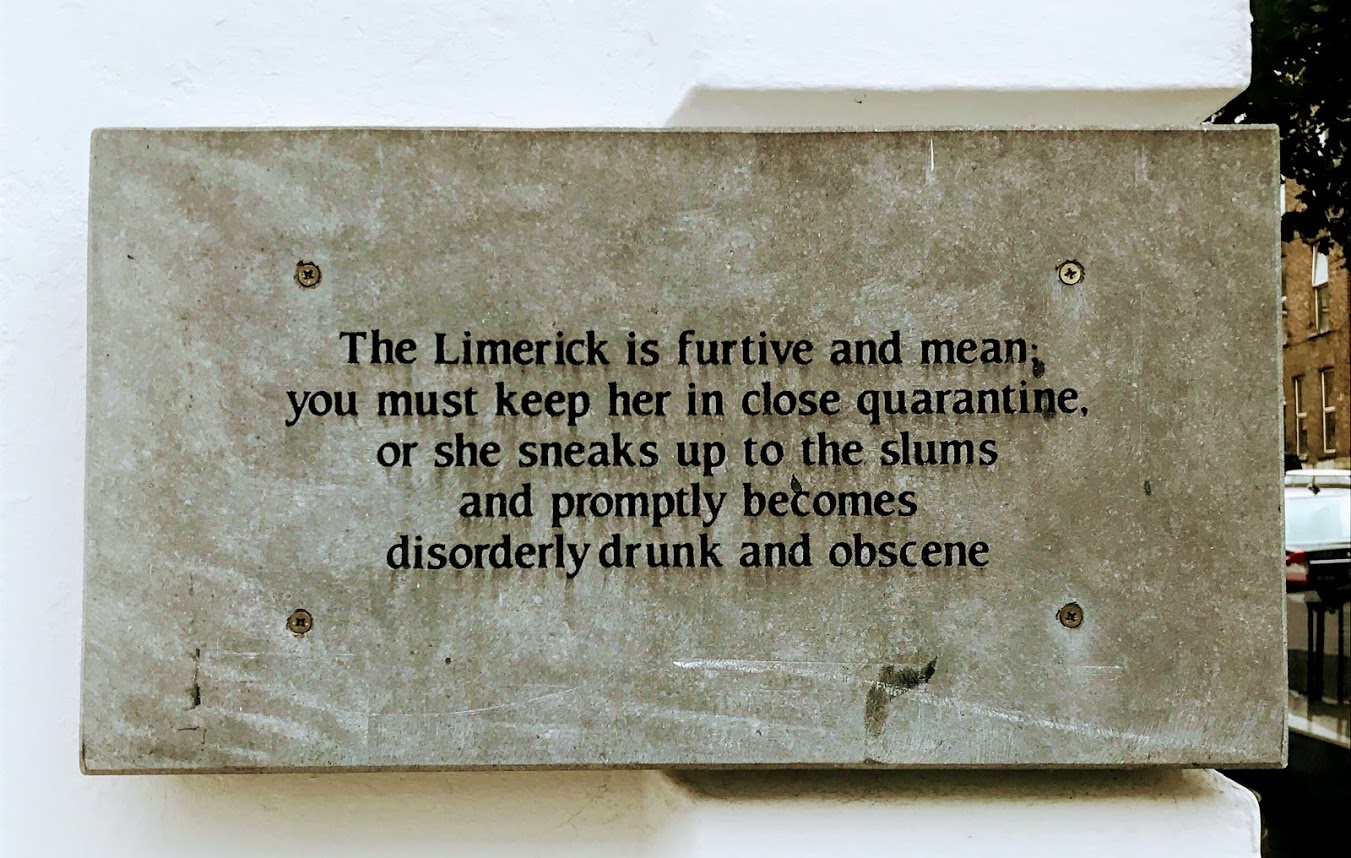
The lure of the Limerick … lines on the corner of Limerick’s White House (Photograph: Patrick Comerford, 2017)

Patrick Comerford

On a street corner in Limerick, an inscribed stone juts out from O’Connell Street into Glentworth Street, with the words:

The Limerick is furtive and mean;
you must keep her in close quarantine,
or she sneaks up to the slums
and promptly becomes
disorderly, drunk, and obscene.


For many Limerick, Limericks and poetry are difficult to separate. For some, the Limerick may have been their introduction to poetry, for others they never moved beyond the fun of the Limerick to enjoy the breadth of opportunity offered by poetry.

It is widely thought that Edward Lear invented the Limerick, although this is probably incorrect.

The Limerick as a form was popularised by Edward Lear in his first Book of Nonsense (1846) and a later work, More Nonsense, Pictures, Rhymes, Botany, etc. (1872). Lear wrote 212 Limericks, mostly considered nonsense literature. The humour is not in the punch line ending but rather in the tension between meaning and the lack of meaning.

In one of his typical Limericks, Lear wrote:

There was a Young Person of Smyrna
Whose grandmother threatened to burn her.
But she seized on the cat,
and said ‘Granny, burn that!
You incongruous old woman of Smyrna!’


Whether he invented it or not, Lear certainly made the Limerick popular. The Oxford English Dictionary first defined the word Limerick in 1892, four years after Lear’s death. But as OE Parrott makes clear in the opening pages of The Penguin Book of Limericks:

The Limerick’s birth is unclear:
Its genesis owed much to Lear.
It started as clean,
But soon went obscene.
And this split haunts its later career.


But in Limerick, it is said the five-line verse probably originated from the Limerick-makers of Croom, known as the Maigue poets, who worked in the 18th century. They were school-teachers, priests and self-styled persons of letters, living within 30 km of Croom. Their gatherings and revels in pubs and inns were said to resemble the ancient Irish bardic schools, conducted in Greek, Latin and Irish.

One of the Maigue’s first-known Limerick-writers was a publican, John O’Toumy, who was born near Croom in 1706. Of his own business practices, he bemoaned:

I sell the best brandy and sherry,
To make my good customers merry.
But at times their finances
Run short as it chances,
And then I feel very sad, very.


To this another Maigue poet, Andrew McCrath, quickly retorted:

O’Toumy! You boast yourself handy
At selling good ale and fine brandy,
But the fact is your liquor
Makes everyone sicker,
I tell you that, I, your friend, Andy.


Ronald Knox caricatured the philosophy and theology of the I8th century Irish bishop George Berkeley in a pair of Limericks:

There was a young man who said, ‘God
Must think it exceedingly odd
If he finds that this tree
Continues to be
When there’s no-one about in the Quad.’


And the reply, according to Knox was:

Dear Sir:
Your astonishment’s odd:
I am always about in the Quad.
And that’s why the tree
Will continue to be,
Sincerely observed by, Yours faithfully, GOD.


The poet WH Auden, whose literary corpus is marked by thoughtfulness and solemnity, seemed to find release in the humour of the Limerick:

T.S. Eliot is quite at a loss
When clubwomen bustle across
At literary teas,
Crying: ‘What, if you please,
Did you mean by The Mill on the Floss?’


The plaque celebrating the fun of the Limerick is on a corner of Limerick’s White House pub, which dates back to 1812. One previous manager attributed the pub’s enduring success over the past 200 years to the fact that it is ‘simple in its design, everything works. It has basically been untouched since it first opened.’

This has been a favourite haunt of bankers, lawyers, artists and musicians. Jack Charlton, Jim Kemmy, Frank McCourt and Richard Harris are all said to have had a pint here.

The pub earned its name not because of its colour but because the company that first opened the White House was WH White & Co. It was bought by Eamonn Gleeson and his family in the 1920s. Eamon Gleeson, whose picture hangs proudly in the bar, was noted as ‘an eccentric, who used to wire all the bar stools together so they couldn’t be moved.’

For a long time the bar and its management prided themselves on the fact that this was one of the few pubs in Limerick not to have a TV, focusing instead on poetry and acoustic music nights, promoting local writers and singers.

The pub is known for its artistic and cultural heritage. The White House poetry nights have featured poets from all over the world, and the pub has always been supportive of actors, writers and musicians. The pub was bought in 1999 for the equivalent of €1 million. But the poetry nights continued, and in 2015 the White House celebrated a cultural milestone in marking 600 consecutive poetry nights.

When the White House was bought last year by the former Munster and Ireland rugby player Damien Varley, reportedly for €650,000, a Facebook page was set up to save the pub from being turned into a sports bar.

The White House has a late 19th century shopfront and a Victorian pub interior (Photograph: Patrick Comerford, 2017)

The White House is a prominent building at the corner of O’Connell Street and Glentworth Street. It was designed to address both streetscapes in a formal architectural manner. The late 19th century shopfront and the Victorian pub interior make this building one of architectural importance.

This end-of-terrace, two-bay, four-storey building over a concealed basement has a three-bay, four-storey over basement south-facing side elevation. It was first built as a red-brick townhouse about 1810, but the shopfront dates from the late 19th century, with Doric pilasters on both elevations rising from ‘crazy’ tiled stall-riser plinths flanking both door openings and display windows, and supporting a timber framed fascia board with incised lettering behind glass panes that reads: ‘James Gleeson.’

The roof is concealed behind a parapet wall. Red brick walls laid in Flemish bond with cement repointing. A gantry crane on the side elevation may be original and was probably used to hoist goods to and from the basement level.

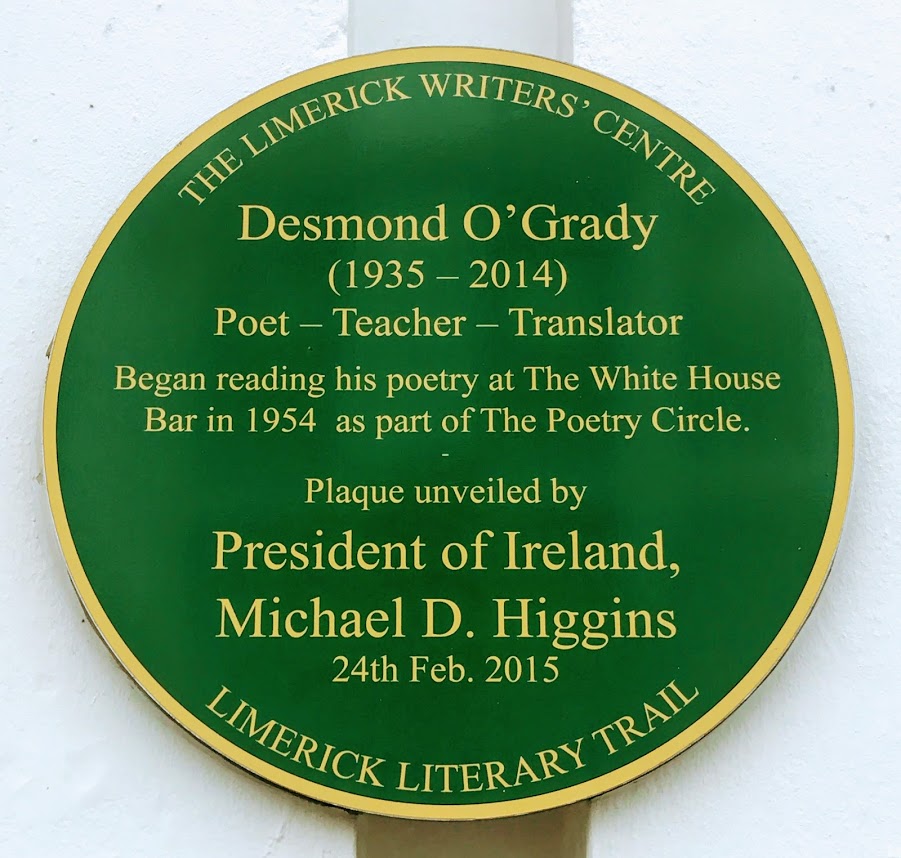
A plaque erected by Limerick Civic Trust on the left-hand side of the O’Connell Street façade was unveiled by President Michael D Higgins on 24 February 2015 as a tribute to the Limerick-born poet Desmond O’Grady (1935-2014), who began reading his poetry at the White House Bar in 1954 as part of the Poetry Circle.

When Desmond O’Grady died at the age of 78 in 2014, President Michael D Higgins led the tributes, describing him as one of Ireland’s best-known poets, who was deeply committed to his work.

With the exception of Yeats, he was arguably the most international of 20th century Irish poets.

His first book, Chords and Orchestrations, was published in 1956. He was the author of almost 20 books of poetry, including My Alexandria (2006), On My Way (2006), The Road Taken: Poems 1956-1996 and The Wandering Celt (2001).

He also published over a dozen collections of translated poetry, among them Trawling Tradition 1954-1994, Selected Poems of CP Cavafy, The Song of Songs, Ten Modern Arab Poets, and Kurdish Poems of Love and Liberty. His other works include prose memoirs of his literary acquaintances and friends.

A plaque on the façade of the White House celebrated the Limerick-born poet Desmond O’Grady (Photograph: Patrick Comerford, 2017)

Desmond O’Grady was born in Limerick in August 1935, and spent much of his childhood in West Clare and the Irish-speaking districts of Co Kerry. After boarding school in Roscrea, Co Tipperary, he moved to Paris in the 1950s and worked in the Shakespeare and Company bookshop, so closely associated with James Joyce and the publication of Ulysses.

He went on to teach in Paris, and there he became friends with Jean-Paul Sartre, Simone de Beauvoir, Pablo Picasso, and Samuel Beckett, who had recently published Waiting for Godot.

When he married an exiled Iraqi Catholic, they moved to Rome, where O’Grady taught English and was the English-language voice of Pope Pius XII on Vatican Radio. In Rome, he also met Federico Fellini and played the role of an Irish poet in Fellini’s La Dolce Vita. For some years, he was secretary to the American poet Ezra Pound in his exile in Italy.

When he and his wife separated, he went to teach at Harvard, where he also completed his MA and PhD in Celtic Languages and Literatures and Comparative Studies. At Harvard, he became friends with Robert Lowell, and continued the links he had forged in Europe with the Beat writers Kerouac and Ginsberg. O’Grady also worked as the European editor of The Transatlantic Review.

He returned to his spiritual home on mainland Europe, and from Europe, he went to Egypt. While was absorbing, distilling, and writing, he was teaching at the American University in Cairo, where he was Poet in Residence, and at the University of Alexandria.

When he returned to live in Ireland, he settled in Kinsale, Co Cork, where he lived for the last 20 years of his life.

We met soon after his return to Ireland, and had a lengthy discussion about the Greek poet CP Cavafy, who was born in Alexandria. Over 20 years ago, in ‘An Irishman’s Diary’ in The Irish Times in 1996, I wondered why little attention had been given to his translation of 33 of Cavafy’s poems. This version of 33 Cavafy poems, Alternative Manners, was published in 1993 by the Hellenic Society (Athens and Alexandria). Unfortunately, much to his regret, the proofs were never properly corrected, and so the book was never put on the market commercially and has never been reviewed in newspapers.

He felt Alternative Manners ‘reads like Greek ruins’ and asked later readers to ‘please forgive, and overlook, and correct.’ But, he conceded modestly, the collection had its admirers. ‘Greek people who know their Cavafy and who have read it found my Hiberno English very suited to Cavafy’s Alexandrian Greek, and closer to the text of Cavafy’s language than standard British and American translations.’

A reading of two of Cavafy's best-known poems illustrates the particular insights and turn of phrase which an Irish translator brought to his work. His translation of Ithaka loses the references by Kimon Friar and Edmund Keeley and Philip Sherrard to Laistrygonians and Cyclops; instead, they become ‘cannibal bogeymen met in half light’ and ‘those with one eye, open for their main chance.’ The ‘Phoenician trading stations’ or ‘market places’ of the other translators become ‘ports you’ve not dreamed of’ and ‘every city.’

In Waiting for the Barbarians, Sherrard and Keeley have the city fathers ‘assembled in the forum’ and Friar has them mustered in the forum, but O’Grady, who renames the poem Expecting the Barbarians, has them ‘waiting, here in the square.’ Instead of the barbarians being dazzled, they are not impressed by ‘bamboozle.’ And, instead of rhetoric and public speaking or ‘eloquence and public speeches,’ O’Grady speaks of ‘boring baloney.’

At the time, I noted how O’Grady had come to regard Greece as his second home. I suggested his earlier frustration with the Greek printer’s handling of Alternative Manners ‘could be rectified if an Irish publisher found an interest in the book.’

That hope was realised in 1998, when the Dedalus Press in Dublin published Selected Poems of CP Cavafy, a volume that was reissued in 2012, two years before he died.

Desmond O’Grady was unusual among Irish poets of his generation for both his interest in modernist experimentation and his immersion in the poetry of other cultures. He was, in the true sense, a citizen of world poetry.

He died in 2014, on the eve of his 79th birthday. In his later years he took comfort in the theme in Cavafy’s Ithaka – it is the journey, not the destination, is what constitutes our true reward:

Keep Ithaka marked on your mind’s map,
always. Arrival there is your final goal.
Don’t hurry your journey in any way. Better
to last it for decades. As you age, anchor
at small islands with the wealth you’ve acquired
voyaging. Never expect Ithaka to give you anything.
Ithaka gave you the journey.


CP Cavafy ... a portrait by David Hockney

20 May 2016

Standing at the edge of the world
during a weekend in Bantry Bay

A weekend in the Maritime Hotel in Bantry Bay

Patrick Comerford

Although my mother was born in Millstreet, Co Cork, Cork is a county that I do not know very well.

I am reasonably familiar with Cork City, and have in recent years have been delighted to get to know Saint Fin Barre’s Cathedral. But until my now-sons were in their early teens and attended a summer camp in Kinsale about 15 years ago, I was unsure of the geography of Co Cork

Indeed, until recently, the furthest west I had been in West Cork was Rosscarbery, for a short visit to Saint Fachtna’s Cathedral, Ross, and I might have been unable to tell my Bandon from my Bantry.

Now, thanks to a very special present, I am spending the weekend in Bantry in West Cork, staying at the Maritime Hotel on Bantry Bay, close to the three rugged peninsulas of Mizen Head, Sheep’s Head and Beara, stretching out like toes at the end of the foot of the island of Ireland.

In this decade of centenary commemorations, I am reminded that Bantry is the birthplace of both William Martin Murphy, who gained notoriety for his confrontation with Jim Larkin and James Connolly during the Dublin Lockout in 1913, and his friend Tim Healy (1855-1931), the combative former Home Rule MP who played a part in split in in 1891 and later became the first Governor-General of the Irish Free State.

Bantry is an excellent base for seeing the glorious scenery of West Cork and the Maritime Hotel is in the town and by the sea.

In Bantry, there are the town’s expansive square and Bantry House and estate, with commanding views over the colourful vista of the inner bay. Nearby too are Glengarriff with its forests, Schull, Castletownsend and Baltimore, all by the sea, and to the west the Healy Pass that leads on to Kenmare.

Here too are Barleycove Beach, Garnish Island, the Dursey Island Cable Car, and the Ring of Beara, as well as hundreds of inlets, tiny coves, safe harbours and blue flag beaches that are so attractive as the daylight stretches into the late evening at this point in late May. Nearby islands include Whiddy Island, Sherkin Island, Cape Clear Island and Seal Island.

At the end of two long working weeks that have included a full working weekend, it was a long journey from Dublin this afternoon, and from the point of view of the front-seat, map-reading passenger, this is one of the most remote and distant parts of Ireland for anyone living in Dublin. Indeed, Mizen Head, with its signal station and visitors’ centre at the south-west tip of Ireland, invites visitors to “stand at the edge of the world.”

20 July 1996

An Irishman’s Diary: CP Cavafy

An Irishman’s Diary
Patrick Comerford


CP Cavafy ... a portrait by David Hockney

IT IS HARD to imagine that modern Egypt dates from 1799, when Napoleon drove out the Turks. It is even harder to imagine that until this century, the port city of Alexandria was one of the major centres of Greek culture and civilisation.

In a heated conversation late one night or early some morning in a taverna in Crete, I was told pointedly by a Greek whose grandparents came from the city that “there were Greeks living in Alexandria when Moses was a boy.”

The city, of course, takes its name from Alexander the Great. But it is well to remember that Cleopatra was not an Egyptian but a Greek, and that in classical times Alexandria was as purely Hellenic as Ptolemy, the founder of the dynasty of Greek monarchs which ruled the city for generations. This first Ptolemy was determined to make his capital the world centre of culture, the “Glory of the Ptolemies”:

The mentor city, the Hel-
lenic world’s acme, wisest in all the arts, in all:
philosophy.


In the mid 19th century, Greeks controlled the commercial life of Cairo, Khartoum and Alexandria, and in 1900, there were still 20,000 Greeks in Alexandria.

It is no accident, therefore, that Constantine Cavafy, hailed by Kimon Friar as “the undisputed founder of modern Greek poetry”, was born in Alexandria in 1863 and lived there for most for of his life, living in declining grandeur as a civil servant until his death in 1933. When his relatives, scandalised by the neighbourhood, implored him to leave his flat at 19 Rue Lepius, he went to the window drew back the curtain and asked. Where else could I be better situated than here, amidst these three centres of existence, a brothel, a church which forgives, and a hospital where you?

Craved recognition

During his life, Cavafy craved public recognition. He was introduced to English readers early in the century by F.M. Forster, T.S. Eliot, T.E. Lawrence, and Arnold Toynbee, and he is the genius loci in Lawrence Durrell’s Alexandria Quartet. But his own sister forbade her daughter to read, her Uncle Constantine's, disreputable verses, scandalised by his homosexuality, decadence and rejection of the Orthodox Church.

Cavafy went unrecognised and without appreciation from the Athenian literati until some time after the publication of his first collected edition in 1935, two years after his death.

Today, he is read in every Greek school, and schoolchildren easily recite poems such as Ithaka, Waiting for the Barbarians, The City, and The god abandons Anthony. He has been popularised among English language readers with translations by Peter Bien, Kimon Friar, John Mavrogordato, Edmund Keeley and Philip Sherrard, among others, and major studies by Friar, Sherrard, Christopher Robinson of Christ Church, Oxford, and Peter Bien of Dartmouth. His popularity was confirmed when poems by Cavafy were read at the funeral of Jackie Kennedy Onassis.

Yet little attention has been given to a translation of 33 of Cavafy’s poems by the Irish poet, Desmond O’Grady. O’Grady, who was born in Ireland in 1935, later travelled as a student and teacher throughout Europe, America and Egypt, where he taught at the American, University of Cairo and the University of Alexandria.

In recent years, with a grant from the Cultural Relations Committee of the Department of Foreign Affairs, he was able to accept an invitation from the Greek poet Kostis Moskof to go back to Alexandria.

Through the tireless efforts of Moskof, the Hellenic Foundation and other admirers of Cavafy’s poetry, and his cultural legacy, Cavafy’s house at 10 Rue Lepsius (now Sharm elSheykli) has been restored to what it looked like when the poet lived there and has been turned into a museum and library in his memory.

Returning to Egypt and the English Department of the American University in Cairo, O’Grady completed his translation of a selection of Cavafy’s poems, and Alternative Manners, his version of 33 Cavafy poems, was published in 1993 by the Hellenic Society, Athens Alexandria. Unfortunately, much to his regret, the proofs were never properly corrected. And so the book was never put on the market commercially and has never been reviewed in newspapers.

Readers, forgive

He feels Alternative Manners “reads like Greek ruins” and asks readers now to “please forgive, and overlook, and correct.” But, he concedes modestly, the collection has its admirers. “Greek people who know their Cavafy and who have read it found my Hiberno English very suited to Cavafy’s Alexandrian Greek, and closer to the text of Cavafy’s language than standard British and American translations.”

A reading of two of Cavafy’s best known poems illustrates the particular insights and turn of phrase which an Irish translator can bring to his work.

His translation of Ithaka loses the references by Friar and Keeley and Sherrard to Laistrygonians and Cyclops; instead, they become “cannibal bogeymen met in half light” and “those with one eye, open for their main chance.” The “Phoenician trading stations” or “market places” of the other translators become “ports you’ve not dreamed of” and “every city”.

In Waiting for the Barbarians, Sherrard and Keeley have the city fathers “assembled in the forum” and Friar has them mustered in the forum but O’Grady has them “waiting, here in the square.” Instead of the barbarians being dazzled, they are not impressed by “bamboozle”. And, instead of rhetoric and public speaking or “eloquence and public speeches”, O’Grady speaks of boring baloney.

Secretary to Pound

For some years, Desmond O’Grady was secretary to the American poet Ezra Pound in his exile in Italy. Now he lives in Kinsale, but regards Greece as his second home. His work as a poet has, of course, been recognised at home, where he is a member of Aosdana, and where he has been back for the opening of “Waves of the Sea”, the new writers’ and translators’ centre.

His earlier frustration with the printers handling of Alternative Manners could be rectified if an Irish publisher found an interest in the book. But in the meantime, he can take comfort from the theme in Cavafy’s Ithaka: the journey, not the destination, is what constitutes our true reward.

This ‘Irishman’s Diary’ was first published in ‘The Irish Times’ on 20 July 1996