The Ascension depicted in the West Window in Norwich Cathedral (Photograph: Patrick Comerford, 2024)
Patrick Comerford
Easter is a 50-day season that continues until the Day of Pentecost (19 May 2024). This week began with the Sixth Sunday of Easter (Easter VI), and yesterday was Ascension Day (9 May 2024). Easter was celebrated in the Greek Orthodox Church on Sunday (5 May), and today is known in the Orthodox Church as ‘Bright Friday.’
Throughout this Season of Easter, my morning reflections each day include the daily Gospel reading, the prayer in the USPG prayer diary, and the prayers in the Collects and Post-Communion Prayer of the day. As yesterday was Ascension Day, the Ascension theme continues in the photographs in my prayer diary this morning.
I have yet another medical appointment in Stony Stratford later this morning. But, before this day begins, I am taking some quiet time this morning to give thanks, for reflection, prayer and reading in these ways:
1, today’s Gospel reading;
2, a prayer from the USPG prayer diary;
3, the Collects and Post-Communion prayer of the day.
The Ascension depicted in the East Window in Saint Giles Church, Oxford (Photograph: Patrick Comerford, 2024)
John 16: 20-23 (NRSVA):
[Jesus said:] 20 ‘Very truly, I tell you, you will weep and mourn, but the world will rejoice; you will have pain, but your pain will turn into joy. 21 When a woman is in labour, she has pain, because her hour has come. But when her child is born, she no longer remembers the anguish because of the joy of having brought a human being into the world. 22 So you have pain now; but I will see you again, and your hearts will rejoice, and no one will take your joy from you. 23 On that day you will ask nothing of me. Very truly, I tell you, if you ask anything of the Father in my name, he will give it to you.’
The Ascension depicted in a stained-glass window by Burlison and Gryllis in Saint Michael’s Church, St Albans (Photograph: Patrick Comerford, 2024)
Today’s Prayers (Friday 10 May 2024):
The theme this week in ‘Pray With the World Church,’ the Prayer Diary of the Anglican mission agency USPG (United Society Partners in the Gospel), is ‘Thy Kingdom Come.’ This theme was introduced on Sunday with some Reflections.
The USPG Prayer Diary today (10 May 2024) invites us to pray:
Father God, we pray in hope for all people who have not yet heard the Good News of Jesus Christ and his love for the world. May they hear it for themselves and respond and follow him.
The Collect:
O God the King of glory,
you have exalted your only Son Jesus Christ
with great triumph to your kingdom in heaven:
we beseech you, leave us not comfortless,
but send your Holy Spirit to strengthen us
and exalt us to the place where our Saviour Christ is gone before,
who is alive and reigns with you,
in the unity of the Holy Spirit,
one God, now and for ever.
Post Communion Prayer:
Eternal God, giver of love and power,
your Son Jesus Christ has sent us into all the world
to preach the gospel of his kingdom:
confirm us in this mission,
and help us to live the good news we proclaim;
through Jesus Christ our Lord.
Additional Collect:
Risen, ascended Lord,
as we rejoice at your triumph,
fill your Church on earth with power and compassion,
that all who are estranged by sin
may find forgiveness and know your peace,
to the glory of God the Father.
Yesterday’s reflection
Continued tomorrow
The Ascension depicted in a stained-glass window in Saint Thomas the Apostle Church, Heptonstall (Photograph: Patrick Comerford, 2023)
Scripture quotations are from the New Revised Standard Version Bible: Anglicised Edition copyright © 1989, 1995, National Council of the Churches of Christ in the United States of America. Used by permission. All rights reserved worldwide. http://nrsvbibles.org
Showing posts with label Heptonstall. Show all posts
10 May 2024
06 August 2023
Daily prayers in Ordinary Time
with USPG: (70) 6 August 2023
The Transfiguration depicted in a window in Saint Thomas the Apostle Church in Heptonstall (Photograph: Patrick Comerford, 2023)
Patrick Comerford
We are in Ordinary Time in the Church Calendar, and today is the Ninth Sunday after Trinity (6 August 2023), which may also be celebrated as the Feast of the Transfiguration.
Before this day begins, I am taking some time this morning for prayer, reading and reflection in these ways:
1, Looking at a images of the Transfiguration I have seen recently;
2, the Gospel reading of the day in the Church of England lectionary;
3, a prayer from the USPG prayer diary.
The Reredos above the High Altar in Saint Andrew’s Church, Rugby, has a painting by Alec Millar (1909), based on Fra Angelico’s painting of the Transfiguration (1441) in Florence (Photograph: Patrick Comerford, 2023)
Images of the Transfiguration:
Today marks the 78th anniversary of the atomic bombing of Hiroshima on 6 August 1945 and Wednesday marks the bombing of Nagasaki on 9 August 1945. Later this morning, I plan to attend the Parish Eucharist in the Church of Saint Mary and Saint Giles in Stony Stratford. Later in the evening, I hope to attend the Hiroshima Anniversary Commemorations at the Japanese Peace Pagoda by Willen Lake in Milton Keynes.
Hundreds of thousands of people died in the attacks either immediately or from the consequential damage in the months and years that followed. Christian CND and the Anglican Pacifist Fellowship are holding their annual online vigil this evening to remember the bombings of Hiroshima and Nagasaki, with readings, prayers and music, and prayers for the victims and survivors of nuclear weapons and for a nuclear weapons-free future. Tjis vigil is at 8 pm (UK time), 9 pm (CET) 3 pm (EDT), online on Zoom. Registration is free at www.christiancnd.org.uk/events.
This morning I am looking again at some images of the Transfiguration I have seen in churches I have visited in recent months.
The Transfiguration is depicted in a window in Saint Thomas the Apostle Church in Heptonstall in Yorkshire. The newer church was built in 1850-1854 to replace the older mediaeval parish church dedicated to Saint Thomas a’ Becket.
The two churches stand side-by-side, and the stained glass windows in the Victorian church, including the Transfiguration window, include fine work from the late 19th and early 20th centuries.
The Reredos behind the High Altar in Saint Andrew’s Church, Rugby, is a painting by Alec Millar (1909), based on Fra Angelico’s painting of the Transfiguration (1441). The original of this is in Saint Mark’s Monastery in Florence.
In Saint Andrew’s Church, Great Linford, the three-light East Window by John Oldrid Scott and Henry Victor Milner (1889) is inspired by the canticle Te Deum. The East Window and the Reredos were erected in memory of Mary Uthwatt of Great Linford, who died in 1885. But the reredos was moved in the 1970s to an unusual place on the north wall, above the entrance from the north porch. This triptych shows the Transfiguration in the centre, with Saint Andrew on the left, and Saint Philip on the right.
The icon of the Transfiguration is one of the five new icons recently installed in the Lady Chapel in Lichfield Cathedral. The five icons are of: the Baptism of Christ; the Wedding at Cana; the Preaching of the Kingdom of God; the Transfiguration; and the Last Supper.
These five icons were used each week as a point of discussion during the Lenten discussions in Lichfield Cathedral earlier this year. These too will add to the cathedral’s role as a destination for pilgrims and for all who seek healing.
The Transfiguration reredos in Saint Andrew’s Church, Great Linford … moved in the 1970s to the north wall, above the entrance from the north porch (Photograph: Patrick Comerford)
Luke 9: 28-36 (NRSVA):
28 Now about eight days after these sayings Jesus took with him Peter and John and James, and went up on the mountain to pray. 29 And while he was praying, the appearance of his face changed, and his clothes became dazzling white. 30 Suddenly they saw two men, Moses and Elijah, talking to him. 31 They appeared in glory and were speaking of his departure, which he was about to accomplish at Jerusalem. 32 Now Peter and his companions were weighed down with sleep; but since they had stayed awake, they saw his glory and the two men who stood with him. 33 Just as they were leaving him, Peter said to Jesus, ‘Master, it is good for us to be here; let us make three dwellings, one for you, one for Moses, and one for Elijah’ – not knowing what he said. 34 While he was saying this, a cloud came and overshadowed them; and they were terrified as they entered the cloud. 35 Then from the cloud came a voice that said, ‘This is my Son, my Chosen; listen to him!’ 36 When the voice had spoken, Jesus was found alone. And they kept silent and in those days told no one any of the things they had seen.
The Transfiguration … one of five new icons in Lichfield Cathedral (Photograph: Patrick Comerford, 2023)
Today’s Prayer:
The theme this week in ‘Pray With the World Church,’ the Prayer Diary of the Anglican mission agency USPG (United Society Partners in the Gospel), is ‘A reflection on the Exodus narrative (Exodus 1-13).’ This theme is introduced today by Archbishop Linda Nicholls, who has been the Primate of the Anglican Church of Canada since 2019. She writes:
The Hebrew people arrived in Egypt fleeing drought and famine in their own land. They came following Joseph whose leadership had wisely preserved food in anticipation of hard times (Genesis 41: 57). They settled in Egypt, initially in Goshen as shepherds and herders.
“They grew to outnumber the Egyptians which raised fears for a new Pharaoh. Therefore, they set taskmasters over them to oppress them with forced labour” (Exodus 1: 7-11, paraphrased).
They continued to flourish so the oppressions increased. Moses is called by God to release the Israelites from their oppression (Exodus 5: 1), ‘Let my people go’. He begins by asking for permission for them to worship (Exodus 5: 1 ff). Instead, they are expected to work harder, longer with fewer resources – no straw provided for making bricks and no relief in expected production.
As the people cry for relief, God invites Moses to lead the people out of slavery into a promise of freedom and land. “Then the Lord said, “I have observed the misery of my people who are in Egypt; I have heard their cry on account of their taskmasters. Indeed, I know their sufferings, and I have come down to deliver them from the Egyptians, and to bring them up out of that land to a good and broad land, a land flowing with milk and honey…” (Exodus 5: 7-9). Then begin the confrontations with Pharaoh to obtain the release of the people, culminating in the Passover and the crossing of the Red Sea by the Israelites.
This great narrative is the foundational text of redemption for the Jewish people, recited at every Passover celebration. It also invites us to reflect on the dynamics of slavery, oppression, and power and God’s call to action.
The Archbishop’s reflection from Tanzania and full Bible study can be read here.
The USPG Prayer Diary today (6 August 2023) invites us to pray in these words:
Lord, you are a God who sets the captives free. Your Spirit searches restlessly for those in despair, that they may find the life you are calling them to. We pray for those who are being trafficked and callously put to work in our region. May we who are blinded by the shallow distractions of daily life, feel the fear of the cornered and be roused to action. Through Jesus Christ our Lord. Amen. (Clewer Initiative).
The Collect:
Father in heaven,
whose Son Jesus Christ was wonderfully transfigured
before chosen witnesses upon the holy mountain,
and spoke of the exodus he would accomplish at Jerusalem:
give us strength so to hear his voice and bear our cross
that in the world to come we may see him as he is;
who is alive and reigns with you,
in the unity of the Holy Spirit,
one God, now and for ever.
The Post Communion Prayer:
Holy God,
we see your glory in the face of Jesus Christ:
may we who are partakers at his table
reflect his life in word and deed,
that all the world may know his power to change and save.
This we ask through Jesus Christ our Lord.
An icon of the Transfiguration in the church in Piskopiano in Crete (Photograph: Patrick Comerford)
Yesterday’s reflection
Continued tomorrow
Scripture quotations are from the New Revised Standard Version Bible: Anglicised Edition copyright © 1989, 1995, National Council of the Churches of Christ in the United States of America. Used by permission. All rights reserved worldwide. http://nrsvbibles.org
The Monastery of the Transfiguration or Great Meteoron in Meteora, northern Greece (Photograph: Patrick Comerford)
Patrick Comerford
We are in Ordinary Time in the Church Calendar, and today is the Ninth Sunday after Trinity (6 August 2023), which may also be celebrated as the Feast of the Transfiguration.
Before this day begins, I am taking some time this morning for prayer, reading and reflection in these ways:
1, Looking at a images of the Transfiguration I have seen recently;
2, the Gospel reading of the day in the Church of England lectionary;
3, a prayer from the USPG prayer diary.
The Reredos above the High Altar in Saint Andrew’s Church, Rugby, has a painting by Alec Millar (1909), based on Fra Angelico’s painting of the Transfiguration (1441) in Florence (Photograph: Patrick Comerford, 2023)
Images of the Transfiguration:
Today marks the 78th anniversary of the atomic bombing of Hiroshima on 6 August 1945 and Wednesday marks the bombing of Nagasaki on 9 August 1945. Later this morning, I plan to attend the Parish Eucharist in the Church of Saint Mary and Saint Giles in Stony Stratford. Later in the evening, I hope to attend the Hiroshima Anniversary Commemorations at the Japanese Peace Pagoda by Willen Lake in Milton Keynes.
Hundreds of thousands of people died in the attacks either immediately or from the consequential damage in the months and years that followed. Christian CND and the Anglican Pacifist Fellowship are holding their annual online vigil this evening to remember the bombings of Hiroshima and Nagasaki, with readings, prayers and music, and prayers for the victims and survivors of nuclear weapons and for a nuclear weapons-free future. Tjis vigil is at 8 pm (UK time), 9 pm (CET) 3 pm (EDT), online on Zoom. Registration is free at www.christiancnd.org.uk/events.
This morning I am looking again at some images of the Transfiguration I have seen in churches I have visited in recent months.
The Transfiguration is depicted in a window in Saint Thomas the Apostle Church in Heptonstall in Yorkshire. The newer church was built in 1850-1854 to replace the older mediaeval parish church dedicated to Saint Thomas a’ Becket.
The two churches stand side-by-side, and the stained glass windows in the Victorian church, including the Transfiguration window, include fine work from the late 19th and early 20th centuries.
The Reredos behind the High Altar in Saint Andrew’s Church, Rugby, is a painting by Alec Millar (1909), based on Fra Angelico’s painting of the Transfiguration (1441). The original of this is in Saint Mark’s Monastery in Florence.
In Saint Andrew’s Church, Great Linford, the three-light East Window by John Oldrid Scott and Henry Victor Milner (1889) is inspired by the canticle Te Deum. The East Window and the Reredos were erected in memory of Mary Uthwatt of Great Linford, who died in 1885. But the reredos was moved in the 1970s to an unusual place on the north wall, above the entrance from the north porch. This triptych shows the Transfiguration in the centre, with Saint Andrew on the left, and Saint Philip on the right.
The icon of the Transfiguration is one of the five new icons recently installed in the Lady Chapel in Lichfield Cathedral. The five icons are of: the Baptism of Christ; the Wedding at Cana; the Preaching of the Kingdom of God; the Transfiguration; and the Last Supper.
These five icons were used each week as a point of discussion during the Lenten discussions in Lichfield Cathedral earlier this year. These too will add to the cathedral’s role as a destination for pilgrims and for all who seek healing.
The Transfiguration reredos in Saint Andrew’s Church, Great Linford … moved in the 1970s to the north wall, above the entrance from the north porch (Photograph: Patrick Comerford)
Luke 9: 28-36 (NRSVA):
28 Now about eight days after these sayings Jesus took with him Peter and John and James, and went up on the mountain to pray. 29 And while he was praying, the appearance of his face changed, and his clothes became dazzling white. 30 Suddenly they saw two men, Moses and Elijah, talking to him. 31 They appeared in glory and were speaking of his departure, which he was about to accomplish at Jerusalem. 32 Now Peter and his companions were weighed down with sleep; but since they had stayed awake, they saw his glory and the two men who stood with him. 33 Just as they were leaving him, Peter said to Jesus, ‘Master, it is good for us to be here; let us make three dwellings, one for you, one for Moses, and one for Elijah’ – not knowing what he said. 34 While he was saying this, a cloud came and overshadowed them; and they were terrified as they entered the cloud. 35 Then from the cloud came a voice that said, ‘This is my Son, my Chosen; listen to him!’ 36 When the voice had spoken, Jesus was found alone. And they kept silent and in those days told no one any of the things they had seen.
The Transfiguration … one of five new icons in Lichfield Cathedral (Photograph: Patrick Comerford, 2023)
Today’s Prayer:
The theme this week in ‘Pray With the World Church,’ the Prayer Diary of the Anglican mission agency USPG (United Society Partners in the Gospel), is ‘A reflection on the Exodus narrative (Exodus 1-13).’ This theme is introduced today by Archbishop Linda Nicholls, who has been the Primate of the Anglican Church of Canada since 2019. She writes:
The Hebrew people arrived in Egypt fleeing drought and famine in their own land. They came following Joseph whose leadership had wisely preserved food in anticipation of hard times (Genesis 41: 57). They settled in Egypt, initially in Goshen as shepherds and herders.
“They grew to outnumber the Egyptians which raised fears for a new Pharaoh. Therefore, they set taskmasters over them to oppress them with forced labour” (Exodus 1: 7-11, paraphrased).
They continued to flourish so the oppressions increased. Moses is called by God to release the Israelites from their oppression (Exodus 5: 1), ‘Let my people go’. He begins by asking for permission for them to worship (Exodus 5: 1 ff). Instead, they are expected to work harder, longer with fewer resources – no straw provided for making bricks and no relief in expected production.
As the people cry for relief, God invites Moses to lead the people out of slavery into a promise of freedom and land. “Then the Lord said, “I have observed the misery of my people who are in Egypt; I have heard their cry on account of their taskmasters. Indeed, I know their sufferings, and I have come down to deliver them from the Egyptians, and to bring them up out of that land to a good and broad land, a land flowing with milk and honey…” (Exodus 5: 7-9). Then begin the confrontations with Pharaoh to obtain the release of the people, culminating in the Passover and the crossing of the Red Sea by the Israelites.
This great narrative is the foundational text of redemption for the Jewish people, recited at every Passover celebration. It also invites us to reflect on the dynamics of slavery, oppression, and power and God’s call to action.
The Archbishop’s reflection from Tanzania and full Bible study can be read here.
The USPG Prayer Diary today (6 August 2023) invites us to pray in these words:
Lord, you are a God who sets the captives free. Your Spirit searches restlessly for those in despair, that they may find the life you are calling them to. We pray for those who are being trafficked and callously put to work in our region. May we who are blinded by the shallow distractions of daily life, feel the fear of the cornered and be roused to action. Through Jesus Christ our Lord. Amen. (Clewer Initiative).
The Collect:
Father in heaven,
whose Son Jesus Christ was wonderfully transfigured
before chosen witnesses upon the holy mountain,
and spoke of the exodus he would accomplish at Jerusalem:
give us strength so to hear his voice and bear our cross
that in the world to come we may see him as he is;
who is alive and reigns with you,
in the unity of the Holy Spirit,
one God, now and for ever.
The Post Communion Prayer:
Holy God,
we see your glory in the face of Jesus Christ:
may we who are partakers at his table
reflect his life in word and deed,
that all the world may know his power to change and save.
This we ask through Jesus Christ our Lord.
An icon of the Transfiguration in the church in Piskopiano in Crete (Photograph: Patrick Comerford)
Yesterday’s reflection
Continued tomorrow
Scripture quotations are from the New Revised Standard Version Bible: Anglicised Edition copyright © 1989, 1995, National Council of the Churches of Christ in the United States of America. Used by permission. All rights reserved worldwide. http://nrsvbibles.org
The Monastery of the Transfiguration or Great Meteoron in Meteora, northern Greece (Photograph: Patrick Comerford)
Labels:
CND,
Great Linford,
Greece 2023,
Heptonstall,
Hiroshima,
Icons,
Lichfield Cathedral,
Meteora,
Mission,
Monasticism,
pacifism,
Piskopiano,
Prayer,
Rugby,
Saint Luke's Gospel,
Stained Glass,
Transfiguration,
USPG
17 May 2023
Morning prayers in Easter
with USPG: (39) 17 May 2023
The Ascension depicted in the east window in the Church of Saint Thomas the Apostle in Heptonstall, West Yorkshire (Photograph: Patrick Comerford, 2023)
Patrick Comerford
This is the Sixth Week of Easter, and Eastertide continues throughout this week and next week, until the Day of Pentecost.
Before this day gets busy, I am taking some time this morning for prayer and reflection. As tomorrow (18 May 2023) is Ascension Day, I am reflecting each morning this week in these ways:
1, Looking at a depiction of the Ascension in images or stained glass windows in a church or cathedral I know;
2, the Gospel reading of the day in the Church of England lectionary;
3, a prayer from the USPG prayer diary.
The East Window in the Church of Saint Thomas the Apostle in Heptonstall, West Yorkshire (Photograph: Patrick Comerford, 2023)
The Ascension Windows, Saint Thomas the Apostle Church, Heptonstall:
The Ascension is the theme in the East Window and a window in the North Wall in Saint Thomas the Apostle Church in Heptonstall, above Hebden Bridge in West Yorkshire, which I was writing about on Monday evening (15 May 2023).
Two churches share the same ground and churchyard in Heptonstall: the mediaeval Church of Saint Thomas a’ Becket, founded in the mid-13th century, and the Church of Saint Thomas the Apostle, built in the 1850s to replace the earlier church.
The East Window in Heptonstall is a five-light window. The lower panels depict the Crucifixion in the three centre panels, with the two thieves on either side. The panel to the left depicts the Nativity, and the panel to the right depicts Christ being buried in the tomb.
Above the Crucifixion scene, the upper panels in the East Window depict the Ascension of Christ in the three centre panels, with the disciples show on either side. The panel to the left depicts the Resurrection, with Christ appearing to Saint Mary Magdalene, while the panel to the right is also a Resurrection scene, depicting Christ at the supper in Emmaus.
The Ascension is also depicted in a window in the north wall of the church.
The Ascension depicted in a window in the north wall of Saint Thomas the Apostle Church in Heptonstall (Photograph: Patrick Comerford, 2023)
John 16: 12-15 (NRSVA):
[Jesus said:] 12 ‘I still have many things to say to you, but you cannot bear them now. 13 When the Spirit of truth comes, he will guide you into all the truth; for he will not speak on his own, but will speak whatever he hears, and he will declare to you the things that are to come. 14 He will glorify me, because he will take what is mine and declare it to you. 15 All that the Father has is mine. For this reason I said that he will take what is mine and declare it to you.’
The Transfiguration depicted in a window in Saint Thomas the Apostle Church in Heptonstall (Photograph: Patrick Comerford, 2023)
Today’s prayer:
The theme this week in the prayer diary of the Anglican mission agency USPG (United Society Partners in the Gospel) is ‘The Ascension.’ USPG’s Global Theologian, the Revd Dr Peniel Rajkumar, reflected on the Ascension in the prayer diary on Sunday.
The USPG Prayer invites us to pray this morning (Wednesday 17 May 2023):
Let us pray for those who have lost loved ones. May they know the support of friends and the comfort of God’s presence.
Collect:
God our redeemer,
you have delivered us from the power of darkness
and brought us into the kingdom of your Son:
grant, that as by his death he has recalled us to life,
so by his continual presence in us he may raise us
to eternal joy;
through Jesus Christ your Son our Lord,
who is alive and reigns with you,
in the unity of the Holy Spirit,
one God, now and for ever.
Post Communion:
God our Father,
whose Son Jesus Christ gives the water of eternal life:
may we thirst for you,
the spring of life and source of goodness,
through him who is alive and reigns, now and for ever.
Saint Thomas the Apostle Church seen from the south porch in the ruins of Saint Thomas a’ Becket Church in Heptonstall (Photograph: Patrick Comerford, 2023)
Yesterday’s reflection
Continued tomorrow
Scripture quotations are from the New Revised Standard Version Bible: Anglicised Edition copyright © 1989, 1995, National Council of the Churches of Christ in the United States of America. Used by permission. All rights reserved worldwide. http://nrsvbibles.org
Patrick Comerford
This is the Sixth Week of Easter, and Eastertide continues throughout this week and next week, until the Day of Pentecost.
Before this day gets busy, I am taking some time this morning for prayer and reflection. As tomorrow (18 May 2023) is Ascension Day, I am reflecting each morning this week in these ways:
1, Looking at a depiction of the Ascension in images or stained glass windows in a church or cathedral I know;
2, the Gospel reading of the day in the Church of England lectionary;
3, a prayer from the USPG prayer diary.
The East Window in the Church of Saint Thomas the Apostle in Heptonstall, West Yorkshire (Photograph: Patrick Comerford, 2023)
The Ascension Windows, Saint Thomas the Apostle Church, Heptonstall:
The Ascension is the theme in the East Window and a window in the North Wall in Saint Thomas the Apostle Church in Heptonstall, above Hebden Bridge in West Yorkshire, which I was writing about on Monday evening (15 May 2023).
Two churches share the same ground and churchyard in Heptonstall: the mediaeval Church of Saint Thomas a’ Becket, founded in the mid-13th century, and the Church of Saint Thomas the Apostle, built in the 1850s to replace the earlier church.
The East Window in Heptonstall is a five-light window. The lower panels depict the Crucifixion in the three centre panels, with the two thieves on either side. The panel to the left depicts the Nativity, and the panel to the right depicts Christ being buried in the tomb.
Above the Crucifixion scene, the upper panels in the East Window depict the Ascension of Christ in the three centre panels, with the disciples show on either side. The panel to the left depicts the Resurrection, with Christ appearing to Saint Mary Magdalene, while the panel to the right is also a Resurrection scene, depicting Christ at the supper in Emmaus.
The Ascension is also depicted in a window in the north wall of the church.
The Ascension depicted in a window in the north wall of Saint Thomas the Apostle Church in Heptonstall (Photograph: Patrick Comerford, 2023)
John 16: 12-15 (NRSVA):
[Jesus said:] 12 ‘I still have many things to say to you, but you cannot bear them now. 13 When the Spirit of truth comes, he will guide you into all the truth; for he will not speak on his own, but will speak whatever he hears, and he will declare to you the things that are to come. 14 He will glorify me, because he will take what is mine and declare it to you. 15 All that the Father has is mine. For this reason I said that he will take what is mine and declare it to you.’
The Transfiguration depicted in a window in Saint Thomas the Apostle Church in Heptonstall (Photograph: Patrick Comerford, 2023)
Today’s prayer:
The theme this week in the prayer diary of the Anglican mission agency USPG (United Society Partners in the Gospel) is ‘The Ascension.’ USPG’s Global Theologian, the Revd Dr Peniel Rajkumar, reflected on the Ascension in the prayer diary on Sunday.
The USPG Prayer invites us to pray this morning (Wednesday 17 May 2023):
Let us pray for those who have lost loved ones. May they know the support of friends and the comfort of God’s presence.
Collect:
God our redeemer,
you have delivered us from the power of darkness
and brought us into the kingdom of your Son:
grant, that as by his death he has recalled us to life,
so by his continual presence in us he may raise us
to eternal joy;
through Jesus Christ your Son our Lord,
who is alive and reigns with you,
in the unity of the Holy Spirit,
one God, now and for ever.
Post Communion:
God our Father,
whose Son Jesus Christ gives the water of eternal life:
may we thirst for you,
the spring of life and source of goodness,
through him who is alive and reigns, now and for ever.
Saint Thomas the Apostle Church seen from the south porch in the ruins of Saint Thomas a’ Becket Church in Heptonstall (Photograph: Patrick Comerford, 2023)
Yesterday’s reflection
Continued tomorrow
Scripture quotations are from the New Revised Standard Version Bible: Anglicised Edition copyright © 1989, 1995, National Council of the Churches of Christ in the United States of America. Used by permission. All rights reserved worldwide. http://nrsvbibles.org
15 May 2023
Twin churches dedicated
to Saint Thomas are
among the ‘architectural
surprises’ in Heptonstall
The ruins of Saint Thomas a’ Becket Church in Heptonstall, dating from the 13th century (Photograph: Patrick Comerford, 2023)
Patrick Comerford
The architectural historian Sir Nikolaus Pevsner described Heptonstall in West Yorkshire as ‘a very handsome hill village of dark stone houses with all kinds of minor architectural surprises.’ The greatest of the ‘architectural surprises’ of this West Yorkshire village above Hebden Bridge is its two churches.
Heptonstall is unique in having has two churches within one churchyard, and both are dedicated to Saint Thomas – although to two different saints: Saint Thomas a’ Becket and Saint Thomas the Apostle, both in the centre of the village, which we visited last week, walking up the steep hill from Hebden Bridge.
The older church has its origins in the 13th century and was ruined by a storm in the mid-19th century.
The Church of Saint Thomas a’ Becket in Heptonstall was founded by the Cluniac Priory of Lewes and was built in 1256-1260 (Photograph: Patrick Comerford, 2023)
The earlier, mediaeval Church of Saint Thomas a’ Becket was founded by the Cluniac Priory of Lewes and was built in 1256-1260 as a chapelry of the larger parish of Halifax, seven miles away. It was dedicated to Saint Thomas the Martyr, Archbishop of Canterbury, murdered in his own cathedral in 1170 on the orders of King Henry II.
This mediaeval church is a low and broad building. Later adaptations gave the church two naves, north and south aisles, two chantry chapels and a tower. A small bellcote above the ruins of the chancel originally housed the sanctus bell, rung during the words of the consecration in the liturgy.
Beside the altar is the piscina where the sacred vessels were rinsed and washed at the end of the liturgy.
Inside the ruins of the Church of Saint Thomas a’ Becket in Heptonstall, facing east (Photograph: Patrick Comerford, 2023)
Mediaeval painted glass filled the east window and other widows, and there was a rood screen that was lost after the Tudor Reformation, and the chapel was later raised to the status of a parish church.
The rectangular west tower is topped with battlements. The lower stages have been dated to the 13th century but the upper storeys are in the Perpendicular Gothic style ca 1500.
William Brygge of Heptonstall left over £6 in his will in 1449 for making the bells. Robert Shagh left about £3 in 1465 for the fabric of the chapel. Thomas Grenewood left £4 in 1494 to buy a chalice, and William Grenewood left £4 in 1508 to buy a vestment. Robert Browne, chaplain, left 20 gold nobles, each worth 6 s 8d, in 1517 to buy a velvet cope. William Sutcliffe left money in 1520 to buy an antiphonary with the sung portions of the Divine Office.
By the late 1700s, the church had been turned into a great ‘preaching house,’ dominated by a triple-decker pulpit in the nave, and with seating for 815 people on the ground floor and a further 300 in new upper galleries.
John Wesley preached in the church on no fewer than five occasions, and complained in 1786 that it was ‘the ugliest I know.’
John Wesley complained in 1786 that the church was ‘the ugliest I know’ (Photograph: Patrick Comerford, 2023)
Following a great storm in 1847, the west face of the tower fell away. Some repairs were carried out and the church remained in use until 1854, but the storm had caused such serious damage to the mediaeval church that the parishioners had decided it was not worth the trouble repairing the church.
Local people opened a public subscription to build a replacement, and a fine Victorian Gothic replacement was built a little to the south of the old church. To distinguish it from its predecessor, the new church was dedicated to Saint Thomas the Apostle.
The new church was designed by the architects Mallinson and Healey if Bradford, and it was built in 1850-1854 at a cost of £7,000. It was consecrated on 26 October 1854 by the Bishop of Ripon, Charles Thomas Longley (1794-1868), later Bishop of Durham, Archbishop of York and Archbishop of Canterbury. As Archbishop of Canterbury, Longley would convene the first Lambeth Conference of Anglican bishops in 1867.
Saint Thomas the Apostle seen from the south porch of Saint Thomas a’ Becket (Photograph: Patrick Comerford, 2023)
The newer church is 130 ft long and 65 ft wide, and much of the stone was quarried on the site itself. The clock was brought from the old church and was made by Titus Bankcroft in Sowerby Bridge in 1809.
The stained glass windows include fine work from the late 19th and early 20th centuries. The Lady Chapel is entered by steps in the north-east corner of the church. This was formerly the Vicar’s vestry before the church was re-ordered.
The unusual 11-sided font from the old church is set behind the screen in preference to the 1850 font which is to one side of the altar.
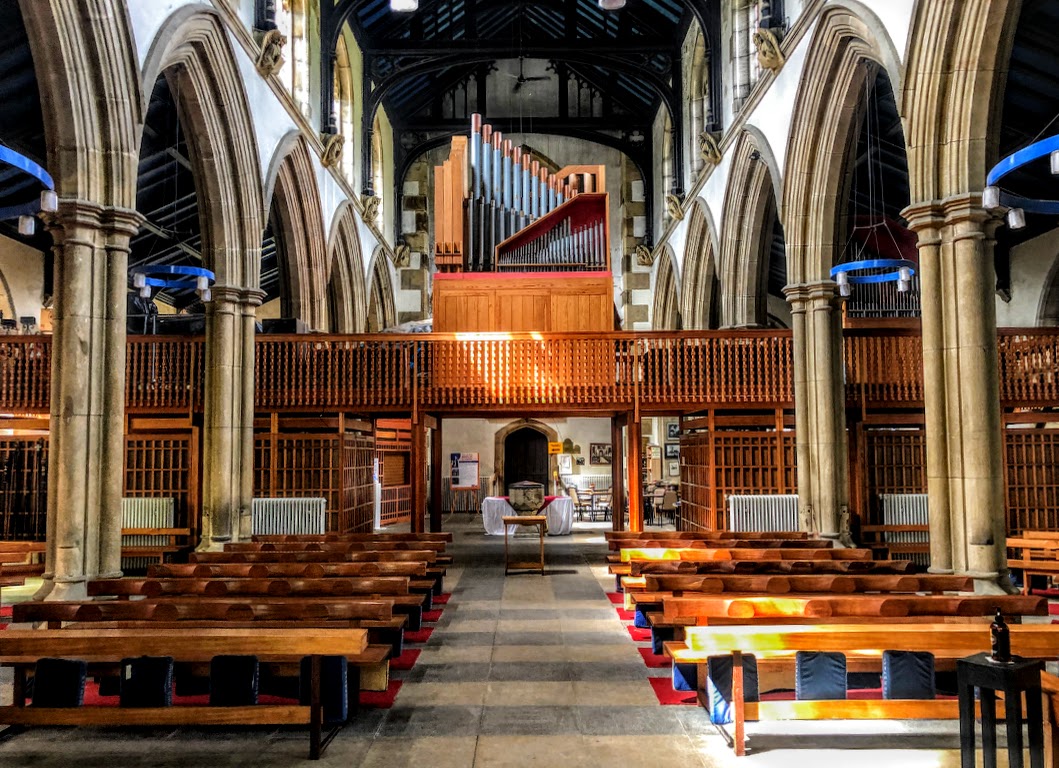
Inside Saint Thomas the Apostle in Heptonstall, facing east (Photograph: Patrick Comerford, 2023)
Work on re-ordering the church began in the early 1960s and was completed in 1964. The woodwork of the church was in a poor state and badly affected by dry rot. A legacy from Abraham Gibson who died in 1956 paid for the alterations as a memorial to his parents. The new design is a 20th century adaptation of a traditional medieval style.
The present organ, part of the Gibson bequest, was built in 1964 by Hill, Norman and Beard, and divides the church in two.
There have been church bells in Heptonstall since 1440, and the six bells from the old church were moved to the new tower in 1854. They were recast in 1911 and two more were added to make a peal. They are rung on most Sundays and are often rung by visiting bands of bellringers.
The church has good acoustics, and is used for the annual Pennine Spring Music Festival, held every Spring Bank Holiday week. It is also used twice a year for a Traidcraft weekend of fair trade clothes, food and gifts, with refreshments
Inside Saint Thomas the Apostle in Heptonstall, facing west (Photograph: Patrick Comerford, 2023)
Without its roof and stripped of its fittings, the mediaeval church rapidly fell into ruin, looking like an abandoned medieval monastery. But the ruins of Saint Thomas a’ Becket have been carefully maintained in recent decades, and open-air services are held there occasionally. It was a location in the 1993 BBC Television drama series, Mr Wroe’s Virgins, directed by Danny Boyle.
The two churches stand side-by-side in a churchyard where local tradition says 100,000 people are buried.
In fact, there are three churchyards side-by-side in Heptonstall. The oldest is now closed and is around the old church, while the second part is around the new church. The third and newer churchyard is across Back Lane and is where we visited the grave of the poet Sylvia Plath, before returning down the steep hill to Hebden Bridge.
The Church of Saint Thomas the Apostle in Heptonstall serves the communities of Heptonstall, Slack, Colden, Blackshaw Head and the surrounding areas. With Saint James the Great in Hebden Bridge, it forms the United Benefice of Hebden Bridge and Heptonstall in the Diocese of Leeds. The Parish Communion is at 10:30 on Sundays.
The south side of the Church of Saint Thomas the Apostle in Heptonstall, seen from the newer graveyard where Sylvia Plath is buried (Photograph: Patrick Comerford, 2023)
Patrick Comerford
The architectural historian Sir Nikolaus Pevsner described Heptonstall in West Yorkshire as ‘a very handsome hill village of dark stone houses with all kinds of minor architectural surprises.’ The greatest of the ‘architectural surprises’ of this West Yorkshire village above Hebden Bridge is its two churches.
Heptonstall is unique in having has two churches within one churchyard, and both are dedicated to Saint Thomas – although to two different saints: Saint Thomas a’ Becket and Saint Thomas the Apostle, both in the centre of the village, which we visited last week, walking up the steep hill from Hebden Bridge.
The older church has its origins in the 13th century and was ruined by a storm in the mid-19th century.
The Church of Saint Thomas a’ Becket in Heptonstall was founded by the Cluniac Priory of Lewes and was built in 1256-1260 (Photograph: Patrick Comerford, 2023)
The earlier, mediaeval Church of Saint Thomas a’ Becket was founded by the Cluniac Priory of Lewes and was built in 1256-1260 as a chapelry of the larger parish of Halifax, seven miles away. It was dedicated to Saint Thomas the Martyr, Archbishop of Canterbury, murdered in his own cathedral in 1170 on the orders of King Henry II.
This mediaeval church is a low and broad building. Later adaptations gave the church two naves, north and south aisles, two chantry chapels and a tower. A small bellcote above the ruins of the chancel originally housed the sanctus bell, rung during the words of the consecration in the liturgy.
Beside the altar is the piscina where the sacred vessels were rinsed and washed at the end of the liturgy.
Inside the ruins of the Church of Saint Thomas a’ Becket in Heptonstall, facing east (Photograph: Patrick Comerford, 2023)
Mediaeval painted glass filled the east window and other widows, and there was a rood screen that was lost after the Tudor Reformation, and the chapel was later raised to the status of a parish church.
The rectangular west tower is topped with battlements. The lower stages have been dated to the 13th century but the upper storeys are in the Perpendicular Gothic style ca 1500.
William Brygge of Heptonstall left over £6 in his will in 1449 for making the bells. Robert Shagh left about £3 in 1465 for the fabric of the chapel. Thomas Grenewood left £4 in 1494 to buy a chalice, and William Grenewood left £4 in 1508 to buy a vestment. Robert Browne, chaplain, left 20 gold nobles, each worth 6 s 8d, in 1517 to buy a velvet cope. William Sutcliffe left money in 1520 to buy an antiphonary with the sung portions of the Divine Office.
By the late 1700s, the church had been turned into a great ‘preaching house,’ dominated by a triple-decker pulpit in the nave, and with seating for 815 people on the ground floor and a further 300 in new upper galleries.
John Wesley preached in the church on no fewer than five occasions, and complained in 1786 that it was ‘the ugliest I know.’
John Wesley complained in 1786 that the church was ‘the ugliest I know’ (Photograph: Patrick Comerford, 2023)
Following a great storm in 1847, the west face of the tower fell away. Some repairs were carried out and the church remained in use until 1854, but the storm had caused such serious damage to the mediaeval church that the parishioners had decided it was not worth the trouble repairing the church.
Local people opened a public subscription to build a replacement, and a fine Victorian Gothic replacement was built a little to the south of the old church. To distinguish it from its predecessor, the new church was dedicated to Saint Thomas the Apostle.
The new church was designed by the architects Mallinson and Healey if Bradford, and it was built in 1850-1854 at a cost of £7,000. It was consecrated on 26 October 1854 by the Bishop of Ripon, Charles Thomas Longley (1794-1868), later Bishop of Durham, Archbishop of York and Archbishop of Canterbury. As Archbishop of Canterbury, Longley would convene the first Lambeth Conference of Anglican bishops in 1867.
Saint Thomas the Apostle seen from the south porch of Saint Thomas a’ Becket (Photograph: Patrick Comerford, 2023)
The newer church is 130 ft long and 65 ft wide, and much of the stone was quarried on the site itself. The clock was brought from the old church and was made by Titus Bankcroft in Sowerby Bridge in 1809.
The stained glass windows include fine work from the late 19th and early 20th centuries. The Lady Chapel is entered by steps in the north-east corner of the church. This was formerly the Vicar’s vestry before the church was re-ordered.
The unusual 11-sided font from the old church is set behind the screen in preference to the 1850 font which is to one side of the altar.
Inside Saint Thomas the Apostle in Heptonstall, facing east (Photograph: Patrick Comerford, 2023)
Work on re-ordering the church began in the early 1960s and was completed in 1964. The woodwork of the church was in a poor state and badly affected by dry rot. A legacy from Abraham Gibson who died in 1956 paid for the alterations as a memorial to his parents. The new design is a 20th century adaptation of a traditional medieval style.
The present organ, part of the Gibson bequest, was built in 1964 by Hill, Norman and Beard, and divides the church in two.
There have been church bells in Heptonstall since 1440, and the six bells from the old church were moved to the new tower in 1854. They were recast in 1911 and two more were added to make a peal. They are rung on most Sundays and are often rung by visiting bands of bellringers.
The church has good acoustics, and is used for the annual Pennine Spring Music Festival, held every Spring Bank Holiday week. It is also used twice a year for a Traidcraft weekend of fair trade clothes, food and gifts, with refreshments
Inside Saint Thomas the Apostle in Heptonstall, facing west (Photograph: Patrick Comerford, 2023)
Without its roof and stripped of its fittings, the mediaeval church rapidly fell into ruin, looking like an abandoned medieval monastery. But the ruins of Saint Thomas a’ Becket have been carefully maintained in recent decades, and open-air services are held there occasionally. It was a location in the 1993 BBC Television drama series, Mr Wroe’s Virgins, directed by Danny Boyle.
The two churches stand side-by-side in a churchyard where local tradition says 100,000 people are buried.
In fact, there are three churchyards side-by-side in Heptonstall. The oldest is now closed and is around the old church, while the second part is around the new church. The third and newer churchyard is across Back Lane and is where we visited the grave of the poet Sylvia Plath, before returning down the steep hill to Hebden Bridge.
The Church of Saint Thomas the Apostle in Heptonstall serves the communities of Heptonstall, Slack, Colden, Blackshaw Head and the surrounding areas. With Saint James the Great in Hebden Bridge, it forms the United Benefice of Hebden Bridge and Heptonstall in the Diocese of Leeds. The Parish Communion is at 10:30 on Sundays.
The south side of the Church of Saint Thomas the Apostle in Heptonstall, seen from the newer graveyard where Sylvia Plath is buried (Photograph: Patrick Comerford, 2023)
14 May 2023
Octagonal Methodist
Church in Heptonstall
closing after 260 years
Heptonstall Methodist Chapel … one of the oldest Methodist churches in continuous use, known for its octagonal shape (Photograph: Patrick Comerford, 2023)
Patrick Comerford
The octagonal Methodist Church in Heptonstall is one of the oldest Methodist churches in continuous use today and one of the oldest Methodist churches in the world, having been founded in 1764.
Later this month, the church is celebrating more than 260 years of Methodism in the Yorkshire village. Sadly though, the church is ceasing regular Sunday worship with a service in a fortnight’s time (Sunday 28 May 2023), as we learned last week when we visited Heptonstall, on the hilltop above Hebden Bridge.
The final service of thanksgiving and celebration will be led by the Revd Kathie Heathcoat and the Superintendent Minister, the Revd Vicky Atkins, with a selection of favourite hymns, and followed by afternoon tea.
This unusual octagonal chapel is tucked away at the bottom of a flight of steps off Northgate in Heptonstall. This is one of the first octagonal chapels in England. It was built in 1764, and the design and construction of the Grade II listed chapel were overseen by John Wesley, who frequently preached there.
Methodism in Heptonstall began with the evangelical activities of William Darney, who has been described as a firebrand Scot ‘of prodigious size.’ A pedlar, cobbler and itinerant poet, he founded many Methodist societies on both sides of the Pennines as he travelled, preaching as he went.
Darney’s preaching had been Calvinist and many of his converts moved between the Methodist societies and local Baptist groups. At first, the Methodist society in Heptonstall met in a cottage at Northgate End. John Wesley placed Darney’s groups under the supervision of the Revd William Grimshaw of Haworth, a friend of Darney and of John and Charles Wesley.
The Wesley brothers were frequent visitors to the area, perhaps because of their friendship with Grimshaw. John Wesley first visited Heptonstall on 21 May 1747 and visited 21 times in all between 1747 and 1786. He drew immense crowds and also preached in the now-ruined Church of England parish church of Saint Thomas Becket, which he labelled ‘the ugliest church I know.’
The Methodist chapel and Sunday School in Heptonstall nestle peacefully in a natural amphitheatre (Photograph: Patrick Comerford, 2023)
In these early days, Heptonstall had a preacher every sixth Sunday, with the travelling preachers receiving no stipend or allowance and eating where they could. But the society became so successful that it decided to build a chapel.
The octagon shape was then fashionable for Methodist chapels. The first octagon chapel was built in Norwich in 1757, followed by Rotherham (1761), Whitby (1762), then Yarm, Aberdeen and Heptonstall (1764).
It is sometimes said Wesley favoured the octagonal shape for his chapels because this left ‘no corners for the devil to hide in.’ Others said the octagon reflects the figure 8, regarded as the ecclesiastical figure of regeneration. The real reason is that Wesley was not building churches, but preaching houses, and wanted to avoid conflict with the local Church of England parish churches. Wesley said: ‘All our houses should be of this shape if the ground allow.’
The symmetrical octagonal chapel in Heptonstall was built on land called Dockey’s Croft, bought and given to the trustees by Thomas Colbeck of Keighley.
John Wesley preached in the unfinished shell, lining out his then unpublished verse, perhaps inspired by the sight of Hardcastle Crags from the hilltop:
Ye mountains and vales, in praises abound,
Ye hills and ye dales, continue the sound,
Break forth into singing, ye trees of the wood,
For Jesus is bringing lost sinners to God.
Local historians Chapman and Turner later wrote: ‘Wesley had obviously been impressed by the roof at the Rotherham Octagon, he had the same man construct the roof in Heptonstall. The sections were brought by the most direct, though hazardous, road over Mount Skip, the people meeting the procession of pack horses and singing hymns of joy. Men and women laboured with their hands to build the chapel with the most primitive of tools.’
The building was finished in 1764. The society grew and became strong. In 1795 the Sunday School was started – possibly the first of its kind in England.
Over 1,000 children were once enrolled in the Methodist Sunday school in Heptonstall (Photograph: Patrick Comerford, 2023)
Following the death of John Wesley in 1791, there were tensions and schisms within Methodism, including the formation of the New Connection in 1797. Heptonstall escaped these divisions, however, and by 1802 the chapel was too small for the 337 members and over 1,000 ‘scholars’ or children enrolled in the Sunday school. The solution was to knock down the far end of the chapel, lengthen the walls and rebuild it, preserving its octagonal shape. Internally, the pulpit was raised up, and new singing pews built.
By 1821, the chapel once again was too small, but by then industry was developing in the valley and the population was beginning to move down from the hilltops. It was felt wiser to build in Hebden Bridge, and so Salem Chapel was built. Heptonstall also planted new congregations and built chapels in Highgate and Blackshawhead.
The chapel in Heptonstall is a hidden jewel and nestles peacefully in a natural amphitheatre. Tended terraced graveyards rise above it to the village and fall away below, leading the eye to the views over the valley. Although we did not get inside the chapel last week, we were told that inside there is ‘a perfect stillness,’ with ‘a simple grace and humility.’
The building featured in the BBC 4 series ‘Churches: How to read them’. The historian Dr Richard Taylor named the chapel as one of his ten favourite churches, saying: ‘If buildings have an aura, this one radiated friendship.’
During repairs in 2017, including the installation of a new toilet, kitchenette, heating system and renovations, services were held in the neighbouring Church of England parish church, Saint Thomas’s.
The two churches in Heptonstall have worked closely together, sometimes holding joint services in either Saint Thomas’s or in the Methodist Church. Now, it seems, the oldest continuous, surviving Methodist Church is about to close its doors in two weeks’ time.
Looking across Hebden Bridge from Cross Lanes Methodist Graveyard near Heptonstall (Photograph: Patrick Comerford, 2023)
Patrick Comerford
The octagonal Methodist Church in Heptonstall is one of the oldest Methodist churches in continuous use today and one of the oldest Methodist churches in the world, having been founded in 1764.
Later this month, the church is celebrating more than 260 years of Methodism in the Yorkshire village. Sadly though, the church is ceasing regular Sunday worship with a service in a fortnight’s time (Sunday 28 May 2023), as we learned last week when we visited Heptonstall, on the hilltop above Hebden Bridge.
The final service of thanksgiving and celebration will be led by the Revd Kathie Heathcoat and the Superintendent Minister, the Revd Vicky Atkins, with a selection of favourite hymns, and followed by afternoon tea.
This unusual octagonal chapel is tucked away at the bottom of a flight of steps off Northgate in Heptonstall. This is one of the first octagonal chapels in England. It was built in 1764, and the design and construction of the Grade II listed chapel were overseen by John Wesley, who frequently preached there.
Methodism in Heptonstall began with the evangelical activities of William Darney, who has been described as a firebrand Scot ‘of prodigious size.’ A pedlar, cobbler and itinerant poet, he founded many Methodist societies on both sides of the Pennines as he travelled, preaching as he went.
Darney’s preaching had been Calvinist and many of his converts moved between the Methodist societies and local Baptist groups. At first, the Methodist society in Heptonstall met in a cottage at Northgate End. John Wesley placed Darney’s groups under the supervision of the Revd William Grimshaw of Haworth, a friend of Darney and of John and Charles Wesley.
The Wesley brothers were frequent visitors to the area, perhaps because of their friendship with Grimshaw. John Wesley first visited Heptonstall on 21 May 1747 and visited 21 times in all between 1747 and 1786. He drew immense crowds and also preached in the now-ruined Church of England parish church of Saint Thomas Becket, which he labelled ‘the ugliest church I know.’
The Methodist chapel and Sunday School in Heptonstall nestle peacefully in a natural amphitheatre (Photograph: Patrick Comerford, 2023)
In these early days, Heptonstall had a preacher every sixth Sunday, with the travelling preachers receiving no stipend or allowance and eating where they could. But the society became so successful that it decided to build a chapel.
The octagon shape was then fashionable for Methodist chapels. The first octagon chapel was built in Norwich in 1757, followed by Rotherham (1761), Whitby (1762), then Yarm, Aberdeen and Heptonstall (1764).
It is sometimes said Wesley favoured the octagonal shape for his chapels because this left ‘no corners for the devil to hide in.’ Others said the octagon reflects the figure 8, regarded as the ecclesiastical figure of regeneration. The real reason is that Wesley was not building churches, but preaching houses, and wanted to avoid conflict with the local Church of England parish churches. Wesley said: ‘All our houses should be of this shape if the ground allow.’
The symmetrical octagonal chapel in Heptonstall was built on land called Dockey’s Croft, bought and given to the trustees by Thomas Colbeck of Keighley.
John Wesley preached in the unfinished shell, lining out his then unpublished verse, perhaps inspired by the sight of Hardcastle Crags from the hilltop:
Ye mountains and vales, in praises abound,
Ye hills and ye dales, continue the sound,
Break forth into singing, ye trees of the wood,
For Jesus is bringing lost sinners to God.
Local historians Chapman and Turner later wrote: ‘Wesley had obviously been impressed by the roof at the Rotherham Octagon, he had the same man construct the roof in Heptonstall. The sections were brought by the most direct, though hazardous, road over Mount Skip, the people meeting the procession of pack horses and singing hymns of joy. Men and women laboured with their hands to build the chapel with the most primitive of tools.’
The building was finished in 1764. The society grew and became strong. In 1795 the Sunday School was started – possibly the first of its kind in England.
Over 1,000 children were once enrolled in the Methodist Sunday school in Heptonstall (Photograph: Patrick Comerford, 2023)
Following the death of John Wesley in 1791, there were tensions and schisms within Methodism, including the formation of the New Connection in 1797. Heptonstall escaped these divisions, however, and by 1802 the chapel was too small for the 337 members and over 1,000 ‘scholars’ or children enrolled in the Sunday school. The solution was to knock down the far end of the chapel, lengthen the walls and rebuild it, preserving its octagonal shape. Internally, the pulpit was raised up, and new singing pews built.
By 1821, the chapel once again was too small, but by then industry was developing in the valley and the population was beginning to move down from the hilltops. It was felt wiser to build in Hebden Bridge, and so Salem Chapel was built. Heptonstall also planted new congregations and built chapels in Highgate and Blackshawhead.
The chapel in Heptonstall is a hidden jewel and nestles peacefully in a natural amphitheatre. Tended terraced graveyards rise above it to the village and fall away below, leading the eye to the views over the valley. Although we did not get inside the chapel last week, we were told that inside there is ‘a perfect stillness,’ with ‘a simple grace and humility.’
The building featured in the BBC 4 series ‘Churches: How to read them’. The historian Dr Richard Taylor named the chapel as one of his ten favourite churches, saying: ‘If buildings have an aura, this one radiated friendship.’
During repairs in 2017, including the installation of a new toilet, kitchenette, heating system and renovations, services were held in the neighbouring Church of England parish church, Saint Thomas’s.
The two churches in Heptonstall have worked closely together, sometimes holding joint services in either Saint Thomas’s or in the Methodist Church. Now, it seems, the oldest continuous, surviving Methodist Church is about to close its doors in two weeks’ time.
Looking across Hebden Bridge from Cross Lanes Methodist Graveyard near Heptonstall (Photograph: Patrick Comerford, 2023)
13 May 2023
In Hebden Bridge,
the ‘Happy Valley’ of
television drama, poets
and spin doctors
The bridge in Hebden Bridge was built ca 1510, replacing a mediaeval timber-built bridge (Photograph: Patrick Comerford, 2023)
Patrick Comerford
During our few days in York this week, we took the train through Leeds to the ‘Happy Valley’ locations and spent some time in Hebden Bridge, a market town in the Upper Calder Valley in West Yorkshire, about 65 km west of York.
Hebden Bridge takes its name from a bridge near the confluence of the River Calder and the Hebden Water. Hebden Old Bridge was built ca 1510, replacing a mediaeval timber-built bridge. The bridge was repaired in 1602 and again in 1657, and the parapet was repaired in 1845, and raised in 1890. The eastern arch of the bridge spans the tail-goit of bridge mill, originally the manorial corn-mill of Wadsworth.
The town of Hebden Bridge itself has a small population of about 4,500, although the wider urban are has a population of more than 12,000.
The original settlement was the hilltop village of Heptonstall, where we visited the grave of Sylvia Plath and the twin churches of Saint Thomas the Apostle and Saint Thomas Becket.
Down the hill, Hebden Bridge began as a settlement where the old trading route between Halifax and Burnley dropped into the valley and crossed the River Hebden where the old bridge stands.
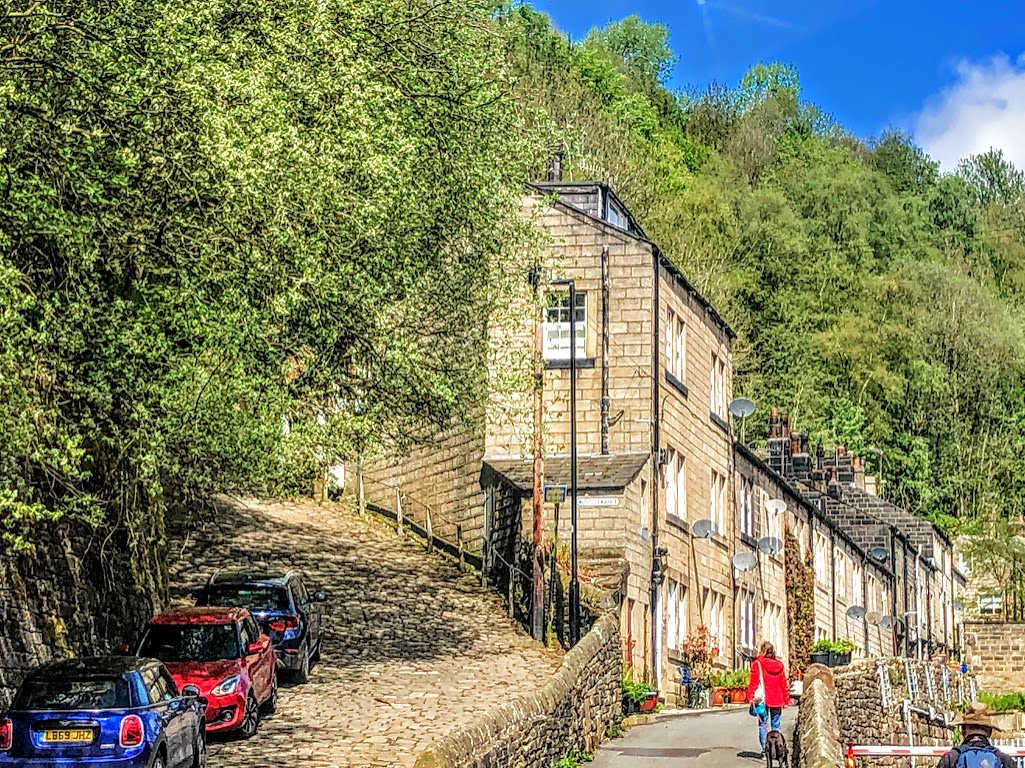
The steep valleys and lack of flat land has led to the ‘upstairs-downstairs’ houses known as ‘over and under dwellings’ in Hebden Bridge (Photograph: Patrick Comerford, 2023)
Hebden Bridge is close to the Pennine Way and Hardcastle Crags and it is a popular base for walking, climbing and cycling. The Rochdale Canal is a route across the Pennines, and the town is on the Calderdale Way, which connects with the Pennine Way.
The town grew and expanded in the 19th and 20th centuries when steep hills with fast-flowing streams and access to major wool markets made Hebden Bridge an ideal place for water-powered weaving mills. Because of the mills and the clothing factories, Hebden was known at one time as ‘Trouser Town.’
Because of its proximity to cities such as Manchester, Bradford and Leeds, Hebden Bridge became a dormitory town. The town also saw an influx of artists, writers, photographers, musicians, teachers, and ‘typical Guardian readers in the 1970s.
Hebden Bridge Arts Centre and Antique Market on Market Street is in the former Ebenezer Particular Baptist Chapel (Photograph: Patrick Comerford, 2023)
Hebden Bridge also has a reputation for its small independent shops, outdoor markets. cafés and tea rooms, pubs, micro pubs and restaurants. Hebden Bridge Arts Centre and Antique Market on Market Street is in a former Baptist chapel.
Ebenezer Particular Baptist Chapel or Meeting House was opened by John Fawcett in 1777. It became the Sunday School for Hope Baptist Chapel in 1858 and when a larger Sunday School was opened there in 1873 it was first leased and later became the offices of the Hebden Bridge Times. The Latin inscription on the sundial reads Quod Petis Umbra Est (‘What thou seekest is a shadow’).
The British Airways flight magazine High Life once named Hebden Bridge as the fourth quirkiest place in the world and it has been described as ‘modern and stylish in an unconventional and stylish way’. One report has even described it as ‘the lesbian capital of the UK.’
The singer-songwriter Ed Sheeran spent his early childhood in Hebden Bridge. This is also the home town of Bernard Ingham, Margaret Thatcher’s press secretary, who attended Hebden Bridge Grammar School and who began his career as a journalist with the Hebden Bridge Times. He died earlier this year (23 February 2023).
Hebden Bridge has become a popular place to live, but the steep valleys and a lack of flat land means space is limited. In the past, this led to ‘upstairs-downstairs’ houses known as ‘over and under dwellings.’ These houses were built in terraces with 4-5 storeys. The upper storeys face uphill while the lower ones face downhill with their back wall against the hillside. The lower two storeys would be one house while the upper 2-3 storeys would be another.
The rivers and canals made Hebden Bridge an ideal place for water-powered weaving mills (Photograph: Patrick Comerford, 2023)
The poet laureate Ted Hughes, who was married to Sylvia Plath, was born in neighbouring Mytholmroyd, and his former home at Lumb Bank on the outskirts of Hebden Bridge is run as a creative writing centre by the Arvon Trust. Hughes set his poem ‘Stubbing Wharfe’ in the Stubbing Wharf, an 18th-century inn by the Rochdale Canal.
Hebden Bridge was documented in the film Shed Your Tears And Walk Away (2009), which made controversial claims about the levels of drug and alcohol abuse in the town and the death rate among young people.
The BBC One crime drama series Happy Valley, written by Sally Wainwright and starring Sarah Lancashire and Siobhan Finneran, was filmed and set in and around the town. The first series was broadcast in 2014, and the last series this year concluded three months ago (5 February 2023).
The title refers to drug use and drug dealers in the area, and local landmarks, such as the graveyard, the canal and the landscapes, provided many of the settings.
The main character in Happy Valley, Catherine Cawood (Sarah Lancashire), has her home in Hebden Bridge, where she also has her local pub. She frequently visits the grave of her daughter Becky in Saint Thomas churchyard in Heptonstall, in the next row to the grave of Sylvia Plath.
Hebden Bridge provided many of the locations for ‘Happy Valley’ (Photograph: Patrick Comerford, 2023)
Patrick Comerford
During our few days in York this week, we took the train through Leeds to the ‘Happy Valley’ locations and spent some time in Hebden Bridge, a market town in the Upper Calder Valley in West Yorkshire, about 65 km west of York.
Hebden Bridge takes its name from a bridge near the confluence of the River Calder and the Hebden Water. Hebden Old Bridge was built ca 1510, replacing a mediaeval timber-built bridge. The bridge was repaired in 1602 and again in 1657, and the parapet was repaired in 1845, and raised in 1890. The eastern arch of the bridge spans the tail-goit of bridge mill, originally the manorial corn-mill of Wadsworth.
The town of Hebden Bridge itself has a small population of about 4,500, although the wider urban are has a population of more than 12,000.
The original settlement was the hilltop village of Heptonstall, where we visited the grave of Sylvia Plath and the twin churches of Saint Thomas the Apostle and Saint Thomas Becket.
Down the hill, Hebden Bridge began as a settlement where the old trading route between Halifax and Burnley dropped into the valley and crossed the River Hebden where the old bridge stands.
The steep valleys and lack of flat land has led to the ‘upstairs-downstairs’ houses known as ‘over and under dwellings’ in Hebden Bridge (Photograph: Patrick Comerford, 2023)
Hebden Bridge is close to the Pennine Way and Hardcastle Crags and it is a popular base for walking, climbing and cycling. The Rochdale Canal is a route across the Pennines, and the town is on the Calderdale Way, which connects with the Pennine Way.
The town grew and expanded in the 19th and 20th centuries when steep hills with fast-flowing streams and access to major wool markets made Hebden Bridge an ideal place for water-powered weaving mills. Because of the mills and the clothing factories, Hebden was known at one time as ‘Trouser Town.’
Because of its proximity to cities such as Manchester, Bradford and Leeds, Hebden Bridge became a dormitory town. The town also saw an influx of artists, writers, photographers, musicians, teachers, and ‘typical Guardian readers in the 1970s.
Hebden Bridge Arts Centre and Antique Market on Market Street is in the former Ebenezer Particular Baptist Chapel (Photograph: Patrick Comerford, 2023)
Hebden Bridge also has a reputation for its small independent shops, outdoor markets. cafés and tea rooms, pubs, micro pubs and restaurants. Hebden Bridge Arts Centre and Antique Market on Market Street is in a former Baptist chapel.
Ebenezer Particular Baptist Chapel or Meeting House was opened by John Fawcett in 1777. It became the Sunday School for Hope Baptist Chapel in 1858 and when a larger Sunday School was opened there in 1873 it was first leased and later became the offices of the Hebden Bridge Times. The Latin inscription on the sundial reads Quod Petis Umbra Est (‘What thou seekest is a shadow’).
The British Airways flight magazine High Life once named Hebden Bridge as the fourth quirkiest place in the world and it has been described as ‘modern and stylish in an unconventional and stylish way’. One report has even described it as ‘the lesbian capital of the UK.’
The singer-songwriter Ed Sheeran spent his early childhood in Hebden Bridge. This is also the home town of Bernard Ingham, Margaret Thatcher’s press secretary, who attended Hebden Bridge Grammar School and who began his career as a journalist with the Hebden Bridge Times. He died earlier this year (23 February 2023).
Hebden Bridge has become a popular place to live, but the steep valleys and a lack of flat land means space is limited. In the past, this led to ‘upstairs-downstairs’ houses known as ‘over and under dwellings.’ These houses were built in terraces with 4-5 storeys. The upper storeys face uphill while the lower ones face downhill with their back wall against the hillside. The lower two storeys would be one house while the upper 2-3 storeys would be another.
The rivers and canals made Hebden Bridge an ideal place for water-powered weaving mills (Photograph: Patrick Comerford, 2023)
The poet laureate Ted Hughes, who was married to Sylvia Plath, was born in neighbouring Mytholmroyd, and his former home at Lumb Bank on the outskirts of Hebden Bridge is run as a creative writing centre by the Arvon Trust. Hughes set his poem ‘Stubbing Wharfe’ in the Stubbing Wharf, an 18th-century inn by the Rochdale Canal.
Hebden Bridge was documented in the film Shed Your Tears And Walk Away (2009), which made controversial claims about the levels of drug and alcohol abuse in the town and the death rate among young people.
The BBC One crime drama series Happy Valley, written by Sally Wainwright and starring Sarah Lancashire and Siobhan Finneran, was filmed and set in and around the town. The first series was broadcast in 2014, and the last series this year concluded three months ago (5 February 2023).
The title refers to drug use and drug dealers in the area, and local landmarks, such as the graveyard, the canal and the landscapes, provided many of the settings.
The main character in Happy Valley, Catherine Cawood (Sarah Lancashire), has her home in Hebden Bridge, where she also has her local pub. She frequently visits the grave of her daughter Becky in Saint Thomas churchyard in Heptonstall, in the next row to the grave of Sylvia Plath.
Hebden Bridge provided many of the locations for ‘Happy Valley’ (Photograph: Patrick Comerford, 2023)
11 May 2023
Visiting the unhappy
grave of Sylvia Plath
in ‘Happy Valley’
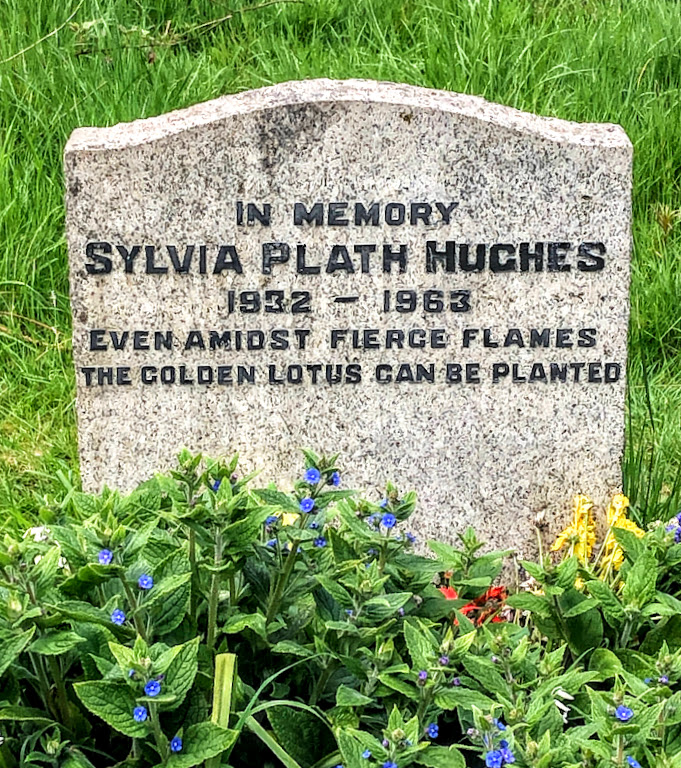
‘Even amidst fierce flames, the golden lotus can be planted’ … the grave of Sylvia Plath in Heptonstall (Photograph: Patrick Comerford, 2023)
Patrick Comerford
The Calder Valley is now known to many as ‘Happy Valley’ following the success of the recent television drama series. Two of us took the train from York through Leeds and Halifax to Hebden Bridge on Tuesday and spent much of the day enjoying the warm sunshine in these tranquil settings beneath the Pennines in West Yorkshire.
Hebden Bridge has steep hills, fast-flowing streams, and canal-side walks, and is beloved by artists, writers, photographers and musicians. Before lunch in Bridge Gate, we climbed the steep cobbled street leading up to the original settlement and hilltop village of Heptonstall.
The original church in Heptonstall was dedicated to Saint Thomas Becket and was founded around 1260. But the church was damaged by a gale in 1847, and is now only a shell. It was replaced by a new church, Saint Thomas the Apostle, built in the same churchyard.
The oldest remaining marked graves in the churchyard are thought to predate 1500. It is said there are more than 100,000 bodies in the churchyard, and many graves have been used again and again.
The American poet Sylvia Plath is buried in the graveyard across the lane from the churchyard. The epitaph on her grave reads: ‘Even amidst fierce flames, the golden lotus can be planted’ – a citation from the Bhagavad Gita.
She was married to the poet Ted Hughes, who was from nearby Mytholmryd, and she is named on the gravestone as Sylvia Plath Hughes. Her headstone is regularly vandalised by visitors who remove his surname, because some of her fans – particularly women, and American women – believe Ted Hughes was responsible for her death. But when we visited her grave this week, the black lettering seemed to have been freshly restored.
Sylvia Plath was born in Boston in 1932 and published her first poem in the Boston Herald at the age of eight. Her German-born father Otto had been alienated from his family because of his decision not to be ordained a Lutheran minister. His death nine days after her eighth birthday had a deeply profound and lasting influence on her and shaped her personality and her writing. Raised as a Unitarian, she experienced a loss of faith after his death, and remained ambivalent about religion for the rest of her life.
While she was a student at Smith College in Massachusetts in the 1950s, she wrote over 400 poems. In 1955, she was awarded a Fulbright scholarship to study at Newnham College, Cambridge. She was enchanted with the groomed courts and crooked streets of Cambridge, and was often seen pedalling furiously around the town, her black gown billowing out behind.
In Cambridge, she met the English poet Ted Hughes. Through his mother, Hughes claimed direct descent from Nicholas Ferrar, the founder of the Little Gidding community. When he met Sylvia Plath, Hughes had already graduated from Cambridge, where he had been an undergraduate at Pembroke College, and he was living between London and Cambridge:
I am here;
I wait;
and he plays on the banks of the river Cam
like a casual faun.
They were married in the same year, on 16 June 1956, in Saint George the Martyr Church, Holborn, on the south end of Queen Square, just a short stroll from the Bloomsbury offices of TS Eliot. They had chosen the day because it was Bloomsday. She returned to Cambridge in October to begin her second year at Newnham. After some time in the US and Canada, they returned to England, and in 1960, at the age of 28, she published her first book, The Colossus, in England. Her only novel, The Bell Jar, was published in 1963.
For a while, Sylvia Plath and Ted Hughes lived in North Tawton, a country village in Devon, but their marriage began to break up less than two years after the birth of her first child.
In the cold winter of 1962-1963, she lived in poverty in a small flat in London, with her two small children – Frieda Rebecca, who is now a poet and children’s writer, and the late Nicholas Farrar Hughes, named after his ancestor, Nicholas Farrar of Little Gidding. Her flat in 23 Fitzroy Road was in a house where WB Yeats once lived. There that winter, the flat was cold, the pipes froze, there was no telephone, and the children were often ill with flu. But there she continued to write, often working between 4 and 8 a.m. before the children awoke, and at times finishing a poem a day. In those poems, death is given a cruel, physical allure and psychic pain becomes almost tactile.
Early in the morning of 11 February 1963, Sylvia Plath succeeded in killing herself with cooking gas at the age of 30, while her children slept in the next room. She was buried in the churchyard in Heptonstall, beside Saint Thomas Becket Church.
Her collection Ariel was published two years after her death. It includes many of her well-known poems and was edited by Ted Hughes. Her two other collections, Crossing the Water and Winter Trees, were also published after her death and edited by Ted Hughes.
Plath frequently wrote about child birth, hospitals and suicide and employed disturbing and distorted imagery. Philip Larkin called her the ‘Horror Poet.’ But in 1982 she was the first poet to receive a Pulitzer Prize posthumously.
Ted Hughes had left Sylvia Plath for Assia Wevill. Tragically, Assia also died by suicide,, in the same manner as Sylvia Plath, and killed their daughter Shura too .
The Collected Poems of Sylvia Plath, published in 1981, was edited by Ted Hughes. He succeeded John Betjeman as Poet Laureate in 1984. In 1998, Hughes published Birthday Letters, a collection of 88 poems about their relationship. The book caused a sensation.
Sylvia Plath’s relationship with Ted Hughes was the subject of the 2003 feature film Ted and Sylvia, starring Gwyneth Paltrow and Daniel Craig.
Sylvia Plath’s poem ‘Edge’ is among the display boards in Saint Thomas’s Church in Heptonstall:
The woman is perfected.
Her dead
Body wears the smile of accomplishment,
The illusion of a Greek necessity
Flows in the scrolls of her toga,
Her bare
Feet seem to be saying:
We have come so far, it is over.
Each dead child coiled, a white serpent,
One at each little
Pitcher of milk, now empty.
She has folded
Them back into her body as petals
Of a rose close when the garden
Stiffens and odors bleed
From the sweet, deep throats of the night flower.
The moon has nothing to be sad about,
Staring from her hood of bone.
She is used to this sort of thing.
Her blacks crackle and drag.
Looking down onto Hebden Bridge from Heptonstall (Photograph: Patrick Comerford, 2023)
If Sylvia Plath would likely not have chosen to be buried in Heptonstall, the American poet Asa Benveniste definitely chose this churchyard for his own grave, having spent the final years of his life in Hebden Bridge, below Heptonstall.
Asa Benveniste (1925-1990) was a poet, typographer and publisher and a co-founder in London of the publisher Trigram Press. He and his partner Agnetha Falk ran a second-hand bookshop in Hebden Bridge in the 1980s. His gravestone reads: ‘Foolish Enough to Have Been a Poet.’
Asa Benveniste, who has been described as ‘a Turkish Jew,’ was born in New York on 25 August 1925. He moved to Paris after World War II, and settled in England in the 1950s. He moved to London, then later to Cornwall and Kent.
He moved to Hebden Bridge in the 1980s after leading a course at the Arvon Foundation at the same rambling mill owner’s house that Ted Hughes considered as a possible home for himself and Sylvia Plath and himself. Asa and Agnetha ran a second-hand bookshop in Hebden Bridge, stocked mostly with the library he had collected over the years.
When he died in 1990, he was buried in the graveyard in Heptonstall. His gravestone, a few feet away from Sylvia Plath’s grave, reads: ‘Foolish Enough to Have Been a Poet.’ His grave is often marked in the traditional Jewish way with pebbles and stones.
‘Foolish Enough to Have Been a Poet’ … the grave of Asa Benveniste in Heptonstall is often marked with pebbles and stones, following Jewish tradition (Photograph: Patrick Comerford, 2023)
Patrick Comerford
The Calder Valley is now known to many as ‘Happy Valley’ following the success of the recent television drama series. Two of us took the train from York through Leeds and Halifax to Hebden Bridge on Tuesday and spent much of the day enjoying the warm sunshine in these tranquil settings beneath the Pennines in West Yorkshire.
Hebden Bridge has steep hills, fast-flowing streams, and canal-side walks, and is beloved by artists, writers, photographers and musicians. Before lunch in Bridge Gate, we climbed the steep cobbled street leading up to the original settlement and hilltop village of Heptonstall.
The original church in Heptonstall was dedicated to Saint Thomas Becket and was founded around 1260. But the church was damaged by a gale in 1847, and is now only a shell. It was replaced by a new church, Saint Thomas the Apostle, built in the same churchyard.
The oldest remaining marked graves in the churchyard are thought to predate 1500. It is said there are more than 100,000 bodies in the churchyard, and many graves have been used again and again.
The American poet Sylvia Plath is buried in the graveyard across the lane from the churchyard. The epitaph on her grave reads: ‘Even amidst fierce flames, the golden lotus can be planted’ – a citation from the Bhagavad Gita.
She was married to the poet Ted Hughes, who was from nearby Mytholmryd, and she is named on the gravestone as Sylvia Plath Hughes. Her headstone is regularly vandalised by visitors who remove his surname, because some of her fans – particularly women, and American women – believe Ted Hughes was responsible for her death. But when we visited her grave this week, the black lettering seemed to have been freshly restored.
Sylvia Plath was born in Boston in 1932 and published her first poem in the Boston Herald at the age of eight. Her German-born father Otto had been alienated from his family because of his decision not to be ordained a Lutheran minister. His death nine days after her eighth birthday had a deeply profound and lasting influence on her and shaped her personality and her writing. Raised as a Unitarian, she experienced a loss of faith after his death, and remained ambivalent about religion for the rest of her life.
While she was a student at Smith College in Massachusetts in the 1950s, she wrote over 400 poems. In 1955, she was awarded a Fulbright scholarship to study at Newnham College, Cambridge. She was enchanted with the groomed courts and crooked streets of Cambridge, and was often seen pedalling furiously around the town, her black gown billowing out behind.
In Cambridge, she met the English poet Ted Hughes. Through his mother, Hughes claimed direct descent from Nicholas Ferrar, the founder of the Little Gidding community. When he met Sylvia Plath, Hughes had already graduated from Cambridge, where he had been an undergraduate at Pembroke College, and he was living between London and Cambridge:
I am here;
I wait;
and he plays on the banks of the river Cam
like a casual faun.
They were married in the same year, on 16 June 1956, in Saint George the Martyr Church, Holborn, on the south end of Queen Square, just a short stroll from the Bloomsbury offices of TS Eliot. They had chosen the day because it was Bloomsday. She returned to Cambridge in October to begin her second year at Newnham. After some time in the US and Canada, they returned to England, and in 1960, at the age of 28, she published her first book, The Colossus, in England. Her only novel, The Bell Jar, was published in 1963.
For a while, Sylvia Plath and Ted Hughes lived in North Tawton, a country village in Devon, but their marriage began to break up less than two years after the birth of her first child.
In the cold winter of 1962-1963, she lived in poverty in a small flat in London, with her two small children – Frieda Rebecca, who is now a poet and children’s writer, and the late Nicholas Farrar Hughes, named after his ancestor, Nicholas Farrar of Little Gidding. Her flat in 23 Fitzroy Road was in a house where WB Yeats once lived. There that winter, the flat was cold, the pipes froze, there was no telephone, and the children were often ill with flu. But there she continued to write, often working between 4 and 8 a.m. before the children awoke, and at times finishing a poem a day. In those poems, death is given a cruel, physical allure and psychic pain becomes almost tactile.
Early in the morning of 11 February 1963, Sylvia Plath succeeded in killing herself with cooking gas at the age of 30, while her children slept in the next room. She was buried in the churchyard in Heptonstall, beside Saint Thomas Becket Church.
Her collection Ariel was published two years after her death. It includes many of her well-known poems and was edited by Ted Hughes. Her two other collections, Crossing the Water and Winter Trees, were also published after her death and edited by Ted Hughes.
Plath frequently wrote about child birth, hospitals and suicide and employed disturbing and distorted imagery. Philip Larkin called her the ‘Horror Poet.’ But in 1982 she was the first poet to receive a Pulitzer Prize posthumously.
Ted Hughes had left Sylvia Plath for Assia Wevill. Tragically, Assia also died by suicide,, in the same manner as Sylvia Plath, and killed their daughter Shura too .
The Collected Poems of Sylvia Plath, published in 1981, was edited by Ted Hughes. He succeeded John Betjeman as Poet Laureate in 1984. In 1998, Hughes published Birthday Letters, a collection of 88 poems about their relationship. The book caused a sensation.
Sylvia Plath’s relationship with Ted Hughes was the subject of the 2003 feature film Ted and Sylvia, starring Gwyneth Paltrow and Daniel Craig.
Sylvia Plath’s poem ‘Edge’ is among the display boards in Saint Thomas’s Church in Heptonstall:
The woman is perfected.
Her dead
Body wears the smile of accomplishment,
The illusion of a Greek necessity
Flows in the scrolls of her toga,
Her bare
Feet seem to be saying:
We have come so far, it is over.
Each dead child coiled, a white serpent,
One at each little
Pitcher of milk, now empty.
She has folded
Them back into her body as petals
Of a rose close when the garden
Stiffens and odors bleed
From the sweet, deep throats of the night flower.
The moon has nothing to be sad about,
Staring from her hood of bone.
She is used to this sort of thing.
Her blacks crackle and drag.
Looking down onto Hebden Bridge from Heptonstall (Photograph: Patrick Comerford, 2023)
If Sylvia Plath would likely not have chosen to be buried in Heptonstall, the American poet Asa Benveniste definitely chose this churchyard for his own grave, having spent the final years of his life in Hebden Bridge, below Heptonstall.
Asa Benveniste (1925-1990) was a poet, typographer and publisher and a co-founder in London of the publisher Trigram Press. He and his partner Agnetha Falk ran a second-hand bookshop in Hebden Bridge in the 1980s. His gravestone reads: ‘Foolish Enough to Have Been a Poet.’
Asa Benveniste, who has been described as ‘a Turkish Jew,’ was born in New York on 25 August 1925. He moved to Paris after World War II, and settled in England in the 1950s. He moved to London, then later to Cornwall and Kent.
He moved to Hebden Bridge in the 1980s after leading a course at the Arvon Foundation at the same rambling mill owner’s house that Ted Hughes considered as a possible home for himself and Sylvia Plath and himself. Asa and Agnetha ran a second-hand bookshop in Hebden Bridge, stocked mostly with the library he had collected over the years.
When he died in 1990, he was buried in the graveyard in Heptonstall. His gravestone, a few feet away from Sylvia Plath’s grave, reads: ‘Foolish Enough to Have Been a Poet.’ His grave is often marked in the traditional Jewish way with pebbles and stones.
‘Foolish Enough to Have Been a Poet’ … the grave of Asa Benveniste in Heptonstall is often marked with pebbles and stones, following Jewish tradition (Photograph: Patrick Comerford, 2023)
10 May 2023
Morning prayers in Easter
with USPG: (32) 10 May 2023
King Oswy of Northumbria and Bishop Diuma of Lichfield in a stained-glass window in the Chapter House in Lichfield Cathedral (Photograph: Patrick Comerford, 2023)
Patrick Comerford
We are more half-way through the season of Easter, and this is the Fifth Week of Easter. Two of us are staying for a few days in York, having arrived late on Monday evening. After yesterday’s visit to Hebden Bridge and Heptonstall, we are setting off early this morning to visit Whitby.
Before this day gets busy, I am taking some time this morning for prayer and reflection. Following my recent visit to Lichfield Cathedral, I am reflecting each morning this week in these ways:
1, Short reflections on the windows in the Chapter House in Lichfield Cathedral;
2, the Gospel reading of the day in the Church of England lectionary;
3, a prayer from the USPG prayer diary.
The window in Lichfield Cathedral with King Oswy of Northumbria and Bishop Diuma of Lichfield (Photograph: Patrick Comerford, 2023)
King Oswy of Northumbria, and Diuma window:
The Chapter House in Lichfield Cathedral is currently the venue for the exhibition ‘Library and Legacy,’ showcasing the collections in the cathedral library.
The chapter house was decorated with frescoes and stained glass in the late 15th century by Thomas Heywood, Dean of Lichfield in 1457-1492. The glass in the Chapter House once contained figures of the apostles, with other depictions above. These all predated the Cromwellian era, and were destroyed by the Puritans during the Civil War in the mid-17th century.
In the 19th century, the glazing of the chapter house displayed armorial bearings, more or less correct, in imitation of glass known to have ornamented the cathedral in the past. This armorial glass gradually gave way to glass representing scenes in the history of the cathedral. Six of the windows were glazed with these images in the late 19th and early 20th century, and the original but unfilled plan was to fill all the windows in the Chapter House.
The fourth window I am looking at this morning is by Charles Eamer Kempe and is in memory of Canon Willian Gresley, a prebendary of Lichfield Cathedral. The figures in the window are King Oswy of Northumbria, and Diuma, the first Bishop of Mercia.
All that is known of Bishop Diuma’s life is found in Bede’s Ecclesiastical History of the English People. Diuma was an Irishman, and was one of four priests – Cedd, Atta, Betti and Diuma – from the Kingdom of Northumbria, who accompanied the newly-baptised Peada, son of King Penda of Mercia, back to Mercia in 653. Peada became a Christian when he married Alhflaed, daughter of King Oswiu of Northumbria.
After Penda’s death, Diuma was consecrated a bishop by Saint Finan of Lindisfarne, although the date of his death is unknown. The seat of the diocese was moved by Saint Chad to Lichfield in 669.
Oswiu, also known as Oswy or Oswig (612-670), was King of Bernicia from 642 and of Northumbria from 654 until his death. He is notable for his role at the Synod of Whitby in 664, which brought the church in Northumbria into conformity with the wider Church.
Oswiu was a devoted Christian, establishing a number of monasteries, including Gilling Abbey and Whitby Abbey, which we plan to visit later today. At the request of King Oswiu of Northumbria, Saint Chad was consecrated bishop of the Northumbrians, with his see at York, where we are staying this week.
Archbishop Theodore of Canterbury was impressed with Chad’s humility and asked King Oswiu to appoint Chad as the Bishop of Mercia in 669. Chad chose Lichfield as the new seat of his diocese and there he built a church and monastery.
The scenes in the lower parts of the window depict Bishop Jaruman promising to build a church at Lichfield, and the institution by Bishop Æthelwald of prebendaries.
Jaruman, who died in 669, was the fourth Bishop of Mercia, during the reign of King Wulfhere. He probably originated in Ireland but was educated at Lindisfarne, and he undertook several missions to Saxon tribes. Bishop Æthelwold or Æthelweald was Bishop of Lichfield from 818 to 830. The Book of Cerne may have been made in his honour in the early ninth century.
Canon William Gresley (1801-1876), who is commemorated in this window, was a key figure in the Tractarian movement from 1833.
Gresley was born on 16 March 1801, the eldest son of Richard Gresley of Stowe House, Lichfield. He was educated at Westminster School and Christ Church Oxford (BA 1823, MA 1825), and was ordained deacon in 1825 and priest in 1826. He was a curate at Drayton Bassett, near Tamworth, and then the curate of Saint Chad’s, Lichfield, and the morning lecturer at Saint Mary’s Church, Lichfield (1830-1837). He was an earnest High Church priest and from 1833 he was involved in the Tractarian movement. He became a prebendary of Lichfield Cathedral in 1840.
Gresley later moved to Saint Paul’s, Brighton, and in 1857 became the perpetual curate (vicar) of All Saints’ Boyne Hill, near Maidenhead, Berkshire, serving there for the rest of his working life. He married Anne Wright, daughter of John Barker Scott, a Lichfield banker. He died at Boyne Hill on 19 November 1876.
His works included The Siege of Lichfield, a Tale illustrative of the Great Rebellion (1843) and a biography of Charles Lever. To describe the influence on his thinking of the Oxford Movement , he wrote Bernard Leslie, or a Tale of the Last Ten Years (1842, 1859). His Ordinance of Confession (1851) caused a stir at the time. His other works include Anglo-Catholicism. A short Treatise on the Theory of the English Church (1844), and The Use of Confirmation (1848).
The window at the east end of the south aisle in Saint Chad’s Church, Lichfield, is in memory of Anne Wright Gresley. It was installed in 1864 and provides the background to the Lady Chapel altar. The window in Lichfield Cathedral in memory of Canon William Gresley was dedicated on 31 July 1895. The list of subscribers includes 20 people with the name Gresley.
The lower parts of the window show Bishop Jaruman promising to build a church at Lichfield, and the institution by King Æthelwald of prebendaries (Photograph: Patrick Comerford, 2023)
John 15: 1-8 (NRSVA):
[Jesus said:] 1 ‘I am the true vine, and my Father is the vine-grower. 2 He removes every branch in me that bears no fruit. Every branch that bears fruit he prunes to make it bear more fruit. 3 You have already been cleansed by the word that I have spoken to you. 4 Abide in me as I abide in you. Just as the branch cannot bear fruit by itself unless it abides in the vine, neither can you unless you abide in me. 5 I am the vine, you are the branches. Those who abide in me and I in them bear much fruit, because apart from me you can do nothing. 6 Whoever does not abide in me is thrown away like a branch and withers; such branches are gathered, thrown into the fire, and burned. 7 If you abide in me, and my words abide in you, ask for whatever you wish, and it will be done for you. 8 My Father is glorified by this, that you bear much fruit and become my disciples.’
Canon William Gresley was the curate of Saint Chad’s, Lichfield, in 1830-1837 (Photograph: Patrick Comerford)
Today’s prayer:
The theme this week in the prayer diary of the Anglican mission agency USPG (United Society Partners in the Gospel) is ‘The Work and Mission of the Laity.’ USPG’s Regional Manager for Africa, Fran Mate, reflected on Sunday on the work and mission of the laity.
The USPG Prayer invites us to pray this morning (Wednesday 10 May 2023):
Let us pray for lay women. May their ministry be encouraged within the worldwide Church and may those whose vocation to ordained ministry is denied find grace to build and plant.
Collect:
Almighty God,
who through your only-begotten Son Jesus Christ
have overcome death and opened to us the gate of everlasting life:
grant that, as by your grace going before us
you put into our minds good desires,
so by your continual help
we may bring them to good effect;
through Jesus Christ our risen Lord,
who is alive and reigns with you,
in the unity of the Holy Spirit,
one God, now and for ever.
Post Communion:
Eternal God,
whose Son Jesus Christ is the way, the truth, and the life:
grant us to walk in his way,
to rejoice in his truth,
and to share his risen life;
who is alive and reigns, now and for ever.
Saint Mary’s Church, Market Square, now The Hub at Saint Mary’s, Lichfield … Canon William Gresley was the morning lecturer at Saint Mary’s Church (Photograph: Patrick Comerford)
Yesterday’s reflection
Continued tomorrow
Scripture quotations are from the New Revised Standard Version Bible: Anglicised Edition copyright © 1989, 1995, National Council of the Churches of Christ in the United States of America. Used by permission. All rights reserved worldwide. http://nrsvbibles.org
Patrick Comerford
We are more half-way through the season of Easter, and this is the Fifth Week of Easter. Two of us are staying for a few days in York, having arrived late on Monday evening. After yesterday’s visit to Hebden Bridge and Heptonstall, we are setting off early this morning to visit Whitby.
Before this day gets busy, I am taking some time this morning for prayer and reflection. Following my recent visit to Lichfield Cathedral, I am reflecting each morning this week in these ways:
1, Short reflections on the windows in the Chapter House in Lichfield Cathedral;
2, the Gospel reading of the day in the Church of England lectionary;
3, a prayer from the USPG prayer diary.
The window in Lichfield Cathedral with King Oswy of Northumbria and Bishop Diuma of Lichfield (Photograph: Patrick Comerford, 2023)
King Oswy of Northumbria, and Diuma window:
The Chapter House in Lichfield Cathedral is currently the venue for the exhibition ‘Library and Legacy,’ showcasing the collections in the cathedral library.
The chapter house was decorated with frescoes and stained glass in the late 15th century by Thomas Heywood, Dean of Lichfield in 1457-1492. The glass in the Chapter House once contained figures of the apostles, with other depictions above. These all predated the Cromwellian era, and were destroyed by the Puritans during the Civil War in the mid-17th century.
In the 19th century, the glazing of the chapter house displayed armorial bearings, more or less correct, in imitation of glass known to have ornamented the cathedral in the past. This armorial glass gradually gave way to glass representing scenes in the history of the cathedral. Six of the windows were glazed with these images in the late 19th and early 20th century, and the original but unfilled plan was to fill all the windows in the Chapter House.
The fourth window I am looking at this morning is by Charles Eamer Kempe and is in memory of Canon Willian Gresley, a prebendary of Lichfield Cathedral. The figures in the window are King Oswy of Northumbria, and Diuma, the first Bishop of Mercia.
All that is known of Bishop Diuma’s life is found in Bede’s Ecclesiastical History of the English People. Diuma was an Irishman, and was one of four priests – Cedd, Atta, Betti and Diuma – from the Kingdom of Northumbria, who accompanied the newly-baptised Peada, son of King Penda of Mercia, back to Mercia in 653. Peada became a Christian when he married Alhflaed, daughter of King Oswiu of Northumbria.
After Penda’s death, Diuma was consecrated a bishop by Saint Finan of Lindisfarne, although the date of his death is unknown. The seat of the diocese was moved by Saint Chad to Lichfield in 669.
Oswiu, also known as Oswy or Oswig (612-670), was King of Bernicia from 642 and of Northumbria from 654 until his death. He is notable for his role at the Synod of Whitby in 664, which brought the church in Northumbria into conformity with the wider Church.
Oswiu was a devoted Christian, establishing a number of monasteries, including Gilling Abbey and Whitby Abbey, which we plan to visit later today. At the request of King Oswiu of Northumbria, Saint Chad was consecrated bishop of the Northumbrians, with his see at York, where we are staying this week.
Archbishop Theodore of Canterbury was impressed with Chad’s humility and asked King Oswiu to appoint Chad as the Bishop of Mercia in 669. Chad chose Lichfield as the new seat of his diocese and there he built a church and monastery.
The scenes in the lower parts of the window depict Bishop Jaruman promising to build a church at Lichfield, and the institution by Bishop Æthelwald of prebendaries.
Jaruman, who died in 669, was the fourth Bishop of Mercia, during the reign of King Wulfhere. He probably originated in Ireland but was educated at Lindisfarne, and he undertook several missions to Saxon tribes. Bishop Æthelwold or Æthelweald was Bishop of Lichfield from 818 to 830. The Book of Cerne may have been made in his honour in the early ninth century.
Canon William Gresley (1801-1876), who is commemorated in this window, was a key figure in the Tractarian movement from 1833.
Gresley was born on 16 March 1801, the eldest son of Richard Gresley of Stowe House, Lichfield. He was educated at Westminster School and Christ Church Oxford (BA 1823, MA 1825), and was ordained deacon in 1825 and priest in 1826. He was a curate at Drayton Bassett, near Tamworth, and then the curate of Saint Chad’s, Lichfield, and the morning lecturer at Saint Mary’s Church, Lichfield (1830-1837). He was an earnest High Church priest and from 1833 he was involved in the Tractarian movement. He became a prebendary of Lichfield Cathedral in 1840.
Gresley later moved to Saint Paul’s, Brighton, and in 1857 became the perpetual curate (vicar) of All Saints’ Boyne Hill, near Maidenhead, Berkshire, serving there for the rest of his working life. He married Anne Wright, daughter of John Barker Scott, a Lichfield banker. He died at Boyne Hill on 19 November 1876.
His works included The Siege of Lichfield, a Tale illustrative of the Great Rebellion (1843) and a biography of Charles Lever. To describe the influence on his thinking of the Oxford Movement , he wrote Bernard Leslie, or a Tale of the Last Ten Years (1842, 1859). His Ordinance of Confession (1851) caused a stir at the time. His other works include Anglo-Catholicism. A short Treatise on the Theory of the English Church (1844), and The Use of Confirmation (1848).
The window at the east end of the south aisle in Saint Chad’s Church, Lichfield, is in memory of Anne Wright Gresley. It was installed in 1864 and provides the background to the Lady Chapel altar. The window in Lichfield Cathedral in memory of Canon William Gresley was dedicated on 31 July 1895. The list of subscribers includes 20 people with the name Gresley.
The lower parts of the window show Bishop Jaruman promising to build a church at Lichfield, and the institution by King Æthelwald of prebendaries (Photograph: Patrick Comerford, 2023)
John 15: 1-8 (NRSVA):
[Jesus said:] 1 ‘I am the true vine, and my Father is the vine-grower. 2 He removes every branch in me that bears no fruit. Every branch that bears fruit he prunes to make it bear more fruit. 3 You have already been cleansed by the word that I have spoken to you. 4 Abide in me as I abide in you. Just as the branch cannot bear fruit by itself unless it abides in the vine, neither can you unless you abide in me. 5 I am the vine, you are the branches. Those who abide in me and I in them bear much fruit, because apart from me you can do nothing. 6 Whoever does not abide in me is thrown away like a branch and withers; such branches are gathered, thrown into the fire, and burned. 7 If you abide in me, and my words abide in you, ask for whatever you wish, and it will be done for you. 8 My Father is glorified by this, that you bear much fruit and become my disciples.’
Canon William Gresley was the curate of Saint Chad’s, Lichfield, in 1830-1837 (Photograph: Patrick Comerford)
Today’s prayer:
The theme this week in the prayer diary of the Anglican mission agency USPG (United Society Partners in the Gospel) is ‘The Work and Mission of the Laity.’ USPG’s Regional Manager for Africa, Fran Mate, reflected on Sunday on the work and mission of the laity.
The USPG Prayer invites us to pray this morning (Wednesday 10 May 2023):
Let us pray for lay women. May their ministry be encouraged within the worldwide Church and may those whose vocation to ordained ministry is denied find grace to build and plant.
Collect:
Almighty God,
who through your only-begotten Son Jesus Christ
have overcome death and opened to us the gate of everlasting life:
grant that, as by your grace going before us
you put into our minds good desires,
so by your continual help
we may bring them to good effect;
through Jesus Christ our risen Lord,
who is alive and reigns with you,
in the unity of the Holy Spirit,
one God, now and for ever.
Post Communion:
Eternal God,
whose Son Jesus Christ is the way, the truth, and the life:
grant us to walk in his way,
to rejoice in his truth,
and to share his risen life;
who is alive and reigns, now and for ever.
Saint Mary’s Church, Market Square, now The Hub at Saint Mary’s, Lichfield … Canon William Gresley was the morning lecturer at Saint Mary’s Church (Photograph: Patrick Comerford)
Yesterday’s reflection
Continued tomorrow
Scripture quotations are from the New Revised Standard Version Bible: Anglicised Edition copyright © 1989, 1995, National Council of the Churches of Christ in the United States of America. Used by permission. All rights reserved worldwide. http://nrsvbibles.org
Labels:
Anglicanism,
Church History,
Easter 2023,
Hebden Bridge,
Heptonstall,
Kempe,
Lichfield,
Lichfield Cathedral,
Local History,
Mission,
Prayer,
Saint Chad,
Saint John's Gospel,
Saints,
Stained Glass,
USPG,
York
Subscribe to:
Posts (Atom)