Showing posts with label Beckett. Show all posts

03 July 2025

‘The One and The Many’:
a sculptor’s exploration of
creation and imagination
in the heart of Fitzrovia

‘The One and The Many’ is a large sculpture by Peter Randall-Page beside the recently-restored Fitzrovia Chapel in London (Photograph: Patrick Comerford, 2025)

Patrick Comerford

I was recalling earlier this week my visit to the recently-restored Fitzrovia Chapel in Pearson Square, off Mortimer Street in London. In a sunny corner, beside the chapel and beneath the tall blocks of a new development, ‘The One and The Many’ is a large sculpture by Peter Randall-Page reminding us of humanity’s shared search for the meaning of creation and our origins.

Peter Randall-Page sculpted ‘The One and The Many’ ten years ago (2015) from a naturally eroded Bavarian granite boulder, weighing 25 tonnes and measuring 3519 x 2240 x 2065 mm and inscribed over its entire surface with marks carved in low relief.

‘The One and The Many’ is primarily a celebration of human ingenuity and imagination. ‘Our ability to convey meaning to one another, through time and space, by making marks has revolutionised human culture and society,’ Peter Randall-Page has said. ‘The human desire to make the world meaningful seems to be ubiquitous and intrinsic to our very nature.’

Embracing many cultures, his sculpture is in the heart of Fitzrovia, an area with a rich and vibrant cultural history and thriving creative community.

It is inscribed with many of the world’s scripts and symbols, from the writings of ancient Babylonia to Mongolian ‘ornamental’ seal script. They recount stories of the creation in poetic musings, sacred scriptures and epic tales of our origins.

Almost all cultures and languages across time have creation myths and narratives that seek to explain how our world came into being, and this leap of imagination illustrates the essence of creativity across many cultures and languages. One of the earliest uses of written language was almost certainly to set down these stories by making marks on clay, papyrus and vellum.

Based on scholarly advice and artistic preferences, Peter Randall-Page chose over 30 variations on the creation myth from around the world. He included writing systems from the earliest cuneiform script in ancient Mesopotamia 5,000 years ago to modern languages. The selected texts from ancient and modern writings were then arranged and inscribed onto the vast boulder, in effect the earth itself.

The texts themselves are creation stories from various cultures, each conveyed in their own writing systems, and the chosen lines speak of cosmology and the material and poetical formation of the universe in a variety of cultures.

There are quotations and texts in Minoan Linear A from Crete, Sanskrit, Japanese, Cyrillic, Ogham Irish Script, Korean, Mongolian, Ancient Greek, Hebrew, Latin, Lycian and Arabic, to name but a few.

He tried to avoid pictograms and hieroglyphics, preferring to concentrate on writing as abstract mark making. He has included Braille and Morse Code, but not musical notation or mathematical symbols. A quotation from Samuel Beckett’s play Endgame is represented in Morse Code, and a quotation from Jorge Luis Borges’s short story ‘God’s Script’ is written in Braille.

In this way, ‘The One and The Many’ is an exploration of the ways we have contemplated, through a wealth of poetic musings and epic narratives, the theme of ‘In the beginning’, and it is also a celebration of human ingenuity and imagination.

Our human ability to convey meaning to one another through time and space, by making marks has revolutionised human culture. In Peter Randall-Page’s own words, ‘These myths and legends have been distilled by a kind of “cultural natural selection” over countless generations and as such they often tell us more about the human condition; our hopes and fears, than about literal cosmology.’

The naturally eroded boulder chosen for the sculpture is a fragment of solidified magma, the material the planet is made of. Its overall form is the result of innumerable chance events over a geological timescale stretching back to the creation of the Earth itself.

Peter Randall-Page has and international reputation for his large-scale sculptures, drawings and prints inspired by geometric forms and patterns from nature. He has undertaken numerous large-scale commissions and exhibited widely. He was elected a Royal Academician in 2015. His work is held in public collections world-wide, including the Tate Gallery, the British Museum and the Eden Project.

His sculpture ‘After the Winter’ was bought in 1981 by the Milton Keynes NHS Trust in anticipation of the opening of the new hospital. To this day, it is situated in a small courtyard space near the Eaglestone Restaurant, one of many that offer a quiet oasis at the hospital.

‘The One and The Many’ is permanently located at Fitzroy Place, Pearson Square, off Mortimer Street, London, and was commissioned by Exemplar and Aviva, developers of Fitzroy Place and project managed by Patrick Morey-Burrows of ArtSource.

• A dedicated website theoneandthemany.co.uk gives more background on the project as well as translations of the inscribed texts.

‘The One and The Many’ is a celebration of human ingenuity and imagination (Photograph: Patrick Comerford, 2025)

18 February 2025

After so many years,
I have my first visit to
Hatchards of Piccadilly,
England’s oldest bookshop

Hatchards, the oldest bookshop in England, was founded by John Hatchard on Piccadilly since 1797 (Photograph: Patrick Comerford, 2025)

Patrick Comerford

Hatchards is the oldest bookshop in England and has been on Piccadilly since 1797, when the shop was founded by John Hatchard. So, I cannot understand why I never stepped through its doors until I was in Piccadilly yesterday.

Of course, I have walked past Hatchards many times before and have been along Piccadilly throughout my life. Most memorably, I spent working time in Piccadilly when the Athens News commissioned me to write a major two-page feaure on ‘Byzantium 330-1453’, an exhibition hosted by the Royal Academy of Arts in the Main Galleries in Burlington House for five months in 2008-2009.

I have been to Hatchards other outlet at Saint Pancras station last year, when Charlotte and I were on our way to Paris, yet somehow I had missed the shop on Piccadilly all my life. But then, there are many places I have never visited on Piccadilly, including Fortum and Mason, right next door to Hatchards.

The street façade of the Piccadilly wing of Burlington House reflected in the windows of Hatchards, the oldest bookshop in Britain (Photograph: Patrick Comerford, 2025)

I was in Piccadilly yesterday with the Anglican mission agency USPG and the publisher SPCK for the celebrations of Founder’s Day in Saint Jame’s Church. And, of course, on Charlotte’s recommendation, I spent some time afterwards in Hatchards, which is prominently located between Saint James’s and Fortum and Mason and across the street from Burlington House.

SPCK is one of England’s oldest publishers – founded by Thomas Bray in 1698, it is older than John Murray (1768), and younger only than Cambridge University Press (1534) and Oxford University Press (1586). It seemed only right, after celebrating with one of England’s oldest publishers, to then spend some time too in England’s oldest bookshop.

Hatchards has had a shop on Piccadilly for 228 years. The business was founded by the bookseller and publisher John Hatchard ((1769-1849) at 173 Piccadilly in 1797. John Hatchard was still in his 20s when he took over the bookshop at 173 Piccadilly formerly run by Richard White and bought a collection of merchandise from a bookseller Simon Vandenbergh.

The shop moved along Piccadilly in 1801, to No 189-190, and the street number of the second shop changed to No 187 in 1820. Meanwhile, the site of the first shop had been cleared in 1810 to build the Egyptian Hall.

Hatchard had deep religious views and was an abolitionist and he became the main publisher for works associated with the Clapham Sect. William Wilberforce, Sir Walter Scott, Sir John Hawkins and Lord Spencer were among the figures of the day who frequented Hatchard’s back parlour. Sydney Smith writing in the Edinburgh Review in 1810, described Hatchard’s visitors as ‘a set of well-dressed, prosperous gentlemen, assembling daily at the shop well in with the people in power, delighted with every existing institution and with every existing circumstance.’

Hatchard died at Clapham Common in 1849, and there is a memorial to him in Saint Paul’s Church, Clapham. His grandson, George Josiah Palmer (1828-1892), was the founder and editor of the Church Times.

Later in the 19th century, Hatchards was Oscar Wilde’s favourite bookshop, and he signed his books sitting at the ground floor main table – still known today as ‘Oscar’s Table’.

Hatchards was bought for £6,000 by the convicted fraudster Clarence Hatry (1888-1965). Ten years earlier, the fall of the Hatry group which had been worth about £24 million (equivalent to £1,840 million today), contributed to the Wall Street crash of 1929. Hatry turned around the ailing business at Hatchards, and in 1946 he also acquired the publishers T Werner Laurie Ltd. Within four years, he owned the largest retail book business in London.

Hatchards was acquired by William Collins & Sons in 1956, and it expanded its number of retail outlets in the 1980s, opening branches across the United Kingdom. It was bought by Pentos in 1990. Pentos, in turn, was acquired by Waterstones who rebranded all the shops apart from Hatchards on Piccadilly. Waterstones also owns Hodges Figgis in Dublin, which was founded in 1768 and is the oldest bookshop in Ireland.

Today, Hatchards has a reputation for attracting high-profile authors and holds three royal warrants. The shop opened its new outlet in St Pancras station in 2014, beside a new branch of Fortnum and Mason, continuing a pairing that goes back over two centuries. A third shop opened in Cheltenham in 2022.

‘Oscar’s Table’ on the ground floor … Hatchards was Oscar Wilde’s favourite bookshop and he signed his books sitting at the main table (Photograph: Patrick Comerford, 2025)

Hatchards is no ordinary Waterstone’s shop – it is a unique British institution and a landmark building on Piccadilly. It is familiar to many with its curving bay windows and its prominently displayed royal warrants above the front doors. Inside, the shop has a grand, four-storey staircase and mementos of the past through the building, with historic photographs, old catalogues, Oscar Wilde’s table, which continues to be used for book signings, and an anonymous painting said to be a portrait of the founder John Hatchard.

The shop also displays an array of first editions from Margaret Atwood, Samuel Beckett, Ted Hughes, DH Lawrence and Iris Murdoch. The shop continues to host regular book signings and author events. Indeed, many of those authors are also regular customers, and the shop remains a literary haven for authors.

As for the Egyptian Hall on Piccadilly, built in 1812 on the site of the first Hatchards shop, it became a venue for exhibitions, popular entertainments and lectures, and became known as ‘England’s Home of Mystery’. But after less than a century, it was demolished in 1905 to make way for flats and offices.

Hatchards is the oldest bookshop in England. But it is not the oldest bookshop on these islands. That accolade goes to Hodges Figgis on Dawson Street in Dublin, which was founded in 1768, and is the third-oldest functioning bookshop in the world, after the Livraria Bertrand in Lisbon (1732) and Pennsylvania’s Moravian Book Shop (1745).

Hodges Figgis opened in Dublin in 1768 at 10 Skinner’s Row, near Christ Church Cathedral, and has had many addresses since then, including 32 Grafton Street (1797), 104 Grafton Street (1819), 20 Nassau Street (1920), 6-7 Dawson Street (1945), and Saint Stephen’s Green (1974). Since 1979, Hodges Figgis has been at 56-58 Dawson Street, the former Browne and Nolan bookshop. Like Hatchards, Hodges Figgis is now owned and operated by Waterstones. But then, so too are Dillons and Foyles in London and Blackwell’s in Oxford.

Hopefully, Hatchards, and all those other unique bookshops, maintain their style and presence for generations to come. And, hopefully, I shall be back in Hatchards the next time I am in Piccadilly.

Hatchards is familiar to many with its curving bay windows and creative window displays (Photograph: Patrick Comerford, 2025)

01 November 2021

Praying in Ordinary Time 2021:
156, Rathgar Methodist Church, Dublin

Rathgar Methodist Church on Brighton Road, Rathgar, Dublin, was designed in the Early English style by Thomas Holbrook in 1874 (Photograph: Patrick Comerford)

Patrick Comerford

Today is All Saints’ Day (1 November 2021). Before the day gets busy, I am taking a little time this morning for prayer, reflection and reading. Each morning in the time in the Church Calendar known as Ordinary Time, I am reflecting in these ways:

1, photographs of a church or place of worship;

2, the day’s Gospel reading;

3, a prayer from the USPG prayer diary.

My theme this week is Methodist churches. This began yesterday with Lichfield Methodist Church on Tamworth Street, Lichfield. My choice of church this morning is Rathgar Methodist Church in Dublin.

Inside Rathgar Methodist Church, Brighton Road (Photograph: Patrick Comerford)

Rathgar Methodist Church at Brighton Road, Rathgar, Dublin, is one of the most beautiful Methodist churches in Ireland. I have preached here in the past and taken Sunday services when the Revd Vanessa Wyse-Jackson was the minister.

The church was designed in the Early English style in 1874 by Thomas Holbrook, who was active as an architect and surveyor in Dublin in the 1860s and 1870s. His other works include Charleston Road Methodist Church, Rathmines (1865), and Lucan Methodist Church (1867).

Holbrook was briefly in partnership with John Holmes in 1865 as Holmes & Holbrook, and with Frederick Darley in 1868 as Darley & Holbrook. After Darley died, Holbrook continued to work from 187 Brunswick Street. He died in 1880.

The foundation stone of the new church was laid in February 1874. The contractors were J&W Beckett, the estimated cost was £2,000, and the first of a series of opening services was held on 7 August 1874.

The hall, sexton’s house and manse were added to the complex five years later, and the building scheme was completed by 1893 with the addition of the church parlour and kitchen, the installation of the organ, the completion of the spire, and the erection of railings.

This work was designed by James John Phillips (1841-1936), a Cork-born architect, draughtsman and watercolourist who lived in Belfast. Phillips also designed the Methodist church at Letterbreen, Co Fermanagh (1884), and he became the preferred architect of the Methodist Church in many parts of Ireland, designing or altering at least 17 Methodist churches in Belfast and the neighbouring counties and two in Dublin. He died at the age of 94 at his home at 9 Marlborough Park, Belfast, in 1936.

Improvements in 1909, including ventilation, a new pulpit and electric lighting, were designed by the Dublin architect George Francis Beckett (1877-1961), and the church re-opened on 10 October 1909.

Beckett was the fourth son of the builder James Beckett. From early childhood, his only ambition was to be an architect. He was educated at Rathmines School, Dublin, before spending four years as a pupil of James Franklin Fuller. In 1897, he established an office at 97 Stephen’s Green.

Beckett designed several Methodist churches. He retired in 1950, but the partnership of Beckett & Harrington continued until about 1973.

The rapid development of Methodist work in the Rathgar area meant that by 1919 the church was proving too small for the number of people attending. An extension was proposed, including a war memorial and a war memorial window. This also included building the transepts, the choir chancel, the choir room and vestry, and enlarging the organ.

Richard Francis Caulfeild Orpen (1863-1938) designed the extension of church in 1924, with the addition of the transepts, choir, chancel, organ chamber, choir room and vestry, the enlargement of the organ and the erection of the war memorial window. Commemoration stones laid was laid on 20 September 1924 and the contractors were RE Mellon & Son.

The architect RFC Orpen was the eldest son of Arthur Herbert Orpen, a solicitor, and his wife, Anne, eldest daughter of the Right Revd Charles Caulfeild, Bishop of Nassau. The painter William Orpen (1878-1931) was the youngest of his three brothers. He was educated at Saint Columba’s College, Rathfarnham, and Trinity College Dublin.

Orpen spent four years as a pupil of Thomas Drew, and stayed on as managing assistant for a further seven years. He was active in the revival of the Architectural Association of Ireland, and he established his own practice at 22 Clare Street in 1888/1889.

Orpen adid a considerable amount of work ib the Church of Ireland. In 1910, he was appointed architect to Christ Church Cathedral in succession to Drew. He was also architect to Saint Patrick’s Cathedral, Dublin, Saint Canice’s Cathedral, Kilkenny, Trinity College Dublin and Saint Columba’s College. His commissions included war memorials and rebuilding country houses destroyed in the Irish War of Independence and Civil War, including Cappoquin House, Co Waterford (1927), for Sir John Keane.

He was a guardian of the National Gallery of Ireland; honorary secretary of the Municipal Gallery, first president of revived Architectural Association of Ireland (1896-1898) and President of the Royal Institute of Architects of Ireland (1914-16).

The War Memorial window, with three scenes of the Resurrection, was designed by Heaton, Butler and Bayne.

John Hubert Brown designed the renovations of the manse, hall and church in 1961, with the addition of kitchen and toilets in the hall. The contractor was S McConnell & Co. Like many other churches, Rathgar has been affected by people moving away from the area in recent years, and a decline in church attendance. But the congregation still has its vitality, the church is beautifully maintained and the premises are used by the wider community.

Rathgar National School on Rathgar Avenue is a co-educational primary school associated with Brighton Road Methodist Church. The first Methodist school in Rathgar opened in 1874 behind the church, with access from both Brighton Road and Garville Avenue.

The Rathgar National Schools were built on Rathgar Avenue in 1896. They were designed as two separate schools, one for boys and one the girls. The schools opened in August 1896, with 160 pupils. They amalgamated in 1971 and became co-educational.

Like many other churches, Rathgar Methodist Church has been affected by people moving away from the area in recent years, and a decline in church attendance. But the congregation still has its vitality, the church is beautifully maintained, and the premises are used by the wider community.

The War Memorial window, with three scenes of the Resurrection, was designed by Heaton, Butler and Bayne (Photograph: Patrick Comerford)

John 11: 32-44 (NRSVA):

32 When Mary came where Jesus was and saw him, she knelt at his feet and said to him, ‘Lord, if you had been here, my brother would not have died.’ 33 When Jesus saw her weeping, and the Jews who came with her also weeping, he was greatly disturbed in spirit and deeply moved. 34 He said, ‘Where have you laid him?’ They said to him, ‘Lord, come and see.’ 35 Jesus began to weep. 36 So the Jews said, ‘See how he loved him!’ 37 But some of them said, ‘Could not he who opened the eyes of the blind man have kept this man from dying?’

38 Then Jesus, again greatly disturbed, came to the tomb. It was a cave, and a stone was lying against it. 39 Jesus said, ‘Take away the stone.’ Martha, the sister of the dead man, said to him, ‘Lord, already there is a stench because he has been dead for four days.’ 40 Jesus said to her, ‘Did I not tell you that if you believed, you would see the glory of God?’ 41 So they took away the stone. And Jesus looked upwards and said, ‘Father, I thank you for having heard me. 42 I knew that you always hear me, but I have said this for the sake of the crowd standing here, so that they may believe that you sent me.’ 43 When he had said this, he cried with a loud voice, ‘Lazarus, come out!’ 44 The dead man came out, his hands and feet bound with strips of cloth, and his face wrapped in a cloth. Jesus said to them, ‘Unbind him, and let him go.’

The pulpit in Rathgar Methodist Church, Brighton Road, Dublin (Photograph: Patrick Comerford)

The Prayer in the USPG Prayer Diary today (1 November 2021) invites us to pray:

Let us give thanks for the lives and works of the saints and apostles. May we emulate the conviction of their beliefs and the righteousness of their actions.

The organ in Rathgar Methodist Church, Brighton Road, Dublin (Photograph: Patrick Comerford)

Yesterday’s reflection

Continued tomorrow

Scripture quotations are from the New Revised Standard Version Bible: Anglicised Edition copyright © 1989, 1995, National Council of the Churches of Christ in the United States of America. Used by permission. All rights reserved worldwide. http://nrsvbibles.org

The Rathgar National Schools were built on Rathgar Avenue in 1896 (Photograph: Patrick Comerford)

15 October 2019

The Synagogues of Dublin:
16, Leicester Avenue

The Dublin Jewish Progressive Synagogue at 7 Leicester Avenue, Rathgar … the foundation stone was laid in 1952 (Photograph: Patrick Comerford, 2019)

Patrick Comerford

The Dublin Jewish Progressive Synagogue, Knesset Orach Chayim, at 7 Leicester Avenue, Rathgar, dates from 1946.

The proposal for a Liberal or Progressive Jewish congregation was first put forward by Lawrence Eleazar (Larry) Elyan (1902-1992), a civil servant from Cork. The first members included Dr Bethel Solomons (1885-1965), the Master of the Rotunda Hospital and a former Irish rugby international (1908-1910), who became the congregation’s first president; Professor Mervyn Abrahamson, of the Royal College of Surgeons; Abraham Jacob (Con) Leventhal (1896-1979), Lecturer in French at TCD and a friend of Samuel Beckett, and who interviewed James Joyce in Paris on the day of the publication of Ulysses; and Dr Ernst Schreyer, a prominent lawyer in Germany before World War II, who taught German at TCD.

Dr Hans Waldemar Rosen (1904-1994), the conductor of the RTÉ Singers, was the congregation’s organist for more than 40 years, although he was not Jewish himself.

The congregation was formed at the same time as a new Orthodox congregation was worshipping nearby, first at 6 Grosvenor Place (1936-1940), and later at 52 Grosvenor Road (1940-1948), before moving to Rathfarnham Road, Terenure, in 1948.

The first meetings of this congregation were held in a Quaker meeting house until 1952, when the foundation stone of the new synagogue in Leicester Avenue was consecrated. The synagogue is beside the Church of the Three Patrons in Rathgar.

This was a good time for Dublin’s Progressive Jews, with the numbers of children in religion classes rising to 55 by 1956.

The first cantor was the Revd D Friedmann, from about 1946 to about 1948, and the minister from 1948 to 1951 was Rabbi Dr Jakob Jankel Kokotek.

Rabbi Kokotek was born in Bedzin, Poland, on 22 June 1911, and was brought up in Germany. After arriving in England as a refugee, he served as rabbi and minister of the Liberal Jewish Synagogue, St John’s Wood (1941-1945) and Southgate and Enfield Progressive Synagogue, now Southgate Progressive Synagogue (1946-1948), before coming to Dublin in 1948.

Later, he served at Liverpool Liberal Synagogue, Hope Place (1951-1956), and the New Jewish Liberal Association, later known as Belsize Square Synagogue (1956-1979). He died on 10 September 1979.

The last resident rabbi left in 1972.

Rabbi Dr Charles Middleburgh has served the congregation part-time since 2005. He was the founder rabbi of Congregation Shir HaTzaphon in Copenhagen and later he was Dean and Director of Jewish Studies at the Leo Baeck College, London. He was the rabbi of Wembley and District Liberal Synagogue, now the Mosaic Liberal Synagogue (1983-1997).

Rabbi Emeritus Charles Middleburgh remains a frequent visitor to the synagogue.

The Aron haKodesh or Holy Ark in the Dublin Jewish Progressive Synagogue (Photograph: Patrick Comerford)

Since its foundation, the congregation has been based on values of inclusivity and the practice of Liberal Judaism. Membership is open to all Jews, and the participation of non-Jewish spouses or partners in the life of the congregation is welcomed. The synagogue has a reputation for providing a warm welcome at its services.

Services are held every Erev Shabbat, on High Holy Days and the Festivals, and on many Shabbat mornings. Frequent family services are also held as are special events marking key milestones in Jewish life – births, Bar and Bat Mitzvah, Kabbalat Torah, weddings and anniversaries.

Jacqueline Solomon, a founder member of the synagogue, celebrated her bat mitzvah 10 years ago at the age of 82, when the service was led by Rabbi Middleburgh.

DJPC celebrated its 70th anniversary in May 2016 with a gala dinner and a weekend of services and events, attended by representatives of many traditions, including Archbishop Diarmuid Martin, Archbishop Michael Jackson, and leaders of the Romanian Orthodox, Unitarian, Muslim, Hindu, Sikh, Buddhist and Bahá’í communities.

The shul is an international partner in Mitzvah Day UK and members are involved in a wide variety of Irish interfaith and other local cross-community activities. This was one of the synagogues I frequently visited with students when I was teaching the module on Liturgy on the MTh course at the Church of Ireland Theological Institute. Earlier, as a young teenager, I passed this synagogue regularly, visiting an uncle who lived around the corner, and in my late teens visited here for Kol Nidre night.

Cheder is held on Sunday mornings during school term for the children of members. In addition to teaching Hebrew and Bible studies along with Jewish customs and practices, there is a variety of outings and special events for the pupils and their families.

Each year some of the older youth and young adults attend Jewish camps organised by Liberal Judaism in Britain, Europe and Israel. The synagogue is a constituent community of Liberal Judaism, formerly known as the Union of Liberal and Progressive Synagogues (ULPS). I continue to use the ULPS prayer book frequently in my personal, daily prayers.

The congregation has its own cemetery in Woodtown, near Rathfarnham, established in 1952.

Inside the Dublin Jewish Progressive Synagogue with students on the liturgy module at the Church of Ireland Theological Institute (Photograph: Patrick Comerford)

Tomorrow 17, Rathfarnham Road, Terenure

Yesterday 15, Grosvenor Road

10 September 2018

The Methodist Church in Roscrea
brings together many traditions

The Methodist Church on the Mall, Roscrea … designed by George Francis Beckett (Photograph: Patrick Comerford, 2018)

Patrick Comerford

After visiting the two parish churches in Roscrea, Co Tipperary – Church of Ireland and Roman Catholic – that are named after Saint Cronan, and the monastic sites the town, including the ruins of the Franciscan friary, the high cross, round tower, and Romanesque cathedral doorway, I also visited Roscrea Methodist Church on the Mall.

There has long been a strong Methodist presence in North Tipperary, and the appearance of this small but elegant church, with its projecting, three-bay porch with a double bow, pays tribute to the monastic and ecclesiastical heritage of Roscrea.

The church was built in 1902 and retains many of its original features. It is a cruciform-plan gable-fronted church, dated 1902, with five-bay side elevations, a three-bay, projecting bow-plan porch and a single-storey advanced gable-fronted entrance front at the centre.

The dressed limestone date stone, was laid on 26 May 1902 by Mrs Lloyd Vaughan of Golden Grove, Roscrea.

There are cut-stone buttresses, pinnacles, a spiralette, tripled round-headed windows, square-headed and lancet-arched windows, a pointed-arch door opening, a timber battened double-leaf door, and decorative cast-iron gate and railings.

The contractor was a local Roscrea builder, Joseph Day, who also worked on Saint Cronan’s Roman Catholic parish church in Roscrea, carrying out alterations designed by Ashlin and Coleman.

The church was designed by the Dublin-born architect George Francis Beckett (1877-1961), who came from a well-known family of builders and architects related to the playwright Samuel Beckett.

Beckett was born on 15 April 1877, the fourth son of James Beckett, founder of the Dublin Master Builders’ Association, and his wife, Frances (Horner).

When the National Library and National Museum were being built on Kildare Street, Dublin, Beckett, then a boy, was living with his parents at No 7 Kildare Street, close to the site. He admired Sir Thomas Deane’s work at first hand, sometimes wandering onto the scaffolding at night-time when his parents imagined he was asleep. He never lost this early enthusiasm for architecture and once said there was never a time he could remember when he did not want to be an architect.

Beckett was educated at Rathmines School, Dublin, before becoming a pupil of James Franklin Fuller (1835-1924), whose works include the Superintendent’s Gate Lodge in Saint Stephen’s Green, Dublin, Saint Mary’s Church, Julianstown, Co Meath, D’Olier Chambers or the Gallaher Building, a landmark building on the corner of D’Olier Street and Hawkins Street, Dublin, Farmeligh House beside the Phoenix Park in Dublin, and Tinakilly House, Co Wicklow.

Beckett then joined the office of Thomas Worthington & Son in Manchester. A fellow pupil in Worthington’s office was the English architect John Harold Gibbons, and they went together on a sketching tour in France and Italy.

When he returned to Dublin in 1897, Beckett established an office at 97 Saint Stephen’s Green.

As an architect, Beckett was at his happiest working on churches, and he designed several Methodist churches. He was also concerned with the provision of children’s public playgrounds and the problems of slum clearance. His wife Edith Alice was a daughter of the Revd JO Park, and one of their daughters and her husband became Methodist missionaries in Haiti.

His other works include Blackhall Place Methodist Church (1898), Dolphin’s Barn Methodist Church (1899-1901), rebuilding Abbey Street Methodist Church (1901-1902), Sutton Methodist Church (1903), Dun Laoghaire Methodist Church (1903), Irishtown Methodist Church (1904), Brighton Road Methodist Church, Rathgar (1909), all in Dublin, and the Methodist churches in Portarlington (1904), Roscommon (1904), Killarney (1907-1912) and Dundalk (1916).

Cyril Ashlin Harrington joined him as a partner in the firm of Beckett and Harrington in 1919.

Beckett was a Fellow of the Royal Institute of Architects of Ireland (FRIAI), honorary secretary (1922-1924), vice-president (1928-1929), and president (1932-1934), and he was twice President of the Association of Architects of Ireland (1909-1910, 1919-1920).

He retired in 1950, and he died on 21 November 1961. He is buried in Dean’s Grange cemetery.

The foundation of Roscrea Methodist Church was laid in 1902 (Photograph: Patrick Comerford, 2018)

15 August 2017

Three memorials provide
a mosaic of life in Tarbert

The Shannon Boating Tragedy memorial in Tarbert, Co Kerry (Photograph: Patrick Comerford, 2017)

Patrick Comerford

I was in Tarbert, Co Kerry, earlier today [15 August 2017] to take part in the annual memorial service for the Shannon Boating Tragedy in 1893.

I was invited to speak briefly and to lead some short prayers at the commemoration, which takes place each year at the Memorial Plaza in Tarbert.

For many years, 15 August was both a church holiday and a welcome holiday at the end of the harvest season in West Limerick and North Kerry, and at the end of the 19th century the new West Clare Railway offered an additional attraction for young workers planning a day off and a day’s fun.

We were reminded this morning how 124 years ago, on 15 August 1893, a party of young people from Tarbert – 10 men and seven women with an average age of 24 – decided to spend the day’s holiday in West Clare. It was a beautiful fine morning, and planned to cross the River Shannon in two boats sailing from Tarbert to Kilrush, to spend the day in Kilkee and to return later that evening on the same three-mile boat journey.

However, when they arrived at their point of embarkation at Coolnanoonagh there was no second boat for the crossing. There and then, the 17 day-trippers decided to crowd into Maurice Murphy’s 17-ft-long fishing boat. When they arrived at Moyne Quay in Co Clare, they expressed concern that the boat was overloaded and in an unseaworthy condition. The women complained that the hems of their skirts were getting wet, while the men described bailing out water with their boots.

Spirits were high, and the 17 enjoyed the afternoon in Kilrush and Kilkee. Towards evening, they returned to Moyne Quay for the journey back to Tarbert. Despite pleas and warnings, the whole party decided to make the return boat trip. There was a strong current and only two oars to steer the boat.

They appeared to have crossed the Tarbert Race, a strong choppy bit of current running down the middle of the estuary. But they were about 300 yards from the Tarbert shoreline and darkness was falling when disaster struck. Some of the group may have stood up in the boat looking out for their landing place, and this may have caused the boat to overturn, plunging them into the sea.

Despite frantic searches the next day, there was no sign of boat or bodies. By the end of September, 12 bodies had been recovered and buried in family graves. But five bodies were never recovered – the River Shannon remains their grave.

The Scanlon family of Kilpadogue suffered the greatest loss with the death of four of the eldest in a family of 14. Two inquests later found that the boat was overcrowded and not in a seaworthy condition. At least four of the 17 who drowned were Church of Ireland parishioners.

The 17 who died were: Maurice Murphy, Patrick Murphy, Michael Scanlon, Mary Scanlon, Kate Scanlon, Bridget Scanlon, Mary Lyndon, Patrick Lyndon, John Holly, Michael Bovenizer, Thomas Bovenizer, Nora Fitzgerald, Hannah O’Sullivan, Thomas Glazier, Johanna McGrath, William Naughton and Richard Allen.

The 15 August 1893 boating tragedy remains the biggest loss of life on the lower River Shannon, and the memorial to the 17 who died was erected by the people of Tarbert in 1988.

In my short address, I recalled that Sunday’s Gospel reading (Matthew 14: 22-33) was about Saint Peter stepping out of the boat when he saw Christ walking on the water, panicked, and reached out his hand. I said we needed in the face of tragedies to reach out to those who suffer, and to those who carry memories, sadness and fears for generations.

The War Memorial in Tarbert recalls the dead of two World Wars (Photograph: Patrick Comerford, 2017)

Beside the memorial for this tragedy, the War Memorial is a limestone memorial in scroll format remembering 14 young men from Tarbert who fought and died in two World Wars.

Ten of those who died in World War I (1914-1918) fought in Irish-based regiments and two men named fought in the US army. Seven of them were under 30, including two who enrolled in the Tralee-based Royal Munster Fusiliers.

The 10 are: Robert Murray (1915), John Liston (1915), Duncan Hunter (1916), Michael Lynch (1916), Thomas Whitaker (1916), Henry de Courcy (1917), Gerald Harris (1918), William Fitzmaurice (1918), John Donovan (1918), Desmond Quinn (1918), Michael Pattwell (1918), and Stephen Cregan (1918).

Stephen Cregan, who was in the 308th US infantry regiment, may have been the last Kerry man to die in World War I. He was killed on 9 November 1918, two days before the Armistice was signed at 11 a.m. on 11 November 1918.

The two men from Tarbert who died in World War II (1939-1945), Maurice (‘Mossie’) Langan (1940) and Eamon Brandon (1944), were killed while serving with the Royal Navy.

The lines of poetry at the base of the memorial were written by a local poet, Thomas MacGreevy (1893-1967) of Tarbert, who was wounded twice at the Somme offensive 100 years ago in 1917:

Those who live between wars may not know,
but we who die between peace know
whether we die or not.


Thomas MacGreevy was one of Ireland’s first modernist poets and was also Director of the National Gallery of Ireland (1950-1963). During World War I, he was a second lieutenant in the Royal Field Artillery. His training lasted nearly 20 months, and by Christmas 1917 he was at the Somme.

During his lifetime, MacGreevy wrote hundreds of articles on art, literature, dance, and religion, an unpublished novel, and several plays. Although he published only one volume of poetry during his lifetime, his strikingly original verse paved the way for younger poets and playwrights, such as Samuel Beckett, Brian Coffey and Denis Devlin, to emerge from under the shadow of WB Yeats.

In London, he met TS Eliot, who as the editor of The Criterion, who took him on as a reviewer. It was possibly Eliot’s poetry that had the most profound effect on MacGreevy’s own style. MacGreevy’s long ‘cab’ poem, Crón Tráth na nDéithe, is greatly indebted to The Waste Land.

It said that in Paris MacGreevy introduced Samuel Beckett to James Joyce. Later, he was the Art Critic of The Irish Times (1941-1944). He died 50 years ago on 16 March 1967.

A few steps away, the left of these monuments, a third memorial recalls the 1916 rising, with images of a harp and the seven signatories of the 1916. The inscription on the plinth includes a quotation from Tom Fitzgerald from Tarbert at this trial in 1918 for the drilling of rebels: ‘As long as the grass grows and water flows, there will be men to do and dare for Ireland.’

All three memorials represent tragic stages in the history of Tarbert. In their diversity, they help to present this Memorial Plaza as a mosaic of the past in Tarbert to those who live there today.

The 1916 Memorial at the Memorial Plaza in Tarbert (Photograph: Patrick Comerford, 2017)

15 June 2017

A Limerick pub with an invitation
to join poets on their journeys

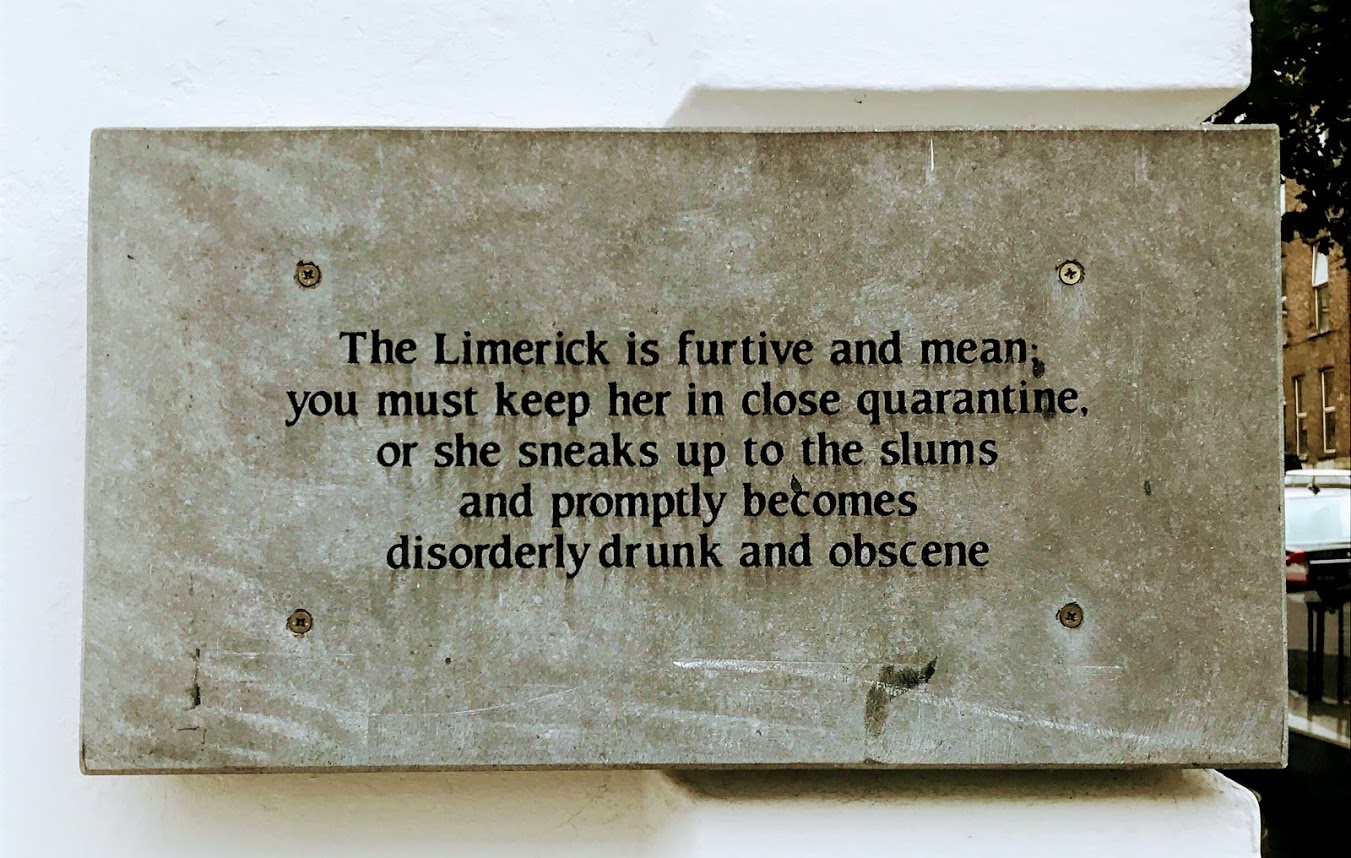
The lure of the Limerick … lines on the corner of Limerick’s White House (Photograph: Patrick Comerford, 2017)

Patrick Comerford

On a street corner in Limerick, an inscribed stone juts out from O’Connell Street into Glentworth Street, with the words:

The Limerick is furtive and mean;
you must keep her in close quarantine,
or she sneaks up to the slums
and promptly becomes
disorderly, drunk, and obscene.


For many Limerick, Limericks and poetry are difficult to separate. For some, the Limerick may have been their introduction to poetry, for others they never moved beyond the fun of the Limerick to enjoy the breadth of opportunity offered by poetry.

It is widely thought that Edward Lear invented the Limerick, although this is probably incorrect.

The Limerick as a form was popularised by Edward Lear in his first Book of Nonsense (1846) and a later work, More Nonsense, Pictures, Rhymes, Botany, etc. (1872). Lear wrote 212 Limericks, mostly considered nonsense literature. The humour is not in the punch line ending but rather in the tension between meaning and the lack of meaning.

In one of his typical Limericks, Lear wrote:

There was a Young Person of Smyrna
Whose grandmother threatened to burn her.
But she seized on the cat,
and said ‘Granny, burn that!
You incongruous old woman of Smyrna!’


Whether he invented it or not, Lear certainly made the Limerick popular. The Oxford English Dictionary first defined the word Limerick in 1892, four years after Lear’s death. But as OE Parrott makes clear in the opening pages of The Penguin Book of Limericks:

The Limerick’s birth is unclear:
Its genesis owed much to Lear.
It started as clean,
But soon went obscene.
And this split haunts its later career.


But in Limerick, it is said the five-line verse probably originated from the Limerick-makers of Croom, known as the Maigue poets, who worked in the 18th century. They were school-teachers, priests and self-styled persons of letters, living within 30 km of Croom. Their gatherings and revels in pubs and inns were said to resemble the ancient Irish bardic schools, conducted in Greek, Latin and Irish.

One of the Maigue’s first-known Limerick-writers was a publican, John O’Toumy, who was born near Croom in 1706. Of his own business practices, he bemoaned:

I sell the best brandy and sherry,
To make my good customers merry.
But at times their finances
Run short as it chances,
And then I feel very sad, very.


To this another Maigue poet, Andrew McCrath, quickly retorted:

O’Toumy! You boast yourself handy
At selling good ale and fine brandy,
But the fact is your liquor
Makes everyone sicker,
I tell you that, I, your friend, Andy.


Ronald Knox caricatured the philosophy and theology of the I8th century Irish bishop George Berkeley in a pair of Limericks:

There was a young man who said, ‘God
Must think it exceedingly odd
If he finds that this tree
Continues to be
When there’s no-one about in the Quad.’


And the reply, according to Knox was:

Dear Sir:
Your astonishment’s odd:
I am always about in the Quad.
And that’s why the tree
Will continue to be,
Sincerely observed by, Yours faithfully, GOD.


The poet WH Auden, whose literary corpus is marked by thoughtfulness and solemnity, seemed to find release in the humour of the Limerick:

T.S. Eliot is quite at a loss
When clubwomen bustle across
At literary teas,
Crying: ‘What, if you please,
Did you mean by The Mill on the Floss?’


The plaque celebrating the fun of the Limerick is on a corner of Limerick’s White House pub, which dates back to 1812. One previous manager attributed the pub’s enduring success over the past 200 years to the fact that it is ‘simple in its design, everything works. It has basically been untouched since it first opened.’

This has been a favourite haunt of bankers, lawyers, artists and musicians. Jack Charlton, Jim Kemmy, Frank McCourt and Richard Harris are all said to have had a pint here.

The pub earned its name not because of its colour but because the company that first opened the White House was WH White & Co. It was bought by Eamonn Gleeson and his family in the 1920s. Eamon Gleeson, whose picture hangs proudly in the bar, was noted as ‘an eccentric, who used to wire all the bar stools together so they couldn’t be moved.’

For a long time the bar and its management prided themselves on the fact that this was one of the few pubs in Limerick not to have a TV, focusing instead on poetry and acoustic music nights, promoting local writers and singers.

The pub is known for its artistic and cultural heritage. The White House poetry nights have featured poets from all over the world, and the pub has always been supportive of actors, writers and musicians. The pub was bought in 1999 for the equivalent of €1 million. But the poetry nights continued, and in 2015 the White House celebrated a cultural milestone in marking 600 consecutive poetry nights.

When the White House was bought last year by the former Munster and Ireland rugby player Damien Varley, reportedly for €650,000, a Facebook page was set up to save the pub from being turned into a sports bar.

The White House has a late 19th century shopfront and a Victorian pub interior (Photograph: Patrick Comerford, 2017)

The White House is a prominent building at the corner of O’Connell Street and Glentworth Street. It was designed to address both streetscapes in a formal architectural manner. The late 19th century shopfront and the Victorian pub interior make this building one of architectural importance.

This end-of-terrace, two-bay, four-storey building over a concealed basement has a three-bay, four-storey over basement south-facing side elevation. It was first built as a red-brick townhouse about 1810, but the shopfront dates from the late 19th century, with Doric pilasters on both elevations rising from ‘crazy’ tiled stall-riser plinths flanking both door openings and display windows, and supporting a timber framed fascia board with incised lettering behind glass panes that reads: ‘James Gleeson.’

The roof is concealed behind a parapet wall. Red brick walls laid in Flemish bond with cement repointing. A gantry crane on the side elevation may be original and was probably used to hoist goods to and from the basement level.

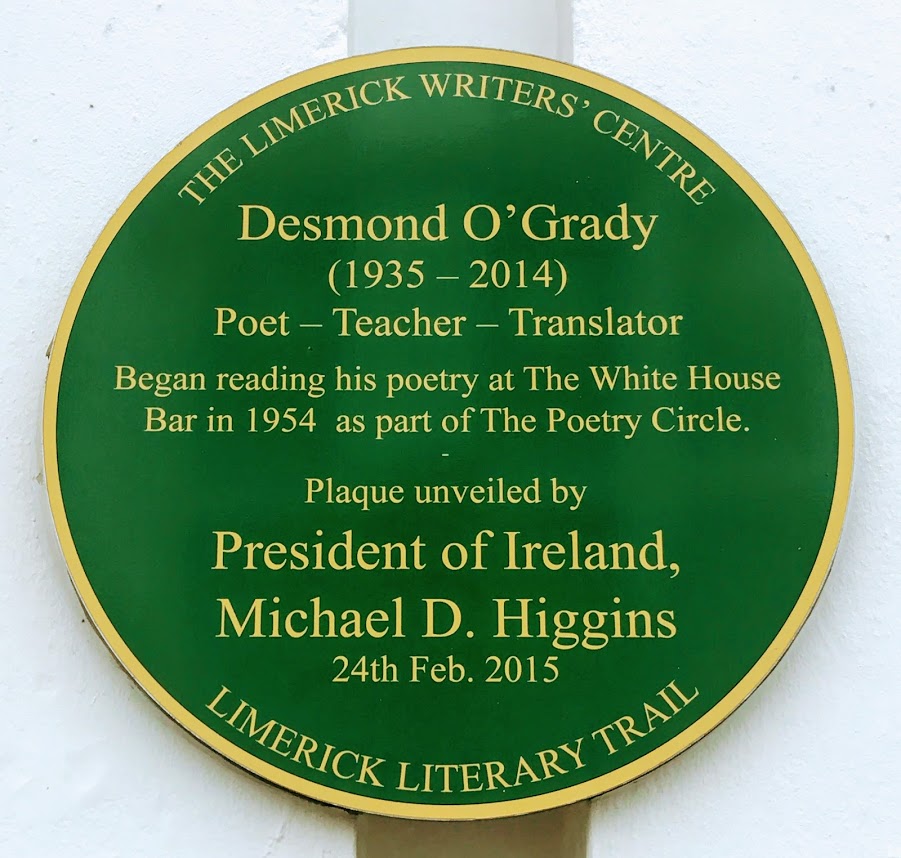
A plaque erected by Limerick Civic Trust on the left-hand side of the O’Connell Street façade was unveiled by President Michael D Higgins on 24 February 2015 as a tribute to the Limerick-born poet Desmond O’Grady (1935-2014), who began reading his poetry at the White House Bar in 1954 as part of the Poetry Circle.

When Desmond O’Grady died at the age of 78 in 2014, President Michael D Higgins led the tributes, describing him as one of Ireland’s best-known poets, who was deeply committed to his work.

With the exception of Yeats, he was arguably the most international of 20th century Irish poets.

His first book, Chords and Orchestrations, was published in 1956. He was the author of almost 20 books of poetry, including My Alexandria (2006), On My Way (2006), The Road Taken: Poems 1956-1996 and The Wandering Celt (2001).

He also published over a dozen collections of translated poetry, among them Trawling Tradition 1954-1994, Selected Poems of CP Cavafy, The Song of Songs, Ten Modern Arab Poets, and Kurdish Poems of Love and Liberty. His other works include prose memoirs of his literary acquaintances and friends.

A plaque on the façade of the White House celebrated the Limerick-born poet Desmond O’Grady (Photograph: Patrick Comerford, 2017)

Desmond O’Grady was born in Limerick in August 1935, and spent much of his childhood in West Clare and the Irish-speaking districts of Co Kerry. After boarding school in Roscrea, Co Tipperary, he moved to Paris in the 1950s and worked in the Shakespeare and Company bookshop, so closely associated with James Joyce and the publication of Ulysses.

He went on to teach in Paris, and there he became friends with Jean-Paul Sartre, Simone de Beauvoir, Pablo Picasso, and Samuel Beckett, who had recently published Waiting for Godot.

When he married an exiled Iraqi Catholic, they moved to Rome, where O’Grady taught English and was the English-language voice of Pope Pius XII on Vatican Radio. In Rome, he also met Federico Fellini and played the role of an Irish poet in Fellini’s La Dolce Vita. For some years, he was secretary to the American poet Ezra Pound in his exile in Italy.

When he and his wife separated, he went to teach at Harvard, where he also completed his MA and PhD in Celtic Languages and Literatures and Comparative Studies. At Harvard, he became friends with Robert Lowell, and continued the links he had forged in Europe with the Beat writers Kerouac and Ginsberg. O’Grady also worked as the European editor of The Transatlantic Review.

He returned to his spiritual home on mainland Europe, and from Europe, he went to Egypt. While was absorbing, distilling, and writing, he was teaching at the American University in Cairo, where he was Poet in Residence, and at the University of Alexandria.

When he returned to live in Ireland, he settled in Kinsale, Co Cork, where he lived for the last 20 years of his life.

We met soon after his return to Ireland, and had a lengthy discussion about the Greek poet CP Cavafy, who was born in Alexandria. Over 20 years ago, in ‘An Irishman’s Diary’ in The Irish Times in 1996, I wondered why little attention had been given to his translation of 33 of Cavafy’s poems. This version of 33 Cavafy poems, Alternative Manners, was published in 1993 by the Hellenic Society (Athens and Alexandria). Unfortunately, much to his regret, the proofs were never properly corrected, and so the book was never put on the market commercially and has never been reviewed in newspapers.

He felt Alternative Manners ‘reads like Greek ruins’ and asked later readers to ‘please forgive, and overlook, and correct.’ But, he conceded modestly, the collection had its admirers. ‘Greek people who know their Cavafy and who have read it found my Hiberno English very suited to Cavafy’s Alexandrian Greek, and closer to the text of Cavafy’s language than standard British and American translations.’

A reading of two of Cavafy's best-known poems illustrates the particular insights and turn of phrase which an Irish translator brought to his work. His translation of Ithaka loses the references by Kimon Friar and Edmund Keeley and Philip Sherrard to Laistrygonians and Cyclops; instead, they become ‘cannibal bogeymen met in half light’ and ‘those with one eye, open for their main chance.’ The ‘Phoenician trading stations’ or ‘market places’ of the other translators become ‘ports you’ve not dreamed of’ and ‘every city.’

In Waiting for the Barbarians, Sherrard and Keeley have the city fathers ‘assembled in the forum’ and Friar has them mustered in the forum, but O’Grady, who renames the poem Expecting the Barbarians, has them ‘waiting, here in the square.’ Instead of the barbarians being dazzled, they are not impressed by ‘bamboozle.’ And, instead of rhetoric and public speaking or ‘eloquence and public speeches,’ O’Grady speaks of ‘boring baloney.’

At the time, I noted how O’Grady had come to regard Greece as his second home. I suggested his earlier frustration with the Greek printer’s handling of Alternative Manners ‘could be rectified if an Irish publisher found an interest in the book.’

That hope was realised in 1998, when the Dedalus Press in Dublin published Selected Poems of CP Cavafy, a volume that was reissued in 2012, two years before he died.

Desmond O’Grady was unusual among Irish poets of his generation for both his interest in modernist experimentation and his immersion in the poetry of other cultures. He was, in the true sense, a citizen of world poetry.

He died in 2014, on the eve of his 79th birthday. In his later years he took comfort in the theme in Cavafy’s Ithaka – it is the journey, not the destination, is what constitutes our true reward:

Keep Ithaka marked on your mind’s map,
always. Arrival there is your final goal.
Don’t hurry your journey in any way. Better
to last it for decades. As you age, anchor
at small islands with the wealth you’ve acquired
voyaging. Never expect Ithaka to give you anything.
Ithaka gave you the journey.


CP Cavafy ... a portrait by David Hockney

03 October 2016

All Saints’ Church, Blackrock: a suburban
Dublin church in the Tractarian tradition

All Saints’ Church, Blackrock … a Victorian church that continues the legacy of the Tractarians and the Oxford Movement (Photograph: Patrick Comerford, 2016)

Patrick Comerford

I was invited to preach at the Harvest Eucharists yesterday [2 October 2016] in both All Saints’ Church, Blackrock, and Saint Brigid’s Church, Stillorgan, where the Rector is the Revd Ian Gallagher.

These are two beautiful but very different suburban Dublin parish churches, and while I have been in the parish church in Stillorgan before, this was my first time in All Saints’ Church, Blackrock.

All Saints’ Church was built on Proby Square and Newtown Park in 1868-1870 in the Early English style to meet the needs of a growing Victorian suburb. This part of the Carysfort Estate was developed in 1840-1880, and the parish was created in 1868 from parts of Stillorgan, Kill and Monkstown.

The first Vicar of Blackrock (1870-1898) was the eminent Victorian church historian, Canon George Thomas Stokes (1843-1898). While he was vicar, Canon Stokes was also Assistant Professor (1880-1883) and then Professor of Ecclesiastical History in Trinity College Dublin (1883-1889), the Keeper of Marsh’s Library (1887-1898), and a canon of Saint Patrick’s Cathedral, Dublin (1893-1898).

All Saints’ Church was designed by John McCurdy (Photograph: Patrick Comerford, 2016)

The church was built for a congregation of 250. The foundation stone was laid on 15 September 1868, the new vicar was instituted on 6 April 1870, and the church was consecrated on 21 April 1870.

The architect of the new church was John McCurdy (1824-1884), the official college architect of Trinity College Dublin. He was also architect to the Commissioners for Education of Certain Endowed Schools (1873-1883), and to the Benchers of King’s Inns, and a Blackrock Township Commissioner (1864-1875).

McCurdy, who worked from his offices in TCD and from various offices in Leinster Street and Harcourt Place, was living at The Cottage, Newtown Park, Blackrock, while All Saints’ Church was being built. In his spare time, he was a keen yachtsman and in 1881 he designed a four-ton cutter for fellow yachtsman George Orr Wilson of Temple Road, Blackrock.

McCurdy later lived at 11 Trafalgar Terrace, Monkstown, Chesterfield House, Cross Avenue, Blackrock, and at Elsinore, 25 Coliemore Road, Dalkey, where he was living at the time of his death.

The church was built in rustic granite at a cost of £3,000. The contractors were J & W Beckett of South King Street, Dublin. The Beckett family believed they had Huguenot ancestry. The brothers James Beckett, and William Beckett formed the building company of J & W Beckett, which became one of the leading contracting firms in Dublin. James Beckett was instrumental in reviving the Dublin Master Builders’ Association in 1895, while William Beckett was the grandfather of the Nobel playwright Samuel Beckett.

The west window commemorates the first vicar, Canon George Thomas Stokes (Photograph: Patrick Comerford, 2016)

The west window commemorates the first vicar, Canon Stokes. The three-light east window by Heaton, Butler & Bayne of London was installed in 1898, and shows Saint Paul preaching in Athens (left), Christ blessing the Children (centre), and Saint Patrick preaching.

In 1877, the chancel was decorated by Mannix of Harcourt Street. The Caen stone reredos and the encaustic tiling of the east wall and floor beneath the Altar were erected at joint expense of the Wesleyan Connexional School (now Wesley College) and Rathmines School in memory of two schoolboys who were parishioners and who were drowned in 1875.

Saint Columba baptisting a child … a fresco in the Baptistery in All Saints’ Church (Photograph: Patrick Comerford, 2016)

One website says All Saints’ Church ‘is nearly a like a miniature Anglican cathedral.’ The church consists of a nave, side aisles and a square tower with a short spire. There is a square apse and transept.

Behind the altar, there are ornate mosaics, there is a hinted-at rood screen in the sanctuary, and large, elaborate frescoes in the baptistery, which occupies the single transept. Yet this is a small church by Dublin standards.

The Resurrection by James Powell and Son, London (1892) … the main windows of the nave are triangular in shape (Photograph: Patrick Comerford, 2016)

The church is mainly lit by the clerestory windows. The main windows of the nave are trefoil or triangular in shape – an unusual feature also found in Christ Church, Dun Laoghaire.

Saint Michael the Archangel … All Saints’ Church has some of the finest stained-glass windows by Wilhelmina Geddes (Photograph: Patrick Comerford, 2016)

The church also has some of the finest examples of the work of the stained-glass artist Wilhelmina Geddes (1887-1955), a vital figure in the Irish Arts and Crafts movement and 20th-century British stained-glass revival. The war memorial windows show the archangels Saint Raphael and Saint Gabriel.

Geddes was born in Co Leitrim and was raised in Belfast. She studied at the Belfast School of Art and later in Dublin under the painter William Orpen. She was invited by Sarah Purser to join the Tur Gloine studio and worked there for several years. She moved to London in the 1920s and worked at the Lowndes & Drury’s Glass House in Fulham for the next 30 years where her pupils included Evie Hone.

Her windows depict human figures with deep emotional expression both in their faces and their body language. She also points to multiple references to mediaeval architecture and ancient Irish iconography within the designs on the stained glass. She had a rich knowledge of Biblical stories and the lives of the saints.

Professor Roy Foster of Oxford wrote in The Irish Times: ‘Her sensual men of God resemble no one else’s, powerfully muscled with prominent Adam’s apples and firm jaws, while her female saints and Madonnas are strong individuals who inhabit richly imaginative worlds.’

Many of her windows were commissioned to commemorate young men who died in World War I. She designed two windows in Saint Anne’s Church, Dawson Street, Dublin: a single-light window with the Archangel Michael with Joshua, Gideon, David and Jonathan, Saint Longinus and Saint George, Saint Sebastian and Saint Martin; and a single-light window of Saint Christopher and scenes from the life of Christ.

She also designed windows for Christ Church (Presbyterian), Rathgar, Dublin, and a war memorial window in the Presbyterian Church in Townsend Street, Belfast.

One of her last commissions was ‘Te Deum’, a large-scale war memorial rose window in Saint Martin’s Cathedral in Ypres, Belgium.

The church has a robed choir and the organ, built by the Manchester-based Dubliner George Benson, is a very fine example of a late-romantic English/Irish instrument. It was rebuilt in 1992 by Derek Verso & Co.

All Saints’ Church has a strong liturgical tradition that continues the legacy of the Tractarians and the Oxford Movement.

Inside All Saints’ Church, Blackrock (Photograph: Patrick Comerford, 2016)

13 June 2016

‘Nothing changes the relief at being’ in
Paris. It’s ‘like coming out of gaol in April’

A corner of Bray that is forever Paris (Photograph: Patrick Comerford)

Patrick Comerford

The Republic of Ireland plays its first match in the UEFA European championship tonight [13 June] against Sweden at 5 p.m. in the Stade de France, the French national stadium in the commune of Saint-Denis, just north of Paris.

Over the weekend, Paris has become home to thousands of Irish fans, who have done a better job of making Parish their home than the English fans have managed in Marseilles.

But for centuries, Paris has been welcoming to Irish saints and scholars, refugees and writers, poets and priests, spies and politicians, journalists and revolutionaries, as well as football players and fans and fans alike.

Whether or not Ireland achieves a miracle in Paris tonight, I am reminded that it is a miracle of modern literary achievement that James Joyce had Ulysses published in Paris. When the American Sylvia Beach of Shakespeare and Co, 7 Rue d’Odeon, published the book, she was also willing to take on all the financial and legal risks.

Oscar Wilde (1854- 1900) first visited Paris in the summer of 1874, in the company of his mother, Speranza.

In his final days, after his public humiliation, Wilde found refuge in Paris and under the assumed name of Sebastian Melmoth he stayed in Room 16 at the Hôtel d’Alsace from July 1900 until his death on 30 November 1900.

His funeral Mass was said by Father Cuthbert Dunne, a Passionist priest, in the Church of Saint-Germain-des-Près on 3 December 1900, with 56 people present. Wilde received a pauper’s burial at Bagneux cemetery but his body was later moved to a grave Père Lachaise.

WB Yeats (1865-1939) first visited Paris in February 1894, and admitted to his friend John Millington Synge that forgot where he was supposed to be.

Yeats returned to Paris in December 1896, and stayed at the Hôtel Corneille, which was beloved by Irish writers in Paris, and where Yeats and Synge became close friends.

On New Year’s Day 1897, Synge accompanied Maud Gonne to the inaugural meeting of the Association irlandaise in rue des Martyrs, and Yeats later had to counter rumours in Irish circles in Paris that Maud was an English spy.

Yeats stayed in Paris again in April 1898, and from late January to mid-February 1899. This was not a happy visit, for Maud Gonne turned down his proposal of marriage. He wrote to Lady Gregory: “I have had a black, depressing time here.”

Yeats did not visit Paris again for almost a decade, once again in romantic pursuit of Maude Gonne in June 1908. He came again to Paris in early December 1908, when he stayed for a month, and in April 1911 with Lady Gregory.

After he visited Paris in May 1914, Yeats returned to London, and stayed with Maud Gonne at her home. He passed through Paris several times after World War I, but by then Maud Gonne had left Paris. He would move to the south of France, and died in Menton in 1939.

James Joyce (1882-1941) first arrived in Paris on 10 December 1902 to study medicine. He returned home for Christmas, but was back in Paris in January, staying at the Hôtel Corneille. The playwright John Millington Synge, who was living in Paris at the same time, noted Joyce’s “rather indolent” and hungry existence. About the same time, Joyce wrote: “Paris amuses me very much, but I quite understand why there is no poetry in French literature, for to create poetry out of French life is impossible.”

Joyce left Paris again in 1903 and visited Paris briefly again with Nora Barnacle on his way to Zurich in October 1904. He was next in Paris in July 1920. His biographer, Richard Ellman, says: “He came to Paris to stay a week and remained for 20 years.”

By some counts Joyce changed address 19 times during this stay in Paris, from 1920 to 1939, and moved around thanks to the generosity of a rich English widow, Harriet Shaw Weaver.

Joyce and TS Eliot first met at the Hotel de l’Elysee in Paris on 15 August 1920. They dined in Joyce’s favourite restaurant, and Joyce extended his hospitality several times. Their friendship blossomed after ‘The Waste Land’ and Ulysses were published around the same time in 1922.

In 1923, when Eliot reviewed Ulysses, he said: “It is a book to which we are all indebted and from which none of us can escape.” It marked a major shift in literature, he said. “It is, I seriously believe, a step toward making the modern world possible for art.”

Eliot would look to Joyce for support when he separated from his wife, and Eliot continued to visit Joyce whenever he was in Paris. In his Dublin lectures in 1936, Eliot said Joyce “seems to me the most universal, the most Irish and the most Catholic writer in English of his generation … What is most truly Irish … is most truly Catholic.”

Later, Edna O’Brien would recall that the first book she ever bought was Introducing James Joyce by TS Eliot. She once said that Joyce’s A Portrait of the Artist as a Young Man made her realise that she wanted to spend her own life writing. So, we cannot yet estimate the impact on modern Irish literature of the friendship between Eliot and Joyce.

Memories of Beckett near his old school … a corner of Enniskillen that is forever Paris (Photograph: Patrick Comerford)

In 1928, at the age of 22, Samuel Beckett (1906-1989) arrived in Paris to take up a position at the prestigious Ecole Normale Supérieure, and stayed there until September 1930. He was lodged in a room on the first floor of the ENS overlooking the rue d’Ulm, looking out over “the bare tree, dripping; then, behind, smoke from the janitor’s chimney-pot, rising stiff like a pine of ashes; then, beyond, beyond the world, pouring a little light up the gully of the street that westers to the Luxembourg ...”

Beckett was soon drinking heavily, especially in the Cochon de Lait in the rue de Corneille, where he spent much of the prize money he received in 1930 for his long poem, ‘Whoroscope.’

In July 1931, like Joyce, Synge and Yeats before him, Beckett was to stay at the Hôtel Corneille, also in rue de Corneille. There he was introduced to Joyce by Thomas MacGreevy, and Beckett became a frequent visitor to Joyce’s flat at Square Robiac until May 1930, when he was blamed for upsetting Joyce’s schizophrenic daughter, Lucia.

Beckett later stayed at the Trianon Palace Hotel at on rue de Vaugirard, around the corner from the rue de Corneille, but felt forced to leave in May 1932 during a campaign to expel foreigners without residence permits.

Although Beckett moved back to Dublin, he returned to Paris once more in 1937, and remained for most of the next 52 years. “Nothing changes the relief at being back here,” he wrote after arriving in Paris. “Like coming out of gaol in April.”

When Beckett was almost stabbed to death by a pimp in January 1938, James Joyce found him a private room at the Broussais hospital and paid for it. While he was recovering, Beckett was visited by Suzanne Deschevaux-Dumnesil, who became his constant companion until his death.

They both joined the French resistance network and after World War II moved to Ussy-sur-Marne, east of Paris, where he wrote much of his work.

Beckett and Suzanne Deschevaux-Dumnesil eventually married in 1961, and they found an apartment on the Boulevard Saint-Jacques.

In the early 1960s, Beckett, Peter Lennon, John Montague and other friends were regulars at the Falstaff on the rue de Montparnasse or at the Rosebud around the corner on the rue Delambre.

Beckett was admitted to the Tiers Temps nursing home in 1988 and died there in December 1989, five months after Suzanne.

Wilde and Beckett both went to school in Portora, Beckett was a cricket player and a boxer, and both Beckett and Joyce were great rugby fans. Joyce’s love of rugby began on the 14 April 1923, when he watched a tie between Ireland and France. I do not know whether they were soccer fans, but in Ulysses we read that “Cissy Caffrey whistled, imitating the boys in the football field to show what a great person she was.” Meanwhile, let’s home that the fans who have arrived for a few weeks in Paris don’t stay there for 20 years.

Chez Max at No 1 Palace Street near Dublin Castle … a corner of Dublin that is forever Paris (Photograph: Patrick Comerford)

12 August 2012

A walk in the gardens at Killruddery and by the shore in Bray

Killruddery is one of Ireland’s great historic houses (Photograph: Patrick Comerford, 2012)

Patrick Comerford

Bray is preparing to welcome Katie Taylor home tomorrow [Monday] with her gold medal. Despite heavy rain throughout the afternoon, Bray was alive and bright today, with music and crowds along the Promenade, and air of excitement everywhere.

Earlier in the afternoon, we were in Killruddery, which has been home to the Brabazon family and the Earls of Meath since 1618. This is one of Ireland’s great historic houses and the gardens deserved more of our time for walks and exploring.

Killruddery has been home to the Brabazon family and the Earls of Meath since 1618 (Photograph: Patrick Comerford, 2012)

We started our walk in the Walled Garden, first built around 1830. This is four acres of space within tall red brick walls. A long walk leads past potatoes, spinach, lettuce, asparagus, broccoli, swedes, courgettes, beans and herbs. There are pear, apple, damson and fig trees and at the heart of the garden is a perfect picnic spot. Close-by are hens and a cockerel, and pigs in an open pen.

The gardens at Killruddery are the oldest in Ireland still surviving in their original 17th century style (Photograph: Patrick Comerford, 2012)

The gardens at Killruddery are the oldest in Ireland still surviving in their original 17th century style, with 18th and 19th century additions. They were designed for the entertainment of a large number of people and the scale is comparable to that of a park. They are mainly the work of the 4th and 6th Earls of Meath, who engaged Bonet, a French landscape architect and a pupil of Le Notre.

The middle section of the garden, ‘The Angles,’ is a series of walks flanked by hornbeam, lime and beech hedges that meet at two centre points. Beyond ‘The Angles’ is an avenue of Ilex trees dating from the 17th century and steps leading to what was the bowling green. This area is under restoration.

The Long Ponds are twin canals 187 metres long and known as miroirs d’eaux or reflecting ponds (Photograph: Patrick Comerford, 2012)

The Long Ponds are twin canals 187 metres long and known as miroirs d’eaux or reflecting ponds.

Opposite ‘The Angles,’ on the far side of the Long Ponds, is a wooded area known as the Wilderness. A gate leads out to the Park and a statue of Venus. The circular granite edged pond is 20 metres in diameter and the four Victorian cast iron statues at the entrances depict the four seasons of the year.

Beyond the Beech Hedge Pond are the gardens laid out in a 19th century style. A low yew hedge encloses a rose and lavender garden with a fountain in the centre.

Killruddery House is one of the most successful EIizabethan-Revival mansions in Ireland. In the 1820s, the 10th Earl of Meath engaged Richard Morrison and his son William, fashionable architects of the day, to remodel Killruddery.

In the 1950s part of the house was demolished and the house was greatly reduced to its present size. However, much of the Morrisons’ design and architecture remains.

The glass dome in Orangery was designed by Richard Turner (Photograph: Patrick Comerford, 2012)

We were brought through the house, ending finally at the magnificent Orangery. This was designed and built by William Burn in 1852 after the fashion of the Crystal Palace in England. The original glass dome was the work of Richard Turner, who designed the curvilinear range at the National Botanic Gardens in Dublin and at Kew Gardens in London.

The Orangery in KIllruddery was designed by William Burn after the fashion of the Crystal Palace (Photograph: Patrick Comerford, 2012)
The Orangery houses a collection of marble statues gathered in Italy in 1830-1850. Classical sculptures include Ganymede giving water to Zeus disguised as an eagle, Cyparissus with his dying deer, and Cupid with Pysche and Venus. A collection of busts includes Homer, Socrates, Napoleon, William Pitt and the Duke of Wellington.

From Killruddery we returned to Bray and stopped for a moment at the former Town Hall and Market House, built by the Earls of Meath as a gift to the town. In front of the Town Hall is a monument to the Brabazon family with their heraldic wyvern, which we had seen throughout the house at Killruddery. Above was a banner preparing to welcome Katie Taylor back to Bray tomorrow.

The Brabazon wyvern fountain and the Town Hall in Bray ... preparing to welcome Katie Taylor home (Photograph: Patrick Comerford, 2012)

The Meath family were generous patrons, giving Dublin the Meath Hospital, the Coombe Hospital and the Brabazon Home. What a sad reflection on life today that the Town Hall they gave to Bray has not remained a public building but is used by a well-known fast food chain!

We parked on the seafront, and walked back in the rain to have lunch in Campo De Fiori, on the corner of Strand Road and Albert Avenue. The restaurant takes its name from a square in Rome, known as the “field of flowers” because in ancient days it was decorated with nice daisies, poppies and many wild flowers.

Walking along the seafront in Bray this afternoon (Photograph: Patrick Comerford, 2012)

Earlier in the day, I was in Tullow Church on Brighton Road in Carrickmines to preside at the early morning Eucharist at 8.30 and to lead Morning Prayer and preach at 10.30.

Tullow Church serves about 200 families in the Church of Ireland parish in the Carrickmines, Foxrock and Cornelscourt area.

Between the two services I strolled in early morning drizzle as far as Foxrock village, and back again.

Tullow Parish traces its history back to a church dating from the late 12th century and said to have stood on the site of an earlier church founded by Saint Brigid. Tullow or Tully (an earlier version of the name) means hillock and the original name was Tullagh na nEspuc (the Hill of the Bishops). Legend says the “Seven Bishops of Cabinteely” started out from there to visit Saint Brigid in Kildare.

The 12th century church was in use until about 1615, and was supplied with clergy from Christ Church Cathedral in the city centre. By 1630, the church had been badly damaged in storms. It was abandoned and fell into ruins, and the parish was united with Monkstown.

Tullow Parish Church on Brighton Road, Carrickmines, Co Dublin (Photograph: Patrick Comerford, 2012)

The story of the present church begins in 1860. The parish church in Monkstown was finding it difficult to accommodate the growing numbers of church-goers on Sundays and Foxrock was a growing suburb served by new suburban rail stations in the Foxrock and Carrickmines on the Harcourt Street line to Bray.

The Revd John Fawcett, a curate in Taney, was nominated to the new parish of Tullow, which first used a schoolhouse on Ballycorus Road until the new church was consecrated in 1864.

The church, designed by Welland and Gillespie, had a simple rectangular shape and gothic-style spire. It was built in granite at a cost of £1,600. The rectory beside the church was built in 1890. The church was extended by JF Fuller in 1904, so that the original building became the transepts and the nave and chancel were added at right angles.

The East Window, which was added on 1959, shows four scenes from the life of Christ – the Annunciation, the Incarnation, the Crucifixion and Resurrection. Below is a discreet carved inscription quoting John Donne: “The whole life Christ was a continual passion ... His birth and his death were but one continual act, and his Christmas Day and his Good Friday are but the evening and the morning of one and the same day.”

The East Window in Tullow Parish Church (Photograph: Patrick Comerford, 2012)