Showing posts with label antisemitism. Show all posts

06 May 2026

When you vote, consider the people
who feel the need to ‘always keep
a packed suitcase by the front door’

Tomorrow is polling day in local elections in many parts of England and in assembly elections in Wales and Scotland (Photograph: Patrick Comerford)

Patrick Comerford

There is an old adage among football fans that ‘you don’t choose the club, the club chooses you.’

So, on Sunday night, as I stood in the bar in the Old George, I really wanted – hope against hope – as five minutes of added time stretched into an agonising six, that Aston Villa would clinch an equaliser, and rise back into the top four in the Premier League.

I have been a Villa fan since my teens for no other reasons than that Villa Park is a few stations south of Lichfield on the trainline from Lichfield into Birmingham. I seldom go to football games these days, but I still watch Villa matches in my local pub, and I have benign, avuncular feelings when I see Villa fans at Lichfield Trent Valley and Lichfield City heading off to games.

In the present political climate, I recall that Aston Villa has a proud tradition of standing up against antisemitism and racism. When Aston Villa was invited on a three-match tour of Germany in 1938, the players refused to give the Nazi salute. Later, during World War II, local lore says, the Villa reserve team were all captured at Dunkirk, and in captivity they thrashed their SS guards.

But on Sunday night I had something of an internal conflict – I didn’t want to see Tottenham Hotspur relegated either. Spurs have been my second team since my teens too, but for very different reasons.

Part of Spurs’ traditional support base was for long in the Jewish community in London, so that to fans of Chelsea and other clubs, Tottenham Hotspur is a Jewish club. In response to racist and antisemitic taunts, Spurs fans long ago adopted as their own chant: ‘We are the Yids’, embracing the label to render the abuse impotent.

Since 1982, Spurs have had three chairs who were Jewish businessmen with pre-existing degrees of allegiance to the club. It is said about 5 per cent of the Spurs fans at games may be Jewish.

The Jewish community in Tottenham began to grow early in the last century. East European Jews fleeing pogroms in Russia arrived in London from the 1880s on, and a fresh wave in 1905-1906 as the persecution intensified. Many Jews settled in the East End, and other families then moved further north to the Tottenham area. In time, Tottenham Hotspur became part of the lives of working-class Jewish men in the Tottenham area.

Jewish numbers at home matches rose after World War I, when improved public transport made it possible to be in synagogue in the morning and to catch a tram from Aldgate in time for a 2:30 kick-off at White Hart Lane. In the 1920s, the Jewish Chronicle claimed, almost all Jews who followed soccer were Spurs supporters, and the Jewish fanbase continued to grow in the 1930s. Several reports in 1935 estimated as many as 10,000 Jews in a Spurs crowd, or about one-third of the total.

When White Hart Lane was the venue for an international between England and Germany, the choice seen as an affront to the Jewish community. The swastika flew over White Hart Lane on 4 December 1935 and the German team gave a sinister Nazi salute to the crowd before kick-off. But a fan climbed onto the roof of the West Stand and tore down the Nazi flag. Perhaps it was irony, certainly it was justice, that Germany was defeated 3-0 that day.

After the war, Jewish fans still felt they belonged at White Hart Lane, although the local community was shrinking from the 1960s on. In the late 1960s, fans from opposing clubs began chanting abuse at Spurs fan using the ‘Yid’ word. When Spurs beat Chelsea in the 1967 FA Cup Final, the antisemitic abuse from Chelsea fans was so undiluted that many were deeply disgusted.

Throughout the 1970s, opposition fans openly labelled Spurs fans as Jews, and the chants descended into extreme racism. These chants raged from ‘does your rabbi know you’re here?’ to ‘I’ve never felt more like gassing the Jews,’ and ‘Spurs are on their way to Auschwitz.’ Nazi salutes were common, and hissing sound that resounded was intended as a reminder of the gas chambers.

In response, Spurs fans embraced the label and on the terraces, they took to chanting, ‘We are the Yids.’ They do not use the word in a derogatory way, nor is it an example of cultural appropriation. They use the label imposed on them by others to celebrate their history, continuity and identity in a form of defence mechanism against virulent and often uncontrolled antisemitism.

At a game between Spurs and West Ham some years ago, songs about Hitler and gas chambers could be heard from the away crowd, and Nazi salutes were also seen. In recent years, Chelsea supporters have chanted anti-Jewish songs on the London Underground, a group of Chelsea fans forced an Orthodox Jewish passenger to move carriages after targeting him for abuse, and a Chelsea season ticket-holder was banned for three years after making 13 Nazi salutes at Spurs fans.

This reminds me of behaviour by Nigel Farage that he refuses to acknowledge, to accept responsibility for, or to accept how offensive his refusal and responses to continue to be. The leader of Reform UK has faced significant allegations regarding antisemitism and racism, largely stemming from his time as a student at Dulwich College in the late 1970s and early 1980s, alongside criticism of his political rhetoric in later years.

Over 20 former classmates and teachers report having witnessed Farage engage in racist and antisemitic behaviour, including singing ‘gas ’em all’ songs, mimicking gas hissing sounds, and telling Jewish pupils that ‘Hitler was right’. Jewish contemporaries have recalled him as a school bully who targeted them and other ethnic minority students with abusive language.

Farage has either denied these claims, calling them ‘complete made-up fantasies’, or, in an apparent admission of their truth, has claimed he never intended to be hurtful or racist, dismissing his past comments as nothing more than ‘banter’.

A 1981 letter from a teacher previously described him as a ‘publicly professed racist’ with ‘neo-fascist views’, according to reports. In recent months, 11 Holocaust survivors have joined calls for Farage to apologise for the alleged school-era antisemitic remarks, but Farage’s response has not been to deny or to apologise, but to claim his critics are ‘politically motivated’.

Jewish groups and MPs have also criticised Farage for using the term ‘globalist’ to describe public figures, describing it as an antisemitic ‘dog whistle’. Farage has been accused of adopting antisemitic tropes by labelling financier George Soros ‘the biggest danger to the entire western world’ and alleging a ‘globalist’ plot, themes often linked to far-right conspiracy theories. Farage has gladly been guest on far-right US shows, with hosts such as Alex Jones and Rick Wiles, who has made overtly antisemitic claims, such as calling a political event a ‘Jew coup’.

And so, it is nothing less than galling to see Farage visit Golder’s Green after last week’s attack, trying to make political capital in advance of tomorrow’s local elections out of the mounting fears of antisemitism in the Jewish community, and accusing the government of failing to respond adequately to rising antisemitism, arguing that political considerations are preventing stronger action, particularly fear of offending a key voting bloc of Muslim South Asians.

My worst experience of racism was at a bus stop late one evening, when two burly men stood by me, one on either side, and started a conversation across me with each other with one saying: ‘’itler was right about ’em.’ I have no doubt it was my beard, black hat and black coat.

The coward’s response would have been to tell them that I’m not Jewish. It may have implied it was not OK to victimise me but was OK to victimise people who are Jews. And once one group of racists identify or perceive you as a Jew, you are always going to be a Jew in the eyes of racists and antisemites everywhere, no matter what ruling is made by a beth din, no matter what definitions are built into the Law of Return, no matter how narrow interpretations and applications of Halakha may be. On the other hand, even Chabad activits approach me on the streets, from London to Paris or Krakow, and ask me very direct questions about my identity.

In a recent discussion on a social media platform on how people are perceived as being Jews, one contributor wrote: ‘You will always be a Jew no matter what. When I was a kid I told my father I hated being a Jew and did not want to be one anymore, he told me you will always be a Jew. When the nazis come, you will be a Jew. When the PLO hijacks a plane and takes the Jews, you will be a Jew.’

My father grew up playing on the streets of ‘Little Jerusalem’ in Portobello in Dublin, where many of his uncles and cousins lived and where his schoolboy friends included Chaim Herzog and the Levitas brothers. I was born a few doors a way from the synagogue on Rathfarnham Road and I too played on those same streets in my younger schooldays, familiar with the small shuls on Walworth Road, Lennox Street, Lombard Street, Saint Kevin’s Parade and Oakfield Place, and the larger synagogues then on the South Circular Road and Adelaide Road. The late Kevin Martin, ‘a cousin of cousins’, was an expert in Sephardic genealogy, and constantly encouraged me to explore our shared stories of the Comerford, Mendoza, Martinez and Nunez families and his descent from the family of the Irish-Jewish prize fighter Daniel Mendoza.

But in today’s climate of induced fear, many Jews are increasingly afraid of openly discussing or displaying their identity, of having that long beard and black hat and coat. For my part, I have suspended my once regular blog postings, often on a Friday evening, discussing the history, architecture and heritage of synagogues, for fear of adding to the feelings of vulnerability among the people and congregations using those synagogues. This fear was confirmed yesterday with news of a fire at the former East London Central Synagogue on Nelson Street in east London. I have written about this synagogue many times in the past, including its recent sale to a Muslim group. Police are concerned that the attack on Tuesday morning may be part of an arson campaign linked to Iran, and now I am concerned about writing about other synagogues and their locations in the weeks, possibly months, ahead.

None of these fears and concerns takes away in any way from the reality of the disgusting misogyny that makes women feel afraid on our streets, the open Islamophobia that sees verbal and physical attacks on Muslims on the streets and on mosques, and the unfettered racism that is expressed against refugees, asylum seekers and immigrants but, is in fact, targeting all minorities of Africa and Asian heritage or descent, and even many with European origins. All this combines in a lethal cocktail that is being stirred by the far-right and that is being served up by their candidates in these elections.

The Labour politician Margaret Hodge, who was born in Alexandria in 1944 to Jewish parents who had fled Germany and Austria, has spoken of how her father advised her always to keep a packed suitcase by the front door. That fear has returned to many Jewish people in recent years, in an atmosphere that must not be linked only with the current crisis in the Middle East, but also with the actions and statements from far-right parties, their candidates and their leaders.

We have nation-wide local elections tomorrow. I shall be up early in the morning to vote: democracy has come at a very heavy price in too many countries, and once it is eroded it is very difficult to recover, as people in Hungary have learned, and as voters in the US are going to realise later this year.

How we vote tomorrow may determine whether the racist atmosphere on our streets is given permission to become even more vocal and more extreme, whether Farage becomes more smug about the past he agressievly sidesteps away from whenever he is challenged about it, hectoring and berating the interviewers while smiling smugly, and whether many people feel the need now to pay greater heed to the advice from previous generations to ‘always keep a packed suitcase by the front door’.

I shall be hoping for a better result tomorrow evening in the second leg of the Europa League semi-final between Aston Villa and Nottingham Forest. But I fear for the results from tomorrow’s elections.

Democracy has come at a very heavy price in many places, and once it is eroded it is very difficult to recover (Photograph: Patrick Comerford)

27 February 2026

The ‘lost Jews’ of Malacca
survived the Inquisition
but are losing their language,
heritage and identity

The Kristang or ‘Portuguese-Eurasians’ of Malacca include people of Sephardic descent

Patrick Comerford

During my first visit to Sarawak at the end of 2024, I tried to learn about the history and the stories of Malaysian Jews, and heard about the lost community of the Jews of Penang from Zayn Al-Abideen Gregory, the Kuching-based writer and academic and author of The Last Jews of Penang.

Penang was home to a Jewish community until the late 1970s. But there were Jewish communities in other parts of Malaysia too, especially in Negeri Sembilan and Malacca.

Traces of these lost Jewish communities were found among Mizrahi Jews, the majority of whom are Baghdadi Jews, Malabar Jews and Ashkenazi Jews. But there are also people of Sephardic descent who continue to live among the Kristang people and who have tried to maintain or recover their traditions.

The Kristang – also known as ‘Portuguese-Eurasians’ or ‘Malacca Portuguese’ – are a creole ethnic group of people primarily of Portuguese and Malay descent, but also with substantial Chinese and Indian ancestry. They are found mostly in Malaysia, Singapore and Australia.

The number of Kristang people is estimated at between 37,000 and 54,000 and in Malaysia they are found particularly in Malacca, Kuala Lumpur, Penang and Johor. Kristang groups are also found in Singapore, and due to significant migration in the second half of the 20th century there is a diaspora that has spread to Australia, Canada and the United Kingdom.

The Jenti Kristang or Orang Serani people are predominantly Roman Catholics, but small numbers of them are Jews, and some are Sunni Muslims and secular people too. Their languages are Papia Kristang, English and Malay.

These people are mainly Malay and Portuguese in their ancestry, but they also have some Dutch ancestry due to intermarriage. This group emerged with their own particular identity in Malacca in the 16th and 17th centuries, when it was part of the Portuguese Empire. Today the Malaysian government classifies them as Portuguese-Eurasians.

The name Kristang comes from the Portuguese creole Kristang, meaning Christian, and in turn it is derived from the Portuguese Cristão. A derogatory term for the Malacca Portuguese community was Grago or Gragok, a slang term for Portuguese camarão (shrimp), referring to the fact that the Portuguese Malaccans were traditionally shrimp fishermen. They also call themselves Gente Kristang (Christian people).

The Padrão dos Descobrimentos or Monument to the Discoveries in Lisbon recalls the Portuguese explorers who set out for the new world (Photograph: Patrick Comerford)

Portugal was once one of the world’s largest and longest-lived maritime empires, with colonies that included Brazil in Latin America, many African countries such as Angola, Mozambique, Cape Verde, Guinea-Bissau, São Tomé and Príncipe, and many port cities throughout Asia, including Goa and Macao. Places that were once part of the Portuguese Empire remain home to small ethnic groups of mixed heritage such as the Macanese in Macau, and the Kristang people in Singapore and Malaysia, with their own unique languages.

The Kristang community traces its origins back to Portuguese sailors, soldiers and traders who came to Malacca during the age of Portuguese explorations and colonialism. There they formed relationships with local women who were indigenous people, Malays and Chinese.

The arrival of Vasco da Gama in India in 1498 sparked Portuguese interest in Malacca as a key, wealthy spice trade hub, and Malacca became a major destination in the great wave of sea expeditions launched by Portugal, becoming part of the Portuguese Empire. The first Portuguese expedition to reach Malacca landed in 1507. The geographic and fiscal advantages of Malacca were obvious, as one Portuguese official noted: ‘Whoever is lord of Malacca has his hand on the throat of Venice’, the Venetians being the great rivals of the Portuguese as importers of spices to Europe.

In the early years, the Malays called the Portuguese Serani, a Malay contraction of the Arabic Nasrani, meaning followers of Jesus of Nazareth. One story records a Portuguese landing party inadvertently insulted the Malaccan sultan by placing a garland of flowers on his head, and he had them detained. A Portuguese fleet was sent from India to free the group in 1511 and then conquered Malacca.

From 1511 on, Portuguese officials encouraged the explorers to marry local indigenous women, under a policy endorsed by Afonso de Albuquerque, then Viceroy of India. The King of Portugal granted freeman status and tax exemption to Portuguese men (casados) who ventured overseas and married local women. With Albuquerque’s encouragement, these mixed marriages flourished and 200 were recorded by 1604, leading to new families and settled communities.

The Dutch took Malacca from the Portuguese in 1641, and almost all political contact between Portugal and Malacca ended. A large number of people of Portuguese descent were sent to Batavia (now Jakarta), the Dutch East India Company headquarters, as war captives and there they settled in an area called Kampung Tugu.

The tomb of Vasco da Gama in the church in Belém in Lisbon (Photograph: Patrick Comerford)

Even after Portugal lost Malacca in 1641, the Kristang community largely preserved its traditions, practicing Catholicism and using the Portuguese language, and they also absorbed some Dutch crypto-Catholics.

Many Sephardic Jews from Portugal and around the Red Sea and Malabar settled in Malacca in the 16th and 17th centuries, and then assimilated into the local Portuguese-Malay community to escape persecution. They were anusim or conversos – Jews who were forced to convert to Catholicism under the pressure of the Inquisition. It continued in the Portuguese colonies until 1821, enforcing Catholic orthodoxy, policing ‘blood purity’, suppressing heresy, and persecuting Jewish ‘New Christians’, often resorting to extreme severity, including public torture and execution.

In the 16th century, Malacca was a significant hub for these communities, with reports of active, though often hidden, Jewish culture. Many of the Jews who remained in Malacca during Portuguese rule (1511-1641) integrated into the local Eurasian or Kristang community, which carries a mixture of Portuguese, Dutch, Jewish, and local Malay heritage.

Diego Hernández Vitoria ‘the elder’ (or Diogo Fernandes Victória) was a Portuguese merchant from Porto but also a Judaeo-converso and one of the most important Sephardic merchants in the late 16th century. He protected and financially helped the Judaeo-conversos who were poor or on the run and also tried to develop a closer relationship with the Jesuits.

Diego Hernández Vitoria lived in Spanish America, South-East Asia and Manila. His commercial network extended through Mozambique, Mombasa, Cambay, Gujarat, Sindh, Bijapur, Golconda, Malabar, Ceylon, Coromandel, Bengal, Orissa, Pegu, Siam, Malacca, Moluccas, China and Japan. In these places, 89 per cent of Vitoria’s investments were centred on trade with China and Japan. But because his Jewish origins were well-known In Malacca, he was ostracised by the resident Portuguese trading community.

Thanks to the protection that Vitoria granted to the Judaeo-conversos living between China, Japan and the Philippines, it is possible to list the main traders of Jewish ancestry who had settled in the region: Afonso Vaez, Diego Jorge, Francisco Rodrigues Pinto, Francisco Vaez, Góis, Luís Rodrigues (Manuel Fernandes), Manuel de Mora, Manuel Farias (Manuel Faria), Manuel Gil de la Guardia, Manuel Rodrigues (Manuel Rodrigues Navarro), Paulo Gonçalves, Pero Nabo, Pero Rodrigues, Rui Perez and Vilela Vaz.

The rules surrounding ‘the status of purify of blood’ (limpeza de sangue) blocked any convert or a descendant of converts from many spheres of public activity, and from many privileges, including honorific titles. This discriminatory legislation was based on racial criteria: it was no longer a question of religion but of ‘blood’. One had to provide a certificate, following thorough genealogical investigations, going back as far as possible in the lineage, that one had no Jewish ancestor in his genealogical tree.

A memorial at the Igreja e Convento de Sao Bento da Vitória in Porto apologises for the treatment of Jews during the Portuguese Inquisition (Photograph: Patrick Comerford)

The Inquisition continued its presence until the Dutch captured Malacca in 1641. Because of its persecution of Jews, many of the Jews of Malacca assimilated into the Kristang community. Most of the Sephardic-Asian creoles became genuine Christians, but in some cases, conversos managed to preserve their Jewishness in secret.

Nowadays, intermarriage occurs more frequently between Kristang and people of Chinese and Indian ethnicity rather than Malay because of religious laws that require non-Muslims who marry Malay Muslims first to convert to Islam.

The Kristang people in Malaysia do not have full bumiputera status, a status that applies to indigenous ethnic groups. Since Portuguese times, the Kristang have been living by the sea. It is still an important part of their culture. Even today, with only 10 percent of the community earning their living by fishing, many men go fishing to supplement their income.

Kristang traditional music and dance, such as the Branyo and the Farrapeira are derived from Portuguese folk dances, Kristang or Malacca Portuguese cuisine is similar to the Eurasian cuisine of Singapore and Malaysia, and the Kristang people traditionally used Portuguese and Christian first names, while their surnames were Portuguese.

In general the Kristang practice Roman Catholicism. Christmas (Natal) is the most festival and celebrate many saints’ days, including Saint John (San Juang) on 24 June and Saint Peter (San Pedro) on 29 June.

Kristang Jews are a small, often hidden, subgroup. They trace their ancestry to the Sephardic Jews who survived the Inquisition in Portuguese-controlled Malacca. They had assimilated into the Catholic Kristang community but retained some residual cultural practices. These ‘hidden’ Sephardic Jews are identified in a number of analyses of Asian communities with Jewish roots.

In recent decades, some Kristang people were interested in rediscovering their forgotten Jewish heritage. This led to the formation of the Kristang Community for Cultural Judaism (KCCJ) in 2010, although it is no longer active. Edgar Pinto Xavier also wrote a book about the Jewish history of Malaysia and how the Inquisition persecuted heretics and non-Christians in the Spanish and Portuguese colonies in Asia.

Today the Kristang community in Malaysia is primarily based in the Portuguese Settlement in Ujong Pasir, Malacca. They speak Papia Kristang (Malacca Portuguese Creole), a language that continues to mark them out from their Chinese and Malay neighbours.

The Kristang language is threatened with extinction and is classified as critically endangered by Unesco. The work of Kristang language activists has been compared by one writer to that of Yiddishists. But their work in Malaysia and Singapore is no guarantee that Kristang will survive as a living language for future generations.

Shabbat Shalom, שבת שלום‎

The Melaka or Malacca River … once known to European seafarers as the ‘Venice of the East’ (Photograph: Engin Akyurt - Pixabay / Wikipedia)

21 February 2026

Daily prayer in Lent 2026:
5, Sunday 22 February 2026,
First Sunday in Lent

‘The devil took him to the holy city and placed him on the pinnacle of the temple …’ (Matthew 4: 5) … a gargoyle at Lichfield Cathedral (Photograph: Patrick Comerford)

Patrick Comerford

Lent began this week with Ash Wednesday, and today is the First Sunday in Lent (Lent I, 22 February 2026). After our marathon journey that began in Heathrow on Ash Wednesday (18 February) and that included stopovers and connections in Muscat and Kuala Lumpur, we have settled into our flat in Kuching and I hope attend the Cathedral Eucharist in Saint Thomas’s Cathedral, Kuching, later this morning (8:30). In all, Saint Thomas’s Cathedral, which is a five-minutes walk from our flat, has six regular Sunday services: Holy Communion in English, 6:30 am; Sung Eucharistic in English, 8:30 am; Bahasa Malaysia Service with Holy Communion (McDougall Hall, Level 3, Parish Centre), 10:30 am; Mandarin Service with Holy Communion, 10:30 am; Iban Service with Holy Communion, 2 pm; Evensong with Holy Communion in English, 5:30 pm.

Before this day begins, I am taking some quiet time this morning to give thanks, to reflect, to pray and to read in these ways:

1, today’s Gospel reading;

2, a short reflection;

3, a prayer from the USPG prayer diary;

4, the Collects and Post-Communion prayer of the day.

The Temptation of Job in the Purgatory Window by Richard King of the Harry Clarke Studios in the Church of Saint Peter and Saint Paul, Athlone (Photograph: Patrick Comerford)

Matthew 4: 1-11 (NRSVA):

1 Then Jesus was led up by the Spirit into the wilderness to be tempted by the devil. 2 He fasted for forty days and forty nights, and afterwards he was famished. 3 The tempter came and said to him, ‘If you are the Son of God, command these stones to become loaves of bread.’ 4 But he answered, ‘It is written,

“One does not live by bread alone,
but by every word that comes from the mouth of God”.’

5 Then the devil took him to the holy city and placed him on the pinnacle of the temple, 6 saying to him, ‘If you are the Son of God, throw yourself down; for it is written,
“He will command his angels concerning you,”
and “On their hands they will bear you up,
so that you will not dash your foot against a stone”.’

7 Jesus said to him, ‘Again it is written, “Do not put the Lord your God to the test”.’

8 Again, the devil took him to a very high mountain and showed him all the kingdoms of the world and their splendour; 9 and he said to him, ‘All these I will give you, if you will fall down and worship me.’ 10 Jesus said to him, ‘Away with you, Satan! for it is written,
“Worship the Lord your God,
and serve only him”.’

11 Then the devil left him, and suddenly angels came and waited on him.

Giovanni da Modena’s fresco of the Last Judgment in the Basilica of San Petronio in Bologna was inspired by Dante’s descriptions of the Devil and Hell (Photograph: Patrick Comerford)

Today’s Reflections:

We are going to meet some interesting, unusual characters in the Gospel readings on the Sundays in Lent this year.

They include:

1, The Devil, who appears as the serpent (Genesis 2: 15-17, 3: 1-7) and the Tempter (Matthew 4: 1-11) in this morning’s readings (Lent I: 22 February 2026)

2, Nicodemus, who comes to meet Jesus in the night (John 3: 1-17) next week (Lent II: 1 March 2026)

3, The unnamed Samaritan woman at the well (John 4: 5-42) two weeks from now (Lent III: 8 March 2026)

4, The women at the Cross (John 19: 25b-27) on Mothering Sunday (Lent IV: 15 March 2026)

5, Lazarus who is raised from the dead (John 11: 1-45, Lent V: 26 March 2020)

All these characters, as we meet them along the journey through Lent, prepare us for meeting Christ when he arrives in Jerusalem and we come face-to-face with him at his Passion, Death and Resurrection.

What is your image of the Devil?

For many people today, he is old hat and the stuff of superstition. For other people he is a figure of fun: the gargoyles gushing out rainwater from gutters on cathedrals and churches; the logo for Manchester United; or the impish black-and-red costumes of children at Hallowe’en or some adults at Carnival in Continental European cities in the days before Lent.

Many of our cultural images of the Devil come not from the Bible but from Dante’s Inferno, which influenced John Milton’s Paradise Lost, other poets, including TS Eliot in his The Waste Land, as well as frescoes, paintings and stained-glass windows across the world.

But the Devil appears in many forms throughout the Bible.

The word satan does not occur in today’s reading from Genesis. Instead, the tempter is a talking serpent.

The original Hebrew term sâtan (שָּׂטָן‎) means an ‘accuser’ or ‘adversary,’ and refers to both human adversaries and a supernatural entity. The word is derived from a verb meaning primarily to obstruct or to oppose. When it is used without the definite article (satan), the word can refer to any accuser; when it is used with the definite article (ha-satan), it refers specifically to the heavenly accuser: the Satan.

Ha-Satan with the definite article occurs 13 times in two books of the Hebrew Bible: Job 1 and 2 (10 times) and Zechariah 3: 1-2 (three times); satan without the definite article is used in 10 instances.

These occurrences without a definite article include the Angel of the Lord who confronts Balaam on his donkey (Numbers 22: 22); and the Angel of the Lord who brings a plague against Israel for three days after David takes a census (II Samuel 24).

The satan who appears in the Book of Job is one of the ‘sons of God’ (Job 1: 6-8) who has been roaming around the earth and who tortures Job physically, mentally and spiritually, to see whether Job will abandon his faith. But Job remains faithful and righteous, and satan is shamed in his defeat.

The English word devil, used as a synonym for Satan, can be traced through Middle English, Old English and Latin to the Greek διάβολος (diabolos), ‘slanderer,’ from a verb (diaballein) meaning to slander, but originally meaning ‘to hurl across’ or ‘to back bite.’ In the New Testament, the words Satan and diabolos are used interchangeably.

Another name, Beelzebub, means ‘Lord of Flies,’ and is also a contemptuous name for a Philistine god and a pun on his name meaning ‘Baal the Prince.’ Some Pharisees accuse Jesus of exorcising demons through the power of Beelzebub.

Satan plays a role in some of the parables, including the Parables of the Sower, the Weeds, the Sheep and the Goats, and the Strong Man.

In Saint Luke’s Gospel, Judas betrays Christ because ‘Satan entered into’ him (see Luke 22: 3-6; cf John 12: 13: 2) and Christ implies Satan has authority to test Peter and the other apostles (see Luke 22: 31).

In Saint John’s Gospel, Satan is identified as ‘the Archon of the Cosmos’ (ὁ ἄρχων τοῦ κόσμου) who is to be overthrown through Christ’s death and resurrection (John 12: 31-32).

The Letter to the Hebrews describes the devil as ‘the one who has the power of death’ (Hebrews 2: 14).

In the Book of Revelation, Satan is first the supernatural ruler of the Empire. In that book, we also come across Abaddon, whose name in Greek is Apollyon, meaning ‘the destroyer,’ an angel who rules the Abyss (Revelation 9: 11).

The vision of a Great Red Dragon with seven heads, 10 horns, seven crowns, and a sweeping tail (Revelation 12: 3-4) is an image inspired by the apocalyptic visions in the Book of Daniel. A war then breaks out in heaven, and Michael and his angels defeat the Dragon who is thrown down. This dragon is identified with ‘that ancient serpent, who is called Devil and Satan, the deceiver of the whole world (Revelation 12: 9) and the accuser.

This identifies him with all the images of satan in the Hebrew Bible, from the serpent in Eden, to Job’s tempters.

Later, the chained and imprisoned Satan breaks loose from his chains in the abyss and wages war against the righteous. But he is defeated and cast into a lake of fire (see Revelation 20: 1-10).

Today’s Gospel reading is one of the three accounts in the synoptic Gospels (see Matthew 4: 1-11, Mark 1: 12-13, Luke 4: 1-13) describing the temptation of Christ by Satan in the wilderness.

Satan first shows Jesus a stone and tells him to turn it into bread. He then takes him to the pinnacle of the Temple in Jerusalem and tells him to throw himself down so that the angels will catch him. Then he takes Jesus to the top of a tall mountain, shows him the kingdoms of the earth and promises to give them all to him if he will bow down and worship him.

In each of these temptations, Christ is tempted to the right thing for the wrong reasons.

What would be wrong with Christ turning stones into bread if that is going to feed the hungry?

What would be wrong with Christ showing his miraculous powers, if this is going to point to the majesty of God?

What would be wrong with Christ taking command of the kingdoms of this world, if this provides the opportunity to bring in justice, mercy and peace?

These are real temptations. Christ is truly human and truly divine, and for those who are morally driven there is always a real temptation to do the right thing … but to do it for the wrong reason.

Each time, Christ rebukes Satan, and after the third temptation he is ministered to by the angels.

Too often we reduce temptation to small things in life. The one real temptation facing Jeff Difford, the slick pastor in the television series Young Sheldon, was greed in the form of wanting a new combined toaster and microwave oven. He resisted that temptation for a day or so, and when he gives in, he asks for forgiveness.

But this is a fatuous and fraudulent presentation of temptation. True temptation can come in small ways, but it can also come in dramatic ways, in the temptation to do the right thing for the wrong reasons, and in the temptation to do nothing.

There is real evil in the world, when we consider the death camps such as Auschwitz and the mass genocide of the Holocaust. Yet the far-right is on the rise not only in Britain but across Europe, with the active support of many insiders in the White House and of Elon Musk, one of the richest people in the world.

Some years ago, during carnival – a time of fun before entering Lent – at a carnival parade in Campo de Criptana, about 120 km south-east of Madrid, participants dressed like Nazis and Jewish concentration camp prisoners while dancing next to a float evoking crematoria. In Aalst in Belgium that same year, some people in the carnival parade dressed like haredim or pious Orthodox Jews but depicting them as ants, others wore fake hooked noses based on Jewish stereotypes, and still others dressed in black uniforms and red armbands imitating Nazi uniforms.

Almost three generations after the Holocaust, there are people who still think real evil in the world is an appropriate theme for carnival floats. How does this prepare us for Lent and the Passion, Death and Resurrection of Christ?

I was reminded of the temptation to be silent in the face of evil when I visited the concentration camp at Sachsenhausen, and the cell of the Revd Martin Niemöller (1892-1984), a prominent German Lutheran pastor and an outspoken opponent of Hitler, was held in isolation.

On the wall of this cell are his words:

First they came for the socialists, and I did not speak out –
Because I was not a socialist.
Then they came for the trade unionists, and I did not speak out –
Because I was not a trade unionist.
Then they came for the Jews, and I did not speak out –
Because I was not a Jew.
Then they came for me – and there was no one left to speak for me.


This Lent, I invite you to join me on the journey, on the pilgrimage that leads to Good Friday, and that leads, of course, to the joys of Easter Day.

Saint Michael and the Devil … a statue by Jacob Epstein at Coventry Cathedral (Photograph: Patrick Comerford)

Today’s Prayers (Sunday 22 February 2026, Lent I):

The theme this week (22-28 February 2026) in ‘Pray With the World Church,’ the Prayer Diary of the Anglican mission agency USPG (United Society Partners in the Gospel), is: ‘Behold, I make all things new!’ (pp 30-31). This theme is introduced today with Reflections by the Right Revd Jorge Pina Cabral Jorge, Diocesan Bishop of the Lusitanian Church (Portugal):

‘The prophetic vision of Saint John, “Behold, I make all things new! ” (Revelation 21: 5), will be the motto and challenge of an impulse for renewal and sustainable growth, for a more consequential Anglican and Christian witness on the Iberian Peninsula, with a desired openness and cooperation with other Anglican jurisdictions in Europe.

‘The two Iberian national churches -- the Spanish Reformed Episcopal Church (IERE) and the Lusitanian Church, Portugal (ILCAE) – are involved in a proposal for a new Anglican Province as a result of nearly 150 years of shared history. Together, the IERE and ILCAE serve communities across the main regions and cities, with ministries that support youth and women, provide social action, communication, and theological training, and build ecumenical and interfaith relationships.

‘In Portugal, specialised ministries include the Diaconia Secretariat dedicated to social intervention, particularly with immigrants. Also focused on social work, the Church’s two solidarity institutions (AETP in Gaia and the Sagrada Família Social Centre in Queluz) provide services to children and the elderly and support people in situations of economic vulnerability, providing meals, laundry, home help, etc.

‘Among the most important institutions and ministries in Spain are the Atilano Coco University Residence in Salamanca; the Anglican Pilgrim House in Santiago de Compostela; the religious bookshop that the Church runs in Malaga (Proyecto Logos) and the important Radio Anglicana ministry with over one million registered listeners.

‘The proposed vision is to move forward in unity and complete the process by 2030, the year in which these Iberian churches will celebrate the 150th anniversary of their founding synods.’

The USPG Prayer Diary today (Sunday 22 February 2026, Lent I) invites us to pray as we read and meditate on Matthew 4: 1-11.

‘Then the devil left him …’ (Matthew 4: 11) … a sculpture in the Llotja de la Seda or Silk Exchange in Valencia (Photograph: Patrick Comerford)

The Collect:

Almighty God,
whose Son Jesus Christ fasted forty days in the wilderness,
and was tempted as we are, yet without sin:
give us grace to discipline ourselves in obedience to your Spirit;
and, as you know our weakness,
so may we know your power to save;
through Jesus Christ your Son our Lord,
who is alive and reigns with you,
in the unity of the Holy Spirit,
one God, now and for ever.

The Post-Communion Prayer:

Lord God,
you have renewed us with the living bread from heaven;
by it you nourish our faith,
increase our hope,
and strengthen our love:
teach us always to hunger for him who is the true and living bread,
and enable us to live by every word
that proceeds from out of your mouth;
through Jesus Christ our Lord.

Additional Collect:

Heavenly Father,
your Son battled with the powers of darkness,
and grew closer to you in the desert:
help us to use these days to grow in wisdom and prayer
that we may witness to your saving love
in Jesus Christ our Lord.

Testerday’s Reflecgtions

Continued Tomorrow

‘ … and suddenly angels came and waited on him’ (Matthew 4: 11) … two angels by Eric Gill support a bishop’s coat-of-arms in Jesus College, Cambridge (Photograph: Patrick Comerford)

Scripture quotations are from the New Revised Standard Version Bible: Anglicised Edition copyright © 1989, 1995, National Council of the Churches of Christ in the United States of America. Used by permission. All rights reserved worldwide. http://nrsvbibles.org

20 February 2026

Arthur Fields, ‘The Man on the Bridge’,
is a bridge between Dublin and Kyev,
and with Jewish refugees from Ukraine

The photographer Arthur Fields (1901-1994), known affectionately to generations of Dubliners as the ‘Man on the Bridge’

Patrick Comerford

Tuesday next marks the fourth anniversary of the Russia’s launch of a large-scale invasion of Ukraine on 24 February 2022, expanding its war against Ukraine and creating Europe’s largest refugee crisis since World War II.

Of course, the Russia-Ukraine War began eight years earlier, in February 2014, with Russia’s covert invasion and annexation of Crimea. The conflict escalated significantly with Russia’s full-scale invasion on 24 February 2022, which expanded the existing conflict in eastern Ukraine’s Donbas region.

The life story of the photographer Arthur Fields (1901-1994), known affectionately to generations of Dubliners as the ‘Man on the Bridge’, provides a link between Ireland and Ukraine, a link between Dublin and Kyiv, and is a reminder of the sufferings of Jewish refugees who fled pogroms, antisemitism and oppression in the Russian Empire and of the positive contributions refugee families to countries that receive and welcome them.

Arthur Fields was born Abraham Feldman on 27 October 1901 in Dublin to Ukrainian Jewish parents Malka, also known as Molly or Mary (Sweed) and Simon Feldman, a draper, of 6 Raymond Street off the South Circular Road. He had four brothers: Oran, Jacob, David and Moses, and a sister who died in infancy.

Simon Feldman was originally from Kyiv, Ukraine, where his father had been a prosperous rabbi. Simon Feldman fled Ukraine with his wife and their two eldest sons, in 1891 or 1885, escaping the pogroms that spread across the Tsarist empire following the assassination of Tsar Alexander II of Russia. About two million Jews fled the Russian empire between 1881 and 1914, with around 3,500 arriving in Ireland, the majority settling in Dublin.

Feldman is family name found in a number of Jewish refugees who fled Ukraine at the time, and a number of Feldman families were living in Dublin by the end of the 19th and the early 20th century; the comedian Marty Feldman (1934-1982) was a son of Myer Feldman, an East End gown manufacturer who was a Ukrainian Jewish immigrant from Kyiv.

Simon Feldman left Kyiv in the middle of the night with his family in a horse-drawn carriage, taking whatever valuables they could manage. Like many of the new ‘foreign Jews’ who arrived in Dublin, they settled around the South Circular Road and Portobello area of Dublin, and lived at a number of addresses in the ‘Little Jerusalem’ area, including 20 Windsor Terrace (1897), 24 Saint Kevin’s Road (1899) and 6 Raymond Street (1901), when Arthur was born as Abraham Feldman on 27 October 1901.

The Feldman family later changed their name to Fields and the children took on English-sounding versions of their Hebrew-sounding names: Oran became Harry, Jacob became Jack, Moses became Morris, David remained David, and Abraham became Arthur, although continued to be known to his family as Abby.

Arthur Fields went to Saint Catherine’s School, Donore Avenue, and then to Wesley College on Saint Stephen’s Green, before going into the tailoring trade. As a young man, he visited his elder brother Jack who had a successful real estate business in the US and his brothers Harry, Morris and David in England.

For a time, he lived in Chalkwell in Southend-on-Sea, Essex, where he and his brother David Fields (1897-1956) bought a house. He met his wife-to-be, Doreen Cracknell (1917-1990) from the East End in London, at a dance in Southend in 1934. Doreen was 17 and Arthur was 33 when they married and moved to Dublin. They first lived Sandymount, but then lived for the rest of their married life at 602 Howth Road, Raheny. They were the parents of one daughter, Norma, and three sons, Bernard, Philip and David.

Doreen was an Anglican, and Arthur was largely non-observant as a Jew, but he retained a strong personal religious commitment and attended Adelaide Road Synagogue on high days and holy days.

Arhur Fields began working as a street photographer in the 1930s and worked on O’Connell Bridge for half a century

Arhur Fields left the tailoring business and moved into street photography in the 1930s. Alongside other street photographers jostling for customers, Arthur established his patch on O’Connell Bridge, but also worked on O’Connell Street, particularly at night to photograph young people visiting the street’s cafés, ballrooms and cinemas, at a time when the street was at the heart of bustling night life in Dublin

He would approach potential customers, take their photograph, ask whether they would like the picture, give them a ticket for a local studio, where they could pay for the photograph have it posted out to them. His wife Doreen developed the photographs – first in premises on Pearse Street, then in a darkroom at home – and posted the prints out to customers.

Arthur was a sturdy and committed man, and would walk from Raheny to the bridge each day and back home again, a 10-mile round trip. He was cautioned for peddling or selling with a licence on several occasions in the early days. But he persevered and was eventually tolerated by the gardai. He began using a Polaroid camera in the 1960s so he could give customers their photographs on the spot.

For almost half of his 50-year career on the bridge, Fields worked one side while his older brother David worked the other. The brothers shared a close bond, David lived with Arthur and his family in Raheny, and the two spoke Yiddish to each other at home. Their mother Molly died at Kilworth Road, Drimnagh, in 1940.

David died on 13 June 1956, leaving his younger brother bereft: Arthur had a breakdown and was given a course of electric shock treatment, before returning to work on the bridge. He travelled further afield at times, taking photographs in resorts like Bray, Co Wicklow, and Bundoran, Co Donegal, or at the Spring Show at the RDS, Ballsbridge, or at the Ploughing Championships.

The ‘Man on Bridge’ multimedia project was launched in 2014

Privately, Fields did not have good social skills, nor did he have close bonds with many other people outside his family circle, nor did he take part in family occasions or attend any of the weddings of his four children, choosing to work instead.

But, while Arthur Fields may have been just one among the many street photographers in Dublin in his day, he was the most prominent and had the lengthiest career. He finally left his pitch on O’Connell Bridge in 1988 at the age of 87. Doreen died two years later on 2 April 1990. He continued to live alone at home in Raheny with the help of his neighbours and family. He died of heart failure in Beaumont Hospital on 11 April 1994 at the age of 92. At his funeral and cremation in Glasnevin Cemetery, many people brought photographs he had taken to share with his family.

The Irish Times described him as ‘one of Dublin’s best known characters’, while the Evening Herald called him a ‘Dublin institution for thousands of people visiting the city’. Declan Kiberd wrote in the Irish Press: ‘Those who mourned the Man on the Bridge … may have been lamenting not just their lost youth, but the lost innocence of an era which Arthur Fields in a way symbolised.’

The legacy of Arthur Fields is his archive of city life in Dublin. During his 50-year career from the 1930s to the 1980s, it is estimated, he took at least 182,500 photographs. These photographs chart the many changes in the city, from fashions in clothing and changes in hairstyles to the disappearance of Nelson’s Pillar. The many celebrities he photographed on O’Connell Bridge or on O’Connell Street include Noel Purcell, Gene Tierney, Bing Crosby, Margaret Rutherford, Brendan Behan, Jack Doyle and George Harrison.

Fields never kept any negatives or copies of his images. His archives survive primarily in homes across Ireland. To bring some of these images together, the ‘Man on Bridge’ multimedia project was launched on the Late Late Show on RTÉ in 2014, asking people to submit their photographs. This resulted in a book of 250 images and an exhibition of 3,400 photographs at the Gallery of Photography in Dublin later that year.

RTÉ broadcast a documentary, Man on Bridge on 28 December 2014. A further book, Man on the Bridge: more photos by Arthur Fields, was published in 2017, when the archive had reached 6,000 photographs.

Shabbat Shalom, שבת שלום‎


30 January 2026

Empty Chairs in a square in
Kraków recall the Jewish ghetto
and are a poignant tribute to
victims of the Holocaust

The Empty Chairs Memorial in Kraków, a powerful yet poignant tribute to the Jewish victims of the Holocaust (Photograph: Patrick Comerford)

Patrick Comerford

International Holocaust Memorial day this week (27 January 2026) marked the 81st anniversary of the end of the Holocaust, which began with the liberation of the concentration camps at Auschwitz Birkenau on 27 January 1945.

In a blog posting to mark the day, I posted a ‘virtual tour’ of Holocaust memorials I have visited in a dozen countries, but I also came across photographs I had taken of an unusual memorial in a square in Kraków that remembers the victims of the Holocaust who had first been forcibly squeezed into the ghetto and then murdered either in the ghetto or in the camps such as Auschwitz.

I visited Kraków and Auschwitz ten years ago, I wrote about the death camps at Auschwitz-Birkenau, and about the seven surviving synagogues in Kraków, the history and life of the old Jewish Quarter in Kazimierz, the Jewish cemeteries, the Salt Mines at Wieliczka, the churches in Kraków, and the castle and cathedralon on Wawel Hill. But I had only made a passing reference in a magazine feature to some of the monuments and memorials I had seen in the ghetto the Nazis had created in Podgórze, to Schindler’s's factory, or to an unusual sculpture in the Ghetto Heroes Square in the former ghetto. Yet, when I came across my photographs from Kraków and Auschwitz-Birkenau this week, my memories of that visit ten years ago were as traumatic and as sharp as yesterday, filled with heartache and tenderness at one and the same time.

The Empty Chairs Memorial, a powerful yet poignant tribute to the Jewish victims of the Holocaust, is in the Ghetto Heroes Square (Bohaterów Getta Square) in the Kazimierz Jewish Quarter in Kraków. This series of empty chairs symbolised the lives abandoned and the homes left empty during the mass deportation of Jews from the Kraków Ghetto in March 1943.

Bohaterów Getta Square began as a quiet, small market place, first known as Zgody Square or Plac Zgody. In the 1930s, the square also became a local bus station.

All changed in 1939 when Nazi Germany invaded Poland. Zgody Square was closed off by a large gate marked with a Star of David, confining the Jewish populations to a ghetto, segregated the rest of the people of Kraków.

The Nazis issued an edict on 3 March 1941, forcing the Jews into the ‘Jewish residential quarter’ in Podgórze, ordering them to move there by 20 March. Non-Jewish residents were force to leave the Podgórze district, and Jewish families from across Kraków were forced to move into the area.

The ghetto, which functioned in Podgórze from 1941 to 1943, became the place for the brutal and savage extermination of the Jews of Kraków. The ghetto covered am area of just 20 ha and had 320 tenement houses, previously inhabited by the 3,500 people who had been forced to leave. About 17,000 Jews were crammed into 320 buildings in the ghetto, often with four or five families in one flat. Many slept on the floor; all, including children, the elderly and the sick, were forced to work; hunger and disease prevailed; and brutal treatment was a daily experience.

The only non-Jewish business not included in the order was the sole remaining pharmacy in the ghetto, run by Tadeusz Pankiewicz, a Pole who became the only non-Jew living in the area.

An arcaded portion of the ghetto wall mockingly resembled matzevot or traditional Jewish tombstones (Photograph: Patrick Comerford)

The ‘Jewish residential quarter’ was surrounded by a three-metre wall with an arcaded portion mockingly styled to resemble matzevot or traditional Jewish tombstones. Four gates led into the ghetto: the main gate had an inscription that read Jüdischer Wohnbezirk (Jewish Quarter) and stood where Limanowskiego Street enters the Main Market of Podgórze.

A tram ran along Lwowska and Limanowskiego streets, but there were no stops inside the walls, and passengers were forbidden even to look at the ghetto through the windows. Of course, that prohibition was broken, and sometimes parcels of food were dropped from a tram.

In October 1941, any departure from the ghetto without leave became punishable by death. The same penalty faced people helping fugitives. Postal services were forbidden, and all ground-floor windows on the non-Jewish side were bricked up, cutting the ghetto off from possible channels of food delivery.

Soon deportations to death camps and forced labour camps began in the ghetto. Płaszów concentration camp was originally intended as a forced labour camp, and was constructed on the grounds of the old and new Jewish cemeteries in Podgórze.

Exceedingly brutal resettlements were carried out in June and October 1942, and many people died in the streets during the roundups and transports. The painter Abraham Neuman and the folk singer and poet Mordecai Gebirtig were executed on so-called ‘Bloody Thursday’, 4 June 1942. Hospital patients and children from the orphanage were murdered on the spot or deported. Some of the deported people were executed over the mass graves already dug by the inmates in Płaszów.

The area of the ghetto was repeatedly reduced throughout 1942. Before the end of the year, it was bisected by barbed wire: precinct A was for able-bodied people capable of labour, while B was for children, the elderly, and the ailing.

Zgody Square became the site for roll-calls and selections. The police station was at the former bus terminal, the ghetto wall was nearby, and square became the place where people were selected to send from the ghetto to trains, waiting for hours for their final journey. The elderly, the sick and the young were often executed in the streets, in their homes, or even in the square.

The victims were clustered together at the west end of the square, while looted property was stacked in the centre. Tadeusz Pankiewicz, who ran the Under the Eagle Pharmacy, was an eyewitness to the horrors of daily life in the ghetto. He helped to smuggle in food and medicines, and provided fake documents to Jews living in hiding. In his memoir, The Kraków Ghetto Pharmacy, recalled ‘In Plac Zgody, an incalculable number of wardrobes, tables, sideboards and other furniture was rotting.’

Finally, on 13 and 14 March 1943, the Nazis carried out the final ‘liquidation’ of the Kraków ghetto. Around 6,000 residents of ghetto A, capable of heavy labour, were moved to the camp in Płaszów. Their children under 14 had to stay in the orphanage. On the following day, the residents of ghetto B were driven to Zgody Square. Many elderly, sick, and unemployed residents – along with children – were shot on-site, in the square or in nearby courtyards.

Around 1,000 people were shot dead on the spot, including the elderly, patients and physicians from the hospital, children and mothers who would not let them go. Many were worked to death in the camps in Płaszów and Belzec. Those who remained were taken to Auschwitz Birkenau, where they were murdered in the gas chambers. The action ended with SS officers searching the now abandoned buildings, murdering anyone who tried to hide.

Oskar Schindler’s factory, featured in ‘Schindler’s List’, is close to Ghetto Heroes Square (Photograph: Patrick Comerford)

The city renamed Plac Zgody as Ghetto Heroes Square in 1948 to honour the victims. For a time, it became a hub for public transport once again, but the memory of the wartime atrocities never faded. This chapter in the square’s history is retold in Stephen Spielberg’s film Schindler’s List (1993).

Inspired by Tadeusz Pankiewicz’s memoirs, the city commissioned an installation of oversized metal chairs, symbolising what was left behind – and the absence of those who once sat there. The architects Piotr Lewicki and Kazimierz Łatak created the monument, and it was completed in 2005.

The memorial features 33 large chairs arranged in rows, reminiscent of the roll-calls, facing the former pharmacy. Three face Lwowska Street, where a fragment of the original ghetto wall survives. An additional 37 smaller chairs for sitting encircle the larger ones. Each chair represents 1,000 lives.

Many people walk past the installation or weave their way their way through and around it, while children play and sit on the chairs, and only an odd walking tour seems to pause briefly to acknowledge it. But the empty chairs are stark and bold, sparse and empty, and they carry a powerful message with their feeling of absence. They capture a moment when human life was discarded just like the furniture piled up in the square.

A paved line through the square marks the symbolic border of the ghetto. Two dates are displayed on the old bus station building: 1941 (ghetto establishment) and 1943 (ghetto liquidation).

The memorial won the European Prize for Urban Public Space in 2006 and the Gold Award for Urban Quality in 2011.

The memorial is near other sites, including Oskar Schindler’s factory, and is a focal point for Holocaust remembrance in Kraków. In the March of Memory on 13 and 14 March each year, people march from Bohaterów Getta Square to the former Płaszów camp, following the route that led the Jews of Kraków to their death.

Shabbat Shalom, שבת שלום‎

The Empty Chairs, installed in 2005, were inspired by Tadeusz Pankiewicz’s memoirs (Photograph: Patrick Comerford)

27 January 2026

A ‘virtual tour’ of Holocaust
memorials on Holocaust
Memorial Day, a reminder
that we must never forget

‘Arbeit macht frei’ … the gate at Auschwitz … today is Holocaust Memorial Day (Photograph: Patrick Comerford)

Patrick Comerford

Today is Holocaust Memorial Day, marking the anniversary of the liberation of Auschwitz in 1945 and the beginning of the liberation of the concentration camps in Europe.

In a ‘virtual tour’ today, I visit Holocaust memorials in a dozen European countries: Austria, Czech Republic, England, France, Germany, Greece, Hungary, Ireland, Italy, Poland, Slovakia and Slovenia.

Looking back on many visits over the years, my images today include monuments, memorials, plaques, sculptures, shattered grave stones and Stolpersteine or ‘stumbling stones’, in cemeteries, libraries, museums, parks, schools, squares, streets, synagogues, railway stations, and bridges.

There are photographs from the concentration camps in Auschwitz, Birkenau and Sachsenhausen. There are Jewish families and individuals, mothers and children, the murdered and the survivors, resistance fighters and the ‘Righteous Among the Nations’.

Austria:

Rachel Whiteread’s Holocaust Memorial in Judenplatz in Vienna (Photograph: Patrick Comerford)

Czech Republic:

The walls of the Pinkas Synagogue in Prague are covered with the names of 78,000 victims of the Holocaust (Photograph: Patrick Comerford)

The names of the concentration camps surround the Aron haKodesh or Holy Ark in the Pinkas Synagogue, Prague (Photograph: Patrick Comerford)

England:

The Holocaust Memorial Stone at the east end of Bourton Park, Buckingham, was installed in 2021 (Photograph: Patrick Comerford)

France:

The Mur des Names or Wall of Names in the Mémorial de la Shoah lists 76,000 French Jews deported and murdered by the Nazis (Photograph: Patrick Comerford)

A plaque on a school in the Marais in Paris recalling the children of the Shoah (Photograph: Patrick Comerford)

Germany:

The Memorial to the Murdered Jews of Europe in Berlin (Photograph: Patrick Comerford)

A memorial to Jewish children at the Jewish Cemetery in Berlin (Photograph: Patrick Comerford)

The memorial to the victims of the Sachsenhausen Concentration Camp 1936-1945 … the victims included gays, Gypsies, political prisoners and disabled people (Photograph: Patrick Comerford)

Greece:

The Jewish Holocaust Memorial at Plateia Eleftherias (Liberty Square) in Thessaloniki (Photograph: Patrick Comerford)

Chief Rabbi Gabriel Negrin places candles in the Holocaust memorial in Etz Hayyim Synagogue in Chania (Photograph: Patrick Comerford)

The Holocaust Memorial by Georgios Karahalios (2001) in Corfu remembers the 2,000 Jews of Corfu who were murdered in Auschwitz in 1944 (Photograph: Patrick Comerford)

The monument in the Nuova or New Synagogue in Corfu to families who died in the Holocaust (Photograph: Patrick Comerford)

Hungary:

The Memorial of the Hungarian Jewish Martyrs by Imre Varga at the Dohány Street Synagogue in Budapest (Photograph: Patrick Comerford)

The Holocaust Memorial Park at the Dohány Street Synagogue in Budapest (Photograph: Patrick Comerford)

Italy:

A monument in Bologna commemorating victims of the Holocaust (Photograph: Patrick Comerford)

The Holocaust Memorial outside the railway station in Gorizia, a town that straddles the border of Italy and Slovenia (Photograph: Patrick Comerford)

The Holocaust Memorial at the Synagogue in Padua (Photograph: Patrick Comerford)

A monument to Jewish partisans and resistance to the Nazis and Fascists in Rome (Photograph: Patrick Comerford)

The memorial wall to victims of the Holocaust in the Ghetto in Venice (Photograph: Patrick Comerford)

The Holocaust memorial in the Ghetto in Venice (Photograph: Patrick Comerford)

Poland:

Multilingual memorials in Birkenau … a reminder of the many nationalities of the victims of the Holocaust (Photographs: Patrick Comerford)

Shattered gravestones make a Holocaust memorial in a Jewish cemetery in Kraków (Photograph: Patrick Comerford)

The Empty Chairs Memorial in Ghetto Heroes Square in Kazimierz , symbolising abandoned homes and mass deportations from the Kraków Ghetto in 1943 (Photograph: Patrick Comerford)

Slovakia:

The Holocaust Memorial in the centre of Bratislava on the site of the former Neolog Synagogue (Photograph: Patrick Comerford)

Stolpersteine or ‘stumbling stones’

Berlin:

Stolpersteine or Stumbling stones on Rosenthaler Straße 39, Berlin-Mitte, remembering members of the Salinger family murdered by the Nazis in Auschwtiz and Riga (Photograph: Patrick Comerford)

Dublin:

Dublin’s first Stolpersteine or ‘stumbling stones’, recalling six Irish Holocaust victims, at Saint Catherine’s National School on Donore Avenue (photograph: Patrick Comerford)

Prague:

‘Stolpersteine’ or ‘Stumbling Stones’ on the streets of Prague remember members of the Bergmann family deported to Terezín during the Holocaust (Photograph: Patrick Comerford)

Thessaloniki:

‘Stolpersteine’ or ‘Stumbling Stones’ on the pavement on Vassilisis Olgas Avenue in Thessaloniki commemorate Greek Jews deported to Auschwitz (Photograph: Patrick Comerford)

Venice:

Stolpersteine or stumbling stones (Pietre d’inciampo) in Venice recall victims of the Holocaust (Photograph: Patrick Comerford)

Remembering individuals:

Remembering Anne Frank in street art in Berlin (Photograph: Patrick Comerford)

The sculpture of Anne Frank by Doreen Kern in the British Library, London (Photograph: Patrick Comerford)

The Kindertransport monument at Liverpool Street Station … a reminder in the heart of London of the Holocaust (Photograph: Patrick Comerford)

A plaque on Heydukova Street in Bratislava marks the former home of Aron Grünhut (1895-1974), involved in heroic rescues during the Holocaust (Photograph: Patrick Comerford)

Monuments to ‘Righteous Among the Nations’:

Philip Jackson’s monument of the Swedish diplomat Raoul Wallenberg at Wallenberg Place, near Hyde Park, London (Photograph: Patrick Comerford)

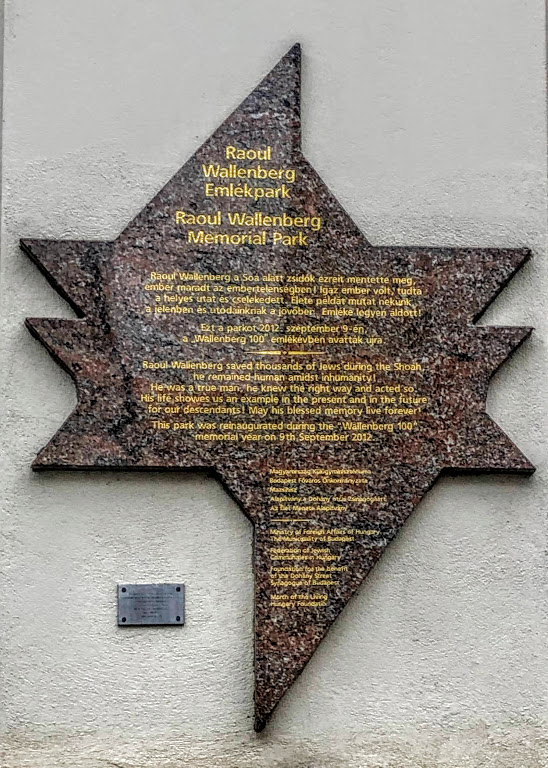
A memorial to Raoul Wallenberg in the Raoul Wallenberg Holocaust Memorial Park at the Dohány Street Synagogue, Budapest (Photograph: Patrick Comerford)

The Mary Elmes Bridge in Cork … the centrepiece of the bridge is designed to look like a menorah (Photograph: Patrick Comerford)

The Wall of the Righteous in Paris lists 3,300 French people who have been recognised as ‘Righteous Among the Nations’ (Photograph: Patrick Comerford)

These images are reminders not only of the Holocaust and its victims, but of real individuals who suffered and were humiliated, whose lives were shattered and who were murdered.

They are reminders of why we must never forget. The Holocaust happened not just because of one evil man but because many good people stood by and remained silent.

Over 80 years after the end of the Holocaust, antisemitism is on the rise once again. We are seeing the rise of the far-right in Britain across Europe and a resurgence of the far-right in Latin America, far-right ideology and vocabulary has become part and parcel of the language of the Trump regime, its spokespersons and those who support street murders by ICE in Minneapolis.

We must never forget.

The Eternal Flame in the Mémorial de la Shoah, Paris (Patrick Comerford)