Showing posts with label Budapest. Show all posts

08 June 2026

Daily prayer in Ordinary Time 2026:
32, Monday 8 June 2026

The Berliner Dom in Berlin, popularly known as Berlin Cathedral … the images inside the dome illustrate the Beatitudes (Photograph: Patrick Comerford)

Patrick Comerford

We are in Ordinary Time in the Church Calendar, and yesterday was the First Sunday after Trinity (Trinity I, 7 June 2026). The calendar of the Church of England in Common Worship today recalls Thomas Ken (1637-1711), Bishop of Bath and Wells, Nonjuror, Hymn Writer.

Before today begins, I am taking some quiet time this morning to give thanks, to reflect, to pray and to read in these ways:

1, reading today’s Gospel reading;

2, a short reflection;

3, a prayer from the USPG prayer diary;

4, the Collects and Post-Communion prayer of the day.

‘Blessed are those who mourn, for they will be comforted’ (Matthew 5: 4) … a child’s painting in Ukrainian Space in Budapest (Photograph: Patrick Comerford)

Matthew 5: 1-12 (NRSVA):

1 When Jesus saw the crowds, he went up the mountain; and after he sat down, his disciples came to him. 2 Then he began to speak, and taught them, saying:

3 ‘Blessed are the poor in spirit, for theirs is the kingdom of heaven.

4 ‘Blessed are those who mourn, for they will be comforted.

5 ‘Blessed are the meek, for they will inherit the earth.

6 ‘Blessed are those who hunger and thirst for righteousness, for they will be filled.

7 ‘Blessed are the merciful, for they will receive mercy.

8 ‘Blessed are the pure in heart, for they will see God.

9 ‘Blessed are the peacemakers, for they will be called children of God.

10 ‘Blessed are those who are persecuted for righteousness’ sake, for theirs is the kingdom of heaven.

11 ‘Blessed are you when people revile you and persecute you and utter all kinds of evil against you falsely on my account. 12 Rejoice and be glad, for your reward is great in heaven, for in the same way they persecuted the prophets who were before you.

12 ‘Rejoice and be glad, for your reward is great in heaven, for in the same way they persecuted the prophets who were before you.’

‘Blessed are those who mourn, for they will be comforted’ (Matthew 5: 4) … ‘Divine Teardrop’ by Peter Cassidy in an exhibition in Wexford in 2016 (Photograph: Patrick Comerford)

Today’s Reflection:

The Gospel reading at the Eucharist today (Matthew 5: 1-12) begins a series of weekday readings from the Sermon on the Mount, beginning with the Beatitudes. The scene opens with Christ leaving the crowds and climbing up the mountain, like Moses in the Book Exodus leaving the crowd behind him, and climbing Mount Sinai. In the Sermon on the Mount in Chapters 5 to 7, Saint Matthew presents us with a covenant renewal document.

The Beatitudes are a declaration of the happy or fortunate state of the children of God who possesses particular qualities, and who, because of them, will inherit divine blessings.

It is interesting to compare the delivery of the Beatitudes to the delivery of the Ten Commandments. Here we have the renewal of the covenant, and a restatement, a re-presentation, of who the Children of God are.

Just as we sometimes find the Ten Commandments grouped into two sets, so we might see the Beatitudes set out in two groups of four, the first four being inward looking, the second four being outward looking.

We might see the first four Beatitudes as addressing attitudes, while the second four deal with resulting actions.

Are they ethical requirements for the present?

Or are they eschatological blessings for the future?

Or are they are statements of present fact, identifying the qualities of a child of God and the consequent blessings that follow?

Few of us, I imagine, are ever going to commit murder.

But we all get ‘angry with a brother’ sooner or later.

The Sermon on the Mount exposes our own present reality in a very stark and real way, and the Beatitudes are a core text for Dietrich Bonhoeffer in The Cost of Discipleship and in the writings of towering Christian figures such as Dorothy Day, Martin Luther King, Thomas Merton and Oscar Romero.

Father Brian D’Arcy once recalled during a radio interview how Dorothy Day once spoke of how her fellow Roman Catholics went to confession regularly and confessed to ‘breaking’ one of the Ten Commandments, but she wondered how often they confessed to ‘breaking’ one of the Eight Beatitudes.

Μακάριοι (Makárioi): Does this mean ‘blessed’? Archbishop Makarios was the President of Cyprus in 1974 when he was deposed in a coup that was followed by the Turkish invasion of the island. ‘His Beatitude’ is a term of respect for archbishops and metropolitans in the Orthodox Church.

The word ‘blessed’ is not the best translation for μακάριος (makários). ‘Fortunate,’ ‘well off,’ or ‘happy’ might fit better.

Christ is telling those who hear him that they are fortunate to be this way. They are fortunate to possess these qualities of life. Why? Because it means they inherit the blessings or fortunes of God’s promised kingdom.

The Beatitudes are culturally embedded in our society, in our literature, in our arts. They are so familiar that we all understand the irreverent humour found in a scene in Monty Python’s The Life of Brian.

‘Blessed are the Meek’ – which means the humble, patient, submissive and gentle – is misheard in The Life of Brian as: ‘Blessed is the Greek – apparently he’s going to inherit the earth.’ When they finally get what Jesus actually says, a woman says, ‘Oh it’s the Meek … blessed are the Meek! That’s nice, I’m glad they’re getting something, ’cause they have a hell of a time.’

The political activist and agitator Reg then says: ‘What Jesus blatantly fails to appreciate is that it’s the meek who are the problem.’ This sums up the growing annoyance of the violent with the peaceful attitude of Christ. But it also highlights that the Beatitudes are about ordinary, everyday people.

Too often we see the saints celebrated by the Church as martyrs and apostles, missionaries and hermits, bishops and theologians. How often do we see them as ordinary, meek, everyday people, the people who too often are dismissed as problems, who are living with problems, who often go without attention from politicians and activists alike?

The mother and child separated at birth in the ‘mother and baby’ home and blocked at every stage as they tried to find each other.

The middle-aged mother who hopes that life is going to get better as the years move on, but then finds instead every waking hour is devoted to an adult child with special needs, or to an elderly parent who now needs to be looked after like a child.

The couple filled with faith but afraid to come to church, marginalised because of their colour, class, language, marital status or sexuality.

The lone protester who stands outside a government office or embassy, ignored by those inside and berated outside by passing, hooting motorists, but who knows right is on her side … ‘Blessed are those who hunger and thirst for righteousness.’

If the Church is a sign of the Kingdom of God, a foretaste of that heavenly liturgy, how does our life as the Church, in the parish and in the diocese, offer solace, comfort, a foretaste, hope for the meek, the downtrodden, the lonely, the oppressed, who are praised in the Beatitudes and who are invited as part of the great multitude, the countless number from every nation, tribe, people and language, to gather before the Lamb on the throne?

‘Blessed are the poor in spirit … those who mourn … the meek … those who hunger and thirst …’

May theirs be the kingdom of heaven, may they be comforted, may they inherit the earth, may they be filled.

‘Blessed are the merciful … the pure in heart … the peacemakers … those who are persecuted for righteousness’ sake …’

May we be generous in showing mercy, may we see God, be called children of God, find ourselves in the kingdom of heaven.

Blessed are we even when others revile us for standing up for these values … when we stand up for those values, may we rejoice and be glad.

Writing on the Financial pages of The Guardian many years ago (17 January 2011), Terry Macalister wrote: ‘From Tolstoy to Dostoevsky to Chekov, if anyone can tell a good story it’s the Russians.’ Well, in Chapter 2 of Boris Pasternak’s great Russian novel Doctor Zhivago, we meet Larissa Feodorovna Guishar, who ‘was not religious’ and ‘did not believe in ritual,’ but was startled by the Beatitudes, for she thought they were about herself.

How do we apply the Beatitudes to ourselves, to our own lives?

The reredos in the Unitarian Church, Dublin, is inscribed with the Beatitudes, one on each panel (Photograph: Patrick Comerford)

Today’s Prayers (Monday 8 June 2026):

In Pray with the World Church, the prayer diary of the Anglican mission agency USPG (United Society Partners in the Gospel), the theme this week, from 7 to 13 June 2026 (pp 8-9), is ‘Safe Churches in Zambia’. This theme was introduced yesterday with a programme update from Fran Mate, Senior Regional Manager for Africa, USPG.

The USPG prayer diary today (Monday 8 June 2026) invites us to pray:

Lord of love, thank you for the challenge that ‘documents alone will not keep people safe.’ Stir clergy and congregants alike with courage to act, wisdom to protect, and compassion to care.

The Collect:

O God, from whom all blessings flow,
by whose providence we are kept
and by whose grace we are directed:
help us, through the example of your servant Thomas Ken,
faithfully to keep your word,
humbly to accept adversity
and steadfastly to worship you;
through Jesus Christ your Son our Lord,
who is alive and reigns with you,
in the unity of the Holy Spirit,
one God, now and for ever.

The Post-Communion Prayer:

God, shepherd of your people,
whose servant Thomas Ken revealed the loving service of Christ
in his ministry as a pastor of your people:
by this eucharist in which we share
awaken within us the love of Christ
and keep us faithful to our Christian calling;
through him who laid down his life for us,
but is alive and reigns with you, now and for ever.

Yesterday’s Reflections

Continued Tomorrow

‘Blessed are the pure in heart, for they shall see God’ (Matthew 5: 8) … a window in Saint Mary’s Collegiate Church, Youghal, Co Cork (Photograph: Patrick Comerford)

Scripture quotations are from the New Revised Standard Version Bible: Anglicised Edition copyright © 1989, 1995 National Council of the Churches of Christ in the United States of America. Used by permission. All rights reserved worldwide. http://nrsvbibles.org

18 November 2025

Daily prayer in the Kingdom Season:
18, Tuesday 18 November 2025

James Tissot, ‘Zacchaeus in the Sycamore Awaiting the Passage of Jesus’ (Brooklyn Museum)

Patrick Comerford

We are in the Kingdom Season, the time between All Saints’ Day and Advent, and this week began with the Second Sunday before Advent. The calendar of the Church of England in Common Worship today remembers Saint Elizabeth of Hungary (1231), Princess of Thuringia, Philanthropist.

Before the day begins, before I have breakfast, I am taking some quiet time early this morning to give thanks, to reflect, to pray and to read in these ways:

1, today’s Gospel reading;

2, a short reflection;

3, a prayer from the USPG prayer diary;

4, the Collects and Post-Communion prayer of the day.

Jesus calls Zacchaeus down from the sycamore tree (Illustration © Henry Martin)

Luke 19: 1-10 (NRSVA):

1 He entered Jericho and was passing through it. 2 A man was there named Zacchaeus; he was a chief tax-collector and was rich. 3 He was trying to see who Jesus was, but on account of the crowd he could not, because he was short in stature. 4 So he ran ahead and climbed a sycamore tree to see him, because he was going to pass that way. 5 When Jesus came to the place, he looked up and said to him, ‘Zacchaeus, hurry and come down; for I must stay at your house today.’ 6 So he hurried down and was happy to welcome him. 7 All who saw it began to grumble and said, ‘He has gone to be the guest of one who is a sinner.’ 8 Zacchaeus stood there and said to the Lord, ‘Look, half of my possessions, Lord, I will give to the poor; and if I have defrauded anyone of anything, I will pay back four times as much.’ 9 Then Jesus said to him, ‘Today salvation has come to this house, because he too is a son of Abraham. 10 For the Son of Man came to seek out and to save the lost.’

Do we neglect Christ’s presence in Word and Sacrament too often? … an icon of the Last Supper in a shop window in Rethymnon (Photograph: Patrick Comerford)

Today’s reflection:

The Gospel reading at the Eucharist this morning (Luke 19: 1-10) is a reminder that the oppressed, the small people, those who are made to feel small by others, especially the proud and the violent, are truly cared for by God, have the promise of new life, and are invited into the kingdom.

In this reading, Zacchaeus is despised both as a tax collector and as a man who is ‘short in stature.’ Both his occupation and his physique squeeze him to the margins and put him outside the community of faith. Yet, he is seen by Christ not as he seems to others, but as God sees him to truly be.

In the previous chapter in Saint Luke’s Gospel, we read the parable of the Pharisee and the tax collector praying in the Temple (Luke 18: 9-14). I sometimes ask: what if Zacchaeus was the model for that publican, that tax collector.

The story of Zacchaeus is a fast-moving story: every verse from verse 1 to 7, in the original Greek, begins with the word καὶ (kai, and), indicating that the pace has heightened, the story is speeding up, we are moving closer to the climax of this Gospel.

Christ is about to set out from Jericho to Jerusalem. From Jericho, the road is going to be uphill and more treacherous: remember that it is on this road between Jericho and Jerusalem that a certain man is mugged and left for dead until the Good Samaritan passes by (Luke 10: 25-37).

Jericho was a major resting place or stopping point on a main trade route, making it a lucrative and profitable location both for tax collectors and for bandits.

But Jericho has other significance: the walls of Jericho fell down at the call of the trumpets (see Joshua 6). So, in this reading, after Christ passes through the walls of Jericho, his call breaks down all the walls people erect around themselves, individually and collectively.

Who is Zacchaeus?

Certainly, Zacchaeus is not any run-of-the-mill tax collector. He is the ἀρχιτελώνης (architelonis), the chief tax collector, and so by contract had the right to collect revenues throughout this district. His name (Ζακχαῖος, Zakchaios) means pure, but his neighbours would have despised him, not only because they believed he squeezed the last drachma and the last lepta out of widows and children, but because they would also have seen him as a collaborator with the Roman administration.

There, a man who wants to see Christ is probably pushed to the back of the crowd for two reasons that count him out: he is small in stature, and he is a tax collector.

The physical problem shows how Zacchaeus is pushed to the margins by those who should have counted him into their social and religious community. He is of little stature not just physically, but socially too.

Can you imagine yourself as a little child trying to see a great parade or a football match when you were small?

Did everyone want to let you through?

Or did you not count? Did no-one stand aside for you?

No-one is going to stand aside for Zacchaeus. They belittle him, and they probably think he deserves it – after all, the taxes he collects support the Roman occupation and administration.

But Zacchaeus overcomes, rises above, his exclusion, by climbing the tree – is there a symbolic reference here to clinging to the Cross? In any case, Zacchaeus climbs the tree to see Jesus – something you could imagine a child doing, but surely not the sort of thing a well-paid civil servant should be seen doing?

Zacchaeus sees Jesus and Jesus sees Zacchaeus.

And Jesus invites himself not just to dine with Zacchaeus, but to stay with him: ‘Zacchaeus, make haste and come down, for I must stay at your house today’ (verse 5).

Normally, it is the potential host rather than the intended guest who does the inviting. So once again, Jesus the Guest becomes Jesus the Host.

Zacchaeus is delighted. But the good burghers of Jericho are unsettled. They murmur that Jesus is heading off to dine with sinners.

We are so self-righteous at times in our churches that I am worried we are in danger of being unwilling to welcome those who would be seen today as the little people.

One priest I know in a comfortable parish challenged his parishioners, who are very generous in their giving, especially when it comes to development agencies, mission agencies and what we once called Third World causes. He asked them how they would react if refugees or asylum seekers were moved into a vacant hotel or hostel in the parish on a Saturday night, and all of them presumed to come to church on the following Sunday morning.

In welcoming Jesus, Zacchaeus has what can only be described as a conversion experience.

The NRSV translation tells us that he promises to amend his ways and that, in the future, he will give half his possessions to the poor, and return anything extra he has squeezed out of people when he has been collecting taxes.

Unfortunately, the NRSV translation is a little inaccurate here. Zacchaeus makes no such promise about the future. He says, in the original Greek, that this is what he is doing in the present – the present tense is used.

If he is telling the truth, then Zacchaeus has been grossly misrepresented, misunderstood and libelled by his neighbours and within his own community, even at the point where he is dining with Jesus.

The present tense is important. For this day, on this day, Christ affirms that Zacchaeus too is a child of Abraham, that he too is an heir to those promises made long, long ago to Abraham.

Those who needed conversion were not Zacchaeus and others like him on the margins, who were in need of seeing people as Christ sees them.

Christ seeks out the sinners, the lost, those who are excluded, those counted out, and invites them to the heavenly banquet. Like Zacchaeus, they too are brought from the margins into the centre.

The one person everyone thought was outside, is on the inside as far as Christ is concerned. And those who think they are on the inside are in danger of finding that they are on the outside.

Are we welcoming enough, as individuals and as a Church?

How would we feel if Jesus came to our parish next weekend, but decided not to come to our church on Sunday morning, but to go somewhere else?

What if we were left without Christ being present in our church on Sunday morning … in either Word or Sacrament?

How often are we prepared to welcome Christ’s presence among us only in the way we choose, on our terms?

For those of us in what might be described as ‘High Church’ or Anglo-Catholic traditions, do we neglect Christ’s presence in the Word too often?

To those of us in what might be described as ‘Evangelical’ traditions, do we neglect Christ’s presence in the Sacrament too often?

May our faith and love continue to increase and to grow abundantly so that we count in those who are overlooked, those who are not counted in, those who are pushed to the margins.


Today’s Prayers (Tuesday 18 November 2025):

The theme this week (16 to 22 November) in Pray with the World Church, the prayer diary of the Anglican mission agency USPG (United Society Partners in the Gospel), is ‘In the Shadow of the Carneddau’ (pp 56-57). This theme was introduced on Sunday with Reflections from Bishop Andrew John, who stepped down as Archbishop of Wales and Bishop of Bangor on 27 June.

.

The USPG Prayer Diary today invites us to pray:

Pray for scientists and other researchers who help us understand the challenges posed by climate change.

The Collect:

Lord God,
who taught Elizabeth of Hungary
to recognize and reverence Christ in the poor of this world:
by her example
strengthen us to love and serve the afflicted and the needy
and so to honour your Son, the servant king,
who is alive and reigns with you,
in the unity of the Holy Spirit,
one God, now and for ever.

Post-Communion Prayer:

Faithful God,
who called Elizabeth of Hungary to serve you
and gave her joy in walking the path of holiness:
by this eucharist
in which you renew within us the vision of your glory,
strengthen us all to follow the way of perfection
until we come to see you face to face;
through Jesus Christ our Lord.

Yesterday’s Reflections

Continued Tomorrow

Inside Saint Margaret’s Church, the Anglican church in Budapest … Saint Margaret of Hungary is remembered on 18 November (Photograph: Patrick Comerford)

Scripture quotations are from the New Revised Standard Version Bible: Anglicised Edition copyright © 1989, 1995 National Council of the Churches of Christ in the United States of America. Used by permission. All rights reserved worldwide. http://nrsvbibles.org

07 November 2025

Daily prayer in the Kingdom Season:
7, Friday 7 November 2025

The Unjust Steward … part of the East Window in Saint Michael’s Church, Limerick, made in 1878 by Mayer & Co and illustrating 10 parables (Photograph: Patrick Comerford)

Patrick Comerford

We are in the Kingdom Season, the time between All Saints and Advent. The Calendar of the Church of England in Common Worship today remembers Saint Willibrord of York (739), Bishop, Apostle of Frisia (7 November).

Before today begins, before having breakfast, I am taking some quiet time early this morning to give thanks, and for reflection, prayer and reading in these ways:

1, today’s Gospel reading;

2, a short reflection;

3, a prayer from the USPG prayer diary;

4, the Collects and Post-Communion prayer of the day.

‘The Unjust Steward,’ by the Kazakhstan Artist, Nelly Bube (Bubay)

Luke 16: 1-8 (NRSVA):

1 Then Jesus said to the disciples, ‘There was a rich man who had a manager, and charges were brought to him that this man was squandering his property. 2 So he summoned him and said to him, “What is this that I hear about you? Give me an account of your management, because you cannot be my manager any longer.” 3 Then the manager said to himself, “What will I do, now that my master is taking the position away from me? I am not strong enough to dig, and I am ashamed to beg. 4 I have decided what to do so that, when I am dismissed as manager, people may welcome me into their homes.” 5 So, summoning his master’s debtors one by one, he asked the first, “How much do you owe my master?” 6 He answered, “A hundred jugs of olive oil.” He said to him, “Take your bill, sit down quickly, and make it fifty.” 7 Then he asked another, “And how much do you owe?” He replied, “A hundred containers of wheat.” He said to him, “Take your bill and make it eighty.” 8 And his master commended the dishonest manager because he had acted shrewdly; for the children of this age are more shrewd in dealing with their own generation than are the children of light.’

A ‘Shop To Let’ sign within view of Sidney Sussex College chapel, Cambridge … can we reconcile the values of the Kingdom and the demands of commercial life? (Photograph: Patrick Comerford)

Today’s reflection:

In the Gospel reading for the Eucharist today, we read the parable of ‘the Unjust Steward’ or the ‘Parable of the Dishonest Manager’.

Whatever name you give it, this morning’s reading is about ignoring and exploiting the plight of the oppressed and the poor and tells us that this amounts to turning away from God and turning towards idolatry. We are called to turn around, and in turning to the needs of the poor we find that we are turning to God.

So, let me tell this morning’s Gospel story (Luke 16: 1-13) in another way. When I left school, I started training as a chartered surveyor and in estate manager. I never finished that training, but I can visualise some of the characters in this story.

A very, very rich man lives in a big city, let’s say it is Dublin. He has a luxurious lifestyle made possible by the income from the apartments, hotels and office blocks he owns in the city centre. He has been a major property developer, and a key shareholder in one of the business banks lending to developers.

He has hired an estate manager to run his property holding company, his building society, and his insurance agency while he spends most of his time in his large country house in Co Kildare or Co Meath, in the Algarve playing golf or in Marbella on his yacht.

All the work of painting, maintaining the lifts and the plumbing in his apartment blocks, working the bar and servicing the rooms in his hotels, and working at the call centres in the office blocks, is done by people who travel in and out from the rims of the city, people whose grandparents probably once lived in the small terraced houses that once stood along the docks or the canal banks but were levelled to build those apartments, office blocks and hotels.

They pay their mortgages to the bank that financed the apartment blocks and similar developments. Their overdrafts are from the same bank. Their mortgage, insurance and life assurance policies are from an agency he owns. They find themselves increasingly in debt, paying school fees and health insurance, running a car or two cars, meeting term loan payments for fridges, freezers, TVs and laptops … What they earn is never enough to pay off their mortgages, their overdrafts, their term loans.

These families are slipping further and further into debt, working harder and harder to pay what cannot be paid.

But they never meet the rich developer. The immediate face of this system, of his companies and his investments, is the face of the estate agent who manages the blocks – a man whose grandparents came from the same families as the people who now suffer under his management.

However, his parents had escaped the system, he got a good education, and then got sucked into the system.

The developer hears rumours that the estate manager, who is also his insurance agent, has been squandering the developer’s resource, and gives him his dismissal notice. Now, remember that ‘squandering’ is not necessarily a bad word here – the sower in another parable squanders seed by tossing it on roads and in bird-feeding zones, and the shepherd in one of this week’s parables potentially squanders 99 sheep by running after the lost one; the widow searching for her lost coin risks losing her other nine as she sweeps everything out.

Meanwhile, the estate agent has to work out his notice, but is no longer authorised to let, to rent, to buy, to sell, to do anything at all in the developer’s name.

He probably shares the same background only a generation or two ago with the maintenance workers, the tenants, the workers in the office blocks. But when he is out on his ear, they are not going to help him to find a place to live, or find a new job, given that up to now he has allied himself with the developer’s interests, collecting high rents, refusing to bring down rents when the reviews are due, managing the work rotas for the maintenance workers, forcing them to work longer hours rather than taking on the staff needed for the job, dealing unjustly with both tenants and workers.

He has been demanding higher rents and premiums, and longer working hours, yet providing fewer and fewer services – doing what certain economists have advised him to do: increasing profit margins and productivity and cutting costs and outlays at one and the same time.

He may be shrewd, but that is why he is called ‘the dishonest manager’ (verse 8).

The agent then does something that is extraordinarily clever.

He gathers all the tenants and workers who owe him money, and he declares that their debts have been written down, more than the courts could ever write them down, to something that might be repaid, freeing families from heartbreaking choices. He has been upping their rents and their premiums; now he brings them all back to a payable rate. And in doing this, he manages to wipe out the arrears that have been mounting up.

The smart agent manages not to tell the tenants or the workers that he has been sacked. Nor does he tell them that the developer has not authorised any of his largesse. But the tenants and the workers now think the developer, their landlord, is more generous than anyone else in his position could be. The developer is now a hero in their eyes – and, by extension, the agent is too.

The developer comes back for his quarterly or annual visit to pick up the income the agent has collected for him, and he gets a surprise that is exhilarating and challenging. The people are delighted to see him. Workers shake his hands, tenants lean out of the balconies to wave at him, children want to have ‘selfies’ taken with him.

Then, as he inspects the books in the small office the agent has worked from in the complex, he finds out what the agent has done in telling the tenants and the workers that the developer has forgiven their debts.

He has a choice to make.

He can go and tell them that it was all a terrible mistake, that the agent’s ‘stroke’ amounted not to generosity but to theft, or at least to dishonesty, and has no legal basis – he can tell them they are still responsible for the unpaid rent, for the overdrawn loans.

The warm welcome could quickly turn to nasty protests.

Or, the developer can go outside, bask in the unexpected welcome he has received, and take credit for the agent’s actions. At least he has cash in his hand where once he might have had nothing because of defaulting tenants and clients. That would save him going to court, but has he to take the agent back to work for him?

What would you do?

Picture yourself in this dilemma, both as the agent and as the developer.

From the agent’s point of view, does it matter any more what the developer decides to do? Whatever decision the developer makes, his future is safe – either he gets his job back, or his own people are going to look after him.

But here is the big problem: what the agent did is clearly dishonest. He has taken the landlord’s property and squandered it – even after he was sacked and had no right to do anything in the developer’s name.

What is it that the agent has done, without permission? Who has he deceived?

The agent forgives. He forgives things that he had no right to forgive. He forgives for all the wrong reasons, for personal gain and to compensate for his past misconduct. But that decisive action that he undertakes redeems him from a position to which it seems he could not be reconciled, to the developer any more than to the tenants and workers.

So what is the moral of the story?

This story is unique to Saint Luke’s Gospel, and for him there is a significance that is important throughout the third gospel: Forgive. Forgive it all. Forgive it now. Forgive it for any reason you want. Forgive for the right reason. Forgive for the wrong reason. Forgive for no reason at all. Just forgive.

Remember, Saint Luke’s version of the Lord’s Prayer includes the helpful confusion: καὶ ἄφες ἡμῖν τὰς ἁμαρτίας ἡμῶν, καὶ γὰρ αὐτοὶ ἀφίομεν παντὶ ὀφείλοντι ἡμῖν: καὶ μὴ εἰσενέγκῃς ἡμᾶς εἰς πειρασμόν (‘and forgive us our sins for indeed we ourselves are forgiving everyone who is [monetarily] indebted to us’) (Luke 11: 4) – the monetary indebtedness is obvious in the original Greek.

We pray it, but do we put it into practice?

The arrival of the Kingdom of God is no occasion for score-keeping of any kind, whether monetary or moral.

Why should I forgive someone who has sinned against me, or against my sense of what is obviously right? I don’t have to do it out of love for the other person.

I could forgive the other person because of what I pray in the Lord’s Prayer every Sunday if not every morning.

I could forgive because I know I would like to be forgiven myself.

I could forgive because I know what it is like to be me when I am unforgiving.

I could forgive because I am, or I want to be, deeply in touch with a sense of Christ’s power to forgive and free someone just like me.

Or I could forgive because I think it will improve my life and sense of well-being.

It boils down to the same thing: deluded or sane, selfish or unselfish, there is no bad reason to forgive.

Extending the kind of grace God shows me in every possible arena – financial and moral – can only put me more deeply in touch with God’s grace.

If a crafty agent, a dishonest manager, an unjust steward, the sort of person we meet in this Gospel reading, can forgive to save his job or give himself a safety net when he is sacked, then those of us who have the experience of real grace, we who have been invited to the Heavenly Banquet, have a better reason than most people to forgive.

Where is the place for Christian values in today’s world of finance and debt? (Photograph: Patrick Comerford)

Today’s Prayers (Friday 7 November 2025):

The theme this week (2 to 8 November) in Pray with the World Church, the prayer diary of the Anglican mission agency USPG (United Society Partners in the Gospel), is ‘From Solitude to Connection’ (pp 52-53). This theme was introduced on Sunday with a Programme Update from Ljudmila, a Ukrainian Refugee living in Budapest, Hungary.

The USPG Prayer Diary today (Friday 7 November 2025) invites us to pray:

Father, we pray for the ministry of Saint Margaret’s Church as they seek to be a light for you in Budapest. Thank you for the way your love is modelled through the church’s open doors.

The Collect:

God, the Saviour of all,
you sent your bishop Willibrord from this land
to proclaim the good news to many peoples
and confirm them in their faith:
help us also to witness to your steadfast love
by word and deed
so that your Church may increase
and grow strong in holiness;
through Jesus Christ your Son our Lord,
who is alive and reigns with you,
in the unity of the Holy Spirit,
one God, now and for ever.

Post Communion Prayer:

Holy Father,
who gathered us here around the table of your Son
to share this meal with the whole household of God:
in that new world where you reveal
the fullness of your peace,
gather people of every race and language
to share with Willibrord and all your saints
in the eternal banquet of Jesus Christ our Lord.

Yesterday’s Reflections

Continued Tomorrow

Property developments and financial growth on the banks of the River Liffey in Dublin (Photograph: Patrick Comerford, 2024)

Scripture quotations are from the New Revised Standard Version Bible: Anglicised Edition copyright © 1989, 1995 National Council of the Churches of Christ in the United States of America. Used by permission. All rights reserved worldwide. http://nrsvbibles.org

06 November 2025

Daily prayer in the Kingdom Season 2025:
6, Thursday 6 November 2025

‘Rejoice with me, for I have found the coin that I had lost’ (Luke 15: 9) … old drachmae coins in a tin box outside an antiques shop in Rethymnon in Crete (Photograph: Patrick Comerford, 2025)

Patrick Comerford

We are in the Kingdom Season, the time between All Saints and Advent. The Calendar of the Church of England in Common Worship today remembers Leonard, sixth century hermit, and William Temple (1881-1944), Archbishop of Canterbury, Teacher of the Faith. In Ireland, 6 November 6 is the Feast of All the Saints of Ireland.

Later today, I hope to be involved in the rehearsals of an amateur dramatic and play-readinggroup in the lbrary in Sonty Stratford. Before today begins, before having breakfast, I am taking some quiet time early this morning to give thanks, and for reflection, prayer and reading in these ways:

1, today’s Gospel reading;

2, a short reflection;

3, a prayer from the USPG prayer diary;

4, the Collects and Post-Communion prayer of the day.

Torn and ragged drachma banknotes in a tin box outside an antiques shop in Rethymnon in Crete (Photograph: Patrick Comerford)

Luke 15: 1-10 (NRSVA):

1 Now all the tax-collectors and sinners were coming near to listen to him. 2 And the Pharisees and the scribes were grumbling and saying, ‘This fellow welcomes sinners and eats with them.’

3 So he told them this parable: 4 ‘Which one of you, having a hundred sheep and losing one of them, does not leave the ninety-nine in the wilderness and go after the one that is lost until he finds it? 5 When he has found it, he lays it on his shoulders and rejoices. 6 And when he comes home, he calls together his friends and neighbours, saying to them, “Rejoice with me, for I have found my sheep that was lost.” 7 Just so, I tell you, there will be more joy in heaven over one sinner who repents than over ninety-nine righteous people who need no repentance.

8 ‘Or what woman having ten silver coins, if she loses one of them, does not light a lamp, sweep the house, and search carefully until she finds it? 9 When she has found it, she calls together her friends and neighbours, saying, “Rejoice with me, for I have found the coin that I had lost.” 10 Just so, I tell you, there is joy in the presence of the angels of God over one sinner who repents.’

‘Which one of you, having a hundred sheep … does not … go after the one that is lost’ (Luke 15: 4) … sheep on a small holding in Platanias, east of Rethymnon (Photograph: Patrick Comerford, 2025)

Today’s reflection:

In the Gospel reading for the Eucharist today (Luke 15: 1-10), Christ speaks in three parables of things lost and found: the one lost sheep among 100; the one sinner who repents in contrast to the 99 righteous people; and the woman who has lost a small coin that others might not even bother to look for.

In the story of the shepherd who has 100 sheep and goes looking for one lost sheep, a rich man shows us how God behaves.

In the story of the woman who has ten silver coins, and who sweeps thoroughly through every dark corner of her house until she finds one lost coin, a poor woman shows us how God behaves.

The first image reminds me how on Achill Island off the west coast of Co Mayo, I once heard about a shepherd who died on a cliff side as he went in search of a lost sheep, and slipped on the edge. A local man reacted by pointing out what a small price sheep fetched in the mart in those days.

When you do find a lost sheep, it has probably been caught in brambles, is full of dirt and matted with droppings. It is not a pleasant fluffy creature, as seen in so many stained glass windows. It may not even be worth bringing home, in the eyes of a shepherd or a sheep farmer. In its panic and distress, it will have lost weight, and may not be possible to sell.

We also have a poor woman who shows us how God behaves.

Ten drachmae might have been a nice sum of money at the time, but was one small coin worth all that time, worry and energy?

I was working in Greece as a journalist many years ago at a time when the Drachma was being phased out as the national currency, and the Euro was being introduced.

As far as I remember, there were about 330 or 350 drachmae to the Euro. You could still exchange them until 2012, when you needed 587.5000 drachma to get €1.

So, a drachma in my days was worth about as much as a farthing. And when Greeks hear this Gospel reading, they hear about the woman sweeping her house, searching not for a valuable silver coin but for a tiny worthless coin, searching for a farthing.

The Greek text says not that she has ten silver coins, but that she has ten drachmae and has lost one.

When she finds it, she is rejoicing over very little. And when she throws a party to rejoice with her friends, it is going to cost her more than the rest of her savings if she only has 10 drachmae, it is going to cost abundant generosity, generosity that reflects the abundant generosity of God.

I came across a book many years that took a light-hearted introduction to Classics, Ancient Athens on Five Drachmas a Day (2008). But you probably would not have been able to even buy a bottle of retsina or a bottle of ouzo in ancient Athens for half of what this woman had saved.

And how the tax collectors who heard this parable (verse 1) must have laughed with ridicule! Finding a drachma certainly was not going to help the party spirit, never mind being worth considering for taxes and tax collecting.

This Gospel story provides us with examples of a variety of people who are living, visible examples of God’s overflowing, overwhelming and inescapable generosity: men and women, young and old, rural and urban, rich and poor, the valued and those who are without value in the eyes of others.

‘Which one of you, having a hundred sheep … does not … go after the one that is lost’ (Luke 15: 4) … ‘Paternoster’ or ‘Shepherd and Sheep’, a bronze sculpture by Dame Elisabeth Frink in Paternoster Square, London (Photograph: Patrick Comerford)

Today’s Prayers (Thursday 6 November 2025):

The theme this week (2 to 8 November) in Pray with the World Church, the prayer diary of the Anglican mission agency USPG (United Society Partners in the Gospel), is ‘From Solitude to Connection’ (pp 52-53). This theme was introduced on Sunday with a Programme Update from Ljudmila, a Ukrainian Refugee living in Budapest, Hungary.

The USPG Prayer Diary today (Thursday 6 November 2025) invites us to pray:

Lord, bless all like Ljudmila who are rebuilding their lives in new countries, far from home. May they find friendship, purpose, and belonging.

The Collect:

Almighty and eternal God,
you have kindled the flame of love
in the hearts of the saints:
grant to us the same faith and power of love,
that, as we rejoice in their triumphs,
we may be sustained by their example and fellowship;
through Jesus Christ your Son our Lord,
who is alive and reigns with you,
in the unity of the Holy Spirit,
one God, now and for ever.

Post Communion Prayer:

Lord of heaven,
in this eucharist you have brought us near
to an innumerable company of angels
and to the spirits of the saints made perfect:
as in this food of our earthly pilgrimage
we have shared their fellowship,
so may we come to share their joy in heaven;
through Jesus Christ our Lord.

Additional Collect:

God of glory,
touch our lips with the fire of your Spirit,
that we with all creation
may rejoice to sing your praise;
through Jesus Christ our Lord.

Yesterday’s Reflections

Continued Tomorrow

Inside Saint Margaret’s Church, the Anglican church in Budapest … see the USPG Prayer Diary this week (Photograph: Patrick Comerford)

Scripture quotations are from the New Revised Standard Version Bible: Anglicised Edition copyright © 1989, 1995 National Council of the Churches of Christ in the United States of America. Used by permission. All rights reserved worldwide. http://nrsvbibles.org

02 November 2025

Daily prayer in the Kingdom Season 2025:
2, Sunday 2 November 2025,
All Saints’ Sunday

Saints and Martyrs … the ten martyrs of the 20th century above the West Door of Westminster Abbey (Photograph: Patrick Comerford)

Patrick Comerford

Today in the Church Calendar is All Souls’ Day (2 November). However, many churches and parishes are celebrating All Saints’ Day today as All Saints’ Sunday, transferring their All Saints celebrations from yesterday (1 November), including, for example, Saint Mary and Saint Giles Church in Stony Stratford, and All Saints’ Church, Margaret Street, London.

With All Saints’ Day, we move on in Ordinary Time in the Church Calendar to the Kingdom Season, the time between All Saints’ Day and Advent. Meanwhile, before today begins, before having breakfast, I am taking some quiet time early this morning to give thanks, and for reflection, prayer and reading in these ways:

1, today’s Gospel reading;

2, a short reflection;

3, a prayer from the USPG prayer diary;

4, the Collects and Post-Communion prayer of the day.

The 190 ft spire of All Saints’ Church, Leighton Buzzard, Bedfordshire, can be seen for miles around (Photograph: Patrick Comerford, 2025)

Luke 6: 20-31 (NRSVA):

20 Then he looked up at his disciples and said:
‘Blessed are you who are poor,
for yours is the kingdom of God.
21 ‘Blessed are you who are hungry now,
for you will be filled.
‘Blessed are you who weep now,
for you will laugh.

22 ‘Blessed are you when people hate you, and when they exclude you, revile you, and defame you on account of the Son of Man. 23 Rejoice on that day and leap for joy, for surely your reward is great in heaven; for that is what their ancestors did to the prophets.

24 ‘But woe to you who are rich,
for you have received your consolation.
25 ‘Woe to you who are full now,
for you will be hungry.
‘Woe to you who are laughing now,
for you will mourn and weep.

26 ‘Woe to you when all speak well of you, for that is what their ancestors did to the false prophets.

27 ‘But I say to you that listen, Love your enemies, do good to those who hate you, 28 bless those who curse you, pray for those who abuse you. 29 If anyone strikes you on the cheek, offer the other also; and from anyone who takes away your coat do not withhold even your shirt. 30 Give to everyone who begs from you; and if anyone takes away your goods, do not ask for them again. 31 Do to others as you would have them do to you.

Christ the Pantocrator surrounded by the saints in the Dome of the Church of Analipsi in Georgioupoli, Crete (Photograph: Patrick Comerford)

Today’s Reflections:

All Saints’ Day is one of the 12 ‘Principal Holy Days’ of the Church. November is a month when we traditionally remember the saints, the Communion of Saints, those who are blessed, those we love and who are now gathered around the throne of God, those who have died and who we still love.

We do that on All Souls’ Day, we do that on Remembrance Day and Remembrance Sunday, and we do that on All Saints; Day, all at the beginning of this month.

In today’s Gospel reading (Luke 6: 20-31), Saint Luke gives us his version of the beatitudes, with a different emphasis that the way Saint Matthew lists them (see Matthew 5: 3-12).

Christ speaks of four blessings or beatitudes and four parallel woes or warnings of the age to come. Some people are ‘blessed’ or ‘happy’ (μακάριος, makários) by being included in the Kingdom, but they are paired with those who are warned of coming woes:

• those who are poor now (verse 20) and those who are rich now (verse 24)
• those who are hungry now (verse 21) and those who are full now (verse 25)
• those who weep now (verse 21) and those who laugh now (verse 25)
• those who are persecuted, or hated, excluded, reviled and defamed (verse 22) and those who are popular (verse 26)

Who are the poor, the hungry, those who weep and those who are persecuted today? And do we see them as saints?

Bishop William Walsham How (1823-1897) wrote his hymn, ‘For all the saints, who from their labours rest’ (459), as a processional hymn for All Saints’ Day.

The saints recalled in his hymn are ordinary people in their weaknesses and their failings. In its original form, it had 11 verses, although three are omitted from most versions – the verses extolling ‘the glorious company of the Apostles,’ ‘the godly fellowship of the prophets’ and ‘the noble army of martyrs’ were inspired by the 1662 Book of Common Prayer version of the canticle Te Deum.

The tune Sine Nomine (‘Without Name,’ referring to the great multitude of unknown saints) was written for the hymn by Ralph Vaughan Williams (1872-1958) while he was editing the English Hymnal (1906) with Canon Percy Dearmer (1867-1936).

When he wrote this hymn, Walsham How was the Rector of Whittington, Shropshire, and a canon St Asaph Cathedral. He had spent time in Rome as chaplain of the Anglican Church there, All Saints’ Church, before returning to England.

While he was Bishop of Bedford, Walsham How became known as ‘the poor man’s bishop.’ He became the first Bishop of Wakefield, and died in Leenane, Co Mayo, in 1897 while he was on an Irish fishing holiday in Dulough.

The hymn vibrates with images from the Book of Revelation. The saints recalled by ‘the poor man’s bishop’ in this hymn are ordinary people who, in spite of their weaknesses and their failings, are able to respond in faith to Christ’s call to service and love, and who have endured the battle against the powers of evil and darkness.

The heart of the hymn is in the stanza that sings about the unity of the Church in heaven and on earth, ‘knit together in one communion and fellowship, in the mystical body of … Christ our Lord.’ Despite our ‘feeble struggles’ we are united in Christ and with one another in one ‘blest communion’ and ‘fellowship divine.’

It is a hymn that celebrates that there among the saints are the ordinary people, the people who are blessed and happy in Saint Luke’s version of the Beatitudes this morning.

All Saints’ Church, Rome … the Anglican church where the hymn writer Bishop William Walsham How was chaplain (Photograph: Patrick Comerford)

Today’s Prayers (Sunday 2 November 2025, All Saints’ Sunday):

The theme this week (2 to 8 November) in Pray with the World Church, the prayer diary of the Anglican mission agency USPG (United Society Partners in the Gospel), is ‘From Solitude to Connection’ (pp 52-53). This theme is introduced today with a Programme Update from Ljudmila, a Ukrainian Refugee living in Budapest, Hungary:

Next Step Hungary is a refugee-led NGO providing practical, costeffective interventions to support integration in Hungary. It is a partner organisation with Saint Margaret’s, Budapest, who reached out as part of USPG and the Diocese in Europe's joint appeal for Ukraine. Next Step is a lifeline for many like Ljudmila.

‘As a Ukrainian living in Budapest, my life was taken up by responsibilities – caring for my 12-year-old son, my parents, and even my cat – while balancing a demanding career as an architect. Despite my lifelong passion for art and design, the past few years had drained me emotionally and psychologically. Loneliness weighed heavily, and time for creativity felt like a luxury I couldn’t afford.

Then, at the end of summer, I signed up for a beading workshop run by Next Step. I was uncertain of what to expect, but from the very first session it turned out to be more than just a craft class. It was a welcoming community, a vibrant space for women filled with laughter, support, and shared creativity. Under the guidance of a fantastic teacher, I completed my first beaded ring and saw endless possibilities for new projects.

Each class became a highlight of my week, a space where I could reconnect with myself and others. This workshop didn’t just teach me a new skill – it rekindled my joy, creativity, and sense of belonging. For that, I am deeply grateful to Next Step.’

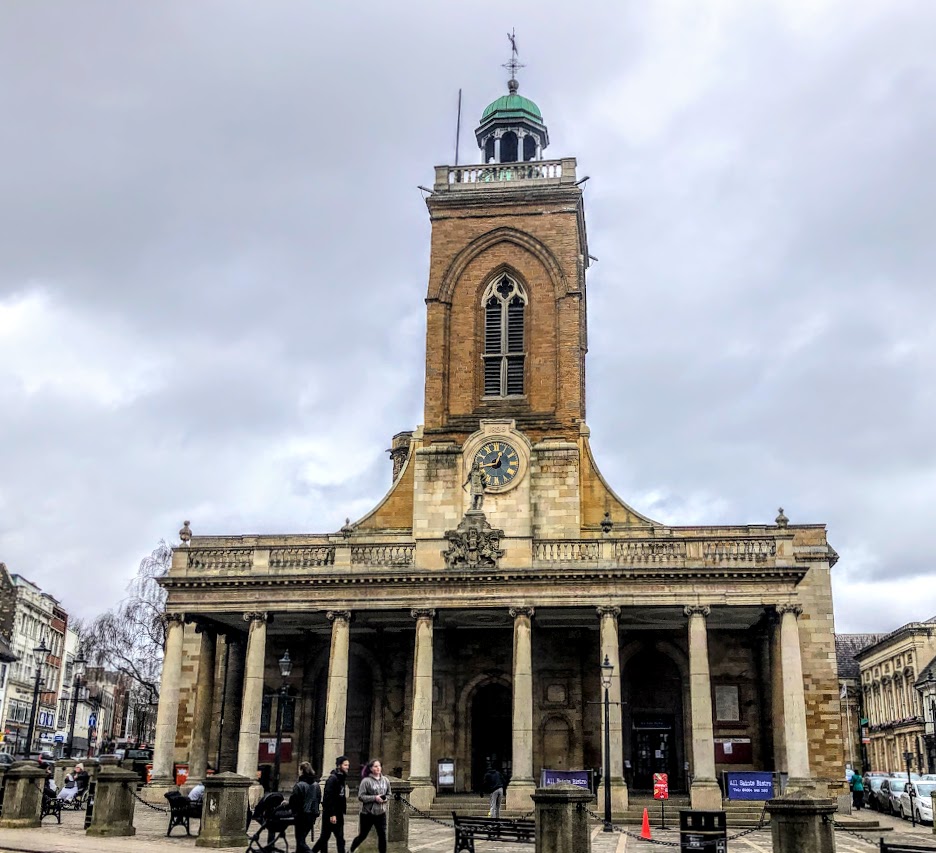
All Saints’ Church is the parish church in the centre of Northampton (Photograph: Patrick Comerford)

ions from the 17th to the 19th century (Photograph: Patrick Comerford, 2024)

The USPG Prayer Diary today (Sunday 2 November 2025, All Saints’ Sunday, All Souls’ Day) invites us to pray:

God of hope, grant that we, with all who have believed in you, may be united in the full knowledge of your love and the unclouded vision of your glory; through Jesus Christ our Lord. Amen (A Prayer Book for Australia, 1995).

The Collect:

Almighty God,
you have knit together your elect
in one communion and fellowship
in the mystical body of your Son Christ our Lord:
grant us grace so to follow your blessed saints
in all virtuous and godly living
that we may come to those inexpressible joys
that you have prepared for those who truly love you;
through Jesus Christ your Son our Lord,
who is alive and reigns with you,
in the unity of the Holy Spirit,
one God, now and for ever.

The Post Communion Prayer:

God, the source of all holiness and giver of all good things:
may we who have shared at this table
as strangers and pilgrims here on earth
be welcomed with all your saints
to the heavenly feast on the day of your kingdom;
through Jesus Christ our Lord.

Additional Collect:

God of holiness,
your glory is proclaimed in every age:
as we rejoice in the faith of your saints,
inspire us to follow their example
with boldness and joy;
through Jesus Christ our Lord.

Yesterday’s Reflections

Continued Tomorrow

Christ the King and the saints on the panels of the altar in All Saints’ Church, Berkhamsted (Photograph: Patrick Comerford)

Scripture quotations are from the New Revised Standard Version Bible: Anglicised Edition copyright © 1989, 1995 National Council of the Churches of Christ in the United States of America. Used by permission. All rights reserved worldwide. http://nrsvbibles.org

All Saints’ Church in Yelvertoft, Northamptonshire, was connected with the Comberford family for about a century … Henry Comberford of Lichfield Cathedral was the rector in 1546-1560 (Photograph: Patrick Comerford)

16 July 2025

Daily prayer in Ordinary Time 2025:
68, Wednesday 16 July 2025

Philip Jackson’s monument of the Swedish diplomat Raoul Wallenberg at Wallenberg Place, near Hyde Park in London (Photograph: Patrick Comerford, 2025)

Patrick Comerford

We are in Ordinary Time in the Church Calendar and the week began with the Fourth Sunday after Trinity (Trinity IV, 13 July 2025). The Calendar of the Church of England in Common Worship today remembers Saint Osmund (1099), Bishop of Salisbury.

Later today, I hope to attend Evensong in Saint Mary and Saint Giles Church, Stony Stratford. But, before today begins, I am taking some quiet time this morning to give thanks, to reflect, to pray and to read in these ways:

1, reading today’s Gospel reading;

2, a short reflection;

3, a prayer from the USPG prayer diary;

4, the Collects and Post-Communion prayer of the day.

The centrepiece of the Mary Elmes Bridge is designed to create the impression of a menorah (Photograph: Patrick Comerford)

Matthew 11: 25-27 (NRSVA):

25 At that time Jesus said, ‘I thank you, Father, Lord of heaven and earth, because you have hidden these things from the wise and the intelligent and have revealed them to infants; 26 yes, Father, for such was your gracious will. 27 All things have been handed over to me by my Father; and no one knows the Son except the Father, and no one knows the Father except the Son and anyone to whom the Son chooses to reveal him.’

Mary Elmes (1908-2013) … the only Irish-born person among the Righteous Among the Nations

Today’s Reflection:

At that time Jesus said, ‘I thank you, Father, Lord of heaven and earth, because you have hidden these things from the wise and the intelligent and have revealed them to infants.’ – (Matthew 11: 25)

In today’s short Gospel reading at the Eucharist (Matthew 11: 25-27), Christ thanks the Father for choosing the simple and uneducated (‘infants’) over ‘the wise and the intelligent.’ Christ is the Father’s representative, and those who know the Father know him because of Christ.

The Liturgical Calendar of the Episcopal Church in the US honours the ‘Righteous’ on 16 July. The date may have been chosen because it is a day before the presumed anniversary of the execution of the Swedish diplomat Raoul Wallenberg on 17 July 1947 while he was a prisoner at Lubyanka Prison.

The Righteous Among the Nations is an honorific used at Yad Vashem in Jerusalem for non-Jews who risked their lives during the Holocaust to save Jews from extermination by the Nazis.

The term originates with the concept of ‘righteous gentiles’, a term used in rabbinical Judaism for non-Jews who abide by the Seven Laws of Noah.

When Yad Vashem, the Holocaust Museum in Jerusalem, was founded in 1953, one of its tasks was to remember the ‘Righteous among the Nations’, who are also offered honorary citizenship of Israel.

So far, about 25,000 people from 45 countries are recognised in this way.

The only Irish woman on this list is Mary Elmes from Cork, who risked her life to save Jewish children from the Nazi gas chambers. The children she rescued include Michael Freund, a boy of five, and his two-year-old little brother, Ronald Friend, who went on to become a Professor of Psychology at Stony Brook, New York.

Mary Elmes was born in 1908 and was educated in Trinity College Dublin, the London School of Economics and in Geneva. She joined the London University Ambulance Unit in February 1937, and worked in a children’s hospital during the Spanish Civil War.

In 1939, she joined thousands of refugees fleeing Spain across the Pyrenees into France. There she continued her work with the Quakers, and provided food supplies and school books for children.

When the Nazis started taking people on trains from France to concentration camps, Mary Elmes and the Quakers started a campaign to move children under the age of 16 to children’s colonies. Under this ruse, she transported many children across the border, hiding them in her car and driving them high into the Pyrenees. We shall probably never know how many children were saved by ‘Miss Mary,’ as she was known.

She was arrested in January 1943 and was held for six months in a prison near Paris. After the war, she married Roger Danjou, they settled in France and they were the parents of two children. She made frequent return visits to Cork before she died in 2002. She never sought special recognition and even declined the Légion d’Honneur. Her bravery was eventually recognised by Yad Vashem in 2013.

The Psalm at the Eucharist today (Psalm 103: 1-7) promises justice in a world that is suffering injustice and oppression:

The Lord works vindication
and justice for all who are oppressed (verse 6).

We are about to mark the 80th anniversary of the end of World War II in 1945. But war is an every-day reality for children, women and non-combatant men throughout the world today – in particular, I have the people of Ukraine and Russia and the people of the Middle East, the people of Gaza, Palestine and Israel, in my prayers this morning.

Who speaks out today for the victims of racism, war and genocide?

Who speaks out today for the children who are the innocent victims of the failed politics of adults?

Who speaks out these days for the children being ‘disappeared’ and the families being broken up on a daily basis by ICE and Homeland Security throughout the United States?

In the Collect today we pray:

O God, the protector of all who trust in you,
without whom nothing is strong, nothing is holy:
increase and multiply upon us your mercy …

The bronze wall is draped with the Swedish flag made up of 100,000 ‘Schutzpässe’, the protective passes Raoul Wallenberg used to rescue Hungarian Jews (Photograph: Patrick Comerford, 2025)

Today’s Prayers (Wednesday 16 July 2025):

The theme this week (13 to 19 July) in Pray with the World Church, the prayer diary of the Anglican mission agency USPG (United Society Partners in the Gospel), is ‘Shaping the Future: Africa Six.’ This theme was introduced on Sunday with a programme update from Fran Mate, Senior Regional Manager: Africa, USPG.

The USPG prayer diary today (Wednesday 16 July 2025) invites us to pray

Almighty God, guide USPG and all who support women’s leadership in the Church, that they may walk faithfully alongside those they serve.

The Collect:

O God, the protector of all who trust in you,
without whom nothing is strong, nothing is holy:
increase and multiply upon us your mercy;
that with you as our ruler and guide
we may so pass through things temporal
that we lose not our hold on things eternal;
grant this, heavenly Father,
for our Lord Jesus Christ’s sake,
who is alive and reigns with you,
in the unity of the Holy Spirit,
one God, now and for ever.

The Post-Communion Prayer:

Eternal God,
comfort of the afflicted and healer of the broken,
you have fed us at the table of life and hope:
teach us the ways of gentleness and peace,
that all the world may acknowledge
the kingdom of your Son Jesus Christ our Lord.

Additional Collect:

Gracious Father,
by the obedience of Jesus
you brought salvation to our wayward world:
draw us into harmony with your will,
that we may find all things restored in him,
our Saviour Jesus Christ.

Yesterday’s reflections

Continued tomorrow

The Memorial of the Hungarian Jewish Martyrs by Imre Varga in the Raoul Wallenberg Holocaust Memorial Park at the Dohány Street Synagogue in Budapest (Photograph: Patrick Comerford, 2023)

Scripture quotations are from the New Revised Standard Version Bible: Anglicised Edition copyright © 1989, 1995, National Council of the Churches of Christ in the United States of America. Used by permission. All rights reserved worldwide. http://nrsvbibles.org

02 July 2025

14 million readers,
14 million residents,
14 million refugees and
14 million passports

A wall painting in a shelter in Budapest housing Ukrainian refugees … more than 14 million Ukrainians are in need of humanitarian assistance (Photograph: Patrick Comerford)

Patrick Comerford

This blog reached yet another new peak last night (1 July 2025), totalling up 14 million hits since I first began blogging about 15 years ago, back in 2010.

Yet again, this is yet another humbling statistic and a sobering figure, and once again I am left not with a sense of achievement but with a feeling of gratitude to all who read and support this blog and my writing.

After I began blogging, it took almost two years until July 2012 to reach half a million readers. It was over a year before this figure rose to 1 million by September 2013. It climbed steadily to 2 million, June 2015; 3 million, October 2016; 4 million, November 2019; 5 million, March 2021; 6 million, July 2022; 7 million, 13 August 2023; 8 million, April 2024; and 9 million, October 2024.

But the rise in the number of readers has been phenomenal over the past few months, reaching 9.5 million on 4 January 2025, 10 million over a week later (12 January 2025), 10.5 million two days after that (14 January 2025), 11 million a month later (12 February 2025), 11.5 million a month after that (10 March 2025), 12 million early last month (3 May 2025), 12.5 million a month later (6 June 2025), 13 million less than two weeks later (17 June 2025), 13.5 million a week later (24 June 2025) and 14 million last night (1 July 2025).

Last month (June 2025) was the second month that this blog ever had more than 1 million hits in one single month, with 1,618,488 hits by the end of the month (30 June). This followed January’s record of 1 million hits by the early hours of 14 January, and a total of 1,420,383 by the end of that month (31 January 2025).

In recent months, the daily figures have been overwhelming on occasions. Seven of the 12 days of busiest traffic on this blog were in June alone, four were in January 2025, and one was in this month (1 July 2025):

• 289,076 (11 January 2025)
• 285,366 (12 January 2025)
• 261,422 (13 January 2025)
• 100,291 (10 January 2025)
• 82,043 (23 June 2025)
• 81,037 (21 June 2025)

• 80,625 (22 June 2025)
• 79,981 (19 June 2025)
• 79,165 (20 June 2025)
• 69,722 (18 June 2025)
• 69,714 (30 June 2025)
• 69,657 (1 July 2025)

This blog has already had 4,466,445 hits in the first half of this year, over 31 per cent of all hits ever.

Joseph Heller wrote in Catch-22, ‘Just because you’re paranoid doesn’t mean they aren’t after you.’ It may only be a hunch, but it’s an educated hunch or a journalist’s experienced instinct when I say I have not failed to notice some patterns.

Some of these days were in the week before and after Trump’s inauguration, the others were in the days around his damp-squib military parade in Washington DC on 14 June and his hair-brained decision to attack Iran. Indeed, the overwhelming number of hits are not from Ireland, the UK and Greece, as I might expect, but from the US.

It’s not paranoid either to imagine how the bots at work in some ugly, dim basement in Washington are trawling far and wide for anyone critical of the Trump regime. The costs may be minimal, but it’s still money that could be better spent on healthcare, education, rehiring air traffic controllers or reinstating DEI programmes.

I doubt that my criticisms of Trump, Rubio, Vance, Hegseth and Musk are going to make it easy to get a visa to visit the US over the next four years, should I ever want to visit the place under the present dystopian regime. I’d prefer to boost my ego and convince myself that my popularity is growing and that I have become a ‘must-read’ writer for so many people every day. But, sadly, I don’t think that’s so.

On the other hand – and in this lies my greatest fear – if a minor critic of the Trump regime outside the US such as me is feeling watched and intimidated at this level, try to imagine how many critics inside of the Trump regime and ICE inside the US feel they really are being monitored, intimidated and bullied into silence.

More than 14 million Syrians have been forced to flee their homes since 2011 … collecting shoes for refugee children from Syria (Photograph: Patrick Comerford)

Putting all this aside, with this latest landmark figure of 14 million hits by today, 1,618,488 hits in June alone, and over 1.4 million hits in January, I once again find myself asking questions such as:

• What do 14 million people look like?
• Where do we find 14 million people?
• What does £14 million, €14 million or $14 million mean.
• What would it buy?

The film 14 Million Screams is so-called because 14 million young girls are forced to be married every year, and 700 million women have been married before the age of 15.

Several cities have populations of around 14 million people, including Istanbul, Karachi, Tokyo, Mumbai, Delhi, Shanghai and Cairo … although this figure depends on how specific metropolitan areas are defined, and who is doing the counting.

A sculpture of a kouros, an athletic youth, and valued at $14 million was among the antiquities recently returned to Greece after being stolen and illegally sent to the US. Dozens of stolen antiquities were repatriated to Greece including 47 antiquities seized from the collection of billionaire investor Michael Steinhardt in 2021 after a search that lasted many years across many countries.

Greece’s efforts to manage the challenges posed by the tourism industry, with extensive taxes and regulations targeting holiday homes, seem to have fallen short. Despite hefty fines and additional charges imposed by the government, the number of residential properties surged by nearly 10 per cent last year.

Figures show there were 14 million overnight stays by foreign tourists using short-term rentals like Airbnb for their holiday accommodation last year (2024), an increase of 2 million on the previous year (2023, prior to Greece implementing policies to address issues caused by over-tourism, such as sky-rocketing rents and deteriorating public services.

The Syrian crisis is one of the largest displacement crises globally. Since 2011, more than 14 million Syrians have been forced to flee their homes in search of safety. This includes both internally displaced people and refugees who have crossed borders.

The director-general of the International Organisation for Migration, Amy Pope, said last October that over 14 million people had also fled their homes in Sudan, either inside the country or over its borders. They include the 11 million people who have been internally displaced within the country, and the 3.1 million who have crossed borders.

As the frontline shifts and hostilities increase, more than 14 million Ukrainians are estimated to be in need of humanitarian assistance in the largest refugee crisis in Europe since World War I. Over 6.3 million refugees have fled to neighbouring countries and 3.7 million people are internally displaced. This means nearly one-third of the population of Ukraine has been forced to flee their homes, including more than half of all Ukrainian children.

Up to 14 million UK tourists risk being turned away at airport gates, according to a recent report. Only half of recent British visitors to Europe knew that a passport must be issued less than 10 years before departure ,and only one in three British passport holders knew that a passport must be valid for at least three months after the return date.

This means around 13.9 million travellers could have made one of these mistakes on their trip. The report also found that only two in five UK adults do not knew they are not be covered by their insurance policy if they make one of these passport errors.

The way statistics like this are mangled in the red-top tabloids never ceases to irritate me. When any of those 14 million tourists are turned back from the their planned package holiday in Benidorm, the Balearics or Benitses, it becomes the fault not of Brexit but of some faceless European bureaucrats in Brussels.

Those forgetful tourists are never bemoaned as illegal migrants without legal papers. But when any miniscule proportion of those 14 million displaced people or refugees – from, say, Sudan, Syria or Ukraine – try to cross the channel, they become illegal migrants without papers, and the victims of tabloid bile and racist caricature.

When any of those 14 million passport holders go island hopping in Greece, it’s fun and pleasure – it ought to be; when any of those 14 people use boats between France and the English coast, they became the target of vitriol from the likes of Daily Mail columnists and Reform voters.

The world has a population of 8.2 billion people, and 14 million people represent only 0.17% of all those people. So 14 million hits on this blog is quite a modest number, I have to concede.

One of the most warming figures personally in the midst of all these statistics is the one that shows my morning prayer diary reaches an average of 80-85 people each day in the past month. It is over three years now since I retired from active parish ministry. But I think many of my priest-colleagues would be prayerfully thankful if the congregations in their churches averaged or totalled 560 to 580 people a week.

Today, I am very grateful to all 14 million readers of this blog to date, and for the small and faithful core group among you who join me in prayer, reading and reflection each morning.

Up to 14 million UK tourists could be travelling abroad on invalid passports (Photograph: Patrick Comerford)