‘Everyone then who hears these words of mine and acts on them will be like a wise man who built his house on rock’ (Matthew 7: 24) … a monastery built on a rock top in Meteora, Greece (Photograph: Patrick Comerford)
Patrick Comerford
The week began with the Third Sunday after Trinity (Trinity III, 21 June 2026). I was in Lichfield yesterday marking the silver jubilee of my ordination as priest 25 years ago, on the Feast of the Birth of Saint John the Baptist [24 June 2001], and today marks the 26th anniversary of my ordination as deacon [25 June 2000].
Because of the heat warnings against travel yesterday, I cancelled my plans to be in Lichfield to mark the 25th anniversary of my ordination as priest. I was invited to speak this afternoon at the Stony Last Thursday History Society event in the library in Stony Stratford, looking at the stained-glass windows in Saint Mary and Saint Giles, and telling a story that has links with some of the famous films and film stars of Hollywood. However, all of England is sweltering in this heatwave, and that talk has been postponed until October.
Meanwhile, before today begins, I am taking some quiet time this morning to give thanks, to reflect, to pray and to read in these ways:
1, reading today’s Gospel reading;
2, a short reflection;
3, a prayer from the USPG prayer diary;
4, the Collects and Post-Communion prayer of the day.
The Acropolis at night, standing on a large rocky outcrop above Athens (Photograph: Patrick Comerford; click on image for full-screen view)
Matthew 7: 21-29 (NRSVA):
[Jesus said:] 21 ‘Not everyone who says to me, “Lord, Lord”, will enter the kingdom of heaven, but only one who does the will of my Father in heaven. 22 On that day many will say to me, “Lord, Lord, did we not prophesy in your name, and cast out demons in your name, and do many deeds of power in your name?” 23 Then I will declare to them, “I never knew you; go away from me, you evildoers.”
24 ‘Everyone then who hears these words of mine and acts on them will be like a wise man who built his house on rock. 25 The rain fell, the floods came, and the winds blew and beat on that house, but it did not fall, because it had been founded on rock. 26 And everyone who hears these words of mine and does not act on them will be like a foolish man who built his house on sand. 27 The rain fell, and the floods came, and the winds blew and beat against that house, and it fell – and great was its fall!’
28 Now when Jesus had finished saying these things, the crowds were astounded at his teaching, 29 for he taught them as one having authority, and not as their scribes.’
‘Everyone who hears these words of mine and does not act on them will be like a foolish man who built his house on sand’ (Matthew 7: 26) … a sandcastle on the beach at Playa de la Carihuela in Torremolinos (Photograph: Patrick Comerford)
Today’s Reflections:
This morning’s Gospel reading at the Eucharist (Matthew 7: 21-29) brings to a conclusion to our series of readings from the Sermon on the Mount in Saint Matthew’s Gospel. In the reading we missed yesterday because of the Feast of the Birth of Saint John the Baptist, Christ warns of the dangers posed by ‘false prophets, who come to you in sheep’s clothing but inwardly are ravenous wolves.’ We are to ‘know them by their fruits.’
Today he warns about what awaits those false prophets and wolves in sheep’s clothing, and talks about a foolish man who built his house on sand. On the other hand, we are told, those who both hear Christ’s words and act on them will show that their faith is built on firm foundation, ‘like a wise man who built his house on rock’.
I have, on many occasions times, stood at the top of Acropolis (Ἀκρόπολις) in Athens, taking in the breathtaking views in every direction across the city and out to the port of Piraeus.
The Acropolis is the highest point in Athens. It stands on an extremely rocky outcrop and on it the ancient Greeks built several significant buildings. The most famous of these is the Parthenon. This flat-topped rock rises 150 metres (490 ft) above sea level and has a surface area of about 3 ha (7.4 acres).
Below, immediately north-west of the Acropolis, is the Areopagus, another prominent, but relatively smaller, rocky outcrop. Its English name comes from its Greek name, Ἄρειος Πάγος (Areios Págos), the ‘Rock of Ares,’ known to the Romans as the Hill of Mars.
In classical Athens, this functioned as the court for trying deliberate homicide. It was said Ares was put on trial there for deicide, the murder of the son of the god Poseidon. In the play The Eumenides (458 BCE) by Aeschylus, the Areopagus is the site of the trial of Orestes for killing his mother.
Later, murderers would seek shelter there in the hope of a fair hearing.
There too the Athenians had an altar to the unknown god, and it was there that the Apostle Paul delivered his most famous speech and sermon, in which he identified the ‘unknown god’ with ‘the God who made the world and everything in it, he who is Lord of heaven and earth’ (Acts 17: 24), for ‘in him we live and move and have our being’ (Acts 17: 28).
This is the most dramatic and fullest reported sermon or speech by the Apostle Paul. He quotes the Greek philosopher Epimenides, and he must have known that the location of his speech had important cultural contexts, including associations with justice, deicide and the hidden God.
The origin of the name of the Areopagus is found in the ancient Greek, πάγος (pagos), meaning a ‘big piece of rock.’
Another word, λιθος (lithos) was used for a small rock, a stone, or even a pebble – it is the Greek word that gives us words like lithograph and megalithic, meaning Great Stone Age.
When you see breathtaking sights like these, you understand how culturally relevant it was for Christ to talk in today’s Gospel reading about the wise man building his house on a rock rather than on sand (Matthew 7: 24-26).
Ordinary domestic buildings might have been built to last a generation or two, at most. But building on rock, building into rock, building into massive rock formations like the Acropolis, was laying the foundations for major works of cultural, political and religious significance that would last long after those who had built them had been forgotten.
And so, the Church is to be built on a rock, with the foundations a movement, an institution, an organisation, a community that is going to have lasting, everlasting significance, and survive the crass abuse of the Gospel message by political opportunists.
The Acropolis in Athens seen from the new Acropolis Museum, standing on a large rocky outcrop (Photograph: Patrick Comerford)
Today’s Prayers (Thursday 25 June 2026):
In Pray with the World Church, the prayer diary of the Anglican mission agency USPG (United Society Partners in the Gospel), the theme this week, from 21 to 27 June 2026 (pp 12-13), is ‘Land Taken, Land Remembered’. This theme was introduced on Sunday with a reflection by the Venerable Rosalyn Kantlaht’ant Elm, Director of Indigenous Ministries, Anglican Church of Canada.
The USPG prayer diary today (Thursday 25 June 2026) invites us to pray:
Gracious God, we pray for the Most Revd Shane Parker, Archbishop and Primate of the Anglican Church of Canada. Grant him wisdom, humility, and courage as he leads your Church in the work of healing and reconciliation.
The Collect:
Almighty God,
you have broken the tyranny of sin
and have sent the Spirit of your Son into our hearts
whereby we call you Father:
give us grace to dedicate our freedom to your service,
that we and all creation may be brought
to the glorious liberty of the children of God;
through Jesus Christ your Son our Lord,
who is alive and reigns with you,
in the unity of the Holy Spirit,
one God, now and for ever.
The Post-Communion Prayer:
O God, whose beauty is beyond our imagining
and whose power we cannot comprehend:
show us your glory as far as we can grasp it,
and shield us from knowing more than we can bear
until we may look upon you without fear;
through Jesus Christ our Saviour.
Additional Collect:
God our saviour,
look on this wounded world
in pity and in power;
hold us fast to your promises of peace
won for us by your Son,
our Saviour Jesus Christ.
Yesterday’s reflections
Continued Tomorrow
Built on rock or built on sand? The ruins of Ballybunion Castle, Co Kerry (Photograph: Patrick Comerford)
Scripture quotations are from the New Revised Standard Version, Anglicised Edition copyright © 2021, National Council of the Churches of Christ in the United States of America. Used by permission. All rights reserved worldwide.
Showing posts with label Torremolinos. Show all posts
25 June 2026
Daily prayer in Ordinary Time 2026:
49, Thursday 25 June 2026
Labels:
Acropolis,
Athens,
Ballybunion,
Beach Walks,
Canada,
Classics,
Co Kerry,
Greece 2026,
Lichfield,
Local History,
Meteora,
Ministry,
Mission,
Prayer,
Saint Matthew's Gospel,
Stony Stratford,
Torremolinos,
USPG
26 June 2025
Daily prayer in Ordinary Time 2025:
48, Thursday 26 June 2025
‘Everyone then who hears these words of mine and acts on them will be like a wise man who built his house on rock’ (Matthew 7: 24) … a monastery built on a rock top in Meteora, Greece (Photograph: Patrick Comerford)
Patrick Comerford
The week began with the First Sunday after Trinity (Trinity I, 22 June 2025), and during the week I have been marking the 24th anniversary of my ordination as priest 24 years ago, on the Feast of the Birth of Saint John the Baptist [24 June 2001], and the 25th anniversary of my ordination as deacon [25 June 2000].
Later this morning, I have yet another clinical consultation in Oxford, although today’s consultation is by ’phone and does not involve repeating my recent experiences of 2-2½-hour return journeys by bus. Later, this afternoon, I may go to the Stony Last Thursday History Society event in the library in Stony Stratford.
Meanwhile, before today begins, I am taking some quiet time this morning to give thanks, to reflect, to pray and to read in these ways:
1, reading today’s Gospel reading;
2, a short reflection;
3, a prayer from the USPG prayer diary;
4, the Collects and Post-Communion prayer of the day.
The Acropolis at night, standing on a large rocky outcrop above Athens (Photograph: Patrick Comerford; click on image for full-screen view)
Matthew 7: 21-29 (NRSVA):
[Jesus said:] 21 ‘Not everyone who says to me, “Lord, Lord”, will enter the kingdom of heaven, but only one who does the will of my Father in heaven. 22 On that day many will say to me, “Lord, Lord, did we not prophesy in your name, and cast out demons in your name, and do many deeds of power in your name?” 23 Then I will declare to them, “I never knew you; go away from me, you evildoers.”
24 ‘Everyone then who hears these words of mine and acts on them will be like a wise man who built his house on rock. 25 The rain fell, the floods came, and the winds blew and beat on that house, but it did not fall, because it had been founded on rock. 26 And everyone who hears these words of mine and does not act on them will be like a foolish man who built his house on sand. 27 The rain fell, and the floods came, and the winds blew and beat against that house, and it fell – and great was its fall!’
28 Now when Jesus had finished saying these things, the crowds were astounded at his teaching, 29 for he taught them as one having authority, and not as their scribes.’
‘Everyone who hears these words of mine and does not act on them will be like a foolish man who built his house on sand’ (Matthew 7: 26) … a sandcastle on the beach at Playa de la Carihuela in Torremolinos (Photograph: Patrick Comerford)
Today’s Reflection:
This morning’s reading (Matthew 7: 21-29) brings to a conclusion to our series of readings from the Sermon on the Mount in Saint Matthew’s Gospel. In yesterday’s reading, Jesus warns us of the dangers posed by ‘false prophets, who come to you in sheep’s clothing but inwardly are ravenous wolves.’ We are to ‘know them by their fruits.’
Today he warns about what awaits those false prophets and wolves in sheep’s clothing, and like a foolish man who built his house on sand. On the other hand, those who both hear Christ’s words and act on them will show that their faith is built on firm foundation, ‘like a wise man who built his house on rock’.
I have, on many occasions times, stood at the top of Acropolis (Ἀκρόπολις) in Athens, taking in the breath-taking views in every direction across the city and out to the port of Piraeus.
The Acropolis is the highest point in Athens. It stands on an extremely rocky outcrop and on it the ancient Greeks built several significant buildings. The most famous of these is the Parthenon. This flat-topped rock rises 150 metres (490 ft) above sea level and has a surface area of about 3 ha (7.4 acres).
Below, immediately north-west of the Acropolis, is the Areopagus, another prominent, but relatively smaller, rocky outcrop. Its English name comes from its Greek name, Ἄρειος Πάγος (Areios Págos), the ‘Rock of Ares,’ known to the Romans as the Hill of Mars.
In classical Athens, this functioned as the court for trying deliberate homicide. It was said Ares was put on trial here for deicide, the murder of the son of the god Poseidon. In the play The Eumenides (458 BCE) by Aeschylus, the Areopagus is the site of the trial of Orestes for killing his mother.
Later, murderers would seek shelter there in the hope of a fair hearing.
There too the Athenians had an altar to the unknown god, and it was there the Apostle Paul delivered his most famous speech and sermon, in which he identified the ‘unknown god’ with ‘the God who made the world and everything in it, he who is Lord of heaven and earth’ (Acts 17: 24), for ‘in him we live and move and have our being’ (Acts 17: 28).
This is the most dramatic and fullest reported sermon or speech by the Apostle Paul. He quotes the Greek philosopher Epimenides, and he must have known that the location of his speech had important cultural contexts, including associations with justice, deicide and the hidden God.
The origin of the name of the Areopagus is found in the ancient Greek, πάγος (pagos), meaning a ‘big piece of rock.’
Another word, λιθος (lithos) was used for a small rock, a stone, or even a pebble – it is the Greek word that gives us words like lithograph and megalithic, meaning Great Stone Age.
When you see breath-taking sights like these, you understand how culturally relevant it was for Christ to talk in today’s Gospel reading about the wise man building his house on a rock rather than on sand (Matthew 7: 24-26).
Ordinary domestic buildings might have been built to last a generation or two, at most. But building on rock, building into rock, building into massive rock formations like the Acropolis, was laying the foundations for major works of cultural, political and religious significance that would last long after those who had built them had been forgotten.
And so, the Church is to be built on a rock, with the foundations a movement, an institution, an organisation, a community that is going to have lasting, everlasting significance, and survive the crass abuse of the Gospel message by the sort of politicians I thought about in my reflections yesterday.
The Acropolis in Athens seen from the new Acropolis Museum, standing on a large rocky outcrop (Photograph: Patrick Comerford)
Today’s Prayers (Thursday 26 June 2025):
‘Windrush Day’ is the theme this week (22-28 June) in Pray with the World Church, the prayer diary of the Anglican mission agency USPG (United Society Partners in the Gospel). This theme was introduced on Sunday with reflections by Rachael Anderson, former Senior Communications and Engagement Manager, USPG.
The USPG prayer diary today (Thursday 26 June 2025) invites us to pray:
Lord help us to always ensure that our churches are places of safety, sanctuary and hope. Where all people are welcomed, entering a community where they are surrounded by your love.
The Collect:
O God,
the strength of all those who put their trust in you,
mercifully accept our prayers
and, because through the weakness of our mortal nature
we can do no good thing without you,
grant us the help of your grace,
that in the keeping of your commandments
we may please you both in will and deed;
through Jesus Christ your Son our Lord,
who is alive and reigns with you,
in the unity of the Holy Spirit,
one God, now and for ever.
The Post-Communion Prayer:
Eternal Father,
we thank you for nourishing us
with these heavenly gifts:
may our communion strengthen us in faith,
build us up in hope,
and make us grow in love;
for the sake of Jesus Christ our Lord.
Additional Collect:
God of truth,
help us to keep your law of love
and to walk in ways of wisdom,
that we may find true life
in Jesus Christ your Son.
Yesterday’s reflections
Continued tomorrow
Built on rock or built on sand? The ruins of Ballybunion Castle, Co Kerry (Photograph: Patrick Comerford)
Scripture quotations are from the New Revised Standard Version, Anglicised Edition copyright © 2021, National Council of the Churches of Christ in the United States of America. Used by permission. All rights reserved worldwide.
Patrick Comerford
The week began with the First Sunday after Trinity (Trinity I, 22 June 2025), and during the week I have been marking the 24th anniversary of my ordination as priest 24 years ago, on the Feast of the Birth of Saint John the Baptist [24 June 2001], and the 25th anniversary of my ordination as deacon [25 June 2000].
Later this morning, I have yet another clinical consultation in Oxford, although today’s consultation is by ’phone and does not involve repeating my recent experiences of 2-2½-hour return journeys by bus. Later, this afternoon, I may go to the Stony Last Thursday History Society event in the library in Stony Stratford.
Meanwhile, before today begins, I am taking some quiet time this morning to give thanks, to reflect, to pray and to read in these ways:
1, reading today’s Gospel reading;
2, a short reflection;
3, a prayer from the USPG prayer diary;
4, the Collects and Post-Communion prayer of the day.
The Acropolis at night, standing on a large rocky outcrop above Athens (Photograph: Patrick Comerford; click on image for full-screen view)
Matthew 7: 21-29 (NRSVA):
[Jesus said:] 21 ‘Not everyone who says to me, “Lord, Lord”, will enter the kingdom of heaven, but only one who does the will of my Father in heaven. 22 On that day many will say to me, “Lord, Lord, did we not prophesy in your name, and cast out demons in your name, and do many deeds of power in your name?” 23 Then I will declare to them, “I never knew you; go away from me, you evildoers.”
24 ‘Everyone then who hears these words of mine and acts on them will be like a wise man who built his house on rock. 25 The rain fell, the floods came, and the winds blew and beat on that house, but it did not fall, because it had been founded on rock. 26 And everyone who hears these words of mine and does not act on them will be like a foolish man who built his house on sand. 27 The rain fell, and the floods came, and the winds blew and beat against that house, and it fell – and great was its fall!’
28 Now when Jesus had finished saying these things, the crowds were astounded at his teaching, 29 for he taught them as one having authority, and not as their scribes.’
‘Everyone who hears these words of mine and does not act on them will be like a foolish man who built his house on sand’ (Matthew 7: 26) … a sandcastle on the beach at Playa de la Carihuela in Torremolinos (Photograph: Patrick Comerford)
Today’s Reflection:
This morning’s reading (Matthew 7: 21-29) brings to a conclusion to our series of readings from the Sermon on the Mount in Saint Matthew’s Gospel. In yesterday’s reading, Jesus warns us of the dangers posed by ‘false prophets, who come to you in sheep’s clothing but inwardly are ravenous wolves.’ We are to ‘know them by their fruits.’
Today he warns about what awaits those false prophets and wolves in sheep’s clothing, and like a foolish man who built his house on sand. On the other hand, those who both hear Christ’s words and act on them will show that their faith is built on firm foundation, ‘like a wise man who built his house on rock’.
I have, on many occasions times, stood at the top of Acropolis (Ἀκρόπολις) in Athens, taking in the breath-taking views in every direction across the city and out to the port of Piraeus.
The Acropolis is the highest point in Athens. It stands on an extremely rocky outcrop and on it the ancient Greeks built several significant buildings. The most famous of these is the Parthenon. This flat-topped rock rises 150 metres (490 ft) above sea level and has a surface area of about 3 ha (7.4 acres).
Below, immediately north-west of the Acropolis, is the Areopagus, another prominent, but relatively smaller, rocky outcrop. Its English name comes from its Greek name, Ἄρειος Πάγος (Areios Págos), the ‘Rock of Ares,’ known to the Romans as the Hill of Mars.
In classical Athens, this functioned as the court for trying deliberate homicide. It was said Ares was put on trial here for deicide, the murder of the son of the god Poseidon. In the play The Eumenides (458 BCE) by Aeschylus, the Areopagus is the site of the trial of Orestes for killing his mother.
Later, murderers would seek shelter there in the hope of a fair hearing.
There too the Athenians had an altar to the unknown god, and it was there the Apostle Paul delivered his most famous speech and sermon, in which he identified the ‘unknown god’ with ‘the God who made the world and everything in it, he who is Lord of heaven and earth’ (Acts 17: 24), for ‘in him we live and move and have our being’ (Acts 17: 28).
This is the most dramatic and fullest reported sermon or speech by the Apostle Paul. He quotes the Greek philosopher Epimenides, and he must have known that the location of his speech had important cultural contexts, including associations with justice, deicide and the hidden God.
The origin of the name of the Areopagus is found in the ancient Greek, πάγος (pagos), meaning a ‘big piece of rock.’
Another word, λιθος (lithos) was used for a small rock, a stone, or even a pebble – it is the Greek word that gives us words like lithograph and megalithic, meaning Great Stone Age.
When you see breath-taking sights like these, you understand how culturally relevant it was for Christ to talk in today’s Gospel reading about the wise man building his house on a rock rather than on sand (Matthew 7: 24-26).
Ordinary domestic buildings might have been built to last a generation or two, at most. But building on rock, building into rock, building into massive rock formations like the Acropolis, was laying the foundations for major works of cultural, political and religious significance that would last long after those who had built them had been forgotten.
And so, the Church is to be built on a rock, with the foundations a movement, an institution, an organisation, a community that is going to have lasting, everlasting significance, and survive the crass abuse of the Gospel message by the sort of politicians I thought about in my reflections yesterday.
The Acropolis in Athens seen from the new Acropolis Museum, standing on a large rocky outcrop (Photograph: Patrick Comerford)
Today’s Prayers (Thursday 26 June 2025):
‘Windrush Day’ is the theme this week (22-28 June) in Pray with the World Church, the prayer diary of the Anglican mission agency USPG (United Society Partners in the Gospel). This theme was introduced on Sunday with reflections by Rachael Anderson, former Senior Communications and Engagement Manager, USPG.
The USPG prayer diary today (Thursday 26 June 2025) invites us to pray:
Lord help us to always ensure that our churches are places of safety, sanctuary and hope. Where all people are welcomed, entering a community where they are surrounded by your love.
The Collect:
O God,
the strength of all those who put their trust in you,
mercifully accept our prayers
and, because through the weakness of our mortal nature
we can do no good thing without you,
grant us the help of your grace,
that in the keeping of your commandments
we may please you both in will and deed;
through Jesus Christ your Son our Lord,
who is alive and reigns with you,
in the unity of the Holy Spirit,
one God, now and for ever.
The Post-Communion Prayer:
Eternal Father,
we thank you for nourishing us
with these heavenly gifts:
may our communion strengthen us in faith,
build us up in hope,
and make us grow in love;
for the sake of Jesus Christ our Lord.
Additional Collect:
God of truth,
help us to keep your law of love
and to walk in ways of wisdom,
that we may find true life
in Jesus Christ your Son.
Yesterday’s reflections
Continued tomorrow
Built on rock or built on sand? The ruins of Ballybunion Castle, Co Kerry (Photograph: Patrick Comerford)
Scripture quotations are from the New Revised Standard Version, Anglicised Edition copyright © 2021, National Council of the Churches of Christ in the United States of America. Used by permission. All rights reserved worldwide.
Labels:
Acropolis,
Acts of the Apostles,
Athens,
Ballybunion,
Beach Walks,
castles,
Classics,
Greece 2025,
Hospitals,
Meteora,
Mission,
Oxford,
Prayer,
Racism,
Saint Matthew's Gospel,
Stony Stratford,
Theatre,
Torremolinos,
USPG
01 December 2022
Praying in Advent with Lichfield Cathedral
and USPG: Thursday 1 December 2022
‘Give us grace to cast away the works of darkness and to put on the armour of light’ (Advent Collect) … in the streets of Tangier, where Charles de Foucauld travelled in 1883 (Photograph: Patrick Comerford)
Patrick Comerford
Advent began on Sunday (27 November 2022), the First Sunday of Advent. The calendar of the Church of England in Common Worship commemorates Charles de Foucauld, Hermit in the Sahara, 1916 (1 December 2022).
Charles Eugène de Foucauld de Pontbriand (1858-1916) led a dissipated life as a young officer in the cavalry. In 1883, he decided to explore Morocco, disguised as a Jew: ‘I disguised myself from Tangiers onwards, so as to avoid awkward meetings. I pretended I was an Israelite. During my trip, my costume was that of Moroccan Jews, my religion, theirs, my name, Rabbi Joseph. I prayed and I sang in the Synagogue. Parents pleaded with me to bless their children …’
There he developed a passion for north Africa and its ways. Four years later, he returned to the Catholicism of his childhood. After a pilgrimage to the Holy Land, he became a Trappist monk in 1890. Desiring an even more austere life, he left in 1897 and became a servant to the Poor Clares in Jerusalem and Nazareth.
He was ordained priest in 1901 and went to live as a hermit in Algeria. He became fluent in the local language and his care and concern for the local tribes-people made him accepted and then much loved, though he never sought converts. He composed Rules for brothers and for sisters, though none ever actually joined him. He was assassinated on 1 December 1916, a victim of local religious wars.
The Little Sisters of the Sacred Heart were founded in 1933, inspired by his rule for sisters. His writings inspired René Voillaume and others to adopt a life based on his rule, eventually becoming the Little Brothers of Jesus in 1945. He was canonised a saint by Pope Francis on 15 May 2022.
Before this day gets busy, I am taking some time this morning for reading, prayer and reflection.
During Advent, I am reflecting in these ways:
1, The reading suggested in the Advent and Christmas Devotional Calendar produced by Lichfield Cathedral this year;
2, praying with the Lichfield Cathedral Devotional Calendar;
3, a prayer from the USPG prayer diary, ‘Pray with the World Church.’
In the old Jewish Quarter of Tangier … Charles de Foucauld travelled through Tangier and Morocco disguised as a Jew named Rabbi Joseph (Photograph: Patrick Comerford)
Matthew 7: 21, 24-27 (NRSVA):
[Jesus said:] 21 ‘Not everyone who says to me, “Lord, Lord”, will enter the kingdom of heaven, but only one who does the will of my Father in heaven.
24 ‘Everyone then who hears these words of mine and acts on them will be like a wise man who built his house on rock. 25 The rain fell, the floods came, and the winds blew and beat on that house, but it did not fall, because it had been founded on rock. 26 And everyone who hears these words of mine and does not act on them will be like a foolish man who built his house on sand. 27 The rain fell, and the floods came, and the winds blew and beat against that house, and it fell – and great was its fall!’
‘Everyone then who hears these words of mine and acts on them will be like a wise man who built his house on rock’ (Matthew 7: 24) … a rock-top monastery in Meteora (Photograph: Patrick Comerford)
The Lichfield Cathedral Devotional Calendar:
In a confusing world with many competing ideas, ask the Holy Spirit for guidance and direction in all the big decisions each of us has to make, to rebuild where necessary, to centre our lives on true foundations.
Collect:
Almighty God,
give us grace to cast away the works of darkness
and to put on the armour of light,
now in the time of this mortal life,
in which your Son Jesus Christ came to us in great humility;
that on the last day,
when he shall come again in his glorious majesty
to judge the living and the dead,
we may rise to the life immortal;
through him who is alive and reigns with you,
in the unity of the Holy Spirit,
one God, now and for ever.
Post Communion:
O Lord our God,
make us watchful and keep us faithful
as we await the coming of your Son our Lord;
that, when he shall appear,
he may not find us sleeping in sin
but active in his service
and joyful in his praise;
through Jesus Christ our Lord.
Additional Collect:
Almighty God,
as your kingdom dawns,
turn us from the darkness of sin
to the light of holiness,
that we may be ready to meet you
in our Lord and Saviour, Jesus Christ.
USPG Prayer Diary:
The theme in the USPG Prayer Diary this week is ‘World Aids Day.’ This theme was introduced on Sunday with a report from the Anglican Church in Zimbabwe.
The USPG Prayer Diary invites us to pray today (World Aids Day) in these words:
Let us pray for those who live with stigma and discrimination. May we work to raise awareness of prejudice and be bold in our challenge of discrimination.
Yesterday’s reflection
Continued tomorrow
‘A foolish man … built his house on sand’ (Matthew 7: 26) … a sandcastle on a beach at Costa de la Carihuela, near Torremolinos in Spain (Photograph: Patrick Comerford)
Scripture quotations are from the New Revised Standard Version Bible: Anglicised Edition copyright © 1989, 1995, National Council of the Churches of Christ in the United States of America. Used by permission. All rights reserved worldwide. http://nrsvbibles.org
Patrick Comerford
Advent began on Sunday (27 November 2022), the First Sunday of Advent. The calendar of the Church of England in Common Worship commemorates Charles de Foucauld, Hermit in the Sahara, 1916 (1 December 2022).
Charles Eugène de Foucauld de Pontbriand (1858-1916) led a dissipated life as a young officer in the cavalry. In 1883, he decided to explore Morocco, disguised as a Jew: ‘I disguised myself from Tangiers onwards, so as to avoid awkward meetings. I pretended I was an Israelite. During my trip, my costume was that of Moroccan Jews, my religion, theirs, my name, Rabbi Joseph. I prayed and I sang in the Synagogue. Parents pleaded with me to bless their children …’
There he developed a passion for north Africa and its ways. Four years later, he returned to the Catholicism of his childhood. After a pilgrimage to the Holy Land, he became a Trappist monk in 1890. Desiring an even more austere life, he left in 1897 and became a servant to the Poor Clares in Jerusalem and Nazareth.
He was ordained priest in 1901 and went to live as a hermit in Algeria. He became fluent in the local language and his care and concern for the local tribes-people made him accepted and then much loved, though he never sought converts. He composed Rules for brothers and for sisters, though none ever actually joined him. He was assassinated on 1 December 1916, a victim of local religious wars.
The Little Sisters of the Sacred Heart were founded in 1933, inspired by his rule for sisters. His writings inspired René Voillaume and others to adopt a life based on his rule, eventually becoming the Little Brothers of Jesus in 1945. He was canonised a saint by Pope Francis on 15 May 2022.
Before this day gets busy, I am taking some time this morning for reading, prayer and reflection.
During Advent, I am reflecting in these ways:
1, The reading suggested in the Advent and Christmas Devotional Calendar produced by Lichfield Cathedral this year;
2, praying with the Lichfield Cathedral Devotional Calendar;
3, a prayer from the USPG prayer diary, ‘Pray with the World Church.’
In the old Jewish Quarter of Tangier … Charles de Foucauld travelled through Tangier and Morocco disguised as a Jew named Rabbi Joseph (Photograph: Patrick Comerford)
Matthew 7: 21, 24-27 (NRSVA):
[Jesus said:] 21 ‘Not everyone who says to me, “Lord, Lord”, will enter the kingdom of heaven, but only one who does the will of my Father in heaven.
24 ‘Everyone then who hears these words of mine and acts on them will be like a wise man who built his house on rock. 25 The rain fell, the floods came, and the winds blew and beat on that house, but it did not fall, because it had been founded on rock. 26 And everyone who hears these words of mine and does not act on them will be like a foolish man who built his house on sand. 27 The rain fell, and the floods came, and the winds blew and beat against that house, and it fell – and great was its fall!’
‘Everyone then who hears these words of mine and acts on them will be like a wise man who built his house on rock’ (Matthew 7: 24) … a rock-top monastery in Meteora (Photograph: Patrick Comerford)
The Lichfield Cathedral Devotional Calendar:
In a confusing world with many competing ideas, ask the Holy Spirit for guidance and direction in all the big decisions each of us has to make, to rebuild where necessary, to centre our lives on true foundations.
Collect:
Almighty God,
give us grace to cast away the works of darkness
and to put on the armour of light,
now in the time of this mortal life,
in which your Son Jesus Christ came to us in great humility;
that on the last day,
when he shall come again in his glorious majesty
to judge the living and the dead,
we may rise to the life immortal;
through him who is alive and reigns with you,
in the unity of the Holy Spirit,
one God, now and for ever.
Post Communion:
O Lord our God,
make us watchful and keep us faithful
as we await the coming of your Son our Lord;
that, when he shall appear,
he may not find us sleeping in sin
but active in his service
and joyful in his praise;
through Jesus Christ our Lord.
Additional Collect:
Almighty God,
as your kingdom dawns,
turn us from the darkness of sin
to the light of holiness,
that we may be ready to meet you
in our Lord and Saviour, Jesus Christ.
USPG Prayer Diary:
The theme in the USPG Prayer Diary this week is ‘World Aids Day.’ This theme was introduced on Sunday with a report from the Anglican Church in Zimbabwe.
The USPG Prayer Diary invites us to pray today (World Aids Day) in these words:
Let us pray for those who live with stigma and discrimination. May we work to raise awareness of prejudice and be bold in our challenge of discrimination.
Yesterday’s reflection
Continued tomorrow
‘A foolish man … built his house on sand’ (Matthew 7: 26) … a sandcastle on a beach at Costa de la Carihuela, near Torremolinos in Spain (Photograph: Patrick Comerford)
Scripture quotations are from the New Revised Standard Version Bible: Anglicised Edition copyright © 1989, 1995, National Council of the Churches of Christ in the United States of America. Used by permission. All rights reserved worldwide. http://nrsvbibles.org
18 March 2022
Praying with the Psalms in Lent:
18 March 2022 (Psalms 38)
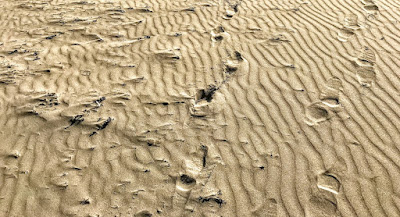
‘Only do not let them rejoice over me, those who boast against me when my foot slips’ (Psalm 38: 16) … footsteps in the sand at Ballybunion, Co Kerry (Photograph: Patrick Comerford)
Patrick Comerford
Following Saint Patrick’s Day celebrations yesterday, today is an additional public holiday in Ireland this year. Before today begins, I am taking some time early this morning for prayer, reflection and reading.
During Lent this year, in this Prayer Diary on my blog each morning, I am reflecting in these ways:
1, Short reflections on a psalm or psalms;
2, reading the psalm or psalms;
3, a prayer from the USPG prayer diary.
Psalm 38:
Psalm 38 is ‘A Psalm of David, for the memorial offering’ or ‘A psalm of David to bring to remembrance.’ The title ‘for the memorial offering’ or ‘to bring to remembrance’ also applies to Psalm 70.
In the slightly different numbering system in the Greek Septuagint and the Latin Vulgate, this psalm becomes Psalm 37.
This is one of the seven Penitential Psalms. In the English King James Version. It begins: ‘O Lord, rebuke me not in thy wrath.’ In Latin, it is known as Domine, ne in furore tuo arguas me.
This psalm is possibly written late in King David’s life, and some commentators see it as a biography of sorts for David.
The psalm’s two principal topics are:
1, God’s displeasure at sin (verses 1-11);
2, the psalmist’s sufferings and prayers (verses 12-22).
The psalm opens with a prayer. King David felt as if he had been forgotten by God. The psalm then passes intermittently between complaint and hope.
Commentators have noted how the depth of misery into which the psalmist gradually plunges in his complaints, only to then to grasp suddenly at the arm of God’s mercy and omnipotence.
Psalm 38 (NRSVA):
A Psalm of David, for the memorial offering.
1 O Lord, do not rebuke me in your anger,
or discipline me in your wrath.
2 For your arrows have sunk into me,
and your hand has come down on me.
3 There is no soundness in my flesh
because of your indignation;
there is no health in my bones
because of my sin.
4 For my iniquities have gone over my head;
they weigh like a burden too heavy for me.
5 My wounds grow foul and fester
because of my foolishness;
6 I am utterly bowed down and prostrate;
all day long I go around mourning.
7 For my loins are filled with burning,
and there is no soundness in my flesh.
8 I am utterly spent and crushed;
I groan because of the tumult of my heart.
9 O Lord, all my longing is known to you;
my sighing is not hidden from you.
10 My heart throbs, my strength fails me;
as for the light of my eyes – it also has gone from me.
11 My friends and companions stand aloof from my affliction,
and my neighbours stand far off.
12 Those who seek my life lay their snares;
those who seek to hurt me speak of ruin,
and meditate treachery all day long.
13 But I am like the deaf, I do not hear;
like the mute, who cannot speak.
14 Truly, I am like one who does not hear,
and in whose mouth is no retort.
15 But it is for you, O Lord, that I wait;
it is you, O Lord my God, who will answer.
16 For I pray, ‘Only do not let them rejoice over me,
those who boast against me when my foot slips.’
17 For I am ready to fall,
and my pain is ever with me.
18 I confess my iniquity;
I am sorry for my sin.
19 Those who are my foes without cause are mighty,
and many are those who hate me wrongfully.
20 Those who render me evil for good
are my adversaries because I follow after good.
21 Do not forsake me, O Lord;
O my God, do not be far from me;
22 make haste to help me,
O Lord, my salvation.
Today’s Prayer:
The USPG Prayer Diary has a particular focus on Ireland and the Church of Ireland this week, and I introduced this theme in the prayer diary on Sunday (13 March 2022), with the heading ‘Crossing Borders’. The Prayer in the USPG Prayer Diary this morning (18 March 2022) invites us to pray:
Lord, may we remember that love has no boundaries. May we cross borders to spread the Good News of Jesus Christ.
Yesterday’s reflection
Continued tomorrow
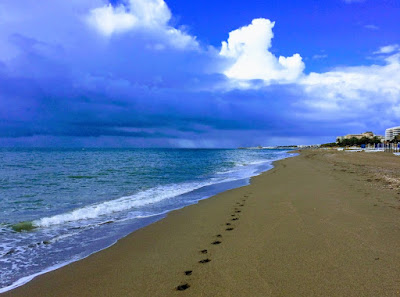
‘Only do not let them rejoice over me, those who boast against me when my foot slips’ (Psalm 38: 16) … footsteps on the sand at La Carihuela, south of Torremolinos in Spain (Photograph: Patrick Comerford)
Scripture quotations are from the New Revised Standard Version Bible: Anglicised Edition copyright © 1989, 1995, National Council of the Churches of Christ in the United States of America. Used by permission. All rights reserved worldwide. http://nrsvbibles.org
Patrick Comerford
Following Saint Patrick’s Day celebrations yesterday, today is an additional public holiday in Ireland this year. Before today begins, I am taking some time early this morning for prayer, reflection and reading.
During Lent this year, in this Prayer Diary on my blog each morning, I am reflecting in these ways:
1, Short reflections on a psalm or psalms;
2, reading the psalm or psalms;
3, a prayer from the USPG prayer diary.
Psalm 38:
Psalm 38 is ‘A Psalm of David, for the memorial offering’ or ‘A psalm of David to bring to remembrance.’ The title ‘for the memorial offering’ or ‘to bring to remembrance’ also applies to Psalm 70.
In the slightly different numbering system in the Greek Septuagint and the Latin Vulgate, this psalm becomes Psalm 37.
This is one of the seven Penitential Psalms. In the English King James Version. It begins: ‘O Lord, rebuke me not in thy wrath.’ In Latin, it is known as Domine, ne in furore tuo arguas me.
This psalm is possibly written late in King David’s life, and some commentators see it as a biography of sorts for David.
The psalm’s two principal topics are:
1, God’s displeasure at sin (verses 1-11);
2, the psalmist’s sufferings and prayers (verses 12-22).
The psalm opens with a prayer. King David felt as if he had been forgotten by God. The psalm then passes intermittently between complaint and hope.
Commentators have noted how the depth of misery into which the psalmist gradually plunges in his complaints, only to then to grasp suddenly at the arm of God’s mercy and omnipotence.
Psalm 38 (NRSVA):
A Psalm of David, for the memorial offering.
1 O Lord, do not rebuke me in your anger,
or discipline me in your wrath.
2 For your arrows have sunk into me,
and your hand has come down on me.
3 There is no soundness in my flesh
because of your indignation;
there is no health in my bones
because of my sin.
4 For my iniquities have gone over my head;
they weigh like a burden too heavy for me.
5 My wounds grow foul and fester
because of my foolishness;
6 I am utterly bowed down and prostrate;
all day long I go around mourning.
7 For my loins are filled with burning,
and there is no soundness in my flesh.
8 I am utterly spent and crushed;
I groan because of the tumult of my heart.
9 O Lord, all my longing is known to you;
my sighing is not hidden from you.
10 My heart throbs, my strength fails me;
as for the light of my eyes – it also has gone from me.
11 My friends and companions stand aloof from my affliction,
and my neighbours stand far off.
12 Those who seek my life lay their snares;
those who seek to hurt me speak of ruin,
and meditate treachery all day long.
13 But I am like the deaf, I do not hear;
like the mute, who cannot speak.
14 Truly, I am like one who does not hear,
and in whose mouth is no retort.
15 But it is for you, O Lord, that I wait;
it is you, O Lord my God, who will answer.
16 For I pray, ‘Only do not let them rejoice over me,
those who boast against me when my foot slips.’
17 For I am ready to fall,
and my pain is ever with me.
18 I confess my iniquity;
I am sorry for my sin.
19 Those who are my foes without cause are mighty,
and many are those who hate me wrongfully.
20 Those who render me evil for good
are my adversaries because I follow after good.
21 Do not forsake me, O Lord;
O my God, do not be far from me;
22 make haste to help me,
O Lord, my salvation.
Today’s Prayer:
The USPG Prayer Diary has a particular focus on Ireland and the Church of Ireland this week, and I introduced this theme in the prayer diary on Sunday (13 March 2022), with the heading ‘Crossing Borders’. The Prayer in the USPG Prayer Diary this morning (18 March 2022) invites us to pray:
Lord, may we remember that love has no boundaries. May we cross borders to spread the Good News of Jesus Christ.
Yesterday’s reflection
Continued tomorrow
‘Only do not let them rejoice over me, those who boast against me when my foot slips’ (Psalm 38: 16) … footsteps on the sand at La Carihuela, south of Torremolinos in Spain (Photograph: Patrick Comerford)
Scripture quotations are from the New Revised Standard Version Bible: Anglicised Edition copyright © 1989, 1995, National Council of the Churches of Christ in the United States of America. Used by permission. All rights reserved worldwide. http://nrsvbibles.org
17 April 2014
Cabaret ‘every Thursday night’ and
singing ‘Torremolinos, Torremolinos’
Patrick Comerford
Do you recall this monologue?:
“Yes, I quite agree with you, I mean, what’s the point of being treated like a sheep? I mean, I’m fed up going abroad and being treated like sheep. What’s the point of being carted around in buses, surrounded by sweaty mindless oafs from Kettering and Boventry in their cloth caps and their cardigans and their transistor radios and their Sunday Mirrors, complaining about the tea, ‘Oh, they don’t make it properly here, do they, not like at home,’ stopping at Majorcan bodegas, selling fish and chips and Watney’s Red Barrel and calamares and two veg and sitting in cotton sun frocks squirting Timothy White’s suncream all over their puffy, raw, swollen, purulent flesh ‘cause they ‘overdid it on the first day,’ and being herded into endless Hotel Miramars and Bellvueses and Bontinentals with their international luxury modern roomettes and their Watney’s Red Barrel and their swimming pools full of fat German businessmen pretending to be acrobats and forming pyramids and frightening the children and barging into the queues and, if you’re not at your table, spot on seven you miss your bowl of Campbell’s Cream of Mushroom soup, the first item on the menu of International Cuisine, and every Thursday night there’s bloody cabaret in the bar featuring some tiny emaciated dago with nine-inch hips and some big, fat, bloated tart with her hair Brylcreemed down and a big arse presenting Flamenco for Foreigners, and then some adenoidal typists from Birmingham with diarrhoea and flabby white legs and hairy bandy-legged wop waiters called Manuel, and then, once a week, there’s an excursion to the local Roman ruins where you can buy cherryade and melted ice cream and bleedin’ Watney’s Red Barrel, and then one night they take you to a local restaurant with local colour and colouring and they show you there and you sit next to a party of people from Rhyl who keeps singing ‘Torremolinos, Torremolinos’ and complaining about the food, ‘Oh, it’s so greasy, isn’t it?’, and then you get cornered by some drunken greengrocer from Luton with an Instamatic and Dr Scholl sandals and Tuesday’s Daily Express and he drones on and on and on about how Mr Smith should be running this country and how many languages Enoch Powell can speak and then he throws up all over the Cuba Libres, and sending tinted postcards of places they don’t know they haven’t visited, ‘To all at number 22, weather wonderful, our room is marked with an ‘X’. Wish you were here. Food very greasy but we have managed to find this marvellous little place hidden away in the back streets where you can even get Watney’s Red Barrel and cheese and onion crisps and the accordionist plays “Maybe It’s Because I’m a Londoner”,’ and spending four days on the tarmac at Luton airport on a five-day package tour with nothing to eat but dried Watney’s sandwiches and you can’t even get a drink of Watney’s Red Barrel because you’re still in England and the bloody bar closes every time you’re thirsty and there’s nowhere to sleep and the kids are crying and vomiting and breaking the plastic ash-trays and they keep telling you it’ll only be another hour although your plane is still in Iceland and has to take some Swedes to Yugoslavia before it can load you up at 3 a.m. in the bloody morning and you sit on the tarmac till six because of ‘unforeseen difficulties,’ i.e. the permanent strike of Air Traffic Control in Paris – and nobody can go to the lavatory until you take off at 8, and when you get to Malaga airport everybody’s swallowing “enterovioform” and queuing for the toilets and queuing for the armed customs officers, and queuing for the bloody bus that isn’t there to take you to the hotel that hasn’t yet been finished. And when you finally get to the half-built Algerian ruin called the Hotel del Sol by paying half your holiday money to a licensed bandit in a taxi you find there’s no water in the pool, there’s no water in the taps, there’s no water in the bog and there’s only a bleeding lizard in the bidet. And half the rooms are double booked and you can’t sleep anyway because of the permanent 24-hour drilling of the foundations of the hotel next door – and you’re plagued by appalling apprentice chemists from Ealing pretending to be hippies, and middle-class stockbrokers’ wives busily buying identical holiday villas in suburban development plots just like Esher, in case the Labour government gets in again, and fat American matrons with sloppy-buttocks and Hawaiian-patterned ski pants looking for any mulatto male who can keep it up long enough when they finally let it all flop out. And the Spanish Tourist Board promises you that the raging cholera epidemic is merely a case of mild Spanish tummy, like the previous outbreak of Spanish tummy in 1660 which killed half London and decimated Europe, and meanwhile the bloody Guardia are busy arresting 16-year-olds for kissing in the streets and shooting anyone under 19 who doesn’t like Franco. And then on the last day in the airport lounge everyone’s comparing sunburns, drinking Nasty Spumante, buying cartons of duty free ‘cigarillos’ and using up their last pesetas on horrid dolls in Spanish National costume and awful straw donkeys and bullfight posters with your name on ‘Ordoney, El Cordobes and Brian Pules of Norwich’ and 3-D pictures of the Pope and Kennedy and Franco, and everybody’s talking about coming again next year and you swear you never will although there you are tumbling bleary-eyed out of a tourist-tight antique Iberian airplane.”
Well, that’s a Monty Python mouthful. If you remember this sketch from 1972, you’re the same generation as I am.
I know it’s no longer politically correct, but it remains a classic of British television comedy after so many years. It’s up there with the Ministry of Silly Walks and the Dead Parrot.
And, well, I’m in Torremlinos this week, nor for the Watney’s Red Barrel, last Tuesday’s Daily Express, or cabaret ‘every Thursday night,’ but to experience the climax of Lent, Semana Santa (Holy Week), which began on Palm Sunday (13 April 2014) and continues until Easter Day (20 April).
During this week, the streets of cities, town and resorts in this part of Spain, including Seville and Malaga, are filled with thousands of mediaeval robed and hooded figures, processing slowly behind swaying life-sized religious effigies, accompanied by the deep thud of drums and mournful wailing of trumpets in one of Spain’s largest festivals.
These ancient, sombre commemorations of Christ’s last days are marked by pageantry and emotion that reveal a mystical side of life in Spain, even in vibrant and cosmopolitan cities and resorts, especially at dusk, when candles are lit, and the processions take on a haunting, timeless feel.
Up to a million visitors flock to Seville alone for the spectacle; and the late-night processions this evening (17 April), known as las Madrugas, are said to be unmissable.
The cofradias or church brotherhoods, many dating from the 16th century, take part, each with its own statues of the Virgin Mary and Christ, as well as colourful misterios or tableaux of Bible scenes, carried about on elaborately-decorated pasos or floats.
The nazarenos or robed and hooded penitents carrying crosses, wear hoods, tunics and belts in the special colours of their cofradia. The capirotes or tall, pointed hoods with eye-holes, are designed so those who wear them can repent in anonymity, without being recognised as self-confessed sinners.
Maundy Thursday and Good Friday are national holidays in Spain.
In Seville, the climax of this week is reached early tomorrow morning on Good Friday (18 April), with the appearance of the city’s two favourite and rival Virgin Marys, Triana and Macarena.
In Malaga, Semana Santa is also a very special affair, with the brotherhoods of the city sending floats and large thrones out onto the streets, and candle-lit processions that followed by thousands of spectators.
There are even traditional Semana Santa pastries and nazareno-shaped sweets and chocolates.
This is my first time in Spain, apart from a brief city break in Madrid five years ago in May 2009. So there is a lot to look forward to over the next few days.
Subscribe to:
Posts (Atom)


