Showing posts with label Whittington. Show all posts

28 July 2025

A weary pilgrim walks
part of the way along
‘Saint Editha’s Way’ from
Polesworth to Lichfield

Inside Saint Editha’s Church, Tamworth, central to the new pilgrim route, the 14-mile ‘Saint Editha’s Way’ (Photograph: Patrick Comerford, 2025)

Patrick Comerford

I was back in Lichfield and Tamworth at the end of last week for one of those short pilgrimages and self-guided mini-retreats that a make a few times in the year, and that are important for my spiritual health and well-being.

But I was visiting Lichfield and Tamworth too to hear about the ‘Saint Editha’s Way’ pilgrim route, a 14-mile journey celebrating the story of ancient Mercia. The pilgrim route starts at Polesworth Abbey and weaves its way through along canal tow-path to Amington, through to Tamworth, including Tamworth Castle and Saint Editha’s Church, then on to Wigginton and through Hopwas, finishing at Lichfield Cathedral.

The total distance is about 14 miles and takes about five hours at walking pace or 1.5 hours on a bicycle. An interactive map of the route that can be download to your phones is available on the Footpaths App, just click here.

An interactive map of ‘Saint Editha’s Way’ illustrates the 14-mile, five-hour pilgrim route

Some people may decide to walk the whole of Saint Editha’s Way in one go, while others may walk it in sections over a longer period, perhaps over several days.

For a shorter route, walkers can start at Polesworth Abbey and stop at Saint Editha’s Church, Tamworth – this is about 6.5 miles and takes about 2.5 hours. Alternatively, walkers can start at Tamworth and proceed to Lichfield Cathedral – this is about 7 miles and takes about three hours. There are good bus services along the whole route and regular connections between Lichfield and Polesworth, so walkers need not walk the whole way back.

There is information about the churches and castles on the route in the Pilgrim Guidebook, a special handbook for the journey with details about landmarks on the route and other tips and information. Much of it has been researched and compiled by Dr David Biggs, chair of the Tamworth and District Civic Society. I picked up my copy in Saint Editha’s Church, Tamworth, on Friday morning and it is also available at Polesworth Abbey and Lichfield Cathedral.

Saint Editha was a 10th century princess in Mercia, one of several kingdoms making up what we now call England. Tamworth was the political capital of Mercia and Lichfield was the ecclesiastical capital.

Saint Editha was probably the sister of Athelstan, who was crowned first King of all England in 925 CE. Renowned for her charity and good works, she renounced royal luxury to live a holy life. She was married in Tamworth Church in 926 CE but was abandoned later by her pagan husband Sihtric, the Viking ruler of York and Northumbria. She then led a life of saintly devotion and good works in her convent in Tamworth until she died in the year 960.

She became a saint by popular acclaim, her shrine in Tamworth became a place of pilgrimage. The church in Tamworth was named in her honour in 963 by her nephew King Edgar when he completed the rebuilding of the church and its foundation as a collegiate church. Other churches in the area with her name include Polesworth Abbey.

The Comberford Chapel in Saint Editha’s Church, Tamworth (Photograph: Patrick Comerford, 2025)

The mediaeval tradition of pilgrimages to Tamworth to venerate Saint Editha is recalled in an anonymous poem from the Middle Ages:

Over ye river broad, ye pilgrims onward speed
By olden Tamworth altars fare, for ghostly good to speed.
Soundeth ye church bells merrily, about ye lofty aisle
Through tinctured shapes of saints and kings ye shafted sunbeams smile.
Standeth ye marble of Saint Edith, all in bright array.
Ora pro nobis peccatoribus [pray for us sinners] each rich one doth say.
Gentles from embroidered silk scraps scattereth pence around
To simple men, with dusty feet, weeping upon ye ground
.

The marble statue referred to was likely removed or destroyed in the Reformation in the 16th century. But a new statue of Saint Editha in Saint Editha’s Church, Tamworth, was commissioned this year (2025) to mark the inauguration of the new pilgrimage route. She is depicted with a crozier, as an abbess, and a church, representing the churches where she is the patron.

A stop by the canal bridge in Hopwas, where the A51 crosses both the River Tame and the Coventry Canal (Photograph: Patrick Comerford, 2025)

The principal stopping points along the way include Polesworth Abbey in the heart of Polesworth, Saint Editha’s, Amington, a Victorian parish church with Burne-Jones glass, Tamworth Castle, Saint Editha’s Church, Tamworth, Spital Chapel, Wigginton, a mediaeval chapel that was originally part of a hospital, and Lichfield Cathedral.

The route meanders through beautiful countryside including Pooley Country Park, a substantial stretch of peaceful canal, the grounds of Tamworth Castle, and past the woods and fields of Hopwas. The route traverses several busy main roads, but the entire journey is along footpaths. Each stop along the route has a special pilgrimage marker, and entry is free at each stop with the one exception of Tamworth Castle.

Other sights along the way include Alvecote Priory, now an atmospheric derelict ruin, Saint Rufin’s Well in the grounds of Tamworth Castle, and Saint Chad’s Well in the churchyard at Saint Chad’s Church, Lichfield.

I travelled part of the way on Friday afternoon, from Tamworth through Hopwas and Whittington to Lichdield, but travlled by bus for most of the journey by bus. In Lichfield, I stopped to pray in the Chapel of Saint John’s Hospital before continuing on to Lichfield Cathedral.

Later in the afternoon, I walked along part of Cross in Hand Lanethe old pilgrim route along Cross in Hand Lane, the first (or final) stage on ‘The Two Saints Way’ between the shrine of Saint Chad in Lichfield and the shrine of Saint Werburgh in Chester. I had a late lunch at the Hedgehog before returning at the end of the day to Lichfield Cathedral for Evening Prayer.

Pilgrims who complete the route along ‘Saint Editha’s Way’ may present their handbook at the front desk of Lichfield Cathedral during visiting hours to receive a special stamp and certificate to prove they have successfully completed the Saint Editha’s Way.

The Pilgrim’s Prayer in the handbook:

O Lord of Heaven and Earth,
guide my steps as I journey through this land of Mercia,
where saints have walked and holy lives were lived.
I lift my heart to you, O God,
with the spirit of a pilgrim – seeking not only places, but peace.
Teach me, like Saint Editha, to set aside pride and vanity,
and to walk humbly with you in all things.
O Lord, as O walk this pilgrim way,
be my compass and my strength.
Through the prayers of Saint Editha and all the Mercian saints,
draw me nearer to your heart.
In the name of Jesus Christ the King of all things.
Amen.

The pilgrim arrives at Lichfield Cathedral in the afternoon summer sunshine

19 November 2022

Bletchley Park, the home of
the code breakers, and home
to many interesting families

Bletchley Park, home of the code-breakers in World War II, was developed by Samuel Lipscomb Seckham and Sir Herbert Samuel Leon (Photograph: Patrick Comerford, 2022)

Patrick Comerford

I spent much of yesterday (18 November 2022) visiting Bletchley Park, the Victorian country house and estate in Milton Keynes that was the principal centre of allied code-breaking during World War II.

Most visitors to Bletchley Park come to see the museums and to learn about the code-breakers. But the pre-war history of Bletchley Park and the architectural story of the mansion are interesting in their own rights too.

The house at Bletchley Park was developed by the Victorian architect Samuel Lipscomb Seckham (1827-1901), who bought the estate in 1877 and named it Bletchley Park, and then by Sir Herbert Samuel Leon (1850-1926), the financier and Liberal MP, who bought it from Seckham in 1883.

The Bletchley Park estate dates back to at least the 11th century (Photograph: Patrick Comerford, 2022)

The Bletchley Park estate dates back to at least the 11th century and it appears in the Domesday Book in 1086 as part of the Manor of Eaton.

Dr Thomas Willis, one of the most celebrated physicians of his day, bought Bletchley, Fenny Stratford and Water Eaton from the 2nd Duke of Buckingham in 1675. He also had a house on Saint Martin's Lane in the parish of Saint Martin-in-the-Fields, London, and died on Saint Martin’s Day, 11 November 1675.

His son Robert Willis added the Whaddon estate, including Whaddon Hall, bought jointly with James Selby from the Duke of Buckingham’s trustees in 1698. However, Robert Browne died shortly after. His son, was the antiquary, author, numismatist and politician Browne Willis (1682-1760). He was MP for Buckingham in 1705-1708, and built a mansion at Bletchley in 1711.

Browne Willis also built Saint Martin’s Church in Fenny Stratford in 1724-1730 on the site of the old Chantry Chapel of Saint Margaret and Saint Catherine as a memorial to his grandfather Dr Thomas Willis, and he arranged for a sermon to be preached in his memory in Saint Martin’s Church every Saint Martin’s Day.

Two seated griffins guard the porch at Bletchley Park (Photograph: Patrick Comerford, 2022)

Thomas Harrison, who managed the Radcliffe estates in Wolverton and the estates of Earl Spencer in Stantonbury, bought the property in 1793, and the house built by Browne in 1711 was pulled down and the land was let. Thomas Harrison died in 1809 and his last surviving son, Richard Harrison, died in 1858.

Richard Harrison’s eldest son, Spencer Harrison, put much of the estate up for auction in seven lots in 1865, but when he decided again to sell Bletchley at auction in 1871 it failed to sell.

Six years later, the estate was sold in 1877 to a Mr Coleman and it almost immediately passed to the Victorian architect and developer Samuel Lipscomb Seckham (1827-1901). The details are obscure, but it is possible that Coleman was an agent for Seckham, who first used the name Bletchley Park after acquiring the estate in 1877.

A three-bay embattled ashlar loggia is among the distinctive features of the front elevation of the house (Photograph: Patrick Comerford, 2022)

Samuel Lipscomb Seckham was born in Oxford on 25 October 1827, and later became the City Surveyor. He was the original architect employed by Saint John’s College, Oxford, to develop parts of North Oxford, and developed Park Town, an early and prominent estate in North Oxford.

Through Seckham’s efforts, the Park Town Estate Company was formed in September 1857. Such was the success of Park Town, he also worked on plans for Walton Manor and Norham Manor.

Seckham rented Hanch Hall, near Longdon, outside Lichfield, from 1873. He bought Bletchley Park in 1877, renamed it and developed it before selling in 1883 to the financier and Liberal politician Sir Herbert Samuel Leon (1850-1926).

Seckham then moved to Beacon Place in Lichfield, once the home of the Hinckley family, and rebuilt and stuccoed in Grecian style ca 1842-1855 by the architect Sir Sydney Smirke (1798-1877) while he was working on Lichfield Cathedral and Saint Michael’s Church, Lichfield. Smirke also restored the Temple Church and the Savoy Chapel in London and completed the British Museum.

While Seckham was living at Beacon Place, he became a pillar of Christ Church, Leomansley, in Lichfield. When the transept and aisles were added to the church in 1887, Seckham and Albert Octavius Worthington jointly bore the cost of the north transept and chancel, while Seckham’s wife, Kinbarra Sweene Smith, presented a wrought iron screen, although this was later removed to the former choir gallery.

Seckham bought Whittington Old Hall, a 16th-century house near Lichfield, in 1889, and he set about restoring and enlarging it. At the same time, he held on to Beacon Place in Lichfield. He was High Sheriff of Staffordshire in 1890, and was also Deputy Lieutenant (DL), a Justice of the Peace (JP), and a representative of Lichfield on Staffordshire County Council.

His wife died in 1900, and he died on 4 February 1901. His funeral took place in Christ Church, Leomansley, and his tomb is recessed in the outer wall of the north transept. They are commemorated in a stained-glass window in the north chapel in Christ Church.

The Seckhams are commemorated in a stained-glass window in the north chapel in Christ Church, Leomansley, Lichfield (Photograph: Patrick Comerford)

Meanwhile, Sir Herbert Leon bought Bletchley Park from Seckham in 1883, along with the estate of 581 acres (235 ha). He set about redeveloping and rebuilding the mansion in the years that followed in the Victorian Gothic, Tudor and Dutch Baroque styles, with a Moorish influenced roof. He turned the house into what the architect Landis Gores called a ‘maudlin and monstrous pile.’

The house is asymmetrical in design with sumptuous interiors featuring reproduction Jacobean ceilings, marble arches and an impressive ballroom with gilded ceilings.

It is a large, rambling, two-store Grade II house with partial attic. It is built in red brick in Flemish bond with ashlar dressings. The principal gables are half-timbered with pebble-dashed infill, some others are tile-hung. There is a Welsh slate roof with red tile ridge, and the brick stacks have clustered flues, ribs and bands. There are ransomed wooden windows, and the principal windows have leaded upper lights. There are decorative wooden barge boards and finials at the gables.

Sir Herbert Leon turned Bletchley Park into what Landis Gores called a ‘maudlin and monstrous pile’ (Photograph: Patrick Comerford, 2022)

The front elevation of the house has six bays. The entrance in the second bay has an internal, vaulted, porch protecting the panelled half-glazed double-door with side lights and a fanlight. The flanking porch has hexagonal brick columns surmounted by panelled stone tops that flank a base with a four-light oriel window that has a decorative base.

Two seated griffins on bracketed plinths project from porch and are attached to it. Other features include a domed, metal roof, a single storey wooden conservatory with traceried bays, gableted buttresses, canted bay windows, and a three-bay embattled ashlar loggia.

Inside the house, the elaborate, interiors survive, with panelling, panelled doors, decorative fireplaces, and decorative plaster ceilings. There are stone columns and vaults, and arcaded polished-stone screen wall in the entrance hall, traceried panelling, elaborate columned ashlar fireplaces, a Jacobean-style fireplace, a painted glass roof, coffered ceilings, and a panelled stair hall, with a fretted balustrade, carved surround and carved octagonal newels.

The former library, which served as a naval intelligence office, has an elaborate wooden Jacobean-style inglenook with an over-mirror and fitted book cases and shelves.

The former ballroom has linenfold panelling, clustered wooden columns, traceried arches, and elaborate plaster work.

The former billiard room also has interesting panelling, cornices, columns ceiling ribs and wooden trusses.

The former library has an elaborate wooden Jacobean-style inglenook with an over-mirror and fitted book cases and shelves (Photograph: Patrick Comerford, 2022)

After Sir Herbert Leon died in 1926, his widow, Lady Fanny Leon, lived on at Bletchley Park until she died in 1937. The mansion and much of the site was bought by a builder for a housing estate, but in May 1938 Admiral Sir Hugh Sinclair, head of the Secret Intelligence Service (SIS or MI6), bought the mansion and 58 acres (23 ha).

Bletchley Park, known as BP to those who worked there, was chosen because of its prime location beside Bletchley Railway Station, a main road linking London to the north-west and a telegraph and telephone station at Fenny Stratford.

During World War II, Bletchley Park was the headquarters of the code-breakers and became the birthplace of modern computing. It was the place where Alastair Denniston, Alan Turing, Gordon Welchman, Dilly Knox, Peter Twinn and others broke the ‘unbreakable’ Enigma machine code and helped shorten World War II by several years, feats recalled in the film The Imitation Game.

The arched entrance to the stables at Bletchley Park (Photograph: Patrick Comerford, 2022)

At the peak of MI6’s code-breaking efforts in early 1945, around 9,000 people working at Bletchley Park. To accommodate them and their extensive equipment, a large number of buildings were added to the site. Wooden huts known by numbers and brick-built blocks were known by letters.

It is here too that Britain’s ‘Special Relationship’ with the US was created, and on the small green outside the house is the ‘Churchill Stone,’ representing the boulder where Sir Winston Churchill stood on 6 September 1941 when he addressed the Bletchley Park staff, describing the code-breakers at Bletchley Park as ‘the geese that laid the golden eggs and never cackled.’

After World War II, much of the equipment and documents at Bletchley Park were destroyed and the buildings were left to ruin. The site of Bletchley Park was used as a teacher training college and local GPO headquarters in the 1960s and 1970s. By the 1990s, it was at risk of being demolished for redevelopment. Milton Keynes Borough Council stepped in and declared Bletchley Park a conservation area.

The Bletchley Park Trust was formed and opened the site to visitors in 1993 as a museum. After decades of secrecy, Bletchley Park is now open to the public, and visitors can see how the codebreakers lived and worked, and view the largest collection of historic computers in the National Museum of Computing.

An artist’s impression of some of the code-breakers who worked at Bletchley Park (Photograph: Patrick Comerford, 2022)

03 September 2022

Whittington Old Hall and
its links with the Babington
clerical family in Lichfield

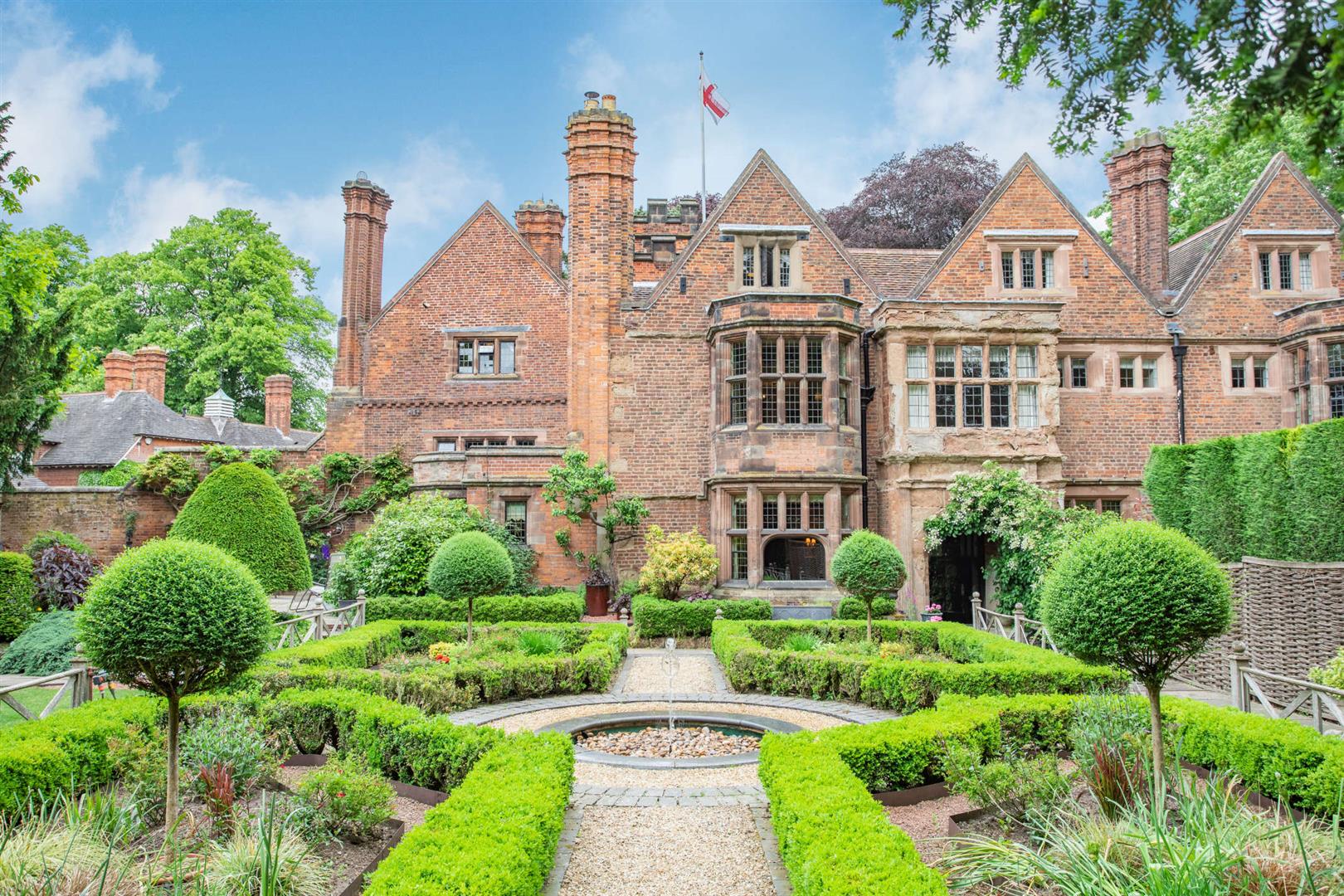
Whittington Old Hall on the edge of Whittington was owned by the Babington family in the 17th and 18th centuries

Patrick Comerford

When I was back in Saint Chad’s Church in Lichfield last week, I paid particular attention to the monument to Catherine Allden (1615-1695) and her husband Zachary Babington (1611-1685) of Whittington and Curborough.

The couple were married in Saint Chad’s Church when she was 20 in 1636, and I was interested in the monument because of the intricate links between the Babington and Comberford families in the 16th and 17th centuries through intermarriage with the Fitzherbert and Beaumont families. But I was also interested to hear this week that part of Whittington Old Hall is still on the market – with an asking price of over £1 million.

Whittington Old Hall is on the edge of the pretty Staffordshire village of Whittington, close to Lichfield. It is a Grade II* listed property steeped in rich history and dating back to the 16th century.

The house is believed to have been built in the Tudor period, and the present owners believe the original timber-frame building would have been clad in handsome brickwork towards the end of the reign of Elizabeth I.

The Revd Stebbing Shaw (1762-1802), in The History and Antiquities of Staffordshire (1798), records that the Everard family owned a house and estate in Whittington during the reign of Henry VIII. They may have been descended from Ralph Everard (1499-1546), who married Maud (Matilda) Comberford (1503-1588), daughter of Thomas Comberford of Comberford Hall. Maud was a sister of Henry Comberford, Precentor of Lichfield, and Richard Comberford, a Lichfield lawyer once claimed as the ancestor of the Comerford family in Ireland.

Whittington Old Hall was probably first built by the Everard family in the mid-16th century

Whittington Hall was probably built or rebuilt in the Elizabethan age, with the early Tudor builders retaining possibly the foundations of an earlier house, but remodelling the south or garden front and a portion of the entrance front in the reign Edward VI and the early years of the reign of Elizabeth I. They left the old half-timber work and re-cased the exterior with brick and stone-work, and with striking bays and mullioned windows.

The Babington family of Whittington Hall was descended from Canon Zachary Babington (1549-1613), Chancellor of the Diocese of Lichfield. One genealogical site suggests he came originally from Comberford, although he was the son of Thomas Babington (d. 1567) of Rothley Temple and Cossington, Derbyshire, and his wife Eleanor, daughter and co-heir of John Beaumont.

He was a cousin of the Comberford family of Comberford Hall and the Moat House, Tamworth, and of Anthony Babington, who was hung, drawn and quartered on Tower Hill in 1586 for his role in the Babington Plot to put Mary Queen of Scots on the throne.

Canon Zachary Babington was Prebendary of Curborough (1584), Master of Saint John’s Hospital, Lichfield (1587), and Precentor of Lichfield and Prebendary of Bishop’s Itchington (1589-1608), two positions held earlier (1555-1559), by his aunt’s brother-in-law, Canon Henry Comberford (1499-1586). He was also Chancellor of the Diocese of Lichfield (1581-1613).

He created an estate centred on Curborough Hall Farm, and was living there when he died in 1613. His son, Canon William Babington (1582-1625), was also Precentor of Lichfield.

The monument Zachary Babington (1611-1685) and his wife Catherine Allden (1615-1695) in Saint Chad’s Church, Lichfield (Photograph: Patrick Comerford)

Canon William Babington was the father of both Canon Matthew Babington, a chaplain to Charles I, and Zachary Babington (1611-1685) of Whittington and Curborough, who is remembered with his wife Catherine Allden (1615-1695) in that monument in Saint Chad’s Church.

This Canon William Babington was also the father of Margaret Babington, who married John Birch, one of the trustees of the Comberford estates in the 1650s and 1660s, and Mary Babington who married Matthew Dyott of Stychbrook and Lichfield.

Zachary Babingnton died in 1685 and was buried at Saint Giles Church, Whittington. Zachary’s son, John Babington, was living at Curborough in 1684 and was High Sheriff of Staffordshire in 1702. John Babington died in 1706.

John Babington was the father of Zachary Babington (1690-1745) of Curborough Hall and Whittington Old Hall, a barrister and High Sheriff of Staffordshire in 1713 and 1724. Zachary Babington’s daughter Mary married Theophilus Levett (1693-1746), steward or town clerk of Lichfield (1721-1746) and a friend of Samuel Johnson’s family as well as part of the intellectual circle in Lichfield that included Erasmus Darwin, Anna Seward, David Garrick and Matthew Boulton.

The Babington estates were divided in 1780 and Curborough Hall went to John Levett, the son of Mary and Theophilus. John died in 1799, and Curborough Hall descended in his family.

Whittington Old Hall was divided into two houses in in 1959

Meanwhile, Whittington Hall was bought by Christopher Astley of Tamhorn. Mary Astley, the heiress of the Astley family, inherited Whittington Hall and married her cousin, Richard Dyott of Freeford, in 1783.

The Dyott family appears to have sold the house after Mary Dyott died in 1836. By 1840, the house belonged to John Baggaley of Fradley, but was occupied by Daniel Riley as a tenant until about 1850, when the Baggaley family moved in themselves.

John Baggaley was still living at the Hall in 1861 and 1870, but Lord Berkeley Charles Sydney Paget (1844-1913) was his tenant there in 1880. He was a younger son of Henry Paget (1797-1869), 2nd Marquess of Anglesey, and was related to the Paget family of Elford Hall. The ‘gentleman jockey’ George Alexander Baird also rented the house for a while.

Charles Edward Baggaley sold Whittington Old Hall in 1889 to Samuel Lipscomb Seckham (1827-1901), an architect and brewer. He was the original architect employed by Saint John’s College, Oxford, to develop parts of North Oxford, including Park Town, an early and prominent estate in North Oxford.

Such was the success of Park Town, Seckham also worked on plans for Walton Manor and Norham Manor. He developed Bletchley Park, which he bought in 1877 and sold in 1883 to Sir Herbert Samuel Leon (1850-1926). Bletchley Park later became known for the World War II codebreaking effort there.

Seckham was the High Sheriff of Staffordshire in 1890. He spent a small fortune renovating and enlarging Whittington Old Hall but did not live there for many years, continuing to live at Beacon Place in Lichfield. The architect was Matthew Henry Holding of Northampton.

Seckham died on 4 February 1901. His eldest son, Bassett Thorne Seckham, inherited the house and lived there with his wife Alice Dorothy Seckham (nee Moore) until his death in 1925.

Whittington Old Hall Estate was offered for sale at auction in 1926. It was a substantial property totalling 543 acres. But the main house with its 10-acre garden did not reach the reserve price and was withdrawn. It was then let to successive tenants, including Harold de Vahl Rubin and Captain Thomas Lawley.

The house and garden were sold in 1933 to Edmund Richard Corn, a wealthy manufacturer of sanitary earthenware and tiles from the Potteries. There was a large garden party at the Old Hall in July 1937 for 1,500 of Corn’s employees to celebrate the centenary of Richards Tiles Ltd, the Corn family firm.

Corn lived at Whittington Old Hall with his wife Susan Annie (nee Hammersley) until he died in 1945. After Mrs Corn died in 1959, the gardens were sold for housing development (Cloister Walk and Babington Close), the lodges and coach houses were sold as separate homes and the main house was divided into two substantial houses with separate entrances.

No 2 Whittington Hall is a six-bedroom property that combines period features with modern family living, and the accommodation is over three floors.

The features include is a Jacobean-style fireplace with heavily carved timber surround. The library has bookcases and a decorative corner fireplace. There is grand staircase and a second charming small staircase within the tower. The property also has a cellar.

The landscaped gardens are to the south of the house and include a central water feature and a sheltered, stone flagged area. The roof terrace has views of the village.

• No 2 Whittington Old Hall is on sale through Fine & Country Sutton Coldfield, at 322 Lichfield Road, Four Oaks, Sutton Coldfield, who are inviting offers of over £1 million.

The features in No 2 Whittington Old Hall include is a Jacobean-style fireplace with heavily carved timber surround

27 June 2015

Christ Church, a Gothic Revival
church in Leamonsley, Lichfield

Christ Church, Lichfield ... a Gothic Revival triumph by Thomas Johnson, the Lichfield architect (Photograph: Patrick Comerford, 2015)

Patrick Comerford

After visiting Davidson House on Upper John Street and writing about its distressed state and about the work of its eminent former resident, the Lichfield architect Thomas Johnson, I decided to visit one of Johnson’s finest works in Lichfield.

Christ Church was built in 1846 in Christchurch Lane in Leamonsley, just off Walsall Road in the south-west corner of Lichfield. It serves a parish that includes the areas around Leamonsley, Sandfields and Lower Sandford Street.

The church was photographed extensively and described beautifully in January 2013 by the Lichfield blogger and local historian Kate Gomez. I was interested in visiting it this week because of its connections with Thomas Johnson and another great Gothic revival architect, George Frederick Bodley, its Hardman and Kempe windows and its interior decorations. They bring together a truly delight expression of the late period of Gothic Revival architecture and art in Staffordshire.

My visit was arranged by the Revd Janet Waterfield, and I was shown around the church by the verger, Margaret Beddoe.

Christ Church is a fine example of the Decorated Gothic revival style of the 19th century. The church is a Grade II* listed building. On the ceiling of the chancel are some unique Pre-Raphaelite canvas panels painted by John Dickson Batten.

A growing population in the west of Lichfield created the need for a new church in the area. Building work on Christ Church began in 1844 and it was completed by 1847, making it the first new parish church in Lichfield since mediaeval times.

The ¾ acre site for the church was a gift in 1844 from Richard Hinckley, a Lichfield solicitor and the owner of Beacon Place and its surrounding estate grounds. The site was about 500 metres south of Beacon Place at the edge of the grounds of the Hinckley estate and could be seen by the Hinckleys from their home.

The church was built in the corner of the park surrounding Beacon House. Because the church had no parish, a new parish was created by annexing parts of the parishes of Saint Michael and Saint Chad.

‘The Sleeping Children’ ... the monument to Ellen Hinckley’s daughters in Lichfield Cathedral (Photograph: Patrick Comerford, 2015)

The church was built and endowed by the generosity of Richard Hinckley’s wife, Ellen Jane Hinckley, the daughter of John Chappel Woodhouse (1780-1815), Dean of Lichfield (1807-1833). She was a niece of the Lichfield hymn-writer, Frederick Oakeley (1802-1880), best known as the translator of ‘O come, all ye faithful.’

Ellen had suffered tragic family losses. Her first husband was Canon William Robinson, and they had two daughters, Ellen-Jane and Marianne, who died in their childhood in 1813 and 1814. These two children are the subject of the memorial in Lichfield Cathedral carved by Sir Francis Chantry and known as ‘The Sleeping Children.’

Canon Robinson died in 1812 while he was still in his 30s. In 1817 in Lichfield Cathedral, Ellen married her second husband, Hugh Dyke Acland (1791-1834). But she was widowed a second time when he died in 1834. A year later, in 1835 she married her third husband, Richard Hinckley. In 1837, they moved into Beacon Place, and soon after donated a corner of their estate for building a new church.

Christ Church was built of sandstone quarried in Lichfield and was designed by the Lichfield architect, Thomas Johnson, who lived in 67 Upper John Street, later known as Davidson House.

The tiles in Christ Church are by Herbert Minton ... most are now covered by carpets (Photograph: Patrick Comerford, 2015)

The church was built with local red sandstone in a decorated Gothic revival style under the design of Thomas Johnson of Lichfield. When the church was completed in 1847, it consisted of a chancel, nave and west tower with a bell cast in 1845 by CG Mears of London. The tiles are by Herbert Minton, whose firm also worked closely with AWN Pugin and donated tiles to about 40 or 50 churches and vicarages throughout the Diocese of Lichfield.

The church was consecrated on 26 October 1847 by the Bishop of Lichfield, the Right Revd John Lonsdale. The first incumbent was Canon Thomas Alfred Bangham (1819-1876). He been ordained priest only a few months earlier in May 1847, but he stayed at Christ Church until his death.

Over the decades, the church has been richly endowed with many treasures and more practical items such as a modern heating system due to the generosity of a number of local benefactors.

Hardman windows in the chancel of Christ Church (Photographs: Patrick Comerford, 2015)

The north and south chancel windows, transept east window and nave south window date from the 1870s and 1880s and were designed by Hardman & Co, the Birmingham firm founded by John Hardman (1811-1867) of Handsworth, who worked closely with AWN Pugin.

The church was enlarged to designs by Matthew Holding of Northampton in 1887, when the north and south transepts and bays were added. The north extension consisted of a Lady Chapel and the south extension provided the church with an organ chamber and vestry. The extensions were partly funded by Samuel Lipscombe Seckham, who had bought Beacon House from the Hinckley family in 1881, and partly by public subscription.

Samuel Lipscomb Seckham (1827-1901) was a prosperous architect, developer, magistrate and brewer. He was employed by Saint John’s College, Oxford, to develop parts of North Oxford, including Park Town, Walton Manor and Norham Manor. From 1877 to 1883, he owned Bletchley Park, later known as the location for the code-breakers in World War II. In 1889, he bought Whittington Old Hall, a 16th-century country house outside Lichfield.

The chancel screen in Christ Church was presented by Seckham’s wife, Kinbarra Sweene (nee Smith), in 1888, but this has since been removed to the former choir gallery.

In 1897, to celebrate the 50th anniversary of the church, the vicar and churchwardens commissioned the decoration of the chancel ceiling and walls by John Dickson Batten (1860-1932). Batten is better known as an illustrator, and his work for Joseph Jacob’s various editions of fairy tales in the 1890s display his magnificent talent for design and creativity.

Batten painted his canvases for Christ Church in the Pre-Raphaelite style, depicting Old Testament figures with symbols of the Passion and the Eucharist. In these canvasses Batten represents the Biblical figures pointing to Christ as the promised and hoped for Messiah and the Eucharist as the Christian’s means of union with him.

The paintings by John Dickson Batten on the ceiling on the north side of the sanctuary (Photograph: Patrick Comerford, 2015)

The paintings on the north side of the sanctuary represent (viewed from left to right):

● Adam and Eve in the Garden of Eden;
● Noah, with the rainbow, the sign of God’s promise and blessing;
● the Archangel Gabriel guarding the gates of Paradise until Paradise should be regained by Christ;
● Abraham with Jacob, with Jacob’s vision of a ladder between Heaven and Earth;
● Moses, the leader and lawgiver, with Aaron, the High Priest who offers sacrifice to God.

The paintings by John Dickson Batten on the ceiling on the south side of the sanctuary (Photograph: Patrick Comerford, 2015)

The paintings on the south side of the sanctuary represent (viewed from left to right):

● Joshua leading God’s army into the Promised Land;
● David, the king and psalmist from whose royal house the Messiah would come;
● Solomon, the builder of the Temple in Jerusalem;
● Elijah, the prophet of God’s judgment, with Isaiah, speaking of comfort;
● the Archangel Gabriel, with Saint John the Baptist, calling the Virgin Mary to be the mother of Christ.

The original watercolours used by Batten as cartoons for his work on the ceiling paintings were discovered in the tower of Christ Church in the early 1980s. At first, it was thought they were the work of the Birmingham stained-glass artist Florence Camm (1874-1916). But this was disputed while the watercolours were being restored at the Birmingham Museum and Art Gallery. Art historians and the BMAG and the Victoria and Albert Museum now agree that they are the work of Batten.

The reredos was designed by the Tractarian artist CE Kempe (Photograph: Patrick Comerford, 2015)

The Tractarian artist, Charles Eamer Kempe (1837-1907), designed the glass for the north transept west window in 1894. Kempe, who studied architecture under George Frederick Bodley, also designed the colourful triptych that forms the reredos of the altar in the Lady Chapel in Lichfield Cathedral.

The reredos and marble sanctuary floor were presented to Christ Church in 1906 by Thomas Cox, a churchwarden, and his daughters in memory of Sarah Cox, wife and mother.

The Adoration of the Magi ... a window by CE Kempe in the Lady Chapel in Christ Church, Lichfield (Photograph: Patrick Comerford, 2015)

The sanctuary refurbishings were designed by George Frederick Bodley (1827-1907), and were built by Robert Bridgeman and Son of Quonian’s Lane, Lichfield.

Bodley was a lifelong friend of Kempe, and he was the first major patron of William Morris’s stained glass. He is closely associated with the Gothic Revival and High Anglican aesthetics, and his biographer Michael Hall argues he “fundamentally shaped the architecture, art, and design of the Anglican Church throughout England and the world” (George Frederick Bodley and the Later Gothic Revival in Britain and America, Yale University Press, 2012). The Church Historian, Owen Chadwick, says Kempe’s work represents “the Victorian zenith” of church decoration and stained glass windows.

Bodley’s other works in the Diocese of Lichfield include the Church of the Holy Angels, Hoar Cross (1871-1872), the Mission Church in Hadley End (1901) and Saint Chad’s Church, Burton-on-Trent (1903-1910).

The sailor from HMS Powerful on the former museum and library was designed by GF Bodley and carved by Bridgeman (Photograph: Patrick Comerford, 2015)

Other churches designed by Bodley include All Saints’ Church on Jesus Lane, Cambridge, close to Westcott House and Sidney Sussex College; and the Chapel of Queens’ College, Cambridge. He also designed the statue of a sailor from HMS Powerful, carved by Bridgeman, on the wall of Lichfield’s former museum and library, now the city Register Office, at Beacon Park.

The clock on the tower of Christ Church was presented in 1913 by the Burton brewer Albert Octavius Worthington (Photograph: Patrick Comerford, 2015)

The clock on the tower of Christ Church, installed in 1913, was presented by the Burton brewer by Albert Octavius Worthington of Maple Hayes in memory of his wife Sarah. He was the vicar's warden in Christ Church, and after he died on Ascension Day 1918 the east window was installed by his children in his memory in 1920.

The churchyard was enlarged twice, in 1895 and again in 1929. Three tombs of the Hinckley and Acland families at the rear of the church also have Grade II listing as monuments.

Today, Christ Church stands serenely in a beautiful and peaceful churchyard. It has a very village-like feeling to it in this quiet corner of Lichfield. The church is an active parish church with regular Sunday services at 8 am, 9.45 am and 6 pm, with weekday services at 7.30 am.

After visiting Christ Church, I strolled for a little while through the woods behind the church, and then crossed the Western Bypass and into Beacon Park, where I strolled through the former estate of the Hinckley family, before making my way into the Cathedral Close and the mid-day Eucharist in Lichfield Cathedral.

The tombs of the Hinckley and Acland families at the east end of Christ Church are Grade II listed monuments (Photograph: Patrick Comerford, 2015)

Kate Gomez, who blogs regularly about Christ Church and the Leomansley area, points out that on the weekend of 4 and 5 July, Christ Church is combining an Open Gardens event with an exploration of the social history of the area. The organisers, the Friends of Christ Church, have studied census records, deeds and maps, and collected oral histories to produce a guide to houses and gardens in the area. Admission to the gardens is between 2 pm and 6 pm on both days, and programmes will be available from Christ Church, with refreshments at 19 Christchurch Lane.

03 July 2014

Comberford Hall is back on the market
with an asking price of £925,000

Welcome to Comberford Hall … back on the market this week (Photograph courtesy Acres, Four Oaks)

Patrick Comerford

Comberford Hall is on the market again this week through Acres, an estate agency based in Four Oaks, Sutton Coldfield, who are quoting an asking price of £925,000.

In the past year or so, I have written about the sale of Comberford Hall, the sale of Comberford Hall Cottage, and the closure of Saint Mary’s and Saint George’s Church, Comberford, last October, with uncertainty hanging over the future of the village church.

For many generations, despite some of the complicated details in the family tree, my branch of the family continued to regard Comberford Hall as our ancestral home. My great-grandfather, James Comerford, had a very interesting visit to Comberford and Tamworth in the early 20th century, visiting the Peel family who lived there … he probably had his heart set on consolidating those family links.

I first visited Comberford Hall and the village in 1970 and have been back many times since then. When my mind and imagination have gone wild in the past, I have thought how nice it would be to buy back Comberford Hall, and even dreamt of using this grand old house as a retreat centre or as a centre for spirituality and the arts, with the village church close at hand, across the fields at the end of a public right-of-way footpath.

But the church closed last autumn, and the asking price for Comberford Hall is beyond my reach.

Comberford Hall … for sale in July 2014 with an asking price of £925,000 (Photograph courtesy Acres, Four Oaks, 2014)

On 21 May 1999, Comberford Hall was sold for £355,000.

In 2006, Comberford Hall was placed on the market by the Butler family through the Lichfield estate agent, Bill Tandy. The house, in a secluded setting at the end of a long gravel approach drive, was described as a “[s]ubstantial sized Grade 2 Listed Georgian residence with garden, grounds, stabling and paddocks and with impressive drive approach.”

By 2007 and 2008, Comberford Hall was the office of Gemini Property Plus. In March 2008, the house was back on the market through Paul Carr estate agents, of Four Oaks. It was put to auction by Cotton Chartered Surveyors of Edgbaston at Aston Villa Football Club on 4 December 2008, with an asking price of £850,000, but was withdrawn and remained on the market.

In July 2012, Comberford Hall was on the market again, with the estate agents Paul Carr of Four Oaks inviting offers in the region of £950,000. Now [July 2014], it is on the market once more through the estate agents Acres of Four Oaks, Sutton, Coldfield, who are quoting £925,000.

The beautiful Staffordshire countryside surrounding Comberford Hall (Photograph courtesy Acres, Four Oaks, 2014)

Comberford Hall is an eight-bedroom house off Elford Road, Comberford, north of Tamworth, B79 9BA, and is within Lichfield District Council’s area. The nearest mainline train stations are at Tamworth (1.8 miles), Wilnecote, Staffordshire (3.5 miles) and Lichfield Trent Valley (4.1 miles).

Acres are describing Comberford Hall as an “outstanding, imposing substantial Hall” and say it “is set in a rural location having good road links … The much improved three-storey accommodation is set off a long private driveway having gated entry, comprising gardens, deep rec[eption] hall, spacious lounge, family/day room, snooker room, dining/breakfast room, refitted breakfast kitchen having Aga and utility room off, sep[arate] WC, first floor four good bedrooms each with en-suite bath/shower rooms, second floor four bedrooms, bathroom, ‘kitchen’, two staircases and two entrances, twin garages.”

The brochure adds that Comberford Hall is “Set off the main road down a long private tree-lined driveway, twin electrically operated gates with side intercom system open to the property’s multi-vehicular driveway with central water feature. There are substantial lawned gardens to fore and side with a variety of trees, shrubs and bushes, a large pond with island and water plants, additionally there is a wooden three door ‘stable block’ to the side.”

Whittington Old Hall … for sale at £795,000

By contrast, neighbouring No 2 Whittington Old Hall, in Whittington, near Lichfield, is also on the market. According to a recent report in the Lichfield Mercury, local estate agents Downes & Daughters of Whittington are quoting £795,000 for this elegant old house. Last year, the Tamworth Herald reported Knight Frank of Sutton Coldfield were seeking £825,000 for Whittington Old Hall.

Whittington Old Hall is a Grade II* listed building, about 3.5 miles from Lichfield and six miles from Tamworth. No 2 is a six-bedroom house with a rich history, being one of the original grand houses of Staffordshire. It is built mainly of red brick with sandstone quoins and dressings. The core of the house is 16th century with later additions. In his History and Antiquities of Staffordshire (1798), the Revd Stebbing Shaw included an image of Whittington Old Hall from 1797 and described it as an “ancient structure.”

Whittington Old Hall is a 16th century mansion house built by the Everard family in the Tudor era. The Astley and the Dyott families followed as owners but after the Dyott family moved to nearby Freeford Hall in 1836, the house was let out to a series of tenants. In 1889, the estate was bought by the architect and brewer Samuel Lipscomb Seckham, who became High Sheriff of Staffordshire in 1890. He commissioned the architect Matthew Holding of Northampton to remodel the house.

In 1959, the Whittington Old Hall estate was sold and the hall was divided into two substantial houses, Number 2 being one of these.

The Coach House, Comberford … on sale earlier this year with an asking price of £650,00 (Photograph: Taylor Cole)

Earlier this year, another historic property in Comberford went on the market, when the Coach House, Comberford, was put up for sale through the Tamworth estate agents, Taylor Cole, with an asking price of £650,000.

The Tamworth Herald report in March 2014 said the Coach House dates back 300 or 400 years, which means it was built while the Comberford family was still living at Comberford Hall.

Comberford Hall Cottage, with Comberford Hall in the background (Photograph: Hunters of Lichfield and Tamworth)

Last year, Comberford Hall Cottage was for sale through the estate agents Hunters of 7 Bore Street, Lichfield, WS13 6LJ (Telephone: 01543 419000) and 6 Victoria Road, Tamworth, B79 7HL (Telephone: 01827 66277), and through Calders of Tamworth. At the time, they were inviting offers in the region of £475,000-£495,000.

Comberford Hall Cottage is also a Grade II listed building within Lichfield District Council’s area. The semi-detached cottage directly adjoins Comberford Hall, and the two houses stand at the end of the same imposing tree-lined private driveway. The brochure said Comberford Hall Cottage stands on the original 15th century site of Comberford Hall.

Meanwhile, Acres, who have placed Comberford Hall on the markt, are at: 74A Walsall Road, Four Oaks, Sutton Coldfield, B74 4QY. For more information about Comberford Hall contact Acres on 0121 659 0973 (local rate).

Comberford is about two miles north of Tamworth and about five or six miles east of Lichfield (Photograph: Patrick Comerford)