Showing posts with label Verona. Show all posts

14 February 2023

Praying in Ordinary Time
with USPG: 14 February 2023

The shrine of Saint Valentine in the Carmelite Church at Whitefriar Street, Dublin (Photograph: Patrick Comerford, 2021)

Patrick Comerford

These weeks, between the end of Epiphany and Ash Wednesday, are known as Ordinary Time. We are in a time of preparation for Lent, which in turn is a preparation for Holy Week and Easter.

Before today becomes a busy day, I am taking some time for prayer and reflection early this morning.

In these days of Ordinary Time before Ash Wednesday later this month (22 February), I am reflecting in these ways each morning:

1, reflecting on a saint or interesting person in the life of the Church;

2, one of the lectionary readings of the day;

3, a prayer from the USPG prayer diary, ‘Pray with the World Church.’

The calendar of the Church of England in Common Worship today commemorates Saint Cyril and Saint Methodius, Missionaries to the Slavs (869 and 885), and Saint Valentine, Martyr at Rome (ca 269).

Many people, especially young couples, are more likely to think today of Saint Valentin than of Saint Cyril and Saint Methodius.

Thousands of locks may be secured to bridges and fences across Europe, in Verona people will try to visit Juliet’s supposed balcony where she was wooed by Romeo, and in Dublin many people may visit the Carmelite Church in Whitefriar Street, Dublin, where Saint Valentine’s reliquary is traditionally taken from a special shrine in a side chapel and placed before the High Altar.

Saint Valentine is a widely believed to have been a third century Roman martyr. He is commemorated on 14 February, and since the High Middle Ages he has been associated with young love.

Yet, despite his popularity, we know nothing reliable about Saint Valentine apart from his name and the tradition that he died a martyr’s death on 14 February on the Via Flaminia, north of Rome. Many of the stories about his life are mythical and unreliable.

Popular legend says Valentine was a Roman priest who was martyred during the reign of Claudius II, Claudius Gothicus. He was arrested and imprisoned when he was caught marrying Christian couples and helping persecuted Christians.

It is said Claudius took a liking to this prisoner. But when Valentinus tried to convert the Emperor, he was condemned to death. He was beaten with clubs and stones; when that failed to kill him, he was beheaded outside the Flaminian Gate.

Many of the legends about Saint Valentine can be traced only to 14th century England and the writings of Geoffrey Chaucer and his circle, when 14 February was already linked with romantic love.

Because of these myths and legends, Saint Valentine was dropped from the Roman Catholic Calendar of Saints in 1969. Nevertheless, the ‘Martyr Valentinus who died on 14 February on the Via Flaminia close to the Milvian Bridge in Rome’ is still on the list of officially recognised saints.

The day is also celebrated as Saint Valentine’s Day with a commemoration in Common Worship in the Church of England and in other churches in the Anglican Communion.

The relics of Saint Valentine were given by Pope Gregory XVI as a gift to Father John Spratt, an Irish Carmelite Prior, after he preached a popular sermon in the Jesuit church in Rome, the Gesu, in 1836. Since then, they have been kept in a shrine in the Carmelite Church in Whitefriar Street, Dublin.

Although the story of Saint Valentine is inextricably linked with romantic young love, it is good to be reminded of love as we prepare for Lent, which begins next Wednesday, and that our Lenten pilgrimage is a journey towards fully accepting the love of God offered to us through Christ on Good Friday and Easter Day.

May those you love be a blessing to you, and may you be a blessing to those who love you.

Hearts for Saint Valentine’s Day in a shopfront in Stony Stratford (Photograph: Patrick Comerford, 2023)

Mark 8: 14-21 (NRSVA):

14 Now the disciples had forgotten to bring any bread; and they had only one loaf with them in the boat. 15 And he cautioned them, saying, ‘Watch out – beware of the yeast of the Pharisees and the yeast of Herod.’ 16 They said to one another, ‘It is because we have no bread.’ 17 And becoming aware of it, Jesus said to them, ‘Why are you talking about having no bread? Do you still not perceive or understand? Are your hearts hardened? 18 Do you have eyes, and fail to see? Do you have ears, and fail to hear? And do you not remember? 19 When I broke the five loaves for the five thousand, how many baskets full of broken pieces did you collect?’ They said to him, ‘Twelve.’ 20 ‘And the seven for the four thousand, how many baskets full of broken pieces did you collect?’ And they said to him, ‘Seven.’ 21 Then he said to them, ‘Do you not yet understand?’

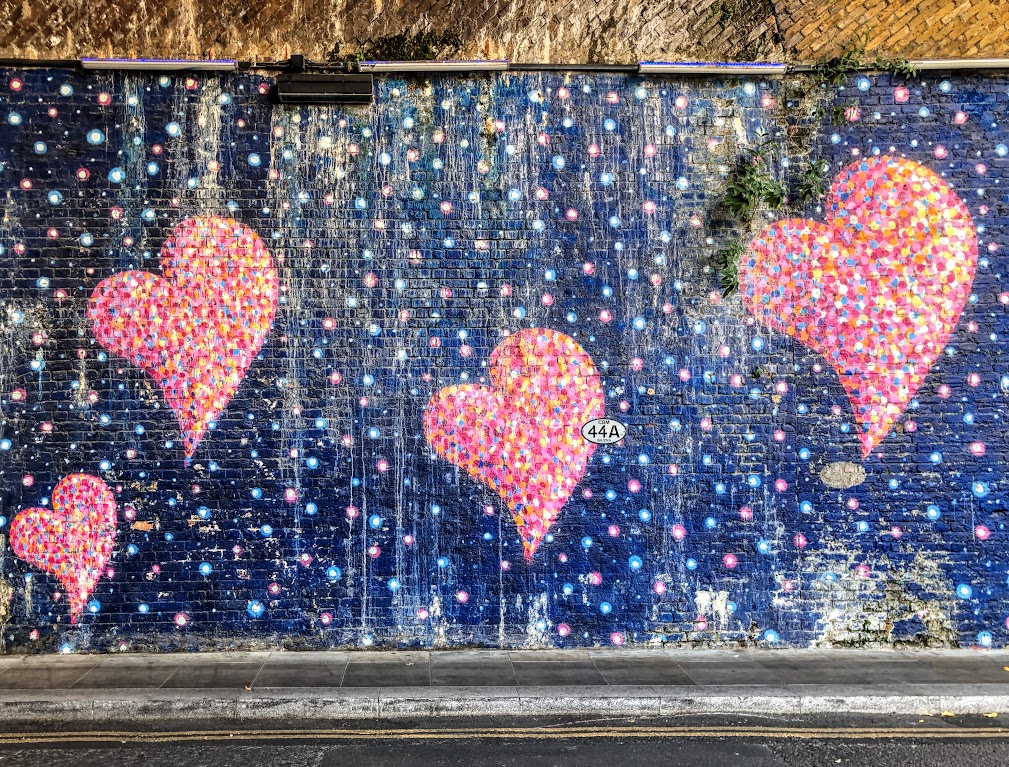
Street art near Borough Market in Southwark (Photograph: Patrick Comerford, 2022)

USPG Prayer Diary:

The theme in the USPG Prayer Diary this week is ‘Bray Day.’ This theme was introduced on Sunday by Jo Sadgrove, USPG’s Research and Learning Advisor, who shared the challenges of uncovering USPG’s archives.

The USPG Prayer Diary today invites us to pray in these words:

We pray for courage to face uncomfortable truths. May we be honest in our reckoning of the past and sensitive in our unfolding the future.

The Collect of Trinity VI:

Merciful God,
you have prepared for those who love you
such good things as pass our understanding:
Pour into our hearts such love toward you
that we, loving you above all things,
may obtain your promises,
which exceed all that we can desire;
through Jesus Christ our Lord.

Yesterday’s Reflection

Continued Tomorrow

‘Pour into our hearts …’ … signs of love and hope in a refugee centre in Budapest (Photograph: Patrick Comerford, 2023)

Scripture quotations are from the New Revised Standard Version Bible: Anglicised Edition copyright © 1989, 1995, National Council of the Churches of Christ in the United States of America. Used by permission. All rights reserved worldwide. http://nrsvbibles.org

13 November 2021

Byron’s sighs and loves over
three years in a palace on
the Grand Canal in Venice

Byron gave the name ‘the Bridge of Sighs’ to the bridge linking the Doge’s Palace and the prisons in Venice (Photograph: Patrick Comerford, 2021)

Patrick Comerford

I have long associated the poet Lord Byron with Greece and the Greek of War of Independence. But I was reminded in Venice this week that Byron lived in Venice for three years, from 1816 to 1819, after he was forced to leave England due to his debts and following too many sex scandals.

Byron is one of the legends of the city, known for his palace near the Grand Canal, his swimming feats and his notorious love-life while he lived in the Mocenigo Palace, between the Rialto Bridge and Saint Mark’s Square, for three years. I was staying this within walking distance of this palace, in the Hotel San Cassiano in the Ca’ Favretto, in the Santa Croce district, on the Grand Canal.

Byron lived in the Mocenigo Palace with 14 servants, two monkeys, a fox and two mastiff dogs, and there he composed the first songs of Don Juan, although it does not mention the city.

In the Querini Benzon Palace on the Grand Canal, Byron also met his last love, the 18-year-old Teresa Gamba Guiccioli, wife of the rich and much older 60-year-old Alessandro Guiccioli from Ravenna.

Those three years in Venice, which was then a city in sad decline, proved to be a turning point in Byron’s career. Venice became the subject of a number of his poems, including Childe Harold’s Pilgrimage and the Ode to Venice, and its history provided the theme for two major dramas.

Byron also composed his social satire, Beppo, regarded by many as one of the wittiest and most amusing works ever written on Venetian life. In Venice, Byron explored the potential of the ottava rima verse formthat would come to embody his poetic voice and all its vices.

While crossing the bridge linking the Doge’s Palace and the prisons, Byron invented the name ‘the Bridge of Sighs’ – a reference to the imagined sighs of condemned prisoners as they caught a glimpse of Venice for the last time – and so made this one of the best-known bridges in the world.

For a time, he lived briefly on the island of San Lazzaro degli Armeni with the small community of Armenian monks. There he learned Armenian and was involved in the publication of an English-Armenian dictionary.

Byron often swam too to the island of Lido to visit the old Jewish Cemetery, the perfect place for his romantic spirit, or to ride his horses.

Gregory Dowling’s guidebook, In Venice and in the Veneto with Lord Byron, visits places in Venice and on the islands of the lagoon that Byron visited and wrote about. He also invites readers to visit a number of places in Veneto associated with Byron, including visiting Verona, Vicenza, Padua, Este, Arquà Petrarca and his villa at La Mira, where he spent the summer months.

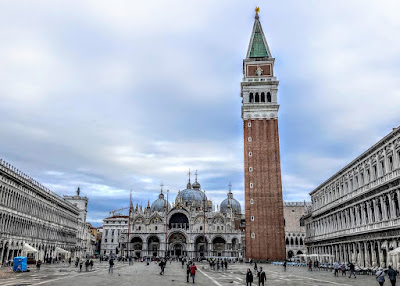
Saint Mark’s Square, with Saint Mark’s Basilica and the Campanile (Photograph: Patrick Comerford, 2021)

18 September 2016

Liturgy 2016-2017 (Part-Time)
2.2: Introduction to liturgy,
secular liturgy and ritual

Church and State have their own language, symbols and expectations when it comes to public ritual … so too with theatre, sport and domestic occasions (Photograph: Patrick Comerford)

Patrick Comerford

TH8824: Liturgy, Worship and Spirituality

Year III to IV (part-time):

Liturgy 2.2: Introduction to liturgy, secular liturgy and ritual.

18 September 2016


10.30 a.m., The Hartin Room.

Ritual and symbol seen through the eyes of secular liturgy and ritual:

Evaluating experiences, e.g., drug culture, sports, theatre, &c.

‘Liturgy’ and our expectations

‘Liturgy’ and ritual in the world today:

1, Drama/Theatre (Plays, Opera, Pantomime).
2, Cinema
3, Sport (Soccer, Rugby, Golf)
4, Domestic
5, Political and secular

1, Drama/Theatre (Plays, Opera, Pantomime)

The Theatre of Dionysus, beneath the slopes of the Acropolis, where the tragedies and comedies of Euripides, Aeschylus and Sophocles, were first performed ... theatre has its own language and rituals (Photograph: Patrick Comerford)

Special language:

● Shakespeare’s English, silence in Beckett
● Opera: Italian for Verdi or Puccini, German for Wagner
● Rhyming-slang-type names in Pantomime (Stinky-Pooh).

Special Movements:

● Off-stage directions and voices
● Dramatised swooning and dying
● Raising up a dagger
● The final bow and encore

Special clothing

● You know who is the good fairy and who is the wicked step-mother
● Period costume.
● Clothing in opera often a very different cut; this is especially so in ballet
● At the Opera, the audience often dresses very differently too.

Sacred space

● The pit for the orchestra;
● The wings and off-stage;
● Where would we be watching Romeo and Juliet without a balcony?

Where would we be watching Romeo and Juliet without a balcony? (Photograph: Patrick Comerford)

Responsorial language

● An important part of drama and opera
● There is a special form in pantomime:
● ‘Look out, he’s behind you.’
● ‘Oh yes he is, oh no he’s not.’

Signs (what do they point to?)

● Curtains close for end of act
● End of scene/end of act differentiated with an inner curtain
● Throwing roses at the diva (smashing plates in Greece)
● Chekov: if a gun on the wall, not for decoration, but symbol of later drama
● Curtain calls symbolise the end, but also invite participation in applause

Roles

● Important to know who is who in a play.
● A programme will name the producer, the director, the lighting team, stage hands ... even if not seen.

Special food?

● Interval drinks?
● People take picnics to the opera in Verona

The Opera at Verona is popular and informal … but often people dress differently for the Opera (Photograph: Patrick Comerford)

What is alienating for you as a participant, as part of the audience?

● It is important to see and to hear.
● If you are a child at pantomime, then you need to be engaged, to participate, to enjoy
● What if the programme notes are not good?
● If the lighting is bad?
● If the actors’ movements don’t match the roles they’re acting.

2, Cinema

Special language

● Certainly a special time, not go in the morning.
● But even language can indicate your generational approach:
● Are they films, or movies?
● Are they westerns or cowboys.
● Is it the cinema?

Special Movements

● The blackout has its own ritual symbolism
● The usher’s light
● There is a wonderful Rowan Atkins sketch the illustrates the ritual acts appropriate in a cinema when people are watching a horror movie, and they are quite different to the ones I remember as being appropriate for young boys watching westerns
● What about how people behave at The Rocky Horror Movie or Mama Mia?

Special clothing

● The usherettes in the past
● Special clothing and behaviour for watching The Rockie Horror Movie.
● Special glasses for 3D movies

Sacred space

● Don’t stand up between me, the projector and the screen.

Responsorial language

● Yes actually, watch outside when people are leaving a movie.

Signs (what do they point to):

● How to find the exit, the loo and the food sales point; they too make a difference.

Roles:

● Not just the roles in the movie
● The ticket seller,
● The ticket checker,
● The usher,
● the projectionist
● Each has a role that is different from my place in the audience

Special food?

● Popcorn!

What is alienating for you as a participant, as part of the audience?

● If the lights come on at the wrong time
● If the advertising goes on too long
● If others stand up or talk during the sacred moment.

3, Sports (Soccer, Rugby, Golf)

Villa Park ... like many English football clubs, Aston Villa has its origins in local church activities … but football has evolved its own rituals and language

Special language:

● technical terms:
● I don’t know what a birdie or an eagle is
● “Fore!”
● What does love mean in tennis?
● The referee’s whistle is a special sign language, with different meanings in one or two pips, and a long sharp blast

Special Movements:

● special entrances and exits
● addressing the ball
● lining up the teams at a cup final
● Shaking hands with the President
● The hakka
● The Mexican wave
● Waving bananas

Special clothing:

● Players’ clothing is distinct from the referee’s as well as from each other
● Special kit for the goalkeeper
● Golf!
● Tennis and Cricket whites
● Soccer supporters.

Sacred space

● The umpires behind the wickets
● The penalty box
● The tennis umpire’s chair
● The goal line
● The side line
● For spectators, the difference between terraces, or Hill 16, or The Kop.

Responsorial language

● Football chants and slogans
● ‘The referee’s a …’
● Where is it appropriate to sing The Fields of Athenry or Ireland’s Call?
• The drums among French rugby supporters
• The Mexican wave?

Signs (what do they point to?):

● Again, the Mexican wave?
● Yellow card, red card
● The flag at the hole on the green
• The goal posts
● The circle, and the penalty box
● The scoreboard in cricket

Roles

● Umpires
● Goalkeepers
● Linesmen
● Ball boys
● Ticket sellers
● Waterboy

Special food?

● Certainly at American football
● Strawberries at Wimbledon
● How often play at a cricket match adjourns for tea
● Captain’s dinner in a golf club
● Champagne, and popping corks at Formula 1

What is alienating for you as a participant or part of the audience?

● Sitting among the wrong supporters, at the Kop, Hill 16 or the Canal End
● Ladies’ day in golf clubs?
● Fixing times of matches to suit television viewers (in China)?
● Flares are a real bugbear at Greek soccer matches.

Cricket has its own clear distinctions when it comes to language, space, roles, signs, clothing and food … Paul Darlington makes 40 for Lichfield Diocese in the Church Times Cricket Cup Final (Photograph: Richard Watt/Church Times)

4, Domestic

Birthdays, wedding anniversaries, name days, Sunday dinner:

At our dinner table, even on weekdays, we like to have flowers on table, usually candles, bread, wine, a salad … then we know the table is set and we can begin dinner. We serve each other the food, we raise glasses, καλή όρεξη, bon appetite.

Special language

● Congratulations
● Many happy returns
● Condolences
● Many happy returns

Special Movements

● Blowing out the candles on a birthday cake
● Candles and flowers
● Who carves the Sunday roast

Special clothing

● One of my sons at the age of six started saying he wanted us to dress for dinner.
● Party dress / little black number, and when inappropriate.
● Wedding clothes nothing to do with church tradition

Sacred space:

● The table for a wedding anniversary
● Our dinner table: flowers, candles, a salad, bread, wine, often candles too

Responsorial language

● ‘For he’s a jolly good fellow ...’
● ‘Hip, hip ...’

Signs and icons (what do they point to?)

● The birthday cake.
● Birthday cards,
● Clinking glasses

Special food?

● Birthday cake
● Champagne
● The Sunday roast, Yorkshire pud?
● Is Turkey inappropriate outside Christmas/Thanksgiving?

Roles

● You don’t initiate singing happy birthday to yourself
● You don’t pop the cork at your own birthday

What is alienating for you as a participant, in the audience?

● When others don’t sing.
● When others don’t respond
● When others forget your birthday, or gatecrash.

It is alienating when others behave inappropriately, using wrong language, songs, signs, and movements at the wrong times.

How many remember clips of Marilyn Monroe popping up and singing … ‘Happy Birthday.’ But it was inappropriate. She was and still is the focus of attention. Who remembers how old JFK was then?

5, Political and secular

Special language

● The speaker calling the house to order
● Invoking points of order
● Giving way

Special Movements

● The state opening of parliament
● The Lord Mayor’s parade
● Judges processing into court, ‘Please arise’
● Sitting on different sides of the house (hence, left and right)
● Waving order papers
● Speaking from the dispatch box
● Swearing in the jury/or the jury retiring
● The house adjourning

Special clothing

● Judges’ wigs
● The speaker’s robes
● The way Black Rod or a court usher dresses

Sacred space

● Please approach the bench
● The speaker’s chair.
● At parades, the reviewing platform, and who is seated where.
● The press gallery

Responsorial language

● Order, order.
● Hear, hear.

Signs/icons (what do they point to?)

● The woolsack
● A Mayor’s chain of office
● The keys of the city
● A judge’s wig or black cap.

Special food?

● If you’ve been on a jury you may not like to recall that
● But draw on other ritual food, like birthday cakes, popping champagne, &c
● The members’ bar

Roles

● The court bailiff
● Black Rod
● The Gentlemen Ushers
● The tellers

What is alienating for you as a participant/or in the audience?

● Parliamentary procedures can be alienating
● But look at the number of people who queue up to visit the Dail or Westminster.
● There are people with positive experience of being jurors … justice was done, and they had a good day
● The state opening of parliament.

Summary:

In all of these, body language matters.

If I put out my hand for a handshake and you refuse it, who feels bad?

Do you give each other a kiss? When is it not appropriate?

An example of misinterpreted body language is easily provided by Greek head movements for yes and no, and can have consequences if I am in the line for a loo.

We create ritual and liturgy in every walk of society.

We are alienated when we are counted out, when we fail to understand what’s going on, or when it loses meaning for us.

In all of these, there are essential ingredients to make sure it works, and they usually include:

● Special language
● Special movements (including body language)
● Special clothing
● Special place and space
● Responsorial language
● Meaningful and indicative signs
● Assigned roles
● Perhaps special food.

We are alienated when:

● the wrong language, signs, responses, movements, roles are used
● when the right ones are misappropriated
● when we feel counted out
● when we fail to understand what’s going on
● or when the ritual or liturgy loses meaning for us.

And a good understanding of these social uses of ritual help us to understand when and how good liturgy works for us and for others, and how and why bad liturgy can be alienating for us and for others.

Worksheet for seminar/workshop:

Space and sign, meaning and timing:


Special language

Special Movements

Special clothing

Sacred space

Responsorial language

Signs/Icons (what do they point to?)

Roles

Special food?

Manual/facial actions:

What is alienating for you as participant/audience?

Next:

Reading before our teleconference:

Liturgy 3.1
: The theology of space, and its implications for church buildings.

Liturgy 3.2: The use of church buildings in relation to the mission of God expressed through the Church (Seminar, based on readings from Richard Giles, Re-pitching the tent, Norwich: Canterbury Press, 3rd ed, 2004).

Chapter 8: pp 53-58.

Chapter 14: pp 103-108.

(Revd Canon Professor) Patrick Comerford is Lecturer in Anglicanism and Liturgy, the Church of Ireland Theological Institute. These notes were shared in a seminar/workshop on the MTh module, TH8824: Liturgy, Worship and Spirituality, with Year III-IV part-time MTh students on Sunday 18 September 2016.

03 April 2016

England and the world
celebrate Shakespeare
400 years after his death

William Shakespeare … he died on 23 April 1616 and his works were first published seven years later

Patrick Comerford

William Shakespeare died 400 years on 23 April 1616. To mark this anniversary year, his home town, Stratford-upon-Avon in Warwickshire, is celebrating the world’s greatest playwright and England’s national poet with performances and exhibitions at the Royal Shakespeare Company, tours of his birthplace and commemorative events at his grave in Holy Trinity Church.

Visitors can see Shakespeare’s birthplace, his school, the cottage where his wife grew up and his grave in the parish church. The one place they cannot see is the New House, the house he bought in 1597 and where he died on 23 April 1616.

Shakespeare’s birthplace … the principal attraction in Stratford-upon-Avon

Shakespeare’s house was demolished 300 years ago, and the house that replaced it was flattened in 1759 by the Revd Francis Gastrell in a row over taxes. Gastrell had already chopped down the mulberry tree under which Shakespeare sat and worked, saying he was irritated by visitors peering into his garden. A five-year archaeology project means the whole site is being redisplayed for the anniversary and the garden has been restored.

Shakespeare’s monument in the parish church in Stratford-on-Avon (Photograph: Tom Reedy/ Wikimedia)

Shakespeare’s Globe Theatre in London is completing its first world tour, in which Hamlet has been brought to almost every country. The production arrives back in London in time for the anniversary weekend of 23-24 April, along with a 37-screen pop-up cinema, one screen to showcase each of Shakespeare’s plays, along the South Bank.

A career after death

The Globe Theatre in London … bringing ‘Hamlet’ around the world

Shakespeare is widely regarded as the greatest writer in the English language, and his use of language helped shape modern English. His surviving works include 38 plays and 154 sonnets. His plays have been translated into every major language and are performed more often than those of any other playwright. Yet his plays might not have survived if friends and actors had not collected every scrap of every play they could find and published the First Folio in 1623, seven years after his death.

There is little documentary evidence for his life and times, and we have few records of his private life. This vacuum has stimulated considerable questions about his physical appearance, sexuality, and religious beliefs, and whether he was the author of the works attributed to him.

Juliet’s Balcony in Verona … love and tragedy in Shakespeare’s plays (Photograph: Patrick Comerford)

Shakespeare’s work displays accurate knowledge of the law, politics, history, geography and politics of England, Italy and France, yet there is no evidence that he ever travelled further than London.

Some scholars suggest the Shakespeare of Stratford did not write the sonnets and plays. Their alternative suggestions include Francis Bacon, Christopher Marlowe and Edward de Vere, Earl of Oxford. But few academics now question the traditional attribution.

Shakespearian figures on the façade of Cintra House on Hills Road, Cambridge (Photograph: Patrick Comerford)

William Shakespeare may have been born on Saint George’s Day, 23 April 1564, and he was baptised on 26 April 1564. When he was 18, he married Anne Hathaway, and they had three children.

Between 1585 and 1592, he began his career in London as an actor, writer, and part-owner of a playing company. He produced most of his work between 1589 and 1613. He appears to have retired to Stratford around 1613 at the age of 49, and died there three years later.

David Garrick in the role of Richard III … a portrait in the Samuel Johnson Museum, Lichfield (Photograph: Patrick Comerford, 2016)

By the 18th century, Shakespeare had lost his popularity and his plays were seldom staged, even in Stratford-upon-Avon. Samuel Johnson’s friend and former pupil, the actor David Garrick, was singularly responsible for reviving his plays on the English stage and defined the way Richard III has been played ever since.

The site of David Garrick’s childhood home in Lichfield … he was responsible for bringing Shakespeare back to the stage (Photograph: Patrick Comerford, 2016)

In his Dictionary, Dr Johnson quotes Shakespeare more often than any other author, and expressions such as “with bated breath” (Merchant of Venice) and “a foregone conclusion” (Othello) have found their way into everyday English speech. A series of scholarly editions of his works, beginning with Samuel Johnson’s in 1765, revived his reputation, and by 1800 he was firmly enshrined as the English national poet.

David Garrick revived the performance of Shakespeare’s plays in Stratford-upon-Avon, and he was buried close to Shakespeare’s monument in Westminster Abbey (Photograph: Patrick Comerford, 2016)

Shakespeare in Ireland

Samuel Johnson’s monument in Lichfield … he was the first major biographer of Shakespeare (Photograph: Patrick Comerford)

The Dublin Shakespeare Society (or ‘Shakes’), founded in 1907, is the oldest non-professional theatre company in Ireland. Their first production was Romeo and Juliet at the Molesworth Hall in April 1910, and since then the Shakes have staged some of the best Shakespeare productions in Dublin.

The Dublin Shakespeare Society is the oldest non-professional theatre company in Ireland

The inaugural meeting was held in the Theatre Royal, Dublin. The Revd John Pentland Mahaffy, later Provost of TCD, was the first president, and he was succeeded in 1908 by Edward Dowden (1843-1913), Professor of English and a brother of John Dowden, Bishop of Edinburgh.

Edward Dowden’s biographical and critical concepts of Shakespeare are played with by Stephen Dedalus in the library chapter of James Joyce’s Ulysses.

For decades, a stained glass window of Shakespeare, once thought to be the work of Harry Clarke, decorated the La Scala Theatre, later the Capitol Cinema, in Prince’s Street, Dublin. The site was demolished to make way for the British Home Stores (now Penney’s). The window was saved by the Dublin Shakespeare Society and is now stored in the library in Ballyfermot.

An Irish accent

Shakespeare’s plays are often performed in crisp English accents. But experts claim the original pronunciation had echoes of Irish, New England and Cockney accents. Professor Paul Meier of the University of Kansas suggests the original audiences would have heard accents with “strong R-coloured vowels” that contrast with the polished deliveries of actors like John Gielgud and Laurence Olivier.

In the early 20th century, two Irish writers, PW Joyce and Sir Dunbar Plunket Barton, claimed that English as spoken in Ireland preserved 16th century speech, and that Ireland retains the language of Shakespeare’s time.

Some Irish words found in Shakespeare’s works include ‘Puck’ for a spirit in A Midsummer Night’s Dream, from the Irish Púca meaning a ghost; and there is a reference to Queen Mab as a fairy queen in Romeo and Juliet.

Some also find Irish colloquial phrases in his plays. For example, Agrippa greets Coriolanus with “a hundred thousand welcomes,” Hamlet swears “by Saint Patrick”, and in Pericles we hear the questions: “Did you ever hear the like? … Did you ever dream of such a thing?”

It is said Shakespeare follows the Irish and Scottish use of ‘shall’ rather than the English method. Some Irish pronunciations are said to include the rhyming of ‘again’ and ‘pen’ with ‘pin,’ ‘tea’ with ‘obey,’ ‘drought’ with ‘youth,’ ‘conceit’ and ‘receipt’ with ‘bait’ and ‘straight',’ and ‘devil’ with ‘evil.’ A pun by Falstaff can only be understood if ‘reason’ is pronounced like ‘raisin’: “If reasons here as plentiful as blackberries.”

His Irish characters include Captain Macmorris – probably the Irish rebel Captain James Fitzmaurice of Munster – who in Henry V says “Of my nation? What ish my nation? Ish a villaine, and a bastard, and a knave, and a rascal. What ish my nation? Who talks of my nation?”

The list of titles of John Talbot, Earl of Shrewsbury, in Henry VI Part 1 include “great Earl of Washford, Waterford and Valence,” a reference to Talbot’s two Irish titles as Earl of Wexford and Earl of Waterford.

But Ireland has a shadowy presence in Shakespeare’s works, and his references to Ireland are fewer than those to Wales (think of Owen Glendower), to Scotland (think of Macbeth), or Denmark (think of Elsinore in Hamlet).

Irish claims to Shakespeare

Saint Aidan’s Cathedral, Enniscorthy … WH Grattan Flood claimed many Shakespeare connections with Ireland (Photograph: Patrick Comerford)

The American writer, Flannery O’Connor, in The Habit of Being, tells Sally and Robert Fitzgerald in 1953: “My mamma asked me the other day if I knew Shakespeare was an Irishman, I said no I didn't. She said well it’s right there in the Savannah paper; and sure enough some gent from the University of Chicago had made a speech somewhere saying Shakespeare was an Irishman.”

However, the historian and composer William Henry Grattan Flood (1859-1928), makes some of the most curious claims for Shakespeare’s Irish links. Grattan Flood was born in Lismore, Co Waterford, and was the organist of Saint Aidan’s Cathedral, Enniscorthy, Co Wexford (1895-1928). While he was living in Enniscorthy, he wrote his History of Irish Music (1905), in which he devotes a full chapter to Shakespeare’s knowledge of Irish songs, suggesting allusions to 11 Irish songs in his plays.

Coliemore Harbour in Dalkey … an inspiration for Elsinore in ‘Hamlet’ (Patrick Comerford, 2016)

Some legends claim Shakespeare wrote Hamlet while visiting his friend the poet and composer John Dowland at Dalkey, Co Dublin, and that his account of the shore of Elsinore is based on the shoreline at Coliemore in Dalkey. Grattan Flood claims Dowland was from Dalkey and published this theory in 1922. He claims that while Shakespeare was writing Hamlet in 1601, he asked Dowland about life in Denmark, and that Dowland compared Elsinore with Dalkey.

Sarah Purser’s mosaic of John Dowland in Sorrento Park, Dalkey (Photograph: Patrick Comerford, 2016)

But there is nothing to connect Dowland with Dalkey apart from the name of a John Dowlan who died there in 1577, or to link the topography of Dalkey with Elsinore. Nevertheless, there is plaque by Sarah Purser commemorating John Dowland in Sorrento Park in Dalkey, and there is a Victorian house called Elsinore on Coliemore Road.

In a more extravagant claim, the Meath historian Elizabeth Hickey suggests in her book The Green Cockatrice that the author of Shakespeare’s plays was William Nugent (1550-1625), a Catholic rebel from Ross Castle, near Lough Sheelin, Co Meath, and the descendant of an old Co Westmeath family.

William Nugent was brought up in England from the age of nine in the household of his guardian, Thomas Radclyffe, 3rd Earl of Sussex, a poet who was fluent in Latin and Italian and a patron of literature and drama. During his career in Ireland, Sussex had restored part of Christ Church Cathedral. He was the uncle of the poet Sir Philip Sidney, the writer of sonnets, and of two of Shakespeare's patrons, Henry Wriothesley, 3rd Earl of Southampton and Robert Radclyffe, 5th Earl of Sussex, also the patron of poets and dramatists. His widow endowed Sidney Sussex College, Cambridge in 1596, 20 years before Shakespeare’s death.

The Sussex monument in Christ Church Cathedral, Dublin (Photograph: Patrick Comerford)

Shakespeare’s Anglican identity

Some scholars claim that members of Shakespeare’s family were recusant Roman Catholics. His mother Mary Arden was from a pious Catholic family. A Catholic statement of faith said to have been signed by his father, John Shakespeare, was found in the rafters of his former home in 1757, but the document is now lost and scholars question its authenticity.

In 1591, John Shakespeare was reported for not going to church, and in 1606 Shakespeare’s daughter Susanna is named on a list of people who failed to attend Easter Communion in Stratford.

Shakespeare was never a regular churchgoer in London, but many members of his acting company were on the parish register of Saint Saviour’s Church, now Southwark Cathedral, where Shakespeare is commemorated by a window and statue in the South Aisle.

Whatever his private views, Shakespeare was baptised and confirmed member in the Church of England, he was married in church, his children were baptised, and he was buried in his parish church when he died on 23 April 1616, at the age of 52.

A memorial window in the Freemasons Hall, Dublin, commemorates the members of the Shakespeare Lodge and Chapter in World War I (Photograph: Michael Pegum)

Canon Patrick Comerford lectures in the Church of Ireland Theological Institute. This feature was first published in the ‘Church Review’ (Dublin and Glendalough) and the ‘Diocesan Magazine’ (Cashel, Ferns and Ossory) in April 2016.

14 February 2015

Stories of true love on
Saint Valentine’s Day

The shrine of Saint Valentine in the Carmelite Church in Whitefriar Street, Dublin (Photograph: Patrick Comerford)

Patrick Comerford

Today is Saint Valentine’s Day [14 February 2015], and the thoughts of many are turned to love. Thousands of locks will be fixed to bridges and fences across Europe, Juliet’s supposed balcony in Verona will be visited by countless tourists and the Carmelite Church in Whitefriar Street, Dublin, will be full with young couples seeking a blessing or hoping for a proposal.

Saint Valentine’s reliquary is part of a shrine in a side chapel in this inner city church, but this morning it being placed before the High Altar.

Saint Valentine is a widely believed to have been a third century Roman martyr. He is commemorated on 14 February and since the High Middle Ages he has been associated with young love.

But how did Saint Valentine ever end up in Dublin?

‘Romeo, Romeo, wherefore art thou?’ ... Juliet’s balcony in Verona (Photograph: Patrick Comerford)

Despite his popularity, despite all the cards, despite the roses and the chocolates, despite the rings and the proposals, we know little about Saint Valentine apart from his name and the tradition that he died a martyr’s death on 14 February on the Via Flaminia, north of Rome.

We do not know even whether there was one Saint Valentine or two – or perhaps even three – saints with the same name, and many of the stories that have grown up around his life are mythical and unreliable.

Because of these myths and legends, Saint Valentine was dropped from the Roman Catholic Calendar of Saints in the post-Vatican II revision in 1969. Nevertheless, the “Martyr Valentinus who died on 14 February on the Via Flaminia close to the Milvian Bridge in Rome” is still on the list of officially recognised saints. He may not feature in the calendar of the Church of Ireland. But this day is celebrated as Saint Valentine’s Day with a commemoration in Common Worship in the Church of England in other churches in the Anglican Communion.

In the Eastern Orthodox Church, Saint Valentine the Priest is celebrated on 6 July and the martyr Saint Valentine, Bishop of Interamna (present-day Terni) in Italy, is celebrated on 30 July.

Italian romance ... locks secured to fencing along the Via d’Amore in the Cinque Terre in Italy (Photograph: Patrick Comerford)

The name of Valentinus is not found in the earliest list of Roman martyrs in the year 354, but he is named in later lists in the second half of the fifth century and the first half of the sixth century.

The feast of Saint Valentine on 14 February was first named in 496 by Pope Gelasius I, who included Saint Valentine among all those “whose names are justly reverenced among men, but whose acts are known only to God.” Perhaps this wording implies that even Pope Gelasius knew nothing about the life of this saint and martyr.

Some sources speak of three saints named Valentines who are associated with today – a Roman priest and a Bishop of Interamna, who are both buried along the Via Flaminia outside Rome, at different distances from the city, and a third saint who was martyred on the same day with a number of companions in the Roman province of Africa.

According to tradition in the Diocese of Terni, Bishop Valentine was born and lived in Interamna and was jailed and tortured in Rome on 14 February. However, different dates are given for the year of his martyrdom, including 269, 270 and 273. He was buried hastily in nearby cemetery and a few nights later his disciples came and brought him home.

The Roman Martyrology lists only one Saint Valentine; who died a martyr’s death on the Via Flaminia.

Popular legend says Valentine was a Roman priest who was martyred during the reign of Claudius II, “Claudius Gothicus.” He was arrested and imprisoned when he was caught marrying Christian couples and helping persecuted Christians.

It is said Claudius took a liking to this prisoner. But when Valentinus tried to convert the Emperor, he was condemned him to death. He was beaten with clubs and stones; when that failed to kill him, he was beheaded outside the Flaminian Gate.

Another legend says Saint Valentine was the Bishop of Terni in southern Umbria in central Italy. While Valentinus he was under house arrest, he was discussing his faith with Judge Asterius.

The judge tested Valentinus by bringing his adopted blind daughter to him. If Valentinus succeeded in restoring the girl’s sight, Asterius would do anything he asked. Valentinus laid his hands on her eyes and the child’s vision was restored. Immediately humbled, the judge asked Valentinus what he should do. Valentinus replied that all the idols in the judge’s house should be broken, that the judge should fast for three days, and that he should then be baptised.

Asterius obeyed, freed all his Christian prisoners and was baptised with all his family and 40 other people.

However, Valentinus was soon arrested again nd was sent to the Prefect of Rome and then to the Emperor Claudius. Claudius too took a liking to Valentinus until he tried to convert the emperor. Claudius sternly refused to be converted and ordered that Valentinus should either renounce his faith or be beaten with clubs and beheaded. Valentinus refused and he was executed outside the Flaminian Gate on 14 February 269.

Many churches throughout Europe are dedicated to Saint Valentine, but it seems none was dedicated to him in either England or Ireland.

Until the 13th century, it was said the martyr’s relics were kept in Saint Valentine’s Basilica on the Via Flaminia, and they were then moved from there to Santa Prassede.

The 18th century English antiquarian, Alban Butler author of Butler’s Lives of the Saints, suggested Saint Valentine’s Day was created as an attempt to supersede the pagan mid-February holiday of Lupercalia in Rome, honouring Juno, queen of the Roman gods and goddesses. However, many of the legends about Saint Valentine can be traced only to 14th century England and the writings of Geoffrey Chaucer and his circle, when 14 February was already linked with romantic love.

The reliquary with the remains of Saint Valentine in the Carmelite Church in Whitefriar Street, Dublin (Photograph: Patrick Comerford)

The flower-crowned skull of Saint Valentine is kept in the Basilica of Santa Maria in Cosmedin, Rome. When some relics were exhumed from the catacombs of Saint Hippolytus on the Via Tiburtina near Rome in 1836, they were identified with Saint Valentine; placed in a casket, and brought in a procession to the high altar for a special Mass dedicated to young people and to people in love.

That same year, Father John Spratt, an Irish Carmelite friar and famous preacher, was in Rome where he preached a popular and acclaimed sermon in the famous Jesuit church in the city, the Gesu. Following this sermon, Pope Gregory XVI gave him a gift of the remains of Saint Valentine and “a small vessel tinged with his blood.”

When the Reliquary with Saint Valentine’s remains arrived in Dublin on 10 November 1836, they were brought in a solemn procession to the Carmelite Church in Whitefriar Street where they were met by Archbishop Murray.

But other churches also claim to hold the relics of Saint Valentine, including a church in Roquemaure, in France, the Stephansdom or Saint Stephen’s Cathedral in Vienna, a church in Balzan, Malta, the Blessed John Duns Scotus Church in the Gorbals, Glasgow, and the Birmingham Oratory.

After Father Spratt died, interest in the relics in Dublin faded and they were placed in storage. But during a major renovation of the church in the 1950s and the 1960s, they were given a new place in the church, and a special altar and shrine were built for them. A statue carved by Irene Broe shows Saint Valentine in the red vestments of a martyr and holding a crocus in his hand.

The shrine is visited by thousands of couples throughout the year, especially on 14 February, when the reliquary is taken out from under the side-altar and is placed before the high altar in the church. There are special celebrations of the Eucharist at 11 a.m. and 3.15 p.m., with a blessing of rings for couples who are about to be married.

Although the story of Saint Valentine is inextricably linked with romantic young love, it is good to be reminded of love as we prepare to begin Lent next Wednesday [18 February 2015], and that our Lenten pilgrimage is a journey towards fully accepting the love of God offered to us through Christ on Good Friday and Easter Day.

Meanwhile, may all I love and all who love me enjoy Saint Valentine’s Day today.

14 February 2013

With the Saints in Lent (2): Saint Valentine, 14 February

The shrine of Saint Valentine in the Carmelite Church in Whitefriar Street, Dublin (Photograph: Patrick Comerford)

Patrick Comerford

We are into the second day of Lent, but for many people, especially young couples, today [14 February] is Saint Valentine’s Day. Thousands of locks will be secured to bridges and fences across Europe, Juliet’s supposed balcony in Verona will be visited by countless tourists and the Carmelite Church in Whitefriar Street, Dublin, will be full for special masses marking Saint Valentine’s Day, when the martyr’s reliquary is taken from a special shrine in a side chapel and placed before the High Altar.

‘Romeo, Romeo, wherefore art thou?’ ... Juliet’s balcony in Verona (Photograph: Patrick Comerford)

Saint Valentine is a widely believed to have been a third century Roman martyr. He is commemorated on 14 February and since the High Middle Ages he has been associated with young love.

Yet, despite his popularity, we know nothing reliable about Saint Valentine apart from his name and the tradition that he died a martyr’s death on 14 February on the Via Flaminia, north of Rome. We do not know even whether there was one Saint Valentine or two – or perhaps even three – saints with the same name, and many of the stories that have grown up around his life are mythical and unreliable.

Because of these myths and legends, Saint Valentine was dropped from the Roman Catholic Calendar of Saints in the post-Vatican II revision in 1969. Nevertheless, the “Martyr Valentinus who died on 14 February on the Via Flaminia close to the Milvian Bridge in Rome” is still on the list of officially recognised saints. This day is celebrated as Saint Valentine’s Day with a commemoration in Common Worship in the Church of England in other churches in the Anglican Communion.

In the Eastern Orthodox Church, Saint Valentine the Presbyter is celebrated on 6 July and the martyr Saint Valentine, Bishop of Interamna (present-day Terni) in Italy, is celebrated on 30 July.

Italian romance ... locks secured to fencing along the Via d’Amore in the Cinque Terre in Italy (Photograph: Patrick Comerford)

The name of Valentinus is not found in the earliest list of Roman martyrs in the year 354, but he is named in later lists in the second half of the fifth century and the first half of the sixth century.

The feast of Saint Valentine on 14 February was first named in 496 by Pope Gelasius I, who included Saint Valentine among all those “whose names are justly reverenced among men, but whose acts are known only to God.” Perhaps this wording implies that even Pope Gelasius knew nothing about the life of this saint and martyr.

Some sources speak of three saints named Valentines who are associated with today – a Roman priest and a Bishop of Interamna, who are both buried along the Via Flaminia outside Rome, at different distances from the city, and a third saint who was martyred on the same day with a number of companions in the Roman province of Africa.

According to tradition in the Diocese of Terni, Bishop Valentine was born and lived in Interamna and was jailed and tortured in Rome on 14 February. However, different dates are given for the year of his martyrdom, including 269, 270 and 273. He was buried hastily in nearby cemetery and a few nights later his disciples came and brought him home.

The Roman Martyrology lists only one Saint Valentine; who died a martyr’s death on the Via Flaminia.

Popular legend says Valentine was a Roman priest who was martyred during the reign of Claudius II, “Claudius Gothicus.” He was arrested and imprisoned when he was caught marrying Christian couples and helping persecuted Christians.

It is said Claudius took a liking to this prisoner. But when Valentinus tried to convert the Emperor, he was condemned him to death. He was beaten with clubs and stones; when that failed to kill him, he was beheaded outside the Flaminian Gate.

Another legend says Saint Valentine was the Bishop of Terni in southern Umbria in central Italy. While Valentinus he was under house arrest, he was discussing his faith with Judge Asterius.

The judge tested Valentinus by bringing his adopted blind daughter to him. If Valentinus succeeded in restoring the girl’s sight, Asterius would do anything he asked. Valentinus laid his hands on her eyes and the child’s vision was restored. Immediately humbled, the judge asked Valentinus what he should do. Valentinus replied that all the idols in the judge’s house should be broken, that the judge should fast for three days, and that he should then be baptised.

Asterius obeyed, freed all his Christian prisoners and was baptised with all his family and 40 other people.

However, Valentinus was soon arrested again nd was sent to the Prefect of Rome and then to the Emperor Claudius. Claudius too took a liking to Valentinus until he tried to convert the emperor. Claudius sternly refused to be converted and ordered that Valentinus should either renounce his faith or be beaten with clubs and beheaded. Valentinus refused and he was executed outside the Flaminian Gate on 14 February 269.

Many churches throughout Europe are dedicated to Saint Valentine, but it seems none was dedicated to him in either England or Ireland.

Until the 13th century, it was said the martyr’s relics were kept in Saint Valentine’s Basilica on the Via Flaminia, and they were then moved from there to Santa Prassede.

The 18th century English antiquarian, Alban Butler author of Butler’s Lives of the Saints, suggested Saint Valentine’s Day was created as an attempt to supersede the pagan mid-February holiday of Lupercalia in Rome, honouring Juno, queen of the Roman gods and goddesses. However, many of the legends about Saint Valentine can be traced only to 14th century England and the writings of Geoffrey Chaucer and his circle, when 14 February was already linked with romantic love.

The reliquary with the remains of Saint Valentine in the Carmelite Church in Whitefriar Street, Dublin (Photograph: Patrick Comerford)

The flower-crowned skull of Saint Valentine is kept in the Basilica of Santa Maria in Cosmedin, Rome. When some relics were exhumed from the catacombs of Saint Hippolytus on the Via Tiburtina near Rome in 1836, they were identified with Saint Valentine; placed in a casket, and brought in a procession to the high altar for a special Mass dedicated to young people and to people in love.

That same year, Father John Spratt, an Irish Carmelite friar and famous preacher, was in Rome where he preached a popular and acclaimed sermon in the famous Jesuit church in the city, the Gesu. Following this sermon, Pope Gregory XVI gave him a gift of the remains of Saint Valentine and “a small vessel tinged with his blood.”

When the Reliquary with Saint Valentine’ remains arrived in Dublin on 10 November 1836, they were brought in a solemn procession to the Carmelite Church in Whitefriar Street where they were met by Archbishop Murray.

But there other churches also claim to hold the relics of Saint Valentine, including a church in Roquemaure, in France, the Stephansdom in Vienna, a church in Balzan, Malta, the Blessed John Duns Scotus Church in the Gorbals, Glasgow, and the Birmingham Oratory.

After Father Spratt died, interest in the relics in Dublin faded and they were placed in storage. But during a major renovation of the church in the 1950s and the 1960s, they were given a new place in the church, and a special altar and shrine were built for them. A statue carved by Irene Broe shows Saint Valentine in the red vestments of a martyr and holding a crocus in his hand.

The shrine is visited by thousands of couples throughout the year, especially on 14 February, when the reliquary is taken out from under the side-altar and is placed before the high altar in the church. There are special celebrations of the Eucharist at 11 a.m. and 3.15 p.m., with a blessing of rings for couples who are about to be married.

Although the story of Saint Valentine is inextricably linked with romantic young love, it is good to be reminded of love at the beginning of Lent, and that our Lenten pilgrimage is a journey towards fully accepting the love of God offered to us through Christ on Good Friday and Easter Day.

Tomorrow (15 February): Thomas Bray.

Canon Patrick Comerford is Lecturer in Anglicanism and Liturgy, the Church of Ireland Theological Institute and an Adjunct Assistant Professor, the University of Dublin (Trinity College Dublin).

26 September 2011

Liturgy 1.2: secular liturgy and ritual

Church and State have their own language, symbols and expectations when it comes to public ritual … so too with theatre, sport and domestic occasions (Photograph: Patrick Comerford)

Patrick Comerford

EM8824: Liturgy, Worship and Spirituality

Year II, 14:00 to 16:00, Mondays, Hartin Room:

Liturgy 1.2: 26 September 2011


Ritual and symbol seen through the eyes of secular liturgy and ritual:

Evaluating experiences, e.g., drug culture, sports, theatre, &c.

‘Liturgy’ and our expectations

‘Liturgy’ and ritual in the world today:

1, Drama/Theatre (Plays, Opera, Pantomime).
2, Cinema
3, Sport (Soccer, Rugby, Golf)
4, Domestic
5, Political and secular

Five working groups:

1, Drama/Theatre (Plays, Opera, Pantomime)

The Theatre of Dionysus, beneath the slopes of the Acropolis, where the tragedies and comedies of Euripides, Aeschylus and Sophocles, were first performed ... theatre has its own language and rituals (Photograph: Patrick Comerford)

Special language:

• Shakespeare’s English, silence in Beckett
• Opera: Italian for Verdi or Puccini, German for Wagner
• Rhyming-slang-type names in Pantomime (Stinky-Pooh).

Special Movements:

• Off-stage directions and voices
• Dramatised swooning and dying
• Raising up a dagger
• The final bow and encore

Special clothing

• You know who is the good fairy and who is the wicked step-mother
• Period costume.
• Clothing in opera often a very different cut; this is especially so in ballet
• At the Opera, the audience often dresses very differently too.

Sacred space

• The pit for the orchestra;
• The wings and off-stage;
• Where would we be watching Romeo and Juliet without a balcony?

Where would we be watching Romeo and Juliet without a balcony? (Photograph: Patrick Comerford)

Responsorial language

• An important part of drama and opera
• There is a special form in pantomime:
“Look out, he’s behind you.”
“Oh yes he is, oh no he’s not.”

Signs (what do they point to?)

• Curtains close for end of act
• End of scene/end of act differentiated with an inner curtain
• Throwing roses at the diva (smashing plates in Greece)
• Chekov: if a gun on the wall, not for decoration, but symbol of later drama
• Curtain calls symbolise the end, but also invite participation in applause

Roles

• Important to know who is who in a play.
• A programme will name the producer, the director, the lighting team, stage hands ... even if not seen.

Special food?

• Interval drinks?
• People take picnics to the opera in Verona

The Opera at Verona is popular and informal … but often people dress differently for the Opera (Photograph: Patrick Comerford)

What is alienating for you as a participant, as part of the audience?

• It is important to see and to hear.
• If you are a child at pantomime, then you need to be engaged, to participate, to enjoy
• What if the programme notes are not good?
• If the lighting is bad?
• If the actors’ movements don’t match the roles they’re acting.

2, Cinema

Special language

• Certainly a special time, not go in the morning.
• But even language can indicate your generational approach:
• Are they films, or movies?
• Are they westerns or cowboys.
• Is it the cinema?

Special Movements

• The blackout has its own ritual symbolism
• The usher’s light
• There is a wonderful Rowan Atkins sketch the illustrates the ritual acts appropriate in a cinema when people are watching a horror movie, and they are quite different to the ones I remember as being appropriate for young boys watching westerns
• What about how people behave at The Rocky Horror Movie or Mama Mia?

Special clothing

• The usherettes in the past
• Special clothing and behaviour for watching The Rockie Horror Movie.
• Special glasses for 3D movies

Sacred space

• Don’t stand up between me, the projector and the screen.

Responsorial language

• Yes actually, watch outside when people are leaving a movie.

Signs (what do they point to):

• How to find the exit, the loo and the food sales point; they too make a difference.

Roles:

• Not just the roles in the movie
• The ticket seller,
• The ticket checker,
• The usher,
• the projectionist
• Each has a role that is different from my place in the audience

Special food?

• Popcorn!

What is alienating for you as a participant, as part of the audience?

• If the lights come on at the wrong time
• If the advertising goes on too long
• If others stand up or talk during the sacred moment.

3, Sports (Soccer, Rugby, Golf)

Villa Park ... like many English football clubs, Aston Villa has its origins in local church activities … but football has evolved its own rituals and language

Special language:

• technical terms:
• I don’t know what a birdie or an eagle is
• “Fore!”
• What does love mean in tennis?
• The referee’s whistle is a special sign language, with different meanings in one or two pips, and a long sharp blast

Special Movements:

• special entrances and exits
• addressing the ball
• lining up the teams at a cup final
• Shaking hands with the President
• The hakka
• The Mexican wave
• Waving bananas

Special clothing:

• Players’ clothing is distinct from the referee’s as well as from each other
• Special kit for the goalkeeper
• Golf!
• Tennis and Cricket whites
• Soccer supporters.

Sacred space

• The umpires behind the wickets
• The penalty box
• The tennis umpire’s chair
• The goal line
• The side line
• For spectators, the difference between terraces, or Hill 16, or The Kop.

Responsorial language

• Football chants and slogans
• “The referee’s a …”
• Where is it appropriate to sing The Fields of Athenry or Ireland’s Call?
• The drums among French rugby supporters
• The Mexican wave?

Signs (what do they point to?):

• Again, the Mexican wave?
• Yellow card, red card
• The flag at the hole on the green
• The goal posts
• The circle, and the penalty box
• The scoreboard in cricket

Roles

• Umpires
• Goalkeepers
• Linesmen
• Ball boys
• Ticket sellers
• Waterboy

Special food?

• Certainly at American football
• Strawberries at Wimbledon
• How often play at a cricket match adjourns for tea
• Captain’s dinner in a golf club
• Champagne, and popping corks at Formula 1

What is alienating for you as a participant or part of the audience?

• Sitting among the wrong supporters, at the Kop, Hill 16 or the Canal End
• Ladies’ day in golf clubs?
• Fixing times of matches to suit television viewers (in China)?
• Flares are a real bugbear at Greek soccer matches.

Cricket has its own clear distinctions when it comes to language, space, roles, signs, clothing and food … Paul Darlington makes 40 for Lichfield Diocese in the Church Times Cricket Cup Final (Photograph: Richard Watt/Church Times)

4, Domestic

Birthdays, wedding anniversaries, name days, Sunday dinner:

At our dinner table, even on weekdays, we like to have flowers on table, usually candles, bread, wine, a salad … then we know the table is set and we can begin dinner. We serve each other the food, we raise glasses, καλή όρεξη, bon appetite.
Special language

• Congratulations
• Many happy returns
• Condolences
• Many happy returns

Special Movements

• Blowing out the candles on a birthday cake
• Candles and flowers
• Who carves the Sunday roast

Special clothing

• One of my sons at the age of six started saying he wanted us to dress for dinner.
• Party dress / little black number, and when inappropriate.
• Wedding clothes nothing to do with church tradition

Sacred space:

• The table for a wedding anniversary
• Our dinner table: flowers, candles, a salad, bread, wine, often candles too

Responsorial language

• “For he’s a jolly good fellow ...”
• “Hip, hip ...”

Signs and icons (what do they point to?)

• The birthday cake.
• Birthday cards,
• Clinking glasses

Special food?

• Birthday cake
• Champagne
• The Sunday roast, Yorkshire pud?
• Is Turkey inappropriate outside Christmas/Thanksgiving?

Roles

• You don’t initiate singing happy birthday to yourself
• You don’t pop the cork at your own birthday

What is alienating for you as a participant, in the audience?

• When others don’t sing.
• When others don’t respond
• When others forget your birthday, or gatecrash.

It is alienating when others behave inappropriately, using wrong language, songs, signs, and movements at the wrong times.

How many remember clips of Marilyn Monroe popping up and singing … “Happy Birthday.” But it was inappropriate. She was and still is the focus of attention. Who remembers how old JFK was then?

5, Political and secular

Special language

• The speaker calling the house to order
• Invoking points of order
• Giving way

Special Movements

• The state opening of parliament
• The Lord Mayor’s parade
• Judges processing into court, “Please arise”
• Sitting on different sides of the house (hence, left and right)
• Waving order papers
• Speaking from the dispatch box
• Swearing in the jury/or the jury retiring
• The house adjourning

Special clothing

• Judges’ wigs
• The speaker’s robes
• The way Black Rod or a court usher dresses

Sacred space

• Please approach the bench
• The speaker’s chair.
• At parades, the reviewing platform, and who is seated where.
• The press gallery

Responsorial language

• Order, order.
• Hear, hear.

Signs/icons (what do they point to?)

• The woolsack
• A Mayor’s chain of office
• The keys of the city
• A judge’s wig or black cap.

Special food?

• If you’ve been on a jury you may not like to recall that
• But draw on other ritual food, like birthday cakes, popping champagne, &c
• The members’ bar

Roles

• The court bailiff
• Black Rod
• The Gentlemen Ushers
• The tellers

What is alienating for you as a participant/or in the audience?

• Parliamentary procedures can be alienating
• But look at the number of people who queue up to visit the Dail or Westminster.
• There are people with positive experience of being jurors … justice was done, and they had a good day
• The state opening of parliament.

Summary:

In all of these, body language matters.

If I put out my hand for a handshake and you refuse it, who feels bad?

Do you give each other a kiss? When is it not appropriate?

An example of misinterpreted body language is easily provided by Greek head movements for yes and no, and can have consequences if I am in the line for a loo.

We create ritual and liturgy in every walk of society.

We are alienated when we are counted out, when we fail to understand what’s going on, or when it loses meaning for us.

In all of these, there are essential ingredients to make sure it works, and they usually include:

• Special language
• Special movements (including body language)
• Special clothing
• Special place and space
• Responsorial language
• Meaningful and indicative signs
• Assigned roles
• Perhaps special food.

We are alienated when:

• the wrong language, signs, responses, movements, roles are used
• when the right ones are misappropriated
• when we feel counted out
• when we fail to understand what’s going on
• or when the ritual or liturgy loses meaning for us.

And a good understanding of these social uses of ritual help us to understand when and how good liturgy works for us and for others, and how and why bad liturgy can be alienating for us and for others.

Worksheet for seminar/workshop:

Space and sign, meaning and timing:


Special language

Special Movements

Special clothing

Sacred space

Responsorial language

Signs/Icons (what do they point to?)

Roles

Special food?

Manual/facial actions:

What is alienating for you as participant/audience?

Next week:

Liturgy 2.1
: The theology of space, and its implications for church buildings.

Liturgy 2.2: The use of church buildings in relation to the mission of God expressed through the Church (Seminar, based on readings from Richard Giles).

Canon Patrick Comerford is Lecturer in Anglicanism and Liturgy, the Church of Ireland Theological Institute. These notes were shared in a seminar/workshop on the MTh module, EM8824: Liturgy, Worship and Spirituality, on 26 September 2011