The former Durham Synagogue at the top of Laburnum Avenue, now Durham Presbyterian Church (Photograph: Patrick Comerford, 2025)
Patrick Comerford
We spent last weekend in York, and for the first time ever I visited Durham, the county town of County Durham and a cathedral city on a bend in the river Wear, with a population of about 50,000 people.
During my short visit, I went in search of the stories of Jewish life in Durham, including the early 20th century synagogues and the stories of Jewish family and community in Durham.
These are the stories of a community was always small and that was one of the late communities to emerge in England at the end of the 19th century. The Jewish community in Durham faded away in the mid-20th century, but in recent decades a small new community has been formed, Jewish student life has become vibrant, and Durham University has become an important centre in the academic world for Jewish studies.
Early Jewish services in Durham were held at the home of Jacob Morris at 8 The Avenue (Photograph: Patrick Comerford, 2025)
There may have been a minyan of Jews in Spennymoor, seven miles south of Durham, in the mid-19th century. But it seems the first Jews moved to Durham ca 1888, and that regular services were being held in private homes by the early 1890s.
Those first Jewish families came to Durham for economic reasons, and many of those early Jewish settlers sold clothing and furniture on credit to local miners, with weekly payments.
The earliest Jewish resident in Durham seems to have been a Mr B Morris, who arrived from Lithuania in 1888. He was soon joined by his brother Edward Morris, his father Jacob Morris, and his nephews Nachman and Boruch. They were a family of learned Talmudic scholars and they dominated Jewish community life in Durham for many years.
Jacob Morris led a deputation to Sunderland in 1891 seeking a loan of a Sepher Torah, and at the time members of the Jewish community in Durham were members of the Sunderland Hebrew Congregation. Reports in Jewish Chronicle show early services in Durham were held in members’ homes, in particular at the home of Jacob Morris at 8 The Avenue in 1899-1900.
There was a small synagogue at 11 John Street, Durham, in 1901-1909 (Photograph: Patrick Comerford, 2025)
The London Jewish Board of Guardians had a policy of ‘dispersal’ in the early 20th century, and sent a number of East European Jews to Durham. As a consequence, the Jewish community in Durham was able to form a minyan and set up a small place for communal worship at 11 John Street, in the Viaduct area.
The congregation held its annual general meeting at the synagogue at 11 John Street in 1901, when Edward Morris was elected president, S Herman treasurer, and B Morris the secretary. The New Year and High Holy Day services were held in the Shakespeare Hall, North Road, in 1903.
A request for the congregation in Durham to become a branch or affiliate of the Sunderland congregation was rejected by Sunderland on 13 April 1904. By then the premises on John Street were too cramped and a new synagogue, with a capacity for 125 people, was built at 107 Laburnum Avenue, off Hawthorn Terrace, in 1909.
The synagogue at the top of Laburnum Avenue was opened in 1909 by the Bradford philanthropist Jacob Moser (Photograph: Patrick Comerford, 2025)
The foundation stone of the new synagogue was laid in January 1909 and the synagogue was opened on 19 August 1909 by the Bradford philanthropist Jacob Moser (1839-1922). He was Lord Mayor of Bradford in 1910 and a founder of the Bradford Reform Synagogue, the second oldest surviving Reform synagogue in the United Kingdom.
The new synagogue in Durham was consecrated in a service led by the Revd S Franklin of Newcastle, with addresses by Rabbi Dr Salis Daiches (1880-1945) of Sunderland and Rabbi Yochel Myer Sandelson (1880-1935) of Newcastle.
The Archdeacon of Durham, the Ven Henry Watkins (1844-1922), sent a cordial letter, writing: ‘All lovers of humanity must thankfully acknowledge their indebtedness to the Jewish nation, and all Christian people must recognise the indebtedness of the church to the synagogue.’ Watkins was also Professor of Hebrew at Durham University, and his letter concluded with a Hebrew blessing.
The ceremonies were followed by a reception in the Durham Miners’ Hall.
The only known resident minister in Durham was the Revd Maurice David Hershman (1862-1931), who was appointed reader, teacher and mohel in 1912. His appointment was of very short duration and there was no minister or shochet in Durham for much of the time, although Dr Samuel Daiches, the resident minister of Sunderland, was a visiting minister from time to time.
The community at one time had over 70 members in 15 families, and the principal family names included Bergson, Garstein, Robinson, Cannon, Garbett, Berg, Book, Herman and Cohen.
Isidore Newman (1916-1944) lived at 52-53 Hawthorn Terrace (Photograph: Patrick Comerford, 2025)
Some notable Jewish connections with Durham include Farrer Herschell (1837-1899), 1st Baron Herschell of the City of Durham, who was MP for Durham (1874-1885), and Lord High Chancellor (1886, 1892-1895). Herschell’s father, the Revd Ridley Haim Herschell (1807-1864), from Strzelno in Poland, had converted from Judaism to Christianity.
Isidore Newman (1916-1944) was a British secret agent in the French section of the Special Operations Executive during World War II. The son of Russian Jewish immigrants Joseph and Tilly Newman, he grew up in Durham and trained there as a teacher.
He joined the Royal Corps of Signals in August 1940, and transferred to the French (F) Section in ‘Churchill’s Secret Army’ in July 1941. He was betrayed in France, arrested on 31 March 1944, taken to the Gestapo prison in Paris, and moved to Mauthausen concentration camp, where he was murdered on 7 September 1944. A plaque in his honour was unveiled at his former home at 52-53 Hawthorn Terrace, Durham, in 2023.
Gerald (Gerry) Steinberg (1945-2015) was born in Durham and was a teacher in Spennymoor; he was co-Leader of Durham City Council (1983-1987) and Labour MP for Durham (1987- 2005).
Four large stones and eight smaller ones embedded in the wall recall some of the trustees of the former Durham Synagogue (Photograph: Patrick Comerford, 2025)
The community began to decline in the 1930s. The synagogue continued to be used by the Durham Hebrew Congregation until the last services during autumn 1944. The building was finally sold in 1955, and the last trustees are named in 1962, when the community was dissolved.
The last two Jewish families – the families of Dr Harry Waters and Sonia Waters and Dr Harry Shenkin and Cynthia Shenkin – left Durham in the 1970s.
The former synagogue building at the top of Laburnum Avenue was bought in 1997 by Durham Presbyterian Church, which was formed 10 years earlier in 1987. The Revd Phil Baiden has been the minister since 2015.
The former synagogue at the top of Laburnum Avenue was bought by Durham Presbyterian Church in 1997 (Photograph: Patrick Comerford, 2025)
In behind the hedges and the growth at the top of Laburnum Avenue last weekend, I found four large stones and eight smaller ones embedded in the wall commemorating some of the trustees of the former Durham Synagogue, although most of the names have been erased over time.
Durham and North-East Liberal Jewish Community is a new community that meets about once a month in Durham and other parts of the north-east.
The other Jewish communities nearby are in Newcastle: Newcastle United Hebrew Congregation and Newcastle Reform Synagogue.
Saint Chad’s College, Durham … the Centre for the Study of Jewish Culture, Society and Politics at Durham University was founded in 2015 (Photograph: Patrick Comerford, 2025)
The Centre for the Study of Jewish Culture, Society and Politics at Durham University was founded ten years ago in 2015. It brings together a group of leading scholars coming from a wide range of disciplines including anthropology, cultural studies, geography, history, literary theory, political science and theology.
The centre provides a multidisciplinary forum for scholars working at the intersection of Jewish Studies and other fields of academic inquiry, developing cutting edge theoretical and empirical scholarship and engaging with issues of wider societal concern.
Durham University’s Jewish Society is one of the fastest-growing in Britain. In partnership with the university, UJC and the North East Jewish Chaplaincy Board, it holds weekly events open to all Jewish students and staff of the university. These events are usually held in Saint Aidan’s College, Durham. They include a weekly Shabbat dinner cooked in the dedicated kosher kitchen.
Shabbat Shalom, שבת שלום
The plaque commemorating Isidore Newman was unveiled on Hawthorn Terrace in 2023 (Photograph: Patrick Comerford, 2025)
Showing posts with label Newcastle. Show all posts
12 September 2025
06 December 2022
A ‘virtual tour’ of 12 more
churches and cathedrals
named after Saint Nicholas
A statue of Saint Nicholas of Myra – the real ‘Santa Claus’ in Saint Nicholas Cathedral, Newcastle on Tyne (Photograph: Patrick Comerford)
Patrick Comerford
Today is the Feast of Saint Nicholas of Myra (6 December 2022) , the ‘real Santa Claus’. Last night, instead of retelling the story of the bishop who risked his life when he defended Orthodox doctrine against the Arains at the Council of Nicaea in the year 325, I thought it would be interesting to follow in his footsteps, visiting or revisiting a number of cathedrals, churches or former church sites to which he has given his name.
During the Covid-19 pandemic lockdown, I offered a number of ‘virtual tours’ of churches and other sites. My offering last night, on the eve of the Feast of Saint Nicholas, was a ‘virtual tour’ with Saint Nicholas of a half-dozen churches in Greece, and a half-dozen more spread across the Czech Republic, Malta, Italy, Spain, Slovakia and Turkey.
Continuing this theme in a second ‘virtual tour’ this evening, I am visiting a dozen more churches, cathedrals and former church sites named after Saint Nicholas in England and Ireland.
1, Saint Nicholas Cathedral, Newcastle on Tyne:
The lantern of Saint Nicholas Church, Newcastle, described by Sir Niklaus Pevsner as ‘a rare form of medieval crown’ (Photograph: Patrick Comerford)
The Diocese of Newcastle was formed in 1882, and Saint Nicholas Church became the most northerly cathedral in England. Saint Nicholas is a Grade I listed and dates from the early 14th century. For over 900 years it has been at the centre of the city’s spiritual and civic life and its memorials and ledger stones which reveal much of the heritage of the region.
The cathedral has one of the finest lantern towers in England, dominating the skyline since the 15th century. The architectural historian Sir Niklaus Pevsner describes it as ‘Four flying buttresses leaning against each other and holding up a tall square lantern, battlemented and pinnacled – a rare form of medieval crown in Britain.’
The cathedral retains substantial elements of its mediaeval fabric, as well as examples of work by prominent architects including Daniel Garrett, John and Benjamin Green, John Dobson, and George Gilbert Scott.
Inside, the cathedral has one of the largest collections of monuments and ledger stones in northern England. It has many mediaeval heraldic bosses and a fine mediaeval font with a contemporary wooden cover with elaborate gothic tracery. The 19th century chancel embellishments include wood and stone work by Ralph Hedley, Robert Beall and JS Westmacott.
2, Saint Nicholas Cole Abbey, London:
Saint Nicholas Cole Abbey … rebuilt by Christopher Wren after the Great Fire of 1666 (Photograph: Patrick Comerford)
Saint Nicholas Cole Abbey, standing on what is now Queen Victoria Street, dates from at least the 12th century. When the church was destroyed in the Great Fire, it was rebuilt by the office of Sir Christopher Wren. The church suffered substantial bomb damage from German bombs during the London Blitz in World War II and was rebuilt by Arthur Bailey in 1961-1962.
The church is named after Saint Nicholas of Myra, but was never an abbey. The name Cole Abbey is derived from ‘cold harbour,’ a mediaeval name for a travellers’ shelter or shelter from the cold. The earliest reference to the church is in a letter of Pope Lucius II in 1144-1145.
After the accession of Queen Mary I, this was the first church to celebrate Mass again, on 23 August 1553. In the 17th century, the living was owned by the regicide, Colonel Francis Hacker, a Puritan who commanded the execution detail of Charles I.
The church was rebuilt by Wren in 1672-1678, becoming the first church of the 51 lost in the Great Fire to be rebuilt. After World War II, the church was restored under Arthur Bailey and re-consecrated in 1962.
Under the name St Nick’s Church, Sunday services re-started in November 2016, along with midweek meetings. Services are described as ‘contemporary in style,’ with Sunday clubs and a crèche for youth and children. But there is no mention on any of the leaflets or handouts of when the Eucharist is celebrated.
3, Saint Nicholas Church, Liverpool:
The Church of Our Lady and Saint Nicholas is the Parish Church of Liverpool (Photograph: Patrick Comerford)
The Church of Our Lady and Saint Nicholas is the Parish Church of Liverpool. The site is said to have been a place of worship since at least the 1250s. The church is close to the River Mersey near the Pier Head. The Chapel of Saint Nicholas was built on the site of Saint Mary del Quay, which in 1355 was determined to be too small for the growing borough of Liverpool.
Until 1868, the church was the tallest building in Liverpool at 53 metres (174 ft). The present church was rebuilt after World War II, and is now a Grade II listed building. There are daily services, and the church is open to visitors throughout the week.
4, King’s College Chapel, Cambridge:
King’s College Cambridge … founded as the King’s College of Our Lady and Saint Nicholas (Photograph: Patrick Comerford)
King’s College Chapel plays a central role in college life, and is the most instantly recognisable and iconic building in Cambridge. In addition to being a place of daily worship during term-time, it is where new students matriculate, where Fellows are admitted, and where the choir performs concerts and records music for our own record label.
The chapel broadcasts ‘A Festival of Nine Lessons and Carols’ live on radio to millions of people every Christmas and every year pre-records new television services for both Christmas and Easter.
King’s College Chapel is dedicated to both the Virgin Mary and Saint Nicholas. Saint Nicholas was the personal patron saint of the founder of the college, King Henry VI, who was born on Saint Nicholas Day, 6 December. The foundation stone of the college was laid in 1441 and the chapel was completed in 1515.
5, Saint Nicholas of Myra Church, Dublin:
Saint Nicholas of Myra Church, Francis Street, Dublin (Photograph: Patrick Comerford)
My great-grandmother, Anne (Doyle) Comerford (1834-1899) was baptised in Saint Nicholas of Myra Church, Francis Church, Dublin, on 25 August 1834, the year the church was completed. The church was designed by John Leeson, who also worked on the Pro-Cathedral in Marlborough Street, Dublin, and briefly on the plans for Saint Andrew’s in Westland Row. Building work began in 1829 and the church was opened in 1834 and dedicated in 1835.
The portico and tower, designed by John Bourke, were added in 1856-1860. This Ionic portico and Italianate tower, in granite and Portland stone, are probably the most striking features of the church.
At one time, the pediment was topped by statues of the Virgin Mary with Saint Nicholas and Saint Patrick on either side, but these have been removed. Inside, the church is neoclassical in style and is strikingly beautiful, brightly painted and decorated.
6, Saint Nicholas Collegiate Church, Galway:
The Collegiate Church of Saint Nicholas, Galway … the largest mediaeval parish church in continuous use in Ireland (Photograph: Patrick Comerford)
The Collegiate Church of Saint Nicholas in Galway is the largest mediaeval parish church in continuous use as a church in Ireland. It is the Church of Ireland parish church in Galway city, and was built in 1320 on the site of an earlier chapel.
Galway is a major port, and in the Middle Ages Saint Nicholas was revered as the patron saint of sailors and seafarers. The earliest parts of the church, the chancel, nave and transepts, date from the foundation of the church. Local legend claims Christopher Columbus worshipped there when he visited Galway in 1477.
The church was given the status of a collegiate church by Donatus Ó Muireadhaigh, Archbishop of Tuam, in 1484, the same year Galway received a Royal Charter and the right to elect a mayor. This collegiate status was confirmed by a papal bull issued by Pope Innocent VIII in 1485.
7, The Cathedral of Our Lady Assumed into Heaven and Saint Nicholas, Galway:
Inside the Cathedral of Our Lady Assumed into Heaven and Saint Nicholas, Galway (Photograph: Patrick Comerford, 2022)
The Cathedral of Our Lady Assumed into Heaven and Saint Nicholas, commonly known as Galway Cathedral, is one of the largest and most impressive buildings in the city. Construction began in 1958 on the site of the old city prison. It was completed in 1965, making it the last great stone cathedral to be built in Europe.
John J Robinson, the architect, had previously designed many churches in Dublin and around Ireland. His designs draws on many influences. The dome and pillars reflect a Renaissance style. Other features, including the rose windows and mosaics, echo the broad tradition of Christian art. The cathedral dome, at a height of 44.2 metres (145 ft), is a prominent landmark.
8, Saint Nicholas, Adare, Co Limerick:
Inside Saint Nicholas Church, Adare, Co Limerick (Photograph: Patrick Comerford)
Saint Nicholas, the Church of Ireland parish church in Adare, Co Limerick, is a short walk from the village on the road out to Limerick City, on the banks of the River Maigue. The church was founded as an Augustinian Priory in 1316 by John FitzThomas FitzGerald, 1st Earl of Kildare. Once known as the Black Abbey, it is a fine example of a mediaeval Irish church, and remained a priory until the dissolution of the monastic houses in the 16th century.
The priory church was repaired and renovated in the early 19th century and became the Church of Ireland parish church in 1807, replacing the Manorial Parish Church of Saint Nicholas of Myra. This stood near the Desmond Castle and fell into ruins after 1806.
The refectory was roofed and converted into a schoolhouse in 1814. Between 1852 and 1854, a second restoration of the church was undertaken by Caroline, Countess of Dunraven. The church complex now includes the former Augustinian cloisters, a school dating from 1814, and the Dunraven Mausoleum, which dates from 1826.
9, Saint Nicholas Church, Dundalk, Co Louth:
Saint Nicholas Church in Dundalk, Co Louth (Photograph: Patrick Comerford)
The parish church of Saint Nicholas in Dundalk, Co Louth, was built in the 13th century. Known affectionately as ‘the Green Church,’ it once had three chantry chapels. The tomb of Saint Richard of Dundalk, Archbishop of Dundalk, dating from 1370, was damaged at the Reformation. It was still identified as late as 1624, but its location is unknown today. The parish historian, HG Tempest, suggests he was buried on the site of the present chancel, was built between 1694 and 1706, in a place now behind the altar.
The church was extensively rebuilt and remodelled in the 17th and 18th centuries, and again by Francis Johnston in the 19th century, so that only the nave and tower date from the mediaeval period. In 1954, a side chapel under the gallery in the south transept was set aside to commemorate a former rector, the Revd JJ McClure, and was dedicated to Saint Richard.
10, Saint Nicholas Church, Limerick:
Nicholas Street was the High Street of mediaeval Limerick … the site of Saint Nicholas Church is on the left (Photograph: Patrick Comerford)
Saint Nicholas also gave his name to Saint Nicholas Church on the mediaeval High Street of Limerick, now known as Nicholas Street.
The church, between Saint Mary’s Cathedral and King John’s Castle, was one of the five mediaeval parish churches in Limerick. The Church of Saint Nicholas is mentioned in the Black Book of Limerick and was used by sailors and merchants. It was believed to have been a low roofed church with a parallel nave and had disappeared by the end of the 17th century.
11, Saint Nicholas Within, Dublin:
The remains of Saint Nicholas Within (right) on the corner of Nicholas Street and Christchurch Place, Dublin (Photograph: Patrick Comerford)
Saint Nicholas Within was a Church of Ireland parish church in inner city Dublin. It stood on the corner of Nicholas Street and Christchurch Place, where part of its entrance may be seen next to the Peace Park.
The original church was built in the 11th century by Bishop Donat. It was dedicated to Saint. Nicholas of Myra by Archbishop Alexander de Bicknor (1317-1349), when the parish of Saint Nicholas was extended outside the city to include the Manor of Saint Sepulchre and the ainDeanery of St Patrick. The parish was divided into two parts: Saint Nicholas Within the Walls and Saint Nicholas Without.
The church fell into disrepair in the 17th century, and was rebuilt in 1707. By 1835, it was again having problems, and it was unroofed, although a chapel in the church, Saint Mary’s, continued to be used until 1847. It was planned to demolish the church and build a new one. However, this was never done, and the parish united with Saint Audoen’s in 1867.
12, Saint Nicholas Without, Dublin:
The north transept of Saint Patrick’s Cathedral, Dublin, served as the Church of Saint Nicholas Without for several hundred years (Photograph: Patrick Comerford)
For several hundred years, the Church of Saint Nicholas Without was the north transept of Saint Patrick’s Cathedral, Dublin, with a wall separating the church and the cathedral. The parish was first mentioned by Pope Celestine in a Bull in 1191. The parish took in both sides of Patrick Street (except Saint Patrick’s Close), New Street and most of Kevin Street. The parish was divided in 1708, creating a new parish of Saint Luke.
The north transept fell into disrepair in the 18th century, and the Lady Chapel (formerly called the French Church, as it had been used by the Huguenots) was rented by the parishioners of Saint Nicholas Without.
The north transept was rebuilt in 1822 and was used until 1861, when the parish of Saint Nicholas Without was united to Saint Luke’s. Saint Patrick’s Cathedral was renovated subsequently, and the north transept re-built.
An icon of Saint Nicholas in the Cathedral of Our Lady Assumed into Heaven and Saint Nicholas, Galway (Photograph: Patrick Comerford, 2022)
Patrick Comerford
Today is the Feast of Saint Nicholas of Myra (6 December 2022) , the ‘real Santa Claus’. Last night, instead of retelling the story of the bishop who risked his life when he defended Orthodox doctrine against the Arains at the Council of Nicaea in the year 325, I thought it would be interesting to follow in his footsteps, visiting or revisiting a number of cathedrals, churches or former church sites to which he has given his name.
During the Covid-19 pandemic lockdown, I offered a number of ‘virtual tours’ of churches and other sites. My offering last night, on the eve of the Feast of Saint Nicholas, was a ‘virtual tour’ with Saint Nicholas of a half-dozen churches in Greece, and a half-dozen more spread across the Czech Republic, Malta, Italy, Spain, Slovakia and Turkey.
Continuing this theme in a second ‘virtual tour’ this evening, I am visiting a dozen more churches, cathedrals and former church sites named after Saint Nicholas in England and Ireland.
1, Saint Nicholas Cathedral, Newcastle on Tyne:
The lantern of Saint Nicholas Church, Newcastle, described by Sir Niklaus Pevsner as ‘a rare form of medieval crown’ (Photograph: Patrick Comerford)
The Diocese of Newcastle was formed in 1882, and Saint Nicholas Church became the most northerly cathedral in England. Saint Nicholas is a Grade I listed and dates from the early 14th century. For over 900 years it has been at the centre of the city’s spiritual and civic life and its memorials and ledger stones which reveal much of the heritage of the region.
The cathedral has one of the finest lantern towers in England, dominating the skyline since the 15th century. The architectural historian Sir Niklaus Pevsner describes it as ‘Four flying buttresses leaning against each other and holding up a tall square lantern, battlemented and pinnacled – a rare form of medieval crown in Britain.’
The cathedral retains substantial elements of its mediaeval fabric, as well as examples of work by prominent architects including Daniel Garrett, John and Benjamin Green, John Dobson, and George Gilbert Scott.
Inside, the cathedral has one of the largest collections of monuments and ledger stones in northern England. It has many mediaeval heraldic bosses and a fine mediaeval font with a contemporary wooden cover with elaborate gothic tracery. The 19th century chancel embellishments include wood and stone work by Ralph Hedley, Robert Beall and JS Westmacott.
2, Saint Nicholas Cole Abbey, London:
Saint Nicholas Cole Abbey … rebuilt by Christopher Wren after the Great Fire of 1666 (Photograph: Patrick Comerford)
Saint Nicholas Cole Abbey, standing on what is now Queen Victoria Street, dates from at least the 12th century. When the church was destroyed in the Great Fire, it was rebuilt by the office of Sir Christopher Wren. The church suffered substantial bomb damage from German bombs during the London Blitz in World War II and was rebuilt by Arthur Bailey in 1961-1962.
The church is named after Saint Nicholas of Myra, but was never an abbey. The name Cole Abbey is derived from ‘cold harbour,’ a mediaeval name for a travellers’ shelter or shelter from the cold. The earliest reference to the church is in a letter of Pope Lucius II in 1144-1145.
After the accession of Queen Mary I, this was the first church to celebrate Mass again, on 23 August 1553. In the 17th century, the living was owned by the regicide, Colonel Francis Hacker, a Puritan who commanded the execution detail of Charles I.
The church was rebuilt by Wren in 1672-1678, becoming the first church of the 51 lost in the Great Fire to be rebuilt. After World War II, the church was restored under Arthur Bailey and re-consecrated in 1962.
Under the name St Nick’s Church, Sunday services re-started in November 2016, along with midweek meetings. Services are described as ‘contemporary in style,’ with Sunday clubs and a crèche for youth and children. But there is no mention on any of the leaflets or handouts of when the Eucharist is celebrated.
3, Saint Nicholas Church, Liverpool:
The Church of Our Lady and Saint Nicholas is the Parish Church of Liverpool (Photograph: Patrick Comerford)
The Church of Our Lady and Saint Nicholas is the Parish Church of Liverpool. The site is said to have been a place of worship since at least the 1250s. The church is close to the River Mersey near the Pier Head. The Chapel of Saint Nicholas was built on the site of Saint Mary del Quay, which in 1355 was determined to be too small for the growing borough of Liverpool.
Until 1868, the church was the tallest building in Liverpool at 53 metres (174 ft). The present church was rebuilt after World War II, and is now a Grade II listed building. There are daily services, and the church is open to visitors throughout the week.
4, King’s College Chapel, Cambridge:
King’s College Cambridge … founded as the King’s College of Our Lady and Saint Nicholas (Photograph: Patrick Comerford)
King’s College Chapel plays a central role in college life, and is the most instantly recognisable and iconic building in Cambridge. In addition to being a place of daily worship during term-time, it is where new students matriculate, where Fellows are admitted, and where the choir performs concerts and records music for our own record label.
The chapel broadcasts ‘A Festival of Nine Lessons and Carols’ live on radio to millions of people every Christmas and every year pre-records new television services for both Christmas and Easter.
King’s College Chapel is dedicated to both the Virgin Mary and Saint Nicholas. Saint Nicholas was the personal patron saint of the founder of the college, King Henry VI, who was born on Saint Nicholas Day, 6 December. The foundation stone of the college was laid in 1441 and the chapel was completed in 1515.
5, Saint Nicholas of Myra Church, Dublin:
Saint Nicholas of Myra Church, Francis Street, Dublin (Photograph: Patrick Comerford)
My great-grandmother, Anne (Doyle) Comerford (1834-1899) was baptised in Saint Nicholas of Myra Church, Francis Church, Dublin, on 25 August 1834, the year the church was completed. The church was designed by John Leeson, who also worked on the Pro-Cathedral in Marlborough Street, Dublin, and briefly on the plans for Saint Andrew’s in Westland Row. Building work began in 1829 and the church was opened in 1834 and dedicated in 1835.
The portico and tower, designed by John Bourke, were added in 1856-1860. This Ionic portico and Italianate tower, in granite and Portland stone, are probably the most striking features of the church.
At one time, the pediment was topped by statues of the Virgin Mary with Saint Nicholas and Saint Patrick on either side, but these have been removed. Inside, the church is neoclassical in style and is strikingly beautiful, brightly painted and decorated.
6, Saint Nicholas Collegiate Church, Galway:
The Collegiate Church of Saint Nicholas, Galway … the largest mediaeval parish church in continuous use in Ireland (Photograph: Patrick Comerford)
The Collegiate Church of Saint Nicholas in Galway is the largest mediaeval parish church in continuous use as a church in Ireland. It is the Church of Ireland parish church in Galway city, and was built in 1320 on the site of an earlier chapel.
Galway is a major port, and in the Middle Ages Saint Nicholas was revered as the patron saint of sailors and seafarers. The earliest parts of the church, the chancel, nave and transepts, date from the foundation of the church. Local legend claims Christopher Columbus worshipped there when he visited Galway in 1477.
The church was given the status of a collegiate church by Donatus Ó Muireadhaigh, Archbishop of Tuam, in 1484, the same year Galway received a Royal Charter and the right to elect a mayor. This collegiate status was confirmed by a papal bull issued by Pope Innocent VIII in 1485.
7, The Cathedral of Our Lady Assumed into Heaven and Saint Nicholas, Galway:
Inside the Cathedral of Our Lady Assumed into Heaven and Saint Nicholas, Galway (Photograph: Patrick Comerford, 2022)
The Cathedral of Our Lady Assumed into Heaven and Saint Nicholas, commonly known as Galway Cathedral, is one of the largest and most impressive buildings in the city. Construction began in 1958 on the site of the old city prison. It was completed in 1965, making it the last great stone cathedral to be built in Europe.
John J Robinson, the architect, had previously designed many churches in Dublin and around Ireland. His designs draws on many influences. The dome and pillars reflect a Renaissance style. Other features, including the rose windows and mosaics, echo the broad tradition of Christian art. The cathedral dome, at a height of 44.2 metres (145 ft), is a prominent landmark.
8, Saint Nicholas, Adare, Co Limerick:
Inside Saint Nicholas Church, Adare, Co Limerick (Photograph: Patrick Comerford)
Saint Nicholas, the Church of Ireland parish church in Adare, Co Limerick, is a short walk from the village on the road out to Limerick City, on the banks of the River Maigue. The church was founded as an Augustinian Priory in 1316 by John FitzThomas FitzGerald, 1st Earl of Kildare. Once known as the Black Abbey, it is a fine example of a mediaeval Irish church, and remained a priory until the dissolution of the monastic houses in the 16th century.
The priory church was repaired and renovated in the early 19th century and became the Church of Ireland parish church in 1807, replacing the Manorial Parish Church of Saint Nicholas of Myra. This stood near the Desmond Castle and fell into ruins after 1806.
The refectory was roofed and converted into a schoolhouse in 1814. Between 1852 and 1854, a second restoration of the church was undertaken by Caroline, Countess of Dunraven. The church complex now includes the former Augustinian cloisters, a school dating from 1814, and the Dunraven Mausoleum, which dates from 1826.
9, Saint Nicholas Church, Dundalk, Co Louth:
Saint Nicholas Church in Dundalk, Co Louth (Photograph: Patrick Comerford)
The parish church of Saint Nicholas in Dundalk, Co Louth, was built in the 13th century. Known affectionately as ‘the Green Church,’ it once had three chantry chapels. The tomb of Saint Richard of Dundalk, Archbishop of Dundalk, dating from 1370, was damaged at the Reformation. It was still identified as late as 1624, but its location is unknown today. The parish historian, HG Tempest, suggests he was buried on the site of the present chancel, was built between 1694 and 1706, in a place now behind the altar.
The church was extensively rebuilt and remodelled in the 17th and 18th centuries, and again by Francis Johnston in the 19th century, so that only the nave and tower date from the mediaeval period. In 1954, a side chapel under the gallery in the south transept was set aside to commemorate a former rector, the Revd JJ McClure, and was dedicated to Saint Richard.
10, Saint Nicholas Church, Limerick:
Nicholas Street was the High Street of mediaeval Limerick … the site of Saint Nicholas Church is on the left (Photograph: Patrick Comerford)
Saint Nicholas also gave his name to Saint Nicholas Church on the mediaeval High Street of Limerick, now known as Nicholas Street.
The church, between Saint Mary’s Cathedral and King John’s Castle, was one of the five mediaeval parish churches in Limerick. The Church of Saint Nicholas is mentioned in the Black Book of Limerick and was used by sailors and merchants. It was believed to have been a low roofed church with a parallel nave and had disappeared by the end of the 17th century.
11, Saint Nicholas Within, Dublin:
The remains of Saint Nicholas Within (right) on the corner of Nicholas Street and Christchurch Place, Dublin (Photograph: Patrick Comerford)
Saint Nicholas Within was a Church of Ireland parish church in inner city Dublin. It stood on the corner of Nicholas Street and Christchurch Place, where part of its entrance may be seen next to the Peace Park.
The original church was built in the 11th century by Bishop Donat. It was dedicated to Saint. Nicholas of Myra by Archbishop Alexander de Bicknor (1317-1349), when the parish of Saint Nicholas was extended outside the city to include the Manor of Saint Sepulchre and the ainDeanery of St Patrick. The parish was divided into two parts: Saint Nicholas Within the Walls and Saint Nicholas Without.
The church fell into disrepair in the 17th century, and was rebuilt in 1707. By 1835, it was again having problems, and it was unroofed, although a chapel in the church, Saint Mary’s, continued to be used until 1847. It was planned to demolish the church and build a new one. However, this was never done, and the parish united with Saint Audoen’s in 1867.
12, Saint Nicholas Without, Dublin:
The north transept of Saint Patrick’s Cathedral, Dublin, served as the Church of Saint Nicholas Without for several hundred years (Photograph: Patrick Comerford)
For several hundred years, the Church of Saint Nicholas Without was the north transept of Saint Patrick’s Cathedral, Dublin, with a wall separating the church and the cathedral. The parish was first mentioned by Pope Celestine in a Bull in 1191. The parish took in both sides of Patrick Street (except Saint Patrick’s Close), New Street and most of Kevin Street. The parish was divided in 1708, creating a new parish of Saint Luke.
The north transept fell into disrepair in the 18th century, and the Lady Chapel (formerly called the French Church, as it had been used by the Huguenots) was rented by the parishioners of Saint Nicholas Without.
The north transept was rebuilt in 1822 and was used until 1861, when the parish of Saint Nicholas Without was united to Saint Luke’s. Saint Patrick’s Cathedral was renovated subsequently, and the north transept re-built.
An icon of Saint Nicholas in the Cathedral of Our Lady Assumed into Heaven and Saint Nicholas, Galway (Photograph: Patrick Comerford, 2022)
Labels:
Adare,
Advent 2022,
Cambridge,
Cathedrals,
Christmas 2022,
Christopher Wren,
Dublin Churches,
Dundalk,
Galway,
Limerick,
Liverpool,
London churches,
Newcastle,
Saint Nicholas,
Saint Patrick’s Cathedral
06 June 2021
The plans that betray
the original ideals
in early football clubs
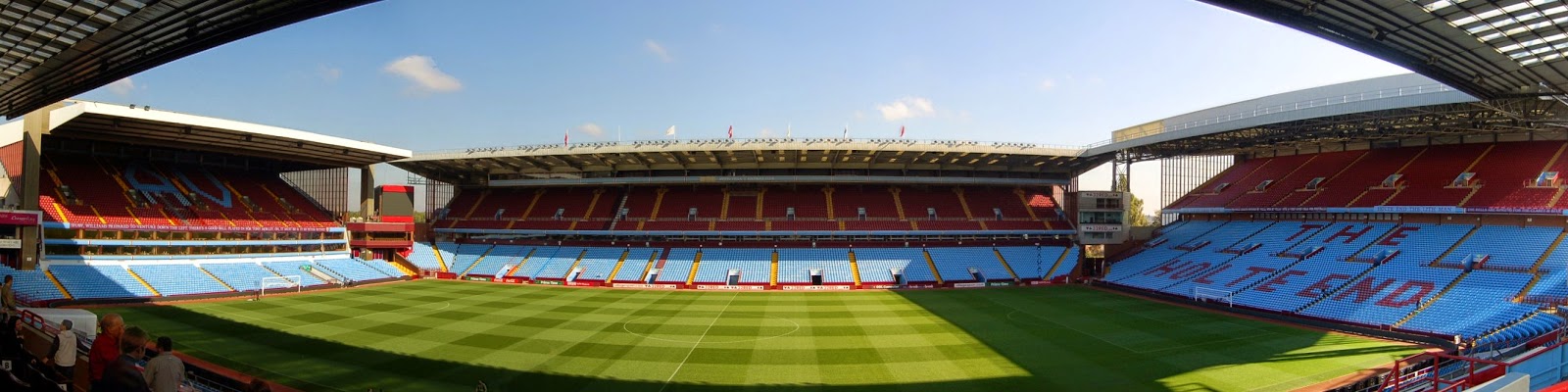
A panorama of Villa Park from the Trinity Road Stand (Photograph: Harry Vale/Wikipedia)
Patrick Comerford
I live in a house divided. Since my teens, I have been an Aston Villa supporter, for no other reason than that Villa Park was the nearest ground to Lichfield; one of my sons is a lifelong fan of Newcastle United – for no other reason than as a young child he was attracted by the starkness of their black-and-white strip.
We have exchanged banter this season, as Aston Villa hovered around the middle of the table, never quite making into the top flight, while Newcastle eventually managed to avoid relegation.
On occasions, we have gone together to fixtures in England and Ireland home games in Dublin; we are ‘ABU’ supporters (‘Anyone But United’); and we have shared the same criticism of recent plans to create a ‘European Super League.’
Not that either Aston Villa or Newcastle were ever going to be considered for any new ‘super league.’ But the notions that football clubs are commodities to be traded and that ticketholders are customers and not fans or loyal supporters, eat away in insidious ways at many of the principles that undergird local support for local teams.
Fans saw the scheme as the ‘ultimate betrayal.’ Supporters of the ‘English Six’ – Arsenal, Chelsea, Liverpool, Manchester City, Manchester United and Tottenham Hotspur – were vocal in their protests.
Chelsea supporters already resent the Russian owner Roman Abramovich, an oligarch close to Vladimir Putin. Manchester United fans feel scorned by the American Glazer family, who secured their loans to buy the club against its assets, including Old Trafford.
Aston, the home station for Villa Park … it had an early attraction as the first club on the line from Lichfield to Birmingham (Photograph: Patrick Comerford)
***
Perhaps Manchester United fans went over the top when they invaded the pitch at Old Trafford; they certainly went beyond peaceful protest when police were injured and the teams’ hotel was besieged.
The cancellation of the ‘super league’ has been hailed as a victory for fans. But it may yet turn out to be nothing more than a Pyrrhic victory. The owners of the big clubs seem more interested in profit margins and the money earned through pay-to-view television, advertising, gambling and merchandising.
No-one failed to notice the irony of Boris Johnson pretending to take an interest in the plight of mainly working-class fans. That irony was compounded by the fact that the Prime Minister who made Brexit his trademark was opposed to taking the elite clubs out of the give-and-take of a league system that brings together the strong, the mediocre and the weak.
Some commentators also link Johnson with a Saudi bid to buy Newcastle United from Mike Ashley of Sports Direct. There are objections to a foreign state becoming a major stakeholder in a very integral part of English identity, and protesters accuse Saudi Arabia of abuses of human rights, including the murder of the US-based Saudi journalist, Jamal Khashoggi, in the Saudi consulate in Istanbul in 2018.
The CIA links the murder to Crown Prince Mohammed bin Salman, and the Premier League is worried the bid could make the Crown Prince the effective owner of the club.
Saint James’ Park remains the name of Newcastle United’s home ground (Photograph: Patrick Comerford)
The church origins of
so many English clubs
This is not the first time for something like this in English football. In the 1990s, the top clubs broke away to form the Premier League.
But all of this is light years away from the origins of many English clubs, that can be traced to works kick-abouts and the ‘social gospel’ ideas of many Victorian parishes and churches, keen to provide facilities that offered healthy exercise and social activities for young men and boys in the rapidly expanding, industrial swaths of England.
Aston Villa, for example, was formed in 1874 by members of the Villa Cross Wesleyan Chapel in Handsworth, which is now part of Birmingham, and played its first match against the local Aston Brook Saint Mary’s rugby team, formed in a Church of England parish church that was demolished in the 1970s.
Aston Villa was one of a dozen teams that competed in the inaugural Football League in 1888, and one of the club’s directors, William McGregor (1846-1911), was the league’s founder and chair of the Football Association Aston Villa became as the most successful English club in the Victorian era, winning five League titles and three FA Cups by 1901.
For 40 years, McGregor worshipped at Wheeler Street Congregational Church in Aston. The Revd WG Percival said the best thing about him ‘was not so much the genial, kindly, honest sportsman, but the Christian behind it all.’ When he died, McGregor was buried in the churchyard at Saint Mary’s, Handsworth.
The former Hibernian Military School played a role in the formation of Bohemian AFC (Photograph: Patrick Comerford)
***
Aston Villa’s arch-rivals are Birmingham City, with games between the two clubs – first played in 1879 – known as the ‘Second City Derby.’ Birmingham City was formed by members of Holy Trinity Church choir and Saint Andrew’s, the name of the club’s home ground, also points to early church links.
Other teams in the region include Wolverhampton Wanderers, another founding club in the Football League in 1888. Wolves were formed as Saint Luke’s FC in 1877 by John Baynton and John Brodie, two schoolboys at Saint Luke’s Church School in Blakenhall, when they were presented with a football by their headmaster, Harry Barcroft.
Newcastle United, the focus of division in this household, plays at Saint James’ Park, another name reflecting the early links many clubs had with local churches. To this day, Southampton glories in the nickname of ‘The Saints.’ They were founded from Saint Mary’s Parish, which gives the stadium its name.
Manchester City (1880) owes it origins to the Revd Arthur Connell of Saint Mark’s Church and his efforts to regenerate the former rural district of West Gorton. There are similar church origins for many other clubs.
In Scotland, Glasgow Celtic was established in 1888 by several Roman Catholic parishes trying to raise money to help feed poor children in the city. Sadly, the divisions between supporters In Liverpool and Glasgow perpetuate sectarian divisions among early Irish immigrants.
Watching an Irish home game in Dublin (Photograph: Patrick Comerford)
An Anglican bishop who
played soccer at Croke Park
I wonder whether there are similar origins for Saint Patrick’s Athletic in Dublin. It is said the colours of Drogheda United represent the Sacred Heart of Jesus and the Immaculate Conception of Mary.
The original founder clubs of the League of Ireland were Shelbourne, Bohemians, Saint James’s Gate, Jacobs, Olympia, Frankfort, Dublin United and YMCA, some with obvious links with the Church of Ireland or seen at the time as ‘culturally Protestant.’
Bohemian Football Club, the second oldest League of Ireland club in continuous existence, began when a small group from Bells Academy in North Great George’s Street joined students from the Hibernian Military School in the Phoenix Park to form a club in 1890.
The founding secretary, Andrew Philip Magill (18), was a Protestant, and the founding secretary Paul Bell (17) was a Protestant. The name Bohemian AFC reflected the club’s difficulties in finding a suitable venue, wandering between the Phoenix Park, Jones Road and Whitehall, until their move to Dalymount in Phibsboro in 1901.
Jacobs Football Club was based in Crumlin. In the 1919-1920 season, during the Irish War of Independence, a group of Jacobs players invaded the dressing room of their opponents, Olympia, after a Leinster Senior Cup game. Two Jacobs players and an Olympia player were suspended when it emerged that Jacobs had been taunted for ‘playing soldiers’ in their team.
Bishop John Curtis (1880-1962) … the Irish missionary bishop who played soccer at Croke Park
***
The United Churches Football League was formed in 1948 to facilitate Saturday-only football opportunities. It was founded at a meeting in Saint Mark’s Parish Hall in Westland Row, chaired by Canon George Hobson, but its origins can be traced back to the 1920s, when an early league was formed by former members of the Boys’ Brigade in the Old Boys Union.
Early clubs with links with Church of Ireland parishes included Saint Paul’s, North Strand, Saint Marks, Saint George’s and Clontarf. Key figures in the league included Canon Robin Armstrong, later Rector of Dun Laoghaire, who was an amateur international player while with Bohs, George Fitch of Kildare Place School, and Jim Carroll of Hibernian Marine.
Another renowned player was John Curtis (1880-1962), the last Irish Anglican bishop to work in China. In his late teens, Curtis played at inside-left for Bohs in 1897-1898, when Oliver St John Gogarty played at outside-left, and they won the Leinster Senior Cup. He played again when Bohs won the Leinster Senior Cup the following season.
In 1899-1900, Bohemians got to the Irish Cup final against Cliftonville after John Curtis scored a vital goal in the semi-final against Belfast Celtic at Jones Road, now Croke Park. But Bohs lost that final 2-1 in Grosvenor Park in Belfast. His two younger brothers, Edward (Ned) and Harry, also played for Bohs.
His career became the stuff of schoolboy adventure stories and comic strips: after the Japanese invaded China at the start of World War II, he was a prisoner of war in Shanghai. He stayed in China as a missionary bishop after the revolution, living in Hangzhou until he was forced to leave in 1950.
Clarendon House, Rathgar Road … the childhood home of Bishop John Curtis (Photograph: Patrick Comerford)
This two-page feature was first published in June 2021 in the Church Review (Dublin and Glendalough)
Patrick Comerford
I live in a house divided. Since my teens, I have been an Aston Villa supporter, for no other reason than that Villa Park was the nearest ground to Lichfield; one of my sons is a lifelong fan of Newcastle United – for no other reason than as a young child he was attracted by the starkness of their black-and-white strip.
We have exchanged banter this season, as Aston Villa hovered around the middle of the table, never quite making into the top flight, while Newcastle eventually managed to avoid relegation.
On occasions, we have gone together to fixtures in England and Ireland home games in Dublin; we are ‘ABU’ supporters (‘Anyone But United’); and we have shared the same criticism of recent plans to create a ‘European Super League.’
Not that either Aston Villa or Newcastle were ever going to be considered for any new ‘super league.’ But the notions that football clubs are commodities to be traded and that ticketholders are customers and not fans or loyal supporters, eat away in insidious ways at many of the principles that undergird local support for local teams.
Fans saw the scheme as the ‘ultimate betrayal.’ Supporters of the ‘English Six’ – Arsenal, Chelsea, Liverpool, Manchester City, Manchester United and Tottenham Hotspur – were vocal in their protests.
Chelsea supporters already resent the Russian owner Roman Abramovich, an oligarch close to Vladimir Putin. Manchester United fans feel scorned by the American Glazer family, who secured their loans to buy the club against its assets, including Old Trafford.
Aston, the home station for Villa Park … it had an early attraction as the first club on the line from Lichfield to Birmingham (Photograph: Patrick Comerford)
***
Perhaps Manchester United fans went over the top when they invaded the pitch at Old Trafford; they certainly went beyond peaceful protest when police were injured and the teams’ hotel was besieged.
The cancellation of the ‘super league’ has been hailed as a victory for fans. But it may yet turn out to be nothing more than a Pyrrhic victory. The owners of the big clubs seem more interested in profit margins and the money earned through pay-to-view television, advertising, gambling and merchandising.
No-one failed to notice the irony of Boris Johnson pretending to take an interest in the plight of mainly working-class fans. That irony was compounded by the fact that the Prime Minister who made Brexit his trademark was opposed to taking the elite clubs out of the give-and-take of a league system that brings together the strong, the mediocre and the weak.
Some commentators also link Johnson with a Saudi bid to buy Newcastle United from Mike Ashley of Sports Direct. There are objections to a foreign state becoming a major stakeholder in a very integral part of English identity, and protesters accuse Saudi Arabia of abuses of human rights, including the murder of the US-based Saudi journalist, Jamal Khashoggi, in the Saudi consulate in Istanbul in 2018.
The CIA links the murder to Crown Prince Mohammed bin Salman, and the Premier League is worried the bid could make the Crown Prince the effective owner of the club.
Saint James’ Park remains the name of Newcastle United’s home ground (Photograph: Patrick Comerford)
The church origins of
so many English clubs
This is not the first time for something like this in English football. In the 1990s, the top clubs broke away to form the Premier League.
But all of this is light years away from the origins of many English clubs, that can be traced to works kick-abouts and the ‘social gospel’ ideas of many Victorian parishes and churches, keen to provide facilities that offered healthy exercise and social activities for young men and boys in the rapidly expanding, industrial swaths of England.
Aston Villa, for example, was formed in 1874 by members of the Villa Cross Wesleyan Chapel in Handsworth, which is now part of Birmingham, and played its first match against the local Aston Brook Saint Mary’s rugby team, formed in a Church of England parish church that was demolished in the 1970s.
Aston Villa was one of a dozen teams that competed in the inaugural Football League in 1888, and one of the club’s directors, William McGregor (1846-1911), was the league’s founder and chair of the Football Association Aston Villa became as the most successful English club in the Victorian era, winning five League titles and three FA Cups by 1901.
For 40 years, McGregor worshipped at Wheeler Street Congregational Church in Aston. The Revd WG Percival said the best thing about him ‘was not so much the genial, kindly, honest sportsman, but the Christian behind it all.’ When he died, McGregor was buried in the churchyard at Saint Mary’s, Handsworth.
The former Hibernian Military School played a role in the formation of Bohemian AFC (Photograph: Patrick Comerford)
***
Aston Villa’s arch-rivals are Birmingham City, with games between the two clubs – first played in 1879 – known as the ‘Second City Derby.’ Birmingham City was formed by members of Holy Trinity Church choir and Saint Andrew’s, the name of the club’s home ground, also points to early church links.
Other teams in the region include Wolverhampton Wanderers, another founding club in the Football League in 1888. Wolves were formed as Saint Luke’s FC in 1877 by John Baynton and John Brodie, two schoolboys at Saint Luke’s Church School in Blakenhall, when they were presented with a football by their headmaster, Harry Barcroft.
Newcastle United, the focus of division in this household, plays at Saint James’ Park, another name reflecting the early links many clubs had with local churches. To this day, Southampton glories in the nickname of ‘The Saints.’ They were founded from Saint Mary’s Parish, which gives the stadium its name.
Manchester City (1880) owes it origins to the Revd Arthur Connell of Saint Mark’s Church and his efforts to regenerate the former rural district of West Gorton. There are similar church origins for many other clubs.
In Scotland, Glasgow Celtic was established in 1888 by several Roman Catholic parishes trying to raise money to help feed poor children in the city. Sadly, the divisions between supporters In Liverpool and Glasgow perpetuate sectarian divisions among early Irish immigrants.
Watching an Irish home game in Dublin (Photograph: Patrick Comerford)
An Anglican bishop who
played soccer at Croke Park
I wonder whether there are similar origins for Saint Patrick’s Athletic in Dublin. It is said the colours of Drogheda United represent the Sacred Heart of Jesus and the Immaculate Conception of Mary.
The original founder clubs of the League of Ireland were Shelbourne, Bohemians, Saint James’s Gate, Jacobs, Olympia, Frankfort, Dublin United and YMCA, some with obvious links with the Church of Ireland or seen at the time as ‘culturally Protestant.’
Bohemian Football Club, the second oldest League of Ireland club in continuous existence, began when a small group from Bells Academy in North Great George’s Street joined students from the Hibernian Military School in the Phoenix Park to form a club in 1890.
The founding secretary, Andrew Philip Magill (18), was a Protestant, and the founding secretary Paul Bell (17) was a Protestant. The name Bohemian AFC reflected the club’s difficulties in finding a suitable venue, wandering between the Phoenix Park, Jones Road and Whitehall, until their move to Dalymount in Phibsboro in 1901.
Jacobs Football Club was based in Crumlin. In the 1919-1920 season, during the Irish War of Independence, a group of Jacobs players invaded the dressing room of their opponents, Olympia, after a Leinster Senior Cup game. Two Jacobs players and an Olympia player were suspended when it emerged that Jacobs had been taunted for ‘playing soldiers’ in their team.
Bishop John Curtis (1880-1962) … the Irish missionary bishop who played soccer at Croke Park
***
The United Churches Football League was formed in 1948 to facilitate Saturday-only football opportunities. It was founded at a meeting in Saint Mark’s Parish Hall in Westland Row, chaired by Canon George Hobson, but its origins can be traced back to the 1920s, when an early league was formed by former members of the Boys’ Brigade in the Old Boys Union.
Early clubs with links with Church of Ireland parishes included Saint Paul’s, North Strand, Saint Marks, Saint George’s and Clontarf. Key figures in the league included Canon Robin Armstrong, later Rector of Dun Laoghaire, who was an amateur international player while with Bohs, George Fitch of Kildare Place School, and Jim Carroll of Hibernian Marine.
Another renowned player was John Curtis (1880-1962), the last Irish Anglican bishop to work in China. In his late teens, Curtis played at inside-left for Bohs in 1897-1898, when Oliver St John Gogarty played at outside-left, and they won the Leinster Senior Cup. He played again when Bohs won the Leinster Senior Cup the following season.
In 1899-1900, Bohemians got to the Irish Cup final against Cliftonville after John Curtis scored a vital goal in the semi-final against Belfast Celtic at Jones Road, now Croke Park. But Bohs lost that final 2-1 in Grosvenor Park in Belfast. His two younger brothers, Edward (Ned) and Harry, also played for Bohs.
His career became the stuff of schoolboy adventure stories and comic strips: after the Japanese invaded China at the start of World War II, he was a prisoner of war in Shanghai. He stayed in China as a missionary bishop after the revolution, living in Hangzhou until he was forced to leave in 1950.
Clarendon House, Rathgar Road … the childhood home of Bishop John Curtis (Photograph: Patrick Comerford)
This two-page feature was first published in June 2021 in the Church Review (Dublin and Glendalough)
17 October 2016
Spirituality (Pastoral Formation):
Spirituality and Sport
Villa Park, the home of Aston Villa … like many clubs, its roots are in the Victorian church
Patrick Comerford
Spirituality (Pastoral Formation),
The Chapel, the Church of Ireland Theological Institute,
9 a.m., 17 October 2016.
Opening Hymn: Fight the good fight (No 566, Church Hymnal, 5th ed).
Opening Reading: II Timothy 4: 1-8.
Some years ago, I was staying in Ealing Abbey for two weeks, taking courses in Liturgy and Liturgical Latin. When I arrived, I was given a monk’s cell where I would spend the next fortnight. On my desk, there was an old cutting from the Daily Telegraph – a feature in which the writer claimed that the Benedictine tradition is so rooted in English life and culture that: ‘Some claim to see the Benedictine spirit in the rules of Cricket.’
I tried to follow this up later, and also found the actual Laws, the official rulebook of the International Cricket Council, also include a clause about the Spirit of Cricket:
‘Cricket is a game that owes much of its unique appeal to the fact that it should be played not only within its Laws but also within the Spirit of the Game. Any action which is seen to abuse this spirit causes injury to the game itself.’
Cricket on a Saturday afternoon in Grantchester, near Cambridge (Photograph: Patrick Comerford)
What do we mean by the Spirit of a Game?
What do we mean by saying someone is a Good Sport?
Why, for many people, does their relationship with sport have an almost religious quality to it?
The figures for the UK are staggering: 15.74 million adults play sport weekly – that is about a third of all adults in the UK. The number is higher in the young-adult bracket where 55.2% take part in at least one session of sport a week, and even higher among 11 to 16-year-olds where it is 86.6%.
The figures include Northern Ireland, but I imagine a similar survey in the Republic of Ireland would produce proportionately similar results.
If we had those figures for church attendance week-by-week, many of us would be very happy. But Sport is also often seen as a rival to Church in many parishes on this island.
Parents regularly give the excuse that they are not in church on Sunday mornings because their children are playing cricket, rugby or hockey on Sunday morning – and that in church-linked schools.
Truth to tell, that is probably so for mothers in car pools, while the many men who grumble that church services start too early on Sunday mornings have no problem about being on the out on fairway by 9 a.m. on a Sunday morning.
But these figures pose interesting challenges in other ways: If the church is even partially a representation of these demographics, then it would mean that sports players are arguably one of the largest groups in any church. But how many of these Christians playing sport are Christians in sport? In other words, how many Christians do not just play sport but actually see that their sport and faith are integrated? Not separate areas – ‘I go to church on Sunday and play sport during the week’ – but integrated – ‘I play sport as part of a whole life view of worship.’
Even if you are not a sports fan, and this topic this morning causes you to roll your eyes, you will find how quickly in parish life you become involved in local sporting life. You will be invited to say grace at rugby, golf, cricket, soccer and even GAA club dinners, be invited to pray before key matches, and even receive tickets for key fixtures. Thankfully you will find the further south you go in Ireland the less the sectarian divisions are when it comes to sport.
And all of this not because people are being generous – but because they want you to pray with them and pray for them.
It may be a surprise to some, but I think of sport as part of God’s good gift of creation. Sure, human beings invented sports, but where does our playfulness come from? The creativity, the desire for human relationship, and the instinctive desire to play that all people, of all ages, across all cultures, have are all part of what it means to be made in the image of God (Genesis 1: 27).
God is the Creator and so being made in his image makes us creative with the talents to strike a ball, see a pass, or swim quickly. Equally God is a relational God, Father, Son and Holy Spirit, and so our desire to play with others pushing them on playfully in competitive sports comes from God. Sport is not some area outside of God’s good creation, it is an integral part of it, a gift to be enjoyed to his glory.
The Apostle Paul urges us to ‘offer our bodies as a living sacrifice, holy and pleasing to God, this is your spiritual act of worship’ (Romans 12:1-2). That means that sport is an area of life that can be offered to God as an act of worship.
In his epistles, Paul frequently draws on sporting images: the runner in races, the boxer in the ring … reading last Thursday’s lectionary reading, I was reminded once again that Saint Paul must have been a good swimmer too (see Acts 27: 27-44).
Yet so often sport is not seen as a gift from God. It is often seen as being bad, full of drugs, professional fouls, violence and cheating. There may not see much evidence of spirituality at a soccer match, with 22 men running around a field chasing a ball and another 50,000 men shouting and gesticulating at them, using crude language for the referee, descending to racist taunts at opposing players, and singing songs with crude and demeaning lyrics.
Certainly, I find it difficult to regard two men throwing punches at each other in a boxing ring as good clean sport. As someone who learned to ride a horse at the same age as I learned to walk, I take no pleasure in seeing a horse being whipped by a jockey as they race around a track. The allegations of ticket-touting and drug-taking at this year’s Olympic Games and the corruption at the top in FIFA not only paint sports governing bodies in bad lights, but totally demean the whole body corporate of sports.
A healthy mind is a healthy body … rowing by the Sidney Sussex boathouse on the River Cam (Photograph: Patrick Comerford, 2015)
But sport is also a human right.
The well-known Latin aphorism Mens sana in corpore sano is usually translated as ‘a sound mind in a sound body’ or ‘a healthy mind in a healthy body.’ In the western world, it is used in sporting and educational contexts to express the theory that physical exercise is an important or essential part of mental and psychological well-being.
The phrase comes from Satire X of the Roman poet Juvenal (10.356). It is the first in a list of what is desirable in life:
You should pray for a healthy mind in a healthy body.
Ask for a stout heart that has no fear of death,
and deems length of days the least of Nature’s gifts
that can endure any kind of toil,
that knows neither wrath nor desire and thinks
the woes and hard labours of Hercules better than
the loves and banquets and downy cushions of Sardanapalus.
What I commend to you, you can give to yourself;
For assuredly, the only road to a life of peace is virtue.
The original Latin reads:
orandum est ut sit mens sana in corpore sano.
fortem posce animum mortis terrore carentem,
qui spatium vitae extremum inter munera ponat
naturae, qui ferre queat quoscumque labores,
nesciat irasci, cupiat nihil et potiores
Herculis aerumnas credat saevosque labores
et venere et cenis et pluma Sardanapalli.
monstro quod ipse tibi possis dare; semita certe
tranquillae per virtutem patet unica vitae.
Juvenal probably drew his inspiration from the pre-Socratic philosopher Thales:
τίς εὐδαίμων, <<ὁ τὸ μὲν σῶμα ὑγιής, τὴν δὲ ψυχὴν εὔπορος, τὴν δὲ φύσιν εὐπαίδευτος>>.
What man is happy? ‘He who has a healthy body, a resourceful mind and a docile nature.’
The sports equipment company Asics takes its name from an acronym of a variant of this aphorism: anima sana in corpore sano, ‘a healthy soul in a healthy body.’ Mensa, the High IQ Society, derives its name both from the Latin word for table, mensa as well as a pun on the phrase mens sana.
Indeed, there is a pronounced, though sometimes hidden aspect to sport, so that it is possible to say– depending on your understanding of spirituality – that the desire to experience spiritual well-being is one reason people play sports.
There is an important connection between mind, body and soul that is inherent in all play. In sport, the reward comes not solely from winning the medal or having the fastest time, but from that wonderful connection of spirit, soul and body that gives glory to God through our every action.
According to the psychologist Mihaly Csikszentmihalyi, sport is important because it is one of the most readily available ways of generating the state of being he calls ‘flow’. This is the state we experience when our attention is completely absorbed in an activity, and our awareness of our surroundings – even of ourselves – fades away.
It is not the passive absorption of watching television or playing computer games, but the ‘active’ absorption we experience when we fully concentrate and make powerful mental efforts – when we perform challenging, stimulating, creative activities like learning a foreign language or a musical instrument, painting or playing sports.
‘Flow’ allows us to take control of our own consciousness, and step beyond the psychic entropy that is our normal state, when worries, desires and other kinds of chaotic thought chatter run through our minds. We experience an inner peace, and a sense of being more ‘energised’ or alive than usual.
A chess player told Csikszentmihalyi that when he plays chess, ‘I have a general sense of well-being, a feeling of complete control over my world.’
Similarly, a dancer told him that during her performances, ‘A strong relaxation and calmness comes over me. I have no worries of failure. What a powerful and warm feeling it is! I want to expand, to hug the world. I feel enormous power to effect something of grace and beauty.’
We may debate whether these states are genuinely spiritual or not, since they do not involve experiencing any transpersonal or transcendent reality. But we can think of them as a kind of ‘base level’ spirituality, the point when spiritual experience begins.
Indeed, sport can sometimes enable us to reach higher levels too. Once a sportsperson is ‘locked into’ a state of flow, unusual things may happen, and sportspeople occasionally experience these. They often speak of being ‘in the Zone.’ These are moments when suddenly everything ‘clicks’ and they shift to a higher level of performance and become capable of astounding feats.
Experiences like these are usually temporary, but it seems that the best sports players and athletes are always ‘in the Zone’ to a degree.
Many individual athletes and teams find prayer and spirituality can play a significant role as coping tools in such a high-stakes atmosphere. In many changing rooms, teams pray before going onto the field and some even have a team chaplain to pray with the players and to provide them with spiritual guidance. Prayer and spirituality are known to make positive contributors to mental health and well-being.
In sports, especially as the stakes increase at professional levels, spiritual well-being must be considered as athletes struggle with expectations, injuries, disappointments, losses, and other emotionally charged events.
I was involved ten years ago in a forum discussing the needs for chaplaincy for British teams at the Beijing Olympics. It was not about providing religious services or blessings, but about how do you provide the support for athletes and their coaches, particularly for athletes who, for example, come fourth – there is no medal for those who are pipped for a bronze by a fraction of a second – for those who fail to get through the qualifying heats, and for their coaches. And we often fail to remember that without proper support, the majority of Olympians, athletes and coaches, can come home wondering whether they are failures, not knowing most of us think the very fact of being an Olympian is a major achievement and success in itself.
A recent study in the Journal of Sport looked at people involved in diverse sports, including football, basketball and others. Through a number of different rating scales, they found that many inner aspects of competitive sports, including coping with adversity, freedom from worry, goal setting, mental preparation, confidence, achievement and motivation were more robust in the ‘high spiritual well-being’ group.
They found certain aspects of spirituality in athletes may add to the array of coping mechanisms they have to deal with adversity, as well as to serve as a buffer against stress.
Does this translate into improved performance on the field?
That is hardly the purpose of any discussion of spirituality and sport.
But, at the end of the day, prayer and general spiritual well-being appear to offer additional coping mechanisms for adverse situations and help to contribute to stress reduction, all of which can add to the ‘mental toughness’ aspect of athletes.
Some of you are early morning joggers, but I doubt that you run to win: running keeps you in touch with the body that God gives you, a body made in God’s image and likeness, and running or walking around the block here puts you in touch with God’s creation in a way that you know is never experienced by driving around the block.
Athletes make enormous sacrifices for a miniscule chance of victory. So they are not motivated solely by the gold medal. Instead, their motivations have more to do with the meaning of taking part and personal growth, says Dr Nesti. He adds that many philosophers and psychologists have noted that when we are playing, we are in love with what we are doing, and this means that sports are more important to individuals than merely learning the skills associated with it.
Being a sport means you are willing to play. Willing to play means you are involved or alive to the situation in which you exist.
It is said that what made the Australian cricketer Don Bradman – who was by far the best batsman who ever lived – so much better than everybody else was the amazing amount of time he seemed to have to play his shots. Although he never committed himself until the last moment, he always had more than ample time to position himself and find the correct stroke, as if the fraction of a second it takes a ball to reach a batsman from the arm of a fast bowler contained more time for him than for others.
Yet, when people get involved in sport, as players or spectators, they often get entangled with a system that can depend on delusion or hallucination that will look and feel real. We hope for the miracle, we believe in the impossible, we risk misery and suffering.
If you want to play a game, you must have the fire of wanting to win but also the balance to see that if you lose, it is okay with you. You never play a game to lose, you always play a game to win, but if you lose, it is all right with you. The sacredness of a sporting event is that individuals rise beyond their limitations, achieving a state of abandon that is usually known only at the peak of spirituality.
Sport is a way not only of balancing body and soul, but also as a way of breaking through to an experience of the Divine. The determined athlete can find that this determination and discipline allows him or her to break through the limitations of the body into the world of the soul where body and soul have become one.
Access to sport must be seen as a human right. It is about the right to having a healthy mind and a healthy body. There is a television promotion at the moment that plays on this right. But when you watch it in detail it turns out that it is not about access to sports but about access to a pay-to-view television channel.
Despite those statistics, access to sport for the majority of people is about access to being a passive spectator than being an active participant. And access to active participation often depends on money and social class.
On the other hand, I do not want to downplay the value of being a spectator. The fervour this summer around the Olympic Games and the UEFA European soccer championship over the summer months, illustrated the power of sport in bringing people together.
The attitude to sport has not always been positive on the part of the Church. In 1531, the Puritan preacher Thomas Eliot argued that football caused ‘beastly fury and extreme violence.’ Later in the 16th century, in 1572, the Bishop of Rochester, Edmund Freke, demanded a new campaign to suppress this ‘evil game.’
In his book, Anatomy of Abuses (1583) Philip Stubbs argued that ‘football playing and other devilish pastimes ... Football encourages envy and hatred ... sometimes fighting, murder and a great loss of blood.’
But history shows that young men refused to accept any attempt to ban football. In 1589, Hugh Case and William Shurlock were fined 2 shilling for playing football in a churchyard during the vicar’s sermon.
Ten years later, a group of men in a village in Essex were fined for playing football on a Sunday.
Attitudes towards football began to change in the 19th century. Thomas Arnold, who became headmaster of Rugby in 1828, emphasised the importance of sport in young men’s education. Like most public school headmasters, Arnold believed that sport was a good method for ‘encouraging senior boys to exercise responsible authority on behalf of the staff.’ He also argued that games like football provided a ‘formidable vehicle for character building.’
Villa Park … Aston Villa was formed by members of a church cricket team in 1874
Like so many football clubs that started in the late 19th century, Aston Villa has its roots in church activities. (yes, I am a fan, and I regret it was just a 1-1 draw against Wolves yesterday [16 October 2016]). The club was formed in 1874 by four members of the cricket team at Villa Cross Wesleyan Chapel in Handsworth. From as early as 1867, the chapel was known as Aston Villa Wesleyan Chapel. Local lore says the four founders of the club met under a gas-light in Heathfield Road to set about forming a new club. As cricket players, they were looking for something to keep them occupied during the winter, and they chose football after witnessing an impromptu game on a meadow off Heathfield Road.
The first match for the new side was against the local Aston Brook Saint Mary’s Rugby team on Wilson Road, Aston. As a condition of the match, the Villa side had to agree to play the first half under rugby rules and the second half under football rules.
William McGregor, a local draper, helped make Villa a successful and prestigious club and is also remembered as the creator of the Football League. At his funeral in the church in Wheeler Street, Aston, where he worshipped for more than 40 years, the Revd WG Percival, said that the best thing about him ‘was not so much the genial, kindly, honest sports man, but it was the Christian behind it all.’
Birmingham City’s origins are found in church life too. It was founded in 1875 by members of the choir at Holy Trinity Church, Bordesley, who had formed their own cricket team four years earlier.
To keep fit in the winter of 1875, half-a-dozen members of Holy Trinity Cricket Club decided to try the new sport of Association Football. But because the choir alone could not provide them with enough players, they thought a new name might broaden their appeal and the Small Heath Alliance Football Club was born. When they moved to Muntz Street and bought the lease to the ground in 1895, they changed their name to Birmingham City Football Club. They moved to new grounds at Saint Andrew’s, near Saint Andrew’s Church, in 1906 and have been there ever since.
Everton was founded in November 1879 at a meeting called by Saint Domingo’s Church. The church already had a cricket team but wanted to find another sport for the winter months. The Saint Domingo team played in Stanley Park and won their first game, against Saint Peter’s Church. The following year the club was renamed Everton FC.
The Revd Arthur Connell was the rector of Saint Mark’s Church in West Gorton at a time of high unemployment in Manchester. In January 1879, he set up a soup kitchen and a relief fund. His daughter, Anna Connell, who became involved, believed that the creation of male clubs would help improve the community spirit. This included the creation of the Saint Mark’s Church football team. In time, this team became Manchester City.
The Hotspur Football Club was formed in 1882 by boys from the Bible class at All Hallows’ Church. They were also members of Hotspur Cricket Club, named after Harry Hotspur in Shakespeare’s Henry IV, part 1. In 1884, the club was renamed Tottenham Hotspur Football Club.
Southampton Football Club, known to this day as ‘the Saints,’ was formed at Saint Mary’s YMA in 1885. The roots of the club can be traced to members of Saint Mary’s Church Young Men’s Association, who played their football at various venues in Southampton for 13 years, prior to the move in 1898 to the club’s former ground, The Dell, where it remained until 2001.
A proud name ... Saint James’ Park, Newcastle (Photograph: Patrick Comerford)
Other football clubs that owed their origins to churches include Newcastle United, who still play at Saint James’ Park, Barnsley (1887) was formed by the Revd Tiverton Preedy, assistant curate at Saint Peter’s; Bolton Wanderers (1874) was formed by the headmaster of Christ Church Boys’ School and boys of Christ Church Sunday school, and the Revd Joseph Wright was its first president; Fulham (1879) was formed through the inspiration of the Revd John Henry Carwell, curate at Saint James’s; Queen’s Park Rangers (1885) was formed by boys connected to Saint Jude’s Institute; and Swindon Town (1879) was formed through the inspiration of the Revd William Baker Pitt, curate at Christ Church.
I’m told the colours of Drogheda United are meant to represent the Sacred Heart of Jesus and the Immaculate Conception of Mary.
In Gaelic Games, Croke Park takes its name from an Archbishop of Cashel who was a founding figure in the GAA and both the Semple Stadium and the Sam Maguire Cup are named after members of the Church of Ireland.
‘You’ll never walk alone’ ... football memories are found throughout Liverpool (Photograph: Patrick Comerford)
It is striking how much of the vocabulary of sport is an appropriation of religious words. Although there is only one Messiah and Saviour, I hear phrases such as ‘Messi the messiah’ and ‘Usain Bolt the saviour of athletics.’
The hymn ‘Abide with me’ has an inseparable association with Cup Finals in Wembley. But there is also a hymn-like quality to the singing of ‘My Old Man’ (Aston Villa), ‘You’ll never walk alone’ (Liverpool), ‘Blowing bubbles’ (West Ham), ‘We’ve Got the Whole World in Our Hands’ (Nottingham Forest), and indeed Irish fans joining together to sing ‘The Fields of Athenry.’ There was a deeply religious moment among the Munster fans as they sang it yesterday in Paris as they tried to express their grief following the sudden death of Anthony Foleyt.
There is a liturgical quality to the responsorial chants, the seasonal team colours and the sense of community if not being in communion with one another.
How often fans asked for their ashes to be scattered on their club’s pitch, and no-one can fail to notice how football serves a quasi-religious function when you see the temporary shrines erected to dead fans and players outside grounds or the minutes’ silence observed at the start of games.
Sport often meets the spiritual needs of spectators who have drifted away from or been alienated from the Church. Why?
Bill Shankly once said: ‘Some people believe football is a matter of life and death. I am very disappointed with that attitude. I can assure you that it is much, much more important than that.’
Perhaps if the church could appropriate some of that enthusiasm and collective, positive good feeling, we might have as much to learn from sport today as the Apostle Paul did in his mission.
[Reflection, Discussion]
Closing Prayer:
Collect 1, The Second Sunday of Advent:
O Lord,
Raise up (we pray thee) thy power, and come among us,
and with great might succour us;
that whereas, through our sins and wickedness,
we are sore let and hindered in running the race that is set before us,
thy bountiful grace and mercy
may speedily help and deliver us;
through the satisfaction of thy Son our Lord,
to whom with thee and the Holy Spirit,
be honour and glory, world without end.
The Lord’s Prayer, the Grace …
Some Scripture passages for reflection:
Jacob was left alone; and a man wrestled with him until daybreak. When the man saw that he did not prevail against Jacob, he struck him on the hip socket; and Jacob’s hip was put out of joint as he wrestled with him. Then he said, “Let me go, for the day is breaking.” But Jacob said, “I will not let you go, unless you bless me.” So he said to him, “What is your name?” And he said, “Jacob.” Then the man said, “You shall no longer be called Jacob, but Israel, for you have striven with God and with humans, and have prevailed.” Then Jacob asked him, “Please tell me your name.” But he said, “Why is it that you ask my name?” And there he blessed him. So Jacob called the place Peniel, saying, “For I have seen God face to face, and yet my life is preserved.” (Genesis 32: 24-30).
If you have raced with foot-runners and they have wearied you, how will you compete with horses? And if in a safe land you fall down, how will you fare in the thickets of the Jordan? (Jeremiah 12: 5).
But those who wait for the Lord shall renew their strength, they shall mount up with wings like eagles, they shall run and not be weary, they shall walk and not faint (Isaiah 40: 31).
Do you not know that in a race the runners all compete, but only one receives the prize? Run in such a way that you may win it. Athletes exercise self-control in all things; they do it to receive a perishable wreath, but we an imperishable one. So I do not run aimlessly, nor do I box as though beating the air; but I punish my body and enslave it, so that after proclaiming to others I myself should not be disqualified. (I Corinthians 9: 24-27).
I went up in response to a revelation. Then I laid before them (though only in a private meeting with the acknowledged leaders) the gospel that I proclaim among the Gentiles, in order to make sure that I was not running, or had not run, in vain (Galatians 2: 2).
It is by your holding fast to the word of life that I can boast on the day of Christ that I did not run in vain or labour in vain (Philippians 2: 16).
I press on toward the goal for the prize of the heavenly call of God in Christ Jesus (Philippians 3: 14).
For what is our hope or joy or crown of boasting before our Lord Jesus at his coming? Is it not you? (1 Thessalonians 2: 19).
Train yourself in godliness, for, while physical training is of some value, godliness is valuable in every way, holding promise for both the present life and the life to come. (I Timothy 4: 7-8).
And in the case of an athlete, no one is crowned without competing according to the rules (II Timothy 2: 5).
I have fought the good fight, I have finished the race, I have kept the faith. From now on there is reserved for me the crown of righteousness, which the Lord, the righteous judge, will give me on that day, and not only to me but also to all who have longed for his appearing. (II Timothy 4: 7-8).
Therefore, since we are surrounded by so great a cloud of witnesses, let us also lay aside every weight and the sin that clings so closely, and let us run with perseverance the race that is set before us, looking to Jesus the pioneer and perfecter of our faith, who for the sake of the joy that was set before him endured the cross, disregarding its shame, and has taken his seat at the right hand of the throne of God (Hebrews 12: 1-2).
From the Autumn Prayer Diary of Christians in Sport
Sunday 16 October: Clubhouse Xtra. Pray for those preparing for and delivering talks, training sessions and seminars at our student training conferences in January would prepare well, being motivated by a passion for the lost world of sport.
Monday 17 October: Partnerships with the local church. Pray that Christians in Sport would continue to serve the local church specifically in the area of evangelism to sport students. Pray for further partnerships to be developed with student churches in many university cities.
Tuesday 18 October: Injury. Please pray for students who have suffered serious injuries this season. Pray that the gospel will comfort them in their situations but continue to motivate them to stay committed to their university sports friends even when they are unable to train, play or compete alongside them.
Wednesday 19 October: Final-year students. Pray for students in their final year of study. Pray that they would make the most of the gospel opportunities that playing or competing in university sport brings before they graduate next summer.
Thursday 20 October: European Sports Mission. Pray for the students from across Europe who attended ReadySetGO Plus in July. Pray that God would use them to make a huge impact in the world of university sport following the training and experience they received in the summer.
Friday 21 October: Dialogue Dinners. Praise God for the 24 Dialogue Dinners we know of which took place last year. Pray that many students this year will be bold in asking their sports friends over for a meal in order to share the gospel through a testimony or short talk.
Saturday 22 October: Graduates. Pray for Christian sportspeople who graduated this summer. Pray that they would stay strong in their faith and continue to live out the mission of making disciples in the world of sport.
Supplemental Reading:
Marilyn Baetz and John Toews, ‘Clinical Implications of Research on Religion, Spirituality, and Mental Health,’ The Canadian Journal of Psychiatry 2009, 54 (5): pp 292-301.
Joe Drape, ‘Increasingly, Football Playbooks Call for Prayer,’ The New York Times, 30 October 2005.
Jeffrey Heskins and Matt Baker (eds), Footballing Lives, As seen by the chaplains of the beautiful game (London: Canterbury Press Norwich, 2006).
Heather Ridnour and Jon Hammermeister, ‘Spiritual Well-Being and Its Influence on Athletic Coping Profiles,’ Journal of Sport Behavior, 2008, 31 (1): pp 81-92.
Dr Susan Saint Sing, Spirituality of Sport: Balancing Body and Soul (St Anthony Messenger Press, 2004, pb, 137 pp).
(Revd Canon Professor) Patrick Comerford is lecturer in Anglicanism, Liturgy and Church History, the Church of Ireland Theological Institute. This lecture in the chapel on 17 October 2016 was part of the module Spirituality, which is part of the Pastoral Formation programme for MTh students.
Patrick Comerford
Spirituality (Pastoral Formation),
The Chapel, the Church of Ireland Theological Institute,
9 a.m., 17 October 2016.
Opening Hymn: Fight the good fight (No 566, Church Hymnal, 5th ed).
Opening Reading: II Timothy 4: 1-8.
Some years ago, I was staying in Ealing Abbey for two weeks, taking courses in Liturgy and Liturgical Latin. When I arrived, I was given a monk’s cell where I would spend the next fortnight. On my desk, there was an old cutting from the Daily Telegraph – a feature in which the writer claimed that the Benedictine tradition is so rooted in English life and culture that: ‘Some claim to see the Benedictine spirit in the rules of Cricket.’
I tried to follow this up later, and also found the actual Laws, the official rulebook of the International Cricket Council, also include a clause about the Spirit of Cricket:
‘Cricket is a game that owes much of its unique appeal to the fact that it should be played not only within its Laws but also within the Spirit of the Game. Any action which is seen to abuse this spirit causes injury to the game itself.’
Cricket on a Saturday afternoon in Grantchester, near Cambridge (Photograph: Patrick Comerford)
What do we mean by the Spirit of a Game?
What do we mean by saying someone is a Good Sport?
Why, for many people, does their relationship with sport have an almost religious quality to it?
The figures for the UK are staggering: 15.74 million adults play sport weekly – that is about a third of all adults in the UK. The number is higher in the young-adult bracket where 55.2% take part in at least one session of sport a week, and even higher among 11 to 16-year-olds where it is 86.6%.
The figures include Northern Ireland, but I imagine a similar survey in the Republic of Ireland would produce proportionately similar results.
If we had those figures for church attendance week-by-week, many of us would be very happy. But Sport is also often seen as a rival to Church in many parishes on this island.
Parents regularly give the excuse that they are not in church on Sunday mornings because their children are playing cricket, rugby or hockey on Sunday morning – and that in church-linked schools.
Truth to tell, that is probably so for mothers in car pools, while the many men who grumble that church services start too early on Sunday mornings have no problem about being on the out on fairway by 9 a.m. on a Sunday morning.
But these figures pose interesting challenges in other ways: If the church is even partially a representation of these demographics, then it would mean that sports players are arguably one of the largest groups in any church. But how many of these Christians playing sport are Christians in sport? In other words, how many Christians do not just play sport but actually see that their sport and faith are integrated? Not separate areas – ‘I go to church on Sunday and play sport during the week’ – but integrated – ‘I play sport as part of a whole life view of worship.’
Even if you are not a sports fan, and this topic this morning causes you to roll your eyes, you will find how quickly in parish life you become involved in local sporting life. You will be invited to say grace at rugby, golf, cricket, soccer and even GAA club dinners, be invited to pray before key matches, and even receive tickets for key fixtures. Thankfully you will find the further south you go in Ireland the less the sectarian divisions are when it comes to sport.
And all of this not because people are being generous – but because they want you to pray with them and pray for them.
It may be a surprise to some, but I think of sport as part of God’s good gift of creation. Sure, human beings invented sports, but where does our playfulness come from? The creativity, the desire for human relationship, and the instinctive desire to play that all people, of all ages, across all cultures, have are all part of what it means to be made in the image of God (Genesis 1: 27).
God is the Creator and so being made in his image makes us creative with the talents to strike a ball, see a pass, or swim quickly. Equally God is a relational God, Father, Son and Holy Spirit, and so our desire to play with others pushing them on playfully in competitive sports comes from God. Sport is not some area outside of God’s good creation, it is an integral part of it, a gift to be enjoyed to his glory.
The Apostle Paul urges us to ‘offer our bodies as a living sacrifice, holy and pleasing to God, this is your spiritual act of worship’ (Romans 12:1-2). That means that sport is an area of life that can be offered to God as an act of worship.
In his epistles, Paul frequently draws on sporting images: the runner in races, the boxer in the ring … reading last Thursday’s lectionary reading, I was reminded once again that Saint Paul must have been a good swimmer too (see Acts 27: 27-44).
Yet so often sport is not seen as a gift from God. It is often seen as being bad, full of drugs, professional fouls, violence and cheating. There may not see much evidence of spirituality at a soccer match, with 22 men running around a field chasing a ball and another 50,000 men shouting and gesticulating at them, using crude language for the referee, descending to racist taunts at opposing players, and singing songs with crude and demeaning lyrics.
Certainly, I find it difficult to regard two men throwing punches at each other in a boxing ring as good clean sport. As someone who learned to ride a horse at the same age as I learned to walk, I take no pleasure in seeing a horse being whipped by a jockey as they race around a track. The allegations of ticket-touting and drug-taking at this year’s Olympic Games and the corruption at the top in FIFA not only paint sports governing bodies in bad lights, but totally demean the whole body corporate of sports.
A healthy mind is a healthy body … rowing by the Sidney Sussex boathouse on the River Cam (Photograph: Patrick Comerford, 2015)
But sport is also a human right.
The well-known Latin aphorism Mens sana in corpore sano is usually translated as ‘a sound mind in a sound body’ or ‘a healthy mind in a healthy body.’ In the western world, it is used in sporting and educational contexts to express the theory that physical exercise is an important or essential part of mental and psychological well-being.
The phrase comes from Satire X of the Roman poet Juvenal (10.356). It is the first in a list of what is desirable in life:
You should pray for a healthy mind in a healthy body.
Ask for a stout heart that has no fear of death,
and deems length of days the least of Nature’s gifts
that can endure any kind of toil,
that knows neither wrath nor desire and thinks
the woes and hard labours of Hercules better than
the loves and banquets and downy cushions of Sardanapalus.
What I commend to you, you can give to yourself;
For assuredly, the only road to a life of peace is virtue.
The original Latin reads:
orandum est ut sit mens sana in corpore sano.
fortem posce animum mortis terrore carentem,
qui spatium vitae extremum inter munera ponat
naturae, qui ferre queat quoscumque labores,
nesciat irasci, cupiat nihil et potiores
Herculis aerumnas credat saevosque labores
et venere et cenis et pluma Sardanapalli.
monstro quod ipse tibi possis dare; semita certe
tranquillae per virtutem patet unica vitae.
Juvenal probably drew his inspiration from the pre-Socratic philosopher Thales:
τίς εὐδαίμων, <<ὁ τὸ μὲν σῶμα ὑγιής, τὴν δὲ ψυχὴν εὔπορος, τὴν δὲ φύσιν εὐπαίδευτος>>.
What man is happy? ‘He who has a healthy body, a resourceful mind and a docile nature.’
The sports equipment company Asics takes its name from an acronym of a variant of this aphorism: anima sana in corpore sano, ‘a healthy soul in a healthy body.’ Mensa, the High IQ Society, derives its name both from the Latin word for table, mensa as well as a pun on the phrase mens sana.
Indeed, there is a pronounced, though sometimes hidden aspect to sport, so that it is possible to say– depending on your understanding of spirituality – that the desire to experience spiritual well-being is one reason people play sports.
There is an important connection between mind, body and soul that is inherent in all play. In sport, the reward comes not solely from winning the medal or having the fastest time, but from that wonderful connection of spirit, soul and body that gives glory to God through our every action.
According to the psychologist Mihaly Csikszentmihalyi, sport is important because it is one of the most readily available ways of generating the state of being he calls ‘flow’. This is the state we experience when our attention is completely absorbed in an activity, and our awareness of our surroundings – even of ourselves – fades away.
It is not the passive absorption of watching television or playing computer games, but the ‘active’ absorption we experience when we fully concentrate and make powerful mental efforts – when we perform challenging, stimulating, creative activities like learning a foreign language or a musical instrument, painting or playing sports.
‘Flow’ allows us to take control of our own consciousness, and step beyond the psychic entropy that is our normal state, when worries, desires and other kinds of chaotic thought chatter run through our minds. We experience an inner peace, and a sense of being more ‘energised’ or alive than usual.
A chess player told Csikszentmihalyi that when he plays chess, ‘I have a general sense of well-being, a feeling of complete control over my world.’
Similarly, a dancer told him that during her performances, ‘A strong relaxation and calmness comes over me. I have no worries of failure. What a powerful and warm feeling it is! I want to expand, to hug the world. I feel enormous power to effect something of grace and beauty.’
We may debate whether these states are genuinely spiritual or not, since they do not involve experiencing any transpersonal or transcendent reality. But we can think of them as a kind of ‘base level’ spirituality, the point when spiritual experience begins.
Indeed, sport can sometimes enable us to reach higher levels too. Once a sportsperson is ‘locked into’ a state of flow, unusual things may happen, and sportspeople occasionally experience these. They often speak of being ‘in the Zone.’ These are moments when suddenly everything ‘clicks’ and they shift to a higher level of performance and become capable of astounding feats.
Experiences like these are usually temporary, but it seems that the best sports players and athletes are always ‘in the Zone’ to a degree.
Many individual athletes and teams find prayer and spirituality can play a significant role as coping tools in such a high-stakes atmosphere. In many changing rooms, teams pray before going onto the field and some even have a team chaplain to pray with the players and to provide them with spiritual guidance. Prayer and spirituality are known to make positive contributors to mental health and well-being.
In sports, especially as the stakes increase at professional levels, spiritual well-being must be considered as athletes struggle with expectations, injuries, disappointments, losses, and other emotionally charged events.
I was involved ten years ago in a forum discussing the needs for chaplaincy for British teams at the Beijing Olympics. It was not about providing religious services or blessings, but about how do you provide the support for athletes and their coaches, particularly for athletes who, for example, come fourth – there is no medal for those who are pipped for a bronze by a fraction of a second – for those who fail to get through the qualifying heats, and for their coaches. And we often fail to remember that without proper support, the majority of Olympians, athletes and coaches, can come home wondering whether they are failures, not knowing most of us think the very fact of being an Olympian is a major achievement and success in itself.
A recent study in the Journal of Sport looked at people involved in diverse sports, including football, basketball and others. Through a number of different rating scales, they found that many inner aspects of competitive sports, including coping with adversity, freedom from worry, goal setting, mental preparation, confidence, achievement and motivation were more robust in the ‘high spiritual well-being’ group.
They found certain aspects of spirituality in athletes may add to the array of coping mechanisms they have to deal with adversity, as well as to serve as a buffer against stress.
Does this translate into improved performance on the field?
That is hardly the purpose of any discussion of spirituality and sport.
But, at the end of the day, prayer and general spiritual well-being appear to offer additional coping mechanisms for adverse situations and help to contribute to stress reduction, all of which can add to the ‘mental toughness’ aspect of athletes.
Some of you are early morning joggers, but I doubt that you run to win: running keeps you in touch with the body that God gives you, a body made in God’s image and likeness, and running or walking around the block here puts you in touch with God’s creation in a way that you know is never experienced by driving around the block.
Athletes make enormous sacrifices for a miniscule chance of victory. So they are not motivated solely by the gold medal. Instead, their motivations have more to do with the meaning of taking part and personal growth, says Dr Nesti. He adds that many philosophers and psychologists have noted that when we are playing, we are in love with what we are doing, and this means that sports are more important to individuals than merely learning the skills associated with it.
Being a sport means you are willing to play. Willing to play means you are involved or alive to the situation in which you exist.
It is said that what made the Australian cricketer Don Bradman – who was by far the best batsman who ever lived – so much better than everybody else was the amazing amount of time he seemed to have to play his shots. Although he never committed himself until the last moment, he always had more than ample time to position himself and find the correct stroke, as if the fraction of a second it takes a ball to reach a batsman from the arm of a fast bowler contained more time for him than for others.
Yet, when people get involved in sport, as players or spectators, they often get entangled with a system that can depend on delusion or hallucination that will look and feel real. We hope for the miracle, we believe in the impossible, we risk misery and suffering.
If you want to play a game, you must have the fire of wanting to win but also the balance to see that if you lose, it is okay with you. You never play a game to lose, you always play a game to win, but if you lose, it is all right with you. The sacredness of a sporting event is that individuals rise beyond their limitations, achieving a state of abandon that is usually known only at the peak of spirituality.
Sport is a way not only of balancing body and soul, but also as a way of breaking through to an experience of the Divine. The determined athlete can find that this determination and discipline allows him or her to break through the limitations of the body into the world of the soul where body and soul have become one.
Access to sport must be seen as a human right. It is about the right to having a healthy mind and a healthy body. There is a television promotion at the moment that plays on this right. But when you watch it in detail it turns out that it is not about access to sports but about access to a pay-to-view television channel.
Despite those statistics, access to sport for the majority of people is about access to being a passive spectator than being an active participant. And access to active participation often depends on money and social class.
On the other hand, I do not want to downplay the value of being a spectator. The fervour this summer around the Olympic Games and the UEFA European soccer championship over the summer months, illustrated the power of sport in bringing people together.
The attitude to sport has not always been positive on the part of the Church. In 1531, the Puritan preacher Thomas Eliot argued that football caused ‘beastly fury and extreme violence.’ Later in the 16th century, in 1572, the Bishop of Rochester, Edmund Freke, demanded a new campaign to suppress this ‘evil game.’
In his book, Anatomy of Abuses (1583) Philip Stubbs argued that ‘football playing and other devilish pastimes ... Football encourages envy and hatred ... sometimes fighting, murder and a great loss of blood.’
But history shows that young men refused to accept any attempt to ban football. In 1589, Hugh Case and William Shurlock were fined 2 shilling for playing football in a churchyard during the vicar’s sermon.
Ten years later, a group of men in a village in Essex were fined for playing football on a Sunday.
Attitudes towards football began to change in the 19th century. Thomas Arnold, who became headmaster of Rugby in 1828, emphasised the importance of sport in young men’s education. Like most public school headmasters, Arnold believed that sport was a good method for ‘encouraging senior boys to exercise responsible authority on behalf of the staff.’ He also argued that games like football provided a ‘formidable vehicle for character building.’
Villa Park … Aston Villa was formed by members of a church cricket team in 1874
Like so many football clubs that started in the late 19th century, Aston Villa has its roots in church activities. (yes, I am a fan, and I regret it was just a 1-1 draw against Wolves yesterday [16 October 2016]). The club was formed in 1874 by four members of the cricket team at Villa Cross Wesleyan Chapel in Handsworth. From as early as 1867, the chapel was known as Aston Villa Wesleyan Chapel. Local lore says the four founders of the club met under a gas-light in Heathfield Road to set about forming a new club. As cricket players, they were looking for something to keep them occupied during the winter, and they chose football after witnessing an impromptu game on a meadow off Heathfield Road.
The first match for the new side was against the local Aston Brook Saint Mary’s Rugby team on Wilson Road, Aston. As a condition of the match, the Villa side had to agree to play the first half under rugby rules and the second half under football rules.
William McGregor, a local draper, helped make Villa a successful and prestigious club and is also remembered as the creator of the Football League. At his funeral in the church in Wheeler Street, Aston, where he worshipped for more than 40 years, the Revd WG Percival, said that the best thing about him ‘was not so much the genial, kindly, honest sports man, but it was the Christian behind it all.’
Birmingham City’s origins are found in church life too. It was founded in 1875 by members of the choir at Holy Trinity Church, Bordesley, who had formed their own cricket team four years earlier.
To keep fit in the winter of 1875, half-a-dozen members of Holy Trinity Cricket Club decided to try the new sport of Association Football. But because the choir alone could not provide them with enough players, they thought a new name might broaden their appeal and the Small Heath Alliance Football Club was born. When they moved to Muntz Street and bought the lease to the ground in 1895, they changed their name to Birmingham City Football Club. They moved to new grounds at Saint Andrew’s, near Saint Andrew’s Church, in 1906 and have been there ever since.
Everton was founded in November 1879 at a meeting called by Saint Domingo’s Church. The church already had a cricket team but wanted to find another sport for the winter months. The Saint Domingo team played in Stanley Park and won their first game, against Saint Peter’s Church. The following year the club was renamed Everton FC.
The Revd Arthur Connell was the rector of Saint Mark’s Church in West Gorton at a time of high unemployment in Manchester. In January 1879, he set up a soup kitchen and a relief fund. His daughter, Anna Connell, who became involved, believed that the creation of male clubs would help improve the community spirit. This included the creation of the Saint Mark’s Church football team. In time, this team became Manchester City.
The Hotspur Football Club was formed in 1882 by boys from the Bible class at All Hallows’ Church. They were also members of Hotspur Cricket Club, named after Harry Hotspur in Shakespeare’s Henry IV, part 1. In 1884, the club was renamed Tottenham Hotspur Football Club.
Southampton Football Club, known to this day as ‘the Saints,’ was formed at Saint Mary’s YMA in 1885. The roots of the club can be traced to members of Saint Mary’s Church Young Men’s Association, who played their football at various venues in Southampton for 13 years, prior to the move in 1898 to the club’s former ground, The Dell, where it remained until 2001.
A proud name ... Saint James’ Park, Newcastle (Photograph: Patrick Comerford)
Other football clubs that owed their origins to churches include Newcastle United, who still play at Saint James’ Park, Barnsley (1887) was formed by the Revd Tiverton Preedy, assistant curate at Saint Peter’s; Bolton Wanderers (1874) was formed by the headmaster of Christ Church Boys’ School and boys of Christ Church Sunday school, and the Revd Joseph Wright was its first president; Fulham (1879) was formed through the inspiration of the Revd John Henry Carwell, curate at Saint James’s; Queen’s Park Rangers (1885) was formed by boys connected to Saint Jude’s Institute; and Swindon Town (1879) was formed through the inspiration of the Revd William Baker Pitt, curate at Christ Church.
I’m told the colours of Drogheda United are meant to represent the Sacred Heart of Jesus and the Immaculate Conception of Mary.
In Gaelic Games, Croke Park takes its name from an Archbishop of Cashel who was a founding figure in the GAA and both the Semple Stadium and the Sam Maguire Cup are named after members of the Church of Ireland.
‘You’ll never walk alone’ ... football memories are found throughout Liverpool (Photograph: Patrick Comerford)
It is striking how much of the vocabulary of sport is an appropriation of religious words. Although there is only one Messiah and Saviour, I hear phrases such as ‘Messi the messiah’ and ‘Usain Bolt the saviour of athletics.’
The hymn ‘Abide with me’ has an inseparable association with Cup Finals in Wembley. But there is also a hymn-like quality to the singing of ‘My Old Man’ (Aston Villa), ‘You’ll never walk alone’ (Liverpool), ‘Blowing bubbles’ (West Ham), ‘We’ve Got the Whole World in Our Hands’ (Nottingham Forest), and indeed Irish fans joining together to sing ‘The Fields of Athenry.’ There was a deeply religious moment among the Munster fans as they sang it yesterday in Paris as they tried to express their grief following the sudden death of Anthony Foleyt.
There is a liturgical quality to the responsorial chants, the seasonal team colours and the sense of community if not being in communion with one another.
How often fans asked for their ashes to be scattered on their club’s pitch, and no-one can fail to notice how football serves a quasi-religious function when you see the temporary shrines erected to dead fans and players outside grounds or the minutes’ silence observed at the start of games.
Sport often meets the spiritual needs of spectators who have drifted away from or been alienated from the Church. Why?
Bill Shankly once said: ‘Some people believe football is a matter of life and death. I am very disappointed with that attitude. I can assure you that it is much, much more important than that.’
Perhaps if the church could appropriate some of that enthusiasm and collective, positive good feeling, we might have as much to learn from sport today as the Apostle Paul did in his mission.
[Reflection, Discussion]
Closing Prayer:
Collect 1, The Second Sunday of Advent:
O Lord,
Raise up (we pray thee) thy power, and come among us,
and with great might succour us;
that whereas, through our sins and wickedness,
we are sore let and hindered in running the race that is set before us,
thy bountiful grace and mercy
may speedily help and deliver us;
through the satisfaction of thy Son our Lord,
to whom with thee and the Holy Spirit,
be honour and glory, world without end.
The Lord’s Prayer, the Grace …
Some Scripture passages for reflection:
Jacob was left alone; and a man wrestled with him until daybreak. When the man saw that he did not prevail against Jacob, he struck him on the hip socket; and Jacob’s hip was put out of joint as he wrestled with him. Then he said, “Let me go, for the day is breaking.” But Jacob said, “I will not let you go, unless you bless me.” So he said to him, “What is your name?” And he said, “Jacob.” Then the man said, “You shall no longer be called Jacob, but Israel, for you have striven with God and with humans, and have prevailed.” Then Jacob asked him, “Please tell me your name.” But he said, “Why is it that you ask my name?” And there he blessed him. So Jacob called the place Peniel, saying, “For I have seen God face to face, and yet my life is preserved.” (Genesis 32: 24-30).
If you have raced with foot-runners and they have wearied you, how will you compete with horses? And if in a safe land you fall down, how will you fare in the thickets of the Jordan? (Jeremiah 12: 5).
But those who wait for the Lord shall renew their strength, they shall mount up with wings like eagles, they shall run and not be weary, they shall walk and not faint (Isaiah 40: 31).
Do you not know that in a race the runners all compete, but only one receives the prize? Run in such a way that you may win it. Athletes exercise self-control in all things; they do it to receive a perishable wreath, but we an imperishable one. So I do not run aimlessly, nor do I box as though beating the air; but I punish my body and enslave it, so that after proclaiming to others I myself should not be disqualified. (I Corinthians 9: 24-27).
I went up in response to a revelation. Then I laid before them (though only in a private meeting with the acknowledged leaders) the gospel that I proclaim among the Gentiles, in order to make sure that I was not running, or had not run, in vain (Galatians 2: 2).
It is by your holding fast to the word of life that I can boast on the day of Christ that I did not run in vain or labour in vain (Philippians 2: 16).
I press on toward the goal for the prize of the heavenly call of God in Christ Jesus (Philippians 3: 14).
For what is our hope or joy or crown of boasting before our Lord Jesus at his coming? Is it not you? (1 Thessalonians 2: 19).
Train yourself in godliness, for, while physical training is of some value, godliness is valuable in every way, holding promise for both the present life and the life to come. (I Timothy 4: 7-8).
And in the case of an athlete, no one is crowned without competing according to the rules (II Timothy 2: 5).
I have fought the good fight, I have finished the race, I have kept the faith. From now on there is reserved for me the crown of righteousness, which the Lord, the righteous judge, will give me on that day, and not only to me but also to all who have longed for his appearing. (II Timothy 4: 7-8).
Therefore, since we are surrounded by so great a cloud of witnesses, let us also lay aside every weight and the sin that clings so closely, and let us run with perseverance the race that is set before us, looking to Jesus the pioneer and perfecter of our faith, who for the sake of the joy that was set before him endured the cross, disregarding its shame, and has taken his seat at the right hand of the throne of God (Hebrews 12: 1-2).
From the Autumn Prayer Diary of Christians in Sport
Sunday 16 October: Clubhouse Xtra. Pray for those preparing for and delivering talks, training sessions and seminars at our student training conferences in January would prepare well, being motivated by a passion for the lost world of sport.
Monday 17 October: Partnerships with the local church. Pray that Christians in Sport would continue to serve the local church specifically in the area of evangelism to sport students. Pray for further partnerships to be developed with student churches in many university cities.
Tuesday 18 October: Injury. Please pray for students who have suffered serious injuries this season. Pray that the gospel will comfort them in their situations but continue to motivate them to stay committed to their university sports friends even when they are unable to train, play or compete alongside them.
Wednesday 19 October: Final-year students. Pray for students in their final year of study. Pray that they would make the most of the gospel opportunities that playing or competing in university sport brings before they graduate next summer.
Thursday 20 October: European Sports Mission. Pray for the students from across Europe who attended ReadySetGO Plus in July. Pray that God would use them to make a huge impact in the world of university sport following the training and experience they received in the summer.
Friday 21 October: Dialogue Dinners. Praise God for the 24 Dialogue Dinners we know of which took place last year. Pray that many students this year will be bold in asking their sports friends over for a meal in order to share the gospel through a testimony or short talk.
Saturday 22 October: Graduates. Pray for Christian sportspeople who graduated this summer. Pray that they would stay strong in their faith and continue to live out the mission of making disciples in the world of sport.
Supplemental Reading:
Marilyn Baetz and John Toews, ‘Clinical Implications of Research on Religion, Spirituality, and Mental Health,’ The Canadian Journal of Psychiatry 2009, 54 (5): pp 292-301.
Joe Drape, ‘Increasingly, Football Playbooks Call for Prayer,’ The New York Times, 30 October 2005.
Jeffrey Heskins and Matt Baker (eds), Footballing Lives, As seen by the chaplains of the beautiful game (London: Canterbury Press Norwich, 2006).
Heather Ridnour and Jon Hammermeister, ‘Spiritual Well-Being and Its Influence on Athletic Coping Profiles,’ Journal of Sport Behavior, 2008, 31 (1): pp 81-92.
Dr Susan Saint Sing, Spirituality of Sport: Balancing Body and Soul (St Anthony Messenger Press, 2004, pb, 137 pp).
(Revd Canon Professor) Patrick Comerford is lecturer in Anglicanism, Liturgy and Church History, the Church of Ireland Theological Institute. This lecture in the chapel on 17 October 2016 was part of the module Spirituality, which is part of the Pastoral Formation programme for MTh students.
06 December 2012
With the Saints through Advent (7): 6 December, Saint Nicholas of Myra
Patrick Comerford
Today [6 December 2012], the Church commemorates Saint Nicholas, Bishop of Myra, one of the fathers of the Council of Nicaea, and the role model for Santa Claus.
Saint Nicholas (Άγιος Νικόλαος, Aghios Nikólaos, “Victory of the People”) was Nicholas of Myra in Lycia, now known as Demre, near Antalya in present-day Turkey. Because of the many miracles associated with Saint Nicholas, he is also known as Saint Nicholas the Wonderworker. He had a reputation as a secret giver of gifts, such as putting coins in the shoes of those who left them out for him, and because of this, perhaps, was transformed into our present-day Santa Claus.
Saint Nicholas is also the patron saint of sailors, seafarers, merchants, archers, pawn brokers, children and students, and the patron saint of Amsterdam, Liverpool and Russia.
According to legend, as a young man Nicholas was sent as a student to Alexandria. During the sea voyage from Myra and Alexandria, he is said to have saved the life of a sailor who fell from the ship’s rigging in a storm. In one version of the story, on their arrival back in Myra Nicholas took the sailor to church. The previous Bishop of Myra had just died, and the freshly-returned, heroic Nicholas was elected his successor.
Another story tells how in the middle of a famine, a butcher lured three little children into his house, slaughtered and butchered them, and put their bodies in a pork barrel to sell them off as meat pies. Saint Nicholas, who heard of the butcher’s horrific plans, raised the three boys back to life from the barrel through his prayers.
The best-known story about the bishop tells how a poor man had three daughters but could not afford a proper dowry for them. This meant that they would remain unmarried and probably end up as prostitutes. Hearing of their plight, Nicholas secretly went to their house under the cover of dark and threw three purses filled with gold, one for each daughter, through the window or down the chimney.
Saint Nicholas, Defender of the Church
Personally, I prefer the stories that link Saint Nicholas with the defence of true Christian doctrine. In the year 325, the Emperor Constantine convened the Council of Nicaea to debate the nature of the Holy Trinity. It was one of the early Church’s most intense theological questions. Arius from Alexandria was teaching that Jesus Christ was the Son of God but was not equal to God the Father.
As Arius argued his position at length, it is said that Nicholas became agitated to the point that he could no longer bear the attacks on what he believed was essential to the faith. The outraged Nicholas got up, crossed the room, and slapped Arius across the face!
The shocked bishops stripped Nicholas of his episcopal robes, chained him in jail, and barred him from the meeting. In the morning, they found his chains loose on the floor and Nicholas dressed in his episcopal robes, quietly reading the Scriptures.
Constantine ordered his release, and promptly reinstated Nicholas as Bishop of Myra. As the debate continued, the Council of Nicaea agreed with his views, deciding against Arius, and agreeing on the Nicene Creed, which remains the symbol of our faith.
From Myra to Ireland
Over the past few years, I have visited a number of churches and cathedrals, islands and towns, associated with Saint Nicholas, including: Aghios Nikolaos in Crete; churches named after Saint Nicholas in Galway, Dundalk, Co Louth, and Adare, Co Limerick; the Cathedral of Saint Nicholas in Newcastle, England; the former Nerantze Mosque in Rethymnon, which was converted into a Church in 1925 with a dedication to Saint Nicholas after the last Turks left the town; the Venetian Cathedral of San Nicolo or Saint Nicholas on the Fortezza in Rethymnon, which the Turks converted into the Sultan Ibrahim Han Mosque; the Church of Aghios Nikolaos Rangava in Athens; and the abandoned Church of Saint Nicholas on the deserted the Island of Gemile, about 9 km south of Fethiye and off the Aegean coast of Turkey.
As the patron saint of sailors, Saint Nicholas was a popular saint among mediaeval seafarers and gave his name to churches in many port cities, including Saint Nicholas Within-the-Walls in Dublin’s Liberties, dating from 1166, Saint Nicholas Without-the-Walls, a parish church that was contained within Saint Patrick’s Cathedral, Dublin, from 1192, and the Collegiate Church of Saint Nicholas in Galway.
Christopher Columbus named a port in Haiti after Saint Nicholas on 6 December 1492 – perhaps recalling his stop-off in Galway on his way to the New World, and prayers in Saint Nicholas Collegiate Church.
In eastern Crete, I have often visited the harbour town of Aghios Nikólaos (Άγιος Νικόλαος), which is in an attractive location on the Gulf of Mirabello. The town is built around an inner lagoon, Voulismeni, which is surrounded by palm trees and cafés. Modern hotels and apartments may dwarf surviving older buildings, but it is still a charming place, and local people love trying to convince visiting tourists that the lake is bottomless.
The town takes its name from the tiny 11th century church of Aghios Nikólaos. Many years ago, on my first visit to the town, a visit to this Church of Aghios Nikólaos with its icons of the saint was enough to end the doubts about Santa Claus that were beginning to emerge in hearts of two small children.
Saint Nicholas also gave his name to the monastic island of Saint Nicholas, now known as Gemile Island, close to the Ölüdeniz Lagoon and about 9 km south of Fethiye on the Anatolian coast of Turkey.
The island is just beneath the town of Levessi or Kayaköy. It was a prominent religious centre and place of pilgrimage until it was captured by the Turks, and had been a port of call for commercial and cruising vessels from Europe and the Eastern Mediterranean.
Saint Nicholas Island had numerous churches and chapels, and a number of ecclesiastical schools, and island remained home to a significant Greek-speaking population until the last century. Then, like their neighbours in the nearby mainland town of Levessi, above the Ölüdeniz Lagoon, they were forced to leave their homes in the horrific wave of “ethnic cleansing” that swept Anatolia in the 1920s.
Since 1990, a surface survey has been carried out by a Japanese team, which has unearthed 11 churches on and around the island. Although the island is a protected area, tourists pile onto it every day during the holiday season as part of their sailing tour of the Twelve Islands off the coast of Fethiye. As they trek through the former villages, streets and island homes carved into the rocks, making their way up the rocky terrain to the ruined Church of Saint Nicholas at the top of the mountain, few notice the ruins that were once family homes and sacred places of worship. Fewer still ask about the original inhabitants, why they were forced to leave the island, or why their churches and chapels no longer echo with the sound and singing of the Liturgy.
The people of Levessi and their distressing story inspired the novel Birds Without Wings (2004), written by Louis de Bernières as his prequel to Captain Corelli’s Mandolin (1993). But the fate of the people of Saint Nicholas Island has been forgotten and their memory wiped away.
From Europe to America
The Venetian Cathedral of Saint Nicholas on the Fortezza in Rethymnon was converted into the Sultan Ibrahim Han Mosque (Photograph: Patrick Comerford, 2012)
But how did the kindly Bishop Nicholas end up as a roly-poly red-suited American symbol for a secular holiday festivity and commercial busyness?
The first European seafarers to arrive in North America brought their devotion to Saint Nicholas with them: the Vikings dedicated a cathedral to him in Greenland; and centuries later in Florida, the Spaniards named an early settlement Saint Nicholas Ferry – although it’s now known as Jacksonville.
Although it is widely claimed that the Dutch brought Saint Nicholas to their colonies, there is scant evidence to support traditions that he was popular in Dutch New Netherlands, although the colonial Germans in Pennsylvania kept this feast-day and the people of New Amsterdam (New York) later celebrated visits by Saint Nicholas on New Year’s Eve.
An unhistorical history
However, after the American Revolution, New Yorkers remembered with pride the colony’s nearly-forgotten Dutch roots. John Pintard, who formed the New York Historical Society in 1804, promoted Saint Nicholas as the patron of his society and of his city. In January 1809, Washington Irving joined the society and in that year he published the satirical fiction, Knickerbocker’s History of New York, with numerous references to a jolly Saint Nicholas character – not a saintly bishop, but an elfin Dutch burgher with a clay pipe.
And so began the legends about Saint Nicholas and New Amsterdam: that the first Dutch emigrant ship had a figurehead of Saint Nicholas; that Saint Nicholas Day was observed in the colony; that the first church was dedicated to him; and that Saint Nicholas comes down chimneys to bring gifts.
The New York Historical Society held its first Saint Nicholas anniversary dinner on 6 December 1810, and in an image by Alexander Anderson for the occasion, Nicholas was shown in a gift-giving role with children’s treats in stockings hanging at a fireplace.
The jolly elf image was reinforced in 1823, with the publication of the poem, A Visit from Saint Nicholas, now better known as The Night Before Christmas, drawing on Washington Irving’s images of Saint Nicholas. The poem is usually attributed to Clement Clark Moore (1779-1863), Professor of Biblical Languages at the Episcopal General Theological Seminary in New York.
Other artists and writers continued the transformation of Nicholas from a saintly bishop to an elf-like jolly, rotund gift-giver. In 1863, the political cartoonist Thomas Nast began a series of black-and-white drawings in Harper’s Weekly, based on the descriptions in Moore’s poem and Washington Irving’s fiction. These drawings established a rotund Santa with flowing beard, fur garments, and a clay pipe. Along with his changed appearance changes, the saint’s name shifted to Santa Claus – a natural phonetic alteration from the German Sankt Niklaus and the Dutch Sinterklaas.
By the end of the 1920s, a standard American Santa – life-sized, dressed in a red, fur-trimmed suit – was being portrayed in illustrations by N.C. Wyeth, Norman Rockwell and other popular illustrators. In 1931, Coca Cola began 35 years of Santa advertisements that popularised and firmly established this Santa as an icon of contemporary commercial culture.
This Santa appeared in magazines, on billboards, and shop counters, encouraging Americans to see Coke as the solution to “a thirst for all seasons.” Soon he was being used in commercial promotions right across America. Santa’s commercial appeal and success led to the North American Santa Claus being exported around the world, displacing the European Saint. Nicholas, who until then, had managed to hold on to his identity as a Christian bishop and saint.
The saint as role model
As Christmas approaches, I think of Saint Nicholas as the bishop who cared for the poor, was the patron saint of children and seafarers, the generous and benevolent dispenser of gifts, the defender and rescuer of children in distress and poverty and who were in danger of exploitation and abuse, and the defender of Orthodox Christian doctrine.
Saint Nicholas remains a model for how all Christians – especially priests and bishops – are meant to live, with Christ not just at the centre of our Christmas festivities this year, but at the centre of our lives every year.
Tomorrow (7 December): Saint Ambrose, Bishop of Milan, Teacher of the Faith.
Canon Patrick Comerford is Lecturer in Anglicanism and Liturgy, the Church of Ireland Theological Institute, and a canon of Christ Church Cathedral, Dublin
Subscribe to:
Posts (Atom)