Showing posts with label Canada. Show all posts

19 July 2026

60 years later, this has been
a very different World Cup
to the one I rejoiced in as
a teenager in summer 1966

The former Saint Michael’s Convent above the beach in Ballinskelligs … the preferred venue for discerning teenagers for the 1966 World Cup final (Photograph: Patrick Comerford)

Patrick Comerford

At the outset, as my own personal protest against the state of politics in Trump’s USA and the ways he and it are infecting, devouring and destabilising the world, I decided not to watch any 2026 FIFA World Cup matches broadcast from the US, although I was watching games played in the two other co-host nations, Canada and Mexico.

Donald Trump and Gianni Infantino, a pair of presidents, have come to embody everything that is wrong about this year’s competition. From the beginning, right up to its end this evening, this World Cup has been a complete disaster, one shambles after another. There has been nothing but one litany after another of controversies, from FIFA’s ticket pricing, to entertaining Trump’s political meddling, along with logistical and environmental problems, cost over-runs, disgraceful abuses of human rights and displays of ugly and unchecked racism.

Harsh US immigration and visa restrictions have targetted players, officials, journalists, referees and fans from several nations. A travel ban blocked fans from Haiti, Iran, Ivory Coast, and Senegal attending matches in the US, the Iraqi striker Aymen Hussein was detained for seven hours on his arrival, and the Somali referee Omar Artan was denied entry to the US.

Trump wanted FIFA to give Iran’s place to Italy, and threatened that the safety of the Iranian team could not be guaranteed. That failed to stop Iran, but Iran’s team was forced to relocate its training base from Tucson, Arizona, to Tijuana, Mexico, they constantly bullied and harassed each time they played in the US, the team’s ticket allocation was revoked, and many of the coaching and administrative staff were denied visas.

It was clear Infantino was never going to make good on his pledge that ‘any team, including the supporters and officials of that team, who qualify for a World Cup need to have access to the country, otherwise there is no World Cup.’ But then this is the same man who presented a newly-invented ‘FIFA Peace Prize’ to Trump last December – whoever thought he would want signs of peace and goodwill at this World Cup?

The national teams from Senegal and Uzbekistan faced unusually strict security checks when they arrived in the US, including individual body searches, the Uruguay national team complained if excessive security checks, and security personnel in Atlanta searched Egyptian fans but not Argentinian fans. In Arlington, Texas, ahead of Egypt’s match against Australia, a Dallas police officer pushed Egypt’s assistant coach and other members of the Egyptian delegation.

Spanish-speaking reporters have been asked by FIFA moderators to use English and their questions have often been turned away, even though Spanish is one of FIFA’s seven official languages, Mexico, one of the three co-hosts, is the world's most populous Spanish-speaking country, and two countries in the final this evening are Spanish-speaking.

FIFA officials have been accused of making racist and white supremacy gestures. At the match between Paraguay and France, a former Paraguay goalkeeper José Luis Chilavert referred to France as ‘a squad from Africa’, Paraguayan senator Celeste Amarilla made widely condemned racist comments in which she mocked Kylian Mbappé’s background and education.

Folarin Balogun’s red card and automatic one-match suspension ought to have ruled him out of the US match against Belgium. But Trumpphoned a friend, intervened directly with Infantino and then rejoiced that due to his special pleading FIFA had ‘made the right decision’. Belgium and UEFA condemned FIFA’s decision. That alone put an end to my personal boycott. I joined the world in watching and rejoicing when Belgium defeated the US.

I watched England’s defeat by Argentina on Wednesday night in the Old George in Stony Stratford, and I stayed up late last night at home to watch England’s 6-4 win over France in the third place play-off, a truly memorable match.

But my memories of this year’s World Cup are going to be distinctively different from my memories of the World Cup final 60 years ago in 1966.

It was a weekend in July, I was in my teens, it was summer, and it was 30 July 1966. It was the year Ireland had gone over the top in marking the fiftieth anniversary of the Easter Rising in 1916.

My parents had a real fear that I might fail Irish in the ‘Inter Cert’ the following year. Failing Irish at the time meant failing the full exam outright, and the consequences for families were dire: repeat the full year, which still provided no guarantee of success a second time; leave school and find an apprenticeship, which was never considered in a family such as mine; or being sent to England to a school such as Downside or Ampleforth.

Three of us were packed off to Ballinskelligs for a month to learn Irish. I boarded with cousins from Co Cork and learned much from them too; and when I returned home and was asked whether I had learned much Irish I answered smartly, ‘No, but I learned a lot about French, eh, French kissing.’

During that month in Coláiste Mhichíl, I also remember learning Irish dancing, boring evenings listening to the old seanachaí, reading Anne Frank’s Diaries and JD Sallinger’s Catcher in the Rye, having my first smoke, being challenged to go ‘skinny dipping’, and my first kiss.

I was the butt of some slight humour – but all in good taste – because of what must have been a tinge of an English accent at the time. On the other hand, I remember feeling negative about that year’s commemorations of the Easter Rising in 1916. If Irish colleges were about shaping national identity then, despite my age, I realised already some people wanted to classify me as an outsider.

There was no doubt on Saturday afternoon, 30 July 1966, who I was going to support in the World Cup Final. The main adventure that weekend was finding a place to watch it. Ballinskelligs was then a remote part of Kerry, it was not only part of the Gaeltacht, but it was ‘single-channel land’ and – even then – there were few homes there with a television, and we were never going to risk being caught in a pub at that age.

Two first cousins, Dick and Tom Barrett from Millstreet, Co Cork, came up with a cunning plan. They knew some nuns from the Presentation convent in Millstreet who were staying in Saint Michael’s Convent, the nuns’ summer house above the beach in Ballinskelligs. There we would be hidden safely from anyone listening out for any teenagers at the summer college risking to speak English, to say nothing about cheering on the English football team.

Not only did the nuns welcome us, and allow us to monopolise the one television in their best room, but they even brought in biscuits, cake and soft drinks to keep us fuelled for the afternoon. For us, that alone was almost more memorable than Geoff Hurst’s hat-trick and England’s controversial third goal – did it go over the line fully?

England had a 4-2 win over West Germany after extra time. It was the first and only time that England hosted or won the World Cup and it remains England’s last final in a major international football tournament, and still is England’s only World Cup final to date.

We stayed right through to see Bobby Moore receiving the cup and the team receiving their medals.

We were not watching alone. The British television audience peaked at 32.3 million viewers, making it Britain’s most-watched television event ever.

When I returned in August after a month in Ballinskelligs, my parents never showed any evidence they had received any reports of my independent behaviour. And, yes, I passed Irish in the ‘Inter Cert’ the following year – albeit a pass on a pass paper – and went on to finish the ‘Leaving Cert’ in 1969 at Gormanston College, Co Meath.

I can still remember with joy, delight and glee, England’s first, and so far only, World Cup title back in 1966. As I wait for this evening’s World Cup final between Spain and Argentina, I know which team I am disappointed is not playing tonight.

I do not particularly want to see tonight’s half-time show, which is nothing less that the Americanisation and commercialisation of the game. But I going to be eager to see how uncomfortable Trump is as he finds himself sitting beside the Spanish Prime Minister, Pedro Sanchez, the western politician he seems to dislike most, and hopefully to see Trump squirm as he presents the World Cup to Spain too.

And I shall be smiling too as I recall teenage memories of that summer afternoon in July 60 years ago.

A summer stroll on the beach in Ballinskelligs (Photograph: Patrick Comerford)

27 June 2026

Daily prayer in Ordinary Time 2026:
51, Saturday 27 June 2026

‘Jesus Heals the Centurion’s Servant’ … a modern Greek Orthodox icon

Patrick Comerford

We are in Ordinary time and tomorrow is the Fourth Sunday after Trinity (Trinity IV, 28 June 2025). The Church Calendar today remembers Saint Cyril (444), Bishop of Alexandria, Teacher of the Faith.

This time of the year is known sometimes as Petertide, because of the ordinations at this time, close to the Feast of Saint Peter and Saint Paul (29 June). Today is an Ember Day, marked on the Wednesday, Friday and Saturday in the week before the Sunday nearest to 29 June as days of prayer for those to be ordained deacon or priest. Before today begins, I am taking some quiet time this morning to give thanks, to reflect, to pray and to read in these ways:

1, reading today’s Gospel reading;

2, a short reflection;

3, a prayer from the USPG prayer diary;

4, the Collects and Post-Communion prayer of the day.

Jesus heals Saint Peter’s Mother-in-Law … a stained-glass window in Saint John the Baptist Church, Blisworth, Northamptonshire (Photograph: Patrick Comerford, 2024)

Matthew 8: 5-17 (NRSVA):

5 When he entered Capernaum, a centurion came to him, appealing to him 6 and saying, ‘Lord, my servant is lying at home paralysed, in terrible distress.’ 7 And he said to him, ‘I will come and cure him.’ 8 The centurion answered, ‘Lord, I am not worthy to have you come under my roof; but only speak the word, and my servant will be healed. 9 For I also am a man under authority, with soldiers under me; and I say to one, “Go”, and he goes, and to another, “Come”, and he comes, and to my slave, “Do this”, and the slave does it.’ 10 When Jesus heard him, he was amazed and said to those who followed him, ‘Truly I tell you, in no one in Israel have I found such faith. 11 I tell you, many will come from east and west and will eat with Abraham and Isaac and Jacob in the kingdom of heaven, 12 while the heirs of the kingdom will be thrown into the outer darkness, where there will be weeping and gnashing of teeth.’ 13 And to the centurion Jesus said, ‘Go; let it be done for you according to your faith.’ And the servant was healed in that hour.

14 When Jesus entered Peter’s house, he saw his mother-in-law lying in bed with a fever; 15 he touched her hand, and the fever left her, and she got up and began to serve him. 16 That evening they brought to him many who were possessed by demons; and he cast out the spirits with a word, and cured all who were sick. 17 This was to fulfil what had been spoken through the prophet Isaiah, ‘He took our infirmities and bore our diseases.’

Jesus Heals Simon Peter's Mother-in-Law … a panel in a window in Saint Mary and Saint Giles Church, Stony Stratford (Photograph: Patrick Comerford)

Today’s Reflections:

This morning’s reading at the Eucharist (Matthew 8: 5-17), with its two healing stories, and yesterday’s account of the healing of the man with leprosy (Matthew 8: 1-4), follow on from our series of readings from the Sermon on the Mount in Saint Matthew’s Gospel, including the feeding of the multitude and the Beatitudes.

The immediate impact of these three healing stories should impress on the reader that teaching and doctrine are immediately and intimately connected with care for the marginalised and people on the edges on or excluded from society.

There are two healing stories in today’s reading: the healing of the centurion’s servant in Capernaum (Matthew 8: 5-13), and the healing of the mother-in-law of Peter (verses 14-17). This reading deals with some everyday questions that we all come across in our lives: compassion and healing, humanity and humility, power and authority, how employers treat the workforce, who is an insider in our society and who is an outsider?

1, Matthew 8: 5-13:

Centurions show up frequently in the Gospels and in the Acts of the Apostles. A centurion (ἑκατόνταρχος, hekatóntarkhos) was a commander, nominally of a century or a military unit of 100 legionaries. The size of the century changed over time, and by the time of Christ it had been reduced to 80 men. A centurion's symbol of office was the vine staff – in contrast to Christ, who is the true vine.

It is surprising that these figures in the Roman occupation are portrayed in such positive and devout ways in the New Testament, including today’s Gospel reading at the Eucharist (Matthew 8: 5-13; cf Luke 7: 1-10). They respond to Christ by recognising his identity and, at times, with faith.

In Saint Luke’s version of this event, a group of Jewish elders come to Jesus, not on behalf of the dying slave, but on behalf of the centurion. They come not on behalf of a powerless person, but on behalf of the powerful man. They speak up for him, not because he might return the favour, but because he has already done them favours.

The onlookers and the early readers would know that it was against Jewish custom to enter a gentile’s, a Roman’s, a centurion’s home. The centurion, for his part, must surely know that despite what Jesus may do, the slave too will eventually die, even if in old age, so his only motivations can be love and compassion, like the love of a parent.

This centurion can say do this, can say do that, but there is one thing he cannot do. He cannot give life itself. He recognises his limitations. He knows that he is dependent on Christ. In other words, he knows he is not self-dependent, he has to depend on God. He is a man of moving humility.

The centurion in Capernaum is not Jewish, he is an outsider. We do not know how he prays, or how he lives, or how he worships. In Saint Luke’s account, it is enough for the people of Capernaum, and for Jesus, that he loves the people. He builds a place for the people to worship, to learn and to meet. He cares for their needs, physical and spiritual.

I imagine this centurion already knew about Jesus and his disciples, and that Jesus and the disciples knew who the centurion was. It is probable that Capernaum was the hometown of Simon Peter, Andrew, James and John, as well as the Gospel writer Matthew. Jesus has taught in the synagogue in Capernaum and then heals a man there who was possessed by an unclean spirit.

We do not know about the future faith of this centurion, whether he changed roles, changed his lifestyle, left politics and the army life behind him.

We do not know about the past or the future of the servant. Culturally, because of translations over the centuries, we have referred to him as the centurion’s servant or slave. But the centurion calls him ‘παῖς μου’ (pais mou, my child) in Matthew, and the word παῖς is instead δοῦλος (doulos, ‘born slave’) in Luke (see Luke 7: 2).

We know this servant, child or slave, is found in good health … but for how long? Did he live to an old age? Did he gain promotion, or even his freedom? What about his later religious beliefs? We do not know.

This surprising story tells us that those we perceive as our enemies, as outsiders, as strangers, as foreigners, can teach us so much about trust and faith. In the end, this story is reminiscent of Christ’s teaching earlier in the Sermon on the Mount: ‘Love your enemies and pray for those who persecute you’ (Matthew 5: 44).

If we concentrate on healing and the miracle potential of this story, we may just sell ourselves short and miss the point of the story. Indeed, we know very little about the healing in this story, it tells us nothing about a healing ministry, it just tells us later that ‘the servant was healed in that hour’ (see verse 13).

Perhaps the real miracle is to be found when we wake up to the reminder once again that Jesus is concerned for those we regard as the outsider, those we treat as the other, those we exclude.

Who are our modern-day Gentiles? Those we describe as unbelievers, agnostics, atheists or secularists? These are the people the Church needs to listen to and to talk to today, just as Christ listens to the centurion.

Jesus commends the centurion for his πίστις (pistis), faith, trust or belief. He has seen nothing like it, even among his own people. He commends the centurion for his faith, and invites us to embrace that calling to live as people of faith.

It is interesting that seemingly the child, servant or slave is not aware of any of this, and is left playing a rather passive role in the story.

So, we should note that Christ does not discriminate against the centurion, or against the child, servant or slave. He makes no distinctions, no categorisation, allows no compartmentalisation. We do not know the religion, the ethnicity, the sexuality or the cultural background of the one who is healed.

Christ does not allow us to hold on to any prejudices or attitudes that tolerate racism, sexism, and ageism. We judge other people’s worthiness every time we withhold compassion or refuse to stand up for justice in solidarity with the oppressed, the ostracised, and the under-served. Will we take our cues from Christ and let God’s compassion and justice demolish the dividing lines we draw to protect ourselves?

2, Matthew 8: 14-17:

Immediately after healing the centurion’s servant, Christ also heals Simon Peter’s mother-in-law at her home in Capernaum (Matthew 8: 15-17). She remains unnamed, and she is identified only by her relationship to Simon Peter. Indeed, there is no reference at all to her daughter, Simon Peter’s wife.

All three synoptic gospels, Matthew, Mark, and Luke, tell this healing story (see Matthew 8: 14-17; Mark 1: 29-31; Luke 4: 38-40). Matthew says Jesus ‘touched’ the woman's hand, Mark say he ‘grasped’ it, and in Luke he simply ‘rebuked the fever’. Mark says the house was the home of Simon and Andrew, who both interceded with Jesus for the woman. Luke alone says she had a high fever. In all three synoptic Gospels, the healing of Peter’s mother-in-law and of a demon-possessed man trigger a wave of sick and possessed people being brought to Jesus.

Mother-in-law jokes illustrated many seaside postcards and were part of the stock-in-trade of comedians in the 1960s and well into the 1970s. Those mothers-in-law were never named, and the jokes served to emphasise the domestic role – perhaps servile role – of women in homes and families in those days.

But mothers-in-law were also mothers, grandmothers, aunts, sisters, wives, nieces and daughters; they had careers, hopes and ambitions, fears, illnesses, and sufferings; they had love and emotions; and they had names … none of which were acknowledged in those postcards or comic sketches.

Yet a closer reading of this story shows that it does not reinforce a woman’s place as being servile or secondary, the ‘complementarian’ view offered by some commentators who claim they are ‘conservative evangelicals.’ It is not a story about a woman taking a late Saturday morning weekend sleep-in on her bed, and then getting up ‘to make the tea’.

The verb for serving, διακονέω (diakoneo) in verse 15, in reference to this woman, means to wait, attend upon, serve, or to be an attendant or assistant. Later, in the Acts of the Apostles and other places in the New Testament, it means to minister to, relieve, assist, or supply with the necessaries of life, or provide the means of living, to do the work of the διάκονος or deacon (see I Timothy 3: 10, 13; I Peter 4: 11), even to be in charge or to administer (see II Corinthians 3: 3, 8: 19-20; I Peter 1: 12, 4: 10).

The word describing this woman’s service also describes the angels who minister to Jesus after he is tempted in the wilderness (Matthew 4: 11; Mark 1: 13), the work of his female disciples (Luke 8: 1-3), and describes Martha of Bethany when she serves while her sister Mary sits at Jesus’s feet and learns, before Jesus specifically affirms Mary’s choice (Luke 10: 38-42).

Most significantly, this word describes Jesus himself, when he explains to his disciples that ‘whoever wishes to become great among you must be your servant, and whoever wishes to be first among you must be slave of all. For the Son of Man came not to be served but to serve, and to give his life a ransom for many’ (see Matthew 20: 26-28).

Being healed is not just about personal relief but also about being restored to a place where one can serve and contribute to the community. The Book of Common Prayerdescribes God as the one ‘whose service is perfect freedom,’ and this is modelled by Peter’s mother-in-law. Her response to Jesus healing her is a model not just for women but for all Christian ministry, for all Christian service, for all being ordained this Petertide.

In the kingdom, serving is not women’s work, it is everybody’s work.

A healing touch … a sculpture facing the main entrance to Milton Keynes University Hospital (Photograph: Patrick Comerford)

Today’s Prayers (Saturday 27 June 2026):

In Pray with the World Church, the prayer diary of the Anglican mission agency USPG (United Society Partners in the Gospel), the theme this week, from 21 to 27 June 2026 (pp 12-13), has been ‘Land Taken, Land Remembered’. This theme was introduced last Sunday with a reflection by the Venerable Rosalyn Kantlaht’ant Elm, Director of Indigenous Ministries, Anglican Church of Canada.

The USPG prayer diary today (Saturday 27 June 2026) invites us to pray:

Creator of heaven and earth, remind us that the land and all its peoples belong to you. Teach us to care for your creation and for one another with reverence, justice, and love.

The Collect:

Almighty God, you have broken the tyranny of sin and have sent the Spirit of your Son into our hearts whereby we call you Father: give us grace to dedicate our freedom to your service, that we and all creation may be brought to the glorious liberty of the children of God; through Jesus Christ your Son our Lord, who is alive and reigns with you, in the unity of the Holy Spirit, one God, now and for ever.

The Collect for those to be ordained:

Almighty God, the giver of all good gifts,
by your Holy Spirit you have appointed
various orders of ministry in the Church:
look with mercy on your servants
now called to be deacons and priests;
maintain them in truth and renew them in holiness,
that by word and good example they may faithfully serve you
to the glory of your name and the benefit of your Church;
through the merits of our Saviour Jesus Christ,
who is alive and reigns with you,
in the unity of the Holy Spirit,
one God, now and for ever.

The Post-Communion Prayer:

O God, whose beauty is beyond our imagining and whose power we cannot comprehend: show us your glory as far as we can grasp it, and shield us from knowing more than we can bear until we may look upon you without fear; through Jesus Christ our Saviour.

Heavenly Father,
whose ascended Son gave gifts of leadership and service to the Church:
strengthen us who have received this holy food
to be good stewards of your manifold grace,
through him who came not to be served but to serve,
and give his life as a ransom for many,
Jesus Christ our Lord.

Additional Collect:

God our saviour, look on this wounded world in pity and in power; hold us fast to your promises of peace won for us by your Son, our Saviour Jesus Christ.

Collect on the Eve of Trinity IV:

O God, the protector of all who trust in you, without whom nothing is strong, nothing is holy: increase and multiply upon us your mercy; that with you as our ruler and guide we may so pass through things temporal that we lose not our hold on things eternal; grant this, heavenly Father, for our Lord Jesus Christ’s sake, who is alive and reigns with you, in the unity of the Holy Spirit, one God, now and for ever.

Yesterday’s Reflections

Continued tomorrow

Healing prayers … the window ledge in the chapel Dr Milley’s Hospital on Beacon Street, Lichfield (Photograph: Patrick Comerford)

Scripture quotations are from the New Revised Standard Version, Anglicised Edition copyright © 2021, National Council of the Churches of Christ in the United States of America. Used by permission. All rights reserved worldwide.

26 June 2026

Daily prayer in Ordinary Time 2026:
50, Friday 26 June 2026

Spinalónga, Europe’s last leprosy colony, continued until 1957 (Photograph: Patrick Comerford; click on images for full view)

Patrick Comerford

The week began with the Third Sunday after Trinity (Trinity III, 21 June 2026), and during the week I have been marking the 25th anniversary of my ordination as priest 24 years ago [24 June 2001], and the 26th anniversary of my ordination as deacon [25 June 2000].

Today is an Ember Day, marked on the Wednesday, Friday and Saturday in the week before the Sunday nearest to 29 June as days of prayer for those to be ordained deacon or priest. Before today begins, I am taking some quiet time this morning to give thanks, to reflect, to pray and to read in these ways:

1, reading today’s Gospel reading;

2, a short reflection;

3, a prayer from the USPG prayer diary;

4, the Collects and Post-Communion prayer of the day.

Entering ‘Dante’s Gate’ on Spinalónga … patients with leprosy did not know what fate awaited them on the island (Photograph: Patrick Comerford)

Matthew 8: 1-4 (NRSVA):

8 When Jesus had come down from the mountain, great crowds followed him; 2 and there was a leper who came to him and knelt before him, saying, ‘Lord, if you choose, you can make me clean.’ 3 He stretched out his hand and touched him, saying, ‘I do choose. Be made clean!’ Immediately his leprosy was cleansed. 4 Then Jesus said to him, ‘See that you say nothing to anyone; but go, show yourself to the priest, and offer the gift that Moses commanded, as a testimony to them.’

‘Go, show yourself to the priest, and offer the gift’ (Matthew 8: 4) … the last person left on Spinalónga was Father Chrysathos Katsouloyiannakis, continuing to pray for leprosy patients who died there (Photograph: Patrick Comerford)

Today’s Reflections:

This morning’s reading (Matthew 8: 1-4) follows on from our series of readings from the Sermon on the Mount in Saint Matthew’s Gospel, including the feeding of the multitude and the Beatitudes. The immediate impact should impress on the reader that teaching and doctrine are immediately and intimately connected with care for the marginalised and people on the edges on or excluded from society.

Saint Matthew’s account of Jesus healing the man with leprosy says the man approached Jesus as he ‘came down from the mountainside’ (Matthew 8: 1); Saint Mark does not offer a location other than Galilee (Mark 1: 39); Saint Luke’s account (Luke 5: 12-16) says they are in a city. All three synoptic Gospels agree that the man has faith that Jesus can make him clean, but he is not sure whether Jesus wants to do so.

Saint Luke’s setting, with the man inside the city, challenges the general perception of the regulations in Jewish law concerning people with leprosy. ‘The person who has the leprous disease shall wear torn clothes and let the hair of his head be dishevelled; and he shall cover his upper lip and cry out, ‘Unclean, unclean.’ He shall remain unclean as long as he has the disease; he is unclean. He shall live alone; his dwelling shall be outside the camp’ (Leviticus 13: 45-46).

Some historians claim the Mosaic law excluded people with leprosy from any cities. However, the Talmud only bans them from entering walled cities, and we have little information about which, if any, cities in Galilee were enclosed by walls at that time.

It is possible that this man had remained outside the city but came in again, defying the community’s laws, expectations and safety measures, to see Jesus and to seek healing.

Saint Luke says he was ‘covered with leprosy.’ If he had the form of leprosy now known as ‘Hansen’s disease’, this would imply an advanced, near-lethal stage. Those suffering with leprosy can experience sores and ulcers over their face, hands and body. This would have resulted in great social stigma, as well as much personal suffering.

Today, 95% of the world population is naturally immune to leprosy. As for the 5% who can get it, many of them live in tropical, overpopulated, underdeveloped areas like Brazil, China and India. Nobody really knows or understands how it is spread, but one common factor is prolonged close contact with someone who has it. You do not get it from hugging someone with leprosy or by sharing a meal with one. And for those who do contract leprosy, there are medical treatments in developed countries that can cure leprosy.

Even so, people with leprosy – then and now – are often cast out from society, rejected, feared, despised, neglected and scorned.

I have visited the island of Spinalónga, in the calm Bay of Mirabello and off the north-east coast of Crete. The island is still remembered as Europe’s last active leprosy colony.

Spinalónga was transformed into a leprosy colony in 1903. Until then, Crete’s leprosy patients had often lived in caves or were banished to areas known as μεσκινιές (meskinies), away from their families and civilisation, without appropriate or adequate medical care.

At his own personal expense, the Greek Prime Minister, Eleftheríos Venizélos, sent a doctor to India and the Philippines to learn about the latest methods of treating leprosy. But subsequent governments did little to change the conditions of the inhabitants.

There were two entrances to Spinalónga. The ‘lepers’ entrance’ was a tunnel known as ‘Dante’s Gate’ because fretful patients did not know what would happen to them after their arrival. Once on the island, they received food, water, medical attention and social security payments. But they were forbidden family visits, fishing was prohibited, and letters were callously disinfected before being posted. The residents ran their own shops, cafés and bazaar, but they were forbidden to marry, and children born on the island were soon separated from their parents.

Little was done to change those conditions even when the discovery of a new drug in America in 1948 offered the hope of a cure. Spinalónga remained a leprosy colony for nine more years, although these advances in medicine meant isolation was no longer appropriate, and care remained rudimentary. The priests who lived with the people were often their most vocal advocates, and the Brotherhood of the Sick of Spinalónga led to many of their demands being met.

The colony finally closed in 1957. The last inhabitant to leave the island was a priest, Father Chrysathos Katsouloyiannakis, who stayed on until 1962 to continue the traditions and rites of the Greek Orthodox Church, in which a dead person is commemorated at intervals of 40 days, six months, a year, three years and five years after death.

As I reflected on the anniversaries of my ordinations this week, I thought of Father Chrysathos as a model for ministry, continuing to work as a priest in isolation and continuing to offer people the dignity Christ offers them, long after they had been forgotten, long after they had died.

There are no souvenir shops on the island, no trinkets to buy and take away. But as I left, I had many questions:

Who do we isolate in cruel ways today?

Who do we cast outside our community, pretending they pose the risk of contamination?

Who, like the priests of Spinalónga, are going to speak out for them in the Church today?

And who, like the last priest on Spinalónga, are going to stay with them long after death, long after others have abandoned and forgotten them?

The Church of Saint Panteleímon on Spinalónga continues to be visited by the families of former leprosy patients, who pray and leave their offerings (Photograph: Patrick Comerford)

Today’s Prayers (Friday 26 June 2026):

In Pray with the World Church, the prayer diary of the Anglican mission agency USPG (United Society Partners in the Gospel), the theme this week, from 21 to 27 June 2026 (pp 12-13), is ‘Land Taken, Land Remembered’. This theme was introduced on Sunday with a reflection by the Venerable Rosalyn Kantlaht’ant Elm, Director of Indigenous Ministries, Anglican Church of Canada.

The USPG prayer diary today (Friday 26 June 2026) invites us to pray:

Lord God, we pray for the Most Reverend Chris Harper, Indigenous Archbishop of the Anglican Church of Canada and the wider Indigenous Ministries. Remind them of your love by the presence of your Spirit.

The Collect:

Almighty God,
you have broken the tyranny of sin
and have sent the Spirit of your Son into our hearts
whereby we call you Father:
give us grace to dedicate our freedom to your service,
that we and all creation may be brought
to the glorious liberty of the children of God;
through Jesus Christ your Son our Lord,
who is alive and reigns with you,
in the unity of the Holy Spirit,
one God, now and for ever.

The Collect for those to be ordained:

Almighty God, the giver of all good gifts,
by your Holy Spirit you have appointed
various orders of ministry in the Church:
look with mercy on your servants
now called to be deacons and priests;
maintain them in truth and renew them in holiness,
that by word and good example they may faithfully serve you
to the glory of your name and the benefit of your Church;
through the merits of our Saviour Jesus Christ,
who is alive and reigns with you,
in the unity of the Holy Spirit,
one God, now and for ever.

The Post-Communion Prayer:

O God, whose beauty is beyond our imagining
and whose power we cannot comprehend:
show us your glory as far as we can grasp it,
and shield us from knowing more than we can bear
until we may look upon you without fear;
through Jesus Christ our Saviour.

Heavenly Father,
whose ascended Son gave gifts of leadership and service to the Church:
strengthen us who have received this holy food
to be good stewards of your manifold grace,
through him who came not to be served but to serve,
and give his life as a ransom for many,
Jesus Christ our Lord.

Additional Collect:

God our saviour,
look on this wounded world
in pity and in power;
hold us fast to your promises of peace
won for us by your Son,
our Saviour Jesus Christ.

Yesterday’s reflections

Continued tomorrow

The waters around Spinalónga are now known for their blue seas (Photograph: Patrick Comerford)

Scripture quotations are from the New Revised Standard Version, Anglicised Edition copyright © 2021, National Council of the Churches of Christ in the United States of America. Used by permission. All rights reserved worldwide.

25 June 2026

Daily prayer in Ordinary Time 2026:
49, Thursday 25 June 2026

‘Everyone then who hears these words of mine and acts on them will be like a wise man who built his house on rock’ (Matthew 7: 24) … a monastery built on a rock top in Meteora, Greece (Photograph: Patrick Comerford)

Patrick Comerford

The week began with the Third Sunday after Trinity (Trinity III, 21 June 2026). I was in Lichfield yesterday marking the silver jubilee of my ordination as priest 25 years ago, on the Feast of the Birth of Saint John the Baptist [24 June 2001], and today marks the 26th anniversary of my ordination as deacon [25 June 2000].

Because of the heat warnings against travel yesterday, I cancelled my plans to be in Lichfield to mark the 25th anniversary of my ordination as priest. I was invited to speak this afternoon at the Stony Last Thursday History Society event in the library in Stony Stratford, looking at the stained-glass windows in Saint Mary and Saint Giles, and telling a story that has links with some of the famous films and film stars of Hollywood. However, all of England is sweltering in this heatwave, and that talk has been postponed until October.

Meanwhile, before today begins, I am taking some quiet time this morning to give thanks, to reflect, to pray and to read in these ways:

1, reading today’s Gospel reading;

2, a short reflection;

3, a prayer from the USPG prayer diary;

4, the Collects and Post-Communion prayer of the day.

The Acropolis at night, standing on a large rocky outcrop above Athens (Photograph: Patrick Comerford; click on image for full-screen view)

Matthew 7: 21-29 (NRSVA):

[Jesus said:] 21 ‘Not everyone who says to me, “Lord, Lord”, will enter the kingdom of heaven, but only one who does the will of my Father in heaven. 22 On that day many will say to me, “Lord, Lord, did we not prophesy in your name, and cast out demons in your name, and do many deeds of power in your name?” 23 Then I will declare to them, “I never knew you; go away from me, you evildoers.”

24 ‘Everyone then who hears these words of mine and acts on them will be like a wise man who built his house on rock. 25 The rain fell, the floods came, and the winds blew and beat on that house, but it did not fall, because it had been founded on rock. 26 And everyone who hears these words of mine and does not act on them will be like a foolish man who built his house on sand. 27 The rain fell, and the floods came, and the winds blew and beat against that house, and it fell – and great was its fall!’

28 Now when Jesus had finished saying these things, the crowds were astounded at his teaching, 29 for he taught them as one having authority, and not as their scribes.’

‘Everyone who hears these words of mine and does not act on them will be like a foolish man who built his house on sand’ (Matthew 7: 26) … a sandcastle on the beach at Playa de la Carihuela in Torremolinos (Photograph: Patrick Comerford)

Today’s Reflections:

This morning’s Gospel reading at the Eucharist (Matthew 7: 21-29) brings to a conclusion to our series of readings from the Sermon on the Mount in Saint Matthew’s Gospel. In the reading we missed yesterday because of the Feast of the Birth of Saint John the Baptist, Christ warns of the dangers posed by ‘false prophets, who come to you in sheep’s clothing but inwardly are ravenous wolves.’ We are to ‘know them by their fruits.’

Today he warns about what awaits those false prophets and wolves in sheep’s clothing, and talks about a foolish man who built his house on sand. On the other hand, we are told, those who both hear Christ’s words and act on them will show that their faith is built on firm foundation, ‘like a wise man who built his house on rock’.

I have, on many occasions times, stood at the top of Acropolis (Ἀκρόπολις) in Athens, taking in the breathtaking views in every direction across the city and out to the port of Piraeus.

The Acropolis is the highest point in Athens. It stands on an extremely rocky outcrop and on it the ancient Greeks built several significant buildings. The most famous of these is the Parthenon. This flat-topped rock rises 150 metres (490 ft) above sea level and has a surface area of about 3 ha (7.4 acres).

Below, immediately north-west of the Acropolis, is the Areopagus, another prominent, but relatively smaller, rocky outcrop. Its English name comes from its Greek name, Ἄρειος Πάγος (Areios Págos), the ‘Rock of Ares,’ known to the Romans as the Hill of Mars.

In classical Athens, this functioned as the court for trying deliberate homicide. It was said Ares was put on trial there for deicide, the murder of the son of the god Poseidon. In the play The Eumenides (458 BCE) by Aeschylus, the Areopagus is the site of the trial of Orestes for killing his mother.

Later, murderers would seek shelter there in the hope of a fair hearing.

There too the Athenians had an altar to the unknown god, and it was there that the Apostle Paul delivered his most famous speech and sermon, in which he identified the ‘unknown god’ with ‘the God who made the world and everything in it, he who is Lord of heaven and earth’ (Acts 17: 24), for ‘in him we live and move and have our being’ (Acts 17: 28).

This is the most dramatic and fullest reported sermon or speech by the Apostle Paul. He quotes the Greek philosopher Epimenides, and he must have known that the location of his speech had important cultural contexts, including associations with justice, deicide and the hidden God.

The origin of the name of the Areopagus is found in the ancient Greek, πάγος (pagos), meaning a ‘big piece of rock.’

Another word, λιθος (lithos) was used for a small rock, a stone, or even a pebble – it is the Greek word that gives us words like lithograph and megalithic, meaning Great Stone Age.

When you see breathtaking sights like these, you understand how culturally relevant it was for Christ to talk in today’s Gospel reading about the wise man building his house on a rock rather than on sand (Matthew 7: 24-26).

Ordinary domestic buildings might have been built to last a generation or two, at most. But building on rock, building into rock, building into massive rock formations like the Acropolis, was laying the foundations for major works of cultural, political and religious significance that would last long after those who had built them had been forgotten.

And so, the Church is to be built on a rock, with the foundations a movement, an institution, an organisation, a community that is going to have lasting, everlasting significance, and survive the crass abuse of the Gospel message by political opportunists.

The Acropolis in Athens seen from the new Acropolis Museum, standing on a large rocky outcrop (Photograph: Patrick Comerford)

Today’s Prayers (Thursday 25 June 2026):

In Pray with the World Church, the prayer diary of the Anglican mission agency USPG (United Society Partners in the Gospel), the theme this week, from 21 to 27 June 2026 (pp 12-13), is ‘Land Taken, Land Remembered’. This theme was introduced on Sunday with a reflection by the Venerable Rosalyn Kantlaht’ant Elm, Director of Indigenous Ministries, Anglican Church of Canada.

The USPG prayer diary today (Thursday 25 June 2026) invites us to pray:

Gracious God, we pray for the Most Revd Shane Parker, Archbishop and Primate of the Anglican Church of Canada. Grant him wisdom, humility, and courage as he leads your Church in the work of healing and reconciliation.

The Collect:

Almighty God,
you have broken the tyranny of sin
and have sent the Spirit of your Son into our hearts
whereby we call you Father:
give us grace to dedicate our freedom to your service,
that we and all creation may be brought
to the glorious liberty of the children of God;
through Jesus Christ your Son our Lord,
who is alive and reigns with you,
in the unity of the Holy Spirit,
one God, now and for ever.

The Post-Communion Prayer:

O God, whose beauty is beyond our imagining
and whose power we cannot comprehend:
show us your glory as far as we can grasp it,
and shield us from knowing more than we can bear
until we may look upon you without fear;
through Jesus Christ our Saviour.

Additional Collect:

God our saviour,
look on this wounded world
in pity and in power;
hold us fast to your promises of peace
won for us by your Son,
our Saviour Jesus Christ.

Yesterday’s reflections

Continued Tomorrow

Built on rock or built on sand? The ruins of Ballybunion Castle, Co Kerry (Photograph: Patrick Comerford)

Scripture quotations are from the New Revised Standard Version, Anglicised Edition copyright © 2021, National Council of the Churches of Christ in the United States of America. Used by permission. All rights reserved worldwide.

23 June 2026

Daily prayer in Ordinary Time 2026:
47, Tuesday 23 June 2026

‘Enter through the narrow gate; for the gate is wide and the road is easy that leads to destruction (Matthew 7: 13) … the gate behind Erasmus Darwin House leading into Dr Darwin’s Garden and Lichfield Cathedral (Photograph: Patrick Comerford, 2026)

Patrick Comerford

We are in Ordinary Time in the Church Calendar, and this week began with the Third Sunday after Trinity (Trinity III, 21 June 2025). The calendar of the Church of England in Common Worship today remembers Saint Etheldreda (ca 678), Abbess of Ely. Two days ago (21 June 2026), the Right Revd Sarah Elizabeth Clark was installed as the Seventieth Bishop of Ely in Ely Cathedral.

Before today begins, I am taking some quiet time this morning to give thanks, to reflect, to pray and to read in these ways:

1, reading today’s Gospel reading;

2, a short reflection;

3, a prayer from the USPG prayer diary;

4, the Collects and Post-Communion prayer of the day.

‘Do not throw your pearls before swine’ (Matthew 7: 6) … pigs on a farm at Packington, half-way between Lichfield and Tamwroth (Photograph: Patrick Comerford)

Matthew 7: 6, 12-14 (NRSVA):

[Jesus said to his disciples:] 6 ‘Do not give what is holy to dogs; and do not throw your pearls before swine, or they will trample them under foot and turn and maul you.

12 ‘In everything do to others as you would have them do to you; for this is the law and the prophets.

13 ‘Enter through the narrow gate; for the gate is wide and the road is easy that leads to destruction, and there are many who take it. 14 For the gate is narrow and the road is hard that leads to life, and there are few who find it.’

‘Enter through the narrow gate; for the gate is wide and the road is easy that leads to destruction (Matthew 7: 13) … a narrow gate and a wide gate leading into the former grounds of Wesley College in Dublin (Photograph: Patrick Comerford)

Today’s Reflections:

Our Gospel story (Matthew 7: 6, 12-14) continues our readings from the Sermon on the Mount. Today’s reading from the Sermon on the Mount omits verses 7-11 about prayer, and instead contains teachings of Jesus that at first reading seems to be unrelated. The Sermon on the Mount is an edited collection of sayings on the theme of the qualities found in a true disciple of Jesus.

1, In verse 6 , Jesus warns against giving what is holy to dogs; and do not throw your pearls before swine, lest they ‘trample them under foot and turn and maul you’.

In the ancient world, dogs and pigs represented uncleanness, hostility and worthlessness. They symbolise individuals who do not revere the truth and will instead disrespect it. In many parts of the East Mediterranean, and among Jews and Muslims to this day, dogs and pigs are unclean. And so, consecrated food from sacrifices in the Temple should not be given as food to the dogs.

We may remember how the state of Lazarus’s poverty at the gates of the rich man is made even more abject by describing how ‘even the dogs would come and lick his sores’ (Luke 16: 21).

In his conversation with the Syro-Phoenician woman, Jesus talks about not giving the food of children to dogs (Matthew 15: 21-28; Mark 7: 24-30).

Just as sacred or sacrificial food should not be fed to dogs, precious pearls should not be given to pigs. We might we remember the parable of the Prodigal Son (Luke 15: 1-3, 11-32), where the pitiable state of the young man is emphasised by saying the only job he could find was feeding pigs and he was so hungry he would have eaten the pigs’ food.

Casting pearls before swine is a proverbial that originates in this passage. It advises us to use discernment and to stop wasting our most precious spiritual truths, wisdom and resources with people who are hostile to Gospel values.

Christ advises his followers not to expose their beliefs indiscriminately to all and sundry. Of course, the Gospel is good news for all, but there are people who subject it to ridicule or who are abusing it for their own political ends. I think this morning of self-styled clerics who have brought crosses and Bibles to the far-right street marches in Britain, or the ‘Christian Nationalist’ pastors who have been allowed to infiltrate Donald Trump’s inner circle in Washington.

Verse 6 is also one of the many examples of poetic parallelism or indiscriminately in the original Greek of the New Testament:

Μὴ δῶτε τὸ ἅγιον τοῖς κυσίν,
μηδὲ βάλητε τοὺς μαργαρίτας ὑμῶν ἔμπροσθεν τῶν χοίρων,

Do not give what is holy to the dogs;
And do not cast your pearls before swine.


The Didache (Διδαχὴ), or ‘The Teaching of the Twelve Apostles’, was an early treatise used by the Church Fathers (Διδαχὴ τῶν δώδεκα ἀποστόλων). In Chapter 9, the Didache quotes prayers that might correspond with what we might call the Consecration and Communion prayers at the Eucharist. But this text also parallels what may have been the Jewish blessing of wine and bread at the time and with which the prayers in Chapter 9 have a close affinity.

μηδεις δε φαγετω μηδε πιετω απο της ευχαριστιας υμων,
αλλ' οι βαπτισθεντες εις ονομα κυριου,
και γαρ περι τουτου ειρηκεν ο κυριος.
μη δωτε το αγιον τοις κυσι.

No one is to eat or drink of your Eucharist
but those who have been baptised in the Name of the Lord;
for the Lord’s own saying applies here,
‘Give not that which is holy unto dogs’
(Didache 9: 5).

If we share sacred truths with people who are actively antagonistic or indifferent to the core values of the Gospel, they will trample them and potentially turn and attack you. We should be as vigorous in denying the Christian claims and credentials of these dangerous political extremists, no matter what religious symbols and labels they abuse, claim and arrogate to themselves, and we should be as offended by this behaviour as we would be if they were to abuse sacramental communion in a similar manner.

2, The second saying in today’s Gospel (verse 12) is a positive way of expressing the ‘Golden Rule’: ‘In everything do to others as you would have them do to you; for this is the law and the prophets’ (verse 12). The Golden Rule is not exclusive to Christianity or the Gospel, and is known in many cultures. The Golden Rule may have been first codified in Babylon in the Code of Hammurabi stele and tablets (ca 1754 BCE). A partial copy exists on a 2.25 metre stone stele, now in the Louvre in Paris, and a copy is on display in the Pergamon Museum in Berlin.

The term ‘Golden Rule’ or ‘Golden Law’ began to be used widely in the early 17th century in England by Anglican theologians and preachers. The earliest known usage is that of Anglicans Charles Gibbon and Thomas Jackson in 1604.

Hillel the Elder (ca 110 BCE to 10 CE), cited this as the most important message of the Torah in his teachings. Once, Hillel was challenged by a gentile who asked to be converted on condition that the Torah was explained to him while he stood on one foot. Hillel accepted him as a candidate for conversion to Judaism but, drawing on Leviticus 19:18, told the man: ‘Do not do to anyone else what is hateful to you: this is the whole Torah; the rest is the explanation; go and learn’ (Babylonian Talmud, Shabbath 31a).

The Golden Rule is often expressed in a negative way: ‘Do not do to others what you would not like them to do to you’. If I lived by the negative maxim, I might observe it by doing nothing at all. But the positive maxim, which Christ teaches in today’s reading, can only be lived out by actively doing good to others.

3, In the third saying (verses 13-14), Christ contrasts the narrow gate with the wide road. To follow the wide road allows me to do just about anything I feel like doing, following my likes and dislikes, my instincts and whims, wherever they lead me along the road of greed and self-centredness, of lies and deceit, of violence and destruction.

But the narrow gate is not for the narrow-minded. It is allowing my life to be guided by truth, principles and values that are at the heart of Gospel teachings. It requires discipline, but in the long run, it is the easier way because it conforms more to the deepest human needs and desires.

‘Do not give what is holy to dogs’ (Matthew 7: 6) … the Famine sculpture on the Quays in Dublin (Photograph: Patrick Comerford)

Today’s Prayers (Tuesday 23 June 2026):

In Pray with the World Church, the prayer diary of the Anglican mission agency USPG (United Society Partners in the Gospel), the theme this week, from 21 to 27 June 2026 (pp 12-13), is ‘Land Taken, Land Remembered’. This theme was introduced on Sunday with a reflection by the Venerable Rosalyn Kantlaht’ant Elm, Director of Indigenous Ministries, Anglican Church of Canada.

The USPG prayer diary today (Tuesday 23 June 2026) invites us to pray:

Creator God, guide your church as it continues the work of truth and reconciliation with Indigenous communities. Give us humility to listen and courage to act with justice.

The Collect of the Day:

Eternal God,
who bestowed such grace upon your servant Etheldreda
that she gave herself wholly to the life of prayer
and to the service of your true religion:
grant that we, like her,
may so live our lives on earth seeking your kingdom
that by your guiding
we may be joined to the glorious fellowship of your saints;
through Jesus Christ your Son our Lord,
who is alive and reigns with you,
in the unity of the Holy Spirit,
one God, now and for ever.

The Post-Communion Prayer:

Merciful God,
who gave such grace to your servant Etheldreda
that she served you with singleness of heart
and loved you above all things:
help us, whose communion with you
has been renewed in this sacrament,
to forsake all that holds us back from following Christ
and to grow into his likeness from glory to glory;
through Jesus Christ our Lord.

Collect on the Eve of the Birth of Saint John the Baptist:

Almighty God,
by whose providence your servant John the Baptist
was wonderfully born,
and sent to prepare the way of your Son our Saviour
by the preaching of repentance:
lead us to repent according to his preaching
and, after his example,
constantly to speak the truth, boldly to rebuke vice,
and patiently to suffer for the truth’s sake;
through Jesus Christ your Son our Lord,
who is alive and reigns with you,
in the unity of the Holy Spirit,
one God, now and for ever.

Yesterday’s Reflections

Continued Tomorrow

‘Enter through the narrow gate; for the gate is wide and the road is easy that leads to destruction (Matthew 7: 13) … a narrow gate leading into the Church of Agios Georgios Grotta in Rethymnon (Photograph: Patrick Comerford)

Scripture quotations are from the New Revised Standard Version Bible: Anglicised Edition copyright © 1989, 1995, National Council of the Churches of Christ in the United States of America. Used by permission. All rights reserved worldwide. http://nrsvbibles.org

22 June 2026

Daily prayer in Ordinary Time 2026:
46, Monday 22 June 2026

‘First take the log out of your own eye’ (Matthew 7: 5) … the remains of a felled tree by Saint Anne's Boat Club and the River Isis in Oxford last week (Photograph: Patrick Comerford, 2026)

Patrick Comerford

We are in Ordinary Time in the Church Calendar, and the week began with the Third Sunday after Trinity (Trinity III, 21 June 2025), which was also Fathers’ Day and the Summer Solstice. The calendar of the Church of England in Common Worship today remembers Saint Alban (ca 250), first Martyr of Britain.

Before today begins, however, I am taking some quiet time this morning to give thanks, to reflect, to pray and to read in these ways:

1, reading today’s Gospel reading;

2, a short reflection;

3, a prayer from the USPG prayer diary;

4, the Collects and Post-Communion prayer of the day.

‘Why do you see the speck in your neighbour’s eye, but do not notice the log in your own eye?’ (Matthew 7: 3) (Photograph: Patrick Comerford)

Matthew 7: 1-5 (NRSVA):

[Jesus said to his disciples:] 1 ‘Do not judge, so that you may not be judged. 2 For with the judgement you make you will be judged, and the measure you give will be the measure you get. 3 Why do you see the speck in your neighbour’s eye, but do not notice the log in your own eye? 4 Or how can you say to your neighbour, “Let me take the speck out of your eye”, while the log is in your own eye? 5 You hypocrite, first take the log out of your own eye, and then you will see clearly to take the speck out of your neighbour’s eye.’

‘Why do you see the speck in your neighbour’s eye?’ (Mattew 7: 4) … street art in Plaza de Judería in Malaga (Photograph: Patrick Comerford)

Today’s Reflections:

Our Gospel story (Matthew 7: 1-5) returns to our readings from the Sermon on the Mount. Today’s reading prompts me once again to reflect on my own actions with the sort of introspection I find in the prayers of Saint John Chrysostom:

1. O Lord, deprive me not of your heavenly blessings.
2. O Lord, deliver me from eternal torment.
3. O Lord, if I have sinned in my mind or thought, in word or deed, forgive me.
4. O Lord, deliver me from every ignorance and heedlessness, from pettiness of the soul and stony hardness of heart.
5. O Lord, deliver me from every temptation.
6. O Lord, enlighten my heart darkened by evil desires.
7. O Lord, I, being a human being, have sinned; I ask you, being God, to forgive me in your loving kindness, for you know the weakness of my soul.
8. O Lord, send down your grace to help me, that I may glorify your holy Name.
9. O Lord Jesus Christ, inscribe me, your servant, in the Book of Life, and grant me a blessed end.
10. O Lord my God, even if I have done nothing good in your sight, yet grant me, according to your grace, that I may make a start in doing good.
11. O Lord, sprinkle on my heart the dew of your grace.
12. O Lord of heaven and earth, remember me, your sinful servant, cold of heart and impure, in your Kingdom.
13. O Lord, receive me in repentance.
14. O Lord, leave me not.
15. O Lord, save me from temptation.
16. O Lord, grant me pure thoughts.
17. O Lord, grant me tears of repentance, remembrance of death, and the sense of peace.
18. O Lord, grant me mindfulness to confess my sins.
19. O Lord, grant me humility, charity, and obedience.
20. O Lord, grant me tolerance, magnanimity, and gentleness.
21. O Lord, implant in me the root of all blessings: the fear of you in my heart.
22. O Lord, grant that I may love you with all my heart and soul, and that in all things I may obey your will.
23. O Lord, shield me from evil persons and devils and passions and all other lawless matters.
24. O Lord, who knows your creation and what you have willed for it; may your will also be fulfilled in me, a sinner, for you art blessed for evermore. Amen.

These are prayers that I handed out each year to students taking the elective on Patristics I offered on the MTh course in the Church of Ireland Theological Institute (CITI) and Trinity College Dublin (TCD).

The rediscovery of Patristic texts and writings in the 15th and 16th centuries, following the exodus of Greek scholars with the fall of Byzantium is a major factor in understanding the Reformations, in particular the Anglican Reformation. Thomas Cranmer introduced the ‘Prayer of Saint Chrysostom’ to Anglicanism:

‘Almighty God, you have given us grace at this time with one accord to make our common supplication to you; and you have promised through your well-beloved Son that when two or three are gathered together in his Name you will be in the midst of them: Fulfil now, O Lord, our desires and petitions as may be best for us; granting us in this world knowledge of your truth, and in the age to come life everlasting. Amen.’

‘Do not judge, so that you may not be judged’ (Matthew 7: 1) … the museum in the old courthouse in Adare, Co Limerick (Photograph: Patrick Comerford)

Today’s Prayers (Monday 22 June 2026):

In Pray with the World Church, the prayer diary of the Anglican mission agency USPG (United Society Partners in the Gospel), the theme this week, from 21 to 27 June 2026 (pp 12-13), is ‘Land Taken, Land Remembered’. This theme was introduced yesterday with a reflection by the Venerable Rosalyn Kantlaht’ant Elm, Director of Indigenous Ministries, Anglican Church of Canada.

The USPG prayer diary today (Monday 22 June 2026, Windrush Day) invites us to pray:

God of welcome, we thank you for the faith, courage, and contributions of the Windrush generation. Help us to honour their legacy by building a more just and hospitable society.

The Collect:

Eternal Father,
when the gospel of Christ first came to our land
you gloriously confirmed the faith of Alban
by making him the first to win a martyr’s crown:
grant that, following his example,
in the fellowship of the saints
we may worship you, the living God,
and give true witness to Jesus Christ your Son our Lord,
who is alive and reigns with you,
in the unity of the Holy Spirit,
one God, now and for ever.

The Post-Communion Prayer:

Eternal God,
who gave us this holy meal
in which we have celebrated the glory of the cross
and the victory of your martyr Alban:
by our communion with Christ
in his saving death and resurrection,
give us with all your saints the courage to conquer evil
and so to share the fruit of the tree of life;
through Jesus Christ our Lord.

Yesterday’s Reflections

Continued Tomorrow

The calendar of the Church of England in Common Worship today remembers Saint Alban … an icon in St Albans Cathedral (Photograph: Patrick Comerford)

Scripture quotations are from the New Revised Standard Version Bible: Anglicised Edition copyright © 1989, 1995, National Council of the Churches of Christ in the United States of America. Used by permission. All rights reserved worldwide. http://nrsvbibles.org

21 June 2026

Daily prayer in Ordinary Time 2026:
45, Sunday 21 June 2026,
Third Sunday after Trinity (Trinity III)

‘Whoever does not take the cross and follow me is not worthy of me’ (Matthew 10: 38) … the Byzantine-style crucifix by Laurence King (1907-1981) in the crypt of Saint Mary le Bow on Cheapside in London (Photograph: Patrick Comerford)

Patrick Comerford

We are in Ordinary Time in the Church Calendar, and this is the Third Sunday after Trinity (Trinity III, 21 June 2026). Tomorrow is also Father’s Day and the Summer Solstice, although next Wednesday (24 June) is officially Midsummer’s Day.

I hope to be involved in the Parish Eucharist in Saint Mary and Saint Giles Church later this morning. Meanwhile, before today begins, I am taking some quiet time this morning to give thanks, to reflect, to pray and to read in these ways:

1, reading today’s Gospel reading;

2, a short reflection;

3, a prayer from the USPG prayer diary;

4, the Collects and Post-Communion prayer of the day.

‘Whoever does not take up the cross and follow me is not worthy of me’ (Matthew 10: 37) … Station 5 in the Chapel at Saint John’s Hospital, Lichfield, Simon of Cyrene helps Jesus carry the Cross (Photograph: Patrick Comerford)

Matthew 10: 24-39 (NRSVA):

[Jesus said:] 24 ‘A disciple is not above the teacher, nor a slave above the master; 25 it is enough for the disciple to be like the teacher, and the slave like the master. If they have called the master of the house Beelzebul, how much more will they malign those of his household!

26 ‘So have no fear of them; for nothing is covered up that will not be uncovered, and nothing secret that will not become known. 27 What I say to you in the dark, tell in the light; and what you hear whispered, proclaim from the housetops. 28 Do not fear those who kill the body but cannot kill the soul; rather fear him who can destroy both soul and body in hell. 29 Are not two sparrows sold for a penny? Yet not one of them will fall to the ground unperceived by your Father. 30 And even the hairs of your head are all counted. 31 So do not be afraid; you are of more value than many sparrows.

32 ‘Everyone therefore who acknowledges me before others, I also will acknowledge before my Father in heaven; 33 but whoever denies me before others, I also will deny before my Father in heaven.

34 ‘Do not think that I have come to bring peace to the earth; I have not come to bring peace, but a sword.
35 For I have come to set a man against his father,
and a daughter against her mother,
and a daughter-in-law against her mother-in-law;
36 and one’s foes will be members of one’s own household.
37 Whoever loves father or mother more than me is not worthy of me; and whoever loves son or daughter more than me is not worthy of me; 38 and whoever does not take up the cross and follow me is not worthy of me. 39 Those who find their life will lose it, and those who lose their life for my sake will find it.’

‘What I say to you in the dark, tell in the light …’ (Matthew 10: 27) … a moment of prayer in Saint Titus Church, Iraklion (Photograph: Patrick Comerford, 2025)

Today’s Reflections:

In the Gospel reading last Sunday (Matthew 9: 35 to 10: 8 or 10: 23, Sunday 14 June 2026), Christ calls the Twelve together to prepare them for their ministry and mission. In today’s Gospel reading (Matthew 10: 24-39), Christ continues to prepare the Twelve for this mission, as both their teacher and their master. They are his students, and they are to be like him, they are told, and they receive their instructions and commission for mission, even in the most hostile of environments.

When the late Archbishop Desmond Tutu (1931-2021) received the Nobel Peace Prize in 1984, I profiled him for The Irish Times. We had met previously, at events co-hosted by AfrI and Christian CND and at dinner in Roebuck House, Seán MacBride’s house in Clonskeagh, Dublin.

I asked him about the death threats he faced in South Africa at the height of apartheid. He engaged me with that look that confirmed his deep hope, commitment and faith, and said: ‘But you know, death is not the worst thing that could happen to a Christian.’

He must have been tempted at times to give up being a thorn in the side of the regime, to stop being a ‘turbulent priest,’ and to live a comfortable life. But his conscience would never have been comfortable.

While apartheid was still in force, Desmond Tutu became Dean of Saint Mary’s Cathedral in Johannesburg, and when I first met him, he was the secretary general of the South African Council of Churches.

I was worried about the many death threats he was receiving, and I asked him how he lived with those threats. Was he worried about them? Did he ever consider modifying what he had to say because of them? His answer was similar to the one he gave when he was facing tough questioning before the regime’s Eloff Commission. He told that inquiry:

‘There is nothing the government can do to me that will stop me from being involved in what I believe God wants me to do. I do not do it because I like doing it. I do it because I am under what I believe to be the influence of God’s hand. I cannot help it. When I see injustice, I cannot keep quiet, for, as Jeremiah says, when I try to keep quiet, God’s Word burns like a fire in my breast. But what is it that they can ultimately do? The most awful thing that they can do is to kill me, and death is not the worst thing that could happen to a Christian.’

In 1987, Veritas invited me to write a short, 36-page biography of Archbishop Tutu, published as Desmond Tutu: Black Africa’s Man of Destiny. It was launched by the then Minister for Foreign Affairs, Brian Lenihan. It was a small book, hardly more than a pamphlet, but it came at an important time when both the Irish Government and the Irish Churches were becoming increasingly vocal about the evils of apartheid. It was republished in the US by Citadel (1988) and Hyperion Books (1989).

When I visited South Africa in 1990 with The Irish Times and Christian Aid, I met Archbishop Tutu in Cape Town, where once again he spoke powerfully about the changes that were beginning to take place.

Then, when my colleague Patsy McGarry was organising a monumental series of features in The Irish Times in 2000 to mark the millennium, Archbishop Tutu was one of the international contributors, along with Hans Küng, Andrew Greeley and Mary Robinson. The complete series was published by Veritas the following year as a book, Christianity, in which Part Two was my ‘Brief History of Christianity.’

I last met Archbishop Tutu when he visited Dublin in 2005, and he preached in Saint George’s and Saint Thomas’s Church in the inner city, where Canon Katharine Poulton was then the Rector, as part of the Discovery Gospel Choir services.

His unforgettable words to me echo Christ’s words to the disciples in today’s Gospel reading: ‘Do not fear those who kill the body but cannot kill the soul; rather fear him who can destroy both soul and body in hell’ (Matthew 10: 28).

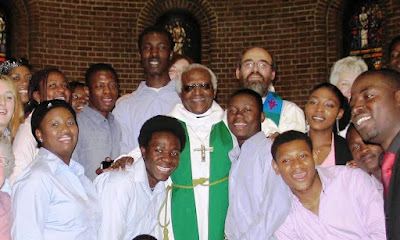
‘The most awful thing that they can do is to kill me, and death is not the worst thing that could happen to a Christian’ … Archbishop Desmond Tutu visiting Saint George’s and Saint Thomas’s Church, Dublin, and the Discovery Gospel Choir

Today’s Prayers (Sunday 21 June 2026, Trinity III, Fathers Day):

In Pray with the World Church, the prayer diary of the Anglican mission agency USPG (United Society Partners in the Gospel), the theme this week, from 21 to 27 June 2026 (pp 12-13), is ‘Land Taken, Land Remembered’. This theme is introduced today with a reflection by the Venerable Rosalyn Kantlaht’ant Elm, Director of Indigenous Ministries, Anglican Church of Canada:

When I think about how land was taken from Indigenous communities in Canada, I see that it was not the work of one person or a single event. It happened slowly, over more than four hundred years. In the early days of European settlement, Indigenous peoples and settlers often lived and worked alongside one another. Though imperfect, there was a time of coexistence.

As Canada developed, laws such as the Civilization Act and the Indian Act enabled the government to take Indigenous lands and move our people onto reserves – fenced-in areas often far from our traditional territories, languages, medicines, ceremonies, and rituals. This process unfolded over generations. Today, Indigenous peoples occupy only a small fraction of our original lands. Much of the rest remains under treaty dispute or is unceded territory, often threatened by mining, forestry, and oil and gas development.

Churches also played a significant role. In partnership with the government, they sought to ‘civilise’ Indigenous children, attempting to erase our cultures. In doing so, they became complicit in what can rightly be described as a legislative form of cultural genocide.

These truths are difficult to speak and to hear. But just as Christians cannot have Easter without Good Friday, we cannot skip the hard history and move straight to celebration. Facing these truths together allows us to lament, to pray, and to understand ourselves not by what we own, but as people created by God, called to care for one another and for the land.

The USPG prayer diary today (Sunday 21 June 2026, Trinity III, Fathers Day, National Indigenous Peoples Day, Canada) invites us to pray:

Creator God, from you every family in heaven and earth takes its name. Rooted and grounded in your covenant love, empowered by your Spirit, help us speak the truth in love and walk in your way towards justice and wholeness. (Anglican Church of Canada)

The Collect of the Day:

Almighty God,
you have broken the tyranny of sin
and have sent the Spirit of your Son into our hearts
whereby we call you Father:
give us grace to dedicate our freedom to your service,
that we and all creation may be brought
to the glorious liberty of the children of God;
through Jesus Christ your Son our Lord,
who is alive and reigns with you,
in the unity of the Holy Spirit,
one God, now and for ever.

The Post-Communion Prayer:

O God, whose beauty is beyond our imagining
and whose power we cannot comprehend:
show us your glory as far as we can grasp it,
and shield us from knowing more than we can bear
until we may look upon you without fear;
through Jesus Christ our Saviour.

Additional Collect:

God our saviour,
look on this wounded world
in pity and in power;
hold us fast to your promises of peace
won for us by your Son,
our Saviour Jesus Christ.

Yesterday’s Reflections

Continued Tomorrow

‘Whoever does not take up the cross and follow me is not worthy of me’ (Matthew 10: 37) … Christ is given his cross, a fresco in Analipsi Church in Georgioupoli, Crete (Photograph: Patrick Comerford)

Scripture quotations are from the New Revised Standard Version Bible: Anglicised Edition copyright © 1989, 1995, National Council of the Churches of Christ in the United States of America. Used by permission. All rights reserved worldwide. http://nrsvbibles.org


‘Are not two sparrows sold for a penny? … you are of more value than many sparrows’ (Matthew 10: 29-30) … a mother sparrow feds her chicks in a church in the ceiling of Aghias Anna Church, Maroulas, near Rethymnon in Crete (Patrick Comerford)