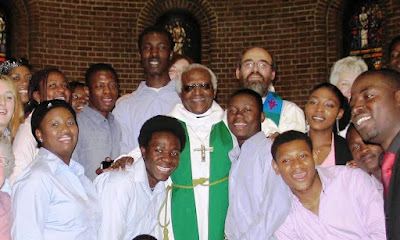
‘But you know, death is not the worst thing that could happen to a Christian’ … with Archbishop Desmond Tutu and members of the Discovery Gospel Choir in Dublin in 2005
Patrick Comerford
We are in Ordinary Time in the Church Calendar and tomorrow is the Sixth Sunday after Trinity (Trinity VI, 12 July 2026). The Calendar of the Church of England in Common Worship today remembers the life and witness of Saint Benedict of Nursia (550), Abbot of Monte Cassino and Father of Western Monasticism.
I may not venture out to the festival in the cricket club later today. But, before I make any decisions about what to do today, I am taking some quiet time this morning to give thanks, to reflect, to pray and to read in these ways:
1, reading today’s Gospel reading;
2, a short reflection;
3, a prayer from the USPG prayer diary;
4, the Collects and Post-Communion prayer of the day.
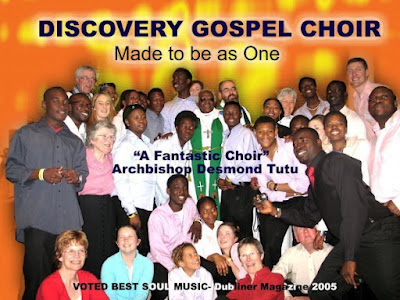
‘But you know, death is not the worst thing that could happen to a Christian’ … with Archbishop Desmond Tutu on the cover of a Discovery Gospel Choir CD
Matthew 10: 24-33 (NRSVA):
[Jesus said:] 24 ‘A disciple is not above the teacher, nor a slave above the master; 25 it is enough for the disciple to be like the teacher, and the slave like the master. If they have called the master of the house Beelzebul, how much more will they malign those of his household!
26 ‘So have no fear of them; for nothing is covered up that will not be uncovered, and nothing secret that will not become known. 27 What I say to you in the dark, tell in the light; and what you hear whispered, proclaim from the housetops. 28 Do not fear those who kill the body but cannot kill the soul; rather fear him who can destroy both soul and body in hell. 29 Are not two sparrows sold for a penny? Yet not one of them will fall to the ground unperceived by your Father. 30 And even the hairs of your head are all counted. 31 So do not be afraid; you are of more value than many sparrows.
32 ‘Everyone therefore who acknowledges me before others, I also will acknowledge before my Father in heaven; 33 but whoever denies me before others, I also will deny before my Father in heaven.’
‘What I say to you in the dark, tell in the light …’ (Matthew 10: 27) … 30 seconds of calm at Platanias in Rethymnon, Crete (Patrick Comerford)
Today’s Reflections:
When the late Archbishop Desmond Tutu (1931-2021) received the Nobel Peace Prize in 1984, I profiled him for The Irish Times. We had met previously, at events co-hosted by AfrI and Christian CND and at dinner in Roebuck House, Seán MacBride’s house in Clonskeagh, Dublin.
I asked him about the death threats he faced in South Africa at the height of apartheid. He engaged me with that look that confirmed his deep hope, commitment and faith, and said: ‘But you know, death is not the worst thing that could happen to a Christian.’
He must have been tempted at times to give up being a thorn in the side of the regime, to stop being a ‘turbulent priest,’ and to live a comfortable life. But his conscience would never have been comfortable.
While apartheid was still in force, Desmond Tutu became Dean of Saint Mary’s Cathedral, Johannesburg, and when I first met him he was the secretary general of the South African Council of Churches.
I was worried about the many death threats he was receiving, and I asked him how he lived with those threats. Was he worried about them? Did he ever consider modifying what he had to say because of them? His answer was similar to the one he gave when he was facing tough questioning before the regime’s Eloff Commission. He told that inquiry:
‘There is nothing the government can do to me that will stop me from being involved in what I believe God wants me to do. I do not do it because I like doing it. I do it because I am under what I believe to be the influence of God’s hand. I cannot help it. When I see injustice, I cannot keep quiet, for, as Jeremiah says, when I try to keep quiet, God’s Word burns like a fire in my breast. But what is it that they can ultimately do? The most awful thing that they can do is to kill me, and death is not the worst thing that could happen to a Christian.’
In 1987, Veritas invited me to write a short, 36-page biography of Archbishop Tutu, published as Desmond Tutu: Black Africa’s Man of Destiny. It was launched by the then Minister for Foreign Affairs, Brian Lenihan. It was a small book, hardly more than a pamphlet, but it came at an important time when both the Irish Government and the Irish Churches were becoming increasingly vocal about the evils of apartheid. It was republished in the US by Citadel (1988) and Hyperion Books (1989).
When I visited South Africa in 1990 with The Irish Times and Christian Aid, I met Archbishop Tutu in Cape Town, where once again he spoke powerfully about the changes that were beginning to take place.
Then, when my colleague Patsy McGarry was organising a monumental series of features in The Irish Times in 2000 to mark the millennium, Archbishop Tutu was one of the international contributors, along with Hans Küng, Andrew Greeley and Mary Robinson. The complete series was published by Veritas the following year as a book, Christianity, in which Part Two was my ‘Brief History of Christianity.’
I last met Archbishop Tutu when he visited Dublin in 2005, and he preached in Saint George’s and Saint Thomas’s Church in the inner city, where Canon (now Archdeacon) Katharine Poulton was then the Rector, as part of the Discovery Gospel Choir services.
His unforgettable words to me echo Christ’s words to the disciples in today’s Gospel reading: ‘Do not fear those who kill the body but cannot kill the soul; rather fear him who can destroy both soul and body in hell’ (Matthew 10: 28).
The Gospel reading at the Eucharist today (Matthew 10: 24-33) continues our readings from the commission and mission of the Twelve, as the Twelve continue to receive their instructions and commission for mission, even in the most hostile of environments.
‘What I say to you in the dark, tell in the light …’ (Matthew 10: 27) … walking through Galley Hill in Stony Stratford at night (Photograph: Patrick Comerford)
Today’s Prayers (Saturday 11 July 2026):
In Pray with the World Church, the prayer diary of the Anglican mission agency USPG (United Society Partners in the Gospel), the theme this week, from 5 to 11 July 2026 (pp 16-17), has been ‘Faith in the Midst of Fractures’. This theme was introduced last Sunday with a reflection by the Revd Godfrey Owino Adera, Anglican priest, theologian, and lecturer at Saint Paul’s University, Limuru, Kenya.
The USPG prayer diary today (Saturday 11 July 2026) invites us to pray:
God of truth and reconciliation, grant us courage to engage in difficult but necessary conversations. Where there is fear, give us boldness; where there is injustice, stir us to action; where there is brokenness, lead us toward healing and unity.
The Collect of the Day:
Eternal God,
who made Benedict a wise master
in the school of your service
and a guide to many called into community
to follow the rule of Christ:
grant that we may put your love before all else
and seek with joy the way of your commandments;
through Jesus Christ your Son our Lord,
who is alive and reigns with you,
in the unity of the Holy Spirit,
one God, now and for ever.
The Post-Communion Prayer:
Merciful God,
who gave such grace to your servant Benedict
that he served you with singleness of heart
and loved you above all things:
help us, whose communion with you
has been renewed in this sacrament,
to forsake all that holds us back from following Christ
and to grow into his likeness from glory to glory;
through Jesus Christ our Lord.
Collect on the Eve of Trinity VI:
Merciful God,
you have prepared for those who love you
such good things as pass our understanding:
pour into our hearts such love toward you
that we, loving you in all things and above all things,
may obtain your promises,
which exceed all that we can desire;
through Jesus Christ your Son our Lord,
who is alive and reigns with you,
in the unity of the Holy Spirit,
one God, now and for ever.
Collect on the Eve of Trinity VI:
O God, the protector of all who trust in you,
without whom nothing is strong, nothing is holy:
increase and multiply upon us your mercy;
that with you as our ruler and guide
we may so pass through things temporal
that we lose not our hold on things eternal;
grant this, heavenly Father,
for our Lord Jesus Christ’s sake,
who is alive and reigns with you,
in the unity of the Holy Spirit,
one God, now and for ever.
Yesterday’s reflections
Continued tomorrow
‘So do not be afraid; you are of more value than many sparrows’ (Matthew 10: 31) … Watching a mother sparrow feed her chicks in a nest in the ceiling of Aghias Anna Church, Maroulas, near Rethymnon in Crete (Patrick Comerford)
Scripture quotations are from the New Revised Standard Version Bible: Anglicised Edition copyright © 1989, 1995, National Council of the Churches of Christ in the United States of America. Used by permission. All rights reserved worldwide. http://nrsvbibles.org
Showing posts with label Apartheid. Show all posts
11 July 2026
Daily prayer in Ordinary Time 2026:
65, Saturday 11 July 2026
Labels:
Apartheid,
Benedictines,
Books,
Crete 2026,
Galley Hill,
Greece 2026,
Kenya,
Maroulas,
Mission,
Platanias,
Prayer,
Racism,
Rethymnon,
Saint Matthew's Gospel,
South Africa,
Stony Stratford,
The Irish Times,
USPG
21 June 2026
Daily prayer in Ordinary Time 2026:
45, Sunday 21 June 2026,
Third Sunday after Trinity (Trinity III)
‘Whoever does not take the cross and follow me is not worthy of me’ (Matthew 10: 38) … the Byzantine-style crucifix by Laurence King (1907-1981) in the crypt of Saint Mary le Bow on Cheapside in London (Photograph: Patrick Comerford)
Patrick Comerford
We are in Ordinary Time in the Church Calendar, and this is the Third Sunday after Trinity (Trinity III, 21 June 2026). Tomorrow is also Father’s Day and the Summer Solstice, although next Wednesday (24 June) is officially Midsummer’s Day.
I hope to be involved in the Parish Eucharist in Saint Mary and Saint Giles Church later this morning. Meanwhile, before today begins, I am taking some quiet time this morning to give thanks, to reflect, to pray and to read in these ways:
1, reading today’s Gospel reading;
2, a short reflection;
3, a prayer from the USPG prayer diary;
4, the Collects and Post-Communion prayer of the day.
‘Whoever does not take up the cross and follow me is not worthy of me’ (Matthew 10: 37) … Station 5 in the Chapel at Saint John’s Hospital, Lichfield, Simon of Cyrene helps Jesus carry the Cross (Photograph: Patrick Comerford)
Matthew 10: 24-39 (NRSVA):
[Jesus said:] 24 ‘A disciple is not above the teacher, nor a slave above the master; 25 it is enough for the disciple to be like the teacher, and the slave like the master. If they have called the master of the house Beelzebul, how much more will they malign those of his household!
26 ‘So have no fear of them; for nothing is covered up that will not be uncovered, and nothing secret that will not become known. 27 What I say to you in the dark, tell in the light; and what you hear whispered, proclaim from the housetops. 28 Do not fear those who kill the body but cannot kill the soul; rather fear him who can destroy both soul and body in hell. 29 Are not two sparrows sold for a penny? Yet not one of them will fall to the ground unperceived by your Father. 30 And even the hairs of your head are all counted. 31 So do not be afraid; you are of more value than many sparrows.
32 ‘Everyone therefore who acknowledges me before others, I also will acknowledge before my Father in heaven; 33 but whoever denies me before others, I also will deny before my Father in heaven.
34 ‘Do not think that I have come to bring peace to the earth; I have not come to bring peace, but a sword.
35 For I have come to set a man against his father,
and a daughter against her mother,
and a daughter-in-law against her mother-in-law;
36 and one’s foes will be members of one’s own household.
37 Whoever loves father or mother more than me is not worthy of me; and whoever loves son or daughter more than me is not worthy of me; 38 and whoever does not take up the cross and follow me is not worthy of me. 39 Those who find their life will lose it, and those who lose their life for my sake will find it.’
‘What I say to you in the dark, tell in the light …’ (Matthew 10: 27) … a moment of prayer in Saint Titus Church, Iraklion (Photograph: Patrick Comerford, 2025)
Today’s Reflections:
In the Gospel reading last Sunday (Matthew 9: 35 to 10: 8 or 10: 23, Sunday 14 June 2026), Christ calls the Twelve together to prepare them for their ministry and mission. In today’s Gospel reading (Matthew 10: 24-39), Christ continues to prepare the Twelve for this mission, as both their teacher and their master. They are his students, and they are to be like him, they are told, and they receive their instructions and commission for mission, even in the most hostile of environments.
When the late Archbishop Desmond Tutu (1931-2021) received the Nobel Peace Prize in 1984, I profiled him for The Irish Times. We had met previously, at events co-hosted by AfrI and Christian CND and at dinner in Roebuck House, Seán MacBride’s house in Clonskeagh, Dublin.
I asked him about the death threats he faced in South Africa at the height of apartheid. He engaged me with that look that confirmed his deep hope, commitment and faith, and said: ‘But you know, death is not the worst thing that could happen to a Christian.’
He must have been tempted at times to give up being a thorn in the side of the regime, to stop being a ‘turbulent priest,’ and to live a comfortable life. But his conscience would never have been comfortable.
While apartheid was still in force, Desmond Tutu became Dean of Saint Mary’s Cathedral in Johannesburg, and when I first met him, he was the secretary general of the South African Council of Churches.
I was worried about the many death threats he was receiving, and I asked him how he lived with those threats. Was he worried about them? Did he ever consider modifying what he had to say because of them? His answer was similar to the one he gave when he was facing tough questioning before the regime’s Eloff Commission. He told that inquiry:
‘There is nothing the government can do to me that will stop me from being involved in what I believe God wants me to do. I do not do it because I like doing it. I do it because I am under what I believe to be the influence of God’s hand. I cannot help it. When I see injustice, I cannot keep quiet, for, as Jeremiah says, when I try to keep quiet, God’s Word burns like a fire in my breast. But what is it that they can ultimately do? The most awful thing that they can do is to kill me, and death is not the worst thing that could happen to a Christian.’
In 1987, Veritas invited me to write a short, 36-page biography of Archbishop Tutu, published as Desmond Tutu: Black Africa’s Man of Destiny. It was launched by the then Minister for Foreign Affairs, Brian Lenihan. It was a small book, hardly more than a pamphlet, but it came at an important time when both the Irish Government and the Irish Churches were becoming increasingly vocal about the evils of apartheid. It was republished in the US by Citadel (1988) and Hyperion Books (1989).
When I visited South Africa in 1990 with The Irish Times and Christian Aid, I met Archbishop Tutu in Cape Town, where once again he spoke powerfully about the changes that were beginning to take place.
Then, when my colleague Patsy McGarry was organising a monumental series of features in The Irish Times in 2000 to mark the millennium, Archbishop Tutu was one of the international contributors, along with Hans Küng, Andrew Greeley and Mary Robinson. The complete series was published by Veritas the following year as a book, Christianity, in which Part Two was my ‘Brief History of Christianity.’
I last met Archbishop Tutu when he visited Dublin in 2005, and he preached in Saint George’s and Saint Thomas’s Church in the inner city, where Canon Katharine Poulton was then the Rector, as part of the Discovery Gospel Choir services.
His unforgettable words to me echo Christ’s words to the disciples in today’s Gospel reading: ‘Do not fear those who kill the body but cannot kill the soul; rather fear him who can destroy both soul and body in hell’ (Matthew 10: 28).
‘The most awful thing that they can do is to kill me, and death is not the worst thing that could happen to a Christian’ … Archbishop Desmond Tutu visiting Saint George’s and Saint Thomas’s Church, Dublin, and the Discovery Gospel Choir
Today’s Prayers (Sunday 21 June 2026, Trinity III, Fathers Day):
In Pray with the World Church, the prayer diary of the Anglican mission agency USPG (United Society Partners in the Gospel), the theme this week, from 21 to 27 June 2026 (pp 12-13), is ‘Land Taken, Land Remembered’. This theme is introduced today with a reflection by the Venerable Rosalyn Kantlaht’ant Elm, Director of Indigenous Ministries, Anglican Church of Canada:
When I think about how land was taken from Indigenous communities in Canada, I see that it was not the work of one person or a single event. It happened slowly, over more than four hundred years. In the early days of European settlement, Indigenous peoples and settlers often lived and worked alongside one another. Though imperfect, there was a time of coexistence.
As Canada developed, laws such as the Civilization Act and the Indian Act enabled the government to take Indigenous lands and move our people onto reserves – fenced-in areas often far from our traditional territories, languages, medicines, ceremonies, and rituals. This process unfolded over generations. Today, Indigenous peoples occupy only a small fraction of our original lands. Much of the rest remains under treaty dispute or is unceded territory, often threatened by mining, forestry, and oil and gas development.
Churches also played a significant role. In partnership with the government, they sought to ‘civilise’ Indigenous children, attempting to erase our cultures. In doing so, they became complicit in what can rightly be described as a legislative form of cultural genocide.
These truths are difficult to speak and to hear. But just as Christians cannot have Easter without Good Friday, we cannot skip the hard history and move straight to celebration. Facing these truths together allows us to lament, to pray, and to understand ourselves not by what we own, but as people created by God, called to care for one another and for the land.
The USPG prayer diary today (Sunday 21 June 2026, Trinity III, Fathers Day, National Indigenous Peoples Day, Canada) invites us to pray:
Creator God, from you every family in heaven and earth takes its name. Rooted and grounded in your covenant love, empowered by your Spirit, help us speak the truth in love and walk in your way towards justice and wholeness. (Anglican Church of Canada)
The Collect of the Day:
Almighty God,
you have broken the tyranny of sin
and have sent the Spirit of your Son into our hearts
whereby we call you Father:
give us grace to dedicate our freedom to your service,
that we and all creation may be brought
to the glorious liberty of the children of God;
through Jesus Christ your Son our Lord,
who is alive and reigns with you,
in the unity of the Holy Spirit,
one God, now and for ever.
The Post-Communion Prayer:
O God, whose beauty is beyond our imagining
and whose power we cannot comprehend:
show us your glory as far as we can grasp it,
and shield us from knowing more than we can bear
until we may look upon you without fear;
through Jesus Christ our Saviour.
Additional Collect:
God our saviour,
look on this wounded world
in pity and in power;
hold us fast to your promises of peace
won for us by your Son,
our Saviour Jesus Christ.
Yesterday’s Reflections
Continued Tomorrow
‘Whoever does not take up the cross and follow me is not worthy of me’ (Matthew 10: 37) … Christ is given his cross, a fresco in Analipsi Church in Georgioupoli, Crete (Photograph: Patrick Comerford)
Scripture quotations are from the New Revised Standard Version Bible: Anglicised Edition copyright © 1989, 1995, National Council of the Churches of Christ in the United States of America. Used by permission. All rights reserved worldwide. http://nrsvbibles.org
‘Are not two sparrows sold for a penny? … you are of more value than many sparrows’ (Matthew 10: 29-30) … a mother sparrow feds her chicks in a church in the ceiling of Aghias Anna Church, Maroulas, near Rethymnon in Crete (Patrick Comerford)
Patrick Comerford
We are in Ordinary Time in the Church Calendar, and this is the Third Sunday after Trinity (Trinity III, 21 June 2026). Tomorrow is also Father’s Day and the Summer Solstice, although next Wednesday (24 June) is officially Midsummer’s Day.
I hope to be involved in the Parish Eucharist in Saint Mary and Saint Giles Church later this morning. Meanwhile, before today begins, I am taking some quiet time this morning to give thanks, to reflect, to pray and to read in these ways:
1, reading today’s Gospel reading;
2, a short reflection;
3, a prayer from the USPG prayer diary;
4, the Collects and Post-Communion prayer of the day.
‘Whoever does not take up the cross and follow me is not worthy of me’ (Matthew 10: 37) … Station 5 in the Chapel at Saint John’s Hospital, Lichfield, Simon of Cyrene helps Jesus carry the Cross (Photograph: Patrick Comerford)
Matthew 10: 24-39 (NRSVA):
[Jesus said:] 24 ‘A disciple is not above the teacher, nor a slave above the master; 25 it is enough for the disciple to be like the teacher, and the slave like the master. If they have called the master of the house Beelzebul, how much more will they malign those of his household!
26 ‘So have no fear of them; for nothing is covered up that will not be uncovered, and nothing secret that will not become known. 27 What I say to you in the dark, tell in the light; and what you hear whispered, proclaim from the housetops. 28 Do not fear those who kill the body but cannot kill the soul; rather fear him who can destroy both soul and body in hell. 29 Are not two sparrows sold for a penny? Yet not one of them will fall to the ground unperceived by your Father. 30 And even the hairs of your head are all counted. 31 So do not be afraid; you are of more value than many sparrows.
32 ‘Everyone therefore who acknowledges me before others, I also will acknowledge before my Father in heaven; 33 but whoever denies me before others, I also will deny before my Father in heaven.
34 ‘Do not think that I have come to bring peace to the earth; I have not come to bring peace, but a sword.
35 For I have come to set a man against his father,
and a daughter against her mother,
and a daughter-in-law against her mother-in-law;
36 and one’s foes will be members of one’s own household.
37 Whoever loves father or mother more than me is not worthy of me; and whoever loves son or daughter more than me is not worthy of me; 38 and whoever does not take up the cross and follow me is not worthy of me. 39 Those who find their life will lose it, and those who lose their life for my sake will find it.’
‘What I say to you in the dark, tell in the light …’ (Matthew 10: 27) … a moment of prayer in Saint Titus Church, Iraklion (Photograph: Patrick Comerford, 2025)
Today’s Reflections:
In the Gospel reading last Sunday (Matthew 9: 35 to 10: 8 or 10: 23, Sunday 14 June 2026), Christ calls the Twelve together to prepare them for their ministry and mission. In today’s Gospel reading (Matthew 10: 24-39), Christ continues to prepare the Twelve for this mission, as both their teacher and their master. They are his students, and they are to be like him, they are told, and they receive their instructions and commission for mission, even in the most hostile of environments.
When the late Archbishop Desmond Tutu (1931-2021) received the Nobel Peace Prize in 1984, I profiled him for The Irish Times. We had met previously, at events co-hosted by AfrI and Christian CND and at dinner in Roebuck House, Seán MacBride’s house in Clonskeagh, Dublin.
I asked him about the death threats he faced in South Africa at the height of apartheid. He engaged me with that look that confirmed his deep hope, commitment and faith, and said: ‘But you know, death is not the worst thing that could happen to a Christian.’
He must have been tempted at times to give up being a thorn in the side of the regime, to stop being a ‘turbulent priest,’ and to live a comfortable life. But his conscience would never have been comfortable.
While apartheid was still in force, Desmond Tutu became Dean of Saint Mary’s Cathedral in Johannesburg, and when I first met him, he was the secretary general of the South African Council of Churches.
I was worried about the many death threats he was receiving, and I asked him how he lived with those threats. Was he worried about them? Did he ever consider modifying what he had to say because of them? His answer was similar to the one he gave when he was facing tough questioning before the regime’s Eloff Commission. He told that inquiry:
‘There is nothing the government can do to me that will stop me from being involved in what I believe God wants me to do. I do not do it because I like doing it. I do it because I am under what I believe to be the influence of God’s hand. I cannot help it. When I see injustice, I cannot keep quiet, for, as Jeremiah says, when I try to keep quiet, God’s Word burns like a fire in my breast. But what is it that they can ultimately do? The most awful thing that they can do is to kill me, and death is not the worst thing that could happen to a Christian.’
In 1987, Veritas invited me to write a short, 36-page biography of Archbishop Tutu, published as Desmond Tutu: Black Africa’s Man of Destiny. It was launched by the then Minister for Foreign Affairs, Brian Lenihan. It was a small book, hardly more than a pamphlet, but it came at an important time when both the Irish Government and the Irish Churches were becoming increasingly vocal about the evils of apartheid. It was republished in the US by Citadel (1988) and Hyperion Books (1989).
When I visited South Africa in 1990 with The Irish Times and Christian Aid, I met Archbishop Tutu in Cape Town, where once again he spoke powerfully about the changes that were beginning to take place.
Then, when my colleague Patsy McGarry was organising a monumental series of features in The Irish Times in 2000 to mark the millennium, Archbishop Tutu was one of the international contributors, along with Hans Küng, Andrew Greeley and Mary Robinson. The complete series was published by Veritas the following year as a book, Christianity, in which Part Two was my ‘Brief History of Christianity.’
I last met Archbishop Tutu when he visited Dublin in 2005, and he preached in Saint George’s and Saint Thomas’s Church in the inner city, where Canon Katharine Poulton was then the Rector, as part of the Discovery Gospel Choir services.
His unforgettable words to me echo Christ’s words to the disciples in today’s Gospel reading: ‘Do not fear those who kill the body but cannot kill the soul; rather fear him who can destroy both soul and body in hell’ (Matthew 10: 28).
‘The most awful thing that they can do is to kill me, and death is not the worst thing that could happen to a Christian’ … Archbishop Desmond Tutu visiting Saint George’s and Saint Thomas’s Church, Dublin, and the Discovery Gospel Choir
Today’s Prayers (Sunday 21 June 2026, Trinity III, Fathers Day):
In Pray with the World Church, the prayer diary of the Anglican mission agency USPG (United Society Partners in the Gospel), the theme this week, from 21 to 27 June 2026 (pp 12-13), is ‘Land Taken, Land Remembered’. This theme is introduced today with a reflection by the Venerable Rosalyn Kantlaht’ant Elm, Director of Indigenous Ministries, Anglican Church of Canada:
When I think about how land was taken from Indigenous communities in Canada, I see that it was not the work of one person or a single event. It happened slowly, over more than four hundred years. In the early days of European settlement, Indigenous peoples and settlers often lived and worked alongside one another. Though imperfect, there was a time of coexistence.
As Canada developed, laws such as the Civilization Act and the Indian Act enabled the government to take Indigenous lands and move our people onto reserves – fenced-in areas often far from our traditional territories, languages, medicines, ceremonies, and rituals. This process unfolded over generations. Today, Indigenous peoples occupy only a small fraction of our original lands. Much of the rest remains under treaty dispute or is unceded territory, often threatened by mining, forestry, and oil and gas development.
Churches also played a significant role. In partnership with the government, they sought to ‘civilise’ Indigenous children, attempting to erase our cultures. In doing so, they became complicit in what can rightly be described as a legislative form of cultural genocide.
These truths are difficult to speak and to hear. But just as Christians cannot have Easter without Good Friday, we cannot skip the hard history and move straight to celebration. Facing these truths together allows us to lament, to pray, and to understand ourselves not by what we own, but as people created by God, called to care for one another and for the land.
The USPG prayer diary today (Sunday 21 June 2026, Trinity III, Fathers Day, National Indigenous Peoples Day, Canada) invites us to pray:
Creator God, from you every family in heaven and earth takes its name. Rooted and grounded in your covenant love, empowered by your Spirit, help us speak the truth in love and walk in your way towards justice and wholeness. (Anglican Church of Canada)
The Collect of the Day:
Almighty God,
you have broken the tyranny of sin
and have sent the Spirit of your Son into our hearts
whereby we call you Father:
give us grace to dedicate our freedom to your service,
that we and all creation may be brought
to the glorious liberty of the children of God;
through Jesus Christ your Son our Lord,
who is alive and reigns with you,
in the unity of the Holy Spirit,
one God, now and for ever.
The Post-Communion Prayer:
O God, whose beauty is beyond our imagining
and whose power we cannot comprehend:
show us your glory as far as we can grasp it,
and shield us from knowing more than we can bear
until we may look upon you without fear;
through Jesus Christ our Saviour.
Additional Collect:
God our saviour,
look on this wounded world
in pity and in power;
hold us fast to your promises of peace
won for us by your Son,
our Saviour Jesus Christ.
Yesterday’s Reflections
Continued Tomorrow
‘Whoever does not take up the cross and follow me is not worthy of me’ (Matthew 10: 37) … Christ is given his cross, a fresco in Analipsi Church in Georgioupoli, Crete (Photograph: Patrick Comerford)
Scripture quotations are from the New Revised Standard Version Bible: Anglicised Edition copyright © 1989, 1995, National Council of the Churches of Christ in the United States of America. Used by permission. All rights reserved worldwide. http://nrsvbibles.org
‘Are not two sparrows sold for a penny? … you are of more value than many sparrows’ (Matthew 10: 29-30) … a mother sparrow feds her chicks in a church in the ceiling of Aghias Anna Church, Maroulas, near Rethymnon in Crete (Patrick Comerford)
Labels:
Apartheid,
Canada,
CND,
Crete 2026,
Father's Day,
Georgioupoli,
Greece 2026,
Iraklion,
Lichfield,
Maroulas,
Mission,
Prayer,
Rethymnon,
Saint Matthew's Gospel,
South Africa,
The Irish Times,
USPG
12 July 2025
Daily prayer in Ordinary Time 2025:
64, Saturday 12 July 2025
‘But you know, death is not the worst thing that could happen to a Christian’ … with Archbishop Desmond Tutu and members of the Discovery Gospel Choir in Dublin in 2005
Patrick Comerford
We are in Ordinary Time in the Church Calendar and tomorrow is the Fourth Sunday after Trinity (Trinity IV, 13 July 2025).
I am back in Stony Stratford after yesterday’s surgical procedure in Oxford, and I am feeling a little sorry for myself this morning. I may not venture out to the festival in the cricket club later this morning. But, before I make any decisions about what to do today, I am taking some quiet time this morning to give thanks, to reflect, to pray and to read in these ways:
1, reading today’s Gospel reading;
2, a short reflection;
3, a prayer from the USPG prayer diary;
4, the Collects and Post-Communion prayer of the day.
‘But you know, death is not the worst thing that could happen to a Christian’ … with Archbishop Desmond Tutu on the cover of a Discovery Gospel Choir CD
Matthew 10: 24-33 (NRSVA):
[Jesus said:] 24 ‘A disciple is not above the teacher, nor a slave above the master; 25 it is enough for the disciple to be like the teacher, and the slave like the master. If they have called the master of the house Beelzebul, how much more will they malign those of his household!
26 ‘So have no fear of them; for nothing is covered up that will not be uncovered, and nothing secret that will not become known. 27 What I say to you in the dark, tell in the light; and what you hear whispered, proclaim from the housetops. 28 Do not fear those who kill the body but cannot kill the soul; rather fear him who can destroy both soul and body in hell. 29 Are not two sparrows sold for a penny? Yet not one of them will fall to the ground unperceived by your Father. 30 And even the hairs of your head are all counted. 31 So do not be afraid; you are of more value than many sparrows.
32 ‘Everyone therefore who acknowledges me before others, I also will acknowledge before my Father in heaven; 33 but whoever denies me before others, I also will deny before my Father in heaven.’
‘What I say to you in the dark, tell in the light …’ (Matthew 10: 27) … a moment of prayer in Saint Titus Church, Iraklion (Photograph: Patrick Comerford, 2025)
Today’s Reflection:
When the late Archbishop Desmond Tutu (1931-2021) received the Nobel Peace Prize in 1984, I profiled him for The Irish Times. We had met previously, at events co-hosted by AfrI and Christian CND and at dinner in Roebuck House, Seán MacBride’s house in Clonskeagh, Dublin.
I asked him about the death threats he faced in South Africa at the height of apartheid. He engaged me with that look that confirmed his deep hope, commitment and faith, and said: ‘But you know, death is not the worst thing that could happen to a Christian.’
He must have been tempted at times to give up being a thorn in the side of the regime, to stop being a ‘turbulent priest,’ and to live a comfortable life. But his conscience would never have been comfortable.
While apartheid was still in force, Desmond Tutu became Dean of Saint Mary’s Cathedral in Johannesburg, and when I first met him, he was the secretary general of the South African Council of Churches.
I was worried about the many death threats he was receiving, and I asked him how he lived with those threats. Was he worried about them? Did he ever consider modifying what he had to say because of them? His answer was similar to the one he gave when he was facing tough questioning before the regime’s Eloff Commission. He told that inquiry:
‘There is nothing the government can do to me that will stop me from being involved in what I believe God wants me to do. I do not do it because I like doing it. I do it because I am under what I believe to be the influence of God’s hand. I cannot help it. When I see injustice, I cannot keep quiet, for, as Jeremiah says, when I try to keep quiet, God’s Word burns like a fire in my breast. But what is it that they can ultimately do? The most awful thing that they can do is to kill me, and death is not the worst thing that could happen to a Christian.’
In 1987, Veritas invited me to write a short, 36-page biography of Archbishop Tutu, published as Desmond Tutu: Black Africa’s Man of Destiny. It was launched by the then Minister for Foreign Affairs, Brian Lenihan. It was a small book, hardly more than a pamphlet, but it came at an important time when both the Irish Government and the Irish Churches were becoming increasingly vocal about the evils of apartheid. It was republished in the US by Citadel (1988) and Hyperion Books (1989).
When I visited South Africa in 1990 with The Irish Times and Christian Aid, I met Archbishop Tutu in Cape Town, where once again he spoke powerfully about the changes that were beginning to take place.
Then, when my colleague Patsy McGarry was organising a monumental series of features in The Irish Times in 2000 to mark the millennium, Archbishop Tutu was one of the international contributors, along with Hans Küng, Andrew Greeley and Mary Robinson. The complete series was published by Veritas the following year as a book, Christianity, in which Part Two was my ‘Brief History of Christianity.’
I last met Archbishop Tutu when he visited Dublin in 2005, and he preached in Saint George’s and Saint Thomas’s Church in the inner city, where Canon Katharine Poulton was then the Rector, as part of the Discovery Gospel Choir services.
His unforgettable words to me echo Christ’s words to the disciples in today’s Gospel reading: ‘Do not fear those who kill the body but cannot kill the soul; rather fear him who can destroy both soul and body in hell’ (Matthew 10: 28).
The Gospel reading at the Eucharist today (Matthew 10: 24-33) continues our readings from the commission and mission of the Twelve, as the Twelve continue to receive their instructions and commission for mission, even in the most hostile of environments.
‘What I say to you in the dark, tell in the light …’ (Matthew 10: 27) … walking through Galley Hill in Stony Stratford at night (Photograph: Patrick Comerford)
Today’s Prayers (Saturday 12 July 2025):
The theme this week (6 to 12 July) in Pray with the World Church, the prayer diary of the Anglican mission agency USPG (United Society Partners in the Gospel), has been ‘Following in the Footsteps of Saint Thomas.’ This theme was introduced last Sunday with a programme update from the Revd Mark Woodrow, USPG Bishop’s Nominee for St Edmundsbury and Ipswich and Parish Priest and Rural Dean in Suffolk.
The USPG prayer diary today (Saturday 12 July 2025) invites us to pray:
Merciful God, bless the Church’s hands that serve, offering relief and hope. Empower our sisters and brothers to break oppressive cycles of need and bring your justice and compassion to all.
The Collect:
Almighty God,
you have broken the tyranny of sin
and have sent the Spirit of your Son into our hearts
whereby we call you Father:
give us grace to dedicate our freedom to your service,
that we and all creation may be brought
to the glorious liberty of the children of God;
through Jesus Christ your Son our Lord,
who is alive and reigns with you,
in the unity of the Holy Spirit,
one God, now and for ever.
The Post-Communion Prayer:
O God, whose beauty is beyond our imagining
and whose power we cannot comprehend:
show us your glory as far as we can grasp it,
and shield us from knowing more than we can bear
until wemay look upon you without fear;
through Jesus Christ our Saviour.
Additional Collect:
God our saviour,
look on this wounded world
in pity and in power;
hold us fast to your promises of peace
won for us by your Son,
our Saviour Jesus Christ.
Collect on the Eve of Trinity IV:
O God, the protector of all who trust in you,
without whom nothing is strong, nothing is holy:
increase and multiply upon us your mercy;
that with you as our ruler and guide
we may so pass through things temporal
that we lose not our hold on things eternal;
grant this, heavenly Father,
for our Lord Jesus Christ’s sake,
who is alive and reigns with you,
in the unity of the Holy Spirit,
one God, now and for ever.
Yesterday’s reflections
Continued tomorrow
‘So do not be afraid; you are of more value than many sparrows’ (Matthew 10: 31) … a mother bird feeds her chicks in a nest in Stony Stratford (Patrick Comerford, 2025)
Scripture quotations are from the New Revised Standard Version Bible: Anglicised Edition copyright © 1989, 1995, National Council of the Churches of Christ in the United States of America. Used by permission. All rights reserved worldwide. http://nrsvbibles.org
Patrick Comerford
We are in Ordinary Time in the Church Calendar and tomorrow is the Fourth Sunday after Trinity (Trinity IV, 13 July 2025).
I am back in Stony Stratford after yesterday’s surgical procedure in Oxford, and I am feeling a little sorry for myself this morning. I may not venture out to the festival in the cricket club later this morning. But, before I make any decisions about what to do today, I am taking some quiet time this morning to give thanks, to reflect, to pray and to read in these ways:
1, reading today’s Gospel reading;
2, a short reflection;
3, a prayer from the USPG prayer diary;
4, the Collects and Post-Communion prayer of the day.
‘But you know, death is not the worst thing that could happen to a Christian’ … with Archbishop Desmond Tutu on the cover of a Discovery Gospel Choir CD
Matthew 10: 24-33 (NRSVA):
[Jesus said:] 24 ‘A disciple is not above the teacher, nor a slave above the master; 25 it is enough for the disciple to be like the teacher, and the slave like the master. If they have called the master of the house Beelzebul, how much more will they malign those of his household!
26 ‘So have no fear of them; for nothing is covered up that will not be uncovered, and nothing secret that will not become known. 27 What I say to you in the dark, tell in the light; and what you hear whispered, proclaim from the housetops. 28 Do not fear those who kill the body but cannot kill the soul; rather fear him who can destroy both soul and body in hell. 29 Are not two sparrows sold for a penny? Yet not one of them will fall to the ground unperceived by your Father. 30 And even the hairs of your head are all counted. 31 So do not be afraid; you are of more value than many sparrows.
32 ‘Everyone therefore who acknowledges me before others, I also will acknowledge before my Father in heaven; 33 but whoever denies me before others, I also will deny before my Father in heaven.’
‘What I say to you in the dark, tell in the light …’ (Matthew 10: 27) … a moment of prayer in Saint Titus Church, Iraklion (Photograph: Patrick Comerford, 2025)
Today’s Reflection:
When the late Archbishop Desmond Tutu (1931-2021) received the Nobel Peace Prize in 1984, I profiled him for The Irish Times. We had met previously, at events co-hosted by AfrI and Christian CND and at dinner in Roebuck House, Seán MacBride’s house in Clonskeagh, Dublin.
I asked him about the death threats he faced in South Africa at the height of apartheid. He engaged me with that look that confirmed his deep hope, commitment and faith, and said: ‘But you know, death is not the worst thing that could happen to a Christian.’
He must have been tempted at times to give up being a thorn in the side of the regime, to stop being a ‘turbulent priest,’ and to live a comfortable life. But his conscience would never have been comfortable.
While apartheid was still in force, Desmond Tutu became Dean of Saint Mary’s Cathedral in Johannesburg, and when I first met him, he was the secretary general of the South African Council of Churches.
I was worried about the many death threats he was receiving, and I asked him how he lived with those threats. Was he worried about them? Did he ever consider modifying what he had to say because of them? His answer was similar to the one he gave when he was facing tough questioning before the regime’s Eloff Commission. He told that inquiry:
‘There is nothing the government can do to me that will stop me from being involved in what I believe God wants me to do. I do not do it because I like doing it. I do it because I am under what I believe to be the influence of God’s hand. I cannot help it. When I see injustice, I cannot keep quiet, for, as Jeremiah says, when I try to keep quiet, God’s Word burns like a fire in my breast. But what is it that they can ultimately do? The most awful thing that they can do is to kill me, and death is not the worst thing that could happen to a Christian.’
In 1987, Veritas invited me to write a short, 36-page biography of Archbishop Tutu, published as Desmond Tutu: Black Africa’s Man of Destiny. It was launched by the then Minister for Foreign Affairs, Brian Lenihan. It was a small book, hardly more than a pamphlet, but it came at an important time when both the Irish Government and the Irish Churches were becoming increasingly vocal about the evils of apartheid. It was republished in the US by Citadel (1988) and Hyperion Books (1989).
When I visited South Africa in 1990 with The Irish Times and Christian Aid, I met Archbishop Tutu in Cape Town, where once again he spoke powerfully about the changes that were beginning to take place.
Then, when my colleague Patsy McGarry was organising a monumental series of features in The Irish Times in 2000 to mark the millennium, Archbishop Tutu was one of the international contributors, along with Hans Küng, Andrew Greeley and Mary Robinson. The complete series was published by Veritas the following year as a book, Christianity, in which Part Two was my ‘Brief History of Christianity.’
I last met Archbishop Tutu when he visited Dublin in 2005, and he preached in Saint George’s and Saint Thomas’s Church in the inner city, where Canon Katharine Poulton was then the Rector, as part of the Discovery Gospel Choir services.
His unforgettable words to me echo Christ’s words to the disciples in today’s Gospel reading: ‘Do not fear those who kill the body but cannot kill the soul; rather fear him who can destroy both soul and body in hell’ (Matthew 10: 28).
The Gospel reading at the Eucharist today (Matthew 10: 24-33) continues our readings from the commission and mission of the Twelve, as the Twelve continue to receive their instructions and commission for mission, even in the most hostile of environments.
‘What I say to you in the dark, tell in the light …’ (Matthew 10: 27) … walking through Galley Hill in Stony Stratford at night (Photograph: Patrick Comerford)
Today’s Prayers (Saturday 12 July 2025):
The theme this week (6 to 12 July) in Pray with the World Church, the prayer diary of the Anglican mission agency USPG (United Society Partners in the Gospel), has been ‘Following in the Footsteps of Saint Thomas.’ This theme was introduced last Sunday with a programme update from the Revd Mark Woodrow, USPG Bishop’s Nominee for St Edmundsbury and Ipswich and Parish Priest and Rural Dean in Suffolk.
The USPG prayer diary today (Saturday 12 July 2025) invites us to pray:
Merciful God, bless the Church’s hands that serve, offering relief and hope. Empower our sisters and brothers to break oppressive cycles of need and bring your justice and compassion to all.
The Collect:
Almighty God,
you have broken the tyranny of sin
and have sent the Spirit of your Son into our hearts
whereby we call you Father:
give us grace to dedicate our freedom to your service,
that we and all creation may be brought
to the glorious liberty of the children of God;
through Jesus Christ your Son our Lord,
who is alive and reigns with you,
in the unity of the Holy Spirit,
one God, now and for ever.
The Post-Communion Prayer:
O God, whose beauty is beyond our imagining
and whose power we cannot comprehend:
show us your glory as far as we can grasp it,
and shield us from knowing more than we can bear
until wemay look upon you without fear;
through Jesus Christ our Saviour.
Additional Collect:
God our saviour,
look on this wounded world
in pity and in power;
hold us fast to your promises of peace
won for us by your Son,
our Saviour Jesus Christ.
Collect on the Eve of Trinity IV:
O God, the protector of all who trust in you,
without whom nothing is strong, nothing is holy:
increase and multiply upon us your mercy;
that with you as our ruler and guide
we may so pass through things temporal
that we lose not our hold on things eternal;
grant this, heavenly Father,
for our Lord Jesus Christ’s sake,
who is alive and reigns with you,
in the unity of the Holy Spirit,
one God, now and for ever.
Yesterday’s reflections
Continued tomorrow
‘So do not be afraid; you are of more value than many sparrows’ (Matthew 10: 31) … a mother bird feeds her chicks in a nest in Stony Stratford (Patrick Comerford, 2025)
Scripture quotations are from the New Revised Standard Version Bible: Anglicised Edition copyright © 1989, 1995, National Council of the Churches of Christ in the United States of America. Used by permission. All rights reserved worldwide. http://nrsvbibles.org
16 March 2025
Daily prayer in Lent 2025:
12, Sunday 16 March 2025,
Second Sunday in Lent (Lent II)
‘How often have I desired to gather your children together as a hen gathers her brood under her wings’ (Luke 13: 34) … a painting of Grey’s Guest House on Achill Island, Co Mayo (Photograph: Patrick Comerford)
Patrick Comerford
We are now well into Lent, which began on Ash Wednesday, and today is the Second Sunday in Lent (Lent II, 16 March 2025).
The Six Nations championship came to a climax yesterday with the last three fixtures, and each successive match yesterday was a nail-biting decider in its own way. Tomorrow is Saint Patrick’s Day (17 March 2025).
Later this morning, I hope to sing with the choir at the Parish Eucharist in Saint Mary and Saint Giles Church, Stony Stratford. But, before today begins, I am taking some quiet time this morning to give thanks, to reflect, to pray and to read in these ways:
1, reading today’s Gospel reading;
2, a short reflection;
3, a prayer from the USPG prayer diary;
4, the Collects and Post-Communion prayer of the day.
‘How often have I desired to gather your children together as a hen gathers her brood under her wings’ (Luke 13: 34) … farmyard hens in Co Wicklow (Photograph: Patrick Comerford)
Luke 13: 31-35 (NRSVA):
31 At that very hour some Pharisees came and said to him, ‘Get away from here, for Herod wants to kill you.’ 32 He said to them, ‘Go and tell that fox for me, “Listen, I am casting out demons and performing cures today and tomorrow, and on the third day I finish my work. 33 Yet today, tomorrow, and the next day I must be on my way, because it is impossible for a prophet to be killed away from Jerusalem.” 34 Jerusalem, Jerusalem, the city that kills the prophets and stones those who are sent to it! How often have I desired to gather your children together as a hen gathers her brood under her wings, and you were not willing! 35 See, your house is left to you. And I tell you, you will not see me until the time comes when you say, “Blessed is the one who comes in the name of the Lord”.’
‘Jerusalem, Jerusalem … How often have I desired to gather your children together’ (Luke 13: 34) … the city of Jerusalem depicted on a tile in a restaurant in Dublin (Photograph: Patrick Comerford)
Today’s Reflection:
In my private meditations and prayers, I often reflect on words from Samuel Johnson from Lichfield, who compiled the first English-language dictionary but who is also often regarded as one of the great Anglican saints of the 18th century. Thinking about the stars at night, the great tragedies in the world and the unbounded love of God, Dr Johnson once wrote:
‘The pensive man at one time walks ‘unseen’ to muse at midnight, and at another hears the sullen curfew. If the weather drives him home he sits in a room lighted only by ‘glowing embers’; or by a lonely lamp outwatches the North Star to discover the habitation of separate souls, and varies the shades of meditation by contemplating the magnificent or pathetick scenes of tragick and epick poetry.’
I sometimes found as I stood presiding at or celebrating the Holy Communion or the Eucharist that I am taken aback by intense feelings of the love of God.
On one memorable occasion, this happened to me as I was using the ‘Prayer of Humble Access’ at the fraction, when we were breaking the Bread of Communion at the invitation.
It is a prayer that has gone out of fashion in many parishes, but it is a reminder that we come to the Table or the Altar not because of our own goodness, not in spite of our own sinfulness, but because of the overflowing mercy and grace that God gives us freely and with unlimited bounty:
We do not presume to come to this your table,
merciful Lord,
trusting in our own righteousness
but in your manifold and great mercies.
We are not worthy so much as to gather up the crumbs under your table.
But you art the same Lord,
whose nature is always to have mercy.
Grant us, therefore, gracious Lord,
so to eat the flesh of your dear Son Jesus Christ,
and to drink his blood,
that our sinful bodies may be made clean by his body,
and our souls washed through his most precious blood,
and that we may evermore dwell in him, and he in us. Amen.
I was taken aback and was conscious of the love of God unexpectedly as I came to those words: ‘We are not worthy so much as to gather up the crumbs under your table.’
What flashed across my mind was a video clip that had gone viral at that time on YouTube and social media, of two small, frail abandoned children caught up in the bloody civil war in Syria, fending for themselves by picking up crumbs of bread from the street to eat.
These two homeless mites, who were braver than any groups fighting or waging war in Syria, told the camera crew: ‘We go to sleep hungry, we wake up hungry.’
They had been separated from their parents. At the time, the Anglican mission agency, USPG, was working with the plight of Syrian refugees in Lesvos and Athens and other parts of Greece.
In that video clip, the 10-year-old girl said she had been collecting bread crumbs off the street with her brother because their area of Damascus, al-Hajar, has been under siege for more than 15 months.
‘If we had food, you wouldn’t have seen us here,’ she said.
But their final message to the world that had abandoned them was: ‘May you be happy and blessed with what God has given you!’
Europe takes pity on children like this when we see them on YouTube or on the 10 o’clock news. But when they land on the shores of the Aegean Islands in Greece, or make their way up through central Europe and cross the Channel into England, we deem them not worthy to gather up the crumbs under our table.
I have looked at this video clip again and again since then. And I think of the image of Christ in the Gospel reading this morning:
‘How often have I desired to gather your children together as a hen gathers her brood under her wings, and you were not willing!’ (Luke 13: 34)
The children of the world are the future of the world. It does not matter whose children they are. It does not matter how many of them there are: whether they are two children searching for crumbs that I am not worthy to gather up, or small enough to be gathered in by a loving parent, or are countless in numbers like the stars, they are all embraced in the love of the loving and living God. They are all heirs to God’s promises.
And how we respond to them, how I respond to them, shows them what I think, what we think, of God and how much we believe in his promises.
Today’s Prayers (Sunday 16 March 2025):
The theme this week in ‘Pray With the World Church’, the Prayer Diary of the Anglican mission agency USPG (United Society Partners in the Gospel), is ‘Truth: The Path to Reconciliation’. This theme is introduced today with a programme update by Rachel Weller, Communications Officer, USPG:
‘We each have the power to change our world. We’re not all going to be Nobel Peace Prize winners and we’re not all going to have books written about our lives. But we all can impact someone’s life in a positive way.’
This is just some of the wisdom shared by the Revd Nontombi Tutu, Episcopal priest and human rights activist, as she led our inaugural Desmond Tutu Memorial Lecture on ‘Truth, the Path to Reconciliation’ held at York Minster.
She shared about the importance of being truthful; about our history, our own roles in societal ills and the power that we each must make change. To this end, she referenced a particular testimony that stood out to her during a hearing of Truth and Reconciliation Commission – a legal body tasked with exposing human rights abuses and promoting reconciliation after apartheid.
The letter, written by a young, white South African, read: ‘I didn’t know about policing in black classrooms. I didn’t know what my government was doing to my black compatriots. I didn’t know … and I recognise that part of me chose not to know’. So often, we stop at what we don’t know and brush things aside. How much more powerful is it, therefore, to courageously listen and speak the truth in love.
The USPG Prayer Diary today (Sunday 16 March 2025) invites us to pray, reflecting on these words:
‘Finally, brothers and sisters, we ask and urge you in the Lord Jesus that, as you learned from us how you ought to live and to please God (as, in fact, you are doing), you should do so more and more’ (I Thessalonians 4: 1).
The Collect:
Almighty God,
you show to those who are in error the light of your truth,
that they may return to the way of righteousness:
grant to all those who are admitted
into the fellowship of Christ’s religion,
that they may reject those things
that are contrary to their profession,
and follow all such things as are agreeable to the same;
through our Lord Jesus Christ,
who is alive and reigns with you,
in the unity of the Holy Spirit,
one God, now and for ever.
The Post Communion Prayer:
Almighty God,
you see that we have no power of ourselves to help ourselves:
keep us both outwardly in our bodies,
and inwardly in our souls;
that we may be defended from all adversities
which may happen to the body,
and from all evil thoughts which may assault and hurt the soul;
through Jesus Christ our Lord.
Additional Collect:
Almighty God,
by the prayer and discipline of Lent
may we enter into the mystery of Christ’s sufferings,
and by following in his Way
come to share in his glory;
through Jesus Christ our Lord.
Yesterday’s Reflection
Continued Tomorrow
‘We are not worthy so much as to gather up the crumbs under your table’ (the Prayer of Humble Access) … preparing bread for the Eucharist early on a Sunday morning (Photograph: Patrick Comerford)
Scripture quotations are from the New Revised Standard Version Bible: Anglicised Edition copyright © 1989, 1995 National Council of the Churches of Christ in the United States of America. Used by permission. All rights reserved worldwide. http://nrsvbibles.org
Patrick Comerford
We are now well into Lent, which began on Ash Wednesday, and today is the Second Sunday in Lent (Lent II, 16 March 2025).
The Six Nations championship came to a climax yesterday with the last three fixtures, and each successive match yesterday was a nail-biting decider in its own way. Tomorrow is Saint Patrick’s Day (17 March 2025).
Later this morning, I hope to sing with the choir at the Parish Eucharist in Saint Mary and Saint Giles Church, Stony Stratford. But, before today begins, I am taking some quiet time this morning to give thanks, to reflect, to pray and to read in these ways:
1, reading today’s Gospel reading;
2, a short reflection;
3, a prayer from the USPG prayer diary;
4, the Collects and Post-Communion prayer of the day.
‘How often have I desired to gather your children together as a hen gathers her brood under her wings’ (Luke 13: 34) … farmyard hens in Co Wicklow (Photograph: Patrick Comerford)
Luke 13: 31-35 (NRSVA):
31 At that very hour some Pharisees came and said to him, ‘Get away from here, for Herod wants to kill you.’ 32 He said to them, ‘Go and tell that fox for me, “Listen, I am casting out demons and performing cures today and tomorrow, and on the third day I finish my work. 33 Yet today, tomorrow, and the next day I must be on my way, because it is impossible for a prophet to be killed away from Jerusalem.” 34 Jerusalem, Jerusalem, the city that kills the prophets and stones those who are sent to it! How often have I desired to gather your children together as a hen gathers her brood under her wings, and you were not willing! 35 See, your house is left to you. And I tell you, you will not see me until the time comes when you say, “Blessed is the one who comes in the name of the Lord”.’
‘Jerusalem, Jerusalem … How often have I desired to gather your children together’ (Luke 13: 34) … the city of Jerusalem depicted on a tile in a restaurant in Dublin (Photograph: Patrick Comerford)
Today’s Reflection:
In my private meditations and prayers, I often reflect on words from Samuel Johnson from Lichfield, who compiled the first English-language dictionary but who is also often regarded as one of the great Anglican saints of the 18th century. Thinking about the stars at night, the great tragedies in the world and the unbounded love of God, Dr Johnson once wrote:
‘The pensive man at one time walks ‘unseen’ to muse at midnight, and at another hears the sullen curfew. If the weather drives him home he sits in a room lighted only by ‘glowing embers’; or by a lonely lamp outwatches the North Star to discover the habitation of separate souls, and varies the shades of meditation by contemplating the magnificent or pathetick scenes of tragick and epick poetry.’
I sometimes found as I stood presiding at or celebrating the Holy Communion or the Eucharist that I am taken aback by intense feelings of the love of God.
On one memorable occasion, this happened to me as I was using the ‘Prayer of Humble Access’ at the fraction, when we were breaking the Bread of Communion at the invitation.
It is a prayer that has gone out of fashion in many parishes, but it is a reminder that we come to the Table or the Altar not because of our own goodness, not in spite of our own sinfulness, but because of the overflowing mercy and grace that God gives us freely and with unlimited bounty:
We do not presume to come to this your table,
merciful Lord,
trusting in our own righteousness
but in your manifold and great mercies.
We are not worthy so much as to gather up the crumbs under your table.
But you art the same Lord,
whose nature is always to have mercy.
Grant us, therefore, gracious Lord,
so to eat the flesh of your dear Son Jesus Christ,
and to drink his blood,
that our sinful bodies may be made clean by his body,
and our souls washed through his most precious blood,
and that we may evermore dwell in him, and he in us. Amen.
I was taken aback and was conscious of the love of God unexpectedly as I came to those words: ‘We are not worthy so much as to gather up the crumbs under your table.’
What flashed across my mind was a video clip that had gone viral at that time on YouTube and social media, of two small, frail abandoned children caught up in the bloody civil war in Syria, fending for themselves by picking up crumbs of bread from the street to eat.
These two homeless mites, who were braver than any groups fighting or waging war in Syria, told the camera crew: ‘We go to sleep hungry, we wake up hungry.’
They had been separated from their parents. At the time, the Anglican mission agency, USPG, was working with the plight of Syrian refugees in Lesvos and Athens and other parts of Greece.
In that video clip, the 10-year-old girl said she had been collecting bread crumbs off the street with her brother because their area of Damascus, al-Hajar, has been under siege for more than 15 months.
‘If we had food, you wouldn’t have seen us here,’ she said.
But their final message to the world that had abandoned them was: ‘May you be happy and blessed with what God has given you!’
Europe takes pity on children like this when we see them on YouTube or on the 10 o’clock news. But when they land on the shores of the Aegean Islands in Greece, or make their way up through central Europe and cross the Channel into England, we deem them not worthy to gather up the crumbs under our table.
I have looked at this video clip again and again since then. And I think of the image of Christ in the Gospel reading this morning:
‘How often have I desired to gather your children together as a hen gathers her brood under her wings, and you were not willing!’ (Luke 13: 34)
The children of the world are the future of the world. It does not matter whose children they are. It does not matter how many of them there are: whether they are two children searching for crumbs that I am not worthy to gather up, or small enough to be gathered in by a loving parent, or are countless in numbers like the stars, they are all embraced in the love of the loving and living God. They are all heirs to God’s promises.
And how we respond to them, how I respond to them, shows them what I think, what we think, of God and how much we believe in his promises.
Today’s Prayers (Sunday 16 March 2025):
The theme this week in ‘Pray With the World Church’, the Prayer Diary of the Anglican mission agency USPG (United Society Partners in the Gospel), is ‘Truth: The Path to Reconciliation’. This theme is introduced today with a programme update by Rachel Weller, Communications Officer, USPG:
‘We each have the power to change our world. We’re not all going to be Nobel Peace Prize winners and we’re not all going to have books written about our lives. But we all can impact someone’s life in a positive way.’
This is just some of the wisdom shared by the Revd Nontombi Tutu, Episcopal priest and human rights activist, as she led our inaugural Desmond Tutu Memorial Lecture on ‘Truth, the Path to Reconciliation’ held at York Minster.
She shared about the importance of being truthful; about our history, our own roles in societal ills and the power that we each must make change. To this end, she referenced a particular testimony that stood out to her during a hearing of Truth and Reconciliation Commission – a legal body tasked with exposing human rights abuses and promoting reconciliation after apartheid.
The letter, written by a young, white South African, read: ‘I didn’t know about policing in black classrooms. I didn’t know what my government was doing to my black compatriots. I didn’t know … and I recognise that part of me chose not to know’. So often, we stop at what we don’t know and brush things aside. How much more powerful is it, therefore, to courageously listen and speak the truth in love.
The USPG Prayer Diary today (Sunday 16 March 2025) invites us to pray, reflecting on these words:
‘Finally, brothers and sisters, we ask and urge you in the Lord Jesus that, as you learned from us how you ought to live and to please God (as, in fact, you are doing), you should do so more and more’ (I Thessalonians 4: 1).
The Collect:
Almighty God,
you show to those who are in error the light of your truth,
that they may return to the way of righteousness:
grant to all those who are admitted
into the fellowship of Christ’s religion,
that they may reject those things
that are contrary to their profession,
and follow all such things as are agreeable to the same;
through our Lord Jesus Christ,
who is alive and reigns with you,
in the unity of the Holy Spirit,
one God, now and for ever.
The Post Communion Prayer:
Almighty God,
you see that we have no power of ourselves to help ourselves:
keep us both outwardly in our bodies,
and inwardly in our souls;
that we may be defended from all adversities
which may happen to the body,
and from all evil thoughts which may assault and hurt the soul;
through Jesus Christ our Lord.
Additional Collect:
Almighty God,
by the prayer and discipline of Lent
may we enter into the mystery of Christ’s sufferings,
and by following in his Way
come to share in his glory;
through Jesus Christ our Lord.
Yesterday’s Reflection
Continued Tomorrow
‘We are not worthy so much as to gather up the crumbs under your table’ (the Prayer of Humble Access) … preparing bread for the Eucharist early on a Sunday morning (Photograph: Patrick Comerford)
Scripture quotations are from the New Revised Standard Version Bible: Anglicised Edition copyright © 1989, 1995 National Council of the Churches of Christ in the United States of America. Used by permission. All rights reserved worldwide. http://nrsvbibles.org
16 December 2024
An afternoon of hospital
tests in Oxford, and
a reminder of pioneering
work at Rhodes House
Rhodes House on South Parks Road, Oxford, was built almost 100 years ago in the 1920s (Photograph: Patrick Comerford, 2024)
Patrick Comerford
I spent much of Friday in the John Radcliffe Hospital in Oxford, where I had a magnetic resonance scan (CMR) of my heart or cardiac magnetic scan.
This latest hospital visit also reminded me of the time I spent in the John Radcliffe Hospital in March 2022 after I was transferred from Milton Keynes Hospital following a stroke.
This time, I was in the Oxford Centre for Clinical Magnetic Resonance (OCMR). This time, I had a cannula inserted into my right arm, and I was so wired up I joked that my heart beat was probably capable of keeping alight the Christmas tree in the hospital reception area.
It was a long day that involved making sure bus journeys were co-ordinated between Stony Stratford, Buckingham, Oxford and the hospital in Headington, and the return journeys again in the evening. Cancellations, diversions and rerouting meant the return journeys did not go as smoothly as I had planned – I left the hospital at about 3:30 and got home five hours later.
In all, it was almost an 11-hour day. But a day in Oxford is always a bonus. Although the winter darkness, my hospital appointment and the lengthy bus journeys did not allow much time for sight-seeing, there was time (of course) to visit Blackwell’s bookshop on Broad Street and to enjoy the Christmas entertainment on the street in front of Trinity College.
I thought of looking for Choral Evensong in one of the college chapels, but had been long and demanding, and darkness had closed in on Oxford before I ever got back from the hospital to the centre of Oxford.
Rhodes House was commissioned by the Rhodes Trust and designed by Sir Herbert Baker (Photograph: Patrick Comerford, 2024)
On the other hand, the bus between the city centre and the hospital gave me a fresh understanding of the geography and streets of Oxford. Twice I passed Rhodes House on South Parks Road, and it is interesting to observe how the name of Rhodes House has caused far less controversy in Oxford than the continuing presence of the statue of Cecil Rhodes and the name of the Rhodes Building at Oriel College.
Rhodes House on South Parks Road was built in memory of Cecil Rhodes (1853-1902), an alumnus of the university and a major benefactor. In his will of Rhodes created scholarships that became known as Rhodes Scholarships, administered by the Rhodes Trust.
The Rhodes Trust was set up in 1902 under the terms and conditions of Cecil Rhodes’s will in 1899, to support scholars selected from the citizens of 14 named areas to study at the University of Oxford. Rhodes Scholarships for up to three years have been awarded annually since 1903.
Rhodes House was commissioned by the Rhodes Trust as a memorial to Cecil Rhodes, to act as a centre for research for the ‘British Empire and Commonwealth, of African and the United States of America’ and to be the headquarters of the Rhodes Scholarship system and the Rhodes Trust.
Rhodes House was built in 1926-1928 on a two-acre site bought from Wadham College (Photograph: Patrick Comerford, 2024)
The Rhodes Trust bought a two-acre site from Wadham College almost 100 years ago in 1925, and Rhodes House was designed by the architect Sir Herbert Baker (1862-1946), who has been described as ‘Cecil Rhodes’s own architect’. It was built in 1926-1928, and when it was completed in 1928, the building and its library were handed over to Oxford University.
Rhodes House is a listed, Grade II* building, and the architectural influences include Cape Dutch farmhouses, traditional and English country mansions to the Arts and Crafts movement of the 1900s. This is reflected in the large beams, trans-domed windows and the tetra-style portico.
The square rubble walls were designed to be consistent with the Wwstern European 17th century architecture found in many of the university buildings. Other features include the open-well staircase made from oak, featuring shaped balusters and carved eagle finials.
Ever since it opened in 1929, Rhodes House has been a home for Rhodes Scholars from around the world. Many of them have gone on to distinguished careers as leaders, scientists, researchers, writers, artists, doctors and sportspeople. Rhodes House has also been host to leading world figures from Albert Einstein to Nelson Mandela.
Albert Einstein delivered a series of three lectures at Rhodes House in 1931. The blackboard he used is now on display at the Museum of the History of Science, Oxford.
In his will, Rhodes expressed the hope that the scholars would be a ‘moral force of character’ who would help to ‘render war impossible’ through promoting understanding between the great powers.
Rhodes Scholars in the past have included Douglas Steere (1901-1995), an American Quaker theologian; Bram Fischer (1908 -1975), the South African lawyer who defended Nelson Mandela at the Rivonia Trial; Sir John Templeton (1912-2008), the American-born British philanthropist and founder of Templeton College, Oxford; the Canadian philosopher Charles Taylor; Edward de Bono (1933-2021), the Maltese writer who originated the term ‘lateral thinking’; former Australian prime ministers Bob Hawke and Malcolm Turnbull; the American singer songwriter Kris Kristofferson, who died earlier this year; former US President Bill Clinton; George Stephanopoulos, American television host and political commentator; and Naomi Wolf, the American feminist-turned-conspiracy theorist who has inspired the prizewinning book Doppelganger, A trip into the mirror world, by the other Naomi Klein, a regular columnist in The Guardian.
Past wardens of Rhodes House have included the philosopher Sir Anthony Kenny (1989-1999).
Nelson Mandela joined his name with Cecil Rhodes in 2002 in the Mandela Rhodes Foundation (Photograph: Patrick Comerford, 2024)
Nelson Mandela joined his name with Cecil Rhodes in the Mandela Rhodes Foundation in 2002. Today, the Rhodes Trust provides the Rhodes Scholarships with the support of the Atlantic Philanthropies, set up by the Irish-American philanthropist Church Feeney, and scholarships are now offered also to students from Syria, Jordan, Lebanon, Palestine, Israel, China, and West Africa.
When Rhodes House was completed all the material relating to the British Empire and the US were transferred from the Bodleian Library to form the Bodleian Library of Commonwealth and African Studies at Rhodes House. The library moved to the Weston Library in 2014 and is now called the Commonwealth and African Studies Collections.
Rhodes House remains an important part of Oxford’s architecture and a world-class venue for gathering and learning. Recently, Rhodes House has completed a three-year refurbishing and rebuilding project, designed by Stanton Williams Architects, creating new spaces that it says makes it ‘fit for the 21st century and beyond’.
Rhodes House has completed a three-year refurbishing and rebuilding project, designed by Stanton Williams Architects (Photograph: Patrick Comerford, 2024)
Patrick Comerford
I spent much of Friday in the John Radcliffe Hospital in Oxford, where I had a magnetic resonance scan (CMR) of my heart or cardiac magnetic scan.
This latest hospital visit also reminded me of the time I spent in the John Radcliffe Hospital in March 2022 after I was transferred from Milton Keynes Hospital following a stroke.
This time, I was in the Oxford Centre for Clinical Magnetic Resonance (OCMR). This time, I had a cannula inserted into my right arm, and I was so wired up I joked that my heart beat was probably capable of keeping alight the Christmas tree in the hospital reception area.
It was a long day that involved making sure bus journeys were co-ordinated between Stony Stratford, Buckingham, Oxford and the hospital in Headington, and the return journeys again in the evening. Cancellations, diversions and rerouting meant the return journeys did not go as smoothly as I had planned – I left the hospital at about 3:30 and got home five hours later.
In all, it was almost an 11-hour day. But a day in Oxford is always a bonus. Although the winter darkness, my hospital appointment and the lengthy bus journeys did not allow much time for sight-seeing, there was time (of course) to visit Blackwell’s bookshop on Broad Street and to enjoy the Christmas entertainment on the street in front of Trinity College.
I thought of looking for Choral Evensong in one of the college chapels, but had been long and demanding, and darkness had closed in on Oxford before I ever got back from the hospital to the centre of Oxford.
Rhodes House was commissioned by the Rhodes Trust and designed by Sir Herbert Baker (Photograph: Patrick Comerford, 2024)
On the other hand, the bus between the city centre and the hospital gave me a fresh understanding of the geography and streets of Oxford. Twice I passed Rhodes House on South Parks Road, and it is interesting to observe how the name of Rhodes House has caused far less controversy in Oxford than the continuing presence of the statue of Cecil Rhodes and the name of the Rhodes Building at Oriel College.
Rhodes House on South Parks Road was built in memory of Cecil Rhodes (1853-1902), an alumnus of the university and a major benefactor. In his will of Rhodes created scholarships that became known as Rhodes Scholarships, administered by the Rhodes Trust.
The Rhodes Trust was set up in 1902 under the terms and conditions of Cecil Rhodes’s will in 1899, to support scholars selected from the citizens of 14 named areas to study at the University of Oxford. Rhodes Scholarships for up to three years have been awarded annually since 1903.
Rhodes House was commissioned by the Rhodes Trust as a memorial to Cecil Rhodes, to act as a centre for research for the ‘British Empire and Commonwealth, of African and the United States of America’ and to be the headquarters of the Rhodes Scholarship system and the Rhodes Trust.
Rhodes House was built in 1926-1928 on a two-acre site bought from Wadham College (Photograph: Patrick Comerford, 2024)
The Rhodes Trust bought a two-acre site from Wadham College almost 100 years ago in 1925, and Rhodes House was designed by the architect Sir Herbert Baker (1862-1946), who has been described as ‘Cecil Rhodes’s own architect’. It was built in 1926-1928, and when it was completed in 1928, the building and its library were handed over to Oxford University.
Rhodes House is a listed, Grade II* building, and the architectural influences include Cape Dutch farmhouses, traditional and English country mansions to the Arts and Crafts movement of the 1900s. This is reflected in the large beams, trans-domed windows and the tetra-style portico.
The square rubble walls were designed to be consistent with the Wwstern European 17th century architecture found in many of the university buildings. Other features include the open-well staircase made from oak, featuring shaped balusters and carved eagle finials.
Ever since it opened in 1929, Rhodes House has been a home for Rhodes Scholars from around the world. Many of them have gone on to distinguished careers as leaders, scientists, researchers, writers, artists, doctors and sportspeople. Rhodes House has also been host to leading world figures from Albert Einstein to Nelson Mandela.
Albert Einstein delivered a series of three lectures at Rhodes House in 1931. The blackboard he used is now on display at the Museum of the History of Science, Oxford.
In his will, Rhodes expressed the hope that the scholars would be a ‘moral force of character’ who would help to ‘render war impossible’ through promoting understanding between the great powers.
Rhodes Scholars in the past have included Douglas Steere (1901-1995), an American Quaker theologian; Bram Fischer (1908 -1975), the South African lawyer who defended Nelson Mandela at the Rivonia Trial; Sir John Templeton (1912-2008), the American-born British philanthropist and founder of Templeton College, Oxford; the Canadian philosopher Charles Taylor; Edward de Bono (1933-2021), the Maltese writer who originated the term ‘lateral thinking’; former Australian prime ministers Bob Hawke and Malcolm Turnbull; the American singer songwriter Kris Kristofferson, who died earlier this year; former US President Bill Clinton; George Stephanopoulos, American television host and political commentator; and Naomi Wolf, the American feminist-turned-conspiracy theorist who has inspired the prizewinning book Doppelganger, A trip into the mirror world, by the other Naomi Klein, a regular columnist in The Guardian.
Past wardens of Rhodes House have included the philosopher Sir Anthony Kenny (1989-1999).
Nelson Mandela joined his name with Cecil Rhodes in 2002 in the Mandela Rhodes Foundation (Photograph: Patrick Comerford, 2024)
Nelson Mandela joined his name with Cecil Rhodes in the Mandela Rhodes Foundation in 2002. Today, the Rhodes Trust provides the Rhodes Scholarships with the support of the Atlantic Philanthropies, set up by the Irish-American philanthropist Church Feeney, and scholarships are now offered also to students from Syria, Jordan, Lebanon, Palestine, Israel, China, and West Africa.
When Rhodes House was completed all the material relating to the British Empire and the US were transferred from the Bodleian Library to form the Bodleian Library of Commonwealth and African Studies at Rhodes House. The library moved to the Weston Library in 2014 and is now called the Commonwealth and African Studies Collections.
Rhodes House remains an important part of Oxford’s architecture and a world-class venue for gathering and learning. Recently, Rhodes House has completed a three-year refurbishing and rebuilding project, designed by Stanton Williams Architects, creating new spaces that it says makes it ‘fit for the 21st century and beyond’.
Rhodes House has completed a three-year refurbishing and rebuilding project, designed by Stanton Williams Architects (Photograph: Patrick Comerford, 2024)
13 September 2024
Sir Otto Jaffe, once
Belfast’s leading Jew,
had family connections
throughout Europe
Sir Otto Jaffe (1846-1929) was twice Lord Mayor of Belfast, in 1899 and 1904
Patrick Comerford
Charlotte and I are in Belfast this weekend, having arrived this afternoon, and we are staying here until Sunday afternoon. I have been familiar with Belfast since my school days, I did a student placement on the Shankill Road in the 1980s, and we were last in Belfast two years ago.
I may have a little time this evening or tomorrow to put together some of the missing pieces in my memories of Jewish history in Belfast. One of the most prominent leaders of the Jewish community in Belfast at the turn of the 19th and 20th centuries was Sir Otto Moses Jaffe (1846-1929), twice elected Lord Mayor of Belfast.
He was a contemporary of Gustav Wilhelm Wolff (1834-1911), Conservative and Unionist MP for East Belfast and co-founder of the shipbuilding firm Harland & Wolff, who was born in Hamburg into a German Jewish family but baptised as a child.
Almost a century after his death, Otto Jaffe is still remembered and celebrated in Belfast and the Jaffe Fountain is back in place as a prominent landmark in the city centre. But it is often forgotten in Belfast that Jaffe suffered humiliating public discrimination during World War I – not because he was Jewish, but because he was German-born.
Otto Moses Jaffe was born in Hamburg on 13 August 1846 to the Jaffe family, a leading rabbinic dynastic family that was descended from the 12th century scholar Samuel ben Elhanan, who claimed descent from the biblical commentator, Rashi, who, in turn, claimed descent from King David through the Kalonymos or Kalonymus family, a prominent Jewish family with a Greek name in Italy, mostly in Lucca and in Rome.
Otto Jaffe was one of the nine children of Daniel Joseph (1809-1874), a prosperous merchant. One of Daniel Jaffe’s brothers, Edgar Jaffe, was an economics professor in Heidelberg, and married Else von Richthofen, sister of DH Lawrence’s wife, Frieda. He was an associate of the sociologist Max Weber and was the Socialist Finance Minister of Bavaria in the 1920s.
Daniel Jaffe moved with his family to Belfast in 1852, where he and his older sons, Martin, John and Alfred, set up a linen-exporting business. Otto went to school in Holywood, Co Down, and then in Hamburg and Switzerland.
Otto lived and worked in New York for 10 years, from 1867 to 1877. While he was away, his father established the Victoria Street synagogue in Belfast on 7 July 1871. When Daniel Jaffe died in Nice on 21 January 1874, his family brought him back to Belfast where he was buried in what became the Jewish Cemetery.
When Otto Jaffe’s brothers retired in 1877, he returned to Belfast to head the family business. He married Paula Hertz from Braunschweig in 1879, and they were the parents of two sons, Arthur Daniel Jaffe and William Edward Berthold Jaffe.
Through Otto Jaffe’s business acumen, the family business became the largest linen exporter in Ireland, and he became a naturalised citizen in 1888. He was prominent in public life and charitable work in Belfast as a Justice of the Peace, a member of the Harbour Commission, a governor of the Royal Hospital, a member of the Technical Education Board and a member of the Senate of Queen’s College, later Queen’s University of Belfast.
Otto Jaffe was active too in the life of the Jewish community of Belfast, and was the life-president of the Belfast Hebrew Congregation. The Great Victoria Street synagogue, which his father founded, grew in numbers from 55 in 1871 to over 1,000 in 1903. A year later, he paid for building a new synagogue in Annesley Street and opened it in 1904, wearing his mayoral regalia.
His wife Paula set up a school on the Cliftonville Road in 1907, and for two years Maxim Litvinov, a future Soviet foreign minister, taught languages there.
In politics, Jaffe was a Unionist, and he was first elected to Belfast Corporation in 1894. He was elected Lord Mayor of Belfast twice, in 1899 and 1904, and was High Sheriff in 1901. When he was Lord Mayor, he was knighted in Dublin Castle in 1900.
The Jaffe Spinning Mill or Strand Spinning on the Newtownards Road was employing 650 people when World War I broke out in 1914. The factory turned to making arms during the war, and Jaffe’s son and nephew joined the army.
However, the outbreak of war brought a rise in anti-German sentiment throughout Ireland and Britain. This reached a breaking point when the Lusitania was torpedoed by a German submarine off the coast of Cork on 7 May 1915 and 1,000 people died.
Jaffe was accused of being a German spy and people involved in charities in Belfast withdrew their support to demand Sir Otto and Lady Jaffe resigned from the boards. Jaffe said he ‘overwhelmed with pain and sorrow’. After 25 years in public life, he resigned as an alderman in June 1916. He was almost 70 and moved to London, where he died on 29 April 1929. Lady Jaffe was too ill to attend his funeral, and she died a few months later, in August 1929.
Otto Jaffe erected the Jaffe Memorial Fountain in Victoria Square, Belfast, in memory of his father. It was moved to the Botanic Gardens in 1933, but it was restored in 2008 and returned close to its original site in Victoria Square opposite the Old Town Hall. The Ulster History Circle has unveiled a blue plaque on the side of the Ten Square Hotel on Linenhall Street to mark the location of his former office.
While Sir Otto Jaffe was to the forefront in public life in Belfast, my great-uncle James Comerford, my grandfather’s eldest brother, was living at No 82 Lower Clanbrassil Street, Dublin, in 1911, when he shared the family space above Rubinstein’s shop with Isaac Joffe or Jaffe, a Jewish refugee from Lithuania.
I have tried to trace Isaac Jaffe and his family in recent years, but with few results. He is probably the Isaac Jaffe of 32 Lower Clanbrassil Street who died six years later on 9 July 1917 after two strokes at the age of 66. Undoubtedly he was related to another Isaac Jaffe – perhaps a first cousin – living in the same area at that time. Isaac Bernard Jaffe (1863-1937) was born in Kovno or Kaunas in Lithuania and moved with his family in the 1890s first to Glasgow and then to Dublin. He lived for much his life at 30 Emorville Avenue, Dublin, and another Jaffe family lived at 22 Emorville Avenue and at 22 St Kevin’s Parade at the same time.
Isaac Bernard Jaffe officiated in 1929 at the wedding of his daughter Sarah and Jacob (Jack) Brazil (1893-1972) in the Greenville Hall or Dolphin’s Barn Synagogue in Dublin. As the Revd B Yaffey, he was the reader of the congregation in the Jewish Year Book until he died at Emorville Avenue on 29 January 1937 at 75. The witness at the registration of his death was Harry Aitkins (? spelling) of 87 Lower Clanbrassil Street.
The author and actress April Jaffé Sebag-Montefiore (1927-2019) … her father was from Limerick
There were other Jaffe, Joffe and Yaffey families in Ireland at this time, including families living in Kenilworth Park, Dublin, and in Limerick, Waterford and Belfast, and they all seem to have been closely inter-related.
The Jaffe family in Limerick were also part of the Lithuanian branch of the family. Fleeing the Russian Empire at the turn of the 19th and 20th centuries, they bought tickets for New York City, but were cheated and instead were dropped off at Cork.
Dr Henry Norman Jaffé (1898-1969), who left Limerick in 1904 at the height of what is often called the ‘Limerick Pogrom,’ was the grandfather of the popular historian Simon Sebag Montefiore and his brother, the writer and historian Hugh Sebag Montefiore. But their great-great-grandparents, Benjamin and Rachel Jaffe, remained in Limerick and were living in Catherine Street in 1911, along with their great-grandparents, Marcus and Leah Jaffe, who also lived on Catherine Street. A Jaffe family continued to run a business in Cecil Street, Limerick, for some decades.
Dr Henry Jaffe was a GP in Nottingham. A son, Dr Gabriel Jaffe (1923-2016), was a GP and was also the first Jewish Mayor of Bournemouth (1977-1978. A daughter, the actress and novelist Phyllis April Jaffé (1927-2019), married the psychotherapist Dr Stephen Eric Sebag-Montefiore (1926-2014), a great-grandson of the banker Sir Joseph Sebag-Montefiore (1822-1903), nephew and heir of the wealthy philanthropist Sir Moses Montefiore.
The Jewish Encyclopaedia describes the Jaffe or Joffe family as a family of rabbis, scholars and communal workers. Family members include famous rabbis, ‘court Jews,’ Talmudic scholars, scientists, business figures, academics and politicians. Family members are found in Germany, Bohemia, Austria, Lithuania, Poland, Russia, Ireland, Britain, Italy, Canada, Israel and the US.
According to legend, the family was descended from the 12th century scholar Samuel ben Elhanan, who claimed descent from the biblical commentator, Rashi, who claimed to be a 33rd-generation descendant of Johanan HaSandlar ,who in turn claimed descent from King David through the Kalonymos or Kalonymus family, a prominent Jewish family with a Greek name in Italy, mostly in Lucca and in Rome. The name Kalonymos (Kαλώνυμος) means ‘good name,’ perhaps a translation of the Hebrew ‘Shem-Tov.’ Traces of the family in Italy are said to be found as early as the second half of the eighth century.
The main branch of the family claims descent from the 12th century Tosafist, Elhanan Jaffe of Dampierre (died 1184), and through him from Moses Jaffe of Bologna, who died in 1480. He was a Polish rabbi who was forced to live in Italy. His son Abraham settled in Bohemia and died in 1535. A descendant of this Abraham was the celebrated Rabbi Mordechai Jaffe, author of Lebushim, an important code of rabbinical law.
The descendants of Mordecai Jaffe of Prague in western Europe include prominent business leaders, politicians, scientists, academics, journalists and jurists. Along with Sir Otto Jaffe, they include the Israeli general and politician Avraham Yoffe, Joel Joffe, Baron Joffe, and Josef Joffe, publisher and editor of Die Zeit. In eastern Europe, his descendants include Mordechai Jaffe (1742-1810), who founded the Lechovitch Hasidic dynasty, Mordecai-Gimpel Jaffe (1820-1891) and Dov Yaffe (1928-2017).
A member of the Jaffe family who cut an admirable and heroic figure in recent years was the Labour life peer, Joel Goodman Joffe, Baron Joffe (1932-2017), a South African-born lawyer whose father was born in Lithuania. He worked as a human rights lawyer, and was the defence attorney of the leadership of the ANC at the Rivonia Trial in 1963-1964, representing Nelson Mandela and his co-defendants.
After the Rivonia trial, he was refused entry to Australia as ‘undesirable’ and he moved to Britain in 1965. In Britain, he set up Hambro Life Assurance with Sir Mark Weinberg and chaired Oxfam in 1982-2001. He was made a life peer in 2000 with the title Baron Joffe of Liddington. Lord Joffe appeared along with the surviving defendants and defence team at the Rivonia Trial in a documentary film, Life is Wonderful in 2017. He died later that year on 18 June 2017.
Rubinstein’s shop and 82 Clanbrassil Street, Dublin, have long been demolished. But it would be interesting to find out, in time, how these Jaffe, Joffe and Yaffe families are related to Sir Otto Jaffe, one of the most the celebrated Jewish figures in the history of Belfast, and to Isaac and Hannah Joffe, refugees from Lithuania, who shared living space above Rubinstein’s shop with my Great-Uncle James Comerford and his family.
Shabbat Shalom, שבת שלום
No 82 Lower Clanbrassil Street, Dublin … my great-uncle James Comerford shared the family space above Rubinstein’s shop with Isaac Jaffe, a Jewish refugee from Lithuania (Photograph courtesy the late Manus O’Riordan)
Patrick Comerford
Charlotte and I are in Belfast this weekend, having arrived this afternoon, and we are staying here until Sunday afternoon. I have been familiar with Belfast since my school days, I did a student placement on the Shankill Road in the 1980s, and we were last in Belfast two years ago.
I may have a little time this evening or tomorrow to put together some of the missing pieces in my memories of Jewish history in Belfast. One of the most prominent leaders of the Jewish community in Belfast at the turn of the 19th and 20th centuries was Sir Otto Moses Jaffe (1846-1929), twice elected Lord Mayor of Belfast.
He was a contemporary of Gustav Wilhelm Wolff (1834-1911), Conservative and Unionist MP for East Belfast and co-founder of the shipbuilding firm Harland & Wolff, who was born in Hamburg into a German Jewish family but baptised as a child.
Almost a century after his death, Otto Jaffe is still remembered and celebrated in Belfast and the Jaffe Fountain is back in place as a prominent landmark in the city centre. But it is often forgotten in Belfast that Jaffe suffered humiliating public discrimination during World War I – not because he was Jewish, but because he was German-born.
Otto Moses Jaffe was born in Hamburg on 13 August 1846 to the Jaffe family, a leading rabbinic dynastic family that was descended from the 12th century scholar Samuel ben Elhanan, who claimed descent from the biblical commentator, Rashi, who, in turn, claimed descent from King David through the Kalonymos or Kalonymus family, a prominent Jewish family with a Greek name in Italy, mostly in Lucca and in Rome.
Otto Jaffe was one of the nine children of Daniel Joseph (1809-1874), a prosperous merchant. One of Daniel Jaffe’s brothers, Edgar Jaffe, was an economics professor in Heidelberg, and married Else von Richthofen, sister of DH Lawrence’s wife, Frieda. He was an associate of the sociologist Max Weber and was the Socialist Finance Minister of Bavaria in the 1920s.
Daniel Jaffe moved with his family to Belfast in 1852, where he and his older sons, Martin, John and Alfred, set up a linen-exporting business. Otto went to school in Holywood, Co Down, and then in Hamburg and Switzerland.
Otto lived and worked in New York for 10 years, from 1867 to 1877. While he was away, his father established the Victoria Street synagogue in Belfast on 7 July 1871. When Daniel Jaffe died in Nice on 21 January 1874, his family brought him back to Belfast where he was buried in what became the Jewish Cemetery.
When Otto Jaffe’s brothers retired in 1877, he returned to Belfast to head the family business. He married Paula Hertz from Braunschweig in 1879, and they were the parents of two sons, Arthur Daniel Jaffe and William Edward Berthold Jaffe.
Through Otto Jaffe’s business acumen, the family business became the largest linen exporter in Ireland, and he became a naturalised citizen in 1888. He was prominent in public life and charitable work in Belfast as a Justice of the Peace, a member of the Harbour Commission, a governor of the Royal Hospital, a member of the Technical Education Board and a member of the Senate of Queen’s College, later Queen’s University of Belfast.
Otto Jaffe was active too in the life of the Jewish community of Belfast, and was the life-president of the Belfast Hebrew Congregation. The Great Victoria Street synagogue, which his father founded, grew in numbers from 55 in 1871 to over 1,000 in 1903. A year later, he paid for building a new synagogue in Annesley Street and opened it in 1904, wearing his mayoral regalia.
His wife Paula set up a school on the Cliftonville Road in 1907, and for two years Maxim Litvinov, a future Soviet foreign minister, taught languages there.
In politics, Jaffe was a Unionist, and he was first elected to Belfast Corporation in 1894. He was elected Lord Mayor of Belfast twice, in 1899 and 1904, and was High Sheriff in 1901. When he was Lord Mayor, he was knighted in Dublin Castle in 1900.
The Jaffe Spinning Mill or Strand Spinning on the Newtownards Road was employing 650 people when World War I broke out in 1914. The factory turned to making arms during the war, and Jaffe’s son and nephew joined the army.
However, the outbreak of war brought a rise in anti-German sentiment throughout Ireland and Britain. This reached a breaking point when the Lusitania was torpedoed by a German submarine off the coast of Cork on 7 May 1915 and 1,000 people died.
Jaffe was accused of being a German spy and people involved in charities in Belfast withdrew their support to demand Sir Otto and Lady Jaffe resigned from the boards. Jaffe said he ‘overwhelmed with pain and sorrow’. After 25 years in public life, he resigned as an alderman in June 1916. He was almost 70 and moved to London, where he died on 29 April 1929. Lady Jaffe was too ill to attend his funeral, and she died a few months later, in August 1929.
Otto Jaffe erected the Jaffe Memorial Fountain in Victoria Square, Belfast, in memory of his father. It was moved to the Botanic Gardens in 1933, but it was restored in 2008 and returned close to its original site in Victoria Square opposite the Old Town Hall. The Ulster History Circle has unveiled a blue plaque on the side of the Ten Square Hotel on Linenhall Street to mark the location of his former office.
While Sir Otto Jaffe was to the forefront in public life in Belfast, my great-uncle James Comerford, my grandfather’s eldest brother, was living at No 82 Lower Clanbrassil Street, Dublin, in 1911, when he shared the family space above Rubinstein’s shop with Isaac Joffe or Jaffe, a Jewish refugee from Lithuania.
I have tried to trace Isaac Jaffe and his family in recent years, but with few results. He is probably the Isaac Jaffe of 32 Lower Clanbrassil Street who died six years later on 9 July 1917 after two strokes at the age of 66. Undoubtedly he was related to another Isaac Jaffe – perhaps a first cousin – living in the same area at that time. Isaac Bernard Jaffe (1863-1937) was born in Kovno or Kaunas in Lithuania and moved with his family in the 1890s first to Glasgow and then to Dublin. He lived for much his life at 30 Emorville Avenue, Dublin, and another Jaffe family lived at 22 Emorville Avenue and at 22 St Kevin’s Parade at the same time.
Isaac Bernard Jaffe officiated in 1929 at the wedding of his daughter Sarah and Jacob (Jack) Brazil (1893-1972) in the Greenville Hall or Dolphin’s Barn Synagogue in Dublin. As the Revd B Yaffey, he was the reader of the congregation in the Jewish Year Book until he died at Emorville Avenue on 29 January 1937 at 75. The witness at the registration of his death was Harry Aitkins (? spelling) of 87 Lower Clanbrassil Street.
The author and actress April Jaffé Sebag-Montefiore (1927-2019) … her father was from Limerick
There were other Jaffe, Joffe and Yaffey families in Ireland at this time, including families living in Kenilworth Park, Dublin, and in Limerick, Waterford and Belfast, and they all seem to have been closely inter-related.
The Jaffe family in Limerick were also part of the Lithuanian branch of the family. Fleeing the Russian Empire at the turn of the 19th and 20th centuries, they bought tickets for New York City, but were cheated and instead were dropped off at Cork.
Dr Henry Norman Jaffé (1898-1969), who left Limerick in 1904 at the height of what is often called the ‘Limerick Pogrom,’ was the grandfather of the popular historian Simon Sebag Montefiore and his brother, the writer and historian Hugh Sebag Montefiore. But their great-great-grandparents, Benjamin and Rachel Jaffe, remained in Limerick and were living in Catherine Street in 1911, along with their great-grandparents, Marcus and Leah Jaffe, who also lived on Catherine Street. A Jaffe family continued to run a business in Cecil Street, Limerick, for some decades.
Dr Henry Jaffe was a GP in Nottingham. A son, Dr Gabriel Jaffe (1923-2016), was a GP and was also the first Jewish Mayor of Bournemouth (1977-1978. A daughter, the actress and novelist Phyllis April Jaffé (1927-2019), married the psychotherapist Dr Stephen Eric Sebag-Montefiore (1926-2014), a great-grandson of the banker Sir Joseph Sebag-Montefiore (1822-1903), nephew and heir of the wealthy philanthropist Sir Moses Montefiore.
The Jewish Encyclopaedia describes the Jaffe or Joffe family as a family of rabbis, scholars and communal workers. Family members include famous rabbis, ‘court Jews,’ Talmudic scholars, scientists, business figures, academics and politicians. Family members are found in Germany, Bohemia, Austria, Lithuania, Poland, Russia, Ireland, Britain, Italy, Canada, Israel and the US.
According to legend, the family was descended from the 12th century scholar Samuel ben Elhanan, who claimed descent from the biblical commentator, Rashi, who claimed to be a 33rd-generation descendant of Johanan HaSandlar ,who in turn claimed descent from King David through the Kalonymos or Kalonymus family, a prominent Jewish family with a Greek name in Italy, mostly in Lucca and in Rome. The name Kalonymos (Kαλώνυμος) means ‘good name,’ perhaps a translation of the Hebrew ‘Shem-Tov.’ Traces of the family in Italy are said to be found as early as the second half of the eighth century.
The main branch of the family claims descent from the 12th century Tosafist, Elhanan Jaffe of Dampierre (died 1184), and through him from Moses Jaffe of Bologna, who died in 1480. He was a Polish rabbi who was forced to live in Italy. His son Abraham settled in Bohemia and died in 1535. A descendant of this Abraham was the celebrated Rabbi Mordechai Jaffe, author of Lebushim, an important code of rabbinical law.
The descendants of Mordecai Jaffe of Prague in western Europe include prominent business leaders, politicians, scientists, academics, journalists and jurists. Along with Sir Otto Jaffe, they include the Israeli general and politician Avraham Yoffe, Joel Joffe, Baron Joffe, and Josef Joffe, publisher and editor of Die Zeit. In eastern Europe, his descendants include Mordechai Jaffe (1742-1810), who founded the Lechovitch Hasidic dynasty, Mordecai-Gimpel Jaffe (1820-1891) and Dov Yaffe (1928-2017).
A member of the Jaffe family who cut an admirable and heroic figure in recent years was the Labour life peer, Joel Goodman Joffe, Baron Joffe (1932-2017), a South African-born lawyer whose father was born in Lithuania. He worked as a human rights lawyer, and was the defence attorney of the leadership of the ANC at the Rivonia Trial in 1963-1964, representing Nelson Mandela and his co-defendants.
After the Rivonia trial, he was refused entry to Australia as ‘undesirable’ and he moved to Britain in 1965. In Britain, he set up Hambro Life Assurance with Sir Mark Weinberg and chaired Oxfam in 1982-2001. He was made a life peer in 2000 with the title Baron Joffe of Liddington. Lord Joffe appeared along with the surviving defendants and defence team at the Rivonia Trial in a documentary film, Life is Wonderful in 2017. He died later that year on 18 June 2017.
Rubinstein’s shop and 82 Clanbrassil Street, Dublin, have long been demolished. But it would be interesting to find out, in time, how these Jaffe, Joffe and Yaffe families are related to Sir Otto Jaffe, one of the most the celebrated Jewish figures in the history of Belfast, and to Isaac and Hannah Joffe, refugees from Lithuania, who shared living space above Rubinstein’s shop with my Great-Uncle James Comerford and his family.
Shabbat Shalom, שבת שלום
No 82 Lower Clanbrassil Street, Dublin … my great-uncle James Comerford shared the family space above Rubinstein’s shop with Isaac Jaffe, a Jewish refugee from Lithuania (Photograph courtesy the late Manus O’Riordan)
09 September 2024
Daily prayer in Ordinary Time 2024:
122, Monday 9 September 2024
‘On another sabbath he entered the synagogue and taught, and there was a man there whose right hand was withered’ (Luke 6: 6) … ‘Healing Hands’, a sculpture by Shane Gilmore in Ennis, Co Clare (Photograph: Patrick Comerford)
Patrick Comerford
We are continuing in Ordinary Time in the Church Calendar and the week began with the Fifteenth Sunday after Trinity (8 September 2024).
The calendar of the Church of England in Common Worship today remembers the life and ministry of Charles Fuge Lowder (1820-1880), priest. Before today begins, I am taking some quiet time this morning to give thanks, for reflection, prayer and reading in these ways:
1, today’s Gospel reading;
2, a reflection on the Gospel reading;
3, a prayer from the USPG prayer diary;
4, the Collects and Post-Communion prayer of the day.
A Hamsa Hand from the Old Jewish Quarter in Prague with a prayer attributed to Rabbi Yehuda ben Bezalel Lewa ‘Maharal’ (Photograph: Patrick Comerford)
Luke 6: 6-11 (NRSVA):
6 On another sabbath he entered the synagogue and taught, and there was a man there whose right hand was withered. 7 The scribes and the Pharisees watched him to see whether he would cure on the sabbath, so that they might find an accusation against him. 8 Even though he knew what they were thinking, he said to the man who had the withered hand, ‘Come and stand here.’ He got up and stood there. 9 Then Jesus said to them, ‘I ask you, is it lawful to do good or to do harm on the sabbath, to save life or to destroy it?’ 10 After looking around at all of them, he said to him, ‘Stretch out your hand.’ He did so, and his hand was restored. 11 But they were filled with fury and discussed with one another what they might do to Jesus.
Father Michael Lapsley standing at the altar and presiding at the Eucharist
Today’s Reflection:
This morning’s Gospel reading (Luke 6: 6-11) tells another story of healing in a synagogue and on the Sabbath.
At one time, not having two functioning hands was an impediment to ordination to the priesthood in the Roman Catholic Church. A priest without hands was regarded as unable to take the bread and wine in his hands at the words of institution, to raise them at the elevation, to distribute them at the Eucharist, to pronounce absolution, or to give a blessing.
In a similar way, not being able to stand on one’s own two legs was also an impediment, seen as stopping a priest from standing at the altar and presiding at the Eucharist.
Father Michael Lapsley, a Facebook friend, is a New Zealand-born Anglican priest in South Africa. At the height of apartheid, he was a university chaplain in Durban. At the time of the Soweto uprising and killings in 1976, he began to speak out on behalf of schoolchildren who were being shot, detained and tortured. His activism resulted in his expulsion from South Africa. He continued his studies in exile in in Lesotho, and became a chaplain to the African National Congress.
He moved to Zimbabwe in 1982, and there in 1990, three months after Nelson Mandela’s release from prison, he was sent a letter bomb. He lost both hands and the sight in one eye in the blast, and was seriously burnt. He was about to become a parish priest in Bulawayo. Instead, he spent months on end in hospitals first in Harare and then in Australia.
When he returned to Zimbabwe, his bishop had given the parish to someone else. ‘He looked at me and said, But you are disabled now. What can you do?’ He replied: ‘I think I can be more of a priest with no hands than I ever was with two hands.’
Archbishop Desmond Tutu invited him to work in his diocese, telling him, ‘I have a priest who’s deaf, one who’s blind, now one with no hands, come and work in my diocese.’
Father Michael has continued as a priest, working with the Truth and Reconciliation Commission, helping to set up the Institute for Healing of Memories in Cape Town, and creating the International Network for Peace to promote effective and nonviolent solutions to terrorism.
He has been a canon of the cathedral in both Cape Town and Edmonton, Canada, vice-president of the South African Council of Churches (2014-2017), and has been honoured with honorary doctorates and medals. Nelson Mandela said of him, ‘Michael’s life … is part of the tapestry of the many long journeys and struggles of our people.’
‘I can’t shake hands,’ he once told Chris Chivers of The Tablet, ‘but I do love hugs.’
I have a Hamsa Hand from Josefov, the Old Jewish Quarter in Prague, hanging above the kitchen door in Stony Stratford. The small Hamsa Hand points down and is decorated with an eye and some fish.
Some years ago, in Hamsa, a kosher and Middle Eastern restaurant in Kraków, I was told how the Hamsa is a popular talisman throughout the Middle East as a sign of protection and blessing. An introductory leaflet said the Hamsa hand ‘helps you make the right choices, find friends and in times of doubt gives us hope that everything will work out.’
The Hamsa Hand is used as a symbol throughout the Middle East, among Jews, Muslims and some Christians as a protective sign. The Hamsa Hand, particularly the open right hand, also represents blessings, power and strength. It is a common symbol in jewellery in the Middle East and is also painted on the walls of houses or on the doorways of rooms.
The Hamsa Hand has a wide variety of names and variant spellings, including hamesh, hamsa, chamsa, and khamsa. Different Jewish traditions identify it as the ‘Hand of Miriam,’ the sister of Aaron and Moses, while many Muslims refer to it as the ‘Hand of Fatima.’
The Hamsa Hand has two main styles. One is shaped like a regular hand, the other has two symmetrical thumbs. The second style is the most popular, and the hamsa can be worn facing up or down.
It is difficult to pinpoint when the Hamsa Hand emerged in Jewish culture, although it is clearly a symbol that is Sephardic in nature. Jews might have used the hamsa to invoke the hand of God, or to counteract the Evil Eye with the eye embedded in the palm of the hand. It is often worn as a pendant on a necklace but also is found on key chains, house decorations, baby carriages, and other jewellery items.
Some hamsa hands contain images of fish, in accordance a saying in the Talmud by Rabbi Yose son of Hanina that the descendants of Joseph, who received Jacob’s blessing of multiplying like fish in Genesis 48: 16, are protected from the Evil Eye like fish. He explains: ‘the water covers the fish of the sea so the eye has no power over them’ (Berakhot 55b).
Other images that have found their way into the hamsa include the Star of David, prayers for travellers, the Shema, the blessing over the house, and the colours red and blue.
The meaning of the Hamsa Hand has a variety of interpretations, but the name hamsa seems to come from the five fingers of the hand. In Hebrew, the number five is hamesh and the fifth letter of the Hebrew alphabet, Hē (ה), is one of God’s holy names, an abbreviation for Hashem, which means ‘The Name’ and is a way of saying God without actually saying the name of God.
It can also represent the five books of the Torah or the five senses used to praise God.
The symbol of the hand appears in Kabbalistic manuscripts and amulets, doubling also as the Hebrew letter Shin (ש), the first letter of Shaddai, one of the names referring to God. In these variations of the hamsa, the index and middle fingers, and the ring and small finger, are joined, giving three upward strokes and the shape of the letter shin (ש). This calls on the all-sufficiency of Shaddai, ‘the Almighty,’ a name for God, to impart the blessing.
Some writers say the Hamsa has been present in Judaism since Biblical times, and cite Deuteronomy 5: 15, where it refers to the ‘strong hand’ of God who led the people out of slavery in Egypt.
Later, in late antiquity, the Byzantine period, and even in mediaeval Europe, including mediaeval Spain, the Hamsa Hand is seen in Jewish art as God’s hand reaching down from heaven.
In the Middle Ages, the Hamsa Hand became associated particularly with the medical arts, and was displayed by Maimonides as a token of the healings he sought to obtain from God and the orderly Creation. It has also been traditionally combined with the eye symbol, but this does not add any potency to either symbol used separately.
One of the most prominent early appearances of the Hamsa Hand is the image of a large open hand that appears on the Puerta Judiciaria (Gate of Judgment) of the Alhambra in southern Spain.
Some historians, including Shalom Sabar, argue that after the Jewish expulsion from Spain in 1492, exiled Jews used the hamsa as a sign of protection and ‘as a distinctive sign of the priesthood, especially when they wished to show that a person was of priestly descent ...’
The use of the hamsa in Jewish culture has been intermittent. It was often used by Sephardic Jews in the late 19th and early 20th centuries, but it was used less and less over time into the mid-20th century.
Among Jewish people, the hamsa has become a respected, holy and common symbol. It is used in the ketubot, or marriage contracts, as well as items that dress the Torah such as pointers, and the Passover Haggadah.
In the kabbalah, the hamsa is the symbol of an extended hand and literally means ‘fivefold,’ from chamesh, five. It is usually depicted in an artificially stylised form, with the thumb and the small finger at identical lengths and the hand in a symmetrical shape rather than a left or right or right.
The first meaning is extending one’s hand towards another in a gesture of peace, blessing and fellowship. From this meaning is derived its symbolism for communal prayer, one for another, and particularly the two prayers of initiation and restoration.
From these meanings are derived its use as a symbol of welcome and of healing, including physical healing. It is said, therefore, that anyone who display the Hamsa Hand has a responsibility to pray continually for those who may view it.
However, the power of the universal gesture is that the universal energy field, which works through order rather than force, is most easily transmitted through the hands. From this fact is derived the principle that smikhah (the ‘laying on of hands’) can physically confer benefits. It takes from what belongs to the giver, including status, authority, and leadership among others, health, vitality, and peace within oneself, and gives it to the receiver.
Some interpretations say the hands are depicted with the fingers spread apart to ward off evil, or closed together to bring good luck, that fingers point up to ward off evil and down to bestow blessings.
The left hand is often regarded as unclean in Middle Eastern cultures because of its function in personal cleanliness. The man in this morning’s Gospel reading is not merely ‘down on his luck’ but he is constantly forced into a state of ritual uncleanliness because of his withered right hand.
In his gestures to this man in the synagogue, Jesus uses his hand as a symbol of welcome and of healing, including physical healing.In his invitation to this man, ‘Come and stand here,’ Jesus calls him from the margins into a full place in the heart of the community of faith. Jesus has status, authority, and leadership among others, health, vitality, and peace within himself, and he gives these to those he heals and restore. Through taking his full place, the man finds healing and restoration.
A Hamsa Hand from Prague, decorated with fish (Photograph: Patrick Comerford)
Today’s Prayers (Monday 9 September 2024):
Each year, on 14 September, the Church celebrates the Feast of the Holy Cross, known as ‘Holy Cross Day’ throughout the majority of the Anglican Communion. The theme this week in ‘Pray With the World Church,’ the Prayer Diary of the Anglican mission agency USPG (United Society Partners in the Gospel), is ‘What does the holy cross mean to you?’ This theme was introduced yesterday with a reflection by Rachael Anderson, Senior Communications and Engagement Manager, USPG.
The USPG Prayer Diary today (Monday 9 September 2024) invites us to pray:
We thank you, Lord, for the hope of the cross.
The Collect:
God, who in generous mercy sent the Holy Spirit
upon your Church in the burning fire of your love:
grant that your people may be fervent
in the fellowship of the gospel
that, always abiding in you,
they may be found steadfast in faith and active in service;
through Jesus Christ your Son our Lord,
who is alive and reigns with you,
in the unity of the Holy Spirit,
one God, now and for ever.
The Post Communion Prayer:
Keep, O Lord, your Church, with your perpetual mercy;
and, because without you our human frailty cannot but fall,
keep us ever by your help from all things hurtful,
and lead us to all things profitable to our salvation;
through Jesus Christ our Lord.
Additional Collect:
Lord God,
defend your Church from all false teaching
and give to your people knowledge of your truth,
that we may enjoy eternal life
in Jesus Christ our Lord.
Yesterday’s reflection
Continued tomorrow
He said to him, ‘Stretch out your hand.’ He did so, and his hand was restored (Luke 6: 10) … stretching out hands in Rathkeale, Co Limerick (Photograph: Patrick Comerford)
Scripture quotations are from the New Revised Standard Version Bible: Anglicised Edition copyright © 1989, 1995, National Council of the Churches of Christ in the United States of America. Used by permission. All rights reserved worldwide. http://nrsvbibles.org
A Hamsa Hand used to serve food in the Hamsa restaurant in Kraków (Photograph: Patrick Comerford)
Patrick Comerford
We are continuing in Ordinary Time in the Church Calendar and the week began with the Fifteenth Sunday after Trinity (8 September 2024).
The calendar of the Church of England in Common Worship today remembers the life and ministry of Charles Fuge Lowder (1820-1880), priest. Before today begins, I am taking some quiet time this morning to give thanks, for reflection, prayer and reading in these ways:
1, today’s Gospel reading;
2, a reflection on the Gospel reading;
3, a prayer from the USPG prayer diary;
4, the Collects and Post-Communion prayer of the day.
A Hamsa Hand from the Old Jewish Quarter in Prague with a prayer attributed to Rabbi Yehuda ben Bezalel Lewa ‘Maharal’ (Photograph: Patrick Comerford)
Luke 6: 6-11 (NRSVA):
6 On another sabbath he entered the synagogue and taught, and there was a man there whose right hand was withered. 7 The scribes and the Pharisees watched him to see whether he would cure on the sabbath, so that they might find an accusation against him. 8 Even though he knew what they were thinking, he said to the man who had the withered hand, ‘Come and stand here.’ He got up and stood there. 9 Then Jesus said to them, ‘I ask you, is it lawful to do good or to do harm on the sabbath, to save life or to destroy it?’ 10 After looking around at all of them, he said to him, ‘Stretch out your hand.’ He did so, and his hand was restored. 11 But they were filled with fury and discussed with one another what they might do to Jesus.
Father Michael Lapsley standing at the altar and presiding at the Eucharist
Today’s Reflection:
This morning’s Gospel reading (Luke 6: 6-11) tells another story of healing in a synagogue and on the Sabbath.
At one time, not having two functioning hands was an impediment to ordination to the priesthood in the Roman Catholic Church. A priest without hands was regarded as unable to take the bread and wine in his hands at the words of institution, to raise them at the elevation, to distribute them at the Eucharist, to pronounce absolution, or to give a blessing.
In a similar way, not being able to stand on one’s own two legs was also an impediment, seen as stopping a priest from standing at the altar and presiding at the Eucharist.
Father Michael Lapsley, a Facebook friend, is a New Zealand-born Anglican priest in South Africa. At the height of apartheid, he was a university chaplain in Durban. At the time of the Soweto uprising and killings in 1976, he began to speak out on behalf of schoolchildren who were being shot, detained and tortured. His activism resulted in his expulsion from South Africa. He continued his studies in exile in in Lesotho, and became a chaplain to the African National Congress.
He moved to Zimbabwe in 1982, and there in 1990, three months after Nelson Mandela’s release from prison, he was sent a letter bomb. He lost both hands and the sight in one eye in the blast, and was seriously burnt. He was about to become a parish priest in Bulawayo. Instead, he spent months on end in hospitals first in Harare and then in Australia.
When he returned to Zimbabwe, his bishop had given the parish to someone else. ‘He looked at me and said, But you are disabled now. What can you do?’ He replied: ‘I think I can be more of a priest with no hands than I ever was with two hands.’
Archbishop Desmond Tutu invited him to work in his diocese, telling him, ‘I have a priest who’s deaf, one who’s blind, now one with no hands, come and work in my diocese.’
Father Michael has continued as a priest, working with the Truth and Reconciliation Commission, helping to set up the Institute for Healing of Memories in Cape Town, and creating the International Network for Peace to promote effective and nonviolent solutions to terrorism.
He has been a canon of the cathedral in both Cape Town and Edmonton, Canada, vice-president of the South African Council of Churches (2014-2017), and has been honoured with honorary doctorates and medals. Nelson Mandela said of him, ‘Michael’s life … is part of the tapestry of the many long journeys and struggles of our people.’
‘I can’t shake hands,’ he once told Chris Chivers of The Tablet, ‘but I do love hugs.’
I have a Hamsa Hand from Josefov, the Old Jewish Quarter in Prague, hanging above the kitchen door in Stony Stratford. The small Hamsa Hand points down and is decorated with an eye and some fish.
Some years ago, in Hamsa, a kosher and Middle Eastern restaurant in Kraków, I was told how the Hamsa is a popular talisman throughout the Middle East as a sign of protection and blessing. An introductory leaflet said the Hamsa hand ‘helps you make the right choices, find friends and in times of doubt gives us hope that everything will work out.’
The Hamsa Hand is used as a symbol throughout the Middle East, among Jews, Muslims and some Christians as a protective sign. The Hamsa Hand, particularly the open right hand, also represents blessings, power and strength. It is a common symbol in jewellery in the Middle East and is also painted on the walls of houses or on the doorways of rooms.
The Hamsa Hand has a wide variety of names and variant spellings, including hamesh, hamsa, chamsa, and khamsa. Different Jewish traditions identify it as the ‘Hand of Miriam,’ the sister of Aaron and Moses, while many Muslims refer to it as the ‘Hand of Fatima.’
The Hamsa Hand has two main styles. One is shaped like a regular hand, the other has two symmetrical thumbs. The second style is the most popular, and the hamsa can be worn facing up or down.
It is difficult to pinpoint when the Hamsa Hand emerged in Jewish culture, although it is clearly a symbol that is Sephardic in nature. Jews might have used the hamsa to invoke the hand of God, or to counteract the Evil Eye with the eye embedded in the palm of the hand. It is often worn as a pendant on a necklace but also is found on key chains, house decorations, baby carriages, and other jewellery items.
Some hamsa hands contain images of fish, in accordance a saying in the Talmud by Rabbi Yose son of Hanina that the descendants of Joseph, who received Jacob’s blessing of multiplying like fish in Genesis 48: 16, are protected from the Evil Eye like fish. He explains: ‘the water covers the fish of the sea so the eye has no power over them’ (Berakhot 55b).
Other images that have found their way into the hamsa include the Star of David, prayers for travellers, the Shema, the blessing over the house, and the colours red and blue.
The meaning of the Hamsa Hand has a variety of interpretations, but the name hamsa seems to come from the five fingers of the hand. In Hebrew, the number five is hamesh and the fifth letter of the Hebrew alphabet, Hē (ה), is one of God’s holy names, an abbreviation for Hashem, which means ‘The Name’ and is a way of saying God without actually saying the name of God.
It can also represent the five books of the Torah or the five senses used to praise God.
The symbol of the hand appears in Kabbalistic manuscripts and amulets, doubling also as the Hebrew letter Shin (ש), the first letter of Shaddai, one of the names referring to God. In these variations of the hamsa, the index and middle fingers, and the ring and small finger, are joined, giving three upward strokes and the shape of the letter shin (ש). This calls on the all-sufficiency of Shaddai, ‘the Almighty,’ a name for God, to impart the blessing.
Some writers say the Hamsa has been present in Judaism since Biblical times, and cite Deuteronomy 5: 15, where it refers to the ‘strong hand’ of God who led the people out of slavery in Egypt.
Later, in late antiquity, the Byzantine period, and even in mediaeval Europe, including mediaeval Spain, the Hamsa Hand is seen in Jewish art as God’s hand reaching down from heaven.
In the Middle Ages, the Hamsa Hand became associated particularly with the medical arts, and was displayed by Maimonides as a token of the healings he sought to obtain from God and the orderly Creation. It has also been traditionally combined with the eye symbol, but this does not add any potency to either symbol used separately.
One of the most prominent early appearances of the Hamsa Hand is the image of a large open hand that appears on the Puerta Judiciaria (Gate of Judgment) of the Alhambra in southern Spain.
Some historians, including Shalom Sabar, argue that after the Jewish expulsion from Spain in 1492, exiled Jews used the hamsa as a sign of protection and ‘as a distinctive sign of the priesthood, especially when they wished to show that a person was of priestly descent ...’
The use of the hamsa in Jewish culture has been intermittent. It was often used by Sephardic Jews in the late 19th and early 20th centuries, but it was used less and less over time into the mid-20th century.
Among Jewish people, the hamsa has become a respected, holy and common symbol. It is used in the ketubot, or marriage contracts, as well as items that dress the Torah such as pointers, and the Passover Haggadah.
In the kabbalah, the hamsa is the symbol of an extended hand and literally means ‘fivefold,’ from chamesh, five. It is usually depicted in an artificially stylised form, with the thumb and the small finger at identical lengths and the hand in a symmetrical shape rather than a left or right or right.
The first meaning is extending one’s hand towards another in a gesture of peace, blessing and fellowship. From this meaning is derived its symbolism for communal prayer, one for another, and particularly the two prayers of initiation and restoration.
From these meanings are derived its use as a symbol of welcome and of healing, including physical healing. It is said, therefore, that anyone who display the Hamsa Hand has a responsibility to pray continually for those who may view it.
However, the power of the universal gesture is that the universal energy field, which works through order rather than force, is most easily transmitted through the hands. From this fact is derived the principle that smikhah (the ‘laying on of hands’) can physically confer benefits. It takes from what belongs to the giver, including status, authority, and leadership among others, health, vitality, and peace within oneself, and gives it to the receiver.
Some interpretations say the hands are depicted with the fingers spread apart to ward off evil, or closed together to bring good luck, that fingers point up to ward off evil and down to bestow blessings.
The left hand is often regarded as unclean in Middle Eastern cultures because of its function in personal cleanliness. The man in this morning’s Gospel reading is not merely ‘down on his luck’ but he is constantly forced into a state of ritual uncleanliness because of his withered right hand.
In his gestures to this man in the synagogue, Jesus uses his hand as a symbol of welcome and of healing, including physical healing.In his invitation to this man, ‘Come and stand here,’ Jesus calls him from the margins into a full place in the heart of the community of faith. Jesus has status, authority, and leadership among others, health, vitality, and peace within himself, and he gives these to those he heals and restore. Through taking his full place, the man finds healing and restoration.
A Hamsa Hand from Prague, decorated with fish (Photograph: Patrick Comerford)
Today’s Prayers (Monday 9 September 2024):
Each year, on 14 September, the Church celebrates the Feast of the Holy Cross, known as ‘Holy Cross Day’ throughout the majority of the Anglican Communion. The theme this week in ‘Pray With the World Church,’ the Prayer Diary of the Anglican mission agency USPG (United Society Partners in the Gospel), is ‘What does the holy cross mean to you?’ This theme was introduced yesterday with a reflection by Rachael Anderson, Senior Communications and Engagement Manager, USPG.
The USPG Prayer Diary today (Monday 9 September 2024) invites us to pray:
We thank you, Lord, for the hope of the cross.
The Collect:
God, who in generous mercy sent the Holy Spirit
upon your Church in the burning fire of your love:
grant that your people may be fervent
in the fellowship of the gospel
that, always abiding in you,
they may be found steadfast in faith and active in service;
through Jesus Christ your Son our Lord,
who is alive and reigns with you,
in the unity of the Holy Spirit,
one God, now and for ever.
The Post Communion Prayer:
Keep, O Lord, your Church, with your perpetual mercy;
and, because without you our human frailty cannot but fall,
keep us ever by your help from all things hurtful,
and lead us to all things profitable to our salvation;
through Jesus Christ our Lord.
Additional Collect:
Lord God,
defend your Church from all false teaching
and give to your people knowledge of your truth,
that we may enjoy eternal life
in Jesus Christ our Lord.
Yesterday’s reflection
Continued tomorrow
He said to him, ‘Stretch out your hand.’ He did so, and his hand was restored (Luke 6: 10) … stretching out hands in Rathkeale, Co Limerick (Photograph: Patrick Comerford)
Scripture quotations are from the New Revised Standard Version Bible: Anglicised Edition copyright © 1989, 1995, National Council of the Churches of Christ in the United States of America. Used by permission. All rights reserved worldwide. http://nrsvbibles.org
A Hamsa Hand used to serve food in the Hamsa restaurant in Kraków (Photograph: Patrick Comerford)
Subscribe to:
Posts (Atom)


