COMERFORD WAY: Patrick Comerford’s online journal on Anglicanism, theology, spirituality, history, architecture, travel, poetry, beach walks ... and more
The shared tomb of Elizabeth Cuting and Emma Hollinhurst in Rugeley shows the sisters in tied lined shrouds (Photograph: Patrick Comerford, 2026)
Patrick Comerford
During my visits in April sunshine to Rugeley, Brereton and Armitage, I heard stories of murder and alleged murder over the centuries in rural Staffordshire.
On Thursday evening (23 April 2026), I recalled one of those stories with tangential links to the Comberford family: Dorothy Chetwynd was said to have murdered her husband Sir Walter Smyth in Elford, and local lore says she was executed by being burnt at the stake on open land for dispatching of the husband who was three times her age.
Other stories of murder and alleged murder are told in the graves of two churchyards in Rugeley.
The tomb of Elizabeth Cuting and Emma Hollinhurst to the east of the ‘Old Chancel’ in Rugeley (Photograph: Patrick Comerford, 2026)
In the grounds of the Old Chancel to the east of the ruins of Saint Augustine’s Church, an old tomb dating back 230 years to the late 17th century is said to be the grave two ladies were put into sacks and buried alive inside the tomb on the capricious whim of Oliver Cromwell.
On top of the tomb, two carved effigies show two female figures, each tied at the top and bottom in a shroud. These curious effigies are behind a local legend that Cromwell had the sisters buried alive in sack – despite the fact that Cromwell died 40 years died earlier, in 1658.
The two sisters who share this unusual tomb are Elizabeth Cuting, who died in 1695, and Emma Hollinhurst, who died in 1696. At one end of the tomb is a skull and cross bones, a symbol that signified mortality and that is a common adornment on tombs of the time.
The skull and crossbones symbol in a panel at the west end of the tomb of Elizabeth Cuting and Emma Hollinhurst (Photograph: Patrick Comerford, 2026)
The true story of the tomb is connected to a 17th century act that required corpses to be buried in wool. These women were not alone in preferring to be buried in linen shrouds and in defying the legislation, as burial registers show. The two sisters Elizabeth and Emma decided to be buried in linen rather than wool, in defiance of the law. Such defiance would have resulted in a fine … but what judge or court was going to insist two dead women should pay such a penalty, or try to collect it?
Their images on the lid of the tomb of two women in their tied burial shrouds later gave rise to a popular local legend in Rugeley that the two sisters had been buried alive in sacks on the orders of Oliver Cromwell.
The churchyard has been cleared and the stones have been used to pave the site of the nave and north aisle of the Old Chancel. The remains of a late 14th-century penitential cross are still in place, and the tomb is still there too, and is now a Grade II listed monument.
In the churchyard across the street, at Saint Augustine’s Church, built in 1822-1823 to replace the older church now known as the Old Chancel, two graves tell the stories of real rather than legendary murders in the 19th century: the headstone of Christina Collins, murdered on a canal boat in 1839, and the grave of John Parsons Cook, Palmer’s victim., and the grave of John Cook, the friend and last victim of William Palmer, known as the ‘Rugeley Poisoner’ or the ‘Prince of Poisoners’.
But these are stories, perhaps, for another evening.
The sisters’ 17thx century tomb is one of the few surviving graves in the old churchyard and is a listed monument (Photograph: Patrick Comerford, 2026)
The Glastonbury Thorn in Shenley Church End is said to flower every Christmas Eve (Photograph: Patrick Comerford, 2025)
Patrick Comerford
We are preparing and rehearsing for the Advent and Christmas services in the choir at Saint Mary and Giles in Stony Stratford. One of the carols we have been rehearsing on Wednesday evenings is ‘The Crown of Roses’, with words by the radical Russian poet Aleksey Nikolayevich Pleshcheev (1825-1893), translated by Geoffrey Dearmer, to a setting by Pyotr Ilyich Tchaikovsky (1840-1893):
When Jesus Christ was yet a child
He had a garden small and wild,
Where he cherished roses fair,
And wove them into garlands there.
Now once, as summertime drew nigh,
There came a troop of children by,
And seeing roses on the tree,
With shouts they plucked them merrily.
‘Do you bind roses in your hair?’,
They cried, in scorn, to Jesus there.
The boy said humbly, ‘take, I pray,
All but the naked thorns away’.
Then of the thorns they made a crown,
And with rough fingers pressed it down,
Till on his forehead fair and young
Red drops of blood like roses sprung.
Holy Thorn Lane off Shenley Road, a few hundred metres south of Saint Mary’s Church, Shenley Church End (Photograph: Patrick Comerford, 2025)
Pleshcheev was a radical poet and part of the Petrashevsky Circle, and he was once arrested alongside Fyodor Dostoyevsky. Many of his poems have been set to music by Tchaikovsky and Rachmaninoff.
The carol’s translator, the poet and BBC editor Geoffrey Dearmer (1893-1996), was the son of the Anglican liturgist and hymn-writer ologist Percy Dearmer and the artist and writer Mabel Dearmer. Many of Dearmer’s war poems dealt with the overall brutality of war and violence.
The carol is a moving story of Jesus as a young boy quietly cultivating a peaceful beauty only to have this stripped bare by humanity, leaving only
… thorns they made a crown,
And with rough fingers pressed it down,
Till on his forehead fair and young
Red drops of blood like roses sprung.
The Glastonbury Thorn explained in a plaque by the bush in Shenley Church End (Photograph: Patrick Comerford, 2025)
Crowns of thorns are usually associated with Holy Week and the Passion narrative leading up to Easter, and not with Advent and the period leading up to Christmas. But earlier this week I was at a meeting of local Milton Keynes clergy in Saint Mary’s Church in Shenley Church End, and there I came across a story of flowering thorns or a flowering thorn bush that also has associations with Christmas rather than Holy Week and Easter, all close to a children’s play area.
Shenley Church End in Buckinghamshire is a village south of Stony Stratford and that has become part of Milton Keynes. There, a few hundred metres south of Saint Mary’s Church and the Old Rectory and off Shenley Road I found Holy Thorn Lane. Hidden away, in an almost-hidden and fenced-off dip of land off the lane, between a children’s play area and the half dozen or so houses on Sheepcoat Close, is a Holy Thorn bush or Glastonbury Thorn.
The thorn is a straggly bush rather than a tree, and appears to have about four rather slender trunks. This probably indicates that it is, indeed, ‘ancient’, the original trunk having split and rotted away, leaving younger trunks still growing. Looking at the spacing of the trunks, this disintegration of older trunks may have happened several times over the centuries.
The Glastonbury Thorn has been in Shenley Church End for so long that local lore says it was grown from a staff planted by the Pilgrim Fathers more than 400 years ago, before they sailed on the Mayflower in 1620.
An explanatory plaque inside the railed-off area seeks to tell its story:
‘Glastonbury Holy Thorn
‘This ancient thorn bush is believed to
have been grown from a cutting from the
famous hawthorn bush at Glastonbury.
The Glastonbury thorn bush is said to have
miraculously grown when Joseph of
Arimathea planted his staff in the ground.
According to Avalon Legend, following
the Crucifixion, Joseph came to England
bearing the Holy Grail. This bush, just like
the original Glastonbury Thorn, is said to
flower around Christmas Eve and crowds
have gathered each year to witness this.’
A Christmas image in a window in Saint Mary’s Church, Shenley End (Photograph: Patrick Comerford, 2025)
Everywhere the Pilgrim Father stopped on their way from Glastonbury, the legend says, they planted one of these thorns. Someone once took a cutting from the bush and planted it at Shenley. But the cutting had many siblings dotted across England, including Quainton, Eaton Bishop, Woodham Ferrers, and Kingsthorne and Orcup in Herefordshire.
In days gone by, access to the Glastonbury Thorn in Shenley involved a trudge across fields. A 19th century writer noted, ‘This “Holy Thorn” stands in a field by itself, and is partially railed round by old palisading. Each Christmastime it is said to burst out into bud. … in this neighbourhood no one disputes the fact that it does so. In the good old coaching days people used to, so I am told, make a point of visiting this particular “Holy Thorn” at Shenley, the field where it is being but a few hundred yards from the old Watling Street.’
In those days, people camped by huge bonfires waiting for the bushes to flower. More recently, developers wanted to root up the bush and build houses. But they were challenged by local people, a preservation order was in 1978, and it is now surrounded by a metal fence, and the nearby primary school is called Glastonbury Thorn School.
The Shenley Church End thorn tree appears to receive little care or attention. It is said to have an internal diameter of 2.15 metres and an external circumference of 8 metres, but its age has never been estimated.
The trunks of the Shenley tree continue to produce flowers or flower buds in winter. When I visited the bush earlier this week, it had no buds – but there are still 40 days to Christmas.
Who were the Maids of Moreton? … a hidden memorial below the floor and near the north door in Saint Edmund’s Church, Maids Moreton (Photograph: Patrick Comerford, 2025)
Patrick Comerford
In recent days, I have been describing my visits to the village of Maids Moreton, a mile or two outside Buckingham, and I have been looking at its traditional timber-framed and cruck houses, the thatched cottages and Saint Edmund’s Church, the oldest building in the village. The church dates back to the late 14th century, but, as I suggested on Sunday afternoon, it probably stansd on the site of an earlier, Anglo-Saxon church, and many of the pretty houses and cottages date back to the 16th and 17th century.
Local lore says Maids Moreton takes its name from two sisters, the Maids of Maids Moreton, who also co-founded or re-founded the parish church in the village. The legend is so popular and so widely accepted and believed that the sisters are commemorated in a number of ways in different parts of the church.
Tradition in Maids Moreton says the two sisters lived at Manor Farm, a 16th-century house in Maids Moreton.
But who were the Maids of Moreton?
What were their names?
Indeed, did they ever live?
Are they historical people? Or are they merely part of a popular story, albeit heart-warming and inspiring?
By tradition, the church is said to have been built by two pious maiden ladies of the Peyvre family. But this tradition is first recorded only in 1644 in the Civil War diary of the antiquarian Richard Symonds, 200 or 300 years after the sisters are said to have lived.
A stone slab now under a section of the nave floor near the north door that can be lifted, carries the outline of the commemorative brasses for two women with a hairstyle that is said to date the figures to a time between ca 1380 and 1420, and there are reproductions of the images of the two figures in the north-east corner of the chancel.
So, I returned to the church yesterday, and there the Rector, the Revd Hans Taling, and I lifted the covering in the floor to see the brass and stone memoorial with the two figures, its heraldic images and an inscription that dates from as recently as 1890.
The 17th century painted inscription above the north door of the church in Maids Moreton (Photograph: Patrick Comerford, 2025)
Above the north door of thde church is a 17th century painted inscription with the coat of arms of the Pever or Peyvre family and commemorating the founding of the church with the words: ‘Sisters and Maids, Daughters Of The Lord Peovre. The Pious and Munificent Founders of this Church.’
Thomas Peyvre (1344-1429) may well have paid for rebuilding the church. He acted as a banker and would have had the kind of wealth needed to pay for the work. But we start encountering problems when we realise that the painted inscription is 300-350 years later than Thomas Peyvre’s lifetime.
In addition, this is the heraldic emblem of a man, not that of a woman or of two sisters, they are not named, and their father is not clearly identified.
Below this, a black-and-white image shows two women with interlocked arms and in 16th or 17th century dress. But this depiction does not match the images in the brass and stone monument set in the nave floor below, nor does it match the two brass rubbings in the chancel, and it has no label, caption or description, and no explanation of its provenance.
Who were the Maids of Moreton? … an image above the north door in Saint Edmund’s Church, Maids Moreton (Photograph: Patrick Comerford, 2025)
The Revd Hans Taling and I lifted the floor covering in the nave near the north door yesterday to see the stone slab and to inspect the commemorative brasses for two women with hairstyles that are said to date the figures to a 40-year time period between ca 1380 and 1420.
New brasses were inserted in 1890, and a tablet under the feet of the figures bears the inscription: ‘In pious Memory of two Maids, daughters of Thomas Pever, Patron of this Benefice. These figures are placed in the ancient Matrix by MT Andrewes, Lady of the Manor, in 1890. Tradition tells that they built this church and died about 1480.’
But Thomas Peyvre’s only daughter Mary was not what was once called a ‘maid’, nor was she one of two sisters. She died before her father, but by then she had married John Broughton. Their son, also John Broughton, inherited both the Peyvre and the Broughton estates.
Once again, this inscription was put in place about 500 years after the date it gives for the death of the two sisters, and that date, ca 1480, is perhaps a century after both the dating of the images and the probable date when the church itself was built.
Research in 2016 found documents recording two sisters, named Alice and Edith de Morton, who held part of a manor in Moreton from 1393 to 1421. Could they have been the true maids of Maids Moreton and, if so, was the stone slab theirs? But then, if this is the case, the two shields with Peyvre arms on the slab are later embellishments, if not forgeries.
The reproductions of the hidden floor memorials in the chancel in Saint Edmund’s Church, Maids Moreton, Buckinghamshire (Photographs: Patrick Comerford, 2025)
The story of the Maids of Moreton has developed different strands over time. One version says the sisters were conjoined or ‘Siamese’ twins, and pictures were produced showing them with their arms linked, suggesting that they were joined at the arm.
This version of the tradition says that when one sister died, the other refused to be separated from her and so died also.
The maiden sisters are commemorated not only in the church and in the name of the village, Maids Moreton, but also in a Victorian poem by the Revd Joseph Tarver, Rector of Tyringham with Filgrave, Buckinghamshire.
The story of the Maids of Moreton seems to have been enriched with details from the legends of Mary and Eliza Chulkhurst or Chalkhurst (1100-1134), conjoined twins commonly known as the ‘Biddenden Maids’, who were from Biddenden in Kent. But the story of the ‘Biddenden Maids’ is new known to be a legend, drawing in part on ancient Irish manuscripts, including the Chronicon Scotorum, the Annals of the Four Masters and the Annals of Clonmacnoise.
Perhaps we should stop trying to match the name of Maids Moreton with the legends associated with the ‘Maids of Moreton’ and the foundation of Saint Edmund’s Church, and simply allow a good story to remain a good story – and nothing more than that.
Saint Edmund’s Church in Maids Moreton, Buckinghamshire, dates from the late 14th century but probably stands on the site of an earlier Anglo-Saxon church (Photograph: Patrick Comerford, 2025)
The Greek flag flying in the Ionian Sea off the coast of Paxos (Photograph: Patrick Comerford)
Patrick Comerford
Today is Oxi Day in Greece, the 85th anniversary of the day Greece said No, Όχι, to fascism in 1940 and a day of national pride. In Greek, this day is known as Επέτειος του οχι, or ‘the anniversary of No’.
Oxi Day (sometimes spelt Ohi Day) is a national public holiday in both Greece and Cyprus and is celebrate by Greeks around the world.
On this day 85 years ago (28 October 1940), the Prime Minister of Greece, Ioannis Metaxas, said ‘No’ to Mussolini’s demand to allow Italian troops to cross the border into Greece.
In the days that followed, as news of this rejection by Metaxas spread around Athens and throughout Greece, Greeks took to the streets shouting ‘Oxi! Όχι!’ That refusal on 28 October 1940 is commemorated each year as a day that represents bravery, solidarity and heroism for millions of Greeks all around the world.
Although Greece had tried to remain neutral in the early days of World War II, increasing threats from Nazi Germany and Fascist Italy pushed the Greek dictatorship into turning to Great Britain and the allies. The Greek army emerged as a formidable force, holding back the Axis forces from entering Greece for almost six months. Churchill commented at the time: ‘Hence we will not say that Greeks fight like heroes, but that heroes fight like Greeks.’
The Greek Parliament facing onto Syntagma Square in Athens (Photograph: Patrick Comerford)
The Oxi Day parade in Athens today included marching bands, clubs, societies and school children in their thousands marching through the city centre, along Leoforos Vassilissis Amalias Avenue, moving past the Parliament in Syntagma Square and then along Panepistimiou Street. This display of colour and national pride was repeated in every city and town in Greece.
Oxi Day was also celebrated with free entry into archaeological sites in Athens, including the Acropolis, the Acropolis Museum, the Byzantine Christian Museum and the National Archaeological Museum. Most shops were closed, but most restaurants and bars stayed open, particularly in the main tourist areas.
In Rethymnon in Crete, today also marks the Feast of the Four Martyrs of Rethymnon, commemorating four local men— Angelis, Manuel, George and Nicholas — who were martyred in 1824 for refusing to renounce their Christian faith under Ottoman rule.
Sunday last was the Feast of Saint Demetrios of Thessaloniki (26 October), and both his feast day and Oxi Day were marked with special celebrations in the Greek Orthodox Church in Stony Stratford last weekend, beginning with Vespers on Saturday, and concluding with themed performances by the children, parents and teachers in the Church Hall at lunchtime on Sunday.
Celebrating Oxi Day in the Greek Orthodox Church in Stony Stratford on Sunday morning (Photograph: Patrick Comerford, 2025)
Mussolini had been planning his war against Greece for several months. He never informed Hitler of his plans though, and notoriously said that Hitler was going to read about it in the papers.
On 15 August 1940, an Italian submarine fired three torpedoes against Elli, a Greek protected cruiser on the island of Tinos island, and nine people were killed. In an effort to avoid the conflict with Italy, the Greek government never officially acknowledged the nationality of the submarine.
Events escalated week-by-week, and on 28 October 1940 Mussolini gave an ultimatum to the Greek government through the Italian ambassador in Greece, Emanuele Grazzi.
Grazzi asked Metaxas, to allow the Italian troops to pass through Pindos mountains, in the region of Epirus. If the forces were not allowed through the Greek border and Greek territory, then there would be war, Mussolini warned. br />
Tradition says Metaxas replied to this ultimatum with a single word: OXI. This refusal marked the beginning of the Greco-Italian War. On the next day, Italian troops deployed in Albania forced their way into Greece. As the news spread, the whole nation joined forces to combat the foreign invader. People took to the streets, shouting ‘OXI’.
The high morale of the Greek troops and their extreme heroism were praised worldwide, and the Greek Resistance fought with determination against Axis occupation. World leader including the American president Franklin D Roosevelt, the British statesman Winston Churchill, the Soviet leader Joseph Stalin and the exiled leader of the French resistance Charles de Gaul all praised the Greek army.
But it is for historians to disentangle myth and history, and popular tellings of stories from the events of the past.
So, did Ioannis Metaxas (1871-1941) actually deliver that one-word rebuttal, Oxi?
And was he taking a principled stand against Fascism?
The Greek flag flying above the Fortezza in Rethymnon in Crete (Photograph: Patrick Comerford)
When Mussolini demanded that Greece would consent to Italian troops crossing the border into Greece, the story goes, Metaxas responded brusquely and bluntly: ‘OXI!’
In reality, Grazzi and Metaxas had a longer dialogue in French, which is documented in Grazzi’s memoirs. Metaxas responded to the Italian ultimatum in French, the diplomatic language at the time: Alors, c’est la gueree!, ‘Well, then it is War!’
According to Metaxa’s daughter, the dialogue escalated as follows:
Grazzi: Pas nécessaire, mon excellence (Not necessarily, your excellency).
Metaxas: Non, c’est necessaire (No, it is necessary).
But, a long quotation in French does not really work as a slogan in Greek. On 30 October, a creative journalist published an article with the headline ‘ΟΧΙ,’ referring to Metaxas’ refusal. This, in turn, became a catchphrase of the Greek resistance, and it remained a remembered word among generations of Greeks ever after.
The Greek flag outside the church in the village of Tsesmes, east of Rethymnon in Crete (Photograph: Patrick Comerford, 2025)
But was Metaxas a principled political opponent of Fascism and the threatened fascist invasion of Greece?
General Ioannis Metaxas (Ιωάννης Μεταξάς) was born on the island of Ithaka in 1871 into an aristocratic family. He entered the Greek army as a career office at an early age. He took part in the Greco-Turkish War (1897) and the Balkan Wars (1912-1913), and quickly rose through the ranks of the Greek army. He studied at the Berlin War Academy in 1899-1903 on the personal nomination of Crown Prince Constantine and became an admirer of Prussian militarism and an opponent of what he regarded as ‘intemperate parliamentarism’ in Greece.
When Eleftherios Venizelos became Prime Minister, he appointed Metaxas as his adjutant in 1910 as part of an effort at rapprochement with the monarchy. At the outbreak of World War I, Venizelos and King Constantine rejected a German request to join the Central Powers, and instead Venizelos approached the Entente Powers, Britain, France and Russia. Venizelos was shaken when Metaxas resigned in February 1915, and when King Constantine decided to keep Greece neutral Venizelos resigned.
Venizelos won the May 1915 elections, formed a new government and recalled Metaxas as deputy chief of staff. Venizelos received support in Parliament for Greek entry into the war and the presence of allied troops in Thessaloniki with a 152-102 vote on 22 September. However, the king dismissed Venizelos the next day, solidifying the rift between monarchists and Venizelists and creating the ‘National Schism’.
When Constantine and the army leadership allowed German and Bulgarian troops to occupy parts of east Macedonia in 1916, there was widespread popular anger throughout Greece. Venizelist officers launched a revolt in Thessaloniki in August 1916 and Venizelos formed a ‘Government of National Defence’. The new government entered the war on the Allies’ side, while the official Greek state and the royal government remained neutral, and King Constantine and Metaxas were accused of being pro-German.
Metaxas formed a monarchist paramilitary Epistratoi force during the events in Athens known as Noemvriana (November) or ‘Greek Vespers’. But King Constantine was deposed in June 1917 and was replaced by his son, King Alexander. Venizelos returned to office, and Greece officially joined the war.
Metaxas and other leading opponents of Venizelos were exiled to Corsica, but he escaped to Sardinia and later to Siena. He was sentenced to death in absentia in January 1920 for his role in the Noemvriana events. But after the electoral defeat of Venizelos in November 1920, Metaxas retuned to Greece and was reinstated in the army with the rank of major-general.
Following the defeat of Greek forces in Asia Minor, King Constantine was again forced into exile after a coup led by Colonel Nikolaos Plastiras. Metaxas entered politics and founded the Freethinkers’ Party in 1922. However, his role in a failed monarchist coup in October 1923 forced him into exile again. King George II was forced into exile too, the monarchy was abolished, and the Second Hellenic Republic was proclaimed in March 1924.
Metaxas soon returned to Greece, publicly declaring his acceptance of the new republic. But in elections in 1926, his party won 15.8% of the vote and 52 seats in Parliament, and Metaxas became Communications Minister in a coalition formed by Alexandros Zaimis.
His party became entangled in infighting and dropped to 1.6% of the vote and three seats in 1933, but he became Interior Minister in the cabinet of Panagis Tsaldaris. He soon became the most intransigent and extreme of all the Monarchist politicians with his call for an absolute monarchy. When there was a failed assassination attempt against Venizelos in 1933, Metaxas praised it in his newspaper Hellenki, expressing regret only that the attempt failed.
Greek flags at the church in the coastal village of Panormos, east of Rethymnon in Crete (Photograph: Patrick Comerford, 2025)
Venizelist officers attempted a coup in Thessaloniki on 1 March 1935. The city was known as a ‘hotbed of republicanism’ and had taken in the bulk of the 1.3 million Greeks expelled from Turkey in 1923, and the majority of the refugees there lived in extreme poverty.
After the failed coup, Metaxas called for a ‘new order’ in Greece. Tsaldaris called early elections and for a referendum on restoring the monarchy. Metaxas and his party took 20% of the vote in Athens, and the War Minister, General Georgios Kondylis, declared he was an admirer of Fascist Italy and Nazi Germany. The army was purged of Venizelist officers, Metaxas spoke openly of a civil war and there was a wave of strikes and protests across the country.
Kondylis staged a coup, Tsaldaris was deposed, and George II returned from exile in London after a heavily rigged plebiscite and took the throne in 1935. On 11 December 1935, the king met Ernst Eisenlohr, the German envoy in Athens, who reminded him that Germany was Greece’s largest trading partner and that ‘Greece could not live without her German customers.’
Venizelists and anti-Venizelists failed to form a government after elections on 26 January 1936, in which the Liberals or Venizelists won 141 seats, while the followers of Kondylis won 12 seats and the followers of Metaxas only seven seats. The big breakthrough was by the Communist Party of Greece (KKE) which took 15 seats. The army chief of staff, General Alexandros Papagos, threatened an immediate coup d’état if the Liberals formed an alliance with the KKE.
On 5 March 1936, George II appointed Metaxas the Minister of Defence, a post he held until he died in 1941. A government under Konstantinos Demertzis government was sworn in on 14 March, with Metaxas as vice-president of the government and Minister of Defence. When Demertzis died suddenly on 13 April, the king immediately appointed Metaxas as Prime Minister.
Even Plato’s ‘Republic’ was on the list of banned books under the Metaxas regime (Photograph: Patrick Comerford)
Parliament voted on 30 April to suspend its sittings. Stikes were called across Greece, and a general strike began in Thessaloniki on 9 May. Metaxas used the unrest to declare a state of emergency. He adjourned parliament indefinitely, suspended many articles of the constitution guaranteeing civil liberties, and declared he would hold ‘all the power I need for saving Greece’.
The regime became known as the ‘4 August Regime’ and Greece became a totalitarian state, in which Metaxas was presented as ‘the First Peasant’, ‘the First Worker’ and ‘the National Father’ of the Greeks. He adopted the title of Arkhigos, Greek for ‘leader’ or ‘chieftain’ and claimed he was initiating a ‘Third Hellenic Civilisation’, inspired by ancient Greece and the Byzantine Empire.
State propaganda portrayed Metaxas as a ‘Saviour of the Nation’, all political parties and strikes were banned, there was widespread censorship, the Communist leader Nikos Zachariadis was arrested, and many political activists were arrested and tortured.
Metaxas made himself Minister of Education in 1938 and had all school texts rewritten to fit the regime’s ideology. Book burnings targeted authors such as Goethe, Shaw, Freud and several Greek writers. Even Plato’s Republic was on the list of banned books. The Fascist salute was introduced, the Minoan double-axe was used in the way Mussolini used the Roman fasces in Italy, and regime propaganda constantly praised Hitler, Mussolini and Franco.
But Metaxas had no mass political party and his power depended on the army and the support of the king. Although most Greeks regarded Italy as their principal enemy, Metaxas saw Germany as a counterweight to Italy.
The crux came when the Italian Ambassador Emanuele Grazzi visited Metaxas at 3 in the morning and in the darkness of the night presented his demands on 28 October 1940, the night of Oxi Day. By morning, Greeks were taking to the streets in cities, towns and villages, chanting ‘Oxi! Όχι!’ A nation refused to bend the knee to fascism or to bow to military threats.
If Greeks had said Yes, Italian troops would have marched in unopposed, independence would have disappeared overnight, the Axis powers would have dominated the Mediterranean, the world would have lost a symbol of resistance, Greek pride and unity would have been silenced and would have dissolved. Greece would have been subugated. Later that morning, Italy invaded Greece from Albania. But Greece fought back, winning the first Allied victory in World War II, and Greeks became an inspiration for anti-fascist resistance throughout Europe.
Metaxas died in Athens on 29 January 1941, before the German invasion and the subsequent fall of Greece. Metaxism was undoubtedly a form of Fascism. During the colonels’ junta in 1967-1974, he was honoured as a patriot.
Many of his decisions and policies have uncanny reflections in the actions of the Trump regime in the US today, from banning books in schools, to overriding the elected members of parliament, ignoring the constitution, arresting political opponents, promising to make Greece great again, pretending to be a voice of the people, and proclaiming himself the ‘leader’, the ‘chieftain’ and the ‘Saviour of the Nation’.
Metaxas never said No, his reply was, in fact, a polite diplomatic démarche in French. It was ordinary Greeks who took to the streets shouting ‘Oxi! Όχι!’ and the word Όχι echoed throughout Greece. The word belongs to them, and the heroism was theirs. So, it is paradoxical but understandable that Metaxas has also become a symbol for Greeks across the political spectrum of resistance to Fascism, and for Cypriots this resistance to an Italian invasion has parallels to resistance to the Turkish invasion over half a century ago in 1974.
An 18th-century panel on the north façade of Durham Cathedral recalls the legend of Saint Cuthbert’s body and the dun cow of Dunholme (Photograph: Patrick Comerford, 2025)
Patrick Comerford
About 10 or 15 years ago, I was asked to consider moving to a parish in the Diocese of Durham. The invitation and the parish were attractive, but this all came at what was then the wrong time in my life, and I never visited Durham that time round.
Eventually, 10 or 15 years later, I actually visited Durham last weekend while two of us were on a family visit to York. It was like a long gap between that initial invitation and my first visit – almost as long, it seems, as it took to bring Saint Cuthbert’s body to be buried at Durham Cathedral.
The legends surrounding the move of Saint Cuthbert’s body to Durham and the stories of the Dun Cow are depicted in an 18th-century panel on the north façade of Durham Cathedral and recalled in the name of Dun Cow Lane, running along the north side of the cathedral, down to North Bailey, Bow Lane and the River Wear.
The sculpted panel on the side of the cathedral depicts a cow, a milkmaid and a monk and is inspired by a legend about the founding of the cathedral.
The popular local legend says that the location of both the city and the cathedral were selected in the year 995 by a small group of wandering monks with the help of a long-dead saint and a lost cow.
The name of Dun Cow Lane recalls the legend about moving Saint Cuthbert’s body to Durham (Photograph: Patrick Comerford, 2025)
Saint Cuthbert died on the island of Lindisfarne in the year 687. When his tomb was opened 11 years later in 698, it is said, his body had not been corrupted by the passage of time. This seeming miracle led to his tomb becoming a place of popular pilgrimage and Cuthbert was declared a saint.
The Vikings first raided the Monastery at Lindisfarne in 793, and in the decades that followed the threat of further raids was ever present. The monks of Lindisfarne finally decided to leave the island and fled with the relics of Saint Cuthbert and the Lindisfarne gospels.
The homeless monks wandered homeless for seven years until 883, when they arrived in Chester-le-Street, seven miles north of present-day Durham. But continuing threats of further invasions forced the monks to move on with the remains of Saint Cuthbert to Ripon. Eventually, the monks decided to return to Chester-le-Street in 995.
However, as the monks moved back north towards Chester-le-Street, the legend says, Saint Cuthbert’s coffin came to a halt. Despite their best efforts, the monks could not get the coffin to budge.
As they continued in their vain but fruitless efforts, a monk in the community, Eadmer, had a vision of Saint Cuthbert demanding to be taken to a place called ‘Dunholme’. After Eadmer’s vision, Bishop Aldhun and his monks found the coffin could be moved again. However none of them had ever heard of a place called Dunholme was and they were perplexed and puzzled monks stood about how to find it.
As they pondered their dilemma, a cow girl walked by and asked another young woman if she had seen a lost dun cow, a cow with a dull brownish colour. The young woman said she had seen a brown cow heading in the direction of Dunholme – and pointed in its direction.
Taking this as a providential sign, the monks followed two milk maids and arrived at a peninsula formed by a loop in the River Wear. There, Saint Cuthbert’s coffin became immovable, and the monks took this as a sign that the new shrine should be built on that spot. The church they built was the first building in what became Durham, and in turn the church became Durham Cathedral.
Although Dun Cow Lane is a now a pleasant walk leading up to Palace Green and the cathedral close, it once separated the outer and inner baileys. A gate once ran across the lane, but it has since has disappeared, and all remains of the wall has been incorporated into the 18th century Abbey House, home to Durham University's Department of Theology and Religion, at the top of the street.
To this day, the Bishops of Durham sign their names with the signature or designation of Dunelm, from the Latin name for Durham, a Latin form of the Old English Dunholm. But more about Dun Cow Lane, Durham Cathedral, Dunholm and the city that grew up around the shrine of Saint Cuthbert in the days to come, hopefully.
Dun Cow Lane is a a pleasant walk leading up to Palace Green and the cathedral close (Photograph: Patrick Comerford, 2025)
The pink McLaren has been parked outside the hotel in St Pancras since 2018 (Photograph: Patrick Comerford, 2025)
Patrick Comerford
The pink car is back outside the hotel in St Pancras. It had been missing for some months, but when we were walking from St Pancras to Euston Station last week I noticed it was back in its favourite spot in London once again.
The St Pancras London, Autograph Collection hotel is the frontispiece of St Pancras railway station. The station is one of the main rail termini in London and the final stop for international trains to Paris, Brussels and Amsterdam. The hotel re-opened in 2011, and occupies much of the former Midland Grand Hotel designed by George Gilbert Scott (1811-1878) which opened in 1873 and closed in 1935.
The St Pancras Renaissance London Hotel opened to guests on 14 March 2011, and the formal grand opening was on 5 May – 138 years to the day after the hotel first opened in 1873. The hotel was transferred from Marriott’s Renaissance Hotels brand to its Autograph Collection brand three months ago (3 June 2025), and was renamed St Pancras London, Autograph Collection.
Meanwhile, the pink car is also back in front of the hotel. The £150,000 supercar can reach speeds of 200 mph, even though most of London is limited to 20 mph. The car seemed not to move from its parking spot for several years, and was there throughout the pandemic.
The McLaren is owned by a guest at the hotel, who permanently moved into one of the apartments before the start of the pandemic. The car soon became a landmark in the Euston, King’s Cross and St Pancras area, even appearing on Google street view.
Since then, it has become the focus of many postings on social media, and it is now a local attraction with people taking ‘selfies’ beside it. But workers, residents and visitors alike were all baffled when the car went missing recently.
There were countless theories about the car and its owner. Some said the car was originally a different colour but was given a pink makeover by a specialist garage. Other rumours said it had been a gift to someone without a driving license holder, or suggested that the owner had moved into the hotel as a permanent resident shortly before the pandemic and could not return home due to travel restrictions.
Others suggest the hotel allows the supercar to be parked not in the lot but right at the entrance since because it attracts attention that is more valuable than expensive advertising.
Staff at the hotel then revealed that the owner is a permanent resident in one of the apartments in the hotel building. When the car went missing recently there was a fresh round of speculation until the same staff said the owner had just taken it on holiday.
The McLaren 570S is worth more than £150,000, and it has been outside the hotel since 2018 at least. It must need high insurance cover, particularly as it’s in the open on a busy street in London.
But the identity of the owner of the pink car still remains a mystery.
The Pillars of Hercules on Greek Street, Soho, celebrates the feats of Hercules in Greek mythology (Photograph: Patrick Comerford, 2025)
Patrick Comerford
One of the silly conundrums I pose when I find myself in Soho is: why is there no Greek restaurant on Greek Street?
Greek Street, which runs from Soho Square to Shaftesbury Avenue, takes its name from the small Greek church that stood on Hog Lane, now buried under Charing Cross Road, roughly where the Montague Pyke pub now stands.
An early map by Fairthorn and Newcourt in 1658 shows the location as a rectangular field that may have been owned by the Crown. A parcel of land known as Soho Fields was steadily sold off to developers.
Henry Jermyn, 1st Earl of St Albans, acquired the ownership of the area in the 1660s, and then leased out the land to Joseph Girle. He received permission to develop the area and then, in turn, passed on the lease for development to a builder, Richard Frith, who gives his name to Frith Street, where Mozart stayed at No 20 in 1764-1765.
Work on developing Greek Street began in 1680. William Morgan’s map in 1682 shows Greek Street with 17 plots on its east side and 12 on the west side, and the street was bisected by Queen’s Street, now Bateman Street.
The Pillars of Hercules, a half-timber pub dating from the early 18th century, on Greek Street (Photograph: Patrick Comerford, 2025)
The origins of the first Greek Orthodox Church in London dates back to the late 17th century. The first church was founded to meet the needs of a growing Greek community in London.
The main driving force behind the new church was Metropolitan Joseph Georgerinis of Samos. A Greek priest, Father Daniel Voulgaris, and number of Greeks living in London signed a petition in 1674 seeking permission ‘to build a church in any part of the city of London, where they may freely exercise their religion according to the Greek Church’.
Permission was granted in 1675 and work began in 1677 on building a small church. The church was completed in 1681, and was dedicated to the Dormition of the Virgin Mary.
The church stood at what was then the edge of the city in Soho in Hog Lane, off Charing Cross Road, and Hog Lane eventually became known as Greek Street. Most Greeks in London at the time were refugees from the oppression of the Ottoman Turks, but lived and worked in the City and around the ports of London. The church was too far from those Greek residents and they found they were unable to attend the Divine Liturgy regularly or support its function.
The church ended up being sold in 1682 and the building was taken over by another group of refugees, French Protestant Huguenots who had fled to England. There were more than 30 Huguenot churches and chapels in London by the early 18th century.
Although the church changed hands, the name Greek Street stuck with the street, which was laid out in the 1670s and 1680s, with taverns, coffee houses and tradesmen’s workshops.
William Hogarth’s painting and print, ‘Noon’ (1736-1738) shows a scene outside the former Greek church on Greek Street
William Hogarth produced a set of four paintings and prints in 1736-1738, including one called ‘Noon’ that shows a scene outside the Greek church, which by then had become the French Church. The spire in the background is either Saint Anne’s Church, Soho, or Saint Giles-in-the-Fields.
The early residents of Greek Street included Arthur Annesley (1678-1737), 5th Earl of Anglesey and 6th Viscount Valentia, who was MP for Cambridge and for New Ross, Co Wexford, in the English and Irish Houses of Commons at the same time. He owned large estates near Camolin, Wexford, and his offices in Ireland included Vice-Treasurer and Paymaster General and Governor of Co Wexford.
Casanova stayed on Greek Street when he was visiting London in 1764. No 1 was once the home of Sir William Beckford (1709-1770), twice Lord Mayor of London (1762, 1769). Other residents included Josiah Wedgwood in 1774-1797.
The writer Thomas de Quincey (1785-1859), author of Confessions of an Opium-Eater (1821), also stayed on Greek Street for a time. Sir Joseph Bazalgette (1819-1891) began designing London’s sewer system in the offices of the Westminster Commissioners Sewers at No 1 Greek Street. No 1 later became the House of Saint Barnabas.
The passageway through the arch seen from Manette Street, with the name of the Pillars of Hercules seen above (Photograph: Patrick Comerford, 2025)
With no Greek restaurants, and the long disappearance of the Greek church, the only hint of a Greek presence, past or present, on Greek Street is through the name Greek mythology has given to the Pillars of Hercules, a half-timbered pub at No 7, at the north end of Greek Street.
The name celebrates the feats of Hercules, who was renowned for his strength and courage, and two landmarks, the Rock of Gibraltar on the north side and Mount Hacho on the south side that mark the entrance to the Mediterranean. Greek mythology says Hercules set up the pillars after cleaving a path through the land to create the Straits of Gibraltar during his tenth laboir. The northern pillar is the Rock of Gibraltar, while the southern pillar is either Jebel Musa in Morocco or Monte Hacho in Ceuta.
Most of what exists of the Pillars of Hercules today was built around 1910. But a pub has been on the site since before 1700, and it was first recorded in 1709.
The passageway through the arch at the side of the pub through leads into Manette Street, named after Dr Manette, one of the characters in A Tale of Two Cities, who is described by Charles Dickens as living near Soho Square.
Greek mythology says Hercules created the Straits of Gibraltar when he pushed two pillars apart, separating Europe from Africa (Photograph: Patrick Comerford, 2025)
A sign at the pub says the Pillars of Hercules was also frequented in the 19th century by the poet, cricket lover and Catholic mystic Francis Thompson (1859-1906), author of the poem The Hound of Heaven.
Those literary associations were revived in the 1970s when the Pillars of Hercules was known as a literary pub and the meeting place of writers such as Martin Amis, Julian Barnes, Ian McEwan, Clive James and Ian Hamilton. Clive James named his second book of literary criticism At the Pillars of Hercules, apparently because most of the pieces were commissioned, delivered or written there.
The pub closed on 24 February 2018, but reopened later that year as Bar Hercules under new owners Be At One. In 2022, the cocktail bar chain Simmons took over the pub, and the pub continues to serve under the name of the Pillars of Hercules above the arch and the sign of Hercules above the Greek Street façade.
Other premises on Greek Street today include the Coach and Horses (No 29), the Gay Hussar restaurant (No 2) and Maison Bertaux (No 28), the oldest French pâtisserie in London. Three of the mirrors in the shop contain the inscriptions Liberté, égalité, fraternité, and each year, the shop creates a tableau vivant on 14 July to celebrate Bastille Day – so, even if you can’t get a good Greek meal on Greek Street, there is always a good French patisserie.
As for the former Greek church on Greek Street, it was demolished in 1934. However, the inscription commemorating the foundation of the first Greek Orthodox Church in London has survived and can still be seen in the left part of the narthex of the Greek Orthodox Cathedral of Saint Sophia in Bayswater.
Sunlight on the waters of the Straits of Gibraltar between the Pillars of Hercules and the coasts of Spain and Morocco (Photograph: Patrick Comerford)
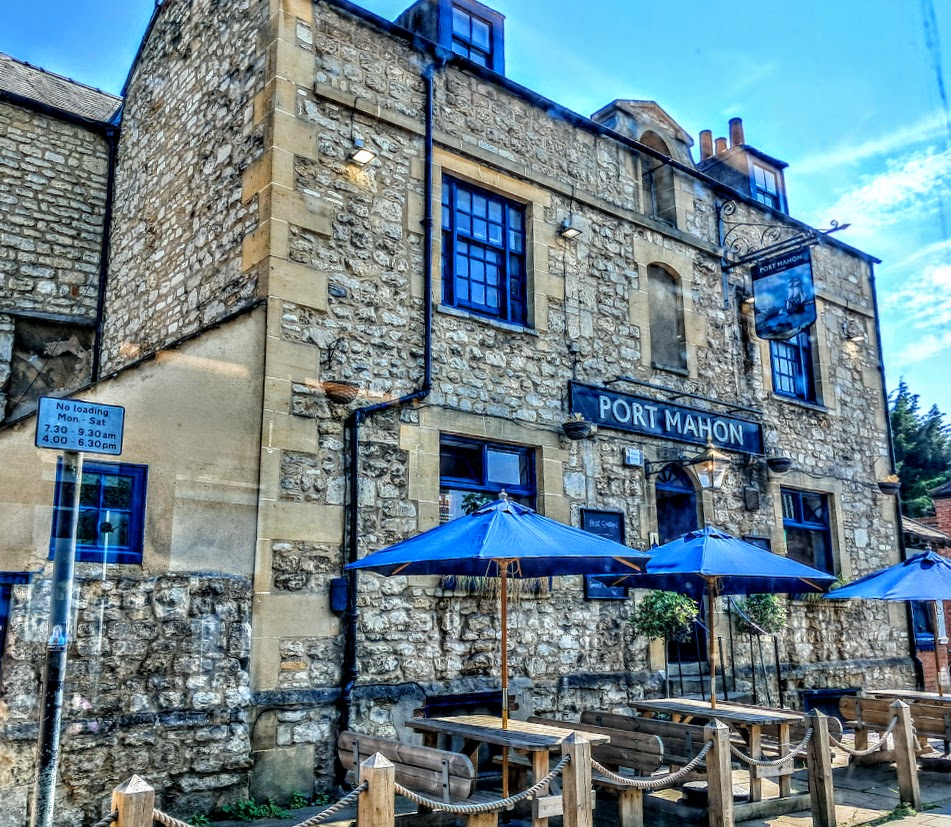
Port Mahon on St Clement’s Street, Oxford, was built two years after the Battle of Port Mahon or Battle of Menorca in 1708 (Photograph: Patrick Comerford, 2025)
Patrick Comerford
Over the past few years, I have begun to recognise some of my favourite pubs in Oxford. On the evening before my surgical procedure last week, two of us had dinner in King’s Arms, close to Hertford College, the Bridge of Sighs and Wadham College, on the corner of Parks Road and Holywell Street, opposite the New Bodleian Library.
A local myth boasts that the KA has the highest IQ per square foot of any pub or bar in the world.
Other pubs I have got to know in recent years include the Lamb and Flag, which has got a new lease of life on Saint Giles; the White Horse, squeezed in between Blackwell’s shopfronts on Broad Street; the Crown on Cornmarket Street; the Head of the River by the river at Folly Bridge; the Rose and Crown on North Parade, between Woodstock Road and Banbury Road; the Cheuquers off the High Street; the Turf Tavern in Saint Helen’s Passage, which claims it has Oxford’s ‘only city walled garden’; and Four Candles on George Street, if only for its name.
And, of course, with all its past literary associations, I eagerly await the reopening of the Eagle and Child (the ‘Bird and the Babe’) across the street from the Lamb and Flag on Saint Giles.
But on my three return journeys between the hospitals and clinics in Headington and the centre of Oxford over the past six or seven weeks or so, I have noticed the names of three pubs on St Clement’s Road that are eye-catching.
When I first noticed Port Mahon at 82 St Clement’s Street, I wondered whether it had been named after an Irish admiral and some Irish port I had never heard about – after all, one of my great-grandmothers was Margaret Mahon or McMahon (1847-1924).
But, in fact, Port Mahon was the Anglicised name given long before the Napoleonic wars by the British navy to Mahón, also known in Catalan as Maó or Mahó, the capital and second largest city of Menorca in the Balearic Islands.
Mahón has one of the longest natural harbours in the world: it is 5 km long, up to 900 metres wide, and the water is deep but remains mostly clear. The name comes not from Irish general or admiral among the Wild Geese in Spain, not even from Patrice de MacMahon (1808-1893), the President of France (1873-1879) who had Irish ancestry. Rather, the name of Mahón or Maó is said to come from a Carthaginian general and Hannibal’s brother, Mago Barca, said to have sought refuge there in 205 BCE.
Menorca was captured in 1708 by a joint British-Dutch force during the War of the Spanish Succession. Its status as a British possession was confirmed by the Treaty of Utrecht in 1713. While Menorca was a British dependency, the capital was moved from Ciutadella de Menorca to Mahón, where the governors included the Irish-born General Richard Kane (1662-1736).
The harbour and the town were known as Port Mahon until the island was lost to the French in 1756 after the naval Battle of Menorca and the final Siege of Fort St Philip. But when the French were defeated in the Seven Years’ War, the island became British once more in 1763.
Britain surrendered Menorca again in 1782, and it was transferred to Spain in 1783 as part of the Peace of Paris. Britain captured the island for a third time in 1798, but it passed to Spain under the Treaty of Amiens in 1802, and it has remained Spanish ever since.
Mahón – and not President Patrice MacMahon – is said to given its name to Mayonnaise. The word seems to have appeared in French cuisine for the first time in 1806. But, according to Émile Littré, when Mahón and Menorca were captured by the Duc de Richelieu in 1756, his cook presented him with a sauce he called mahonnaise, and made with egg and oil, although several versions of similar sauces already existed in France and in Spain.
As for Port Mahon at 82 St Clement’s Street, Oxford, it was built on the site of an orchard in 1710, two years after the Battle of Port Mahon or Battle of Menorca in 1708, when British forces captured the port and the island of Minorca from the French. A captain in the British navy was given this pub to reward his bravery, it has retained its name ever since, and today it is one of the oldest surviving pubs in Oxford.
It is a Grade II-listed pub with several rooms, and a strange layout. The main room is up six steps from the street, and then you go down steps to the other room. The bar serves both at two levels with the lower room laid out for dining and the upper room very much a bar.
The three-storey building dates from early 18th century, with alterations made over time,. It is built of rubble on a moulded stone plinth, and with cellars, two attic dormers and a Welsh slate roof.
Six steps with iron handrails lead up to the front doorway, with the north elevation facing onto the street, and the front doorway has a semi-circular stone head. The ground floor has two plain sash windows in stone frames, and the first floor has two three-light 18th century sash windows, with a blind semi-circular headed window in between.
Above this is another window that breaks through the eaves and that has a pediment and scrolled sides. There is a stone band above the first floor windows and the two stacks are of brick. The attic dormers have 19th century sash windows.
A stone extension or wing on the south-east angle has a Welsh slate hipped roof and an 18th century sash windows with stone frames, cills and architraves. There is a gabled staircase projection at the back on the south and there are modern one-storey additions on the west.
Port Mahon on St Clement’s Street was closed for a time last summer but reopened later in the year after Greene King spent £190,000 on refurbishing the interior. During last year’s refurbishing and updating, Port Mahon retained some original interior features, including the fireplaces. It now has a two-level layout, with the main room accessed through steps and another room downstairs, where the bar serves both levels.
Port Mahon is being run by Jonathan and Renee Perritt who also operate pubs in London. It is a favourite with real ale drinkers, with guest beers, and it also offers live music and food – including, even, its own ‘Mahon Mayo.’
Some of the neighbouring pubs with curious names that I have noticed on those return journeys include the Cape of Good Hope, at the corner of The Plain, where Cowley Road meets St Clement's Street and Headington Road, and the Oranges and Lemons – which seems such an appropriate names for St Clement’s.
I may not be as familiar with the pubs in Oxford as I am with those in Cambridge – but I look forward to continuing my explorations once I’m back on my feet fully again.
Port Mahon … the sign recalls naval battles in Menorca in the 18th century (Photograph: Patrick Comerford, 2025)
The fig tree – and the inscription – have long disappeared from the Fig Tree Tomb at Saint Mary’s Church in Watford (Photograph: Patrick Comerford, 2025)
Patrick Comerford
If I had the space and the soil, the patience and the time, the two trees I would like to try to grow are an olive tree and a fig tree.
They are signs of life and God’s blessings in creation, of life and of continuity in life. There is a very large fig tree off the High Street in Stony Stratford and small potted olive trees outside some of the restaurants in Milton Keynes. Fig trees and olive trees at any time of the year also bring back warm memories of Greece.
But during my visit to Watford earlier this week, I heard the story of what surely must have been one of the most unusual fig trees in an English churchyard.
Saint Mary’s Church is the oldest building in Watford, and the churchyard has 13 prominent tombs, of which nine are nationally listed chest tombs, one is locally listed, two have been reconstructed from piles of stone, and one is a nationally-listed headstone.
A headstone from 1809 is of George Edward Doney, a loyal servant to the Earl of Essex who lived at Cassiobury House in Watford. He was born in Gambia and sold into slavery in Virginia. He later earned his freedom and came to Watford as a free man. His headstone is of national significance and represents an important aspect of the social history of the town.
Saint Mary’s churchyard has 13 prominent tombs (Photograph: Patrick Comerford, 2025)
At the south-east corner of the churchyard, the Fig Tree Tomb was a popular tourist attraction in Victorian Watford. Local legend claims that the person buried there was an atheist, who had asked that something be buried in the tomb that could germinate if there was life after death. If there was a God, this would grow and burst the tomb to prove to his family that his soul was alive. If not, then nothing would happen and he would be proved correct.
The existence of God was said to have been proven when a fig tree sprouted up from the tomb and dislodged the lid.
The strange sight drew visitors to the graveyard in large numbers. They came to hear the story and they left taking a twig from the tree as a souvenir.
Whoever was buried in the tomb must have come from a wealthy family as the tomb is of Portland stone with an elaborate design, and the slate panel would have had crisp carving with the name and details of the dead person. It is unlikely though that an atheist would have been given such an impressive tomb so close to the church.
Over time, the slate panel was worn away and eroded and the inscription is no longer legible, so the details in any version of the legend are difficult if not impossible to verify.
One version of the legend says it was the grave of a naval officer named Ben Wangford. However, historians have not been able to identify anyone of the name Wangford in naval records.
Details about Ben Wangford grew as the story of the Fig Tree grew, attracting visitors to the church and the churchyard in ever-increasing numbers.
Henry Williams describes hundreds of people making long excursions to see the fig tree in the 1880s and taking home a leaf or small branch (Photograph: Patrick Comerford, 2025)
Henry Williams, in his History of Watford, writing in 1884, described the fig tree growing through the tomb and he reported that each year it ‘exhibits considerable luxuriance and sometimes produces figs.’ He said the fig tree had ‘probably grown there for close upon 100 years’, which would date it to the 1790s, or even the 1780s.
He described hundreds of people visiting the churchyard, many making long excursions to see the fig tree and taking home a leaf or small branch.
However, Williams said that when the tomb was opened it was found that the root of the tree was four or five feet above where the dead man’s head must have been. He said some tendrils had become attached to the bottom of the vault and this was said to explain the luxuriant growth of the fig tree.
For some, the fact the tree did not grow out of the coffin discredited the old legends. Others still believed it was strange that a fig tree should grow out of a tomb at all. The coffin inside the tomb was found to have a projection at the top. This led to speculation that the buried person had died with his or her knees up and that, after death, the knees could not be straightened.
Over a decade later, a writer in the parish magazine in 1898 said Ben Wangford had lived about the middle of the previous century, that he was a man of enormous size, and ‘his boots could contain a bushel of corn.’ But the writer admitted he knew nothing more – whether the dead man was from Watford, single or married.
In The Book of Watford, Bob Nunn offers another version or a similar story about a woman who was atheist. Her tomb was accidentally damaged when the churchyard was being lowered and graves were being levelled.
Yet another theory suggested the seed of the fig tree could have been accidentally thrown into the tomb by the Revd the Hon William Robert Capel (1775-1854), who was the Vicar of Saint Mary’s from 1799 to 1855. His father was William Anne Capell (1743-1799), 4th Earl of Essex; he grew fig trees and had a taste for eating figs as he walked to church, spitting out the pips along his way from the vicarage.
The churchyard was taken over by Watford Council in recent years ago and is now an open space. Sadly, the Fig Tree itself died in 1963 after a long and cold winter, though some writers suggest it was helped on its way by local officials who thought it was in the way.
The fig tree may be long gone, but the legend and the tomb remain with several versions of the story.
Meanwhile, I am looking forward to seeing some more fig trees – and olive trees – when I am back in Crete during Easter next month.
A fig tree in full bloom close to the ruins of Saint Mary Magdalene Church in Stony Stratford (Photograph: Patrick Comerford)
Soho Square at the heart of Soho in London’s West End … but where does the name comes from? (Photograph: Patrick Comerford, 2025)
Patrick Comerford
Before having a bad tumble on Oxford Street last week, when I ended up in the A&E unit in University College Hospital London on Euston Road, I had spent some time in the Tottenham Court Road, Oxford Street and Soho area, looking for old churches and buildings of architectural interest.
I have been in Gerrard Street and Chinatown before, and I first stayed in an hotel off Oxford Street back in 1970 or 1971. But I had never really got to know Soho.
Of course I knew of Soho as a centre for the theatre and music industries and its seedy reputation in the past as a centre for the sex industry, prostitution and night clubs that featured regularly in salacious reports in tabloid pressarchi from the 1950s on.
I knew of Soho too in lyrics from hits in the late 1960s and early 1970s by the Kinks (‘I met her in a club down in old Soho / Where you drink champagne and it tastes just like Coca-Cola’) and the Who (‘Ever since I was a young boy, I’ve played the silver ball / From Soho down to Brighton, I must’ve played ’em all’) to Shane Macgowan and the Pogues singing ‘Rainy Night in Soho’ in 1990:
I took shelter from a shower
And I stepped into your arms
On a rainy night in Soho
The wind was whistling all its charms.
Soho is a much different area in recent years, to a degree. Many parts of it have been gentrified, with attractive cafés and restaurants, hotels and bars, theatres and music studios, although there is still a whisper everywhere of its recent salacious past.
Soho was a part of the ancient parish of Saint Martin in the Fields, forming part of the Liberty of Westminster.. But Soho never was an administrative unit with formally defined boundaries. It is about a square mile in area, and is usually considered to be bounded by Shaftesbury Avenue to the south, Oxford Street to the north, Regent Street to the west, and Charing Cross Road to the east. The area to the west is Mayfair, to the north Fitzrovia, to the east Saint Giles and Covent Garden, and to the south Saint James’s.
The ‘Tudorbethean’ mock ‘market cross’ building at the centre of Soho Square was built in 1926 (Photograph: Patrick Comerford, 2025)
Soho Square in the centre of Soho has been a public square effectively since 1954 when it was transferred by the Soho Square Garden Committee to Westminster City Council. It was originally called King’s Square to honour Charles II.
But the name of Soho goes back long before King’s Square became Soho Square.
I have long been interested in the origins of the name Soho, wondering whether its etymological origin has any connection with the motto with slight variations on most Comerford coats-of-arms and that has long escaped a credible explanation or translation: ‘So Ho Ho Dea Ne.’
Most accounts say the name of Soho derives from an English 16th-century hunting cry ‘So-Hoe’ when the area was open fields and grazing land. There are also places called Soho near Handsworth in Birmingham, once a part of Staffordshire, and New York and Hong Kong, although the name of Soho in New York is an acronym for South of Houston Street.
The history of Soho as we know it today does not begin until after the Great Fire of London in 1666. It was originally a royal park used for fox and hare hunting. The fire destroyed two-thirds of London, creating in a huge demand for new housing. Soho quickly went from open fields to an fashionable residential location.
Immigrants began to settle in the area from around 1680 onwards, particularly French Huguenots after 1688, and the area became known as London’s French quarter. Greek Street was first laid out around 1680 and was named after a nearby Greek church. The early Irish residents included Arthur Annesley, 5th Earl of Anglesey, and Peter Plunket, 4th Earl of Fingall, and later Josiah Wedgwood ran his main pottery warehouse and showrooms there.
Building work in Golden Square, Gerrard Street and Old Compton Street began in the 1670s and Soho Square itself was laid out in 1681. When building began on Soho Square in 1681, one of the first residents was the Duke of Monmouth, one of the many illegitimate sons of Charles II. The square had become known as Soho Square by 1720, and when John Rocque drew his keynote map of London in 1746, the name of Soho Square had replaced King’s Square.
Monmouth House in Soho Square, built for the Duke of Monmouth, later became the French ambassador’s residence, but was demolished in 1773.
Soho Square was still close to the countryside in the late 18th century. Speakers of the House of Commons had houses in the square and a number of foreign embassies were there, including those of France, Russia, Spain and Sweden. But, between 1778 and 1836, the square was also home to the infamous White House brothel at the Manor House, 21 Soho Square.
Joseph Addison and Richard Steele wrote of their character Sir Roger de Coverley in The Spectator, saying, ‘When he is in Town he lives in Soho-Square.’
By the mid-18th century, the aristocrats who had been living in Soho Square or Gerrard Street had moved away to more fashionable areas such as Mayfair. By the 19th century, they had been replaced by prostitutes, brothels, music halls and small theatres.
In A Tale of Two Cities Charles Dickens has Lucie and her father, Doctor Manette living on Soho Square. It is believed that their house is modelled on the House of Saint Barnabas, and so the name of Rose Street was changed from Rose Street to Manette Street. Golden Square is mentioned by Dickens in Nicholas Nickleby, and Ralph Nickleby has a house on the square.
Robert Louis Stevenson had Dr Henry Jekyll set up a home for Edward Hyde in Soho in the Strange Case of Dr Jekyll and Mr Hyde.
Soho was badly hit by an outbreak of cholera in 1854. John Snow’s study of the outbreak was significant in the history of epidemiology and public health. He mapped the addresses of the sick and noted that they were mostly people whose nearest access to water was the Broad Street pump.
Many small restaurants and cafés sprang up in Soho in the 19th century, particularly as a result of Greek and Italian immigration.
Soho Square has two churches, Saint Patrick’s Roman Catholic Church, partially on the site of Carlisle House, and the French Protestant Church, as well as the House of Saint Barnabas, which closed last year. Saint Anne’s Church on Wardour Street was built in 1677-1686. Nearby, the Church of Our Lady of the Assumption and Saint Gregory on Warwick Street was built in 1788 and is the only remaining 18th-century Roman Catholic embassy chapel in London.
At the centre of Soho Square is a listed mock ‘market cross’ building, built in 1926 to hide the above-ground appearance of an electricity substation. It is a small, octagonal, rustic gardener’s shed with black-and-white, timber framing, a steep hipped roof and a squat upper storey with jettying, supported by timber columns. It incorporates 17th- or 18th-century beams and its style has been described as ‘Tudorbethan’.
The much-weathered statue of Charles II was carved in 1681 by the Danish sculptor Caius Gabriel Cibber, father of the Poet Laureate Colley Cibber. It became the centrepiece of the square, set on a pedestal above a fountain and basin, with four figures representing four rivers, the Thames, Severn, Tyne and Humber.
In time, the fountain ceased to function, the basin was filled, and eventually the statue was removed In 1875 during alterations in the square by Thomas Blackwell, of Crosse & Blackwell, the food firm then based at 20-21 Soho Square.
Blackwell gave the statue to a friend, supposedly, for safekeeping, and it was absent for many decades, stashed away as a private garden feature in a country house. It was returned to Soho Square in 1938, although the garden was not restored and opened to the public until 1954.
Cibber’s statue of Charles II, sculpted in 1681, was returned to Soho Square in 1938 (Photograph: Patrick Comerford, 2025)
The name Soho dates from at least 1632, but ‘So Ho!’ has been used as a hunting cry from perhaps the early 1300s. It was used in calling from a distant place to alert hounds and hunters when a hare had been sighted, similar to the use of ‘Tally Ho!’ in fox hunting – when a fox breaks cover and ‘soho!’ is the cry when the huntsmen uncouple the dogs.
Various dictionaries say ‘soho’ was a synonym for ‘tally-ho’, and the the word ‘soho’ as a call by huntsmen to direct the attention on the dogs or of other hunters to a hare that has been discovered, or to encourage them in the chase. Soho in London developed on an area that had been a royal park once associated with hunting and the area was developed from farmland by Henry VIII in 1536, when it became a royal park.
Interestingly, the Duke of Monmouth used ‘Soho!’ as a rallying cry for his troops at the Battle of Sedgemoor, the final battle in his rebellion. But the name Soho or So Hoe was in use for the area at least 50 years before the Duke of Monmouth led his troops with the battle cry.
Will Noble, editor of the website Londonist, wonders whether the link between the hunting cry ‘So Ho’ and the name of Soho is little more than an ‘unsubstantiated urban myth’. He dismisses as ridiculous another theory that Soho is an abbreviation of South of Holborn, pointing out that, in fact, Soho is to the west of Holborn.
Walter Thornbury discussed another cry theory in the Victoria County History in 1878. He suggested that ‘soho’ might come from ‘the footpad’s slang of the 16th century, when the fields were lonely at night, and divers persons were robbed in them.’ Footpads were the equivalent of highwaymen on foot, but there is nothing to substantiate Thornbury’s claim.
There are many other Sohos, SoHos and SOHOs around the world, from Malaga to Buenos Aires and Beijing, and all seem to take their name from Soho in London.
There is another Soho in Handsworth, which was once in Staffordshire but has been subsumed into Birmingham. The name of this Soho is said to come from an inn sign on Soho Hill that depicted a huntsman with the word ‘Soho!’ coming from his mouth. Other sources suggest Soho in Handsworth takes its name from a map reference to a building called South House, abbreviated as ‘So. Ho’. But it is also possible that the name was taken from Soho in London. Soho is now part of Handsworth and the name is used primarily with reference to the long and linear shopping centre along Soho Road.
As Will Noble writes, ‘the sketchiness of our Soho’s etymology is part of what makes this place so special.’
The Dog and Duck in Soho … the pub signs are a reminder of Soho’s hunting past (Photograph: Patrick Comerford, 2025)
The motto ‘So Ho Ho Dea Ne’, with variations in spelling, has been used in the heraldry of the Comerford and Comberford families from at least the early 17th century. Any attempts to translate, explain or interpret the motto have always been inadequate, and it remains inexplicable. But the motto may relate to the presence of a talbot or hunting dog in the Comberford arms, which in turn may be associated with the arms of the Wolseley family, though the colouring is inverted. A similar hunting dog can be seen today in places in Soho, including the ‘Dog and Duck’ on the corner of Bateman Street and Frith Street.
The coincidence of the ‘So Ho …’ motto and the talbot in the Comberford and Comerford coats of arms may have been associated with the imaginative myth, repeated in Joseph Comerford’s fantastical pedigree in 1724, that ‘Roger de Comberford of Staffordsh[ire] came into Ireland with King John & was Great Master of the Game.’
The origins of the name of Soho in London seem less difficult to unravel than the origins of my family motto.
The motto ‘So Ho Ho Dea Ne’ has been used in Comberford and Comerford coats of arms since the early 17th century (Photo collage: Patrick Comerford, 2025)