Showing posts with label Germany. Show all posts

27 January 2026

A ‘virtual tour’ of Holocaust
memorials on Holocaust
Memorial Day, a reminder
that we must never forget

‘Arbeit macht frei’ … the gate at Auschwitz … today is Holocaust Memorial Day (Photograph: Patrick Comerford)

Patrick Comerford

Today is Holocaust Memorial Day, marking the anniversary of the liberation of Auschwitz in 1945 and the beginning of the liberation of the concentration camps in Europe.

In a ‘virtual tour’ today, I visit Holocaust memorials in a dozen European countries: Austria, Czech Republic, England, France, Germany, Greece, Hungary, Ireland, Italy, Poland, Slovakia and Slovenia.

Looking back on many visits over the years, my images today include monuments, memorials, plaques, sculptures, shattered grave stones and Stolpersteine or ‘stumbling stones’, in cemeteries, libraries, museums, parks, schools, squares, streets, synagogues, railway stations, and bridges.

There are photographs from the concentration camps in Auschwitz, Birkenau and Sachsenhausen. There are Jewish families and individuals, mothers and children, the murdered and the survivors, resistance fighters and the ‘Righteous Among the Nations’.

Austria:

Rachel Whiteread’s Holocaust Memorial in Judenplatz in Vienna (Photograph: Patrick Comerford)

Czech Republic:

The walls of the Pinkas Synagogue in Prague are covered with the names of 78,000 victims of the Holocaust (Photograph: Patrick Comerford)

The names of the concentration camps surround the Aron haKodesh or Holy Ark in the Pinkas Synagogue, Prague (Photograph: Patrick Comerford)

England:

The Holocaust Memorial Stone at the east end of Bourton Park, Buckingham, was installed in 2021 (Photograph: Patrick Comerford)

France:

The Mur des Names or Wall of Names in the Mémorial de la Shoah lists 76,000 French Jews deported and murdered by the Nazis (Photograph: Patrick Comerford)

A plaque on a school in the Marais in Paris recalling the children of the Shoah (Photograph: Patrick Comerford)

Germany:

The Memorial to the Murdered Jews of Europe in Berlin (Photograph: Patrick Comerford)

A memorial to Jewish children at the Jewish Cemetery in Berlin (Photograph: Patrick Comerford)

The memorial to the victims of the Sachsenhausen Concentration Camp 1936-1945 … the victims included gays, Gypsies, political prisoners and disabled people (Photograph: Patrick Comerford)

Greece:

The Jewish Holocaust Memorial at Plateia Eleftherias (Liberty Square) in Thessaloniki (Photograph: Patrick Comerford)

Chief Rabbi Gabriel Negrin places candles in the Holocaust memorial in Etz Hayyim Synagogue in Chania (Photograph: Patrick Comerford)

The Holocaust Memorial by Georgios Karahalios (2001) in Corfu remembers the 2,000 Jews of Corfu who were murdered in Auschwitz in 1944 (Photograph: Patrick Comerford)

The monument in the Nuova or New Synagogue in Corfu to families who died in the Holocaust (Photograph: Patrick Comerford)

Hungary:

The Memorial of the Hungarian Jewish Martyrs by Imre Varga at the Dohány Street Synagogue in Budapest (Photograph: Patrick Comerford)

The Holocaust Memorial Park at the Dohány Street Synagogue in Budapest (Photograph: Patrick Comerford)

Italy:

A monument in Bologna commemorating victims of the Holocaust (Photograph: Patrick Comerford)

The Holocaust Memorial outside the railway station in Gorizia, a town that straddles the border of Italy and Slovenia (Photograph: Patrick Comerford)

The Holocaust Memorial at the Synagogue in Padua (Photograph: Patrick Comerford)

A monument to Jewish partisans and resistance to the Nazis and Fascists in Rome (Photograph: Patrick Comerford)

The memorial wall to victims of the Holocaust in the Ghetto in Venice (Photograph: Patrick Comerford)

The Holocaust memorial in the Ghetto in Venice (Photograph: Patrick Comerford)

Poland:

Multilingual memorials in Birkenau … a reminder of the many nationalities of the victims of the Holocaust (Photographs: Patrick Comerford)

Shattered gravestones make a Holocaust memorial in a Jewish cemetery in Kraków (Photograph: Patrick Comerford)

The Empty Chairs Memorial in Ghetto Heroes Square in Kazimierz , symbolising abandoned homes and mass deportations from the Kraków Ghetto in 1943 (Photograph: Patrick Comerford)

Slovakia:

The Holocaust Memorial in the centre of Bratislava on the site of the former Neolog Synagogue (Photograph: Patrick Comerford)

Stolpersteine or ‘stumbling stones’

Berlin:

Stolpersteine or Stumbling stones on Rosenthaler Straße 39, Berlin-Mitte, remembering members of the Salinger family murdered by the Nazis in Auschwtiz and Riga (Photograph: Patrick Comerford)

Dublin:

Dublin’s first Stolpersteine or ‘stumbling stones’, recalling six Irish Holocaust victims, at Saint Catherine’s National School on Donore Avenue (photograph: Patrick Comerford)

Prague:

‘Stolpersteine’ or ‘Stumbling Stones’ on the streets of Prague remember members of the Bergmann family deported to Terezín during the Holocaust (Photograph: Patrick Comerford)

Thessaloniki:

‘Stolpersteine’ or ‘Stumbling Stones’ on the pavement on Vassilisis Olgas Avenue in Thessaloniki commemorate Greek Jews deported to Auschwitz (Photograph: Patrick Comerford)

Venice:

Stolpersteine or stumbling stones (Pietre d’inciampo) in Venice recall victims of the Holocaust (Photograph: Patrick Comerford)

Remembering individuals:

Remembering Anne Frank in street art in Berlin (Photograph: Patrick Comerford)

The sculpture of Anne Frank by Doreen Kern in the British Library, London (Photograph: Patrick Comerford)

The Kindertransport monument at Liverpool Street Station … a reminder in the heart of London of the Holocaust (Photograph: Patrick Comerford)

A plaque on Heydukova Street in Bratislava marks the former home of Aron Grünhut (1895-1974), involved in heroic rescues during the Holocaust (Photograph: Patrick Comerford)

Monuments to ‘Righteous Among the Nations’:

Philip Jackson’s monument of the Swedish diplomat Raoul Wallenberg at Wallenberg Place, near Hyde Park, London (Photograph: Patrick Comerford)

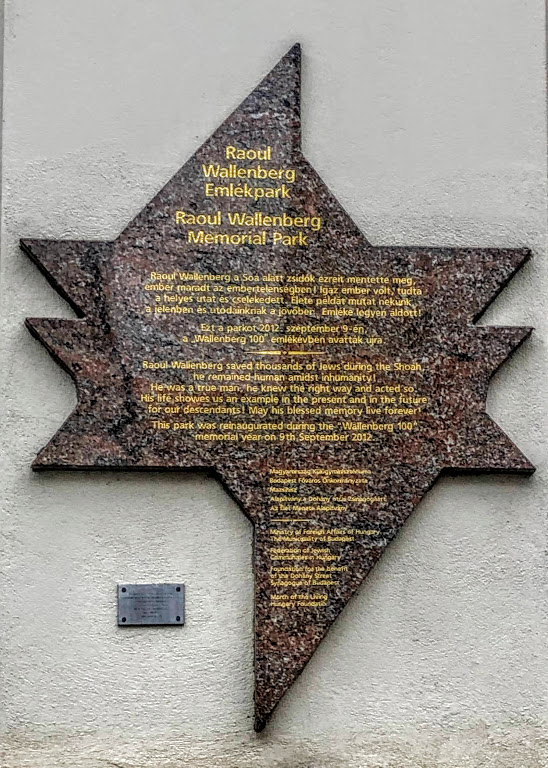
A memorial to Raoul Wallenberg in the Raoul Wallenberg Holocaust Memorial Park at the Dohány Street Synagogue, Budapest (Photograph: Patrick Comerford)

The Mary Elmes Bridge in Cork … the centrepiece of the bridge is designed to look like a menorah (Photograph: Patrick Comerford)

The Wall of the Righteous in Paris lists 3,300 French people who have been recognised as ‘Righteous Among the Nations’ (Photograph: Patrick Comerford)

These images are reminders not only of the Holocaust and its victims, but of real individuals who suffered and were humiliated, whose lives were shattered and who were murdered.

They are reminders of why we must never forget. The Holocaust happened not just because of one evil man but because many good people stood by and remained silent.

Over 80 years after the end of the Holocaust, antisemitism is on the rise once again. We are seeing the rise of the far-right in Britain across Europe and a resurgence of the far-right in Latin America, far-right ideology and vocabulary has become part and parcel of the language of the Trump regime, its spokespersons and those who support street murders by ICE in Minneapolis.

We must never forget.

The Eternal Flame in the Mémorial de la Shoah, Paris (Patrick Comerford)

18 December 2025

20 million olive trees in Crete,
20 million in classical Greece,
a $20 million pay-out to Trump,
and 20 million blog readers

The Parthenon on the Acropolis … Ancient Greece had 20 million people by 400 BCE (Photograph: Patrick Comerford)

Patrick Comerford

Once again, this blog continues to reach more and more readers, reaching yet another overwhelming landmark, with 20 million hits at about 7 am this morning (18 December 2025), and more than 800,000 readers this week alone. There have been almost 1.5 million visitors to this blog so far this month, an average of about 80,000 hits each day so far in December.

Earlier this week, this blog had reached 19.5 million readers by early Sunday afternoon (14 December 2025), having passed the 19 million mark last week (9 December).

I began blogging in 2010, and it took almost two years until July 2012 to reach half a million readers. It more than another year before this figure rose to 1 million by September 2013. This blog reached the 10 million mark earlier this year (12 January), almost 15 years later.

So far this year, the daily figures have been overwhelming on many occasions. Eight of the 12 days of busiest traffic on this blog were this month alone and four were in January:

• 289,076 (11 January 2025)
• 285,366 (12 January 2025)
• 261,422 (13 January 2025)
• 166,155 (15 December 2025)
• 146,944 (14 December 2025)
• 140,417 (16 December 2025)

• 122,398 (17 December 2025)
• 112,221 (13 December 2025)
• 100,291 (10 January 2025)
• 94,824 (12 December 2025)
• 93,575 (11 December 2025)
• 88,333 (10 December 2025)

The latest figure of 20 million is all the more staggering as half of those hits (10 million) have been within this year, since 12 January 2025. The rise in the number of readers has been phenomenal throughout this year, and the daily figures have been overwhelming at times. With this latest landmark figure of 20 million readers, I once again find myself asking questions such as:

• What do 20 million people look like?

• Where do we find 20 million people?

• What does £20 million, €20 million or $20 million mean?

• What would it buy, how far would it stretch, how much of a difference would that much make to people’s lives?

When countries have passed the 20 million mark (vividmaps.com)

The world’s population hovered is now well over 8 billion, and projections say there could be 10.3 billion of us by the 2080s. Alex Egoshin of vividmaps is a GIS specialist and ecologist working as a researcher in a national park. He has created a series of maps based on Wikipedia’s List of Population Milestones by Country database and he concludes that ‘crossing the 20 million mark was like lighting a great bonfire – a signal that a civilisation had grown too large to ignore.’

He suggests only a few ancient societies reached that mark at an early stage: China may have passed 20 million by 1000 BCE, Persia by 480 BCE, classical Greece by 400 BCE, and Rome by 60 BCE. France joined around 1100 CE, ancient Mexico ca 1250, and the Mali Empire by 1400.

In the modern era, Russia crossed the 20 million line in 1765, Germany by 1770, and Japan by 1815 or earlier. Britain reached 20 million during the early Victorian surge in 1837, the US soon followed in 1844, Poland in 1882, Ukraine in 1883, and Spain in 1911. A wave of nations followed after World War II – including Egypt, Thailand, South Korea and the Philippines by the 1950s, followed by countries like Romania in 1968 and Malaysia in 1995.

Today, cities such as Cairo, Mumbai, Beijing and Dhaka all have close to 20 million inhabitants.

The Brandenburg Gate in Berlin … Germany had 20 million people by 1770 (Photograph: Patrick Comerford)

Earlier this year, Donald Trump claimed that Paramount, the new owners of the US TV network CBS, are to provide him with $20 million worth of advertising and programming – just months before filing legal action seeking to squeeze $10 billion out of the BBC.

Winston Churchill’s published work is estimated to come to a total of 20 million words.

20 Million Miles to Earth (also known as The Beast from Space) was a 1957 science-fiction monster film directed by Nathan Juran, with stop-motion animation by Ray Harryhausen and starring William Hopper, Joan Taylor, and Frank Puglia. Set in Italy, the film involves an alien lifeform from Venus that arrives on a crashed rocket, and begins rapidly growing.

The US has a coastline of approximately 20 million metres (20,000 km or 12,400 miles), which is also close to half the circumference of the Earth.

Last month (November) was the olive picking season in Crete, where over 20 million olive trees are cultivated the length and breadth of the island. Olives and olive oil account for one of the main sources of income throughout Crete, so that olive oil is often called ‘Crete’s liquid gold’.

The olive groves on the hillsides between Piskopianó and Koutouloufári above Hersonissos … Crete has more than 20 million olive trees (Photograph: Patrick Comerford, 2024)

And 20 million minutes is approximately 38 years 4 months. If this blog was getting one hit a minute, it would have taken over 38 years to reach this 20 million mark.

So, yet again, this blog has reached another humbling statistic and a sobering figure, and once more I am left with a feeling of gratitude to all who read and support this blog and my writing.

A continuing and warming figure in the midst of all these statistics continues to be the one that shows my morning prayer diary continues to reach up to 90-100 people each day, with similar figures for my daily Advent Calendar postings at noon. It is almost four years now since I retired from active parish ministry, but I think many of my priest-colleagues would be prayerfully thankful if the congregations in their churches totalled 600 to 700 people twice a week.

Today, I am very grateful to all the 20 million readers of this blog to date, and in particular I am grateful for the small and faithful core group among you who join me in prayer, reading and reflection each morning.

Notre Dame Cathedral in Paris … France had around 20 million inhabitants by the year 1100 (Photograph: Patrick Comerford, 2024)

24 October 2025

Aston Villa stood up to the Nazis
in 1938, and built a reputation for
challenging racism and antisemitism

The Holte End, inspired by Aston Hall, is where Aston Villa’s most vocal and passionate supporters have traditionally gathered (Photograph: Patrick Comerford)

Patrick Comerford

It would take deep and long sessions of psychotherapy and counselling to grasp why many young boys pick a football team to support, and end up identifying with that team for the rest of their lives.

Some pick a team because their fathers and other family figures made the same decision a generation or even two generations before them. Others make a choice based on geography: matches are accessible and all their friends are going there too. Still others are swayed by fashion: a team is fashionable one year or season, and retains popularity with the followers it collects along their way, or their merchandise is ‘cool’ to wear because of its colours or design.

Growing up in Ireland in the 1950s and 1960s, many of my contemporaries as schoolboys supported Shamrock Rovers, and a smaller number were Shelbourne fans. A handful would support one or other provincial side because their mother or father was from the area.

I remember a colleague on the subs desk in The Irish Times in the 1970s who was from Sligo. Long after moving to London and the subs desk on a Fleet Street newspaper, he would still ring the subs desk in the Irish Times every Sunday evening to ask for Sligo Rovers’ result that afternoon.

My uncle and godfather Arthur Comerford was a keen supporter of Bohemians and a club member, and for two or three years in the mid-1960s he brought me to Bohs’ matches on Sunday afternoons. Bohs were known from their foundation for taking a stand against sectarianism and the politicisation of football, and I still take a benign interest in the way Bohs continues to take a stand against racism and for diversity.

When it comes to selecting English football clubs to support, many of my age ended up as Manchester United supporters. There were many Irish players on the side for decades, and the Munich air disaster in 1958 generated strong sympathy for the club in Ireland.

When I was growing up, the area close to Donore Avenue was still Dublin’s ‘Little Jerusalem’, although the Jewish community had moved in large numbers by then to south Dublin suburbs like Rathfarnham and Churchtown. When I was about 11 or 12, some friends introduced me to a schoolboys’ soccer club called Port Vale. The clubhouse was in the Donore Avenue area, but home games in the Dublin Schoolboy League were played in Bushy Park in Terenure.

I must have been no good, because I only remember playing with Port Vale for a few weeks. But the good players I remember who were of my age included Alan Shatter, then living in Crannagh Park and later Minister for Justice in a coalition government. His memories of Port Vale, Donore Avenue, Bushy Park and Rathfarnham, recalled in his book Life is a Funny Business: A Very Personal Story, have many resonances with my own memories.

I never ended up as a fan of the English club Port Vale, despite that experience, nor did I follow other boys sheepishly into supporting Manchester United, Arsenal or Liverpool. Instead, I ended up with Aston Villa and Tottenham Hotspur as my first and second teams of choice. I celebrated those choices in Stony Stratford last Saturday afternoon as I watched the match between Aston Villa and Tottenham Hotspur.

In my late teens, Villa Park was just a few stops away from Lichfield. Part of Spurs’ traditional support base was for long in the Jewish community in London, so that to fans of Chelsea and many other clubs, Tottenham Hotspur is a Jewish club, and in response to racist and antisemitic taunts, Spurs fans long ago adopted as their own chant: ‘We are the Yids.’

Aston Station is only 30 minutes from Lichfield (Photograph: Patrick Comerford)

Aston Villa too has a proud tradition of standing up against antisemitism and racism. Almost 90 years ago, Aston Villa was invited on a three-match tour of Germany in the summer of 1938. Villa was then the most famous club in the world and manager Jimmy Hogan had enjoyed great success through Europe as a coach prior to arriving at Villa Park. Villa’s tour coincided with a tour by the England national team, and both tours were only weeks before Neville Chamberlain appeased Nazi Germany and signed the Munich Agreement.

The day before their first match, the England football team bowed to pressure from the British Foreign Office and performed the Nazi salute during a friendly match on 14 May 1938.

On 14 May 1938 an England side including Villa centre-forward Frank Broome played against Germany in the Olympic Stadium in Berlin, before a crowd of 110,000. As the England players were changing, an FA official went to their dressing-room and told them that they had to give the Nazi salute during the German national anthem.

Villa’s Frank Broome (1915-1994) said at the time: ‘The dressing room erupted. There was bedlam. All the England players were livid and totally opposed to this, myself included. Everyone was shouting at once.’

‘Eddie Hapgood, normally a respectful and devoted captain, wagged his finger at the official and told him what he could do with the Nazi salute, which involved putting it where the sun doesn’t shine.’ The FA official left only to return minutes later saying he had a direct order from the British Ambassador, Sir Neville Henderson. The England team reluctantly gave the Nazi salute, and then went on to win 6-3.

The following day, Villa’s first match was against a German Select XI that included players from the Austria, recently annexed by Nazi Germany.

The Villa players were told too to give the Nazi salute. The Villa inside forward Eric Houghton later recalled: ‘We had a meeting about this and George Cummings and Alec Massie and the Scots lads said “There’s no way we’re giving the Nazi salute” so we didn't give it!’

This match was marked by continual jeering and whistling. Villa’s use of the offside trap was unfamiliar and frustrating to the German players and fans. When future Villa manager, Alex Massie fouled Camillo Jerusalem, the referee had to separate the teams. Villa had a 3-2 victory. Hostility from the 110,000 crowd got worse when Villa left the pitch without the players giving the Nazi salute.

The second game was in Düsseldorf. Once again Villa refused to give the Nazi salute, and they won the game 3-2 too. The Villa players went to the centre of the field and gave the crowd a two-finger salute, but this was not understood in Germany and the game passed without incident.

The third Villa game was in Stuttgart and against a German Select XI. This time, British diplomats were even more insistent in their demands that the Villa players did what their German hosts demanded, and SS guards and Stormtroopers were called in to protect the players from the crowd.

Later during World War II, it was reported, the Villa reserve team were all captured at Dunkirk, and in captivity they thrashed their SS guards.

Ever since, Villa supporters have seen their players at the time as keeping with the finest traditions of the club. Villa’s reputation should not be sullied or forgotten because of the way the ban on Maccabi Tel Aviv supporters from a match next month (6 November) has been covered.

Villa Park has been the welcoming home of Aston Villa since the club moved from Wellington Road in 1897 (Photograph: Patrick Comerford)

Maccabi Tel Aviv FC is one of Israel’s biggest clubs and plays in European competitions despite being in the Middle East, because Israel has been effectively excluded from Asian competitions. A survey by Yedioth shows that Maccabi Tel Aviv are the second-most popular team among Israeli football fans (23%), behind rivals Maccabi Haifa (28%), and a third of people in Tel Aviv residents support the team.

But In recent years, Maccabi Tel Aviv have developed a reputation for thuggish and racist behaviour, and reports by the New Israel Fund found that Maccabi Tel Aviv has the second-most racist fan base in Israel, behind Beitar Jerusalem. A study by the Jewish Arab Centre for Peace, Maccabi Tel Aviv fans lead the charts of racist chanting with 118 racist chants during a single season in 2024-2025.

Fans have been known to yell racist slurs and insults at Arab and black players. Players on the team often face racist abuse from their own fans. Fans have yelled anti-Arab slurs at Maharan Radi, an Arab player, and taunted Baruch Dego, an Ethiopian-Jewish player yell monkey noises.

The fans are also linked with far-right and racist militants. During protests in 2020-2021 against Benjamin Netanyahu, Maccabi fans attacked protesters with batons and broken bottles. Countless viral online videos show Maccabi fans singing: ‘Let the IDF win, and f**k the Arabs’, ‘why is school out in Gaza? There are no children left there’, ‘f**k you, Palestine’ and ‘death to Arabs. Is it any wonder that the far-right crowd-stirrer Tommy Two-Names Robinson recently posed in a Maccabi Tel Aviv shirt?

Israeli police cancelled the Tel Aviv derby between Maccabi and Hapoel last Sunday night due to violent fan unrest, where smoke grenades and stones were thrown, and several police officers and civilians were attacked.

These are the sort of safety concerns raised by the community leaders and local residents of Birmingham, as well as West Midlands Police, when it comes to the fixture at Villa Park on 6 November.

Tension erupted among Maccabi Tel Aviv fans in Syntagma Square in central Athens last year (March 2024) ahead of a fixture with Olympiakos, when Maccabi fans assaulted a man of Arab descent as he left a metro station. More recently in November 2024, five people were injured during a wave of violence that erupted in Amsterdam when supporters of Maccabi Tel Aviv stormed through the city. Dutch police arrested 62 people in connection with the vandalism and violence.

Villa’s famous and celebrity fans have included Prince William, the poet Benjamin Zephaniah, cricketers Ian Bell and Chris Woakes, television and film stars Tom Hanks, David Bradley, Oliver Phelps and Brendan Gleeson, musicians Ozzy Osbourne and Nigel Kennedy and Simon Le Bon and Roger Taylor of Duran Duran. The Irish players have included Paul McGrath, Steve Staunton, Andy Townsend and Ray Houghton. But Aston Villa retains a loyal, locally-based core of supporters, who are mainly working class, and with a catchment area that extends as far north as Lichfield.

Aston Villa last year celebrated the 150th anniversary of its formation. It seems challenging racism, thuggery and violence, no matter where it comes from, is built into the DNA of fans.

Shabbat Shalom, שבת שלום‎

Aston Villa celebrated its 150th anniversary last year (Photograph: Patrick Comerford, 2024)

30 August 2025

Daily prayer in Ordinary Time 2025:
112, Saturday 30 August 2025

‘Loadsamoney’ was a catchphrase of comedian Harry Enfield … but is a load of money worth stashing away? (Photograph: Patrick Comerford)

Patrick Comerford

We are continuing in Ordinary Time in the Church Calendar and tomorrow is the Eleventh Sunday after Trinity (Trinity XI, 31 August 2025). The Calendar of the Church of England in Common Worship today (30 August) remembers John Bunyan (1628-1688), Spiritual Writer.

Before today begins, I am taking some quiet time this morning to give thanks, for reflection, prayer and reading in these ways:

1, today’s Gospel reading;

2, a reflection on the Gospel reading;

3, a prayer from the USPG prayer diary;

4, the Collects and Post-Communion prayer of the day.

Talents and drachmai … old coins outside an antique shop in Rethymnon in Crete (Photograph: Patrick Comerford, 2025)

Matthew 25: 14-30 (NRSVA):

[Jesus said:] 14 ‘For it is as if a man, going on a journey, summoned his slaves and entrusted his property to them; 15 to one he gave five talents,[a] to another two, to another one, to each according to his ability. Then he went away. 16 The one who had received the five talents went off at once and traded with them, and made five more talents. 17 In the same way, the one who had the two talents made two more talents. 18 But the one who had received the one talent went off and dug a hole in the ground and hid his master’s money. 19 After a long time the master of those slaves came and settled accounts with them. 20 Then the one who had received the five talents came forward, bringing five more talents, saying, “Master, you handed over to me five talents; see, I have made five more talents.” 21 His master said to him, “Well done, good and trustworthy slave; you have been trustworthy in a few things, I will put you in charge of many things; enter into the joy of your master.” 22 And the one with the two talents also came forward, saying, “Master, you handed over to me two talents; see, I have made two more talents.” 23 His master said to him, “Well done, good and trustworthy slave; you have been trustworthy in a few things, I will put you in charge of many things; enter into the joy of your master.” 24 Then the one who had received the one talent also came forward, saying, “Master, I knew that you were a harsh man, reaping where you did not sow, and gathering where you did not scatter seed; 25 so I was afraid, and I went and hid your talent in the ground. Here you have what is yours.” 26 But his master replied, “You wicked and lazy slave! You knew, did you, that I reap where I did not sow, and gather where I did not scatter? 27 Then you ought to have invested my money with the bankers, and on my return I would have received what was my own with interest. 28 So take the talent from him, and give it to the one with the ten talents. 29 For to all those who have, more will be given, and they will have an abundance; but from those who have nothing, even what they have will be taken away. 30 As for this worthless slave, throw him into the outer darkness, where there will be weeping and gnashing of teeth”.’

Is the parable less about talents and money and more about those who are exploited in the world by others and who are left destitute? (Photograph: Patrick Comerford)

Today’s Reflection:

The catchphrase ‘Loadsamoney’ and the character to go with it were part of the comedy sketches created by the English comedian Harry Enfield on Channel 4 in the 1980s.

‘Loadsamoney’ was an obnoxious Cockney plasterer who constantly boasted about how much money he had to throw away. The character took on a life of his own and adapted the song ‘Money, Money,’ from the musical Cabaret, for a hit single in 1988 and a sell-out live tour.

That year, the Labour leader, Neil Kinnock, used the catchphrase to criticise the policies of the Conservative government of the day and journalists began to refer to the ‘loadsamoney mentality’ and the ‘loadsamoney economy.’

On the other hand, we all know people who are reluctant to flash their cash and who would prefer to stash their cash. We have all heard of people who kept their savings in a mattress, thinking it was safer there than in the bank.

They may never have realised how right they might have been about the banks. But leaving your money under the mattress is not going to put it to work. And, these days, putting my money on deposit in the bank may cost me money rather than earning it. With low deposit rates and taxation at source, you may end up collecting less than you had when you first opened that savings account.

But piling up your money has its risks too. At a time of rapid inflation in war-time Greece and Germany, people who saved their money as banknotes found it quickly depreciated in value. I have enough 5 million drachmai notes to make my two sons multi-millionaires. Sad to say, those notes date from the 1940s and the only value they have today is mere curiosity value.

Saving them in the bank, or piling them up under the mattress would have earned nothing for their original owners.

And yet, I am aware of how many people in this parish are feeling the financial pinch created by the fiscal policies over the past 14 years by the previous government. Yet the cost of living seems to continue to rise.

This morning’s parable is set in the realm of finance. Before leaving on a journey, a master entrusts his servants (that word deacon again) with his money, each according to his ability.

A talent (τάλαντον, tálanton) was a lot of money – enough to make any one of those slaves a millionaire, and enough to make them fret and worry about the enormity with which he had been entrusted.

One source says a talent was the equivalent of more than 15 years’ wages for a labourer. Another suggests a talent was worth the equivalent of 7,300 denarii. With one denarius equal to a day’s pay, a talent would work out at more than 26 years’ wages. So a talent was extremely valuable, and the slave who was given five talents was given 85 to 130 years’ wages, vastly more than he could ever imagine earning in lifetime.

Earlier in this Gospel, we have come across another parable of talents, when a servant who is forgiven a debt of 10,000 talents refuses to forgive another servant who owes him only 100 denarii (Matthew 18: 23-35).

Two servants invest the money they have been entrusted with and earn more, but the third simply buries it.

When the master returns, he praises the investors. He says they will be made responsible for many things, and will enter into the joy of their master.

But the third slave, admitting that he was afraid of his master’s wrath, simply returns the original sum. The master chastises him for his wickedness and laziness. He loses not only what he has been given but is also condemned to outer darkness.

What would have happened to the two investors who took risks with vast sums of money had they lost everything?

There was an old maxim that you ‘must speculate to accumulate.’ But every investor knows there are risks, and the greater the risk the higher the interest rates that are promised.

What if they had overstepped their master’s expectations in the risks they had taken?

What if this bondholder had been burned because of the folly of two of his risk-takers, and only one had been a careful steward? After all, there is a rabbinical maxim that commends burying money to protect it.

If this parable is about the kingdom of heaven, if the master stands for God and the servants for different kinds of people, what lesson does it teach us?

Does God reward us for our works but behave like a stern judge when we keep faith without taking risks?

Will we be judged by our work?

Will our failure to use what God gives us result in punishment and our separation from God?

Of course, we cannot imagine that the two slaves who traded with their talents and produced a profit were engaged in reckless trading and speculation, still less in reckless gambling.

What was the third slave doing with his time after he buried his talent? Was he doing any other work on behalf of the master? Is he chided for his refusal to invest or speculate, or for his refusal to work, his laziness?

In this, did he show disdain for his master?

Is my relationship with God one of trust and gratitude? Or do I fear God to the point of thinking of God as the source of injustice?

What talents and gifts has God entrusted me with?

Are they mine? Or are they God’s?

Am I using or investing them to my fullest ability?

‘To one he gave five talents, to another two, to another one, to each according to his ability’ (Matthew 25: 15) … old Brooke-era coins sold in the Bazaar in Kuching (Photograph: Patrick Comerford, 2024)

Today’s Prayers (Saturday 30 August 2025):

The theme this week (24 to 30 August) in Pray with the World Church, the prayer diary of the Anglican mission agency USPG (United Society Partners in the Gospel), has been ‘From Strangers to Neighbours’ (pp 32-33) This theme was introduced on Sunday with a programme update from the Right Revd Antonio Ablon, Chaplain of Saint Catherine’s Anglican Church, Stuttgart, Germany.

The USPG Prayer Diary today (Saturday 30 August 2025) invites us to pray:

Lord, we pray for Saint Catherine’s in Stuttgart, that volunteers from within the community may be encouraged and refreshed by your gentle and kind heart.

The Collect:

God of peace,
who called your servant John Bunyan
to be valiant for truth:
grant that as strangers and pilgrims
we may at the last rejoice with all Christian people
in your heavenly city;
through Jesus Christ your Son our Lord,
who is alive and reigns with you,
in the unity of the Holy Spirit,
one God, now and for ever.

The Post Communion Prayer:

God of truth,
whose Wisdom set her table
and invited us to eat the bread and drink the wine
of the kingdom:
help us to lay aside all foolishness
and to live and walk in the way of insight,
that we may come with John Bunyan to the eternal feast of heaven;
through Jesus Christ our Lord.

Collect on the Eve of Trinity XI:

O God, you declare your almighty power
most chiefly in showing mercy and pity:
mercifully grant to us such a measure of your grace,
that we, running the way of your commandments,
may receive your gracious promises,
and be made partakers of your heavenly treasure;
through Jesus Christ your Son our Lord,
who is alive and reigns with you,
in the unity of the Holy Spirit,
one God, now and for ever.

Sir Joseph Edgar Boehm’s statue of John Bunyan in Bedford, erected in 1874 (Photograph: Patrick Comerford, 2024)

Yesterday’s reflections

Continued tomorrow

Scripture quotations are from the New Revised Standard Version Bible: Anglicised Edition copyright © 1989, 1995, National Council of the Churches of Christ in the United States of America. Used by permission. All rights reserved worldwide. http://nrsvbibles.org

‘Throw him into the outer darkness’ (Matthew 25: 30) … at night on Souliou Street in Rethymnon in Crete (Photograph: Patrick Comerford, 2025)