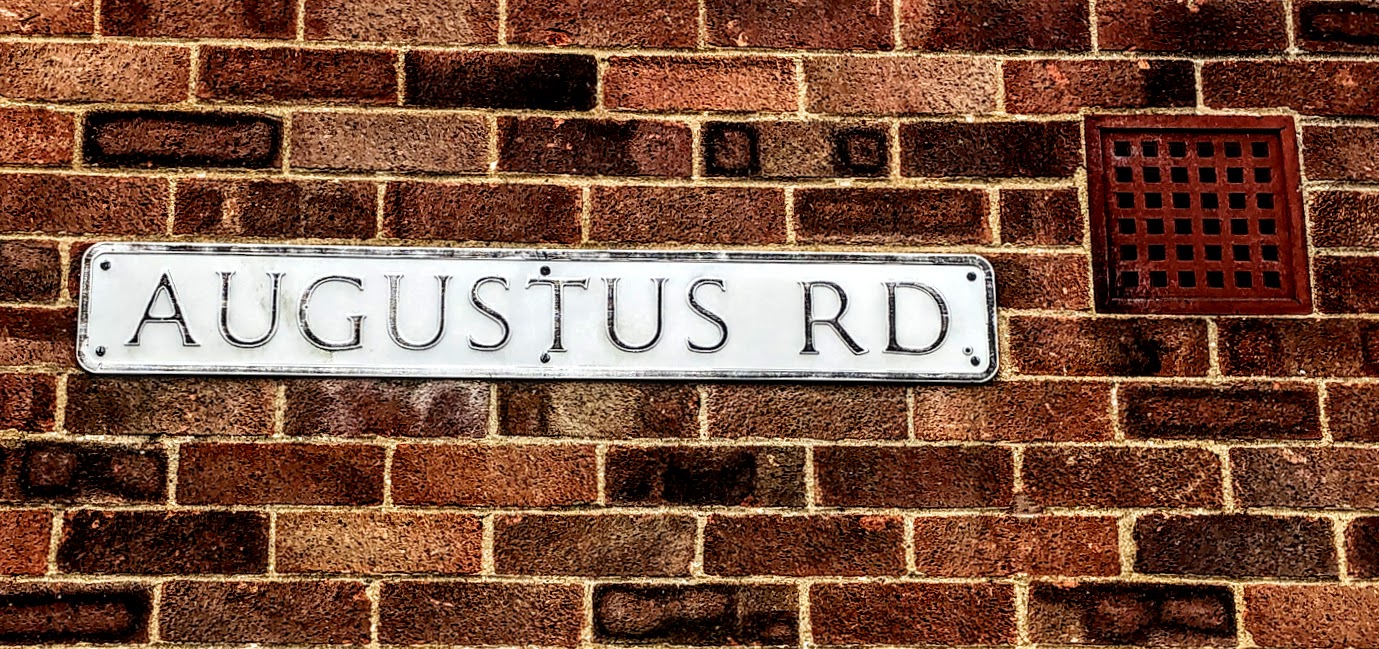
Augustus Road and Egmont Avenue in Stony Stratford are reminders of the story of Augustus Perceval, Earl of Egmont (Photographs: Patrick Comerford, 2022)
Patrick Comerford
Two neighbouring streets in Stony Stratford – Augustus Road off Calverton Road, and Egmont Avenue, which leads off Augustus Road – take their names from Augustus Arthur Perceval (1856-1910), 8th Earl of Egmont, whose family once owned the land on which the houses on both streets are built.
Lord Egmont was a colourful if enigmatic figure. He had run away in his teens to become a sailor, married a waitress, was later a fireman and a town hall janitor or caretaker and worked in salt mines and cement factories before inheriting the family titles and estates in Wolverton and Stony Stratford following a series of coincidental deaths of successive family members.
But, in anticipation of inheriting the Perceval family titles and estates, Augustus had borrowed heavily against the family estates in Ireland that were already heavily indebted and being sold off because of the debauched lifestyle who had died half a century earlier.
By the early 20th century, Augustus had effectively lost any grip on his finances and had squandered all he might have inherited before ever getting his hands on it. He was forced to sell off the last estates he had mortgaged or borrowed against. When he sold off the lands between Calverton and Stony Stratford for housing, the developers kindly acknowledged his name when it came to developing Egmont Avenue and Augustus Road.
The Egmont estate in Stony Calverton and Wolverton dated back to 1806, when it was bought by Augustus Perceval’s great-grandfather, Charles George Perceval (1756-1840), 2nd Baron Arden, a half-brother of John James Perceval (1738-1822), 3rd Earl of Egmont.
Calverton Manor … Charles Perceval, Lord Arden, bought large portions of the Calverton estate in 1806 (Photograph: Patrick Comerford, 2022)
For centuries, from the Middle Ages until the Tudor era, Calverton Manor belonged to the de Vere family, Earls of Oxford, and then the Nevil family, who held the title of Lord Latimer, remembered in the name of Latimer estate. From them, the Calverton estate descended to the Percy family, Earls of Northumberland. It was sold to Sir Thomas Bennet, a former Lord Mayor of London, in 1616, and then descended to the Cecil family, Earls of Salisbury.
When James Cecil (1748-1823), Marquess of Salisbury, sold the manors of Calverton and Beachampton, they were bought at an auction in the Cock Hotel in Stony Startford on 18 October 1806 by William Selby Lowndes of Whaddon, while other interests in Calverton bought by Charles Perceval, Lord Arden. Perceval was a half-brother of Spencer Perceval (1762-1812), who would become Prime Minister in 1809 and who was assassinated in the House of Commons in 1812 – the only British prime minister to have been assassinated. They were half-brothers of John James Perceval, 3rd Earl of Egmont.
The Perceval family were extensive and titled landowners in Ireland. They were descended from Sir Richard Percivale or Perceval (1550-1620), who acquired hundreds of thousands of acres of land in Ireland at the beginning of the 17th century, making him one of the largest landowners in Co Cork.
Sir John Perceval (1629-1665), who amassed over 100,000 acres in Co Cork, including Kanturk Castle and Liscarroll Castle, received the title of baronet at the Caroline restoration in 1661. There is a family connection, for this Sir John Perceval was the recipient of extensive correspondence in 1650s from his cousin William Dobbyns about the living conditions and life circumstances of the mapmaker Nicholas Comerford or Comberford in Stepney in the East End of London.
Sir John Perceval’s grandson, also Sir John Perceval (1683-1748), was MP for Cork (1703-1715) until he received a string of Irish peerage titles, becoming the 1st Earl of Egmont. His son, John Perceval (1711-1770), was MP for Dingle, Co Kerry, in the Irish Parliament, and was the father of two half-brothers who bought out the Cecil family’s interest in the estates in the Calverton and Stony Stratford area.
The third earl’s grandson, Henry Perceval (1796-1841), 5th Earl of Egmont, began the process of selling off the family silver to sustain a life of debauchery, marked by his alcoholism and loose living. In his mad scramble for ready cash, this Lord Egmont appointed Sir Edward Tierney from Rathkeale, Co Limerick, as his agent at his Irish estates in 1823, including Liscarroll Castle and thousands of acres around Churchtown, Kanturk and Buttevant in north Cork.
After living a dissolute lifestyle, this Lord Egmont left all his estates in England and Ireland to Tierney, while the family titles passed to his distant cousin, George Perceval (1794-1874), 3rd Lord Arden, who became the sixth earl.
All Saints’ Church, Calverton, rebuilt in 1818-1824 by Charles Perceval (Photograph: Patrick Comerford, 2022)
His father Charles Perceval, as the 2nd Lord Arden, had bought a portion of Calverton Manor, including the advowson or the right to present or nominate the Rector of Calverton. He exercised this right in 1814 when he presented Dr Butler as a temporary Rector of Calverton, to hold the parish until his son was ‘of a proper age.’ The patronage of the living later descended in the Perceval family to the Earls of Egmont.
Lord Arden commissioned the architect William Pilkington to rebuild All Saints’ Church between 1818 and 1824, on the foundations of the earlier All Hallows’ Church, and the church opened or reopened in October 1818.
Lord Arden was assisted in this work by Dr Butler. Arden also built a new rectory at his own expense, and the foundations of the house were laid in July 1819.
Butler was succeeded in 1821 by Lord Arden’s third son, the Revd the Hon Charles George Perceval (1796-1858), who came to live at Calverton as Rector on 26 March 1821, at the relatively young age of 24.
Charles Perceval was a devout High Churchman and a supporter of the Tractarians. Much of the decoration in the church, the stained glass windows and other embellishments, owes its origins to Perceval.
Many of the Tractarian leaders met in the Rectory at this time, including Edward Bouverie Pusey (1800-1882), John Henry Newman and Edward Manning, and some of the Tracts for the Times were planned if not written at Calverton.
The Revd Charles Perceval of Calverton, was a younger brother of George Perceval (1794-1874), who became the 6th Earl of Egmont in 1841. However, the new earl received not a penny from his ancestral estates.
Sir Edward Tierney had died in 1856 at the age of 76, and his title and his interest in the vast Perceval title had passed to his son, Sir Matthew Edward Tierney (1818-1860), but he left his estates acquired from the Egmonts to his son-in-law, the Revd Sir Lionel Darell (1817-1883).
The sixth earl went to court against Darell to recover the estates in a remarkable case before the Summer Assizes at Cork in 1863. After four days, the case was settled. Egmont recovered Liscarroll Castle and his ancestral estates, but Darell was awarded £125,000 and costs.
Kanturk Castle, Co Cork … given to the National Trust before Augustus Perceval could inherit it, is now in ruins (Photograph: Patrick Comerford, 2021)
Egmont died on 2 August 1874 and – for want of a male heir – was succeeded by his first cousin’s son, Charles George Perceval (1845-1897), 7th Earl of Egmont, who was born in Calverton Rectory. In 1889, this earl sold the Perceval estates in Co Cork, including Liscarroll Castle, near Buttevant, and 62,500 acres of land, to his tenants under the Ashbourne Land Act in 1895. After the seventh earl died in 1897, his widowed countess donated the majestic ruins of Kanturk Castle to the National Trust in 1900.
The seventh earl, like so many of his immediate predecessors, had no immediate male heir, and so his Irish peerage titles passed to his first cousin’s son Augustus Arthur Perceval (1856-1910), who became 8th Earl of Egmont in the Irish peerage, but without the once grand Irish castles at Kanturk and Liscarroll.
Augustus Perceval was born at Papanui, Canterbury, in New Zealand, in 1856. He ran away from his Royal Navy training ship to become a common sailor. He married Kate Howell, daughter of Warwick Howell of South Carolina, in 1881. The New York Times in a report described as a waitress.
A year after Kate and Augustus married, he joined the fire brigade of Southwark, and by 1887 he was working as a janitor or caretaker at Chelsea Town Hall. He later worked in salt mines in Cheshire, and then in South Africa in a cement factory.
He eventually succeeded to the family titles on 5 September 1897. Those titles were daunting and an impressive if not overpowering list: 8th Earl of Egmont, Co Cork, 8th Viscount Perceval of Kanturk, Co Cork, 8th Baron Perceval of Burton, Co Cork, 7th Lord Lovel and Holland, Baron Lovel and Holland of Enmore, Co Somerset, 4th Baron Arden, of Arden, Co Warwick, and 9th baronet. The runaway sailor and former janitor now had a list of titles that would have suited any Gilbert and Sullivan stage production.
Known among his drinking companions as Gussie, he scandalised his fellow peers regularly. He was arrested for being inordinately intoxicated in Piccadilly while accompanied by a young prostitute. The young woman attempted suicide in her cell and Gussie caused a sensation when he refused to remove his hat when arraigned in court the next morning.
In a risk that never paid off, the new earl borrowed heavily, gambling that he would inherit the vast Perceval estates totalling 120,00 acres. Instead, there was little for him to inherit, and he sold off what was left in a piecemeal manner in the hopes of acquiring a lifestyle commensurate with his new status. Finally, he sold Cowdray Park in Sussex in 1910, shortly before he died. Perhaps the only legacy in property that he could leave was giving his names to Augustus Road and Egmont Avenue, which were developed in the early 1900s.
Egmont Avenue in Stony Stratford is a distant reminder of Augustus Perceval, 8th of Egmont (Photograph: Patrick Comerford, 2022)
Gussie and Kate had no children: he died at The Hollies, Thames Ditton, Surrey, in 1910 at the age of 54; Kate, the former waitress who survived as the Dowager Countess of Egmont, died in 1926.
The titles continued to struggle to find heirs among members of the Perceval family who were living in suburban Birmingham. Three claimants to the titles came forward in the late 1920s and early 1930s. Two of the claims, by a baker and a derelict, were dismissed by the Master of the Court of Chancery, who instead accepted of a rancher living in Canada, who at first wanted nothing more than to remain a simple farmer, living in a sparsely-furnished, two-room log house in the Rockies.
The Perceval titles eventually died out in 2011 with the death of the 12th Earl of Egmont. Both Liscarroll Castle and Kanturk Castle in Co Cork are elegant but in ruins. All Saints’ Church in Calverton remains a beautiful historical and architectural legacy of the Perceval family. But the only properies left in Stony Stratford as reminders of this family in name are two suburban streets in Stony Startford: Augustus Road and Egmont Avenue, off Calverton Road.
Augustus Road in Stony Stratford is a distant reminder of Augustus Perceval, 8th of Egmont (Photograph: Patrick Comerford, 2022)
Showing posts with label Buttevant. Show all posts
26 July 2022
Praying with the World Church in
Ordinary Time: Tuesday 26 July 2022
‘The field is the world, and the good seed are the children of the kingdom’ (Matthew 13: 38) … fields of green and gold near High Leigh in Hoddesdon (Photograph: Patrick Comerford)
Patrick Comerford
I am in the High Leigh Conference Centre at Hoddesdon in Hertfordshire this week, taking part in the annual conference of the Anglican mission agency USPG (United Society Partners in the Gospel). The conference, which began yesterday, has the theme ‘Living Stones, Living Hope.’
In the Calendar of the Church today, we remember Anne and Joachim, Parents of the Blessed Virgin Mary, with a lesser festival (26 July 2022). In the Parish of Saint Mary and Saint Giles, Stony Stratford, and All Saints’ Church, Calverton, the intercessions this week also remember the Revd Charles George Perceval, Rector of Calverton, who was born on 25 December 1796 and died on this day, 26 July 1858, aged 61.
Charles Perceval was the son of an Irish peer, Charles George Perceval, 2nd Baron Arden, of Liscarroll Castle, near Buttevant, and Kanturk Castle, Co Cork. Perceval was a devout High Churchman and a supporter of the Tractarians. Many of the Tractarian leaders met in his Rectory in Calverton, including Edward Bouverie Pusey, John Henry Newman and Edward Manning, and some of the Tracts for the Times were planned if not written in Calverton.
I am continuing my prayer diary each morning this week in this way:
1,Reading the Gospel reading of the morning;
2,a short reflections on the reading;
3, a prayer from the USPG prayer diary, ‘Pray with the World Church.’
The Virgin Mary with her parents, Saint Anne and Saint Joachim, in a mosaic by the Russian artist Boris Anrep (1883-1969) in the Cathedral of Christ the King, Mullingar, Co Westmeath (Photograph: Patrick Comerford; click on images for full-screen views)
Common Worship provides this Gospel reading for the Eucharist on today’s Lesser Festival commemorating Anne and Joachim, Parents of the Blessed Virgin Mary:
Matthew 13: 16-17 (NRSVA):
[Jesus said to his disciples:] 16 ‘But blessed are your eyes, for they see, and your ears, for they hear. 17 Truly I tell you, many prophets and righteous people longed to see what you see, but did not see it, and to hear what you hear, but did not hear it.’
On the other hand, the Church of Ireland lectionary provides this Gospel reading for celebrations of the Eucharist today:
Matthew 13: 36-43 (NRSVA):
36 Then he left the crowds and went into the house. And his disciples approached him, saying, ‘Explain to us the parable of the weeds of the field.’ 37 He answered, ‘The one who sows the good seed is the Son of Man; 38 the field is the world, and the good seed are the children of the kingdom; the weeds are the children of the evil one, 39 and the enemy who sowed them is the devil; the harvest is the end of the age, and the reapers are angels. 40 Just as the weeds are collected and burned up with fire, so will it be at the end of the age. 41 The Son of Man will send his angels, and they will collect out of his kingdom all causes of sin and all evildoers, 42 and they will throw them into the furnace of fire, where there will be weeping and gnashing of teeth. 43 Then the righteous will shine like the sun in the kingdom of their Father. Let anyone with ears listen!’
Gnasher and Gnipper in the Beano always seemed to be ready to gnash their teeth
Today’s reflection:
In my imagination, when I was a child, not only were the summers long and sunny, but weekend entertainment was simpler and less complicated. The highlights of the weekend seemed to be Dr Who and Dixon of Dock Green, and the weekly editions of the Eagle and the Beano.
I may have been just a little too old (16) for the first appearance of Gnasher (1968), the pet dog of Dennis the Menace in the Beano.
The G- tagged onto the beginning of the name of both Gnasher and his son Gnipper is pronounced silently, just like the silent P at the beginning of Psmith, the Rupert Psmith in so many PG Wodehouse novels.
Most of the Beano speech bubbles for both Gnasher and Gnipper consist of normal English words beginning with the letter ‘N’ with a silent ‘G’ added to the beginning, as in ‘Gnight, Gnight.’
I was a little too old for the introduction of Gnasher. Nonetheless, my friends in my late teens and early 20s loved Gnasher and Gniper, joked about those silent ‘Gs’ and even recalled how as children we had joked about ‘weeping and G-nashing of teeth.’
There is very little to joke about in today’s Gospel reading (Matthew 13: 36-43). The idea of people being thrown into the furnace of fire is not a very appealing image for children, and so to joke about it is a childhood method of coping.
Nor is the idea of people being thrown into the furnace of fire a very inviting image after a week in which we have suffered burning heats and raging heat not only here but across Europe.
It is worth reminding ourselves that throughout history, humanity has stooped to burn what we dislike and what we want to expunge, and we have done it constantly.
We have been burning books as Christians since Saint Athanasius ordered the burning of texts in Alexandria in the year 367.
In the Middle Ages and later, we burned heretics at the stake. The Inquisition burned heretics and Jews in public squares. Heretics were burned publicly as an accompanying theme for the outdoor sermons of San Bernardino da Siena in the early 15th century, along with mirrors, cosmetics, fine dresses, playing cards … even musical instruments, and, of course, books, song sheets, artworks, paintings and sculpture.
In his sermons, the book-burning friar regularly called for Jews and gays to be either isolated from society or eliminated from the human community.
In Florence, the supporters of Savonarola collected and publicly burned thousands of objects, including cosmetics, art, and books in 1497.
More recently, the Nazis staged regular book burnings, especially burning books by Jewish writers, including Thomas Mann, Karl Marx and Albert Einstein.
Extremists of all religious and political persuasions want to burn the symbols and totems of their opponents, whether it is Pastor Terry Jones burning the Quran and effigies of Bill Clinton and Barack Obama in Florida or jihadists burning the Twin Towers in New York.
The limits of our extremists seem to be defined by their inflammatory words.
But who is being burned in this Gospel reading?
Who is doing the burning?
And who will be weeping and gnashing their teeth?
Contrary to many shoddy readings of this Gospel reading, Christians are not asked to burn anyone or anything at all. And, if we have enemies, we are called not to burn them but to live with them, even love them. Judgment is left with God, while we are left to love and to pray.
Too often we think of who might be excluded from God’s plans rather than who is counted in. When we do that, we descend to our greatest depths rather than reaching our potential heights.
Today’s Prayer:
Collect (Common Worship):
Lord God of Israel,
who bestowed such grace on Anne and Joachim
that their daughter Mary grew up obedient to your word
and made ready to be the mother of your Son:
help us to commit ourselves in all things to your keeping
and grant us the salvation you promised to your people;
through Jesus Christ your Son our Lord,
who is alive and reigns with you,
in the unity of the Holy Spirit,
one God, now and for ever.
The theme in the prayer diary of the Anglican mission agency USPG (United Society Partners in the Gospel) this week is ‘The Way Towards Healing,’ looking at the work for peace of the Churches in Korea. This theme was introduced on Sunday by Shin Seung-min, National Council of Churches in Korea.
Tuesday 26 July 2022:
The USPG Prayer Diary invites us to pray today in these words:
Let us pray for the National Council of Churches in Korea, a thriving example of ecumenism, as they work together to promote peace.
Yesterday’s reflection
Continued tomorrow
An icon of Saint Anne with her child, the Virgin Mary, with her child, the Christ Child, in the Church of Saint Eleftherios and Saint Anna in Corfu (Photograph: Patrick Comerford)
Scripture quotations are from the New Revised Standard Version Bible: Anglicised Edition copyright © 1989, 1995, National Council of the Churches of Christ in the United States of America. Used by permission. All rights reserved worldwide. http://nrsvbibles.org
Patrick Comerford
I am in the High Leigh Conference Centre at Hoddesdon in Hertfordshire this week, taking part in the annual conference of the Anglican mission agency USPG (United Society Partners in the Gospel). The conference, which began yesterday, has the theme ‘Living Stones, Living Hope.’
In the Calendar of the Church today, we remember Anne and Joachim, Parents of the Blessed Virgin Mary, with a lesser festival (26 July 2022). In the Parish of Saint Mary and Saint Giles, Stony Stratford, and All Saints’ Church, Calverton, the intercessions this week also remember the Revd Charles George Perceval, Rector of Calverton, who was born on 25 December 1796 and died on this day, 26 July 1858, aged 61.
Charles Perceval was the son of an Irish peer, Charles George Perceval, 2nd Baron Arden, of Liscarroll Castle, near Buttevant, and Kanturk Castle, Co Cork. Perceval was a devout High Churchman and a supporter of the Tractarians. Many of the Tractarian leaders met in his Rectory in Calverton, including Edward Bouverie Pusey, John Henry Newman and Edward Manning, and some of the Tracts for the Times were planned if not written in Calverton.
I am continuing my prayer diary each morning this week in this way:
1,Reading the Gospel reading of the morning;
2,a short reflections on the reading;
3, a prayer from the USPG prayer diary, ‘Pray with the World Church.’
The Virgin Mary with her parents, Saint Anne and Saint Joachim, in a mosaic by the Russian artist Boris Anrep (1883-1969) in the Cathedral of Christ the King, Mullingar, Co Westmeath (Photograph: Patrick Comerford; click on images for full-screen views)
Common Worship provides this Gospel reading for the Eucharist on today’s Lesser Festival commemorating Anne and Joachim, Parents of the Blessed Virgin Mary:
Matthew 13: 16-17 (NRSVA):
[Jesus said to his disciples:] 16 ‘But blessed are your eyes, for they see, and your ears, for they hear. 17 Truly I tell you, many prophets and righteous people longed to see what you see, but did not see it, and to hear what you hear, but did not hear it.’
On the other hand, the Church of Ireland lectionary provides this Gospel reading for celebrations of the Eucharist today:
Matthew 13: 36-43 (NRSVA):
36 Then he left the crowds and went into the house. And his disciples approached him, saying, ‘Explain to us the parable of the weeds of the field.’ 37 He answered, ‘The one who sows the good seed is the Son of Man; 38 the field is the world, and the good seed are the children of the kingdom; the weeds are the children of the evil one, 39 and the enemy who sowed them is the devil; the harvest is the end of the age, and the reapers are angels. 40 Just as the weeds are collected and burned up with fire, so will it be at the end of the age. 41 The Son of Man will send his angels, and they will collect out of his kingdom all causes of sin and all evildoers, 42 and they will throw them into the furnace of fire, where there will be weeping and gnashing of teeth. 43 Then the righteous will shine like the sun in the kingdom of their Father. Let anyone with ears listen!’
Gnasher and Gnipper in the Beano always seemed to be ready to gnash their teeth
Today’s reflection:
In my imagination, when I was a child, not only were the summers long and sunny, but weekend entertainment was simpler and less complicated. The highlights of the weekend seemed to be Dr Who and Dixon of Dock Green, and the weekly editions of the Eagle and the Beano.
I may have been just a little too old (16) for the first appearance of Gnasher (1968), the pet dog of Dennis the Menace in the Beano.
The G- tagged onto the beginning of the name of both Gnasher and his son Gnipper is pronounced silently, just like the silent P at the beginning of Psmith, the Rupert Psmith in so many PG Wodehouse novels.
Most of the Beano speech bubbles for both Gnasher and Gnipper consist of normal English words beginning with the letter ‘N’ with a silent ‘G’ added to the beginning, as in ‘Gnight, Gnight.’
I was a little too old for the introduction of Gnasher. Nonetheless, my friends in my late teens and early 20s loved Gnasher and Gniper, joked about those silent ‘Gs’ and even recalled how as children we had joked about ‘weeping and G-nashing of teeth.’
There is very little to joke about in today’s Gospel reading (Matthew 13: 36-43). The idea of people being thrown into the furnace of fire is not a very appealing image for children, and so to joke about it is a childhood method of coping.
Nor is the idea of people being thrown into the furnace of fire a very inviting image after a week in which we have suffered burning heats and raging heat not only here but across Europe.
It is worth reminding ourselves that throughout history, humanity has stooped to burn what we dislike and what we want to expunge, and we have done it constantly.
We have been burning books as Christians since Saint Athanasius ordered the burning of texts in Alexandria in the year 367.
In the Middle Ages and later, we burned heretics at the stake. The Inquisition burned heretics and Jews in public squares. Heretics were burned publicly as an accompanying theme for the outdoor sermons of San Bernardino da Siena in the early 15th century, along with mirrors, cosmetics, fine dresses, playing cards … even musical instruments, and, of course, books, song sheets, artworks, paintings and sculpture.
In his sermons, the book-burning friar regularly called for Jews and gays to be either isolated from society or eliminated from the human community.
In Florence, the supporters of Savonarola collected and publicly burned thousands of objects, including cosmetics, art, and books in 1497.
More recently, the Nazis staged regular book burnings, especially burning books by Jewish writers, including Thomas Mann, Karl Marx and Albert Einstein.
Extremists of all religious and political persuasions want to burn the symbols and totems of their opponents, whether it is Pastor Terry Jones burning the Quran and effigies of Bill Clinton and Barack Obama in Florida or jihadists burning the Twin Towers in New York.
The limits of our extremists seem to be defined by their inflammatory words.
But who is being burned in this Gospel reading?
Who is doing the burning?
And who will be weeping and gnashing their teeth?
Contrary to many shoddy readings of this Gospel reading, Christians are not asked to burn anyone or anything at all. And, if we have enemies, we are called not to burn them but to live with them, even love them. Judgment is left with God, while we are left to love and to pray.
Too often we think of who might be excluded from God’s plans rather than who is counted in. When we do that, we descend to our greatest depths rather than reaching our potential heights.
Today’s Prayer:
Collect (Common Worship):
Lord God of Israel,
who bestowed such grace on Anne and Joachim
that their daughter Mary grew up obedient to your word
and made ready to be the mother of your Son:
help us to commit ourselves in all things to your keeping
and grant us the salvation you promised to your people;
through Jesus Christ your Son our Lord,
who is alive and reigns with you,
in the unity of the Holy Spirit,
one God, now and for ever.
The theme in the prayer diary of the Anglican mission agency USPG (United Society Partners in the Gospel) this week is ‘The Way Towards Healing,’ looking at the work for peace of the Churches in Korea. This theme was introduced on Sunday by Shin Seung-min, National Council of Churches in Korea.
Tuesday 26 July 2022:
The USPG Prayer Diary invites us to pray today in these words:
Let us pray for the National Council of Churches in Korea, a thriving example of ecumenism, as they work together to promote peace.
Yesterday’s reflection
Continued tomorrow
An icon of Saint Anne with her child, the Virgin Mary, with her child, the Christ Child, in the Church of Saint Eleftherios and Saint Anna in Corfu (Photograph: Patrick Comerford)
Scripture quotations are from the New Revised Standard Version Bible: Anglicised Edition copyright © 1989, 1995, National Council of the Churches of Christ in the United States of America. Used by permission. All rights reserved worldwide. http://nrsvbibles.org
Labels:
Buttevant,
Calverton,
Corfu,
High Leigh,
Hoddesdon,
Humour,
Icons,
Kanturk,
Korea,
Liscarroll,
Mullingar,
Prayer,
Saint Matthew's Gospel,
Stony Stratford,
USPG,
USPG High Leigh 2022
18 October 2021
Praying in Ordinary Time 2021:
142, Buttevant Friary, Co Cork
The ruins of the Franciscan Friary beside Saint Mary’s Church, on the Main Street, Buttevant (Photograph: Patrick Comerford)
Patrick Comerford
Today is the Feast of Saint Luke the Evangelist (18 October). The annual clergy conference for priests of the Diocese of Limerick and Killaloe and the Diocese of Tuam, Killala and Achonry begins later today in Adare, Co Limerick.
This year’s conference comes just two weeks before the two dioceses are merged into one following the retirement of both Bishop Kenneth Kearon and Bishop Patrick Rooke.
Before the day begins, I am taking a little time this morning for prayer, reflection and reading. Each morning in the time in the Church Calendar known as Ordinary Time, I am reflecting in these ways:
1, photographs of a church or place of worship;
2, the day’s Gospel reading;
3, a prayer from the USPG prayer diary.
My theme for these few weeks is churches in the Franciscan (and Capuchin) tradition. My photographs this morning (18 October 2021) are of the ruins of the Franciscan Friary in Buttevant, Co Cork.
The east window in the Franciscan friary church (Photograph: Patrick Comerford)
The ruins of the Franciscan Friary are in the centre of Buttevant, beside Saint Mary’s Roman Catholic Church on the Main Street. The friary was also dedicated to Saint Thomas à Becket of Canterbury and housed a thriving community from the mid-13th to mid-16th century. It still possesses some of the earliest examples of Franciscan architecture in Ireland.
The first friary of the Observant Franciscans in Ireland was founded at Youghal, Co Cork, by Maurice FitzGerald in 1224. The friary in Buttevant was founded from Youghal and was the only Franciscan house in North Cork.
The Annals of the Four Masters record it was founded and endowed in 1251 by David Óg de Barry. The townland of Lagfrancis was assigned as the glebe for its mensa.
At first, the Franciscan friary had a rectangular church. A transept was added later, with a triumphal arch that faced south, towards the Barry family’s castle. The Bell Tower was added in the final phase and was placed equidistant from both gables of the friary.
The Franciscans were mendicant friars who lived by preaching and on charity. But their patrons in Buttevant, the Barry family, financed several major redevelopments of the friary. Over the centuries, these expansions showed the growing wealth and power of the Barrys.
By 1324, Buttevant friary consisted of a community of Irish and Anglo-Norman friars and was important enough to maintain its own stadium or house of studies.
However, the community was divided by tensions between the Anglo-Norman and Irish friars. A Papal commission investigated a decision to transfer a Gaelic friar from Buttevant to one of the Gaelic friaries, and the Friary in the 1320s, at the time when the friary in Buttevant had been transferred to a new jurisdiction, separating it from other Irish friaries and linking it to Anglo-Norman friaries.
The Cloyne diocesan records from the 1400s show that the law courts in Buttevant operated at the door of the friary church. In mediaeval Buttevant, the friary porch was the place to make legal agreements, renew or grant leases on Lady Day and Michaelmas, to swear fealty, to do homage and to marriages. These records also record the same legal functions at the front door of the parish church of Saint Bridget, the site later of Saint John’s Church, the Church of Ireland parish church in Buttevant.
When of the monastic houses were dissolved during the Tudor reformation in the 1540s, the Franciscan friary in Buttevant included the friary church, the conventual buildings, a garden, a cemetery, and a watermill.
James de Barry (1520-1581), 4th Viscount Buttevant, obtained a 21-year lease of the friary in 1571. At the outbreak of the Desmond Rebellions, he joined the rebels and when his estates were confiscated, the friary in Buttevant passed to Edmund Spenser in the Plantation of Munster. However, by 1615 or earlier, the friary had reverted to his son, David de Barry (1550-1617), 5th Viscount Buttevant.
Evidence shows the Franciscan friars continued to live at the friary in late Elizabethan and Jacobean Buttevant. Reports in 1615 and 1629 show the large friary church was still roofed and held many of the tombs of the local nobility, and the friary buildings ‘were spacious and numerous.’
At the Irish Rebellion in 1641, the Franciscan community in Buttevant welcomed the Confederate army of Lord Mountgarret, and the guardian, Father Boetius Egan, attended the Confederate Parliament in Kilkenny in 1642. But Murrough O’Brien, Earl of Inchiquin, assembled the Parliamentarian army in Buttevant and burned the friary church.
The friars returned to Buttevant at the Restoration. Two friars continued to live in Buttevant in the 18th century, and the friary was still being used by friars in 1731, according to a report presented to the House of Lords.
By 1800, only one old friar was left in Buttevant, and he died soon afterwards. The great Bell Tower, which had been silent for centuries but continued to dominate the friary ruins, collapsed in 1814, and greatly damaged an already fragile, crumbling building. By 1820, the Franciscan presence in Buttevant had come to end after almost 600 years.
Canon Cornelius Buckley, who built Saint Mary’s Church in the 1830s, removed the rubble inside the friary nave and chancel , and collected the architectural remnants that were inserted in the north wall, as a ‘sort of mediaeval museum for the curious,’ as the antiquarian, Richard Brash described it.
A large quantity of human remains and bones was collected at this stage. For some years, they were of ghoulish interest to visitors, but were later reburied in the crypt under the friary.
Samuel Lewis noted in his Topographical Dictionary in 1837, that the tomb of the founder, David de Barry, ‘is supposed to be in the centre of the chancel, but is marked only by some broken stones which appear to have formed an enclosure.’ Other families buried in the nave and chancel included the Barrys, Fitzgeralds, Lombards, and others.
The remains of the friary today include a church with a piscina and a number of elaborate carvings. The church and transept are complete, many stones belonging to the cloister arcade are stored in the upper vault under the choir, while there are good carved stones in the lower vault, and some windows in the church have been rebuilt.
Inside the church of the Franciscan friary in Buttevant (Photograph: Patrick Comerford)
Luke 10: 1-9 (NRSVA):
10 After this the Lord appointed seventy others and sent them on ahead of him in pairs to every town and place where he himself intended to go. 2 He said to them, ‘The harvest is plentiful, but the labourers are few; therefore ask the Lord of the harvest to send out labourers into his harvest. 3 Go on your way. See, I am sending you out like lambs into the midst of wolves. 4 Carry no purse, no bag, no sandals; and greet no one on the road. 5 Whatever house you enter, first say, “Peace to this house!” 6 And if anyone is there who shares in peace, your peace will rest on that person; but if not, it will return to you. 7 Remain in the same house, eating and drinking whatever they provide, for the labourer deserves to be paid. Do not move about from house to house. 8 Whenever you enter a town and its people welcome you, eat what is set before you; 9 cure the sick who are there, and say to them, “The kingdom of God has come near to you”.’
The Franciscan friars continued to live in Buttevant until the early 19th century (Photograph: Patrick Comerford)
The Prayer in the USPG Prayer Diary today (18 October 2021, Saint Luke the Evangelist) invites us to pray:
Let us give thanks for the life and works of Saint Luke. May we be a healing presence in the world.
Architectural remains and portions of graves were inserted in the north wall of the friary church in the 1830s (Photograph: Patrick Comerford, 2020
Yesterday’s reflection
Continued tomorrow
Portion of a carved mediaeval crucifixion, inserted in a wall in the south transept (Photograph: Patrick Comerford)
Scripture quotations are from the New Revised Standard Version Bible: Anglicised Edition copyright © 1989, 1995, National Council of the Churches of Christ in the United States of America. Used by permission. All rights reserved worldwide. http://nrsvbibles.org
Patrick Comerford
Today is the Feast of Saint Luke the Evangelist (18 October). The annual clergy conference for priests of the Diocese of Limerick and Killaloe and the Diocese of Tuam, Killala and Achonry begins later today in Adare, Co Limerick.
This year’s conference comes just two weeks before the two dioceses are merged into one following the retirement of both Bishop Kenneth Kearon and Bishop Patrick Rooke.
Before the day begins, I am taking a little time this morning for prayer, reflection and reading. Each morning in the time in the Church Calendar known as Ordinary Time, I am reflecting in these ways:
1, photographs of a church or place of worship;
2, the day’s Gospel reading;
3, a prayer from the USPG prayer diary.
My theme for these few weeks is churches in the Franciscan (and Capuchin) tradition. My photographs this morning (18 October 2021) are of the ruins of the Franciscan Friary in Buttevant, Co Cork.
The east window in the Franciscan friary church (Photograph: Patrick Comerford)
The ruins of the Franciscan Friary are in the centre of Buttevant, beside Saint Mary’s Roman Catholic Church on the Main Street. The friary was also dedicated to Saint Thomas à Becket of Canterbury and housed a thriving community from the mid-13th to mid-16th century. It still possesses some of the earliest examples of Franciscan architecture in Ireland.
The first friary of the Observant Franciscans in Ireland was founded at Youghal, Co Cork, by Maurice FitzGerald in 1224. The friary in Buttevant was founded from Youghal and was the only Franciscan house in North Cork.
The Annals of the Four Masters record it was founded and endowed in 1251 by David Óg de Barry. The townland of Lagfrancis was assigned as the glebe for its mensa.
At first, the Franciscan friary had a rectangular church. A transept was added later, with a triumphal arch that faced south, towards the Barry family’s castle. The Bell Tower was added in the final phase and was placed equidistant from both gables of the friary.
The Franciscans were mendicant friars who lived by preaching and on charity. But their patrons in Buttevant, the Barry family, financed several major redevelopments of the friary. Over the centuries, these expansions showed the growing wealth and power of the Barrys.
By 1324, Buttevant friary consisted of a community of Irish and Anglo-Norman friars and was important enough to maintain its own stadium or house of studies.
However, the community was divided by tensions between the Anglo-Norman and Irish friars. A Papal commission investigated a decision to transfer a Gaelic friar from Buttevant to one of the Gaelic friaries, and the Friary in the 1320s, at the time when the friary in Buttevant had been transferred to a new jurisdiction, separating it from other Irish friaries and linking it to Anglo-Norman friaries.
The Cloyne diocesan records from the 1400s show that the law courts in Buttevant operated at the door of the friary church. In mediaeval Buttevant, the friary porch was the place to make legal agreements, renew or grant leases on Lady Day and Michaelmas, to swear fealty, to do homage and to marriages. These records also record the same legal functions at the front door of the parish church of Saint Bridget, the site later of Saint John’s Church, the Church of Ireland parish church in Buttevant.
When of the monastic houses were dissolved during the Tudor reformation in the 1540s, the Franciscan friary in Buttevant included the friary church, the conventual buildings, a garden, a cemetery, and a watermill.
James de Barry (1520-1581), 4th Viscount Buttevant, obtained a 21-year lease of the friary in 1571. At the outbreak of the Desmond Rebellions, he joined the rebels and when his estates were confiscated, the friary in Buttevant passed to Edmund Spenser in the Plantation of Munster. However, by 1615 or earlier, the friary had reverted to his son, David de Barry (1550-1617), 5th Viscount Buttevant.
Evidence shows the Franciscan friars continued to live at the friary in late Elizabethan and Jacobean Buttevant. Reports in 1615 and 1629 show the large friary church was still roofed and held many of the tombs of the local nobility, and the friary buildings ‘were spacious and numerous.’
At the Irish Rebellion in 1641, the Franciscan community in Buttevant welcomed the Confederate army of Lord Mountgarret, and the guardian, Father Boetius Egan, attended the Confederate Parliament in Kilkenny in 1642. But Murrough O’Brien, Earl of Inchiquin, assembled the Parliamentarian army in Buttevant and burned the friary church.
The friars returned to Buttevant at the Restoration. Two friars continued to live in Buttevant in the 18th century, and the friary was still being used by friars in 1731, according to a report presented to the House of Lords.
By 1800, only one old friar was left in Buttevant, and he died soon afterwards. The great Bell Tower, which had been silent for centuries but continued to dominate the friary ruins, collapsed in 1814, and greatly damaged an already fragile, crumbling building. By 1820, the Franciscan presence in Buttevant had come to end after almost 600 years.
Canon Cornelius Buckley, who built Saint Mary’s Church in the 1830s, removed the rubble inside the friary nave and chancel , and collected the architectural remnants that were inserted in the north wall, as a ‘sort of mediaeval museum for the curious,’ as the antiquarian, Richard Brash described it.
A large quantity of human remains and bones was collected at this stage. For some years, they were of ghoulish interest to visitors, but were later reburied in the crypt under the friary.
Samuel Lewis noted in his Topographical Dictionary in 1837, that the tomb of the founder, David de Barry, ‘is supposed to be in the centre of the chancel, but is marked only by some broken stones which appear to have formed an enclosure.’ Other families buried in the nave and chancel included the Barrys, Fitzgeralds, Lombards, and others.
The remains of the friary today include a church with a piscina and a number of elaborate carvings. The church and transept are complete, many stones belonging to the cloister arcade are stored in the upper vault under the choir, while there are good carved stones in the lower vault, and some windows in the church have been rebuilt.
Inside the church of the Franciscan friary in Buttevant (Photograph: Patrick Comerford)
Luke 10: 1-9 (NRSVA):
10 After this the Lord appointed seventy others and sent them on ahead of him in pairs to every town and place where he himself intended to go. 2 He said to them, ‘The harvest is plentiful, but the labourers are few; therefore ask the Lord of the harvest to send out labourers into his harvest. 3 Go on your way. See, I am sending you out like lambs into the midst of wolves. 4 Carry no purse, no bag, no sandals; and greet no one on the road. 5 Whatever house you enter, first say, “Peace to this house!” 6 And if anyone is there who shares in peace, your peace will rest on that person; but if not, it will return to you. 7 Remain in the same house, eating and drinking whatever they provide, for the labourer deserves to be paid. Do not move about from house to house. 8 Whenever you enter a town and its people welcome you, eat what is set before you; 9 cure the sick who are there, and say to them, “The kingdom of God has come near to you”.’
The Franciscan friars continued to live in Buttevant until the early 19th century (Photograph: Patrick Comerford)
The Prayer in the USPG Prayer Diary today (18 October 2021, Saint Luke the Evangelist) invites us to pray:
Let us give thanks for the life and works of Saint Luke. May we be a healing presence in the world.
Architectural remains and portions of graves were inserted in the north wall of the friary church in the 1830s (Photograph: Patrick Comerford, 2020
Yesterday’s reflection
Continued tomorrow
Portion of a carved mediaeval crucifixion, inserted in a wall in the south transept (Photograph: Patrick Comerford)
Scripture quotations are from the New Revised Standard Version Bible: Anglicised Edition copyright © 1989, 1995, National Council of the Churches of Christ in the United States of America. Used by permission. All rights reserved worldwide. http://nrsvbibles.org
24 November 2020
Finding one Saint Colman
after another, and then
a third Saint Colman
Saint Colman of Cloyne depicted in a window in Saint Colman’s Cathedral, Cobh, Co Cork (Photograph: Patrick Comerford, 2020)
Patrick Comerford
Today (24 November) is the feast of Saint Colman of Cloyne, who gives his name to both Saint Colman’s Cathedral in Cloyne in the Church of Ireland, and Saint Colman’s Cathedral in Cobh in the Roman Catholic Church.
But when I was visiting Saint Colman’s Church and monastic site in Kilcolman, west Limerick, I was told that the Saint Colman honoured there is Saint Colman who is associated with Templeshambo, Co Wexford, and whose feastday is on 27 October.
Indeed, there is at least one more Saint Colman among Irish monastic saints, Saint Colman Mac Duagh, who is associated with Kilmacduagh, Co Clare, a diocese that is incorporated along with Kilfenora, into the Diocese of Limerick and Killaloe in the Church of Ireland and, along with Kilefenora into the Diocese of Galway in the Roman Catholic Church.
Saint Colman of Cloyne (left) among the saints in a stained-glass window in Saint Mary’s Church, Buttevant, Co Cork … the window is the work Franz Mayer & Co in 1886 (Photograph: Patrick Comerford, 2020)
Saint Colmán of Cloyne (530-606), also known as Colmán mac Léníne, was a monk, founder and patron of Cluain Uama, now Cloyne, Co Cork, and one of the earliest-known Irish poets to write in the vernacular.
Irish genealogies generally agree that this Saint Colmán was the son of Lénín, and descended from the Rothrige, a people who lived in the Déisi or present-day Co Waterford. Irish genealogies also try to associate him with the Éoganachta, the leading ruling dynasty in Munster.
He is said to have been educated as a bard or file, and became attached to the court of Cashel where he remained until he was about 48 years. He and Saint Brendan of Clonfert are said to have settled a dispute in 570 between rival claimants to the throne of Cashel. Aodh Caomh was acknowledged as king, becoming the first Christian king of Cashel, and was enthroned by Saint Brendan.
Saint Brendan then ordained Colmán, giving him his name which is a diminutive of Colm, derived from the Latin columba (dove). According to tradition, Colmán is named as one of the three ‘ex-laymen’ (athláich) of Ireland, along with Énna of Aran and Móchammac of Inis Celtra, suggesting that Colmán was ordained at a later age than was usual at the time.
After some time in Saint Jarlath’s monastery in Tuam, Co Galway, Colman returned to east Co Cork. He is described as a ‘religious and holy priest, who afterwards became a famous bishop.’
Saint Colmán is remembered as the founder of the monastery at Cloyne (Cluain Uama), Co Cork, on land given not given by the local king, but by the King of Munster. The Prince of the Déise, in Co Waterford, presented his child to Colman for baptism. Colman baptised him the child who became Saint Declan of Ardmore.
Saint Colman is also said to have founded a monastery at what became Killagha Abbey in Co Kerry, and many places in Co Cork and Co Limerick are associated with his name.
Many accounts describe him as the ‘royal poet of Munster,’ and his poems include a metrical panegyric on Saint Brendan. His surviving verses date from the period 565 and 604, and are among the earliest examples of Irish writing in the Latin alphabet.
He died on 24 November, ca 600, and was probably buried in Cloyne.
Saint Colman of Templeshambo depicted in a window in Saint Colman’s Church, Co Limerick (Photograph: Patrick Comerford, 2020)
However, the people of Kilcolman in West Limerick insist that bith the mediaeval church and modern church there take their name from Saint Colman of Templeshambo or Templeshanbo, near Bunclody, Co Wexford.
This saint was from Connacht, the son of Eochaidh Brec, and Fearamhla, but lived and laboured mainly in wat is now Co Wexford. He was a contemporary of Saint Máedóc or Saint Aidan of Ferns, who appointed him Abbot of Templeshambo, originally called ‘Shanbo-Colman’ or Saint Colman’s booth.
There are many legends about Saint Colman and of his holy well with its sacred ducks. He is said to have laboured zealously at the foot of Mount Leinster. He died ca 595 on 27 October, according to the Martyrology of Donegal.
Saint Colman’s Church of Ireland Parish Church in Templeshambo, Co Wexford (Photograph: Patrick Comerford)
The third saint, Saint Colman mac Duagh (ca 560-632), was born at Corker, near Kiltartan, Co Galway, the son of Duac, a local chieftain, and Queen Rhinagh. He initially lived as a recluse, living in prayer and prolonged fastings, first at Saint Enda’s monastery on Inismore on the Aran Islands, then in a cave at the Burren in Co Clare.
With the support of his kinsman, King Guaire Aidne mac Colmáin of Connacht, who lived at Dungaire Castle, Kinvara, he founded the monastery of Kilmacduagh, (‘the church of the son of Duac’) in 610, and became its abbot-bishop. His monastery became the centre of the tribal Diocese of Aidhne, practically coextensive with the later Diocese of Kilmacduagh.
Local legend says Saint Colman declared that no person nor animal in the Diocese of Kilmacduagh would ever die of lightning strike. His abbatial crozier was used through the centuries for the swearing of oaths. It was in the custody of the O’Heyne family of Kiltartan and later the O’Shaughnessy family, and is now the National Museum in Dublin.
Other legends tell of Saint Colman and his love for birds and animals, and how he kept a pet rooster to call him in the morning, a pet mouse to call him to prayer in the middle of the night, and a pet fly who served as a bookmark.
When they died, he wrote about his loss to his friend Saint Columba, who replied: ‘You were too rich when you had them. That is why you are sad now. Trouble like that only comes where there are riches. Be rich no more.’
He died on 29 October 632. Although the Martyrology of Donegal assigns his feast to 2 February, tradition in the Diocese of Kilmacduagh pointed to 29 October, and an annual pilgrimage to his hermitage was associated with 21 October.
Saint Colman’s Cathedral, Cobh … he is the patron saint of the Diocese of Cloyne, and his feast day is on 24 November (Photograph: Patrick Comerford, 2020)
Patrick Comerford
Today (24 November) is the feast of Saint Colman of Cloyne, who gives his name to both Saint Colman’s Cathedral in Cloyne in the Church of Ireland, and Saint Colman’s Cathedral in Cobh in the Roman Catholic Church.
But when I was visiting Saint Colman’s Church and monastic site in Kilcolman, west Limerick, I was told that the Saint Colman honoured there is Saint Colman who is associated with Templeshambo, Co Wexford, and whose feastday is on 27 October.
Indeed, there is at least one more Saint Colman among Irish monastic saints, Saint Colman Mac Duagh, who is associated with Kilmacduagh, Co Clare, a diocese that is incorporated along with Kilfenora, into the Diocese of Limerick and Killaloe in the Church of Ireland and, along with Kilefenora into the Diocese of Galway in the Roman Catholic Church.
Saint Colman of Cloyne (left) among the saints in a stained-glass window in Saint Mary’s Church, Buttevant, Co Cork … the window is the work Franz Mayer & Co in 1886 (Photograph: Patrick Comerford, 2020)
Saint Colmán of Cloyne (530-606), also known as Colmán mac Léníne, was a monk, founder and patron of Cluain Uama, now Cloyne, Co Cork, and one of the earliest-known Irish poets to write in the vernacular.
Irish genealogies generally agree that this Saint Colmán was the son of Lénín, and descended from the Rothrige, a people who lived in the Déisi or present-day Co Waterford. Irish genealogies also try to associate him with the Éoganachta, the leading ruling dynasty in Munster.
He is said to have been educated as a bard or file, and became attached to the court of Cashel where he remained until he was about 48 years. He and Saint Brendan of Clonfert are said to have settled a dispute in 570 between rival claimants to the throne of Cashel. Aodh Caomh was acknowledged as king, becoming the first Christian king of Cashel, and was enthroned by Saint Brendan.
Saint Brendan then ordained Colmán, giving him his name which is a diminutive of Colm, derived from the Latin columba (dove). According to tradition, Colmán is named as one of the three ‘ex-laymen’ (athláich) of Ireland, along with Énna of Aran and Móchammac of Inis Celtra, suggesting that Colmán was ordained at a later age than was usual at the time.
After some time in Saint Jarlath’s monastery in Tuam, Co Galway, Colman returned to east Co Cork. He is described as a ‘religious and holy priest, who afterwards became a famous bishop.’
Saint Colmán is remembered as the founder of the monastery at Cloyne (Cluain Uama), Co Cork, on land given not given by the local king, but by the King of Munster. The Prince of the Déise, in Co Waterford, presented his child to Colman for baptism. Colman baptised him the child who became Saint Declan of Ardmore.
Saint Colman is also said to have founded a monastery at what became Killagha Abbey in Co Kerry, and many places in Co Cork and Co Limerick are associated with his name.
Many accounts describe him as the ‘royal poet of Munster,’ and his poems include a metrical panegyric on Saint Brendan. His surviving verses date from the period 565 and 604, and are among the earliest examples of Irish writing in the Latin alphabet.
He died on 24 November, ca 600, and was probably buried in Cloyne.
Saint Colman of Templeshambo depicted in a window in Saint Colman’s Church, Co Limerick (Photograph: Patrick Comerford, 2020)
However, the people of Kilcolman in West Limerick insist that bith the mediaeval church and modern church there take their name from Saint Colman of Templeshambo or Templeshanbo, near Bunclody, Co Wexford.
This saint was from Connacht, the son of Eochaidh Brec, and Fearamhla, but lived and laboured mainly in wat is now Co Wexford. He was a contemporary of Saint Máedóc or Saint Aidan of Ferns, who appointed him Abbot of Templeshambo, originally called ‘Shanbo-Colman’ or Saint Colman’s booth.
There are many legends about Saint Colman and of his holy well with its sacred ducks. He is said to have laboured zealously at the foot of Mount Leinster. He died ca 595 on 27 October, according to the Martyrology of Donegal.
Saint Colman’s Church of Ireland Parish Church in Templeshambo, Co Wexford (Photograph: Patrick Comerford)The third saint, Saint Colman mac Duagh (ca 560-632), was born at Corker, near Kiltartan, Co Galway, the son of Duac, a local chieftain, and Queen Rhinagh. He initially lived as a recluse, living in prayer and prolonged fastings, first at Saint Enda’s monastery on Inismore on the Aran Islands, then in a cave at the Burren in Co Clare.
With the support of his kinsman, King Guaire Aidne mac Colmáin of Connacht, who lived at Dungaire Castle, Kinvara, he founded the monastery of Kilmacduagh, (‘the church of the son of Duac’) in 610, and became its abbot-bishop. His monastery became the centre of the tribal Diocese of Aidhne, practically coextensive with the later Diocese of Kilmacduagh.
Local legend says Saint Colman declared that no person nor animal in the Diocese of Kilmacduagh would ever die of lightning strike. His abbatial crozier was used through the centuries for the swearing of oaths. It was in the custody of the O’Heyne family of Kiltartan and later the O’Shaughnessy family, and is now the National Museum in Dublin.
Other legends tell of Saint Colman and his love for birds and animals, and how he kept a pet rooster to call him in the morning, a pet mouse to call him to prayer in the middle of the night, and a pet fly who served as a bookmark.
When they died, he wrote about his loss to his friend Saint Columba, who replied: ‘You were too rich when you had them. That is why you are sad now. Trouble like that only comes where there are riches. Be rich no more.’
He died on 29 October 632. Although the Martyrology of Donegal assigns his feast to 2 February, tradition in the Diocese of Kilmacduagh pointed to 29 October, and an annual pilgrimage to his hermitage was associated with 21 October.
Saint Colman’s Cathedral, Cobh … he is the patron saint of the Diocese of Cloyne, and his feast day is on 24 November (Photograph: Patrick Comerford, 2020)
14 November 2020
In search of more Victorian
and Edwardian post boxes
from pre-independence days
A Victorian post box near Creeves, Co Limerick … created a discussion about surviving pre-independence post boxes (Photograph: Patrick Comerford, 2020)
Patrick Comerford
Earlier this week, I initiated an unexpected conversation on Instagram and Facebook when I posed a photograph of a Victorian red post box near Kilbradren, close to Creeves and Rathkeale in west Co Limerick.
Some people wanted to know whether it was genuine, others suggested it was a plastic replica, while a number of people wanted to know how many Victorian post boxes have survived in Co Limerick and other parts of Ireland.
For about ten years or so, I have occasionally taken photographs of old post boxes and pillar boxes that predate the formation of the Irish Free State and a separate Irish postal service in 1922.
They are spread throughout the country, from Co Mayo to Co Wexford, and from Co Louth to Co Wexford. When I last posted about these fast-disappearing post boxes on 18 August 2017, I included a collection of photographs of 47 pre-independence post boxes in 11 counties throughout the Republic of Ireland.
I have not gone in search of them with any purpose or method, so my collection of is representative at any time only of places I have visited in recent years, and of how alert I was on any particular day.
Since that first posting, I have come across another 15 similar post boxes, spread across the island in different places.
Most of these post boxes and pillar boxes are embellished with royal monograms. The simpler boxes, inserted into walls, have plain ‘VR’ initials with crown insignias, while the stand-alone tubular pillar boxes often have a monogram with the ‘VR’ (Queen Victoria) or ‘EVIIR’ (Edward VII) initials in a cursive flourish, but despite the decorative approach have no crowns.
The initials became more elaborate in their calligraphic flourishes during the reign of Edward VII, but they returned to more simple fonts in the reign of George V, reflecting not only the harsh times of World War I and the War of Independence but also the design and development of new typefaces for typography and printing that emphasised clarity and legibility.
The green post box, in various shapes and sizes, is a familiar sight on city streets and country roads throughout Ireland. But all the post boxes illustrated in this evening’s posting and my earlier posting three years ago were originally painted in Post Office Red, and the embossed crowns were painted in gold, as may have been the lettering.
The post box was introduced over 160 years ago by the novelist, Anthony Trollope, who worked for the Post Office in Ireland for several years. He wanted to make it easier for people to post their letters and make it unnecessary for them to have to wait for a post office to open.
The first boxes appeared on the streets of cities such as Dublin, Belfast and Cork about 165 years ago and they were introduced to other towns and villages from the 19th century on. The big pillar boxes were soon joined by smaller boxes that fitted into walls and later by lamp boxes that were cheaper to make and could be attached to lamp and telegraph poles.
The first letter boxes were put in place in 1855, when five boxes were erected in Belfast, Ballymena and Dublin. The first Dublin box was rectangular in shape and is now on display in the National Museum in Kildare Street, Dublin.
Pillar boxes had been placed in many Irish cities by early 1857. The Post Office went on to put wall boxes in place throughout the island, and the cylindrical boxes were introduced in March 1879. A new design was introduced in 1887, incorporating the royal cypher on the door and the words ‘Post Office’ on the collar below the rim of the roof.
Most of the early pillar boxes were painted dark bronze green throughout the United Kingdom. But in 1874 the Post Office decided to make pillar boxes more obvious by painting them a striking royal red. All the boxes illustrated here and in my posting three years ago were originally painted in red. However, after Independence the Irish Post Office changed their colour to green.
A number of these old post boxes remain in use today and they are an elegant feature in many towns and suburbs. But many are neglected, left to rust, blocked up. In some cases the royal insignia has been wilfully razed or filed away, or an additional monogram with the initials ‘SÉ’ has been added, representing Saorstát Éireann, the Irish Free State, the official name of the state for 15 years from 6 December 1922 until 29 December 1937.
There was a genuine concern among many of the people commenting on my photograph earlier this week that post boxes with royal monograms might be targets for the vandalism of over-zealous self-proclaimed republicans or, on the other hand, of thieves targeting antiquities.
The 15 post boxes and pillar boxes in this evening’s posting date from the reigns of Queen Victoria and Edward VII, and were seen in counties Clare, Cork, Limerick, Kerry, Tipperary and Wicklow, They are an important element in the street architecture of Ireland, and it would be a shame if they were lost because of neglect, wanton abandon, or vandalism.
The reign of Queen Victoria:
These ten post boxes date from 1887 to 1901:
Bray, Co Wicklow (Photograph Patrick Comerford, 2017)
Buttevant, Co Cork (Photograph Patrick Comerford, 2020)
Cahir, Co Tipperary (Photograph Patrick Comerford, 2020)
Castleconnell, Co Limerick (Photograph Patrick Comerford, 2020)
Charleville, Co Cork (Photograph Patrick Comerford, 2019)
Cobh, Co Cork (Photograph Patrick Comerford, 2020)
Kilmallock, Co Limerick (Photograph Patrick Comerford, 2020)
Nicker, near Pallasgreen, Co Limerick (Photograph Patrick Comerford, 2019)
Thurles, Co Tipperary (Photograph Patrick Comerford, 2018)
The reign of Edward VII (1910-1910):
These five date from the reign of Edward VII (1910-1910):
Castleconnell, Co Limerick (Photograph Patrick Comerford, 2020)
Ennis, Co Clare (Photograph Patrick Comerford, 2018)
Killarney, Co Kerry (Photograph Patrick Comerford, 2017)
Mallow Street, Limerick (Photograph Patrick Comerford, 2017)
North Circular Road, Limerick … note the addition of the ‘SÉ’ monogram, representing Saorstát Éireann, the Irish Free State (Photograph Patrick Comerford, 2017)
Patrick Comerford
Earlier this week, I initiated an unexpected conversation on Instagram and Facebook when I posed a photograph of a Victorian red post box near Kilbradren, close to Creeves and Rathkeale in west Co Limerick.
Some people wanted to know whether it was genuine, others suggested it was a plastic replica, while a number of people wanted to know how many Victorian post boxes have survived in Co Limerick and other parts of Ireland.
For about ten years or so, I have occasionally taken photographs of old post boxes and pillar boxes that predate the formation of the Irish Free State and a separate Irish postal service in 1922.
They are spread throughout the country, from Co Mayo to Co Wexford, and from Co Louth to Co Wexford. When I last posted about these fast-disappearing post boxes on 18 August 2017, I included a collection of photographs of 47 pre-independence post boxes in 11 counties throughout the Republic of Ireland.
I have not gone in search of them with any purpose or method, so my collection of is representative at any time only of places I have visited in recent years, and of how alert I was on any particular day.
Since that first posting, I have come across another 15 similar post boxes, spread across the island in different places.
Most of these post boxes and pillar boxes are embellished with royal monograms. The simpler boxes, inserted into walls, have plain ‘VR’ initials with crown insignias, while the stand-alone tubular pillar boxes often have a monogram with the ‘VR’ (Queen Victoria) or ‘EVIIR’ (Edward VII) initials in a cursive flourish, but despite the decorative approach have no crowns.
The initials became more elaborate in their calligraphic flourishes during the reign of Edward VII, but they returned to more simple fonts in the reign of George V, reflecting not only the harsh times of World War I and the War of Independence but also the design and development of new typefaces for typography and printing that emphasised clarity and legibility.
The green post box, in various shapes and sizes, is a familiar sight on city streets and country roads throughout Ireland. But all the post boxes illustrated in this evening’s posting and my earlier posting three years ago were originally painted in Post Office Red, and the embossed crowns were painted in gold, as may have been the lettering.
The post box was introduced over 160 years ago by the novelist, Anthony Trollope, who worked for the Post Office in Ireland for several years. He wanted to make it easier for people to post their letters and make it unnecessary for them to have to wait for a post office to open.
The first boxes appeared on the streets of cities such as Dublin, Belfast and Cork about 165 years ago and they were introduced to other towns and villages from the 19th century on. The big pillar boxes were soon joined by smaller boxes that fitted into walls and later by lamp boxes that were cheaper to make and could be attached to lamp and telegraph poles.
The first letter boxes were put in place in 1855, when five boxes were erected in Belfast, Ballymena and Dublin. The first Dublin box was rectangular in shape and is now on display in the National Museum in Kildare Street, Dublin.
Pillar boxes had been placed in many Irish cities by early 1857. The Post Office went on to put wall boxes in place throughout the island, and the cylindrical boxes were introduced in March 1879. A new design was introduced in 1887, incorporating the royal cypher on the door and the words ‘Post Office’ on the collar below the rim of the roof.
Most of the early pillar boxes were painted dark bronze green throughout the United Kingdom. But in 1874 the Post Office decided to make pillar boxes more obvious by painting them a striking royal red. All the boxes illustrated here and in my posting three years ago were originally painted in red. However, after Independence the Irish Post Office changed their colour to green.
A number of these old post boxes remain in use today and they are an elegant feature in many towns and suburbs. But many are neglected, left to rust, blocked up. In some cases the royal insignia has been wilfully razed or filed away, or an additional monogram with the initials ‘SÉ’ has been added, representing Saorstát Éireann, the Irish Free State, the official name of the state for 15 years from 6 December 1922 until 29 December 1937.
There was a genuine concern among many of the people commenting on my photograph earlier this week that post boxes with royal monograms might be targets for the vandalism of over-zealous self-proclaimed republicans or, on the other hand, of thieves targeting antiquities.
The 15 post boxes and pillar boxes in this evening’s posting date from the reigns of Queen Victoria and Edward VII, and were seen in counties Clare, Cork, Limerick, Kerry, Tipperary and Wicklow, They are an important element in the street architecture of Ireland, and it would be a shame if they were lost because of neglect, wanton abandon, or vandalism.
The reign of Queen Victoria:
These ten post boxes date from 1887 to 1901:
Bray, Co Wicklow (Photograph Patrick Comerford, 2017)
Buttevant, Co Cork (Photograph Patrick Comerford, 2020)
Cahir, Co Tipperary (Photograph Patrick Comerford, 2020)
Castleconnell, Co Limerick (Photograph Patrick Comerford, 2020)
Charleville, Co Cork (Photograph Patrick Comerford, 2019)
Cobh, Co Cork (Photograph Patrick Comerford, 2020)
Kilmallock, Co Limerick (Photograph Patrick Comerford, 2020)
Nicker, near Pallasgreen, Co Limerick (Photograph Patrick Comerford, 2019)
Thurles, Co Tipperary (Photograph Patrick Comerford, 2018)
The reign of Edward VII (1910-1910):
These five date from the reign of Edward VII (1910-1910):
Castleconnell, Co Limerick (Photograph Patrick Comerford, 2020)
Ennis, Co Clare (Photograph Patrick Comerford, 2018)
Killarney, Co Kerry (Photograph Patrick Comerford, 2017)
Mallow Street, Limerick (Photograph Patrick Comerford, 2017)
North Circular Road, Limerick … note the addition of the ‘SÉ’ monogram, representing Saorstát Éireann, the Irish Free State (Photograph Patrick Comerford, 2017)
13 November 2020
Doneraile Church, part of
the steeplechase legend,
has a tower but no steeple
Saint Mary’s Church, Doneraile, Co Cork … first built in 1633 and rebuilt many times since (Photograph: Patrick Comerford, 2020)
Patrick Comerford
During my ‘road trip’ visit to Buttevant, Co Cork, in September, I saw a mural on the gable end of Moloney’s pub that boasts how the world’s first-ever Steeplechase was run from Buttevant and Doneraile in 1752.
The legend says that after a hunt, a local man, Edmund Blake, challenged his neighbour Cornelius O’Callaghan, to race across country from Buttevant church steeple to Doneraile church steeple, a distance of four miles away (6.4 km). And so, the Steeplechase passed into racing vocabulary and history.
I was surprised then, when I visited Doneraile later that day, to see that Saint Mary’s Church, the Church of Ireland parish church in Doneraile, Co Cork, while it is of considerable charm and character, has no steeple.
Saint Mary’s Church was built and rebuilt in phases between 1633 and 1815-1816, and it is highly visible from numerous vantage points in Doneraile town and in the surrounding countryside.
The church is one of the first sights on arriving in Doneraile from the north, and it provides an interesting contrast to the Church of the Nativity, the Roman Catholic parish church at the south end of the town, and it offers am interesting introduction to the architectural heritage of Doneraile.
The first Saint Mary’s Church was built in 1633 by William St Leger, Lord President of Munster. It was repaired or rebuilt in 1726 by his grandson, Arthur St Leger, Viscount Doneraile. It was repaired again or rebuilt in 1815-1816, with a loan of £2,000 from the Board of First Fruits and probably through the patronage of Lord Doneraile.
The cohesive architectural details of the exterior, with a repeated ogee motif, are reflected inside the church, mimicking in the repeated ogee detailing of the timber panelling to the walls and doorway and in the altar area.
Saint Mary’s Church, Dineraile … the ogee motif is repeated outside and inside (Photograph: Patrick Comerford, 2020)
Inside, the church has many points of historical and architectural interest, including the pulpit, pews and a wall monument to the St Leger family of Doneraile Court.
The church has a four-bay nave, square-plan three-stage tower at the west end, a limestone plaque dated 1726.
The stained-glass East Window, with tracery, dates from 1878. It displays high artistic merit and compliments the other windows in the nave. It is flanked by blind pointed arch niches with limestone sills, each window flanked by tapering limestone engaged columns with moulded bases, and capitals with sharp pointed pinnacles.
The church floor has geometric encaustic and marble tiles. There is a flattened king-post trussed roof, and painted rendered walls with ogee-headed timber panelling, an ornate marble monument to the St Leger family on the north wall and a decorative timber pulpit in the south-east. There is a carved timber altar, chairs and pews, a polished brass altar rail, and a polished red granite font, also at the west end.
The vestry has a Tudor arch doorway, and there are timber panelled doors at the west end, with ogee-headed panelling and fluted carved timber surrounds.
The church bell, preserved in the west lobby, is cracked but original and dates from the earlier phases of the church. It has a Latin inscription and date (1636) that state it was made for William St Leger, Viscount Doneraile, and his wife Gertrude, and repaired by their grandson Arthur when it was broken in 1700.
The peel of six bells is one of the few surviving in an Irish country parish church.
Other interesting details include the cast-iron boot scrapes, set into limestone blocks. The surrounding churchyard has some elaborate chest tombs and ornate gravestones.
The writer Elizabeth Bowen recalled almost 80 years ago, in 1942, how ‘in the great days of the Doneraile neighbourhood, the line of gentlemen’s carriages outside the church on Sundays, used (they say) to be a mile long …’
Saint Mary’s is part of the Mallow Union of Parishes in the Diocese of Cork, Cloyne and Ross. The Ven Meurig Williams, who currently Archdeacon of France and Monaco in Europe, has been appointed the new Rector of Mallow Union of Parishes.
Saint Mary’s Church, Doneraile … the surrounding churchyard has elaborate chest tombs and ornate gravestones (Photograph: Patrick Comerford, 2020)
Patrick Comerford
During my ‘road trip’ visit to Buttevant, Co Cork, in September, I saw a mural on the gable end of Moloney’s pub that boasts how the world’s first-ever Steeplechase was run from Buttevant and Doneraile in 1752.
The legend says that after a hunt, a local man, Edmund Blake, challenged his neighbour Cornelius O’Callaghan, to race across country from Buttevant church steeple to Doneraile church steeple, a distance of four miles away (6.4 km). And so, the Steeplechase passed into racing vocabulary and history.
I was surprised then, when I visited Doneraile later that day, to see that Saint Mary’s Church, the Church of Ireland parish church in Doneraile, Co Cork, while it is of considerable charm and character, has no steeple.
Saint Mary’s Church was built and rebuilt in phases between 1633 and 1815-1816, and it is highly visible from numerous vantage points in Doneraile town and in the surrounding countryside.
The church is one of the first sights on arriving in Doneraile from the north, and it provides an interesting contrast to the Church of the Nativity, the Roman Catholic parish church at the south end of the town, and it offers am interesting introduction to the architectural heritage of Doneraile.
The first Saint Mary’s Church was built in 1633 by William St Leger, Lord President of Munster. It was repaired or rebuilt in 1726 by his grandson, Arthur St Leger, Viscount Doneraile. It was repaired again or rebuilt in 1815-1816, with a loan of £2,000 from the Board of First Fruits and probably through the patronage of Lord Doneraile.
The cohesive architectural details of the exterior, with a repeated ogee motif, are reflected inside the church, mimicking in the repeated ogee detailing of the timber panelling to the walls and doorway and in the altar area.
Saint Mary’s Church, Dineraile … the ogee motif is repeated outside and inside (Photograph: Patrick Comerford, 2020)
Inside, the church has many points of historical and architectural interest, including the pulpit, pews and a wall monument to the St Leger family of Doneraile Court.
The church has a four-bay nave, square-plan three-stage tower at the west end, a limestone plaque dated 1726.
The stained-glass East Window, with tracery, dates from 1878. It displays high artistic merit and compliments the other windows in the nave. It is flanked by blind pointed arch niches with limestone sills, each window flanked by tapering limestone engaged columns with moulded bases, and capitals with sharp pointed pinnacles.
The church floor has geometric encaustic and marble tiles. There is a flattened king-post trussed roof, and painted rendered walls with ogee-headed timber panelling, an ornate marble monument to the St Leger family on the north wall and a decorative timber pulpit in the south-east. There is a carved timber altar, chairs and pews, a polished brass altar rail, and a polished red granite font, also at the west end.
The vestry has a Tudor arch doorway, and there are timber panelled doors at the west end, with ogee-headed panelling and fluted carved timber surrounds.
The church bell, preserved in the west lobby, is cracked but original and dates from the earlier phases of the church. It has a Latin inscription and date (1636) that state it was made for William St Leger, Viscount Doneraile, and his wife Gertrude, and repaired by their grandson Arthur when it was broken in 1700.
The peel of six bells is one of the few surviving in an Irish country parish church.
Other interesting details include the cast-iron boot scrapes, set into limestone blocks. The surrounding churchyard has some elaborate chest tombs and ornate gravestones.
The writer Elizabeth Bowen recalled almost 80 years ago, in 1942, how ‘in the great days of the Doneraile neighbourhood, the line of gentlemen’s carriages outside the church on Sundays, used (they say) to be a mile long …’
Saint Mary’s is part of the Mallow Union of Parishes in the Diocese of Cork, Cloyne and Ross. The Ven Meurig Williams, who currently Archdeacon of France and Monaco in Europe, has been appointed the new Rector of Mallow Union of Parishes.
Saint Mary’s Church, Doneraile … the surrounding churchyard has elaborate chest tombs and ornate gravestones (Photograph: Patrick Comerford, 2020)
31 October 2020
Canon Charles Bunworth,
Rector of Buttevant, harpist
and patron of Irish harpists
A plaque in Buttevant, Co Cork, commemorates Canon Charles Bunworth and the Bunworth Harp (Photograph: Patrick Comerford, 2020)
Patrick Comerford
Going back over my recent ‘road trip’ photographs from Buttevant, Co Cork, I came across the former home and a memorial to Canon Charles Bunworth (1704-1772), a Rector of Buttevant who was celebrated for his skill as a harper, his knowledge of Irish music, and his patronage of harpers.
Charles Bunworth was born in 1704 in Freemount, Newmarket, Co Cork, the second son of Colonel Richard Bunworth of Newmarket and his wife Elizabeth (Philpot). His elder brother, Canon Peter Bunworth, also became a priest in the Diocese of Cloyne and was Prebendary of Lackeen.
Charles Bunworth was educated by a family tutor and at Trinity College Dublin (BA 1727, MA 1730), and was ordained deacon (1730) and priest (1731) by the Bishop of Cloyne.
He was appointed Rector of Knocktemple (1729-1740) and Prebendary of Cooline (1736-1740), and then became Rector of Buttevant (1740-1772), and Vicar of Bregoge (1740-1772), Tullylease (1748-1772), and Kilbrin (1764-1772), all in north Cork.
Throughout these years, Bunworth lived in the Coach House in Buttevant and was respected for his learning and loved for his kindness. He was described in his family as ‘a man of unaffected piety, and of sound learning, pure of heart and benevolent of nature.’
After a time at the Royal Irish Academy of Music, Bunworth developed a passion for the harp and Irish music. He was noted as an accomplished harpist, but most of all as a great patron of harpers and poets.
A patron of poets and bards, Charles Bunworth was chosen five times as president of the assembly of bards, held every three years at Bruree, Co Limerick from 1730 to 1750.
He was a skilled musician, and was known for his hospitality and entertainment of poor, travelling harpers. They, in turn, sang his praises and wrote songs about the charms of his daughters, Elizabeth and Mary.
He also provided instruction and financial aid to John Philpot Curran and Barry Yelverton (Lord Avonmore) before they entered TCD and went on to become prominent lawyers.
Charles Bunworth married Elizabeth Delacourt on 6 January 1743. They were the parents of two daughters: Mary; and Elizabeth (1746-1816), who married Croker Dillon in 1764.
The story of Bunworth’s death is almost as legendary as his collection of harps, and worthy of retelling on Hallowe’en. When he lay dying, a servant reported to the family that he heard the wailing of a banshee. He described how the woman had wailed and moaned and clapped her hands in despair, repeating Bunworth’s name. Local people said this meant that death was near.
Bunworth’s family dismissed the talk as mere superstition as his health appeared to be improving. However, without warning, his condition declined and on the night before his death events took a further turn.
Bunworth had been moved downstairs to sleep. Moaning and clapping was heard outside his room. When family members went out to investigate, it was found that a rose bush close to the window had been partially dislodged. Those who remained inside the house once again heard the sound of moaning and clapping.
As the night wore on, Bunworth’s condition worsened. By the time dawn broke he had died. It was 14 September 1772. He was buried in Saint John’s churchyard, Buttevant.
The story of the banshee was told by his great-grandson, the Cork writer and antiquarian, Thomas Crofton Croker (1798-1854), in Fairy Legends and Traditions of the South of Ireland (1825).
When he died, Bunworth owned no less than 15 harps, bequeathed to him by grateful harpists. These harps were left in the loft of his granary, but were later burned as firewood by a careless servant. However, his favourite harp, now known as the Bunworth Harp, has survived.
The Bunworth Harp was made by the harp maker John Kelly in 1734. The sides and soundboard were carved from a single block of willow and incised with scrolling foliage and flowers, with black, red, and white painted decorations. It bears the inscription: ‘made by John Kelly for the Reverend Charles Bunworth, Ball-Daniel 1734.’
It is a large high-headed harp with carved, incised, and painted decoration, which has a one-piece soundbox, a narrow brass strip along the centre of the box with perforated string holes, 36 strings, and 36 pins.
This harp was inherited by his descendant, Thomas Crofton Croker, and was sold in London in 1854 after his death. It is now part of the Leslie Linsey Mason collection at the Museum of Fine Arts in Boston.
In recent years, Bunworth and his work were commemorated when the local community in Buttevant organised a festival of music and art to commemorate the music and art of the area.
A local craftsman, Mick Culloty, was commissioned in 1995 to design and make a harp to commemorate Bunworth. It was unveiled by the Right Revd Roy Warke, Bishop of Cork, Cloyne and Ross.
Charles Bunworth’s former home in Buttevant, Co Cork (Photograph: Patrick Comerford, 2020)
Patrick Comerford
Going back over my recent ‘road trip’ photographs from Buttevant, Co Cork, I came across the former home and a memorial to Canon Charles Bunworth (1704-1772), a Rector of Buttevant who was celebrated for his skill as a harper, his knowledge of Irish music, and his patronage of harpers.
Charles Bunworth was born in 1704 in Freemount, Newmarket, Co Cork, the second son of Colonel Richard Bunworth of Newmarket and his wife Elizabeth (Philpot). His elder brother, Canon Peter Bunworth, also became a priest in the Diocese of Cloyne and was Prebendary of Lackeen.
Charles Bunworth was educated by a family tutor and at Trinity College Dublin (BA 1727, MA 1730), and was ordained deacon (1730) and priest (1731) by the Bishop of Cloyne.
He was appointed Rector of Knocktemple (1729-1740) and Prebendary of Cooline (1736-1740), and then became Rector of Buttevant (1740-1772), and Vicar of Bregoge (1740-1772), Tullylease (1748-1772), and Kilbrin (1764-1772), all in north Cork.
Throughout these years, Bunworth lived in the Coach House in Buttevant and was respected for his learning and loved for his kindness. He was described in his family as ‘a man of unaffected piety, and of sound learning, pure of heart and benevolent of nature.’
After a time at the Royal Irish Academy of Music, Bunworth developed a passion for the harp and Irish music. He was noted as an accomplished harpist, but most of all as a great patron of harpers and poets.
A patron of poets and bards, Charles Bunworth was chosen five times as president of the assembly of bards, held every three years at Bruree, Co Limerick from 1730 to 1750.
He was a skilled musician, and was known for his hospitality and entertainment of poor, travelling harpers. They, in turn, sang his praises and wrote songs about the charms of his daughters, Elizabeth and Mary.
He also provided instruction and financial aid to John Philpot Curran and Barry Yelverton (Lord Avonmore) before they entered TCD and went on to become prominent lawyers.
Charles Bunworth married Elizabeth Delacourt on 6 January 1743. They were the parents of two daughters: Mary; and Elizabeth (1746-1816), who married Croker Dillon in 1764.
The story of Bunworth’s death is almost as legendary as his collection of harps, and worthy of retelling on Hallowe’en. When he lay dying, a servant reported to the family that he heard the wailing of a banshee. He described how the woman had wailed and moaned and clapped her hands in despair, repeating Bunworth’s name. Local people said this meant that death was near.
Bunworth’s family dismissed the talk as mere superstition as his health appeared to be improving. However, without warning, his condition declined and on the night before his death events took a further turn.
Bunworth had been moved downstairs to sleep. Moaning and clapping was heard outside his room. When family members went out to investigate, it was found that a rose bush close to the window had been partially dislodged. Those who remained inside the house once again heard the sound of moaning and clapping.
As the night wore on, Bunworth’s condition worsened. By the time dawn broke he had died. It was 14 September 1772. He was buried in Saint John’s churchyard, Buttevant.
The story of the banshee was told by his great-grandson, the Cork writer and antiquarian, Thomas Crofton Croker (1798-1854), in Fairy Legends and Traditions of the South of Ireland (1825).
When he died, Bunworth owned no less than 15 harps, bequeathed to him by grateful harpists. These harps were left in the loft of his granary, but were later burned as firewood by a careless servant. However, his favourite harp, now known as the Bunworth Harp, has survived.
The Bunworth Harp was made by the harp maker John Kelly in 1734. The sides and soundboard were carved from a single block of willow and incised with scrolling foliage and flowers, with black, red, and white painted decorations. It bears the inscription: ‘made by John Kelly for the Reverend Charles Bunworth, Ball-Daniel 1734.’
It is a large high-headed harp with carved, incised, and painted decoration, which has a one-piece soundbox, a narrow brass strip along the centre of the box with perforated string holes, 36 strings, and 36 pins.
This harp was inherited by his descendant, Thomas Crofton Croker, and was sold in London in 1854 after his death. It is now part of the Leslie Linsey Mason collection at the Museum of Fine Arts in Boston.
In recent years, Bunworth and his work were commemorated when the local community in Buttevant organised a festival of music and art to commemorate the music and art of the area.
A local craftsman, Mick Culloty, was commissioned in 1995 to design and make a harp to commemorate Bunworth. It was unveiled by the Right Revd Roy Warke, Bishop of Cork, Cloyne and Ross.
Charles Bunworth’s former home in Buttevant, Co Cork (Photograph: Patrick Comerford, 2020)
01 October 2020
Two Co Cork churches
and the beginnings of
steeplechase racing
Buttevant remembers the first steeplechase … a mural at Moloney’s pub (Photograph: Patrick Comerford, 2020)
Patrick Comerford
A mural on the gable end of Moloney’s pub in Buttevant, Co Cork, boasts how the world’s first-ever Steeplechase was run from Buttevant and Doneraile in 1752 after a hunt, when a local man, Edmund Blake, challenged his neighbour Cornelius O’Callaghan, to race across country from Buttevant church steeple to Doneraile church steeple, a distance of four miles away (6.4 km).
The church steeples of Saint John’s Church, Buttevant, and Saint Mary's Church, Doneraile, were chosen so both riders could see their finish point all along the route and stay on track to the end.
Blake and O’Callaghan raced along the banks of the Awbeg River, jumping over stone walls, ditches and hedges along the way.
History does not record who won the bet, and little did they know their sport would still be thriving 2½ centuries later.
The race, from steeple to steeple, gave birth to steeplechasing – also known in Britain and Ireland as national hunt racing. It is also popular in Canada, the US, Australia and France.
In addition, this part of north Cork also gave its name to the Doncaster St Leger, which is named after Anthony St Leger, an army officer and nephew of Arthur St Leger, 1st Viscount Doneraile.
Anthony St Leger devised a flat race, first run in 1776. It is the world’s oldest classic race and set the pattern for classic racing throughout the modern world.
The tower of Saint Mary’s Church, Doneraile, no longer has a steeple (Photograph: Patrick Comerford, 2020)
The modern usage of the term ‘steeplechase’ differs from country to country. In Ireland and Britain, it refers only to races run over large, fixed obstacles, in contrast to ‘hurdle’ races where the obstacles are much smaller. The collective term ‘jump racing’ or ‘National Hunt racing’ is used when referring to steeplechases and hurdle races collectively – although, properly speaking, National Hunt racing also includes some flat races.
In other parts of the world, ‘steeplechase’ refers to any race that involves jumping obstacles.
The first recorded steeplechase over a prepared track with fences was run at Bedford in 1810, although a race had been run at Newmarket in 1794 over a mile (1.6 km) with 5-ft (1.5 m) bars every quarter mile (400 m). The first recorded steeplechase of any kind in England took place in Leicestershire in 1792, when three horses raced eight miles from Barkby Holt to Billesdon Coplow and back.
The first recorded hurdle race took place at Durdham Down near Bristol in 1821. There were five hurdles on the mile-long course, and the race was run in three heats.
The first recognised English National Steeplechase took place on 8 March 1830. The 4-mile (6.4 km) race, organised by Thomas Coleman of St Albans, was run from Bury Orchard, Harlington in Bedfordshire to the Obelisk in Wrest Park, Bedfordshire.
Most of the earlier steeplechases were contested cross-country rather than on a track, and resembled English cross country as it exists today.
Today, the world’s most famous steeplechase is the Grand National, run annually at Aintree Racecourse in Liverpool, since its inception in 1836. The first official race was held three years later.
Saint John’s Church in Buttevant was rebuilt in 1826 and is now closed, while Saint Mary’s Church in Doneraile no longer has its steeple. The 260th anniversary of the first steeplechase in 1752 was marked in Donraile in 2012 with a re-enactment of the steeplechase from Buttevant Church to Doneraile.
Saint John’s Church, Buttevant, was rebuilt by the Pain brothers in 1826 (Photograph: Patrick Comerford, 2020)
Patrick Comerford
A mural on the gable end of Moloney’s pub in Buttevant, Co Cork, boasts how the world’s first-ever Steeplechase was run from Buttevant and Doneraile in 1752 after a hunt, when a local man, Edmund Blake, challenged his neighbour Cornelius O’Callaghan, to race across country from Buttevant church steeple to Doneraile church steeple, a distance of four miles away (6.4 km).
The church steeples of Saint John’s Church, Buttevant, and Saint Mary's Church, Doneraile, were chosen so both riders could see their finish point all along the route and stay on track to the end.
Blake and O’Callaghan raced along the banks of the Awbeg River, jumping over stone walls, ditches and hedges along the way.
History does not record who won the bet, and little did they know their sport would still be thriving 2½ centuries later.
The race, from steeple to steeple, gave birth to steeplechasing – also known in Britain and Ireland as national hunt racing. It is also popular in Canada, the US, Australia and France.
In addition, this part of north Cork also gave its name to the Doncaster St Leger, which is named after Anthony St Leger, an army officer and nephew of Arthur St Leger, 1st Viscount Doneraile.
Anthony St Leger devised a flat race, first run in 1776. It is the world’s oldest classic race and set the pattern for classic racing throughout the modern world.
The tower of Saint Mary’s Church, Doneraile, no longer has a steeple (Photograph: Patrick Comerford, 2020)
The modern usage of the term ‘steeplechase’ differs from country to country. In Ireland and Britain, it refers only to races run over large, fixed obstacles, in contrast to ‘hurdle’ races where the obstacles are much smaller. The collective term ‘jump racing’ or ‘National Hunt racing’ is used when referring to steeplechases and hurdle races collectively – although, properly speaking, National Hunt racing also includes some flat races.
In other parts of the world, ‘steeplechase’ refers to any race that involves jumping obstacles.
The first recorded steeplechase over a prepared track with fences was run at Bedford in 1810, although a race had been run at Newmarket in 1794 over a mile (1.6 km) with 5-ft (1.5 m) bars every quarter mile (400 m). The first recorded steeplechase of any kind in England took place in Leicestershire in 1792, when three horses raced eight miles from Barkby Holt to Billesdon Coplow and back.
The first recorded hurdle race took place at Durdham Down near Bristol in 1821. There were five hurdles on the mile-long course, and the race was run in three heats.
The first recognised English National Steeplechase took place on 8 March 1830. The 4-mile (6.4 km) race, organised by Thomas Coleman of St Albans, was run from Bury Orchard, Harlington in Bedfordshire to the Obelisk in Wrest Park, Bedfordshire.
Most of the earlier steeplechases were contested cross-country rather than on a track, and resembled English cross country as it exists today.
Today, the world’s most famous steeplechase is the Grand National, run annually at Aintree Racecourse in Liverpool, since its inception in 1836. The first official race was held three years later.
Saint John’s Church in Buttevant was rebuilt in 1826 and is now closed, while Saint Mary’s Church in Doneraile no longer has its steeple. The 260th anniversary of the first steeplechase in 1752 was marked in Donraile in 2012 with a re-enactment of the steeplechase from Buttevant Church to Doneraile.
Saint John’s Church, Buttevant, was rebuilt by the Pain brothers in 1826 (Photograph: Patrick Comerford, 2020)
Colourful buildings in
Buttevant under blue
skies and autumn sun
The 18th century Market House in Buttevant, Co Cork … there has been a market on this site since 1234 (Photograph: Patrick Comerford, 2020)
Patrick Comerford
Buttevant is a colourful town in north Cork, particularly under blue skies in the autumn sunshine. Its castles, churches, and mediaeval friaries are its principal attractions. But it would be a pity to pay attention to those and not to notice its other attractive buildings, including its colourful pubs, and the commercial legacy found in its market house and the crumbling mill.
The Market House and Market Green are part of the original grid pattern layout of medieval Buttevant. This plan resembles the bastides in mediaeval south-west France.
Buttevant had been a thriving market town since mediaeval times, and the Market House was built in 1750 on the site of the original 13th century Market House.
A Market House has stood on a site at the south end of the town since 1234. In that year, David de Barry was granted a charter that allowed him to hold a weekly market in Buttevant, and an annual fair in October that lasted for several days.
Buttevant become a thriving and prosperous market town, and the Market House had scales used to weigh produce for sale and from which to determine taxes. Imported goods brought in by de Barry contacts from continental Europe were sold here, including wines, spices, dyes and English and European cloths.
The playground in front of the Market House was once the Market Green, where for many years local traders sold meats, hides, wool, grains, livestock, Irish cloth and timber.
For centuries, Buttevant had a weekly market and a yearly fair. The yearly fair evolved in time into Cahirmee Fair, held in the town to this day on 12 July each year.
This area was also used in mediaeval times for the punishment of crimes. Petty criminals were put in the stocks and more serious offenders faced the gallows in the square.
The present Market House, which was built ca 1750, is a handsome building with a fine arcadw. Until the 1970s the upper story was used as a courthouse.
A beautiful limestone fireplace inside was first erected by Garrett Barry in Lisgriffin Castle ca 1605-1610. It was rescued from Lisgriffin Castle in 1911 by Colonel James Grove White and installed in his home at Kilbyrne House in Doneraile. Kilbyrne House was demolished in the 1950s and Canon Murphy, parish priest of Buttevant, had it removed and re-erected in the Market House in Buttevant.
Buttevant Mill … there has been a mill existed on or near this site since mediaeval times (Photograph: Patrick Comerford, 2020)
Buttevant Mill stands on the banks of the River Awbeg, between the town and the original castle grounds. The laneway leading to the mill from the Main Street was called ‘MyInstrete’ or Mill Street, suggesting a mill has stood on or near this site since mediaeval times.
By the turn of the 18th and 19th century, the Barry fortunes had changed and Buttevant manor and castle had been sold by the Earls of Barrymore to the Anderson family.
John Anderson extended and remodelled the existing mill around 1810. He created a substantial, six-storey buildings high, with turrets that mirror those of Buttevant Castle, which he had also remodelled to reflect the fashions and tastes of the day.
Anderson installed the most advanced milling machinery available, and the mill was could produce over 20,000 barrels of flour annually.
However, Anderson went bankrupt following the Napoleonic wars and the mill passed to the Brownings of Limerick, who worked it until 1865. Over the next 20 years, it passed through several hands, including Charles Corbett of Buttevant and William Walsh of Mallow. It was also idle for a while when the building and machinery were damaged.
William Oliver of Kilfinane bought the mill in 1885, restored the building and installed the Robinson Roller system instead of the grinding stones. The mill then ran on steam and a turbine water system and flour production soared. However, the mill accidently burned in 1930.
Furney and McKay bought the mill and began to restore the building. Half the building was restored by 1935 and full restoration was completed by 1947. They used local grains and imported grain to manufacture animal feed.
Furney and McKay were importers of coal and fuel oil when they left Buttevant in 1975. The mill passed briefly to Greens of Cork and then to Dairygold, who used it to collect and classify grain from local farmers before sending it for milling. The mill closed in 2000.
Some of the colourful pubs and buildings on the streets of Buttevant (Photograph: Patrick Comerford, 2020)
Patrick Comerford
Buttevant is a colourful town in north Cork, particularly under blue skies in the autumn sunshine. Its castles, churches, and mediaeval friaries are its principal attractions. But it would be a pity to pay attention to those and not to notice its other attractive buildings, including its colourful pubs, and the commercial legacy found in its market house and the crumbling mill.
The Market House and Market Green are part of the original grid pattern layout of medieval Buttevant. This plan resembles the bastides in mediaeval south-west France.
Buttevant had been a thriving market town since mediaeval times, and the Market House was built in 1750 on the site of the original 13th century Market House.
A Market House has stood on a site at the south end of the town since 1234. In that year, David de Barry was granted a charter that allowed him to hold a weekly market in Buttevant, and an annual fair in October that lasted for several days.
Buttevant become a thriving and prosperous market town, and the Market House had scales used to weigh produce for sale and from which to determine taxes. Imported goods brought in by de Barry contacts from continental Europe were sold here, including wines, spices, dyes and English and European cloths.
The playground in front of the Market House was once the Market Green, where for many years local traders sold meats, hides, wool, grains, livestock, Irish cloth and timber.
For centuries, Buttevant had a weekly market and a yearly fair. The yearly fair evolved in time into Cahirmee Fair, held in the town to this day on 12 July each year.
This area was also used in mediaeval times for the punishment of crimes. Petty criminals were put in the stocks and more serious offenders faced the gallows in the square.
The present Market House, which was built ca 1750, is a handsome building with a fine arcadw. Until the 1970s the upper story was used as a courthouse.
A beautiful limestone fireplace inside was first erected by Garrett Barry in Lisgriffin Castle ca 1605-1610. It was rescued from Lisgriffin Castle in 1911 by Colonel James Grove White and installed in his home at Kilbyrne House in Doneraile. Kilbyrne House was demolished in the 1950s and Canon Murphy, parish priest of Buttevant, had it removed and re-erected in the Market House in Buttevant.
Buttevant Mill … there has been a mill existed on or near this site since mediaeval times (Photograph: Patrick Comerford, 2020)
Buttevant Mill stands on the banks of the River Awbeg, between the town and the original castle grounds. The laneway leading to the mill from the Main Street was called ‘MyInstrete’ or Mill Street, suggesting a mill has stood on or near this site since mediaeval times.
By the turn of the 18th and 19th century, the Barry fortunes had changed and Buttevant manor and castle had been sold by the Earls of Barrymore to the Anderson family.
John Anderson extended and remodelled the existing mill around 1810. He created a substantial, six-storey buildings high, with turrets that mirror those of Buttevant Castle, which he had also remodelled to reflect the fashions and tastes of the day.
Anderson installed the most advanced milling machinery available, and the mill was could produce over 20,000 barrels of flour annually.
However, Anderson went bankrupt following the Napoleonic wars and the mill passed to the Brownings of Limerick, who worked it until 1865. Over the next 20 years, it passed through several hands, including Charles Corbett of Buttevant and William Walsh of Mallow. It was also idle for a while when the building and machinery were damaged.
William Oliver of Kilfinane bought the mill in 1885, restored the building and installed the Robinson Roller system instead of the grinding stones. The mill then ran on steam and a turbine water system and flour production soared. However, the mill accidently burned in 1930.
Furney and McKay bought the mill and began to restore the building. Half the building was restored by 1935 and full restoration was completed by 1947. They used local grains and imported grain to manufacture animal feed.
Furney and McKay were importers of coal and fuel oil when they left Buttevant in 1975. The mill passed briefly to Greens of Cork and then to Dairygold, who used it to collect and classify grain from local farmers before sending it for milling. The mill closed in 2000.
Some of the colourful pubs and buildings on the streets of Buttevant (Photograph: Patrick Comerford, 2020)
Subscribe to:
Posts (Atom)


