Showing posts with label Shakespeare. Show all posts

28 July 2026

Downing College is the oldest of
the new colleges and the newest
of the old colleges in Cambridge

The Porter’s Lodge and First Court at Downing College, Cambridge, facing onto Regent Street (Photograph: Patrick Comerford, 2026)

Patrick Comerford

There are posters all over Cambridge this week and last for the Cambridge Shakespeare Festival, which began on 13 July and continues until 29 August. The festival is celebrating 39 years, and this year’s programme includes The Tempest and The Merchant of Venice in Downing College Gardens; Much Ado About Nothing and Romeo and Juliet in Saint John’s College Gardens; and A Midsummer Night’s Dream in Trinity College Gardens.

The festival was founded in 1987, and runs for eight weeks in July and August. In the past, when the festival coincided with IOCS summer schools in Sidney Sussex College, I have been were invited to a production of A Midsummer Night’s Dream in Saint John’s College Gardens.

While I was walking around in Cambridge last week with a friend from Ireland, there were posters for the festival everywhere, and at the end of the day I decided to call into Downing College, where The Tempest (13 July to 1 August) and The Merchant of Venice (3 to 29 August ) are being staged.

The Maitland Robinson Library was designed by Quinlan Terry and opened in 1993 (Photograph: Patrick Comerford, 2026)

Downing College was founded in 1800 and is often described as the oldest of the new colleges and the newest of the old colleges in Cambridge. It is on Regent Street, in the heart of Cambridge, and the entrance is opposite the front of the University Arms Hotel and the entrance to Parker’s Piece.

It was the only college to be added to the university between 1596 and 1869, and was formed ‘for the encouragement of the study of Law and Medicine and of the cognate subjects of Moral and Natural Science’. Downing has been named as one of the two most eco-friendly colleges in Cambridge and it has developed a reputation in both law and medicine.

It almost goes without saying that the names of Downing Street and Downing College share a common origin. Sir George Downing (1623-1684) was born in Dublin and was a Parliamentarian turned Royalist, who had been a Puritan chaplain and a Cromwellian diplomat, and later the ambassador at the Hague during the reign of Charles II.

Samuel Pepys once said Downing’s conduct was odious if useful to the king, called him a ‘perfidious rogue’ and reported that ‘all the world took notice of him for a most ungrateful villain for his pains’.

Trees lining one side of the Quadrangle at Downing College, Cambridge (Photograph: Patrick Comerford, 2026)

George Downing built Downing Street in Whitehall in the 1680s, including 10 Downing Street, later the official residence of the Prime Minister. When his grandson Sir George Downing (1685-1749) died, the family fortune and title passed to his cousin, Sir Jacob Downing (1717-1764). But the estates were to be used to found a college at Cambridge and when Sir Jacob died Downing College was supposed to come into existence.

However, Jacob’s widow Margaret refused to give up the estates and lengthy court cases followed. When she died in 1778 both her second husband, Admiral Sir George Bowyer (1740-1800), and her sister’s son continued to resist the terms of the original will until 1800, when the court decided in favour of Sir George Downing’s will. George III then granted Downing a royal charter, marking the official foundation of the college.

The trustees of the Downing estate included the Master of Clare College and Saint John’s College and the Archbishops of Canterbury and York. In 1806, they commissioned the architect William Wilkins (1778-1839) to design their new college.

Wilkins, who worked in the neo-classical architectural style, designed the first wholly campus-based college plan in the world, based on a magnificent entrance on Downing Street reaching back to form the largest court in Cambridge, extending to Lensfield Road. But this was not to be: the court cases greatly reduced the estate and the grand plans failed.

The Dining Hall and the Paddock at Downing College, Cambridge (Photograph: Patrick Comerford, 2026)

Much of the north side of what was then the Pembroke Leys was sold to the university and is now home to scientific buildings at the Downing Site. Initially, only limited east and west ranges were built, and the plans for a library and a chapel on the south face of the college were shelved.

The third side of the square was only completed in 1951 when the college chapel was built. Where the fourth side would have been is now a large paddock known simply as ‘The Paddock’, with many trees. Although not fully enclosed, the court formed before Downing College is perhaps the largest in Cambridge or Oxford – a boast that is contested by Trinity College’s Great Court.

The most recent building additions are the Howard Lodge, the Howard Building and the Howard Theatre which opened in 2010. The Heong Gallery, a modern art gallery, opened in 2016, is named after Alwyn Heong, an alumnus who is a supporter of the visual arts. The conversion of a stables building by Caruso St John won an RIBA award.

The college fields teams in a range of sports, including men’s football, men’s and women’s rugby and tennis, and Downing College Boat Club is successful too.

Downing students remain prominent in the academic world and Downing has a particular reputation as the ‘Law College’. The college is renowned for its strong legal tradition, being built up by Clive Parry, his pupil and successor John Hopkins and Graham Virgo.

Legal notables associated with Downing College include the late Sir John Smith, the pre-eminent criminal lawyer of his generation; Lord Collins of Mapesbury, the first solicitor to be appointed to the Court of Appeal and House of Lords; and Sir Robert Jennings, former president of the International Court of Justice.

Downing College Chapel, behind the portico, was built in 1951 (Photograph: Patrick Comerford, 2026)

The Dean of Chapel and chaplain, the Revd Dr Keith Eyeons, is a Fellow of Downing College and the Director of Studies for Theology, Religion and Philosophy of Religion. He was a teacher in Buckinghamshire before training for ordination.

He returned to Cambridge to work part-time as chaplain at Downing College, while also working part-time on a PhD on Karl Barth and Saint John’s Gospel, supervised by Professor David Ford. He is the author of The Theology of Everything and The View from the Centre.

His current research is on the potential interactions between physics and theology, especially the ontological significance of quantum field theory and general relativity, and the fine-tuning of the cosmos.

Downing College chapel is a focus for spirituality, prayer, worship, preaching, hospitality and friendship. The services include choral services on Sundays at 6 pm and on occasional Thursdays at 9 pm, daily prayers, compline and occasional talks and discussions.

The Cambridge Shakespeare Festival began on 13 July and continues until 29 August … a poster in Downing College (Photograph: Patrick Comerford, 2026)

26 January 2026

At 74, I have become a semiprime,
the sum of two perfect squares,
both discrete and distinct, but
hopefully not a creaking gate

A creaking gate at 74? … No 74 on a garden gate in Lichfield (Photograph: Patrick Comerford)

Patrick Comerford

John Banville was interivewed by Marin Doyle in The Irish Times some weeks ago following the publication his latest novel, Venetian Vespers, and when asked about reaching the age of 80 he declared: ‘I expected to be dead, or at least gaga, by now’.

I’ve not quite reached 80 today, but I am glad to be alive at 74 and glad to find that I am not ‘at least gaga by now’. But, unless I am going to live to be 148, I have to concede something is wrong about still feeling middle-aged today. I’m up and about, enjoying life, feeling deeply loved, thinking too far ahead, and revelling in all the loving birthday greetings I have been receiving during the day.

According to Trainline, 74 trains run daily on the busiest and most popular train route in the UK, between London and Manchester, with an average journey time of 2½ hours. At 74, I am neither popular nor busy, nor am I running daily for 2½ hours.

But at this stage in my life, is 74 just another number along the road or on the pilgrimage of life, a number on a front door or a creaking gate, a mumber for the bus from Putney Exchange to Baker Street Station, Birmingham to Dudley, or Eden Quay to Dundrum Luas, or perhaps merely a broken speed limit?

Old and weary at 74? … No 74 Neofitou Patelarou, Rethymnon (Photograph: Patrick Comerford)

In maths, 74 is a positive composite number, a semiprime or subprime (2 x 37), with factors 1, 2, 37, and 74, and it is the sum of two perfect squares (52 + 72 = 25 + 49 = 74).

A semiprime, or biprime or a pq number, is a natural number that is the product of exactly two prime numbers, which can be the same or different, like 6 (2×3) or 9 (3×3), or, for that matter 74 (2x37). They are important in number theory and cryptography, as they are difficult to factor, making them useful for security, and they include prime squares like 4, 25, and 49. Semiprimes that are not square numbers are called discrete, distinct, or squarefree semiprimes

The number 74 is represented as LXXIV in Roman numerals and 1001010 in binary, it is a palindromic number in base 6 (202) and base 36 (22).

In science, 74 is the atomic number of tungsten, a strong and dense metal. It has the highest melting point of all metals, which means it needs great heat to turn into a liquid. Because of this, tungsten is often used to make the filaments or tiny wires that glow inside old-fashioned light bulbs. It is also used in tools that need to be very hard, like drills.

I am aware a little more than usual today that the poet Seamus Heaney was 74 when he died in 2013.

When he reached the age of 74, the poet Michael Blumenthal, a former Director of Creative Writing at Harvard and retired Professor of Law at West Virginia University, said he had felt like 38 ‘’ever since I turned 38’: ‘Now that I am a limping 74-year-old, I am just trying to keep up with my peers and not feel jealous about the ones who can still walk without pain. Inside, I still feel like 38, outside like 74.’

He reflected wisely: ‘I am calmer, slower, more patient. I am no longer plagued, or motivated, by terribly much by way of ambition. I have a sense of being able to sit back and watch the world and its events go by … Life has its own plans for us, often not the ones we made.’

Perhaps, at 74, I am less of creaking gate or a dense metal and more like the sum of two perfect squares, a positive composite number, a semiprime, difficult to factor and useful for security, yet discrete and distinct. Outside I may look 74; inside, in my mind and in my heart, I still feel like I am 37, in my prime, or somewhere between 25 and 49, two prime squares.

Red berries at 74 …walking along Moreton Road in Buckingham (Photograph: Patrick Comerford)

For poets and lovers and lovers of poetry, it is worth remending ourselves how in Sonnet 74, Shakespeare says only the poet’s body will die, but the spirit of the poet will continue to live in his poetry and in the love he gave and shared:

But be contented when that fell arrest
Without all bail shall carry me away,
My life hath in this line some interest,
Which for memorial still with thee shall stay.

When thou reviewest this, thou dost review
The very part was consecrate to thee.
The earth can have but earth, which is his due;
My spirit is thine, the better part of me.

So then thou hast but lost the dregs of life,
The prey of worms, my body being dead,
The coward conquest of a wretch’s knife,
Too base of thee to be rememberèd.

The worth of that is that which it contains,
And that is this, and this with thee remains.

74 is more than a number on a door or a figure for counting the years (Photographs: Patrick Comerford)

11 September 2025

Daily prayer in Ordinary Time 2025:
124, Thursday 11 September 2025

‘Forgive, and you will be forgiven’ (Luke 6: 36) … street art on North Street, Leighton Buzzard (Photograph: Patrick Comerford, 2025)

Patrick Comerford

We are continuing in Ordinary Time in the Church Calendar and the week began with the Twelfth Sunday after Trinity (Trinity XII, 7 September 2025). Later this morning, I am speaking in Buckingham Library on the work of the Stony Stratford architect Edward Swinfen Harris at the invitation of the Buckingham U3A Architecture Group.

But, before today begins, I am taking some quiet time this morning to give thanks, for reflection, prayer and reading in these ways:

1, today’s Gospel reading;

2, a reflection on the Gospel reading;

3, a prayer from the USPG prayer diary;

4, the Collects and Post-Communion prayer of the day.

‘Be merciful, just as your Father is merciful’ (Luke 6: 36) … the ‘Corporal Works of Mercy’ window in All Saints’ Church, North Street, York (Photograph: Patrick Comerford)

Luke 6: 27-38 (NRSVA):

[Jesus said:] 27 ‘But I say to you that listen, Love your enemies, do good to those who hate you, 28 bless those who curse you, pray for those who abuse you. 29 If anyone strikes you on the cheek, offer the other also; and from anyone who takes away your coat do not withhold even your shirt. 30 Give to everyone who begs from you; and if anyone takes away your goods, do not ask for them again. 31 Do to others as you would have them do to you.

32 ‘If you love those who love you, what credit is that to you? For even sinners love those who love them. 33 If you do good to those who do good to you, what credit is that to you? For even sinners do the same. 34 If you lend to those from whom you hope to receive, what credit is that to you? Even sinners lend to sinners, to receive as much again. 35 But love your enemies, do good, and lend, expecting nothing in return. Your reward will be great, and you will be children of the Most High; for he is kind to the ungrateful and the wicked. 36 Be merciful, just as your Father is merciful.

37 ‘Do not judge, and you will not be judged; do not condemn, and you will not be condemned. Forgive, and you will be forgiven; 38 give, and it will be given to you. A good measure, pressed down, shaken together, running over, will be put into your lap; for the measure you give will be the measure you get back.’

‘If anyone strikes you on the cheek, offer the other also’ (Luke 6: 29) … street art in Plaza de la Judería in Malaga (Photograph: Patrick Comerford)

Today’s Reflection:

Today’s Gospel reading continues reading from the ‘Sermon on the Level Place’, Saint Luke’s equivalent of the Sermon on the Mount, which we began reading yesterday with Saint Luke’s version of the Beatitudes (Luke 6: 20-26).

After the blessings and woes of the Beatitudes, we read this morning that Jesus tells us as his followers to be merciful as God is merciful. Mercy is one of God’s primary qualities (see Exodus 34: 6-7), and the concept of mercy in Luke 6 has an eschatological frame of reference. God is merciful by offering the possibility of turning away from disobedience through repentance and turning towards him and receiving forgiveness and restoration.

In Mary’s song Magnificat, God is twice identified as merciful (Luke 1: 50, 54). Zechariah too identifies mercy as a sign of God’s faithfulness to God’s promises, creating a people who ‘might serve God without fear in holiness and righteousness (Luke 1: 72-78). In this morning’s reading, Christ shows how to put this mercy into practice.

Luke 6: 27-29 presuppose a situation of conflict, in a time when the religious and political leaders of day were seen by many as their enemies. But Christ calls on us to respond and act in ways that seek the good of the other. This form of nonviolence goes beyond non-retaliation and takes positive steps that promote the welfare of the other parties in the conflict.

Luke 6: 30 presupposes an economic situation in which many people are exploited, live in poverty, and seek to survive by begging. The give to those who beg implies that we have an abundance from which to share (see Luke 6: 39).

Luke 6: 31 repeats the ‘Golden Rule’: ‘Do to others as you would have them do to you.’ But the golden rule is not enough for us, the Children of God (see verse 35) in our covenant relationship with God.

uke 6: 32-34 challenges the widely accepted notion in the Hellenistic world that relationships are reciprocal, and calls on us to go beyond behaviour is guided merely by the expectation of similar responses.

Luke 6: 35 calls on us to replace old-age pattens of behaviour with ways that reflect the Kingdom of God, and to imitate God who is kind also to the ungrateful and the wicked. To be kind does not mean to approve but means to seek their best interest. Even the ungrateful and the wicked have the potential and the possibility of becoming part of the Kingdom of God.

Luke 6: 36 sums up how to live a life that reflects the Kingdom of God.

Luke 6: 37 is a reminder that we not have the final say ourselves on who is in and who is outside the Kingdom of God. We do not live in the apocalyptic moment, and when he exclude others from the Church we risk finding we have excluded ourselves too.

Luke 6: 38 reminds us that God’s generosity is overflowing and overwhelming and goes beyond any possibility we have of measuring it.

As Shakespeare reminds us, in the words of Portia in The Merchant of Venice,

The quality of mercy is not strained;
It droppeth as the gentle rain from heaven … (The Merchant of Venice, Act IV, Scene 1).

‘Love your enemies, do good to those who hate you’ (Luke 6: 26) … street art on North Street, Leighton Buzzard (Photograph: Patrick Comerford, 2025)

Today’s Prayers (Thursday 11 September 2025):

The theme this week (7 to 13 September) in Pray with the World Church, the prayer diary of the Anglican mission agency USPG (United Society Partners in the Gospel), is ‘Cementing a Legacy’ (pp 36-37). This theme was introduced on Sunday with reflections from Rachel Weller, Communications Officer, USPG.

The USPG Prayer Diary today (Thursday 11 September 2025) invites us to pray:

Lord, thank you for the dedication and hard work that has brought this vision to life. Encourage us that great fruit comes from small seeds of faithful service.

The Collect:

Almighty and everlasting God,
you are always more ready to hear than we to pray
and to give more than either we desire or deserve:
pour down upon us the abundance of your mercy,
forgiving us those things of which our conscience is afraid
and giving us those good things
which we are not worthy to ask
but through the merits and mediation
of Jesus Christ your Son our Lord,
who is alive and reigns with you,
in the unity of the Holy Spirit,
one God, now and for ever.

The Post Communion Prayer:

God of all mercy,
in this eucharist you have set aside our sins
and given us your healing:
grant that we who are made whole in Christ
may bring that healing to this broken world,
in the name of Jesus Christ our Lord.

Additional Collect:

God of constant mercy,
who sent your Son to save us:
remind us of your goodness,
increase your grace within us,
that our thankfulness may grow,
through Jesus Christ our Lord.

Yesterday’s reflections

Continued tomorrow

‘A good measure, pressed down, shaken together, running over … the measure you give will be the measure you get back’ (Luke 6: 38) … street art in Dublin (Photograph: Patrick Comerford)

Scripture quotations are from the New Revised Standard Version Bible: Anglicised Edition copyright © 1989, 1995, National Council of the Churches of Christ in the United States of America. Used by permission. All rights reserved worldwide. http://nrsvbibles.org

22 July 2025

Broadcasting House in
London, a controversial
sculpture by Eric Gill, and
an Irish architect’s designs

xxx (Photograph: Patrick Comerford, 2025)

Patrick Comerford

Broadcasting House is the headquarters of the BBC in Portland Place and Langham Place, London. It is one of the first purpose-built broadcast buildings in the world and was completed in 1932. The first radio broadcast from the building was on 15 March 1932, and the building was officially opened two months later, on 15 May 1932.

The main building is in the Art Deco style, with a facing of Portland stone over a steel frame. Broadcasting House is a Grade II* listed building and over the years, has been extensively renovated and extended. A new wing added in 2005 is now known as the John Peel Wing.

Broadcasting House was designed by the architect George Val Myer (1883-1959), in collaboration with the BBC’s civil engineer, Marmaduke Tudsbery. The interiors were mainly the work of the Australian-born Irish architect Raymond McGrath (1903-1977).

Val Myer and Francis James (‘FJ’) Watson-Hart (1880-1953) had been working in 1927 for a consortium headed by Lord Waring that owned sites at the bottom of Portland Place. The BBC identified the sites as the location for its new building, and Val Myer, who began as the landlord’s architect, came to undertake the leaseholder’s bespoke design.

Myer named his original design ‘the Top Hat design’. With its clean-cut lines and allusions to New York Art Deco, and its accentuated front section with its clock tower and aerial mast, Myer’s design has often been compared with the streamlined liners of the 1930s.

Inside, the reception has Art Deco light fittings and a mosaic floor, while the decoration matches the 1930s colours. The interior designs for Broadcasting House were the first major commission for Raymond McGrath. He was a Cambridge-educated architect, illustrator, printmaker and interior designer and for the greater part of his career he would live in Dublin, where he was the principal architect for the Office of Public Works in Ireland.

The gilded Latin inscription on the ceiling arch of the main reception area describes Broadcasting House as a ‘temple of the arts and muses’ and welcome workers and visitors alike to a palace of art and creativity: ‘This temple of the arts and muses is dedicated to Almighty God by the first Governors in the year of our Lord 1931 John Reith being Director-General, and they pray that good seed sown may bring forth good harvest, that all things foul or hostile to peace may be banished hence, and that people inclining their ear to whatsoever things are lovely and honest, whatsoever things are of good report, may tread the path of virtue and wisdom.’

Broadcasting House links emphatically to the rest of Regent Street with its use of Portland stone. But it was modernistic in spirit, and the building showcases works of art, most prominently Eric Gill’s statues of Prospero and Ariel, from The Tempest by Shakespeare. The reception area also has a statue of ‘The Sower’ by Gill, and there are additional carvings of Ariel in many bas-reliefs on the exterior, some by Gill and others by Gilbert Bayes (1872-1973).

Gill was among the most prominent sculptors of the 20th century. The choice of Prospero and Ariel was seen as fitting at the time as Prospero was a magician and scholar and Ariel was a spirit of the air, representing in some way radio waves.

Prospero and Ariel by Eric Gill in the niche above the main entrance to Broadcasting House (Photograph: Patrick Comerford, 2025)

The most important group by Gill is in the niche above the main entrance and shows Prospero, Ariel’s master, sending him out into the world. Gill accepted the BBC’s suggestion that the literary subject of the carvings should be Shakespeare’s Ariel, who, as the invisible spirit of the air, might well serve as a personification of broadcasting.

The two panels by Gill on the west front show ‘Ariel between Wisdom and Gaiety’, and ‘Ariel hearing celestial music’, and a panel on the east side represents ‘Ariel piping to children’.

Directly above this group, at the seventh floor level, is a rectangular clock that is without chimes but that uses an amplifier and loudspeaker to reproduce the chimes of Big Ben.

The great surface area of the west face is relieved partly by vertical breaks in the massing of the windows, and partly by a carved balcony on the third floor, the BBC coat of arms between the third and fourth floors, and groups of sculpture at appropriate places on the level of the first floor. The carving of the BBC coat of arms and the frieze of the ‘birds of the air’ and ‘waves’ or ‘rays of light’ on the balcony front were designed by the architect.

Inside, Gilbert Bayes was commissioned to create 12 friezes for the walls of the Concert Hall, later the Radio Theatre. His carvings on the west wall are of classical scenes such as poetry, dancing and music; those on the opposite wall depict modern scenes. Bayes is best-known for his ‘Queen of Time’ (1908), which supports the clock above the main entrance at Selfridge’s on Oxford Street.

The great surface area of the west face on Portland Street with a carved balcony on the third floor (Photograph: Patrick Comerford, 2025)

Gill carved his statue of Prospero and Ariel onsite in 1931 and 1932, and it was one of his many high-profile commissions. He later said he did not understand why the Shakespearean characters were relevant and that his statue actually depicted God and Jesus. Other reports said Gill had sculpted them as God and Man, rather than Prospero and Ariel, and that there is a small carved picture of a beautiful girl on the back of Prospero.

From the beginning, some features of the statue were controversial, including the size of the sprite’s genitalia. A question was tabled in the House of Commons, but the popular story that Gill was ordered to modify the statue is not substantiated.

The statues of Prospero and Ariel have become controversial once again in recent years with revelations from Gill’s diary that he engaged in paedophilia and questions about whether the statue reflect his sexuality.

Despite his keen interest in religion and pious appearance, Gill’s private diaries revealed a life of sexual deviancy. After his death in 1940, his diaries revealed he had sexually abused his two eldest daughters, documented an incestuous relationship with at least one of his sisters, and gave accounts of sexual activity with the family dog.

Since all this was revealed in Fiona MacCarthy’s biography of Gill in 1989, calls for the removal of his public artworks have grown. But the BBC has declined to remove his work from Broadcasting House, saying he is one of the pre-eminent British artists of the 20th century.

Gill’s statue of Prospero and Ariel was vandalised in January 2022 by a man using a hammer and who wrote on the statue: ‘Time to go was 1989’ and ‘noose all paedos’. The statue was damaged a second time in May 2023 by a man with a hammer. BBC staff reportedly heard him shouting ‘paedophile’ as he struck the statue.

The Grade II*-listed statue was restored and unveiled in April (2025). The estimated total costs of the restoration and protective work in line with the building’s Grade II* status was put at £529,715. A protective screen was installed in front of the sculpture ‘to avoid future damage’.

At the time, a spokeswoman said the BBC ‘in no way condones Gill's abusive behaviour’ but that it ‘draws a line between the actions of Gill, and the status of these artworks’. The head of BBC History, Robert Seatter, said: ‘Gill’s abusive behaviour and lifestyle are well documented and the BBC in no way condones his behaviour. So while it is right that the fabric of the building is restored, we must also ensure people are fully informed about the history connected to it.’

The BBC coat of arms and the frieze of the ‘birds of the air’ and ‘waves’ or ‘rays of light’ on the balcony front at Broadcating House (Photograph: Patrick Comerford, 2025)

As for Raymond McGrath, the architect who designed the interiors for Broadcasting House, he moved to Dublin in 1940 when he was appointed Senior Architect at the Office of Public Works. He was appointed Principal Architect in 1948, and held that post until 1968.

His first major work for the OPW was the decoration of the interior of Áras an Uachtaráin. After a fire in the state apartments at Dublin Castle in 1941 he took charge of the team responsible for the restoration work.

McGrath is credited with giving a recognisable ‘look’ to Ireland’s state buildings. These included specially designed woollen carpets, Waterford glass chandeliers and Irish silk poplin hangings, along with fittings that included 18th-century chimney-pieces and ornamental plasterwork. He supervised and co-ordinated the decor as well as the architecture, drawing on his extensive knowledge of Irish Georgian architecture.

In the 1950s, he worked on a series of specially-woven carpets that became the hallmark of his government work. They were installed in public buildings in Ireland and in Irish embassies around the world, most notably in Paris, Rome, Washington and Ottawa.

McGrath also designed the Royal Hibernian Academy building in Ely Place, and in 1968 he became the RHA’s professor of architecture. For many years, he also championed a new National Concert Hall. He died in Dublin on 2 December 1977 at the age of 74.

The clock uses an amplifier and loudspeaker to reproduce the chimes of Big Ben (Photograph: Patrick Comerford, 2025)

11 July 2025

Why does Trump seem
incapable of apologising
or admitting he is using
antisemitic language?

‘Shylock and Jessica’ by Maurycy Gottlieb … a copy in the Jewish Museum in the Old Synagogue in Kraków (Photograph: Patrick Comerford)

Patrick Comerford

President Donald Trump says he is not aware that the word ‘Shylock’ is antisemitic after he used the term at a rally to decry amoral money lenders. In a speech in Iowa marking the beginning of nationwide celebrations marking the 250th anniversary of the United States next year, he used the word ‘Shylock’ when applauded a bill that had been pushed through Congress a few hours earlier.

‘Think of that: no death tax, no estate tax, no going to the banks and borrowings from in some cases a fine banker. And in some cases, Shylocks and bad people,’ rump said in Des Moines. ‘They took away a lot of, a lot of family. They destroyed a lot of families, but we did the opposite.’

The Anti-Defamation League condemned Trump’s use of the word, saying. ‘The term ‘Shylock’ evokes a centuries-old antisemitic trope about Jews and greed that is extremely offensive and dangerous. President Trump’s use of the term is very troubling and irresponsible,’ the ADL said. ‘It underscores how lies and conspiracies about Jews remain deeply entrenched in our country. Words from our leaders matter and we expect more from the President of the United States.’

But instead of acknowledging his antisemitic vocabulary, instead of apologising or retracting, Trump said: ‘I’ve never heard it that way. To me, Shylock is somebody that’s a money lender at high rates.’ As he arrived back in Washington, he claimed : ‘I’ve never heard it that way, you view it differently than me. I’ve never heard that.’

Amy Spitalnick of the Jewish Council for Public Affairs responded: ‘Shylock is among the most quintessential antisemitic stereotypes. This is not an accident. It follows years in which Trump has normalised antisemitic tropes and conspiracy theories – and it’s deeply dangerous.’

In response to Trump’s use of the word, the Anti-Defamation League said the term ‘evokes a centuries-old antisemitic trope about Jews and greed that is extremely offensive and dangerous. President Trump's use of the term is very troubling and irresponsible. It underscores how lies and conspiracies about Jews remain deeply entrenched in our country. Words from our leaders matter and we expect more from the President of the United States.’

Some Democrats were quick to criticise Trump’s use of the word. ‘This is blatant and vile antisemitism, and Trump knows exactly what he’s doing,’ Representative Daniel Goldman (New York) said. ‘Anyone who truly opposes antisemitism calls it out wherever it occurs – on both extremes – as I do.’

But Republicans were noticeably silent – as they always are when it comes to Trump’s abominable gaffes and appalling behaviour.

The name ‘Shylock’ comes from the name of the character in William Shakespeare’s The Merchant of Venice. Shylock in the play is a Jew and a ruthless moneylender who demands a ‘pound of flesh’ from the merchant Antonio if he fails to repay a loan. But Shylock is thwarted and forced to convert to Christianity.

The play has generated debates for hundreds of years about whether it is antisemitic. It is classified as one of Shakespeare’s comedies, but much of its tone is more dramatic and often divisive.

The American literary critic Harold Bloom once wrote: ‘One would have to be blind, deaf and dumb not to recognise that Shakespeare’s grand, equivocal comedy … is nevertheless a profoundly antisemitic work.’

Shylock has been played in starkly different ways over the years – sometimes as a repulsive character, driven by a desire for revenge, other times as a more sympathetic figure. But many see Shylock as an offensive stereotype about Jewish people and money, and the name has become a slur to describe loan sharks who lend money at extortionate rates.

More than 50 productions of the play were staged in Nazi Germany between 1933 and 1939. Kevin Madigan, Professor of Christian History at Harvard Divinity School, has pointed out that in one Berlin production of the play, the director ‘planted extras in the audiences to shout and whistle when Shylock appeared, thus cuing the audience to do the same.’

Joe Biden apologised after using the term when he was vice president in 2014. Speaking at a Legal Services Corporation event, he used the word to describe lenders taking advantage of members of the military while they were overseas and needed help to deal with problems back at home. ‘I mean these Shylocks who took advantage of, um, these women and men while overseas,’ he said.

Biden apologised within 24 hours, acknowledging it ‘was a poor choice of words’ and the ADL said he ‘should have been more careful’.

Trump has failed to show the same grace or to acknowledge the way he used the woed was offensive. Instead, flying back to Washington DC on Air Force One, Trump said he had ‘never heard that’ the word was considered antisemitic, and then proceeded to offer his own definition of the term.

‘I’ve never heard it that way,’ he said. ‘The meaning of Shylock is somebody that’s a money lender at high rates. You view it differently. I’ve never heard that.’

It was nothing less than a stunning display of wilful historical illiteracy by Trump, even though he was drawing on a 400-year-old play. When he was pressed, he shrugged off questions, insisting: ‘To me, a shylock is just some guy who charges too much interest. Like my old casino creditors!’

This is the same Donald Trump who has a stellar track record when it comes to Jewish stereotypes.

This is the same Donald Trump who in 2015 told the Republican Jewish Coalition ‘you guys love controlling politicians with money, right?’

This is the same Donald Trump who in 2022 hosted a dinner with Nick Fuentes, a white supremacist who believes the Holocaust was ‘overblown’.

This is the same Donald Trump who in 2023 accused Jewish Democrats of ‘disloyalty’ for criticising Netanyahu.

This is the same Donald Trump who called neo-Nazis ‘very fine people’, who pushed the ‘Jewish space lasers’ conspiracy by proxy, who thinks ‘antisemitism’ is just ‘something liberals accuse me of.’

Either Trump is historically illiterate, or he is calculatingly reckless. Now he also wants us to think he is an expert on Shakespeare and that he can provide new dictionary definitions of the words he uses.

Give me a break, please.

Shabbat Shalom, שבת שלום

10 May 2025

David Frost (1939-2025),
translator of the Psalms
and innovative Orthodox
principal in Cambridge

Professor David Frost, in that famous tie, speaking under the portrait of Archbishop John Bramhall in the Old Library in Sidney Sussex College, Cambridge, in 2011 (Photograph: Patrick Comerford)

Patrick Comerford

I was saddened to hear the news a few days ago of the death of Professor David Frost, the former Principal of the Institute for Orthodox Christian Studies. He died peacefully on Thursday night, surrounded by his family.

I first got to know David when I was a regular student at the Institute for Orthodox Christian Studies in Cambridge from 2008, taking part in the annual summer schools in Sidney Sussex College, visiting the IOCS in Wesley House on Jesus Lane, joining in IOCS pilgrimages to Saint John’s Monastery in Tolleshunt Knights, and at conferences and seminars in Wescott House, the Anglican theological college across the street from the IOCS on Jesus Lane and around the corner from Sidney Sussex College.

David Frost was a distinguished academic and a Shakespearean scholar of note, and was also known as a liturgist and as a gifted writer. He was a fellow of Saint John’s College, Cambridge, and taught English literature and religious studies at several universities, including the University of Newcastle in Australia. He also worked in theatre in Australia, where he staged the Chester Mysteries in Newcastle and was involved a symphony orchestra.

His research and publications focussed on literary subjects like Shakespeare, 17th century English drama, liturgical works including a modern translation of the Psalms, and the liturgy of Saint Chrysostom.

He worked with Andrew Macintosh and John Emerton on The Cambridge Liturgical Psalter, first published by William Collins in 1976 as The Psalms: A New Translation for Worship. There were two editions, one a plain text and one pointed for singing to Anglican chant.

This modern English-language version of the Psalms was prepared for public and private worship by a panel of eight Hebrew specialists from various Christian traditions, working over a six-year period in collaboration with David Frost as a literary scholar who was conversant with the long tradition of translations into English of this ancient Biblical text.

It became a Penguin classic, The Psalms in English (1996), was authorised for use in many Churches world-wide and became part of six national prayer books, including the Liturgical Psalter in the An Alternative Service Book (1980). The translation was incorporated in An Australian Prayer Book (1978), in the Alternative Prayer Book of the Church of Ireland (1984), and in An Anglican Prayer Book of the Anglican Church of Southern Africa. It was also adopted for use by the Uniting Church in Australia and in the Methodist Hymns and Psalms (1983).

An adapted version, The Psalms: The Liturgical Psalter (New Inclusive Language Version), was published by HarperCollins in 1995 and was incorporated into A Prayer Book for Australia (1995).

It remains in use in the Church of England and is seen as representing the best modern understanding of what is on occasions a very difficult Hebrew text, and it is recognised by Jews and Christians alike as an honest and reliable translation.

His translation of the Psalms into English was so groundbreaking that his wife, the late Dr Christine Mangala Frost, once told me: ‘I prefer to think of him as David the Psalmist.’

Professor David Frost (right) with Metropolitan Kallistos Ware and Dr Christine Mangala Forst at the summer school of the Institute for Orthodox Christian Studies in Sidney Sussex College, Cambridge, in 2009 (Photograph: Patrick Comerford)

When he retired, David returned from Australia to Cambridge as Principal of the Institute for Orthodox Christian Studies, at a time of great difficulty for the IOCS. With steadfast resolve and unwavering dedication, he guided the institute through turbulent waters into a period of renewed stability and purpose.

During his decade-long tenure as Principal, he brought to the IOCS – and to the wider Orthodox community in Cambridge – a deep love for the Church and a sincere, unwavering commitment to its mission but also an earnest openness to ecumenical dialogue.

In a recent book, In Blind Evolution?: The Nature of Humanity and the Origin of Life, published by James Clarke & Co, Cambridge, he made a powerful case for the incomprehensible Creator who shares in the world’s beauty, suffering and transformation. He challenged the worldview derived from Charles Darwin’s evolutionary theories and perpetuated in Richard Dawkins’s atheistic neo-Darwinism, and aligned himself with the Intelligent Design Movement (IDM) in the creation-evolution debate.

David Frost (centre, back row) at an IOCS seminar in Westcott House, Cambridge, honouring the work of Metropolitan John Zizioulas, in June 2014

His leadership of IOCS was marked by a profound faith in the renewing power of Christ, a resolute optimism, and an infectious joy. He enriched the life of the institute with his gift for storytelling and his warm, often mischievous sense of humour.

Among the programmes he initiated at IOCS, ‘The Way’ is catechesis course that remains one of the most important, and is currently used in the Romanian Church and in an increasing number of Orthodox contexts.

I took part with David in 2013 in a presentational video in which faculty, students and supporters of IOCS explained how we have benefitted from the work of the institute over the years.

Others who spoke on the video included the then President of IOCS, the late Metropolitan Kallistos Ware, Dr Sebastian Brock, formerly Reader in Syriac Studies in the University of Oxford, IOCS staff members at the time time, the Revd Dr Alexander Tefft, Dr Christoph Schneider, Dr Razvan Porumb and Father Dragos Herescu, along with Dr Marcus Plested and Dr Christine Mangala Frost, as well as fellow students, the Revd David Patrick Cassidy from Austin, Texas, and Alice Belcher from Brighton.

While I was at IOCS, there were memorable lectures on Love, Chaucer, Shakespeare. He frequently and fluently quoted from Shaespeare, George Herbert, William Blake, the Psalms and the Song of Songs.

In one lecture, he offered the beautiful insight that the great creative artists have insights that go beyond the formulations of philosophers and theologians. On one mid-summer evening, he brought a group of us to watch Shakespeare’s A Midsummer Night’s Dream on the lawns at Saint John’s, where he had once been a fellow.

I shall cherish memories of his generous hospitality and warm welcome, his deep faith, his scholarship, his encouragement, his inclusivity, his style, charm and wit.

In one light-hearted after-dinner speech in the Old Library in Sidney Sussex College, standing beneath a portrait of Archbishop John Bramhall of Armagh, when he told a humorous story about a number of Anglican, Orthodox and Roman Catholic bishops who were known variously as ‘Your Eminence’, ‘Your Elegance’, ‘Your Excellence’ – and ‘Your Effluence.’

May he rest in peace and rise in glory.


01 May 2025

Daily prayer in Easter 2025:
12, Thursday 1 May 2025,
Saint Philip and Saint James

‘In my Father’s house there are many dwelling-places’ (John 14: 2) … street art seen in Iraklion during Easter weekend (Photograph: Patrick Comerford, 2025)

Patrick Comerford

Our Easter celebrations continue in the Church Calendar, and this week began with the Second Sunday of Easter (Easter II). Easter is a 50-day season that continues until the Day of Pentecost.

The Church calendar today celebrates the feast of Saint Philip and Saint James, Apostles. This is May Day (1 May), and there are local elections in many parts of England today. However, there are no local elections in Milton Keynes this year, although there is a vacancy on Stony Stratford Town Council. Meanwhile, before today begins, I am taking some quiet time this morning to give thanks, to reflect, to pray and to read in these ways:

1, reading today’s Gospel reading;

2, a short reflection;

3, a prayer from the USPG prayer diary;

4, the Collects and Post-Communion prayer of the day.

An icon of the Mystical Supper in a shop window in Rethymnon … was Philip asking awkward questions at the Last Supper? (Photograph: Patrick Comerford)

John 14: 1-14 (NRSVA):

[Jesus said:] 1 ‘Do not let your hearts be troubled. Believe in God, believe also in me. 2 In my Father’s house there are many dwelling-places. If it were not so, would I have told you that I go to prepare a place for you? 3 And if I go and prepare a place for you, I will come again and will take you to myself, so that where I am, there you may be also. 4 And you know the way to the place where I am going.’ 5 Thomas said to him, ‘Lord, we do not know where you are going. How can we know the way?’ 6 Jesus said to him, ‘I am the way, and the truth, and the life. No one comes to the Father except through me. 7 If you know me, you will know my Father also. From now on you do know him and have seen him.’

8 Philip said to him, ‘Lord, show us the Father, and we will be satisfied.’ 9 Jesus said to him, ‘Have I been with you all this time, Philip, and you still do not know me? Whoever has seen me has seen the Father. How can you say, “Show us the Father”? 10 Do you not believe that I am in the Father and the Father is in me? The words that I say to you I do not speak on my own; but the Father who dwells in me does his works. 11 Believe me that I am in the Father and the Father is in me; but if you do not, then believe me because of the works themselves. 12 Very truly, I tell you, the one who believes in me will also do the works that I do and, in fact, will do greater works than these, because I am going to the Father. 13 I will do whatever you ask in my name, so that the Father may be glorified in the Son. 14 If in my name you ask me for anything, I will do it.’

‘In my Father’s house there are many dwelling-places’ (John 14: 2) … reflections at the Marina in Kilrush, Co Clare (Photograph: Patrick Comerford)

Today’s Gospel reading (John 14: 1-14) is set within the context of the Last Supper, Christ’s Passover meal with the Disciples, and introduces his ‘Farewell Discourse’ in Saint John’s Gospel, in which he responds to the disciples’ questions by telling them he is the way, the truth and the life.

Judas Iscariot has left the table and the upper room and has gone out into the dark (John 13: 30), about to betray Christ.

Christ then gives his disciples the new commandment, ‘that you love one another’ (John 13: 34). In response to questions from Peter, Thomas, Philip and Jude, Christ now prepares his disciples for his departure.

This Gospel reading includes some well-known sayings, including:

• ‘In my Father's house are many mansions’ (KJV), translated in the NRSV and NRSVA as ‘In my Father’s house there are many dwelling-places’ (John 14: 2)

• ‘I am the way, the truth and the life’ (John 14: 6), the sixth of the seven ‘I AM’ (Ἐγώ εἰμι) sayings in Saint John’s Gospel

• ‘If in my name you ask me for anything, I will do it’ (John 14: 14)

Saint Philip and Saint James have been associated since ancient times: an ancient inscription shows the Basilica of the Twelve Apostles in Rome had an earlier dedication to Philip and James.

In Shakespeare’s play Measure for Measure (III, ii, 204), a child’s age is given as ‘a year and a quarter old, come Philip and Jacob,’ meaning, ‘a year and a quarter old on the first of next May, the feast of Philip and James.’ This day has also given us the word ‘popinjay’ for a vain or conceited person or ‘fop.’

But, despite the cultural legacy they have left us, the Philip and James recalled on 1 May are, to a great degree, small-bit players – almost anonymous or forgotten – in the New Testament, and in the Church calendar.

The Western Church commemorates James the Greater on 25 July, and James the Brother of the Lord on 23 or 25 October. But James the Less has no day for himself, he shares it with Philip, on 1 May. Philip the Apostle who has to share that same commemoration is frequently confused with Philip the Deacon (Acts 6: 7; 8: 5-40; 21: 8 ff) – but Philip the Deacon has his own day on 6 June or 11 October.

The Saint James that the Church remembers on May Day is James, the Son of Alphaeus. We know nothing about this James, apart from the fact that Jesus called him to be one of the 12. He is not James, the Brother of the Lord, later Bishop of Jerusalem and the traditional author of the Letter of James. Nor is he James the son of Zebedee, also an apostle and known as James the Greater. He appears on lists of the 12 – usually in the ninth place – but is never mentioned otherwise.

Philip the Apostle, not Philip the Deacon, came from the same town as Peter and Andrew, Bethsaida in Galilee. When Jesus called him directly, he sought out Nathanael and told him about ‘him about whom Moses … wrote’ (John 1: 45).

Like the other apostles, Philip took a long time coming to realise who Jesus was. On one occasion, as we shall read tomorrow (John 6: 1-15), when Jesus sees the great multitude following him and wants to give them food, he asks Philip where they should buy bread for the people to eat. We are told Jesus says ‘this to test him, for he himself knew what he was going to do’ (John 6: 6). Philip answers unhelpfully, perhaps in a disbelieving way: ‘Six months’ wages would not buy enough bread for each of them to get a little [bit]’ (John 6: 7).

When Christ says in today’s reading, ‘I am the way, and the truth, and the life … If you know me, then you will know my Father also. From now on you do know him and have seen him’ (John 14: 6a, 7), Philip then says: ‘Lord, show us the Father, and we will be satisfied’ (John 14: 8).

Satisfied?

Enough?

Jesus answers: ‘Have I been with you all this time, Philip, and you still do not know me? Whoever has seen me has seen the Father’ (John 14: 9a).

Yet, despite the near-anonymity of James and the weaknesses of Philip, these two became foundational pillars in the Church. They display total human helplessness, yet they become apostles who bring the Good News into the world. Indeed, from the very beginning, Philip has an oft-forgotten role in bringing people to Christ. Perhaps because he had a Greek name, some Gentile proselytes came and asked him to introduce them to Jesus.

We see in James and Philip ordinary, weak, everyday, human, men who, nevertheless, become pillars of the Church at its very foundation. They show us that grace, holiness and the call to follow Christ come to us not on our own merits, or as special prizes to be achieved. They are entirely the gift of God, not a matter of human achieving.

We need not worry about questions and doubts … there are many dwelling places in God’s house, and faith grows and develops and matures, just as a child learns, through questions.

Questioning is not a sign of weakness, it is a sign of willingness to learn.

It is OK not to have all the answers. It is OK not to have all the answers. For Christ is ‘the way, the truth and the life’ (John 14: 6).

In following Christ, we need not worry about our human weakness or that others may even forget us. God sees us as we are, and loves us just as we are. It is just as we are that we are called to follow Christ.

Christ is risen!
The Lord is risen indeed. Alleluia!

‘In my Father’s house there are many dwelling-places’ (John 14: 2) … reflections in steel and concrete in Milton Keynes (Photograph: Patrick Comerford)

Today’s Prayers (Thursday 1 May 2025, Saint Philip and Saint James):

‘Become Like Children’ provides the theme this week in ‘Pray With the World Church’, the Prayer Diary of the Anglican mission agency USPG (United Society Partners in the Gospel). This theme was introduced on Sunday with a Programme Update by Rachel Weller, Communications Officer, USPG.

The USPG Prayer Diary today (Thursday 1 May 2025, Saint Philip and Saint James) invites us to pray:

Lord, we thank you for the apostles, Philip and James; may their faith inspire us to boldly share your love and truth in our lives.

The Collect:

Almighty Father,
whom truly to know is eternal life:
teach us to know your Son Jesus Christ
as the way, the truth, and the life;
that we may follow the steps
of your holy apostles Philip and James,
and walk steadfastly in the way that leads to your glory;
through Jesus Christ your Son our Lord,
who is alive and reigns with you,
in the unity of the Holy Spirit,
one God, now and for ever.

The Post Communion Prayer:

Almighty God,
who on the day of Pentecost
sent your Holy Spirit to the apostles
with the wind from heaven and in tongues of flame,
filling them with joy and boldness to preach the gospel:
by the power of the same Spirit
strengthen us to witness to your truth
and to draw everyone to the fire of your love;
through Jesus Christ our Lord.

Yesterday’s Reflections

Continued Tomorrow

‘In my Father’s house there are many dwelling-places’ (John 14: 2) … apartments and tower blocks by the river bank in Valencia (Photograph: Patrick Comerford)

Scripture quotations are from the New Revised Standard Version Bible: Anglicised Edition copyright © 1989, 1995 National Council of the Churches of Christ in the United States of America. Used by permission. All rights reserved worldwide. http://nrsvbibles.org

23 March 2025

Saint Botolph’s Church in Colchester
and Saint Botolph’s Priory, the first
Augustinian foundation in England

Saint Botolph’s Priory, Colchester, founded ca 1093 … the first and leading Augustinian house in England (Photograph: Patrick Comerford, 2025)

Patrick Comerford

During our recent visit to Colchester, I visited some of the churches in the town centre, as well as the castle, the Roman and Norman walls, the town hall, the former Jewish quarter in Stockwell Street, and the sites of the town’s synagogues.

Saint Botolph’s Priory in Colchester was founded ca 1093, and was the first and leading Augustinian house in England until it was dissolved at the Tudor reformation in 1536.

The priory was founded on the site of a Saxon church dedicated to Saint Botolph, with a tower that resembled the Saxon tower of Holy Trinity Church in Colchester. The church’s transformation into an Augustinian priory was initiated by priest named Norman, who had studied under Anselm of Canterbury in France before returning to England and settling in Colchester.

In Colchester, Norman joined a college of secular priests at Saint Botolph’s Church who wanted to join a religious order. Norman suggested the Augustinian order, which at the time had no houses in England, and received the approval of Anselm as Archbishop of Canterbury.

Saint Botolph’s Church became Saint Botolph’s Priory, and Norman later left Colchester to become the first prior of Holy Trinity Priory, Aldgate.

Saint Botolph’s Priory, Colchester, was built on the site of an earlier Saxon church (Photograph: Patrick Comerford, 2025)

Unlike nearby Saint John’s Abbey, Saint Botolph's Priory at first received little support from rich patrons, despite an endowment from Henry I, and it was several decades before the priory church was fully built. It was built in the Norman style on the site of the earlier church, and the work was completed by 1177 when the priory church was dedicated.

The house was headed by a Prior, and initially had 12 canons representing the 12 Apostles; a thirteenth canon was added to the foundation in 1281. The church was 53.7 metres (176 ft) long – about twice as long as the surviving standing ruins – with a central tower and transepts. The nave was 33.5 metres (110 ft) long, and 16.75metres (55 ft) wide. The rose window in the gable is thought to have been one of the earliest examples in England.

The church had several side chapels, including a lady chapel and chapels dedicated to Saint Catherine of Alexandria, Saint Thomas Becket and the Holy Trinity.

The main west door of the church was known as the Pardon Door, because it was there pardons were granted on the feast of Saint Denis (9 October), known as Pardon Day in mediaeval Colchester.

The cloisters were on its south side of the church, and the canons’ dormitory was refurbished in 1383.

The church had at least two bells, a Sanctus bell and a requiem bell.

The main west door of the priory church was known as the Pardon Door (Photograph: Patrick Comerford, 2025)

Although Saint Botolph’s not as wealthy as its neighbour and rival, Saint John’s Abbey, the priory had considerable holdings in Essex and other places in south and east England. The church of Saint Peter, Colchester, was appropriated to the priory in 1318, and other churches attached to the priory included All Saints’, Saint James’s, and Saint Martin in Colchester, and the church in Frating.

A violent clash between the prior and canons of Saint Botolph’s and the monks of Saint John’s Abbey in the mid-14th century arose out of disputes over Saint Peter’s Church in Colchester.

Thomas Turner, the last prior of Saint Botolph’s, was elected 1527. The prior and seven canons of Saint Botolph’s took the oath of fealty in 1534, and the priory was dissolved in 1535, when it was granted to Sir Thomas Audley. The nave of the priory church was retained as a parish church, but the choir was demolished along with the cloisters, chapter house and other monastic buildings.

During the Siege of Colchester in 1648 in the Second English Civil War, when Colchester was besieged by the Parliamentarian New Model Army, Saint Botolph’s was caught in the crossfire of the assault on South Gate, and was reduced to ruins.

Saint Botolph’s Priory was destroyed by a Parliamentarian assault during the siege of Colchester in 1648 (Photograph: Patrick Comerford, 2025)

The parish of Saint Botolph’s was left without a parish church after the siege of Colchester, and for almost 200 years the parishioners worshipped at All Saints’ Church on the High Street.

A Gothic Victorian church was built next to the priory ruins in 1837, on the site of the monastic kitchens and refectory. It was designed by the architect William Mason (1810-1897), and his design, inside and outside, reflects that of its 12th century predecessor.

Saint Botolph’s Church, dominated by its massive tower, was built in white brick, earning it the nickname of ‘the White Elephant’. The external brickwork has weathered to a darker hue, but, inside, the visitor is greeted by a bright contrast of white, scarlet and gold.

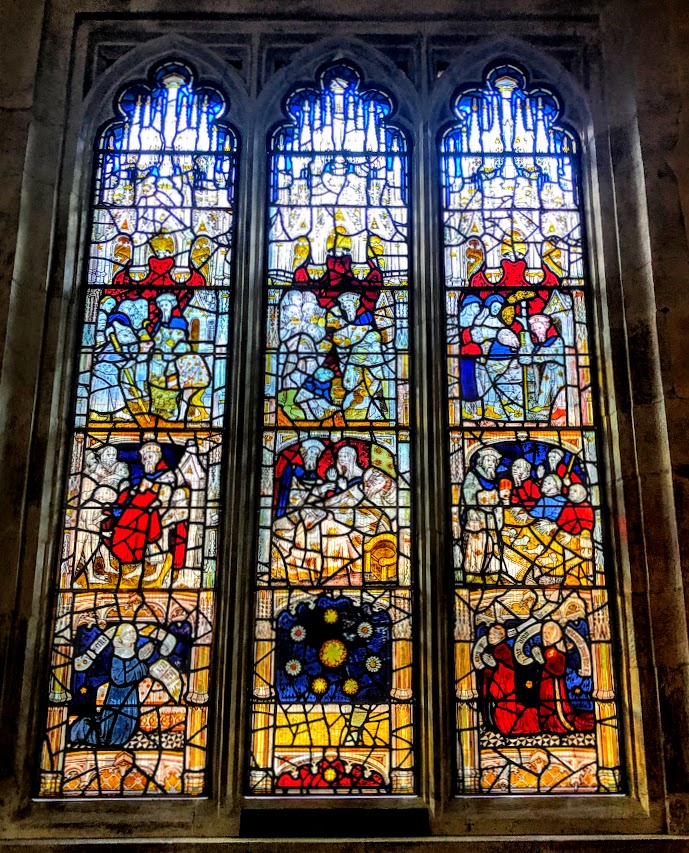
The church retains its original plan and most of its three-sided gallery in the style of the gallery churches in London. The east windows are of splendid Flemish stained glass and a window in the south aisle commemorates Samuel Harsnett (1561-1631), Archbishop of York (1629-1631), who was born in Colchester. His writings are said to have influenced Shakespeare and Milton.

Saint Botolph’s Church, built beside the priory ruins in 1837, was designed by William Mason (Photograph: Patrick Comerford, 2025)

The nave was reordered in the 1970s, when the cast iron rood screen and pulpit were removed from the chancel and the fixed pews were removed from the nave.

The raised daises, left after the pews were taken out, were removed in 1988 and the nave was levelled. A dividing partition was installed at the west end in 1990 to give a separate welcome area and some hospitality facilities. The church extension in 2001 provided a hall, kitchen, toilets and a vestry and meeting room.

The ruins of Saint Botolph’s Priory are now a public park, and improvements in 2010-2012 made the ruins more accessible to the public.

Saint Botolph’s Church, Colchester, was once nicknamed ‘the White Elephant’ (Photograph: Patrick Comerford, 2025)

17 March 2025

Daily prayer in Lent 2025:
13, Monday 17 March 2025,
Saint Patrick’s Day

‘Forgive, and you will be forgiven’ (Luke 6: 36) … street art in Dublin (Photograph: Patrick Comerford)

Patrick Comerford

Lent began almost two weeks ago on Ash Wednesday (5 March 2025), and yesterday was the Second Sunday in Lent (Lent II). But today is Saint Patrick’s Day (17 March 2025), and it offers Irish people a respite in the rigours and disciplines of Lent.

I hope to say a little more about Saint Patrick and Saint Patrick’s Day later today. But, before today begins, I am taking some quiet time this morning to give thanks, to reflect, to pray and to read in these ways:

1, reading today’s Gospel reading;

2, a short reflection;

3, a prayer from the USPG prayer diary;

4, the Collects and Post-Communion prayer of the day.

‘Be merciful, just as your Father is merciful’ (Luke 6: 36) … the ‘Corporal Works of Mercy’ window in All Saints’ Church, North Street, York (Photograph: Patrick Comerford)

Luke 6: 36-38 (NRSVA):

[Jesus said:] 36 ‘Be merciful, just as your Father is merciful.

37 ‘Do not judge, and you will not be judged; do not condemn, and you will not be condemned. Forgive, and you will be forgiven; 38 give, and it will be given to you. A good measure, pressed down, shaken together, running over, will be put into your lap; for the measure you give will be the measure you get back.’

‘If anyone strikes you on the cheek, offer the other also (Luke 6: 29) … street art in Plaza de la Judería in Malaga (Photograph: Patrick Comerford)

Today’s Reflection:

The Gospel reading in the lectionary for Saint Patrick’s Day is Matthew 10: 16-23, and I hope to say a little more about Saint Patrick and Saint Patrick’s Day in a blog posting later today. But the Lenten reading for the Eucharist today is Luke 6: 36-38, which is from the ‘Sermon on the Level Place’, Saint Luke’s equivalent of the Sermon on the Mount.

After the blessings and woes of the Beatitudes, Jesus tells us as his followers to be merciful as God is merciful. Mercy is one of God’s primary qualities (see Exodus 34: 6-7), and the concept of mercy in Luke 6 has an eschatological frame of reference. God is merciful by offering the possibility of turning away from disobedience through repentance and turning towards him and receiving forgiveness and restoration.

In Mary’s song Magnificat, God is twice identified as merciful (Luke 1: 50, 54). Zechariah too identifies mercy as a sign of God’s faithfulness to God’s promises, creating a people who ‘might serve God without fear in holiness and righteousness (Luke 1: 72-78). In this morning’s reading, Christ shows how to put this mercy into practice.

In the verses immediately before today’s reading, Luke 6: 27-29 presupposes a situation of conflict, in a time when the religious and political leaders of day were seen by many as their enemies. But Christ calls on us to respond and act in ways that seek the good of the other. This form of nonviolence goes beyond non-retaliation and takes positive steps that promote the welfare of the other parties in the conflict.

Luke 6: 30 presupposes an economic situation in which many people are exploited, live in poverty, and seek to survive by begging. The give to those who beg implies that we have an abundance from which to share (see Luke 6: 39).

Luke 6: 31 repeats the ‘Golden Rule’: ‘Do to others as you would have them do to you.’ But the golden rule is not enough for us, the Children of God (see verse 35) in our covenant relationship with God.

Luke 6: 32-34 challenges the widely accepted notion in the Hellenistic world that relationships are reciprocal, and calls on us to go beyond behaviour is guided merely by the expectation of similar responses.

Luke 6: 35 calls on to replace old-age pattens of behaviour with ways that reflect the Kingdom of God, and to imitate God who is kind also to the ungrateful and the wicked. To be kind does not mean to approve but means to seek the best interest. Even the ungrateful and the wicked have the potential and the possibility of becoming part of the Kingdom of God.

Now, Luke 6: 36 sums up how to live a life that reflects the Kingdom of God.

Luke 6: 37 is a reminder that we not have the final say ourselves on who is in and who is outside the Kingdom of God. We do not live in the apocalyptic moment, and when he exclude others from the Church we risk finding we have excluded ourselves too.

Luke 6: 38 reminds us that God’s generosity is overflowing and overwhelming and goes beyond any possibility we have of measuring it.

As Shakespeare reminds us, in the words of Portia in The Merchant of Venice,

The quality of mercy is not strained;
It droppeth as the gentle rain from heaven … (The Merchant of Venice, Act IV, Scene 1).

‘Love Being Awake’ … ‘Love your enemies, do good to those who hate you’ (Luke 6: 26) … a sign in a café in Charleville, Co Cork (Photograph: Patrick Comerford)

Today’s Prayers (Monday 17 March 2025, Saint Patrick’s Day):

The theme this week in ‘Pray With the World Church’, the Prayer Diary of the Anglican mission agency USPG (United Society Partners in the Gospel), is ‘Truth: The Path to Reconciliation’. This theme was introduced yesterday with a programme update by Rachel Weller, Communications Officer, USPG.

The USPG Prayer Diary today (Monday 17 March 2025, Saint Patrick’s Day) invites us to pray:

Dear God, grant us the courage to seek and speak the truth in all aspects of our lives. May we find the strength to acknowledge our own roles in the injustices we witness and strive to be agents of reconciliation.

The Collect:

Almighty God,
who in your providence chose your servant Patrick
to be the apostle of the Irish people:
keep alive in us the fire of the faith he kindled
and strengthen us in our pilgrimage
towards the light of everlasting life;
through Jesus Christ your Son our Lord,
who is alive and reigns with you,
in the unity of the Holy Spirit,
one God, now and for ever.

The Post Communion Prayer:

Holy Father,
who gathered us here around the table of your Son
to share this meal with the whole household of God:
in that new world where you reveal
the fullness of your peace,
gather people of every race and language
to share with Patrick and all your saints
in the eternal banquet of Jesus Christ our Lord.

Yesterday’s Reflection

Continued Tomorrow

‘A good measure, pressed down, shaken together, running over … the measure you give will be the measure you get back’ (Luke 6: 38) … street art in Dublin (Photograph: Patrick Comerford)

Scripture quotations are from the New Revised Standard Version Bible: Anglicised Edition copyright © 1989, 1995 National Council of the Churches of Christ in the United States of America. Used by permission. All rights reserved worldwide. http://nrsvbibles.org