xxx
Patrick Comerford
Most people of my generation read Anne Frank’s Diary in our teenage years, and I remember how read it over a few days as a 14-year-old during the summer months on the beach in Ballinskelligs, Co Kerry, 60 years ago.
Perhaps this explains, in part, why I paid special attention to news reports in recent days of the death of Eva Schloss (formerly Eva Geiringer), a Holocaust survivor, educator and bestselling author, who was a step-sister of Anne Frank and a co-founder of the Anne Frank Trust UK.
I began this occasional blog series, ‘Tales of the Viennese Jews,’ in November 2019. I last returned to that series almost a year ago (7 February 2025), when I told the stories of Marianne Faithfull (1946-2025), the archetypal ‘wild child’ of the 1960s, of her brave battle for recovery from addiction and against cancer, and of her mother, Eva Hermine von Sacher-Masoch (1912-1991), a self-styled baroness who resisted the Nazis in Austria. My previous posting in this series had been the story of Max Perutz (18 May 2021).
The Tales from the Vienna Woods is a waltz by the composer Johann Strauss II (1825-1899), written more than a century and a half ago in 1868. Although Strauss was baptised in the Roman Catholic Church, he was born into a prominent Jewish family. Because the Nazis had a particular penchant for Strauss’s music, they tried to conceal and even deny the Strauss family’s Jewish identity.
However, the stories of Vienna’s Jews cannot be hidden, and many of these stories are told in the exhibits in the Jewish Museum in its two locations, at the Palais Eskeles on Dorotheergasse and in the Misrachi-Haus in Judenplatz.
Rather than describe both museums in detail in one or two postings, I decided after a visit to Vienna to re-tell some of these stories through this series, celebrating a culture and a community whose stories should never be forgotten.
Eva Geiringer was born in Vienna on 11 May 1929 into a middle-class Jewish family, the daughter of Elfriede Markovits, known as Fritzi, and Erich Geiringer, a businessman. The family observed the main Jewish festivals and did not eat pork, but they were not orthodox.
Their lives changed overnight with the Anschluss, the German annexation of Austria, in 1938. After Eva’s older brother Heinz was beaten up at school because he was Jewish came home blood-soaked, the Geiringer family decided to leave Vienna and moved first to Brussels and then to Amsterdam.
Eva was 11 when the family arrived in Amsterdam in 1940. Anne Frank, who was a month younger, lived with her parents, Otto and Edith Frank, and her sister in the same block of flats in Merwedeplein: Anne lived at flat 37 and Eva at 46. They were not close, nor were they alike – Eva was athletic, while Anne was more interested in fashion, films and flirting.
When the Netherlands fell to the Nazis, they were forced to wear yellow stars. As life got worse, the two families found false papers and went into hiding, moving seven times in two years before ending up in an attic flat with a secret compartment behind a trapdoor.
While the Geiringer family were having breakfast on Eva’s 15th birthday, the Gestapo stormed in and marched them to their headquarters, where they were beaten before being sent from Westerbork to Auschwitz. Eva and her mother were separated from Eva’s father and brother, their heads were shaved and Eva was tattooed with the number A/5272.
Eva later recalled in detail the repeated humiliations, the starvation, the rats, beetles and lice, the brutal beatings, frostbite and diarrhoea, being forced to watch prisoners being hanged, and being forced to carry away dead bodies.
When Eva went to the hospital block in Birkenau with a high fever, she met her cousin from Prague, Minni, a nurse who interceded with Josef Mengele to save Fritzi, who had been selected for the gas chambers. Without Minni, neither Eva nor Fritzi would have survived.
When Auschwitz was liberated by the Soviet army in January 1945, Eva and Fritzi returned to Amsterdam. There they learned that Eva’s brother Heinz had died in Mauthausen of exhaustion in April, after the forced march from Auschwitz, and that her father had died three days before the end of the war.
Eva returned to school but felt bitter, angry and depressed. Otto Frank, who had learned of the death of his wife Edith and his daughters Anne and Margot, began to get close to Fritzi, especially after the discovery and the publication of Anne’s diary in 1947. When they married in 1953, Otto became Eva’s stepfather and he gave her the Leica camera he had used to photograph Anne and Margot.
At Otto’s suggestion, Eva went to London to take a photography course. There she met Zvi Schloss, a Bavarian-born Israeli citizen. They married in 1952, became the parents of three daughters, and Eva opened an antiques shop in Edgware.
Eva and Fritzi were invited to the opening of the exhibition ‘Anne Frank and the World’ at the Mall Galleries in 1986. The event was chaired by Ken Livingstone, leader of the Greater London Council, who called on Eva to speak. She had never spoken publicly about her experiences before, but went on to speak at events throughout the UK and co-founded the Anne Frank Trust UK with Gillian Walnes Perry.
Eva lived with survivor’s guilt in relation to her brother Heinz. In 2016, she spoke in Tralee, Co Kerry, at an International Women’s Day event organised by the Kerry Businesswomen's Association and the Bon Secours Hospital. In 2017, she organised an exhibition at the Jewish Museum in London of 30 of his paintings she had retrieved from their hiding place in Amsterdam.
She seldom spoke in public about Anne Frank apart from quoting the her diary where she said ‘I still believe that deep down human beings are good at heart’, commenting: ‘I cannot help remembering that she wrote this before she experienced Auschwitz and Belsen.’ Her books included The Promise (2006) and the bestselling After Auschwitz (2013).
Eva Schloss was appointed MBE for her work with the Anne Frank Trust and other Holocaust charities. She became an Austrian citizen again in 2021. Her mother Fritzi died in 1998 and her husband Zvi died in 2016. Three years ago, she danced with King Charles when he visited the JW3 centre on Finchley Road in December 2022. Eva died on 3 January 2026 and is survived by their daughters, Caroline, Jacky and Sylvia, and five grandchildren.
‘I have worked very, very hard to change people’s attitudes,’ Eva Schloss once told the BBC. ‘Each person you convince not to be racist is a positive.’ She believed that ‘we need to learn to live with each other in harmony, to accept each other for who and what we are. We must learn the lesson that human differences actually enrich our lives. We should not be afraid of people who are different from us, but we need to embrace their faiths and ways of life so that we can give our children and future generations a safer life to live’.
As for Anne Frank, many of the observations in her diary seem so relevant to events playing out today. For example, she wrote: ‘Terrible things are happening outside. At any time of night and day, poor helpless people are being dragged out of their homes. They’re allowed to take only a knapsack and a little cash with them, and even then, they’re robbed of these possessions on the way.
‘Families are torn apart; men, women, and children are separated. Children come home from school to find that their parents have disappeared. Women return from shopping to find their houses sealed, their families gone … Everyone is scared … the end is nowhere in sight.’
When the Jon S Randall Peace Page on Facebook cited this quotation in June 2019, it was labelled ‘fake’ and denied and the page was suspended by Facebook for some time. Snopes, the online fact-check site, researched and investigated the quote, and verified it. Eventually, when the suspension was lifted, Jon S Randall cited another quotation from Anne Frank that was often quoted by Eva Schloss: ‘It’s difficult in times like these: ideals, dreams and cherished hopes rise within us, only to be crushed by grim reality. It’s a wonder I haven’t abandoned all my ideals, they seem so absurd and impractical. Yet I cling to them because I still believe, in spite of everything, that people are truly good at heart.’
May her memory be a blessing, זיכרונה לברכה
Shabbat Shalom, שבת שלום
Tales of the Viennese Jews:
1, the chief rabbi and a French artist’s ‘pogrom’
2, a ‘positively rabbinic’ portrait of an Anglican dean
3, portraits of two imperial court financiers
4, portrait of Sigmund Freud, founder of psychoanalysis
5, Lily Renée, from Holocaust Survivor to Escape Artist
6, Sir Moses Montefiore and a decorative Torah Mantle
7, Theodor Herzl and the cycle of contradictions
8, Simon Wiesenthal and the café in Mauthausen
9, Leonard Cohen and ‘The Spice-Box of Earth’
10, Ludwig Wittgenstein and his Jewish grandparents
11, Wolfgang Amadeus Mozart and his Jewish librettist
12, Salomon Mayer von Rothschild and the railways in Vienna
13, Gustav Mahler and the ‘thrice homeless’ Jew
14, Beethoven at 250 and his Jewish connections in Vienna
15, Martin Buber and the idea of the ‘I-Thou’ relationship
16, Three Holocaust survivors who lived in Northern Ireland.
17, Schubert’s setting of Psalm 92 for the synagogue.
18, Bert Linder and his campaign against the Swiss banks.
19, Adele Bloch-Bauer and Gustav Klimt’s ‘Lady in Gold’.
20, Max Perutz, Nobel laureate and ‘the godfather of molecular biology’.
21, Marianne Faithfull (1946-2025) and her mother Eva Hermine von Sacher-Masoch (1912-1991)
22, Eva Geiringer Schloss (1929-2026), step-sister of Anne Frank
16 January 2026
Daily prayer in Christmas 2025-2026:
23, Friday 16 January 2026
The healing of the paralytic man … a fresco in Analipsi Church in Georgioupoli in Crete (Photograph: Patrick Comerford)
Patrick Comerford
The 40-day season of Christmas continues until Candlemas or the Feast of the Presentation (2 February). This week began with the First Sunday of Epiphany (Epiphany I, 11 January 2026), with readings that focus on the Baptism of Christ.
We got back to Stony Stratford late last night after two funerals over two days, in Seer Freen in the Chilterns on Wednesday, in Lingwood in Norfolk yesterday. It was an odyssey that involved going through London each time on the train, back and forth, an overnight stay in Norwich that also allowed visits to Norwich Cathedral, but a major delay on the train in Watford last night because of a serious incident on the line between Watford and Milton Keynes, and that eventually necessesitated a late night taxi from Watford to Stony Stratford.
Stony Words 2026, a local festival of drama and literature, begins in Stony Stratford this evening. But, before the day begins, I am taking some quiet time this morning to give thanks, to reflect, to pray and to read in these ways:
1, today’s Gospel reading;
2, a short reflection;
3, a prayer from the USPG prayer diary;
4, the Collects and Post-Communion prayer of the day.
A blessing in the Chapel of the John Radcliffe Hospital, Oxford (Photograph: Patrick Comerford)
Mark 2: 1-12 (NRSVA):
1 When he returned to Capernaum after some days, it was reported that he was at home. 2 So many gathered around that there was no longer room for them, not even in front of the door; and he was speaking the word to them. 3 Then some people came, bringing to him a paralysed man, carried by four of them. 4 And when they could not bring him to Jesus because of the crowd, they removed the roof above him; and after having dug through it, they let down the mat on which the paralytic lay. 5 When Jesus saw their faith, he said to the paralytic, ‘Son, your sins are forgiven.’ 6 Now some of the scribes were sitting there, questioning in their hearts, 7 ‘Why does this fellow speak in this way? It is blasphemy! Who can forgive sins but God alone?’ 8 At once Jesus perceived in his spirit that they were discussing these questions among themselves; and he said to them, ‘Why do you raise such questions in your hearts? 9 Which is easier, to say to the paralytic, “Your sins are forgiven”, or to say, “Stand up and take your mat and walk”? 10 But so that you may know that the Son of Man has authority on earth to forgive sins’ – he said to the paralytic – 11 ‘I say to you, stand up, take your mat and go to your home.’ 12 And he stood up, and immediately took the mat and went out before all of them; so that they were all amazed and glorified God, saying, ‘We have never seen anything like this!’
Inside the Chapel in the John Radcliffe Hospital, Oxford (Photograph: Patrick Comerford)
Today’s Reflections:
This morning’s Gospel reading at the Eucharist (Mark 2: 1-12) is another healing story that follows yesterday’s story of Christ healing a man with leprosy (Mark 1: 40-45) and the story the day before of Jesus healing Simon Peter’s mother-in-law (Mark 1: 29-39).
Today’s Gospel reading has its synoptic parallels in Matthew 9: 2-8 and Luke 5: 18-26.
I have an appointment next week for one of my regular injections for my B12 deficiency. Meanwhile, I continue to have regular hospital appointments monitoring my pulmonary sarcoidosis and as part of the care and attention I continue to receive as a follow-up to my stroke almost four years ago in March 2022.
I remain truly grateful for the caring and attentive treatment I receive in hospitals in Milton Keynes, Oxford and Sheffield, and I am even more grateful for the way Charlotte Hunter recognised I was having a stroke, brought me to hospital, ensured I received the attention I needed, visited me every day, and brought me back to Stony Stratford.
Some years ago, at an event in Saint Martin-in-the-Fields Church, Trafalgar Square, when people were asked to bring along their favourite poems, Charlotte brought Seamus Heaney’s poem ‘Miracle’, from his collection Human Chain (2010).
In these poems, written after his stroke in 2005, Seamus Heaney speaks of suffering and mortality. This poem ‘Miracle’ retells the story of the miraculous healing of the man variously described as a paralytic man and a man with palsy. The story is told in all three synoptic Gospels, including this morning’s Gospel reading (Mark 2: 1-12), and – like Seamus Heaney, I suppose – my situation makes me wonder whether this man was also suffering after a stroke.
It is interesting how Seamus Heaney tells the story of this man’s healing from the perspective of the man’s friends. In this way, his poem becomes an expression of gratitude by the poet to all who helped his recovery after his stroke.
When Jesus looks at the paralysed man brought to him by his friends, he sees not just the faith of the man, but the faith of his friends too. In other words, this is a story of the blessing of friendship and the miracle of community as much as it is a story of miraculous healing.
The poet’s focus is on neither Christ as the healer nor the invalid, but on the friends who helped this sick man to reach Jesus by lowering him through a skylight in the roof. The title of the poem refers to the miracle in the Gospel story, but for the poet the miracle is found in the opening lines:
Not the one who takes up his bed and walks
But the ones who have known him all along
And carry him in.
The friends of this man love him and seek his healing, no matter what it takes for them to do, and so they become the true miracle in this moment. They are there when no one else is, they care for their friend, and they give him the priceless gift of friendship.
When they hear in Capernaum that Jesus is healing the sick, they give their friend one more gift. They carry him to Jesus. And when they cannot get him through the door, they then lower him through the roof.
What persistent love they show their friend, like the persistent love of one who calls a taxi, packs all my bags, brings me to the A&E unit, stays with me while I am admitted, as I am transferred to the emergency unit, and then, late at night, when I am moved to a ward.
This poem sees the Gospel story through the eyes of this man’s faithful friends. So often, I read this story through the eyes of the paralysed man, through the eyes of the crowd, or even through the eyes of the Pharisees and teachers. But Seamus Heaney invites me to join the man’s friends, who stand with
their shoulders numb, the ache and stoop deeplocked
In their backs, the stretcher handles
Slippery with sweat.
We are invited to stand with those friends, with the hope and the faith and the love that brings them there, to stand with them on behalf of all who hurt, to feel the burns in their hands from the paid-out rope, the ache in their backs from the burden they have carried, to see the gift of this miracle, this grace, that was all gift, but that required something extra of them.
There are many miracles in this story and many lessons. This poem reminds us how sometimes we need to be carried by our friends, while at other times we are the ones who need to help ‘bear one another’s burdens’ (Galatians 6: 2).
Miracle, by Seamus Heaney (1939-2013)
Not the one who takes up his bed and walks
But the ones who have known him all along
And carry him in —
Their shoulders numb, the ache and stoop deeplocked
In their backs, the stretcher handles
Slippery with sweat. And no let up
Until he’s strapped on tight, made tiltable
and raised to the tiled roof, then lowered for healing.
Be mindful of them as they stand and wait
For the burn of the paid out ropes to cool,
Their slight lightheadedness and incredulity
To pass, those who had known him all along.
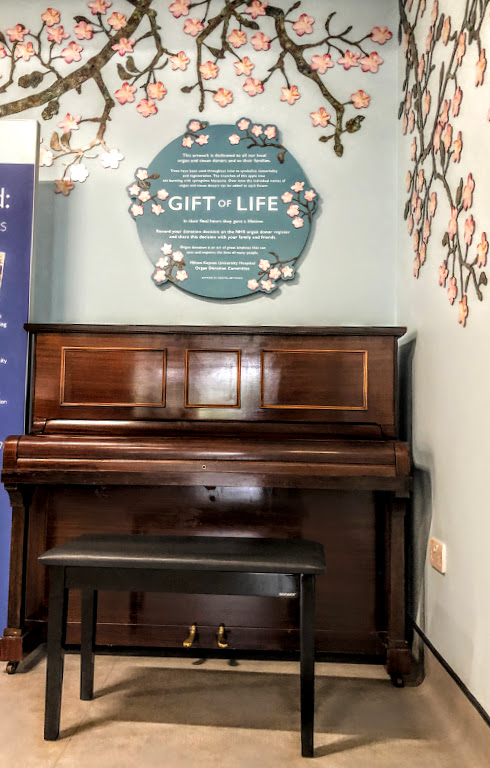
‘The Gift of Life’ … art and music in the outpatients reception area in Milton Keynes University Hospital (Photograph: Patrick Comerford)
Today’s Prayers (Friday 16 January 2025):
The theme this week (11-17 January 2026) in Pray with the World Church, the prayer diary of the Anglican mission agency USPG (United Society Partners in the Gospel), is ‘Gaza Crisis Response’ (pp 18-19). This theme was introduced on Sunday with a Programme Update from the Diocese of Jerusalem.
The USPG Prayer Diary today (Friday 16 January 2026) invites us to pray:
Heavenly Father, we thank you for the coalition of international partners with the Anglican Alliance. Give wisdom, provision, and perseverance, so that together we may meet urgent needs and demonstrate your mercy in action.
The Collect:
Eternal Father,
who at the baptism of Jesus
revealed him to be your Son,
anointing him with the Holy Spirit:
grant to us, who are born again by water and the Spirit,
that we may be faithful to our calling as your adopted children;
through Jesus Christ your Son our Lord,
who is alive and reigns with you,
in the unity of the Holy Spirit,
one God, now and for ever.
The Post-Communion Prayer:
Lord of all time and eternity,
you opened the heavens and revealed yourself as Father
in the baptism of Jesus your beloved Son:
by the power of your Spirit
complete the heavenly work of our rebirth
through the waters of the new creation;
through Jesus Christ our Lord.
Additional Collect:
Heavenly Father,
at the Jordan you revealed Jesus as your Son:
may we recognize him as our Lord
and know ourselves to be your beloved children;
through Jesus Christ our Saviour.
Yesterday’s Reflections
Continued Tomorrow
The magnolia tree in a courtyard in the hospital in Milton Keynes (Photograph: Patrick Comerford)
Scripture quotations are from the New Revised Standard Version Bible: Anglicised Edition copyright © 1989, 1995 National Council of the Churches of Christ in the United States of America. Used by permission. All rights reserved worldwide. http://nrsvbibles.org
Patrick Comerford
The 40-day season of Christmas continues until Candlemas or the Feast of the Presentation (2 February). This week began with the First Sunday of Epiphany (Epiphany I, 11 January 2026), with readings that focus on the Baptism of Christ.
We got back to Stony Stratford late last night after two funerals over two days, in Seer Freen in the Chilterns on Wednesday, in Lingwood in Norfolk yesterday. It was an odyssey that involved going through London each time on the train, back and forth, an overnight stay in Norwich that also allowed visits to Norwich Cathedral, but a major delay on the train in Watford last night because of a serious incident on the line between Watford and Milton Keynes, and that eventually necessesitated a late night taxi from Watford to Stony Stratford.
Stony Words 2026, a local festival of drama and literature, begins in Stony Stratford this evening. But, before the day begins, I am taking some quiet time this morning to give thanks, to reflect, to pray and to read in these ways:
1, today’s Gospel reading;
2, a short reflection;
3, a prayer from the USPG prayer diary;
4, the Collects and Post-Communion prayer of the day.
A blessing in the Chapel of the John Radcliffe Hospital, Oxford (Photograph: Patrick Comerford)
Mark 2: 1-12 (NRSVA):
1 When he returned to Capernaum after some days, it was reported that he was at home. 2 So many gathered around that there was no longer room for them, not even in front of the door; and he was speaking the word to them. 3 Then some people came, bringing to him a paralysed man, carried by four of them. 4 And when they could not bring him to Jesus because of the crowd, they removed the roof above him; and after having dug through it, they let down the mat on which the paralytic lay. 5 When Jesus saw their faith, he said to the paralytic, ‘Son, your sins are forgiven.’ 6 Now some of the scribes were sitting there, questioning in their hearts, 7 ‘Why does this fellow speak in this way? It is blasphemy! Who can forgive sins but God alone?’ 8 At once Jesus perceived in his spirit that they were discussing these questions among themselves; and he said to them, ‘Why do you raise such questions in your hearts? 9 Which is easier, to say to the paralytic, “Your sins are forgiven”, or to say, “Stand up and take your mat and walk”? 10 But so that you may know that the Son of Man has authority on earth to forgive sins’ – he said to the paralytic – 11 ‘I say to you, stand up, take your mat and go to your home.’ 12 And he stood up, and immediately took the mat and went out before all of them; so that they were all amazed and glorified God, saying, ‘We have never seen anything like this!’
Inside the Chapel in the John Radcliffe Hospital, Oxford (Photograph: Patrick Comerford)
Today’s Reflections:
This morning’s Gospel reading at the Eucharist (Mark 2: 1-12) is another healing story that follows yesterday’s story of Christ healing a man with leprosy (Mark 1: 40-45) and the story the day before of Jesus healing Simon Peter’s mother-in-law (Mark 1: 29-39).
Today’s Gospel reading has its synoptic parallels in Matthew 9: 2-8 and Luke 5: 18-26.
I have an appointment next week for one of my regular injections for my B12 deficiency. Meanwhile, I continue to have regular hospital appointments monitoring my pulmonary sarcoidosis and as part of the care and attention I continue to receive as a follow-up to my stroke almost four years ago in March 2022.
I remain truly grateful for the caring and attentive treatment I receive in hospitals in Milton Keynes, Oxford and Sheffield, and I am even more grateful for the way Charlotte Hunter recognised I was having a stroke, brought me to hospital, ensured I received the attention I needed, visited me every day, and brought me back to Stony Stratford.
Some years ago, at an event in Saint Martin-in-the-Fields Church, Trafalgar Square, when people were asked to bring along their favourite poems, Charlotte brought Seamus Heaney’s poem ‘Miracle’, from his collection Human Chain (2010).
In these poems, written after his stroke in 2005, Seamus Heaney speaks of suffering and mortality. This poem ‘Miracle’ retells the story of the miraculous healing of the man variously described as a paralytic man and a man with palsy. The story is told in all three synoptic Gospels, including this morning’s Gospel reading (Mark 2: 1-12), and – like Seamus Heaney, I suppose – my situation makes me wonder whether this man was also suffering after a stroke.
It is interesting how Seamus Heaney tells the story of this man’s healing from the perspective of the man’s friends. In this way, his poem becomes an expression of gratitude by the poet to all who helped his recovery after his stroke.
When Jesus looks at the paralysed man brought to him by his friends, he sees not just the faith of the man, but the faith of his friends too. In other words, this is a story of the blessing of friendship and the miracle of community as much as it is a story of miraculous healing.
The poet’s focus is on neither Christ as the healer nor the invalid, but on the friends who helped this sick man to reach Jesus by lowering him through a skylight in the roof. The title of the poem refers to the miracle in the Gospel story, but for the poet the miracle is found in the opening lines:
Not the one who takes up his bed and walks
But the ones who have known him all along
And carry him in.
The friends of this man love him and seek his healing, no matter what it takes for them to do, and so they become the true miracle in this moment. They are there when no one else is, they care for their friend, and they give him the priceless gift of friendship.
When they hear in Capernaum that Jesus is healing the sick, they give their friend one more gift. They carry him to Jesus. And when they cannot get him through the door, they then lower him through the roof.
What persistent love they show their friend, like the persistent love of one who calls a taxi, packs all my bags, brings me to the A&E unit, stays with me while I am admitted, as I am transferred to the emergency unit, and then, late at night, when I am moved to a ward.
This poem sees the Gospel story through the eyes of this man’s faithful friends. So often, I read this story through the eyes of the paralysed man, through the eyes of the crowd, or even through the eyes of the Pharisees and teachers. But Seamus Heaney invites me to join the man’s friends, who stand with
their shoulders numb, the ache and stoop deeplocked
In their backs, the stretcher handles
Slippery with sweat.
We are invited to stand with those friends, with the hope and the faith and the love that brings them there, to stand with them on behalf of all who hurt, to feel the burns in their hands from the paid-out rope, the ache in their backs from the burden they have carried, to see the gift of this miracle, this grace, that was all gift, but that required something extra of them.
There are many miracles in this story and many lessons. This poem reminds us how sometimes we need to be carried by our friends, while at other times we are the ones who need to help ‘bear one another’s burdens’ (Galatians 6: 2).
Miracle, by Seamus Heaney (1939-2013)
Not the one who takes up his bed and walks
But the ones who have known him all along
And carry him in —
Their shoulders numb, the ache and stoop deeplocked
In their backs, the stretcher handles
Slippery with sweat. And no let up
Until he’s strapped on tight, made tiltable
and raised to the tiled roof, then lowered for healing.
Be mindful of them as they stand and wait
For the burn of the paid out ropes to cool,
Their slight lightheadedness and incredulity
To pass, those who had known him all along.
‘The Gift of Life’ … art and music in the outpatients reception area in Milton Keynes University Hospital (Photograph: Patrick Comerford)
Today’s Prayers (Friday 16 January 2025):
The theme this week (11-17 January 2026) in Pray with the World Church, the prayer diary of the Anglican mission agency USPG (United Society Partners in the Gospel), is ‘Gaza Crisis Response’ (pp 18-19). This theme was introduced on Sunday with a Programme Update from the Diocese of Jerusalem.
The USPG Prayer Diary today (Friday 16 January 2026) invites us to pray:
Heavenly Father, we thank you for the coalition of international partners with the Anglican Alliance. Give wisdom, provision, and perseverance, so that together we may meet urgent needs and demonstrate your mercy in action.
The Collect:
Eternal Father,
who at the baptism of Jesus
revealed him to be your Son,
anointing him with the Holy Spirit:
grant to us, who are born again by water and the Spirit,
that we may be faithful to our calling as your adopted children;
through Jesus Christ your Son our Lord,
who is alive and reigns with you,
in the unity of the Holy Spirit,
one God, now and for ever.
The Post-Communion Prayer:
Lord of all time and eternity,
you opened the heavens and revealed yourself as Father
in the baptism of Jesus your beloved Son:
by the power of your Spirit
complete the heavenly work of our rebirth
through the waters of the new creation;
through Jesus Christ our Lord.
Additional Collect:
Heavenly Father,
at the Jordan you revealed Jesus as your Son:
may we recognize him as our Lord
and know ourselves to be your beloved children;
through Jesus Christ our Saviour.
Yesterday’s Reflections
Continued Tomorrow
The magnolia tree in a courtyard in the hospital in Milton Keynes (Photograph: Patrick Comerford)
Scripture quotations are from the New Revised Standard Version Bible: Anglicised Edition copyright © 1989, 1995 National Council of the Churches of Christ in the United States of America. Used by permission. All rights reserved worldwide. http://nrsvbibles.org
Labels:
Christmas 2025,
Epiphany 2026,
Georgioupoli,
Hospitals,
Lingwood,
Middle East,
Milton Keynes,
Mission,
Norwich,
Oxford,
Poetry,
Prayer,
Saint Mark's Gospel,
Seer Green,
Stony Stratford,
Stroke,
USPG,
Watford
Subscribe to:
Comments (Atom)