COMERFORD WAY: Patrick Comerford’s online journal on Anglicanism, theology, spirituality, history, architecture, travel, poetry, beach walks ... and more
Who hears the voice of those who cannot speak out for themselves? … street art in Leighton Buzzard (Photograph: Patrick Comerford)
Patrick Comerford
We are in Ordinary Time in the Church Calendar. This week began with the Fourth Sunday before Lent (8 February 2026), and Ash Wednesday and the beginning of Lent are only five days away (18 February 2025).
Before today begins, I am taking some quiet time this morning to give thanks, to reflect, to pray and to read in these ways:
1, today’s Gospel reading;
2, a short reflection;
3, a prayer from the USPG prayer diary;
4, the Collects and Post-Communion prayer of the day.
Who hears the voice of the oppressed? Whose cries are we deaf to?
Mark 7: 31-37 (NRSVA):
31 Then he returned from the region of Tyre, and went by way of Sidon towards the Sea of Galilee, in the region of the Decapolis. 32 They brought to him a deaf man who had an impediment in his speech; and they begged him to lay his hand on him. 33 He took him aside in private, away from the crowd, and put his fingers into his ears, and he spat and touched his tongue. 34 Then looking up to heaven, he sighed and said to him, ‘Ephphatha’, that is, ‘Be opened.’ 35 And immediately his ears were opened, his tongue was released, and he spoke plainly. 36 Then Jesus ordered them to tell no one; but the more he ordered them, the more zealously they proclaimed it. 37 They were astounded beyond measure, saying, ‘He has done everything well; he even makes the deaf to hear and the mute to speak.’
Martin Niemöller’s cell in Sachsenhausen … if we do not speak out today, who is going to speak out for us? (Photograph: Patrick Comerford)
Today’s Reflections:
Jesus returns from region of Tyre and Sidon, where he has healed the daughter of a Greek-speaking Syrophoenician woman in Tyre, which we read about yesterday (Mark 7: 24-30). In this morning’s reading, he is still in a culturally Hellenised region, the Decapolis. But, from a very dramatic healing, that I have compared with the best of Greek classical drama, we move to what is intended to be a very private, one-to-one healing, that was not even meant to be a sideshow.
There are two languages at play in these two readings: Greek and Aramaic. The single word Jesus uses in verse 34, Ephphatha (Εφφαθα) is not so much an Aramaic word as the Greek form of a Syro-Chaldaic or Aramaic word, meaning ‘Be opened’. It is as though Mark has to regularly translate the Aramaic words he hears so that they can be heard by his Greek-speaking readers (see Mark 3: 17; 5: 41; 7: 11; 14: 36; 15: 34).
But this word is so guttural that even in polite parishes it can sound vulgar as people try to read it out. No matter how polite they try to be, the double F (Φ) sound can sometimes cause blushes and giggles, or even embarrass the reader.
English is such a polite language, and the translators add their own polite priorities and good manners to how they translate what Jesus says in the original and very direct Greek into palatable, modern English.
During this week, we have heard a Gospel reading on Tuesday in which Jesus is being rude to some very religious people, who come with real doubts and with polite questions and end up being called hypocrites (Mark 7: 1-13). The blunt conversations continued on Wednesday (Mark 7: 14-23), with Jesus speaking about human waste, and then about fornication, theft, murder, adultery, avarice, wickedness, deceit, licentiousness, envy, slander, pride and folly … hardly safe topics for most Sunday services.
To add to that, in the Gospel reading yesterday (Mark 7: 24-30), Jesus later goes on to compare a woman who comes to him in distress with dogs, and he seems to call her daughter what amounts to – in the original Greek – a ‘little bitch’ (Mark 7: 24-30, 13 February 2025).
Then in the reading today, he meets a man who is deaf and dumb – and he sticks his fingers in his ears and spits on him. (Mark 7: 31-37).
It is interesting how Jesus calls this man aside for a private one-to-one. How did he do this? If the man is deaf, how could he hear what Jesus is saying to him, both in public and in private? In this area, as a deaf mute, how had he learned to speak both Greek and Aramaic?
Yes, with one, single, perhaps even coarse word, the man can hear and speak.
It has become very difficult for people in the US in the past year to speak out about events at the moment, with one disastrous and catastrophic edict following another. Children have been detained cruelly, family lives are being destroyed, protesters have been shot dead in their cars and on the streets. Many are now afraid to speak out in case they become be the victims of the next diktat signed in the Oval Office by that capricious and vengeful President. Who sees and hears what he does, but is afraid to speak out?
But if people do not speak out now, who is going to be left to speak out three years from now?
Perhaps one, simple, blunt and direct word from Jesus may empower some people to speak out before it is too late. That word may be εφφαθα. But perhaps, on the eve of Saint Valentine’s Day, we might also need to be reminded that that word may simply be ‘Love!’
I am reminded again of the words of the German theologian and Lutheran pastor Martin Niemöller (1892-1984), whose cell I once visited in Sachsenhausen:
They came first for the Communists,
and I didn’t speak up because I wasn’t a Communist.
Then they came for the Jews,
and I didn’t speak up because I wasn’t a Jew.
Then they came for the trade unionists,
and I didn’t speak up because I wasn’t a trade unionist.
Then they came for the Catholics,
and I didn’t speak up because I was a Protestant.
Then they came for me,
and by that time no one was left to speak up.
The two healing stories of the mother and her daughter and the deaf mute find their context in – are sandwiched between – the two stories about feeding the crowds. The two feeding stories and the healing store in Tyre involve feeding with bread. Christ’s invitation to the Eucharist needs to be opened out, from being a rite of the Church to being a banquet for the world.
Only when we break down our limitations or prejudices, and when we are bold enough to speak out, can Christ’s healing message be brought to a world that cries out for God’s healing, God’s mercy, God’s justice … that cries out to be called into God’s Kingdom.
The Collect today prays that God who has ‘created the heavens and the earth ‘and made us in’ God’s own image my teach us ‘to discern your hand in all your works and your likeness in all your children.’
‘Christ’s invitation to the Eucharist needs to be opened out, from being a rite of the Church to being a banquet for the world’ … one of three monochrome round paintings of Christ the Pantocrator by Hanna-Leena Ward in her current exhibition in Lichfield Cathedral (Photograph: Patrick Comerford, 2026)
Today’s Prayers (Friday 13 February 2026):
The theme this week in ‘Pray With the World Church,’ the Prayer Diary of the Anglican mission agency USPG (United Society Partners in the Gospel), is: ‘Safe Routes’ (pp 26-27). This theme was introduced on Sunday with a Programme Update by Bradon Muilenburg, Anglican Refugee Support Lead.
The USPG Prayer Diary today (Friday 13 February 2026) invites us to pray:
Inspire local leaders, the EU and UK authorities to choose hospitality over harmful policies. May decisions protect all who are stranded and in danger.
The Collect of the Day:
Almighty God,
you have created the heavens and the earth
and made us in your own image:
teach us to discern your hand in all your works
and your likeness in all your children;
through Jesus Christ your Son our Lord,
who with you and the Holy Spirit reigns supreme over all things,
now and for ever.
The Post-Communion Prayer:
God our creator,
by your gift
the tree of life was set at the heart of the earthly paradise,
and the bread of life at the heart of your Church:
may we who have been nourished at your table on earth
be transformed by the glory of the Saviour’s cross
and enjoy the delights of eternity;
through Jesus Christ our Lord.
Additional Collect:
Almighty God,
give us reverence for all creation
and respect for every person,
that we may mirror your likeness
in Jesus Christ our Lord.
With President Michael D Higgins and Brendan Howlin during the 2011 Presidential election campaign at the Wexford Ambassadors initiative in Iveagh House, Dublin
Patrick Comerford
President Michael D Higgins formally relinquishes office as President of Ireland at midnight tonight (Monday 10 November 2025), and Catherine Connolly becomes president at an inauguration ceremony in Dublin Castle tomorrow (Tuesday 11 November 2025).
In her inauguration speech, she is expected to indicate some of the themes and priorities of her presidency and the projects she hopes to undertake. After her election victory, she spoke in Dublin Castle of a new-style Republic, so tomorrow she may touch on that and on her plans to revisit communities across the country she visited during her campaign.
As President Michael D Higgins prepares to step down tonight, I find it appropriate to look back on my memories of his commitment to peace and social justice, and some of the many achievements of this president, poet, politician, academic and campaigner.
I first got to know Michael Higgins over 50 years ago. We were both delegates at the Labour Party conference in Cork in 1973, when he slept on the floor in the rooms I was sharing with Philip orish, another Wexford constituency delegate in Moore’s Hotel.
Both as a senator (1973-1977, 1983-1987) and as a TD (1981-1982, 1987-2011), he was an active supporter of the Irish Campaign for Nuclear Disarmament (CND), took part in the protests against President Ronald Reagan’s visit to Ireland in 1984 and later against the war in Iraq, and was also deeply committed to campaign groups focussed on Latin American issues, particularly in El Salvador and Nicaragua.
In those years, we took part together in many protests outside the US Embassy in Dublin. I was among his guests in the Mansion House in Dublin in 1992 when he was presented with the Sean MacBride Peace Prize by the International Peace Prize – Sean MacBride had been president of both Irish CND and the IPB.
The measure of the man’s international acclaim as a poet, a key figure in shaping cultural policies across Europe and his reputation internationally was edident when I was writing regularly for The Irish Times on Greek politics and culture in the 1990s. Once when I was interviewing the Greek Minister of Culture, Professor Evangelos Venizelos, in Athens, the first person he asked about was Michael D Higgins, and he asked me to convey much he appreciated both his poetry and his standing among politicians in Pasok and other European socialist parties.
With President Michael D Higgins at a Pax Christi seminar on cluster munitions in Dublin in 2008
I was invited, unexpectedly, in 2008 to chair a seminar organised by Pax Christi, the International Catholic Peace Movement, on the topic: ‘Towards a Comprehensive Ban on Cluster Bombs.’ The seminar also saw the launch of Pax Christi’s campaign, ‘Make Cluster Bombs History.’
The speakers included Michael D Higgins, then President of the Labour Party and Labour spokesperson on Foreign Affairs, the President of Pax Christi Ireland, Bishop Raymond Field, and Joe Little of RTÉ, who spoke on the effects of cluster munitions in Lebanon.
When Mr Higgins was elected President in 2011, peace and anti-war groups, including PANA, the Irish Anti-War Movement (IAWM), Shannonwatch and Galway Alliance Against War (GAAW), expressed the hope that his time as President would further the cause of peace and bring a renewed focus on the importance of Irish neutrality, causes he has passionately defended throughout his political career.
He consistently opposed the use of Shannon, a civilian airport, for the invasions and occupations of Iraq and Afghanistan. He was critical of the apparent Irish collusion with the US government in relation to suspected rendition flights through Shannon, and he once called on the government to withdraw Irish military personnel from Afghanistan. Hundreds of armed US troops passed through Shannon Airport each day without any oversight or inspection of planes suspected of carrying illegally kidnapped prisoners, CIA assassination crews or dangerous munitions.
President McAleese opened the doors of Áras an Uachtaráin to people working for peace, development and human rights
When his presidential election campaign began in June 2011, Michael D Higgins was one of the speakers at the launch of the Wexford Ambassadors programme in Iveagh House, Dublin. The programme was launched by the Minister for Public Expenditure, Brendan Howlin, Labour TD for Wexford, and the chair of Wexford County Council, Councillor Michael Kavangh. The first four appointed Wexford Ambassadors that evening were the writers Colm Tóibín and Eoin Colfer, the rugby international Gordon D’Arcy and the soccer international Kevin Doyle.
His predecessor as President, President Mary McAleese, opened the doors of Áras an Uachtaráin to those she encouraged in work for peace, development, human rights and interfaith dialogue.
She warmly welcomed me to Áras an Uachtaráin on Sean MacBride’s 100th birthday; when she publicly thanked and affirmed Development and Mission workers and agencies for work in Africa; and when an interfaith group of Christians and Muslims from Egypt were visiting Ireland in 2006.
President Higgins was in office during the difficult ‘decade of centenaries’, including those of the Ulster Solemn League and Covenant, the 1913 Lock-Out, World War I and its many battles, the 1916 Rising, the First Dail and the Irish War of Independence, and he lived up to his pledge that in office he would continue President McAleese’s work to help heal the wounds of the Troubles in Ireland.
His first official engagement as President of Ireland was attending the Remembrance Sunday service in Saint Patrick’s Cathedral in Dublin, and he was there again as President for the last time yesterday. His second inauguration ceremony in 2018 was held in the evening so that he could attend the Armistice Day commemorations in the morning – two opportunities that President-elect Connolly should not miss when she is in office and seeks to demonstrate that she is the President for all the people.
Bruce Kent and President Michael D Higgins at the presentation of the Sean MacBride Peace Prize medals in All Hallows College, Drumcondra in 2012 (Photograph: Patrick Comerford)
A year after his inauguration, and 20 years after he received the Sean MacBride Peace Prize, President Higgins was invited by the International Peace Bureau to present the 2012 Sean MacBride Peace Prize to two Arab activists, Dr Lina Ben Mhenni from Tunisia and Dr Nawal El-Sadaawi from Egypt, for their courage and contributions to the ‘Arab Spring.’ I was present as President of Irish CND at the ceremony and his address in All Hallows’ College, Drumcondra, that evening.
The ceremony marked the opening of the annual conference of the International Peace Bureau, and it was the first time the IPB council ever met in Ireland in over 100 years of its history. Old friends and fellow campaigners who were there that night included Caitriona Lawlor, who worked for many years with Sean MacBride, Brendan Butler, a long-time activist on Central American rights, David Hutchinson-Edgar of Irish CND, Roger Cole of the Peace and Neutrality Alliance, Joe Murray of Afri, Tony D’Souza of Pax Christi, and Rob Farmichael, the nonviolence activist.
The evening ended in conversation with President Higgins and the veteran international peace activist, the late Bruce Kent, who had been a personal friend since the mid-1970s.
Canon Patrick Comerford speaking at the National Famine Commemoration in Glasnevin Cemetery with President Michael D Higgins in 2016 (Photograph: Church Review)
President Higgins and I both spoke at the annual National Famine Commemoration in Glasnevin Cemetery, Dublin, in 2016, when he accused European nations failing to respond to their humanitarian obligations to refugees and said they should learn the lessons of the Great Famine in Ireland. He compared some of the rhetoric used today about people crossing the Mediterranean ‘marine grave’ to media reports during the worst period of Ireland’s 19th century catastrophe. Between 1845 and 1849, over a million people died of hunger and related diseases, and two million fled a country ‘with no hope.’ Many who emigrated faced fresh marginalisation on arrival on foreign shores.
President Higgins asked: ‘Is there not a lesson for all of us, as we are faced in our own time with the largest number of displaced people since World War II, as the Mediterranean becomes, for many, a marine grave, as European nations fail to respond to their humanitarian obligations?’
I was at that commemorative service on behalf of the Church of Ireland and said in my prayers: ‘As we remember those who were driven from this land in their hunger, in their thirst, and in their quest for justice and mercy, and how they left on the high seas, let us pray for those who are driven from their own lands as they hungered and thirsted for justice and mercy.’
I added: ‘Let us pray in particular for the people of Syria, for those who are on the high seas in the Aegean and the Mediterranean, and those who flee places where climate change and our inaction deprives them of justice and forces them to choose between, on the one hand, hunger and thirst at home, and short measures of justice and mercy in the countries they reach.’
Another speaker that Sunday was the then Minister for the Arts, Heritage, Regional, Rural and Gaeltacht Affairs, Ms Heather Humphreys, the other candidate in last month’s Presidential election.
Ireland has been well served by Michael D Higgins as President of Ireland, and he has used the office to keep reminding everyone of important values both at home and internationally.
President Michael D Higgins at the presentation of the Sean MacBride Peace Prize in All Hallows’ College, Drumcondra, in 2012
Irving Berlin, author of ‘God Bless America … the cover of ‘Write On, Irving Berlin!’ by Leslie Kimmelman, illustrated by David C Gardner
Patrick Comerford
In sleepless moments in the early hours yesterday, I ended up doing an old ‘Quick crossword’ from the Guardian over three years ago (Quick crossword No 16,120, 6 January 2022). One of the clues near the end was:
‘17 Russian-born American songwriter, d. 1989 (6)’
In sleepless nights, I constantly pray ‘God Bless America.’ In the two months since Trump was sworn into office on 20 January 2025, we have seen a convicted felon, an economic migrant from South Africa and a self-styled hillbilly replace the rule of law with the diktats of a despot, tear up international conventions, threaten to invade their neighbours, undermine their allies, and cosy up to an invading despot who has brought Europe closer to the brink of war than it has ever been since 1945.
In his campaigns, Trump has hijacked the songs and music of many artists, including Leonard Cohen, Abba, Adele, Andrew Lloyd Weber, Beyoncé, Bruce Springsteen, Elton John, the Rolling Stones, Guns N Roses, Luciano Pavarotti, Neil Young, Queen, Sinéad O’Connor, Blondie, Sheryl Crow, Lionel Richie, Elvis Costello and Village People.
His use of music without permission has become the subject of satire, with The Onion claiming the estate of Irving Berlin is suing Trump for his glockenspiel rendition of ‘God Bless America’.
Irving Berlin (1888-1989) was born Israel Isidore Beilin (ישראל איזידור ביילין) in the former Russian empire. His songs and music form a large part of the Great American Songbook, and his many honours included Academy, Grammy and Tony awards, and the Presidential Medal of Freedom. The broadcast journalist Walter Cronkite once said he ‘helped write the story of this country, capturing the best of who we are and the dreams that shape our lives.’
Irving Berlin was born Israel Isidore Beilin (ישראל איזידור ביילין) in the Russian Empire on 11 May 1888, one of eight children of Moses Beilin (1848-1901) and Lena Lipkin Beilin (1850-1922). Although the family came from the shtetl of Tolochin, present-day Talachyn in Belarus, the songwriter was probably born in Tyumen, Siberia. His father was a cantor and took his family there to work in a synagogue.
Soon after his birth, the family returned From Tyumen to Tolochin. One of his few memories of those first five years in Russia was sitting on a blanket by the side of a road, watching the family home being burned down by Cossacks. By dawn, the house was in ashes.
The family fled Tolochin to Antwerp and left Europe on the SS Rhynland and arrived at Ellis Island on 14 September 1893. There the family were put in a pen until immigration officials declared them fit to be allowed into New York, and their name was changed from Beilin was changed to Baline.
They were one Jewish family among the hundreds of thousands who fled to the US in the late 19th and early 20th century, escaping antisemitism, racism, pogroms, discrimination and poverty – families such as those of George and Ira Gershwin, Al Jolson, Louis B Mayer of MGM and the Warner brothers.
But Moses Baline could not find work as a cantor and took a job at a kosher meat market, giving Hebrew lessons in the evening to make ends meet. While young Izzy Baline was at school he sang in a synagogue choir. He was eight when he began selling newspapers to support his family, his mother worked as a midwife, three of his sisters worked wrapping cigars, and his older brother worked making shorts in a sweatshop.
Shortly after his son’s bar mitzvah, Moses Baline died in 1901, leaving a widow and a family of young children. Izzy left school at 13, worked as a singing waiter, and then at 14 moved into one of the lodging house for homeless boys in the Bowery, before he foundi work with a music publisher at the age of 18 and got a job as a singing waiter in Chinatown.
He taught himself to play the piano, and started to publish his first songs under the name ‘I. Berlin’. He soon became one of the most prolific songwriters of all time.
The cover of ‘Irving Berlin: The Immigrant Boy Who Made America Sing’ by Nancy Churnin and illustrated by James Rey Sanchez
His first big success, ‘Alexander’s Ragtime Band’ (1911), sparked an international dance craze and made him a wealthy man at a young age. He had 20 original Broadway shows, 15 original Hollywood films – including Easter Parade (1948) and Holiday Inn (1942), which introduced ‘White Christmas’ – and 1,500 songs, including 232 Top 10 hits, with 25 reaching No 1.
After a whirlwind romance, he married 20-year-old Dorothy Goetz in February 1912. But she contracted typhoid fever on their honeymoon in Havana and died on 17 July.
He married his second wife, the writer Ellin Mackay, a Catholic from an Irish family, in a civil ceremony in 1926. Ellin wanted to be married by a priest, but he refused. His daughter later explained, ‘The cantor’s son does not forget who his people are.’
Their marriage was bitterly opposed by her billionaire father Clarence Mackay was furious that his daughter had married a Jewish refugee and disinherited her. She was dropped from the social registry, but her sister who dated a Nazi diplomat remained in good standing.
Ellin later decided that their three daughters should get to know their father’s Jewish heritage and, toward that end she joined a Manhattan Reform synagogue and took their children to a Passover seder and Yom Kippur services.
Another enduring song is ‘White Christmas.’ His three-week old son Irving jr died from sudden infant death syndrome (SIDS) on Christmas Day 1928, which helps to explain the song’s strong undertone of melancholy. The song has sold over 50 million records and remains the highest top single selling song in recording history.
There is some irony that a ‘nice Jewish boy’ wrote songs such as ‘White Christmas’ and ‘Easter Parade’. But Irving Berlin insisted that Christmas was an all-American holiday in which Jews could take part without betraying their faith, with Christmas a celebration of the winter season and Easter a festival of spring fashion.
Irving Berlin was drafted into the army near the end of World War I in 1917. That year he wrote ‘God Bless America,’ although it was not recorded until 1938. He later said the song title was inspired by his mother who, despite a life of hardship and poverty, often exclaimed ‘G-d bless America’, saying it ‘with emotion which was almost exultation.’
His original lyrics were:
God bless America, land that I love
Stand beside her, and guide her,
to the right with a light from above.
Make her victorious on land and foam,
God bless America, my home sweet home.
Berlin revived the song shortly before World War II. But he wanted a song about peace, and changed the militaristic sounding ‘make her victorious on land and foam’ to the now familiar words ‘from the mountains, to the prairie, to the ocean, white with foam.’
Moreover, the term ‘to the right’ had developed political associations that he wanted to avoid, so he changed the lyric to ‘through the night with a light from above.’
‘God Bless America’ had its debut the day after Kristallnacht in Germany in November 1938. It was first performed by Kate Smith when Berlin gave it to her to sing as a patriotic song marking the 20th anniversary of Armistice Day. The song’s introduction, which Kate Smith sang, is rarely heard today:
While the storm clouds gather from across the sea,
let us swear allegiance to the land that’s free.
Let us all be grateful for a land so fair,
as we raise our voices in a solemn prayer.
Those lyrics seem so relevant so poignant these days.
‘God Bless America’ became a second anthem when the US entered World War II. But its popularity was not without controversy and antisemites and xenophobes were outraged that a Jew had written the song.
The German American Bund, a pro-nazi front, claimed it was part of a Jewish conspiracy and a manifestation of the mindset of ‘the refugee horde.’ Followers of the antisemitic and pro-nazi broadcaster Father Charles Coughlin regarded singing the song as ‘a provocation of violence’. The Ku Klux Klan called for its boycott.
Irving Berlin refused to profit from patriotism, and signed over all the rights and royalties to ‘God Bless America’ in perpetuity to the Boy Scouts and Girl Scouts of America. Since then, the song has generated many millions of dollars.
During World War II, he became involved in wartime musicals and shows for the army. Berlin insisted on integrated casts and staff, and hired African Americans to work on his play This is the Army. It became the first integrated division army unit in US history, and he wrote a song specifically to be sung by his black actors – as opposed to being sung by blackface singers – ‘That’s What the Well-Dressed Man in Harlem Will Wear’.
The play became a film of the same name in 1943, starring Ronald Reagan. Kate Smith also sang ‘God Bless America’ against a backdrop of anxious families apprehensive about the war.
It was deliberate action that strongly contrasts today with the Pentagon’s continuing purge of web content that is deemed to be related to diversity, equity, inclusion and accessibility (DEI) programmes, including pages about Jackie Robinson’s military career, the Native American code talkers, the heroes who raised the flag at Iwa Jima and – for some days – the page dedicated to Major General Calvin Charles Rogers.
There is deep personal significance in the number he wrote in 1925, ‘Don’t Send Me Back to Petrograd,’ about the 1924 American quota law. The National Origins Act effectively barred eastern Europeans from immigrating to the US during World War II and was not repealed until 1965. The singer pleads, ‘Now that I’m over here, they won’t let me stay ... Please don’t send me away’ – a sentiment that certainly resonates today.
Although Irving Berlin married a Christian and was often described as an agnostic, he continued to identify as a Jew and supported Jewish charities. He was honoured by the National Conference of Christians and Jews in 1944 for ‘advancing the aims of the conference to eliminate religious and racial conflict’, and he was honoured by the Young Men’s Hebrew Association (YMHA) in 1949 as one of the 12 ‘most outstanding Americans of Jewish faith’.
Irving Berlin died on 22 September 1989 at 101. Twelve years later, ‘God Bless America’ took on a new significance in the US after 9-11 in 2001, when it became the spontaneous symbol of national unity and collective mourning after members of Congress stood together singing it on the steps of the Capitol.
Yet Donald Trump forgot the words of ‘God Bless America’ during an event at the White House in 2018. Seven years later, he panders to a dictatorial and war-mongering Russian despot, defies court orders, ignores democratic processes, deports refugee children, welcomes an Irish rapist into the Oval Office and fulminates racist bile and hatred.
I wonder whether he and his cabal ever stop to think the migrant child who escaped prejudice, racism, antisemitism and violence and became the author of ‘God Bless America’, one of the greatest American anthems and how it celebrates liberty and democracy, diversity, equity, inclusion and accessibility.
Shabbat Shalom, שבת שלום
Speaking at a protest against Trump’s policies outside the US Embassy in Dublin during his previous presidency
While I am away, I am going to miss not just one but many opportunities to see Medea by Euripides which is being staged between 19 and 23 October in the Swinfen Harris Greek Church Hall on London Road, Stony Stratford.
This is a new adaptation of the play by Tim Dalgleish and Sally Luff, based on the translation by Robinson Jeffers, and features original music by songwriter Mark Denman.
The Greek tragedy Medea opens in a state of chaos and conflict and passion, betrayal and revenge take centre stage. Jason, the hero of the Argo has abandoned his wife of 10 years and two sons so he can marry Glauce, daughter of the King of Corinth, to increase his status and standing in Greece. Medea had assisted Jason to steal the Golden Fleece and became his wife. But she is an outsider and when she is spurned she plans her revenge with a series of murders.
Medea has been adapted by the Carabosse Theatre Company, and this new and immersive adaptation promises to be a powerful and unforgettable theatrical experience.
The Carabosse Theatre Company is known for pushing the boundaries of traditional theatre and with Medea has blurred the lines between audience and actors, drawing the audience deeper into the story than ever before.
As Medea (played by Danni Kushner) plots her chilling revenge, the production captures the raw emotion and intensity of a timeless tragedy in an evening of passion, power, and the dark depths of the human soul.
Medea by the English Pre-Raphaelite painter Frederick Sandys … its rejection for exhibition at the Royal Academy in 1868 caused a storm of protest
The rise of far-right politics across Europe, and the anti-immigrant grand-standing of Reform and hard ‘Brexiters’ in Britain, are symptomatic of a hardening of hearts towards the plight of refugees and asylum.
The marginalisation and demonising of the foreigner and the perceived outsider is at the heart of Medea, which remains the great classical Greek tragedy about the fear of the foreigner and about confusion that arises about the sexuality of the other when we objectify the foreigner in our midst.
I first started to try reading Medeain the original Greekof Euripides almost 40 years ago, in the 1980s, when, following a course in Biblical Greek, I began a Cambridge course in Classical Greek. Shortly afterwards, I was in Rethymnon in Crete when Medea was staged using the original text in the theatre in the Fortezza.
Of course, this is a familiar story in Crete, and Medea herself is associated with the Cave of Melidoni near the village of Mylopotamos, in the mountains above Rethymnon. During the Minoan era, the cave was a centre for the worship of the mythical bronze giant of Crete, Talos, who was believed to ensure the safety and the security of the island. The giant robot ran the round of Crete twice a day, but legend says that Medea removed the tack that protected his only vein, his vital fluid flushed out, and Talos died.
The Theatre of Dionysus in Athens, where ‘Medea’ was first staged (Photograph: Patrick Comerford)
Medea (Μήδεια) is a tragedy by Euripides, based on the myth of Jason and Medea, and it was first produced in 431 BCE. The plot centres on the actions of Medea, a barbarian and the wife of Jason. After the adventures of the Golden Fleece, Jason takes his wife Medea into exile at Corinth. However, he then leaves her, seeking to advance his political ambitions by marrying Glauke, the daughter of King Creon of Corinth.
Medea seeks vengeance by killing Jason’s new wife, his father-in-law and the children Medea had with Jason. Having taken her revenge, she escapes to Athens to begin a new life.
This tragedy is generally considered the best play written by Euripides and one of the greatest plays ever. However, it only came third when it was presented at the Dionysia Festival in 431 BCE. This may have been because of the extensive changes Euripides made to the conventions of Greek theatre in the play. These include an indecisive chorus, implicitly criticising Athenian society and showing disrespect for the gods.
As with most Greek tragedies, the play does not require any change of scene and takes place throughout outside the façade of the palace of Jason and Medea in Corinth. Events that occur off-stage, such as the deaths of Glauke and Creon and Medea’s murder of her children, are described in elaborate speeches delivered by a messenger, rather than enacted before the audience.
Although there are virtually no stage directions, Medea’s appearance in a chariot drawn by dragons towards the end of the play probably required a construction on the roof of the skene or suspended from a mechane, a kind of crane used in Greek theatres for flying scenes.
The play explores many universal themes.
It deals with passion and rage, for Medea is a woman of extreme behaviour and emotion, and Jason’s betrayal of her has transformed her passion into rage and intemperate destruction.
It discusses revenge, for Medea is willing to sacrifice everything to make her revenge perfect.
It explores greatness and pride. In classical Greece, people were fascinated by the thin line between greatness and hubris, or pride, and the idea that the same traits that make a man or woman great can lead to destruction.
It asks us to consider how we deal with the Other. Medea’s exotic foreignness is emphasised, and is made worse by her status as an exile. But Euripides shows during the play that the Other is not exclusively something external to Greece.
It confronts our prejudices about intelligence and our abilities to be manipulative. Jason and Creon both seek to be manipulative, but Medea is the great manipulator, playing on the weaknesses and needs of both her enemies and her friends.
It challenges our concepts of justice in an unjust society, especially where women and foreigners are concerned, and so it is seen by some as one of the first works of feminism.
Medea’s opening speech to the Chorus is the most eloquent statement in classical Greek literature about the injustices that befall women. Indeed, the relationship between the Chorus and Medea is one of the most interesting in Greek drama. The women are alternately horrified and enthralled by Medea, living vicariously through her. They both condemn her and pity her for her horrible acts, yet do nothing to interfere.
Is Medea a monster because she is a foreigner or because of the way she is treated by the men in her life?
How do we react to a foreigner who moves beyond being the object of our pity and is seen as noble, proud, efficient, and unwilling to be the object of pity, to be marginalised, to be denied rights, to continue to be treated as the outsider?
The form of the play differs from many other Greek tragedies by its simplicity. All the scenes involve only two actors, Medea and someone else. These encounters serve to highlight Medea’s skill and determination in manipulating powerful male figures to achieve her own ends.
The play is also the only Greek tragedy in which a character kills family members yet remains unpunished by the end of the play, and the only play about child-killing in which the deed is performed in cold blood rather than in a state of temporary madness.
Medea exposes the false pieties and hypocritical values of her enemies, and uses their own moral bankruptcy against them. Her revenge is total, but it comes at the cost of everything she holds dear. She murders her own children in part because she cannot bear the thought of seeing them hurt by an enemy.
Jason, on the other hand, is a condescending, opportunistic and unscrupulous man, full of self-deception. The other main male characters, Creon and Aegeus, are weak and fearful, considering only their own interests and ambitions.
When it was first staged in Athens in 431 BCE as one of plays at the City Dionysia, Medea shocked the judges and the audience and came last. Each year, three playwrights competed against each other at the festival, and in 431 BCE the competition was between Euphorion, the son of Aeschylus, Sophocles, who was the main rival of Euripides, and Euripides. Euphorion won, and Euripides was placed last.
The City Dionysia (Διονύσια τὰ ἐν Ἄστει) or Great Dionysia (Διονύσια τὰ Μεγάλα) was an urban festival celebrating the end of winter and harvesting the year’s crops. The Theatre of Dionysus Eleuthereus is sometimes confused with the later and better-preserved Odeon of Herodes Atticus, on the south-west slope of the Acropolis. It is one of the earliest theatres in Athens, and is considered the first theatre in the world. It could seat 17,000 people, compared with the theatre in Epidaurus, which can still seat 14,000 people.
Euripides’ characterisation of Medea exhibits the inner emotions of passion, love, and vengeance. Until then, tradition said Medea’s children were killed by the Corinthians after her escape. Euripides’ retelling of the story so that Medea kills her own children might have offended his audience.
Medea is set in Corinth some time after Jason’s quest for the Golden Fleece, where he met Medea. The play opens in a state of conflict. Jason (Ἰάσων) has abandoned his wife, Medea, along with their two children. He hopes to advance his place in life by marrying Glauke (Γλαυκή), the daughter of Creon (Κρέων), the King of Corinth. Medea grieves over the loss of her husband’s love, and curses her own existence, as well as that of her two children.
Her elderly nurse and the Chorus of Corinthian women, who are generally sympathetic to her plight, fear what she might do to herself or her children.
Jason accuses Medea of over-reacting. By voicing her grievances so publicly, she has endangered her life and the lives of their children. He claims his decision to remarry is in everyone’s best interest. Medea says he is spineless, and she refuses to accept his token offers of help. She reminds him that she left her own people for him: ‘I am the mother of your children. Whither can I fly, since all Greece hates the barbarian?’
King Creon fears the possibility of revenge, and so he banishes Medea and her two sons from Corinth. Medea pleads for mercy, and is granted one more day before she must leave. It goes against his better judgment, but he allows it out of pity for Medea’s two sons.
However, Medea is not the sort of woman to take mistreatment easily, and she plans swift and bloody revenge through killing Creon, Glauke and Jason.
Medea needs to secure a safe place to retreat to once she has committed the murders. By chance and by coincidence, Aegeus, King of Athens, appears on the scene. He has no sons and heirs, and Medea promises to cure his sterility if, in return, he gives her refuge. Of course, she does not mention she is about to kill so many people.
With a guarantee of a safe haven in Athens, Medea has cleared all obstacles to completing her revenge. Her plan grows to include the murder of her own children. The pain their loss will cause her does not outweigh the satisfaction she will feel by making Jason suffer.
Now that Medea has a promise of a safe exile, she develops her plan. She pretends to Jason that she understands his new marriage. Medea begs her husband to ask Glauke to secure a promise from her father that their two sons can stay in Corinth. Jason is moved and agrees. Medea gives Jason a gossamer dress and a golden crown as gifts for Glauke, but does not tell him that the gifts are cursed.
The coronet and dress are poisoned, and their delivery causes Glauke’s death. Seeing his daughter ravaged by the poison, Creon chooses to die by her side by dramatically embracing her and absorbing the poison himself.
A messenger returns and tells Medea the gruesome details of these deaths. When the princess put on the gown and crown, her entire body caught fire and her flesh melted from her bones.
King Creon is so distraught when he sees his daughter’s flaming corpse that he throws his body onto hers and dies as well.
Medea listens to all this with a cool attention to the detail. Her earlier state of anxiety, which intensified as she struggled with the decision to kill her children, now gives way to an assured determination to fulfil her plans and so leave Jason totally devastated.
Against the protests of the chorus, Medea murders her children. The murder of her children is not easy for Medea. She struggles with her motherly instincts, but in the end her revenge is more important. She drags the boys inside the house and kills them with a sword. Jason arrives too late to save his sons.
Medea flees the scene, escaping in a dragon-pulled chariot provided by her grandfather, the sun-god. Jason is left cursing his lot. He begs to have the children’s bodies so that he can bury them. She refuses him even this, and takes their corpses away with her as she flies away triumphant.
She confronts Jason, revelling in his pain at being unable to ever hold his children again: ‘I do not leave my children’s bodies with thee; I take them with me that I may bury them in Hera’s precinct. And for thee, who didst me all that evil, I prophesy an evil doom.’
She escapes to Athens with the bodies. The chorus is left contemplating the will of Zeus in Medea’s actions:
Manifold are thy shapings, Providence!
Many a hopeless matter gods arrange.
What we expected never came to pass,
What we did not expect the gods brought to bear;
So have things gone, this whole experience through!
I missed the opportunity to see ‘Medea’ performed in the theatre in the Fortezza in Rethymnon (Photograph: Patrick Comerford)
Modern interpretations
My early memories of Medea are the 1963 film Jason and the Argonauts, in which Medea, played by Nancy Kovack, is portrayed as a Temple Dancer who is saved by Jason after her ship sinks, and the 1969 film Medea, directed by the Italian director Pier Paolo Pasolini and featuring the Greek opera singer Maria Callas in the title role.
A new translation of the play by Kenneth McLeish and Frederic Raphael was staged in the Abbey Theatre, Dublin, in 2000. When Medea was staged in the National Theatre in London in 2014, the Guardian interviewed two actors, Helen McCrory and Diana Rigg, who played the role 20 years apart and spoke about why it still resonates.
As part of the celebrations marking the 90th birthday of the Greek composer the late Mikis Theodorakis, the film Recycling Medea directed by Asteris Koutoulas had its world premiere in 2015. Koutoulas had been Theodorakis’ music producer and manager abroad since 1986 and had worked with him in many countries.
This film is a hybrid ballet performance music and political documentary film collage, with a poignant relevance given the present crises in Greece. This film by Asteris Koutoulas includes music by Theodorakis, with choreography by Renato Zanella and featuring Maria Kousouni as Medea.
The classical Greek tragedy served as an astute metaphor for the Greek political, social and economic tragedy at the time. Script, sound and dance joined in a powerful film reflecting the desperation of a society that had spent all of yesterday turning its children into today’s lost generation.
The protagonists are flanked and contrasted by the disturbingly mild-mannered 15-year-old Bella, who is innocence incarnate but is destroyed by the hand of a hostile and selfish world. Against this background, she seems an almost unreal, fictitious character. On the other hand, there is no fiction in the words of Anne Frank, hidden away in her Amsterdam hideout and filling the pages of her diary. Another child victim of racism in Europe lends today’s isolated and trusting Bella her ‘voice’ and thoughts.
Medea, Jason, Bella and Anne Frank, composer and protester Theodorakis, the dancers, the rebelling hooded teenagers, advancing police, the choreographer and camera crew – they all become (in)voluntary actors in this complex tragedy spanning the ages. Recycling Medea has been dedicated to the betrayed youth – and their parents who sacrificed the dreams and future of their own children.
But Medea is relevant to Europe’s problems today and Britain’s problems too, and our responses to the foreigners we refuse to accept among us.
• The performances of Medea in the Swinfen Harris Greek Church Hall, London Road, Stony Stratford, are on 19 October (7:30), 20 October (1:30 and 7:30), and 21, 22 and 23 October (7:30).
Gia the giant ‘mother’ gorilla welcomes the animals in Paternoster Square into the safety of her embrace (Photograph: Patrick Comerford, 2024)
Patrick Comerford
Paternoster Square on the north side of Saint Paul’s Cathedral is the location of the London Stock Exchange, investment banks and fund managers. Surprisingly, though, the square itself is privately owned public space. The London Stock Exchange was the initial target of the ‘Occupy London’ protests in 2011, but the police thwarted the protesters’ attempts to occupy the square and sealed off the entrance.
A High Court injunction defined the square as private property, even though it had been repeatedly described as ‘public space’ in the plans for Paternoster Square. It all means the public has access but without a right of way in law, and the owner can limit access at any time.
The main monument in the square is the 23 metre (75 ft) Paternoster Square Column, William Whitfield’s Corinthian column of Portland stone topped by a gold leaf covered flaming copper urn, illuminated by fibre-optic lighting at night. However, the most-known work in the square must be Dame Elisabeth Frink’s Shepherd and Sheep, or Paternoster.
The bronze statue, commissioned in 1975, recalls not only Psalm 23 (‘The Lord is my Shepherd’) – but is also a play on the words Pater and Pastor and is a reminder of the traditional right of the Freemen of London to drive their sheep across London Bridge into the City of London.
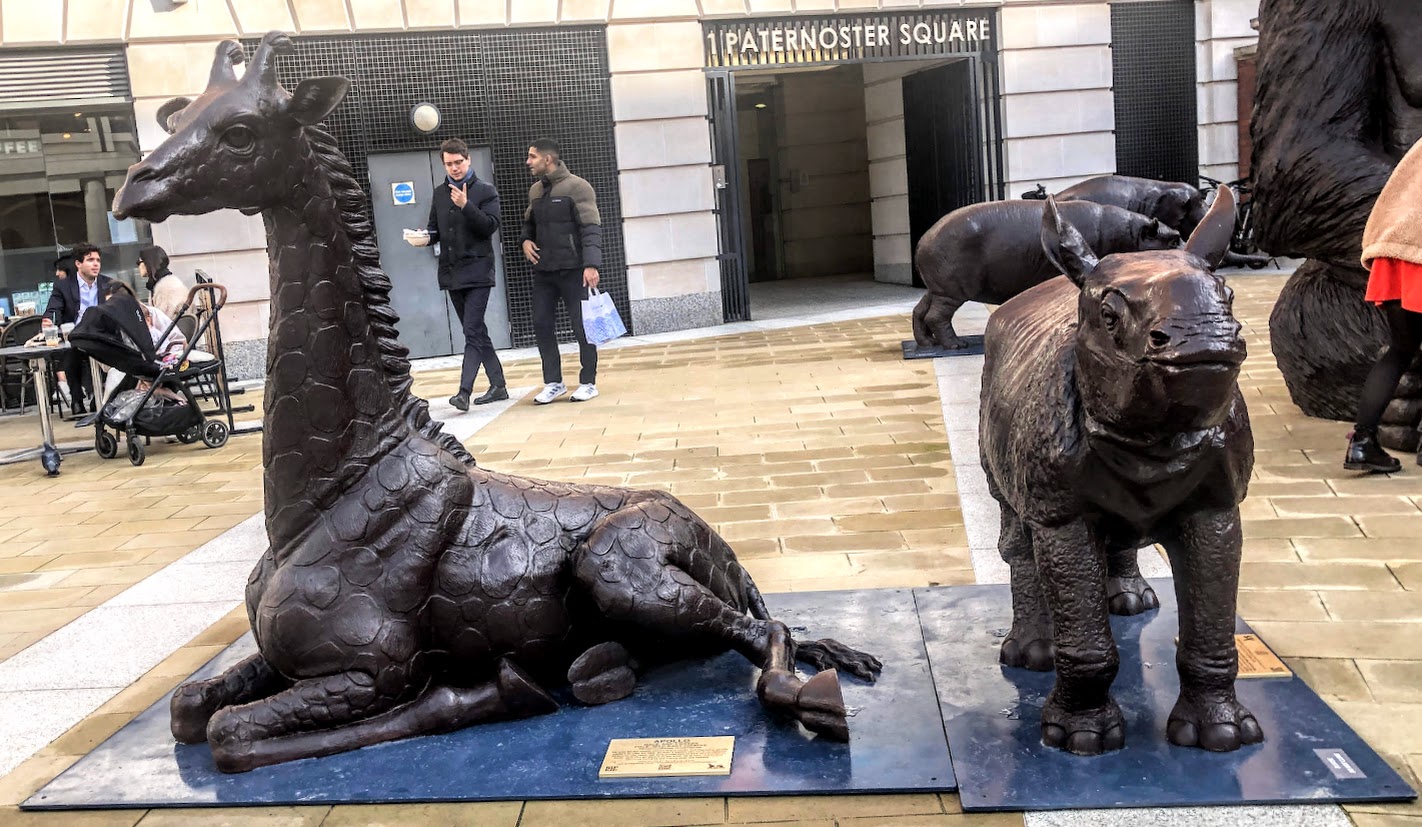
Apollo a giraffe and Mila a Javan rhino by Gillie and Marc in Paternoster Square (Photograph: Patrick Comerford, 2024)
But there are more animals than sheep in Paternoster Square at present. Following last year’s sculpture of an animals’ dining table, the artists Gillie and Marc are back in Paternoster Square with yet another menagerie of animals with their sculptures ‘Wild About Babies’. Their current exhibition in Paternoster Square was launched last month (January 2024) and continues until January 2025.
This exhibition appeals to the inherent inability we all have to resist the charm of baby animals and our deep connection with the innocence of nature. They hope these creatures not only uplift people but also spark an urge to protect.
The project is a creative and artistic response to what is described as the ‘sixth mass extinction’. In January 2020, the International Union for Conservation of Nature (IUCN) listed 203 critically endangered mammalian species, including 31 which were tagged as possibly extinct. Wildlife is facing enormous human-made challenges, including climate change and poaching.
The sculptures by Gillie and Marc now in Paternoster Square bring an array of baby animals to the streets in partnership with the WWF (World Wildlife Fund). The installation features six endangered baby animals, watched over by Gia, the giant 30-year-old ‘mother’ gorilla, a majestic three-metre creation representing the universal mother. She sits with her arms spread wide, welcoming all the animals into the safety of her embrace.
These creatures are crafted in bronze: Astrid, a young five-year-old giant tortoise; Bailey, a four-month-old African elephant; Apollo, a three-week-old giraffe; Mila, a four-month-old Javan rhino; Luna, a two-month-old hippo; and Clio, a six-month-old Bengal tiger.
The project is interactive, so each sculpture has a QR code with information and images of the real-life animal in its natural habitat and with an understanding of the diversity of wildlife, the plight these animals face and why they are so important to our planet.
Gillie and Marc’s Rabbitwoman and Dogman tell the tale of two opposites coming together as best friends and soul mates (Photograph: Patrick Comerford, 2024)
Nearby too are Gillie and Marc’s Rabbitwoman and Dogman sculptures, with a sign explaining the installation and telling of the work of Gillie and Marc.
Gillie and Marc Shattner are two British and Australian collaborative artists who have been called ‘the most successful and prolific creators of public art’ by the New York Times. They create innovative public sculptures, seeking to redefine what public art should be and spreading their message of love, equality, and conservation.
Gillie and Marc are known for Rabbitwoman and Dogman, two trademark characters who tell the tale of two opposites coming together as best friends and soul mates. They stand for diversity and acceptance through love. Their public artworks can be seen New York, London, Singapore, Shanghai and Sydney, and they have raised hundreds of thousands for wildlife charities.
Clio, a six-month-old Bengal tiger, and Astrid, a young giant tortoise (Photograph: Patrick Comerford, 2024)
Last year, I enjoyed their collections in Spitalfields, including the ‘Herd of Hope’ – a family of 21 life-sized bronze elephants embarking on the journey of a lifetime as they migrate across London – and ‘Together Forever on Wheels,’ incorporating two of their most popular sculpture themes, Rabbitwoman and Dogman, Vespas and coffee.
Now I need also to see the ‘Wild Table of Love,’ Gillie and Marc’s exhibition in Paddington, with the invitation to join the banquet, with Rabbitwoman and Dogman host at the party. The animals are already tucking in at the table, and all that is left is for the public to take our seats.
• Wild About Babies is Paternoster Square until January 2025.
Luna, a two-month-old hippo, and Bailey, a four-month-old African elephant (Photograph: Patrick Comerford, 2024)
The statue of Fenner Brockway (1888-1988) by Ian Walters in Red Lion Square in Holborn (Photograph: Patrick Comerford, 2024)
Patrick Comerford
During my strolls around Bloomsbury, Holborn and Fleet Street earlier this month, I visited a number of London churches that I have blogged about in recent days. But I also stopped to visit Red Lion Square, a small square in Holborn.
This square was home in the Victorian era to many of the pre-Raphaelites. It has a sculpture commemorating Fenner Brockway, a father-figure – or, perhaps, a grandparent figure – in the modern peace movement.
I remember Red Lion Square too as the place where 50 years ago Kevin Gately, a young student, was left dead during a protest against fascism and racism on 15 June 1974. He was the first person to die in a public demonstration in Britain for over half a century, and no one has ever been held responsible for his death.
Although Oliver Cromwell’s head is said to be buried in the antechapel in Sidney Sussex College, Cambridge, some sources say that after the Restoration the bodies of Cromwell, his son-in-law Henry Ireton, and a third regicide John Bradshaw, were dumped in a pit on the site of the square in 1661 after they had been exhumed and beheaded posthumously.
Red Lion Square was laid out in 1684 by Nicholas Barbon, who was active in redeveloping the City after the Great Fire of London in 1666. Barbon was the eldest son of the Fifth Monarchist Praise-God Barebone (or Barbon), who gave his name to ‘Barebone’s Parliament’, the predecessor in 1653 of Cromwell’s Protectorate. At his baptism in 1640, his father gave Nicholas an unusual tongue-twister of a baptismal name: ‘If-Jesus-Christ-had-not-died-for-thee-thou-hadst-been-damned.’
Barbon’s developments, including squares, streets and houses on the Strand, Bloomsbury, St Giles and Holborn, linked the City of London with Westminster for the first time. Red Lion Square took its name from the Red Lion Inn, reputed to be the most important pub in Holborn. It was a fashionable part of London in the 1720s, when the residents included an eminent judge Sir Bernard Hale and Sir Robert Raymond, Lord Chief Justice.
Red Lion Square was ‘beautified’ under an Act of Parliament in 1737. But, by then, it had become a ‘receptacle for rubbish, dirt and nastiness of all kinds and an encouragement to common beggars, vagabonds and other disorderly persons.’
Charles Lamb was painted at No 3 in 1826 by Henry Mayer. A generation later, many of the Pre-Raphaelites lived and worked on Red Lion Square. Dante Gabriel Rossetti lived at No 17 in 1851, while William Morris, Edward Burne-Jones and Richard Watson Dixon also lived at No 17 from 1856 to 1859. No 8 was a decorator’s shop run by Morris, Burne-Jones and others from 1860 to 1865, and it was the first headquarters of Marshall, Faulkner & Co, founded by William Morris.
At the same time as these Pre-Raphaelites were living and working in Red Lion Square, Frederick Denison Maurice (1805-1872), a towering figure in 19th century theology, lived at No 31. He was sacked as Professor of Theology at King’s College London in 1853 because of his leadership in the Christian Socialist Movement, but became a professor of theology at Cambridge in 1866.
However, Red Lion Square may have become unfashionable by 1860s. Anthony Trollope, in Orley Farm (1862), reassures his readers that one of his characters is perfectly respectable, despite living in Red Lion Square.
The landscape gardener Fanny Wilkinson laid out the square as a public garden in 1885. In 1894, the trustees of the square passed the freehold to the Metropolitan Public Gardens Association and it then passed to the London County Council.
The centrepiece of the garden today is a statue by Ian Walters (1930-2006) of Fenner Brockway (1888-1988), which was installed in 1986. There is also a bust of Bertrand Russell.
Archibald Fenner Brockway was a socialist, pacifist, vegetarian, journalist and anti-war activist. He was born in Calcutta, the son of missionary parents, the Revd William George Brockway and Frances Elizabeth (Abbey). After leaving school, he worked as a journalist and joined the Independent Labour Party (ILP) in 1907. He later recalled he was introduced to socialism through Keir Hardie. He soon became the editor of the Labour Leader (later the New Leader).
He became a vegetarian in 1908 and by 1913 he was a committed pacifist. At the outbreak of World War I, he was involved in forming the No-Conscription Fellowship to campaign against the government attempts to introduce conscription. The Labour Leader offices were raided in August 1915 and he was charged with publishing seditious material. He was acquitted but was arrested again in 1916 for distributing anti-conscription leaflets. After refusing to pay a fine, he was sent to Pentonville Prison.
He was arrested a third time for refusing to be conscripted after he was denied recognition as a conscientious objector. He was court-martialled for disobeying army orders, and was jailed in the Tower of London, in a dungeon under Chester Castle and in Walton Prison, Liverpool, before he was transferred to Lincoln Jail. There he spent some time in solitary confinement until he was released in 1919. He revisited Lincoln Jail with Éamon de Valera in 1950.
Following his release, he became an active member of the India League. He became secretary of the Independent Labour Party in 1923 and later its chair.
Brockway stood for Parliament several times, including standing against Winston Churchill in a by-election in 1924. He was elected the Labour MP for Leyton East in the general election in 1929. In Parliament he was outspoken and was once ‘named’ (suspended) by the Speaker while demanding a debate on India.
He lost his seat in 1931 and he disaffiliated from the Labour Party the following year, along with the rest of the ILP. He stood unsuccessfully for the ILP in the 1934 Upton by-election and in Norwich in the 1935 election.
He was the first chair of War Resisters’ International in 1926-1934. But, despite his long-standing pacifism, he resigned from War Resisters' International at the outbreak of the Spanish Civil War and helped to recruit British volunteers to fight Franco’s fascist forces, including Eric Blair – better known as George Orwell. He wrote a number of articles about the Spanish Civil War, and was influential in having George Orwell’s Homage to Catalonia published.
He chaired the Central Board for Conscientious Objectors throughout World War II, and continued as chair until he died. He tried to return to Parliament, but was unsuccessful as an ILP candidate in by-elections in Lancaster (1941) and Cardiff East (1942).
After World War II, he visited the British occupation zone in Germany as a war correspondent in 1946, and wrote about the visit in German Diary, published by the Left Book Club.
Brockway rejoined the Labour Party, and after an absence of over 18 years he returned to the Commons in 1950 as MP for Eton and Slough. He forced a Commons debate in 1950 when the Labour Government banished Seretse Khama from what would become Botswana after he married an English woman, an action seen an affront to apartheid South Africa.
He was one of the founders of War on Want in 1951, and from the 1950s on he regularly proposed legislation to ban racial discrimination, and spoke out against responses to the Mau Mau uprising in Kenya. He strongly opposed nuclear weapons and was a founding member of the Campaign for Nuclear Disarmament (CND).
He narrowly lost his seat in the 1964 election. Later that year, he was made a life peer, with the title Baron Brockway of Eton and of Slough in the County of Buckingham.
As Lord Brockway, he campaigned for world peace and against the war in Vietnam. With Philip Noel-Baker founded the World Disarmament Campaign in 1979. It was through these campaigns that I met him in the early 1980s. He died on 28 April 1988, six months shy of his 100th birthday.
Fenner Brockway was a prominent member of the British Humanist Association and the South Place Ethical Society. His Conway Memorial Lecture in 1986 was chaired by Michael Foot and the Brockway Room at Conway Hall on Red Lion Square is named after him.
Conway Hall – the home of the South Place Ethical Society and the National Secular Society – opens on to Red Lion Square. Many remember it to this day for the protests against a meeting by the National Front in Conway Hall on 15 June 1974. In the chaos and disorder that afternoon and the police response, Kevin Gately, a student from the University of Warwick in Coventry, was left dead.
Peter Cadogan (1921-2007), who was chairman of the South Place Ethical Society from 1970 to 1981, took the controversial decision to allow the National Front to book the meeting in Conway Hall. The counter-demonstration was organised by Liberation, a movement opposing colonialism and of which Lord Brockway was the president.
In scenes that must have been reminiscent of the Battle of Cable Street on 4 October 1936, the police led the National Front marchers around the south and east sides of Red Lion Square and into Conway Hall. A total of 51 people were arrested that day – all were counter-protesters and none was among the National Front.
Kevin Gately was 20 when he died as the result of a head injury that afternoon. He was not a member of any political organisation and he had come to London from Coventry for the day. It was his first protest march, and he was the first person to die in a public demonstration in Great Britain for at least 55 years.
A public inquiry by Lord Scarman denied there was any evidence that Gately had been killed by the police. Inquiries and reports refused to blame the police or the National Front for his death. Liberation was never involved in political violence, but the far-left groups who infiltrated the counter-demonstration never accepted any responsibility for their role in the afternoon’s mayhem. And Peter Cadogan always maintained that he had allowed the National Front to book the Conway Hall only in the interests of freedom of speech.
Kevin Gately and Blair Peach, who was killed in Southall in 1979, have been described as martyrs against fascism and racism, but they are largely forgotten.
As I stood in front of Fenner Brockway’s statue in Red Lion Square on a bright February morning, I recalled the price FD Maurice paid for his socialism, the radicalism of the Pre-Raphaelites, and how many of Fenner Brockway’s values remain relevant to the needs of Britain and the world today. But I also wondered who is going to remember Kevin Gately later this year on the 50th anniversary of his death or murder.
As I thought of this year’s inevitable general election, I thought of Fenner Brockway’s many efforts to get elected. But I realised too, 50 years after that dreadful and deadly afternoon in Red Lion Square, how many of the demands of the National Front have since become mainstream policies in the Conservative Party, including withdrawal from what became the European Union, caps on immigration and the forced deportation of vulnerable immigrants.
Red Lion Square in London, with Conway Hall in the distance to the left (Photograph: Patrick Comerford, 2024)
This week began with Trinity Sunday (4 June 2023). Over these few weeks after Trinity Sunday, I am reflecting each morning in these ways:
1, Looking at relevant images or stained glass window in a church, chapel or cathedral I know;
2, the Gospel reading of the day in the Church of England lectionary;
3, a prayer from the USPG prayer diary.
However, today is the feast of Corpus Christi, and I am digressing this morning as I reflect on this day in the Church Calendar.
The chapel in Corpus Christi College, Cambridge … designed by William Wilkins as a miniature replica of the chapel in King’s College (Photograph: Patrick Comerford)
The Feast of Corpus Christi:
The Feast of Corpus Christi is marked in the calendar of many Anglican churches. Although it is not a feast in the Calendar of the Church of Ireland, Corpus Christi features in the calendar of the Church of England on the Thursday after Trinity Sunday, and this day is being celebrated in many English churches and cathedrals today. For example, there is a Solemn Eucharist in Lichfield Cathedral at 5.30 this evening. Saint Editha’s Church, Tamworth, is celebrating the Feast of Corpus Christi with the Sung Eucharist at 7 pm, followed by sherry and shortbread refreshments in the new café.
Although Saint Mary and Saint Giles Church in Stony Stratford has been in the Anglo-Catholic tration, Corpus Christ is not being celebrated there today, and instead the Corpus Christi celebrations have been transferred to next Sunday (11 June 2023).
Traditionally, there has been a Corpus Christi procession in Cambridge each year, with a brass band and hymn-singing starting with the Sung Eucharist at St Bene’t’s Church at 7 p.m., then moving along Trumpington Street, passing Corpus Christi College, Fitzbillies and the Fitzwilliam Museum as it processes to Little Saint Mary’s for Benediction, followed by refreshments. The preacher in Cambridge this evening is the Revd Jennifer Totney, Director of Contextual Training at Westcott House.
Little Saint Mary’s says this is always a ‘most enjoyable event’ and an act of witness through the streets of Cambridge. ‘We are especially keen for this to be well supported this year after the last few years of Covid and the recent loss of our friend and colleague, the Revd Anna Matthews, the former Vicar of Saint Bene’t’s, who helped start this annual tradition some years ago. So please do come along and support.’
Pusey House in Oxford has a number of Corpus Christi celebrations this week including Choral Evensong in the Chapel yesterday for the Eve of Corpus Christi with music by Brewer and Byrd. Today, on the Feast of Corpus Christi, there is High Mass at 6:30 pm with Father Guy Willis, of Saint Bene’t’s Church, Kentish Town, preaching and with music by Vaughan Williams and Byrd.This is followed with procession to Saint Barnabas Church, Jericho, for Benediction.
In Rose Macaulay’s The Towers of Trebizond, Father Hugh Chantry-Pigg says Mass in a corner of the public gardens in Trebizond to mark the Feast of Corpus Christi. After Mass, he holds a procession round the gardens, chanting Ave Verum, stops, preaches a short sermon in English, and says that Corpus Christi is a great Christian festival and holy day, ‘always kept in the Church of England.’
The survival of Corpus Christi in the Anglican tradition is also illustrated in the history of Corpus Christi College, Cambridge. Formally known as the College of Corpus Christi and the Blessed Virgin Mary, this is the only Cambridge college founded by the townspeople of Cambridge: it was established in 1352 by the Guilds of Corpus Christi and the Blessed Virgin Mary.
Today, Corpus Christi is best known to visitors to Cambridge for its clock, the Chronophage or ‘Time Eater,’ which is accurate only once every five minutes. But the Old Court in Corpus is the oldest court in any Oxbridge college.
The new college acquired all the guild’s lands, ceremonies and revenues, including the annual Corpus Christi procession through the streets of Cambridge to Magdalene Bridge, during which the Eucharistic host was carried by a priest and several of the college’s treasures were carried by the Master and fellows, before returning to the college for an extravagant dinner.
The procession in Cambridge continued until the Reformation, but in 1535 William Sowode, who was Parker’s predecessor as Master (1523-1544), stopped this tradition. However, the college retains its pre-Reformation name and continues to have a grand dinner on the feast of Corpus Christi.
In the calendar of the Church of England, Corpus Christi is known as The Day of Thanksgiving for the Institution of Holy Communion (Corpus Christi) and has the status of a Festival (Common Worship, p. 529). But in many parts of the Roman Catholic Church, it has now been moved from the Thursday after Trinity Sunday to the following Sunday. Yet, in the Roman Catholic Church, the feast of Corpus Christi is one of the five occasions in a year when a bishop must not to be away from his diocese unless for a grave and urgent reason.
Corpus Christi does not commemorate any one particular event in the life of Christ or in the history of the Church – but the same can be said too of Trinity Sunday (last Sunday, 4 June 2023) or the Feast of Christ the King (the Sunday before Advent). Instead, this day celebrates the presence of Christ in the Eucharist.
Corpus Christi first made an appearance in the Church Calendar at the suggestion of Saint Juliana of Liège, a 13th century Augustinian nun, when she suggested the feastday to her local bishop, Bishop Robert de Thorete of Liège and the Archdeacon of Liège, Jacques Pantaléon.
The bishop introduced the feastday to the calendar of his diocese in 1246, and the archdeacon subsequently introduced it to the calendar of the Western Church when he became Pope Urban IV in 1264, when he issued a papal bull, Transiturus de hoc mundo.
A liturgy for the feast was composed by the great Dominican theologian, Saint Thomas Aquinas, who also wrote the hymns Verbum Supernum Prodiens for Lauds and Pange Lingua for Vespers of Corpus Christi.
The last two verses of Pange Lingua are often sung as a separate Latin hymn, Tantum Ergo, while the last two verses of Verbum Supernum Prodiens are sometimes sung separately as O Salutaris Hostia.
This was the very first universal feast ever sanctioned by a Pope. Corpus Christi was retained in Lutheran calendars until about 1600, and continues to be celebrated in some Lutheran churches.
Anglicans generally and officially believe in the Real Presence of Christ in the Eucharist – is there any ‘presence’ that is not ‘real’? But the specifics of that belief range from transubstantiation, to something akin to a belief in a ‘pneumatic’ presence, from objective reality to pious silence.
Anglican teaching thinking about the Eucharist is best summarised in the Prayer of Humble Access:
We do not presume to come to this thy Table, O merciful Lord, trusting in our own righteousness, but in thy manifold and great mercies. We are not worthy so much as to gather up the crumbs under thy Table. But thou art the same Lord, whose property is always to have mercy: Grant us therefore, gracious Lord, so to eat the flesh of thy dear Son Jesus Christ, and to drink his blood, that our sinful bodies may be made clean by his body, and our souls washed through his most precious blood, and that we may evermore dwell in him, and he in us. Amen. – (Book of Common Prayer, 1662)
The classic Anglican aphorism with regard to this debate is found in a poem by John Donne that is often attributed to Queen Elizabeth I:
His was the Word that spake it;
He took the bread and brake it;
and what that Word did make it;
I do believe and take it.
This, in many ways, also reflects Orthodox theology, which does not use the term ‘transubstantiation’ to systematically describe how the Gifts become the Body and Blood of Christ. Instead, the Orthodox speak of the Eucharist as a ‘Sacred Mystery’ use only the word ‘change.’ That moment of transformation of change does not take place at one particular moment during the Liturgy, but is completed at the Epiclesis.
And that completion is affirmed by our ‘Amen’ at the distribution and reception.
But when we say ‘Amen’ to those words, ‘The Body of Christ,’ at the distribution we are also saying ‘Amen’ to the Church as the Body of Christ, as Corpus Christi: ‘He [Christ] is the of the body, the church’ (Colossians 1: 18), ‘which is his body, the fullness of him who fills all in all’ (Ephesians 1: 23).
In the act of communion, the entire Church – past, present, and even future – is united in eternity. In Orthodox Eucharistic theology, although many separate Divine Liturgies may be celebrated, there is only one Bread and one Cup throughout all the world and throughout all time.
Corpus Christi is not just a celebration for Roman Catholics and Anglo-Catholics. It is part of the shared pre-Reformation heritage of the Church, and long pre-dates Tridentine teachings on the Eucharist and transubstantiation.
It is a reminder too that the Eucharist is supposed to be a regular celebration for the Church, and not just once a month, once a quarter or once a year. As someone reminded me recently, if Christ had meant us to celebrate the Eucharist only on special occasions, he would have used cake and champagne at the last Supper. But he used ordinary everyday bread and table wine.
Preaching at the Corpus Christi ecumenical protest service at the US embassy in Dublin in 1982 (Photograph: The Irish Times, 1982)
Corpus Christi in Dublin
In the Church of Ireland in Dublin, a Chantry Guild of Corpus Christ attached to Saint Michan’s Church survived for decades after the Reformation, and was still in existence in the mid-17th century.
Over forty years ago, on Good Friday, 9 April 1982, I was involved in organising and as chair of Christian CND preached at an ecumenical service outside the US Embassy in Dublin to protest against proposals to name a US nuclear submarine Corpus Christi. Those who took part included Anglicans, Roman Catholics, Methodists, Mennonties and Quakers.
A few days earlier, nine of us, calling ourselves ‘Corpus Christ Witness’ and writing from the Student Christian Movement (SCM) offices then in Rathgar, Dublin, signed an open letter published in Irish newspapers condemning the proposal as blasphemous. We said that by giving that name to a ‘hunter killer’ nuclear submarine, the world was faced ‘with the choice of which God we will serve: Jesus of Nazareth, who died that all might live, or the new ‘Christ,’ which lives that all may die.’
In the US, the choice of name was condemned by 259 Roman Catholic bishops, archbishops and cardinals, 25 Episcopalian bishops, and more than 250 religious orders, denominations, organisation and councils of churches, including the United Church of Christ, the National Assembly of Women Religious and the Unitarian Universalist Association.
The Chronophage or ‘Time Eater’ at Corpus Christi College, Cambridge, is accurate only once every five minutes … in Orthodox Eucharistic theology, there is only one Bread and one Cup throughout all time (Photograph: Patrick Comerford)
John 6: 51-58 (NRSVA):
[Jesus said:] 51 ‘I am the living bread that came down from heaven. Whoever eats of this bread will live for ever; and the bread that I will give for the life of the world is my flesh.’
52 The Jews then disputed among themselves, saying, ‘How can this man give us his flesh to eat?’ 53 So Jesus said to them, ‘Very truly, I tell you, unless you eat the flesh of the Son of Man and drink his blood, you have no life in you. 54 Those who eat my flesh and drink my blood have eternal life, and I will raise them up on the last day; 55 for my flesh is true food and my blood is true drink. 56 Those who eat my flesh and drink my blood abide in me, and I in them. 57 Just as the living Father sent me, and I live because of the Father, so whoever eats me will live because of me. 58 This is the bread that came down from heaven, not like that which your ancestors ate, and they died. But the one who eats this bread will live for ever.’
‘Those who eat my flesh and drink my blood abide in me, and I in them’ (John 5: 56) … the Last Supper depicted in the East Window in Holy Trinity Church, Old Wolverton (Photograph: Patrick Comerford, 2023)
Today’s prayer:
The theme in the prayer diary of the Anglican mission agency USPG (United Society Partners in the Gospel) this week is ‘Protecting the Environment in Zambia. This theme was introduced on Sunday by USPG’s Regional Manager for Africa, Fran Mate, with a reflection from Zambia for the United Nations World Environment Day on Monday.
The USPG Prayer invites us to pray this morning (Thursday 8 June 2023, Corpus Christi):
Let us pray for the Church worldwide. May it seek to be Christ’s body on earth and through sharing his life bring life to others.
Collect:
Lord Jesus Christ,
we thank you that in this wonderful sacrament
you have given us the memorial of your passion:
grant us so to reverence the sacred mysteries
of your body and blood
that we may know within ourselves
and show forth in our lives
the fruits of your redemption;
for you are alive and reign with the Father
in the unity of the Holy Spirit,
one God, now and for ever.
(Common Worship, p. 407)
Post Communion Prayer:
All praise to you, our God and Father,
for you have fed us with the bread of heaven
and quenched our thirst from the true vine:
hear our prayer that, being grafted into Christ,
we may grow together in unity
and feast with him in the kingdom;
through Jesus Christ our Lord.
(Common Worship, p. 407).
Corpus Christi College, Oxford, was founded in 1517 by Richard Foxe, Bishop of Winchester (Photograph: Patrick Comerford, 2022)