Showing posts with label Easter. Show all posts

05 April 2026

A new icon that tells of
the 58 women saints in
the New Testament who
were ‘equal to the Apostles’

Heather MacKean’s icon of women in the New Testament … commissioned by the University of Portland (Photograph: Axia Women)

Patrick Comerford

The Easter Gospel reading this morning (John 20: 1-18) tells how early on the Sunday morning (‘the first day of the week’) after the Crucifixion, before dawn, Mary Magdalene, who has been a witness to Christ’s death and burial, comes to the tomb and finds that the stone has been rolled away.

Initially it seems she is on her own, for she alone is named. But later she describes her experiences using the word ‘we,’ which indicates she was with other women.

In the Eastern Orthodox tradition, these women are known as the Holy Myrrhbearers (Μυροφόροι). The Myrrhbearers are traditionally listed as: Mary Magdalene, Mary the mother of James and Joses, Mary the wife of Cleopas, Martha of Bethany, sister of Lazarus, Mary of Bethany, sister of Lazarus, Joanna, the wife of Chuza the steward of Herod Antipas, and Salome, the mother of James and John, the sons of Zebedee, and Susanna, although it is generally said that there are other Myrrhbearers whose names are not known.

Mary and these women run to tell Saint Peter and the other disciple (presumably Saint John the Evangelist) that they suspect someone has removed the body. The tidy way the linen wrappings and the shroud have been folded or rolled up shows that the body has not been stolen.

Peter and John return without seeing the Risen Lord. It is left to Mary to tell the Disciples that she has seen the Lord. Mary Magdalene is the first witness of the Resurrection.

All four gospels are unanimous in telling us that the women are the earliest witnesses to the Risen Christ. In Saint John’s Gospel, the Risen Christ sends Mary Magdalene to tell the other disciples what she had seen. Mary becomes the apostle to the apostles.

As I was recalling this morning, the word apostle comes from the Greek ἀπόστολος (apóstólos), formed from the prefix ἀπό- (apó-, ‘from’) and the root στέλλω (stéllō, ‘I send,’ ‘I depart’). So, the Greek word ἀπόστολος (apóstolos) or apostle means one who is sent.

In addition, at the end of the reading (see verse 18), Mary comes announcing what she has seen. The word used there (ἀγγέλλουσα, angéllousa) is from the word that gives us the Annunciation, the proclamation of the good news, the proclamation of the Gospel (Εὐαγγέλιον, Evangélion). Mary, in her proclamation of the Gospel of the Resurrection, is not only the apostle to the apostles, but she is also the first of the evangelists.

Some of the 58 women in Heather MacKean’s icon of women in the New Testament (Photograph: Axia Women)

Axia Women, a Facebook network by, for, and about Orthodox women and based in Stamford, Connecticut. On its Facebook page last month, the group told how the University of Portland commissioned the Canadian iconographer Heather MacKean to compose an icon of women in the New Testament, and sent her a list of 18 names. Several months later, that number had grown to 20, then 24, and finally to 58.

‘I had no idea when I started that there would be so many names,’ she told Axia Women last month. ‘If I had more time I might have come up with ten more women.’

While she was researching the women for her commission, Heather MacKean learned about many female saints in the days of Christ and in the early Church that were new to her. Many women of the women in the New Testament are not named but have names in the Orthodox tradition: the woman with the flow of blood becomes Saint Bernice, Pilate’s wife is known as Saint Claudia; the Samaritan woman at the well is Saint Photini; the Queen of Ethiopia is Saint Candace; and Saint Junia is said to be one of the 70 apostles sent out by Christ.

Dozens of women were involved in the early Church, supporting the work of the apostles, hosting home churches, caring for the poor, becoming ‘unmercenary healers’, suffering martyrdom and preaching the Good News.

‘When you start researching it, you realise there were hundreds of women involved,’ Heather MacKean says.

Eventually, she set herself a cut-off criteria: women must have chosen to follow Christ in the first century, either as a result of an encounter with him or through one of the Apostles. Even then, her list kept growing. ‘A month before I was supposed to deliver the icon, I learned that Saint Photini was martyred with her five sisters, so I added them in,’ she recalls. ‘Then I found out that Saint Photini converted Nero’s daughter, Domnina, who brought 100 of her slaves to the faith. I couldn’t add in that many faces, unfortunately!’

To accommodate her growing list, Heather changed the design of the icon three or four times and the size of the icon panel. Eventually she ended up with an icon piece 4 ft tall and over 3 ft 7 in wide, and she was still running out of space. For the composition of the icon, she chose as her model of one of her favourite icons, ‘In Thee Rejoices.’ The Theotokos or Virgin Mary is in the centre in a mandorla with Christ enthroned on her lap, and the Church and Creation around her as an image of Paradise.

‘I was really amazed to hear the story of Saint Photini,’ Heather told Axia Women. ‘She was known as Equal to the Apostles, one of the greats in terms of preaching, and imprisoned for three years with her family. They turned the whole prison into a paradise. It smelled like myrrh and incense; they healed those who had been blinded by the guards, and it was filled with lots of rejoicing and praise.’

To honour women’s role in sharing the Gospel News, Heather chose to put the Myrrhbearing Women at the front and centre of her icon, below the Theotokos.

‘I was also surprised at how many women preachers there were, I was not expecting that,’ she commented. ‘Women like Thekla, Syntyche, and Euodia, they were sent out by Paul to preach – and not only to women.’

The new icon is in the chapel of the University of Portland, where it will be blessed before residing in the chapel of one of the female dorms.

Martha and Mary among the women depicted in Heather MacKean’s icon of women in the New Testament (Photograph: Axia Women)

Heather MacKean lists the 58 women of the New Testament in her new icon:

• Anna, the mother of the Theotokos

• Elizabeth, the mother of John the Baptist

• The prophetess Anna who was present at the Presentation of Christ to Saint Simeon in the Temple

• The Widow of Nain, whose son Christ raised from the dead

• The poor widow who gave her two mites in the Temple

• The wife of Jairus

• The daughter of Jairus

• Peter’s mother-in-law

• Junia, one of the 70 apostles

• Apphia, also one of the 70 apostles – she was the wife of Philemon, the first Bishop of Gaza and was martyred with her husband

• The Mother of Rufus and Alexander, who was probably the wife of Simon of Cyrene – Saint Paul commends her as his ‘mother’ because of her loving maternal care for him

• Lydia who was baptised with her whole family in Philippi by Saint Paul – she is considered by the Orthodox Church as ‘Equal to the Apostles’

• Chloe of Corinth who alerted Saint Paul to the divisions in the Corinthian church

• Persis, called a beloved friend by Saint Paul, who commends her for her hard work for the Church

• Thekla who was converted by Saint Paul and is also considered to be ‘Equal to the Apostles’. She worked with Paul and Barnabas to spread the Gospel, lived for many years as a hermit in a cave in the desert, and is considered to be the first female martyr.

• Syntyche and Euodia who were co-workers with Saint Paul in the church in Philippi

• Priscilla – she and her husband Aguila were fellow tentmakers and worked with Saint Paul to spread the Gospel

• Eunice, Saint Timothy’s mother

• Lois, Timothy’s grandmother – Saint Paul commends her for her sincere faith

• Nympha, who is mentioned by Saint Paul

• Phoebe the deaconess

• Mary the wife of Cleopas and mother of John Mark and who had a church in her home

• Mary of Rome, who treated Saint Paul with tremendous kindness

• Basilissa and Anastasia, who were converted by Saint Peter and Saint Paul and became martyrs

• Damaris, said to be the first Athenian woman converted by Saint Paul

• Julia, who is mentioned by Saint Paul

• The Syrophoenician woman who asked Christ to heal her daughter

• Tryphena and Tryphosa, commended by Saint Paul for their hard work for the Lord

• Zenaida and Philonella, cousins of Saint Paul, who provided free medical care to the sick

• Berenice and Drusilla, daughters of Herod Agrippa and converts to the faith

• Claudia, the wife of Pontius Pilate

• Candace, the Queen of Ethiopia

• Photini, the Samaritan woman at the well who converted her whole family after her encounter with Christ. She is also considered to be ‘Equal to the Apostles’. She was martyred with her two sons and five sisters, Anatole, Phota, Photida, Kyriake and Paraskeva

• Domnina the daughter of Nero who was converted by Saint Photini and who brought 100 slaves into the faith with her

• Rhoda, the first person to hear Peter after he was freed him from prison

• Mariamne the sister of the Apostle Philip

• Enkhidia, Charilene and Hermione, Philip’s three daughters. They were prophets and ‘unmercenary healers’ and Hermione also became a martyr.

• The seven Myrrhbearing women: Salome, Joanna, Mary, Susanna, Martha and Mary who were the sisters of Lazarus, and Mary Magdalene.

There are 58 women in total, not counting the Theotokos. But after she varnished the icon, Heather found out that Dorcas and Tabitha are the same person, and that the woman with the flow of blood was named Bernice. ‘So the next time I am in Portland, I would like to change the name of the woman currently labelled Dorcas to Bernice’, she says.

Χριστὸς ἀνέστη!
Christ is Risen!


Heather MacKean with her icon of women in the New Testament … commissioned by the University of Portland (Photograph: Axia Women)

24 April 2025

An icon of Saint Irene,
a friend’s present in
Rethymnon, symbolises
hope for peace at Easter

An icon of Aghia Irini (Αγία Ειρήνη) or Saint Irene by Alexandra Kaouki … completed in 2012 and a present from Rethymnon at Easter (Photograph: Patrick Comerford, 2025)

Patrick Comerford

I came back from Rethymnon earlier this week laden down with presents and gifts from friends during my five-day ‘mini-retreat’ in Crete in Holy Week and Easter.

During the weekend, I had coffee one morning in Galero, near the Rimondi Fountain, with Alexandra Kaouki (Αλεξανδρα Καουκι), one of the foremost icon writers in Rethymnon today. We had a lengthy conversation that included the theology of icons, the place of women in the church, ministry and political and economic life in Greece.

One of her gifts was one of her early icons, depicting Aghia Irini (Αγία Ειρήνη) or Saint Irene, completed in 2012.

She told me that morning how she had kept this icon at home after working on it because it had a special meaning and special significance for me. She had long felt it should only go to a special home or special person, and she held on to it all those years.

But on the morning before we met, she told me, she felt Saint Irene’s eyes were fixed on her and telling her: ‘Give me to Patrick’.

Saint Irene seemed such a special choice for me last weekend. I was back in Rethymnon to pray and remind me of my own need for spiritual peace. But Alexandra also thought it was appropriate for me, because of my campaigning past, as the saint’s name ‘Peace’, and also because I had written appreciatively in the past about Aghia Irini convent in the hills above Rethymnon.

A fresco depicting Saint Irene or Aghia Irini by Alexandra Kaouki in a church in Rethymnon

I first got to know Alexandra Kaouki when she had a workshop on Melissinou Street, beneath the slopes of the Venetian Fortezza. She began writing icons at the early age of 20, and on that first visit she proudly showed me her first completed work. On a shelf beside her, a new icon of Saint Catherine of Alexandria was ready for the final touches, while on a second easel she was preparing to work of an icon of the Dormition.

Alexandra’s work includes icons and frescoes and is marked by its spirituality, simplicity, the expression of the figures and the brightness of her colours. She works throughout the day with care, faith and passion. There she crafts icons using traditional Byzantine techniques and the faithful to traditions of the Cretan school.

The raw materials she uses for her icons are of the highest quality, with natural and industrial woods, traditionally-prepared canvases, 22 carat gold leaf coating, mineral colours and tempera, which uses the yolk of an egg according to Byzantine and Orthodox traditions.

She believes an icon in the Byzantine tradition should not only be an aid to worship, ‘but a diachronic work of art, of beauty and aesthetics.’

Alexandra Kaouki was born in Le Mans in France in 1973. At the age of 20, she moved with her family to Athens, and there she took her first steps in the holy art of writing icons.

She is self-taught, but has also learned at the hands of well-known icon writers in Athens from 1997 to 2000. She has lived in Rethymnon since 2006, and she took her first professional steps in 2007 when she opened her first art studio in Atsipopoulo, before moving in 2013 to studio on Melissinou Street, a narrow street close to the slopes beneath the old Venetian Fortezza.

Her icon of the Four Martyrs of Rethymnon hangs over the desk of the Bishop of Rethymnon in his office, and her icons and frescoes can be seen in churches throughout Crete.

The first of her icons that I bought was a small copy of that icon of the Four Martyrs of Rethymnon, and for years it stayed on the bookshelves in my study at the Church of Ireland Theological Institute and then on a wall in the Rectory in Askeaton, Co Limerick.

Saint Irene (left), Saint Catherine and Saint Barbara … three women saints in a fresco in the Church of Panagia Dexia in Thessaloniki (Photograph: Patrick Comerford)

Saint Irene, Saint Catherine and Saint Barbara are three saints who are often found together in icons and frescoes in Greek churches. They form a traditional grouping, such as the Apostles Peter and Paul, as an icon of Church Unity, Saint Paul and Sant Barnabas, the Cappadocian Fathers (Basil the Great, Gregory of Nyssa and Gregory of Nazianzus), and the Three Holy Hierarchs (Basil the Great, Gregory the Theologian and John Chrysostom).

Saint Irene is one of three saints and sisters – Irene, Agape and Chioni – who were born in Thessaloniki and who were martyred there for their faith in the year 304 CE. Their names mean Peace, Love and Purity, and their feast day was earlier this month, 3 April.

The story of their martyrdom is the subject of Dulcitius, a 10th-century Latin drama by Hrotsvitha of Gandersheim, the first-known female playwright.

Irene, Agape and Chione were brought before Dulcitius, governor of Macedonia, on the charge of refusing to eat food that had been offered in sacrifice to the gods. When Agape and Chionia again refused to eat this food, they were burned alive.

Dulcitius then found that Irene was keeping Christian books prohibited by the law. She declared that when the decrees against Christians had been published, she and several others fled to the mountains. She refused to name the people who had fled with her and said all she alone knew where the books were being kept. Dulcitius then ordered Irene to be stripped and exposed in a brothel. But no one mistreated her in the brothel. The governor then gave Irene a second chance, but when she refused this Dulcitius then sentenced her to death, and the books found with her were burned as well.

There is a second significant Saint Irene in the Orthodox Calendar. This Saint Irene (752-803) was a Byzantine empress and was instrumental in restoring the use of icons in the Orthodox Church.

Saint Irene was the wife of the Byzantine emperor Leo IV, and when her husband died in 780, she became guardian of their 10-year-old son, Constantine VI, and co-emperor with him. Later that year she crushed a plot by the iconoclasts or opponents of the use of icons to put Leo’s half-brother, Nicephorus, on the throne.

The use of icons had been prohibited since 730. When one of Irene’s supporters, Tarasius, was elected patriarch of Constantinople, he summoned the Constantinople in 786 and then the Seventh Ecumenical Council in Nicaea in 787 and restored the reverence of images.

Constantine VI banished his mother from court, but she later had her son arrested and blinded . From 797, she reigned alone as emperor for five years until she was deposed in 802 and exiled to the island of Lesbos. She is remembered for her zeal in restoring icons and her feast day is celebrated on 9 August.

A quiet corner in the monastery of Agia Irini, 5 km south of Rethymnon (Photograph: Patrick Comerford)

The Monastery of Aghia Irini, about 5 km south of Rethymnon in the mountains above the town, is one of the oldest monasteries in Crete. Various accounts say it was founded sometime between 961 and 1204, and it was certainly built before 1362, when a Venetian document testifies to its existence.

The monastery was destroyed several times during the many revolutions in Crete against Ottoman rule. During the last Cretan revolution of 1897-1898, the Turks burnt the monastery, the ruined monastery was formally closed in 1900, and the ruins remained deserted throughout most of the 20th century.

At first, the monastery lands were granted to the monastery of Arsani, but in 1925 the lands were distributed among local Greek war veterans. Sister Akaterina, who brought once brought me on a tour of the monastery, told of how the Metropolitan of Rethymnon, the late Bishop Theodoros Tzedakis, had a vision in 1989 for its restoration and invited a group of nuns to form a new community at Aghia Irini.

The nuns moved into the buildings and restoration work began in 1990. At the time, Aghia Irini was a jumble of dilapidated buildings. Today, it must be one of the most beautiful monasteries in Crete, and the restoration work has received architectural and cultural awards. The church was officially opened in 2003, and was consecrated in 2011 by Patriarch Theodoros of Alexandria. The buildings include an older three-aisled church of Saint Irene, Saint Catherine and Saint Euphemia.

In their shop, the nuns sell traditional handicrafts of weaving and needlework, their own almond-flavoured drink, candles, religious books and icons, including unusual icons written on odd pieces of ceramic.

To outsiders, the Orthodox Church can sometimes seem behind the times in its attitude to women, exemplified in debates about the ordination of women or the exclusion of women from Mount Athos. But the exclusion of women from Mount Athos is more about protecting and honouring the celibacy of the men in the monastic communities.

The work of iconographers like Alexandra Kaouki and the work of the women at Aghia Irini leave me confident that the Orthodox Church has the capacity to move forward in time in the debates about the place of women in the Church.

Alexandra Kaouki at work on an icon of Saint Catherine of Alexandria

01 July 2024

Daily prayer in Ordinary Time 2024:
53, Monday 1 July 2024

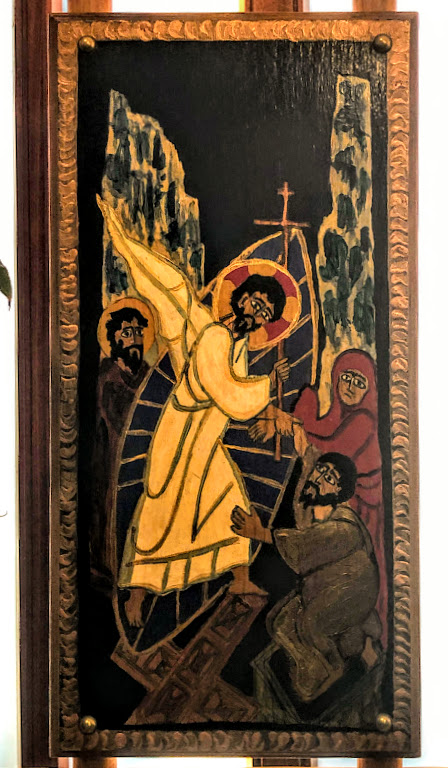
The icon of the Harrowing of Hell or the Resurrection in the new iconostasis in the Greek Orthodox Church in Stony Stratford (Photograph: Patrick Comerford, 2024)

Patrick Comerford

This week began with the Fifth Sunday after Trinity (Trinity V). Today, the calendar of the Church of England in Common Worship remembers Henry Venn (1797), John Venn (1813) and Henry Venn the younger (1873), priests and evangelical divines.

Later today I have a meeting of the trustees of a local charity in Stony Stratford. But, before today begins, I am taking some quiet time this morning to give thanks, for reflection, prayer and reading in these ways:

1, today’s Gospel reading;

2, a reflection on the icons in the new iconostasis or icon stand in the Greek Orthodox Church in Stony Stratford.

3, a prayer from the USPG prayer diary;

4, the Collects and Post-Communion prayer of the day.

The icon depicting the Harrowing of Hell or the Resurrection is seventh from the left among the 12 feasts depicted in the upper tier of the new iconostasis in Stony Stratford (Photograph: Patrick Comerford, 2024; click on images to view full screen)

Matthew 8: 18-22 (NRSVUE):

18 Now when Jesus saw great crowds around him, he gave orders to go over to the other side. 19 A scribe then approached and said, “Teacher, I will follow you wherever you go.” 20 And Jesus said to him, “Foxes have holes, and birds of the air have nests, but the Son of Man has nowhere to lay his head.” 21 Another of his disciples said to him, “Lord, first let me go and bury my father.” 22 But Jesus said to him, “Follow me, and let the dead bury their own dead.”

A detail in the icon of the Harrowing of Hell or the Resurrection in the iconostasis in the Greek Orthodox Church in Stony Stratford (Photograph: Patrick Comerford, 2024)

The Stony Stratford iconostasis 16: The Harrowing of Hell or the Resurrection (Ἡ Αναστασις):

In recent weeks, I have been watching the building and installation of the new iconostasis or icon screen in the Greek Orthodox Church in Stony Stratford. In my prayer diary over these weeks, I am reflecting on this new iconostasis, and the theological meaning and liturgical significance of its icons and decorations.

The lower, first tier of a traditional iconostasis is sometimes called Sovereign. On the right side of the Beautiful Gates or Royal Doors facing forward is an icon of Christ, often as the Pantokrator, representing his second coming, and on the left is an icon of the Theotokos (the Virgin Mary), symbolising the incarnation. It is another way of saying all things take place between Christ’s first coming and his second coming.

The six icons on the lower, first tier of the iconostasis in Stony Stratford depict Christ to the right of the Royal Doors, as seen from the nave of the church, and the Theotokos or the Virgin Mary to the left. All six icons depict (from left to right): the Dormition, Saint Stylianos, the Theotokos, Christ Pantocrator, Saint John the Baptist and Saint Ambrosios.

Traditionally, the upper tier has an icon of the Mystical Supper in the centre, with icons of the Twelve Great Feasts on either side, in two groups of six: the Nativity of the Theotokos (8 September), the Exaltation of the Cross (14 September), the Presentation of the Theotokos (21 November), the Nativity of Christ (25 December), the Baptism of Christ (6 January), the Presentation of Christ in the Temple (2 February), the Annunciation (25 March), the Entry into Jerusalem (Palm Sunday), the Ascension, Pentecost, the Transfiguration (6 August) and the Dormition (15 August).

In Stony Stratford, these 12 icons in the top tier, on either side of the icon of the Mystical Supper, are (from left): the Ascension, the Nativity, the Baptism of Christ, the Entry into Jerusalem on Palm Sunday, the Raising of Lazarus and the Crucifixion; and the Harrowing of Hell or the Resurrection, the Incredulity of Saint Thomas, Pentecost, the Transfiguration, the Presentation and the Annunciation.

The seventh in this top tier of 12 icons in Stony Stratford is the icon of the Harrowing of Hell or Christ’s Descent into Hades. This is the primary icon of Pascha (Easter) and of the Resurrection, Ἡ Αναστασις, and the Greek title above reads simply Ἡ Αναστασις (He Anastasis), the Resurrection.

In some icons, Christ’s cape or robe is flowing upwards, symbolising his radical descent into Hades to save those who have died in the flesh.

The golden bars by his feet are the gates of Hades, which he has trampled and torn apart. Keys are floating in the abyss below, symbolising he has entered and conquered both death and Hades.

The skeletal figure who is chained and bound is either Death or Satan, and the refrain sung throughout Pascha declares ‘Christ has trampled down death by death.’

The two figures whom Christ has grasped and is pulling from tombs are Adam and Eve. This gesture shows that Christ in his victory redeems all humanity, back to the very beginning, and, at the same time, foreshadows the general resurrection of the body before the Final Judgment.

To the left are three figures: David and Solomon, two of Christ’s human, lineal ancestors and Saint John the Forerunner or Saint John the Baptist , who was his forerunner in both life and death.

The figures to the right vary from icon to icon, but usually represent Old Testament prophets and saints such as Moses, Abel as a shepherd, and the three youths who were thrown into the fiery furnace (Daniel 3).

The blue shape around Christ is called the Mandorla – which derives from the Italian word for almond, which describes its shape. The Mandorla is the uncreated, eternal light of Christ. In the writings of the Eastern Orthodox mystics, God is often prayerfully experienced as light. This is the light that filled the apostles with wonder when they witnessed the Transfiguration. Christ described it as the power of the Kingdom of God (see Mark 9: 1, Matthew 16: 28, Luke 9: 27). It is also the light that filled the previous darkness of Hades when Christ descended and brought life into the realm of death.

The Mandorla is progressively darker as it moves toward its centre, which is Christ. If God is represented by light, the Mandorla may seem confusing. However, those who seek God will find that the more they know him, the less they comprehend him. To know God, to experience him, is to walk in the darkness of his light, to enter into the mystery of his presence.

In the Eastern Orthodox tradition, Saturday is the day Christ lay in the Tomb. The Western tradition of the Church has traditionally contemplated the cross, and then the empty tomb … and has been totally agnostic about what happened in between, between dusk on the Friday afternoon and dawn on that Sunday morning. The deep joys of the Resurrection have often been overshadowed in the Western Church by the Way of the Cross, as though the Cross leads only to death. This emphasis neglects Christ’s resting place, his tomb, and gives little thought to what was happening in the Holy Sepulchre on that holy weekend.

The Eastern Churches lack a clearly defined doctrine of Purgatory and, instead, have been more comfortable with exploring in depth the theme of Christ’s Harrowing of Hell. For, while Christ’s body lays in the tomb, he is visiting those who were dead.

The icon of the Harrowing of Hell reminds us that God reaches into the deepest depths to pull forth souls into the kingdom of light. It reminds us how much we are unable to comprehend – let alone take to heart as our own – our creedal statement that Christ ‘descended into Hell.’

The Apostle Peter tells us that when Christ died he went and preached to the spirits in prison ‘who in former times did not obey … For this is the reason the Gospel was proclaimed even to the dead, so that … they might live in the spirit as God does’ (see I Peter 3: 15b to 4: 8).

The Early Church taught that after his death Christ descended into hell and rescued all the souls, starting with Adam and Eve, who had died under the Fall. The Harrowing of Hell is intimately bound up with the Resurrection, the Raising from the Dead, for as Christ is raised from the dead he also plummets the depths to bring up, to raise up, those who are dead, no matter where that may be in time and in space. The Harrowing of Hell carries us into the gap in time between Christ’s death and his resurrection.

In icons of the Harrowing of Hell, Christ stands on the shattered doors of Hell. Sometimes, two angels are seen in the pit binding Satan. And we see Christ pulling out of Hell Adam and Eve, imprisoned there since their deaths, imprisoned along with all humanity because of sin. Christ breaks down the doors of Hell and leads the souls of the lost into Heaven. It is the most radical reversal we can imagine. Death does not have the last word, we need not live our lives buried in fear. If Adam and Eve are forgiven, and the Sin of Adam is annulled and destroyed, who is beyond forgiveness?

In discussing the ‘Descent into Hell,’ Hans Urs von Balthasar argues that if Christ’s mission did not result in the successful application of God’s love to every intended soul, how then can we think of it as a success? He emphasises Christ’s descent into the fullness of death, so as to be ‘Lord of both the dead and the living’ (Romans 5).

However, in her book Light in Darkness, Alyssa Lyra Pitstick says Christ did not descend into the lowest depths of Hell, that he only stayed in the top levels. She cannot agree that Christ’s descent into Hell entails experiencing the fullness of alienation, sin and death, which he then absorbs, transfigures, and defeats through the Resurrection. Instead, she says, Christ descends only to the ‘limbo of the Fathers’ in which the righteous, justified dead of the Old Testament waited for his coming.

And so her argument robs the Harrowing of Hell of its soteriological significance. For her, Christ does not descend into Hell and experience there the depths of alienation between God and humanity opened up by sin. She leaves us with a Christ visiting an already-redeemed and justified collection of Old Testament saints to let them know that he has defeated death – as though he is merely ringing on the doorbell for those who are already ready to come out.

However, Archbishop Rowan Williams has written beautifully, in The Indwelling of Light, on the Harrowing of Hell. Christ is the new Adam who rescues humanity from its past, and who starts history anew. ‘The resurrection … is an introduction – to our buried selves, to our alienated neighbours, to our physical world.’

He says: ‘Adam and Eve stand for wherever it is in the human story that fear and refusal began … [This] icon declares that wherever that lost moment was or is – Christ [is] there to implant the possibility … of another future.’ [Rowan Williams, The Dwelling of the Light: Praying with Icons of Christ, p 38.]

I ask myself: what is the difference between the top levels of Hell and the bottom levels of Hell? Is my Hell in my heart of my own creation? In my mind, in my home, where I live and I work, in my society, in this world? Is hell the nightmares from the past I cannot shake off, or the fears for the future when it looks gloomy and desolate for the planet? But is anything too hard for Lord?

The icon of the Harrowing of Hell tells us that there are no limits to God’s ability to search us out and to know us. Where are the depths of my heart and my soul, where darkness prevails, where I feel even Christ can find no welcome? Those crevices even I am afraid to think about, let alone contemplate, may be beyond my reach. I cannot produce or manufacture my own salvation from that deep, interior hell, hidden from others, and often hidden from myself.

But Christ breaks down the gates of Hell. He rips all of sinful humanity from the clutches of death. He descends into the depths of our sin and alienation from God. Plummeting the depths of Hell, he suffuses all that is lost and sinful with the radiance of divine goodness, joy and light.

Hell is where God is not; Christ is God, and his decent into Hell pushes back Hell’s boundaries. In his descent into Hell, Christ reclaims this zone for life, pushing back the gates of death, where God is not, to the farthest limits possible. Christ plummets even those deepest depths, and his love and mercy can raise us again to new life.

To think of Christ in the grave is to ask him to take away all that denies life in us, whether it is a hell of our own making, a hell that has been forced on us, or a hell that surrounds us. Christ reaches down, and lifts us up with him in his Risen Glory.

A second icon of the Harrowing of Hell or the Resurrection in the Greek Orthodox Church in Stony Stratford (Photograph: Patrick Comerford, 2024)

Today’s Prayers (Monday 1 July 2024):

The theme this week in ‘Pray With the World Church,’ the Prayer Diary of the Anglican mission agency USPG (United Society Partners in the Gospel), is ‘Saint Luke’s Hospital, Nablus.’ This theme was introduced yesterday with a programme update.

The USPG Prayer Diary today (Monday 1 July 2024) invites us to pray:

Lord God, we lift those who, like Ms E [in Nablus], who face difficult circumstances - whether physical or emotional. Grant them the strength to persevere, knowing that you are their steadfast support in times of need.

The Collect:

Almighty and everlasting God,
by whose Spirit the whole body of the Church
is governed and sanctified:
hear our prayer which we offer for all your faithful people,
that in their vocation and ministry
they may serve you in holiness and truth
to the glory of your name;
through our Lord and Saviour Jesus Christ,
who is alive and reigns with you,
in the unity of the Holy Spirit,
one God, now and for ever.

Post Communion Prayer:

Grant, O Lord, we beseech you,
that the course of this world may be so peaceably ordered
by your governance,
that your Church may joyfully serve you in all godly quietness;
through Jesus Christ our Lord.

Additional Collect:

Almighty God,
send down upon your Church
the riches of your Spirit,
and kindle in all who minister the gospel
your countless gifts of grace;
through Jesus Christ our Lord.

The new iconostasis or icon stand installed in the Greek Orthodox Church in Stony Stratford in recent weeks (Photograph: Patrick Comerford, 2024)

An introduction to the Stony Stratford iconostasis (15 June 2024)

Yesterday’s reflection

Continued tomorrow

The Harrowing of Hell in a fresco behind the icon screen in the Chapel of the Resurrection in Saint John’s Monastery, Tolleshunt Knights, Essex (Photograph: Patrick Comerford)

Scripture quotations are from the New Revised Standard Version, Updated Edition copyright © 2021, National Council of the Churches of Christ in the United States of America. Used by permission. All rights reserved worldwide.

The Harrowing of Hell Resurrection depicted in a fresco in Analipsi Church in Georgioupoli, Crete (Photograph: Patrick Comerford)

01 April 2024

Daily prayer in Easter 2024:
2, 1 April 2024

The Resurrection … an Easter scene in a stained glass window in Christ Church Cathedral, Dublin (Photograph: Patrick Comerford)

Patrick Comerford

This has been a busy Easter , and I have been involved in readings and the choir in many services in Saint Mary and Saint Giles Church, Stony Stratford, over the past four days.

This week began with Easter Day (31 March 2024). Throughout this week, my morning reflections include the daily Gospel reading, the prayer in the USPG prayer diary, and the prayers in the Collects and Post-Communion Prayer of the day.

Before this day begins, I am taking some quiet time this morning to give thanks for reflection, prayer and reading in these ways:

1, today’s Gospel reading;

2, a prayer from the USPG prayer diary;

3, the Collects and Post-Communion prayer of the day.

Matthew 28: 8-15 (NRSVA):

8 So they left the tomb quickly with fear and great joy, and ran to tell his disciples. 9 Suddenly Jesus met them and said, ‘Greetings!’ And they came to him, took hold of his feet, and worshipped him. 10 Then Jesus said to them, ‘Do not be afraid; go and tell my brothers to go to Galilee; there they will see me.’

11 While they were going, some of the guard went into the city and told the chief priests everything that had happened. 12 After the priests had assembled with the elders, they devised a plan to give a large sum of money to the soldiers, 13 telling them, ‘You must say, “His disciples came by night and stole him away while we were asleep.” 14 If this comes to the governor’s ears, we will satisfy him and keep you out of trouble.’ 15 So they took the money and did as they were directed. And this story is still told among the Jews to this day.

The Risen Christ greets Mary Magdalene … a window by CE Kempe in Saint John’s Church, Wall, near Lichfield (Photograph: Patrick Comerford)

Today’s Prayers (Monday 1 April 2024, Easter Monay):

The theme this week in ‘Pray With the World Church,’ the Prayer Diary of the Anglican mission agency USPG (United Society Partners in the Gospel), is ‘Easter Day Reflection.’ This theme was introduced yesterday by the Revd Dr Carlton John Turner, USPG Trustee.

The USPG Prayer Diary today (1 April 2024) invites us to pray:

Lord, we pray for the continued renewal of the Church and all Christian communities.

The Collect:

Lord of all life and power,
who through the mighty resurrection of your Son
overcame the old order of sin and death
to make all things new in him:
grant that we, being dead to sin
and alive to you in Jesus Christ,
may reign with him in glory;
to whom with you and the Holy Spirit
be praise and honour, glory and might,
now and in all eternity.

Post Communion Prayer:

God of Life,
who for our redemption gave your only–begotten Son
to the death of the cross,
and by his glorious resurrection
have delivered us from the power of our enemy:
grant us so to die daily to sin,
that we may evermore live with him in the joy of his risen life;
through Jesus Christ our Lord.

Additional Collect:

God of glory,
by the raising of your Son
you have broken the chains of death and hell:
fill your Church with faith and hope;
for a new day has dawned
and the way to life stands open
in our Saviour Jesus Christ.

Yesterday’s reflection

Continued Tomorrow

The Resurrection depicted in a fresco in Analipsi Church in Georgioupoli, Crete (Photograph: Patrick Comerford)

Scripture quotations are from the New Revised Standard Version Bible: Anglicised Edition copyright © 1989, 1995, National Council of the Churches of Christ in the United States of America. Used by permission. All rights reserved worldwide. http://nrsvbibles.org

31 March 2024

Daily prayer in Easter 2024:
1, 31 March 2024,
Easter Day

The Resurrection … Station 15 in the Stations of the Cross in the Church of Saint Mary and Giles in Stony Stratford (Photograph: Patrick Comerford)

Patrick Comerford

This is Easter Day (31 March 2024). Throughout Lent this year, I took time each morning to reflect on the lives of early, pre-Reformation English saints. This week, my morning reflections include the daily Gospel reading, the prayer in the USPG prayer diary, and the prayers in the Collects and Post-Communion Prayer of the day.

Later this morning, I hope to be involved in the Easter Eucharist in Saint Mary and Saint Giles Church, Stony Stratford.

But, before this day begins, I am taking some quiet time this morning to give thanks for reflection, prayer and reading in these ways:

1, today’s Gospel reading;

2, a prayer from the USPG prayer diary;

3, the Collects and Post-Communion prayer of the day.

The Resurrection … a stained glass window in Saint Michael’s Church, Lichfield (Photograph: Patrick Comerford)

John 20: 1-18 (NRSVA):

1 Early on the first day of the week, while it was still dark, Mary Magdalene came to the tomb and saw that the stone had been removed from the tomb. 2 So she ran and went to Simon Peter and the other disciple, the one whom Jesus loved, and said to them, ‘They have taken the Lord out of the tomb, and we do not know where they have laid him.’ 3 Then Peter and the other disciple set out and went towards the tomb. 4 The two were running together, but the other disciple outran Peter and reached the tomb first. 5 He bent down to look in and saw the linen wrappings lying there, but he did not go in. 6 Then Simon Peter came, following him, and went into the tomb. He saw the linen wrappings lying there, 7 and the cloth that had been on Jesus’ head, not lying with the linen wrappings but rolled up in a place by itself. 8 Then the other disciple, who reached the tomb first, also went in, and he saw and believed; 9 for as yet they did not understand the scripture, that he must rise from the dead. 10 Then the disciples returned to their homes.

11 But Mary stood weeping outside the tomb. As she wept, she bent over to look into the tomb; 12 and she saw two angels in white, sitting where the body of Jesus had been lying, one at the head and the other at the feet. 13 They said to her, ‘Woman, why are you weeping?’ She said to them, ‘They have taken away my Lord, and I do not know where they have laid him.’ 14 When she had said this, she turned round and saw Jesus standing there, but she did not know that it was Jesus. 15 Jesus said to her, ‘Woman, why are you weeping? For whom are you looking?’ Supposing him to be the gardener, she said to him, ‘Sir, if you have carried him away, tell me where you have laid him, and I will take him away.’ 16 Jesus said to her, ‘Mary!’ She turned and said to him in Hebrew, ‘Rabbouni!’ (which means Teacher). 17 Jesus said to her, ‘Do not hold on to me, because I have not yet ascended to the Father. But go to my brothers and say to them, “I am ascending to my Father and your Father, to my God and your God”.’ 18 Mary Magdalene went and announced to the disciples, ‘I have seen the Lord’; and she told them that he had said these things to her.

The Harrowing of Hell … the central panel in the processional cross in the Church of the Annunciation, Clonard, Wexford (Photograph: Patrick Comerford)

Today’s Prayers (Sunday 31 March 2024, Easter Day):

The theme this week in ‘Pray With the World Church,’ the Prayer Diary of the Anglican mission agency USPG (United Society Partners in the Gospel), is ‘Easter Day Reflection.’ This theme is introduced today by the Revd Dr Carlton John Turner, USPG Trustee:

Read Luke 24: 36-48

‘This is Easter Sunday, and for our reflection, we have Jesus’ post-resurrection appearances to His disciples. The word ‘appearance’ is important here. Earlier in the famous ‘Road to Emmaus’ walk, Jesus is unveiled or revealed as risen and alive. The language is vivid – “Then their eyes were opened, and they recognised him, and he vanished from their sight” (Luke 24: 31). He then appears to his disciples, not as a spirit being, but an embodied risen Lord, showing them His physical body and eating with them.

‘Appearance can be understood in several ways. Firstly, those witnessing Jesus have their eyes opened. They got to see Jesus. However, deeper than seeing Jesus, they came to a deeper understanding of Jesus, as well as themselves. They had a radical shift in their experience – Jesus was not dead, but alive and present.

‘Secondly, it matters that Jesus was physically present. Luke goes to every length to demonstrate that Jesus was not a ghost. The resurrection of Jesus was about material change and transformation. He could be touched, held, embraced and eaten with.

‘This brings us to perhaps the deepest truth of all about Easter. The resurrection of Jesus is ultimately about concrete change and transformation in the world. Ministry and mission cannot simply be about conversation, but concrete action. Secondly, much of the change begins with our own perceptions. We have to change how we see the world, how we read the scriptures, and how we allow ourselves to recognise Jesus already in our midst.’

The USPG Prayer Diary today (31 March 2024, Easter Day) invites us to pray reflecting on these words:

‘Look at my hands and my feet; see that it is I myself. Touch me and see; for a ghost does not have flesh and bones as you see that I have’ (Luke 24: 39).

The Empty Tomb … a fresco in Saint John’s Monastery, Tolleshunt Knights, Essex (Photograph: Patrick Comerford)

The Collect:

Lord of all life and power,
who through the mighty resurrection of your Son
overcame the old order of sin and death
to make all things new in him:
grant that we, being dead to sin
and alive to you in Jesus Christ,
may reign with him in glory;
to whom with you and the Holy Spirit
be praise and honour, glory and might,
now and in all eternity.

Post Communion Prayer:

God of Life,
who for our redemption gave your only–begotten Son
to the death of the cross,
and by his glorious resurrection
have delivered us from the power of our enemy:
grant us so to die daily to sin,
that we may evermore live with him in the joy of his risen life;
through Jesus Christ our Lord.

Additional Collect:

God of glory,
by the raising of your Son
you have broken the chains of death and hell:
fill your Church with faith and hope;
for a new day has dawned
and the way to life stands open
in our Saviour Jesus Christ.

Yesterday’s reflection (Julian of Norwich)

Continued Tomorrow

Saint Mary Magdalene at Easter Morning … a sculpture by Mary Grant at the west door of Lichfield Cathedral (Photograph: Patrick Comerford)

Scripture quotations are from the New Revised Standard Version Bible: Anglicised Edition copyright © 1989, 1995, National Council of the Churches of Christ in the United States of America. Used by permission. All rights reserved worldwide. http://nrsvbibles.org

24 April 2022

Easter 1822 and memories of the
Massacre of Chios 200 years ago

‘Scenes from the Massacres at Chios’, Eugène Delacroix (1824), in the Louvre in Paris … the massacre began 200 years ago on Easter Day 1822

Patrick Comerford

I visited the Greek Orthodox Church in Stony Stratford a few times this weekend to see the Orthodox celebrations of Good Friday (22 April 2022), and the celebrations of Easter last night (23 April).

Today is Easter Day in the Greek calendar in the calendar of all Orthodox churches.

But it is difficult today not to be reminded that Easter Day in Greece 200 years ago was marked by the Massacre of Chios in April 1822.

The Massacre of Chios is one of the many horrific events during the Greek War of Independence. The details of this massacre continue to shock and to horrify people as they learn about it.

The island of Chios is an Aegean island that is often counted as one of the Dodecanese islands, and it is just 8 km off the main Anatolian coast of Turkey.

The Chians or Chiots -- the islanders of Chios – never joined in the Greek War of Independence, and enjoyed many privileges under Ottoman rule, including a degree of autonomy, religious freedom, property rights, and exemptions from many taxes on houses, vineyards, orchards and trade.

The islanders had avoided threats of forced conversion to Islam experienced on so many Greek islands, and they were exempt from the devshirme, in which the fittest and strongest boys in families were captured or conscripted and sent to Constantinople, where they were trained as janissaries, an elite and brutal corps.

The island was known for the production of mastic, silk and citrus fruits, and for its sea trade. Many merchant families from Chios dealt in banking, insurance and shipping and founded merchant houses in England, Italy and the Netherlands. Traders from Chios settled in Smyrna, Constantinople, Odessa and other Black Sea ports.

It is easy to understand why the people of Chios rebutted an appeal to support a naval assault on the Ottoman Empire in April 1821. But, a year later, in April 1822, a small number of people from Chios joined a small band from the neighbouring island of Samos who attacked the small Turkish garrison on Chios.

A small number of soldiers were killed. But the response was swift, brutal and merciless.

The bloodbath began on Easter Day 1822 and continued for several months. In a revenge attack in June 1822, Greek insurgents from the neighbouring island of Psara attacked a flagship of the Ottoman navy anchored in the harbour of Chios while its sailors were marking the end of Ramadan. In all, 2,000 men were killed in one assault.

A second wave of savagery was unleashed against the people of Chios.

The original population of the island was 100,000 to 120,000. At least 30,000 were murdered or executed or died by suicide or disease, and another 45,000 people were sold into slavery. Whole villages were wiped out. Of the survivors, about 20,000 people managed to flee to safety on islands under Greek rule.

Richard Calvocoressi, a descendant of one such family from Chios, wrote recently in the New Statesman: ‘For months afterwards the slave markets of the Levant were glutted with Chian boys, girls and young women, for sale at knock-down prices; and for many, slavery meant sexual slavery.’

The massacre inspired Eugène Delacroix’s Scenes from the Massacres at Chios or Scènes des massacres de Scio, completed in 1824. It is an enormous painting in the Louvre seen by millions of visitors each year.

The massacre caused an outcry throughout Europe. Reports of the massacre, Delacroix’s painting and Byron’s writings encouraged Philhellenes to redouble their efforts in support of Greek independence from Ottoman oppression. But Ottoman continued for another 90 years, and Chios did not become part of the modern Greek state until 1912.

Although the composer Mikis Theodorakis (1925-2021) is popularly identified with Crete and was buried there when he died last year, he was born on the island of Chios.

Today, Chios is the fifth largest of the Greek islands, and is one of the Aegean islands that have become a centre for asylum seekers and refugees seeking to arrive in Europe.

Two hundred years after the Massacre of Chios, it is hard not to think of those merchants in Odessa and the brutality in Ukraine today; it is hard not to think of the refugees and slaves created by the massacre and not to think of the refugees and asylum seekers who arrive in Chios and other Greek islands in the hope of finding freedom today.

17 April 2022

Praying at the Stations of the Cross in Lent
and Easter 2022: 17 April 2022 (Station 15)

The Resurrection … Station 15 in the Stations of the Cross in the Church of Saint Mary and Giles in Stony Stratford (Photograph: Patrick Comerford, 2022)

Patrick Comerford

Lent and Holy Week have come to an end and today is Easter Day (17 April 2022), bringing an end to all our fears and ushering in all our hopes and joys.

I am hoping to take part in the Easter celebrations this morning in Saint Mary and Saint Giles Church, Stony Stratford. But, even before this day begins, I am taking some time early this morning for prayer, reflection and reading.

During Lent this year, in this Prayer Diary on my blog each morning, I was reflecting on the Psalms each morning. But during the two weeks of Passiontide, Passion Week and Holy Week, I was reflecting in these ways:

1, Short reflections on the Stations of the Cross, illustrated by images in the Church of the Annunciation, Clonard, Wexford, and the Church of Saint Mary and Saint Giles in Stony Stratford, Milton Keynes;

2, the Gospel reading of the day in the lectionary adapted in the Church of Ireland;

3, a prayer from the USPG prayer diary.

Station 15, the Resurrection:

Of course, traditional Stations of the Cross do not included a Fifteenth Station, However, in the Stations of the Cross on the north and south walls of the nave in Stoney Stratford, donated in memory of John Dunstan (1924-1988), Station XV depicts the Resurrection.

Beside the Stations of the Cross in the church in Clonard, a processional Cross has a central panel depicting the Resurrection.

The Crucifixion and Death of Christ is not the end.

Early on Sunday morning, before dawn on the first day of the week, the women come to the tomb with spices they have prepared. But they find the stone has been rolled away from the tomb, there is no body, and two men in dazzling clothes ask them ‘Why do you look for the living among the dead? He is not here, but has risen’ (Luke 24: 5). There is a similar greeting in the other two Synoptic Gospels: ‘He is not here; for he has been raised’ (Matthew 28: 6); ‘He has been raised; he is not here’ (Mark 16: 6).


Christ is still wrapped in his grave clothes, his hands, feet and side still pierced with the marks of the nails and the centurion’s lance. But this is the Risen Christ. His eyes are open, and below a bowed soldier sent to guard the grave symbolises the defeat of death.

The Harrowing of Hell … the central panel in the processional cross in the Church of the Annunciation, Clonard, Wexford (Photograph: Patrick Comerford, 2022)

John 20: 1-18 (NRSVA):

1 Early on the first day of the week, while it was still dark, Mary Magdalene came to the tomb and saw that the stone had been removed from the tomb. 2 So she ran and went to Simon Peter and the other disciple, the one whom Jesus loved, and said to them, ‘They have taken the Lord out of the tomb, and we do not know where they have laid him.’ 3 Then Peter and the other disciple set out and went towards the tomb. 4 The two were running together, but the other disciple outran Peter and reached the tomb first. 5 He bent down to look in and saw the linen wrappings lying there, but he did not go in. 6 Then Simon Peter came, following him, and went into the tomb. He saw the linen wrappings lying there, 7 and the cloth that had been on Jesus’ head, not lying with the linen wrappings but rolled up in a place by itself. 8 Then the other disciple, who reached the tomb first, also went in, and he saw and believed; 9 for as yet they did not understand the scripture, that he must rise from the dead. 10 Then the disciples returned to their homes.

11 But Mary stood weeping outside the tomb. As she wept, she bent over to look into the tomb; 12 and she saw two angels in white, sitting where the body of Jesus had been lying, one at the head and the other at the feet. 13 They said to her, ‘Woman, why are you weeping?’ She said to them, ‘They have taken away my Lord, and I do not know where they have laid him.’ 14 When she had said this, she turned round and saw Jesus standing there, but she did not know that it was Jesus. 15 Jesus said to her, ‘Woman, why are you weeping? For whom are you looking?’ Supposing him to be the gardener, she said to him, ‘Sir, if you have carried him away, tell me where you have laid him, and I will take him away.’ 16 Jesus said to her, ‘Mary!’ She turned and said to him in Hebrew, ‘Rabbouni!’ (which means Teacher). 17 Jesus said to her, ‘Do not hold on to me, because I have not yet ascended to the Father. But go to my brothers and say to them, “I am ascending to my Father and your Father, to my God and your God”.’ 18 Mary Magdalene went and announced to the disciples, ‘I have seen the Lord’; and she told them that he had said these things to her.

Today’s Prayer:

The theme in this week’s prayer diary of the Anglican mission agency USPG (United Society Partners in the Gospel) is ‘From Death to Resurrection,’ and is introduced this morning by the Revd Dr Rachel Mash, Coordinator of the Environmental Network of the Anglican Church of Southern Africa. She writes:

What is the message of Easter for us when the future of Earth is under threat?

On Good Friday we feel the pain of suffering, cruelty and death – we lament the devastation of the Earth, the loss of two thirds of the world’s species in a single generation, the dying of the oceans and the destruction of the rainforests. Teeming life has turned to barren death, millions are faced with hunger from drought, floods and sea levels rise.

Where then is our Easter hope? Jesus died to save the world, the ‘cosmos’, as the Bible tells us (John 3 :16). ‘All the broken and dislocated pieces of the universe – people and things, animals and atoms—get properly fixed and fit together in vibrant harmonies, all because of his death, his blood that poured down from the cross’ (Colossians 1: 19-20, The Message version).

Jesus died not only to reconcile us to God and to one another, but also to bring reconciliation between humans and the whole of Creation. Believing in the resurrection does not point us to another world, it gives us hope and inspiration to work for the redemption of this one.

The prayer in the USPG Prayer Diary today (17 April 2022, Easter Day) invites us to pray:

Lord of All,
you defeated death so that we could live.
Guide us as we witness the power and
glory of the Risen Christ.

Yesterday’s reflection

Continued tomorrow

Scripture quotations are from the New Revised Standard Version Bible: Anglicised Edition copyright © 1989, 1995, National Council of the Churches of Christ in the United States of America. Used by permission. All rights reserved worldwide. http://nrsvbibles.org

04 April 2021

Finding faith and meaning
to end our fears and
to fill the empty spaces

The Resurrection … a stained glass window in Saint Michael’s Church, Lichfield (Photograph: Patrick Comerford)

Patrick Comerford

Sunday 4 April 2021, Easter Day

10 a.m.: The Easter Eucharist

The Readings: Acts 10: 34-43; the Easter Anthems (I Corinthians 5: 7-8; Romans 6: 9-11; I Corinthians 15: 20-22); John 20: 1-18

There is a link to the readings HERE.

‘Early on the first day of the week, while it was still dark’ (John 20: 1) … scurrying through Mediterranean streets before dawn (Photograph: Patrick Comerford)

Christ is risen!
The Lord is risen indeed. Alleluia!

Early on the Sunday morning, ‘the first day of the week’ after the Crucifixion, before dawn, Mary Magdalene, who has been a witness to Christ’s death and burial, comes to the tomb, only to find that the stone has been rolled away.

At first, it seems she is on her own, she alone is named. But later she describes her experiences using the word ‘we.’ There are other women with her too that early morning.

In the alternative Gospel reading in Saint Mark’s Gospel (Mark 16: 1-8), Saint Mark says that on Saturday after sundown, the women buy spices to anoint Christ’s body.

Early on Sunday morning, they go to the tomb. It is a dangerous task, risking being identified with the man who has been executed publicly, shamefully.

Imagine them scurrying through the back streets and city lanes, creeping outside the city walls, hoping no-one is awake yet or sees them in their secret mission.

But when they get to the tomb, the stone has been rolled away, and the grave is empty.

Mary and these women rush back to tell Saint Peter and Saint John they fear someone has taken away the body. But the tidy way they find the folded wrappings and rolled-up shroud shows the body has not been stolen. They believe, yet do not understand; they return home without any explanations.

But Mary returns to the grave. In her grief, she sees ‘two angels in white’ sitting where the body had been lying, one at the head, and one at the feet. They speak to her, and then she turns around and sees Christ, but only recognises him when he calls her by name.

Peter and John have returned without seeing the Risen Lord. It is left to Mary to tell the Disciples that she has seen the Lord. Mary Magdalene is the first witness of the Resurrection, the first person to the Risen Christ. He sends her back to tell the other disciples what she has seen, she becomes the ‘Apostle to the Apostles.’

But, despite Mary’s good news, the disciples have remained at home, socially isolated, their doors locked in fear (John 20: 19) throughout that first Easter Day.

This is the second consecutive Easter that our churches are empty and our church doors have been locked in fear … this time in fear that church services may be ‘super spreader’ events.

What is the dominant feeling this Easter morning: Fear? Or Faith?

Writing in the Guardian last week (29 March 2021), John Harris talks about the way the year of lockdown has brought with it ‘the sudden fear of serious illness and death, and the sense of all of it being wholly random.’

When they filled their census form earlier this month, John Harris and his partner ticked the ‘no religion’ box. Later, though, he admitted he ‘felt a pang of envy’ as he ‘wondered how religious believers were feeling’.

He writes, ‘Like millions of other faithless people, I have not even the flimsiest of narratives to project on to what has happened, nor any real vocabulary with which to talk about the profundities of life and death.’

In the first phase of the pandemic, Googling the word ‘prayer’ increased by 50%. An Easter service led by the Archbishop of Canterbury from his kitchen table attracted 5 million viewers, described by the Church of England as the largest congregation in its history.

As the pandemic lockdown continued, the symbols of religion made very visible recoveries, have come back to life, have given people new ways of finding, exploring and expressing meaning in life.

That exploration ranges from a renewed interest in the second series of Fleabag and its explorations of ethics in an age of individualism, to a startling surge in the popularity of early Christian composers such as William Byrd and Palestrina, and to virtual pilgrimages to a degree, according to a leader in the Guardian, ‘that would have astonished Geoffrey Chaucer.’

The fear of the Apostles, locked away in isolation in their homes that first Easter Day, ought to speak to the fear of people in this lockdown era, looking for real ways ‘with which to talk about the profundities of life and death.’

Somehow, on this Easter morning, I find this empty church speaks to me of the empty grave on the first Easter morning.

The Easter Church must be a community that, after the lockdown, is found willing to grapple with the great issues of life. People do not want to be alone. They are seeking community that responds to the authentic questions of life, death, love, anxiety, longing, and the search for meaning.

The task in mission for the post-lockdown Church is to rush back, like Mary and the other women, to rush back and to fill the empty places in the core of people seeking a ‘real vocabulary with which to talk about the profundities of life and death.’

Christ is risen!
The Lord is risen indeed. Alleluia!

The Empty Tomb … a fresco in Saint John’s Monastery, Tolleshunt Knights, Essex (Photograph: Patrick Comerford)

John 20: 1-18 (NRSVA):

1 Early on the first day of the week, while it was still dark, Mary Magdalene came to the tomb and saw that the stone had been removed from the tomb. 2 So she ran and went to Simon Peter and the other disciple, the one whom Jesus loved, and said to them, ‘They have taken the Lord out of the tomb, and we do not know where they have laid him.’ 3 Then Peter and the other disciple set out and went towards the tomb. 4 The two were running together, but the other disciple outran Peter and reached the tomb first. 5 He bent down to look in and saw the linen wrappings lying there, but he did not go in. 6 Then Simon Peter came, following him, and went into the tomb. He saw the linen wrappings lying there, 7 and the cloth that had been on Jesus’ head, not lying with the linen wrappings but rolled up in a place by itself. 8 Then the other disciple, who reached the tomb first, also went in, and he saw and believed; 9 for as yet they did not understand the scripture, that he must rise from the dead. 10 Then the disciples returned to their homes.

11 But Mary stood weeping outside the tomb. As she wept, she bent over to look into the tomb; 12 and she saw two angels in white, sitting where the body of Jesus had been lying, one at the head and the other at the feet. 13 They said to her, ‘Woman, why are you weeping?’ She said to them, ‘They have taken away my Lord, and I do not know where they have laid him.’ 14 When she had said this, she turned round and saw Jesus standing there, but she did not know that it was Jesus. 15 Jesus said to her, ‘Woman, why are you weeping? For whom are you looking?’ Supposing him to be the gardener, she said to him, ‘Sir, if you have carried him away, tell me where you have laid him, and I will take him away.’ 16 Jesus said to her, ‘Mary!’ She turned and said to him in Hebrew, ‘Rabbouni!’ (which means Teacher). 17 Jesus said to her, ‘Do not hold on to me, because I have not yet ascended to the Father. But go to my brothers and say to them, “I am ascending to my Father and your Father, to my God and your God”.’ 18 Mary Magdalene went and announced to the disciples, ‘I have seen the Lord’; and she told them that he had said these things to her.

She ‘came to the tomb and saw that the stone had been removed from the tomb’ (John 20: 1) … (Photograph: Patrick Comerford, 2021)

Liturgical Colour: White (or Gold).

The Greeting (from Easter Day until Pentecost):

Christ is risen!
The Lord is risen indeed. Alleluia!

Penitential Kyries:

Lord God,
you raised your Son from the dead.
Lord, have mercy.
Lord, have mercy.

Lord Jesus,
through you we are more than conquerors.
Christ, have mercy.
Christ, have mercy.

Holy Spirit,
you help us in our weakness.
Lord, have mercy.
Lord, have mercy.

Collect:

Almighty God,
through your only-begotten Son Jesus Christ
you have overcome death
and opened to us the gate of everlasting life:
Grant that, as by your grace going before us
you put into our minds good desires,
so by your continual help we may bring them to good effect;
through Jesus Christ our risen Lord
who is alive and reigns with you and the Holy Spirit,
one God, now and for ever.

Introduction to the Peace:

The Risen Christ came and stood among his disciples and said, Peace be with you. Then were they glad when they saw the Lord (John 20: 19, 20).

Preface:

Above all we praise you
for the glorious resurrection of your Son
Jesus Christ our Lord,
the true paschal lamb who was sacrificed for us;
by dying he destroyed our death;
by rising he restored our life:

Post Communion Prayer:

Living God,
for our redemption you gave your only-begotten Son
to the death of the cross,
and by his glorious resurrection
you have delivered us from the power of our enemy.
Grant us so to die daily unto sin,
that we may evermore live with him in the joy of his risen life;
through Jesus Christ our Lord.

Blessing:

God the Father,
by whose glory Christ was raised from the dead,
raise you up to walk with him in the newness of his risen life:

Dismissal: (from Easter Day to Pentecost):

Go in the peace of the Risen Christ. Alleluia! Alleluia!
Thanks be to God. Alleluia! Alleluia!

Hymns:

271, Jesus Christ is risen today (CD 17)
286, The strife is o’er, the battle done (CD 17)
288, Thine be the glory, risen, conquering Son (CD 17)

Saint Mary Magdalene at Easter Morning … a sculpture by Mary Grant at the west door of Lichfield Cathedral (Photograph: Patrick Comerford)

Scripture quotations are from the New Revised Standard Version Bible: Anglicised Edition copyright © 1989, 1995, National Council of the Churches of Christ in the United States of America. Used by permission. All rights reserved worldwide. http://nrsvbibles.org

Material from the Book of Common Prayer is copyright © 2004, Representative Body of the Church of Ireland.

14 January 2019

The ‘Lent Lily’ is blooming
by the roads between
Christmas and Easter

Daffodils blooming on Sunday morning on the road east of Castletown Church (Photograph: Patrick Comerford, 2019; click on image for full-screen view)

Patrick Comerford

The daffodils are early this year. is a bright, sunny flower. They are growing along the sides of the road on the ditches and the banks, and already early daffodils are on sale in the supermarkets in this part of West Limerick.

It is all about three or four weeks too early, for daffodils normally do not arrive in the supermarkets until the first week in February. It is only a few years since I enjoyed heading out to see fields of fresh daffodils near Gormanston and Julianstown in Co Meath in late March or even early April.

Daffodils like to flower before the leaves grow on the trees, and this way they can get plenty of sunlight, but this is very early. They begin to flower in early spring, and usually grow in groups.

On Sunday morning [13 January 2019], it seemed the banks lining the road from Castletown Church east to Pallaskenry were alive with riots of daffodils on the north side of the road, taking advantage of the little sunshine that comes with the lengthening of days and the promise of winter turning to spring.

They grow in most places – along roadsides, in hedgerows, meadows and waste ground – and there are at least 50 different species of daffodil. From about the 16th century, they have also been known as ‘daffadown dilly’ or ‘daffydowndilly.’ But the daffodil has also been as the ‘Lent lily.’

In western countries the daffodil is also associated with spring festivals such as Lent and Easter. In Germany, the wild narcissus is known as the Osterglocke or ‘Easter bell.’ In England, the daffodil is sometimes referred to as the Lenten lily.

Perhaps because of its association with Lent, the daffodil became the national flower of Wales, associated with Saint David’s Day (1 March). Yet it is too early to start thinking of Lent, which arrives quite late this year.

I was surprised to learn yesterday that the daffodil is a form of narcissus. In Greek mythology, Narcissus (Νάρκισσος, Nárkissos) was a hunter from Thespiae known for his beauty. He loved everything beautiful, but he was so proud that he disdained all who loved him, causing some to end their lives by suicide to prove their unrelenting devotion to his striking beauty.

The word narcissus has come to be used for the daffodil, but is the flower named after the myth, or the myth after the flower? Or if there is any true connection at all? Although there is no clear evidence that the flower's name derives directly from the Greek myth, this link between the flower and the myth became firmly part of western culture.

The daffodil is prized as an ornamental flower, but some people consider narcissi unlucky, because they hang their heads implying misfortune. White narcissi are especially associated with death, and have been called grave flowers. In ancient Greece, narcissi were planted near tombs, and Robert Herrick describes them as portents of death, an association that also appears in the myth of Persephone and the underworld.

The daffodil or narcissus is the most loved of all Irish and English plants, and appears frequently in English literature. No flower has received more poetic description in English except the rose and the lily, with poems by writers from John Gower, Shakespeare, Milton, Wordsworth, Shelley and Keats.

Frequently the poems deal with self-love because of the association of the daffodil with Narcissus, and the flower that sprang from the youth’s death. Spenser announces the coming of the ‘Daffodil in Aprill’ in his Shepheardes Calender (1579).

Shakespeare refers to daffodils twice in The Winter’s Tale and in The Two Noble Kinsmen. In a number of poems, Robert Herrick associates the daffodil with death. Keats refers to daffodils as bringing ‘joy for ever.’

William Wordsworth’s poem I Wandered Lonely as a Cloud (1804) provides many people with their main literary image of the flower. But Wordsworth refers to the daffodil in many.

AE Housman is referring to the daffodil when he writes about ‘The Lent Lily’ in A Shropshire Lad, describing the traditional Easter death of the daffodil.

Narcissi first started to appear in western art in the late middle ages, in panel paintings, particularly those depicting crucifixion, symbolising not only death but also hope in the resurrection, because they are perennial and bloom at Easter.

So perhaps there is a link in these daffodils appearing on the roadside near Castletown Church that helps to prepare the link between Epiphany and Good Friday, between Christmas and Easter, between birth and death, between the Incarnation and the Resurrection.

The skies after sunset at the Rectory in Askeaton, Co Limerick, last night (Photograph; Patrick Comerford, 2019)