The Ascension depicted in a window in Saint Mary and Saint Giles Church, Stony Stratford (Photograph: Patrick Comerford)
Patrick Comerford
Easter is a 50-day season, beginning on Easter Day (5 April 2026) and continuing until the Day of Pentecost or Whit Sunday in ten days’ time (24 May 2026). This week began with the Sixth Sunday of Easter (Easter VI, 10 May 2026), and today is Ascension Day (14 May 2026).
There is an Ascension Day Eucharist in All Saints’ Church, Calverton, later this morning, but many parishes and churches are probably going to celebrate the Ascension next Sunday (17 May 2026).
Later today (5 pm), I hope to take part in ‘Threads, Echoes, and Ink: Uncovering Minority Voices in Medieval Spain, Sefarad and al-Andalus’, a seminar organised by the Woolf Institute in Cambridge, with three talks, each looking at Spain and Medieval Mediterranean culture from a different perspective, and a panel discussion between the speakers and questions from the audience.
Before today begins, however, I am taking some quiet time at home this morning to give thanks, to reflect, to pray and to read in these ways:
1, reading today’s Gospel reading;
2, a short reflection;
3, a prayer from the USPG prayer diary;
4, the Collects and Post-Communion prayer of the day.
The Ascension depicted in a fresco in the ceiling in the parish church in Piskopianó in Crete (Photograph: Patrick Comerford)
Luke 24: 44-53 (NRSVA):
44 Then he said to them, ‘These are my words that I spoke to you while I was still with you – that everything written about me in the law of Moses, the prophets, and the psalms must be fulfilled.’ 45 Then he opened their minds to understand the scriptures, 46 and he said to them, ‘Thus it is written, that the Messiah[a] is to suffer and to rise from the dead on the third day, 47 and that repentance and forgiveness of sins is to be proclaimed in his name to all nations, beginning from Jerusalem. 48 You are witnesses of these things. 49 And see, I am sending upon you what my Father promised; so stay here in the city until you have been clothed with power from on high.’
50 Then he led them out as far as Bethany, and, lifting up his hands, he blessed them. 51 While he was blessing them, he withdrew from them and was carried up into heaven. 52 And they worshipped him, and returned to Jerusalem with great joy; 53 and they were continually in the temple blessing God.
The Ascension depicted in the East Window by Alexander Gibbs in the chapel of Keble College, Oxford (Photograph: Patrick Comerford)
Today’s Reflections:
Our view of the universe, our understanding of the cosmos, shapes how we image and think of God’s place in it, within it, above it, or alongside it. And sometimes, the way past and outdated understandings of the universe were used to describe or explain the Ascension now make it difficult to talk about its significance and meaning to today’s scientific mind.
In his occasional series, ‘Theology Matters’, Professor Andrew Davison of Oxford wrote in the Church Times last weekend (8 May 2026) of ‘the many rather embarrassed sermons that I have heard on Ascension Day over the years.’
When we believed in a flat earth, it was easy to understand how Christ ascended into heaven, and how he then sat in the heavens, on a throne, on the right hand of the Father. But once we lost the notion of a flat earth as a way of explaining the world and the universe, we failed to adjust our images or approaches to the Ascension narrative. Ever since, intelligent people have been left asking silly questions:
When Christ went up through the clouds, how long did he keep going?
When did he stop?
And where?
Standing there gaping at the sky could make us some kind of navel-gazers, looking for explanations within the universe and for life, but not as we know it. In our day and age, the idea of Christ flying up into the sky and vanishing through the great blue yonder strikes us as fanciful.
Does Jesus peek over the edge of the cloud as he is whisked away like Aladdin on a magic carpet?
Is he beamed up as if by Scotty?
Does he clench his right fist and take off like Superman?
Like the disciples, would we have been left on the mountain top looking up at his bare feet as they became smaller and smaller and smaller?
But the concept of an ascension was not one that posed difficulties in Christ’s earthly days. It is part of the tradition that God’s most important prophets were lifted up from the Earth rather than perish in the earth with death and burial.
Elijah and Enoch ascended into heaven. Elijah was taken away on a fiery chariot. Philo of Alexandria wrote that Moses also ascended. The cloud that Christ is taken up in reminds us of the shechinah – the presence of God in the cloud, for example, in the story of Moses receiving the law (Exodus 24: 15-17), or with the presence of God in the Tabernacle on the way to the Promised Land (see Exodus 40: 34-38).
Saint Luke makes a clear connection between the ascension of Moses and Elijah and the Ascension of Christ, when he makes clear links between the Transfiguration and the Ascension. At the Transfiguration, he records, a cloud descends and covers the mountain, and Moses and Elijah – who have both ascended – are heard speaking with Jesus about ‘his departure, which he was about to accomplish at Jerusalem’ (Luke 9: 30-31).
So, Saint Luke links all these elements as symbols as he tells this story. There is a direct connection between the Transfiguration, the Ascension and the Second Coming … the shechinah is the parousia. However, like the disciples in this reading from the Acts of the Apostles, we often fail to make these connections. We are still left looking up at the feet … an enigma posed by Salvador Dali almost 70 years ago in his painting, The Ascension (1958).
Let us just think of those feet for a moment.
In the Epistle reading that is provided in the Lectionary today (Ephesians 1: 15-23), the Apostle Paul tells says that with the Ascension the Father ‘has put all things under [Christ’s] feet and has made him the head over all things’ (Ephesians 1: 22).
‘Under his feet’ … Salvador Dali’s painting of the Ascension, with its depiction of the Ascension from the disciples’ perspective, places the whole of creation under Christ’s feet. Of course, Isaiah 52: 7 tells us: ‘How beautiful upon the mountains are the feet of the messenger who announces peace, who brings good news, who announces salvation, who says to Zion, “Your God reigns”.’
Feet are important to God … there are 229 references to feet in the Bible and another 100 for the word foot. When Moses stands before God on Mount Sinai, God tells him to take his sandals off his feet, for he is standing on ‘holy ground’ (Exodus 3: 5) – God calls for bare feet on the bare ground, God’s creation touching God’s creation.
Later, when the priests cross the Jordan into the Promised Land, carrying the ark of the Lord, the water stops when they put their feet down, and the people cross on dry land (Joshua 3: 12-17): walking in the footsteps of God, putting our feet where God wants us to, is taking the first steps in discipleship and towards the kingdom.
The disciples object when a woman washes and anoints Jesus’ feet and dries them with her hair, but he praises her faith (Luke 7: 36-50). On the night of his betrayal, the last and most important Christ Jesus does for his disciples is wash their feet (John 13: 3-12).
Footprints … many of us have learned off by heart or have a mug or a wall plaque with the words of the poem Footprints in the Sand. We long for a footprint of Jesus, an imprint that shows where he has been … and where we should be going. The place where the Ascension is said to have taken place is marked by a rock with what is claimed to be the footprint of Christ. And, as they continue gazing up, after his feet, the disciples are left wondering whether it is the time for the kingdom to come, are they too going to be raised up.
Yet it seems that the two men who stand in white robes beside them are reminding them Christ wants them not to stay there standing on their feet doing nothing, that he wants us to pay more attention to the footprints he left all over the Gospels. Christ’s feet took him to some surprising places – and he asks us to follow.
Can I see Christ’s footprints in the wilderness?
Can I see Christ walking on the wrong side of the street with the wrong sort of people?
Can I see Christ walking up to the tree, looking up at Zacchaeus in the branches (Luke 19: 1-10), and inviting him to eat with him?
Can I see his feet stumbling towards Calvary with a cross on his back, loving us to the very end?
Am I prepared to walk with him?
Since that first Ascension Day, the body of Christ is within us and among us and through us as the Church and as we go forth in his name, bearing that Good News as his ‘witnesses in Jerusalem, in all Judea and Samaria, and to the ends of the earth’ (Acts 1: 8).
Meanwhile, we are reminded by the two men in white: ‘This Jesus, who was taken up from you into heaven, will come in the same way as you saw him go into heaven’ (Acts 1: 11). Between now and then we are to keep in mind that the same Jesus is ‘with [us] always, to the end of the age’ (Matthew 28: 20).
The disciples who are left below are left not to ponder on what they have seen, but to prepare for Pentecost and to go out into the world as the lived Pentecost, as Christ’s hands and feet in the world, leaving behind us the footprints of Christ.
Saint Paul paraphrases Isaiah when he says: ‘How beautiful are the feet of those who bring good news!’ (Romans 10: 15). Our feet can look like Christ’s feet. Our feet can become his feet until he returns in glory once again (Acts 1: 11), when he returns exactly as he ascended. And we need to keep the tracks fresh so that others may follow us in word, deed, and sacrament, and follow him.
The disciples are sent back to Jerusalem not to be passive but to pray to God the Father and to wait for the gifts of the Holy Spirit. In time, the Holy Spirit will empower them, and they will be Christ’s witnesses not just in Judea and Samaria, but to the ends of the earth fulfilling that commission in Saint Matthew’s Gospel.
The disciples who are left below are left not to ponder on what they have seen, but to prepare for Pentecost and to go out into the world as the lived Pentecost, as Christ’s hands and Christ’s feet in the world.
As Andrew Davison wrote last weekend: ‘The ascension belongs to the gospel, and bears witness to the gospel, because it is so much about Christ, and about God’s unshakeable commitment to being with us and for us. It is good news because it shows that our humanity has been taken into God’s presence: Christ going ahead of us rather than abandoning us, and interceding for us there … The gospel is proclaimed in the ascension as “God is with us.” We can add that “We are with God”.’
Andrew Davison is Regius Professor of Divinity in the University of Oxford and a canon of Christ Church. In that column in the Church Times, he wrote: ‘Paradoxically, then, the ascension of Christ proclaims the good news of Christ’s presence, not his absence. Christ takes our humanity into the presence of the Father for all eternity, and in that he goes from being, to some, locally present to being universally present to all.’
Christ is risen!
The Lord is risen indeed. Alleluia!
The Ascension depicted in a tile frieze designed by William Butterfield in All Saints’ Church, Margaret Street, London (Photograph: Patrick Comerford)
Today’s Prayers (Thursday 14 May 2026, Ascension Day):
The theme this week (10-16 May 2026) in ‘Pray With the World Church’, the Prayer Diary of the Anglican mission agency USPG (United Society Partners in the Gospel) is ‘Parenting with Purpose’ (pp 54-55). This theme was introduced on Sunday with a Programme Update from Ella Sibley, former Regional Manager for Europe and Oceania.
The USPG Prayer Diary today (Thursday 16 May 2026, Ascension Day) invites us to pray:
Heavenly Father, on this Feast of Saint Matthias and Ascension Day, we give thanks for apostles and leaders called to witness your love. Inspire us, by your power, to do the same.
The Collect:
Grant, we pray, almighty God
that as we believe your only-begotten Son our Lord Jesus Christ
to have ascended into the heavens,
so we in heart and mind may also ascend
and with him continually dwell;
who is alive and reigns with you,
in the unity of the Holy Spirit,
one God, now and for ever.
Post Communion Prayer:
God our Father,
you have raised our humanity in Christ
and have fed us with the bread of heaven:
mercifully grant that, nourished with such spiritual blessings,
we may set our hearts in the heavenly places;
through Jesus Christ our Lord.
Additional Collect:
Risen Christ,
you have raised our human nature to the throne of heaven:
help us to seek and serve you,
that we may join you at the Father’s side,
where you reign with the Spirit in glory,
now and for ever.
Yesterday’s Reflections
Continued Tomorrow
The Ascension depicted in a window in Saint Peter and Saint Paul Church, Olney, Buckinghamshire (Photograph: Patrick Comerford)
Scripture quotations are from the New Revised Standard Version Bible: Anglicised Edition copyright © 1989, 1995 National Council of the Churches of Christ in the United States of America. Used by permission. All rights reserved worldwide. http://nrsvbibles.org
The Ascension Window in the North Transept (Jebb Chapel), Saint Mary’s Cathedral, Limerick (Photograph: Patrick Comerford)
Showing posts with label Church Times. Show all posts
14 May 2026
Daily prayer in Easter 2026:
40, Thursday 14 May 2026,
Ascension Day
Labels:
Ascension,
Calverton,
Church Times,
Crete 2026,
Greece 2026,
Mission,
Olney,
Oxford,
Piskopiano,
Prayer,
Saint Luke's Gospel,
Saint Mary’s Cathedral,
Stained Glass,
Stony Stratford,
USPG
10 May 2026
Daily prayer in Easter 2026:
36, Sunday 10 May 2026,
the Sixth Sunday of Easter (Easter VI)
‘Those who love me will keep my word, and my Father will love them, and we will come to them and make our home with them’ (John 14: 23) … family homes in Platanias near Rethymnon in Crete (Photograph: Patrick Comerford)
Patrick Comerford
Easter is a 50-day season, beginning on Easter Day (4 April 2026) and continuing until the Day of Pentecost (24 May 2026), or Whit Sunday. This is the Sixth Sunday of Easter (Easter VI, 10 May 2026).
Later this morning, I hope to sing with the choir at the Parish Eucharist in Saint Mary and Saint Giles Church, Stony Stratford, and to read one of the lessons. But, before today begins, I am taking some quiet time this morning to give thanks, to reflect, to pray and to read in these ways:
1, reading today’s Gospel reading;
2, a short reflection;
3, a prayer from the USPG prayer diary;
4, the Collects and Post-Communion prayer of the day.
‘Peace I leave with you; my peace I give to you’ (John 14: 27) … a banner in Stony Stratford Methodist Church (Photograph: Patrick Comerford)
John 14: 23-29 (NRSVA):
23 Jesus answered him, ‘Those who love me will keep my word, and my Father will love them, and we will come to them and make our home with them. 24 Whoever does not love me does not keep my words; and the word that you hear is not mine, but is from the Father who sent me.
25 ‘I have said these things to you while I am still with you. 26 But the Advocate, the Holy Spirit, whom the Father will send in my name, will teach you everything, and remind you of all that I have said to you. 27 Peace I leave with you; my peace I give to you. I do not give to you as the world gives. Do not let your hearts be troubled, and do not let them be afraid. 28 You heard me say to you, “I am going away, and I am coming to you.” If you loved me, you would rejoice that I am going to the Father, because the Father is greater than I. 29 And now I have told you this before it occurs, so that when it does occur, you may believe.’
‘The Advocate, the Holy Spirit, whom the Father will send in my name, will teach you everything, and remind you of all that I have said to you’ (John 14: 26) … lighting candles at Eastertime in the Cathedral in Rethymnon (Photograph: Patrick Comerford)
Today’s Reflections:
The Gospel reading provided in the Lectionary today (John 14: 23-29) continues our readings from the ‘Farewell Discourse’ at the Last Supper in Saint John’s Gospel.
Christ continues to prepare his followers for his departure. Judas, son of James, who is one of the Twelve in Saint Luke’s list of disciples, has asked Jesus how he will reveal himself to them but not to the world (verse 22).
Christ answers, but not directly. In the era to come, when the Father and Son come, separation between God and those who love him will no longer exist (verse 23). Loving Christ implies obeying him. The message Christ brings is ‘from the Father,’ who has sent Christ (verse 24).
Christ’s words will be complemented by the actions of the Holy Spirit (verse 26), who will be the Advocate, or helper and counsellor, to believers. He will cause the disciples to remember what Christ has said, and help them to understand the true significance of Christ’s words and deeds.
Christ gives his followers peace (verse 27), but how is this gift of peace a challenge to the world today?
Pope Leo XIV said recently (16 April 2026): ‘Jesus told us: Blessed are the peacemakers! But woe to those who manipulate religion and the very name of God for their own military, economic or political gain, dragging that which is sacred into darkness and filth … We must make a decisive change of course — a true conversion — that will lead us in the opposite direction, onto a sustainable path rich in human fraternity. The world is being ravaged by a handful of tyrants, yet it is held together by a multitude of supportive brothers and sisters!’
The former Archbishop of Canterbury, Lord Williams, spoke out directly about the existence of evil in the world. He was pushed by Freddie Sayers in an interview on UnHerd about what he meant by calling American political culture ‘demonic’.
Rowan Williams had given as an example Pete Hegseth invoking the will of God in the US military campaign against Iran. Sayers asked him whether using the word ‘demonic’, rather than ‘misguided’, ‘not very intelligent’ or ‘making a grave mistake’ was making the former archbishop guilty of demonising his political opponents or suggesting that he is animated by a malign spirit.
‘Animated by a malign spirit,’ Lord Williams confirmed, ‘which is not necessarily Pete Hegseth. I’m rather old fashioned in believing in the Devil. I actually do believe there are malign forces in the universe and that people who may not consciously have malign or diabolical designs can be manipulated and destroyed by those destructive forces.’
Does he believe then, Sayers asked, that the Devil is at work in the Trump administration?
‘The Devil is at work in you and me. The Devil is at work in every institution. Sometimes it comes to the fore more clearly. And at the moment, I worry that something is being normalised, licensed and allowed into the room which ought to be regarded (to put it with Anglican politeness) with considerable suspicion.’
In his Viewpoint column in the Church Times (1 May 2026), Andrew Brown commented: ‘If an archbishop can’t speak intelligently about how evil works in the world, who can? It’s not as if the subject is going to go away.’
As the Collect prays today:
God our redeemer,
you have delivered us from the power of darkness
and brought us into the kingdom of your Son:
grant, that as by his death he has recalled us to life,
so by his continual presence in us he may raise us
to eternal joy;
through Jesus Christ your Son our Lord,
who is alive and reigns with you,
in the unity of the Holy Spirit,
one God, now and for ever.
Christ is risen!
The Lord is risen indeed. Alleluia!
‘If you loved me, you would rejoice that I am going to the Father’ (John 14: 28) … Christ the Pantocrator in the dome in the Church of the Four Martyrs, Rethymnon (Photograph: Patrick Comerford)
Today’s Prayers (Sunday 10 May 2026, Easter VI):
The theme this week (10-16 May 2026) in ‘Pray With the World Church’, the Prayer Diary of the Anglican mission agency USPG (United Society Partners in the Gospel) is ‘Parenting with Purpose’ (pp 54-55). This theme is introduced today with a Programme Update from Ella Sibley, former Regional Manager for Europe and Oceania:
Introduced to the Anglican Church of Melanesia in 2011 and supported by USPG, the Positive Parenting programme equips communities across the Solomon Islands with skills in relationship-building, communication, and positive discipline. It addresses domestic violence, child abuse, substance abuse, and broken families - issues affecting over two-thirds of women and girls in the Pacific.
Recently, a training course at Good Shepherd, North Guadalcanal, brought together facilitators from local parishes in Temotu to explore family cycles, behaviour change, child development, and protection. Through participatory exercises such as the Trust Walk, participants experienced firsthand the importance of trust and mutual support between parents and children.
For Sandra Rollands, the goal is clear: to build safer, stronger, and more nurturing families by equipping local leaders to support parents in their communities. Rooted in the Church’s mission of demonstrating God’s love in action, the Positive Parenting Programme is both practical and deeply spiritual. With 54 trained facilitators ready to take these lessons back to their parishes, Sandra hopes the seeds sown will grow into resilient families, thriving communities, and, as she says, ‘Happy families form a happy community and consequently, a happy nation.’
The USPG Prayer Diary today (Sunday 10 May 2026, Easter VI, International Mother’s Day) invites us to pray:
Heavenly Father, we give thanks for mothers and maternal figures everywhere. Bless each one with wisdom, patience, and love as they nurture children and strengthen family units.
The Collect:
God our redeemer,
you have delivered us from the power of darkness
and brought us into the kingdom of your Son:
grant, that as by his death he has recalled us to life,
so by his continual presence in us he may raise us
to eternal joy;
through Jesus Christ your Son our Lord,
who is alive and reigns with you,
in the unity of the Holy Spirit,
one God, now and for ever.
The Post-Communion Prayer:
God our Father,
whose Son Jesus Christ gives the water of eternal life:
may we thirst for you,
the spring of life and source of goodness,
through him who is alive and reigns, now and for ever.
Additional Collect:
Risen Christ,
by the lakeside you renewed your call to your disciples:
help your Church to obey your command
and draw the nations to the fire of your love,
to the glory of God the Father.
Yesterday’s Reflections
Continued Tomorrow
‘God our redeemer, you have delivered us from the power of darkness’ (the Collect) … sunset in Rethymnon (Photograph: Patrick Comerford)
Scripture quotations are from the New Revised Standard Version Bible: Anglicised Edition copyright © 1989, 1995 National Council of the Churches of Christ in the United States of America. Used by permission. All rights reserved worldwide. http://nrsvbibles.org
Patrick Comerford
Easter is a 50-day season, beginning on Easter Day (4 April 2026) and continuing until the Day of Pentecost (24 May 2026), or Whit Sunday. This is the Sixth Sunday of Easter (Easter VI, 10 May 2026).
Later this morning, I hope to sing with the choir at the Parish Eucharist in Saint Mary and Saint Giles Church, Stony Stratford, and to read one of the lessons. But, before today begins, I am taking some quiet time this morning to give thanks, to reflect, to pray and to read in these ways:
1, reading today’s Gospel reading;
2, a short reflection;
3, a prayer from the USPG prayer diary;
4, the Collects and Post-Communion prayer of the day.
‘Peace I leave with you; my peace I give to you’ (John 14: 27) … a banner in Stony Stratford Methodist Church (Photograph: Patrick Comerford)
John 14: 23-29 (NRSVA):
23 Jesus answered him, ‘Those who love me will keep my word, and my Father will love them, and we will come to them and make our home with them. 24 Whoever does not love me does not keep my words; and the word that you hear is not mine, but is from the Father who sent me.
25 ‘I have said these things to you while I am still with you. 26 But the Advocate, the Holy Spirit, whom the Father will send in my name, will teach you everything, and remind you of all that I have said to you. 27 Peace I leave with you; my peace I give to you. I do not give to you as the world gives. Do not let your hearts be troubled, and do not let them be afraid. 28 You heard me say to you, “I am going away, and I am coming to you.” If you loved me, you would rejoice that I am going to the Father, because the Father is greater than I. 29 And now I have told you this before it occurs, so that when it does occur, you may believe.’
‘The Advocate, the Holy Spirit, whom the Father will send in my name, will teach you everything, and remind you of all that I have said to you’ (John 14: 26) … lighting candles at Eastertime in the Cathedral in Rethymnon (Photograph: Patrick Comerford)
Today’s Reflections:
The Gospel reading provided in the Lectionary today (John 14: 23-29) continues our readings from the ‘Farewell Discourse’ at the Last Supper in Saint John’s Gospel.
Christ continues to prepare his followers for his departure. Judas, son of James, who is one of the Twelve in Saint Luke’s list of disciples, has asked Jesus how he will reveal himself to them but not to the world (verse 22).
Christ answers, but not directly. In the era to come, when the Father and Son come, separation between God and those who love him will no longer exist (verse 23). Loving Christ implies obeying him. The message Christ brings is ‘from the Father,’ who has sent Christ (verse 24).
Christ’s words will be complemented by the actions of the Holy Spirit (verse 26), who will be the Advocate, or helper and counsellor, to believers. He will cause the disciples to remember what Christ has said, and help them to understand the true significance of Christ’s words and deeds.
Christ gives his followers peace (verse 27), but how is this gift of peace a challenge to the world today?
Pope Leo XIV said recently (16 April 2026): ‘Jesus told us: Blessed are the peacemakers! But woe to those who manipulate religion and the very name of God for their own military, economic or political gain, dragging that which is sacred into darkness and filth … We must make a decisive change of course — a true conversion — that will lead us in the opposite direction, onto a sustainable path rich in human fraternity. The world is being ravaged by a handful of tyrants, yet it is held together by a multitude of supportive brothers and sisters!’
The former Archbishop of Canterbury, Lord Williams, spoke out directly about the existence of evil in the world. He was pushed by Freddie Sayers in an interview on UnHerd about what he meant by calling American political culture ‘demonic’.
Rowan Williams had given as an example Pete Hegseth invoking the will of God in the US military campaign against Iran. Sayers asked him whether using the word ‘demonic’, rather than ‘misguided’, ‘not very intelligent’ or ‘making a grave mistake’ was making the former archbishop guilty of demonising his political opponents or suggesting that he is animated by a malign spirit.
‘Animated by a malign spirit,’ Lord Williams confirmed, ‘which is not necessarily Pete Hegseth. I’m rather old fashioned in believing in the Devil. I actually do believe there are malign forces in the universe and that people who may not consciously have malign or diabolical designs can be manipulated and destroyed by those destructive forces.’
Does he believe then, Sayers asked, that the Devil is at work in the Trump administration?
‘The Devil is at work in you and me. The Devil is at work in every institution. Sometimes it comes to the fore more clearly. And at the moment, I worry that something is being normalised, licensed and allowed into the room which ought to be regarded (to put it with Anglican politeness) with considerable suspicion.’
In his Viewpoint column in the Church Times (1 May 2026), Andrew Brown commented: ‘If an archbishop can’t speak intelligently about how evil works in the world, who can? It’s not as if the subject is going to go away.’
As the Collect prays today:
God our redeemer,
you have delivered us from the power of darkness
and brought us into the kingdom of your Son:
grant, that as by his death he has recalled us to life,
so by his continual presence in us he may raise us
to eternal joy;
through Jesus Christ your Son our Lord,
who is alive and reigns with you,
in the unity of the Holy Spirit,
one God, now and for ever.
Christ is risen!
The Lord is risen indeed. Alleluia!
‘If you loved me, you would rejoice that I am going to the Father’ (John 14: 28) … Christ the Pantocrator in the dome in the Church of the Four Martyrs, Rethymnon (Photograph: Patrick Comerford)
Today’s Prayers (Sunday 10 May 2026, Easter VI):
The theme this week (10-16 May 2026) in ‘Pray With the World Church’, the Prayer Diary of the Anglican mission agency USPG (United Society Partners in the Gospel) is ‘Parenting with Purpose’ (pp 54-55). This theme is introduced today with a Programme Update from Ella Sibley, former Regional Manager for Europe and Oceania:
Introduced to the Anglican Church of Melanesia in 2011 and supported by USPG, the Positive Parenting programme equips communities across the Solomon Islands with skills in relationship-building, communication, and positive discipline. It addresses domestic violence, child abuse, substance abuse, and broken families - issues affecting over two-thirds of women and girls in the Pacific.
Recently, a training course at Good Shepherd, North Guadalcanal, brought together facilitators from local parishes in Temotu to explore family cycles, behaviour change, child development, and protection. Through participatory exercises such as the Trust Walk, participants experienced firsthand the importance of trust and mutual support between parents and children.
For Sandra Rollands, the goal is clear: to build safer, stronger, and more nurturing families by equipping local leaders to support parents in their communities. Rooted in the Church’s mission of demonstrating God’s love in action, the Positive Parenting Programme is both practical and deeply spiritual. With 54 trained facilitators ready to take these lessons back to their parishes, Sandra hopes the seeds sown will grow into resilient families, thriving communities, and, as she says, ‘Happy families form a happy community and consequently, a happy nation.’
The USPG Prayer Diary today (Sunday 10 May 2026, Easter VI, International Mother’s Day) invites us to pray:
Heavenly Father, we give thanks for mothers and maternal figures everywhere. Bless each one with wisdom, patience, and love as they nurture children and strengthen family units.
The Collect:
God our redeemer,
you have delivered us from the power of darkness
and brought us into the kingdom of your Son:
grant, that as by his death he has recalled us to life,
so by his continual presence in us he may raise us
to eternal joy;
through Jesus Christ your Son our Lord,
who is alive and reigns with you,
in the unity of the Holy Spirit,
one God, now and for ever.
The Post-Communion Prayer:
God our Father,
whose Son Jesus Christ gives the water of eternal life:
may we thirst for you,
the spring of life and source of goodness,
through him who is alive and reigns, now and for ever.
Additional Collect:
Risen Christ,
by the lakeside you renewed your call to your disciples:
help your Church to obey your command
and draw the nations to the fire of your love,
to the glory of God the Father.
Yesterday’s Reflections
Continued Tomorrow
‘God our redeemer, you have delivered us from the power of darkness’ (the Collect) … sunset in Rethymnon (Photograph: Patrick Comerford)
Scripture quotations are from the New Revised Standard Version Bible: Anglicised Edition copyright © 1989, 1995 National Council of the Churches of Christ in the United States of America. Used by permission. All rights reserved worldwide. http://nrsvbibles.org
23 April 2026
Daily prayer in Easter 2026:
19, Thursday 23 April 2026,
Saint George
Saint George’s flag flying from the church tower in Stony Stratford … how can the Church of England find a healthy way to challenge the misuse and hijacking of this sacred symbol? (Photograph: Patrick Comerford, 2026)
Patrick Comerford
Easter is a 50-day season that continues until the Day of Pentecost, and this week began with the Third Sunday of Easter (Easter III, 19 April 2026). Today (23 April) is the feast of Saint George (Martyr, Patron of England, ca 304). Saint George’s Day continued is being celebrated in many ways today, including Saint George’s flag flying from the tower of Saint Mary and Saint Giles in Stony Stratford throughout the day, a Saint George’s Day Eucharist in All Saints’ Church, Calverton, this morning, celebrations in Saint George’s Church, Wolverton, at 7 pm, and the traditional Saint George’s Court at Noon in the Guildhall in Lichfield, now held in a light-hearted manner but which still appoints the ancient officers of the Manor.
Meanwhile, before today begins, I am taking some quiet time this morning to give thanks, to reflect, to pray and to read in these ways:
1, reading today’s Gospel reading;
2, a short reflection;
3, a prayer from the USPG prayer diary;
4, the Collects and Post-Communion prayer of the day.
Saint George depicted in an icon by Alexandra Kaouki in Rethymnon (Photograph © Alexandra Kaokui)
John 15: 18-21 (NRSVA):
[Jesus said:] 18 ‘If the world hates you, be aware that it hated me before it hated you. 19 If you belonged to the world, the world would love you as its own. Because you do not belong to the world, but I have chosen you out of the world – therefore the world hates you. 20 Remember the word that I said to you, “Servants are not greater than their master.” If they persecuted me, they will persecute you; if they kept my word, they will keep yours also. 21 But they will do all these things to you on account of my name, because they do not know him who sent me.’
An icon of Saint George by Hanna-Leena Ward in her recent exhibition in Lichfield Cathedral (Photograph: Patrick Comerford, 2026)
Today’s Reflection:
Saint George may be the patron saint of England, but it seems that every town in Greece has a church dedicated to Saint George, and Rethymnon has at least two.
The Greek name Georgios means ‘farmer’ or ‘worker of the land’. Saint George was the son of a rich and aristocratic family in Cappadocia in Asia Minor. He became an officer in the Roman army at the end of the third century and lived during the reign of the Emperor Diocletian in the early fourth century. After his father Gerondios died, his mother Polychronia, who was from Lydda in Syria Palaestina, returned with George to her hometown, present-day Lod between Jerusalem and Tel Aviv in Israel.
The story of Saint George rescuing the princess from the dragon is set in the city of Silene in Libya. In later Greek tellings of the story of Saint George, the dragon came to symbolise Turkey and the princess he rescues symbolised a Greece that was struggling for liberation.
Saint George is revered by many Muslims too, especially in the Balkan region, Turkey and parts of Lebanon and Syria. According to some Muslim traditions, Saint George is associated or confused with a Muslim saint who died multiple times. Turks have known him as Hidir Elez, and there are traditions that Hidir or Hizir was a prophet contemporary with Moses.
Over the past four decades, I have visited many churches in Greece dedicated to Saint George, including two contrasting churches in Rethymnon: a tiny, ancient church in a hidden corner off Patriárchou Grigroíou Street, and a large modern church on Egeou Street in the eastern suburbs, close to the landmark tower of the former Bio olive oil factory and facing onto an open, expansive square.
Among the other churches in the Rethymnon area named in honour of Saint George, the one I am most familiar with is the modern church dedicated to the Ascension and Saint George.
Saint George is also the patron saint of Portugal, Bosnia and Herzegovina, Georgia, Ukraine, Malta, Ethiopia, as well as Catalonia, Aragon and Moscow. The Council of Oxford in 1222 declared Saint George’s Day a public holiday in England, but his feast day only became truly popular after the Battle of Agincourt in 1415, and the Saint George cross was not used to represent England until the reign of Henry VIII.
In recent months, many far-right extremists in England hijacked the flag of Saint George in a particularly nasty expression of nationalism, hatred and racism. In their feigned zeal, they fail to realise how inappropriate is their use of Saint George’s flag.
Saint George was born a Greek-speaker, spent his early childhood in what we now call Turkey and his later childhood in Israel or Palestine, spent much of his military career in Egypt, the story most associated with him is set in Libya, and he was executed and buried in the Middle East.
Should Saint George come to England today, many of those who wave Saint George flags as they play around with dangerous slogans such as ‘Stop the Boats,’ I imagine, would want to send George and the princess back, and probably keep the Dragon in England.
Saint George flags popped up everywhere last summer, on lampposts, street crossings and roundabouts and in windows, and the flag became part of the far-right protests outside asylum hotels. Against this backdrop, many church leaders are wondering whether they should fly the flag for Saint George’s Day.
Saint George’s Day should be used to consider how to foster a healthy kind of patriotism, the Bishop of Leicester, Martyn Snow, wrote in the Church Times last week (17 April 2026). He suggested the day and the flag should be used as an opportunity to reflect on how the Church of England can foster a healthy kind of patriotism. Healthy patriotism, he argues, has three marks: honesty, particularity without exclusion, and an orientation towards the common good.
A patriotism that is healthy, he writes, is willing to look at wrongdoing carried out in the nation’s name as well as its genuine achievements, it refuses to draw hard lines around who truly belongs, and it is oriented towards the common good and the responsibilities the nation has to the wider world, serving the well-being of creation and people around the world who are suffering.
He identifies what he describes as ‘two characteristic pathologies of nationalism’: nostalgia or the mythologising of a golden past that never quite existed, which underwrites a politics of grievance and loss; and a rootless progressivism that severs a people from its history and leaves it without the resources of memory.
He agrees that if a church raises the flag without explanation, some people will read it as a statement that they find troubling. ‘Church leaders, in this political climate, will need to speak about this directly to both their congregation and the wider community, explaining that love of place is a gift to be received with gratitude and held with humility; that it goes alongside, not against, the welcome of the stranger; and that the cross at the centre of the flag speaks not of national superiority, but of sacrifice, suffering, and the redemption of all things.’
‘If the world hates you, be aware that it hated me before it hated you … If they persecuted me, they will persecute you’ (see John 15: 18, 20).
Χριστὸς ἀνέστη!
Christ is Risen!
Saint George depicted on the sign outside the George and Dragon on Beacon Street in Lichfield (Photograph: Patrick Comerford)
Today’s Prayers (Thursday 23 April 2026, Saint George):
‘Turning Waste into Wonder’ provides the theme this week (19-25 April 2026) in ‘Pray With the World Church’, the Prayer Diary of the Anglican mission agency USPG (United Society Partners in the Gospel), pp 48-49. This theme was introduced on Sunday with a Programme Update from Linet Musasa, team member of the Partners in the Gospel Comprehensive Climate Change initiative of the Anglican Council of Zimbabwe.
The USPG Prayer Diary today (Thursday 23 April 2026, Saint George) invites us to pray:
Lord, we pray for the Anglican Church in Zimbabwe in its wider work combatting HIV stigma. Bless the dioceses and programmes that restore dignity, offer support, and educate communities with compassion.
The Collect:
God of hosts,
who so kindled the flame of love
in the heart of your servant George
that he bore witness to the risen Lord
by his life and by his death:
give us the same faith and power of love
that we who rejoice in his triumphs
may come to share with him the fullness of the resurrection;
through Jesus Christ your Son our Lord,
who is alive and reigns with you,
in the unity of the Holy Spirit,
one God, now and for ever.
Post Communion Prayer:
God our redeemer,
whose Church was strengthened
by the blood of your martyr George:
so bind us, in life and death, to Christ’s sacrifice
that our lives, broken and offered with his,
may carry his death and proclaim his resurrection in the world;
through Jesus Christ our Lord.
Yesterday’s Reflections
Continued Tomorrow
Saint George depicted on the sign outside the George and Dragon in Eaton Socon in Huntingdonshire, Cambridgeshire (Photograph: Patrick Comerford)
Scripture quotations are from the New Revised Standard Version Bible: Anglicised Edition copyright © 1989, 1995 National Council of the Churches of Christ in the United States of America. Used by permission. All rights reserved worldwide. http://nrsvbibles.org
Patrick Comerford
Easter is a 50-day season that continues until the Day of Pentecost, and this week began with the Third Sunday of Easter (Easter III, 19 April 2026). Today (23 April) is the feast of Saint George (Martyr, Patron of England, ca 304). Saint George’s Day continued is being celebrated in many ways today, including Saint George’s flag flying from the tower of Saint Mary and Saint Giles in Stony Stratford throughout the day, a Saint George’s Day Eucharist in All Saints’ Church, Calverton, this morning, celebrations in Saint George’s Church, Wolverton, at 7 pm, and the traditional Saint George’s Court at Noon in the Guildhall in Lichfield, now held in a light-hearted manner but which still appoints the ancient officers of the Manor.
Meanwhile, before today begins, I am taking some quiet time this morning to give thanks, to reflect, to pray and to read in these ways:
1, reading today’s Gospel reading;
2, a short reflection;
3, a prayer from the USPG prayer diary;
4, the Collects and Post-Communion prayer of the day.
Saint George depicted in an icon by Alexandra Kaouki in Rethymnon (Photograph © Alexandra Kaokui)
John 15: 18-21 (NRSVA):
[Jesus said:] 18 ‘If the world hates you, be aware that it hated me before it hated you. 19 If you belonged to the world, the world would love you as its own. Because you do not belong to the world, but I have chosen you out of the world – therefore the world hates you. 20 Remember the word that I said to you, “Servants are not greater than their master.” If they persecuted me, they will persecute you; if they kept my word, they will keep yours also. 21 But they will do all these things to you on account of my name, because they do not know him who sent me.’
An icon of Saint George by Hanna-Leena Ward in her recent exhibition in Lichfield Cathedral (Photograph: Patrick Comerford, 2026)
Today’s Reflection:
Saint George may be the patron saint of England, but it seems that every town in Greece has a church dedicated to Saint George, and Rethymnon has at least two.
The Greek name Georgios means ‘farmer’ or ‘worker of the land’. Saint George was the son of a rich and aristocratic family in Cappadocia in Asia Minor. He became an officer in the Roman army at the end of the third century and lived during the reign of the Emperor Diocletian in the early fourth century. After his father Gerondios died, his mother Polychronia, who was from Lydda in Syria Palaestina, returned with George to her hometown, present-day Lod between Jerusalem and Tel Aviv in Israel.
The story of Saint George rescuing the princess from the dragon is set in the city of Silene in Libya. In later Greek tellings of the story of Saint George, the dragon came to symbolise Turkey and the princess he rescues symbolised a Greece that was struggling for liberation.
Saint George is revered by many Muslims too, especially in the Balkan region, Turkey and parts of Lebanon and Syria. According to some Muslim traditions, Saint George is associated or confused with a Muslim saint who died multiple times. Turks have known him as Hidir Elez, and there are traditions that Hidir or Hizir was a prophet contemporary with Moses.
Over the past four decades, I have visited many churches in Greece dedicated to Saint George, including two contrasting churches in Rethymnon: a tiny, ancient church in a hidden corner off Patriárchou Grigroíou Street, and a large modern church on Egeou Street in the eastern suburbs, close to the landmark tower of the former Bio olive oil factory and facing onto an open, expansive square.
Among the other churches in the Rethymnon area named in honour of Saint George, the one I am most familiar with is the modern church dedicated to the Ascension and Saint George.
Saint George is also the patron saint of Portugal, Bosnia and Herzegovina, Georgia, Ukraine, Malta, Ethiopia, as well as Catalonia, Aragon and Moscow. The Council of Oxford in 1222 declared Saint George’s Day a public holiday in England, but his feast day only became truly popular after the Battle of Agincourt in 1415, and the Saint George cross was not used to represent England until the reign of Henry VIII.
In recent months, many far-right extremists in England hijacked the flag of Saint George in a particularly nasty expression of nationalism, hatred and racism. In their feigned zeal, they fail to realise how inappropriate is their use of Saint George’s flag.
Saint George was born a Greek-speaker, spent his early childhood in what we now call Turkey and his later childhood in Israel or Palestine, spent much of his military career in Egypt, the story most associated with him is set in Libya, and he was executed and buried in the Middle East.
Should Saint George come to England today, many of those who wave Saint George flags as they play around with dangerous slogans such as ‘Stop the Boats,’ I imagine, would want to send George and the princess back, and probably keep the Dragon in England.
Saint George flags popped up everywhere last summer, on lampposts, street crossings and roundabouts and in windows, and the flag became part of the far-right protests outside asylum hotels. Against this backdrop, many church leaders are wondering whether they should fly the flag for Saint George’s Day.
Saint George’s Day should be used to consider how to foster a healthy kind of patriotism, the Bishop of Leicester, Martyn Snow, wrote in the Church Times last week (17 April 2026). He suggested the day and the flag should be used as an opportunity to reflect on how the Church of England can foster a healthy kind of patriotism. Healthy patriotism, he argues, has three marks: honesty, particularity without exclusion, and an orientation towards the common good.
A patriotism that is healthy, he writes, is willing to look at wrongdoing carried out in the nation’s name as well as its genuine achievements, it refuses to draw hard lines around who truly belongs, and it is oriented towards the common good and the responsibilities the nation has to the wider world, serving the well-being of creation and people around the world who are suffering.
He identifies what he describes as ‘two characteristic pathologies of nationalism’: nostalgia or the mythologising of a golden past that never quite existed, which underwrites a politics of grievance and loss; and a rootless progressivism that severs a people from its history and leaves it without the resources of memory.
He agrees that if a church raises the flag without explanation, some people will read it as a statement that they find troubling. ‘Church leaders, in this political climate, will need to speak about this directly to both their congregation and the wider community, explaining that love of place is a gift to be received with gratitude and held with humility; that it goes alongside, not against, the welcome of the stranger; and that the cross at the centre of the flag speaks not of national superiority, but of sacrifice, suffering, and the redemption of all things.’
‘If the world hates you, be aware that it hated me before it hated you … If they persecuted me, they will persecute you’ (see John 15: 18, 20).
Χριστὸς ἀνέστη!
Christ is Risen!
Saint George depicted on the sign outside the George and Dragon on Beacon Street in Lichfield (Photograph: Patrick Comerford)
Today’s Prayers (Thursday 23 April 2026, Saint George):
‘Turning Waste into Wonder’ provides the theme this week (19-25 April 2026) in ‘Pray With the World Church’, the Prayer Diary of the Anglican mission agency USPG (United Society Partners in the Gospel), pp 48-49. This theme was introduced on Sunday with a Programme Update from Linet Musasa, team member of the Partners in the Gospel Comprehensive Climate Change initiative of the Anglican Council of Zimbabwe.
The USPG Prayer Diary today (Thursday 23 April 2026, Saint George) invites us to pray:
Lord, we pray for the Anglican Church in Zimbabwe in its wider work combatting HIV stigma. Bless the dioceses and programmes that restore dignity, offer support, and educate communities with compassion.
The Collect:
God of hosts,
who so kindled the flame of love
in the heart of your servant George
that he bore witness to the risen Lord
by his life and by his death:
give us the same faith and power of love
that we who rejoice in his triumphs
may come to share with him the fullness of the resurrection;
through Jesus Christ your Son our Lord,
who is alive and reigns with you,
in the unity of the Holy Spirit,
one God, now and for ever.
Post Communion Prayer:
God our redeemer,
whose Church was strengthened
by the blood of your martyr George:
so bind us, in life and death, to Christ’s sacrifice
that our lives, broken and offered with his,
may carry his death and proclaim his resurrection in the world;
through Jesus Christ our Lord.
Yesterday’s Reflections
Continued Tomorrow
Saint George depicted on the sign outside the George and Dragon in Eaton Socon in Huntingdonshire, Cambridgeshire (Photograph: Patrick Comerford)
Scripture quotations are from the New Revised Standard Version Bible: Anglicised Edition copyright © 1989, 1995 National Council of the Churches of Christ in the United States of America. Used by permission. All rights reserved worldwide. http://nrsvbibles.org
Labels:
Church Times,
Crete 2026,
Diversity and Pluralism,
Easter 2026,
Eaton Socon,
Flags,
Greece 2026,
Icons,
Lichfield,
Lichfield Cathedral,
Mission,
Prayer,
Rethymnon,
Saint George,
Saint John's Gospel,
Stony Stratford,
USPG
28 November 2025
Norwich Cathedral withdraws
a leaflet linked to the ‘ritual
murder’ of William of Norwich
and mediaeval ‘blood libels’
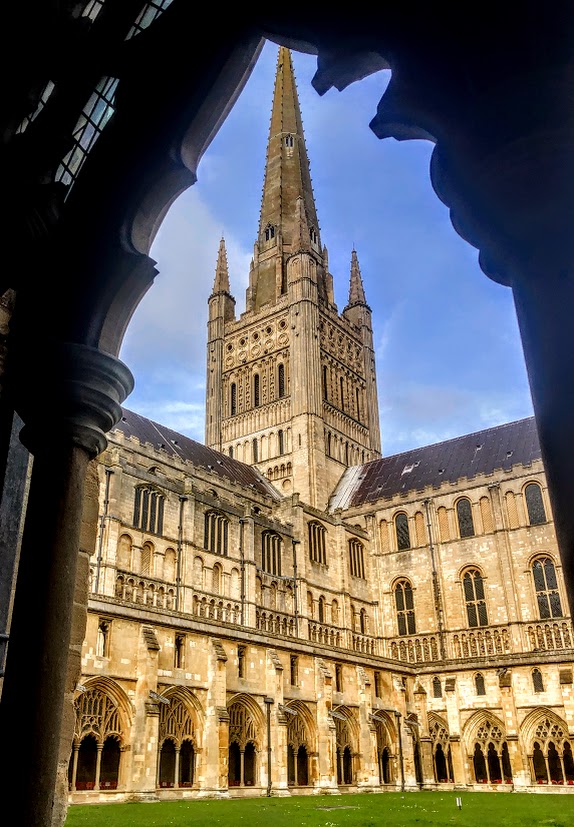
Norwich Cathedral … information leaflets dated about the murder William of Norwich in 1144 have been removed (Photograph: Patrick Comerford)
Patrick Comerford
The dean and chapter of Norwich Cathedral have decided to remove information leaflets dated from the 1990s on the murder of William of Norwich in 1144. The leaflets have been removed from the Chapel of the Holy Innocents in Norwich Cathedral following a new documentary film that explores the history of the Jewish blood libel in mediaeval Norwich.
The murder of 12-year-old William of Norwich in 1144 was blamed on the Jewish community. The myth gained ground when a Benedictine monk, Thomas of Monmouth, accused the Jewish people of murdering Christian boys so that they could use their blood in ritual ceremonies. The libel spread to Europe, leading to the persecution and massacre of the Jewish people.
Norwich Cathedral had a shrine to William, whose body was said to have been buried beneath the altar. It was destroyed at the Reformation and the Chapel of the Innocents was rededicated in the 1990s to victims of abuse, persecution, and intolerance. The leaflets linked William’s murder with the story of slaughter of the innocents in Saint Matthew’s Gospel.
The documentary The Innocents – funded by the Jewish Small Communities Network (JSCN) – is about two small English cities in the shadow of the blood libel and is to be screened in Norwich next Thursday (4 December 2025) as part of the British Jewish Life on Film event. A coda has been added to include a section on the start of the conversation with the cathedral.
The Dean of Norwich, the Very Revd Dr Andrew Braddock, said last week that the documentary film had brought long-held concerns to the surface. He said that putting the story of William into the context of a chapel dedicated to the Holy Innocents was really troubling and created ‘a parallel between William as an innocent boy who was killed allegedly by the Jews, with the story of the boys under two years old in Bethlehem being killed by a Jewish king, Herod.’
Norwich Hebrew Congregation Synagogue on Earlham Road (Photograph: Patrick Comerford)
The events in Norwich in 1144 mark the beginning of the mediaeval ‘blood libel’, and, according to a report in the Church Times last week, Dean Braddock concedes: ‘We just need to own it as part of our history – but in a way which makes it clear that today we work together as synagogue and cathedral, both committed to taking a shared stand against antisemitism in our own time.’
The cult of William of Norwich developed into a particularly virulent strain of antisemitism, and the story of the tragic death of a boy was exploited to incite antisemitic persecution.
By the mid-12th century, there were nine Jewish communities across England, including 200 Jews living in Norwich. In the days before Easter 1144, a 12-year-old boy named William, a tanner’s apprentice, disappeared. When his body was discovered under suspicious circumstances in woods outside Norwich, it was clear he had suffered a violent death. His mother and uncle alleged local Jews were responsible were responsible for his death, and local gossip spoke of anti-Christian Jewish conspiracies.
One story claimed the Jews had crucified William. However, the local sheriff could find no evidence for any of this, and further investigations did not shed any further light on the events. Despite the rumours of Jewish involvement, no arrests were ever made, the Jews of Norwich were provided with shelter in Norwich Castle, and William’s death remained unsolved.
The mediaeval synagogue in Norwich was in the city centre close to the castle (Photograph: Patrick Comerford)
Several years later, when a monk named Thomas de Monmouth arrived in Norwich he noticed that Norwich Cathedral was dedicated to the Holy Trinity but not to any named saint. Thomas of Monmouth said the lack of a local saint’s cult was a glaring omission, and missed out on the opportunity to increase revenue from visiting pilgrims. In 1150, he published The Life and Passions of Saint William, the Martyr of Norwich.
Thomas claimed his detailed research had uncovered the lurid details of in the murder and martyrdom of 12-year-old William. He claimed William had been abducted, subjected to ritual torture and crucified before his body was dumped in the woods.
Bishop William de Turbeville and several monks in Norwich were eager to support William’s saintly candidacy, although the new cult was not without its detractors. The local sheriff, John de Chesney, refused to support the cult, pointing out that neither Thomas nor the local Bishop had the authority to declare people saints.
When the body of the newly-proclaimed Saint William was moved to a place near the Priory’s high altar, tales of miracles spread quickly. By 1154 William’s body was moved to the chapel of martyrs in Norwich Cathedral.
The story of William of Norwich set a precedent. It was the first known time a Jewish community had been accused of ritual child murder in England. Similar accusations of child murder by Jews followed: Gloucester (1168), Bury Saint Edmunds (1181), Winchester (1192), Norwich again (1235) and Lincoln (1255).
The accusations in Lincoln in 1255 led to the hanging of 19 Jews and, were it not for the intervention of the king’s brother, 90 more would have followed them. Similar accusations appeared in continental Europe from the mid-12th century on, and accusations of Jewish child murder featured in around 150 different trials in the 12th and 13th centuries.
What began as a local antisemitic rumour evolved into a conspiracy theory that became known as ‘Blood Libel’. Within a century it was being claimed that Jews harvested a child’s blood and distributed it to other Jewish communities. These ideas spread across Europe, and the ‘Blood Libel’ became firmly established in western European.
When the bodies of five dead boys were discovered in Fulda in Germany in 1225, local Jews were accused of murdering them in Blood Libel rituals; 34 Jews were rounded up and burnt at the stake, despite the lack of any solid evidence.
Although William of Norwich was venerated locally throughout the Middle Ages, he was never officially recognised as a saint. His cult finally disappeared during the Reformations in the 16th century. The ritual nature of William’s death became part of the narrative long after the event. Other possibilities include an accidental death or killing, or the killer transferring the blame to local Jews in Norwich.
One of the earliest references to The Life and Miracles of St William of Norwich by Thomas of Monmouth is from John Bale (1495-1563), Bishop of Ossory, who went to school in Norwich.
The stories became the pretext for a lie that travelled across Europe, was evoked by the Nazis and endures today. The legacy of the ‘Blood Libel’ stories that spread from Norwich continues in antisemitic language and claims across Europe.
In the film, the Masorti rabbi in Norwich, Rabbi Roderick Young, says he wants to focus on the thriving Jewish history of the city. ‘Let’s not concentrate so much on William of Norwich, let’s concentrate on what was great about the time that Jews were living in Norwich.’
Two years ago, the Mayor of Norwich apologised for the city’s part in the spread of blood libel. Now Norwich Cathedral is taking a step in the right direction.
Shabbat Shalom, שבת שלום
The cloisters Norwich Cathedral, built in 1297-1430 (Photograph: Patrick Comerford)
For the history of the Jewish community in Norwich, visit HERE
Patrick Comerford
The dean and chapter of Norwich Cathedral have decided to remove information leaflets dated from the 1990s on the murder of William of Norwich in 1144. The leaflets have been removed from the Chapel of the Holy Innocents in Norwich Cathedral following a new documentary film that explores the history of the Jewish blood libel in mediaeval Norwich.
The murder of 12-year-old William of Norwich in 1144 was blamed on the Jewish community. The myth gained ground when a Benedictine monk, Thomas of Monmouth, accused the Jewish people of murdering Christian boys so that they could use their blood in ritual ceremonies. The libel spread to Europe, leading to the persecution and massacre of the Jewish people.
Norwich Cathedral had a shrine to William, whose body was said to have been buried beneath the altar. It was destroyed at the Reformation and the Chapel of the Innocents was rededicated in the 1990s to victims of abuse, persecution, and intolerance. The leaflets linked William’s murder with the story of slaughter of the innocents in Saint Matthew’s Gospel.
The documentary The Innocents – funded by the Jewish Small Communities Network (JSCN) – is about two small English cities in the shadow of the blood libel and is to be screened in Norwich next Thursday (4 December 2025) as part of the British Jewish Life on Film event. A coda has been added to include a section on the start of the conversation with the cathedral.
The Dean of Norwich, the Very Revd Dr Andrew Braddock, said last week that the documentary film had brought long-held concerns to the surface. He said that putting the story of William into the context of a chapel dedicated to the Holy Innocents was really troubling and created ‘a parallel between William as an innocent boy who was killed allegedly by the Jews, with the story of the boys under two years old in Bethlehem being killed by a Jewish king, Herod.’
Norwich Hebrew Congregation Synagogue on Earlham Road (Photograph: Patrick Comerford)
The events in Norwich in 1144 mark the beginning of the mediaeval ‘blood libel’, and, according to a report in the Church Times last week, Dean Braddock concedes: ‘We just need to own it as part of our history – but in a way which makes it clear that today we work together as synagogue and cathedral, both committed to taking a shared stand against antisemitism in our own time.’
The cult of William of Norwich developed into a particularly virulent strain of antisemitism, and the story of the tragic death of a boy was exploited to incite antisemitic persecution.
By the mid-12th century, there were nine Jewish communities across England, including 200 Jews living in Norwich. In the days before Easter 1144, a 12-year-old boy named William, a tanner’s apprentice, disappeared. When his body was discovered under suspicious circumstances in woods outside Norwich, it was clear he had suffered a violent death. His mother and uncle alleged local Jews were responsible were responsible for his death, and local gossip spoke of anti-Christian Jewish conspiracies.
One story claimed the Jews had crucified William. However, the local sheriff could find no evidence for any of this, and further investigations did not shed any further light on the events. Despite the rumours of Jewish involvement, no arrests were ever made, the Jews of Norwich were provided with shelter in Norwich Castle, and William’s death remained unsolved.
The mediaeval synagogue in Norwich was in the city centre close to the castle (Photograph: Patrick Comerford)
Several years later, when a monk named Thomas de Monmouth arrived in Norwich he noticed that Norwich Cathedral was dedicated to the Holy Trinity but not to any named saint. Thomas of Monmouth said the lack of a local saint’s cult was a glaring omission, and missed out on the opportunity to increase revenue from visiting pilgrims. In 1150, he published The Life and Passions of Saint William, the Martyr of Norwich.
Thomas claimed his detailed research had uncovered the lurid details of in the murder and martyrdom of 12-year-old William. He claimed William had been abducted, subjected to ritual torture and crucified before his body was dumped in the woods.
Bishop William de Turbeville and several monks in Norwich were eager to support William’s saintly candidacy, although the new cult was not without its detractors. The local sheriff, John de Chesney, refused to support the cult, pointing out that neither Thomas nor the local Bishop had the authority to declare people saints.
When the body of the newly-proclaimed Saint William was moved to a place near the Priory’s high altar, tales of miracles spread quickly. By 1154 William’s body was moved to the chapel of martyrs in Norwich Cathedral.
The story of William of Norwich set a precedent. It was the first known time a Jewish community had been accused of ritual child murder in England. Similar accusations of child murder by Jews followed: Gloucester (1168), Bury Saint Edmunds (1181), Winchester (1192), Norwich again (1235) and Lincoln (1255).
The accusations in Lincoln in 1255 led to the hanging of 19 Jews and, were it not for the intervention of the king’s brother, 90 more would have followed them. Similar accusations appeared in continental Europe from the mid-12th century on, and accusations of Jewish child murder featured in around 150 different trials in the 12th and 13th centuries.
What began as a local antisemitic rumour evolved into a conspiracy theory that became known as ‘Blood Libel’. Within a century it was being claimed that Jews harvested a child’s blood and distributed it to other Jewish communities. These ideas spread across Europe, and the ‘Blood Libel’ became firmly established in western European.
When the bodies of five dead boys were discovered in Fulda in Germany in 1225, local Jews were accused of murdering them in Blood Libel rituals; 34 Jews were rounded up and burnt at the stake, despite the lack of any solid evidence.
Although William of Norwich was venerated locally throughout the Middle Ages, he was never officially recognised as a saint. His cult finally disappeared during the Reformations in the 16th century. The ritual nature of William’s death became part of the narrative long after the event. Other possibilities include an accidental death or killing, or the killer transferring the blame to local Jews in Norwich.
One of the earliest references to The Life and Miracles of St William of Norwich by Thomas of Monmouth is from John Bale (1495-1563), Bishop of Ossory, who went to school in Norwich.
The stories became the pretext for a lie that travelled across Europe, was evoked by the Nazis and endures today. The legacy of the ‘Blood Libel’ stories that spread from Norwich continues in antisemitic language and claims across Europe.
In the film, the Masorti rabbi in Norwich, Rabbi Roderick Young, says he wants to focus on the thriving Jewish history of the city. ‘Let’s not concentrate so much on William of Norwich, let’s concentrate on what was great about the time that Jews were living in Norwich.’
Two years ago, the Mayor of Norwich apologised for the city’s part in the spread of blood libel. Now Norwich Cathedral is taking a step in the right direction.
Shabbat Shalom, שבת שלום
The cloisters Norwich Cathedral, built in 1297-1430 (Photograph: Patrick Comerford)
For the history of the Jewish community in Norwich, visit HERE
03 November 2025
Daily prayer in the Kingdom Season 2025:
3, Monday 3 November 2025,
All Souls’ Monday
All Souls College, Oxford … its full, official name is: the Warden and the College of the Souls of All Faithful People deceased in the University of Oxford (Photograph: Patrick Comerford)
Patrick Comerford
The week began with All Saints’ Sunday (2 November), and I imagine few if any parishes or churches marked All Souls’ Day yesterday. On All Saints’ Day on 1 November, we moved in Ordinary Time in the Church Calendar to the Kingdom Season, the time between All Saints’ Day and Advent.
The calendar of the Church of England in Common Worship today (3 November) remembers Richard Hooker (1554-1600), Priest, Anglican Apologist, and Teacher of the Faith; and Saint Martin of Porres (1579-1639), Dominican friar. However, when 2 November is a Sunday, then the Commemoration of the Faithful Departed (All Souls’ Day) may be observed on Monday 3 November.
Charlotte and I are celebrating our wedding anniversary later today. Meanwhile, before the day begins, before having breakfast, I am taking some quiet time early this morning to give thanks, and for reflection, prayer and reading in these ways:
1, today’s Gospel reading;
2, a short reflection;
3, a prayer from the USPG prayer diary;
4, the Collects and Post-Communion prayer of the day.
The reredos in the chapel of All Souls College, Oxford … a reminder of the ‘Faithful Departed’ (Photograph: Patrick Comerford)
John 6: 12-14 (NRSVA):
[Jesus said:] 37 ‘Everything that the Father gives me will come to me, and anyone who comes to me I will never drive away; 38 for I have come down from heaven, not to do my own will, but the will of him who sent me. 39 And this is the will of him who sent me, that I should lose nothing of all that he has given me, but raise it up on the last day. 40 This is indeed the will of my Father, that all who see the Son and believe in him may have eternal life; and I will raise them up on the last day.’
‘I will raise them up on the last day’ (John 6: 40) … an unlabelled carving in All Souls College, Oxford (Photograph: Patrick Comerford)
November is a month when we traditionally remember the saints, the Communion of Saints, those who are blessed, those we love and who are now gathered around the throne of God, those who have died and who we still love.
We do that on All Souls’ Day, we do that on Remembrance Day and Remembrance Sunday, and we do that on All Saints’ Day.
November is a month when we traditionally remember the saints, the Communion of Saints, those we love and who are now gathered around the throne of God, those who have died and who we still love.
As the evenings close in, as the last autumn leaves fall from the trees, it is natural to remember the dead and the fallen, with love and affection.
The special days in November include:
• All Saints’ Day (1 November);
• All Souls’ Day or the ‘Commemoration of the Faithful Departed’ (2 November, Common Worship, p 15);
• In Ireland, All Saints of Ireland (6 November);
• Remembrance Sunday (9 November 2025);
• Remembrance Day (11 November).
At this time of the year there are many people in my own family I am remembering, including:
• my mother, Ellen (Murphy) Comerford, who died 11 years ago, on 20 May 2014;
• my father, Stephen Edward Comerford, who died 21 years ago on 27 December 2004;
• my brother, Stephen Edward Comerford, who died in Durham, North Carolina, 55 years ago, on 18 December 1970;
• my foster mother, Peggy Kerr, who died on 27 July 2010, and my foster father George Kerr;
• my grandparents, Stephen Edward Comerford, who died on 21 January 1921, having contracted malaria five years earlier in Thessaloniki, and Bridget (Lynders) Comerford, who died on 25 March 1948;
• my grandparents, Thomas Michael Murphy, who died in Queensland, Australia, on 10 September 1949, and Maria (Crowley) Murphy, who died on 8 July 1957;
• and, at this time of the year, my ‘Gran’, Mary (McCarthy) Hallinan, who died on 6 November 1961; and ‘Granddad’ Edmond Hallinan, who died on 8 March 1963.
Hallowe’en is the day before we remember the Hallowed, not as the dead but as the blessed, the saints, who are model for our lives, our Christian lifestyle today. We believe the dead we love are still caught up in the love of God and are alive in Christ.
Indeed, saints do not need to be dead to be examples of ‘holy living and holy dying’ (Jeremy Taylor). Saint Paul regularly refers in his letters to fellow Christians as ‘saints.’ Saints Alive!
In the past, I have realised how many people and parishes have been shy, reluctant, perhaps even fearful, in the Church of Ireland when it comes to recalling, commemorating and celebrating the saints. A comparison of the calendars of the Church of Ireland and the Church of England is very telling.
Perhaps the people who decided on the calendar in the Church of Ireland were too afraid in the past of being seen to pray to the saints, or to pray for the dead. But, really, these are quite different to finding examples of godly living among Christians from the past, and expressing confidence that the dead we have loved are now committed to God’s love.
Yet the Church of England sees the calendar of saints as a living calendar, something that is added to as we find more appropriate examples of Christian living for today.
Saints do not have to be martyrs. But in recent years Oscar Romero was canonised and there was a major commemoration in Westminster Abbey of Oscar Romero in 2017 to mark his 100th birthday.
Saints do not have to be canonised. Modern martyrs include Dietrich Bonhoeffer and Martin Luther King, or Heather Heyer, the civil rights activist killed by far-right neo-Nazis and racists in Charlottesville, Kentucky, in 2017.
Many of us know people who handed on the faith to us – teachers, grandparents, perhaps neighbours. Even though many may be long dead, they remain part of our vision of the Communion of Saints.
Saints do not have to live a perfect life; as the Book of Common Prayer reminds us, ‘if we say we have no sin we deceive ourselves’ (I John 1: 8) … none of us is without sin, and none of us is beyond redemption. Some of the saints carved on the West Front of Westminster Abbey might have been very surprised to know they were going to appear there. But their lives in sum total are what we are asked to think about.
They are: Maximilian Kolbe, Manche Masemola, Archbishop Janani Luwum, Grand Duchess Elizabeth, Martin Luther King, Oscar Romero, Dietrich Bonhoeffer, Esther John, Lucian Tapiedi, and Wang Zhiming.
Some years ago, I asked students to share stories of their favourite ‘saints and heroes.’ They included an interesting array of people, some who were the still living at the time, including Archbishop Desmond Tutu.
In interviews in the Church Times, people are sometimes asked who they would like to be locked into a church with for a few hours.
Who are your favourite saints?
Who would you like to learn from a little more when it comes to living the Christian life?
This year marks the 1700th anniversary of the Nicene Creed, in which we express our belief in ‘the resurrection of the dead, and the life of the world to come’. In the Apostles’ Creed, we confess our belief in ‘the communion of saints’ and ‘the resurrection of the body.’
In the introduction to the Church Calendar and this in-between time, the time between All Saints and Advent, the resources for Common Worship remind us that ‘No Christian is solitary. Through baptism we become members one of another in Christ, members of a company of saints whose mutual belonging transcends death’. The resources then quote Charles Wesley:
One family, we dwell in him,
one Church, above, beneath;
though now divided by the stream,
the narrow stream of death.
Who are the saints in your life, in your own personal calendars? Who are those you recall whose souls we have committed to God’s love and who are part of ‘the communion of saints’?
Throughout the month of November, there are opportunities to remember their names as we are reminded in the first reading today that ‘The souls of the righteous are in the hand of God, no torment will ever touch them’ (Wisdom 3: 1).
The Library at All Souls College, Oxford, with a sundial designed by Sir Christopher Wren (Photograph: Patrick Comerford)
Today’s Prayers (Monday 3 November 2025, All Souls’):
The theme this week (2 to 8 November) in Pray with the World Church, the prayer diary of the Anglican mission agency USPG (United Society Partners in the Gospel), is ‘From Solitude to Connection’ (pp 52-53). This theme was introduced yesterday with a Programme Update from Ljudmila, a Ukrainian Refugee living in Budapest, Hungary.
The USPG Prayer Diary today (Monday 3 November 2025, All Souls’) invites us to pray:
Lord, as a God of peace, we pray that you will bring peace to Ukraine so families like Ljudmila’s may live without fear, reunited in safety and love.
The Collect:
Eternal God, our maker and redeemer,
grant us, with all the faithful departed,
the sure benefits of your Son’s saving passion
and glorious resurrection
that, in the last day,
when you gather up all things in Christ,
we may with them enjoy the fullness of your promises;
through Jesus Christ your Son our Lord,
who is alive and reigns with you,
in the unity of the Holy Spirit,
one God, now and for ever.
The Post Communion Prayer:
God of love,
may the death and resurrection of Christ
which we have celebrated in this eucharist
bring us, with all the faithful departed,
into the peace of your eternal home.
We ask this in the name of Jesus Christ,
our rock and our salvation,
to whom be glory for time and for eternity.
Yesterday’s Reflections
Continued Tomorrow
All Souls College, Oxford, founded in 1438 by Henry Chichele, Archbishop of Canterbury, with King Henry VI as its formal co-founder (Photograph: Patrick Comerford)
Scripture quotations are from the New Revised Standard Version Bible: Anglicised Edition copyright © 1989, 1995 National Council of the Churches of Christ in the United States of America. Used by permission. All rights reserved worldwide. http://nrsvbibles.org
Patrick Comerford
The week began with All Saints’ Sunday (2 November), and I imagine few if any parishes or churches marked All Souls’ Day yesterday. On All Saints’ Day on 1 November, we moved in Ordinary Time in the Church Calendar to the Kingdom Season, the time between All Saints’ Day and Advent.
The calendar of the Church of England in Common Worship today (3 November) remembers Richard Hooker (1554-1600), Priest, Anglican Apologist, and Teacher of the Faith; and Saint Martin of Porres (1579-1639), Dominican friar. However, when 2 November is a Sunday, then the Commemoration of the Faithful Departed (All Souls’ Day) may be observed on Monday 3 November.
Charlotte and I are celebrating our wedding anniversary later today. Meanwhile, before the day begins, before having breakfast, I am taking some quiet time early this morning to give thanks, and for reflection, prayer and reading in these ways:
1, today’s Gospel reading;
2, a short reflection;
3, a prayer from the USPG prayer diary;
4, the Collects and Post-Communion prayer of the day.
The reredos in the chapel of All Souls College, Oxford … a reminder of the ‘Faithful Departed’ (Photograph: Patrick Comerford)
John 6: 12-14 (NRSVA):
[Jesus said:] 37 ‘Everything that the Father gives me will come to me, and anyone who comes to me I will never drive away; 38 for I have come down from heaven, not to do my own will, but the will of him who sent me. 39 And this is the will of him who sent me, that I should lose nothing of all that he has given me, but raise it up on the last day. 40 This is indeed the will of my Father, that all who see the Son and believe in him may have eternal life; and I will raise them up on the last day.’
‘I will raise them up on the last day’ (John 6: 40) … an unlabelled carving in All Souls College, Oxford (Photograph: Patrick Comerford)
November is a month when we traditionally remember the saints, the Communion of Saints, those who are blessed, those we love and who are now gathered around the throne of God, those who have died and who we still love.
We do that on All Souls’ Day, we do that on Remembrance Day and Remembrance Sunday, and we do that on All Saints’ Day.
November is a month when we traditionally remember the saints, the Communion of Saints, those we love and who are now gathered around the throne of God, those who have died and who we still love.
As the evenings close in, as the last autumn leaves fall from the trees, it is natural to remember the dead and the fallen, with love and affection.
The special days in November include:
• All Saints’ Day (1 November);
• All Souls’ Day or the ‘Commemoration of the Faithful Departed’ (2 November, Common Worship, p 15);
• In Ireland, All Saints of Ireland (6 November);
• Remembrance Sunday (9 November 2025);
• Remembrance Day (11 November).
At this time of the year there are many people in my own family I am remembering, including:
• my mother, Ellen (Murphy) Comerford, who died 11 years ago, on 20 May 2014;
• my father, Stephen Edward Comerford, who died 21 years ago on 27 December 2004;
• my brother, Stephen Edward Comerford, who died in Durham, North Carolina, 55 years ago, on 18 December 1970;
• my foster mother, Peggy Kerr, who died on 27 July 2010, and my foster father George Kerr;
• my grandparents, Stephen Edward Comerford, who died on 21 January 1921, having contracted malaria five years earlier in Thessaloniki, and Bridget (Lynders) Comerford, who died on 25 March 1948;
• my grandparents, Thomas Michael Murphy, who died in Queensland, Australia, on 10 September 1949, and Maria (Crowley) Murphy, who died on 8 July 1957;
• and, at this time of the year, my ‘Gran’, Mary (McCarthy) Hallinan, who died on 6 November 1961; and ‘Granddad’ Edmond Hallinan, who died on 8 March 1963.
Hallowe’en is the day before we remember the Hallowed, not as the dead but as the blessed, the saints, who are model for our lives, our Christian lifestyle today. We believe the dead we love are still caught up in the love of God and are alive in Christ.
Indeed, saints do not need to be dead to be examples of ‘holy living and holy dying’ (Jeremy Taylor). Saint Paul regularly refers in his letters to fellow Christians as ‘saints.’ Saints Alive!
In the past, I have realised how many people and parishes have been shy, reluctant, perhaps even fearful, in the Church of Ireland when it comes to recalling, commemorating and celebrating the saints. A comparison of the calendars of the Church of Ireland and the Church of England is very telling.
Perhaps the people who decided on the calendar in the Church of Ireland were too afraid in the past of being seen to pray to the saints, or to pray for the dead. But, really, these are quite different to finding examples of godly living among Christians from the past, and expressing confidence that the dead we have loved are now committed to God’s love.
Yet the Church of England sees the calendar of saints as a living calendar, something that is added to as we find more appropriate examples of Christian living for today.
Saints do not have to be martyrs. But in recent years Oscar Romero was canonised and there was a major commemoration in Westminster Abbey of Oscar Romero in 2017 to mark his 100th birthday.
Saints do not have to be canonised. Modern martyrs include Dietrich Bonhoeffer and Martin Luther King, or Heather Heyer, the civil rights activist killed by far-right neo-Nazis and racists in Charlottesville, Kentucky, in 2017.
Many of us know people who handed on the faith to us – teachers, grandparents, perhaps neighbours. Even though many may be long dead, they remain part of our vision of the Communion of Saints.
Saints do not have to live a perfect life; as the Book of Common Prayer reminds us, ‘if we say we have no sin we deceive ourselves’ (I John 1: 8) … none of us is without sin, and none of us is beyond redemption. Some of the saints carved on the West Front of Westminster Abbey might have been very surprised to know they were going to appear there. But their lives in sum total are what we are asked to think about.
They are: Maximilian Kolbe, Manche Masemola, Archbishop Janani Luwum, Grand Duchess Elizabeth, Martin Luther King, Oscar Romero, Dietrich Bonhoeffer, Esther John, Lucian Tapiedi, and Wang Zhiming.
Some years ago, I asked students to share stories of their favourite ‘saints and heroes.’ They included an interesting array of people, some who were the still living at the time, including Archbishop Desmond Tutu.
In interviews in the Church Times, people are sometimes asked who they would like to be locked into a church with for a few hours.
Who are your favourite saints?
Who would you like to learn from a little more when it comes to living the Christian life?
This year marks the 1700th anniversary of the Nicene Creed, in which we express our belief in ‘the resurrection of the dead, and the life of the world to come’. In the Apostles’ Creed, we confess our belief in ‘the communion of saints’ and ‘the resurrection of the body.’
In the introduction to the Church Calendar and this in-between time, the time between All Saints and Advent, the resources for Common Worship remind us that ‘No Christian is solitary. Through baptism we become members one of another in Christ, members of a company of saints whose mutual belonging transcends death’. The resources then quote Charles Wesley:
One family, we dwell in him,
one Church, above, beneath;
though now divided by the stream,
the narrow stream of death.
Who are the saints in your life, in your own personal calendars? Who are those you recall whose souls we have committed to God’s love and who are part of ‘the communion of saints’?
Throughout the month of November, there are opportunities to remember their names as we are reminded in the first reading today that ‘The souls of the righteous are in the hand of God, no torment will ever touch them’ (Wisdom 3: 1).
The Library at All Souls College, Oxford, with a sundial designed by Sir Christopher Wren (Photograph: Patrick Comerford)
Today’s Prayers (Monday 3 November 2025, All Souls’):
The theme this week (2 to 8 November) in Pray with the World Church, the prayer diary of the Anglican mission agency USPG (United Society Partners in the Gospel), is ‘From Solitude to Connection’ (pp 52-53). This theme was introduced yesterday with a Programme Update from Ljudmila, a Ukrainian Refugee living in Budapest, Hungary.
The USPG Prayer Diary today (Monday 3 November 2025, All Souls’) invites us to pray:
Lord, as a God of peace, we pray that you will bring peace to Ukraine so families like Ljudmila’s may live without fear, reunited in safety and love.
The Collect:
Eternal God, our maker and redeemer,
grant us, with all the faithful departed,
the sure benefits of your Son’s saving passion
and glorious resurrection
that, in the last day,
when you gather up all things in Christ,
we may with them enjoy the fullness of your promises;
through Jesus Christ your Son our Lord,
who is alive and reigns with you,
in the unity of the Holy Spirit,
one God, now and for ever.
The Post Communion Prayer:
God of love,
may the death and resurrection of Christ
which we have celebrated in this eucharist
bring us, with all the faithful departed,
into the peace of your eternal home.
We ask this in the name of Jesus Christ,
our rock and our salvation,
to whom be glory for time and for eternity.
Yesterday’s Reflections
Continued Tomorrow
All Souls College, Oxford, founded in 1438 by Henry Chichele, Archbishop of Canterbury, with King Henry VI as its formal co-founder (Photograph: Patrick Comerford)
Scripture quotations are from the New Revised Standard Version Bible: Anglicised Edition copyright © 1989, 1995 National Council of the Churches of Christ in the United States of America. Used by permission. All rights reserved worldwide. http://nrsvbibles.org
09 May 2025
Daily prayer in Easter 2025:
20, Friday 9 May 2025
‘Those who eat my flesh and drink my blood abide in me’ (John 6: 56) … an icon of Christ the Great High Priest, in a shop window in Thessaloniki (Photograph: Patrick Comerford)
Patrick Comerford
Easter is a 50-day season that continues until the Day of Pentecost, and this week began with the Third Sunday of Easter (Easter III, 4 May 2025).
Before today begins, I am taking some quiet time this morning to give thanks, to reflect, to pray and to read in these ways:
1, reading today’s Gospel reading;
2, a short reflection;
3, a prayer from the USPG prayer diary;
4, the Collects and Post-Communion prayer of the day.
The Visitation of Abraham or the ‘Old Testament Trinity’ … a fresco in the Monastery of Saint John the Baptist in Tolleshunt Knights, Essex, interprets a Trinitarian and Eucharistic theme (Photograph: Patrick Comerford)
John 6: 52-59 (NRSVA):
52 The Jews then disputed among themselves, saying, ‘How can this man give us his flesh to eat?’ 53 So Jesus said to them, ‘Very truly, I tell you, unless you eat the flesh of the Son of Man and drink his blood, you have no life in you. 54 Those who eat my flesh and drink my blood have eternal life, and I will raise them up on the last day; 55 for my flesh is true food and my blood is true drink. 56 Those who eat my flesh and drink my blood abide in me, and I in them. 57 Just as the living Father sent me, and I live because of the Father, so whoever eats me will live because of me. 58 This is the bread that came down from heaven, not like that which your ancestors ate, and they died. But the one who eats this bread will live for ever.’ 59 He said these things while he was teaching in the synagogue at Capernaum.
‘This is the bread that came down from heaven, not like that which your ancestors ate’ (John 6: 58) … bread in the Avoca shop in Kilmacanogue, Co Wicklow (Photograph: Patrick Comerford)
Today’s Reflection:
With this morning’s Gospel reading, we are coming to the end of this week’s series of readings in the ‘Bread of Life’ discourse in Saint John’s Gospel, which conclude tomorrow (John 6: 60-69).
This morning’s reading is one of the most explicit Trinitarian passages in the New Testament. Christ speaks to us of the Trinity in terms of the inter-relationship between the Father, Son and Holy Spirit, explaining how the Father, Son and Holy Spirit work together, dance together, and are inseparable.
We owe our understandings of the Trinity, in terms of doctrine and social understanding, and how we express these understandings to the Cappadocian Fathers. I spent some time in Cappadocia in south-central Turkey ten years afo because of my interest in sites associated with the three Cappadocian Fathers. These were three key Patristic writers and saints: Saint Basil the Great (329-379), Bishop of Caesarea; his brother Saint Gregory (335-395), Bishop of Nyssa; and Saint Gregory Nazianzus (329-390), who became Patriarch of Constantinople.
They challenged heresies such as Arianism, which denied the divinity of Christ, and their thinking was instrumental in formulating the phrases that shaped the Nicene Creed – the Church is celebrating the 1,700th anniversary of the Nicene Creed this year.
But their thinking was not about doctrine alone; it was also about living the Christian life. Without the Cappadocian Fathers, would we have turned away from the difficult teachings of Christ, as we find them in this Gospel passage? Would we too have dismissed this passage as a ‘hard saying’?
Although Christ’s words ‘I am the Bread of Life’ are familiar to many Christians, in this passage the disciples declare ‘this teaching is difficult’ (verse 60), as we shall read tomorrow.
Christ is teaching in the synagogue in Capernaum, where he is interpreting a passage of scripture that has already been introduced by the crowd (see verse 31). They want a sign similar to the one of manna given to their ancestors in the wilderness in Sinai.
In response, he declares he is the manna, the ‘bread of life’ (verse 35), just as he has told the Samaritan woman at the well that he is the living water (see John 4: 5-26), and just as he tells the disciples later that he is the true vine (see John 15: 1).
Moses could provide this miraculous bread, but he is not the bread of life. Moses could strike the rock and bring forth water, but he is not the living water. How can Christ himself be bread and wine?
These are such difficult conundrums that they turn many of his listeners away.
Verse 56 says: ὁ τρώγων μου τὴν σάρκα καὶ πίνων μου τὸ αἷμα ἐν ἐμοὶ μένει κἀγὼ ἐν αὐτῷ. We translate this and similar passages into English so politely. For example, the NRSV says: ‘Those who eat my flesh and drink my blood abide in me, and I them.’ But a more direct translation might say something: ‘Whoever is gnawing on my flesh and drinking my blood remains in me and I in him.’
There are three interesting verbs in this verse: the verb τρώγων (trógon) means to gnaw, crunch, or chew, as in chewing on raw vegetables or fruits, and is subtly different in meaning than the verb ‘eat’ (ἐσθίω, esthío); the verb πίνων (pínon) means to drink; and the verb μένει (ménei) means to remain or abide, yet some of his disciples or about to leave Christ and the twelve are to continue to walk with him.
Verse 57 says: καθὼς ἀπέστειλέν με ὁ ζῶν πατὴρ κἀγὼ ζῶ διὰ τὸν πατέρα, καὶ ὁ τρώγων με κἀκεῖνος ζήσει δι' ἐμέ. ‘Just as the living Father sent me, and I live through the Father, so whoever eats me will live because of me.’ But, again, we could translate this: ‘As the living Father sent me, and I live because of the Father, so also the one gnawing on me also will live because of me.’
Christ is not merely claiming to give the bread: he is the life-giving bread that the Father gives, and, lest his hearers dismiss this as a metaphor, he insists that this bread is his own flesh.
The Greek word here, ἀπέστειλέν (apésteilén) speaks of being sent to or going to an appointed place. The words ζῶν (zon), ζῶ (zo) and ζήσει (zései) speak of living, breathing, and being among the living. Once again, we hear the word τρώγων (trógon), from the verb τρώγω (trógo) to gnaw, crunch or chew.
Verse 58 says: οὗτός ἐστιν ὁ ἄρτος ὁ ἐξ οὐρανοῦ καταβάς, οὐ καθὼς ἔφαγον οἱ πατέρες καὶ ἀπέθανον: ὁ τρώγων τοῦτον τὸν ἄρτον ζήσει εἰς τὸν αἰῶνα. ‘This is the bread that came down from heaven, not like that which your ancestors ate, and they died. But the one who eats this bread will live for ever.’
Again, how would you respond if this had been translated more explicitly as ‘This one is the bread that has come down out of heaven, not as the fathers ate and died; whoever gnaws on this bread will live into the age-long.’
We have the contrast between καταβὰς (katavas), from καταβαίνω (katavaíno) to go down, come down, or descend, which contrasts with the later reference in verse 62 to ascending to where the Son of Man was before.
In the first part of this verse, Christ uses the word ἔφαγον (ephagon) to describe eating, rather than the verb used again in the second part, τρώγων (trógon), to gnaw, crunch or chew.
This verse brings us back to the earlier discussion in the Gospel reading on Thursday (John 6: 44-51, see verses 49-51), comparing the temporal nature of the manna in the wilderness with the everlasting nature of Christ’s own bread or flesh. It is a reminder that this chapter begins with the feeding of the 5,000 near the time of the Passover, an explicit echo of the Manna story from the Exodus journey through the wilderness to the Promised Land.
They murmur and mutter, and the word used here is the same word used in the Exodus story (see, for examples, Exodus 15: 24; 16: 2) for the murmuring, muttering and grumbling of the people who have just experienced being liberated from slavery yet are not willing to accept the consequences of staying on the journey. They do not trust God to take care of them. Over and over, with questions of water, food, and physical safety, the Israelites play out the same drama of whether they will trust God to care for them.
Once again, people who are on a journey with God turn away. This turning away is the very opposite to the metanoia (μετάνοια), the turning around of conversion.
They are no longer willing to stay the course, they turn away from journeying with Christ, journeying with him to Jerusalem, journeying with him to the Cross, journeying with him to the promise of new life. They are scandalised.
The phrase here reminds me of the common phrase, the Scandal of the Cross or the Scandal of the Gospel, although the phrase as such appears nowhere in the New Testament.
Some of Christ’s disciples have only understood his words in a literal way.
There are many today who hold up a literal interpretation of some obscure and contended passages of scripture, including, for example, some on sexuality, but who reject a literal interpretation of the passages in this ‘Bread of Life’ discourse in Saint John’s Gospel.
They cannot, will not, and refuse to accept Christ’s corporal presence, body and blood, in the Eucharist, however we may come to understand that. It sometimes seems this is the one passage whose literal interpretation is a stumbling block, a scandal, to them.
When they ask whether you have invited Christ into your life, they would be scandalised were you to answer you do that every time you pray the Prayer of Humble Access, every time you receive him in the Eucharist, asking that ‘we may evermore dwell in him and he in us’.
There is little point in arguing that people at the time had no understanding of this Gospel passage as looking forward to the Last Supper and beyond that to the Eucharistic celebrations of the Early Church.
It was written not for the people who were present at the time, but written 50 or 60 years later and would have been first heard by people dealing with the divisions in the Pauline and Johannine communities that came together in the Church in Ephesus. In a lectionary reflection in the Church Times [14 August 2015], Dr Bridget Nicholas pointed out that the ‘Bread of Life’ discourse is the Fourth Gospel’s counterpart to the narrative of the institution of the Lord’s Supper in the Synoptic Gospels.
The writer of this Gospel is addressing a small community of Christians in Ephesus, for whom linear time is displaced by the fact that they already know the divine identity of Christ. And the life that Christ offers to his own people is being worked out in practical ways by the recipients of the Letter to the Ephesians.
In this Gospel story, as in the Exodus story, this murmuring, muttering and grumbling shows a complete lack of trust, belief and faith in God. And this is not just intellectual assent, but a willingness to make life-changing decisions.
In this week’s Gospel readings, the twelve are the ones who ‘abide’ with Christ. They stick with him even though his teaching is difficult. They stay with him at the Last Supper, and even though they will scatter during his trial and crucifixion, their faith is strengthened, returns in full vigour with the Resurrection and is fortified at Pentecost.
But the people who desert Christ in this week’s Gospel reading, who turn away, are not ‘the crowds’ – they are ‘disciples.’ They had followed Christ and believed in him, but now they leave.
Abandoning the Eucharistic faith and practice of the Church is often the first step in abandoning the Church, abandoning Christ, and turning backs on the call to love God and love one another.
If we take part regularly and with spiritual discipline in the Eucharist, we realise that it is not all about me at all. This bread is broken and this cup is poured out not just for us but also for the many.
It is interesting that the parishes with infrequent celebrations of the Eucharist are often the most closed, the ones most turned in on themselves, unwilling to open their doors to those who are different in social and ethnic background, with irregular relationships and lifestyles, and the parishes that err on the side of judgmentalism.
Regular reception of this Sacrament is a reminder that the Church exists not for you and for me but for the world, and that the Church is not for those who decide subjectively they are the ‘called’ and the ‘saved,’ but is there to call the world into the Kingdom.
In the Eucharistic prayers, we use words such as: ‘this is my blood of the new covenant which is shed for you and for many for the forgiveness of sins’. In two Gospel passages we read: ‘for this is my blood of the covenant, which is poured out for many for the forgiveness of sins’ (Matthew 26: 28); and ‘this is my blood of the covenant, which is poured out for many’ (Mark 14: 24).
It is clear that the Eucharist, while celebrated among the disciples or within the community, is for the benefit of ‘the many.’ The Eucharist is the shape of ‘the mission-shaped Church.’
Knowing and belief come together, knowledge is meaningless without wisdom, faith goes beyond accepting facts.
As Canon Patrick Whitworth points out in one of his books, for the Cappadocian Fathers, doctrine, prayer and pastoral ministry are inseparable from care for the poor [Patrick Whitworth, Three Wise men from the East: the Cappadocian Fathers and the Struggle for Orthodoxy (Durham: Sacristy Press, 2015)].
The profession of faith by Simon Peter in tomorrow’s reading is followed immediately by a cautious and disturbing remark by Christ about betrayal (verses 70-71), although the compilers of the Revised Common Lectionary have omitted them. Judas is going to walk out at the Last Supper. Is a regular refusal to eat this bread and to drink this cup a betrayal of Christ and of the Christian faith?
The word sacrament is derived from the Latin sacrāmentum, which is an attempt to render the Greek word μυστήριον (mysterion). Saint Paul asks the people of Ephesus to pray that he may be given a gift of the right words in telling of the ‘mystery of the Gospel’ (τὸ μυστήριον τοῦ εὐαγγελίου, to mysterion tou evangeliou) (Ephesians 6: 19).
What if this Gospel reading is a reminder of the heart of the Gospel, the mystery of the Gospel?
Yes, it would affirm, the Eucharist is the shape of ‘the mission-shaped Church.’
Christ is risen!
The Lord is risen indeed. Alleluia!
‘But the one who eats this bread will live for ever’ (John 6: 58) … bread on display in a bakery in Frankfurt (Photograph: Patrick Comerford)
Today’s Prayers (Friday 9 May 2025):
My prayers today include Pope Leo XIV, the former Cardinal Robert Prevost, who was elected at the Papal Conclave in the Sistine Chapel in the Vatican late yesterday (8 May).
‘Inconvenient Migration’ provides the theme this week in ‘Pray With the World Church’, the Prayer Diary of the Anglican mission agency USPG (United Society Partners in the Gospel). This theme was introduced on Sunday with Reflections from Carol Miller, Church Engagement Manager, USPG.
The USPG Prayer Diary today (Friday 9 May 2025) invites us to pray:
God of compassion, we ask for merciful and just decisions by leaders around the globe as policies are made and implemented.
The Collect:
Almighty Father,
who in your great mercy gladdened the disciples
with the sight of the risen Lord:
give us such knowledge of his presence with us,
that we may be strengthened and sustained by his risen life
and serve you continually in righteousness and truth;
through Jesus Christ your Son our Lord,
who is alive and reigns with you,
in the unity of the Holy Spirit,
one God, now and for ever.
The Post-Communion Prayer:
Living God,
your Son made himself known to his disciples
in the breaking of bread:
open the eyes of our faith,
that we may see him in all his redeeming work;
who is alive and reigns, now and for ever.
Additional Collect:
Risen Christ,
you filled your disciples with boldness and fresh hope:
strengthen us to proclaim your risen life
and fill us with your peace,
to the glory of God the Father.
Yesterday’s Reflections
Continued Tomorrow
The Gate of Persecution leading into the site of the Basilica of Saint John the Divine in Ephesus (Photograph: Patrick Comerford)
Scripture quotations are from the New Revised Standard Version Bible: Anglicised Edition copyright © 1989, 1995 National Council of the Churches of Christ in the United States of America. Used by permission. All rights reserved worldwide. http://nrsvbibles.org
Patrick Comerford
Easter is a 50-day season that continues until the Day of Pentecost, and this week began with the Third Sunday of Easter (Easter III, 4 May 2025).
Before today begins, I am taking some quiet time this morning to give thanks, to reflect, to pray and to read in these ways:
1, reading today’s Gospel reading;
2, a short reflection;
3, a prayer from the USPG prayer diary;
4, the Collects and Post-Communion prayer of the day.
The Visitation of Abraham or the ‘Old Testament Trinity’ … a fresco in the Monastery of Saint John the Baptist in Tolleshunt Knights, Essex, interprets a Trinitarian and Eucharistic theme (Photograph: Patrick Comerford)
John 6: 52-59 (NRSVA):
52 The Jews then disputed among themselves, saying, ‘How can this man give us his flesh to eat?’ 53 So Jesus said to them, ‘Very truly, I tell you, unless you eat the flesh of the Son of Man and drink his blood, you have no life in you. 54 Those who eat my flesh and drink my blood have eternal life, and I will raise them up on the last day; 55 for my flesh is true food and my blood is true drink. 56 Those who eat my flesh and drink my blood abide in me, and I in them. 57 Just as the living Father sent me, and I live because of the Father, so whoever eats me will live because of me. 58 This is the bread that came down from heaven, not like that which your ancestors ate, and they died. But the one who eats this bread will live for ever.’ 59 He said these things while he was teaching in the synagogue at Capernaum.
‘This is the bread that came down from heaven, not like that which your ancestors ate’ (John 6: 58) … bread in the Avoca shop in Kilmacanogue, Co Wicklow (Photograph: Patrick Comerford)
Today’s Reflection:
With this morning’s Gospel reading, we are coming to the end of this week’s series of readings in the ‘Bread of Life’ discourse in Saint John’s Gospel, which conclude tomorrow (John 6: 60-69).
This morning’s reading is one of the most explicit Trinitarian passages in the New Testament. Christ speaks to us of the Trinity in terms of the inter-relationship between the Father, Son and Holy Spirit, explaining how the Father, Son and Holy Spirit work together, dance together, and are inseparable.
We owe our understandings of the Trinity, in terms of doctrine and social understanding, and how we express these understandings to the Cappadocian Fathers. I spent some time in Cappadocia in south-central Turkey ten years afo because of my interest in sites associated with the three Cappadocian Fathers. These were three key Patristic writers and saints: Saint Basil the Great (329-379), Bishop of Caesarea; his brother Saint Gregory (335-395), Bishop of Nyssa; and Saint Gregory Nazianzus (329-390), who became Patriarch of Constantinople.
They challenged heresies such as Arianism, which denied the divinity of Christ, and their thinking was instrumental in formulating the phrases that shaped the Nicene Creed – the Church is celebrating the 1,700th anniversary of the Nicene Creed this year.
But their thinking was not about doctrine alone; it was also about living the Christian life. Without the Cappadocian Fathers, would we have turned away from the difficult teachings of Christ, as we find them in this Gospel passage? Would we too have dismissed this passage as a ‘hard saying’?
Although Christ’s words ‘I am the Bread of Life’ are familiar to many Christians, in this passage the disciples declare ‘this teaching is difficult’ (verse 60), as we shall read tomorrow.
Christ is teaching in the synagogue in Capernaum, where he is interpreting a passage of scripture that has already been introduced by the crowd (see verse 31). They want a sign similar to the one of manna given to their ancestors in the wilderness in Sinai.
In response, he declares he is the manna, the ‘bread of life’ (verse 35), just as he has told the Samaritan woman at the well that he is the living water (see John 4: 5-26), and just as he tells the disciples later that he is the true vine (see John 15: 1).
Moses could provide this miraculous bread, but he is not the bread of life. Moses could strike the rock and bring forth water, but he is not the living water. How can Christ himself be bread and wine?
These are such difficult conundrums that they turn many of his listeners away.
Verse 56 says: ὁ τρώγων μου τὴν σάρκα καὶ πίνων μου τὸ αἷμα ἐν ἐμοὶ μένει κἀγὼ ἐν αὐτῷ. We translate this and similar passages into English so politely. For example, the NRSV says: ‘Those who eat my flesh and drink my blood abide in me, and I them.’ But a more direct translation might say something: ‘Whoever is gnawing on my flesh and drinking my blood remains in me and I in him.’
There are three interesting verbs in this verse: the verb τρώγων (trógon) means to gnaw, crunch, or chew, as in chewing on raw vegetables or fruits, and is subtly different in meaning than the verb ‘eat’ (ἐσθίω, esthío); the verb πίνων (pínon) means to drink; and the verb μένει (ménei) means to remain or abide, yet some of his disciples or about to leave Christ and the twelve are to continue to walk with him.
Verse 57 says: καθὼς ἀπέστειλέν με ὁ ζῶν πατὴρ κἀγὼ ζῶ διὰ τὸν πατέρα, καὶ ὁ τρώγων με κἀκεῖνος ζήσει δι' ἐμέ. ‘Just as the living Father sent me, and I live through the Father, so whoever eats me will live because of me.’ But, again, we could translate this: ‘As the living Father sent me, and I live because of the Father, so also the one gnawing on me also will live because of me.’
Christ is not merely claiming to give the bread: he is the life-giving bread that the Father gives, and, lest his hearers dismiss this as a metaphor, he insists that this bread is his own flesh.
The Greek word here, ἀπέστειλέν (apésteilén) speaks of being sent to or going to an appointed place. The words ζῶν (zon), ζῶ (zo) and ζήσει (zései) speak of living, breathing, and being among the living. Once again, we hear the word τρώγων (trógon), from the verb τρώγω (trógo) to gnaw, crunch or chew.
Verse 58 says: οὗτός ἐστιν ὁ ἄρτος ὁ ἐξ οὐρανοῦ καταβάς, οὐ καθὼς ἔφαγον οἱ πατέρες καὶ ἀπέθανον: ὁ τρώγων τοῦτον τὸν ἄρτον ζήσει εἰς τὸν αἰῶνα. ‘This is the bread that came down from heaven, not like that which your ancestors ate, and they died. But the one who eats this bread will live for ever.’
Again, how would you respond if this had been translated more explicitly as ‘This one is the bread that has come down out of heaven, not as the fathers ate and died; whoever gnaws on this bread will live into the age-long.’
We have the contrast between καταβὰς (katavas), from καταβαίνω (katavaíno) to go down, come down, or descend, which contrasts with the later reference in verse 62 to ascending to where the Son of Man was before.
In the first part of this verse, Christ uses the word ἔφαγον (ephagon) to describe eating, rather than the verb used again in the second part, τρώγων (trógon), to gnaw, crunch or chew.
This verse brings us back to the earlier discussion in the Gospel reading on Thursday (John 6: 44-51, see verses 49-51), comparing the temporal nature of the manna in the wilderness with the everlasting nature of Christ’s own bread or flesh. It is a reminder that this chapter begins with the feeding of the 5,000 near the time of the Passover, an explicit echo of the Manna story from the Exodus journey through the wilderness to the Promised Land.
They murmur and mutter, and the word used here is the same word used in the Exodus story (see, for examples, Exodus 15: 24; 16: 2) for the murmuring, muttering and grumbling of the people who have just experienced being liberated from slavery yet are not willing to accept the consequences of staying on the journey. They do not trust God to take care of them. Over and over, with questions of water, food, and physical safety, the Israelites play out the same drama of whether they will trust God to care for them.
Once again, people who are on a journey with God turn away. This turning away is the very opposite to the metanoia (μετάνοια), the turning around of conversion.
They are no longer willing to stay the course, they turn away from journeying with Christ, journeying with him to Jerusalem, journeying with him to the Cross, journeying with him to the promise of new life. They are scandalised.
The phrase here reminds me of the common phrase, the Scandal of the Cross or the Scandal of the Gospel, although the phrase as such appears nowhere in the New Testament.
Some of Christ’s disciples have only understood his words in a literal way.
There are many today who hold up a literal interpretation of some obscure and contended passages of scripture, including, for example, some on sexuality, but who reject a literal interpretation of the passages in this ‘Bread of Life’ discourse in Saint John’s Gospel.
They cannot, will not, and refuse to accept Christ’s corporal presence, body and blood, in the Eucharist, however we may come to understand that. It sometimes seems this is the one passage whose literal interpretation is a stumbling block, a scandal, to them.
When they ask whether you have invited Christ into your life, they would be scandalised were you to answer you do that every time you pray the Prayer of Humble Access, every time you receive him in the Eucharist, asking that ‘we may evermore dwell in him and he in us’.
There is little point in arguing that people at the time had no understanding of this Gospel passage as looking forward to the Last Supper and beyond that to the Eucharistic celebrations of the Early Church.
It was written not for the people who were present at the time, but written 50 or 60 years later and would have been first heard by people dealing with the divisions in the Pauline and Johannine communities that came together in the Church in Ephesus. In a lectionary reflection in the Church Times [14 August 2015], Dr Bridget Nicholas pointed out that the ‘Bread of Life’ discourse is the Fourth Gospel’s counterpart to the narrative of the institution of the Lord’s Supper in the Synoptic Gospels.
The writer of this Gospel is addressing a small community of Christians in Ephesus, for whom linear time is displaced by the fact that they already know the divine identity of Christ. And the life that Christ offers to his own people is being worked out in practical ways by the recipients of the Letter to the Ephesians.
In this Gospel story, as in the Exodus story, this murmuring, muttering and grumbling shows a complete lack of trust, belief and faith in God. And this is not just intellectual assent, but a willingness to make life-changing decisions.
In this week’s Gospel readings, the twelve are the ones who ‘abide’ with Christ. They stick with him even though his teaching is difficult. They stay with him at the Last Supper, and even though they will scatter during his trial and crucifixion, their faith is strengthened, returns in full vigour with the Resurrection and is fortified at Pentecost.
But the people who desert Christ in this week’s Gospel reading, who turn away, are not ‘the crowds’ – they are ‘disciples.’ They had followed Christ and believed in him, but now they leave.
Abandoning the Eucharistic faith and practice of the Church is often the first step in abandoning the Church, abandoning Christ, and turning backs on the call to love God and love one another.
If we take part regularly and with spiritual discipline in the Eucharist, we realise that it is not all about me at all. This bread is broken and this cup is poured out not just for us but also for the many.
It is interesting that the parishes with infrequent celebrations of the Eucharist are often the most closed, the ones most turned in on themselves, unwilling to open their doors to those who are different in social and ethnic background, with irregular relationships and lifestyles, and the parishes that err on the side of judgmentalism.
Regular reception of this Sacrament is a reminder that the Church exists not for you and for me but for the world, and that the Church is not for those who decide subjectively they are the ‘called’ and the ‘saved,’ but is there to call the world into the Kingdom.
In the Eucharistic prayers, we use words such as: ‘this is my blood of the new covenant which is shed for you and for many for the forgiveness of sins’. In two Gospel passages we read: ‘for this is my blood of the covenant, which is poured out for many for the forgiveness of sins’ (Matthew 26: 28); and ‘this is my blood of the covenant, which is poured out for many’ (Mark 14: 24).
It is clear that the Eucharist, while celebrated among the disciples or within the community, is for the benefit of ‘the many.’ The Eucharist is the shape of ‘the mission-shaped Church.’
Knowing and belief come together, knowledge is meaningless without wisdom, faith goes beyond accepting facts.
As Canon Patrick Whitworth points out in one of his books, for the Cappadocian Fathers, doctrine, prayer and pastoral ministry are inseparable from care for the poor [Patrick Whitworth, Three Wise men from the East: the Cappadocian Fathers and the Struggle for Orthodoxy (Durham: Sacristy Press, 2015)].
The profession of faith by Simon Peter in tomorrow’s reading is followed immediately by a cautious and disturbing remark by Christ about betrayal (verses 70-71), although the compilers of the Revised Common Lectionary have omitted them. Judas is going to walk out at the Last Supper. Is a regular refusal to eat this bread and to drink this cup a betrayal of Christ and of the Christian faith?
The word sacrament is derived from the Latin sacrāmentum, which is an attempt to render the Greek word μυστήριον (mysterion). Saint Paul asks the people of Ephesus to pray that he may be given a gift of the right words in telling of the ‘mystery of the Gospel’ (τὸ μυστήριον τοῦ εὐαγγελίου, to mysterion tou evangeliou) (Ephesians 6: 19).
What if this Gospel reading is a reminder of the heart of the Gospel, the mystery of the Gospel?
Yes, it would affirm, the Eucharist is the shape of ‘the mission-shaped Church.’
Christ is risen!
The Lord is risen indeed. Alleluia!
‘But the one who eats this bread will live for ever’ (John 6: 58) … bread on display in a bakery in Frankfurt (Photograph: Patrick Comerford)
Today’s Prayers (Friday 9 May 2025):
My prayers today include Pope Leo XIV, the former Cardinal Robert Prevost, who was elected at the Papal Conclave in the Sistine Chapel in the Vatican late yesterday (8 May).
‘Inconvenient Migration’ provides the theme this week in ‘Pray With the World Church’, the Prayer Diary of the Anglican mission agency USPG (United Society Partners in the Gospel). This theme was introduced on Sunday with Reflections from Carol Miller, Church Engagement Manager, USPG.
The USPG Prayer Diary today (Friday 9 May 2025) invites us to pray:
God of compassion, we ask for merciful and just decisions by leaders around the globe as policies are made and implemented.
The Collect:
Almighty Father,
who in your great mercy gladdened the disciples
with the sight of the risen Lord:
give us such knowledge of his presence with us,
that we may be strengthened and sustained by his risen life
and serve you continually in righteousness and truth;
through Jesus Christ your Son our Lord,
who is alive and reigns with you,
in the unity of the Holy Spirit,
one God, now and for ever.
The Post-Communion Prayer:
Living God,
your Son made himself known to his disciples
in the breaking of bread:
open the eyes of our faith,
that we may see him in all his redeeming work;
who is alive and reigns, now and for ever.
Additional Collect:
Risen Christ,
you filled your disciples with boldness and fresh hope:
strengthen us to proclaim your risen life
and fill us with your peace,
to the glory of God the Father.
Yesterday’s Reflections
Continued Tomorrow
Scripture quotations are from the New Revised Standard Version Bible: Anglicised Edition copyright © 1989, 1995 National Council of the Churches of Christ in the United States of America. Used by permission. All rights reserved worldwide. http://nrsvbibles.org
Labels:
Cappadocia,
Church Times,
Easter 2025,
Ephesus,
Frankfurt,
Icons,
Kilmacanogue,
Mission,
Patristics,
Prayer,
refugees,
Saint John's Gospel,
Thessaloniki,
Tolleshunt Knights,
USPG
09 April 2025
Daily prayer in Lent 2025:
36, Wednesday 9 April 2025
Patrick Comerford
We are now in the last two weeks of Lent, and this week began with the Fifth Sunday in Lent (Lent V), sometimes still known as Passion Sunday. The Church Calendar of the Church of England in Common Worship today remembers the life and witness of Dietrich Bonhoeffer (1906-1945), Lutheran Pastor and Martyr, who was executed by the Nazi police in Flossenburg concentration camp 80 years ago on 9 April 1945.
Later today, I hope to join some of my clergy colleagues in the Milton Keynes area at the Cricket Pavilion for a walk around Campbell Park or down to the coffee shop at Willen Lake. In the evening, I hope to take part in the choir rehearsals at Saint Mary and Saint Giles Church, Stony Stratford.
But, before today begins, I am taking some quiet time this morning to give thanks, to reflect, to pray and to read in these ways:
1, reading today’s Gospel reading;
2, a short reflection;
3, a prayer from the USPG prayer diary;
4, the Collects and Post-Communion prayer of the day.
John 8: 31-42 (NRSVA):
31 Then Jesus said to the Jews who had believed in him, ‘If you continue in my word, you are truly my disciples; 32 and you will know the truth, and the truth will make you free.’ 33 They answered him, ‘We are descendants of Abraham and have never been slaves to anyone. What do you mean by saying, “You will be made free”?’
34 Jesus answered them, ‘Very truly, I tell you, everyone who commits sin is a slave to sin. 35 The slave does not have a permanent place in the household; the son has a place there for ever. 36 So if the Son makes you free, you will be free indeed. 37 I know that you are descendants of Abraham; yet you look for an opportunity to kill me, because there is no place in you for my word. 38 I declare what I have seen in the Father’s presence; as for you, you should do what you have heard from the Father.’
39 They answered him, ‘Abraham is our father.’ Jesus said to them, ‘If you were Abraham’s children, you would be doing what Abraham did, 40 but now you are trying to kill me, a man who has told you the truth that I heard from God. This is not what Abraham did. 41 You are indeed doing what your father does.’ They said to him, ‘We are not illegitimate children; we have one father, God himself.’ 42 Jesus said to them, ‘If God were your Father, you would love me, for I came from God and now I am here. I did not come on my own, but he sent me.
Dietrich Bonhoeffer (seventh from left) among the ten martyrs of the 20th century above the West Door of Westminster Abbey (Photograph: Patrick Comerford)
Today’s Reflection:
The conflict between Jesus and the religious leaders in Jerusalem continues in the Gospel reading at the Eucharist (John 8: 31-42) today. In today’s reading, Jesus talks about discipleship and truth and tells those who believe in him: ‘If you continue in my word, you are truly my disciples; and you will know the truth, and the truth will make you free’ (verses 31-32).
The Cost of Discipleship (1937) is probably the best-known work by Dietrich Bonhoeffer, who is remembered in the Church Calendar today (9 April) on the 80th anniversary of his murder in 1945, only weeks before the end of World War II. His writings have had a strong influence on my thinking and on my theology.
Two year earlier, the German pastor, theologian and martyr was asked in 1943, how it was possible for the Church to sit back and let Hitler seize absolute power. He answered, ‘It was the teaching of cheap grace.’ The same question may be asked today as we watch an authoritarian regime drive and a coach and four through institutions of democracy, justice, law, liberty and human rights in the United States.
This takeover has been facilitated and supported by a variety of vocal religious groups in the US, including Christian Nationalists, many so-called ‘conservative evangelicals’ (I would question whether they are either ‘conservative’ or evangelical’) and fringe, sacked bishop such as Joseph Strickland, who promoted a $1,500-a-head cocktail evening at Trump’s Mar-a-Lago private club in Palm Beach last month.
We live in a time and culture that not only teaches cheap grace, but praises it and in which sectors of the Church dispense it. ‘Cheap grace is the preaching of forgiveness without requiring repentance, baptism without church discipline, communion without confession, absolution without personal confession,’ Bonhoeffer wrote. ‘Cheap grace is grace without discipleship, grace without the cross, grace without Jesus Christ.’
Like many others, I will not be watching the new film Bonhoeffer: Pastor. Spy. Assassin, which was released in the UK on 13 December 2024. It is based on the book Bonhoeffer: Pastor, Martyr, Prophet, Spy (2011), by the right-wing radio talk show host and Trump supporter Eric Metaxas.
His political biases are evident in the titles of two of his books supposedly written for children, Donald Builds the Wall and Donald Drains the Swamp in a series called ‘Donald the Caveman’.
The film, released by the Utah-based Angel Studios, argues against protection of refuges and care of the environment, for example. The Christian Century, in its condemnation of the film, said: ‘The New Bonhoeffer Movie isn’t just bad. It’s dangerous’ (21 November 2024).
The Bonhoeffer family and leading Bonhoeffer scholars have spoken out critically about the film.
Many Bonhoeffer scholars have signed a petition headed ‘Stop Misusing Dietrich Bonhoeffer to Support Political Violence and Christian Nationalism.’ They say the film ‘is a dangerous and grievous misuse of his theology and life’. They say ‘this dangerous rhetoric and the weaponisation of Dietrich Bonhoeffer are most prevalent’ in the US ‘among those who also espouse Christian Nationalism. Christian Nationalism uses the symbols and language of Christian faith to gain power and control over others.’
They condemn American Christian Nationalists’ disdain and their use of ‘hyperbolic rhetoric’, and point out that Bonhoeffer promoted justice and care for the neighbour, especially those who are suffering, recognised the dangers of Christian Nationalism and spoke against it as early as 1930.
In the latest edition of the Church Times (4 April 2025), Andrew Lockley, whose grandmother was a first cousin of Bonhoeffer, points out that in a sermon in New York, Bonhoeffer warned that Christians should never forget that they have brothers and sisters not only in their own people, but in every people. If the people of God were united, he proclaimed, ‘no nationalism, no hate of races or classes could execute its designs, and then the world would have peace forever and ever.’
The Bonhoeffer scholars accuse Metaxas of manipulating the Bonhoeffer story to support Christian Nationalism, of developing and inserting his distorted use of Bonhoeffer into public discourse portrayal, and of glorifying violence. They speak of a ‘perfidious appropriation of Bonhoeffer’ and a ‘dangerous and patently false poster images of Bonhoeffer carrying a gun’.
They point out that Bonhoeffer’s life was defined by the question, ‘Who is Christ for us today?’ They explain, ‘With this question, Bonhoeffer teaches us that Christ is to be found in the presence and suffering of the neighbour, whether across the street or across the border. With this question, he has inspired Christians and non-Christians around the world to work for a society based on solidarity and humanity.’
They say we are called ‘to see the great events of world history from below, from the perspective of the outcasts, the suspects, the maltreated, the powerless, the oppressed and reviled, in short from the perspective of the suffering.’
A recent letter, signed by almost 100 descendants of Bonhoeffer’s siblings, asserts: ‘We are horrified to see how the legacy of Dietrich Bonhoeffer is increasingly being distorted and misused by right-wing extremists, xenophobes and religious agitators.’
In considering the Cost of Discipleship and the distortion of truth in the interests of political extremism and authoritarianism, it is worth, once again, recalling Christ’s words in this morning’s Gospel reading at the Eucharist: ‘If you continue in my word, you are truly my disciples; and you will know the truth, and the truth will make you free’ (John 8: 31-32).
Dietrich Bonhoeffer (first on right) among seven modern martyrs in statues by the sculptor Rory Young in the nave screen in St Albans Cathedral (Photograph: Patrick Comerford, 2024)
Today’s Prayers (Wednesday 9 April 2025):
The theme this week in ‘Pray With the World Church’, the Prayer Diary of the Anglican mission agency USPG (United Society Partners in the Gospel), is ‘Healthcare in Bangladesh.’ This theme was introduced on Sunday with a Programme Update by Suvojit Mondal, Programme Director for the Church of Bangladesh Community Healthcare Programme in Dhaka.
The USPG Prayer Diary today (Wednesday 9 April 2025) invites us to pray:
Pray for the healing and holistic wellbeing of those receiving medical care, that they may experience both physical recovery and spiritual renewal, growing in faith and trust in God.
The Collect:
Most merciful God,
who by the death and resurrection of your Son Jesus Christ
delivered and saved the world:
grant that by faith in him who suffered on the cross
we may triumph in the power of his victory;
through Jesus Christ your Son our Lord,
who is alive and reigns with you,
in the unity of the Holy Spirit,
one God, now and for ever.
The Post Communion Prayer:
Lord Jesus Christ,
you have taught us
that what we do for the least of our brothers and sisters
we do also for you:
give us the will to be the servant of others
as you were the servant of all,
and gave up your life and died for us,
but are alive and reign, now and for ever.
Additional Collect:
Gracious Father,
you gave up your Son
out of love for the world:
lead us to ponder the mysteries of his passion,
that we may know eternal peace
through the shedding of our Saviour’s blood,
Jesus Christ our Lord.
Yesterday’s Reflection
Continued Tomorrow
Dietrich Bonhoeffer questioned the proper role of a Christian in the midst of political turmoil … he is remembered in the Church Calendar on 9 AprilScripture quotations are from the New Revised Standard Version Bible: Anglicised Edition copyright © 1989, 1995 National Council of the Churches of Christ in the United States of America. Used by permission. All rights reserved worldwide. http://nrsvbibles.org
Patrick Comerford’s sermon in Saint Patrick’s Cathedral, Dublin, on 5 February 2006, marking the 100th anniversary of the birth of Dietrich Bonhoeffer, was published in ‘A Year of Sermons at Saint Patrick’s, Dublin’ (2008, pp 19-22)
Subscribe to:
Posts (Atom)