The traveller Rabbi Benjamin of Tudela visited a Jewish community in Muscat in the 12th century (Artwork: Sefira Lightstone / Chabad)
Patrick Comerford
My hasty furtive rush through the airport in Muscat in the early hours of Friday morning got me to Gate C6 just three minutes before boarding began. Looking back on it all at the end of the day after, it is an experience I am glad to have behind me.
On our way through Muscat two weeks earlier, the airport was much calmer and more peaceful, with enough time to have coffee and a modest breakfast. The atmosphere has changed so dramatically since then and so unexpectedly.
Oman sits on the strategic Straits of Hormuz, a mere 29 km from Iran at its choke point. in normal times, 30 per cent of the world’s liquified natural gas and 25 per cent of the world’s oil pass through it on tankers. It is the most strategic spot on all of the world’s oceans, which explains why Oman is at the centre of the political and military tsunami that has overwhelmed the world in the past week.
But Oman has long played a quiet role as mediator between countries in the Gulf that have accepted it as an honest broker, which explains how it has come to be a safe place to many thousands of people trying to get away from the present crises.
Oman has a reputation for being gentle, friendly and warmly welcoming, while Dubai in the neighbouring United Arab Emirates is known as being brash, noisy, full of bling, supercars and temptations, and the people of Abu Dhabi are regarded as more conservative, and less brazen and expressive.
I had hoped when we were booking these flights that I might have had more time in Muscat to learn about the religious traditions of Oman, including the history of Jews and Christians in Oman as well as its Ibadi Muslim community, which is neither Sunni nor Shia.
Oman does not provide official statistics on religious affiliation, but it seems Muslims are 85.9 per cent of the population. They predominantly follow the Ibadi school of Islam, with smaller numbers following the Shafi’i school of Sunni Islam and the Twelver school of Shia Islam. Most non-Muslims in Oman are foreign workers, and the religious minorities include Christians (6.4 percent), Hindus (5.7 per cent), Buddhists (0.8 per cent), Jains, Parsees and Sikhs. The Christian communities, mainly in Muscat, Sohar and Salalah, include Catholic, Eastern Orthodox and others, and are organised along linguistic and ethnic lines.
Although there is no longer a Jewish community in Oman, the history of the Jews in Oman dates centuries. The grave of the prophet Job is said to be 45 miles from Salalah, in the south of Oman and close to the border with Yemen. But this is only one of three supposed gravesites of Job: another is in the village of Deir Ayyoub near Ramle, and a third is in Istanbul.
The Jewish presence in Oman probably dates back to the ninth century, with a Jewish presence for many centuries, mainly in Muscat and Sohar.
Ishaq bin Yahuda, a ninth century merchant, lived in Sohar and sailed to China between the years of 882 and 912 CE after an argument with a Jewish colleague. He made a great fortune, returned to Sohar and sailed for China again. But his ship was seized and bin Yahuda was murdered in Sumatra.
The traveller Rabbi Benjamin of Tudela mentioned a community in Muscat in the 12th century. He undertook a journey from 1165 to 1173 to visit far-flung Jewish communities that also brought him to the area that is modern Oman. His journey began as a pilgrimage to the Holy Land, although his travels may also have had a commercial motive. He was the first known European traveller to approach the frontiers of China and his account of his journey throws light on the lives of Jews and Jewish communities in Europe and Asia in the 12th century.
Benjamin of Tudela tried to catalogue the Jewish communities on the route to the Holy Land as a way of providing a guide to where Jews might hospitality. He often gave a count of Jews in the towns and countries he visited, and he reported a Jewish community in Muscat in the northern part of the Arabian Peninsula.
Later, in the 17th century, travellers reported the presence of Jews in Muscat in 1625 when the port was under Portuguese control, and a synagogue was built there in 1673.
The Jewish community in Oman grew with the arrival of refugees from Baghdad in the 1820s. A British naval officer, Lieutenant James Raymond Wellsted (1805-1842), documented the Jews of Muscat in his memoirs Travels in Arabia. He recorded ‘a few Jews in Muskat (sic), who mostly arrived there in 1828, being driven from Baghdad … by the cruelties and extortions of the Pacha Daud.’
Dawūd Pasha of Baghdad (1767-1851), was born Davit Manvelashvili in Tbilisi, Georgia, and was the last Mamluk ruler of Iraq (1816-1831). Under his rule, the Jews of Baghdad were grievously persecuted resulting, and many of the leading Baghdadi Jewish families such as the Sassoon and Judah families, fled to India.
Wellsted noted that Jews were not discriminated against in Oman, unlike other Arab countries. They did not have to live in ghettos, nor were they forced to publicly identify themselves as Jews, nor walk in the road if a Muslim was walking on the same street, as was the case in Yemen.
By the mid-19th century, Oman had as many as 350 Jewish families, many of them the descendants of Iraqi or Baghdadi Jews and Yemeni Jews. The merchant society in Sohar included Jews originating from Persia and Iraq. They worked mostly in making silver objects, trade, finance and selling liquor. Between 1830 and 1860 they represented British interests, as in the port of Aden. Wellsted also found 20 Jewish families in Sohar, where they had a synagogue and owned a few buildings.
By the early 20th century, the Jewish community in Muscat was in decline, many had left and some had converted to Islam. During World War II, a Jewish American army enlist, Emanuel Glick, met a small community of Omani Jews in Muscat, but this community consisted mostly of recent migrants from Yemen.
The last native-born member of the community is thought to have been Sulayman al-Yehudi. He left at the time of the 1948 Arab-Israeli War, and it is said his children and grandchildren converted to Islam.
Oman does not have any formal relations with Israel, but the two countries had exchange offices from 1996 to 2000. A series of visits by Israeli leaders have visited Oman in recent years, including Yitzhak Rabin in 1994, Shimon Peres in 1996, and the Omani foreign minister visited Jerusalem in 1995.
Diplomatic were cut off from 2000 at the start of the second intifada. But Tsipi Livni, then Israel’s foreign minister, visited Oman in 2008, and the Israeli prime minister Benjamin Netanyahu visited in 2021, to the surprise of the international media at the time.
Professor Alexander Honeyman, once described as the ‘real India Jones’ … recorded the Jewish cemetery in Sohar in 1958
The surviving 19th-century Jewish cemetery in Sohar is known locally as Qumbaz Al-Yahud, the cemetery of the Jews. It has brick-built graves with Hebrew characters, and its size indicates how large the Jewish community in Sohar once was.
Wendell Phillips (1922-1975) and the archaeologist Alexander Honeyman (1907-1988), Professor of Hebrew and Oriental Languages at the University of St Andrews and once described as the ‘real India Jones,’ measured the cemetery in 1958 and they investigated a few of the then surviving 200 tombs.
But many of those graves have been lost over the years. The Italian archaeologist, Professor Paolo M Costa (1932-2019), recorded 95 graves or tombs in the cemetery in 1980.
Dr Aviva Klein-Franke has been a Senior Lecturer and Assistant Professor at the University of Köln in Germany, specialising in the history and cultural heritage of Yemenite Jews, Middle Eastern minorities, and Diaspora communities. She visited Oman twice to visit the Jewish cemetery in Sohar. There she took many photographs and documented the names written on the bricks of the Memorial Wall.
In her visit to Sohar in 2005, she could count only 12 full tombs and another five half-open tombs, and found bones were strewn across the ground. She copied many of the Hebrew names engraved into the bricks on the four sides of the wall.
Today there is no official, organised Jewish community in Oman, although a small number of expatriate western Jews live in the sultanate. The houses and the synagogue described by 19th century travellers have all disappeared.
A Map of Oman (1838) by James Raymond Wellsted … he documented the Jews of Muscat (Wikipedia / CCL)
Showing posts with label Job. Show all posts
07 March 2026
24 February 2026
Daily prayer in Lent 2026:
8, Wednesday 25 February 2026
‘The shoe is … a sign that we must gather shoes together in abundance’ (Monty Python, ‘The Life of Brian’) … sandals provide street numbers at Antika Irish Bar on Arampatzoglou street in Rethymnon (Photograph: Patrick Comerford)
Patrick Comerford
Lent began a week ago on Ash Wednesday, and this week began with the First Sunday in Lent (Lent I). This visit to Kuching coincides not only with Lent but also with Ramadan and the continuing celebrations of Chinese New Year.
Later this evening, a new book by the Czech artist Josef Ryzecis, My Irish-Norman Ancestor, is being launched in the Irish embassy in Prague, and it includes a number of photographs of me in the context of my genealogical research and the history of the Comerford family. However, this visit to Kuching means there was never a possibility of travelling to Prague for the event. Meanwhile, before this day begins, I am taking some quiet time in Kuching this morning to give thanks, to reflect, to pray and to read in these ways:
1, today’s Gospel reading;
2, a short reflection;
3, a prayer from the USPG prayer diary;
4, the Collects and Post-Communion prayer of the day.
‘The people of Nineveh … repented at the proclamation of Jonah’ (Luke 11: 32) … a reconstruction of the gates of an Assyrian palace in the Pergamon Museum, Berlin (Photograph: Patrick Comerford)
Luke 11: 29-32 (NRSVA):
29 When the crowds were increasing, he began to say, ‘This generation is an evil generation; it asks for a sign, but no sign will be given to it except the sign of Jonah. 30 For just as Jonah became a sign to the people of Nineveh, so the Son of Man will be to this generation. 31 The queen of the South will rise at the judgement with the people of this generation and condemn them, because she came from the ends of the earth to listen to the wisdom of Solomon, and see, something greater than Solomon is here! 32 The people of Nineveh will rise up at the judgement with this generation and condemn it, because they repented at the proclamation of Jonah, and see, something greater than Jonah is here!’
‘Hold up the sandal, as he has commanded us!’ (Monty Python, ‘The Life of Brian’) … sandals outside a shop in Rethymnon (Photograph: Patrick Comerford)
Today’s Reflection:
Signs are part of the humour throughout Monty Python’s Life of Brian, also known as Life of Brian, a controversial 1979 film by the Monty Python team, including Graham Chapman, John Cleese, Terry Gilliam, Eric Idle, Terry Jones and Michael Palin.
Scene 18, ‘The Holy Gourd of Jerusalem’, includes this dialogue:
FOLLOWERS: … Look! Ah! Oh! Oh!
ARTHUR: He has given us a sign!
FOLLOWER: Oh!
SHOE FOLLOWER: He has given us … His shoe!
ARTHUR: The shoe is the sign. Let us follow His example.
SPIKE: What?
ARTHUR: Let us, like Him, hold up one shoe and let the other be upon our foot, for this is His sign, that all who follow Him shall do likewise.
EDDIE: Yes.
SHOE FOLLOWER: No, no, no. The shoe is …
YOUTH: No.
SHOE FOLLOWER: … a sign that we must gather shoes together in abundance.
GIRL: Cast off …
SPIKE: Aye. What?
GIRL: … the shoes! Follow the Gourd!
SHOE FOLLOWER: No! Let us gather shoes together!
FRANK: Yes.
SHOE FOLLOWER: Let me!
ELSIE: Oh, get off!
YOUTH: No, no! It is a sign that, like Him, we must think not of the things of the body, but of the face and head!
SHOE FOLLOWER: Give me your shoe!
YOUTH: Get off!
GIRL: Follow the Gourd! The Holy Gourd of Jerusalem!
FOLLOWER: The Gourd!
HARRY: Hold up the sandal, as He has commanded us!
ARTHUR: It is a shoe! It is a shoe!
HARRY: It's a sandal!
ARTHUR: No, it isn't!
GIRL: Cast it away!
ARTHUR: Put it on!
YOUTH: And clear off!
How often do we pray unusual signs as indications of God’s blessing, favour, approval or intervention, or even God’s judgment?
In today’s Gospel reading (Luke 11: 29-32), Jesus faces this sort of request too. with that in his own day. People wanted some spectacular sign from him to establish beyond doubt that he was who he said he was.
In this reading, he addresses the crowds who gather around him as a wicked generation because they are asking for a sign. Today people can be very impressed by visionaries who claim to have visions that are denied to the rest of believers.
The church has traditionally been very wary of all such claims. In the Gospel reading, Jesus accuses his contemporaries of failing to see what is there before them. They want signs and yet all they need already stands in front of them in the person of Jesus, someone greater than Solomon, greater than Jonah, greater than all the prophets and kings.
If the people of Nineveh responded to Jonah and if the Queen of the South responded to Solomon, how much more should Jesus’ contemporaries respond to him?
Jonah serves 40 days’ notice on the city. These are the years of wandering in the wilderness after the Exodus, the days and nights Moses spends on Mount Sinai, the days the spies spend in the land of Canaan, the days Ezekiel spends repenting for the sins of Judah, the days Elijah spends without food or water on his way to Mount Horeb, the days Jesus spends fasting in the wilderness, the days between the Resurrection and the Ascension …
To Jonah’s dismay, the people of Nineveh take his words to heart; even the king puts on sackcloth and ashes and prays for God’s redemption. They turn from their evil ways, and God changes his mind about the calamity they had faced. They are 40 days that are comparable to our observance of Lent, and at the end the promise of mew life is fulfilled.
But, instead of being pleased with a mission accomplished, Jonah is not only displeased but is angry. He is convinced that the king and the city are not sincere about their repentance. Is he fearful that, having survived, they are now going to turn their attention to his people? This is the Jonah who, only some time earlier, had faced drowning and being devoured, but now he is so angry he would prefer to be dead. And when he survives, he goes away, separating himself from God and people, and sulks.
Even then, when he might have been saved from the harsh weather and climate only to find his shelters destroyed, he is angry with God yet again.
The story of Jonah ends not with an answer to Jonah’s complaints, or a solution to Israel’s conflict with Assyria, or even an indication of whether the king and people of Nineveh remain faithful, but with a question from God: should God not be concerned for the lives of people – even their animals – no matter how immoral or sinful I may see them as being, not knowing their right hand from their left?
It is a salutary lesson for the Church when we think at times that we have heard God’s word, think we are following God’s ways, but are reluctant to share with others – whether they are outside our parish, outside our society or culture, outside our country.
Are there times when I limit God’s salvation to those I want to be counted in?
Are there times when I resent calls to recognise that God loves others beyond my circle or circles of faith, family or friends?
No matter how threatening I see outsiders to be, does this justify putting limits on reaching out to them, on my compassion for them?
‘The people of Nineveh … repented at the proclamation of Jonah’ (Luke 11: 32) … a whale depicted in the Saint Brendan window in Saint Michael’s Church, Sneem, Co Kerry (Photograph: Patrick Comerford)
Today’s Prayers (Wednesday 25 February 2026):
The theme this week (22-28 February 2026) in ‘Pray With the World Church,’ the Prayer Diary of the Anglican mission agency USPG (United Society Partners in the Gospel), is: ‘Behold, I make all things new!’ (pp 30-31). This theme was introduced on Sunday with Reflections by the Right Revd Jorge Pina Cabral Jorge, Diocesan Bishop of the Lusitanian Church (Portugal).
The USPG Prayer Diary today (Wednesday 25 February 2026) invites us to pray:
God of wisdom, guide cooperation in theological training and Christian education across Portugal and Spain. Raise up faithful leaders who will serve with integrity, courage, and truth.
The Collect:
Almighty God,
whose Son Jesus Christ fasted forty days in the wilderness,
and was tempted as we are, yet without sin:
give us grace to discipline ourselves in obedience to your Spirit;
and, as you know our weakness,
so may we know your power to save;
through Jesus Christ your Son our Lord,
who is alive and reigns with you,
in the unity of the Holy Spirit,
one God, now and for ever.
The Post-Communion Prayer:
Lord God,
you have renewed us with the living bread from heaven;
by it you nourish our faith,
increase our hope,
and strengthen our love:
teach us always to hunger for him who is the true and living bread,
and enable us to live by every word
that proceeds from out of your mouth;
through Jesus Christ our Lord.
Additional Collect:
Heavenly Father,
your Son battled with the powers of darkness,
and grew closer to you in the desert:
help us to use these days to grow in wisdom and prayer
that we may witness to your saving love
in Jesus Christ our Lord.
Yesterday’s Reflections
Continued Tomorrow
Saint Michael with the whales in a window depicting the stories of Jonah and Saint Brendan in Saint Michael’s Church, Sneem, Co Kerry (Photograph: Patrick Comerford)
Scripture quotations are from the New Revised Standard Version Bible: Anglicised Edition copyright © 1989, 1995, National Council of the Churches of Christ in the United States of America. Used by permission. All rights reserved worldwide. http://nrsvbibles.org
Patrick Comerford
Lent began a week ago on Ash Wednesday, and this week began with the First Sunday in Lent (Lent I). This visit to Kuching coincides not only with Lent but also with Ramadan and the continuing celebrations of Chinese New Year.
Later this evening, a new book by the Czech artist Josef Ryzecis, My Irish-Norman Ancestor, is being launched in the Irish embassy in Prague, and it includes a number of photographs of me in the context of my genealogical research and the history of the Comerford family. However, this visit to Kuching means there was never a possibility of travelling to Prague for the event. Meanwhile, before this day begins, I am taking some quiet time in Kuching this morning to give thanks, to reflect, to pray and to read in these ways:
1, today’s Gospel reading;
2, a short reflection;
3, a prayer from the USPG prayer diary;
4, the Collects and Post-Communion prayer of the day.
‘The people of Nineveh … repented at the proclamation of Jonah’ (Luke 11: 32) … a reconstruction of the gates of an Assyrian palace in the Pergamon Museum, Berlin (Photograph: Patrick Comerford)
Luke 11: 29-32 (NRSVA):
29 When the crowds were increasing, he began to say, ‘This generation is an evil generation; it asks for a sign, but no sign will be given to it except the sign of Jonah. 30 For just as Jonah became a sign to the people of Nineveh, so the Son of Man will be to this generation. 31 The queen of the South will rise at the judgement with the people of this generation and condemn them, because she came from the ends of the earth to listen to the wisdom of Solomon, and see, something greater than Solomon is here! 32 The people of Nineveh will rise up at the judgement with this generation and condemn it, because they repented at the proclamation of Jonah, and see, something greater than Jonah is here!’
‘Hold up the sandal, as he has commanded us!’ (Monty Python, ‘The Life of Brian’) … sandals outside a shop in Rethymnon (Photograph: Patrick Comerford)
Today’s Reflection:
Signs are part of the humour throughout Monty Python’s Life of Brian, also known as Life of Brian, a controversial 1979 film by the Monty Python team, including Graham Chapman, John Cleese, Terry Gilliam, Eric Idle, Terry Jones and Michael Palin.
Scene 18, ‘The Holy Gourd of Jerusalem’, includes this dialogue:
FOLLOWERS: … Look! Ah! Oh! Oh!
ARTHUR: He has given us a sign!
FOLLOWER: Oh!
SHOE FOLLOWER: He has given us … His shoe!
ARTHUR: The shoe is the sign. Let us follow His example.
SPIKE: What?
ARTHUR: Let us, like Him, hold up one shoe and let the other be upon our foot, for this is His sign, that all who follow Him shall do likewise.
EDDIE: Yes.
SHOE FOLLOWER: No, no, no. The shoe is …
YOUTH: No.
SHOE FOLLOWER: … a sign that we must gather shoes together in abundance.
GIRL: Cast off …
SPIKE: Aye. What?
GIRL: … the shoes! Follow the Gourd!
SHOE FOLLOWER: No! Let us gather shoes together!
FRANK: Yes.
SHOE FOLLOWER: Let me!
ELSIE: Oh, get off!
YOUTH: No, no! It is a sign that, like Him, we must think not of the things of the body, but of the face and head!
SHOE FOLLOWER: Give me your shoe!
YOUTH: Get off!
GIRL: Follow the Gourd! The Holy Gourd of Jerusalem!
FOLLOWER: The Gourd!
HARRY: Hold up the sandal, as He has commanded us!
ARTHUR: It is a shoe! It is a shoe!
HARRY: It's a sandal!
ARTHUR: No, it isn't!
GIRL: Cast it away!
ARTHUR: Put it on!
YOUTH: And clear off!
How often do we pray unusual signs as indications of God’s blessing, favour, approval or intervention, or even God’s judgment?
In today’s Gospel reading (Luke 11: 29-32), Jesus faces this sort of request too. with that in his own day. People wanted some spectacular sign from him to establish beyond doubt that he was who he said he was.
In this reading, he addresses the crowds who gather around him as a wicked generation because they are asking for a sign. Today people can be very impressed by visionaries who claim to have visions that are denied to the rest of believers.
The church has traditionally been very wary of all such claims. In the Gospel reading, Jesus accuses his contemporaries of failing to see what is there before them. They want signs and yet all they need already stands in front of them in the person of Jesus, someone greater than Solomon, greater than Jonah, greater than all the prophets and kings.
If the people of Nineveh responded to Jonah and if the Queen of the South responded to Solomon, how much more should Jesus’ contemporaries respond to him?
Jonah serves 40 days’ notice on the city. These are the years of wandering in the wilderness after the Exodus, the days and nights Moses spends on Mount Sinai, the days the spies spend in the land of Canaan, the days Ezekiel spends repenting for the sins of Judah, the days Elijah spends without food or water on his way to Mount Horeb, the days Jesus spends fasting in the wilderness, the days between the Resurrection and the Ascension …
To Jonah’s dismay, the people of Nineveh take his words to heart; even the king puts on sackcloth and ashes and prays for God’s redemption. They turn from their evil ways, and God changes his mind about the calamity they had faced. They are 40 days that are comparable to our observance of Lent, and at the end the promise of mew life is fulfilled.
But, instead of being pleased with a mission accomplished, Jonah is not only displeased but is angry. He is convinced that the king and the city are not sincere about their repentance. Is he fearful that, having survived, they are now going to turn their attention to his people? This is the Jonah who, only some time earlier, had faced drowning and being devoured, but now he is so angry he would prefer to be dead. And when he survives, he goes away, separating himself from God and people, and sulks.
Even then, when he might have been saved from the harsh weather and climate only to find his shelters destroyed, he is angry with God yet again.
The story of Jonah ends not with an answer to Jonah’s complaints, or a solution to Israel’s conflict with Assyria, or even an indication of whether the king and people of Nineveh remain faithful, but with a question from God: should God not be concerned for the lives of people – even their animals – no matter how immoral or sinful I may see them as being, not knowing their right hand from their left?
It is a salutary lesson for the Church when we think at times that we have heard God’s word, think we are following God’s ways, but are reluctant to share with others – whether they are outside our parish, outside our society or culture, outside our country.
Are there times when I limit God’s salvation to those I want to be counted in?
Are there times when I resent calls to recognise that God loves others beyond my circle or circles of faith, family or friends?
No matter how threatening I see outsiders to be, does this justify putting limits on reaching out to them, on my compassion for them?
‘The people of Nineveh … repented at the proclamation of Jonah’ (Luke 11: 32) … a whale depicted in the Saint Brendan window in Saint Michael’s Church, Sneem, Co Kerry (Photograph: Patrick Comerford)
Today’s Prayers (Wednesday 25 February 2026):
The theme this week (22-28 February 2026) in ‘Pray With the World Church,’ the Prayer Diary of the Anglican mission agency USPG (United Society Partners in the Gospel), is: ‘Behold, I make all things new!’ (pp 30-31). This theme was introduced on Sunday with Reflections by the Right Revd Jorge Pina Cabral Jorge, Diocesan Bishop of the Lusitanian Church (Portugal).
The USPG Prayer Diary today (Wednesday 25 February 2026) invites us to pray:
God of wisdom, guide cooperation in theological training and Christian education across Portugal and Spain. Raise up faithful leaders who will serve with integrity, courage, and truth.
The Collect:
Almighty God,
whose Son Jesus Christ fasted forty days in the wilderness,
and was tempted as we are, yet without sin:
give us grace to discipline ourselves in obedience to your Spirit;
and, as you know our weakness,
so may we know your power to save;
through Jesus Christ your Son our Lord,
who is alive and reigns with you,
in the unity of the Holy Spirit,
one God, now and for ever.
The Post-Communion Prayer:
Lord God,
you have renewed us with the living bread from heaven;
by it you nourish our faith,
increase our hope,
and strengthen our love:
teach us always to hunger for him who is the true and living bread,
and enable us to live by every word
that proceeds from out of your mouth;
through Jesus Christ our Lord.
Additional Collect:
Heavenly Father,
your Son battled with the powers of darkness,
and grew closer to you in the desert:
help us to use these days to grow in wisdom and prayer
that we may witness to your saving love
in Jesus Christ our Lord.
Yesterday’s Reflections
Continued Tomorrow
Saint Michael with the whales in a window depicting the stories of Jonah and Saint Brendan in Saint Michael’s Church, Sneem, Co Kerry (Photograph: Patrick Comerford)
Scripture quotations are from the New Revised Standard Version Bible: Anglicised Edition copyright © 1989, 1995, National Council of the Churches of Christ in the United States of America. Used by permission. All rights reserved worldwide. http://nrsvbibles.org
Labels:
Berlin,
Books,
Crete 2026,
Humour,
Job,
Kuching,
Lent 2026,
Mission,
Movies,
Portugal,
Prague,
Prayer,
Ramadan,
Rethymnon,
Saint Luke's Gospel,
Sneem,
Spain,
theological education,
USPG
24 January 2023
Praying through the Week of
Christian Unity and with USPG:
24 January 2023
‘He has scattered the proud in the thoughts of their hearts. He has brought down the powerful from their thrones, and lifted up the lowly; he has filled the hungry with good things’ (Luke 1: 51-53) … an image of the Virgin Mary in a quiet corner at the High Leigh Conference Centre in Hoddesdon, Hertfordshire (Photograph: Patrick Comerford)
Patrick Comerford
Christmas is not a season of 12 days, despite the popular Christmas song. Christmas is a 40-day season that lasts from Christmas Day (25 December) to Candlemas or the Feast of the Presentation (2 February).
Throughout the 40 days of this Christmas Season, I have been reflecting in these ways:
1, Reflecting on a seasonal or appropriate poem;
2, a prayer from the USPG prayer diary, ‘Pray with the World Church.’
However, the Week of Prayer for Christian Unity began last Wednesday (18 January 2023), and until tomorrow my morning reflections look at this year’s readings and prayers.
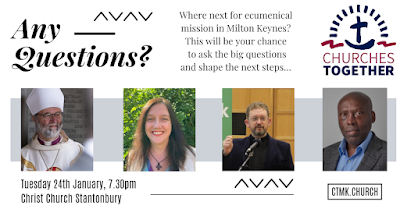
Later today, Churches Together in Milton Keynes continues to mark the Week of Prayer for Christian Unity this evening at 7:30 in Christ Church, Stantonbury, with an evening billed as ‘Any Questions?’
This has been a powerful week with great music, challenging ideas and powerful speakers. But, where next for ecumenical mission in Milton Keynes? This evening provides an opportunity to ask the big (or silly) questions? There may be a few answers, but this will definitely be a chance to shape the next steps.
The panellists include: the Right Revd Revd Alan Wilson, Bishop of Buckingham; Dorel Hayes, the Principal Officer for Ecumenical Development and Relations, Churches Together in England; Dr Fidèle Mutwarasibo, Lecturer in Work-Based Learning in the Faculty of Business and Law and Director of the Open University Centre for Voluntary Sector Leadership – Fidèle was a parishioner in Whitechurch Parish, Rathfarnham (Dublin), when I was a NSM curate there after ordination, and he has been a commissioner on the Irish Human Rights and Equality Commission; and the Revd Tim Norwood, Area Dean of Milton Keynes in the Diocese of Oxford and chair of Churches Together in Milton Keynes, who led Choral Evensong in Saint Mary and Saint Giles Church, Stony Stratford, last Thursday.
The words of the canticle Magnificat carved on the wooden screen at the west end of the monastic church in Mount Melleray Abbey, Cappoquin, Co Waterford (Photograph: Patrick Comerford)
Day 7: ‘What is now does not have to be’
Readings:
Job 5: 11-16:
So the poor have hope, and injustice shuts its mouth.
Luke 1: 46-55:
He has brought down the powerful from their thrones, and lifted up the lowly.
Reflection:
Job was living the good life and unexpectedly suffered the loss of his livestock and servants, and endured the devastation of the death of his children. He was suffering in his mind, body, and spirit. We all have suffering that is manifested in our minds, bodies, and spirits. We may pull away from God and others. We may lose hope. Yet, as Christians, we are unified in our belief that God is with us in the midst of our suffering.
On 11 April 2021 in Minnesota, Daunte Wright, a 20-year old, unarmed African-American man, was fatally shot by a white police officer during a routine traffic stop. This incident occurred during the Derek Chauvin trial for the killing of George Floyd.
It is easy to feel hopeless when we are once again reminded that we live in a fractured society that does not fully recognise, honour, and protect the human dignity and freedom of all human beings. According to Father Bryan Massingale, a leading Catholic social ethicist and scholar in racial justice, ‘Social life is made by human beings. The society we live in is the result of human choices and decisions. This means that human beings can change things. What human beings break, divide and separate, we can with God’s help, also heal, unite and restore. What is now does not have to be, therein lies the hope and the challenge.’
In prayer, Christians align their hearts to the heart of God, to love what he loves and to love as he loves. Prayer with integrity therefore aligns the hearts of all Christians beyond their divisions, to love what, whom and how God loves, and to express this love in our actions.
Christian Unity:
The Magnificat is Mary’s song of joy for all that she sees God is doing: restoring balance by raising up the lowly; righting injustice by feeding the hungry; and remembering Israel, his servant. The Lord never forgets his promises or abandons his people. It is easy to overlook or undervalue the faith of those who belong to other Christian communities, particularly if those communities are small. But the Lord makes his people whole by raising up the lowly so that the value of each is recognised. We are called to see as he sees and to value each of our Christian brothers and sisters as He values them.
Challenge:
How can we come together in Christ with hope and faith that God will ‘shut injustice’s mouth?’
Prayer:
God of Hope,
Help us to remember that you are with us in our suffering.
Help us to embody hope for one another when hopelessness is a frequent unwelcomed guest in our hearts.
Grant us the gift of being grounded in your loving Spirit as we work together to eradicate all forms of oppression and injustice.
Give us the courage to love what, whom and how you love, and to express this love in our actions.
Through Christ Our Lord. Amen.
‘They meet with darkness in the daytime, and grope at noonday as in the night’ (Job 5: 14) … at night in Cosgrove, Northamptonshire (Photograph: Patrick Comerford, 2023)
USPG Prayer Diary:
The Week of Prayer for Christian Unity began last Wednesday (18 January), and the theme in the USPG Prayer Diary last week was the Week of Prayer for Christian Unity. The theme this week is the ‘Myanmar Education Programme.’ This theme was introduced on Sunday with a reflection from a report from the Church of the Province of Myanmar.
The USPG Prayer Diary invites us to pray today in these words:
Let us pray for religious minorities persecuted for their faith. May their human rights be recognised and all forms of discrimination cease.
Yesterday’s reflection
Continued Tomorrow
Patrick Comerford
Christmas is not a season of 12 days, despite the popular Christmas song. Christmas is a 40-day season that lasts from Christmas Day (25 December) to Candlemas or the Feast of the Presentation (2 February).
Throughout the 40 days of this Christmas Season, I have been reflecting in these ways:
1, Reflecting on a seasonal or appropriate poem;
2, a prayer from the USPG prayer diary, ‘Pray with the World Church.’
However, the Week of Prayer for Christian Unity began last Wednesday (18 January 2023), and until tomorrow my morning reflections look at this year’s readings and prayers.
Later today, Churches Together in Milton Keynes continues to mark the Week of Prayer for Christian Unity this evening at 7:30 in Christ Church, Stantonbury, with an evening billed as ‘Any Questions?’
This has been a powerful week with great music, challenging ideas and powerful speakers. But, where next for ecumenical mission in Milton Keynes? This evening provides an opportunity to ask the big (or silly) questions? There may be a few answers, but this will definitely be a chance to shape the next steps.
The panellists include: the Right Revd Revd Alan Wilson, Bishop of Buckingham; Dorel Hayes, the Principal Officer for Ecumenical Development and Relations, Churches Together in England; Dr Fidèle Mutwarasibo, Lecturer in Work-Based Learning in the Faculty of Business and Law and Director of the Open University Centre for Voluntary Sector Leadership – Fidèle was a parishioner in Whitechurch Parish, Rathfarnham (Dublin), when I was a NSM curate there after ordination, and he has been a commissioner on the Irish Human Rights and Equality Commission; and the Revd Tim Norwood, Area Dean of Milton Keynes in the Diocese of Oxford and chair of Churches Together in Milton Keynes, who led Choral Evensong in Saint Mary and Saint Giles Church, Stony Stratford, last Thursday.
The words of the canticle Magnificat carved on the wooden screen at the west end of the monastic church in Mount Melleray Abbey, Cappoquin, Co Waterford (Photograph: Patrick Comerford)
Day 7: ‘What is now does not have to be’
Readings:
Job 5: 11-16:
So the poor have hope, and injustice shuts its mouth.
Luke 1: 46-55:
He has brought down the powerful from their thrones, and lifted up the lowly.
Reflection:
Job was living the good life and unexpectedly suffered the loss of his livestock and servants, and endured the devastation of the death of his children. He was suffering in his mind, body, and spirit. We all have suffering that is manifested in our minds, bodies, and spirits. We may pull away from God and others. We may lose hope. Yet, as Christians, we are unified in our belief that God is with us in the midst of our suffering.
On 11 April 2021 in Minnesota, Daunte Wright, a 20-year old, unarmed African-American man, was fatally shot by a white police officer during a routine traffic stop. This incident occurred during the Derek Chauvin trial for the killing of George Floyd.
It is easy to feel hopeless when we are once again reminded that we live in a fractured society that does not fully recognise, honour, and protect the human dignity and freedom of all human beings. According to Father Bryan Massingale, a leading Catholic social ethicist and scholar in racial justice, ‘Social life is made by human beings. The society we live in is the result of human choices and decisions. This means that human beings can change things. What human beings break, divide and separate, we can with God’s help, also heal, unite and restore. What is now does not have to be, therein lies the hope and the challenge.’
In prayer, Christians align their hearts to the heart of God, to love what he loves and to love as he loves. Prayer with integrity therefore aligns the hearts of all Christians beyond their divisions, to love what, whom and how God loves, and to express this love in our actions.
Christian Unity:
The Magnificat is Mary’s song of joy for all that she sees God is doing: restoring balance by raising up the lowly; righting injustice by feeding the hungry; and remembering Israel, his servant. The Lord never forgets his promises or abandons his people. It is easy to overlook or undervalue the faith of those who belong to other Christian communities, particularly if those communities are small. But the Lord makes his people whole by raising up the lowly so that the value of each is recognised. We are called to see as he sees and to value each of our Christian brothers and sisters as He values them.
Challenge:
How can we come together in Christ with hope and faith that God will ‘shut injustice’s mouth?’
Prayer:
God of Hope,
Help us to remember that you are with us in our suffering.
Help us to embody hope for one another when hopelessness is a frequent unwelcomed guest in our hearts.
Grant us the gift of being grounded in your loving Spirit as we work together to eradicate all forms of oppression and injustice.
Give us the courage to love what, whom and how you love, and to express this love in our actions.
Through Christ Our Lord. Amen.
‘They meet with darkness in the daytime, and grope at noonday as in the night’ (Job 5: 14) … at night in Cosgrove, Northamptonshire (Photograph: Patrick Comerford, 2023)
USPG Prayer Diary:
The Week of Prayer for Christian Unity began last Wednesday (18 January), and the theme in the USPG Prayer Diary last week was the Week of Prayer for Christian Unity. The theme this week is the ‘Myanmar Education Programme.’ This theme was introduced on Sunday with a reflection from a report from the Church of the Province of Myanmar.
The USPG Prayer Diary invites us to pray today in these words:
Let us pray for religious minorities persecuted for their faith. May their human rights be recognised and all forms of discrimination cease.
Yesterday’s reflection
Continued Tomorrow
24 October 2021
Sunday intercessions, 24 October 2021,
the Fifth Sunday before Advent
The citadel and mediaeval gate in the city walls of Limerick … Bartimaeus is begging outside the gate and walls of Jericho (Photograph: Patrick Comerford)
Let us pray:
Job said, ‘I had heard of you by the hearing of the ear, but now my eye sees you’ (Job 42: 5):
Heavenly Father,
Listen to our prayers for the world,
for those nations where rulers and leaders hold onto power
through violence, coercion and subjugation,
for people who wait in hope for signs of the Kingdom of God,
for all who seek mercy, peace and justice.
We pray for all who face discrimination …
who are denied equal opportunities …
who are denied access to public services …
Lord have mercy,
Lord have mercy.
Bartimaeus said, ‘Jesus, Son of David, have mercy on me! … Son of David, have mercy on me!’ (Mark 10: 47-48):
Lord Jesus Christ,
we pray for the Church,
that we see and proclaim who you are …
In the Church, we are in communion with the saints
who have served Christ, the Church and the world,
including this week Saint Simon and Saint Jude on Thursday (28 October).
In the Diocesan Cycle of Prayer,
we pray for Bishop Kenneth Kearon and Bishop Patrick Rooke
as they prepare to retire on 31 October,
when our dioceses will be united as the Diocese of Tuam, Limerick and Killaloe,
and we give thanks for their ministry.
In the Church of Ireland this month,
we pray for the Diocese of Cashel, Ferns and Ossory,
and for Bishop Michael Burrows.
In the Anglican Cycle of Prayer,
we pray this week for the Extra-Provincial Churches,
including the Anglican Churches in
Spain, Portugal, Bermuda, Sri Lanka and the Fakland Islands.
In our community,
we pray for our schools,
we pray for our parishes and people …
we pray for our neighbouring churches and parishes,
and people of faith everywhere,
that we may be blessed in our variety and diversity.
And we pray for ourselves …
Christ have mercy,
Christ have mercy.
The Psalmist says, ‘The Lord ransoms the life of his servants and will condemn none who seek refuge in him’ (Psalm 34: 22):
Holy Spirit, we pray for one another …
We remember Kenneth Smyth, who was buried last week,
we pray for those who grieve and mourn …
those who feel pain and loss …
those who are bewildered and without answers …
including Caroline, Victor and Gillian …
We remember Linda and Joe too …
May their memories be a blessing.
We pray for those we love and those who love us …
we pray for our families, friends and neighbours …
We pray for all who feel rejected and discouraged …
we pray for all in need and who seek healing …
and we pray for those we promised to pray for …
We pray for all who are sick or isolated,
at home, in hospital …
Ruby … Daphne … Sylvia … Ajay … Cecil … Pat …
Lord have mercy,
Lord have mercy.
The prayer in the Prayer Diary of the Anglican mission agency USPG (United Society Partners in the Gospel, invites us to pray today:
‘I saw a great multitude that none could number,
From every nation and tribe and people and tongue.’
Lamb of God,
From your throne you reign over the peoples of the world.
on this Sunday, may we draw strength from the Bible’s story
of Babel’s division becoming a single shout of worship.
Merciful Father …
‘Look upon him and be radiant and your faces shall not be ashamed’ (Psalm 34: 5) … street art in Brick Lane in London’s East End (Photograph: Patrick Comerford)
Let us pray:
Job said, ‘I had heard of you by the hearing of the ear, but now my eye sees you’ (Job 42: 5):
Heavenly Father,
Listen to our prayers for the world,
for those nations where rulers and leaders hold onto power
through violence, coercion and subjugation,
for people who wait in hope for signs of the Kingdom of God,
for all who seek mercy, peace and justice.
We pray for all who face discrimination …
who are denied equal opportunities …
who are denied access to public services …
Lord have mercy,
Lord have mercy.
Bartimaeus said, ‘Jesus, Son of David, have mercy on me! … Son of David, have mercy on me!’ (Mark 10: 47-48):
Lord Jesus Christ,
we pray for the Church,
that we see and proclaim who you are …
In the Church, we are in communion with the saints
who have served Christ, the Church and the world,
including this week Saint Simon and Saint Jude on Thursday (28 October).
In the Diocesan Cycle of Prayer,
we pray for Bishop Kenneth Kearon and Bishop Patrick Rooke
as they prepare to retire on 31 October,
when our dioceses will be united as the Diocese of Tuam, Limerick and Killaloe,
and we give thanks for their ministry.
In the Church of Ireland this month,
we pray for the Diocese of Cashel, Ferns and Ossory,
and for Bishop Michael Burrows.
In the Anglican Cycle of Prayer,
we pray this week for the Extra-Provincial Churches,
including the Anglican Churches in
Spain, Portugal, Bermuda, Sri Lanka and the Fakland Islands.
In our community,
we pray for our schools,
we pray for our parishes and people …
we pray for our neighbouring churches and parishes,
and people of faith everywhere,
that we may be blessed in our variety and diversity.
And we pray for ourselves …
Christ have mercy,
Christ have mercy.
The Psalmist says, ‘The Lord ransoms the life of his servants and will condemn none who seek refuge in him’ (Psalm 34: 22):
Holy Spirit, we pray for one another …
We remember Kenneth Smyth, who was buried last week,
we pray for those who grieve and mourn …
those who feel pain and loss …
those who are bewildered and without answers …
including Caroline, Victor and Gillian …
We remember Linda and Joe too …
May their memories be a blessing.
We pray for those we love and those who love us …
we pray for our families, friends and neighbours …
We pray for all who feel rejected and discouraged …
we pray for all in need and who seek healing …
and we pray for those we promised to pray for …
We pray for all who are sick or isolated,
at home, in hospital …
Ruby … Daphne … Sylvia … Ajay … Cecil … Pat …
Lord have mercy,
Lord have mercy.
The prayer in the Prayer Diary of the Anglican mission agency USPG (United Society Partners in the Gospel, invites us to pray today:
‘I saw a great multitude that none could number,
From every nation and tribe and people and tongue.’
Lamb of God,
From your throne you reign over the peoples of the world.
on this Sunday, may we draw strength from the Bible’s story
of Babel’s division becoming a single shout of worship.
Merciful Father …
‘Look upon him and be radiant and your faces shall not be ashamed’ (Psalm 34: 5) … street art in Brick Lane in London’s East End (Photograph: Patrick Comerford)
21 March 2020
Praying through Lent with
USPG (25): 21 March 2020
‘O earth, cover not my blood’ (Job 16: 18) … the verse continues, ‘let my outcry find no resting-place’ … a prophetic cry in the Jewish Museum in Venice (Photograph: Patrick Comerford)
Patrick Comerford
Today is the International Day for the Elimination of Racial Discrimination. During Lent this year, I am using the USPG Prayer Diary, Pray with the World Church, for my morning prayers and reflections. This year marks the 75th anniversary of the liberation of Auschwitz and the end of the Holocaust, so I am illustrating my reflections each morning with images that emphasise this theme.
USPG (United Society Partners in the Gospel) is the Anglican mission agency that partners churches and communities worldwide in God’s mission to enliven faith, strengthen relationships, unlock potential, and champion justice. It was founded in 1701.
This week (15-21 March), the USPG Prayer Diary is focussing on the theme of ‘Standing with Indigenous Communities in The Philippines.’ This theme was introduced in the Prayer Diary on Sunday.
Saturday 21 March 2020 (International Day for the Elimination of Racial Discrimination):
Lord, help us to see each other as equals, and to do all we can to end all forms of racial discrimination.
Readings: Hosea 5: 15 to 6: 6; Psalm 51: 1-2, 17-20; Luke 18: 9-14.
The Collect of the Day:
Merciful Lord,
Grant your people grace to withstand the temptations
of the world, the flesh and the devil
and with pure hearts and minds to follow you, the only God;
through Jesus Christ our Lord.
The Lenten Collect:
Almighty and everlasting God,
you hate nothing that you have made
and forgive the sins of all those who are penitent:
Create and make in us new and contrite hearts
that we, worthily lamenting our sins
and acknowledging our wretchedness,
may receive from you, the God of all mercy,
perfect remission and forgiveness;
through Jesus Christ our Lord.
Continued tomorrow
Yesterday’s reflection
Patrick Comerford
Today is the International Day for the Elimination of Racial Discrimination. During Lent this year, I am using the USPG Prayer Diary, Pray with the World Church, for my morning prayers and reflections. This year marks the 75th anniversary of the liberation of Auschwitz and the end of the Holocaust, so I am illustrating my reflections each morning with images that emphasise this theme.
USPG (United Society Partners in the Gospel) is the Anglican mission agency that partners churches and communities worldwide in God’s mission to enliven faith, strengthen relationships, unlock potential, and champion justice. It was founded in 1701.
This week (15-21 March), the USPG Prayer Diary is focussing on the theme of ‘Standing with Indigenous Communities in The Philippines.’ This theme was introduced in the Prayer Diary on Sunday.
Saturday 21 March 2020 (International Day for the Elimination of Racial Discrimination):
Lord, help us to see each other as equals, and to do all we can to end all forms of racial discrimination.
Readings: Hosea 5: 15 to 6: 6; Psalm 51: 1-2, 17-20; Luke 18: 9-14.
The Collect of the Day:
Merciful Lord,
Grant your people grace to withstand the temptations
of the world, the flesh and the devil
and with pure hearts and minds to follow you, the only God;
through Jesus Christ our Lord.
The Lenten Collect:
Almighty and everlasting God,
you hate nothing that you have made
and forgive the sins of all those who are penitent:
Create and make in us new and contrite hearts
that we, worthily lamenting our sins
and acknowledging our wretchedness,
may receive from you, the God of all mercy,
perfect remission and forgiveness;
through Jesus Christ our Lord.
Continued tomorrow
Yesterday’s reflection
16 October 2018
Silence and prayer,
time and eternity, before
a little-known icon
Patrick Comerford
Monday [15 October 2018] was a demanding day’s work, with a two-part programme for priests and readers in the diocese on preparing and resourcing Remembrance Day [11 November 2018].
I spent much of this morning and afternoon preparing liturgical and preaching resources for Sunday week, the Fifth Sunday before Advent, which may also be observed as the Feast of Saint Simon and Saint Jude, and as Bible Sunday.
The lectionary readings for the Fifth Sunday before Advent offer an interesting contrast between silence and listening to God.
In his sufferings, Job has been silenced before God, and now realises his need to listen to God (see Job 42: 1-6, 10-17). The Psalmist wishes to praise God all the time so that ‘his praise shall ever be in my mouth’ (Psalm 34: 1). The response provided for this Psalm is: ‘I sought the Lord, and he answered me, and delivered me out of my terror’ (Psalm 34: 4).
In the Gospel reading (Mark 10: 46-52), when Bartimaeus the blind beggar realises he is in the presence of Christ outside the gates of Jericho, ‘many sternly ordered him to be quiet, but he cried out even more loudly’ (verse 48).
There are moments to cry out loudly in the presence of God, and there are moments when silence is so appropriate. But there are times too when the seeming silence of God is more difficult to understand and to wrestle with than our own silence, as Job realised in the earlier readings from the Book of Job over recent weeks.
So, in my prayers and silent reflections today, my thoughts turned to the icon of Christ the Blessed Silence, an icon found in some traditions in the Greek and Russian Orthodox Churches, but that is not so well known outside Orthodoxy.
In this icon, Christ is portrayed as a youthful figure looking like a winged angel, his hands crossed against his chest, sometimes wearing a bishop’s mitre and dressed in a sakkos (σάκκος), the vestment worn by Orthodox bishops. In most of these icons, Christ is shown with an eight-pointed, shining nimbus.
The icon of Christ the Blessed Silence represents his sacrifice, through his young face and crossed hands, and his ecclesiastic mission in his attire. His angel-like face and the wings point to his ministry. In some of these icons, Christ is bareheaded, in others he wears the crown of a bishop, to show that he is both the Great High Priest and the King of Kings. In some icons of Christ the Blessed Silence, Christ holds the cross, spear and sponge of the Crucifixion.
The tradition of icons of Christ the Blessed Silence developed in the 14th and 15th centuries on Mount Athos, in Greece and in the Balkans. In Greece it was associated in Greece with the tradition of Hesychia. This Blessed Silence of Christ associates this icon with the hesychasts in the Eastern Orthodox tradition – the Greek ἡσυχία (hesychia) is a word for silence or quiet.
This icon is known in Russian as Spas Blagoe Molchanie or the Saviour of the Blessed Silence, and even as the Angel of Great Counsel. The earliest icon in this tradition in mediaeval Rus dates from the late 15th century. Christ is portrayed on the iconostasis or icon screen in the Dormition Cathedral in the Kremlin in Moscow, above the entrance to the sanctuary and dates from about 1482 or perhaps later (1514-1515).
This image was widespread in the 17th century, and it found special reverence in the 18th and 19th centuries among the Old Believers in Russia. Many of these icons were confiscated from the Old Believers and kept in archives in St Petersburg.
The icon of Christ the Blessed Silence Saviour is one of the few types in which Christ is represented in the form of an angel. In these icons, Christ is young and without a beard, looking like an angel or messenger, the angel of the blessed silence. The word angel is derived from the Greek word αγγελος (angelos), meaning a messenger. Saint John the Baptist is often represented with the wings of an angel, because he is described in Saint Mark’s Gospel as an αγγελος (angelos) or messenger.
This icon is deeply mystical and symbolic. This is the Christ of the prologue in Saint John’s Gospel, the eternally existing Word.
Christ’s eight-pointed crown or nimbus is known in iconography as the star of the Ancient of Days This crown can be seen as two superimposed squares, one red denoting the Passion, and the other olive green denoting the spirituality of the Trinity. This eight-pointed or crown signifies the six days of Creation with the seventh day of rest and the eighth day, the Day of Eternity, that preceded the Creation and that follows it.
So, Christ as Angel is also the eternal Logos of God, who according to the Nicene Creed, was ‘eternally begotten of the Father.’
The seraphim often depicted hovering above the hands are symbols of the Nativity, but like many iconographic images, they link the birth and the death of Christ, as in the icon of the Crucified Seraph.
So, we have here a representation of the Christ who eternally proceeds from the Father in sacred Silence and the Christ who was born in time to be the Suffering Servant who died in Silence.
This icon is also a Passion-related image, and we can link this icon with the icon that shows the winged Christ as the Crucified Seraph. In the traditional interpretations of Isaiah, the Suffering Servant passages are associated with the crucifixion of Jesus:
He was oppressed, and he was afflicted,
yet he did not open his mouth;
like a lamb that is led to the slaughter,
and like a sheep that before its shearers is silent,
so he did not open his mouth. (Isaiah 53: 7 NRSV)
So, the suffering Christ was silent, and Christ the Angel of Great Counsel is the Son of God begotten in the Silence of Eternity.
Isaiah also says:
He will not cry or lift up his voice,
or make it heard in the street (Isaiah 42: 2, NRSV).
These icons often also bear inscriptions from another passage in Isaiah:
The spirit of the Lord shall rest on him,
the spirit of wisdom and understanding,
the spirit of counsel and might,
the spirit of knowledge and the fear of the Lord. (Isaiah 11: 2)
Sometimes Christ holds in his hand a scroll that reads: ‘You are the God of Peace, Father of Mercies, the Angel of Great Counsel.’ These words are in Irmos 5 in the Liturgy of the Nativity:
O God of peace and Father of mercies
Thou has sent to us the Angel of Great Counsel who grants us peace.
So we are guided to the light of the knowledge of God.
Waking early from the night we praise Thee, O Lover of men.
Traditionally, the words of Isaiah 9: 6 are associated with the birth of Christ and the Nativity narratives. They are best known in the English-speaking world because of their use in the libretto by Charles Jennens for Handel’s oratorio Messiah:
For unto us a child is born, unto us a son is given:
and the government shall be upon his shoulder:
and his name shall be called Wonderful, Counsellor,
The mighty God, The everlasting Father, The Prince of Peace.
Jenner was drawing on the text of the Authorised Version or King James Version of the Bible, which reflects the Hebrew text of the Bible as it was known in the 17th century. However, early Christians knew the Biblical texts not in Hebrew, but in the Greek of the Septuagint. In Greek, Isaiah 9: 6 reads somewhat differently:
For a child is born to us, and a son is given to us,
whose government is upon his shoulder,
and his name is called the Messenger of Great Counsel:
for I will bring peace upon the princes, and health to him.
His government shall be great, and of his peace there is no end.
The two texts differ substantially, and the Septuagint often has readings that are not found in translations from the Hebrew Masoretic text. The relevant interesting words here are: ‘his name is called the Messenger of Great Counsel.’
A variant reading of Isaiah 9: 6 found in some Septuagint manuscripts reads:
ὅτι παιδίον ἐγενήθη ἡμῖν, υἱὸς καὶ ἐδόθη ἡμῖν,
οὗ ἡ ἀρχὴ ἐγενήθη ἐπὶ τοῦ ὤμου αὐτοῦ,
καὶ καλεῖται τὸ ὄνομα αὐτοῦ μεγάλης βουλῆς ἄγγελός,
θαυμαστὸς σύμβουλος, Θεὸς ἰσχυρός, ἐξουσιαστής,
ἄρχων εἰρήνης, πατὴρ τοῦ μέλλοντος αἰῶνος·
ἐγὼ γὰρ ἄξω εἰρήνην ἐπὶ τοὺς ἄρχοντας, εἰρήνην καὶ ὑγίειαν αὐτῷ.
For a child is born to us, and a son given to us,
whose government is upon his shoulder,
and his name is called Messenger (Angel) of Great Counsel,
Wonderful Counsellor, Mighty God, Potentate,
Prince of Peace, Father of the Age to Come.
For I will bring peace upon the princes and health to him.’
The ‘Messenger of Great Counsel’ (Ο Μεγάλης Βουλής Άγγελος) in the Septuagint may also be understood as the ‘Angel of Great Counsel.’ Greek versions of the icon of the Angel of Great Counsel sometimes include the inscription:
ἐγὼ γὰρ ἐκ τοῦ θεοῦ ἐξῆλθον καὶ ἥκω:
οὐδὲ γὰρ ἀπ’ ἐμαυτοῦ ἐλήλυθα, ἀλλ’ ἐκεῖνός με ἀπέστειλεν.
For I came from God and now I am here.
I did not come on my own, but he sent me (John 8: 42).
When we think of the icon of Christ the Blessed Silence, we should think both of the Logos begotten from God in Eternity and of the birth of the Christ Child in time.
The word of God that speaks to Job who was forced to live outside the city in that Sunday reading is the same word of God that speaks to blind Bartimaeus outside the city gates of Jericho. He is the one who was, who is and who is to come, the one to cry out loud to and the one in whose presence we should be silent too.
I am reminded by Dave Evan’s hymn (No 325 in Church Hymnal:
Be still, for the presence of the Lord, the Holy One, is here.
Come, bow before him now, with reverence and fear.
In him no sin is found, we stand on holy ground.
Be still, for the presence of the Lord, the Holy One, is here.
Be still, for the glory of the Lord is shining all around;
he burns with holy fire, with splendor he is crowned.
How awesome is the sight, our radiant King of light!
Be still, for the glory of the Lord is shining all around.
Be still, for the power of the Lord is moving in this place,
he comes to cleanse and heal, to minister his grace.
No work too hard for him, in faith receive from him;
be still for the power of the Lord is moving in this place.
07 October 2018
‘Hardness of heart’ and using
marriage and divorce to trap
people and to trap Jesus
A summer wedding in a monastery in Crete … but the Gospel reading may bring us to ask whether a marriage should last longer than love (Photograph: Patrick Comerford)
Patrick Comerford
Sunday 7 October,
The Nineteenth Sunday after Trinity (Trinity XIX):
9.30 a.m.: the Parish Eucharist (Holy Communion 2), Saint Mary’s Church, Askeaton
Readings: Job 1: 1, 2: 1-10; Psalm 26; Hebrews 1: 1-4, 2: 5-12; Mark 10: 2-16.
May I speak to you in the name of God, + Father, Son and Holy Spirit, Amen.
This morning’s readings challenge us to think about the differences between how we see God’s ways and the actual working out of God’s ways. They challenge us to think about the foundations of faith, which are weak if they depend on God meeting our expectations, and are weakened when God does not meet our expectations.
Job challenges us to think about how much we tend to fashion God in our image and likeness, but throughout the Old Testament reading, Psalm and Epistle reading, we are challenged to be fashioned in God’s image and likeness.
The Gospel reading also challenges old ideas and customs – in the Pharisees’ tradition about divorce. But, instead of accepting yet another tradition, how might we accept what Christ says as a way of challenging custom and tradition, and as a way of being brave enough to come to new conclusions that reflect the priorities of God and the compassion of Christ?
The Temptation of Job … a panel in ‘The Purgatory Window’ by the Harry Clarke Studios, designed by Richard King, in the Church of Saint Peter and Saint Paul, Athlone (Photograph: Patrick Comerford, 2018)
The Book of Job, the first poetic book in the Bible, addresses the problem of continuing to hope in the justice of God in the face of human suffering. In his suffering and distress, Job laments the day of his birth, and would like to die. But even that is denied to him.
In the past, people thought their relationship with God depended on laws and rules. But in the story of Job, we are challenged to find ways of knowing God that are based on faith and love.
In the missing verses, although Job has not sinned himself, he loses his children and all his wealth. In the past, people saw this as God’s punishment, but Job wants to see faith and love standing on their own, not depending on the changes and chances of life.
When Job is tested again, he excludes himself from society, and goes to live on the town dump. His wife nags him and advises him to end his misery and pain. But Job is reasonable, kindly and wise in his answer and keeps his faith in God.
If our health is ruined, our family life and domestic situation become desperate, our income dries up, our family breaks up, we find ourselves down in the dumps and marginalised, do we blame God? How is God with us in our woes?
Do we see material success, prosperity, family life and children as rewards from God?
Is faith, like love, not without seeking reward?
Or do we only love – and believe – because there are rewards?
Many priests and preachers, on first reading this morning’s Gospel passage (Mark 10: 2-16), may decide to preach on one of the other readings. But if they do this, they will leave us in danger of thinking that Christ is too harsh on those who go through a divorce.
People who go through a marriage breakdown and divorce, and still cling on to going to church, perhaps just by their fingernails, may well ask, ‘Where is the Good News this morning?’
So, what’s happening? Herod Antipas was the Governor of Galilee. He had divorced his wife Aretus to marry Herodias, the wife of his brother, Herod Philip. This caused such a scandal that when Saint John the Baptist confronted Herod about it – he was beheaded (see Mark 6: 18-19).
If Christ says it is unlawful for a man to divorce his wife, does he end up like John the Baptist?
If he says it is acceptable, does he contradict the teaching of the Torah and leave himself open to the charge of blasphemy?
The Pharisees were divided on the legality of divorce and the grounds for divorce. So, the question is a trap in another way. They say: ‘Moses allowed a man to write a certificate of dismissal and to divorce her’ (Mark 10: 4). The Law of Moses allowed a man to divorce his wife, if he finds ‘something objectionable about her’ (Deuteronomy 24: 1).
Mind you, it never said a woman could divorce her husband.
A man could simply ‘write a certificate of dismissal’ (verse 4), without going through any formal legal proceedings. ‘Something objectionable’ could cover a multitude, from adultery to an eccentric hair-do on a bad hair day. Indeed, by the time of Christ, divorce was allowed for the most trivial of reasons, and was so common that many women suffered.
However, instead of falling into the trap being set for him, Christ asks the Pharisees: ‘What did Moses command you?’ (Mark 10: 3). In other words, what does the law say? He tells them Moses allowed this ‘because of your hardness of heart’ (Mark 10: 5), perhaps hinting at how hard-hearted men were now making women suffer even more.
There are other places in the New Testament where Christ, and Saint Paul and Saint Peter, accept that a man may divorce an unfaithful wife.
Saint Mark alone mentions the possibility of women also divorcing. This may have been normal in non-Jewish contexts, but cases of Jewish women initiating divorce are rare.
This morning, Christ reminds those around him of God’s original intention. Marriage is a covenant relationship in which the two people become one and live in mutual love and affection.
Christ devotes much of his teaching time interpreting scripture in a way that gives priority to human wellbeing. For example, the Sabbath is made for us rather than we being made for the Sabbath. Similarly, we could say he is saying here that the order of marriage is made for us, not that we are made for the ordering of marriage, or worrying about the minutiae in the details religious people construct around marriage.
The way Christ interprets scriptural law ought to provide a clue to how we interpret his teaching.
Today, many of us may appear to be on the side of the Pharisees on the question of divorce. Divorce is common today and most of us accept it as a reality. Our laws and our customs, like those of the Pharisees in this Gospel story, assume divorce happens.
Christ appears to be harsh and uncompromising on a first reading this morning. But many marriages get stale or toxic, relationships can dry up or lose focus, self-destruct, or break down. Things go wrong for far too many reasons.
A divorce may be a burial for a dead marriage. Divorces do not kill marriages any more than funerals kill people … although one of the great tragedies today is that far too many couples are burying their relationship when it is only sick or injured.
Is it not possible that the promise to be together until death can refer to the death of the relationship as well as the death of the person?
Is it not possible to recall that the original intent of our loving and caring God who gave us the gift of marriage was to make our lives better?
Does that desire of God evaporate when we are no longer in a marriage?
From the opening of this story, it is clear the Pharisees are not seeking Christ’s wisdom or compassion. Instead, they are trying to trap him. But marriage is not a trap and not a matter of expediency in which the wife is the property of the husband.
Of course, the covenant of marriage is still just as valid today. Ideally, when two people marry, they commit themselves to an exclusive relationship of love and devotion in a new entity.
But that is easier to say than it is to face up to reality, which includes the complexities of child-rearing, careers and competing religious, social and economic claims and responsibilities.
Ideally, we are not to live alone, but in loving and committed relationships. In an ideal world, there would be no such thing as divorce. But we do not live in an ideal world. We live in a fallen and broken world in which human nature always falls short of the glory of God. Whether we like it or not, divorce is a reality and we have to live with that.
Sadly, when people go through a divorce, the church is often the last place they can turn to for help and understanding.
But divorce is like a death. It is the death of a relationship, and so people grieve, and they need sympathy and to be consoled. Would you dare chastise someone who was grieving after the death of a family member?
I was reminded once by a divorced priest in the Church of Ireland that when God says: ‘I hate divorce ... I hate divorce’ (Malachi 2: 16), that of course God hates divorce because he has gone through the sufferings and grieving of divorce through our faithlessness and wandering.
God hates divorces because God has suffered divorce.
What a profound insight.
Too often, in debates, passages of Scripture taken out of context, or one-sided interpretations of the tradition of the Church can be used to set a trap so that people are forced to accept only one standard or practice for marriage in the world today. But in this Gospel reading, Christ responds to those who seek to trap him by refusing to accept to be trapped into accepting their interpretation of Scripture or Tradition.
Instead, he challenges those around them to think for themselves and to think with compassion.
Let us not use this reading to trap Jesus through hardness of heart. And let us not use this reading to trap vulnerable, suffering and grieving people who remain open to loving and being loved.
We must face questions about marriage and divorce, about who can be married and who can be divorced, as challenges that ask us to think outside the box, without trying to trap Jesus or to trap those who are faced with honest questions about marriage and about divorce.
May all we think, say and do be to the praise, honour and glory of God, + Father, Son and Holy Spirit, Amen.
Enjoying a summer wedding (Photograph: Patrick Comerford, 2018)
Mark 10: 2-16:
2 Some Pharisees came, and to test him they asked, ‘Is it lawful for a man to divorce his wife?’ 3 He answered them, ‘What did Moses command you?’ 4 They said, ‘Moses allowed a man to write a certificate of dismissal and to divorce her.’ 5 But Jesus said to them, ‘Because of your hardness of heart he wrote this commandment for you. 6 But from the beginning of creation, “God made them male and female.” 7 “For this reason a man shall leave his father and mother and be joined to his wife, 8 and the two shall become one flesh.” So they are no longer two, but one flesh. 9 Therefore what God has joined together, let no one separate.’
10 Then in the house the disciples asked him again about this matter.11 He said to them, ‘Whoever divorces his wife and marries another commits adultery against her; 12 and if she divorces her husband and marries another, she commits adultery.’
13 People were bringing little children to him in order that he might touch them; and the disciples spoke sternly to them. 14 But when Jesus saw this, he was indignant and said to them, ‘Let the little children come to me; do not stop them; for it is to such as these that the kingdom of God belongs. 15 Truly I tell you, whoever does not receive the kingdom of God as a little child will never enter it.’ 16 And he took them up in his arms, laid his hands on them, and blessed them.
Wedding flowers strewn on the lawn at Lisnavagh House in the late evening … what happens when love fades in a marriage? (Photograph: Patrick Comerford)
Liturgical Colour: Green
The Collect:
O God,
without you we are not able to please you;
Mercifully grant that your Holy Spirit
may in all things direct and rule our hearts;
through Jesus Christ our Lord.
The Post-Communion Prayer:
Holy and blessed God,
you feed us with the body and blood of your Son
and fill us with your Holy Spirit.
May we honour you,
not only with our lips but in lives dedicated
to the service of Jesus Christ our Lord.
Hymns:
638, On for a heart to praise my God (CD 49)
259, Christ triumphant, ever reigning (CD 16)
634, Love divine, all loves excelling (CD 36)
‘Holy and blessed God, you feed us with the body and blood of your Son’ … the Post-Communion Prayer (Photograph: Patrick Comerford)
Scripture quotations are from the New Revised Standard Version Bible: Anglicised Edition copyright © 1989, 1995 National Council of the Churches of Christ in the United States of America. Used by permission. All rights reserved worldwide. http://nrsvbibles.org
Patrick Comerford
Sunday 7 October,
The Nineteenth Sunday after Trinity (Trinity XIX):
9.30 a.m.: the Parish Eucharist (Holy Communion 2), Saint Mary’s Church, Askeaton
Readings: Job 1: 1, 2: 1-10; Psalm 26; Hebrews 1: 1-4, 2: 5-12; Mark 10: 2-16.
May I speak to you in the name of God, + Father, Son and Holy Spirit, Amen.
This morning’s readings challenge us to think about the differences between how we see God’s ways and the actual working out of God’s ways. They challenge us to think about the foundations of faith, which are weak if they depend on God meeting our expectations, and are weakened when God does not meet our expectations.
Job challenges us to think about how much we tend to fashion God in our image and likeness, but throughout the Old Testament reading, Psalm and Epistle reading, we are challenged to be fashioned in God’s image and likeness.
The Gospel reading also challenges old ideas and customs – in the Pharisees’ tradition about divorce. But, instead of accepting yet another tradition, how might we accept what Christ says as a way of challenging custom and tradition, and as a way of being brave enough to come to new conclusions that reflect the priorities of God and the compassion of Christ?
The Temptation of Job … a panel in ‘The Purgatory Window’ by the Harry Clarke Studios, designed by Richard King, in the Church of Saint Peter and Saint Paul, Athlone (Photograph: Patrick Comerford, 2018)
The Book of Job, the first poetic book in the Bible, addresses the problem of continuing to hope in the justice of God in the face of human suffering. In his suffering and distress, Job laments the day of his birth, and would like to die. But even that is denied to him.
In the past, people thought their relationship with God depended on laws and rules. But in the story of Job, we are challenged to find ways of knowing God that are based on faith and love.
In the missing verses, although Job has not sinned himself, he loses his children and all his wealth. In the past, people saw this as God’s punishment, but Job wants to see faith and love standing on their own, not depending on the changes and chances of life.
When Job is tested again, he excludes himself from society, and goes to live on the town dump. His wife nags him and advises him to end his misery and pain. But Job is reasonable, kindly and wise in his answer and keeps his faith in God.
If our health is ruined, our family life and domestic situation become desperate, our income dries up, our family breaks up, we find ourselves down in the dumps and marginalised, do we blame God? How is God with us in our woes?
Do we see material success, prosperity, family life and children as rewards from God?
Is faith, like love, not without seeking reward?
Or do we only love – and believe – because there are rewards?
Many priests and preachers, on first reading this morning’s Gospel passage (Mark 10: 2-16), may decide to preach on one of the other readings. But if they do this, they will leave us in danger of thinking that Christ is too harsh on those who go through a divorce.
People who go through a marriage breakdown and divorce, and still cling on to going to church, perhaps just by their fingernails, may well ask, ‘Where is the Good News this morning?’
So, what’s happening? Herod Antipas was the Governor of Galilee. He had divorced his wife Aretus to marry Herodias, the wife of his brother, Herod Philip. This caused such a scandal that when Saint John the Baptist confronted Herod about it – he was beheaded (see Mark 6: 18-19).
If Christ says it is unlawful for a man to divorce his wife, does he end up like John the Baptist?
If he says it is acceptable, does he contradict the teaching of the Torah and leave himself open to the charge of blasphemy?
The Pharisees were divided on the legality of divorce and the grounds for divorce. So, the question is a trap in another way. They say: ‘Moses allowed a man to write a certificate of dismissal and to divorce her’ (Mark 10: 4). The Law of Moses allowed a man to divorce his wife, if he finds ‘something objectionable about her’ (Deuteronomy 24: 1).
Mind you, it never said a woman could divorce her husband.
A man could simply ‘write a certificate of dismissal’ (verse 4), without going through any formal legal proceedings. ‘Something objectionable’ could cover a multitude, from adultery to an eccentric hair-do on a bad hair day. Indeed, by the time of Christ, divorce was allowed for the most trivial of reasons, and was so common that many women suffered.
However, instead of falling into the trap being set for him, Christ asks the Pharisees: ‘What did Moses command you?’ (Mark 10: 3). In other words, what does the law say? He tells them Moses allowed this ‘because of your hardness of heart’ (Mark 10: 5), perhaps hinting at how hard-hearted men were now making women suffer even more.
There are other places in the New Testament where Christ, and Saint Paul and Saint Peter, accept that a man may divorce an unfaithful wife.
Saint Mark alone mentions the possibility of women also divorcing. This may have been normal in non-Jewish contexts, but cases of Jewish women initiating divorce are rare.
This morning, Christ reminds those around him of God’s original intention. Marriage is a covenant relationship in which the two people become one and live in mutual love and affection.
Christ devotes much of his teaching time interpreting scripture in a way that gives priority to human wellbeing. For example, the Sabbath is made for us rather than we being made for the Sabbath. Similarly, we could say he is saying here that the order of marriage is made for us, not that we are made for the ordering of marriage, or worrying about the minutiae in the details religious people construct around marriage.
The way Christ interprets scriptural law ought to provide a clue to how we interpret his teaching.
Today, many of us may appear to be on the side of the Pharisees on the question of divorce. Divorce is common today and most of us accept it as a reality. Our laws and our customs, like those of the Pharisees in this Gospel story, assume divorce happens.
Christ appears to be harsh and uncompromising on a first reading this morning. But many marriages get stale or toxic, relationships can dry up or lose focus, self-destruct, or break down. Things go wrong for far too many reasons.
A divorce may be a burial for a dead marriage. Divorces do not kill marriages any more than funerals kill people … although one of the great tragedies today is that far too many couples are burying their relationship when it is only sick or injured.
Is it not possible that the promise to be together until death can refer to the death of the relationship as well as the death of the person?
Is it not possible to recall that the original intent of our loving and caring God who gave us the gift of marriage was to make our lives better?
Does that desire of God evaporate when we are no longer in a marriage?
From the opening of this story, it is clear the Pharisees are not seeking Christ’s wisdom or compassion. Instead, they are trying to trap him. But marriage is not a trap and not a matter of expediency in which the wife is the property of the husband.
Of course, the covenant of marriage is still just as valid today. Ideally, when two people marry, they commit themselves to an exclusive relationship of love and devotion in a new entity.
But that is easier to say than it is to face up to reality, which includes the complexities of child-rearing, careers and competing religious, social and economic claims and responsibilities.
Ideally, we are not to live alone, but in loving and committed relationships. In an ideal world, there would be no such thing as divorce. But we do not live in an ideal world. We live in a fallen and broken world in which human nature always falls short of the glory of God. Whether we like it or not, divorce is a reality and we have to live with that.
Sadly, when people go through a divorce, the church is often the last place they can turn to for help and understanding.
But divorce is like a death. It is the death of a relationship, and so people grieve, and they need sympathy and to be consoled. Would you dare chastise someone who was grieving after the death of a family member?
I was reminded once by a divorced priest in the Church of Ireland that when God says: ‘I hate divorce ... I hate divorce’ (Malachi 2: 16), that of course God hates divorce because he has gone through the sufferings and grieving of divorce through our faithlessness and wandering.
God hates divorces because God has suffered divorce.
What a profound insight.
Too often, in debates, passages of Scripture taken out of context, or one-sided interpretations of the tradition of the Church can be used to set a trap so that people are forced to accept only one standard or practice for marriage in the world today. But in this Gospel reading, Christ responds to those who seek to trap him by refusing to accept to be trapped into accepting their interpretation of Scripture or Tradition.
Instead, he challenges those around them to think for themselves and to think with compassion.
Let us not use this reading to trap Jesus through hardness of heart. And let us not use this reading to trap vulnerable, suffering and grieving people who remain open to loving and being loved.
We must face questions about marriage and divorce, about who can be married and who can be divorced, as challenges that ask us to think outside the box, without trying to trap Jesus or to trap those who are faced with honest questions about marriage and about divorce.
May all we think, say and do be to the praise, honour and glory of God, + Father, Son and Holy Spirit, Amen.
Enjoying a summer wedding (Photograph: Patrick Comerford, 2018)
Mark 10: 2-16:
2 Some Pharisees came, and to test him they asked, ‘Is it lawful for a man to divorce his wife?’ 3 He answered them, ‘What did Moses command you?’ 4 They said, ‘Moses allowed a man to write a certificate of dismissal and to divorce her.’ 5 But Jesus said to them, ‘Because of your hardness of heart he wrote this commandment for you. 6 But from the beginning of creation, “God made them male and female.” 7 “For this reason a man shall leave his father and mother and be joined to his wife, 8 and the two shall become one flesh.” So they are no longer two, but one flesh. 9 Therefore what God has joined together, let no one separate.’
10 Then in the house the disciples asked him again about this matter.11 He said to them, ‘Whoever divorces his wife and marries another commits adultery against her; 12 and if she divorces her husband and marries another, she commits adultery.’
13 People were bringing little children to him in order that he might touch them; and the disciples spoke sternly to them. 14 But when Jesus saw this, he was indignant and said to them, ‘Let the little children come to me; do not stop them; for it is to such as these that the kingdom of God belongs. 15 Truly I tell you, whoever does not receive the kingdom of God as a little child will never enter it.’ 16 And he took them up in his arms, laid his hands on them, and blessed them.
Wedding flowers strewn on the lawn at Lisnavagh House in the late evening … what happens when love fades in a marriage? (Photograph: Patrick Comerford)
Liturgical Colour: Green
The Collect:
O God,
without you we are not able to please you;
Mercifully grant that your Holy Spirit
may in all things direct and rule our hearts;
through Jesus Christ our Lord.
The Post-Communion Prayer:
Holy and blessed God,
you feed us with the body and blood of your Son
and fill us with your Holy Spirit.
May we honour you,
not only with our lips but in lives dedicated
to the service of Jesus Christ our Lord.
Hymns:
638, On for a heart to praise my God (CD 49)
259, Christ triumphant, ever reigning (CD 16)
634, Love divine, all loves excelling (CD 36)
‘Holy and blessed God, you feed us with the body and blood of your Son’ … the Post-Communion Prayer (Photograph: Patrick Comerford)
Scripture quotations are from the New Revised Standard Version Bible: Anglicised Edition copyright © 1989, 1995 National Council of the Churches of Christ in the United States of America. Used by permission. All rights reserved worldwide. http://nrsvbibles.org
30 September 2018
October in the Rathkeale and
Kilnaughtin group of parishes
The Temptation of Job … a panel in ‘The Purgatory Window’ by the Harry Clarke Studios, designed by Richard King, in the Church of Saint Peter and Saint Paul in Athlone … we read through the Book of Job in October (Photograph: Patrick Comerford, 2018)
Friday 4 October: 8 p.m., Group Harvest Thanksgiving Service, Holy Trinity Church, Rathkeale, followed by Harvest Auction in Rathkeale No 2 National School.
Readings: Joel 2: 21-27; Psalm 126; Matthew 6: 25-33.
Hymns: 37, Come, ye thankful people, come (CD 3), 47 We plough the fields and scatter (CD 3), 365, Praise to the Lord, the Almighty (CD 22).
Visiting preacher: The Revd Michael O’Sullivan (Cork).
Sunday 7 October (Trinity XIX): 9.30, the Parish Eucharist (Holy Communion 2), Saint Mary’s Church, Askeaton.
Readings: Job 1: 1, 2: 1-10; Psalm 26; Hebrews 1: 1-4, 2: 5-12; Mark 10: 2-16.
Hymns: 638, On for a heart to praise my God (CD 49), 259, Christ triumphant, ever reigning (CD 16), 634, Love divine, all loves excelling (CD 36).
11.30, Morning Prayer and Harvest, Saint Brendan’s Church, Kilnaughtin, Tarbert.
Readings: Joel 2: 21-27; Psalm 126; Matthew 6: 25-33.
Hymns: 37, Come, ye thankful people, come (CD 3), 47 We plough the fields and scatter (CD 3), 365, Praise to the Lord, the Almighty (CD 22).
Sunday 14 October (Trinity XX): 9.30, the Parish Eucharist (Holy Communion 2), Castletown Church; 11.30, Morning Prayer, Holy Trinity Church, Rathkeale (with Sunday School).
Readings: Job 23: 1-9, 16-17; Psalm 22: 1-15; Hebrews 4: 12-16; Mark 10: 17-31.
Hymns: 218, And can it be that I should gain (CD 14), 643, Be thou my vision, O Lord of my heart (CD 37), 553, Jesu, lover of my soul (CD 32).
Sunday 21 October (Trinity XXI): 9.30, Morning Prayer, Saint Mary’s Church, Askeaton; 11.30, the Parish Eucharist (Holy Communion 2), Saint Brendan’s Church, Kilnaughtin, Tarbert.
Readings: Job 38: 1-7; Psalm 104: 1-10, 26, 37c; Hebrews 5: 1-10; Mark 10: 35-45.
Hymns: 34, O worship the King (CD 2), 226, It is a thing most wonderful (CD 14), 366, Praise my soul, the king of heaven (CD 22).
2.30 p.m., Holy Baptism, Saint Mary’s Church, Askeaton.
Sunday 28 October (V before Advent; Saint Simon and Saint Jude): 9.30, Morning Prayer, Castletown Church; 11.30, the Parish Eucharist (Holy Communion 2), Holy Trinity Church, Rathkeale (with Sunday School).
Readings: Isaiah 28: 14-16; Psalm 119: 89-96; Ephesians 2: 19-22; John 15: 17-27.
Hymns: 327, Christ is our corner-stone (CD 20), 528, The Church’s one foundation (CD 30), 459, For all the saints, who from their labours rest (CD 27).
Thursday 1 November (All Saints’ Day): 11 a.m., the Eucharist (Holy Communion 2), Saint Mary’s Church, Askeaton.
Readings: Wisdom 3: 1-9; Psalm 24; Revelation 21: 1-6a; John 11: 32-44.
Hymns: 459, For all the saints, who from their labours rest (CD 27); 466, Here from all Nations (CD 27).
Saints days in October: 11, Saint Philip the Deacon; 18, Saint Luke; 23, Saint James, the Brother of our Lord; 28, Saint Simon and Saint Jude.
Advance notice:
Remembrance Day Service: Sunday 11 November, 11 a.m., Holy Trinity Church, Rathkeale. This is a united service for the group of parishes, with a time of silence and commemoration at 11 minutes past 11, on 11 November.
Readings: Isaiah 2: 1-5 or Psalm 47; Psalm 4; Romans 8: 31-39 or Revelation 1: 1-7; Matthew 5: 1-12 or John 15: 9-17.
Hymns: 62, Abide with me (CD 4), 647, Guide me, O thou great Jehovah (CD 37), 666, Be still, my soul (CD 39), 81, Lord for the years (CD 5).
Friday 4 October: 8 p.m., Group Harvest Thanksgiving Service, Holy Trinity Church, Rathkeale, followed by Harvest Auction in Rathkeale No 2 National School.
Readings: Joel 2: 21-27; Psalm 126; Matthew 6: 25-33.
Hymns: 37, Come, ye thankful people, come (CD 3), 47 We plough the fields and scatter (CD 3), 365, Praise to the Lord, the Almighty (CD 22).
Visiting preacher: The Revd Michael O’Sullivan (Cork).
Sunday 7 October (Trinity XIX): 9.30, the Parish Eucharist (Holy Communion 2), Saint Mary’s Church, Askeaton.
Readings: Job 1: 1, 2: 1-10; Psalm 26; Hebrews 1: 1-4, 2: 5-12; Mark 10: 2-16.
Hymns: 638, On for a heart to praise my God (CD 49), 259, Christ triumphant, ever reigning (CD 16), 634, Love divine, all loves excelling (CD 36).
11.30, Morning Prayer and Harvest, Saint Brendan’s Church, Kilnaughtin, Tarbert.
Readings: Joel 2: 21-27; Psalm 126; Matthew 6: 25-33.
Hymns: 37, Come, ye thankful people, come (CD 3), 47 We plough the fields and scatter (CD 3), 365, Praise to the Lord, the Almighty (CD 22).
Sunday 14 October (Trinity XX): 9.30, the Parish Eucharist (Holy Communion 2), Castletown Church; 11.30, Morning Prayer, Holy Trinity Church, Rathkeale (with Sunday School).
Readings: Job 23: 1-9, 16-17; Psalm 22: 1-15; Hebrews 4: 12-16; Mark 10: 17-31.
Hymns: 218, And can it be that I should gain (CD 14), 643, Be thou my vision, O Lord of my heart (CD 37), 553, Jesu, lover of my soul (CD 32).
Sunday 21 October (Trinity XXI): 9.30, Morning Prayer, Saint Mary’s Church, Askeaton; 11.30, the Parish Eucharist (Holy Communion 2), Saint Brendan’s Church, Kilnaughtin, Tarbert.
Readings: Job 38: 1-7; Psalm 104: 1-10, 26, 37c; Hebrews 5: 1-10; Mark 10: 35-45.
Hymns: 34, O worship the King (CD 2), 226, It is a thing most wonderful (CD 14), 366, Praise my soul, the king of heaven (CD 22).
2.30 p.m., Holy Baptism, Saint Mary’s Church, Askeaton.
Sunday 28 October (V before Advent; Saint Simon and Saint Jude): 9.30, Morning Prayer, Castletown Church; 11.30, the Parish Eucharist (Holy Communion 2), Holy Trinity Church, Rathkeale (with Sunday School).
Readings: Isaiah 28: 14-16; Psalm 119: 89-96; Ephesians 2: 19-22; John 15: 17-27.
Hymns: 327, Christ is our corner-stone (CD 20), 528, The Church’s one foundation (CD 30), 459, For all the saints, who from their labours rest (CD 27).
Thursday 1 November (All Saints’ Day): 11 a.m., the Eucharist (Holy Communion 2), Saint Mary’s Church, Askeaton.
Readings: Wisdom 3: 1-9; Psalm 24; Revelation 21: 1-6a; John 11: 32-44.
Hymns: 459, For all the saints, who from their labours rest (CD 27); 466, Here from all Nations (CD 27).
Saints days in October: 11, Saint Philip the Deacon; 18, Saint Luke; 23, Saint James, the Brother of our Lord; 28, Saint Simon and Saint Jude.
Advance notice:
Remembrance Day Service: Sunday 11 November, 11 a.m., Holy Trinity Church, Rathkeale. This is a united service for the group of parishes, with a time of silence and commemoration at 11 minutes past 11, on 11 November.
Readings: Isaiah 2: 1-5 or Psalm 47; Psalm 4; Romans 8: 31-39 or Revelation 1: 1-7; Matthew 5: 1-12 or John 15: 9-17.
Hymns: 62, Abide with me (CD 4), 647, Guide me, O thou great Jehovah (CD 37), 666, Be still, my soul (CD 39), 81, Lord for the years (CD 5).
Subscribe to:
Posts (Atom)