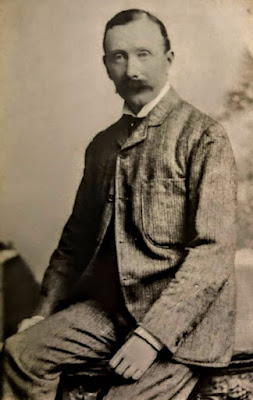
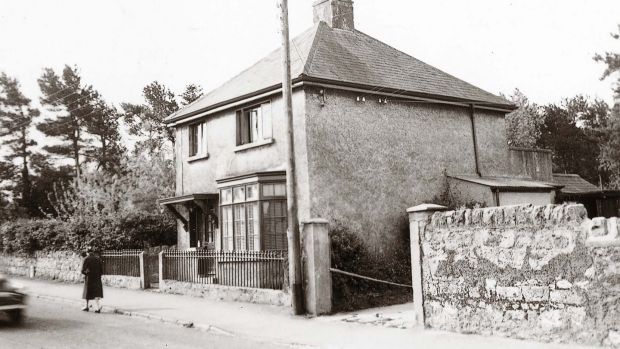
Ludwig Wittgenstein (1889-1951) … died 75 years ago on 29 April 1951
Patrick Comerford
Today marks the 75th anniversary of the death of Ludwig Wittgenstein (1889-1951), one of the greatest philosophers of the 20th century, who died in Cambridge 75 years ago, on 29 April 1951.
Wittgenstein was a Viennese-born Cambridge philosopher who had been influenced at an early stage by Tolstoy and Dostoevsky. He taught at the University of Cambridge from 1929 to 1947 and worked primarily in the fields of logic, the philosophy of mathematics, the philosophy of mind, and the philosophy of language.
During his lifetime, he published just one small, 75-page book, Tractatus Logico-Philosophicus (1921), one article, one book review and a children’s dictionary. His major work, Philosophical Investigations, was not published until two years after his death, yet it has become an important modern classic.
Bertrand Russell said he was ‘the most perfect example I have ever known of genius as traditionally conceived; passionate, profound, intense, and dominating.’
A plaque at the Ashling Hotel in Parkgate Street, Dublin, recalls Wittgenstein’s time as a guest (Photograph: Patrick Comerford)
Ludwig Wittgenstein was born in Vienna in 1889. A family tree shows his paternal great-great-grandfather was Moses Meier, a Jewish land agent who lived with his wife Brendel Simon in Bad Laasphe in the Principality of Wittgenstein, Westphalia. Napoleon decreed in 1808 that everyone, including Jews, must adopt an inheritable family surname. Moses Meier’s son, also Moses, became Moses Meier Wittgenstein.
His son, Hermann Christian Wittgenstein (1802-1878), took the middle name Christian to distance himself from his Jewish background. He married Franziska (Fanny) Figdor (1814-1890), who was also Jewish and a first cousin of the violinist Joseph Joachim (1831-1907), who worked closely with Brahms. They both became Protestants before they married, and the couple began a successful wool trading business trading in Leipzig.
Their 11 children included the philosopher’s father, Karl Otto Clemens Wittgenstein (1847-1913), who became an industrial tycoon. By the late 1880s, he had an effective monopoly on Austria’s steel cartel and was one of the richest men in Europe. The Wittgensteins became one of the wealthiest families in the Austro-Hungarian Empire, second only to the Rothschilds.
Karl Wittgenstein married Leopoldine ‘Poldie’ Maria Josefa Kalmus in 1873. Her father, Jakob Maximilian Kalmus (1814-1870) was a Bohemian Jew from Prague; her mother, Marie Stallner (1825-1921) was a German-speaking Catholic born in Sevnica in present-day Slovenia, and was Ludwig Wittgenstein’s only non-Jewish grandparent.
Ludwig Wittgenstein was born on 26 April 1889 in the ‘Wittgenstein Palace’ at Alleegasse 16, now the Argentinierstrasse, near the Karlskirche in Vienna. He was one of nine children who were all baptised as Catholics and received formal Catholic teaching. Gustav Klimt painted Ludwig’s sister for her wedding portrait, and Johannes Brahms and Gustav Mahler gave regular concerts in the family’s many music rooms.
In an interview, his sister Gretl Stonborough-Wittgenstein said their grandfather's ‘strong, severe, partly ascetic Christianity’ was a strong influence on all the Wittgenstein children.
While Ludwig Wittgenstein was at school at the Realschule, he decided he had lost his faith in God and became an atheist. But his religious faith and his relationship with Christianity and religion in general would change over time. He resisted formal religion, saying it was hard for him to ‘bend the knee,’ although he once said, ‘I cannot help seeing every problem from a religious point of view.
With age, his personal spirituality deepened, and he wrestled with language problems in religion. At a time when he was finding it difficult to work, he wrote in 1947, ‘I have had a letter from an old friend in Austria, a priest. In it he says that he hopes my work will go well, if it should be God’s will. Now that is all I want: if it should be God’s will.’
In Culture and Value, Wittgenstein asks, ‘Is what I am doing really worth the effort? Yes, but only if a light shines on it from above.’ His close friend Norman Malcolm later wrote, ‘Wittgenstein’s mature life was strongly marked by religious thought and feeling. I am inclined to think that he was more deeply religious than are many people who correctly regard themselves as religious believers.’
Ludwig Wittgenstein’s steps in the Great Palm House in the National Botanic Gardens, Dublin (Photograph: Patrick Comerford)
Wittgenstein visited his Irish friend, the psychiatrist Dr Maurice O’Connor (‘Con’) Drury (1907-1976) in Dublin in August 1947. They first met in the chapel Westcott House, Cambridge, when Drury had been an Anglican ordinand.
When Wittgenstein returned to Cambridge he resigned his professorship, planning to move to Dublin. From December 1947 to April 1948, Wittgenstein lived at Kilpatrick House, the home of the Kingston family near Redcross, Co Wicklow, where he worked on one of his major treatises, Philosophical Investigations, now accepted as a classic of 20th century philosophy.
By April 1948, he had moved from Kilpatrick House to Dr Con Drury’s holiday home in the west of Ireland, Rosro Cottage in Renvyle, Co Galway, and stayed there until the following October. This is now the Killary Harbour Youth Hostel.
From Co Galway, Wittgenstein moved to Dublin and to Ross’s Hotel, now the Ashling Hotel in Parkgate Street. A plaque by steps in the Great Palm House in the National Botanic Gardens in Glasnevin recalls how Wittgenstein liked to sit and write there in the late 1940s.
He remained in Dublin until June 1949. In all he spent 18 months in Ireland before returning to Cambridge.
Kilpatrick House near Redcross, Co Wicklow … Wittgenstein lived and wrote there from December 1947 to April 1948 (Photograph: Patrick Comerford)
Back in Cambridge, Wittgenstein became very ill on the evening of 27 April 1951. When his doctor told him he might live only a few days, he reportedly replied, ‘Good!’
Four of his former students arrived at his bedside – Ben Richards, the Limerick-born philosopher Elizabeth Anscombe, Yorick Smythies, and Con Drury, once an Anglican ordinand at Westcott House, Cambridge, and later a regular communicant at Christ Church Cathedral, Dublin.
Anscombe and Smythies were both Roman Catholics. At their request, the Dominican friar and philosopher, Father Conrad Pepler (1908-1993), also attended; he was the founding warden of the Dominican retreat centre at Spode House near Rugeley, Stafforshire, which I revisited in a posing last week (22 April 2026). Wittgenstein had asked for a ‘priest who was not a philosopher’ and had met Father Conrad several times before his death.
His friends were unsure at first what Wittgenstein would have wanted. But they remembered he had said he hoped his Catholic friends would pray for him, and so they did. He was pronounced dead shortly afterwards, 75 years ago, on 29 April 1951, and was given a Catholic burial in Cambridge.
A plaque in the chapel of Trinity College Cambridge recalls Wittgenstein’s time as a fellow and professor (Photograph: Patrick Comerford)
Wittgenstein’s influence reaches almost every discipline in the humanities and social sciences, and he has influenced many current Anglican theologians, including Andrew Davison and Alison Milbank.
On his religious views, Wittgenstein was said to be greatly interested in Catholicism and was sympathetic to it. However, he did not consider himself a Catholic. According to Norman Malcolm, Wittgenstein saw Catholicism as a way of life rather than as a set of beliefs he personally held.
So, did Wittgenstein see himself as Jewish?
Wittgenstein wrote repeatedly about Jews and Judaism in the 1930s, and many biographical studies present that his writings about Jewishness as a way in which he thought about the kind of person he was and the nature of his philosophical work.
On the other hand, as David Stern points out, many philosophers regard Wittgenstein’s thoughts about Jews as relatively unimportant, and many studies of his philosophy do not even mention the topic.
Yet, some writers have referred to Wittgenstein as a ‘rabbinical thinker’ and a far-sighted critic of anti-Semitism.
There is much debate about the extent to which Wittgenstein and his siblings, who were of three-quarters Jewish descent, saw themselves as Jews. The 1935 Nuremberg laws in 1935 defined as Jewish someone with three or four Jewish grandparents.
In a diary entry shortly after the German-Austrian Anschluss, he described the prospect of holding a German Judenpass or Jewish identity papers as an ‘extraordinarily difficult situation’ and compared it to hot iron that would burn his pocket.
In his writings, Wittgenstein frequently referred to himself as Jewish, at times as part of an apparent self-flagellation. For example, while berating himself for being a ‘reproductive’ as opposed to ‘productive’ thinker, he attributed this to his own Jewish sense of identity.
He wrote, ‘The saint is the only Jewish genius. Even the greatest Jewish thinker is no more than talented. (Myself for instance).’
While Wittgenstein would later claim that ‘my thoughts are 100% Hebraic,’ as Professor Hans Sluga has argued, if so, ‘His was a self-doubting Judaism, which had always the possibility of collapsing into a destructive self-hatred (as it did in [Otto] Weinberger’s case) but which also held an immense promise of innovation and genius.’
Wittgenstein once wrote, ‘Bach wrote on the title page of his Orgelbüchlein, “To the glory of the most high God, and that my neighbour may be benefited thereby.” That is what I would have liked to say about my work.’
In a letter to Bertrand Russell in 1912, he said Mozart and Beethoven were the actual sons of God – both composers died in Vienna.
The plaque at the entrance to Kilpatrick House marking the 50th anniversary of Wittgenstein’s death (Photograph: Patrick Comerford)
Showing posts with label Co Wicklow. Show all posts
29 April 2026
30 October 2025
Daily prayer in Ordinary Time 2025:
171, Thursday 30 October 2025
‘How often have I desired to gather your children together as a hen gathers her brood under her wings’ (Luke 13: 34) … a painting of Grey’s Guest House on Achill Island, Co Mayo (Photograph: Patrick Comerford)
Patrick Comerford
We are continuing in Ordinary Time in the Church Calendar, and this week leads us into Kingdom-time or the Kingdom Season. This week began with the Last Sunday after Trinity (26 October 2025).
Later this morning, I have an interesting bus journey to take. But, before the day begins, before having breakfast, I am taking some quiet time early this morning to give thanks, and for reflection, prayer and reading in these ways:
1, today’s Gospel reading;
2, a short reflection;
3, a prayer from the USPG prayer diary;
4, the Collects and Post-Communion prayer of the day.
‘How often have I desired to gather your children together as a hen gathers her brood under her wings’ (Luke 13: 34) … farmyard hens in Co Wicklow (Photograph: Patrick Comerford)
Luke 13: 31-35 (NRSVA):
31 At that very hour some Pharisees came and said to him, ‘Get away from here, for Herod wants to kill you.’ 32 He said to them, ‘Go and tell that fox for me, “Listen, I am casting out demons and performing cures today and tomorrow, and on the third day I finish my work. 33 Yet today, tomorrow, and the next day I must be on my way, because it is impossible for a prophet to be killed away from Jerusalem.” 34 Jerusalem, Jerusalem, the city that kills the prophets and stones those who are sent to it! How often have I desired to gather your children together as a hen gathers her brood under her wings, and you were not willing! 35 See, your house is left to you. And I tell you, you will not see me until the time comes when you say, “Blessed is the one who comes in the name of the Lord”.’
‘Jerusalem, Jerusalem … How often have I desired to gather your children together’ (Luke 13: 34) … the city of Jerusalem depicted on a tile in a restaurant in Dublin (Photograph: Patrick Comerford)
Today’s Reflection:
In my private meditations and prayers, I often reflect on words from Samuel Johnson from Lichfield, who compiled the first English-language dictionary but who is also often regarded as one of the great Anglican saints of the 18th century. Thinking about the stars at night, the great tragedies in the world and the unbounded love of God, Dr Johnson once wrote:
‘The pensive man at one time walks ‘unseen’ to muse at midnight, and at another hears the sullen curfew. If the weather drives him home he sits in a room lighted only by ‘glowing embers’; or by a lonely lamp outwatches the North Star to discover the habitation of separate souls, and varies the shades of meditation by contemplating the magnificent or pathetick scenes of tragick and epick poetry.’
Sometimes, I have found as I stood presiding at or celebrating the Holy Communion or the Eucharist that I am taken aback by intense feelings of the love of God.
On one memorable occasion, this happened to me as I was using the ‘Prayer of Humble Access’ at the fraction, when we were breaking the Bread of Communion at the invitation.
It is a prayer that has gone out of fashion in many parishes, but it is a reminder that we come to the Table or the Altar not because of our own goodness, not in spite of our own sinfulness, but because of the overflowing mercy and grace that God gives us freely and with unlimited bounty:
We do not presume to come to this your table,
merciful Lord,
trusting in our own righteousness
but in your manifold and great mercies.
We are not worthy so much as to gather up the crumbs under your table.
But you art the same Lord,
whose nature is always to have mercy.
Grant us, therefore, gracious Lord,
so to eat the flesh of your dear Son Jesus Christ,
and to drink his blood,
that our sinful bodies may be made clean by his body,
and our souls washed through his most precious blood,
and that we may evermore dwell in him, and he in us. Amen.
I was taken aback and was conscious of the love of God unexpectedly as I came to those words: ‘We are not worthy so much as to gather up the crumbs under your table.’
What flashed across my mind was a video clip that had gone viral at that time on YouTube and social media, of two small, frail abandoned children caught up in Syria’s bloody civil war, fending for themselves by picking up crumbs of bread from the street to eat.
These two homeless mites, braver than any groups fighting or waging war in Syria, told the camera crew: ‘We go to sleep hungry, we wake up hungry.’
They had been separated from their parents. At the time, the Anglican mission agency, USPG, was working with the plight of Syrian refugees in Lesvos and Athens and other parts of Greece.
In that video clip, the 10-year-old girl said she had been collecting bread crumbs off the street with her brother because their area of Damascus, al-Hajar, has been under siege for more than 15 months.
‘If we had food, you wouldn’t have seen us here,’ she said.
But their final message to the world that had abandoned them was: ‘May you be happy and blessed with what God has given you!’
Europe takes pity on children like this when we see them on YouTube or on the 9 o’clock news. But when they land on our shores in the Aegean Islands in Greece, or make their way up through central Europe and cross the Channel into England, we deem them not worthy to gather up the crumbs under our table.
I have looked at this video clip again and again since then. And I think of the image of Christ in our Gospel reading this morning: ‘How often have I desired to gather your children together as a hen gathers her brood under her wings, and you were not willing!’ (Luke 13: 34)
The children of the world are the future of the world. It does not matter whose children they are. It does not matter how many of them there are: whether they are two children searching for crumbs that I am not worthy to gather up, or small enough to be gathered in by a loving parent, or are countless in numbers like the stars, they are all embraced in the love of the loving and living God. They are all heirs to God’s promises.
And how we respond to them, how I respond to them, shows them what I think, what we think, of God and how much we believe in his promises.
Today’s Prayers (Thursday 30 October 2025):
The theme this week (26 October to 1 November) in Pray with the World Church, the prayer diary of the Anglican mission agency USPG (United Society Partners in the Gospel), is ‘Bonds of Affection (pp 50-51). This theme was introduced on Sunday with reflections from Rachel Weller, Communications Officer, USPG.
The USPG Prayer Diary today (Thursday 30 October 2025) invites us to pray:
We pray for your wisdom and discernment as the group navigates the challenges of working across cultures and contexts, seeking to reflect your love and truth.
The Collect:
Blessed Lord,
who caused all holy Scriptures to be written for our learning:
help us so to hear them,
to read, mark, learn and inwardly digest them
that, through patience, and the comfort of your holy word,
we may embrace and for ever hold fast
the hope of everlasting life,
which you have given us in our Saviour Jesus Christ,
who is alive and reigns with you,
in the unity of the Holy Spirit,
one God, now and for ever.
The Post Communion Prayer:
God of all grace,
your Son Jesus Christ fed the hungry
with the bread of his life
and the word of his kingdom:
renew your people with your heavenly grace,
and in all our weakness
sustain us by your true and living bread;
who is alive and reigns, now and for ever.
Additional Collect:
Merciful God,
teach us to be faithful in change and uncertainty,
that trusting in your word
and obeying your will
we may enter the unfailing joy of Jesus Christ our Lord.
Yesterday’s Reflections
Continued Tomorrow
‘We are not worthy so much as to gather up the crumbs under your table’ (the Prayer of Humble Access) … preparing bread for the Eucharist early on a Sunday morning (Photograph: Patrick Comerford)
Scripture quotations are from the New Revised Standard Version Bible: Anglicised Edition copyright © 1989, 1995 National Council of the Churches of Christ in the United States of America. Used by permission. All rights reserved worldwide. http://nrsvbibles.org
Patrick Comerford
We are continuing in Ordinary Time in the Church Calendar, and this week leads us into Kingdom-time or the Kingdom Season. This week began with the Last Sunday after Trinity (26 October 2025).
Later this morning, I have an interesting bus journey to take. But, before the day begins, before having breakfast, I am taking some quiet time early this morning to give thanks, and for reflection, prayer and reading in these ways:
1, today’s Gospel reading;
2, a short reflection;
3, a prayer from the USPG prayer diary;
4, the Collects and Post-Communion prayer of the day.
‘How often have I desired to gather your children together as a hen gathers her brood under her wings’ (Luke 13: 34) … farmyard hens in Co Wicklow (Photograph: Patrick Comerford)
Luke 13: 31-35 (NRSVA):
31 At that very hour some Pharisees came and said to him, ‘Get away from here, for Herod wants to kill you.’ 32 He said to them, ‘Go and tell that fox for me, “Listen, I am casting out demons and performing cures today and tomorrow, and on the third day I finish my work. 33 Yet today, tomorrow, and the next day I must be on my way, because it is impossible for a prophet to be killed away from Jerusalem.” 34 Jerusalem, Jerusalem, the city that kills the prophets and stones those who are sent to it! How often have I desired to gather your children together as a hen gathers her brood under her wings, and you were not willing! 35 See, your house is left to you. And I tell you, you will not see me until the time comes when you say, “Blessed is the one who comes in the name of the Lord”.’
‘Jerusalem, Jerusalem … How often have I desired to gather your children together’ (Luke 13: 34) … the city of Jerusalem depicted on a tile in a restaurant in Dublin (Photograph: Patrick Comerford)
Today’s Reflection:
In my private meditations and prayers, I often reflect on words from Samuel Johnson from Lichfield, who compiled the first English-language dictionary but who is also often regarded as one of the great Anglican saints of the 18th century. Thinking about the stars at night, the great tragedies in the world and the unbounded love of God, Dr Johnson once wrote:
‘The pensive man at one time walks ‘unseen’ to muse at midnight, and at another hears the sullen curfew. If the weather drives him home he sits in a room lighted only by ‘glowing embers’; or by a lonely lamp outwatches the North Star to discover the habitation of separate souls, and varies the shades of meditation by contemplating the magnificent or pathetick scenes of tragick and epick poetry.’
Sometimes, I have found as I stood presiding at or celebrating the Holy Communion or the Eucharist that I am taken aback by intense feelings of the love of God.
On one memorable occasion, this happened to me as I was using the ‘Prayer of Humble Access’ at the fraction, when we were breaking the Bread of Communion at the invitation.
It is a prayer that has gone out of fashion in many parishes, but it is a reminder that we come to the Table or the Altar not because of our own goodness, not in spite of our own sinfulness, but because of the overflowing mercy and grace that God gives us freely and with unlimited bounty:
We do not presume to come to this your table,
merciful Lord,
trusting in our own righteousness
but in your manifold and great mercies.
We are not worthy so much as to gather up the crumbs under your table.
But you art the same Lord,
whose nature is always to have mercy.
Grant us, therefore, gracious Lord,
so to eat the flesh of your dear Son Jesus Christ,
and to drink his blood,
that our sinful bodies may be made clean by his body,
and our souls washed through his most precious blood,
and that we may evermore dwell in him, and he in us. Amen.
I was taken aback and was conscious of the love of God unexpectedly as I came to those words: ‘We are not worthy so much as to gather up the crumbs under your table.’
What flashed across my mind was a video clip that had gone viral at that time on YouTube and social media, of two small, frail abandoned children caught up in Syria’s bloody civil war, fending for themselves by picking up crumbs of bread from the street to eat.
These two homeless mites, braver than any groups fighting or waging war in Syria, told the camera crew: ‘We go to sleep hungry, we wake up hungry.’
They had been separated from their parents. At the time, the Anglican mission agency, USPG, was working with the plight of Syrian refugees in Lesvos and Athens and other parts of Greece.
In that video clip, the 10-year-old girl said she had been collecting bread crumbs off the street with her brother because their area of Damascus, al-Hajar, has been under siege for more than 15 months.
‘If we had food, you wouldn’t have seen us here,’ she said.
But their final message to the world that had abandoned them was: ‘May you be happy and blessed with what God has given you!’
Europe takes pity on children like this when we see them on YouTube or on the 9 o’clock news. But when they land on our shores in the Aegean Islands in Greece, or make their way up through central Europe and cross the Channel into England, we deem them not worthy to gather up the crumbs under our table.
I have looked at this video clip again and again since then. And I think of the image of Christ in our Gospel reading this morning: ‘How often have I desired to gather your children together as a hen gathers her brood under her wings, and you were not willing!’ (Luke 13: 34)
The children of the world are the future of the world. It does not matter whose children they are. It does not matter how many of them there are: whether they are two children searching for crumbs that I am not worthy to gather up, or small enough to be gathered in by a loving parent, or are countless in numbers like the stars, they are all embraced in the love of the loving and living God. They are all heirs to God’s promises.
And how we respond to them, how I respond to them, shows them what I think, what we think, of God and how much we believe in his promises.
Today’s Prayers (Thursday 30 October 2025):
The theme this week (26 October to 1 November) in Pray with the World Church, the prayer diary of the Anglican mission agency USPG (United Society Partners in the Gospel), is ‘Bonds of Affection (pp 50-51). This theme was introduced on Sunday with reflections from Rachel Weller, Communications Officer, USPG.
The USPG Prayer Diary today (Thursday 30 October 2025) invites us to pray:
We pray for your wisdom and discernment as the group navigates the challenges of working across cultures and contexts, seeking to reflect your love and truth.
The Collect:
Blessed Lord,
who caused all holy Scriptures to be written for our learning:
help us so to hear them,
to read, mark, learn and inwardly digest them
that, through patience, and the comfort of your holy word,
we may embrace and for ever hold fast
the hope of everlasting life,
which you have given us in our Saviour Jesus Christ,
who is alive and reigns with you,
in the unity of the Holy Spirit,
one God, now and for ever.
The Post Communion Prayer:
God of all grace,
your Son Jesus Christ fed the hungry
with the bread of his life
and the word of his kingdom:
renew your people with your heavenly grace,
and in all our weakness
sustain us by your true and living bread;
who is alive and reigns, now and for ever.
Additional Collect:
Merciful God,
teach us to be faithful in change and uncertainty,
that trusting in your word
and obeying your will
we may enter the unfailing joy of Jesus Christ our Lord.
Yesterday’s Reflections
Continued Tomorrow
‘We are not worthy so much as to gather up the crumbs under your table’ (the Prayer of Humble Access) … preparing bread for the Eucharist early on a Sunday morning (Photograph: Patrick Comerford)
Scripture quotations are from the New Revised Standard Version Bible: Anglicised Edition copyright © 1989, 1995 National Council of the Churches of Christ in the United States of America. Used by permission. All rights reserved worldwide. http://nrsvbibles.org
19 July 2025
Daily prayer in Ordinary Time 2025:
71, Saturday 19 July 2025
The Prophet Isaiah depicted in the iconostasis in Arkadi Monastery in Crete (Photograph: Patrick Comerford)
Patrick Comerford
We are in Ordinary Time in the Church Calendar and tomorrow is the Fifth Sunday after Trinity (Trinity V, 20 July 2025). The calendar of the Church of England in Common Worship today remembers Saint Gregory (ca 394), Bishop of Nyssa, and his sister, Saint Macrina (ca 379), Deaconess, Teachers of the Faith.
Before today begins, I am taking some quiet time this morning to give thanks, to reflect, to pray and to read in these ways:
1, reading today’s Gospel reading;
2, a short reflection;
3, a prayer from the USPG prayer diary;
4, the Collects and Post-Communion prayer of the day.
‘He will not cry or lift up his voice, or make it heard in the street; a bruised reed he will not break’ (Isaiah 42: 2-3; see Matthew 12: 19) … reeds at the small lake by the North Beach in Arklow, Co Wicklow (Photograph: Patrick Comerford)
Matthew 12: 14-21 (NRSVA):
14 But the Pharisees went out and conspired against him, how to destroy him.
15 When Jesus became aware of this, he departed. Many crowds followed him, and he cured all of them, 16 and he ordered them not to make him known. 17 This was to fulfil what had been spoken through the prophet Isaiah:
18 ‘Here is my servant, whom I have chosen,
my beloved, with whom my soul is well pleased.
I will put my Spirit upon him,
and he will proclaim justice to the Gentiles.
19 He will not wrangle or cry aloud,
nor will anyone hear his voice in the streets.
20 He will not break a bruised reed
or quench a smouldering wick
until he brings justice to victory.
21 And in his name the Gentiles will hope.’
The Prophet Isaiah (right) and Saint John the Baptist … a window in Saint John’s Church, Wall, near Lichfield (Photograph: Patrick Comerford)
Today’s Reflection:
As we continue our daily readings in Saint Matthew’s Gospel, we see how Jesus is becoming a figure of controversy. We saw yesterday how he was accused by Pharisees of condoning the disciples breaking the Sabbath on the part of his disciples (Matthew 12: 1-8). Immediately afterwards he went to a synagogue and, in spite of a challenge about healing on the Sabbath, he went ahead and cured a man with a ‘withered hand’ (Matthew 12: 9-13).
Following this, Matthew tells us that ‘the Pharisees went out and conspired against him, how to destroy him’ (Matthew 12: 14), because his is a severe threat to their authority.
Jesus, aware of this plotting, disappears from sight for a while. He does not go out of his way to confront people or to create trouble for himself and does not deliberately engineer his own suffering and death.
At this point, Saint Matthew compares Jesus’ behaviour with a Biblical and quotes a passage in Isaiah (42: 1-4) to portray Jesus as fulfilling of the Spirit of God campaigning for justice for peoples everywhere.
Second Isaiah, or Isaiah 40-55), often referred to as ‘Deutero-Isaiah’ or the Book of Consolation, was probably written during the Babylonian exile, between 540 and 515 BCE, offering comfort and hope to the exiled people. This section contains beautiful poetic passages, emphasising God’s mercy, faithfulness, and the promise of salvation. It foretells the coming of a ‘Suffering Servant’, the Messiah, who will bring salvation not only to Israel but to all nations.
This is the longest Old Testament citation in this gospel (verses 18-21), although it does not correspond exactly to either the Hebrew or the Septuagint reading of that passage.
Isaiah 42:1-4 describes God’s servant, chosen and empowered by God’s Spirit, who will bring justice to the nations. This servant will be gentle, not resorting to loud public displays, and will not extinguish even the smallest hope. He is going to establish justice on earth and be a light to the nations, guiding those in darkness:
1 Here is my servant, whom I uphold,
my chosen, in whom my soul delights;
I have put my spirit upon him;
he will bring forth justice to the nations.
2 He will not cry or lift up his voice,
or make it heard in the street;
3 a bruised reed he will not break,
and a dimly burning wick he will not quench;
he will faithfully bring forth justice.
4 He will not grow faint or be crushed
until he has established justice in the earth;
and the coastlands wait for his teaching.
For Saint Matthew, Jesus is the servant whom God has chosen, ‘in whom my soul delights’. He is no demagogue and ‘will not cry out or lift up his voice or make it heard in the street’. Instead, he goes about quietly, tolerant and understanding of the weak, so gentle and kind in his behaviour that ‘a bruised reed he will not break, and a dimly burning wick he will not quench.’
This reading, then, emphasises the meekness of Jesus, the Servant of the Lord, and foretells the extension of his mission to the Gentiles. His message, demanding thought it may be, does not crush people. Justice comes through compassion – like care for the bruised reed – not through the exercise of power and violence.
Christ will always intervene on behalf of the weak, and in a way that is sensitive to them, and that takes the limelight away from himself. His concern for justice will bring hope to all people.
In these days, we are so in need of this assurance that Christ will patiently bring justice to victory.
The Prophet Isaiah (left) and the Prophet Jeremiah (right) in a window in Saint Michael’s Church, Pery Square, Limerick (Photograph: Patrick Comerford)
Today’s Prayers (Saturday 19 July 2025):
The theme this week (13 to 19 July) in Pray with the World Church, the prayer diary of the Anglican mission agency USPG (United Society Partners in the Gospel), has been ‘Shaping the Future: Africa Six.’ This theme was introduced last Sunday with a programme update from Fran Mate, Senior Regional Manager: Africa, USPG.
The USPG prayer diary today (Saturday 19 July 2025) invites us to pray
Lord God, we pray for Bishop Vicentia and Bishop Dalcy within the Anglican Church of Southern Africa. Thank you for their passionate leadership and trust in you. May many be blessed by their ministry.
The Collect:
Lord of eternity, creator of all things,
in your Son Jesus Christ you open for us the way to resurrection
that we may enjoy your bountiful goodness:
may we who celebrate your servants Gregory and Macrina
press onwards in faith to your boundless love
and ever wonder at the miracle of your presence among us;
through Jesus Christ your Son our Lord,
who is alive and reigns with you,
in the unity of the Holy Spirit,
one God, now and for ever.
The Post-Communion Prayer:
God of truth,
whose Wisdom set her table
and invited us to eat the bread and drink the wine
of the kingdom:
help us to lay aside all foolishness
and to live and walk in the way of insight,
that we may come with Gregory and Macrina to the eternal feast of heaven;
through Jesus Christ our Lord.
Collect on the Eve of Trinity V:
Almighty and everlasting God,
by whose Spirit the whole body of the Church
is governed and sanctified:
hear our prayer which we offer for all your faithful people,
that in their vocation and ministry
they may serve you in holiness and truth
to the glory of your name;
through our Lord and Saviour Jesus Christ,
who is alive and reigns with you,
in the unity of the Holy Spirit,
one God, now and for ever.
Yesterday’s reflections
Continued tomorrow
‘He will not break a bruised reed’ (Matthew 12: 20), ‘a bruised reed he will not break’ (Isaiah 42: 3) … reeds in the breeze in Killarney, Co Kerry (Photograph: Patrick Comerford)
Scripture quotations are from the New Revised Standard Version Bible: Anglicised Edition copyright © 1989, 1995, National Council of the Churches of Christ in the United States of America. Used by permission. All rights reserved worldwide. http://nrsvbibles.org
Patrick Comerford
We are in Ordinary Time in the Church Calendar and tomorrow is the Fifth Sunday after Trinity (Trinity V, 20 July 2025). The calendar of the Church of England in Common Worship today remembers Saint Gregory (ca 394), Bishop of Nyssa, and his sister, Saint Macrina (ca 379), Deaconess, Teachers of the Faith.
Before today begins, I am taking some quiet time this morning to give thanks, to reflect, to pray and to read in these ways:
1, reading today’s Gospel reading;
2, a short reflection;
3, a prayer from the USPG prayer diary;
4, the Collects and Post-Communion prayer of the day.
‘He will not cry or lift up his voice, or make it heard in the street; a bruised reed he will not break’ (Isaiah 42: 2-3; see Matthew 12: 19) … reeds at the small lake by the North Beach in Arklow, Co Wicklow (Photograph: Patrick Comerford)
Matthew 12: 14-21 (NRSVA):
14 But the Pharisees went out and conspired against him, how to destroy him.
15 When Jesus became aware of this, he departed. Many crowds followed him, and he cured all of them, 16 and he ordered them not to make him known. 17 This was to fulfil what had been spoken through the prophet Isaiah:
18 ‘Here is my servant, whom I have chosen,
my beloved, with whom my soul is well pleased.
I will put my Spirit upon him,
and he will proclaim justice to the Gentiles.
19 He will not wrangle or cry aloud,
nor will anyone hear his voice in the streets.
20 He will not break a bruised reed
or quench a smouldering wick
until he brings justice to victory.
21 And in his name the Gentiles will hope.’
The Prophet Isaiah (right) and Saint John the Baptist … a window in Saint John’s Church, Wall, near Lichfield (Photograph: Patrick Comerford)
Today’s Reflection:
As we continue our daily readings in Saint Matthew’s Gospel, we see how Jesus is becoming a figure of controversy. We saw yesterday how he was accused by Pharisees of condoning the disciples breaking the Sabbath on the part of his disciples (Matthew 12: 1-8). Immediately afterwards he went to a synagogue and, in spite of a challenge about healing on the Sabbath, he went ahead and cured a man with a ‘withered hand’ (Matthew 12: 9-13).
Following this, Matthew tells us that ‘the Pharisees went out and conspired against him, how to destroy him’ (Matthew 12: 14), because his is a severe threat to their authority.
Jesus, aware of this plotting, disappears from sight for a while. He does not go out of his way to confront people or to create trouble for himself and does not deliberately engineer his own suffering and death.
At this point, Saint Matthew compares Jesus’ behaviour with a Biblical and quotes a passage in Isaiah (42: 1-4) to portray Jesus as fulfilling of the Spirit of God campaigning for justice for peoples everywhere.
Second Isaiah, or Isaiah 40-55), often referred to as ‘Deutero-Isaiah’ or the Book of Consolation, was probably written during the Babylonian exile, between 540 and 515 BCE, offering comfort and hope to the exiled people. This section contains beautiful poetic passages, emphasising God’s mercy, faithfulness, and the promise of salvation. It foretells the coming of a ‘Suffering Servant’, the Messiah, who will bring salvation not only to Israel but to all nations.
This is the longest Old Testament citation in this gospel (verses 18-21), although it does not correspond exactly to either the Hebrew or the Septuagint reading of that passage.
Isaiah 42:1-4 describes God’s servant, chosen and empowered by God’s Spirit, who will bring justice to the nations. This servant will be gentle, not resorting to loud public displays, and will not extinguish even the smallest hope. He is going to establish justice on earth and be a light to the nations, guiding those in darkness:
1 Here is my servant, whom I uphold,
my chosen, in whom my soul delights;
I have put my spirit upon him;
he will bring forth justice to the nations.
2 He will not cry or lift up his voice,
or make it heard in the street;
3 a bruised reed he will not break,
and a dimly burning wick he will not quench;
he will faithfully bring forth justice.
4 He will not grow faint or be crushed
until he has established justice in the earth;
and the coastlands wait for his teaching.
For Saint Matthew, Jesus is the servant whom God has chosen, ‘in whom my soul delights’. He is no demagogue and ‘will not cry out or lift up his voice or make it heard in the street’. Instead, he goes about quietly, tolerant and understanding of the weak, so gentle and kind in his behaviour that ‘a bruised reed he will not break, and a dimly burning wick he will not quench.’
This reading, then, emphasises the meekness of Jesus, the Servant of the Lord, and foretells the extension of his mission to the Gentiles. His message, demanding thought it may be, does not crush people. Justice comes through compassion – like care for the bruised reed – not through the exercise of power and violence.
Christ will always intervene on behalf of the weak, and in a way that is sensitive to them, and that takes the limelight away from himself. His concern for justice will bring hope to all people.
In these days, we are so in need of this assurance that Christ will patiently bring justice to victory.
The Prophet Isaiah (left) and the Prophet Jeremiah (right) in a window in Saint Michael’s Church, Pery Square, Limerick (Photograph: Patrick Comerford)
Today’s Prayers (Saturday 19 July 2025):
The theme this week (13 to 19 July) in Pray with the World Church, the prayer diary of the Anglican mission agency USPG (United Society Partners in the Gospel), has been ‘Shaping the Future: Africa Six.’ This theme was introduced last Sunday with a programme update from Fran Mate, Senior Regional Manager: Africa, USPG.
The USPG prayer diary today (Saturday 19 July 2025) invites us to pray
Lord God, we pray for Bishop Vicentia and Bishop Dalcy within the Anglican Church of Southern Africa. Thank you for their passionate leadership and trust in you. May many be blessed by their ministry.
The Collect:
Lord of eternity, creator of all things,
in your Son Jesus Christ you open for us the way to resurrection
that we may enjoy your bountiful goodness:
may we who celebrate your servants Gregory and Macrina
press onwards in faith to your boundless love
and ever wonder at the miracle of your presence among us;
through Jesus Christ your Son our Lord,
who is alive and reigns with you,
in the unity of the Holy Spirit,
one God, now and for ever.
The Post-Communion Prayer:
God of truth,
whose Wisdom set her table
and invited us to eat the bread and drink the wine
of the kingdom:
help us to lay aside all foolishness
and to live and walk in the way of insight,
that we may come with Gregory and Macrina to the eternal feast of heaven;
through Jesus Christ our Lord.
Collect on the Eve of Trinity V:
Almighty and everlasting God,
by whose Spirit the whole body of the Church
is governed and sanctified:
hear our prayer which we offer for all your faithful people,
that in their vocation and ministry
they may serve you in holiness and truth
to the glory of your name;
through our Lord and Saviour Jesus Christ,
who is alive and reigns with you,
in the unity of the Holy Spirit,
one God, now and for ever.
Yesterday’s reflections
Continued tomorrow
‘He will not break a bruised reed’ (Matthew 12: 20), ‘a bruised reed he will not break’ (Isaiah 42: 3) … reeds in the breeze in Killarney, Co Kerry (Photograph: Patrick Comerford)
Scripture quotations are from the New Revised Standard Version Bible: Anglicised Edition copyright © 1989, 1995, National Council of the Churches of Christ in the United States of America. Used by permission. All rights reserved worldwide. http://nrsvbibles.org
16 March 2025
Daily prayer in Lent 2025:
12, Sunday 16 March 2025,
Second Sunday in Lent (Lent II)
‘How often have I desired to gather your children together as a hen gathers her brood under her wings’ (Luke 13: 34) … a painting of Grey’s Guest House on Achill Island, Co Mayo (Photograph: Patrick Comerford)
Patrick Comerford
We are now well into Lent, which began on Ash Wednesday, and today is the Second Sunday in Lent (Lent II, 16 March 2025).
The Six Nations championship came to a climax yesterday with the last three fixtures, and each successive match yesterday was a nail-biting decider in its own way. Tomorrow is Saint Patrick’s Day (17 March 2025).
Later this morning, I hope to sing with the choir at the Parish Eucharist in Saint Mary and Saint Giles Church, Stony Stratford. But, before today begins, I am taking some quiet time this morning to give thanks, to reflect, to pray and to read in these ways:
1, reading today’s Gospel reading;
2, a short reflection;
3, a prayer from the USPG prayer diary;
4, the Collects and Post-Communion prayer of the day.
‘How often have I desired to gather your children together as a hen gathers her brood under her wings’ (Luke 13: 34) … farmyard hens in Co Wicklow (Photograph: Patrick Comerford)
Luke 13: 31-35 (NRSVA):
31 At that very hour some Pharisees came and said to him, ‘Get away from here, for Herod wants to kill you.’ 32 He said to them, ‘Go and tell that fox for me, “Listen, I am casting out demons and performing cures today and tomorrow, and on the third day I finish my work. 33 Yet today, tomorrow, and the next day I must be on my way, because it is impossible for a prophet to be killed away from Jerusalem.” 34 Jerusalem, Jerusalem, the city that kills the prophets and stones those who are sent to it! How often have I desired to gather your children together as a hen gathers her brood under her wings, and you were not willing! 35 See, your house is left to you. And I tell you, you will not see me until the time comes when you say, “Blessed is the one who comes in the name of the Lord”.’
‘Jerusalem, Jerusalem … How often have I desired to gather your children together’ (Luke 13: 34) … the city of Jerusalem depicted on a tile in a restaurant in Dublin (Photograph: Patrick Comerford)
Today’s Reflection:
In my private meditations and prayers, I often reflect on words from Samuel Johnson from Lichfield, who compiled the first English-language dictionary but who is also often regarded as one of the great Anglican saints of the 18th century. Thinking about the stars at night, the great tragedies in the world and the unbounded love of God, Dr Johnson once wrote:
‘The pensive man at one time walks ‘unseen’ to muse at midnight, and at another hears the sullen curfew. If the weather drives him home he sits in a room lighted only by ‘glowing embers’; or by a lonely lamp outwatches the North Star to discover the habitation of separate souls, and varies the shades of meditation by contemplating the magnificent or pathetick scenes of tragick and epick poetry.’
I sometimes found as I stood presiding at or celebrating the Holy Communion or the Eucharist that I am taken aback by intense feelings of the love of God.
On one memorable occasion, this happened to me as I was using the ‘Prayer of Humble Access’ at the fraction, when we were breaking the Bread of Communion at the invitation.
It is a prayer that has gone out of fashion in many parishes, but it is a reminder that we come to the Table or the Altar not because of our own goodness, not in spite of our own sinfulness, but because of the overflowing mercy and grace that God gives us freely and with unlimited bounty:
We do not presume to come to this your table,
merciful Lord,
trusting in our own righteousness
but in your manifold and great mercies.
We are not worthy so much as to gather up the crumbs under your table.
But you art the same Lord,
whose nature is always to have mercy.
Grant us, therefore, gracious Lord,
so to eat the flesh of your dear Son Jesus Christ,
and to drink his blood,
that our sinful bodies may be made clean by his body,
and our souls washed through his most precious blood,
and that we may evermore dwell in him, and he in us. Amen.
I was taken aback and was conscious of the love of God unexpectedly as I came to those words: ‘We are not worthy so much as to gather up the crumbs under your table.’
What flashed across my mind was a video clip that had gone viral at that time on YouTube and social media, of two small, frail abandoned children caught up in the bloody civil war in Syria, fending for themselves by picking up crumbs of bread from the street to eat.
These two homeless mites, who were braver than any groups fighting or waging war in Syria, told the camera crew: ‘We go to sleep hungry, we wake up hungry.’
They had been separated from their parents. At the time, the Anglican mission agency, USPG, was working with the plight of Syrian refugees in Lesvos and Athens and other parts of Greece.
In that video clip, the 10-year-old girl said she had been collecting bread crumbs off the street with her brother because their area of Damascus, al-Hajar, has been under siege for more than 15 months.
‘If we had food, you wouldn’t have seen us here,’ she said.
But their final message to the world that had abandoned them was: ‘May you be happy and blessed with what God has given you!’
Europe takes pity on children like this when we see them on YouTube or on the 10 o’clock news. But when they land on the shores of the Aegean Islands in Greece, or make their way up through central Europe and cross the Channel into England, we deem them not worthy to gather up the crumbs under our table.
I have looked at this video clip again and again since then. And I think of the image of Christ in the Gospel reading this morning:
‘How often have I desired to gather your children together as a hen gathers her brood under her wings, and you were not willing!’ (Luke 13: 34)
The children of the world are the future of the world. It does not matter whose children they are. It does not matter how many of them there are: whether they are two children searching for crumbs that I am not worthy to gather up, or small enough to be gathered in by a loving parent, or are countless in numbers like the stars, they are all embraced in the love of the loving and living God. They are all heirs to God’s promises.
And how we respond to them, how I respond to them, shows them what I think, what we think, of God and how much we believe in his promises.
Today’s Prayers (Sunday 16 March 2025):
The theme this week in ‘Pray With the World Church’, the Prayer Diary of the Anglican mission agency USPG (United Society Partners in the Gospel), is ‘Truth: The Path to Reconciliation’. This theme is introduced today with a programme update by Rachel Weller, Communications Officer, USPG:
‘We each have the power to change our world. We’re not all going to be Nobel Peace Prize winners and we’re not all going to have books written about our lives. But we all can impact someone’s life in a positive way.’
This is just some of the wisdom shared by the Revd Nontombi Tutu, Episcopal priest and human rights activist, as she led our inaugural Desmond Tutu Memorial Lecture on ‘Truth, the Path to Reconciliation’ held at York Minster.
She shared about the importance of being truthful; about our history, our own roles in societal ills and the power that we each must make change. To this end, she referenced a particular testimony that stood out to her during a hearing of Truth and Reconciliation Commission – a legal body tasked with exposing human rights abuses and promoting reconciliation after apartheid.
The letter, written by a young, white South African, read: ‘I didn’t know about policing in black classrooms. I didn’t know what my government was doing to my black compatriots. I didn’t know … and I recognise that part of me chose not to know’. So often, we stop at what we don’t know and brush things aside. How much more powerful is it, therefore, to courageously listen and speak the truth in love.
The USPG Prayer Diary today (Sunday 16 March 2025) invites us to pray, reflecting on these words:
‘Finally, brothers and sisters, we ask and urge you in the Lord Jesus that, as you learned from us how you ought to live and to please God (as, in fact, you are doing), you should do so more and more’ (I Thessalonians 4: 1).
The Collect:
Almighty God,
you show to those who are in error the light of your truth,
that they may return to the way of righteousness:
grant to all those who are admitted
into the fellowship of Christ’s religion,
that they may reject those things
that are contrary to their profession,
and follow all such things as are agreeable to the same;
through our Lord Jesus Christ,
who is alive and reigns with you,
in the unity of the Holy Spirit,
one God, now and for ever.
The Post Communion Prayer:
Almighty God,
you see that we have no power of ourselves to help ourselves:
keep us both outwardly in our bodies,
and inwardly in our souls;
that we may be defended from all adversities
which may happen to the body,
and from all evil thoughts which may assault and hurt the soul;
through Jesus Christ our Lord.
Additional Collect:
Almighty God,
by the prayer and discipline of Lent
may we enter into the mystery of Christ’s sufferings,
and by following in his Way
come to share in his glory;
through Jesus Christ our Lord.
Yesterday’s Reflection
Continued Tomorrow
‘We are not worthy so much as to gather up the crumbs under your table’ (the Prayer of Humble Access) … preparing bread for the Eucharist early on a Sunday morning (Photograph: Patrick Comerford)
Scripture quotations are from the New Revised Standard Version Bible: Anglicised Edition copyright © 1989, 1995 National Council of the Churches of Christ in the United States of America. Used by permission. All rights reserved worldwide. http://nrsvbibles.org
Patrick Comerford
We are now well into Lent, which began on Ash Wednesday, and today is the Second Sunday in Lent (Lent II, 16 March 2025).
The Six Nations championship came to a climax yesterday with the last three fixtures, and each successive match yesterday was a nail-biting decider in its own way. Tomorrow is Saint Patrick’s Day (17 March 2025).
Later this morning, I hope to sing with the choir at the Parish Eucharist in Saint Mary and Saint Giles Church, Stony Stratford. But, before today begins, I am taking some quiet time this morning to give thanks, to reflect, to pray and to read in these ways:
1, reading today’s Gospel reading;
2, a short reflection;
3, a prayer from the USPG prayer diary;
4, the Collects and Post-Communion prayer of the day.
‘How often have I desired to gather your children together as a hen gathers her brood under her wings’ (Luke 13: 34) … farmyard hens in Co Wicklow (Photograph: Patrick Comerford)
Luke 13: 31-35 (NRSVA):
31 At that very hour some Pharisees came and said to him, ‘Get away from here, for Herod wants to kill you.’ 32 He said to them, ‘Go and tell that fox for me, “Listen, I am casting out demons and performing cures today and tomorrow, and on the third day I finish my work. 33 Yet today, tomorrow, and the next day I must be on my way, because it is impossible for a prophet to be killed away from Jerusalem.” 34 Jerusalem, Jerusalem, the city that kills the prophets and stones those who are sent to it! How often have I desired to gather your children together as a hen gathers her brood under her wings, and you were not willing! 35 See, your house is left to you. And I tell you, you will not see me until the time comes when you say, “Blessed is the one who comes in the name of the Lord”.’
‘Jerusalem, Jerusalem … How often have I desired to gather your children together’ (Luke 13: 34) … the city of Jerusalem depicted on a tile in a restaurant in Dublin (Photograph: Patrick Comerford)
Today’s Reflection:
In my private meditations and prayers, I often reflect on words from Samuel Johnson from Lichfield, who compiled the first English-language dictionary but who is also often regarded as one of the great Anglican saints of the 18th century. Thinking about the stars at night, the great tragedies in the world and the unbounded love of God, Dr Johnson once wrote:
‘The pensive man at one time walks ‘unseen’ to muse at midnight, and at another hears the sullen curfew. If the weather drives him home he sits in a room lighted only by ‘glowing embers’; or by a lonely lamp outwatches the North Star to discover the habitation of separate souls, and varies the shades of meditation by contemplating the magnificent or pathetick scenes of tragick and epick poetry.’
I sometimes found as I stood presiding at or celebrating the Holy Communion or the Eucharist that I am taken aback by intense feelings of the love of God.
On one memorable occasion, this happened to me as I was using the ‘Prayer of Humble Access’ at the fraction, when we were breaking the Bread of Communion at the invitation.
It is a prayer that has gone out of fashion in many parishes, but it is a reminder that we come to the Table or the Altar not because of our own goodness, not in spite of our own sinfulness, but because of the overflowing mercy and grace that God gives us freely and with unlimited bounty:
We do not presume to come to this your table,
merciful Lord,
trusting in our own righteousness
but in your manifold and great mercies.
We are not worthy so much as to gather up the crumbs under your table.
But you art the same Lord,
whose nature is always to have mercy.
Grant us, therefore, gracious Lord,
so to eat the flesh of your dear Son Jesus Christ,
and to drink his blood,
that our sinful bodies may be made clean by his body,
and our souls washed through his most precious blood,
and that we may evermore dwell in him, and he in us. Amen.
I was taken aback and was conscious of the love of God unexpectedly as I came to those words: ‘We are not worthy so much as to gather up the crumbs under your table.’
What flashed across my mind was a video clip that had gone viral at that time on YouTube and social media, of two small, frail abandoned children caught up in the bloody civil war in Syria, fending for themselves by picking up crumbs of bread from the street to eat.
These two homeless mites, who were braver than any groups fighting or waging war in Syria, told the camera crew: ‘We go to sleep hungry, we wake up hungry.’
They had been separated from their parents. At the time, the Anglican mission agency, USPG, was working with the plight of Syrian refugees in Lesvos and Athens and other parts of Greece.
In that video clip, the 10-year-old girl said she had been collecting bread crumbs off the street with her brother because their area of Damascus, al-Hajar, has been under siege for more than 15 months.
‘If we had food, you wouldn’t have seen us here,’ she said.
But their final message to the world that had abandoned them was: ‘May you be happy and blessed with what God has given you!’
Europe takes pity on children like this when we see them on YouTube or on the 10 o’clock news. But when they land on the shores of the Aegean Islands in Greece, or make their way up through central Europe and cross the Channel into England, we deem them not worthy to gather up the crumbs under our table.
I have looked at this video clip again and again since then. And I think of the image of Christ in the Gospel reading this morning:
‘How often have I desired to gather your children together as a hen gathers her brood under her wings, and you were not willing!’ (Luke 13: 34)
The children of the world are the future of the world. It does not matter whose children they are. It does not matter how many of them there are: whether they are two children searching for crumbs that I am not worthy to gather up, or small enough to be gathered in by a loving parent, or are countless in numbers like the stars, they are all embraced in the love of the loving and living God. They are all heirs to God’s promises.
And how we respond to them, how I respond to them, shows them what I think, what we think, of God and how much we believe in his promises.
Today’s Prayers (Sunday 16 March 2025):
The theme this week in ‘Pray With the World Church’, the Prayer Diary of the Anglican mission agency USPG (United Society Partners in the Gospel), is ‘Truth: The Path to Reconciliation’. This theme is introduced today with a programme update by Rachel Weller, Communications Officer, USPG:
‘We each have the power to change our world. We’re not all going to be Nobel Peace Prize winners and we’re not all going to have books written about our lives. But we all can impact someone’s life in a positive way.’
This is just some of the wisdom shared by the Revd Nontombi Tutu, Episcopal priest and human rights activist, as she led our inaugural Desmond Tutu Memorial Lecture on ‘Truth, the Path to Reconciliation’ held at York Minster.
She shared about the importance of being truthful; about our history, our own roles in societal ills and the power that we each must make change. To this end, she referenced a particular testimony that stood out to her during a hearing of Truth and Reconciliation Commission – a legal body tasked with exposing human rights abuses and promoting reconciliation after apartheid.
The letter, written by a young, white South African, read: ‘I didn’t know about policing in black classrooms. I didn’t know what my government was doing to my black compatriots. I didn’t know … and I recognise that part of me chose not to know’. So often, we stop at what we don’t know and brush things aside. How much more powerful is it, therefore, to courageously listen and speak the truth in love.
The USPG Prayer Diary today (Sunday 16 March 2025) invites us to pray, reflecting on these words:
‘Finally, brothers and sisters, we ask and urge you in the Lord Jesus that, as you learned from us how you ought to live and to please God (as, in fact, you are doing), you should do so more and more’ (I Thessalonians 4: 1).
The Collect:
Almighty God,
you show to those who are in error the light of your truth,
that they may return to the way of righteousness:
grant to all those who are admitted
into the fellowship of Christ’s religion,
that they may reject those things
that are contrary to their profession,
and follow all such things as are agreeable to the same;
through our Lord Jesus Christ,
who is alive and reigns with you,
in the unity of the Holy Spirit,
one God, now and for ever.
The Post Communion Prayer:
Almighty God,
you see that we have no power of ourselves to help ourselves:
keep us both outwardly in our bodies,
and inwardly in our souls;
that we may be defended from all adversities
which may happen to the body,
and from all evil thoughts which may assault and hurt the soul;
through Jesus Christ our Lord.
Additional Collect:
Almighty God,
by the prayer and discipline of Lent
may we enter into the mystery of Christ’s sufferings,
and by following in his Way
come to share in his glory;
through Jesus Christ our Lord.
Yesterday’s Reflection
Continued Tomorrow
‘We are not worthy so much as to gather up the crumbs under your table’ (the Prayer of Humble Access) … preparing bread for the Eucharist early on a Sunday morning (Photograph: Patrick Comerford)
Scripture quotations are from the New Revised Standard Version Bible: Anglicised Edition copyright © 1989, 1995 National Council of the Churches of Christ in the United States of America. Used by permission. All rights reserved worldwide. http://nrsvbibles.org
06 November 2024
Daily prayer in the Kingdom Season:
7, Thursday 7 November 2024
‘Rejoice with me, for I have found the coin that I had lost’ (Luke 15: 9) … old drachmae coins in a tin box outside an antiques shop in Rethymnon in Crete (Photograph: Patrick Comerford)
Patrick Comerford
We are in the Kingdom Season, the time between All Saints and Advent. The Calendar of the Church of England in Common Worship today remembers Willibrord of York (739), Bishop, Apostle of Frisia.
Before today begins, before having breakfast, I am taking some quiet time early this morning to give thanks, and for reflection, prayer and reading in these ways:
1, today’s Gospel reading;
2, a short reflection;
3, a prayer from the USPG prayer diary;
4, the Collects and Post-Communion prayer of the day.
Torn and ragged drachma banknotes in a tin box outside an antiques shop in Rethymnon in Crete (Photograph: Patrick Comerford)
Luke 15: 1-10 (NRSVA):
1 Now all the tax-collectors and sinners were coming near to listen to him. 2 And the Pharisees and the scribes were grumbling and saying, ‘This fellow welcomes sinners and eats with them.’
3 So he told them this parable: 4 ‘Which one of you, having a hundred sheep and losing one of them, does not leave the ninety-nine in the wilderness and go after the one that is lost until he finds it? 5 When he has found it, he lays it on his shoulders and rejoices. 6 And when he comes home, he calls together his friends and neighbours, saying to them, “Rejoice with me, for I have found my sheep that was lost.” 7 Just so, I tell you, there will be more joy in heaven over one sinner who repents than over ninety-nine righteous people who need no repentance.
8 ‘Or what woman having ten silver coins, if she loses one of them, does not light a lamp, sweep the house, and search carefully until she finds it? 9 When she has found it, she calls together her friends and neighbours, saying, “Rejoice with me, for I have found the coin that I had lost.” 10 Just so, I tell you, there is joy in the presence of the angels of God over one sinner who repents.’
‘Or what woman having ten silver coins (drachmae) …’ (Luke 15: 8) … a worn and tattered 10 drachmae note from 1940 was worthless soon after it was issued (Photograph: Patrick Comerford)
Today’s reflection:
In the Gospel reading for the Eucharist today, Christ speaks in three parables of things lost and found: the one lost sheep among 100; the one sinner who repents in contrast to the 99 righteous people; and the woman who has lost a small coin that others might not even bother to look for.
In the story of the shepherd who has 100 sheep and goes looking for one lost sheep, a rich man shows us how God behaves.
In the story of the woman who has ten silver coins, and who sweeps thoroughly through every dark corner of her house until she finds one lost coin, a poor woman shows us how God behaves.
The first image reminds me how on Achill Island off the west coast of Co Mayo, I once heard about a shepherd who died on a cliff side as he went in search of a lost sheep, and slipped on the edge. A local man reacted by pointing out what a small price sheep fetched in the mart in those days.
When you do find a lost sheep, it has probably been caught in brambles, is full of dirt and matted with droppings. It is not a pleasant fluffy creature, as seen in so many stained glass windows. It may not even be worth bringing home, in the eyes of a shepherd or a sheep farmer. In its panic and distress, it will have lost weight, and may not be possible to sell.
We also have a poor woman who shows us how God behaves.
Ten drachmae might have been a nice sum of money at the time, but was one small coin worth all that time, worry and energy?
I was working in Greece as a journalist many years ago at a time when the Drachma was being phased out as the national currency, and the Euro was being introduced.
As far as I remember, there were about 330 or 350 drachmae to the Euro. You could still exchange them until 2012, when you needed 587.5000 drachma to get €1.
So, a drachma in my days was worth about as much as a farthing. And when Greeks hear this Gospel reading, they hear about the woman sweeping her house, searching not for a valuable silver coin but for a tiny worthless coin, searching for a farthing.
The Greek text says not that she has ten silver coins, but that she has ten drachmae and has lost one.
When she finds it, she is rejoicing over very little. And when she throws a party to rejoice with her friends, it is going to cost her more than the rest of her savings if she only has 10 drachmae, it is going to cost abundant generosity, generosity that reflects the abundant generosity of God.
I came across a book many years that took a light-hearted introduction to Classics, Ancient Athens on Five Drachmas a Day (2008). But you probably would not have been able to even buy a bottle of retsina or a bottle of ouzo in ancient Athens for half of what this woman had saved.
And how the tax collectors who heard this parable (verse 1) must have laughed with ridicule! Finding a drachma certainly was not going to help the party spirit, never mind being worth considering for taxes and tax collecting.
This Gospel story provides us with examples of a variety of people who are living, visible examples of God’s overflowing, overwhelming and inescapable generosity: men and women, young and old, rural and urban, rich and poor, the valued and those who are without value in the eyes of others.
‘Which one of you, having a hundred sheep and losing one of them, does not leave the ninety-nine in the wilderness and go after the one that is lost’ (Luke 15: 4) … ‘Paternoster’ or ‘Shepherd and Sheep’, a bronze sculpture by Dame Elisabeth Frink in Paternoster Square, near Saint Paul’s Cathedral, London (Photograph: Patrick Comerford)
Today’s Prayers (Thursday 7 November 2024):
The theme this week in ‘Pray With the World Church’, the Prayer Diary of the Anglican mission agency USPG (United Society Partners in the Gospel), is ‘Conflict, Confluence and Creativity’. This theme was introduced on Sunday with reflections by Rebecca Boardman, former Operations Manager, USPG.
The USPG Prayer Diary today (Thursday 7 November 2024) invites us to pray:
Lord, bless the FeAST network – may all its work this year be to the glory of your name. May it continue to grow and flourish around the world.
The Collect:
God, the Saviour of all,
you sent your bishop Willibrord from this land
to proclaim the good news to many peoples
and confirm them in their faith:
help us also to witness to your steadfast love
by word and deed
so that your Church may increase
and grow strong in holiness;
through Jesus Christ your Son our Lord,
who is alive and reigns with you,
in the unity of the Holy Spirit,
one God, now and for ever.
Post Communion Prayer:
Holy Father,
who gathered us here around the table of your Son
to share this meal with the whole household of God:
in that new world where you reveal
the fullness of your peace,
gather people of every race and language
to share with Willibrord and all your saints
in the eternal banquet of Jesus Christ our Lord.
Yesterday’s Reflection
Continued Tomorrow
‘Which one of you, having a hundred sheep and losing one of them, does not leave the ninety-nine in the wilderness and go after the one that is lost’ (Luke 15: 4) … sheep in the Wicklow mountains (Photograph: Patrick Comerford)
Scripture quotations are from the New Revised Standard Version Bible: Anglicised Edition copyright © 1989, 1995 National Council of the Churches of Christ in the United States of America. Used by permission. All rights reserved worldwide. http://nrsvbibles.org
Patrick Comerford
We are in the Kingdom Season, the time between All Saints and Advent. The Calendar of the Church of England in Common Worship today remembers Willibrord of York (739), Bishop, Apostle of Frisia.
Before today begins, before having breakfast, I am taking some quiet time early this morning to give thanks, and for reflection, prayer and reading in these ways:
1, today’s Gospel reading;
2, a short reflection;
3, a prayer from the USPG prayer diary;
4, the Collects and Post-Communion prayer of the day.
Torn and ragged drachma banknotes in a tin box outside an antiques shop in Rethymnon in Crete (Photograph: Patrick Comerford)
Luke 15: 1-10 (NRSVA):
1 Now all the tax-collectors and sinners were coming near to listen to him. 2 And the Pharisees and the scribes were grumbling and saying, ‘This fellow welcomes sinners and eats with them.’
3 So he told them this parable: 4 ‘Which one of you, having a hundred sheep and losing one of them, does not leave the ninety-nine in the wilderness and go after the one that is lost until he finds it? 5 When he has found it, he lays it on his shoulders and rejoices. 6 And when he comes home, he calls together his friends and neighbours, saying to them, “Rejoice with me, for I have found my sheep that was lost.” 7 Just so, I tell you, there will be more joy in heaven over one sinner who repents than over ninety-nine righteous people who need no repentance.
8 ‘Or what woman having ten silver coins, if she loses one of them, does not light a lamp, sweep the house, and search carefully until she finds it? 9 When she has found it, she calls together her friends and neighbours, saying, “Rejoice with me, for I have found the coin that I had lost.” 10 Just so, I tell you, there is joy in the presence of the angels of God over one sinner who repents.’
‘Or what woman having ten silver coins (drachmae) …’ (Luke 15: 8) … a worn and tattered 10 drachmae note from 1940 was worthless soon after it was issued (Photograph: Patrick Comerford)
Today’s reflection:
In the Gospel reading for the Eucharist today, Christ speaks in three parables of things lost and found: the one lost sheep among 100; the one sinner who repents in contrast to the 99 righteous people; and the woman who has lost a small coin that others might not even bother to look for.
In the story of the shepherd who has 100 sheep and goes looking for one lost sheep, a rich man shows us how God behaves.
In the story of the woman who has ten silver coins, and who sweeps thoroughly through every dark corner of her house until she finds one lost coin, a poor woman shows us how God behaves.
The first image reminds me how on Achill Island off the west coast of Co Mayo, I once heard about a shepherd who died on a cliff side as he went in search of a lost sheep, and slipped on the edge. A local man reacted by pointing out what a small price sheep fetched in the mart in those days.
When you do find a lost sheep, it has probably been caught in brambles, is full of dirt and matted with droppings. It is not a pleasant fluffy creature, as seen in so many stained glass windows. It may not even be worth bringing home, in the eyes of a shepherd or a sheep farmer. In its panic and distress, it will have lost weight, and may not be possible to sell.
We also have a poor woman who shows us how God behaves.
Ten drachmae might have been a nice sum of money at the time, but was one small coin worth all that time, worry and energy?
I was working in Greece as a journalist many years ago at a time when the Drachma was being phased out as the national currency, and the Euro was being introduced.
As far as I remember, there were about 330 or 350 drachmae to the Euro. You could still exchange them until 2012, when you needed 587.5000 drachma to get €1.
So, a drachma in my days was worth about as much as a farthing. And when Greeks hear this Gospel reading, they hear about the woman sweeping her house, searching not for a valuable silver coin but for a tiny worthless coin, searching for a farthing.
The Greek text says not that she has ten silver coins, but that she has ten drachmae and has lost one.
When she finds it, she is rejoicing over very little. And when she throws a party to rejoice with her friends, it is going to cost her more than the rest of her savings if she only has 10 drachmae, it is going to cost abundant generosity, generosity that reflects the abundant generosity of God.
I came across a book many years that took a light-hearted introduction to Classics, Ancient Athens on Five Drachmas a Day (2008). But you probably would not have been able to even buy a bottle of retsina or a bottle of ouzo in ancient Athens for half of what this woman had saved.
And how the tax collectors who heard this parable (verse 1) must have laughed with ridicule! Finding a drachma certainly was not going to help the party spirit, never mind being worth considering for taxes and tax collecting.
This Gospel story provides us with examples of a variety of people who are living, visible examples of God’s overflowing, overwhelming and inescapable generosity: men and women, young and old, rural and urban, rich and poor, the valued and those who are without value in the eyes of others.
‘Which one of you, having a hundred sheep and losing one of them, does not leave the ninety-nine in the wilderness and go after the one that is lost’ (Luke 15: 4) … ‘Paternoster’ or ‘Shepherd and Sheep’, a bronze sculpture by Dame Elisabeth Frink in Paternoster Square, near Saint Paul’s Cathedral, London (Photograph: Patrick Comerford)
Today’s Prayers (Thursday 7 November 2024):
The theme this week in ‘Pray With the World Church’, the Prayer Diary of the Anglican mission agency USPG (United Society Partners in the Gospel), is ‘Conflict, Confluence and Creativity’. This theme was introduced on Sunday with reflections by Rebecca Boardman, former Operations Manager, USPG.
The USPG Prayer Diary today (Thursday 7 November 2024) invites us to pray:
Lord, bless the FeAST network – may all its work this year be to the glory of your name. May it continue to grow and flourish around the world.
The Collect:
God, the Saviour of all,
you sent your bishop Willibrord from this land
to proclaim the good news to many peoples
and confirm them in their faith:
help us also to witness to your steadfast love
by word and deed
so that your Church may increase
and grow strong in holiness;
through Jesus Christ your Son our Lord,
who is alive and reigns with you,
in the unity of the Holy Spirit,
one God, now and for ever.
Post Communion Prayer:
Holy Father,
who gathered us here around the table of your Son
to share this meal with the whole household of God:
in that new world where you reveal
the fullness of your peace,
gather people of every race and language
to share with Willibrord and all your saints
in the eternal banquet of Jesus Christ our Lord.
Yesterday’s Reflection
Continued Tomorrow
‘Which one of you, having a hundred sheep and losing one of them, does not leave the ninety-nine in the wilderness and go after the one that is lost’ (Luke 15: 4) … sheep in the Wicklow mountains (Photograph: Patrick Comerford)
Scripture quotations are from the New Revised Standard Version Bible: Anglicised Edition copyright © 1989, 1995 National Council of the Churches of Christ in the United States of America. Used by permission. All rights reserved worldwide. http://nrsvbibles.org
30 October 2024
Daily prayer in Ordinary Time 2024:
173, Thursday 31 October 2024
‘How often have I desired to gather your children together as a hen gathers her brood under her wings’ (Luke 13: 34) … a painting of Grey’s Guest House on Achill Island, Co Mayo (Photograph: Patrick Comerford)
Patrick Comerford
We come to the end of Ordinary Time in the Church Calendar today. The week began with the Last Sunday after Trinity (27 October 2024). The Church Calendar in many parts of the Church today remembers Martin Luther (1483-1546), Reformer. This is also Hallowe’en or the Eve of All Saints’ Day. The Kingdom Season begins tomorrow with All Saints’ Day (1 November 2024) and continues until Advent Sunday (1 December 2024).
Before the day begins, before having breakfast, I am taking some quiet time early this morning to give thanks, and for reflection, prayer and reading in these ways:
1, today’s Gospel reading;
2, a short reflection;
3, a prayer from the USPG prayer diary;
4, the Collects and Post-Communion prayer of the day.
‘How often have I desired to gather your children together as a hen gathers her brood under her wings’ (Luke 13: 34) … farmyard hens in Co Wicklow (Photograph: Patrick Comerford)
Luke 13: 31-35 (NRSVA):
31 At that very hour some Pharisees came and said to him, ‘Get away from here, for Herod wants to kill you.’ 32 He said to them, ‘Go and tell that fox for me, “Listen, I am casting out demons and performing cures today and tomorrow, and on the third day I finish my work. 33 Yet today, tomorrow, and the next day I must be on my way, because it is impossible for a prophet to be killed away from Jerusalem.” 34 Jerusalem, Jerusalem, the city that kills the prophets and stones those who are sent to it! How often have I desired to gather your children together as a hen gathers her brood under her wings, and you were not willing! 35 See, your house is left to you. And I tell you, you will not see me until the time comes when you say, “Blessed is the one who comes in the name of the Lord”.’
‘Jerusalem, Jerusalem … How often have I desired to gather your children together’ (Luke 13: 34) … the city of Jerusalem depicted on a tile in a restaurant in Dublin (Photograph: Patrick Comerford)
Today’s Reflection:
In my private meditations and prayers, I often reflect on words from Samuel Johnson from Lichfield, who compiled the first English-language dictionary but who is also often regarded as one of the great Anglican saints of the 18th century. Thinking about the stars at night, the great tragedies in the world and the unbounded love of God, Dr Johnson once wrote:
‘The pensive man at one time walks ‘unseen’ to muse at midnight, and at another hears the sullen curfew. If the weather drives him home he sits in a room lighted only by ‘glowing embers’; or by a lonely lamp outwatches the North Star to discover the habitation of separate souls, and varies the shades of meditation by contemplating the magnificent or pathetick scenes of tragick and epick poetry.’
Sometimes, I have found as I stood presiding at or celebrating the Holy Communion or the Eucharist that I am taken aback by intense feelings of the love of God.
On one memorable occasion, this happened to me as I was using the ‘Prayer of Humble Access’ at the fraction, when we were breaking the Bread of Communion at the invitation.
It is a prayer that has gone out of fashion in many parishes, but it is a reminder that we come to the Table or the Altar not because of our own goodness, not in spite of our own sinfulness, but because of the overflowing mercy and grace that God gives us freely and with unlimited bounty:
We do not presume to come to this your table,
merciful Lord,
trusting in our own righteousness
but in your manifold and great mercies.
We are not worthy so much as to gather up the crumbs under your table.
But you art the same Lord,
whose nature is always to have mercy.
Grant us, therefore, gracious Lord,
so to eat the flesh of your dear Son Jesus Christ,
and to drink his blood,
that our sinful bodies may be made clean by his body,
and our souls washed through his most precious blood,
and that we may evermore dwell in him, and he in us. Amen.
I was taken aback and was conscious of the love of God unexpectedly as I came to those words: ‘We are not worthy so much as to gather up the crumbs under your table.’
What flashed across my mind was a video clip that had gone viral at that time on YouTube and social media, of two small, frail abandoned children caught up in Syria’s bloody civil war, fending for themselves by picking up crumbs of bread from the street to eat.
These two homeless mites, who are braver than any groups fighting or waging war in Syria, told the camera crew: ‘We go to sleep hungry, we wake up hungry.’
They have been separated from their parents. At the time, the Anglican mission agency, USPG, was working with the plight of Syrian refugees in Lesvos and Athens and other parts of Greece.
In that video clip, the 10-year-old girl said she had been collecting bread crumbs off the street with her brother because their area of Damascus, al-Hajar, has been under siege for more than 15 months.
‘If we had food, you wouldn’t have seen us here,’ she said.
But their final message to the world that had abandoned them was: ‘May you be happy and blessed with what God has given you!’
Europe takes pity on children like this when we see them on YouTube or on the 9 o’clock news. But when they land on our shores in the Aegean Islands in Greece, or make their way up through central Europe and cross the Channel into England, we deem them not worthy to gather up the crumbs under our table.
I have looked at this video clip again and again since then. And I think of the image of Christ in our Gospel reading this morning:
‘How often have I desired to gather your children together as a hen gathers her brood under her wings, and you were not willing!’ (Luke 13: 34)
The children of the world are the future of the world. It does not matter whose children they are. It does not matter how many of them there are: whether they are two children searching for crumbs that I am not worthy to gather up, or small enough to be gathered in by a loving parent, or are countless in numbers like the stars, they are all embraced in the love of the loving and living God. They are all heirs to God’s promises.
And how we respond to them, how I respond to them, shows them what I think, what we think, of God and how much we believe in his promises.
Today’s Prayers (Thursday 31 October 2024):
The theme this week in ‘Pray With the World Church’, the Prayer Diary of the Anglican mission agency USPG (United Society Partners in the Gospel), is ‘All Saints’ Day’. This theme was introduced on Sunday with a programme update by the Revd Dr Duncan Dormor, General Secretary, USPG.
The USPG Prayer Diary today (Thursday 31 October 2024) invites us to pray:
We give thanks for the rich diversity of the Church across the world – for all we can learn from one another and our different cultures.
The Collect:
Blessed Lord,
who caused all holy Scriptures to be written for our learning:
help us so to hear them,
to read, mark, learn and inwardly digest them
that, through patience, and the comfort of your holy word,
we may embrace and for ever hold fast
the hope of everlasting life,
which you have given us in our Saviour Jesus Christ,
who is alive and reigns with you,
in the unity of the Holy Spirit,
one God, now and for ever.
The Post Communion Prayer:
God of all grace,
your Son Jesus Christ fed the hungry
with the bread of his life
and the word of his kingdom:
renew your people with your heavenly grace,
and in all our weakness
sustain us by your true and living bread;
who is alive and reigns, now and for ever.
Additional Collect:
Merciful God,
teach us to be faithful in change and uncertainty,
that trusting in your word
and obeying your will
we may enter the unfailing joy of Jesus Christ our Lord.
Collect on the Eve of All Saints’ Day:
Almighty God,
you have knit together your elect
in one communion and fellowship
in the mystical body of your Son Christ our Lord:
grant us grace so to follow your blessed saints
in all virtuous and godly living
that we may come to those inexpressible joys
that you have prepared for those who truly love you;
through Jesus Christ your Son our Lord,
who is alive and reigns with you,
in the unity of the Holy Spirit,
one God, now and for ever.
Yesterday’s Reflection
Continued Tomorrow
‘We are not worthy so much as to gather up the crumbs under your table’ (the Prayer of Humble Access) … preparing bread for the Eucharist early on a Sunday morning (Photograph: Patrick Comerford)
Scripture quotations are from the New Revised Standard Version Bible: Anglicised Edition copyright © 1989, 1995 National Council of the Churches of Christ in the United States of America. Used by permission. All rights reserved worldwide. http://nrsvbibles.org
Patrick Comerford
We come to the end of Ordinary Time in the Church Calendar today. The week began with the Last Sunday after Trinity (27 October 2024). The Church Calendar in many parts of the Church today remembers Martin Luther (1483-1546), Reformer. This is also Hallowe’en or the Eve of All Saints’ Day. The Kingdom Season begins tomorrow with All Saints’ Day (1 November 2024) and continues until Advent Sunday (1 December 2024).
Before the day begins, before having breakfast, I am taking some quiet time early this morning to give thanks, and for reflection, prayer and reading in these ways:
1, today’s Gospel reading;
2, a short reflection;
3, a prayer from the USPG prayer diary;
4, the Collects and Post-Communion prayer of the day.
‘How often have I desired to gather your children together as a hen gathers her brood under her wings’ (Luke 13: 34) … farmyard hens in Co Wicklow (Photograph: Patrick Comerford)
Luke 13: 31-35 (NRSVA):
31 At that very hour some Pharisees came and said to him, ‘Get away from here, for Herod wants to kill you.’ 32 He said to them, ‘Go and tell that fox for me, “Listen, I am casting out demons and performing cures today and tomorrow, and on the third day I finish my work. 33 Yet today, tomorrow, and the next day I must be on my way, because it is impossible for a prophet to be killed away from Jerusalem.” 34 Jerusalem, Jerusalem, the city that kills the prophets and stones those who are sent to it! How often have I desired to gather your children together as a hen gathers her brood under her wings, and you were not willing! 35 See, your house is left to you. And I tell you, you will not see me until the time comes when you say, “Blessed is the one who comes in the name of the Lord”.’
‘Jerusalem, Jerusalem … How often have I desired to gather your children together’ (Luke 13: 34) … the city of Jerusalem depicted on a tile in a restaurant in Dublin (Photograph: Patrick Comerford)
Today’s Reflection:
In my private meditations and prayers, I often reflect on words from Samuel Johnson from Lichfield, who compiled the first English-language dictionary but who is also often regarded as one of the great Anglican saints of the 18th century. Thinking about the stars at night, the great tragedies in the world and the unbounded love of God, Dr Johnson once wrote:
‘The pensive man at one time walks ‘unseen’ to muse at midnight, and at another hears the sullen curfew. If the weather drives him home he sits in a room lighted only by ‘glowing embers’; or by a lonely lamp outwatches the North Star to discover the habitation of separate souls, and varies the shades of meditation by contemplating the magnificent or pathetick scenes of tragick and epick poetry.’
Sometimes, I have found as I stood presiding at or celebrating the Holy Communion or the Eucharist that I am taken aback by intense feelings of the love of God.
On one memorable occasion, this happened to me as I was using the ‘Prayer of Humble Access’ at the fraction, when we were breaking the Bread of Communion at the invitation.
It is a prayer that has gone out of fashion in many parishes, but it is a reminder that we come to the Table or the Altar not because of our own goodness, not in spite of our own sinfulness, but because of the overflowing mercy and grace that God gives us freely and with unlimited bounty:
We do not presume to come to this your table,
merciful Lord,
trusting in our own righteousness
but in your manifold and great mercies.
We are not worthy so much as to gather up the crumbs under your table.
But you art the same Lord,
whose nature is always to have mercy.
Grant us, therefore, gracious Lord,
so to eat the flesh of your dear Son Jesus Christ,
and to drink his blood,
that our sinful bodies may be made clean by his body,
and our souls washed through his most precious blood,
and that we may evermore dwell in him, and he in us. Amen.
I was taken aback and was conscious of the love of God unexpectedly as I came to those words: ‘We are not worthy so much as to gather up the crumbs under your table.’
What flashed across my mind was a video clip that had gone viral at that time on YouTube and social media, of two small, frail abandoned children caught up in Syria’s bloody civil war, fending for themselves by picking up crumbs of bread from the street to eat.
These two homeless mites, who are braver than any groups fighting or waging war in Syria, told the camera crew: ‘We go to sleep hungry, we wake up hungry.’
They have been separated from their parents. At the time, the Anglican mission agency, USPG, was working with the plight of Syrian refugees in Lesvos and Athens and other parts of Greece.
In that video clip, the 10-year-old girl said she had been collecting bread crumbs off the street with her brother because their area of Damascus, al-Hajar, has been under siege for more than 15 months.
‘If we had food, you wouldn’t have seen us here,’ she said.
But their final message to the world that had abandoned them was: ‘May you be happy and blessed with what God has given you!’
Europe takes pity on children like this when we see them on YouTube or on the 9 o’clock news. But when they land on our shores in the Aegean Islands in Greece, or make their way up through central Europe and cross the Channel into England, we deem them not worthy to gather up the crumbs under our table.
I have looked at this video clip again and again since then. And I think of the image of Christ in our Gospel reading this morning:
‘How often have I desired to gather your children together as a hen gathers her brood under her wings, and you were not willing!’ (Luke 13: 34)
The children of the world are the future of the world. It does not matter whose children they are. It does not matter how many of them there are: whether they are two children searching for crumbs that I am not worthy to gather up, or small enough to be gathered in by a loving parent, or are countless in numbers like the stars, they are all embraced in the love of the loving and living God. They are all heirs to God’s promises.
And how we respond to them, how I respond to them, shows them what I think, what we think, of God and how much we believe in his promises.
Today’s Prayers (Thursday 31 October 2024):
The theme this week in ‘Pray With the World Church’, the Prayer Diary of the Anglican mission agency USPG (United Society Partners in the Gospel), is ‘All Saints’ Day’. This theme was introduced on Sunday with a programme update by the Revd Dr Duncan Dormor, General Secretary, USPG.
The USPG Prayer Diary today (Thursday 31 October 2024) invites us to pray:
We give thanks for the rich diversity of the Church across the world – for all we can learn from one another and our different cultures.
The Collect:
Blessed Lord,
who caused all holy Scriptures to be written for our learning:
help us so to hear them,
to read, mark, learn and inwardly digest them
that, through patience, and the comfort of your holy word,
we may embrace and for ever hold fast
the hope of everlasting life,
which you have given us in our Saviour Jesus Christ,
who is alive and reigns with you,
in the unity of the Holy Spirit,
one God, now and for ever.
The Post Communion Prayer:
God of all grace,
your Son Jesus Christ fed the hungry
with the bread of his life
and the word of his kingdom:
renew your people with your heavenly grace,
and in all our weakness
sustain us by your true and living bread;
who is alive and reigns, now and for ever.
Additional Collect:
Merciful God,
teach us to be faithful in change and uncertainty,
that trusting in your word
and obeying your will
we may enter the unfailing joy of Jesus Christ our Lord.
Collect on the Eve of All Saints’ Day:
Almighty God,
you have knit together your elect
in one communion and fellowship
in the mystical body of your Son Christ our Lord:
grant us grace so to follow your blessed saints
in all virtuous and godly living
that we may come to those inexpressible joys
that you have prepared for those who truly love you;
through Jesus Christ your Son our Lord,
who is alive and reigns with you,
in the unity of the Holy Spirit,
one God, now and for ever.
Yesterday’s Reflection
Continued Tomorrow
‘We are not worthy so much as to gather up the crumbs under your table’ (the Prayer of Humble Access) … preparing bread for the Eucharist early on a Sunday morning (Photograph: Patrick Comerford)
Scripture quotations are from the New Revised Standard Version Bible: Anglicised Edition copyright © 1989, 1995 National Council of the Churches of Christ in the United States of America. Used by permission. All rights reserved worldwide. http://nrsvbibles.org
03 August 2023
The Irish diplomat and
aristocrat who refused
a posting to Athens
150 years ago in 1873
The Brabazon wyvern fountain and the Town Hall in Bray … recalling an Irish diplomat who refused to be posted to Athens in 1873 (Photograph: Patrick Comerford)
Patrick Comerford
I was in Southwark Cathedral earlier this week, and as I walked around Southwark during the day I was reminded of how the Irish philanthropist Lord Brabazon played an instrumental role in saving the Cross Bones Graveyard near Southwark Cathedral and how his diplomatic careeer came to an end when he refused to go to Greece 150 years ago.
Lord Brabazon, who eventually succeeded as the 12th Earl of Meath in 1887, was an Irish diplomat and aristocrat who turned down the opportunity to become the Ambassador to Greece in 1873, and so may have missed the opportunity to join the ranks of the Irish Philhellenes a century and a half ago.
Reginald Brabazon (1841-1929), 12th Earl of Meath, was an Irish politician and philanthropist, was born in London on 31 July 1841 into the Brabazon family of Killruddery House, near Bray, Co Wicklow.
He was the son of William Brabazon, 11th Earl of Meath, who laid the foundation stone of the first Catholic church in Rathmines, Dublin, after the site was bought from his father 200 years ago in 1823.
When his father succeeded as the 11th Earl of Meath in 1851, nine-year-old Reginald Brabazon became known as Lord Brabazon. He was educated at Eton and in 1863 he became a clerk in the Foreign Office, and as Lord Brabazon, he became a British diplomat.
He married Lady Mary Jane Maitland, daughter of the 11th Earl of Lauderdale, in 1868. But, in response to pleas from his wife’s family, Brabazon refused to go to Athens 150 years ago when he was posted to the Greek capital in 1873.
Many diplomats who were Irish-born or from Irish families had served as diplomats in Greece in the immediate preceding years, and had earned for themselves reputations as Philhellenes. The most notable of these predecessors was Sir Thomas Wyse (1791-1862) from Waterford, who was the British ambassador in Athens in 1849-1862, and who died at Athens on 16 April 1862.
It is doubtful whether Brabazon would have ever gained a reputation as a Philhellene, unlike many of his Irish predecessors in Greece. He was given offered no alternative to that posting in Athens and, indeed, because of his refusal he was suspended from the Foreign Office. Brabazon was still suspended when he resigned from the Foreign Office in 1877.
A plaque on the former town hall in Bray recalls Lord Brabazon’s gift to the town (Photograph: Patrick Comerford)
Brabazon now took a new interest in his home town in Co Wicklow. Bray had been without a market house since the old one was demolished in the 1830s, and in 1879 Brabazon wrote to the town council offering to build a covered market house for about £4,000 – the final cost turned out to be £6,366.
The building was designed by two of the leading architects of the day, Sir Thomas Newenham Deane (1827-1899) and his son Thomas Manly Deane (1851-1932), with input from Sir Edward Guy Dawber (1861-1938), later a prominent figure in the Arts and Crafts movement in England.
The Market House is built of local red brick, with timber framing to projecting first floor bays and gables. The pitched roof is tiled and the two-storey portion facing the Main Street is surmounted by a tall copper-clad fleche, complete with clock. The wrought iron gates in the north porch are dated 1881, although the building was largely built in 1882-1883. The town council first met in the new chamber in 1884.
Looking at the building from the side, it is still possible to imagine the original busy market area, 62 ft long by 50 ft wide, with its arcades opening onto the street.
The upper floor is reached by a stone staircase at the east side and with an open timber roof and oak chimney-pieces with carved panels. In the south porch, there is a battered mock Tudor inscription:
Who traffic here beware no strife ensue
In all your dealings be ye just and true
Let [justice] strictly in the scale be weighed
So shall ye call God's blessing on your trade.
On the north front there are relief carvings on the gables of the Brabazon coats of arms, and 30 stained-glass panels in the windows display the heraldic arms of the Brabazon family and their wives from Norman times on.
Brabazon and his wife then decided to devote their time to working with ‘social problems and the relief of human suffering.’ His charities included the Metropolitan Public Gardens Association which he founded in 1882. The association created public parks and gardens in London.
Brabazon leased Ottershaw Park from Sir Edward Colebrooke in 1882-1883, and he was High Sheriff of Co Wicklow in 1883. He wrote to The Times that year to protest against the planned sale of Cross Bones Cemetery as a building site. He urged the public ‘to save this ground from such desecration, and to retain it as an open space for the use and enjoyment of the people.’
Brabazon succeeded his father as 12th Earl of Meath in May 1887, and returned to Ireland with his wife, promising to devote their considerable energies to ‘the consideration of social problems and the relief of human suffering.’
Brabazon was Chancellor of the Royal University of Ireland in 1902-1906. His principal titles were Irish, but he held a seat in the House of Lords with the title of Baron Chaworth. He became a prominent Conservative in the Lords and an ardent imperialist, and was responsible for introducing Empire Day, which was recognised in 1916.
He was a member of the London County Council, the Privy Council of Ireland and the Senate of Southern Ireland, which only existed in 1920-1921. But he did not attend either of the meetings of that short-lived senate in advance of the formation of the Irish Free State.
Lord Meath died on 11 October 1929 and is buried with his wife and son in the churchyard of Christ Church, the Church of Ireland parish church in Delgany, Co Wicklow. The streets and squares in The Coombe, Dublin, named in his honour include: Reginald Street, Reginald Square and Brabazon Square. Meath Gardens in Bethnal Green is a public park.
There is a Portland stone memorial to him by the artist Joseph Hermon Cawthra (1934) outside the Columbia Hotel in Lancaster Gate, London, and a stained-glass window in Saint Paul’s Cathedral.
As for Cross Roads burial yard, it only received the Church’s first official blessing eight years ago on Saint Mary Magdalene’s Day, 22 July 2015, when the recently-retired Dean of Southwark Cathedral, the Very Revd Andrew Nunn, conducted ‘An Act of Regret, Remembrance, Restoration.’ Today, this burial ground saved by Lord Brabazon is home to a garden of remembrance that has evolved into a contemplative space and a memorial shrine created by local people.
The present sad commercial use of the town hall in Bray is hardly a fitting tribute to a man who had a genuine sense of public duty, despite scuppering his diplomatic career by refusing to go to Athens 150 years ago.
Killruddery is the ancestral home of the Brabazon family and one of Ireland’s great historic houses (Photograph: Patrick Comerford)
Patrick Comerford
I was in Southwark Cathedral earlier this week, and as I walked around Southwark during the day I was reminded of how the Irish philanthropist Lord Brabazon played an instrumental role in saving the Cross Bones Graveyard near Southwark Cathedral and how his diplomatic careeer came to an end when he refused to go to Greece 150 years ago.
Lord Brabazon, who eventually succeeded as the 12th Earl of Meath in 1887, was an Irish diplomat and aristocrat who turned down the opportunity to become the Ambassador to Greece in 1873, and so may have missed the opportunity to join the ranks of the Irish Philhellenes a century and a half ago.
Reginald Brabazon (1841-1929), 12th Earl of Meath, was an Irish politician and philanthropist, was born in London on 31 July 1841 into the Brabazon family of Killruddery House, near Bray, Co Wicklow.
He was the son of William Brabazon, 11th Earl of Meath, who laid the foundation stone of the first Catholic church in Rathmines, Dublin, after the site was bought from his father 200 years ago in 1823.
When his father succeeded as the 11th Earl of Meath in 1851, nine-year-old Reginald Brabazon became known as Lord Brabazon. He was educated at Eton and in 1863 he became a clerk in the Foreign Office, and as Lord Brabazon, he became a British diplomat.
He married Lady Mary Jane Maitland, daughter of the 11th Earl of Lauderdale, in 1868. But, in response to pleas from his wife’s family, Brabazon refused to go to Athens 150 years ago when he was posted to the Greek capital in 1873.
Many diplomats who were Irish-born or from Irish families had served as diplomats in Greece in the immediate preceding years, and had earned for themselves reputations as Philhellenes. The most notable of these predecessors was Sir Thomas Wyse (1791-1862) from Waterford, who was the British ambassador in Athens in 1849-1862, and who died at Athens on 16 April 1862.
It is doubtful whether Brabazon would have ever gained a reputation as a Philhellene, unlike many of his Irish predecessors in Greece. He was given offered no alternative to that posting in Athens and, indeed, because of his refusal he was suspended from the Foreign Office. Brabazon was still suspended when he resigned from the Foreign Office in 1877.
A plaque on the former town hall in Bray recalls Lord Brabazon’s gift to the town (Photograph: Patrick Comerford)
Brabazon now took a new interest in his home town in Co Wicklow. Bray had been without a market house since the old one was demolished in the 1830s, and in 1879 Brabazon wrote to the town council offering to build a covered market house for about £4,000 – the final cost turned out to be £6,366.
The building was designed by two of the leading architects of the day, Sir Thomas Newenham Deane (1827-1899) and his son Thomas Manly Deane (1851-1932), with input from Sir Edward Guy Dawber (1861-1938), later a prominent figure in the Arts and Crafts movement in England.
The Market House is built of local red brick, with timber framing to projecting first floor bays and gables. The pitched roof is tiled and the two-storey portion facing the Main Street is surmounted by a tall copper-clad fleche, complete with clock. The wrought iron gates in the north porch are dated 1881, although the building was largely built in 1882-1883. The town council first met in the new chamber in 1884.
Looking at the building from the side, it is still possible to imagine the original busy market area, 62 ft long by 50 ft wide, with its arcades opening onto the street.
The upper floor is reached by a stone staircase at the east side and with an open timber roof and oak chimney-pieces with carved panels. In the south porch, there is a battered mock Tudor inscription:
Who traffic here beware no strife ensue
In all your dealings be ye just and true
Let [justice] strictly in the scale be weighed
So shall ye call God's blessing on your trade.
On the north front there are relief carvings on the gables of the Brabazon coats of arms, and 30 stained-glass panels in the windows display the heraldic arms of the Brabazon family and their wives from Norman times on.
Brabazon and his wife then decided to devote their time to working with ‘social problems and the relief of human suffering.’ His charities included the Metropolitan Public Gardens Association which he founded in 1882. The association created public parks and gardens in London.
Brabazon leased Ottershaw Park from Sir Edward Colebrooke in 1882-1883, and he was High Sheriff of Co Wicklow in 1883. He wrote to The Times that year to protest against the planned sale of Cross Bones Cemetery as a building site. He urged the public ‘to save this ground from such desecration, and to retain it as an open space for the use and enjoyment of the people.’
Brabazon succeeded his father as 12th Earl of Meath in May 1887, and returned to Ireland with his wife, promising to devote their considerable energies to ‘the consideration of social problems and the relief of human suffering.’
Brabazon was Chancellor of the Royal University of Ireland in 1902-1906. His principal titles were Irish, but he held a seat in the House of Lords with the title of Baron Chaworth. He became a prominent Conservative in the Lords and an ardent imperialist, and was responsible for introducing Empire Day, which was recognised in 1916.
He was a member of the London County Council, the Privy Council of Ireland and the Senate of Southern Ireland, which only existed in 1920-1921. But he did not attend either of the meetings of that short-lived senate in advance of the formation of the Irish Free State.
Lord Meath died on 11 October 1929 and is buried with his wife and son in the churchyard of Christ Church, the Church of Ireland parish church in Delgany, Co Wicklow. The streets and squares in The Coombe, Dublin, named in his honour include: Reginald Street, Reginald Square and Brabazon Square. Meath Gardens in Bethnal Green is a public park.
There is a Portland stone memorial to him by the artist Joseph Hermon Cawthra (1934) outside the Columbia Hotel in Lancaster Gate, London, and a stained-glass window in Saint Paul’s Cathedral.
As for Cross Roads burial yard, it only received the Church’s first official blessing eight years ago on Saint Mary Magdalene’s Day, 22 July 2015, when the recently-retired Dean of Southwark Cathedral, the Very Revd Andrew Nunn, conducted ‘An Act of Regret, Remembrance, Restoration.’ Today, this burial ground saved by Lord Brabazon is home to a garden of remembrance that has evolved into a contemplative space and a memorial shrine created by local people.
The present sad commercial use of the town hall in Bray is hardly a fitting tribute to a man who had a genuine sense of public duty, despite scuppering his diplomatic career by refusing to go to Athens 150 years ago.
Killruddery is the ancestral home of the Brabazon family and one of Ireland’s great historic houses (Photograph: Patrick Comerford)
13 March 2023
Colonel Thomas Comerford:
the life in the Indian army
of a revolutionary’s brother
Patrick Comerford
Colonel Thomas James Comerford (1894-1959) was a polo-playing army officer in the Indian army who played crucial roles in both World War I and World War II. He was born into the landed gentry and minor aristocracy of Co Wexford and Co Wicklow, and his mother’s family was deeply involved in politics in Co Wexford. Yet, the story of Thomas and his elder sister shows how many Irish families were deeply divided politically and socially during the War of Independence and the decades that followed.
Thomas James Comerford was the elder son of James Charles Comerford (1842-1907) of Ardavon House, Rathdrum, Co Wicklow, and Eva Mary Esmonde (1860-1949), who were married on 24 August 1892 in Saint Peter and Saint Paul Church, Kilanerin (Killinierin), outside Gorey, Co Wexford. This church was designed by Pugin and Ashlin and the Esmonde family of Ballynastragh were major benefactors of the church, where are listed on a plaque together with other benefactors.
James Charles Comerford of Ardavon House, who is described at his wedding as ‘Gentleman’, was the principal shareholder in Rathdrum Mill. He was a friend and political ally of his neighbour, Charles Stewart Parnell. When the Land League organised a demonstrative day of action on 15 December 1881 in support of Parnell by calling on people to plough and manure his fields at Garrymore, near Rathdrum, and at Avondale, Comerford gave his mill workers in Rathdrum and Laragh the day off to take part.
The Comerford mill in Rathdrum burned down in June 1885, but was rebuilt and the business was flourishing a year later in June 1886 when the Comerfords hosted a visit by British and Irish millers.
At the time of their wedding, Eva Mary Esmonde was living at Borleigh Manor, then the home of Major General Thomas James Quin. She was a daughter of Lieutenant-Colonel Thomas Esmonde VC (1829-1872) and a niece of Sir John Esmonde (1826-1876), 10th Baronet, of Ballynastragh, Gorey, Co Wexford, and Glenwood, Rathdrum, Co Wicklow, Liberal MP for Waterford (1852-1876).
Colonel Thomas Esmonde was an officer in the 18th Royal Irish Regiment during the Crimean War. He only 26 when he was the first officer to enter Sebastopol on 18 June 1855 after the siege. He was decorated with the Victoria Cross for his part in the Battle of Sebastopol. Later, Colonel Esmonde became Aide de Camp to the Lord Lieutenant of Ireland, Lord Abercorn, and Deputy-Inspector General of the Royal Irish Constabulary. He died in Bruges on 14 January 1872 after a riding accident at the age of 43, and is buried in the Central Cemetery. His grave was restored by volunteers of the Victoria Cross Trust in 2017.
When James and Eva Comerford married in Co Wexford, the witnesses at the wedding were his brother, William Comerford (1838-1893), who died a year later, and her sister Matilda (‘Milly’) Mary Josephine Esmonde (1862-1937).
James Charles Comerford died on 3 October 1907, aged 64, and is buried in Three Mile Water, Ennisboyne, Co Wicklow, with the Ellis family of Kilpoole, Co Wicklow. At the time of her death in 1949, Eva Comerford was living at St Nessan’s, Sandyford, Co Dublin, and she too was buried in Ennisboyne.
James and Eva Comerford were the parents of four children: Mary Eva (Maire) Comerford (1893-1982); Colonel Thomas James Comerford (1894-1959); Dympna Helen Mulligan (1897-1977) and Alexander E Comerford (1900-1966) of Malahide, Co Dublin.
James Charles Comerford (1842-1907) of Ardavon House, Rathdrum … a contemporary of Charles Stewart Parnell, and father of Máire Comerford
Although their father died in 1907 when they were still in their teens or childhood, the Comerford children grew up in Co Wexford and Co Waterford in relative prosperity, provided by their father’s land and business interests in Co Wicklow and their family connections in Co Wexford.
Their uncle, Alexander Comerford (1844-1895), was a corn merchant in Liverpool, and lived at Greenfield House, Hoole, Chester. He was a gentleman jockey, he was the owner of Woodcock and other steeplechasers. He made his last appearance on a racecourse at the Tanatside Hunt Meeting, held at Llanymynech, on 30 April 1895, when he fell on Colonel Sandbach’s Sorcerer in the Maiden Steeplechase won by Beauty. He died on Sunday 26 May 1895, after he was thrown from a four-year-old horse he was schooling at Sealand Shooting Range, Chester, and landed on his head the previous afternoon. Their aunts were the only friends of Charles Stewart Parnell’s daughter, Anna, as she grew up in Rathdrum.
As a young woman, their mother, Eva Mary Comerford, was three times tennis champion of Ireland. She was a first cousin of three baronets: Sir Thomas Grattan Esmonde (1862-1935), the Irish Parliamentary Party MP for South Dublin (1885-1892), West Kerry (1892-1900) and North Wexford (1900-1918), and later an independent Senator (1922-1934); and Sir Laurence Grattan Esmonde (1863-1943).
The Comerford children grew up as the second cousins of three baronets: Sir Osmond Thomas Grattan Esmonde (1896-1936), Cumann na nGaedheal (Fine Gael) TD for Wexford (1923-1927-1936); Sir John Lymbrick Esmonde (1893-1958), MP for North Tipperary (1915-1918) and Fine Gael TD for Wexford (1937-1944, 1948-1951); and Sir Anthony Charles Esmonde (1899-1981), Fine Gael TD for Wexford (1951-1973).
Ardavon House, Rathdrum, Co Wicklow … home to generations of the Comerford family
The stories of the two elder Comerford children show how divided Irish families were at the time of the 1916 Rising.
The elder daughter, Mary Eva Comerford (1893-1982), of St Nessan’s, Sandyford, Co Dublin, is better known as Máire Comerford, a Republican activist and journalist. She was raised in Co Wexford and Co Waterford. She first became active in politics as a Redmondite in Wexford Town, but then took part in the 1916 Rising. She ran a farm in Co Wexford before working as a journalist with The Irish Press from 1935. She is buried at Mount Saint Benedict outside Gorey, Co Wexford.
Maire Comerford’s elder brother, Colonel Thomas James Comerford (1894-1959), was born James Thomas Comerford in Ardavon Rathdrum, Co Wicklow, on 1 November 1894, but was known throughout his life as Thomas James Comerford.
He too was raised in Co Wexford and Co Waterford, and probably went to school in Clongowes Wood College, Co Kildare. He was 19 when World War I broke out, and he was commissioned as a Second Lieutenant in the Royal Irish Regiment in September 1914.
He was on active service at the Souvla Bay landing (Gallipoli), and was temporarily with the 6th Battalion, Royal Munster Fusiliers, from 7 to 16 August 1915. He was badly wounded in the mouth and chest and was not declared fit for active service until December 1915.
He later told his son that he was in Dublin while his sister Máire was involved in the Easter Rebellion in 1916.
The army moved him to France and from 22 July 1916 he was involved in the latter part of Battle of the Somme with the 13th Battalion, Royal Irish Rifles, and then in Belgium at the Battles of Messines, Langemark, Menin Road, Ploegsteert and Wytschaate.
He became a captain in the 18th/19th cavalry, moved to the Indian Army in November 1917 and spent the next 30 years in India.
Thomas Comerford and Edith Isobel Donaldson were married in Bombay on 10 October 1921. She was a daughter of John Donaldson KC and Elizabeth Anne (née Munro) of 4 Dartmouth Square, Dublin, and Knocknagor, Banbridge, Co Dublin.
During the 1930s, Thomas Comerford was a noted polo player in India, playing polo for the Blue Birds in the Delhi Low Handicap Polo Tournament in 1930 and for the Wild Geese in 1932.
As Major TJ Comerford, he was gazetted on 3 September 1939 as Remounts Officer at the headquarters of the Northern Command of the Indian Army in Rawalpindi (now Pakistan). The northern command encompassed the North-West Frontier Provinces, Waziristan District, Kashmir State, the Punjab (less Districts of Rohtak and Gurgaon) and the Punjab States including the Punjab Hill States (less Khairpur, Tehri (Garhwal), Pataudi, Dujana and the Bawal District of the Nabha State).
Remount referred to the provision of fresh horses for military purposes. The word refers to both the animals themselves and the means by which they were provided. In many cases, remounts were horses provided to replace horses killed or injured in battle. Comerford was active organising supplies for the Chindits throughout World War II.
He was promoted from major to lieutenant-colonel on 16 June 1941, and he was Deputy Director of Remounts in the Indian Army from 1944 to 1946.
Colonel Thomas Comerford and his wife Edith retired to England when India and Pakistan achieved independence. His mother, Eva Mary Comerford, died at St Nessan’s, Sandyford, on 5 September 1949.
Thomas Comerford was 65 when he died on 1 January 1959 in West Malling, Kent; Edith died on 9 September 1990. They were the parents of a son and a daughter. Their grandson is Roger Comerford.
Saint Nessan’s, Sandyford … Eva Mary Comerford, died at St Nessan’s, Sandyford, on 5 September 1949
Subscribe to:
Posts (Atom)