The Slipper Chapel in Houghton Saint Giles was the last chapel on the pilgrim route to Walsingham (Photograph: Patrick Comerford, 2026)
Patrick Comerford
During my three or four days in Walsingham, where I was speaking at the Ecumenical Pilgrimage last week, I visited a dozen or more churches and chapels in Walsingham, including the Shrine Church and the chapels at the Anglican Shrine, and Saint Mary and All Saints’ Church, the Church of England parish church in the small Norfolk village.
On the way, Cyril Wood and I stopped in Houghton Saint Giles, a mile outside Walsingham, to visit the Catholic National Shrine and Basilica of Our Lady at Walsingham. The shrine and its grounds include the Slipper Chapel, built ca 1340, the Grade II listed presbytery built in 1904, the Chapel of the Holy Ghost, and the Chapel of Our Lady of Reconciliation built in 1982.
The Slipper Chapel, originally known as the Chapel of Saint Catherine of Alexandria, was the last chapel on the pilgrim route to the Priory of Our Lady of Walsingham. The entire site was given to the status of a Minor Basilica by Pope Francis in 2015.
The Marian image of Our Lady of Walsingham was moved in 1934 from the Church of Our Lady of the Annunciation in King’s Lynn to the Chapel of Saint Catherine of Alexandria or the Slipper Chapel, which became the Catholic National Shrine and a focal point of Marian devotion that year. Pope Pius XII granted a canonical coronation to the image under the title of Our Lady of Walsingham on 15 August 1954.
Inside the Slipper Chapel, where every king of England, from Henry III in 1226 to Henry VIII in 1511, knelt in prayer (Photograph: Patrick Comerford, 2026)
The chapel was built in 1325 and dedicated to Saint Catherine of Alexandria, the patron of pilgrims. Walsingham – ‘England’s Nazareth’ – was second only to Canterbury in importance as an English pilgrimage site, attracting pilgrims from across England and beyond. Every king of England, from Henry III in 1226 to Henry VIII in 1511, accompanied by his first wife, Catherine of Aragon.
The Slipper Chapel became the final and most important wayside chapel on the pilgrim route. There pilgrims stopped to go to Mass and confess their sins, then traditionally removed their shoes to walk barefoot and in a penitential spirit the last ‘holy mile’ to the Holt House at Walsingham Priory. And so it became known as the ‘Slipper Chapel. An alternative explanation suggests the name may come from slype, the Old English word for ‘between’, because the chapel stood between everyday life and the main shrine at Walsingham.
During the Tudor Reformation, the priory property was handed over to the King’s Commissioners in 1538, the statue of Our Lady of Walsingham was taken to London to be burnt, the Holy House and the original shrine were destroyed, and Walsingham ceased to be a place of pilgrimage. The Slipper Chapel survived but fell into disuse, disrepair and neglect, and over the centuries it was used as a poorhouse, a forge, a cowshed and a barn.
The restoration of the Slipper Chapel is due to the vision and commitment of Charlotte Pearson Boyd (Photograph: Patrick Comerford, 2026)
The restoration of the Slipper Chapel is due to the vision and commitment of Charlotte Pearson Boyd (1837-1906), who had been a devout Anglo-Catholic before she became a Roman Catholic in 1894. She was born in Macao in 1837, the daughter of a wealthy merchant Alexander Pearson Boyd and his wife Charlotte. At the age of six weeks she brought back by her parents to live in Brighton.
She opened an orphanage in Kilburn in 1866, and continued to run it into her old age. She founded the English Abbey Restoration Trust in 1875 ‘to provide funds for the purchase of ancient ecclesiastical buildings which had passed into secular hands, and their restoration for worship according to the rites of the Church of England’.
She made her first pilgrimage to Walsingham in 1893 and was so entranced with the place that she offered to buy everything – from the Slipper Chapel to the shrine ruins. Eventually, she bought the ruined former chapel from the farm owner in 1896.
Charlotte Boyd commissioned the architect Thomas Garner to restore the Slipper Chapel (Photograph: Patrick Comerford, 2026)
Charlotte Boyd failed to find support from Bishop Riddell of Northampton, who saw the site more as a mission station. Instead, a modern shrine to Our Lady of Walsingham was established at King’s Lynn in 1897, when Pope Leo XIII gave permission to set up the Shrine of Our Lady of Walsingham in the Lady Chapel of the Church of the Annunciation in King’s Lynn. At the time, it was the parish church for all Roman Catholics in that part of North Norfolk, and from there the first public pilgrimage since the Reformation visited Walsingham on 20 August 1897.
Charlotte Boyd then offered the chapel to the Benedictines of Downside Abbey, where she had become an oblate. She invited the architect Thomas Garner (1839-1906) to undertake the restoration work, which started in 1897 and was largely complete by 1904. He one of the leading English Gothic Revival architects of the Victorian era, and also built the Grade II listed presbytery beside the Slipper Chapel.
Garner had been articled to Sir Gilbert Scott at the age of 17, and one of his immediate predecessors at Scott’s was his future partner George Frederick Bodley (1827-1907). Their works can be seen throughout Oxford, but their partnership was dissolved when Garner became a Roman Catholic in 1898. Garner was also the architect to Downside Abbey, where he designed the choir in which he is buried.
The architect Thomas Garner also designed the presbytery beside the Slipper Chapel (Photograph: Patrick Comerford, 2026)
Downside did not actively promote the chapel, apparently because of opposition from the local bishop. Amid much disappointment and misunderstanding, the Slipper Chapel remained virtually unused for 40 years, and the presbytery designed by Garner was leased to a tenant until 1933, when the Benedictines transferred the site to the diocese.
But over the years, pilgrims and pilgrimages to the Slipper Chapel became more frequent. Meanwhile, in 1922, a new Anglican vicar, Father Alfred Hope Patten, set up a shrine in Saint Mary and All Saints Church in Little Walsingham, and this was eventually transferred to the new Anglican Shrine in 1931.
Prompted by the growth in popularity of the Anglo-Catholic shrine at Walsingham, Cardinal Francis Bourne of Westminster ordered moving the shrine of Our Lady of Walsingham from King’s Lynn to the Slipper Chapel.
James and Lilian Dagless designed the altar and reredos for the Slipper Chapel in 1934 (Photograph: Patrick Comerford, 2026)
James and Lilian Dagless made the altar and reredos for the Slipper Chapel in 1934, and after some further minor repairs, Bishop Laurence Youens of Northampton celebrated Mass in the Slipper Chapel on 15 August 1934. It twas he first public Mass in the Slipper Chapel in 400 years. On 19 August, Cardinal Francis Bourne, accompanied by most of the bishops of England and Wales, led a National Pilgrimage of 12,000 people to the shrine, where Cardinal Bourne declared the Slipper Chapel the National Shrine of Our Lady for Roman Catholics in England.
The chapel was consecrated in September 1938, and was made the centre of a new, independent episcopal parish, with Bishop Youens of Northampton as the first rector and the priest-custodian Monsignor Bruno Scott-James as the first administrator.
The Canadian artist Marcel Barbeau designed a new statue for the Slipper Chapel that was made by WF Knight of Wellingborough. The statue was solemnly crowned on 15 August 1954 by Archbishop Gerald O’Hara on behalf of Pope Pius XII.
The East Window (above), designed by Geoffrey Web (1953) depicts the Assumption; the West Window (below), designed by Alfred Fisher (1997) depicts the Annunciation (Photographs: Patrick Comerford, 2026)
The East Window in the Slipper Chapel, designed by Geoffrey Webb, was completed in 1953. Its theme is the Assumption of Our Lady, and the lower panels include the arms of Pope Pius XII, who defined the dogma of the Assumption in 1950, and Bishop Leo Parker, the then Bishop of Northampton.
To commemorate the centenary of the restoration of pilgrimage to Walsingham, Alfred Fisher designed a new West Window illustrating the Annunciation that was installed in 1997.
From 1968 to 2014, the shrine was administered by the Marists Fathers, assisted by the Marist Sisters. Since 2015, the National Shrine of Our Lady has been run under statutes of the Catholic Bishops of England and Wales, who appoint the shrine rector. A community of Augustinian friars from Nigeria came to assist the Rector, the Revd Dr Robert Billing, in 2024.
Inside the Holy Ghost Chapel, designed by Monsignor Bruno Scott-James and was built in 1938 (Photograph: Patrick Comerford, 2026)
The Holy Ghost Chapel is a flat-roofed chapel attached to the Slipper Chapel and is reached through a short cloister link. It was designed by Monsignor Bruno Scott-James, the first priest-custodian of the shrine, and was built in 1938.
The chapel has a stone altar with a gilt reredos, a significant collection of relics acquired over the years, including relics of the True Cross, Our Lady’s Veil, the Twelve Apostles and other saints, staues of Erasmus and Thomas More, and a copy of the bearskin said to have been seen by Erasmus in Walsingham.
The chapel also has a copy of the Wilton Diptych (1395), showing Richard II dedicating England as the Dowry of Mary at Westminster Abbey in 1381 and a large mosaic by Anna Wyner (1988) depicting Our Lady and the Apostles at Pentecost.
The Holy Ghost Chapel holds a significant collection of relics acquired over the years (Photograph: Patrick Comerford, 2026)
Pope Francis made the shrine a minor basilica on 27 December 2015, and its proper title today is the Basilica of Our Lady, Walsingham.
The then Rector of the Catholic National Shrine and the then Priest Administrator of the Anglican Shrine of Our Lady of Walsingham signed an Ecumenical Covenant in 2018, striving to work together as ‘shared custodians of the Holy Land of Walsingham’ in ‘common witness to the unique vocation of the Blessed Virgin Mary’ and to pray for the unity which is ‘Christ’s will for his Church’.
Today, the grounds around the Slipper Chapel includes the Chapel of Our Lady of Reconciliation, completed in 1982, which accommodates up to 400 people for services and can open towards the pilgrimage area for larger ceremonies. The site also has open-air Stations of the Cross around the grounds, a picnic area, a gift shop, a café and an exhibition area.
• Each year on the Sunday closest to 8 September, the Feast of the Nativity of Our Lady, the statue of Our Lady of Walsingham is carried in a procession from the Slipper Chapel. The chapel welcomes over 250,000 pilgrims and visitors throughout the year, and the main pilgrimage season is from May to the end of September. Although times may vary, there is usually a Pilgrim Mass at 12 noon each day.
Pope Francis designated the shrine a minor basilica on 27 December 2015 (Photograph: Patrick Comerford, 2026)
Tomorrow: the Chapel of Our Lady of Reconciliation.
Showing posts with label Northampton. Show all posts
21 March 2026
02 November 2025
Daily prayer in the Kingdom Season 2025:
2, Sunday 2 November 2025,
All Saints’ Sunday
Saints and Martyrs … the ten martyrs of the 20th century above the West Door of Westminster Abbey (Photograph: Patrick Comerford)
Patrick Comerford
Today in the Church Calendar is All Souls’ Day (2 November). However, many churches and parishes are celebrating All Saints’ Day today as All Saints’ Sunday, transferring their All Saints celebrations from yesterday (1 November), including, for example, Saint Mary and Saint Giles Church in Stony Stratford, and All Saints’ Church, Margaret Street, London.
With All Saints’ Day, we move on in Ordinary Time in the Church Calendar to the Kingdom Season, the time between All Saints’ Day and Advent. Meanwhile, before today begins, before having breakfast, I am taking some quiet time early this morning to give thanks, and for reflection, prayer and reading in these ways:
1, today’s Gospel reading;
2, a short reflection;
3, a prayer from the USPG prayer diary;
4, the Collects and Post-Communion prayer of the day.
The 190 ft spire of All Saints’ Church, Leighton Buzzard, Bedfordshire, can be seen for miles around (Photograph: Patrick Comerford, 2025)
Luke 6: 20-31 (NRSVA):
20 Then he looked up at his disciples and said:
‘Blessed are you who are poor,
for yours is the kingdom of God.
21 ‘Blessed are you who are hungry now,
for you will be filled.
‘Blessed are you who weep now,
for you will laugh.
22 ‘Blessed are you when people hate you, and when they exclude you, revile you, and defame you on account of the Son of Man. 23 Rejoice on that day and leap for joy, for surely your reward is great in heaven; for that is what their ancestors did to the prophets.
24 ‘But woe to you who are rich,
for you have received your consolation.
25 ‘Woe to you who are full now,
for you will be hungry.
‘Woe to you who are laughing now,
for you will mourn and weep.
26 ‘Woe to you when all speak well of you, for that is what their ancestors did to the false prophets.
27 ‘But I say to you that listen, Love your enemies, do good to those who hate you, 28 bless those who curse you, pray for those who abuse you. 29 If anyone strikes you on the cheek, offer the other also; and from anyone who takes away your coat do not withhold even your shirt. 30 Give to everyone who begs from you; and if anyone takes away your goods, do not ask for them again. 31 Do to others as you would have them do to you.
Christ the Pantocrator surrounded by the saints in the Dome of the Church of Analipsi in Georgioupoli, Crete (Photograph: Patrick Comerford)
Today’s Reflections:
All Saints’ Day is one of the 12 ‘Principal Holy Days’ of the Church. November is a month when we traditionally remember the saints, the Communion of Saints, those who are blessed, those we love and who are now gathered around the throne of God, those who have died and who we still love.
We do that on All Souls’ Day, we do that on Remembrance Day and Remembrance Sunday, and we do that on All Saints; Day, all at the beginning of this month.
In today’s Gospel reading (Luke 6: 20-31), Saint Luke gives us his version of the beatitudes, with a different emphasis that the way Saint Matthew lists them (see Matthew 5: 3-12).
Christ speaks of four blessings or beatitudes and four parallel woes or warnings of the age to come. Some people are ‘blessed’ or ‘happy’ (μακάριος, makários) by being included in the Kingdom, but they are paired with those who are warned of coming woes:
• those who are poor now (verse 20) and those who are rich now (verse 24)
• those who are hungry now (verse 21) and those who are full now (verse 25)
• those who weep now (verse 21) and those who laugh now (verse 25)
• those who are persecuted, or hated, excluded, reviled and defamed (verse 22) and those who are popular (verse 26)
Who are the poor, the hungry, those who weep and those who are persecuted today? And do we see them as saints?
Bishop William Walsham How (1823-1897) wrote his hymn, ‘For all the saints, who from their labours rest’ (459), as a processional hymn for All Saints’ Day.
The saints recalled in his hymn are ordinary people in their weaknesses and their failings. In its original form, it had 11 verses, although three are omitted from most versions – the verses extolling ‘the glorious company of the Apostles,’ ‘the godly fellowship of the prophets’ and ‘the noble army of martyrs’ were inspired by the 1662 Book of Common Prayer version of the canticle Te Deum.
The tune Sine Nomine (‘Without Name,’ referring to the great multitude of unknown saints) was written for the hymn by Ralph Vaughan Williams (1872-1958) while he was editing the English Hymnal (1906) with Canon Percy Dearmer (1867-1936).
When he wrote this hymn, Walsham How was the Rector of Whittington, Shropshire, and a canon St Asaph Cathedral. He had spent time in Rome as chaplain of the Anglican Church there, All Saints’ Church, before returning to England.
While he was Bishop of Bedford, Walsham How became known as ‘the poor man’s bishop.’ He became the first Bishop of Wakefield, and died in Leenane, Co Mayo, in 1897 while he was on an Irish fishing holiday in Dulough.
The hymn vibrates with images from the Book of Revelation. The saints recalled by ‘the poor man’s bishop’ in this hymn are ordinary people who, in spite of their weaknesses and their failings, are able to respond in faith to Christ’s call to service and love, and who have endured the battle against the powers of evil and darkness.
The heart of the hymn is in the stanza that sings about the unity of the Church in heaven and on earth, ‘knit together in one communion and fellowship, in the mystical body of … Christ our Lord.’ Despite our ‘feeble struggles’ we are united in Christ and with one another in one ‘blest communion’ and ‘fellowship divine.’
It is a hymn that celebrates that there among the saints are the ordinary people, the people who are blessed and happy in Saint Luke’s version of the Beatitudes this morning.
All Saints’ Church, Rome … the Anglican church where the hymn writer Bishop William Walsham How was chaplain (Photograph: Patrick Comerford)
Today’s Prayers (Sunday 2 November 2025, All Saints’ Sunday):
The theme this week (2 to 8 November) in Pray with the World Church, the prayer diary of the Anglican mission agency USPG (United Society Partners in the Gospel), is ‘From Solitude to Connection’ (pp 52-53). This theme is introduced today with a Programme Update from Ljudmila, a Ukrainian Refugee living in Budapest, Hungary:
Next Step Hungary is a refugee-led NGO providing practical, costeffective interventions to support integration in Hungary. It is a partner organisation with Saint Margaret’s, Budapest, who reached out as part of USPG and the Diocese in Europe's joint appeal for Ukraine. Next Step is a lifeline for many like Ljudmila.
‘As a Ukrainian living in Budapest, my life was taken up by responsibilities – caring for my 12-year-old son, my parents, and even my cat – while balancing a demanding career as an architect. Despite my lifelong passion for art and design, the past few years had drained me emotionally and psychologically. Loneliness weighed heavily, and time for creativity felt like a luxury I couldn’t afford.
Then, at the end of summer, I signed up for a beading workshop run by Next Step. I was uncertain of what to expect, but from the very first session it turned out to be more than just a craft class. It was a welcoming community, a vibrant space for women filled with laughter, support, and shared creativity. Under the guidance of a fantastic teacher, I completed my first beaded ring and saw endless possibilities for new projects.
Each class became a highlight of my week, a space where I could reconnect with myself and others. This workshop didn’t just teach me a new skill – it rekindled my joy, creativity, and sense of belonging. For that, I am deeply grateful to Next Step.’
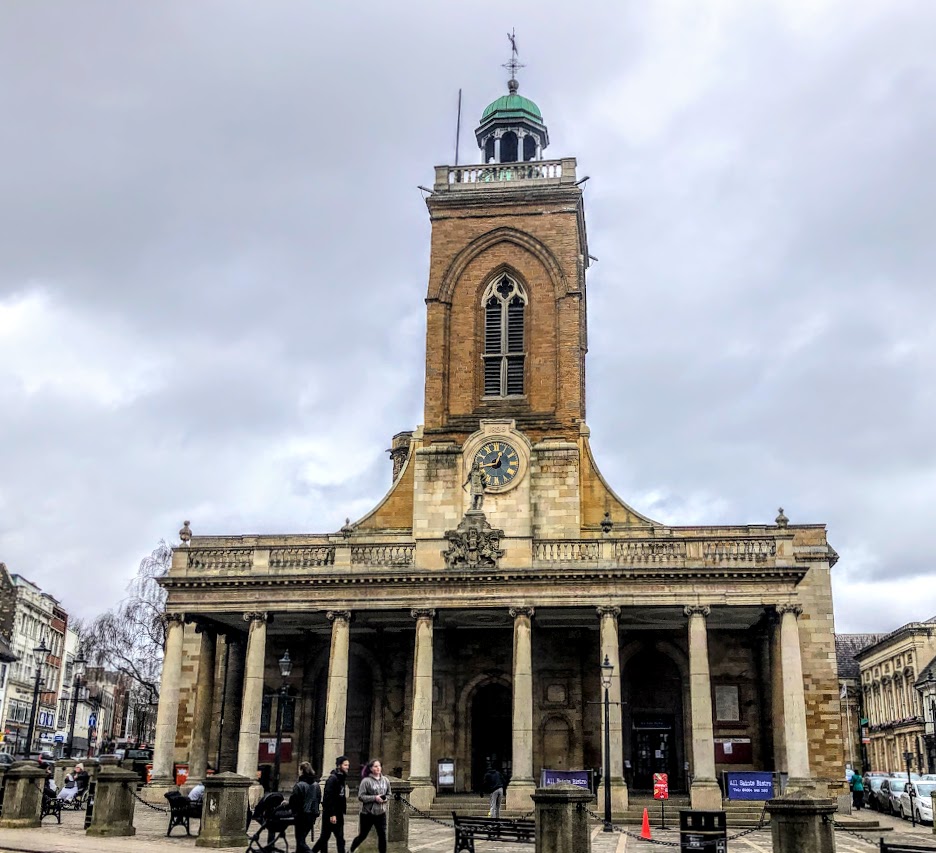
All Saints’ Church is the parish church in the centre of Northampton (Photograph: Patrick Comerford)
ions from the 17th to the 19th century (Photograph: Patrick Comerford, 2024)
The USPG Prayer Diary today (Sunday 2 November 2025, All Saints’ Sunday, All Souls’ Day) invites us to pray:
God of hope, grant that we, with all who have believed in you, may be united in the full knowledge of your love and the unclouded vision of your glory; through Jesus Christ our Lord. Amen (A Prayer Book for Australia, 1995).
The Collect:
Almighty God,
you have knit together your elect
in one communion and fellowship
in the mystical body of your Son Christ our Lord:
grant us grace so to follow your blessed saints
in all virtuous and godly living
that we may come to those inexpressible joys
that you have prepared for those who truly love you;
through Jesus Christ your Son our Lord,
who is alive and reigns with you,
in the unity of the Holy Spirit,
one God, now and for ever.
The Post Communion Prayer:
God, the source of all holiness and giver of all good things:
may we who have shared at this table
as strangers and pilgrims here on earth
be welcomed with all your saints
to the heavenly feast on the day of your kingdom;
through Jesus Christ our Lord.
Additional Collect:
God of holiness,
your glory is proclaimed in every age:
as we rejoice in the faith of your saints,
inspire us to follow their example
with boldness and joy;
through Jesus Christ our Lord.
Yesterday’s Reflections
Continued Tomorrow
Christ the King and the saints on the panels of the altar in All Saints’ Church, Berkhamsted (Photograph: Patrick Comerford)
Scripture quotations are from the New Revised Standard Version Bible: Anglicised Edition copyright © 1989, 1995 National Council of the Churches of Christ in the United States of America. Used by permission. All rights reserved worldwide. http://nrsvbibles.org
All Saints’ Church in Yelvertoft, Northamptonshire, was connected with the Comberford family for about a century … Henry Comberford of Lichfield Cathedral was the rector in 1546-1560 (Photograph: Patrick Comerford)
Patrick Comerford
Today in the Church Calendar is All Souls’ Day (2 November). However, many churches and parishes are celebrating All Saints’ Day today as All Saints’ Sunday, transferring their All Saints celebrations from yesterday (1 November), including, for example, Saint Mary and Saint Giles Church in Stony Stratford, and All Saints’ Church, Margaret Street, London.
With All Saints’ Day, we move on in Ordinary Time in the Church Calendar to the Kingdom Season, the time between All Saints’ Day and Advent. Meanwhile, before today begins, before having breakfast, I am taking some quiet time early this morning to give thanks, and for reflection, prayer and reading in these ways:
1, today’s Gospel reading;
2, a short reflection;
3, a prayer from the USPG prayer diary;
4, the Collects and Post-Communion prayer of the day.
The 190 ft spire of All Saints’ Church, Leighton Buzzard, Bedfordshire, can be seen for miles around (Photograph: Patrick Comerford, 2025)
Luke 6: 20-31 (NRSVA):
20 Then he looked up at his disciples and said:
‘Blessed are you who are poor,
for yours is the kingdom of God.
21 ‘Blessed are you who are hungry now,
for you will be filled.
‘Blessed are you who weep now,
for you will laugh.
22 ‘Blessed are you when people hate you, and when they exclude you, revile you, and defame you on account of the Son of Man. 23 Rejoice on that day and leap for joy, for surely your reward is great in heaven; for that is what their ancestors did to the prophets.
24 ‘But woe to you who are rich,
for you have received your consolation.
25 ‘Woe to you who are full now,
for you will be hungry.
‘Woe to you who are laughing now,
for you will mourn and weep.
26 ‘Woe to you when all speak well of you, for that is what their ancestors did to the false prophets.
27 ‘But I say to you that listen, Love your enemies, do good to those who hate you, 28 bless those who curse you, pray for those who abuse you. 29 If anyone strikes you on the cheek, offer the other also; and from anyone who takes away your coat do not withhold even your shirt. 30 Give to everyone who begs from you; and if anyone takes away your goods, do not ask for them again. 31 Do to others as you would have them do to you.
Christ the Pantocrator surrounded by the saints in the Dome of the Church of Analipsi in Georgioupoli, Crete (Photograph: Patrick Comerford)
Today’s Reflections:
All Saints’ Day is one of the 12 ‘Principal Holy Days’ of the Church. November is a month when we traditionally remember the saints, the Communion of Saints, those who are blessed, those we love and who are now gathered around the throne of God, those who have died and who we still love.
We do that on All Souls’ Day, we do that on Remembrance Day and Remembrance Sunday, and we do that on All Saints; Day, all at the beginning of this month.
In today’s Gospel reading (Luke 6: 20-31), Saint Luke gives us his version of the beatitudes, with a different emphasis that the way Saint Matthew lists them (see Matthew 5: 3-12).
Christ speaks of four blessings or beatitudes and four parallel woes or warnings of the age to come. Some people are ‘blessed’ or ‘happy’ (μακάριος, makários) by being included in the Kingdom, but they are paired with those who are warned of coming woes:
• those who are poor now (verse 20) and those who are rich now (verse 24)
• those who are hungry now (verse 21) and those who are full now (verse 25)
• those who weep now (verse 21) and those who laugh now (verse 25)
• those who are persecuted, or hated, excluded, reviled and defamed (verse 22) and those who are popular (verse 26)
Who are the poor, the hungry, those who weep and those who are persecuted today? And do we see them as saints?
Bishop William Walsham How (1823-1897) wrote his hymn, ‘For all the saints, who from their labours rest’ (459), as a processional hymn for All Saints’ Day.
The saints recalled in his hymn are ordinary people in their weaknesses and their failings. In its original form, it had 11 verses, although three are omitted from most versions – the verses extolling ‘the glorious company of the Apostles,’ ‘the godly fellowship of the prophets’ and ‘the noble army of martyrs’ were inspired by the 1662 Book of Common Prayer version of the canticle Te Deum.
The tune Sine Nomine (‘Without Name,’ referring to the great multitude of unknown saints) was written for the hymn by Ralph Vaughan Williams (1872-1958) while he was editing the English Hymnal (1906) with Canon Percy Dearmer (1867-1936).
When he wrote this hymn, Walsham How was the Rector of Whittington, Shropshire, and a canon St Asaph Cathedral. He had spent time in Rome as chaplain of the Anglican Church there, All Saints’ Church, before returning to England.
While he was Bishop of Bedford, Walsham How became known as ‘the poor man’s bishop.’ He became the first Bishop of Wakefield, and died in Leenane, Co Mayo, in 1897 while he was on an Irish fishing holiday in Dulough.
The hymn vibrates with images from the Book of Revelation. The saints recalled by ‘the poor man’s bishop’ in this hymn are ordinary people who, in spite of their weaknesses and their failings, are able to respond in faith to Christ’s call to service and love, and who have endured the battle against the powers of evil and darkness.
The heart of the hymn is in the stanza that sings about the unity of the Church in heaven and on earth, ‘knit together in one communion and fellowship, in the mystical body of … Christ our Lord.’ Despite our ‘feeble struggles’ we are united in Christ and with one another in one ‘blest communion’ and ‘fellowship divine.’
It is a hymn that celebrates that there among the saints are the ordinary people, the people who are blessed and happy in Saint Luke’s version of the Beatitudes this morning.
All Saints’ Church, Rome … the Anglican church where the hymn writer Bishop William Walsham How was chaplain (Photograph: Patrick Comerford)
Today’s Prayers (Sunday 2 November 2025, All Saints’ Sunday):
The theme this week (2 to 8 November) in Pray with the World Church, the prayer diary of the Anglican mission agency USPG (United Society Partners in the Gospel), is ‘From Solitude to Connection’ (pp 52-53). This theme is introduced today with a Programme Update from Ljudmila, a Ukrainian Refugee living in Budapest, Hungary:
Next Step Hungary is a refugee-led NGO providing practical, costeffective interventions to support integration in Hungary. It is a partner organisation with Saint Margaret’s, Budapest, who reached out as part of USPG and the Diocese in Europe's joint appeal for Ukraine. Next Step is a lifeline for many like Ljudmila.
‘As a Ukrainian living in Budapest, my life was taken up by responsibilities – caring for my 12-year-old son, my parents, and even my cat – while balancing a demanding career as an architect. Despite my lifelong passion for art and design, the past few years had drained me emotionally and psychologically. Loneliness weighed heavily, and time for creativity felt like a luxury I couldn’t afford.
Then, at the end of summer, I signed up for a beading workshop run by Next Step. I was uncertain of what to expect, but from the very first session it turned out to be more than just a craft class. It was a welcoming community, a vibrant space for women filled with laughter, support, and shared creativity. Under the guidance of a fantastic teacher, I completed my first beaded ring and saw endless possibilities for new projects.
Each class became a highlight of my week, a space where I could reconnect with myself and others. This workshop didn’t just teach me a new skill – it rekindled my joy, creativity, and sense of belonging. For that, I am deeply grateful to Next Step.’
All Saints’ Church is the parish church in the centre of Northampton (Photograph: Patrick Comerford)
ions from the 17th to the 19th century (Photograph: Patrick Comerford, 2024)
The USPG Prayer Diary today (Sunday 2 November 2025, All Saints’ Sunday, All Souls’ Day) invites us to pray:
God of hope, grant that we, with all who have believed in you, may be united in the full knowledge of your love and the unclouded vision of your glory; through Jesus Christ our Lord. Amen (A Prayer Book for Australia, 1995).
The Collect:
Almighty God,
you have knit together your elect
in one communion and fellowship
in the mystical body of your Son Christ our Lord:
grant us grace so to follow your blessed saints
in all virtuous and godly living
that we may come to those inexpressible joys
that you have prepared for those who truly love you;
through Jesus Christ your Son our Lord,
who is alive and reigns with you,
in the unity of the Holy Spirit,
one God, now and for ever.
The Post Communion Prayer:
God, the source of all holiness and giver of all good things:
may we who have shared at this table
as strangers and pilgrims here on earth
be welcomed with all your saints
to the heavenly feast on the day of your kingdom;
through Jesus Christ our Lord.
Additional Collect:
God of holiness,
your glory is proclaimed in every age:
as we rejoice in the faith of your saints,
inspire us to follow their example
with boldness and joy;
through Jesus Christ our Lord.
Yesterday’s Reflections
Continued Tomorrow
Christ the King and the saints on the panels of the altar in All Saints’ Church, Berkhamsted (Photograph: Patrick Comerford)
Scripture quotations are from the New Revised Standard Version Bible: Anglicised Edition copyright © 1989, 1995 National Council of the Churches of Christ in the United States of America. Used by permission. All rights reserved worldwide. http://nrsvbibles.org
All Saints’ Church in Yelvertoft, Northamptonshire, was connected with the Comberford family for about a century … Henry Comberford of Lichfield Cathedral was the rector in 1546-1560 (Photograph: Patrick Comerford)
Labels:
All Saints,
All Souls,
Berkhamsted,
Budapest,
Crete 2025,
Georgioupoli,
Greece 2025,
Hymns,
Kingdom Season,
Leighton Buzzard,
Mission,
Northampton,
Prayer,
refugees,
Rome,
Saint Luke's Gospel,
Ukraine,
USPG,
Westminster,
Yelvertoft
10 September 2024
Visiting cathedrals,
churches and places of
worship in Northampton
and Northamptonshire
All Saints’ Church is the parish church in the centre of Northampton (Photograph: Patrick Comerford)
Patrick Comerford
Living in Stony Stratford means I am living on the borders of Buckinghamshire and Northamptonshire. The bridge over the River Ouse linking Stony Stratford and Old Stratford marks the boundary between the two counties, crossing from the Home Counties into the Shires.
Northampton is only a few minutes by train from Wolverton. This means that over the past two or three years here, I have enjoyed numerous visits to Northampton and used it as a starting base for walks in the countryside, exploring the villages and small towns, and ‘church crawling.’
In the past, I have compiled guides to the cathedrals, churches, chapels and places of worship I have visited and blogged about in the Milton Keynes area and Buckinghamshire, in Oxford, in Limerick, in London, and in other places, and to the synagogues I have visited around the world.
So, I thought it would be helpful this evening to offer a guide to the cathedrals, churches, chapels and places of worship I have visited and blogged about in Northampton and Northamptonshire.
As with other similar guides, I intend to up-date this index as my ‘church crawling’ and other visits continue in Northampton and Northamptonshire.
The Cathedral of Our Lady Immaculate and Saint Thomas of Canterbury on Barrack Road, Northampton (Photograph: Patrick Comerford)
Cathedrals:
1, The Cathedral of Our Lady Immaculate and Saint Thomas of Canterbury (Roman Catholic), Barrack Road, Northampton (5 February 2023)
Church of England:
Northampton:
2, All Saints’ Church, Northampton (6 February 2023)
3, Church of the Holy Sepulchre, Sheep Street (7 February 2023)
4, Saint James’s Church, Saint James’s Road (8 February 2023)
5, Saint John’s Church (former), Bridge Street (9 February 2023)
6, Saint Peter’s Church, Marefair (9 February 2023)
All Saints’ Church in Yelvertoft … Henry Comberford was the rector in 1546-1560 (Photograph: Patrick Comerford)
Northamptonshire:
7, Badby: Saint Mary’s Church (20 September 2023)
8, Blisworth: Saint John the Baptist (7 September 2024)
9, Crick: Saint Margaret of Antioch Church, Church Street (23 March 2023)
10, Lamport: All Saints’ Church (6 May 2024)
11, Lamport: Isham family chapel (6 May 2024), and the Lamport Crucifix (4 May 2024)
12, Long Buckby: Saint Lawrence’s Church (4 April 2023)
13, Passenham: Saint Guthlac’s Church (21 April 2022)
14, Roade: Saint Mary’s Church, Church End (9 September 2024)
15, Shutlanger: The Monastery, the former Parles and Comberford family chapel (4 September 2024)
16, Shutlanger: Saint Anne’s Chapel-of-Ease (4 September 2024)
17, Stoke Bruerne: Saint Mary the Virgin (3 September 2024)
18, Watford: Saint Peter and Saint Paul Church (11 March 2023)
19, Yelvertoft: All Saints’ Church (20 March 2023)
The Quaker Meeting House at the north end of Wellington Street in Northampton (Photograph: Patrick Comerford)
Baptists:
20, Long Buckby: Long Buckby Baptist Chapel (4 April 2023)
21, Roade: Roade Baptist Chapel (9 September 2024)
Methodists:
22, Roade: Roade Methodist Church (9 September 2024)
23, Shutlanger: (former) Wesleyan Methodist Chapel (8 September 2024)
24, Stoke Bruerne: the Old Chapel, (former) Wesleyan Methodist Chapel (8 September 2024)
Pentecostalist:
25, Northampton: Christ Image Assembly, Wellington Street (11 February 2023)
Society of Friends (Quakers):
26, Northampton: Friends’ Meeting House, Wellington Street (11 February 2023)
United Reformed Church:
27, Long Buckby: Long Buckby United Reformed Church (4 April 2024)
Synagogues:
28, Northampton: Northampton Hebrew Congregation, Overstone Road (10 February 2023)
29, Northampton: the Mediaeval Synagogue, Sheep Street (3 February 2023)
The synagogue on Overstone Road, Northampton, was built in 1965-1966 (Photograph: Patrick Comerford)
Patrick Comerford
Living in Stony Stratford means I am living on the borders of Buckinghamshire and Northamptonshire. The bridge over the River Ouse linking Stony Stratford and Old Stratford marks the boundary between the two counties, crossing from the Home Counties into the Shires.
Northampton is only a few minutes by train from Wolverton. This means that over the past two or three years here, I have enjoyed numerous visits to Northampton and used it as a starting base for walks in the countryside, exploring the villages and small towns, and ‘church crawling.’
In the past, I have compiled guides to the cathedrals, churches, chapels and places of worship I have visited and blogged about in the Milton Keynes area and Buckinghamshire, in Oxford, in Limerick, in London, and in other places, and to the synagogues I have visited around the world.
So, I thought it would be helpful this evening to offer a guide to the cathedrals, churches, chapels and places of worship I have visited and blogged about in Northampton and Northamptonshire.
As with other similar guides, I intend to up-date this index as my ‘church crawling’ and other visits continue in Northampton and Northamptonshire.
The Cathedral of Our Lady Immaculate and Saint Thomas of Canterbury on Barrack Road, Northampton (Photograph: Patrick Comerford)
Cathedrals:
1, The Cathedral of Our Lady Immaculate and Saint Thomas of Canterbury (Roman Catholic), Barrack Road, Northampton (5 February 2023)
Church of England:
Northampton:
2, All Saints’ Church, Northampton (6 February 2023)
3, Church of the Holy Sepulchre, Sheep Street (7 February 2023)
4, Saint James’s Church, Saint James’s Road (8 February 2023)
5, Saint John’s Church (former), Bridge Street (9 February 2023)
6, Saint Peter’s Church, Marefair (9 February 2023)
All Saints’ Church in Yelvertoft … Henry Comberford was the rector in 1546-1560 (Photograph: Patrick Comerford)
Northamptonshire:
7, Badby: Saint Mary’s Church (20 September 2023)
8, Blisworth: Saint John the Baptist (7 September 2024)
9, Crick: Saint Margaret of Antioch Church, Church Street (23 March 2023)
10, Lamport: All Saints’ Church (6 May 2024)
11, Lamport: Isham family chapel (6 May 2024), and the Lamport Crucifix (4 May 2024)
12, Long Buckby: Saint Lawrence’s Church (4 April 2023)
13, Passenham: Saint Guthlac’s Church (21 April 2022)
14, Roade: Saint Mary’s Church, Church End (9 September 2024)
15, Shutlanger: The Monastery, the former Parles and Comberford family chapel (4 September 2024)
16, Shutlanger: Saint Anne’s Chapel-of-Ease (4 September 2024)
17, Stoke Bruerne: Saint Mary the Virgin (3 September 2024)
18, Watford: Saint Peter and Saint Paul Church (11 March 2023)
19, Yelvertoft: All Saints’ Church (20 March 2023)
The Quaker Meeting House at the north end of Wellington Street in Northampton (Photograph: Patrick Comerford)
Baptists:
20, Long Buckby: Long Buckby Baptist Chapel (4 April 2023)
21, Roade: Roade Baptist Chapel (9 September 2024)
Methodists:
22, Roade: Roade Methodist Church (9 September 2024)
23, Shutlanger: (former) Wesleyan Methodist Chapel (8 September 2024)
24, Stoke Bruerne: the Old Chapel, (former) Wesleyan Methodist Chapel (8 September 2024)
Pentecostalist:
25, Northampton: Christ Image Assembly, Wellington Street (11 February 2023)
Society of Friends (Quakers):
26, Northampton: Friends’ Meeting House, Wellington Street (11 February 2023)
United Reformed Church:
27, Long Buckby: Long Buckby United Reformed Church (4 April 2024)
Synagogues:
28, Northampton: Northampton Hebrew Congregation, Overstone Road (10 February 2023)
29, Northampton: the Mediaeval Synagogue, Sheep Street (3 February 2023)
The synagogue on Overstone Road, Northampton, was built in 1965-1966 (Photograph: Patrick Comerford)
09 September 2024
The village of Roade
near Northampton
retains much of its
mediaeval charm
Saint Mary’s Church in Roade, Northamptonshire, dates from the 12th and 13th centuries (Photograph: Patrick Comerford, 2024)
Patrick Comerford
My walk through the villages and countryside in Northamptonshire brought me from Blisworth through Shutlanger, into Stoke Park, by the canal in Stoke Bruerne, and eventually to Roade, where I caught a bus back to Northampton.
Roade is 8 km (5 miles) south of Northampton and 15 km (10 miles) north of Stony Stratford has between 2,300 and 3,500 residents. The village straddles the Northampton to Milton Keynes A508, which divides Roade into the east, older part, and the west part, which is mostly 20th-century housing.
Although Roade railway station closed in 1964, four tracks of the West Coast Main Line from London Euston to Manchester and Scotland run through the village in a deep cutting. However, there are two main road bridges and four others for pedestrians, some for local and farm traffic.
The Retreat on High Street is a thatched cottage in Roade dating from the late 17th and early 18th centuries (Photograph: Patrick Comerford, 2024)
The place name Roade (formerly ‘Rode’) is thought to derive from the Old English word ‘rod’ describing ‘a clearing in a forest’. This suggests a Saxon settlement within a wooded area.
Some prehistoric and Roman artefacts have been found in the parish and aerial photographs indicate crop marks of a number of enclosures. The evidence suggests that there were people living in the Roade area from prehistoric times and through the Roman period.
Three entries in the Domesday Book refer to places in the present parish. Roade was not in the hands of one person or family, and Roade has always been an ‘open village’.
The mediaeval parish of Roade included Ashton and Hartwell, with the principal church in Roade and chapels at Hartwell and Ashton. This continued until the early 16th century when the Lord of Ashton tried to reverse the status of the Roade and Ashton churches, so that Ashton had a rector and Roade had a perpetual curate like Hartwell.
Saint Mary’s Church is the oldest building in Roade (Photograph: Patrick Comerford, 2024)
Saint Mary’s Church, the oldest building in Roade, and dates from the 12th and 13th centuries. A church was established around 1100 by the Hartwell family of Hartwell and the Lupus family of Ashton. By 1167, Simon Hartwell had given his portion to the Augustinian canons of Saint James Abbey, Northampton, as a chantry for the souls of his father, Geoffrey, and his brothers William and Henry.
Saint James Abbey was founded by William Peverel ca 1104 and acquired other lands in the area. A dispute over the tithes in Roade between the abbey and Sir John Hardreshall, the Lupus heir, continued from 1342 until 1346, when it was resolved in favour of the abbey.
Saint Mary’s has a chancel with a south vestry, a central tower and a nave with a 19th century north aisle and no clerestory and a south doorway under a porch. The original aisleless nave and chancel are mid-12th century work, with small round-headed lancets in the chancel and the south nave doorway showing beakhead decoration.
The tower is a substantial structure of stone rubble and may have been remodelled ca 1200, while the bell-openings in the upper storey may date from the 15th century.
Saint Mary’s Church was restored in the 1850s by the Northampton architect Edmund Francis Law (Photograph: Patrick Comerford, 2024)
The nave roof collapsed in 1660. It was re-roofed in 1669 and new windows were put in the south wall. At the same time, one of the tower arches was bricked up, and only a small door provided to give access between the nave and the chancel. The chancel was still walled off from the nave in 1822, and was used as a Sunday school. The partition was eventually taken down in 1840.
The nave was repaired in 1822, when the floor level was raised and a gallery was added at the west end. The north aisle was added in 1850, by the Northampton architect Edmund Francis Law (1810-1882), who was involved at the same time in the restoration of the Church of Saint John the Baptist in Blisworth.
The tower was restored in 1856, and Law restored the chancel in 1857 and the nave in 1864, when the church was re-roofed and the nave roof was raised to match the chancel roof. The south vestry and organ chamber were added in 1879.
Sir Cyril Cripps, a local industrialist and philanthropist funded a major restoration of the tower in 1949-1950, and the church interior in 1950. The north nave doorway now links with the church hall, added in 1972 to replace the old church institute (1886) which had fallen into disrepair. A further restoration of the exterior took place in 1981.
The village grew up south of the church … Brown’s Lodge on Church End, a former farmhouse dating from the 18th century (Photograph: Patrick Comerford, 2024)
The village grew up south of the church, surrounded by open fields. In 1301, 21 households were assessed for tax or lay subsidy. The oldest secular building in the village is a hall house dating from the 14th century and now known as Hyde Farm House. The Hyde estate had its own fishponds, dovecote, water mill and open field system and belonged to Saint James’s Abbey until the Reformation. It was surrendered to the Crown in 1538.
The principal landowning families in Road until the 16th century included the Mauntell, Boteler and Knightley families and the the Woodvilles of Grafton.
Robert Mauntell was described as Lord of Roade in 1316, although he did not hold all the land there. The Mauntell family continued to hold land in Roade until 1541, when John Mauntell was executed for murder and his estates were seized by the Crown.
The Boteler family of Hartwell held some land in Roade in the early 15th century. This later passed to the Knightley family of Fawsley. Their lands in 1533 included the ‘manor’ of Roade, which was conveyed to the Crown in 1542.
The Woodvilles of Grafton also had land in Roade which passed to the Crown in 1527. Elizabeth Woodville married Edward IV. Their daughter married Henry VII and was the mother of Henry VIII, who conferred the title of Regis on Grafton Regis.
The former estates of the Mauntell, Knightley and Woodville families in Roade and Ashton formed part of the newly created Honor of Grafton in 1542. This was a large royal estate centred on the former Woodville manors of Grafton and Hartwell, and it included land in several other local parishes.
No 28 High Street was formerly two thatched cottages dating from the late 17th and early 18th century … the row of cottages once extended to the corner of High Street and Church End (Photograph: Patrick Comerford, 2024)
After the Reformation, the land in Roade that once belonged to Saint James’s Abbey remained in Crown hands until 1550, when what was described as the Manor of Hyde was granted to Richard Fermor of Easton Neston. During the reign of James I, Sir Hatton Fermor sold the manor of Hyde to Stephen Hoe, whose descendants retained much of the estate until the 19th century.
The Grafton estates in Roade and Ashton were placed in trust in 1673 for Henry FitzRoy (1663-1690), 1st Duke of Grafton, an illegitimate son of Charles II and Barbara Villiers. His son, Charles FitzRoy (1683-1757), 2nd Duke of Grafton, claimed the lordship of Roade from at least 1713, although he owned less than half the land in the parish.
The people of Roade were obliged to attend his manorial court, whether they were his tenants or not, and a single court was held for the manors of Grafton, Roade and Hartwell in the early 18th century.
The open fields around Roade and Ashton were inclosed between 1816 and 1819. At that time the Grafton Estate owned about a third of the farmland. After the open fields were inclosed, the landscape around Roade was transformed, but the village itself did not change much until the arrival of the railway.
Roade Primary School on Hartwell Road was first built as Roade Board School in 1876 (Photograph: Patrick Comerford, 2024)
The Roade Cutting was a major engineering feat, designed and supervised by Robert Stephenson, and it was officially opened on 17 September 1838. The railway brought more jobs, houses and pubs and had a profound effect on the social and economic growth of Roade.
Roade Baptist Church is said to have been formed in 1688 by John Gibbs of Newport Pagnell, who also founded the church in Olney. Joseph Palmer was the Baptist minister in Roade in 1715, with a congregation of 200. A Baptist chapel was built in the High Street in 1736-1737, with a manse next door.
The Baptist Church closed in the 1980s when the building was declared unsafe, although services continued in private houses until the lay pastor Ray Lineham died in 1993. The former chapel was sold and became a guest house and then a private house known as the Chapter House.
Methodism came to Roade with a group of men from Bletchley who came to work on the railway cutting. At first they attended the Baptist Chapel but their enthusiastic acclamations during sermons were frowned on and they moved to a room built by railway contractor Richard Dunkley and registered in 1834.
Roade Methodist Church on Hartwell Road was built in 1908 (Photograph: Patrick Comerford, 2024)
The Methodists moved to a cottage near the Green in 1835. They bought an old malting house on the Ashton Road in 1852, and when that became too small they built a new chapel on Hartwell Road that opened in 1875. The building became a school hall in 1908 when the present church was built next door. The original building is now the church hall.
Saint Lawrence’s Roman Catholic chapel opened in Croft Lane on 1962 and served people in Roade and other local villages. It closed a few months after a new Catholic church opened in East Hunsbury in November 1989 and the former chapel later became a private house.
Roade Primary School on Hartwell Road was first built as Roade Board School in 1876. The local secondary school, Elizabeth Woodville School, is named after Elizabeth Woodville who was born nearby in Grafton Regis; she was the Queen Consort of King Edward IV and grandmother of Henry VIII. The school opened as Roade secondary modern school in 1956, became comprehensive in 1975 and is now Elizabeth Woodville School (North Campus) linked with a South Campus at Deanshanger.
Herbert House Seminary for Young Ladies was run by Anne Lalor and Mary Wilson, who also taught lacemaking. Their school closed in 1879 and was succeeded by Warwick House School for Girls, a boarding school on the corner of Church End and High Street run by the sisters Louisa and Emma Lea. Warwick House was named after the family who once owned Hyde Farm. The school closed around 1914.
Warwick House was named after the family who once owned Hyde Farm (Photograph: Patrick Comerford, 2024)
A polish factory opened in Roade in 1909. It later became the Simplex Polish Co Ltd, but failed after about 10 years. Sir Cyril Cripps set up Pianoforte Supplies in London in 1919, making components for pianos, and moved the business to Roade In 1923, taking over the former Simplex factory. During World II the factory made munitions and parts for aircraft and army vehicles, and after the war made components for the car industry.
Cripps was a district councillor with an interest in housing, and he was a generous supporter of Saint Mary’s Church, local schools, hospitals clubs and sports. The village grew along with the factory, and the workforce reached a peak of around 1,800 in the 1960s. But the PSL factory gradually declined and finally closed in 2010.
Other political figures associated with Roade include Glenys Kinnock (1944-2023) – the Labour Party politician and wife of the former Labour leader Neil Kinnock – who was born in Roade.
Church End leads from Saint Saint Mary’s Church to the High Street (Photograph: Patrick Comerford, 2024)
The Revd Mark Donnelly is the Vicar the Salcey Benefice or group of churches that includes Saint Mary’s, Roade, Saint Michael and All Angels, Ashton, Saint Peter and Saint Paul, Courteenhall, and Saint John the Baptist, Hartwell.
Holy Communion is celebrated in Saint Mary’s Church, Roade, every second Sunday at 9 am and at 10:30 am, with Morning Worship every first, third and fourth Sunday at 10:30 am. Café Church every third Sunday at 4 pm is an informal time of worship in the Church Hall adjoining the church at 4 pm.
The Cock Inn, the village pub, is at the junction of High Street and Hartwell Road (Photograph: Patrick Comerford, 2024)
Patrick Comerford
My walk through the villages and countryside in Northamptonshire brought me from Blisworth through Shutlanger, into Stoke Park, by the canal in Stoke Bruerne, and eventually to Roade, where I caught a bus back to Northampton.
Roade is 8 km (5 miles) south of Northampton and 15 km (10 miles) north of Stony Stratford has between 2,300 and 3,500 residents. The village straddles the Northampton to Milton Keynes A508, which divides Roade into the east, older part, and the west part, which is mostly 20th-century housing.
Although Roade railway station closed in 1964, four tracks of the West Coast Main Line from London Euston to Manchester and Scotland run through the village in a deep cutting. However, there are two main road bridges and four others for pedestrians, some for local and farm traffic.
The Retreat on High Street is a thatched cottage in Roade dating from the late 17th and early 18th centuries (Photograph: Patrick Comerford, 2024)
The place name Roade (formerly ‘Rode’) is thought to derive from the Old English word ‘rod’ describing ‘a clearing in a forest’. This suggests a Saxon settlement within a wooded area.
Some prehistoric and Roman artefacts have been found in the parish and aerial photographs indicate crop marks of a number of enclosures. The evidence suggests that there were people living in the Roade area from prehistoric times and through the Roman period.
Three entries in the Domesday Book refer to places in the present parish. Roade was not in the hands of one person or family, and Roade has always been an ‘open village’.
The mediaeval parish of Roade included Ashton and Hartwell, with the principal church in Roade and chapels at Hartwell and Ashton. This continued until the early 16th century when the Lord of Ashton tried to reverse the status of the Roade and Ashton churches, so that Ashton had a rector and Roade had a perpetual curate like Hartwell.
Saint Mary’s Church is the oldest building in Roade (Photograph: Patrick Comerford, 2024)
Saint Mary’s Church, the oldest building in Roade, and dates from the 12th and 13th centuries. A church was established around 1100 by the Hartwell family of Hartwell and the Lupus family of Ashton. By 1167, Simon Hartwell had given his portion to the Augustinian canons of Saint James Abbey, Northampton, as a chantry for the souls of his father, Geoffrey, and his brothers William and Henry.
Saint James Abbey was founded by William Peverel ca 1104 and acquired other lands in the area. A dispute over the tithes in Roade between the abbey and Sir John Hardreshall, the Lupus heir, continued from 1342 until 1346, when it was resolved in favour of the abbey.
Saint Mary’s has a chancel with a south vestry, a central tower and a nave with a 19th century north aisle and no clerestory and a south doorway under a porch. The original aisleless nave and chancel are mid-12th century work, with small round-headed lancets in the chancel and the south nave doorway showing beakhead decoration.
The tower is a substantial structure of stone rubble and may have been remodelled ca 1200, while the bell-openings in the upper storey may date from the 15th century.
Saint Mary’s Church was restored in the 1850s by the Northampton architect Edmund Francis Law (Photograph: Patrick Comerford, 2024)
The nave roof collapsed in 1660. It was re-roofed in 1669 and new windows were put in the south wall. At the same time, one of the tower arches was bricked up, and only a small door provided to give access between the nave and the chancel. The chancel was still walled off from the nave in 1822, and was used as a Sunday school. The partition was eventually taken down in 1840.
The nave was repaired in 1822, when the floor level was raised and a gallery was added at the west end. The north aisle was added in 1850, by the Northampton architect Edmund Francis Law (1810-1882), who was involved at the same time in the restoration of the Church of Saint John the Baptist in Blisworth.
The tower was restored in 1856, and Law restored the chancel in 1857 and the nave in 1864, when the church was re-roofed and the nave roof was raised to match the chancel roof. The south vestry and organ chamber were added in 1879.
Sir Cyril Cripps, a local industrialist and philanthropist funded a major restoration of the tower in 1949-1950, and the church interior in 1950. The north nave doorway now links with the church hall, added in 1972 to replace the old church institute (1886) which had fallen into disrepair. A further restoration of the exterior took place in 1981.
The village grew up south of the church … Brown’s Lodge on Church End, a former farmhouse dating from the 18th century (Photograph: Patrick Comerford, 2024)
The village grew up south of the church, surrounded by open fields. In 1301, 21 households were assessed for tax or lay subsidy. The oldest secular building in the village is a hall house dating from the 14th century and now known as Hyde Farm House. The Hyde estate had its own fishponds, dovecote, water mill and open field system and belonged to Saint James’s Abbey until the Reformation. It was surrendered to the Crown in 1538.
The principal landowning families in Road until the 16th century included the Mauntell, Boteler and Knightley families and the the Woodvilles of Grafton.
Robert Mauntell was described as Lord of Roade in 1316, although he did not hold all the land there. The Mauntell family continued to hold land in Roade until 1541, when John Mauntell was executed for murder and his estates were seized by the Crown.
The Boteler family of Hartwell held some land in Roade in the early 15th century. This later passed to the Knightley family of Fawsley. Their lands in 1533 included the ‘manor’ of Roade, which was conveyed to the Crown in 1542.
The Woodvilles of Grafton also had land in Roade which passed to the Crown in 1527. Elizabeth Woodville married Edward IV. Their daughter married Henry VII and was the mother of Henry VIII, who conferred the title of Regis on Grafton Regis.
The former estates of the Mauntell, Knightley and Woodville families in Roade and Ashton formed part of the newly created Honor of Grafton in 1542. This was a large royal estate centred on the former Woodville manors of Grafton and Hartwell, and it included land in several other local parishes.
No 28 High Street was formerly two thatched cottages dating from the late 17th and early 18th century … the row of cottages once extended to the corner of High Street and Church End (Photograph: Patrick Comerford, 2024)
After the Reformation, the land in Roade that once belonged to Saint James’s Abbey remained in Crown hands until 1550, when what was described as the Manor of Hyde was granted to Richard Fermor of Easton Neston. During the reign of James I, Sir Hatton Fermor sold the manor of Hyde to Stephen Hoe, whose descendants retained much of the estate until the 19th century.
The Grafton estates in Roade and Ashton were placed in trust in 1673 for Henry FitzRoy (1663-1690), 1st Duke of Grafton, an illegitimate son of Charles II and Barbara Villiers. His son, Charles FitzRoy (1683-1757), 2nd Duke of Grafton, claimed the lordship of Roade from at least 1713, although he owned less than half the land in the parish.
The people of Roade were obliged to attend his manorial court, whether they were his tenants or not, and a single court was held for the manors of Grafton, Roade and Hartwell in the early 18th century.
The open fields around Roade and Ashton were inclosed between 1816 and 1819. At that time the Grafton Estate owned about a third of the farmland. After the open fields were inclosed, the landscape around Roade was transformed, but the village itself did not change much until the arrival of the railway.
Roade Primary School on Hartwell Road was first built as Roade Board School in 1876 (Photograph: Patrick Comerford, 2024)
The Roade Cutting was a major engineering feat, designed and supervised by Robert Stephenson, and it was officially opened on 17 September 1838. The railway brought more jobs, houses and pubs and had a profound effect on the social and economic growth of Roade.
Roade Baptist Church is said to have been formed in 1688 by John Gibbs of Newport Pagnell, who also founded the church in Olney. Joseph Palmer was the Baptist minister in Roade in 1715, with a congregation of 200. A Baptist chapel was built in the High Street in 1736-1737, with a manse next door.
The Baptist Church closed in the 1980s when the building was declared unsafe, although services continued in private houses until the lay pastor Ray Lineham died in 1993. The former chapel was sold and became a guest house and then a private house known as the Chapter House.
Methodism came to Roade with a group of men from Bletchley who came to work on the railway cutting. At first they attended the Baptist Chapel but their enthusiastic acclamations during sermons were frowned on and they moved to a room built by railway contractor Richard Dunkley and registered in 1834.
Roade Methodist Church on Hartwell Road was built in 1908 (Photograph: Patrick Comerford, 2024)
The Methodists moved to a cottage near the Green in 1835. They bought an old malting house on the Ashton Road in 1852, and when that became too small they built a new chapel on Hartwell Road that opened in 1875. The building became a school hall in 1908 when the present church was built next door. The original building is now the church hall.
Saint Lawrence’s Roman Catholic chapel opened in Croft Lane on 1962 and served people in Roade and other local villages. It closed a few months after a new Catholic church opened in East Hunsbury in November 1989 and the former chapel later became a private house.
Roade Primary School on Hartwell Road was first built as Roade Board School in 1876. The local secondary school, Elizabeth Woodville School, is named after Elizabeth Woodville who was born nearby in Grafton Regis; she was the Queen Consort of King Edward IV and grandmother of Henry VIII. The school opened as Roade secondary modern school in 1956, became comprehensive in 1975 and is now Elizabeth Woodville School (North Campus) linked with a South Campus at Deanshanger.
Herbert House Seminary for Young Ladies was run by Anne Lalor and Mary Wilson, who also taught lacemaking. Their school closed in 1879 and was succeeded by Warwick House School for Girls, a boarding school on the corner of Church End and High Street run by the sisters Louisa and Emma Lea. Warwick House was named after the family who once owned Hyde Farm. The school closed around 1914.
Warwick House was named after the family who once owned Hyde Farm (Photograph: Patrick Comerford, 2024)
A polish factory opened in Roade in 1909. It later became the Simplex Polish Co Ltd, but failed after about 10 years. Sir Cyril Cripps set up Pianoforte Supplies in London in 1919, making components for pianos, and moved the business to Roade In 1923, taking over the former Simplex factory. During World II the factory made munitions and parts for aircraft and army vehicles, and after the war made components for the car industry.
Cripps was a district councillor with an interest in housing, and he was a generous supporter of Saint Mary’s Church, local schools, hospitals clubs and sports. The village grew along with the factory, and the workforce reached a peak of around 1,800 in the 1960s. But the PSL factory gradually declined and finally closed in 2010.
Other political figures associated with Roade include Glenys Kinnock (1944-2023) – the Labour Party politician and wife of the former Labour leader Neil Kinnock – who was born in Roade.
Church End leads from Saint Saint Mary’s Church to the High Street (Photograph: Patrick Comerford, 2024)
The Revd Mark Donnelly is the Vicar the Salcey Benefice or group of churches that includes Saint Mary’s, Roade, Saint Michael and All Angels, Ashton, Saint Peter and Saint Paul, Courteenhall, and Saint John the Baptist, Hartwell.
Holy Communion is celebrated in Saint Mary’s Church, Roade, every second Sunday at 9 am and at 10:30 am, with Morning Worship every first, third and fourth Sunday at 10:30 am. Café Church every third Sunday at 4 pm is an informal time of worship in the Church Hall adjoining the church at 4 pm.
The Cock Inn, the village pub, is at the junction of High Street and Hartwell Road (Photograph: Patrick Comerford, 2024)
07 September 2024
Saint John the Baptist
Church in Blisworth and
the absentee rector who
fled his debtors to Paris
The Church of Saint John the Baptist in Blisworth was built in the late 13th century but dates mainly from the 14th and 15th centuries (Photograph: Patrick Comerford, 2024)
Patrick Comerford
During my stroll through the Northamptonshire countryside earlier this week, I visited a number of pretty villages and small towns, including Blisworth, Shutlanger, Stoke Bruerne and Roade.
My journey began by taking the bus from Northampton to Blisworth, a picturesque village on the Grand Union Canal, about half-way between Northampton (8 km, 5 miles) and Stony Stratford (11 km, 7 miles).
Blisworth is known for the Blisworth Tunnel, one of the longest tunnels on the English canal system, for the annual Canal Festival every August, and for the Blisworth Arch, a railway bridge built by Robert Stephenson in 1837-1838 for the London and Birmingham Railway.
Blisworth has many traditional local stone cottages, often thatched and some dating back to the 18th or even the 17th century (Photograph: Patrick Comerford, 2024)
Blisworth has a population of 1,800 to 2,000 people, with a few small businesses. There are many traditional local stone cottages, often thatched and some dating back to the 18th or even the 17th century.
The Walnut Tree Inn was once the Blisworth Station Hotel. The Royal Oak is the village pub; a second pub, the Sun, Moon and Stars, closed over 50 years ago, and a third pub, the Grafton Arms, is now a private house. The only shop is a small supermarket, post office and newsagent.
Iron ore and limestone were quarried at Blisworth in the 19th and 20th centuries. The iron ore was sent by canal or railway to ironworks in Staffordshire. The limestone quarry near Rectory Farm is now a nature reserve.
Inside the Church of Saint John the Baptist, facing east (Photograph: Patrick Comerford, 2024)
The main building of note in Blisworth is, of course, the parish church, the Church of Saint John the Baptist. It was built in the late 13th century but dates mainly from the 14th and 15th centuries, although there may have been an earlier church on the site.
The 13th century church consisted of the chancel, with the nave extending to only three bays, with both north and south aisles. Between 1320 and 1340, the nave was extended to the present length of 61 ft 6 in. The north aisle was also extended, but the three bays of the south side remained as original.
Both the north and south doorways date from the 13th century with characteristic edge rolls. The tower followed later in the 14th century. The chapel at the east end of the south aisle dates from the 14th century, and now contains the table tomb of Roger Wake and his wife Elisabeth Catesby.
There may have been a mediaeval stone sedilia in the south wall of the chancel, but this has not survived.
The chancel, high altar and east window in the Church of Saint John the Baptist (Photograph: Patrick Comerford, 2024)
The five-light East Window with unusual tracery may have been added in the 14th century when the east and north walls of the chancel were rebuilt or refaced. Three large windows were inserted in the chancel in the 15th century, but two of the small original 13th century windows in the south side were left untouched.
There are two large windows In the north wall of the chancel, one with some panels of mediaeval stained glass that have survived since the Reformation.
The first stained-glass window in the chancel dates from 1872, and is a memorial to the late squire and his wife, George and Mary Stone. The East Window contains a memorial to Revd William Barry and his wife Frances and may date from 1885.
The large window on the south wall is a memorial stained glass in memory of a son of the rector, who died at the age of nine.
The blocked north doorway in the chancel is known as the ‘priest’s doorway’ (Photograph: Patrick Comerford, 2024)
A blocked north doorway in the chancel is often referred to as the ‘priest’s doorway.’ It is not known when this was blocked. This door was only used it by the rector and members of his family, who has a private pew in the chancel. The ‘priest’s doorway’ was blocked up when the organ was installed in 1889, and the choir was moved into the chancel.
There are blocked low side windows on both north and south sides of the chancel. These so-called ‘Low Side Windows’ are a common feature of local parish churches but are now mostly blocked up.
A wooden rood screen was built in the 15th century, but all that remains of the rood loft is a rood loft stairway on the north side of the chancel arch.
All that remains of the rood loft is a rood loft stairway on the north side of the chancel arch (Photograph: Patrick Comerford, 2024)
The church also has two squints. The north squint was obscured by the 1888 organ until it was moved in the 1970s. A carved wooden architectural boss was found in the 1970s hidden in the south squint when it was opened up. Both squints are angled so that a priest in each side aisle might see all that was happening at the altar.
The tower was added at the end of the 14th century and terminates in a battlemented parapet without pinnacles. The earliest mention of bells is in 1552.
The present porch was built in 1607.
Among the tombs and monuments in the church is the tomb of Margaret Blackey, wife of Lyonel Blackey, sergeant at arms to Elizabeth I and James I. It reads: ‘She lived a maid eighteen yeares, a wife twenty, and widow sixty-one and dyed the 20th January 1683 in the 99th yeare of her age.’
The table tomb of Roger Wake and his wife Elisabeth Catesby at the east end of the south aisle (Photograph: Patrick Comerford, 2024)
Major changes took place in the 19th century, when the church was restored in 1856 by the Northampton architect Edmund Francis Law. He arranged the pews, replaced the roof and covered the floor with encaustic tiles.
The Elmhirst family of Blisworth House gave the carved reredos and the raised oak floor in 1910. The Victorian altar or communion table was then encased within an oak super-structure made to carry new needlework. The 1855 Communion Table was later moved from the case to the south door.
The south aisle was rebuilt in 1926.
The oldest pieces of church plate in Blisworth include a silver Communion Cup made ca 1570, and a paten made about 1636.
Inside the Church of Saint John the Baptist, facing west (Photograph: Patrick Comerford, 2024)
The most notorious and mysterious person associated with the parish is the notorious Revd John Ambrose (1768-1839). He was the Rector of Blisworth for over 40 years from 1797 to 1839, but was often absent during that time. It was said of him that he ‘disgraced a profession which he ought to have adorned, for he was clever and had a remarkably fine delivery … He passed as the natural son of an Irish peer, whose loose morals had descended to him.’
The student records at Oxford say John Ambrose was born in 1768, the son of John Ambrose of London. But later he claimed he was the illegitimate son of an Irish peer, John Blaquiere (1732-1812), 1st Baron de Blaquiere, and the singer and actress Caroline Ambrosse or Ambrose.
Another illegitimate child of John Blaquiere and Caroline Ambrosse was Henrietta Ambrose Whatley (1766-1852), who was born in Killarney, Co Kerry and was the great-grandmother of the composer Gustav Holst. Could John Ambrose have been born in Killarney too two years later?
Blaquiere was a senior diplomat at the British Embassy in Paris when he was appointed Chief Secretary for Ireland (1772-1776). He was an MP in the Irish House of Commons for Old Leighlin (1773-1783), Enniskillen (1783), Carlingford (1783-1790), Charleville (1790-1798) and Newtownards (1798-1801). He was made a baronet in 1784, and was given an Irish peerage as Baron de Blaquiere in 1800 for his support for the Act of Union. Later he was MP for Rye (1801-1802) and Downton (1802-1806). He died in Bray, Co Wicklow, in 1812.
Meanwhile, John Ambrose entered University College, Oxford, in 1784, aged 16, and received the degree BA in January 1791 and MA in June 1791, when his name was spelled Ambrosse. In the intervening years, he married Mary Mahon a soprano of Irish parentage, at Saint James’s Church, Piccadilly, on 3 April 1787, and they were the parents of at least five children.
But questions have been asked about why it took Ambrose seven years to complete his first degree, and whether he spent time in revolutionary France during this time.
The stained glass window on the north side of the chancel includes an image of Saint John the Baptist (Photograph: Patrick Comerford, 2024)
John Ambrose was ordained deacon by the Bishop John Douglas of Salisbury on 25 September 1791 and priest by Bishop Beilby Porteus of London at Saint James’s Chapel Royal on 22 April 1792. He was a curate in Swindon, Wiltshire (1791-1797), until was presented to the Parish of Blisworth on 19 April 1797 by the patron, George Finch Hatton, whose family owned the Hatton Garden Estate in London and held the title of Earl of Winchelsea.
The Irish-born actor and dramatist Charles Macklin (1699-1797) often acted often on the stage of the Theatre Royal, Drury Lane. When he died on 11 July 1797, he left £50 to Ambrose as a former pupil to preach at his funeral.
Ambrose was known for his interests in hunting and boxing. His last signature in the Blisworth parish registers was for a baptism in 1807. Soon after he fled his creditors, and was said to have ‘died abroad in obscurity and want’, perhaps in Paris. In fact, he spent some time in the debtors’ prisons, firstly in Horsham from 1813 and then in the Fleet Prison in London. By 1825, he had fled to Nantes and he was still there in 1833.
Ambrose was 66 when he married again. His second wife was the much younger Juliana Catherine Colyear and they were married in the British Embassy in Paris on 15 July 1834. She was said to be an illegitimate daughter of Thomas Charles Colyear (1772-1835), 4th Earl of Portmore. They were the parents of at least four more children, including two daughters, Emma and Juliana, who were born in France.
However, Ambrose remained Rector of Blisworth throughout all those years and he returned to Blisworth in 1836 two years after his second marriage to baptise his daughters. He remained in the parish until he died at Blisworth Rectory on 6 June 1839, aged 71, and he was buried in the churchyard.
A memorial tablet in Blisworth church recalls Joseph Ambrose Lawson (1806-1864), who was born in Waterford. Why is this tablet in Blisworth church? Could there be a connection with John Ambrose, perhaps through the Irish peer he claimed was his father?
The Revd William Barry built a new rectory west of the church in 1841 (Photograph: Patrick Comerford, 2024)
Ambrose was followed in Blisworth by the Revd William Barry. He seems to have been unhappy with the old Rectory and in 1841 he built a new rectory west of the church with stables and a coach house. During Barry’s 45 years as Rector, he oversaw many alterations and made many gifts to the church, including three pieces of plate and silver.
The four steps and socket stone of a churchyard cross are on the north side of the church, by the path leading to the porch.
To the north of the cross, on the other side of the High Street, is the site of the supposed Manor. The farm there was called ‘The Manor’ in the 18th century, but the seat of the Manor, where the Wake family lived, seems to have been the site of Blisworth House, to the south-east of the church.
The five-light East Window has unusual tracery and depicts the Resurrection (Photograph: Patrick Comerford, 2024)
• Canon Richard Stainer has been the Rector of Blisworth, Alderton, Grafton Regis, Milton Malsor and Stoke Bruerne with Shutlanger (the Grand Union Benefice) in the Diocese of Peterborough since 2019. The Family Eucharist (Common Worship) is celebrated at 11 am on the First, Second and Fourth Sundays.
The Royal Oak is the village pub in Bilsworth (Photograph: Patrick Comerford, 2024)
Patrick Comerford
During my stroll through the Northamptonshire countryside earlier this week, I visited a number of pretty villages and small towns, including Blisworth, Shutlanger, Stoke Bruerne and Roade.
My journey began by taking the bus from Northampton to Blisworth, a picturesque village on the Grand Union Canal, about half-way between Northampton (8 km, 5 miles) and Stony Stratford (11 km, 7 miles).
Blisworth is known for the Blisworth Tunnel, one of the longest tunnels on the English canal system, for the annual Canal Festival every August, and for the Blisworth Arch, a railway bridge built by Robert Stephenson in 1837-1838 for the London and Birmingham Railway.
Blisworth has many traditional local stone cottages, often thatched and some dating back to the 18th or even the 17th century (Photograph: Patrick Comerford, 2024)
Blisworth has a population of 1,800 to 2,000 people, with a few small businesses. There are many traditional local stone cottages, often thatched and some dating back to the 18th or even the 17th century.
The Walnut Tree Inn was once the Blisworth Station Hotel. The Royal Oak is the village pub; a second pub, the Sun, Moon and Stars, closed over 50 years ago, and a third pub, the Grafton Arms, is now a private house. The only shop is a small supermarket, post office and newsagent.
Iron ore and limestone were quarried at Blisworth in the 19th and 20th centuries. The iron ore was sent by canal or railway to ironworks in Staffordshire. The limestone quarry near Rectory Farm is now a nature reserve.
Inside the Church of Saint John the Baptist, facing east (Photograph: Patrick Comerford, 2024)
The main building of note in Blisworth is, of course, the parish church, the Church of Saint John the Baptist. It was built in the late 13th century but dates mainly from the 14th and 15th centuries, although there may have been an earlier church on the site.
The 13th century church consisted of the chancel, with the nave extending to only three bays, with both north and south aisles. Between 1320 and 1340, the nave was extended to the present length of 61 ft 6 in. The north aisle was also extended, but the three bays of the south side remained as original.
Both the north and south doorways date from the 13th century with characteristic edge rolls. The tower followed later in the 14th century. The chapel at the east end of the south aisle dates from the 14th century, and now contains the table tomb of Roger Wake and his wife Elisabeth Catesby.
There may have been a mediaeval stone sedilia in the south wall of the chancel, but this has not survived.
The chancel, high altar and east window in the Church of Saint John the Baptist (Photograph: Patrick Comerford, 2024)
The five-light East Window with unusual tracery may have been added in the 14th century when the east and north walls of the chancel were rebuilt or refaced. Three large windows were inserted in the chancel in the 15th century, but two of the small original 13th century windows in the south side were left untouched.
There are two large windows In the north wall of the chancel, one with some panels of mediaeval stained glass that have survived since the Reformation.
The first stained-glass window in the chancel dates from 1872, and is a memorial to the late squire and his wife, George and Mary Stone. The East Window contains a memorial to Revd William Barry and his wife Frances and may date from 1885.
The large window on the south wall is a memorial stained glass in memory of a son of the rector, who died at the age of nine.
The blocked north doorway in the chancel is known as the ‘priest’s doorway’ (Photograph: Patrick Comerford, 2024)
A blocked north doorway in the chancel is often referred to as the ‘priest’s doorway.’ It is not known when this was blocked. This door was only used it by the rector and members of his family, who has a private pew in the chancel. The ‘priest’s doorway’ was blocked up when the organ was installed in 1889, and the choir was moved into the chancel.
There are blocked low side windows on both north and south sides of the chancel. These so-called ‘Low Side Windows’ are a common feature of local parish churches but are now mostly blocked up.
A wooden rood screen was built in the 15th century, but all that remains of the rood loft is a rood loft stairway on the north side of the chancel arch.
All that remains of the rood loft is a rood loft stairway on the north side of the chancel arch (Photograph: Patrick Comerford, 2024)
The church also has two squints. The north squint was obscured by the 1888 organ until it was moved in the 1970s. A carved wooden architectural boss was found in the 1970s hidden in the south squint when it was opened up. Both squints are angled so that a priest in each side aisle might see all that was happening at the altar.
The tower was added at the end of the 14th century and terminates in a battlemented parapet without pinnacles. The earliest mention of bells is in 1552.
The present porch was built in 1607.
Among the tombs and monuments in the church is the tomb of Margaret Blackey, wife of Lyonel Blackey, sergeant at arms to Elizabeth I and James I. It reads: ‘She lived a maid eighteen yeares, a wife twenty, and widow sixty-one and dyed the 20th January 1683 in the 99th yeare of her age.’
The table tomb of Roger Wake and his wife Elisabeth Catesby at the east end of the south aisle (Photograph: Patrick Comerford, 2024)
Major changes took place in the 19th century, when the church was restored in 1856 by the Northampton architect Edmund Francis Law. He arranged the pews, replaced the roof and covered the floor with encaustic tiles.
The Elmhirst family of Blisworth House gave the carved reredos and the raised oak floor in 1910. The Victorian altar or communion table was then encased within an oak super-structure made to carry new needlework. The 1855 Communion Table was later moved from the case to the south door.
The south aisle was rebuilt in 1926.
The oldest pieces of church plate in Blisworth include a silver Communion Cup made ca 1570, and a paten made about 1636.
Inside the Church of Saint John the Baptist, facing west (Photograph: Patrick Comerford, 2024)
The most notorious and mysterious person associated with the parish is the notorious Revd John Ambrose (1768-1839). He was the Rector of Blisworth for over 40 years from 1797 to 1839, but was often absent during that time. It was said of him that he ‘disgraced a profession which he ought to have adorned, for he was clever and had a remarkably fine delivery … He passed as the natural son of an Irish peer, whose loose morals had descended to him.’
The student records at Oxford say John Ambrose was born in 1768, the son of John Ambrose of London. But later he claimed he was the illegitimate son of an Irish peer, John Blaquiere (1732-1812), 1st Baron de Blaquiere, and the singer and actress Caroline Ambrosse or Ambrose.
Another illegitimate child of John Blaquiere and Caroline Ambrosse was Henrietta Ambrose Whatley (1766-1852), who was born in Killarney, Co Kerry and was the great-grandmother of the composer Gustav Holst. Could John Ambrose have been born in Killarney too two years later?
Blaquiere was a senior diplomat at the British Embassy in Paris when he was appointed Chief Secretary for Ireland (1772-1776). He was an MP in the Irish House of Commons for Old Leighlin (1773-1783), Enniskillen (1783), Carlingford (1783-1790), Charleville (1790-1798) and Newtownards (1798-1801). He was made a baronet in 1784, and was given an Irish peerage as Baron de Blaquiere in 1800 for his support for the Act of Union. Later he was MP for Rye (1801-1802) and Downton (1802-1806). He died in Bray, Co Wicklow, in 1812.
Meanwhile, John Ambrose entered University College, Oxford, in 1784, aged 16, and received the degree BA in January 1791 and MA in June 1791, when his name was spelled Ambrosse. In the intervening years, he married Mary Mahon a soprano of Irish parentage, at Saint James’s Church, Piccadilly, on 3 April 1787, and they were the parents of at least five children.
But questions have been asked about why it took Ambrose seven years to complete his first degree, and whether he spent time in revolutionary France during this time.
The stained glass window on the north side of the chancel includes an image of Saint John the Baptist (Photograph: Patrick Comerford, 2024)
John Ambrose was ordained deacon by the Bishop John Douglas of Salisbury on 25 September 1791 and priest by Bishop Beilby Porteus of London at Saint James’s Chapel Royal on 22 April 1792. He was a curate in Swindon, Wiltshire (1791-1797), until was presented to the Parish of Blisworth on 19 April 1797 by the patron, George Finch Hatton, whose family owned the Hatton Garden Estate in London and held the title of Earl of Winchelsea.
The Irish-born actor and dramatist Charles Macklin (1699-1797) often acted often on the stage of the Theatre Royal, Drury Lane. When he died on 11 July 1797, he left £50 to Ambrose as a former pupil to preach at his funeral.
Ambrose was known for his interests in hunting and boxing. His last signature in the Blisworth parish registers was for a baptism in 1807. Soon after he fled his creditors, and was said to have ‘died abroad in obscurity and want’, perhaps in Paris. In fact, he spent some time in the debtors’ prisons, firstly in Horsham from 1813 and then in the Fleet Prison in London. By 1825, he had fled to Nantes and he was still there in 1833.
Ambrose was 66 when he married again. His second wife was the much younger Juliana Catherine Colyear and they were married in the British Embassy in Paris on 15 July 1834. She was said to be an illegitimate daughter of Thomas Charles Colyear (1772-1835), 4th Earl of Portmore. They were the parents of at least four more children, including two daughters, Emma and Juliana, who were born in France.
However, Ambrose remained Rector of Blisworth throughout all those years and he returned to Blisworth in 1836 two years after his second marriage to baptise his daughters. He remained in the parish until he died at Blisworth Rectory on 6 June 1839, aged 71, and he was buried in the churchyard.
A memorial tablet in Blisworth church recalls Joseph Ambrose Lawson (1806-1864), who was born in Waterford. Why is this tablet in Blisworth church? Could there be a connection with John Ambrose, perhaps through the Irish peer he claimed was his father?
The Revd William Barry built a new rectory west of the church in 1841 (Photograph: Patrick Comerford, 2024)
Ambrose was followed in Blisworth by the Revd William Barry. He seems to have been unhappy with the old Rectory and in 1841 he built a new rectory west of the church with stables and a coach house. During Barry’s 45 years as Rector, he oversaw many alterations and made many gifts to the church, including three pieces of plate and silver.
The four steps and socket stone of a churchyard cross are on the north side of the church, by the path leading to the porch.
To the north of the cross, on the other side of the High Street, is the site of the supposed Manor. The farm there was called ‘The Manor’ in the 18th century, but the seat of the Manor, where the Wake family lived, seems to have been the site of Blisworth House, to the south-east of the church.
The five-light East Window has unusual tracery and depicts the Resurrection (Photograph: Patrick Comerford, 2024)
• Canon Richard Stainer has been the Rector of Blisworth, Alderton, Grafton Regis, Milton Malsor and Stoke Bruerne with Shutlanger (the Grand Union Benefice) in the Diocese of Peterborough since 2019. The Family Eucharist (Common Worship) is celebrated at 11 am on the First, Second and Fourth Sundays.
The Royal Oak is the village pub in Bilsworth (Photograph: Patrick Comerford, 2024)
21 March 2024
Daily prayer in Lent with
early English saints:
37, 21 March 2024,
Saint Thomas Becket
Saint Thomas Becket (or Saint William of York?) in the Saint Thomas Window in All Saints’ Church, North Street, York (Photograph: Patrick Comerford)
Patrick Comerford
Passiontide – the last two weeks of Lent – began on Sunday, the Fifth Sunday in Lent (Lent V), also known as Passion Sunday (17 March 2024). Today, the Calendar of the Church of England in Common Worship remembers Thomas Cranmer (1556), Archbishop of Canterbury and Reformation Martyr (21 March).
Throughout Lent this year, I am taking time each morning to reflect on the lives of early, pre-Reformation English saints commemorated in Common Worship.
Before today begins, I am taking some quiet time this morning to give thanks for life and love, for reflection, prayer and reading in these ways:
1, A reflection on an early, pre-Reformation English saint;
2, today’s Gospel reading;
3, a prayer from the USPG prayer diary.
Two plaques on a street corner in London recall Saint Thomas Becket, Archbishop of Canterbury, who was murdered on 29 December 1170 (Photographs: Patrick Comerford)
Early English pre-Reformation saints: 37, Saint Thomas Becket
Saint Thomas Becket, Archbishop of Canterbury, is remembered in Common Worship on 29 December.
Thomas was born in London in 1118, into a family of merchants. After a good education he served as clerk to another burgess then entered the service of Archbishop Theobald of Canterbury. Thomas proved himself an excellent administrator and skilled diplomat. In 1155 he was appointed Chancellor by Henry II.
For several years king and chancellor worked harmoniously together in mutual admiration and personal friendship. As a result, the king nominated Thomas as Archbishop of Canterbury to succeed Theobald in 1161.
When Thomas Becket was consecrated Archbishop of Canterbury on the Sunday after Pentecost, his first act was to decree that the day of his consecration should be observed as a new festival in honour of the Holy Trinity.
From the start, there was friction between the king and the archbishop, with Thomas insisting on every privilege of the Church. The conflict worsened until 1164 when Thomas fled to France. Encouraged by the pope he pursued his arguments from exile, sending letters and pronouncing excommunications. Three efforts at mediation failed before an apparent reconciliation brought him back triumphant to Canterbury in 1170.
But the nobility still opposed him, and words of anger at court led four knights to journey to Canterbury where they finally chased Thomas into the cathedral, and murdered him there on 29 December 1170.
Thomas was undoubtedly a proud and stubborn man, for all his gifts, and his personal austerities as archbishop were probably an attempt at self-discipline after years of ostentatious luxury. His conflict with Henry stemmed from their equal personal ambitions, exacerbated by the increasingly international claims of the papacy, played out in the inevitable tension between Church and State.
A statue of Saint Thomas Becket in Northampton Cathedral … he escaped during his trial by Henry II in Northampton in 1164 (Photograph: Patrick Comerford, 2023)
John 8: 51-59 (NRSVA):
[Jesus said:] 51 ‘Very truly, I tell you, whoever keeps my word will never see death.’ 52 The Jews said to him, ‘Now we know that you have a demon. Abraham died, and so did the prophets; yet you say, “Whoever keeps my word will never taste death.” 53 Are you greater than our father Abraham, who died? The prophets also died. Who do you claim to be?’ 54 Jesus answered, ‘If I glorify myself, my glory is nothing. It is my Father who glorifies me, he of whom you say, “He is our God”, 55 though you do not know him. But I know him; if I were to say that I do not know him, I would be a liar like you. But I do know him and I keep his word. 56 Your ancestor Abraham rejoiced that he would see my day; he saw it and was glad.’ 57 Then the Jews said to him, ‘You are not yet fifty years old, and have you seen Abraham?’ 58 Jesus said to them, ‘Very truly, I tell you, before Abraham was, I am.’ 59 So they picked up stones to throw at him, but Jesus hid himself and went out of the temple.
Selskar Abbey, Wexford … Henry II is said to have spent Lent 1172 here in penance after the murder of Saint Thomas Becket (Photograph: Patrick Comerford)
Today’s Prayers (Wednesday 21 March 2024):
The theme this week in ‘Pray With the World Church,’ the Prayer Diary of the Anglican mission agency USPG (United Society Partners in the Gospel), is ‘Lent Reflection: True repentance is the key to Christian Freedom.’ This theme was introduced on Sunday by the Revd Dr Simon Ro, Dean of Graduate School of Theology at Sungkonghoe (Anglican) University, Seoul, Korea.
The USPG Prayer Diary today (21 March 2024, United Nations International Day for the Elimination of Racial Discrimination) invites us to pray in these words:
Let us pray for all victims of racial prejudice, discrimination, and persecution. May we be aware of our own bias and be strengthened to stand up for racial justice and equality.
The Collect:
Father of all mercies,
who through the work of your servant Thomas Cranmer
renewed the worship of your Church
and through his death revealed your strength in human weakness:
by your grace strengthen us to worship you
in spirit and in truth
and so to come to the joys of your everlasting kingdom;
through Jesus Christ our Mediator and Advocate,
who is alive and reigns with you,
in the unity of the Holy Spirit,
one God, now and for ever.
The Post-Communion Prayer:
God our redeemer,
whose Church was strengthened by the blood of your martyr Thomas Cranmer:
so bind us, in life and death, to Christ’s sacrifice
that our lives, broken and offered with his,
may carry his death and proclaim his resurrection in the world;
through Jesus Christ our Lord.
Yesterday: Saint Aelred of Rievaulx
Tomorrow: Gilbert of Sempringham, Founder of Gilbertine Order
A plaque at Peterborough Cathedral recalls Saint Thomas Becket (Photograph: Patrick Comerford)
Scripture quotations are from the New Revised Standard Version Bible: Anglicised Edition copyright © 1989, 1995, National Council of the Churches of Christ in the United States of America. Used by permission. All rights reserved worldwide. http://nrsvbibles.org
Patrick Comerford
Passiontide – the last two weeks of Lent – began on Sunday, the Fifth Sunday in Lent (Lent V), also known as Passion Sunday (17 March 2024). Today, the Calendar of the Church of England in Common Worship remembers Thomas Cranmer (1556), Archbishop of Canterbury and Reformation Martyr (21 March).
Throughout Lent this year, I am taking time each morning to reflect on the lives of early, pre-Reformation English saints commemorated in Common Worship.
Before today begins, I am taking some quiet time this morning to give thanks for life and love, for reflection, prayer and reading in these ways:
1, A reflection on an early, pre-Reformation English saint;
2, today’s Gospel reading;
3, a prayer from the USPG prayer diary.
Two plaques on a street corner in London recall Saint Thomas Becket, Archbishop of Canterbury, who was murdered on 29 December 1170 (Photographs: Patrick Comerford)
Early English pre-Reformation saints: 37, Saint Thomas Becket
Saint Thomas Becket, Archbishop of Canterbury, is remembered in Common Worship on 29 December.
Thomas was born in London in 1118, into a family of merchants. After a good education he served as clerk to another burgess then entered the service of Archbishop Theobald of Canterbury. Thomas proved himself an excellent administrator and skilled diplomat. In 1155 he was appointed Chancellor by Henry II.
For several years king and chancellor worked harmoniously together in mutual admiration and personal friendship. As a result, the king nominated Thomas as Archbishop of Canterbury to succeed Theobald in 1161.
When Thomas Becket was consecrated Archbishop of Canterbury on the Sunday after Pentecost, his first act was to decree that the day of his consecration should be observed as a new festival in honour of the Holy Trinity.
From the start, there was friction between the king and the archbishop, with Thomas insisting on every privilege of the Church. The conflict worsened until 1164 when Thomas fled to France. Encouraged by the pope he pursued his arguments from exile, sending letters and pronouncing excommunications. Three efforts at mediation failed before an apparent reconciliation brought him back triumphant to Canterbury in 1170.
But the nobility still opposed him, and words of anger at court led four knights to journey to Canterbury where they finally chased Thomas into the cathedral, and murdered him there on 29 December 1170.
Thomas was undoubtedly a proud and stubborn man, for all his gifts, and his personal austerities as archbishop were probably an attempt at self-discipline after years of ostentatious luxury. His conflict with Henry stemmed from their equal personal ambitions, exacerbated by the increasingly international claims of the papacy, played out in the inevitable tension between Church and State.
A statue of Saint Thomas Becket in Northampton Cathedral … he escaped during his trial by Henry II in Northampton in 1164 (Photograph: Patrick Comerford, 2023)
John 8: 51-59 (NRSVA):
[Jesus said:] 51 ‘Very truly, I tell you, whoever keeps my word will never see death.’ 52 The Jews said to him, ‘Now we know that you have a demon. Abraham died, and so did the prophets; yet you say, “Whoever keeps my word will never taste death.” 53 Are you greater than our father Abraham, who died? The prophets also died. Who do you claim to be?’ 54 Jesus answered, ‘If I glorify myself, my glory is nothing. It is my Father who glorifies me, he of whom you say, “He is our God”, 55 though you do not know him. But I know him; if I were to say that I do not know him, I would be a liar like you. But I do know him and I keep his word. 56 Your ancestor Abraham rejoiced that he would see my day; he saw it and was glad.’ 57 Then the Jews said to him, ‘You are not yet fifty years old, and have you seen Abraham?’ 58 Jesus said to them, ‘Very truly, I tell you, before Abraham was, I am.’ 59 So they picked up stones to throw at him, but Jesus hid himself and went out of the temple.
Selskar Abbey, Wexford … Henry II is said to have spent Lent 1172 here in penance after the murder of Saint Thomas Becket (Photograph: Patrick Comerford)Today’s Prayers (Wednesday 21 March 2024):
The theme this week in ‘Pray With the World Church,’ the Prayer Diary of the Anglican mission agency USPG (United Society Partners in the Gospel), is ‘Lent Reflection: True repentance is the key to Christian Freedom.’ This theme was introduced on Sunday by the Revd Dr Simon Ro, Dean of Graduate School of Theology at Sungkonghoe (Anglican) University, Seoul, Korea.
The USPG Prayer Diary today (21 March 2024, United Nations International Day for the Elimination of Racial Discrimination) invites us to pray in these words:
Let us pray for all victims of racial prejudice, discrimination, and persecution. May we be aware of our own bias and be strengthened to stand up for racial justice and equality.
The Collect:
Father of all mercies,
who through the work of your servant Thomas Cranmer
renewed the worship of your Church
and through his death revealed your strength in human weakness:
by your grace strengthen us to worship you
in spirit and in truth
and so to come to the joys of your everlasting kingdom;
through Jesus Christ our Mediator and Advocate,
who is alive and reigns with you,
in the unity of the Holy Spirit,
one God, now and for ever.
The Post-Communion Prayer:
God our redeemer,
whose Church was strengthened by the blood of your martyr Thomas Cranmer:
so bind us, in life and death, to Christ’s sacrifice
that our lives, broken and offered with his,
may carry his death and proclaim his resurrection in the world;
through Jesus Christ our Lord.
Yesterday: Saint Aelred of Rievaulx
Tomorrow: Gilbert of Sempringham, Founder of Gilbertine Order
A plaque at Peterborough Cathedral recalls Saint Thomas Becket (Photograph: Patrick Comerford)
Scripture quotations are from the New Revised Standard Version Bible: Anglicised Edition copyright © 1989, 1995, National Council of the Churches of Christ in the United States of America. Used by permission. All rights reserved worldwide. http://nrsvbibles.org
Subscribe to:
Posts (Atom)