The healing of the paralytic man … a fresco in Analipsi Church in Georgioupoli in Crete (Photograph: Patrick Comerford)
Patrick Comerford
We are in Ordinary Time in the Church Calendar and the week began with the Fourth Sunday after Trinity (Trinity IV, 28 June 2026) and the Feast of Saint Peter and Saint Paul (29 June 2026). We are still in the time known as Peter-tide, a time when many ordinations to the diaconate and priesthood take place.
Later this evening, I hope to take part in the rehearsals with a playreading group in the Library in Stony Stratford. But, before this day begins, I am taking some quiet time this morning to give thanks, to reflect, to pray and to read in these ways:
1, reading today’s Gospel reading;
2, a short reflection;
3, a prayer from the USPG prayer diary;
4, the Collects and Post-Communion prayer of the day.
A blessing in the Chapel of the John Radcliffe Hospital, Oxford (Photograph: Patrick Comerford)
Matthew 9: 1-8 (NRSVA):
1 And after getting into a boat he crossed the water and came to his own town.
2 And just then some people were carrying a paralysed man lying on a bed. When Jesus saw their faith, he said to the paralytic, ‘Take heart, son; your sins are forgiven.’ 3 Then some of the scribes said to themselves, ‘This man is blaspheming.’ 4 But Jesus, perceiving their thoughts, said, ‘Why do you think evil in your hearts? 5 For which is easier, to say, “Your sins are forgiven”, or to say, “Stand up and walk”? 6 But so that you may know that the Son of Man has authority on earth to forgive sins’ – he then said to the paralytic – ‘Stand up, take your bed and go to your home.’ 7 And he stood up and went to his home. 8 When the crowds saw it, they were filled with awe, and they glorified God, who had given such authority to human beings.
Inside the Chapel in the John Radcliffe Hospital, Oxford (Photograph: Patrick Comerford)
Today’s Reflections:
This morning’s Gospel reading at the Eucharist (Matthew 9: 1-8) is a healing story that has its synoptic parallels in Mark 2: 1-12 and Luke 5: 18-26.
I have regular appointments with my local GP practice for injections for my B12 deficiency, and I continue to have regular hospital appointments monitoring my pulmonary sarcoidosis and as part of the care and attention I continue to receive as a follow-up to my stroke almost over four years ago in March 2022.
I remain truly grateful for the caring and attentive treatment I receive in hospitals in Milton Keynes, Oxford and Sheffield, and I am even more grateful for the way Charlotte Hunter recognised I was having a stroke, brought me to hospital, ensured I received the attention I needed, visited me every day, and brought me back to Stony Stratford.
Some years ago, at an event in Saint Martin-in-the-Fields Church, Trafalgar Square, when people were asked to bring along their favourite poems, Charlotte brought Seamus Heaney’s poem ‘Miracle’, from his collection Human Chain (2010).
In these poems, written after his stroke in 2005, Seamus Heaney speaks of suffering and mortality. This poem ‘Miracle’ retells the story of the miraculous healing of the man variously described as a paralytic man and a man with palsy. The story is told in all three synoptic Gospels, including this morning’s Gospel reading (Matthew 9: 1-8), and – like Seamus Heaney, I suppose – my situation makes me wonder whether this man was also suffering after a stroke.
It is interesting how Seamus Heaney tells the story of this man’s healing from the perspective of the man’s friends. In this way, his poem becomes an expression of gratitude by the poet to all who helped his recovery after his stroke.
When Jesus looks at the paralysed man brought to him by his friends, he sees not just the faith of the man, but the faith of his friends too. In other words, this is a story of the blessing of friendship and the miracle of community as much as it is a story of miraculous healing.
The poet’s focus is on neither Christ as the healer nor the invalid, but on the friends who in the other synoptic accounts helped this sick man to reach Jesus by lowering him through a skylight in the roof. The title of the poem refers to the miracle in the Gospel story, but for the poet the miracle is found in the opening lines:
Not the one who takes up his bed and walks
But the ones who have known him all along
And carry him in.
The friends of this man love him and seek his healing, no matter what it takes for them to do, and so they become the true miracle in this moment. They are there when no one else is, they care for their friend, and they give him the priceless gift of friendship.
When they hear in Capernaum that Jesus is healing the sick, they give their friend one more gift. They carry him to Jesus. And when they cannot get him through the door, they then lower him through the roof.
What persistent love they show their friend, like the persistent love of one who calls a taxi, packs all my bags, brings me to the A&E unit, stays with me while I am admitted, as I am transferred to the emergency unit, and then, late at night, when I am moved to a ward.
This poem sees the Gospel story through the eyes of this man’s faithful friends. So often, I read this story through the eyes of the paralysed man, through the eyes of the crowd, or even through the eyes of the Pharisees and teachers. But Seamus Heaney invites me to join the man’s friends, who stand with
their shoulders numb, the ache and stoop deeplocked
In their backs, the stretcher handles
Slippery with sweat.
We are invited to stand with those friends, with the hope and the faith and the love that brings them there, to stand with them on behalf of all who hurt, to feel the burns in their hands from the paid-out rope, the ache in their backs from the burden they have carried, to see the gift of this miracle, this grace, that was all gift, but that required something extra of them.
There are many miracles in this story and many lessons. This poem reminds us how sometimes we need to be carried by our friends, while at other times we are the ones who need to help ‘bear one another’s burdens’ (Galatians 6: 2).
Miracle, by Seamus Heaney (1939-2013)
Not the one who takes up his bed and walks
But the ones who have known him all along
And carry him in —
Their shoulders numb, the ache and stoop deeplocked
In their backs, the stretcher handles
Slippery with sweat. And no let up
Until he’s strapped on tight, made tiltable
and raised to the tiled roof, then lowered for healing.
Be mindful of them as they stand and wait
For the burn of the paid out ropes to cool,
Their slight lightheadedness and incredulity
To pass, those who had known him all along.
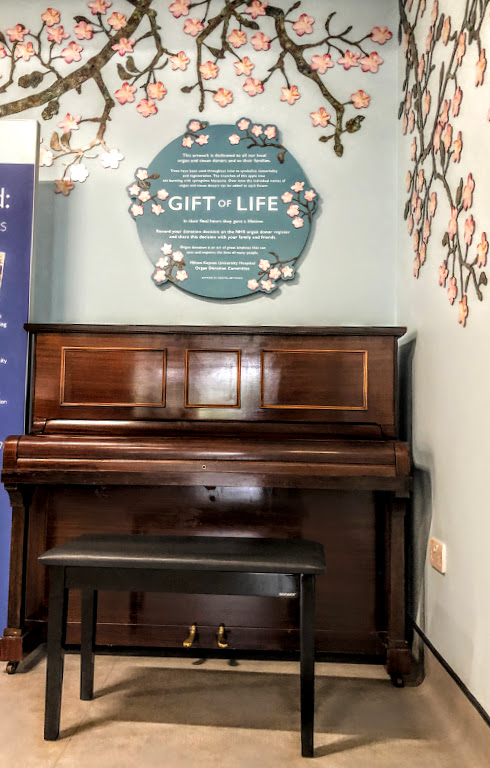
‘The Gift of Life’ … art and music in the outpatients reception area in Milton Keynes University Hospital (Photograph: Patrick Comerford)
Today’s Prayers (Thursday 2 July 2026):
In Pray with the World Church, the prayer diary of the Anglican mission agency USPG (United Society Partners in the Gospel), the theme this week, from 28 June to 4 July 2026 (pp 14-15), is ‘Living Stones’. This theme was introduced on Sunday with a reflection by the Very Revd Lydia Kelsey Bucklin, President and Dean of Episcopal Divinity School.
The USPG prayer diary today (Thursday 2 July 2026) invites us to pray:
Creator God, remind us of our deep interconnection. Strengthen us to seek the liberation of all people, knowing none of us are free while violence and injustice persist.
The Collect of the Day:
O God, the protector of all who trust in you,
without whom nothing is strong, nothing is holy:
increase and multiply upon us your mercy;
that with you as our ruler and guide
we may so pass through things temporal
that we lose not our hold on things eternal;
grant this, heavenly Father,
for our Lord Jesus Christ’s sake,
who is alive and reigns with you,
in the unity of the Holy Spirit,
one God, now and for ever.
The Post-Communion Prayer:
Eternal God,
comfort of the afflicted and healer of the broken,
you have fed us at the table of life and hope:
teach us the ways of gentleness and peace,
that all the world may acknowledge
the kingdom of your Son Jesus Christ our Lord.
Additional Collect:
Gracious Father,
by the obedience of Jesus
you brought salvation to our wayward world:
draw us into harmony with your will,
that we may find all things restored in him,
our Saviour Jesus Christ.
The Collect on the Eve of Saint Thomas:
Almighty and eternal God,
who, for the firmer foundation of our faith,
allowed your holy apostle Thomas
to doubt the resurrection of your Son
till word and sight convinced him:
grant to us, who have not seen, that we also may believe
and so confess Christ as our Lord and our God;
who is alive and reigns with you,
in the unity of the Holy Spirit,
one God, now and for ever.
Yesterday’s reflections
Continued tomorrow
The magnolia tree in a courtyard in the hospital in Milton Keynes (Photograph: Patrick Comerford)
Scripture quotations are from the New Revised Standard Version Bible: Anglicised Edition copyright © 1989, 1995 National Council of the Churches of Christ in the United States of America. Used by permission. All rights reserved worldwide. http://nrsvbibles.org
Showing posts with label Hospitals. Show all posts
27 June 2026
Daily prayer in Ordinary Time 2026:
51, Saturday 27 June 2026
‘Jesus Heals the Centurion’s Servant’ … a modern Greek Orthodox icon
Patrick Comerford
We are in Ordinary time and tomorrow is the Fourth Sunday after Trinity (Trinity IV, 28 June 2025). The Church Calendar today remembers Saint Cyril (444), Bishop of Alexandria, Teacher of the Faith.
This time of the year is known sometimes as Petertide, because of the ordinations at this time, close to the Feast of Saint Peter and Saint Paul (29 June). Today is an Ember Day, marked on the Wednesday, Friday and Saturday in the week before the Sunday nearest to 29 June as days of prayer for those to be ordained deacon or priest. Before today begins, I am taking some quiet time this morning to give thanks, to reflect, to pray and to read in these ways:
1, reading today’s Gospel reading;
2, a short reflection;
3, a prayer from the USPG prayer diary;
4, the Collects and Post-Communion prayer of the day.
Jesus heals Saint Peter’s Mother-in-Law … a stained-glass window in Saint John the Baptist Church, Blisworth, Northamptonshire (Photograph: Patrick Comerford, 2024)
Matthew 8: 5-17 (NRSVA):
5 When he entered Capernaum, a centurion came to him, appealing to him 6 and saying, ‘Lord, my servant is lying at home paralysed, in terrible distress.’ 7 And he said to him, ‘I will come and cure him.’ 8 The centurion answered, ‘Lord, I am not worthy to have you come under my roof; but only speak the word, and my servant will be healed. 9 For I also am a man under authority, with soldiers under me; and I say to one, “Go”, and he goes, and to another, “Come”, and he comes, and to my slave, “Do this”, and the slave does it.’ 10 When Jesus heard him, he was amazed and said to those who followed him, ‘Truly I tell you, in no one in Israel have I found such faith. 11 I tell you, many will come from east and west and will eat with Abraham and Isaac and Jacob in the kingdom of heaven, 12 while the heirs of the kingdom will be thrown into the outer darkness, where there will be weeping and gnashing of teeth.’ 13 And to the centurion Jesus said, ‘Go; let it be done for you according to your faith.’ And the servant was healed in that hour.
14 When Jesus entered Peter’s house, he saw his mother-in-law lying in bed with a fever; 15 he touched her hand, and the fever left her, and she got up and began to serve him. 16 That evening they brought to him many who were possessed by demons; and he cast out the spirits with a word, and cured all who were sick. 17 This was to fulfil what had been spoken through the prophet Isaiah, ‘He took our infirmities and bore our diseases.’
Jesus Heals Simon Peter's Mother-in-Law … a panel in a window in Saint Mary and Saint Giles Church, Stony Stratford (Photograph: Patrick Comerford)
Today’s Reflections:
This morning’s reading at the Eucharist (Matthew 8: 5-17), with its two healing stories, and yesterday’s account of the healing of the man with leprosy (Matthew 8: 1-4), follow on from our series of readings from the Sermon on the Mount in Saint Matthew’s Gospel, including the feeding of the multitude and the Beatitudes.
The immediate impact of these three healing stories should impress on the reader that teaching and doctrine are immediately and intimately connected with care for the marginalised and people on the edges on or excluded from society.
There are two healing stories in today’s reading: the healing of the centurion’s servant in Capernaum (Matthew 8: 5-13), and the healing of the mother-in-law of Peter (verses 14-17). This reading deals with some everyday questions that we all come across in our lives: compassion and healing, humanity and humility, power and authority, how employers treat the workforce, who is an insider in our society and who is an outsider?
1, Matthew 8: 5-13:
Centurions show up frequently in the Gospels and in the Acts of the Apostles. A centurion (ἑκατόνταρχος, hekatóntarkhos) was a commander, nominally of a century or a military unit of 100 legionaries. The size of the century changed over time, and by the time of Christ it had been reduced to 80 men. A centurion's symbol of office was the vine staff – in contrast to Christ, who is the true vine.
It is surprising that these figures in the Roman occupation are portrayed in such positive and devout ways in the New Testament, including today’s Gospel reading at the Eucharist (Matthew 8: 5-13; cf Luke 7: 1-10). They respond to Christ by recognising his identity and, at times, with faith.
In Saint Luke’s version of this event, a group of Jewish elders come to Jesus, not on behalf of the dying slave, but on behalf of the centurion. They come not on behalf of a powerless person, but on behalf of the powerful man. They speak up for him, not because he might return the favour, but because he has already done them favours.
The onlookers and the early readers would know that it was against Jewish custom to enter a gentile’s, a Roman’s, a centurion’s home. The centurion, for his part, must surely know that despite what Jesus may do, the slave too will eventually die, even if in old age, so his only motivations can be love and compassion, like the love of a parent.
This centurion can say do this, can say do that, but there is one thing he cannot do. He cannot give life itself. He recognises his limitations. He knows that he is dependent on Christ. In other words, he knows he is not self-dependent, he has to depend on God. He is a man of moving humility.
The centurion in Capernaum is not Jewish, he is an outsider. We do not know how he prays, or how he lives, or how he worships. In Saint Luke’s account, it is enough for the people of Capernaum, and for Jesus, that he loves the people. He builds a place for the people to worship, to learn and to meet. He cares for their needs, physical and spiritual.
I imagine this centurion already knew about Jesus and his disciples, and that Jesus and the disciples knew who the centurion was. It is probable that Capernaum was the hometown of Simon Peter, Andrew, James and John, as well as the Gospel writer Matthew. Jesus has taught in the synagogue in Capernaum and then heals a man there who was possessed by an unclean spirit.
We do not know about the future faith of this centurion, whether he changed roles, changed his lifestyle, left politics and the army life behind him.
We do not know about the past or the future of the servant. Culturally, because of translations over the centuries, we have referred to him as the centurion’s servant or slave. But the centurion calls him ‘παῖς μου’ (pais mou, my child) in Matthew, and the word παῖς is instead δοῦλος (doulos, ‘born slave’) in Luke (see Luke 7: 2).
We know this servant, child or slave, is found in good health … but for how long? Did he live to an old age? Did he gain promotion, or even his freedom? What about his later religious beliefs? We do not know.
This surprising story tells us that those we perceive as our enemies, as outsiders, as strangers, as foreigners, can teach us so much about trust and faith. In the end, this story is reminiscent of Christ’s teaching earlier in the Sermon on the Mount: ‘Love your enemies and pray for those who persecute you’ (Matthew 5: 44).
If we concentrate on healing and the miracle potential of this story, we may just sell ourselves short and miss the point of the story. Indeed, we know very little about the healing in this story, it tells us nothing about a healing ministry, it just tells us later that ‘the servant was healed in that hour’ (see verse 13).
Perhaps the real miracle is to be found when we wake up to the reminder once again that Jesus is concerned for those we regard as the outsider, those we treat as the other, those we exclude.
Who are our modern-day Gentiles? Those we describe as unbelievers, agnostics, atheists or secularists? These are the people the Church needs to listen to and to talk to today, just as Christ listens to the centurion.
Jesus commends the centurion for his πίστις (pistis), faith, trust or belief. He has seen nothing like it, even among his own people. He commends the centurion for his faith, and invites us to embrace that calling to live as people of faith.
It is interesting that seemingly the child, servant or slave is not aware of any of this, and is left playing a rather passive role in the story.
So, we should note that Christ does not discriminate against the centurion, or against the child, servant or slave. He makes no distinctions, no categorisation, allows no compartmentalisation. We do not know the religion, the ethnicity, the sexuality or the cultural background of the one who is healed.
Christ does not allow us to hold on to any prejudices or attitudes that tolerate racism, sexism, and ageism. We judge other people’s worthiness every time we withhold compassion or refuse to stand up for justice in solidarity with the oppressed, the ostracised, and the under-served. Will we take our cues from Christ and let God’s compassion and justice demolish the dividing lines we draw to protect ourselves?
2, Matthew 8: 14-17:
Immediately after healing the centurion’s servant, Christ also heals Simon Peter’s mother-in-law at her home in Capernaum (Matthew 8: 15-17). She remains unnamed, and she is identified only by her relationship to Simon Peter. Indeed, there is no reference at all to her daughter, Simon Peter’s wife.
All three synoptic gospels, Matthew, Mark, and Luke, tell this healing story (see Matthew 8: 14-17; Mark 1: 29-31; Luke 4: 38-40). Matthew says Jesus ‘touched’ the woman's hand, Mark say he ‘grasped’ it, and in Luke he simply ‘rebuked the fever’. Mark says the house was the home of Simon and Andrew, who both interceded with Jesus for the woman. Luke alone says she had a high fever. In all three synoptic Gospels, the healing of Peter’s mother-in-law and of a demon-possessed man trigger a wave of sick and possessed people being brought to Jesus.
Mother-in-law jokes illustrated many seaside postcards and were part of the stock-in-trade of comedians in the 1960s and well into the 1970s. Those mothers-in-law were never named, and the jokes served to emphasise the domestic role – perhaps servile role – of women in homes and families in those days.
But mothers-in-law were also mothers, grandmothers, aunts, sisters, wives, nieces and daughters; they had careers, hopes and ambitions, fears, illnesses, and sufferings; they had love and emotions; and they had names … none of which were acknowledged in those postcards or comic sketches.
Yet a closer reading of this story shows that it does not reinforce a woman’s place as being servile or secondary, the ‘complementarian’ view offered by some commentators who claim they are ‘conservative evangelicals.’ It is not a story about a woman taking a late Saturday morning weekend sleep-in on her bed, and then getting up ‘to make the tea’.
The verb for serving, διακονέω (diakoneo) in verse 15, in reference to this woman, means to wait, attend upon, serve, or to be an attendant or assistant. Later, in the Acts of the Apostles and other places in the New Testament, it means to minister to, relieve, assist, or supply with the necessaries of life, or provide the means of living, to do the work of the διάκονος or deacon (see I Timothy 3: 10, 13; I Peter 4: 11), even to be in charge or to administer (see II Corinthians 3: 3, 8: 19-20; I Peter 1: 12, 4: 10).
The word describing this woman’s service also describes the angels who minister to Jesus after he is tempted in the wilderness (Matthew 4: 11; Mark 1: 13), the work of his female disciples (Luke 8: 1-3), and describes Martha of Bethany when she serves while her sister Mary sits at Jesus’s feet and learns, before Jesus specifically affirms Mary’s choice (Luke 10: 38-42).
Most significantly, this word describes Jesus himself, when he explains to his disciples that ‘whoever wishes to become great among you must be your servant, and whoever wishes to be first among you must be slave of all. For the Son of Man came not to be served but to serve, and to give his life a ransom for many’ (see Matthew 20: 26-28).
Being healed is not just about personal relief but also about being restored to a place where one can serve and contribute to the community. The Book of Common Prayerdescribes God as the one ‘whose service is perfect freedom,’ and this is modelled by Peter’s mother-in-law. Her response to Jesus healing her is a model not just for women but for all Christian ministry, for all Christian service, for all being ordained this Petertide.
In the kingdom, serving is not women’s work, it is everybody’s work.
A healing touch … a sculpture facing the main entrance to Milton Keynes University Hospital (Photograph: Patrick Comerford)
Today’s Prayers (Saturday 27 June 2026):
In Pray with the World Church, the prayer diary of the Anglican mission agency USPG (United Society Partners in the Gospel), the theme this week, from 21 to 27 June 2026 (pp 12-13), has been ‘Land Taken, Land Remembered’. This theme was introduced last Sunday with a reflection by the Venerable Rosalyn Kantlaht’ant Elm, Director of Indigenous Ministries, Anglican Church of Canada.
The USPG prayer diary today (Saturday 27 June 2026) invites us to pray:
Creator of heaven and earth, remind us that the land and all its peoples belong to you. Teach us to care for your creation and for one another with reverence, justice, and love.
The Collect:
Almighty God, you have broken the tyranny of sin and have sent the Spirit of your Son into our hearts whereby we call you Father: give us grace to dedicate our freedom to your service, that we and all creation may be brought to the glorious liberty of the children of God; through Jesus Christ your Son our Lord, who is alive and reigns with you, in the unity of the Holy Spirit, one God, now and for ever.
The Collect for those to be ordained:
Almighty God, the giver of all good gifts,
by your Holy Spirit you have appointed
various orders of ministry in the Church:
look with mercy on your servants
now called to be deacons and priests;
maintain them in truth and renew them in holiness,
that by word and good example they may faithfully serve you
to the glory of your name and the benefit of your Church;
through the merits of our Saviour Jesus Christ,
who is alive and reigns with you,
in the unity of the Holy Spirit,
one God, now and for ever.
The Post-Communion Prayer:
O God, whose beauty is beyond our imagining and whose power we cannot comprehend: show us your glory as far as we can grasp it, and shield us from knowing more than we can bear until we may look upon you without fear; through Jesus Christ our Saviour.
Heavenly Father,
whose ascended Son gave gifts of leadership and service to the Church:
strengthen us who have received this holy food
to be good stewards of your manifold grace,
through him who came not to be served but to serve,
and give his life as a ransom for many,
Jesus Christ our Lord.
Additional Collect:
God our saviour, look on this wounded world in pity and in power; hold us fast to your promises of peace won for us by your Son, our Saviour Jesus Christ.
Collect on the Eve of Trinity IV:
O God, the protector of all who trust in you, without whom nothing is strong, nothing is holy: increase and multiply upon us your mercy; that with you as our ruler and guide we may so pass through things temporal that we lose not our hold on things eternal; grant this, heavenly Father, for our Lord Jesus Christ’s sake, who is alive and reigns with you, in the unity of the Holy Spirit, one God, now and for ever.
Yesterday’s Reflections
Continued tomorrow
Healing prayers … the window ledge in the chapel Dr Milley’s Hospital on Beacon Street, Lichfield (Photograph: Patrick Comerford)
Scripture quotations are from the New Revised Standard Version, Anglicised Edition copyright © 2021, National Council of the Churches of Christ in the United States of America. Used by permission. All rights reserved worldwide.
Patrick Comerford
We are in Ordinary time and tomorrow is the Fourth Sunday after Trinity (Trinity IV, 28 June 2025). The Church Calendar today remembers Saint Cyril (444), Bishop of Alexandria, Teacher of the Faith.
This time of the year is known sometimes as Petertide, because of the ordinations at this time, close to the Feast of Saint Peter and Saint Paul (29 June). Today is an Ember Day, marked on the Wednesday, Friday and Saturday in the week before the Sunday nearest to 29 June as days of prayer for those to be ordained deacon or priest. Before today begins, I am taking some quiet time this morning to give thanks, to reflect, to pray and to read in these ways:
1, reading today’s Gospel reading;
2, a short reflection;
3, a prayer from the USPG prayer diary;
4, the Collects and Post-Communion prayer of the day.
Jesus heals Saint Peter’s Mother-in-Law … a stained-glass window in Saint John the Baptist Church, Blisworth, Northamptonshire (Photograph: Patrick Comerford, 2024)
Matthew 8: 5-17 (NRSVA):
5 When he entered Capernaum, a centurion came to him, appealing to him 6 and saying, ‘Lord, my servant is lying at home paralysed, in terrible distress.’ 7 And he said to him, ‘I will come and cure him.’ 8 The centurion answered, ‘Lord, I am not worthy to have you come under my roof; but only speak the word, and my servant will be healed. 9 For I also am a man under authority, with soldiers under me; and I say to one, “Go”, and he goes, and to another, “Come”, and he comes, and to my slave, “Do this”, and the slave does it.’ 10 When Jesus heard him, he was amazed and said to those who followed him, ‘Truly I tell you, in no one in Israel have I found such faith. 11 I tell you, many will come from east and west and will eat with Abraham and Isaac and Jacob in the kingdom of heaven, 12 while the heirs of the kingdom will be thrown into the outer darkness, where there will be weeping and gnashing of teeth.’ 13 And to the centurion Jesus said, ‘Go; let it be done for you according to your faith.’ And the servant was healed in that hour.
14 When Jesus entered Peter’s house, he saw his mother-in-law lying in bed with a fever; 15 he touched her hand, and the fever left her, and she got up and began to serve him. 16 That evening they brought to him many who were possessed by demons; and he cast out the spirits with a word, and cured all who were sick. 17 This was to fulfil what had been spoken through the prophet Isaiah, ‘He took our infirmities and bore our diseases.’
Jesus Heals Simon Peter's Mother-in-Law … a panel in a window in Saint Mary and Saint Giles Church, Stony Stratford (Photograph: Patrick Comerford)
Today’s Reflections:
This morning’s reading at the Eucharist (Matthew 8: 5-17), with its two healing stories, and yesterday’s account of the healing of the man with leprosy (Matthew 8: 1-4), follow on from our series of readings from the Sermon on the Mount in Saint Matthew’s Gospel, including the feeding of the multitude and the Beatitudes.
The immediate impact of these three healing stories should impress on the reader that teaching and doctrine are immediately and intimately connected with care for the marginalised and people on the edges on or excluded from society.
There are two healing stories in today’s reading: the healing of the centurion’s servant in Capernaum (Matthew 8: 5-13), and the healing of the mother-in-law of Peter (verses 14-17). This reading deals with some everyday questions that we all come across in our lives: compassion and healing, humanity and humility, power and authority, how employers treat the workforce, who is an insider in our society and who is an outsider?
1, Matthew 8: 5-13:
Centurions show up frequently in the Gospels and in the Acts of the Apostles. A centurion (ἑκατόνταρχος, hekatóntarkhos) was a commander, nominally of a century or a military unit of 100 legionaries. The size of the century changed over time, and by the time of Christ it had been reduced to 80 men. A centurion's symbol of office was the vine staff – in contrast to Christ, who is the true vine.
It is surprising that these figures in the Roman occupation are portrayed in such positive and devout ways in the New Testament, including today’s Gospel reading at the Eucharist (Matthew 8: 5-13; cf Luke 7: 1-10). They respond to Christ by recognising his identity and, at times, with faith.
In Saint Luke’s version of this event, a group of Jewish elders come to Jesus, not on behalf of the dying slave, but on behalf of the centurion. They come not on behalf of a powerless person, but on behalf of the powerful man. They speak up for him, not because he might return the favour, but because he has already done them favours.
The onlookers and the early readers would know that it was against Jewish custom to enter a gentile’s, a Roman’s, a centurion’s home. The centurion, for his part, must surely know that despite what Jesus may do, the slave too will eventually die, even if in old age, so his only motivations can be love and compassion, like the love of a parent.
This centurion can say do this, can say do that, but there is one thing he cannot do. He cannot give life itself. He recognises his limitations. He knows that he is dependent on Christ. In other words, he knows he is not self-dependent, he has to depend on God. He is a man of moving humility.
The centurion in Capernaum is not Jewish, he is an outsider. We do not know how he prays, or how he lives, or how he worships. In Saint Luke’s account, it is enough for the people of Capernaum, and for Jesus, that he loves the people. He builds a place for the people to worship, to learn and to meet. He cares for their needs, physical and spiritual.
I imagine this centurion already knew about Jesus and his disciples, and that Jesus and the disciples knew who the centurion was. It is probable that Capernaum was the hometown of Simon Peter, Andrew, James and John, as well as the Gospel writer Matthew. Jesus has taught in the synagogue in Capernaum and then heals a man there who was possessed by an unclean spirit.
We do not know about the future faith of this centurion, whether he changed roles, changed his lifestyle, left politics and the army life behind him.
We do not know about the past or the future of the servant. Culturally, because of translations over the centuries, we have referred to him as the centurion’s servant or slave. But the centurion calls him ‘παῖς μου’ (pais mou, my child) in Matthew, and the word παῖς is instead δοῦλος (doulos, ‘born slave’) in Luke (see Luke 7: 2).
We know this servant, child or slave, is found in good health … but for how long? Did he live to an old age? Did he gain promotion, or even his freedom? What about his later religious beliefs? We do not know.
This surprising story tells us that those we perceive as our enemies, as outsiders, as strangers, as foreigners, can teach us so much about trust and faith. In the end, this story is reminiscent of Christ’s teaching earlier in the Sermon on the Mount: ‘Love your enemies and pray for those who persecute you’ (Matthew 5: 44).
If we concentrate on healing and the miracle potential of this story, we may just sell ourselves short and miss the point of the story. Indeed, we know very little about the healing in this story, it tells us nothing about a healing ministry, it just tells us later that ‘the servant was healed in that hour’ (see verse 13).
Perhaps the real miracle is to be found when we wake up to the reminder once again that Jesus is concerned for those we regard as the outsider, those we treat as the other, those we exclude.
Who are our modern-day Gentiles? Those we describe as unbelievers, agnostics, atheists or secularists? These are the people the Church needs to listen to and to talk to today, just as Christ listens to the centurion.
Jesus commends the centurion for his πίστις (pistis), faith, trust or belief. He has seen nothing like it, even among his own people. He commends the centurion for his faith, and invites us to embrace that calling to live as people of faith.
It is interesting that seemingly the child, servant or slave is not aware of any of this, and is left playing a rather passive role in the story.
So, we should note that Christ does not discriminate against the centurion, or against the child, servant or slave. He makes no distinctions, no categorisation, allows no compartmentalisation. We do not know the religion, the ethnicity, the sexuality or the cultural background of the one who is healed.
Christ does not allow us to hold on to any prejudices or attitudes that tolerate racism, sexism, and ageism. We judge other people’s worthiness every time we withhold compassion or refuse to stand up for justice in solidarity with the oppressed, the ostracised, and the under-served. Will we take our cues from Christ and let God’s compassion and justice demolish the dividing lines we draw to protect ourselves?
2, Matthew 8: 14-17:
Immediately after healing the centurion’s servant, Christ also heals Simon Peter’s mother-in-law at her home in Capernaum (Matthew 8: 15-17). She remains unnamed, and she is identified only by her relationship to Simon Peter. Indeed, there is no reference at all to her daughter, Simon Peter’s wife.
All three synoptic gospels, Matthew, Mark, and Luke, tell this healing story (see Matthew 8: 14-17; Mark 1: 29-31; Luke 4: 38-40). Matthew says Jesus ‘touched’ the woman's hand, Mark say he ‘grasped’ it, and in Luke he simply ‘rebuked the fever’. Mark says the house was the home of Simon and Andrew, who both interceded with Jesus for the woman. Luke alone says she had a high fever. In all three synoptic Gospels, the healing of Peter’s mother-in-law and of a demon-possessed man trigger a wave of sick and possessed people being brought to Jesus.
Mother-in-law jokes illustrated many seaside postcards and were part of the stock-in-trade of comedians in the 1960s and well into the 1970s. Those mothers-in-law were never named, and the jokes served to emphasise the domestic role – perhaps servile role – of women in homes and families in those days.
But mothers-in-law were also mothers, grandmothers, aunts, sisters, wives, nieces and daughters; they had careers, hopes and ambitions, fears, illnesses, and sufferings; they had love and emotions; and they had names … none of which were acknowledged in those postcards or comic sketches.
Yet a closer reading of this story shows that it does not reinforce a woman’s place as being servile or secondary, the ‘complementarian’ view offered by some commentators who claim they are ‘conservative evangelicals.’ It is not a story about a woman taking a late Saturday morning weekend sleep-in on her bed, and then getting up ‘to make the tea’.
The verb for serving, διακονέω (diakoneo) in verse 15, in reference to this woman, means to wait, attend upon, serve, or to be an attendant or assistant. Later, in the Acts of the Apostles and other places in the New Testament, it means to minister to, relieve, assist, or supply with the necessaries of life, or provide the means of living, to do the work of the διάκονος or deacon (see I Timothy 3: 10, 13; I Peter 4: 11), even to be in charge or to administer (see II Corinthians 3: 3, 8: 19-20; I Peter 1: 12, 4: 10).
The word describing this woman’s service also describes the angels who minister to Jesus after he is tempted in the wilderness (Matthew 4: 11; Mark 1: 13), the work of his female disciples (Luke 8: 1-3), and describes Martha of Bethany when she serves while her sister Mary sits at Jesus’s feet and learns, before Jesus specifically affirms Mary’s choice (Luke 10: 38-42).
Most significantly, this word describes Jesus himself, when he explains to his disciples that ‘whoever wishes to become great among you must be your servant, and whoever wishes to be first among you must be slave of all. For the Son of Man came not to be served but to serve, and to give his life a ransom for many’ (see Matthew 20: 26-28).
Being healed is not just about personal relief but also about being restored to a place where one can serve and contribute to the community. The Book of Common Prayerdescribes God as the one ‘whose service is perfect freedom,’ and this is modelled by Peter’s mother-in-law. Her response to Jesus healing her is a model not just for women but for all Christian ministry, for all Christian service, for all being ordained this Petertide.
In the kingdom, serving is not women’s work, it is everybody’s work.
A healing touch … a sculpture facing the main entrance to Milton Keynes University Hospital (Photograph: Patrick Comerford)
Today’s Prayers (Saturday 27 June 2026):
In Pray with the World Church, the prayer diary of the Anglican mission agency USPG (United Society Partners in the Gospel), the theme this week, from 21 to 27 June 2026 (pp 12-13), has been ‘Land Taken, Land Remembered’. This theme was introduced last Sunday with a reflection by the Venerable Rosalyn Kantlaht’ant Elm, Director of Indigenous Ministries, Anglican Church of Canada.
The USPG prayer diary today (Saturday 27 June 2026) invites us to pray:
Creator of heaven and earth, remind us that the land and all its peoples belong to you. Teach us to care for your creation and for one another with reverence, justice, and love.
The Collect:
Almighty God, you have broken the tyranny of sin and have sent the Spirit of your Son into our hearts whereby we call you Father: give us grace to dedicate our freedom to your service, that we and all creation may be brought to the glorious liberty of the children of God; through Jesus Christ your Son our Lord, who is alive and reigns with you, in the unity of the Holy Spirit, one God, now and for ever.
The Collect for those to be ordained:
Almighty God, the giver of all good gifts,
by your Holy Spirit you have appointed
various orders of ministry in the Church:
look with mercy on your servants
now called to be deacons and priests;
maintain them in truth and renew them in holiness,
that by word and good example they may faithfully serve you
to the glory of your name and the benefit of your Church;
through the merits of our Saviour Jesus Christ,
who is alive and reigns with you,
in the unity of the Holy Spirit,
one God, now and for ever.
The Post-Communion Prayer:
O God, whose beauty is beyond our imagining and whose power we cannot comprehend: show us your glory as far as we can grasp it, and shield us from knowing more than we can bear until we may look upon you without fear; through Jesus Christ our Saviour.
Heavenly Father,
whose ascended Son gave gifts of leadership and service to the Church:
strengthen us who have received this holy food
to be good stewards of your manifold grace,
through him who came not to be served but to serve,
and give his life as a ransom for many,
Jesus Christ our Lord.
Additional Collect:
God our saviour, look on this wounded world in pity and in power; hold us fast to your promises of peace won for us by your Son, our Saviour Jesus Christ.
Collect on the Eve of Trinity IV:
O God, the protector of all who trust in you, without whom nothing is strong, nothing is holy: increase and multiply upon us your mercy; that with you as our ruler and guide we may so pass through things temporal that we lose not our hold on things eternal; grant this, heavenly Father, for our Lord Jesus Christ’s sake, who is alive and reigns with you, in the unity of the Holy Spirit, one God, now and for ever.
Yesterday’s Reflections
Continued tomorrow
Healing prayers … the window ledge in the chapel Dr Milley’s Hospital on Beacon Street, Lichfield (Photograph: Patrick Comerford)
Scripture quotations are from the New Revised Standard Version, Anglicised Edition copyright © 2021, National Council of the Churches of Christ in the United States of America. Used by permission. All rights reserved worldwide.
16 March 2026
Daily prayer in Lent 2026:
27, Monday 16 March 2026
Capernaum … with the synagogue on the left and the domes of the Greek Orthodox church in the backgroundPatrick Comerford
This week began with the Fourth Sunday in Lent (Lent IV, 15 March 2026) and Mothering Sunday. I have a hospital appointment later this morning for an echocardiogram, a non-invasive, ultrasound scan that uses sound waves to create live, moving images of the heart’s chambers, valves, and surrounding vessels. It assesses heart function, blood flow, and structure, and takes 30-60 minutes to diagnose issues such as heart failure, valve disease, and damage from heart attacks.
Meanwhile, before today begins, I am taking some quiet time this morning to give thanks, to reflect, to pray and to read in these ways:
1, reading today’s Gospel reading;
2, a short reflection;
3, a prayer from the USPG prayer diary;
4, the Collects and Post-Communion prayer of the day.
The Greek Orthodox Church in Capernaum on the shores of the Sea of Galilee, with the Golan Heights in the distanceJohn 4: 43-54 (NRSVA):
43 When the two days were over, he went from that place to Galilee 44 (for Jesus himself had testified that a prophet has no honour in the prophet’s own country). 45 When he came to Galilee, the Galileans welcomed him, since they had seen all that he had done in Jerusalem at the festival; for they too had gone to the festival.
46 Then he came again to Cana in Galilee where he had changed the water into wine. Now there was a royal official whose son lay ill in Capernaum. 47 When he heard that Jesus had come from Judea to Galilee, he went and begged him to come down and heal his son, for he was at the point of death. 48 Then Jesus said to him, ‘Unless you see signs and wonders you will not believe.’ 49 The official said to him, ‘Sir, come down before my little boy dies.’ 50 Jesus said to him, ‘Go; your son will live.’ The man believed the word that Jesus spoke to him and started on his way. 51 As he was going down, his slaves met him and told him that his child was alive. 52 So he asked them the hour when he began to recover, and they said to him, ‘Yesterday at one in the afternoon the fever left him.’ 53 The father realized that this was the hour when Jesus had said to him, ‘Your son will live.’ So he himself believed, along with his whole household. 54 Now this was the second sign that Jesus did after coming from Judea to Galilee.
‘Ecce Signum’, Sean Lynch’s work on a gable end in East Square, Askeaton, Co Limerick … the healing in John 4 is the second of the seven signs (Photograph: Patrick Comerford)
Today’s Reflections:
The Dominican author and theologian, Cardinal Timothy Radcliffe, points out that that in the Bible, seven is the number of perfection. We know of the six days of creation and how God rested on the seventh. In Saint John’s Gospel, we have seven signs and seven ‘I AM’ sayings disclosing s who Jesus truly is.
In the Gospel reading at the Eucharist today (John 4: 43-54), we have two separate incidents that run together in Saint John’s Gospel: the return of Jesus to Galilee, and the second of the seven signs in the Fourth Gospel.
The first part of this reading (verses 43-45), recalling the return to Galilee, is a bridge passage, a link between two stories of encounters Jesus has with key non-Jewish figures – the Samaritan woman and the villagers of Sychar (see John 4: 1-42) and the royal official from Capernaum (verses 43-54). So with Nicodemus, the woman at the well, and the royal official, we have three key personalities, one Jewish, one Samaritan, and one Gentile.
In between the Samaritans and the Gentiles, Jesus continues on his journey from Jerusalem to Galilee, on the third day he arrives in Cana. So already, we are being prepared to hear about a story of life and death and new life.
We can find a link here between this story and the incident in Saint Luke’s Gospel (Luke 4: 14-21), when Jesus tells us that a prophet is without honour in his own country, and yet he appears at first to be received with honour in Galilee, as he was first received in the synagogues in Galilee when he returned from Jerusalem, according to Saint Luke (see Luke 4: 15).
Jesus says ‘a prophet has no honour in his own country’ (verse 44). But if Jesus believed that he would have no honour in ‘his own country’, why does John tell us that the Galileans ‘welcomed’ him? This same proverb is found in Matthew 13: 57, Mark 6: 4, and Luke 4: 24.
When Jesus comes to Nazareth and teaches in the synagogue, some local people who were there had probably been in Jerusalem when he had performed signs (see John 2: 23; 4: 45). If they had not been in Jerusalem, they would have heard about some of his miracles there. When Jesus arrives in his ‘hometown’, there must have been high expectations. Yet, some people start to ask questions. He may be a popular person and have a growing following. But Nazareth is his hometown, they all know all about him. And so, Jesus performs few miracles there.
He has returned to Galilee, to his ‘own country’ (verse 45), where a prophet is without honour. But when Jesus arrives in Galilee, the people there ‘welcome him’. From what we have seen in Matthew’s account of his arrival at Nazareth, we see virtually the same phenomena. Jesus returns to his ‘hometown’ and receives an initially warm welcome.
The people are aware of the miracles he performed in Jerusalem and now hope to see many more in their own town. But as they reflect on his origins and family background, they find they are not so sure. Has he come to bless the Gentiles as well as the Jews? What seems to start off well ends up in a very disappointing way, both for Christ and for those from his ‘hometown’.
A short-lived, superficial acceptance of Christ is not the same as an informed, long-term commitment. Although the Galileans initially welcomed Christ, this does not mean that they truly accept him as Messiah. His visit home is disappointing because, although he is initially welcomed, he is not truly honoured.
And yet this interlude also tells us that Christ came as the Saviour of Jews (these three verses), of Samaritans (the previous story), and of Gentiles (the next story) … in other words, of all people, and that he is the Saviour of the whole world.
On a first reading, the story about the healing of the royal official’s son in verses 46-54 seems similar to that of the healing of the centurion’s servant or slave (Matthew 8: 5-13; Luke 7: 2-10). But, despite the similarities, there are many differences. They can be summarised:
• The centurion was a Gentile; the royal official was probably a Gentile, although we are not told so – there is a possibility that he was Jewish.
• The centurion’s servant suffered from a paralysis; the royal official’s son was ill with a fever.
• The centurion lives in Capernaum; the royal official lives in Cana.
• The centurion’s faith is praised by Christ; the royal official and others are rebuked for a deficient faith.
• The centurion urges Jesus not to come, but only to speak the word; the royal official urges Jesus to come.
• The Centurion asks Jewish elders to plead his case; the royal official pleads personally with Jesus.
And so the story of Christ healing the royal official’s son is unique to the Fourth Gospel, as is most of the material in Saint John’s Gospel.
Jesus returns to Cana of Galilee (verse 46), where he turned water into wine at a wedding (John 2: 1-11). The NRSV translates βασιλικός (basilikós) as royal official, although other versions call him a ‘nobleman’. He was probably a servant of Herod, the Tetrarch of Galilee, who is referred to as a king in the New Testament (see Matthew 14: 9; Mark 6: 14, 22).
Capernaum was a border town, and it was there that this royal official heard that Jesus is back in Cana once again. The official’s son is at the point of death and this father is desperate. Jesus is now his last and only hope to save his son. He makes the 30 km journey to Cana to find Jesus, and there he begs him to return with him to Capernaum immediately and to heal his dying son.
At first reading, Christ’s response to the royal official appears disturbing: Then Jesus said to him, ‘Unless you see signs and wonders you will not believe.’ The NRSV in a footnote, and other translations, point out that the ‘you’ in verse 48 is plural, and not singular. Therefore, Jesus is speaking to a larger audience and not to, or not just to the royal official.
At first reading, as with the story of the Syro-Phoenician woman in Saint Mark’s Gospel (Mark 7: 24-30), who asks for healing for her daughter, Jesus appears to be caught with his compassion down. But back in Galilee, where a prophet is without honour among his own people, Jesus is not going to rush into performing a miracle to entertain the crowd and to draw attention to himself.
His words of rebuke may be in the hope of dispersing the crowd. He chides them for being interested only in his miracles and not taking to heart what the signs point to.
Certainly the official does not interpret these words as a personal rebuke. For he asks – perhaps even tells – Jesus to come back with him (verse 49).
Perhaps the crowds have left by now. Jesus’ next words are to tell the man: ‘Go; your son will live’ (verse 50). If the crowd has stayed around, these words would have sounded as though they were only intended to get rid of this persistent father, not as words of assurance. He probably headed back home on his own to Capernaum. The crowd disperses, the sign-seekers go away disappointed.
From this story, it appears that the royal official believes – but only to a degree, and not fully. The royal official did not get what we wanted. Jesus did not go back to Capernaum with him. He probably headed home wondering what was happening to his son (verses 51-52).
The man’s belief only comes to full fruition in verse 53, later that evening or perhaps a day later, when he hears that his son was healed at the time Jesus spoke to him. The father now knows he has witnessed a miracle, and he believes, along with his entire household. But this new belief in verse 53 is more informed than the belief in verse 50. It is now a belief in Jesus as the Messiah, as the Saviour of the world.
This is the second sign in Saint John’s Gospel (verse 54). The first sign was at Cana, when Jesus turned the water into wine on the third day, but when most of the guests at the wedding never knew what had happened. It was a ‘sign’ seen only by a few, but it results in the faith of the disciples (see John 2: 1-12).
So too with the second sign, also on the third day. The royal official’s son is healed not in front of the gaping crowd, not even in front of the official’s household. Christ performs this miracle in such a way that only the royal official knows it is a miracle. But when he explained this miracle to his servants, they too become members of the household of faith.
‘He came again to Cana in Galilee where he had changed the water into wine’ (John 4: 46) … an icon in the Lady Chapel in Lichfield Cathedral (Photograph: Patrick Comerford)
Today’s Prayers (Monday 16 March 2026):
The theme this week (15-21 March 2026) in ‘Pray With the World Church,’ the Prayer Diary of the Anglican mission agency USPG (United Society Partners in the Gospel), is ‘Lament and Hope’ (pp 38-39). This theme was introduced yesterday with a programme update by Kennedy Jones, Church Engagement and Fundraising Officer, USPG.
The USPG Prayer Diary today (Monday 16 March 2026) invites us to pray:
We pray for all those still affected by the legacy of slavery and racial injustice. May God guide us to recognise the harm done and to work for reconciliation and healing.
The Collect:
Merciful Lord,
absolve your people from their offences,
that through your bountiful goodness
we may all be delivered from the chains of those sins
which by our frailty we have committed;
grant this, heavenly Father,
for Jesus Christ’s sake, our blessed Lord and Saviour,
who is alive and reigns with you,
in the unity of the Holy Spirit,
one God, now and for ever.
The Post Communion Prayer:
Lord God,
whose blessed Son our Saviour
gave his back to the smiters
and did not hide his face from shame:
give us grace to endure the sufferings of this present time
with sure confidence in the glory that shall be revealed;
through Jesus Christ our Lord.
Additional Collect:
Merciful Lord,
you know our struggle to serve you:
when sin spoils our lives
and overshadows our hearts,
come to our aid
and turn us back to you again;
through Jesus Christ our Lord.
Yesterday’s Reflections
Continued Tomorrow
‘Unless you see signs and wonders you will not believe’ (John 4: 48) … signs and wonders on the High Street in Little Walsingham, Norfolk (Photograph: Patrick Comerford, 2026)
Scripture quotations are from the New Revised Standard Version Bible: Anglicised Edition copyright © 1989, 1995 National Council of the Churches of Christ in the United States of America. Used by permission. All rights reserved worldwide. http://nrsvbibles.org
13 February 2026
Bethel Solomons, the prominent
Jewish doctor who won ten caps
in international rugby for Ireland
A portrait of Dr Bethel Solomons by his sister Estella Solomons (Irish Jewish Museum, ©The Trustees of the Estate of Estella Solomons)
Patrick Comerford
This is another weekend of wall-to-wall, back-to-back rugby in the Six Nations Championship, with Ireland playing Italy tomorrow (2:10 pm) and England playing Scotland (4:40 pm), and then Wales and France on Sunday afternoon (15:10).
Despite a disappointing 36-14 defeat by France in the Stade de France last week, my fervour for Irish rugby is undimmed, and my hopes, however unfounded, remain high this weekend.
Few Jewish players have played at the highest levels in Irish rugby history. Bethel Solomons (1885-1965) is the most prominent Jewish Irish rugby international, capped as a forward for Ireland in the early 20th century, and also a noted doctor. Later, another former Irish rugby international, Tony Ward, discovered his Jewish heritage with dramatic revelations in recent years.
Dr Bethel Solons was the Master of the Rotunda Hospital, an actor at the Abbey Theatre and President of the Dublin Jewish Progressive Congregation. In addition, he was an international rugby player.
Bethel Albert Herbert Solomons was born on 27 February 1885 into a prominent Jewish family who are one of the oldest continuous Jewish families in Ireland. The Solomons family came to Ireland from England in 1824, when Elias Solomons opened his optician’s shop in Nassau Street, close to Trinity College Dublin. His son, Maurice Solomons (1832-1922), continued the optician’s practice at 19 Nassau Street, on the corner with South Frederick Street. He is mentioned by James Joyce in Ulysses, and was also a JP and the honorary consul in Ireland of the Austro-Hungarian Empire.
James Joyce in street art in Nassau Street … Maurice Solomons (is mentioned by James Joyce in ‘Ulysses’ (Photograph: Patrick Comerford)
Bethel’s elder brother Edwin Solomons (1879-1964) was a stockbroker and prominent member of the Dublin Jewish community. Their sister Estella Solomons (1882-1968) was a leading artist; she married the poet and publisher James Sullivan Starkey (1879-1958), a Methodist, who wrote under the penname Seumas O’Sullivan. Their younger sister Sophie trained as an opera singer.
Bethel Solomons went to Saint Andrew’s School, Dublin, and studied medicine in Trinity College Dublin, where he enjoyed the social life, theatre and rugby. He captained Trinity to the Leinster Senior Cup (1908), also played for Wanderers, and played on the Hospitals’ Cup winning team in the 1903-1904 and 1904-1905 seasons. He became the first Jew to play Test rugby when, on 8 February 1908, he lined up as Ireland’s number 8 in a 13-3 defeat by England at the Richmond Athletic Ground. In all, he won ten caps for Ireland (1908-1910).
In The Oval World: A Global History of Rugby' by Tony Collins, an account is given of Solomons taking a taxi to ensure he would be in time to run on to the pitch for a rugby international: ‘Fearing he would be late for Ireland’s 1909 home match against England, he hailed a cab in the centre of Dublin. He told the cabbie he wanted to go to Lansdowne Road. “It’s for the Ireland rugby international” explained Solomons. “Ireland?” snorted the driver dismissively “it’s nothing but fourteen Prods and a Jew”.’
Ireland were defeated 11-5 by England that day, 13 February 1909.
The stadium at Lansdowne Road, the home ground of Ireland and of Wanderers … Bethel Solomons was capped ten times for Ireland (Photograph: Patrick Comerford)
He acted at the Abbey Theatre, under the stage name Thomas Thornhill, in 1913 in August Strindberg’s There are Crimes and Crimes, and James Stephens dedicated The Charwoman’s Daughter to him.
Although his rugby and theatrical ambitions were limited by the demands and successful medical career, he went on to become a selector for the Irish team and was vice-president of the Irish Rugby Football Union (IRFU) in later years.
After his experience as an extern maternity assistant at the Rotunda Hospital, attending home births in the Dublin slums, he became devoted to obstetrics and gynaecology, also studied in Paris, Vienna, Berlin, Leipzig, Dresden and Munich, and started to teach medical students.
Bethel Solomons was a supporter of the suffrage movement and an advocate of women’s equality. He opened the Jewish Medical Dispensary in Stamer Street in Dublin’s ‘Little Jerusalem’ in 1913 and ran it with Ada Shillman, a midwife who attended most of the Jewish women in Dublin during her career.
He married Gertrude Levy in 1916 at the Liberal Synagogue in London in a wedding conducted by Claude Montefiore. Gertrude was a friend of his sister Sophie since they were students at the Royal Academy of Music in London.
Gertrude and Bethel lived in 42 Fitzwilliam Square, where he ran a successful practice (1916-1926). His patients included George Yeats and Iseult Gonne, and they later rented the upstairs of 42 Fitzwilliam Square to WB Yeats and his wife George. He later practiced from 30 Lower Baggot Street.
Bethel Solomons was the Master of the Rotunda Hospital from 1926 to 1933, and as Master he is mentioned by James Joyce in Finnegans Wake: ‘in my bethel of Solyman’s I accouched my rotundaties.’
He inherited considerable financial challenges at a hospital that needed to modernise and to maintain its reputation as one of the world’s leading maternity hospitals. His improvements included a new nurses’ home, new out-patient department, theatre block and sick babies ward, the introduction of X-ray facilities and incubators and a revival of the pathology laboratory.
As World War II approached, Solomons took an increased role in Jewish affairs. He wrote to the British Medical Journal in 1937 warning against the choice of Berlin as the location for an international medical academy of postgraduate work and research to ‘further international fellowship and friendship’.
The Dublin Jewish Progressive Congregation on Leicester Avenue, Rathgar (Photograph: Patrick Comerford)
From 1939, he worked to raise funds for the Jewish Refugee Aid Committee, which was chaired by Leonard Abrahamson and had among its vice-chairs, his brother Edwin, who was the President of the Dublin Hebrew Congregation at Adelaide Road Synagogue. At the end of the war, he became chair of the Jewish Children’s Refugee fund, raising funds to bring refugee children to Clonyn Castle, Co Westmeath or to Millisle Farm in Northern Ireland.
Solomons chaired a meeting in the Mansion House in Dublin in 1946 addressed by Rabbi Israel Mattuck of the Liberal Synagogue in London. The meeting led to the formation of the Dublin Jewish Progressive Congregation (DJPC), with Bethel Solomons as president from 1946 to 1965. The former Chief Rabbi of Ireland, Yitzhak Herzog (1888-1959), by then the Chief Rabbi of the Holy Land, denounced the new synagogue as an ‘open, active, organised rebellion against the Torah’, but Bethel Solomons refuted this in the Jewish Chronicle in 1946.
Solomons received many international honours and was President of the Royal College of Physicians of Ireland in 1946-1949. He died on 11 September 1965 at his home, Laughton Beg, Rochestown Avenue, Dún Laoghaire. Bethel and Gertrude Solomons were the parents of three children. Their second son, Dr Michael Solomons (1919-2007) was a distinguished gynaecologist, a pioneer of family planning in Ireland, and a veteran of the bitter and divisive 1983 constitutional amendment referendum campaign.
Another Irish rugby international, Tony Ward, found out late in life that his father, Danny Ward, was from a Jewish family that fled Poland to escape Nazi persecution. In a peculiar accident or coincidence in history, his paternal ancestors too had Solomons as their original family name.
Tony Ward was only five years old when his father died, leaving him with ‘precious few early memories of him’ so that he ‘knew very little about him or his family.’ It was only in later life he discovered his father’s story as a Jewish refugee from Poland later, partly through research initiated by his daughters, Nikki and Lynn, as a Christmas present. Through a professional genealogical agency, Ancestry Made Easy, they came across findings he had never known for the best part of six decades.
His father, known as Danny Ward, was born Saul Solomons on 16 August 1909. The Solomons family were victims of their time, and following the assassination of Tsar Alexander II in 1881, they fled the persecution of Jews in Russia, Poland and Finland.
Harris Solomons and Jane Cohen were the parents of Saul (Danny). Harris was a tailor and he and Jane lived at Great Garden Street, Whitechapel, in the East End of London. Saul Solomons, or Danny Ward, had three siblings: Sadie, Sydney and another sister, Sarah, who died soon after birth. The three surviving children were all born in London, but the census return listed them as Russians.
Saul Solomons and Lily Gross were married in Philpot Street Synagogue in the East End in 1934. They both worked in London as hairdressers and their son Derek, who was born in 1935, is Tony Ward’s half-brother.
That first marriage was later dissolved, and Saul Solomons then moved to Ireland and settled in Dublin in the late 1940s. He met June Connolly, a Catholic, around 1952 and there was an 18-year age gap between them. Gor them to marry, he reportedly had to give up his Jewish religion. By late November 1953, he had changed his name from Saul Solomons to Daniel Ward, had become a Catholic, and they married in Cardiff Registry Office.
The couple lived for a time in Leeds, where Tony Ward was born. Danny Ward had a heart attack and died in Leeds General Infirmary on Saint Patrick’s Day, 17 March 1960. Tony was only five, and June returned to Dublin almost immediately. Yet, having spent part of his childhood in Leeds, Tony Ward is still a committed Leeds United supporter.
There are other Jewish sports figures who have played cricket and football for Ireland, including Louis ‘Abraham’ Bookman and Finn Isaac Azaz. But more about them, perhaps, on another and appropriate Friday evening.
Shabbat Shalom, שבת שלום
Dr Bethel Solons was the Master of the Rotunda Hospital, an actor at the Abbey Theatre, President of the Dublin Jewish Progressive Congregation, and was capped then times for Ireland in international rugby
Patrick Comerford
This is another weekend of wall-to-wall, back-to-back rugby in the Six Nations Championship, with Ireland playing Italy tomorrow (2:10 pm) and England playing Scotland (4:40 pm), and then Wales and France on Sunday afternoon (15:10).
Despite a disappointing 36-14 defeat by France in the Stade de France last week, my fervour for Irish rugby is undimmed, and my hopes, however unfounded, remain high this weekend.
Few Jewish players have played at the highest levels in Irish rugby history. Bethel Solomons (1885-1965) is the most prominent Jewish Irish rugby international, capped as a forward for Ireland in the early 20th century, and also a noted doctor. Later, another former Irish rugby international, Tony Ward, discovered his Jewish heritage with dramatic revelations in recent years.
Dr Bethel Solons was the Master of the Rotunda Hospital, an actor at the Abbey Theatre and President of the Dublin Jewish Progressive Congregation. In addition, he was an international rugby player.
Bethel Albert Herbert Solomons was born on 27 February 1885 into a prominent Jewish family who are one of the oldest continuous Jewish families in Ireland. The Solomons family came to Ireland from England in 1824, when Elias Solomons opened his optician’s shop in Nassau Street, close to Trinity College Dublin. His son, Maurice Solomons (1832-1922), continued the optician’s practice at 19 Nassau Street, on the corner with South Frederick Street. He is mentioned by James Joyce in Ulysses, and was also a JP and the honorary consul in Ireland of the Austro-Hungarian Empire.
James Joyce in street art in Nassau Street … Maurice Solomons (is mentioned by James Joyce in ‘Ulysses’ (Photograph: Patrick Comerford)
Bethel’s elder brother Edwin Solomons (1879-1964) was a stockbroker and prominent member of the Dublin Jewish community. Their sister Estella Solomons (1882-1968) was a leading artist; she married the poet and publisher James Sullivan Starkey (1879-1958), a Methodist, who wrote under the penname Seumas O’Sullivan. Their younger sister Sophie trained as an opera singer.
Bethel Solomons went to Saint Andrew’s School, Dublin, and studied medicine in Trinity College Dublin, where he enjoyed the social life, theatre and rugby. He captained Trinity to the Leinster Senior Cup (1908), also played for Wanderers, and played on the Hospitals’ Cup winning team in the 1903-1904 and 1904-1905 seasons. He became the first Jew to play Test rugby when, on 8 February 1908, he lined up as Ireland’s number 8 in a 13-3 defeat by England at the Richmond Athletic Ground. In all, he won ten caps for Ireland (1908-1910).
In The Oval World: A Global History of Rugby' by Tony Collins, an account is given of Solomons taking a taxi to ensure he would be in time to run on to the pitch for a rugby international: ‘Fearing he would be late for Ireland’s 1909 home match against England, he hailed a cab in the centre of Dublin. He told the cabbie he wanted to go to Lansdowne Road. “It’s for the Ireland rugby international” explained Solomons. “Ireland?” snorted the driver dismissively “it’s nothing but fourteen Prods and a Jew”.’
Ireland were defeated 11-5 by England that day, 13 February 1909.
The stadium at Lansdowne Road, the home ground of Ireland and of Wanderers … Bethel Solomons was capped ten times for Ireland (Photograph: Patrick Comerford)
He acted at the Abbey Theatre, under the stage name Thomas Thornhill, in 1913 in August Strindberg’s There are Crimes and Crimes, and James Stephens dedicated The Charwoman’s Daughter to him.
Although his rugby and theatrical ambitions were limited by the demands and successful medical career, he went on to become a selector for the Irish team and was vice-president of the Irish Rugby Football Union (IRFU) in later years.
After his experience as an extern maternity assistant at the Rotunda Hospital, attending home births in the Dublin slums, he became devoted to obstetrics and gynaecology, also studied in Paris, Vienna, Berlin, Leipzig, Dresden and Munich, and started to teach medical students.
Bethel Solomons was a supporter of the suffrage movement and an advocate of women’s equality. He opened the Jewish Medical Dispensary in Stamer Street in Dublin’s ‘Little Jerusalem’ in 1913 and ran it with Ada Shillman, a midwife who attended most of the Jewish women in Dublin during her career.
He married Gertrude Levy in 1916 at the Liberal Synagogue in London in a wedding conducted by Claude Montefiore. Gertrude was a friend of his sister Sophie since they were students at the Royal Academy of Music in London.
Gertrude and Bethel lived in 42 Fitzwilliam Square, where he ran a successful practice (1916-1926). His patients included George Yeats and Iseult Gonne, and they later rented the upstairs of 42 Fitzwilliam Square to WB Yeats and his wife George. He later practiced from 30 Lower Baggot Street.
Bethel Solomons was the Master of the Rotunda Hospital from 1926 to 1933, and as Master he is mentioned by James Joyce in Finnegans Wake: ‘in my bethel of Solyman’s I accouched my rotundaties.’
He inherited considerable financial challenges at a hospital that needed to modernise and to maintain its reputation as one of the world’s leading maternity hospitals. His improvements included a new nurses’ home, new out-patient department, theatre block and sick babies ward, the introduction of X-ray facilities and incubators and a revival of the pathology laboratory.
As World War II approached, Solomons took an increased role in Jewish affairs. He wrote to the British Medical Journal in 1937 warning against the choice of Berlin as the location for an international medical academy of postgraduate work and research to ‘further international fellowship and friendship’.
The Dublin Jewish Progressive Congregation on Leicester Avenue, Rathgar (Photograph: Patrick Comerford)
From 1939, he worked to raise funds for the Jewish Refugee Aid Committee, which was chaired by Leonard Abrahamson and had among its vice-chairs, his brother Edwin, who was the President of the Dublin Hebrew Congregation at Adelaide Road Synagogue. At the end of the war, he became chair of the Jewish Children’s Refugee fund, raising funds to bring refugee children to Clonyn Castle, Co Westmeath or to Millisle Farm in Northern Ireland.
Solomons chaired a meeting in the Mansion House in Dublin in 1946 addressed by Rabbi Israel Mattuck of the Liberal Synagogue in London. The meeting led to the formation of the Dublin Jewish Progressive Congregation (DJPC), with Bethel Solomons as president from 1946 to 1965. The former Chief Rabbi of Ireland, Yitzhak Herzog (1888-1959), by then the Chief Rabbi of the Holy Land, denounced the new synagogue as an ‘open, active, organised rebellion against the Torah’, but Bethel Solomons refuted this in the Jewish Chronicle in 1946.
Solomons received many international honours and was President of the Royal College of Physicians of Ireland in 1946-1949. He died on 11 September 1965 at his home, Laughton Beg, Rochestown Avenue, Dún Laoghaire. Bethel and Gertrude Solomons were the parents of three children. Their second son, Dr Michael Solomons (1919-2007) was a distinguished gynaecologist, a pioneer of family planning in Ireland, and a veteran of the bitter and divisive 1983 constitutional amendment referendum campaign.
Another Irish rugby international, Tony Ward, found out late in life that his father, Danny Ward, was from a Jewish family that fled Poland to escape Nazi persecution. In a peculiar accident or coincidence in history, his paternal ancestors too had Solomons as their original family name.
Tony Ward was only five years old when his father died, leaving him with ‘precious few early memories of him’ so that he ‘knew very little about him or his family.’ It was only in later life he discovered his father’s story as a Jewish refugee from Poland later, partly through research initiated by his daughters, Nikki and Lynn, as a Christmas present. Through a professional genealogical agency, Ancestry Made Easy, they came across findings he had never known for the best part of six decades.
His father, known as Danny Ward, was born Saul Solomons on 16 August 1909. The Solomons family were victims of their time, and following the assassination of Tsar Alexander II in 1881, they fled the persecution of Jews in Russia, Poland and Finland.
Harris Solomons and Jane Cohen were the parents of Saul (Danny). Harris was a tailor and he and Jane lived at Great Garden Street, Whitechapel, in the East End of London. Saul Solomons, or Danny Ward, had three siblings: Sadie, Sydney and another sister, Sarah, who died soon after birth. The three surviving children were all born in London, but the census return listed them as Russians.
Saul Solomons and Lily Gross were married in Philpot Street Synagogue in the East End in 1934. They both worked in London as hairdressers and their son Derek, who was born in 1935, is Tony Ward’s half-brother.
That first marriage was later dissolved, and Saul Solomons then moved to Ireland and settled in Dublin in the late 1940s. He met June Connolly, a Catholic, around 1952 and there was an 18-year age gap between them. Gor them to marry, he reportedly had to give up his Jewish religion. By late November 1953, he had changed his name from Saul Solomons to Daniel Ward, had become a Catholic, and they married in Cardiff Registry Office.
The couple lived for a time in Leeds, where Tony Ward was born. Danny Ward had a heart attack and died in Leeds General Infirmary on Saint Patrick’s Day, 17 March 1960. Tony was only five, and June returned to Dublin almost immediately. Yet, having spent part of his childhood in Leeds, Tony Ward is still a committed Leeds United supporter.
There are other Jewish sports figures who have played cricket and football for Ireland, including Louis ‘Abraham’ Bookman and Finn Isaac Azaz. But more about them, perhaps, on another and appropriate Friday evening.
Shabbat Shalom, שבת שלום
Dr Bethel Solons was the Master of the Rotunda Hospital, an actor at the Abbey Theatre, President of the Dublin Jewish Progressive Congregation, and was capped then times for Ireland in international rugby
27 January 2026
The Great Hospital, Norwich,
has ‘the most important set of
mediaeval hospital records to
survive the English Reformation’
The Great Hospital in Norwich was founded as Saint Giles’s Hospital in 1249 and is now a retirement home (Photograph: Patrick Comerford, 2026; click on images for full-screen viewing)
Patrick Comerford
The Great Hospital is a mediaeval hospital or almshouse with a continuous presence in Norwich since the 13th century, and the Great Hospital, with Saint Helen’s Church on Bishopgate, it is one of the historical sites we visited during our recent overnight stay in Norwich. The Great Hospital stands on a 2.8 ha (7 acres) site at a bend on the River Wensum, and close to Norwich Cathedral and the Cathedral Close.
Over 1,000 hospitals of this kind were founded in medieval England, including also Saint John’s Hospital in Lichfield. Yet very few of these hospitals survived the upheavals of the English Reformations. Indeed, only the Great Hospital in Norwich, also known as Saint Giles’s Hospital, now a retirement home for the elderly, has retained both its mediaeval fabric and a major archive.
The archive is said to have no rival anywhere in Britain, and it has been described as the ‘fullest and by far the most important set of British mediaeval hospital records to survive the English Reformation.’ It has a lengthy record of continuous care and most of the extensive mediaeval buildings in the hospital grounds are still in use to this day.
The original beneficiaries of the hospital were aged priests, poor scholars and sick and hungry paupers (Photograph: Patrick Comerford, 2026)
The Great Hospital in Norwich was founded in 1249 by Bishop Walter de Suffield. It was originally known as Saint Giles’s Hospital, and the first Master was Hamon de Calthorpe, who was appointed in 1256.
The original beneficiaries of the new hospital were aged priests, poor scholars and sick and hungry paupers. At the time, priests were unmarried, so they had no families to support them in their old age. The poor scholars – boys chosen on merit from local song schools – were to receive a daily meal during term times, and this was to continue until the boy had achieved a good grasp of Latin. With this help, bright but poor boys were given the chance to train as choristers or even to enter the priesthood.
Thirty beds at the west end of the church were allocated for the sick poor, and 13 paupers were to be fed at the hospital gates each day. As well as the Master of Saint Giles’s, the foundation had four chaplains, a deacon and a sub-deacon.
The hospital was modelled on the Rule of Saint Augustine, which discouraged excessive liturgical ritual so more time could be devoted to charitable works. Nevertheless, the master and the chaplains were bound to sing three Masses a day, including one for Bishop Suffield’s soul, as well as a weekly mass in honour of Saint Giles.
The chancel ceiling in the hospital was lavishly decorated in the late 14th century with 252 panels, each depicting a black eagle. The ceiling was thought to have been painted in honour of Anne of Bohemia, who visited Norwich in 1383 with her husband, King Richard II, and it now forms the ceiling of Eagle Ward which has been preserved.
The internal appearance of the church was radically altered in the 16th century when the east and west ends were partitioned off and divided horizontally to provide two wards at either end. The central area of the church was retained and used for worship as it still is today, being both the chapel of the Great Hospital and the Parish Church of Saint Helen.
The central area of the meidiaeval church is both the chapel of the Great Hospital and the Parish Church of Saint Helen (Photograph: Patrick Comerford, 2026)
Since the mid 19th century, living accommodation has been constantly improved to meet residents’ needs. Five cottages were built in 1849; a sick ward followed in 1889; a further 12 cottages in 1906; and another 17 dwellings in 1937. The 17 cottages built in 1937, now called Suffield Court, were later changed to single-person dwellings.
Substantial changes were initiated by Jack Davies Shaw, Master from 1965 to 1980, when the Great Hospital was modernised, ensuring it was a model community for the elderly going into the 21st century.
The old sick ward was replaced in 1972 by Elaine Herbert House, where an improved form of nursing care was provided. The lodge was finally demolished in 1975. Prior Court opened in 1980 and has 18 single and six double flats designed to accommodate people who need regular support. Saint Helen’s House was converted into eight residential flats in 1986. A new group of cottages were built behind Suffield Court in 1999.
Plans were made to demolish the 12 cottages built in 1906 and replace them with a new two-storey block with 18 flats, Holme Terrace, and six additional flats were added to Prior Court. Saint Helen’s House is currently used as the nursing home, but is not part of the Great Hospital as it was originally a residence separate from the Hospital.
The Great Hospital has one of the smallest monastic cloisters in England; a fine mediaeval refectory; Saint Helen’s House, with excellent examples of Georgian decorated ceilings said to be the work of Angelica Kauffman; an 18th century swan pit; and a large Victorian hall.
In all, the Great Hospital has nine listed buildings: Birkbeck Hall; the Cloisters and West Wall of the former Chapter House; the former Chaplain’s House; the former Master’s House; part of the former Master’s House; the Refectory and part of the former Master’s House; the Lodge; the East Wards; and the White Cottages.
The hospital has had 64 Masters. The first female Master was Dorothy North in 2000-2007, and Gina Dormer is the current Master. The charity nurtures a vibrant and peaceful community of over 60s, supporting the residents to live independently.
The Great Hospital is included in the ‘Norwich 12’, one of the finest collections of individually outstanding heritage buildings in the UK, spanning the Norman, mediaeval, Georgian, Victorian and modern eras.
The Great Hospital encompasses nine listed buildings (Photograph: Patrick Comerford, 2026)
Further reading:
Carole Rawcliffe, Medicine for the Soul: The life, death and resurrection of an English Medieval Hospital, St Giles, Norwich, c1249-1550 (1999)
Elaine Phillips, A Short History of the Great Hospital, Norwich (1999)
Patrick Comerford
The Great Hospital is a mediaeval hospital or almshouse with a continuous presence in Norwich since the 13th century, and the Great Hospital, with Saint Helen’s Church on Bishopgate, it is one of the historical sites we visited during our recent overnight stay in Norwich. The Great Hospital stands on a 2.8 ha (7 acres) site at a bend on the River Wensum, and close to Norwich Cathedral and the Cathedral Close.
Over 1,000 hospitals of this kind were founded in medieval England, including also Saint John’s Hospital in Lichfield. Yet very few of these hospitals survived the upheavals of the English Reformations. Indeed, only the Great Hospital in Norwich, also known as Saint Giles’s Hospital, now a retirement home for the elderly, has retained both its mediaeval fabric and a major archive.
The archive is said to have no rival anywhere in Britain, and it has been described as the ‘fullest and by far the most important set of British mediaeval hospital records to survive the English Reformation.’ It has a lengthy record of continuous care and most of the extensive mediaeval buildings in the hospital grounds are still in use to this day.
The original beneficiaries of the hospital were aged priests, poor scholars and sick and hungry paupers (Photograph: Patrick Comerford, 2026)
The Great Hospital in Norwich was founded in 1249 by Bishop Walter de Suffield. It was originally known as Saint Giles’s Hospital, and the first Master was Hamon de Calthorpe, who was appointed in 1256.
The original beneficiaries of the new hospital were aged priests, poor scholars and sick and hungry paupers. At the time, priests were unmarried, so they had no families to support them in their old age. The poor scholars – boys chosen on merit from local song schools – were to receive a daily meal during term times, and this was to continue until the boy had achieved a good grasp of Latin. With this help, bright but poor boys were given the chance to train as choristers or even to enter the priesthood.
Thirty beds at the west end of the church were allocated for the sick poor, and 13 paupers were to be fed at the hospital gates each day. As well as the Master of Saint Giles’s, the foundation had four chaplains, a deacon and a sub-deacon.
The hospital was modelled on the Rule of Saint Augustine, which discouraged excessive liturgical ritual so more time could be devoted to charitable works. Nevertheless, the master and the chaplains were bound to sing three Masses a day, including one for Bishop Suffield’s soul, as well as a weekly mass in honour of Saint Giles.
The chancel ceiling in the hospital was lavishly decorated in the late 14th century with 252 panels, each depicting a black eagle. The ceiling was thought to have been painted in honour of Anne of Bohemia, who visited Norwich in 1383 with her husband, King Richard II, and it now forms the ceiling of Eagle Ward which has been preserved.
The internal appearance of the church was radically altered in the 16th century when the east and west ends were partitioned off and divided horizontally to provide two wards at either end. The central area of the church was retained and used for worship as it still is today, being both the chapel of the Great Hospital and the Parish Church of Saint Helen.
The central area of the meidiaeval church is both the chapel of the Great Hospital and the Parish Church of Saint Helen (Photograph: Patrick Comerford, 2026)
Since the mid 19th century, living accommodation has been constantly improved to meet residents’ needs. Five cottages were built in 1849; a sick ward followed in 1889; a further 12 cottages in 1906; and another 17 dwellings in 1937. The 17 cottages built in 1937, now called Suffield Court, were later changed to single-person dwellings.
Substantial changes were initiated by Jack Davies Shaw, Master from 1965 to 1980, when the Great Hospital was modernised, ensuring it was a model community for the elderly going into the 21st century.
The old sick ward was replaced in 1972 by Elaine Herbert House, where an improved form of nursing care was provided. The lodge was finally demolished in 1975. Prior Court opened in 1980 and has 18 single and six double flats designed to accommodate people who need regular support. Saint Helen’s House was converted into eight residential flats in 1986. A new group of cottages were built behind Suffield Court in 1999.
Plans were made to demolish the 12 cottages built in 1906 and replace them with a new two-storey block with 18 flats, Holme Terrace, and six additional flats were added to Prior Court. Saint Helen’s House is currently used as the nursing home, but is not part of the Great Hospital as it was originally a residence separate from the Hospital.
The Great Hospital has one of the smallest monastic cloisters in England; a fine mediaeval refectory; Saint Helen’s House, with excellent examples of Georgian decorated ceilings said to be the work of Angelica Kauffman; an 18th century swan pit; and a large Victorian hall.
In all, the Great Hospital has nine listed buildings: Birkbeck Hall; the Cloisters and West Wall of the former Chapter House; the former Chaplain’s House; the former Master’s House; part of the former Master’s House; the Refectory and part of the former Master’s House; the Lodge; the East Wards; and the White Cottages.
The hospital has had 64 Masters. The first female Master was Dorothy North in 2000-2007, and Gina Dormer is the current Master. The charity nurtures a vibrant and peaceful community of over 60s, supporting the residents to live independently.
The Great Hospital is included in the ‘Norwich 12’, one of the finest collections of individually outstanding heritage buildings in the UK, spanning the Norman, mediaeval, Georgian, Victorian and modern eras.
The Great Hospital encompasses nine listed buildings (Photograph: Patrick Comerford, 2026)
Further reading:
Carole Rawcliffe, Medicine for the Soul: The life, death and resurrection of an English Medieval Hospital, St Giles, Norwich, c1249-1550 (1999)
Elaine Phillips, A Short History of the Great Hospital, Norwich (1999)
21 January 2026
Daily prayer in Christmas 2025-2026:
28, Wednesday 21 January 2026
‘Stretch out your hand.’ He stretched it out, and his hand was restored (Mark 3: 5) … ‘Hands of Healing’, a sculpture by Shane Gilmore at Ennis Cathedral, Co Clare (Photograph: Patrick Comerford)
Patrick Comerford
The 40-day season of Christmas continues until Candlemas or the Feast of the Presentation (2 February 2026). This week began with the Second Sunday of Epiphany (Epiphany II, 18 January 2026), with readings that continue to focus on the Baptism of Christ by Saint John the Baptist, one of the three great Epiphany themes, alongside the Visit of the Magi and the Wedding at Cana.
Today is the fourth day of the Week of Prayer for Christian Unity, from 18 to 25 January. This year’s theme is ‘One Body, One Spirit’ – from Ephesians 4: 1-13 – which was prepared by the Armenian Apostolic Church, along with the Armenian Catholic and Evangelical Churches. The calendar of the Church of England in Common Worship today remembers Saint Agnes (304 CE), child martyr in Rome.
Later today, I hope to return the choir rehearsals in Saint Mary and Saint Giles Church, Stony Stratford. But, before today begins, I am taking some quiet time this morning to give thanks, to reflect, to pray and to read in these ways:
1, today’s Gospel reading;
2, a short reflection;
3, a prayer from the USPG prayer diary;
4, the Collects and Post-Communion prayer of the day.
Signs and symbols of healing for holding in hands … in the chapel at Milton Keynes University Hospital (Photograph: Patrick Comerford)
Mark 3: 1-6 (NRSVA):
1 Again he entered the synagogue, and a man was there who had a withered hand. 2 They watched him to see whether he would cure him on the sabbath, so that they might accuse him. 3 And he said to the man who had the withered hand, ‘Come forward.’ 4 Then he said to them, ‘Is it lawful to do good or to do harm on the sabbath, to save life or to kill?’ But they were silent. 5 He looked around at them with anger; he was grieved at their hardness of heart and said to the man, ‘Stretch out your hand.’ He stretched it out, and his hand was restored. 6 The Pharisees went out and immediately conspired with the Herodians against him, how to destroy him.
A doctor’s sign in Hersonissos in Crete … the healing stories in the Gospels involve physical and spiritual healing (Photograph: Patrick Comerford)
Today’s Reflection:
In the Gospel reading at the Eucharist yesterday (Mark 2: 23-28), we heard a debate about the detailed interpretation and application of faith and practice on the Sabbath. That continues in today’s reading (Mark 3: 1-6), with a discission about healing and the Sabbath. The story of Jesus healing a man with a withered hand on the Sabbath is found in all three synoptic Gospels (see Matthew 12: 9-13, Mark 3: 1-6; Luke 6: 6-11).
In his hymn ‘Songs of thankfulness and praise’, Christopher Wordsworth (1807-1885) links the three traditional Epiphany narratives of the Visit of the Magi (verse 1), the Baptism of Christ in the Jordan and the Wedding at Cana (verse 2), with the miracles of ‘making whole / palsied limbs and fainting soul’:
Manifest in making whole
palsied limbs and fainting soul;
manifest in valiant fight,
quelling all the devil’s might;
manifest in gracious will,
ever bringing good from ill:
anthems be to you addresst,
God in man made manifest.
Several Gospel passages involve controversies over healing and observing the Sabbath, including: casting an ‘unclean spirit’ or demon out of a man (Mark 1: 21-28; Luke 4: 31-37); healing Simon Peter’s mother-in-law (Matthew 8: 14-15; Mark 1: 29-31; Luke 4: 38-39); the controversy over grain (Matthew 12: 1-8; Mark 2: 23-28; Luke 6: 1-5); today’s story of the healing of a man with a withered hand (Matthew 12: 9-13; Mark 3: 1-6; Luke 6: 6-11); the healing of the woman in the synagogue (Luke 13: 10-16); the healing of a paralytic man (John 5: 9-18); the discussion about circumcision on the Sabbath (John 7: 22-23); and the healing of the man born blind (John 9: 1-33).
Once again, as with yesterday’s reading, we are faced today with an example of rhetorical humour on the part of Jesus. Of course the Pharisees were not opposed to doing good on the Sabbath, still less were they likely to object to healing on the Sabbath.
The word Pharisee has become a byword for hypocrisy, and was challenged last year by Giles Fraser in a ‘Beyond Belief’ BBC discussion with Professor Amy-Jill Levine of Vanderbilt University, co-author of The Pharisees, the Catholic theologian James Alison and Dr Stephen de Wijzeoft Manchester University (14 January 2025).
The Pharisees were not like some judgmental evangelicals and Free Presbyterians who wanted to keep the playgrounds, parks, golf clubs, sports venues and pubs in Northern Ireland locked up and closed on Sundays. Works of necessity and works of mercy are allowed, even encouraged on the Sabbath day, even for animals. Indeed, healing is intrinsic to the sabbath.
A work of necessity readily given as an example is when the Jews decide to continue fighting in the Maccabean war even on the Sabbath (see I Maccabees 2). Healing is an act of mercy and so does not violate the Sabbath. The rabbinic tradition teaches clearly, ‘Any danger to life overrides the prohibitions of the Sabbath’ (m. Yoma 8: 6). The question here, then, is whether the man's condition is life-conditioning: could he, and Jesus, not wait until the next day?
A man with a withered hand faced the regular barrier of being perceived as ritually unclean, because he was unable on his own to carry out the ritual obligation of washing both hands on many occasions throughout the day, including before and after eating a meal with bread, before eating dipped fruit or vegetables, before prayer, after sleeping, or after touching certain parts of the body. This involved pouring water over both hands, something a man without the use of one hand could not do on his own.
Today’s reading says Jesus sees this man as he enters the synagogue, not inside the synagogue. The man is not only healed, but he can now wash both hands and enter the synagogue, taking his rightful place in the community of faith, and in the synagogue on the Sabbath. He has been restored both physically and spiritually.
Cardinal Karl Lehmann, who died in 2018, was described as the face and voice of Catholicism in Germany for over 35 years. He was the Bishop of Mainz and former Professor of Dogmatic Theology at the University of Mainz, and in the 1960s he was an assistant to Karl Rahner, the Jesuit theologian, during the Second Vatican Council.
The German theologian Professor Johanna Rahner of Tübingen University told the German weekly Die Zeit that Cardinal Karl Lehmann ‘interpreted the Church’s teaching as a seelsorger (a ‘carer of souls’ – the German word for priest) and not in the narrow, doctrinal, sense.’
I like the idea of seeing the priest or the pastor as the physician or doctor of souls. The German theological journal, Seelsorger describes itself as a ‘Journal for the Contemporary Cure of Souls,’ and the topics on pastoral care it discusses range from sexuality to post-modernity, the conscience to the use of story, vice, virtue, and baptism and the dangers and blessings of a long-term pastorate.
The soul is the deepest centre of the psyche. Problems at the level of the soul radiate out to all levels of the psyche and even the body.
The priest, the soul doctor, traces the problem to its deepest point. A hurting person should be addressed at all of those levels, but it is the soul doctor who addresses the very deepest level.
Among the Patristic writers, Saint John Chrysostom says that every priest is, as it were, the father of the whole world, and therefore should have care of all the souls to whose salvation he can co-operate by his labours. Besides, priests are appointed by God as physicians to cure every soul that is infirm. Origen has called priests ‘physicians of souls,’ while Saint Jerome calls us ‘spiritual physicians.’ Later, Saint Bonaventure asks: ‘If the physician flees from the sick, who will cure them?’
Canon 21 of the Fourth Lateran Council in 1215 drew an analogy between the physicians of the body and the physicians of the soul. This analogy between medical or physical care and spiritual or pastoral care was enthusiastically developed in mediaeval sermons and penitential literature, opening the door to many further comparisons.
The English word curate refers to a person who is charged with the care or cure (cura) of souls in a parish. In this sense, ‘curate’ correctly means a parish priest. In France, the cure is the principal priest in a parish, as is the Italian curato and the Spanish cura. But in English-speaking places, the term curate is commonly used to describe priests who are assistants to the parish priest.
However, the word curate in the 1662 Book of Common Prayer means the incumbent of a benefice, who is licensed by the bishop to the ‘cure of souls.’ The shared cure of souls is made clear by the traditional wording of the bishop’s deed of institution to a new incumbent, ‘habere curam animarum, et accipe curam tuam et meam, receive the cure of souls which is both mine and thine.’
In other words, when a parish priest begins his or her new ministry, the bishop is sharing the care of the parish – described traditionally as ‘the cure of souls’ – with the priest, but the bishop does not give it away. The 43 Canons of the Church of Ireland, listed in Chapter IX of the Constitution, refers specifically to cures rather than parishes.
The soul is just as complicated as the body, just as rich and strange and puzzling. And it needs just as much attention. That does not mean that any priest can necessarily address these soul problems. But the true soul doctor is the depth psychologist.
When we think about salvation, it is worth recalling that the English word ‘salve’ is derived from the Latin salvus, which means healing. The priest, as an alter Christus is seen as one who mends broken hearts, heals hurting souls, and applies God’s soothing balm on pained and wounded lives.
The priest truly is the ‘doctor of souls.’ Perhaps theology is the technical language of soul doctoring. But the prescription is the word and the medicine is the Eucharist, regular confession and daily prayer. The proper exercise is found in prayer, regular good deeds and acts of kindness.
The popular German word for priest means ‘carer of souls’ (Photograph: Patrick Comerford)
Today’s Prayers (Wednesday 21 January 2026):
The theme this week (18-24 January 2026) in Pray with the World Church, the prayer diary of the Anglican mission agency USPG (United Society Partners in the Gospel), is ‘Freedom Theologies’ (pp 20-21). This theme was introduced on Sunday with Reflections from Dr Thandi Gamedze, poet, theologian, and senior researcher at the Desmond Tutu Centre for Religion and Social Justice.
The USPG Prayer Diary today (Wednesday 21 January 2026) invites us to pray:
Father, we give thanks for Dr Thandi Gamedze and the creative ways her research brings untold stories to life. Bless her, we pray.
The Collect:
Eternal God, shepherd of your sheep,
whose child Agnes was strengthened to bear witness
in her living and her dying
to the true love of her redeemer:
grant us the power to understand, with all your saints,
what is the breadth and length and height and depth
and to know the love that surpasses knowledge,
even Jesus Christ your Son our Lord,
who is alive and reigns with you,
in the unity of the Holy Spirit,
one God, now and for ever.
The Post-Communion Prayer:
Eternal God,
who gave us this holy meal
in which we have celebrated the glory of the cross
and the victory of your martyr Agnes:
by our communion with Christ
in his saving death and resurrection,
give us with all your saints the courage to conquer evil
and so to share the fruit of the tree of life;
through Jesus Christ our Lord.
Yesterday’s Reflections
Continued Tomorrow
Saint John Chrysostom says priests are appointed by God as physicians to cure every soul that is infirm (Photograph: Patrick Comerford)
Scripture quotations are from the New Revised Standard Version Bible: Anglicised Edition copyright © 1989, 1995 National Council of the Churches of Christ in the United States of America. Used by permission. All rights reserved worldwide. http://nrsvbibles.org
Patrick Comerford
The 40-day season of Christmas continues until Candlemas or the Feast of the Presentation (2 February 2026). This week began with the Second Sunday of Epiphany (Epiphany II, 18 January 2026), with readings that continue to focus on the Baptism of Christ by Saint John the Baptist, one of the three great Epiphany themes, alongside the Visit of the Magi and the Wedding at Cana.
Today is the fourth day of the Week of Prayer for Christian Unity, from 18 to 25 January. This year’s theme is ‘One Body, One Spirit’ – from Ephesians 4: 1-13 – which was prepared by the Armenian Apostolic Church, along with the Armenian Catholic and Evangelical Churches. The calendar of the Church of England in Common Worship today remembers Saint Agnes (304 CE), child martyr in Rome.
Later today, I hope to return the choir rehearsals in Saint Mary and Saint Giles Church, Stony Stratford. But, before today begins, I am taking some quiet time this morning to give thanks, to reflect, to pray and to read in these ways:
1, today’s Gospel reading;
2, a short reflection;
3, a prayer from the USPG prayer diary;
4, the Collects and Post-Communion prayer of the day.
Signs and symbols of healing for holding in hands … in the chapel at Milton Keynes University Hospital (Photograph: Patrick Comerford)
Mark 3: 1-6 (NRSVA):
1 Again he entered the synagogue, and a man was there who had a withered hand. 2 They watched him to see whether he would cure him on the sabbath, so that they might accuse him. 3 And he said to the man who had the withered hand, ‘Come forward.’ 4 Then he said to them, ‘Is it lawful to do good or to do harm on the sabbath, to save life or to kill?’ But they were silent. 5 He looked around at them with anger; he was grieved at their hardness of heart and said to the man, ‘Stretch out your hand.’ He stretched it out, and his hand was restored. 6 The Pharisees went out and immediately conspired with the Herodians against him, how to destroy him.
A doctor’s sign in Hersonissos in Crete … the healing stories in the Gospels involve physical and spiritual healing (Photograph: Patrick Comerford)
Today’s Reflection:
In the Gospel reading at the Eucharist yesterday (Mark 2: 23-28), we heard a debate about the detailed interpretation and application of faith and practice on the Sabbath. That continues in today’s reading (Mark 3: 1-6), with a discission about healing and the Sabbath. The story of Jesus healing a man with a withered hand on the Sabbath is found in all three synoptic Gospels (see Matthew 12: 9-13, Mark 3: 1-6; Luke 6: 6-11).
In his hymn ‘Songs of thankfulness and praise’, Christopher Wordsworth (1807-1885) links the three traditional Epiphany narratives of the Visit of the Magi (verse 1), the Baptism of Christ in the Jordan and the Wedding at Cana (verse 2), with the miracles of ‘making whole / palsied limbs and fainting soul’:
Manifest in making whole
palsied limbs and fainting soul;
manifest in valiant fight,
quelling all the devil’s might;
manifest in gracious will,
ever bringing good from ill:
anthems be to you addresst,
God in man made manifest.
Several Gospel passages involve controversies over healing and observing the Sabbath, including: casting an ‘unclean spirit’ or demon out of a man (Mark 1: 21-28; Luke 4: 31-37); healing Simon Peter’s mother-in-law (Matthew 8: 14-15; Mark 1: 29-31; Luke 4: 38-39); the controversy over grain (Matthew 12: 1-8; Mark 2: 23-28; Luke 6: 1-5); today’s story of the healing of a man with a withered hand (Matthew 12: 9-13; Mark 3: 1-6; Luke 6: 6-11); the healing of the woman in the synagogue (Luke 13: 10-16); the healing of a paralytic man (John 5: 9-18); the discussion about circumcision on the Sabbath (John 7: 22-23); and the healing of the man born blind (John 9: 1-33).
Once again, as with yesterday’s reading, we are faced today with an example of rhetorical humour on the part of Jesus. Of course the Pharisees were not opposed to doing good on the Sabbath, still less were they likely to object to healing on the Sabbath.
The word Pharisee has become a byword for hypocrisy, and was challenged last year by Giles Fraser in a ‘Beyond Belief’ BBC discussion with Professor Amy-Jill Levine of Vanderbilt University, co-author of The Pharisees, the Catholic theologian James Alison and Dr Stephen de Wijzeoft Manchester University (14 January 2025).
The Pharisees were not like some judgmental evangelicals and Free Presbyterians who wanted to keep the playgrounds, parks, golf clubs, sports venues and pubs in Northern Ireland locked up and closed on Sundays. Works of necessity and works of mercy are allowed, even encouraged on the Sabbath day, even for animals. Indeed, healing is intrinsic to the sabbath.
A work of necessity readily given as an example is when the Jews decide to continue fighting in the Maccabean war even on the Sabbath (see I Maccabees 2). Healing is an act of mercy and so does not violate the Sabbath. The rabbinic tradition teaches clearly, ‘Any danger to life overrides the prohibitions of the Sabbath’ (m. Yoma 8: 6). The question here, then, is whether the man's condition is life-conditioning: could he, and Jesus, not wait until the next day?
A man with a withered hand faced the regular barrier of being perceived as ritually unclean, because he was unable on his own to carry out the ritual obligation of washing both hands on many occasions throughout the day, including before and after eating a meal with bread, before eating dipped fruit or vegetables, before prayer, after sleeping, or after touching certain parts of the body. This involved pouring water over both hands, something a man without the use of one hand could not do on his own.
Today’s reading says Jesus sees this man as he enters the synagogue, not inside the synagogue. The man is not only healed, but he can now wash both hands and enter the synagogue, taking his rightful place in the community of faith, and in the synagogue on the Sabbath. He has been restored both physically and spiritually.
Cardinal Karl Lehmann, who died in 2018, was described as the face and voice of Catholicism in Germany for over 35 years. He was the Bishop of Mainz and former Professor of Dogmatic Theology at the University of Mainz, and in the 1960s he was an assistant to Karl Rahner, the Jesuit theologian, during the Second Vatican Council.
The German theologian Professor Johanna Rahner of Tübingen University told the German weekly Die Zeit that Cardinal Karl Lehmann ‘interpreted the Church’s teaching as a seelsorger (a ‘carer of souls’ – the German word for priest) and not in the narrow, doctrinal, sense.’
I like the idea of seeing the priest or the pastor as the physician or doctor of souls. The German theological journal, Seelsorger describes itself as a ‘Journal for the Contemporary Cure of Souls,’ and the topics on pastoral care it discusses range from sexuality to post-modernity, the conscience to the use of story, vice, virtue, and baptism and the dangers and blessings of a long-term pastorate.
The soul is the deepest centre of the psyche. Problems at the level of the soul radiate out to all levels of the psyche and even the body.
The priest, the soul doctor, traces the problem to its deepest point. A hurting person should be addressed at all of those levels, but it is the soul doctor who addresses the very deepest level.
Among the Patristic writers, Saint John Chrysostom says that every priest is, as it were, the father of the whole world, and therefore should have care of all the souls to whose salvation he can co-operate by his labours. Besides, priests are appointed by God as physicians to cure every soul that is infirm. Origen has called priests ‘physicians of souls,’ while Saint Jerome calls us ‘spiritual physicians.’ Later, Saint Bonaventure asks: ‘If the physician flees from the sick, who will cure them?’
Canon 21 of the Fourth Lateran Council in 1215 drew an analogy between the physicians of the body and the physicians of the soul. This analogy between medical or physical care and spiritual or pastoral care was enthusiastically developed in mediaeval sermons and penitential literature, opening the door to many further comparisons.
The English word curate refers to a person who is charged with the care or cure (cura) of souls in a parish. In this sense, ‘curate’ correctly means a parish priest. In France, the cure is the principal priest in a parish, as is the Italian curato and the Spanish cura. But in English-speaking places, the term curate is commonly used to describe priests who are assistants to the parish priest.
However, the word curate in the 1662 Book of Common Prayer means the incumbent of a benefice, who is licensed by the bishop to the ‘cure of souls.’ The shared cure of souls is made clear by the traditional wording of the bishop’s deed of institution to a new incumbent, ‘habere curam animarum, et accipe curam tuam et meam, receive the cure of souls which is both mine and thine.’
In other words, when a parish priest begins his or her new ministry, the bishop is sharing the care of the parish – described traditionally as ‘the cure of souls’ – with the priest, but the bishop does not give it away. The 43 Canons of the Church of Ireland, listed in Chapter IX of the Constitution, refers specifically to cures rather than parishes.
The soul is just as complicated as the body, just as rich and strange and puzzling. And it needs just as much attention. That does not mean that any priest can necessarily address these soul problems. But the true soul doctor is the depth psychologist.
When we think about salvation, it is worth recalling that the English word ‘salve’ is derived from the Latin salvus, which means healing. The priest, as an alter Christus is seen as one who mends broken hearts, heals hurting souls, and applies God’s soothing balm on pained and wounded lives.
The priest truly is the ‘doctor of souls.’ Perhaps theology is the technical language of soul doctoring. But the prescription is the word and the medicine is the Eucharist, regular confession and daily prayer. The proper exercise is found in prayer, regular good deeds and acts of kindness.
The popular German word for priest means ‘carer of souls’ (Photograph: Patrick Comerford)
Today’s Prayers (Wednesday 21 January 2026):
The theme this week (18-24 January 2026) in Pray with the World Church, the prayer diary of the Anglican mission agency USPG (United Society Partners in the Gospel), is ‘Freedom Theologies’ (pp 20-21). This theme was introduced on Sunday with Reflections from Dr Thandi Gamedze, poet, theologian, and senior researcher at the Desmond Tutu Centre for Religion and Social Justice.
The USPG Prayer Diary today (Wednesday 21 January 2026) invites us to pray:
Father, we give thanks for Dr Thandi Gamedze and the creative ways her research brings untold stories to life. Bless her, we pray.
The Collect:
Eternal God, shepherd of your sheep,
whose child Agnes was strengthened to bear witness
in her living and her dying
to the true love of her redeemer:
grant us the power to understand, with all your saints,
what is the breadth and length and height and depth
and to know the love that surpasses knowledge,
even Jesus Christ your Son our Lord,
who is alive and reigns with you,
in the unity of the Holy Spirit,
one God, now and for ever.
The Post-Communion Prayer:
Eternal God,
who gave us this holy meal
in which we have celebrated the glory of the cross
and the victory of your martyr Agnes:
by our communion with Christ
in his saving death and resurrection,
give us with all your saints the courage to conquer evil
and so to share the fruit of the tree of life;
through Jesus Christ our Lord.
Yesterday’s Reflections
Continued Tomorrow
Saint John Chrysostom says priests are appointed by God as physicians to cure every soul that is infirm (Photograph: Patrick Comerford)
Scripture quotations are from the New Revised Standard Version Bible: Anglicised Edition copyright © 1989, 1995 National Council of the Churches of Christ in the United States of America. Used by permission. All rights reserved worldwide. http://nrsvbibles.org
Labels:
Armenia,
Christmas 2025,
Crete 2026,
Ecumenism,
Ennis,
Epiphany 2026,
Greece 2026,
Hersonissos,
Hospitals,
Ministry,
Mission,
Patristics,
Prayer,
Saint Mark's Gospel,
Sculpture,
South Africa,
Stony Stratford,
USPG
16 January 2026
Daily prayer in Christmas 2025-2026:
23, Friday 16 January 2026
The healing of the paralytic man … a fresco in Analipsi Church in Georgioupoli in Crete (Photograph: Patrick Comerford)
Patrick Comerford
The 40-day season of Christmas continues until Candlemas or the Feast of the Presentation (2 February). This week began with the First Sunday of Epiphany (Epiphany I, 11 January 2026), with readings that focus on the Baptism of Christ.
We got back to Stony Stratford late last night after two funerals over two days, in Seer Freen in the Chilterns on Wednesday, in Lingwood in Norfolk yesterday. It was an odyssey that involved going through London each time on the train, back and forth, an overnight stay in Norwich that also allowed visits to Norwich Cathedral, but a major delay on the train in Watford last night because of a serious incident on the line between Watford and Milton Keynes, and that eventually necessesitated a late night taxi from Watford to Stony Stratford.
Stony Words 2026, a local festival of drama and literature, begins in Stony Stratford this evening. But, before the day begins, I am taking some quiet time this morning to give thanks, to reflect, to pray and to read in these ways:
1, today’s Gospel reading;
2, a short reflection;
3, a prayer from the USPG prayer diary;
4, the Collects and Post-Communion prayer of the day.
A blessing in the Chapel of the John Radcliffe Hospital, Oxford (Photograph: Patrick Comerford)
Mark 2: 1-12 (NRSVA):
1 When he returned to Capernaum after some days, it was reported that he was at home. 2 So many gathered around that there was no longer room for them, not even in front of the door; and he was speaking the word to them. 3 Then some people came, bringing to him a paralysed man, carried by four of them. 4 And when they could not bring him to Jesus because of the crowd, they removed the roof above him; and after having dug through it, they let down the mat on which the paralytic lay. 5 When Jesus saw their faith, he said to the paralytic, ‘Son, your sins are forgiven.’ 6 Now some of the scribes were sitting there, questioning in their hearts, 7 ‘Why does this fellow speak in this way? It is blasphemy! Who can forgive sins but God alone?’ 8 At once Jesus perceived in his spirit that they were discussing these questions among themselves; and he said to them, ‘Why do you raise such questions in your hearts? 9 Which is easier, to say to the paralytic, “Your sins are forgiven”, or to say, “Stand up and take your mat and walk”? 10 But so that you may know that the Son of Man has authority on earth to forgive sins’ – he said to the paralytic – 11 ‘I say to you, stand up, take your mat and go to your home.’ 12 And he stood up, and immediately took the mat and went out before all of them; so that they were all amazed and glorified God, saying, ‘We have never seen anything like this!’
Inside the Chapel in the John Radcliffe Hospital, Oxford (Photograph: Patrick Comerford)
Today’s Reflections:
This morning’s Gospel reading at the Eucharist (Mark 2: 1-12) is another healing story that follows yesterday’s story of Christ healing a man with leprosy (Mark 1: 40-45) and the story the day before of Jesus healing Simon Peter’s mother-in-law (Mark 1: 29-39).
Today’s Gospel reading has its synoptic parallels in Matthew 9: 2-8 and Luke 5: 18-26.
I have an appointment next week for one of my regular injections for my B12 deficiency. Meanwhile, I continue to have regular hospital appointments monitoring my pulmonary sarcoidosis and as part of the care and attention I continue to receive as a follow-up to my stroke almost four years ago in March 2022.
I remain truly grateful for the caring and attentive treatment I receive in hospitals in Milton Keynes, Oxford and Sheffield, and I am even more grateful for the way Charlotte Hunter recognised I was having a stroke, brought me to hospital, ensured I received the attention I needed, visited me every day, and brought me back to Stony Stratford.
Some years ago, at an event in Saint Martin-in-the-Fields Church, Trafalgar Square, when people were asked to bring along their favourite poems, Charlotte brought Seamus Heaney’s poem ‘Miracle’, from his collection Human Chain (2010).
In these poems, written after his stroke in 2005, Seamus Heaney speaks of suffering and mortality. This poem ‘Miracle’ retells the story of the miraculous healing of the man variously described as a paralytic man and a man with palsy. The story is told in all three synoptic Gospels, including this morning’s Gospel reading (Mark 2: 1-12), and – like Seamus Heaney, I suppose – my situation makes me wonder whether this man was also suffering after a stroke.
It is interesting how Seamus Heaney tells the story of this man’s healing from the perspective of the man’s friends. In this way, his poem becomes an expression of gratitude by the poet to all who helped his recovery after his stroke.
When Jesus looks at the paralysed man brought to him by his friends, he sees not just the faith of the man, but the faith of his friends too. In other words, this is a story of the blessing of friendship and the miracle of community as much as it is a story of miraculous healing.
The poet’s focus is on neither Christ as the healer nor the invalid, but on the friends who helped this sick man to reach Jesus by lowering him through a skylight in the roof. The title of the poem refers to the miracle in the Gospel story, but for the poet the miracle is found in the opening lines:
Not the one who takes up his bed and walks
But the ones who have known him all along
And carry him in.
The friends of this man love him and seek his healing, no matter what it takes for them to do, and so they become the true miracle in this moment. They are there when no one else is, they care for their friend, and they give him the priceless gift of friendship.
When they hear in Capernaum that Jesus is healing the sick, they give their friend one more gift. They carry him to Jesus. And when they cannot get him through the door, they then lower him through the roof.
What persistent love they show their friend, like the persistent love of one who calls a taxi, packs all my bags, brings me to the A&E unit, stays with me while I am admitted, as I am transferred to the emergency unit, and then, late at night, when I am moved to a ward.
This poem sees the Gospel story through the eyes of this man’s faithful friends. So often, I read this story through the eyes of the paralysed man, through the eyes of the crowd, or even through the eyes of the Pharisees and teachers. But Seamus Heaney invites me to join the man’s friends, who stand with
their shoulders numb, the ache and stoop deeplocked
In their backs, the stretcher handles
Slippery with sweat.
We are invited to stand with those friends, with the hope and the faith and the love that brings them there, to stand with them on behalf of all who hurt, to feel the burns in their hands from the paid-out rope, the ache in their backs from the burden they have carried, to see the gift of this miracle, this grace, that was all gift, but that required something extra of them.
There are many miracles in this story and many lessons. This poem reminds us how sometimes we need to be carried by our friends, while at other times we are the ones who need to help ‘bear one another’s burdens’ (Galatians 6: 2).
Miracle, by Seamus Heaney (1939-2013)
Not the one who takes up his bed and walks
But the ones who have known him all along
And carry him in —
Their shoulders numb, the ache and stoop deeplocked
In their backs, the stretcher handles
Slippery with sweat. And no let up
Until he’s strapped on tight, made tiltable
and raised to the tiled roof, then lowered for healing.
Be mindful of them as they stand and wait
For the burn of the paid out ropes to cool,
Their slight lightheadedness and incredulity
To pass, those who had known him all along.
‘The Gift of Life’ … art and music in the outpatients reception area in Milton Keynes University Hospital (Photograph: Patrick Comerford)
Today’s Prayers (Friday 16 January 2025):
The theme this week (11-17 January 2026) in Pray with the World Church, the prayer diary of the Anglican mission agency USPG (United Society Partners in the Gospel), is ‘Gaza Crisis Response’ (pp 18-19). This theme was introduced on Sunday with a Programme Update from the Diocese of Jerusalem.
The USPG Prayer Diary today (Friday 16 January 2026) invites us to pray:
Heavenly Father, we thank you for the coalition of international partners with the Anglican Alliance. Give wisdom, provision, and perseverance, so that together we may meet urgent needs and demonstrate your mercy in action.
The Collect:
Eternal Father,
who at the baptism of Jesus
revealed him to be your Son,
anointing him with the Holy Spirit:
grant to us, who are born again by water and the Spirit,
that we may be faithful to our calling as your adopted children;
through Jesus Christ your Son our Lord,
who is alive and reigns with you,
in the unity of the Holy Spirit,
one God, now and for ever.
The Post-Communion Prayer:
Lord of all time and eternity,
you opened the heavens and revealed yourself as Father
in the baptism of Jesus your beloved Son:
by the power of your Spirit
complete the heavenly work of our rebirth
through the waters of the new creation;
through Jesus Christ our Lord.
Additional Collect:
Heavenly Father,
at the Jordan you revealed Jesus as your Son:
may we recognize him as our Lord
and know ourselves to be your beloved children;
through Jesus Christ our Saviour.
Yesterday’s Reflections
Continued Tomorrow
The magnolia tree in a courtyard in the hospital in Milton Keynes (Photograph: Patrick Comerford)
Scripture quotations are from the New Revised Standard Version Bible: Anglicised Edition copyright © 1989, 1995 National Council of the Churches of Christ in the United States of America. Used by permission. All rights reserved worldwide. http://nrsvbibles.org
Patrick Comerford
The 40-day season of Christmas continues until Candlemas or the Feast of the Presentation (2 February). This week began with the First Sunday of Epiphany (Epiphany I, 11 January 2026), with readings that focus on the Baptism of Christ.
We got back to Stony Stratford late last night after two funerals over two days, in Seer Freen in the Chilterns on Wednesday, in Lingwood in Norfolk yesterday. It was an odyssey that involved going through London each time on the train, back and forth, an overnight stay in Norwich that also allowed visits to Norwich Cathedral, but a major delay on the train in Watford last night because of a serious incident on the line between Watford and Milton Keynes, and that eventually necessesitated a late night taxi from Watford to Stony Stratford.
Stony Words 2026, a local festival of drama and literature, begins in Stony Stratford this evening. But, before the day begins, I am taking some quiet time this morning to give thanks, to reflect, to pray and to read in these ways:
1, today’s Gospel reading;
2, a short reflection;
3, a prayer from the USPG prayer diary;
4, the Collects and Post-Communion prayer of the day.
A blessing in the Chapel of the John Radcliffe Hospital, Oxford (Photograph: Patrick Comerford)
Mark 2: 1-12 (NRSVA):
1 When he returned to Capernaum after some days, it was reported that he was at home. 2 So many gathered around that there was no longer room for them, not even in front of the door; and he was speaking the word to them. 3 Then some people came, bringing to him a paralysed man, carried by four of them. 4 And when they could not bring him to Jesus because of the crowd, they removed the roof above him; and after having dug through it, they let down the mat on which the paralytic lay. 5 When Jesus saw their faith, he said to the paralytic, ‘Son, your sins are forgiven.’ 6 Now some of the scribes were sitting there, questioning in their hearts, 7 ‘Why does this fellow speak in this way? It is blasphemy! Who can forgive sins but God alone?’ 8 At once Jesus perceived in his spirit that they were discussing these questions among themselves; and he said to them, ‘Why do you raise such questions in your hearts? 9 Which is easier, to say to the paralytic, “Your sins are forgiven”, or to say, “Stand up and take your mat and walk”? 10 But so that you may know that the Son of Man has authority on earth to forgive sins’ – he said to the paralytic – 11 ‘I say to you, stand up, take your mat and go to your home.’ 12 And he stood up, and immediately took the mat and went out before all of them; so that they were all amazed and glorified God, saying, ‘We have never seen anything like this!’
Inside the Chapel in the John Radcliffe Hospital, Oxford (Photograph: Patrick Comerford)
Today’s Reflections:
This morning’s Gospel reading at the Eucharist (Mark 2: 1-12) is another healing story that follows yesterday’s story of Christ healing a man with leprosy (Mark 1: 40-45) and the story the day before of Jesus healing Simon Peter’s mother-in-law (Mark 1: 29-39).
Today’s Gospel reading has its synoptic parallels in Matthew 9: 2-8 and Luke 5: 18-26.
I have an appointment next week for one of my regular injections for my B12 deficiency. Meanwhile, I continue to have regular hospital appointments monitoring my pulmonary sarcoidosis and as part of the care and attention I continue to receive as a follow-up to my stroke almost four years ago in March 2022.
I remain truly grateful for the caring and attentive treatment I receive in hospitals in Milton Keynes, Oxford and Sheffield, and I am even more grateful for the way Charlotte Hunter recognised I was having a stroke, brought me to hospital, ensured I received the attention I needed, visited me every day, and brought me back to Stony Stratford.
Some years ago, at an event in Saint Martin-in-the-Fields Church, Trafalgar Square, when people were asked to bring along their favourite poems, Charlotte brought Seamus Heaney’s poem ‘Miracle’, from his collection Human Chain (2010).
In these poems, written after his stroke in 2005, Seamus Heaney speaks of suffering and mortality. This poem ‘Miracle’ retells the story of the miraculous healing of the man variously described as a paralytic man and a man with palsy. The story is told in all three synoptic Gospels, including this morning’s Gospel reading (Mark 2: 1-12), and – like Seamus Heaney, I suppose – my situation makes me wonder whether this man was also suffering after a stroke.
It is interesting how Seamus Heaney tells the story of this man’s healing from the perspective of the man’s friends. In this way, his poem becomes an expression of gratitude by the poet to all who helped his recovery after his stroke.
When Jesus looks at the paralysed man brought to him by his friends, he sees not just the faith of the man, but the faith of his friends too. In other words, this is a story of the blessing of friendship and the miracle of community as much as it is a story of miraculous healing.
The poet’s focus is on neither Christ as the healer nor the invalid, but on the friends who helped this sick man to reach Jesus by lowering him through a skylight in the roof. The title of the poem refers to the miracle in the Gospel story, but for the poet the miracle is found in the opening lines:
Not the one who takes up his bed and walks
But the ones who have known him all along
And carry him in.
The friends of this man love him and seek his healing, no matter what it takes for them to do, and so they become the true miracle in this moment. They are there when no one else is, they care for their friend, and they give him the priceless gift of friendship.
When they hear in Capernaum that Jesus is healing the sick, they give their friend one more gift. They carry him to Jesus. And when they cannot get him through the door, they then lower him through the roof.
What persistent love they show their friend, like the persistent love of one who calls a taxi, packs all my bags, brings me to the A&E unit, stays with me while I am admitted, as I am transferred to the emergency unit, and then, late at night, when I am moved to a ward.
This poem sees the Gospel story through the eyes of this man’s faithful friends. So often, I read this story through the eyes of the paralysed man, through the eyes of the crowd, or even through the eyes of the Pharisees and teachers. But Seamus Heaney invites me to join the man’s friends, who stand with
their shoulders numb, the ache and stoop deeplocked
In their backs, the stretcher handles
Slippery with sweat.
We are invited to stand with those friends, with the hope and the faith and the love that brings them there, to stand with them on behalf of all who hurt, to feel the burns in their hands from the paid-out rope, the ache in their backs from the burden they have carried, to see the gift of this miracle, this grace, that was all gift, but that required something extra of them.
There are many miracles in this story and many lessons. This poem reminds us how sometimes we need to be carried by our friends, while at other times we are the ones who need to help ‘bear one another’s burdens’ (Galatians 6: 2).
Miracle, by Seamus Heaney (1939-2013)
Not the one who takes up his bed and walks
But the ones who have known him all along
And carry him in —
Their shoulders numb, the ache and stoop deeplocked
In their backs, the stretcher handles
Slippery with sweat. And no let up
Until he’s strapped on tight, made tiltable
and raised to the tiled roof, then lowered for healing.
Be mindful of them as they stand and wait
For the burn of the paid out ropes to cool,
Their slight lightheadedness and incredulity
To pass, those who had known him all along.
‘The Gift of Life’ … art and music in the outpatients reception area in Milton Keynes University Hospital (Photograph: Patrick Comerford)
Today’s Prayers (Friday 16 January 2025):
The theme this week (11-17 January 2026) in Pray with the World Church, the prayer diary of the Anglican mission agency USPG (United Society Partners in the Gospel), is ‘Gaza Crisis Response’ (pp 18-19). This theme was introduced on Sunday with a Programme Update from the Diocese of Jerusalem.
The USPG Prayer Diary today (Friday 16 January 2026) invites us to pray:
Heavenly Father, we thank you for the coalition of international partners with the Anglican Alliance. Give wisdom, provision, and perseverance, so that together we may meet urgent needs and demonstrate your mercy in action.
The Collect:
Eternal Father,
who at the baptism of Jesus
revealed him to be your Son,
anointing him with the Holy Spirit:
grant to us, who are born again by water and the Spirit,
that we may be faithful to our calling as your adopted children;
through Jesus Christ your Son our Lord,
who is alive and reigns with you,
in the unity of the Holy Spirit,
one God, now and for ever.
The Post-Communion Prayer:
Lord of all time and eternity,
you opened the heavens and revealed yourself as Father
in the baptism of Jesus your beloved Son:
by the power of your Spirit
complete the heavenly work of our rebirth
through the waters of the new creation;
through Jesus Christ our Lord.
Additional Collect:
Heavenly Father,
at the Jordan you revealed Jesus as your Son:
may we recognize him as our Lord
and know ourselves to be your beloved children;
through Jesus Christ our Saviour.
Yesterday’s Reflections
Continued Tomorrow
The magnolia tree in a courtyard in the hospital in Milton Keynes (Photograph: Patrick Comerford)
Scripture quotations are from the New Revised Standard Version Bible: Anglicised Edition copyright © 1989, 1995 National Council of the Churches of Christ in the United States of America. Used by permission. All rights reserved worldwide. http://nrsvbibles.org
Labels:
Christmas 2025,
Epiphany 2026,
Georgioupoli,
Hospitals,
Lingwood,
Middle East,
Milton Keynes,
Mission,
Norwich,
Oxford,
Poetry,
Prayer,
Saint Mark's Gospel,
Seer Green,
Stony Stratford,
Stroke,
USPG,
Watford
Subscribe to:
Posts (Atom)


