Canon Anna Matthews … she was ‘a priest’s priest
Patrick Comerford
The death of Canon Anna Matthews in Cambridge ten days ago (8 March) is tragic and sad, and has come as a shock to all her friends and all who knew her.
Even among those who did not know her, there has been an outpouring of grief on social media by clergy and theologians trying to wrestle with the meaning of the death by suicide of a much-loved, caring and pastoral friend.
I cannot say I knew Anna well, but that was because of distance. I think we first met when she was an ordinand in Westcott House, and we got to know each other better when she returned to Cambridge as the priest at Saint Bene’t’s Church. When I was a student on courses at Sidney Sussex College organised by the Institute for Orthodox Christian Studies, Saint Bene’t’s became effectively my parish church: I would slip in there for the early Eucharist each morning before breakfast and lectures, and occasionally I was there on Sunday mornings on my way to the USPG conference in High Leigh.
We kept in touch, we have a high number of mutual friends on Facebook, and there was an invitation to return and preach in Saint Bene’t’s, an invitation that is now going to remain unanswered.
Anna was a priest’s priest, and her death leaves many of us with pain and dealing with many unanswered questions.
The language surrounding suicide has changed in recent years, so we no longer use the word ‘committed.’ No crime has been committed, and all involved and caught up in the tragedy are victims and are suffering.
There has been a parallel change in attitudes in the church too. Until recently, people who died by suicide were refused a proper funeral services and burial in consecrated ground. A rubric preceding the burial services in the Book of Common Prayer declared in stern, harsh, judgmental and unloving words: ‘Here is to be noted, That the Office ensuing is not to be used for any that die unbaptized, or excommunicate, or have laid violent hands upon themselves.’
The rubric was repeated in part by Canon 68 of 1603, which denied Church funerals and burials to those who ‘being of sound mind have laid violent hands upon themselves’. Roger Beckwith reflected many evangelical Anglican theologians of his age when he declared that a person who died by suicide ‘is a person who has committed so grievous and notorious an offence that, if he could have been, he ought to have been excommunicated for it. He is, therefore, as it were, excommunicated posthumously, being denied Christian burial.’
For centuries, the lack of understanding of suicide was reflected in the English civil law, which condemned suicide as homicide. But Canon 37, as it became, was often ignored sensibly by pastorally sensitive priests, who knew that funerals are for the comfort of family members, loved ones and friends. What was ‘sound mind’? What was meant by ‘violent hands’?
This canon came under increasing scrutiny in recent years as society's attitudes towards suicide became more understanding and compassionate, and the General Synod of the Church of England voted to amend this canon in 2017.
A report from the Board for Social Responsibility in 1959 noted that most people believed that anyone who attempted suicide must have been experiencing a degree of mental distress and deserved special sympathy and understanding. The canon was honoured more in the breach than in the observance.
Of course these were restrictions that were never found in the Bible in the first place. Indeed, the word suicide is not found in the Bible either.
I remember a tragic funeral for a teenager, where the evangelical preacher in his sermon, in presence of the bishop and the grieving parents referred to suicide as the unpardonable sin.
In the Bible, the Hebrew Scriptures refer to five events that are often interpreted as suicide:
1, When Abimelech was mortally wounded by a woman who dropped a millstone on his head, he cried to his armour-bearer to kill him so his death would not be credited to the woman (Judges 9: 54). But this is about male dignity in battle and, as death was inevitable, it was not a case of suicide.
2, The mortally wounded King Saul fell upon his own sword lest the Philistines abuse him further (I Samuel 31: 4). But, once again, this is about male dignity in battle.
3, Saul’s armour-bearer then took his own life as well (I Samuel 31: 5).
4, Ahithophel hanged himself after his advice was no longer followed by King David’s son Absalom (II Samuel 17: 23).
5, Zimri set himself afire after his rebellion failed (I Kings 16: 18). These three examples are also about male dignity and pride.
Additionally, some commentators ask whether Jonah attempted suicide (Jonah 1: 11-15).
When Samson destroyed the Philistine temple, he killed himself and all those with him (Judges 16: 29-30). Many see this as an act of military bravery rather than suicide as such.
The death of Judas is regarded as the only example of suicide in the New Testament. But there are two different, conflicting accounts of his death (see Matthew 27: 1-10, and Acts 1: 16-20).
Later, Saint Paul prevents the suicide of the Philippian jailer (see Acts 16: 27-28).
Looking out onto the world from Saint Bene’t’s Church, Cambridge (Photograph: Patrick Comerford)
The word suicide is never used in the Bible, and is only found in cross-headings inserted by translators and editors. Indeed, the word did not exist in the English language until the 17th century, and tortured phrases, such as referring to people who ‘have laid violent hands upon themselves,’ failed to grasp or understand what was happening.
Before becoming Dean of Saint Paul’s, the poet-priest John Donne, wrote Biathanatos, an extended essay on suicide, in 1608.
One school of interpretation sees Biathanatos as an epiphenomenon of Donne’s morbid condition, others see in it an attempt by Donne to overcome temptation.
Biathanatos is a long and extremely difficult work with a challenging and, Donne says, ‘paradoxical’ thesis. It undertakes an exhaustive analysis of both secular and religious arguments against suicide, and argues that suicide is ‘not so naturally sin, that it may never be otherwise.’ He argues that suicide is justified when, like submission to martyrdom, it is done with charity or done for the glory of God.
In Donne’s unconventional view, Christ, in allowing himself to be crucified and in voluntarily emitting his last breath on the cross, was in fact a suicide.
Donne recognised that his unconventional thesis was ‘misinterpretable,’ and probably for this reason did not allow Biathanatos to be published during his lifetime. It was not published until a decade later, in 1647, after his death, by his son.
The word Biathanatos comes from the Greek Βιαθανατος, meaning ‘violent death’. The word suicide meaning ‘deliberate killing of oneself’ does not enter the English language until 1651 and is coined from Modern Latin. The timing of its first use is crucial to understanding its place in English culture: Charles I had been executed two years earlier; when his execution and those who signed his death warrant were condemned, the words used were ‘regicide’ and ‘regicides.’
The word suicide entered the English language alongside words such as regicide, fratricide and patricide. The word suicide had become established as a noun and a verb in the English language by the mid-18th century, when it was included by Samuel Johnson in his Dictionary.
The word is not, and has never been a Biblical term.
‘The Passion,’ a sculpture by Enzo Plazzotta in Saint Bene’t’s Church, Cambridge (Photograph: Patrick Comerford)
In the classical world, what we now know as suicide was often associated with personal dignity or accepting personal responsibility.
Socrates was put on trial in the year 399 BC, charged with corrupting the youth and with impiety. The primary sources for his trial are provided by his friends Plato and Xenophon. His accusers cited two impious acts: ‘failing to acknowledge the gods that the city acknowledges’ and ‘introducing new deities.’
These two charges arose from Socrates asking philosophical questions. Citizens of Athens were chosen by lot to serve as jurors, and a majority voted to convict him. They took another vote to decide on his punishment and Socrates was sentenced to death by drinking hemlock. Instead of fleeing when he has the opportunity, Socrates, uses his death as a final lesson for his pupils, and faces the end calmly.
In the painting, ‘The Death of Socrates’ (1787) by Jacques-Louis David, Socrates is seen as an old man in a white robe who sits upright on a bed, one hand extended over a cup, the other gesturing in the air. He is surrounded by other men of varying ages, most showing emotional distress, unlike the stoic old man.
Socrates is being handed the cup by a young man who looks the other way, with his face in his free hand. Another young man clutches the thigh of the old man. An elderly man sits at the end of the bed, slumped over and looking in his lap. To the left of the painting, the wall becomes an arch, with more men in the background.
However, this depiction of the death of Socrates contains many historical inaccuracies. For simplicity, David removed many characters, including the wife of Socrates. On the other hand, he included Apollodorus, the man leaning against the wall just within the arch. But Apollodorus was sent away by Socrates for showing too much grief.
In his painting, David examines a philosopher’s approach to death. Socrates is stoic and calm because he sees death as a separate, actual realm, a different state of being from life but not an end to being.
In Plato’s Phaedo, Socrates seems to be more concerned with how Crito will handle his death than with his own wellbeing. In the painting, the gesture of Socrates indicates he is still teaching, even in the moment before his death.
The only words Christ is recorded as writing are words in the sand when a woman is about to be stoned to death. When he was asked why he did not commit his words to writing, Socrates replied: ‘I would rather write on the hearts of living men than on the skins of dead sheep.’
Like Christ, Socrates left behind no great writings. We know of Christ’s words from the Gospels and the other writings in the New Testament, we know of Socrates’ thoughts through Plato’s works.
Many writers have compared Socrates with Christ, and some of the early Church Fathers even considered Socrates a pre-Christian saint or something of a prophet. Yet Tertullian asked: ‘What has Athens to do with Jerusalem, or the Academy with the Church?’ (De praescriptione, vii).
Do Christ and Socrates share any ethical precepts? Or are those similarities shared by all great teachers of the past?
Is there a similarity between the way Christ and Socrates sought out the common people to teach them?
Christ and Socrates were both accused of ‘corrupting society’ and were put on trial. Do Socrates and Christ pose similar challenges to the prevailing religiosity and idolatries of the age?
Can you find similarities between the two in Socrates’ claims to be just a humble person trying to figure things out?
In Plato’s Crito, Crito visits Socrates on the night before his death, he questions why Socrates is content with remaining in prison and he offers him an escape route that would allow Socrates and his followers to leave the country and live in exile. Does Crito pinteracts with Socrates in a role similar to that of Judas with Christ?
Can we draw parallels between the dialogue between Socrates and Meletus, the judge at the trial, and the dialogue between Christ and Pilate?
Is there a similarity or a difference between the way Socrates is willing to accept his trial and sentencing, and the way Christ faces his trial and crucifixion?
Some consider Jesus’ death to have been a kind of suicide, as suggested by John Donne. Could we even talk about his willing acceptance of death as the ‘Suicide of God’?
After death, the person who dies by suicide continues to need the pastoral care of the church. That includes allowing that person to rest in peace. The dead person continues to retain human rights, and the right to respect, privacy and personal dignity.
There is, perhaps, too much speculation by people who did not know Anna Matthews about her and about how she died.
In a statement shared at St Bene’t’s in Cambridge last Sunday, her husband Stephen said: ‘Having received Communion at the 12:30 service on Thursday, as I prayed for Anna, I was given an image that has been of great comfort to me: Even as she fell, God lifted Anna up. She was shining in the light of the resurrection as the hurt that overcame her fell away, along with her body. So, I pray to merciful God with hope that she was spared the final anguish, and in death she was cleansed and resurrected with Christ, rising in his glory.’
And that is probably all that needs to be said for now.
Canon Anna Matthews offered a warm welcome at Saint Bene’t’s Church, Cambridge (Photograph: Patrick Comerford)
Showing posts with label I Samuel. Show all posts
18 November 2022
Praying in Ordinary Time with USPG:
Friday 18 November 2022
The second window in the north wall in Saint Mary and Saint Giles Church, Stony Stratford, is by NHJ Westlake, in memory of the Revd John William Spark (Photograph: Patrick Comerford, 2022)
Patrick Comerford
The Calendar of the Church of England in Common Worship today (18 November 2022) remembers Elizabeth of Hungary, Princess of Thuringia, Philanthropist (1231), with a Lesser Festival.
Elizabeth was born in 1207, the daughter of a king of Hungary. She married Louis IV, Landgrave of Thuringia, and they had three children. Theirs was a happy marriage but after four years her husband died of the plague. Elizabeth was driven from the court and she settled in Marburg. There her confessor was Conrad of Marburg, but was domineering and sadistic, and she suffered mental and physical abuse from him. Still, Elizabeth joined the Franciscan Third Order, and cared for the poor, cooking and cleaning for them. She died on this day, just 24 years old, in 1231.
Before this day gets busy, I am taking some time this morning for reading, prayer and reflection.
Throughout this week, I am reflecting in these ways:
1, One of the readings for the morning;
2, A reflection on the stained glass windows in Saint Mary and Saint Giles Church, Stony Stratford;
3, a prayer from the USPG prayer diary, ‘Pray with the World Church.’
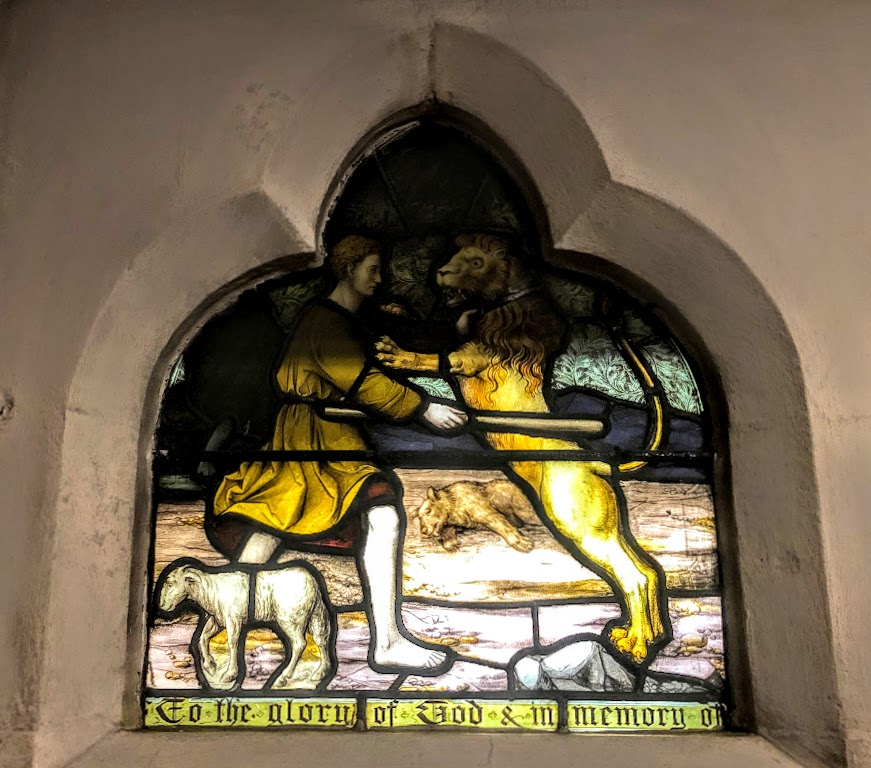
David killing a lion (see I Samuel 17: 34-37) depicted in the second window on the north wall in Saint Mary and Saint Giles Church, Stony Stratford (Photograph: Patrick Comerford, 2022)
Luke 19: 45-48 (NRSVA):
45 Then he entered the temple and began to drive out those who were selling things there; 46 and he said, ‘It is written,
“My house shall be a house of prayer”;
but you have made it a den of robbers.’
47 Every day he was teaching in the temple. The chief priests, the scribes, and the leaders of the people kept looking for a way to kill him; 48 but they did not find anything they could do, for all the people were spellbound by what they heard.
Christ the Good Shepherd (John 10: 11-18) depicted in the second window in the north wall in Saint Mary and Saint Giles Church, Stony Stratford (Photograph: Patrick Comerford, 2022)
Stained-glass windows in Stony Stratford, 6:
Throughout this week, I am reflecting each morning on the stained glass windows in the Church of Saint Mary and Saint Giles, Stony Stratford, Buckinghamshire.
The 12 windows in Saint Mary and Saint Giles include a two-light window at the west end by Charles Eamer Kempe, depicting three archangels; a set of three windows in the south gallery, among them important work by John Groome Howe of the Hardman studios; two separate windows in the south gallery that appear to include fragments from an earlier window; and six windows – three below the gallery on the south wall and three below the gallery on the north wall – by NHJ Westlake of Lavers & Westlake.
The second window in the North Wall in Saint Mary and Saint Giles is dated 1889. It is by Nathaniel Westlake and was commissioned by the Stony Stratford architect Edward Swinfen Harris (1841-1924), whose works, mainly in the Arts and Crafts style, can be seen throughout the town.
This is second of two sets of windows in memory of the Revd John William Spark, who was the assistant curate in Stony Stratford for six years.
This window is of three eyelets and depicts:
1, David killing a lion (see I Samuel 17: 34-37);
2, Christ the Good Shepherd (John 10: 11-18);
3, The Sacrifice of Abel (Genesis 4: 2).
The Revd John William Spark was born in 1858, the son of Peter Spark, a farmer of Meldreth, near Whittlesford, Cambridgeshire, and later of Babraham. John Spark was educated at Saint John’s College, Oxford (BA 1880, MA 1885), and was an assistant curate in Stony Stratford for six years. He left £50 in his will towards providing better vestry accommodation, and this money formed the nucleus of a fund for building the new vestries.
This window is the second of two in the church in Spark’s memory. Each panel in this window depicts a good shepherd.
Before going into battle with Goliath, David told Saul how he had risked his life for the sheep in flock, killing lions and bears: ‘… whenever a lion or a bear came, and took a lamb from the flock, I went after it and struck it down, rescuing the lamb from its mouth; and if it turned against me, I would catch it by the jaw, strike it down, and kill it. Your servant has killed both lions and bears … the Lord, who saved me from the paw of the lion and from the paw of the bear, will save me from the hand of this Philistine’ (I Samuel 17: 34-37).
In Saint John’s Gospel, Christ describes himself twice in one passage as the Good Shepherd: ‘I am the good shepherd. The good shepherd lays down his life for the sheep. … I am the good shepherd. I know my own and my own know me, just as the Father knows me and I know the Father. And I lay down my life for the sheep’ (John 10: 11-15).
The third panel recalls Abel the Shepherd and his sacrifice: ‘Abel was a keeper of sheep, and Cain a tiller of the ground. In the course of time Cain brought to the Lord an offering of the fruit of the ground, and Abel for his part brought of the firstlings of his flock, their fat portions. And the Lord had regard for Abel and his offering’ (Genesis 4: 2-4).
The panels in this window are asking the parishioners of Stony Stratford to remember the Revd John William Spark, their curate who died a young man, as someone who risked his life for them, who made a perfect sacrifice, and who was a faithful shepherd.
The Sacrifice of Abel (Genesis 4: 2) … a panel in the second window on the north wall in Saint Mary and Saint Giles Church, Stony Stratford (Photograph: Patrick Comerford, 2022)
The Collect:
Lord God,
who taught Elizabeth of Hungary
to recognize and reverence Christ in the poor of this world:
by her example
strengthen us to love and serve the afflicted and the needy
and so to honour your Son, the servant king,
who is alive and reigns with you,
in the unity of the Holy Spirit,
one God, now and for ever.
The Post Communion Prayer:
Faithful God,
who called Elizabeth of Hungary to serve you
and gave her joy in walking the path of holiness:
by this Eucharist
in which you renew within us the vision of your glory,
strengthen us all to follow the way of perfection
until we come to see you face to face;
through Jesus Christ our Lord.
The theme in the USPG Prayer Diary this week is ‘Living Together in Peace.’ This theme was introduced on Sunday, describing the work of PROCMURA, the Programme for Christian-Muslim Relations in Africa. USPG has provided an annual grant to PROCMURA since it started in 1959.
The USPG Prayer Diary invites us to pray today in these words:
Let us pray for the success of the Protestant University of Central Africa’s Master of Arts programme in Islam and Christian-Muslim Relations.
Yesterday’s reflection
Continued tomorrow
Inside Saint Mary and Saint Giles, looking east … the church was rebuilt by Francis Hiorne in 1776-1777 (Photograph: Patrick Comerford, 2022)
Scripture quotations are from the New Revised Standard Version Bible: Anglicised Edition copyright © 1989, 1995, National Council of the Churches of Christ in the United States of America. Used by permission. All rights reserved worldwide. http://nrsvbibles.org
Patrick Comerford
The Calendar of the Church of England in Common Worship today (18 November 2022) remembers Elizabeth of Hungary, Princess of Thuringia, Philanthropist (1231), with a Lesser Festival.
Elizabeth was born in 1207, the daughter of a king of Hungary. She married Louis IV, Landgrave of Thuringia, and they had three children. Theirs was a happy marriage but after four years her husband died of the plague. Elizabeth was driven from the court and she settled in Marburg. There her confessor was Conrad of Marburg, but was domineering and sadistic, and she suffered mental and physical abuse from him. Still, Elizabeth joined the Franciscan Third Order, and cared for the poor, cooking and cleaning for them. She died on this day, just 24 years old, in 1231.
Before this day gets busy, I am taking some time this morning for reading, prayer and reflection.
Throughout this week, I am reflecting in these ways:
1, One of the readings for the morning;
2, A reflection on the stained glass windows in Saint Mary and Saint Giles Church, Stony Stratford;
3, a prayer from the USPG prayer diary, ‘Pray with the World Church.’
David killing a lion (see I Samuel 17: 34-37) depicted in the second window on the north wall in Saint Mary and Saint Giles Church, Stony Stratford (Photograph: Patrick Comerford, 2022)
Luke 19: 45-48 (NRSVA):
45 Then he entered the temple and began to drive out those who were selling things there; 46 and he said, ‘It is written,
“My house shall be a house of prayer”;
but you have made it a den of robbers.’
47 Every day he was teaching in the temple. The chief priests, the scribes, and the leaders of the people kept looking for a way to kill him; 48 but they did not find anything they could do, for all the people were spellbound by what they heard.
Christ the Good Shepherd (John 10: 11-18) depicted in the second window in the north wall in Saint Mary and Saint Giles Church, Stony Stratford (Photograph: Patrick Comerford, 2022)
Stained-glass windows in Stony Stratford, 6:
Throughout this week, I am reflecting each morning on the stained glass windows in the Church of Saint Mary and Saint Giles, Stony Stratford, Buckinghamshire.
The 12 windows in Saint Mary and Saint Giles include a two-light window at the west end by Charles Eamer Kempe, depicting three archangels; a set of three windows in the south gallery, among them important work by John Groome Howe of the Hardman studios; two separate windows in the south gallery that appear to include fragments from an earlier window; and six windows – three below the gallery on the south wall and three below the gallery on the north wall – by NHJ Westlake of Lavers & Westlake.
The second window in the North Wall in Saint Mary and Saint Giles is dated 1889. It is by Nathaniel Westlake and was commissioned by the Stony Stratford architect Edward Swinfen Harris (1841-1924), whose works, mainly in the Arts and Crafts style, can be seen throughout the town.
This is second of two sets of windows in memory of the Revd John William Spark, who was the assistant curate in Stony Stratford for six years.
This window is of three eyelets and depicts:
1, David killing a lion (see I Samuel 17: 34-37);
2, Christ the Good Shepherd (John 10: 11-18);
3, The Sacrifice of Abel (Genesis 4: 2).
The Revd John William Spark was born in 1858, the son of Peter Spark, a farmer of Meldreth, near Whittlesford, Cambridgeshire, and later of Babraham. John Spark was educated at Saint John’s College, Oxford (BA 1880, MA 1885), and was an assistant curate in Stony Stratford for six years. He left £50 in his will towards providing better vestry accommodation, and this money formed the nucleus of a fund for building the new vestries.
This window is the second of two in the church in Spark’s memory. Each panel in this window depicts a good shepherd.
Before going into battle with Goliath, David told Saul how he had risked his life for the sheep in flock, killing lions and bears: ‘… whenever a lion or a bear came, and took a lamb from the flock, I went after it and struck it down, rescuing the lamb from its mouth; and if it turned against me, I would catch it by the jaw, strike it down, and kill it. Your servant has killed both lions and bears … the Lord, who saved me from the paw of the lion and from the paw of the bear, will save me from the hand of this Philistine’ (I Samuel 17: 34-37).
In Saint John’s Gospel, Christ describes himself twice in one passage as the Good Shepherd: ‘I am the good shepherd. The good shepherd lays down his life for the sheep. … I am the good shepherd. I know my own and my own know me, just as the Father knows me and I know the Father. And I lay down my life for the sheep’ (John 10: 11-15).
The third panel recalls Abel the Shepherd and his sacrifice: ‘Abel was a keeper of sheep, and Cain a tiller of the ground. In the course of time Cain brought to the Lord an offering of the fruit of the ground, and Abel for his part brought of the firstlings of his flock, their fat portions. And the Lord had regard for Abel and his offering’ (Genesis 4: 2-4).
The panels in this window are asking the parishioners of Stony Stratford to remember the Revd John William Spark, their curate who died a young man, as someone who risked his life for them, who made a perfect sacrifice, and who was a faithful shepherd.
The Sacrifice of Abel (Genesis 4: 2) … a panel in the second window on the north wall in Saint Mary and Saint Giles Church, Stony Stratford (Photograph: Patrick Comerford, 2022)
The Collect:
Lord God,
who taught Elizabeth of Hungary
to recognize and reverence Christ in the poor of this world:
by her example
strengthen us to love and serve the afflicted and the needy
and so to honour your Son, the servant king,
who is alive and reigns with you,
in the unity of the Holy Spirit,
one God, now and for ever.
The Post Communion Prayer:
Faithful God,
who called Elizabeth of Hungary to serve you
and gave her joy in walking the path of holiness:
by this Eucharist
in which you renew within us the vision of your glory,
strengthen us all to follow the way of perfection
until we come to see you face to face;
through Jesus Christ our Lord.
The theme in the USPG Prayer Diary this week is ‘Living Together in Peace.’ This theme was introduced on Sunday, describing the work of PROCMURA, the Programme for Christian-Muslim Relations in Africa. USPG has provided an annual grant to PROCMURA since it started in 1959.
The USPG Prayer Diary invites us to pray today in these words:
Let us pray for the success of the Protestant University of Central Africa’s Master of Arts programme in Islam and Christian-Muslim Relations.
Yesterday’s reflection
Continued tomorrow
Inside Saint Mary and Saint Giles, looking east … the church was rebuilt by Francis Hiorne in 1776-1777 (Photograph: Patrick Comerford, 2022)
Scripture quotations are from the New Revised Standard Version Bible: Anglicised Edition copyright © 1989, 1995, National Council of the Churches of Christ in the United States of America. Used by permission. All rights reserved worldwide. http://nrsvbibles.org
06 June 2021
How the things we do today
reflect our values and shape
the future we are creating
‘But no one can enter a strong man’s house and plunder his property (Mark 3: 27) … Kilkenny Castle at night (Photograph: Patrick Comerford, 2020)
Patrick Comerford
Sunday 6 June 2021
The First Sunday After Trinity (Trinity I)
11 am: The Parish Eucharist
Saint Brendan’s Church, Kilnaughtin (Tarbert), Co Kerry
The Readings: I Samuel 8: 4-11, 16-20; Psalm 138; Mark 3: 20-35.
There is a link to the readings HERE.
‘By the ruler of the demons he casts out demons’ (Mark 3: 22) … a gargoyle at Lichfield Cathedral (Photograph: Patrick Comerford)
May I speak to you in the name of God, + Father, Son and Holy Spirit, Amen.
TS Eliot’s play Murder in the Cathedral is based on the events leading up to the murder of Thomas Becket, Archbishop of Canterbury, on 29 December 1170.
Becket was murdered at the behest of King Henry II, and the play focuses on Becket’s internal struggles. As he reflects on the martyrdom he faces, his tempters arrive, like Job’s comforters, and they question the archbishop about his plight, echoing in many ways Christ’s temptations in the wilderness.
The first tempter offers Becket the prospect of physical safety. The second tempter offers him power, riches and fame in serving the king so that he can disarm the powerful and help the poor. The third tempter suggests the archbishop should form an alliance with the barons and seize a chance to resist the king.
Finally, the fourth tempter urges Thomas to look to the glory of martyrdom.
Becket responds to all his tempters and specifically addresses the immoral suggestions of the fourth tempter at the end of the first act:
Now is my way clear, now is the meaning plain:
Temptation shall not come in this kind again.
The last temptation is the greatest treason:
To do the right deed for the wrong reason.
Saint Mark’s Gospel is very sparse in its account of the story of Christ’s temptations in the wilderness – just two verses (see Mark 1: 12-13). In the much fuller accounts given by Saint Matthew (Matthew 4: 1-11) and Saint Luke (Luke 4: 1-13), Christ is tempted to do the right things for the wrong reason.
What would be wrong with Christ turning stones into bread (see Matthew 4: 3; Luke 4: 3-4) to feed the hungry?
What would be wrong with Christ showing miraculous powers (see Matthew 4: 3; Luke 4: 9) to point to the majesty of God (see Matthew 4: 4; Luke 4: 10-11)?
What would be wrong with Christ taking command of the kingdoms of this world (see Matthew 4: 9; Luke 4: 5-7) to usher in justice, mercy and peace?
Let us not deceive ourselves, these are real temptations. For those who are morally driven there is always a real temptation to do the right thing but to do it for the wrong reason.
In today’s Gospel reading, Christ is challenged in two fundamental ways. He is challenged about whether his work is the work of God or the work of the Devil (Mark 3: 22), and he is challenged to think about what his family thinks about what he is doing (Mark 3: 32).
This theme of temptation and power is also at the heart of our first reading (I Samuel 8: 4-11, [12-15], 16-20 [11: 14-15]). The elders of Israel want a king, and go to Samuel, claiming their motivation is to be ‘like other nations’ (I Samuel 8: 5). But the real reason was a power grab, motivated by a loss of faith in the power of God.
We all know Ireland benefitted in recent years from wanting to be a modern nation, like our neighbours. But that ambition turned to greed, and we were surprised when greed turned to economic collapse. We had given in to the temptation to do what appeared to be the right thing for the wrong reason.
Too often when I am offered the opportunity to do the right thing, to make a difference in this society, in this world, I ask: ‘What’s in this for me?’
When I am asked to speak up for those who are marginalised or oppressed, this should be good enough reason in itself. But then I wonder how others are going to react – react not to the marginalised or oppressed, but to me.
How often have I seen what is the right thing to do, but have found an excuse that I pretend is not of my own making?
How often do I think of doing the right thing only if it is going to please my family members or please my neighbours?
How often do I use the Bible to justify not extending civil rights to others?
How often do I use obscure Bible texts to prop up my own prejudices, forgetting that any text in the Bible, however clear or obscure it may be, depends, in Christ’s own words, on the two greatest commandments, to love God and to love one another.
We can convince ourselves that we are doing the right thing when we are doing it for the wrong reason. A wrong decision taken once, thinking it is doing the right thing, but for the wrong reason, is not just an action in the present moment. It forms habits and it shapes who we are, within time and eternity.
The Revd Martin Niemöller (1892-1984), a prominent German Lutheran pastor and an outspoken opponent of Hitler, spent the last seven years of Nazi rule in concentration camps. He once said:
First they came for the socialists, and I did not speak out –
Because I was not a socialist.
Then they came for the trade unionists, and I did not speak out –
Because I was not a trade unionist.
Then they came for the Jews, and I did not speak out –
Because I was not a Jew.
Then they came for me – and there was no one left to speak for me.
What we do today or refuse to do today, even if we think it is the right thing to do but we do it for the wrong reasons, reflects how we have formed ourselves habitually in the past, is an image of our inner being in the present, and has consequences for the future we wish to shape.
As TS Eliot writes:
Time present and time past
Are both perhaps present in time future
And time future contained in time past (‘Burnt Norton’).
How is the Church to recover its voice and speak up for the oppressed and the marginalised, not because it is fashionable or politically correct today, but because it is the right thing to do today and for the future?
Surely all our actions must depend on those two great commandments – to love God and to love one another.
As the Post-Communion Prayer today reminds us, ‘May our Communion strengthen us in faith, build us up in hope, and make us grow in love; for the sake of Jesus Christ our Lord.’
And so, may all we think, say and do be to the praise, honour and glory of God, + Father, Son and Holy Spirit, Amen.
‘By the ruler of the demons he casts out demons’ (Mark 3: 22) … an image at La Lonja de la Seda in Valencia (Photograph: Patrick Comerford, 2020)
Mark 3: 20-35 (NRSVA):
20 The crowd came together again, so that they could not even eat. 21 When his family heard it, they went out to restrain him, for people were saying, ‘He has gone out of his mind.’ 22 And the scribes who came down from Jerusalem said, ‘He has Beelzebul, and by the ruler of the demons he casts out demons.’ 23 And he called them to him, and spoke to them in parables, ‘How can Satan cast out Satan? 24 If a kingdom is divided against itself, that kingdom cannot stand. 25 And if a house is divided against itself, that house will not be able to stand. 26 And if Satan has risen up against himself and is divided, he cannot stand, but his end has come. 27 But no one can enter a strong man’s house and plunder his property without first tying up the strong man; then indeed the house can be plundered.
28 ‘Truly I tell you, people will be forgiven for their sins and whatever blasphemies they utter; 29 but whoever blasphemes against the Holy Spirit can never have forgiveness, but is guilty of an eternal sin’ – 30 for they had said, ‘He has an unclean spirit.’
31 Then his mother and his brothers came; and standing outside, they sent to him and called him. 32 A crowd was sitting around him; and they said to him, ‘Your mother and your brothers and sisters are outside, asking for you.’ 33 And he replied, ‘Who are my mother and my brothers?’ 34 And looking at those who sat around him, he said, ‘Here are my mother and my brothers! 35 Whoever does the will of God is my brother and sister and mother.’
‘Time present and time past / Are both perhaps present in time future / And time future contained in time past’ (TS Eliot, ‘Burnt Norton’) … summer returns to Cross in Hand Lane, Lichfield (Photograph: Patrick Comerford)
Liturgical Colour: Green
The Collect of the Day:
God,
the strength of all those who put their trust in you:
Mercifully accept our prayers
and, because through the weakness of our mortal nature
we can do no good thing without you, grant us the help of your grace,
that in the keeping of your commandments
we may please you, both in will and deed;
through Jesus Christ our Lord.
The Post-Communion Prayer:
Eternal Father,
we thank you for nourishing us
with these heavenly gifts.
May our communion strengthen us in faith,
build us up in hope,
and make us grow in love;
for the sake of Jesus Christ our Lord.
‘Appoint for us, then, a king to govern us, like other nations’ (I Samuel 8: 5) … a door-knocker on a front door in Cahir, Co Tipperary (Photograph: Patrick Comerford, 2020)
Hymns:
522, In Christ there is no east or west (CD 30)
662, Those who would valour see (CD 38)
‘In Christ there is no east or west’ (Hymn 522) … confusing road signs in Tsesmes near Rethymnon in Crete (Photograph: Patrick Comerford)
Scripture quotations are from the New Revised Standard Version Bible: Anglicised Edition copyright © 1989, 1995, National Council of the Churches of Christ in the United States of America. Used by permission. All rights reserved worldwide. http://nrsvbibles.org
Material from the Book of Common Prayer is copyright © 2004, Representative Body of the Church of Ireland.
Patrick Comerford
Sunday 6 June 2021
The First Sunday After Trinity (Trinity I)
11 am: The Parish Eucharist
Saint Brendan’s Church, Kilnaughtin (Tarbert), Co Kerry
The Readings: I Samuel 8: 4-11, 16-20; Psalm 138; Mark 3: 20-35.
There is a link to the readings HERE.
‘By the ruler of the demons he casts out demons’ (Mark 3: 22) … a gargoyle at Lichfield Cathedral (Photograph: Patrick Comerford)
May I speak to you in the name of God, + Father, Son and Holy Spirit, Amen.
TS Eliot’s play Murder in the Cathedral is based on the events leading up to the murder of Thomas Becket, Archbishop of Canterbury, on 29 December 1170.
Becket was murdered at the behest of King Henry II, and the play focuses on Becket’s internal struggles. As he reflects on the martyrdom he faces, his tempters arrive, like Job’s comforters, and they question the archbishop about his plight, echoing in many ways Christ’s temptations in the wilderness.
The first tempter offers Becket the prospect of physical safety. The second tempter offers him power, riches and fame in serving the king so that he can disarm the powerful and help the poor. The third tempter suggests the archbishop should form an alliance with the barons and seize a chance to resist the king.
Finally, the fourth tempter urges Thomas to look to the glory of martyrdom.
Becket responds to all his tempters and specifically addresses the immoral suggestions of the fourth tempter at the end of the first act:
Now is my way clear, now is the meaning plain:
Temptation shall not come in this kind again.
The last temptation is the greatest treason:
To do the right deed for the wrong reason.
Saint Mark’s Gospel is very sparse in its account of the story of Christ’s temptations in the wilderness – just two verses (see Mark 1: 12-13). In the much fuller accounts given by Saint Matthew (Matthew 4: 1-11) and Saint Luke (Luke 4: 1-13), Christ is tempted to do the right things for the wrong reason.
What would be wrong with Christ turning stones into bread (see Matthew 4: 3; Luke 4: 3-4) to feed the hungry?
What would be wrong with Christ showing miraculous powers (see Matthew 4: 3; Luke 4: 9) to point to the majesty of God (see Matthew 4: 4; Luke 4: 10-11)?
What would be wrong with Christ taking command of the kingdoms of this world (see Matthew 4: 9; Luke 4: 5-7) to usher in justice, mercy and peace?
Let us not deceive ourselves, these are real temptations. For those who are morally driven there is always a real temptation to do the right thing but to do it for the wrong reason.
In today’s Gospel reading, Christ is challenged in two fundamental ways. He is challenged about whether his work is the work of God or the work of the Devil (Mark 3: 22), and he is challenged to think about what his family thinks about what he is doing (Mark 3: 32).
This theme of temptation and power is also at the heart of our first reading (I Samuel 8: 4-11, [12-15], 16-20 [11: 14-15]). The elders of Israel want a king, and go to Samuel, claiming their motivation is to be ‘like other nations’ (I Samuel 8: 5). But the real reason was a power grab, motivated by a loss of faith in the power of God.
We all know Ireland benefitted in recent years from wanting to be a modern nation, like our neighbours. But that ambition turned to greed, and we were surprised when greed turned to economic collapse. We had given in to the temptation to do what appeared to be the right thing for the wrong reason.
Too often when I am offered the opportunity to do the right thing, to make a difference in this society, in this world, I ask: ‘What’s in this for me?’
When I am asked to speak up for those who are marginalised or oppressed, this should be good enough reason in itself. But then I wonder how others are going to react – react not to the marginalised or oppressed, but to me.
How often have I seen what is the right thing to do, but have found an excuse that I pretend is not of my own making?
How often do I think of doing the right thing only if it is going to please my family members or please my neighbours?
How often do I use the Bible to justify not extending civil rights to others?
How often do I use obscure Bible texts to prop up my own prejudices, forgetting that any text in the Bible, however clear or obscure it may be, depends, in Christ’s own words, on the two greatest commandments, to love God and to love one another.
We can convince ourselves that we are doing the right thing when we are doing it for the wrong reason. A wrong decision taken once, thinking it is doing the right thing, but for the wrong reason, is not just an action in the present moment. It forms habits and it shapes who we are, within time and eternity.
The Revd Martin Niemöller (1892-1984), a prominent German Lutheran pastor and an outspoken opponent of Hitler, spent the last seven years of Nazi rule in concentration camps. He once said:
First they came for the socialists, and I did not speak out –
Because I was not a socialist.
Then they came for the trade unionists, and I did not speak out –
Because I was not a trade unionist.
Then they came for the Jews, and I did not speak out –
Because I was not a Jew.
Then they came for me – and there was no one left to speak for me.
What we do today or refuse to do today, even if we think it is the right thing to do but we do it for the wrong reasons, reflects how we have formed ourselves habitually in the past, is an image of our inner being in the present, and has consequences for the future we wish to shape.
As TS Eliot writes:
Time present and time past
Are both perhaps present in time future
And time future contained in time past (‘Burnt Norton’).
How is the Church to recover its voice and speak up for the oppressed and the marginalised, not because it is fashionable or politically correct today, but because it is the right thing to do today and for the future?
Surely all our actions must depend on those two great commandments – to love God and to love one another.
As the Post-Communion Prayer today reminds us, ‘May our Communion strengthen us in faith, build us up in hope, and make us grow in love; for the sake of Jesus Christ our Lord.’
And so, may all we think, say and do be to the praise, honour and glory of God, + Father, Son and Holy Spirit, Amen.
‘By the ruler of the demons he casts out demons’ (Mark 3: 22) … an image at La Lonja de la Seda in Valencia (Photograph: Patrick Comerford, 2020)
Mark 3: 20-35 (NRSVA):
20 The crowd came together again, so that they could not even eat. 21 When his family heard it, they went out to restrain him, for people were saying, ‘He has gone out of his mind.’ 22 And the scribes who came down from Jerusalem said, ‘He has Beelzebul, and by the ruler of the demons he casts out demons.’ 23 And he called them to him, and spoke to them in parables, ‘How can Satan cast out Satan? 24 If a kingdom is divided against itself, that kingdom cannot stand. 25 And if a house is divided against itself, that house will not be able to stand. 26 And if Satan has risen up against himself and is divided, he cannot stand, but his end has come. 27 But no one can enter a strong man’s house and plunder his property without first tying up the strong man; then indeed the house can be plundered.
28 ‘Truly I tell you, people will be forgiven for their sins and whatever blasphemies they utter; 29 but whoever blasphemes against the Holy Spirit can never have forgiveness, but is guilty of an eternal sin’ – 30 for they had said, ‘He has an unclean spirit.’
31 Then his mother and his brothers came; and standing outside, they sent to him and called him. 32 A crowd was sitting around him; and they said to him, ‘Your mother and your brothers and sisters are outside, asking for you.’ 33 And he replied, ‘Who are my mother and my brothers?’ 34 And looking at those who sat around him, he said, ‘Here are my mother and my brothers! 35 Whoever does the will of God is my brother and sister and mother.’
‘Time present and time past / Are both perhaps present in time future / And time future contained in time past’ (TS Eliot, ‘Burnt Norton’) … summer returns to Cross in Hand Lane, Lichfield (Photograph: Patrick Comerford)
Liturgical Colour: Green
The Collect of the Day:
God,
the strength of all those who put their trust in you:
Mercifully accept our prayers
and, because through the weakness of our mortal nature
we can do no good thing without you, grant us the help of your grace,
that in the keeping of your commandments
we may please you, both in will and deed;
through Jesus Christ our Lord.
The Post-Communion Prayer:
Eternal Father,
we thank you for nourishing us
with these heavenly gifts.
May our communion strengthen us in faith,
build us up in hope,
and make us grow in love;
for the sake of Jesus Christ our Lord.
‘Appoint for us, then, a king to govern us, like other nations’ (I Samuel 8: 5) … a door-knocker on a front door in Cahir, Co Tipperary (Photograph: Patrick Comerford, 2020)
Hymns:
522, In Christ there is no east or west (CD 30)
662, Those who would valour see (CD 38)
‘In Christ there is no east or west’ (Hymn 522) … confusing road signs in Tsesmes near Rethymnon in Crete (Photograph: Patrick Comerford)
Scripture quotations are from the New Revised Standard Version Bible: Anglicised Edition copyright © 1989, 1995, National Council of the Churches of Christ in the United States of America. Used by permission. All rights reserved worldwide. http://nrsvbibles.org
Material from the Book of Common Prayer is copyright © 2004, Representative Body of the Church of Ireland.
18 November 2018
‘Beware that no one leads you astray’
‘Beware that no one leads you astray’ (Mark 13: 5) … confusing signs leading into the sea at the beach at Bettystown, Co Meath (Photograph: Patrick Comerford)
Patrick Comerford
Sunday 18 November 2018,
The Second Sunday before Advent (Proper 28).
11.30 a.m.: The Parish Eucharist (Holy Communion 2), Saint Brendan’s Church, Kilnaughtin (Tarbert), Co Kerry.
Readings: I Samuel 1: 4-20; Psalm 16; Hebrews 10: 11-14, (15-18), 19-25; Mark 13: 1-8.
‘Not one stone will be left here upon another; all will be thrown down’ (Mark 13: 2) … classical remains in the Forum (Photograph: Patrick Comerford, Rome, 2017)
May I speak to you in the name of God, + Father, Son and Holy Spirit, Amen.
This morning’s readings raise a number of questions and pose a number of challenges:
● What can we pray for?
● Who can we ask to pray for us?
● Do we only pray for people and causes we regard as worthy and deserving?
● Are there some things we should not ask for in prayer?
● How do we respond when prayers are answered?
● How do we respond when prayers do not seem to be answered?
● How do we respond to those who seem to pray against us?
● Should prayer include an offering or a promise of an offering?
● How does prayer relate to our hopes for the future … for ourselves, our families, our communities, our future?
● How do we pray in times of doubt, in times of fear?
● How do we respond if others seem to have led us astray in our prayers and in our religious hopes?
● What if the way they have led us astray is related in negative or destructive ways not only to our futures, but to the future of the world?
As the Collect of the Day reminds us, prayer is about shaping us in Christ’s image rather than bringing a shopping list to God.
But, on the other hand, if we cannot bring everything to Christ in prayer, how can we possibly be prepared then to celebrate him next Sunday as Christ the King?
In the Old Testament reading (I Samuel 1: 4-20), Elkanah is visiting the Temple at Shiloh for one of the great Jewish festivals. He takes with him his two wives, Hannah and Peninnah, and the children of his younger wife, Peninnah.
At Shiloh, Elkanah takes part in a sacrificial meal. We are told that God has made Hannah childless. In spite of this, Elkanah loves her and he gives Hannah a double portion of food and drink.
This festival is a special time for rejoicing, when sadness is prohibited (Deuteronomy 12: 17-18). But Hannah is sad. For many years, Peninnah taunts Hannah about having no children, and despite her husband’s love, Hannah has reached the point where she can take it no longer.
At the entrance of the temple, she meets Eli, the priest.
Hannah prays to God and makes a vow: if God will grant her a son, she will see to it that he is dedicated or consecrated to God, refrains from strong drink, and is not allowed to have his head shaved – all signs at the time of a holy man.
She is praying out loud, and, knowing that everyone has been drinking at the festival, Eli thinks Hannah’s silent prayer means she is drunk. When she answers back, Eli realises he has misjudged her, and prays to God on her behalf.
Hannah trusts in God, Samuel is born, and Hannah now knows her prayer has been answered.
In the Gospel reading (Mark 13: 1-8), we find ourselves at the end of this year’s lectionary readings from Saint Mark’s Gospel, and at the end of reading Christ’s instructions to his disciples.
Christ has indicated to the disciples that the poor widow who gave all that she has in the Temple is a good example of discipleship. Now he predicts the destruction of the Temple, as the prophets Micah and Jeremiah had done earlier. His words were later used against him.
Then Christ and his first four disciples, Peter, James, John and Andrew, visit the Mount of Olives – a place mentioned in the Old Testament (see Zechariah 14: 4) in connection with events at the end of the era. There they ask him when will the Temple be destroyed.
How will we know that the end of the era is near? Christ gives them three indicators:
● Many will come in Chris’s name claiming, ‘I am he!’ (verse 6) – the phrase he uses here (ἐγώ εἰμι, ego eimi) is the same as the great ‘I AM’ sayings in Saint John’s Gospel.
● major international political conflicts will erupt (verse 8).
● natural disasters and famines will erupt (verse 8).
● And there shall be other signs too (see verses 14-25 later).
The reference to ‘birth pangs’ or a woman in labour (verse 8) might remind us of God’s answer to the prayers of Hannah, but is also an image used by prophets like Jeremiah, Hosea and Micah.
This passage is known as the Marcan Apocalypse, and we are warned that many apocalyptic messengers are deceitful, while those who are discerning will wait for the real end. We are to resist false prophets of doom, yet we must be ready for the true events that are to unfold.
In the meantime, we are charged to continue the mission of the Church: ‘And the good news must first be proclaimed to all nations’ (verse 10).
‘Through all the changing scenes of life’ (Hymn 372) (Photograph: Patrick Comerford, Wexford)
The plight of a woman unable to conceive the much-wanted heir was one of the themes running through Downton Abbey some years ago. But this is also a private and silent source of grief for many women, and for many men too.
In the past, we have not been very good, like the old priest in our Old Testament reading, in recognising in the Church that there are times when it is appropriate to be sad before God in our public worship.
As we approach Advent, it might be worth thinking about the following connections:
● between the promise to Hannah and the promises to Elizabeth and Mary;
● between the lifestyle of Samuel and the lifestyle of John the Baptist;
● between the Temple at Siloh and the destruction of the Temple discussed in the Gospel reading;
● between Hannah’s suffering and the reminder in the psalm that God can be present at the very breaking point of our suffering;
● between Hannah’s weakness and the way God’s power is demonstrated so often at the point of our weaknesses;
● between the Kings of Israel, whose story is about to begin with the story of Samuel, and Christ the Great High King whose story is about to begin in Advent;
● between how we prayed the last Sunday about remembrance and peace and Christ’s warnings this Sunday about ‘wars and rumours of wars’ and of nation rising up against nation;
● between these themes and the theme next Sunday, when we celebrate the Kingship of Christ.
In the past week, I have been very conscious of the great upheavals and political and social crises we face in the world today. Many of us must be concerned about what the combined impact of Brexit and the Trump presidency means not only for Britain and the US, but for the whole world.
Many people will find resonances this morning with the words of Jesus, ‘Not one stone will be left here upon another; all will be thrown down’ … or ‘nation will rise against nation, and kingdom against kingdom.’
And yet Christ tells us, ‘do not be alarmed.’ Like Hannah, we can bring all our fears and all our hopes, for ourselves and for our world, to God in prayer, for Christ is King.
And so, may all we think, say and do be to the praise, honour and glory of God, + Father, Son and Holy Spirit. Amen.
‘When you hear of wars and rumours of wars, do not be alarmed’ (Mark 13: 7) … an anti-war protest outside the Houses of Parliament in Westminster (Photograph: Patrick Comerford)
Mark 13: 1-8:
1 As he came out of the temple, one of his disciples said to him, ‘Look, Teacher, what large stones and what large buildings!’ 2 Then Jesus asked him, ‘Do you see these great buildings? Not one stone will be left here upon another; all will be thrown down.’
3 When he was sitting on the Mount of Olives opposite the temple, Peter, James, John, and Andrew asked him privately, 4 ‘Tell us, when will this be, and what will be the sign that all these things are about to be accomplished?’ 5 Then Jesus began to say to them, ‘Beware that no one leads you astray. 6 Many will come in my name and say, “I am he!” and they will lead many astray. 7 When you hear of wars and rumours of wars, do not be alarmed; this must take place, but the end is still to come. 8 For nation will rise against nation, and kingdom against kingdom; there will be earthquakes in various places; there will be famines. This is but the beginning of the birth pangs.’
‘Look, Teacher, what large stone and what large buildings!’ (Mark 13: 1) … classical remains in the Forum (Photograph: Patrick Comerford, Rome, 2017)
Liturgical Colour: Green
The Collect:
Heavenly Father,
whose blessed Son was revealed to destroy the works of the devil
and to make us the children of God and heirs of eternal life:
Grant that we, having this hope,
may purify ourselves even as he is pure;
that when he shall appear in power and great glory,
we may be made like him
in his eternal and glorious kingdom;
where he is alive and reigns with you and the Holy Spirit,
one God, now and for ever.
The Post Communion Prayer:
Gracious Lord,
in this holy sacrament you give substance to our hope.
Bring us at the last to that pure life for which we long,
through Jesus Christ our Saviour.
Hymns:
466, Here from all nations (CD 27);
327, Christ is our corner-stone (CD 20);
372, Through all the changing scenes of life (CD 20).
‘My heart teaches me, night after night’ (Psalm 16: 7) … alone at night on Bird Street in Lichfield (Photograph: Patrick Comerford)
Scripture quotations are from the New Revised Standard Version Bible: Anglicised Edition copyright © 1989, 1995, National Council of the Churches of Christ in the United States of America. Used by permission. All rights reserved worldwide. http://nrsvbibles.org
Patrick Comerford
Sunday 18 November 2018,
The Second Sunday before Advent (Proper 28).
11.30 a.m.: The Parish Eucharist (Holy Communion 2), Saint Brendan’s Church, Kilnaughtin (Tarbert), Co Kerry.
Readings: I Samuel 1: 4-20; Psalm 16; Hebrews 10: 11-14, (15-18), 19-25; Mark 13: 1-8.
‘Not one stone will be left here upon another; all will be thrown down’ (Mark 13: 2) … classical remains in the Forum (Photograph: Patrick Comerford, Rome, 2017)
May I speak to you in the name of God, + Father, Son and Holy Spirit, Amen.
This morning’s readings raise a number of questions and pose a number of challenges:
● What can we pray for?
● Who can we ask to pray for us?
● Do we only pray for people and causes we regard as worthy and deserving?
● Are there some things we should not ask for in prayer?
● How do we respond when prayers are answered?
● How do we respond when prayers do not seem to be answered?
● How do we respond to those who seem to pray against us?
● Should prayer include an offering or a promise of an offering?
● How does prayer relate to our hopes for the future … for ourselves, our families, our communities, our future?
● How do we pray in times of doubt, in times of fear?
● How do we respond if others seem to have led us astray in our prayers and in our religious hopes?
● What if the way they have led us astray is related in negative or destructive ways not only to our futures, but to the future of the world?
As the Collect of the Day reminds us, prayer is about shaping us in Christ’s image rather than bringing a shopping list to God.
But, on the other hand, if we cannot bring everything to Christ in prayer, how can we possibly be prepared then to celebrate him next Sunday as Christ the King?
In the Old Testament reading (I Samuel 1: 4-20), Elkanah is visiting the Temple at Shiloh for one of the great Jewish festivals. He takes with him his two wives, Hannah and Peninnah, and the children of his younger wife, Peninnah.
At Shiloh, Elkanah takes part in a sacrificial meal. We are told that God has made Hannah childless. In spite of this, Elkanah loves her and he gives Hannah a double portion of food and drink.
This festival is a special time for rejoicing, when sadness is prohibited (Deuteronomy 12: 17-18). But Hannah is sad. For many years, Peninnah taunts Hannah about having no children, and despite her husband’s love, Hannah has reached the point where she can take it no longer.
At the entrance of the temple, she meets Eli, the priest.
Hannah prays to God and makes a vow: if God will grant her a son, she will see to it that he is dedicated or consecrated to God, refrains from strong drink, and is not allowed to have his head shaved – all signs at the time of a holy man.
She is praying out loud, and, knowing that everyone has been drinking at the festival, Eli thinks Hannah’s silent prayer means she is drunk. When she answers back, Eli realises he has misjudged her, and prays to God on her behalf.
Hannah trusts in God, Samuel is born, and Hannah now knows her prayer has been answered.
In the Gospel reading (Mark 13: 1-8), we find ourselves at the end of this year’s lectionary readings from Saint Mark’s Gospel, and at the end of reading Christ’s instructions to his disciples.
Christ has indicated to the disciples that the poor widow who gave all that she has in the Temple is a good example of discipleship. Now he predicts the destruction of the Temple, as the prophets Micah and Jeremiah had done earlier. His words were later used against him.
Then Christ and his first four disciples, Peter, James, John and Andrew, visit the Mount of Olives – a place mentioned in the Old Testament (see Zechariah 14: 4) in connection with events at the end of the era. There they ask him when will the Temple be destroyed.
How will we know that the end of the era is near? Christ gives them three indicators:
● Many will come in Chris’s name claiming, ‘I am he!’ (verse 6) – the phrase he uses here (ἐγώ εἰμι, ego eimi) is the same as the great ‘I AM’ sayings in Saint John’s Gospel.
● major international political conflicts will erupt (verse 8).
● natural disasters and famines will erupt (verse 8).
● And there shall be other signs too (see verses 14-25 later).
The reference to ‘birth pangs’ or a woman in labour (verse 8) might remind us of God’s answer to the prayers of Hannah, but is also an image used by prophets like Jeremiah, Hosea and Micah.
This passage is known as the Marcan Apocalypse, and we are warned that many apocalyptic messengers are deceitful, while those who are discerning will wait for the real end. We are to resist false prophets of doom, yet we must be ready for the true events that are to unfold.
In the meantime, we are charged to continue the mission of the Church: ‘And the good news must first be proclaimed to all nations’ (verse 10).
‘Through all the changing scenes of life’ (Hymn 372) (Photograph: Patrick Comerford, Wexford)
The plight of a woman unable to conceive the much-wanted heir was one of the themes running through Downton Abbey some years ago. But this is also a private and silent source of grief for many women, and for many men too.
In the past, we have not been very good, like the old priest in our Old Testament reading, in recognising in the Church that there are times when it is appropriate to be sad before God in our public worship.
As we approach Advent, it might be worth thinking about the following connections:
● between the promise to Hannah and the promises to Elizabeth and Mary;
● between the lifestyle of Samuel and the lifestyle of John the Baptist;
● between the Temple at Siloh and the destruction of the Temple discussed in the Gospel reading;
● between Hannah’s suffering and the reminder in the psalm that God can be present at the very breaking point of our suffering;
● between Hannah’s weakness and the way God’s power is demonstrated so often at the point of our weaknesses;
● between the Kings of Israel, whose story is about to begin with the story of Samuel, and Christ the Great High King whose story is about to begin in Advent;
● between how we prayed the last Sunday about remembrance and peace and Christ’s warnings this Sunday about ‘wars and rumours of wars’ and of nation rising up against nation;
● between these themes and the theme next Sunday, when we celebrate the Kingship of Christ.
In the past week, I have been very conscious of the great upheavals and political and social crises we face in the world today. Many of us must be concerned about what the combined impact of Brexit and the Trump presidency means not only for Britain and the US, but for the whole world.
Many people will find resonances this morning with the words of Jesus, ‘Not one stone will be left here upon another; all will be thrown down’ … or ‘nation will rise against nation, and kingdom against kingdom.’
And yet Christ tells us, ‘do not be alarmed.’ Like Hannah, we can bring all our fears and all our hopes, for ourselves and for our world, to God in prayer, for Christ is King.
And so, may all we think, say and do be to the praise, honour and glory of God, + Father, Son and Holy Spirit. Amen.
‘When you hear of wars and rumours of wars, do not be alarmed’ (Mark 13: 7) … an anti-war protest outside the Houses of Parliament in Westminster (Photograph: Patrick Comerford)
Mark 13: 1-8:
1 As he came out of the temple, one of his disciples said to him, ‘Look, Teacher, what large stones and what large buildings!’ 2 Then Jesus asked him, ‘Do you see these great buildings? Not one stone will be left here upon another; all will be thrown down.’
3 When he was sitting on the Mount of Olives opposite the temple, Peter, James, John, and Andrew asked him privately, 4 ‘Tell us, when will this be, and what will be the sign that all these things are about to be accomplished?’ 5 Then Jesus began to say to them, ‘Beware that no one leads you astray. 6 Many will come in my name and say, “I am he!” and they will lead many astray. 7 When you hear of wars and rumours of wars, do not be alarmed; this must take place, but the end is still to come. 8 For nation will rise against nation, and kingdom against kingdom; there will be earthquakes in various places; there will be famines. This is but the beginning of the birth pangs.’
‘Look, Teacher, what large stone and what large buildings!’ (Mark 13: 1) … classical remains in the Forum (Photograph: Patrick Comerford, Rome, 2017)
Liturgical Colour: Green
The Collect:
Heavenly Father,
whose blessed Son was revealed to destroy the works of the devil
and to make us the children of God and heirs of eternal life:
Grant that we, having this hope,
may purify ourselves even as he is pure;
that when he shall appear in power and great glory,
we may be made like him
in his eternal and glorious kingdom;
where he is alive and reigns with you and the Holy Spirit,
one God, now and for ever.
The Post Communion Prayer:
Gracious Lord,
in this holy sacrament you give substance to our hope.
Bring us at the last to that pure life for which we long,
through Jesus Christ our Saviour.
Hymns:
466, Here from all nations (CD 27);
327, Christ is our corner-stone (CD 20);
372, Through all the changing scenes of life (CD 20).
‘My heart teaches me, night after night’ (Psalm 16: 7) … alone at night on Bird Street in Lichfield (Photograph: Patrick Comerford)
Scripture quotations are from the New Revised Standard Version Bible: Anglicised Edition copyright © 1989, 1995, National Council of the Churches of Christ in the United States of America. Used by permission. All rights reserved worldwide. http://nrsvbibles.org
‘Through all the changing scenes of life’
‘Not one stone will be left here upon another; all will be thrown down’ (Mark 13: 2) … classical remains in the Forum (Photograph: Patrick Comerford, Rome, 2017)
Patrick Comerford
Sunday 18 November 2018,
The Second Sunday before Advent (Proper 28).
9.30 a.m.: Morning Prayer, Saint Mary’s Church, Askeaton, Co Limerick.
Readings: I Samuel 1: 4-20; Psalm 16; Hebrews 10: 11-14, (15-18), 19-25; Mark 13: 1-8.
‘Through all the changing scenes of life’ (Hymn 372) (Photograph: Patrick Comerford, Wexford)
May I speak to you in the name of God, + Father, Son and Holy Spirit, Amen.
This morning’s readings raise a number of questions and pose a number of challenges:
● What can we pray for?
● Who can we ask to pray for us?
● Do we only pray for people and causes we regard as worthy and deserving?
● Are there some things we should not ask for in prayer?
● How do we respond when prayers are answered?
● How do we respond when prayers do not seem to be answered?
● How do we respond to those who seem to pray against us?
● Should prayer include an offering or a promise of an offering?
● How does prayer relate to our hopes for the future … for ourselves, our families, our communities, our future?
● How do we pray in times of doubt, in times of fear?
● How do we respond if others seem to have led us astray in our prayers and in our religious hopes?
● What if the way they have led us astray is related in negative or destructive ways not only to our futures, but to the future of the world?
As the Collect of the Day reminds us, prayer is about shaping us in Christ’s image rather than bringing a shopping list to God.
But, on the other hand, if we cannot bring everything to Christ in prayer, how can we possibly be prepared then to celebrate him next Sunday as Christ the King?
In the Old Testament reading (I Samuel 1: 4-20), Elkanah is visiting the Temple at Shiloh for one of the great Jewish festivals. He takes with him his two wives, Hannah and Peninnah, and the children of his younger wife, Peninnah.
At Shiloh, Elkanah takes part in a sacrificial meal. We are told that God has made Hannah childless. In spite of this, Elkanah loves her and he gives Hannah a double portion of food and drink.
This festival is a special time for rejoicing, when sadness is prohibited (Deuteronomy 12: 17-18). But Hannah is sad. For many years, Peninnah taunts Hannah about having no children, and despite her husband’s love, Hannah has reached the point where she can take it no longer.
At the entrance of the temple, she meets Eli, the priest.
Hannah prays to God and makes a vow: if God will grant her a son, she will see to it that he is dedicated or consecrated to God, refrains from strong drink, and is not allowed to have his head shaved – all signs at the time of a holy man.
She is praying out loud, and, knowing that everyone has been drinking at the festival, Eli thinks Hannah’s silent prayer means she is drunk. When she answers back, Eli realises he has misjudged her, and prays to God on her behalf.
Hannah trusts in God, Samuel is born, and Hannah now knows her prayer has been answered.
In the Gospel reading (Mark 13: 1-8), we find ourselves at the end of this year’s lectionary readings from Saint Mark’s Gospel, and at the end of reading Christ’s instructions to his disciples.
Christ has indicated to the disciples that the poor widow who gave all that she has in the Temple is a good example of discipleship. Now he predicts the destruction of the Temple, as the prophets Micah and Jeremiah had done earlier. His words were later used against him.
Then Christ and his first four disciples, Peter, James, John and Andrew, visit the Mount of Olives – a place mentioned in the Old Testament (see Zechariah 14: 4) in connection with events at the end of the era. There they ask him when will the Temple be destroyed.
How will we know that the end of the era is near? Christ gives them three indicators:
● Many will come in Chris’s name claiming, ‘I am he!’ (verse 6) – the phrase he uses here (ἐγώ εἰμι, ego eimi) is the same as the great ‘I AM’ sayings in Saint John’s Gospel.
● major international political conflicts will erupt (verse 8).
● natural disasters and famines will erupt (verse 8).
● And there shall be other signs too (see verses 14-25 later).
The reference to ‘birth pangs’ or a woman in labour (verse 8) might remind us of God’s answer to the prayers of Hannah, but is also an image used by prophets like Jeremiah, Hosea and Micah.
This passage is known as the Marcan Apocalypse, and we are warned that many apocalyptic messengers are deceitful, while those who are discerning will wait for the real end. We are to resist false prophets of doom, yet we must be ready for the true events that are to unfold.
In the meantime, we are charged to continue the mission of the Church: ‘And the good news must first be proclaimed to all nations’ (verse 10).
‘Beware that no one leads you astray’ (Mark 13: 5) … confusing signs leading into the sea at the beach at Bettystown, Co Meath (Photograph: Patrick Comerford)
The plight of a woman unable to conceive the much-wanted heir was one of the themes running through Downton Abbey some years ago. But this is also a private and silent source of grief for many women, and for many men too.
In the past, we have not been very good, like the old priest in our Old Testament reading, in recognising in the Church that there are times when it is appropriate to be sad before God in our public worship.
As we approach Advent, it might be worth thinking about the following connections:
● between the promise to Hannah and the promises to Elizabeth and Mary;
● between the lifestyle of Samuel and the lifestyle of John the Baptist;
● between the Temple at Siloh and the destruction of the Temple discussed in the Gospel reading;
● between Hannah’s suffering and the reminder in the psalm that God can be present at the very breaking point of our suffering;
● between Hannah’s weakness and the way God’s power is demonstrated so often at the point of our weaknesses;
● between the Kings of Israel, whose story is about to begin with the story of Samuel, and Christ the Great High King whose story is about to begin in Advent;
● between how we prayed the last Sunday about remembrance and peace and Christ’s warnings this Sunday about ‘wars and rumours of wars’ and of nation rising up against nation;
● between these themes and the theme next Sunday, when we celebrate the Kingship of Christ.
In the past week, I have been very conscious of the great upheavals and political and social crises we face in the world today. Many of us must be concerned about what the combined impact of Brexit and the Trump presidency means not only for Britain and the US, but for the whole world.
Many people will find resonances this morning with the words of Jesus, ‘Not one stone will be left here upon another; all will be thrown down’ … or ‘nation will rise against nation, and kingdom against kingdom.’
And yet Christ tells us, ‘do not be alarmed.’ Like Hannah, we can bring all our fears and all our hopes, for ourselves and for our world, to God in prayer, for Christ is King.
And so, may all we think, say and do be to the praise, honour and glory of God, + Father, Son and Holy Spirit. Amen.
‘When you hear of wars and rumours of wars, do not be alarmed’ (Mark 13: 7) … an anti-war protest outside the Houses of Parliament in Westminster (Photograph: Patrick Comerford)
Mark 13: 1-8:
1 As he came out of the temple, one of his disciples said to him, ‘Look, Teacher, what large stones and what large buildings!’ 2 Then Jesus asked him, ‘Do you see these great buildings? Not one stone will be left here upon another; all will be thrown down.’
3 When he was sitting on the Mount of Olives opposite the temple, Peter, James, John, and Andrew asked him privately, 4 ‘Tell us, when will this be, and what will be the sign that all these things are about to be accomplished?’ 5 Then Jesus began to say to them, ‘Beware that no one leads you astray. 6 Many will come in my name and say, “I am he!” and they will lead many astray. 7 When you hear of wars and rumours of wars, do not be alarmed; this must take place, but the end is still to come. 8 For nation will rise against nation, and kingdom against kingdom; there will be earthquakes in various places; there will be famines. This is but the beginning of the birth pangs.’
‘Look, Teacher, what large stone and what large buildings!’ (Mark 13: 1) … classical remains in the Forum (Photograph: Patrick Comerford, Rome, 2017)
Liturgical Colour: Green
The Collect:
Heavenly Father,
whose blessed Son was revealed to destroy the works of the devil
and to make us the children of God and heirs of eternal life:
Grant that we, having this hope,
may purify ourselves even as he is pure;
that when he shall appear in power and great glory,
we may be made like him
in his eternal and glorious kingdom;
where he is alive and reigns with you and the Holy Spirit,
one God, now and for ever.
The Post Communion Prayer:
Gracious Lord,
in this holy sacrament you give substance to our hope.
Bring us at the last to that pure life for which we long,
through Jesus Christ our Saviour.
Hymns:
466, Here from all nations (CD 27);
327, Christ is our corner-stone (CD 20);
372, Through all the changing scenes of life (CD 20).
‘My heart teaches me, night after night’ (Psalm 16: 7) … alone at night on Bird Street in Lichfield (Photograph: Patrick Comerford)
Scripture quotations are from the New Revised Standard Version Bible: Anglicised Edition copyright © 1989, 1995, National Council of the Churches of Christ in the United States of America. Used by permission. All rights reserved worldwide. http://nrsvbibles.org
Patrick Comerford
Sunday 18 November 2018,
The Second Sunday before Advent (Proper 28).
9.30 a.m.: Morning Prayer, Saint Mary’s Church, Askeaton, Co Limerick.
Readings: I Samuel 1: 4-20; Psalm 16; Hebrews 10: 11-14, (15-18), 19-25; Mark 13: 1-8.
‘Through all the changing scenes of life’ (Hymn 372) (Photograph: Patrick Comerford, Wexford)
May I speak to you in the name of God, + Father, Son and Holy Spirit, Amen.
This morning’s readings raise a number of questions and pose a number of challenges:
● What can we pray for?
● Who can we ask to pray for us?
● Do we only pray for people and causes we regard as worthy and deserving?
● Are there some things we should not ask for in prayer?
● How do we respond when prayers are answered?
● How do we respond when prayers do not seem to be answered?
● How do we respond to those who seem to pray against us?
● Should prayer include an offering or a promise of an offering?
● How does prayer relate to our hopes for the future … for ourselves, our families, our communities, our future?
● How do we pray in times of doubt, in times of fear?
● How do we respond if others seem to have led us astray in our prayers and in our religious hopes?
● What if the way they have led us astray is related in negative or destructive ways not only to our futures, but to the future of the world?
As the Collect of the Day reminds us, prayer is about shaping us in Christ’s image rather than bringing a shopping list to God.
But, on the other hand, if we cannot bring everything to Christ in prayer, how can we possibly be prepared then to celebrate him next Sunday as Christ the King?
In the Old Testament reading (I Samuel 1: 4-20), Elkanah is visiting the Temple at Shiloh for one of the great Jewish festivals. He takes with him his two wives, Hannah and Peninnah, and the children of his younger wife, Peninnah.
At Shiloh, Elkanah takes part in a sacrificial meal. We are told that God has made Hannah childless. In spite of this, Elkanah loves her and he gives Hannah a double portion of food and drink.
This festival is a special time for rejoicing, when sadness is prohibited (Deuteronomy 12: 17-18). But Hannah is sad. For many years, Peninnah taunts Hannah about having no children, and despite her husband’s love, Hannah has reached the point where she can take it no longer.
At the entrance of the temple, she meets Eli, the priest.
Hannah prays to God and makes a vow: if God will grant her a son, she will see to it that he is dedicated or consecrated to God, refrains from strong drink, and is not allowed to have his head shaved – all signs at the time of a holy man.
She is praying out loud, and, knowing that everyone has been drinking at the festival, Eli thinks Hannah’s silent prayer means she is drunk. When she answers back, Eli realises he has misjudged her, and prays to God on her behalf.
Hannah trusts in God, Samuel is born, and Hannah now knows her prayer has been answered.
In the Gospel reading (Mark 13: 1-8), we find ourselves at the end of this year’s lectionary readings from Saint Mark’s Gospel, and at the end of reading Christ’s instructions to his disciples.
Christ has indicated to the disciples that the poor widow who gave all that she has in the Temple is a good example of discipleship. Now he predicts the destruction of the Temple, as the prophets Micah and Jeremiah had done earlier. His words were later used against him.
Then Christ and his first four disciples, Peter, James, John and Andrew, visit the Mount of Olives – a place mentioned in the Old Testament (see Zechariah 14: 4) in connection with events at the end of the era. There they ask him when will the Temple be destroyed.
How will we know that the end of the era is near? Christ gives them three indicators:
● Many will come in Chris’s name claiming, ‘I am he!’ (verse 6) – the phrase he uses here (ἐγώ εἰμι, ego eimi) is the same as the great ‘I AM’ sayings in Saint John’s Gospel.
● major international political conflicts will erupt (verse 8).
● natural disasters and famines will erupt (verse 8).
● And there shall be other signs too (see verses 14-25 later).
The reference to ‘birth pangs’ or a woman in labour (verse 8) might remind us of God’s answer to the prayers of Hannah, but is also an image used by prophets like Jeremiah, Hosea and Micah.
This passage is known as the Marcan Apocalypse, and we are warned that many apocalyptic messengers are deceitful, while those who are discerning will wait for the real end. We are to resist false prophets of doom, yet we must be ready for the true events that are to unfold.
In the meantime, we are charged to continue the mission of the Church: ‘And the good news must first be proclaimed to all nations’ (verse 10).
‘Beware that no one leads you astray’ (Mark 13: 5) … confusing signs leading into the sea at the beach at Bettystown, Co Meath (Photograph: Patrick Comerford)
The plight of a woman unable to conceive the much-wanted heir was one of the themes running through Downton Abbey some years ago. But this is also a private and silent source of grief for many women, and for many men too.
In the past, we have not been very good, like the old priest in our Old Testament reading, in recognising in the Church that there are times when it is appropriate to be sad before God in our public worship.
As we approach Advent, it might be worth thinking about the following connections:
● between the promise to Hannah and the promises to Elizabeth and Mary;
● between the lifestyle of Samuel and the lifestyle of John the Baptist;
● between the Temple at Siloh and the destruction of the Temple discussed in the Gospel reading;
● between Hannah’s suffering and the reminder in the psalm that God can be present at the very breaking point of our suffering;
● between Hannah’s weakness and the way God’s power is demonstrated so often at the point of our weaknesses;
● between the Kings of Israel, whose story is about to begin with the story of Samuel, and Christ the Great High King whose story is about to begin in Advent;
● between how we prayed the last Sunday about remembrance and peace and Christ’s warnings this Sunday about ‘wars and rumours of wars’ and of nation rising up against nation;
● between these themes and the theme next Sunday, when we celebrate the Kingship of Christ.
In the past week, I have been very conscious of the great upheavals and political and social crises we face in the world today. Many of us must be concerned about what the combined impact of Brexit and the Trump presidency means not only for Britain and the US, but for the whole world.
Many people will find resonances this morning with the words of Jesus, ‘Not one stone will be left here upon another; all will be thrown down’ … or ‘nation will rise against nation, and kingdom against kingdom.’
And yet Christ tells us, ‘do not be alarmed.’ Like Hannah, we can bring all our fears and all our hopes, for ourselves and for our world, to God in prayer, for Christ is King.
And so, may all we think, say and do be to the praise, honour and glory of God, + Father, Son and Holy Spirit. Amen.
‘When you hear of wars and rumours of wars, do not be alarmed’ (Mark 13: 7) … an anti-war protest outside the Houses of Parliament in Westminster (Photograph: Patrick Comerford)
Mark 13: 1-8:
1 As he came out of the temple, one of his disciples said to him, ‘Look, Teacher, what large stones and what large buildings!’ 2 Then Jesus asked him, ‘Do you see these great buildings? Not one stone will be left here upon another; all will be thrown down.’
3 When he was sitting on the Mount of Olives opposite the temple, Peter, James, John, and Andrew asked him privately, 4 ‘Tell us, when will this be, and what will be the sign that all these things are about to be accomplished?’ 5 Then Jesus began to say to them, ‘Beware that no one leads you astray. 6 Many will come in my name and say, “I am he!” and they will lead many astray. 7 When you hear of wars and rumours of wars, do not be alarmed; this must take place, but the end is still to come. 8 For nation will rise against nation, and kingdom against kingdom; there will be earthquakes in various places; there will be famines. This is but the beginning of the birth pangs.’
‘Look, Teacher, what large stone and what large buildings!’ (Mark 13: 1) … classical remains in the Forum (Photograph: Patrick Comerford, Rome, 2017)
Liturgical Colour: Green
The Collect:
Heavenly Father,
whose blessed Son was revealed to destroy the works of the devil
and to make us the children of God and heirs of eternal life:
Grant that we, having this hope,
may purify ourselves even as he is pure;
that when he shall appear in power and great glory,
we may be made like him
in his eternal and glorious kingdom;
where he is alive and reigns with you and the Holy Spirit,
one God, now and for ever.
The Post Communion Prayer:
Gracious Lord,
in this holy sacrament you give substance to our hope.
Bring us at the last to that pure life for which we long,
through Jesus Christ our Saviour.
Hymns:
466, Here from all nations (CD 27);
327, Christ is our corner-stone (CD 20);
372, Through all the changing scenes of life (CD 20).
‘My heart teaches me, night after night’ (Psalm 16: 7) … alone at night on Bird Street in Lichfield (Photograph: Patrick Comerford)
Scripture quotations are from the New Revised Standard Version Bible: Anglicised Edition copyright © 1989, 1995, National Council of the Churches of Christ in the United States of America. Used by permission. All rights reserved worldwide. http://nrsvbibles.org
10 November 2012
Making connections between priest and king
Hannah giving her son Samuel to the priest Eli, Jan Victors (Staatliche Museen, Berlin, 1645)
Patrick Comerford
In our tutorial group, we have decided to look at the Old Testament lectionary readings for the Sundays after our residential weekends. Tomorrow week [Sunday, 18 November 2012], is the Second Sunday before Advent (Proper 28).
The readings in the Revised Common Lectionary are: I Samuel 1: 4-20; Psalm 16; Hebrews 10: 11-14 (15-18), 19-25; Mark 13: 1-8.
I Samuel 1: 4-20
4 On the day when Elkanah sacrificed, he would give portions to his wife Peninnah and to all her sons and daughters; 5 but to Hannah he gave a double portion, because he loved her, though the Lord had closed her womb. 6 Her rival used to provoke her severely, to irritate her, because the Lord had closed her womb. 7 So it went on year after year; as often as she went up to the house of the Lord, she used to provoke her. Therefore Hannah wept and would not eat. 8Her husband Elkanah said to her, ‘Hannah, why do you weep? Why do you not eat? Why is your heart sad? Am I not more to you than ten sons?’
9 After they had eaten and drunk at Shiloh, Hannah rose and presented herself before the Lord. Now Eli the priest was sitting on the seat beside the doorpost of the temple of the Lord. 10 She was deeply distressed and prayed to the Lord, and wept bitterly. 11 She made this vow: ‘O Lord of hosts, if only you will look on the misery of your servant, and remember me, and not forget your servant, but will give to your servant a male child, then I will set him before you as a nazirite until the day of his death. He shall drink neither wine nor intoxicants, and no razor shall touch his head.’
12 As she continued praying before the Lord, Eli observed her mouth.13 Hannah was praying silently; only her lips moved, but her voice was not heard; therefore Eli thought she was drunk. 14 So Eli said to her, ‘How long will you make a drunken spectacle of yourself? Put away your wine.’ 15 But Hannah answered, ‘No, my lord, I am a woman deeply troubled; I have drunk neither wine nor strong drink, but I have been pouring out my soul before the Lord. 16 Do not regard your servant as a worthless woman, for I have been speaking out of my great anxiety and vexation all this time.’ 17 Then Eli answered, ‘Go in peace; the God of Israel grant the petition you have made to him.’ 18 And she said, ‘Let your servant find favour in your sight.’ Then the woman went to her quarters, ate and drank with her husband, and her countenance was sad no longer.
19 They rose early in the morning and worshipped before the Lord; then they went back to their house at Ramah. Elkanah knew his wife Hannah, and the Lord remembered her. 20 In due time Hannah conceived and bore a son. She named him Samuel, for she said, ‘I have asked him of the Lord.’
Introduction:
The four books I and II Samuel and I and II Kings come together as a single collection, presenting us with an account of Israel’s monarchy and telling us the story of Israel’s kings.
The story of Samuel (I Samuel 1-2) marks the period of transition before the monarchy. It is followed immediately by the story of Saul, Israel’s first king (I Samuel 13-31) leads us into the story of David.
Despite God’s reluctant agreement to kingship, David, whose reign beings in II Samuel 5, represents the highest expression of a kingdom under the rule of God. The covenantal bond between God and his people is first sealed through Abraham, Isaac and Jacob. Then it is refined through Moses. Now it is about to be worked out in a nation with roots that draw nourishment from its religious ideals, beliefs and customs.
Introducing the text:
There are several stories in the Bible of once-barren women who have unusual births and children late in life who are seen as a special favour from God, including:
● Sarah (Genesis 17:16-19);
● Rebekah (Genesis 25: 21-26);
● Rachel (Genesis 29: 31; 30: 22-24);
● The mother of Samson (Judges 13: 2-5);
● Elizabeth (Luke 1: 5-17).
An unusual birth was thought to be symbolic of the importance of the person in later life. This reading is a good reminder of this in these weeks as we are beginning to prepare to celebrate the birth of Christ and the birth of Christ.
Reading the text:
This collection of books on the monarchy opens in the time before the monarchy, when the Temple in Jerusalem Temple has not yet been built. We might read here that Elkanah is a member of the tribe of Ephraim, rather than a godly descendant of Levi who lives in the hill country of Ephraim. Because of his place of residence, he is known as an Ephraimite, but he is really of the tribe of Levi (see I Chronicles 6: 33-38).
Elkanah is on a visit to the Temple at Shiloh for one of the three great Jewish festivals. Elkanah takes with him his two wives, Hannah and Peninnah and the children of his younger wife, Peninnah (I Samuel 1: 1-4).
Polygamy was not common, but we know it was permitted. For example, we read:
“If a man has two wives, one of them loved and the other disliked, and if both the loved and the disliked have borne him sons, the firstborn being the son of the one who is disliked, then on the day when he wills his possessions to his sons, he is not permitted to treat the son of the loved as the firstborn in preference to the son of the disliked, who is the firstborn” (Deuteronomy 21: 15-17, NRSV).
Shiloh was 20-25 miles north of Jerusalem, and this is where the Ark was kept (see I Samuel 3: 3). There also were temples in Shiloh, Bethel and Mizpah, and Shiloh is also mentioned as a centre of worship in Joshua 18: 1; Judges 21: 19; Jeremiah 7: 12; Psalm 78: 60.
At Shiloh, Elkanah takes part in a sacrificial meal. We are told that God has made Hannah childless (verse 5). In spite of this, Elkanah “loved her” and he gives Hannah “a double portion” of food and drink.
This is a very special time for rejoicing, when sadness is prohibited (see Deuteronomy 12: 17-18). But Hannah is sad. For many years, her “rival” (verse 6), Peninnah (verse 4), taunts Hannah about her barrenness. In spite of her husband’s love and considerate attitude towards her, Hannah has been so provoked and irritated reached the point where she can take it no longer.
This time round, after the meal, Hannah goes to the entrance of the temple in Shiloh, and there she meets Eli, the priest (verses 9-10).
Hannah prays to God and makes a vow: if God will grant her a son, she will make him a “nazirite” (verse 11). A nazirite was dedicated or consecrated to God, refrained from drink, and was not allowed to have his head shaved.
A first-born son was always dedicated to God, but was not expected to go as far as becoming a nazirite. However, Hannah offers more: he will be a nazirite throughout his life.
It is presumed that that time prayer was usually said out loud. Knowing that everyone has been drinking, Eli thinks Hannah’s silence in prayer is because she is drunk (verse 13-14). When she answers him very coherently (verse 15-16), Eli realises the error of his judgment, and intercedes with God on Hannah’s behalf (verse 17).
Hannah trusts in God to grant her wish (verse 18). After returning home (verse 19), Samuel is born to Hannah and Elkanah, and Hannah now knows that her desperate prayer has been answered (verse 20).
Later in this chapter, after this reading, Hannah fulfils her promise. When Samuel is weaned, she takes him to Eli in the Temple and gives him to the Lord (verse 24). Samuel is God’s gift to an oppressed woman. His life is God’s gift. Then, in return, his mother gives his life to God (verses 27-28).
Some notes on the text:
Verse 11:
“Lord of hosts”: Hosts may mean armies; if so, the phrase speaks of God’s might.
“male”: It was especially important in Middle East culture that the child be male.
For the Nazirites, see Numbers 6: 1-21, Judges 13: 1-7.
Both men and women could be Nazirites. A person entered this holy state on their own vow or the vow of a parent. There were three conditions for entering this holy state:
● He shall drink neither wine nor intoxicants, although, after a term of membership, the prohibition on wine and strong drink was relaxed.
● No razor shall touch his head.
● He shall not go near a dead body, even his own mother or father.
Joseph is called a nazir (Genesis 49: 26; Deuteronomy 33: 16) and, according to the Septuagint, Samson too was a nazirite.
Verse 13:
“drunk”: Drinking was part of the ritual (see I Samuel 1: 18; Isaiah 22: 13; Amos 2: 8).
Verse 20:
“I have asked him of the Lord”: Actually, Samuel means “name of God” or, more fully, “he over whom the name of God is pronounced,” or possibly “the name of God is El,” while Saul mean “the one who was asked for.”
“asked”: In Hebrew, the word for asked also means “borrowed,” so perhaps the word should be connected with the word “lent” in Hannah’s prayer later (see verse 28). Hannah has begged or borrowed her son from God, so she lends him back to God, by whose grace he has been granted.
The other readings:
Christ the King of Kings and Great High priest ... an icon from Mount Athos (Photograph: Patrick Comerford)
If you are going to preach on the Old Testament reading, then it is important to make connections with the other lectionary readings at the same service.
Psalm 16:
Psalm 16 is about placing our trust in God, who will not abandon us. However, this appears to be an exceptional or unusual variation for the Church of Ireland in the lectionary (see The Book of Common Prayer, p 61; the Church of Ireland Directory 2012, and the Church of Ireland website).
Otherwise, the RCL provides for Psalm 16 only when the alternative Old Testament reading is used (Daniel 12: 1-3). Instead of the Psalm, if I Samuel 1: 4-20 is used as the Old Testament reading, then I Samuel 2: 1-10 should be used as a canticle.
Hebrews 10: 11-14 (15-18), 19-25:
The author has told us how much greater is Christ’s sacrifice of himself than the annual sacrifices of the high priest on the Day of Atonement. Now he says that what any priest offered daily in sacrificial ritual for the forgiveness of sins was worthless, unlike Christ’s “single sacrifice” (verse 12).
After Christ dies and is raised, he becomed king. In Eastern Mediterranean culture, kings sat down, but priests stood up.
Since that time, he has been awaiting the final defeat of his “enemies” (verse 13), although the author does not say who those enemies are. For by offering himself on the cross he has “perfected” (verse 14) or completed the removal of sin from those whom God has “sanctified”, made holy, or set apart for his service.
Elsewhere, salvation will be completed when Christ comes again.
The Old Testament writings, divinely inspired through the “Holy Spirit” (verse 15), foretell this. Jeremiah wrote that there will be a new covenant, one in which God’s ways will be written in peoples’ very being (verse 16), and where God will, in effect, clean off the sin slate (verse 17).
We have a new covenant (verse 18), a new deal with God. From verse 19 on, we are told of the consequences of the new covenant. Since Christ’s sacrifice allows us to enter boldly into God’s presence (“sanctuary”, verse 19), now that there is no longer a barrier (“curtain”, verse 20) between the faithful and God, and since Christ is “a great [high] priest” (verse 21) who has sacrificed for the Church (“house of God”), we have three privileges or duties:
● to approach God in faith with clear consciences (verse 22);
● to “hold fast” (verse 23) to our statement of faith (made at baptism), reciprocating God’s fidelity to us;
● to stimulate the expression of “love and good deeds” (verse 24) in others.
These duties must be performed in the context of the liturgical community, especially since “the Day” (verse 25, Christ’s second coming), is approaching.
Mark 13: 1-8:
We are nearing the end of Christ’s instructions to his disciples. Christ has indicated to them that the poor widow who gave all that she has is a good example of discipleship.
In verses 1-2, Christ predicts the destruction of the Temple, as the prophets Micah and Jeremiah had done earlier. His words were later used against him.
Did he mean it literally or figuratively? We do not know. (Both the Temple and the religious system were destroyed in 70 AD.)
Then Christ and his first four disciples, Peter, James, John and Andrew (verse 3) visit the Mount of Olives – a place mentioned in the Old Testament (see Zechariah 14: 4) in connection with events at the end of the era. They ask him when will the Temple be destroyed (verse 4).
How will we know that the end of the era is near? Christ gives them three indicators:
● Many will come in Chris’s name claiming “I am he!” (verse 6) – the Christological ἐγώ εἰμι (ego eimi we associate with the “I AM” sayings in Saint John’s Gospel.
● major international political conflicts will erupt (verse 8).
● natural disasters and famines will erupt (verse 8).
And there shall be other signs too (see verse 14-25 later).
The figure of a woman in labour (“birth pangs,” verse 8) also appears in Jeremiah, Hosea and Micah.
Some questions:
The plight of a woman unable to conceive the much-wanted heir is one of the themes running through the current episodes of Downton Abbey on television. How do you deal with a topic such as this from the pulpit, knowing this is a private and silent source of grief for many women, and for many men too, in your parish?
Are there times when it is appropriate to be sad in our public worship and during the Liturgy of the Church?
As we approach Advent, can you make the following connections:
● between the promise to Hannah and the promise to Mary, or to Elizabeth?
● the misuse of the name Samuel and the name Emmanuel?
● between the lifestyle of Samuel and the lifestyle of John the Baptist?
● between the Temple at Siloh, the Temple in the reading from the Letter to the Hebrews, and the destruction of the Temple discussed in the Gospel reading?
● between the priest Eli sitting on his seat rather than standing and the sitting king and standing priest (Hebrews 10: 11-12)?
● between Hannah’s suffering and her psalm and the way in which God reveals himself?
● between Hannah’s weakness and the way God’s power is demonstrated so often at the point of our weaknesses?
● between the Kings of Israel, whose story begins here, and Christ the Great High King in the New Testament reading?
● between these themes and the themes of the following Sunday, which celebrates the Kingship of Christ?
Canon Patrick Comerford is Lecturer in Anglicanism and Liturgy, the Church of Ireland Theological Institute. These notes were prepared for a Bible study with part-time MTh students during a residential weekend on 10 November 2012.
Patrick Comerford
In our tutorial group, we have decided to look at the Old Testament lectionary readings for the Sundays after our residential weekends. Tomorrow week [Sunday, 18 November 2012], is the Second Sunday before Advent (Proper 28).
The readings in the Revised Common Lectionary are: I Samuel 1: 4-20; Psalm 16; Hebrews 10: 11-14 (15-18), 19-25; Mark 13: 1-8.
I Samuel 1: 4-20
4 On the day when Elkanah sacrificed, he would give portions to his wife Peninnah and to all her sons and daughters; 5 but to Hannah he gave a double portion, because he loved her, though the Lord had closed her womb. 6 Her rival used to provoke her severely, to irritate her, because the Lord had closed her womb. 7 So it went on year after year; as often as she went up to the house of the Lord, she used to provoke her. Therefore Hannah wept and would not eat. 8Her husband Elkanah said to her, ‘Hannah, why do you weep? Why do you not eat? Why is your heart sad? Am I not more to you than ten sons?’
9 After they had eaten and drunk at Shiloh, Hannah rose and presented herself before the Lord. Now Eli the priest was sitting on the seat beside the doorpost of the temple of the Lord. 10 She was deeply distressed and prayed to the Lord, and wept bitterly. 11 She made this vow: ‘O Lord of hosts, if only you will look on the misery of your servant, and remember me, and not forget your servant, but will give to your servant a male child, then I will set him before you as a nazirite until the day of his death. He shall drink neither wine nor intoxicants, and no razor shall touch his head.’
12 As she continued praying before the Lord, Eli observed her mouth.13 Hannah was praying silently; only her lips moved, but her voice was not heard; therefore Eli thought she was drunk. 14 So Eli said to her, ‘How long will you make a drunken spectacle of yourself? Put away your wine.’ 15 But Hannah answered, ‘No, my lord, I am a woman deeply troubled; I have drunk neither wine nor strong drink, but I have been pouring out my soul before the Lord. 16 Do not regard your servant as a worthless woman, for I have been speaking out of my great anxiety and vexation all this time.’ 17 Then Eli answered, ‘Go in peace; the God of Israel grant the petition you have made to him.’ 18 And she said, ‘Let your servant find favour in your sight.’ Then the woman went to her quarters, ate and drank with her husband, and her countenance was sad no longer.
19 They rose early in the morning and worshipped before the Lord; then they went back to their house at Ramah. Elkanah knew his wife Hannah, and the Lord remembered her. 20 In due time Hannah conceived and bore a son. She named him Samuel, for she said, ‘I have asked him of the Lord.’
Introduction:
The four books I and II Samuel and I and II Kings come together as a single collection, presenting us with an account of Israel’s monarchy and telling us the story of Israel’s kings.
The story of Samuel (I Samuel 1-2) marks the period of transition before the monarchy. It is followed immediately by the story of Saul, Israel’s first king (I Samuel 13-31) leads us into the story of David.
Despite God’s reluctant agreement to kingship, David, whose reign beings in II Samuel 5, represents the highest expression of a kingdom under the rule of God. The covenantal bond between God and his people is first sealed through Abraham, Isaac and Jacob. Then it is refined through Moses. Now it is about to be worked out in a nation with roots that draw nourishment from its religious ideals, beliefs and customs.
Introducing the text:
There are several stories in the Bible of once-barren women who have unusual births and children late in life who are seen as a special favour from God, including:
● Sarah (Genesis 17:16-19);
● Rebekah (Genesis 25: 21-26);
● Rachel (Genesis 29: 31; 30: 22-24);
● The mother of Samson (Judges 13: 2-5);
● Elizabeth (Luke 1: 5-17).
An unusual birth was thought to be symbolic of the importance of the person in later life. This reading is a good reminder of this in these weeks as we are beginning to prepare to celebrate the birth of Christ and the birth of Christ.
Reading the text:
This collection of books on the monarchy opens in the time before the monarchy, when the Temple in Jerusalem Temple has not yet been built. We might read here that Elkanah is a member of the tribe of Ephraim, rather than a godly descendant of Levi who lives in the hill country of Ephraim. Because of his place of residence, he is known as an Ephraimite, but he is really of the tribe of Levi (see I Chronicles 6: 33-38).
Elkanah is on a visit to the Temple at Shiloh for one of the three great Jewish festivals. Elkanah takes with him his two wives, Hannah and Peninnah and the children of his younger wife, Peninnah (I Samuel 1: 1-4).
Polygamy was not common, but we know it was permitted. For example, we read:
“If a man has two wives, one of them loved and the other disliked, and if both the loved and the disliked have borne him sons, the firstborn being the son of the one who is disliked, then on the day when he wills his possessions to his sons, he is not permitted to treat the son of the loved as the firstborn in preference to the son of the disliked, who is the firstborn” (Deuteronomy 21: 15-17, NRSV).
Shiloh was 20-25 miles north of Jerusalem, and this is where the Ark was kept (see I Samuel 3: 3). There also were temples in Shiloh, Bethel and Mizpah, and Shiloh is also mentioned as a centre of worship in Joshua 18: 1; Judges 21: 19; Jeremiah 7: 12; Psalm 78: 60.
At Shiloh, Elkanah takes part in a sacrificial meal. We are told that God has made Hannah childless (verse 5). In spite of this, Elkanah “loved her” and he gives Hannah “a double portion” of food and drink.
This is a very special time for rejoicing, when sadness is prohibited (see Deuteronomy 12: 17-18). But Hannah is sad. For many years, her “rival” (verse 6), Peninnah (verse 4), taunts Hannah about her barrenness. In spite of her husband’s love and considerate attitude towards her, Hannah has been so provoked and irritated reached the point where she can take it no longer.
This time round, after the meal, Hannah goes to the entrance of the temple in Shiloh, and there she meets Eli, the priest (verses 9-10).
Hannah prays to God and makes a vow: if God will grant her a son, she will make him a “nazirite” (verse 11). A nazirite was dedicated or consecrated to God, refrained from drink, and was not allowed to have his head shaved.
A first-born son was always dedicated to God, but was not expected to go as far as becoming a nazirite. However, Hannah offers more: he will be a nazirite throughout his life.
It is presumed that that time prayer was usually said out loud. Knowing that everyone has been drinking, Eli thinks Hannah’s silence in prayer is because she is drunk (verse 13-14). When she answers him very coherently (verse 15-16), Eli realises the error of his judgment, and intercedes with God on Hannah’s behalf (verse 17).
Hannah trusts in God to grant her wish (verse 18). After returning home (verse 19), Samuel is born to Hannah and Elkanah, and Hannah now knows that her desperate prayer has been answered (verse 20).
Later in this chapter, after this reading, Hannah fulfils her promise. When Samuel is weaned, she takes him to Eli in the Temple and gives him to the Lord (verse 24). Samuel is God’s gift to an oppressed woman. His life is God’s gift. Then, in return, his mother gives his life to God (verses 27-28).
Some notes on the text:
Verse 11:
“Lord of hosts”: Hosts may mean armies; if so, the phrase speaks of God’s might.
“male”: It was especially important in Middle East culture that the child be male.
For the Nazirites, see Numbers 6: 1-21, Judges 13: 1-7.
Both men and women could be Nazirites. A person entered this holy state on their own vow or the vow of a parent. There were three conditions for entering this holy state:
● He shall drink neither wine nor intoxicants, although, after a term of membership, the prohibition on wine and strong drink was relaxed.
● No razor shall touch his head.
● He shall not go near a dead body, even his own mother or father.
Joseph is called a nazir (Genesis 49: 26; Deuteronomy 33: 16) and, according to the Septuagint, Samson too was a nazirite.
Verse 13:
“drunk”: Drinking was part of the ritual (see I Samuel 1: 18; Isaiah 22: 13; Amos 2: 8).
Verse 20:
“I have asked him of the Lord”: Actually, Samuel means “name of God” or, more fully, “he over whom the name of God is pronounced,” or possibly “the name of God is El,” while Saul mean “the one who was asked for.”
“asked”: In Hebrew, the word for asked also means “borrowed,” so perhaps the word should be connected with the word “lent” in Hannah’s prayer later (see verse 28). Hannah has begged or borrowed her son from God, so she lends him back to God, by whose grace he has been granted.
The other readings:
Christ the King of Kings and Great High priest ... an icon from Mount Athos (Photograph: Patrick Comerford)
If you are going to preach on the Old Testament reading, then it is important to make connections with the other lectionary readings at the same service.
Psalm 16:
Psalm 16 is about placing our trust in God, who will not abandon us. However, this appears to be an exceptional or unusual variation for the Church of Ireland in the lectionary (see The Book of Common Prayer, p 61; the Church of Ireland Directory 2012, and the Church of Ireland website).
Otherwise, the RCL provides for Psalm 16 only when the alternative Old Testament reading is used (Daniel 12: 1-3). Instead of the Psalm, if I Samuel 1: 4-20 is used as the Old Testament reading, then I Samuel 2: 1-10 should be used as a canticle.
Hebrews 10: 11-14 (15-18), 19-25:
The author has told us how much greater is Christ’s sacrifice of himself than the annual sacrifices of the high priest on the Day of Atonement. Now he says that what any priest offered daily in sacrificial ritual for the forgiveness of sins was worthless, unlike Christ’s “single sacrifice” (verse 12).
After Christ dies and is raised, he becomed king. In Eastern Mediterranean culture, kings sat down, but priests stood up.
Since that time, he has been awaiting the final defeat of his “enemies” (verse 13), although the author does not say who those enemies are. For by offering himself on the cross he has “perfected” (verse 14) or completed the removal of sin from those whom God has “sanctified”, made holy, or set apart for his service.
Elsewhere, salvation will be completed when Christ comes again.
The Old Testament writings, divinely inspired through the “Holy Spirit” (verse 15), foretell this. Jeremiah wrote that there will be a new covenant, one in which God’s ways will be written in peoples’ very being (verse 16), and where God will, in effect, clean off the sin slate (verse 17).
We have a new covenant (verse 18), a new deal with God. From verse 19 on, we are told of the consequences of the new covenant. Since Christ’s sacrifice allows us to enter boldly into God’s presence (“sanctuary”, verse 19), now that there is no longer a barrier (“curtain”, verse 20) between the faithful and God, and since Christ is “a great [high] priest” (verse 21) who has sacrificed for the Church (“house of God”), we have three privileges or duties:
● to approach God in faith with clear consciences (verse 22);
● to “hold fast” (verse 23) to our statement of faith (made at baptism), reciprocating God’s fidelity to us;
● to stimulate the expression of “love and good deeds” (verse 24) in others.
These duties must be performed in the context of the liturgical community, especially since “the Day” (verse 25, Christ’s second coming), is approaching.
Mark 13: 1-8:
We are nearing the end of Christ’s instructions to his disciples. Christ has indicated to them that the poor widow who gave all that she has is a good example of discipleship.
In verses 1-2, Christ predicts the destruction of the Temple, as the prophets Micah and Jeremiah had done earlier. His words were later used against him.
Did he mean it literally or figuratively? We do not know. (Both the Temple and the religious system were destroyed in 70 AD.)
Then Christ and his first four disciples, Peter, James, John and Andrew (verse 3) visit the Mount of Olives – a place mentioned in the Old Testament (see Zechariah 14: 4) in connection with events at the end of the era. They ask him when will the Temple be destroyed (verse 4).
How will we know that the end of the era is near? Christ gives them three indicators:
● Many will come in Chris’s name claiming “I am he!” (verse 6) – the Christological ἐγώ εἰμι (ego eimi we associate with the “I AM” sayings in Saint John’s Gospel.
● major international political conflicts will erupt (verse 8).
● natural disasters and famines will erupt (verse 8).
And there shall be other signs too (see verse 14-25 later).
The figure of a woman in labour (“birth pangs,” verse 8) also appears in Jeremiah, Hosea and Micah.
Some questions:
The plight of a woman unable to conceive the much-wanted heir is one of the themes running through the current episodes of Downton Abbey on television. How do you deal with a topic such as this from the pulpit, knowing this is a private and silent source of grief for many women, and for many men too, in your parish?
Are there times when it is appropriate to be sad in our public worship and during the Liturgy of the Church?
As we approach Advent, can you make the following connections:
● between the promise to Hannah and the promise to Mary, or to Elizabeth?
● the misuse of the name Samuel and the name Emmanuel?
● between the lifestyle of Samuel and the lifestyle of John the Baptist?
● between the Temple at Siloh, the Temple in the reading from the Letter to the Hebrews, and the destruction of the Temple discussed in the Gospel reading?
● between the priest Eli sitting on his seat rather than standing and the sitting king and standing priest (Hebrews 10: 11-12)?
● between Hannah’s suffering and her psalm and the way in which God reveals himself?
● between Hannah’s weakness and the way God’s power is demonstrated so often at the point of our weaknesses?
● between the Kings of Israel, whose story begins here, and Christ the Great High King in the New Testament reading?
● between these themes and the themes of the following Sunday, which celebrates the Kingship of Christ?
Canon Patrick Comerford is Lecturer in Anglicanism and Liturgy, the Church of Ireland Theological Institute. These notes were prepared for a Bible study with part-time MTh students during a residential weekend on 10 November 2012.
Subscribe to:
Posts (Atom)