Showing posts with label Belgium. Show all posts

12 October 2024

Daily prayer in Ordinary Time 2024:
154, Saturday 12 October 2024

Edith Cavell depicted in a bronze bust on her memorial by Henry Alfred Pegram (1862–1937) outside the Erpingham Gate at Norwich Cathedral (Photograph: Patrick Comerford, 2024)

Patrick Comerford

We are continuing in Ordinary Time in the Church Calendar, and tomorrow is the Twentieth Sunday after Trinity (Trinity XX).

The calendar of the Church of England in Common Worship today remembers Wilfrid of Ripon (709), Bishop and Missionary, Elizabeth Fry (1845), Prison Reformer, and Edith Cavell (1915), Nurse.

Today is Yom Kippur or the Day of Repentance, the most solemn day in the Jewish calendar, and I attended the Kol Nidre service in Milton Keynes and District Reform Synagogue yesterday evening.

I have an appointment in Milton Keynes University Hospital later this morning, following my ECG earlier this week. But, before today begins, I am taking some quiet time this morning to give thanks, and for reflection, prayer and reading in these ways:

1, today’s Gospel reading;

2, a reflection on the Gospel reading;

3, a prayer from the USPG prayer diary;

4, the Collects and Post-Communion prayer of the day.

‘Patriotism is not enough’ … the Edith Cavell Memorial in Saint Martin’s Place, London (Photograph: Patrick Comerford, 2024)

Luke 11: 27-28:

27 While he was saying this, a woman in the crowd raised her voice and said to him, ‘Blessed is the womb that bore you and the breasts that nursed you!’ 28 But he said, ‘Blessed rather are those who hear the word of God and obey it!’

The Edith Cavell Memorial near Trafalgar Square is the work of the sculptor Sir George Frampton (Photograph: Patrick Comerford, 2024)

Today’s reflection:

The Gospels – and in particular Saint Luke’s Gospel – are scattered through with short pithy sayings from Jesus that I am reminded of when I read the Sayings of the Desert Fathers, the Pirkei Avot or Ethics of the Fathers in the Mishnah and Jewish tradition, or even the sayings of Zen masters.

This morning’s short Gospel reading quotes one of those short and pithy sayings or aphorisms from Jesus. It is one I thought of as an appropriate Gospel response when Trump’s running mate JD Vance referred to Vice President Kamala Harris and spoke dismissively of ‘childless cat ladies’ who are ‘mean and mean spirited.’

The Trump campaign has been infected in a thorough-going way with racism, misogyny, antisemitism and violence, and seems to be nourished by and feed on all four. A ‘childless cat lady’ seems to have the greater potential of being blessed in the way she may encourage ‘those who hear the word of God and obey it’.

Edith Cavell (1865-1915), who is remembered in Common Worship today (12 October), is an example of those childless women who provide moral leadership in the face of violence and who realised the inappropriate values inherent in what passes as patriotism.

I went to see two monuments to Edith Cavell earlier this year: one close to Norwich Cathedral, where she is buried, the other in Saint Martin’s Place, close to Trafalgar Square, the National Gallery and the National Portrait Gallery and beside the Church of Saint Martin-in-the-Fields.

Edith Cavell was a matron at Berkendael Medical Institute in Brussels when World War I broke out in 1914. She nursed soldiers from both sides without distinction and also helped 200 Allied soldiers escape from German-occupied Belgium. She was arrested in August 1915, court-martialled, found guilty of treason, and shot by a German firing squad on 12 October 1915.

A month before the end of World War I, her statue in Norwich by Henry Pegram (1862-1937) was unveiled on 12 October 1918 by Queen Alexandra. It stood originally in the middle of the road opposite the then Cavell Rest Home for Nurses, which occupied part of the Maids Head Hotel. The depiction of the soldier offering a wreath represents the men she protected at the cost of her own life.

Her body was brought back from Belgium to Britain in May 1919 for a state funeral at Westminster Abbey and she was buried at Norwich Cathedral.

The sculptor Sir George James Frampton (1860-1928) accepted the commission for her monument in London, but declined any fee. He adopted a distinctively Modernist style for the memorial, which comprises a 3 metre high statue of Cavell in her nurse’s uniform, sculpted from white Carrara marble, standing on a grey Cornish granite pedestal. The statue stands in front of the south side of a larger 12-metre grey granite block. The top of the block is carved into a cross and a statue of a mother and child, sometimes interpreted as the Virgin and Child.

The inscription on the pedestal beneath her statue reads: ‘Edith Cavell / Brussels / Dawn / October 12th 1915 / Patriotism is not enough / I must have no hatred or / bitterness for anyone’. The last three lines quote her comment to the Revd Stirling Gahan (1870-1958), the Irish-born Anglican chaplain in Brussels, who shared Holy Communion with her on the night before her execution.

The face of the granite block behind the statue of Cavell bears the inscription ‘Humanity,’ and higher up, below the Virgin and Child, ‘For King and Country.’ Other faces of the block read ‘Devotion’, ‘Fortitude’ and ‘Sacrifice.’ On the rear face of the block is a carving of a lion crushing a serpent, and higher up is the inscription ‘Faithful until death.’

The memorial was unveiled by Queen Alexandra on 17 March 1920. The site was chosen because it was beside the first headquarters of the British Red Cross at 7 Saint Martin’s Place.

Edith Cavell was born on 4 December 1865 in Swardeston, near Norwich, where her father, the Revd Frederick Cavell (1824-1910), was the vicar for 45 years; her maternal grandmother was Irish. She was educated at Norwich High School for Girls, and then went to boarding schools at Clevedon in Somerset, and Laurel Court in Peterborough.

In 1888, when she was 23, Edith was governess in Keswick Hall, near Norwich, for the children in the Gurney family, the family of Elizabeth Fry, who is also commemorated in Common Worship on this day. She later spent five years with a family in Brussels, and began nursing training in London at the age of 30.

At the invitation of Dr Antoine Depage, she became the matron of a new nursing school in Brussels in 1907. She was visiting her widowed mother in Norfolk when World War I broke out. She returned to Brussels, where her clinic and nursing school were taken over by the Red Cross.

After the German occupation of Brussels in November 1914, Edith began sheltering British soldiers, helping them to escape to the neutral Netherlands, and hiding wounded British and French soldiers and Belgian and French civilians of military age.

She was arrested on 3 August 1915, charged with harbouring allied soldiers and war treason, despite not being a German national, and was sentenced to death. The First Geneva Convention guaranteed the protection of medical personnel, but this was forfeit if used as cover for belligerent action. At her trial, she made no attempt to defend herself.

The British government said it could do nothing to help her. But Hugh S Gibson of the US legation at Brussels, made clear to the German government that executing her would further harm Germany’s already damaged reputation. He reminded the Germans of the burning of Louvain and the sinking of the Lusitania.

The sentence of death by firing squad was confirmed at 4:30 pm on 11 October 1915, to be carried out before dawn the next day. Her final words to the German Lutheran prison chaplain, the Revd Paul Le Seur, were, ‘Ask Father Gahan to tell my loved ones later on that my soul, as I believe, is safe, and that I am glad to die for my country.’

Pastor Le Soeur realised that Edith could not receive spiritual help from someone in a German uniform. He hurriedly called for Horace Gahan who was not at home, but eventually the message reached him to meet the chaplain at his lodgings. Learning of Edith’s fate was a very shocking moment for him.

Gahan arrived at Saint Gilles Prison after 8:30 that evening with a pass and went to Edith’s cell. There he found her calm and resigned. He recalled her words, ‘I have no fear or shrinking; I have seen death so often it is not strange, or fearful to me!’

They shared Holy Communion together and he stayed for an hour. She spoke kindly of her treatment in prison and said, ‘But this I would say, standing as I do in view of God and eternity, I realise that patriotism is not enough. I must have no hatred or bitterness towards anyone.’

The meeting ended after they softly recited together the hymn Abide with Me. On leaving, he said ‘God Bless’; she smiled and replied tenderly, ‘We shall meet again.’

Sixteen men, forming two firing squads, carried out the death sentence on her and four Belgian men in Schaerbeek at 7 a.m. on 12 October 1915. News reports after her execution were found to be only true in part. Even the American Journal of Nursing repeated the fictional account that she fainted and fell because of her refusal to wear a blindfold in front of the firing squad. Allegedly, while she lay unconscious, the German commanding officer shot her dead with a revolver. She was 49.

Pastor Le Seur, the German army chaplain, recalled at the time of her execution, ‘I do not believe that Miss Cavell wanted to be a martyr … but she was ready to die for her country … Miss Cavell was a very brave woman and a faithful Christian.’

Immediately after her execution, Horace Gahan wrote a moving account of their last meeting. It was sent through the US Legation to the Foreign Office in London, where it was released. Her story was used in war-time propaganda as an example of German barbarism and moral depravity.

Edith Cavell became the most prominent British female casualty of World War I, and many memorials were created around the world to remember her.

The reredos of the Last Supper behind the altar in Holy Trinity Church, Essex Street, Norwich, where Edith worshipped with her mother, was dedicated as a memorial to her. The Edith Cavell Health Care Campus is on the site of the former Edith Cavell Hospital in Peterborough, and there is a memorial to her in Peterborough Cathedral. She is also remembered in Peterborough in the name of the Cavell car park at the Queensgate shopping centre.

The Revd Horace Sterling Townsend Gahan (1870-1959), who shared Holy Communion with her on the evening before her execution, continued to live in Brussels until 1923, and there he was sometimes known affectionately as ‘Father Pat’ because of his Irish origins.

Gahan was born in Lurganboy, Co Donegal, on 11 November 1870, a son of Frederick Beresford Gahan, an engineer, and his wife, Katherine Janes (Townsend). He was ordained deacon (1894) and priest (1895), and worked in parishes in the Church of England until 1905, when he returned to Ireland. He moved to Brussels as the Anglican chaplain of Christ Church, just as World War I was about to break out. He returned to England and a parish in Leicester in 1923, and died in 1959.

Meanwhile, on this Day of Repentance, Yom Kippur, as I continue to fret about the dangers of Trump returning to the White House, with his brutal interpretation of ‘patriotism’, I am reminded of two pithy sayings in the Pirkei Avot or Ethics of the Fathers: ‘Your house should be open wide, and you should treat the poor as members of your household’ (1: 5) … ‘On three things the world continues to exist: On justice, truth, and peace’ (1: 18).

The monument to Edith Cavell near Norwich Cathedral, where she is buried (Photograph: Patrick Comerford, 2024)

Today’s Prayers (Saturday 12 October 2024):

The theme this week in ‘Pray With the World Church’, the Prayer Diary of the Anglican mission agency USPG (United Society Partners in the Gospel), has been the ‘Humanitarian Corridors project in Leuven, Belgium.’ This theme was introduced on Sunday with a programme update by Rebecca Breekveldt, Second Secretary, Central Committee of the Anglican Church in Belgium.

The USPG Prayer Diary today (Saturday 12 October 2024) invites us to pray reflecting on these words:

‘I am about to do a new thing; now it springs forth, do you not perceive it? I will make a way in the wilderness and rivers in the desert’ (Isaiah 43: 19).

The Collect:

O God, forasmuch as without you
we are not able to please you;
mercifully grant that your Holy Spirit
may in all things direct and rule our hearts;
through Jesus Christ your Son our Lord,
who is alive and reigns with you,
in the unity of the Holy Spirit,
one God, now and for ever.

The Post Communion Prayer:

Holy and blessed God,
you have fed us with the body and blood of your Son
and filled us with your Holy Spirit:
may we honour you,
not only with our lips
but in lives dedicated to the service
of Jesus Christ our Lord.

Collect on the Eve of Trinity XX:

God, the giver of life,
whose Holy Spirit wells up within your Church:
by the Spirit’s gifts equip us to live the gospel of Christ
and make us eager to do your will,
that we may share with the whole creation
the joys of eternal life;
through Jesus Christ your Son our Lord,
who is alive and reigns with you,
in the unity of the Holy Spirit,
one God, now and for ever.

Yesterday’s reflection

Continued tomorrow

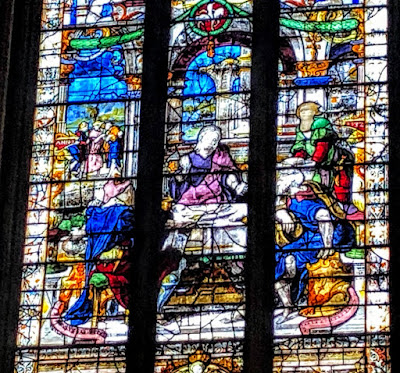
‘Abide with me, fast falls the eventide’ … Edith Cavell depicted in a memorial Window in Saint Mary the Virgin Church, Swardeston, Norfolk

Scripture quotations are from the New Revised Standard Version Bible: Anglicised Edition copyright © 1989, 1995 National Council of the Churches of Christ in the United States of America. Used by permission. All rights reserved worldwide. http://nrsvbibles.org

11 October 2024

Daily prayer in Ordinary Time 2024:
153, Friday 11 October 2024

‘If it is by the finger of God that I cast out the demons, then the kingdom of God has come to you’ (Luke 11: 20) … the finger of God touches Adam in Michelangelo’s ceiling in the Sistine Chapel (1508-1512)

Patrick Comerford

We are continuing in Ordinary Time in the Church Calendar, and the week began with the Nineteenth Sunday after Trinity (Trinity XIX).

The calendar of the Church of England in Common Worship today remembers Ethelburga (675), Abbess of Barking, and James the Deacon 7th century), companion of Paulinus.

In the Jewish calendar, Yom Kippur, the Day of Repentance, begins this evening, and I hope to attend the Kol Nidre service in Milton Keynes and District Reform Synagogue this evening. But, before today begins, I am taking some quiet time this morning to give thanks, and for reflection, prayer and reading in these ways:

1, today’s Gospel reading;

2, a reflection on the Gospel reading;

3, a prayer from the USPG prayer diary;

4, the Collects and Post-Communion prayer of the day.

‘He casts out demons by Beelzebul, the ruler of the demons’ (Luke 11: 15) … a gargoyle at Lichfield Cathedral (Photograph: Patrick Comerford)

Luke 11: 15-26 (NRSVA):

15 But some of them said, ‘He casts out demons by Beelzebul, the ruler of the demons.’ 16 Others, to test him, kept demanding from him a sign from heaven. 17 But he knew what they were thinking and said to them, ‘Every kingdom divided against itself becomes a desert, and house falls on house. 18 If Satan also is divided against himself, how will his kingdom stand? – for you say that I cast out the demons by Beelzebul. 19 Now if I cast out the demons by Beelzebul, by whom do your exorcists cast them out? Therefore they will be your judges. 20 But if it is by the finger of God that I cast out the demons, then the kingdom of God has come to you. 21 When a strong man, fully armed, guards his castle, his property is safe. 22 But when one stronger than he attacks him and overpowers him, he takes away his armour in which he trusted and divides his plunder. 23 Whoever is not with me is against me, and whoever does not gather with me scatters.

24 ‘When the unclean spirit has gone out of a person, it wanders through waterless regions looking for a resting-place, but not finding any, it says, “I will return to my house from which I came.” 25 When it comes, it finds it swept and put in order. 26 Then it goes and brings seven other spirits more evil than itself, and they enter and live there; and the last state of that person is worse than the first.’

‘When a strong man, fully armed, guards his castle, his property is safe’ (Luke 11: 21) … Ballybur Castle, the former seat of the Comerford family near Callan, Co Kilkenny (Photograph: Patrick Comerford)

Today’s reflection:

In this morning’s Gospel reading, Christ is challenged about whether his work is the work of God or the work of the Devil.

Too often, when I am offered the opportunity to do the right thing, to make a difference in this society, in this world, I ask: ‘What’s in this for me?’ And how often do I challenge others when they are doing the right thing, questioning their motives and wondering ‘Wat’s in it for them?’

When I am asked to speak up for those who are marginalised or oppressed, this should be good enough reason in itself. But then I wonder how others are going to react – react not to the marginalised or oppressed, but to me, and then jealous or feeling hubris when others are seeing to do the right thing when I failed to respond?

How often have I seen what is the right thing to do, but have found an excuse that I pretend is not of my own making?

How often do I think of doing the right thing only if it is going to please my family members or please my neighbours?

How often do I use the Bible to justify not extending civil rights to others?

How often do I use the Bible to condemn others when I know, deep down, that they are doing the right thing for other people?

How often do I use obscure Bible texts to prop up my own prejudices, forgetting that any text in the Bible, however clear or obscure it may be, depends, in Christ’s own words, on the two greatest commandments, to love God and to love one another.

We can convince ourselves that we are doing the right thing when we are doing it for the wrong reason. A wrong decision taken once, thinking it is doing the right thing, but for the wrong reason, is not just an action in the present moment. It forms habits and it shapes who we are, within time and eternity.

The Revd Martin Niemöller (1892-1984), a prominent German Lutheran pastor and an outspoken opponent of Hitler, spent the last seven years of Nazi rule in concentration camps. He once said:

First they came for the socialists, and I did not speak out –
Because I was not a socialist.
Then they came for the trade unionists, and I did not speak out –
Because I was not a trade unionist.
Then they came for the Jews, and I did not speak out –
Because I was not a Jew.
Then they came for me – and there was no one left to speak for me.


What we do today or fail to do today, even if we think it is the right thing to do but we do it for the wrong reasons, reflects how we have formed ourselves habitually in the past, is an image of our inner being in the present, and has consequences for the future we wish to shape.

As TS Eliot writes:

Time present and time past
Are both perhaps present in time future
And time future contained in time past
(‘Burnt Norton’).

How is the Church to recover its voice and speak up for the oppressed and the marginalised, not because it is fashionable or politically correct today, but because it is the right thing to do today and for the future?

Surely all our actions must depend on those two great commandments – to love God and to love one another.

‘Now if I cast out the demons by Beelzebul, by whom do your exorcists cast them out?’ (Luke 11: 19) … an image at La Lonja de la Seda in Valencia (Photograph: Patrick Comerford)

Today’s Prayers (Friday 11 October 2024):

The theme this week in ‘Pray With the World Church’, the Prayer Diary of the Anglican mission agency USPG (United Society Partners in the Gospel), is the ‘Humanitarian Corridors project in Leuven, Belgium.’ This theme was introduced on Sunday with a programme update by Rebecca Breekveldt, Second Secretary, Central Committee of the Anglican Church in Belgium.

The USPG Prayer Diary today (Friday 11 October 2024) invites us to pray:

We pray for all of the chaplains throughout the Diocese in Europe and for all the projects and work they do to support displaced people.

The Collect:

O God, forasmuch as without you
we are not able to please you;
mercifully grant that your Holy Spirit
may in all things direct and rule our hearts;
through Jesus Christ your Son our Lord,
who is alive and reigns with you,
in the unity of the Holy Spirit,
one God, now and for ever.

The Post Communion Prayer:

Holy and blessed God,
you have fed us with the body and blood of your Son
and filled us with your Holy Spirit:
may we honour you,
not only with our lips
but in lives dedicated to the service
of Jesus Christ our Lord.

Additional Collect:

Faithful Lord,
whose steadfast love never ceases
and whose mercies never come to an end:
grant us the grace to trust you
and to receive the gifts of your love,
new every morning,
in Jesus Christ our Lord.

Yesterday’s reflection

Continued tomorrow

‘Time present and time past / Are both perhaps present in time future / And time future contained in time past’ (TS Eliot, ‘Burnt Norton’) … the clock on Donegall House in Lichfield (Photograph: Patrick Comerford, 2024)

Scripture quotations are from the New Revised Standard Version Bible: Anglicised Edition copyright © 1989, 1995 National Council of the Churches of Christ in the United States of America. Used by permission. All rights reserved worldwide. http://nrsvbibles.org

09 October 2024

Daily prayer in Ordinary Time 2024:
151, Wednesday 9 October 2024

‘Padre Nuestro, que estas en el Cielo … Our Father, who art in Heaven’ … the words of the Lord’s Prayer in Spanish in the shape of a Cross (Photograph: Patrick Comerford)

Patrick Comerford

We are continuing in Ordinary Time in the Church Calendar, and the week began with the Nineteenth Sunday after Trinity (Trinity XIX).

The calendar of the Church of England in Common Worship today remembers Denys, Bishop of Paris, and his Companions, Martyrs (ca 250) and Robert Grosseteste (1253), Bishop of Lincoln, Philosopher, Scientist.

Later today, I am due a B12 injection and a check-up on my B12 levels. But, before today begins, I am taking some quiet time this morning to give thanks, and for reflection, prayer and reading in these ways:

1, today’s Gospel reading;

2, a reflection on the Gospel reading;

3, a prayer from the USPG prayer diary;

4, the Collects and Post-Communion prayer of the day.

‘Give us each day our daily bread’ … bread in a shop window in Lichfield (Photograph: Patrick Comerford, 2024)

Luke 11: 1-4 (NRSVA):

1 He was praying in a certain place, and after he had finished, one of his disciples said to him, ‘Lord, teach us to pray, as John taught his disciples.’ 2 He said to them, ‘When you pray, say:

Father, hallowed be your name.
Your kingdom come.
3 Give us each day our daily bread.
4 And forgive us our sins,
for we ourselves forgive everyone indebted to us.
And do not bring us to the time of trial.’

‘Give us each day our daily bread’ … bread on the table in a restaurant in Panormos, near Rethymnon in Crete (Photograph: Patrick Comerford, 2024)

Today’s Reflection:

The version of the Lord’s Prayer in Saint Luke’s Gospel (Luke 11: 2-4) is not the same as the familiar text we use, based on the version in Saint Matthew’s text.

In Saint Matthew’s Gospel, Christ teaches the Lord’s Prayer within the context of the Sermon on the Mount. But in Saint Luke’s Gospel, immediately after visiting the home of Mary and Martha in Bethany, Christ finds a private place to pray. It is then that the disciples ask him to teach them ‘to pray, as John taught his disciples.’

The disciples are already familiar not only with the prayers of Saint John the Baptist, but also with traditional Jewish prayers in the home, in the synagogue and in the Temple in Jerusalem.

As a rabbi and a religious leader, Jesus was responsible for teaching his followers how to fulfil Jewish religious commandments, including the obligation to pray at certain times and in certain forms.

Then and now, a religious community has a distinctive way of praying; ours is exemplified by the Lord’s Prayer, which is a communal rather than individual prayer, expressed in the plural and not the singular:

Father, hallowed be your name.
Your kingdom come.
Give us each day our daily bread.
And forgive us our sins,
for we ourselves forgive everyone indebted to us.
And do not bring us to the time of trial.

We approach God in a personal way, as Father. We then bring before him five petitions that are not on behalf of me personally, but on behalf of us, on behalf of all.

Sometimes we miss out on the impact of the Lord’s Prayer because we are so familiar with it. But, in the public worship of the Church, we often facilitate people missing out on the impact of the Lord’s Prayer when we privatise it.

Many of us were taught to pray the Lord’s Prayer as a private personal prayer as children, perhaps even saying it kneeling by our bedside, hands joined together, fingers pointing up.

So often, in our churches, we encourage people to kneel for the Lord’s Prayer, as if this was now both the most sacred and the most personal part of the Liturgy, rather than asking them to remain standing and to continue in collective prayer.

At synods and mission conferences, we often invite everyone present to say the Lord’s Prayer in their own first language. In this way, a collective, public prayer becomes a private, personal prayer, detached from and ignoring where everyone else is at each stage in the petitions.

As someone with English as my first language, I often notice how others finish a lot later than we do – the Finns in particular, but even the Germans too. Each language has its own rhythms and cadences. And the cacophony and conflicting rhythms mean it sounds as if we are in Babel rather than praying together, collectively and in the plural.

The first two petitions place us in God’s presence (‘hallowed be your name’ and ‘your kingdom come’), the next two bring our needs before God, both physical (‘daily bread,’ verse 3) and spiritual (forgiveness, verse 4), and the final petition has an eschatological dimension, looks forward to the fulfilment of all God’s promises, in God’s own time (‘the time of trial,’ verse 4).

The ‘time of trial’ is the final onslaught of evil forces, before Christ comes again, but also refers to the temptations we experience day-by-day.

So there is a temporal and an eternal dimension to these petitions, even when we pray for ourselves in the here and now.

The privatisation of the Lord’s Prayer, even on Sundays, takes away from its impact and from the collective thrust of each of the petitions.

Jesus, when he is teaching us to pray, is responding not to one individual but to the disciples as the core, formative group of the Church. God is addressed not as my Father, but our Father, and each petition that follows is in the plural: our daily bread, our forgiveness, our sins, our debts, how we forgive, and do not ‘bring us.’

When we say ‘Amen’ at the end, are we really saying ‘Amen’ to the holiness of God’s name, to the coming of Kingdom, to the needs of each being met, on a daily basis, to forgiveness, both given and received, to being put on the path of righteousness and justice, to others falling into no evil or into no harm.

If we privatise the Lord’s Prayer, we leave little room for its collective impact to grab a hold of those who are praying, and we leave little room for our own conversion, which is a continuing and daily need.

And so, let the kingdom, the power and the glory be God’s as we pray together:

Father, hallowed be your name.
Your kingdom come.
Give us each day our daily bread.
And forgive us our sins,
for we ourselves forgive everyone indebted to us.
And do not bring us to the time of trial.

‘Lord, teach us to pray’ (Luke 11: 1) … prayer books and prayer shawls in the synagogue in Porto (Photograph: Patrick Comerford, 2019)

Today’s Prayers (Wednesday 9 October 2024):

The theme this week in ‘Pray With the World Church’, the Prayer Diary of the Anglican mission agency USPG (United Society Partners in the Gospel), is the ‘Humanitarian Corridors project in Leuven, Belgium.’ This theme was introduced on Sunday with a programme update by Rebecca Breekveldt, Second Secretary, Central Committee of the Anglican Church in Belgium.

The USPG Prayer Diary today (Wednesday 9 October 2024) invites us to pray:

Father God, grant safety and protection for those yet to arrive via the Humanitarian Corridors project.

The Collect:

O God, forasmuch as without you
we are not able to please you;
mercifully grant that your Holy Spirit
may in all things direct and rule our hearts;
through Jesus Christ your Son our Lord,
who is alive and reigns with you,
in the unity of the Holy Spirit,
one God, now and for ever.

The Post Communion Prayer:

Holy and blessed God,
you have fed us with the body and blood of your Son
and filled us with your Holy Spirit:
may we honour you,
not only with our lips
but in lives dedicated to the service
of Jesus Christ our Lord.

Additional Collect:

Faithful Lord,
whose steadfast love never ceases
and whose mercies never come to an end:
grant us the grace to trust you
and to receive the gifts of your love,
new every morning,
in Jesus Christ our Lord.

Yesterday’s reflection

Continued tomorrow

‘Give us each day our daily bread’ … bread and wine on the table at the end of the day in the Sunset Taverna in Rethymnon in Crete (Photograph: Patrick Comerford, 2024)

Scripture quotations are from the New Revised Standard Version Bible: Anglicised Edition copyright © 1989, 1995 National Council of the Churches of Christ in the United States of America. Used by permission. All rights reserved worldwide. http://nrsvbibles.org

08 October 2024

Daily prayer in Ordinary Time 2024:
150, Tuesday 8 October 2024

Christ in the home of Mary, Martha and Lazarus … a panel in the Herkenrode glass windows in the Lady Chapel in Lichfield Cathedral (Photograph: Patrick Comerford)

Patrick Comerford

We are continuing in Ordinary Time in the Church Calendar, and the week began with the Nineteenth Sunday after Trinity (Trinity XIX).

Before today begins, I am taking some quiet time this morning to give thanks, and for reflection, prayer and reading in these ways:

1, today’s Gospel reading;

2, a reflection on the Gospel reading;

3, a prayer from the USPG prayer diary;

4, the Collects and Post-Communion prayer of the day.

The East Window in Saint Peter and Saint Paul Church, Watford, Northamptonshire, shows Christ in the home of Mary and Martha (Photograph: Patrick Comerford)

Luke 10: 38-42 (NRSVA):

38 Now as they went on their way, he entered a certain village, where a woman named Martha welcomed him into her home. 39 She had a sister named Mary, who sat at the Lord’s feet and listened to what he was saying. 40 But Martha was distracted by her many tasks; so she came to him and asked, ‘Lord, do you not care that my sister has left me to do all the work by myself? Tell her then to help me.’ 41 But the Lord answered her, ‘Martha, Martha, you are worried and distracted by many things; 42 there is need of only one thing. Mary has chosen the better part, which will not be taken away from her.’

Christ in the House of Martha and Mary by Diego Velázquez (1630)

Today’s Reflection:

Saint Luke’s story of the meal that Jesus has with his friends Mary and Martha is not found in the other synoptic gospels, and the only other parallel is in the Fourth Gospel, where Jesus visits Mary and Martha after the death of Lazarus.

So the meals Jesus has with Mary and Martha must be understood in the light of the Resurrection, which is prefigured by the raising of Lazarus from the dead.

For many women, and for many men too, the story of the meal with Martha and Mary raises many problems, often created by the agenda with which we now approach this story, but an agenda that may not have been possible to imagine when Saint Luke’s Gospel was written.

Our approach to understanding and explaining this meal very often depends on the way in which I understand Martha and the busy round of activities that have her distracted, and that cause her to complain to Jesus about her sister’s apparent lack of zeal and activity.

These activities in the Greek are described as Martha’s service – she is the deacon at the table: where the NRSV says ‘But Martha was distracted by her many tasks,’ the Greek says: ἡ δὲ Μάρθα περιεσπᾶτο περὶ πολλὴν διακονίαν (‘But Martha was being distracted by much diaconal work, service at the table’).

Quite often, when this story is told, over and over, again and again, it is told as if Martha is getting stroppy about having to empty the dishwasher while Mary is lazing, sitting around, chattering with Jesus.

Does Martha see that Mary should only engage in kitchen work too?

Does she think, perhaps, that only Lazarus should be out at the front of the house, keeping Jesus engaged in lads’ batter about the latest match between Bethany United and Jerusalem City?

Is Jesus being too dismissive of Martha’s complaints?

Or is he defending Mary’s right to engage in a full discussion of the Word, to engage in an alive ministry of the Word?

Martha is presented in this story as the dominant, leading figure. It is she who takes the initiative and who welcomes Jesus into her home (verse 38). It is she who offers the hospitality, who is the host at the meal, who is the head of the household – in fact, Lazarus isn’t even on the stage for this scene, and Mary is merely ‘her sister’ – very much the junior partner in the household.

Yet it is Mary, the figure on the margins, who offers the sort of hospitality that Jesus commends and praises.

Mary simply listens to Jesus, sitting at his feet, like a student would sit at the feet of a great rabbi or teacher, waiting and willing to learn what is being taught.

Martha is upset about this, and comes out from the back and asks Jesus to pack off Mary to the kitchen where she can help Martha.

But perhaps Martha was being too busy with her household tasks.

I was once invited to dinner by people I knew as good friends. And for a long time I was left on my own with the other guest as the couple busied themselves with things in the kitchen – they had decided to do the washing up before bringing out the coffee … the wife knew that if she left the washing up until later, the husband would shirk his share of the task.

But being left on our own was a little embarrassing. Part of the joy of being invited to someone’s home for dinner is the conversation around the table.

When I have been on retreats, at times, in Greek Orthodox monasteries, conversation at the table has been discouraged by a monk reading, usually from the writings of the Early Fathers, from the Patristic writings.

But a good meal, good table fellowship, good hospitality is not just about the food that is served, but about the conversation around the table too.

One commentator suggests that Martha has gone overboard in her duties of hospitality. She has spent too much time preparing the food, and has failed to pay real attention to her guest.

On the other hand, Mary has chosen her activity (verse 42). It does not just happen by accident. Mary has chosen to offer Jesus the real hospitality that a guest should be offered. She talks to Jesus, and real conversation is about both talking and listening.

If she is sent back into the kitchen, then – in the absence of Lazarus, indeed, in the notable absence of the disciples – Jesus would be left without hospitality, without words of welcome, without conversation.

Perhaps Martha might have been better off she had a more simple lifestyle, if she had prepared just one dish for her guest and for her family – might I be bold enough to suggest, if she had been content for them to sup on bread and wine alone.

She could have joined Mary in her hospitality, in welcoming Jesus to their home and to their table; they could have been in full communion with one another.

In this way, Martha will experience what her sister is experiencing, but which she is too busy to notice – their visitor’s invitation into the hospitality of God.

One commentator, Brendan Byrne, points out the subtle point being made in this story:

‘Frenetic service, even service of the Lord, can be a deceptive distraction from what the Lord really wants. Luke has already warned that the grasp of the word can be choked by the cares and worries of life … Here the cares and worries seem well justified – are they not in the service of the Lord? But precisely therein lies the power of the temptation, the great deceit. True hospitality – even that given directly to the Lord – attends to what the guest really wants.’

‘Christ at the home of Martha and Mary,’ Georg Friedrich Stettner (1639)

Today’s Prayers (Tuesday 8 October 2024):

The theme this week in ‘Pray With the World Church’, the Prayer Diary of the Anglican mission agency USPG (United Society Partners in the Gospel), is the ‘Humanitarian Corridors project in Leuven, Belgium.’ This theme was introduced on Sunday with a programme update by Rebecca Breekveldt, Second Secretary, Central Committee of the Anglican Church in Belgium.

The USPG Prayer Diary today (Tuesday 8 October 2024) invites us to pray:

We pray for strength and peace for the families welcomed as they navigate the countless obstacles of resettling in a country so far from home.

The Collect:

O God, forasmuch as without you
we are not able to please you;
mercifully grant that your Holy Spirit
may in all things direct and rule our hearts;
through Jesus Christ your Son our Lord,
who is alive and reigns with you,
in the unity of the Holy Spirit,
one God, now and for ever.

The Post Communion Prayer:

Holy and blessed God,
you have fed us with the body and blood of your Son
and filled us with your Holy Spirit:
may we honour you,
not only with our lips
but in lives dedicated to the service
of Jesus Christ our Lord.

Additional Collect:

Faithful Lord,
whose steadfast love never ceases
and whose mercies never come to an end:
grant us the grace to trust you
and to receive the gifts of your love,
new every morning,
in Jesus Christ our Lord.

Yesterday’s reflection

Continued tomorrow

The Risen Christ with Mary of Bethany (left) and Mary Magdalene (right) … a stained glass window in Saint Nicholas’s Church, Adare, Co Limerick (Photograph: Patrick Comerford)

Scripture quotations are from the New Revised Standard Version Bible: Anglicised Edition copyright © 1989, 1995 National Council of the Churches of Christ in the United States of America. Used by permission. All rights reserved worldwide. http://nrsvbibles.org

07 October 2024

Daily prayer in Ordinary Time 2024:
149, Monday 7 October 2024

An Orthodox icon of the Parable of the Good Samaritan, interpreting the parable according to Patristic and Orthodox traditions (Click on image for full-screen viewing)

Patrick Comerford

We are continuing in Ordinary Time in the Church Calendar, and the week began with the Nineteenth Sunday after Trinity (Trinity XIX). A series of medical appointment and check-ups continues for me this afternoon, with an echocardiogram (ECG), an imaging technique that uses ultrasound to create a picture of the heart and blood vessels.

Today is the first anniversary of the attack on Kibbutz Be’eri, Netiv haAsara, Kfar Aza, and the Nova music festival in Israel on 7 October 2024, with brutal murders and kidnappings and leading to the present conflagration that is spreading and threatening to engulf the whole Middle East. This situation, doubtless, is a priority for many of us in our prayers throughout this day, still hoping for the release of the 101 remaining hostages, praying for an immediate ceasefire and praying and hoping for peace and justice for people in Gaza, Israel, the West Bank, and in Lebanon, Syria, Iran and Yemen.

But, before today begins, I am taking some quiet time this morning to give thanks, and for reflection, prayer and reading in these ways:

1, today’s Gospel reading;

2, a reflection on the Gospel reading;

3, a prayer from the USPG prayer diary;

4, the Collects and Post-Communion prayer of the day.

The Good Samaritan … a stained glass window in Saint Michael’s Church, Limerick (Photograph: Patrick Comerford)

Luke 10: 25-37 (NRSVA):

25 Just then a lawyer stood up to test Jesus. ‘Teacher,’ he said, ‘what must I do to inherit eternal life?’ 26 He said to him, ‘What is written in the law? What do you read there?’ 27 He answered, ‘You shall love the Lord your God with all your heart, and with all your soul, and with all your strength, and with all your mind; and your neighbour as yourself.’ 28 And he said to him, ‘You have given the right answer; do this, and you will live.’

29 But wanting to justify himself, he asked Jesus, ‘And who is my neighbour?’ 30 Jesus replied, ‘A man was going down from Jerusalem to Jericho, and fell into the hands of robbers, who stripped him, beat him, and went away, leaving him half dead. 31 Now by chance a priest was going down that road; and when he saw him, he passed by on the other side. 32 So likewise a Levite, when he came to the place and saw him, passed by on the other side. 33 But a Samaritan while travelling came near him; and when he saw him, he was moved with pity. 34 He went to him and bandaged his wounds, having poured oil and wine on them. Then he put him on his own animal, brought him to an inn, and took care of him. 35 The next day he took out two denarii, gave them to the innkeeper, and said, “Take care of him; and when I come back, I will repay you whatever more you spend.” 36 Which of these three, do you think, was a neighbour to the man who fell into the hands of the robbers?’ 37 He said, ‘The one who showed him mercy.’ Jesus said to him, ‘Go and do likewise.’

The Good Samaritan … a modern icon

Today’s Reflection:

We are all very familiar with the parable of the Good Samaritan, so familiar and so used to it, that we are probably comfortable with the explanations and sermons we have heard over the years about this episode in this morning’s reading from Saint Luke’s Gospel, leaving very little to our own imaginations.

But the Early Fathers offered another interpretation of this parable.

The man who goes down from Jerusalem to Jericho is Adam, or humanity, or each and every one of us.

What does it mean that he goes down from Jerusalem to Jericho?

Jerusalem is the holy city of God, the place where God is served in worship and in public prayer. It is an impregnable stronghold, but it is located in a hill country, where the soil is stony and barren.

On the other hand, Jericho lies below the sea level in the Jordan Valley, in an area that is very fertile and rich in vegetation.

Jerusalem signifies the Divine Commandments. These commandments, like the walls of a city, limit us and our desires, but also create a safe living space where we can live unharmed by sin.

A man being seduced by earthly pleasures, represented by Jericho, goes out from Jerusalem, the stronghold of Divine Commandments. Here, we might think of Adam and Eve, leaving the Garden and going out into the world.

But the robbers control this way. Who are the robbers?

When people abandon God and seek pleasures in other places, the way of bodily desires first appears to be full of joy. But as time passes, indulging in passions becomes a heavy burden on the soul; in place of pleasure it becomes endless slavery. A man realises that he has lost his freedom and has become a captive of his passions. A soul blinded by passions and wounded by sin becomes incapable of any spiritual activity.

Before God, such a man is half-dead. On the way, the man has been stripped of his raiment, deprived of the raiment of virtues and of the cover of God’s grace and protection.

In this patristic approach to reading the parable, the robbers are demons who act through our own passions. The man wounded by robbers represents fallen humanity before the coming of Christ.

Who then were the Priest and Levite who saw the wounded man and passed by without providing him any help?

The Priest and the Levite are ministers of God. They represent the saints and prophets sent by God from the beginning of time.

Why then is it said that they passed by without helping that man?

Did they not fulfil the ministry of preaching?

Yes, they did. They came to that place, they stopped, they saw the man and they passed by. But wounded humanity remained lying on the road. Moses came and passed away, Elijah came and passed away, other prophets came and passed away, but the illness of humanity remained without being healed.

Only God who has created us can recreate us.

This is how Isaiah speaks on the incurable disease of the humanity:

Why do you seek further beatings?
Why do you continue to rebel?
The whole head is sick,
and the whole heart faint.
From the sole of the foot even to the head,
there is no soundness in it,
but bruises and sores
and bleeding wounds;
they have not been drained, or bound up,
or softened with oil. (Isaiah 1: 5-6)

Who then is the Samaritan who goes down on the same road?

The Samaritans were the descendants of Israelites and the nations who migrated to Palestine under Assyrian rule after the destruction of Jerusalem. They lived to the south of Judea, between Judea and Galilee. Samaritans believed in the One God of Israel and kept the Law of Moses, but they developed their own traditions. For the Jews, they were heretics, and so Jews kept their distance from Samaritans.

Why then does Christ represent himself as a Samaritan?

The Pharisees mockingly labelled Christ a Samaritan, saying, ‘Are we not right in saying that you are a Samaritan and have a demon?’ (John 8: 48).

Christ humbly attributes to himself the name given to him by his detractors.

In addition, Greek Orthodox hymns note a similarity between the phrases ‘from Samaria’ and ‘from Mary,’ for in Greek these phrases sound similar. (For example, the Samarian Gorge in Crete takes its name not from Samaria but from the abandoned village and church of Óssia María or Saint Mary).

The Samaritan, moved with compassion, approaches the wounded man. He binds his wounds, pouring oil and wine on them. The oil symbolises mercy and the wine the true teaching of God. Then he brings the man to an inn where he can be taken care of.

This Gospel readings says that the Good Samaritan ‘put him on his own animal, brought him to an inn, and took care of him.’ However, in traditional icons, Christ carries the man on his back. Christ in the incarnation takes on our human nature, our soul and body. That is why in the parable he ‘set him on his own beast,’ interpreted by the Early Fathers that Christ makes us members of his own body.

There is a similar image in the parable of the Lost Sheep (see Luke 15). The Good Shepherd left 99 sheep in the desert and went after the lost sheep, representing humanity. When he found the lost sheep, he put it on his shoulders, rejoicing.

The inn in this parable represents the Church. The innkeeper represents bishops and priests. Christ establishes his Church which, like an inn, accepts and provides shelter for all. The wounded man should stay here to be taken care of. The Samaritan has to leave, however. He takes out two silver coins and gave them to the innkeeper, saying: ‘Take care of him; and when I come back, I will repay you whatever more you spend.’

Christ indicates his second coming when he will come not to heal our infirmities, but to judge the living and the dead, and to reward each one according to his works.

The silver the Samaritan gives to the innkeeper is the divine grace Christ gives to the Church; it heals and saves souls through the sacraments. Bishops and priests, the ministers of the sacraments of the Church, are the distributors of God’s gifts. They offer to others what they have received: the sacraments and the teaching of Christ. Are they able to spend more? What can they add from themselves to the gift of the Divine Grace? Their labour, their cares, their zeal, which Christ shall recompense them on the day of the Last Judgment.

In this interpretation of the parable of the Good Samaritan, Christ offers himself as the prime example of mercy and compassion. Through his compassion, he takes on our sufferings and becomes the true neighbour of all fallen humanity.

This is a reading of this parable that connects with the assertion in the New Testament reading that God through Christ ‘has rescued us from the power of darkness and transferred us into the kingdom.

The Good Samaritan … a modern Greek icon

Today’s Prayers (Monday 7 October 2024):

The theme this week in ‘Pray With the World Church’, the Prayer Diary of the Anglican mission agency USPG (United Society Partners in the Gospel), is the ‘Humanitarian Corridors project in Leuven, Belgium.’ This theme was introduced yesterday with a programme update by Rebecca Breekveldt, Second Secretary, Central Committee of the Anglican Church in Belgium.

The USPG Prayer Diary today (Monday 7 October 2024) invites us to pray:

Let us pray for the Anglican Church in Belgium. That they will grow both through finances and volunteers, so they can maintain such a transformative project.

The Collect:

O God, forasmuch as without you
we are not able to please you;
mercifully grant that your Holy Spirit
may in all things direct and rule our hearts;
through Jesus Christ your Son our Lord,
who is alive and reigns with you,
in the unity of the Holy Spirit,
one God, now and for ever.

The Post Communion Prayer:

Holy and blessed God,
you have fed us with the body and blood of your Son
and filled us with your Holy Spirit:
may we honour you,
not only with our lips
but in lives dedicated to the service
of Jesus Christ our Lord.

Additional Collect:

Faithful Lord,
whose steadfast love never ceases
and whose mercies never come to an end:
grant us the grace to trust you
and to receive the gifts of your love,
new every morning,
in Jesus Christ our Lord.

Yesterday’s reflection

Continued tomorrow

The Good Samaritan window in Saint Anne’s Cathedral, Belfast (Photograph: Patrick Comerford, 2024)

Scripture quotations are from the New Revised Standard Version Bible: Anglicised Edition copyright © 1989, 1995 National Council of the Churches of Christ in the United States of America. Used by permission. All rights reserved worldwide. http://nrsvbibles.org

The Good Samaritan … a stained glass window in Saint Mary’s Cathedral, Limerick (Photograph: Patrick Comerford)

06 October 2024

Daily prayer in Ordinary Time 2024:
148, Sunday 6 October 2024

A summer wedding in a monastery in Crete … but today’s Gospel reading may bring us to ask whether a marriage should last longer than love (Photograph: Patrick Comerford)

Patrick Comerford

We are continuing in Ordinary Time in the Church Calendar, and today is the Nineteenth Sunday after Trinity (Trinity XIX). Later this morning, I hope to to take part in the Parish Eucharist in Saint Mary and Saint Giles Church, Stony Stratford, reading one of the lessons and singing with the choir.

But, before today begins, I am taking some quiet time this morning to give thanks, and for reflection, prayer and reading in these ways:

1, today’s Gospel reading;

2, a reflection on the Gospel reading;

3, a prayer from the USPG prayer diary;

4, the Collects and Post-Communion prayer of the day.

Enjoying a summer wedding (Photograph: Patrick Comerford)

Mark 10: 2-16 (NRSVA):

2 Some Pharisees came, and to test him they asked, ‘Is it lawful for a man to divorce his wife?’ 3 He answered them, ‘What did Moses command you?’ 4 They said, ‘Moses allowed a man to write a certificate of dismissal and to divorce her.’ 5 But Jesus said to them, ‘Because of your hardness of heart he wrote this commandment for you. 6 But from the beginning of creation, “God made them male and female.” 7 “For this reason a man shall leave his father and mother and be joined to his wife, 8 and the two shall become one flesh.” So they are no longer two, but one flesh. 9 Therefore what God has joined together, let no one separate.’

10 Then in the house the disciples asked him again about this matter. 11 He said to them, ‘Whoever divorces his wife and marries another commits adultery against her; 12 and if she divorces her husband and marries another, she commits adultery.’

13 People were bringing little children to him in order that he might touch them; and the disciples spoke sternly to them. 14 But when Jesus saw this, he was indignant and said to them, ‘Let the little children come to me; do not stop them; for it is to such as these that the kingdom of God belongs. 15 Truly I tell you, whoever does not receive the kingdom of God as a little child will never enter it.’ 16 And he took them up in his arms, laid his hands on them, and blessed them.

23 Then turning to the disciples, Jesus said to them privately, ‘Blessed are the eyes that see what you see! 24 For I tell you that many prophets and kings desired to see what you see, but did not see it, and to hear what you hear, but did not hear it.’

Wedding flowers strewn on the lawn at Lisnavagh House, Co Carlow, in the late evening … what happens when love fades in a marriage? (Photograph: Patrick Comerford)

Today’s Reflection:

If our health is ruined, our family life and domestic situation become desperate, our income dries up, our family breaks up, we find ourselves down in the dumps and marginalised, do we blame God? How is God with us in our woes?

These are questions that arise in the first reading in the continuous readings in the lectionary this morning (Job 1: 1, 2: 1-10).

Do we see material success, prosperity, family life and children as rewards from God?

Is faith, like love, not without seeking reward?

Or do we only love – and believe – because there are rewards?

Many priests and preachers, on first reading this morning’s Gospel passage (Mark 10: 2-16), may decide to preach on one of the other readings. But if they do this, they will leave us in danger of thinking that Christ is too harsh on those who go through a divorce.

I know only too well that people who go through a marriage breakdown and divorce, and still cling on to going to church, perhaps just by their fingernails, may well ask, ‘Where is the Good News this morning?’

So, what is happening? Herod Antipas was the Governor of Galilee. He had divorced his wife Aretus to marry Herodias, the wife of his brother, Herod Philip. This caused such a scandal that when Saint John the Baptist confronted Herod about it – he was beheaded (see Mark 6: 18-19).

If Christ says it is unlawful for a man to divorce his wife, does he end up like John the Baptist?

If he says it is acceptable, does he contradict the teaching of the Torah and leave himself open to the charge of blasphemy?

The Pharisees were divided on the legality of divorce and the grounds for divorce. So, the question is a trap in another way. They say: ‘Moses allowed a man to write a certificate of dismissal and to divorce her’ (Mark 10: 4). The Law of Moses allowed a man to divorce his wife, if he finds ‘something objectionable about her’ (Deuteronomy 24: 1).

Mind you, it never said a woman could divorce her husband.

A man could simply ‘write a certificate of dismissal’ (verse 4), without going through any formal legal proceedings. ‘Something objectionable’ could cover a multitude, from adultery to an eccentric hair-do on a bad hair day. Indeed, by the time of Christ, divorce was allowed for the most trivial of reasons, and was so common that many women suffered.

However, instead of falling into the trap being set for him, Christ asks the Pharisees: ‘What did Moses command you?’ (Mark 10: 3). In other words, what does the law say? He tells them Moses allowed this ‘because of your hardness of heart’ (Mark 10: 5), perhaps hinting at how hard-hearted men were now making women suffer even more.

There are other places in the New Testament where Christ, and Saint Paul and Saint Peter, accept that a man may divorce an unfaithful wife.

Saint Mark alone mentions the possibility of women also divorcing. This may have been normal in non-Jewish contexts, but cases of Jewish women initiating divorce are rare.

In this reading, Christ reminds those around him of God’s original intention. Marriage is a covenant relationship in which the two people become one and live in mutual love and affection.

Christ devotes much of his teaching time interpreting scripture in a way that gives priority to human wellbeing. For example, the Sabbath is made for us rather than we being made for the Sabbath. Similarly, we could say he is saying here that the order of marriage is made for us, not that we are made for the ordering of marriage, or worrying about the minutiae in the details religious people construct around marriage.

The way Christ interprets scriptural law ought to provide a clue to how we interpret his teaching.

Today, many of us may appear to be on the side of the Pharisees on the question of divorce. Divorce is common today and most of us accept it as a reality. Our laws and our customs, like those of the Pharisees in this Gospel story, assume divorce happens.

On a first reading of this Gospel passage this morning, Christ may appear to be harsh and uncompromising. But many marriages get stale or toxic, relationships can dry up or lose focus, self-destruct, or break down. Things go wrong for far too many reasons.

It is easy to think that the Adam and Eve story is about men and women since those are the characters in the story. But is that story not truly, really, about individuals and families, about life together, that it is better to live life together than to live life alone, and not that men are superior to women?

Marriage is a relationship that works on the principle of self-giving when all our instincts are self-serving – so, is it counter-intuitive, or is it part of the natural order?

The truth is that in many marriages life together becomes a gift that is more than we can handle. Marriages can get stale or toxic, angry or depressed. Relationships can dry up or lose focus, self-destruct, or break down under pressure. Things go wrong for far too many reasons.

A divorce may be a burial for a dead marriage. Divorces do not kill marriages any more than funerals kill people … although one of the great tragedies today is that far too many couples are burying their relationship when it is only sick or injured.

Is it not possible that the promise to be together until death can refer to the death of the relationship as well as the death of the person?

Is it not possible to recall that the original intent of our loving and caring God who gave us the gift of marriage was to make our lives better?

Does that desire of God evaporate when we are no longer in a marriage?

From the opening of this story, it is clear the Pharisees are not seeking Christ’s wisdom or compassion. Instead, they are trying to trap him. But marriage is not a trap and not a matter of expediency in which the wife is the property of the husband.

Of course, the covenant of marriage is still just as valid today. Ideally, when two people marry, they commit themselves to an exclusive relationship of love and devotion in a new entity.

But that is easier to say than it is to face up to reality, which includes the complexities of child-rearing, careers and competing religious, social and economic claims and responsibilities.

Ideally, we are not to live alone, but in loving and committed relationships. In an ideal world, there would be no such thing as divorce. But we do not live in an ideal world. We live in a fallen and broken world in which human nature always falls short of the glory of God. Whether we like it or not, divorce is a reality and we have to live with that.

I know only too well from my own personal experience that when people go through a divorce, the church is often the last place they can turn to for help and understanding.

But divorce is like a death. It is the death of a relationship, and so people grieve, and they need sympathy and to be consoled. Would you dare chastise someone who was grieving after the death of a family member?

I was reminded once by a divorced priest in the Church of Ireland that when God says: ‘I hate divorce ... I hate divorce’ (Malachi 2: 16), that of course God hates divorce because he has gone through the sufferings and grieving of divorce through our faithlessness and wandering.

God hates divorces because God has suffered divorce.

What a profound insight.

Too often, in debates, passages of Scripture taken out of context, or one-sided interpretations of the tradition of the Church can be used to set a trap so that people are forced to accept only one standard or practice for marriage in the world today. But in this Gospel reading, Christ responds to those who seek to trap him by refusing to accept to be trapped into accepting their interpretation of Scripture or Tradition.

Instead, he challenges those around them to think for themselves and to think with compassion.

Let us not use this reading to trap Jesus through hardness of heart. And let us not use this reading to trap vulnerable, suffering and grieving people who remain open to loving and being loved.

We must face questions about marriage and divorce, about who can be married and who can be divorced, as challenges that ask us to think outside the box, without trying to trap Jesus or to trap those who are faced with honest questions about marriage and about divorce.

From the beginning of creation, ‘God made them male and female’ (Mark 10: 6) … ‘The Arnolfini Wedding’ by Jan van Eyck (1390-1440)

Today’s Prayers (Sunday 6 October 2024, Trinity XIX):

The theme this week in ‘Pray With the World Church’, the Prayer Diary of the Anglican mission agency USPG (United Society Partners in the Gospel), is the ‘Humanitarian Corridors project in Leuven, Belgium.’ This theme is introduced today with a programme update by Rebecca Breekveldt, Second Secretary, Central Committee of the Anglican Church in Belgium:

The Humanitarian Corridors provide safe routes for refugees to be received and integrated into European countries (through the innovative Humanitarian Corridors model developed by the Community of Sant’Egidio). 2024 marks the first year that USPG has supported the programme.

Through the project, the team in Leuven has welcomed two families into a warm and supportive community within the last year. Each family received their Flemish refugee approval status in record time, one within 3 months and one within 1.5 months. Both families are enrolled with OCMW, the Flemish social service, and receive ongoing wraparound support to continue their resettlement process. They are at different stages of learning Dutch, transferring credentials, returning to studies, having their children attend school and starting work.

Multiple faith communities have come together in Leuven to make the Humanitarian Corridors project possible. The families continue to express their appreciation for the support they receive from our church community. It is a massive puzzle to navigate Belgian bureaucracy, but it is made easier by the care of a friend.

The USPG Prayer Diary today (Sunday 6 October 2024, Trinity XIX) invites us to pray, reflecting on these words:

‘O Lord, You have searched for me and known me
You know when I sit down and when I rise up’
May we listen to God and follow the path
He leads us along for he has a plan for us.

The Collect:

O God, forasmuch as without you
we are not able to please you;
mercifully grant that your Holy Spirit
may in all things direct and rule our hearts;
through Jesus Christ your Son our Lord,
who is alive and reigns with you,
in the unity of the Holy Spirit,
one God, now and for ever.

The Post Communion Prayer:

Holy and blessed God,
you have fed us with the body and blood of your Son
and filled us with your Holy Spirit:
may we honour you,
not only with our lips
but in lives dedicated to the service
of Jesus Christ our Lord.

Additional Collect:

Faithful Lord,
whose steadfast love never ceases
and whose mercies never come to an end:
grant us the grace to trust you
and to receive the gifts of your love,
new every morning,
in Jesus Christ our Lord.

Yesterday’s reflection

Continued tomorrow

‘Holy and blessed God, you have fed us with the body and blood of your Son’ … the Post-Communion Prayer (Photograph: Patrick Comerford)

Scripture quotations are from the New Revised Standard Version Bible: Anglicised Edition copyright © 1989, 1995 National Council of the Churches of Christ in the United States of America. Used by permission. All rights reserved worldwide. http://nrsvbibles.org

27 January 2023

Audrey Hepburn’s brave
role during the Holocaust and
her father’s life in Dublin


Patrick Comerford

Today is Holocaust Memorial Day (27 January 2023). Over the past few days, the World Jewish Congress has drawn attention to the role of Audrey Hepburn as a teenager living in the Netherlands under Nazi occupation, and how she helped the Dutch Resistance and saved Jewish lives during World War II.

Audrey Hepburn died away 30 years ago this month, on 20 January 1993. She starred in many memorable roles, from Manhattan socialite Holly Golightly in Breakfast at Tiffany’s (1961) to Cockney flower seller Eliza Doolittle in My Fair Lady (1964). The 1953 classic Roman Holiday — in which she played Princess Ann, a royal exploring the Eternal City with Gregory Peck — earned her an Academy Award. She is one of the few stars to win an Emmy, a Grammy, an Oscar and a Tony award.

Yet few people know that was also a Dutch aristocrat, raised by parents with controversial political sympathies, who aided resistance to the Nazis while enduring tragedy and starvation.

In his biography, Dutch Girl: Audrey Hepburn and World War II, the author Robert Matzen reveals his discoveries about Audrey Hepburn’s life growing up in the Netherlands during World War II, and how her parents’ Nazi connections haunted her for the rest of her life.

With meticulous research, he tells the story of her heroic efforts during World War II, and how those difficult years led her to a life of humanitarian service. During that time, she was also becoming a prima ballerina on her way to Hollywood and stardom.

Robert Matzen’s book is based on research in the Netherlands, where he had access archives, interviewed people with war-time memories of Hepburn, unearthed rare photographs, documents and mementoes, and visited Arnhem, where she lived there during World War II.

Her Dutch mother, Baroness Ella van Heemstra, met Hitler in the 1930s and wrote admiringly about him in British fascist publications. She changed her mind during the brutal Nazi occupation of the Netherlands from 1940 to 1945. Her father, Joseph Ruston, ended up in jailed because of his Nazi sympathies.

The baroness aided the Dutch Resistance after Hepburn’s uncle, Otto Ernst Gelder, Count van Limburg Stirum, was executed by the Nazis. After the execution of her uncle, Audrey and her mother relocated from Arnhem to the village of Velp five km away and heard hear the destruction of their former hometown during the 1944 Allied defeat in the battles of Arnhem and Oosterbeek.

Audrey Hepburn volunteered for the resistance, aided Jews in hiding, and raised funds through dancing to keep them safe. Despite everything, fewer than 25 per cent of Dutch Jews survived the Holocaust.

Audrey Hepburn was invited in 1958 to play Anne Frank in the film version of The Diary of Anne Frank. But she found the subject too close to home and turned it down, although she met Otto Frank. Two decades later, in 1976, she turned a role in A Bridge Too Far.

Hepburn’s war years explain her later work as a UNICEF ambassador working with children affected by war.

Audrey Hepburn was born Audrey Kathleen van Heemstra Ruston on 4 May 1929. Her family had aristocratic connections on both sides. Her Dutch grandfather, Baron van Heemstra, was a former governor of the South American colony of Surinam and a former mayor of Arnhem. Her English father claimed a royal descent from James Hepburn, the third husband of Mary Queen of Scots in the 16th-century.

Young Audrey, or Adriaantje as she was known in her family, grew up between Belgium, England and the Netherlands. Her parents visited Germany with Sir Oswald Mosley and other British fascists, and met Hitler in Munich in 1935.

Ella returned to Germany for the Nazi Party Congress later that year and praised Hitler in British fascist publications. She continued supporting the Nazis after they occupied the Netherlands. Ironically, Hepburn’s ballet teacher, Winja Marova, was Jewish and hid her identity from the occupiers.

The Nazis arrested her brother-in-law, Hepburn’s uncle Otto, a court prosecutor, and he was executed on 15 August 1942 in a mass killing with another relative, Baron Schimmelpenninck van der Oye.

Otto’s execution was a turning point and shook the family to the core. Ella relocated with Audrey to Velp, where they lived with Audrey’s grandfather, Baron van Heemstra, and Otto’s widow, Meisje. There the family joined the resistance. The refusal to join a Nazi artists’ committee ending Audrey Hepburn’s burgeoning dance career.

In Velp, Audrey assisted Dr Hendrik Visser ’t Hooft, who helped shelter hundreds of Jews. She brought messages to families protecting Jews. She danced to raise money for the resistance and to feed Jews in hiding.

In an unexpected development, when Audrey Hepburn and her mother lived in Amsterdam after liberation, their fellow lodger was the editor working on publishing the Diary of Anne Frank. Audrey and Anne were born less than five months apart in 1929, but Anne Frank was apprehended in 1944 and died in Bergen-Belsen in 1945. Audrey Hepburn would later describe Anne Frank as a soul sister.

‘I believe Audrey felt survivor’s guilt,’ Robert Matzen says. ‘She survived. Anne Frank did not.’

Eventually, she left with her mother for England, where Audrey Hepburn found success not through ballet but in film. In time, she came to terms with her past. Years after becoming a household name, she took part in public readings of The Diary of Anne Frank and became a Unicef ambassador.


Audrey Hepburn was born in Belgium, spent the war years in occupied Holland, she sounded English and her first acting roles were in British films, became a Hollywood success, and had a second international career as a Unicef ambassador and a humanitarian campaigner. Yet, there was also an Irish element in her life story too.

Her father, Joseph Hepburn-Ruston, was born Joseph Ruston in Bohemia, Austria-Hungary, in 1889 to an English father and his German wife, Catherina Wels.

He was an Englishman living in Belgium when his daughter was born in 1929. In the years before World War II, he expressed unqualified enthusiasm for Hitler. He left Audrey and her mother in 1939. After detention in the Isle of Man, made his way to Dublin where, assisted by the Carmelite order, he found lucrative work in the insurance industry.

Joseph Hepburn-Ruston became friends with the Guinness family and Sir Alfred Beit, the art collector and philanthropist. He and his third wife, the model Fidelma Walshe, more than 30 years his junior, were living near Merrion Square, Dublin, when Audrey first reconnected with him in the early 1960s.

She tracked down Joseph with the help of the Red Cross. A meeting was arranged in the Shelbourne Hotel, Dublin, in 1964. But it was not the occasion she had hoped for. When Joseph saw Audrey, he made no move towards her. She took the initiative, stepping forward to hug him. She soon realised that the man she had pined for as a child was distant and emotionally detached. They did not speak for another 20 years.

He lived in Sydenham Road Dublin for over 35 years. His daughter supported him financially until he died in Baggot Street Hospital at the age of 91 on 16 October 1980. He is buried in Mount Jerome Cemetery, Harold’s Cross. Audrey did not go to her father’s funeral, but returned to Dublin in 1988.

Audrey Hepburn died in Switzerland 30 years ago this month on 20 January 1993.

Shabbat Shalom