Showing posts with label Kanturk. Show all posts

01 October 2025

Daily prayer in Ordinary Time 2025:
142, Wednesday 1 October 2025

‘Disturb us, Lord … when we arrived safely because we sailed too close to the shore’ … after sunset on the shore below the Fortezza in Rethymnon in Crete (Photograph: Patrick Comerford, 2025)

Patrick Comerford

We begin a new month today and we are continuing in Ordinary Time in the Church Calendar. The week began with the Fifteenth Sunday after Trinity (Trinity XV, 28 September), and the calendar of the Church of England in Common Worship today remembers Remigius (533), Bishop of Rheims, Apostle of the Franks, and Anthony Ashley Cooper (1801-1885), Earl of Shaftesbury, Social Reformer.

These are the Days of Awe, or the High Holy Days in the Jewish calendar. The Kol Nidre service begins at sunset this evening, marking the start of Yom Kippur. This solemn service is a prayer for annulling vows made over the past year, allowing individuals to approach the Day of Atonement with a clean conscience. The fast of Yom Kippur concludes tomorrow evening (Thursday 2 October).

Before today begins, I am taking some quiet time this morning to give thanks, and for reflection, prayer and reading in these ways:

1, today’s Gospel reading;

2, a reflection on the Gospel reading;

3, a prayer from the USPG prayer diary;

4, the Collects and Post-Communion prayer of the day.

‘Disturb us, Lord … when we arrived safely because we sailed too close to the shore’ … sails and boats in the harbour in Rethymnon at sunset (Photograph: Patrick Comerford; click on image for full-screen viewing)

Luke 9: 57-62 (NRSVA):

57 As they were going along the road, someone said to him, ‘I will follow you wherever you go.’ 58 And Jesus said to him, ‘Foxes have holes, and birds of the air have nests; but the Son of Man has nowhere to lay his head.’ 59 To another he said, ‘Follow me.’ But he said, ‘Lord, first let me go and bury my father.’ 60 But Jesus said to him, ‘Let the dead bury their own dead; but as for you, go and proclaim the kingdom of God.’ 61 Another said, ‘I will follow you, Lord; but let me first say farewell to those at my home.’ 62 Jesus said to him, ‘No one who puts a hand to the plough and looks back is fit for the kingdom of God.’

Sir Francis Drake … ‘it is not the beginning, but the continuing of the same unto the end, until it be thoroughly finished, which yieldeth the true glory’

Today’s Reflections:

Saint Luke is a great story-teller, and we are all captivated by his stories of healing and his parables: the Good Samaritan, the Prodigal Son, the unjust steward, and so on.

So this morning’s Gospel reading comes as a little surprise. The first impression is that there’s no story here, no drama, no healing, no showing how society’s perceived underdog is really a model for our own behaviour, for my behaviour – indeed a model of how God behaves, and behaves towards us.

Instead, what we have what reads like a series of pithy statements from Jesus: like a collection of sayings from the Desert Fathers or even a collection of popular sayings from Zen masters.

Good stories about wayward sons and muggings on the roadside make for good drama, and healing stories are great soap opera. But they only remain stories and they only remain mini-stage-plays if all we want is good entertainment and forget all about what the main storyline is, what the underlying plot in Saint Luke’s Gospel is.

The context of this reading is provided a few verses earlier, when Saint Luke says the days are drawing near and Jesus is setting his face to go to Jerusalem (Luke 9: 51).

It is a challenge to us all. We are called to live not for the pleasure of a dramatic moment, but to live in the one great drama that is taking place: to set our faces on the heavenly Jerusalem; to live as if we really believe in the New Heaven and the New Earth.

We are called not to be conditional disciples – being a Christian when I look after everything else, sometime in the future. We are called to be committed disciples – to live as Christians in the here-and-now.

There is the man who wants to follow Jesus, but only if he can hold on to his wealth and property (Luke 9: 57-58). There is the man who wants to follow Jesus, but not until he has looked after burying his father (Luke 9: 59-60). There is the man who wants to follow Jesus, but who thinks first he must consider what his friends and those at home would think before he leaves them (Luke 10: 61-62).

Of course, it is good to have a home of my own and not to live in a foxhole. Of course, it is good that each of us should take responsibility for ageing parents and to bury them when they die. Of course, it is good that we should not walk out on our families, our friends and our responsibilities.

Of course, domestic security, filial duty and loyal affection are high ideals. But they are conditional, while the call of the kingdom is compelling, urgent and imperative. And it demands commitment in such a way that it puts all other loyalties in second place.

Christ is not saying that these men had the wrong values. But he sees how we can use values so that we can end up with the wrong priorities.

As GB Caird pointed out in his commentary on Saint Luke’s Gospel, sometimes the most difficult choices in life for most of us are not between good and evil, but between the good and the best. I am sure these three ‘wannabe’ disciples presented good excuses. But discipleship on my own terms is not what Christ asks of me. It can only be on his terms. There is no conditional discipleship, there is only committed discipleship.

As advertisers remind us constantly, there are terms and conditions attached to most things in life. But there can be no terms and conditions attached when it comes to being a disciple, to being a follower of Jesus.

As his ship, the Elizabeth Bonaventure, lay at anchor at Cape Sakar on 17 May 1587 after the sacking of Sagress, Sir Francis Drake wrote to Elizabeth I’s secretary of state, Sir Francis Walsingham: ‘There must be a begynnyng of any great matter, but the contenewing unto the end untyll it be thoroughly ffynyshed yeldes the trew glory.’

These words were later adapted by Eric Milner-White (1884-1963), who is credited with introducing the Service of Nine Lessons and Carols during his time as Dean of King’s College, Cambridge (1918-1941). In a collection of prayers he compiled and published in 1941 as he was moving from King’s to become Dean of York, he adapted Drake’s words in what has become a well-known prayer:

O Lord God,
when thou givest to thy servants
to endeavour any great matter,
grant us also to know that it is not the beginning,
but the continuing of the same unto the end,
until it be thoroughly finished, which yieldeth the true glory;
through him who for the finishing of thy work
laid down his life, our Redeemer, Jesus Christ.

— after Francis Drake (c. 1540-1596)

But there is another prayer that is also attributed to Francis Drake. After the Golden Hinde sailed from Portsmouth to raid Spanish Gold before sailing on to California, he is said to have written:

Disturb us, Lord,
when we are too well pleased with ourselves;
when our dreams have come true
because we have dreamed too little,
when we arrived safely
because we sailed too close to the shore.

Disturb us, Lord, when
with the abundance of things we possess
we have lost our thirst
for the waters of life;
having fallen in love with life,
we have ceased to dream of eternity
and in our efforts to build a new earth,
we have allowed our vision
of the new Heaven to dim.

Disturb us, Lord, to dare more boldly –
to venture on wider seas
where storms will show your mastery;
where losing sight of land,
We shall find the stars.

We ask you to push back
the horizons of our hopes;
and to push back the future
in strength, courage, hope, and love.

This we ask in the name of our Captain,
who is Jesus Christ.

This prayer exists in different versions, and many of these versions include lines that sound too modern to be Drake’s own words. Indeed, it is difficult to be certain whether any of this prayer was written or prayed by Drake himself, although, as the first person to circumnavigate the globe, he would certainly have understood its sentiment.

There is a well-known saying: ‘A ship in the harbour is safe, but that’s not what ships are built for.’ Food, shelter, and warmth are not enough on their own. In order to flourish, we need a dream – a sense of purpose. A dream come true is, by definition, not a dream any more. And when our dreams come true, we need to dream new dreams, for: ‘Where there is no vision, the people perish’ (Proverbs 28.19).

So often, it is true, church life is a tussle between young people who want to try new things and older people who so want to keep things as they are. But young adventurers also need older people with wisdom and perspective who can still retain and nurture a healthy sense of adventure.

Drake’s prayer expresses the excitement of faith. It is so easy for some to dismiss faith as a crutch for the weak and prayer as a sign of weakness. But if all our prayers were prayers for help, then would there be nothing more to life than merely coping with it and whatever it brings us?

‘No one who puts a hand to the plough and looks back is fit for the kingdom of God’ (Luke 9: 62) … sculpture in Kanturk, Co Cork, of Thady Kelleher (1935-2004), World and All-Ireland Ploughing Champion (Photograph: Patrick Comerford)

Today’s Prayers (Wednesday 1 October 2025):

The theme this week (28 September to 4 October) in Pray with the World Church, the prayer diary of the Anglican mission agency USPG (United Society Partners in the Gospel), is ‘One Faith: Many Voices’ (pp 42-43). This theme was introduced on Sunday with Reflections from Rachel Weller, Communications Officer, USPG.

The USPG Prayer Diary today (Wednesday 1 October 2025) invites us to pray:

Lord, we give thanks for those who have passed down the faith and your faithfulness through the generations.

The Collect of the Day:

God, who in generous mercy sent the Holy Spirit
upon your Church in the burning fire of your love:
grant that your people may be fervent
in the fellowship of the gospel
that, always abiding in you,
they may be found steadfast in faith and active in service;
through Jesus Christ your Son our Lord,
who is alive and reigns with you,
in the unity of the Holy Spirit,
one God, now and for ever.

The Post Communion Prayer:

Keep, O Lord, your Church, with your perpetual mercy;
and, because without you our human frailty cannot but fall,
keep us ever by your help from all things hurtful,
and lead us to all things profitable to our salvation;
through Jesus Christ our Lord.

Additional Collect:

Lord God,
defend your Church from all false teaching
and give to your people knowledge of your truth,
that we may enjoy eternal life
in Jesus Christ our Lord.

Yesterday’s Reflections

Continued Tomorrow

‘Foxes have holes … but the Son of Man has nowhere to lay his head’ (Luke 9: 57) … a fox in street art in Lichfield (Photograph: Patrick Comerford, 2025)

Scripture quotations are from the New Revised Standard Version Bible: Anglicised Edition copyright © 1989, 1995 National Council of the Churches of Christ in the United States of America. Used by permission. All rights reserved worldwide. http://nrsvbibles.org

02 October 2024

Daily prayer in Ordinary Time 2024:
144, Wednesday 2 October 2024

‘Disturb us, Lord … when we arrived safely because we sailed too close to the shore’ … sails and boats in the harbour in Rethymnon at sunset (Photograph: Patrick Comerford, 2024; click on image for full-screen viewing)

Patrick Comerford

We began a new month yesterday and we are continuing in Ordinary Time in the Church Calendar. The week began with the Eighteenth Sunday after Trinity (Trinity XVIII).

I have a busy day ahead, with a number of journeys and meetings, and it looks like I am going to miss the choir rehearsal in Stony Stratford this evening. Before today begins, I am taking some quiet time this morning to give thanks, and for reflection, prayer and reading in these ways:

1, today’s Gospel reading;

2, a reflection on the Gospel reading;

3, a prayer from the USPG prayer diary;

4, the Collects and Post-Communion prayer of the day.

‘Disturb us, Lord … when we arrived safely because we sailed too close to the shore’ … sunset on the River Deel at Askeaton, Co Limerick (Photograph: Patrick Comerford; click on image for full-screen viewing)

Luke 9: 57-62 (NRSVA):

57 As they were going along the road, someone said to him, ‘I will follow you wherever you go.’ 58 And Jesus said to him, ‘Foxes have holes, and birds of the air have nests; but the Son of Man has nowhere to lay his head.’ 59 To another he said, ‘Follow me.’ But he said, ‘Lord, first let me go and bury my father.’ 60 But Jesus said to him, ‘Let the dead bury their own dead; but as for you, go and proclaim the kingdom of God.’ 61 Another said, ‘I will follow you, Lord; but let me first say farewell to those at my home.’ 62 Jesus said to him, ‘No one who puts a hand to the plough and looks back is fit for the kingdom of God.’

A shofar or ritual horn in the Casa de Sefarad or Sephardic Museum in Córdoba … the central observance of Rosh Hashanah includes blowing the shofar in synagogues (Photograph: Patrick Comerford)

‘He supports the fallen’

Rosh Hashanah (רֹאשׁ הַשָּׁנָה‎), the Jewish New Year, celebrates the birthday of the universe, the day God created Adam and Eve. This year, Rosh Hashanah 5785 begins at sundown on the eve of Tishrei 1 (2 October 2024) and ends after nightfall on Tishrei 2 (4 October 2024). Together with Kol Nidrei (Friday 11 October) and Yom Kippur (Saturday 12 October), it is part of the Yamim Nora’im, the Days of Awe or High Holidays, and the 10 Days of Repentance.

Most synagogues and Jewish communities will hold Erev Rosh Hashanah services this evening (Wednesday) and Rosh Hashanah services tomorrow (Thursday). The central observance of Rosh Hashanah is blowing the shofar (ram’s horn), normally blown in synagogues as part of the day’s services.

Rosh Hashanah traditions include round challah bread studded with raisins and apples dipped in honey, as well as other foods that symbolise wishes for a sweet year. Other Rosh Hashanah observances include candle lighting in the evenings and refraining from creative work.

It is almost a year since the shocking and startling events on 7 October, the worst tragedy for the Jewish people since the Holocaust. A year later, war and conflagration ard engulfing the Middle East and yet many of the hostages are not yet home. Next Monday’s anniversary is doubtlessly shaping how Jews all over the world are heading into the High Holydays and a time of reflection in the coming days.

Many Jewish people during this period will experience sadness, anger, pain, loss, grief, suffering, hopelessness yet hope, and many other emotions. The plaintive cry of the shofar, which will be heard in Jewish communities tomorrow and on Friday, will sound like a collective wail to many, the outpouring of the soul, and a prayerful wish for a peaceful tomorrow. The Amidah is the prayer said by pious Jews three or four times a day. The second blessing of the Amidah includes the reminder: ‘He supports the fallen, heals the sick, sets the captives free.’

Sir Francis Drake … ‘it is not the beginning, but the continuing of the same unto the end, until it be thoroughly finished, which yieldeth the true glory’

Today’s Reflection:

Saint Luke is a great story-teller, and we are all captivated by his stories of healing and his parables: the Good Samaritan, the Prodigal Son, the unjust steward, and so on.

So this morning’s Gospel reading comes as a little surprise. The first impression is that there’s no story here, no drama, no healing, no showing how society’s perceived underdog is really a model for our own behaviour, for my behaviour – indeed a model of how God behaves, and behaves towards us.

Instead, what we have what reads like a series of pithy statements from Jesus: like a collection of sayings from the Desert Fathers or even a collection of popular sayings from Zen masters.

Good stories about wayward sons and muggings on the roadside make for good drama, and healing stories are great soap opera. But they only remain stories and they only remain mini-stage-plays if all we want is good entertainment and forget all about what the main storyline is, what the underlying plot in Saint Luke’s Gospel is.

The context of this reading is provided a few verses earlier, when Saint Luke says the days are drawing near and Jesus is setting his face to go to Jerusalem (Luke 9: 51).

It is a challenge to us all. We are called to live not for the pleasure of a dramatic moment, but to live in the one great drama that is taking place: to set our faces on the heavenly Jerusalem; to live as if we really believe in the New Heaven and the New Earth.

We are called not to be conditional disciples – being a Christian when I look after everything else, sometime in the future. We are called to be committed disciples – to live as Christians in the here-and-now.

There is the man who wants to follow Jesus, but only if he can hold on to his wealth and property (Luke 9: 57-58). There is the man who wants to follow Jesus, but not until he has looked after burying his father (Luke 9: 59-60). There is the man who wants to follow Jesus, but who thinks first he must consider what his friends and those at home would think before he leaves them (Luke 10: 61-62).

Of course, it’s good to have a home of my own and not to live in a foxhole. Of course, it’s good that each of us should take responsibility for ageing parents and to bury them when they die. Of course, it’s good that we should not walk out on our families, our friends and our responsibilities.

Of course, domestic security, filial duty and loyal affection are high ideals. But they are conditional, while the call of the kingdom is urgent and imperative. And it demands commitment in such a way that it puts all other loyalties in second place.

Jesus is not saying that these men had the wrong values. But he sees how we can use values so that we can end up with the wrong priorities.

As GB Caird pointed out in his commentary on Saint Luke’s Gospel, sometimes the most difficult choices in life for most of us are not between good and evil, but between the good and the best. I’m sure these three ‘wannabe’ disciples presented good excuses. But discipleship on my own terms is not what Jesus asks of me. It can only be on his terms. There is no conditional discipleship, there is only committed discipleship.

As advertisers remind us constantly, there are terms and conditions attached to most things in life. But there can be no terms and conditions attached when it comes to being a disciple, to being a follower of Jesus.

As his ship, the Elizabeth Bonaventure, lay at anchor at Cape Sakar on 17 May 1587 after the sacking of Sagress, Sir Francis Drake wrote to Elizabeth I’s secretary of state, Sir Francis Walsingham: ‘There must be a begynnyng of any great matter, but the contenewing unto the end untyll it be thoroughly ffynyshed yeldes the trew glory.’

These words were later adapted by Eric Milner-White (1884-1963), who is credited with introducing the Service of Nine Lessons and Carols during his time as Dean of King’s College, Cambridge (1918-1941). In a collection of prayers he compiled and published in 1941 as he was moving from King’s to become Dean of York, he adapted Drake’s words in what has become a well-known prayer:

O Lord God,
when thou givest to thy servants
to endeavour any great matter,
grant us also to know that it is not the beginning,
but the continuing of the same unto the end,
until it be thoroughly finished, which yieldeth the true glory;
through him who for the finishing of thy work
laid down his life, our Redeemer, Jesus Christ.

— after Francis Drake (c. 1540-1596)

But there is another prayer that is also attributed to Francis Drake. After the Golden Hinde sailed from Portsmouth to raid Spanish Gold before sailing on to California, he is said to have written:

Disturb us, Lord,
when we are too well pleased with ourselves;
when our dreams have come true
because we have dreamed too little,
when we arrived safely
because we sailed too close to the shore.

Disturb us, Lord, when
with the abundance of things we possess
we have lost our thirst
for the waters of life;
having fallen in love with life,
we have ceased to dream of eternity
and in our efforts to build a new earth,
we have allowed our vision
of the new Heaven to dim.

Disturb us, Lord, to dare more boldly —
to venture on wider seas
where storms will show your mastery;
where losing sight of land,
We shall find the stars.

We ask you to push back
the horizons of our hopes;
and to push back the future
in strength, courage, hope, and love.

This we ask in the name of our Captain,
who is Jesus Christ.

This prayer exists in different versions, and many of these versions include lines that sound too modern to be Drake’s own words. Indeed, it is difficult to be certain whether any of this prayer was written or prayed by Drake himself, although, as the first person to circumnavigate the globe, he would certainly have understood its sentiment.

There is a well-known saying: ‘A ship in the harbour is safe, but that’s not what ships are built for.’ Food, shelter, and warmth are not enough on their own. In order to flourish, we need a dream – a sense of purpose. A dream come true is, by definition, not a dream any more. And when our dreams come true, we need to dream new dreams, for: ‘Where there is no vision, the people perish’ (Proverbs 28.19).

So often, it is true, church life is a tussle between young people who want to try new things and older people who so want to keep things as they are. But young adventurers also need older people with wisdom and perspective who can still retain and nurture a healthy sense of adventure.

Drake’s prayer expresses the excitement of faith. It is so easy for some to dismiss faith as a crutch for the weak and prayer as a sign of weakness. But if all our prayers were prayers for help, then would there be nothing more to life than merely coping with it and whatever it brings us?

‘No one who puts a hand to the plough and looks back is fit for the kingdom of God’ (Luke 9: 62) … sculpture in Kanturk, Co Cork, of Thady Kelleher (1935-2004), World and All-Ireland Ploughing Champion (Photograph: Patrick Comerford)

Today’s Prayers (Wednesday 2 October 2024):

The theme this week in ‘Pray With the World Church’, the Prayer Diary of the Anglican mission agency USPG (United Society Partners in the Gospel), is ‘One God: many languages.’ This theme was introduced on Sunday in reflections by Rachel Weller, Communications Officer, USPG.

The USPG Prayer Diary today (Wednesday 2 October 2024) invites us to pray:

May we embrace the value of multilingualism as a reflection of God’s creativity and design, affirming the inherent dignity of each language and its speakers, and striving to create inclusive spaces, including in our churches, where all languages are honoured and respected.

The Collect:

Almighty and everlasting God,
increase in us your gift of faith
that, forsaking what lies behind
and reaching out to that which is before,
we may run the way of your commandments
and win the crown of everlasting joy;
through Jesus Christ your Son our Lord,
who is alive and reigns with you,
in the unity of the Holy Spirit,
one God, now and for ever.

The Post Communion Prayer:

We praise and thank you, O Christ, for this sacred feast:
for here we receive you,
here the memory of your passion is renewed,
here our minds are filled with grace,
and here a pledge of future glory is given,
when we shall feast at that table where you reign
with all your saints for ever.

Additional Collect:

God, our judge and saviour,
teach us to be open to your truth
and to trust in your love,
that we may live each day
with confidence in the salvation which is given
through Jesus Christ our Lord.

Yesterday’s reflection

Continued tomorrow

‘Foxes have holes … but the Son of Man has nowhere to lay his head’ (Luke 9: 57) … a fox on the lawn at the Church of Ireland Theological Institute in Dublin (Photograph: Patrick Comerford)

Scripture quotations are from the New Revised Standard Version Bible: Anglicised Edition copyright © 1989, 1995 National Council of the Churches of Christ in the United States of America. Used by permission. All rights reserved worldwide. http://nrsvbibles.org

18 December 2022

The janitor and drinking
earl who gave his name to
two streets in Stony Stratford

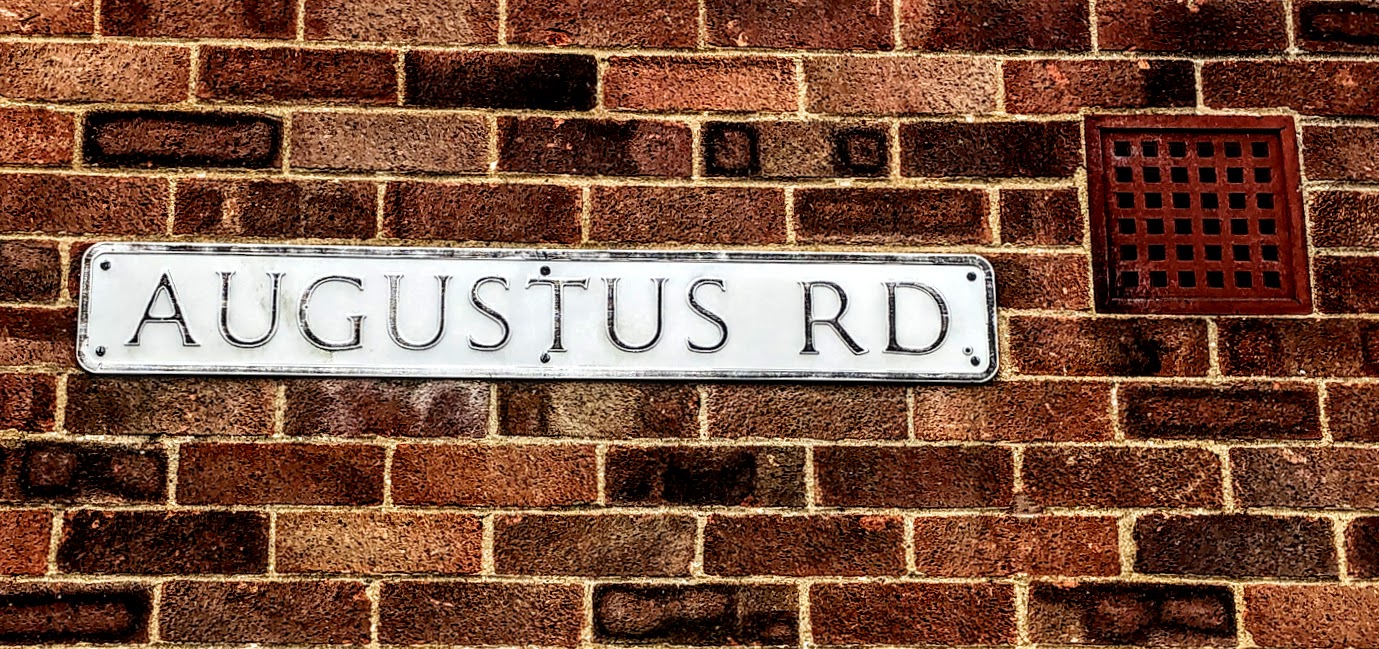
Augustus Road and Egmont Avenue in Stony Stratford are reminders of the story of Augustus Perceval, Earl of Egmont (Photographs: Patrick Comerford, 2022)

Patrick Comerford

Two neighbouring streets in Stony Stratford – Augustus Road off Calverton Road, and Egmont Avenue, which leads off Augustus Road – take their names from Augustus Arthur Perceval (1856-1910), 8th Earl of Egmont, whose family once owned the land on which the houses on both streets are built.

Lord Egmont was a colourful if enigmatic figure. He had run away in his teens to become a sailor, married a waitress, was later a fireman and a town hall janitor or caretaker and worked in salt mines and cement factories before inheriting the family titles and estates in Wolverton and Stony Stratford following a series of coincidental deaths of successive family members.

But, in anticipation of inheriting the Perceval family titles and estates, Augustus had borrowed heavily against the family estates in Ireland that were already heavily indebted and being sold off because of the debauched lifestyle who had died half a century earlier.

By the early 20th century, Augustus had effectively lost any grip on his finances and had squandered all he might have inherited before ever getting his hands on it. He was forced to sell off the last estates he had mortgaged or borrowed against. When he sold off the lands between Calverton and Stony Stratford for housing, the developers kindly acknowledged his name when it came to developing Egmont Avenue and Augustus Road.

The Egmont estate in Stony Calverton and Wolverton dated back to 1806, when it was bought by Augustus Perceval’s great-grandfather, Charles George Perceval (1756-1840), 2nd Baron Arden, a half-brother of John James Perceval (1738-1822), 3rd Earl of Egmont.

Calverton Manor … Charles Perceval, Lord Arden, bought large portions of the Calverton estate in 1806 (Photograph: Patrick Comerford, 2022)

For centuries, from the Middle Ages until the Tudor era, Calverton Manor belonged to the de Vere family, Earls of Oxford, and then the Nevil family, who held the title of Lord Latimer, remembered in the name of Latimer estate. From them, the Calverton estate descended to the Percy family, Earls of Northumberland. It was sold to Sir Thomas Bennet, a former Lord Mayor of London, in 1616, and then descended to the Cecil family, Earls of Salisbury.

When James Cecil (1748-1823), Marquess of Salisbury, sold the manors of Calverton and Beachampton, they were bought at an auction in the Cock Hotel in Stony Startford on 18 October 1806 by William Selby Lowndes of Whaddon, while other interests in Calverton bought by Charles Perceval, Lord Arden. Perceval was a half-brother of Spencer Perceval (1762-1812), who would become Prime Minister in 1809 and who was assassinated in the House of Commons in 1812 – the only British prime minister to have been assassinated. They were half-brothers of John James Perceval, 3rd Earl of Egmont.

The Perceval family were extensive and titled landowners in Ireland. They were descended from Sir Richard Percivale or Perceval (1550-1620), who acquired hundreds of thousands of acres of land in Ireland at the beginning of the 17th century, making him one of the largest landowners in Co Cork.

Sir John Perceval (1629-1665), who amassed over 100,000 acres in Co Cork, including Kanturk Castle and Liscarroll Castle, received the title of baronet at the Caroline restoration in 1661. There is a family connection, for this Sir John Perceval was the recipient of extensive correspondence in 1650s from his cousin William Dobbyns about the living conditions and life circumstances of the mapmaker Nicholas Comerford or Comberford in Stepney in the East End of London.

Sir John Perceval’s grandson, also Sir John Perceval (1683-1748), was MP for Cork (1703-1715) until he received a string of Irish peerage titles, becoming the 1st Earl of Egmont. His son, John Perceval (1711-1770), was MP for Dingle, Co Kerry, in the Irish Parliament, and was the father of two half-brothers who bought out the Cecil family’s interest in the estates in the Calverton and Stony Stratford area.

The third earl’s grandson, Henry Perceval (1796-1841), 5th Earl of Egmont, began the process of selling off the family silver to sustain a life of debauchery, marked by his alcoholism and loose living. In his mad scramble for ready cash, this Lord Egmont appointed Sir Edward Tierney from Rathkeale, Co Limerick, as his agent at his Irish estates in 1823, including Liscarroll Castle and thousands of acres around Churchtown, Kanturk and Buttevant in north Cork.

After living a dissolute lifestyle, this Lord Egmont left all his estates in England and Ireland to Tierney, while the family titles passed to his distant cousin, George Perceval (1794-1874), 3rd Lord Arden, who became the sixth earl.

All Saints’ Church, Calverton, rebuilt in 1818-1824 by Charles Perceval (Photograph: Patrick Comerford, 2022)

His father Charles Perceval, as the 2nd Lord Arden, had bought a portion of Calverton Manor, including the advowson or the right to present or nominate the Rector of Calverton. He exercised this right in 1814 when he presented Dr Butler as a temporary Rector of Calverton, to hold the parish until his son was ‘of a proper age.’ The patronage of the living later descended in the Perceval family to the Earls of Egmont.

Lord Arden commissioned the architect William Pilkington to rebuild All Saints’ Church between 1818 and 1824, on the foundations of the earlier All Hallows’ Church, and the church opened or reopened in October 1818.

Lord Arden was assisted in this work by Dr Butler. Arden also built a new rectory at his own expense, and the foundations of the house were laid in July 1819.

Butler was succeeded in 1821 by Lord Arden’s third son, the Revd the Hon Charles George Perceval (1796-1858), who came to live at Calverton as Rector on 26 March 1821, at the relatively young age of 24.

Charles Perceval was a devout High Churchman and a supporter of the Tractarians. Much of the decoration in the church, the stained glass windows and other embellishments, owes its origins to Perceval.

Many of the Tractarian leaders met in the Rectory at this time, including Edward Bouverie Pusey (1800-1882), John Henry Newman and Edward Manning, and some of the Tracts for the Times were planned if not written at Calverton.

The Revd Charles Perceval of Calverton, was a younger brother of George Perceval (1794-1874), who became the 6th Earl of Egmont in 1841. However, the new earl received not a penny from his ancestral estates.

Sir Edward Tierney had died in 1856 at the age of 76, and his title and his interest in the vast Perceval title had passed to his son, Sir Matthew Edward Tierney (1818-1860), but he left his estates acquired from the Egmonts to his son-in-law, the Revd Sir Lionel Darell (1817-1883).

The sixth earl went to court against Darell to recover the estates in a remarkable case before the Summer Assizes at Cork in 1863. After four days, the case was settled. Egmont recovered Liscarroll Castle and his ancestral estates, but Darell was awarded £125,000 and costs.

Kanturk Castle, Co Cork … given to the National Trust before Augustus Perceval could inherit it, is now in ruins (Photograph: Patrick Comerford, 2021)

Egmont died on 2 August 1874 and – for want of a male heir – was succeeded by his first cousin’s son, Charles George Perceval (1845-1897), 7th Earl of Egmont, who was born in Calverton Rectory. In 1889, this earl sold the Perceval estates in Co Cork, including Liscarroll Castle, near Buttevant, and 62,500 acres of land, to his tenants under the Ashbourne Land Act in 1895. After the seventh earl died in 1897, his widowed countess donated the majestic ruins of Kanturk Castle to the National Trust in 1900.

The seventh earl, like so many of his immediate predecessors, had no immediate male heir, and so his Irish peerage titles passed to his first cousin’s son Augustus Arthur Perceval (1856-1910), who became 8th Earl of Egmont in the Irish peerage, but without the once grand Irish castles at Kanturk and Liscarroll.

Augustus Perceval was born at Papanui, Canterbury, in New Zealand, in 1856. He ran away from his Royal Navy training ship to become a common sailor. He married Kate Howell, daughter of Warwick Howell of South Carolina, in 1881. The New York Times in a report described as a waitress.

A year after Kate and Augustus married, he joined the fire brigade of Southwark, and by 1887 he was working as a janitor or caretaker at Chelsea Town Hall. He later worked in salt mines in Cheshire, and then in South Africa in a cement factory.

He eventually succeeded to the family titles on 5 September 1897. Those titles were daunting and an impressive if not overpowering list: 8th Earl of Egmont, Co Cork, 8th Viscount Perceval of Kanturk, Co Cork, 8th Baron Perceval of Burton, Co Cork, 7th Lord Lovel and Holland, Baron Lovel and Holland of Enmore, Co Somerset, 4th Baron Arden, of Arden, Co Warwick, and 9th baronet. The runaway sailor and former janitor now had a list of titles that would have suited any Gilbert and Sullivan stage production.

Known among his drinking companions as Gussie, he scandalised his fellow peers regularly. He was arrested for being inordinately intoxicated in Piccadilly while accompanied by a young prostitute. The young woman attempted suicide in her cell and Gussie caused a sensation when he refused to remove his hat when arraigned in court the next morning.

In a risk that never paid off, the new earl borrowed heavily, gambling that he would inherit the vast Perceval estates totalling 120,00 acres. Instead, there was little for him to inherit, and he sold off what was left in a piecemeal manner in the hopes of acquiring a lifestyle commensurate with his new status. Finally, he sold Cowdray Park in Sussex in 1910, shortly before he died. Perhaps the only legacy in property that he could leave was giving his names to Augustus Road and Egmont Avenue, which were developed in the early 1900s.

Egmont Avenue in Stony Stratford is a distant reminder of Augustus Perceval, 8th of Egmont (Photograph: Patrick Comerford, 2022)

Gussie and Kate had no children: he died at The Hollies, Thames Ditton, Surrey, in 1910 at the age of 54; Kate, the former waitress who survived as the Dowager Countess of Egmont, died in 1926.

The titles continued to struggle to find heirs among members of the Perceval family who were living in suburban Birmingham. Three claimants to the titles came forward in the late 1920s and early 1930s. Two of the claims, by a baker and a derelict, were dismissed by the Master of the Court of Chancery, who instead accepted of a rancher living in Canada, who at first wanted nothing more than to remain a simple farmer, living in a sparsely-furnished, two-room log house in the Rockies.

The Perceval titles eventually died out in 2011 with the death of the 12th Earl of Egmont. Both Liscarroll Castle and Kanturk Castle in Co Cork are elegant but in ruins. All Saints’ Church in Calverton remains a beautiful historical and architectural legacy of the Perceval family. But the only properies left in Stony Stratford as reminders of this family in name are two suburban streets in Stony Startford: Augustus Road and Egmont Avenue, off Calverton Road.

Augustus Road in Stony Stratford is a distant reminder of Augustus Perceval, 8th of Egmont (Photograph: Patrick Comerford, 2022)

08 December 2022

A ‘virtual tour’ of churches
and a cathedral dedicated to
the Immaculate Conception

George W Walsh’s circular window in Lahinch, Co Clare, depicting the Virgin Mary as the Immaculate Conception (Photograph: Patrick Comerford, 2022)

Patrick Comerford

Earlier this week, I was offering ‘virtual tours’ of cathedrals and churches dedicated to Saint Nicholas, the real ‘Santa Claus,’ whose feast day was on Tuesday (6 December).

Today (8 December) is the Feast of the Conception of the Virgin Mary, known among Roman Catholics alone as the Immaculate Conception.

The Immaculate Conception is the belief that the Virgin Mary was free of original sin from the moment of her conception. The idea was first debated by mediaeval theologians, but was so controversial that it did not become part of official Roman Catholic teaching until 1854, when Pius IX gave it the status of dogma in the papal bull Ineffabilis Deus.

This evening, I invite you to join me on a ‘virtual tour’ of ten churches in Ireland that are dedicated to the Immaculate Conception, including one cathedral (Sligo) and nine other churches: three in Co Limerick, two in Co Clare, and one each in Co Kerry, Co Cork, Dublin and Wexford.

1, The Cathedral of the Immaculate Conception, Sligo:

The Cathedral of the Immaculate Conception was designed by the English-born architect George Goldie (Photograph: Patrick Comerford)

The Cathedral of the Immaculate Conception on Temple Street, Sligo, is the cathedral of the Roman Catholic Diocese of Elphin. The cathedral and its tower dominate the skyline of Sligo, and the chimes of its bells peal out over the city, with Ben Bulben in the background.

The Diocese of Elphin is said to date from the fourth century. According to tradition, Ono son of Oengus offered a house to Saint Patrick ca 450, who renamed it Ail Fionn (‘Rock of the Clear Spring’) and placed his disciple, Saint Assicus, in charge.

However, it was not until the 12th century that Elphin was established as a diocese of East Connacht. The Roman Catholic Diocese of Elphin did not have a cathedral until the mid-19th century, but Saint John’s, a small parish church near the site of the Cheshire Home, had served as the pro-cathedral from 1827.

Bishop Laurence Gillooly (1819-1895) was appointed co-adjutor bishop in 1856 and succeeded George Browne as Bishop of Elphin in 1858. Sligo was then a growing, thriving town, and Bishop Gillooly became the inspiring figure in planning and building a new cathedral there.

A year after becoming diocesan bishop, Bishop Gillooly secured a renewable lease from Sir Gilbert King of two adjacent properties close to the Lungy, and beside Saint John’s Church which would become the Church of Ireland cathedral in 1961. One of these properties, known as the Bowling Green, became the site of the new Roman Catholic cathedral.

Inside the Cathedral of the Immaculate Conception on Temple Street, Sligo (Photograph: Patrick Comerford)

The cathedral was designed by the English-born architect George Goldie (1828-1887), who also designed Saint Saviour’s Dominican Church, Waterford (1876-1877). Goldie also remodelled the interior and exterior of Saint Saviour’s, the Dominican church in Limerick, and designed the High Altar and reredos in the Redemptorist Church at Mount Saint Alphonsus in Limerick.

Goldie was born in York, the grandson of the architect Joseph Bonomi the Elder. He was educated at Saint Cuthbert’s College, Ushaw, in Durham, and trained as an architect with John Grey Weightman and Matthew Ellison Hadfield of Sheffield, in 1845-1850, and then worked with them as a partner.

Goldie was joined in his architectural partnership in 1880 by his son Edward Goldie (1856-1921), whose work includes Hawkesyard Priory in Armitage, near Rugeley and six miles north-west of Lichfield, built for the Dominicans in 1896-1914, and which I knew in my late teens and early 20s.

The cathedral was built in a Norman style, and it is the only Romanesque Revival cathedral among the cathedrals of the 19th and 20th centuries in Ireland, built at a time when the fashion was for Gothic cathedrals and churches.

The main contractor was Joseph Clarence of Ballisodare, and Bishop Gillooly took complete charge of the building project when work began in 1869. The cathedral is built of cut limestone and is modelled on a Norman-Romano-Byzantine style.

Goldie designed this cathedral in the form of a basilica. Contemporaries called his design ‘Norman,’ but it is in a round-arched style that includes elements of English, German and Irish Romanesque.

2, The Church of the Immaculate Conception, Lahinch, Co Clare:

The Church of the Immaculate Conception in Lahinch, Co Clare … designed by McCormick and Corr in the 1950s (Photograph: Patrick Comerford, 2022)

Lahinch, Co Clare, featured prominently in the recent RTÉ drama series Smother. The Church of the Immaculate Conception in the centre of Lahinch is similar in design to the Church of Our Lady and Saint Michael in neighbouring Ennistymon, and the two churches form one parish in the Diocese of Galway, Kilmacduagh and Kilfenora.

An earlier church was built on this site in Lahinch by a Father Keane in the period 1830-1840. That church was extended for the parish priest, Canon McHugh, by Thomas Joseph Cullen in 1923, and a new church was planned in the 1940s, with Ralph Henry Byrne as architect.

However, it was another decade before a new church was built on the site of the original church in Lahinch.

Inside the Church of the Immaculate Conception in Lahinch, Co Clare, facing the liturgical east (Photograph: Patrick Comerford, 2022)

The architects of the Church of our Lady of the Immaculate Conception were the Derry-born architects, William Henry Dunlevy McCormick (1916-1996) and Francis Michael (Frank) Corr, who also designed the new church for Ennistymon in 1947.

Liam McCormick was one of the founders of modern Irish architectural movement and also one of the most important church architects in Northern Ireland. He was responsible for designing 27 church buildings and many commercial and state buildings. These include the iconic Met Éireann building in Glasnevin, Dublin, and Saint Aengus’s Church in Burt, Co Donegal, was voted Ireland’s ‘Building of the 20th century’ in 1999.

The church in Lahinch was built in 1952-1954 by Farmer Brothers of Dublin at a cost of £38,000. The cornerstone was laid in November 1952 and the church was opened in March 1954.

The church is oriented south/north rather than east/west, and faces onto to the Main Street in Lahinch.

Today, the church looks the worse for wear, and has suffered over the past half century. But inside the church has an impressive three-light stained-glass window by George W Walsh, depicting the Annunciation, the Nativity and the Presentation, in memory of the Dixon family, and a circular window by Walsh above the entrance depicting the Virgin Mary as the Immaculate Conception. Both windows date from 1995.

3, The Church of the Immaculate Conception, Bruree, Co Limerick:

The Church of the Immaculate Conception in Bruree, Co Limerick, was built in 1922-1925 (Photograph: Patrick Comerford)

Bruree, Co Limerick, is best-known as the childhood home of Eamon de Valera. The Church of the Immaculate Conception was built in 1922-1925, when Father John Breen was the parish priest, and was officially opened on 26 April 1925.

The foundation stone to the left of the main door of the church was laid by Bishop Denis Hallinan of Limerick on 8 December 1922. The inscription says Samuel Francis Hynes from Cork was the architect and Jeremiah J Coffey from Midleton, Co Cork, was the builder.

The church is built in the Hiberno-Romanesque style, with limestone from nearby Tankardstown, in Kilmallock.

Inside the Church of the Immaculate Conception in Bruree, facing the liturgical east (Photograph: Patrick Comerford)

This church is oriented on a north-south axis, instead of the traditional east-west liturgical axis. It has a fine interior with stained-glass windows, a well-carved timber roof and marble colonnades. These features add architectural significance to the church and are a testimony the skilled craftsmanship used in its construction.

This is a gable-fronted church, with a seven-bay nave and six-bay side aisles, two transepts, and gable-fronted porches that have chamfered corners, and a distinctive, square-plan three-stage tower at the front, to the right of the main door, with a battered base, a large open bell chamber and a short spire.

The snecked limestone walls have a stringcourse and an inscribed plaque at the front.

There are four, round-headed lancet windows above the double-leaf, timber battened front doors, with a stained-glass oculus above them. There are stained glass oculi in the nave too.

4, The Church of the Immaculate Conception, Kanturk, Co Cork:

The Church of the Immaculate Conception in Kanturk, Co Cork … designed by the Cork-based architect John Pine Hurley (Photograph: Patrick Comerford, 2021)

The Church of the Immaculate Conception, beside the Courthouse in Kanturk, Co Cork, was built in 1867 in the transitional Gothic style, designed by John Pine Hurley, an architect who practised in Cork from the 1850s or earlier until the 1870s.

Hurley’s first major commission came in 1856 when Bishop Timothy Murphy appointed him architect for the new Saint Colman’s College in Fermoy. Two years later, he designed improvements to the chapel of Saint Mary’s Convent, Cobh, in 1858, and in 1867 he designed the new Catholic church and convent schools at Kanturk. Nothing is known of Hurley in Cork after the mid-1870s, and he may have moved to Dublin or have emigrated.

Hurley’s church in Kanturk was completed in 1867 at a cost of £11,000. It stands in an extensive church campus with a graveyard, convent and school. The convent and school on the site were built at a cost of £4,000. The builder, JE Devlin of Bantry, later went bankrupt.

Inside the Church of the Immaculate Conception, Kanturk, Co Cork, facing west, the liturgical east (Photograph: Patrick Comerford, 2021)

This is an imposing Gothic-style church that is oriented on a west-east axis rather than the traditional liturgical east-west axis. It has fine craft work in its exterior details, and retains many original features such as the stained-glass windows, carved limestone detailing and timber batten doors.

The gable-fronted church has a projecting entrance frontispiece, a seven-bay nave, a single-bay chancel, recessed six-bay side aisles with gabled porches at the east (liturgical west) ends, a gabled sacristy, a two-bay transept, and gabled confessional projections.

It is built with cut tooled limestone walls with a moulded plinth, and there are buttresses at the corners and between the clerestory windows.

The church has pointed arch windows, trefoil lights, stained-glass, chamfered limestone surrounds, hood-mouldings and carved tracery. The chancel has a traceried six-light window and rose window, with a trefoil at the top of the gable. There are latticed lancet windows in the porches with hood-mouldings.

The order arch style entrance doorway, with timber battened doors, has a shallow gable, a tympanum with triangular window opening, and pair of door openings divided by and flanked by engaged colonnettes with decorative capitals and surmounted by a quatrefoil panel with an inscribed date plaque. All this is flanked by paired short lancet windows with hood-mouldings.

A freestanding ashlar limestone bell tower stands to the north-west of the church.

5, The Church of the Immaculate Conception, Knightstown, Valentia Island, Co Kerry:

The Church of the Immaculate Conception in Knightstown, on Valentia Island, Co Kerry … designed by Ashlin and Coleman and built in 1914-1915 (Photograph: Patrick Comerford)

The Church of the Immaculate Conception on the Promenade in Knightstown was paid for by the people who worked at the Cable Station on Valentia Island and by local people.

The church was designed in the Gothic-revival style by Ashlin and Coleman, the architectural partnership of George Coppinger Ashlin (1837-1921) and Thomas Aloysius Coleman (1865-1950). Ashlin was noted for his work on churches and cathedrals throughout Ireland, including Saint Coleman’s Cathedral, Cobh, and was AWN Pugin’s son-in-law.

The Church of the Immaculate Conception was built in 1914 and dedicated on 1 August 1915. This is a cruciform-plan, double-height, Gothic Revival church. It is oriented on a west/east axis instead of the traditional east/west liturgical axis, but this gives beautiful views of the sea to people as they leave the church by the front door.

The view from the front porch of the Church of the Immaculate Conception in Knightstown (Photograph: Patrick Comerford)

The church has a three-bay nave, single-bay transepts at the north and south sides, a two-bay chancel at the west gable end, a two-bay single-storey sacristy projection, an entrance bay at the east gable end, and a single-bay, two-stage corner turret at the north-east, with an octagonal plan, a limestone ashlar open belfry at the upper stage and a spirelet above.

The roofs, appropriately, are of pitched Valentia slate. There are decorative ridge tiles, cut-stone coping at the gables with finials, a coursed rubble stone chimneystack and a limestone ashlar flue.

The coursed rubble stone walls have a continuous cut-limestone sill course and cut-limestone brackets at the eaves. There is a base batter at the plinth of the turret with cut-stone coping and the cut-limestone open belfry at the upper stage.

The church has lancet arch windows with limestone sills, cut-limestone block-and-start surrounds, and metal-framed diamond-leaded windows.

The lancet arch door at the east gable end (the liturgical west end) has a cut-limestone, block-and-start, fielded doorcase with timber double doors. There are paired lancet arch window openings and a rose window over the entrance.

Inside the church, the full-height interior opens into the open scissors-truss timber roof. There are decorative tiles on the floor, timber pews, carved timber Stations of the Cross, a pointed-arch chancel arch on moulded corbels, and an organ that came from an opera house in Piccadilly, London. The sanctuary was refurbished in the 1960s to meet the needs of the liturgical reforms introduced by Vatican II.

The five-light traceried window above the altar in the west end (liturgical east) is filled with a stained-glass window made by the Earley Studios in Dublin 1916-1917. The window was donated to the church by the Galvin family of the Royal Valentia Hotel in Knightstown.

6, The Church of the Immaculate Conception, Ballingarry, Co Limerick:

The Church of the Immaculate Conception in Ballingarry is one of a handful of churches in Co Limerick designed by JJ McCarthy (Photograph: Patrick Comerford)

The Church of the Immaculate Conception in Ballingarry is one of a handful of churches in Co Limerick designed by AWN Pugin’s Irish successor, James Joseph McCarthy (1817-1882).

McCarthy’s other churches in Co Limerick include Saint Saviour’s Dominican Church in Baker’s Place, Limerick; Saint Senanus Church, Foynes; Saint Mary’s Church, Rathkeale; and the Church of Saint Peter and Saint Paul, Kilmallock. He also remodelled and enlarged the Church of the Immaculate Conception in Newcastle West and designed Cahermoyle House for the family of William Smith O’Brien.

McCarthy completed Pugin’s work at Maynooth and Saint Mary’s Cathedral in Killarney, and his other cathedrals and churches include Saint Aidan’s Cathedral, Enniscorthy, Saint Macartan’s Cathedral, Monaghan, the Cathedral of the Assumption, Thurles, Saint Colman’s Cathedral, Cobh, the ‘Twin Churches’ in Wexford, Saint Catherine’s Church, Dublin, and the Passionist Church in Mount Argus.

The spire of McCarthy’s church in Ballingarry can be seen for miles around. This is a fine late 19th century church, prominently sited, and it continues to have a strong presence in the Ballingarry streetscape, providing a focus in the area.

The church was built on the site of an earlier T-plan Catholic chapel in Ballingarry, and was dedicated in 1879. The coherent decorative scheme is marked by its elaborate tower that unifies the Gothic style of the building. The rusticated masonry, which was popular in church architecture of the time, adds a textural interest, balanced by the tooled limestone dressings.

Inside the Church of the Immaculate Conception in Ballingarry, Co Limerick (Photograph: Patrick Comerford)

The interior reflects the Gothic style of the exterior and is also highly decorative, with ornate tiling on the floor and sophisticated carpentry in the roof. The mosaics on the chancel walls and the ornate corbels further enliven the interior. The arcade of finely carved marble columns adds another element of richness and colour to the interior of the church. The piers and gates at the front of the church are highly ornate and continue the Gothic Revival idiom of the site.

According to Patrick J O’Connor, in his Exploring Limerick’s Past, the first Roman Catholic Church at Ballingarry stood on the same site from the early 18th century.

When Father James Enraght was appointed parish priest of Ballingarry in 1851, he was in America raising money to build a new church in his then parish of Askeaton. He then started building a new church in Ballingarry, and the foundation stone was laid in 1872. The church was completion of the church was supervised by his successor, Father Timothy Shanahan, and the new church was consecrated on 7 September 1879.

The timber scissors truss ceiling in the church in Ballingarry, Co Limerick (Photograph: Patrick Comerford)

The High Altar is the work of Edmund Sharp (1853-1930), and in 1890s Pugin’s son-in-law George Coppinger Ashlin (1837-1921) drafted proposals for a ‘throne’ to the High Altar. The builder was Michael Walsh of Foynes, who also worked with McCarthy on this churches in Foynes, Rathkeale and Kilmallock.

The church has an eight-bay nave, two transepts, a hexagonal turret, a gable-fronted porch, a four-stage square-plan battered tower, and a gable-fronted chancel with flanking side chapels. There is a four-bay side aisle, a single-storey over basement sacristy and a canted side chapel.

The pitched slate roof has a fish-scale pattern, cast-iron ridge crestings, limestone brackets and limestone copings with cross finials. The sacristy has a limestone chimney-stack.

The church has rusticated sandstone walls with tooled limestone quoins, buttresses, limestone plaques, trefoil-headed lancet stained-glass windows with limestone hood-mouldings, and Corinthian style columns with banded marble shafts, timber panelled doors with ornate cast-iron strap hinges, and a timber scissors truss ceiling.

The chapels and transepts have oculi, the entrance has a timber gallery, and the floors have geometric tiles. The sandstone and limestone tower has limestone turrets and a cast-iron spire.

Father Ronald Costelloe restored the church in 1991.

7, The Church of the Immaculate Conception, Newcastle West, Co Limerick:

The Church of the Immaculate Conception, Newcastle West, Co Limerick, was extended in the 1860s by JJ McCarthy (Photograph: Patrick Comerford)

The Church of the Immaculate Conception in Newcastle West, Co Limerick, was built in 1828 on a site donated by the Earl of Devon along with a sum of £1,400, which covered half the costs of the original church.

The church was extended in the 1860s, when the Gothic style façade with its impressive rose window was erected, and a new sanctuary and Lady Chapel were also added.

The architect James J McCarthy designed the extension and façade. The bell tower was raised in height in 1885.

Inside the Church of the Immaculate Conception in Newcastle West, Co Limerick (Photograph: Patrick Comerford)

The stained glass windows depicting the Sacred Heart of Jesus, in the centre lancet, and Saint Bridget and Saint Ita in the two lancets on the right, and Saint Munchin and Saint Patrick in the two lancets on the left, were put into the large Gothic window behind the High Altar in 1894 in memory of Dean O’Brien.

The interior details include diverse forms of plasterwork on the ceilings. These are of considerable artistic achievement, and are highlighted by an ornate plaster medallion and pendant.

8, The Franciscan Church of the Immaculate Conception, Merchants’ Quay, Dublin:

The Merchants’ Quay entrance to the Church of the Immaculate Conception on Merchants’ Quay, Dublin, better known to Dubliners as ‘Adam and Eve’s’ (Photograph: Patrick Comerford, 2021)

The Franciscan Church of the Immaculate Conception on Merchants’ Quay, Dublin, is better known to Dubliners as ‘Adam and Eve’s’ or simply as ‘Merchants’ Quay.’

The Franciscans have been in the south side of Dublin since mediaeval times. At the dissolution of monastic houses during the Tudor Reformation, King Henry VIII, the Franciscan Friary at Francis Street, on the site of the current church of Saint Nicholas of Myra, Francis Street, was confiscatedca 1640, and the Franciscan community was dispersed.

A new friary was built on Cook Street in 1615, and was Ireland’s first post-Reformation seminary. A chapel on the site was destroyed in 1629, and the friars did not return to the area until 1757, when they bought a house on Merchants’ Quay. At first, the Franciscans secretly said Mass in the Adam and Eve Tavern, giving the present church its popular name. A newer church was built in 1759, and this was later replaced by the current church.

Inside the church on Merchants’ Quay, Dublin, facing the liturgical east (Photograph: Patrick Comerford, 2021)

After Catholic Emancipation in 1829, the friars set about building a new church and laid the foundation stone of the current church in 1834. The church was designed in 1852 by the architect Patrick Byrne, who planned a tower at the Merchants’ Quay entrance. However, because of financial problems, the church was built without a nave or tower.

The church was originally dedicated to Saint Francis, but was rededicated to the Immaculate Conception of Our Lady in 1889.

The church was reorganised after 1900 by moving of the altar to the left wall and the original sanctuary was changed into a transept and an entrance from Cook Street. A small nave was added to the right and a dome built over the sanctuary.

A shrine to Saint Anthony, designed by the architects Doolin, Butler and Donnelly, was built in 1912. To mark the seventh centenary of Saint Francis in 1926, the friars built a circular apse, remodelled the transepts and extended the nave with an entrance to Skipper’s Alley. This work was designed by JJ O’Hare.

The high altar was consecrated in 1928. The granite bell tower added in 1930 was probably designed by JJ Robinson and RC Keefe, and is crowned by a pedimented temple with columns.

In recent years, the Franciscans of Merchants’ Quay have been closely identified with the work of the Simon Community and addiction and counselling services.

9, The Church of the Immaculate Conception, Ennis, Co Clare:

Saint Mary’s or the Church of the Immaculate Conception, the Friary Church in Ennis, Co Clare (Photograph: Patrick Comerford)

The old Franciscan Friary in Ennis, Co Clare, is now an archaeological site managed by the Office of Public Works. But the Franciscans maintain a living presence in the town in their friary on Francis Street.

The Franciscans began to return to Ennis in the 18th century, and they were living again as a community in Lysaght’s Lane by 1800. They then moved to Bow Lane, where they opened a new chapel in 1830.

The Franciscan Provincial threatened to close the friary in Ennis in 1853 unless conditions were improved. The Franciscan community in Ennis responded by buying the present site at Willow Bank House on Francis Street and in 1854 Patrick Sexton designed a new, cruciform chapel built by the Ennis builder William Carroll in 1854-1855.

The first Mass in the new church was celebrated on 1 January 1856, and the church was dedicated as the Church of the Immaculate Conception on 10 September 1856.

Inside the church in Ennis designed by William Reginald Carroll in the 14th-century Gothic style (Photograph: Patrick Comerford)

At the end of the 19th century, a new friary church, designed by William Reginald Carroll (1850-1910) and incorporating Sexton’s earlier church, was built in the Gothic Revival style in 1892. Carroll designed the new friary church in Ennis in the 14th-century Gothic style, with a nave, apse, two side chapels and a tower. The altar was designed by the Dublin-based monumental sculptor, James Pearse (1839-1900), father of the 1916 leader, Padraic Pearse (1879-1916).

The church was built by a local builder, Dan Shanks, at a cost of £11,000, and was dedicated on 11 June 1892.

The church is a T-plan, gable-fronted church, with a polygonal apse, a tower to the west, and a connecting block that leads to the neighbouring friary.

A statue of the Virgin Mary stands in a niche on the façade and is flanked by lancet windows with stone tracery, and with a quatrefoil and hood moulding above. Paired lancet windows are set between the buttresses.

Inside, the church has an open timber roof, with tongue and groove sheeting. There are four polished granite columns with carved stylised ivy capitals that divide the nave from the transepts. The stained-glass windows are by Earley.

The foundation stone of the earlier church on the site is set in the grotto beside the church.

The friary site includes the site of the birthplace of William Mulready (1786-1863), the Ennis-born artist who studied at the Royal Academy and designed the first penny postage envelope, introduced by the Royal Mail at the same time as the ‘Penny Black’ stamp in May 1840.

10, The Church of the Immaculate Conception, Rowe Street, Wexford:

The Church of the Immaculate Conception, Rowe Street, Wexford … one of the town’s ‘Twin Churches’ (Photograph: Patrick Comerford)

When I was living on School Street and then on High Street in Wexford 50 years ago, I was living within sound of the chimes of Rowe Street church. Until the Theatre Royal on High Street was rebuilt as the National Opera House, the skyline of Wexford was dominated by the town’s great Gothic Revival churches known as the ‘Twin Churches’: the Church of the Immaculate Conception or Rowe Street Church, on the corner of Upper Rowe Street and Lower John Street; and the Church of the Assumption or Bride Street Church, on the corner of Bride Street and Joseph Street.

The twin churches are architectural masterpieces by Wexford’s own Gothic Revival architect, Richard Pierce (1801-1854) from Kilmore. Pierce’s earliest churches include Saint Mary Magdalene’s Catholic Church, Bunclody (Newtownbarry), which was built in 1825-1826 and demolished in 1970, Saint Mary’s Church, Kilmyshall (1831), outside Bunclody, and All Saints’ Church, Castledockrell (1840). By the 1830s and 1840s, he was working closely with AWN Pugin (1812-1852) on his churches throughout Co Wexford, and during that time he developed his own interpretation of Gothic Revival.

Pierce designed the collegiate wing of Saint Peter’s College on Summerhill Road, Wexford, in 1832-1837. While he was completing this collegiate wing, Pugin was invited to Wexford to attend the blessing of the foundation stone of the chapel. Pugin had come to Wexford through the Talbot and Redmond family connections with the Talbots, Earls of Shrewsbury, who were his patrons in Staffordshire. Pugin appointed Pierce as his clerk-of-works to oversee the work on his chapel (1838-1841), which is Pugin’s earliest urban church in Ireland.

From then until 1850, Pierce was Pugin’s clerk-of-works in Ireland, overseeing the construction of all his projects in Ireland in that period, including Saint Aidan’s Cathedral, Enniscorthy (1843-1850).

Inside the Church of the Immaculate Conception, Rowe Street, Wexford (Photograph: Patrick Comerford)