COMERFORD WAY: Patrick Comerford’s online journal on Anglicanism, theology, spirituality, history, architecture, travel, poetry, beach walks ... and more
The Cascades at Ennistymon … one of my photographs in the new ‘Co Clare Visitor Guide’ edited by Sally Davies (Photograph: Patrick Comerford)
Patrick Comerford
The site SmartTraveller365 is an online tourist service in Ireland providing tourists and visitors to Ireland with free online services and information on what to see and do in Ireland.
The SmartTraveller365 website and service include smart phone coupons that offer shopping and entrance discounts at many of Ireland’s top attractions, shops and experiences.
Sally Davies, Senior Manager of Irish County Visitor Guides with SmartTraveller365, is producing a new series of colourgul, slimeline, ocket-size and user-friendly visitor guides that now include: the Co. Clare Visitor Guide, the County Kerry Visitor Guide, the West Cork Visitor Guide and the West Cork Visitor Guide.
Nine of my photographs have been published as part of the Co. Clare Visitor Guide, and one more also appears in the County Kerry Visitor Guide.
The Harbour at Ballyvaughan … one of my photographs in the ‘Co Clare Visitor Guide’ edited by Sally Davies (Photograph: Patrick Comerford)
Initially, Sally Davies asked to use just one or two of my photographs from my blog. But eventually, she decided to use nine of my photographs in the 64-page Co. Clare Visitor Guide she has edited and one in her guide to Co Kerry.
I am reluctant to allow my photographs to be used commercially. Businesses need to be realistic about their costings and margins, and professional photographers need to be paid for their work, without being undercut by amateurs who use their phones for images on social media. I am also anxious to retain the copyright of my own creative work, and certainly do not want my work being used to promote religious, social, political or business values I would not otherwise endorse.
On the other hand, I firmly believe in promoting small, local enterprises of the sort that are facilitated by guides like guidebooks such as these new publications, and it is a pleasure to be involved in areas that I know so well.
During my five years in parish ministry in west Limerick and north Kerry, living in the rectory in Askeaton, my parochial areas included parts of the River Shannon and some of the islands in the estuary – although I was never quite sure which islands, such as Scattery or Canon Island were in my parishes and which were linked with my colleagues.
Tarbert in Co Kerry was at the heart of Kilnaughtin parish, and the ferry across the mouth of the Shannon to Killimer brought me directly to many of the places described in the latest Co. Clare Visitor Guide.
My role as Precentor in the chapters of the Diocesan Cathedrals also made me familiar with the two cathedrals in Co Clare, in Killaloe and Kilfenora. In addition, I was eager during those years to explore Comerford family stories in many parts of Co Clare, including Miltown Malbay, Spanish Point and Ballyvaughan.
So I was delighted that Sally Davies has used nine of my photographs in her Co. Clare Visitor Guide, which arrived a few days ago. These photographs are of:
• the Duck Inn in Sixmilebridge (p 7)
• the Teardrop Memorial, Kilkee (p 26)
• the Cascades at Ennistymon (p 36)
• Quin Abbey (p 38)
• Canon Island Abbey (p 38)
• Canon Island (p 46)
• Scattery Island (p 47)
• and two photographs of the beach and harbour at Ballyvaughan (p 49).
Georgie Comerford is remembered as Miltown Malbay’s greatest-ever footballer … he played for four counties and two provinces
In addition, the pages on Miltown Malbay in this new publication include the story of Georgie Comerford (p 31), a sporting star in the 1930s, drawing on biographical details and images on my blog:
Teenage Years
Underage Success
• In 1929 George captained Clare to win the inaugural All Ireland minor championship
.. In the Munster final Clare defeated Waterford 1-6 to 0-4
.. In the All-Ireland final Clare defeated Longford 5-3 to 3-5, with George scoring 1-2 of the Clare total from full forward
.. This remains Clare’s only All-Ireland title at this grade.
• In 1930 George was on the Clare minor team that retained the Munster title defeating Tipperary 2-1 to 1-3, but Clare were unable to repeat success at All-Ireland level.
Georgie Comerford is remembered as Miltown Malbay’s greatest ever footballer and played for four counties and two provinces …
In addition, Sally Davies has used one of my photographs in another guide to Co Kerry. My photograph of the Daniel O’Connell Memorial Church in Cahersiveen appears on p 42 in the 76-page County Kerry Visitor Guide.
The ‘Duck Inn’ at Sixmilebridge … one of my photographs in the ‘Co Clare Visitor Guide’ edited by Sally Davies (Photograph: Patrick Comerford,)
• The SmartTraveller365 guides are available to read online and to download HERE
Shanmuckinish Castle, or Muckinish Castle, is a ruined tower house in Drumcreehy, Co Clare, not far from the churchyard with Henry Comerford’s mausoleum (Photograph: Patrick Comerford, 2022)
Patrick Comerford
When I was searching recently for Comerford family houses and graves in Kinvara, Co Galway, and Ballyvaughan, Co Clare, I stopped on the road between both locations to admire the ruins of Shanmuckinish Castle, or Muckinish Castle, a ruined tower house in Drumcreehy parish, Co Clare, not far from the churchyard with Henry Comerford’s mausoleum.
The name Muckinish comes from the Irish meaning ‘pig island,’ but the castle ruins stand in a romantic location halfway between Kinvara and Ballyvaughan, on the narrowest part of a small peninsula on the northern edge of the Burren, looking out onto Galway Bay.
Shanmuckinish was also known for a time as Ballynacragga Castle. It sits on a narrow part of an isthmus jutting into Pouldoody Bay and once had a strategic position. The castle was built by the O’Loughlin family ca 1450. However, the exact date of its original construction is unknown.
The castle is first mentioned in the Annals of the Four Masters in 1584 when Turlough, son of Owny, son of McLoughlin O’Loughlin, owner of the castle, was taken prisoner and later put to death.
Muckinish Castle was inhabited until the 19th century by members of the O’Loghlen, Neylon and Blake families. The castle was repaired around 1836, and it was still habitable in 1897.
Today, the tower house represents the ruins of a square-plan, single-bay, four-storey rubble stone-built tower house, ca 1450. It reaches almost to its original height of around 17 metres and is partially collapsed, exposing a cross-sectional view of the interior floors. The stairways have not survived.
The striking ruins of Muckinish Castle stand off the road between Kinvara and Ballyvaughan (Photograph: Patrick Comerford, 2022)
The striking castle ruins, with their magnificent views over Pouldoody Bay and Galway Bay, stand off the road between Kinvara and Ballyvaughan. From the road, the castle appears intact, but only the south wall is complete. The ruins stand tall over the bay and it is possible to look inside at the ground floor through one of the windows.
Parts of the east and west wall remain, while the coastal north wall has completely fallen into a pile of rubble that prevents exploring the lower floors on that side.
From the shore, it is possible to see partially demolished arches and hanging vaults above the first and third floors. But it is sad to see huge blocks of masonry in the shoreline rubble.
However, the ruin still features the remains of two vaulted ceilings, intra-mural passages and stairs. The lower windows are defensive loops, while the upper floors feature larger decorative windows.
A bawn wall survives and is in relatively good repair due to repair work in the 18th and 19th centuries. The first floor reception room had a large fireplace in the west wall and some of the internal wall rendering can still be seen. The house also has a wall walk and two of the original four machicolations survive.
Below a machicolation that juts out from the parapet is a three-light mullioned window that may have been inserted in the 17th century. All other windows are single narrow slits and may be original work. The parapet on the east wall projects from the wall with corbels, but these features are not repeated on the south or west walls.
It is hard to miss this ruined castle off the coast road between Kinvara and Ballyvaughan. A laneway provides access from the main road, and new holiday homes beside the ruins make it easy to find parking.
A three-light mullioned window below a machicolation that juts out from the parapet may have been inserted in the 17th century (Photograph: Patrick Comerford, 2022)
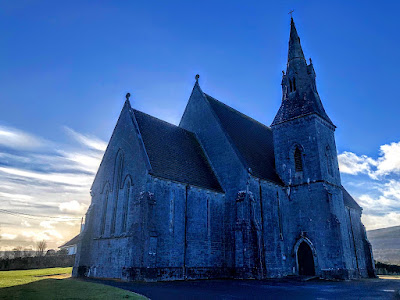
The Church of Saint John the Baptist, on Lisdoonvarna Road, Ballyvaughan, Co Clare (Photograph: Patrick Comerford, 2022)
Patrick Comerford
During my recent ‘road trip’ through Co Galway and Co Clare earlier this month, after visiting the Comerford Mausoleum at Drumcreehy, near Ballvaughan, Co Clare, I stopped to visit the Church of Saint John the Baptist, the Roman Catholic Church on Lisdoonvarna Road, Ballyvaughan.
Ballyvaughan is on the north side of the Burren, looking out onto Galway Bay. Saint John the Baptist, Ballyvaughan, and Saint Patrick’s Church, Murrough, Fanore, are united in one parish in the Kilfenora Deanery of the Diocese of Galway, Kilmacduagh and Kilfenora. The parish is an amalgamation of the former parishes of Drumcreehy, Gleninagh, Kilonaghan and Rathborney.
The Church of Saint John the Baptist in Ballyvaughan was built and twice rebuilt after damaging storms in the period 1858-1866.
The foundation stone was laid by Bishop Fallon in 1858. The church was knocked down in 1862 and again in 1863. The parish priest, Father Forde, then went to Australia to collect money for rebuilding Saint John’s and he managed to complete the church in 1866.
This Gothic Revival church was designed by the Dublin architect Michael Brophy Moran, whose only known works are Catholic churches.
Michael Moran was admitted to the Royal Dublin Society’s School of Drawing in Architecture in 1847. He was a son of Michael Moran, builder and slater, of 15 John Street West, Dublin. The house was next to the Augustinian church in John Street, which may explain why Moran was commissioned to design the Augustinian churches in Drogheda and Galway.
He was also one of the 13 entrants in the competition to design Rathgar Presbyterian church in 1860, and he also designed two churches for the Roman Catholic Diocese of Melbourne in Australia.
Moran worked from 15 John Street West (1855-1856), 140 Saint Stephen’s Green West (1857), 3 Castlewood Avenue, Rathmines (1860-1863) and 20 Belgrave Road, Rathmines (1864-1865). However, after 1865, he no longer appears in Thom’s Directory.
A new marble altar and communion rail were erected in the church in Ballyvaughan in 1938, and the walls and floor of the sanctuary were finished in mosaic. A general renovation of the nave, roof and tower was carried out in 1942, and the church was given a new roof in 1985.
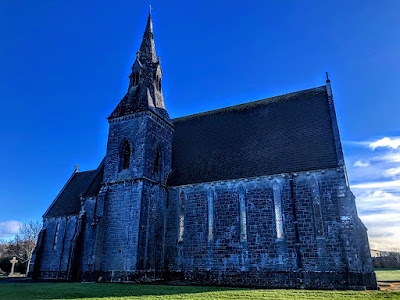
The Church of Saint John the Baptist, Ballyvaughan, was designed by the Dublin architect Michael Brophy Moran (Photograph: Patrick Comerford, 2022)
Saint John’s is a double-height Gothic Revival church, with eight-bay side elevations, a gable-fronted three-bay chancel, a two-bay single-storey sacristy anda two-stage entrance tower and spire. The church has a pitched concrete tile roof with gable copings, finials and cast-iron downpipes. There is a cut-limestone spire with lucarnes, snecked limestone walls with stepped buttresses, a string course, eaves dentils and some hood mouldings. There are pointed arch windows with cut-limestone dressings and cast-iron quarry clear and coloured glazing. Retaining interior features.
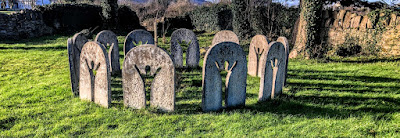
The graveyard has a number of cut-stone grave markers, and there are cut-stone piers at the front with cast-iron gates and railings.
On my visit two weeks ago, I did not manage to get to see inside Saint John’s Church, which was given a recent facelift when the generosity of an anonymous donor made funds available to install new stained-glass windows.
The Dublin-born artist Manus Walsh, who has been living in Ballyvaughan for more than 40 years, was approached by local parish priest, Father Richard Flanagan, with a view to designing the new stained-glass windows.
The older stained-glass windows were in complete disrepair, and PVC plain glass windows were totally out of place.
The broad theme for the design of the new windows was a reflection on Pope Francis’s encyclical, Laudato Si, on care for the common home and the environment. In his work, Manus Walsh incorporated portions of Genesis, the creation and the environment of the Burren. Aria Glass in Cortoon, Galway, helped to bring Manus Walsh’s vision to life, and Marija Kovak, an artist from Serbia, did the painting and leading.
Manus Walsh has worked in the Abbey Stained Glass Studios in Dublin and designed the Michael Green memorial window in Saint John’s, commemorating Michael and Mary Green who founded the Burren College of Art. He has five windows in Galway Cathedral, dating from the 1960s.
Although I did not get inside Saint John’s to see these windows, I was impressed by a notice at the church door:
‘However trying we find Saint Paul’s views on sex or the role of women, his definition of agape (love) is incomparable; that which is patient and kind does not envy others, is not quick to take offence, keeps no score of wrongs, takes no pleasure in the sins of others, delights in the truth. The opposite of love is not hate but indifference, the failure to care, or to care enough. It is a want of imagination, a lack of empathy, an inability or a refusal to see in another human being a creature as frail and as easily hurt as I can be.
‘When someone is troubled, sick or dying, the caring love of people who also know themselves to be vulnerable.’
In the churchyard in Ballyvaughan, Co Clare (Photograph: Patrick Comerford, 2022)
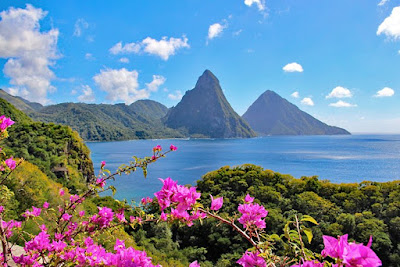
The island of St Lucia in the Caribbean … Henry Hegart Breen, who was Governor, was an uncle of Isaac Breen Daly who married Henrietta Comerford
Patrick Comerford
My recent search for the Comerford mausoleum near Ballyvaughan, Co Clare, and houses associated with the Comerford family in Galway, unearthed an interesting, if not curious, family connection with British colonial administration in the Caribbean island of St Lucia.
Henrietta Emily Comerford (1837-1881) was the ninth and youngest daughter of Henry Comerford (1796-1861), JP, of Merchant’s Road, Galway, and Ballykeel House, Kilfenora, Co Clare, and his wife, who are buried in the Comerford mausoleum. Henrietta was named after her father when she was born in Galway on 8 May 1837 and baptised that day in Saint Nicholas Church, Galway.
Henrietta Comerford was twice married. She married her first husband, Isaac Breen Daly (1835-1871), in Dublin on 25 January 1858.
Isaac Breen Daly was a son of Michael Daly (1810-1901) and his wife Mary (née Breen). His father, Michael Daly, was living at Ballykeel House with the Comerford family in 1861. His mother, Mary Daly (née Breen), was a sister of Henry Hegart Breen (1805-1882), Governor of St Lucia.
Henry Hegart Breen, who was born in Kerry on 26 June 1805, claimed direct descent from the ancient Irish chiefs of Tyrone. Following the Battle of Kinsale and during the Plantation of Ulster, the Breen family were adherents of Hugh O’Neil, Earl of Tyrone, the Breens were dispossessed of their lands in Ulster during the reign of James I in 1607, and they were banished from there to Co Kerry.
On his mother’s side, Henry Hegart Breen was also related to the poet Thomas Moore, whose father, the son of a Kerry farmer, settled in Dublin in 1775.
Henry Hegart Breen was educated at grammar schools in Co Kerry, and at the age of 18 he was sent to the College of St Esprit, in Paris. During his five years there, he studied philosophy, theology and French literature.
Breen moved to the West Indies in 1829, and in 1833 he was appointed Secretary of the Courts of Justice in the island of St Lucia. Britain had taken control of St Lucia as a colony from the French in 1814, but the French language continued to be used for many years as the language of the courts. Slavery was abolished on St Lucia in 1836, and slaves were granted full freedom in 1838.
Breen was appointed Administrator of the Government of St Lucia in April 1857, in succession to Maurice Power from Skibbereen, Co Cork, who had been Lieutenant Governor since 1852.
Breen continued as the de factio Governor of St Lucia until October 1861. As administrator, he was present in Martinique in August 1859 at the inauguration of a statue to the Empress Josephine. Breen’s speech in French received special thanks from the Emperor Napoleon III.
Queen Victoria’s son, Prince Alfred, Duke of Edinburgh, visited St Lucia officially in March 1861. Breen retired later that year and he died in the West Indies on 2 November 1882.
Meanwhile, Henry Breen’s nephew, Isaac Breen Daly, died in Salthill, Galway, on 16 December 1871. Isaac and his wife Henrietta (Comerford) were the parents of eight children: Henry Joseph Daly (1858-1903), of Corrib Castle, Galway; Michael Joseph Daly (1860-1894), of Castleblakeney, Co Galway; Hyacinth John Daly (1861-1930), who died in South Africa; George William Daly (1861-1935); Charles Nicholas Daly (1862-1917); Mary ‘Minnie’ (1864-1956); Henrietta (1865-1948), who died in Los Angeles; and Margaret (born 1869).
Henrietta (Comerford) was still a young widow when she married her second husband, John Joseph Ireland, in Galway on 28 November 1872. At their wedding, he gave his age as 23 and he was living in Dominick Street; she gave her age as 30, she was living at Montpelier Terrace, and described rself as ‘Lady.’
They were living at Bushy Park, Galway in 1875. He was 27 when he died the following year at Forster House, the Blake-Forester family home in Forster Street, Galway, on 16 October 1876. She died at Forster House within five years on 20 April 1881, aged 43.
Henrietta and John were the parents of two daughters and a son: Henrietta (Henryeta) Josephine (1873-1960); Elizabeth (1875-1934), known in the family as Ida (1875-1934); and John Francis Ireland (1876-1878), who was an infant when he died in Forster House, Galway, on 14 December 1878.
As for Henry Breen, he was the author of St Lucia, Historical, Statistical, and Descriptive (1844); The Diamond Rock and other Poems (1849); Modern English Literature: its Blemishes and Defects (1857); Warrawarra, the Carib Chief, a Tale of 1770 (2 vols, 1876); and some other works that appeared anonymously. He also contributed to many periodicals.
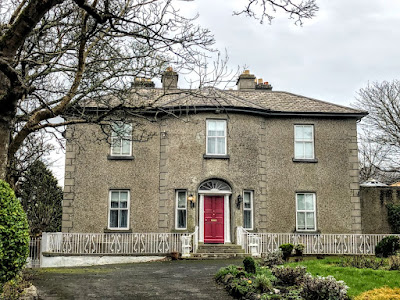
Forster House, on Forster Street, Galway … home to Henrietta Comerford who married Isaac Breen Daly and John Joseph Ireland (Photograph: Patrick Comerford, 2022)
Forster House, on Forster Street, Galway … home to generations of the Blake-Forster family and some members of the Comerford family (Photograph: Patrick Comerford, 2022)
Patrick Comerford
After last week’s search for the Comerford family mausoleum in Drumcreehy Chuchyard, near Ballyvaughan, Co Clare, I went in search yesterday of Forster House on Forster Street, Galway.
This house, close to the coach station, and just a five-minute walk from Eyre Square in the centre of Galway, was home to generations of the Blake-Forster family, who were intermarried with the Comerford, and many of them are buried in the Comerford mausoleum near Ballyaughan.
So far, I have traced the Forster family in Galway back to Francis Forster (1740-1788), of Rose Hill House, Galway. He married Anstace Blake (1746-1820), daughter of Sir Ulick Blake (1715-1766), 8th baronet, of Menlo, and so the Blake name came into the family.
The Blake name was passed on to their son, Robert Blake-Forster (1769-1799), who married Ann Daly. They were the parents of Francis James Blake-Forster (1787-1837), who married into another prominent Galway family: his wife, the Hon Rose ffrench (1787–1857), was a daughter of Thomas Hamilton ffrench (1765-1814), 2nd Baron ffrench of ffrench Park.
Their son, Francis Blake-Forster (1817-1881), was born in in Galway. In 1846, he married 18-year-old Mary Josephine Comerford (1827-1862), daughter of Henry Comerford (1796-1861), a Galway merchant who also lived at Ballykeel House, Kilfenora, Co Clare. Francis and Mary Josephine were the parent of children, but she was a young mother when she died on 2 December 1862. He died in Galway on 23 September 1881 at the age of 64.
Francis Blake-Forster seems to have designed Forster House, now known as Forster Street House, built on a prominent position overlooking Lough Atalia. The house, which has been well maintained, is an imposing and attractive house, distinguished by its bowed bays. It has a fine doorway and steps, and with its high-quality entrance gates, makes an impressive contribution to the streetscape on one of the main approaches to the city centre.
Forster House is a detached, three-bay, two-storey house over basement, built ca 1850, with a bowed entrance bay at the front and bowed bays at the south ends of three-bay side elevations.
The house has hipped slate roofs with rendered chimneystacks and rendered eaves with cast-iron and replacement metal rainwater goods. The roughcast rendered walls have raised render quoins at the corners and at the front bowed bay, and there is a rendered plinth.
The square-headed window openings have six-over-six pane timber sliding sash windows at basement. The rest of the house seems to have replacement timber and uPVC windows, with raised render reveals and limestone sills.
The elliptical-headed recessed door opening with moulded render surround, has fluted render columns flanking the timber panelled door and supporting a moulded cornice and a timber-spoked fanlight. The detached sidelights have raised render reveals and a replacement windows.
A flight of round splayed steps at the front has wrought-iron railings at each side, and decorative cast-iron railings protect the basement area.
A square-headed replacement timber door at the rear of the house had a raised render reveal.
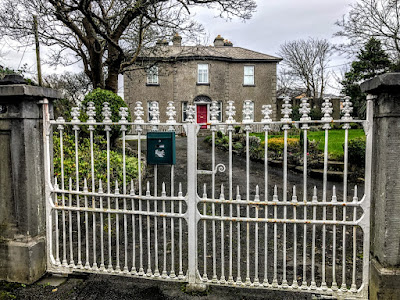
The rendered stone enclosing wall on Forster Street has tooled limestone gate piers with flared moulded panels, decorative caps, plinths with a benchmark, and a decorative cast-iron double-leaf cast-iron gate flanked by pedestrian gates.
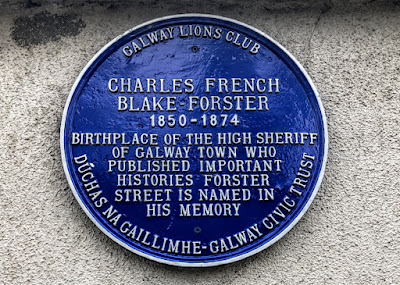
A blue plaque on the wall outside Forster House commemorates Charles French Blake-Forster (Photograph: Patrick Comerford, 2022)
A blue plaque on the wall outside Forster House commemorates Charles French Blake-Forster (1847-1874), the eldest son of Mary Josephine (Comerford) and Francis Blake-Forster, author of The Irish Chieftains, in which he repeated many of the myths of the origins of the Comerford family.
Charles French Blake-Forster was the High Sheriff of Galway when he died at Forster Street on 9 September 1874. He was buried with his parents in Saint James’s Church churchyard, Galway, while his brother, Captain Francis O’Donnellan Blake Forster (1853-1912), is buried in the Comerford mausoleum in Drumcreehy churchyard near Ballyvaughan.
The descendants of the Comerford and Blake Forster family continued to live in Forster House for a number of generations. Mary Josephine’s sister, Henrietta Emily (1837-1881), also lived in Forster House. Henrietta was married twice, first to Isaac Breen Daly (1835-1871), and then, when she was widowed, to John Joseph Ireland.
The Comerford sisters, Mary Josephine and Henrietta, seem to have passed on much of the Comerford family lore to Charles French Blake-Forster when they were living at Forster House. Henrietta’s second husband, John Joseph Ireland, died in Forster House on 16 October 1876, and she died there on 20 April 1881, twice widowed, the mother of 11 children, and still only 43.
The decorative double-leaf cast-iron gates at Forster House on Forster Street, Galway (Photograph: Patrick Comerford, 2022)
Drumcreehy Churchyard, near Ballyvaughan, Co Clare … the burial place of many members of the Comerford, Blake-Forster and Comyn families (Photograph: Patrick Comerford, 2022)
Patrick Comerford
During last weekend’s visit to Ballyvaughan, Co Clare, and Kinvara, Co Galway, I was searching for the mausoleum in Drumcreehy churchyard of Henry Comerford (1796-1861), JP, of Merchant’s Road, Galway, and Ballykeel House, Kilfenora, Co Clare.
Henry Comerford is buried in Drumcreehy churchyard in Bishop’s Quarter, near Ballyvaughan, overlooking Galway Bay on one side, and overlooked by the Burren on the other side.
He is buried in the Comerford mausoleum with his grandson, Captain Francis O’Donnellan Blake Forster (1853-1912), and Francis’s wife, Marcella (Johnson), the eldest daughter of Robert Johnson of Arran View, Doolin, Co Clare, and the heiress of Admiral Sir Burton Macnamara.
Marcella Comerford’s fascinating descent from the Macnama family of Ennistymon House – now the Falls Hotel in Ennistymon – led me to yesterday’s story about the distant yet fascinating family links with the Welsh poet Dylan Thomas through his wife Caitlin Macnamara.
But as I explored the stories of the Blake Forster family and other related families in this part of north Clare, I also came across some interesting stories about the Comyn family, who were intermarried on many occasions over the generations with the Macnamara family, as I pointed out yesterday, and were related too to the Comerford and Blake Forster families. And here lies another fascinating family story that also has a humorous link with The Irish Times.
Francis O’Donnellan Blake Forster died in on 27 June 1912, Marcella died on 26 June 1917, and they are buried in the Comerford mausoleum in Drumcreehy churchyard. Their daughter, Marcella Margaret (1894-1961), married Judge Michael Comyn KC (1871-1952). They met when he stood for election for Sinn Fein in 1919, and they married in 1924. He was a former civil servant, a barrister, a Fianna Fáil Senator (1928-1936) and a Circuit Court judge. When Michael died in 1952 and Marcella died in 1961, they too were buried in Drumcreehy churchyard.
They were the parents of two daughters, Marcella and Eleanor Rose. But this evening’s family tale is about their nephew, Sir James Peter Comyn (1921-1997), the Dublin-born barrister who was drummed out of The Irish Times and later became an English High Court judge.
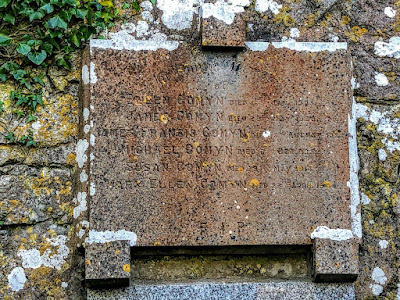
Members of the Comyn family commemorated on a plaque inside Drumcreehy Church, near Ballyvaughan, Co Clare (Photograph: Patrick Comerford, 2022)
Marcella’s husband, Michael Comyn, and his brother James Comyn were both prominent barristers and nationalists in Co Clare in the early decades of the 20th century. The two brothers were once political and legal advisers to Éamon de Valera, who at one point used James Comyn’s home in Dublin, Beaufield House, as a safe house.
However, the Comyn brothers fell out with de Valera shortly before he came to office in 1932, and Michael Comyn was passed over for appointment as Attorney-General of the Iris Free State
James Comyn’s son, Sir James Comyn, was later considered by many to be ‘the finest all-round advocate at the English bar,’ and was became a judge in the High Court of Justice in 1978, serving on the bench until he retired in 1985.
He was born at Beaufield House in Stillorgan, later the Beaufield Mews, a celebrated restaurant in south Dublin, on 8 March 1921. When the Comyn brothers fell out with Eamon de Valera, young James Comyn was taken out of school at Belvedere College in Dublin, and was sent by his father to the Oratory School in England.
He later recalled his father taking him to visit Edward Carson in London shortly before his death in 1936 and hearing from Carson’s own lips that he had never wanted partition and was still against it. He also recalled how Éamon de Valera sent for him in 1939 while he was an undergraduate at Oxford to question him on British attitudes and to suggest that he might consider joining the Irish diplomatic service.
Comyn read law at New College, Oxford. During his undergraduate days, he spent six months as a trainee journalist with The Irish Times, when RM Smyllie was the editor. However, he was obliged to abandon journalism when an obituary Comyn wrote of a cardinal concluded: ‘His Eminence was unmarried.
Comyn was demoted to the racing department. ‘God knows how you'll ever turn out, Comyn,’ said an enraged Smyllie as they eventually parted company.
At Oxford, Comyn defeated Roy Jenkins for the presidency of the Oxford Union in 1940, winning by four votes. After suffering the first of several breakdowns through his life, he briefly worked for the BBC’s Empire Service during World War II.
He was called to the English bar by the Inner Temple in 1942, the Irish Bar in 1947, and the Hong Kong Bar in 1969.
He began his pupillage in 1944 with Edward Holroyd Pearce KC, later a law lord, and joined his chambers at Fountain Court. Comyn practised in London and on the Western circuit, supplementing his earnings by teaching banking, a subject of which he knew nothing. On one occasion, he rose in Lambeth County Court to cross-examine a female defendant in an eviction case. Just as Comyn began by saying ‘Madam,’ the defendant opened her bag, took out a dead cat, and threw it at him. The judge’s reaction was to tell the defendant: ‘Madam, if you do that again, I’ll commit you.’ Comyn won the case.
Comyn took silk in 1961, and acquired a large practice as a senior, appearing in many high-profile cases. In 1964, he won damages for libel for the former safe-breaker Alfie Hinds against a Scotland Yard inspector by convincing the jury that Hinds was in fact innocent. In 1970, he successfully defended the Labour MP Will Owen, who was accused of providing information to the Czechoslovak intelligence services.
He defeated the government’s attempt in 1975 to obtain an injunction against the publication by The Times of the ‘Crossman Diaries,’ the diaries of a former minister, Richard Crossman.
Comyn was Recorder of Andover in 1964-1971, commissioner of assize for the Western Circuit in 1971, and a Recorder of the Crown Court in 1972-1977. He was elected a bencher of the Inner Temple in 1968, and chaired the Bar Council in 1973-1974.
Comyn refused an invitation by Lord Hailsham to join the bench, but was nominated again by Lord Elwyn-Jones in 1977. He was appointed a High Court judge in 1978, and was knighted. He was assigned to the Family Division, and moved to the Queen’s Bench Division in 1979. He had a reputation for leniency in sentencing, and was nicknamed ‘Probation Comyn.’
A plaque in Drumcreehy Church, near Ballyvaughan, Co Clare, commemorates Sir James Comyn (Photograph: Patrick Comerford, 2022)
Comyn presided over an unsuccessful libel action by a member of the Unification Church (‘the Moonies’) against the Daily Mailin 1980-1981, the longest libel trial in England up to that time. His Irish background made him the target of the IRA, and in 1981 the Provisional IRA burnt his house in Tara. Recurring bouts of depression led to his early retirement, on grounds of ill health, in 1985.
In retirement, he divided his time between England and Ireland, wrote a number of books, including memoirs, light verse, and books on famous trials. He also bred Friesian cattle. He died of pneumonia in Navan Hospital on 5 January 1997 at age 75, and was buried in the old family plot in Drumcreehy churchyard. He married Anne Chaundler, a solicitor, in 1967, and they were the parents of two children, Rory and Kate.
Lady Comyn died in 2018, aged 92, and she too is buried in Drumcreehy churchyard.
Sir James Comyn … once an Irish Times journalist who knew the wrath of RM Smylie
The Falls Hotel in Ennistymon … once the family home of the Macnamara family, who laid out the streets of Enistymon, Co Clare (Photograph: Patrick Comerford)
Patrick Comerford
In my search last weekend for some more Comerford houses and graves in Co Galway and Co Clare last weekend, I came across some distant but interesting links between the Comerfords of Kinvara and Kilfenora with the Comyn and Macnamara families of Co Clare, and stories that link the Macnamara family with Dylan Thomas, one of the greatest poets of the 20th century.
Henry Comerford (1796-1861), JP, of Merchant’s Road, Galway, and Ballykeel House, Kilfenora, Co Clare, is buried in Drumcreehy churchyard at Bishop’s Quarters, Ballyvaughan, Co Clare. His grandson, Captain Francis O’Donnellan Blake Forster (1853-1912), married Marcella Johnson (1852-1917), in Saint Andrew’s Church, Dublin, on 2 August 1879. She was the eldest daughter of Robert Johnson of Arran View, Doolin, Co Clare, and was described as the heiress of Sir Burton Macnamara.
So I started looking for the links with the Macnamara family, and came across stories about the origins of the Falls Hotel in Ennistymon, gold and silver salvaged from the Spanish Armada, and the writer from Co Clare who married the poet Dylan Thomas.
Quin Abbey, founded by the Macnamara family (Photograph: Patrick Comerford)
The Macnamara family is among the oldest families in Co Clare and they presided at the inauguration of the O’Brien Kings of Thomond. The Macnamara territory once included almost all that part of Co Clare east of the River Fergus and south of a line from Ruan to the Shannon. Those Macnamara chiefs were Lords of Clancullen, they founded Quin Abbey for the Franciscan friars, and in 1580 the family had no fewer than 42 castles in Co Clare.
The Macnamaras of Doolin and Ennistymon arrived in North Clare in the mid-17th century, when Teige Macnamara of Ballynacraggy settled in Drumcreehy (Ballyvaughan) in 1659. He married Ann Nugent and Teige and Ann were the parents of seven sons.
Their youngest son, Bartholomew Macnamara (1685-1761), was the ancestor of the Macnamaras of Doolin and Ennistymon. He married Dorothy Brock, daughter of a Mayor of Galway, and their youngest child, Ann, married Laurence Comyn of Kilcorney.
Bartholomew Macnamara was buried in the old church of Rathbourney, near Ballyvaughan. His eldest son, William Macnamara (1714-1762), married Catherine Sarsfield of Doolin, and so the Sarsfield estate eventually passed to the Macnamara family. After William Macnamara died in 1762, his widow Catherine married her second husband, Nicholas Comyn of Kilcorney, ca 1772, continuing the links with the Comyn family.
Dorothy, the youngest daughter of William and Catherine Macnamara, married her cousin David Comyn JP of Kilcorney and afterwards of Bishop’s Quarter. Their son, Peter Comyn of Scotland Lodge, New Quay, caused a political storm when he was hanged at Ennis in 1830 for burning down his house following a dispute with his landlord, Bindon Scott of Cahercon.
Francis Macnamara, the eldest son of William Macnamara and Catherine (Sarsfield), was born in Doolin in 1750. In 1774, Francis married Jane Stamer of Carnelly House, Clarecastle, grand-daughter of Christopher O’Brien of Ennistymon. Jane is said to have ruled over her husband and family with an iron fist. They built Doolin House, but in 1806 moved to Wellpark, near Galway, where he died in 1821.
Francis and Jane Macnamara were the parents of a large family, including: William Nugent Macnamara; George Macnamara; Francis Macnamara of Aran View; and Admiral Sir Burton Macnamara.
Sir Burton Macnamara, the seventh son, had a distinguished career in the Royal Navy. He took part in the Great Lakes campaign in Canada in 1812, and was present in the Ionian islands during the Greek War of Independence in the 1820s. He was a knighted in 1839. Later, he was appointed a vice-admiral, and then a full admiral of the reserve list. In the 1850s, Sir Burton bought a 732-acre estate at Tromora, near Miltown Malbay, and was a popular landlord. He married Jane Gabbett of Limerick, but they had no children.
Three weeks before his death, he had been appointed Deputy Lieutenant for Co Clare in succession to his nephew, Colonel Francis Macnamara who had died earlier that year. Sir Burton died at Merrion Square, Dublin, on 12 December 1876.
A memorial to the Spanish Armada in Spanish Point … Marcella Blake-Forster is said to have inherited gold and silver salvaged from a wreck of the Spanish Armada (Photograph: Patrick Comerford)
Sir Burton’s brother, Francis Macnamara, was given a farm at Glasha by his father and a sum of £1,000 when he married Marcella O’Flaherty from Aran. Francis and Marcella built a house at Glasha that they named Aran View. Aran View House is now a Georgian country house hotel in Doolin run by the Linnane family.
Marcella is said to have inherited fine gold and silver ornaments salvaged from a wreck of the Spanish Armada. When she died in 1856, they were inherited by her daughter Catherine Macnamara, wife of Robert Johnson JP, who married into Aran View. After Catherine’s death in 1867 the objects passed once more to her daughter – another Marcella – who married Henry Comerford’s grandson, Francis Blake-Foster of Ballykeale House near Kilfenora.
Major William Nugent Macnamara (1775-1856) was the eldest son and heir of Francis Macnamara and Jane Stamer. It was said, ‘He is a Protestant in religion a Catholic in politics, and a Milesian in descent.’ He was born at Doolin and educated at Trinity College Dublin.
Major Macnamara was a major in the Clare militia, a justice of the peace (JP) and in 1799 High Sheriff of Co Clare. He became something of a national figure after Daniel O’Connell selected him as his second in his duel with John d’Esterre in 1816. He was elected MP for Co Clare in 1830 and sat as a Liberal MP for 17 years.
He married Susannah Finucane, daughter and co-heiress of Judge Matthias Finucane (1737-1814) of Lifford House, Ennis, in 1779. Susannah’s mother, Ann O’Brien, was the only daughter of Edward O’Brien of Ennistymon House, and Ennistymon House passed to the Finucane family and later to William Nugent Macnamara’s son, Colonel Francis Macnamara, in 1843.
Major William Nugent Macnamara died in 1856 at the age of 81. His funeral in Doolin was described as the largest ever seen in Co Clare and extended for two miles.
Colonel Francis Macnamara (1802-1873), the major’s only son, was MP for Ennis (1832-1835), and High Sheriff of Co Clare (1839). When he married Helen Mc Dermott, the daughter of a Dublin solicitor, in 1860, he was 58 and she was 35. They moved into Ennistymon House in 1863 and made it their family home. He also carried out an ambitious building scheme in Ennistymon, laying out the streetscape that largely survives to this day.
The Macnamara estate extended to 15,000 acres in 1876, including large swathes of North Clare, some property near Ennis, 16 acres near Galway, and houses in Dublin, Galway, Ennis and Doolin. Francis Macnamara died in London on 26 June 1873.
Colonel Macnamara’s eldest son, Henry Valentine (Henry ‘Vee’) Macnamara (1861-1925), was educated at Harrow and Trinity College Cambridge (BA 1882). He was a justice of the peace (JP) and High Sheriff of Clare (1885). In 1883, Henry Vee married Edith Elizabeth Cooper, an Englishwoman of Australian descent who was described as ‘a formidable and capable woman who knew her rights and exercised them.’
Henry Vee lived at the height of the ‘Land War.’ In the ‘Doolin Cattle Drive’ on 22 September 1908, about 400 people watched as cattle and sheep were driven off his estate and through the streets of Lisdoonvarna. Later, 40 people appeared in court in Ennistymon.
During the War of Independence, Henry Vee and some friends were ambushed near Leamaneh Castle by the IRA in December 1919. During the Irish Civil War, a letter was sent to Henry Vee on 27 April 1922, telling him he was a ‘marked man’ and ordering him to leave Ennistymon House. Doolin House, still used as a Macnamara family holiday home, was burned down.
Henry Vee left, never to return to Ennistymon House. He died in London on 30 October 1925. By then, Ennistymon House had become a temporary barracks for the Garda Siochána.
The Cascades at Ennistymon … inspired by the Cascades, Francis Macnamara renamed Ennistymon House the Falls Hotel (Photograph: Patrick Comerford, 2022)
Henry Vee Macnamara was the father of three sons and four daughters. Francis Macnamara (1884-1946), the eldest son, was educated at Harrow and Magdalen College, Oxford. In London, he was friends with Augustus John, George Bernard Shaw and WB Yeats, and published a book of poems. In 1907, he married Yvonne Majolier (20), the daughter of a French father and an Irish mother from Co Limerick. They spent part of their honeymoon at Doolin and at Coole Park with Lady Gregory and WB Yeats.
They were the parents of a son, John, and three daughters, Nicolette, Brigit and Caitlin, and Francis was also the father of another daughter named Katherine Patricia (‘Pat’), who was part of the family all her life.
Francis owned a converted Galway hooker, Mary Anne, and is said to have sailed from Doolin to Greece with some of Augustus John’s family as crew. After 10 years of marriage, he left Yvonne and their children for Augustus John’s sister-in-law, Edie Mac Neil, and they were married in 1928.
Francis recovered Ennistymon House in the 1930s, and began to convert it into the Falls Hotel, named after the nearby cascades on the Inagh River. This project was interrupted by Edie’s death, but by 1935 Francis had married his third wife, Geraldine Iris O’Callaghan (22), daughter of Colonel George O’Callaghan-Westropp (1864-1944), a woman less than half his age.
Within a few years, Francis had given up his plans for the Falls Hotel. He moved to a small house in the grounds, and leased the hotel to the O’Regan family, parents of Brendan O’Regan, later identified with Shannon Airport and Duty Free. Francis Macnamara then moved to Dublin, finally living at Sorrento Terrace, Dalkey. He died in Dalkey on 8 March 1946.
Francis Macnamara’s eldest son, Major John Macnamara (1908-1962), married Henriette Buffard, a French woman, and they had no children. After World War II, they moved to the US, where John worked as a civil engineer until Henriette’s death in 1962. He returned to England and died within a month. With his death, the Macnamaras of Doolin and Ennistymon became extinct in the male line.
Nicolette Macnamara (1911-1987) was the eldest of Francis Macnamara’s daughters. She painted under the name Nicolette Macnamara and also wrote six books. In 1931, she married Anthony Devas, who died in 1958. Seven years later, Nicolette married the widowed Rupert Sheppard, Professor of Fine Art in Cape Town University.
Brigit Macnamara (1912-1994) was the second of Francis Macnamara’s daughters. She has been described by friends as ‘a little eccentric,’ and changed her name by deed poll from Macnamara to Marnier. Brigit, who never married, was the mother of two sons, Tobias and Edward. She died in August 1994, just days after her younger sister Caitlin.
Caitlin Macnamara (1913-1994) was the third of Francis Macnamara’s daughters. Caitlin married the Welsh poet Dylan Thomas in Penzance in 1937. They later settled at Laugharne in Carmarthenshire in the ‘Boat House’ overlooking the estuary. This was their home until Dylan Thomas died in New York in 1953 at the age of 39.
Four years after Dylan’s death, Caitlin and their children moved to Rome. There she met Giuseppe Fazio, a Sicilian, in 1957. They never married, and their son Francesco was born in 1963. They moved from Rome to Sicily and lived in a house in Catania owned by Giuseppe’s mother. Their relationship lasted four decades until they died. When Caitlin died in July 1994 at the age of 80, she was brought back to Wales and buried beside Dylan in Laugharne.
Caitlin Thomas was also a published writer. She and Dylan were the parents of two sons, Llewellyn (‘Wellie’) Edouard Thomas (1939-2000) and Colm Garan Hart Thomas (1949-2012), and a daughter Aeronwy Thomas-Ellis (1943-2009), who was a writer and poet in her own right.
After visiting the Comerford, Blake-Forster and Comyn family graves, I returned through Lisdoonvarna to Ennistymon to see the Falls Hotel and the Cascades once again, stopped for coffee in Lahinch, and then watched the sunset at the pier in Fintramore, the ancestral home of Henry Comerford near Spanish Point and Milltown Malbay.
Sunset at the pier in Fintramore, the ancestral home of Henry Comerford near Spanish Point and Milltown Malbay, Co Clare (Photograph: Patrick Comerford, 2022)
Ballyvaughan, the Burren and Galway Bay spread out below Corkscrew Hill in north Clare (Photograph: Patrick Comerford, 2022)
Patrick Comerford
During the weekend, two of us went in search of some more Comerford family stories in Kinvara, Co Galway, and some Comerford family graves and mausoleums in Ballyvaughan, Co Clare.
Ballyvaughan overlooks Galway Bay and stands as the gateway on the North Clare coast to the Burren. Corkscrew Hill is a narrow road that rises up from Ballyvaughan, on the road on to Lisdoonvarna, bending and folding several steps, and providing breath-taking views back down across Ballyvaughan and out to Galway Bay.
John Betjeman visited the Burren with ‘Emily’ in the summer of 1943, and described the landscape in his poem ‘Ireland with Emily,’ first published two years later in New Bats in Old Belfries (1945).
As I gazed on the Comerford mausoleum in Bishop’s Quarter in Ballyvaughan, I thought too of John Betjeman and his reference to a ‘fantastic mausoleum’ as he recalled cycling along Corkscrew Hill with Emily almost 80 years ago.
John Betjeman and Emily Sears cycled over Corkscrew Hill on a road built to provide work for starving labourers during the Great Famine a century earlier.
His wrote:
Stony seaboard, far and foreign,
Stony hills poured over space,
Stony outcrop of the Burren,
Stones in every fertile place,
Little fields with boulders dotted,
Grey-stone shoulders saffron-spotted,
Stone-walled cabins thatched with reeds,
Where a Stone Age people breeds
The last of Europe’s stone age race.
These words are quoted in a sign at the viewing point near the top of the hill, where I had a vista of the natural amphitheatre carved out by giant ice sheets of ancient ice ages. The ice sheets left behind a fertile valley surrounded by Aillwee Mountain to the east, Cappanwalla Mountain to the west, and opening out onto Galway Bay to the north.
The typical and often contrasting characteristics of the Burren are on view there: bare limestone terraces, fertile fields, dense overgrowth of hazel scrub alongside areas of incredible biodiversity created by traditional farming practices.
There are other literary links too. JRR Tolkien often stayed in Gregans Castle, nestling in the valley below, and many have asked whether he was influenced by this view when he was writing Lord of the Rings.
John Betjeman’s lines on the Burren in ‘Ireland with Emily’ may not be the most comprehensive description of this uniquely valuable area of north-west Clare. But he conveys a sense of the overwhelming bareness of its characteristic limestone landscape.
The ‘soil-less, treeless, waterless’ hills of the Burren also made an impression on Robert Lloyd Praeger. In his classic, The Way That I Went, he wrote: ‘The strangeness of this grey limestone country must be seen to be realised; it is like nothing else in Ireland or in Britain.
According to the Belfast-born environmentalist Gordon D’Arcy, 70 per cent of Ireland’s wild plants grow here in less than 0.5 per cent of Ireland’s land area.
The archaeological heritage of the Burren is also disproportionately large, with evidence of human settlement in the upland area stretching back through 6,000 years. It includes no less than 350 ring forts, notably Cahercommaun, as well as 70 wedge tombs, the highest concentration known, and numerous fulacht fiadha or cooking sites.
John Betjeman’s relationship with Emily Sears did not last that long. He returned to England, and later became Poet Laureate; she later married Ion Villiers-Stuart. ‘They did, however, remain good friends right up to the end of his life,’ according to her ddaughter, Barbara Grubb, who now lives at Dromana House, near Cappoquin, Co Waterford.
‘Ireland With Emily’ by John Betjeman
Bells are booming down the bohreens,
White the mist along the grass,
Now the Julias, Maeves and Maureens
Move between the fields to Mass.
Twisted trees of small green apple
Guard the decent whitewashed chapel,
Gilded gates and doorway grained,
Pointed windows richly stained
With many-coloured Munich glass.
See the black-shawled congregations
On the broidered vestment gaze
Murmer past the painted stations
As Thy Sacred Heart displays
Lush Kildare of scented meadows,
Roscommon, thin in ash-tree shadows,
And Westmeath the lake-reflected,
Spreading Leix the hill-protected,
Kneeling all in silver haze?
In yews and woodbine, walls and guelder,
Nettle-deep the faithful rest,
Winding leagues of flowering elder,
Sycamore with ivy dressed,
Ruins in demesnes deserted,
Bog-surrounded bramble-skirted –
Townlands rich or townlands mean as
These, oh, counties of them screen us
In the Kingdom of the West.
Stony seaboard, far and foreign,
Stony hills poured over space,
Stony outcrop of the Burren,
Stones in every fertile place,
Little fields with boulders dotted,
Grey-stone shoulders saffron-spotted,
Stone-walled cabins thatched with reeds,
Where a Stone Age people breeds
The last of Europe’s stone age race.
Has it held, the warm June weather?
Draining shallow sea-pools dry,
When we bicycled together
Down the bohreens fuchsia-high.
Till there rose, abrupt and lonely,
A ruined abbey, chancel only,
Lichen-crusted, time-befriended,
Soared the arches, splayed and splendid,
Romanesque against the sky.
There in pinnacled protection,
One extinguished family waits
A Church of Ireland resurrection
By the broken, rusty gates.
Sheepswool, straw and droppings cover,
Graves of spinster, rake and lover,
Whose fantastic mausoleum,
Sings its own seablown Te Deum,
In and out the slipping slates.
John Betjeman is quoted on a sign at the viewing point near the top of the hill (Photograph: Patrick Comerford, 2022)
The mausoleum of Henry Comerford in Drumcreehy Churchyard at Bishop’s Quarter, near Ballyvaughan, Co Clare (Photograph: Patrick Comerford, 2022)
Patrick Comerford
I was searching last weekend for some more Comerford family houses and family graves in Kinvara, Co Galway, and Ballyvaughan, Co Clare, at the weekend.
It was a journey along the south coast of Galway Bay and along the northern edges of the Burren, and it eventually took me to Drumcreehy Church, overlooking the tiny bay and beach at Bishop’s Quarter.
Bishop’s Quarter, about 2 km north-east of Ballyvaughan, once had a religious house belonging, perhaps, to the Bishops of Kilfenora. Today, the most prominent features of the landscape in the area are the ruins of Saint Colman’s Abbey or Drumcreehy Church and an attractive little beach backing onto some sandhills, with a sandy pool almost totally enclosed by sand to the rear of the hills.
The beach, with its tidal lagoon, is said to be a good place for swimming or to collect sea shells, and there is a car park close to the shore. Seaweed is still harvested there and left to dry out of the tide’s reach until it is collected.
The mausoleum of Henry Comerford (right) and the ruins of Drumcreehy Church (left) at Bishop’s Quarter, near Ballyvaughan, Co Clare (Photograph: Patrick Comerford, 2022)
Drumcreehy Church takes its name from ‘Druimcriche,’ the original church built on a hillside in the territory of Crioch Maille. Today, the church is a picturesque but decaying ruin overlooking the Burren and the southern shoreline of Galway Bay.
The church, like many other religious sites in the area, is associated with Saint Colman and is known locally as Saint Colman’s Abbey, but this seems to be a later association.
Some records suggest the church was founded in 1302 by Drumcruth. Other sources point out that the windows and some aspects of the building may date from the 11th century and may have been integrated into the later design.
The north door, which reflects the style of west doors of the nearby Quin Friary, and the chancel may have only been added in the 15th or 16th century. What we see today, however, is a rubble stone-built, single-cell church that may have been built ca 1500.
Most of the church and its details are now destroyed. It appears the church was already in a very poor state by the 1839 when the ordnance survey letters of John O’ Donovan and Eugene Curry describe the church as ‘five centuries old and in a state of dilapidation.’
The inscription the Comerford mausoleum in Bishop’s Quarter, near Ballyvaughan, Co Clare (Photograph: Patrick Comerford, 2022)
However, burials continued to take place in the surrounding churchyard. The most conspicuous tomb is the mausoleum of Henry Comerford (1796-1861), JP, of Merchant’s Road, Galway, and Ballykeel House, Kilfenora, Co Clare.
Henry died at Ballykeel House on 6 September 1861, and was buried in Bishop’s Quarters Cemetery, Ballyvaughan, Co Clare, with his wife Margaret (McDonagh) Comerford, who died ten years earlier in Salthill, Galway, on 31 August 1851.
Henry Comerford was a prosperous merchant, landowner and magistrate in Galway, but his actions during and after the famine led to infamy.
Henry was the owner of the famine migration ship, St John that sailed from Galway to the US but was wrecked off the coast of Massachusetts on 7 October 1849, leading to 100 deaths.
This was only the beginning of his misfortunes. During the decade immediately after the Famine, emigration continued and economic distress intensified. The migration of tenants and the social upheavalbrought about by the Famine was compounded in the decade that followed by the change of landlords. In 1857, Henry Comerford bought the estates around Kinvara that belonged to the Sir William Gregory, MP for Galway and husband of Isabella Augusta Gregory, better known as Lady Gregory, a key figure in the Irish literary revival and co-founder of the Abbey Theatre.
Henry obtained a bank loan to buy the Gregory estates in Kinvara on the basis of his plans to increase revenue from the lands by raising the rents. Sir William Gregory had a relatively good relationship with his tenants, but Henry set out to double and triple the rents of an already disparate and dwindling community.
In his History and Antiquities of the Diocese of Kilmacduagh, Monsignor Jerome Fahy says after Henry Comerford bought the Kinvara estate, ‘the comparatively short interval of about twenty years witnessed the ruin of over a thousand homesteads in one Parish’.
Another priest, Father Francis Arthur, wrote, ‘The change of landlords for the greatest portion of this place has rendered this one of the most wretched and deplorable parishes in Ireland’. He added that it was impossible to get credit from the merchants of Kinvara as they were ‘bereft of all hope’ after Comerford tried to raise the rents so steeply.
Henry Comerford died at Ballykeel House, Kilfenora, Co Clare, on 6 September 1861. He is buried in the churchyard at Drumcreehy, overlooking Bishop’s Quarter and Galway Bay on one side, and looking across the landscape of the Burren on the other side. It is a monumental statement of his sense of importance in the Kinvara and Ballyvaughan area.
The Comerford coat-of-arms carved on the mausoleum of Henry Comerford in Drumcreehy Churchyard (Photograph: Patrick Comerford, 2022)
The Comerford Mausoleum is a single-bay two-storey cut-stone mausoleum, erected ca 1865, with a rusticated underground burial chamber, channelled walls with pilasters above, surmounted by a cut-stone obelisk with a ball finial and surrounded by cast-iron railings.
The inscription reads: ‘Sacred to the memory of Henry Comerford Esqr J.P. who died in the 67[th] year of his age at Ballykeal on the 6th day of Sept[ember] 1861. A fond parent. A faithful friend. A prudent adviser. And in all his dealings just. May the Lord have mercy on his soul. This monument has been erected for him and posterity by his attached and beloved brother Isaac.’
The carved coat-of-arms above the inscription and below the obelisk represents the coat-of-arms of the Comerford family of Co Kilkenny and Co Wexford, blazoned, ‘Azure, a bugle horn argent, stringed gules, between three mullets or. Crest, A peacock in its pride proper. Motto, So Ho Ho Dea Ne.’
The Burren landscape behind Henry Comerford’s mausoleum (Photograph: Patrick Comerford, 2022)
Henry Comerford’s grandson, Francis O’Donnellan Blake Forster (1853-1912), and his family, are buried in the lower part of the mausoleum. The plaque at the lower level is inscribed:
‘In loving memory of Francis O’Donnellan Blake Forster, who died June 27 1912, his wife Marcella died June 26 1917, also their children Francis died March 26 1919, O’Donnellan (Donny) died July 7 1938, Mrs Mollie Pearson, died July 16 1939’.
Marcella Blake-Forster was related to the MacNamara family of Ennistymon, and there lies a link with the poet Dylan Thomas. But that’s a story for another day, as is the story of the Comyn family, who are also related to this branch of the Comerford family and who are buried at Drumcreehy Church too.
The small secluded shoreline at Bishop’s Quarter, below Drumcreehy Churchyard (Photograph: Patrick Comerford, 2022)
The Harbour at Ballyvaughan … owes much to the work of Alexander Nimmo in the 1830s (Photograph: Patrick Comerford, 2018; click on image for full-screen view)
Patrick Comerford
One of the many pretty villages we visited on Saturday afternoon [21 July 2018] as part of our journey through the Burren was Ballyvaughan, the most northerly place in Co Clare and close to the border with Co Galway.
This traditional and beautiful fishing village stands at the entrance to the Burren and looks over Galway Bay to the coast of south Connemara. It is set in wooded a vale and was once a small fishing and trading port. It is now an ideal base for exploring the Burren, and the Corkscrew Hill outside the village gave us spectacular views of the sea and the barren mountain landscapes.
The name Ballyvaughan comes from the Irish Baile Ui Bheachain, meaning ‘Behan’s Town’ or ‘Vaughan’s Town.’
Ballyvaughan owes it origins to Ballyvaughan Castle, which once stood at the edge of the harbour, on the promontory where the Irish Cottage scheme is located today.
For centuries, the castle belonged to the O’Loghlen family, apart from a brief period in the 16th century when it was held by the O’Brien family. A stolen cow was found at the castle in the 1540s, and heavy fines were levied on the O’Loghlens, including the loss of cattle, goats and sheep and of the town of Ballyvaughan.
The Lord Deputy, Sir Henry Sidney (1529-1586) – brother of Lady Frances Sidney Sussex, founder of Sidney Sussex College, Cambridge – attacked the castle in 1569, but the O’Loghlens managed to hold on to the property.
Ballyvaughan Castle stood at the edge of the harbour, where the Irish Cottage scheme stands today (Photograph: Patrick Comerford, 2018)
The present village grew up around the harbour in the 19th century, when this was a thriving port for just a short time. Three older piers had been built by the villagers, who used them for herring fishing. But these piers were unusable at high tide, and the Fishery Board built a new quay in 1829.
The new quay was designed by the Scottish engineer Alexander Nimmo (1783-1832), who had been working in Ireland from 1811. He designed a new harbour at Dunmore, Co Waterford, in 1814, and improved the navigation on the River Lee in Cork and improved the harbour at Cobh in 1815. From 1820, Nimmo worked on making extensive surveys and recommendations for Ireland’s fishing harbours.
The Knight of Kerry commissioned Nimmo in 1830 to design a new village on Valentia Island, Co Kerry, that was later named Knightstown. He also designed the road from Galway to Clifden and the harbour of Roundstone in Connemara.
Nimmo redesigned over 30 harbours on the west coast of Ireland in the 1830s. One of his major projects was the Wellesley Bridge in Limerick, built in 1824-1835 and now known as Sarsfield Bridge. Nimmo died at his home at 78 Marlborough Street, Dublin, in 1832.
By 1831, turf from Connemara was landed at the quay in great quantities, despite the shallow depths in the bay. To facilitate the turf trade, another quay was built in 1837, apparently also based to a design by Nimmo, who had died five years earlier.
The new quay was of great importance, as it allowed Ballyvaughan to export grain, bacon and vegetables and to import supplies from Galway, and also allowed Ballyvaughan to benefit from the herring fishing boom.
Exports from the Burren valleys included grain, lamb, pork, bacon and vegetables, while turf boats from Connemara crossed Galway Bay bringing much-needed peat because the Burren was without trees and lacked fuel.
Meanwhile, Ballyvaughan Castle was in ruins by 1840, and only the foundations remain today. The local landlord, Richard Plantagenet Temple-Nugent-Brydges-Chandos-Grenville (1797-1861), 2nd Duke of Buckingham and Chandos, was declared bankrupt in 1847 with debts of over £1 million, and he was forced to sell vast tracts of land in the Burren in 1848.
The Buckingham estates in the Barony of Burren, Co Clare, extended to 2,800 ha (7,000 acres). They were bought for £30,000 by Richard Samuel Guinness, acting as agent for Henry White (1791-1873), MP for Longford, whose father had made his fortune as a lottery operator in Dublin. White became a peer in 1863 when he was given the title of Baron Annaly, of Annaly and Rathcline in the Co Longford.
As a benevolent landlord, Lord Annaly built a reservoir outside Ballyvaughan in 1872 to supply water to the farms in the valley. This water supply was extended to the town in 1874, and in 1875 a fountain was built by the Coyne brothers from Connemara when they were stranded in town after their ship sank at Gleninagh pier.
For a while, Ballyvaughan was the official capital of this region of Clare, with its own workhouse, coastguard station and a large police barracks. But over time, as the roads improved and the piers fell into disrepair, the town lost its importance as a fishing harbour.
Ballyvaughan is a centre for water sports and a base for exploring the Burren (Photograph: Patrick Comerford, 2018)
During the recent economic boom in Ireland, Ballyvaughan became known as Ireland’s ‘Gold Coast’ because of a boom in property prices in the area. Today, the economy of Ballyvaughan is based mainly on tourism. The new pier and slipway, built in 2006, have opened up the area to boating, fishing, scuba diving and other maritime activities.
Today the village bustles with visitors rather than fishermen as a base for exploring the Burren’s landscapes, unique flora and its archaeological and Christian heritage. Looking at the yachts and surfboarders on the blue waters beneath blue skies in the harbour at Ballyvaughan at the weekend, I wondered whether I could be closer to a summer scene in Greece.
But on another Facebook forum, commenting on my photographs from Saint Fachan’s Cathedral, Kilfenora, another poster reminded me of lines from John Betjeman’s poem, ‘Ireland with Emily,’ first published in New Bats in Old Belfries (1945):
Stony seaboard, far and foreign,
Stony hills poured over space,
Stony outcrop of the Burren,
Stones in every fertile place,
Little fields with boulders dotted,
Grey-stone shoulders saffron-spotted,
Stone-walled cabins thatched with reeds,
Where a Stone Age people breeds
The last of Europe’s stone age race.
A scene at Ballyvaughan Harbour that was reminiscent of holidays in Greece last month (Photograph: Patrick Comerford, 2018)