Showing posts with label Kinvara. Show all posts

09 May 2025

Lyela Brandeis Comerford (1880-1946),
grand-daughter of Los Angeles rabbi
and wife of Judge Frank Comerford

Lyela Julia Edelman Brandeis Comerford (1880-1946), the descendant of an interesting and pioneering Jewish family in Los Angeles and wife of Judge Frank D Comerford (1879-1929)

Patrick Comerford

In the past, I have written about Judge Frank D Comerford (1879-1929), the Chicago judge, Democratic politician, journalist and author, and his nephew, the Very Revd Professor Comerford Joseph O’Malley (1902-1991)who was President and Chancellor of DePaul University, Chicago.

They were members of an interesting branch of the Comerford family which once had homes in Kinvara, Co Galway, and Ballykeel House, Kilfenora, Co Clare.

In my research in recent days, I have also come across the story of Judge Frank Comerford’s wife, Lyela Julia Edelman Brandeis Comerford (1880-1946), the descendant of an interesting and pioneering Jewish family in Los Angeles.

Lyela Comerford was a granddaughter of the first resident rabbi in Los Angeles, a niece of both the architect and a president of the best-known synagogue in Los Angeles, Wilshire Boulevard Temple, and she was a sister-in-law of one of the passengers who died on the Titanic in 1912.

With her family background, and Hollywood connections, and life on Park Avenue in Manhattan, many may have thought Lyela Comerford was born to a glamorous society or star-filled life. Instead, she was widowed twice, and was swindled and defrauded by another husband.

Her first husband was a member of a prominent Jewish business and legal family who gave their name to a ‘Hidden Ivies’ university; her second husband was a fraudster who swindled her out of her immense widow’s fortune; and her third husband, Judge Frank Comerford, was the descendant of a prominent branch of the Comerford family in Co Galway.

Rabbi Abraham Wolf Edelman (1832-1907), grandfather of Lyela Julia Edelman Brandeis Comerford

Lyela Julia Edelman was born on 2 March 1880 in Los Angeles, California. She was the daughter of Benjamin W Edelman (1853-1922) and Laura Morris Studebaker (1863-1939). Benjamin Edelman’s father and Lyela Comerford’s grandfather was Rabbi Abraham Wolf Edelman (1832-1907), the pioneer rabbi of Los Angeles. He was born in Poland in 1832, he married Hannah Pessah Cohn in Warsaw in 1851, and they then moved to the US. Eight years later, they were living in San Francisco, where Abraham continued his Hebrew studies, teaching Hebrew, and for a time acting as a dry goods salesman.

When Rabbi Edelman arrived in the pueblo of Los Angles, it was still a wild west frontier town. Joseph Newmark (1799-1881), the founder of the first Ashkenazic congregation in New York and then the organiser of the Jewish community in Los Angeles, persuaded Abraham Edelman to come to Los Angeles as its first full-time rabbi and Jewish spiritual leader. He served Congregation B’nai B’rith from its beginnings in 1862 until 1885, and for more than two decades he was the Jewish spiritual leader of Los Angeles.

Rabbi Edelman is said to have been a ‘traditional’ Orthodox rabbi – although this was not quite accurate. There were two good reasons for his move to Los Angeles: the children needed a teacher to help them maintain their Jewish identity and spiritual heritage, and the adults wanted a Jewish spokesman and ambassador. Edelman fulfilled both roles and combined the offices of rabbi and cantor. But he never claimed ordination, and before coming to Los Angeles he had never held a pulpit.

Rabbi Edelman eventually became the victim of his own success and the growth of the Jewish community in Los Angeles. He retired in 1886, although, in reality, he had been eased out in a way calculated to spare the rabbi’s feelings and to protect the congregation.

Joseph Newmark’s nephew, Harris Newmark, who was President of B’nai B’rith Congregation in 1881-1887, claimed Edelman felt he had to resign when the synagogue wanted a more Reform or liberal ritual. But the evidence suggests that Edelman was never part of a truly Orthodox establishment. He had shown signs of non-Orthodox leanings, and allowed mixed seating for men and women, a mixed choir, conformation ceremonies, and English prayers and sermons.

Congregation B’nai B’rith developed a type of Reform Judaism that was grounded in tradition yet committed to contemporary relevance. However, despite the community’s growth, Rabbi Edelman lacked the glamour desired in a new era. Los Angeles still loved ‘old Edelman,’ but they decided to sideline him. From June 1885 to June 1886, he served Congregation Ahavai Sholom in Portland, Oregon, but he resigned after a year, citing the ‘dampness of the Oregon climate,’ and returned to Los Angeles.

Abraham and Hannah Edelman were the parents of six children, two daughters and four sons, including: Benjamin W Edelman (1853-1922), the father of Lyela Julia (Edelman) Comerford; Abram M Edelman (1863-1941), a prolific architect in Los Angeles; and Dr David W Edelman. Congregation B’nai B’rith was rebuilt in the Moorish style in 1929 and soon after was renamed the Wilshire Boulevard Temple; its president at the time was Dr David W Edelman and its architect was Abram M Edelman, sons of the founding rabbi and uncles of Lyela Brandeis Comerford.

The Wilshire Boulevard Temple, formerly Congregation B’nai B’rith, is a Reform congregation and synagogue and the oldest and one of the largest Jewish congregations in Los Angeles. The main building has a large Byzantine Revival dome modelled on the Pantheon in Rome, and the interior murals were commissioned by the Warner Brothers, Jack Harry and Albert.

Wilshire Boulevard Temple has been led by several influential rabbis, including Edgar Magnin, described as the ‘John Wayne’ of rabbis and the ‘rabbi to the stars’, who served for 69 years, from 1915 to 1984. It was designated as a City of Los Angeles Historic Cultural Monument in 1973 and was listed on the National Register of Historic Places in 1981.

Wilshire Boulevard Temple, closely linked with Lyela Brandeis Comerford’s family

Lyela Julia (Edelman) Comerford was born in Los Angeles on 2 March 1880. She was 20 in 1900 when she married her first husband, H Hugo Brandeis (1868-1912), at the Los Angeles home of her aunt, Rachel L Barnett (1857-1950), and uncle William G Barnet (1852-1930). The wedding was performed by her grandfather, Rabbi Abraham Edelman, assisted by Rabbi Sigmund Hecht (1849-1925), who had become the senior rabbi in Los Angeles in 1899.

Hugo Brandeis was born in Wisconsin in January 1868. His family owned a large department store chain in Omaha, Nebraska. He was the son of Jonas Leopold Brandeis (1836-1903), a dry goods merchant, and Francesca Teweles (1845-1905), both were Jewish immigrants.

The Brandeis family was once a prominent rabbinic family in Prague. The extended Brandeis family included the Dante scholar Irma Brandeis (1905-1999); and Louis Dembitz Brandeis (1856-1941), an associate justice on the US Supreme Court ( 1916-1939), who gave his name to Brandeis University.

Judge Louis Brandeis was the first Jew to be named to the Supreme Court. During his career, he fought railroad monopolies, defended workplace and labour laws, challenged antisemitism and helped create the Federal Reserve System. He criticised the power of large banks, money trusts, powerful corporations, monopolies, public corruption, and mass consumerism. He was a courageous and militant advocate of social justice. He was seen as being incorruptible, was known as the ‘People’s Lawyer’, and The Economist called him ‘A Robin Hood of the law.’

Jonas Leopold Brandeis was from Libeň in Prague, then in the Austrian empire and now the capital of the Czech Republic. Franciska ‘Fannie’ Teweles was born in Prague. They emigrated to the US around 1856 and were married in Milwaukee, Wisconsin, around 1862.

Jonas Leopold Brandeis was the founder of the successful dry goods business, JL Brandeis & Sons. His wife was a wealthy patron of the arts and was a founder of the Wise Memorial Hospital in Omaha and its president from 1901 until she died in 1905. They are buried in Pleasant Hill Jewish Cemetery in North Omaha, also known as Temple Israel Cemetery, the oldest Jewish Cemetery in Nebraska.

Hugo Brandeis was one of four children, and his siblings were: Arthur Donoen Brandeis (1862-1916); Sarah (1867-1936), who married Herman Cohn; and Emil Franklin Brandeis (1864-1912). Emil Brandeis died on the Titanic on 14/15 April 1912. It was falsely rumoured that he tried to sneak onto one of the life boats by putting on a dress. When his body was recovered, he was buried in Pleasant Hill Jewish Cemetery, Omaha.

Hugo Brandeis was the youngest partner in JL Brandeis with his brother and was a prominent dry goods merchant in Omaha. He died at the age of 44 on 21 July 1912 in hospital in Omaha, Nebraska, after an operation, and was buried in Pleasant Hill Jewish Cemetery. He left Leyla a widow with a substantial fortune.

Two years later, Lyela married her second husband, Charles Wesley Turner jr (1885-1941), in London on 27 August 1914. He managed the Brandeis Theatre in Omaha and was also a stockbroker. He had previously been married in 1909 to Etta May Schneider (1886-1969), and when Charles and Etta divorced she returned to live with her parents in Dodge, Nebraska.

In a dramatic turn of events less than four years of their marriage, Charles Wesley Turner was convicted on 26 May 1918 in New York of theft from his wife through a securities fraud of $35,000 – in all, Lyela claimed, he had defrauded her of $325,000. He was later drafted into the US army, and they were divorced in 1919. Turner later married his third wife, Janet Megrew (1904-1988), but they had divorced by 1940, and he died in Chester, New Jersey, on 18 June 1941.

Judge Frank D Comerford (1879-1929) … a judge in Chicago, a Democratic politician, a journalist and an author

Lyela married her third husband, Frank D Comerford (1879-1929), in the Municipal Building in Manhattan, New York, on 10 November 1926. She gave her name as Leyla Studebaker Brandeis, and was living at 570 Park Avenue, a remarkable 13-storey building designed in the Georgian style by the architect Emery Roth (1870-1948).

Frank Comerford was a judge in Illinois, a Democratic politician, a journalist and an author. Their wedding came as a surprise to their friends and was attended only by Lyela’s mother, Laura Morris Studebaker, and ‘a few intimate friends’.

Frank D Comerford was born on 25 September 1879 in Chicago. He was the son of Isaac Comerford (1829-1900) of Kinvara, Co Galway, and Mary ‘Jane’ (Linnane) Comerford (1841-1914). Isaac Comerford of Kinvara was a younger brother of Henry Comerford (1827-1861), a prominent Galway merchant and magistrate who lived at Merchant’s Road, Galway, and Ballykeel House, Kilfenora, Co Clare. Henry bought up the Gregory estate in Kinvara in the 1850s and his post-Famine efforts to impose exorbitant rent increases in the town brought financial ruin to Kinvara and brought the Comerford family to the brink of social and economic disaster.

Isaac Comerford remained in Kinvara as a shopkeeper for about a decade, and married Mary Jane Linnane. Their first seven children were born in Kinvara: Henry (1858), John Henry (1859), Mary (1860), Bridget (1861), Michael (1862), Alice ‘Ella’ (1863) and George Henry (1865). Isaac and Mary Jane Comerford emigrated to the US around 1866, and settled in Chicago, Illinois, and five more children were born there: Elizabeth (1867), Jane (1871), Thomas Joseph (1877), Anne (1878) and Frank (1879).

Frank D Comerford studied at Northwestern University and the Illinois College of Law in Chicago. After graduation, he was admitted to the Illinois State Bar in 1904. Later that year, at the age of 24, Comerford was elected to the Illinois State Senate in November 1904 from the 2nd District, representing part of Cook County, Illinois.

Three months later, Frank D Comerford was expelled from the Illinois State Senate in February 1905 for allegedly besmirching the name of the Senate at a lecture in Chicago in which he accused the Senate of corruption. He was the first elected official expelled from the Illinois legislature.

In a speech at the Illinois College of Law, he claimed the state senate was merely ‘a great public auction, where special privileges are sold to the highest corporation bidders.’ He made specific accusations of wrongdoing, named names, and gave dates and financial details. He tried to protect himself by saying these stories were ‘in common circulation at the Capitol.’

The Illinois legislature quickly passed a resolution that accused Comerford of spreading ‘assertions, slanders, insinuations and incriminations’ that called into question ‘the honour and integrity of the Illinois General Assembly.’ A special committee of the Illinois House of Representatives was hastily established and took extensive testimony before deciding Comerford’s allegations were unfounded.

The report of the special committee was placed before the House on 8 February 1905, and the newly-elected Senator was expelled on a 121-13 vote. Unbowed, Comerford ran for the seat again – this time as an independent – and was re-elected. He was unsuccessful in his bid for re-election in 1906, however, and later accepted a position as police attorney of Chicago under the Democratic mayor, Edward Fitzsimmons Dunne. Comerford set up his own private practice as an attorney in 1917, and after the US entered World War I in 1917 he spent the rest of the war as a public speaker selling bonds on behalf of the Liberty Loan programme.

After World War I, Comerford travelled to London and Paris for six months in 1919. He witnessed at first hand the rapidly changing social and political situation and contributed news reports to the Chicago Tribune. He was a vocal advocate of the US joining the League of Nations, warning that ‘the failure to establish a League of Nations would be a world tragedy and in its wake may come revolution.’

Comerford was the special prosecutor in the 1920 case of William Bross Lloyd and members of the Communist Labor Party of America. The defence attorney Clarence Darrow later defended the teacher John T Scopes in the 1925 Scopes ‘Monkey’ Trial, in which he opposed the statesman and orator William Jennings Bryan. Comerford was elected to the bench as a Superior Court judge in Chicago in June 1926.

Frank D Comerford was twice married. On 19 March 1906, he married in Saint Joseph’s Church, Berrien, Michigan, Jean Cowgill (1875-1948). They later divorced, and on 10 November 1926 in Manhattan, he married the widowed Lyela Edelman Brandeis (1880-1946) from Omaha, Nebraska.

The widowed Lyela Brandeis married Frank Comerford in Manhattan on 10 November 1926

Lyela and Frank Comerford spent their honeymoon in Cuba, and then returned to Chicago to live at the Lake Shore Drive Hotel.

Frank Comerford complained of chest pain while visiting his brother’s home in Chicago on 29 August 1929. Two of his nephews, Dr Francis Xavier O’Malley (1895-1974) and Dr John Gabriel O’Malley (1888-1935), were called to the house. Neither doctor found anything obviously wrong, however, and he was not taken to hospital. At 8:55 pm, however, Comerford suffered a massive heart attack and died five minutes later. He was 49 years old. He was buried at Rosehill Cemetery and Mausoleum in Chicago.

After Frank Comerford died, Lyela continued to live in Chicago until 1940, and later lived in Paolo Alto, California. She had been widowed twice, divorced once, and defrauded by one of those hubans. She had no children. Lyela died on 30 July 1946 at the age of 66 in Los Angeles, and she was buried not with Frank Comerford but alongside her first husband, Hugo Brandeis, in Pleasant Hill Jewish Cemetery, Omaha, Nebraska.

Her gravestone names her as Lyela Brandeis Comerford, without any reference to her second husband, Charles Wesley Turner jr.

זכרונה לברכה, May her memory be a blessing.

Lyela Brandeis Comerford’s gravestone in Pleasant Hill Jewish Cemetery, Omaha, Nebraska (Photograph: Mike Hughbanks, Find a Grave)

04 February 2025

Daily prayer in Ordinary Time 2025:
2, Tuesday 4 February 2025

‘The Daughter of Jairus’ by James Tissot (1836-1902)

Patrick Comerford

The 40-day season of Christmas came to end on Sunday with the Feast of the Presentation of Christ in the Temple (2 February 2025) or Candlemas. We have returned to Ordinary Time in the Church Calendar, the liturgical colour has returned from white to green, and it is little more than a month before Ash Wednesday (5 March 2025) and the beginning of Lent.

Today, the calendar of the Church of England in Common Worship remembers Saint Gilbert of Sempringham (1189), founder of the Gilbertine Order. Before today begins, I am taking some quiet time this morning to give thanks, to reflect, to pray and to read in these ways:

1, today’s Gospel reading;

2, a short reflection;

3, a prayer from the USPG prayer diary;

4, the Collects and Post-Communion prayer of the day.

‘When Jesus had crossed again in the boat to the other side, a great crowd gathered round him’ (Mark 5: 21) … a crowded boat in the Mediterranean (Photograph: Patrick Comerford)

Mark 5: 21-43 (NRSVA):

21 When Jesus had crossed again in the boat to the other side, a great crowd gathered round him; and he was by the lake. 22 Then one of the leaders of the synagogue named Jairus came and, when he saw him, fell at his feet 23 and begged him repeatedly, ‘My little daughter is at the point of death. Come and lay your hands on her, so that she may be made well, and live.’ 24 So he went with him.

And a large crowd followed him and pressed in on him. 25 Now there was a woman who had been suffering from haemorrhages for twelve years. 26 She had endured much under many physicians, and had spent all that she had; and she was no better, but rather grew worse. 27 She had heard about Jesus, and came up behind him in the crowd and touched his cloak, 28 for she said, ‘If I but touch his clothes, I will be made well.’ 29 Immediately her haemorrhage stopped; and she felt in her body that she was healed of her disease. 30 Immediately aware that power had gone forth from him, Jesus turned about in the crowd and said, ‘Who touched my clothes?’ 31 And his disciples said to him, ‘You see the crowd pressing in on you; how can you say, “Who touched me?” ’ 32 He looked all round to see who had done it. 33 But the woman, knowing what had happened to her, came in fear and trembling, fell down before him, and told him the whole truth. 34 He said to her, ‘Daughter, your faith has made you well; go in peace, and be healed of your disease.’

35 While he was still speaking, some people came from the leader’s house to say, ‘Your daughter is dead. Why trouble the teacher any further?’ 36 But overhearing what they said, Jesus said to the leader of the synagogue, ‘Do not fear, only believe.’ 37 He allowed no one to follow him except Peter, James, and John, the brother of James. 38 When they came to the house of the leader of the synagogue, he saw a commotion, people weeping and wailing loudly. 39 When he had entered, he said to them, ‘Why do you make a commotion and weep? The child is not dead but sleeping.’ 40 And they laughed at him. Then he put them all outside, and took the child’s father and mother and those who were with him, and went in where the child was. 41 He took her by the hand and said to her, ‘Talitha cum’, which means, ‘Little girl, get up!’ 42 And immediately the girl got up and began to walk about (she was twelve years of age). At this they were overcome with amazement. 43 He strictly ordered them that no one should know this, and told them to give her something to eat.

‘Christ raises the daughter of Jairus’ (left), in the Hardman window by JH Powell at the west end of the nave in Saint Nicholas Church, Adare, Co Limerick (Photograph: Patrick Comerford)

Today’s Reflection:

The Gospel reading at the Eucharist today (Mark 5: 21-43) tells the stories of how Christ responds to the plight of two very different people: a young girl who is on her deathbed, and a woman who has been suffering for the previous 12 years, as long as the young girl has lived.

The women in this reading remain unnamed, like so many women in the New Testament: three women in all, the dying girl, the older woman, and the girl’s mother.

The young girl who is on her deathbed and her mother are from a religious family; the older woman who interrupts this story, and who disrupts Jesus and intrudes on the crowd, has endured a lifetime of suffering. The two principal women in this story both suffer and are marginalised, are seen as not worth bothering about, because of their gender and because of their age.

This reading reminds us that Christ calls the unnamed, the marginalised, and the long-suffering from the outside into the community. They call out, just as the psalmist cries out, ‘Out of the depths I cry to you, O Lord’ (Psalm 130: 1).

God is attentive to our pleas, despite everything that has gone wrong, God forgives, God is merciful, God offers unfailing love and freedom, God’s love for us surpasses the love of any father or mother for their children.

In this Gospel reading, one of the key people is the daughter of a leading member of the local synagogue. But religious position and social status are of little value when a small child is struck with a death-threatening illness or disease.

In both cases these women are ritually unclean … a bleeding woman, a dying or dead women. Jesus should not touch them. Yet their plight touches his heart, and he reaches out to them with a healing touch.

One young woman is restored to her place in her family and in her community. One older woman, who has lost everything, who is at risk of being marginalised, even by the Disciples, is offered the hope of her proper place.

The crowd who gather around Jesus by the lake becomes a large crowd pressing in on him.

Too often in a crowd, it is those who get to the front first, who have the loudest voices, who are heard, whose demands are met.

But in this case, it is not the loud and the proud, the rich or the famous, who grab the attention of Christ – it is a weak, timid, neglected impoverished, exploited and sick woman. All her money has gone on quacks, and she has no man to speak up for her.

But look at what Christ does for her. Without knowing it, he heals her. And when he realises what has happened, he calls her ‘Daughter.’

In a society where men had the only voices, where to have a full place in society was to be known as a Son of Israel, she is called ‘Daughter.’ She too has a full and equal place in society, in the world, and before God.

It is shocking that when the unnamed girl dies the first reaction of some key local figures is to upbraid her father for seeking help, and not to offer him comfort and sympathy.

Their lack of compassion and sympathy contrasts sharply with the compassion Christ shows for both the older and the younger woman.

Some years ago at the annual conference of the Anglican mission agency USPG (the United Society Partners in the Gospel) in High Leigh, I heard powerful and engaging stories of how projects supported by USPG are empowering women around the world.

Canon Delene Mark from South Africa gave harrowing accounts of gender-based violence, people trafficking, child murder and forced prostitution.

Sheba Sultan from the Church of Pakistan reminded us that women in Pakistan cannot achieve anything without tackling bigotry and intolerance.

We heard from India where the Delhi Brotherhood is challenging gender-based violence, including rape and murder.

The Revd Dr Miranda Threlfall-Holmes, now the Archdeacon of Liverpool, talked about gender justice, which is much more than ending gender-based violence. She shared a vision of equality for men and women created equally in the image and likeness of God, made one in Christ, called and equipped by the Holy Spirit, and living with the promise of abundant life for all.

We were challenged each day to ask ourselves: how is the Gospel good news for women? Speaker after speaker insisted that the Gospel is Good News – but only if we read it, accept its consequences for us, and then live it out.

The Gospel is Good News for women like the two women in the Gospel story and for the women I heard about at that USPG conference. But … only if we read it and if we put it into practice.

Newspapers on sale at a kiosk in Rethymnon in Crete … when and how is the Gospel good news for people on the margins? (Photograph: Patrick Comerford, 2024)

Today’s Prayers (Tuesday 4 February 2025):

The theme this week in ‘Pray With the World Church’, the Prayer Diary of the Anglican mission agency USPG (United Society Partners in the Gospel), is ‘Common Humanity and Love for Religious “Other”.’ This theme was introduced on Sunday with a Reflection by the Revd Dr Salli Effungani, a minister in the Presbyterian Church in Cameroon (PCC), Programme Officer for the Programme for Christian-Muslim Relations in Africa (PROCMURA), and Adjunct Lecturer on Interfaith Relations at Saint Paul’s University, Limuru, Kenya.

The USPG Prayer Diary today (Tuesday 4 February 2025) invites us to pray:

God, reveal yourself to us in ways that we can understand, so that we can live a life that is worthy of our calling.

The Collect:

Almighty God,
by whose grace alone we are accepted
and called to your service:
strengthen us by your Holy Spirit
and make us worthy of our calling;
through Jesus Christ your Son our Lord,
who is alive and reigns with you,
in the unity of the Holy Spirit,
one God, now and for ever.

The Post-Communion Prayer:

God of truth,
we have seen with our eyes and touched with our hands the bread of life:
strengthen our faith
that we may grow in love for you and for each other;
through Jesus Christ our Lord.

Additional Collect:
God of our salvation,
help us to turn away from those habits which harm our bodies
and poison our minds
and to choose again your gift of life,
revealed to us in Jesus Christ our Lord.

Yesterday’s Reflection

Continued Tomorrow

‘When Jesus had crossed again in the boat to the other side, a great crowd gathered round him’ (Mark 5: 21) … boats in the harbour in Kinvara, Co Galway (Photograph: Patrick Comerford)

Scripture quotations are from the New Revised Standard Version Bible: Anglicised Edition copyright © 1989, 1995 National Council of the Churches of Christ in the United States of America. Used by permission. All rights reserved worldwide. http://nrsvbibles.org

23 February 2022

The old courthouse in
Kinvara has a connection
with the arts since the 1860s

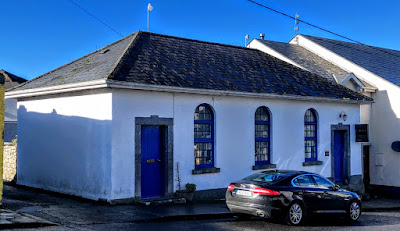
The old courthouse in Kinvara, Co Galway … standing for two centuries and now an arts centre (Photograph: Patrick Comerford, 2022)

Patrick Comerford

The Old Courthouse in Kinvara, Co Galway, is now home to Kinvara Area Visual Arts (KAVA), run by a committee representing local volunteers. The Georgian building has been used as a performance space as well as a courthouse since the 1860s, and dates back to ca 1820-1840.

The building has been described as ‘an almost vernacular version of the courthouse type.’ It has a symmetrical façade flanked by doors at either end. The tooled limestone surrounds and plinth course add an element of grandeur to what is otherwise quite a simple building.

This is a detached five-bay, single-storey building, with a hipped slate roof with cut limestone eaves. The roughcast rendered walls have a tooled limestone plinth course. The square-headed door openings at the end bays of the front elevation have tooled limestone surrounds, keystones and plinth blocks, and timber battened doors. There are rendered steps at the entrances. The round-headed window openings in the middle bays have tooled limestone sills and replacement timber windows.

The poet and songwriter Francis Arthur Fahy (1854-1935), whose songs include ‘Galway Bay,’ was born in Kinvara and produced his first play, The Last of the O’Learys, in the courthouse in Kinvara. It was performed by the local dramatic society in aid of the dependents of Fenian prisoners in 1869.

Fahy was born at Kinvara, the son of Thomas Fahy, who came from the Burren area in Co Clare, and Celia Marlborough from Gort, Co Galway. He wrote ‘Galway Bay’ while living in London, and his other songs include ‘The Bog Road’ and ‘The Ould Plaid Shawl.’

The courthouse was also used to lay out corpses, particularly the bodies of people who died of unnatural causes in the 19th and early 20th centuries. Petty Sessions were held there until 1920, when the original building was almost completely demolished in an attack by a group of local nationalists.

The courthouse was eventually rebuilt and District Court sittings took place there from 1926 until 2008. It also accommodated a community playschool from 1980, which ran alongside the district court sittings. The playschool moved to new purpose-built premises in 2009, and since then the building has been a venue for wide variety of events, including use as a solicitor’s office and housing the Kinvara Youth Project from 2010 to 2015.

The courthouse became the home of KAVA in 2015, with the support of the Kinvara Community Council and the Parish Council. Since opening the courthouse as a community art gallery and art space, KAVA has revitalised the building.

Francis Fahy’s version of ‘Galway Bay’ is hardly as well-known as Arthur Colahan’s song, written in Leicester and popularised by Bing Crosby in 1947. But as I came down the hill from the courthouse to the harbour in Kinvara and looked out onto Galway Bay, I wondered how many of the poor tenants of Kinvara who faced eviction by Henry Comerford after he bought the Kinvara estate from Sir William Gregory (1816-1892) in 1857 ended up in Kinvara Courthouse.

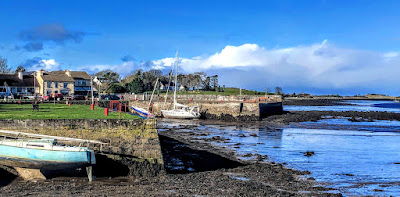
Looking out onto Galway Bay from the harbour in Kinvara (Photograph: Patrick Comerford, 2022)

22 February 2022

The romantic ruins of
Muckinish Castle in the Burren,
overlooking Galway Bay

Shanmuckinish Castle, or Muckinish Castle, is a ruined tower house in Drumcreehy, Co Clare, not far from the churchyard with Henry Comerford’s mausoleum (Photograph: Patrick Comerford, 2022)

Patrick Comerford

When I was searching recently for Comerford family houses and graves in Kinvara, Co Galway, and Ballyvaughan, Co Clare, I stopped on the road between both locations to admire the ruins of Shanmuckinish Castle, or Muckinish Castle, a ruined tower house in Drumcreehy parish, Co Clare, not far from the churchyard with Henry Comerford’s mausoleum.

The name Muckinish comes from the Irish meaning ‘pig island,’ but the castle ruins stand in a romantic location halfway between Kinvara and Ballyvaughan, on the narrowest part of a small peninsula on the northern edge of the Burren, looking out onto Galway Bay.

Shanmuckinish was also known for a time as Ballynacragga Castle. It sits on a narrow part of an isthmus jutting into Pouldoody Bay and once had a strategic position. The castle was built by the O’Loughlin family ca 1450. However, the exact date of its original construction is unknown.

The castle is first mentioned in the Annals of the Four Masters in 1584 when Turlough, son of Owny, son of McLoughlin O’Loughlin, owner of the castle, was taken prisoner and later put to death.

Muckinish Castle was inhabited until the 19th century by members of the O’Loghlen, Neylon and Blake families. The castle was repaired around 1836, and it was still habitable in 1897.

Today, the tower house represents the ruins of a square-plan, single-bay, four-storey rubble stone-built tower house, ca 1450. It reaches almost to its original height of around 17 metres and is partially collapsed, exposing a cross-sectional view of the interior floors. The stairways have not survived.

The striking ruins of Muckinish Castle stand off the road between Kinvara and Ballyvaughan (Photograph: Patrick Comerford, 2022)

The striking castle ruins, with their magnificent views over Pouldoody Bay and Galway Bay, stand off the road between Kinvara and Ballyvaughan. From the road, the castle appears intact, but only the south wall is complete. The ruins stand tall over the bay and it is possible to look inside at the ground floor through one of the windows.

Parts of the east and west wall remain, while the coastal north wall has completely fallen into a pile of rubble that prevents exploring the lower floors on that side.

From the shore, it is possible to see partially demolished arches and hanging vaults above the first and third floors. But it is sad to see huge blocks of masonry in the shoreline rubble.

However, the ruin still features the remains of two vaulted ceilings, intra-mural passages and stairs. The lower windows are defensive loops, while the upper floors feature larger decorative windows.

A bawn wall survives and is in relatively good repair due to repair work in the 18th and 19th centuries. The first floor reception room had a large fireplace in the west wall and some of the internal wall rendering can still be seen. The house also has a wall walk and two of the original four machicolations survive.

Below a machicolation that juts out from the parapet is a three-light mullioned window that may have been inserted in the 17th century. All other windows are single narrow slits and may be original work. The parapet on the east wall projects from the wall with corbels, but these features are not repeated on the south or west walls.

It is hard to miss this ruined castle off the coast road between Kinvara and Ballyvaughan. A laneway provides access from the main road, and new holiday homes beside the ruins make it easy to find parking.

A three-light mullioned window below a machicolation that juts out from the parapet may have been inserted in the 17th century (Photograph: Patrick Comerford, 2022)

14 February 2022

A curious Comerford link
with colonial administration
on the island of St Lucia

The island of St Lucia in the Caribbean … Henry Hegart Breen, who was Governor, was an uncle of Isaac Breen Daly who married Henrietta Comerford

Patrick Comerford

My recent search for the Comerford mausoleum near Ballyvaughan, Co Clare, and houses associated with the Comerford family in Galway, unearthed an interesting, if not curious, family connection with British colonial administration in the Caribbean island of St Lucia.

Henrietta Emily Comerford (1837-1881) was the ninth and youngest daughter of Henry Comerford (1796-1861), JP, of Merchant’s Road, Galway, and Ballykeel House, Kilfenora, Co Clare, and his wife, who are buried in the Comerford mausoleum. Henrietta was named after her father when she was born in Galway on 8 May 1837 and baptised that day in Saint Nicholas Church, Galway.

Henrietta Comerford was twice married. She married her first husband, Isaac Breen Daly (1835-1871), in Dublin on 25 January 1858.

Isaac Breen Daly was a son of Michael Daly (1810-1901) and his wife Mary (née Breen). His father, Michael Daly, was living at Ballykeel House with the Comerford family in 1861. His mother, Mary Daly (née Breen), was a sister of Henry Hegart Breen (1805-1882), Governor of St Lucia.

Henry Hegart Breen, who was born in Kerry on 26 June 1805, claimed direct descent from the ancient Irish chiefs of Tyrone. Following the Battle of Kinsale and during the Plantation of Ulster, the Breen family were adherents of Hugh O’Neil, Earl of Tyrone, the Breens were dispossessed of their lands in Ulster during the reign of James I in 1607, and they were banished from there to Co Kerry.

On his mother’s side, Henry Hegart Breen was also related to the poet Thomas Moore, whose father, the son of a Kerry farmer, settled in Dublin in 1775.

Henry Hegart Breen was educated at grammar schools in Co Kerry, and at the age of 18 he was sent to the College of St Esprit, in Paris. During his five years there, he studied philosophy, theology and French literature.

Breen moved to the West Indies in 1829, and in 1833 he was appointed Secretary of the Courts of Justice in the island of St Lucia. Britain had taken control of St Lucia as a colony from the French in 1814, but the French language continued to be used for many years as the language of the courts. Slavery was abolished on St Lucia in 1836, and slaves were granted full freedom in 1838.

Breen was appointed Administrator of the Government of St Lucia in April 1857, in succession to Maurice Power from Skibbereen, Co Cork, who had been Lieutenant Governor since 1852.

Breen continued as the de factio Governor of St Lucia until October 1861. As administrator, he was present in Martinique in August 1859 at the inauguration of a statue to the Empress Josephine. Breen’s speech in French received special thanks from the Emperor Napoleon III.

Queen Victoria’s son, Prince Alfred, Duke of Edinburgh, visited St Lucia officially in March 1861. Breen retired later that year and he died in the West Indies on 2 November 1882.

Meanwhile, Henry Breen’s nephew, Isaac Breen Daly, died in Salthill, Galway, on 16 December 1871. Isaac and his wife Henrietta (Comerford) were the parents of eight children: Henry Joseph Daly (1858-1903), of Corrib Castle, Galway; Michael Joseph Daly (1860-1894), of Castleblakeney, Co Galway; Hyacinth John Daly (1861-1930), who died in South Africa; George William Daly (1861-1935); Charles Nicholas Daly (1862-1917); Mary ‘Minnie’ (1864-1956); Henrietta (1865-1948), who died in Los Angeles; and Margaret (born 1869).

Henrietta (Comerford) was still a young widow when she married her second husband, John Joseph Ireland, in Galway on 28 November 1872. At their wedding, he gave his age as 23 and he was living in Dominick Street; she gave her age as 30, she was living at Montpelier Terrace, and described rself as ‘Lady.’

They were living at Bushy Park, Galway in 1875. He was 27 when he died the following year at Forster House, the Blake-Forester family home in Forster Street, Galway, on 16 October 1876. She died at Forster House within five years on 20 April 1881, aged 43.

Henrietta and John were the parents of two daughters and a son: Henrietta (Henryeta) Josephine (1873-1960); Elizabeth (1875-1934), known in the family as Ida (1875-1934); and John Francis Ireland (1876-1878), who was an infant when he died in Forster House, Galway, on 14 December 1878.

As for Henry Breen, he was the author of St Lucia, Historical, Statistical, and Descriptive (1844); The Diamond Rock and other Poems (1849); Modern English Literature: its Blemishes and Defects (1857); Warrawarra, the Carib Chief, a Tale of 1770 (2 vols, 1876); and some other works that appeared anonymously. He also contributed to many periodicals.

Forster House, on Forster Street, Galway … home to Henrietta Comerford who married Isaac Breen Daly and John Joseph Ireland (Photograph: Patrick Comerford, 2022)

08 February 2022

In search of a family mausoleum
and finding John Betjeman
cycling with Emily in the Burren

Ballyvaughan, the Burren and Galway Bay spread out below Corkscrew Hill in north Clare (Photograph: Patrick Comerford, 2022)

Patrick Comerford

During the weekend, two of us went in search of some more Comerford family stories in Kinvara, Co Galway, and some Comerford family graves and mausoleums in Ballyvaughan, Co Clare.

Ballyvaughan overlooks Galway Bay and stands as the gateway on the North Clare coast to the Burren. Corkscrew Hill is a narrow road that rises up from Ballyvaughan, on the road on to Lisdoonvarna, bending and folding several steps, and providing breath-taking views back down across Ballyvaughan and out to Galway Bay.

John Betjeman visited the Burren with ‘Emily’ in the summer of 1943, and described the landscape in his poem ‘Ireland with Emily,’ first published two years later in New Bats in Old Belfries (1945).

As I gazed on the Comerford mausoleum in Bishop’s Quarter in Ballyvaughan, I thought too of John Betjeman and his reference to a ‘fantastic mausoleum’ as he recalled cycling along Corkscrew Hill with Emily almost 80 years ago.

John Betjeman and Emily Sears cycled over Corkscrew Hill on a road built to provide work for starving labourers during the Great Famine a century earlier.

His wrote:

Stony seaboard, far and foreign,
Stony hills poured over space,
Stony outcrop of the Burren,
Stones in every fertile place,
Little fields with boulders dotted,
Grey-stone shoulders saffron-spotted,
Stone-walled cabins thatched with reeds,
Where a Stone Age people breeds
The last of Europe’s stone age race.

These words are quoted in a sign at the viewing point near the top of the hill, where I had a vista of the natural amphitheatre carved out by giant ice sheets of ancient ice ages. The ice sheets left behind a fertile valley surrounded by Aillwee Mountain to the east, Cappanwalla Mountain to the west, and opening out onto Galway Bay to the north.

The typical and often contrasting characteristics of the Burren are on view there: bare limestone terraces, fertile fields, dense overgrowth of hazel scrub alongside areas of incredible biodiversity created by traditional farming practices.

There are other literary links too. JRR Tolkien often stayed in Gregans Castle, nestling in the valley below, and many have asked whether he was influenced by this view when he was writing Lord of the Rings.

John Betjeman’s lines on the Burren in ‘Ireland with Emily’ may not be the most comprehensive description of this uniquely valuable area of north-west Clare. But he conveys a sense of the overwhelming bareness of its characteristic limestone landscape.

The ‘soil-less, treeless, waterless’ hills of the Burren also made an impression on Robert Lloyd Praeger. In his classic, The Way That I Went, he wrote: ‘The strangeness of this grey limestone country must be seen to be realised; it is like nothing else in Ireland or in Britain.

According to the Belfast-born environmentalist Gordon D’Arcy, 70 per cent of Ireland’s wild plants grow here in less than 0.5 per cent of Ireland’s land area.

The archaeological heritage of the Burren is also disproportionately large, with evidence of human settlement in the upland area stretching back through 6,000 years. It includes no less than 350 ring forts, notably Cahercommaun, as well as 70 wedge tombs, the highest concentration known, and numerous fulacht fiadha or cooking sites.

John Betjeman’s relationship with Emily Sears did not last that long. He returned to England, and later became Poet Laureate; she later married Ion Villiers-Stuart. ‘They did, however, remain good friends right up to the end of his life,’ according to her ddaughter, Barbara Grubb, who now lives at Dromana House, near Cappoquin, Co Waterford.

‘Ireland With Emily’ by John Betjeman

Bells are booming down the bohreens,
White the mist along the grass,
Now the Julias, Maeves and Maureens
Move between the fields to Mass.
Twisted trees of small green apple
Guard the decent whitewashed chapel,
Gilded gates and doorway grained,
Pointed windows richly stained
With many-coloured Munich glass.

See the black-shawled congregations
On the broidered vestment gaze
Murmer past the painted stations
As Thy Sacred Heart displays
Lush Kildare of scented meadows,
Roscommon, thin in ash-tree shadows, And Westmeath the lake-reflected,
Spreading Leix the hill-protected,
Kneeling all in silver haze?

In yews and woodbine, walls and guelder,
Nettle-deep the faithful rest,
Winding leagues of flowering elder,
Sycamore with ivy dressed,
Ruins in demesnes deserted,
Bog-surrounded bramble-skirted –
Townlands rich or townlands mean as
These, oh, counties of them screen us
In the Kingdom of the West.

Stony seaboard, far and foreign,
Stony hills poured over space,
Stony outcrop of the Burren,
Stones in every fertile place,
Little fields with boulders dotted,
Grey-stone shoulders saffron-spotted,
Stone-walled cabins thatched with reeds,
Where a Stone Age people breeds
The last of Europe’s stone age race.

Has it held, the warm June weather?
Draining shallow sea-pools dry,
When we bicycled together
Down the bohreens fuchsia-high.
Till there rose, abrupt and lonely,
A ruined abbey, chancel only,
Lichen-crusted, time-befriended,
Soared the arches, splayed and splendid,
Romanesque against the sky.

There in pinnacled protection,
One extinguished family waits
A Church of Ireland resurrection
By the broken, rusty gates.
Sheepswool, straw and droppings cover,
Graves of spinster, rake and lover,
Whose fantastic mausoleum,
Sings its own seablown Te Deum,
In and out the slipping slates.

John Betjeman is quoted on a sign at the viewing point near the top of the hill (Photograph: Patrick Comerford, 2022)

07 February 2022

Finding a Comerford
family mausoleum in
the Burren in Co Clare

The mausoleum of Henry Comerford in Drumcreehy Churchyard at Bishop’s Quarter, near Ballyvaughan, Co Clare (Photograph: Patrick Comerford, 2022)

Patrick Comerford

I was searching last weekend for some more Comerford family houses and family graves in Kinvara, Co Galway, and Ballyvaughan, Co Clare, at the weekend.

It was a journey along the south coast of Galway Bay and along the northern edges of the Burren, and it eventually took me to Drumcreehy Church, overlooking the tiny bay and beach at Bishop’s Quarter.

Bishop’s Quarter, about 2 km north-east of Ballyvaughan, once had a religious house belonging, perhaps, to the Bishops of Kilfenora. Today, the most prominent features of the landscape in the area are the ruins of Saint Colman’s Abbey or Drumcreehy Church and an attractive little beach backing onto some sandhills, with a sandy pool almost totally enclosed by sand to the rear of the hills.

The beach, with its tidal lagoon, is said to be a good place for swimming or to collect sea shells, and there is a car park close to the shore. Seaweed is still harvested there and left to dry out of the tide’s reach until it is collected.

The mausoleum of Henry Comerford (right) and the ruins of Drumcreehy Church (left) at Bishop’s Quarter, near Ballyvaughan, Co Clare (Photograph: Patrick Comerford, 2022)

Drumcreehy Church takes its name from ‘Druimcriche,’ the original church built on a hillside in the territory of Crioch Maille. Today, the church is a picturesque but decaying ruin overlooking the Burren and the southern shoreline of Galway Bay.

The church, like many other religious sites in the area, is associated with Saint Colman and is known locally as Saint Colman’s Abbey, but this seems to be a later association.

Some records suggest the church was founded in 1302 by Drumcruth. Other sources point out that the windows and some aspects of the building may date from the 11th century and may have been integrated into the later design.

The north door, which reflects the style of west doors of the nearby Quin Friary, and the chancel may have only been added in the 15th or 16th century. What we see today, however, is a rubble stone-built, single-cell church that may have been built ca 1500.

Most of the church and its details are now destroyed. It appears the church was already in a very poor state by the 1839 when the ordnance survey letters of John O’ Donovan and Eugene Curry describe the church as ‘five centuries old and in a state of dilapidation.’

The inscription the Comerford mausoleum in Bishop’s Quarter, near Ballyvaughan, Co Clare (Photograph: Patrick Comerford, 2022)

However, burials continued to take place in the surrounding churchyard. The most conspicuous tomb is the mausoleum of Henry Comerford (1796-1861), JP, of Merchant’s Road, Galway, and Ballykeel House, Kilfenora, Co Clare.

Henry died at Ballykeel House on 6 September 1861, and was buried in Bishop’s Quarters Cemetery, Ballyvaughan, Co Clare, with his wife Margaret (McDonagh) Comerford, who died ten years earlier in Salthill, Galway, on 31 August 1851.

Henry Comerford was a prosperous merchant, landowner and magistrate in Galway, but his actions during and after the famine led to infamy.

Henry was the owner of the famine migration ship, St John that sailed from Galway to the US but was wrecked off the coast of Massachusetts on 7 October 1849, leading to 100 deaths.

This was only the beginning of his misfortunes. During the decade immediately after the Famine, emigration continued and economic distress intensified. The migration of tenants and the social upheavalbrought about by the Famine was compounded in the decade that followed by the change of landlords. In 1857, Henry Comerford bought the estates around Kinvara that belonged to the Sir William Gregory, MP for Galway and husband of Isabella Augusta Gregory, better known as Lady Gregory, a key figure in the Irish literary revival and co-founder of the Abbey Theatre.

Henry obtained a bank loan to buy the Gregory estates in Kinvara on the basis of his plans to increase revenue from the lands by raising the rents. Sir William Gregory had a relatively good relationship with his tenants, but Henry set out to double and triple the rents of an already disparate and dwindling community.

In his History and Antiquities of the Diocese of Kilmacduagh, Monsignor Jerome Fahy says after Henry Comerford bought the Kinvara estate, ‘the comparatively short interval of about twenty years witnessed the ruin of over a thousand homesteads in one Parish’.

Another priest, Father Francis Arthur, wrote, ‘The change of landlords for the greatest portion of this place has rendered this one of the most wretched and deplorable parishes in Ireland’. He added that it was impossible to get credit from the merchants of Kinvara as they were ‘bereft of all hope’ after Comerford tried to raise the rents so steeply.

Henry Comerford died at Ballykeel House, Kilfenora, Co Clare, on 6 September 1861. He is buried in the churchyard at Drumcreehy, overlooking Bishop’s Quarter and Galway Bay on one side, and looking across the landscape of the Burren on the other side. It is a monumental statement of his sense of importance in the Kinvara and Ballyvaughan area.

The Comerford coat-of-arms carved on the mausoleum of Henry Comerford in Drumcreehy Churchyard (Photograph: Patrick Comerford, 2022)

The Comerford Mausoleum is a single-bay two-storey cut-stone mausoleum, erected ca 1865, with a rusticated underground burial chamber, channelled walls with pilasters above, surmounted by a cut-stone obelisk with a ball finial and surrounded by cast-iron railings.

The inscription reads: ‘Sacred to the memory of Henry Comerford Esqr J.P. who died in the 67[th] year of his age at Ballykeal on the 6th day of Sept[ember] 1861. A fond parent. A faithful friend. A prudent adviser. And in all his dealings just. May the Lord have mercy on his soul. This monument has been erected for him and posterity by his attached and beloved brother Isaac.’

The carved coat-of-arms above the inscription and below the obelisk represents the coat-of-arms of the Comerford family of Co Kilkenny and Co Wexford, blazoned, ‘Azure, a bugle horn argent, stringed gules, between three mullets or. Crest, A peacock in its pride proper. Motto, So Ho Ho Dea Ne.’

The Burren landscape behind Henry Comerford’s mausoleum (Photograph: Patrick Comerford, 2022)

Henry Comerford’s grandson, Francis O’Donnellan Blake Forster (1853-1912), and his family, are buried in the lower part of the mausoleum. The plaque at the lower level is inscribed:

‘In loving memory of Francis O’Donnellan Blake Forster, who died June 27 1912, his wife Marcella died June 26 1917, also their children Francis died March 26 1919, O’Donnellan (Donny) died July 7 1938, Mrs Mollie Pearson, died July 16 1939’.

Marcella Blake-Forster was related to the MacNamara family of Ennistymon, and there lies a link with the poet Dylan Thomas. But that’s a story for another day, as is the story of the Comyn family, who are also related to this branch of the Comerford family and who are buried at Drumcreehy Church too.

The small secluded shoreline at Bishop’s Quarter, below Drumcreehy Churchyard (Photograph: Patrick Comerford, 2022)

06 February 2022

Ordinary people, in
ordinary time, doing
extraordinary things

‘He saw two boats there at the shore’ … two boats at the Pier in Kinvara, Co Galway, at the weekend (Photograph: Patrick Comerford, 2022)

Patrick Comerford

Sunday 6 February 2022,

The Fourth Sunday before Lent


9.30 a.m. Saint Mary’s Church, Askeaton, Co Limerick, the Parish Eucharist (Holy Communion 2)

11.30 a.m. Saint Brendan’s Church, Tarbert, Co Kerry, Morning Prayer

Readings: Isaiah 6: 1-8; Psalm 138; I Corinthians 15: 1-11; Luke 5: 1-11

There is a link to the readings HERE.

‘The fishermen had gone out of them and were washing their nets’ (Luke 5: 2) … fishing boats and nets in the harbour in Loughshinny, Co Dublin (Photograph: Patrick Comerford)

May I speak to you in the name of God, + Father, Son and Holy Spirit, Amen

The Season of Christmas came to an end on Wednesday (2 February 2022) with the Feast of the Presentation or Candlemas, which we celebrated in Holy Trinity Church, Rathkeale, last Sunday morning (30 January 2022).

Between now and Ash Wednesday (2 March 2022), we are in what the Church Calendar calls ‘Ordinary Time.’

So often, our celebrations in Church ask us to identify with the great saints and martyrs, in contrast to the ordinary people who are so often the focus of Christ’s ministry in the Gospels: ordinary people who are poor or on the margins in society; ordinary people with everyday jobs like fishermen and tax collectors, or publicans and farmers; ordinary people in the villages and towns; ordinary people with a need for healing or who are hurt and broken by loss and grief.

Ordinary people like you and me, living ordinary lives in ordinary time. Not sinless people, but ordinary people, conscious of our weaknesses and our failings, humbled in and all too aware of our own sinfulness and flaws.

In our readings this morning, we hear the call of Isaiah, a renewed call to David the Psalmist, the response of Saint Paul to his call, and the renewed call to some of the disciples, including Peter, James and John. These calls come not to people who feel they are worthy of this call, that the deserve this, that they have inherited a call, or who think they are entitled to speak on God’s behalf. They start off as very ordinary people, like you and me.

Isaiah is in the Temple, feeling he is lost and ‘a man of unclean lips’ when he hears and responds to God’s call, only to find he becomes isolated from his own people.

The Psalmist is in God’s presence in the Temple when he finds God answers his prayer and gives him a new calling or new spiritual gifts. Yet David begins life as a small and weak shepherd boy.

Saint Paul tells us he feels he is ‘the least of the apostles, unfit to be called an apostle.’

The three disciples, Peter, James and John are called not only to speak on Christ’s behalf, but to do what Christ commands and to follow him.

In all these readings, Isaiah, the Psalmist, Saint Paul and then Saint Peter, all express their feelings of inadequacy and unworthiness, yet accept God’s call to speak in God’s name unconditionally and in faith.

In our first reading (Isaiah 6: 1-8), the Prophet Isaiah hears his call from God to be a prophet. Isaiah feels unclean and unworthy in the presence of God, and yet he sees God. He sees the people as unworthy too, but one of the seraphs purifies him, rendering him fit to speak God’s word to his people.

Our Psalm (Psalm 138) thanks God for his steadfast, enduring love and for his care for his faithful followers. When the writer calls upon God, God not only answers him but gives him a new calling or makes him more confident spiritually: ‘you increased my strength of soul’ (verse 3).

In the Epistle reading (I Corinthians 15: 1-11), Saint Paul tells us that the Risen Christ first appeared to Cephas (Peter), then to the twelve, then to 500 at one time, then to James, then to all the apostles, and finally to Paul himself.

Saint Paul realises that he is not the first choice, not the second choice. He is way down the list, not among the first 12, not even in the top 500. Until then, he has been an ordinary Jewish Pharisee of the day, making a living mending tents and sails.

But he now knows that through his Baptism he shares in Christ’s suffering and death and that he has been raised to new life in Christ.

Our Gospel story (Luke 5: 1-11) is a story of commitment to Christ, to his message and to his destiny. Simon is named Peter for the first time in Saint Luke’s Gospel in this reading (verse 8). Christ calls Simon or Simon Peter to be a disciple, promising him he is to be a ‘fisher of men,’ and Peter, James and John leave everything and follow Christ.

Try to imagine the roles or the calls being reversed.

Can you imagine King Uzziah giving up his throne to be a marginalised prophet like Isaiah?

Can you imagine a powerful king accepting God’s call to be a despised shepherd boy?

Can you imagine a Roman Governor accepting the call to work with the disciples in an ordinary fishing boat?

Had Pontius Pilate heard Christ’s call would he have given up privilege, or paid heed to the inevitable obloquy that would follow his extraordinary use of power?

Our Gospel reading opens us to the concept that God does extraordinary things with ordinary people, in ordinary places, in ordinary times.

This episode begins beside the ‘lake of Gennesaret,’ on the south-west shore of the Sea of Galilee. The crowd is pressing in to hear Christ, the Word of God, to hear the Christian message.

Jesus gets into the boat with Simon Peter. There are two boats in this episode, and James and John are also fishing in one of the boats.

Simon acknowledges Jesus as ‘Master’ or teacher. The disciples do what Christ tells them to do, and they are amazed at the consequences. Simon Peter responds by falling down before Christ in humility, pointing to himself as a sinful man, and calling Jesus ‘Lord,’ which becomes an expression of faith.

Peter, James and John are ordinary working men who make an extraordinary and total commitment to Christ; they leave everything, and follow him.

In traditional illustrations, the boat is often used as an image of the Church, while the fish is an image of Christ. In the Early Church, the fish came to symbolise Christ because the Greek word Ichthus (ΙΧΘΥΣ), meaning ‘fish’, is an acrostic for ‘Jesus Christ, Son of God, Saviour’ (Ἰησοῦς Χριστός, Θεοῦ Υἱός, Σωτήρ).

The Church is the boat, Christ is the fish, and God calls us as ordinary people, in ordinary places, in ordinary times, to realise that God sees us – you and me, each and every one of us – to work with him, where he finds us. God sees us in our everyday lives as his partners in the boat. And we are all in this boat together.

It is in being the ordinary people we are, in our ordinary lives, in our ordinary times, that God calls us. And if we chose to respond, then, like Peter, James and John, we may find we are amazed at the catch Christ brings into the Church through us.

Are we brave enough to face this possibility? Or is that ordinary challenge too much for us? If we have any doubts, remember how Christ says to Simon Peter, ‘Do not be afraid; from now on you will be catching people.’

And so, may all we think, say and do be to the praise honour and glory of God, + Father, Son and Holy Spirit, Amen.

‘He saw two boats there at the shore’ … two fishing boats at the harbour in Skerries, Co Dublin (Photograph: Patrick Comerford)

Luke 5: 1-11 (NRSVA):

1 Once while Jesus was standing beside the lake of Gennesaret, and the crowd was pressing in on him to hear the word of God, 2 he saw two boats there at the shore of the lake; the fishermen had gone out of them and were washing their nets. 3 He got into one of the boats, the one belonging to Simon, and asked him to put out a little way from the shore. Then he sat down and taught the crowds from the boat. 4 When he had finished speaking, he said to Simon, ‘Put out into the deep water and let down your nets for a catch.’ 5 Simon answered, ‘Master, we have worked all night long but have caught nothing. Yet if you say so, I will let down the nets.’ 6 When they had done this, they caught so many fish that their nets were beginning to break. 7 So they signalled to their partners in the other boat to come and help them. And they came and filled both boats, so that they began to sink. 8 But when Simon Peter saw it, he fell down at Jesus’ knees, saying, ‘Go away from me, Lord, for I am a sinful man!’ 9 For he and all who were with him were amazed at the catch of fish that they had taken; 10 and so also were James and John, sons of Zebedee, who were partners with Simon. Then Jesus said to Simon, ‘Do not be afraid; from now on you will be catching people.’ 11 When they had brought their boats to shore, they left everything and followed him.

An icon of the Church as a boat, including Christ, the Apostles and the Church Fathers (Icon: Deacon Matthew Garrett, www.holy-icons.com)

Liturgical Colour: Green

The Collect:

O God,
you know us to be set
in the midst of so many and great dangers,
that by reason of the frailty of our nature
we cannot always stand upright:
Grant to us such strength and protection
as may support us in all dangers
and carry us through all temptations;
through Jesus Christ our Lord.

The Collect of the Word:

Most holy God,
the earth is filled with your glory,
and before you angels and saints serve in awe.
Enlarge our vision to see
your power at work in the world, and by your grace
make us heralds of your Son,
Jesus Christ, our Saviour and Lord.

The Post-Communion Prayer:

God of tender care,
in this Eucharist we celebrate your love for us and for all people.
May we show your love in our lives
and know its fulfilment in your presence.
We ask this in the name of Jesus Christ our Lord.

When he had finished speaking, he said to Simon, ‘Put out into the deep water and let down your nets for a catch’ (Luke 5: 4) … a fisherman at work at Torcello in the Venetian lagoon (Photograph: Patrick Comerford)

Hymns:

321, Holy, holy, holy! Lord God almighty (CD 19)
358, King of glory, King of peace (CD 21)
395, When Jesus taught by Galilee (CD 48)

‘When they had brought their boats to shore, they left everything and followed him’ … fishing boats on a shore at Mount Athos (Photograph: Patrick Comerford)

Scripture quotations are from the New Revised Standard Version Bible: Anglicised Edition copyright © 1989, 1995, National Council of the Churches of Christ in the United States of America. Used by permission. All rights reserved worldwide. http://nrsvbibles.org

Material from The Book of Common Prayer (the Church of Ireland, 2004) is copyright © Representative Body of the Church of Ireland 2004.


11 August 2021

Comerford O’Malley,
the priest who shaped
DePaul University, Chicago

The Very Revd Professor Comerford Joseph O’Malley (1902-1991) … President and Chancellor of DePaul University, Chicago

Patrick Comerford

My explorations of former Comerford family homes in Co Clare and Co Galway during this summer’s ‘road trips’ have led to finding the interesting stories of more members of the Comerford family.

Earlier this week, I was recalling the interesting life of Judge Frank D Comerford (1879-1929), a judge in Chicago and a Democratic politician who was expelled from the Illinois State Senate, whose parents and elder siblings from Kinvara, Co Galway.

Judge Comerford was an uncle of the Very Revd Professor Comerford Joseph O’Malley (1902-1991), who was a professor, president and chancellor at DePaul University, Chicago, where he spent 47 years of his academic career until he retired in 1981.

Father Comerford O’Malley was born in 1902 in Chicago, a son of Austin O’Malley (1851-1932) and his wife Alice ‘Ella’ Comerford (1863-1941).

Alice Comerford was born in Kinvara, Co Galway, on 24 March 1863, a daughter of Isaac Comerford (1829-1900) and his wife Mary Jane Linnane (1841-1914). Isaac Comerford was a younger brother of Henry Comerford (1827-1861), a prominent Galway merchant and magistrate who lived at Merchant’s Road, Galway, and Ballykeel House, Kilfenora, Co Clare. Henry bought up the Gregory estate in Kinvara in the 1850s and his post-Famine efforts to impose exorbitant rent increases in the town brought financial ruin to Kinvara and brought the Comerford family to the brink of social and economic disaster.

Alice Comerford emigrated ca 1866 with her parents and siblings to Chicago, where more brothers and sisters were born, including Judge Frank Comerford.

On 29 November 1883, Alice married Austin John O’Malley (1850-1932) from Co Mayo. They had a large family of eight children, including three doctors, three priests and a nun: Dr John Gabriel O’Malley (1888-1935), of Columbus Hospital, Chicago; Sister Mary Paulina ‘Jennie’ O’Malley (1888-1942); Dr Austin J O’Malley (1894-1954); Dr Francis Xavier O’Malley (1895-1974), whose children included Judge Paul Augustine O’Malley (1927-2006); Charles Bernard O’Malley (1898-1974) of Tallahassee, Florida; Father George A O’Malley (1899-1960), a Vincentian priest and President of Saint Vincent’s Seminary and College, Cape Girardeau, Missouri; the Very Revd Professor Comerford Joseph O’Malley (1902-1991); and Father Paul T O’Malley (1904-1980).

Three of these brothers joined the Congregation of the Mission, the Vincentian community that founded DePaul University as Saint Vincent’s College in 1898. It became DePaul University in 1907, and conferred an honorary LL.D. on Eamon de Valera in 1919, DePaul’s first honorary doctorate for an international figure.

Father Comerford Joseph O’Malley was the only member of this large family to continue the Comerford name, which was given as a first name at birth in 1902. After joining the Vincentians, he was ordained priest in 1928 and received the degree of Doctor of Sacred Theology in 1929 from the Colegio Angelico in Rome. He joined the faculty of De Paul University in 1934 as Professor of Philosophy, and two years later became the Dean of the College of Commerce (1936-1944).

He was elected the seventh President of DePaul University in 1944, and had the distinction of being the longest-serving president of the university, from 1944 to 1964.

While Comerford O’Malley was president of DePaul, the university saw tremendous growth, partly due to the GI Bill after World War II that sent many former soldiers to college. Enrolment ballooned to 11,500 by 1948.

During these years, DePaul acquired the Lewis Center and developed its Loop Campus. Father O’Malley also oversaw the building of Alumni Hall, which allowed sports to take a greater part in campus life.

But DePaul also faced some uncertainty in these years. The North Central Association, which accredits universities, recommended in 1947 that DePaul lose its accreditation, due in part to a poor library and a shortage of professors with PhDs.

DePaul, which had always seen itself as primarily a teaching and training university rather than a research university, initially balked at hiring more professors with doctorates who would then require research leave. However, these professors were soon hired, and the academic standards of the university rose. The library was also centralised and improved under one director.

Before Comerford O’Malley retired, he announced a $22 million 10-year ‘Programme for Greatness’ that would expand the Lincoln Park campus, including adding dormitories for the first time, and further improve academics.

When O’Malley began his presidency, enrolment was at about 8,000. During the beginning and middle of his tenure, it rose greatly, but when he retired there were fewer former soldiers to enrol. In 1960, enrolment was at around 9,000 students.

All of these changes have affected the current academic program and student life of DePaul to a very large degree. In a way, O’Malley’s tenure formed the modern DePaul University.

When he retired as President, Comerford O’Malley became the first Chancellor of DePaul University in 1964. He died in Saint Joseph’s Hospital, Chicago, on 27 February 1991.

Comerford O’Malley … his tenure as President formed the modern DePaul University