Showing posts with label Banbury. Show all posts

04 March 2026

Daily prayer in Lent 2026:
16, Thursday 6 March 2026

Lazarus and the Rich Man … a panel in the East Window Mayer & Co in Saint Michael’s Church, Limerick, depicting a series of ten parables (Photograph: Patrick Comerford)

Patrick Comerford

Lent began over two weeks ago on Ash Wednesday (18 February 2026), and this week began with the Second Sunday in Lent (Lent II). I am due to leave Kuching this morning with a flight first to Kuala Lumpur this evening and from there with Oman Air through Muscat in the middle of the night, arriving in London early tomorrow. But as the situation in the Gulf changes by the hour I have no idea what is going to happen to my travel plans today, tonight or in the days to come.

Meanwhile, before today begins, before I head off to Kuching Airport in faith, hope and anticipation, and perhaps with just a small dose of tepidtion, I am taking some quiet time this morning to give thanks, to reflect, to pray and to read in these ways:

/>
1, reading today’s Gospel reading;

2, a short reflection;

3, a prayer from the USPG prayer diary;

4, the Collects and Post-Communion prayer of the day.

Bonifacio Veronese, Dives and Lazarus, 1540-50. Oil on canvas, Gallerie dell’Accademia, Venice

Luke 16: 19-31 (NRSVA):

[Jesus told this parable:] 19 ‘There was a rich man who was dressed in purple and fine linen and who feasted sumptuously every day. 20 And at his gate lay a poor man named Lazarus, covered with sores, 21 who longed to satisfy his hunger with what fell from the rich man’s table; even the dogs would come and lick his sores. 22 The poor man died and was carried away by the angels to be with Abraham. The rich man also died and was buried. 23 In Hades, where he was being tormented, he looked up and saw Abraham far away with Lazarus by his side. 24 He called out, “Father Abraham, have mercy on me, and send Lazarus to dip the tip of his finger in water and cool my tongue; for I am in agony in these flames.” 25 But Abraham said, “Child, remember that during your lifetime you received your good things, and Lazarus in like manner evil things; but now he is comforted here, and you are in agony. 26 Besides all this, between you and us a great chasm has been fixed, so that those who might want to pass from here to you cannot do so, and no one can cross from there to us.” 27 He said, “Then, father, I beg you to send him to my father’s house – 28 for I have five brothers – that he may warn them, so that they will not also come into this place of torment.” 29 Abraham replied, “They have Moses and the prophets; they should listen to them.” 30 He said, “No, father Abraham; but if someone goes to them from the dead, they will repent.” 31 He said to him, “If they do not listen to Moses and the prophets, neither will they be convinced even if someone rises from the dead”.’

The Rich Man and Lazarus … a window in Saint Mary’s Church, Banbury, Oxfordshire

Today’s Reflections:

The Gospel reading today (Luke 16: 19-31) is a popular Bible story. We usually know this as the story of Dives and Lazarus, and it is almost as well-known a story as the parables of the Good Samaritan or the Prodigal Son.

But there are some unique and distinctive aspects to this story.

For example, this story is found only in Saint Luke’s Gospel.

Surprisingly, God is not named in this story. But, of course, as in the Book of Esther, God is seldom named in the Gospel parables either. Instead, the parables challenge us to think who is God for us by asking us to see who is most God-like, who acts like God would act.

The poor man at the gate is named, but the name Lazarus could be confusing, because this is also the name of the brother of Mary and Martha, the dead friend Jesus raised to life in Bethany.

The name Lazarus, or in Hebrew Eleazar, which means ‘the Lord is my help,’ is an interesting name for those who first heard Jesus tell this story, for the rich man in his castle certainly is of no help to the poor man at his gate.

Abraham is named. And Moses is named. Both are key figures in this story, for all the descendants of Abraham are promised that they are going to be children of the covenant with God. And it is Moses who receives that covenant in the wilderness on Mount Sinai. The man at the gate, who is being ignored by a leading religious figure of the day, must have been made to feel hopeless, outside the scope of the covenant, abandoned, in a wilderness, impoverished, exiled outside the community.

But there are six other characters in the story – and not one of them is named.

The Rich Man at the centre of the story, is sometimes called ‘Dives’. But the name Dives is one he does not have in the Gospel story, in the parable as Jesus tells it. Tradition has given him the name Dives, but the rich man remains anonymous and he has no name. The name Dives derives simply from a misreading of an early Latin translation of the Bible.

The rich man has five brothers, but not one of these is named either.

I like to think this man is anyone who claims to be religious but who falls in love with riches. It is not his wealth that is his downfall, but his love of wealth and how he uses it.

The Apostle Paul is often misquoted as saying money is the root of all evil. But what he actually tells Timothy is that ‘the love of money is a root of all kinds of evil,’ and that, ‘in their eagerness to be rich, some have wandered away from the faith and pierced themselves with many pains.’

It is possible be religious and rich at one and the same time. But if I appear to be religious, I need to be careful that my religious practices are not a contradiction of, a denial of, the way I live my life in the world, and respond to the needs of others.

God’s covenant is only meaningful when it is lived as a covenant of love. The rich man loves himself first, and, perhaps, his family, his own inner circle second. But that is as far as his religion goes. It does not go beyond his own front door.

I like to think Jesus is playing a little game with those who are religious and listening. The Samaritan woman at the well (John 4) is told that she is wed to five husbands but has no true marriage at all.

The five husbands could represent the first five books of the Bible – the Torah. The Samaritans would not accept any other writings as Holy Scripture, and there was a joke among Jews at the time that the Samaritans were so insistent on these five books alone that it was like being wedded to them. They were the Biblical fundamentalists of their day. She is being told that you cannot be wed to Holy Scripture and have a covenantal relationship with God without love. She realises that just as being wed but without love is no marriage, so being religious without love is no religion at all.

Love is the active ingredient of true religion. And when that dawns on her, she becomes one of the greatest missionaries in the Gospels.

Similarly, Jesus may be playing a game with those who are listening to today’s parable. If the rich man, as it appears, is a priest of the Temple, then he too is a religious figure. But the priestly caste of the day were Sadducees, not Pharisees. And so the Pharisees who were listening to this story (verse 14) would have known that the Sadducees too refused to accept as part of the Bible any books other than the first five – when it came to Holy Scripture they only admitted those five into the family of faith.

The rich man realises that being wed to the Torah without love is no covenant. But unlike, the Samaritan woman, it is too late for him when this truth dawns on him.

There is no covenant without love, and this is true for marriage and for religion.

There is no true religion without love … not self-interest, but love for God and love for others.

Of course, there is one other character in this story who is not named. This is not a human character, but an animal – the dog.

There is a 1996 movie produced at the Sullivan Bluth studios in Dublin, All Dogs go to Heaven, with a voice over by Burt Reynolds. But, while we think of dogs today as faithful pets, there was a religious tradition in the time of Jesus that dogs did not get into heaven.

Lazarus is hungry and covered with sores, and sits outside the gate of what must have looked like a Heavenly City inside. He is in such a condition and in a place that even the dogs come and lick his sores (verse 21). For its time, this is a description of abject living, so abhorrent that this man is totally outside normal, good clean company. He is in the wilderness, in exile, and at a point where only God can redeem him.

Dives is not one single identifiable rich man. He is each and every one of us. Who among us, on first hearing this story, as it opened, as the first part of it began to be told, would not have delighted in the lifestyle of the rich man. After all, how often do I find myself saying, quite rightly, all I want is for me and those I love to have somewhere decent to live, decent clothes and enough decent food?

But that decency turns to indecency when these things soon become all we want in life … and want nothing for others, have no place for meeting the needs of others.

I heard a comedian once complaining about the size of a pizza slice he was served in a café – if you had a pie chart for what you would do if you a won a million in the lotto, this was the size of the slice for what I would give to charity, he said.

Having lost his compassion for others, especially the needy on his doorstep, Dives loses his religion, for without love there can be no true religion; and Dives loses his humanity, for I am only human in so far as I am like God and love others.

The loss of Dives’ humanity is symbolised by his loss of a personal name. I am baptised with a personal name, and so incorporated into the Body of Christ; that name is how I am known to God and to others – God calls me and you recognise me by my name. Without a name, can Dives remain in the image of God? Can he be called on by others as a fellow human being?

On the other hand, the coming of Christ turns all our skewed values upside down: those we think are most outside God’s compassion and outside the Kingdom of Heaven may well be those most likely to be signs of what the Kingdom of God is, and to be reminders of kingdom values.

Lazarus who is an outsider becomes the true insider; Lazarus who is totally poor becomes rich in the one way that really matters; Lazarus who is at death’s door finds eternal life.

The dogs too play an important role – like the woman who mops the brow of Jesus on his way to Calvary, and the women who weep with him above the city … they do not take away his suffering, but they tell him that his suffering is shared in creation.

So, who is most like God, most like Christ, in this Gospel story?

Those who first heard this story, would initially have expected the person to be most like God to be the religious leader, the one who can cite the Bible, call out to Abraham and Moses. And those who first heard this story would initially have expected the person to be least like God to be the beggar at the gates, the man outside among the dogs.

But is that not what Christ is like? He gives up everything to identify with our humanity in his incarnation, life and death; he is rejected, suffers and dies outside the city walls.

You may not want to be like Lazarus, but Christ wants us to be like him. And we are most like him not when we hope for riches and pleasures beyond our reach, but when we love God and when we love one another. God calls each and every one of us to be like him, to love like him, and when he calls us he calls us by name.

We may marginalise others, we may exclude others, we may push others outside the gates. But God never counts me out, God never excludes you, God never closes the gates on others. We too, despite what others may think of us, are invited to the Heavenly Banquet. Therefore, let us celebrate the feast.


The story of Dives and Lazarus has inspired great artists, and composers like Vaughan Williams

Today’s Prayers (Thursday 6 March 2026):

The theme this week (1-7 March 2026) in ‘Pray With the World Church,’ the Prayer Diary of the Anglican mission agency USPG (United Society Partners in the Gospel), is: ‘Saint David’s Day’ (pp 34-35). This theme was introduced on Sunday with Reflections by the Revd Sarah Rosser, Team Vicar in the Netherwent Ministry Area, Diocese of Monmouth, Church in Wales.

The USPG Prayer Diary today (Thursday 6 March 2026) invites us to pray:

We pray for the sick: bring them comfort and healing. Strengthen those caring for loved ones and all who work in caring professions.

The Collect:

Almighty God,
you show to those who are in error the light of your truth,
that they may return to the way of righteousness:
grant to all those who are admitted
into the fellowship of Christ’s religion,
that they may reject those things
that are contrary to their profession,
and follow all such things as are agreeable to the same;
through our Lord Jesus Christ,
who is alive and reigns with you,
in the unity of the Holy Spirit,
one God, now and for ever.

The Post Communion Prayer:

Almighty God,
you see that we have no power of ourselves to help ourselves:
keep us both outwardly in our bodies,
and inwardly in our souls;
that we may be defended from all adversities
which may happen to the body,
and from all evil thoughts which may assault and hurt the soul;
through Jesus Christ our Lord.

Additional Collect:

Almighty God,
by the prayer and discipline of Lent
may we enter into the mystery of Christ’s sufferings,
and by following in his Way
come to share in his glory;
through Jesus Christ our Lord.

Yesterday’s Reflections

Continued Tomorrow

Scripture quotations are from the New Revised Standard Version Bible: Anglicised Edition copyright © 1989, 1995 National Council of the Churches of Christ in the United States of America. Used by permission. All rights reserved worldwide. http://nrsvbibles.org

28 September 2025

Daily prayer in Ordinary Time 2025:
139, Sunday 28 September 2025,
Fifteenth Sunday after Trinity (Trinity XV)

Lazarus and the Rich Man … a panel in the East Window by Mayer & Co in Saint Michael’s Church, Limerick, depicting a series of ten parables (Photograph: Patrick Comerford)

Patrick Comerford

We are continuing in Ordinary Time in the Church Calendar and tomorrow is the Fifteenth Sunday after Trinity (Trinity XV, 28 September). Later this morning, I hope to be at the Parish Eucharist in Saint Mary and Saint Giles Church, Stony Stratford.

Before today begins, I am taking some quiet time this morning to give thanks, to reflect, to pray and to read in these ways:

1, reading today’s Gospel reading;

2, a short reflection;

3, a prayer from the USPG prayer diary;

4, the Collects and Post-Communion prayer of the day.

Bonifacio Veronese, Dives and Lazarus, 1540-50. Oil on canvas (Gallerie dell’Accademia, Venice)

Luke 16: 19-31 (NRSVA):

[Jesus told this parable:] 19 ‘There was a rich man who was dressed in purple and fine linen and who feasted sumptuously every day. 20 And at his gate lay a poor man named Lazarus, covered with sores, 21 who longed to satisfy his hunger with what fell from the rich man’s table; even the dogs would come and lick his sores. 22 The poor man died and was carried away by the angels to be with Abraham. The rich man also died and was buried. 23 In Hades, where he was being tormented, he looked up and saw Abraham far away with Lazarus by his side. 24 He called out, “Father Abraham, have mercy on me, and send Lazarus to dip the tip of his finger in water and cool my tongue; for I am in agony in these flames.” 25 But Abraham said, “Child, remember that during your lifetime you received your good things, and Lazarus in like manner evil things; but now he is comforted here, and you are in agony. 26 Besides all this, between you and us a great chasm has been fixed, so that those who might want to pass from here to you cannot do so, and no one can cross from there to us.” 27 He said, “Then, father, I beg you to send him to my father’s house – 28 for I have five brothers – that he may warn them, so that they will not also come into this place of torment.” 29 Abraham replied, “They have Moses and the prophets; they should listen to them.” 30 He said, “No, father Abraham; but if someone goes to them from the dead, they will repent.” 31 He said to him, “If they do not listen to Moses and the prophets, neither will they be convinced even if someone rises from the dead”.’

The Rich Man and Lazarus … a stained glass window in Saint Mary’s Church, Banbury, Oxford

Today’s Reflections:

The Gospel reading today (Luke 16: 19-31) is a popular Bible story. We usually know this as the story of Dives and Lazarus, and it is almost as well-known a story as the parables of the Good Samaritan or the Prodigal Son.

But there are some unique and distinctive aspects to this story.

For example, this story is found only in Saint Luke’s Gospel.

Surprisingly, God is not named in this story. But, of course, as in the Book of Esther, God is seldom named in the Gospel parables either. Instead, the parables challenge us to think who is God for us by asking us to see who is most God-like, who acts like God would act.

The poor man at the gate is named, but the name Lazarus could be confusing, because this is also the name of the brother of Mary and Martha, the dead friend Jesus raised to life in Bethany.

The name Lazarus, or in Hebrew Eleazar, which means ‘the Lord is my help,’ is an interesting name for those who first heard Jesus tell this story, for the rich man in his castle certainly is of no help to the poor man at his gate.

Abraham is named. And Moses is named. Both are key figures in this story, for all the descendants of Abraham are promised that they are going to be children of the covenant with God. And it is Moses who receives that covenant in the wilderness on Mount Sinai. The man at the gate, who is being ignored by a leading religious figure of the day, must have been made to feel hopeless, outside the scope of the covenant, abandoned, in a wilderness, impoverished, exiled outside the community.

But there are six other characters in the story – and not one of them is named.

The Rich Man, who is at the centre of the story, is sometimes called ‘Dives.; But the name Dives is one he does not have in the Gospel story, in the parable as Jesus tells it. Tradition has given him the name Dives, but the rich man is anonymous and he has no name. The name Dives derives simply from a misreading of an early Latin translation of the Bible.

The rich man has five brothers, but not one of these is named either.

I like to think this man is anyone who claims to be religious but who falls in love with riches. It is not his wealth that is his downfall, but his love of wealth and how he uses it.

The Apostle Paul is often misquoted as saying money is the root of all evil. But what he actually tells Timothy is that ‘the love of money is a root of all kinds of evil,’ and that, ‘in their eagerness to be rich, some have wandered away from the faith and pierced themselves with many pains.’

It is possible to be religious and rich at one and the same time. But if I appear to be religious, I need to be careful that my religious practices are not a contradiction of, a denial of, the way I live my life in the world, and respond to the needs of others.

God’s covenant is only meaningful when it is lived as a covenant of love. The rich man loves himself first, and, perhaps, his family, his own inner circle second. But that is as far as his religion goes. It does not go beyond his own front door.

I like to think Jesus is playing a little game with those who are religious and listening. The Samaritan woman at the well (John 4) is told that she is wed to five husbands but has no true marriage at all.

The five husbands could represent the first five books of the Bible – the Torah. The Samaritans would not accept any other writings as Holy Scripture, and there was a joke among Jews at the time that the Samaritans were so insistent on these five books alone that it was like being wedded to them. They were the Biblical fundamentalists of their day. She is being told that you cannot be wed to Holy Scripture and have a covenantal relationship with God without love. She realises that just as being wed but without love is no marriage, so being religious without love is no religion at all.

Love is the active ingredient of true religion. And when that dawns on her, she becomes one of the greatest missionaries in the Gospels.

Similarly, Jesus may be playing a game with those who are listening to today’s parable. If the rich man, as it appears, is a priest of the Temple, then he too is a religious figure. But the priestly caste of the day were Sadducees, not Pharisees. And so the Pharisees who were listening to this story (verse 14) would have known that the Sadducees too refused to accept as part of the Bible any books other than the first five – when it came to Holy Scripture they only admitted those five into the family of faith.

The rich man realises that being wed to the Torah without love is no covenant. But unlike, the Samaritan woman, it is too late for him when this truth dawns on him.

There is no covenant without love, and this is true for marriage and for religion.

There is no true religion without love … not self-interest, but love for God and love for others.

Of course, there is one other character in this story who is not named. This is not a human character, but an animal – the dog.

There is a 1996 film produced at the Sullivan Bluth studios in Dublin, All Dogs go to Heaven, with a voice over by Burt Reynolds. But, while we think of dogs today as faithful pets, there was a religious tradition in the time of Jesus that dogs did not get into heaven.

Lazarus is hungry and covered with sores, and sits outside the gate of what must have looked like a Heavenly City inside. He is in such a condition and in a place that even the dogs come and lick his sores (verse 21). For its time, this is a description of abject living, so abhorrent that this man is totally outside normal, good clean company. He is in the wilderness, in exile, and at a point where only God can redeem him.

Dives is not a single identifiable rich man. He is each and every one of us. Who among us, on first hearing this story, as it opened, as the first part of it began to be told, would not have delighted in the lifestyle of the rich man. After all, how often do I find myself saying, quite rightly, all I want is for me and those I love to have somewhere decent to live, decent clothes and decent food?

But that decency turns to indecency when these things soon become all we want in life … and want nothing for others, have no place for meeting the needs of others.

I heard a comedian once complaining about the size of a pizza slice he was served in a café – if you had a pie chart for what you would do if you a won a million in the lotto, this was the size of the slice for what I would give to charity, he said.

Having lost his compassion for others, especially the needy on his doorstep, Dives loses his religion, for without love there can be no true religion; and Dives loses his humanity, for I am only human in so far as I am like God and love others.

The loss of Dives’ humanity is symbolised by his loss of a personal name. I am baptised with a personal name, and so incorporated into the Body of Christ; that name is how I am known to God and to others – God calls me and you recognise me by my name. Without a name, can Dives remain in the image of God? Can he be called on by others as a fellow human being?

On the other hand, the name Lazarus means ‘God helps’ – the Greek Λάζαρος (Lazaros) is derived from the Hebrew Eleazar (אֶלְעָזָר, Elʿazar), ‘God’s assistance,’ or: ‘God has helped.’ Eleazar was a nephew of Moses and the second High Priest, succeeding his father Aaron after he died. So, as this story unfolds, our expectations of God’s actions, of God’s deliverance, are raised incrementally, but we are also expecting a conflict between two priests about who are the true heirs to Abraham and Moses, and a conflict about the teachings on and expectations of eternal justice and eternal life.

The coming of Christ turns all our skewed values upside down: those we think are most outside God’s compassion and outside the Kingdom of Heaven may well be those most likely to be signs of what the Kingdom of God is, and to be reminders of kingdom values.

Lazarus who is an outsider becomes the true insider; Lazarus who is totally poor becomes rich in the one way that really matters; Lazarus who is at death’s door finds eternal life.

The dogs too play an important role – like the woman who mops the brow of Jesus on his way to Calvary, and the women who weep with him above the city … they do not take away his suffering, but they tell him that his suffering is shared in creation.

So, who is most like God, most like Christ, in this Gospel story?

Those who first heard this story, would initially have expected the person to be most like God to be the religious leader, the one who can cite the Bible, who calls out to Abraham and Moses. And those who first heard this story would initially have expected that the person to be least like God is going to be the beggar at the gates, the man outside among the dogs.

But is that not what Christ is like? He gives up everything to identify with our humanity in his incarnation, life and death; he is rejected, suffers and dies outside the city walls.

You may not want to be like Lazarus, but Christ wants us to be like him. And we are most like him not when we hope for riches and pleasures beyond our reach, but when we love God and when we love one another. God calls each and every one of us to be like him, to love like him, and when he calls us he calls us by name.

When the poor man dies, he is carried away by the angels to be with Abraham (verse 22). When the rich man dies and finds himself in Hades he calls out to Abraham as ‘father’ or ‘Father Abraham’ (verse 24), and he in turn is addressed by Abraham as ‘Child’ (verse 25).

These are not mere terms of affection but in a profound way they open one other possibility in this story, a perspective that is not offered by commentators, perhaps because many are not familiar with customs within Judaism, yet one that I believe may be possible and perhaps even profound.

Jewish law or halakhah considers converts to Judaism as spiritually adopted into the lineage of Abraham, the first Jewish patriarch. Male converts are often called ‘ben Avraham Avinu’ (son of Abraham, our father) during liturgical ceremonies such as being called up to Torah readings in the synagogue.

This custom serves to emphasise their connection to these foundational figures and signifies that converts are spiritually adopted into the Jewish lineage, becoming part of the covenant established with Abraham and Sarah. This practice is a way to acknowledge their entry into the Jewish people and their spiritual connection to the foundational figures of Judaism.

The custom of referring to a man who is a convert to Judaism as ‘ben Avraham Avinu’ is connected with the prohibition in Jewish law of mistreating proselytes, including reminding them that they were once not a Jew.

There is a possibility here that Lazarus was a convert to Judaism, but that he was constantly reminded of this by Dives, metaphorically left outside the gates, outside what he defined as the community of faith, denied his place as a true child of Abraham, as though he had been thrown to the dogs.

We are told that when the poor man in the Gospel reading died, he ‘was carried away by the angels to be with Abraham.’ In calling him ‘child’, Abraham restores the outsider to his proper place as an insider within the community of faith, restores him to him to his rightful place in the community, an eternal justice that he had been denied in mortal life.

Jesus uses a similar phrase in a Gospel reading last month (Luke 10: 13-17, Sunday 24 August 2024, Trinity X), when he seess a woman who has endured suffering for 18 years, calls her into the centre of the synagogue, heals her and refers to her as a daughter of Abraham. Was she too a convert to Judaism, or the widow of a convert, denied her rightful place in the community of faith, marginalised and never fully accepted, bent over for 18 years by the demands and expectations that had been laid on her shoulders?

Who is Lazarus to me today?

Who do I exclude, who do I make a stranger at the gate?


The story of Dives and Lazarus has inspired great artists, and composers like Vaughan Williams

Today’s Prayers:

Today’s Prayers (Sunday 28 September 2025, Trinity XV):

The theme this week (28 September to 4 October) in Pray with the World Church, the prayer diary of the Anglican mission agency USPG (United Society Partners in the Gospel), is ‘One Faith: Many Voices’ (pp 42-43). This theme is introduced today with Reflections from Rachel Weller, Communications Officer, USPG:

To mark the 1700th anniversary of the Council of Nicaea, USPG created a unique video showcasing Christians from around the world reciting the Nicene Creed in their own languages. The compilation features speakers of Twi, Bengali, Portuguese, Welsh, and various forms of English spoken by believers from the Middle East, Zambia and the Solomon Islands.

Interestingly, the project revealed some similarities concealed within the different languages we speak. For instance, the Arabic term for Holy Spirit, ar-rūh al-qudus (رلاُّحو لاْقُدُس‎), closely resembles Roh Kudus in Iban, an Indigenous language of Malaysia, due to the influence of Islam. Likewise, Biblical Hebrew rúakh hakódesh (ורּחַ הַקֹּדֶשׁ‎) shares a striking similarity – a clear sign of the legacy of Abrahamic religions and their languages. In the Philippines, espíritu santo in Tagalog reflects the same expression in Spanish, highlighting the enduring legacy of Spanish colonial influence.

And so, whilst history, culture, and even colonial legacies have shaped the languages we speak, they have not divided the essence of our faith. Although we sound different, the central message remains the same. It is a beautiful thing to affirm together that ‘we believe in one God, one faith, and one baptism’.

Watch now and hear the Nicene Creed as you’ve never heard it before. Available on YouTube @USPGglobal.

The USPG Prayer Diary today (Sunday 28 September 2025, Trinity XV) invites us to pray by reading and meditating on Luke 16: 19-31.

The Collect:

God, who in generous mercy sent the Holy Spirit
upon your Church in the burning fire of your love:
grant that your people may be fervent
in the fellowship of the gospel
that, always abiding in you,
they may be found steadfast in faith and active in service;
through Jesus Christ your Son our Lord,
who is alive and reigns with you,
in the unity of the Holy Spirit,
one God, now and for ever.

The Post-Communion Prayer:

Keep, O Lord, your Church, with your perpetual mercy;
and, because without you our human frailty cannot but fall,
keep us ever by your help from all things hurtful,
and lead us to all things profitable to our salvation;
through Jesus Christ our Lord.

Additional Collect:

Lord God,
defend your Church from all false teaching
and give to your people knowledge of your truth,
that we may enjoy eternal life
in Jesus Christ our Lord.

Collect on the Eve of Saint Michael and All Angels:

Everlasting God,
you have ordained and constituted
the ministries of angels and mortals in a wonderful order:
grant that as your holy angels always serve you in heaven,
so, at your command,
they may help and defend us on earth;
through Jesus Christ your Son our Lord,
who is alive and reigns with you,
in the unity of the Holy Spirit,
one God, now and for ever.

Yesterday’s Reflections

Continued Tomorrow


Maddy Prior’s live performance of ‘Dives and Lazarus’ at the Nettlebed Folk Club on the ‘Seven For Old England’ tour. The song is on the album of the same name ‘Seven For Old England’

14 July 2025

Twining House on Banbury Road
recalls the grocer who developed
the suburbs of north Oxford

Twining House at 294 Banbury Road, Oxford, built by TH Kingerlee for Francis Twining in 1909 (Photograph: Patrick Comerford, 2025)

Patrick Comerford

I stayed overnight in Oxford at the end of last week in the Summertown area at the north end of Banbury Road. This is a major road leading north out of the city centre, running from Saint Giles at the south end, through the leafy suburbs of North Oxford and Summertown. Woodstock Road runs parallel to and to the west of Banbury Road.

Summertown is home to several independent schools and some of the most expensive houses in Oxford. In the past, the residents of Summertown have included Iris Murdoch and John Bayley. Summertown is also home to much of Oxford’s broadcast media, including the BBC Oxford studios on Banbury Road.

Most of North Oxford came into being the university decided in 1877 to allow college fellows to marry and live in private houses rather living in college rooms in college, and large houses were built on Banbury Road and Woodstock Road on land that once belonged to Saint John’s College.

I had stayed before at the south end of Banbury Road, when I was a guest in Wycliffe Hall. But this was my second time to stay at this end of Banbury Road in Summertown: we stayed there overnight after I was discharged from the John Radcliffe Hospital following a stroke in 2022; and I was back there again last week, three years later, for yet another medical procedure.

This stretch of Banbury Road in Summertown is known for its shops, from boutique book shops and niche stationery shops to bakeries, cafés and estate agents, as well as branches of Marks and Spencer, Tesco and Sainsbury.

Breckon and Breckon must have the most attractive premises for any estate agents in Summertown. But their premises, Twining House, was also one of the earliest grocer’s shop on Banbury Road.

When I saw Twining House and the former United Reformed Church side-by-side on Banbury Road last week, I thought one had been the church hall for the other. But, instead, I found they told the story of Alderman Francis Twining, an enlightened and benevolent philanthropist and entrepreneur who had risen from began life as an impoverished child, became a grocer’s boy at a young age and rose to being the Mayor of Oxford and one of the main property developers in late Victorian and Edwardian north Oxford.

The builder Thomas Henry Kingerlee (1843-1929), who designed Summertown Congregational Church, was a Liberal city councillor and he too was the Mayor of Oxford, in 1898-1899 and 1911-1912.

Kingerlee built a number of prominent buildings in Oxford, including the Rivermead Hospital, Headington Junior School, the original New Theatre, Elliston & Cavell (later Debenhams) and the Oxford Marmalade Factory. He used patterns similar to Summertown Congregational Church a decade later when he built the grocery shop for Twining in 1902 next door at 294 Banbury Road, now known as Twining House.

Francis Twining (1848-1929) was born in Thompson Buildings, St Aldate’s, Oxford, and was baptised in Saint Aldate’s Church on 7 May 1848. His mother, Mary Ann, was born in Evesham, Worcestershire, in 1811; his father Robert Twining was a stonemason and was distantly related to the Twining’s Tea family. The Twining family originated in Gloucestershire, where they were weavers and fulling millers. Recession drove the family to London in 1684, bringing with them nine-year-old Thomas Twining, later the founder of the tea business.

Francis was only nine when his father Robert Twining, who was working on Addington Church, was killed in an accident near Winslow railway station while trying to catch the last train back to Oxford on 30 January 1858. Soon after, the young Francis Twining began working as a grocer’s boy for Grimbly Hughes at 55-56 Cornmarket.

By the age of 22, Francis Twining was a grocer’s assistant and living in Victor Street, Jericho, when he married Elizabeth Ann Smith (26) in the newly-oepned Saint Barnabas Church, Jericho, in 1870. Two years later, in 1872, they were living over his own grocer’s shop at 23 Saint Ebbe’s Street.

When a vacancy arose in the West Ward of the city in 1879, Twining was the only candidate and was elected to the council; he was still in his 20s. Although he was not a freeman, he was elected Sheriff of Oxford in 1885.

Around this time, he moved to Llantrisant House at 78 Kingston Road, near the corner of St Margaret’s Road. By 1890, he had moved into a new home, Summertown House on the Banbury Road, and this was his address when he was elected as a Liberal member of the town council.

Twining bought 25 acres at Hawkswell Farm in 1895, and combined this with 25 acres at Stone’s Estate for a major housing development in North Oxford, building 350 houses in all. He also laid out Portland, Lonsdale, King’s Cross, Victoria, Hamilton and Lucerne Roads in 1901. He also bought the White Hart Hotel at Cornmarket in 1899.

Meanwhile, Twining donated the site for Summertown Congregational Church – later the United Reformed Church – that was built on this stretch of the Banbury Road in 1893. He lived in Summertown House, a 15-roomed mansion at the junction of Apsley Road and Banbury Road. He opened the Summertown branch of his grocery chain in 1902, and at one time he had six shops throughout Oxford.

Twining’s new purpose-built branch at 294 Banbury Road, Summertown, opened in 1902. But later that year, he handed over his wholesale and retail grocery businesses to three of his sons. By 1915, there were six Twining Brothers branches throughout Oxford: the original shop at 23-24 St Ebbe’s Street, 53 Cornmarket Street, 16 North Parade Avenue, 46 High Street, 56 St Aldate’s Street and 294 Banbury Road.

Twining was a member of the city council in Oxford for 50 years, first as a councillor and then as an alderman, and in 1905 he was elected Mayor of Oxford for 1905-1906. As Mayor, he welcomed the Chinese Imperial Commissioners to Oxford in 1906.

Twining donated the site for Saint Michael and All Angels, a new Church of England parish church for Summertown, in 1909.

During World War I, his youngest son, Sidney Twining, died of his wounds in Thessaloniki on 27 February 1917. After the war, Alderman Twining gave £500 to buy the site of the Summertown War Memorial in 1919.

Elizabeth Twining was 84 when she died at Summertown in 1927; Francis Twining was 81 when died at Summertown House in 1929; they are buried at Wolvercote Cemetery.

His sons Ernest, Gilbert, and Francis Twining, continued to run Twining Bros. There were still six Twining’s shops in 1935, but some were in larger premises: 15-19 George Street, 164 Cowley Road, 15 North Parade Avenue, 83-84 High Street, 294 Banbury Road and 3 Woodstock Road. All of these except the High Street branch were still open in 1955.

By 1971, the shop on Banbury Road had become Moore’s wineshop, and by 1976 the only Twining’s branches that survived in Oxford were at North Parade Avenue and Woodstock Road.

Summertown House was sold at auction in 1939, and is now graduate housing known as Mansion House, with three blocks of graduate flats in the grounds.

Oxford city council decided to rename George Street in Summertown as Twining Street in 1955. But 62 residents signed a petition, saying they did not want to live on a street named after a grocer. What must those (presumably) Tory voters have thought in the decades that followed when Ted ‘Grocer’ Heath and the grocer’s daughter Margaret Thatcher became Prime Minister? Instead, the street was named Middle Way. But the name of Francis Twining is still celebrated in Twining House and the offices of Breckon and Breckon.

As for the church next door, that is a story for another day, I hope. [see here]

The façade of Twining House retains the symbols of Twining’s once prosperous grocery business (Photograph: Patrick Comerford, 2025)

20 March 2025

Daily prayer in Lent 2025:
16, Thursday 20 March 2025

Lazarus and the Rich Man … a panel in the East Window Mayer & Co in Saint Michael’s Church, Limerick, depicting a series of ten parables (Photograph: Patrick Comerford)

Patrick Comerford

Lent began over two weeks ago on Ash Wednesday (5 March 2025), and this week began with the Second Sunday in Lent (Lent II). Today, the Calendar of the Church of England in Common Worship remembers the life and work of Saint Cuthbert (687), Bishop of Lindisfarne and Missionary.

Before today begins, I am taking some quiet time this morning to give thanks, to reflect, to pray and to read in these ways:

1, reading today’s Gospel reading;

2, a short reflection;

3, a prayer from the USPG prayer diary;

4, the Collects and Post-Communion prayer of the day.

Bonifacio Veronese, Dives and Lazarus, 1540-50. Oil on canvas, Gallerie dell’Accademia, Venice

Luke 16: 19-31 (NRSVA):

[Jesus told this parable:] 19 ‘There was a rich man who was dressed in purple and fine linen and who feasted sumptuously every day. 20 And at his gate lay a poor man named Lazarus, covered with sores, 21 who longed to satisfy his hunger with what fell from the rich man’s table; even the dogs would come and lick his sores. 22 The poor man died and was carried away by the angels to be with Abraham. The rich man also died and was buried. 23 In Hades, where he was being tormented, he looked up and saw Abraham far away with Lazarus by his side. 24 He called out, “Father Abraham, have mercy on me, and send Lazarus to dip the tip of his finger in water and cool my tongue; for I am in agony in these flames.” 25 But Abraham said, “Child, remember that during your lifetime you received your good things, and Lazarus in like manner evil things; but now he is comforted here, and you are in agony. 26 Besides all this, between you and us a great chasm has been fixed, so that those who might want to pass from here to you cannot do so, and no one can cross from there to us.” 27 He said, “Then, father, I beg you to send him to my father’s house – 28 for I have five brothers – that he may warn them, so that they will not also come into this place of torment.” 29 Abraham replied, “They have Moses and the prophets; they should listen to them.” 30 He said, “No, father Abraham; but if someone goes to them from the dead, they will repent.” 31 He said to him, “If they do not listen to Moses and the prophets, neither will they be convinced even if someone rises from the dead”.’

The Rich Man and Lazarus … a window in Saint Mary’s Church, Banbury, Oxford

Today’s Reflection:

The Gospel reading today (Luke 16: 19-31) is a popular Bible story. We usually know this as the story of Dives and Lazarus, and it is almost as well-known a story as the parables of the Good Samaritan or the Prodigal Son.

But there are some unique and distinctive aspects to this story.

For example, this story is found only in Saint Luke’s Gospel.

Surprisingly, God is not named in this story. But, of course, as in the Book of Esther, God is seldom named in the Gospel parables either. Instead, the parables challenge us to think who is God for us by asking us to see who is most God-like, who acts like God would act.

The poor man at the gate is named, but the name Lazarus could be confusing, because this is also the name of the brother of Mary and Martha, the dead friend Jesus raised to life in Bethany.

The name Lazarus, or in Hebrew Eleazar, which means ‘the Lord is my help,’ is an interesting name for those who first heard Jesus tell this story, for the rich man in his castle certainly is of no help to the poor man at his gate.

Abraham is named. And Moses is named. Both are key figures in this story, for all the descendants of Abraham are promised that they are going to be children of the covenant with God. And it is Moses who receives that covenant in the wilderness on Mount Sinai. The man at the gate, who is being ignored by a leading religious figure of the day, must have been made to feel hopeless, outside the scope of the covenant, abandoned, in a wilderness, impoverished, exiled outside the community.

But there are six other characters in the story – and not one of them is named.

The Rich Man, who is at the centre of the story, is sometimes called ‘Dives.; But the name Dives is one he does not have in the Gospel story, in the parable as Jesus tells it. Tradition has given him the name Dives, but the rich man is anonymous and he has no name. The name Dives derives simply from a misreading of an early Latin translation of the Bible.

The rich man has five brothers, but not one of these is named either.

I like to think this man is anyone who claims to be religious but who falls in love with riches. It is not his wealth that is his downfall, but his love of wealth and how he uses it.

The Apostle Paul is often misquoted as saying money is the root of all evil. But what he actually tells Timothy is that ‘the love of money is a root of all kinds of evil,’ and that, ‘in their eagerness to be rich, some have wandered away from the faith and pierced themselves with many pains.’

It is possible be religious and rich at one and the same time. But if I appear to be religious, I need to be careful that my religious practices are not a contradiction of, a denial of, the way I live my life in the world, and respond to the needs of others.

God’s covenant is only meaningful when it is lived as a covenant of love. The rich man loves himself first, and, perhaps, his family, his own inner circle second. But that is as far as his religion goes. It does not go beyond his own front door.

I like to think Jesus is playing a little game with those who are religious and listening. The Samaritan woman at the well (John 4) is told that she is wed to five husbands but has no true marriage at all.

The five husbands could represent the first five books of the Bible – the Torah. The Samaritans would not accept any other writings as Holy Scripture, and there was a joke among Jews at the time that the Samaritans were so insistent on these five books alone that it was like being wedded to them. They were the Biblical fundamentalists of their day. She is being told that you cannot be wed to Holy Scripture and have a covenantal relationship with God without love. She realises that just as being wed but without love is no marriage, so being religious without love is no religion at all.

Love is the active ingredient of true religion. And when that dawns on her, she becomes one of the greatest missionaries in the Gospels.

Similarly, Jesus may be playing a game with those who are listening to today’s parable. If the rich man, as it appears, is a priest of the Temple, then he too is a religious figure. But the priestly caste of the day were Sadducees, not Pharisees. And so the Pharisees who were listening to this story (verse 14) would have known that the Sadducees too refused to accept as part of the Bible any books other than the first five – when it came to Holy Scripture they only admitted those five into the family of faith.

The rich man realises that being wed to the Torah without love is no covenant. But unlike, the Samaritan woman, it is too late for him when this truth dawns on him.

There is no covenant without love, and this is true for marriage and for religion.

There is no true religion without love … not self-interest, but love for God and love for others.

Of course, there is one other character in this story who is not named. This is not a human character, but an animal – the dog.

There is a 1996 movie produced at the Sullivan Bluth studios in Dublin, All Dogs go to Heaven, with a voice over by Burt Reynolds. But, while we think of dogs today as faithful pets, there was a religious tradition in the time of Jesus that dogs did not get into heaven.

Lazarus is hungry and covered with sores, and sits outside the gate of what must have looked like a Heavenly City inside. He is in such a condition and in a place that even the dogs come and lick his sores (verse 21). For its time, this is a description of abject living, so abhorrent that this man is totally outside normal, good clean company. He is in the wilderness, in exile, and at a point where only God can redeem him.

Dives is not a single identifiable rich man. He is each and every one of us. Who among us, on first hearing this story, as it opened, as the first part of it began to be told, would not have delighted in the lifestyle of the rich man. After all, how often do I find myself saying, quite rightly, all I want is for me and those I love to have somewhere decent to live, decent clothes and decent food?

But that decency turns to indecency when these things soon become all we want in life … and want nothing for others, have no place for meeting the needs of others.

I heard a comedian once complaining about the size of a pizza slice he was served in a café – if you had a pie chart for what you would do if you a won a million in the lotto, this was the size of the slice for what I would give to charity, he said.

Having lost his compassion for others, especially the needy on his doorstep, Dives loses his religion, for without love there can be no true religion; and Dives loses his humanity, for I am only human in so far as I am like God and love others.

The loss of Dives’ humanity is symbolised by his loss of a personal name. I am baptised with a personal name, and so incorporated into the Body of Christ; that name is how I am known to God and to others – God calls me and you recognise me by my name. Without a name, can Dives remain in the image of God? Can he be called on by others as a fellow human being?

On the other hand, the coming of Christ turns all our skewed values upside down: those we think are most outside God’s compassion and outside the Kingdom of Heaven may well be those most likely to be signs of what the Kingdom of God is, and to be reminders of kingdom values.

Lazarus who is an outsider becomes the true insider; Lazarus who is totally poor becomes rich in the one way that really matters; Lazarus who is at death’s door finds eternal life.

The dogs too play an important role – like the woman who mops the brow of Jesus on his way to Calvary, and the women who weep with him above the city … they do not take away his suffering, but they tell him that his suffering is shared in creation.

So, who is most like God, most like Christ, in this Gospel story?

Those who first heard this story, would initially have expected the person to be most like God to be the religious leader, the one who can cite the Bible, call out to Abraham and Moses. And those who first heard this story would initially have expected the person to be least like God to be the beggar at the gates, the man outside among the dogs.

But is that not what Christ is like? He gives up everything to identify with our humanity in his incarnation, life and death; he is rejected, suffers and dies outside the city walls.

You may not want to be like Lazarus, but Christ wants us to be like him. And we are most like him not when we hope for riches and pleasures beyond our reach, but when we love God and when we love one another. God calls each and every one of us to be like him, to love like him, and when he calls us he calls us by name.

We may marginalise others, we may exclude others, we may push others outside the gates. But God never counts me out, God never excludes you, God never closes the gates on others. We too, despite what others may think of us, are invited to the Heavenly Banquet. Therefore, let us celebrate the feast.


The story of Dives and Lazarus has inspired great artists, and composers like Vaughan Williams

Today’s Prayers (Thursday 20 March 2025):

The theme this week in ‘Pray With the World Church’, the Prayer Diary of the Anglican mission agency USPG (United Society Partners in the Gospel), is ‘Truth: The Path to Reconciliation’. This theme was introduced on Sunday with a programme update by Rachel Weller, Communications Officer, USPG.

The USPG Prayer Diary today (Thursday 20 March 2025) invites us to pray:

Loving God, we pray for the healing of our divided communities. Teach us to listen deeply and respond with empathy, following the path of truth that leads to reconciliation.

The Collect:

Almighty God,
who called your servant Cuthbert from following the flock
to follow your Son and to be a shepherd of your people:
in your mercy, grant that we, following his example,
may bring those who are lost home to your fold;
through Jesus Christ your Son our Lord,
who is alive and reigns with you,
in the unity of the Holy Spirit,
one God, now and for ever.

The Post Communion Prayer:

Holy Father,
who gathered us here around the table of your Son
to share this meal with the whole household of God:
in that new world where you reveal
the fullness of your peace,
gather people of every race and language
to share with Cuthbert and all your saints
in the eternal banquet of Jesus Christ our Lord.

Yesterday’s Reflection

Continued Tomorrow

Saint Cuthbert of Lindisfarne depicted in a window of the Church of All Saints Pavement, York … he is remembered in the Church Calendar on 20 March (Photograph: Patrick Comerford)

Scripture quotations are from the New Revised Standard Version Bible: Anglicised Edition copyright © 1989, 1995 National Council of the Churches of Christ in the United States of America. Used by permission. All rights reserved worldwide. http://nrsvbibles.org

29 February 2024

Daily prayer in Lent with
early English saints:
16, 29 February 2024,
Saint Cuthbert of Lindisfarne

Saint Cuthbert of Lindisfarne depicted in a window of the Church of All Saints Pavement, York (Photograph: Patrick Comerford, 2022)

Patrick Comerford

The Season of Lent began earlier this month on Ash Wednesday (14 February 2024), and this week began with the Second Sunday in Lent (Lent II, 25 February 2024).

Throughout Lent this year, I am taking time each morning to reflect on the lives of early, pre-Reformation English saints commemorated in Common Worship.

Before this day begins, I am taking some quiet time this morning for reflection, prayer and reading in these ways:

1, A reflection on an early, pre-Reformation English saint;

2, today’s Gospel reading;

3, a prayer from the USPG prayer diary.

Saint Cuthbert of Lindisfarne depicted in a window in the baptistry in Christ Church Cathedral, Dublin

Early English pre-Reformation saints: 16, Saint Cuthbert of Lindisfarne

Saint Cuthbert of Lindisfarne is commemorated in Common Worship on 20 March. He was probably born in the Scottish lowlands around the year 640. At the age of eight, a prophetic remark from a playmate turned his mind to sober and godly thoughts, and his upbringing as a shepherd gave him ample time for prayer.

One night, he saw a dazzling light in the sky and angels carrying a soul up to heaven, and resolved to dedicate his life to God. Some years later, Cuthbert came to Melrose Abbey asking to be admitted as a monk. From there, he began his missionary work, which he continued from Lindisfarne when he became abbot there.

He was consecrated bishop in 685. He remained an indefatigable traveller and preacher, walking all over his diocese, and spending time as a hermit on Farne Island in between.

After only a year, however, he felt his end coming and resigned his office. He died on Farne in the company of a few of his monks.

Saint Cuthbert of Lindisfarne (right) in the Church of All Saints Pavement, York, with Saint Paulinus of York (centre) and Saint Aidan of Lindisfarne (left) (Photograph: Patrick Comerford, 2022)

Luke 16: 19-31 (NRSVA):

[Jesus said:] 19 ‘There was a rich man who was dressed in purple and fine linen and who feasted sumptuously every day. 20 And at his gate lay a poor man named Lazarus, covered with sores, 21 who longed to satisfy his hunger with what fell from the rich man’s table; even the dogs would come and lick his sores. 22 The poor man died and was carried away by the angels to be with Abraham. The rich man also died and was buried. 23 In Hades, where he was being tormented, he looked up and saw Abraham far away with Lazarus by his side. 24 He called out, “Father Abraham, have mercy on me, and send Lazarus to dip the tip of his finger in water and cool my tongue; for I am in agony in these flames.” 25 But Abraham said, “Child, remember that during your lifetime you received your good things, and Lazarus in like manner evil things; but now he is comforted here, and you are in agony. 26 Besides all this, between you and us a great chasm has been fixed, so that those who might want to pass from here to you cannot do so, and no one can cross from there to us.” 27 He said, “Then, father, I beg you to send him to my father’s house – 28 for I have five brothers – that he may warn them, so that they will not also come into this place of torment.” 29 Abraham replied, “They have Moses and the prophets; they should listen to them.” 30 He said, “No, father Abraham; but if someone goes to them from the dead, they will repent.” 31 He said to him, “If they do not listen to Moses and the prophets, neither will they be convinced even if someone rises from the dead”.’

The Rich Man and Lazarus (Luke 16: 19-31) … a stained glass window in Saint Mary’s Church, Banbury, Oxford

Today’s Prayers (Thursday 29 February 2024):

The theme this week in ‘Pray With the World Church,’ the Prayer Diary of the Anglican mission agency USPG (United Society Partners in the Gospel), is ‘Lent Reflection: Freedom in Christ.’ This theme was introduced on Sunday by the Revd Bianca Daébs (Igreja Episcopal Anglicana do Brasil).

The USPG Prayer Diary today (29 February 2024) invites us to pray in these words:

Thank you for our Salvation in Christ, and thank you Father, for the freedom we have in him.

The Collect:

Almighty God,
you show to those who are in error the light of your truth,
that they may return to the way of righteousness:
grant to all those who are admitted
into the fellowship of Christ’s religion,
that they may reject those things
that are contrary to their profession,
and follow all such things as are agreeable to the same;
through our Lord Jesus Christ,
who is alive and reigns with you,
in the unity of the Holy Spirit,
one God, now and for ever.

The Post-Communion Prayer:

Almighty God,
you see that we have no power of ourselves to help ourselves:
keep us both outwardly in our bodies,
and inwardly in our souls;
that we may be defended from all adversities
which may happen to the body,
and from all evil thoughts which may assault and hurt the soul;
through Jesus Christ our Lord.

Additional Collect:

Almighty God,
by the prayer and discipline of Lent
may we enter into the mystery of Christ’s sufferings,
and by following in his Way
come to share in his glory;
through Jesus Christ our Lord.

Yesterday’s Reflection: Saint Hilda of Whitby

Tomorrow: Benedict Biscop, Abbot of Wearmouth, Scholar

The story of Dives and Lazarus (Luke 16: 19-31) has inspired great artists, and composers like Vaughan Williams

Scripture quotations are from the New Revised Standard Version Bible: Anglicised Edition copyright © 1989, 1995, National Council of the Churches of Christ in the United States of America. Used by permission. All rights reserved worldwide. http://nrsvbibles.org

11 June 2023

Rathmines Library has been
progressive and pioneering
since it opened in 1913

Rathmines Library, on the corner of Lower Rathmines Road and Leinster Road, opened 110 years ago in 1913 (Photograph: Patrick Comerford, 2023)

Patrick Comerford

I was recalling yesterday how three buildings grace the skyline and dominate the skyline of Rathmines: Rathmines Church with its giant green copper dome, and which is celebrating the bicentenary of its parish this year; Rathmines Library; and Rathmines Town Hall, with its clock tower.

Rathmines Library had been my local library when I was in my teens, and in recent weeks I used the library for some of my research for a forthcoming publication in Limerick. With its classical façade, replete with a William Morris stained glass window, the library has been a prominent landmark since it first opened 110 years ago in 1913.

Rathmines Library opened in its present location on the corner of Lower Rathmines Road and Leinster Road on 24 October 1913. But the first public library in Rathmines opened in June 1887 in rented premises at 53 Rathmines Road. The library soon needed more space, and in 1899 moved to 67 Rathmines Road, remaining there for 14 years. Rathmines Fire Brigade later used the same building.

Rathmines and Rathgar Urban District Council applied in 1902 for a grant to Andrew Carnegie, who was making large grants of money towards building libraries around the world. An initial grant of £7,500 in 1903 was later increased to £8,500. It took the town council some time to find a suitable site for the library at 157 Lower Rathmines Road, but building work began in 1912.

The Dublin-based architect Frederick George Hicks (1870-1965) won the competition to design the new library and his partnership firm of Batchelor and Hicks of Dublin were the architects for the new building.

Frederick Hicks was born in Banbury, Oxfordshire, on 16 May 1870, a son of Joseph Hicks, linen draper, and his wife Mary. His architectural training was at the London Architectural Association School and Finsbury Technical College. At 20, he moved to Dublin in 1890 to the office of James Rawson Carroll, where he worked with Frederick Batchelor. He later worked with both William Henry Byrne and Sir Thomas Drew, before setting up his own practice in Dublin in 1895, working from 5 Saint Stephen’s Green, 28 South Frederick Street and 35a Kildare Street.

Batchelor and Hicks set up a partnership at 86 Merrion Square in 1905, and their practice continued until 1922, when Batchelor retired. Hicks continued to work until his retirement in 1945. He was president of the RIAI in 1929-1931, and exhibited frequently at the exhibition of the Water Colour Society of Ireland and the Royal Hibernian Academy.

Hicks died at home at The Tower, Malahide, on 24 April 1965 shortly before his 95th birthday and was buried in Saint Andrew’s churchyard. His former office at 86 Merrion Square has a much-photographed front door and was later the offices of GVA Donal O’Buachalla (now Avison Young), where my father was once a director until his retirement.

Hicks designed many artisan housing schemes, including many in Rathmines, and his other designs include Saint Thomas’s Church (later Saint George and Saint Thomas Church), Cathal Brugha Street, Dublin, and Saint Peter and Saint Paul Church, Kilmallock, Co Limerick.

The library and technical school next door were part of the same building, but each had a separate entrance (Photograph: Patrick Comerford, 2023)

Hicks’s design of the library is a fine example of neo-Georgian style architecture. The library was built in red brick and was designed to fit in with the style of Rathmines Town Hall, designed by Sir Thomas Drew, and it was intended to be an ‘ornament to the township’. The library and technical school next door were part of the same building, but each had a separate entrance.

The Baroque style façade is composed of Arklow brick walls with terracotta dressings. The library and technical school next door were part of the same building but each had a separate entrance, with the library entrance flanked by two-storey high Ionic columns.

A ventilating cupola is in the centre of the roof, and large Venetian windows provide light to the ground floor. The ground floor included a newspaper reading room, an open access lending library, a strong room and a librarian’s room. The large sunny room on the ground floor where people could read the daily newspapers was innovative in a day when newspapers were expensive for ordinary people.

A teak staircase leads up to the landing, where a handsome stained-glass window designed by William Morris depicting ‘Literature’ overlooks the stairwell. There the staircase divides into two parallel flights that lead to the first floor.

The first floor included a well-equipped reference room, with an inner room for periodicals and a lecture hall, now the exhibition room.

The Library and Technical Institute opened on 24 October 1913. During the opening speeches in the town hall, a suffragette seized the chance to shout about ‘votes for women!’ A report at the time said that Sir Thomas Wallace Russell (1841-1920), who was speaking, encouraged those present not to give attention to the woman.

In its early days, Rathmines was a pioneering and progressive library, introducing open access lending and a self-contained children’s library with its own dedicated librarian. Mary Kettle, a councillor in Rathmines, and other women councillors were interested in making the lives of poor children better. They voted to provide school meals for children and supported opening a children’s library in Rathmines 100 years ago in 1923.

Roisin Walsh, the first children’s librarian in Ireland, was based in Rathmines. She became the first chief librarian of Dublin City Council when all the authorities merged in the 1930s.

The library presented both the written word and the writers and thinkers of the day to the general public. It became a true literary workshop catering for the student and general reader in an atmosphere of peace and learning, making information, education and the enjoyment of reading available to all.

A popular free lecture series included topics from ‘Prehistoric Man’ by FE Stephens to ‘My Own Poetry’ by Senator William Butler Yeats in 1926. The future President Douglas Hyde gave a talk in 1928 on Irish folklore, and in 1931 the campaigner and academic Hannah Sheehy Skeffington spoke about Russia.

The library was used by a variety of community groups: Rathmines Chess Club had its headquarters there, the Public Health Department held clinics there, and the Thomas Davis branch of the Gaelic League held meetings there.

The library reopened in 2011 after extensive refurbishment works that removed barriers for people with disabilities and created an open, accessible and welcoming environment. A passenger lift, automatic doors, accessible signage, accessible toilets and improved furniture and shelving were installed, and significant conservation works restored the building to its former glory.

Some of the restored features include reading desks and the original floors, including the oak parquet on the ground floor, the solid pine on the first floor and the teak staircase. The literary associations with Rathmines and local writers were strengthened, re-enforcing Dublin’s designation as a UNESCO City of literature.

Today the library offers access to a collection of 35,000 items, including books, audio books, large print, DVDs and reference material. The children’s library reflects the fact that 35% of active borrowers are children. There is free Wi-Fi, space for study and research, and advice and guidance from professional staff.

Rathmines Library marked its centenary 10 years ago with a programme of lectures, exhibitions and children’s events in 2013. Today, the library stands proudly in the heart of Rathmines, on the corner of Lower Rathmines Road and Leinster Road. It is still a major part of the community and is visited by hundreds of people every day.

Rathmines Library is visited by hundreds of people every day (Photograph: Patrick Comerford, 2023)

01 November 2022

Saint Mary’s Church, Bloxham,
with its spire and windows, is
‘one of the grandest’ in England

Saint Mary’s Church, Bloxham, and its 198 ft spire can be seen from miles around, a key landmark in Oxfordshire (Photograph: Patrick Comerford, 2022)

Patrick Comerford

Saint Mary’s Church has been at the heart of Bloxham in Oxfordshire for almost 1,000 years, providing a focal point for Christian worship and prayer.

Saint Mary’s, which I visited last week, is a Grade I listed mediaeval church and it has been described by the architectural historian Sir Nikolaus Pevsner as ‘one of the grandest in the country.’

Saint Mary’s Church stands on the hill dominating the village three or four miles south-east of Banbury in the north Oxfordshire countryside. The church has stood on the site for almost 1,000 years, and the 198 ft spire can be seen from miles around, a key landmark across the North Oxfordshire countryside.

The church also has an East Window is regarded as ‘one of the finest examples’ in Oxfordshire church of some of the best if not in Britain of Pre-Raphaelite stained glass by William Morris and Edward Burne-Jones.

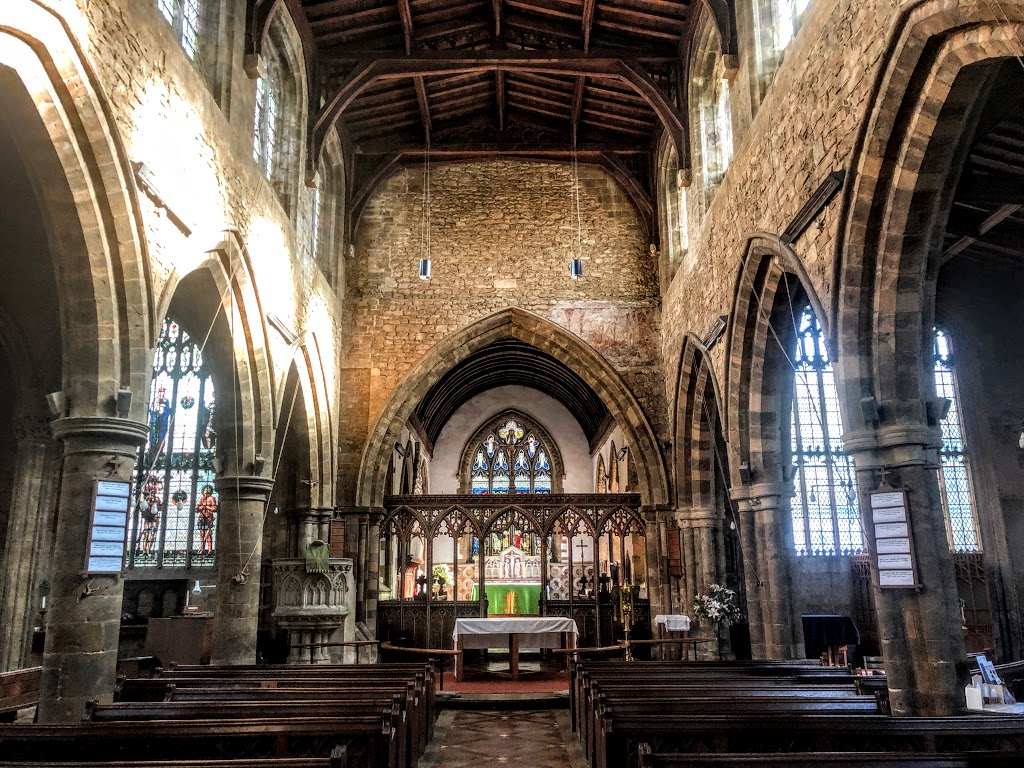
Inside Saint Mary’s Church, Bloxham, facing east (Photograph: Patrick Comerford, 2022)

The first documentary evidence of a church on this site is found in a charter in 1067 when William the Conqueror granted the church and the rectory estate to Westminster Abbey.

King Stephen built a chantry chapel there in the 12th century, when he gave two fields from his royal manor to pay a priest to say daily masses for the repose of the soul of his mother Adela, the daughter of King William I.

Henry II granted patronage of the church to Godstow Abbey near Oxford, causing Westminster Abbey to complain to the Pope. However, the Pope allowed Godstow Abbey to retain the church provided it made an annual payment to Westminster Abbey.

Inside Saint Mary’s Church, Bloxham, facing west (Photograph: Patrick Comerford, 2022)

The church has some notable remaining fragments of Norman architecture, including fragments of 12th-century masonry, two doorways and the responds of the chancel arch. The re-set 12th century doorway in north wall has tympanum with a fish scale pattern.

The arcades date from the rebuilding of the original nave in the 13th century, but the present church was mainly built in the 14th and 15th centuries.

The chancel and aisles were rebuilt in the early 14th century, as were the north and south porches. At this time the church was ornamented with much fine stone sculpture, including tracery and ornate capitals, much of which survives. It may have been crafted by a school of masons who carried out similar work on the nearby churches of Adderbury, Alkerton and Hanwell.

The hammer-bream roof inside Saint Mary’s Church, Bloxham (Photograph: Patrick Comerford, 2022)

The tower is thought to have been built between 1300 and 1340. The tower of five stages has angle buttresses, with niches, string courses to all stages and louvred lights to bell stage. At the fifth stage, the tower forms an octagon under the spire, and the broaches are marked by corner pinnacles. The octagon has a cornice of blind tracery, and the spire has canopied lucarnes.

Fragments of mediaeval wall paintings survive inside the church, including a Doom painting over the chancel arch and Saint Christopher over the north doorway. Remnants of 14th-century stained glass survive in some of the windows. The church’s elaborate rood screen dates from the 15th century, with fragmentary remains of painted figures.

Over the west door of the tower is a carving of the Last Judgment. The doorway itself is heavily carved, with depictions of animals, foliage, birds, beakheads, and traditional ballflower ornamentation. The hood-mould is carved with the 12 Apostles on thrones, with Christ with angels presiding over the whole scene.

The south chapel or Milcombe chapel was added in the 15th century (Photograph: Patrick Comerford, 2022)

The south chapel or Milcombe chapel was added in the Perpendicular Gothic style in the 15th century. The stonework is a fine example of the work of a renowned Banbury based group of stonemasons. Although the patron and the architect are unknown, it is likely that the new chapel was designed by Richard Winchcombe.

The 15th century baptismal font has a Jacobean cover.

With Henry VIII’s Dissolution of the Monasteries at the Tudor Reformation in the 1530s, the advowson or patronage of Bloxham parish church passed to Crown, which granted it to Eton College in 1547.

The Milcombe chapel contains a number of 18th-century monuments to members of the Thornycroft family and the tomb of Sir John Thornycroft (1725). Other monuments to this family include Elizabeth, Lady Thornycroft (1704), John Thornycroft (1687) and his wife Dorothy (1718).

The East Window is regarded as ‘one of the finest examples’ in Oxfordshire church of Pre-Raphaelite stained-glass (Photograph: Patrick Comerford, 2022)

Saint Mary’s Church was restored in 1864-1866 and significant renovation was carried out under the direction of the Gothic Revival architect George Edmund Street (1824-1881), who also built the Royal Courts of Justice in London and rebuilt Christ Church Cathedral, Dublin.

As well as stabilising the spire, Street’s work includes one of his best-preserved chancels in existence, including the pulpit, choir stalls, reredos, flooring and other elements designed specifically for Saint Mary’s.

At the same time, the church was provided with three important Pre-Raphaelite stained-glass windows. William Morris, Sir Edward Burne-Jones and Philip Webb created the east window, filling the four-light west window that has unusual tracery with carved figures.

The East Window is regarded as ‘one of the finest examples’ in an Oxfordshire church of some of the best Victoria stained glass in Britain. Charles Sewter says it is ‘certainly one of the most beautiful windows of the firm’s first decade of activity.’

The four main lights show (with their attributions):

Top row (from left): Angels with censors (Burne-Jones), Michael and Raphael (Morris), Saint Peter and Saint James (Burne-Jones), Ezekiel and Saint John the Baptist (Burne-Jones);

Bottom row (from left): Saint Alban and Saint Stephen (Burne-Jones), King Alfred and King Louis (Burne-Jones), Saint James Bishop of Jerusalem (Burne-Jones) and Saint Augustine (Morris), and Saint Cecilia and Saint Catherine (Burne-Jones).

Burne-Jones also created the stained glass window of Saint Christopher in the chancel and the window depicting Saint Martin of Tours. Other windows are by Charles Eamer Kempe.

The 15th century baptismal font has a Jacobean cover (Photograph: Patrick Comerford, 2022)

Further alterations were made to the church in the 20th century, when the north aisle was dedicated as the War Memorial Chapel.

The high altar became used less frequently with the addition of a nave altar.

The Milcombe Chapel was screened off by a local craft worker, who was also commissioned to create the Millennium Screen at the west end of the central aisle.

The church has a large graveyard, which has been expanded to the east several times.

While the building is historic, the parish is developing a space to serve the community throughout the week, providing a space for community events, concerts and theatrical productions.

The parish was taken to a Church of England consistory court in 2018 for having removed seven Victorian pews from the church to create a children’s play area without applying to the Diocese of Oxford for the necessary faculty. The Victorian Society testified that the pews had been badly stored, causing them to deteriorate. The court granted retrospective permission for the removal of the pews, but ordered that four of them be returned to the church.

Christopher Rogers, deputy chancellor of the Diocese of Oxford, called the decision ‘highly unfortunate, to put it mildly.’ He found that the current vicar and leadership team were not in charge when the decision was taken and added that he had the ‘greatest sympathy’ in having to deal with the ‘mess’ left by their predecessors.

He said: ‘A degree of change and the removal of some pews was necessary in order to serve the wider community and to remain a sustainable place of worship.’ Retrospective permission for the removal was granted but four of the pews must be returned to the church.

Over the west door of the tower is a carving of the Last Judgment, while the doorway and the hood-mould are richly carved (Photograph: Patrick Comerford, 2022)

A traditional local rhyme says:

Adderbury for length
Bloxham for strength
King’s Sutton for beauty


Nevertheless, Saint Mary’s Church, Bloxham, remains one of the real gems among Oxfordshire churches.

The benefice is now combined with those of Milcombe and South Newington, of which Our Lady of Bloxham is the main church. The Vicar is the Revd Dale Gingrich.

The Sunday services are: 8 am, Holy Communion, a traditional, spoken service using the 1662 Book of Common; 9:30 am, Holy Communion, with hymns, choir and a sermon; except on the fourth Sunday, when there is a café style family service without communion; 6 pm, Evening Prayer following the Book of Common Prayer, with Choral Evensong takes place on the fourth Sundays. Schools in Bloxham use the church for their annual Christmas services.

Saint Mary’s Church, Bloxham, remains one of the real gems among Oxfordshire churches (Photograph: Patrick Comerford, 2022)