Showing posts with label Bristol. Show all posts

16 March 2024

Daily prayer in Lent with
early English saints:
32, 16 March 2024,
Saint Wulfstan, Bishop of Worcester

Saint Wulfstan depicted in the Goodman window in Worcester Cathedral (Photograph: Christopher Guy © Dean and Chapter, Worcester Cathedral)

Patrick Comerford

Lent began over a month ago on Ash Wednesday (14 February 2024), and Passiontide begins tomorrow with the Fifth Sunday in Lent (Lent V), also known as Passion Sunday. But it is also Saint Patrick’s Day (17 March 2024).

Throughout Lent this year, I am taking time each morning to reflect on the lives of early, pre-Reformation English saints commemorated in the Calendar of the Church of England in Common Worship.

I plan to spend much of this afternoon watching the international rugby matches in the Sux Nations Championship, particularly the crucial fixture between Ireland and Scotland at 4:45. But, before this day begins, I am taking some quiet time this morning for reflection, prayer and reading in these ways:

1, A reflection on an early, pre-Reformation English saint;

2, today’s Gospel reading;

3, a prayer from the USPG prayer diary.

Saint Wulfstan depicted on the reredos in the Jesus Chapel, Worcester Cathedral (Photograph: Christopher Guy © Dean and Chapter, Worcester Cathedral)

Early English pre-Reformation saints: 32, Saint Wulfstan of Worcester

Saint Wulfstan (1095), Bishop of Worcester, is remembered in Common Worship with a lesser festival on 19 January.

Wulfstan was born ca 1009, at Itchington in Warwickshire. His maternal uncle, also called Wulfstan, was the second Archbishop of York. Wulfstan was educated in the monastery of Peterborough and spent the first 25 years after his ordination in the Benedictine monastery in Worcester. He was elected Bishop of Worcester against his will in 1062. But he went on to prove an able administrator and pastor.

After the Norman conquest of England, Wulfstan was the only English-born bishop to retain his diocese for any significant time after. He carefully and gently nurtured both church and state through the transition from Saxon to Norman rule. He struggled to alleviate the suffering of the poor, was a strong opponent of the slave trade, and together with Lanfranc, was mainly responsible for ending the 11th century slave trade between Bristol and Ireland.

He died at Worcester on 19 January 1095, at the age of 87, after washing the feet of a dozen poor men, a humble ritual he performed daily. He was canonised by Pope Innocent III in 1203 on the testimony of Archbishop John Comyn of Dublin. He is the patron saint of peasants, vegetarians and dieters.

Inside Worcester Cathedral … Saint Wulfstan was Bishop of Worcester in 1062-1095

John 7: 40-52 (NRSVA):

40 When they heard these words, some in the crowd said, ‘This is really the prophet.’ 41 Others said, ‘This is the Messiah.’ But some asked, ‘Surely the Messiah does not come from Galilee, does he? 42 Has not the scripture said that the Messiah is descended from David and comes from Bethlehem, the village where David lived?’ 43 So there was a division in the crowd because of him. 44 Some of them wanted to arrest him, but no one laid hands on him.

45 Then the temple police went back to the chief priests and Pharisees, who asked them, ‘Why did you not arrest him?’ 46 The police answered, ‘Never has anyone spoken like this!’ 47 Then the Pharisees replied, ‘Surely you have not been deceived too, have you? 48 Has any one of the authorities or of the Pharisees believed in him? 49 But this crowd, which does not know the law – they are accursed.’ 50 Nicodemus, who had gone to Jesus before, and who was one of them, asked, 51 ‘Our law does not judge people without first giving them a hearing to find out what they are doing, does it?’ 52 They replied, ‘Surely you are not also from Galilee, are you? Search and you will see that no prophet is to arise from Galilee.’

Saint Wulfstan depicted in a window in Holy Trinity Church, Long Itchington (Photograph: Amanda Slater /Wikipedia / CC BY-SA 2.0)

Today’s Prayers (Saturday 16 March 2024):

The theme this week in ‘Pray With the World Church,’ the Prayer Diary of the Anglican mission agency USPG (United Society Partners in the Gospel), has been ‘Lent Reflection: JustMoney Movement.’ This theme was introduced on Sunday by Matt Ceaser, Movement Builder, JustMoney Movement.

The USPG Prayer Diary today (16 March 2024) invites us to pray in these words:

Let us pray for us all to receive the freedom we have in Christ.

The Collect:

Merciful Lord,
absolve your people from their offences,
that through your bountiful goodness
we may all be delivered from the chains of those sins
which by our frailty we have committed;
grant this, heavenly Father,
for Jesus Christ’s sake, our blessed Lord and Saviour,
who is alive and reigns with you,
in the unity of the Holy Spirit,
one God, now and for ever.

The Post-Communion Prayer:

Lord God,
whose blessed Son our Saviour
gave his back to the smiters
and did not hide his face from shame:
give us grace to endure the sufferings of this present time
with sure confidence in the glory that shall be revealed;
through Jesus Christ our Lord.

Additional Collect:

Merciful Lord,
you know our struggle to serve you:
when sin spoils our lives
and overshadows our hearts,
come to our aid
and turn us back to you again;
through Jesus Christ our Lord.

Collect on the Eve of Lent V:

Most merciful God,
who by the death and resurrection of your Son Jesus Christ
delivered and saved the world:
grant that by faith in him who suffered on the cross
we may triumph in the power of his victory;
through Jesus Christ your Son our Lord,
who is alive and reigns with you,
in the unity of the Holy Spirit,
one God, now and for ever.

Yesterday: Lanfranc of Canterbury

Tomorrow: Saint Osmund, Bishop of Salisbury

The River Liffey at Celbridge, Co Kildare, near the site of Saint Wolstan’s Abbey (Photograph: Patrick Comerford)

Scripture quotations are from the New Revised Standard Version Bible: Anglicised Edition copyright © 1989, 1995, National Council of the Churches of Christ in the United States of America. Used by permission. All rights reserved worldwide. http://nrsvbibles.org

30 January 2023

Sampling the largest public
art collection in Milton Keynes
during a visit to hospital

‘Family’ by Jon Buck at the entrance to Milton Keynes University Hospital (Photograph: Patrick Comerford, 2023)

Patrick Comerford

I was in Milton Keynes University Hospital again at the weekend for a check-up over 10 months after I was admitted to hospital with a stroke – 10 months and 10 days since 18 March 2022 to be precise.

This time, I was in the hospital for a follow-up to a procedure some months ago for some lesions on the skin of the head, probably caused by too much exposure to direct sunlight. I suppose I can blame myself for not wearing a hat over almost four decades during those many, lengthy summer holidays in Greece.

Once again, I have been impressed by the quality and standard of attention and care that I receive in every hospital I have attended over the past year. A neighbour was telling me yesterday that when she arrived at A&E one day recently, she was told there was a nine-hour waiting list. But this is not the fault of the NHS or the staff – this is due to the combined failure of the government to invest properly in the NHS and to the consequences of Brexit that has prevented the NHS from recruiting the best available to fill vacancies.

Being a patient and arriving early at the hospital, I had a little time to appreciate one of the many sculptures on the hospital campus. Arts for Health Milton Keynes is a project using arts and creativity to improve health and wellbeing.

The project organises exhibitions and workshops at the hospital, has developed an art trail app, and has inspired creative courtyards. This explains why Milton Keynes University Hospital has the largest public art collection in Milton Keynes, with over 450 artworks from local, national and international artists.

The collection ranges from sculptures, paintings and drawings to site-specific installations and commissions, and includes sculptures from nationally and internationally renowned artists such as Peter Randall-Page, Jon Buck and Glynn Williams.

Jon Buck has been working as a sculptor since graduating in the 1970s and has completed many public commissions. His two sculptures in Milton Keynes University Hospital are ‘Equilibrium’, a 165cm high bronze work, and ‘Family’, a 170 cm high bronze.

‘Family’ is one of two sculptures by Jon Buck in Milton Keynes University Hospital (Photograph: Patrick Comerford, 2023)

Jon Buck has exhibited regularly from 1980 on, mostly in Europe and America, and he has contributed to some of the recent significant sculpture exhibitions in Britain. He was born in 1951 and grew up just south of Bristol at the mouth of the river Avon. His was the first generation to break with the family tradition of becoming Bristol Channel Pilots. From an early age, he was determined to go his own way and his deep fascination with the natural world led to his first employment at Bristol Zoo.

Studying animals and birds at close quarters gave him the opportunity to indulge in his passion for drawing. Gradually, though, he became disillusioned with the unethical nature of the work and after initially enrolling on a science degree he transferred to a Fine Art course at Cardiff in 1975.

After his first degree at Nottingham, Jon Buck took a Master’s degree at Manchester and then received a Fellowship at Cheltenham School of Art. At this point, he began showing with the Nicholas Treadwell gallery based in London. In the early 1980s, he became part of a disparate group of artists for whose work Treadwell coined the term ‘Superhumanism’.

He received a grant from Southern Arts in 1984 to become Artist in Residence for the Borough of Thamesdown in a regeneration area of Swindon. This placement gave him the opportunity to make his first large-scale work and to take on the challenge of making art for a public place.

Until then, all his sculptures were cast in resin and glass fibre. The Swindon experience showed him how inadequate these materials were for art in an external environment. This led to Jon Buck adopting bronze as his preferred media and into developing a close collaboration with his casting foundry, Pangolin Editions. This relationship has been central to his attempt to use traditional processes to make contemporary images.

Jon Buck has continued to work in both the public and private realms and for over 20 years he was Senior Lecturer in Fine Art at Southampton Solent University and a visiting lecturer at other art colleges and institutions.

Central to his work has always been his interest in humanity’s connection to the natural world. In art, he has always believed in some sort of visual ‘lingua franca’ and has been fascinated with art outside the western tradition, particularly African sculpture. In addition, the art of prehistory, outsider art and the drawings of children have all affected his way of thinking about making art.

He has worked on a number of occasions as artist consultant with Camlin Lonsdale Landscape Architects, in conjunction with planners and other artists, most notably on the Caerphilly Town Centre Enhancement Scheme in 1995.

He was the artist chosen to be part of a team for the enhancement and refurbishment of Deal Pier in 1998. This involved a major public consultation scheme and collaboration with planners and landscape architects from Kent County Council. The resulting work won the 1999 Rouse Kent Award for Public Art.

Jon Buck was invited to deliver a sculpture workshop at Makerere University, Kampala, in 2004 on behalf of the Ruwenzori Sculpture Foundation. He returned to Uganda in 2007 and 2009 to undertake further design research into tribal and clan totems for the Foundation and to oversee the translation of his designs into a series of bronze casts.

Milton Keynes University Hospital actively promotes the arts (Photograph: Patrick Comerford, 2023)

20 November 2022

Comerford’s name is
not forgotten among
motorcycle enthusiasts

Comerford’s of Thames Ditton in Surrey were once one of the most respected car and motorcycle dealers in Britain

Patrick Comerford

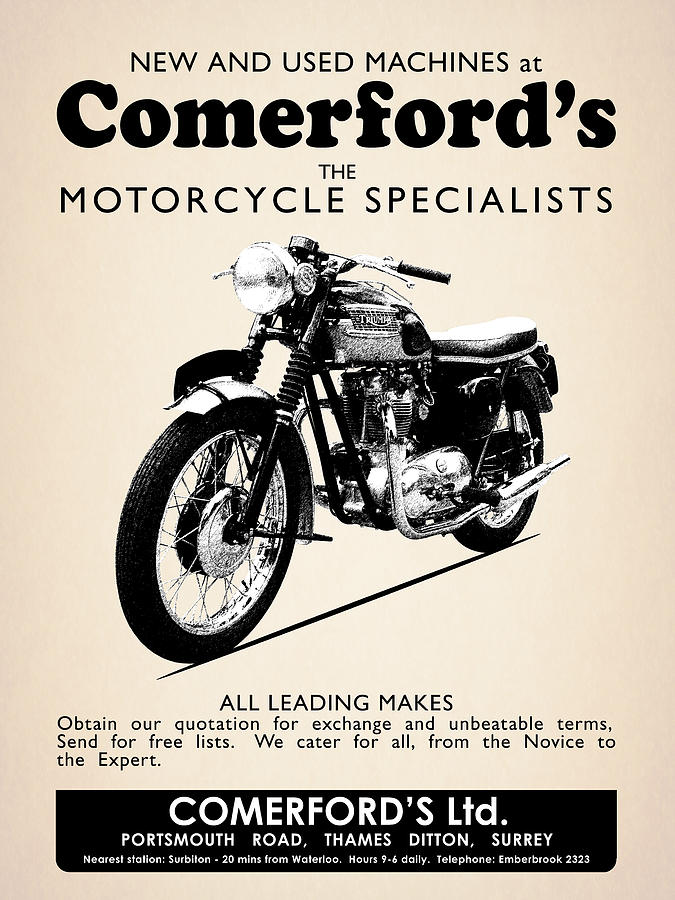
Comerford’s of Thames Ditton in Surrey had a reputation as one of the most respected car and motorcycle dealers in Britain until recently incorporated into CI Sport in Leatherhead. Comerfords Motorcycles dated back to 1930, and the motorcycles were produced and marketed by Comerford’s of Portsmouth Road, who were dealers of some standing.

During the early 1930s, a speedway machine appeared with a new frame designed by George Wallis and a new JAP speedway engine. The resulting debut was spectacular and success was so great that around 300 machines were built and sold, and known as the Comerford Wallis.

The design was revised in 1933 to lengthen the wheelbase, steepen the fork angle, allow the rear frame to flex and place the engine, countershaft and rear wheel in line when viewed from the side.

The machine went on to become the Comerford Special, then the Martin-Comerford or Martin-Rudge. This was fitted with a JAP engine and the name reflected the Rudge speedway form of the frame. After World War II, they built the Comerford Cub, a trials machine with a Triumph Cub engine.

Comerfords premises on Portsmouth Road, Thames Ditton, at its height of fame

Comerford’s was subtly different from the other big-name London area dealers because of its focus on off-road competition machines. Comerfords was known internationally, and the US team headed to the workshop to prepare the ISDT bikes supplied by Triumph.

Later on, Comerford’s supported star American trials rider Bernie Schreiber, and celebrity visitors to the Portsmouth Road premises included Steve McQueen.

Things were changing in the trials world in the late 1960s. The era of the heavyweight AMC, Ariel, BSA and Norton machines was all but forgotten, and even the heyday of Greeves, Cotton, DOT et al was drawing to a close, with Villiers engines no longer available and the Spanish armada well under way.

Comerfords reportedly considered making trialers based on the BSA Bantam Bushman, but decided it would be uneconomic, and so it eventually succumbed to the continental onslaught and took over Bultaco importation from the Rickman brothers in the early 1970s.

John Patrick Comerford (1932-2014) was instrumental in Comerfords forming a special and successful partnership with the Spanish marque Bultacoxxx

A key figure in the family business was John Patrick Comerford (1932-2014). He had a promising legal career ahead of him, but decided instead to joined his father in Thames Ditton, where he was instrumental in Comerfords forming a special and successful partnership with the Spanish marque Bultaco.

John Comerford was born in Walton-on-Thames in November 1932, but he spent much of his childhood in and around Bristol, where he attended Clifton College before completing his National Service with the Royal Artillery in Germany.

He read law at University College Oxford and enjoyed his time at Oxford immensely. He rowed and was an active participant in the University Players, appearing in a number of productions. After leaving Oxford he had a brief spell in advertising before applying to Gray’s Inn, where he was offered a place to study at the Bar, completing his qualifications as a barrister in nine months.

He never entered the legal profession, instead opting to join his father at Comerford’s Ltd in Thames Ditton. There he helped to cement the firm’s reputation as one of the most respected car and motorcycle dealers in the country. His legal training served him well, but he also held a traditional view on the importance of integrity in matters of business, believing wholeheartedly in the agreement of a deal with a handshake.

Steve McQueen visiting Comerford’s premises on Portsmouth Road, Thames Ditton

He was instrumental in Comerford’s forming a special and successful partnership with the Spanish marque Bultaco, acting for them as sole importers and UK concessionaires. The company also provided the technical and logistical support that helped Bultaco win numerous Trials and Motocross titles, including an unbroken run of seven years that saw them win every European, then the renamed World Trials Championships between 1973 and 1979.

John Comerford lived in Woking, Surrey, for most of his life, but was proud of his Irish roots and always regarded the Ireland as his spiritual home, keeping a house in Kilkenny that he loved to visit.

He always had a passion for theatre and the arts. In later years, he and his wife Pauline built up a very well regarded private collection of portrait miniatures that were exhibited in Ireland on a number of occasions. He enjoyed watching a good game of cricket, listening to choral music and visiting the RAC club in Pall Mall, where he was a lifelong member.

John Comerford died on 27 March 2014 aged 81, after a protracted illness. At the time of his death, he was living at Chestnut Farm, Ockham Lane, Ockham, Woking. He was survived by his wife Pauline and their son Patrick John Comerford.

Comerford’s was recently incorporated into CI Sport in Leatherhead, but the Comerford’s name and branding are still remembered by enthusiasts.

The Comerford’s name and branding are still remembered by enthusiasts

11 September 2022

Praying with USPG and the music of
Vaughan Williams: Sunday 11 September 2022

Early spring buttercups in front of the main front of Kings Weston House (Photograph: Kings Weston Action Group)

Patrick Comerford

Today in the Calendar of the Church is the Thirteenth Sunday after Trinity (Trinity XIII, 11 September). Before today begins, I am taking some time this morning for reading, prayer and reflection.

This year marks the 150th anniversary of the composer Ralph Vaughan Williams, whose music is celebrated throughout this year’s Proms season. In my prayer diary for these weeks I am reflecting in these ways:

1, One of the readings for the morning;

2, Reflecting on a hymn or another piece of music by Vaughan Williams, often drawing, admittedly, on previous postings on the composer;

3, a prayer from the USPG prayer diary, ‘Pray with the World Church.’

‘Or what woman having ten silver coins (drachmae) …’ (Luke 15: 8) … old drachmae coins in a tin box outside an antiques shop in Rethymnon in Crete (Photograph: Patrick Comerford)

Luke 15: 1-10 (NRSVA):

1 Now all the tax-collectors and sinners were coming near to listen to him. 2 And the Pharisees and the scribes were grumbling and saying, ‘This fellow welcomes sinners and eats with them.’

3 So he told them this parable: 4 ‘Which one of you, having a hundred sheep and losing one of them, does not leave the ninety-nine in the wilderness and go after the one that is lost until he finds it? 5 When he has found it, he lays it on his shoulders and rejoices. 6 And when he comes home, he calls together his friends and neighbours, saying to them, “Rejoice with me, for I have found my sheep that was lost.” 7 Just so, I tell you, there will be more joy in heaven over one sinner who repents than over ninety-nine righteous people who need no repentance.

8 ‘Or what woman having ten silver coins, if she loses one of them, does not light a lamp, sweep the house, and search carefully until she finds it? 9 When she has found it, she calls together her friends and neighbours, saying, “Rejoice with me, for I have found the coin that I had lost.” 10 Just so, I tell you, there is joy in the presence of the angels of God over one sinner who repents.’


Today’s reflection: ‘At the name of Jesus’ (‘Kings Weston’)

For my reflections and devotions each day these few weeks, I am reflecting on and invite you to listen to a piece of music or a hymn set to a tune by the great English composer, Ralph Vaughan Williams (1872-1958).

As I prepare for another medical procedure this week, and as I read this morning’s Gospel passage, I am also listening to Caroline Noel’s hymn, ‘At the name of Jesus,’ for which Vaughan Williams composed the tune Kings Weston. This arrangement was published in Songs of Praise (1925), and the combination of text and tune in a hymn-anthem has become a favourite for choirs in many cathedrals, churches and colleges.

Kings Weston is marked by distinctive rhythmic structures and a soaring climax in the final two lines. Like many of Vaughan Williams’s tunes, it is best sung in unison with moderate accompaniment to support this vigorous melody.

The name of the tune refers to a manor house on the River Avon River near Bristol. It was built in 1712-1719 was designed by Sir John Vanbrugh for Edward Southwell on the site of an earlier Tudor house, remodelled in 1763-1768 by Robert Mylne and again in 1845-1850 by Thomas Hopper. A significant architectural feature of the house is the grouping of all the chimneys into a massive arcade.

The house passed through several generations of the Southwell family until the estate was sold in 1833 to Philip John Miles for £210,000, and became his family seat. During the World War I, the house was converted into a hospital, although the house continued as a family home until 1935.

The last member of the Miles family to live at Kings Weston, Philip Napier Miles (1865-1935), who lived there with his wife Sybil. He was a gifted musician and composer who had a wide circle of friends from a musical background, many of whom came to stay at the house. The long library at Kings Weston was such a frequent venue for recitals that it was better known as the music room.

Napier Miles was a great-grandson of the peninsular war general from Celbridge, Co Kildare, General Sir William Francis Patrick Napier (1785-1860), a first cousin of Lord Edward FitzGerald and a direct ancestor of Archbishop Justin Welby of Canterbury. He studied music in Dresden, and on his return to England studied under Hubert Parry. He was a recognised composer, and his work included several operas. Westward Ho! (1913) received positive reviews after it was performed at the Lyceum in London. Another opera, Markheim, received a Carnegie award in 1921.

His friends included some of the great composers, conductors and musicians of the day. Vaughan Williams was among the regular visitor to Kings Weston, and on one visit in 1920 he revised and completed one of his most famous pieces, ‘The Lark Ascending,’ with the help of the English violinist Marie Hall (1884-1956), who had studied under Edward Elgar and was Napier Miles’s musical protégé.

They were staying at Kings Weston as guests of Napier Miles, and Vaughan Williams arranged ‘The Lark Ascending’ to showcase her skills, dedicating it to her. The piano-accompanied premiere was on 15 December 1920 in Shirehampton Public Hall, near Bristol, which was built by Napier Miles in 1902. While it received little attention at the time, today it is regularly voted Britain’s favourite piece of classical music.

Vaughan Williams also published a melody in 1927 that he named after Kings Weston. This was written especially for Caroline Noel’s hymn, ‘At the name of Jesus.’

When Philip Napier Miles died, Kings Weston was bought by Bristol Municipal Charities and leased for use as a school. It later became the Bristol Technical College School of Architecture and then the Bath University School of Architecture. In 1970, Bristol Corporation bought the house for £305,000 to set up a police training centre. The house was abandoned from 1995 for five years before it was leased and partially restored by local businessman John Hardy.

Since 2012, the house has been extensively renovated again and is a conference and wedding venue.

Caroline Marie Noel (1817-1877) wrote this hymn originally as a processional hymn for Ascension Day.

The text is based on the confession of faith Saint Paul quotes in Philippians 2: 6-11, which may well have been an early Christian hymn. Stanza 1 announces the triumph of the ascended Christ to whom ‘every knee should bow’ (Philippians 2: 10). In Stanza 2, Christ is the ‘mighty Word’ (see John 1: 1-4) through whom ‘creation sprang at once to sight.’ Stanzas 3 and 4 look back to Christ’s humiliation, death, resurrection, and ascension (Philippians 2: 6-9). Stanza 5 is an encouragement for submission to Christ, for us to have the ‘mind of Christ.’ Stanza 6 looks forward to Christ’s return as ‘King of glory.’ The text is not only concerned with the name of Jesus, whose saving work it confesses, but also with the glory and majesty that attends ‘the name of Jesus.’

This hymn was first published in 1870 in an enlarged edition of her collection The Name of Jesus, &c. It appears in the Irish Church Hymnal as ‘In the name of Jesus’ (No 94), but in the New English Hymnal it has the title ‘At the Name of Jesus’ (No 338).

Why does this popular hymn have two different names?

The verse in Philippians 2: 10 says in the original Greek: ἐν τῷ ὀνόματι Ἰησοῦ (en to onomati Iesou). This is translated in the Authorised or King James Version of the Bible as: ‘at the name of Jesus.’ However, when the Revised Version (RV) of the Bible was published in 1881, mainly under the guidance of the Cambridge theologians Brooke Foss Westcott (1825-1901) and the Dublin-born Fenton John Anthony Hort (1828–1892), these words were translated more accurately as: ‘in the name of Jesus.’

Fenton Hort entered Trinity College Cambridge in 1846, and in 1852 became a Fellow; Westcott too had been an undergraduate and later a Fellow of Trinity, where Vaughan Williams would later become a student.

Caroline Noel died four years before Westcott and Hort published the Revised Version in 1881. She must have used the words found in the KJV, but when the hymn was published in the 1903 edition of Church Hymns (London), her family asked for the change, and this is how it was introduced to the repertoire of the Church of Ireland in 1915. So an Irish-born Cambridge theologian may have influenced the change of name in one of the most popular Anglican hymns.

Caroline Maria Noel was born in Teston, Kent, on 10 April 1817, the daughter of Canon Gerard Thomas Noel (1782-1851), and niece of the hymn writer the Revd the Hon Baptist Wriothesley Noel (1798-1873). These two brothers, who were born into a large, aristocratic family of 18 children, were evangelical hymn writers in their own right; although Gerard was an Anglican priest all his life, Baptist was a barrister who later became a Church of England priest before becoming a Baptist minister and later President of the Baptist Union.

At the age of 17, she wrote her first hymn, ‘Draw nigh unto my soul.’ Over the next three years she wrote about a dozen hymns or poems. Then, from the age of 20 to the age of 40, she wrote nothing. At age of 35, she became an invalid, and five years later, she once again picked up her pen to write hymns that would comfort people in their sickness and illness. In her last 20 years, she wrote the rest of her hymns and poems.

The first edition of her hymns was published as The Name of Jesus and Other Verses for the Sick and Lonely (1861). This was enlarged from time to time, and its title was subsequently changed by her publishers to The Name of Jesus and Other Poems (1878).

Caroline Noel, like Charlotte Elliott, suffered greatly, and many of her verses reflect those days of pain. They are specially adapted ‘for the Sick and Lonely,’ and were written for private meditation rather than for public use, although several are suited to the public worship of the Church.

She died at 39 Great Cumberland Place, Hyde Park, on 7 December 1877, and is buried beside her father in Abbey Church, Romsey, Hampshire, where he had been the vicar for many years.

Strangely, this hymn is not what we would expect in a collection aimed at comforting the sick and the lonely. Instead, it is a hymn about Christ and how he bore his suffering on the cross so that he might rise victorious over death.

Both the New English Hymnal and the Irish Church Hymnal suggest the tune Evelyns, composed by William Henry Monk for this hymn at the publication of Hymns Ancient and Modern in 1875. The Irish Church Hymnal offers as an alternative tune ‘Camberwell,’ which was written in 1960 by the Revd John Michael Brierley (1932-2019) while he was a student at Lichfield Theological College. He named that tune in honour of the Revd Geoffrey Beaumont (1903–1970), then the Rector of Saint George’s, Camberwell. Beaumont is remembered for composing his Twentieth Century Folk Mass in an attempt to make the Mass relevant to churchgoers in the 1950s, while he was the chaplain of Trinity College, Cambridge, where Vaughan Williams was once an undergraduate.

The New English Hymnal uses the tune Evelyns for ‘At the name of Jesus’ (No 338), but offers ‘Kings Weston’ by Vaughan Williams as an alternative setting for this hymn. Instead, The New English Hymnal uses ‘Kings Weston’ as the setting for Godfrey Thring’s hymn, ‘From the eastern mountains’ (No 50).

This tune is marked by distinctive rhythmic structures and a soaring climax in the final two lines. Like many of Vaughan Williams’s tunes, it is best sung in unison with moderate accompaniment to support this vigorous melody. The combination of Noel’s words and Vaughan William’s tune make this a festive hymn or anthem, and it is a favourite among many choirs.

At the name of Jesus
Every knee shall bow,
Every tongue confess him
King of glory now;
’Tis the Father’s pleasure’ We should call him Lord,
Who from the beginning
Was the mighty Word.

At his voice creation
Sprang at once to sight,
All the angel faces,
All the hosts of light,
Thrones and dominations,
Stars upon their way,
All the heavenly orders,
In their great array.

Humbled for a season,
To receive a name
From the lips of sinners
Unto whom he came,
Faithfully he bore it
Spotless to the last,
Brought it back victorious
When from death he passed;

Bore it up triumphant
With its human light,
Through all ranks of creatures,
To the central height,
To the throne of Godhead,
To the Father’s breast;
Filled it with the glory
Of that perfect rest.

In your hearts enthrone him;
There let him subdue
All that is not holy,
All that is not true:
He is God the Saviour,
He is Christ the Lord,
Ever to be worshipped,
Trusted, and adored.

Brothers, this Lord Jesus
Shall return again,
With the Father’s glory,
With the angel train;
For all wreaths of empire
Meet upon his brow,
And our hearts confess him
King of glory now.

Fenton Hort, a portrait by George Percy Jacomb-Hood in Trinity College, Cambridge … his Biblical scholarship changed the title and wording of the hymn ‘At the name of Jesus’

Today’s Prayer (Sunday 11 September 2022, Trinity XIII):

The Collect:

Almighty God,
who called your Church to bear witness
that you were in Christ reconciling the world to yourself:
help us to proclaim the good news of your love,
that all who hear it may be drawn to you;
through him who was lifted up on the cross,
and reigns with you in the unity of the Holy Spirit,
one God, now and for ever.

The Post Communion Prayer:

God our creator,
you feed your children with the true manna,
the living bread from heaven:
let this holy food sustain us through our earthly pilgrimage
until we come to that place
where hunger and thirst are no more;
through Jesus Christ our Lord.

The theme in the USPG prayer diary this week is ‘Holy Cross Day,’ and is introduced this morning with a prayer written by Naw Kyi Win, a final year undergraduate student at Holy Cross Theological College in the Church of Province of Myanmar:

‘Our heavenly Father,

‘We thank You for giving us safety in our lives with grace and mercy. We give thanks that we have been able to study about mission and theology at Holy Cross Theological College. We give thanks for Your children, who are working in evangelism and mission. These servant leaders, trained at the theological college, are spreading the Good News in local villages. As a result, many villagers are experiencing God’s love and churches are being established in these areas.

‘We pray for the teachers who are teaching at mission schools across the Church of the Province of Myanmar. Lord, give the teachers wisdom and knowledge to be good servants to You. Help them to lead their communities, guiding students and their families to live healthy and fulfilled lives. Bless the children at these schools to learn and study well. May they be supported spiritually and materially in all they do. Let us pray that where the schools are established, Your kingdom is also established there. In Jesus’ name, we pray. Amen.’

The USPG Prayer Diary invites us to pray today in these words:

Lord of All,
Forgive us when we judge others.
May we be empathetic to all whom we meet,
and welcome the stranger.

Yesterday’s reflection

Continued tomorrow

‘Which one of you, having a hundred sheep and losing one of them, does not leave the ninety-nine in the wilderness and go after the one that is lost’ (Luke 15: 4) … ‘Paternoster’ or ‘Shepherd and Sheep’, a bronze sculpture by Dame Elisabeth Frink in Paternoster Square, near Saint Paul’s Cathedral, London (Photograph: Patrick Comerford)

Scripture quotations are from the New Revised Standard Version Bible: Anglicised Edition copyright © 1989, 1995, National Council of the Churches of Christ in the United States of America. Used by permission. All rights reserved worldwide. http://nrsvbibles.org

15 December 2020

Keynsham Abbey, its
Co Limerick churches,
and legends about the
Knights Templar in Askeaton

The octagonal tower at Saint Mary’s Church, Askeaton … but is there any evidence for the presence of the Knights Templar? (Photograph: Patrick Comerford 2020)

Patrick Comerford

It is a common belief in Askeaton that Saint Mary’s Church, Askeaton, Co Limerick, was a foundation of the Knights Templar, and that the neighbouring octagonal tower was built by the Knights Templar.

However, it seems, there may be no primary, documentary evidence or sources to show that the Knights Templar ever had a foundation in Askeaton.

On the other hand, I have been challenged by my findings in recent weeks that the Augustinian Abbey of Keynsham in Somerset held Askeaton in the early mediaeval period, along with a number of other parish churches in this part of west Co Limerick, including Askeaton, Ballingarry, Bruree, Croagh, Lismakeera, and, for a time, Rathkeale.

Keynsham Abbey also had close links with successive proprietors of Askeaton Castle until the Reformation. Could it be, I was forced to ask, that Saint Mary’s was a dependent house of Keynsham Abbey, and was never associated with the Knights Templar?

The remaining ruins of Keynsham Abbey, between Bath and Bristol (Photograph: Rick Crowley/Wikipedia)

Keynsham Abbey in Somerset was founded ca 1166 by William, Earl of Gloucester. It was founded as a house of Augustinian canons regular, and continued until the dissolution of the monastic houses in 1539. Keynsham Abbey stood on the south side of the River Avon, where the River Avon meets the River Chew in the Keynsham Hams, an alluvial flood plain with open fields, pastures and meadows, divided by hedgerows and ditches.

This was the site of a fourth century Roman settlement, possibly called Trajectus, that was abandoned when the Roman legions left Britain. The Abbey was built near the old Roman Road that became the Bath Road connecting London with Bath and Bristol.

There was a religious settlement in Keynsham from the ninth or tenth centuries. Some sources say a later mediaeval abbey was established ca 1170, when Bartholomew de Sancto Mauro (Seymour) witnessed the founding charter. Other sources say the main abbey was founded by William de Clare, Earl of Gloucester, in 1166, the year his son Robert de Clare died, traditionally at his son’s dying request, or in the year 1180.

The priests at Keynsham Abbey were Augustinian canons regular and they adopted the rule of the Order of Saint Victor, so that the head of the religious house was always called an abbot, and the house was known as the House of the Canons of Saint Austin and Saint Victor. Other abbeys following this rule included Worspring (also called Woodspring), near Weston-super-Mare, and Stavordale near Wincanton, both in Somerset; Saint Augustine’s Abbey, Bristol; and Wormeley and Wigmore, both in Herefordshire.

At its foundation, the abbey was endowed with the Manor and the Hundred of Keynsham, totalling 9,920 ha (24,520 acres), and the parishes of Brislington, Burnett, Chelwood, Compton Dando, Farmborough, Keynsham, Marksbury, Nempnett Thrubwell, Pensford, Priston, Publow, Queen Charlton, Saltford, Stanton Drew, Stanton Prior, and Whitchurch. It also included many parish properties such as the church of Saint Mary and Saint Peter and Saint Paul and the chapels of Brislington, Charlton, Felton (or Whitchurch), Publow and Pensford.

The abbey also acquired considerable property in Ireland, including the churches at Askeaton, Rathkeale, Lismakeera, Croagh and Bruree in Co Limerick.

Askeaton Castle … part of the large estates granted to Hamo de Valognes in 1199 (Photograph: Patrick Comerford, 2020)

King John granted large parts of mid-west Limerick to Hamo de Valognes, justiciar of Ireland, in 1199, including Askeaton, Rathkeale and Bruree, an area where the manor of Askeaton held sway. Hamo de Valognes had died by 1207, and his son and heir, Hamo de Valognes, was a minor. King John then granted much of the de Valognes estate to Hugh de Neville in 1207, and other lands in the area to Sir Roger Waspail, who held extensive estates in Dorset, Wiltshire and Gloucestershire, and also owned estates in present-day Co Laois, Co Dublin and Co Kildare.

Waspail, who became Seneschal of Ulster, granted the church of Rathkeale to Keynsham Abbey ca 1213-1226. He died in 1226 and was succeeded by his son, Henry Waspail, who reconfirmed his father’s grant of Rathkeale to Keynsham Abbey ca 1226-1228.

Henry died in 1233 and was succeeded by his brother Roger Waspail, who received a grant of Rathkeale in 1251 and became Deputy Justiciar of Ireland in 1262. He exchanged the manor of Rathkeale with John Maltravers in 1280 for a life interest in the manor of Wolcomb Maltravers, Dorset.

Following Roger Waspail’s grant of Rathkeale, Keynsham managed its new benefice, collecting income and appointing clerics. But the politically unstable situation in Ireland made it difficult to collect revenue.

Some time after 1237, under the direction of John de Bureford, a canon of the abbey and their proctor in Ireland, Keynsham granted the church of Rathkeale and nine dependent chapels and property rights in the cantred of Askeaton to the Bishop of Limerick. These nine chapels were Rathofergus [Rathfergus], Mayntaueny [Moytawnach], Mayryne [Kiltanna], Browry [Bruree], Culbalysward [Howardstown], Karracnefy [Cathernasse and Cahernarry], Mayncro [Croagh], Maymolcally [Kilnecally] and Orosse [unknown].

At the same time, Keynsham granted the church of Askeaton to the Priory of Saint Catherine outside the walls of Waterford. This priory was founded before 1207, and, like Keynsham, it followed the Augustinian rule of Saint Victor.

The ruins of the Augustinian Priory of Saint Mary in Rathkeale … the church of Rathkeale and nine dependent chapels were part of the possessions of Keynsham Abbey (Photograph: Patrick Comerford, 2020)

The grants to the Bishop of Limerick benefitted both sides. Keynsham realised capital without the expense of collecting while the bishop acquired another source of income. At the time, Bishop Hubert de Burgh was involved in costly disputes with the pope in Rome and the government in Dublin, and was forced to borrow money from Italian bankers. He had difficulty repaying these loans and interest was accumulating. In 1237, the year he received the Keynsham parishes, Bishop Hubert repaid 160 marks on a loan that included 54 marks of interest.

The early 13th century grant by Roger Waspail of Rathkeale to Keynsham Abbey failed to mention any other parishes. But the grant to Bishop Hubert ca 1237 shows Rathkeale had nine dependent chapels in area that extended from Askeaton to Bruree. The church of Askeaton was not named as a benefice but must have formed part of Waspail’s grant to the abbey. The church in Askeaton was given to the priory of Saint Catherine in Waterford ca 1237. Sometime afterwards, Askeaton was granted to Bishop Hubert of Limerick by the priory. Before 1250, Bishop Hubert granted Askeaton to Keynsham.

An early Vicar of Askeaton, Thomas de Cardiff, is named in 1237, and it is said that Saint Mary’s Church in Askeaton was built in 1291. It is also said that the Knights Templars had a commandery in Askeaton from 1298 until they were disbanded in 1307. But all the available documentary evidence shows Askeaton remained in the hands of Keynsham Abbey and its dependency in Waterford.

Keynsham Abbey also held the parish of Ballingarry from the mid-1200s, and by the 15th century, Ballingarry was the chief parish held by Keynsham, with Askeaton a junior parish. Ballingarry may have been transferred by Keynsham to another religious house in the 13th century, like its other Limerick possessions, but it is also possible that the abbey kept control of Ballingarry without interruption.

From 1294 on, the Abbots of Keynsham appointed attorneys to manage their Irish property, which suggests that Ballingarry and Askeaton were under its direct ownership. These attorneys collected the tithes and incomes from the Limerick parishes and sent the surplus back to Keynsham.

The former parish church in Ballingarry … Ballingarry and Askeaton were owned directly by the Abbots of Keynsham (Photograph: Patrick Comerford)

The barony, castle and manor of Askeaton were held by the late Thomas de Clare, son of Richard de Clare, in 1320.

At the same time, the Abbot of Keynsham held the Rectory of Askeaton in 1320, and the income from the rectory was for the abbot’s own use. The abbey also had the right to nominate the Vicars of Askeaton. The rectory of Askeaton was valued at 16 marks while the vicarage was valued at 8 marks.

The responsibilities of the abbey’s Irish attorneys increased in the early 1320s. But the abbey suffered considerable financial losses in England, its revenues could not meet its needs, and it lost the income from many parishes through fraud, default, theft, the death of cattle, poor crops, flood damage and wars.

Those wars were caused mainly by Maurice FitzThomas FitzGerald, 1st Earl of Desmond, as he tried to acquire the Irish estates of the de Clare absentee heirs. When Thomas de Clare, son of Richard de Clare, died in 1321 without any direct heirs, his possessions were divided between his aunts, Margaret, wife of Sir Bartholomew de Badlesmere, and Maud, wife of Sir Robert de Wells, while the de Clare estates that included the Limerick parishes owned by Keynsham Abbey passed as dower land to Joan, widow of Richard de Clare.

Maurice FitzGerald regarded all the former de Clare lands in Co Kerry, Co Limerick and Co Cork as his by descent, along with those in Thomond. However, the losses suffered by Keynsham in these wars is unknown.

The church ruins at Affane, near Cappoquin … one of the parishes in west Waterford acquired by Kenynsham Abbey in 1413 (Photograph: Patrick Comerford, 2020)

When the Bishop of Bath and Wells visited Keynsham Abbey in 1350, he reported the abbey neglected to keep its gates safely closed, leaving the church ornaments and valuables open to being stolen. Lay people were allowed into the refectory contrary to the rules, nightly offices were irregularly kept, poor financial accounts were kept, estates were let out at low rents, and the title deeds and charters of the abbey were not stored in a secure location. Lay men and women entered the abbey at unlawful hours, the abbey’s staff were involved in stealing, the poor were not being served, and the monks used sporting dogs.

Keynsham Abbey acquired the Rectory of Dungarvan, Co Waterford, from Thomas FitzGerald, 5th Earl of Desmond, in 1413, and with it the right of presentation to 13 parishes across mid-Co Waterford: Affane, Aglish, Clashmore, Clonea, Colligan, Fews, Kilgobinet, Kilronan, Kinsalebeg, Lisgenan, Ringagonagh and Whitechurch.

It has been suggested that Keynsham gave Desmond the advowsons for its Co Limerick parishes in exchange for Dungarvan, but there is no evidence to support this. A document in 1427 shows Keynsham as holding two Limerick parishes, Askeaton and Ballingarry.

The Limerick parishes of Askeaton and Ballingarry were situated in the heart of the earldom. A stable earldom was to the obvious benefit of Keynsham. It would appear that the abbey opened doors for the Earl of Desmond in London and among the regional magnates.

Sometime before 1427, a new vicar was appointed to Askeaton. Edmund McAdam, had tendered his resignation to Cornelius O’Dea, Bishop of Limerick. The Rector of Ballingarry, John Kyndton, was asked by William, Abbot of Keynsham, to present a new vicar. Kyndton selected James Oleayn, a priest of the Diocese of Killaloe, and Bishop Cornelius instituted Cleayn, despite Gillabertus Ykatyl illegally holding Askeaton for more than a year.

But James Oleayn had doubts about whether the presentation and institution were valid, and petitioned the Pope for papal letters to make good his position. He held Askeaton in June 1427 when he was charged to pay 6 marks in first fruits.

Edmund McAdam later revoked his resignation and recovered possession of Askeaton. But McAdam resigned as Vicar of Askeaton again by 1458, and the public notary of Limerick and other judges gave the vicarage to Thomas Macega. John Maclanchie presented a claim of false possession and took his case to Rome, although the vicarage had not lawfully devolved to the Pope.

Pope Eugene IV sent the case to a papal auditor who favoured Thomas Macega over John Maclanchie. Subsequently, Philip Offlait, a priest of Limerick, brought false charges against Macega and demanded the removal of Macega from Askeaton. Macega appealed to Rome where Pope Nicholas V sent the case to a papal auditor who ruled against Offlait.

The Bishop of Limerick then admitted Macega to Askeaton, but Offlait objected, and faced with a choice between two priests in his diocese, the bishop expelled both candidates and appointed Philip Ocathill, a priest of Limerick, to Askeaton.

Macega appealed to Rome once again, was granted a dispensation from his illegitimacy as the son of unmarried parents, and received a new mandate for Askeaton. The vicarage was valued at 8 marks and the previous Vicars of Askeaton were named as Gilbert Itaschill and William Ymolcorkra, along with Edmund McAdam. It is not known if Macega succeeded to the vicarage or if more appeals were made, and Keynsham Abbey is not mentioned in these cases.

The Rector of Ballingarry was proctor of Keynsham Abbey in 1427 (Photograph: Patrick Comerford)

The rights of Keynsham Abbey’s in Ballingarry were also challenged. Sometime ca 1399-1426, John Fitzgerald of Pobbnesheagh had founded a Franciscan house at Kilshane. In 1488, John Lesse, the minister of the Ballingarry community was in a dispute over tithes.

The vicarage of Ballingarry became vacant ca 1409 with the death of William, son of Thomas Ymalcorkra. The vicarage was then valued at 12 marks. Thomas Saleys alias Cristour, was presented to Ballingarry by Keynsham Abbey as patron of the parish. But Thomas had doubts about the abbey’s authority and petitioned the Pope for a mandate that was issued to the Chancellor of Limerick.

John Kyndton, Rector of Ballingarry, seems to have acted as the abbey’s proctor a in 1427, collecting tithes and income from farming the landed estates.

Gilbert O’Liathain or O’Loan, the Vicar of Ballingarry in 1445, exchanged the parish for Croom with Malachy O’Condoub (O’Conify), with the sanction of the Bishop of Limerick. But Malachy had doubts about the exchange and in July 1445 he received a papal mandate to confirm the exchange. Ballingarry was valued at 16 marks. At the same time, Malachy was made Prebendary of Kilrossanty in Lismore.

Gillacius (or Walter) O’Keyt, a canon of Lismore, became Dean of Lismore and Prebendary of Kilrossanty in 1450, as well as Prebendary of Saint Munchin’s (Limerick) and Vicar of Ballingarry. O’Keyt got a papal dispensation on account of charges of simony, perjury and other irregularities to legitimise these appointments. Keynsham Abbey was acknowledged as holding the right of presentation to Ballingarry and a new claimant emerged in 1452, when William Torriger was presented to Ballingarry by Keynsham Abbey.

Torringer was instituted by John Mothell, Bishop of Limerick, in succession to Malachy O’Conify, but he was opposed by Gillacius O’Keyt, the former vicar. Torriger and O’Keyt both petitioned Pope Nicholas V. The papal auditor judged in favour of Torriger, and issued a perpetual silence on O’Keyt.

O’Keyt surrendered the vicarage to Torriger, but a sentence of excommunication threatened his role as Dean of Lismore. O’Keyt was further reprimanded when he tried to celebrate masses. He petitioned the pope in 1454, and the Bishop of Lismore received a mandate to lift the sentence of excommunication and to restore Okeyt to full cleric status.

O’Keyt filed another petition relating to Ballingarry in 1457, receiving absolution from the pope for simony and a mandate to remain Dean of Lismore.

Matthew (Mahon or Malachi) O’Griffa, a canon of Limerick, received a Papal dispensation because his illegitimacy as the son of a priest. He was then appointed Vicar of Dysert in Killaloe Diocese, Prebendary of Saint Munchin’s (Limerick), Archdeacon of Limerick, and Vicar of Ballingarry in 1458. He was also Dean of Cashel (1455), and later became Bishop of Killaloe (1463-1483).

The financial details of some of Keynsham’s Limerick parishes are disclosed in a papal mandate in 1460. According to Cornelius Ydeayd, a priest of the Diocese of Limerick, the abbey held a number of rectorial tithes in the parishes of Ballingarry and Askeaton. These tithes were not collected by the abbey’s representative, but were leased to lay people who paid a yearly rent. Ydeayd feared they could easily pass to these lay people to the loss of Keynsham, and Pope Pius II asked the Bishop of Limerick to investigate.

Nicholas Wale, a priest of Limerick diocese, was appointed the Vicar of Ballingarry in 1488, and Philip O’Kail was to be removed. William O’Muleoni, a priest of Limerick, became Vicar of Ballingarry and Kilscannell in 1492.

Saint Carthage’s Cathedral, Lismore … Gillacius O’Keyt was Dean of Lismore and Vicar of Ballingarry (Photograph: Patrick Comerford, 2020)

As for Keynsham Abbey, Edward I stayed at the Abbey in 1276 on his way from Bath to Bristol. A small town eventually grew up around Keynsham Abbey, and in 1307 Edward II granted the abbey a weekly market on Tuesdays and a yearly fair on the Feast of the Assumption (15 August).

As the centuries progressed, the abbey became embroiled in a number of disputes over monastic life and discipline. When the bishop visited Keynsham in 1350, he found the canons were failing to properly guard and secure the outer gate of the abbey, so that the ornaments of the church and treasures of the house could be easily stolen. The canons were also admonished to keep better household accounts, attend prayers more regularly, and give up luxuries such as hunting dogs and dining abroad.

When the bishop visited again in 1353, he found there was great neglect throughout the abbey. The doors were unguarded, household accounts were not properly kept, prayers were not attended to regularly, and up to two-thirds of the canons were regularly missing community meals and engaging in gaming.

Similar issues arose again in 1450, when the bishop made more complaints about the management of the abbey. Bishop Beckington of Bath and Wells found several poor standards at Keynsham in 1451, but Abbot Walter Bekynsfield was aged and unable to introduce changes. Another commission in 1455 found no improvements and forced the abbot to resign. Thomas Tyler was appointed the new abbot, but resistance was still strong.

When Canon John Ledbury, a leader of this resistance, was transferred to Worspring Abbey in 1458, matters began to settle. But resistance resurfaced, and further commissions were issued in 1458 and 1459.

The fortunes of Keynsham Abbey received a boost in 1495 when Jasper Tudor (1431-1495), Duke of Bedford and Earl of Pembroke, asked to be buried in a tomb within Keynsham Abbey and gave 100 marks to make the tomb. He was a maternal half-brother of King Henry VI and uncle of Henry VII. He left income for four priests to sing perpetually in the abbey for his soul and the souls of his father, mother brother and his predecessors. Jasper Tudor also gave his best gown of gold to the abbey for vestments.

But Keynsham Abbey and its English and Irish interests was facing increasing and eventually irresistible demands for reform. The Augustinian general chapter in 1518 heard that without reform the order faced imminent ruin.

Cardinal Wolsey obtained papal approval to reform all monastic houses in England, including the Augustinians following the rule of Saint Victor at Keynsham. His new rules were presented at a conference of leading Augustinians, Benedictines and Cistercians in 1519. The Benedictines rejected the rules almost immediately, followed by the Augustinians in 1520.

Keynsham Abbey was in urgent need of reform and visitation in 1526 on behalf of the bishop of Bath and Wells found a deplorable situation. Things were so bad that the abbot, John Stourton, admitted the abbey was in ruins. The choir of the church was in a filthy state, frequented by dogs as if it were a kennel, water and fuel were scarce and there was a lack of books for divine service. None of the brothers studied at Oxford and many of the novices were illiterate.

The last Abbot of Keynsham, John Staunton, the prior, William Herne, the subprior John Arnold, and 12 other canons, subscribed to the Act of Supremacy at the Tudor Reformation in 1534.

The Irish properties of Keynsham Abbey were seized under the Act of Absentees (1536), and this prevented the Earls of Desmond from having any further claims to Dungarvan.

John Tregonwell and William Petre, Henry VIII’s and Secretary of State were sent to the abbey as ‘visitors’ in 1539. The abbot and ten monks surrendered the abbey, and the abbot and canons received pensions or annuities.

When Keynsham’s possessions in Co Waterford were surveyed in 1541, they included the rectory of Dungarvan and its vicarages. The income from Dungarvan and its vicarages was granted for 21 years to James Butler, Earl of Ormond, and James Butler, Viscount Thurles. The Vicar of Dungarvan, Maurice Connell, was left in office for life, as were any vicars of the dependent parishes.

For many years after the dissolution the name of Keynesham Abbey and its Irish possessions continued to appear in the state papers.

The surrender of Keynsham Abbey began a 400-year period of the buildings and site being torn apart and plundered for building materials. Within two years of the surrender of the abbey, the conventual church was torn down and sold off. Richard Walker was paid £12 for melting the lead on the church, the cloister, and the steeple. Frances Edwards bought the seven bells of the church and other buildings attached to it.

The site was sold to Thomas Bridges, who tore down the remaining buildings and built a family house on the site and who handed over and left-over stone from the abbey church for the repair of the bridge and causeway over the River Avon.

The family home built by Bridges was demolished in 1776. Victorian housebuilders and excavators began actively taking stone from the site in 1865, and this continued until the beginning of the 20th century, when only isolated stretches of unsuitable stone or stone buried under discarded material were left. In some places, so much material was disturbed and excavated for reuse that quarrying had reached down to bedrock.

There were proposals in 1964 for the Keynsham bypass of the A4 to pass directly through the site of the abbey, destroying what was left on the site. Since then, the remains have been designated a Grade I listed building and scheduled ancient monument. The abbey ruins can be seen in the Memorial Park at Keynsham, near the A4 and Keynsham railway station.

Saint Mary’s Church and the tower at Askeaton … the Abbots of Keynsham retained the Rectory of Askeaton until the Reformation (Photograph: Patrick Comerford, 2020)

The Abbots of Keynsham (and Rectors of Askeaton):

William, fl 1175, 1205
George de Eston
Richard, fl1225, 1230
John, fl 1233
Peter, fl 1253, 1259
Gilbert, 1274
Robert, fl1272, 1277
Adam, 1308
Nicholas de Taunton, fl 1308, 1343
John Bradford, elected 1348
William Peschon, 1377
Thomas, occurs 1396, 1427
Walter Bekynsfield, fl 1438, 1455
Thomas or John Tyler, elected 1456
John Gybruyn, 1486
John Graunt, elected 1496
Philip Keynsham, 1499, died 1505
William Rolfe, elected 1506, fl 1514
John Staunton or Sturton, 1528-1539

The tower at Saint Mary’s Church, Askeaton, Co Limerick (Photograph: Patrick Comerford, 2020)

Sources include:

JB Leslie (ed), Clergy of Limerick, Clergy of Ardfert and Aghadoe, Biographical Succession Lists, (2015 edition, ed DWT Crooks, Ulster Historical Foundation for the Diocesan Council of Limerick and Killaloe
‘Houses of Augustinian canons: The abbey of Keynsham,’ in A History of the County of Somerset: Volume 2, ed William Page (London, 1911), pp 129-132. British History Online, http://www.british-history.ac.uk/vch/som/vol2/pp129-132 (last accessed, 14 December 2020)
(Revd) Iain Knox (ed), Clergy of Waterford, Lismore and Ferns (originally compiled by Henry Cottom, JB Leslie and WH Rennison (Ulster Historical Foundation, for the Diocesan Councils of Cashel and Ossory, and Ferns, 2008). Niall C.E.J. O’Brien, ‘Keynesham Abbey in Ireland’ (Medieval News, 30 September 2014), http://celtic2realms-medievalnews.blogspot.com/2014/09/ (last accessed, 14 December 2020)
Patrick J Cronin, Eas Céad Tine, ‘The Waterfall of the Hundred Fires’ (Askeaton: Askeaton Civic Trust, 1999)

05 July 2019

The poet who invited
Ireland’s best harpists
to play in her home

One of the two 18th century stucco alcoves from Corballis House in the multi-faith room at Terminal 2 in Dublin Airport (Photograph: Patrick Comerford, 2019)

Patrick Comerford

The two stucco niches from Corballis House that survive in the multifaith prayer room in Terminal 2 at Dublin Airport are reminders not only of the loss of a once graceful house, but also of a musical and poetic tradition that blossomed in Ireland at turn of the 18th and 19th centuries.

I was writing about the multifaith prayer room this morning [5 July 2019] and the beauty of these surviving stucco niches, without realising the cultural role played by the Wilkinson family of Corballis House in Georgian and Regency Ireland.

Sir Thomas Wilkinson, who was Lord Mayor of Dublin in 1719-1720, is said to have invited the blind harpist Turlough O’Carolan (1670-1738) to play at Corballis House. A planxty by O’Carolan, Planxty Wilkinson, is one of the 214 Carolan compositions identified by Donal O’Sullivan, and may have been dedicated this to Sir Thomas Wilkinson.

O’Carolan is said to have given his last public performance at Corballis House. He died on 25 March 1738, and was buried in the MacDermott Roe family crypt in Kilronan, near Ballyfarnon, Co Roscommon. A memorial in Saint Patrick’s Cathedral, Dublin, the gift of Sydney, Lady Morgan, describes him as ‘Carolan, the last of the Irish Bards.’

Sir Thomas Wilkinson was the grandfather of Sir Henry Wilkinson (1749-1831), Recorder of Kilkenny, who continued to live at Corballis House. His daughter, the poet Anna Liddiard (1773-1819), who died 200 years ago, was the most important cultural figure to live at Corballis House.

She was a romantic poet whose work draws on the themes of patriotism, Irish culture and history, landscape, and human relations. Liddiard’s verse is patriotic and romantic, in particular her poem Addressed to Albion and Conrade.

Jane Susannah Anna Wilkinson was born in Co Meath on 29 April 1773. She married the Revd William Liddiard (1773-1841), a vicar’s son from Wiltshire, on 12 February 1798. He was a former army officer hoping to become an Anglican priest and was an aspiring poet and artist.

Anna continued the cultural and musical traditions introduced to Corballis House by hear great-grandfather. The interior decorative plasterwork of Corballis House was commissioned by the Wilkinson family. The musical theme of these decorative plaster niches inside one of the upper-storey bay rooms indicated the room may once have been the venue for fashionable recitals and parties hosted by Anna Liddiard around the turn of the 18th and 19th centuries.

The musicians she invited to play at the house included the Armagh harper Patrick Quin from Portadown, who was also blind. Quin performed in the Rotunda in Dublin in 1809, at a concert in commemoration of Carolan, and probably stayed at Corballis House.

Anna and William were advocates of religious tolerance. She dedicated her book of Poems, published in Dublin in 1809, to her husband.

The couple moved to Bath in 1811, living there for two years. In Bath, she published The Sgelaighe or A tale of old (1811), supposedly drawing on an old Irish manuscript.

She describes her return from Bath to Ireland in Kenilworth and Farley Castle (1813). This book is addressed to the ‘Ladies of Llangollen,’ whom she visited.

A tale in verse, Evening after the battle, was published in 1819 along with her husband’s Mont St Jean both based around the battle of Waterloo. An anonymous work, Mount Leinster (1819), also published that year, blamed the 1798 Rising in Co Wexford on the Penal Laws.

Anna died later that year at Corballis on 30 October 1819.

Her husband, the Revd William Liddiard, was a son of the Revd William Stratton Liddiard of Wiltshire. He matriculated at University College Oxford, but he left in 1794 without receiving a degree to enlist in the army. After reaching the rank of captain, he left the army in 1796 with the intention of seeking ordination.

William was ordained after graduating BA at Trinity College Dublin in 1803. On the recommendation of the Duke of Bedford, he was appointed chaplain to Charles Lennox (1764-1819), 4th Duke of Richmond, Lord Lieutenant of Ireland and a cousin of the 1798 leader Lord Edward FitzGerald.

William Liddiard was the vicar of Culmullen, Co Meath (1807-1810), and then of the united parish of Knockmark (1810-1831). After resigning the living to his son, Liddiard spent his later years in Bath, and died at Clifton, near Bristol, on 11 October 1841.

Anna and William Liddiard had one son, the Revd Henry Liddiard, born in 1800. He succeeded his father as the Rector of Knockmark and also inherited Corballis House.

The second of two 18th century stucco alcoves from Corballis House in the multi-faith room at Terminal 2 in Dublin Airport (Photograph: Patrick Comerford, 2019)

02 November 2018

A tale of conspiracy that
links West Limerick with
a plot to kill Charles II

The gatehouse is all that survives of the 15th century Rye House, on the edges of Hoddesdon (Photograph: Patrick Comerford)

Patrick Comerford

As I was exploring the history of Croagh, Co Limerick, and the ruins of the former Augustinian abbey and Church of Ireland parish church, I came across a story that links this part of Co Limerick with the Rye House plot, a plot in 1683 to assassinate King Charles II and his brother, the Duke of York, later King James II.

Colonel Thomas Walcott (1625-1683) was born in Warwickshire, the fourth son of Charles Walcott and Elizabeth Games. He was a Puritan and during the English Civil War he became a colonel in Cromwell’s Parliamentary Army.

During the Cromwellian era, Walcott came to Ireland, and married Jane Blayney, daughter of Thomas Blayney, niece of Edward Blayney, 1st Baron Blayney, and grand-niece of Adam Loftus of Rathfarnham Castle, Archbishop of Dublin and first Provost of Trinity College Dublin.

Walcott bought Ballyvarra Castle in 1655, and by 1667 he had settled at Croagh, Co Limerick, where he had an estate that provided an income of £800 a year. He also had lands at Amigan in Co Limerick.

His neighbour, Sir Hardress Waller (1604-1666), who was the Governor of Askeaton in 1641, was one of the regicides who signed the warrant for the execution of King Charles I in 1649. Waller was later condemned to death, and died in prison in Jersey.

He was offered the post of Governor of the Province of Carolina in North America by his political ally, Anthony Ashley-Cooper, 1st Earl of Shaftesbury, but declined.

Walcott was arrested in 1672, accused of planning a Dutch invasion of Ireland, and he spent eight months in Tower of London before he was exonerated.

Thomas Walcott visited Shaftesbury in his self-imposed exile in the Netherlands in 1682. A year later, he was arrested in England on 8 or 10 July 1683 for his part in the Rye House Plot, a conspiracy to assassinate Charles II and his brother, the Duke of York, the future James II.

After the Restoration of the monarchy in 1660, some former Cromwellians and MPs feared Charles II’s links with Catholic France were too close. Anti-Catholic fears were stoked by the conversion of his brother James in 1673. Rumours of plots and conspiracies abounded.

Richard Rumbold was the tenant of Rye House, near Hoddesdon, in Hertfordshire, in 1683 when it became the setting of the Rye House Plot to murder King Charles II, and Walcott and Rumbold were among the accused conspirators.

The plan was to conceal a force of men in the grounds of Rye House and to ambush King Charles and the Duke of York on their way back to London from the horse races at Newmarket.

The royal party was expected to make the journey on 1 April 1683. However, a major fire on 22 March destroyed half the town of Newmarket, the races were cancelled, and the royal party returned early to London.

Although the planned attack never took place, the plot was uncovered the suspected conspirators were rounded up. Thomas Walcott was one of the accused conspirators. He stood trial on 12 July 1683 in the Old Bailey, London. He was found guilty of high treason and was hanged, drawn and quartered on 20 July 1683 at Tyburn Hill in London and his head displayed publicly on a spike at Aldgate. He was the last man in England to undergo this punishment.

In all, 12 conspirators were executed – some were hanged, drawn and quartered, some were hanged, two were beheaded and one was burnt at the stake. Two were sentenced to death but later pardoned, 11 were imprisoned, nine were exiled or fled to the Netherlands, one escaped from the Tower of London, one cut his throat in the Tower, and many more were implicated. The final trial was that of Charles Bateman, who was hanged, drawn and quartered in 1685.

Walcott’s cousin, William Russell, Lord Russell, was also convicted and executed. Algernon Sidney was convicted on weaker evidence by Judge George Jeffreys, who was brought in as Lord Chief Justice in September 1683.

Many historians suggest the story of the plot may have been largely manufactured by King Charles or his supporters to allow the removal of most of his strongest political opponents. Popular reaction to the vengeful excesses in its suppression later contributed to Williamite Rebellion of 1688.

Thomas Walcott’s eldest son, John Walcott (1655-1736) of Croagh, and his brother William Walcott, fought alongside William of Orange at the Battle of the Boyne in 1690. In a cruel irony, it is said that after his defeat at the Battle of Boyne, James II slept a night at Amigan Castle, near Croagh.

Eventually, Thomas Walcott was exonerated posthumously with the reversal of his attainder in favour of his eldest son, John Walcott, during the reign William III in 1696. John Walcott was restored to his father’s estates, and he became Deputy Lieutenant of Co Limerick.

A mortgage dated 1698 refers to John Walcott of Gray’s Inn, Middlesex, son of Thomas Walcott of Croagh. By then, the Walcott family owned over 1,000 acres in Co Limerick and had extensive lands in the Burren in Co Clare.

When John Walcott died without heirs in 1736, he left his Irish estates to his niece’s husband, John Minchin (1700-1753). His sister Catherine had married William Fitzgerald of Sixmilebridge, Co Clare, and their daughter, Eleanor Fitzgerald, married John Minchin, who changed his name to John Minchin-Walcott when he inherited the Croagh Estate in 1736.

He was educated at Trinity College Dublin, was called to the Irish Bar in 1726, and was an MP for Askeaton from 1747 until he died in 1753.

In 1755, his eldest daughter Jane married as his first wife the Revd William Cecil Pery (1721-1794), later Dean of Derry (1780-1781), Bishop of Killala and Achonry (1781-1784) Bishop of Limerick, Ardfert and Aghadoe (1784-1794), and 1st Baron Glentworth. They were the parents of Edmund Pery, 1st Earl of Limerick, while their daughter Eleanor married Sir Vere Hunt (1761-1818) of Curragh Chase, who was also MP for Askeaton (1798-1800).

Other family members included the naturalist John Walcott (1754-1831) of Croagh, a friend of Erasmus Darwin of Lichfield, grandfather of Charles Darwin.

By the 1790s, the Walcotts were leasing Croagh to Gerald Fitzgerald of Croagh and his son, also Gerald Fitzgerald. Samuel Lewis refers in 1837 to John Walcott of Clifton, Bristol, but originally of Croagh House.

This John Walcott of Croagh House built three almshouses in Ballylin for six poor widows of Croagh parish, and each was endowed with half an acre of land for a garden, and a weekly allowance of a shilling to each widow, with an extra l0 shillings each at Easter and Christmas, payable for ever out of his estate at Croagh.

Much of the Walcott estates in Co Limerick and Co Tipperary were sold in the 1850s.

The gatehouse of Rye House … but did the plot ever exist? (Photograph: Patrick Comerford)