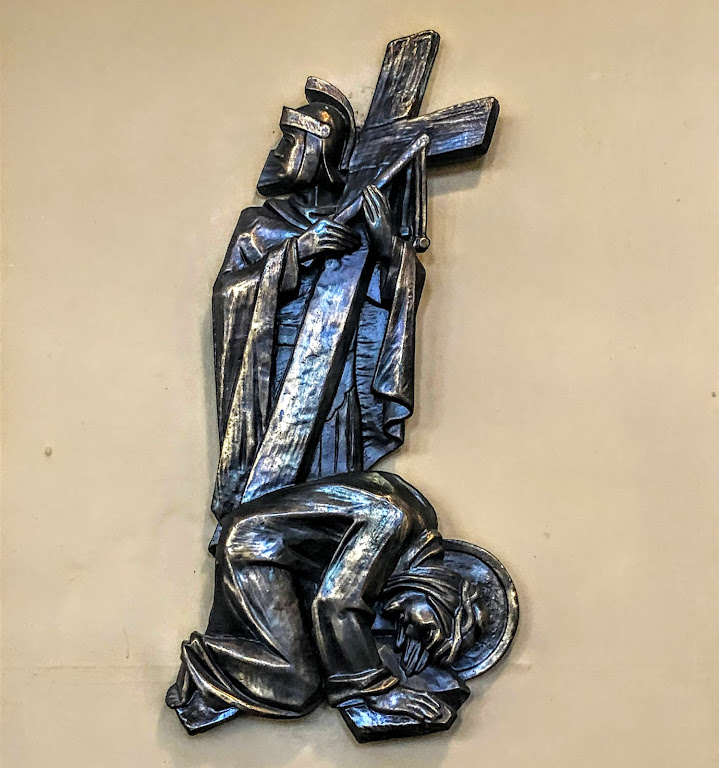
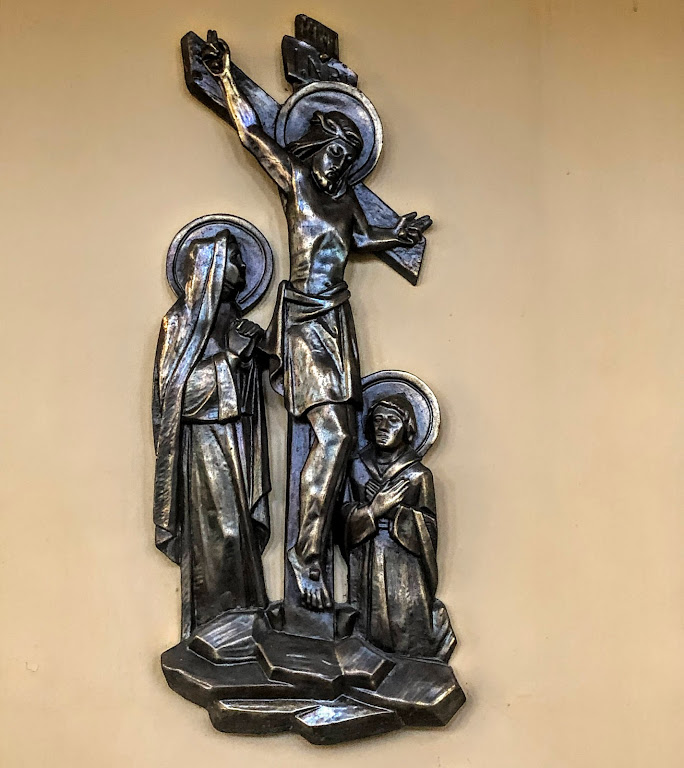
The Deposition of Christ from the Cross by Giotto in the Scrovegni Chapel in Padua (Photograph: Patrick Comerford)
Patrick Comerford
We have reached the end of Holy Week and the end of Lent. Today is Easter Eve (4 April 2026), known in the Greek Orthodox Church as Great Holy Saturday. However, Easter comes a week later in the Orthodox calendar this year. Later this morning, I hope to drop in to Το Στεκι Μας, Our Place, the pop-up Greek café which opens every first Saturday of the month at the Swinfen Harris Church Hall beside the Greek Orthodox Church on London Road, Stony Stratford, between 10:30 am and 3 pm. Today there is an Easter Special ‘Steki’, with a taste of Greek Easter delicacies, with Easter crafts for children, including decorating Easter candle, as well as Greek olive oil and honey and, of course, authentic Greek coffee, pastries and cakes.
Later, I hope to find somewhere appropriate to watch the Cambridge v Oxford boat races, although this is the first time in many years that they are not being broadcast by the BBC; the 80th Women’s Boat Race starts at 2:21 pm, the 171st Men’s Boat Race starts at 3:21 pm.
Easter begins in Saint Mary and Saint Giles Church, Stony Stratford, this evening with the Lighting of the New Fire, the Easter Vigil and the Eucharist in Saint Mary and Saint Giles Church at 8 pm, and I hope to sing with the choir and to read one of the lessons.
But, before this day begins, I am taking some quiet time this morning to give thanks, to reflect, to pray and to read in these ways:
1, reading today’s Gospel reading;
2, a short reflection;
3, a prayer from the USPG prayer diary;
4, the Collects of the day.
The Harrowing of Hell, depicted in a fresco on a chancel arch in the Church of the Four Martyrs in Rethymnon (Photograph: Patrick Comerford)
Matthew 27: 57-66 (NRSVA):
57 When it was evening, there came a rich man from Arimathea, named Joseph, who was also a disciple of Jesus. 58 He went to Pilate and asked for the body of Jesus; then Pilate ordered it to be given to him. 59 So Joseph took the body and wrapped it in a clean linen cloth 60 and laid it in his own new tomb, which he had hewn in the rock. He then rolled a great stone to the door of the tomb and went away. 61 Mary Magdalene and the other Mary were there, sitting opposite the tomb.
62 The next day, that is, after the day of Preparation, the chief priests and the Pharisees gathered before Pilate 63 and said, ‘Sir, we remember what that impostor said while he was still alive, “After three days I will rise again.” 64 Therefore command that the tomb be made secure until the third day; otherwise his disciples may go and steal him away, and tell the people, “He has been raised from the dead”, and the last deception would be worse than the first.’ 65 Pilate said to them, ‘You have a guard of soldiers; go, make it as secure as you can.’ 66 So they went with the guard and made the tomb secure by sealing the stone.
‘So Joseph took the body and wrapped it in a clean linen cloth and laid it in his own new tomb’ (Matthew 27: 59-60) … inside the Sarcophagus at the end of the Stations of the Cross in the Garden in Walsingham (Photograph: Patrick Comerford, 2026)
Today’s Reflections:
George Koros (1923-2014) was one of the finest Greek solo violinists of our time. He was born on the island of Evia in 1923, and he started playing the violin at the age of eight, when his father – who was a church cantor and a teacher of Byzantine music – decided to replace the mandolin with a violin and a bow without strings. His professional career began a year later, when he began playing at weddings and feasts with his father.
His mother spurned an opportunity for him to have a classical musical education. But Koros later revolutionised Greek folk music through the introduction of the fiddle as an accepted instrument. He became an acclaimed, self-made musician, who composed about 2,000 songs. But despite his reputation in Greek folk music, for me he stands out for his Byzantine hymns, particularly during this Easter weekend in Crete. In these hymns, Koros returned to his roots in Byzantine music and with his violin he recreates the tradition of the early hymns he learned from his father in church as a boy.
George Koros died in 2014, and was buried in Kiffisia in Athens.
On this Saturday – between Good Friday and Easter Day – many years ago (2008), during a series of Holy Saturday reflections in Whitechurch Parish in Dublin, I invited people to listen to George Koros using his violin to plaintively recall the sorrow of the tomb in two pieces: I see thy resting place (Τον Νυμφωνα Σου Βλεπω) and Life in the Holy Sepulchre (Η Ζωη εν Ταφω).
In the Western tradition of the Church, we seem to have contemplated the cross, and then moved to the empty tomb. At times, the deep joys of the Resurrection have often been overshadowed in the Western Church by the way of the Cross, as though the Cross leads only to death. But we have also neglected Christ’s resting place, his tomb, and given little thought to what was happening in the Holy Sepulchre on this day.
In Greece, Holy and Great Saturday, which falls next Saturday (11 April 2026) is observed solemnly by the Orthodox Church, with hymns and readings that truly explore the theme of the Harrowing of Hell in depth. For this is the day on which Christ’s body lay in the tomb, this is the day on which he visited those who were dead.
The icon of the Harrowing of Hell reminds us that God reaches into the deepest depths to pull forth souls into the kingdom of light. It reminds us how much we are unable to comprehend – let alone take to heart as our own – the creedal statement about Christ’s descent into Hell – ‘He descended into Hell.’
Christ’s descent into Hell is captured in Saint Peter’s Pentecost sermon in Acts 2. In the Petrine letters, we are told that when Christ died he went and preached to the spirits in prison ‘who in former times did not obey … For this is the reason the Gospel was proclaimed even to the dead, so that … they might live in the spirit as God does’ (see I Peter 3: 15b to 4: 8).
In the NRSV, I Peter 4: 6 reads the gospel was ‘proclaimed even to the dead …’, reflecting the original Greek: ‘εἰς τοῦτο γὰρ καὶ νεκροῖς εὐηγγελίσθη …’ The New International Version, however, says the Gospel ‘was preached even to those who are now dead …’ But the word ‘now’ is not in the Greek text. It was inserted to rule out the idea that Christ preached to those who were dead at the time when Christ descended into Hell and preached to them there. Instead, the NIV interpolates and rewrites the text so that it says that Christ brought his good news to people who were dead at the time I Peter was written. If you remove the word ‘now,’ the English becomes ambiguous on that point, just like the Greek is ambiguous there.
The Early Church taught that after his death Christ descended into hell and rescued all the souls, starting with Adam and Eve, who had died under the Fall.
The Harrowing of Hell is intimately bound up with the Resurrection, the Raising from the Dead, for as Christ is raised from the dead he also plummets the depths to bring up, to raise up, those who are dead. The Harrowing of Hell carries us into the gap in time between Christ’s death and resurrection.
In Orthodox icons of the Harrowing of Hell, Christ stands on the shattered doors of Hell. Sometimes, two angels are shown in the pit binding Satan. And we see Christ pulling out of Hell Adam and Eve, imprisoned there since their deaths, imprisoned along with all humanity because of sin. Christ breaks down the doors of Hell and leads the souls of the lost into Heaven.
It is the most radical reversal we can imagine. Death does not have the last word, we need not live our lives entombed in fear. If Adam and Eve are forgiven, and the Sin of Adam is annulled and destroyed, who is beyond forgiveness?
In discussing the ‘Descent into Hell,’ the Swiss theologian Hans Urs von Balthasar (1905-1988) argues that if Christ’s mission did not result in the successful application of God’s love to every intended soul, how then can we think of it as a success. He emphasises Christ’s descent into the fullness of death, so as to be ‘Lord of both the dead and the living’ (Romans 5).
However, in her award-winning book Light in Darkness, Alyssa Lyra Pitstick says that Christ did not descend into the lowest depths of hell, and only stayed in the top levels. She finds untenable his view that Christ’s descent into hell entails experiencing the fullness of alienation, sin and death, which he then absorbs, transfigures, and defeats through the Resurrection. Instead, she claims, Christ descends only to the ‘limbo of the Fathers’ in which the righteous, justified dead of the Old Testament awaited the coming of the Messiah.
Her argument robs the Harrowing of Hell of its soteriological significance. For her, Christ does not descend into hell and experience the depths of alienation between God and humanity opened up by sin. She leaves Christ visiting an already-redeemed and justified collection of Old Testament saints to let them know that he has defeated death.
Archbishop Rowan Williams has written beautifully in The Indwelling of Light on the Harrowing of Hell. Christ is the new Adam who rescues humanity from its past, and who starts history anew. ‘The resurrection … is an introduction – to our buried selves, to our alienated neighbours, to our physical world.’ He says: ‘Adam and Eve stand for wherever it is in the human story that fear and refusal began … (This) icon declares that wherever that lost moment was or is – Christ (is) there to implant the possibility … of another future.’ (Rowan Williams, The Dwelling of the Light: Praying with Icons of Christ, p 38.)
I ask myself once again this morning: what is the difference between the top levels and bottom levels of hell?
Is my hell in my heart of my own creation?
In my mind, in my home, where I live and work, in my society, in this world?
Is hell the nightmares from the past I cannot shake off, or the fears for the future when it looks gloomy and desolate for this planet?
But is anything too hard for Christ?
On this day, the icon of the Harrowing of Hell tells us that there are no limits to God’s ability to search us out and to know us. Where are the depths of your heart and your soul – where darkness prevails, and where you feel even Christ can find no welcome? Those crevices even I am afraid to think about, let alone contemplate, may be beyond my reach. I cannot produce or manufacture my own salvation from that deep, interior hell, hidden from others, and often hidden from myself.
Christ breaks down the gates of Hell, and as the icon powerfully shows, he rips all of sinful humanity from the clutches of death. He descends into the depths of our sin and alienation from God; and by plumbing the depths of hell he suffuses all that is lost and sinful with the radiance of divine goodness, joy and light. If hell is where God is not, and Jesus is God, then his decent into hell pushes back hell’s boundaries. In his descent into hell, Christ reclaims this zone for life, pushing back the gates of death, where God is not, to the farthest limits possible.
The music associated with this day in the Orthodox tradition, the icons and the readings, remind me that Christ plummets even those deepest depths, and that his love and mercy can raise us again to new life.
On this Saturday, as I prepare to take part in this evening’s Easter celebrations of the Resurrection, I have been thinking of Christ lying in the grave, and thinking of how we can ask him to take away all that denies life in us, whether it is a hell of our own making, a hell that has been forced on us, or a hell that surrounds us. Christ reaches down, and lifts us up with him in his Risen Glory.
George Koros used his violin to plaintively recall the sorrow of the tomb in two pieces: ‘I see thy resting place’ (Τον Νυμφωνα Σου Βλεπω) and ‘Life in the Holy Sepulchre’ (Η Ζωη εν Ταφω)
Today’s Prayers (Saturday 4 April 2026, Easter Eve, Great Holy Saturday):
The theme this week (29 March-4 April 2026) in ‘Pray With the World Church’, the Prayer Diary of the Anglican mission agency USPG (United Society Partners in the Gospel), is a ‘Holy Week’ reflection’ (pp 42-43). This theme was introduced on Sunday with reflections by the Revd Kenson Li, Assistant Curate of Manchester Cathedral and a Trustee of USPG.
The USPG Prayer Diary today (Saturday 4 April 2026, Easter Eve, Great Holy Saturday) invites us to pray:
Loving Father, we pray for those to whom Easter brings no joy or hope. Make us a Resurrection People, sensitive to others’ suffering, so that we may spread Easter joy to the glory of your name, not our own.
The Collect:
Grant, Lord,
that we who are baptized into the death
of your Son our Saviour Jesus Christ
may continually put to death our evil desires
and be buried with him;
and that through the grave and gate of death
we may pass to our joyful resurrection;
through his merits,
who died and was buried and rose again for us,
your Son Jesus Christ our Lord.
Additional Collect:
In the depths of our isolation
we cry to you, Lord God:
give light in our darkness
and bring us out of the prison of our despair;
through Jesus Christ our Lord.
Yesterday’s Reflections
Continued Tomorrow
The Sarcophagus at the end of the Stations of the Cross in the Garden in Walsingham (Patrick Comerford, 2026)
Scripture quotations are from the New Revised Standard Version Bible: Anglicised Edition copyright © 1989, 1995 National Council of the Churches of Christ in the United States of America. Used by permission. All rights reserved worldwide. http://nrsvbibles.org
The Epitaphios in the Church of the Four Martyrs, Rethymnon, decorated with flowers symbolising the tomb of Christ (Photograph: Patrick Comerford, 2025)
Showing posts with label Holy Week. Show all posts
04 April 2026
Daily prayer in Lent 2026:
46, Saturday 4 April 2026,
Easter Eve
Labels:
Crete 2026,
Easter 2026,
Easter Eve,
Giotto,
Greece 2026,
Holy Week,
Lent 2026,
Mission,
Orthodoxy,
Padua,
Prayer,
Rethymnon,
Rowing,
Saint Matthew's Gospel,
Stations of the Cross,
Stony Stratford,
USPG,
Walsingham
03 April 2026
Daily prayer in Lent 2026:
45, Friday 3 April 2026,
Good Friday
An icon of the Crucifixion by Hanna-Leena Ward in her recent exhibition in Lichfield Cathedral (Photograph: Patrick Comerford, 2026)
Patrick Comerford
We are at the climax of Holy Week, the last week in Lent. Today is Good Friday (3 April 2026), known as Great Friday in the Greek Orthodox Church.
We were in Oxford yesterday for the Chrism Eucharist in Christ Church and the renewal of ordination vows, and I was back in Stony Stratford last night for the Eucharist of the Last Supper and the Watch of the Passion in Saint Mary and Saint Giles Church. I hope to sing with the choir this afternoon when the Watch of the Passion continues (12 noon to 2 pm), followed by the Veneration of the Cross from 2 pm.
But, before this day begins, I am taking some quiet time this morning to give thanks, to reflect, to pray and to read in these ways:
1, reading today’s Gospel reading;
2, a short reflection;
3, a prayer from the USPG prayer diary;
4, the Collects of the day.
A Byzantine-style crucifix by Αλεξανδρα Καουκι, icon writer in Rethymnon, Crete
John 18: 1 to 19: 42 (NRSVA):
1 After Jesus had spoken these words, he went out with his disciples across the Kidron valley to a place where there was a garden, which he and his disciples entered. 2 Now Judas, who betrayed him, also knew the place, because Jesus often met there with his disciples. 3 So Judas brought a detachment of soldiers together with police from the chief priests and the Pharisees, and they came there with lanterns and torches and weapons. 4 Then Jesus, knowing all that was to happen to him, came forward and asked them, ‘For whom are you looking?’ 5 They answered, ‘Jesus of Nazareth.’ Jesus replied, ‘I am he.’ Judas, who betrayed him, was standing with them. 6 When Jesus said to them, ‘I am he’, they stepped back and fell to the ground. 7 Again he asked them, ‘For whom are you looking?’ And they said, ‘Jesus of Nazareth.’ 8 Jesus answered, ‘I told you that I am he. So if you are looking for me, let these men go.’ 9 This was to fulfil the word that he had spoken, ‘I did not lose a single one of those whom you gave me.’ 10 Then Simon Peter, who had a sword, drew it, struck the high priest’s slave, and cut off his right ear. The slave’s name was Malchus. 11 Jesus said to Peter, ‘Put your sword back into its sheath. Am I not to drink the cup that the Father has given me?’
12 So the soldiers, their officer, and the Jewish police arrested Jesus and bound him. 13 First they took him to Annas, who was the father-in-law of Caiaphas, the high priest that year. 14 Caiaphas was the one who had advised the Jews that it was better to have one person die for the people.
15 Simon Peter and another disciple followed Jesus. Since that disciple was known to the high priest, he went with Jesus into the courtyard of the high priest, 16 but Peter was standing outside at the gate. So the other disciple, who was known to the high priest, went out, spoke to the woman who guarded the gate, and brought Peter in. 17 The woman said to Peter, ‘You are not also one of this man’s disciples, are you?’ He said, ‘I am not.’ 18 Now the slaves and the police had made a charcoal fire because it was cold, and they were standing round it and warming themselves. Peter also was standing with them and warming himself.
19 Then the high priest questioned Jesus about his disciples and about his teaching. 20 Jesus answered, ‘I have spoken openly to the world; I have always taught in synagogues and in the temple, where all the Jews come together. I have said nothing in secret. 21 Why do you ask me? Ask those who heard what I said to them; they know what I said.’ 22 When he had said this, one of the police standing nearby struck Jesus on the face, saying, ‘Is that how you answer the high priest?’ 23 Jesus answered, ‘If I have spoken wrongly, testify to the wrong. But if I have spoken rightly, why do you strike me?’ 24 Then Annas sent him bound to Caiaphas the high priest.
25 Now Simon Peter was standing and warming himself. They asked him, ‘You are not also one of his disciples, are you?’ He denied it and said, ‘I am not.’ 26 One of the slaves of the high priest, a relative of the man whose ear Peter had cut off, asked, ‘Did I not see you in the garden with him?’ 27 Again Peter denied it, and at that moment the cock crowed.
28 Then they took Jesus from Caiaphas to Pilate’s headquarters. It was early in the morning. They themselves did not enter the headquarters, so as to avoid ritual defilement and to be able to eat the Passover. 29 So Pilate went out to them and said, ‘What accusation do you bring against this man?’ 30 They answered, ‘If this man were not a criminal, we would not have handed him over to you.’ 31 Pilate said to them, ‘Take him yourselves and judge him according to your law.’ The Jews replied, ‘We are not permitted to put anyone to death.’ 32 (This was to fulfil what Jesus had said when he indicated the kind of death he was to die.)
33 Then Pilate entered the headquarters again, summoned Jesus, and asked him, ‘Are you the King of the Jews?’ 34 Jesus answered, ‘Do you ask this on your own, or did others tell you about me?’ 35 Pilate replied, ‘I am not a Jew, am I? Your own nation and the chief priests have handed you over to me. What have you done?’ 36 Jesus answered, ‘My kingdom is not from this world. If my kingdom were from this world, my followers would be fighting to keep me from being handed over to the Jews. But as it is, my kingdom is not from here.’ 37 Pilate asked him, ‘So you are a king?’ Jesus answered, ‘You say that I am a king. For this I was born, and for this I came into the world, to testify to the truth. Everyone who belongs to the truth listens to my voice.’ 38 Pilate asked him, ‘What is truth?’
After he had said this, he went out to the Jews again and told them, ‘I find no case against him. 39 But you have a custom that I release someone for you at the Passover. Do you want me to release for you the King of the Jews?’ 40 They shouted in reply, ‘Not this man, but Barabbas!’ Now Barabbas was a bandit.
1 Then Pilate took Jesus and had him flogged. 2 And the soldiers wove a crown of thorns and put it on his head, and they dressed him in a purple robe. 3 They kept coming up to him, saying, ‘Hail, King of the Jews!’ and striking him on the face. 4 Pilate went out again and said to them, ‘Look, I am bringing him out to you to let you know that I find no case against him.’ 5 So Jesus came out, wearing the crown of thorns and the purple robe. Pilate said to them, ‘Here is the man!’ 6 When the chief priests and the police saw him, they shouted, ‘Crucify him! Crucify him!’ Pilate said to them, ‘Take him yourselves and crucify him; I find no case against him.’ 7 The Jews answered him, ‘We have a law, and according to that law he ought to die because he has claimed to be the Son of God.’
8 Now when Pilate heard this, he was more afraid than ever. 9 He entered his headquarters again and asked Jesus, ‘Where are you from?’ But Jesus gave him no answer. 10 Pilate therefore said to him, ‘Do you refuse to speak to me? Do you not know that I have power to release you, and power to crucify you?’ 11 Jesus answered him, ‘You would have no power over me unless it had been given you from above; therefore the one who handed me over to you is guilty of a greater sin.’ 12 From then on Pilate tried to release him, but the Jews cried out, ‘If you release this man, you are no friend of the emperor. Everyone who claims to be a king sets himself against the emperor.’
13 When Pilate heard these words, he brought Jesus outside and sat on the judge’s bench at a place called The Stone Pavement, or in Hebrew Gabbatha. 14 Now it was the day of Preparation for the Passover; and it was about noon. He said to the Jews, ‘Here is your King!’ 15 They cried out, ‘Away with him! Away with him! Crucify him!’ Pilate asked them, ‘Shall I crucify your King?’ The chief priests answered, ‘We have no king but the emperor.’ 16 Then he handed him over to them to be crucified.
So they took Jesus; 17 and carrying the cross by himself, he went out to what is called The Place of the Skull, which in Hebrew is called Golgotha. 18 There they crucified him, and with him two others, one on either side, with Jesus between them. 19 Pilate also had an inscription written and put on the cross. It read, ‘Jesus of Nazareth, the King of the Jews.’ 20 Many of the Jews read this inscription, because the place where Jesus was crucified was near the city; and it was written in Hebrew,[o] in Latin, and in Greek. 21 Then the chief priests of the Jews said to Pilate, ‘Do not write, “The King of the Jews”, but, “This man said, I am King of the Jews.”’ 22 Pilate answered, ‘What I have written I have written.’ 23 When the soldiers had crucified Jesus, they took his clothes and divided them into four parts, one for each soldier. They also took his tunic; now the tunic was seamless, woven in one piece from the top. 24 So they said to one another, ‘Let us not tear it, but cast lots for it to see who will get it.’ This was to fulfil what the scripture says,
‘They divided my clothes among themselves,
and for my clothing they cast lots.’
25 And that is what the soldiers did.
Meanwhile, standing near the cross of Jesus were his mother, and his mother’s sister, Mary the wife of Clopas, and Mary Magdalene. 26 When Jesus saw his mother and the disciple whom he loved standing beside her, he said to his mother, ‘Woman, here is your son.’ 27 Then he said to the disciple, ‘Here is your mother.’ And from that hour the disciple took her into his own home.
28 After this, when Jesus knew that all was now finished, he said (in order to fulfil the scripture), ‘I am thirsty.’ 29 A jar full of sour wine was standing there. So they put a sponge full of the wine on a branch of hyssop and held it to his mouth. 30 When Jesus had received the wine, he said, ‘It is finished.’ Then he bowed his head and gave up his spirit.
31 Since it was the day of Preparation, the Jews did not want the bodies left on the cross during the sabbath, especially because that sabbath was a day of great solemnity. So they asked Pilate to have the legs of the crucified men broken and the bodies removed. 32 Then the soldiers came and broke the legs of the first and of the other who had been crucified with him. 33 But when they came to Jesus and saw that he was already dead, they did not break his legs. 34 Instead, one of the soldiers pierced his side with a spear, and at once blood and water came out. 35 (He who saw this has testified so that you also may believe. His testimony is true, and he knows that he tells the truth.) 36 These things occurred so that the scripture might be fulfilled, ‘None of his bones shall be broken.’ 37 And again another passage of scripture says, ‘They will look on the one whom they have pierced.’
38 After these things, Joseph of Arimathea, who was a disciple of Jesus, though a secret one because of his fear of the Jews, asked Pilate to let him take away the body of Jesus. Pilate gave him permission; so he came and removed his body. 39 Nicodemus, who had at first come to Jesus by night, also came, bringing a mixture of myrrh and aloes, weighing about a hundred pounds. 40 They took the body of Jesus and wrapped it with the spices in linen cloths, according to the burial custom of the Jews. 41 Now there was a garden in the place where he was crucified, and in the garden there was a new tomb in which no one had ever been laid. 42 And so, because it was the Jewish day of Preparation, and the tomb was nearby, they laid Jesus there.
Venerating the Cross in Church of the Four Martyrs in Rethymnon at the beginning of the commemorations of Great and Good Friday (Photograph: Patrick Comerford)
Today’s Reflections:
Throughout this week, the Holy Week prayers and devotions in many churches have included the Stations of the Cross. The verse and response at each station is:
We adore you, O Christ, and we bless you,
Because by your holy cross
you have redeemed the world.
And then, following a meditation:
Lord Jesus crucified,
Have mercy on us!
The Stations of the Cross are not usually found in Greek Orthodox Churches, but the Good Friday processions through the streets of cities, towns and villages in Greece on the evening of Good Friday are unmatched in northern Europe. Because of the differences in calculating the date of Easter, Great and Good Friday is taking place in Greece next week. It is marked with the Veneration of the Cross, sombre tolling of church bells, and procession of the Epitaphios or bier of Christ through the streets.
This morning, my reflections on today’s Gospel reading (John 18: 1 to 19: 42) are assisted by images of the Stations of the Cross in Saint Mary and Saint Giles Church in Stony Stratford:
Jesus is condemned to Death … Station 1 in the Stations of the Cross in Saint Mary and Saint Giles Church in Stony Stratford (Photograph: Patrick Comerford)
Jesus is made to carry his Cross … Station 2 in Stony Stratford (Photograph: Patrick Comerford)
Jesus falls the First Time … Station 3 in Stony Stratford (Photograph: Patrick Comerford)
Jesus meets his Sorrowful Mother … Station 4 in Stony Stratford (Photograph: Patrick Comerford)
Simon of Cyrene Helps Jesus carry his Cross … Station 5 in Stony Stratford (Photograph: Patrick Comerford)
Veronica wipes the Face of Jesus … Station 6 in Stony Stratford (Photograph: Patrick Comerford)
Jesus falls The Second Time … Station 7 in Stony Stratford (Photograph: Patrick Comerford)
The Women Of Jerusalem weep over Jesus … Station 8 in the Stations of the Cross in Stony Stratford (Photograph: Patrick Comerford)
Jesus falls The Third Time … Station 9 in Stony Stratford (Photograph: Patrick Comerford)
Jesus Is stripped of his garments … Station 10 in Stony Stratford (Photograph: Patrick Comerford)
Jesus Is nailed To The Cross … Station 11 in Stony Stratford (Photograph: Patrick Comerford)
Jesus Is Raised Upon the Cross And Dies … Station 12 in Stony Stratford (Photograph: Patrick Comerford)
Jesus Is taken down from the Cross and placed In the arms of his Mother … Station 13 in Stony Stratford (Photograph: Patrick Comerford)
Jesus is laid In the Sepulchre … Station 14 in Stony Stratford (Photograph: Patrick Comerford)
Today’s Prayers (Friday 3 April 2026, Good Friday):
The theme this week (29 March-4 April 2026) in ‘Pray With the World Church’, the Prayer Diary of the Anglican mission agency USPG (United Society Partners in the Gospel), is a ‘Holy Week’ reflection’ (pp 42-43). This theme was introduced on Sunday with reflections by the Revd Kenson Li, Assistant Curate of Manchester Cathedral and a Trustee of USPG.
The USPG Prayer Diary today (Friday 4 April 2026, Good Friday) invites us to pray:
Jesus, Saviour of the world, who rested in the tomb and sanctified the grave as a bed of hope: help us to know the depth of our need for forgiveness, and the greater power of your everlasting love.
The Collect:
Almighty Father,
look with mercy on this your family
for which our Lord Jesus Christ was content to be betrayed
and given up into the hands of sinners
and to suffer death upon the cross;
who is alive and glorified with you and the Holy Spirit,
one God, now and for ever.
Additional Collect:
Eternal God,
in the cross of Jesus
we see the cost of our sin
and the depth of your love:
in humble hope and fear
may we place at his feet
all that we have and all that we are,
through Jesus Christ our Lord.
Yesterday’s Reflections
Continued Tomorrow
The processions arriving at the Church of the Four Martyrs in Rethymnon on Good Friday last year (Patrick Comerford)
Scripture quotations are from the New Revised Standard Version Bible: Anglicised Edition copyright © 1989, 1995 National Council of the Churches of Christ in the United States of America. Used by permission. All rights reserved worldwide. http://nrsvbibles.org
Patrick Comerford
We are at the climax of Holy Week, the last week in Lent. Today is Good Friday (3 April 2026), known as Great Friday in the Greek Orthodox Church.
We were in Oxford yesterday for the Chrism Eucharist in Christ Church and the renewal of ordination vows, and I was back in Stony Stratford last night for the Eucharist of the Last Supper and the Watch of the Passion in Saint Mary and Saint Giles Church. I hope to sing with the choir this afternoon when the Watch of the Passion continues (12 noon to 2 pm), followed by the Veneration of the Cross from 2 pm.
But, before this day begins, I am taking some quiet time this morning to give thanks, to reflect, to pray and to read in these ways:
1, reading today’s Gospel reading;
2, a short reflection;
3, a prayer from the USPG prayer diary;
4, the Collects of the day.
A Byzantine-style crucifix by Αλεξανδρα Καουκι, icon writer in Rethymnon, Crete
John 18: 1 to 19: 42 (NRSVA):
1 After Jesus had spoken these words, he went out with his disciples across the Kidron valley to a place where there was a garden, which he and his disciples entered. 2 Now Judas, who betrayed him, also knew the place, because Jesus often met there with his disciples. 3 So Judas brought a detachment of soldiers together with police from the chief priests and the Pharisees, and they came there with lanterns and torches and weapons. 4 Then Jesus, knowing all that was to happen to him, came forward and asked them, ‘For whom are you looking?’ 5 They answered, ‘Jesus of Nazareth.’ Jesus replied, ‘I am he.’ Judas, who betrayed him, was standing with them. 6 When Jesus said to them, ‘I am he’, they stepped back and fell to the ground. 7 Again he asked them, ‘For whom are you looking?’ And they said, ‘Jesus of Nazareth.’ 8 Jesus answered, ‘I told you that I am he. So if you are looking for me, let these men go.’ 9 This was to fulfil the word that he had spoken, ‘I did not lose a single one of those whom you gave me.’ 10 Then Simon Peter, who had a sword, drew it, struck the high priest’s slave, and cut off his right ear. The slave’s name was Malchus. 11 Jesus said to Peter, ‘Put your sword back into its sheath. Am I not to drink the cup that the Father has given me?’
12 So the soldiers, their officer, and the Jewish police arrested Jesus and bound him. 13 First they took him to Annas, who was the father-in-law of Caiaphas, the high priest that year. 14 Caiaphas was the one who had advised the Jews that it was better to have one person die for the people.
15 Simon Peter and another disciple followed Jesus. Since that disciple was known to the high priest, he went with Jesus into the courtyard of the high priest, 16 but Peter was standing outside at the gate. So the other disciple, who was known to the high priest, went out, spoke to the woman who guarded the gate, and brought Peter in. 17 The woman said to Peter, ‘You are not also one of this man’s disciples, are you?’ He said, ‘I am not.’ 18 Now the slaves and the police had made a charcoal fire because it was cold, and they were standing round it and warming themselves. Peter also was standing with them and warming himself.
19 Then the high priest questioned Jesus about his disciples and about his teaching. 20 Jesus answered, ‘I have spoken openly to the world; I have always taught in synagogues and in the temple, where all the Jews come together. I have said nothing in secret. 21 Why do you ask me? Ask those who heard what I said to them; they know what I said.’ 22 When he had said this, one of the police standing nearby struck Jesus on the face, saying, ‘Is that how you answer the high priest?’ 23 Jesus answered, ‘If I have spoken wrongly, testify to the wrong. But if I have spoken rightly, why do you strike me?’ 24 Then Annas sent him bound to Caiaphas the high priest.
25 Now Simon Peter was standing and warming himself. They asked him, ‘You are not also one of his disciples, are you?’ He denied it and said, ‘I am not.’ 26 One of the slaves of the high priest, a relative of the man whose ear Peter had cut off, asked, ‘Did I not see you in the garden with him?’ 27 Again Peter denied it, and at that moment the cock crowed.
28 Then they took Jesus from Caiaphas to Pilate’s headquarters. It was early in the morning. They themselves did not enter the headquarters, so as to avoid ritual defilement and to be able to eat the Passover. 29 So Pilate went out to them and said, ‘What accusation do you bring against this man?’ 30 They answered, ‘If this man were not a criminal, we would not have handed him over to you.’ 31 Pilate said to them, ‘Take him yourselves and judge him according to your law.’ The Jews replied, ‘We are not permitted to put anyone to death.’ 32 (This was to fulfil what Jesus had said when he indicated the kind of death he was to die.)
33 Then Pilate entered the headquarters again, summoned Jesus, and asked him, ‘Are you the King of the Jews?’ 34 Jesus answered, ‘Do you ask this on your own, or did others tell you about me?’ 35 Pilate replied, ‘I am not a Jew, am I? Your own nation and the chief priests have handed you over to me. What have you done?’ 36 Jesus answered, ‘My kingdom is not from this world. If my kingdom were from this world, my followers would be fighting to keep me from being handed over to the Jews. But as it is, my kingdom is not from here.’ 37 Pilate asked him, ‘So you are a king?’ Jesus answered, ‘You say that I am a king. For this I was born, and for this I came into the world, to testify to the truth. Everyone who belongs to the truth listens to my voice.’ 38 Pilate asked him, ‘What is truth?’
After he had said this, he went out to the Jews again and told them, ‘I find no case against him. 39 But you have a custom that I release someone for you at the Passover. Do you want me to release for you the King of the Jews?’ 40 They shouted in reply, ‘Not this man, but Barabbas!’ Now Barabbas was a bandit.
1 Then Pilate took Jesus and had him flogged. 2 And the soldiers wove a crown of thorns and put it on his head, and they dressed him in a purple robe. 3 They kept coming up to him, saying, ‘Hail, King of the Jews!’ and striking him on the face. 4 Pilate went out again and said to them, ‘Look, I am bringing him out to you to let you know that I find no case against him.’ 5 So Jesus came out, wearing the crown of thorns and the purple robe. Pilate said to them, ‘Here is the man!’ 6 When the chief priests and the police saw him, they shouted, ‘Crucify him! Crucify him!’ Pilate said to them, ‘Take him yourselves and crucify him; I find no case against him.’ 7 The Jews answered him, ‘We have a law, and according to that law he ought to die because he has claimed to be the Son of God.’
8 Now when Pilate heard this, he was more afraid than ever. 9 He entered his headquarters again and asked Jesus, ‘Where are you from?’ But Jesus gave him no answer. 10 Pilate therefore said to him, ‘Do you refuse to speak to me? Do you not know that I have power to release you, and power to crucify you?’ 11 Jesus answered him, ‘You would have no power over me unless it had been given you from above; therefore the one who handed me over to you is guilty of a greater sin.’ 12 From then on Pilate tried to release him, but the Jews cried out, ‘If you release this man, you are no friend of the emperor. Everyone who claims to be a king sets himself against the emperor.’
13 When Pilate heard these words, he brought Jesus outside and sat on the judge’s bench at a place called The Stone Pavement, or in Hebrew Gabbatha. 14 Now it was the day of Preparation for the Passover; and it was about noon. He said to the Jews, ‘Here is your King!’ 15 They cried out, ‘Away with him! Away with him! Crucify him!’ Pilate asked them, ‘Shall I crucify your King?’ The chief priests answered, ‘We have no king but the emperor.’ 16 Then he handed him over to them to be crucified.
So they took Jesus; 17 and carrying the cross by himself, he went out to what is called The Place of the Skull, which in Hebrew is called Golgotha. 18 There they crucified him, and with him two others, one on either side, with Jesus between them. 19 Pilate also had an inscription written and put on the cross. It read, ‘Jesus of Nazareth, the King of the Jews.’ 20 Many of the Jews read this inscription, because the place where Jesus was crucified was near the city; and it was written in Hebrew,[o] in Latin, and in Greek. 21 Then the chief priests of the Jews said to Pilate, ‘Do not write, “The King of the Jews”, but, “This man said, I am King of the Jews.”’ 22 Pilate answered, ‘What I have written I have written.’ 23 When the soldiers had crucified Jesus, they took his clothes and divided them into four parts, one for each soldier. They also took his tunic; now the tunic was seamless, woven in one piece from the top. 24 So they said to one another, ‘Let us not tear it, but cast lots for it to see who will get it.’ This was to fulfil what the scripture says,
‘They divided my clothes among themselves,
and for my clothing they cast lots.’
25 And that is what the soldiers did.
Meanwhile, standing near the cross of Jesus were his mother, and his mother’s sister, Mary the wife of Clopas, and Mary Magdalene. 26 When Jesus saw his mother and the disciple whom he loved standing beside her, he said to his mother, ‘Woman, here is your son.’ 27 Then he said to the disciple, ‘Here is your mother.’ And from that hour the disciple took her into his own home.
28 After this, when Jesus knew that all was now finished, he said (in order to fulfil the scripture), ‘I am thirsty.’ 29 A jar full of sour wine was standing there. So they put a sponge full of the wine on a branch of hyssop and held it to his mouth. 30 When Jesus had received the wine, he said, ‘It is finished.’ Then he bowed his head and gave up his spirit.
31 Since it was the day of Preparation, the Jews did not want the bodies left on the cross during the sabbath, especially because that sabbath was a day of great solemnity. So they asked Pilate to have the legs of the crucified men broken and the bodies removed. 32 Then the soldiers came and broke the legs of the first and of the other who had been crucified with him. 33 But when they came to Jesus and saw that he was already dead, they did not break his legs. 34 Instead, one of the soldiers pierced his side with a spear, and at once blood and water came out. 35 (He who saw this has testified so that you also may believe. His testimony is true, and he knows that he tells the truth.) 36 These things occurred so that the scripture might be fulfilled, ‘None of his bones shall be broken.’ 37 And again another passage of scripture says, ‘They will look on the one whom they have pierced.’
38 After these things, Joseph of Arimathea, who was a disciple of Jesus, though a secret one because of his fear of the Jews, asked Pilate to let him take away the body of Jesus. Pilate gave him permission; so he came and removed his body. 39 Nicodemus, who had at first come to Jesus by night, also came, bringing a mixture of myrrh and aloes, weighing about a hundred pounds. 40 They took the body of Jesus and wrapped it with the spices in linen cloths, according to the burial custom of the Jews. 41 Now there was a garden in the place where he was crucified, and in the garden there was a new tomb in which no one had ever been laid. 42 And so, because it was the Jewish day of Preparation, and the tomb was nearby, they laid Jesus there.
Venerating the Cross in Church of the Four Martyrs in Rethymnon at the beginning of the commemorations of Great and Good Friday (Photograph: Patrick Comerford)
Today’s Reflections:
Throughout this week, the Holy Week prayers and devotions in many churches have included the Stations of the Cross. The verse and response at each station is:
We adore you, O Christ, and we bless you,
Because by your holy cross
you have redeemed the world.
And then, following a meditation:
Lord Jesus crucified,
Have mercy on us!
The Stations of the Cross are not usually found in Greek Orthodox Churches, but the Good Friday processions through the streets of cities, towns and villages in Greece on the evening of Good Friday are unmatched in northern Europe. Because of the differences in calculating the date of Easter, Great and Good Friday is taking place in Greece next week. It is marked with the Veneration of the Cross, sombre tolling of church bells, and procession of the Epitaphios or bier of Christ through the streets.
This morning, my reflections on today’s Gospel reading (John 18: 1 to 19: 42) are assisted by images of the Stations of the Cross in Saint Mary and Saint Giles Church in Stony Stratford:
Jesus is condemned to Death … Station 1 in the Stations of the Cross in Saint Mary and Saint Giles Church in Stony Stratford (Photograph: Patrick Comerford)
Jesus is made to carry his Cross … Station 2 in Stony Stratford (Photograph: Patrick Comerford)
Jesus falls the First Time … Station 3 in Stony Stratford (Photograph: Patrick Comerford)
Jesus meets his Sorrowful Mother … Station 4 in Stony Stratford (Photograph: Patrick Comerford)
Simon of Cyrene Helps Jesus carry his Cross … Station 5 in Stony Stratford (Photograph: Patrick Comerford)
Veronica wipes the Face of Jesus … Station 6 in Stony Stratford (Photograph: Patrick Comerford)
Jesus falls The Second Time … Station 7 in Stony Stratford (Photograph: Patrick Comerford)
The Women Of Jerusalem weep over Jesus … Station 8 in the Stations of the Cross in Stony Stratford (Photograph: Patrick Comerford)
Jesus falls The Third Time … Station 9 in Stony Stratford (Photograph: Patrick Comerford)
Jesus Is stripped of his garments … Station 10 in Stony Stratford (Photograph: Patrick Comerford)
Jesus Is nailed To The Cross … Station 11 in Stony Stratford (Photograph: Patrick Comerford)
Jesus Is Raised Upon the Cross And Dies … Station 12 in Stony Stratford (Photograph: Patrick Comerford)
Jesus Is taken down from the Cross and placed In the arms of his Mother … Station 13 in Stony Stratford (Photograph: Patrick Comerford)
Jesus is laid In the Sepulchre … Station 14 in Stony Stratford (Photograph: Patrick Comerford)
Today’s Prayers (Friday 3 April 2026, Good Friday):
The theme this week (29 March-4 April 2026) in ‘Pray With the World Church’, the Prayer Diary of the Anglican mission agency USPG (United Society Partners in the Gospel), is a ‘Holy Week’ reflection’ (pp 42-43). This theme was introduced on Sunday with reflections by the Revd Kenson Li, Assistant Curate of Manchester Cathedral and a Trustee of USPG.
The USPG Prayer Diary today (Friday 4 April 2026, Good Friday) invites us to pray:
Jesus, Saviour of the world, who rested in the tomb and sanctified the grave as a bed of hope: help us to know the depth of our need for forgiveness, and the greater power of your everlasting love.
The Collect:
Almighty Father,
look with mercy on this your family
for which our Lord Jesus Christ was content to be betrayed
and given up into the hands of sinners
and to suffer death upon the cross;
who is alive and glorified with you and the Holy Spirit,
one God, now and for ever.
Additional Collect:
Eternal God,
in the cross of Jesus
we see the cost of our sin
and the depth of your love:
in humble hope and fear
may we place at his feet
all that we have and all that we are,
through Jesus Christ our Lord.
Yesterday’s Reflections
Continued Tomorrow
The processions arriving at the Church of the Four Martyrs in Rethymnon on Good Friday last year (Patrick Comerford)
Scripture quotations are from the New Revised Standard Version Bible: Anglicised Edition copyright © 1989, 1995 National Council of the Churches of Christ in the United States of America. Used by permission. All rights reserved worldwide. http://nrsvbibles.org
Labels:
Crete 2026,
Good Friday,
Greece 2026,
Holy Week,
Icons,
Lent 2026,
Mission,
Orthodoxy,
Oxford,
Prayer,
Rethymnon,
Saint John's Gospel,
Stations of the Cross,
Stony Stratford,
USPG
02 April 2026
Daily prayer in Lent 2026:
44, Thursday 2 April 2026,
Maundy Thursday
An icon depicting the Last Supper or Mystical Supper seen in a shop on Ethnikis Antistaseos street in Rethymnon in Crete (Photograph: Patrick Comerford)
Patrick Comerford
We are reaching the climax of Holy Week, the last week in Lent. Today is Maundy Thursday (2 April 2026), and we preparing for Good Friday tomorrow and Easter Day.
Later this morning, I hope to be present at the Chrism Eucharist in Christ Church, Oxford, when the bishops, priest and deacons in the diocese opportunity to renew our ordination vows. I missed this moving service last year, when I spent much of Holy Week and Easter in Rethymnon in Crete.
Later this evening, I hope to take part in the Maundy Eucharist at 7 pm in Saint Mary and Saint Giles Church, Stony Stratford, followed by the Watch of the Passion from 8 to 9 pm. The music this evening includes Byrd’s Ave Verum and Vidi Aquam. But, before this day begins, before we catch the bus to Oxford, I am taking some quiet time this morning to give thanks, to reflect, to pray and to read in these ways:
1, reading today’s Gospel reading;
2, a short reflection;
3, a prayer from the USPG prayer diary;
4, the Collects and Post-Communion prayer of the day.
An icon depicting the Last Supper or Mystical Supper seen in Rethymnon in Crete (Photograph: Patrick Comerford)
John 13: 1-17, 31b-35 (NRSVA):
1 Now before the festival of the Passover, Jesus knew that his hour had come to depart from this world and go to the Father. Having loved his own who were in the world, he loved them to the end. 2 The devil had already put it into the heart of Judas son of Simon Iscariot to betray him. And during supper 3 Jesus, knowing that the Father had given all things into his hands, and that he had come from God and was going to God, 4 got up from the table, took off his outer robe, and tied a towel around himself. 5 Then he poured water into a basin and began to wash the disciples’ feet and to wipe them with the towel that was tied around him. 6 He came to Simon Peter, who said to him, ‘Lord, are you going to wash my feet?’ 7 Jesus answered, ‘You do not know now what I am doing, but later you will understand.’ 8 Peter said to him, ‘You will never wash my feet.’ Jesus answered, ‘Unless I wash you, you have no share with me.’ 9 Simon Peter said to him, ‘Lord, not my feet only but also my hands and my head!’ 10 Jesus said to him, ‘One who has bathed does not need to wash, except for the feet, but is entirely clean. And you are clean, though not all of you.’ 11 For he knew who was to betray him; for this reason he said, ‘Not all of you are clean.’
12 After he had washed their feet, had put on his robe, and had returned to the table, he said to them, ‘Do you know what I have done to you? 13 You call me Teacher and Lord—and you are right, for that is what I am. 14 So if I, your Lord and Teacher, have washed your feet, you also ought to wash one another’s feet. 15 For I have set you an example, that you also should do as I have done to you. 16 Very truly, I tell you, servants[d] are not greater than their master, nor are messengers greater than the one who sent them. 17 If you know these things, you are blessed if you do them.
31b ‘Now the Son of Man has been glorified, and God has been glorified in him. 32 If God has been glorified in him, God will also glorify him in himself and will glorify him at once. 33 Little children, I am with you only a little longer. You will look for me; and as I said to the Jews so now I say to you, “Where I am going, you cannot come.” 34 I give you a new commandment, that you love one another. Just as I have loved you, you also should love one another. 35 By this everyone will know that you are my disciples, if you have love for one another.’
The Last Supper depicted in a window in Saint Mary’s Church, Watford (Photograph: Patrick Comerford)
Today’s Reflections:
During Holy Week, we have a series of readings from Saint John’s Gospel, in which Jesus has a very different set of encounters or exchanges each evening.
This evening, the Water for Washing the Disciples feet continues a theme we find throughout Saint John’s Gospel:
• The waters of the River Jordan, at the Baptism of Christ (see John 1: 19-34);
• The water that is turned into wine at the wedding in Cana (John 2: 1-11);
• The Water of Life that the Samaritan Woman asks for at Jacob’s well in Sychar (John 4: 5-42);
• The water of the pool in Jerusalem where the paralysed man is healed after 38 years (John 5: 1-18);
• The water of the Sea of Galilee by which the 5,000 are fed (John 6: 1-14);
• The water by Capernaum where Jesus calms the storm (John 6: 16-21);
• The Rivers of Living Water (John 7: 37-39);
• The healing waters of the Pool of Siloam (John 9: 1-12);
• The water Christ cries out for on the Cross when he says: ‘I am thirsty’ (John 19: 28);
• The water that mingles with the blood from Christ’s side when it is pierced after his death (John 19: 32-35);
• The waters of the Sea of Tiberias, where the Risen Christ appears for a third time, after daybreak, and from which the disciples haul in 153 fish (John 21: 1-14).
Why then, in Saint John’s Gospel, does Pilate not wash his hands when he denies all responsibility on his part for the events that are to unfold that Good Friday (see John 18: 38)?
The Russian writer Mikhail Bulgakov (1891-1940) is best known for his posthumous novel The Master and Margarita, a masterpiece of the 20th century. Here Bulgakov portrays Pilate as a man who is ruthless, yet complex in his humanity. When Pilate meets Christ, he is reluctant but resigned and passively hands him over to those who wanted to kill him.
In this novel, Pilate exemplifies the statement ‘Cowardice is the worst of vices,’ and so he serves as a model of all the people who have washed their hands by silently or actively taking part in the Stalin’s crimes.
The actor Richard Boone plays a calm and stern, though, slightly guilt-ridden Pilate in the 1953 film The Robe (1953). There is an interesting touch when Pilate asks again for water to wash his hands, forgetting he has already washed those hands at the conclusion of the trial of Jesus.
When do we forget that we are complicit in the sufferings of others, and when do we deny we are complicit in the sufferings of others?
As Christ washes the feet of his disciples this evening, he calls us out from our complacency and our cosy forgetfulness, and challenges us once again to renew the promises made in the waters of our Baptism, to come again with forgiveness to living and healing waters, to dine and drink with him at the banquet, to have him calm the waters in the storms in our lives, to accept the miracle, to be cleansed by the waters from his side, to walk with him afresh and to join the Disciples in the new promises of the Resurrection.
Christ washes the feet of the Disciples … a fresco on a pillar in a church in Thessaloniki (Photograph: Patrick Comerford)
Today’s Prayers (Thursday 2 April 2026, Maundy Thursday):
The theme this week (29 March-4 April 2026) in ‘Pray With the World Church’, the Prayer Diary of the Anglican mission agency USPG (United Society Partners in the Gospel), is a ‘Holy Week’ reflection’ (pp 42-43). This theme was introduced on Sunday with reflections by the Revd Kenson Li, Assistant Curate of Manchester Cathedral and a Trustee of USPG.
The USPG Prayer Diary today (Thursday 2 April 2026, Maundy Thursday) invites us to pray:
My Lord and my God, who for love of the world gave us the eucharistic mystery, teach us to see you in broken bread and outpoured wine, and so to recognise you in the faces of those neglected by society.
The Collect:
God our Father,
you have invited us to share in the supper
which your Son gave to his Church
to proclaim his death until he comes:
may he nourish us by his presence,
and unite us in his love;
who is alive and reigns with you,
in the unity of the Holy Spirit,
one God, now and for ever.
The Post-Communion Prayer:
Lord Jesus Christ,
we thank you that in this wonderful sacrament
you have given us the memorial of your passion:
grant us so to reverence the sacred mysteries
of your body and blood
that we may know within ourselves
and show forth in our lives
the fruit of your redemption,
for you are alive and reign, now and for ever.
Additional Collect:
God our Father,
your Son Jesus Christ was obedient to the end
and drank the cup prepared for him:
may we who share his table
watch with him through the night of suffering
and be faithful.
Yesterday’s Reflections
Continued Tomorrow
Inside Christ Church Cathedral, Oxford, the venue for today’s Maundy Thursday Chrism Eucharist (Photograph: Patrick Comerford)
Scripture quotations are from the New Revised Standard Version Bible: Anglicised Edition copyright © 1989, 1995 National Council of the Churches of Christ in the United States of America. Used by permission. All rights reserved worldwide. http://nrsvbibles.org
Patrick Comerford
We are reaching the climax of Holy Week, the last week in Lent. Today is Maundy Thursday (2 April 2026), and we preparing for Good Friday tomorrow and Easter Day.
Later this morning, I hope to be present at the Chrism Eucharist in Christ Church, Oxford, when the bishops, priest and deacons in the diocese opportunity to renew our ordination vows. I missed this moving service last year, when I spent much of Holy Week and Easter in Rethymnon in Crete.
Later this evening, I hope to take part in the Maundy Eucharist at 7 pm in Saint Mary and Saint Giles Church, Stony Stratford, followed by the Watch of the Passion from 8 to 9 pm. The music this evening includes Byrd’s Ave Verum and Vidi Aquam. But, before this day begins, before we catch the bus to Oxford, I am taking some quiet time this morning to give thanks, to reflect, to pray and to read in these ways:
1, reading today’s Gospel reading;
2, a short reflection;
3, a prayer from the USPG prayer diary;
4, the Collects and Post-Communion prayer of the day.
An icon depicting the Last Supper or Mystical Supper seen in Rethymnon in Crete (Photograph: Patrick Comerford)
John 13: 1-17, 31b-35 (NRSVA):
1 Now before the festival of the Passover, Jesus knew that his hour had come to depart from this world and go to the Father. Having loved his own who were in the world, he loved them to the end. 2 The devil had already put it into the heart of Judas son of Simon Iscariot to betray him. And during supper 3 Jesus, knowing that the Father had given all things into his hands, and that he had come from God and was going to God, 4 got up from the table, took off his outer robe, and tied a towel around himself. 5 Then he poured water into a basin and began to wash the disciples’ feet and to wipe them with the towel that was tied around him. 6 He came to Simon Peter, who said to him, ‘Lord, are you going to wash my feet?’ 7 Jesus answered, ‘You do not know now what I am doing, but later you will understand.’ 8 Peter said to him, ‘You will never wash my feet.’ Jesus answered, ‘Unless I wash you, you have no share with me.’ 9 Simon Peter said to him, ‘Lord, not my feet only but also my hands and my head!’ 10 Jesus said to him, ‘One who has bathed does not need to wash, except for the feet, but is entirely clean. And you are clean, though not all of you.’ 11 For he knew who was to betray him; for this reason he said, ‘Not all of you are clean.’
12 After he had washed their feet, had put on his robe, and had returned to the table, he said to them, ‘Do you know what I have done to you? 13 You call me Teacher and Lord—and you are right, for that is what I am. 14 So if I, your Lord and Teacher, have washed your feet, you also ought to wash one another’s feet. 15 For I have set you an example, that you also should do as I have done to you. 16 Very truly, I tell you, servants[d] are not greater than their master, nor are messengers greater than the one who sent them. 17 If you know these things, you are blessed if you do them.
31b ‘Now the Son of Man has been glorified, and God has been glorified in him. 32 If God has been glorified in him, God will also glorify him in himself and will glorify him at once. 33 Little children, I am with you only a little longer. You will look for me; and as I said to the Jews so now I say to you, “Where I am going, you cannot come.” 34 I give you a new commandment, that you love one another. Just as I have loved you, you also should love one another. 35 By this everyone will know that you are my disciples, if you have love for one another.’
The Last Supper depicted in a window in Saint Mary’s Church, Watford (Photograph: Patrick Comerford)
Today’s Reflections:
During Holy Week, we have a series of readings from Saint John’s Gospel, in which Jesus has a very different set of encounters or exchanges each evening.
This evening, the Water for Washing the Disciples feet continues a theme we find throughout Saint John’s Gospel:
• The waters of the River Jordan, at the Baptism of Christ (see John 1: 19-34);
• The water that is turned into wine at the wedding in Cana (John 2: 1-11);
• The Water of Life that the Samaritan Woman asks for at Jacob’s well in Sychar (John 4: 5-42);
• The water of the pool in Jerusalem where the paralysed man is healed after 38 years (John 5: 1-18);
• The water of the Sea of Galilee by which the 5,000 are fed (John 6: 1-14);
• The water by Capernaum where Jesus calms the storm (John 6: 16-21);
• The Rivers of Living Water (John 7: 37-39);
• The healing waters of the Pool of Siloam (John 9: 1-12);
• The water Christ cries out for on the Cross when he says: ‘I am thirsty’ (John 19: 28);
• The water that mingles with the blood from Christ’s side when it is pierced after his death (John 19: 32-35);
• The waters of the Sea of Tiberias, where the Risen Christ appears for a third time, after daybreak, and from which the disciples haul in 153 fish (John 21: 1-14).
Why then, in Saint John’s Gospel, does Pilate not wash his hands when he denies all responsibility on his part for the events that are to unfold that Good Friday (see John 18: 38)?
The Russian writer Mikhail Bulgakov (1891-1940) is best known for his posthumous novel The Master and Margarita, a masterpiece of the 20th century. Here Bulgakov portrays Pilate as a man who is ruthless, yet complex in his humanity. When Pilate meets Christ, he is reluctant but resigned and passively hands him over to those who wanted to kill him.
In this novel, Pilate exemplifies the statement ‘Cowardice is the worst of vices,’ and so he serves as a model of all the people who have washed their hands by silently or actively taking part in the Stalin’s crimes.
The actor Richard Boone plays a calm and stern, though, slightly guilt-ridden Pilate in the 1953 film The Robe (1953). There is an interesting touch when Pilate asks again for water to wash his hands, forgetting he has already washed those hands at the conclusion of the trial of Jesus.
When do we forget that we are complicit in the sufferings of others, and when do we deny we are complicit in the sufferings of others?
As Christ washes the feet of his disciples this evening, he calls us out from our complacency and our cosy forgetfulness, and challenges us once again to renew the promises made in the waters of our Baptism, to come again with forgiveness to living and healing waters, to dine and drink with him at the banquet, to have him calm the waters in the storms in our lives, to accept the miracle, to be cleansed by the waters from his side, to walk with him afresh and to join the Disciples in the new promises of the Resurrection.
Christ washes the feet of the Disciples … a fresco on a pillar in a church in Thessaloniki (Photograph: Patrick Comerford)
Today’s Prayers (Thursday 2 April 2026, Maundy Thursday):
The theme this week (29 March-4 April 2026) in ‘Pray With the World Church’, the Prayer Diary of the Anglican mission agency USPG (United Society Partners in the Gospel), is a ‘Holy Week’ reflection’ (pp 42-43). This theme was introduced on Sunday with reflections by the Revd Kenson Li, Assistant Curate of Manchester Cathedral and a Trustee of USPG.
The USPG Prayer Diary today (Thursday 2 April 2026, Maundy Thursday) invites us to pray:
My Lord and my God, who for love of the world gave us the eucharistic mystery, teach us to see you in broken bread and outpoured wine, and so to recognise you in the faces of those neglected by society.
The Collect:
God our Father,
you have invited us to share in the supper
which your Son gave to his Church
to proclaim his death until he comes:
may he nourish us by his presence,
and unite us in his love;
who is alive and reigns with you,
in the unity of the Holy Spirit,
one God, now and for ever.
The Post-Communion Prayer:
Lord Jesus Christ,
we thank you that in this wonderful sacrament
you have given us the memorial of your passion:
grant us so to reverence the sacred mysteries
of your body and blood
that we may know within ourselves
and show forth in our lives
the fruit of your redemption,
for you are alive and reign, now and for ever.
Additional Collect:
God our Father,
your Son Jesus Christ was obedient to the end
and drank the cup prepared for him:
may we who share his table
watch with him through the night of suffering
and be faithful.
Yesterday’s Reflections
Continued Tomorrow
Inside Christ Church Cathedral, Oxford, the venue for today’s Maundy Thursday Chrism Eucharist (Photograph: Patrick Comerford)
Scripture quotations are from the New Revised Standard Version Bible: Anglicised Edition copyright © 1989, 1995 National Council of the Churches of Christ in the United States of America. Used by permission. All rights reserved worldwide. http://nrsvbibles.org
01 April 2026
Daily prayer in Lent 2026:
43, Wednesday 1 April 2026
Wednesday of Holy Week (‘Spy Wednesday’)
‘The Taking of Christ in the Garden’ by Caravaggio (1598), the National Gallery of Ireland … the betrayal of Christ is a major theme for the Wednesday of Holy WeekPatrick Comerford
We are half-way through Holy Week, the last week in Lent, as we prepare for Good Friday and Easte. Today is the Wednesday of Holy Week (16 April 2025), known in many places as ‘Spy Wednesday’, and in some places 1 April is also ‘April Fools’ Day’. Passover also begins this evening (1 April 2026) and continues until Thursday next week (9 April 2026).
I hope to sing with the choir of Saint Mary and Saint Giles Church today at the funeral of Dave King, who gave so much and so cheerfully to the life of the parish and the community in Stony Stratford. Later in the evening, the choir continues its rehearsals for the rest of Holy Week and for Easter.
But, before today begins, I am taking some quiet time this morning to give thanks, to reflect, to pray and to read in these ways:
1, reading today’s Gospel reading;
2, a short reflection;
3, a prayer from the USPG prayer diary;
4, the Collects and Post-Communion prayer of the day.
‘The Betrayal by Judas’ by Giotto (ca 1304-1306)John 13: 21-32 (NRSVA):
21 After saying this Jesus was troubled in spirit, and declared, ‘Very truly, I tell you, one of you will betray me.’ 22 The disciples looked at one another, uncertain of whom he was speaking. 23 One of his disciples – the one whom Jesus loved – was reclining next to him; 24 Simon Peter therefore motioned to him to ask Jesus of whom he was speaking. 25 So while reclining next to Jesus, he asked him, ‘Lord, who is it?’ 26 Jesus answered, ‘It is the one to whom I give this piece of bread when I have dipped it in the dish.’ So when he had dipped the piece of bread, he gave it to Judas son of Simon Iscariot. 27 After he received the piece of bread, Satan entered into him. Jesus said to him, ‘Do quickly what you are going to do.’ 28 Now no one at the table knew why he said this to him. 29 Some thought that, because Judas had the common purse, Jesus was telling him, ‘Buy what we need for the festival’; or, that he should give something to the poor. 30 So, after receiving the piece of bread, he immediately went out. And it was night.
31 When he had gone out, Jesus said, ‘Now the Son of Man has been glorified, and God has been glorified in him. 32 If God has been glorified in him, God will also glorify him in himself and will glorify him at once.
‘The Ship of Fools’ by Hieronymus Bosch (ca 1450–1516)
Today’s Reflections
Today [1 April] is marked throughout much of the English-speaking world and in many parts of Europe as April Fools’ Day, a day for people play practical jokes and hoaxes on each other, so that victim becomes the April fools.
My long-time friend and former colleague in journalism and history projects in Wexford, the late Nicky Furlong (1929-2022), managed to make me the victim of his April Fool’s prank in the Echo group of newspapers in Co Wexford – the Wexford Echo, the Enniscorthy Echo and the New Ross Echo – back in 2009.
On their front pages on 1 April 2009, the Echo newspapers carried reports and photographs of sharks spotted variously in Wexford Harbour, in the Slaney at Enniscorthy and in the Barrow near New Ross. The sightings were confirmed by no less an expert in large fish than one Mr Ray Whiting.
But I had to turn to page 36 inside the 1 April editions to find a report by Nicky that the Pugin churches of Co Wexford were suffering a unique infestation that threatened the demolition of the Pugin churches – and only the Pugin churches. And right beneath the dateline on the page, Nicky also carried the following preposterous report: ‘Wexford man’s church promotion’, claiming, quite preposterously, that I was to ‘become Dean of St. Patrick’s Cathedral in Dublin’.
He gilded the lily, saying I had spent ‘holidays in Greece, Armenia, Ethiopia and even Soviet Russia when religion of any kind was forbidden’, and that I was the author of a whimsical work The Tower that ‘was a comic delight in Wexford associations’.
Two of my all-time April Fool pranks were the work of the BBC and the Guardian.
In 1957, the BBC staged the Swiss Spaghetti Harvest prank, with a fake news report of Swiss farmers picking freshly-grown spaghetti. The BBC was later flooded with questions about buying spaghetti plants.
The Guardian’s successful April Fool joke was a seven-page travel supplement on the tiny tropical republic of San Serriffe on 1 April 1977. San Serriffe was ‘a small archipelago, its main islands grouped roughly in the shape of a semicolon, in the Indian Ocean,’ and was celebrating 10 years of independence.
The name San Serriffe and the shape of the islands were concocted from printing and typesetting terms. The two main islands were Upper Caisse and Lower Caisse, the indigenous islanders were Flongs, and the Republic is ruled by a dictator General MJ Pica. School subjects included A-level pearl-diving.
The supplement was designed by Philip Davies, the editorial was the work of the Foreign Editor, Geoffrey Taylor, and the advertising agency J Walter Thompson filled the advertising space on four of the seven pages, including one from Kodak running a competition for photographs of San Serriffe,
My mother, who could hold some unusual evangelical opinions, would have nothing to do with April Fool’s Day, insisting it was a continuation of the Gospel stories of Christ being mocked during his sufferings and passion before the crucifixion (see Matthew 27, Mark 15, John 19) and on the Cross (see Matthew 27, Mark 15, Luke: 23).
So, how did 1 April become April Fool’s Day?
The earliest record may be in an ambiguous reference in Chaucer’s Canterbury Tales (1392). The ‘Nun’s Priest’s Tale’ is set Syn March bigan thritty dayes and two. However, many scholars now believe that there is a copying error in the extant manuscripts and that Chaucer actually wrote ‘Syn March was gon.’ If so, then this passage meant 32 days after April, or 2 May, which was the anniversary of the engagement of King Richard II to Anne of Bohemia in 1381.
Readers apparently misunderstood Chaucer’s line to mean ‘32 March,’ or 1 April. In Chaucer’s tale, the vain cock Chauntecleer is tricked by a fox.
For centuries, the mediaeval Christian Feast of Fools took place in January. In the opening passages of The Hunchback of Notre-Dame, Victor Hugo describes ‘rowdy theatricals and underworld parades of lay Parisians ... on the sixth of January 1482’ as a combined celebration ‘of the day of the kings and the Feast of Fools.’
The actual feast was developed in the late 12th and early 13th centuries and was finally forbidden by the Council of Basle in 1435, despite its fictional survival in Victor Hugo’s novel.
‘The Ship of Fools’ by Hieronymus Bosch (ca 1450-1516) is a fragment of the left wing of a triptych, painted ca 1490-1500 in oil on an oak panel. It measures 58 cm x 33 cm, and was given to the Musée du Louvre, Paris, by Camille Benoît of Paris in 1918.
This painting is rich with symbolism and is probably a satirical comment on Albrecht Dürer’s frontispiece of Sebastian Brant’s book of the same name. As it is seen today in the Louvre, it is a fragment of a triptych that was cut into several parts. ‘The Ship of Fools’ was painted on one of the wings of the altarpiece, and is about two thirds of its original length. The bottom third of the panel belongs to Yale University Art Gallery and is exhibited under the title ‘Allegory of Gluttony’.
The wing on the other side, which has more or less retained its full length, is the ‘Death and the Miser’, now in the National Gallery of Art, Washington. The two panels together would have represented the two extremes of the prodigal who is condemned and the miser who is caricatured.
Sebastian Brant’s The Ship of Fools (Das Narrenschiff) is a book of satire published in 1494 in Basel, Switzerland. Brant was a conservative German theologian. In a prologue, 112 brief satires, and an epilogue, all illustrated with woodcuts, the book includes the first commissioned work by Dürer, a great Renaissance artist and engraver. Much of the work was critical of the state of the Church at the time. Brant tackles the weaknesses and vices of his time, and creates the fictional Saint Grobian, who becomes the patron saint of vulgar and coarse people.
The Ship of Fools was inspired by a frequent motif in mediaeval art and literature, particularly in religious satire, due to a pun on the Latin word navis, which means both a boat and the nave of a church.
The theme of foolishness is a frequent literary device for criticism before the Reformation. Examples are provided by Erasmus in his In Praise of Folly, by Martin Luther in his Address to the Christian Nobility, and by the role of court jesters or fools. By writing in the voice of the fool, Brant found an acceptable literary device for his criticism of the Church. Dürer carved many of the woodcuts for the first edition, and the book found immediate popularity. However, it is still debated whether The Ship of Fools is a humanist work or just a late example of this mediaeval genre.
But the association of foolishness, pranks and 1 April may not have developed until the 16th century, after Pope Gregory XIII restored 1 January as New Year’s Day in the Gregorian Calendar. The change was important because the Julian calendar meant the March equinox was occurring well before 21 March, and the date is important to the Church because it is fundamental to the calculation of the date of Easter. To reinstate the association, the reform advanced the date by 10 days: Thursday 4 October 1582 was followed by Friday 15 October 1582.
Before the Gregorian Calendar was introduced, New Year’s Day was celebrated on 25 March, the Feast of the Annunciation, in many parts of Europe. It developed in some places into a week-long holiday ending on 1 April. Perhaps those Catholics who celebrated the New Year on 1 January made fun of those Protestants who continued to celebrate it from 25 March to 1 April. They were seen as foolish, and so became April Fools.
The change was widespread throughout Europe – although Britain, Ireland and what became Canada and the US did not adopt the Gregorian calendar until 1752.
The first unambiguous British reference to April Fools’ Day is by the diarist John Aubrey to ‘Fooles holy day’ in 1686 – although he might have been referring to Germany: ‘We observe it on ye first of April … And so it is kept in Germany everywhere.’
More recently, Ship of Fools has been adapted as the name of a satirical, church-related website that has its roots in a student print magazine, Ship of Fools, first launched in 1977. The print magazine, folded in 1983 after ten issues. It was revived again on April Fools’ Day 1998 as a website, and has quickly grown into an online community as well as a webzine.
‘We’re here for people who prefer their religion disorganised,’ according to Simon Jenkins, editor and designer of the website. ‘Our aim is to help Christians be self-critical and honest about the failings of Christianity, as we believe honesty can only strengthen faith.’
Ship of Fools describes itself as iconoclastic and debunking but also committed to the ultimate value of faith, and aims to attract readers more interested in searching questions than simplistic answers. Regular features include the Mystery Worshipper.
The co-editor of Ship of Fools is Stephen Goddard, who met Simon Jenkins at theological college in London in the late 1970s. ‘As committed Christians ourselves, we can’t help laughing at the crazy things that go wrong with the church, and we’re also drawn to those questions which take us beyond easy believing. In the end, we want to make sense of the Christian faith in today’s complex world.’
The notion of ‘holy fools’ has a long, respected place in Jewish and Christian traditions. Hebrew prophets were often scorned as mad or eccentric for pronouncing unwelcome or uncomfortable truths, the Apostle Paul talked to the Corinthians about becoming ‘fools for Christ’ (I Corinthians 4: 10). Eastern Orthodoxy still sees the ‘holy fool’ as a type of Christian martyr or wise paradoxically and saintly.
The Catholic theologian and priest Professor John Saward is a Senior Research Fellow at Blackfriars in the University of Oxford and the author of Perfect Fools: Folly for Christ's Sake in Catholic and Orthodox Spirituality (1980). He writes: ‘If the wisdom of the world is folly to God, and God’s own foolishness is the only true wisdom, it follows that the worldly wise, to become truly wise, must become foolish and renounce their worldly wisdom.’
The Yale theologian Jaroslav Pelikan (1923-2006) was a Lutheran pastor who joined the Orthodox Church in later life. In Fools for Christ (2001), he looks at various ‘fools’ and explores the motif of fool-for-Christ in relationship to the problem of understanding the numinous: ‘The Holy is too great and too terrible when encountered directly for men of normal sanity to be able to contemplate it comfortably. Only those who cannot care for the consequences run the risk of the direct confrontation of the Holy.’
Dear Lord and Father of mankind,
Forgive our foolish ways!
Reclothe us in our rightful mind,
In purer lives thy service find,
In deeper reverence, praise.
– John Greenleaf Whittier (1807-1892)
The Guardian’s seven-page travel supplement on the tiny tropical republic of San Serriffe was a successful April Fool joke on 1 April 1977
Today’s Prayers (Wednesday 1 April 2026, Wednesday of Holy Week, ‘Spy Wednesday’):
The theme this week (29 March-4 April 2026) in ‘Pray With the World Church’, the Prayer Diary of the Anglican mission agency USPG (United Society Partners in the Gospel), is a ‘Holy Week’ reflection’ (pp 42-43). This theme was introduced on Sunday with reflections by the Revd Kenson Li, Assistant Curate of Manchester Cathedral and a Trustee of USPG.
The USPG Prayer Diary today (Wednesday 1 April 2026, Wednesday of Holy Week, ‘Spy Wednesday’) invites us to pray:
Generous God, we remember how Judas betrayed you for silver. Transform hearts ruled by love of wealth rather than love of you and your people. Give us generous hearts to know that to give is to receive, and to love our neighbour is to love you.
The Collect:
Almighty and everlasting God,
who in your tender love towards the human race
sent your Son our Saviour Jesus Christ
to take upon him our flesh
and to suffer death upon the cross:
grant that we may follow the example of his patience and humility,
and also be made partakers of his resurrection;
through Jesus Christ your Son our Lord,
who is alive and reigns with you,
in the unity of the Holy Spirit,
one God, now and for ever.
The Post Communion Prayer:
Lord Jesus Christ,
you humbled yourself in taking the form of a servant,
and in obedience died on the cross for our salvation:
give us the mind to follow you
and to proclaim you as Lord and King,
to the glory of God the Father.
Additional Collect:
True and humble king,
hailed by the crowd as Messiah:
grant us the faith to know you and love you,
that we may be found beside you
on the way of the cross,
which is the path of glory.
Yesterday’s Reflections
Continued Tomorrow
‘the fools, the fools, the fools!’ … street art depicting O’Donovan Rossa in Skibbereen, Co Cork (Photograph, Patrick Comerford)
Scripture quotations are from the New Revised Standard Version Bible: Anglicised Edition copyright © 1989, 1995 National Council of the Churches of Christ in the United States of America. Used by permission. All rights reserved worldwide. http://nrsvbibles.org
Labels:
Art,
Chaucer,
Giotto,
Guardian,
Holy Week,
Humour,
Hymns,
Lent 2026,
Mission,
Orthodoxy,
Passover,
Prayer,
Saint John's Gospel,
Skibbereen,
Stony Stratford,
Street art,
Theology and Culture,
Thessaloniki,
USPG,
Wexford
31 March 2026
Daily prayer in Lent 2026:
42, Tuesday 31 March 2026,
Tuesday of Holy Week
Patrick Comerford
We are in Holy Week, the last week in Lent, as we prepare for Good Friday and Easter, and today is the Tuesday of Holy Week (31 March 2026). In addition, Passover begins tomorrow evening (1 April 2026) and continues until Thursday 9 April 2026.
Before today begins, I am taking some quiet time this morning to give thanks, to reflect, to pray and to read in these ways:
1, reading today’s Gospel reading;
2, a short reflection;
3, a prayer from the USPG prayer diary;
4, the Collects and Post-Communion prayer of the day.
‘Some Greeks … came to Philip, who was from Bethsaida in Galilee’ (see John 12: 20-21) … Saint Philip (left) in a stained glass window in the Chapel of Saint John’s Hospital, Lichfield (Photograph: Patrick Comerford)
John 12: 20-36 (NRSVA):
20 Now among those who went up to worship at the festival were some Greeks. 21 They came to Philip, who was from Bethsaida in Galilee, and said to him, ‘Sir, we wish to see Jesus.’ 22 Philip went and told Andrew; then Andrew and Philip went and told Jesus. 23 Jesus answered them, ‘The hour has come for the Son of Man to be glorified. 24 Very truly, I tell you, unless a grain of wheat falls into the earth and dies, it remains just a single grain; but if it dies, it bears much fruit. 25 Those who love their life lose it, and those who hate their life in this world will keep it for eternal life. 26 Whoever serves me must follow me, and where I am, there will my servant be also. Whoever serves me, the Father will honour.
27 ‘Now my soul is troubled. And what should I say – “Father, save me from this hour”? No, it is for this reason that I have come to this hour. 28 Father, glorify your name.’ Then a voice came from heaven, ‘I have glorified it, and I will glorify it again.’ 29 The crowd standing there heard it and said that it was thunder. Others said, ‘An angel has spoken to him.’ 30 Jesus answered, ‘This voice has come for your sake, not for mine. 31 Now is the judgement of this world; now the ruler of this world will be driven out. 32 And I, when I am lifted up from the earth, will draw all people to myself.’ 33 He said this to indicate the kind of death he was to die. 34 The crowd answered him, ‘We have heard from the law that the Messiah remains for ever. How can you say that the Son of Man must be lifted up? Who is this Son of Man?’ 35 Jesus said to them, ‘The light is with you for a little longer. Walk while you have the light, so that the darkness may not overtake you. If you walk in the darkness, you do not know where you are going. 36 While you have the light, believe in the light, so that you may become children of light.’
After Jesus had said this, he departed and hid from them.
Inside the Church of Aghios Philippos off Adrianou Street in Athens … for a Jewish family to give their son the Greek name Philip at the time may have been risqué (Photograph: Patrick Comerford) (Photograph: Patrick Comerford)
Today’s Reflection:
In today’s Gospel reading at the Eucharist today (John 12: 20-36), it is Palm Sunday and some Greeks are in Jerusalem for the festival of Passover. This year, Passover begins tomorrow evening [1 April 2026], so that Passover this year overlaps with Holy Week and Easter.
These visiting Greeks in Jerusalem are trying to find Jesus. They approach Philip, whose Greek name indicates he probably understands them, and they say to him, ‘Sir, we wish to see Jesus.’
For a Jewish family to call their son Philip in those days might have been risqué – if not scandalous. The Greek name Philip (Φίλιππος) means ‘one who loves horses.’ But it is not as simple as that. The name represents much more.
Philip of Macedon, who died in 336 BCE, was the father of Alexander the Great. A century later, Philip V (Φίλιππος Ε) of Macedon (221-179 BCE) was an attractive and charismatic young man and a dashing and courageous warrior, and the inevitable comparisons with Alexander the Great gave him the nickname ‘beloved of all Greece’ (ἐρώμενος τῶν Ἑλλήνων).
Philip was also a common name in the Seleucid dynasty, which inherited the Eastern portion of Alexander’s Empire. The Seleucid Empire, based in Babylon and then in Antioch, was a major centre of Hellenistic culture that maintained the dominance of Greek culture, customs and politics.
Antiochus IV Epiphanes imposed aggressive Hellenising (or forcible de-Judaising) policies that provoked the Maccabean Revolt in Judea. A century later, two of the last four Seleucid rulers, before their kingdom fell to the Romans, were Philip I and his son Philip II.
So the name Philip would be associated with a family that had been fully Hellenised and that was opposed to the Maccabees and the Hasmoneans.
At the time of Christ, we find the confusing figure of Herod I or Herod Philip I, the husband of Herodias and father of Salome; and Herod the Great’s son, Philip the Tetrarch or Herod Philip II, who married Salome and who gave his name to Caesarea Philippi (Καισαρεία Φιλίππεια), in the Golan Heights.
Philip the Apostle is very much a Hellenised Jew, perhaps from a non-practising Jewish family in Bethsaida, which was part of the territory of the Tetrarch Philip II. He may represent the very antithesis of Nathanael, the guileless Jews waiting for the expected Messiah.
Yet Philip the Greek seeks out Nathanael the Jew (see John 1: 43-46), just as Andrew, with a Greek name, seeks out Simon, his brother with the Hebrew name (see John 1: 40-42). At the very beginning of Christ’s mission, the barriers between Hebrew and Greek, Jew and Gentile, are already broken down. And their calling, Andrew and Simon, Philip and Nathanael, shows how we are called both individually and in community.
Did Philip join Jesus at the wedding in Cana (see John 2: 1-11)? Probably, although we cannot know with certainty.
Philip figures most prominently in Saint John’s Gospel. Christ asks Philip about feeding the 5,000. Later, Philip is a link to Greek speakers when they approach Philip and say: ‘Sir, we wish to see Jesus.’ Philip advises Andrew and together these two tell Jesus of this request (see John 12: 21-26), which we read about today. At the Last Supper, Philip’s question (John 14: 8) leads to the great Farwell Discourse (John 14: 9 to John 17: 26).
In the second part of this Gospel story, we are pointed not just to the Cross, but to the resurrection. This is not just a story for Lent, but a story filled with the Easter promise of the Resurrection.
In the long run, the conclusion to this story is found in the experience of Greeks visiting Jerusalem after the Resurrection, just 50 days later, at Pentecost, when the Holy Spirit is poured out on devout people of every nation, and the disciples find they are heard by each one present in their own language. It becomes a foundational experience for the Church.
Saint Paul finds it so transforming that he reminds his readers that in Christ: ‘There is no longer Jew or Greek (οὐκ ἔνι Ἰουδαῖος οὐδὲ Ἕλλην), there is no longer slave or free, there is no longer male and female; for all of you are one in Christ Jesus’ (Galatians 3: 28).
Am I like Philip and Andrew, too comfortable with a Christ who fits my own cultural comforts, my own demands and expectations?
Do I all too easily lock Christ away in my own ‘churchiness,’ to the point that the stone might never have been rolled away from the tomb on Easter morning?
What prejudices from the past do I use to dress up my image of Christ today?
If Saint Paul is right, then Christ reaches out too to those who are marginalised in our society because of their gender, sexuality, marital status, colour, language or religious background.
In Christ there is no Catholic nor Protestant, no male and female, no black and white, no gay and straight, no distinction between those born on these islands and those who arrive here as immigrants, migrants, asylum seekers or refugees.
And every time I reduce Christ to my own comfortable categories I keep him behind that stone rolled across the tomb.
‘Some Greeks came to Philip … and said to him, ‘Sir, we wish to see Jesus’ (John 12: 20-21) … the monument of Alexander the Great in Thessaloniki, looking out towards Mount Olympus (Photograph: Patrick Comerford)
Today’s Prayers (Tuesday 31 March 2026, Tuesday of Holy Week):
The theme this week (29 March-4 April 2026) in ‘Pray With the World Church’, the Prayer Diary of the Anglican mission agency USPG (United Society Partners in the Gospel), is a ‘Holy Week’ reflection’ (pp 42-43). This theme was introduced on Sunday with reflections by the Revd Kenson Li, Assistant Curate of Manchester Cathedral and a Trustee of USPG.
The USPG Prayer Diary today (Tuesday 31 March 2026, Tuesday of Holy Week) invites us to pray:
Lord of the Sabbath, help us to trust in you, cast our burdens upon you, and know you sustain us in life’s pilgrimage. When darkness falls or the road is hard, send your Spirit to comfort us and assure us of your presence.
The Collect:
Almighty and everlasting God,
who in your tender love towards the human race
sent your Son our Saviour Jesus Christ
to take upon him our flesh
and to suffer death upon the cross:
grant that we may follow the example of his patience and humility,
and also be made partakers of his resurrection;
through Jesus Christ your Son our Lord,
who is alive and reigns with you,
in the unity of the Holy Spirit,
one God, now and for ever.
The Post Communion Prayer:
Lord Jesus Christ,
you humbled yourself in taking the form of a servant,
and in obedience died on the cross for our salvation:
give us the mind to follow you
and to proclaim you as Lord and King,
to the glory of God the Father.
Additional Collect:
True and humble king,
hailed by the crowd as Messiah:
grant us the faith to know you and love you,
that we may be found beside you
on the way of the cross,
which is the path of glory.
Yesterday’s Reflections
Continued Tomorrow
‘Some Greeks … came to Philip, who was from Bethsaida in Galilee’ (see John 12: 20-21) … Saint Philip depicted in a stained-glass window in Saint Andrew’s Church, Rugby (Photograph: Patrick Comerford)
Scripture quotations are from the New Revised Standard Version Bible: Anglicised Edition copyright © 1989, 1995 National Council of the Churches of Christ in the United States of America. Used by permission. All rights reserved worldwide. http://nrsvbibles.org
Subscribe to:
Posts (Atom)