Showing posts with label Ashlin. Show all posts

17 March 2025

A Saint Patrick’s Day
‘virtual tour’ of a dozen
churches and cathedrals
dedicated to Saint Patrick

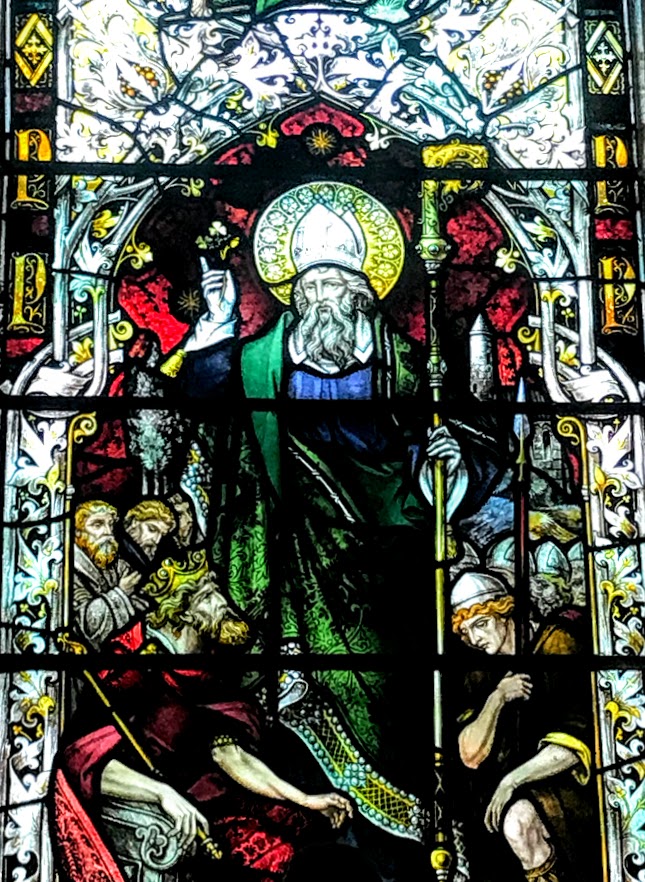
A statue of Saint Patrick in Saint Patrick’s Church, Soho Square, London (Photograph: Patrick Comerford, 2025)

Patrick Comerford

Today is Saint Patrick’s Day [17 March], and this afternoon I am allowing my mind’s eye to travel on a ‘virtual tour’, revisiting a dozen cathedrals and churches dedicated to Saint Patrick.

To mark Saint Patrick’s Day two years ago, I offered a similar ‘virtual tour’ to a dozen cathedrals and churches in Ireland dedicated to Saint Patrick: Saint Patrick’s Cathedral, Dublin; the two Saint Patrick’s Cathedrals in Armagh; the Saint Patrick’s Cathedrals in Trim, Co Meath, and in Cavan; the two Saint Patrick’s Churches in Donabate, Co Dublin; and Saint Patrick’s Church in Dalkey, Co Dublin, Wicklow Town, Ballysteen, Co Limerick, and Waterford City; and the ruins of Saint Patrick’s Church, at the end of High Street, where I once lived in Wexford.

In today’s ‘virtual tour’ with Saint Patrick, I am returning to two cathedrals or pro-cathedrals in Ireland, the college chapel where I graduated, the two churches where my both sets of grandparents were married, two churches in Co Limerick, where I lived for five years, a church in Skerries where I did ‘Sunday duty’ during a vacancy many years ago, a church in Co Kilkenny where another Canon Comerford was once parish priest, and three churches named after Saint Patrick that I have visited within the last six months or in Belfast, London and Sarawak.

1, Saint Patrick’s Cathedral, Skibbereen, Co Cork:

Saint Patrick’s on North Street, Skibbereen, Co Cork … is it a cathedral, or is it a parish church? (Photograph: Patrick Comerford)

Saint Patrick’s Cathedral on North Street, Skibbereen, West Cork, is the 200-year-old Roman Catholic parish church in Skibbereen. It is often referred to as the cathedral of the Diocese of Ross, although Cork and Ross is now a united diocese.

The foundation stone was laid in 1825, and the church was designed as a plain Greek Revival T-plan church by the Revd Michael Augustine Riordan, a priest-architect from Doneraile, Co Cork.

A plaque on the west gable is inscribed: Deo Opt Max et Beato Patritio Parochus Populusque extruere AD 1825 Venite adoremus et procidamus ante Deum (‘To the great glory of Almighty God and the Blessed Patrick, the parish priest and people built this church in AD 1825. Come let us adore and fall down before God’).

George Coppinger Ashlin gave the cathedral the splendour it retains to this day (Photograph: Patrick Comerford)

The most significant improvement to Saint Patrick’s was carried out in the early 1880s, when Bishop William Fitzgerald commissioned AWN Pugin’s son-in-law, the Cork-born architect George Coppinger Ashlin (1837-1921), to design a radical modernisation of the church. Ashlin was also the architect of Saint Colman’s Cathedral, Cobh, for the Diocese of Cloyne.

Ashlin gave the cathedral the splendour it displays to this day, and reconfigured the church in the shape of a Latin cross. The east wall behind the original High Altar was opened; a semi-circular apse was added; the apse was embellished by three stained-glass windows; the High Altar, dedicated to the memory of Bishop Michael O’Hea (1858-1876), and the Marian Altar, supplied by Pearse and Sharpe of Dublin, were erected.

The arcade of three arches above the sanctuary and two dividing the transepts from the nave, the polished pillars of granite, the coffered ceiling which they support, all date from 1882-1883.

The white marble altar rail was the work of Pearse and Sharp of Dublin; James Pearse was the father of the 1916 leader Padraig Pearse. The wrought iron panels, with their floral and leaflet decoration, were the work of Eugene McCarthy of Skibbereen.

The High Altar was consecrated on the first Sunday in May 1883 and the reconstructed church was blessed and re-opened.

2, Saint Patrick’s Pro-Cathedral, Dundalk, Co Louth:

Saint Patrick’s Pro-Cathedral, Dundalk, Co Louth … Thomas Duff modelled the exterior on the Chapel of King’s College, Cambridge (Photograph: Patrick Comerford)

Modern Dundalk was first laid out by James Hamilton, 1st Earl of Clanbrassil, in the mid-18th century. Around the same time, Dundalk Grammar School was founded as a Charter School in 1739. The town continued to grow and prosper in the 18th and 19th centuries, thanks to the patronage of the Jocelyn family, Earls of Roden, the industrial revolution and the arrival of the railway.

The growing Roman Catholic population was becoming more prosperity, and the architecture of their new churches reflects their growing confidence. The principal Roman Catholic church is Saint Patrick’s, known locally as the Pro-Cathedral. It was designed by the Newry architect Thomas Duff (1792-1848), who modelled the interior on Exeter Cathedral, where Richard FitzRalph of Dundalk was consecrated bishop, and the exterior on King’s College Chapel in Cambridge – it is curious to note that the Vicar of Dundalk at the time, the Revd Elias Thackeray, was a former Fellow of King’s College.

Thomas Turner’s entry curtain at Saint Patrick’s in Perpendicular Gothic (1850) was inspired by the curtain at King’s College, Cambridge (Photograph: Patrick Comerford)

Building work on Saint Patrick’s began in 1834. The travel writer and Church of Ireland clergyman, the Revd Caesar Otway, met Duff in Cambridge the following year making drawings of King’s College Chapel for his new designs. At the same time, Duff also designed the Methodist Church in Jocelyn Street (1834) in the Greek revival or classical style, and the Presbyterian Church across the street (1839) in the Tudor Gothic style.

Duff died in 1848 following a stroke after his daughter’s death. Thomas Turner’s entry curtain in Perpendicular Gothic, inspired by the curtain at King’s College, Cambridge, was erected two years later. But the Famine disrupted work at Saint Patrick’s, and did not resume until 1860. The church was completed by JJ McCarthy, the ‘Irish Pugin,’ who designed the high altar, the reredos and the Gothic sedilia in Caen stone. Pugin’s son-in-law, George Coppinger Ashlin, designed the Italian mosaics in the chancel by Oppenheimer and the pulpit. The stained glass is by Mayer and Earley, who had worked on many of Pugin’s churches in Dublin. Ashlin’s later tower was modelled on Gloucester Cathedral, although it interrupts the grand Cambridge-like main façade.

3, Saint Patrick’s College Chapel, Maynooth, Co Kildare:

The chapel at Saint Patrick’s College, Maynooth, Co Kildare (Photograph: Patrick Comerford)

I received my BD in theology from the Pontifical University in the chapel in Saint Patrick’s College, Maynooth, Co Kildare, in 1987. Later, I was a post-graduate student in history at Maynooth, and I spent a day on a retreat in the chapel before my ordination as priest in 2001. Since then, I have been a visiting lecturer in Maynooth, co-chaired conferences, contributed chapters, papers and book reviews to books and journals edited in Maynooth, and I was involved in organising a retreat for students from the Church of Ireland Theological Institute (CITI) in Maynooth in 2016.

Those books include a recent history of Maynooth, We Remember Maynooth: A College across Four Centuries, edited by Salvador Ryan and John-Paul Sheridan (Dublin: Messenger Publishing, 2020).

Inside the chapel at Saint Patrick’s College, Maynooth, Co Kildare … I received my BD in the chapel in 1987 (Photograph: Patrick Comerford)

The chapel, built by public subscription, was designed by the architect JJ McCarthy, the foundation stone was laid in 1875, and the chapel opened on 24 June 1891.

It is in French 14th-century Gothic style, and is more ornate than AWN Pugin’s college buildings in Maynooth. The interior was designed by the architect William Hague, the stained glass windows are by Mayer of Munich, Lavers and Westlake of London and Cox Buckley of London and Youghal, and NHC Westlake designed the Pre-Raphaelite style Stations of the Cross and the ceiling panels.

The carved oak choir-stalls that fill the whole church were produced by Connollys of Dominick Street, Dublin. Many of the mosaics are in Italian glass by the Earley Studios of Camden Street, Dublin.

4, Saint Patrick’s Church, Donabate, Co Dublin:

Saint Patrick’s Church, Donabate … George Luke O’Connor was inspired by Pugin’s cathedral in Birmingham (Photograph: Patrick Comerford)

My paternal grandparents, Stephen Comerford (1867-1921) of Rathmines and Bridget Lynders (1875-1948) of Portrane, were married in Saint Patrick’s Church, Donabate, on 7 February 1905. The witnesses at their wedding were her cousin Lawrence McMahon and her younger sister Mary Anne Lynders (1879-1956), who later married John Sheehan.

Saint Patrick’s Church, Donabate, was designed by the Dublin architect George Luke O’Connor, for the Very Revd W Magill, PP, and was consecrated by Archbishop Walsh of Dublin on 9 August 1903.

O’Connor designed many churches, schools and cinemas, and it always strikes me that his church in Donabate is strongly influenced by Pugin’s designs for Birmingham Cathedral.

Inside Saint Patrick’s Church, Donabate, Co Dublin (Photograph: Patrick Comerford)

This is a Gothic, gable-fronted cruciform church with an apse and tower. The family tradition is that much of the work in the church interior is my grandfather’s work. The high altar, erected in 1906, is the work of Patrick Tomlin & Sons of Grantham Place. The canted apse has a painted ceiling.

This red brick church is built in English garden wall bond. The features include decorative buttressing, limestone dressing and string courses, terracotta details in the eaves, pointed arched doors with limestone surrounds, the exposed timber truss, barrel vaulted ceiling, tongue and grooved timber doors with elaborate cast-iron hinges, cast-iron pillars, marble columns, encaustic tiles, the ornate rose west window, lancet windows and the Harry Clarke stained glass.

5, Saint Patrick’s Church, Millstreet, Co Cork:

Saint Patrick’s Church, Millstreet, was designed by the priest-architect Michael Augustine Riordan (Photograph: Patrick Comerford)

Saint Patrick’s Church is an imposing feature on the streets of Millstreet, and its fine façade marks out the church as the most accomplished historic building in the town. The church, built in 1833-1835, was designed by the Revd Michael Augustine Riordan (1783-1848), a priest-architect from Doneraile who founded the South Presentation Monastery (1828) in Cork, and whose best-known work is probably Saint Patrick’s Cathedral, Skibbereen.

My maternal grandparents, Thomas Michael ‘Corduroy’ Murphy (1882-1949), later of Mackay, Queensland, Australia, and Maria Crowley (1882-1953) of Millstreet, were married in Saint Patrick’s 110 years ago, on 3 March 1915.

The west front porch has a timber panelled double-leaf door, stepped-profile carved limestone surround with plinths and Celtic interlace decoration in relief. Above the door, the carved limestone pediment has a cross finial, and a render, relief panel has a crucifixion scene between an image of the Good Shepherd and a scene of Saint Patrick baptising Saint Aonghus at Cashel.

The east front porch has a moulded archivolt with scroll keystone, all set into a carved limestone doorcase with carved limestone panelled pilasters, decorative capitals and a carved limestone open-bed pediment with cross finial. Above the timber panelled double-leaf doors, the tympanum has a render scene depicting an outdoor Mass, perhaps at a penal rock.

The carving above the west porch door (Photograph: Patrick Comerford)

Saint Patrick’s Church has a window attributed to Harry Clarke and two windows by Clement Watson & Co of Youghal and erected by the Crowley in memory of my maternal great-grandparents Denis and Margaret Crowley, who are buried in the churchyard outside.

Saint Oliver Plunket is depicted in a window with the inscription: ‘Erected to the memory of Denis and Margaret Crowley of Millstreet by their son Cornelius. 1944.’ Facing it, a a second window depicts the Apparition at Lourdes and has the same wording.

Denis Crowley died on 8 March 1912 at Drishane Rectory, Liscahane, Millstreet, the home of his son Con Crowley, later of Finnstown House, Lucan, Co Dublin – so, you could say, I was the third generation in four in my family to live in a rectory. Margaret Crowley died at the home of her daughter, my grandmother Maria Murphy, on Main Street, Millstreet, on 9 March 1923.

6, Saint Patrick’s Church, Clare Street, Limerick:

Saint Patrick’s graveyard, Limerick … the site of a mediaeval church dedicated to Saint Patrick (Photograph: Patrick Comerford)

There were five parishes in the mediaeval city of Limerick: Saint John’s, Saint Mary’s, Saint Michael’s, Saint Munchin’s and Saint Patrick’s. As one of these five original mediaeval parishes, Saint Patrick’s once included the old parishes of Ballysimon, Derrygalvin and Kilmurry (now Monaleen).

Saint Patrick’s Well in Singland was once in a small field but is now surrounded by housing estates. It is half-way along Saint Patrick’s Road, on the west side, at the bottom of the hill on which Saint Brigid’s Church stands.

Local lore claims that this well is where Saint Patrick baptised Cairtheann, the son of Blatt and the Chief of the Dál gCais, in the year 440 CE. According to the legend, when Saint Patrick was building his church, he could not find any water to help in the project. He prayed for water and the well sprang up.

It is claimed that the print of his feet can be seen on one of the rocks at the well, and there was supposed to be a rocky bed where Saint Patrick slept. It is claimed that the water cures sore eyes, although looking into the well this week the water looks more likely to cause infections than to cure anything.

Saint Patrick’s Well at Singland in Limerick … the statue was erected in 1904 (Photograph: Patrick Comerford)

A statue of Saint Patrick was erected at the well in 1904 by the priests and parishioners, and a plaque behind the statue lists their names. But over a century later, while the grass and the paths around the well are well maintained, the water in the well is filthy and Saint Patrick’s mitre has been broken, not standing the test of time over more than a century.

On the top of the hill, Saint Patrick’s Church may have stood on the site of Saint Patrick’s Graveyard, next to Saint Brigid’s Church, which dates from the 1970s.

Saint Patrick’s civil parish was situated on both banks of the River Shannon and was distributed over three baronies in Co Limerick and Co Clare: Bunratty Lower, Clanwilliam and the barony of the City of Limerick.

There was a church on the site in Singland from at the mediaeval period. But it was in ruins by the 17th century. The Down Survey Map of 1683 shows a round tower on the site, but this had fallen by the early 19th century.

By 1711, Saint Nicholas’s Parish in the Roman Catholic Church had been joined with Saint Patrick’s. The Harold family built a church in Pennywell in 1750 to serve the needs of Roman Catholics in this area.

Meanwhile, the old Saint Patrick’s graveyard continued in use. The oldest identified headstone was erected by John Sexton for his parents who died in 1770 and 1771. The tombs include the crumbling and part-shattered tomb of John Young (1746-1813), Bishop of Limerick (1796-1813).

7, Saint Patrick’s Church, Clare Street, Limerick:

Inside Saint Patrick’s Church on Clare Street, Limerick (Photograph: Patrick Comerford)

Saint Patrick’s Church on Clare Street, Limerick, was built over 200 years ago in 1816, and replaced a Penal Chapel on the Rhebogue Road. The church was built while Father Patrick McGrath was Parish Priest. Bishop Charles Tuohy of Limerick, dedicated it to Saint Patrick on 25 August 1816.

It is a simple, but well-built example of a pre-Emancipation church and it claims to be the oldest purpose-built Catholic church in Limerick City that is still in use. It is a simple nave and transept or T-plan, gable-fronted stone church with a bell-cote and a wooden ceiling. The ceiling is high and large wooden beams hold up the ceiling of the church. The church was renovated in 1835.

With its good masonry and fine roof, it is an important part of the streetscape in this area of Limerick. The central window at the front gable has stone moulding. Below is an ogee-headed front entrance with a clustered, carved limestone bull-nose moulding surmounted by pinnacles with replacement stone finials. Inside the church, there is an elaborate timber roof with a groin vault.

The statue of Saint Patrick in Saint Patrick’s Church, Limerick (Photograph: Patrick Comerford)

Inside the church, there is a stained-glass window of Saint Patrick over the main entrance to the church, and stained-glass windows depicting the Sacred Heart, Saint Joseph, the Immaculate Heart of Mary, Saint Brigid and Saint Ita.

There is a large crucifix on the stone wall above the high altar, and the reredos, donated by the Presentation Sisters has six statues, three male saints and three female saints: Saint Columba, Saint Munchin, Saint Patrick, Saint Bridget, Saint Ita and Saint Lelia. The front of the altar is carved with a Judgment scene and a mosaic on the floor in front of the altar depicts the Lamb of God with a flag. To the right of the altar there is a large, colourful statue of Saint Patrick.

To meet the needs of the growing population in the area, Bishop Henry Murphy created the new parish of Monaleen in 1971 from the area in the west of Saint Patrick’s parish. Saint Brigid’s Church, on the hill off the N7, was dedicated by Bishop Jeremiah Newman in 1975.

The old graveyard at Saint Patrick’s, on the hill beside Saint Brigid’s, is now closed to burials. Saint Patrick’s Church celebrated its bicentenary in 2016.

8, Holmpatrick Church, Skerries, Co Dublin:

Holmpatrick Church and the wetlands at Kybe Pond in Skerries, Co Dublin (Photograph: Patrick Comerford)

When I was living in Co Dublin, Skerries was one of my favourite choices for a beach walk. I have known Skerries since my teens, and around 2010-2011, during a vacancy, I was privileged to do ‘Sunday duty’ in Holmpatrick Church, and to speak at Lenten talks. I also organised a number of Ash Wednesday retreats in Skerries for CITI staff and students.

Holmpatrick Parish Church is a Gothic Revival, pre-disestablishment church, built in 1867. It has an ornate interior, with neo-mediaeval decoration, and interesting stained glass windows, especially those on the balcony.

The Church was designed by the architect and artist James Edward Rogers (1838-1896) was consecrated on 2 September 1868. The limestone came from the Milverton quarries, near Skerries, and Walter Doolin was the contractor. Other churches by Rogers include Saint Mary’s Church, Howth; Kenure Church and the nearby Rectory in Rush, Co Dublin, built for Sir Roger Palmer (1832-1910) of Kenure Park; Kilfergus Church, Glin, Co Limerick; Saint Patrick’s Church, Kilcock, Co Kildare; Kilkeedy Church, Clarina, Co Limerick; Saint Columba's Church, Omagh, Co Tyrone; as well as the former Saint Bartholomew’s Vicarage and the parochial hall in Ballsbridge.

Looking across to the towers and spires of Holmpatrick from Skerries Mills (Photograph: Patrick Comerford)

Holmpatrick Church has some memorial tablets from an older church that stood nearby. One describes James Hamilton of Holmpatrick as a ‘gentleman who during a long and most active life displayed that zealous energy and ingenious integrity that forms a useful and virtuous man … He died the 20th of October 1800, in the 73rd year of his age … Of the uncommonly numerous offspring of thirty six children he was survived by eight sons and eight daughters.’

I think he gave new meaning to ‘zealous energy’! Hamilton’s descendants include Richard Branson, but with his ‘uncommonly numerous’ 36 children born 2½ centuries ago, Hamilton must be the ancestor of thousands upon thousands of people living in Ireland today.

Behind the church stand the ruins of an earlier church built in 1722 by the Hamilton family after they acquired Holmpatrick from the Earls of Thomond in 1720. When the church was demolished in the 1860s, the square tower was left standing – supposedly as a landmark for ships, although it is also a reminder of the mediaeval monastic past of this site.

Local lore says that when Saint Patrick was expelled from Wicklow he moved to Saint Patrick’s Island off Skerries in 432 CE. Legend says that one day, while Saint Patrick was on shore buying groceries, the people of Skerries rowed over to his island where he kept a goat for milk, stole the goat, took her back to the mainland and ate her. When Saint Patrick returned he was angry, and with one great step he bounded from his island to Red Island. There he questioned the local people, and when they denied their theft he took away their powers of speech. They could only bleat like goats, until they eventually admitted their crime.

It is said that on Red Island there is still a mark on the rock that is nothing less than Saint Patrick’s footprint. In all my visits to Skerries, I have failed to see the saint’s footprint on Red Island.

9, Saint Patrick’s Church, Ballyraggett, Co Kilkenny:

Saint Patrick’s Church, Ballyragget, Co Kilkenny, stands on the site of an earlier, Penal-era chapel (Photograph: Patrick Comerford)

Both Saint Patrick’s Church, the Roman Catholic parish church in Ballyragget, Co Kilkenny, and Ballyragget Castle are difficult to find, with the church at the end of a side street between the Square and Castle Street, and the castle at the end of a lane behind locked gates. The obscure location of the church is explained because it stands on the site of an earlier chapel that may have been built first during the Penal days in the 18th century.

Saint Patrick’s is an imposing large-scale church built in 1842 under the direction of William Kinsella, Bishop of Ossory (1793-1845), for Father John Foran, Parish Priest of Ballyragget, who died in 1843, to designs by William Deane Butler (ca 1794-1857).

Butler, who was also the architect of Saint Kieran’s College, Kilkenny, designed the church in the Gothic Revival style. It is similar in many details to other contemporary parish churches in the area, including Castlecomer and Freshford, representing a form of house style developed by Butler while he was the resident architect for the Diocese of Ossory.

The grave of Canon James Comerford, who died in 1948 (Photograph: Patrick Comerford)

The Gothic-style reredos in Caen stone was designed in 1869 by Pugin’s son-in-law, George Coppinger Ashlin and depicts the Sacrifice of Abraham, the Crucifixion and the Sacrifice of Melchizedek. The front of the altar depicts the worship of the Lamb on the Throne (see Revelation 4). The mosaic work in the sanctuary is by Ludwig Oppenheimer Ltd (1915).

The church was renovated in 1924 and again in 1983-1985, and some new windows were added after 2000.

Because the church saw few interior alterations after the Second Vatican Council (1963-1965), it retains its rich interior scheme, with high quality carpentry, decorative plasterwork, and stained-glass windows.

The churchyard on the north side of the church has many cut-limestone Celtic High Cross-style gravestones dating back to 1842, including the grave of Canon James Comerford, Parish Priest of Ballyragget, who died on 12 June 1948 at the age of 69.

10, Saint Patrick’s Church, Donegall Street, Belfast:

Saint Patrick’s Church on Donegall Road, Belfast, was built in the 1870s, replacing a church built in 1815 (Photograph: Patrick Comerford, 2024)

Saint Patrick’s Church on Donegall Street, Belfast, is a Victorian gem and an oasis of peace in the heart of the city and it is part of community life in the city centre. The church serves a large local resident community and a thriving population in the Cathedral Quarter, the city’s cultural and social heartland, and the students and staff in the neighbouring Belfast campus of Ulster University, along with a busy hospital, a large primary school, and residential and care homes.

The first church on the site was built in 1815, the year of the Battle of Waterloo, and it was the second Catholic church built in Belfast since the Reformation. The present Saint Patrick’s Church, the second on the site, was designed in the Gothic Revival style by Timothy Hevey (1846-1878) and Mortimer Thomspon. It is said the church was built ‘by the pennies of the poor’.

Two of the six windows in the south transept illustrating the life and mission of Saint Patrick (Photograph: Patrick Comerford, 2024)

The original windows in the right transept were destroyed by an explosion during the ‘Troubles’, but six newly-installed windows illustrate the life and mission of Saint Patrick.

The church has a triptych by Sir John Lavery, who was baptised in the older, smaller church. He painted ‘The Madonna Of The Lakes’ (1919), with his second wife, Hazel Trudeau, as the model for the Virgin Mary and his daughter Eileen and step-daughter Helen as models for Saint Patrick and Saint Brigid.

The triptych originally stood on an altar designed by Edwin Lutyens, a friend of Lavery, and was illuminated by two candlesticks by Lutyens. Both the altar and the candlesticks were lost during reordering works out in the 1960s and 1970s, and the frame around the triptych, decorated with Celtic knotwork, remains the only Lutyens-designed artefact in Northern Ireland.

11, Saint Patrick’s Church, Soho:

Saint Patrick’s Church on Soho Square is one of the oldest post-Reformation Catholic parish churches in London (Photograph: Patrick Comerford, 2025)

Saint Patrick’s on Soho Square is one of the oldest post-Reformation Catholic parishes in London, and the original church on the site was the first Catholic place of worship to open in London after the Roman Catholic Relief Acts were passed in 1778 and 1791 and the first post-Reformation church in England dedicated to Saint Patrick.

The first church on the site was in a building behind Carlisle House and was consecrated in 1792. The present church, built in 1891-1893, is a Grade II* listed building designed by the Leeds architect John Kelly.

Father Arthur O’Leary (1729-1802), a celebrated Irish Capuchin preacher from Fanlobbus, Dunmanway, Co Cork, is the founding figure of this church.

Inside Saint Patrick’s Church, Soho Square, designed by the Leeds architect John Kelly and built in 1891-1893 (Photograph: Patrick Comerford, 2025)

The present church on Soho Square was designed by John Kelly of Leeds and was built in 1891-1893. The church was built in the Italian Renaissance style. The main entrance has a Roman-style porch with Corinthian columns. Above the entrance is the inscription: Ut Christiani ita et Romani sitis (‘Be ye Christians as those of the Roman Church’), a quotation from the writings of Saint Patrick.

Many alterations have been made to Kelly’s church since it was built, and Saint Patrick’s Church was renovated and refurbished at a cost of £4 million in 2010-2011. Today, only a handful of resident Catholics remains in the parish. Hundreds of people continue to attend Saint Patrick’s Church, but they are mostly visitors, tourists and people working in the area. The church also attracts immigrants and migrant workers from across London, and Mass is regularly celebrated in both Spanish and Portuguese.

12, Saint Patrick’s Church, Semadang, Sarawak:

Saint Patrick’s Chapel (left), in orange and white, and Saint Patrick’s School (right), in green and white, beneath the mountain in Semadang, south of Kuching (Photograph: Patrick Comerford, 2024)

Saint Patrick’s Chapel, a mission chapel in Semadang, dates back to the 1930s, and neighbouring Saint Patrick’s School dates from 1953. They are among the churches, chapels and schools in the Diocese of Kuching that I visited Father Jeffry Renos Nawie during a recent visit to Sarawak.

Semadang is about a 1½-hour drive south from Kuching, half-way between Kuching and the border with Indonesia, and just a few miles north of the Equator. The Sarawak River in this area is known as the River Semadang (Sungai Semadang).

Two villages in the area, Kampung Semadang and Kampung Danu, are home to the Bidayuh community.

Saint Patrick’s Chapel, Semadang, was first built in the 1930s and was rebuilt and dedicated in 2009 (Photograph: Patrick Comerford, 2024)

Saint Patrick’s Church is in striking, bright orange and white colours, and the school beside it is in bright, striking green and white colours, so that the whole site looked to this Irish visitor like a bright eye-catching display of green, white and orange.

Perhaps the colour scheme is nothing more than coincidence, and I imagine few other visitors notice the vivid and colourful combination or make a mental association with the Irish flag.

Saint Patrick’s Chapel dates from the 1930s, and was probably given its name by missionaries from the Anglican mission agency SPG (now USPG, United Society Partners in the Gospel). The present church building was consecrated on 3 May 2009 by Bishop Bolly Lapok of Kuching. Bishop Bolly also became the Archbishop of the Church of the Province of South East Asia in 2012 and was installed in Saint Thomas’s Cathedral, Kuching. He retired in 2017.

The present priest-in-charge of Saint Patrick’s is the Revd Kamor Diah. Parishioners told me how Saint Patrick’s has a congregation of about 200 on Sundays, but these numbers can reach 800 at major festivals and celebrations.

Visiting Saint Patrick’s School in Semadang, beside Saint Patrick’s Chapel (Photograph: Patrick Comerford, 2024)

16 August 2023

Saint Kevin’s Church:
a prime example of
the Gothic Revival
in a Dublin church

Saint Kevin’s Church on Harrington Street, Dublin, was designed in the Gothic Revival style by Pugin and Ashlin (Photograph: Patrick Comerford, 2023)

Patrick Comerford

During last week’s return visit to Dublin, two of us stayed in Keavan’s Port Hotel on Camden Street, originally the premises of the Earley and Powell stained glass studios and the Dublin branch Hardman’s of Birmingham.

During our visit, I also visited 37 Wexford Street, where Robert Croker or Robert Noonan, the author of The Ragged-Trousered Philanthropists, best-known by his pen name Robert Tressell was born in 1870.

Robert Tressell was baptised in Saint Kevin’s Church on Harrington Street, and that church also has an impressive collection of stained-glass windows from the Earley and Powell stained glass studios.

The church is a three-minute walk (270 metres) around the corner from Camden Street, so I took the opportunity to revisit the church early in the morning.

Saint Kevin’s Church fills a large site bordered by Harrington Street, Heytesbury Street, Synge Street and Synge Street CBS schools (Photograph: Patrick Comerford, 2023)

Saint Kevin’s Church and the presbytery next door fill a large site bordered by Harrington Street on the south side, Heytesbury Street on the west, Synge Street on the east and Synge Street CBS schools to the north.

Saint Kevin’s Church is a prime example of Gothic Revival architecture in Dublin in the late 19th century. It was designed by Pugin and Ashlin at a time when their partnership was breaking up, and the Early and Powell studios had a direct link with Hardmans of Birmingham, who worked closely with AWN Pugin.

The name of the church comes from the mediaeval church, Saint Kevin’s, nearby in Camden Row, which dated back to at least the 12th century, and which was the Church of Ireland parish church.

Inside Saint Kevin’s Church facing the west or liturgical east end (Photograph: Patrick Comerford, 2023)

Saint Kevin’s Parish was formed out of Saint Catherine’s Parish between 1855 and 1865. A site from a new church first leased from James Perrin and then bought through Hugh Lundy. The building committee was chaired by Sir James Power, who also chaired the committee for building Saint Catherine’s Church on Meath Street.

The new Saint Kevin’s Church was built between 1868 and 1872. By a vote of 14-2, Pugin and Ashlin were the winners of the architectural competition between themselves and WF Caldbeck. The partnership was formed in 1860 by Edward Welby Pugin, AWN Pugin’s son, and his assistant and future brother-in-law George Coppinger Ashlin. Ashlin opened an office at 90 Saint Stephen’s Green, Dublin, that year and managed the firm’s Irish business.

The partnership was dissolved towards the end of 1868, shortly after winning the competition to design Saint Kevin’s and not long after Ashlin married Pugin’s sister Mary in 1867.

The stained glass windows in Saint Kevin’s Church represent the work of Earley and Company from 1861 to 1975 (Photograph: Patrick Comerford, 2023)

The stained glass windows of Saint Kevin’s Church are unique as they trace the history of Earley and Company from 1861 to 1975. The Earley and Powell studios designed much of the stained glass windows in the church, including those in the apse depicting the Crucifixion and Christ in Majesty (1872) and the Resurrection and the Last Supper (1873), and the windows in the transepts depicting saints (ca 1880).

The Earley and Powell studios were active in Dublin from 1864 until 1893, and the firm was one of the largest and most prestigious ecclesiastical decorators both in Ireland and Britain. Generations of the Earley family have been involved in maintaining and designing windows in the church, culminating in William Earley creating a window for the south transept.

The business was initially established by Thomas Earley and the brothers Edward and Henry Powell in 1853 as a branch of the Birmingham firm of church decorators, John Hardman & Co – the Powells were nephews of John Hardman.

The organ was installed in 1903 and the grissille stained glass, the largest of its kind in Ireland, was installed that year (Photograph: Patrick Comerford, 2023)

The Dublin branch of Hardman’s of Birmingham was first at 48 Grafton Street, and by February 1860 they had set up a workshop at 1 Upper Camden Street. After Hardman’s gave up their connection with the Dublin business in 1864, it continued running from Upper Camden Street as Earley & Powells or Earley & Powell. Edward Powell died in 1876, Henry Powell died in 1882, and Thomas Earley died in 1893.

The foundation stone of the new church was laid on 3 June 1868, and the contractor was Michael Meade. The building work was delayed by a two-month strike by workers seeking a pay rise form 30 to 33 shillings a week – they eventually accepted 32 shillings.

The church was completed within four years and was dedicated on Saint Kevin’s Day, 3 June 1872, by Cardinal Paul Cullen, Archbishop of Dublin. The setting for the inaugural Mass was Haydn’s Imperial Mass No 3, also known as Missa in Angustiis and the ‘Lord Nelson Mass.’

The Lady Chapel in the south transept (liturgical north) in Saint Kevin’s Church (Photograph: Patrick Comerford, 2023)

Saint Kevin’s Church is a Gothic Revival church, forming part of a significant group of religious and education buildings between Kelly’s Corner and the east end of the South Circular Road.

The church is oriented on a west-east axis, rather than the traditional east-west alignment proposed in the original plans. Cardinal Cullen wanted the church to open onto Synge Street and the Christian Brothers’ schools at the east end, and a presbytery built on the west end, at the corner of Harrington Street and Heytesbury Street.

Saint Kevin’s is a cruciform-plan, double-height church, with a gable-fronted five-bay nave, two-bay transepts with gabled porches, sacristies, and a five-sided apse at the west end (liturgical east). There are octagonal-plan corner turrets at the nave and transepts, and pinnacled buttresses at the nave. A proposed church spire was never built. The juxtaposition of rusticated granite and Portland stone dressings provides textural and tonal variation to the exterior of the church.

The Baptistry in Saint Kevin’s Church (Photograph: Patrick Comerford, 2023)

Inside, the church is oriented on a west-east axis, rather than a traditional east-west alignment. The unusual pinnacled reredos in the chancel provides a focal point to the west end or liturgical east end of the church.

The sculptor Francis Hubert Earley carved the statues of Saint Michael and Saint Gabriel statues flanking the high altar.

The marble pulpit is by James O’Callaghan of Bachelor’s Walk and has a carved timber canopy. O’Callaghan also made the baptismal font. The gallery at the liturgical west end incorporates the organ and is supported on a segmental-headed arcade. The pews are particularly noteworthy, and are probably by Hardman & Co.

A new organ was installed in 1903 and the grissille stained glass, the largest of its kind in Ireland, was installed that year. The work was carried out by Earley and Co of Camden Street.

The High Altar in Saint Kevin’s Church has been placed back in its original position in the chancel (Photograph: Patrick Comerford, 2023)

After the liturgical reforms of Vatican II, the altar was moved out from the wall to facilitate the versus populum orientation of the Mass.

Saint Kevin’s Church has been the home of the Dublin Latin Mass Chaplaincy since 2007. It is the only church in Dublin where the Extraordinary Form of the Roman Rite, or Traditional Latin Mass, is licitly celebrated.

The Altar has been placed back in its original position in the chancel area to facilitate the ad orientem style used in Tridentine Mass.

A major restoration of the sanctuary was completed in November 2013. This included repairing the stained glass and redecorating and repainting the sanctuary wall and ceiling, and redecorating the walls according to the original Victorian era stencil-work designs.

The restoration work continues at Saint Kevin’s, slowly returning the church to the original Gothic Revival splendour envisaged by Pugin and Ashlin and by the Earley and Powell studios in Camden Street.

Restoration work is returning Saint Kevin’s to the original Gothic Revival splendour envisaged by Pugin and Ashlin and by Earley and Powell (Photograph: Patrick Comerford, 2023)

16 March 2023

A ‘virtual tour’ of a dozen
churches and cathedrals to
celebrate Saint Patrick’s Day

Saint Patrick depicted in a window in Saint Patrick’s Church, Waterford (Photograph: Patrick Comerford)

Patrick Comerford

Tomorrow is Saint Patrick’s Day [17 March], and I am allowing my mind’s eye to travel back to Ireland this evening for a ‘virtual tour’ and to revisit a dozen cathedrals and churches dedicated to Saint Patrick.

1, Saint Patrick’s Cathedral, Dublin:

Saint Patrick’s Cathedral, Dublin, is the largest cathedral in Ireland (Photograph: Patrick Comerford)

Saint Patrick’s Cathedral, Dublin, is the largest cathedral and one of the most important pilgrimage sites in Ireland. Saint Patrick’s has been at the heart of Dublin’s history and culture for over 800 years, and the cathedral claims that its ‘story is a microcosm of the story of Ireland.’

The cathedral was founded in 1191 and is the national cathedral of the Church of Ireland, while Christ Church Cathedral is the diocesan cathedral for Dublin and Glendalough.

The chapter members of Saint Patrick’s represent from each of the dioceses in the Church of Ireland. The dean is the ordinary of the cathedral, and the most famous dean was Jonathan Swift.

Inside Saint Patrick’s Cathedral, Dublin (Photograph: Patrick Comerford)

The cathedral hosts a number of public national ceremonies and services, and the funerals of two Presidents, Douglas Hyde and Erskine Childers, were held there in 1949 and 1974. The Service of Nine Lessons and Carols takes place twice in December.

The present Dean of Saint Patrick’s is the Very Revd William Morton.

2, Saint Patrick’s Cathedral (Church of Ireland), Armagh:

Saint Patrick’s Cathedral, Armagh, stands on the hill that gives Armagh its name (Photograph: Patrick Comerford)

Saint Patrick’s Church of Ireland Cathedral in Armagh stands on the hill that gives Armagh its name – Ard Mhacha, the ‘Hill of Macha’. On the neighbouring hill stands Saint Patrick’s Roman Catholic Cathedral.

Macha was a legendary pre-Christian tribal princess associated with nearby Eamhain Mhacha, or Navan Fort, a major ritual site occupied from the late Neolithic and early Bronze Age, and thought to have been the centre of Iron Age Ulster. Eamhain Mhacha is associated with the epic Ulster cycle, the Táin Bó Cúailnge (‘The Cattle Raid of Cooley’) and its doomed hero, Cú Chulainn, the ‘Hound of Ulster.’

Saint Patrick is said to have acquired this hilltop enclosure and in the year 445 he built his first ‘Great Stone Church,’ the Church of the Relics, on the Druim Saileach (Sallow Ridge) Hill, a site close to Scotch Street, below the Hill of Armagh.

The monastic community that developed around Saint Patrick’s Church produced the Book of Armagh, a ninth century Irish manuscript now in the Library in Trinity College Dublin, and containing some of the earliest surviving examples of Old Irish.

The Vikings raised the monastery in Armagh on at least two occasions in the ninth century – in 839 and in 869. The church was also damaged in a lightning strike in 995. Brian Boru, who defeated the Vikings at the Battle of Clontarf on Good Friday 1014 – only to be executed as he prayed in his tent that evening – is said to be buried beside the north wall of the cathedral.

However, the church remained in ruins until 1125 when it was repaired and re-roofed by Bishop Cellach or Celsus. After his death, the see remained vacant for five years until he was succeeded by Saint Malachy in 1134. The most far-reaching work of restoration was carried out by Archbishop Patrick O’Scanlon (1261-1270). Further damage required major rebuilding by Archbishop Milo Sweetman in the 1360s and by Archbishop John Swayne in the 1420s.

In the 1560s, the Earl of Sussex fortified the cathedral against Shane O’Neill, but in 1566 O’Neill ‘utterly destroyed the cathedral by fire, lest the English should again lodge in it.’ A century later, in 1641, Sir Phelim O’Neill burned down the cathedral.

Archbishop James Margetson carried out repair work in the 1660s, and further restorations were undertaken in 1727, 1765, 1802, 1834, 1888, 1903, 1950, 1970, and most recently in 2004 under Dean Herbert Cassidy.

Inside Saint Patrick’s Cathedral, Armagh (Photograph: Patrick Comerford)

The extensive restoration carried out between 1834 and 1837 was commissioned and largely paid for by Archbishop John George Beresford. The architect Lewis Nockalls Cottingham (1787-1847) addressed the structural vulnerability of the cathedral by restoring the nave walls to the perpendicular and removing the short wooden spire that can be seen on the cathedral seal. He also reopened the clerestory windows that had been blocked by Archbishop Margetson and restyled them in decorated Gothic, enlarged the choir windows and overlaid the timber vaulting with plasterwork.

The stone screen separating the nave from the choir shows how Cottingham was influenced by the ideas of AWN Pugin and the early Gothic Revival. These influences can be seen too in his restoration of the High Altar from the west end, where it had been relegated by Archbishop William Stewart at the beginning of the 19th century, to its proper eastward position in the form of a stone altar backed by a reredos of canopied niches.

According to William Makepeace Thackeray, Cottingham’s cathedral was ‘too complete … not the least venerable. It is as neat and trim as a lady’s drawing-room.’

Although the rood screen was removed in 1888, much of Cottingham’s work remains, although the basic shape of the cathedral is still as it was conceived by Archbishop O’Scanlon in the 13th century.

3, Saint Patrick’s Cathedral (Roman Catholic), Armagh:

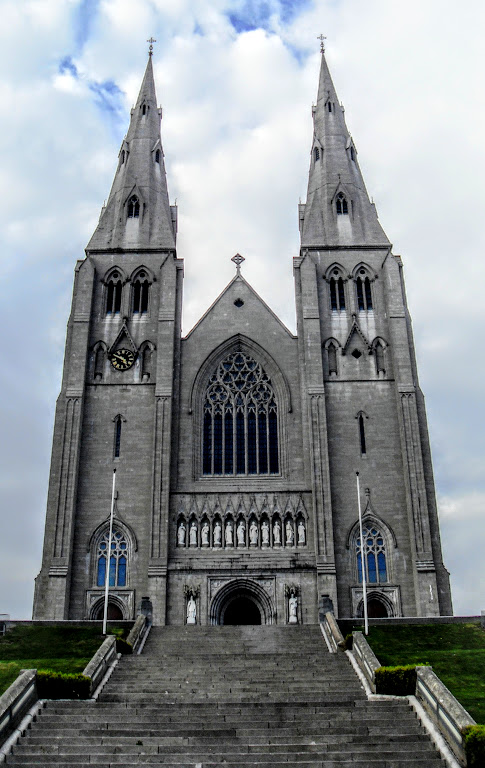
Saint Patrick’s Cathedral, Armagh, has a spectacular mixing of styles by two clashing architects (Photograph: Patrick Comerford)

Saint Patrick’s Roman Catholic Cathedral in Armagh which is an important architectural essay in Gothic Revival, and a spectacular mixing of styles by two clashing architects, with ‘fourteenth-century’ works standing on top of ‘sixteenth-century’ works.

The cathedral is fascinating – for while it was being built the architects changed, and the change of architects resulted in a decision to change the architectural style, just as the walls were half-way up.

The bottom half of Saint Patrick’s Cathedral was designed in 1838 in the English Perpendicular Gothic style by Thomas Duff of Newry, who also designed Saint Patrick’s Cathedral, Dundalk, and Saint Colman’s Cathedral, Newry.

Archbishop William Crolly (1835-1839) acquired the site from Richard Dawson (1817-1897), 1st Earl of Dartrey, a Liberal Unionist whose family gave their name to Dawson Street in Dublin.

In Dundalk, Duff had modelled his cathedral on the Chapel of King’s College, Cambridge. In Armagh, he drew on York Minster for his plans for Saint Patrick’s, which he wanted to build in the Perpendicular Gothic style.

The foundation stone was laid and blessed on Saint Patrick’s Day, 17 March 1840. But by the time work had begun on Duff’s cathedral, an architectural renaissance had taken place under the influence of Pugin. In 1853 a new building committee appointed JJ McCarthy as architect and he drew up was a continuation design in the 14th century, French Decorated Gothic style.

McCarthy began working in 1854, and Archbishop Joseph Dixon (1852-1866) declared Easter Monday 1854 ‘Resumption Monday.’

The architectural historian Jeanne Sheehy points out that McCarthy ‘completely changed the appearance of Duff’s design by getting rid of the pinnacles on the buttresses, the battlemented parapets on the nave and aisles, and by making the pitch of the roof steeper.’ However, Maurice Craig concludes that ‘in most ways it is a very successful building.’

Archbishop Dixon organised a great bazaar in 1865 that raised over £7,000 for the building project, and items for sale were donated by Pope Pius IX, the Emperor of Austria and Napoleon III. The cathedral was completed under Archbishop Daniel McGettigan (1870-1887) and was dedicated on 24 August 1873. The sacristy, synod hall, grand entrance, gates and sacristan’s lodge were built later to designs by William Hague, who was working on designs for a great rood screen when he died in March 1899. The solemn consecration of the cathedral took place in 1904.

The interior of Saint Patrick’s Cathedral, Armagh, was originally decorated by Ashlin and Coleman (Photograph: Patrick Comerford)

The interior decoration of the cathedral is also the work of different teams. The 1904 designs were the work of Ashlin and Coleman of Dublin, who were the heirs to Pugin’s style of work, but a great deal of this work has been removed in the wake of the liturgical reforms introduced by the Second Vatican Council.

An exquisite example of artistic workmanship – a magnificent, marble Gothic altar with a replica of Leonardo Da Vinci’s Last Supper carved by the Roman sculptor, Cesare Aureli, was moved to Saint Patrick’s Church, Stonebridge.

What was a fine late Gothic revival chancel has been replaced in with chunks of granite, brass screens were removed and then welded together to form a screen in front of the reredos of McCarthy’s Lady Chapel, modern tiling was laid on the floor of the entire sanctuary area and a new tabernacle was placed in the Sacred Heart Chapel which had been designed by Ashlin and Coleman. Nevertheless, Saint Patrick’s retains much of the majesty – and eccentricity – of Duff’s and McCarthy’s designs.

4, Saint Patrick’s Cathedral, Trim, Co Meath:

Saint Patrick’s Cathedral, Loman Street, Trim, is the Church of Ireland cathedral for the Diocese of Meath (Photograph: Patrick Comerford)

Saint Patrick’s Cathedral on Loman Street, on the north side of Trim, is the Church of Ireland cathedral for the Diocese of Meath. It claims to be the oldest Anglican church in Ireland – although this claim is disputed by a church in Armagh that says it is 20 years older than the cathedral in Trim.

The tower is part of the remains of the mediaeval parish church of Trim, and further ruins of this earlier church lie behind the cathedral.

Although the Diocese of Meath was without a cathedral after the dissolution of the monasteries in the 16th century, the Bishops of Meath have been enthroned in Saint Patrick’s since 1536. However, Saint Patrick’s did not become a cathedral until Saint Patrick’s Day 1955, and the deans continue to called Dean of Clonmacnoise. The tower clock at Saint Patrick’s commemorates Dean Richard Butler, the historian of Trim, who is buried on the south side of the cathedral.

The Dean of Saint Patrick’s is the Very Revd Paul Bogle.

5, Saint Patrick’s Cathedral, Cavan:

The Cathedral of Saint Patrick and Saint Felim stands on a hill at the end of Farnham Street in Cavan (Photograph: Patrick Comerford)

The Roman Catholic Cathedral of Saint Patrick and Saint Felim is the tallest and most prominent building in Cavan Town and stands at the end of Farnham Street, across the street from the older Church of Ireland parish church, which was completed in 1815.

Cavan Cathedral is a relatively modern cathedral, designed by the architect Ralph Henry Byrne (1877-1946) and built in neo-classical style between 1938 and 1947. However, the story of Cavan Cathedral dates back to the mid-18th century, when a small thatched chapel, without seating, was built in the town, on a site donated by the Maxwell family of Farnham Estate.

The small chapel continued in use until 1823, when it was replaced by a new church built on the same site in Farnham Street. At the time, the seat of the Roman Catholic Diocese of Kilmore was in Cootehill. But 20 years later, in 1843, Bishop James Brown of Kilmore (1829-1865) moved the seat of the diocese of Kilmore from Cootehill to Cavan.

The church was renovated in 1862 and Bishop Browne raised it to the status of a cathedral, dedicated to Saint Patrick. A decision was made in 1919 to build a larger cathedral on the site behind the old cathedral. Building work began in 1938, but was interrupted by World War II. Although the cathedral was completed in 1942 it was not consecrated until 1947.

Cavan Cathedral was designed in the style of a Roman basilica by Ralph Byrne (Photograph: Patrick Comerford)

For a short time, the old Gothic cathedral and the new Classical cathedral stood side-by-side. Then old Saint Patrick’s Cathedral was taken down, stone-by-stone, and was rebuilt, without its transepts, in Ballyhaise. There it stood for only a short time, and was demolished around 1952, when its stones were used to build a new church in Castletara.

The new cathedral was designed by Byrne along the lines of a Roman basilica with a Corinthian portico. His choice of the classical style was a deliberate rejection of the Gothic style popularised in Ireland by AWN Pugin and JJ McCarthy in the previous century, and a return to a style that had long been forgotten. No Roman Catholic cathedral had been built in the classical style since Saint Mel’s Cathedral was built in Longford in 1840.

Cavan Cathedral is oriented West-East rather than East-West. It is built of Wicklow granite and some limestone, with Portland stone details. The West Front (at the east) was inspired by Francis Johnston’s design for Saint George’s Church (Church of Ireland) in Hardwicke Street, Dublin (1802-1813).

The cathedral is cruciform in shape, designed like a Roman basilica, with a narthex, aisled nave, clerestory and apse. The portico has four Corinthian columns, and the dome over the crossing is supported by four marble columns. The cathedral also has six stained-glass windows in the nave and one in the south transept that come from the studios of Harry Clarke (1889-1931 and that were added in 1994.

6, Saint Patrick’s Church (Roman Catholic), Donabate, Co Dublin:

Saint Patrick’s Church, Donabate … George Luke O’Connor was inspired by Pugin’s cathedral in Birmingham (Photograph: Patrick Comerford)

My grandparents, Stephen Comerford (1867-1921) of Rathmines and Bridget Lynders (1875-1948) of Portrane, were married in Saint Patrick’s Church, Donabate, on 7 February 1905. The witnesses at their wedding were her cousin Lawrence McMahon and her younger sister Mary Anne Lynders (1879-1956), who later married John Sheehan.

Saint Patrick’s Church, Donabate, was designed by the Dublin architect George Luke O’Connor, for the Very Revd W Magill, PP, and was consecrated by Archbishop Walsh of Dublin on 9 August 1903.

O’Connor designed many churches, schools and cinemas, and it always strikes me that his church in Donabate is strongly influenced by Pugin’s designs for Birmingham Cathedral.

Inside Saint Patrick’s Church, Donabate, Co Dublin (Photograph: Patrick Comerford)

This is a Gothic, gable-fronted cruciform church with an apse and tower. The family tradition is that much of the work in the church interior is my grandfather’s work. The high altar, erected in 1906, is the work of Patrick Tomlin & Sons of Grantham Place. The canted apse has a painted ceiling.

This red brick church is built in English garden wall bond. The features include decorative buttressing, limestone dressing and string courses, terracotta details in the eaves, pointed arched doors with limestone surrounds, the exposed timber truss, barrel vaulted ceiling, tongue and grooved timber doors with elaborate cast-iron hinges, cast-iron pillars, marble columns, encaustic tiles, the ornate rose west window, lancet windows and the Harry Clarke stained glass.

7, Saint Patrick’s Church (Church of Ireland), Donabate, Co Dublin:

The sundial above the porch of Saint Patrick’s Church, Donabate (Photograph: Patrick Comerford)

Saint Patrick’s Church, on The Square, Church Road, Donabate, is centuries-old and stands on an ecclesiastical site that is even more ancient. The first stone church was built there in the 13th century on a foundation that was even older. The only remnant of that first stone church is the square tower, which served as the monastic watch tower and belfry.

The present church was built in the late 17th century and extended in the 18th century. An unusual feature is the sundial above the church door. The church has ornate plasterwork ceilings, and fine brass and stone monuments. The newest part of the church is the East end, where the sanctuary is lit by a fine stained glass window.

The Cobbe family of nearby Newbridge House were the principal benefactors of the church. The Cobbe family used the tower attached to the north-east end of the church as their private crypt.

When the church was extended in the 18th century, the Cobbes had their own private pew built in the gallery at the west end and had the gallery's ceiling lavishly decorated in stucco plasterwork by the same Italian stuccodores who designed the elaborate ceilings of Newbridge House. The Cobbe gallery had its own fireplace and seating.

Inside Saint Patrick’s Church, Donabate (Photograph: Patrick Comerford)

The chancel was added in 1874, and the stained glass window behind the altar commemorates James Henry Edward Arcedeckne-Butler (1838-1871) – a grandson of the 23rd Lord Dunboyne – who lived at Portrane House and farmed the former Evans estate. His widow erected the Butler vault and was responsible for the East Window (1874) depicting the Raising of Lazarus.

The window and the new chancel were dedicated in 1874 by Archbishop Beresford of Armagh. The four ornamental angels in gilt gold on the chancel ceiling are said to have been found during ploughing on Lancelot Smith’s farm. The oak communion rails, which came from the Lady Chapel in Saint Patrick’s Cathedral, were a gift of the Cobbe family.

8, Saint Patrick’s Church (Church of Ireland), Dalkey, Co Dublin:

Saint Patrick’s Church, Dalkey, was designed by Jacob Owen (Photograph: Patrick Comerford)

Saint Patrick’s Church is the Church of Ireland parish church in the heritage town of Dalkey, in South County Dublin and dominates the granite outcrop above Bulloch Harbour.

The old church in Dalkey was in ruins by the 17th century, and Dalkey was part of Monkstown parish until the 19th century. With the increased travel opportunities and mobility offered by the railways and buses, large villas were built in Dalkey for summer accommodation, and new houses were built along the coast at Coliemore Road and part of the north end of Vico Road.

Saint Patrick’s Church, Dalkey, looks out across Bulloch Harbour (Photograph: Patrick Comerford)

The needs for a church in Dalkey led to formation of trustees to build a new church first known as Dalkey Episcopal Chapel of Ease, within the Parish of Monkstown. The site was offered free by the Ballast Board of Dublin Port, later Dublin Port Company.

The church was designed by the Welsh-born architect Jacob Owen (1778-1856) and was consecrated by Archbishop Richard Whately of Dublin on Sunday 5 March 1843.

The Revd Ruth Elmes became the Rector of Dalkey earlier this year.

9, Saint Patrick’s Church, Wicklow:

Saint Patrick’s Church, the Church of Ireland parish church overlooking the town and harbour in Wicklow (Photograph: Patrick Comerford)

Wicklow parish traces its origins back to the time of Saint Patrick, and both the Church of Ireland Roman Catholic parish churches in the town are named Saint Patrick’s. The arly name of the area was Kilmantan, or the Church of Mantan, who was a disciple of Saint Patrick. The old church was on the site of the Church of Ireland parish church on Church Hill.

Archdeacon Andrew O’Toole, Parish Priest in 1788-1799, built a Roman Catholic church in 1797, sited opposite the site of the present church. It was rebuilt in the 1950s as a parish hall, and it later became a youth centre.

Saint Patrick’s Roman Catholic parish church in Wicklow … built in 1840-1844 (Photograph: Patrick Comerford)

Archdeacon John Grant, Parish Priest in 1826-1863, set about building a new parish church overlooking the town and bay. The Fitzwilliam family presented the site for the new church to the parish, but the name of the architect and the builders have not survived.

The foundation stone was laid in 1840 and Archbishop Daniel Murray of Dublin celebrated the first Mass in Saint Patrick’s Church on Sunday 13 October 1844. The High Altar of Caen stone is in memory of Archdeacon Grant who is buried in the vault in front of the high altar.

The stained glass windows include a window in the west transept from the Harry Clarke studio depicting the Birth of Christ.

10, Saint Patrick’s Church, Ballysteen, Co Limerick:

Saint Patrick’s Church in Ballysteen, Co Limerick, was built in 1861 on land donated by the Earl of Dunraven (Photograph: Patrick Comerford)

Saint Patrick’s Church in Ballysteen, Co Limerick, was one of my neighbouring churches while I was priest-in-charge of the Rathkeale and Kilnaughtin Group of Parishes until last March. The church was built in 1861 on a site donated by Edwin Richard Wyndham-Quin (1812-1871), 3rd Earl of Dunraven, who lived at Adare Manor and who had become a Roman Catholic in 1855.

A few years earlier, in 1859, Lord Dunraven has subscribed £50 towards building a new school in Ballysteen, promising to match £1 for £1 every donation that had been raised by other subscribers.

Saint Patrick’s Church, Ballysteen, seen from the south-west (Photograph: Patrick Comerford)

When the church was built, it replaced an earlier, thatched Mass house, dating back to the 1790s. The date of the church is inscribed on the church bell, and the church was consecrated in 1862.

Since then, it has retained its modest form and size, and its long axis runs parallel with the main road through Ballysteen and the expansive green areas in front.

11, Saint Patrick’s Church, Waterford:

Inside Saint Patrick’s Church, Waterford … said to be the oldest post-Reformation Roman Catholic in Ireland (Photograph: Patrick Comerford)

Saint Patrick’s Church in Waterford is said to be the oldest post-Reformation Roman Catholic in Ireland. There are records of Mass being celebrated on the site of Saint Patrick’s Church as early as 1704, and the present building dates from 1750. People in Waterford claim this is the oldest post-Reformation Roman Catholic church in Ireland. It predates Holy Trinity Roman Catholic Cathedral nearby on Barronstrand Street, and it is a rare example in Ireland of a Catholic church that survives from the first half of the 18th century, almost a century before Catholic Emancipation.

From the outside, the building looks like a large storehouse. The interior is a single cell with a horseshoe shaped gallery. Saint Patricks Church has considerable charm and is vividly evocative of the period in which it was built.

The church is in a narrow, closed alley between Great George’s Street and Jenkin’s Lane. The gateway on George’s Street is permanently locked, so it is easy to miss a building that is one of the hidden gems of Waterford.

This is five-bay two-storey Catholic church, built in the mid-18th century. It was renovated and extended around 1840, with the addition of a two-bay double-height chancel at the south-west (liturgical east) end and a round-headed door opening in a fluted pilaster doorcase, with pediment, moulded archivolt with a keystone, and timber panelled double doors with an over-panel.

The church was extended around 1890, with the addition of a two-bay single-storey sacristy at the south-east.

Because it has been comprehensively renovated and extended over the years, the church retains little of its original exterior fabric. But inside, much of the early form of this church remains intact.

12, Saint Patrick’s Church, High Street, Wexford:

Saint Patrick’s Church on Saint Patrick’s Square at the south end of High Street, Wexford (Photograph: Patrick Comerford)

When I was living on High Street, Wexford, in the early 1970s, the street was ‘bookended’ by two churches at one end and church ruins at the other end: Rowe Street Church, or the Church of the Immaculate Conception, and the Methodist Church on Rowe Street at the north or west end, and the ruins of the mediaeval Saint Patrick’s Church fronting onto Saint Patrick’s Square at the south or east end of the street.

In between these three churches was the former Quaker meeting house, which by then had been closed for almost half a century and was being used as a band room.

Saint Patrick’s is one of the best preserved of the ruined mediaeval churches in Wexford, and its walls form one side of Saint Patrick’s, which remains a quiet and quaint corner in the narrow streets of the old town, near the top of Allen Street and Patrick’s Lane and sloe to the top of Keyser’s Lane.

Saint Patrick’s Church was one of the five parishes that existed inside the walls of Norse-Irish town of Wexford. It is said that as a building the church was a miniature reproduction of the abbey church in Selskar, without the tower.

Saint Patrick’s Church stood at the south end of the mediaeval town and part of the town wall also formed the boundary wall of the church and churchyard. This is the largest pre-Cromwellian Church in Wexford town and, alongside Selskar Abbey, it is the best preserved of the old church ruins and sites in Wexford Town.

At the beginning of the Tudor Reformation in Ireland, the Revd John Heztherne was the Vicar of Saint Patrick’s in 1543, when Francis Canton is named as the chaplain of the Chantry of ‘the Cathedral Church of Saint Patrick’s, Wexford,’ and Nicholas Hay as a Proctor of the Chantry.

Some accounts say the church was in ruins in 1603, but it was certainly standing in 1615. It may closed finally some time after the 1660s and certainly by the 1680s. The sale of Saint Patrick’s Glebe in 1821 was used to fund building a parish school in Saint Patrick’s Square. The parish school moved to new premises on Davitt Road in 1963.

The graveyard contains the mass graves of people killed when Cromwell sacked the town in October 1649, and is also the burial place for many of the dead of both sides in the 1798 Rising.

Saint Patrick’s Churchyard in Wexford is the burial place for many of the dead from the Cromwellian massacres and the 1798 Rising (Photograph: Patrick Comerford)