Showing posts with label Borneo. Show all posts

01 March 2026

Saint Thomas’s Cathedral,
Kuching, celebrates its
70th anniversary in 2026,
but dates back to 1851

Saint Thomas’s Cathedral, Kuching, is the cathedral of the Anglican Diocese of Kuching, which includes Sarawak and Brunei (Photograph: Patrick Comerford, 2026)

Patrick Comerford

During this visit to Kuching, I am attending the Cathedral Eucharist each Sunday in Saint Thomas’s Cathedral, Kuching, the cathedral of the Anglican Diocese of Kuching, which includes Sarawak and Brunei. We are staying beside the cathedral, which is a three-minute walk from where we stay, and I hear the cathedral bell ringing thtroughout the day, including ringing for the angelus at 6 am, 12 noon and 6 pm.

The present cathedral is celebrating its 70th anniversary. The cathedral grounds include the cathedral, the bishop’s house on the top of a hill, the diocesan offices, the cathedral hall, the parish centre, and the House of the Epiphany, the theological college for the Diocese of Kuching. Nearby are Saint Thomas’s, the diocesan boys’ school, Saint Mary’s, the diocesan girls’ school, and the Marian Hotel, once the Ong family home, then the boarding house of Saint Mary’s School, later became the diocesan guesthouse, and now a charming boutique hotel where we stayed for a week at the beginning of our visit in 2024.

Saint Thomas’s Cathedral was built in 1954-1956. It is a plain but modern structure that in many ways is typical of many large churches of this size and importance built in the English-speaking world in the mid-20th-century.

Inside Saint Thomas’s Cathedral, Kuching, facing the east end from the west doors (Photograph: Patrick Comerford, 2026)

The cathedral faces Padang Merdeka (Independence Square) with its monumental kapok or Java cotton tree. But the cathedral compound is also accessed from Jalan McDougall, a street named after the first Anglican bishop in Kuching, Francis Thomas McDougall (1817-1886), who arrived in Sarawak on Saint Peter’s Day, 25 August 1848.

The Borneo Church Mission and McDougall and his party were invited to Sarawak by James Brooke, the Rajah of Sarawak. McDougall who led the group was both a doctor and a priest. The Rajah gave the missionaries a considerable area of jungle-covered hill. on which they built Saint Thomas’s Church, a wooden church that could seat up to 250 people.

Saint Thomas’s served as a pro-cathedral for many years and stood on a hill where the parish hall now stands, about 50 metres north of the present cathedral. These first missionaries also built a school that later became Saint Thomas’s and Saint Mary’s, and a dispensary.

Inside Saint Thomas’s Cathedral, Kuching, facing the west end from the chancel and choir at the east end (Photograph: Patrick Comerford, 2026)

Kuching was then within the Diocese of Calcutta, and Bishop Daniel Wilson of Calcutta, consecrated Saint Thomas’s Church on 22 January 1851. The church became the home church and base of the Borneo Church Mission in Sarawak.

McDougall returned to England in 1853 to manage the transfer of the mission from the Borneo Mission Society, whose funds came to an end, to the Anglican mission agency SPG (the Society for the Propagation of the Gospel), now USPG.

The initiative to create a separate diocese based in Kuching came from SPG and SPG contributed £5,000 (about £875,00 today) towards the endowment of the new diocese. McDougall returned to Sarawak in 1854 and the work of the mission grew.

McDougall was appointed the first Bishop of Labuan and Sarawak in 1855. His title was chosen carefully because Labuan was a British territory and Sarawak was not, and was ruled as an autonomous state by the Brooke family with the title of rajah. McDougall was consecrated a bishop in Calcutta on Saint Luke’s Day, 18 October 1855, by Daniel Wilson, Bishop of Calcutta, under a commission from John Bird Sumner, Archbishop of Canterbury. His consecration was said to be ‘the first consecration of an English bishop performed outside the British Isles.’

The cathedral chancel was built with funds from SPG (USPG) to mark more than 100 years of links between SPG and the Diocese of Kuching (Photograph: Patrick Comerford, 2026)

Saint Thomas’s Church was wrecked in the Chinese insurrection in 1857, but was restored soon after, and continued to serve as the Pro-Cathedral after McDougall returned to England in 1868.

Walter Chambers (1824-1893) was the second Bishop of Labuan, Sarawak and Singapore from 1868 to 1881. Chambers had arrived in Sarawak in 1851, and he brought his first four converts to Kuching to be baptised on Christmas Eve 1854. He married Lizzie Wooley, another missionary and a cousin of McDougall’s wife, Harriette McDougall, in 1857.

George Frederick Hose (1838-1922), a former Archdeacon of Singapore, was the third Bishop of Labuan, Sarawak and Singapore from 1881 to 1909. He organised the first Iban conference in 1893, and expanded mission work in Sabah. Hose is also credited with having planted the first rubber seeds in Borneo.

The Lady Chapel in Saint Thomas’s Cathedral was the gift of Yap Ghee Heng (Photograph: Patrick Comerford)

When Hose retired, a separate Diocese of Singapore was formed, and the diocese reverted to the name of Labuan and Sarawak with William Robert Mounsey (1867-1952) as the fourth bishop (1909-1916). He founded the Borneo Mission Association in 1909, and after he retired, he joined the Community of the Resurrection in Mirfield, where he was known as Father Rupert.

Ernest Denny Logie Danson (1880-1946) was the fifth Bishop of Labuan and Sarawak (1917-1931). During his time, the old Saint Thomas’s continued to serve as the Pro-Cathedral. While Danson was bishop, the building was enlarged and it was given the status of a cathedral in 1920.

Danson saw these enlargements as temporary measures, and by 1920 he was proposing a permanent cathedral building of brick. However, those dreams were not realised for another 35 years.

Danson was succeeded as bishop by Noel Hudson in 1932-1937 and Francis Hollis in 1938-1948. After Hudson resigned from Sarawak, he became Secretary of SPG, then Bishop of St Albans, of Newcastle and later of Ely.

The figure of the Crucified Christ on the Rood Beam appears to be modelled on a man from one of the indigenous people of Sarawak (Photograph: Patrick Comerford, 2026)

Francis Hollis (1884-1955) first came to Sarawak in 1916, and was the assistant priest at Saint Thomas’s Cathedral, Kuching (1916-1923), priest-in-charge of the Land Dayak mission of Saint James, Quop and Tai (1923-1928), principal of Saint Thomas’s School (1928-1938), and Archdeacon of Sarawak (1934-1938).

He became Bishop of Labuan and Sarawak in 1938. During World War II, Hollis was interned at Batu Lintang camp near Kuching for 3½ years (1942-1945), and his time in internment seriously undermined his health and his eyesight. He resigned in 1948 after 32 years in Sarawak.

During World War II, the wooden cathedral suffered from four years of neglect and abuse, and the occupying Japanese forces used the old cathedral as a store. After the devastation of World War II, the Diocese of Labuan and the bishopric of Sarawak were joined into the Diocese of Borneo.

The Calvary in the cathedral grounds, close to the west doors of Saint Thomas’s Cathedral (Photograph: Patrick Comerford, 2024)

Nigel Edmund Cornwall (1903-1948) became the first Bishop of Borneo in 1949. His immediate task was to restore the churches, schools and other church property destroyed during the Japanese occupation. The high points of his time as bishop were the construction of the new Saint Thomas’s Cathedral in Kuching, and the centenary of the founding of the Anglican Church in Borneo.

Soon after he arrived in Kuching, Cornwall commissioned an architect in England to design a new cathedral and an appeal was launched.

The foundation stone of a new cathedral was laid by Princess Marina, Duchess of Kent, on 15 October 1952. The old cathedral building was dismantled carefully, and the parts that could be reused were taken by boat to the Iban village of Sungai Tanju, located in the Samarahan division.

The architect’s plans sought to incorporate a western plan and layout with the outward appearance of the Far East. However, it was soon realised the plans would have placed a heavy financial burden on the diocese. Alfred George Church of the Singapore architects Swan and McLaren drew up new plans that were unanimously approved in October 1954.

The coat of arms of the Diocese of Kuching beside the choir stalls and chapter stalls in Saint Thomas’s Cathedral (Photographs: Patrick Comerford, 2026)

The Swan and Maclaren group is one of the oldest architectural practices in Singapore and was formerly known as Swan & Maclaren and Swan & Lermit, and was one of the most prominent architectural firms in Singapore when it was a crown colony during the early 20th century.

The firm has designed numerous heritage buildings in Singapore and Malaysia, including Raffles Hotel (1899), the Teutonia Club (1900, now the Goodwood Park Hotel) and Victoria Memorial Hall (1905, now the Victoria Theatre and Concert Hall), the Chesed-El Synagogue (1905), and the Sultan Mosque (1924-1928) in Singapore.

The architect of the new cathedral in Kuching, Alfred Church, had been a prisoner of war during World War II at Kanu Camp, a Japanese POW camp in Siam (Thailand).

Bishop Cornwall cut the first sod on 27 January 1955, the building was completed by May 1956, and Cornwall consecrated the cathedral on 9 June 1956.

An image of the original Saint Thomas’s Pro-Cathedral in the cathedral office (Photographs: Patrick Comerford, 2026)

Saint Thomas’s Cathedral is built in the style of a basilica, with a bright red barrel-vaulted ceiling. As light pours in the upper windows, the of yellow and golden light and the red ceiling create a combination of colours that many Chinese people associate with prayers, worship and the spiritual life.

The 12 pillars are each marked with consecration crosses. The white pillars are thin at the bottom and thick at the top, and the arches reach a height of about 48 ft. The Rood Beam has a figure of the Crucified Christ, with the Virgin Mary and Saint John on either side. The figure of Christ on the Crucifix appears to be modelled on a man from one of the indigenous people of Sarawak.

The greater part of the cost of building the cathedral came from within the Diocese of Kuching, but there were generous outside contributions, while each parish in the diocese provided a part of the building.

The chancel was built with funds from SPG (USPG) to mark more than 100 years of links between the diocese and SPG. The six stained glass windows high above the chapter and choir stalls depict six of the seven sacraments and commemorate Geraldine Ng Siew Lan, who died in 2014.

Inside the original Saint Thomas’s Pro-Cathedral, an image in the cathedral office (Photographs: Patrick Comerford, 2026)

A plaque above the lectern reads: ‘Borneo Mission Association, 1909-2015, For its memorial look around you.’

The coats-of-arms of the Diocese of Kuching, Singapore, Calcutta, London, Canterbury and other linked dioceses decorate the walls above the chapter and choir stalls.

A plaque at the west end records that Saint Andrew’s in Brunei paid for the roofing, Saint Philip and Saint James in Kuala Belait provided the cost of the terrazzo paving of the floor, and the new parish of Saint Margaret and All Saints, Seria in Brunei bore the cost of the electric lighting.

The Lady Chapel is the gift of Yap Ghee Heng (1880-1967).

The chime of bells in the tower were presented jointly in 1956 by Sarawak Oilfields Ltd, British Malayan Petroleum and the Shell Company of North Borneo. The eight bells in the tower were dedicated to eight priests who were ordained on the centenary of the diocese in 1955.

A plaque above the lectern reads: ‘Borneo Mission Association, 1909-2015, For its memorial look around you.’ (Photograph: Patrick Comerford, 2026)

Sarawak and Sabah became parts of the new Federation of Malaysia in 1963. Bishop Cornwall was succeeded by Bishop David Nicholas Allenby (1909-1995), and the Diocese of Borneo was the divided into the Diocese of Kuching and the Diocese of Jesselton, later renamed the Diocese of Sabah.

Allenby appointed the Very Revd Michael Lim as the first Sarawakian Dean of Saint Thomas’s Cathedral, and Ven (later Bishop) Basil Temenggong, the first Sarawakian and Iban, as Archdeacon.

Bishop Allenby retired in 1968 and spent the last years of his life at Willen Hospice, near Milton Keynes. When he died in 1995, he was is buried in the churchyard of Saint Mary Magdalene, Willen.

The Diocese of Sabah, which covers Sabah and Labuan, was formed in 1962. The Diocese of West Malaysia was formed to separate that region from Singapore in 1970.

The Bishop’s House in the grounds of Saint Thomas’s Cathedral (Photograph: Patrick Comerford)

Bishop Basil Temenggong, who became bishop in 1968, was the first Sarawakian and the first Iban to be made bishop. He died suddenly in Simunjan while administering Confirmation in 1984. Bishop John Leong was consecrated in 1985 and enthroned in Saint Thomas’s Cathedral, Kuching.

The Diocese of Kuching became a part of the Province of South East Asia when it was formed in 1996, with the neighbouring Dioceses of Sabah, West Malaysia, and Singapore. The Church of the Province of South East Asia is celebrating the 30th anniversary of its formation this year (2026).

Today, the Diocese of Kuching includes Sarawak in Malaysia and Brunei, as well as part of Indonesian Borneo lying north of the equator and west of longitude 115 42. The Right Revd Danald Jute has been the 14th Bishop of Kuching and Brunei since 2017; the Right Revd Andrew Shie is the assistant bishop.

The House of the Epiphany beside the cathedral has provided ordination training for the Diocese of Kuching (Photograph: Patrick Comerford, 2026)

The House of the Epiphany beside the cathedral was established in 1952 and has provided ordination training for the diocese. The House of the Epiphany has been closely identified with the work of Peter Howes (1911-2003), later an assistant bishop in Kuching. He was arrested by the Japanese at Kuap in 1942. While he was interned in the Batu Lintang Prison Camp, he celebrated the Eucharist for the prisoners, together with Biship Hollis and other missionaries.

After World War II, Howes returned to Sarawak to begin rebuilding the Church. He became the first Warden of the House of Epiphany when it opened in 1953. Later, he became Archdeacon of Sarawak and Brunei, Archdeacon of Brunei and North Sarawak, and then Principal of the re-founded House of the Epiphany (1971-1976). He was an assistant bishop in the Diocese of Kuching from 1976 to 1981.

There has been a warm welcome in Saint Thomas’s Cathedral from the Dean of Kuching, the Very Revd Kho Thong Meng, the Revd Dato Bong Ah Loi who preached last Sunday and who presided this morning, from my friend the Revd Dr Jeffry Renos Nawie, who preached this morning, and from the priests of the cathedral each time I visit. Saint Thomas’s has become my home church and cathedral each time I visit Kuching.

• Saint Thomas’s Cathedral has six regular Sunday services: Holy Communion in English, 6:30 am; Sung Eucharistic in English, 8:30 am; Bahasa Malaysia Service with Holy Communion (McDougall Hall, Level 3, Parish Centre), 10:30 am; Mandarin Service with Holy Communion, 10:30 am; Iban Service with Holy Communion, 2 pm; Evensong with Holy Communion in English, 5:30 pm.

The eight bells in the cathedral tower were dedicated to eight priests who were ordained on the centenary of the diocese in 1955 (Photograph: Patrick Comerford, 2026)

15 August 2025

Seven members of the extended
Comerford family remembered
on VJ Day, 80 years after war

Gerald Francis Commerford of the Australian Army Medical Corps was a Japanese prisoner of war and is named on Panel 26 on the Labuan Memorial in Borneo

Patrick Comerford

Commemorations are taking across the land marking VJ Day and the 80th anniversary of the defeat of Japan and the end of World War II in Asia and Pacific on 15 August 1945.

It is only a week or since I was involved in commemorations marking the atomic bombings of Hiroshima and Nagasaki on 6 and 9 August 1945.

Being a pacifist has not stopped me from wanting to remember both VE Day (7 May) and VJ Day and to honour the sacrifices so many people made so that we would have democracy, freedom and justice 80 years later.

The wars in Ukraine and Russia, in Gaza, Israel and Palestine, and the meeting at an air force base in Alaska later today of two bellicose presidents, Donald Trump and Vladimir Putin, should remind us all that there are no victors in war, that there is no glory in war, and when politicians get it wrong the principal victims of war are ordinary, every day civilians, men, women and children.

Ironically, today’s talks between Trump and Putin, which are unlikely to bring any hope of peace in the world, take in Pacific region as we remember the end of World War II in the Pacific.

This afternoon, to mark VJ Day, I am recalling members of the Comerford, Commerford and Cumberford families who died in the Pacific region during World War II and whose names are recorded on memorials and graves by the Commonwealth War Graves Commission.

The 19 members of this extended family I have found to date on Commonwealth War Graves include prisoners of war of the Japanese in Borneo, Burma (Myanmar), Hong Kong and Japan.

Seven Comerfords fought in the Asia and Pacific regions and five were Prisoners of War of the Japanese. They are remembered in the Sat Wan Memorial in Hong Kong, Thanbyuzayat War Cemetery and the Rangoon Memorial in Burma (Myanmar), Yokohama War Cemetery in Japan, and the Labuan Memorial on Labuan Island off the coast of Sabah in Borneo, Malaysia.

They were the members of the ‘Forgotten Army’, but they should not be forgotten, nor should the threat and dangers of war be forgotten. These seven people I am remembering today on VJ Day are:

Ernest Edward Comerford: Australian; Lieutenant, Australian Infantry, A.I.F. 3 Rec. Trg. Bn. Age: 28. Date of death: 18 July 1945. Service number: QX.35506. Family information: Son of John Edward and Rosina Comerford, of Townsville, Queensland. Grave/memorial reference: 2W. D. 8, Sydney War Cemetery.

Gerald Francis Commerford was born on 8 July 1919 in Maclean, Clarence Valley Council, New South Wales. He was a son of Denis and Margaret Sarah Commerford of Lower Lawrence, New South Wales. His family was originally from Ireland, and they were related to Denis Comerford, who gives his name to Comerford Way in Winslow, Buckinghamshire, near Milton Keynes.

Gerald was a private in a field ambulance unit in the Australian Army Medical Corps during World War II. He was one of over 2,000 Allied POWs held in the Sandakan camp in North Borneo. He was transferred there from Singapore as a part of B Force. The 1,494 POWs that made up B Force, were transported from Changi on 7 July 1942 on board the tramp ship Ubi Maru, arriving in Sandakan Harbour on 18 July 1942.

Gerald Commerford was 25 when he died of starvation while he was a prisoner of the Japanese in Borneo on 9 February 1945. He has no known grave, and is commemorated on Panel 26 on the Labuan Memorial on Labuan Island off the coast of Sabah in North Borneo, Malaysia.

James Matthew Comerford, Australian; Corporal, Australian Infantry, A.I.F. 2/26 Bn. Age: 26. Date of death: 25 May 1943. Service number: QX17117. Family information: son of Edward Tobias and Ellen Cecelia Comerford, of Paddington, Queensland, Australia. Grave/memorial reference: A1. B. 19, Thanbyuzayat War Cemetery, Burma (Myanmar).

John Commerford, United Kingdom; Lance Corporal, Middlesex Regiment, 1st Bn. Age: 27. Date of death: between 1 and 2 October 1942. Service number: 6010413. Family information: son of Serjeant TJ Commerford, The Royal Fusiliers, and of Mary Commerford, of Sunbury-on-Thames, Middlesex, England. Grave/memorial reference: Column 14, Sat Wan Memorial, Hong Kong.

Noel Patrick Commerford, South African; Able Seaman, South African Naval Forces, HMS Cornwall. Age: ?. Date of death: 5 April 1942 (off the coast of Ceylon/Sri Lanka). Service number: 66493. Family information: son of Mrs P Commerford, of Cape Town, Cape Province, South Africa; brother of Terence Commerford (see below), who died five months later. Grave/memorial reference: Panel 74, Column 1, Plymouth Naval Memorial.

Thomas Michael Comerford, Australian; Private, Australian Infantry, A.I.F. 2/20 Bn. Age: 39. Date of death: 26 October 1943. Service number: NX55519. Family information: son of John and Bridget Ann Comerford. Grave/memorial reference: Aust. Sec. A.B.1, Yokohama War Cemetery, Japan.

William Comerford, United Kingdom; Fusilier, Royal Inniskilling Fusiliers, 1st Bn. Age: 22. Date of death: 18 January 1943 (POW). Service number: 6981836. Family information: son of Edward William Comerford and Harriet Comerford, of Mansfield, Nottinghamshire. Grave/memorial reference: Face 11, Rangoon Memorial, Burma (Myanmar).

Behind each of these names and numbers are real-life stories … but more of these stories tomorrow evening.

Gerald Francis Commerford was a Japanese prisoner of war in Changi in Singapore and Sandakan camp in North Borneo

20 July 2025

Daily prayer in Ordinary Time 2025:
72, Sunday 20 July 2025,
Fifth Sunday after Trinity (Trinity V)

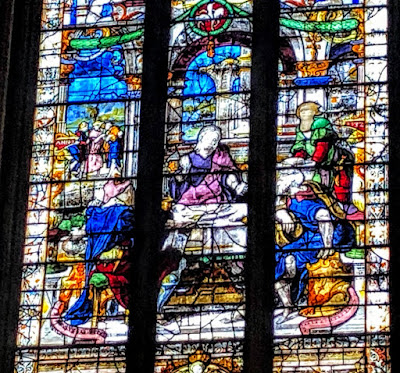
Christ in the home of Mary, Martha and Lazarus … a panel in the Herkenrode glass windows in the Lady Chapel in Lichfield Cathedral (Photograph: Patrick Comerford)

Patrick Comerford

We are in Ordinary Time in the Church Calendar and today is the Fifth Sunday after Trinity (Trinity V, 20 July 2025). Later this morning, I hope to present at the Parish Eucharist in Saint Mary and Saint Giles Church, Stony Stratford.

Before today begins, I am taking some quiet time this morning to give thanks, to reflect, to pray and to read in these ways:

1, reading today’s Gospel reading;

2, a short reflection;

3, a prayer from the USPG prayer diary;

4, the Collects and Post-Communion prayer of the day.

Christ in the home of Mary and Martha … the East Window in Saint Peter and Saint Paul Church, Watford, Northamptonshire (Photograph: Patrick Comerford)

Luke 10: 38-42 (NRSVA):

38 Now as they went on their way, he entered a certain village, where a woman named Martha welcomed him into her home. 39 She had a sister named Mary, who sat at the Lord’s feet and listened to what he was saying. 40 But Martha was distracted by her many tasks; so she came to him and asked, ‘Lord, do you not care that my sister has left me to do all the work by myself? Tell her then to help me.’ 41 But the Lord answered her, ‘Martha, Martha, you are worried and distracted by many things; 42 there is need of only one thing. Mary has chosen the better part, which will not be taken away from her.’

Christ in the House of Martha and Mary by Diego Velázquez (1630)

Today’s Reflection:

Saint Luke’s story of the meal that Jesus has with his friends Mary and Martha is not found in the other synoptic gospels, and the only other parallel is in the Fourth Gospel, where Jesus visits Mary and Martha after the death of Lazarus.

So the meals Jesus has with Mary and Martha must be understood in the light of the Resurrection, which is prefigured by the raising of Lazarus from the dead.

For many women, and for many men too, the story of the meal with Martha and Mary raises many problems, often created by insights that may not have been possible to have at the time when Saint Luke’s Gospel was written.

Our approach to understanding and explaining this meal very often depends on the way in which I understand Martha and the busy round of activities that have her distracted, and that cause her to complain to Jesus about her sister’s apparent lack of zeal and activity.

These activities in the Greek are described as Martha’s service – she is the deacon at the table: where the NRSV says ‘But Martha was distracted by her many tasks,’ the Greek says: ἡ δὲ Μάρθα περιεσπᾶτο περὶ πολλὴν διακονίαν (‘But Martha was being distracted by much diaconal work, service at the table’).

Quite often, when this story is told, over and over, again and again, it is told as if Martha is getting stroppy about having to empty the dishwasher while Mary is lazing, sitting around, making small talk with Jesus.

Does Martha see that Mary should only engage in kitchen work too?

Does she think, perhaps, that only Lazarus should be out at the front of the house, keeping Jesus engaged in lads’ banter about the latest league match between Bethany United and Jerusalem City?

Is Jesus being too dismissive of Martha’s complaints?

Or is he defending Mary’s right to engage in a full discussion of the Word, to engage in an alive ministry of the Word?

Martha is presented in this story as the dominant, leading figure. It is she who takes the initiative and who welcomes Jesus into her home (verse 38); it is she who offers the hospitality, who is the host at the meal, who is the head of the household – in fact, Lazarus isn’t even on the stage for this scene, and Mary is merely ‘her sister’ – very much the junior partner in the household.

Yet it is Mary, the figure on the margins, who offers the sort of hospitality that Jesus commends and praises.

Mary simply listens to Jesus, sitting at his feet, like a student would sit at the feet of a great rabbi or teacher, waiting and willing to learn what is being taught.

Martha is upset about this, and comes out from the back and asks Jesus to pack off Mary to the kitchen where she can help Martha.

But perhaps Martha was being too busy with her household tasks.

I was once invited to dinner by people I knew as good friends. And for a long time I was left on my own with the other guest as the couple busied themselves with things in the kitchen – they had decided to do the washing up before bringing out the coffee … the wife knew that if she left the washing up until later, the husband would shirk his share of the task.

But being left on our own was a little embarrassing. Part of the joy of being invited to someone’s home for dinner is the conversation around the table.

When I have been on retreats, at times, in Greek Orthodox and Benedictine monasteries, conversation at the table has been discouraged by a monk reading, usually from the writings of the Early Fathers, from the Patristic writings.

A good meal, good table fellowship, good hospitality, are not just about the food that is served, but about the ideas and words shared, heard and listened to around the table too.

One commentator suggests that Martha has gone overboard in her duties of hospitality. She has spent too much time preparing the food, and has failed to pay real attention to her guest.

On the other hand, Mary has chosen her activity (verse 42). It does not just happen by accident. Mary has chosen to offer Jesus the real hospitality that a guest should receive. She talks to Jesus, and real conversation is about both talking and listening.

If she is sent back into the kitchen, then – in the absence of Lazarus, indeed, in the notable absence of the disciples – Jesus would be left without hospitality, without words of welcome, without conversation.

Perhaps Martha might have been better off if she had a more simple lifestyle, if she prepared just one dish for her guest and for her family – might I be bold enough to suggest, if she had been content for them to sup on bread and wine alone.

She could have joined Mary in her hospitality, in welcoming Jesus to their home and to their table; they could have been in full communion with one another.

In this way, Martha will experience what her sister is experiencing, but which she is too busy to notice – their visitor’s invitation into the hospitality of God.

One commentator, Brendan Byrne, points out the subtle point being made in this story:

‘Frenetic service, even service of the Lord, can be a deceptive distraction from what the Lord really wants. Luke has already warned that the grasp of the word can be choked by the cares and worries of life … Here the cares and worries seem well justified – are they not in the service of the Lord? But precisely therein lies the power of the temptation, the great deceit. True hospitality – even that given directly to the Lord – attends to what the guest really wants.’

Saint Augustine’s Church, Mambong … illustrating reflections on ‘Diversity in Sarawak’ in the USPG prayer diary this week (Photograph: Patrick Comerford, 2024)

Today’s Prayers (Sunday 20 July 2025, Trinity V):

The theme this week (20 to 26 July) in Pray with the World Church, the prayer diary of the Anglican mission agency USPG (United Society Partners in the Gospel), is ‘Diversity in Sarawak’ (pp 20-21). This theme is introduced today with these reflections:

The Revd Canon Prof Patrick Comerford – Former Professor of Theology and retired parish priest in the Diocese of Limerick and Killaloe, Church of Ireland. Following five weeks travelling throughout the Diocese of Kuching in East Malaysia, Canon Patrick writes:

“Sarawak, on the island of Borneo, is the largest of the 13 states in Malaysia, spanning 48,000 square miles and about 3 million people. The Anglican presence on Borneo dates from 1848, when Thomas McDougall arrived in Kuching at the invitation of the Rajah of Sarawak. The chancel of Saint Thomas’s Cathedral, Kuching, was built by SPG (USPG) to mark more than 100 years of links between the diocese and SPG. A plaque above the lectern reads: ‘Borneo Mission Association, 1909-2015, For its memorial look around you.’

During my stay, I worshipped regularly in Saint Thomas’s Cathedral but also went on a whirlwind tour of various churches and chapels, mission stations and schools, throughout the Malaysian state of Sarawak. I was led by Father Jeffry, who leads churches in the mission area of Mambong. He was a most genial host. It was a privilege to see his ministry and mission, in urban and rural settings. Sarawak is a richly diverse place with Indigenous people groups, including the Iban and Bidayuh, making up almost half the population.

It was good for me to see at first-hand that the legacy of SPG and USPG’s work in the past has led to a truly incarnational local diocese. Sarawak is in a unique position to become a model for interfaith harmony and dialogue and for cultural and ethnic diversity and co-operation,” Patrick concluded.

The USPG prayer diary today (Sunday 20 July 2025, Trinity V) invites us to pray:

Lord God, we pray for the Church of the Province of southeast Asia, the Diocese of Kuching, and for the ministry and mission of the bishops, including the Right Revd Danald Jute, Bishop of Kuching and Brunei since 2017.

The Collect:

Almighty and everlasting God,
by whose Spirit the whole body of the Church
is governed and sanctified:
hear our prayer which we offer for all your faithful people,
that in their vocation and ministry
they may serve you in holiness and truth
to the glory of your name;
through our Lord and Saviour Jesus Christ,
who is alive and reigns with you,
in the unity of the Holy Spirit,
one God, now and for ever.

The Post-Communion Prayer:

Grant, O Lord, we beseech you,
that the course of this world may be so peaceably ordered
by your governance,
that your Church may joyfully serve you in all godly quietness;
through Jesus Christ our Lord.

Additional Collect:

Almighty God,
send down upon your Church
the riches of your Spirit,
and kindle in all who minister the gospel
your countless gifts of grace;
through Jesus Christ our Lord.

Yesterday’s reflections

Continued tomorrow

‘Diversity in Sarawak’ is the theme in the USPG Prayer Diary this week (Photograph: Patrick Comerford, 2025)

Scripture quotations are from the New Revised Standard Version Bible: Anglicised Edition copyright © 1989, 1995, National Council of the Churches of Christ in the United States of America. Used by permission. All rights reserved worldwide. http://nrsvbibles.org

08 May 2025

Some of the real-life stories
and war-time tragedies
recalled in Comerford
families on VE Day

Gerald Francis Commerford of the Australian Army Medical Corps was a Japanese prisoner of war and is named on Panel 26 on Labuan Memorial in Borneo

Patrick Comerford

At 6:30 this evening (8 May 2025) the church bells at Saint Mary and Saint Giles are ringing across Stony Stratford, like church bells and cathedral bells across the land, marking the 80th anniversary of VE Day, Victory in Europe Day. Later this evening, people are asked to light a candle for peace and place it in their front windows at 9:30.

In anticipation of the commemorations marking VE Day, I recalled yesterday the names of the dead from World War II from the Comerford, Commerford and Cumberford families I can find who are recorded on memorials and graves by the Commonwealth War Graves Commission.

The 19 members of this extended family I have found to date on Commonwealth War Graves are from many parts of Ireland and Britain, including Wexford and Arklow, from Glasgow, Hartlepool, Hastings, London, Manchester, Mansfield in Nottinghamshire and Shrewsbury, and also from Australia, Canada and South Africa.

They include soldiers and officers, with ambulance units in the medical corps, drivers, civilian casualties, soldiers in the D-Day landings, merchant seamen torpedoed in Atlantic convoys, brothers and sisters, and prisoners of war of the Japanese in Borneo, Burma (Myanmar), Hong Kong and Japan.

They are buried or commemorated in the Phaleron War Cemetery near Athens and in the graves at the Normandy beaches, in Borneo, Burma, Japan, Nottinghamshire, London, Sydney, Durban and Montreal.

Five Comerfords who were Prisoners of War of the Japanese are remembered in the Sat Wan Memorial in Hong Kong, Thanbyuzayat War Cemetery and the Rangoon Memorial in Burma (Myanmar), Yokohama War Cemetery in Japan, and the Labuan Memorial on Labuan Island off the coast of Sabah in Borneo, Malaysia. Four Comerfords are named on the Merchant Seamen’s Memorial on Tower Hill in London and two are named on the Plymouth War Memorial.

Behind each name and number os real-life story among and the war-time tragedies and sufferings of many families.

Lilian Rose Comerford was killed on 30 September 1940 when a German bomb that hit the Plaza Cinema in Hastings

Lilian Rose Comerford was 62 when she was killed on 30 September 1940 when a single German bomber dropped one HE bomb a ndhit the Plaza Cinema on Robertson Street in Hastings. Thirteen other people were killed and 35 injured, 12 seriously, in Hastings thatday.

Lilian was born in Ferozepore, Punjab, in 1878, a daughter of Francis Thomas Comerford (1852-1927) and Charlotte (nee Finch) Comerford (1851-1933). Her father’s family was originally from the East End, and Lilian returned with her parents and siblings from India to England as an infant.

She was brought up in Aston, near Birmingham, and later lived with her family in Hasting. After her parents died in the interwar years, Lilian lived at Rose Cottage, The Ridge, Hastings.

Monday 30 September 1940 saw the last major daylight attack against London during the Battle of Britain with about 300 aircraft trying to bomb the capital. The Luftwaffe also launched raids against other targets away from London, and Hastings, along with other towns, suffered as a result.

Throughout Britain, 175 civilians were killed on 30 September, and additional casualties died from their wounds in the weeks and months that followed. Although the Luftwaffe did have specific targets that day, many bombers dropped their loads at the first sign of approaching RAF fighters. There were also ‘tip and run’ raids carried out at high speed and low level.

Hastings was one of the south coast towns hit by Luftwaffe and Lilian Comerford was one of a group people who were killed at the Plaza Cinema that day. They included Albert Henry Southey, a World War I veteran and a member of the Home Guard, and his wife Frances, Clifford Arthur Glazier, Frederick George Hepple, Winifred Ada Spence and Ronald Horace Dutton. Leo Redver Ryan was killed by a bomb in Chalk Pit Lane, Thomas Moyle was killed on London Road, George James Brooker was killed when a bomb hit the National Westminster Bank, and Henry Walter Cook was killed at his home at 484 Bexhill Road.

Cecil Robert Kenneth Hume died in hospital the next day (1 October) from wounds received when a bomb hit the Plummer and Roddis shop. William George Sadler died in hospital on 3 October from injuries he received when a bomb hit Cambridge Road in the same raid on 30 September.

Gerald Francis Commerford was a Japanese prisoner of war in Changi in Singapore and Sandakan camp in North Borneo

Gerald Francis Commerford was born on 8 July 1919 in Maclean, Clarence Valley Council, New South Wales. He was a son of Denis and Margaret Sarah Commerford of Lower Lawrence, New South Wales. His family was originally from Ireland, and they were related to Denis Comerford, who gives his name to Comerford Way in Winslow, Buckinghamshire, near Milton Keynes.

Gerald was a private in a field ambulance unit in the Australian Army Medical Corps during World War II. He was one of over 2,000 Allied POWs held in the Sandakan camp in North Borneo. He was transferred there from Singapore as a part of B Force. The 1,494 POWs that made up B Force, were transported from Changi on 7 July 1942 on board the tramp ship Ubi Maru, arriving in Sandakan Harbour on 18 July 1942.

Gerald Commerford was 25 when he died of starvation while he was a prisoner of the Japanese in Borneo on 9 February 1945. He has no known grave, and is commemorated on Panel 26 on the Labuan Memorial on Labuan Island off the coast of Sabah in North Borneo, Malaysia.

Flight Lieutenant Harry Alfred George Comerford (1905-1956), an RAF fighter pilot named on the Battle of Britain Monument on the Victoria Embankment, London

Apart from Commonwealth War Graves and memorials, Flight-Lieutenant Harry Alfred George Comerford (1905-1956) is one of the RAF fighter pilots named on the Battle of Britain Monument on the Victoria Embankment, on the north bank of the Thames, about 200 metres from Westminster Bridge, and almost directly opposite the Millennium Wheel.

Harry Alfred George Comerford was born on 13 August 1905, the eldest son of Harry William John Comerford (1874-1955), a popular music hall and variety comedian and actor whose stage name was Harry Ford, and Rosina Sarah Sipple (1881-1958), a descendant of some of the most interesting Sephardi Jewish families in Europe.

Harry Alfred George Comerford, was born on 15 August 1905 in Wandsworth. He joined the RAF on a short service commission in January 1927, and was posted to 2 Flying Training School Digby in Lincolnshire for flying training. When he qualified, Harry joined 16 Squadron at Old Sarum on 19 December 1927, equipped with Bristol Fighters. Within a year, he was posted to 28 Squadron at Ambala, India, near the border with Punjab, on 20 October 1928, and he served on the North-West Frontier in 1930-1931.

While Harry was in India, he married Georgiana Alicia Betty Davidson (1903-2001) in 1931 in Ambala, Bengal. Some months later, Harry moved to 31 Squadron at Quetta – now in Pakistan – on 18 March 1932 and he became adjutant.

Harry was in Britain on leave at the end of 1932, returned to India, and was then posted back to Britain in November 1933. He joined 40 Squadron at Abingdon on 15 March 1934, and then went on to the Reserve of RAF Officers on 7 October 1934.

The name of Flight Lieutenant HAG Comerford on the Battle of Britain Monument on the Victoria Embankment, London (Photograph: Patrick Comerford)

At the outbreak of World War II, the RAF recalled Harry on 13 January 1940 and posted him to 7 Flying Training School, Peterborough, as a flying instructor and ‘C’ Flight Commander. After being acquitted at a courtmMartial in 1940, he was posted to 6 EFTS Sywell and from there that he joined 312 Squadron at Speke on 1 October 1940 as ‘B’ Flight Commander.

On Tuesday 15 October 1940, 550 German fighters and bombers attacked London, the Thames Estuary and Kent in five waves. Early that evening, two flights of hurricanes, Red and Yellow sections of No 312 Squadron, took off from Speke at 17:30 for a dusk patrol over the Lancaster area, with instructions to return at 18:25. Harry ran out of fuel and bailed out at 19:00, landing near Dalton-in-Furness with injuries.

His aircraft, serial No V6542 had dived vertically into farmland and was completely destroyed. He did not fly again operationally, and was posted away to the Air Ministry on 13 November 1940. He was awarded the AFC on 30 September 1941 and left the RAF when he resigned his commission on 19 April 1943. He died in Leicester in September 1956.

Harry Comerford’s brother, Leonard Jack Comerford (1914-1993), was a driver in the Royal Army Service Corps during World War II and was a prisoner of war in Germany. He died in January 1993 in Boston, Lincolnshire.

Lieutenant-Colonel Augustine Ambrose Comerford, DSO, MRCVS (1886-1944), is not named on any of these graves or memorials, but he was decorated for his role in World War II, and died during the war.

He was born in Stratford, Essex, into a family that originally came from Co Wexford. He was educated at Mount Saint Mary’s College, a Jesuit-run public school in Spinkhill, Derbyshire, and the Royal Veterinary College, London (1903-1909). During World War I, he was a lieutenant (1916) in the Army Veterinary Service (later the Royal Army Veterinary Corps), and was promoted captain. He transferred to the Royal Army Veterinary Corps Territorial Army (1922), and was promoted major (1926).

During World War II, he was Officer Commanding, 418th (Bedfordshire) Battery, 105th (Bedfordshire Yeomanry) Army Field Regiment RA (Biggleswade), and a lieutenant-colonel and commanding officer in 52 Heavy Regiment, Royal Artillery (January 1939 to June 1940), fought in Western Europe, and was decorated DSO (1940) and was Mentioned in Dispatches (1941) ‘for distinguished services in the field’.

He lived at Dean House, Caxton, Cambridge, and later at Home Farmhouse, Potton, Bedfordshire in 1928. He died on 25 February 1944 in Huntingdonshire at the age of 58.

Dr Richard Eric Woodgate Beaumont Comerford (1914-1980) was the consultant anaesthetist at Charing Cross Hospital for much of his career, and was a major in the Royal Army Medical Corps during World War II.

He was born in 1914, and like his father, Dr Beaumont Harry Comerford, he was educated at Sherborne School, Dorset (1928-1933). Later he studied medicine at Gonville and Caius College, Cambridge, in the 1930s, and at Saint George’s Hospital, London. He qualified in 1940, and received the degrees MB and BChir at the University of Cambridge in 1941.

Before the outbreak of World War II, he was commissioned a lieutenant in the Royal Artillery on 27 May 1939. During the war, he was a major in the Royal Army Medical Corps, serving as a specialist anaesthetist in India, Burma and French Indo-China.

After World War II, he returned to medicine and to Saint George’s Hospital as a registrar, then became resident medical assistant at Fulham Hospital, and at the inception of the National Health Service (NHS) he was appointed a consultant anaesthetist. He became consultant anaesthetist to the Charing Cross group of hospitals, but continued to run the anaesthetic department at Fulham until the move to the new Charing Cross Hospital in 1974. Dr Comerford died in 1980 at the age of 65.

The Battle of Britain Monument on the Victoria Embankment, London (Photograph: Patrick Comerford)

07 May 2025

Commemorating VE Day in
Crete and Stony Stratford,
and remembering Comerfords
who died in World War II

The Suda Bay Commonwealth War Cemetery in Crete, near Chania and Chania Airport (Photograph: Patrick Comerford, 2025)

Patrick Comerford

At 6:30 tomorrow evening (8 May 2025) the church bells at Saint Mary and Saint Giles are ringing across Stony Stratford, like church bells and cathedral bells across the land, marking the 80th anniversary of VE Day, Victory in Europe Day.

The fragile peace we have had in Europe for the past 80 years has been marred and broken constantly, and even shattered on many occasions, with the civil war in Greece (1946-1949), the false stability and tensions of the Cold War, the Turkish invasion of Cyprus, the ‘ethnic cleansing’ in former Yugoslavia’, and the Russian invasion of Ukraine.

Every town and village in Crete has monuments and memorials that are reminders of how every family on the island suffered during World War II. As I passed the Souda Bay War Cemetery on my way from Rethymnon to Chania Airport, I was reminded of the horrors of war, that peace in Europe has been bought with a heavy price, and how all too often we take our liberties, rights and systems of justice for granted.

The road to the airport climbs high above a horseshoe bay, the busy port and the cemetery at Souda Bay in a peaceful setting in an olive grove and surrounded by eucalyptus trees, about 5 km east from the centre of Chania. There are 1,500 Commonwealth war graves from World War II in the cemetery, along with 60 or so other graves. These graves bring home with force the calamity that was the Battle of Crete in 1941.

In May 1941, the Commonwealth force in Crete was organised in five widely separated defence areas along the north coast – around the three airfields at Iraklion, Rethymnon and Máleme, and at Souda Bay and the port of Chania.

The Germans launched their attack on Crete on 20 May with airborne troops. The airfield at Máleme was quickly captured and used for landing German reinforcements. The remainder of the Máleme position was given up on 23 May and its defenders fell back to Chania. The Allied line west of Chania was broken on 26 May, Suda Bay became indefensible and the troops from these two positions, with the remainder of the Maleme garrison, withdrew across the island to Hora Sfakion, where many of them were evacuated by sea on the nights of the 28-31 May.

The airborne attacks on the Iraklion and Rethymnon positions on 20 May were repulsed. Iraklion was defended until the night of 29 May when the garrison was evacuated by sea. Orders for the garrison in Rethymnon to fight its way southward for evacuation did not arrive, and it was overwhelmed on 31 May. Of the total Commonwealth land force of 32,000 in Crete, 18,000 were evacuated, 12,000 were taken prisoner and 2,000 were killed.

Among the graves at Soudha is that of John Pendlebury, the archaeologist who took over at Knossos after Arthur Evans retired.

Being a pacifist does not stop me from wanting to remember on VE Day and to honour the sacrifices so many people made so that we would have democracy, freedom and justice 80 years later. For example, without the extraordinary work at Bletchley Park, would World War II have dragged on for another six years? Would Britain and Ireland have been invaded? Would six million more have been murdered in the Holocaust?

Patrick Comerford, Dungulph, Co Wexford, Derek Comerford, West Hartlepool, Hugh Brown Cumberford, Glasgow, and Patrick Comerford, Arklow, are named on the Merchant Sailors’ Memorial on Tower Hill, London (Photograph: Patrick Comerford)

This evening, in anticipation of the VE Day commemorations tomorrow, I am recalling all those names of the dead from World War II from the Comerford, Commerford and Cumberford families that I have found recorded on memorials and graves by the Commonwealth War Graves Commission.

The 19 members of this extended family I have found to date on Commonwealth War Graves are from many parts of Ireland and Britain, including Wexford and Arklow, from Glasgow, Hartlepool, Hastings, London, Manchester, Mansfield in Nottinghamshire and Shrewsbury, and also from Australia, Canada and South Africa.

They include soldiers and officers, with ambulance units in the medical corps, drivers, able seamen, civilian casualties, soldiers in the D-Day landings, merchant seamen torpedoed in Atlantic convoys, brothers and sisters, and prisoners of war of the Japanese in Borneo, Burma (Myanmar), Hong Kong and Japan.

They are buried or commemorated in the Phaleron War Cemetery near Athens, in Normandy, Borneo, Burma, Japan, Nottinghamshire, London, Sydney, Durban and Montreal.

Five Comerfords who were Prisoners of War of the Japanese are remembered in the Sat Wan Memorial in I am recalling all those names of the dead from World War II from the Comerford, Commerford and Cumberford families that I have found recorded on memorials and graves by the Commonwealth War Graves Commission.

The 19 members of this extended family I have found to date on Commonwealth War Graves are from many parts of Ireland and Britain, including Wexford and Arklow, from Glasgow, Hartlepool, Hastings, London, Manchester, Mansfield in Nottinghamshire and Shrewsbury, and also from Australia, Canada and South Africa.

They include soldiers and officers, with ambulance units in the medical corps, drivers, able seamen, civilian casualties, soldiers in the D-Day landings, merchant seamen torpedoed in Atlantic convoys, brothers and sisters, and prisoners of war of the Japanese in Borneo, Burma (Myanmar), Hong Kong and Japan.

They are buried or commemorated in the Phaleron War Cemetery near Athens, in Normandy, Hong Kong, Thanbyuzayat War Cemetery and the Rangoon Memorial in Burma (Myanmar), Yokohama War Cemetery in Japan, and the Labuan Memorial on Labuan Island off the coast of Sabah in Borneo, Malaysia. Four Comerfords are named on the Merchant Seamen’s Memorial on Tower Hill in London and two are named on the Plymouth War Memorial.

Michael John Comerford from Manchester is buried at Phaleron War Cemetery, near Athens

These 19 people from World War II are:

Derek Comerford: United Kingdom; Ordinary Seaman, Merchant Navy, S.S. Empire Engineer (West Hartlepool). Age: 17. Date of death: 2 February 1941. Family information: son of Peter and Mary Hannah Comerford, of North Shields, Northumberland. His father, Peter Comerford, was born in Glasgow, and his father was from Ireland. Grave/memorial reference: Panel 40, Tower Hill Memorial.

Edward William Commerford, United Kingdom; Private, Home Guard, 18th County of London Bn. Age: 39. Date of death: 4 February 1944. Family information: son of Edward and Matilda Commerford; husband of Minnie Commerford, of Dulwich. Grave/memorial reference: Sec. 86. Grave 39695, West Norwood Cemetery and Crematorium.

Ernest Edward Comerford: Australian; Lieutenant, Australian Infantry, A.I.F. 3 Rec. Trg. Bn. Age: 28. Date of death: 18 July 1945. Service number: QX.35506. Family information: Son of John Edward and Rosina Comerford, of Townsville, Queensland. Grave/memorial reference: 2W. D. 8, Sydney War Cemetery.

Frank Comerford: United Kingdom; Company Quartermaster Serjeant, Royal Army Ordnance Corps. Age: 40. Date of death: 3 April 1944. Service number: 3514928. Family information: son of William and Margaret Comerford; husband of Doris Mary Comerford, of Frankwell, Shrewsbury, Shropshire. Grave/memorial reference: Sec. A 2 D. Grave 1. Beeston and Stapleford (Chilwell) Cemetery.

Gerald Francis Commerford, Australian; Private, Australian Army Medical Corps, A.I.F. 2/10 Field Ambulance. Age: 25. Date of death: 9 February 1945. Service number: NX33246. Family information: son of Denis and Margaret Sarah Commerford, of Lower Lawrence, New South Wales. Grave/memorial reference: Panel 26, Labuan Memorial, Malaysia.

Hugh Brown Cumberford, United Kingdom; Radio Officer, Merchant Navy, SS Kellwyn (Swansea). Age: 19. Date of death: 27 July 1941. Family information: son of John Brown Cumberford and Agnes Cumberford, of Dalmarnock, Glasgow. Grave/memorial reference: Tower Hill Memorial.

James Matthew Comerford, Australian; Corporal, Australian Infantry, A.I.F. 2/26 Bn. Age: 26. Date of death: 25 May 1943. Service number: QX17117. Family information: son of Edward Tobias and Ellen Cecelia Comerford, of Paddington, Queensland, Australia. Grave/memorial reference: A1. B. 19, Thanbyuzayat War Cemetery, Burma (Myanmar).

John Commerford, United Kingdom; Lance Corporal, Middlesex Regiment, 1st Bn. Age: 27. Date of death: between 1 and 2 October 1942. Service number: 6010413. Family information: son of Serjeant TJ Commerford, The Royal Fusiliers, and of Mary Commerford, of Sunbury-on-Thames, Middlesex, England. Grave/memorial reference: Column 14, Sat Wan Memorial, Hong Kong.

Lilian Rose Comerford, United Kingdom; civilian casualty. Age: 62. Date of death: 30 September 1940. Family information: of Rose Cottage, The Ridge, Hastings; daughter of Francis Thomas and Charlotte Comerford. Died at Robertson Street. Reporting authority: Hastings County Borough.

Mary Agnes Comerford, United Kingdom; civilian casualty. Age: 17. Date of death: 16 December 1940. Family information: daughter of Thomas and Mary Agnes Comerford, of 26 New Allen Street, Collyhurst, Manchester; died at Ancoats Hospital, New Cross, Manchester; her brother, Michael John Comerford (see below), died in 1944, and is buried near Athens. Reporting authority: Manchester County Borough.

Michael John Comerford, United Kingdom; Gunner, Royal Artillery, 165 Field Regt. Age: 22. Date of death: 5 December 1944. Service number: 1144779. Family information: son of Thomas and Mary Agnes Comerford, of Manchester; husband of Sabina Comerford, of Manchester; his sister, Mary Agnes Comerford (see above), was a civilian casualty in 1940. Grave/memorial reference: 16. E. 12, Phaleron War Cemetery, near Athens.

Noel Patrick Commerford, South African; Able Seaman, South African Naval Forces, HMS Cornwall. Age: ?. Date of death: 5 April 1942 (off the coast of Ceylon/Sri Lanka). Service number: 66493. Family information: son of Mrs P Commerford, of Cape Town, Cape Province, South Africa; brother of Terence Commerford (see below), who died five months later. Grave/memorial reference: Panel 74, Column 1, Plymouth Naval Memorial.

Patrick Comerford, United Kingdom (Ireland); Able Seaman, Merchant Navy, SS Clune Park (Greenock). Age: 52. Date of death: 12 February 1941 (200 miles south-east of the Azores, in Convoy SLS-64 from Freetown to Liverpool). Family information: husband of Catherine Comerford, of Dungulph, Fethard-on-Sea, Co Wexford. His brother, Laurence Comerford, was a casualty in World War I. Grave/memorial reference: Panel 31, Tower Hill Memorial.

Patrick Comerton (Comerford), United Kingdom (Ireland); Able Seaman, Merchant Navy, SS Newbury (London). Age: 49. Date of death: 15 September 1941 (torpedoed by U-94 and sunk 800 miles south-east of Cape Farewell, carrying coal from Cardiff to Buenos Aires). Family information: son of James and Mary Comerton (Comerford); husband of Mary Ellen Comerton (Comerford), of Arklow, Co Wicklow. Memorial: Panel 72, Tower Hill Memorial, London,

Terence Commerford, South African; Ordinary Seaman, South African Naval Forces, HMS Express. Age: 21. Date of death: 19 September 1942. Service number: 330258. Family information: son of Pierce and Wilhelmina Commerford of Cape Town; brother of Noel Patrick Commerford (see above), who died five months earlier. Grave/memorial reference: Block F. Grave 275, Durban (Stellawood) Cemetery.

Thomas Matthew Commerford, United Kingdom; Trooper, Royal Armoured Corps, 8th King’s Royal Irish Hussars. Age: 36. Date of death: 19 August 1944 (Normandy Landings). Service number: 7927353. Family information: son of Thomas James Commerford and Mary Commerford; husband of Phyllis Ettie Mary Commerford, of Sunbury-on-Thames, Middlesex. Grave/memorial reference: III. F. 13, Banneville-la-Campagne War Cemetery.

Thomas Michael Comerford, Australian; Private, Australian Infantry, A.I.F. 2/20 Bn. Age: 39. Date of death: 26 October 1943. Service number: NX55519. Family information: son of John and Bridget Ann Comerford. Grave/memorial reference: Aust. Sec. A.B.1, Yokohama War Cemetery, Japan.

William Comerford, United Kingdom; Fusilier, Royal Inniskilling Fusiliers, 1st Bn. Age: 22. Date of death: 18 January 1943 (POW). Service number: 6981836. Family information: son of Edward William Comerford and Harriet Comerford, of Mansfield, Nottinghamshire. Grave/memorial reference: Face 11, Rangoon Memorial, Burma (Myanmar).

William Michael Commerford, Canadian; Private, Royal Canadian Infantry Corps. Age: 36. Date of death: 30 November 1944. Service number: D/142978. Family information: husband of Muriel Commerford, of Montreal. Grave/memorial reference: Sec. I. Lot 1498. Grave 5957, Montreal (Notre Dame des Neiges) Cemetery, Canada.

Behind each of these names and numbers are real-life stories … but more of these stories tomorrow evening.

Patrick Comerford of Dungulph, Fethard-on-Sea, Co Wexfor, named with members of the SS Clune Park crew on Panel 31 on the Tower Hill Memorial in London

01 December 2024

The House of the Epiphany,
the theological college in
Kuching, was ‘a most wonderful
Christmas gift’ for Sarawak

The House of the Epiphany is the theological college in the Anglican Diocese of Kuching (Photograph: Patrick Comerford, 2024)

Patrick Comerford

During my recent visit to Kuching, I was staying beside Saint Thomas’s Cathedral, and regularly attended the Cathedral Eucharist each Sunday. But I also visited the other buildings that share the extensive, landscaped and wooden grounds in the city centre, including the Bishop’s House, the Diocesan Office, the Parish Office, and the House of the Epiphany.

The House of the Epiphany is the theological college in the Anglican Diocese of Kuching, providing theological education to candidates for ordination. The new college buildings were opened a year ago, on 4 December 2023. However, the college dates from 1952, and before the House of the Epiphany opened a number of short-lived theological colleges served what is now the Diocese of Kuching.

The first theological college in the then Diocese of Labuan began in 1921 as the College of the Holy Way, also known as Divinity College, in Kudat, on the Kudat Peninsula. Kudat is near the northernmost point of Borneo, and about 190 km north of Jesselton, now Kota Kinabalu, the state capital of Sabah.

The Revd Ernest Parry was the warden of the college from 1921 to 1928, when five Chinese candidates were prepared for ordination as deacons in 1927 and priests in 1928. They included the Revd Lim Siong Teck, later martyred by the Japanese in 1945, the Revd Vun Nen Vun, the Revd Chong Paul En Siong, the Revd Lai Choon Sang, and the Revd Chin Phu Yin. The college continued until 1930, when Parry returned to England for health reasons.

The House of the Epiphany was rebuilt and reopened a year ago, on 4 December 2023 (Photograph: Patrick Comerford, 2024)

A second theological school in the Diocese of Labuan was established by the Revd Wilfrid Linton in 1925. He opened the School of the Holy Spirit in Betong, about 250 km east of Kuching, to train Indigenous candidates for ordination. The Revd Matius Senang and the Revd Thomas Buda were ordained priests in 1926 and the Revd Laurence Angking was ordained in 1932.

The school closed after Linton’s health broke down, but a new theological course opened after five priests from the Community of the Resurrection in Mirfield arrived in Kuching in 1933: Edward Oswald Philipps, Wilfred Percy Brightwen Shelley, Father Thomas, Andrew Hamish Blair and Richard Law Wrathall.

These priests opened the Ordination Test School in Kuching in 1934 with six candidates. They included the Revd Hope Hugh, the Revd Lim Yong Chua, the Revd Martin Nanang and the Revd Ng Thau Sin, who were ordained deacons in 1936 and priests in 1937. However, the school closed when the last member of the Community of the Resurrection left Kuching in 1937. Father Andrew Hamish Blair later became the Principal of the College of the Resurrection in Yorkshire.

The Warden’s House at the the House of the Epiphany (Photograph: Patrick Comerford, 2024)

Canon Peter Howes (1911-2003), a USPG missionary, had worked at Saint James Church, Quop, throughout world War II and was later an Assistant Bishop of Kuching. He was asked to open a new theological college in Kuching, training local candidates for ordination.

The new college was the vision of the newly-appointed Nigel Cornwall (1903-1984), who was Bishop of Borneo in 1948-1962. Ten students enrolled and the college met at first in the Bishop’s House, on a hill above Saint Thomas’s Cathedral.

The admission of those students signalled a breakthrough in the process of transferring Church leadership in Kuching to local clergy in line with the threefold principles of the Church being self-propagating, self-supporting and self-governing.

The chapel in the the House of the Epiphany, Kuching (Photograph: Patrick Comerford, 2024)

The college building was completed and was dedicated on the Feast of the Epiphany in 1953, and so was named the House of the Epiphany. Six students were ordained deacons in 1955 and priests in 1956: Edmund Paleng, James Gunyau, Peter Radin, Arnold Puntang, Ambrose Dunggat and Alfred Chabu, who was later Archdeacon of Brunei and North Sarawak.

The college closed temporarily in 1956, but reopened in 1971, and Peter Howes returned as the Principal, with the Revd Alex Reid as Warden.

The college was restructured in 1987, and was affiliated with the Australian College of Theology, based in Sydney, offering a Diploma in Ministry. It re-established its independence in 1992, offering the Bishop’s Certificate of Ministry.

Later wardens and principals of the House of the Epiphany included the Revd Bolly Lapok from 1999, later Bishop of Kuching and Archbishop of South-East Asia; and Canon Michael Spencer Woods (2009-2017).

One of the earlier buildings at the the House of the Epiphany, Kuching (Photograph: Patrick Comerford, 2024)

The House of the Epiphany has been rebuilt in recent years, with new buildings and new facilities. The new buildings and upgraded facilities at the theological college were completed last year at a cost of RM 11.5 million. The new House of the Epiphany was opened a year ago (4 December 2023) by the Deputy Premier, Datuk Amar Douglas Uggah Embas. ‘This beautiful building stands majestically as a new landmark in the heart of Kuching city,’ the Deputy Premier said.

The new complex is both a theological training college for priests-in-training and a hub for the training of youth leaders and women’s ministries, and it offers refresher courses for the local clergy and lay leaders. The centre also facilitates and organises workshops, training sessions, seminars, conferences, study groups and retreats at diocesan, regional and parish level.

The five-storey building houses a chapel, lecture room, seminar rooms, library, administrative and staff offices, ministry offices, a small museum, staff and student accommodation and meeting spaces. A detached lecture room nearby separates the Warden’s House from the main building.

At the opening of the new House of the Epiphany last year, Bishop Danald Jute said would function as a theological training college for priests-in-training and also as a training space for leaders in youth and women’s ministries.

‘With the Christmas season about three weeks away, this House of Epiphany certainly makes for a most wonderful Christmas gift to the community in the state’ of Sarawak, Bishop Jute said.

The Epiphany Pavilion and Epiphany Garden at the the House of the Epiphany (Photograph: Patrick Comerford, 2024)