Showing posts with label Helsinki. Show all posts

17 March 2026

A 27.5 million-year cycle,
27.5 million Nordic people,
£27.5 million for Norwich
and 27.5 million blog hits

The Earth experiences a major geological ‘pulse’ or cycle of activity roughly every 27.5 million years … a sculpture beneath the Fortezza in Rethymnon in Crete (Photograph: Patrick Comerford)

Patrick Comerford

The viewing and reading figures for this blog continues to surprise me, and those figures passed the 27.5 million mark late yesterday evening (16 March 2026). This is the fourth time this month alone that the half-million figure in readership numbers has been passed, with 27 million last Thursday (12 March 2026), 26.5 million hits the week before (3 March 2026) and 26 million at the beginning of the month (Sunday 1 March 2026), when the hits that day were also the highest daily figure I have ever recorded (318,307).

This year so far has seen a phenomenal amount of traffic on this blog, reaching a volume of readers that I never have expected when I first started blogging 16 years ago. Half the total hits (have been within the past eight or nine months, and the total of hits last month (February 2026) was the highest monthly total ever (3,386,504), with this blog passing the half-million mark seven times in all in February.

At the end of last year, this blog had 21 million hits (31 December 2025). So far this year, there have been more than 6.5 million hits or visitors for 2026.

I first began blogging in 2010, and it took almost two years until July 2012 to reach half a million readers – a number reached four times this month alone. Half of the 27.5 million hits have been within eight or nine months.

Throughout last year and this year, the daily figures have been overwhelming on many occasions. Eight of the 12 days of busiest traffic on this blog have been in February alone, two were this month (March) and two were in January last year:

• 318,307 (1 March 2026)
• 314,018 (28 February 2026)
• 301,449 (2 March 2026)
• 289,076 (11 January 2025)
• 285,366 (12 January 2025)
• 280,802 (26 February 2026)

• 273,022 (27 February 2026)
• 261,422 (13 January 2026)
• 195,391 (20 February 2026)
• 190,630 (23 February 2026)
• 190,467 (21 February 2026)
• 188,376 (19 February 2026)

The number of readers has been overpowering this year and last, with the daily averages currently running at over 100,000 hits a day so far this month. Ten years ago, the daily average was around 1,000.

Norwich Castle has reopened to the public after a five-year, £27.5 million transformation (Photograph: Patrick Comerford)

To put this figure of 27.5 million in context:

The Earth experiences a major geological ‘pulse’ or cycle of activity roughly every 27.5 million years. This cycle influences plate tectonics, volcanism, and mass extinctions.

Norwich Castle has been redesigned as ‘The People’s Palace,’ making it the UK’s most accessible Norman castle. After a five-year, £27.5 million transformation, Norwich Castle Keep – one of Europe’s most important Norman palaces – reopened to the public last August.

The most common response to the religion question in the latest census in England and Wales was ‘Christian’– 46.2% of the overall population, or 27.5 million people.

The combined population of the Nordic countries (Sweden, Denmark, Finland, Norway, Iceland, along with Greenland, the Faroe Islands and Åland) is estimated at 27.5 million. The Nordic Council of Ministers has a vision to make the Nordic Region the world’s most sustainable and integrated region by 2030.

The population of the United Kingdom passed 27.5 million in 1843.

The Electoral Reform Society reports that 27.5 million people did not vote in the 2024 election in the UK, roughly equal to the number who did vote.

27.5 million metres is 27,500 km and 27 million square metres is 27,500 sq km, the approximate size of Haiti, the most populous country in the Caribbean.

And 27.5 million minutes is equal to 52 years, 3 months, and 12 days, or 458,333 hours. In other words, if this blog was getting only one hit a minute, it would take more than 52 years to reach this latest 27.5 million mark.

It is four years since I retired from active parish ministry in March 2022. These days, though, about 100 people on average are reading my daily prayer diary posted on this blog each morning. I imagine many of my priest-colleagues would be prayerfully thankful if the congregations in their churches totalled 700 or more people each week.

Today, I am very grateful to the real readers among those 27.5 million hits on this blog to date, and in particular I remain grateful to the faithful core group of about 100 people who join me in prayer, reading and reflections each day.

Helsinki City Hall in the Finnish capital … the combined population of the Nordic countries (Sweden, Denmark, Finland, Norway, Iceland, Greenland, the Faroe Islands and Åland) is 27.5 million (Photograph: Patrick Comerford)

24 February 2025

Daily prayer in Ordinary Time 2025:
22, Monday 24 February 2025

‘I believe; help my unbelief!’ (Mark 9: 24) … Christ the Pantocrator depicted in the dome in a church in Panormos, near Rethymnon (Photograph: Patrick Comerford)

Patrick Comerford

We are in Ordinary Time in the Church Calendar. The week began with the Second Sunday before Lent yesterday (23 February 2025), and Lent begins next week on Ash Wednesday (5 March 2025).

Today marks the third anniversary of the Russian invasion of Ukraine on 24 February 2022. Before this day begins, however, I am taking some quiet time this morning to give thanks, to reflect, to pray and to read in these ways:

1, today’s Gospel reading;

2, a short reflection;

3, a prayer from the USPG prayer diary;

4, the Collects and Post-Communion prayer of the day.

When he had entered the house … [Jesus] said to them, ‘This kind can come out only through prayer.’ (Mark 8: 28-29) … an icon corner from a Romanian home, recreated in the Hunt Museum in Limerick (Photograph: Patrick Comerford)

Mark 9: 14-29 (NRSVA):

14 When they came to the disciples, they saw a great crowd around them, and some scribes arguing with them. 15 When the whole crowd saw him, they were immediately overcome with awe, and they ran forward to greet him. 16 He asked them, ‘What are you arguing about with them?’ 17 Someone from the crowd answered him, ‘Teacher, I brought you my son; he has a spirit that makes him unable to speak; 18 and whenever it seizes him, it dashes him down; and he foams and grinds his teeth and becomes rigid; and I asked your disciples to cast it out, but they could not do so.’ 19 He answered them, ‘You faithless generation, how much longer must I be among you? How much longer must I put up with you? Bring him to me.’ 20 And they brought the boy to him. When the spirit saw him, immediately it threw the boy into convulsions, and he fell on the ground and rolled about, foaming at the mouth. 21 Jesus asked the father, ‘How long has this been happening to him?’ And he said, ‘From childhood. 22 It has often cast him into the fire and into the water, to destroy him; but if you are able to do anything, have pity on us and help us.’ 23 Jesus said to him, ‘If you are able! – All things can be done for the one who believes.’ 24 Immediately the father of the child cried out, ‘I believe; help my unbelief!’ 25 When Jesus saw that a crowd came running together, he rebuked the unclean spirit, saying to it, ‘You spirit that keep this boy from speaking and hearing, I command you, come out of him, and never enter him again!’ 26 After crying out and convulsing him terribly, it came out, and the boy was like a corpse, so that most of them said, ‘He is dead.’ 27 But Jesus took him by the hand and lifted him up, and he was able to stand. 28 When he had entered the house, his disciples asked him privately, ‘Why could we not cast it out?’ 29 He said to them, ‘This kind can come out only through prayer.’

‘Jesus took him by the hand and lifted him up’ (Mark 9: 27) … a Romanian version of ‘The Icon not made by Hands’ (Photograph: Patrick Comerford)

Today’s Reflection:

This morning’s Gospel reading (Mark 9: 14-29) includes that very powerful and memorable exclamation: ‘Lord, I believe; help my unbelief!’ (see Mark 9: 24).

The prayers this week in the USPG prayer diary mark the third anniversary of the Russian invasion of Ukraine, and are introduced by the Revd Dr Nevsky Everett, chaplain of the Anglican Church of the Resurrection in Bucharest.

Some years ago, at the a summer school in Sidney Sussex College, Cambridge, organised by the Institute for Orthodox Christian Studies, Dr Răzvan Porumb told how this exclamation, ‘Lord, I believe; help my unbelief!’, was one of the great inspirations for the Romanian writer and theologian Father Nicolae Steinhardt (1912-1989).

‘If evil is bottomless, so goodness too is boundless,’ Father Nicolae wrote while he was in prison. Dr Porumb introduced his writings and thoughts at that year’s conference, which was looking at ‘Contemporary Fathers and Mothers of the Church (2016).

Nicolae Steinhardt, a theologian, hermit, confessor and dissident writer, is one of the great writers in Romanian literature, and is studied nation-wide. His great work, The Diary of Happiness, or The Journal of Happiness, is his literary testament and stands between literature and theology, culture and faith, but has not yet been translated into English.

He was born Aurelian Nicolae Steinhardt in Bucharest into a Jewish family and completed his PhD in constitutional law. On a holiday in Switzerland in 1937 or 1938, he met an Irishman who first stirred his interests in Christianity, although later he could not recall his name.

He was a writer and journalist, and was imprisoned in 1958 and was held in harsh conditions for 14 years. In jail, he taught English literature to other prisoners. There too he converted to Orthodox Christianity while he was a prisoner, and was baptised in prison in 1960.

He was fascinated by the paradox of faith, but he sought ambiguity rather than clarity: ‘Never have more astounding words been uttered than “Lord, I believe; help my unbelief!” (see Mark 9: 24) I tell myself that if, of all words on the entire Bible we would only retain these, they would be enough to prove the divine essence of Christianity … They are paradoxical, they represent the very mystery of the act of faith …’

His baptism took place hurriedly in extraordinary circumstances, with his fellow prisoner, Father Mina Dobzeu, a Romanian Orthodox priest using a chipped enamel mug filled with wormy water from the water tank, and witnessed by two Greek Catholic (Uniate) priests, two Roman Catholic priests and a Protestant pastor. He would rejoice that his baptism had an ‘ecumenical character.’

He noted in his diary: ‘Those baptised as infants cannot know, nor can they suspect what baptism means. I find myself assaulted, second after second, by ever-stronger attacks of joy … I am a new man.’

He later had an Epiphany moment in a dream in his cold cell in the winter of 1962: ‘I do not see the incarnated Christ, but only an enormous light – white and bright – and I feel unspeakably happy. This light envelops me from all sides, it is complete happiness, and it ousts everything else. I am submersed in the blinding light, I float inside the light, I am in light and I exult. I know it is going to last forever, it is perpetuum immobile. The light speaks to: I am, not through words – but through thoughts. I understand it is the Lord and that I am inside the light of Tabor, and I don’t just see it, but I am living inside of it.’

He continued: ‘More than anything, I am happy, happy, happy. I am happy and I recognise that I am, and tell myself that. The light seems to be brighter than light and it seems to talk to me and tells me who it is. The dream seems to go on for long, very long. Happiness not only lasts forever, but increases constantly. If evil is bottomless, so goodness too is boundless.’

On his release in 1964, he remained a dissident and continued to write and publish. Late in life, he entered Rohia Monastery in 1978, where he worked as the monastery’s librarian and continued to write. There, his growing reputation as a counsellor and father-confessor attracted many visitors to Rohia. He died on 29 March 1989.

Dr Porumb has written the ‘Foreword’ to Nicolae Steinhardt’s Journal of Joy which was launched at St Vladimir’s Seminary, New York, last Thursday (20 February 2025).

At the launch, Dr Porumb delivered a public lecture, ‘An Orthodox Spirituality for Today: Reading Steinhardt’s Journal of Joy in Context’. A first-hand account of Father Nicolae was given by Father Ștefan Iloaie, Professor of Orthodox Spirituality and Bioethics at the Babeș-Bolyai University in Cluj-Napoca, Romania. The guests included the Abbot of Rohia monastery, Archimandrite Macarie.

Nicolae Steinhardt’s ‘Journal of Joy’, with a foreword by Dr Răzvan Porumb of the Institute for Orthodox Christian Studies, Cambridge, was launched at St Vladimir’s Seminary, New York, last week

Today’s Prayers (Monday 24 February 2025):

Today marks the third anniversary of Russia’s invasion of Ukraine on 24 February 2022. The theme this week in ‘Pray With the World Church’, the Prayer Diary of the Anglican mission agency USPG (United Society Partners in the Gospel), is ‘A Grain of Wheat.’ This theme was introduced yesterday with a Programme Update by the Revd Dr Nevsky Everett, chaplain of the Church of the Resurrection, Bucharest, Romania.

The USPG Prayer Diary today (Monday 24 February 2025), on the anniversary of the invasion of Ukraine invites us to pray:

Lord, we lift the nation of Ukraine to you. We ask for your divine intervention to bring peace, healing, and reconciliation. Soften the hearts of leaders, bring an end to violence, and lasting peace.

The Collect:

Almighty God,
you have created the heavens and the earth
and made us in your own image:
teach us to discern your hand in all your works
and your likeness in all your children;
through Jesus Christ your Son our Lord,
who with you and the Holy Spirit reigns supreme over all things,
now and for ever.

The Post-Communion Prayer:

God our creator,
by your gift
the tree of life was set at the heart of the earthly paradise,
and the bread of life at the heart of your Church:
may we who have been nourished at your table on earth
be transformed by the glory of the Saviour’s cross
and enjoy the delights of eternity;
through Jesus Christ our Lord.

Additional Collect:

Almighty God,
give us reverence for all creation
and respect for every person,
that we may mirror your likeness
in Jesus Christ our Lord.

Yesterday’s Reflection

Continued Tomorrow

The courtyard in Stavropoleos Monastery, a quiet and prayerful corner of Bucharest … the reflections in the USPG prayer this week are introduced by the Revd Dr Nevsky Everett of Bucharest (Photograph: Patrick Comerford)

Scripture quotations are from the New Revised Standard Version Bible: Anglicised Edition copyright © 1989, 1995, National Council of the Churches of Christ in the United States of America. Used by permission. All rights reserved worldwide. http://nrsvbibles.org


08 July 2024

Daily prayer in Ordinary Time 2024:
60, Monday 8 July 2024

‘The Preaching of the Kingdom of God’ … a new icon with a mission theme in the Lady Chapel in Lichfield Cathedral (Photograph: Patrick Comerford, 2024)

Patrick Comerford

We are continuing in Ordinary Time in the Church Calendar and the week began with the Sixth Sunday after Trinity (Trinity VI, 7 July 2024). Later today, I hope to visit Cambridge before heading on to the High Leigh Conference Centre at Hoddesdon in Hertfordshire, where the annual conference of the Anglican mission agency USPG (United Society Partners in the Gospel) is taking place this week.

Before today this day’s journeys begin, I am taking some quiet time this morning to give thanks, for reflection, prayer and reading in these ways:

1, today’s Gospel reading;

2, a reflection in connection with this week’s USPG conference;

3, a prayer from the USPG prayer diary;

4, the Collects and Post-Communion prayer of the day.

The High Leigh Conference Centre in Hoddesdon, Hertfordshire … the venue for the USPG Conference this week (Photograph: Patrick Comerford)

Matthew 9: 18-26 (NRSVUE):

18 While he was saying these things to them, suddenly a leader came in and knelt before him, saying, “My daughter has just died, but come and lay your hand on her, and she will live.” 19 And Jesus got up and followed him, with his disciples. 20 Then suddenly a woman who had been suffering from a flow of blood for twelve years came up behind him and touched the fringe of his cloak, 21 for she was saying to herself, “If I only touch his cloak, I will be made well.” 22 Jesus turned, and seeing her he said, “Take heart, daughter; your faith has made you well.” And the woman was made well from that moment. 23 When Jesus came to the leader’s house and saw the flute players and the crowd making a commotion, 24 he said, “Go away, for the girl is not dead but sleeping.” And they laughed at him. 25 But when the crowd had been put outside, he went in and took her by the hand, and the girl got up. 26 And the report of this spread through all of that district.

‘United Beyond Borders’ is the theme for this week’s USPG conference in High Leigh

This morning’s reflection:

The annual conference of the Anglican mission agency USPG (United Society Partners in the Gospel) takes place this week at the High Leigh Conference Centre near Hoddesdon in Hertfordshire.

The conference theme this year is ‘United Beyond Borders’, and I hope to reflect on the conference in this prayer diary on mornings for rest of this week.

The conference programme includes this quotation: ‘For in Christ Jesus you are all children of God through faith. As many of you as were baptised into Christ have clothed yourselves with Christ. There is no longer Jew or Greek, there is no longer slave or free, there is no longer male and female; for all of you are one in Christ Jesus’ (Galatians 3: 26-28).

I met the Revd Tuomas Mäkipää, the former Chaplain of Saint Nicholas, Helsinki, last year when Charlotte and I were visiting Church-linked programmes in Helsinki working with Ukrainian refugees and supported by USPG. He has written a prayer for the conference programme:

Father,
Give wisdom to the leaders of the nations,
that they may be a force for good on the earth.
Sustain the anxious and fearful
and renew them with courage from on high,
Comfort all worried families whose loved ones are in danger,
surround them with your love protect them from all harm.
Be with the sick and wounded,
Stand by all prisoners and captives,
let your mercy be shown to all and your power to heal and save.
In Christ Jesus your son, our Lord, Amen.

The USPG conference in High Leigh opens tomorrow and continues until Thursday

Today’s Prayers (Monday 8 July 2024):

The theme this week in ‘Pray With the World Church,’ the Prayer Diary of the Anglican mission agency USPG (United Society Partners in the Gospel), is ‘United Beyond Borders.’ This theme was introduced yesterday with reflections on this week’s USPG conference by Rachael Anderson, Senior Communications and Engagement Manager, USPG.

The USPG Prayer Diary today (Monday 8 July 2024) invites us to pray:

Heavenly Father – we pray for unity and peace in all countries where there is fighting over land boundaries.

The Collect:

Merciful God,
you have prepared for those who love you
such good things as pass our understanding:
pour into our hearts such love toward you
that we, loving you in all things and above all things,
may obtain your promises,
which exceed all that we can desire;
through Jesus Christ your Son our Lord,
who is alive and reigns with you,
in the unity of the Holy Spirit,
one God, now and for ever.

Post Communion Prayer:

God of our pilgrimage,
you have led us to the living water:
refresh and sustain us
as we go forward on our journey,
in the name of Jesus Christ our Lord.

Additional Collect:

Creator God,
you made us all in your image:
may we discern you in all that we see,
and serve you in all that we do;
through Jesus Christ our Lord.

Sidney Sussex College, Cambridge … I am hoping to visit Cambridge later today on my way to High Leigh in Hoddesdon (Photograph: Patrick Comerford)

Yesterday’s reflection

Continued tomorrow

Scripture quotations are from the New Revised Standard Version, Updated Edition copyright © 2021, National Council of the Churches of Christ in the United States of America. Used by permission. All rights reserved worldwide.

22 October 2023

Daily prayers in Ordinary Time
with USPG: (147) 22 October 2023,
Week of Prayer for World Peace (8)

‘Father Forgive’ … the Cross of Nails in Coventry Cathedral (Photograph: Patrick Comerford, 2023)

Patrick Comerford

We are in Ordinary Time in the Church Calendar, and today is the Twentieth Sunday after Trinity (Trinity XX, 22 October 2023).

Later this morning, I hope to be at the Parish Eucharist in Holy Trinity Church, Old Wolverton. But, before today begins, I am taking some time for prayer and reflection early this morning.

The Week of Prayer for World Peace began last Sunday and ends today. My reflections each morning during these eight days have been gathered around this theme in these ways:

1, A reflection on the Week of Prayer for World Peace ;

2, the Gospel reading of the day in the Church of England lectionary;

3, a prayer from the USPG prayer diary.

The Week of Prayer for World Peace began with ‘A Call to Prayer for World Peace’ signed by faith leaders in 1974

A Week of Prayer for World Peace:

The International Prayer For Peace:

Lead me from death to life, from falsehood to truth
Lead me from despair to hope, from fear to trust
Lead me from hate to love, from war to peace
Let peace fill our hearts, our world, our universe

Day 8, Perceived Enemies: Praying for those we perceive as enemies:

Forgive do I creatures all, and let all creatures forgive me. Unto all have I amity, and unto none enmity.
Jain

Where in the Qu’ran does it say you should love your enemies?

The central teaching of the Qu’ran is peace. It exhorts believers in numerous verses to make peace with one’s enemies.
Kahif Shahzada, Muslim author

The principle of loving one’s enemies is not a call to pacifism, nor does it ask us to conjure up warm feelings of affection for those who mistreat us.

One is not required to like his enemy. The love we are to express toward our enemies consists of acts of loving kindness which accord the enemy common dignity and recognise his basic humanity.

The instruction to love an enemy applies on a personal level of individual interaction. Our Master did not mean that nations and governments should appease aggressors with acts of loving kindness.
(First Fruits of Zion Messianic Jewish)

Everyone’s breath is the same, there is no colour, no caste, no religion … If people can come to peace with themselves and find inner harmony, then that will translate into external harmony … not promoting a particular religious doctrine or philosophy, rather looking to promote the goodness of human nature to find it in unconditional love.
Shayalpa Tenzin Ranpoche, Tibetan Buddhist Monk

Why should we pray for our enemies? Because Jesus did. He prayed for those who opposed Him, for those who devised evil against Him, and ultimately as He hung on the Cross, Jesus prayed for His Father to forgive all those who had a part in His death, because they did not know what they were doing. Jesus modelled unconditional love and how we should pray for our enemies, then commanded us to do the same.
(Crosswalk.com)

Then Jesus said, ‘Father, forgive them, for they know not what they do.’ – Christianity

Cover us with the shelter of Your peace. May we have the courage to denounce violence and destructiveness, and may we become partners in building that shelter of peace – Judaism

God of tender mercies, we admit that sometimes we don’t know what to do with ourselves. We anger at the slightest insult and imagine great vengeance upon those who have wronged us. We laze about in the good news of our faith and do not consider the deep commitment of faith. We care for ourselves but not for others. Forgive us, we pray. Forgive us, help us to repent and make us whole. Amen.
Beth Merrill Neel, Presbyterian Minister, USA

>‘Why should we pray for our enemies? … the Reconciliation monument in the ruins of Coventry Cathedral (Photograph: Patrick Comerford, 2023)

Matthew 22: 15-22 (NRSVA):

15 Then the Pharisees went and plotted to entrap him in what he said. 16 So they sent their disciples to him, along with the Herodians, saying, ‘Teacher, we know that you are sincere, and teach the way of God in accordance with truth, and show deference to no one; for you do not regard people with partiality. 17 Tell us, then, what you think. Is it lawful to pay taxes to the emperor, or not?’ 18 But Jesus, aware of their malice, said, ‘Why are you putting me to the test, you hypocrites? 19 Show me the coin used for the tax.’ And they brought him a denarius. 20 Then he said to them, ‘Whose head is this, and whose title?’ 21 They answered, ‘The emperor’s.’ Then he said to them, ‘Give therefore to the emperor the things that are the emperor’s, and to God the things that are God’s.’ 22 When they heard this, they were amazed; and they left him and went away.

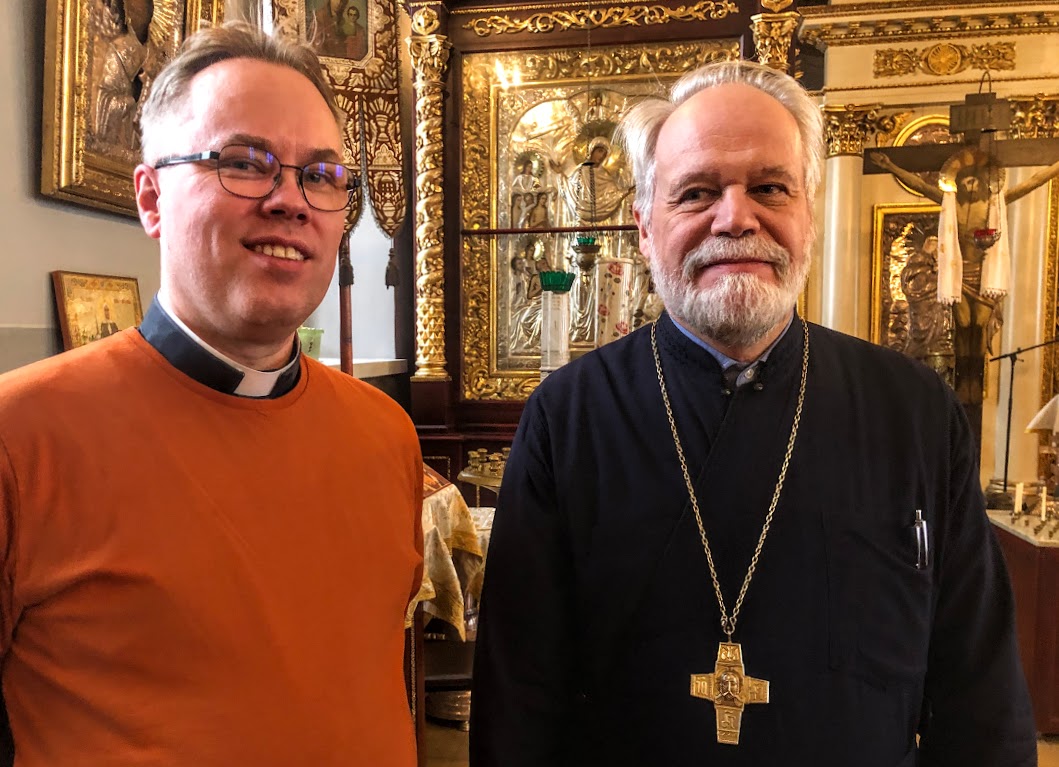
The Revd Tuomas Mäkipää (left), the Chaplain at Saint Nicholas, Helsinki, who introduces the USPG Prayer Diary this week, with Father Heikki Huttunen of Holy Trinity Orthodox Church (Photograph: Patrick Comerford, 2023)

Today’s Prayers: USPG Prayer Diary:

The theme this week in ‘Pray With the World Church,’ the Prayer Diary of the Anglican mission agency USPG (United Society Partners in the Gospel), is ‘Praying for Peace.’ This theme is introduced today:

As the war continues in Ukraine USPG and the Diocese in Europe support several programmes and initiatives to support refugees who flee the country. The Chaplaincy at Saint Nicholas is one of many chaplaincies that have pooled its resources to help ease the suffering of those refugees having to flee their homes because of the conflict in Ukraine and supports the Vallila Help Centre in its work.

The Revd Tuomas Mäkipää, Chaplain of Saint Nicholas, Helsinki has written the following prayer for those affected by conflict.

Father,
Give wisdom to the leaders of the nations,
that they may be a force for good on the earth.
Sustain the anxious and fearful and renew them with courage from on high,
Comfort all worried families whose loved ones are in danger,
surround them with your love protect them from all harm.
Be with the sick and wounded,
Stand by all prisoners and captives,
let your mercy be shown to all and your power to heal and save.
In Christ Jesus your son, our Lord, Amen

The USPG Prayer Diary today (22 October 2023, Trinity XX) invites us to pray in these words:

Oh, God of peace and safety
Pour your peace on us
Oh, God of peace,
Grant peace in our hearts
(from an Arabic hymn).

The Collect:

God, the giver of life,
whose Holy Spirit wells up within your Church:
by the Spirit’s gifts equip us to live the gospel of Christ
and make us eager to do your will,
that we may share with the whole creation
the joys of eternal life;
through Jesus Christ your Son our Lord,
who is alive and reigns with you,
in the unity of the Holy Spirit,
one God, now and for ever.

The Post-Communion Prayer:

God our Father,
whose Son, the light unfailing,
has come from heaven to deliver the world
from the darkness of ignorance:
let these holy mysteries open the eyes of our understanding
that we may know the way of life,
and walk in it without stumbling;
through Jesus Christ our Lord.

Yesterday’s Reflection

Continued Tomorrow

The Week of Prayer for World Peace ends today, Sunday 22 October 2023

Scripture quotations are from the New Revised Standard Version Bible: Anglicised Edition copyright © 1989, 1995, National Council of the Churches of Christ in the United States of America. Used by permission. All rights reserved worldwide. http://nrsvbibles.org

Saint Nicholas’s Chaplaincy supports the work of Vallila Centre through grants from USPG and the Diocese in Europe (Photograph: Patrick Comerford, 2023)

21 October 2023

Daily prayers in Ordinary Time
with USPG: (146) 21 October 2023,
Week of Prayer for World Peace (7)

‘We pray for recovery in the years to come, for restoration, generosity, healing, closure’ (John Birch) … street art in Gort, Co Galway (Photograph: Patrick Comerford)

Patrick Comerford

We are in Ordinary Time in the Church Calendar, and tomorrow is the Twentieth Sunday after Trinity (Trinity XX, 22 October 2023).

Before today begins, I am taking some time for prayer and reflection early this morning.

The Week of Prayer for World Peace began last Sunday, and so my reflections each morning during these eight days are gathered around this theme in these ways:

1, A reflection on the Week of Prayer for World Peace ;

2, the Gospel reading of the day in the Church of England lectionary;

3, a prayer from the USPG prayer diary.

The Week of Prayer for World Peace began with ‘A Call to Prayer for World Peace’ signed by faith leaders in 1974

A Week of Prayer for World Peace:

The International Prayer For Peace:

Lead me from death to life, from falsehood to truth
Lead me from despair to hope, from fear to trust
Lead me from hate to love, from war to peace
Let peace fill our hearts, our world, our universe

Day 7, Consequences: Remembering those impacted by all forms of violence:

Hiroshima Child

I come and stand at every door
but none can hear my silent tread.
I knock and yet remain unseen
for I am dead, for I am dead.

I’m only seven though I died
in Hiroshima long ago.
I’m seven now as I was then.
When children die they do not grow.

My hair was scorched by swirling flame,
my eyes grew dim, my eyes grew blind.
Death came and turned my bones to dust
and that was scattered by the wind.

I need no fruit, I need no rice,
I need no sweets nor even bread,
I ask for nothing for myself,
for I am dead, for I am dead.

All that I need is that for peace
you fight today, you fight today,
so that the children of this world
can live and grow and laugh and play.
Nazim Hikmet, Turkish poet

We pray for lives lost, families torn apart, lost and
lonely, homeless, hungry, afraid.

We pray for factories destroyed in an instant, for
machinery shattered,
livelihoods ruined.

We pray for rescuers, finding survivors alongside
bodies, courageous,
undaunted, hopeful.

We pray for recovery in the years to come, for
restoration, generosity,
healing, closure.
John Birch, Welsh Methodist preacher

Victory creates hatred. Defeat creates suffering. The wise ones desire neither victory nor defeat … Anger creates anger … He who kills will be killed. He who wins will be defeated … Revenge can only be overcome by abandoning revenge … The wise seek neither victory nor defeat.
Words of The Buddha

‘All that I need is that for peace / you fight today’ (Hiroshima Child, Nazim Hikmet) … floating peace lanterns on Willen Lake on Hiroshima Day (Photograph: Patrick Comerford, 2023)

Luke 12: 8-12 (NRSVA):

[Jesus said:] 8 ‘And I tell you, everyone who acknowledges me before others, the Son of Man also will acknowledge before the angels of God; 9 but whoever denies me before others will be denied before the angels of God. 10 And everyone who speaks a word against the Son of Man will be forgiven; but whoever blasphemes against the Holy Spirit will not be forgiven. 11 When they bring you before the synagogues, the rulers, and the authorities, do not worry about how you are to defend yourselves or what you are to say; 12 for the Holy Spirit will teach you at that very hour what you ought to say.’

‘We pray for lives lost, families torn apart, lost and lonely, homeless, hungry, afraid’ (John Birch) … clothes for Ukrainian families in a refugee centre in Helsinki (Photograph: Patrick Comerford, 2023)

Today’s Prayers: USPG Prayer Diary:

The theme this week in ‘Pray With the World Church,’ the Prayer Diary of the Anglican mission agency USPG (United Society Partners in the Gospel), has been ‘Helpline to women in need.’ This theme was introduced on Sunday.

The USPG Prayer Diary today (21 October 2023) invites us to pray in these words:

We pray for a world in which all people are safe from violence and abuse.

The Collect:

O God, forasmuch as without you
we are not able to please you;
mercifully grant that your Holy Spirit
may in all things direct and rule our hearts;
through Jesus Christ your Son our Lord,
who is alive and reigns with you,
in the unity of the Holy Spirit,
one God, now and for ever.

The Post Communion Prayer:

Holy and blessed God,
you have fed us with the body and blood of your Son
and filled us with your Holy Spirit:
may we honour you,
not only with our lips
but in lives dedicated to the service
of Jesus Christ our Lord.

Yesterday’s Reflection

Continued Tomorrow

The Week of Prayer for World Peace began on Sunday 15 October 2023

Scripture quotations are from the New Revised Standard Version Bible: Anglicised Edition copyright © 1989, 1995, National Council of the Churches of Christ in the United States of America. Used by permission. All rights reserved worldwide. http://nrsvbibles.org

22 June 2023

Daily prayers in Ordinary Time
with USPG: (25) 22 June 2023

Father Heikki Huttunen celebrates the Liturgy in Finnish and Church Slavonic in Holy Trinity Church in Helsinki (Photograph: Patrick Comerford, 2023)

Patrick Comerford

This week began with the Second Sunday after Trinity (18 June 2023) and Father’s Day. Today the calendar of the Church of England in Common Worship commemorates Saint Alban, first Martyr of Britain (ca 250).

Before the day begins, I am taking some time for prayer, reading and reflection.

Over these weeks after Trinity Sunday, I am reflecting each morning in these ways:

1, Looking at relevant images or stained glass window in a church, chapel or cathedral I know;

2, the Gospel reading of the day in the Church of England lectionary;

3, a prayer from the USPG prayer diary.

Holy Trinity Church is the oldest Orthodox church in central Helsinki (Photograph: Patrick Comerford, 2023)

Holy Trinity Church, Helsinki:

This week I am reflecting on Orthodox churches named after the Holy Trinity. These Trinity reflections continue this morning (22 June 2023) with photographs of Holy Trinity Church in Helsinki, which I visited earlier this year when I was visiting church-based projects in the Finnish capital supported by USPG and working with Ukrainian refugees.

There is a popular story about the origins of the Orthodox Church in Ukraine, Russia and Belarus. It is said that when Vladimir, Prince of Kyiv, was still a pagan at the end of the tenth century, he sent envoys out to discover what the true religion was and to advise him on which religion should become the state religion.

The envoys first visited the Muslim Bulgars of the Volga, but found no joy among them ‘but mournfulness and a great smell.’ In Germany and Rome, they found the worship and liturgy was without beauty. But when the envoys from Kyiv reached Byzantium, they were so dazzled by the splendour of the liturgy in the great church of Aghia Sophia they instantly decided that Orthodoxy should be the faith of their people.

‘We knew not whether we were on heaven or on earth, for surely there is no such splendour or beauty anywhere upon earth. We cannot describe it to you: only this we know, that God dwells there among humans, and that their service surpasses the worship of all other places. For we cannot forget that beauty.’

The story may be part of the myths of building national identity. But it shows too how Orthodox identity shares many common traditions among the people of Russia and Ukraine, and in neighbouring Finland.

Inside Holy Trinity Church in central Helsinki, Father Heikki Huttunen celebrates the Liturgy with the same splendour and beauty that the emissaries from Kyiv, but a relaxed and warm simplicity that make the church a place of welcome for refugees and asylum seekers.

The languages he uses in the liturgy include Finnish, Church Slavonic and Russian, which reflect the diversity of his people and the recent conflicts that are redefining their identities.

Holy Trinity Church is the oldest Orthodox church in central Helsinki. In size, it is almost dwarfed by the large Lutheran cathedral next-door, with its majestic domes and steps looking down onto the harbour. Helsinki Cathedral is the city’s major landmark and Finland’s most recognisable building. It is in the heart of the area that includes Senate Square, the Presidential Palace and a collection of major academic and historical buildings.

Both the Evangelical Lutheran Church of Finland and the Orthodox Church of Finland have a special position in Finnish law, and their historic churches standing side-by-side each – Helsinki Cathedral and Holy Trinity Church – were designed in the 1820s by the same architect, Carl Ludvig Engel.

Although the Orthodox Church of Finland is small in numbers – with about 58,000 members – the Orthodox presence in Finland dates back to the early 12th century, and shares its roots in those stories of the emissaries sent from Kyiv to Constantinople.

As Father Heikki Huttunen celebrated the Liturgy in Finnish and Church Slavonic in Holy Trinity Church this week, I noticed how he named the Patriarch of Constantinople in his prayers, but not for the Patriarch of Moscow.

After centuries of Swedish rule, Finland became the autonomous Grand Duchy of Finland within the Russian Empire in 1808, and Helsinki was declared the capital in 1812. Russian civil servants, merchants and soldiers moved to Helsinki in large numbers and the czar supported their efforts to build their own church. Alexander I decreed in 1814 that 15 per cent of the salt import tax was to be used to build two churches in the city, one Lutheran and one Orthodox.

In the early period of Russian rule, the parish consisted mainly of Russians living in the Helsinki region. Over the years, however, the parish has changed and the majority of members today speak Finnish, although 15 per cent of members speak Russian as their mother tongue.

Many families at Holy Trinity Church have roots in Russia or have Russian-speaking ancestors. But many also remember how Finland was divided in the aftermath of World II, with many parts of Karelia, with their towns and people, churches and parishes, forced to become part of the Soviet Union.

Orthodox numbers in Finland were boosted in the 1990s with the migration of many people from the former Soviet Union, and now the children and grandchildren of that generation of migrants are in their 30s and make up about half the parish.

Finland shares a 1,300 km border with Russia. The crisis in Ukraine has put an effective end to Russian tourism in Finland, but has also brought a large number of Russian and Ukrainian refugees to Helsinki. Many of the people fleeing Russia have been forced to leave because of the changes in Russian society or for fear of being conscripted.

But, as Father Heikki reminded me when me met earlier this year, Finland has always been a country of refugees and of the children of immigrants.

He has worked with the World Council of Church in Geneva and the European Conference of Churches in Brussels, and is a former Secretary General of the Ecumenical Council of Finland. He speaks fluent Finnish, Swedish, English, Russian, French, Spanish and Estonian, reflecting the diversity of his parish and parishioners.

On a Sunday morning, more than half the congregation comes from a refugee background, and 25% or a quarter of them can be Ukrainians. ‘We are the closest church to these Ukrainians, and we should be the first to open our arms to welcome them.’

The Russians and Ukrainians in the church show compassion and understanding for each other, Father Heikki says. The Russians are shocked that they cannot return to visit their grandparents. They cannot pay their rents, and they cannot even communicate by main since all postal links were cut off. These Russian speakers include people from Russian-speaking parts of Ukraine that were occupied by Russian troops in the first weeks of the conflict.

He estimates that about 30% of the Russians in his church have relatives in Ukraine, while 40% of the Ukrainians have close family relatives in Russia. Many of the Ukrainians are hoping they can go back to western or central Ukrainians when Spring comes. But the future is uncertain for those who have fled east or south Ukraine, where whole towns and cities have been destroyed.

He thinks one-third of the refugees may remain in Finland. But he also expects more newcomers when the war enters new phases in the coming months.

Soon after the conflict broke out, Archbishop Leo Makkonen of Helsinki and All Finland accused the Russian Orthodox Church of standing by the state leadership to bless the war and to present it as a legitimate ‘holy war’.

‘Now is the high time for the Church in Russia to realise that it has gone astray,’ Archbishop Leo said. ‘I appeal directly to the Patriarch of Moscow, Kirill: Remember the promises you have made before God as a bishop and patriarch. They must be accounted for before the Almighty.’

‘For Christ’s sake, wake up and condemn this evil,’ he implored. ‘Use your influence to promote peace. Do your best to end this war. I pray that humility and wisdom from God will guide you.’

A short walk from Holy Trinity Church and Helsinki’s Lutheran Cathedral, Uspenski Cathedral is the main cathedral of the Orthodox Church of Finland. It is dedicated to the Dormition of the Theotokos or the Virgin Mary. Uspenski Cathedral was built above the harbour in 1862-1868 by the architects Aleksey Gornostayev and Ivan Varnek.

The consecration of Holy Trinity Church on 26 August 1827 marks the formal beginning of the Finnish Orthodox Church. But the Church became autonomous and self-governing in 1923 when it gained its independence from the Russian Orthodox Church.

The Finnish Orthodox Church is preparing to celebrate the centenary of its separate identity next year. The majority of parishes are not big enough to meet some of the basic and simple needs of the new arrivals. But Father Heikki hopes the church can find a priest to work full-time with the refugees.

Father Heikki Huttunen in Holy Trinity Church … his church in Helsinki includes many Russian and Ukrainian refugee families (Photograph: Patrick Comerford, 2023)

John 12: 24-26 (NRSVA):

[Jesus said:] 24 Very truly, I tell you, unless a grain of wheat falls into the earth and dies, it remains just a single grain; but if it dies, it bears much fruit. 25 Those who love their life lose it, and those who hate their life in this world will keep it for eternal life. 26 Whoever serves me must follow me, and where I am, there will my servant be also. Whoever serves me, the Father will honour.’

‘For Christ’s sake, wake up and condemn this evil’ (Archbishop Leo Makkonen of Helsinki and All Finland) … inside Holy Trinity Church, Helsinki (Photograph: Patrick Comerford, 2023)

Today’s Prayer:

The theme this week in ‘Pray With the World Church,’ the Prayer Diary of the Anglican mission agency USPG (United Society Partners in the Gospel) is ‘The snowdrop that never bloomed.’ This theme was introduced on Sunday.

The Prayer in the USPG Prayer Diary today (22 June 2023, Saint Alban, Windrush Day) invites us to pray:

Let us give thanks for the life of Saint Alban, and for the rich and varied contributions of immigrants to our society. May we recognise their works and offer hospitality to all who migrate to the UK today without prejudice and fear.

Collect:

Eternal Father,
when the gospel of Christ first came to our land
you gloriously confirmed the faith of Alban
by making him the first to win a martyr’s crown:
grant that, following his example,
in the fellowship of the saints
we may worship you, the living God,
and give true witness to Jesus Christ your Son our Lord,
who is alive and reigns with you,
in the unity of the Holy Spirit,
one God, now and for ever.

Post Communion:

God our redeemer,
whose Church was strengthened by the blood of your martyr Alban:
so bind us, in life and death, to Christ’s sacrifice
that our lives, broken and offered with his,
may carry his death and proclaim his resurrection in the world;
through Jesus Christ our Lord.

Yesterday’s reflection

Continued tomorrow

The Revd Tuomas Mäkipää (left), the Anglican Chaplain in Helsinki, with Father Heikki Huttunen in Holy Trinity Orthodox Church (Photograph: Patrick Comerford, 2023)

Scripture quotations are from the New Revised Standard Version Bible: Anglicised Edition copyright © 1989, 1995, National Council of the Churches of Christ in the United States of America. Used by permission. All rights reserved worldwide. http://nrsvbibles.org

Uspenski Cathedral is the main cathedral of the Orthodox Church of Finland (Photograph: Patrick Comerford, 2023)

16 June 2023

Daily prayers in Ordinary Time
with USPG: (19) 16 June 2023

Inside the chapel in the USPG offices in Trinity Street, near Southwark Cathedral (Photograph: Patrick Comerford)

Patrick Comerford

The First Sunday after Trinity was celebrated on Sunday (11 June 2023). The Calendar of the Church of England in Common Worship today (16 June 2023) remembers Richard, Bishop of Chichester (died 1253) and Joseph Butler, Bishop of Durham, Philosopher (died 1752).

Before this day begins, I am taking some time this morning for prayer, reading and reflection.

Over these weeks after Trinity Sunday, I am reflecting each morning in these ways:

1, Looking at relevant images or stained glass window in a church, chapel or cathedral I know;

2, the Gospel reading of the day in the Church of England lectionary;

3, a prayer from the USPG prayer diary.

Four missionary bishops on four windows in the USPG chapel in Trinity Street, Southwark (Photograph: Patrick Comerford; click on image for full-screen view)

The Chapel, USPG offices, Trinity Street, Southwark:

My photographs this morning (16 June 2023) return to Trinity Street, near Southwark Cathedral, and the offices of USPG. USPG moved there in 2019, and USPG’s unique stained-glass windows of four pioneering missionary bishops were put in place in the USPG chapel in 2020.

These windows date from the 250th anniversary of SPG (now USPG) in 1951. The bishops depicted in the windows are: Samuel Ajayi Crowther, Vedanayakam Samuel Azariah, Tsae-seng Sing, and Joseph Sakunoshin Motoda.

Bishop Tsae-seng Sing (1861-1940) was the first ethnic Chinese bishop in the Anglican Communion and an Anglican bishop in China. His father was the first Anglican priest in Chekiang (Zhejiang) Province. Sing Tsae-seng was educated at Trinity College, Ningpo, and ordained in 1890. He was Headmaster of his old college for 29 years. He was also Archdeacon of Chekiang from 1910 to 1918.

He was consecrated an Assistant Bishop in the Diocese of North China at Holy Trinity Cathedral, Shanghai, in 1918, which provided the theme of this prayer diary yesterday. While has was an assistant bishop in the diocese, the Bishops of Chekiang were two Dublin-born bishops, Herbert James Molony (1908-1928), and John Curtis (1929-1950).

These windows have brought the chapel to life, with their bright colours and their sense of history. USPG’s General Secretary, the Revd Duncan Dormor, has said, ‘They represent where we’ve come from, who we are, and for me they speak to the nature of the Anglican Communion today.’

USPG was founded in 1701 and I have been a supporter of USPG throughout my adult life. My six-year term as a Trustee of USPG came to an end in 2021, and I miss the friendships that have grown over these years, and the inspiration have drawn from fellow trustees, staff members, and other people linked with USPG.

However, many of these friendships continue to grow, and it was a privilege for me and for Charlotte earlier this year to work on behalf of USPG, visiting church-linked projects in Budapest and Helsinki working with Ukrainian refugees in Hungary and Finland.

For many years, I attended the USPG conferences each year in High Leigh, near Hoddesdon in Hertfordshire, and in Swanwick in Derbyshire. This year, the conference has moved to in Yarnfield Park in Stone, Staffordshire, and opens today (16 June 2023).

I am sorry I cannot take part in the conference, as I have been in Dublin since yesterday, working on a television documentary. This year’ conference, on the theme of ‘Justice & the Church,’ is exploring the theme of justice across the Anglican Communion.

This is an opportunity to hear from guest speakers and to engage with workshops and bible studies focused on the themes of race, gender, and climate action. The conference concludes tomorrow (17 June 2023).

Bishop Samuel Ajayi Crowther in the USPG windows (Photograph: Patrick Comerford)

John 21: 15-19 (NRSVA):

15 When they had finished breakfast, Jesus said to Simon Peter, ‘Simon son of John, do you love me more than these?’ He said to him, ‘Yes, Lord; you know that I love you.’ Jesus said to him, ‘Feed my lambs.’ 16 A second time he said to him, ‘Simon son of John, do you love me?’ He said to him, ‘Yes, Lord; you know that I love you.’ Jesus said to him, ‘Tend my sheep.’ 17 He said to him the third time, ‘Simon son of John, do you love me?’ Peter felt hurt because he said to him the third time, ‘Do you love me?’ And he said to him, ‘Lord, you know everything; you know that I love you.’ Jesus said to him, ‘Feed my sheep. 18 Very truly, I tell you, when you were younger, you used to fasten your own belt and to go wherever you wished. But when you grow old, you will stretch out your hands, and someone else will fasten a belt around you and take you where you do not wish to go.’ 19 (He said this to indicate the kind of death by which he would glorify God.) After this he said to him, ‘Follow me.’

Bishop VS Azariah holding Dornakal Cathedral in one of the windows in the USPG chapel in Trinity Street, Southwark (Photograph: Patrick Comerford, 2020)

Today’s Prayer:

The theme this week in ‘Pray With the World Church,’ the Prayer Diary of the Anglican mission agency USPG (United Society Partners in the Gospel) is ‘Opening the World for Children through Learning.’ This theme was introduced on Sunday.

The Prayer in the USPG Prayer Diary today (16 June 2023) invites us to pray:

We pray for the Estate Community Development Mission – for all they are doing for workers and especially their children so that they can experience an education.

Bishop Tsae-seng Sing of Chekiang in the windows (Photograph: Patrick Comerford)

Collect:

Most merciful redeemer,
who gave to your bishop Richard a love of learning,
a zeal for souls and a devotion to the poor:
grant that, encouraged by his example,
we may know you more clearly,
love you more dearly,
and follow you more nearly,
day by day,
who with the Father and the Holy Spirit are alive and reign,
one God, now and for ever.

Post Communion:

God, shepherd of your people,
whose servant Richard revealed the loving service of Christ
in his ministry as a pastor of your people:
by this eucharist in which we share
awaken within us the love of Christ
and keep us faithful to our Christian calling;
through him who laid down his life for us,
but is alive and reigns with you, now and for ever.

Bishop Joseph Sakunoshin Motoda in the windows (Photograph: Patrick Comerford)

Yesterday’s reflection

Continued tomorrow

The windows in the USPG chapel date from the 250th anniversary of SPG in 1951 (Photograph: Patrick Comerford)

Scripture quotations are from the New Revised Standard Version Bible: Anglicised Edition copyright © 1989, 1995, National Council of the Churches of Christ in the United States of America. Used by permission. All rights reserved worldwide. http://nrsvbibles.org

20 January 2023

How Helsinki’s Jewish
community survived through
wars and the Holocaust

Helsinki Synagogue in the Kamppi district was designed by the architect Jac Ahrenberg and built in 1906 (Photograph: Sofia Ek/Wkipedia)

Patrick Comerford

Our visit to Helsinki last week was short and focussed with a packed and demanding programme. This, combined with the shortened daylight hours in mid-January and streets piled high with snow, left virtually no time to see any of places tourists expect to see in the Finnish capital.

I suppose we shall have to visit Helsinki again if I am going to visit Helsinki’s synagogue. But while I was there I learned a little more about the Jewish community in Finland and its history.

Finland is home to 1,300 to 1,900 Jews, the third largest Jewish community in Scandinavia, following Sweden and Denmark. Finland’s Jewish community is largely integrated into Finnish society, and the World Jewish Congress says Jews in Finland enjoy a sense of stability and there has been relatively little antisemitism in Finland.

Most Jews in Finland live in the Greater Helsinki area, with a smaller community in Turku. The synagogue in Helsinki was built in 1906 and the synagogue in Turku was built in 1912. A synagogue in Wiborg built in 1910-1911 was destroyed by air bombings in 1939. The Jewish community in Tampere ceased functioning in 1981.

Jews first came to Finland as Russian soldiers who stayed in Finland in the 19th century after their military conscription came to an end.

Jacob Weikam, later Veikkanen, is said to be the first Jew to have settled on Finnish soil. He moved in 1782 to the town of Hamina, then under Russian rule, although at the time most of Finland was part of the Kingdom of Sweden. Swedish law allowed Jews to live in a only three towns – all of them outside what is now Finland.

Finland became part of the Russian Empire as the autonomous Grand Duchy of Finland in 1809. But Swedish laws remained in force, preventing Jews from settling in Finnish territory.

However, Russian Jews began arriving in Finland as tradesmen and craftsmen. Most were retired soldiers from the Imperial Russian army. They had been forced into the Russian army as children, and after their 25-year terms expired they had the right to remain in Finland regardless of legacy Swedish legislation.

However, it was only after Finland declared independence in 1917 that Jews were granted full rights as Finnish citizens.

Finland’s involvement in World War II began during the Winter War, from 30 November 1939 to 13 March 1940, when the Soviet Union invaded Finland. Many Finnish Jews became refugees and the synagogue in Wiborg was destroyed by air bombings.

When Germany launched Operation Barbarossa, Finland resumed hostilities and was at war with the Soviet Union in 1941-1944. It is recorded 327 Finnish Jews fought for Finland during the war; 21 Jewish women served in the women’s auxiliary; and 15 Finnish Jews were killed in the Winter War and eight in the Continuation War.

The Finnish front had a field synagogue operating in the presence of Nazi troops, and Jewish soldiers were given leave on Saturdays and Jewish holidays.

Eight Jewish Austrian refugees and 19 other people were deported to Nazi Germany in November 1942 at the behest of the head of the Finnish police. Seven of the Jews were murdered immediately. Their deportation caused a national scandal, ministers resigned in protest, and the Archbishop, many Lutheran ministers, and the Social Democratic Party protested.

About 500 Jewish refugees arrived in Finland during World War II, although about 350 moved on to other countries, including about 160 who were moved to Sweden on the orders of Marshal Carl Gustaf Emil Mannerheim, commander of the Finnish Army and later President.

Although Himmler twice visited Finland trying to persuade the authorities to hand over the Jewish population, he was unsuccessful. Jews with Finnish citizenship were protected throughout that period, and Finland was the only Axis country where synagogues remained open throughout World War II. Three Finnish Jews were offered the Iron Cross for their wartime service, but all three refused the award.

Migration to Israel depleted Finland’s Jewish community after World War II, but numbers were boosted with the arrival of some Soviet Jews after the collapse of the Soviet Union.

Most Finnish Jews speak Finnish or Swedish as their first language. Yiddish, German, Russian, and Hebrew are also spoken in the community.

Helsinki Synagogue in the Kamppi (Kampen) district, nestled between the two big wings of the Radisson Hotel on Runeberginkatu Main Street was designed by the architect Jac Ahrenberg (1847-1914). The city of Helsinki gave the site on Malminkatu Street in Kamppi to the Jewish community in 1900. Construction began in the spring of 1905 and the building was finished in August 1906.

The synagogue is in an international, eclectic style common for 19th century synagogues in Central Europe and England. Its Byzantine-style cupola is a landmark in Helsinki. The façades are defined through the use of round arches. Its religious function is revealed only by Star of David motifs on three small round windows, the cupola and an inscription on the front wall: ‘For I give you good instruction; do not forsake my teaching’ (Proverbs 4: 2).

A memorial on Tähtitorninmäki (Observatory Hill) honours the eight Jewish refugees who were turned over to the Gestapo by Finnish authorities in 1942 and murdered at Auschwitz-Birkenau.The memorial is made from a thick slab of granite. It was unveiled in November 2000 and includes a plaque with a relief depicting hands begging for mercy. It is inscribed in Hebrew, Finnish, and English:'‘Even unto them will I give in my house and within my walls a monument and a memorial’ (Isaiah 56: 5). At its unveiling, the Finnish Prime Minister, Paavo Lipponen, issued an official apology for the extradition of the eight Jewish Austrian refugees to Nazi Germany.

Shabat Shalom
Helsinki City Hall designed by Carl Ludvig Engel … the city of Helsinki gave the site for the synagogue to the Jewish community in 1900 (Photograph: Patrick Comerford, 2023)

16 January 2023

The Ukrainian refugees in
Helsinki cannot walk away
from problems caused by war

Eeva has perfected a well-organised operation at the Vallila Help Centre (Photograph: Charlotte Hunter, 2023)

Amber Jackson from the diocese communications team in the Diocese in Europe and Patrick Comerford from USPG have been visiting Anglican chaplaincies in Hungary and Finland to see how they are supporting Ukrainian refugees with funding from the joint Ukraine appeal.

In Helsinki, Patrick Comerford visited the Vallila Help Centre, to see its work with Ukrainian refugees supported by Anglicans in the Finnish capital


Patrick Comerford

Saint Nicholas’s Anglican Church in Helsinki is responding to the conflict in Ukraine in a practical way through its active support for the Vallila Help Centre in a busy commercial and industrial area 4 km from the city centre.

The Revd Tuomas Mäkipää, the Chaplain at Saint Nicholas’s, brought us to visit the Vallila Help Centre and introduced us to Eeva and the volunteers and workers she co-ordinates as they respond to the urgent and daily needs of Ukrainian refugees.

Eeva has perfected a well-organised and co-ordinated operation at the Vallila Help Centre. One morning last week, she invited four of us – myself, Charlotte Hunter and Rebecca Boardman of USPG and Amber Jackson from the Diocese in Europe – to join her team of highly-motivated volunteers in a three-hour operation, packing bags of essential food items for distribution later in the day to 100 Ukrainian families.

The Vallila Help Centre is a unique service that has grown out of the work of the Ukrainian Association in Finland. The centre was up and running a week after the Russian invasion of Ukraine and has become a shared space for several relief organisations and an information and assistance point for people who fled the war in Ukraine.

Vassili Goutsoul of the Ukrainian Association in Finland admits that the expectations are greater than the resources. In the first few months of the crisis, everyone involved expected that the situation would have stabilised by now. Instead, the number of refugees continues to grow, and he believes Finland needs to prepare to receive 20,000 more refugees.

The centre is working from the Sturenportti building in Vallila, provided by YIT Oyj, the largest construction company in Finland, with headquarters in Helsinki. YIT develops and builds apartments and business premises in Finland and in the neighbouring Scandinavian and Baltic states. In the past, the company has also worked in Russia.

The building has about 1,300 sq metres of space. Since the Vallila Help Centre opened, 30 or more regular people volunteer at the centre, offering three principle areas of support:

• humanitarian aid, including clothes, food and hygiene items;
• emotional, psychological and psychosocial support;
• informational support and practical guidance on accommodation, employment, education and living in Finland.

Since it opened, the centre has worked with over 20,000 visitors. It began by providing food for at least 140 families and over six months this number has reached more than 3,360 families.

Natalia has been in Finland since the war in Ukraine began almost a year ago (Photograph: Charlotte Hunter, 2023)

Natalia (42) tells us how she has been in Finland since the war in Ukraine began almost a year ago. She first came to the Vallila Centre as a visitor, but is now part of Eeva’s team of volunteers at the centre.

When she fled, her civilian husband stayed behind to look after the elderly people in the apartment block where they lived. He was not involved in the fighting, but still was killed by Russian troops after they occupied the empty apartments in the block.

Natalia has been back to Ukraine for her husband’s funeral. But now she does not know whether she can ever return home again.

Most Ukrainian refugees in Helsinki still hope to return home in the future, despite their fears. But Natalia’s husband is dead, her children have been left without a father, and their home has been destroyed. Instead, the centre has become a second home for her.
The Anglican mission agency USPG (United Society Partners in the Gospel) and the Diocese in Europe through the Bishop’s Lent Appeal donated £22,855 to the Vallila Help Centre last August to fund Eeva’s work as the Humanitarian Aid co-ordinator.

The Vallila Help Centre offers a safe space for Ukrainian refugees, rooms where they can receive counselling, psychological support and therapy, a welcome area where clothes and shoes are offered in an environment that reflects a pleasant shopping environment, and a play area for children who can also receive psychological assistance.

A lounge area offers space for communication and relaxation, other non-governmental organisations (NGOs) provide advice in a consultation area, and other facilities include a computer zone and employment assistance point.

The centre had up to 20-30 refugee volunteers for many months. But public transportation stopped being free for refuges in October, and today that number has dropped to about ten who can come regularly only because the centre can meet their travel costs.

The Vallila Help Centre offers a safe space for Ukrainian refugees (Photograph: Charlotte Hunter, 2023)

Eeva’s work ensures the centre can meet the basic needs of Ukrainians in Helsinki. The centre offers a safe place where people who fled the conflict can receive appropriate support. Her work includes:

• securing donations of items to the centre;
• contact with other bodies to secure donations to the centre;
• organising food and hygiene packages;
• supporting and co-ordinating volunteers;
• providing integration support for visitors.

The Ukrainian Association in Finland was founded in Helsinki in 1998, but its founders never expected to turn their focus to work like this. Now Vassili Goutsoul sees the need for team building and he identifies the need to keep 30 or more volunteers motivated.

The support from USPG and the Diocese in Europe was timely as the centre moved from being an entirely volunteer-run project to consolidating its work. The majority of people the volunteers work with are women and children. Local businesses have donated furniture and consumer goods, ordinary Finns have donated clothes, shoes and children’s toys.

Many refugees see Finland as a getaway before they move on to another, third country. It was tragic to hear how some of them were already victims of an earlier tragedy, living close to Chernobyl at the time of the nuclear disaster in 1986.

After packing bags for 100 families and helping to unload donated goods from a tightly-packed van, we came down stairs lined with children, babies and pregnant women. We could walk away knowing we had homes to go to. The immediate future looks bleak for the families who need the support of the Vallila Help Centre.

Eeva’s work ensures the centre can meet the basic needs of Ukrainian families in Helsinki (Photograph: Charlotte Hunter, 2023)