Showing posts with label Iran. Show all posts

09 April 2026

From Agamemnon to Armageddon,
‘Iphigenia’ by Euripides is a classical
warning about the futility of war

A new interpretation by Stephen Sharkey of ‘Iphegnia’ by Euripides, adapted and directed by Serdar Biliş, opens tonight in the Arcola Theatre in London

Patrick Comerford

The Arcola Theatre in London is staging Iphigenia by Euripides in a new English version by Stephen Sharkey, adapted and directed by Serdar Biliş. It opens tonight (9 April) and continues until 2 May 2026.

Iphigenia is a story of sacrifice, parenthood and the human cost of war – then and now.

A young girl stands at the altar. A nation holds its breath. The winds have stopped. The Greek fleet is stranded. King Agamemnon is told by the gods that there is only one way for his army to reach Troy: he must sacrifice his daughter, Iphigenia.

It is a stark, contemporary reimagining of Euripides’ classic text and confronts the timeless question: what do we owe our country – and what do we owe our children? Blending the brutal beauty of ancient tragedy with voices of today, this new production replaces the traditional chorus with filmed testimonies from women across cultures, interwoven with live contemporary folk music that bridges East and West.

In this production, Mithra Malek plays Iphigenia, Indra Ové is Clytemnestra, Simon Kunz is Agamemnon and Kalia Lyraki is the Musician. The director and adaptor Serdar Biliş was born in Istanbul, and moved to London for a career in directing. He has an MA from Middlesex University, has been an associate director at Arcola Theatre and Liverpool Everyman, artistic director of Pürtelaş Theatre, and teaches at Kadir Has University in Istanbul and in Florence.

The translator Stephen Sharkey has updated and adapted a wide variety of classic and contemporary stories for the stage. His translation of Euripides’s Ion was produced by the Gate Theatre and directed by Erica Whyman.

The 1977 film ‘Iphigenia’ by the Greek director Michael Cacoyannis was the third in his Greek Tragedy trilogy

The name Iphigenia (Ἰφιγένεια) means ‘strong-born’, ‘born to strength’, or ‘she who causes the birth of strong offspring’. In Homer’s Iliad, Iphianassa (Ἰφιάνασσα) is the name of one of Agamemnon’s three daughters (Iliad ix.145, 287), a name that may be simply an older variant of the name Iphigenia.

For Euripides, Iphigenia is a daughter of King Agamemnon and Queen Clytemnestra, and so a princess of Mycenae. On his way to the Trojan War, Agamemnon offends the goddess Artemis by hunting and killing one of her sacred stags. She retaliates by preventing the allied troops from reaching Troy unless Agamemnon kills Iphigenia, his eldest daughter, at Aulis as a human sacrifice. In some versions, Iphigenia dies at Aulis, and in others, Artemis rescues her. In the version where she is saved, she goes to the Taurians and meets her brother Orestes.

Iphigenia in Aulis or Iphigenia at Aulis (Ἰφιγένεια ἐν Αὐλίδι) is the last of the surviving plays by Euripides. Written between 408 BCE, after Orestes, and 406 BCE, the year Euripides died, the play was first produced the following year in a trilogy with The Bacchae and Alcmaeon in Corinth by his son or nephew, Euripides the Younger, and won first place at the City Dionysia in Athens.


Mikis Theodorakis composed the score for Michael Cacoyannis’s film Iphigenia

Iphigenia in Aulis has had a significant influence on modern art. I became aware of that impact through the 1977 film Iphigenia (Ιφιγένεια) by the Greek director Michael Cacoyannis. It was the third in his Greek Tragedy trilogy, following Electra (1962) and The Trojan Women (1971), and Mikis Theodorakis composed the score. Cacoyannis adapted his film from his stage production of Iphigenia at Aulis.

Iphigenia tells the story of events immediately before the Trojan War. Helen, the wife of Menelaus, ran away to Troy with Paris, Priam’s son. Agamemnon, Menelaus’s brother and the King of Argos, gathered a large Greek expedition at Aulis to bring back Helen.

However, Artemis, the goddess of hunting, angered by an offence from Agamemnon’s father, King Atreus, caused storms to hinder the Greek fleet. This sets the stage for the film’s beginning.

The Greek armies have been waiting for far too long for the winds to rise and blow eastward, carrying their boats to Troy. They are tired, bored, hungry, and eager for battle. In an attempt to appease them, Agamemnon (Costa Kazakos) allows them to take sheep from a nearby temple dedicated to Artemis. In the chaos that ensues, Artemis’s sacred deer is accidentally killed. This angers Calchas (Dimitris Aronis), the high priest of Artemis’s temple, who delivers an oracle to Agamemnon in the presence of Menelaus (Kostas Karras) and Odysseus (Christos Tsagas).

Artemis was the daughter of Zeus and Leto, and twin sister of Apollo. She was the patron and protector of young children, especially young girls, and the goddess of marriage and childbirth. Her great temple at Ephesus was one of the Seven Wonders of the Ancient World, and she was also revered in Didyma, Delos and Delphi.

According to Calchas, the oracle demands that Agamemnon offer a sacrifice to atone for defiling holy ground and for killing the sacred stag. Once the sacrifice is made, Artemis will allow the winds to blow east so the armies can sail to Troy. The sacrifice demanded is Agamemnon's first-born daughter, Iphigenia (Tatiana Papamoschou). News of the deal spreads quickly among the army, although for some time they do not know the exact nature of the sacrifice.

After a heated argument between the two brothers, Agamemnon sends a message to his wife Clytemnestra (Irene Papas) in Argos. In the letter, Agamemnon asks his wife to send their daughter Iphigenia alone to Aulis, supposedly to marry Achilles (Panos Mihalopoulos), who is part of Agamemnon’s expeditionary force. Despite her husband’s instructions, Clytemnestra decides to accompany her daughter to Aulis.

From then on, the tension and the tragedy intensify. Agamemnon begins to doubt his plan. After admitting his deception to his old servant (Angelos Yannoulis), Agamemnon sends him with another letter to Clytemnestra, revealing the deal and urging her to cancel Iphigenia’s journey. However, Menelaus’s men intercept the servant on the road and bring him back to Aulis. In the confrontation that follows, Menelaus condemns his brother for sacrificing Greece’s honour for personal interests.

Agamemnon challenges this argument, persuading Menelaus that no war is worth the life of a child. Following their agreement, Agamemnon decides to deliver the letter to Clytemnestra personally, but it is too late. A messenger announces the imminent arrival of the wedding party, including Clytemnestra. Agamemnon is stunned by the news and resigns himself to fate: ‘From now on, fate rules. Not I.’

When Clytemnestra arrives at Aulis, she is filled with happiness about her daughter’s imminent marriage to Achilles. However, Iphigenia’s first meeting with her father is fraught with double entendre, which is devastating. As she speaks of the wedding she expects, he speaks of her impending sacrifice. Although they use the same words, their meanings could not be more tragically divergent.

When Agamemnon meets Clytemnestra, he tries in vain to persuade her to return to Argos without witnessing the ‘wedding’. Clytemnestra and Achilles soon discover the truth from Agamemnon’s old servant.

Achilles is overwhelmed with shame and anger when he learns of the deception that has ensnared him in this tragedy. Clytemnestra is furious and, in desperation, confronts her husband one last time.

However, Agamemnon is ensnared in his own trap and cannot retreat, as Odysseus has threatened to disclose the true nature of the sacrifice to the army if Agamemnon fails to comply with the oracle’s demand. Meanwhile, preparations for the sacrifice progress swiftly. ‘Let's not delay; the wind is picking up,’ declares Calchas.

Odysseus finally acts by revealing the chosen sacrificial victim to the army. Now there is no turning back. Iphigenia briefly manages to escape, but is soon captured by Odysseus’s soldiers. In a poignant scene reminiscent of the dying sacred stag at the beginning of the film, Iphigenia is seen lying exhausted and breathless on the forest floor, evoking a sense of impending tragedy. Her captors return her to the camp to face her fate.

Resigned to her destiny, she has a heart-rending final meeting with her father before ascending the hill to her fate. Meanwhile, Agamemnon, surrounded by his jubilant army, watches helplessly from below as Iphigenia reaches the summit and is swiftly seized by Calchas. At that moment, as the wind rises, Agamemnon rushes up the steps. At the top, his expression reflects the assumed sight of his daughter’s death.

With a strong wind now blowing, the men rush to the beach, and launch their ships to set sail for Troy and its promised riches.

The play as it exists in the manuscripts ends with a messenger reporting that Iphigenia has been replaced on the altar by a deer. However, most critics accept that this is not an authentic part of Euripides’s original text but the work of an interpolator. A fragment of the play may indicate that Artemis appeared to console Clytemnestra and assure her that her daughter had not been sacrificed after all. But if this is a surviving reference to Euripides’s original ending which has not survived.

Cacoyannis made a number of changes to Iphigenia at Aulis to adapt it for modern cinema, with some significant divergences from the original plot. He does away with the traditional Greek tragic chorus originally used to explain key scenes, replacing it in some cases with a chorus of Greek soldiers. He introduces as dramatis personae Odysseus and Calchas, who are not present but are mentioned in the original play, to further the plot and voice certain themes.

As in Euripides’s original play, Cacoyannis is deliberately ambiguous in his ending. Although Greek myth says Iphigenia was miraculously saved at the moment of her death, this is not depicted in either the play or the film. Her true fate is left in question, but Agamemnon’s expression leaves little doubt that his daughter has been killed.

In Euripides’s Iphigenia at Aulis, Iphigenia’s rescue is described second-hand by a messenger. In the film, there is no overt reference to this event: the audience sees clouds and mist, followed by a shot of Agamemnon’s shocked expression.

A stall in Ephesus sells souvenir statues of Artemis, alongside figurines of Greek philosophers and the Virgin Mary (Photograph: Patrick Comerford)

The testimonies woven into Stephen Sharkey’s new interpretation of Iphigenia opening at the Arcola Theatre in London tonight are said to be raw, intimate and fiercely honest. They speak of motherhood, loss, duty and war, and they reframe this classical play by Euripides for a modern world and offer a powerful counterpoint to a story shaped by the decisions of men.

The role of gender in Iphigenia in Aulis becomes clear in the play. Classical Greek was a male-dominated culture, the majority of Greek warriors and heroes were male, and women had no political rights or rights over their own bodies – their role was to bear children and listen to their husbands or, if they are unmarried, their fathers.

As a woman, Iphigenia has no true choice in who she marries, as it is her father’s role to select and approve of a husband. Even when Achilles and Agamemnon reveal the truth, Iphigenia knows she has no choice and is forced to beg her father to change his mind.

Eventually, she concludes that her sacrifice would be worth the furthering of the war. She notes that it would be better that her life was lost than the lives of all the soldiers gathered there, as a woman's life bears a lot less value than the life of a man. She feels obliged to make the decision because of the subservient role she is expected to play to the men in her life. Euripides’s Iphigenia in Aulis highlights the importance of gender roles in both the decision Iphigenia makes and in how she is treated by her father, Agamemnon.

The play also deals with the themes of sacrifice and duty. Iphigenia is willing to make a great sacrifice to further the Trojan War, a war that she is not involved in directly herself.

Many major Greek artworks depict the Greek warrior or the art of warfare, including buildings, statues, coins, and vases. A major theme in war is sacrifice, and it was regarded as a great honour to die in battle as a hero.

Iphigenia recognises this when she chooses to make the sacrifice so that the Greek warriors could sail onwards to Troy. She bears a great sense of duty to her country, and she chooses to lay her life down not for her sake, but for the sake of the war and her country. She only asks that her name is written in history for her great sacrifice, although she does not get this. In some translations, Artemis sees Iphigenia’s sense of duty and her willingness to die an honourable death.

A bust of Euripides in the Achilleon Palace in Corfu (Photograph: Patrick Comerford)

Euripides wrote Iphigenia in Aulis between 408 BCE and 406. Although the Trojan Wars in the 13th or 12th century BCE, provides the setting, the more immediate context is the Peloponnesian Wars between Athens and Sparta fought in 431-421 BCE and 413-404 BCE, or the earlier Persian Wars that lastedfrom 499 until 449 BCE.

As wars and conflicts unfold and intensify in those regions in recent weeks, Euripides and his Iphigenia in Aulis become even more relevant today.

The German historian Heinz Richter (1939-2024) speculated that the debate over who is Greek and who is Turk, who is European and who is non-European, may have started as early as the Persian Wars, perhaps even from the Trojan War, and continued into modern times. The US Defence Secretary Pete Hegseth posted ‘Back to the Stone Age’ on X a week ago (2 April 2026), echoing Trump’s threat to bring Iran ‘back to the Stone Ages, where they belong.’ Iranian diplomats responded directly: ‘Stone Age? At a time when you were still in caves searching for fire, we were inscribing human rights on the Cyrus Cylinder. We endured the storm of Alexander and the Mongol invasions and remained; because Iran is not just a country, it is a civilisation.’

The Cyrus Cylinder, dating to 539 BCE, is one of the earliest declarations of human rights.

Other official Iranian responses added: ‘We will not be driven back to the Stone Age by your bombings. We are a nation with 7,000 years of civilisation.’

Trump, in his crude and illiterate failure to understand the very foundations of civilisation that have endured for so long, shows no appreciation of the place of Persian culture in shaping the classical world and our cultural identity today.

Once again, the demands of another Artemis (this time Artemis II) distract from the real lessons of the futility and tragedy of war, from the consequences of impetuous and capricious decision-making by rulers who would be kings and who are driven more by their own needs to project a sense of self-importance, of the way the decision to go to war impulsively sets off a chain of events that are soon beyond control, of the dangers of listening to voices that claim to be divinely inspired or sanctioned, of the ways war divide and destroy families, and of the deadly consequences of war for young people who have had no say in the decision-making processes yet are sacrificed on the altar not of a god but of a blustering and ill-advised king.

Trump has set in motion a future chain of events over which he has no control. Like Agamemnon, he may yet rue the future he has cursed us with and cry out: ‘From now on, fate rules. Not I.’


Daily prayer in Easter 2026:
5, Thursday 9 April 2026,
Thursday in Easter week

Christ appearing to his disciples at the table, Duccio (ca 1308-1311)

Patrick Comerford

Our Easter celebrations continue in the Church Calendar, and this is still Easter week.

Before this day begins, I am taking some quiet time this morning to give thanks, to reflect, to pray and to read in these ways:

1, reading today’s Gospel reading;

2, a short reflection;

3, a prayer from the USPG prayer diary;

4, the Collects and Post-Communion prayer of the day.

Jesus … stood among them and said to them, ‘Peace be with you’ (Luke 24: 36) … ‘Humanity’s Contempt for Humanity’ by Peter Walker in the ‘Consequence of War’ exhibition in Lichfield Cathedral (Photograph: Patrick Comerford)

Luke 24: 35-48 (NRSVA):

35 Then they told what had happened on the road, and how he had been made known to them in the breaking of the bread.

36 While they were talking about this, Jesus himself stood among them and said to them, ‘Peace be with you.’ 37 They were startled and terrified, and thought that they were seeing a ghost. 38 He said to them, ‘Why are you frightened, and why do doubts arise in your hearts? 39 Look at my hands and my feet; see that it is I myself. Touch me and see; for a ghost does not have flesh and bones as you see that I have.’ 40 And when he had said this, he showed them his hands and his feet. 41 While in their joy they were disbelieving and still wondering, he said to them, ‘Have you anything here to eat?’ 42 They gave him a piece of broiled fish, 43 and he took it and ate in their presence.

44 Then he said to them, ‘These are my words that I spoke to you while I was still with you – that everything written about me in the law of Moses, the prophets, and the psalms must be fulfilled.’ 45 Then he opened their minds to understand the scriptures, 46 and he said to them, ‘Thus it is written, that the Messiah is to suffer and to rise from the dead on the third day, 47 and that repentance and forgiveness of sins is to be proclaimed in his name to all nations, beginning from Jerusalem. 48 You are witnesses of these things.’

‘They gave him a piece of broiled fish, and he took it and ate in their presence’ (Luke 24: 42-43) … a variety of fish in a seafood shop at Easter in Rethymnon in Crete (Photograph: Patrick Comerford)

Today’s Reflections:

This morning’s Gospel reading at the Eucharist (Luke 24: 35-48) is a Resurrection story that continues on immediately from yesterday’s reading about the encounter of two disciples on the road to Emmaus with the Risen Christ.

In today’s reading, as the those two report back to their friends in Jerusalem of their encounter, the Risen Christ appears and greets his disciples, ‘Peace be with you’ (verse 36). He goes on to ask them, ‘Why are you frightened, and why do doubts arise in your hearts? (verse 38).

I have to admit to being not just frightened but absolutely terrified for the future of the world with the direction Donald Trump has taken the conflict in the Gulf and the Middle East, despite his claims he has agrred to a ceasefire for two weeks.

Tomorrow is Great and Good Friday in the calendar of the Greek Orthodox Church. So I have a second opportunity to celebrate Easter this year with the Greek Orthodox community in Stony Stratford this coming weekend. Easter is so important in the Greek calendar that our celebrations in England or Ireland pale into insignificance.

The common Easter greeting in Greece is Χριστός ἀνέστη! (Christós anésti!), Christ is Risen! And the automatic, reflex response, between friends and strangers alike, on the streets and in the shops, is Ἀληθῶς ἀνέστη! (Alithós anésti!), He is Risen Indeed!

And this is not just for Easter Day, or even a week or two after. Easter is celebrated for 50 days.

It is often forgotten here that Easter is not just for Easter Day. The Risen Christ is not put back into the tomb, nor is the stone rolled back across it after Easter Day or after the Easter holiday is over.

The Easter Season is a celebration of our new creation in the Risen Christ, and it is a full season of 50 days. It brings together the three dimensions of the Resurrection, the Ascension, and the sending of the Spirit.

These 50 days amount to one-seventh of the year, and they form our great ‘Sunday’ of the year. Just as Sunday is the first and the eighth day, so the ‘great Sunday’ of the 50 days of Easter begins with the day of the Resurrection and continues through eight Sundays, or an octave of Sundays, a ‘week of weeks’.

But the Easter promise of peace that we hear this morning is in sharp contrast to the Trump’s threat this Easter-tide that the people of Iran will ‘be living in Hell.’ His vulgar language shows no appreciation or understanding of the fact that the Persian civilisation is one of the oldest great classical cultures.

During the Babylonian exile, Persian thinking and philosophy interacted creatively with Jewish religious concepts, and contributed to many thoughts in Second Temple Judaism such as the resurrection of the dead, the sharp contrasts between angels and demons, reward and punishment and heaven and hell, and the concept of a final judgment, and the ultimate triumph of good over evil.

Hebrew adopted several Persian loanwords, such as our word paradise which comes from an old Persian word meaning an enclosed or walled garden or orchard.

In the first fourth century BCE, Xenophon adapted the Persian phrase into Greek as παράδεισος (paradeisos). Xenophon provides an early description of a Persian garden in his Οἰκονομικός (Oeconomicos), in which Socrates recalls the visit of the Spartan general Lysander to the Persian prince Cyrus the Younger and his ‘paradise at Sardis.’

Lysander is ‘astonished at the beauty of the trees within, all planted at equal intervals, the long straight rows of waving branches, the perfect regularity, the rectangular symmetry of the whole, and the many sweet scents which hung about them as they paced the park.’

Xenophon is writing about household management and agriculture in one of the earliest-known works on economics. It is also a treatise on leading an army and a state.

As another catastrophic conflict in the Middle East continues, it still holds the potential of developing into a global conflagration.

Often, the rush to war abroad can be a symptom of ineffective leadership at home, offering bravado abroad as an alternative to delivering on election promises at home.

The Prussian general Clausewitz famously declared: ‘War is the continuation of politics by other means.’ But, as Tony Benn told the House of Commons in 1991: ‘All war represents a failure of diplomacy.’

War represents the failure of diplomacy, the failure of politics and the failures of politicians. When inept leaders who cannot meet their responibilities and commitments resort to blaming some outsiders, people then believe the scapegoat is the real problem, and demand resolution through war. War is an aberration of politics rather than an extension of politics.

It was only in the Second Temple era Judaism that the Persian and Greek word paradise came to be associated with the Garden of Eden, and by extension its meaning was transferred to heaven.

In the New Testament, the word paradise is used only three times: by Christ on the cross, in response to the penitent thief, ‘Truly, I tell you, today you will be with me in Paradise’ (Luke 23: 42-43); by Saint Paul in his visionary description of being ‘caught up into Paradise’ (II Corinthians 12: 3-4), and in the Book of Revelation in a reference to ‘the tree of life that is in the paradise of God’ (Revelation 2: 7; see Genesis 2: 9).

The Persian, Greek, classical and Biblical images, which bring together the concepts of a garden, the enclosed place of peace, Eden, a restored earth, the coming kingdom and beatific visions of heaven are in sharp contrast to the Valhalla of Norse mythology, which is ruled over by Odin, the god of war, and is reward for those who die in conflict and combat.

In time, I hope to see Trump and his collaborators facing charges of war crimes, crime and against humanity. Bombing the people of Iran in their hospitals, schools and homes is hardly going to bring solace, comfort or peace to the over-bombed and much-victimised people of Iran, certainly not going to bring them into paradise. Instead, there is a real danger of creating a Valhalla or even a hell on earth rather than bringing the people of Iran closer to a place of peace and comfort.

Meanwhile, some lines come to mind that are so familiar that they often seem trite:

The kiss of the sun for pardon,
The song of the birds for mirth,
One is nearer God’s heart in a garden
Than anywhere else on Earth.


This verse is on a plaque on a wall in Saint Mary’s Cathedral, Limerick, and must be inscribed on millions of garden plaques, bird baths and sundials. The lines were penned by the English poet and hymnwriter Dorothy Gurney (1858-1932).

Dorothy Gurney was the daughter and wife of Anglican priests, her grandfather and her brother were both Anglican bishops, and ‘God’s Garden’ is her best-known poem. Quotations from her popular poem often miss the next and final verse that tells us why we are near to God in the garden:

For he broke it for us in a garden
Under the olive-trees
Where the angel of strength was the warden
And the soul of the world found ease.


Where is the soul of the world to find this peace in the face war in Iran and the Gulf?

Dorothy Gurney wrote her best-known hymn, O Perfect Love, in 1883 for her sister’s wedding:

O perfect Love, all human thoughts transcending,
lowly we kneel in prayer before thy throne,
that theirs may be the love which knows no ending
whom thou for evermore dost join in one …

Grant them the joy which brightens earthly sorrow;
grant them the peace which calms all earthly strife;
grant them the vision of the glorious morrow
that will reveal eternal love and life.


With imagination, Dorothy Gurney might have composed still another verse for ‘God’s Garden’, pointing out that when Mary Magdalene went to the empty tomb on the first Easter morning, she mistakenly supposed the Risen Christ to be the gardener (John 20: 15). As the Easter Gospel stories remind us, the constant words of the Risen Christ are ‘Peace be with you’ (Luke 24: 36; John 20: 19, 21, 26) and ‘Do not be afraid’ (Matthew 28: 10).

Saint Luke portrays the Risen Christ granting the disciples that ‘joy which brightens earthly sorrow,’ that ‘peace which calms all earthly strife,’ that ‘vision of the glorious morrow that will reveal eternal love and life.’

He eats with us, he dispels fear, he proclaims peace, and on the Easter morn he commissions us to be his witnesses (Luke 24: 47-48). We are to do the same.

Today the scripture has been fulfilled in our hearing, every time we eat with him, proclaim his word and invite the world into the kingdom. Today – like every one of the 50 days in this season of Easter – is the day of resurrection, of the in-breaking of God’s kingdom.

Χριστὸς ἀνέστη!
Christ is Risen!


In the gardens at the Hedgehog Vintage Inn in Lichfield (Photograph: Patrick Comerford)

Today’s Prayers (Thursday 9 April 2026, Thursday in Easter Week):

‘In the Garden’ provides the theme this week (5-11 April 2026) in ‘Pray With the World Church’, the Prayer Diary of the Anglican mission agency USPG (United Society Partners in the Gospel), pp 44-45. This theme was introduced on Sunday with Reflections by Rachel Weller, Communications Officer, USPG.

The USPG Prayer Diary today (Thursday 9 April 2026, Thursday in Easter Week) invites us to pray:

Merciful God, we pray for schools and families who receive fresh vegetables from the garden. Protect the wellbeing of each person and help the church meet the practical needs of children and households.

The Collect:

Lord of all life and power,
who through the mighty resurrection of your Son
overcame the old order of sin and death
to make all things new in him:
grant that we, being dead to sin
and alive to you in Jesus Christ,
may reign with him in glory;
to whom with you and the Holy Spirit
be praise and honour, glory and might,
now and in all eternity.

The Post-Communion Prayer:

God of Life,
who for our redemption gave your only-begotten Son
to the death of the cross,
and by his glorious resurrection
have delivered us from the power of our enemy:
grant us so to die daily to sin,
that we may evermore live with him in the joy of his risen life;
through Jesus Christ our Lord.

Additional Collect:

God of glory,
by the raising of your Son
you have broken the chains of death and hell:
fill your Church with faith and hope;
for a new day has dawned
and the way to life stands open
in our Saviour Jesus Christ.

Yesterday’s Reflections

Continued Tomorrow

The Gates of Paradise in Cambridge at Owlstone Croft, once known as Paradise Garden and now part of Queens’ College (Photograph: Patrick Comerford)

Scripture quotations are from the New Revised Standard Version Bible: Anglicised Edition copyright © 1989, 1995 National Council of the Churches of Christ in the United States of America. Used by permission. All rights reserved worldwide. http://nrsvbibles.org

06 March 2026

My anxieties about being stuck
in the Gulf ended with a quick
dash through Muscat Airport
last night and I am back home

I caught last night’s flight in Muscat with moments to spare and no time for coffee (Photograph: Patrick Comerford, 2026)

Patrick Comerford

Despite all my heightened fears anxiety, I didn’t find myself hanging around in Muscat International Airport in Oman last night or this morning. I left our flat in Kuching early on Thursday morning for a two-hour flight to Kuala Lumpur, and then to Muscat on a delayed seven-hour flight from Kuala Lumpur in the middle of the night. The delay left me with only minutes to spare before (breathlessly) catching my third flight – an eight-hour journey to Heathrow – and arrived in London early this morning.

Door-to-door, from Kuching to Stony Stratford, it was a 38-hour odyssey, and I feel washed out and exhausted this evening.

I had flown this route only two weeks previously, in the opposite direction, and had no hint at the time that all would not be well in the Gulf and the Middle East on the way back.

In normal times, before this conflict erupted a week ago, Muscat has been an alternative for perhaps more discerning travellers who preferred Oman to Dubai and its glitzy skyscrapers, brash brand-and-label shops and an overpowering, overwhelming commercialism. The World Travel and Tourism Council says Oman is the fastest growing tourism destination in the Middle East. Until last week.

Oman, officially the Sultanate of Oman, is the oldest independent state in the Arab world, ruled by the Al Bu Said dynasty since 1744. It has a population of almost 5.5 million people, a land area of 315,331 sq km, and is in the south-east corner of the Arabian Peninsula, sharing land borders with Saudi Arabia, the United Arab Emirates and Yemen. Muscat is the capital and the coastline of Oman faces the Arabian Sea to the south-east and the Gulf of Oman on the north-east.

Oman has been better known to tourists for its postcard beaches and green mountains. But in the past week, Muscat has become a major hub for a very different kind of visitor: people stranded by the closure of airspace across the Gulf and the Middle East and who are willing to pay a premium to be evacuated from the region.

The British government has chartered a number of planes this week to evacuate tourists and exiles who have found themselves trapped in the Gulf, and many are making their way from the United Arab Emirates to Oman. The drive from Dubai to Muscat takes about five hours, and it is now a busy route for people hoping to escape a long and arduous stretch of time in an increasingly tense Gulf area. Flights out of Dubai have been cancelled, as debris from Iranian missiles and drones rains down on the airport and on the artificial island of Palm Jumeirah.

Oman Air has increased flights from Muscat to Europe to accommodate stranded and fleeing travellers (Photograph: Patrick Comerford, 2026)

I travelled late at night from Kuala Lumpur to Muscat on Oman Air, which has increased flights from Muscat to Europe to accommodate stranded and fleeing travellers, and it is also running buses to bring them from the United Arab Emirates.

UAE airspace has been largely shut down to commercial flights since Saturday, stranding tens of thousands of business and leisure travellers in Dubai. The fluidity – and the danger – of the situation is triggering fear among many visitors in Dubai. Large numbers have been forced to extend their hotel stays, there us panic-buying of food and medicine, while they look for alternative ways to get out.

In the last few days, Austrian Air has flown people out from Muscat, and the Italian defence minister was picked up by the air force in Oman, where he travelled by land from Dubai.

Many of the people who have been flocking to Muscat this week seem to have access to large funds and paid extortionate demands to evacuate by land to Oman and then fly out by private jets while UAE airspace is closed. It all comes at an extraordinary price: one report says fast-track transfers to Oman now cost $5,000 per car, with some families even paying anything from $150,000 to $200,000 to be evacuated.

World governments are also trying to evacuate passengers through either Oman or Saudi Arabia. The first flight carrying Irish people who were stranded in Dubai arrived in Dublin a few days ago.

One American businessman I spoke to was travelling to Chicago, and found himself marooned without a flight, unable to book alternative options or the possibility of finding an hotel room. An English couple whose flight from Thailand to Muscat was delayed were left sleeping on the floor in the airport with no hotel rooms available, and believed they may have managed to get one of the last pair of seats on last night’s flight out to Heathrow.

An hotelier I was talking to said hotels in Muscat know they can charge what they want to these nights, and also fear the present crisis may have put an end to tourism in Oman for a long time to come.

Emotions and fears aside, I was prepared to find I was stuck in Muscat late last night and early this morning, with no idea when I might get out of Oman. I had decided to pack light, with only one small back pack, and at the time did not realise how wise that was going to be.

I had a boarding pass and my seat number. My anxieties may have given me enough adrenaline to run through the airport and reach Gate C6 with just three minutes before boarding began. There wasn’t even time to log-on to the airport WiFi and message Charlotte to say I was safe and boarding or to post that on Facebook. Had I not caught the same flight by a hair’s breadth, I wonder how long I would have been left waiting for a seat on already overbooked flights.

Tensions were running so high that a number of full-grown adult, mature men had a stand-up shouting match in the aisles of the plane during last night’s flight, and it took a lot of persuading from the cabin crew before they were seated again.

Unable to sleep, I spent most of the flight playing computer chess and watching the flight path on the screen in front of me. The Oman Air flight out two weeks’ ago had crossed from Turkish into Iraqi airspace, and then flown across Iran and across the Gulf to Muscat. On the return journey last night, the plane was redirected across the Arabian Peninsula and Saudi Arabia, then over the Sinai Peninsula, Cairo and Alexandria, then Chania in Crete, the southern Peloponnese, Kefalonia and Zakynthos, then across Italy, Switzerland and France.

I have slept much of this afternoon at home in Stony Stratford, comforted by the sound of the bells of Saint Mary and Saint Giles next door striking out the quarter hours and hours. I may well have been just one among the 25,000 Irish people who are said to feel they are stranded in the Gulf this week.

Charlotte faces a similar journey next week. Hopefully it’s not going to be as arduous

Last night’s flight from Muscat was safely redirected away from the Gulf and flew across Saudi Arabia and Egypt (Photograph: Patrick Comerford, 2026)

27 June 2025

What does the present conflict
mean for the Jews of Iran, who
have lived there for 30 centuries?

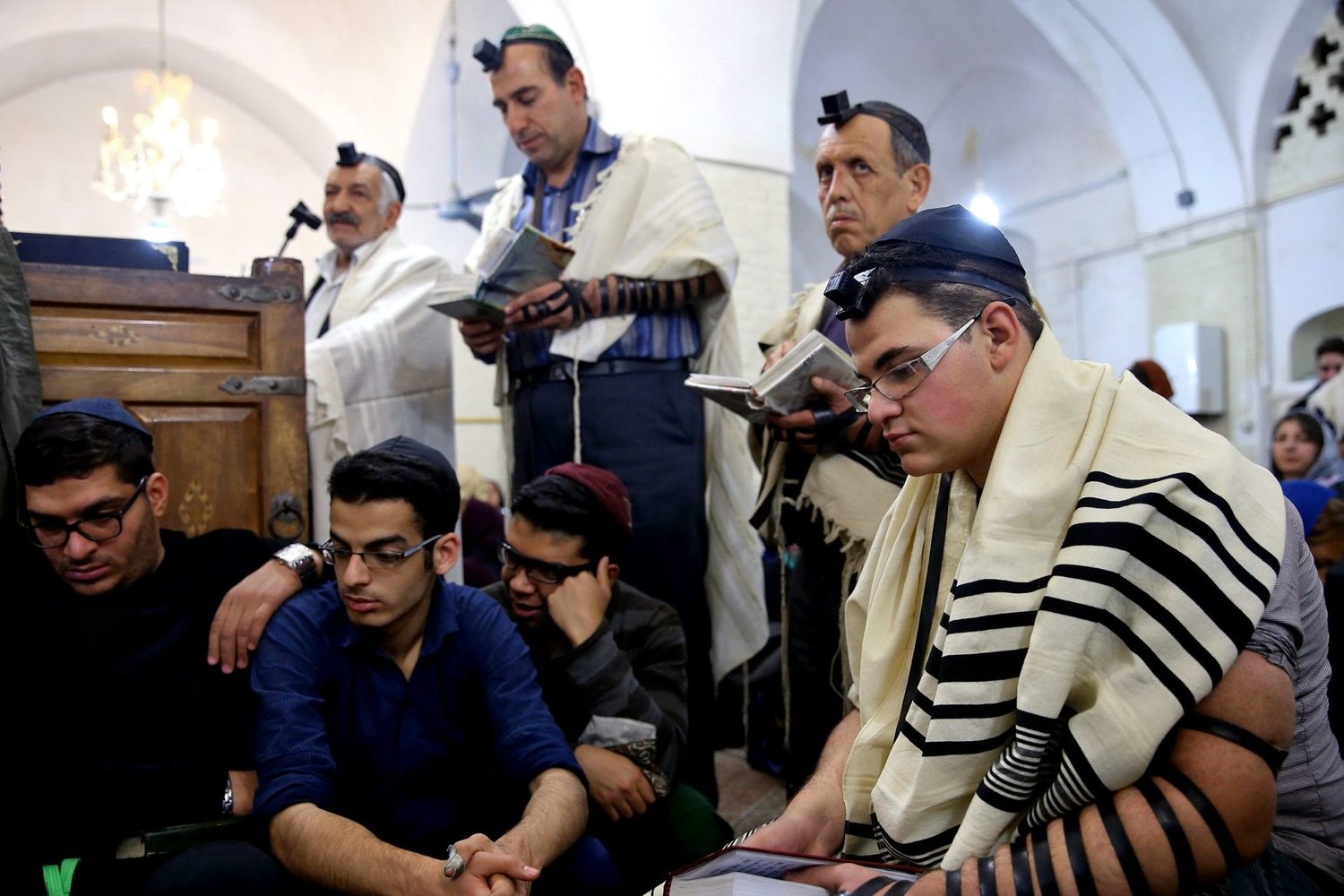
In synagogues in Isfahan and Tehran (Photographs: Tel Aviv Universoty)

Patrick Comerford

The recent Israeli and US attacks on Iran have made day-to-day life even more precarious for Jews living in Iran today. Since the Islamic Revolution in 1979, Iran has not been an easy place for Jews to live in, nor is it for Christians either. Both minorities seem to have been lost in the news coverage in recent days, yet Iran has Jewish and Christian communities that have called Iran, and before that Persia, their home for centuries.

After Israel, Iran has the largest number of Jewish people in a Middle East country. According to estimates, between 17,000 and 25,000 Iranian Jews are living mostly in larger cities such as Tehran, Isfahan, Shiraz, Hamedan and Tabriz. Iran's parliament, the Majlis, has one reserved seat for the Jewish community, currently held by Dr Homayoun Sameyah Najafabadi (61), a Tehran-born pharmacist first elected in 2020.

Iranian immigrants in Israel are referred to as Parsim, meaning Persian. In Iran, Persian Jews and Jewish people in general are both described with four common terms: Kalīmī, the most proper term; Yahūdī, which is less formal but correct; Yīsrael, the term Jewish people use to refer to themselves as descendants of the Children of Israel; and Johūd a term with highly negative connotations that many Jews find offensive.

Iranian or Persian Jews, or Parsim, are one of the oldest communities of the Jewish diaspora. According to one Jewish legend, the first Jew to enter Persia was Sarah bat Asher, granddaughter of the Patriarch Jacob.

Jews have been living in Persia continuously since ca 727 BCE, having arrived in the region as slaves captured by the Assyrian and Babylonian kings. The biblical books of Isaiah, Daniel, Ezra, Nehemiah, Chronicles and Esther refer to the lives of Jews in Persia and their relations with the Persian kings. The historic Jewish sites in Iran include the tomb of Esther and Mordechai in Hamadan, and the tombs of Daniel and Habakkuk, as well as the tombs of several outstanding Jewish scholars.

The Book of Esther are set entirely in Persia. Haman, a senior official in the court of King Ahasuerus, identified as Xerxes the Great, plotted in the 6th century BCE to kill all the Jews in ancient Persia. The plot was foiled by Esther, the Jewish Queen of Persia, Haman and his sons were hanged. The events are celebrated in the holiday of Purim.

Cyrus the Great led the Achaemenid conquest of the Neo-Babylonian Empire and later freed the the Jewish exiles rom the Babylonian captivity. According to the biblical account, Cyrus the Great was ‘God’s anointed’, and he granted all the Jews citizenship. Various biblical accounts say over 40,000 Jews returned ca 537 BCE, but many chose to remain in Persia. Scholars believe that Jews may have comprised as much as 20% of the population at the peak of the Persian Empire.

The Second Temple was rebuilt in Jerusalem, ‘according to the decree of Cyrus, and Darius, and Artaxerxes king of Persia’ (Ezra 6: 14). The prophets Haggai and Zechariah encouraged this work, and the Temple was ready for consecration in the spring of 515 BCE, more than 20 years after the Jews returned to Jerusalem.

After Israel, Iran has the largest number of Jewish people in a Middle East country

Persian loan words in Hebrew include: pardes (פַּרְדֵּס), orchard, from which we get the word for Paradise; Etrog (אֶתְרוֹג), a green-yellow fruit; lilach (לִילָךְ), lilac, a lighter shade of purple; shoshana (שׁוֹשַׁנָּה), rose, from the name of the former capital of the Persian Empire, Shushan; sukar (סֻכָּר), sugar, from the Persian word shakar); and bazar (בָּזָאר), from bāzār in Persian.

The Pharisees were one of the most important Jewish groups in the late inter-testamental and New Testament periods, and their name is said to come from Hebrew word that means ‘to separate,’ indicating a ‘separatist’ or a separated person. But a plausible alternative finds the origin of the name in the Aramaic word for Persian, and some scholars claim the Pharisees adapted some Zoroastrianism ideas, such as their ideas about resurrection and the future life, and their angelology and demonology, making them ‘Persianisers.’

With the fall of Jerusalem, Babylonia became a kind of bulwark of Judaism, and the number of Jewish refugees in Babylon increased after the collapse of the Bar Kochba revolt.

In the third century CE, Zoroastrianism became the official state religion and other religions, including Judaism, were suppressed. But later Shapur I was friendly to the Jews, Shapur II’s mother was half-Jewish, and this gave the Jewish community relative freedom of religion and many advantages.

After the Islamic conquest of Persia, Jews, Christians and Zoroastrians lived with a number of discriminations. At times, they even enjoyed significant economic and religious freedom compared with Jews in Europe, and many were doctors, scholars and craftsman, or held positions of influence.

During Mongol rule in the late 13th century, Arghun Khan appointed Sa’d al-Daula a Jew as his vizier. But al-Daula was murdered in 1291 and Persian Jews in Tabriz suffered such violent persecutions that the Syriac Orthodox historian Bar Hebraeus wrote that ‘neither tongue can utter, nor the pen write down’ how violent the events were. Synagogues were destroyed, there were forced conversions and Jews were forced a distinctive mark on their heads.

Under the Safavid dynasty (1502-1794), Shi’a Islam became the state religion, Isfahan became a new capital, and Jews were forced to wear distinctive badges, clothing and headgear. But many Jews were traders, and they prospered through trade along the Silk Road with Central Asia and China.

The persecution of Jews in Persia resumed under the Qajar dynasty in 1794, and many Jews were confronted with two options: conversion to Islam or death. Throughout the 19th century, the European powers noted numerous forced conversions and massacres. However, European travellers reported that many Jews in Tabriz and Shiraz continued to practice Judaism in secret.

By the late 19th century, Jews were the most significant minority in Tehran. The Jewish quarter of Shiraz was looted and plundered in 1901, and 12 Jews murdered. Thousands of Iranian Jews emigrated in the late 19th and early 20th centuries to what is now Israel but then in the Ottoman Empire and to present-day Afghanistan, Pakistan and India.

The Pahlavi dynasty improved the life of Jews and many of the restrictions on Jews and other religious minorities were abolished. During the Allied occupation of Iran in World War II, some Polish and Jewish refugees who escaped Nazi-occupied Poland settled in Iran. After World II, the state of Israel was formed in 1948 and about 140,000 to 150,000 Jews were living in Iran, but over 95% of them have since migrated abroad.

About 70,000 Jews, or one-third of Iranian Jews, most of them poor, emigrated to Israel between 1948 and 1953. But many Jews who remained in Iran prospered during the reign of Shah Mohammad Reza Pahlavi. Until the Islamic Revolution in 1979, there were 80,000 to 100,000 Jews in Iran, mostly in Tehran (60,000), Shiraz (18,000), Kermanshah (4,000) and Isfahan (3,000).

Ayatollah Khomeini met Jewish community leaders in Qom when he returned from exile in Paris, and issued a fatwa decreeing that the Jews were to be protected. But since 1979, 13 Jews have been executed in Iran, accused of connections with Israel, and Jewish emigration increased dramatically: 20,000 Jews left within months of the revolution, and 60,000 more emigrated in the aftermath.

Jews have become more religious in recent years. Families that had been secular in the 1970s started following kosher dietary laws, observed the Shabbat and made the synagogue the focal point of their social lives.

Outside Iran, the largest group of Persian Jews is found in Israel, with an estimated 135,000 people

Some estimates say there are still 60,000 to 85,000 Jews in Iran; other sources put the figure at 25,000, and even as low as 8,500. But, after Israel, Iran is home to the second-largest Jewish population in the Middle East, with large Jewish communities in Tehran, Isfahan and Shiraz. President Mohammad Khatami visited Yusef Abad Synagogue in 2000, the first time a President of Iran had visited a synagogue since the revolution.

There are 25 synagogues in Iran, and most Jews live in Tehran, where there are 11 active synagogues, some Hebrew schools, two kosher restaurants, a Jewish library, an old-age home and a cemetery. Dr Sapir Jewish Hospital is Iran’s largest charity hospital of any religious minority community. It caters for all patients regardless of religious affiliation and most of the patients and staff are Muslim.

Traditionally, Shiraz, Hamedan, Isfahan, Tabriz, Nahawand and Babol have been home to large Jewish populations. Isfahan has a Jewish population of about 1,500 and 13 synagogues.

Rabbi Yehuda Gerami has been the Chief Rabbi of Iran and the spiritual leader of the Jewish community of Iran since 2011. Following the assassination of Qassem Soleimani, a senior Iranian military intelligence figure, in 2020, the Chief Rabbi visited his family and condemned Israeli attacks, saying the attacks had stoked tensions in the Jewish community in Iran.

Opinions about the condition of Jews in Iran are divided. Some reports say the majority of Iranian Jews prefer to stay in Iran. Other sources say that while Jews are allowed to practice their religion, they live in fear of being accused of spying for Israel and that they distance themselves from Israel and Zionism to ensure their own security.

Privately, it is said, many Jews complain of ‘discrimination, much of it of a social or bureaucratic nature.’ The last remaining newspaper in the Iranian Jewish community closed in 1991 after criticising government control of Jewish schools.

Jewish emigration from Iran increased dramatically after the Islamic Revolution in 1979 and the fall of the last Shah. Today, the vast majority of Iranian Jews live in Israel and the US, with Iranian Jewish communities in Paris, London, Australia, Canada and South America.

Outside Iran, the largest group of Persian Jews is found in Israel, with an estimated 135,000 people. In Israel, Persian Jews are classified as Mizrahim, and they include former President Moshe Katsav and former Minister of Defence Shaul Mofaz.

The US is home to 60,000-80,000 Iranian Jews, most of them in the Greater Los Angeles area, Great Neck, New York and Baltimore, Maryland. In particular, Persian Jews make up a sizeable proportion of the population of Beverly Hills. The community is credited with revitalising Beverly Hills, where Jimmy Delshad, a Persian Jew who emigrated to the US in 1958, has been the Mayor in 2007 and 2010.

Iranian-born Jews or Jews of Iranian descent include: David Alliance, Baron Alliance, a British businessman and Liberal Democrat politician; the US politician, Anna Kaplan; Moshe Katsav, former President of Israel; the peace activist Abie Nathan; the co-founders of Tinder Justin Mateen and Sean Rad; and the actor Sarah Solemani.

One prominent Jew in Iran said in recent years, ‘We are not tenants in this country. We are Iranians, and we have been for 30 centuries.’

Shabbat Shalom, שבת שלום


13 December 2022

Why every Biblical scholar should
visit the British Museum in London

A roaring lion from the Throne Room of Nebuchadnezzar II in Babylon … on loan from the Pergamon Museum to the British Museum (Photograph: Patrick Comerford, 2022)

Patrick Comerford

When Charlotte and I were visiting the British Museum in London earlier this month, I was interested to see some items I had already seen in the Pergamon Museum in Berlin four years ago (September 2018).

They include a glazed brick panel showing a roaring lion from the Throne Room of Nebuchadnezzar II in Babylon, in what is now southern Iraq. This panel is on loan from Vorderasiatisches Museum or Near East Museum in Berlin. This museum is part of the Pergamon Museum and has one of the world's largest collections of Southwest Asian art.

King Nebuchadnezzar II, who reigned in Babylon in 605-562 BCE, commissioned major building projects in Babylon to glorify the capital of his empire. Glazed bricks in bright shades of blue, yellow and white were favoured for public monuments in order to emphasise both divine and royal power.

The Processional Way and the Ishtar Gate linked the city’s outer fortifications to Nebuchadnezzar’s Southern Palace. Beyond them stood the main temples and the great ziggurat tower that stretched seven storeys high. The roaring lions on the walls of the Processional Way and Palace Throne Room represent Nebuchadnezzar himself.

Museum exhibits like this are of interest to every Biblical scholar and student, for the great seven-storey ziggurat tower in Babylon was none other than the tower of Babel.

Nebuchadnezzar the Great is regarded as the empire's greatest king in the Babylonian Empire, and is known for his military campaigns in what we now know as the Middle East, his building projects in Babylon, and his important role in Jewish history.

Nebuchadnezzar destroyed the Kingdom of Judah and its capita, Jerusalem in 587 BCE. The destruction of Jerusalem led to the Babylonian captivity as the city’s population and people from the surrounding lands were deported to Babylonia. For ever after, Jews thereafter referred to him as a ‘destroyer of nations’. The Book of Jeremiah paints Nebuchadnezzar as a cruel enemy, but also as God’s appointed ruler of the world and a divine instrument to punish disobedience.

Biblical scholars are also interested in display items from other empires in the region, including the Persian and Sumerian kingdoms.

A plaster cast from the palace in Persepolis (Photograph: Patrick Comerford, 2022)

On the same floor, a plaster cast from Persepolis is made from part of one side of a huge doorway to a palace built in 470-450 BCE. The scene shows the king sitting on a throne and holding a sceptre and lotus flower. An attendant stands behind, and above is a richly decorated canopy. The throne is supported by a huge platform with lion’s paws and three figures. The people wear different costumes from across the Persian Empire, which stretched from Libya to India.

The king is seated under a canopy with an attendant behind. The top row of supporting figures are an Elamite, Armenian, Lydian and Assyrian. The middle row of figures represent an Egyptian, possibly an lonian, a Gandharan, possibly a Sagartian and a Sogdian. The bottom row represents a Skudrian, Scythian, Arab, and Libyan and Scythian.

Lorenzo Giuntini travelled with Herbert Weld to Persepolis in 1892, when he created the moulds, and he made this plaster cast on his return to London.

The Standard of Ur, dating from ca 2500 BCE, was found by Leonard Woolley (Photographa: Patrick Comerford, 2022)

On the same floor too is the Standard of Ur, dating from ca 2500 BCE. It was so named at the time of excavation by the archaeologist Sir Leonard Woolley (1880-1960) because it was found near the shoulder of a man, as if it were being carried on a pole like a battle standard. It is a hollow box and its original function is not yet known. It was found in a large royal grave with several tomb chambers, which had been thoroughly robbed in antiquity.

The standard is decorated on all four sides with mosaic scenes made with incised shell, red limestone and lapis lazuli inlay, which were originally set in bitumen on a wooden frame. It was found crushed by the weight of soil and stones and the wooden structure had completely decayed. The arrangements of the inlay pieces were ingeniously preserved by Woolley by applying wax.

Each side is divided into three registers. The end panels show fanciful scenes, they were the most damaged and their restoration is uncertain. The two long sides show a scene of war and a scene of peace and prosperity. These two scenes also address two aspects of Sumerian kingship – the ruler as a warrior and as a mediator between his people and the gods.

This side of the standard presents a completely different theme from the scene of battle on the other side. In the top register a banquet with religious overtones is shown. Banquet scenes, often shown on cylinder seals of this period, were associated with religious rituals. The king is distinguished by being the largest figure in the scene and by his fleece skirt.

Sitting with the king are six men who all hold cups in their right hands. On the left, three standing attendants administer to the banquet participants, while on the right a lyre is played by a musician. The person with long hair and clasped hands next to the musician may be singing or reciting words in accompaniment.

The middle register shows the abundance of the land. Bald Sumerians wearing fringed skirts lead bulls and goats and carry fish. On the left, a man standing behind a bull has hair, a beard and a different belt and skirt. It seems he is leading the people from the bottom register, who carry produce and backpacks supported by headbands. Their different appearance indicates that they may come from northern regions.

There are other objects from the Royal Cemetery in this gallery that are illustrated on the side of the standard, including lyres with bull’s heads and silver cups held by the banqueters.

There was personal pleasure in seeing a photograph by Charlotte’s grandfather among the exhibits. John Hunter’s photograph from the Middle East Archive is a view of the remains of the Kassite ziggurat at Dur-Kurigalzu, photographed in the 1930s.

Dur-Kurigalzu (modern `Aqar-Qūf) was a city in southern Mesopotamia, near the confluence of the Tigris and Diyala rivers, about 30 km west of the center of Baghdad. It was founded by a Kassite king of Babylon, Kurigalzu I, who died ca 1375 BCE and was abandoned after the fall of the Kassite dynasty ca 1155 BCE.

The city was of such importance that it appeared on toponym lists in the funerary temple of the Egyptian pharaoh, Amenophis III (ca 1351 BC) at Kom el-Hettan. The city included a ziggurat and temples dedicated to Mesopotamian gods, as well as a royal palace extending to 420,000 square meters.

The ziggurat at Aqar Quf, standing 52 metres high, has been a very visible monument for centuries, signalling the near approach to Baghdad. Because of its proximity to Baghdad, it has been one of Iraq’s most visited and best-known sites. The ziggurat was often confused with the Tower of Babel by Western visitors to the area from the 17th century onwards.

John Hunter’s 1930s photograph of the Kassite ziggurat at Dur-Kurigalzu, near Baghdad (Photograph: Patrick Comerford)

15 February 2016

Introducing a showing and discussion of
‘Persepolis’ in Christ Church Cathedral


Patrick Comerford

The Music Room, Christ Church Cathedral, Dublin,

7.30 p.m., 15 February 2016


This evening’s movie Persepolis is a 2007 French-Iranian-US animated film based on Marjane Satrapi’s autobiographical graphic novel, also called Persepolis. The film was written and directed by Marjane Satrapi with Vincent Paronnaud. The story follows a young girl as she comes of age against the backdrop of the Iranian Revolution.

The name of the book and the movie refers to the city of Persepolis, capital of the classical Persian empire. The film won the Jury Prize at the 2007 Cannes Film Festival, and was nominated for the Academy Awards.

I read this comic-book-style novel/autobiography in Turkey and discussed it with a number of Iranians there who were disturbed at the policies of Mahmoud Ahmadinejad, who was President of Iran at the time, and the direction in which he was taking their country.

Iran is a much misunderstood country, but perhaps it has been misunderstood as much by its own ruling classes as it has been by outsiders.

Iran is one of the great classical civilisations of the Eastern Mediterranean and Middle East world, alongside not only Rome and Greece, but also Egypt, Baghdad and Syria. Yet, we have seen it as “other” rather than a constituent part of the classical world that shaped our understanding of civilisation, perhaps not since the rise of Islam, but perhaps even since the Spartan and Peloponnesian wars, the battles of Marathon, Thermopylae and Salamis.

After the Battle of Salamis-in-Cyprus, Thucydides paraphrases Homer when he says “out of many few returned home.” But he makes no further mention of the Persians.

Did we forget their civilisation after they were conquered by Alexander the Great because they left us no great playwrights, philosophers or epic poets?

Yet, this was the civilisation that gave us the laws of the Parthians and the Medes, the Magi, Cyrus the Great, Darius and Xerxes. Some even argue that this society influenced western religious thinking through the Pharisees, and that their name means not “set apart” or “separated” but Persian.

Outlining the story

This movie gives us an insider’s insight into the internal debates and conflicts in a much-misunderstood country that is a current player in the crises in the Middle East. But I also think it brings us to ask many questions about our own society, in western Europe in general but also in Ireland.

This is the story of Marjane Satrapi, the author, who comes from a prominent Iranian family – her maternal grandfather was the son of the last Qadjar emperor of Persia, and she has been described by some critics of the move as Iran’s “Red Princess.”

Her Uncle Anouche and her Great Uncle Fereydoune were involved in establishing the short-lived Iranian independent pro-Soviet Republic of Azerbaidjan in 1946. Her parents were both politically active and supported Marxist causes against the monarchy of the last Shah.

The movie begins in an airport looking back on her childhood, the good and the bad times with her family, and the political conflicts in Iran. She remembers how as a young girl in Tehran, she saw herself as a prophet in the line of Zarathustra, Moses, Jesus, and Mohammed. Her imaginary friend is her vision of God as an old man with a long flowing beard. In these scenes from childhood, God encourages Marjane to become a prophet and to stand up for love and justice. During the uprising against the Shah, her middle-class family takes part in all the rallies and protests.

One evening, her Uncle Anoush arrives to dinner after being released from prison and tells stories of his part in politics and protests.

With the new elections, Marji's family are deeply upset when Islamic fundamentalists win the elections with 99.99% of the vote. Under the new government, women are forced to wear the head scarf, and Uncle Anoush is rearrested.

When the Iran-Iraq conflict breaks out, Marji sees the horrors of war. Her father is threatened by gun-toting militia members and watches her critically ill uncle die after an unqualified hospital administrator refuses to allow him to travel abroad for treatment.

The family seeks solace in secret parties with simple pleasures.

Marji refuses to stay out of trouble, buys Western music, including Michael Jackson, Iron Maiden and punk rock on the black market, wears denim jackets, and challenges her teachers.

Her parents fear her arrest and she is sent away to school in Vienna, where she lives with Catholic nuns and is upset with their discriminatory and judgmental behaviour.

But she finds Western Europeans superficial people who take their freedom for granted. As the years go by, Marji is thrown out of her temporary shelter for insulting a nun and finds herself on the streets. After going from house to house, she ends up in the house of Dr Schloss, a retired philosophy teacher. One night, after lying at a party about her nationality, saying she is French, she recalls her grandmother telling her to stay true to herself.

After a would-be lover turns out to be gay, Marji has a passionate affair with Markus, who cheats on her. When Marji leaves when she is accused of stealing Dr Schloss’s brooch, she finds has nowhere to go. She lives on the streets, contracts bronchitis, and almost dies.

After recovering in hospital in Vienna, she returns to Iran where she hopes the end of the war will change her family’s quality of life. But she falls into a clinical depression, and attempts suicide.

She falls asleep and dreams of God and Karl Marx reminding her of what is important in life. She begins enjoying life again, goes to university and parties, and has a relationship. But what has changed in Iran?

The regime is more tyrannical, there are mass political executions and petty religious absurdities have become common. When she and her boyfriend are caught holding hands their parents are forced to pay a fine to avoid lashings.

But Marji remains rebellious. To protect herself she falsely accuses a man of insulting her, marries her boyfriend and finds she is a disappointment to her grandmother who reminds her that both her grandfather and her uncle died supporting freedom and innocent people.

Marji repents and goes on to challenge blatant sexist double standards in her university.

After the tragic death of a friend and her divorce, the family decides Marji should leave Iran permanently.

As her taxi drives away from Paris-Orly Airport, the narrative cuts back to the present day. The driver asks where she is from and she replies Iran. She is going to keep her promise to her uncle and her grandmother that she would remain true to who she is.


Some questions:

Any anthropomorphic portrayal of God is shocking to Muslims. But Marji’s vision of God reminds me of a vision of God also described by the Turkish writer Orhan Pamuk in his book Istanbul (2005):

Until I was 10, I had a very clear image of God: ravaged with age, and draped in white scarves, God had the featureless guise of a highly respectable woman. Although She resembled a human being, She had more in common with the phantoms that populated my dreams: not at all like someone I might run into in the street.

So mystical visions of God are not outside the mainstream of Islam.

But does God remain for you a distant, benign figure in the clouds with a long white beard?

And does this movie challenge your perceptions of Islam?

Does this movie confirm your worst perceptions of Iran and the Iranian revolution?

Does this film provide you with a new understanding of my Muslims may see Western society as decadent and judgmental?

The characters do not look like foreigners in a foreign country. Is the author saying any country could easily become another Iran?

Are you surprised by the images of God described by Marji?

Do you think Persepolis is “offensive to Iran and Islam”?

Is the “adult content” too graphic or explicit?

Has religion, per se, rights that need to be considered, or even upheld, in law?

Can you find parallels between the Iran of Persepolis and Ireland of a few decades ago, not even a generation ago?

Apart from religion, do Marji’s perceptions of Turkey or her expectations of Western Europe parallel what people in Ireland once expected of England or the US?

The film is presented in the black-and-white style of the original graphic novels, but present-day scenes are in colour, and sections of the historic narrative resemble a shadow theatre show.

Is this “a coming-of-age tale”?

Have we come of age in Ireland today?

Do we see the past in black-and-white terms?

And in the year of 1916 centenary commemorations, should the political values of a generation ago, or the generation before that, demand a role in shaping our political demands and expectations today?

Some further questions:

Some other questions arising from the movie that we might discuss include:

How do you respond to the old man who died of cancer was turned into a (false) martyr in the name of the revolution?

The book tells us a revolution is like a bicycle – they will stop if they do not maintain their momentum. How do you relate this to the maintenance or loss of revolutionary ideals in Iran or, say, Cuba or post-1916 Ireland, or post-1917 Russia?

Is idealism doomed to remain naïve?

Is war a way of deflecting attention from problems inside a society by creating a threat from the outsider?

Do you recall how the Shah’s regime is presented? Has the West interfered so often in the Middle East that has become part of the problem and can never be part of the solution?

Consider the way the Shah was overthrown and replaced. Is revolution inevitably doomed to replace what is bad by something that is worse? Can you draw parallels with the fears many have today if the Assad regime falls in Syria? Is bad always better than the fear of the worst?

Do we promise paradise to the poor as a way of not dealing with poverty?

Consider the way the nuns are portrayed? Are Islam and Christianity capable of understanding each other without misrepresentation or mis-portrayal?


(Revd Canon Professor) Patrick Comerford lectures in the Church of Ireland Theological Institute, is a canon of Christ Church Cathedral, Dublin, and a former Foreign Desk Editor of The Irish Times These notes were prepared for introducing Persepolis in Christ Church Cathedral on 15 February 2016 at 7.30 pm, the third in a series of films on social justice.

13 February 2016

Introducing ‘Persepolis’


The following paragraph is included in the ‘Church of Ireland Notes’ in The Irish Times today [13 February 2016]:

In Christ Church Cathedral, Dublin, on Monday evening at 7.30 pm the third in a series of films on social justice will be screened. “Persepolis”, a 2007 film based on Marjane Satrapi’s graphic novel about her life in Iran, will be introduced by Canon Patrick Comerford, a former foreign desk editor in The Irish Times.

For this introduction on 13 February 2015, follow this link: Persepolis in Christ Church Cathedral.