Patrick Comerford
Swinfen Harris in Stony Stratford and further afield,
an illustrated presentation,
7 pm, Tuesday 25 February 2025,
Stony Stratford Library
The Friends of Stony Stratford Library (FOSSL)
Personal Introduction:
Good evening, thank you for your introduction and your welcome here this evening.
I have been living in Stony Stratford for the past three years, and my wife Charlotte is from Galley Hill.
As Richard [Deveson] has said, I am an Anglican priest, before moving here I spent five years in parish ministry as a country vicar in the west of Ireland. Before that, I spent 15 years in academic theology, where my specialist areas were liturgy and church history – these came together in my interests in sacred space, how we use church buildings and church architecture in the public worship of the church, and how ecclesiastical architecture has been part of local and church history over the centuries.
Before that, I spent 30 years working as a journalist.
But my interests have also been shaped by family background too: my grandfather and my great-grandfather worked as architects and stuccodores in the Gothic Revival and the Arts and Crafts movement, two movements in architecture that strongly influenced Edward Swinfen Harris.
Repton House, Wolverton Road … part of the architectural legacy of Edward Swinfen Harris in Stony Stratford (Photograph: Patrick Comerford)
Introducing Swinfen Harris
The two major architectural influences in Stony Stratford before the development of Milton Keynes are the two fires in the 18th century, and the extensive works in the late 19th and early 20th century of Edward Swinfen Harris (1841-1924), the Stony Stratford-born architect who died 100 years ago last year, on 30 May 2024.
Stony Stratford suffered two great fires. The sundial on the house at No 40 Church Street bears a Latin inscription from 1739 that translates, ‘Time and Fire Destroy All Things.’ The bigger fire in 1742 destroyed 146 buildings, and even crossed the River Great Ouse, burning houses in Old Stratford. The fires destroyed most of the town’s mediaeval buildings. But the coaching era also ushered in a new prosperity that enabled much of the building work now standing on High Street today.
The other great influence on the architectural legacy of Stony Stratford was the locally-born architect Edward Swinfen Harris, whose works, mainly in the Arts and Crafts style, can be seen throughout the town. He died in 1924. His works in Stony Stratford and the neighbouring towns in Buckinghamshire and Northamptonshire include vicarages, houses, schools, church alterations and additions, church halls, almshouses, lynch gates and the memorial cross in the London Road cemetery. He seems to have been particularly adept at receiving commissions from local GPs, and his work can be seen in Stony Stratford and neighbouring towns and villages, including Bletchley, Buckingham, Calverton, Great Linford, Maids Morton, Newport Pagnell, Roade and Wolverton.
His architectural legacy in North Buckinghamshire and Northamptonshire, particularly in his home town of Stony Stratford, is immense and might have been celebrated with more panache last year, the centenary of his death.
Biographical summary:
Edward Swinfen Harris was born on 30 July 1841 at 36 High Street, Stony Stratford (Photograph: Patrick Comerford, 2024)
Swinfen Harris was a distinguished architect with a national reputation. The architectural historian Sir Nikolaus Pevsner, best known for his monumental 46-volume series of county-by-county guides, describes him as ‘the only outstanding local architect working in’ north Buckinghamshire.
Swinfen Harris worked in London as well as Stony Stratford, and many of the fine houses he designed in North Buckinghamshire are still standing today, with surviving buildings also in Dorset and Northamptonshire.
He was born on 30 July 1841 at 36 High Street, Stony Stratford. His father was the clerk to the town magistrates, the Board of Guardians and other bodies, and Edward was the eldest son. The family later moved to Back Lane. He began his formal education when he was 11 at the Belvedere Academy at Old Stratford, and then went to Ullesthorpe House School in Leicestershire as a boarder.
He was apprenticed to the book trade around 1858, and was then articled to an architect in London. On completing his apprenticeship, he shared an office in London with two friends, but he returned to Stony Stratford in 1868 to make additions to the vicarage of Wolverton Saint Mary on London Road, Stony Stratford, and also to Calverton Limes.
Swinfen Harris returned to Stony Stratford in 1868 to make additions to the vicarage of Wolverton Saint Mary on London Road (Photograph: Patrick Comerford)
Wolverton Saint Mary Vicarage, London Road:
The
Church of Saint Mary the Virgin on London Road was designed in 1863-1865 in the Gothic style by Sir George Gilbert Scott and at the time was in Wolverton Parish.
When Swinfen Harris completed his architectural apprenticeship, he shared an office in London with two friends, but then returned to Stony Stratford in 1868 to make additions to the vicarage of Wolverton Saint Mary on London Road, Stony Stratford, and also to Calverton Limes.
After his marriage in 1870, Edward Swinfen Harris lived at 15 Wolverton Road, Stony Stratford (Photograph: Patrick Comerford, 2024)
After his marriage in 1870, Swinfen Harris and his wife Emily Harriet settled in Stony Stratford at a new house at 15 Wolverton Road. In this period, he designed the house at 19 Wolverton Road for Dr McGuire.
In the following years, Swinfen Harris was involved in ecclesiastical architecture, restoring many churches. He was elected a Fellow of the Royal Institute of British Architects (FRIBA) and travelled extensively in Europe to study architecture.
In his professional life, he was the county surveyor of North Buckinghamshire. After the Education Act was passed, he built a number of local schools.
Calverton Limes, London Road:
Calverton Limes on London Road, Stony Stratford, was designed by Edward Swinfen Harris (Photograph: Patrick Comerford)
Calverton Limes is one of the many major houses in Stony Stratford he designed. Until recently, this landmark building at 18 and 20 London Road was known to many as the Working Men’s Social Club, but it also has interesting links with the Trevelyan family, who lived for a time in the house.
The story of the Trevelyan family has links with the Irish Famine, colonialism in India, and social and educational reforms in Stony Stratford and Wolverton.
Calverton Limes is dated 1870, and was designed in an ornate and mannered Victorian ‘vernacular’ style. It was built in two and three storeys in three irregular blocks, faced in cobbled, herringbone and upright-laid limestones divided by rubble lacing courses.
Calverton Limes and the Trevelyan family offer interesting links between church life in Stony Stratford and global changes over the last two centuries (Photograph: Patrick Comerford)
The brick dressings and quoins are offset by a low plinth, there are scallop tiles laid in horizontal colour bands, and a crested ridge, with a ridged chimney on No 18.
The left-hand block, No 20, has a gable end to the street. The architectural features include a bargeboard, a bay window with sash windows.
The recessed central block has raised top-lighting. There are two high windows with terracotta shafts and slightly pointed heads. The ground floor projects with a lean-to roof. The central ornamental entrance has a pointed arch, roof shafts, buttresses and raised gable, and there are panelled double doors.
No 18, the right hand block, breaks forward again. This part of the building is of two storeys, with two attic windows with pointed relieving arches.
There are light sashes on the first floor, with a brick mullion on the left. The ground floor has a five-light rectangular bay to the right. There are three light sashes in the attic with half-timbered gables.
The return on the north-west side has much decorative brick work and a half-timbered gable with a moulded wood bargeboard.
The Revd William Pitt Trevelyan (1812-1905) lived for a time at Calverton Limes (Photograph: Patrick Comerford)
Calverton Limes was built for William Cole Daniell, a local surgeon. Later, the Revd William Pitt Trevelyan (1812-1905) lived there. Subsequently, it became the home of Colonel LC Hawkins, a local magistrate. In more recent decades, this was the Working Men’s Club. It has since been converted into separate dwelling houses.
For many years it was the home of the Revd William Pitt Trevelyan, who was the Vicar of Wolverton (1856-1872) and of Calverton (1859-1881), both in Buckinghamshire and in the Diocese of Oxford.
When Trevelyan came to Calverton, it covered the west side of Stony Stratford and was known as one of the first Tractarian parishes in this part of Buckinghamshire. Many of the
Tracts for the Times were planned in the old vicarage, where the regular visitors included Cardinal Henry Manning; both Newman and Pusey preached from the pulpit and Pusey celebrated at the altar in All Saints’ Church.
The neighbouring Parish of Wolverton covered much of the east and south sides of Stony Stratford, and in 1868 the parish established Saint Mary the Virgin on London Road as a daughter church. The church was designed by the architect Sir George Gilbert Scott, and a vicarage, two curate’s houses, now known as Jesuan House, and a Parish Hall were built also.
Saint Mary’s became a parish in its own right, and its priests were supporters of the Tractarian and Anglo-Catholic movements in the Church of England. Some of the priests were persecuted for what were regarded as ‘ritual offences’ and one was deprived of his living for these practices.
In Stony Stratford, Trevelyan began to develop the lower end of London Road, part of the new parish of Wolverton Saint Mary, and contributed to building Saint Mary’s Church and the church schools. With Lady Mary Russell and the Radcliffe Trust, he was one of the principal benefactors in building Saint Mary’s Church on London Road in 1864.
Trevelyan was instrumental, alongside John Worley and others, in inaugurating the Stony Stratford Dispensary and the Cottage Hospital, although the cottage hospital later closed and was replaced by a hospital fund.
Calverton Limes was built in 1870 and designed by Swinfen Harris (Photograph: Patrick Comerford)
William Pitt Trevelyan’s third son, the Revd George Philipp Trevelyan (1858-1937), was born in Wolverton. He was also Vicar of Wolverton Saint Mary’s in Stony Stratford from 1885. Later, he was Vicar of Saint Alban’s, Hindhead, in Surrey, and Saint Stephen’s, an Anglo-Catholic parish in the centre of Bournemouth (1911-1928).
His son, Humphrey Trevelyan (1905-1985), Baron Trevelyan, was a leading colonial administrator, diplomat and writer. He was ambassador in Beijing after the Revolution, Egypt during the Suez crisis, Iraq during the attempt to annex Kuwait in 1961, and the Soviet Union, and the last high commissioner of Aden.
Saint Mary’s School (the Old School House), Wolverton Road, Stony Stratford:
Saint Mary’s School, now the Old School House, remains one of the most visible designs by Edward Swinfen Harris in Stony Stratford (Photograph: Patrick Comerford, 2024)
The schools designed by Swinfen Harris include Saint Mary’s School, on the corner of Wolverton Road and London Road. The Radcliffe Trust donated the site to build Wolverton End School and School House in 1867, and the church school for the poor, designed by Swinfen Harris, was built in 1871-1873. The school was financed by Mrs Russell of Beachampton, and over 280 pupils attended in the early 1890s.
Swinfen Harris designed both the school and the School House (Photograph: Patrick Comerford, 2024)
The school became the Plough Inn in 1937, and in recent years was refurbished and renamed The Old School House. It remains one of the most visible of Swinfen Harris’s designs in Stony Stratford.
London Road Cemetery (Galley Hill Cemetery):
Swinfen Harris designed the London Road Cemetery, including the lychgate (above) and the ecclesiastical cross (Photographs: Patrick Comerford, 2025)
The John Radcliffe Trust bought a parcel of land on London Road for use as a cemetery for the new-built church in 1870. Swinfen Harris was commissioned to design and build the London Road Cemetery, also known as Galley Hill Cemetery, and the first burial was recorded in 1871.
The Lychgate and Ecclesiastical Cross designed by Swinfen Harris have been restored in recent years.
All Saints’ Church, Calverton:
The reredos installed by Swinfen Harris in All Saints’ Church, Calverton in 1871-1872 (Photograph: Patrick Comerford)
Swinfen Harris restored and decorated All Saints’ Church in Calverton 1871-1872. His work there included laying Minton tiles on the chancel floor, the application of sgraffito patterns to the chancel walls and the installation of a mosaic reredos of the Epiphany, which is unusual in depicting Christ not as a babe in swaddling clothes but as a toddler standing on his mother’s knee. This depiction is said to reflect the Christ Child at the age when Herod commanded the slaughter of all male children up to the age of two.
Figures were also painted on the stone pulpit by the artist Daniel Bell at about this time. The stone cross at the south-west corner of the church, about four metres high and with the symbols of the four evangelists at the four corners of its base, dates from
ca 1873.
Post Office, Newport Pagnell:
The Post Office in Newport Pagnell was built in 1872 for Bassett’s Bank
The Post Office in Newport Pagnell was built in 1872 for Bassett’s Bank, the oldest banking institution in Buckinghamshire. This building was designed by Swinfen Harris, and later became Barclays Bank.
Saint Mary and Saint Giles Church, Stony Stratford:
Swinfen Harris added the north vestries in Saint Mary and Saint Giles Church, Stony Stratford (Photograph: Patrick Comerford, 2024)
Swinfen Harris restored
Saint Mary and Saint Giles Church, then known as Saint Giles Church, in Stony Stratford, in 1876-1878, when he put new tracery in the windows and added the north and south galleries.
Later, Swinfen Harris also added the north vestries in 1891. A year later, in 1892, he commissioned stained-glass windows in the church by Nathaniel Westlake, one of the best stained-glass artists of the time, to commemorate his parents. I shall return to those windows later this evening.
Swinfen Harris Church Hall, London Road, Stony Stratford:
The Swinfen Harris Church Hall on London Road was built by Swinfen Harris in 1892 (Photograph: Patrick Comerford)
The Swinfen Harris Church Hall on London Road was built in 1892 by Swinfen Harris as the Parish Hall for Saint Mary the Virgin Church.
The church and hall are now owned by the Greek Orthodox Community of Milton Keynes and have undergone extensive restoration.
The Retreat almshouses, Stony Stratford:
The Retreat almshouses in Stony Stratford were designed by Swinfen Harris in the Queen Anne revival style in 1892 (Photograph: Patrick Comerford)
The Retreat almshouses in Stony Stratford form a group of three cottages off High Street designed by Swinfen Harris in the Queen Anne revival style in 1892. They are built in limestone and brick and are listed Grade II buildings.
Nos 14-16 High Street, in their style and features, show evidence of being the work of Swinfen Harris (Photograph: Patrick Comerford, 2025)
The premises at the front of the Retreat, Nos 14-16 High Street, are not listed buildings, but in their style and features show evidence of being designed by Swinfen Harris.
Rothenburg House, 107 High Street, Stony Stratford:
The inscription over the door of Rothenburg House, ‘Nisi Dominus’, quotes the opening words of Psalm 127 (Photograph: Patrick Comerford)
Swinfen Harris built Rothenburg House at 107 High Street as his family home in 1892. Now a Grade II listed building, it was designed in his highly individual style.
The inscription over the door,
Nisi Dominus, quotes the opening words of Psalm 127: ‘Unless the Lord builds the house, those who build it labour in vain.’
Swinfen Harris built Rothenburg House at 107 High Street, Stony Stratford, as his family home in 1892 (Photograph: Patrick Comerford)
Repton House, 19 Wolverton Road:
Repton House at 19 Wolverton Road is an interesting house in the Victorian architectural history and heritage of Stony Stratford (Photograph: Patrick Comerford)
Repton House at 19 Wolverton Road is an interesting house in the Victorian architectural history and heritage of Stony Stratford, with its romantic turret, jettied gable, bargeboard, half-timbered gables, arched entrance that once led into stables, and its sash windows.
Repton House today provides supported housing for people who require assistance in all aspects of daily living skills, as a result of long-term and enduring mental health problems.
Repton House is part of Richmond Fellowship’s Supported Housing Service, which is tailored for each individual using the service with the ultimate goal of helping them to manage their accommodation and assist them with reintegration back into independent living and the wider community.
Richmond Fellowship is a national mental health charity that has been ‘Making Recovery Reality’ for over 60 years. It is part of Recovery Focus, a group of charities with the shared aim to ‘Inspire Recovery Together.’ Since 1959, its services have pioneered work with individuals, communities, and families to overcome mental ill-health and support people on their recovery journeys.
The architectural details of Repton House include a romantic turret and an arched entrance (Photograph: Patrick Comerford)
Repton House, on the west side of Wolverton Road is a Grade II listed building dating from 1883, when it was designed by Swinfen Harris in the Arts and Crafts style.
Swinfen Harris designed the house at No 19 Wolverton Road for a medical practitioner, Dr TS Maguire, who was also a local magistrate.
The arched entrance leading into a rear courtyard is a reminder by Edward Swinfen Harris that Stony Stratford was once a coaching town (Photograph: Patrick Comerford)
Repton House is a two-storey, seven-bay house built in a Victorian vernacular style. It is a long, low, red-brick building with extensive rear quarters.
The left-hand bay of the house breaks forward and has a jettied gable with a bargeboard, blind tracery on studs and the date of the building of the house on the bressumer or supporting beam on the first floor of the jetty. This gable is partly hung, and it has a two-storey, four-light bay below.
There are sash windows with glazing bars in the top sash, and a continuous moulded string at sill level. The five-panel door to the left has a depressed arch over it. The central glazed door is flanked by pairs of windows.
There are stone heads on the windows on the ground floor and half-timbered gables on the first floor.
The date A.1883.D on the bressumer or supporting beam on the first floor of the jetty marks the date Repton House was built (Photograph: Patrick Comerford)
To the right, a wide, arched entrance leads into a rear courtyard that once had stables, a reminder by Swinfen Harris that his home town had once been a coaching town.
Further to the right again is a tiled, roofed turret and a single storey extension with a foiled gablet in the roof. There is a wrought iron finial over the square bay on the south-west front of the house.
Repton House has a variety of dormers over the main part of building. The tiled roof has a crested ridge and brick chimneys.
The front of the house is covered with wisteria, and the growth at the front of the house means many people probably walk by Repton House on Wolverton Road without fully appreciating its place in the architectural heritage of Stony Stratford.
Stony Stratford lychgates:
The lychgate on London Road Cemetery, or Galley Hill Cemetery in Stony Stratford was designed by Edward Swinfen Harris (Photograph: Patrick Comerford)
Stony Stratford has not just one but three lychgates at its churchyards and cemeteries. The oldest lychgate is at Stony Stratford Cemetery on Calverton Road. This small, one-acre burial board cemetery dates from 1856-1857. The site was designed by the Northampton architect Edmund Francis Law (1810-1882), with a typical collection of cemetery structures, including two separate chapels and a stone boundary wall with a lychgate.
The cemetery on Calverton Road is now in a residential area but was originally in a partly rural setting. In the early 19th century, the site was in agricultural use, lying in a rural area to the south of the town near the River Great Ouse.
With the introduction of the Burial Acts in the mid-1850s, the Burial Board of the United Parishes of Saint Giles and Saint Mary Magdalene, Stony Stratford, was formed and directed a cemetery to be laid out. Law’s design for the cemetery included two chapels in Gothic style, an Anglican chapel and a Dissenters’ chapel, but the two chapels have since been demolished, although their sites can be seen.
The lychgate at the London Road Cemetery, or Galley Hill Cemetery, was designed by Swinfen Harris (Photograph: Patrick Comerford)
The second lychgate in Stony Stratford is at the London Road Cemetery, also known as Galley Hill Cemetery, and was designed by Swinfen Harris.
The John Radcliffe Trust bought a parcel of land measuring two roods and four perches on London Road in 1870 for use as a cemetery for the new-built Church of Saint Mary the Virgin – now the Greek Orthodox Church.
Swinfen Harris was commissioned to design and lay out the cemetery. The first burial there was in 1871. A second area of the cemetery was bought by Milton Keynes Council in the 1980s.
In recent times, the lychgate and memorial cross designed by Swinfen Harris fell into disrepair and the cross was considered unsafe. Following a concerted effort from members of Stony in Bloom, local tradesmen, finance from the Stony Stratford Futures Group and money from Milton Keynes Council Heritage Projects, the lychgate and cross were restored to their former glory in 2011.
Stony Stratford has a third and more recent lychgate at the north-east side of Saint Mary and Saint Giles Church. The lychgate and calvary facing on to the High Street were erected in 1931 in memory of Arnold Steer by his wife Clara and children, Eric, Gwen and Wilfrid. Canon Eric Steer had been a curate in Slough before becoming a naval chaplain during World War I. In all, three Steer brothers were priests in the Church of England, and Arnold Steer came to Stony Stratford to live in the vicarage in his old age and died in 1930.
The lychgate was made from an old oak tree that once stood on the same site, and remains an attractive feature on the High Street, next to where I am living.
Lovat Bank, Newport Pagnell:
Lovat Bank, designed by Swinfen Harris for the Taylor family, on the banks of the Ousel or Lovat River in Newport Pagnell (Photograph: Patrick Comerford, 2025)
Lovat Bank on Silver Street, Newport Pagnell (1876-1877), was designed for FJ Taylor, of Taylor’s Prepared Mustard fame. William Taylor came to Newport Pagnell in 1825. His first business was manufacturing soda and then later mustard. The instructions to Swinfen Harris were to build a grand house overlooking the river in the style of Queen Anne, including Gothic features.
Here too, sunflowers appear as a feature all over the house.
Lovat Bank on Silver Street in Newport Pagnell is regarded as the ‘chef d’oeuvre’ of Swinfen Harris (Photograph: Patrick Comerford, 2025)
The lawns were terraced down to the river. A wooden bridge crossed the river to the daffodil meadows that were all part of the property. A water wheel was used to pump water to the house from the river.
Lovat Bank served as local council offices in 1969-1974. Wendy and David Loughlan bought the house in 2018 and renovated it over the following months. Today, this grand building with a vibrant history is now home to unique and creative businesses along with a picturesque Yoga space.
Lovat Lodge, beside Lovat Bank in Newport Pagnell (Photograph: Patrick Comerford, 2025)
Lovat Lodge, beside Lovat Bank in Newport Pagnell, also has the appearance of being the work of Swinfen Harris.
The Old Rectory, Great Linford:
The Old Rectory in Great Linford dates from the late 16th or early 17th century (Photograph: Patrick Comerford)
The Old Rectory in Great Linford is close to the gates of Great Linford Park, near the old manor house and to the south-east of Saint Andrew’s Church. The house was extensively and sympathetically renovated, extended and rebuilt in the Arts and Crafts style in 1876-1878 by Edward Swinfen Harris. Further extensions were carried out in the Edwardian era.
This is a stone building, built mainly at the close of the 16th century and in the early 17th century, although there seems to be work from a century earlier in the south-east wing and much of the building was altered by Swinfen Harris in the late 19th century. His work includes the south wing, rebuilt in the 19th century in the Tudor manner.
The house now has four reception rooms and six bedrooms and stands on two acres of mature grounds, including a former orchard. It has been on the market twice in recent years, with asking prices of £1.6 million and £1.75 million.
London House, 5 High Street, Stony Stratford:
London House, 5 High Street, Stony Stratford, designed by Swinfen Harris in the 1880s (Photograph: Patrick Comerford, 2025)
London House, at 5 High Street, Stony Stratford, now the Nationwide Bank, is Grade II listed building designed by Swinfen Harris in the 1880s.
This is a two-storey house with a gabled attic employing a variety of decorative surface treatments. It is brick built, with a tiled roof with a crested ridge and end stacks, a gabled dormer to the left and a large jettied timber framed gable to right.
The features include brick nogging and plaster panels below both windows, blind tracery on the corner posts of main gable, a moulded jetty beam and bargeboards, and casement windows.
The decorative stuccowork, including sunflowers, on the façade of London House, 5 High Street, Stony Stratford (Photograph: Patrick Comerford, 2025)
No 5 has a double shop front with a recessed entrance and small passageway that leads through to the rear on the left.
There is a five-light wooden rectangular oriel window on the left of the first floor, that is mullioned and transomed with small panes in the upper lights.
The ornate wrought iron weathervane has panel with ‘W.51.W’ in the openwork. The next time you are passing by, look up at the decorative stuccowork, especially the sunflowers, a theme in the Aesthetic Movement in architecture this area.
Saint George’s Rectory, Wolverton:
The former Saint George’s Rectory in Wolverton was extended by Swinfen Harris in 1889-1890 (Photograph: Patrick Comerford, 2024)
The former Saint George’s Rectory, at Saint George’s Way, Wolverton, was extended by Swinfen Harris in 1889-1890.
The house was originally built in the 1844 for the Rector of Wolverton by Wyatt and Brandon in 1844. It was a two-storey picturesque detached house with a drive and large garden.
It was vacated as Wolverton Rectory in the 1980s, and since then has lost much of its setting.
The Elms, Green Lane, Wolverton:
The Elms, Green Lane, Wolverton, is a picturesque Arts and Crafts house with a domed stair tower (Photograph: Patrick Comerford, 2024)
The Elms, Green Lane, Wolverton, is a picturesque Arts and Crafts house with a domed stair tower. It was designed by Swinfen Harris for the London and North-Western Railway Company as a house, surgery and coach house for the railway works and town doctor and surgeon, Dr John Harvey, in 1903.
The domed stair tower at The Elms in Wolverton (Photograph: Patrick Comerford, 2024)
The house was extended in 1906. The Elms is now a grade II listed building although it has since been converted into two houses.
Four other churches, Milton Keynes:
Four other churches in the Milton Keynes area have features by Edward Swinfen Harris: Saint John the Evangelist, Wicken, altered and enlarged, including reredos (1874-1890); Saint Lawrence, Old Bradwell, restoration (1903); All Saints’ Church, Bow Brickhill, south porch (1907); and Saint Lawrence, Chicheley, new vestry (1909).
Work in Buckingham:
Edward Swinfen Harris designed the Carriage House (left) and extended the Coach House (right) at the top of Castle Street, Buckingham (Photograph: Patrick Comerford)
Swinfen Harris was a leading member of the Aesthetic Movement in arts and architecture and he worked mainly in the Arts and Crafts style. He was commissioned in 1875 to extend the Coach House, an 18th century painted brick cottage at the top of Castle Street in Buckingham, just before the gates of Saint Peter and Saint Paul Parish Church.
Swinfen Harris extended the Coach House in 1875, designing a half-timbered bay with a timber gallery or rare ‘Juliet’ balcony (Photograph: Patrick Comerford)
The overall design chosen by Swinfen Harris for the extension to the Coach House included a half-timbered bay with a timber gallery or rare ‘Juliet’ balcony at the first-floor level, flamboyantly articulated with four bays of pointed arches, pierced spandrels and a balustrade with a turned baluster.
The Coach House in Buckingham is an 18th century painted brick cottage (Photograph: Patrick Comerford)
The prominent features of his design include a substantial brick chimney and ornamenting the street façade are sgraffito decoration panels and ironwork depicting sunflowers and vases. The 19th century revival of Sgraffito, which was revived the Arts and Crafts movement, was an ancient form of incised plaster decoration used to adorn buildings. Sgraffito is an Italian word for decorating by scratching through surface layers to reveal a lower layer and the sunflower was the symbol of the Aesthetic Movement.
Swinfen Harris also designed the adjacent Carriage House to the south-west of the Coach House, and built in 1875. It is designed with a rustic character, and is positioned with its gable facing onto the street. It is an unusual building, a quirky brick and timber house, and it compliments No 11 in its design. It was restored in 1987.
The sunflower was the symbol of the Aesthetic Movement (Photograph: Patrick Comerford)
The Aesthetic Movement was a late 19th century movement that championed pure beauty and ‘art for art’s sake,’ emphasising the visual and sensual qualities of art and design over practical, moral or narrative considerations.
Aestheticism originated in England in the 1860s with a radical group of artists and designers, including William Morris and Dante Gabriel Rossetti. It flourished in the 1870s and 1880s, gaining prominence and the support of notable writers such as Walter Pater and Oscar Wilde, as well as local prominence in the work of architects such as Edward Swinfen Harris in Stony Stratford, Buckingham and neighbouring towns.
Tylecote House, Roade, Northamptonshire:
Swinfen Harris designed Tylecote House in Roade, Northamptonshire, for the local GP in 1894
Swinfen Harris designed Tylecote House at 33 Hartwell Road, Roade, half-way between Old Stratford and Northampton, in 1894 for the local GP, Dr O’Ryan, who used the outbuilding to the east of the main house as his surgery. This picturesque, listed house It was sold recently through Michael Graham estate agents, who quoted an asking price of £1.25 million.
One other work in Stony Stratford:
1 Calverton Road, Stony Stratford … Swinfen Harris designed the extension (Photograph: Patrick Comerford, 2025)
One other work by Swinfen Harris that might be missed is the extension he designed for No 1 Calverton Road, Stony Stratford.
Swinfen Harris windows, Stony Stratford:
The first window at the east end of the south wall in Saint Mary and Saint Giles Church, Stony Stratford, is one of a series of windows by NHJ Westlake commissioned by Swinfen Harris in memory of his parents (Photograph: Patrick Comerford)
Swinfen Harris inserted the north and south galleries in Saint Mary and Saint Giles Church, Stony Stratford. The windows in the church six windows below the galleries by NHJ Westlake of Lavers & Westlake.
Their insertion was overseen by Swinfen Harris, and the three windows below the south gallery were commissioned by Swinfen Harris and serve to illustrate both his filial and his religious piety.
The first window at the east end of the south wall depicts two angels worshipping the Lamb on the Throne, Agnus Dei, an image from the Book of Revelation; the Crucifixion, with the Virgin Mary and Saint John keeping watch with the Crucified Christ as the stand at the foot of the cross; and Moses with Aaron and Hur holding up his arms.
In each of these three panels, the central figure – the Lamb on the Throne, the Crucified Christ and the ageing Moses – have two supporting figures: two angels, the Virgin Mary nd Saint John, and Aaron and Hur.
This window by Westlake is dated 1889 and was commissioned by Swinfen Harris in memory of his parents.
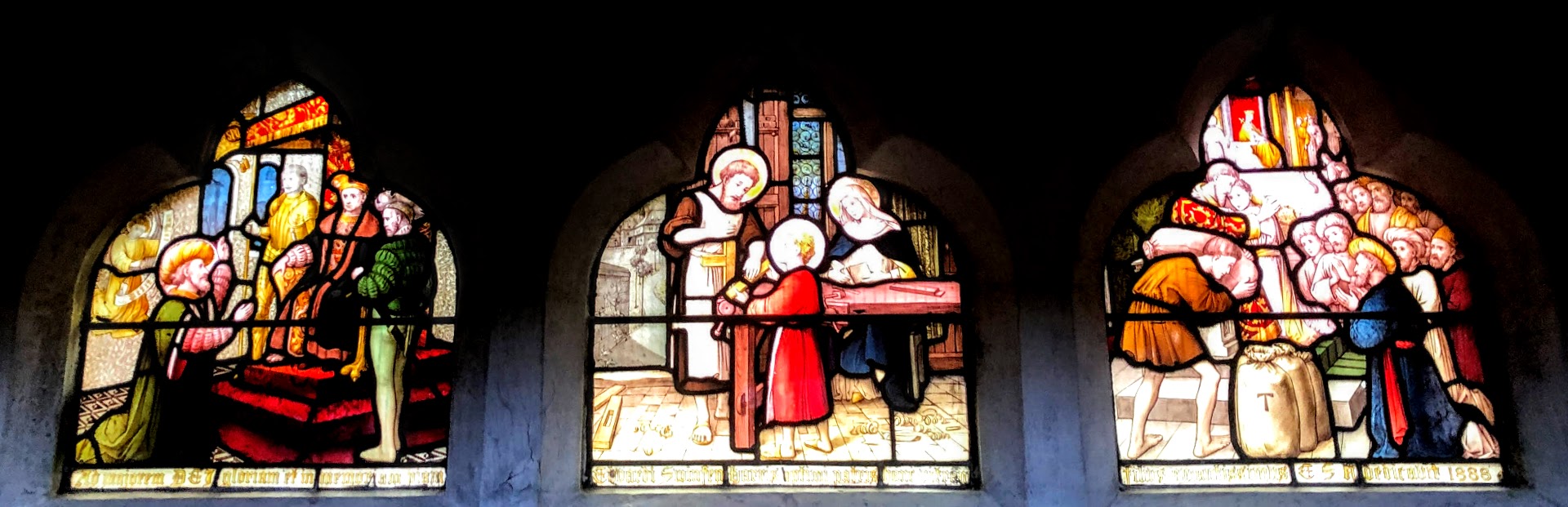
The second window in the south wall in Saint Mary and Saint Giles Church, Stony Stratford, commissioned by Swinfen Harris and dated 1888 (Photograph: Patrick Comerford)
The second window commissioned by Swinfen Harris is in memory of his father, also Edward Swinfen Harris, who was the clerk to the town bench of magistrates, the Board of Guardians and other bodies in the town.
This second window is of three eyelets and depicts: Joseph before Pharoah’s throne, interpreting his dreams; Jesus as an apprentice in Joseph the carpenter’s shop; and Joseph’s brothers before him with the silver cup found in Benjamin’s sack.
In each of these panels, Westlake is suggesting to the viewer that Swinfen Harris was a loyal and faithful son to his father, the late Edward Swinfen Harris, and that he had learned from him.
The third window by NHJ Westlake is in memory of Catherine Swinfen Harris (Photograph: Patrick Comerford)
The third Westlake window on the south wall is dated 1896 and was commissioned by Swinfen Harris in memory of his mother, Catharine Swinfen Harris, who died on 23 June 1896, at the age of 85.
This third window depicts: Jacob blessing Joseph’s sons Manasseh and Ephraim; Christ greeting two disciples at night; and Jacob’s dream at Bethel.
Asenath, the mother of Ephraim and Manasseh was an Egyptian, and so her family was outside the community of faith. Yet, they are not disqualified from God’s blessings because of their parents’ unconventional marriage. In the panels in this window, Swinfen Harris may be saying that his mother was seen as an outsider but that in life through his parents he found blessings beyond any expectations in his dreams.
Other works by Swinfen Harris:
Swinfen Harris converted designed the stables at Bletchley Park and later converted part of the north range to a cottage (Photograph: Patrick Comerford)
Some other works by Edward Swinfen Harris include: the Old Rectory, Maids Moreton (1878-1879); Emmanuel Church, Upper Holloway, London (1883) – most of the church was rebuilt to a modern design in 1988; the stables at Bletchley Park (1883); Nos 1 and 3 Stacey Avenue, Wolverton, a pair of model estate workers’ houses (1886), designed by Swinfen Harris; three cottages in the stable yard at Bletchley Park, involving an alteration and extension of an earlier north range undertaken, with a cottage for Sir Herbert Leon’s head groom (
ca 1890); the Poplars, Newport Pagnell; and the church cottage, Newport Pagnell (early 20th century).
Nos 1 and 3 Stacey Avenue, Wolverton, a pair of model estate workers’ houses designed by Swinfen Harris Photograph: Patrick Comerford)
Conclusions:
Swinfen Harris retired in 1914 and died over 100 years ago, on 30 May 1924.
He is part of the architectural and aesthetic heritage of Stony Stratford. Swinfen’s Yard, in the middle of Stony Stratford, includes individual, specialist shops under a covered courtyard, with offices on the upper floors. It is named in honour of Edward Swinfen Harris.
Last year was the centenary of his death, marked during Heritage Week by a walking tour of some of his work … in a summer downpour.
More work needs to be done on cataloguing his work in Stony Stratford and the neighbouring towns. More research is needed on his life and his work, and if his papers can be located he is worthy of a full biographical appraisal and study.
I hope to continue this research, and to talk about him again during the Heritage Week programme in September. But more about those plans in the weeks and months ahead.
(Revd Canon Professor) Patrick Comerford lives in retirement in Stony Stratford. This lecture was given in Stony Stratford Library on 25 February 2025 at the invitation of the Friends of Stony Stratford Library (FOSSL).


 The Good Samaritan … a modern icon