Showing posts with label Pisa. Show all posts

16 June 2021

Praying in Ordinary Time 2021:
18, The cathedral and ‘leaning tower’ of Pisa

The Duomo or Cathedral of Santa Maria Assunta in Pisa, and its ‘leaning tower’ (Photograph: Patrick Comerford)

Patrick Comerford

During this time in the Church Calendar known as Ordinary Time, I am taking some time each morning to reflect in these ways:

1, photographs of a church or place of worship;

2, the day’s Gospel reading;

3, a prayer from the prayer diary of the Anglican mission agency USPG (United Society Partners in the Gospel).

This week my photographs are of seven cathedrals in Italy. This morning (16 June 2021), my photographs are of the Duomo or Cathedral of Santa Maria Assunta in Pisa, and its ‘leaning tower.’

Inside the Duomo … Galileo watched the swinging sanctuary lamp and developed his theory about the movement of a pendulum (Photograph: Patrick Comerford)

Pisa, which was once a naval power that rivalled the seafaring reputations of Amalfi, Genoa and even Venice. The waters of the deltas of two rivers – the Arno and the Serchio – on which Pisa was built have since silted up and Pisa is so far inland today that is hard to imagine that Pisa was once a great Mediterranean port and an independent maritime republic dating back to the tenth century. Indeed, the town is so old that its Etruscan origins can be said to predate the foundation of Rome by centuries.

The entrance through the old city walls leads into the Piazza del Duomo (Cathedral Square) or Piazza dei Miracoli (Square of Miracles), the wide, walled, partly-paved and partly-grassed area at the heart of the city.

At the heart of the piazza is the Duomo or Cathedral of Santa Maria Assunta. This five-nave cathedral was built in 1064 by Buscheto, in the distinctive Pisan-Romanesque style.

Pisa’s most famous son, Galileo Galilei, is said to have formulated his theory about the movement of a pendulum by watching the swinging of the sanctuary lamp hanging in the cathedral nave.

Across from the cathedral, the Baptistry dates from 1153, and was completed in the 14th century, when the top storey and dome were added by Nicola and Giovanni Pisano. This is the largest baptistry in Italy, and is a few centimetres higher than the ‘Leaning Tower.’

The Baptistry is known for its acoustics, and the guards sometimes treat visitors to short singing demonstrations of this.

The ‘Leaning Tower’ was built originally as the campanile or bell tower for cathedral, and is about 60 metres high. Building began in 1173 and the bell-chamber was added only in 1372. But five years after building began, as work reached the third-floor level, sinking began due to the weak subsoil and the poor foundations.

The building was left alone for a century, the subsoil stabilised, and the building was saved from collapsing. Building work resumed in 1272, and the upper floors were added, with one side taller than the other. The seventh and final floor was added in 1319. But by then the building was leaning one degree, or 80 cm from vertical. Today, the tower is leaning by about four degrees.

The sanctuary and the apse in the Duomo (Photograph: Patrick Comerford)

Matthew 6: 1-6, 16-18 (NRSVA):

[Jesus said:] 1 ‘Beware of practising your piety before others in order to be seen by them; for then you have no reward from your Father in heaven.

2 ‘So whenever you give alms, do not sound a trumpet before you, as the hypocrites do in the synagogues and in the streets, so that they may be praised by others. Truly I tell you, they have received their reward. 3 But when you give alms, do not let your left hand know what your right hand is doing, 4 so that your alms may be done in secret; and your Father who sees in secret will reward you.

5 ‘And whenever you pray, do not be like the hypocrites; for they love to stand and pray in the synagogues and at the street corners, so that they may be seen by others. Truly I tell you, they have received their reward. 6 But whenever you pray, go into your room and shut the door and pray to your Father who is in secret; and your Father who sees in secret will reward you.

16 ‘And whenever you fast, do not look dismal, like the hypocrites, for they disfigure their faces so as to show others that they are fasting. Truly I tell you, they have received their reward. 17 But when you fast, put oil on your head and wash your face, 18 so that your fasting may be seen not by others but by your Father who is in secret; and your Father who sees in secret will reward you.’

The five-nave cathedral was built in 1064 by Buscheto in the distinctive Pisan-Romanesque style (Photograph: Patrick Comerford)

Prayer in the USPG Prayer Diary:

The Prayer in the USPG Prayer Diary today (16 June 2021) invites us to pray:

Let us pray for the humility and strength to change our ways. May we live more sustainable lives, and encourage others to do likewise.

Yesterday’s reflection

Continued tomorrow

The Baptistry dates from 1153 and was completed in the 14th century (Photograph: Patrick Comerford)

Scripture quotations are from the New Revised Standard Version Bible: Anglicised Edition copyright © 1989, 1995, National Council of the Churches of Christ in the United States of America. Used by permission. All rights reserved worldwide. http://nrsvbibles.org

12 May 2020

A lockdown ‘virtual
tour’ of a dozen
churches in Tuscany

Brunelleschi’s dome and Giotto’s campanile of the Duomo … the skyline of Florence (Photograph: Patrick Comerford; click on images for full-screen viewing)

Patrick Comerford

The lockdown introduced as a response to the Covid-19 pandemic continues to grip most of Europe, and the latest discussions indicate there may be no travel from Ireland to other parts of Europe for the rest of 2020.

But I can still travel in my mind’s eye. And, so, in the spirit of my recent ‘virtual tours’ over the past month or two, I invite you to join me this evening on a virtual tour of a dozen or more churches and basilicas in Tuscany, similar to recent virtual tours of churches in Rome, Venice and Bologna.

These churches in Florence, Pusa, Lucca, San Gimignano, Pistoia and Siena are among the most photographed and most visited churches in Europe, and many of them are associated with some of the greatest creative minds in Italian culture, from Dante and Catherine of Siena, to Giotto, Brunelleschi and Michelangelo.

In these times of pandemic, it is interesting how some of these churches are associated with the plague and the Black Death. There is even a surprise association in the cloisters of the Basilica of Santa Croce with Florence Nightingale, who was born in Florence on this day 200 years ago, 12 May 1820.

1, Florence: the Duomo, Campanile and Baptistry:

The Duomo in Florence is one of Italy’s three most photographed sites (Photograph: Patrick Comerford)

I have visited Florence, the city of architectural beauty and Renaissance grandeur, on a number of occasions. With its Duomo and baptistry, palazzi and basilicas, the Uffizi and the Ponte Vecchio, it outdid its rivals and its richest citizens sought to outdo one another. This was ‘the engine room of the Renaissance.’

The cathedral complex, in Piazza del Duomo, includes the Duomo, the Baptistry and Giotto’s Campanile. The dome of the Duomo is the city’s iconic landmark and stands, alongside the Leaning Tower of Pisa and the Coliseum in Rome as Italy’s three most photographed sites.

Work on building the Duomo or Cattedrale di Santa Maria del Fiore (Cathedral of Saint Mary of the Flower) began in 1296. It was designed in a Gothic style by Arnolfo di Cambio and was completed by 1436 with the dome by Filippo Brunelleschi. The dome is comprised of two domes – an outer and inner shell bound together with rings of sandstone.

The exterior walls of the Duomo are faced in alternate vertical and horizontal bands of polychrome marble from Carrara (white), Prato (green), Siena (red), Lavenza and other places. The original façade, designed by Arnolfo di Cambio but usually attributed to Giotto, was begun 20 years after Giotto’s death.

The Duomo and the Baptistry of Saint the Baptist … Michelangelo named the east doors of the Baptistry the ‘Gates of Paradise’ (Photograph: Patrick Comerford)

The octagonal, 11th century Baptistry of Saint the Baptist stands across the square in Piazza di San Giovanni. It is older than the cathedral and was built between 1059 and 1128. It has the status of a minor basilica in its own right.

The Baptistry is renowned for its three sets of bronze doors with relief sculptures. The south doors were created by Andrea Pisano and the north and east doors by Lorenzo Ghiberti. Michelangelo named the east doors the ‘Gates of Paradise.’ Dante and other Renaissance figures, including members of the Medici family, were baptised in the Baptistry.

2, Florence: The Basilica of Santa Croce:

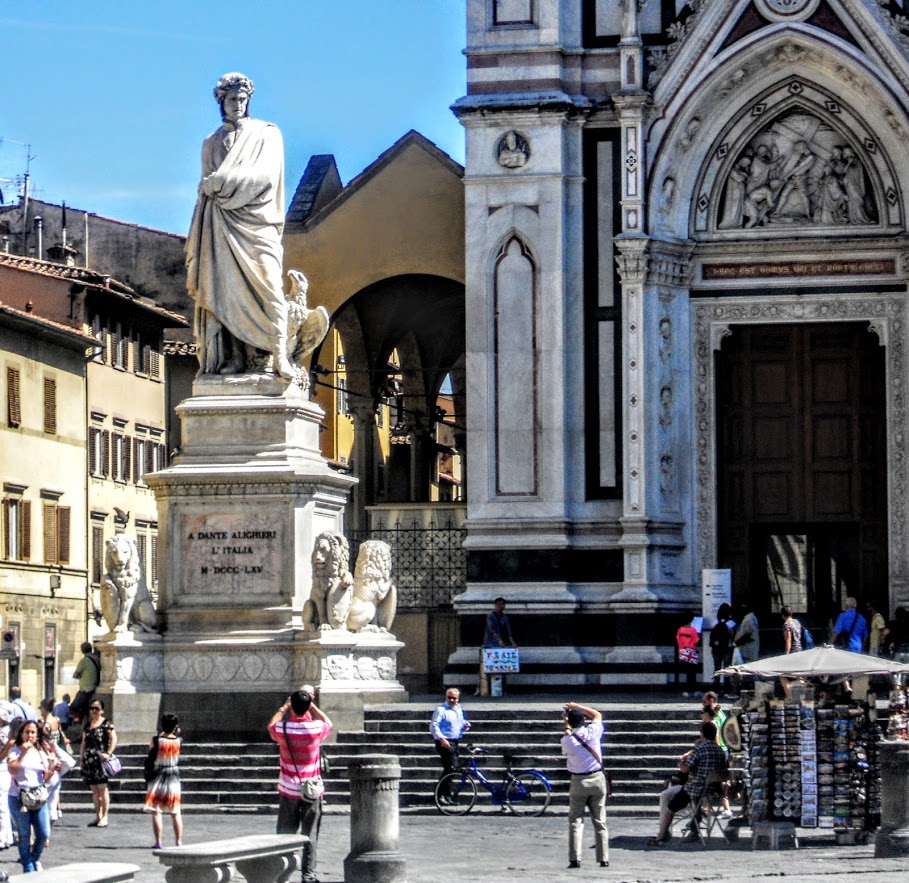
The Basilica di Santa Croce with its façade completed in the 19th century (Photograph: Patrick Comerford)

The Basilica di Santa Croce (Basilica of the Holy Cross) in the Piazza di Santa Croce is the burial place of many Florentines, including Michelangelo, Galileo, Machiavelli, Foscolo and Rossini. For this reason, it is also known as the Tempio dell’Itale Glorie, the Temple of the Italian Glories. Although Dante was exiled from Florence and buried in Ravenna, his statue stands in the wide, open square, in front of the basilica.

When the site was first chosen it was in marshland outside the city walls. Later, the square was the venue for burning heretics and it is still used once a year for the calcio storico, the Florentine version of a rough-and-tumble mediaeval game of football.

Santa Croce is about 800 meters south-east of the Duomo. It is a minor basilica, the principal Franciscan church in Florence, and the largest Franciscan church in the world.

Legend says that Santa Croce was founded by Saint Francis. The present church was built in 1294, replacing an older building, and was consecrated by Pope Eugene IV in 1442.The Basilica’s features include its 16 chapels, many decorated with frescoes by Giotto and his pupils, and its tombs and cenotaphs.

The Primo Chiostro, the main cloister, houses the Cappella dei Pazzi, built as the chapter house and completed in the 1470s. Filippo Brunelleschi, who designed the dome of the Duomo, was involved in designing the main cloister and the inner cloister, which was completed in 1453.

The statue of Dante in front of the Basilica of Santa Croce (Photograph: Patrick Comerford)

The façade of the church remained unfinished for more than three centuries, and the neo-Gothic marble façade dates from 1857-1863. The Jewish architect, Niccolo Matas (1798-1872) from Ancona, designed the façade, working a prominent Star of David into his composition. Matas wanted to be buried with his peers but, because he was Jewish, he was buried outside the main door of the basilica, under the threshold.

The complex became public property in 1866 when the Italian government suppressed many religious houses after Italian unification.

The Museo dell’Opera di Santa Croce is in the refectory, off the cloisters. The cloisters also have a monument to Florence Nightingale, who was born in Florence on this day 200 years ago (12 May 1820).

The basilica is undergoing a multi-year restoration programme. It was closed to visitors in 2017 after falling masonry killed a Spanish tourist.

3, Florence: Chiesa di Santa Maria Maggiore and Basilica of Santa Maria Novella:

The Chiesa di Santa Maria Maggiore is one of the oldest surviving churches in Florence (Photograph: Patrick Comerford)

The Duomo in Florence is dedicated to Santa Maria, but there are many other churches in the city with similar dedications, including the Chiesa di Santa Maria Maggiore and the Basilica of Santa Maria Novella.

The Church of Santa Maria Maggiore di Firenze is one of the oldest surviving churches in Florence. This Romanesque and Gothic-style church was first built in the 11th century and there were extensive renovations to the façade and the sides of the church in the 13th century. The bell tower survives from the Romanesque building and has a Roman head embedded in its walls, known popularly as Berta.

The original church dated from the eighth century and is first noted in 931. However, a legend saying it was founded in 580 by Pope Pelagius II is not reliable.

The church became a collegiate church in 1176, and was put under papal direct protection by Lucius III in 1183. When the church was handed over to the Cistercians in the 13th century, it was rebuilt in the Gothic style, apart from the original external walls and the vaults. The church was transferred to Carmelites from Mantua in 1521.

The Basilica of Santa Maria Novella seen from Piazza Unità d’Italia (Photograph: Patrick Comerford)

The Basilica of Santa Maria Novella stands opposite the main railway station in Florence and gives its name to the station. It is the first great basilica in Florence and is the city’s principal Dominican church.

This church was called Santa Maria Novella or New Saint Mary’s because it was built on the site of a ninth-century oratory of Santa Maria delle Vigne. When the site was assigned to the Dominican Order in 1221, they decided to build a new church and cloisters. Building began ca 1246, and lasted 80 years, ending with the completion of the Romanesque-Gothic bell tower and sacristy.

A series of Gothic arcades was added to the façade in 1360, intended for sarcophagi for leading local families. The church was consecrated in 1420.

The church treasures include frescoes by Gothic and early Renaissance masters. They were financed by the most important Florentine families who wanted funerary chapels on consecrated ground. The cadaver tomb of the Lenzi family includes in Latin the epigram: ‘I was once what you are, and what I am you will become.’

The frescoes in the Cappella Strozzi di Mantova by Nardo di Cione (1350-1357) are inspired by Dante’s Divine Comedy. The frescoes in chancel were painted in 1485-1490 by Domenico Ghirlandaio, whose apprentice was the young Michelangelo.

The pulpit, commissioned by the Rucellai family in 1443, was designed by Filippo Brunelleschi and executed by his adopted son Andrea Calvalcanti. It was from this pulpit that the first attack was made on Galileo Galilei.

The square in front the church was used by Cosimo I for the yearly chariot race (Palio dei Cocchi). This custom continued from 1563 into the late 19th century. The two Obelisks of the Corsa dei Cocchi, marking the start and finish of the race, were set up to imitate an antique Roman circus.

4, Florence: the Chiesa e Museo di Orsanmichele:

Orsanmichele was a grain market before being converted into a guild church (Photograph: Patrick Comerford)

Orsanmichele, or the ‘Kitchen Garden of Saint Michael,’ was on the site of the kitchen garden of the monastery of San Michele which no longer exists. The church, which stands on the Via Calzaiuoli, was first built as a grain market in 1337.

Between 1380 and 1404, it was converted into a church and it served as the chapel of the powerful craft and trade guilds in Florence. The arches on the ground floor of the square building originally formed the loggia of the grain market. The second floor provided offices, while the third floor was one of the city’s great grain storehouses, planned to withstand famine or siege.

The statues of saints in the niches of Orsanmichele were commissioned by the guilds of Florence (Photograph: Patrick Comerford)

Late in the 14th century, the guilds were ordered by the city to commission statues of their patron saints to fill the façades of the church. The three richest guilds decided to make their figures in bronze, which cost ten times the amount of the stone figures. The originals have since been moved to museums to protect them from the elements and vandalism, and the sculptures in their place today are copies.

Inside the church is Andrea Orcagna’s richly jewelled Gothic Tabernacle (1355-1359) encasing a repainting by Bernardo Daddi of an older icon of the ‘Madonna and Child.’

5, Pisa: Cattedrale di Pisa, Baptistry and Tower:

The Duomo, Baptistry and Campanile or ‘Leaning Tower’ are in the heart of Pisa (Photograph: Patrick Comerford)

The ‘Leaning Tower’ of Pisa, alongside the Duomo in Florence, and the Coliseum in Rome, is one of the three most photographed sites in Florence. They stand beside each other in the Piazza del Duomo (Cathedral Square) or Piazza dei Miracoli (Square of Miracles), a wide, walled, partly-paved and partly-grassed area in the heart of the city.

At the heart of the piazza is the Duomo or Cathedral of Santa Maria Assunta, a five-nave cathedral built in 1064 by Buscheto in the distinctive Pisan-Romanesque style.

Pisa’s most famous son, Galileo Galilei, is said to have formulated his theory about the movement of a pendulum by watching the swinging of the sanctuary lamp hanging in the cathedral nave.

Inside the Duomo, where Galileo watched the swinging sanctuary lamp and developed his theory about the movement of a pendulum (Photograph: Patrick Comerford)

The Baptistry, which dates from 1153, was completed in the 14th century when the top storey and dome were added by Nicola and Giovanni Pisano. This is the largest baptistry in Italy, and is even a few centimetres higher than the Leaning Tower. The Baptistry is also known for its acoustics, and I have been treated to a short singing demonstration of this by one of the guards.

The ‘Leaning Tower,’ which is about 60 metres high, was built originally as the campanile or bell tower of the cathedral.

Building began in 1173 and the bell-chamber was added only in 1372. But five years after building began, as work reached the third-floor level, sinking began due to the weak subsoil and the poor foundations. The building was left alone for a century, the subsoil stabilised and the building was saved from collapsing.

Building work resumed in 1272, and the upper floors were added, with one side taller than the other. The seventh and final floor was added in 1319. But by then the building was leaning one degree, or 80 cm from vertical. Today, the tower is leaning by about four degrees.

6, Lucca: Duomo di San Martino:

The façade and bell tower of the Duomo in Lucca (Photograph: Patrick Comerford)

Lucca was saved from bombing during World War II and so the city has been preserved within its walls which also remain intact. This was the birthplace of Puccini, and there is a bronze statue of the composer in the square close to the house where he was born.

Lucca Cathedral or the Duomo di Lucca or Cattedrale di San Martino is dedicated to Saint Martin of Tours. Building work was begun in 1063 by Bishop Anselm of Lucca, later Pope Alexander II.

The great apse, with its tall columns and arcades, and the campanile survive from the original building. The nave and transepts were rebuilt in the Gothic style in the 14th century. The west front was begun in 1204 by Guido Bigarelli of Como, and has a vast portico of three magnificent arches, with three ranges of open galleries filled with sculptures above.

A small shrine in the nave holds the Volto Santo di Lucca (‘Holy Face of Lucca’), said to be an image of Christ carved from cedar-wood for a crucifix by Nicodemus, and brought miraculously to Lucca in 782. The figure of Christ is clothed in a long sleeveless garment. The cathedral also has works by Matteo Civitali, Jacopo della Quercia, Domenico Ghirlandaio, Federico Zuccari, Jacopo Tintoretto and Fra Bartolomeo.

Each column of the façade is different. According to local lore, when they were about to be decorated, the people of Lucca announced a contest for the best column. Each artist made a column, but the people decided to take all of them without paying the artists and used all the columns.

A labyrinth embedded in the right pier of the portico and is believed to date from the 12th or 13th century, and may pre-date the labyrinth in Chartres. The Latin inscription translates: ‘This is the labyrinth built by Dedalus of Crete; all who entered therein were lost, save Theseus, thanks to Ariadne’s thread.’

7, Lucca: Chiesa dei Santi Giovanni e Reparata:

The church of Santi Giovanni e Reparata in Piazza San Giovanni … once the cathedral of Lucca (Photograph: Patrick Comerford)

The church of Santi Giovanni e Reparata in Piazza San Giovanni was the first seat of the Bishops of Lucca, and was the cathedral from the eighth century until the cathedra was transferred to San Martino. Since then, the two churches have retained a close relationship.

The Santa Reparata complex was built in the fifth century on the site of an earlier Roman settlement. The area became a cemetery in the sixth century, and a church was built here in the eighth century.

The crypt dates from the ninth century, and the relics of San Pantaleone were found there in 1714. The church was altered at the turn of the 10th and 11th centuries, and the present layout dates from rebuilding in the second half of the 12th century.

The new church – with three naves supported by columns with composite capitals, with an apse and transept – was similar in size to the earlier church. The decorative figures on the capitals inside the church include leafy masks, harpies and dragons. However, little remains today of the works from the second half of the 14th century.

The church was refurbished in the late 16th and early 17th century. The most striking result of this work is the new façade, which reuses most of the mediaeval façade. Inside, the coffered ceiling and the decoration of the apse date from this phase.

The Chapel of Sant’Ignazio, one of the most interesting baroque creations of Lucca, dates from the end of the 17th century. It is entirely covered in polychrome marble with fresco decorations in the dome, attributed to Ippolito Marracci, depicting the Glory of Saint Ignatius.

The church was confiscated during the Napoleonic occupation in the early 19th century and all its furnishings were lost in the plans to convert into an archive. When it reopened for worship in 1821, it was a very changed church, with new altars and new paintings.

8, Lucca: San Michele in Foro:

San Michele in Foro was built on the site of the Roman forum in Lucca (Photograph: Patrick Comerford)

San Michele in Foro, dedicated to the Archangel Michael, was built over the ancient Roman forum, and the church is first mentioned in 795 as ad foro or ‘in the forum.’

The church was rebuilt after 1070 at the request of Pope Alexander II. Until 1370, it was the seat of the Consiglio Maggiore or Major Council of Lucca.

The façade, dating from the 13th century, has a large collection of sculptures and inlays, many of them remade in the 19th century. The lower part has a series of blind arcades.

The upper part has four orders of small loggias. The four-metre statue of Saint Michael the Archangel at the top of the façade is flanked by two other angels.

The statue of Saint Michael the Archangel at San Michele in Foro is flanked by two angels (Photograph: Patrick Comerford)

On the lower right corner of the façade, the statue of the Madonna Salutis Portus was sculpted by Matteo Civitali in 1480 to mark the end of the plague in 1476.

Inside, the church has a nave, two aisles with transept and semi-circular apse. The bell tower, built in the 12th-14th centuries, has a series of single, double and triple mullioned windows.

9, San Gimignano: Duomo di San Gimignano:

The Collegiate Church of Santa Maria Assunta faces onto the Piazza del Duomo in the centre of San Gimignano (Photograph: Patrick Comerford)

The centre of San Gimignano, including the church, is a Unesco heritage site. The Collegiate Church of Santa Maria Assunta, facing onto the Piazza del Duomo in the heart of San Gimignano, is sometimes known as the ‘duomo’ or cathedral, although it has never been the seat of a bishop; instead, it is a collegiate church and a minor basilica.

The church is famous for its fresco cycles that include works by Domenico Ghirlandaio, Benozzo Gozzoli, Taddeo di Bartolo, Lippo Memmi and Bartolo di Fredi. Unesco has described these frescoes as ‘works of outstanding beauty.’

The first church on the site was built in the 10th century. The importance of San Gimignano and the church grew in the 12th century because of the town’s place on the Via Francigena, the pilgrimage route to Rome. The present church was consecrated in 1148 and dedicated to Saint Geminianus (San Gimignano) in the presence of Pope Eugenius III and 14 bishops.

The church, like Saint Peter’s Basilica in Rome, has a west-east liturgical orientation rather than the traditional east-west orientation. The façade, which has little decoration, is approached from the square by a wide staircase and has a door into each of the side aisles, but no central portal. The doorways are surmounted by stone lintels with recessed arches above them.

There is a central ocular window at the end of the nave and a smaller one giving light to each aisle. Beneath the central ocular window, a slot marks the place of a window that lit the chancel of the earlier church. Some scholars suggest this may be the most visible sign of the church’s reorientation in the 12th century rebuilding.

The campanile on the north side of the church may be that of the earlier church, as it appears to mark the extent of the original west façade, or it may have been one of the city’s many tower houses.

In the 13th, 14th and 15th centuries, the church was enriched with the addition of frescoes and sculpture. The western end (liturgical east) was altered and extended by Giuliano da Maiano in 1466-1468, and the church became a collegiate church in 1471. The church holds the relics of Saint Geminianus, Bishop of Modena and patron saint of the town, whose feast day is on 31 January.

The power and authority of the city of San Gimignano continued to grow and it eventually achieved autonomy. On 8 May 1300 Dante Alighieri came to San Gimignano as the Ambassador of the Guelph League in Tuscany. Girolamo Savonarola preached from the pulpit of the church in 1497.

The church was damaged during World War II, but was restored in 1951.

10, Pistoia: San Zeno and Baptistry:

The Cattedrale di San Zeno or Cathedral of Saint John in Pistoia (Photograph: Patrick Comerford)

One day, when I insisted in using my poor and limited Italian to buy train tickets in Tuscany, I ended up in Pistoia instead of Viareggio. But for this mistake, I might not have visited Pistoia and the Cattedrale di San Zeno, or Cathedral of Saint John, with its beautiful Pisan-Romanesque façade that is crowned with a lunette by Andrea della Robbia.

Inside the duomo, in the Capella di San Jacopo in the north aisle, is a silver altarpiece that took two centuries to erect and that was completed by Brunelleschi.

The 14th century octagonal Baptistry in Pistoia (Photograph: Patrick Comerford)

In the crypt of the duomo, at the back of a simple chapel, are the tombs of many past Bishops of Pistoia. The side walls above are decorated with monuments to many more past bishops, including Alessandro di Medici who later became Pope Leo XI and had a short reign of only 26 days.

Beside the cathedral is the former bishops’ palace, now a museum, and opposite the west door of the cathedral is the 14th century octagonal Baptistry, with its distinctive green-and-white marble stripes.

11, Siena: the Duomo:

The Duomo in Siena … work stopped with the Black Death in 1348 (Photograph: Patrick Comerford)

Siena Cathedral (Duomo di Siena) is dedicated to the Assumption of the Virgin Mary, and is the episcopal seat of the Diocese of Siena, now the Archdiocese of Siena-Colle di Val d’Elsa-Montalcino.

The exterior and interior are built of white and greenish-black marble in alternating stripes, with the addition of red marble on the façade. Black and white are the symbolic colours of Siena, linked to black and white horses of the city’s legendary founders, Senius and Aschius. The finest Italian artists completed works in the cathedral, including Nicola and Giovanni Pisano, Donatello, Pinturicchio, Lorenzo Ghiberti, and Bernini.

There was a church on the site in the ninth century church with a bishop’s palace. A synod in this church in December 1058 elected of Pope Nicholas II and deposed the antipope Benedict X.

The cathedral masons’ guild, the Opera di Santa Maria, was commissioned in 1196 to build a new cathedral. Work began on the north and south transepts and it was planned to add the main, larger body of the cathedral later, although this enlargement was never accomplished.

The cathedral was designed and completed in 1215-1263 on the site of an earlier church. It is in the shape of a Latin cross with a slightly projecting transept, a dome and a bell tower. The dome was completed in 1264, and the lantern was added by Gian Lorenzo Bernini. The bell tower has six bells, the oldest cast in 1149.

A second major addition to the cathedral was planned in 1339. This would have more than doubled its size, with of an entirely new nave and two new aisles.

Building work began under the direction of Giovanni di Agostino, but came to a halt with the Black Death in 1348 and never resumed. The outer walls, remains of this extension, can now be seen to the south of the Duomo. The floor of the incomplete nave is now a parking lot and a museum. One unfinished wall can be climbed by a narrow stairs for a high view of the city.

The bell tower of the Duomo in Siena has six bells (Photograph: Patrick Comerford)

The façade is one of the most fascinating in Italy. Each of the cardinal points – west, east, north, and south – has its own distinct work. The most impressive is the west façade, a beautiful example of Sienese workmanship, which serves as the main entrance to the Duomo.

This west façade was built in two stages and combines elements of French Gothic, Tuscan Romanesque and Classical architecture. Work on lower part of the west façade began ca 1284. It was built in polychrome marble, and the work was overseen by Giovanni Pisano.

The lower portion of the façade follows Pisano’s original plans. Built in Tuscan Romanesque style, it emphasises a horizontal unity of the area around the portals at the expense of the vertical bay divisions. The three portals, surmounted by lunettes, are based on Pisano’s original designs, as are much of the sculpture and orientation surrounding the entrances. The areas around and above the doors and the columns between the portals are richly decorated with acanthus scrolls, allegorical figures and biblical scenes.

Pisano left Siena abruptly in 1296, and his work on the lower façade was continued by Camaino di Crescentino, who made a number of changes to the original plan. These included the instillation of a larger rose window based on designs by Duccio di Buoninsegna. But work on the west façade came to an abrupt end in 1317 when the all efforts were redirected to the east façade.

The upper part of the west façade may have been completed in 1360-1370, using Pisano’s plans with some adaptations by Giovanni di Cecco, who was heavily influenced by French Gothic architecture. The upper portion also features heavy Gothic decoration in marked contrast to the simple geometric designs common to Tuscan Romanesque architecture.

Three large mosaics on the gables of the façade were made in Venice in 1878. The large central mosaic, the Coronation of the Virgin, is the work of Luigi Mussini. The smaller mosaics on each side, the Nativity of Christ and the Presentation of Mary in the Temple, are the work of Alessandro Franchi. The bronze central door, known as the Porta della Riconoscenza, dates from 1946.

On the left corner pier of the façade, a 14th-century inscription marks the grave of Giovanni Pisano. A column next to the façade has a statue of the Contrade Lupa, a wolf breast-feeding Romulus and Remus. According to local legend, Senius and Aschius, sons of Remus and founders of Siena, left Rome with the statue which they had stolen from the Temple of Apollo.

12, Siena: the Basilica San Domenico, Basilica Cateriniana:

The Basilica of San Domenico in Siena is also known as the Basilica Cateriniana (Photograph: Patrick Comerford)

The Basilica of San Domenico in Siena, also known as the Basilica Cateriniana, is one of the most important churches in the city.

This Dominican church was begun in 1226-1265, and was enlarged in the 14th century, giving the church the Gothic appearance it has today. Parts of the Gothic structure were destroyed in fires in 1443, 1456 and 1531, and further damage later caused by military occupation in 1548-1552.

This large building in brick, with a lofty bell tower that was reduced in height after an earthquake in 1798. The interior layout follows an Egyptian cross plan with a large nave covered by trusses and with a transept featuring high chapels.

The church has several relics of Saint Catherine of Siena, whose family house is nearby. The Cappella delle Volte is the former chapel of Dominican nuns and is associated with several events in life of Saint Catherine of Siena.

An altar on the right side of the nave has a reliquary with the relics of Saint Catherine. Saint Catherine’s Chapel holds the saint’s head and thumb.

The Duomo of Siena seen from the Basilica Cateriniana (Photograph: Patrick Comerford)

Some recent ‘virtual tours’:

A dozen Wren churches in London;

Ten former Wren churches in London;

More than a dozen churches in Lichfield;

More than a dozen pubs in Lichfield;

A dozen former pubs in Lichfield;

A dozen churches in Rethymnon;

A dozen restaurants in Rethymnon;

A dozen churches in other parts of Crete;

A dozen monasteries in Crete;

A dozen sites on Mount Athos;

A dozen historic sites in Athens;

A dozen historic sites in Thessaloniki;

A dozen churches in Thessaloniki;

A dozen Jewish sites in Thessaloniki.

A dozen churches in Cambridge;

A dozen college chapels in Cambridge;

A dozen Irish islands;

A dozen churches in Corfu;

A dozen churches in Venice.

A dozen churches in Rome.

A dozen churches in Bologna.

The vineyards and terraced slopes of Tuscany (Photograph: Patrick Comerford)

21 March 2020

10 places I would miss
if I could no longer
see or travel … (1) Italy

A Venetian mask decorated with an image of Saint Mark’s Square … What would you miss if you could no longer see or travel? (Photograph: Patrick Comerford)

Patrick Comerford

As the Taoiseach said earlier this week, we have witnessed ‘a Saint Patrick’s Day like no other, a day that none of us will forget.’

In the morning, there was a quiet celebration of the Eucharist for just a small cluster in Saint Mary’s Church, Askeaton. In the afternoon, I went for a walk through Askeaton, by the banks of the River Deel, and around the ruins of the Franciscan Friary. But, apart from traditional Irish folk songs blasting out from one house on Church Street, this was a Saint Patrick’s Day like no others.

At the age of 68, with sarcoidosis in my lungs, and having had pneumonia and asthma in the past, perhaps I am one of those people who may soon be asked to ‘cocoon’ ourselves and to stay at home for several weeks.

Already, I have been moaning about how many of my travel plans have been cancelled, including a visit with USPG to Myanmar next week, and Orthodox Easter in Crete next month.

The Taoiseach also warned last Tuesday that many people may have to self-isolate, perhaps for several weeks. What am I to do if I face several weeks in self-isolation? Apart from praying and keeping in touch with people through social media, there is a lot of books to read, a lot of music to listen to, a lot of games of chess to play, movies to catch up on, and the promise to complete some of the writing projects that have been on the ‘back boiler’ for some time.

But I shall dream too, and in particular dream of travel.

Matador, the global media travel platform, sent out an encouraging email earlier this week, saying, ‘You may not be traveling now. But you will travel again.’

It went on to say, ‘There are few things that collectively unite the world. Coronavirus has pushed us into one such moment. No one will exit this time period unchanged or unaffected. And we must do our part in this pandemic to prioritize and value our fellow humans around the world.

‘We believe travel is an essential human experience. We believe travel is the ultimate education, with the power to open minds, change perspectives, and defeat ignorance, racism, and prejudice. But we also believe that traveling should be approached responsibly, and we can’t in good faith tell you to go out into the world at this moment.

‘What we can tell you is that the day to venture, explore, and wander will come. We are already hungry for the sights of far-flung destinations, the comforting sound of laughter contrasted by unfamiliar languages, and the weight of a passport in our pocket.

‘This will pass, but we hope your appreciation for people will not. In real-time, we are witnessing the resiliency and strength of the human spirit, from the singing balconies of Italy to the healthcare workers putting the needs of others ahead of their own.

‘For the foreseeable future, we encourage you to do your part. That means distancing yourself from others as much as possible. And in the meantime, we will do our best to inform and entertain you with our most inspiring stories and videos. Our goal over the coming weeks is to connect you to the destinations outside your four walls – because we want to get you back to doing what you love and exploring soon.

‘Travel will be waiting for you: and will welcome you back like the old friend it is.’

In a similar vein, Laura Reilly, Director of Editorial, sent out an email from Expedia, saying how much people at Expedia ‘believe in the power of travel: to create joy, to bring people together, to enrich our hearts and minds.’

She too said that despite these uncertain times that at Expedia ‘one thing we know is that for people and communities around the globe, travel is a force for good.’ She encouraged everyone to stay informed and follow the recommendations of local health authorities.

She said, ‘No matter where you live, and whether you are travelling or not, it’s worth our repeating the WHO’s advice for protecting yourself and others: Wash your hands frequently with soap and/or alcohol-based sanitisers; avoid touching your eyes, nose, and mouth; cover your mouth or nose when you sneeze or cough; and maintain distance between yourself and anyone who is coughing or sneezing. Of course, if you have a fever, cough, or difficulty breathing yourself, seek medical attention.’

In liturgical and preaching resources I posted earlier this week on another site, I looked at next Sunday’s Gospel reading – the story of the man who is blind from birth and who is healed (John 9: 1-41) – and asked readers, ‘What would you miss if you were blind?’

In answer to my own question, in solidarity with people living in countries that are now in total lockdown or facing that prospect, and in tune with the idea that ‘travel is the ultimate education, with the power to open minds, change perspectives, and defeat ignorance, racism, and prejudice,’ I plan over the next few days to repost photographs of ten favourite places in a variety of countries, beginning with Italy, Spain, Greece, England and Portugal.

In part I have been inspired by a posting on Tuesday from Jewish Heritage Europe (JHE), headed, ‘Social distancing or lockdown got you stuck at home? Take a virtual tour of some of Italy’s gorgeous historic Jewish heritage sites!’ And it begins with the ark in the synagogue in Casale Monferrato in Italy.

Until this year, Italy was the fifth most-visited country in the world, and with 52.4 million tourists a year Italians were saying they could cope no longer with tourism in these numbers.

So, I begin this evening with ten places in Italy I would miss in Italy if I could no longer travel or see … click on the images to view them in full-screen mode. If social isolation is extended, I may even broaden my horizons.

1, Venice:

Sunset and gondolas at Santa Maria della Salute … the collapse in tourism in Venice has had an unexpected side effect with the normally cloudy canals transformed into water clear enough to see fish and the return of swans and dolphins (Photograph: Patrick Comerford)

2, Rome:

Who is going to return to Rome? … tourists are told throwing coins in the Trevi Fountain guarantees a return visit to Rome (Photograph: Patrick Comerford)

3, Florence:

The Duomo of Florence and the Palazzo Vecchio seen from the terraces of the Uffizi (Photograph: Patrick Comerford)

4, Bologna:

A panoramic view across Bologna from the top of the Asinelli Tower (Photograph: Patrick Comerford)
5, Ravenna:

Mosaics in the Basilica of San Vitale in Ravenna … in ‘Byzantium: the Surprising Life of a Medieval Empire,’ Professor Judith Herrin recalls that the mosaics in Ravenna were her ‘first and most exciting introduction to Byzantine art’ (Photograph: Patrick Comerford)

6, Tuscany:

The vines, groves and terraces of Tuscany that have given us Chianti (Photograph: Patrick Comerford)

7, Pisa:

The Tower of Pisa ... will still be leaning after this crisis is over (Photograph: Patrick Comerford)

8, Lucca:

Lucca, the birthplace of Puccini, Lucca was saved from bombing during World War II, leaving intact the walls, tiny squares, narrow streets and alleyways, with their fountains, statues, and mediaeval churches (Photograph: Patrick Comerford)

9, Siena:

The Piazza del Campo is the venue for the Palio horse race in Siena twice a year (Photograph: Patrick Comerford)

10,Cinque Terre:

The Cinque Terre region in Liguria … recently introduced a ticketing system to limit the number of tourists to 1.5 million a year, now there are none (Photograph: Patrick Comerford)

Of course, there are far too many more places I could add to list … Amalfi, Bergamo, Capri, Lake Garda, Milan, Montecatini, Mount Etna, Naples, Noto, Pompei, Positano, Ravello, Rimini, San Gimignano, Sirmione Sorrento, Syracuse, Taormina, Torcello, Verona … I still plan to visit Bari in June, I still have to visit Palermo

But this is just a beginning.

Next: 10 places in Spain.

13 January 2019

Renewing our baptismal promises,
renewing our faith commitments

The Baptism of Christ … the fifth century mosaic in the Neonian Baptistry in Ravenna (Photograph: Patrick Comerford)

Patrick Comerford

Sunday 13 January 2019,

The First Sunday after the Epiphany (Epiphany 1), the Baptism of Our Lord


11.30 a.m: Holy Trinity Church, Rathkeale, Co Limerick, Morning Prayer, with Sunday School.

Readings: Isaiah 43: 1-7; Psalm 29; Acts 8: 14-17; Luke 3: 15-17, 21-22

An icon of the Baptism of Christ, worked on a cut of olive wood by Eleftheria Syrianoglou, in an exhibition in the Fortezza in Rethymnon, Crete (Photograph: Patrick Comerford)

May I speak to you in the name of God, + Father, Son and Holy Spirit, Amen.

Epiphany celebrates not one but three Theophanies or great events, reminding us what Christmas is truly about and who this Christ Child is for us.

We celebrated the Visit of the Magi last Sunday [6 January 2019], and we read about the Wedding at Cana next Sunday [20 January 2019], events that show us, even before his time has come, who Christ truly is.

Today’s Gospel reading (Luke 3: 15-17, 21-22), Saint Luke’s account of the Baptism of Christ in the River Jordan, marks the beginning of Christ’s public ministry.

It is an Epiphany or Theophany moment, and it is a Trinitarian moment, when the Father, Son and Holy Spirit come together, acting as one, with distinctive personal roles: when Christ is baptised, heaven opens, the Holy Spirit descends upon Christ ‘in bodily form like a dove.’ And the voice of the Father comes from heaven declaring: ‘You are my Son, the Beloved; with you I am well pleased’ (Luke 3: 21-22).

This morning’s Gospel story is also a reminder of our Baptisms, and it is the story of a new creation.

The Baptism of Christ is about new beginnings for each of us individually and for us collectively as members of the Body of Christ, the Church.

This Gospel reading is also the story of a new beginning in every sense of the meaning. Did you notice how after the waters are parted, and Christ emerges, just as the waters are separated, earth and water are separated, and then human life emerges as in the Creation story in Genesis (see Genesis 1: 1 to 2: 3). Here too the Holy Spirit appears over the waters (see Genesis 1: 2), and God says ‘I am well pleased,’ just as God sees that every moment of creation is good (see Genesis 1: 4, 10, 12, 18, 21, 25) and with the creation of humanity it becomes ‘very good’ (verse 31)?

But this Gospel reading also poses two sets of questions for me.

My first set of questions begins by asking:

● What would a parting of the waters and the promise of a new beginning, a new creation, mean for us today?

● Do we believe that what God has made is ‘very good’?

● Are we responsible when it comes to the care of the creation that has been entrusted to us?

And my second set of questions begins:

● What would a parting of the waters and the promise of a new beginning mean for people caught as refugees in the cold waters of the Mediterranean or in the English Channel between France and England in this winter weather?

● Would they be able to believe in the hope that is offered at Epiphany?

It is at the very end of the creation cycle, after the creation and separation of the waters, when God has created us in human form, that God pronounces not just that it is good, but that it is very good.

In responding to our promises at Baptism, we must take responsibility for creation and for humanity – those responsibilities are inseparable. But they are at the heart of the Epiphany stories if we show that we truly believe that ‘the best has yet to come.’

And so, this morning, instead of the Creed and intercessions, we are going to renew our Baptismal promises in the Book of Common Prayer (see pp 398-401).

In those promises, we not only affirm our faith in God, Father, Son, and Holy Spirit, but also promise to be faithful in our prayer life, our sacramental life, to resist evil, to show our faith in word and deed, to serve all people, to love our neighbours as ourselves, to pray for the world and its leaders, to defend the weak and to seek peace and justice.

And so, may all we think, say and do be to the praise, honour and glory of God, + Father, Son and Holy Spirit, Amen.

The Baptistry at the Duomo in Pisa (Photograph: Patrick Comerford)

The Renewal of Baptismal Vows:

[The Book of Common Prayer, pp 398-401]

A form which may be used at Easter, Pentecost, the Baptism of our Lord, on Ash Wednesday, at the close of a mission or on other suitable occasions.

The renewal of baptismal vows may be made at Morning or Evening Prayer, or at Holy Communion after the sermon, and the creed may be omitted. The prayers of intercession and of penitence may be omitted.


The minister says:

In our baptism we died with Christ and were buried with him, so that we might rise with him to a new life within the family of his Church.

We now meet to renew the promises made at our baptism, to affirm our allegiance to Christ and our rejection of all that is evil.

Stand

The minister says:


Do you renew and affirm the promises made when you were baptised?
I do.

Do you turn in faith to Christ?
I do.

Do you then renounce all evil?
I do, by God’s help.

Will you obey and serve Christ?
I will, by God’s help.

Do you believe and trust in God the Father,
creator of heaven and earth?
I believe and trust in him.

Do you believe and trust in his Son Jesus Christ,
who redeemed the world?
I believe and trust in him.

Do you believe and trust in the Holy Spirit
who gives life to the people of God?
I believe and trust in him.

This is the faith of the Church.
This is our faith.
We believe and trust in one God,
Father, Son, and Holy Spirit.


The minister continues:

Those who are baptised are called to worship and serve God.

Will you continue in the apostles’ teaching and fellowship,
in the breaking of bread, and in the prayers?
With the help of God, I will.

Will you persevere in resisting evil,
and, whenever you fall into sin, repent and return to the Lord?
With the help of God, I will.

Will you proclaim by word and example
the good news of God in Christ?
With the help of God, I will.

Will you seek and serve Christ in all people,
loving your neighbour as yourself?
With the help of God, I will.

Will you acknowledge Christ's authority over human society,
by prayer for the world and its leaders,
by defending the weak, and by seeking peace and justice?
With the help of God, I will.

The minister says:

Let us pray.

Almighty God,
you have given us the will to do all these things:
Give us the courage and strength to achieve them
to the honour and glory of your name,
and the good of your Church and people;
through Jesus Christ our Lord,
who lives and reigns with you and the Holy Spirit,
one God, now and for ever. Amen.

May Christ dwell in your hearts through faith,
that you may be rooted and grounded in love
and bring forth the fruit of the Spirit. Amen.

The Baptismal Font in Saint Mel’s Cathedral, Longford (Photograph: Patrick Comerford)

Luke 3: 15-17, 21-22 (NRSVA):

15 As the people were filled with expectation, and all were questioning in their hearts concerning John, whether he might be the Messiah, 16 John answered all of them by saying, ‘I baptize you with water; but one who is more powerful than I is coming; I am not worthy to untie the thong of his sandals. He will baptize you with the Holy Spirit and fire. 17 His winnowing-fork is in his hand, to clear his threshing-floor and to gather the wheat into his granary; but the chaff he will burn with unquenchable fire.’

21 Now when all the people were baptized, and when Jesus also had been baptized and was praying, the heaven was opened, 22 and the Holy Spirit descended upon him in bodily form like a dove. And a voice came from heaven, ‘You are my Son, the Beloved; with you I am well pleased.’

John answered all of them by saying, ‘I baptize you with water; but one who is more powerful than I is coming’ (Luke 3: 16) … a fresco in a church in the mountain village of Maroulas, near Rethymnon in Crete (Photograph: Patrick Comerford)

Liturgical colour: White

The Penitential Kyries:

God be merciful to us and bless us,
and make his face to shine on us.

Lord, have mercy.
Lord, have mercy.

May your ways be known on earth,
your saving power to all nations.

Christ, have mercy.
Christ, have mercy.

You, Lord, have made known your salvation,
and reveal your justice in the sight of the nations.

Lord, have mercy.
Lord, have mercy.

The Collect:

Eternal Father,
who at the baptism of Jesus
revealed him to be your Son,
anointing him with the Holy Spirit:
Grant to us, who are born of water and the Spirit,
that we may be faithful to our calling as your adopted children;
through Jesus Christ our Lord.

Introduction to the Peace:

Our Saviour Christ is the Prince of Peace.
Of the increase of his government and of peace
there shall be no end. (cf Isaiah 9: 6, 7)

The Blessing:

Christ the Son be manifest to you,
that your lives may be a light to the world:

The Baptism font in Saint Mary’s Church, Askeaton, Co Limerick … a reminder of our own Baptismal commitments (Photograph: Patrick Comerford)

Hymns:

22, You shall cross the barren desert (#2, CD 1, Love of God, Life of Faith)
(Alternative, 204, When Jesus came to Jordan, CD 13)
136, On Jordan’s bank, the Baptist’s cry (CD 8)
294, Come down, O love divine (CD 18)

The Baptism of Christ by Saint the Baptist depicted at the Duomo in Florence (Photograph: Patrick Comerford)

Scripture quotations are from the New Revised Standard Version Bible: Anglicised Edition copyright © 1989, 1995, National Council of the Churches of Christ in the United States of America. Used by permission. All rights reserved worldwide. http://nrsvbibles.org

‘You are my Son, the Beloved;
with you I am well pleased’

The Baptism of Christ by Saint the Baptist depicted at the Duomo in Florence (Photograph: Patrick Comerford)

Patrick Comerford

Sunday 13 January 2019,

The First Sunday after the Epiphany (Epiphany 1), the Baptism of Our Lord


9.30 a.m.: Castletown Church, Kilcornan, Co Limerick, the Parish Eucharist (Holy Communion 2).

Readings: Isaiah 43: 1-7; Psalm 29; Acts 8: 14-17; Luke 3: 15-17, 21-22

An icon of the Baptism of Christ, worked on a cut of olive wood by Eleftheria Syrianoglou, in an exhibition in the Fortezza in Rethymnon, Crete (Photograph: Patrick Comerford)

May I speak to you in the name of God, + Father, Son and Holy Spirit, Amen.

Epiphany celebrates not one but three Theophanies or great events, reminding us what Christmas is truly about and who this Christ Child is for us.

We celebrated the Visit of the Magi last Sunday [6 January 2019], and we read about the Wedding at Cana next Sunday [20 January 2019], events that show us, even before his time has come, who Christ truly is.

Today’s Gospel reading (Luke 3: 15-17, 21-22), Saint Luke’s account of the Baptism of Christ in the River Jordan, marks the beginning of Christ’s public ministry.

It is an Epiphany or Theophany moment, and it is a Trinitarian moment, when the Father, Son and Holy Spirit come together, acting as one, with distinctive personal roles: when Christ is baptised, heaven opens, the Holy Spirit descends upon Christ ‘in bodily form like a dove.’ And the voice of the Father comes from heaven declaring: ‘You are my Son, the Beloved; with you I am well pleased’ (Luke 3: 21-22).

This morning’s Gospel story is also a reminder of our Baptisms, and it is the story of a new creation.

The Baptism of Christ is about new beginnings for each of us individually and for us collectively as members of the Body of Christ, the Church.

This Gospel reading is also the story of a new beginning in every sense of the meaning. Did you notice how after the waters are parted, and Christ emerges, just as the waters are separated, earth and water are separated, and then human life emerges as in the Creation story in Genesis (see Genesis 1: 1 to 2: 3). Here too the Holy Spirit appears over the waters (see Genesis 1: 2), and God says ‘I am well pleased,’ just as God sees that every moment of creation is good (see Genesis 1: 4, 10, 12, 18, 21, 25) and with the creation of humanity it becomes ‘very good’ (verse 31)?

But this Gospel reading also poses two sets of questions for me.

My first set of questions begins by asking:

● What would a parting of the waters and the promise of a new beginning, a new creation, mean for us today?

● Do we believe that what God has made is ‘very good’?

● Are we responsible when it comes to the care of the creation that has been entrusted to us?

And my second set of questions begins:

● What would a parting of the waters and the promise of a new beginning mean for people caught as refugees in the cold waters of the Mediterranean or in the English Channel between France and England in this winter weather?

● Would they be able to believe in the hope that is offered at Epiphany?

It is at the very end of the creation cycle, after the creation and separation of the waters, when God has created us in human form, that God pronounces not just that it is good, but that it is very good.

In responding to our promises at Baptism, we must take responsibility for creation and for humanity – those responsibilities are inseparable. But they are at the heart of the Epiphany stories if we show that we truly believe that ‘the best has yet to come.’

And so, this morning, instead of the Creed and intercessions, we are going to renew our Baptismal promises in the Book of Common Prayer (see pp 398-401).

In those promises, we not only affirm our faith in God, Father, Son, and Holy Spirit, but also promise to be faithful in our prayer life, our sacramental life, to resist evil, to show our faith in word and deed, to serve all people, to love our neighbours as ourselves, to pray for the world and its leaders, to defend the weak and to seek peace and justice.

And so, may all we think, say and do be to the praise, honour and glory of God, + Father, Son and Holy Spirit, Amen.

The Baptistry at the Duomo in Pisa (Photograph: Patrick Comerford)

The Renewal of Baptismal Vows:

[The Book of Common Prayer, pp 398-401]

A form which may be used at Easter, Pentecost, the Baptism of our Lord, on Ash Wednesday, at the close of a mission or on other suitable occasions.

The renewal of baptismal vows may be made at Morning or Evening Prayer, or at Holy Communion after the sermon, and the creed may be omitted. The prayers of intercession and of penitence may be omitted.


The minister says:

In our baptism we died with Christ and were buried with him, so that we might rise with him to a new life within the family of his Church.

We now meet to renew the promises made at our baptism, to affirm our allegiance to Christ and our rejection of all that is evil.

Stand

The minister says:


Do you renew and affirm the promises made when you were baptised?
I do.

Do you turn in faith to Christ?
I do.

Do you then renounce all evil?
I do, by God’s help.

Will you obey and serve Christ?
I will, by God’s help.

Do you believe and trust in God the Father,
creator of heaven and earth?
I believe and trust in him.

Do you believe and trust in his Son Jesus Christ,
who redeemed the world?
I believe and trust in him.

Do you believe and trust in the Holy Spirit
who gives life to the people of God?
I believe and trust in him.

This is the faith of the Church.
This is our faith.
We believe and trust in one God,
Father, Son, and Holy Spirit.


The minister continues:

Those who are baptised are called to worship and serve God.

Will you continue in the apostles’ teaching and fellowship,
in the breaking of bread, and in the prayers?
With the help of God, I will.

Will you persevere in resisting evil,
and, whenever you fall into sin, repent and return to the Lord?
With the help of God, I will.

Will you proclaim by word and example
the good news of God in Christ?
With the help of God, I will.

Will you seek and serve Christ in all people,
loving your neighbour as yourself?
With the help of God, I will.

Will you acknowledge Christ's authority over human society,
by prayer for the world and its leaders,
by defending the weak, and by seeking peace and justice?
With the help of God, I will.

The minister says:

Let us pray.

Almighty God,
you have given us the will to do all these things:
Give us the courage and strength to achieve them
to the honour and glory of your name,
and the good of your Church and people;
through Jesus Christ our Lord,
who lives and reigns with you and the Holy Spirit,
one God, now and for ever. Amen.

May Christ dwell in your hearts through faith,
that you may be rooted and grounded in love
and bring forth the fruit of the Spirit. Amen.

The Baptismal Font in Saint Mel’s Cathedral, Longford (Photograph: Patrick Comerford)

Luke 3: 15-17, 21-22 (NRSVA):

15 As the people were filled with expectation, and all were questioning in their hearts concerning John, whether he might be the Messiah, 16 John answered all of them by saying, ‘I baptize you with water; but one who is more powerful than I is coming; I am not worthy to untie the thong of his sandals. He will baptize you with the Holy Spirit and fire. 17 His winnowing-fork is in his hand, to clear his threshing-floor and to gather the wheat into his granary; but the chaff he will burn with unquenchable fire.’

21 Now when all the people were baptized, and when Jesus also had been baptized and was praying, the heaven was opened, 22 and the Holy Spirit descended upon him in bodily form like a dove. And a voice came from heaven, ‘You are my Son, the Beloved; with you I am well pleased.’

John answered all of them by saying, ‘I baptize you with water; but one who is more powerful than I is coming’ (Luke 3: 16) … a fresco in a church in the mountain village of Maroulas, near Rethymnon in Crete (Photograph: Patrick Comerford)

Liturgical colour: White

The Penitential Kyries:

God be merciful to us and bless us,
and make his face to shine on us.

Lord, have mercy.
Lord, have mercy.

May your ways be known on earth,
your saving power to all nations.

Christ, have mercy.
Christ, have mercy.

You, Lord, have made known your salvation,
and reveal your justice in the sight of the nations.

Lord, have mercy.
Lord, have mercy.

The Collect:

Eternal Father,
who at the baptism of Jesus
revealed him to be your Son,
anointing him with the Holy Spirit:
Grant to us, who are born of water and the Spirit,
that we may be faithful to our calling as your adopted children;
through Jesus Christ our Lord.

Introduction to the Peace:

Our Saviour Christ is the Prince of Peace.
Of the increase of his government and of peace
there shall be no end. (cf Isaiah 9: 6, 7)

Preface:

For Jesus Christ our Lord
who in human likeness revealed your glory,
to bring us out of darkness
into the splendour of his light:

The Post Communion Prayer:

Refreshed by these holy gifts, Lord God,
we seek your mercy:
that by listening faithfully to your only Son,
and being obedient to the prompting of the Spirit,
we may be your children in name and in truth;
through Jesus Christ our Lord.

The Blessing:

Christ the Son be manifest to you,
that your lives may be a light to the world:

The Baptism font in Saint Mary’s Church, Askeaton, Co Limerick … a reminder of our own Baptismal commitments (Photograph: Patrick Comerford)

Hymns:

22, You shall cross the barren desert (#2, CD 1, Love of God, Life of Faith)
(Alternative, 204, When Jesus came to Jordan, CD 13)
136, On Jordan’s bank, the Baptist’s cry (CD 8)
294, Come down, O love divine (CD 18)

The Baptism of Christ … the fifth century mosaic in the Neonian Baptistry in Ravenna (Photograph: Patrick Comerford)

Scripture quotations are from the New Revised Standard Version Bible: Anglicised Edition copyright © 1989, 1995, National Council of the Churches of Christ in the United States of America. Used by permission. All rights reserved worldwide. http://nrsvbibles.org