Heather MacKean’s icon of women in the New Testament … commissioned by the University of Portland (Photograph: Axia Women)
Patrick Comerford
The Easter Gospel reading this morning (John 20: 1-18) tells how early on the Sunday morning (‘the first day of the week’) after the Crucifixion, before dawn, Mary Magdalene, who has been a witness to Christ’s death and burial, comes to the tomb and finds that the stone has been rolled away.
Initially it seems she is on her own, for she alone is named. But later she describes her experiences using the word ‘we,’ which indicates she was with other women.
In the Eastern Orthodox tradition, these women are known as the Holy Myrrhbearers (Μυροφόροι). The Myrrhbearers are traditionally listed as: Mary Magdalene, Mary the mother of James and Joses, Mary the wife of Cleopas, Martha of Bethany, sister of Lazarus, Mary of Bethany, sister of Lazarus, Joanna, the wife of Chuza the steward of Herod Antipas, and Salome, the mother of James and John, the sons of Zebedee, and Susanna, although it is generally said that there are other Myrrhbearers whose names are not known.
Mary and these women run to tell Saint Peter and the other disciple (presumably Saint John the Evangelist) that they suspect someone has removed the body. The tidy way the linen wrappings and the shroud have been folded or rolled up shows that the body has not been stolen.
Peter and John return without seeing the Risen Lord. It is left to Mary to tell the Disciples that she has seen the Lord. Mary Magdalene is the first witness of the Resurrection.
All four gospels are unanimous in telling us that the women are the earliest witnesses to the Risen Christ. In Saint John’s Gospel, the Risen Christ sends Mary Magdalene to tell the other disciples what she had seen. Mary becomes the apostle to the apostles.
As I was recalling this morning, the word apostle comes from the Greek ἀπόστολος (apóstólos), formed from the prefix ἀπό- (apó-, ‘from’) and the root στέλλω (stéllō, ‘I send,’ ‘I depart’). So, the Greek word ἀπόστολος (apóstolos) or apostle means one who is sent.
In addition, at the end of the reading (see verse 18), Mary comes announcing what she has seen. The word used there (ἀγγέλλουσα, angéllousa) is from the word that gives us the Annunciation, the proclamation of the good news, the proclamation of the Gospel (Εὐαγγέλιον, Evangélion). Mary, in her proclamation of the Gospel of the Resurrection, is not only the apostle to the apostles, but she is also the first of the evangelists.
Some of the 58 women in Heather MacKean’s icon of women in the New Testament (Photograph: Axia Women)
Axia Women, a Facebook network by, for, and about Orthodox women and based in Stamford, Connecticut. On its Facebook page last month, the group told how the University of Portland commissioned the Canadian iconographer Heather MacKean to compose an icon of women in the New Testament, and sent her a list of 18 names. Several months later, that number had grown to 20, then 24, and finally to 58.
‘I had no idea when I started that there would be so many names,’ she told Axia Women last month. ‘If I had more time I might have come up with ten more women.’
While she was researching the women for her commission, Heather MacKean learned about many female saints in the days of Christ and in the early Church that were new to her. Many women of the women in the New Testament are not named but have names in the Orthodox tradition: the woman with the flow of blood becomes Saint Bernice, Pilate’s wife is known as Saint Claudia; the Samaritan woman at the well is Saint Photini; the Queen of Ethiopia is Saint Candace; and Saint Junia is said to be one of the 70 apostles sent out by Christ.
Dozens of women were involved in the early Church, supporting the work of the apostles, hosting home churches, caring for the poor, becoming ‘unmercenary healers’, suffering martyrdom and preaching the Good News.
‘When you start researching it, you realise there were hundreds of women involved,’ Heather MacKean says.
Eventually, she set herself a cut-off criteria: women must have chosen to follow Christ in the first century, either as a result of an encounter with him or through one of the Apostles. Even then, her list kept growing. ‘A month before I was supposed to deliver the icon, I learned that Saint Photini was martyred with her five sisters, so I added them in,’ she recalls. ‘Then I found out that Saint Photini converted Nero’s daughter, Domnina, who brought 100 of her slaves to the faith. I couldn’t add in that many faces, unfortunately!’
To accommodate her growing list, Heather changed the design of the icon three or four times and the size of the icon panel. Eventually she ended up with an icon piece 4 ft tall and over 3 ft 7 in wide, and she was still running out of space. For the composition of the icon, she chose as her model of one of her favourite icons, ‘In Thee Rejoices.’ The Theotokos or Virgin Mary is in the centre in a mandorla with Christ enthroned on her lap, and the Church and Creation around her as an image of Paradise.
‘I was really amazed to hear the story of Saint Photini,’ Heather told Axia Women. ‘She was known as Equal to the Apostles, one of the greats in terms of preaching, and imprisoned for three years with her family. They turned the whole prison into a paradise. It smelled like myrrh and incense; they healed those who had been blinded by the guards, and it was filled with lots of rejoicing and praise.’
To honour women’s role in sharing the Gospel News, Heather chose to put the Myrrhbearing Women at the front and centre of her icon, below the Theotokos.
‘I was also surprised at how many women preachers there were, I was not expecting that,’ she commented. ‘Women like Thekla, Syntyche, and Euodia, they were sent out by Paul to preach – and not only to women.’
The new icon is in the chapel of the University of Portland, where it will be blessed before residing in the chapel of one of the female dorms.
Martha and Mary among the women depicted in Heather MacKean’s icon of women in the New Testament (Photograph: Axia Women)
Heather MacKean lists the 58 women of the New Testament in her new icon:
• Anna, the mother of the Theotokos
• Elizabeth, the mother of John the Baptist
• The prophetess Anna who was present at the Presentation of Christ to Saint Simeon in the Temple
• The Widow of Nain, whose son Christ raised from the dead
• The poor widow who gave her two mites in the Temple
• The wife of Jairus
• The daughter of Jairus
• Peter’s mother-in-law
• Junia, one of the 70 apostles
• Apphia, also one of the 70 apostles – she was the wife of Philemon, the first Bishop of Gaza and was martyred with her husband
• The Mother of Rufus and Alexander, who was probably the wife of Simon of Cyrene – Saint Paul commends her as his ‘mother’ because of her loving maternal care for him
• Lydia who was baptised with her whole family in Philippi by Saint Paul – she is considered by the Orthodox Church as ‘Equal to the Apostles’
• Chloe of Corinth who alerted Saint Paul to the divisions in the Corinthian church
• Persis, called a beloved friend by Saint Paul, who commends her for her hard work for the Church
• Thekla who was converted by Saint Paul and is also considered to be ‘Equal to the Apostles’. She worked with Paul and Barnabas to spread the Gospel, lived for many years as a hermit in a cave in the desert, and is considered to be the first female martyr.
• Syntyche and Euodia who were co-workers with Saint Paul in the church in Philippi
• Priscilla – she and her husband Aguila were fellow tentmakers and worked with Saint Paul to spread the Gospel
• Eunice, Saint Timothy’s mother
• Lois, Timothy’s grandmother – Saint Paul commends her for her sincere faith
• Nympha, who is mentioned by Saint Paul
• Phoebe the deaconess
• Mary the wife of Cleopas and mother of John Mark and who had a church in her home
• Mary of Rome, who treated Saint Paul with tremendous kindness
• Basilissa and Anastasia, who were converted by Saint Peter and Saint Paul and became martyrs
• Damaris, said to be the first Athenian woman converted by Saint Paul
• Julia, who is mentioned by Saint Paul
• The Syrophoenician woman who asked Christ to heal her daughter
• Tryphena and Tryphosa, commended by Saint Paul for their hard work for the Lord
• Zenaida and Philonella, cousins of Saint Paul, who provided free medical care to the sick
• Berenice and Drusilla, daughters of Herod Agrippa and converts to the faith
• Claudia, the wife of Pontius Pilate
• Candace, the Queen of Ethiopia
• Photini, the Samaritan woman at the well who converted her whole family after her encounter with Christ. She is also considered to be ‘Equal to the Apostles’. She was martyred with her two sons and five sisters, Anatole, Phota, Photida, Kyriake and Paraskeva
• Domnina the daughter of Nero who was converted by Saint Photini and who brought 100 slaves into the faith with her
• Rhoda, the first person to hear Peter after he was freed him from prison
• Mariamne the sister of the Apostle Philip
• Enkhidia, Charilene and Hermione, Philip’s three daughters. They were prophets and ‘unmercenary healers’ and Hermione also became a martyr.
• The seven Myrrhbearing women: Salome, Joanna, Mary, Susanna, Martha and Mary who were the sisters of Lazarus, and Mary Magdalene.
There are 58 women in total, not counting the Theotokos. But after she varnished the icon, Heather found out that Dorcas and Tabitha are the same person, and that the woman with the flow of blood was named Bernice. ‘So the next time I am in Portland, I would like to change the name of the woman currently labelled Dorcas to Bernice’, she says.
Χριστὸς ἀνέστη!
Christ is Risen!
Heather MacKean with her icon of women in the New Testament … commissioned by the University of Portland (Photograph: Axia Women)
Showing posts with label Easter Day. Show all posts
05 April 2026
Daily prayer in Easter 2026:
1, Sunday 5 April 2026,
Easter Day
The Anastasis (Η Αναστάσης), the Resurrection … by Alexandra Kaouki, the icon writer in Rethymnon
Patrick Comerford
Easter Day (5 April 2026) has dawned, after being part of the Easter Vigil celebrations in Saint Mary and Saint Giles Church in Stony Stratford last night.
I awoke this Easter morning, as I do most mornings, to the bells of the church, which is almost next door. Later this morning, I hope to sing with the choir at the Easter Eucharist, and to read one of the lessons. But, before this day begins, I am taking some quiet time this morning to give thanks, to reflect, to pray and to read in these ways:
1, reading today’s Gospel reading;
2, a short reflection;
3, a prayer from the USPG prayer diary;
4, the Collects and Post-Communion prayer of the day.
‘Noli me Tangere’, by Mikhail Damaskinos, ca 1585-1591, in the Museum of Christian Art in the Church of Saint Catherine of Sinai in Iraklion, Crete (Photograph: Patrick Comerford)
John 20: 1-18 (NRSVA):
1 Early on the first day of the week, while it was still dark, Mary Magdalene came to the tomb and saw that the stone had been removed from the tomb. 2 So she ran and went to Simon Peter and the other disciple, the one whom Jesus loved, and said to them, ‘They have taken the Lord out of the tomb, and we do not know where they have laid him.’ 3 Then Peter and the other disciple set out and went towards the tomb. 4 The two were running together, but the other disciple outran Peter and reached the tomb first. 5 He bent down to look in and saw the linen wrappings lying there, but he did not go in. 6 Then Simon Peter came, following him, and went into the tomb. He saw the linen wrappings lying there, 7 and the cloth that had been on Jesus’ head, not lying with the linen wrappings but rolled up in a place by itself. 8 Then the other disciple, who reached the tomb first, also went in, and he saw and believed; 9 for as yet they did not understand the scripture, that he must rise from the dead. 10 Then the disciples returned to their homes.
11 But Mary stood weeping outside the tomb. As she wept, she bent over to look into the tomb; 12 and she saw two angels in white, sitting where the body of Jesus had been lying, one at the head and the other at the feet. 13 They said to her, ‘Woman, why are you weeping?’ She said to them, ‘They have taken away my Lord, and I do not know where they have laid him.’ 14 When she had said this, she turned round and saw Jesus standing there, but she did not know that it was Jesus. 15 Jesus said to her, ‘Woman, why are you weeping? For whom are you looking?’ Supposing him to be the gardener, she said to him, ‘Sir, if you have carried him away, tell me where you have laid him, and I will take him away.’ 16 Jesus said to her, ‘Mary!’ She turned and said to him in Hebrew, ‘Rabbouni!’ (which means Teacher). 17 Jesus said to her, ‘Do not hold on to me, because I have not yet ascended to the Father. But go to my brothers and say to them, “I am ascending to my Father and your Father, to my God and your God”.’ 18 Mary Magdalene went and announced to the disciples, ‘I have seen the Lord’; and she told them that he had said these things to her.
The Empty Tomb … an icon in Saint Matthew’s Church, Iraklion (Photograph: Patrick Comerford)
Today’s Reflections:
Early on the Sunday morning (‘the first day of the week’) after the Crucifixion, before dawn, Mary Magdalene, who has been a witness to Christ’s death and burial, comes to the tomb and finds that the stone has been rolled away.
Initially it seems she is on her own, for she alone is named. But later she describes her experiences using the word ‘we,’ which indicates she was with other women.
In the Eastern Orthodox tradition, these women are known as the Holy Myrrhbearers (Μυροφόροι). The Myrrhbearers are traditionally listed as: Mary Magdalene, Mary, the mother of James and Joses, Mary, the wife of Cleopas, Martha of Bethany, sister of Lazarus, Mary of Bethany, sister of Lazarus, Joanna, the wife of Chuza the steward of Herod Antipas, and Salome, the mother of James and John, the sons of Zebedee, and Susanna, although it is generally said that there are other Myrrhbearers whose names are not known.
Mary and these women run to tell Saint Peter and the other disciple (presumably Saint John the Evangelist) that they suspect someone has removed the body. The ‘other disciple’ may have been younger and fitter, for he outruns Saint Peter. The tidy way the linen wrappings and the shroud have been folded or rolled up shows that the body has not been stolen. They believe, yet they do not understand; they return home without any explanations.
But Mary still thinks Christ’s body has been removed or stolen, and she returns to the cemetery. In her grief, she sees ‘two angels in white’ sitting where the body had been lying, one at the head, and one at the feet. They speak to her and then she turns around sees Christ, but only recognises him when he calls her by name.
Peter and John have returned without seeing the Risen Lord. It is left to Mary to tell the Disciples that she has seen the Lord. Mary Magdalene is the first witness of the Resurrection.
All four gospels are unanimous in telling us that the women are the earliest witnesses to the Risen Christ. In Saint John’s Gospel, the Risen Christ sends Mary Magdalene to tell the other disciples what she had seen. Mary becomes the apostle to the apostles.
The word apostle comes from the Greek ἀπόστολος (apóstólos), formed from the prefix ἀπό- (apó-, ‘from’) and the root στέλλω (stéllō, ‘I send,’ ‘I depart’). So, the Greek word ἀπόστολος (apóstolos) or apostle means one who is sent.
In addition, at the end of the reading (see verse 18), Mary comes announcing what she has seen. The word used here (ἀγγέλλουσα, angéllousa) is from the word that gives us the Annunciation, the proclamation of the good news, the proclamation of the Gospel (Εὐαγγέλιον, Evangélion). Mary, in her proclamation of the Gospel of the Resurrection, is not only the apostle to the apostles, but she is also the first of the evangelists.
Χριστὸς ἀνέστη!
Christ is Risen!
The Resurrection depicted in a fresco in Saint Minas Cathedral, Iraklion (Photograph: Patrick Comerford)
Today’s Prayers (Sunday 5 April 2026, Easter Day):
‘In the Garden’ provides the theme this week (5-11 April 2026) in ‘Pray With the World Church’, the Prayer Diary of the Anglican mission agency USPG (United Society Partners in the Gospel), pp 44-45. This theme is introduced today with Reflections by Rachel Weller, Communications Officer, USPG:
‘The Diocese of Zululand’s mission goes beyond worship to building strong communities. Through its Masinakekelane Agency (“to take care of each other”), it supports disaster relief, victims of violence, and local families. A key effort is the Food Gardens and Resilience Project.
‘On that first Easter morning, the women came to a garden expecting only death and loss. Instead, they encountered the risen Christ: life where there had been despair, hope where there had been sorrow. The empty tomb proclaimed that God’s love cannot be buried, and that resurrection is not only for Jesus, but for all creation.
‘In Zululand, Ntombitheni tends her own garden of resurrection. Once struggling to make ends meet, she now waters rows of spinach, cabbage, and tomatoes that sustain her family and nourish her community. Through the Diocese of Zululand’s Food Gardens and Resilience Project, seeds planted in the ground become signs of God’s abundant life; children are fed and households receive income.
‘As we celebrate Easter this week, we remember that resurrection is not confined to the past. Jesus is alive and transforming lives to this day. Wherever love is sown, wherever justice is watered, wherever communities care for one another, we glimpse the Risen Lord walking in the garden still.’
The USPG Prayer Diary today (Sunday 5 April 2026, Easter Day) invites us to pray, reading and meditating on Matthew 28: 1-10. Jesus Has Risen!
The Collect:
Lord of all life and power,
who through the mighty resurrection of your Son
overcame the old order of sin and death
to make all things new in him:
grant that we, being dead to sin
and alive to you in Jesus Christ,
may reign with him in glory;
to whom with you and the Holy Spirit
be praise and honour, glory and might,
now and in all eternity.
The Post-Communion Prayer:
God of Life,
who for our redemption gave your only-begotten Son
to the death of the cross,
and by his glorious resurrection
have delivered us from the power of our enemy:
grant us so to die daily to sin,
that we may evermore live with him in the joy of his risen life;
through Jesus Christ our Lord.
Additional Collect:
God of glory,
by the raising of your Son
you have broken the chains of death and hell:
fill your Church with faith and hope;
for a new day has dawned
and the way to life stands open
in our Saviour Jesus Christ.
Yesterday’s Reflections
Continued Tomorrow
The Light of Easter … the Easter light rushes through the Church of the Four Martyrs in Rethymnon in Crete on Easter night 2025 (Patrick Comerford)
Scripture quotations are from the New Revised Standard Version Bible: Anglicised Edition copyright © 1989, 1995 National Council of the Churches of Christ in the United States of America. Used by permission. All rights reserved worldwide. http://nrsvbibles.org
Patrick Comerford
Easter Day (5 April 2026) has dawned, after being part of the Easter Vigil celebrations in Saint Mary and Saint Giles Church in Stony Stratford last night.
I awoke this Easter morning, as I do most mornings, to the bells of the church, which is almost next door. Later this morning, I hope to sing with the choir at the Easter Eucharist, and to read one of the lessons. But, before this day begins, I am taking some quiet time this morning to give thanks, to reflect, to pray and to read in these ways:
1, reading today’s Gospel reading;
2, a short reflection;
3, a prayer from the USPG prayer diary;
4, the Collects and Post-Communion prayer of the day.
‘Noli me Tangere’, by Mikhail Damaskinos, ca 1585-1591, in the Museum of Christian Art in the Church of Saint Catherine of Sinai in Iraklion, Crete (Photograph: Patrick Comerford)
John 20: 1-18 (NRSVA):
1 Early on the first day of the week, while it was still dark, Mary Magdalene came to the tomb and saw that the stone had been removed from the tomb. 2 So she ran and went to Simon Peter and the other disciple, the one whom Jesus loved, and said to them, ‘They have taken the Lord out of the tomb, and we do not know where they have laid him.’ 3 Then Peter and the other disciple set out and went towards the tomb. 4 The two were running together, but the other disciple outran Peter and reached the tomb first. 5 He bent down to look in and saw the linen wrappings lying there, but he did not go in. 6 Then Simon Peter came, following him, and went into the tomb. He saw the linen wrappings lying there, 7 and the cloth that had been on Jesus’ head, not lying with the linen wrappings but rolled up in a place by itself. 8 Then the other disciple, who reached the tomb first, also went in, and he saw and believed; 9 for as yet they did not understand the scripture, that he must rise from the dead. 10 Then the disciples returned to their homes.
11 But Mary stood weeping outside the tomb. As she wept, she bent over to look into the tomb; 12 and she saw two angels in white, sitting where the body of Jesus had been lying, one at the head and the other at the feet. 13 They said to her, ‘Woman, why are you weeping?’ She said to them, ‘They have taken away my Lord, and I do not know where they have laid him.’ 14 When she had said this, she turned round and saw Jesus standing there, but she did not know that it was Jesus. 15 Jesus said to her, ‘Woman, why are you weeping? For whom are you looking?’ Supposing him to be the gardener, she said to him, ‘Sir, if you have carried him away, tell me where you have laid him, and I will take him away.’ 16 Jesus said to her, ‘Mary!’ She turned and said to him in Hebrew, ‘Rabbouni!’ (which means Teacher). 17 Jesus said to her, ‘Do not hold on to me, because I have not yet ascended to the Father. But go to my brothers and say to them, “I am ascending to my Father and your Father, to my God and your God”.’ 18 Mary Magdalene went and announced to the disciples, ‘I have seen the Lord’; and she told them that he had said these things to her.
The Empty Tomb … an icon in Saint Matthew’s Church, Iraklion (Photograph: Patrick Comerford)
Today’s Reflections:
Early on the Sunday morning (‘the first day of the week’) after the Crucifixion, before dawn, Mary Magdalene, who has been a witness to Christ’s death and burial, comes to the tomb and finds that the stone has been rolled away.
Initially it seems she is on her own, for she alone is named. But later she describes her experiences using the word ‘we,’ which indicates she was with other women.
In the Eastern Orthodox tradition, these women are known as the Holy Myrrhbearers (Μυροφόροι). The Myrrhbearers are traditionally listed as: Mary Magdalene, Mary, the mother of James and Joses, Mary, the wife of Cleopas, Martha of Bethany, sister of Lazarus, Mary of Bethany, sister of Lazarus, Joanna, the wife of Chuza the steward of Herod Antipas, and Salome, the mother of James and John, the sons of Zebedee, and Susanna, although it is generally said that there are other Myrrhbearers whose names are not known.
Mary and these women run to tell Saint Peter and the other disciple (presumably Saint John the Evangelist) that they suspect someone has removed the body. The ‘other disciple’ may have been younger and fitter, for he outruns Saint Peter. The tidy way the linen wrappings and the shroud have been folded or rolled up shows that the body has not been stolen. They believe, yet they do not understand; they return home without any explanations.
But Mary still thinks Christ’s body has been removed or stolen, and she returns to the cemetery. In her grief, she sees ‘two angels in white’ sitting where the body had been lying, one at the head, and one at the feet. They speak to her and then she turns around sees Christ, but only recognises him when he calls her by name.
Peter and John have returned without seeing the Risen Lord. It is left to Mary to tell the Disciples that she has seen the Lord. Mary Magdalene is the first witness of the Resurrection.
All four gospels are unanimous in telling us that the women are the earliest witnesses to the Risen Christ. In Saint John’s Gospel, the Risen Christ sends Mary Magdalene to tell the other disciples what she had seen. Mary becomes the apostle to the apostles.
The word apostle comes from the Greek ἀπόστολος (apóstólos), formed from the prefix ἀπό- (apó-, ‘from’) and the root στέλλω (stéllō, ‘I send,’ ‘I depart’). So, the Greek word ἀπόστολος (apóstolos) or apostle means one who is sent.
In addition, at the end of the reading (see verse 18), Mary comes announcing what she has seen. The word used here (ἀγγέλλουσα, angéllousa) is from the word that gives us the Annunciation, the proclamation of the good news, the proclamation of the Gospel (Εὐαγγέλιον, Evangélion). Mary, in her proclamation of the Gospel of the Resurrection, is not only the apostle to the apostles, but she is also the first of the evangelists.
Χριστὸς ἀνέστη!
Christ is Risen!
The Resurrection depicted in a fresco in Saint Minas Cathedral, Iraklion (Photograph: Patrick Comerford)
Today’s Prayers (Sunday 5 April 2026, Easter Day):
‘In the Garden’ provides the theme this week (5-11 April 2026) in ‘Pray With the World Church’, the Prayer Diary of the Anglican mission agency USPG (United Society Partners in the Gospel), pp 44-45. This theme is introduced today with Reflections by Rachel Weller, Communications Officer, USPG:
‘The Diocese of Zululand’s mission goes beyond worship to building strong communities. Through its Masinakekelane Agency (“to take care of each other”), it supports disaster relief, victims of violence, and local families. A key effort is the Food Gardens and Resilience Project.
‘On that first Easter morning, the women came to a garden expecting only death and loss. Instead, they encountered the risen Christ: life where there had been despair, hope where there had been sorrow. The empty tomb proclaimed that God’s love cannot be buried, and that resurrection is not only for Jesus, but for all creation.
‘In Zululand, Ntombitheni tends her own garden of resurrection. Once struggling to make ends meet, she now waters rows of spinach, cabbage, and tomatoes that sustain her family and nourish her community. Through the Diocese of Zululand’s Food Gardens and Resilience Project, seeds planted in the ground become signs of God’s abundant life; children are fed and households receive income.
‘As we celebrate Easter this week, we remember that resurrection is not confined to the past. Jesus is alive and transforming lives to this day. Wherever love is sown, wherever justice is watered, wherever communities care for one another, we glimpse the Risen Lord walking in the garden still.’
The USPG Prayer Diary today (Sunday 5 April 2026, Easter Day) invites us to pray, reading and meditating on Matthew 28: 1-10. Jesus Has Risen!
The Collect:
Lord of all life and power,
who through the mighty resurrection of your Son
overcame the old order of sin and death
to make all things new in him:
grant that we, being dead to sin
and alive to you in Jesus Christ,
may reign with him in glory;
to whom with you and the Holy Spirit
be praise and honour, glory and might,
now and in all eternity.
The Post-Communion Prayer:
God of Life,
who for our redemption gave your only-begotten Son
to the death of the cross,
and by his glorious resurrection
have delivered us from the power of our enemy:
grant us so to die daily to sin,
that we may evermore live with him in the joy of his risen life;
through Jesus Christ our Lord.
Additional Collect:
God of glory,
by the raising of your Son
you have broken the chains of death and hell:
fill your Church with faith and hope;
for a new day has dawned
and the way to life stands open
in our Saviour Jesus Christ.
Yesterday’s Reflections
Continued Tomorrow
The Light of Easter … the Easter light rushes through the Church of the Four Martyrs in Rethymnon in Crete on Easter night 2025 (Patrick Comerford)
Scripture quotations are from the New Revised Standard Version Bible: Anglicised Edition copyright © 1989, 1995 National Council of the Churches of Christ in the United States of America. Used by permission. All rights reserved worldwide. http://nrsvbibles.org
20 April 2025
Daily prayer in Easter 2025:
1, Sunday 20 April 2025,
Easter Day
The Anastasis (Η Αναστάσης), the Resurrection … by Alexandra Kaouki, the icon writer in Rethymnon
Patrick Comerford
Easter Day (20 April 2025) has dawned, after spending last night at the magnificent Easter liturgy in the Church of the Four Martyrs in Rethymnon.
I am spending these days in Rethymnon, and I spent much of yesterday in Iraklion at a long and lingering lunch with a friend I have known for almost 20 years.
I awoke this morning, once again, to the peals of the bells of the Church of the Four Martyrs, which is almost next door to the Hotel Brascos where I am staying, and of the cathedral nearby. I spent many hours last night last night at the Easter Liturgy in the Church of the Four Martyrs, and I am about to head back to the church later this morning.
I spent much of yesterday with an old friend over a long lingering lunch in Iraklion, where I also visited many churches. Later this afternoon I hope to have lunch with a visiting friend from Ireland in the harbour village of Panormos, east of Rethymnon.
Today is also the closing day of Passover in the Jewish calendar. But, before this day begins, I am taking some quiet time this morning to give thanks, to reflect, to pray and to read in these ways:
1, reading today’s Gospel reading;
2, a short reflection;
3, a prayer from the USPG prayer diary;
4, the Collects and Post-Communion prayer of the day.
‘Noli me Tangere’, by Mikhail Damaskinos, ca 1585-1591, in the Museum of Christian Art in the Church of Saint Catherine of Sinai in Iraklion, Crete (Photograph: Patrick Comerford)
John 20: 1-18 (NRSVA):
1 Early on the first day of the week, while it was still dark, Mary Magdalene came to the tomb and saw that the stone had been removed from the tomb. 2 So she ran and went to Simon Peter and the other disciple, the one whom Jesus loved, and said to them, ‘They have taken the Lord out of the tomb, and we do not know where they have laid him.’ 3 Then Peter and the other disciple set out and went towards the tomb. 4 The two were running together, but the other disciple outran Peter and reached the tomb first. 5 He bent down to look in and saw the linen wrappings lying there, but he did not go in. 6 Then Simon Peter came, following him, and went into the tomb. He saw the linen wrappings lying there, 7 and the cloth that had been on Jesus’ head, not lying with the linen wrappings but rolled up in a place by itself. 8 Then the other disciple, who reached the tomb first, also went in, and he saw and believed; 9 for as yet they did not understand the scripture, that he must rise from the dead. 10 Then the disciples returned to their homes.
11 But Mary stood weeping outside the tomb. As she wept, she bent over to look into the tomb; 12 and she saw two angels in white, sitting where the body of Jesus had been lying, one at the head and the other at the feet. 13 They said to her, ‘Woman, why are you weeping?’ She said to them, ‘They have taken away my Lord, and I do not know where they have laid him.’ 14 When she had said this, she turned round and saw Jesus standing there, but she did not know that it was Jesus. 15 Jesus said to her, ‘Woman, why are you weeping? For whom are you looking?’ Supposing him to be the gardener, she said to him, ‘Sir, if you have carried him away, tell me where you have laid him, and I will take him away.’ 16 Jesus said to her, ‘Mary!’ She turned and said to him in Hebrew, ‘Rabbouni!’ (which means Teacher). 17 Jesus said to her, ‘Do not hold on to me, because I have not yet ascended to the Father. But go to my brothers and say to them, “I am ascending to my Father and your Father, to my God and your God”.’ 18 Mary Magdalene went and announced to the disciples, ‘I have seen the Lord’; and she told them that he had said these things to her.
The Empty Tomb … an icon in Saint Matthew’s Church, Iraklion, yesterday (Photograph: Patrick Comerford, 2025)
Today’s Reflection:
Early on the Sunday morning (‘the first day of the week’) after the Crucifixion, before dawn, Mary Magdalene, who has been a witness to Christ’s death and burial, comes to the tomb and finds that the stone has been rolled away.
Initially it seems she is on her own, for she alone is named. But later she describes her experiences using the word ‘we,’ which indicates she was with other women.
In the Eastern Orthodox tradition, these women are known as the Holy Myrrhbearers (Μυροφόροι). The Myrrhbearers are traditionally listed as: Mary Magdalene, Mary, the mother of James and Joses, Mary, the wife of Cleopas, Martha of Bethany, sister of Lazarus, Mary of Bethany, sister of Lazarus, Joanna, the wife of Chuza the steward of Herod Antipas, and Salome, the mother of James and John, the sons of Zebedee, and Susanna, although it is generally said that there are other Myrrhbearers whose names are not known.
Mary and these women run to tell Saint Peter and the other disciple (presumably Saint John the Evangelist) that they suspect someone has removed the body. The ‘other disciple’ may have been younger and fitter, for he outruns Saint Peter. The tidy way the linen wrappings and the shroud have been folded or rolled up shows that the body has not been stolen. They believe, yet they do not understand; they return home without any explanations.
But Mary still thinks Christ’s body has been removed or stolen, and she returns to the cemetery. In her grief, she sees ‘two angels in white’ sitting where the body had been lying, one at the head, and one at the feet. They speak to her and then she turns around sees Christ, but only recognises him when he calls her by name.
Peter and John have returned without seeing the Risen Lord. It is left to Mary to tell the Disciples that she has seen the Lord. Mary Magdalene is the first witness of the Resurrection.
All four gospels are unanimous in telling us that the women are the earliest witnesses to the Risen Christ. In Saint John’s Gospel, the Risen Christ sends Mary Magdalene to tell the other disciples what she had seen. Mary becomes the apostle to the apostles.
The word apostle comes from the Greek ἀπόστολος (apóstólos), formed from the prefix ἀπό- (apó-, ‘from’) and the root στέλλω (stéllō, ‘I send,’ ‘I depart’). So, the Greek word ἀπόστολος (apóstolos) or apostle means one who is sent.
In addition, at the end of the reading (see verse 18), Mary comes announcing what she has seen. The word used here (ἀγγέλλουσα, angéllousa) is from the word that gives us the Annunciation, the proclamation of the good news, the proclamation of the Gospel (Εὐαγγέλιον, Evangélion). Mary, in her proclamation of the Gospel of the Resurrection, is not only the apostle to the apostles, but she is also the first of the evangelists.
Χριστὸς ἀνέστη!
Christ is Risen!
The Resurrection depicted in a fresco in Saint Minas Cathedral, Iraklion, yesterday (Photograph: Patrick Comerford, 2025)
Today’s Prayers (Sunday 20 April 2025, Easter Day):
‘Cross-Cultural Mission at Manchester Airport’ provides the theme this week in ‘Pray With the World Church’, the Prayer Diary of the Anglican mission agency USPG (United Society Partners in the Gospel).’ This theme is introduced today with reflections by the Revd Debbie Sawyer, Pastoral Chaplain in the Church in Wales and Airport Chaplain, Manchester:
Read Acts 10: 34-43
Following the glory of Easter, we focus on the renewal of our covenant and relationship with God as a personal reminder of how we remain within in His Kingdom. Striving to be inclusive within our own faith of all who we meet, we are bound to offer compassion and kindness … and not only to those who already share in His Kingdom. Our troubled world often presents this as a challenge, but as an airport chaplain the need to offer support and guidance across the global spectrum of cultures and faiths, or no faiths, is the very essence of our ministry.
Daily, we encounter displaced people, people fleeing from cultural or domestic adversity, or modern slavery. All receive the warmest welcome into the ‘kingdom’ of our chaplaincy. Just as Peter realised God did not show partiality, neither do we.
The Kingdom of God formed the heart of Jesus’ proclamation in his own mission. It is there for everyone who wishes to enter, with righteousness and repentance as the entry requirements. So often though we witness life dictating otherwise as some simply fall from their righteous pathway through life needing help and redirection.
Airport chaplaincy also forms close connections with staff as we dip in and out of lives affected by bereavement, financial difficulties, and joys too of course!
Regardless of our chaplain’s faith or that of our guests, we are so fortunate to share the peace of God given for ALL people.
The USPG Prayer Diary today (Sunday 20 April 2025, Easter Day) invites us to pray, reading and meditating on this verse:
‘O give thanks to the Lord, for he is good; his steadfast love endures forever!’ (Psalm 118: 1).
The Collect:
Lord of all life and power,
who through the mighty resurrection of your Son
overcame the old order of sin and death
to make all things new in him:
grant that we, being dead to sin
and alive to you in Jesus Christ,
may reign with him in glory;
to whom with you and the Holy Spirit
be praise and honour, glory and might,
now and in all eternity.
The Post-Communion Prayer:
God of Life,
who for our redemption gave your only-begotten Son
to the death of the cross,
and by his glorious resurrection
have delivered us from the power of our enemy:
grant us so to die daily to sin,
that we may evermore live with him in the joy of his risen life;
through Jesus Christ our Lord.
Additional Collect:
God of glory,
by the raising of your Son
you have broken the chains of death and hell:
fill your Church with faith and hope;
for a new day has dawned
and the way to life stands open
in our Saviour Jesus Christ.
Yesterday’s Reflection
Continued Tomorrow
The Light of Easter … the Easter light rushes through the Church of the Four Martyrs in Rethymnon in Crete on Easter night, 19 and 20 April 2025 (Patrick Comerford)
Scripture quotations are from the New Revised Standard Version Bible: Anglicised Edition copyright © 1989, 1995 National Council of the Churches of Christ in the United States of America. Used by permission. All rights reserved worldwide. http://nrsvbibles.org
Patrick Comerford
Easter Day (20 April 2025) has dawned, after spending last night at the magnificent Easter liturgy in the Church of the Four Martyrs in Rethymnon.
I am spending these days in Rethymnon, and I spent much of yesterday in Iraklion at a long and lingering lunch with a friend I have known for almost 20 years.
I awoke this morning, once again, to the peals of the bells of the Church of the Four Martyrs, which is almost next door to the Hotel Brascos where I am staying, and of the cathedral nearby. I spent many hours last night last night at the Easter Liturgy in the Church of the Four Martyrs, and I am about to head back to the church later this morning.
I spent much of yesterday with an old friend over a long lingering lunch in Iraklion, where I also visited many churches. Later this afternoon I hope to have lunch with a visiting friend from Ireland in the harbour village of Panormos, east of Rethymnon.
Today is also the closing day of Passover in the Jewish calendar. But, before this day begins, I am taking some quiet time this morning to give thanks, to reflect, to pray and to read in these ways:
1, reading today’s Gospel reading;
2, a short reflection;
3, a prayer from the USPG prayer diary;
4, the Collects and Post-Communion prayer of the day.
‘Noli me Tangere’, by Mikhail Damaskinos, ca 1585-1591, in the Museum of Christian Art in the Church of Saint Catherine of Sinai in Iraklion, Crete (Photograph: Patrick Comerford)
John 20: 1-18 (NRSVA):
1 Early on the first day of the week, while it was still dark, Mary Magdalene came to the tomb and saw that the stone had been removed from the tomb. 2 So she ran and went to Simon Peter and the other disciple, the one whom Jesus loved, and said to them, ‘They have taken the Lord out of the tomb, and we do not know where they have laid him.’ 3 Then Peter and the other disciple set out and went towards the tomb. 4 The two were running together, but the other disciple outran Peter and reached the tomb first. 5 He bent down to look in and saw the linen wrappings lying there, but he did not go in. 6 Then Simon Peter came, following him, and went into the tomb. He saw the linen wrappings lying there, 7 and the cloth that had been on Jesus’ head, not lying with the linen wrappings but rolled up in a place by itself. 8 Then the other disciple, who reached the tomb first, also went in, and he saw and believed; 9 for as yet they did not understand the scripture, that he must rise from the dead. 10 Then the disciples returned to their homes.
11 But Mary stood weeping outside the tomb. As she wept, she bent over to look into the tomb; 12 and she saw two angels in white, sitting where the body of Jesus had been lying, one at the head and the other at the feet. 13 They said to her, ‘Woman, why are you weeping?’ She said to them, ‘They have taken away my Lord, and I do not know where they have laid him.’ 14 When she had said this, she turned round and saw Jesus standing there, but she did not know that it was Jesus. 15 Jesus said to her, ‘Woman, why are you weeping? For whom are you looking?’ Supposing him to be the gardener, she said to him, ‘Sir, if you have carried him away, tell me where you have laid him, and I will take him away.’ 16 Jesus said to her, ‘Mary!’ She turned and said to him in Hebrew, ‘Rabbouni!’ (which means Teacher). 17 Jesus said to her, ‘Do not hold on to me, because I have not yet ascended to the Father. But go to my brothers and say to them, “I am ascending to my Father and your Father, to my God and your God”.’ 18 Mary Magdalene went and announced to the disciples, ‘I have seen the Lord’; and she told them that he had said these things to her.
The Empty Tomb … an icon in Saint Matthew’s Church, Iraklion, yesterday (Photograph: Patrick Comerford, 2025)
Today’s Reflection:
Early on the Sunday morning (‘the first day of the week’) after the Crucifixion, before dawn, Mary Magdalene, who has been a witness to Christ’s death and burial, comes to the tomb and finds that the stone has been rolled away.
Initially it seems she is on her own, for she alone is named. But later she describes her experiences using the word ‘we,’ which indicates she was with other women.
In the Eastern Orthodox tradition, these women are known as the Holy Myrrhbearers (Μυροφόροι). The Myrrhbearers are traditionally listed as: Mary Magdalene, Mary, the mother of James and Joses, Mary, the wife of Cleopas, Martha of Bethany, sister of Lazarus, Mary of Bethany, sister of Lazarus, Joanna, the wife of Chuza the steward of Herod Antipas, and Salome, the mother of James and John, the sons of Zebedee, and Susanna, although it is generally said that there are other Myrrhbearers whose names are not known.
Mary and these women run to tell Saint Peter and the other disciple (presumably Saint John the Evangelist) that they suspect someone has removed the body. The ‘other disciple’ may have been younger and fitter, for he outruns Saint Peter. The tidy way the linen wrappings and the shroud have been folded or rolled up shows that the body has not been stolen. They believe, yet they do not understand; they return home without any explanations.
But Mary still thinks Christ’s body has been removed or stolen, and she returns to the cemetery. In her grief, she sees ‘two angels in white’ sitting where the body had been lying, one at the head, and one at the feet. They speak to her and then she turns around sees Christ, but only recognises him when he calls her by name.
Peter and John have returned without seeing the Risen Lord. It is left to Mary to tell the Disciples that she has seen the Lord. Mary Magdalene is the first witness of the Resurrection.
All four gospels are unanimous in telling us that the women are the earliest witnesses to the Risen Christ. In Saint John’s Gospel, the Risen Christ sends Mary Magdalene to tell the other disciples what she had seen. Mary becomes the apostle to the apostles.
The word apostle comes from the Greek ἀπόστολος (apóstólos), formed from the prefix ἀπό- (apó-, ‘from’) and the root στέλλω (stéllō, ‘I send,’ ‘I depart’). So, the Greek word ἀπόστολος (apóstolos) or apostle means one who is sent.
In addition, at the end of the reading (see verse 18), Mary comes announcing what she has seen. The word used here (ἀγγέλλουσα, angéllousa) is from the word that gives us the Annunciation, the proclamation of the good news, the proclamation of the Gospel (Εὐαγγέλιον, Evangélion). Mary, in her proclamation of the Gospel of the Resurrection, is not only the apostle to the apostles, but she is also the first of the evangelists.
Χριστὸς ἀνέστη!
Christ is Risen!
The Resurrection depicted in a fresco in Saint Minas Cathedral, Iraklion, yesterday (Photograph: Patrick Comerford, 2025)
Today’s Prayers (Sunday 20 April 2025, Easter Day):
‘Cross-Cultural Mission at Manchester Airport’ provides the theme this week in ‘Pray With the World Church’, the Prayer Diary of the Anglican mission agency USPG (United Society Partners in the Gospel).’ This theme is introduced today with reflections by the Revd Debbie Sawyer, Pastoral Chaplain in the Church in Wales and Airport Chaplain, Manchester:
Read Acts 10: 34-43
Following the glory of Easter, we focus on the renewal of our covenant and relationship with God as a personal reminder of how we remain within in His Kingdom. Striving to be inclusive within our own faith of all who we meet, we are bound to offer compassion and kindness … and not only to those who already share in His Kingdom. Our troubled world often presents this as a challenge, but as an airport chaplain the need to offer support and guidance across the global spectrum of cultures and faiths, or no faiths, is the very essence of our ministry.
Daily, we encounter displaced people, people fleeing from cultural or domestic adversity, or modern slavery. All receive the warmest welcome into the ‘kingdom’ of our chaplaincy. Just as Peter realised God did not show partiality, neither do we.
The Kingdom of God formed the heart of Jesus’ proclamation in his own mission. It is there for everyone who wishes to enter, with righteousness and repentance as the entry requirements. So often though we witness life dictating otherwise as some simply fall from their righteous pathway through life needing help and redirection.
Airport chaplaincy also forms close connections with staff as we dip in and out of lives affected by bereavement, financial difficulties, and joys too of course!
Regardless of our chaplain’s faith or that of our guests, we are so fortunate to share the peace of God given for ALL people.
The USPG Prayer Diary today (Sunday 20 April 2025, Easter Day) invites us to pray, reading and meditating on this verse:
‘O give thanks to the Lord, for he is good; his steadfast love endures forever!’ (Psalm 118: 1).
The Collect:
Lord of all life and power,
who through the mighty resurrection of your Son
overcame the old order of sin and death
to make all things new in him:
grant that we, being dead to sin
and alive to you in Jesus Christ,
may reign with him in glory;
to whom with you and the Holy Spirit
be praise and honour, glory and might,
now and in all eternity.
The Post-Communion Prayer:
God of Life,
who for our redemption gave your only-begotten Son
to the death of the cross,
and by his glorious resurrection
have delivered us from the power of our enemy:
grant us so to die daily to sin,
that we may evermore live with him in the joy of his risen life;
through Jesus Christ our Lord.
Additional Collect:
God of glory,
by the raising of your Son
you have broken the chains of death and hell:
fill your Church with faith and hope;
for a new day has dawned
and the way to life stands open
in our Saviour Jesus Christ.
Yesterday’s Reflection
Continued Tomorrow
The Light of Easter … the Easter light rushes through the Church of the Four Martyrs in Rethymnon in Crete on Easter night, 19 and 20 April 2025 (Patrick Comerford)
Scripture quotations are from the New Revised Standard Version Bible: Anglicised Edition copyright © 1989, 1995 National Council of the Churches of Christ in the United States of America. Used by permission. All rights reserved worldwide. http://nrsvbibles.org
Labels:
Cathedrals,
Crete 2025,
Easter 2025,
Easter Day,
Greece 2025,
Icons,
Iraklion,
Liturgy,
Manchester,
Mission,
Museums,
Orthodoxy,
Panormos,
Passover,
Prayer,
Rethymnon,
Saint John's Gospel,
Saint Mary Magdalene,
USPG
09 April 2023
Morning prayers in Easter
with USPG: (1) 9 April 2023
The Resurrection window by an unknown artist in Holy Trinity Church, Old Wolverton (Photograph: Patrick Comerford, 2023)
Patrick Comerford
Lent and Holy Week have come to an end and today is Easter Day (9 April 2023), bringing an end to all our fears and ushering in all our hopes and joys
I am hoping to take part in the Easter celebrations this morning in Saint Mary and Saint Giles Church, Stony Stratford. But, even before this day begins, I am taking some time early this morning for prayer, reflection and reading.
During Lent this year, in this Prayer Diary on my blog each morning, I was reflecting on the thoughts of Samuel Johnson, the Lichfield-born lexicographer. But during the two weeks of Passiontide, Passion Week and Holy Week, I was reflecting on the Stations of the Cross in churches in Stepney and Wolverton.
In these days of Easter Week, I am reflecting each morning in these ways:
1, Short reflections on the stained-glass windows in Holy Trinity Church, Old Wolverton;
2, the Gospel reading of the day in the lectionary;
3, a prayer from the USPG prayer diary.
Two Easter scenes:
Two windows in Holy Trinity Church, Old Wolverton illustrate two Easter themes, the Resurrection and the Supper at Emmaus.
The Resurrection window is a one-light window in the South Transept. It dates from ca 1870. Although the artist and studio are unknown, it is probably by Daniel Bell of the Daniel Bell and Richard Almond Studio.
The Supper at Emmaus is depicted in a one light window at the east end of the south side of the nave. It dates from the 1870s and was designed by Daniel Bell of the Daniel Bell and Richard Almond Studio, who designed the four windows in the nave.
The stained glass firm and partnership of Daniel Bell and Richard Almond was based in London. Daniel Bell, who was born 1840, was a brother of the better-known Alfred Bell (1832-1895), and worked for his brother’s firm Clayton and Bell before establishing a partnership initially with James Redfern (1838-1876) and Richard Almond (born 1841), and then with Almond alone from 1868.
Daniel Bell worked independently after 1875.
The Supper at Emmaus … a window by Daniel Bell of Bell and Almond in Holy Trinity Church, Old Wolverton (Photograph: Patrick Comerford, 2023)
John 20: 1-18 (NRSVA):
1 Early on the first day of the week, while it was still dark, Mary Magdalene came to the tomb and saw that the stone had been removed from the tomb. 2 So she ran and went to Simon Peter and the other disciple, the one whom Jesus loved, and said to them, ‘They have taken the Lord out of the tomb, and we do not know where they have laid him.’ 3 Then Peter and the other disciple set out and went towards the tomb. 4 The two were running together, but the other disciple outran Peter and reached the tomb first. 5 He bent down to look in and saw the linen wrappings lying there, but he did not go in. 6 Then Simon Peter came, following him, and went into the tomb. He saw the linen wrappings lying there, 7 and the cloth that had been on Jesus’ head, not lying with the linen wrappings but rolled up in a place by itself. 8 Then the other disciple, who reached the tomb first, also went in, and he saw and believed; 9 for as yet they did not understand the scripture, that he must rise from the dead. 10 Then the disciples returned to their homes.
11 But Mary stood weeping outside the tomb. As she wept, she bent over to look into the tomb; 12 and she saw two angels in white, sitting where the body of Jesus had been lying, one at the head and the other at the feet. 13 They said to her, ‘Woman, why are you weeping?’ She said to them, ‘They have taken away my Lord, and I do not know where they have laid him.’ 14 When she had said this, she turned round and saw Jesus standing there, but she did not know that it was Jesus. 15 Jesus said to her, ‘Woman, why are you weeping? For whom are you looking?’ Supposing him to be the gardener, she said to him, ‘Sir, if you have carried him away, tell me where you have laid him, and I will take him away.’ 16 Jesus said to her, ‘Mary!’ She turned and said to him in Hebrew, ‘Rabbouni!’ (which means Teacher). 17 Jesus said to her, ‘Do not hold on to me, because I have not yet ascended to the Father. But go to my brothers and say to them, “I am ascending to my Father and your Father, to my God and your God”.’ 18 Mary Magdalene went and announced to the disciples, ‘I have seen the Lord’; and she told them that he had said these things to her.
Matthew 28: 1-10 (NRSVA):
1 After the sabbath, as the first day of the week was dawning, Mary Magdalene and the other Mary went to see the tomb. 2 And suddenly there was a great earthquake; for an angel of the Lord, descending from heaven, came and rolled back the stone and sat on it. 3 His appearance was like lightning, and his clothing white as snow. 4 For fear of him the guards shook and became like dead men. 5 But the angel said to the women, ‘Do not be afraid; I know that you are looking for Jesus who was crucified. 6 He is not here; for he has been raised, as he said. Come, see the place where he lay. 7 Then go quickly and tell his disciples, “He has been raised from the dead, and indeed he is going ahead of you to Galilee; there you will see him.” This is my message for you.’ 8 So they left the tomb quickly with fear and great joy, and ran to tell his disciples. 9 Suddenly Jesus met them and said, ‘Greetings!’ And they came to him, took hold of his feet, and worshipped him. 10 Then Jesus said to them, ‘Do not be afraid; go and tell my brothers to go to Galilee; there they will see me.’
‘Do not be afraid’ (Matthew 28: 5, 10) … words on a gable end on Richmond Street in Portobello, Dublin (Photograph: Patrick Comerford)
Today’s Prayer:
The theme in this week’s prayer diary of the Anglican mission agency USPG (United Society Partners in the Gospel) is ‘USPG’s Lent Appeal: supporting young mothers affected By HIV.’ It is introduced this morning by USPG’s Fundraising Manager, Rebecca Allin, who reflects on the 2023 Lent Appeal supporting young mothers affected by HIV, and their children. She writes:
‘This Lent we have been praying for young mothers affected by HIV and asking that their babies be born HIV free (see ‘Good neighbours for a mother in need’, page 8).
‘Like the good Samaritan in Luke 10, we are called to support people who are suffering injustice in the world. Our church partner, the Anglican Church of Tanzania, is supporting HIV positive women and children in their local communities.
‘Every year, 8,600 children in Tanzania under the age of 14 are infected by HIV. If the virus isn’t controlled, they may grow up and go on to infect others. It is an endless, scary cycle that could be avoided. If a baby is born without HIV, the cycle is broken. A whole new generation could have a brighter future.
‘The Anglican Church of Tanzania’s prevention of mother-to-baby transmission programme is working with local women to ensure they have the information, support, and medical care needed to ensure their babies are born healthy.
‘This Lent, you might be thinking of ways you could love your neighbour. Please consider giving today. Your kindness will not only provide lifechanging HIV medication, but we’ll also make sure that any money raised makes a meaningful and permanent difference wherever it’s needed.
‘Donate to the USPG Lent appeal today at www.uspg.org.uk/lent.’
The prayer in the USPG Prayer Diary today (9 April 2023, Easter Day) invites us to pray:
Risen Christ,
break into our lives
and shatter our complacency.
Bring light to our darkness
that we may be born anew
and learn to love our
neighbour as you first loved us.
Collect:
Lord of all life and power,
who through the mighty resurrection of your Son
overcame the old order of sin and death
to make all things new in him:
grant that we, being dead to sin
and alive to you in Jesus Christ,
may reign with him in glory;
to whom with you and the Holy Spirit
be praise and honour, glory and might,
now and in all eternity.
Post Communion:
God of Life,
who for our redemption gave your only-begotten Son
to the death of the cross,
and by his glorious resurrection
have delivered us from the power of our enemy:
grant us so to die daily to sin,
that we may evermore live with him in the joy of his risen life;
through Jesus Christ our Lord.
Yesterday’s reflection
Continued tomorrow<
Scripture quotations are from the New Revised Standard Version Bible: Anglicised Edition copyright © 1989, 1995, National Council of the Churches of Christ in the United States of America. Used by permission. All rights reserved worldwide. http://nrsvbibles.org
Patrick Comerford
Lent and Holy Week have come to an end and today is Easter Day (9 April 2023), bringing an end to all our fears and ushering in all our hopes and joys
I am hoping to take part in the Easter celebrations this morning in Saint Mary and Saint Giles Church, Stony Stratford. But, even before this day begins, I am taking some time early this morning for prayer, reflection and reading.
During Lent this year, in this Prayer Diary on my blog each morning, I was reflecting on the thoughts of Samuel Johnson, the Lichfield-born lexicographer. But during the two weeks of Passiontide, Passion Week and Holy Week, I was reflecting on the Stations of the Cross in churches in Stepney and Wolverton.
In these days of Easter Week, I am reflecting each morning in these ways:
1, Short reflections on the stained-glass windows in Holy Trinity Church, Old Wolverton;
2, the Gospel reading of the day in the lectionary;
3, a prayer from the USPG prayer diary.
Two Easter scenes:
Two windows in Holy Trinity Church, Old Wolverton illustrate two Easter themes, the Resurrection and the Supper at Emmaus.
The Resurrection window is a one-light window in the South Transept. It dates from ca 1870. Although the artist and studio are unknown, it is probably by Daniel Bell of the Daniel Bell and Richard Almond Studio.
The Supper at Emmaus is depicted in a one light window at the east end of the south side of the nave. It dates from the 1870s and was designed by Daniel Bell of the Daniel Bell and Richard Almond Studio, who designed the four windows in the nave.
The stained glass firm and partnership of Daniel Bell and Richard Almond was based in London. Daniel Bell, who was born 1840, was a brother of the better-known Alfred Bell (1832-1895), and worked for his brother’s firm Clayton and Bell before establishing a partnership initially with James Redfern (1838-1876) and Richard Almond (born 1841), and then with Almond alone from 1868.
Daniel Bell worked independently after 1875.
The Supper at Emmaus … a window by Daniel Bell of Bell and Almond in Holy Trinity Church, Old Wolverton (Photograph: Patrick Comerford, 2023)
John 20: 1-18 (NRSVA):
1 Early on the first day of the week, while it was still dark, Mary Magdalene came to the tomb and saw that the stone had been removed from the tomb. 2 So she ran and went to Simon Peter and the other disciple, the one whom Jesus loved, and said to them, ‘They have taken the Lord out of the tomb, and we do not know where they have laid him.’ 3 Then Peter and the other disciple set out and went towards the tomb. 4 The two were running together, but the other disciple outran Peter and reached the tomb first. 5 He bent down to look in and saw the linen wrappings lying there, but he did not go in. 6 Then Simon Peter came, following him, and went into the tomb. He saw the linen wrappings lying there, 7 and the cloth that had been on Jesus’ head, not lying with the linen wrappings but rolled up in a place by itself. 8 Then the other disciple, who reached the tomb first, also went in, and he saw and believed; 9 for as yet they did not understand the scripture, that he must rise from the dead. 10 Then the disciples returned to their homes.
11 But Mary stood weeping outside the tomb. As she wept, she bent over to look into the tomb; 12 and she saw two angels in white, sitting where the body of Jesus had been lying, one at the head and the other at the feet. 13 They said to her, ‘Woman, why are you weeping?’ She said to them, ‘They have taken away my Lord, and I do not know where they have laid him.’ 14 When she had said this, she turned round and saw Jesus standing there, but she did not know that it was Jesus. 15 Jesus said to her, ‘Woman, why are you weeping? For whom are you looking?’ Supposing him to be the gardener, she said to him, ‘Sir, if you have carried him away, tell me where you have laid him, and I will take him away.’ 16 Jesus said to her, ‘Mary!’ She turned and said to him in Hebrew, ‘Rabbouni!’ (which means Teacher). 17 Jesus said to her, ‘Do not hold on to me, because I have not yet ascended to the Father. But go to my brothers and say to them, “I am ascending to my Father and your Father, to my God and your God”.’ 18 Mary Magdalene went and announced to the disciples, ‘I have seen the Lord’; and she told them that he had said these things to her.
Matthew 28: 1-10 (NRSVA):
1 After the sabbath, as the first day of the week was dawning, Mary Magdalene and the other Mary went to see the tomb. 2 And suddenly there was a great earthquake; for an angel of the Lord, descending from heaven, came and rolled back the stone and sat on it. 3 His appearance was like lightning, and his clothing white as snow. 4 For fear of him the guards shook and became like dead men. 5 But the angel said to the women, ‘Do not be afraid; I know that you are looking for Jesus who was crucified. 6 He is not here; for he has been raised, as he said. Come, see the place where he lay. 7 Then go quickly and tell his disciples, “He has been raised from the dead, and indeed he is going ahead of you to Galilee; there you will see him.” This is my message for you.’ 8 So they left the tomb quickly with fear and great joy, and ran to tell his disciples. 9 Suddenly Jesus met them and said, ‘Greetings!’ And they came to him, took hold of his feet, and worshipped him. 10 Then Jesus said to them, ‘Do not be afraid; go and tell my brothers to go to Galilee; there they will see me.’
‘Do not be afraid’ (Matthew 28: 5, 10) … words on a gable end on Richmond Street in Portobello, Dublin (Photograph: Patrick Comerford)
Today’s Prayer:
The theme in this week’s prayer diary of the Anglican mission agency USPG (United Society Partners in the Gospel) is ‘USPG’s Lent Appeal: supporting young mothers affected By HIV.’ It is introduced this morning by USPG’s Fundraising Manager, Rebecca Allin, who reflects on the 2023 Lent Appeal supporting young mothers affected by HIV, and their children. She writes:
‘This Lent we have been praying for young mothers affected by HIV and asking that their babies be born HIV free (see ‘Good neighbours for a mother in need’, page 8).
‘Like the good Samaritan in Luke 10, we are called to support people who are suffering injustice in the world. Our church partner, the Anglican Church of Tanzania, is supporting HIV positive women and children in their local communities.
‘Every year, 8,600 children in Tanzania under the age of 14 are infected by HIV. If the virus isn’t controlled, they may grow up and go on to infect others. It is an endless, scary cycle that could be avoided. If a baby is born without HIV, the cycle is broken. A whole new generation could have a brighter future.
‘The Anglican Church of Tanzania’s prevention of mother-to-baby transmission programme is working with local women to ensure they have the information, support, and medical care needed to ensure their babies are born healthy.
‘This Lent, you might be thinking of ways you could love your neighbour. Please consider giving today. Your kindness will not only provide lifechanging HIV medication, but we’ll also make sure that any money raised makes a meaningful and permanent difference wherever it’s needed.
‘Donate to the USPG Lent appeal today at www.uspg.org.uk/lent.’
The prayer in the USPG Prayer Diary today (9 April 2023, Easter Day) invites us to pray:
Risen Christ,
break into our lives
and shatter our complacency.
Bring light to our darkness
that we may be born anew
and learn to love our
neighbour as you first loved us.
Collect:
Lord of all life and power,
who through the mighty resurrection of your Son
overcame the old order of sin and death
to make all things new in him:
grant that we, being dead to sin
and alive to you in Jesus Christ,
may reign with him in glory;
to whom with you and the Holy Spirit
be praise and honour, glory and might,
now and in all eternity.
Post Communion:
God of Life,
who for our redemption gave your only-begotten Son
to the death of the cross,
and by his glorious resurrection
have delivered us from the power of our enemy:
grant us so to die daily to sin,
that we may evermore live with him in the joy of his risen life;
through Jesus Christ our Lord.
Yesterday’s reflection
Continued tomorrow<
Scripture quotations are from the New Revised Standard Version Bible: Anglicised Edition copyright © 1989, 1995, National Council of the Churches of Christ in the United States of America. Used by permission. All rights reserved worldwide. http://nrsvbibles.org
17 April 2022
Praying at the Stations of the Cross in Lent
and Easter 2022: 17 April 2022 (Station 15)
The Resurrection … Station 15 in the Stations of the Cross in the Church of Saint Mary and Giles in Stony Stratford (Photograph: Patrick Comerford, 2022)
Patrick Comerford
Lent and Holy Week have come to an end and today is Easter Day (17 April 2022), bringing an end to all our fears and ushering in all our hopes and joys.
I am hoping to take part in the Easter celebrations this morning in Saint Mary and Saint Giles Church, Stony Stratford. But, even before this day begins, I am taking some time early this morning for prayer, reflection and reading.
During Lent this year, in this Prayer Diary on my blog each morning, I was reflecting on the Psalms each morning. But during the two weeks of Passiontide, Passion Week and Holy Week, I was reflecting in these ways:
1, Short reflections on the Stations of the Cross, illustrated by images in the Church of the Annunciation, Clonard, Wexford, and the Church of Saint Mary and Saint Giles in Stony Stratford, Milton Keynes;
2, the Gospel reading of the day in the lectionary adapted in the Church of Ireland;
3, a prayer from the USPG prayer diary.
Station 15, the Resurrection:
Of course, traditional Stations of the Cross do not included a Fifteenth Station, However, in the Stations of the Cross on the north and south walls of the nave in Stoney Stratford, donated in memory of John Dunstan (1924-1988), Station XV depicts the Resurrection.
Beside the Stations of the Cross in the church in Clonard, a processional Cross has a central panel depicting the Resurrection.
The Crucifixion and Death of Christ is not the end.
Early on Sunday morning, before dawn on the first day of the week, the women come to the tomb with spices they have prepared. But they find the stone has been rolled away from the tomb, there is no body, and two men in dazzling clothes ask them ‘Why do you look for the living among the dead? He is not here, but has risen’ (Luke 24: 5). There is a similar greeting in the other two Synoptic Gospels: ‘He is not here; for he has been raised’ (Matthew 28: 6); ‘He has been raised; he is not here’ (Mark 16: 6).
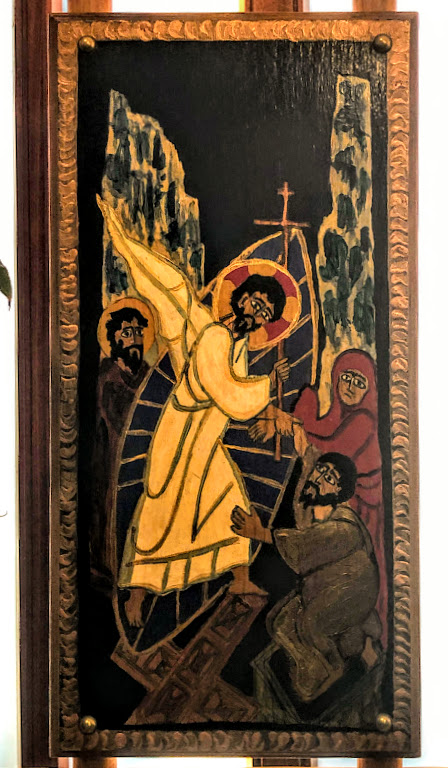
Christ is still wrapped in his grave clothes, his hands, feet and side still pierced with the marks of the nails and the centurion’s lance. But this is the Risen Christ. His eyes are open, and below a bowed soldier sent to guard the grave symbolises the defeat of death.
The Harrowing of Hell … the central panel in the processional cross in the Church of the Annunciation, Clonard, Wexford (Photograph: Patrick Comerford, 2022)
John 20: 1-18 (NRSVA):
1 Early on the first day of the week, while it was still dark, Mary Magdalene came to the tomb and saw that the stone had been removed from the tomb. 2 So she ran and went to Simon Peter and the other disciple, the one whom Jesus loved, and said to them, ‘They have taken the Lord out of the tomb, and we do not know where they have laid him.’ 3 Then Peter and the other disciple set out and went towards the tomb. 4 The two were running together, but the other disciple outran Peter and reached the tomb first. 5 He bent down to look in and saw the linen wrappings lying there, but he did not go in. 6 Then Simon Peter came, following him, and went into the tomb. He saw the linen wrappings lying there, 7 and the cloth that had been on Jesus’ head, not lying with the linen wrappings but rolled up in a place by itself. 8 Then the other disciple, who reached the tomb first, also went in, and he saw and believed; 9 for as yet they did not understand the scripture, that he must rise from the dead. 10 Then the disciples returned to their homes.
11 But Mary stood weeping outside the tomb. As she wept, she bent over to look into the tomb; 12 and she saw two angels in white, sitting where the body of Jesus had been lying, one at the head and the other at the feet. 13 They said to her, ‘Woman, why are you weeping?’ She said to them, ‘They have taken away my Lord, and I do not know where they have laid him.’ 14 When she had said this, she turned round and saw Jesus standing there, but she did not know that it was Jesus. 15 Jesus said to her, ‘Woman, why are you weeping? For whom are you looking?’ Supposing him to be the gardener, she said to him, ‘Sir, if you have carried him away, tell me where you have laid him, and I will take him away.’ 16 Jesus said to her, ‘Mary!’ She turned and said to him in Hebrew, ‘Rabbouni!’ (which means Teacher). 17 Jesus said to her, ‘Do not hold on to me, because I have not yet ascended to the Father. But go to my brothers and say to them, “I am ascending to my Father and your Father, to my God and your God”.’ 18 Mary Magdalene went and announced to the disciples, ‘I have seen the Lord’; and she told them that he had said these things to her.
Today’s Prayer:
The theme in this week’s prayer diary of the Anglican mission agency USPG (United Society Partners in the Gospel) is ‘From Death to Resurrection,’ and is introduced this morning by the Revd Dr Rachel Mash, Coordinator of the Environmental Network of the Anglican Church of Southern Africa. She writes:
What is the message of Easter for us when the future of Earth is under threat?
On Good Friday we feel the pain of suffering, cruelty and death – we lament the devastation of the Earth, the loss of two thirds of the world’s species in a single generation, the dying of the oceans and the destruction of the rainforests. Teeming life has turned to barren death, millions are faced with hunger from drought, floods and sea levels rise.
Where then is our Easter hope? Jesus died to save the world, the ‘cosmos’, as the Bible tells us (John 3 :16). ‘All the broken and dislocated pieces of the universe – people and things, animals and atoms—get properly fixed and fit together in vibrant harmonies, all because of his death, his blood that poured down from the cross’ (Colossians 1: 19-20, The Message version).
Jesus died not only to reconcile us to God and to one another, but also to bring reconciliation between humans and the whole of Creation. Believing in the resurrection does not point us to another world, it gives us hope and inspiration to work for the redemption of this one.
The prayer in the USPG Prayer Diary today (17 April 2022, Easter Day) invites us to pray:
Lord of All,
you defeated death so that we could live.
Guide us as we witness the power and
glory of the Risen Christ.
Yesterday’s reflection
Continued tomorrow
Scripture quotations are from the New Revised Standard Version Bible: Anglicised Edition copyright © 1989, 1995, National Council of the Churches of Christ in the United States of America. Used by permission. All rights reserved worldwide. http://nrsvbibles.org
Patrick Comerford
Lent and Holy Week have come to an end and today is Easter Day (17 April 2022), bringing an end to all our fears and ushering in all our hopes and joys.
I am hoping to take part in the Easter celebrations this morning in Saint Mary and Saint Giles Church, Stony Stratford. But, even before this day begins, I am taking some time early this morning for prayer, reflection and reading.
During Lent this year, in this Prayer Diary on my blog each morning, I was reflecting on the Psalms each morning. But during the two weeks of Passiontide, Passion Week and Holy Week, I was reflecting in these ways:
1, Short reflections on the Stations of the Cross, illustrated by images in the Church of the Annunciation, Clonard, Wexford, and the Church of Saint Mary and Saint Giles in Stony Stratford, Milton Keynes;
2, the Gospel reading of the day in the lectionary adapted in the Church of Ireland;
3, a prayer from the USPG prayer diary.
Station 15, the Resurrection:
Of course, traditional Stations of the Cross do not included a Fifteenth Station, However, in the Stations of the Cross on the north and south walls of the nave in Stoney Stratford, donated in memory of John Dunstan (1924-1988), Station XV depicts the Resurrection.
Beside the Stations of the Cross in the church in Clonard, a processional Cross has a central panel depicting the Resurrection.
The Crucifixion and Death of Christ is not the end.
Early on Sunday morning, before dawn on the first day of the week, the women come to the tomb with spices they have prepared. But they find the stone has been rolled away from the tomb, there is no body, and two men in dazzling clothes ask them ‘Why do you look for the living among the dead? He is not here, but has risen’ (Luke 24: 5). There is a similar greeting in the other two Synoptic Gospels: ‘He is not here; for he has been raised’ (Matthew 28: 6); ‘He has been raised; he is not here’ (Mark 16: 6).
Christ is still wrapped in his grave clothes, his hands, feet and side still pierced with the marks of the nails and the centurion’s lance. But this is the Risen Christ. His eyes are open, and below a bowed soldier sent to guard the grave symbolises the defeat of death.
The Harrowing of Hell … the central panel in the processional cross in the Church of the Annunciation, Clonard, Wexford (Photograph: Patrick Comerford, 2022)
John 20: 1-18 (NRSVA):
1 Early on the first day of the week, while it was still dark, Mary Magdalene came to the tomb and saw that the stone had been removed from the tomb. 2 So she ran and went to Simon Peter and the other disciple, the one whom Jesus loved, and said to them, ‘They have taken the Lord out of the tomb, and we do not know where they have laid him.’ 3 Then Peter and the other disciple set out and went towards the tomb. 4 The two were running together, but the other disciple outran Peter and reached the tomb first. 5 He bent down to look in and saw the linen wrappings lying there, but he did not go in. 6 Then Simon Peter came, following him, and went into the tomb. He saw the linen wrappings lying there, 7 and the cloth that had been on Jesus’ head, not lying with the linen wrappings but rolled up in a place by itself. 8 Then the other disciple, who reached the tomb first, also went in, and he saw and believed; 9 for as yet they did not understand the scripture, that he must rise from the dead. 10 Then the disciples returned to their homes.
11 But Mary stood weeping outside the tomb. As she wept, she bent over to look into the tomb; 12 and she saw two angels in white, sitting where the body of Jesus had been lying, one at the head and the other at the feet. 13 They said to her, ‘Woman, why are you weeping?’ She said to them, ‘They have taken away my Lord, and I do not know where they have laid him.’ 14 When she had said this, she turned round and saw Jesus standing there, but she did not know that it was Jesus. 15 Jesus said to her, ‘Woman, why are you weeping? For whom are you looking?’ Supposing him to be the gardener, she said to him, ‘Sir, if you have carried him away, tell me where you have laid him, and I will take him away.’ 16 Jesus said to her, ‘Mary!’ She turned and said to him in Hebrew, ‘Rabbouni!’ (which means Teacher). 17 Jesus said to her, ‘Do not hold on to me, because I have not yet ascended to the Father. But go to my brothers and say to them, “I am ascending to my Father and your Father, to my God and your God”.’ 18 Mary Magdalene went and announced to the disciples, ‘I have seen the Lord’; and she told them that he had said these things to her.
Today’s Prayer:
The theme in this week’s prayer diary of the Anglican mission agency USPG (United Society Partners in the Gospel) is ‘From Death to Resurrection,’ and is introduced this morning by the Revd Dr Rachel Mash, Coordinator of the Environmental Network of the Anglican Church of Southern Africa. She writes:
What is the message of Easter for us when the future of Earth is under threat?
On Good Friday we feel the pain of suffering, cruelty and death – we lament the devastation of the Earth, the loss of two thirds of the world’s species in a single generation, the dying of the oceans and the destruction of the rainforests. Teeming life has turned to barren death, millions are faced with hunger from drought, floods and sea levels rise.
Where then is our Easter hope? Jesus died to save the world, the ‘cosmos’, as the Bible tells us (John 3 :16). ‘All the broken and dislocated pieces of the universe – people and things, animals and atoms—get properly fixed and fit together in vibrant harmonies, all because of his death, his blood that poured down from the cross’ (Colossians 1: 19-20, The Message version).
Jesus died not only to reconcile us to God and to one another, but also to bring reconciliation between humans and the whole of Creation. Believing in the resurrection does not point us to another world, it gives us hope and inspiration to work for the redemption of this one.
The prayer in the USPG Prayer Diary today (17 April 2022, Easter Day) invites us to pray:
Lord of All,
you defeated death so that we could live.
Guide us as we witness the power and
glory of the Risen Christ.
Yesterday’s reflection
Continued tomorrow
Scripture quotations are from the New Revised Standard Version Bible: Anglicised Edition copyright © 1989, 1995, National Council of the Churches of Christ in the United States of America. Used by permission. All rights reserved worldwide. http://nrsvbibles.org
04 April 2021
Sunday intercessions on
4 April 2021, Easter Day
The Resurrection depicted in the Foley window in Saint Mary’s Church, Nenagh, Co Tipperary (Photograph: Patrick Comerford)
Christ is risen!
The Lord is risen indeed. Alleluia!
Let us pray:
‘I truly understand that God shows no partiality, but in every nation anyone who fears him and does what is right is acceptable to him’ (Acts 10: 34):
Heavenly Father,
on this Easter Day,
we thank you for the grace to follow Christ,
in times of grief and of rejoicing,
in times of rejection and welcome,
in times of defeat and triumph.
We pray for the nations of the world,
for Ireland north and south,
for the Taoiseach and Tanaiste,
the First Minister and Deputy First Minister.
We pray for nations torn by war, strife and division,
we pray for all who defend democracy and human rights,
for all who stand against racism, prejudice and oppression,
and we pray for all peacemakers …
Lord have mercy,
Lord have mercy.
‘Do not be alarmed; you are looking for Jesus of Nazareth, who was crucified. He has been raised; he is not here’ (Mark 16: 6):
Lord Jesus Christ,
we pray for the Church,
that we may welcome Christ in word and sacrament.
We pray for our neighbouring churches and parishes
in Co Limerick and Co Kerry,
that we may be blessed in their variety and diversity.
In the Anglican Cycle of Prayer,
we pray for the peace of Jerusalem.
In the Church of Ireland this month,
we pray for the Diocese of Down and Dromore
and Bishop David McClay.
In the Diocesan Cycle of Prayer this week,
we pray for all suffering from depression and other mental illnesses,
We pray for our own parishes and people,
and we pray for ourselves …
Christ have mercy,
Christ have mercy.
‘Christ, once raised from the dead dies no more; death has no more dominion over him’ (The Easter Anthems):
Holy Spirit,
we pray for one another …
we pray those we love and those who love us …
we pray for family, friends and neighbours ...
and we pray for those we promised to pray for …
We pray for those in need and those who seek healing …
for those working for healing …
for those waiting for healing …
for those seeking an end to this Covid crisis …
We pray for those who are sick or isolated,
at home or in hospital …
Una … Ann … Valerie … Daphne … Sylvia … Ajay …
Joey … Ena … George … Louise …
We pray for people who are lonely this Easter, without their families around them …
We pray for those we have offered to pray for …
and we pray for those who pray for us …
We pray for all who grieve and mourn at this time …
for Joey, Kenneth, Victor, and their families …
We remember and give thanks for those who have died …
especially for Linda Smyth …
for Bridget, whose birthday is at this time …
for those whose anniversaries are at this time …
May their memories be a blessing to us …
Lord have mercy,
Lord have mercy.
A prayer from the Anglican mission agency USPG (United Society Partners in the Gospel) on Easter Day:
Loving God, we come to you on this day that your Son
broke the bonds of death and rose victoriously from the tomb.
May the risen Christ continue to strengthen us
with the desire to share the good news of Your love for the world.
Christ is risen!
The Lord is risen indeed. Alleluia!
These intercessions were prepared for use in the Rathkeale and Kilnaughtin Group of Parishes on Easter Day, Sunday 4 April 2021
Christ is risen!
The Lord is risen indeed. Alleluia!
Let us pray:
‘I truly understand that God shows no partiality, but in every nation anyone who fears him and does what is right is acceptable to him’ (Acts 10: 34):
Heavenly Father,
on this Easter Day,
we thank you for the grace to follow Christ,
in times of grief and of rejoicing,
in times of rejection and welcome,
in times of defeat and triumph.
We pray for the nations of the world,
for Ireland north and south,
for the Taoiseach and Tanaiste,
the First Minister and Deputy First Minister.
We pray for nations torn by war, strife and division,
we pray for all who defend democracy and human rights,
for all who stand against racism, prejudice and oppression,
and we pray for all peacemakers …
Lord have mercy,
Lord have mercy.
‘Do not be alarmed; you are looking for Jesus of Nazareth, who was crucified. He has been raised; he is not here’ (Mark 16: 6):
Lord Jesus Christ,
we pray for the Church,
that we may welcome Christ in word and sacrament.
We pray for our neighbouring churches and parishes
in Co Limerick and Co Kerry,
that we may be blessed in their variety and diversity.
In the Anglican Cycle of Prayer,
we pray for the peace of Jerusalem.
In the Church of Ireland this month,
we pray for the Diocese of Down and Dromore
and Bishop David McClay.
In the Diocesan Cycle of Prayer this week,
we pray for all suffering from depression and other mental illnesses,
We pray for our own parishes and people,
and we pray for ourselves …
Christ have mercy,
Christ have mercy.
‘Christ, once raised from the dead dies no more; death has no more dominion over him’ (The Easter Anthems):
Holy Spirit,
we pray for one another …
we pray those we love and those who love us …
we pray for family, friends and neighbours ...
and we pray for those we promised to pray for …
We pray for those in need and those who seek healing …
for those working for healing …
for those waiting for healing …
for those seeking an end to this Covid crisis …
We pray for those who are sick or isolated,
at home or in hospital …
Una … Ann … Valerie … Daphne … Sylvia … Ajay …
Joey … Ena … George … Louise …
We pray for people who are lonely this Easter, without their families around them …
We pray for those we have offered to pray for …
and we pray for those who pray for us …
We pray for all who grieve and mourn at this time …
for Joey, Kenneth, Victor, and their families …
We remember and give thanks for those who have died …
especially for Linda Smyth …
for Bridget, whose birthday is at this time …
for those whose anniversaries are at this time …
May their memories be a blessing to us …
Lord have mercy,
Lord have mercy.
A prayer from the Anglican mission agency USPG (United Society Partners in the Gospel) on Easter Day:
Loving God, we come to you on this day that your Son
broke the bonds of death and rose victoriously from the tomb.
May the risen Christ continue to strengthen us
with the desire to share the good news of Your love for the world.
Christ is risen!
The Lord is risen indeed. Alleluia!
These intercessions were prepared for use in the Rathkeale and Kilnaughtin Group of Parishes on Easter Day, Sunday 4 April 2021
Finding faith and meaning
to end our fears and
to fill the empty spaces
The Resurrection … a stained glass window in Saint Michael’s Church, Lichfield (Photograph: Patrick Comerford)
Patrick Comerford
Sunday 4 April 2021, Easter Day
10 a.m.: The Easter Eucharist
The Readings: Acts 10: 34-43; the Easter Anthems (I Corinthians 5: 7-8; Romans 6: 9-11; I Corinthians 15: 20-22); John 20: 1-18
There is a link to the readings HERE.
‘Early on the first day of the week, while it was still dark’ (John 20: 1) … scurrying through Mediterranean streets before dawn (Photograph: Patrick Comerford)
Christ is risen!
The Lord is risen indeed. Alleluia!
Early on the Sunday morning, ‘the first day of the week’ after the Crucifixion, before dawn, Mary Magdalene, who has been a witness to Christ’s death and burial, comes to the tomb, only to find that the stone has been rolled away.
At first, it seems she is on her own, she alone is named. But later she describes her experiences using the word ‘we.’ There are other women with her too that early morning.
In the alternative Gospel reading in Saint Mark’s Gospel (Mark 16: 1-8), Saint Mark says that on Saturday after sundown, the women buy spices to anoint Christ’s body.
Early on Sunday morning, they go to the tomb. It is a dangerous task, risking being identified with the man who has been executed publicly, shamefully.
Imagine them scurrying through the back streets and city lanes, creeping outside the city walls, hoping no-one is awake yet or sees them in their secret mission.
But when they get to the tomb, the stone has been rolled away, and the grave is empty.
Mary and these women rush back to tell Saint Peter and Saint John they fear someone has taken away the body. But the tidy way they find the folded wrappings and rolled-up shroud shows the body has not been stolen. They believe, yet do not understand; they return home without any explanations.
But Mary returns to the grave. In her grief, she sees ‘two angels in white’ sitting where the body had been lying, one at the head, and one at the feet. They speak to her, and then she turns around and sees Christ, but only recognises him when he calls her by name.
Peter and John have returned without seeing the Risen Lord. It is left to Mary to tell the Disciples that she has seen the Lord. Mary Magdalene is the first witness of the Resurrection, the first person to the Risen Christ. He sends her back to tell the other disciples what she has seen, she becomes the ‘Apostle to the Apostles.’
But, despite Mary’s good news, the disciples have remained at home, socially isolated, their doors locked in fear (John 20: 19) throughout that first Easter Day.
This is the second consecutive Easter that our churches are empty and our church doors have been locked in fear … this time in fear that church services may be ‘super spreader’ events.
What is the dominant feeling this Easter morning: Fear? Or Faith?
Writing in the Guardian last week (29 March 2021), John Harris talks about the way the year of lockdown has brought with it ‘the sudden fear of serious illness and death, and the sense of all of it being wholly random.’
When they filled their census form earlier this month, John Harris and his partner ticked the ‘no religion’ box. Later, though, he admitted he ‘felt a pang of envy’ as he ‘wondered how religious believers were feeling’.
He writes, ‘Like millions of other faithless people, I have not even the flimsiest of narratives to project on to what has happened, nor any real vocabulary with which to talk about the profundities of life and death.’
In the first phase of the pandemic, Googling the word ‘prayer’ increased by 50%. An Easter service led by the Archbishop of Canterbury from his kitchen table attracted 5 million viewers, described by the Church of England as the largest congregation in its history.
As the pandemic lockdown continued, the symbols of religion made very visible recoveries, have come back to life, have given people new ways of finding, exploring and expressing meaning in life.
That exploration ranges from a renewed interest in the second series of Fleabag and its explorations of ethics in an age of individualism, to a startling surge in the popularity of early Christian composers such as William Byrd and Palestrina, and to virtual pilgrimages to a degree, according to a leader in the Guardian, ‘that would have astonished Geoffrey Chaucer.’
The fear of the Apostles, locked away in isolation in their homes that first Easter Day, ought to speak to the fear of people in this lockdown era, looking for real ways ‘with which to talk about the profundities of life and death.’
Somehow, on this Easter morning, I find this empty church speaks to me of the empty grave on the first Easter morning.
The Easter Church must be a community that, after the lockdown, is found willing to grapple with the great issues of life. People do not want to be alone. They are seeking community that responds to the authentic questions of life, death, love, anxiety, longing, and the search for meaning.
The task in mission for the post-lockdown Church is to rush back, like Mary and the other women, to rush back and to fill the empty places in the core of people seeking a ‘real vocabulary with which to talk about the profundities of life and death.’
Christ is risen!
The Lord is risen indeed. Alleluia!
The Empty Tomb … a fresco in Saint John’s Monastery, Tolleshunt Knights, Essex (Photograph: Patrick Comerford)
John 20: 1-18 (NRSVA):
1 Early on the first day of the week, while it was still dark, Mary Magdalene came to the tomb and saw that the stone had been removed from the tomb. 2 So she ran and went to Simon Peter and the other disciple, the one whom Jesus loved, and said to them, ‘They have taken the Lord out of the tomb, and we do not know where they have laid him.’ 3 Then Peter and the other disciple set out and went towards the tomb. 4 The two were running together, but the other disciple outran Peter and reached the tomb first. 5 He bent down to look in and saw the linen wrappings lying there, but he did not go in. 6 Then Simon Peter came, following him, and went into the tomb. He saw the linen wrappings lying there, 7 and the cloth that had been on Jesus’ head, not lying with the linen wrappings but rolled up in a place by itself. 8 Then the other disciple, who reached the tomb first, also went in, and he saw and believed; 9 for as yet they did not understand the scripture, that he must rise from the dead. 10 Then the disciples returned to their homes.
11 But Mary stood weeping outside the tomb. As she wept, she bent over to look into the tomb; 12 and she saw two angels in white, sitting where the body of Jesus had been lying, one at the head and the other at the feet. 13 They said to her, ‘Woman, why are you weeping?’ She said to them, ‘They have taken away my Lord, and I do not know where they have laid him.’ 14 When she had said this, she turned round and saw Jesus standing there, but she did not know that it was Jesus. 15 Jesus said to her, ‘Woman, why are you weeping? For whom are you looking?’ Supposing him to be the gardener, she said to him, ‘Sir, if you have carried him away, tell me where you have laid him, and I will take him away.’ 16 Jesus said to her, ‘Mary!’ She turned and said to him in Hebrew, ‘Rabbouni!’ (which means Teacher). 17 Jesus said to her, ‘Do not hold on to me, because I have not yet ascended to the Father. But go to my brothers and say to them, “I am ascending to my Father and your Father, to my God and your God”.’ 18 Mary Magdalene went and announced to the disciples, ‘I have seen the Lord’; and she told them that he had said these things to her.
She ‘came to the tomb and saw that the stone had been removed from the tomb’ (John 20: 1) … (Photograph: Patrick Comerford, 2021)
Liturgical Colour: White (or Gold).
The Greeting (from Easter Day until Pentecost):
Christ is risen!
The Lord is risen indeed. Alleluia!
Penitential Kyries:
Lord God,
you raised your Son from the dead.
Lord, have mercy.
Lord, have mercy.
Lord Jesus,
through you we are more than conquerors.
Christ, have mercy.
Christ, have mercy.
Holy Spirit,
you help us in our weakness.
Lord, have mercy.
Lord, have mercy.
Collect:
Almighty God,
through your only-begotten Son Jesus Christ
you have overcome death
and opened to us the gate of everlasting life:
Grant that, as by your grace going before us
you put into our minds good desires,
so by your continual help we may bring them to good effect;
through Jesus Christ our risen Lord
who is alive and reigns with you and the Holy Spirit,
one God, now and for ever.
Introduction to the Peace:
The Risen Christ came and stood among his disciples and said, Peace be with you. Then were they glad when they saw the Lord (John 20: 19, 20).
Preface:
Above all we praise you
for the glorious resurrection of your Son
Jesus Christ our Lord,
the true paschal lamb who was sacrificed for us;
by dying he destroyed our death;
by rising he restored our life:
Post Communion Prayer:
Living God,
for our redemption you gave your only-begotten Son
to the death of the cross,
and by his glorious resurrection
you have delivered us from the power of our enemy.
Grant us so to die daily unto sin,
that we may evermore live with him in the joy of his risen life;
through Jesus Christ our Lord.
Blessing:
God the Father,
by whose glory Christ was raised from the dead,
raise you up to walk with him in the newness of his risen life:
Dismissal: (from Easter Day to Pentecost):
Go in the peace of the Risen Christ. Alleluia! Alleluia!
Thanks be to God. Alleluia! Alleluia!
Hymns:
271, Jesus Christ is risen today (CD 17)
286, The strife is o’er, the battle done (CD 17)
288, Thine be the glory, risen, conquering Son (CD 17)
Saint Mary Magdalene at Easter Morning … a sculpture by Mary Grant at the west door of Lichfield Cathedral (Photograph: Patrick Comerford)
Scripture quotations are from the New Revised Standard Version Bible: Anglicised Edition copyright © 1989, 1995, National Council of the Churches of Christ in the United States of America. Used by permission. All rights reserved worldwide. http://nrsvbibles.org
Material from the Book of Common Prayer is copyright © 2004, Representative Body of the Church of Ireland.
Patrick Comerford
Sunday 4 April 2021, Easter Day
10 a.m.: The Easter Eucharist
The Readings: Acts 10: 34-43; the Easter Anthems (I Corinthians 5: 7-8; Romans 6: 9-11; I Corinthians 15: 20-22); John 20: 1-18
There is a link to the readings HERE.
‘Early on the first day of the week, while it was still dark’ (John 20: 1) … scurrying through Mediterranean streets before dawn (Photograph: Patrick Comerford)
Christ is risen!
The Lord is risen indeed. Alleluia!
Early on the Sunday morning, ‘the first day of the week’ after the Crucifixion, before dawn, Mary Magdalene, who has been a witness to Christ’s death and burial, comes to the tomb, only to find that the stone has been rolled away.
At first, it seems she is on her own, she alone is named. But later she describes her experiences using the word ‘we.’ There are other women with her too that early morning.
In the alternative Gospel reading in Saint Mark’s Gospel (Mark 16: 1-8), Saint Mark says that on Saturday after sundown, the women buy spices to anoint Christ’s body.
Early on Sunday morning, they go to the tomb. It is a dangerous task, risking being identified with the man who has been executed publicly, shamefully.
Imagine them scurrying through the back streets and city lanes, creeping outside the city walls, hoping no-one is awake yet or sees them in their secret mission.
But when they get to the tomb, the stone has been rolled away, and the grave is empty.
Mary and these women rush back to tell Saint Peter and Saint John they fear someone has taken away the body. But the tidy way they find the folded wrappings and rolled-up shroud shows the body has not been stolen. They believe, yet do not understand; they return home without any explanations.
But Mary returns to the grave. In her grief, she sees ‘two angels in white’ sitting where the body had been lying, one at the head, and one at the feet. They speak to her, and then she turns around and sees Christ, but only recognises him when he calls her by name.
Peter and John have returned without seeing the Risen Lord. It is left to Mary to tell the Disciples that she has seen the Lord. Mary Magdalene is the first witness of the Resurrection, the first person to the Risen Christ. He sends her back to tell the other disciples what she has seen, she becomes the ‘Apostle to the Apostles.’
But, despite Mary’s good news, the disciples have remained at home, socially isolated, their doors locked in fear (John 20: 19) throughout that first Easter Day.
This is the second consecutive Easter that our churches are empty and our church doors have been locked in fear … this time in fear that church services may be ‘super spreader’ events.
What is the dominant feeling this Easter morning: Fear? Or Faith?
Writing in the Guardian last week (29 March 2021), John Harris talks about the way the year of lockdown has brought with it ‘the sudden fear of serious illness and death, and the sense of all of it being wholly random.’
When they filled their census form earlier this month, John Harris and his partner ticked the ‘no religion’ box. Later, though, he admitted he ‘felt a pang of envy’ as he ‘wondered how religious believers were feeling’.
He writes, ‘Like millions of other faithless people, I have not even the flimsiest of narratives to project on to what has happened, nor any real vocabulary with which to talk about the profundities of life and death.’
In the first phase of the pandemic, Googling the word ‘prayer’ increased by 50%. An Easter service led by the Archbishop of Canterbury from his kitchen table attracted 5 million viewers, described by the Church of England as the largest congregation in its history.
As the pandemic lockdown continued, the symbols of religion made very visible recoveries, have come back to life, have given people new ways of finding, exploring and expressing meaning in life.
That exploration ranges from a renewed interest in the second series of Fleabag and its explorations of ethics in an age of individualism, to a startling surge in the popularity of early Christian composers such as William Byrd and Palestrina, and to virtual pilgrimages to a degree, according to a leader in the Guardian, ‘that would have astonished Geoffrey Chaucer.’
The fear of the Apostles, locked away in isolation in their homes that first Easter Day, ought to speak to the fear of people in this lockdown era, looking for real ways ‘with which to talk about the profundities of life and death.’
Somehow, on this Easter morning, I find this empty church speaks to me of the empty grave on the first Easter morning.
The Easter Church must be a community that, after the lockdown, is found willing to grapple with the great issues of life. People do not want to be alone. They are seeking community that responds to the authentic questions of life, death, love, anxiety, longing, and the search for meaning.
The task in mission for the post-lockdown Church is to rush back, like Mary and the other women, to rush back and to fill the empty places in the core of people seeking a ‘real vocabulary with which to talk about the profundities of life and death.’
Christ is risen!
The Lord is risen indeed. Alleluia!
The Empty Tomb … a fresco in Saint John’s Monastery, Tolleshunt Knights, Essex (Photograph: Patrick Comerford)
John 20: 1-18 (NRSVA):
1 Early on the first day of the week, while it was still dark, Mary Magdalene came to the tomb and saw that the stone had been removed from the tomb. 2 So she ran and went to Simon Peter and the other disciple, the one whom Jesus loved, and said to them, ‘They have taken the Lord out of the tomb, and we do not know where they have laid him.’ 3 Then Peter and the other disciple set out and went towards the tomb. 4 The two were running together, but the other disciple outran Peter and reached the tomb first. 5 He bent down to look in and saw the linen wrappings lying there, but he did not go in. 6 Then Simon Peter came, following him, and went into the tomb. He saw the linen wrappings lying there, 7 and the cloth that had been on Jesus’ head, not lying with the linen wrappings but rolled up in a place by itself. 8 Then the other disciple, who reached the tomb first, also went in, and he saw and believed; 9 for as yet they did not understand the scripture, that he must rise from the dead. 10 Then the disciples returned to their homes.
11 But Mary stood weeping outside the tomb. As she wept, she bent over to look into the tomb; 12 and she saw two angels in white, sitting where the body of Jesus had been lying, one at the head and the other at the feet. 13 They said to her, ‘Woman, why are you weeping?’ She said to them, ‘They have taken away my Lord, and I do not know where they have laid him.’ 14 When she had said this, she turned round and saw Jesus standing there, but she did not know that it was Jesus. 15 Jesus said to her, ‘Woman, why are you weeping? For whom are you looking?’ Supposing him to be the gardener, she said to him, ‘Sir, if you have carried him away, tell me where you have laid him, and I will take him away.’ 16 Jesus said to her, ‘Mary!’ She turned and said to him in Hebrew, ‘Rabbouni!’ (which means Teacher). 17 Jesus said to her, ‘Do not hold on to me, because I have not yet ascended to the Father. But go to my brothers and say to them, “I am ascending to my Father and your Father, to my God and your God”.’ 18 Mary Magdalene went and announced to the disciples, ‘I have seen the Lord’; and she told them that he had said these things to her.
She ‘came to the tomb and saw that the stone had been removed from the tomb’ (John 20: 1) … (Photograph: Patrick Comerford, 2021)
Liturgical Colour: White (or Gold).
The Greeting (from Easter Day until Pentecost):
Christ is risen!
The Lord is risen indeed. Alleluia!
Penitential Kyries:
Lord God,
you raised your Son from the dead.
Lord, have mercy.
Lord, have mercy.
Lord Jesus,
through you we are more than conquerors.
Christ, have mercy.
Christ, have mercy.
Holy Spirit,
you help us in our weakness.
Lord, have mercy.
Lord, have mercy.
Collect:
Almighty God,
through your only-begotten Son Jesus Christ
you have overcome death
and opened to us the gate of everlasting life:
Grant that, as by your grace going before us
you put into our minds good desires,
so by your continual help we may bring them to good effect;
through Jesus Christ our risen Lord
who is alive and reigns with you and the Holy Spirit,
one God, now and for ever.
Introduction to the Peace:
The Risen Christ came and stood among his disciples and said, Peace be with you. Then were they glad when they saw the Lord (John 20: 19, 20).
Preface:
Above all we praise you
for the glorious resurrection of your Son
Jesus Christ our Lord,
the true paschal lamb who was sacrificed for us;
by dying he destroyed our death;
by rising he restored our life:
Post Communion Prayer:
Living God,
for our redemption you gave your only-begotten Son
to the death of the cross,
and by his glorious resurrection
you have delivered us from the power of our enemy.
Grant us so to die daily unto sin,
that we may evermore live with him in the joy of his risen life;
through Jesus Christ our Lord.
Blessing:
God the Father,
by whose glory Christ was raised from the dead,
raise you up to walk with him in the newness of his risen life:
Dismissal: (from Easter Day to Pentecost):
Go in the peace of the Risen Christ. Alleluia! Alleluia!
Thanks be to God. Alleluia! Alleluia!
Hymns:
271, Jesus Christ is risen today (CD 17)
286, The strife is o’er, the battle done (CD 17)
288, Thine be the glory, risen, conquering Son (CD 17)
Saint Mary Magdalene at Easter Morning … a sculpture by Mary Grant at the west door of Lichfield Cathedral (Photograph: Patrick Comerford)
Scripture quotations are from the New Revised Standard Version Bible: Anglicised Edition copyright © 1989, 1995, National Council of the Churches of Christ in the United States of America. Used by permission. All rights reserved worldwide. http://nrsvbibles.org
Material from the Book of Common Prayer is copyright © 2004, Representative Body of the Church of Ireland.
Labels:
Anglesey,
Askeaton,
Castletown,
Easter,
Easter 2021,
Easter Day,
Guardian,
Icons,
Iraklion,
Lichfield,
Lichfield Cathedral,
Mount Sinai,
Penmon,
Rathkeale,
Saint John's Gospel,
Tarbert,
Tolleshunt Knights
12 April 2020
Sunday intercessions
on Easter Day
‘Do not be afraid’ (Matthew 28: 5) … words on a gable end on Richmond Street in Portobello, Dublin (Photograph: Patrick Comerford)
These intercessions were prepared for use last night at the Easter Eucharist in Saint Brendan’s Church Kilnaughtin (Tarbert), Saint Mary’s Church, Askeaton, and at the Easter Eucharist this morning in Castletown Church and Holy Trinity Church, Rathkeale. However, the churches have been closed temporarily because of the Covid-19 or Corona Virus pandemic:
Let us pray on this Easter Day:
Lord God, our Heavenly Father:
Jesus says, ‘Do not be afraid’ (Matthew 28: 5), ‘I am ascending to my Father and your Father, to my God and your God’ (John 20: 17):
We pray this morning for all who are afraid and live in fear …
in fear of the Corona virus …
in fear for their health and for their families…
in fear for the future …
in fear of hunger and hatred …
We pray for people who are not at home …
for those who cannot return home …
for all in hospitals or who are isolated …
for families finding it difficult to work at home, to stay at home …
to care for and to school children at home …
for the homeless, the migrants and the refugees …
We pray for the nations of the world in this time of crisis,
for our own country, Ireland north and south …
for those bearing the responsibility of government …
for those working in frontline services …
and for those who keep working on essential supply lines …
Lord have mercy,
Lord have mercy.
Lord Jesus Christ:
You ask us: ‘Why are you weeping? (John 20: 12):
We pray for the Church,
that as the Church we may be messengers of hope and joy,
sharing the good news of the Resurrection.
We pray for churches that are closed this morning,
that the hearts of the people may remain open
to the love of God, and to the love of others.
In the Church of Ireland,
we pray this month for
the Diocese of Down and Dromore and Bishop David McClay.
We pray for our Bishop Kenneth,
we pray for our neighbouring parishes
in Limerick, Adare and Tralee,
their parishioners and people,
their priests: Jim, Phyllis, Liz, and Niall,
that we may grow closer together
in mission, ministry and hospitality.
In the Anglican Cycle of Prayer,
we pray for the Peace of Jerusalem
and the People of the Land of the Holy One.
In the Diocesan Cycle of Prayer,
we pray for Aughaval Union of Parishes in the Diocese of Tuam,
their priest, Canon Jennifer McWhirter,
and the congregations of
Holy Trinity, Westport, Christ Church, Castlebar.
Saint Thomas’s, Dugort (Achill Island), and Turlough Church.
Christ have mercy,
Christ have mercy.
Holy Spirit:
‘This is the day that the Lord has made;
we will rejoice and be glad in it’ (Psalm 118: 24):
We pray for ourselves and for our needs,
for healing, restoration and health,
in body, mind and spirit.
We pray for the needs of one another,
for those who are alone and lonely …
for those who travel …
for those who are sick, at home or in hospital …
Alan ... Ajay … Charles …
Lorraine … James …
Niall … Linda ... Basil …
We pray for those who grieve …
for those who remember loved ones …
May their memory be a blessing to us.
We pray for those who have broken hearts …
for those who live with disappointment …
for those who are alone and lonely …
We pray for all who are to be baptised,
We pray for all preparing to be married,
We pray for those who are about to die …
We pray for those who have asked for our prayers …
for those we have offered to pray for …
Lord have mercy,
Lord have mercy.
A prayer on this Sunday, Easter Day,
in the prayer diary of the Anglican mission agency USPG,
United Society Partners in the Gospel:
Christ yesterday and today, the beginning and the end,
Alpha and Omega, all time belongs to him, and all ages;
to him be glory and power, through every age and for ever.
Alleluia, Christ is risen: he is risen indeed. Alleluia! Amen.
(From the Easter Liturgy)
Merciful Father, …
Saint Thomas’s Church, Dugort, Achill Island … named in the Diocesan Cycle of Prayer (Photograph: Patrick Comerford)
These intercessions were prepared for use last night at the Easter Eucharist in Saint Brendan’s Church Kilnaughtin (Tarbert), Saint Mary’s Church, Askeaton, and at the Easter Eucharist this morning in Castletown Church and Holy Trinity Church, Rathkeale. However, the churches have been closed temporarily because of the Covid-19 or Corona Virus pandemic:
Let us pray on this Easter Day:
Lord God, our Heavenly Father:
Jesus says, ‘Do not be afraid’ (Matthew 28: 5), ‘I am ascending to my Father and your Father, to my God and your God’ (John 20: 17):
We pray this morning for all who are afraid and live in fear …
in fear of the Corona virus …
in fear for their health and for their families…
in fear for the future …
in fear of hunger and hatred …
We pray for people who are not at home …
for those who cannot return home …
for all in hospitals or who are isolated …
for families finding it difficult to work at home, to stay at home …
to care for and to school children at home …
for the homeless, the migrants and the refugees …
We pray for the nations of the world in this time of crisis,
for our own country, Ireland north and south …
for those bearing the responsibility of government …
for those working in frontline services …
and for those who keep working on essential supply lines …
Lord have mercy,
Lord have mercy.
Lord Jesus Christ:
You ask us: ‘Why are you weeping? (John 20: 12):
We pray for the Church,
that as the Church we may be messengers of hope and joy,
sharing the good news of the Resurrection.
We pray for churches that are closed this morning,
that the hearts of the people may remain open
to the love of God, and to the love of others.
In the Church of Ireland,
we pray this month for
the Diocese of Down and Dromore and Bishop David McClay.
We pray for our Bishop Kenneth,
we pray for our neighbouring parishes
in Limerick, Adare and Tralee,
their parishioners and people,
their priests: Jim, Phyllis, Liz, and Niall,
that we may grow closer together
in mission, ministry and hospitality.
In the Anglican Cycle of Prayer,
we pray for the Peace of Jerusalem
and the People of the Land of the Holy One.
In the Diocesan Cycle of Prayer,
we pray for Aughaval Union of Parishes in the Diocese of Tuam,
their priest, Canon Jennifer McWhirter,
and the congregations of
Holy Trinity, Westport, Christ Church, Castlebar.
Saint Thomas’s, Dugort (Achill Island), and Turlough Church.
Christ have mercy,
Christ have mercy.
Holy Spirit:
‘This is the day that the Lord has made;
we will rejoice and be glad in it’ (Psalm 118: 24):
We pray for ourselves and for our needs,
for healing, restoration and health,
in body, mind and spirit.
We pray for the needs of one another,
for those who are alone and lonely …
for those who travel …
for those who are sick, at home or in hospital …
Alan ... Ajay … Charles …
Lorraine … James …
Niall … Linda ... Basil …
We pray for those who grieve …
for those who remember loved ones …
May their memory be a blessing to us.
We pray for those who have broken hearts …
for those who live with disappointment …
for those who are alone and lonely …
We pray for all who are to be baptised,
We pray for all preparing to be married,
We pray for those who are about to die …
We pray for those who have asked for our prayers …
for those we have offered to pray for …
Lord have mercy,
Lord have mercy.
A prayer on this Sunday, Easter Day,
in the prayer diary of the Anglican mission agency USPG,
United Society Partners in the Gospel:
Christ yesterday and today, the beginning and the end,
Alpha and Omega, all time belongs to him, and all ages;
to him be glory and power, through every age and for ever.
Alleluia, Christ is risen: he is risen indeed. Alleluia! Amen.
(From the Easter Liturgy)
Merciful Father, …
Subscribe to:
Posts (Atom)