Showing posts with label Saint Chad. Show all posts

11 May 2026

The lost chapel in Hopwas,
stories of early Methodists
and of the former ‘Hopwas
Congregation’ of Catholics

The site of Saint John’s Chapel, Hopwas … now green space and a disused burial ground on Hints Lane (Photograph: Patrick Comerford, 2026)

Patrick Comerford

When I was visiting Saint Chad’s Church in Hopwas in recent days, I noticed the old font in the churchyard, on the south side of the church. The font is a surviving reminder of Saint John’s Chapel, a chapel-of-ease on Hints Lane that was replaced when Saint Chad’s was built in 1879-1881, along with the bell that still tolls in Saint Chad’s Church.

I decided a few days ago to go in search of the site of Saint John’s Chapel, and found the old churchyard on Hints Lane, less than half a mile west of the Tame Otter.

This is a very small cemetery off a quiet road. A few of the gravestones are very worn, only a few of them can be read and there is no sign to describe the former churchyard. The small rectangular plot of land is surrounded by a low wall, with just a small metal gate.

Saint John’s Chapel was built as a chapel-of-ease for Tamworth parish in 1836. There are no signs to indicate that a church once stood on the site, although some of the legible gravestones indicate it continued to be used as a burial ground until the early decades of the 20th century.

The font from Saint John’s Chapel is on the south side of Saint Chad’s Church, in the churchyard (Photograph: Patrick Comerford, 2026)

When the Revd William MacGregor (1848-1937) was appointed Vicar of Tamworth in 1878, he gave Saint Editha’s Church a major facelift, had its bells recast, and built two churches, at Glascote and at Hopwas. He believed that Saint John’s chapel, built over 40 years earlier was too small to cater for the growing population of Hopwas. But when he sought land to build a new church, he was opposed by Sir Robert Peel who argued that the population was not large enough.

Nonetheless, MacGregor managed to secure a site for his planned church from the Revd TK Levett of Packington Hall in 1878, with additional land donated by Herbert Dean. The church was designed by John Douglas and consecrated in 1881.

The original chapel structure may have survived a little longer after the font and bell were moved up the hill to the new Saint Chad’s, for the Tamworth Herald reported on 16 April 1898 that the holy table from Saint John’s was made use of in the new workhouse chapel in Tamworth.

All that remains of Saint John’s today may be a handful of stones in among the graves in the former churchyard in the centre of the village. Even the tree planted to mark Queen Elizabeth II’s 90th birthday has wilted and seems to have died.

Hopwas Methodist Church on Hints Lane was built in 1888 (Photograph: Patrick Comerford, 2026)

Two other traditions, the Methodists and the Roman Catholics, have also had a long presence in Hopwas, alongside the Church of England.

Francis Wilson (1835-1917) introduced Methodism to Hopwas three months after he moved to the village in 1866. When his cottage on School Lane became too small for the growing congregation, a new chapel was built in 1888 on Hints Lane on the other side of the village, a little further west along Hints Lane. Hopwas Methodist Church has been in the heart of the village ever since.

Hopwas Methodist Church is part of the Tamworth and Lichfield Methodist Circuit, a collection of six churches in Tamworth, Lichfield, Alrewas, Hopwas, Shenstone and Stonydelph. The Revd Joanna Thornton is the Superintendent Minister, and Sunday services in Hopwas are at 10:45 am. On a fifth Sunday in the month, a joint service alternates between Hopwas Methodist Church and Saint Chad’s Church.

Hopwas Methodists met for oover 20 years in the home of Francis Wilson, from 1866 to 1888 (Photograph: Patrick Comerford, 2026)

In the past, Hopwas also had an interesting Roman Catholic presence. Local tradition says that Catholics in the area attended Mass in the chapel in Comberford Hall until the Comberford family moved away in 1671, although that date ought perhaps to be as late as 1718, when Catherine Comberford died.

The Catholics in the area were then served by visiting priests from Pipe Hall, the home of the Weld family, who were descended from the Comberfords through the Heveningham family, and from Oscott College. The Revd Dr John Kirk of Holy Cross, Lichfield, took charge of what was called the ‘Hopwas Congregation’ in 1801, and the congregation met in houses until 1815.

However, I have yet to identify those houses. It would be interesting if there is any continuity in that Catholic tradition between the houses used by the congregation in those years and the two houses in Hopwas still owned by Catherine Comberford when she died in 1718.

The ‘Hopwas Congregation’ of Catholics met in houses in Hopwas from 1801 until 1815 (Photograph: Patrick Comerford, 2026)

The Birch family gave a small plot of land at Coton in 1815, and Father Kirk built a small chapel. The chapel opened on 15 August 1815, when the preacher was the recently-ordained Dr Henry Weedall (1788-1859), later President of Saint Mary’s College, Oscott.

For 50 years from 1826, the Revd James Kelly was in charge of the Tamworth mission. A new church and presbytery were built in 1829-1830 ‘entirely through his exertions’, although other accounts suggest that the energetic Father Kirk also remained involved, and that the new church in Tamworth was partly endowed by John Talbot (1791-1852), 16th Earl of Shrewsbury, who lived at Alton Towers, who commissioned AWN Pugin to build many churches in Staffordshire, and who was once ‘the most prominent British Catholic of day’.

In the 1820s, Kirk also built Holy Cross Church on Upper Saint John Street, Lichfield, which was later enlarged and rebuilt in 1832 by the Lichfield-born architect Joseph Potter (1756-1842).

A piece of land in central Tamworth was acquired from Sir Robert Peel, and Kirk’s Lichfield friend Potter was commissioned to design a neoclassical church with an attached presbytery, although it is possible that the church was designed by Joseph Potter jnr.

The foundation stone was laid on Good Friday, 17 April 1829, and the church was opened on the feast of Saint John the Baptist, 24 June 1830, by Bishop Thomas Walsh (1777-1849), Vicar Apostolic for the Midland District, when a choir from Oscott College sang.

Saint John’s Church, Tamworth, was remodelled and extended and given a distinctly post-war character in 1954-1956, and its brick exterior makes it look like a 20th century church. Its story has developed quite separately from the ‘Hopwas Congregation’ that met in houses in Hopwas from 1801 to 1815, or its distant predecessor in Comberford Hall a century or more earlier.

Comberford Hall … local tradition says a Catholic congregation met in the private chapel of the Comberford family before moving to Hopwas (Photograph: Patrick Comerford, 2026)

10 May 2026

Saint Chad’s Church, Hopwas:
‘an ingenious and entertaining’
church built by a Vicar of Tamworth

Saint Chad’s Church in Hopwas, Staffordshire, was designed by John Douglas (1830-1911) and built in 1879-1881 (Photograph: Patrick Comerford, 2026)

Patrick Comerford

My 10-mile walk through the countryside in south Staffordshire last week, starting at the Moat House in Tamworth, brought me to Wigginton and Saint Leonard’s Church, along Comberford Lane and Wigginton Lane to Comberford and the banks of the River Tame, and then along Coton Lane to Hopwas.

Before returning to Tamworth, I stopped to see Hopwas and Hopwas Hayes Wood, climbed up the hill to Saint Chad’s Church, walked along the canal towpaths beside the Tame Otter and the Red Lion, and had a late lunch in the Tame Otter.

Saint Chad’s Church, tucked under the woods, was built in 1879-1881 to replace the earlier Saint John’s Chapel, built as a chapel-of-ease for Tamworth parish in 1836. Saint John’s churchyard can still be seen on the right-hand or west side of Hints Lane, walking up from the Tame Otter, just beyond Hopwas Methodist Church.

Saint Chad’s Church, Hopwas, was built on the initiative of the Revd William MacGregor (1848-1937), Vicar of Tamworth (Photograph: Patrick Comerford, 2026)

The Revd William MacGregor (1848-1937) who was, without doubt, Tamworth’s ultimate ‘champion of the poor’ and the very embodiment of the Victorian ‘slum priest’. He was a curate in Hopwas, outside Tamworth, in 1872-1876, and then Vicar of Saint Matthias’, Liverpool, in 1877-1878. But he returned to Tamworth and the Diocese of Lichfield when he was appointed Vicar of Tamworth in 1878 at the age of 30.

When he was the Vicar of Tamworth (1878-1887), MacGregor gave Saint Editha’s Church a major facelift, had its bells recast, and built two churches, at Glascote and at Hopwas. Saint John’s was too small to cater for the growing population of Hopwas, but when he sought land to build a new church, he was opposed by Sir Robert Peel who argued that the population was not large enough. However, the Revd TK Levett of Packington Hall gave an acre of land as a site for a new church in 1878, and Herbert Dean later gave additional land to ensure the church had an open setting.

The foundation stone was laid in 1879 and Saint Chad’s was consecrated on 23 April 1881 by William Dalrymple Maclagan (1826-1910), Bishop of Lichfield (1878-1891) and later Archbishop of York (1891-1908).

The foundation stone was laid in 1879 and Saint Chad’s was consecrated in 1881 by Bishop William Dalrymple Maclagan of Lichfield (Photograph: Patrick Comerford, 2026)

This brick and timber-framed ‘chocolate-box’, Arts and Crafts church on Hopwas Hill is in the shadow of Hopwas Hayes Wood. It has been praised by the architectural historian Sir Nikolaus Pevsner as ‘an ingenious and entertaining building’. It was designed by the architect John Douglas (1830-1911) of Chester and is now a Grade II listed building.

The architect John Douglas (1830-1911) of Chester also designed many of the interior fittings, including the choir stalls, pulpit, pews and sanctuary rail. As an architect, Douglas designed over 500 buildings in Cheshire, North Wales, and north-west England, particularly on the Eaton Hall estate.

Douglas designed 500 or more buildings, built at least 40 new churches or chapels, restored, altered or renovated many more churches, and designed fittings and furniture for the interiors of his churches. His other works include houses, farms, shops, banks, offices, hotels, a hospital, drinking fountains, clocks, schools, public baths, a library, a bridge, an obelisk, cheese factories, and public conveniences. Most of his work was in Cheshire and North Wales, although there are some in Lancashire, Staffordshire, Warwickshire and Scotland.

Inside Saint Chad’s Church, Hopwas, facing east towards the High Altar, choir and chancel (Photograph: Patrick Comerford, 2026)

His architectural styles were eclectic. He worked during the period of the Gothic Revival, and much of his works incorporates elements of the English Gothic style. The firm where he trained was at the forefront of the Gothic Revival and both Edmund Sharpe and EG Paley were influenced by the Cambridge Camden Society and by AWN Pugin. Douglas’s first church, Saint John the Evangelist at Over, Winsford, was entirely English Gothic in style.

He was also influenced by European architectural styles and he included French, German and Dutch elements. However, he is probably best remembered for incorporating vernacular elements in his buildings, in particular half-timbering, influenced by the black-and-white revival in Chester. One of his characteristic features is his inclusion of dormer windows rising through the eaves and surmounted by hipped roofs. Other elements include tile-hanging, pargeting and the use of decorative brick in diapering and the design of tall chimney stacks, and his use of joinery and highly detailed wood carving.

Douglas attracted commissions from wealthy landowners and industrialists, especially the Grosvenor family of Eaton Hall. Most of his works have survived, particularly his churches. Chester has a number of his structures, the most admired of which are his half-timbered black-and-white buildings and the Eastgate Clock. The highest concentration of his work is found in the Eaton Hall estate and the surrounding villages of Eccleston, Aldford and Pulford.

Inside Saint Chad’s Church, Hopwas, facing west from the High Altar, choir and chancel (Photograph: Patrick Comerford, 2026)

John Douglas was born in Sandiway, Cheshire, on 11 April 1830, the second of four children and the only son of John Douglas, a builder, joiner, surveyor and timber merchant from Northampton, and his wife Mary (née Swindley) from Aldford on the Eaton estate in Cheshire. John Douglas senior was a builder and joiner, and also described himself as an architect, surveyor and a timber merchant.

He gained experience in his father’s building yard and workshop before being articled in the 1840s to EG Paley of Sharpe and Paley, architects in Lancaster. He was Paley’s chief assistant until he established his own office at No 6 Abbey Square, Chester, in 1855-1860.

Douglas married Elizabeth Edmunds from Bangor-is-y-Coed, Flintshire, in 1860 in Saint Dunawd’s Church, the village church he later restored, and they were the parents of five children.

He designed four churches and chapels, eight parsonages and large houses for the Duke of Westminster, as well as 15 schools, around 50 farms, about 300 cottages, lodges and smithies, two factories, two inns and about 12 commercial buildings on the Eaton Hall estate, as well as a church and buildings on the Halkyn estate in Flintshire. He also had commissions from the Earl of Sefton, the Earl of Ellesmere, the Marquess of Cholmondeley, Lord Kenyon, and the Gladstone family, including WE Gladstone, and from soap makers such as the Johnsons and WH Lever, the creator of Port Sunlight.

John Douglas designed many of the interior fittings, including the choir stalls, pulpit, pews and sanctuary rail (Photograph: Patrick Comerford, 2026)

By the time Douglas moved to Chester, the black-and-white revival using half-timbering was well under way, and Douglas came to incorporate this style in his buildings in Chester and elsewhere. Part of his earliest work for the Grosvenor family, the entrance lodge to Grosvenor Park, used half-timbering in its upper storey, the first known use by Douglas of black-and-white.

One of Douglas's most important secular buildings is St Deiniol’s Library, at Hawarden, Flintshire, designed for WE Gladstone and his family. His work in the centre of Chester includes 38 Bridge Street (1897), a timber-framed shop that incorporates a section of Chester Rows and has heavily decorated carving. The architectural historian Edward Hubbard says that ‘in this work, the city’s half-timber revival reached its very apogee’.

Douglas died on 23 May 1911 at Walmoor Hill, the large house he built for himself at Dee Banks, and he was buried at Overleigh Old Cemetery, Chester. Pevsner describes him as ‘the best Cheshire architect’.

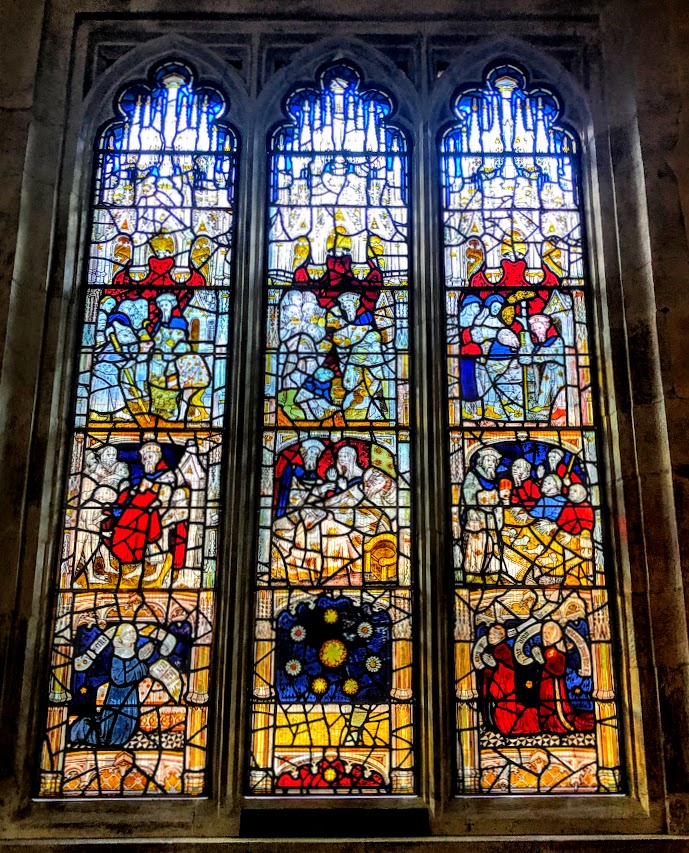
he East Window (1890) is probably by Heaton, Butler & Bayne (Photograph: Patrick Comerford, 2026)

A notice in the church porch reads:

Enter this door
as if the floor within were gold
and every wall of jewels,
all of wealth untold,
as if a choir
in robes were signing here.
Nor shout – nor rush
but hush for
God is here.

Saint Chad’s Church, which Douglas designed in Hopwas, was built by J Deakins. Pevsner says that in its design it is ‘certainly an ingenious and entertaining building’. All the timber is oak. The exterior design resembles a chalet, well suited to the woodland background. The lower walls are reddish pink brick and at the chancel continue up to form a low saddle backed tower topped with an octagonal turret of oak shingles surmounted with a wrought iron cross and weather vane.

Saint Chad’s is built in red brick with timber framing in its upper parts, and has a roof of plain tiles. The church is crowned by an octagonal flèche. Its plan consists of a five-bay nave and a single-bay chancel between which is the flèche, with a vestry to the south and an annex with the organ to the north.

The octagonal stone font at the west end of Saint Chad’s Church, Hopwas (Photograph: Patrick Comerford, 2026)

The interior consists mainly of buff coloured brick and dark oak. The chancel has a five-light east window with Perpendicular tracery and a square head. The East window by Heaton, Butler & Bayne (1890) depicts the Crucifixion in the centre with the Nativity and Baptism of Christ to the left, and the women at the empty tomb and the road to Emmaus to the right.

The fittings include an octagonal stone font, a carved oak pulpit with stone base and steps, open cusped arches, a wooden altar rail with traceried panels, an oak lectern and oak pews with poppyheads.

The original organ appears to have been pneumatically controlled with the manual on the south side and the pipes installed on the north side. Small pipes were laid in a duct under the floor enabling the keys being pressed to direct wind to the pipes. A small archway in the west side of the organ chamber may have been the access point for the ‘bellows boy’ to provide wind for the organ.

The present organ manual is sunk down 2 ft in front of the priest’s stall with the music coming from the pipes on the north wall behind the choir stalls. The organ was built by the organ builders Hill, Norman & Beard in 1940. It was installed by Herbert Dean in memory of his first wife Esther and was dedicated on 20 May 1940. The organ is being restored after an infestation of wood worm, with the entire organ stripped down, restored and rebuilt.

The organ was built by Hill, Norman & Beard in 1940 (Photograph: Patrick Comerford, 2026)

The war memorial in the churchyard is at the east end of the church. The Celtic cross in Peterhead granite is 3.7 m (12 ft) high with interlace carving, carved wreaths and the names of people who died in World War I and World War II.

As for the Revd William MacGregor, the priest who initiated the building Saint of Chad’s, his initiative in starting the Co-op in Tamworth enraged many business owners in Tamworth. He was abused in the street, damned in letters sent to him, to the Tamworth Herald and to the bishop, and some parishioners stopped going to church in protest.

He resigned as Vicar of Tamworth in 1887 but continued to live in Tamworth, faithful to his beliefs and morals, held in esteem by ordinary working men and women. He sat on Warwickshire County Council (1888-1917) and was chair of the Tamworth Herald (1906-1928). He was 89 when he died on 26 February 1937 at Bolehall Manor; it seems fitting that he was buried at Saint Chad’s Church, Hopwas.

The war memorial in the churchyard at the east end of the church (Photograph: Patrick Comerford, 2026)

A poster on the noticeboard says:

In happy moments, praise God.
In difficult moments, seek God.
In quiet moments, trust God.
In every moment, thank God.

• Saint Chad’s Church, Hopwas, is part of a benefice that includes Saint Editha’s Church, Tamworth, Saint Francis, Leyfields, and Saint Andrew’s, Kettlebrook, and the Revd Andrew Lythall is the vicar. The Eucharist is celebrated most Sundays at 10:30 am, but occasionally this is replaced with ‘Prayer & Praise’. On a fifth Sunday in the month, a joint service alternates between Saint Chad’s Church and Hopwas Methodist Church.

Sir Niklaus Pevsner describes Saint Chad’s Church, Hopwas, as ‘an ingenious and entertaining building’ (Photograph: Patrick Comerford, 2026)

13 April 2026

Saint Bertelin’s Chapel is part
of the story of early Stafford,
but archaeologists disagree
about interpreting the site

The site of Saint Bertelin’s Chapel, in front of Saint Mary’s Collegiate Church, Stafford, is said to date from the year 700 (Photograph: Patrick Comerford, 2026)

Patrick Comerford

I was writing yesterday about my visit to Stafford last week and to Saint Mary’s Collegiate Church in the centre of the town. At the west end of the church is the site of a chapel associated with Saint Bertelin or Saint Beorhthelm, who is said to have established a hermitage ca 700 CE that is said to mark the beginnings of Stafford.

Saint Bertelin was an obscure Anglo Saxon saint. He is said to have established his hermitage ca 700 CE on the Isle of Bethnei in the marshes around the River Sow. Bertelin – whose name gradually took the form Bertram in some areas – later moved his hermitage to Ilam in Derbyshire, where his shrine and well made Ilam a popular place of pilgrimage.

The first building on the site in Stafford seems to have been a Late Saxon timber chapel, commemorating Saint Bertelin, although The first historical reference to Saint Bertelin at Stafford appears in a list of tombs of saints for pilgrims by Hugh Candidus of Peterbrough, who died ca 1175, in a reference ‘in Stefford sanctus Berthelmus martyr’.

Saint Mary’s Church was rebuilt in the late 12th and early 13th century, and was joined to Saint Bertelin’s chapel through a doorway in the west wall. The chapel became a shrine to Saint Bertelin, and was a place of pilgrimage throughout the Middle Ages.

The chapel was later used as a council chamber and a school, before it was pulled down in 1801 to allow more room for burials in the churchyard. Following the demolition, the site of Saint Bertelin’s Chapel was destroyed largely by burials in the 19th century and only patches of wall and floor and several early graves definable.

The blocked former west entrance into Saint Mary's was the only surviving evidence for the existence of the chapel until the local authority decided to clear the gravestones and create a garden of remembrance.

Saint Bertelin’s Chapel was pulled down in 1801 to provide more space for burials in Saint Mary’s churchyard (Photograph: Patrick Comerford, 2026)

Before the clearance work began, an archaeological investigation was carried out in 1954 at the site of Saint Bertelin’s Chapel by Adrian Oswald (1908-2001), curator of archaeology at Birmingham City Museum.

Oswald found a set of stone foundations interpreted as belonging to Saint Bertelin's mediaeval chapel. Beneath the stone was a set of post-holes with a central grave-shaped pit in the centre of the structure containing a large lump of oak with a cylindrical base that had been placed in a pit.

The archaeologist and historian CA Ralegh Radford (1900-1998) initially interpreted this as a 1,000-year-old a wooden cross of the Mercian period and a later reconstruction was put on the site.

In the popular retelling of these interpretations, it was said that the remains of a timber cross buried 5 ft below the surface, and from this it was deduced that ‘it is entirely possible that this cross was the one used by Saint Bertelin himself. Beneath the cross were the remains of a timber building, which it seems reasonable to assume was the one built by Bertelin.’

The site of Saint Bertelin’s Chapel at the west front of Saint Mary’s Church, Stafford (Photograph: Patrick Comerford, 2026)

However, a re-assessment of the site was made in in 1984 by Professor Martin Carver, who considered the finds in the context of other archaeological investigations at Stafford. Carver is Emeritus Professor of Archaeology at the University of York and director of the Sutton Hoo Research Project. He founded the Birmingham University Field Archaeology Unit (BUFAU), later called Birmingham Archaeology, at the University of Birmingham, and is the author of The Birth of a Borough. Archaeological studies of Anglo-Saxon Stafford (2010).

Carver argues that the shape of the wood lump, with a cylindrical base, and the leather attached inside to the top, all suggest that this was a coffin, not a cross, resembling the tree-trunk coffins known from the seventh century onwards in East Anglia.

The general sequence reported by Oswald was largely endorsed, seeing the site as one of a timber structure succeeded by a later stone chapel. However, the earliest part of the sequence associated with the timber structure and coffin was found to be inverted in respect of the dates. A layer of ninth century charcoal (830-845 CE) lay above the layer containing a Saxon farthing of Athelred II (971-1016) lost before 1000 CE, which in turn lay above the 12th century log coffin.

From this evidence, it could be argued that the coffin was buried in a late 12th century stone chapel, and the coffin was simply part of a late 12th century foundation process.

Carver suggests the log coffin was buried within a timber structure dated to the period 800-1000, and so too late to be used to support legends of an eighth century foundation associated with an ‘Isle of Bethnei’.

The timber chapel, or possible mortuary house, may have burnt down in the ninth century, which would account for the charcoal layer. Carver rejected the date 1180 for the log coffin. The timber chapel was superseded by a stone chapel with a truer east-west alignment. The floor of this stone chapel would have sealed the log coffin and the layers above it.

This stone chapel appears to have fallen into disuse and was probably demolished around the time of the Conquest and then rebuilt in stone on an improved alignment. A layer of brown soil, interpreted as a layer of ‘disuse’ appears to separate the floor of the first stone chapel from the second, later stone chapel rebuilt on the same site, slightly offset to the south, laid out in dressed stone indicating a small nave and a narrower chancel, with a tiled floor laid in the 14th century.

The muddled evidence may suggest the first chapel was built of timber between 800 and 1000. A tree-trunk burial was placed centrally in this structure, and presumed to be an object of veneration. The date range of other finds allows the construction of the timber chapel to belong to the foundation of the burh by Æthelflæd in 913 CE, and it seems likely the chapel was built during the reconquest of English Mercia.

The plaque marking the site of Saint Bertelin’s Chapel at Saint Mary’s Church, Stafford (Photograph: Patrick Comerford, 2026)

Still, local publications continue to maintain this was Saint Bertelin’s preaching cross and this is echoed on the plaque at the site:

‘Site of St. Bertelin’s Chapel

‘This site was excavated in 1954 AD. The foundation stones have been restored upon the exact plan of the chapel built about 1000 AD.

‘The wooden cross is a replica of the cross lying five feet below with indications of a wooden building of much earlier date. The position of the cross indicates that it was regarded with great sanctity and may be the preaching cross of St. Bertelin the founder of the town of Stafford circa 700 AD.’

Meanwhile, the name of the early hermit and saint is continued in Saint Bertelin’s Church, the parish church for the north end of Stafford, on the corner of Holmcroft Road and Eccleshall Road.

Saint Chad’s Church is the oldest surviving building in Stafford (Photograph: Patrick Comerford, 2026)

After visiting Saint Mary’s Church and Saint Bertelin’s Chapel, I went to see Saint Chad’s Church opposite the Ancient High House on Greengate Street. Saint Chad’s is the oldest surviving building in Stafford, with a story stretching back to the 12th century, and perhaps even back to the time of Saint Chad, the first Bishop of Lichfield (669-672).

Saint Chad’s was built ca 1150-1190 and an inscription names the founder as Orm: Orm vocatur qui me condidit (‘He who made me is called Orm’). Orm was a major landowner of Danish origin and the dragons in the carvings are a pun on his name ‘Orm’ or ‘Worm’.

Saint Chad’s was restored from a forgotten and ruinous state in the mid-19th century. The restoration was carried out by Henry Griffiths, Robert Ward and George Gilbert Scott, who also built the Norman-Romanesque front and donated the statue of Saint Chad in the central niche. At the same time, Scott was carrying out extensive restorations of Lichfield Cathedral.

Saint Paul’s Church, which I passed on the way to Rugeley and Lichfield, is a Grade II building on Lichfield Road. It was designed by Henry Ward and built in 1844. The steeple was added in 1887 by Robert Griffiths. The stained glass includes late 19th and early 20th century work by Hardman and Co, AJ Davies of Bromsgrove, and Smith of St John’s Wood, including a particularly good 19th century east window.

I had visited four churches and chapels in Stafford – Saint Mary’s, Saint Bertelin’s Chapel’s Chapel, Saint Chad’s Church and Saint Paul’s Church. But before leaving Stafford last week I also visited Sir Martin Noel’s Almshouses on Earl Street, which still has its chapel.

As for Saint Bertelin, his feast day is celebrated on 10 August.

Saint Paul’s Church on Lichfield Road, Stafford, was designed by Henry Ward and built in 1844 (Photograph: Patrick Comerford, 2026)

02 March 2026

Celebrating Saint Chad in
Kuching today, although
I am far away from Lichfield

Peter Walker’s statue of Saint Chad at the south-east side of Lichfield Cathedral (Photograph: Patrick Comerford, 2026)

Patrick Comerford

The Diocese of Lichfield is celebrating the patron saint of the diocese, Saint Chad, on his feast day today, 2 March. For the past 55 years, Lichfield, Lichfield Cathedral and the Chapel of Saint John’s Hospital in Lichfield have been like a spiritual home to me after what I have described in an interview with David Moore as ‘a self-defining moment.’

He was interviewing me for A Self Defining Moment, the first of four films that went up on YouTube over 11 years ago (21 January 2015) and in which I talked about my own self-defining moment, and the scenic route I took to ordination and priesthood.

Ever since, I return to Lichfield a few times each year for prayer, reflection, and to follow the daily cycle of prayer and liturgy in the cathedral in my own personal, self-guided retreat or pilgrimage. I was there last month just a few days before we left for this visit to Kuching.

So there are many reasons for me to remember Saint Chad’s Day today, although I am in Kuching, over 11,000 km or 7,000 miles from Lichfield. Indeed, the Diocese of Kuching has been twinned with the Diocese of Lichfield in the past.

A statue of Saint Chad on one of the walls of Lichfield Cathedral (Photograph: Patrick Comerford, 2026)

Saint Chad was born in Northumbria, the youngest of four sons, all of whom became both priests and monks. They entered the monastery on the isle of Lindisfarne, where they were taught by Saint Aidan.

Saint Chad’s brother, Saint Cedd, founded the abbey at Lastingham and, on when Cedd died, Chad was elected abbot as his successor.

During the confusion in ecclesiastical discipline between the Celtic-oriented, Anglo-Saxon hierarchy and the pressure from Rome for conformity, Chad became Bishop of York for a time.

He graciously stepped back with the arrival in Britain of Theodore, who doubted the validity of indigenous consecrations. This was eventually rectified and Chad became Bishop of Mercia, a huge diocese the centre of which he moved from Repton to Lichfield.

Saint Chad travelled extensively and became much loved for his wisdom and gentleness in otherwise difficult situations. The plague was widespread at this time and Saint Chad died on this day, 2 March, in the year 672. His bones were moved to the new Lichfield Cathedral in the year 700.

The new Shrine of Saint Chad was consecrated and reinstated at two moving services in Lichfield Cathedral in November 2022. The new shrine in the Lady Chapel celebrates Lichfield’s own saint as Bishop, Evangelist and Disciple, and an inscription reads: ‘Christ is the morning star who, when the night of this world is past, brings to his saints the promise of the light of life and opens everlasting day.’

The Shrine of Saint Chad in the Lady Chapel in Lichfield Cathedral (Photograph: Patrick Comerford, 2026)

Saint Chad’s day is being celebrated in Lichfield Cathedral today at Morning Prayer (8 am), the Mid-Day Eucharist (12:30) and the Festal Evensong (5:30).

The Collect:

Almighty God,
from the first fruits of the English nation who turned to Christ,
you called your servant Chad
to be an evangelist and bishop of his own people:
give us grace so to follow his peaceable nature,
humble spirit and prayerful life,
that we may truly commend to others
the faith which we ourselves profess;
through Jesus Christ your Son our Lord,
who is alive and reigns with you,
in the unity of the Holy Spirit,
one God, now and for ever.

The Post Communion Prayer:

Holy Father,
who gathered us here around the table of your Son
to share this meal with the whole household of God:
in that new world where you reveal
the fullness of your peace,
gather people of every race and language
to share with Chad and all your saints
in the eternal banquet of Jesus Christ our Lord.

The spires of Lichfield Cathedral seen from the gardens of Erasmus Cathedral (Photograph: Patrick Comerford, 2026)

01 March 2026

Daily prayer in Lent 2026:
13, Monday 2 March 2026,
Saint Chad of Lichfield

‘Forgive, and you will be forgiven’ (Luke 6: 36) … street art off Carpenter Street in Kuching (Photograph: Patrick Comerford, 2026)

Patrick Comerford

Lent began almost two weeks ago on Ash Wednesday (18 February 2026), and yesterday was the Second Sunday in Lent (Lent II). The Diocese of Lichfield and the calendar of the Church of England today (2 March) celebrates the life and mission of Saint Chad of Lichfield (672), Bishop of Lichfield and Missionary. The Jewish holiday of Purim also begins this evening and continues tomorrow (3 March).

But, before today begins, I am taking some quiet time this morning to give thanks, to reflect, to pray and to read in these ways:

1, reading today’s Gospel reading;

2, a short reflection;

3, a prayer from the USPG prayer diary;

4, the Collects and Post-Communion prayer of the day.

‘Be merciful, just as your Father is merciful’ (Luke 6: 36) … the ‘Corporal Works of Mercy’ window in All Saints’ Church, North Street, York (Photograph: Patrick Comerford)

Luke 6: 36-38 (NRSVA):

[Jesus said:] 36 ‘Be merciful, just as your Father is merciful.

37 ‘Do not judge, and you will not be judged; do not condemn, and you will not be condemned. Forgive, and you will be forgiven; 38 give, and it will be given to you. A good measure, pressed down, shaken together, running over, will be put into your lap; for the measure you give will be the measure you get back.’

‘If anyone strikes you on the cheek, offer the other also (Luke 6: 29) … street art in Plaza de la Judería in Malaga (Photograph: Patrick Comerford)

Today’s Reflections:

The Gospel reading at the Eucharist today is Luke 6: 36-38, which is from the ‘Sermon on the Level Place’, Saint Luke’s equivalent of the Sermon on the Mount.

After the blessings and woes of the Beatitudes, Jesus tells us to be merciful as God is merciful. Mercy is one of God’s primary qualities (see Exodus 34: 6-7), and the concept of mercy in Luke 6 has an eschatological frame of reference. God is merciful by offering the possibility of turning away from disobedience through repentance and turning towards him and receiving forgiveness and restoration.

In Mary’s song Magnificat, God is twice identified as merciful (Luke 1: 50, 54). Zechariah too identifies mercy as a sign of God’s faithfulness to God’s promises, creating a people who ‘might serve God without fear in holiness and righteousness (Luke 1: 72-78). In this morning’s reading, Christ shows how to put this mercy into practice.

In the verses immediately before today’s reading, Luke 6: 27-29 presupposes a situation of conflict, in a time when the religious and political leaders of day were seen by many as their enemies. But Christ calls on us to respond and act in ways that seek the good of the other. This form of nonviolence goes beyond non-retaliation and takes positive steps that promote the welfare of the other parties in the conflict.

Luke 6: 30 presupposes an economic situation in which many people are exploited, live in poverty, and seek to survive by begging. The give to those who beg implies that we have an abundance from which to share (see Luke 6: 39).

Luke 6: 31 repeats the ‘Golden Rule’: ‘Do to others as you would have them do to you.’ But the golden rule is not enough for us, the Children of God (see verse 35) in our covenant relationship with God.

Luke 6: 32-34 challenges the widely accepted notion in the Hellenistic world that relationships are reciprocal, and calls on us to go beyond behaviour is guided merely by the expectation of similar responses.

Luke 6: 35 calls on to replace old-age pattens of behaviour with ways that reflect the Kingdom of God, and to imitate God who is kind also to the ungrateful and the wicked. To be kind does not mean to approve but means to seek the best interest. Even the ungrateful and the wicked have the potential and the possibility of becoming part of the Kingdom of God.

Now, Luke 6: 36 sums up how to live a life that reflects the Kingdom of God.

Luke 6: 37 is a reminder that we not have the final say ourselves on who is in and who is outside the Kingdom of God. We do not live in the apocalyptic moment, and when he exclude others from the Church we risk finding we have excluded ourselves too.

Luke 6: 38 reminds us that God’s generosity is overflowing and overwhelming and goes beyond any possibility we have of measuring it.

As Shakespeare reminds us, in the words of Portia in The Merchant of Venice,

The quality of mercy is not strained;
It droppeth as the gentle rain from heaven … (The Merchant of Venice, Act IV, Scene 1).

‘Love Being Awake’ … ‘Love your enemies, do good to those who hate you’ (Luke 6: 26) … a sign in a café in Charleville, Co Cork (Photograph: Patrick Comerford)

Today’s Prayers (Monday 2 March 2026):

The theme this week (1-7 March 2026) in ‘Pray With the World Church,’ the Prayer Diary of the Anglican mission agency USPG (United Society Partners in the Gospel), is: ‘Saint David’s Day’ (pp 34-35). This theme was introduced yesterday with Reflections by the Revd Sarah Rosser, Team Vicar in the Netherwent Ministry Area, Diocese of Monmouth, Church in Wales.

The USPG Prayer Diary today (Monday 2 March 2026) invites us to pray:

We thank you for Saint David, for his love of the Gospel and his passion for sharing it. Renew your Church’s mission, give us wisdom and courage to share your love, and help us ‘do the little things’ that glorify you..

The Collect:

Almighty God,
from the first fruits of the English nation who turned to Christ,
you called your servant Chad
to be an evangelist and bishop of his own people:
give us grace so to follow his peaceable nature,
humble spirit and prayerful life,
that we may truly commend to others
the faith which we ourselves profess;
through Jesus Christ your Son our Lord,
who is alive and reigns with you,
in the unity of the Holy Spirit,
one God, now and for ever.

The Post Communion Prayer:

Holy Father,
who gathered us here around the table of your Son
to share this meal with the whole household of God:
in that new world where you reveal
the fullness of your peace,
gather people of every race and language
to share with Chad and all your saints
in the eternal banquet of Jesus Christ our Lord.

Yesterday’s Reflections

Continued Tomorrow

Peter Walker’s statue of Saint Chad at the south-east side of Lichfield Cathedral (Photograph: Patrick Comerford, 2026)

Scripture quotations are from the New Revised Standard Version Bible: Anglicised Edition copyright © 1989, 1995 National Council of the Churches of Christ in the United States of America. Used by permission. All rights reserved worldwide. http://nrsvbibles.org

28 July 2025

A weary pilgrim walks
part of the way along
‘Saint Editha’s Way’ from
Polesworth to Lichfield

Inside Saint Editha’s Church, Tamworth, central to the new pilgrim route, the 14-mile ‘Saint Editha’s Way’ (Photograph: Patrick Comerford, 2025)

Patrick Comerford

I was back in Lichfield and Tamworth at the end of last week for one of those short pilgrimages and self-guided mini-retreats that a make a few times in the year, and that are important for my spiritual health and well-being.

But I was visiting Lichfield and Tamworth too to hear about the ‘Saint Editha’s Way’ pilgrim route, a 14-mile journey celebrating the story of ancient Mercia. The pilgrim route starts at Polesworth Abbey and weaves its way through along canal tow-path to Amington, through to Tamworth, including Tamworth Castle and Saint Editha’s Church, then on to Wigginton and through Hopwas, finishing at Lichfield Cathedral.

The total distance is about 14 miles and takes about five hours at walking pace or 1.5 hours on a bicycle. An interactive map of the route that can be download to your phones is available on the Footpaths App, just click here.

An interactive map of ‘Saint Editha’s Way’ illustrates the 14-mile, five-hour pilgrim route

Some people may decide to walk the whole of Saint Editha’s Way in one go, while others may walk it in sections over a longer period, perhaps over several days.

For a shorter route, walkers can start at Polesworth Abbey and stop at Saint Editha’s Church, Tamworth – this is about 6.5 miles and takes about 2.5 hours. Alternatively, walkers can start at Tamworth and proceed to Lichfield Cathedral – this is about 7 miles and takes about three hours. There are good bus services along the whole route and regular connections between Lichfield and Polesworth, so walkers need not walk the whole way back.

There is information about the churches and castles on the route in the Pilgrim Guidebook, a special handbook for the journey with details about landmarks on the route and other tips and information. Much of it has been researched and compiled by Dr David Biggs, chair of the Tamworth and District Civic Society. I picked up my copy in Saint Editha’s Church, Tamworth, on Friday morning and it is also available at Polesworth Abbey and Lichfield Cathedral.

Saint Editha was a 10th century princess in Mercia, one of several kingdoms making up what we now call England. Tamworth was the political capital of Mercia and Lichfield was the ecclesiastical capital.

Saint Editha was probably the sister of Athelstan, who was crowned first King of all England in 925 CE. Renowned for her charity and good works, she renounced royal luxury to live a holy life. She was married in Tamworth Church in 926 CE but was abandoned later by her pagan husband Sihtric, the Viking ruler of York and Northumbria. She then led a life of saintly devotion and good works in her convent in Tamworth until she died in the year 960.

She became a saint by popular acclaim, her shrine in Tamworth became a place of pilgrimage. The church in Tamworth was named in her honour in 963 by her nephew King Edgar when he completed the rebuilding of the church and its foundation as a collegiate church. Other churches in the area with her name include Polesworth Abbey.

The Comberford Chapel in Saint Editha’s Church, Tamworth (Photograph: Patrick Comerford, 2025)

The mediaeval tradition of pilgrimages to Tamworth to venerate Saint Editha is recalled in an anonymous poem from the Middle Ages:

Over ye river broad, ye pilgrims onward speed
By olden Tamworth altars fare, for ghostly good to speed.
Soundeth ye church bells merrily, about ye lofty aisle
Through tinctured shapes of saints and kings ye shafted sunbeams smile.
Standeth ye marble of Saint Edith, all in bright array.
Ora pro nobis peccatoribus [pray for us sinners] each rich one doth say.
Gentles from embroidered silk scraps scattereth pence around
To simple men, with dusty feet, weeping upon ye ground
.

The marble statue referred to was likely removed or destroyed in the Reformation in the 16th century. But a new statue of Saint Editha in Saint Editha’s Church, Tamworth, was commissioned this year (2025) to mark the inauguration of the new pilgrimage route. She is depicted with a crozier, as an abbess, and a church, representing the churches where she is the patron.

A stop by the canal bridge in Hopwas, where the A51 crosses both the River Tame and the Coventry Canal (Photograph: Patrick Comerford, 2025)

The principal stopping points along the way include Polesworth Abbey in the heart of Polesworth, Saint Editha’s, Amington, a Victorian parish church with Burne-Jones glass, Tamworth Castle, Saint Editha’s Church, Tamworth, Spital Chapel, Wigginton, a mediaeval chapel that was originally part of a hospital, and Lichfield Cathedral.

The route meanders through beautiful countryside including Pooley Country Park, a substantial stretch of peaceful canal, the grounds of Tamworth Castle, and past the woods and fields of Hopwas. The route traverses several busy main roads, but the entire journey is along footpaths. Each stop along the route has a special pilgrimage marker, and entry is free at each stop with the one exception of Tamworth Castle.

Other sights along the way include Alvecote Priory, now an atmospheric derelict ruin, Saint Rufin’s Well in the grounds of Tamworth Castle, and Saint Chad’s Well in the churchyard at Saint Chad’s Church, Lichfield.

I travelled part of the way on Friday afternoon, from Tamworth through Hopwas and Whittington to Lichdield, but travlled by bus for most of the journey by bus. In Lichfield, I stopped to pray in the Chapel of Saint John’s Hospital before continuing on to Lichfield Cathedral.

Later in the afternoon, I walked along part of Cross in Hand Lanethe old pilgrim route along Cross in Hand Lane, the first (or final) stage on ‘The Two Saints Way’ between the shrine of Saint Chad in Lichfield and the shrine of Saint Werburgh in Chester. I had a late lunch at the Hedgehog before returning at the end of the day to Lichfield Cathedral for Evening Prayer.

Pilgrims who complete the route along ‘Saint Editha’s Way’ may present their handbook at the front desk of Lichfield Cathedral during visiting hours to receive a special stamp and certificate to prove they have successfully completed the Saint Editha’s Way.

The Pilgrim’s Prayer in the handbook:

O Lord of Heaven and Earth,
guide my steps as I journey through this land of Mercia,
where saints have walked and holy lives were lived.
I lift my heart to you, O God,
with the spirit of a pilgrim – seeking not only places, but peace.
Teach me, like Saint Editha, to set aside pride and vanity,
and to walk humbly with you in all things.
O Lord, as O walk this pilgrim way,
be my compass and my strength.
Through the prayers of Saint Editha and all the Mercian saints,
draw me nearer to your heart.
In the name of Jesus Christ the King of all things.
Amen.

The pilgrim arrives at Lichfield Cathedral in the afternoon summer sunshine

02 March 2025

Daily prayer in Ordinary Time 2025:
28, Sunday 2 March 2025,
the Sunday before Lent, Saint Chad’s Day

A mask for the Carnival in Venice … do we hide our personae behind masks before other people … before God? (Photograph: Patrick Comerford)

Patrick Comerford

We are in Ordinary Time in the Church Calendar. Today is the Sunday before Lent (2 March 2025), and Lent begins this week on Ash Wednesday (5 March 2025). Later this morning, I hope to sing with the choir at the Parish Eucharist in Saint Mary and Saint Giles Church, Stony Stratford.

In the Diocese of Lichfield, this day (2 March) is also celebrated as Saint Chad’s Day. I was in Lichfield Cathedral on Friday for the mid-day Eucharist and Choral Evensong. The celebrations in Lichfield Cathedral today include the Solemn Choral Eucharist celebrated as the Eucharist of the Patron at 10:30 am, and Solemn Choral Eucharist, with the presentation of Saint Chad’s medals at 3:30 pm.

There is a break in the Six Nations championship this weekend, but Vintage Stony Festival 2025, which was postponed earlier this year, takes place on the streets of Stony Stratford later today. The festival celebrates cars, bikes and vehicles of the past.

Before this day begins though, I am taking some quiet time this morning to give thanks, to reflect, to pray and to read in these ways:

1, today’s Gospel reading;

2, a short reflection;

3, a prayer from the USPG prayer diary;

4, the Collects and Post-Communion prayer of the day.

The Transfiguration depicted in the Church of the Transfiguration in Piskopianó, in the hills above Hersonissos in Crete (Photograph: Patrick Comerford, 2024; click on image for full-screen viewing)

Luke 9: 28-36 [37-43a] (NRSVA):

28 Now about eight days after these sayings Jesus took with him Peter and John and James, and went up on the mountain to pray. 29 And while he was praying, the appearance of his face changed, and his clothes became dazzling white. 30 Suddenly they saw two men, Moses and Elijah, talking to him. 31 They appeared in glory and were speaking of his departure, which he was about to accomplish at Jerusalem. 32 Now Peter and his companions were weighed down with sleep; but since they had stayed awake, they saw his glory and the two men who stood with him. 33 Just as they were leaving him, Peter said to Jesus, ‘Master, it is good for us to be here; let us make three dwellings, one for you, one for Moses, and one for Elijah’ – not knowing what he said. 34 While he was saying this, a cloud came and overshadowed them; and they were terrified as they entered the cloud. 35 Then from the cloud came a voice that said, ‘This is my Son, my Chosen; listen to him!’ 36 When the voice had spoken, Jesus was found alone. And they kept silent and in those days told no one any of the things they had seen.

[37 On the next day, when they had come down from the mountain, a great crowd met him. 38 Just then a man from the crowd shouted, ‘Teacher, I beg you to look at my son; he is my only child. 39 Suddenly a spirit seizes him, and all at once he shrieks. It throws him into convulsions until he foams at the mouth; it mauls him and will scarcely leave him. 40 I begged your disciples to cast it out, but they could not.’ 41 Jesus answered, ‘You faithless and perverse generation, how much longer must I be with you and bear with you? Bring your son here.’ 42 While he was coming, the demon dashed him to the ground in convulsions. But Jesus rebuked the unclean spirit, healed the boy, and gave him back to his father. 43 And all were astounded at the greatness of God.]

The Transfiguration depicted in a fresco in the Analipsi Church in Georgioupoli in Crete (Photograph: Patrick Comerford)

Today’s Reflection:

This Sunday is the Sunday before Lent. In many parts of the Church, this is Transfiguration Sunday. In the Orthodox Church, the final Sunday before Lent is known as Cheesefare Sunday and also as Forgiveness Sunday. In the past, this was also known as Quinquagesima, and in some places it is also known as Shrove Sunday, just as Tuesday next is known in many places as Shrove Tuesday.

The Carnival of Venice (Carnevale di Venezia) takes place at this time of the year, each year. This year, it began last weekend [22 February] and it ends at midnight on Tuesday, Shrove Tuesday or Mardi Gras, the day before Ash Wednesday and the beginning of Lent.

The Carnival in Venice is known for its elaborate masks. It grew in prestige and developed in its revelry in the 17th and 18th centuries, to the point that it became a symbol of licence and pleasure.

Mask-makers (mascherari) had a special position in Venetian society, with their own laws and their own guild. But the masks allowed many people to spend a large part of the year in disguise, hiding their secret lifestyles. When he occupied Venice, the Emperor Francis II outlawed the festival in 1797 and masks were strictly forbidden.

It was not until 1979 that the Carnival was revived in Venice. With it came the revival of the tradition of making carnival masks, and one of the most important events at the Carnival is the contest for la maschera più bella, the most beautiful mask.

So often, we all have our own masks. We are afraid that others might see us or get to know us as we really are. We hide behind a persona, which is the Latin word for a theatrical mask. We are worried, ‘What if someone saw me for who I truly am?’ ‘What if they came face-to-face with what I am really like?’

Lent is a good opportunity to come to terms with our true selves.

This morning’s Gospel reading (Luke 9: 28-36) invites us to a mutual face-to-face encounter with the living God. The inner circle of disciples, Peter, James and John, ascend the mountain with Christ, and in the clouds they see who he truly is: he is the God of Moses and Elijah, and the vision is so dazzling that they are dazzled and overshadowed by the cloud.

When they come back down the mountain, like Moses, there is a great crowd waiting for the healing that restores them to their place in the covenant with God.

The original Greek word for Transfiguration in the Gospels is μεταμόρφωσις (metamorphosis), which means ‘to progress from one state of being to another.’ Consider the metamorphosis of the chrysalis into the butterfly. Saint Paul uses this same word (μεταμόρφωσις) when he describes how the Christian is to be transfigured, transformed, into the image of Christ (II Corinthians 3: 18), and there he uses the word ‘icon’ of Christ.

The Transfiguration reveals not just who Christ should truly be in our eyes, but who we should be truly in God’s eyes. It is a reminder of our ultimate destiny as Christians, the ultimate destiny of all people and all creation – to be transformed and glorified by the majestic splendour of God himself.

The Transfiguration points to the fulfilment of the Kingdom of God, when all of creation shall be transfigured and filled with light.

In the second part of the Gospel reading, we have a second story that may not seem to be related to the first story. But it is oh so intimately connected with it.

The Transfiguration is not just an Epiphany or Theophany moment for Christ, with Peter, James and John as onlookers. The Transfiguration is a story of, a miracle that reminds us of how God sees us in God’s own image and likeness, sees us for who we are and who we are going to be, no matter how others see us, no matter how others dismiss us.

So it means, quite naturally, that Christ sees the potential of the child, the only son, of a distressed father, a troubled and paralysed child. Christ sees the boy’s potential as the image and likeness of God and restores him to being seen as such.

When we become adults, do we love the child we have been in our childhood?

When we become adults, many of us are messed up and mess up in life, not because of what is happening in the present, but because of what has happened to us as children in the past.

Are we going to blame our problems in the future on what happened to us in the past?

In secular life, there is a temptation to accept our human nature as it is now. But the Transfiguration of Christ offers the opportunity to look at ourselves not only as we are now, but take stock of what happened in the past that made us so, and to grasp the promise of what we can be in the future.

In the present and in the future, can we take ownership of who we have been as a child? Do we remember always that we are made in the image and likeness of God?

As Saint Paul reminds you, you are an icon of Christ.

We need no masks, no personae, in God’s presence. God sees us as we are: made in his own image and likeness, sees us for who we were, who we are and who we are going to be, no matter how others see us, no matter how others dismiss us.

No matter what others say about you, how others judge you, how others gossip or talk about you, how others treat you, God sees your potential, God sees in you God’s own image and likeness. God sees through all our masks and sees an icon of Christ. God knows you are beautiful inside and loves you, loves you for ever, as though you are God’s only child.

You are his beloved child in whom he is well pleased.

Souvenir masks from a stall in Venice … do we hide our personae behind masks before other people … before God? (Photograph: Patrick Comerford)

Today’s Prayers (Sunday 2 March 2025, the Sunday before Lent):

The theme this week in ‘Pray With the World Church’, the Prayer Diary of the Anglican mission agency USPG (United Society Partners in the Gospel), is ‘The World’s Greatest Leader: Jesus Christ.’ This theme is introduced today with a Programme Update by the Right Revd Filomena Tete Estevão, Bishop of Angola:

During Jesus’ earthly ministry, he exercised authority and yet showed simplicity and mercy to all. He impacted the world by transforming man in all areas of life: setting the captives free, healing the sick and performing miracles. We are called to follow his example, our greatest world leader.

He left a promise saying: ‘… the one who believes in me will also do the works that I do and, in fact, will do greater works than these, because I am going to the Father.’ (John 14: 12). These and other promises should reinforce our faith that we have a God who knows everything and can do everything, even when circumstances are less than favourable. To this end, we must lead a life of prayer, because the intimate relationship between the persons of the Trinity is manifested in the doctrine of prayer.

To pray in Jesus’ name is to pray as a representative, especially those appointed to exercise his authority and therefore according to his will. Jesus was primarily assuring his disciples and apostles, and their representatives with authority given by him, that God would answer their prayers during their respective ministries. This same assurance on a smaller scale also applies to the Church, which represents Christ on Earth in order that the Father may be glorified.

The USPG Prayer Diary today (Sunday 2 March 2025) invites us to pray reflecting on these words:

‘Very truly, I tell you, the one who believes in me will also do the works that I do and, in fact, will do greater works than these, because I am going to the Father. I will do whatever you ask in my name, so that the Father may be glorified in the Son. If in my name you ask me for anything, I will do it’ (John 14: 12-14).

The Collect:

Almighty Father,
whose Son was revealed in majesty
before he suffered death upon the cross:
give us grace to perceive his glory,
that we may be strengthened to suffer with him
and be changed into his likeness, from glory to glory;
who is alive and reigns with you,
in the unity of the Holy Spirit,
one God, now and for ever.

The Post-Communion Prayer:

Holy God, we see your glory in the face of Jesus Christ:
may we who are partakers at his table
reflect his life in word and deed,
that all the world may know his power to change and save.
This we ask through Jesus Christ our Lord.

Additional Collect:

Holy God,
you know the disorder of our sinful lives:
set straight our crooked hearts,
and bend our wills to love your goodness and your glory
in Jesus Christ our Lord.

Yesterday’s Reflection

Continued Tomorrow

Peter Walker’s statue of Saint Chad at Lichfield Cathedral … 2 March is Saint Chad’s Day in the Diocese of Lichfield (Photograph: Patrick Comerford, 2025)

Scripture quotations are from the New Revised Standard Version Bible: Anglicised Edition copyright © 1989, 1995, National Council of the Churches of Christ in the United States of America. Used by permission. All rights reserved worldwide. http://nrsvbibles.org