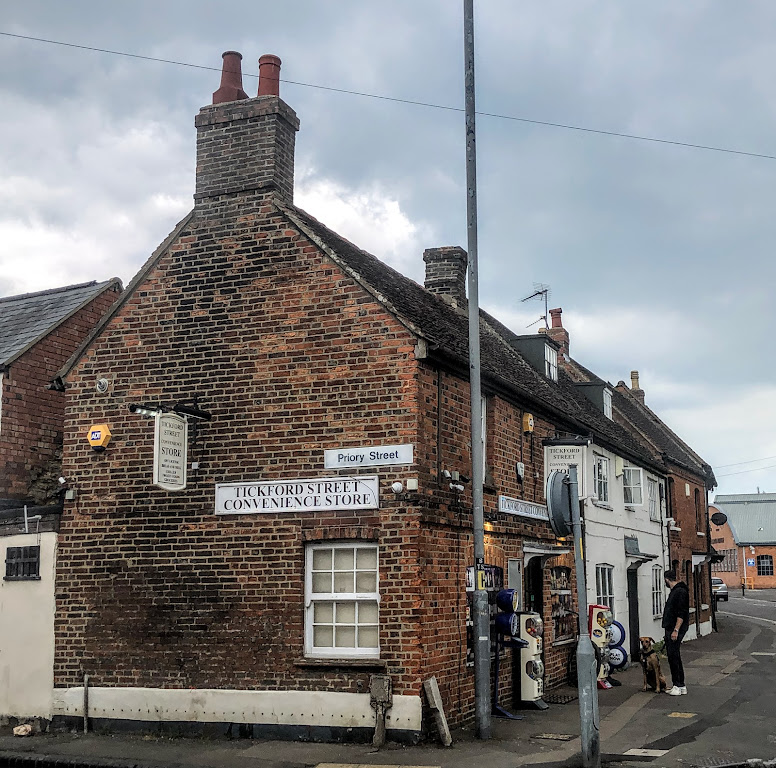
Newport Pagnell has been the home of Aston Martin for almost 80 years (Photograph: Patrick Comerford, 2025)
Patrick Comerford
I suppose it’s because I am an Aston Villa fan – and quite a happy one these days – that I had always thought the Aston Martin had its home at or had taken its name from Aston, also the home of Aston Villa and Villa Park.
I have been a Villa fan ever since my teens, probably – almost certainly – because Villa were the big-name side nearest to Lichfield, and because Aston is such an accessible station on the train from Lichfield into Birmingham.
In my childhood and throughout my teens, the Aston Martin, as the name of luxury sports cars and grand tourers seemed to represent suave style and smooth sophistication, enhanced by Aston Martin’s involvement in motorsport, sports car racing and in Formula One.
Drivers like Stirling Moss and Jim Clark developed the reputation of Aston Martin in the 1950s and 1960s, and the name was glamourised or exaggerated when the Aston Martin become the car of choice for James Bond in the third Bond film Goldfinger in 1964.
Not that I ever learned to drive, or, for that matter, ever watched even one single Bond film from start to finish – although neither admission has ever stopped me from appreciating the aesthetic styling of classic and vintage cars.
Aston, the home of Aston Villa … but was there ever any link with Aston Martin? (Photograph: Patrick Comerford)
Somehow, every time I passed through Aston on the line between Lichfield and Birmingham, or visited Villa Park, I still continued to imagine – no matter how mistakenly – that I was close to the home of Aston Martin. At the same time, somewhere in the back of my mind I had maintained the memory that there was some remote connection with Lichfield.
,
It was only when I moved to Stony Stratford and found myself enjoyinged ‘Classic Stony’ that I realised the home of Aston Martin is actually nearby in Newport Pagnell, and that the ‘Aston’ part of the name comes not from Aston, Aston Hall, or Aston Villa, but from Aston Hill near Aston Clinton in the Vale of Aylesbury in Buckinghamshire.
The stories all seemed to coalesce when I found myself at the home of Aston Martain on Tickford Street in Newport Pagnell at the end of last week.
Aston Martin was founded in 1913 by Lionel Martin (1878-1945) and Robert Bamford (1883-1942). They had joined forces as Bamford & Martin the previous year to sell and service cars. Martin raced specials at Aston Hill near Aston Clinton, and the pair decided to make their own vehicles. The first car to be named Aston Martin was created by Martin by fitting a four-cylinder Coventry-Simplex engine to the chassis of a 1908 Isotta Fraschini.
After World War I, Bamford left the business in 1920. Bamford & Martin went bankrupt in 1924 and was bought by Dorothea Benson (1876-1942), Lady Charnwood. Her husband Godfrey Rathbone Benson (1864-1945), had been Mayor of Lichfield from 1909 until 1911, when he was made a peer with the title of Baron Charnwood.
Lady Charnwood, who lived at Stowe House in Lichfield, put her son John Benson (1901-1955) on the board. But Bamford & Martin got into financial difficulty again in 1925 and Martin was forced to sell the company, ending Aston Martin’s last links with the founder who had given his name to the business.
Later that year, Bill Renwick, Augustus (Bert) Bertelli and investors including Lady Charnwood took control of the business, renamed it Aston Martin Motors and moved it to Feltham in West London.
Aston Martin took its name from the Aston Hill Climb at Aston Hill near Aston Clinton
David Brown Ltd bought Aston Martin in 1947, and at the same time acquired Lagonda, which moved to Newport Pagnell and shared engines, resources and workshops. Ever since, Newport Pagnell has been associated with the bespoke and luxury car maker. Newport Pagnell already had a rich coach building tradition that dated back to 1830 when Salmons Coachworks was formed.
The move from Feltham to Newport Pagnell was encouraged by the opening of the M1, the first motorway in the UK, in the early 1960s. It provided both rapid transport links and – in the days before speed limits – a convenient test track. And so, Sunnyside in Tickford Street, Newport Pagnell, which became Aston Martin’s global headquarters in the early 1960s. The factory welcomed several royal and celebrity visitors over the years, including one by Queen Elizabeth II in 1966.
Aston Martin sports cars were made at Newport Pagnell over the span of 52, with over 13,300 cars sent to customers all over the world. Among the many models designed and built there were: DB4, DB5 and DB6, V8 Vantage, the William Towns Lagonda and the original Vanquish.
The DB2/4 MkII was the first Aston Martin produced at the Tickford Street site. The DB5, launched in 1963 and became the most famous model was launched. Sean Connery starred with the DB5 in several James Bond film from 1964 on. The Aston Martin AMV8 was introduced in 1972 and production ran right through to 1989. In April 1984, Aston Martin celebrated the landmark production of its 10,000th car. Ford had fully acquired the company by 1993.
In 2007, the Newport Pagnell plant rolled out the last of nearly 13,000 cars made there since 1955, a Vanquish S. The Tickford Street facility was converted and became the home of the Aston Martin Works classic car department, which focuses on heritage sales, service, spares and restoration operations. UK production was later concentrated at Gaydon in Warwickshire, until a large site in St Athan, South Wales, was acquired in 2017 for a new factory. Production work retuned to Newport Pagnell that year.
Today the Aston Martin headquarters and the main production of sports cars and grand tourers are at Gaydon in Warwickshire. The facility in Newport Pagnell is the present home of the Aston Martin Works classic car department, which focuses on heritage sales, service, spares and restoration operations. The factory in St Athan, Wales, is the production site of Aston Martin’s SUV, the DBX.
As a child, Dorothea Thorpe, later Lady Charnwood, was painted by the Pre-Raphaelite artist John Everett Millais in 1882
As for Lady Charnwood, who had a controlling stake in Aston Martin 100 years ago in the mid-1920s, she seems to be only significant connection I can find between Lichfield and Aston Martin. Her moher, Nelly Thorpe, was the daughter of the Liberal politician Anthony John Mundella. As a child, Dorothea was painted by the Pre-Raphaelite artist John Everett Millais in 1882.
Nelly Thorpe bought Stowe House in Lichfield 1902, but fell ill soon after moving in. Dorothea and her husband Godfrey Rathbone Benson (1864-1945) then moved into the house. A Liberal politician and a man of letters, Benson was elected to Lichfield city council in 1904, was the Mayor of Lichfield in 1910-1911, and became Baron Charnwood in 1911.
Nelly Thorpe died in 1919, but the Charnwoods continued to live at Stowe House until 1933. Dorothea inherited many important literary manuscripts from her aunt, including many of the papers of Edward Lear; her husband was a pillar of the Johnson Society and its president in 1934-1935.
Their son John Roby Benson (1901-1955), who had been placed on the board of Aston Martin in 1925 by his mother, was the Sheriff of Lichfield 1933-1934, and remained at Stowe House until about 1937. He succeeded his father as Lord Charnwood in 1945, but the title died with him in 1955.
Stowe House had oter literary connections, as it once been the home of Thomas Day, the author of Sandford and Merton and of Richard Lovell Edgeworth. Curiously, it was built in the 1750s by Elizabeth Aston, daughter of Sir Thomas Aston of Aston – but that was Aston in Runcorn, Cheshire, and not Aston, the home of Aston Villa.
• ‘Classic Stony’ takes place again in Stony Stratford on Sunday 1 July from 9:30 am until 4 pm. It is run in partnership with Stony Stratford Business Association as part of ‘Stony Live’ week, and the day is in aid of Willen Hospice.
Newport Pagnell remains the emotional home of Aston Martin (Photograph: Patrick Comerford, 2025)
Showing posts with label Tickford. Show all posts
22 May 2025
19 May 2025
A return visit to Tickford Abbey in
search of the Comberford family’s
lost links with Newport Pagnell
Tickford Abbey was built with the ruins of Tickford Priory … a reminder of Comberford family links with Newport Pagnell and Tickford (Photograph: Patrick Comerford, 2025)
Patrick Comerford
Since moving to Stony Stratford over three years ago, I have been fascinated to find how the Comberford family had so many links with these parts of north Buckinghamshire and Northamptonshire in the 15th, 16th and 17th centuries.
These links have included a share in the Manor of Watford, and a manor and properties in the neighbouring villages of Stoke Bruerne, as well as some high-profile engagement with Church life in this area.
As a judge and the Bishop of Lincoln’s commissary, John Comberford held the courts of the Archdeacon of Buckingham, probably from 1497 until at least 1507, and he died in 1508. At the time, the Bishop of Lincoln was William Smith, previously Bishop of Lichfield, where he had re-founded Saint John’s Hospital in Lichfield.
The connections between Smith and the Comberford family were far-reaching, for in 1507 John Comberford, as patron, presented the bishop’s nephew, also William Smith, as Rector of Yelvertoft. Later, John Comberford’s grandson, Canon Henry Comberford (1499-1586), Precentor of Lichfield Cathedral, was appointed Rector of Yelvertoft by his brother Humphrey Comberford in 1546.
John Comberford had acquired extensive interests in Northamptonshire and Buckinghamshire through his marriage to his father’s ward, Johanna or Joan Parles, the only daughter and heir of John Parles of Watford Manor and of Shutlanger Manor, near Stoke Bruerne, five miles south of Northampton.
Quite separately, John Comberford’s father, Judge William Comberford, had bought properties in Newport Pagnell and Tickford in 1470-1471. I was reminded of these connections on a recent afternoon when I was in Newport Pagnell and Tickford. When I first visited Tickford three years ago, it was a dull and dreary afternoon. So, I decided to revisit Tickford Abbey last Friday and to recall once again the Comberford family links with Newport Pagnell that go back almost six centuries, to 1442 or earlier.
A sign for Newport Pagnell close to Tickford Street (Photograph: Patrick Comerford, 2025)
Newport Pagnell is one of the towns in north Buckinghamshire that have been absorbed into Milton Keynes. Newport Pagnell is separated from the rest of Milton Keynes by the M1, and the Newport Pagnell Services was Britain’s second motorway service station.
Newport Pagnell is first mentioned in the Domesday Book in 1086 as ‘Neuport,’ an Anglo-Saxon name meaning the ‘New Market Town.’ The suffix ‘Pagnell’ was added later when the manor passed into the hands of the Pagnell or Paynel family.
This was the principal town of the ‘Three Hundreds of Newport,’ and at one time Newport Pagnell was one of the largest towns in Buckinghamshire, with the assizes of the county held there occasionally.
William Comberford (ca 1403/1410-1472), along with Humphry Starky and Thomas Stokley, was granted lands and other properties in Newport Pagnell and Tykford (Tickford), Buckinghamshire, by Geoffrey Seyntgerman (St Germain), in 1471-1472. By then, William Comberford was in his 60s, but already he had substantial property and political interests in the area.
From 1442 or earlier, William was a key political ally of Henry Stafford (1402-1460), Earl of Stafford and later 1st Duke of Buckingham. Stafford was the key political figure in Buckinghamshire at the time, and they shared a political ally in John Talbot, 2nd Earl of Shrewsbury.
William was an important landowner in south Staffordshire in the mid-15th century, with land in Comberford, Wigginton and Tamworth, and he was also a trustee of the manors of Whichnor, Sirescote and other estates. He built Comberford Hall, a new house at Comberford, between Tamworth and Lichfield, in 1439. He may also have been one of the early members of the Comberford family to own the Moat House on Lichfield Street, Tamworth.
Three years after he built Comberford Hall, William Comberford became one of the two MPs for Newcastle-under-Lyme, Staffordshire, on 27 March 1442, on the nomination of the Chancellor of the Duchy of Lancaster. He was a judge and one of the Duke of Buckingham’s retainers, and h e remained an MP until 3 March 1447.
William was first appointed to the Staffordshire bench in 1442, and was a Justice of the Peace (JP) until 1471. He became an attorney for the Duchy of Lancaster in the Court of Common Pleas in 1446. Soon afterwards, through the patronage of the Duke of Buckinghamm he became the second protonotary or chief clerk in the Court of Common Pleas.
The Duke of Buckingham was killed at the Battle of Northampton on 10 July 1460. Nevertheless, Comberford continued to play an important role in the political, civil and judicial life of Staffordshire. In addition, as ‘Will’s Combford,’ he was admitted to membership of the Guild of Saint Mary and Saint John in Lichfield in 1469, along with Ralph FitzHerbert, father-in-law of William’s grandson, Thomas Comberford.
From 1452, William Comberford’s ward was Joan Parles, the daughter of John Parles (1419-1452) of Watford and of Shutlanger, near Stoke Bruerne, five miles south of Northampton and about 13 miles north-west of Newport Pagnell, Stony Stratford and Milton Keynes.
Roses seen on Tickford Street, Priory Street and Priory Close … John Comberford bought out the lands, tenements and rents in Newport Pagnell and Tickford in 1487 (Photographa: Patrick Comerford, 2025)
Joan Parles came of age in 1461 and she later married William’s son and heir, John Comberford (ca 1440-1508). The marriage was so important for the Comberford family, both politically and financially, that the Parles coat-of-arms, with its cross and five red roses, was quartered with the Comberford arms, and sometimes even substituted for the arms of the Comberford family.
Meanwhile, Henry Stafford (1455-1483), 2nd Duke of Buckingham, and Richard Plantagenet, Duke of Gloucester and later King Richard III, met the uncrowned 12-year-old ‘Boy King’, Edward V, at the Rose and Crown Inn in Stony Stratford on the night of 29 April 1483.
From Stony Stratford, the young King Edward was taken by the two dukes to the Tower of London, and it is there, it is believed, he and his younger brother, ten-year-old Prince Richard, Duke of York, were murdered. Their disappearance has given rise to many of the stories and legends about the ‘Princes in the Tower.’
In 1487, John Comberford bought out Thomas Stokley’s interest in the lands, tenements and rents in Newport Pagnell and Tickford that had been acquired by Stokley and John Comberford’s father in 1470-1471. In 1504, after his wife had died, John Comberford, along with his son Thomas and daughter-in-law Dorothy (Beaumont), sold the former Parles estates in Stoke Bruerne, Shutlanger, Alderton (about 10 miles north of Milton Keynes), and Wappenham to Richard Empson of Easton Neston. The estate then consisted of eight messuages, six tofts, one mill, 200 acres of land, 24 acres of meadow, 100 acres of pasture, 40 acres of wood and 14 shillings rent.
John Comberford died in 1508, but the Comberford family’s interest in lands in the Watford area continued for some decades later, as told by Murray Johnson in his book, Give a Manor, Take a Manor: the rise and decline of a medieval manor.
The Priory of Tickford owned some property in Aston, outside Birmingham that seems to have constituted a rectorial manor. It seems more than coincidental that at the same time John Comberford’s sister Margaret was married to William Holte (ca 1430-post 1498) of Aston Hall. The tomb of their son, William Holte (ca 1460-1514), in Saint Peter and Saint Paul Church, Aston, displays one of the earliest known heraldic depictions of the Comberford use of the Parles family’s arms, with its cross and five roses, as their own coat of arms.
After the suppression of the priory in 1525, its possessions were said to have included ‘the manor of Tickford in the parish of Aston’, and this manor in Asston was granted to Christ Church, Oxford, in 1532. The estate included the advowson of the vicarage and a pension of 40 shillings from Aston church. The rectorial estate seems to have passed into the possession of the Holte family between 1535 and 1552, and was united with the manor of Aston.
Humphrey Comberford (1496 -1555) of Comberford owned significant estates, including Watford Manor. He left most of his manors to Thomas Comberford (1530-1597), and he specified in his will that his Manor in Watford was to be held by his second son, Humphrey Comberford, from the elder son, Thomas, at an annual rent of one red rose for 60 years. In the event, Humphrey had died unmarried in 1545, before his father’s death. Thomas Comberford the probably sold the manor and lands of Watford shortly after 1555.
Looking from Tickford Abbey across Castle Meadow towards Saint Peter and Saint Paul Church in Newport Pagnell (Photograph: Patrick Comerford, 2025)
The name of Tykford or Tickford, which was part of the Comberford property interests in the Newport Pagnell area in the 15th century, is found in Tickford Priory, a mediaeval monastic house in Newport Pagnell.
Tickford Priory was established in 1140 by Fulconius Paganel, the lord of the Manor of Newport Pagnell. The priory belonged to the Cluniac Order, with their French headquarters at Marmoutier Abbey in Tours.
Cardinal Wolsey annexed ‘the superfluous house of Tickford’ and its wealth to Christ Church College, Oxford, in 1524. Later, King James I sold the abbey to his physician, Dr Henry Atkins, in 1621.
Some of the former buildings of Tickford Priory were still standing in the early 18th century, but they were in poor condition. Tickford Abbey was built on the site of the priory ca 1757 for John Hooton, a lace merchant, and much of its fabric is believed to have come from Tickford Priory. It is said members of the Hooton family are buried in a a private vault with the grounds of Tickford Abbey.
The house was altered and added to in the early-mid 19th century and again in 1881-1889 by the Stony Stratford architect Edward Swinfen Harris for Philip Butler, JP. Futher internal alterations were made in the late 20th for its use as residential home. Tickford Abbey is now a residential and dementia care home and a Grade II listed building.
Tickford Bridge, built in 1810, is one of the last 21 cast iron bridges in Britain that continue to carry modern road traffic, and is the oldest bridge in Milton Keynes (Photograph: Patrick Comerford, 2025)
As I walked through the grounds of Tickford Abbey that late sunny afternoon, I found myself on Castle Meadow, looking across the River Great Ouse and the Ouzel or Lovat River towards the tower and pinnacles of the parish church, Saint Peter and Saint Paul.
Despite the name of Castle Meadow, historians today debate whether there the evidence for a castle at Newport Pagnell is meagre. Although there are references to Castle Meadow dating back to the 12th century, there is no specific documentary reference to a castle, and there was no castle in Tickford or Newport Pagnell by 1272.
The main house, with whatever remains of Tickford Priory, it is the nearest I can find to any remains of the Comberford properties in late mediaeval Newport Pagnell and Tickford. My great-grandfather, James Comerford (1817-1902), continued to use the Comberford coat-of-arms quartered with the arms of the Parles family on his bookplate.
From Tickford Abbey, I returned along Priory Street to Tickford Street, close to the home of Aston Martin and by the Bull Inn, and continued my afternoon stroll along to Tickford Bridge. It was built over the River Ouzel in 1810, is one of the last 21 cast iron bridges in Britain that continue to carry modern road traffic, and it is the oldest bridge in Milton Keynes. A plaque near the bridge recalls its history and construction, and it is Grade I listed by Historic England.
From there, I continued to walk on into the centre of Newport Pagnell, where I wanted to photograph another building by Edward Swinfen Harris and where we had dinner in Apollonia, the Greek restaurant on High Street.
My great-grandfather James Comerford (1817-1902) continued to use the Comberford coat-of-arms quartered with the arms of the Parles family on his bookplate (Photograph: Patrick Comerford)
Patrick Comerford
Since moving to Stony Stratford over three years ago, I have been fascinated to find how the Comberford family had so many links with these parts of north Buckinghamshire and Northamptonshire in the 15th, 16th and 17th centuries.
These links have included a share in the Manor of Watford, and a manor and properties in the neighbouring villages of Stoke Bruerne, as well as some high-profile engagement with Church life in this area.
As a judge and the Bishop of Lincoln’s commissary, John Comberford held the courts of the Archdeacon of Buckingham, probably from 1497 until at least 1507, and he died in 1508. At the time, the Bishop of Lincoln was William Smith, previously Bishop of Lichfield, where he had re-founded Saint John’s Hospital in Lichfield.
The connections between Smith and the Comberford family were far-reaching, for in 1507 John Comberford, as patron, presented the bishop’s nephew, also William Smith, as Rector of Yelvertoft. Later, John Comberford’s grandson, Canon Henry Comberford (1499-1586), Precentor of Lichfield Cathedral, was appointed Rector of Yelvertoft by his brother Humphrey Comberford in 1546.
John Comberford had acquired extensive interests in Northamptonshire and Buckinghamshire through his marriage to his father’s ward, Johanna or Joan Parles, the only daughter and heir of John Parles of Watford Manor and of Shutlanger Manor, near Stoke Bruerne, five miles south of Northampton.
Quite separately, John Comberford’s father, Judge William Comberford, had bought properties in Newport Pagnell and Tickford in 1470-1471. I was reminded of these connections on a recent afternoon when I was in Newport Pagnell and Tickford. When I first visited Tickford three years ago, it was a dull and dreary afternoon. So, I decided to revisit Tickford Abbey last Friday and to recall once again the Comberford family links with Newport Pagnell that go back almost six centuries, to 1442 or earlier.
A sign for Newport Pagnell close to Tickford Street (Photograph: Patrick Comerford, 2025)
Newport Pagnell is one of the towns in north Buckinghamshire that have been absorbed into Milton Keynes. Newport Pagnell is separated from the rest of Milton Keynes by the M1, and the Newport Pagnell Services was Britain’s second motorway service station.
Newport Pagnell is first mentioned in the Domesday Book in 1086 as ‘Neuport,’ an Anglo-Saxon name meaning the ‘New Market Town.’ The suffix ‘Pagnell’ was added later when the manor passed into the hands of the Pagnell or Paynel family.
This was the principal town of the ‘Three Hundreds of Newport,’ and at one time Newport Pagnell was one of the largest towns in Buckinghamshire, with the assizes of the county held there occasionally.
William Comberford (ca 1403/1410-1472), along with Humphry Starky and Thomas Stokley, was granted lands and other properties in Newport Pagnell and Tykford (Tickford), Buckinghamshire, by Geoffrey Seyntgerman (St Germain), in 1471-1472. By then, William Comberford was in his 60s, but already he had substantial property and political interests in the area.
From 1442 or earlier, William was a key political ally of Henry Stafford (1402-1460), Earl of Stafford and later 1st Duke of Buckingham. Stafford was the key political figure in Buckinghamshire at the time, and they shared a political ally in John Talbot, 2nd Earl of Shrewsbury.
William was an important landowner in south Staffordshire in the mid-15th century, with land in Comberford, Wigginton and Tamworth, and he was also a trustee of the manors of Whichnor, Sirescote and other estates. He built Comberford Hall, a new house at Comberford, between Tamworth and Lichfield, in 1439. He may also have been one of the early members of the Comberford family to own the Moat House on Lichfield Street, Tamworth.
Three years after he built Comberford Hall, William Comberford became one of the two MPs for Newcastle-under-Lyme, Staffordshire, on 27 March 1442, on the nomination of the Chancellor of the Duchy of Lancaster. He was a judge and one of the Duke of Buckingham’s retainers, and h e remained an MP until 3 March 1447.
William was first appointed to the Staffordshire bench in 1442, and was a Justice of the Peace (JP) until 1471. He became an attorney for the Duchy of Lancaster in the Court of Common Pleas in 1446. Soon afterwards, through the patronage of the Duke of Buckinghamm he became the second protonotary or chief clerk in the Court of Common Pleas.
The Duke of Buckingham was killed at the Battle of Northampton on 10 July 1460. Nevertheless, Comberford continued to play an important role in the political, civil and judicial life of Staffordshire. In addition, as ‘Will’s Combford,’ he was admitted to membership of the Guild of Saint Mary and Saint John in Lichfield in 1469, along with Ralph FitzHerbert, father-in-law of William’s grandson, Thomas Comberford.
From 1452, William Comberford’s ward was Joan Parles, the daughter of John Parles (1419-1452) of Watford and of Shutlanger, near Stoke Bruerne, five miles south of Northampton and about 13 miles north-west of Newport Pagnell, Stony Stratford and Milton Keynes.
Roses seen on Tickford Street, Priory Street and Priory Close … John Comberford bought out the lands, tenements and rents in Newport Pagnell and Tickford in 1487 (Photographa: Patrick Comerford, 2025)
Joan Parles came of age in 1461 and she later married William’s son and heir, John Comberford (ca 1440-1508). The marriage was so important for the Comberford family, both politically and financially, that the Parles coat-of-arms, with its cross and five red roses, was quartered with the Comberford arms, and sometimes even substituted for the arms of the Comberford family.
Meanwhile, Henry Stafford (1455-1483), 2nd Duke of Buckingham, and Richard Plantagenet, Duke of Gloucester and later King Richard III, met the uncrowned 12-year-old ‘Boy King’, Edward V, at the Rose and Crown Inn in Stony Stratford on the night of 29 April 1483.
From Stony Stratford, the young King Edward was taken by the two dukes to the Tower of London, and it is there, it is believed, he and his younger brother, ten-year-old Prince Richard, Duke of York, were murdered. Their disappearance has given rise to many of the stories and legends about the ‘Princes in the Tower.’
In 1487, John Comberford bought out Thomas Stokley’s interest in the lands, tenements and rents in Newport Pagnell and Tickford that had been acquired by Stokley and John Comberford’s father in 1470-1471. In 1504, after his wife had died, John Comberford, along with his son Thomas and daughter-in-law Dorothy (Beaumont), sold the former Parles estates in Stoke Bruerne, Shutlanger, Alderton (about 10 miles north of Milton Keynes), and Wappenham to Richard Empson of Easton Neston. The estate then consisted of eight messuages, six tofts, one mill, 200 acres of land, 24 acres of meadow, 100 acres of pasture, 40 acres of wood and 14 shillings rent.
John Comberford died in 1508, but the Comberford family’s interest in lands in the Watford area continued for some decades later, as told by Murray Johnson in his book, Give a Manor, Take a Manor: the rise and decline of a medieval manor.
The Priory of Tickford owned some property in Aston, outside Birmingham that seems to have constituted a rectorial manor. It seems more than coincidental that at the same time John Comberford’s sister Margaret was married to William Holte (ca 1430-post 1498) of Aston Hall. The tomb of their son, William Holte (ca 1460-1514), in Saint Peter and Saint Paul Church, Aston, displays one of the earliest known heraldic depictions of the Comberford use of the Parles family’s arms, with its cross and five roses, as their own coat of arms.
After the suppression of the priory in 1525, its possessions were said to have included ‘the manor of Tickford in the parish of Aston’, and this manor in Asston was granted to Christ Church, Oxford, in 1532. The estate included the advowson of the vicarage and a pension of 40 shillings from Aston church. The rectorial estate seems to have passed into the possession of the Holte family between 1535 and 1552, and was united with the manor of Aston.
Humphrey Comberford (1496 -1555) of Comberford owned significant estates, including Watford Manor. He left most of his manors to Thomas Comberford (1530-1597), and he specified in his will that his Manor in Watford was to be held by his second son, Humphrey Comberford, from the elder son, Thomas, at an annual rent of one red rose for 60 years. In the event, Humphrey had died unmarried in 1545, before his father’s death. Thomas Comberford the probably sold the manor and lands of Watford shortly after 1555.
Looking from Tickford Abbey across Castle Meadow towards Saint Peter and Saint Paul Church in Newport Pagnell (Photograph: Patrick Comerford, 2025)
The name of Tykford or Tickford, which was part of the Comberford property interests in the Newport Pagnell area in the 15th century, is found in Tickford Priory, a mediaeval monastic house in Newport Pagnell.
Tickford Priory was established in 1140 by Fulconius Paganel, the lord of the Manor of Newport Pagnell. The priory belonged to the Cluniac Order, with their French headquarters at Marmoutier Abbey in Tours.
Cardinal Wolsey annexed ‘the superfluous house of Tickford’ and its wealth to Christ Church College, Oxford, in 1524. Later, King James I sold the abbey to his physician, Dr Henry Atkins, in 1621.
Some of the former buildings of Tickford Priory were still standing in the early 18th century, but they were in poor condition. Tickford Abbey was built on the site of the priory ca 1757 for John Hooton, a lace merchant, and much of its fabric is believed to have come from Tickford Priory. It is said members of the Hooton family are buried in a a private vault with the grounds of Tickford Abbey.
The house was altered and added to in the early-mid 19th century and again in 1881-1889 by the Stony Stratford architect Edward Swinfen Harris for Philip Butler, JP. Futher internal alterations were made in the late 20th for its use as residential home. Tickford Abbey is now a residential and dementia care home and a Grade II listed building.
Tickford Bridge, built in 1810, is one of the last 21 cast iron bridges in Britain that continue to carry modern road traffic, and is the oldest bridge in Milton Keynes (Photograph: Patrick Comerford, 2025)
As I walked through the grounds of Tickford Abbey that late sunny afternoon, I found myself on Castle Meadow, looking across the River Great Ouse and the Ouzel or Lovat River towards the tower and pinnacles of the parish church, Saint Peter and Saint Paul.
Despite the name of Castle Meadow, historians today debate whether there the evidence for a castle at Newport Pagnell is meagre. Although there are references to Castle Meadow dating back to the 12th century, there is no specific documentary reference to a castle, and there was no castle in Tickford or Newport Pagnell by 1272.
The main house, with whatever remains of Tickford Priory, it is the nearest I can find to any remains of the Comberford properties in late mediaeval Newport Pagnell and Tickford. My great-grandfather, James Comerford (1817-1902), continued to use the Comberford coat-of-arms quartered with the arms of the Parles family on his bookplate.
From Tickford Abbey, I returned along Priory Street to Tickford Street, close to the home of Aston Martin and by the Bull Inn, and continued my afternoon stroll along to Tickford Bridge. It was built over the River Ouzel in 1810, is one of the last 21 cast iron bridges in Britain that continue to carry modern road traffic, and it is the oldest bridge in Milton Keynes. A plaque near the bridge recalls its history and construction, and it is Grade I listed by Historic England.
From there, I continued to walk on into the centre of Newport Pagnell, where I wanted to photograph another building by Edward Swinfen Harris and where we had dinner in Apollonia, the Greek restaurant on High Street.
My great-grandfather James Comerford (1817-1902) continued to use the Comberford coat-of-arms quartered with the arms of the Parles family on his bookplate (Photograph: Patrick Comerford)
Labels:
Aston,
Buckinghamshire,
Comberford,
Country Walks,
Family History,
Genealogy,
Local History,
Milton Keynes,
Newport Pagnell,
Northamptonshire,
River Ouse,
Shutlanger,
Stoke Bruerne,
Tickford,
Watford
20 August 2024
Saint Peter and Saint Paul
Church, Aston: older than
than Birmingham and with
an unusual Comberford link
Saint Peter and Saint Paul Church, Aston, dates back to the Anglo-Saxon Kingdom of Mercia (Photograph: Patrick Comerford, 2024)
Patrick Comerford
The Church of Saint Peter and Saint Paul on Witton Lane in Aston, Birmingham, is the parish church of Aston. It is grade II* listed and is in the Aston Hall and Church Conservation Area, is close to Aston Hall and Park and to Villa Park, the home of Aston Villa Football Club, and near the Aston Expressway and Spaghetti Junction.
The church is a landmark building for Aston Villa fans making way from Aston station to Villa Park and the church spire is visible from the nearby M6 motorway.
There was a church on the site when the Domesday Book was compiled in 1086. The earlier history of the site is uncertain, although an archaeological excavation of the original village in 2013 suggests this was the site of a British Roman settlement.
Inside Saint Peter and Saint Paul Church, Aston, facing east (Photograph: Patrick Comerford, 2024)
The Domesday Book gave Aston (Estone) five times the value of nearby Birmingham. The area was wealthy during the agricultural era, and it was overtaken in economic importance by Birmingham only with the advance of the industrial revolution.
Because of its antiquity and lengthy history, the church has links to many well-known names in the history of Aston, including the Holtes who built Aston Hall in 1618, the Arden family who were related to William Shakespeare, and the Ansell family of Ansell’s brewery.
When Anglo-Saxon England was divided into seven smaller kingdoms, Aston was part of the Kingdom of Mercia with its political capital in Tamworth and its ecclesiastical centre at Lichfield Cathedral. The church was probably founded in the ninth century, and the original church would have been wooden, as the Domesday Book records.
The area of the parish was extensive, with chapels of ease in Yardley, Water Orton and Castle Bromwich, and it is likely that Saint Peter and Saint Paul was a minster church.
The first masonry structure was completed in 1120. It was the second largest church in the West Midlands, the original Coventry Cathedral being larger. The church has many impressive monuments dating from the 14th century, including three chest tombs commemorating the Arden family. The oldest monument is the tomb of Ralph Arden, who died in 1360, a direct ancestor of William Shakespeare, and the church also has a Shakespeare window.
Two tombs are associated with the Wars of the Roses: the effigy of William Harcourt (died 1483) shows him in armour; Sir Thomas de Erdington (died 1449) took his name from the Erdington district of Birmingham, between Aston and Lichfield.
Saint Peter and Saint Paul Church seen from Aston Hall, built by the Holte family (Photograph: Patrick Comerford, 2024)
There are memorials too to members of the Holte family of Aston Hall. The oldest remaining Holte family monument is to William Holte (ca 1460-1514), and it includes one of the earliest known heraldic depictions of the Comberford coat of arms.
William Holte was the son of William Holte (ca 1430-post 1498). The elder William Holte was a merchant of the staple, and he married Margaret Comberford, a daughter of William Comberford of Comberford Hall, halfway between Tamworth and Lichfield in Staffordshire. She was living in 1477, and he was still alive in 1498. William Holte’s father-in-law, William Comberford, was MP for Newcastle-under-Lyme (1442-1447) and Staffordshire (1449-1450).
Margaret (Comberford) Holt was a sister of John Comberford (ca 1440-1508), of Comberford Hall, who was a Justice of the Peace and MP for Staffordshire 1502-1508. John Comberford extended the family’s estates and land holding when he married his father’s ward, Johanna Parles, the only daughter and heir of John Parles of Watford Manor and of Shutlanger, near Stoke Bruerne, Northamptonshire.
Margaret (Comberford) Holt was still living in 1477, and her husband William probably died ca 1498.
The altar tomb and effigy in the north aisle to William Holte, who died in 1514 (Photograph: Patrick Comerford, 2024)
Their eldest son, William Holte, inherited the Holte family estates, including Aston, and married Joanna Knight, daughter of Adam Knight of Shrewsbury. When this William Holte died in 1514, he was buried in the north aisle of Aston Church.
Sam Evans, the Parish Administrator, helped me to locate the altar tomb with its life-size effigy of William Holte. It is the oldest remaining monument of the Holte family and shows William Holte clad in a suit of mail armour, a surcoat covering the upper part of his body; his hands are joined prayer, his head rests on a helmet, and at his feet is a resting lion.
This tomb displays one of the early examples of an image of the Comberford coat-of-arms. The front of the tomb is divided by buttresses into four compartments, each with a cinquefoil panel. In each panel, crowned and robed winged angels hold heraldic shields charged with these arms: 1, Holte impaling Knight, for William’s wife Joan; 2, singly Delabere, for William’s grandmother, Margaret Delabere; 3, Holte impaling Comberford, for William’s parents; and 4, de Wolvey.
However, the depiction of the Comberford arms is an anachronism in heraldic terms. They are shown as: Gules, a cross engrailed or, charged with five roses of the first (a red shield, with a golden, engrailed or jagged cross that bears five red roses).
These arms were adopted by descendants of Margaret’s brother John Comberford; they are originally the arms of the Parles family, and were adopted partly because of the wealth inherited from the Parles family, and partly to display the Comberford family’s political allegiance to the House of Lancaster. The original Comberford arms used by Margaret’s immediate family are: Gules, a talbot passant argent (red, with a white, walking talbot hunting dog).
The impaled coats of arms of Holte and Comberford, held by the third angel on the tomb (Photograph: Patrick Comerford, 2024)
The inscription around the ledge of this tomb has long been obliterated, but was transcribed by Sir William Dugdale: ‘Of your charity, pray for the soule of William Holt, Esquire, sometime Lord of this towne, and Joane his wife. Which William dy’d the XVIII September, the yeare of howre Lord MCCCIII.’
The date 1303 is an obvious mistake, and should have read 1514. The error was made either at the time the monument was made or, more likely, in a later transcription.
The Priory of Tickford or Newport Pagnell in Buckinghamshire, had some property in Aston which seems to have constituted a rectorial manor. After the suppression of the priory in 1525, its possessions were said to have included ‘the manor of Tickford in the parish of Aston’, which was given to Cardinal Wolsey for his college at Oxford, now Christ Church Oxford.
The manor was granted to Christ Church Oxford in 1532. The estate included the advowson of the vicarage and a pension of 40 shillings from Aston church. The rectorial estate seems to have passed into the possession of the Holte family between 1535 and 1552, and was united with the manor of Aston.
The height of the spire in Aston made the church the tallest building in Birmingham from 1838 to 1855 (Photograph: Patrick Comerford, 2024)
During the English Civil War, six soldiers were killed in the siege of Aston Hall and were buried in unmarked graves in the churchyard.
Meanwhile, there was a major reordering of the church in 1480. The tower and spire remain from this time, although the spire was renovated in 1776-1777 by John Cheshire, who also rebuilt the spire of Saint Martin in the Bull Ring, Birmingham. Cheshire’s spire in Aston made the church the tallest building in Birmingham from 1838 to 1855.
A 19th-century bust commemorates John Rogers, who was born at Deritend, then in the parish of Aston, ca 1505 and was burnt at the stake in Smithfield in 1555. He was responsible for the Matthew Bible, the first translation of the complete Bible from Greek into English, published under the pseudonym Thomas Matthew.
The Aston area became residential and industrial in the 19th century, and to cope with the growth in population the church was again reordered in 1879. The architect Julius Alfred Chatwin (1830-1907) was a Birmingham architect who specialised in both neo-gothic and neo-classical styles.
The brass eagle lectern is a memorial to Joseph Ansell, founder of Ansell’s Brewery, who was churchwarden from 1867 to 1883.
The Victorian stained glass windows in the church include the renovated window in the south aisle in memory of Joseph and Francis Plevins, depicting four episodes in the nativity narrative.
The three manual pipe organ was built by Banfield in 1901 and rebuilt by Nicholson in 1967.
The lych gate at the entrance to the churchyard and Saint Peter and Saint Paul Church, Aston (Photograph: Patrick Comerford, 2024)
The monuments in the churchyard include 31 Commonwealth war grave memorials, the grave of Alfred Wilcox VC, the Ansell family vault, and the Aston War Memorial which is grade 2 listed. The churchyard was partly cleared in the 1950s as a memorial to a former vicar and Archdeacon of Aston, Henry McGowen (1891-1948), who was Bishop of Wakefield in 1945-1948.
The Aston area prospered until the slum clearances in Birmingham in the 1960s, the construction of the A38(M) motorway and the collapse of British industry in the last quarter of the 20th century.
A full immersion baptism pool was added in 2008. This pool in the shape of a cross was added as part of an extension of the front platform. When the pool is not in use, it is covered by a thick layer of glass but is still visible.
A mosaic monument installed in 2019 commemorates Charlene Ellis (18) and Letisha Shakespeare (17) who were killed in a drive-by shooting on 2 January 2003. The community was outraged and their mothers led a campaign against gun and knife crime.
The south porch of Saint Peter and Saint Paul Church, Aston (Photograph: Patrick Comerford, 2024)
There has been a Bishop of Aston as a suffragan bishop in the Diocese of Birmingham since 1954. Previous bishops include the liturgist Colin Buchanan who died in 2023. Bishop Anne Hollinghurst is due to retire next month (September 2024) when she becomes Principal of the Queen’s Foundation, Birmingham.
Today, Aston is one of the most deprived areas in the UK , the church is at the centre of a very diverse community, and the congregation is made up of people from many cultures – European, African and Asian. The church is also used by the Debre Selam Saint Mary’s Eritrean Orthodox Tewahedo Church.
• The Revd Dr Fiona Gregson is the Vicar of Aston and Nechells. Sunday services at 10:30 include Service of the Word (first Sunday), Holy Communion (second and fourth Sundays), All-Age Worship (third Sunday), and Morning Worship (fifth Sunday).
Saint Peter and Saint Paul hurch, Aston, also serves Saint Mary’s Eritrean Orthodox Tewahedo Church (Photograph: Patrick Comerford, 2024)
Patrick Comerford
The Church of Saint Peter and Saint Paul on Witton Lane in Aston, Birmingham, is the parish church of Aston. It is grade II* listed and is in the Aston Hall and Church Conservation Area, is close to Aston Hall and Park and to Villa Park, the home of Aston Villa Football Club, and near the Aston Expressway and Spaghetti Junction.
The church is a landmark building for Aston Villa fans making way from Aston station to Villa Park and the church spire is visible from the nearby M6 motorway.
There was a church on the site when the Domesday Book was compiled in 1086. The earlier history of the site is uncertain, although an archaeological excavation of the original village in 2013 suggests this was the site of a British Roman settlement.
Inside Saint Peter and Saint Paul Church, Aston, facing east (Photograph: Patrick Comerford, 2024)
The Domesday Book gave Aston (Estone) five times the value of nearby Birmingham. The area was wealthy during the agricultural era, and it was overtaken in economic importance by Birmingham only with the advance of the industrial revolution.
Because of its antiquity and lengthy history, the church has links to many well-known names in the history of Aston, including the Holtes who built Aston Hall in 1618, the Arden family who were related to William Shakespeare, and the Ansell family of Ansell’s brewery.
When Anglo-Saxon England was divided into seven smaller kingdoms, Aston was part of the Kingdom of Mercia with its political capital in Tamworth and its ecclesiastical centre at Lichfield Cathedral. The church was probably founded in the ninth century, and the original church would have been wooden, as the Domesday Book records.
The area of the parish was extensive, with chapels of ease in Yardley, Water Orton and Castle Bromwich, and it is likely that Saint Peter and Saint Paul was a minster church.
The first masonry structure was completed in 1120. It was the second largest church in the West Midlands, the original Coventry Cathedral being larger. The church has many impressive monuments dating from the 14th century, including three chest tombs commemorating the Arden family. The oldest monument is the tomb of Ralph Arden, who died in 1360, a direct ancestor of William Shakespeare, and the church also has a Shakespeare window.
Two tombs are associated with the Wars of the Roses: the effigy of William Harcourt (died 1483) shows him in armour; Sir Thomas de Erdington (died 1449) took his name from the Erdington district of Birmingham, between Aston and Lichfield.
Saint Peter and Saint Paul Church seen from Aston Hall, built by the Holte family (Photograph: Patrick Comerford, 2024)
There are memorials too to members of the Holte family of Aston Hall. The oldest remaining Holte family monument is to William Holte (ca 1460-1514), and it includes one of the earliest known heraldic depictions of the Comberford coat of arms.
William Holte was the son of William Holte (ca 1430-post 1498). The elder William Holte was a merchant of the staple, and he married Margaret Comberford, a daughter of William Comberford of Comberford Hall, halfway between Tamworth and Lichfield in Staffordshire. She was living in 1477, and he was still alive in 1498. William Holte’s father-in-law, William Comberford, was MP for Newcastle-under-Lyme (1442-1447) and Staffordshire (1449-1450).
Margaret (Comberford) Holt was a sister of John Comberford (ca 1440-1508), of Comberford Hall, who was a Justice of the Peace and MP for Staffordshire 1502-1508. John Comberford extended the family’s estates and land holding when he married his father’s ward, Johanna Parles, the only daughter and heir of John Parles of Watford Manor and of Shutlanger, near Stoke Bruerne, Northamptonshire.
Margaret (Comberford) Holt was still living in 1477, and her husband William probably died ca 1498.
The altar tomb and effigy in the north aisle to William Holte, who died in 1514 (Photograph: Patrick Comerford, 2024)
Their eldest son, William Holte, inherited the Holte family estates, including Aston, and married Joanna Knight, daughter of Adam Knight of Shrewsbury. When this William Holte died in 1514, he was buried in the north aisle of Aston Church.
Sam Evans, the Parish Administrator, helped me to locate the altar tomb with its life-size effigy of William Holte. It is the oldest remaining monument of the Holte family and shows William Holte clad in a suit of mail armour, a surcoat covering the upper part of his body; his hands are joined prayer, his head rests on a helmet, and at his feet is a resting lion.
This tomb displays one of the early examples of an image of the Comberford coat-of-arms. The front of the tomb is divided by buttresses into four compartments, each with a cinquefoil panel. In each panel, crowned and robed winged angels hold heraldic shields charged with these arms: 1, Holte impaling Knight, for William’s wife Joan; 2, singly Delabere, for William’s grandmother, Margaret Delabere; 3, Holte impaling Comberford, for William’s parents; and 4, de Wolvey.
However, the depiction of the Comberford arms is an anachronism in heraldic terms. They are shown as: Gules, a cross engrailed or, charged with five roses of the first (a red shield, with a golden, engrailed or jagged cross that bears five red roses).
These arms were adopted by descendants of Margaret’s brother John Comberford; they are originally the arms of the Parles family, and were adopted partly because of the wealth inherited from the Parles family, and partly to display the Comberford family’s political allegiance to the House of Lancaster. The original Comberford arms used by Margaret’s immediate family are: Gules, a talbot passant argent (red, with a white, walking talbot hunting dog).
The impaled coats of arms of Holte and Comberford, held by the third angel on the tomb (Photograph: Patrick Comerford, 2024)
The inscription around the ledge of this tomb has long been obliterated, but was transcribed by Sir William Dugdale: ‘Of your charity, pray for the soule of William Holt, Esquire, sometime Lord of this towne, and Joane his wife. Which William dy’d the XVIII September, the yeare of howre Lord MCCCIII.’
The date 1303 is an obvious mistake, and should have read 1514. The error was made either at the time the monument was made or, more likely, in a later transcription.
The Priory of Tickford or Newport Pagnell in Buckinghamshire, had some property in Aston which seems to have constituted a rectorial manor. After the suppression of the priory in 1525, its possessions were said to have included ‘the manor of Tickford in the parish of Aston’, which was given to Cardinal Wolsey for his college at Oxford, now Christ Church Oxford.
The manor was granted to Christ Church Oxford in 1532. The estate included the advowson of the vicarage and a pension of 40 shillings from Aston church. The rectorial estate seems to have passed into the possession of the Holte family between 1535 and 1552, and was united with the manor of Aston.
The height of the spire in Aston made the church the tallest building in Birmingham from 1838 to 1855 (Photograph: Patrick Comerford, 2024)
During the English Civil War, six soldiers were killed in the siege of Aston Hall and were buried in unmarked graves in the churchyard.
Meanwhile, there was a major reordering of the church in 1480. The tower and spire remain from this time, although the spire was renovated in 1776-1777 by John Cheshire, who also rebuilt the spire of Saint Martin in the Bull Ring, Birmingham. Cheshire’s spire in Aston made the church the tallest building in Birmingham from 1838 to 1855.
A 19th-century bust commemorates John Rogers, who was born at Deritend, then in the parish of Aston, ca 1505 and was burnt at the stake in Smithfield in 1555. He was responsible for the Matthew Bible, the first translation of the complete Bible from Greek into English, published under the pseudonym Thomas Matthew.
The Aston area became residential and industrial in the 19th century, and to cope with the growth in population the church was again reordered in 1879. The architect Julius Alfred Chatwin (1830-1907) was a Birmingham architect who specialised in both neo-gothic and neo-classical styles.
The brass eagle lectern is a memorial to Joseph Ansell, founder of Ansell’s Brewery, who was churchwarden from 1867 to 1883.
The Victorian stained glass windows in the church include the renovated window in the south aisle in memory of Joseph and Francis Plevins, depicting four episodes in the nativity narrative.
The three manual pipe organ was built by Banfield in 1901 and rebuilt by Nicholson in 1967.
The lych gate at the entrance to the churchyard and Saint Peter and Saint Paul Church, Aston (Photograph: Patrick Comerford, 2024)
The monuments in the churchyard include 31 Commonwealth war grave memorials, the grave of Alfred Wilcox VC, the Ansell family vault, and the Aston War Memorial which is grade 2 listed. The churchyard was partly cleared in the 1950s as a memorial to a former vicar and Archdeacon of Aston, Henry McGowen (1891-1948), who was Bishop of Wakefield in 1945-1948.
The Aston area prospered until the slum clearances in Birmingham in the 1960s, the construction of the A38(M) motorway and the collapse of British industry in the last quarter of the 20th century.
A full immersion baptism pool was added in 2008. This pool in the shape of a cross was added as part of an extension of the front platform. When the pool is not in use, it is covered by a thick layer of glass but is still visible.
A mosaic monument installed in 2019 commemorates Charlene Ellis (18) and Letisha Shakespeare (17) who were killed in a drive-by shooting on 2 January 2003. The community was outraged and their mothers led a campaign against gun and knife crime.
The south porch of Saint Peter and Saint Paul Church, Aston (Photograph: Patrick Comerford, 2024)
There has been a Bishop of Aston as a suffragan bishop in the Diocese of Birmingham since 1954. Previous bishops include the liturgist Colin Buchanan who died in 2023. Bishop Anne Hollinghurst is due to retire next month (September 2024) when she becomes Principal of the Queen’s Foundation, Birmingham.
Today, Aston is one of the most deprived areas in the UK , the church is at the centre of a very diverse community, and the congregation is made up of people from many cultures – European, African and Asian. The church is also used by the Debre Selam Saint Mary’s Eritrean Orthodox Tewahedo Church.
• The Revd Dr Fiona Gregson is the Vicar of Aston and Nechells. Sunday services at 10:30 include Service of the Word (first Sunday), Holy Communion (second and fourth Sundays), All-Age Worship (third Sunday), and Morning Worship (fifth Sunday).
Saint Peter and Saint Paul hurch, Aston, also serves Saint Mary’s Eritrean Orthodox Tewahedo Church (Photograph: Patrick Comerford, 2024)
13 April 2024
A return visit to Willen
to see the interior of
Saint Mary Magdalene
Church by Robert Hooke
The Church of Saint Mary Magdalene, Willen … the only surviving church designed by Robert Hooke (Photograph: Patrick Comerford, 2024)
Patrick Comerford
Earlier this week, Charlotte and I visited the Japanese Peace Pagoda at Willen Lake for the Japanese Flower Festival, and we returned for a walk aoround the Temple grounds and the shore of Willen Lake yesterday afternoon. I have visited the pagoda and monastery a few times since moving here two years ago, particularly for the ceremonies marking the anniversary of the atomic bombing of Hiroshima on 6 August 1945.
During these visits, I have also visited the Church of Saint Mary Magdalene, the only surviving church among the buildings designed by the scientist, inventor, and architect Robert Hooke. However, on previous visits the church was closed, and at the beginning of this week I saw inside the church for the first time.
Saint Mary Magdalene Church is regarded as a classic of early English baroque architecture. It is one of the finest churches in Milton Keynes, in a beautiful setting close to Willen Lake and beside the Hospice in Willen.
Sir Simon Jenkins lists Saint Mary Magdalene Church as one of the ‘1,000 Best Churches in England.’ It was designated a Grade I listed building in 1966.
The baroque interior of Saint Mary Magdalene Church, Willen, facing east (Photograph: Patrick Comerford, 2024)
Willen is a small village on the north edge of Milton Keynes, on the west bank of the River Ouzel. It appears there was a Romano-British industrial settlement just to the north of the village, near Caldecote Farm. The settlement was abandoned in the late Roman period, and the area seems to have remained largely unsettled until the 11th century. By 1292, Willen was large enough to have a church served by a vicar.
Between 1150 and 1524, the advowson was held by Tickford Priory, near Newport Pagnell. It then formed part of the foundation of Cardinal College, Oxford, and its refoundation as Henry VIII’s College. The advowson reverted to the Crown in 1545.
The advowson was granted in 1676 to the Revd Dr Richard Busby (1606-1695), the long-serving headmaster of Westminster School (1638-1695). He bought the manor in 1672, and as lord of the manor oversaw rebuilding the parish church.
When Busby died in 1695, he left the manor and the advowson to the trustees of Dr Richard Busby’s Charity. The trustees were to use the annual income from the manor for the relief and support of poor clergy in Lincolnshire, Oxfordshire, Middlesex, and Buckinghamshire. The Vicar of Willen was to deliver 30 lectures a year by the vicar of Willen in the parish church, and Busby stipulated that the vicar was always to be a student of Westminster and Christ Church, Oxford.
Inside Saint Mary Magdalene Church, facing the west end (Photograph: Patrick Comerford, 2024)
Busby commissioned and paid for building Saint Mary Magdalene Church, designed and built in 1678-1680 by his former pupil, Robert Hooke (1635-1703). The project cost almost £5,000, not including the materials taken from the former church on the site. George Lipscomb observes that ‘with good management the church might have been built for a third part of the money.’
Busby is said to have funded the cost of the church by asking for a silver spoon from each of his pupils. Among his more illustrious pupils were Sir Christopher Wren, Robert South, John Dryden, John Locke, Matthew Prior, Henry Purcell, Thomas Millington, Francis Atterbury and Robert Hooke, who designed the church and supervised its construction.
While Hooke was studying at Christ Church College, Oxford, he worked as an assistant to Robert Boyle. He met Christopher Wren at Oxford ca 1655 at a meeting of the club that later formed the core of the Royal Society. He was the Gresham Professor of Geometry, the secretary and curator of Experiments at the Royal Society.
As the City Surveyor after the Great Fire of London in 1666, Hooke helped Wren rebuild London. Their collaboration included Saint Paul’s Cathedral, where the dome uses a method of construction that Hooke had conceived.
Details in the plaster work on the ceiling of Saint Mary Magdalene Church, Willen (Photograph: Patrick Comerford, 2024)
In the reconstruction of London after the Great Fire, Hooke proposed redesigning the streets on a grid pattern with wide boulevards and arteries, a pattern later used in the renovation of Paris, Liverpool, and many cities in the US. However, his proposal was thwarted by arguments over property.
Hooke also worked on the design of London’s Monument to the fire, the Royal Greenwich Observatory, Montagu House in Bloomsbury, and the Bethlem Royal Hospital (‘Bedlam’). Hooke was also involved in the design of the Pepys Library in Magdalene College, Cambridge, where the diaries of Samuel Pepys offer the most frequently cited eyewitness account of the Great Fire of London.
Other buildings designed by Hooke include the Royal College of Physicians (1679), Ragley Hall, Warwickshire, and Ramsbury Manor, Wiltshire.
Saint Mary Magdalene Church has a three-stage west tower topped with four pineapple finials (Photograph: Patrick Comerford, 2024)
Saint Mary Magdalene is the only known church entirely of Hooke’s design. The building replaced a mediaeval church, and demolition rubble from the old church may be present on the north side of the churchyard. The church is similar in style to several of the 52 churches rebuilt by Wren after the Great Fire of London.
This unique restoration church retains an almost complete interior of 1680. It is a plain structure in the Italian style, built of brick with stone dressings, and it consists of a simple rectangular nave with a chancel, a west tower, and an apse added in 1862.
The church is entered through a three-stage west tower topped with four pineapple finials. It originally had a cupola, but this was removed in 1814. There is a vestry on the north side of the tower, and on the south side is a room erected for a library, chiefly for theology, founded by Busby for the use of the vicar.
The architectural historian Sir Nikolaus Pevsner notes how the west door, set in a limestone apsidal recess, matches the south doorway by Wren at Saint Mary-le-Bow. The oak door is in oak in a classical style, with a gilded beading and fixed tympanum.
The inside two-leaf oak door also dates from 1680. At eye height is a pierced ornamental ironwork panel, in a fretwork style, with a glass panel fitted at a later date.
The original box pews from 1680 … an extremely rare survival in an English church (Photograph: Patrick Comerford, 2024)
Inside the church, the original features from 1680 include an elaborate baroque plaster ceiling, box pews, a pulpit and clerk’s desk, and a fine font. The addition of an apse at the east end in 1862 reversed Hooke’s original plan for a simple nave and a decorative tower.
The nave has three bays, and the eastern-most bay is functionally the choir. The trusses and bands of foliate plasterwork create a barrelled and coffered ceiling, and the motifs include gilded foliate bosses, plaster cherubs, gilded scallop shells and open books. The date 1680 also is divided across two gilded shields.
The ornamental baroque font with cherub heads, swags and foliate detail, and a cover with cherub heads and swags of fruits and flowers (Photograph: Patrick Comerford, 2024)
The ornamental baroque font has a white marble bowl on a black marble stem and base, and an oak cover. The marble bowl has cherub heads, swags and foliate detail, the cover has characterful cherub heads and swags of fruits and flowers and is topped by an urn shaped finial. The carved oak cover has been attributed to Bates, one of the carpenters identified in Hooke’s diary as working for him in Willen.
The pulpit against the south wall of the nave, between the choir and nave seating, dates from 1680. It was originally a three-decker pulpit, but alterations mean it has lost its sounding board and the whole structure has been lowered.
The two western-most bays of the nave retain the majority of the 1680 seating, though with some alterations in the form of the pew platforms and the replacement of seat boards. The seats are box pews of oak with scrolly tops to the ends. This largely complete set of seats from the 17th century is an extremely rare survival in an English church.
The small apse was added in 1862 (Photograph: Patrick Comerford, 2024)
The small apse was added in 1862, possibly by TH Lewis. It has three slender round-headed windows, in which the glass is plain and leaded. The floor is of diamond set limestone flags with darts of black quarry tiles, probably dating from 1862.
The baroque plaster ceiling in the apse roughly follows the precedent of the coffered ceiling over the nave, although the foliate plaster detail and cherubs are less well executed.
The open framed oak altar has baluster legs and a tacked on moulding. Some sources date the altar to the late 17th century. A small credence table fixed to the north face of the chancel arch may have been made from the sounding board of the pulpit.
The easternmost bay of the nave has fixed collegiate-style stalls from 1680 that were altered ca1862. Two rows of benches on each side of the choir give seating for 20-24 people. The Communion railing may have formed part of a semicircular railed enclosure around the altar and was relocated in 1862 when the apse was formed.
The pulpit dates from 1680 and was originally a three-decker pulpit (Photograph: Patrick Comerford, 2024)
A new organ was installed in 1985. The original organ dated from 1680, and the case and the original low gates were adapted to house the new organ in the 20th century.
A plaque east of the doorway refers to a Benthall family vault. It is unlikely that this is in its original position, but it proves there is burial vault somewhere in the church.
The tower has three bells, each inscribed: ‘Richard Chandler made me 1683’. The ring of three bells was converted from full circle to level chiming in 1991. The bells were hung dead in 2023 and provided with electromagnetic hammers.
Restoration work began in 1956 and continued until 1970. During that time, copper roofs were replaced with lead, electric heating was installed under the pews, and stonework repairs were carried out. The interior was redecorated in 1970 and 1988, the plasterwork was repaired and in 1972 the 19th century stained glass was replaced with clear modern glass.
To the west of the church, a long avenue lined with lime trees leads to the west gate. To the east of the church is the former village school, now a private house, and a small green with the village war memorial and a carriage circle.
The east apse, added to the church in 1862, faces a small green with the village war memorial (Photograph: Patrick Comerford, 2024)
The Manor Farm, formerly the manor house, was bought in 1978 to establish a hospice, and Willen Hospice continues there today.
The 18th century vicarage was rebuilt in 1930. It was part of Saint Michael’s Priory when the Society of the Sacred Mission or the ‘Kelham Fathers’ took responsibility for the parish from 1974 to 1985.
A new ecumenical lay community, the Well, was established in the priory in 1997 and the SSM brothers moved to a smaller house nearby. The name refers to the story of Christ meeting the Samaritan woman at the well (see John 4: 5-30). The Well ran a conference and retreat centre, and worked with homeless and distressed people.
The SSM priory and the Well merged in 2007, and was known again as Saint Michael’s Priory from 2016. The priory closed in 2019, and the remaining members moved to Saint Antony’s Priory, Durham.
The former village school is now a private house (Photograph: Patrick Comerford, 2024)
Today, Saint Mary Magdalene, Willen, is part of the Stantonbury Ecumenical Partnership, involving six churches from four denominations in north-east Milton Keynes: Saint Lawrence, Bradwell; Saint James’s, New Bradwell; Saint Andrew’s, Great Linford; Saint Mary Magdalene, Willen; Cross and Stable Church, Downs Barn; and Christ Church, Stantonbury.
Sunday services at 9:30 are led regularly by the Revd Dr Sam Muthuveloe. Stephen Fletcher and Margaret Moakes are the Licensed Lay Ministers.
Saint Mary Magdalene Church is open for private prayer or quiet reflection on Mondays from 10 am until evening.
The long avenue to the west of the church is lined with lime trees (Photograph: Patrick Comerford, 2024)
Patrick Comerford
Earlier this week, Charlotte and I visited the Japanese Peace Pagoda at Willen Lake for the Japanese Flower Festival, and we returned for a walk aoround the Temple grounds and the shore of Willen Lake yesterday afternoon. I have visited the pagoda and monastery a few times since moving here two years ago, particularly for the ceremonies marking the anniversary of the atomic bombing of Hiroshima on 6 August 1945.
During these visits, I have also visited the Church of Saint Mary Magdalene, the only surviving church among the buildings designed by the scientist, inventor, and architect Robert Hooke. However, on previous visits the church was closed, and at the beginning of this week I saw inside the church for the first time.
Saint Mary Magdalene Church is regarded as a classic of early English baroque architecture. It is one of the finest churches in Milton Keynes, in a beautiful setting close to Willen Lake and beside the Hospice in Willen.
Sir Simon Jenkins lists Saint Mary Magdalene Church as one of the ‘1,000 Best Churches in England.’ It was designated a Grade I listed building in 1966.
The baroque interior of Saint Mary Magdalene Church, Willen, facing east (Photograph: Patrick Comerford, 2024)
Willen is a small village on the north edge of Milton Keynes, on the west bank of the River Ouzel. It appears there was a Romano-British industrial settlement just to the north of the village, near Caldecote Farm. The settlement was abandoned in the late Roman period, and the area seems to have remained largely unsettled until the 11th century. By 1292, Willen was large enough to have a church served by a vicar.
Between 1150 and 1524, the advowson was held by Tickford Priory, near Newport Pagnell. It then formed part of the foundation of Cardinal College, Oxford, and its refoundation as Henry VIII’s College. The advowson reverted to the Crown in 1545.
The advowson was granted in 1676 to the Revd Dr Richard Busby (1606-1695), the long-serving headmaster of Westminster School (1638-1695). He bought the manor in 1672, and as lord of the manor oversaw rebuilding the parish church.
When Busby died in 1695, he left the manor and the advowson to the trustees of Dr Richard Busby’s Charity. The trustees were to use the annual income from the manor for the relief and support of poor clergy in Lincolnshire, Oxfordshire, Middlesex, and Buckinghamshire. The Vicar of Willen was to deliver 30 lectures a year by the vicar of Willen in the parish church, and Busby stipulated that the vicar was always to be a student of Westminster and Christ Church, Oxford.
Inside Saint Mary Magdalene Church, facing the west end (Photograph: Patrick Comerford, 2024)
Busby commissioned and paid for building Saint Mary Magdalene Church, designed and built in 1678-1680 by his former pupil, Robert Hooke (1635-1703). The project cost almost £5,000, not including the materials taken from the former church on the site. George Lipscomb observes that ‘with good management the church might have been built for a third part of the money.’
Busby is said to have funded the cost of the church by asking for a silver spoon from each of his pupils. Among his more illustrious pupils were Sir Christopher Wren, Robert South, John Dryden, John Locke, Matthew Prior, Henry Purcell, Thomas Millington, Francis Atterbury and Robert Hooke, who designed the church and supervised its construction.
While Hooke was studying at Christ Church College, Oxford, he worked as an assistant to Robert Boyle. He met Christopher Wren at Oxford ca 1655 at a meeting of the club that later formed the core of the Royal Society. He was the Gresham Professor of Geometry, the secretary and curator of Experiments at the Royal Society.
As the City Surveyor after the Great Fire of London in 1666, Hooke helped Wren rebuild London. Their collaboration included Saint Paul’s Cathedral, where the dome uses a method of construction that Hooke had conceived.
Details in the plaster work on the ceiling of Saint Mary Magdalene Church, Willen (Photograph: Patrick Comerford, 2024)
In the reconstruction of London after the Great Fire, Hooke proposed redesigning the streets on a grid pattern with wide boulevards and arteries, a pattern later used in the renovation of Paris, Liverpool, and many cities in the US. However, his proposal was thwarted by arguments over property.
Hooke also worked on the design of London’s Monument to the fire, the Royal Greenwich Observatory, Montagu House in Bloomsbury, and the Bethlem Royal Hospital (‘Bedlam’). Hooke was also involved in the design of the Pepys Library in Magdalene College, Cambridge, where the diaries of Samuel Pepys offer the most frequently cited eyewitness account of the Great Fire of London.
Other buildings designed by Hooke include the Royal College of Physicians (1679), Ragley Hall, Warwickshire, and Ramsbury Manor, Wiltshire.
Saint Mary Magdalene Church has a three-stage west tower topped with four pineapple finials (Photograph: Patrick Comerford, 2024)
Saint Mary Magdalene is the only known church entirely of Hooke’s design. The building replaced a mediaeval church, and demolition rubble from the old church may be present on the north side of the churchyard. The church is similar in style to several of the 52 churches rebuilt by Wren after the Great Fire of London.
This unique restoration church retains an almost complete interior of 1680. It is a plain structure in the Italian style, built of brick with stone dressings, and it consists of a simple rectangular nave with a chancel, a west tower, and an apse added in 1862.
The church is entered through a three-stage west tower topped with four pineapple finials. It originally had a cupola, but this was removed in 1814. There is a vestry on the north side of the tower, and on the south side is a room erected for a library, chiefly for theology, founded by Busby for the use of the vicar.
The architectural historian Sir Nikolaus Pevsner notes how the west door, set in a limestone apsidal recess, matches the south doorway by Wren at Saint Mary-le-Bow. The oak door is in oak in a classical style, with a gilded beading and fixed tympanum.
The inside two-leaf oak door also dates from 1680. At eye height is a pierced ornamental ironwork panel, in a fretwork style, with a glass panel fitted at a later date.
The original box pews from 1680 … an extremely rare survival in an English church (Photograph: Patrick Comerford, 2024)
Inside the church, the original features from 1680 include an elaborate baroque plaster ceiling, box pews, a pulpit and clerk’s desk, and a fine font. The addition of an apse at the east end in 1862 reversed Hooke’s original plan for a simple nave and a decorative tower.
The nave has three bays, and the eastern-most bay is functionally the choir. The trusses and bands of foliate plasterwork create a barrelled and coffered ceiling, and the motifs include gilded foliate bosses, plaster cherubs, gilded scallop shells and open books. The date 1680 also is divided across two gilded shields.
The ornamental baroque font with cherub heads, swags and foliate detail, and a cover with cherub heads and swags of fruits and flowers (Photograph: Patrick Comerford, 2024)
The ornamental baroque font has a white marble bowl on a black marble stem and base, and an oak cover. The marble bowl has cherub heads, swags and foliate detail, the cover has characterful cherub heads and swags of fruits and flowers and is topped by an urn shaped finial. The carved oak cover has been attributed to Bates, one of the carpenters identified in Hooke’s diary as working for him in Willen.
The pulpit against the south wall of the nave, between the choir and nave seating, dates from 1680. It was originally a three-decker pulpit, but alterations mean it has lost its sounding board and the whole structure has been lowered.
The two western-most bays of the nave retain the majority of the 1680 seating, though with some alterations in the form of the pew platforms and the replacement of seat boards. The seats are box pews of oak with scrolly tops to the ends. This largely complete set of seats from the 17th century is an extremely rare survival in an English church.
The small apse was added in 1862 (Photograph: Patrick Comerford, 2024)
The small apse was added in 1862, possibly by TH Lewis. It has three slender round-headed windows, in which the glass is plain and leaded. The floor is of diamond set limestone flags with darts of black quarry tiles, probably dating from 1862.
The baroque plaster ceiling in the apse roughly follows the precedent of the coffered ceiling over the nave, although the foliate plaster detail and cherubs are less well executed.
The open framed oak altar has baluster legs and a tacked on moulding. Some sources date the altar to the late 17th century. A small credence table fixed to the north face of the chancel arch may have been made from the sounding board of the pulpit.
The easternmost bay of the nave has fixed collegiate-style stalls from 1680 that were altered ca1862. Two rows of benches on each side of the choir give seating for 20-24 people. The Communion railing may have formed part of a semicircular railed enclosure around the altar and was relocated in 1862 when the apse was formed.
The pulpit dates from 1680 and was originally a three-decker pulpit (Photograph: Patrick Comerford, 2024)
A new organ was installed in 1985. The original organ dated from 1680, and the case and the original low gates were adapted to house the new organ in the 20th century.
A plaque east of the doorway refers to a Benthall family vault. It is unlikely that this is in its original position, but it proves there is burial vault somewhere in the church.
The tower has three bells, each inscribed: ‘Richard Chandler made me 1683’. The ring of three bells was converted from full circle to level chiming in 1991. The bells were hung dead in 2023 and provided with electromagnetic hammers.
Restoration work began in 1956 and continued until 1970. During that time, copper roofs were replaced with lead, electric heating was installed under the pews, and stonework repairs were carried out. The interior was redecorated in 1970 and 1988, the plasterwork was repaired and in 1972 the 19th century stained glass was replaced with clear modern glass.
To the west of the church, a long avenue lined with lime trees leads to the west gate. To the east of the church is the former village school, now a private house, and a small green with the village war memorial and a carriage circle.
The east apse, added to the church in 1862, faces a small green with the village war memorial (Photograph: Patrick Comerford, 2024)
The Manor Farm, formerly the manor house, was bought in 1978 to establish a hospice, and Willen Hospice continues there today.
The 18th century vicarage was rebuilt in 1930. It was part of Saint Michael’s Priory when the Society of the Sacred Mission or the ‘Kelham Fathers’ took responsibility for the parish from 1974 to 1985.
A new ecumenical lay community, the Well, was established in the priory in 1997 and the SSM brothers moved to a smaller house nearby. The name refers to the story of Christ meeting the Samaritan woman at the well (see John 4: 5-30). The Well ran a conference and retreat centre, and worked with homeless and distressed people.
The SSM priory and the Well merged in 2007, and was known again as Saint Michael’s Priory from 2016. The priory closed in 2019, and the remaining members moved to Saint Antony’s Priory, Durham.
The former village school is now a private house (Photograph: Patrick Comerford, 2024)
Today, Saint Mary Magdalene, Willen, is part of the Stantonbury Ecumenical Partnership, involving six churches from four denominations in north-east Milton Keynes: Saint Lawrence, Bradwell; Saint James’s, New Bradwell; Saint Andrew’s, Great Linford; Saint Mary Magdalene, Willen; Cross and Stable Church, Downs Barn; and Christ Church, Stantonbury.
Sunday services at 9:30 are led regularly by the Revd Dr Sam Muthuveloe. Stephen Fletcher and Margaret Moakes are the Licensed Lay Ministers.
Saint Mary Magdalene Church is open for private prayer or quiet reflection on Mondays from 10 am until evening.
The long avenue to the west of the church is lined with lime trees (Photograph: Patrick Comerford, 2024)
05 May 2022
Saint Peter and Saint Paul
in Newport Pagnell is like
a cathedral in its dimensions
The Church of Saint Peter and Saint Paul in Newport Pagnell stands above the valleys of two rivers (Photograph: Patrick Comerford, 2022)
Patrick Comerford
During my visit to Newport Pagnell earlier this week, seeking the Comberford family links with Tickford, I also visited the Church of Saint Peter and Saint Paul, the parish church of Newport Pagnell, one of the towns that have been incorporated into Milton Keynes.
Whether Newport Pagnell is approached from either north or south, there are fine views of the church, which is cathedral-like in its location and dimensions. The church is a Grade 1 listed building and stands above the valleys of two rivers – the Great Ouse and the Ousel or Lovat.
At the time of the Norman Conquest, the town was known simply as Newport. In the reign of William Rufus, the owner of the Manor, Fulk Paganel, added his name to the name of the town. Newport was originally in the Diocese of Dorchester under Saint Birinus, and it was transferred to the Diocese of Lincoln in 1072. The town has been part of the deanery to which it gives its name since the 13th century.
Inside the Church of Saint Peter and Saint Paul, Newport Pagnell, facing east (Photograph: Patrick Comerford, 2022)
Fulk Paganel founded Saint Mary’s Priory in Tickford, and in 1100 Fulk Pagnell and his wife Beatrix gave Newport Church to the Prior and monks of Tickford, together with a ‘hide of land in the Field of Newport.’
At the time, the church in Newport Pagnell was probably a simple structure, with a nave and chancel.
The church was rebuilt in its present form ca 1350, with north and south aisles and porches but without a tower. Later, the church had a cruciform shape, with a nave, central tower and transepts. The North Porch, one of the earliest parts of the Church, dates from ca 1350. The South Porch dates from the same period and was restored in 1951.
The tower was destroyed in the 14th century, and records show a new tower was built on to the west of the nave in 1542-1548. The chancel was also rebuilt in the early 16th century.
Inside the Church of Saint Peter and Saint Paul, Newport Pagnell, facing west (Photograph: Patrick Comerford, 2022)
Meanwhile, Tickford Priory was dissolved by Cardinal Wolsey in 1524, and much of its endowment was given to Christ Church, Oxford.
During the great restoration of the Church of Saint Peter and Saint Paul in 1827, the whole of the South Aisle was rebuilt and the pinnacles and battlements were added to the tower and the roof. The tower is of three stages, strengthened by clasping buttresses, and is surmounted by an embattled parapet with pinnacles at the angles and at the centre of each face.
New vestries were built onto the north-east corner of the church in 1905, and there was extensive restoration of the tower in 1972-1973 and of the exterior stonework and roof in 1989-1993.
The font is a copy of the Norman one in Aylesbury Parish Church.
The chancel, high altar and East Window (Photograph: Patrick Comerford, 2022)
The west doorway has a pointed head and continuous mouldings. Above it is a four-light window with modern tracery under a four-centred head. Access to the upper stages is provided by a doorway on the east side of the tower leading from the nave roof. The tower being is reached by the turret stairway at the south-east of the nave.
The bell chamber is lit on each side by two tall windows, each of two trefoiled lights under a pointed head. All this work has been considerably restored, and the parapet and pinnacles are modern.
There are eight bells, a small bell by Anthony Chandler, inscribed ‘AC 1671,’ and a clock bell, added with the chiming apparatus in 1887. Five of the ring were recast in 1749 by Thomas Lester of London, one was added in 1769, one in 1816, and one in 1819, but the whole ring was again recast in 1911.
The roof was found to be badly damaged by the death-watch beetle in 1934 and had to be rebuilt. Some of the wooden figures supporting the main beam can be identified as apostles. The roof was decorated during 1967 when the interior of the building was cleaned and redecorated. The clerestory was built in the 15th century.
Looking out onto the world … the North Porch dates from ca 1350 (Photograph: Patrick Comerford, 2022)
The threefold sedilia, now in the south aisle, dates from the early 14th century, and was probably originally in the chancel.
Above the sedilia is a marble wall memorial to John Revis, who built and endowed the row of almshouses north-east of the church in 1763. The brass figure of the civilian fixed to the turret door dates from 1440.
The chancel screen was erected in 1870. The pulpit was given in 1871, and the modern oak lectern dates from 1933.
The baptismal font is a copy of the Norman font in Aylesbury Parish Church (Photograph: Patrick Comerford, 2022)
There are references to various altars in the church before the Reformation. However, it was not until 1933 that the present Lady Chapel was restored in the south aisle, and the Chapel of the Transfiguration in the north aisle in the following year. These chapels were refurbished with oak flooring and new Communion Rails in 1957-1958.
Galleries, dating from 1710, were removed in 1926, when electric light was installed. Two standard candlesticks were made from the old timbers and are used for the Pascal Candles. Rewiring and new lights were installed in 1959-1960.
The chancel was newly roofed and paved in marble in 1894. There is a piscina on the South wall, by the High Altar, and the memorial slab on the opposite wall dates from the 17th century, commemorates Sir Richard Adkins, descended from Dr Henry Adkins, the Royal Physician who owned the Tickford Abbey Estate.
A four-light window in the south aisle, attributed to George Edmund Street and Alexander Gibbs (1860), shows (from left) Moses and the Brazen Serpent, Christ healing the lame man at Bethesda, Christ healing the man born blind, and the Good Samaritan (Photograph: Patrick Comerford, 2022)
The rerdos, given in 1894, consists of three hand-painted panels. The original organ, built in 1665, was replaced in 1867 with a Henry Willis instrument, which was enlarged in 1905.
No ancient stained glass survives in the Church, but the West Window in the tower is a memorial to Samuel Wilberforce (1805-1873), first Bishop of Oxford (1845-1869).
The parish registers, dating back to 1558, are now held in the Buckinghamshire County Archives at Aylesbury. A list of Vicars dates from the 13th century, when the first vicar, Henry, took office in 1236.
A three-light window in the south aisle attributed to Alexander Gibbs (1862), depicts the Adoration of the Magi, Christ’s Charge to Saint Peter and Christ Blessing the Children (Photograph: Patrick Comerford, 2022)
Newport was moved in 1845 to the Diocese of Oxford, where it still remains.
Today, the Benefice of Newport Pagnell with Lathbury and Moulsoe is a group of four inclusive and individual Anglican churches in Newport Pagnell and the villages of Lathbury and Moulsoe. Each church and congregation in the benefice is different but friendly and welcoming.
The Rector of Newport Pagnell, the Revd Nick Evans has been ordained for 35 years. He trained at Queen’s College, Birmingham, and his first curacy was in the Diocese of Hereford. Since then, he has served in the London, Guildford and Birmingham dioceses, taught RE in school and was an army chaplain with tours in Bosnia and Northern Ireland. He has been involved in Christian Healing Ministry.
The Church of Saint Peter and Saint Paul, the parish church of Newport Pagnell, is part of the Benefice of Newport Pagnell with Lathbury and Moulsoe (Photograph: Patrick Comerford, 2022)
Patrick Comerford
During my visit to Newport Pagnell earlier this week, seeking the Comberford family links with Tickford, I also visited the Church of Saint Peter and Saint Paul, the parish church of Newport Pagnell, one of the towns that have been incorporated into Milton Keynes.
Whether Newport Pagnell is approached from either north or south, there are fine views of the church, which is cathedral-like in its location and dimensions. The church is a Grade 1 listed building and stands above the valleys of two rivers – the Great Ouse and the Ousel or Lovat.
At the time of the Norman Conquest, the town was known simply as Newport. In the reign of William Rufus, the owner of the Manor, Fulk Paganel, added his name to the name of the town. Newport was originally in the Diocese of Dorchester under Saint Birinus, and it was transferred to the Diocese of Lincoln in 1072. The town has been part of the deanery to which it gives its name since the 13th century.
Inside the Church of Saint Peter and Saint Paul, Newport Pagnell, facing east (Photograph: Patrick Comerford, 2022)
Fulk Paganel founded Saint Mary’s Priory in Tickford, and in 1100 Fulk Pagnell and his wife Beatrix gave Newport Church to the Prior and monks of Tickford, together with a ‘hide of land in the Field of Newport.’
At the time, the church in Newport Pagnell was probably a simple structure, with a nave and chancel.
The church was rebuilt in its present form ca 1350, with north and south aisles and porches but without a tower. Later, the church had a cruciform shape, with a nave, central tower and transepts. The North Porch, one of the earliest parts of the Church, dates from ca 1350. The South Porch dates from the same period and was restored in 1951.
The tower was destroyed in the 14th century, and records show a new tower was built on to the west of the nave in 1542-1548. The chancel was also rebuilt in the early 16th century.
Inside the Church of Saint Peter and Saint Paul, Newport Pagnell, facing west (Photograph: Patrick Comerford, 2022)
Meanwhile, Tickford Priory was dissolved by Cardinal Wolsey in 1524, and much of its endowment was given to Christ Church, Oxford.
During the great restoration of the Church of Saint Peter and Saint Paul in 1827, the whole of the South Aisle was rebuilt and the pinnacles and battlements were added to the tower and the roof. The tower is of three stages, strengthened by clasping buttresses, and is surmounted by an embattled parapet with pinnacles at the angles and at the centre of each face.
New vestries were built onto the north-east corner of the church in 1905, and there was extensive restoration of the tower in 1972-1973 and of the exterior stonework and roof in 1989-1993.
The font is a copy of the Norman one in Aylesbury Parish Church.
The chancel, high altar and East Window (Photograph: Patrick Comerford, 2022)
The west doorway has a pointed head and continuous mouldings. Above it is a four-light window with modern tracery under a four-centred head. Access to the upper stages is provided by a doorway on the east side of the tower leading from the nave roof. The tower being is reached by the turret stairway at the south-east of the nave.
The bell chamber is lit on each side by two tall windows, each of two trefoiled lights under a pointed head. All this work has been considerably restored, and the parapet and pinnacles are modern.
There are eight bells, a small bell by Anthony Chandler, inscribed ‘AC 1671,’ and a clock bell, added with the chiming apparatus in 1887. Five of the ring were recast in 1749 by Thomas Lester of London, one was added in 1769, one in 1816, and one in 1819, but the whole ring was again recast in 1911.
The roof was found to be badly damaged by the death-watch beetle in 1934 and had to be rebuilt. Some of the wooden figures supporting the main beam can be identified as apostles. The roof was decorated during 1967 when the interior of the building was cleaned and redecorated. The clerestory was built in the 15th century.
Looking out onto the world … the North Porch dates from ca 1350 (Photograph: Patrick Comerford, 2022)
The threefold sedilia, now in the south aisle, dates from the early 14th century, and was probably originally in the chancel.
Above the sedilia is a marble wall memorial to John Revis, who built and endowed the row of almshouses north-east of the church in 1763. The brass figure of the civilian fixed to the turret door dates from 1440.
The chancel screen was erected in 1870. The pulpit was given in 1871, and the modern oak lectern dates from 1933.
The baptismal font is a copy of the Norman font in Aylesbury Parish Church (Photograph: Patrick Comerford, 2022)
There are references to various altars in the church before the Reformation. However, it was not until 1933 that the present Lady Chapel was restored in the south aisle, and the Chapel of the Transfiguration in the north aisle in the following year. These chapels were refurbished with oak flooring and new Communion Rails in 1957-1958.
Galleries, dating from 1710, were removed in 1926, when electric light was installed. Two standard candlesticks were made from the old timbers and are used for the Pascal Candles. Rewiring and new lights were installed in 1959-1960.
The chancel was newly roofed and paved in marble in 1894. There is a piscina on the South wall, by the High Altar, and the memorial slab on the opposite wall dates from the 17th century, commemorates Sir Richard Adkins, descended from Dr Henry Adkins, the Royal Physician who owned the Tickford Abbey Estate.
A four-light window in the south aisle, attributed to George Edmund Street and Alexander Gibbs (1860), shows (from left) Moses and the Brazen Serpent, Christ healing the lame man at Bethesda, Christ healing the man born blind, and the Good Samaritan (Photograph: Patrick Comerford, 2022)
The rerdos, given in 1894, consists of three hand-painted panels. The original organ, built in 1665, was replaced in 1867 with a Henry Willis instrument, which was enlarged in 1905.
No ancient stained glass survives in the Church, but the West Window in the tower is a memorial to Samuel Wilberforce (1805-1873), first Bishop of Oxford (1845-1869).
The parish registers, dating back to 1558, are now held in the Buckinghamshire County Archives at Aylesbury. A list of Vicars dates from the 13th century, when the first vicar, Henry, took office in 1236.
A three-light window in the south aisle attributed to Alexander Gibbs (1862), depicts the Adoration of the Magi, Christ’s Charge to Saint Peter and Christ Blessing the Children (Photograph: Patrick Comerford, 2022)
Newport was moved in 1845 to the Diocese of Oxford, where it still remains.
Today, the Benefice of Newport Pagnell with Lathbury and Moulsoe is a group of four inclusive and individual Anglican churches in Newport Pagnell and the villages of Lathbury and Moulsoe. Each church and congregation in the benefice is different but friendly and welcoming.
The Rector of Newport Pagnell, the Revd Nick Evans has been ordained for 35 years. He trained at Queen’s College, Birmingham, and his first curacy was in the Diocese of Hereford. Since then, he has served in the London, Guildford and Birmingham dioceses, taught RE in school and was an army chaplain with tours in Bosnia and Northern Ireland. He has been involved in Christian Healing Ministry.
The Church of Saint Peter and Saint Paul, the parish church of Newport Pagnell, is part of the Benefice of Newport Pagnell with Lathbury and Moulsoe (Photograph: Patrick Comerford, 2022)
04 May 2022
Searching for some Comberford
family links in Newport Pagnell
and near Milton Keynes
Tickford, now part of Newport Pagnell, had links with the Comberford family from the 15th century (Photograph: Patrick Comerford, 2022)
Patrick Comerford
Earlier this week I was in Newport Pagnell, one of the towns in north Buckinghamshire that have been absorbed into Milton Keynes. Newport Pagnell is separated from the rest of Milton Keynes by the M1, and the Newport Pagnell Services was Britain’s second motorway service station. The town is also known as the original home of the Aston Martin and for Britain’s last remaining vellum manufacturer.
However, I was more interested in finding out whether I could find any evidence of the links between the Comberford family and Newport Pagnell that go back almost six centuries ago, to 1442 or earlier.
Newport Pagnell is first mentioned in the Domesday Book in 1086 as ‘Neuport,’ an Anglo-Saxon name meaning the ‘New Market Town.’ The suffix ‘Pagnell’ was added later when the manor passed into the hands of the Pagnell or Paynel family.
This was the principal town of the ‘Three Hundreds of Newport,’ and at one time Newport Pagnell was one of the largest towns in Buckinghamshire, with the assizes of the county held there occasionally.
William Comberford (ca 1403/1410-1472), along with Humphry Starky and Thomas Stokley, was granted lands and other properties in Newport Pagnell and Tykford (Tickford), Buckinghamshire, by Geoffrey Seyntgerman (St Germain), in 1471-1472. By then, William Comberford was in his 60s, but already he had substantial property and political interests in the area.
From 1442 or earlier, William Comberford was a key political ally of Henry Stafford (1402-1460), Earl of Stafford and later 1st Duke of Buckingham. Stafford was the key political figure in Buckinghamshire at the time, and they shared a political ally in John Talbot, 2nd Earl of Shrewsbury.
William was an important landowner in south Staffordshire in the mid-15th century, with land in Comberford, Wigginton and Tamworth, and he was also a trustee of the manors of Whichnor, Sirescote and other estates.
He built Comebrford Hall, a new house at Comberford, between Tamworth and Lichfield, in 1439. He may also have been one of the early members of the Comberford family to own the Moat House on Lichfield Street, Tamworth.
Three years after he built Comberford Hall, William Comberford became one of the two MPs for Newcastle-under-Lyme, Staffordshire, on 27 March 1442, on the nomination of the Chancellor of the Duchy of Lancaster, because he was a judge and one of the Duke of Buckingham’s retainers. He remained an MP until 3 March 1447.
William was first appointed to the Staffordshire bench in 1442, and was a Justice of the Peace (JP) until 1471. In 1446, he became an attorney for the Duchy of Lancaster in the Court of Common Pleas. Soon afterwards, the Duke of Buckingham’s patronage secured for him the office of second protonotary or chief clerk in the Court of Common Pleas. He was one of the Commissioners appointed to distribute money in distressed areas in the late 1440s.
Comberford’s patron, the Duke of Buckingham, was killed at the Battle of Northampton on 10 July 1460. Nevertheless, Comberford continued to play an important role in the political, civil and judicial life of Staffordshire. In addition, as ‘Will’s Combford,’ he was admitted to membership of the Guild of Saint Mary and Saint John in Lichfield in 1469, along with Ralph FitzHerbert, father-in-law of William’s grandson, Thomas Comberford.
From 1452, William Comberford’s ward was Joan Parles, the daughter of John Parles (1419-1452) of Watford and of Shutlanger, near Stoke Bruerne, five miles south of Northampton and about 13 miles north-west of Newport Pagnell, Stony Stratford and Milton Keynes.
Joan Parles came of age in 1461 and she later married William’s son and heir, John Comberford (ca 1440-1508). The marriage was so important for the Comberford family, both politically and financially, that the Parles coat-of-arms, with its cross and five red roses, was quartered with the Comberford arms, and sometimes even substituted for the arms of the Comberford family.
Meanwhile, Henry Stafford (1455-1483), 2nd Duke of Buckingham, and Richard Plantagenet, Duke of Gloucester and later King Richard III, met the uncrowned 12-year-old ‘Boy King’, Edward V, at the Rose and Crown Inn in Stony Stratford on the night of 29 April 1483.
From Stony Stratford, the young King Edward was taken by the two dukes to the Tower of London, and it is there, it is believed, he and his younger brother, ten-year-old Prince Richard, Duke of York, were murdered. Their disappearance has given rise to many of the stories and legends about the ‘Princes in the Tower.’
The corner of Tickford Street and Priory Street … John Comberford bought out the lands, tenements and rents in Newport Pagnell and Tickford in 1487 (Photograph: Patrick Comerford, 2022)
In 1487, John Comberford bought out Thomas Stokley’s interest in the lands, tenements and rents in Newport Pagnell and Tickford, Buckinghamshire, that had been acquired by Stokley and John Comberford’s father in 1470-1471.
In 1504, after his wife had died, John Comberford, along with his son Thomas and daughter-in-law Dorothy (Beaumont), sold the former Parles estates in Stoke Bruerne, Shutlanger, Alderton (about 10 miles north of Milton Keynes), and Wappenham to Richard Empson of Easton Neston. The estate then consisted of eight messuages, six tofts, one mill, 200 acres of land, 24 acres of meadow, 100 acres of pasture, 40 acres of wood and 14 shillings rent.
John Comberford died in 1508, but the Comberford interest in lands in the Watford area continued for some decades later, as told by Murray Johnson in his recent book, Give a Manor, Take a Manor: the rise and decline of a medieval manor.
Humphrey Comberford (1496 -1555) of Comberford owned significant estates, including Watford Manor. He left most of his manors to Thomas Comberford (1530-1597), and he specified in his will that his Manor in Watford was to be held by his second son, Humphrey Comberford, from the elder son, Thomas, at an annual rent of one red rose for 60 years. In the event, Humphrey had died unmarried in 1545, before his father’s death.
Although the exact date is not known, this Thomas Comberford the probably sold the manor and lands of Watford shortly after 1555.
Tickford Abbey was built with the ruins of Tickford Priory (Photograph: Patrick Comerford, 2022)
The name of Tykford or Tickford, which was part of the Comberford property interests in the Newport Pagnell area in the 15th century, is found in Tickford Priory, a mediaeval monastic house in Newport Pagnell.
Tickford Priory was established in 1140 by Fulconius Paganel, the lord of the Manor of Newport Pagnell. The priory belonged to the Cluniac Order, with their French headquarters at Marmoutier Abbey in Tours.
In 1524, Cardinal Wolsey annexed ‘the superfluous house of Tickford’ and its wealth to Christ Church College, Oxford . Later, King James I sold the abbey to his physician, Dr Henry Atkins, in 1621.
Some of the former buildings of Tickford Priory were still standing in the early 18th century, but they were in poor condition. The present building was built by the Hooton family in the 18th century, but much of its fabric is believed to have come from the Tickford Priory. Tickford Abbey is now a residential and dementia care home and a Grade II listed building.
Tickford Bridge, built in 1810, is one of the last 21 cast iron bridges in Britain that continue to carry modern road traffic, and is the oldest bridge in Milton Keynes (Photograph: Patrick Comerford, 2022)
Tickford Bridge, which was built over the River Ouzel in 1810, is one of the last 21 cast iron bridges in Britain that continue to carry modern road traffic. This is the oldest bridge in Milton Keynes.
A plaque near the footbridge recalls its history and construction, and this is Grade I listed by Historic England.
My great-grandfather, James Comerford (1817-1902), continued to use the Comberford coat-of-arms quartered with the arms of the Parles family on his bookplate.
I never found Tickford Priory, but having seen Tickford Abbey and Tickford Bridge during my all-too-brief to Newport Pragnell this week, I hope to search in the coming months to Stoke Bruerne, Shutlanger and other places in the area once linked with the Comberford family almost 600 years ago.
My great-grandfather James Comerford (1817-1902) continued to use the Comberford coat-of-arms quartered with the arms of the Parles family on his bookplate (Photograph: Patrick Comerford)
Patrick Comerford
Earlier this week I was in Newport Pagnell, one of the towns in north Buckinghamshire that have been absorbed into Milton Keynes. Newport Pagnell is separated from the rest of Milton Keynes by the M1, and the Newport Pagnell Services was Britain’s second motorway service station. The town is also known as the original home of the Aston Martin and for Britain’s last remaining vellum manufacturer.
However, I was more interested in finding out whether I could find any evidence of the links between the Comberford family and Newport Pagnell that go back almost six centuries ago, to 1442 or earlier.
Newport Pagnell is first mentioned in the Domesday Book in 1086 as ‘Neuport,’ an Anglo-Saxon name meaning the ‘New Market Town.’ The suffix ‘Pagnell’ was added later when the manor passed into the hands of the Pagnell or Paynel family.
This was the principal town of the ‘Three Hundreds of Newport,’ and at one time Newport Pagnell was one of the largest towns in Buckinghamshire, with the assizes of the county held there occasionally.
William Comberford (ca 1403/1410-1472), along with Humphry Starky and Thomas Stokley, was granted lands and other properties in Newport Pagnell and Tykford (Tickford), Buckinghamshire, by Geoffrey Seyntgerman (St Germain), in 1471-1472. By then, William Comberford was in his 60s, but already he had substantial property and political interests in the area.
From 1442 or earlier, William Comberford was a key political ally of Henry Stafford (1402-1460), Earl of Stafford and later 1st Duke of Buckingham. Stafford was the key political figure in Buckinghamshire at the time, and they shared a political ally in John Talbot, 2nd Earl of Shrewsbury.
William was an important landowner in south Staffordshire in the mid-15th century, with land in Comberford, Wigginton and Tamworth, and he was also a trustee of the manors of Whichnor, Sirescote and other estates.
He built Comebrford Hall, a new house at Comberford, between Tamworth and Lichfield, in 1439. He may also have been one of the early members of the Comberford family to own the Moat House on Lichfield Street, Tamworth.
Three years after he built Comberford Hall, William Comberford became one of the two MPs for Newcastle-under-Lyme, Staffordshire, on 27 March 1442, on the nomination of the Chancellor of the Duchy of Lancaster, because he was a judge and one of the Duke of Buckingham’s retainers. He remained an MP until 3 March 1447.
William was first appointed to the Staffordshire bench in 1442, and was a Justice of the Peace (JP) until 1471. In 1446, he became an attorney for the Duchy of Lancaster in the Court of Common Pleas. Soon afterwards, the Duke of Buckingham’s patronage secured for him the office of second protonotary or chief clerk in the Court of Common Pleas. He was one of the Commissioners appointed to distribute money in distressed areas in the late 1440s.
Comberford’s patron, the Duke of Buckingham, was killed at the Battle of Northampton on 10 July 1460. Nevertheless, Comberford continued to play an important role in the political, civil and judicial life of Staffordshire. In addition, as ‘Will’s Combford,’ he was admitted to membership of the Guild of Saint Mary and Saint John in Lichfield in 1469, along with Ralph FitzHerbert, father-in-law of William’s grandson, Thomas Comberford.
From 1452, William Comberford’s ward was Joan Parles, the daughter of John Parles (1419-1452) of Watford and of Shutlanger, near Stoke Bruerne, five miles south of Northampton and about 13 miles north-west of Newport Pagnell, Stony Stratford and Milton Keynes.
Joan Parles came of age in 1461 and she later married William’s son and heir, John Comberford (ca 1440-1508). The marriage was so important for the Comberford family, both politically and financially, that the Parles coat-of-arms, with its cross and five red roses, was quartered with the Comberford arms, and sometimes even substituted for the arms of the Comberford family.
Meanwhile, Henry Stafford (1455-1483), 2nd Duke of Buckingham, and Richard Plantagenet, Duke of Gloucester and later King Richard III, met the uncrowned 12-year-old ‘Boy King’, Edward V, at the Rose and Crown Inn in Stony Stratford on the night of 29 April 1483.
From Stony Stratford, the young King Edward was taken by the two dukes to the Tower of London, and it is there, it is believed, he and his younger brother, ten-year-old Prince Richard, Duke of York, were murdered. Their disappearance has given rise to many of the stories and legends about the ‘Princes in the Tower.’
The corner of Tickford Street and Priory Street … John Comberford bought out the lands, tenements and rents in Newport Pagnell and Tickford in 1487 (Photograph: Patrick Comerford, 2022)
In 1487, John Comberford bought out Thomas Stokley’s interest in the lands, tenements and rents in Newport Pagnell and Tickford, Buckinghamshire, that had been acquired by Stokley and John Comberford’s father in 1470-1471.
In 1504, after his wife had died, John Comberford, along with his son Thomas and daughter-in-law Dorothy (Beaumont), sold the former Parles estates in Stoke Bruerne, Shutlanger, Alderton (about 10 miles north of Milton Keynes), and Wappenham to Richard Empson of Easton Neston. The estate then consisted of eight messuages, six tofts, one mill, 200 acres of land, 24 acres of meadow, 100 acres of pasture, 40 acres of wood and 14 shillings rent.
John Comberford died in 1508, but the Comberford interest in lands in the Watford area continued for some decades later, as told by Murray Johnson in his recent book, Give a Manor, Take a Manor: the rise and decline of a medieval manor.
Humphrey Comberford (1496 -1555) of Comberford owned significant estates, including Watford Manor. He left most of his manors to Thomas Comberford (1530-1597), and he specified in his will that his Manor in Watford was to be held by his second son, Humphrey Comberford, from the elder son, Thomas, at an annual rent of one red rose for 60 years. In the event, Humphrey had died unmarried in 1545, before his father’s death.
Although the exact date is not known, this Thomas Comberford the probably sold the manor and lands of Watford shortly after 1555.
Tickford Abbey was built with the ruins of Tickford Priory (Photograph: Patrick Comerford, 2022)
The name of Tykford or Tickford, which was part of the Comberford property interests in the Newport Pagnell area in the 15th century, is found in Tickford Priory, a mediaeval monastic house in Newport Pagnell.
Tickford Priory was established in 1140 by Fulconius Paganel, the lord of the Manor of Newport Pagnell. The priory belonged to the Cluniac Order, with their French headquarters at Marmoutier Abbey in Tours.
In 1524, Cardinal Wolsey annexed ‘the superfluous house of Tickford’ and its wealth to Christ Church College, Oxford . Later, King James I sold the abbey to his physician, Dr Henry Atkins, in 1621.
Some of the former buildings of Tickford Priory were still standing in the early 18th century, but they were in poor condition. The present building was built by the Hooton family in the 18th century, but much of its fabric is believed to have come from the Tickford Priory. Tickford Abbey is now a residential and dementia care home and a Grade II listed building.
Tickford Bridge, built in 1810, is one of the last 21 cast iron bridges in Britain that continue to carry modern road traffic, and is the oldest bridge in Milton Keynes (Photograph: Patrick Comerford, 2022)
Tickford Bridge, which was built over the River Ouzel in 1810, is one of the last 21 cast iron bridges in Britain that continue to carry modern road traffic. This is the oldest bridge in Milton Keynes.
A plaque near the footbridge recalls its history and construction, and this is Grade I listed by Historic England.
My great-grandfather, James Comerford (1817-1902), continued to use the Comberford coat-of-arms quartered with the arms of the Parles family on his bookplate.
I never found Tickford Priory, but having seen Tickford Abbey and Tickford Bridge during my all-too-brief to Newport Pragnell this week, I hope to search in the coming months to Stoke Bruerne, Shutlanger and other places in the area once linked with the Comberford family almost 600 years ago.
My great-grandfather James Comerford (1817-1902) continued to use the Comberford coat-of-arms quartered with the arms of the Parles family on his bookplate (Photograph: Patrick Comerford)
Subscribe to:
Posts (Atom)