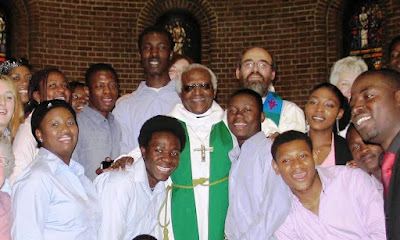
‘But you know, death is not the worst thing that could happen to a Christian’ … with Archbishop Desmond Tutu and members of the Discovery Gospel Choir in Dublin in 2005
Patrick Comerford
We are in Ordinary Time in the Church Calendar and tomorrow is the Sixth Sunday after Trinity (Trinity VI, 12 July 2026). The Calendar of the Church of England in Common Worship today remembers the life and witness of Saint Benedict of Nursia (550), Abbot of Monte Cassino and Father of Western Monasticism.
I may not venture out to the festival in the cricket club later today. But, before I make any decisions about what to do today, I am taking some quiet time this morning to give thanks, to reflect, to pray and to read in these ways:
1, reading today’s Gospel reading;
2, a short reflection;
3, a prayer from the USPG prayer diary;
4, the Collects and Post-Communion prayer of the day.
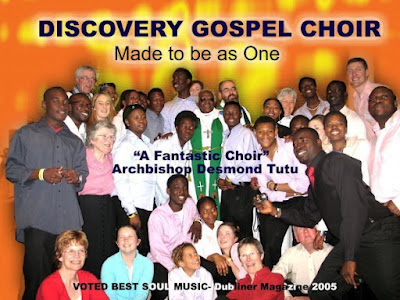
‘But you know, death is not the worst thing that could happen to a Christian’ … with Archbishop Desmond Tutu on the cover of a Discovery Gospel Choir CD
Matthew 10: 24-33 (NRSVA):
[Jesus said:] 24 ‘A disciple is not above the teacher, nor a slave above the master; 25 it is enough for the disciple to be like the teacher, and the slave like the master. If they have called the master of the house Beelzebul, how much more will they malign those of his household!
26 ‘So have no fear of them; for nothing is covered up that will not be uncovered, and nothing secret that will not become known. 27 What I say to you in the dark, tell in the light; and what you hear whispered, proclaim from the housetops. 28 Do not fear those who kill the body but cannot kill the soul; rather fear him who can destroy both soul and body in hell. 29 Are not two sparrows sold for a penny? Yet not one of them will fall to the ground unperceived by your Father. 30 And even the hairs of your head are all counted. 31 So do not be afraid; you are of more value than many sparrows.
32 ‘Everyone therefore who acknowledges me before others, I also will acknowledge before my Father in heaven; 33 but whoever denies me before others, I also will deny before my Father in heaven.’
‘What I say to you in the dark, tell in the light …’ (Matthew 10: 27) … 30 seconds of calm at Platanias in Rethymnon, Crete (Patrick Comerford)
Today’s Reflections:
When the late Archbishop Desmond Tutu (1931-2021) received the Nobel Peace Prize in 1984, I profiled him for The Irish Times. We had met previously, at events co-hosted by AfrI and Christian CND and at dinner in Roebuck House, Seán MacBride’s house in Clonskeagh, Dublin.
I asked him about the death threats he faced in South Africa at the height of apartheid. He engaged me with that look that confirmed his deep hope, commitment and faith, and said: ‘But you know, death is not the worst thing that could happen to a Christian.’
He must have been tempted at times to give up being a thorn in the side of the regime, to stop being a ‘turbulent priest,’ and to live a comfortable life. But his conscience would never have been comfortable.
While apartheid was still in force, Desmond Tutu became Dean of Saint Mary’s Cathedral, Johannesburg, and when I first met him he was the secretary general of the South African Council of Churches.
I was worried about the many death threats he was receiving, and I asked him how he lived with those threats. Was he worried about them? Did he ever consider modifying what he had to say because of them? His answer was similar to the one he gave when he was facing tough questioning before the regime’s Eloff Commission. He told that inquiry:
‘There is nothing the government can do to me that will stop me from being involved in what I believe God wants me to do. I do not do it because I like doing it. I do it because I am under what I believe to be the influence of God’s hand. I cannot help it. When I see injustice, I cannot keep quiet, for, as Jeremiah says, when I try to keep quiet, God’s Word burns like a fire in my breast. But what is it that they can ultimately do? The most awful thing that they can do is to kill me, and death is not the worst thing that could happen to a Christian.’
In 1987, Veritas invited me to write a short, 36-page biography of Archbishop Tutu, published as Desmond Tutu: Black Africa’s Man of Destiny. It was launched by the then Minister for Foreign Affairs, Brian Lenihan. It was a small book, hardly more than a pamphlet, but it came at an important time when both the Irish Government and the Irish Churches were becoming increasingly vocal about the evils of apartheid. It was republished in the US by Citadel (1988) and Hyperion Books (1989).
When I visited South Africa in 1990 with The Irish Times and Christian Aid, I met Archbishop Tutu in Cape Town, where once again he spoke powerfully about the changes that were beginning to take place.
Then, when my colleague Patsy McGarry was organising a monumental series of features in The Irish Times in 2000 to mark the millennium, Archbishop Tutu was one of the international contributors, along with Hans Küng, Andrew Greeley and Mary Robinson. The complete series was published by Veritas the following year as a book, Christianity, in which Part Two was my ‘Brief History of Christianity.’
I last met Archbishop Tutu when he visited Dublin in 2005, and he preached in Saint George’s and Saint Thomas’s Church in the inner city, where Canon (now Archdeacon) Katharine Poulton was then the Rector, as part of the Discovery Gospel Choir services.
His unforgettable words to me echo Christ’s words to the disciples in today’s Gospel reading: ‘Do not fear those who kill the body but cannot kill the soul; rather fear him who can destroy both soul and body in hell’ (Matthew 10: 28).
The Gospel reading at the Eucharist today (Matthew 10: 24-33) continues our readings from the commission and mission of the Twelve, as the Twelve continue to receive their instructions and commission for mission, even in the most hostile of environments.
‘What I say to you in the dark, tell in the light …’ (Matthew 10: 27) … walking through Galley Hill in Stony Stratford at night (Photograph: Patrick Comerford)
Today’s Prayers (Saturday 11 July 2026):
In Pray with the World Church, the prayer diary of the Anglican mission agency USPG (United Society Partners in the Gospel), the theme this week, from 5 to 11 July 2026 (pp 16-17), has been ‘Faith in the Midst of Fractures’. This theme was introduced last Sunday with a reflection by the Revd Godfrey Owino Adera, Anglican priest, theologian, and lecturer at Saint Paul’s University, Limuru, Kenya.
The USPG prayer diary today (Saturday 11 July 2026) invites us to pray:
God of truth and reconciliation, grant us courage to engage in difficult but necessary conversations. Where there is fear, give us boldness; where there is injustice, stir us to action; where there is brokenness, lead us toward healing and unity.
The Collect of the Day:
Eternal God,
who made Benedict a wise master
in the school of your service
and a guide to many called into community
to follow the rule of Christ:
grant that we may put your love before all else
and seek with joy the way of your commandments;
through Jesus Christ your Son our Lord,
who is alive and reigns with you,
in the unity of the Holy Spirit,
one God, now and for ever.
The Post-Communion Prayer:
Merciful God,
who gave such grace to your servant Benedict
that he served you with singleness of heart
and loved you above all things:
help us, whose communion with you
has been renewed in this sacrament,
to forsake all that holds us back from following Christ
and to grow into his likeness from glory to glory;
through Jesus Christ our Lord.
Collect on the Eve of Trinity VI:
Merciful God,
you have prepared for those who love you
such good things as pass our understanding:
pour into our hearts such love toward you
that we, loving you in all things and above all things,
may obtain your promises,
which exceed all that we can desire;
through Jesus Christ your Son our Lord,
who is alive and reigns with you,
in the unity of the Holy Spirit,
one God, now and for ever.
Collect on the Eve of Trinity VI:
O God, the protector of all who trust in you,
without whom nothing is strong, nothing is holy:
increase and multiply upon us your mercy;
that with you as our ruler and guide
we may so pass through things temporal
that we lose not our hold on things eternal;
grant this, heavenly Father,
for our Lord Jesus Christ’s sake,
who is alive and reigns with you,
in the unity of the Holy Spirit,
one God, now and for ever.
Yesterday’s reflections
Continued tomorrow
‘So do not be afraid; you are of more value than many sparrows’ (Matthew 10: 31) … Watching a mother sparrow feed her chicks in a nest in the ceiling of Aghias Anna Church, Maroulas, near Rethymnon in Crete (Patrick Comerford)
Scripture quotations are from the New Revised Standard Version Bible: Anglicised Edition copyright © 1989, 1995, National Council of the Churches of Christ in the United States of America. Used by permission. All rights reserved worldwide. http://nrsvbibles.org
Showing posts with label Kenya. Show all posts
11 July 2026
Daily prayer in Ordinary Time 2026:
65, Saturday 11 July 2026
Labels:
Apartheid,
Benedictines,
Books,
Crete 2026,
Galley Hill,
Greece 2026,
Kenya,
Maroulas,
Mission,
Platanias,
Prayer,
Racism,
Rethymnon,
Saint Matthew's Gospel,
South Africa,
Stony Stratford,
The Irish Times,
USPG
10 July 2026
Daily prayer in Ordinary Time 2026:
64, Friday 10 July 2026
‘See, I am sending you out like sheep into the midst of wolves’ (Matthew 10: 16)
Patrick Comerford
We are in Ordinary Time in the Church Calendar and this week began with the Fifth Sunday after Trinity (Trinity V, 5 July 2026). Later this evening, I hope to take part in the rehearsals in Saint Mary and Saint Giles for the service next Monday welcoming the new Rector of Stony Stratford, the Revd Dr David Jarratt.
But, before today begins, I am taking some quiet time this morning to give thanks, to reflect, to pray and to read in these ways:
1, reading today’s Gospel reading;
2, a short reflection;
3, a prayer from the USPG prayer diary;
4, the Collects and Post-Communion prayer of the day.
‘Be wise as serpents and innocent as doves’ (Matthew 10: 16)
Matthew 10: 16-23 (NRSVA):
[Jesus said:] 16 ‘See, I am sending you out like sheep into the midst of wolves; so be wise as serpents and innocent as doves. 17 Beware of them, for they will hand you over to councils and flog you in their synagogues; 18 and you will be dragged before governors and kings because of me, as a testimony to them and the Gentiles. 19 When they hand you over, do not worry about how you are to speak or what you are to say; for what you are to say will be given to you at that time; 20 for it is not you who speak, but the Spirit of your Father speaking through you. 21 Brother will betray brother to death, and a father his child, and children will rise against parents and have them put to death; 22 and you will be hated by all because of my name. But the one who endures to the end will be saved. 23 When they persecute you in one town, flee to the next; for truly I tell you, you will not have gone through all the towns of Israel before the Son of Man comes.’
‘Be wise as serpents and innocent as doves’ (Matthew 10: 16)
Today’s Reflections:
The Gospel reading at the Eucharist today (Matthew 10: 16-23) continues yesterday’s account of the commission and mission of the Twelve (Matthew 10: 7-15), as the Twelve continue to receive are given their instructions and commission for mission among the ‘lost sheep’: they are going out like sheep into the midst of wolves, so they need to be wise ‘as serpents and innocent as doves’ and to be aware of the threats and dangers they face.
The image of wolves in sheep’s clothing may lead us to ask how we recognise wolves in sheep clothing or false prophets who hijack abuse the name of Christ and Christianity today?
I hope I never get use to the blasphemous obscenities and images that come from Donald Trump. When he speaks he is often flanked by a Catholic Vice-President, JD Vance, a Catholic Secretary of State, Mario Rubio, who has also been a Baptist and a Mormon, and a Defence Secretary, Pete Hegseth, who is a member of the Pilgrim Hill Reformed Fellowship and who claims God blesses his war-mongering, his violence, his genocide, and invoking God to sanction his evil actions.
Let me offer four names to consider:
1, Allie Beth Stuckey seeks to legitimise the concept of ‘toxic empathy’ in her book Toxic Empathy: How Progressives Exploit Christian Compassion. She describes herself as a Reformed Baptist, is a regular guest on Fox News, and is heard on the podcast ‘Relatable with Allie Beth Stuckey’, distributed by Blaze Media, known for its recent film hijacking the story of Dietrich Bonhoeffer to promote ultra-right ‘Christian Nationalism’ in the US.
Stuckey studied communications at Furman University and has been a publicist and social media strategist on behalf of pro-Trump and MAGA causes. But she has no theological education or degrees that qualify her to make her judgmental theological pronouncements.
Stuckey once made a video that purported to be an interview with Alexandria Ocasio-Cortez in which the politician appeared to give bizarre answers to questions put to her by Stuckey. It emerged later that the video plagiarised footage from other interviews spliced to appear as answers to Stuckey’s questions. When the video was widely exposed as a hoax, Stuckey said it was ‘satirical’ and ‘a joke’, but she has not made similar videos or jokes about right-wing politicians.
In her book, Toxic Empathy: How Progressives Exploit Christian Compassion (2024), Stuckey claims that when politics are driven by empathy rather than truth, innocent people pay the price. She claims empathy has become the highest virtue but like so many other words, such as tolerance, justice and acceptance, the word has been hijacked by people who exploit compassion for their own political ends.
She claims ‘toxic empathy’ is the primary tool of persuasion used by progressives to manipulate well-meaning Christians. She says they use toxic empathy ‘by employing our language, our Bible verses, our concepts and then pervert them to morally extort us into adopting their position.’
Stuckey argues that empathy has become a tool of manipulation by left-wing activists, claiming they bully people into believing that they must adopt progressive positions to be loving. She associates toxic empathy with the issues she is obsessed with: abortion, gender, sexuality, immigration and social justice. She argues empathy should derive from God’s definitions of love, goodness, and justice, and argues there are logical pitfalls and moral consequences for toxic empathy.
‘Our language, our Bible verses, our concepts’? Stuckey seems to imply the Bible and the language of Christianity are the sole preserve of far-right fundamentalists. She complains someone of the same religion can read the shared religious text and come to a different conclusion about its meaning, such as coming to the conclusion that the Prophets of the Hebrew Scriptures and Jesus in the Gospels meant what they said about responding with human decency to the outcast, the stranger, the sick, the imprisoned, the widowed, and the orphan.
But her notion that there is one and only one correct understanding of Scripture, is a false notion … one might even say it is a toxic notion.
Q, Wolf or Sheep? True prophet or false?
2, Pastor Paula White-Cain, a televangelist and a prominent figure in the charismatic movement, has been a longtime spiritual adviser to Donald Trump and is a proponent of ‘prosperity theology’, which takes advantage of vulnerable believers, promising material blessings in return for donations.
In the past, she has been the pastor at churches that bought her a waterfront mansion for $900,000, paid over $1 million in salaries to her and her family members and paid for their private jet, yet failed to pay mortgages and electricity bills and filed for bankruptcy. One church alleged White had stolen $600,000 in audio-visual equipment.
She chaired the evangelical advisory board for Trump’s 2016 campaign, delivered the invocation at his inauguration in 2017, became his special adviser on the Faith and Opportunity Initiative at the Office of Public Liaison in 2019, and offered an opening prayer before Trump’s speech at the rally shortly before the US Capitol was stormed on 6 January 2021.
White has warned that ‘Christians that don’t support President Trump will have to answer to God.’ Last year (7 February 2025), he appointed White to lead the White House Faith Office.
She once criticised immigration advocates who cited the Gospel account of Jesus’ escape to Egypt as a child, saying: ‘Yes, he did live in Egypt for 3½ years. But it was not illegal. If he had broken the law, then he would have been sinful and he would not have been our Messiah.’
Q, Wolf or Sheep? True prophet or false?
3, Mike Huckabee – or, more formally, the Revd Dr Michael Dale Huckabee – is Trump’s ambassador to Israel. He is an ordained Baptist minister, but has also been the Governor of Arkansas (1996-2007), and has hosted a talk show on Fox News. He has claimed, wrongly, that Barack Obama was born in Kenya and alleged Obama supported the Mau-Mau rebels; he outlawed same-sex marriage in Arkansas; and he has repeated the unsubstantiated claims of election fraud in the 2020 presidential election.
He denies global warming, opposes anti-discrimination legislation, is vocal in opposing migration into the US, and opposes gun control measures. Within hours of the Sandy Hook Elementary School shooting, he told Fox News: ‘We ask why there is violence in our schools, but we have systematically removed God from our schools. Should we be so surprised that schools would become a place of carnage?’
Before his present appointment, he opposed Palestinian statehood and rejected Palestinian identity as ‘a political tool to try and force land away from Israel.’ At an event in the West Bank in 2017, he said: ‘There is no such thing as a West Bank – it’s Judea and Samaria. There’s no such thing as a settlement. They’re communities. They’re neighbourhoods. They’re cities. There’s no such thing as an occupation.’
When he presented his credentials to President Isaac Herzog, Huckabee claimed Iran wants to destroy Israel and the US. He hardly has the credibility or the credentials to be an impartial mediator or negotiator in any part of the Middle East, or in any conflict.
Q, Wolf or Sheep? True prophet or false?
4, Vance Boelter – or, more formally, the Revd Dr Vance Luther Boelter – was arrested in connection with the killing of a Minnesota state legislator and her husband and the shooting of a state senator and his wife last year (14 June 2025). It turns out he has been an evangelical missionary who has preached in the Democratic Republic of the Congo in recent years, and has long been a Trump supporter and a registered Republican voter.
Boelter has pleaded guilty to killing Melissa Hortman, a Democrat, and her husband Mark Hortman at their home in Champlin, a suburb of Minneapolis, and with shooting and wounding Democratic state Senator John Hoffman and his wife Yvette Hoffman at their home.
Videos show Boelter preaching from 2021 to 2023 at La Borne Matadi, a church in Matadi, on the western coast of the DRC. In one sermon he says ‘God is going to raise up apostles and prophets in America to correct his church.’ Boelter says he was ordained in 1993, claims a doctorate from Cardinal Stritch University, a private Catholic college in Wisconsin that was shut down in 2023, and says he studied at Christ for the Nations Institute in Dallas, a charismatic ‘Spirit-filled Bible School’. His other intended targets included Governor Tim Walz of Minnesota, the Democratic vice-presidential nominee last year, and Rashida Tlaib and Ilhan Omar, the first two Muslim women members of Congress.
He is due to be sentenced later this month (23 July 2026), when he faces two consecutive sentences of life imprisonment without the possibility of parole, plus 40 years.
To this day, Trump has had neither the courtesy nor the courage to pick up the phone and offer words of consolation and assurance to these three politicians or anyone else named on Boetler’s hit list. Then, on the other hand, perhaps it is no small mercy that he has not managed to shift the blame onto migrants or refugees, yet.
Q, Wolf or Sheep? True prophet or false?
We are sent out like sheep among wolves. We are, in a way, defenceless, because we renounce any use of violence. There are wolves out there eager to destroy us because, despite our message of love, justice and peace, we are seen as a threat to their activities and ambitions.
We are to be as wise as snakes and innocent as doves. We are to be as inventive and creative as we can be in dealing with the world. But we are to be innocent, not in the sense of being naive, but in the sense of being completely free of even any suspicion of wrongdoing. The ends do not justify the means.
At every Eucharist, we hear that Jesus in his Body is handed over to us: ‘This is my Body, which is given up for you.’
When we are handed over we are not to be anxious about what to say. The enemies of the Gospel do not have the final answer when it comes to truth, love and justice.
Of course, Jesus never calls on us to go out of our way to seek persecution or to be hated, and we are to make Christianity as attractive as possible. But Christianity and the values of the Kingdom are being traduced, supposedly in the name of Christ, by key people at the very heart of political life in the US today.
Has the time come when true Christians can run no further, or when it is clear we have to take a stand and cannot compromise? We need to know the sheep from the wolves, to be in some way as wise as serpents and innocent as doves, to be assured also of the promise that those who endure to the end will be saved.
At every Eucharist, we hear that Jesus in his Body is handed over to us: ‘This is my Body, which is given up for you’ ... Communion bread being prepared at Mount Athos (Photograph: Patrick Comerford)
Today’s Prayers (Friday 10 July 2026):
In Pray with the World Church, the prayer diary of the Anglican mission agency USPG (United Society Partners in the Gospel), the theme this week, from 5 to 11 July 2026 (pp 16-17), is ‘Faith in the Midst of Fractures’. This theme was introduced on Sunday with a reflection by the Revd Godfrey Owino Adera, Anglican priest, theologian, and lecturer at Saint Paul’s University, Limuru, Kenya.
The USPG prayer diary today (Friday 10 July 2026) invites us to pray:
Faithful God, we give thanks for the FeAST network and the way it nurtures learning, friendship, and justice-oriented theology. Bless the network with deepened relationships, shared vision, and long-lasting fruit that glorifies your name.
The Collect of the Day:
Almighty and everlasting God,
by whose Spirit the whole body of the Church
is governed and sanctified:
hear our prayer which we offer for all your faithful people,
that in their vocation and ministry
they may serve you in holiness and truth
to the glory of your name;
through our Lord and Saviour Jesus Christ,
who is alive and reigns with you,
in the unity of the Holy Spirit,
one God, now and for ever.
The Post-Communion Prayer:
Grant, O Lord, we beseech you,
that the course of this world may be so peaceably ordered
by your governance,
that your Church may joyfully serve you in all godly quietness;
through Jesus Christ our Lord.
Additional Collect:
Almighty God,
send down upon your Church
the riches of your Spirit,
and kindle in all who minister the gospel
your countless gifts of grace;
through Jesus Christ our Lord.
Yesterday’s reflections
Continued tomorrow
‘See, I am sending you out like sheep …’ (Matthew 10: 16) … sheep on a farm in Comberford, between Lichfield and Tamworth in Staffordshire (Photograph: Patrick Comerford)
Scripture quotations are from the New Revised Standard Version Bible: Anglicised Edition copyright © 1989, 1995, National Council of the Churches of Christ in the United States of America. Used by permission. All rights reserved worldwide. http://nrsvbibles.org
Patrick Comerford
We are in Ordinary Time in the Church Calendar and this week began with the Fifth Sunday after Trinity (Trinity V, 5 July 2026). Later this evening, I hope to take part in the rehearsals in Saint Mary and Saint Giles for the service next Monday welcoming the new Rector of Stony Stratford, the Revd Dr David Jarratt.
But, before today begins, I am taking some quiet time this morning to give thanks, to reflect, to pray and to read in these ways:
1, reading today’s Gospel reading;
2, a short reflection;
3, a prayer from the USPG prayer diary;
4, the Collects and Post-Communion prayer of the day.
‘Be wise as serpents and innocent as doves’ (Matthew 10: 16)
Matthew 10: 16-23 (NRSVA):
[Jesus said:] 16 ‘See, I am sending you out like sheep into the midst of wolves; so be wise as serpents and innocent as doves. 17 Beware of them, for they will hand you over to councils and flog you in their synagogues; 18 and you will be dragged before governors and kings because of me, as a testimony to them and the Gentiles. 19 When they hand you over, do not worry about how you are to speak or what you are to say; for what you are to say will be given to you at that time; 20 for it is not you who speak, but the Spirit of your Father speaking through you. 21 Brother will betray brother to death, and a father his child, and children will rise against parents and have them put to death; 22 and you will be hated by all because of my name. But the one who endures to the end will be saved. 23 When they persecute you in one town, flee to the next; for truly I tell you, you will not have gone through all the towns of Israel before the Son of Man comes.’
‘Be wise as serpents and innocent as doves’ (Matthew 10: 16)
Today’s Reflections:
The Gospel reading at the Eucharist today (Matthew 10: 16-23) continues yesterday’s account of the commission and mission of the Twelve (Matthew 10: 7-15), as the Twelve continue to receive are given their instructions and commission for mission among the ‘lost sheep’: they are going out like sheep into the midst of wolves, so they need to be wise ‘as serpents and innocent as doves’ and to be aware of the threats and dangers they face.
The image of wolves in sheep’s clothing may lead us to ask how we recognise wolves in sheep clothing or false prophets who hijack abuse the name of Christ and Christianity today?
I hope I never get use to the blasphemous obscenities and images that come from Donald Trump. When he speaks he is often flanked by a Catholic Vice-President, JD Vance, a Catholic Secretary of State, Mario Rubio, who has also been a Baptist and a Mormon, and a Defence Secretary, Pete Hegseth, who is a member of the Pilgrim Hill Reformed Fellowship and who claims God blesses his war-mongering, his violence, his genocide, and invoking God to sanction his evil actions.
Let me offer four names to consider:
1, Allie Beth Stuckey seeks to legitimise the concept of ‘toxic empathy’ in her book Toxic Empathy: How Progressives Exploit Christian Compassion. She describes herself as a Reformed Baptist, is a regular guest on Fox News, and is heard on the podcast ‘Relatable with Allie Beth Stuckey’, distributed by Blaze Media, known for its recent film hijacking the story of Dietrich Bonhoeffer to promote ultra-right ‘Christian Nationalism’ in the US.
Stuckey studied communications at Furman University and has been a publicist and social media strategist on behalf of pro-Trump and MAGA causes. But she has no theological education or degrees that qualify her to make her judgmental theological pronouncements.
Stuckey once made a video that purported to be an interview with Alexandria Ocasio-Cortez in which the politician appeared to give bizarre answers to questions put to her by Stuckey. It emerged later that the video plagiarised footage from other interviews spliced to appear as answers to Stuckey’s questions. When the video was widely exposed as a hoax, Stuckey said it was ‘satirical’ and ‘a joke’, but she has not made similar videos or jokes about right-wing politicians.
In her book, Toxic Empathy: How Progressives Exploit Christian Compassion (2024), Stuckey claims that when politics are driven by empathy rather than truth, innocent people pay the price. She claims empathy has become the highest virtue but like so many other words, such as tolerance, justice and acceptance, the word has been hijacked by people who exploit compassion for their own political ends.
She claims ‘toxic empathy’ is the primary tool of persuasion used by progressives to manipulate well-meaning Christians. She says they use toxic empathy ‘by employing our language, our Bible verses, our concepts and then pervert them to morally extort us into adopting their position.’
Stuckey argues that empathy has become a tool of manipulation by left-wing activists, claiming they bully people into believing that they must adopt progressive positions to be loving. She associates toxic empathy with the issues she is obsessed with: abortion, gender, sexuality, immigration and social justice. She argues empathy should derive from God’s definitions of love, goodness, and justice, and argues there are logical pitfalls and moral consequences for toxic empathy.
‘Our language, our Bible verses, our concepts’? Stuckey seems to imply the Bible and the language of Christianity are the sole preserve of far-right fundamentalists. She complains someone of the same religion can read the shared religious text and come to a different conclusion about its meaning, such as coming to the conclusion that the Prophets of the Hebrew Scriptures and Jesus in the Gospels meant what they said about responding with human decency to the outcast, the stranger, the sick, the imprisoned, the widowed, and the orphan.
But her notion that there is one and only one correct understanding of Scripture, is a false notion … one might even say it is a toxic notion.
Q, Wolf or Sheep? True prophet or false?
2, Pastor Paula White-Cain, a televangelist and a prominent figure in the charismatic movement, has been a longtime spiritual adviser to Donald Trump and is a proponent of ‘prosperity theology’, which takes advantage of vulnerable believers, promising material blessings in return for donations.
In the past, she has been the pastor at churches that bought her a waterfront mansion for $900,000, paid over $1 million in salaries to her and her family members and paid for their private jet, yet failed to pay mortgages and electricity bills and filed for bankruptcy. One church alleged White had stolen $600,000 in audio-visual equipment.
She chaired the evangelical advisory board for Trump’s 2016 campaign, delivered the invocation at his inauguration in 2017, became his special adviser on the Faith and Opportunity Initiative at the Office of Public Liaison in 2019, and offered an opening prayer before Trump’s speech at the rally shortly before the US Capitol was stormed on 6 January 2021.
White has warned that ‘Christians that don’t support President Trump will have to answer to God.’ Last year (7 February 2025), he appointed White to lead the White House Faith Office.
She once criticised immigration advocates who cited the Gospel account of Jesus’ escape to Egypt as a child, saying: ‘Yes, he did live in Egypt for 3½ years. But it was not illegal. If he had broken the law, then he would have been sinful and he would not have been our Messiah.’
Q, Wolf or Sheep? True prophet or false?
3, Mike Huckabee – or, more formally, the Revd Dr Michael Dale Huckabee – is Trump’s ambassador to Israel. He is an ordained Baptist minister, but has also been the Governor of Arkansas (1996-2007), and has hosted a talk show on Fox News. He has claimed, wrongly, that Barack Obama was born in Kenya and alleged Obama supported the Mau-Mau rebels; he outlawed same-sex marriage in Arkansas; and he has repeated the unsubstantiated claims of election fraud in the 2020 presidential election.
He denies global warming, opposes anti-discrimination legislation, is vocal in opposing migration into the US, and opposes gun control measures. Within hours of the Sandy Hook Elementary School shooting, he told Fox News: ‘We ask why there is violence in our schools, but we have systematically removed God from our schools. Should we be so surprised that schools would become a place of carnage?’
Before his present appointment, he opposed Palestinian statehood and rejected Palestinian identity as ‘a political tool to try and force land away from Israel.’ At an event in the West Bank in 2017, he said: ‘There is no such thing as a West Bank – it’s Judea and Samaria. There’s no such thing as a settlement. They’re communities. They’re neighbourhoods. They’re cities. There’s no such thing as an occupation.’
When he presented his credentials to President Isaac Herzog, Huckabee claimed Iran wants to destroy Israel and the US. He hardly has the credibility or the credentials to be an impartial mediator or negotiator in any part of the Middle East, or in any conflict.
Q, Wolf or Sheep? True prophet or false?
4, Vance Boelter – or, more formally, the Revd Dr Vance Luther Boelter – was arrested in connection with the killing of a Minnesota state legislator and her husband and the shooting of a state senator and his wife last year (14 June 2025). It turns out he has been an evangelical missionary who has preached in the Democratic Republic of the Congo in recent years, and has long been a Trump supporter and a registered Republican voter.
Boelter has pleaded guilty to killing Melissa Hortman, a Democrat, and her husband Mark Hortman at their home in Champlin, a suburb of Minneapolis, and with shooting and wounding Democratic state Senator John Hoffman and his wife Yvette Hoffman at their home.
Videos show Boelter preaching from 2021 to 2023 at La Borne Matadi, a church in Matadi, on the western coast of the DRC. In one sermon he says ‘God is going to raise up apostles and prophets in America to correct his church.’ Boelter says he was ordained in 1993, claims a doctorate from Cardinal Stritch University, a private Catholic college in Wisconsin that was shut down in 2023, and says he studied at Christ for the Nations Institute in Dallas, a charismatic ‘Spirit-filled Bible School’. His other intended targets included Governor Tim Walz of Minnesota, the Democratic vice-presidential nominee last year, and Rashida Tlaib and Ilhan Omar, the first two Muslim women members of Congress.
He is due to be sentenced later this month (23 July 2026), when he faces two consecutive sentences of life imprisonment without the possibility of parole, plus 40 years.
To this day, Trump has had neither the courtesy nor the courage to pick up the phone and offer words of consolation and assurance to these three politicians or anyone else named on Boetler’s hit list. Then, on the other hand, perhaps it is no small mercy that he has not managed to shift the blame onto migrants or refugees, yet.
Q, Wolf or Sheep? True prophet or false?
We are sent out like sheep among wolves. We are, in a way, defenceless, because we renounce any use of violence. There are wolves out there eager to destroy us because, despite our message of love, justice and peace, we are seen as a threat to their activities and ambitions.
We are to be as wise as snakes and innocent as doves. We are to be as inventive and creative as we can be in dealing with the world. But we are to be innocent, not in the sense of being naive, but in the sense of being completely free of even any suspicion of wrongdoing. The ends do not justify the means.
At every Eucharist, we hear that Jesus in his Body is handed over to us: ‘This is my Body, which is given up for you.’
When we are handed over we are not to be anxious about what to say. The enemies of the Gospel do not have the final answer when it comes to truth, love and justice.
Of course, Jesus never calls on us to go out of our way to seek persecution or to be hated, and we are to make Christianity as attractive as possible. But Christianity and the values of the Kingdom are being traduced, supposedly in the name of Christ, by key people at the very heart of political life in the US today.
Has the time come when true Christians can run no further, or when it is clear we have to take a stand and cannot compromise? We need to know the sheep from the wolves, to be in some way as wise as serpents and innocent as doves, to be assured also of the promise that those who endure to the end will be saved.
At every Eucharist, we hear that Jesus in his Body is handed over to us: ‘This is my Body, which is given up for you’ ... Communion bread being prepared at Mount Athos (Photograph: Patrick Comerford)
Today’s Prayers (Friday 10 July 2026):
In Pray with the World Church, the prayer diary of the Anglican mission agency USPG (United Society Partners in the Gospel), the theme this week, from 5 to 11 July 2026 (pp 16-17), is ‘Faith in the Midst of Fractures’. This theme was introduced on Sunday with a reflection by the Revd Godfrey Owino Adera, Anglican priest, theologian, and lecturer at Saint Paul’s University, Limuru, Kenya.
The USPG prayer diary today (Friday 10 July 2026) invites us to pray:
Faithful God, we give thanks for the FeAST network and the way it nurtures learning, friendship, and justice-oriented theology. Bless the network with deepened relationships, shared vision, and long-lasting fruit that glorifies your name.
The Collect of the Day:
Almighty and everlasting God,
by whose Spirit the whole body of the Church
is governed and sanctified:
hear our prayer which we offer for all your faithful people,
that in their vocation and ministry
they may serve you in holiness and truth
to the glory of your name;
through our Lord and Saviour Jesus Christ,
who is alive and reigns with you,
in the unity of the Holy Spirit,
one God, now and for ever.
The Post-Communion Prayer:
Grant, O Lord, we beseech you,
that the course of this world may be so peaceably ordered
by your governance,
that your Church may joyfully serve you in all godly quietness;
through Jesus Christ our Lord.
Additional Collect:
Almighty God,
send down upon your Church
the riches of your Spirit,
and kindle in all who minister the gospel
your countless gifts of grace;
through Jesus Christ our Lord.
Yesterday’s reflections
Continued tomorrow
‘See, I am sending you out like sheep …’ (Matthew 10: 16) … sheep on a farm in Comberford, between Lichfield and Tamworth in Staffordshire (Photograph: Patrick Comerford)
Scripture quotations are from the New Revised Standard Version Bible: Anglicised Edition copyright © 1989, 1995, National Council of the Churches of Christ in the United States of America. Used by permission. All rights reserved worldwide. http://nrsvbibles.org
09 July 2026
Daily prayer in Ordinary Time 2026:
63, Thursday 9 July 2026
‘If anyone will not welcome you or listen to your words, shake off the dust from your feet as you leave that house or town’ (Matthew 10: 14) … a multilingual welcome at a church in London (Photograph: Patrick Comerford)
Patrick Comerford
We are in Ordinary Time in the Church Calendar and this week began with the Fifth Sunday after Trinity (Trinity V, 5 July 2026). Later this evening, the Greek School in Stony Stratford is holding its Summer Celebration from 5pm in Stony Stratford. This promises to be a relaxed, friendly evening to round off the school year, with children’s films, games and activities from 5 pm, a Greek BBQ with souvlaki all evening, and film for the grown-ups from 7 pm. The invitation is to come along, eat well, and support a small local school.
But, before today begins, I am taking some quiet time early this morning to give thanks, to reflect, to pray and to read in these ways:
1, reading today’s Gospel reading;
2, a short reflection;
3, a prayer from the USPG prayer diary;
4, the Collects and Post-Communion prayer of the day.
‘Take no gold, or silver, or copper in your belts’ (Matthew 10: 9) … a selection of old coins in an antiques shop in Rethymnon (Photograph: Patrick Comerford)
Matthew 10: 7-15 (NRSVA):
[Jesus said:] 7 ‘As you go, proclaim the good news, “The kingdom of heaven has come near.” 8 Cure the sick, raise the dead, cleanse the lepers, cast out demons. You received without payment; give without payment. 9 Take no gold, or silver, or copper in your belts, 10 no bag for your journey, or two tunics, or sandals, or a staff; for labourers deserve their food. 11 Whatever town or village you enter, find out who in it is worthy, and stay there until you leave. 12 As you enter the house, greet it. 13 If the house is worthy, let your peace come upon it; but if it is not worthy, let your peace return to you. 14 If anyone will not welcome you or listen to your words, shake off the dust from your feet as you leave that house or town. 15 Truly I tell you, it will be more tolerable for the land of Sodom and Gomorrah on the day of judgement than for that town.’
‘If anyone will not welcome you or listen to your words, shake off the dust from your feet as you leave that house or town’ (Matthew 10: 14) … a welcome sign at Athens International Airport (Photograph: Patrick Comerford)
Today’s Reflections:
The Gospel reading at the Eucharist today (Matthew 10: 7-15) continues yesterday’s account of the commission and mission of the Twelve (Matthew 10: 1-7), as the Twelve are given their instructions for mission among the ‘lost sheep’: they are to cure the sick, raise the dead, cleanse the lepers, cast out demons; they are to give without expecting payment in return, travel lightly, be humble in accepting generosity, and to wish peace to all; and they are reminded of the dreadful consequences of hospitality not offered or hospitality spurned.
The particularly Greek concept of hospitality or φῐλοξενῐ́ᾱ (philoxenia) fits in well with what might be called the sacrament of hospitality. But most of the discussions about sacramental hospitality are actually discussing to whom should we extend hospitality at the Eucharist rather than any potential sacramental understanding of generous hospitality itself.
The reference to Sodom and Gomorrah in today’s reading is a reminder of the story in Genesis 19, in which two angels are sent to destroy Sodom. Lot welcomes them into his home, but all the men of the town surround the house and demand that Lot surrender his visitors that they may ‘know’ them carnally (see Genesis 19: 5). Lot offers the mob his virgin daughters to ‘do to them as you please’, but they refuse and threaten to do worse to Lot.
In response, the angels strike the crowd blind, and tell Lot: ‘the outcry against its people has become great before the Lord, and the Lord has sent us to destroy it’ (Genesis 19: 13).
The next morning, because Lot has lingered, the angels take Lot, Lot’s wife, and his two daughters by the hand and out of the city, and tell Lot to flee to the hills and not look back. Lot says that the hills are too far away and asks to go to Zoar instead. Sulphur and fire are then rained down on Sodom and Gomorrah, all the Plain, and all the inhabitants of the cities, and what grew on the ground (Genesis 19: 24-25). Lot and his daughters are saved, but his wife disregards the warning, looks back, and is turned into a pillar of salt.
‘Sodom and Gomorrah’ would become bywords for destruction and desolation (see Deuteronomy 29: 21-23). Other Biblical books initially attribute a variety of non-sexual sins to the inhabitants of Sodom. It is only much later that what came to be labelled ‘unnatural’ sex and homosexuality began to be included on these lists, and eventually homosexuality was interpreted as the primary sin of Sodom.
Sodom and Gomorrah, or the ‘cities of the plain’, were used historically and in modern discourse as metaphors for homosexuality, and are the origin of the English words sodomite, a pejorative term for male homosexuals, ‘sod’, a vulgar English slang term for male homosexuals, and sodomy, which is used in a legal context under the label crimes against nature to describe anal or oral sex (particularly homosexual) and bestiality.
The origin of the argument that sodomy was sinful is found in a contested reading of one word in the story. Citing Sodom and Gomorrah, Christian authorities began to label and condemn acts of sodomy as the worst of all sexual sins, and one of the worst crimes in general. For many centuries, the story of Sodom and Gomorrah was used by the Church to justify criminalisation of sexual practices between men, and people who were labelled sodomites were often punished by execution.
To this day, the phrase ‘Save Ulster from Sodomy’ remains a rallying call among some far-right groups in Northern Ireland.
However, since the mid-20th century, scholars in increasing numbers have seen the great sin of Sodom as the inhospitable treatment of guests. Much of the debate in modern interpretation of the greatest sin of Sodom, and whether the story concerns or condemns homosexuality, rests on interpreting the moment the mob from Sodom confronts Lot about his guests.
Today, many scholars dispute the interpretation that the sins of Sodom and Gomorrah involve homosexuality. They cite Ezekiel 16: 49-50 and interpret the sin as arrogance and lack of hospitality. As with Ezekiel, later prophetic reproaches of Sodom and Gomorrah do not condemn, implicate, or even mention homosexual conduct as the reason for the destruction of the city. Instead, they assign the blame to other sins, ranging from adultery, sexual violence and exploitation and dishonesty, to a lack of charity and an unwillingness to extend appropriate and generous hospitality.
If the obsession with equating gay sexuality with the sin of Sodom that is found among many evangelicals to this day was tempered even by true Biblical literalism and instead became widespread condemnation by those evangelicals, particularly in Trump’s America, of sexual violence and exploitation, dishonesty and an unwillingness to offer generous hospitality to the stranger, imagine what a different place the United States of America would be this day.
But, perhaps, I ought to conclude with a story retold this week that conveys how we can mis-hear and misinterpret words because of our already determined cultural presuppositions and prejudices.
In its obituary of Lord (David) Lipsey, the journalist and Labour peer who died tragically last year, the Guardian recalled how he had founded a newspaper at his school in Bryanston and interviewed his future mentor, Anthony Crosland, then the Education Secretary and who was committed to abolishing public schools. The young interviewer reported Crosland saying prep schools were ‘stinking breeding grounds of sodomy’. Years later, Lipsey came across a Crosland speech and realised he had misheard the last word. It should have been ‘snobbery’.
Fáilte Romhat … words of welcome above the door of a pub in Doonbeg in Co Clare (Photograph: Patrick Comerford)
Today’s Prayers (Thursday 9 July 2026):
In Pray with the World Church, the prayer diary of the Anglican mission agency USPG (United Society Partners in the Gospel), the theme this week, from 5 to 11 July 2026 (pp 16-17), is ‘Faith in the Midst of Fractures’. This theme was introduced on Sunday with a reflection by the Revd Godfrey Owino Adera, Anglican priest, theologian, and lecturer at Saint Paul’s University, Limuru, Kenya.
The USPG prayer diary today (Thursday 9 July 2026) invites us to pray:
God of truth, grant us the courage to face division with humility, honesty, and compassion. Lead communities towards justice, healing, and unity.
The Collect of the Day:
Almighty and everlasting God,
by whose Spirit the whole body of the Church
is governed and sanctified:
hear our prayer which we offer for all your faithful people,
that in their vocation and ministry
they may serve you in holiness and truth
to the glory of your name;
through our Lord and Saviour Jesus Christ,
who is alive and reigns with you,
in the unity of the Holy Spirit,
one God, now and for ever.
The Post-Communion Prayer:
Grant, O Lord, we beseech you,
that the course of this world may be so peaceably ordered
by your governance,
that your Church may joyfully serve you in all godly quietness;
through Jesus Christ our Lord.
Additional Collect:
Almighty God,
send down upon your Church
the riches of your Spirit,
and kindle in all who minister the gospel
your countless gifts of grace;
through Jesus Christ our Lord.
Yesterday’s reflections
Continued tomorrow
A welcome sign at Terminal 4 in Heathrow Airport (Photograph: Patrick Comerford, 2026)
Scripture quotations are from the New Revised Standard Version Bible: Anglicised Edition copyright © 1989, 1995, National Council of the Churches of Christ in the United States of America. Used by permission. All rights reserved worldwide. http://nrsvbibles.org
Patrick Comerford
We are in Ordinary Time in the Church Calendar and this week began with the Fifth Sunday after Trinity (Trinity V, 5 July 2026). Later this evening, the Greek School in Stony Stratford is holding its Summer Celebration from 5pm in Stony Stratford. This promises to be a relaxed, friendly evening to round off the school year, with children’s films, games and activities from 5 pm, a Greek BBQ with souvlaki all evening, and film for the grown-ups from 7 pm. The invitation is to come along, eat well, and support a small local school.
But, before today begins, I am taking some quiet time early this morning to give thanks, to reflect, to pray and to read in these ways:
1, reading today’s Gospel reading;
2, a short reflection;
3, a prayer from the USPG prayer diary;
4, the Collects and Post-Communion prayer of the day.
‘Take no gold, or silver, or copper in your belts’ (Matthew 10: 9) … a selection of old coins in an antiques shop in Rethymnon (Photograph: Patrick Comerford)
Matthew 10: 7-15 (NRSVA):
[Jesus said:] 7 ‘As you go, proclaim the good news, “The kingdom of heaven has come near.” 8 Cure the sick, raise the dead, cleanse the lepers, cast out demons. You received without payment; give without payment. 9 Take no gold, or silver, or copper in your belts, 10 no bag for your journey, or two tunics, or sandals, or a staff; for labourers deserve their food. 11 Whatever town or village you enter, find out who in it is worthy, and stay there until you leave. 12 As you enter the house, greet it. 13 If the house is worthy, let your peace come upon it; but if it is not worthy, let your peace return to you. 14 If anyone will not welcome you or listen to your words, shake off the dust from your feet as you leave that house or town. 15 Truly I tell you, it will be more tolerable for the land of Sodom and Gomorrah on the day of judgement than for that town.’
‘If anyone will not welcome you or listen to your words, shake off the dust from your feet as you leave that house or town’ (Matthew 10: 14) … a welcome sign at Athens International Airport (Photograph: Patrick Comerford)
Today’s Reflections:
The Gospel reading at the Eucharist today (Matthew 10: 7-15) continues yesterday’s account of the commission and mission of the Twelve (Matthew 10: 1-7), as the Twelve are given their instructions for mission among the ‘lost sheep’: they are to cure the sick, raise the dead, cleanse the lepers, cast out demons; they are to give without expecting payment in return, travel lightly, be humble in accepting generosity, and to wish peace to all; and they are reminded of the dreadful consequences of hospitality not offered or hospitality spurned.
The particularly Greek concept of hospitality or φῐλοξενῐ́ᾱ (philoxenia) fits in well with what might be called the sacrament of hospitality. But most of the discussions about sacramental hospitality are actually discussing to whom should we extend hospitality at the Eucharist rather than any potential sacramental understanding of generous hospitality itself.
The reference to Sodom and Gomorrah in today’s reading is a reminder of the story in Genesis 19, in which two angels are sent to destroy Sodom. Lot welcomes them into his home, but all the men of the town surround the house and demand that Lot surrender his visitors that they may ‘know’ them carnally (see Genesis 19: 5). Lot offers the mob his virgin daughters to ‘do to them as you please’, but they refuse and threaten to do worse to Lot.
In response, the angels strike the crowd blind, and tell Lot: ‘the outcry against its people has become great before the Lord, and the Lord has sent us to destroy it’ (Genesis 19: 13).
The next morning, because Lot has lingered, the angels take Lot, Lot’s wife, and his two daughters by the hand and out of the city, and tell Lot to flee to the hills and not look back. Lot says that the hills are too far away and asks to go to Zoar instead. Sulphur and fire are then rained down on Sodom and Gomorrah, all the Plain, and all the inhabitants of the cities, and what grew on the ground (Genesis 19: 24-25). Lot and his daughters are saved, but his wife disregards the warning, looks back, and is turned into a pillar of salt.
‘Sodom and Gomorrah’ would become bywords for destruction and desolation (see Deuteronomy 29: 21-23). Other Biblical books initially attribute a variety of non-sexual sins to the inhabitants of Sodom. It is only much later that what came to be labelled ‘unnatural’ sex and homosexuality began to be included on these lists, and eventually homosexuality was interpreted as the primary sin of Sodom.
Sodom and Gomorrah, or the ‘cities of the plain’, were used historically and in modern discourse as metaphors for homosexuality, and are the origin of the English words sodomite, a pejorative term for male homosexuals, ‘sod’, a vulgar English slang term for male homosexuals, and sodomy, which is used in a legal context under the label crimes against nature to describe anal or oral sex (particularly homosexual) and bestiality.
The origin of the argument that sodomy was sinful is found in a contested reading of one word in the story. Citing Sodom and Gomorrah, Christian authorities began to label and condemn acts of sodomy as the worst of all sexual sins, and one of the worst crimes in general. For many centuries, the story of Sodom and Gomorrah was used by the Church to justify criminalisation of sexual practices between men, and people who were labelled sodomites were often punished by execution.
To this day, the phrase ‘Save Ulster from Sodomy’ remains a rallying call among some far-right groups in Northern Ireland.
However, since the mid-20th century, scholars in increasing numbers have seen the great sin of Sodom as the inhospitable treatment of guests. Much of the debate in modern interpretation of the greatest sin of Sodom, and whether the story concerns or condemns homosexuality, rests on interpreting the moment the mob from Sodom confronts Lot about his guests.
Today, many scholars dispute the interpretation that the sins of Sodom and Gomorrah involve homosexuality. They cite Ezekiel 16: 49-50 and interpret the sin as arrogance and lack of hospitality. As with Ezekiel, later prophetic reproaches of Sodom and Gomorrah do not condemn, implicate, or even mention homosexual conduct as the reason for the destruction of the city. Instead, they assign the blame to other sins, ranging from adultery, sexual violence and exploitation and dishonesty, to a lack of charity and an unwillingness to extend appropriate and generous hospitality.
If the obsession with equating gay sexuality with the sin of Sodom that is found among many evangelicals to this day was tempered even by true Biblical literalism and instead became widespread condemnation by those evangelicals, particularly in Trump’s America, of sexual violence and exploitation, dishonesty and an unwillingness to offer generous hospitality to the stranger, imagine what a different place the United States of America would be this day.
But, perhaps, I ought to conclude with a story retold this week that conveys how we can mis-hear and misinterpret words because of our already determined cultural presuppositions and prejudices.
In its obituary of Lord (David) Lipsey, the journalist and Labour peer who died tragically last year, the Guardian recalled how he had founded a newspaper at his school in Bryanston and interviewed his future mentor, Anthony Crosland, then the Education Secretary and who was committed to abolishing public schools. The young interviewer reported Crosland saying prep schools were ‘stinking breeding grounds of sodomy’. Years later, Lipsey came across a Crosland speech and realised he had misheard the last word. It should have been ‘snobbery’.
Fáilte Romhat … words of welcome above the door of a pub in Doonbeg in Co Clare (Photograph: Patrick Comerford)
Today’s Prayers (Thursday 9 July 2026):
In Pray with the World Church, the prayer diary of the Anglican mission agency USPG (United Society Partners in the Gospel), the theme this week, from 5 to 11 July 2026 (pp 16-17), is ‘Faith in the Midst of Fractures’. This theme was introduced on Sunday with a reflection by the Revd Godfrey Owino Adera, Anglican priest, theologian, and lecturer at Saint Paul’s University, Limuru, Kenya.
The USPG prayer diary today (Thursday 9 July 2026) invites us to pray:
God of truth, grant us the courage to face division with humility, honesty, and compassion. Lead communities towards justice, healing, and unity.
The Collect of the Day:
Almighty and everlasting God,
by whose Spirit the whole body of the Church
is governed and sanctified:
hear our prayer which we offer for all your faithful people,
that in their vocation and ministry
they may serve you in holiness and truth
to the glory of your name;
through our Lord and Saviour Jesus Christ,
who is alive and reigns with you,
in the unity of the Holy Spirit,
one God, now and for ever.
The Post-Communion Prayer:
Grant, O Lord, we beseech you,
that the course of this world may be so peaceably ordered
by your governance,
that your Church may joyfully serve you in all godly quietness;
through Jesus Christ our Lord.
Additional Collect:
Almighty God,
send down upon your Church
the riches of your Spirit,
and kindle in all who minister the gospel
your countless gifts of grace;
through Jesus Christ our Lord.
Yesterday’s reflections
Continued tomorrow
A welcome sign at Terminal 4 in Heathrow Airport (Photograph: Patrick Comerford, 2026)
Scripture quotations are from the New Revised Standard Version Bible: Anglicised Edition copyright © 1989, 1995, National Council of the Churches of Christ in the United States of America. Used by permission. All rights reserved worldwide. http://nrsvbibles.org
08 July 2026
Daily prayer in Ordinary Time 2026:
62, Wednesday 8 July 2026
The Twelve Apostles … an icon in the church in Panormos, near Rethymnon in Crete (Photograph: Patrick Comerford, 2025)
Patrick Comerford
We are in Ordinary Time in the Church Calendar and this week began with the Fifth Sunday after Trinity (Trinity V, 5 July 2025). I hope to take part in a meeting of local clergy in the Milton Keynes area later today at the Urban Farm in Wolverton. Later, this evening, I hope to take part in the choir rehearsals in Saint Mary and Saint Giles Church, Stony Stratford.
But, before today begins, I am taking some quiet time this morning to give thanks, to reflect, to pray and to read in these ways:
1, reading today’s Gospel reading;
2, a short reflection;
3, a prayer from the USPG prayer diary;
4, the Collects and Post-Communion prayer of the day.
The Twelve Apostles depicted in the East Window in Saint Editha’s Church, Tamworth (Photograph: Patrick Comerford, 2026)
Matthew 10: 1-7 (NRSVA):
1 Then Jesus summoned his twelve disciples and gave them authority over unclean spirits, to cast them out, and to cure every disease and every sickness. 2 These are the names of the twelve apostles: first, Simon, also known as Peter, and his brother Andrew; James son of Zebedee, and his brother John; 3 Philip and Bartholomew; Thomas and Matthew the tax-collector; James son of Alphaeus, and Thaddaeus; 4 Simon the Cananaean, and Judas Iscariot, the one who betrayed him.
5 These twelve Jesus sent out with the following instructions: ‘Go nowhere among the Gentiles, and enter no town of the Samaritans, 6 but go rather to the lost sheep of the house of Israel. 7 As you go, proclaim the good news, “The kingdom of heaven has come near”.’
The Synaxis of the Apostles … an icon in the Cathedral in Rethymnon in Crete (Photograph: Patrick Comerford, 2024)
Today’s Reflections:
The Gospel reading at the Eucharist today (Matthew 10: 1-7) reminds us of the commission and mission of the Twelve. We read yesterday of Christ in ordinary, everyday situations, going ‘about all the cities and villages’ (Matthew 9: 35), mixing with ordinary people. These are people who need hope, people who are sick, sore and sorry, people who are distressed, marginalised and suffering, and Christ has compassion for them, because they are harassed and helpless, ‘like sheep without a shepherd’ (Matthew 9: 36).
They are ordinary people, indeed, in ordinary places, in ordinary time, but suffering and often isolated and marginalised in their everyday lives.
We read this morning how, in answer to their plight, to carry out his mission, Christ chooses 12 disciples, 12 ordinary people, with ordinary backgrounds and careers: Peter, who denies him three times; Andrew his brother, a fisherman; James and John, ‘Mammy’s boys’ who jockey for position, unsure of what the Kingdom of God is about; Philip, who could easily turn away Greek-speaking Gentiles; Matthew, despised as a tax collector; Thomas who doubts him; Judas who betrays him … (see Matthew 10: 2-4).
In our ordinary everyday lives, Christ calls us to follow him, not for our own self-satisfying feeling of being good, but to proclaim the Good News; not for our own advantage and enrichment, but because that is what the suffering world needs.
We are called as ordinary people to do that; our Baptism is our commission to do that; our Confirmation is our ‘Amen’ to that.
Christ sends the 12 out in mission to the marginalised and the outcast. They are to gather to the lost sheep proclaim the ‘good news,’ as Saint John the Baptist announced, that ‘the kingdom of heaven has come near’, is at hand.
We might also ask whether our churches are open enough to gather in the lost sheep, whether we delight in meeting strangers in our midst and bringing them in, sharing God’s welcome and hospitality found, for the kingdom of God is at hand.
As we prepare to welcome a new rector, the Revd Dr David Jarratt, to Stony Stratford next week (13 June 2026), I find myself thinking once again about the well-known prayer of welcome by Bishop Thomas Ken (1637-1711):
O God, make the door of this house
wide enough to receive all who need human love and fellowship,
and a heavenly Father’s care;
and narrow enough to shut out all envy, pride and hate.
Make its threshold smooth enough to be no stumbling block to children,
nor to straying feet,
but rugged enough to turn back the tempter’s power:
make it a gateway to thine eternal kingdom.
The 12 Apostles depicted in the smaller rows of icons in the Greek Orthodox Church in Stony Stratford (Photographs: Patrick Comerford, 2025)
Today’s Prayers (Wednesday 8 July 2026):
In Pray with the World Church, the prayer diary of the Anglican mission agency USPG (United Society Partners in the Gospel), the theme this week, from 5 to 11 July 2026 (pp 16-17), is ‘Faith in the Midst of Fractures’. This theme was introduced on Sunday with a reflection by the Revd Godfrey Owino Adera, Anglican priest, theologian, and lecturer at Saint Paul’s University, Limuru, Kenya.
The USPG prayer diary today (Wednesday 8 July 2026) invites us to pray:
Loving God, renew the Church as a welcoming home where women, young people, and other minorities find dignity and belonging. Break down exclusion and form communities of love and grace.
The Collect of the Day:
Almighty and everlasting God,
by whose Spirit the whole body of the Church
is governed and sanctified:
hear our prayer which we offer for all your faithful people,
that in their vocation and ministry
they may serve you in holiness and truth
to the glory of your name;
through our Lord and Saviour Jesus Christ,
who is alive and reigns with you,
in the unity of the Holy Spirit,
one God, now and for ever.
The Post-Communion Prayer:
Grant, O Lord, we beseech you,
that the course of this world may be so peaceably ordered
by your governance,
that your Church may joyfully serve you in all godly quietness;
through Jesus Christ our Lord.
Additional Collect:
Almighty God,
send down upon your Church
the riches of your Spirit,
and kindle in all who minister the gospel
your countless gifts of grace;
through Jesus Christ our Lord.
Yesterday’s reflections
Continued tomorrow
Figures of the 12 Apostles surround the 16th century tomb of a knight and lady in the churchyard at Saint Mary’s Church, Thurles, Co Tipperary (Photograph: Patrick Comerford)
Scripture quotations are from the New Revised Standard Version Bible: Anglicised Edition copyright © 1989, 1995, National Council of the Churches of Christ in the United States of America. Used by permission. All rights reserved worldwide. http://nrsvbibles.org
Patrick Comerford
We are in Ordinary Time in the Church Calendar and this week began with the Fifth Sunday after Trinity (Trinity V, 5 July 2025). I hope to take part in a meeting of local clergy in the Milton Keynes area later today at the Urban Farm in Wolverton. Later, this evening, I hope to take part in the choir rehearsals in Saint Mary and Saint Giles Church, Stony Stratford.
But, before today begins, I am taking some quiet time this morning to give thanks, to reflect, to pray and to read in these ways:
1, reading today’s Gospel reading;
2, a short reflection;
3, a prayer from the USPG prayer diary;
4, the Collects and Post-Communion prayer of the day.
The Twelve Apostles depicted in the East Window in Saint Editha’s Church, Tamworth (Photograph: Patrick Comerford, 2026)
Matthew 10: 1-7 (NRSVA):
1 Then Jesus summoned his twelve disciples and gave them authority over unclean spirits, to cast them out, and to cure every disease and every sickness. 2 These are the names of the twelve apostles: first, Simon, also known as Peter, and his brother Andrew; James son of Zebedee, and his brother John; 3 Philip and Bartholomew; Thomas and Matthew the tax-collector; James son of Alphaeus, and Thaddaeus; 4 Simon the Cananaean, and Judas Iscariot, the one who betrayed him.
5 These twelve Jesus sent out with the following instructions: ‘Go nowhere among the Gentiles, and enter no town of the Samaritans, 6 but go rather to the lost sheep of the house of Israel. 7 As you go, proclaim the good news, “The kingdom of heaven has come near”.’
The Synaxis of the Apostles … an icon in the Cathedral in Rethymnon in Crete (Photograph: Patrick Comerford, 2024)
Today’s Reflections:
The Gospel reading at the Eucharist today (Matthew 10: 1-7) reminds us of the commission and mission of the Twelve. We read yesterday of Christ in ordinary, everyday situations, going ‘about all the cities and villages’ (Matthew 9: 35), mixing with ordinary people. These are people who need hope, people who are sick, sore and sorry, people who are distressed, marginalised and suffering, and Christ has compassion for them, because they are harassed and helpless, ‘like sheep without a shepherd’ (Matthew 9: 36).
They are ordinary people, indeed, in ordinary places, in ordinary time, but suffering and often isolated and marginalised in their everyday lives.
We read this morning how, in answer to their plight, to carry out his mission, Christ chooses 12 disciples, 12 ordinary people, with ordinary backgrounds and careers: Peter, who denies him three times; Andrew his brother, a fisherman; James and John, ‘Mammy’s boys’ who jockey for position, unsure of what the Kingdom of God is about; Philip, who could easily turn away Greek-speaking Gentiles; Matthew, despised as a tax collector; Thomas who doubts him; Judas who betrays him … (see Matthew 10: 2-4).
In our ordinary everyday lives, Christ calls us to follow him, not for our own self-satisfying feeling of being good, but to proclaim the Good News; not for our own advantage and enrichment, but because that is what the suffering world needs.
We are called as ordinary people to do that; our Baptism is our commission to do that; our Confirmation is our ‘Amen’ to that.
Christ sends the 12 out in mission to the marginalised and the outcast. They are to gather to the lost sheep proclaim the ‘good news,’ as Saint John the Baptist announced, that ‘the kingdom of heaven has come near’, is at hand.
We might also ask whether our churches are open enough to gather in the lost sheep, whether we delight in meeting strangers in our midst and bringing them in, sharing God’s welcome and hospitality found, for the kingdom of God is at hand.
As we prepare to welcome a new rector, the Revd Dr David Jarratt, to Stony Stratford next week (13 June 2026), I find myself thinking once again about the well-known prayer of welcome by Bishop Thomas Ken (1637-1711):
O God, make the door of this house
wide enough to receive all who need human love and fellowship,
and a heavenly Father’s care;
and narrow enough to shut out all envy, pride and hate.
Make its threshold smooth enough to be no stumbling block to children,
nor to straying feet,
but rugged enough to turn back the tempter’s power:
make it a gateway to thine eternal kingdom.
The 12 Apostles depicted in the smaller rows of icons in the Greek Orthodox Church in Stony Stratford (Photographs: Patrick Comerford, 2025)
Today’s Prayers (Wednesday 8 July 2026):
In Pray with the World Church, the prayer diary of the Anglican mission agency USPG (United Society Partners in the Gospel), the theme this week, from 5 to 11 July 2026 (pp 16-17), is ‘Faith in the Midst of Fractures’. This theme was introduced on Sunday with a reflection by the Revd Godfrey Owino Adera, Anglican priest, theologian, and lecturer at Saint Paul’s University, Limuru, Kenya.
The USPG prayer diary today (Wednesday 8 July 2026) invites us to pray:
Loving God, renew the Church as a welcoming home where women, young people, and other minorities find dignity and belonging. Break down exclusion and form communities of love and grace.
The Collect of the Day:
Almighty and everlasting God,
by whose Spirit the whole body of the Church
is governed and sanctified:
hear our prayer which we offer for all your faithful people,
that in their vocation and ministry
they may serve you in holiness and truth
to the glory of your name;
through our Lord and Saviour Jesus Christ,
who is alive and reigns with you,
in the unity of the Holy Spirit,
one God, now and for ever.
The Post-Communion Prayer:
Grant, O Lord, we beseech you,
that the course of this world may be so peaceably ordered
by your governance,
that your Church may joyfully serve you in all godly quietness;
through Jesus Christ our Lord.
Additional Collect:
Almighty God,
send down upon your Church
the riches of your Spirit,
and kindle in all who minister the gospel
your countless gifts of grace;
through Jesus Christ our Lord.
Yesterday’s reflections
Continued tomorrow
Figures of the 12 Apostles surround the 16th century tomb of a knight and lady in the churchyard at Saint Mary’s Church, Thurles, Co Tipperary (Photograph: Patrick Comerford)
Scripture quotations are from the New Revised Standard Version Bible: Anglicised Edition copyright © 1989, 1995, National Council of the Churches of Christ in the United States of America. Used by permission. All rights reserved worldwide. http://nrsvbibles.org
07 July 2026
Daily prayer in Ordinary Time 2026:
61, Tuesday 7 July 2026
‘Ask the Lord of the harvest to send out labourers into his harvest’ (Matthew 9: 38) … walking through the fields in Comberford, between Lichfield and Tamworth (Photograph: Patrick Comerford, 2026)
Patrick Comerford
We are in Ordinary Time in the Church Calendar and this week began with the Fifth Sunday after Trinity (Trinity V, 5 July 2026). Last night or in the early hours of this morning, I went back on my pledge to watch only World Cup fixtures that were broadcast from the co-hosts Mexico and Canada. It was my lone, single protest against the Trump regime and the way it has corrupted the world of football, along with so much else in our world today. But over the last 48 hours, Trump has intervened in yet another blatant breach of the rules of the game, and yet again Infantino allowed Trump to play all the cards (pardon the pun). I felt I had stayed awake with the rest of the world, hoping Belgium would win, knowing at the end that 4-1 is justice not just for Belgians but for football fans everywhere.
Now, tired as I am, I am taking some quiet time this morning before this new day begins to give thanks, to reflect, to pray and to read in these ways:
1, reading today’s Gospel reading;
2, a short reflection;
3, a prayer from the USPG prayer diary;
4, the Collects and Post-Communion prayer of the day.
‘By the ruler of the demons he casts out the demons’ (Matthew 9: 34) … a gargoyle at Lichfield Cathedral (Photograph: Patrick Comerford)
Matthew 9: 32-38 (NRSVA):
32 After they had gone away, a demoniac who was mute was brought to him. 33 And when the demon had been cast out, the one who had been mute spoke; and the crowds were amazed and said, ‘Never has anything like this been seen in Israel.’ 34 But the Pharisees said, ‘By the ruler of the demons he casts out the demons.’
35 Then Jesus went about all the cities and villages, teaching in their synagogues, and proclaiming the good news of the kingdom, and curing every disease and every sickness. 36 When he saw the crowds, he had compassion for them, because they were harassed and helpless, like sheep without a shepherd. 37 Then he said to his disciples, ‘The harvest is plentiful, but the labourers are few; 38 therefore ask the Lord of the harvest to send out labourers into his harvest.’
‘He had compassion for them, because they were harassed and helpless, like sheep without a shepherd’ (Matthew 9: 36) … sheep on a small holding in Platanias, near Rethymnon (Photograph: Patrick Comerford, 2025)
Today’s Reflections:
The Gospel reading at the Eucharist today (Matthew 9: 32-38) recalls the healing of the demoniac who is mute and then follows Jesus as goes through cities and villages, teaching in synagogues, proclaiming the good news, curing the sick, and showing compassion for the crowds, for they are ‘harassed and helpless, like sheep without a shepherd.’
Today’s reading brings us to the end of the section in Saint Matthew’s Gospel recounting 10 miracles of Jesus (chapters 8 to 9). The last of those miracles involves a man whose deafness results from being possessed by a demon. It follows immediately after the cure of two blind men, a story that is not read in this current cycle of readings but one that is told again in Matthew 20. It seems to correspond to the healing of the blind man Bartimaeus in Mark 10, although there are significant differences.
When the people bring this man to Jesus, he drives out the demon and immediately the man is able to speak. There is a double reaction. The people are astounded, but the Pharisees suggest Jesus casts out demons through the power of ‘the ruler of the demons’, an absurd and illogical suggestion.
This reading then summarises so much of what Jesus was doing. But behind all that he does is his deep compassion for the needs of the people, for they are ‘harassed and helpless, like sheep without a shepherd’ (verse 36).
He sees their plight, and tells the disciples: ‘The harvest is plentiful, but the labourers are few; 38 therefore ask the Lord of the harvest to send out labourers into his harvest’ (verses 37-38).
Ministry and mission must embolden the Church to name the needs of people who are ‘harassed and helpless’. This is not bringing politics into religion, but refusing to allow politics to silence us in the demands put on us by being faithful to our religious calling.
The labourers in the field cannot be confined to bishops and priests, to the members of church commissions and committees and to those who work with mission societies and development agencies.
The harvest is plentiful, but the labourers are few and the people are ‘harassed and helpless’ more than ever. How do I respond with compassion, vocally, practically and effectively?
‘Ask the Lord of the harvest to send out labourers into his harvest’ (Matthew 9: 38) … walking through fields along Comberford Lane in Wigginton in Staffordshire (Photograph: Patrick Comerford, 2026)
Today’s Prayers (Tuesday 7 July 2026):
In Pray with the World Church, the prayer diary of the Anglican mission agency USPG (United Society Partners in the Gospel), the theme this week, from 5 to 11 July 2026 (pp 16-17), is ‘Faith in the Midst of Fractures’. This theme was introduced on Sunday with a reflection by the Revd Godfrey Owino Adera, Anglican priest, theologian, and lecturer at Saint Paul’s University, Limuru, Kenya.
The USPG prayer diary today (Tuesday 7 July 2026) invites us to pray:
God of mercy, bring healing to survivors of gender-based violence and comfort those who mourn. Stir the Church and wider community towards justice, protection, and lasting change.
The Collect of the Day:
Almighty and everlasting God,
by whose Spirit the whole body of the Church
is governed and sanctified:
hear our prayer which we offer for all your faithful people,
that in their vocation and ministry
they may serve you in holiness and truth
to the glory of your name;
through our Lord and Saviour Jesus Christ,
who is alive and reigns with you,
in the unity of the Holy Spirit,
one God, now and for ever.
The Post-Communion Prayer:
Grant, O Lord, we beseech you,
that the course of this world may be so peaceably ordered
by your governance,
that your Church may joyfully serve you in all godly quietness;
through Jesus Christ our Lord.
Additional Collect:
Almighty God,
send down upon your Church
the riches of your Spirit,
and kindle in all who minister the gospel
your countless gifts of grace;
through Jesus Christ our Lord.
Yesterday’s Reflections
Continued tomorrow
‘He had compassion for them, because they were harassed and helpless, like sheep without a shepherd’ (Matthew 9: 36) … a window in Saint John-in-Hampstead Church, London (Photograph: Patrick Comerford)
Scripture quotations are from the New Revised Standard Version, Anglicised Edition copyright © 2021, National Council of the Churches of Christ in the United States of America. Used by permission. All rights reserved worldwide.
Patrick Comerford
We are in Ordinary Time in the Church Calendar and this week began with the Fifth Sunday after Trinity (Trinity V, 5 July 2026). Last night or in the early hours of this morning, I went back on my pledge to watch only World Cup fixtures that were broadcast from the co-hosts Mexico and Canada. It was my lone, single protest against the Trump regime and the way it has corrupted the world of football, along with so much else in our world today. But over the last 48 hours, Trump has intervened in yet another blatant breach of the rules of the game, and yet again Infantino allowed Trump to play all the cards (pardon the pun). I felt I had stayed awake with the rest of the world, hoping Belgium would win, knowing at the end that 4-1 is justice not just for Belgians but for football fans everywhere.
Now, tired as I am, I am taking some quiet time this morning before this new day begins to give thanks, to reflect, to pray and to read in these ways:
1, reading today’s Gospel reading;
2, a short reflection;
3, a prayer from the USPG prayer diary;
4, the Collects and Post-Communion prayer of the day.
‘By the ruler of the demons he casts out the demons’ (Matthew 9: 34) … a gargoyle at Lichfield Cathedral (Photograph: Patrick Comerford)
Matthew 9: 32-38 (NRSVA):
32 After they had gone away, a demoniac who was mute was brought to him. 33 And when the demon had been cast out, the one who had been mute spoke; and the crowds were amazed and said, ‘Never has anything like this been seen in Israel.’ 34 But the Pharisees said, ‘By the ruler of the demons he casts out the demons.’
35 Then Jesus went about all the cities and villages, teaching in their synagogues, and proclaiming the good news of the kingdom, and curing every disease and every sickness. 36 When he saw the crowds, he had compassion for them, because they were harassed and helpless, like sheep without a shepherd. 37 Then he said to his disciples, ‘The harvest is plentiful, but the labourers are few; 38 therefore ask the Lord of the harvest to send out labourers into his harvest.’
‘He had compassion for them, because they were harassed and helpless, like sheep without a shepherd’ (Matthew 9: 36) … sheep on a small holding in Platanias, near Rethymnon (Photograph: Patrick Comerford, 2025)
Today’s Reflections:
The Gospel reading at the Eucharist today (Matthew 9: 32-38) recalls the healing of the demoniac who is mute and then follows Jesus as goes through cities and villages, teaching in synagogues, proclaiming the good news, curing the sick, and showing compassion for the crowds, for they are ‘harassed and helpless, like sheep without a shepherd.’
Today’s reading brings us to the end of the section in Saint Matthew’s Gospel recounting 10 miracles of Jesus (chapters 8 to 9). The last of those miracles involves a man whose deafness results from being possessed by a demon. It follows immediately after the cure of two blind men, a story that is not read in this current cycle of readings but one that is told again in Matthew 20. It seems to correspond to the healing of the blind man Bartimaeus in Mark 10, although there are significant differences.
When the people bring this man to Jesus, he drives out the demon and immediately the man is able to speak. There is a double reaction. The people are astounded, but the Pharisees suggest Jesus casts out demons through the power of ‘the ruler of the demons’, an absurd and illogical suggestion.
This reading then summarises so much of what Jesus was doing. But behind all that he does is his deep compassion for the needs of the people, for they are ‘harassed and helpless, like sheep without a shepherd’ (verse 36).
He sees their plight, and tells the disciples: ‘The harvest is plentiful, but the labourers are few; 38 therefore ask the Lord of the harvest to send out labourers into his harvest’ (verses 37-38).
Ministry and mission must embolden the Church to name the needs of people who are ‘harassed and helpless’. This is not bringing politics into religion, but refusing to allow politics to silence us in the demands put on us by being faithful to our religious calling.
The labourers in the field cannot be confined to bishops and priests, to the members of church commissions and committees and to those who work with mission societies and development agencies.
The harvest is plentiful, but the labourers are few and the people are ‘harassed and helpless’ more than ever. How do I respond with compassion, vocally, practically and effectively?
‘Ask the Lord of the harvest to send out labourers into his harvest’ (Matthew 9: 38) … walking through fields along Comberford Lane in Wigginton in Staffordshire (Photograph: Patrick Comerford, 2026)
Today’s Prayers (Tuesday 7 July 2026):
In Pray with the World Church, the prayer diary of the Anglican mission agency USPG (United Society Partners in the Gospel), the theme this week, from 5 to 11 July 2026 (pp 16-17), is ‘Faith in the Midst of Fractures’. This theme was introduced on Sunday with a reflection by the Revd Godfrey Owino Adera, Anglican priest, theologian, and lecturer at Saint Paul’s University, Limuru, Kenya.
The USPG prayer diary today (Tuesday 7 July 2026) invites us to pray:
God of mercy, bring healing to survivors of gender-based violence and comfort those who mourn. Stir the Church and wider community towards justice, protection, and lasting change.
The Collect of the Day:
Almighty and everlasting God,
by whose Spirit the whole body of the Church
is governed and sanctified:
hear our prayer which we offer for all your faithful people,
that in their vocation and ministry
they may serve you in holiness and truth
to the glory of your name;
through our Lord and Saviour Jesus Christ,
who is alive and reigns with you,
in the unity of the Holy Spirit,
one God, now and for ever.
The Post-Communion Prayer:
Grant, O Lord, we beseech you,
that the course of this world may be so peaceably ordered
by your governance,
that your Church may joyfully serve you in all godly quietness;
through Jesus Christ our Lord.
Additional Collect:
Almighty God,
send down upon your Church
the riches of your Spirit,
and kindle in all who minister the gospel
your countless gifts of grace;
through Jesus Christ our Lord.
Yesterday’s Reflections
Continued tomorrow
‘He had compassion for them, because they were harassed and helpless, like sheep without a shepherd’ (Matthew 9: 36) … a window in Saint John-in-Hampstead Church, London (Photograph: Patrick Comerford)
Scripture quotations are from the New Revised Standard Version, Anglicised Edition copyright © 2021, National Council of the Churches of Christ in the United States of America. Used by permission. All rights reserved worldwide.
Labels:
Belgium,
Comberford,
Crete 2026,
Football,
Greece 2026,
Hampstead,
Kenya,
Lichfield,
Lichfield Cathedral,
Mission,
Platanias,
Prayer,
Rethymnon,
Saint Matthew's Gospel,
Tamworth,
USPG,
Wigginton
06 July 2026
Daily prayer in Ordinary Time 2026:
60, Monday 6 July 2026
‘The Daughter of Jairus’ by James Tissot (1836-1902)
Patrick Comerford
We are in Ordinary Time in the Church Calendar and this week began with the Fifth Sunday after Trinity (Trinity V, 5 July 2026).
I stayed up until the early hours of this morning, long past 4 am, watching England’s 3-2 win over Mexico on television, including thee two goals from Jude Bellongham, Harry Kane’s penalty, and those nail-biting 11 minutes 11 minutes that were added on. The High Street below is now quiet, and before today begins I am taking some quiet time this morning to give thanks, to reflect, to pray and to read in these ways:
1, reading today’s Gospel reading;
2, a short reflection;
3, a prayer from the USPG prayer diary;
4, the Collects and Post-Communion prayer of the day.
Christ healing the woman in the crowd … a modern Orthodox icon
Matthew 9: 18-26 (NRSVA):
18 While he was saying these things to them, suddenly a leader of the synagogue came in and knelt before him, saying, ‘My daughter has just died; but come and lay your hand on her, and she will live.’ 19 And Jesus got up and followed him, with his disciples. 20 Then suddenly a woman who had been suffering from haemorrhages for twelve years came up behind him and touched the fringe of his cloak, 21 for she said to herself, ‘If I only touch his cloak, I will be made well.’ 22 Jesus turned, and seeing her he said, ‘Take heart, daughter; your faith has made you well.’ And instantly the woman was made well. 23 When Jesus came to the leader’s house and saw the flute-players and the crowd making a commotion, 24 he said, ‘Go away; for the girl is not dead but sleeping.’ And they laughed at him. 25 But when the crowd had been put outside, he went in and took her by the hand, and the girl got up. 26 And the report of this spread throughout that district.
‘My daughter has just died; but come and lay your hand on her, and she will live’ (Matthew 9: 18) … ‘Spectral Child’ on Thomas Street, Limerick, by Dermot McConaghy (Photograph: Patrick Comerford)
Today’s Reflection:
The Gospel reading at the Eucharist today (Matthew 9: 18-26) tells the stories of how Christ responds to the plight of two very different people: a young girl who is on her deathbed, and a woman who has been suffering for the previous 12 years, as long as the young girl has lived.
The women in this reading remain unnamed, like so many women in the New Testament: three women in all, the dying girl, the older woman, and the girl’s mother.
The young girl who is on her deathbed and her mother are from a religious family; the older woman who interrupts this story, and who disrupts Jesus and intrudes on the crowd, has endured a lifetime of suffering. The two principal women in this story both suffer and are marginalised, are seen as not worth bothering about, because of their gender and because of their age.
This reading reminds us that Christ calls the unnamed, the marginalised, and the long-suffering from the outside into the community. They call out, just as the psalmist cries out, ‘Out of the depths I cry to you, O Lord’ (Psalm 130: 1).
God is attentive to our pleas, despite everything that has gone wrong, God forgives, God is merciful, God offers unfailing love and freedom, God’s love for us surpasses the love of any father or mother for their children.
In this Gospel reading, one of the key people is the daughter of a leading member of the local synagogue. We know him as Jairus because of the accounts in the other synoptic Gospels (see Mark 5: 21-43; Luke 8: 40-56), although he is not named in Matthew 9. Mark describes him as ‘one of the rulers of the synagogue’ (εἷς τῶν ἀρχισυναγώγων), Luke says he is ‘a leader of the synagogue (ἄρχων τῆς συναγωγῆς), while Matthew describes him simply as an ἄρχων (archon), and omits any reference to a synagogue, a word that has come to be inserted by convention in the English translations.
Matthew does not give the girl’s age, she has already ‘just died’ (ἄρτι ἐτελεύτησεν), and her father’s request is that Jesus lay his hand upon her ‘and she will live [again]’ (Matthew: καὶ ζήσεται). In other words, in Matthew he asks Jesus to reverse her death rather than prevent it, in contrast with the accounts of Mark and Luke.
The timings and settings differ in the Gospels: in Mark and Luke, the story follows the exorcism at Gerasa; Jairus comes up to Jesus as soon as he gets out of the boat. In Matthew, this event is first preceded by three others, healing the paralytic, the calling of Matthew, and the New Wine in Old Wineskins. In Matthew’s version, Jesus is in Matthew’s house, eating and drinking with tax collectors and sinners and debating about fasting with Pharisees and disciples of John the Baptist, when the distraught father arrives.
Mark and Luke report a large crowd (ὄχλος) following Jesus around and pressing against him (συνέθλιβον/συνέπνιγον αὐτόν) as he follows Jairus to his house. Matthew does not mention this, and it is only Jesus and his disciples (μαθηταὶ) who follow the ruler back to his house.
The narrative is interrupted with the arrival on the scene of a woman who had a haemorrhage (Matthew: αἱμορροοῦσα haimorroousa, having had a flow of blood that is vaginal or uterine. Mark and Luke say she has been οὖσα ἐν ῥύσει αἵματος (ousa en rhysei haimatos, being with a flow of blood), for 12 years. Mark and Luke tell us that during all this time nobody could heal her, with Mark dramatically adding she had spent all she had on physicians to no avail.
The woman touches the fringe of his cloak. Each tassel of the tallit or prayer shawl worn by pious Jews has eight threads (when doubled over) and five sets of knots, totalling 13; the sum of these numbers is 613. The 613 tzizit or knotted fringes are reminders of the 613 commandments, precepts or mitzvot in Jewish tradition. They include positive commandments, to perform an act (mitzvot aseh), and negative commandments, to abstain from certain acts (mitzvot lo taaseh). The negative commandments number 365, which coincides with the number of days in the solar year, and the positive commandments number 248, said to be the number of bones and main organs in the human body (Babylonian Talmud, Makkot 23b–24a). This reflects the idea that donning a tallit or prayer shawl with tzitzit reminds its wearer of all 613 Torah commandments.
When this woman touches Jesus’ cloak, her bleeding stops immediately, according to Mark and Luke, but in Matthew she is not healed until after Jesus tells her: ‘Take heart, daughter; your faith has made you well’ (verse 22).
Matthew’s account of the bleeding woman also ends there (Matthew 9:20–22). But for Mark and Luke, her act of touching his cloak appears to disturb Jesus, who seems agitated or even angry, and we are told that the woman came with φοβηθεῖσα καὶ τρέμουσα (phobētheisa kai tremousa, ‘in fear and trembling’) as he feels that power had gone out of him.
Jesus asks around the crowd who touched him or touched his clothes. Luke says all in the crowd deny doing this, and Peter says that crowds are pressing against Jesus; Mark has the disciples giving this explanation.
Jesus is not satisfied, and he keeps inspecting the crowd until the woman, trembling in fear, falls at Jesus' feet and admits that it was her. The accounts in Mark and Luke conclude with Jesus telling her ‘Daughter, your faith has made you well; go in peace and be healed of your disease’, or ‘Daughter, your faith has made you well; go in peace’ (see Mark 5: 25-34; Luke 8: 43-48).
In Mark’s and Luke’s narrative, people come (Mark: ἔρχονται, plural) or someone comes (Luke: ἔρχεταί τις, singular) with the news that that the daughter of Jairus had died, and Jairus is advised not to trouble Jesus any further. However, Jesus responds: ‘Do not fear, only believe’, with Luke extending the quote with ‘and she will be saved’ (σωθήσεται).
When he arrives at the house, Jesus does not let anyone follow him inside, ‘except Peter, James and John, the brother of James’ (Mark 5: 37), with Luke adding ‘and the father of the child and the mother’, later also added by Mark (Mark 5: 40; Luke 8: 49-50). For Matthew, the daughter is already dead from the start, so this part of the event does not unfold.
At the house, Mark and Luke report that Jesus ‘saw a commotion, people weeping and wailing loudly’ (Mark 5: 38; Luke 8: 52); according to Matthew, he ‘saw the flute-players and the crowd making a commotion’ (Matthew 9: 23). He tells all present that the girl is not dead but asleep; in Matthew, Jesus even tells the crowd ‘Go away’. But the crowd laughs at Jesus. Mark says Jesus puts the crowd outside; Matthew says they were put outside, but witout mentioning who does it (verse 25); Luke does not report this, but instead emphasises that the crowd ‘knew she had died’.
Jesus then goes back inside the house (Mark, Matthew). He takes the girl by the hand, and she gets up. In Mark’s account, the Aramaic phrase Talitha koum – transliterated into Greek as ταλιθα κουμ and reportedly meaning, ‘Little girl, I say to you, get up!’ – is attributed to Jesus (Mark 5: 41). In Luke, Jesus says ‘My child, get up!’ For Matthew, Jesus says nothing and is silent verse 25).
The accounts in Mark and Luke end with Jesus commanding that the girl should be fed and that Jairus and his wife should tell no-one what had happened. On the other hand, Matthew concludes by saying: ‘And the report of this spread throughout that district’ (verse 26).
Does it matter that Matthew’s account, which we are reading today, does not name Jairus, nor that it does not relate his status to the synagogue? Religious position and social status are of little value when a small child is struck with a death-threatening illness or disease.
In both cases these women are ritually unclean … a bleeding woman, a dying or dead women. Jesus should not touch them. Yet their plight touches his heart, and he reaches out to them with a healing touch.
One young woman is restored to her place in her family and in her community. One older woman, who has lost everything, who is at risk of being marginalised, even by the Disciples, is offered the hope of her proper place.
The crowd who gather around Jesus by the lake becomes a large crowd pressing in on him.
Too often in a crowd, it is those who get to the front first, who have the loudest voices, who are heard, whose demands are met.
But in this case, it is not the loud and the proud, the rich or the famous, who grab the attention of Christ – it is a weak, timid, neglected impoverished, exploited and sick woman. All her money has gone on quacks, and she has no man to speak up for her.
But look at what Christ does for her. Without knowing it, he heals her. And when he realises what has happened, he calls her ‘Daughter.’
In a society where men had the only voices, where to have a full place in society was to be known as a Son of Israel, she is called ‘Daughter.’ She too has a full and equal place in society, in the world, and before God.
It is shocking that when the unnamed girl dies the first reaction of some key local figures is to upbraid her father for seeking help, and not to offer him comfort and sympathy.
Their lack of compassion and sympathy contrasts sharply with the compassion Christ shows for both the older and the younger woman.
We were challenged each day to ask ourselves: how is the Gospel good news for those on the margins? The Gospel is Good News for those on the margins as we read in today’s Gospel story. But … only if we read it and if we put it into practice.
‘And the report of this spread throughout that district’ (Matthew 9: 26) … when and how is the Gospel good news for people on the margins? … newspapers at a kiosk near the Marina in Rethymnon in Crete (Photograph: Patrick Comerford)
Today’s Prayers (Monday 6 July 2026):
In Pray with the World Church, the prayer diary of the Anglican mission agency USPG (United Society Partners in the Gospel), the theme this week, from 5 to 11 July 2026 (pp 16-17), is ‘Faith in the Midst of Fractures’. This theme was introduced yesterday with a reflection by the Revd Godfrey Owino Adera, Anglican priest, theologian, and lecturer at Saint Paul’s University, Limuru, Kenya.
The USPG prayer diary today (Monday 6 July 2026) invites us to pray:
Gracious God, move theologians, church leaders, and all followers of you to be perceptive of the needs in our communities and how we can respond in your justice, truth, and wisdom.
The Collect of the Day:
Almighty and everlasting God,
by whose Spirit the whole body of the Church
is governed and sanctified:
hear our prayer which we offer for all your faithful people,
that in their vocation and ministry
they may serve you in holiness and truth
to the glory of your name;
through our Lord and Saviour Jesus Christ,
who is alive and reigns with you,
in the unity of the Holy Spirit,
one God, now and for ever.
The Post-Communion Prayer:
Grant, O Lord, we beseech you,
that the course of this world may be so peaceably ordered
by your governance,
that your Church may joyfully serve you in all godly quietness;
through Jesus Christ our Lord.
Additional Collect:
Almighty God,
send down upon your Church
the riches of your Spirit,
and kindle in all who minister the gospel
your countless gifts of grace;
through Jesus Christ our Lord.
Yesterday’s reflections
Continued tomorrow
‘Christ raises the daughter of Jairus’ (left), in the Hardman window by JH Powell at the west end of the nave in Saint Nicholas Church, Adare, Co Limerick (Photograph: Patrick Comerford)
Scripture quotations are from the New Revised Standard Version, Anglicised Edition copyright © 2021, National Council of the Churches of Christ in the United States of America. Used by permission. All rights reserved worldwide.
Patrick Comerford
We are in Ordinary Time in the Church Calendar and this week began with the Fifth Sunday after Trinity (Trinity V, 5 July 2026).
I stayed up until the early hours of this morning, long past 4 am, watching England’s 3-2 win over Mexico on television, including thee two goals from Jude Bellongham, Harry Kane’s penalty, and those nail-biting 11 minutes 11 minutes that were added on. The High Street below is now quiet, and before today begins I am taking some quiet time this morning to give thanks, to reflect, to pray and to read in these ways:
1, reading today’s Gospel reading;
2, a short reflection;
3, a prayer from the USPG prayer diary;
4, the Collects and Post-Communion prayer of the day.
Christ healing the woman in the crowd … a modern Orthodox icon
Matthew 9: 18-26 (NRSVA):
18 While he was saying these things to them, suddenly a leader of the synagogue came in and knelt before him, saying, ‘My daughter has just died; but come and lay your hand on her, and she will live.’ 19 And Jesus got up and followed him, with his disciples. 20 Then suddenly a woman who had been suffering from haemorrhages for twelve years came up behind him and touched the fringe of his cloak, 21 for she said to herself, ‘If I only touch his cloak, I will be made well.’ 22 Jesus turned, and seeing her he said, ‘Take heart, daughter; your faith has made you well.’ And instantly the woman was made well. 23 When Jesus came to the leader’s house and saw the flute-players and the crowd making a commotion, 24 he said, ‘Go away; for the girl is not dead but sleeping.’ And they laughed at him. 25 But when the crowd had been put outside, he went in and took her by the hand, and the girl got up. 26 And the report of this spread throughout that district.
‘My daughter has just died; but come and lay your hand on her, and she will live’ (Matthew 9: 18) … ‘Spectral Child’ on Thomas Street, Limerick, by Dermot McConaghy (Photograph: Patrick Comerford)
Today’s Reflection:
The Gospel reading at the Eucharist today (Matthew 9: 18-26) tells the stories of how Christ responds to the plight of two very different people: a young girl who is on her deathbed, and a woman who has been suffering for the previous 12 years, as long as the young girl has lived.
The women in this reading remain unnamed, like so many women in the New Testament: three women in all, the dying girl, the older woman, and the girl’s mother.
The young girl who is on her deathbed and her mother are from a religious family; the older woman who interrupts this story, and who disrupts Jesus and intrudes on the crowd, has endured a lifetime of suffering. The two principal women in this story both suffer and are marginalised, are seen as not worth bothering about, because of their gender and because of their age.
This reading reminds us that Christ calls the unnamed, the marginalised, and the long-suffering from the outside into the community. They call out, just as the psalmist cries out, ‘Out of the depths I cry to you, O Lord’ (Psalm 130: 1).
God is attentive to our pleas, despite everything that has gone wrong, God forgives, God is merciful, God offers unfailing love and freedom, God’s love for us surpasses the love of any father or mother for their children.
In this Gospel reading, one of the key people is the daughter of a leading member of the local synagogue. We know him as Jairus because of the accounts in the other synoptic Gospels (see Mark 5: 21-43; Luke 8: 40-56), although he is not named in Matthew 9. Mark describes him as ‘one of the rulers of the synagogue’ (εἷς τῶν ἀρχισυναγώγων), Luke says he is ‘a leader of the synagogue (ἄρχων τῆς συναγωγῆς), while Matthew describes him simply as an ἄρχων (archon), and omits any reference to a synagogue, a word that has come to be inserted by convention in the English translations.
Matthew does not give the girl’s age, she has already ‘just died’ (ἄρτι ἐτελεύτησεν), and her father’s request is that Jesus lay his hand upon her ‘and she will live [again]’ (Matthew: καὶ ζήσεται). In other words, in Matthew he asks Jesus to reverse her death rather than prevent it, in contrast with the accounts of Mark and Luke.
The timings and settings differ in the Gospels: in Mark and Luke, the story follows the exorcism at Gerasa; Jairus comes up to Jesus as soon as he gets out of the boat. In Matthew, this event is first preceded by three others, healing the paralytic, the calling of Matthew, and the New Wine in Old Wineskins. In Matthew’s version, Jesus is in Matthew’s house, eating and drinking with tax collectors and sinners and debating about fasting with Pharisees and disciples of John the Baptist, when the distraught father arrives.
Mark and Luke report a large crowd (ὄχλος) following Jesus around and pressing against him (συνέθλιβον/συνέπνιγον αὐτόν) as he follows Jairus to his house. Matthew does not mention this, and it is only Jesus and his disciples (μαθηταὶ) who follow the ruler back to his house.
The narrative is interrupted with the arrival on the scene of a woman who had a haemorrhage (Matthew: αἱμορροοῦσα haimorroousa, having had a flow of blood that is vaginal or uterine. Mark and Luke say she has been οὖσα ἐν ῥύσει αἵματος (ousa en rhysei haimatos, being with a flow of blood), for 12 years. Mark and Luke tell us that during all this time nobody could heal her, with Mark dramatically adding she had spent all she had on physicians to no avail.
The woman touches the fringe of his cloak. Each tassel of the tallit or prayer shawl worn by pious Jews has eight threads (when doubled over) and five sets of knots, totalling 13; the sum of these numbers is 613. The 613 tzizit or knotted fringes are reminders of the 613 commandments, precepts or mitzvot in Jewish tradition. They include positive commandments, to perform an act (mitzvot aseh), and negative commandments, to abstain from certain acts (mitzvot lo taaseh). The negative commandments number 365, which coincides with the number of days in the solar year, and the positive commandments number 248, said to be the number of bones and main organs in the human body (Babylonian Talmud, Makkot 23b–24a). This reflects the idea that donning a tallit or prayer shawl with tzitzit reminds its wearer of all 613 Torah commandments.
When this woman touches Jesus’ cloak, her bleeding stops immediately, according to Mark and Luke, but in Matthew she is not healed until after Jesus tells her: ‘Take heart, daughter; your faith has made you well’ (verse 22).
Matthew’s account of the bleeding woman also ends there (Matthew 9:20–22). But for Mark and Luke, her act of touching his cloak appears to disturb Jesus, who seems agitated or even angry, and we are told that the woman came with φοβηθεῖσα καὶ τρέμουσα (phobētheisa kai tremousa, ‘in fear and trembling’) as he feels that power had gone out of him.
Jesus asks around the crowd who touched him or touched his clothes. Luke says all in the crowd deny doing this, and Peter says that crowds are pressing against Jesus; Mark has the disciples giving this explanation.
Jesus is not satisfied, and he keeps inspecting the crowd until the woman, trembling in fear, falls at Jesus' feet and admits that it was her. The accounts in Mark and Luke conclude with Jesus telling her ‘Daughter, your faith has made you well; go in peace and be healed of your disease’, or ‘Daughter, your faith has made you well; go in peace’ (see Mark 5: 25-34; Luke 8: 43-48).
In Mark’s and Luke’s narrative, people come (Mark: ἔρχονται, plural) or someone comes (Luke: ἔρχεταί τις, singular) with the news that that the daughter of Jairus had died, and Jairus is advised not to trouble Jesus any further. However, Jesus responds: ‘Do not fear, only believe’, with Luke extending the quote with ‘and she will be saved’ (σωθήσεται).
When he arrives at the house, Jesus does not let anyone follow him inside, ‘except Peter, James and John, the brother of James’ (Mark 5: 37), with Luke adding ‘and the father of the child and the mother’, later also added by Mark (Mark 5: 40; Luke 8: 49-50). For Matthew, the daughter is already dead from the start, so this part of the event does not unfold.
At the house, Mark and Luke report that Jesus ‘saw a commotion, people weeping and wailing loudly’ (Mark 5: 38; Luke 8: 52); according to Matthew, he ‘saw the flute-players and the crowd making a commotion’ (Matthew 9: 23). He tells all present that the girl is not dead but asleep; in Matthew, Jesus even tells the crowd ‘Go away’. But the crowd laughs at Jesus. Mark says Jesus puts the crowd outside; Matthew says they were put outside, but witout mentioning who does it (verse 25); Luke does not report this, but instead emphasises that the crowd ‘knew she had died’.
Jesus then goes back inside the house (Mark, Matthew). He takes the girl by the hand, and she gets up. In Mark’s account, the Aramaic phrase Talitha koum – transliterated into Greek as ταλιθα κουμ and reportedly meaning, ‘Little girl, I say to you, get up!’ – is attributed to Jesus (Mark 5: 41). In Luke, Jesus says ‘My child, get up!’ For Matthew, Jesus says nothing and is silent verse 25).
The accounts in Mark and Luke end with Jesus commanding that the girl should be fed and that Jairus and his wife should tell no-one what had happened. On the other hand, Matthew concludes by saying: ‘And the report of this spread throughout that district’ (verse 26).
Does it matter that Matthew’s account, which we are reading today, does not name Jairus, nor that it does not relate his status to the synagogue? Religious position and social status are of little value when a small child is struck with a death-threatening illness or disease.
In both cases these women are ritually unclean … a bleeding woman, a dying or dead women. Jesus should not touch them. Yet their plight touches his heart, and he reaches out to them with a healing touch.
One young woman is restored to her place in her family and in her community. One older woman, who has lost everything, who is at risk of being marginalised, even by the Disciples, is offered the hope of her proper place.
The crowd who gather around Jesus by the lake becomes a large crowd pressing in on him.
Too often in a crowd, it is those who get to the front first, who have the loudest voices, who are heard, whose demands are met.
But in this case, it is not the loud and the proud, the rich or the famous, who grab the attention of Christ – it is a weak, timid, neglected impoverished, exploited and sick woman. All her money has gone on quacks, and she has no man to speak up for her.
But look at what Christ does for her. Without knowing it, he heals her. And when he realises what has happened, he calls her ‘Daughter.’
In a society where men had the only voices, where to have a full place in society was to be known as a Son of Israel, she is called ‘Daughter.’ She too has a full and equal place in society, in the world, and before God.
It is shocking that when the unnamed girl dies the first reaction of some key local figures is to upbraid her father for seeking help, and not to offer him comfort and sympathy.
Their lack of compassion and sympathy contrasts sharply with the compassion Christ shows for both the older and the younger woman.
We were challenged each day to ask ourselves: how is the Gospel good news for those on the margins? The Gospel is Good News for those on the margins as we read in today’s Gospel story. But … only if we read it and if we put it into practice.
‘And the report of this spread throughout that district’ (Matthew 9: 26) … when and how is the Gospel good news for people on the margins? … newspapers at a kiosk near the Marina in Rethymnon in Crete (Photograph: Patrick Comerford)
Today’s Prayers (Monday 6 July 2026):
In Pray with the World Church, the prayer diary of the Anglican mission agency USPG (United Society Partners in the Gospel), the theme this week, from 5 to 11 July 2026 (pp 16-17), is ‘Faith in the Midst of Fractures’. This theme was introduced yesterday with a reflection by the Revd Godfrey Owino Adera, Anglican priest, theologian, and lecturer at Saint Paul’s University, Limuru, Kenya.
The USPG prayer diary today (Monday 6 July 2026) invites us to pray:
Gracious God, move theologians, church leaders, and all followers of you to be perceptive of the needs in our communities and how we can respond in your justice, truth, and wisdom.
The Collect of the Day:
Almighty and everlasting God,
by whose Spirit the whole body of the Church
is governed and sanctified:
hear our prayer which we offer for all your faithful people,
that in their vocation and ministry
they may serve you in holiness and truth
to the glory of your name;
through our Lord and Saviour Jesus Christ,
who is alive and reigns with you,
in the unity of the Holy Spirit,
one God, now and for ever.
The Post-Communion Prayer:
Grant, O Lord, we beseech you,
that the course of this world may be so peaceably ordered
by your governance,
that your Church may joyfully serve you in all godly quietness;
through Jesus Christ our Lord.
Additional Collect:
Almighty God,
send down upon your Church
the riches of your Spirit,
and kindle in all who minister the gospel
your countless gifts of grace;
through Jesus Christ our Lord.
Yesterday’s reflections
Continued tomorrow
‘Christ raises the daughter of Jairus’ (left), in the Hardman window by JH Powell at the west end of the nave in Saint Nicholas Church, Adare, Co Limerick (Photograph: Patrick Comerford)
Scripture quotations are from the New Revised Standard Version, Anglicised Edition copyright © 2021, National Council of the Churches of Christ in the United States of America. Used by permission. All rights reserved worldwide.
05 July 2026
Daily prayer in Ordinary Time 2026:
59, Sunday 5 July 2026,
Fifth Sunday after Trinity (Trinity V)
‘We played the flute for you, and you did not dance; we wailed, and you did not mourn’ (Matthew 11: 17) … ‘Τα κάλαντα’ (‘Carols’), Νικηφόρος Λύτρας (Nikiphoros Lytras)
Patrick Comerford
We are in Ordinary Time in the Church Calendar and today is the Fifth Sunday after Trinity (Trinity V, 5 July 2026).
I hope to take part in the Parish Eucharist in Saint Mary and Saint Giles Church, Stony Stratford, this morning. Then, later in the day, I hope to enjoy the annual Greek Festival, Paniyiri, taking place this afternoon, from 12:30 to 5 in the grounds of the Greek Orthodox Church, with live music, dance, barbeque food, traditional Greek cakes, and stalls with Greek products.
Before today begins, however, I am taking some quiet time this morning to give thanks, to reflect, to pray and to read in these ways:
1, reading today’s Gospel reading;
2, a short reflection;
3, a prayer from the USPG prayer diary;
4, the Collects and Post-Communion prayer of the day.
‘We played the flute for you, and you did not dance; we wailed, and you did not mourn’ (Matthew 11: 19) … traditional Greek folk music celebrated at a restaurant in the old town in Rethymnon (Photograph: Patrick Comerford)
Matthew 11: 16-19, 25-30 (NRSVA):
[Jesus said:] 16 ‘But to what will I compare this generation? It is like children sitting in the market-places and calling to one another,
17 “We played the flute for you, and you did not dance;
we wailed, and you did not mourn.”
18 For John came neither eating nor drinking, and they say, “He has a demon”; 19 the Son of Man came eating and drinking, and they say, “Look, a glutton and a drunkard, a friend of tax-collectors and sinners!” Yet wisdom is vindicated by her deeds.’
25 At that time Jesus said, ‘I thank you, Father, Lord of heaven and earth, because you have hidden these things from the wise and the intelligent and have revealed them to infants; 26 yes, Father, for such was your gracious will. 27 All things have been handed over to me by my Father; and no one knows the Son except the Father, and no one knows the Father except the Son and anyone to whom the Son chooses to reveal him.
28 ‘Come to me, all you that are weary and are carrying heavy burdens, and I will give you rest. 29 Take my yoke upon you, and learn from me; for I am gentle and humble in heart, and you will find rest for your souls. 30 For my yoke is easy, and my burden is light.’
Imagine going to a wedding but not getting onto the floor and dancing (Photograph: Patrick Comerford)
Today’s Reflections:
Have you ever stayed up late, far too late, too late into the night, watching your favourite sport late at night on the television?
I have taken a personal decision not to watch any of this year’s World Cup fixtures in the US, as my own personal protest at the way FIFA has allowed Trump to hijack or abuse the World Cup for his own personal aggrandisement and for personal political opportunism. But I have been watching fixtures in Canada and Mexico, the co-host nations, and I am probably going to stay up late tonight and into the early hours of tomorrow morning to watch the match between England and Mexico in Mexico.
The World Cup matches that I have seen so far this summer, and those I have not watched but followed carefully, all offer gripping entertainment. And even when the team we support or the player we identify with does not get through, we keep on watching, waiting and hoping.
If this is you, if you sit on the edge of your chair rather than resting back on a comfortable cushion, then you know the difference between being a spectator and being a participant.
You don’t have to fly any flags from your window, or have your face painted to still enter into the spirit of great sporting events.
And if England gets through late tonight, early tomorrow morning, then the drama and excitement continue.
Entering into the spirit of a game moves us from being mere spectators to feeling we truly are participants … that every shout and every roar is a passionate response, is true encouragement, is wish fulfilment … the more passion the more we not only hope but believe that our team is going to win.
When we go to baptisms, weddings and funerals, the attitude we go with makes a world of difference: do I go as a spectator or as a participant?
Imagine going to a funeral and failing to offer sympathy to those who are grieving and mourning.
Imagine going to a wedding reception, but not taking your place at the table, not cheering the bride and groom, not getting onto the floor and dancing.
Sometimes we can get a little too precious, a little too worried about sending out the wrong signals. If we stand back, then like John the Baptist in this morning’s Gospel reading are we in danger of being reproached for being aloof from others (see Matthew 11: 18)?
If we enjoy ourselves, then, like Jesus in this morning’s Gospel reading, are we going to be seen as too interested in eating and drinking (verse 19; cf Romans 7: 15-16)?
When we go to church on Sundays, we have to ask ourselves whether we are here as spectators or as participants.
When we join in waves and chants at a football match, when we join in the dance at weddings, when we sing the hymns and enter into the prayers in church on a Sunday, we are moving from being observers and spectators to being participants.
The great opportunity for this transformation is provided Sunday after Sunday, in the invitation to move from being at the Liturgy to being in the Liturgy.
There is very little detail about the actual wedding of Rebekah in the first reading this morning (Genesis 24: 34-38, 42-49, 58-67). But if you have been to the Middle East, or you have seen Fiddler on the Roof, you know that dancing at Jewish weddings is traditionally a male celebration.
At funerals in many Mediterranean countries, open mourning and weeping is a sign not just of individual grief, but of public grief, and of the esteem the community holds for the person who has died.
These traditions were passed on through the generations – by children learning from adults, and by children teaching each other.
In this morning’s Gospel reading, we see how Christ has noticed this in the streets and the back alleys as he moves through the towns and cities.
He sees the children playing, the boys playing wedding dances, and the girls playing funeral wailing and mourning.
He notices the ways in which children can reproach each other for not joining in their playfulness:
We played the flute for you, and you did not dance; we wailed, and you did not mourn. (verse 17)
Even as he speaks, there is playfulness in the way Jesus phrases his observation, there is humour in the way he uses words that rhyme for dance and mourn at the end of each line of the children’s taunts.
Perhaps he is repeating an everyday rebuke at the time for people who stand back from what others are doing.
The boys playing tin whistles and tin drums are learning to become adult men. The girls wailing and beating their breasts in mock weeping are learning to become adult women. Each group is growing into the roles and rituals that will be expected of them when they mature.
Like all good children’s games, the point is the game, not who wins.
When we refuse to take part in the game, in the ritual, we refuse to take part in the shaping of society, we are in danger of denying our shared culture, denying our shared humanity.
If I stand back, detached, and remain a mere observer of the joys and sorrow in the lives of others, I am not sharing in their humanity.
And in not sharing in your humanity, I am failing to acknowledge that you too are made in the image and likeness of God.
But when we rejoice with people in their joys, and when we mourn with people in their sorrows, we are putting into practice what the doctrine of the Trinity teaches us about us being not only made in the image and likeness of God individually but communally and collectively too as humanity.
‘It is like children sitting in the market-places’ (Matthew 11: 16) … Samuel Johnson amid the Christmas lights in Market Square in Lichfield (Photograph: Patrick Comerford)
Today’s Prayers (Sunday 5 July 2026, Trinity V):
In Pray with the World Church, the prayer diary of the Anglican mission agency USPG (United Society Partners in the Gospel), the theme this week, from 5 to 11 July 2026 (pp 16-17), is ‘Faith in the Midst of Fractures’. This theme is introduced today with a reflection by the Revd Godfrey Owino Adera, Anglican priest, theologian, and lecturer at Saint Paul’s University, Limuru, Kenya:
Kenya, like many parts of the world, faces a tangle of urgent challenges that call for a bold and compassionate response from the Church. Gender-based violence, rising teenage pregnancies, and the ongoing burden of HIV remain pressing concerns, intensified by economic inequality, youth unemployment, political division, and corruption. Climate change adds further strain, with droughts, floods, and environmental damage hitting the most vulnerable hardest. Questions of dignity and belonging also persist, particularly for women, young people, and minorities often pushed to the margins of both church and society.
Against this backdrop, the FeAST Conference in Limuru, close to my home, proved to be a deeply formative experience. FeAST brings Anglican theologians together to reflect on faith rooted in both tradition and lived experience. In Limuru, we explored the Nicene Creed from fresh perspectives, drawing on insights from Africa, Asia, Latin America, and the Caribbean, showing how theology is richest when shaped by lived experience and global solidarity.
Alongside the formal sessions, I had the privilege of leading Anglican worship using Kenyan liturgy. The service included singing, dancing, and a joyful rendition of ‘Nimetembea kote na hakuna kama Mungu,’ capturing the beauty and energy of African worship. These shared moments of joy and cultural expression made the conference not only intellectually engaging but also deeply human and spiritually uplifting.
Overall, FeAST strengthened my work on social justice in Kenya, offering fresh insights from new friends and practical tools to engage in difficult conversations with honesty, hope, and care.
The USPG prayer diary today (Sunday 5 July 2026, Trinity V) invites us to pray by reading and meditating on today’s Gospel reading (Matthew 11: 16-19, 25-30).
The Collect of the Day:
Almighty and everlasting God,
by whose Spirit the whole body of the Church
is governed and sanctified:
hear our prayer which we offer for all your faithful people,
that in their vocation and ministry
they may serve you in holiness and truth
to the glory of your name;
through our Lord and Saviour Jesus Christ,
who is alive and reigns with you,
in the unity of the Holy Spirit,
one God, now and for ever.
The Post-Communion Prayer:
Grant, O Lord, we beseech you,
that the course of this world may be so peaceably ordered
by your governance,
that your Church may joyfully serve you in all godly quietness;
through Jesus Christ our Lord.
Additional Collect:
Almighty God,
send down upon your Church
the riches of your Spirit,
and kindle in all who minister the gospel
your countless gifts of grace;
through Jesus Christ our Lord.
Yesterday’s reflections
Continued tomorrow
‘We played the flute for you, and you did not dance; we wailed, and you did not mourn’ (Matthew 11: 19) … music at the Hiroshima Day commemorations at the Peace Pagoda in Milton Keynes (Patrick Comerford)
Patrick Comerford
We are in Ordinary Time in the Church Calendar and today is the Fifth Sunday after Trinity (Trinity V, 5 July 2026).
I hope to take part in the Parish Eucharist in Saint Mary and Saint Giles Church, Stony Stratford, this morning. Then, later in the day, I hope to enjoy the annual Greek Festival, Paniyiri, taking place this afternoon, from 12:30 to 5 in the grounds of the Greek Orthodox Church, with live music, dance, barbeque food, traditional Greek cakes, and stalls with Greek products.
Before today begins, however, I am taking some quiet time this morning to give thanks, to reflect, to pray and to read in these ways:
1, reading today’s Gospel reading;
2, a short reflection;
3, a prayer from the USPG prayer diary;
4, the Collects and Post-Communion prayer of the day.
‘We played the flute for you, and you did not dance; we wailed, and you did not mourn’ (Matthew 11: 19) … traditional Greek folk music celebrated at a restaurant in the old town in Rethymnon (Photograph: Patrick Comerford)
Matthew 11: 16-19, 25-30 (NRSVA):
[Jesus said:] 16 ‘But to what will I compare this generation? It is like children sitting in the market-places and calling to one another,
17 “We played the flute for you, and you did not dance;
we wailed, and you did not mourn.”
18 For John came neither eating nor drinking, and they say, “He has a demon”; 19 the Son of Man came eating and drinking, and they say, “Look, a glutton and a drunkard, a friend of tax-collectors and sinners!” Yet wisdom is vindicated by her deeds.’
25 At that time Jesus said, ‘I thank you, Father, Lord of heaven and earth, because you have hidden these things from the wise and the intelligent and have revealed them to infants; 26 yes, Father, for such was your gracious will. 27 All things have been handed over to me by my Father; and no one knows the Son except the Father, and no one knows the Father except the Son and anyone to whom the Son chooses to reveal him.
28 ‘Come to me, all you that are weary and are carrying heavy burdens, and I will give you rest. 29 Take my yoke upon you, and learn from me; for I am gentle and humble in heart, and you will find rest for your souls. 30 For my yoke is easy, and my burden is light.’
Imagine going to a wedding but not getting onto the floor and dancing (Photograph: Patrick Comerford)
Today’s Reflections:
Have you ever stayed up late, far too late, too late into the night, watching your favourite sport late at night on the television?
I have taken a personal decision not to watch any of this year’s World Cup fixtures in the US, as my own personal protest at the way FIFA has allowed Trump to hijack or abuse the World Cup for his own personal aggrandisement and for personal political opportunism. But I have been watching fixtures in Canada and Mexico, the co-host nations, and I am probably going to stay up late tonight and into the early hours of tomorrow morning to watch the match between England and Mexico in Mexico.
The World Cup matches that I have seen so far this summer, and those I have not watched but followed carefully, all offer gripping entertainment. And even when the team we support or the player we identify with does not get through, we keep on watching, waiting and hoping.
If this is you, if you sit on the edge of your chair rather than resting back on a comfortable cushion, then you know the difference between being a spectator and being a participant.
You don’t have to fly any flags from your window, or have your face painted to still enter into the spirit of great sporting events.
And if England gets through late tonight, early tomorrow morning, then the drama and excitement continue.
Entering into the spirit of a game moves us from being mere spectators to feeling we truly are participants … that every shout and every roar is a passionate response, is true encouragement, is wish fulfilment … the more passion the more we not only hope but believe that our team is going to win.
When we go to baptisms, weddings and funerals, the attitude we go with makes a world of difference: do I go as a spectator or as a participant?
Imagine going to a funeral and failing to offer sympathy to those who are grieving and mourning.
Imagine going to a wedding reception, but not taking your place at the table, not cheering the bride and groom, not getting onto the floor and dancing.
Sometimes we can get a little too precious, a little too worried about sending out the wrong signals. If we stand back, then like John the Baptist in this morning’s Gospel reading are we in danger of being reproached for being aloof from others (see Matthew 11: 18)?
If we enjoy ourselves, then, like Jesus in this morning’s Gospel reading, are we going to be seen as too interested in eating and drinking (verse 19; cf Romans 7: 15-16)?
When we go to church on Sundays, we have to ask ourselves whether we are here as spectators or as participants.
When we join in waves and chants at a football match, when we join in the dance at weddings, when we sing the hymns and enter into the prayers in church on a Sunday, we are moving from being observers and spectators to being participants.
The great opportunity for this transformation is provided Sunday after Sunday, in the invitation to move from being at the Liturgy to being in the Liturgy.
There is very little detail about the actual wedding of Rebekah in the first reading this morning (Genesis 24: 34-38, 42-49, 58-67). But if you have been to the Middle East, or you have seen Fiddler on the Roof, you know that dancing at Jewish weddings is traditionally a male celebration.
At funerals in many Mediterranean countries, open mourning and weeping is a sign not just of individual grief, but of public grief, and of the esteem the community holds for the person who has died.
These traditions were passed on through the generations – by children learning from adults, and by children teaching each other.
In this morning’s Gospel reading, we see how Christ has noticed this in the streets and the back alleys as he moves through the towns and cities.
He sees the children playing, the boys playing wedding dances, and the girls playing funeral wailing and mourning.
He notices the ways in which children can reproach each other for not joining in their playfulness:
We played the flute for you, and you did not dance; we wailed, and you did not mourn. (verse 17)
Even as he speaks, there is playfulness in the way Jesus phrases his observation, there is humour in the way he uses words that rhyme for dance and mourn at the end of each line of the children’s taunts.
Perhaps he is repeating an everyday rebuke at the time for people who stand back from what others are doing.
The boys playing tin whistles and tin drums are learning to become adult men. The girls wailing and beating their breasts in mock weeping are learning to become adult women. Each group is growing into the roles and rituals that will be expected of them when they mature.
Like all good children’s games, the point is the game, not who wins.
When we refuse to take part in the game, in the ritual, we refuse to take part in the shaping of society, we are in danger of denying our shared culture, denying our shared humanity.
If I stand back, detached, and remain a mere observer of the joys and sorrow in the lives of others, I am not sharing in their humanity.
And in not sharing in your humanity, I am failing to acknowledge that you too are made in the image and likeness of God.
But when we rejoice with people in their joys, and when we mourn with people in their sorrows, we are putting into practice what the doctrine of the Trinity teaches us about us being not only made in the image and likeness of God individually but communally and collectively too as humanity.
‘It is like children sitting in the market-places’ (Matthew 11: 16) … Samuel Johnson amid the Christmas lights in Market Square in Lichfield (Photograph: Patrick Comerford)
Today’s Prayers (Sunday 5 July 2026, Trinity V):
In Pray with the World Church, the prayer diary of the Anglican mission agency USPG (United Society Partners in the Gospel), the theme this week, from 5 to 11 July 2026 (pp 16-17), is ‘Faith in the Midst of Fractures’. This theme is introduced today with a reflection by the Revd Godfrey Owino Adera, Anglican priest, theologian, and lecturer at Saint Paul’s University, Limuru, Kenya:
Kenya, like many parts of the world, faces a tangle of urgent challenges that call for a bold and compassionate response from the Church. Gender-based violence, rising teenage pregnancies, and the ongoing burden of HIV remain pressing concerns, intensified by economic inequality, youth unemployment, political division, and corruption. Climate change adds further strain, with droughts, floods, and environmental damage hitting the most vulnerable hardest. Questions of dignity and belonging also persist, particularly for women, young people, and minorities often pushed to the margins of both church and society.
Against this backdrop, the FeAST Conference in Limuru, close to my home, proved to be a deeply formative experience. FeAST brings Anglican theologians together to reflect on faith rooted in both tradition and lived experience. In Limuru, we explored the Nicene Creed from fresh perspectives, drawing on insights from Africa, Asia, Latin America, and the Caribbean, showing how theology is richest when shaped by lived experience and global solidarity.
Alongside the formal sessions, I had the privilege of leading Anglican worship using Kenyan liturgy. The service included singing, dancing, and a joyful rendition of ‘Nimetembea kote na hakuna kama Mungu,’ capturing the beauty and energy of African worship. These shared moments of joy and cultural expression made the conference not only intellectually engaging but also deeply human and spiritually uplifting.
Overall, FeAST strengthened my work on social justice in Kenya, offering fresh insights from new friends and practical tools to engage in difficult conversations with honesty, hope, and care.
The USPG prayer diary today (Sunday 5 July 2026, Trinity V) invites us to pray by reading and meditating on today’s Gospel reading (Matthew 11: 16-19, 25-30).
The Collect of the Day:
Almighty and everlasting God,
by whose Spirit the whole body of the Church
is governed and sanctified:
hear our prayer which we offer for all your faithful people,
that in their vocation and ministry
they may serve you in holiness and truth
to the glory of your name;
through our Lord and Saviour Jesus Christ,
who is alive and reigns with you,
in the unity of the Holy Spirit,
one God, now and for ever.
The Post-Communion Prayer:
Grant, O Lord, we beseech you,
that the course of this world may be so peaceably ordered
by your governance,
that your Church may joyfully serve you in all godly quietness;
through Jesus Christ our Lord.
Additional Collect:
Almighty God,
send down upon your Church
the riches of your Spirit,
and kindle in all who minister the gospel
your countless gifts of grace;
through Jesus Christ our Lord.
Yesterday’s reflections
Continued tomorrow
‘We played the flute for you, and you did not dance; we wailed, and you did not mourn’ (Matthew 11: 19) … music at the Hiroshima Day commemorations at the Peace Pagoda in Milton Keynes (Patrick Comerford)
Subscribe to:
Posts (Atom)


