Showing posts with label Glin. Show all posts

16 December 2021

The Crosbies of Ardfert and
illustrating stories of deceit
and complex allegiances

The gate at Ardfert Abbey showing the family crests of the Talbots and the Crosbies … a photograph on p 145 in Chris Keane’s new book (Photograph: Patrick Comerford)

Patrick Comerford

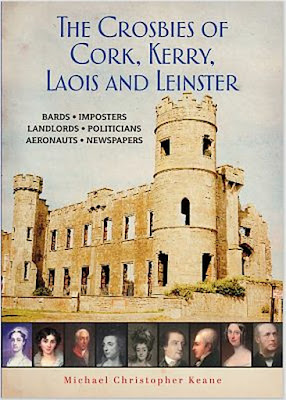
During my book-buying visit to Limerick earlier this week, one of the new books I bought is The Crosbies of Cork, Kerry, Laois and Leinster by Michael Christopher Keane, partly because the author has used two of my photographs to illustrate his book, and partly because this is a fascinating story for anyone interested in genealogy, family history and local history.

Chris Keane is from Tarbert, Co Kerry, and is a retired lecturer in University College Cork. He now lives in Farran, Ovens, Co Cork. This is his third book and has the inviting subtitle: ‘Bards, Imposters, Landlords, Politicians, Aeronauts, Newspapers’. It tells the story of a colourful family that achieved both fame and notoriety through the centuries.

The story begins with the MacCrossans, who were the hereditary bards and poets to Laois’s leading sept, the O’Moores of the Rock of Dunamase, and to the O’Connors of Offaly from ancient times. When Laois and Offaly were planted and renamed Queen’s County and King’s County in the 16th century, two young MacCrossan brothers from the Ballyfin and Clonenagh area, between Mountrath and Portlaoise, were fostered by Francis Cosby of Stradbally Hall, who moved to Ireland in 1546, and the neighbouring Bowen family.

The brothers tried to disguise their Gaelic Irish origins, changed their names to Patrick and John Crosbie and claimed to be descended from mid-ranking English gentry, the Crosbies of Great Crosbie, Lancashire. These changes are described by Chris Keane as a ‘deceit’ and he concludes they were ‘imposters within their own community.’ But the changes helped to advance the standing of the brothers in Elizabethan and Jacobean society. Patrick becoming a leading landlord in both Laois and Kerry, while his brother, John Crosbie, becoming the Church of Ireland Bishop of Ardfert (1601-1620).

Surprisingly, most of Bishop John Crosbie’s children were brought up as Roman Catholics. His descendants became major landlords in Co Kerry for the following three centuries. Their principal residence was Ardfert Abbey and the family accumulated an array of titles and peerages, including baronet (1630), Baron Brandon (1758), Viscount Crosbie of Ardfert (1771) and Earl of Glandore (1776).

When John Crosbie (1753-1815), 2nd Earl of Glandore, died in 1818, there as no immediate male heir to inherit his titles and estates. The Brandon title passed to his cousin, the Revd William Crosbie, Rector of Castleisland. When Lord Brandon realised his wife Elizabeth (La Touche) was having an affair with the Prime Minister, Lord Melbourne, even before the death of Melbourne’s wife, Lady Caroline Lamb, he first tried to blackmail Melbourne into making him a bishop, and then sued unsuccessfully for ‘criminal conversation.’

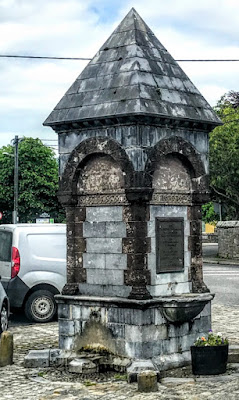
The Talbot-Crosbie Memorial Fountain in Ardfert … a photograph on p 186 in Chris Keane’s new book (Photograph: Patrick Comerford)

Meanwhile, Lord Glandore’s sister, Lady Anne Crosbie, had married John Talbot of Mount Talbot Co Roscommon, and the Ardfert estate passed to their son, the Revd John Talbot-Crosbie, who changed his name to Talbot-Crosbie. He married Jane Lloyd of Beechmount House, Rathkeale, Co Limerick, and they were the ancestors of the Talbot-Crosbie family of Ardfert Abbey.

Patrick Crosbie is best remembered for transplanting substantial numbers of the ‘Seven Septs of Laois’ to his large estate in Co Kerry, with many of these families settling in the Tarbert area, now within the Rathkeale and Kilnaughtin Group of Parishes. Before his death in 1610, he failed in his attempt to grab the estates of the FitzMaurice family of Lixnaw, Co Kerry, and of the FitzGerald family of Glin Castle, Co Limerick.

Sir Pierce Crosbie was both Cupholder and Gentleman of the King’s Bedchamber to two successive monarchs, King James I and King Charles I. He lost his estates and was jailed due to his implacable opposition to the Irish Lord Deputy Wentworth, only to regain them when Wentworth was executed for treason.

He was also closely associated with what is arguably the most notorious sex scandal in British history in which his stepson, the Earl of Castlehaven, was executed for sexual depravity. His remarkable career ended in supporting the Irish Catholic Confederacy in the 1640s.

The Laois Crosbies lost their estates, including Crosbie castle in Ballyfin, when they found themselves on the losing side in the Cromwellian wars. However, this branch of the family later re-established itself at Crosbie Park, near Baltinglass, Co Wicklow and in Co Carlow. A later generation acquired fame in their own different ways. Richard Crosbie of Wicklow, who became popularly known as ‘Mr Balloon,’ achieved fame as Ireland’s first aeronaut with his pioneering hot-air balloon flight in 1785. His brother, Sir Edward Crosbie, the fifth baronet, was executed as a suspected rebel leader in Carlow in the 1798 rebellion, and was denied a Christian burial.

Yet another well-known branch of the extended family includes the Cork Crosbies of the Examiner newspapers. These Crosbies originated with a young journalist Thomas Crosbie who left his home in Co Kerry to build a newspaper dynasty that extended over five generations from the mid-1800s until finally taken over by The Irish Times in 2017.

The stories of the Crosbies provide intriguing insights into the complex allegiances of a prominent Irish family through the centuries to the present time.

● The new book on the Crosbies is available in good local bookshops: Michael Christopher Keane, The Crosbies of Cork, Kerry, Laois and Leinster (2021, viii + 321 pp), ISBN: 9781527297418 €20.


13 May 2021

Kilteery Pier failed as
a Victorian enterprise
but is a visitors’ delight

Blue skies and clear waters on the Shannon Estuary at Kilteery Pier, near Foynes, Co Limerick (Photograph: Patrick Comerford, 2021)

Patrick Comerford

Earlier this week, I visited Kilteery Pier, one of the many small, 19th century piers on the shores of the Shannon Estuary. This pier is between Foynes and Glin, a little outside the village of Loghill. Although it is only 20 km west of Askeaton, and I have seen the signposts for it on many occasions, my visit on Sunday afternoon was my first since I moved to Askeaton over four years ago.

The pier at Kilteery is an L-plan limestone pier, built in 1841-1842. It has coursed rusticated limestone battered walls, and a supporting ramp at the east side. The tarmacked roadway has cut limestone flagstones forming a footpath and fluted cast-iron bollards around the edge. There are tapered limestone capstans, and concrete steps down to the sea at the west of the pier, with cut limestone steps at the east side.

The Shannon Commissioners, who took office in 1839, built a number of piers on the Shannon Estuary in places where local landowners were willing to contribute about half of the total cost.

A local landlord, John FitzGibbon (1792-1851), 2nd Earl of Clare, a former Governor of Bombay and later Lord Lieutenant of Limerick, paid £918 2s 6d to build a pier at Kilteery, said to be ‘favourably situated’ for shipping out agricultural produce.

Lord Clare was the closest friend of Lord Byron while they were at school at Harrow, and Byron had claimed to love him ‘ad infinitum’ and said that he could never hear the word ‘Clare’ without ‘a murmur of the heart.’

Lord Clare had recently been compensated by the Shannon Commissioners to the sum of 5 shillings for the compulsory purchase of the land and beach at Kilteery for building a new pier. Some years earlier, Lord Clare had donated £50 towards the building costs of a new church in Kilcolman, and also leased land in the townland of Knockboheen for building a schoolhouse.

The Shannon Commissioners reported in 1842 that building work on the pier at Kilteery began in May 1841. The stone came Foynes Quarry, providing the foundations and walls of the north and south faces. However, it was difficult to find suitable foundations with the budget, and the mole was shorter than planned.

The project was hampered by severe weather, frequent gales, and an unprecedented rainy season, the work would by this time have been nearly completed. The works have been carried on with energy. The foundations of the remaining portion, which was exposed to the sea, could only be laid at low water in extraordinary spring tides.

The pier at Kilteery was partly financed by the Earl of Clare (Photograph: Patrick Comerford, 2021)

At times, over 60 people were employed in the building work each day. The Shannon Commissioners reported in 1842 that the costs were £1490 12s 1½d in 1841. The pier was completed in mid-July 1842 at a further cost of £317 17s 0½d.

When the new pier was completed, it was inspected by Lord Clare, James Harvey and Charles Bingham, commander of the Garryowen steamer. It was reported at the time would open trade for ‘a vast tract of country’, including Athea, Abbeyfeale and Newcastle. Lord Clare also contributed to opening a road in this area to Abbeyfeale.

By December 1842, a person was employed to take charge of the pier and to collect fees for boats using the wharf and the quay. The Shannon Commissioners also built a parapet wall to protect people working on the pier and to preserve the roadway against strong westerly gales.

A stone near the pier looks like a benchmark stone, but is engraved with a vertical arrow and the initials ‘SC.’ There are similar stones with these marks at other piers at the Shannon Estuary developed by the Shannon Commissioners.

A stone near the pier is engraved with a vertical arrow and the initials ‘SC’ for the Shannon Commissioners (Photograph: Patrick Comerford, 2021)

Like many of these piers along the banks of the Shannon Estuary, the pier at Kilteery was designed so that boats could tie off the end and load or unload cargoes. But it was never designed as a harbour where boats would stay overnight or for even longer periods. The produce loaded there was carried directly to Kilrush or Limerick, both customs ports, and then transferred to seagoing vessels.

Within a few years, it was clear that Kilteery pier had not become an important point for exporting produce from the areas around Athea, Abbeyfeale and Newcastle, as Lord Clare had hoped. Perhaps the Famine added to these problems. But it was also noted in the 1840s that the pier was in the wrong place, ‘a little below Foynes,’ when Foynes and Glin were more appropriate sites for piers.

Lord Clare not only helped financially in building Kilteery pier, but also spent money on a new road when, it is said, the landlords in Glin and Askeaton had rejected the opportunity to have improvements on their land. On the other hand, the landlord of Foynes, Thomas Spring Rice (1790-1866), Lord Monteagle, who had first initiated the Shannon Commissioners, later spent money on providing facilities at Foynes, and this, in time, became the most important port on the Shannon estuary.

By the end of the 1840s, most of the cargo landed at Kilteery was manure, probably sea manure, sand and seaweed, while most of the cargo loaded at Kilteery was from the small coal pits near to the pier, and lime that was shipped to parts of south Co Clare as fertiliser.

The Board of Works took over most of the Shannon piers from the Shannon Commissioners in 1885, and responsibility for most of the estuary piers in Co Limerick later passed to Limerick County Council.

A signboard at the end of the pier commemorates the associations of Kilteery with Sean Finn, a West Limerick IRA activist, Mary Spring Rice of nearby Mount Trenchard House, and Mary Childers.

Finn was born Michael John Finn in 1897 in Rathkeale, where he joined the IRA in 1915. Mary Spring-Rice offered Finn the use of her yacht and a hiding place at Mount Trenchard. Finn kidnapped and smuggled the British General Cuthbert Lucas from Fermoy, Co Cork to the Shannon at Kilteery. While the British were searching for Lucas, Finn handed him over to the East Limerick IRA, and in process the general either escaped or was released in Pallaskenry on 30 July 1920.

Finn was shot dead nearby in Ballyhahill 100 years ago on 31 March 2021. Earlier this year, his grandson, Minister Niall Collins, laid a wreath on behalf of the family at Finn’s grave in Rathkeale.

The pier at Kilteery was built with high levels of technical skill and craft work, and it retains many of its original features, including limestone capstans, flagstones and kerbs. The pier has been repaired in recent years, and is a popular bathing spot. While some stones seem to have shifted significantly, the pier remains an interesting focal point on the coastline of the Shannon Estuary.

The pier at Kilteery has been repaired in recent years (Photograph: Patrick Comerford, 2021)

16 November 2020

Shanid Castle, a hill-top
ruin near Shanagolden, was
a Desmond stronghold

Shanid Castle, perched on a hilltop near Shanagolden, Co Limerick (Photograph: Patrick Comerford, 2020)

Patrick Comerford

The ruins of Shanid Castle, an important Anglo-Norman stronghold, are a short distance south of the village of Shanagolden on the Ardagh road in Co Limerick, 13 km north of Newcastle West. Two of us have often driven around this hill-top ruin, but we have never figured out how to gain access to this fine example of an Anglo-Norman fortress.

The famous war-cry and motto of the Earls of Desmond and the Knights of Glin was Shanid Aboo, ‘Long Live Shanid.’ It echoes a belief that Shanid Castle was the first and oldest Desmond castle.

The castle was occupied at times by both main branches of the FitzGerald family of Munster: the Earls of Desmond and the Knights of Glin.

Maurice FitzGerald was granted lands in Limerick by Richard de Clare (Strongbow) after the arrival of the Anglo-Normans. His son, Thomas FitzMaurice, inherited the lands of Shanid and is said to have built Shanid Castle in 1230. However, there are strong indications that the castle may have stood there before that date.

Thomas FitzMaurice was the ancestor of the FitzGeralds, the Earls of Desmond and this was to be the first stronghold of the Knights of Glin. These Desmond Geraldines would go on to build many castles but Shanid was reputedly the strongest.

Shanid Castle includes the shattered shell of a polygonal tower spectacularly clinging to the summit of a large earthen motte with surrounding fosse and bank.

The castle sits high on a hill with a motte some 35 ft deep. This impressive stronghold once had circular walls 10 ft thick. It is surrounded by more motte and bailey defensives, ditches and banks. It is likely that this series of mottes and ditches were present before the stone tower was added.

The tower is circular internally and only half survives to full parapet height. It was surrounded by a curtain wall around the summit of the earthwork. The remains on the south side still retain some of their battlements and loopholes. A small, kidney-shaped bailey on the east side has no sign of an enclosing wall.

The castle was briefly the chief seat of the Desmond Fitzgeralds, Earls of Desmond, and it was the first stronghold of the Knights of Glin.

The last Earl of Desmond was murdered in Kerry in 1584. The lands of the Desmond Geraldines were then divided up and parcelled out. The castle was captured by Hugh O’Donnell in 1601, but continued to be inhabited until 1641, when it was burned and dismantled during the 1641 rebellion.

The tower was remarkably complete until the end of the 19th century, although only the shell remains now. The tower is multi-sided outside and round inside, it had just one upper storey over a vaulted cellar.

All that survives of Shanid Castle today is the hill-top ruin. The castle and the lands around it were held by the Nolan family by the mid-1850s, and Shanid Castle is still owned by the Nolan family of Waterpark House.

All that survives of Shanid Castle today is the hill-top ruin (Photograph: Patrick Comerford, 2020)

The Limerick poet Gerald Griffin wrote the poem ‘Shanid Castle’:

On Shannon side the day is closing fair,
The kern sits musing by his shieling low,
And marks, beyond the lonely hills of Clare,
Blue, rimmed with gold, the clouds of sunset glow.

Hush in that sun the wide-spread waters flow,
Returning warm the day’s departing smile;
Along the sunny highland pacing slow
The keyriaght lingers with his herd the while.

And bells are tolling faint from far Saint Sinon’s isle.
O loved shore! with softest memories twined,
Sweet fall the summer on thy margin fair!
And peace come whispering, like a morning wind,
Dear thoughts of love to every bosom there!

The horrid wreck and driving storm forbear
Thy smiling strand, nor oft the accents swell
Along thy hills of grief or heart-wrung care;
But heaven look down upon each lowly dell, And bless thee for the joys I yet remember well!


21 July 2020

A sunny, summer Sunday
afternoon by the yachts
in the marina in Kilrush

Kilrush Marina on Sunday afternoon … home to the Royal Western Yacht Club of Ireland (Photograph: Patrick Comerford, 2020)

Patrick Comerford

I ought to be in Derbyshire this week, at the annual conference of the Anglican mission agency USPG (United Society Partners in the Gospel) in the Hayes Conference Centre at Swanwick.

But Covid-19 travel restrictions have led to the cancellation of the conference, and instead I spent much yesterday (20 July 2020) at a Zoom meeting of the trustees of USPG.

In normal circumstances, I might have expected to spend a day or two before or after the conference staying over in Lichfield, visiting Lichfield Cathedral and the chapel of Saint John’s Hospital, and perhaps also visiting Tamworth and Comberford.

But Sunday was an unexpectedly bright sunny, summer’s day, and not to be outdone, after two church services and a select vestry meeting, two of us decided to cross the Shannon estuary from Kerry to Clare, and take the ferry from Tarbert to Killimer … it was my first time on a boat of any type this year.

Coffee time on Sunday afternoon in the Vandeleur Walled Gardens at Kilrush (Photograph: Patrick Comerford, 2020)

We stopped first for coffee in Kilrush and a walk around the Vandeleur Walled Gardens, before continuing on the other end of the town, and spending some time at the Marina in Kilrush.

Kilrush is a beautiful, brightly-painted town in Co Clare, and we had what you might call our Sunday afternoon dose of ‘Vitamin Sea’ as we watched children splashing about, learning water skills, and small boats leaving for and returning from Scattery Island.

The marina at Kilrush is also home to the Royal Western Yacht Club of Ireland, a traditional yacht club nestled in the heart of the Wild Atlantic Way. The club was established almost two centuries ago, in 1827, and to this day it continues to run yacht and dinghy sailing and racing events, mainly on the waters of the Shannon Estuary.

The Water Club of the Cork Harbour was established around 1720 and drew up rules for membership. At first, the club was based on Haulbowline Island, organising fortnightly sailing excursions and dinner parties to coincide with the Spring tides. The club went into decline around 1765 but was re-established itself in 1806.

An early member of the Water Club was Colonel John Bateman Fitzgerald, Knight of Glin. When he built Glin Castle on the south shore of the Shannon Estuary, he had the yacht Farmer, a large 18-gun brig, built in 1780 so he could enjoy sailing and cruising along the west coast.

A number of new royal yacht clubs were formed in Cork in the 19th century. The Munster Model Yacht Club was founded in 1872 as a Corinthian or amateur yacht club and eventually became the Royal Munster Yacht Club, based in the clubhouse of the Cork Harbour Motor Yacht Club at Crosshaven.

The Royal Munster merged with the dormant Royal Cork Yacht Club of Cobh which claimed descent from the original Cork Water Club of 1720. The royal charter dates from 1831 and the club organises the world’s biggest regatta bi-annually.

Meanwhile on the Shannon Estuary, with the encouragement of the Knight of Glin, the number of commercial local sailing trading vessels was growing apace, with the establishment of towns and sea-going trade along the Shannon Estuary. Soon, during summer months, interested groups organised regattas at each small port for all the types of craft on the estuary. They included trading brigs, cutters, turf boats, hookers, canoes, canvas currachs and gondolas.

The Royal Western Yacht Club of Ireland was first formed in Kilrush on 6 February 1828. The committee included the Earl of Dunraven (president), George Courtney (commodore), and Stafford O’Brien (vice-commodore), and other committee members included Crofton M Vandeleur and Colonel John Vandeleur of Kilrush, Maurice and John O’Connell, sons of Daniel O’Connell, and the Knight of Glin.

In the Vandeleur Walled Gardens at Kilrush … the Vandeleur family was involved in the foundation of the Royal Western Yacht Club of Ireland in 1828 (Photograph: Patrick Comerford, 2020)

The club had 201 members in 1837 with 82 sailing vessels, although not all members or vessels were based on the Shannon Estuary. The members were drawn from the Shannon Estuary area, including Limerick, Kerry, Cork, Westport in Co Mayo, Galway, Dublin and other places.

The Lords of the Admiralty gave permission on 16 January 1832 for members of the Royal Western Yacht Club of Ireland to fly the a white ensign with a red cross, a crown in the centre surrounded by a wreath of shamrocks, and with the Union Flag at the head of the ensign.

The Royal Western held regattas at Galway, Sligo, Westport and Belfast, which encouraged the establishment of the Royal Northern Yacht Club, which later moved across to the Clyde.

The Royal Western’s considerable resources in the mid-1850s included a club house at 113 Grafton Street, Dublin, and a floating club house based in Kingstown (Dun Laoghaire) Harbour.

The Admiralty withdrew the right to fly the defaced white ensign in 1858, putting into force an earlier decision that only naval vessels and members of the Royal Yacht Squadron could fly the white.

The move led to petitions to the admiralty and was raised in Parliament by Irish MPs. A lengthy dispute ensued, but by the beginning of the 1860s the Royal Western Yacht Club had faded away and no order was ever received by the club withdrawing its right to fly the white ensign, and no Act of Parliament has taken away this right.

The Dublin members of the Royal Western had run successful regattas in Dublin in 1854 and 1856. With the decline of the Royal Western, the members reformed as the Kingstown Model Yacht Club in 1857, later the Prince Alfred Yacht Club (1864) and later the Royal Alfred Yacht Club (1870), which claims – through these Royal Western links – it is the oldest amateur yacht racing organisation in the world.

Meanwhile, down in Cobh (Queenstown), the remaining Royal Western members there obtained an Admiralty Warrant in 1862 to fly the Blue Ensign under the title Royal Western Yacht Club of Ireland, based at the Queenstown Yacht Club which had been formed in 1860 but was disbanded and replaced by its new title and distinctions.

A year later, the new Royal Western obtained the Queen’s Cup for yacht racing from Queen Victoria and all the Cork yacht clubs were later amalgamated into the present Royal Cork.

Back on the Shannon Estuary, sailing was being revived slowly, with Tarbert in Co Kerry as the main base. The club was re-established in Kilrush as the Western Yacht Club in 1984, through the efforts of Brendan McMahon, Hugh McKiernan, Dan Beazley, Fintan Keating, Paudie Eustace, Richard Glynn, Gerald Griffin and others.

When Kilrush Marina was built by Shannon Development in 1991 to provide the infrastructure for developing yachting on the west coast and maritime-based tourism. The new development provided secure walk-on, walk-off mooring facilities and the club grew and increased its membership, becoming an active club in the traditions of the Royal Western of Ireland.

The crown on the Royal Western flags today is that of the Prince of Wales and not the monarch’s crown with orbs and crosses symbolising empire and faith. Today, the club is located at Kilrush Marina, a 120-berth marina that has excellent facilities just a five-minute walk from the centre of Kilrush.

Kilrush Marina is just a five-minute walk from the centre of the colourful Co Clare town (Photograph: Patrick Comerford, 2020)

22 February 2020

How one man managed
to cross the Shannon
Estuary on a bicycle

Tom Mangan cycled across the Shannon Estuary from the pier at Glin, Co Limerick, in July 1902 (Photograph: Patrick Comerford)

Patrick Comerford

The rains that have been brought in by the latest storms seem unremitting in the past few days. At times, they have turned to hail and sleet, and sometimes it even takes careful planning and timing to know when to venture down to the local supermarket to buy the daily newspapers.

Standing by the banks of the Shannon Estuary, watching the swells on the water, feeling the strong winds and watching the grey clouds mass overhead, it is hard to imagine how anyone could take out onto the river in a small vessel.

So, I was surprised earlier this week to hear the story of one man who not only tried to, but also succeeded in peddling across the Shannon Estuary from Glin in Co Limerick to Labasheeda in Co Clare, and cycled back again the same day.

Tom Mangan was a resourceful man who was born in Cahera in 1871 and who lived in Glin all his life. At a time of hardship in Ireland, he had the good fortune to work as a clerk with the Shannon Steamship Company which collected and distributed goods all along the Shannon Estuary from Limerick to Kilrush, serving the ports along the way, including Glin.

During the course of his work, Tom Mangan saved a man from drowning at Glin Pier after he had fallen between a boat and the pier.

Tom set out to build a pedal boat. He put his cycle, whose frame he had built himself, on two flat boards like a raft, one under each wheel.

A crack in the boards formed a crevice that allowed the wheels to touch the water.

After a trial run, he set off on a warm sunny Sunday afternoon in July 1902, watched by a crowd on Glin Pier. People lit bonfires to alert the village of Labasheeda of his expected arrival.

Despite the bonfires and the warnings, Tom Mangan caused a huge stir and furore in Labasheeda and the local RIC sergeant sent to Killaloe for reinforcements, before people realised this was not some demon or monster coming over the water but a man.

When he staggered ashore, a crowd of people cheered and a bottle of brandy was pressed to his lips.

The local sergeant thought of arresting him for public disorder, but he cycled back to Glin again later that day.

The day was recalled 70 years later by John B Keane, a regular visitor to Glin, in his column in the Limerick Leader on 14 August 1971.

Inspired by John B Keane, a local man, Kevin Reidy, designed yet another specially adapted bicycle-boat and the late Bill Culhane volunteered to cycle it an re-enact Tom Mangan’s feat.

Local people in Glin used Kevin Reidy’s replica in a charity fundraiser in the 1980s, pushing it from Dublin for display at Shannon Airport.

In this weather, I think I’d prefer to cross the Shannon on the ferry between Tarbert and Killimer. It beats paddling your own canoe, or peddling your own bicycle.

It is safer and wiser to cross the Shannon on the ferry between Tarbert and Killimer (Photograph: Patrick Comerford)

06 February 2020

A 200-year-old church
in Loughill, Co Limerick,
with a tower and shrine

The Tower of Church of the Assumption in Loughill, Co Limerick (Photograph: Patrick Comerford, 2020)

Patrick Comerford

The village of Loughill is between Foynes and Glin on the N69 route from Limerick to Tralee. The name comes from the Irish Leamh Choill, ‘the elm wood.’

The Owvaun or White River, a popular fishing river, meets the Shannon Estuary at Loughill.

Loughill’s development dates from the 12th century. In the past, there were ironworks in Loughill where the large supply of timber in the area was converted into charcoal for smelting iron ore. The village has seen modest housing development in the past 10 years and has a public house and a community centre.

Loughill was part of the Roman Catholic parish of Glin until Father Daniel McCoy, parish priest of Glin, died in 1855 when it became a separate parish.

Ballyhahill was part of the parish of Shanagolden and Kilmoylan in 1855, but when Father Mortimer Collins, parish priest of Shanagolden and Kilmoylan, died in 1857, Ballyhahill and Loughill were joined to form the present-day parish.

There are two churches in the Roman Catholic parish today, one at Loughill, the other at Ballyhahill.

Inside the Church of the Assumption in Loughill (Photograph: Patrick Comerford, 2020)

The church in Loughill stands on an elevated site facing the man road. It was built in 1819 and is dedicated to the Blessed Virgin Mary. It is not clear whether William MacEnery or Daniel O’Sullivan was the parish priest when the church was built.

The church was rebuilt in the early 1960s, to designs by Patrick Sheehan. It has a nave, chancel and two transepts, with a shrine to Our Lady of the Wayside in the stone tower at the end of the nave.

A plaque in the porch recalls the church was blessed and rededicated as the Church of the Assumption by Bishop Murphy DD, and James O’Byrne, PP, on 12 February 1961, just over a decade after Pope Pius XII had proclaimed the Assumption as a dogma invoking papal infallibility.

The shrine and tower conceal the main entrance to the church (Photograph: Patrick Comerford, 2020)

The shrine and stone tower conceal the main entrance to the church on the left, accessed by steep steps.

The altar was donated by the O’Shaughnessy family of Jointer, Loughill. The base of the altar was donated by exiles from the parish in the US and England. The altar rails were donated by exiles of the parish in New York.

Thomas Fitzgerald of Loughill House, donated the crucifix behind the altar. The confessional box was donated by the McNamara family of the US and Knocknaboula.

Symbols of the Four Evangelists in the stucco plaster work in the ceiling at the crossing (Photograph: Patrick Comerford, 2020)

There are symbols of the Four Evangelists in the stucco plaster work in the ceiling in front of the chancel.

Two former parish priests are buried within the church: Bernard McMahon, who died in 1847, and Daniel McCoy, who died in 1855. A third former parish priest, James Byrne, who died in 1967, is buried in the church grounds.

The shrine to ‘Our Lady of the Wayside’ is in memory of Father James O’Byrne PP and his sisters.

Inside the Church of the Assumption, looking towards the tower and gallery (Photograph: Patrick Comerford, 2020)

According to the local historian Westropp, there was an early church in Loughill before the present parish church was built in 1819. This church was dedicated to Saint Colmog, a hermit who had a little church in the area. It was said a holy well nearby could cure eye ailments.

However, only small fragments of the church remained when Westropp carried out his survey of the churches in Limerick in 1905.

The church in Loughill was built on an elevated site in 1819 (Photograph: Patrick Comerford, 2020)

26 November 2018

Finding the Precentor’s
link with Ballycahane
and the strange story
of the Colleen Bawn

Ballycahane Church, near Croom, Co Limerick, seen from the south-east (Photograph: Patrick Comerford, 2018)

Patrick Comerford

Two new canons were installed in Saint Mary’s Cathedral, Limerick, yesterday [25 November 2018]: Canon Liz Beasley of Adare and Kilmallock becomes the new Chancellor, and Canon Jim Stephens of Tralee is the new Prebendary of Saint Munchin and Tulloh.

The chapter is a united chapter for the three cathedrals in the diocese – Saint Mary’s, Limerick, Saint Flannan’s, Killaloe, Co Clare, and Saint Brendan’s, Clonfert, Co Galway.

I was reminded recently of the legislation introduced in the General Synod by Dean Maurice Sirr of Limerick and Dean Ernon Perdue of Killaloe in 1987 that united the cathedral chapters and that set out the full complement of chapter members:

The Dean of Limerick, who is also Dean of Ardfert and Prebendary of Tomgraney;

The Dean of Killaloe and Clonfert, who is also the Prebendary of Kilpeacon;

The Precentor, who is also the Prebendary of Ballycahane;

The Chancellor;

The Treasurer, who is also the Archdeacon of Ardfert and Prebendary of Killeedy and Prebendary of Dysart;

The Archdeacon of Limerick, who is also the Prebendary of Effin, Croagh, Ardcanny and Clondegad;

The Archdeacon of Killaloe and Clonfert, who is also the Prebendary of Tullybrackey;

The Prebendary of Saint Munchin’s, who is also the Prebendary of Tulloh;

The Prebendary of Inniscattery, who is also the Prebendary of Donaghmore and of Kilconnell;

The Prebendary of Athnett, ‘who shall always be the Bishop for the time being of the united dioceses.’

The seals of the Deans and Chapters of the cathedrals in Limerick and Killaloe (Photograph: Patrick Comerford, 2018)

In the past, the Prebendary of Ballcahane was obliged to preach in Saint Mary’s Cathedral, Limerick, on the Sixth Sunday after the Epiphany, and the Precentor on the Feast of Saint Bartholomew, the Feast of Saint Andrew the Apostle, and the Second Sunday in Lent.

The Prebendaries of Ballycahane in the past have included William Mansell, who held office for 50 years (1754-1804) as well as being Treasurer of Ardfert and corresponded with George Washington, and John Cousins, a former Roman Catholic priest who was educated at Maynooth and who was the Prebendary of Ballycahane in 1816-1833.

Until I was reminded of this legislation in general synod, I had not realised that by virtue of being the Precentor I am also the Prebendary of Ballycahane. So, one afternoon last week, on my way from the school in Rathkeale to Dublin, I went in search of Ballycahane, and the church were the rectors in the past had been my predecessors in this title in the cathedral chapter.

The south side of Ballycahane Church, Co Limerick, built in 1823 (Photograph: Patrick Comerford, 2018)

Ballycahane is a parish in the baronies of Small County and Pubblebrien in Co Limerick, about 5 km miles from Croom, off the road between Limerick and Charleville and close to the banks of the River Maigue.

Local historic houses in the area have included Maryville, once the home of the Finch family, Fort Elizabeth, home of the Revd John Croker (1787-1839), Rector of Croom in the early 19th century, and Ballycahane House, home of a Captain Scanlon in the 1830s.

Samuel Lewis mentioned in the 1830s that the Rector of Ballycahane was also the Prebendary of Ballycahane in Saint Mary’s Cathedral, Limerick. The office and parish were in the patronage of the Bishop of the Limerick, and the tithes totalled £166.3.0.

The church was a large building, in the early English style, with a tower, built in 1823 by the assistance of a loan from the late Board of First Fruits. Although the glebe was five acres of ‘excellent land,’ there was no glebe house.

The boys’ and girls’ schools in the parish were supported by subscriptions from the rector, curate, and the Finch family of Fort Elizabeth, who domated the land on which the school was built.

Not far from the church are the ruins of the ancient castle of Ballycahane, built by the O’Grady family in 1496, and many ancient silver and copper coins were found nearby. Near Tory Hill are the remains of a church that once belonged to the Knights Templars, and later to the abbey of Nenagh.

Looking out into the churchyard at Ballycahane Church, Co Limerick (Photograph: Patrick Comerford, 2018)

The church, now in a ruined state and without a roof, was built in 1823. It has three-bay nave elevations, a three-stage square-plan entrance tower and projecting rooms on the north and south sides of the tower.

One site describes them as a ‘side chapels,’ but undoubtedly they were a vestry and a Sunday school room, similar to the function of rooms like these flanking the tower in Castletown Church, near Pallaskenry, Co Limerick, down to the position of the fireplace in the vestry.

Inside Ballycahane Church, Co Limerick (Photograph: Patrick Comerford, 2018)

The tower has three corner pinnacles, with a fourth missing, and stepped crenellations, with a cut limestone stringcourse beneath. The tower has snecked limestone walls with cut and tooled limestone quoins. There is a plaque above the door with a cut limestone stringcourse on the tower and incised crosses on the gables of the side chapels.

The pointed arch openings on the south nave wall and the east elevation have hood-mouldings with limestone block-and-start surrounds. There are no window openings on the north wall, a common feature in many Church of Ireland parish churches at the time as it protected the buildings and the congregations against the cold blasts of north winds.

The church tower and west end of Ballycahane Church, Co Limerick, built in 1823 (Photograph: Patrick Comerford, 2018)

The paired pointed arch openings on the second floor of the tower have cut limestone block-and-start surrounds. The pointed arch door opening on the ground floor of the tower have label moulding and stops.

The surrounding churchyard has gravestones, a rubble limestone wall and a wrought-iron gate flanked by cut limestone piers.

Although this church is now in a state of ruin, it still shows many signs of high-quality craftsmanship. This can be seen in the cut limestone finishes to the door and window surrounds, the finishes to the tower, with its stringcourses and corner pinnacles.

Although the name of the architect is unknown, the shape of the main door and the rooms flanking the tower and other similarities with Castletown Church, indicate this may be the work of James Pain.

The fireplace in the former vestry in Ballycahane Church, Co Limerick (Photograph: Patrick Comerford, 2018)

The earliest church in Ballycahane, as well as its lands, became part of the estate and abbey lands of Monasteranenagh Cistercian Abbey in Manister, but no trace of this church remains.

The extensive ruins of Monasteranenagh Abbey include a church, dating from about 1170 to 1220, an early Gothic chapter house and the abbey guesthouse.

The abbey was founded in 1148 by Turlough O’Brien, King of Munster, for Cistercian monks and was dedicated to the Blessed Virgin Mary. Manister was a daughter house of Mellifont Abbey in C. Louth and Manister had daughter houses in Abbeydorney (1154), Middleton (1180) and Holy Cross (1181).

In 1228, the Irish monks with the help of the O’Briens, the Kings of Thomond, drove out the abbot and the non-Irish monks, who were mainly of Norman descent. They were excommunicated for revolting against their ecclesiastical superiors. Using armed force Hubert de Burgo, Bishop of Limerick, recaptured the abbey, and reinstalled the monks who had been driven out.

Gerald FitzGerald, Earl of Desmond, was visiting the Abbot of Manister in 1307 when he was captured by O’Brien of Thomond. Later the 14th century, Manister is said to have had up to 1,500 monks. In the 15th century, there were three chapels in each arm of the transept.

Although the monastery at Manister was dissolved in 1540, the monks were left in possession of the abbey.

During the Desmond Wars, Spanish and Irish soldiers took shelter in Monasternenagh in 1579, and the abbot helped them in the battle in which they were defeated by Sir William Malby. The Earl of Desmond watched the battle from Tory Hill nearby. After his victory, Malby burned the abbey. However, the monastery was not destroyed until 1585, when it became the property of Sir Henry Wallop, who plundered and robbed it of all its valuables before destroying the monastery.

Looking out the tower door of Ballycahane Church into the churchyard (Photograph: Patrick Comerford, 2018)

Ballycahane Castle is the ancestral home of John Scanlan, the murderer of the Colleen Bawn, Ellie Hanley, a beautiful young peasant girl.

Ellie Hanley was from Ballingarry, Co Limerick. Her mother died when she was six, and she was raised by an uncle in Ballycahane. John Scanlan, who was in his 20s, came from a family of high social standing. He had been a lieutenant in the Royal Marines and was known as a playboy.

Ellie was not yet 16 when the two eloped and moved to Glin in West Limerick. Scanlan employed a local woman, Nelly Walsh, as a part-time housekeeper and companion for Ellie, while Stephen Sullivan was his servant and boatman.

Ellie was missing for several weeks, when Nelly approached the Knight of Glin, a local magistrate, in the late autumn of 1819. Ellen had last seen Ellie two months before with Scanlan and Sullivan in a boat leaving from Glin. While Ellen was talking to the Knight of Glin, two policemen arrived and told him a body had been washed ashore across the Shannon at Moneypoint, Co Clare. The body was too badly decomposed to be identified, but the Coroner’s Court recorded a verdict of wilful murder against Scanlan and Sullivan.

The two men went into hiding, but Scanlan was captured and tried in March 1820. The trial was a sensation. Scanlan was defended by Daniel O’Connell, one of the leading barristers of the day, but was found guilty and sentenced to hang.

Scanlan was being taken by carriage to Gallows Green on the Clare side of the river on 16 March 1820 when the horses stopped, refusing to continue. Finally, Scanlan was made to walk to his place of execution, where he was hanged before he had time for an appeal.

Sullivan was arrested later and confessed that he had taken Ellie in his boat onto the Shannon from Glin and murdered her on 14 July at the behest of Scanlan, who had plied him with liquor in the town to nerve his arm. Sullivan was hanged too.

The Colleen Bawn, Ellie Hanley, is buried in Burrane cemetery, near Kilrush, Co Clare. John Scanlan from Ballycahane Castle is buried in Crecora Cemetery.

The Prebendary of Ballycahane at the Precentor’s Stall in Saint Mary’s Cathedral, Limerick (Photograph: Patrick Comerford, 2018)

26 October 2018

Finding three Irish governors at
an English outpost in Tangier

The former Portuguese and English walls at Tangier … the short-lived English colony had three Irish governors in the 17th century (Photograph: Patrick Comerford, 2018)

Patrick Comerford

I crossed the Strait of Gibraltar by fast ferry yesterday [25 October 2018] and sailed to Tangier, on a day trip from Seville, to explore the Medina and to visit the caves where god Hercules is said to have slept. It was an opportunity to discover a unique blend of European and African cultures and taste the delicious food.

Tangier once had three Irish Governors in the 17th century when it was an English colony for less than quarter of a century between 1661 and 1684.

King Charles II acquired the city as part of the dowry when he married the Portuguese princess Catherine of Braganza. The marriage treaty was an extensive renewal of the alliance between England and Portugal. It was opposed by Spain, then at war with Portugal, but received clandestine support from France.

England garrisoned and fortified the city against hostile but disunited Moroccan forces.

The first Irishman to act as governor of Tangier was Colonel Sir John FitzGerald, who was lieutenant governor from 7 June 1664 to April 1665, He was the son of Gerald FitzGerald, of Ballygleaghan, Co Limerick. He was descended from a branch of the FitzGerald family of Glin Castle, Co Limerick, who were Knights of Glin.

This John Fitzgerald was a colonel in the Irish Regiment of Tangier in 1663, although he was a Roman Catholic. Later, he held the office of Governor of Yarmouth in 1672, and he died in 1678 at Nonsuch Park, Surrey. He had no children, but perhaps if he had descendants the title of Knight of Glin would not have died out in recent years.

Abandoned British military equipment at the walls in Tangier … the city was an international zone from 1924 to 1956 (Photograph: Patrick Comerford, 2018)

The second Irish Governor of Tangier was William O’Brien, 2nd Earl of Inchiquin, who was Governor from 1675 to 1680. He was appointed Governor in succession to the Earl of Middleton in 1675, and that year a garrison school was founded, led by the Rev. Dr George Mercer.

He had succeeded his father as Earl of Inchiquin in 1674, and was Captain General of the Forces at Tangier from 1674 to 1680 and Colonel of the 2nd Tangier Regiment of Foot from 1675 to 1680. He commanded the Tangier Garrison at the time of the Great Siege of Tangier in 1680.

Later, he was the first Governor of Jamaica and Vice-Admiral of the Caribbean Seas from 1690 to 1692. He died in Jamaica in 1692 and his Irish estate and titles were inherited by his son, William O’Brien.

When Lord Inchiquin resigned as Governor of Tangier in 1680, he was replaced by a third Irish governor, Thomas Butler (1634-1680), Earl of Ossory. He was born at Kilkenny Castle, the eldest son of James Butler, 1st Duke of Ormond, and his wife Lady Elizabeth Preston.

However, Lord Osssory died on 30 July 1680 before he could take up his post in Tangiers. His son, James Butler, succeeded as the 2nd Duke of Ormond eight years later in 1688.

Meanwhile, the cost of maintaining the English garrison against Moroccan attack greatly increased after Morocco was united under the Alaouites. Parliament refused to provide funds for its upkeep, partly due to fears of ‘Popery’ and fears arising from the imminent of a Catholic succession of James II.

In 1684, Parliament forced Charles II to give up his possession on the north African coast. The English forces blew up their defences and evacuated the city, which later became part of Morocco.

The British military presence in this part of North Africa returned briefly in the 20th century. The Tangier International Zone was a 373 sq km international zone under the joint administration of Britain France, and Spain, and later Portugal, Italy, Belgium, the Netherlands, Sweden and the US from 1924 until its reintegration into independent Morocco in 1956.

The entrance to Glin Castle, Co Limerick … there is a remote, and very thin, connection with the Irish-born Governors of Tangier in the 17th century (Photograph: Patrick Comerford, 2018)

14 October 2017

The Revd Sir William Augustus
Wolseley (1865-1950), an
exceptional curate in
Kilnaughtin and Aughavallin

The Rectory, Tarbert … was this the home of the Revd William Augustus Wolseley while he was the curate in Kilnaughtin parish? (Photograph: Patrick Comerford, 2017)

Patrick Comerford

Tarbert Historical and Heritage Society,

7.30 p.m., 14 October 2017,

The Bridewell, Tarbert, Co Kerry

Introduction and context


I am sure I am like many of my colleagues who come to a new parish and wonder who our predecessors are. Since early this year [20 January 2017], I have been the priest-in-charge of the Rathkeale and Kilnaughtin Group of Parishes, and soon after was made Canon Precentor of the three cathedrals in these dioceses.

In some ways I feel blessed that I know or have known so many of my predecessors. But, because of the amalgamation of parishes over the years, and the closure of many churches in North Kerry and West Limerick, I am never going to truly find out who all my predecessors were.

I imagine many of them prayerful and faithful priests and men of prayer. But some of them were mere careerists and pluralists, some were mad or bad … or both. It is interesting to learn about my predecessors in these parishes, and one of the most eccentric of them was a former curate in Kilnaughtin and Glin, the Revd Sir William Augustus Wolseley (1865-1950).

The Wolseley Arms … near the former seat of the Wolseley family near Rugeley, Staffordshire (Photograph: fatbadgers)

My delight at finding him here over a century ago is partly due to a long-term interest in the history of the Wolseley family. Wolseley is in mid-Staffordshire, between Stafford and Rugeley, north of Lichfield. The coats-of-arms of the Comberford and Wolseley families are inverted reflections of each other, and the families were related by marriage in the 16th century.

Wolseley and Comberford are about 20 miles apart, and one of my earliest contracts as a freelance journalist was to interview Sir Charles Wolseley of Wolseley for the Lichfield Mercury and the Rugeley Mercury in the early 1970s.

We have been in touch again in recent years, and then during a family wedding at the end of last year, I spent a weekend at Mount Wolseley, the ancestral home of Sir William and some other intriguing and eccentric Wolseley baronets.

Mount Wolseley House near Tullow, Co Carlow … home to generations of the Wolseley family and sold in 1925 for £4,500 (Photograph: Patrick Comerford)

I think this evening you are going to enjoy some of my stories of these eccentric Wolseleys, including Sir William’s immediate predecessor, Sir Dick Wolseley (1872-1933), the tenth baronet, who was his first cousin once removed and who worked as an elevator operator or ‘lift boy,’ and Sir William’s immediate successor, Sir Garnet Wolseley (1915-1991), the twelfth baronet, who was his second cousin once removed and who was a cobbler, born into poverty on Merseyside.

The Wolseley family in Ireland

Wolseley Family Tree (Table I, Patrick Comerford)

The first of the Wolseley family to come to Ireland was William Wolseley from Wolseley in mid-Staffordshire. He fought alongside King William III at the Battle of the Boyne.

William Wolseley died unmarried. His nephew Captain Richard Wolseley (died 1724), was a younger son in the Wolseley family, and bought the 2,500-acre estate of Mount Arran from Charles Butler, Earl of Arran, renaming it Mount Wolseley, which is on the outskirts of Tullow, Co Carlow. He was the father of both Sir William Wolseley, who inherited as the fifth baronet of Wolseley, Staffordshire, and his younger brother, Sir Richard Wolseley, MP for Carlow (1696-1769), inherited Mount Wolseley and became an Irish baronet.

So, Sir Richard Wolseley was the ancestor of the Revd Sir William Wolseley of Tarbert. The Irish baronets were heirs to the English family title, while the present English line, represented by Sir Charles Wolseley (born 1944), the 11th baronet, is descended from the Irish branch of the family, and the Irish branch of the family is in the line of succession to the English title.

The family tree is often very difficult to trace, names are often inherited making it difficult to tell cousins apart, and the Irish title regularly passes to distant cousins time and again, complicating the line of succession.

Frederick York Wolseley … gave the Wolseley name to one of Britain’s most famous car marques

Probably the most famous of all the Wolseley family members was Frederick York Wolseley, who in 1895 started producing one of Britain’s most famous car marques – the Wolseley. The name dominated the British motor industry for eight decades until 1975, when the last car with the Wolseley name was produced.

The memorial to Field Marshal Viscount Wolseley in Saint Patrick’s Cathedral, Dublin (Photograph: Patrick Comerford)

His brother, Field Marshal Viscount Wolseley, was one of Britain’s most important military leaders. He was born in Goldenbridge, near Inchicore, Dublin, and in retirement lived in the Royal Hospital, Kilmainham. He is commemorated in a very decorative monument in Saint Patrick’s Cathedral, Dublin.

William Augustus Wolseley’s career

Dean Robert Beatty’s grave in the former Saint Paul’s churchyard in Glin, Co Limerick (Photograph: Patrick Comerford, 2017)

The Revd William Augustus Wolseley was the curate in Kilnaughtin with Aughavallin for almost two decades, from 1888 until he moved to Australia in 1906. While Wolseley was the curate here, Dean Robert Beatty (1833-1921) was the Rector of Kilnaughtin (1878-1921), and from 1891 appears to have lived in Glin.

Dean Beatty was related to Admiral Beatty of World War I fame. He was the Rector of Kilnaughtin with Aughavallin from 1878 and Kilfergus (Glin) was joined to his parish in 1891. A senior priest in the diocese, Beatty was successively Canon Treasurer (1903-1905), Canon Chancellor (1905-1911) and Dean of Ardfert (1911-1917). He lived at Carnaville, Glin, with his sisters Rebecca and Louisa, and never married. When he died on 7 February 1921 at the age of 88, he was buried in the churchyard at Saint Paul’s Church, Glin, where his headstone says he was ‘40 years Rector of Kilnaughtin Parish.’

So, we know a lot about Dean Beatty. But neither the standard reference books nor the popular accounts of the unusual circumstances of William Wolseley’s life give much attention to the almost two decades he spent in these Church of Ireland parishes in Tarbert and Ballylongford.

William was born on 19 April 1865, the only son of Charles Wolseley (1809-1889) and a grandson of the Revd William Wolseley, Rector of Dunaghy (1831-1846), Co Antrim, in the Diocese of Connor. He was descended through an obscure branch of the family from the first baronet, Sir Richard Wolseley, and Charles Wolseley could never have expected that his only son was going to become the heir to this family title.

This was a strongly clerical branch of the Wolseley family, and the young William had two uncles who were priests, including the Ven Cadwallader Wolseley, who was Archdeacon of Glendalough, a canon of Saint Patrick’s Cathedral, Dublin, and Rector of Saint Andrew’s, Dublin.

So the young William was probably thinking of ordination from an early age, without any thoughts of a title or celebrity.

Saint Brendan’s Church, Kilnaughtin, where William Wolseley was curate for 18 years (Photograph: Patrick Comerford, 2017)

William Augustus Wolseley was educated in Rathmines at a then-famous school run by the Revd Dr Charles William Benson and at Trinity College Dublin, where he graduated BA in 1887. He was awarded the Wall Biblical Scholarship in 1888, and earned a first class Theological Exhibition in 1889 that entitled him to the Divinity Testimonium, then the basic qualification from TCD for ordination in the Church of Ireland.

Within a year, he was ordained deacon in 1888 by the Archbishop of Dublin, Lord Plunket, on behalf of the Bishop of Limerick, and he was appointed curate of the parish of Kilnaughtin with Aughavallin in the Diocese of Ardfert and Aghadoe. In 1889, he was ordained priest by Charles Graves, the Bishop of Limerick, Ardfert and Aghadoe.

William Wolseley remained a curate in this parish for 18 years until 1906. During his time in this parish, he supplemented his income as a tutor to the Hewetson family, and his name appears only once in the parish baptismal records in Kilnaughtin.

He may have spent most of his time in Hewetson family household. But what brought Wolseley to this part of Ireland and to this diocese?

He was a second cousin of the Ven William Hulbert Wolseley (1821-1899), then Vicar of Kilrush, Co Clare (1862-1899) and Archdeacon of Kilfenora (1885-1899), and also, briefly, one of my predecessors in so far as he too was the Precentor of Killaloe (1857-1859).

But this connection was too remote to explain how William Wolseley came to this parish: at the time, Kilrush was less accessible from Tarbert than it is today, and the Dioceses of Limerick and Ardfert were not united with the Diocese of Killaloe until 1976, almost a century later.

William Wolseley remained a curate in this parish for 18 years before moving to West Australia in 1906. In Australia, Wolseley was the Rector of Ravensthorpe, West Australia (1906-1910), and then worked in Denmark, West Australia (1910-1920). He returned to England in 1920 to work in parishes in the Diocese of Durham and the Diocese of Newcastle. He was the Senior Curate of Christ Church, Felling (1921-1923), and Curate of Saint James, Burnopfield (1923-1927).

So, he had been ordained for almost 40 years and was in his early 60s when he was still working as a curate in a small rural parish in the north of England. Not where an aspiring priest might have expected to be at that stage in his life, considering he came from a titled family with many senior clerics among his close relatives and a senior, distinguished general who was his second cousin.

What did he do for the next five years, between 1927 and 1932? I am not sure what he was doing, but during that time he had the bishop’s permission to officiate in the Diocese of Durham.

He was the Vicar of Alnham in rural Northumberland from 1932. That year, at the age of 67, he married Sarah Helen Grummitt, daughter of William Cotton Grummitt of Grantham, Lincolnshire, on 16 June 1932. A year later, in 1933, he inherited the Wolseley title in the most unexpected way from his very distant cousin.

The story is told in the parish of Alnham that the news came one day by post so that nobody but the Wolseleys knew about it. That morning, the butcher from Rothbury arrived in the village in his van and knocked on the vicarage door, calling: ‘Butcher Mrs Wolseley.’ There was no reply, so he tried again: ‘Butcher Mrs Wolseley.’ This time the response was: ‘Lady Wolseley if you please.’

Australian newspapers that reported his inheritance described him as ‘a rather eccentric clergyman, notorious wherever he went for the prodigious rate at which he preached.’ I am not sure yet whether this means that he preached too quickly, far too often, or that he preached for far too long … I am still hoping to find out in the parish records.

The 11th baronet retired from parish ministry in 1942. He was then in his late 70s, and he died at the age of 84 on 19 February 1950. He had no children and the title passed to yet another distant cousin, a cobbler living in a four-room flat in Bromborough, Cheshire.

Inheriting the title

The Wolseley Family Tree (Table II, Patrick Comerford, 2017)

William Augustus Wolseley has direct connections with two extraordinary people as the immediate successor and the immediate predecessor, successively, of the ‘elevator baronet’ and the ‘cobbler baronet,’ all three inheriting a family title through a bewildering set of circumstances in an entangled family tree.

When Sir John Richard Wolseley (1834-1874), 6th Baronet, died aged 40, he was succeeded in the title by his brother Sir Clement James Wolseley (1837-1889), probably the last of the family to live at Mount Wolseley. The estate was sold for £4,500 in 1925 by Sir John’s daughters to the Patrician Brothers, who were founded in Tullow in 1808 by Bishop Daniel Delaney.

Meanwhile, the title of baronet in the Irish branch of the Wolseley family began to pass out in an ever-widening circle of distant cousins, and even the printed and online versions of the family tree are confusing and show many inconsistencies.

The eighth baronet, the Very Revd Dr Sir John Wolseley (1803-1890), was the Dean of Kildare (1859-1890) when he inherited the title on 16 October 1889. He only held the title for three months, and died on 26 January 1890. In all, seven successive holders of the title have died without immediate, direct heirs.

Sir Dick Wolseley, the ‘elevator baronet’ (Source: WP:NFCC#4)

The tenth baronet, Sir Reginald Beatty Wolseley (1872-1933), known as Dick Wolseley, was the son of a Dublin doctor, Dr Cadwalader Brooke Wolseley (1845-1884). He was born in Dunfanaghy, Co Donegal, and was probably less aware of the Wolseley title than the fact that he was a cousin of Admiral Beatty.

He inherited the family title when his cousin died in 1923, but he never used this title. Instead, he sought anonymity in self-imposed exile, working as an ‘elevator boy’ at the Black Hawk Bank Buildings in Waterloo, Iowa, for 18 years and living as plain Dick Wolseley.

That is, until his secret came out in May 1930. His mother’s dying wish was to visit her son who had become Sir Reginald Wolseley. She persuaded him to return to England. A day after her arrival in Iowa, Dick married his mother’s nurse, Marian Elizabeth Baker, a woman who was 18 years his junior. The day after their marriage, Marian returned to England on the understanding that he would follow her.

But the new Lady Wolseley realised that Dick, or Sir Reginald, was too set in his ways and that he was unwilling to move. He claimed he had taken the title and married her out of gratitude for the way she had cared for his mother. ‘I took the title for my wife,’ he said, ‘on marrying her out of gratitude for what she did for my mother. The title will be of advantage to her in English society. A lady is a lady over there.’

Dick obtained a divorce from Marian on the grounds that she had ‘harassed him’ with telegrams trying to persuade him to return to England. However, she was not going to give way too easily. She returned to Iowa and in January 1932, she persuaded him to move, their divorce was annulled and Sir Reginald and Lady Wolseley moved to England.

Dick, Sir Reginald, died 18 months later near Ilfracombe in Devon on 10 July 1933. Only a few villagers attended his funeral in Berry Harbour; 12 farmers carried his coffin, and his wife was dressed entirely in white. Lady Wolseley, who became a Justice of the Peace, died on 20 June 1934. Meanwhile the title passed to yet another distant cousin, the Revd Sir William Augustus Wolseley (1865-1950), who had succeeded as 11th baronet.

The Wolseley Family Tree (Table III, Patrick Comerford, 2017)

When the former curate of Kilnaughtin died in 1950, it was not clear who was going to inherit the title.

When he inherited the title, Sir Garnet Wolseley was then earning £5.10s a week as a shoe-maker and he rode on a bicycle to work in a backstreet shop each day when he became the 12th baronet.

By then, the Wolseley lineage had become so distant and dispersed that Debrett’s Peerage began an international search for an heir to the title. It seemed at the time that the heir would be a very distant cousin and two Americans vied for the title: Noel Wolseley, of Manchester, New Hampshire, and Charles William Wolseley, of Brooklyn, New York. The search seemed to be reaching a conclusion when a widow living in Wallasey, near Liverpool, Mrs Mary Alexandra Wolseley (née Read), claimed the title on behalf of her son, Garnet Wolseley, a 35-year-old shoemaker.

It was soon discovered that Mary’s late husband was descended from a line in the family that many had thought had died out in the 19th century. Experts from Debrett’s examined the competing claims. The American contenders were ruled out, and the quiet, pipe-smoking bachelor cobbler became the 12th baronet of Mount Wolseley, Co Carlow.

The new Sir Garnet’s wife, Lillian Mary Ellison, had been a telephone operator in Liverpool, and they lived ordinary working-class lives in post-war England until a genealogical quirk transformed them into international curiosities as Sir Garnet and Lady Wolseley.

Lilian and Garnet had been married on 12 August 1950 in Wallasey Town Hall in Cheshire. They had known each other for 12 years, since they worked together in a grocery shop in Wallasey. Now a genealogical quirk of fate transformed them into international curiosities as Sir Garnet and Lady Wolseley. A quiet, pipe-smoking cobbler had suddenly become the 12th baronet of Mount Wolseley, Co Carlow, but this new-found accidental status brought no wealth, property or privilege. Overwhelmed by the media attention, they emigrated in June 1951 to Canada, where Lady Wolseley’s uncle, Andrew Ellison, lived in Brantford.

‘In Canada, I hope to live the life of a lady,’ she said. But they soon found there are few class distinctions in Canada and they became merely objects of curiosity. They moved from one address to another, and Sir Garnet, who liked to be known as George, worked as a press operator at Cockshutt Farm Equipment and later as a gardener at the city parks department, until he retired in 1979. Lady Wolseley worked for a while at Bell Telephone and at a sweet shop.

Sir Garnet died in Canada on 3 October 1991. Lady Wolseley died at Brantford General Hospital at the age of 94.

Since Sir Garnet’s death, the title has not passed officially to a 13th baronet. The presumed baronet, Sir James Douglas Wolseley from Texas, has not been able to prove his claims to the title successfully, his name is not on the Official Roll of Baronets, and so the baronetcy has been considered dormant since 1991.

Robbing the Crown Jewels

The inscription on the vestry doors in Saint Bartholomew’s Church, Ballsbridge … erected in memory of Athelstane Wolseley, a former churchwarden and parish treasurer (Photograph: Patrick Comerford)

For some time in Saint Bartholomew’s Church, Ballsbridge, I have noticed a wooden piece above the door into the sacristy, with a simple but fading carved inscription that reads: ‘A.G. Wolseley (1858-1933) In Christ.’ Above is a colourful image of the Visit of the Magi.

I wondered who he was and found myself on a trail the led through Edwardian scandals, the theft of the Irish Crown Jewels, a brutal murder during the Irish War of Independence and blackmail in this family of eccentric baronets.

Athelstane George Wolseley was born in Dublin in 1858, the son of Richard J Wolseley, an engineer, and his wife, Elizabeth Anne (née Hughes). He was a clerk in the Irish Law Commission and for many years he shared household arrangements with Sir Arthur Edward Vicars, Ulster King-at-Arms, who was at the centre of a scandal following the theft of the Irish ‘crown jewels’ from Dublin Castle in 1907.

Wolseley was at the centre of one of the early controversies involving Saint Bartholomew’s Church. In 1890, he presented a brass sanctuary cross to the church in memory of his mother, Elizabeth (née Hughes), who died on 13 May 1887. The Select Vestry agreed to the cross being placed behind the altar. Acting on behalf of the Protestant Defence Association, Colonel Fox Grant complained to the Diocesan Court in 1892. The controversy spilled over into the pages of the Irish Ecclesiastical Gazette (now the Church of Ireland Gazette), the Church Times, The Irish Times, the Daily Express and other daily newspapers.

Grant eventually took his case to the Court of the General Synod, which upheld his appeal in 1894, and the cross was moved to another position, but the controversy continued.

Sir Arthur Vicars … sacked after the theft of the Irish Crown Jewels from Dublin Castle

Wolseley and Sir Arthur Vicars had lived together for some time in the 1890s as guests of Canon Richard Travers Smith in Saint Bartholomew’s Vicarage on Clyde Road, and in 1897 Wolseley was the People’s Churchwarden of Saint Bartholomew’s. By the 1901 census, when Wolseley was 42, the Census shows he and Vicars were living at 80 Wellington Road.

Vicars was one of Ireland’s distinguished experts on heraldry and genealogy. He had a distinguished career until 1907 and the theft of the Irish Crown Jewels. As Registrar of the Order of Saint Patrick, Vicars had custody of the insignia of the order, also known as the crown jewels. They were found to be missing on 6 July 1907, four days before a visit to Dublin by King Edward VII.

A Viceregal Commission was set up in January 1908 to investigate the theft of the crown jewels. Vicars and his barrister Tim Healy, later Governor General of the Irish Free State, refused to attend the commission’s hearings. The commission’s findings were published on 25 January 1908, and Vicars was dismissed as Ulster King of Arms five days later.

The theft of the regalia also drew attention to the living arrangements of Wolseley and Vicars. The Earl of Aberdeen, who was Lord Lieutenant of Ireland and the last person to wear the regalia, was shocked when he read a secret police report alleging ‘scandalous conduct’ by the Ulster King of Arms.

Vicars was defended by his half-brother, Pierce Charles de Lacy O’Mahony, of Grangecon, Co Wicklow, relying on evidence given by Athelstane Wolseley, then the principal clerk in the Land Commission and a churchwarden of Saint Bartholomew’s.

Canon Richard Travers Smith (1831-1906) … Vicar of Saint Bartholomew’s (1871-1905)

Under questioning, Wolseley told O’Mahony: ‘I cannot conceive anyone bringing such an accusation against your brother … except for the purpose of blackmailing or from some malignant motive … I know what a high opinion [Canon Travers Smith] had of your brother.’

Some years ago, in a letter to The Irish Times in 2000, Gregory Allen compared ‘the hounding of Vicars with the treatment of Roger Casement in 1916.’ George Bernard Shaw recalled in 1927: ‘You could go nowhere in London at the time without hearing this scandal whispered.’

Vicars left Dublin and moved to Kilmorna, south of Tarbert and between Listowel, Co Kerry, and Athea. He married Gertrude Wright in Ballymore, Co Wicklow, on 4 July 1917. He continued to protest his innocence in the ‘Crown Jewels’ theft until his death, even including bitter references to the affair in his will.

When his house was ransacked in 1920, the raiders may have thought he had secreted away the Crown Jewels. His house was burned down in the night and he was shot dead before his wife on 14 April 1921. A week later, he was buried in Leckhampton, Gloucestershire. His widow never returned to live in Ireland.

In 1927, the recovery of the regalia, the Grand Master’s jewelled badge and star were offered in return for the payment of a ransom by President WT Cosgrave, but they have never been seen in public since then, and their whereabouts remain a mystery.

The Wolseley family grave in Mount Jerome, Harold’s Cross (Photograph: Yvonne Russell/Ireland Genealogy Projects Archives)

For his part, Athelstane Wolseley continued to live in Ballsbridge, and in 1908 and again in 1919, he was the Vicar’s Churchwarden of Saint Bartholomew’s, and People’s Churchwarden in 1914. He lived alone at 48 Wellington Road (1911, 1913). In 1928, as the Parish Treasurer of Saint Bartholomew’s, he organised a fund the defray the costs incurred by the Vicar, the Revd Walter Cadden Simpson, who had been strictly admonished by the Ecclesiastical Courts for infringing the canons of the Church of Ireland. Simpson had to pay the costs, which came to more than £500, but Wolseley’s fundraising, including £125 brought in through an appeal in the Church Times, met the costs within a year.

When Wolseley died some years later on 8 October 1933, he was buried with his parents Richard and Lizzie Wolseley and his elder brother William in Mount Jerome Cemetery in Harold’s Cross, Dublin. The new vestry doors in Saint Bartholomew’s erected in his memory in 1934 were designed by the architect and town planner Manning Robertson. Above the doors, the mosaic of the Epiphany is the work of Kate O’Brien and is a memorial to Canon Walter Simpson (1872-1958), former Vicar of Saint Bartholomew’s (1918-1951).

Vicars, with his genealogical expertise, ought to have known which branch of the Wolseley family his one-time companion was descended from, and that he was eventually in line to succeed to the family title, given the many Wolseley title holders who were dying without heirs. If he did know this, it is curious then that this line of descent never appeared at the time in either Debrett’s Peerage or Burke’s Peerage.

Even the printed and online versions of the family tree are confusing and show many inconsistencies. However, my own recent research confirms Athelstane Wolseley’s line of descent within the Wolseley family.

It is curious to note that had Athelstane Wolseley ever married and had children, the family title would have passed to his descendants instead of the former Merseyside cobbler, Sir Garnet Wolseley.

As for Mount Wolseley near Tullow, Co Carlow, when Sir John Richard Wolseley (1834-1874), 6th Baronet, died aged 40, he was succeeded in the title by his brother Sir Clement James Wolseley (1837-1889), probably the last of the family to live at Mount Wolseley. The estate was sold for £4,500 in 1925 by Sir John’s daughters to the Patrician Brothers. They ran it as a school, and today it is a popular golf resort and wedding venue and hotel.

Mount Wolseley House near Tullow, Co Carlow … sold in 1925 for £4,500 (Photograph: Patrick Comerford)

(Revd Canon Professor) Patrick Comerford is Priest-in-Charge of the Rathkeale and Kilnaughtin Group of Parishes. This paper was prepared for the Tarbert Historical and Heritage Society on 14 October 2017.