Showing posts with label USPG Swanwick 2025. Show all posts

30 July 2025

Daily prayer in Ordinary Time 2025:
82, Wednesday 30 July 2025

A snatch of heaven? … evening lights at Stowe Pool and Lichfield Cathedral (Photograph: Patrick Comerford, 2024)

Patrick Comerford

We are continuing in Ordinary Time in the Church and this week began with the Sixth Sunday after Trinity (Trinity VI, 27 July 2025). The Calendar of the Church of England in Common Worship today (30 July) remembers William Wilberforce (1833), Social Reformer, Olaudah Equiano (1797) and Thomas Clarkson (1846), Anti–Slavery Campaigners.

Before today begins, I am taking some quiet time this morning to give thanks, to reflect, to pray and to read in these ways:

1, today’s Gospel reading;

2, a reflection on the Gospel reading;

3, a prayer from the USPG prayer diary;

4, the Collects and Post-Communion prayer of the day.

A snatch of heaven? … a beach walk in Dublin Bay (Photograph: Patrick Comerford, 2024)

Matthew 13: 44-46 (NRSVA):

[Jesus said:] 44 ‘The kingdom of heaven is like treasure hidden in a field, which someone found and hid; then in his joy he goes and sells all that he has and buys that field.

45 ‘Again, the kingdom of heaven is like a merchant in search of fine pearls; 46 on finding one pearl of great value, he went and sold all that he had and bought it.’

A snatch of heaven? … how would you describe Sorrento or the Bay of Naples to someone who has never been beyond these islands? (Photograph: Patrick Comerford)

This morning’s reflection:

I asked a few days ago whether you ever find yourself lost for words when it comes to describing a beautiful place you have visited?

If you have ever been to the Bay of Naples or Sorrento, how would you describe what you have seen to someone who has never travelled beyond these islands? For someone who has been to Dublin, and been on the DART, you might want to compare the Bay of Naples with the vista in Dalkey or Killiney … but that hardly catches the majestic scope of the view.

You might want to compare the church domes with the great copper dome in Rathmines … but that goes nowhere near describing the intricate artwork on those Italian domes.

You might compare the inside of the duomo in Amalfi with the inside of your favourite parish church … but you know you are getting nowhere near what you want to say.

And as for Capri … you are hardly going to write a romantic song about Dalkey Island, or even Howth Head.

Comparisons never match the beauty of any place that offers us a snatch or a glimpse of heaven.

And yet, we know that the photographs on our phones, no matter how good they seem to be when we are taking them, never do justice to the places we have been to once we get back home. We risk becoming bores either by trying to use inadequate words or inadequate images to describe experiences that we can never truly share with people unless they go there, unless they have been there too.

I suppose that helps to a degree to understand why Jesus keeps on trying to grasp at images that might help the Disciples and help us to understand what the Kingdom of God is like. He tries to offer us a taste of the kingdom with a number of parables in this chapter in Saint Matthew’s Gospel:

• The kingdom of heaven is like a mustard seed … (verse 31).

• The kingdom of heaven is like yeast … (verse 33).

• The kingdom of heaven is like treasure hidden in a field … (verse 44).

• The kingdom of heaven is like a merchant in search of fine pearls … (verse 45).

• The kingdom of heaven is like a net in the sea … (verse 47).

In the verses that follow, he asks: ‘Do they understand?’ They answer, ‘Yes.’ But how can they really understand, fully understand?

Many years ago, after a late Sunday lunch at the café in Mount Usher in Co Wicklow, I posted some photographs of the gardens on my blog. An American reader I have never met commented: ‘A little piece of heaven.’

We have a romantic imagination that confuses gardens with Paradise, and Paradise with the Kingdom of Heaven. But perhaps that is a good starting point, because I have a number of places where I find myself saying constantly: ‘This is a little snatch of heaven.’ They include:

• The road from Cappoquin out to my grandmother’s farm in West Waterford.

• The journey along the banks of the River Slaney between Ferns and Wexford.

• The view from the east end of Stowe Pool across to Lichfield Cathedral at sunset on a Spring evening.

• The Backs in Cambridge.

• Sunset behind at the Fortezza in Rethymnon on the Greek island of Crete.

• The sights and sounds on some of the many beaches I like to walk on regularly … beaches in Achill, Kerry, Clare, north Dublin, Crete … I could go on.

Already this year, I have managed to get back to some of these places.

At times, I imagine the Kingdom of Heaven must be so like so many of these places where I find myself constantly praising God and thanking God for creation and for re-creation.

But … but it’s not just that. And I start thinking that Christ does more than just paint a scene when he describes the kingdom of heaven. Looking at this morning’s Gospel reading again, I realise he is doing more than offering holiday snapshots or painting the scenery.

In this chapter, Jesus tries to describe the Kingdom of Heaven in terms of doing, and not just in terms of being:

• Sowing a seed (verse 31);

• Giving a nest to the birds of the air (verse 32);

• Mixing yeast (verse 33);

• Turning small amounts of flour into generous portions of bread (verse 34);

• Finding hidden treasure (verse 44);

• Rushing out in joy (verse 44);

• Selling all that I have because something I have found is worth more – much, much more, again and again (verse 44, 46);

• Searching for pearls (verse 45);

• Finding just one pearl (verse 46);

• Casting a net into the sea (verse 47);

• Catching an abundance of fish (verse 47);

• Drawing the abundance of fish ashore, and realising there is too much there for personal needs (verse 48);

• Writing about it so that others can enjoy the benefit and rewards of treasures new and old (verse 52).

So there are, perhaps, four or five times as many active images of the kingdom than there are passive images.

One of my favourite T-shirts, one I bought in Athens some years ago, said: ‘To do is to be, Socrates. To be is to do, Plato. Do-be-do-be-do, Sinatra.’

The kingdom is more about doing than being.

I was sorry to miss the annual conference of USPG in Swanwick, Derbyshire, earlier this month (July 2025). Over the years, at these conferences in Swanwick and High Leigh, I have heard about a number of activities that, for me, offer snatches of what the kingdom is like:

• Working with refugees and asylum seekers who continue to arrive in inhospitable and strange places in desperate and heart-breaking circumstances;

• Listening to how the Bible relates to the work of the Church with victims of gender-based violence and people trafficking;

• the commitment of people in the church to challenging violence and working for peace;

• stories of people who work at lobbying politicians and empowering churches in the whole area of climate change;

• hearing how God creates out of chaos, how God’s pattern for growing the Church is about entering chaos and bringing about something creative, something new.

At those conferences, I have regularly been offered fresh and engaging signs of the ministry of Christ as he invites us to the banquet, as he invites us into the Kingdom – works that are little glimpses or snatches of what the Kingdom of Heaven is like.

This morning, could I challenge you once again to think of three places, three gifts in God’s creation, that offer you glimpses of the Kingdom of Heaven, and to think of three actions that for you symbolise Christ’s invitation into the Kingdom of Heaven.

Give thanks for these pearls beyond price, and share them with someone you love and cherish.

A snatch of heaven? … summer afternoon punting on the Backs in Cambridge (Photograph: Patrick Comerford, 2024)

Today’s Prayers (Wednesday 30 July 2025):

The theme this week (27 to 2 August) in Pray with the World Church, the prayer diary of the Anglican mission agency USPG (United Society Partners in the Gospel), is ‘Reunited at Last’. This theme was introduced yesterday with a programme update from Raja Moses, Programme Coordinator, Diocese of Durgapur, Church of North India.

The USPG prayer diary today (Wednesday 30 July 2025, World Day Against Trafficking in Persons) invites us to pray:

Lord, bring freedom to those at risk of trafficking, healing to survivors, and justice against those who exploit. Strengthen all who fight this evil and guide us to be voices for the voiceless.

The Collect:

God our deliverer,
who sent your Son Jesus Christ
to set your people free from the slavery of sin:
grant that, as your servants William Wilberforce, Olaudah Equiano and Thomas Clarkson
toiled against the sin of slavery,
so we may bring compassion to all
and work for the freedom of all the children of God;
through Jesus Christ your Son our Lord,
who is alive and reigns with you,
in the unity of the Holy Spirit,
one God, now and for ever.

Post Communion Prayer:

God our redeemer,
who inspired William Wilberforce, Olaudah Equiano and Thomas Clarkson to witness to your love
and to work for the coming of your kingdom:
may we, who in this sacrament share the bread of heaven,
be fired by your Spirit to proclaim the gospel in our daily living
and never to rest content until your kingdom come,
on earth as it is in heaven;
through Jesus Christ our Lord.

Are our images of the kingdom passive or active? … a T-shirt in the Plaka in Athens (Photograph: Patrick Comerford)

Yesterday’s reflection

Continued tomorrow

Scripture quotations are from the New Revised Standard Version Bible: Anglicised Edition copyright © 1989, 1995, National Council of the Churches of Christ in the United States of America. Used by permission. All rights reserved worldwide. http://nrsvbibles.org


A snatch of heaven? … sunset behind the Fortezza in Rethymnon at Easter (Patrick Comerford, 2025)

05 July 2025

Daily prayer in Ordinary Time 2025:
57, Saturday 5 July 2025

‘Neither is new wine put into old wineskins’ (Matthew 9: 17) … old wine in old barrels in a winery in Vryses in Crete (Photograph: Patrick Comerford)

Patrick Comerford

We are in Ordinary Time in the Church Calendar and tomorrow is the Third Sunday after Trinity (Trinity III, 6 July 2025).

Later today, the Greek community in Stony Stratford is opening its pop-up café at Swinfen Harris Church Hall, London Road. Το Στεκι Μας, Our Place, takes place every first Saturday of the month from 10:30 to 5 pm.

Before today begins, I am taking some quiet time this morning to give thanks, to reflect, to pray and to read in these ways:

1, reading today’s Gospel reading;

2, a short reflection;

3, a prayer from the USPG prayer diary;

4, the Collects and Post-Communion prayer of the day.

‘No one sews a piece of unshrunk cloth on an old cloak’ (Matthew 9: 16) … an exhibit in the Patch Work Collective exhibition in Liberty, London (Photograph: Patrick Comerford, 2025)

Matthew 9: 14-17 (NRSVA):

14 Then the disciples of John came to him, saying, ‘Why do we and the Pharisees fast often, but your disciples do not fast?’ 15 And Jesus said to them, ‘The wedding-guests cannot mourn as long as the bridegroom is with them, can they? The days will come when the bridegroom is taken away from them, and then they will fast. 16 No one sews a piece of unshrunk cloth on an old cloak, for the patch pulls away from the cloak, and a worse tear is made. 17 Neither is new wine put into old wineskins; otherwise, the skins burst, and the wine is spilled, and the skins are destroyed; but new wine is put into fresh wineskins, and so both are preserved.’

‘Neither is new wine put into old wineskins’ (Matthew 9: 17) … an old wine at sunset at the Sunset Taverna in Rethymnon in Crete (Photograph: Patrick Comerford)

Today’s Reflection:

The Gospel reading in the Lectionary for the celebration of the Eucharist today (Matthew 9: 14-17) follows yesterday’s account of the calling of Saint Matthew, and is set at the banquet in Matthew’s house, to which Jesus goes, despite the criticism of local religious leaders (see Matthew 9: 9-13).

Quite often in the Gospels we find Jesus facing criticism from the Pharisees, the Scribes or both groups working together. But we seldom find Jesus facing criticism from the disciples of John the Baptist, still less from the disciples of John seemingly on the same side of the Pharisees.

The critics yesterday asked why Jesus was eating with sinners and outcasts. Today they go one step further and ask why he is eating at all. They point to the example of John the Baptist and his disciples who fasted regularly.

In Jewish practice, the only day of the year when fasting is expected is Yom Kippur or the Day of Atonement. However, John’s disciples and perhaps also some Pharisees, may have observed additional fasts that were not prescribed by the Law in the hope that their extra piety would help hasten an early coming of the Kingdom.

Jesus answers their question in two ways. First, he says that people do not fast when they are in the company of the bridegroom. That is a time for celebration. By implication, of course, Jesus is the groom. As long as he is around, it would be inappropriate for his disciples to fast. However, he says a time will come when the groom is no longer with them, and then there will be reason enough then to fast.

His second answer is more profound and it takes the form of two examples.

In the first example, Jesus says It does not make sense to repair an old piece of clothing with a patch of new cloth. The new cloth, being much tougher, will, under stress, only cause the older cloth to tear.

In the second example, Jesus says it is not wise to put new wine into old wineskins. Wine was kept in containers made of leather. Because new wine was still fermenting and expanding, it was put in new leather bags that could expand with the wine. The old bags would be stretched already, and new wine would only cause them to burst. Then both the wine would be lost and the bags ruined.

What does Jesus mean by these images?

What message is Jesus giving to his critics?

Are his ideas like new wine or new cloth to you?

People like the Pharisees tried to fit Jesus’ teaching and his ideas into their ways of thinking, but that did not seem to work.

The new cloth and the new wine, then, are the spirit of the Kingdom as proclaimed by Jesus, a radically new understanding of how God is to be loved, and how God loves us.

Jesus does not measure religion by external actions like fasting or other demands and expectation such as washing hands before eating. Instead, religion is a matter of the inner spirit and how we reflect that in the way we live our lives, as he teaches in the Sermon on the Mount.

How do I try to squeeze new wine into old wineskins?

What prejudices and hang-ups that were external and extraneous expressions of Church life in the past am I still clinging onto in my interior life, and that hinder my acceptance of other people today?

Who are today’s equivalent of Matthew, an outsider called to be part of the inner circle with Jesus yet I am uncomfortable to find beside me in Church and at the Eucharist?

‘No one sews a piece of unshrunk cloth on an old cloak’ (Matthew 9: 16) … a patchwork hanging in Wade Street Church, Lichfield (Photograph: Patrick Comerford)

Today’s Prayers (Saturday 5 July 2025):

I was sorry to miss the USPG Annual Conference which took place at the Hayes Conference Centre in Swanwick, Derbyshire, this week. The theme of the conference this year was ‘We Believe, We Belong?’ and centred around the 1,700th anniversary of the Nicene Creed (AD 325).

‘We Believe, We Belong?’ was also the theme this week (29 June to 5 July) in Pray with the World Church, the prayer diary of the Anglican mission agency USPG (United Society Partners in the Gospel). This theme was introduced last Sunday with reflections by Rachael Anderson, former Senior Communications and Engagement Manager, USPG.

The USPG prayer diary today (Saturday 5 July 2025) invites us to pray:

We give thanks for the dedication and hard work of the USPG staff in planning, preparing, and running the conference. Grant them rest and strength, to support USPG’s mission throughout the year.

The Collect:

Lord, you have taught us
that all our doings without love are nothing worth:
send your Holy Spirit
and pour into our hearts that most excellent gift of love,
the true bond of peace and of all virtues,
without which whoever lives is counted dead before you.
Grant this for your only Son Jesus Christ’s sake,
who is alive and reigns with you,
in the unity of the Holy Spirit,
one God, now and for ever.

The Post-Communion Prayer:

Loving Father,
we thank you for feeding us at the supper of your Son:
sustain us with your Spirit,
that we may serve you here on earth
until our joy is complete in heaven,
and we share in the eternal banquet
with Jesus Christ our Lord.

Additional Collect:

Faithful Creator,
whose mercy never fails:
deepen our faithfulness to you
and to your living Word,
Jesus Christ our Lord.

Collect on the Eve of Trinity III:

Almighty God,
you have broken the tyranny of sin
and have sent the Spirit of your Son into our hearts
whereby we call you Father:
give us grace to dedicate our freedom to your service,
that we and all creation may be brought
to the glorious liberty of the children of God;
through Jesus Christ your Son our Lord,
who is alive and reigns with you,
in the unity of the Holy Spirit,
one God, now and for ever.

Yesterday’s reflections

Continued tomorrow

‘Neither is new wine put into old wineskins’ (Matthew 9: 17) … new wine at lunchtime in the Captain’s House in Panormos, near Rethymnon in Crete (Photograph: Patrick Comerford, 2025)

Scripture quotations are from the New Revised Standard Version, Anglicised Edition copyright © 2021, National Council of the Churches of Christ in the United States of America. Used by permission. All rights reserved worldwide.

04 July 2025

Daily prayer in Ordinary Time 2025:
56, Friday 4 July 2025

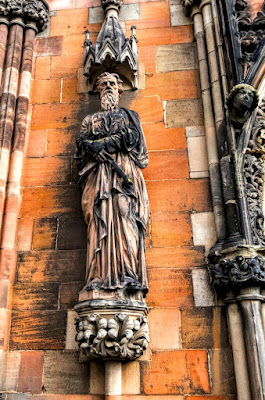
Saint Matthew … a sculpture on the west façade of Lichfield Cathedral (Photograph: Patrick Comerford)

Patrick Comerford

We are in Ordinary Time in the Church Calendar and the week began with the Second Sunday after Trinity (Trinity II, 29 June 2025) and the Feast of Saint Peter and Saint Paul, while yesterday the Church Calendar celebrated Saint Thomas the Apostle.

Before today begins, I am taking some quiet time this morning to give thanks, to reflect, to pray and to read in these ways:

1, reading today’s Gospel reading;

2, a short reflection;

3, a prayer from the USPG prayer diary;

4, the Collects and Post-Communion prayer of the day.

Saint Matthew depicted in a window in Saint Peter’s Church, Kuching … the church was officially opened last Sunday, on the Feast of Saint Peter (Photograph: Patrick Comerford, 2024)

Matthew 9: 9-13 (NRSVA):

9 As Jesus was walking along, he saw a man called Matthew sitting at the tax booth; and he said to him, ‘Follow me.’ And he got up and followed him.

10 And as he sat at dinner in the house, many tax-collectors and sinners came and were sitting with him and his disciples. 11 When the Pharisees saw this, they said to his disciples, ‘Why does your teacher eat with tax-collectors and sinners?’ 12 But when he heard this, he said, ‘Those who are well have no need of a physician, but those who are sick. 13 Go and learn what this means, “I desire mercy, not sacrifice.” For I have come to call not the righteous but sinners.’

‘Scenes from the Life of the Apostle Matthew’, an icon by Georgios Kastrophylakas (1742) in old Saint Minas Church, Iraklion (Photograph: Patrick Comerford, 2025)

Today’s Reflection:

The Gospel reading in the Lectionary for the celebration of the Eucharist today tells of the calling of Saint Matthew, a tax-collector or publican who is called to be one of the Twelve, and the response of the religious leaders of the day, who air their criticism of this decision to the other disciples of Jesus.

Saint Matthew the Evangelist (מתי/מתתיהו, Gift of Yahweh; Ματθαίος) is one of the Twelve and is identified with both the author of the first of the four gospels and with Levi the publican or tax collector in the Gospels according to Saint Mark and Saint Luke.

According to tradition, Saint Matthew was the son of Alpheus, a publican or a tax collector by profession. He was the Levi in the Gospels according to Saint Mark and Saint Luke, and was called to be a disciple while he was sitting in the tax collectors’ place at Capernaum.

We know little about Saint Matthew’s subsequent career – what we do know is little more than speculation and legend. Saint Irenaeus says Matthew preached the Gospel among the Hebrews, Saint Clement of Alexandria claimed that he did this for 15 years, and Eusebius maintains that, before going into other countries, he gave them his Gospel in his mother tongue.

Some ancient writers say Matthew later worked in Ethiopia to the south of the Caspian Sea – not Ethiopia in Africa; others say he worked in Persia, Parthia, Macedonia or Syria. According to Heracleon, who is quoted by Clement of Alexandria, Matthew did not die a martyr, but other accounts, including the Roman Martyrology, say he died a martyr’s death in Ethiopia.

Like the other evangelists, Matthew is often depicted in Christian art as one of the four living creatures of Revelation (4: 7) – in Matthew’s case the winged man, carrying a lance in his hand. There are three paintings of Matthew by Carravagio in the church of San Luigi del Francesci in Rome. Those three paintings, which are among the landmarks of Western art, depict Saint Matthew and the Angel, Matthew being called by Christ, and the Martyrdom of Matthew.

Caravaggio, in depicting the calling of Matthew, shows Levi the tax collector sitting at a table with four assistants, counting the day’s proceeds. This group is lighted from a source at the upper right of the painting. Christ, his eyes veiled, with his halo the only indication of his divinity, enters with Saint Peter. A gesture of Christ’s right hand – all the more powerful and compelling because of its languor – summons Levi.

Surprised by the intrusion and perhaps dazzled by the sudden light from the just-opened door, Levi draws back and gestures toward himself with his left hand as if to say: ‘Who, me?’ His right hand is still on the coin he had been counting before Christ’s entrance.

Today, Saint Matthew is regarded as the patron saint of accountants and bankers. Given the unsaintly performance of many bankers in recent years, I do not know that I would be particularly happy with the prospect of being the patron saint of bankers being put to me as a good career move in heaven. But then, Christ came not to call the righteous but sinners to salvation.

Perhaps Matthew should be the patron saint of those who answer the call to ministry. I hope none of us will be worried about how we are remembered, whether people get it right about where we worked in ministry and mission, or whether they even get my name right. As long as I answered that call when it came, and abandoned everything else, including career prospects and the possibility of wealth, to answer that call faithfully and fully.

Saint Matthew depicted in a spandrel beneath the dome of the Analipsi Church in Georgioupoli in Crete (Photograph: Patrick Comerford)

Today’s Prayers (Friday 4 July 2025):

I was sorry to miss the USPG Annual Conference which took place over three days this week at the Hayes Conference Centre in Swanwick, Derbyshire. The theme of the conference this year was ‘We Believe, We Belong?’ and centred around the 1,700th anniversary of the Nicene Creed (AD 325).

‘We Believe, We Belong?’ is also the theme this week (29 June to 5 July) in Pray with the World Church, the prayer diary of the Anglican mission agency USPG (United Society Partners in the Gospel). This theme was introduced on Sunday with reflections by Rachael Anderson, former Senior Communications and Engagement Manager, USPG.

The USPG prayer diary today (Friday 4 July 2025) invites us to pray:

Lord, may the profound words of the Nicene Creed continue to uplift and guide us, reminding us that, despite our differences, we are united as one in the sacred communion of faith.

The Collect:

Lord, you have taught us
that all our doings without love are nothing worth:
send your Holy Spirit
and pour into our hearts that most excellent gift of love,
the true bond of peace and of all virtues,
without which whoever lives is counted dead before you.
Grant this for your only Son Jesus Christ’s sake,
who is alive and reigns with you,
in the unity of the Holy Spirit,
one God, now and for ever.

The Post-Communion Prayer:

Loving Father,
we thank you for feeding us at the supper of your Son:
sustain us with your Spirit,
that we may serve you here on earth
until our joy is complete in heaven,
and we share in the eternal banquet
with Jesus Christ our Lord.

Additional Collect:

Faithful Creator,
whose mercy never fails:
deepen our faithfulness to you
and to your living Word,
Jesus Christ our Lord.

Yesterday’s reflections

Continued tomorrow

Saint Matthew depicted in the iconostasis in the Greek Orthodox Church in Stony Stratford (Photograph: Patrick Comerford, 2025)

Scripture quotations are from the New Revised Standard Version, Anglicised Edition copyright © 2021, National Council of the Churches of Christ in the United States of America. Used by permission. All rights reserved worldwide.

03 July 2025

Daily prayer in Ordinary Time 2025:
55, Thursday 3 July 2025,
Saint Thomas the Apostle

Saint Thomas the Apostle … a sculpture on the west façade of Lichfield Cathedral (Photograph: Patrick Comerford)

Patrick Comerford

We are in Ordinary Time in the Church Calendar and the week began with the Second Sunday after Trinity (Trinity II, 29 June 2025) and the Feast of Saint Peter and Saint Paul. Today, the Calendar of the Church of England celebrates Saint Thomas the Apostle.

Before today begins, I am taking some quiet time this morning to give thanks, to reflect, to pray and to read in these ways:

1, reading today’s Gospel reading;

2, a short reflection;

3, a prayer from the USPG prayer diary;

4, the Collects and Post-Communion prayer of the day.

The icon of the Incredulity of Saint Thomas in the iconostasis in the Greek Orthodox Church in Stony Stratford (Photograph: Patrick Comerford, 2024)

John 20: 24-29 (NRSVA):

24 But Thomas (who was called the Twin), one of the twelve, was not with them when Jesus came. 25 So the other disciples told him, ‘We have seen the Lord.’ But he said to them, ‘Unless I see the mark of the nails in his hands, and put my finger in the mark of the nails and my hand in his side, I will not believe.’

26 A week later his disciples were again in the house, and Thomas was with them. Although the doors were shut, Jesus came and stood among them and said, ‘Peace be with you.’ 27 Then he said to Thomas, ‘Put your finger here and see my hands. Reach out your hand and put it in my side. Do not doubt but believe.’ 28 Thomas answered him, ‘My Lord and my God!’ 29 Jesus said to him, ‘Have you believed because you have seen me? Blessed are those who have not seen and yet have come to believe.’

A detail in the icon of the Incredulity of Saint Thomas in the iconostasis in the Greek Orthodox Church in Stony Stratford (Photograph: Patrick Comerford, 2024)

Today’s Reflection:

The Calendar of the Church of England commemorates Saint Thomas today (3 July), while the Orthodox Church remembers the doubting of the Apostle Thomas on the first Sunday after Easter; this year Thomas Sunday was on Sunday 27 April 2025.

In the Gospels, Saint Thomas is named ‘Thomas, also called the Twin (Didymus).’ But the name ‘Thomas’ comes from the Aramaic word for twin, T'oma (תאומא), so there is a tautological wordplay going on here.

Syrian tradition says the apostle’s full name was Judas Thomas, or Jude Thomas. But, who was his twin brother – or sister?

I have often visited Didyma on the south coast of Anatolia. There, the Didymaion was one of the most important shrines and temples in the classical world to Apollo and his twin sister Artemis. Apollo was the sun-god, the son of Zeus; he was the patron of shepherds and the guardian of truth, and in Greek and Roman mythology he died and rose again.

Is the story of Saint Thomas’s doubts an invitation to the followers of the cult of Apollo to turn to Christ, the true Son of God the Father, who is the Good Shepherd, who is the way, the truth and the light, who has died and who is truly risen?

We can never be quite sure about Saint Thomas in Saint John’s Gospel. After the death of Lazarus, the disciples resist Christ’s decision to return to Judea, where there had been an attempt to stone Jesus. But Thomas shows he has no idea of the real meaning of death and resurrection when he suggests that the disciples should go to Bethany with Jesus: ‘Let us also go, that we may die with him’ (John 11: 16).

And, while Thomas saw the raising of Lazarus, what did he believe in?

Could seeing ever be enough for a doubting Thomas to believe?

The Apostle Thomas also speaks at the Last Supper (John 14: 5). When Christ assures the disciples that they know where he is going, Thomas protests that they do not know at all. He has been with Christ for three years, and still he does not believe or understand. Seeing and explanations are not enough for him. Christ replies to his remarks and to Philip’s requests with a detailed exposition of his relationship to God the Father.

In the Resurrection story in Saint John’s Gospel, Saint Mary Magdalene – who is commemorated later this month on 22 July – does not recognise the Risen Christ at first. For her, appearances could be deceptive, and she thinks he is the gardener. But when he speaks to her, she recognises his voice, and then wants to hold on to him. From that moment of seeing and believing, she rushes off to tell the Disciples: ‘I have seen the Lord.’

Two of the disciples, John the Beloved and Simon Peter, have already seen the empty tomb, but they fail to make the vital connection between seeing and believing. When they hear Mary’s testimony, they still fail to believe fully. They only believe when they see the Risen Lord standing among them, when he greets them, ‘Peace be with you,’ and when he shows them his pierced hands and side.

They had to see and to hear, they had to have the Master stand over them in their presence, before they could believe.

On the first Easter Day, the Disciples locked themselves away out of fear. But where is Thomas? Is he fearless? Or is he foolish?

For a full week, Thomas is absent and does not join in the Easter experience of the remaining disciples. He has not seen and so he refuses to believe. When they tell him what has happened, Thomas refuses to accept their stories of the Resurrection. For him hearing, even seeing, are not enough.

Thomas wants to see, hear and touch. He wants to use all his learning faculties before he can believe this story. He has heard, but he wants to see. When he sees, he wants to touch … he demands not only to touch the Risen Christ, but to touch his wounds too before being convinced.

And so, for a second time within eight days, Christ comes and stands among his disciples, and says: ‘Peace be with you.’

The traditional icon depicting the event recalled in John 20: 19-31 emphasises the closed door, a significant part of the narrative: ‘the doors were locked’ (verse 19). After Christ’s arrest, the disciples tried to hide from the authorities out of fear. They returned to the last place where they had seen him alive, the upper room, around the same table where they had shared that last meal.

The young Thomas was not present the first time round and had said to the others: ‘Unless I see the mark of the nails in his hands and put my finger in the mark of the nails and my hand in his side, I will not believe’ (John 20: 25).

Christ appears within the disciples’ hiding place, where the door is firmly shut. His presence is real, and he invites Thomas: ‘Put your finger here and see my hands. Reach out your hand and put it in my side. Do not doubt but believe’ (John 20: 27).

In this icon, Christ’s right arm is raised not so much in blessing but revealing his right side with its open wound. Saint Thomas is raising his right hand, about to touch the wounded side, but not actually placing his finger in the open wound.

The wounds from the nails on the Cross can also be seen in Christ’s hand and feet. The traditional icons following Byzantine iconography and style show Christ standing in front of the closed door of a large domed building, with his right arm raised; we can see the signs of the nails on his hands. In many icons, Christ holds a scroll in his left hand.

The Apostles, divided in two groups, watch Thomas touch Christ’s side.

The familiar term ‘doubting Thomas’, referring to the Apostle, is used to describe someone who unreasonably doubts someone’s word. Where Orthodox icons depicting this scene have inscriptions, they do not refer to the doubts of Saint Thomas. Instead, the usual Greek inscription reads Η ψηλάφηση του Θωμά (I Psilafisi tou Thoma), ‘the Assurance of Thomas.’ Often English icons are inscribed ‘The Belief of Thomas.’ The icons show not a ‘Doubting Thomas,’ but a reassured Thomas. This is the Thomas who bends before the Risen Christ to touch his wounds and exclaims: ‘My Lord and my God!’ (John 20: 28).

The Church Fathers recognised that although Saint Thomas doubted, his doubt was not unreasonable. Christ responded, spurring Saint Thomas to a confession of Christ’s Divinity that is more explicit than anywhere else in the Gospels.

Looking out from the scene, Christ’s response to Thomas is also for us: ‘Have you believed because you have seen me? Blessed are those who have not seen and yet have come to believe’ (John 20: 29).

Mary was asked in the garden on Easter morning not to cling on to Christ. But Thomas is invited to touch him in the most intimate way. He is told to place his finger in Christ’s wounded hands and his hand in Christ’s pierced side.

Yet we are never told whether Thomas actually touches those wounds with his fingers. All we are told is that once he has seen the Risen Christ, Thomas simply professes his faith in Christ: ‘My Lord and my God!’

In that moment, we hear the first expression of faith in the two natures of Christ, that he is both divine and human. For all his doubts, Saint Thomas provides us with an exquisite summary of the apostolic faith, contained within the Nicene Creed, whose 1,700th anniversary we are commemorating this year.

Too often, perhaps, we talk about ‘Doubting Thomas,’ when we might better call him ‘Believing Thomas.’ His doubting leads him to questions. But his questioning leads to listening. And when he hears, he sees, perhaps he even touches. Whatever he does, he learns in his own way, and he comes not only to faith but to faith that for this first time is expressed in that eloquent yet succinct acknowledgment of Christ as both ‘My Lord and My God.’

In our society today, are we easily deceived by appearances?

Do we confuse what pleases me with beauty and with truth?

Do we allow those who have power to define the boundaries of trust and integrity merely to serve their own interests?

Too often, in this world, we are deceived easily by the words of others and deceived by what they want us to see. Seeing is not always believing today. Hearing does not always mean we have heard the truth, as we know in politics today. It is easy to deceive and to be deceived by a good presentation and by clever words.

Too often, we accept or judge people by their appearances, and we are easily deceived by the words of others because of their office or their privilege. But there are times when our faith, however simple or sophisticated, must lead us to ask appropriate questions, not to take everything for granted, and not to confuse what looks like being in our own interests with real beauty and truth.

A detail in the icon of the Incredulity of Saint Thomas in the iconostasis in the Greek Orthodox Church in Stony Stratford (Photograph: Patrick Comerford, 2024)

Today’s Prayers (Thursday 3 July 2025, Saint Thomas the Apostle):

I am sorry to miss the USPG Annual Conference which is taking place over three days this week at the Hayes Conference Centre in Swanwick, Derbyshire. The theme of the conference this year is ‘We Believe, We Belong?’ and centres around the 1,700th anniversary of the Nicene Creed (AD 325). Updates of the conference as it happens are available by following USPG on social media @USPGglobal.’

‘We Believe, We Belong?’ is the theme this week (29 June to 5 July) in Pray with the World Church, the prayer diary of the Anglican mission agency USPG (United Society Partners in the Gospel). This theme was introduced on Sunday with reflections by Rachael Anderson, former Senior Communications and Engagement Manager, USPG.

The USPG prayer diary today (Thursday 3 July 2025, Saint Thomas the Apostle) invites us to pray:

Lord God, on this Feast of St Thomas the Apostle, please deepen our faith and renew our calling to serve you. As the USPG conference concludes, may all go forth with courage, conviction, and a spirit of unity.

The Collect:

Almighty and eternal God,
who, for the firmer foundation of our faith,
allowed your holy apostle Thomas
to doubt the resurrection of your Son
till word and sight convinced him:
grant to us, who have not seen, that we also may believe
and so confess Christ as our Lord and our God;
who is alive and reigns with you,
in the unity of the Holy Spirit,
one God, now and for ever.

The Post-Communion Prayer:

Almighty God,
who on the day of Pentecost
sent your Holy Spirit to the apostles
with the wind from heaven and in tongues of flame,
filling them with joy and boldness to preach the gospel:
by the power of the same Spirit
strengthen us to witness to your truth
and to draw everyone to the fire of your love;
through Jesus Christ our Lord.

Yesterday’s reflections

Continued tomorrow

The Temple of Apollo in Didyma … one of the most important shrines and temples in the classical world to Apollo and his twin sister Artemis (Photograph: Patrick Comerford)

Scripture quotations are from the New Revised Standard Version, Anglicised Edition copyright © 2021, National Council of the Churches of Christ in the United States of America. Used by permission. All rights reserved worldwide.

02 July 2025

Daily prayer in Ordinary Time 2025:
54, Wednesday 2 July 2025

‘Now a large herd of swine was feeding at some distance from them’ (Matthew 8: 30) … sculptures of pigs throughout Tamworth celebrate the political achievements of Sir Robert Peel (Photograph: Patrick Comerford, 2025)

Patrick Comerford

We are in Ordinary Time in the Church Calendar and the week began with the Second Sunday after Trinity (Trinity II, 29 June 2025) and the Feast of Saint Peter and Saint Paul.

Before today begins, I am taking some quiet time this morning to give thanks, to reflect, to pray and to read in these ways:

1, reading today’s Gospel reading;

2, a short reflection;

3, a prayer from the USPG prayer diary;

4, the Collects and Post-Communion prayer of the day.

‘Two demoniacs coming out of the tombs met him’ (Matthew 8: 28) … in the graveyard between Koutouloufari and Piskopiano in Crete (Photograph: Patrick Comerford)

Matthew 8: 28-34 (NRSVA):

28 When he came to the other side, to the country of the Gadarenes, two demoniacs coming out of the tombs met him. They were so fierce that no one could pass that way. 29 Suddenly they shouted, ‘What have you to do with us, Son of God? Have you come here to torment us before the time?’ 30 Now a large herd of swine was feeding at some distance from them. 31 The demons begged him, ‘If you cast us out, send us into the herd of swine.’ 32 And he said to them, ‘Go!’ So they came out and entered the swine; and suddenly, the whole herd rushed down the steep bank into the lake and perished in the water. 33 The swineherds ran off, and on going into the town, they told the whole story about what had happened to the demoniacs. 34 Then the whole town came out to meet Jesus; and when they saw him, they begged him to leave their neighbourhood.

A cartoonist’s take on the pigs in the Gospel accounts of the herd of swine the swine who rush down the steep bank into the lake

Today’s Reflection:

This morning’s reading at the Eucharist (Matthew 8: 28-34) comes after yesterday’s account of Christ calming the storm as he and the disciples are in a boat crossing the lake or sea. In today’s reading, they arrive at the other side, where Jesus heals the Gadarene demoniacs.

This story appears in all three synoptic Gospels: Matthew 8: 28-34; Mark 5: 1-20; and Luke 8: 26-39, and we read Saint Luke’s account the Sunday before last (22 June 2025, Trinity I, see HERE).

After Jesus calms the storm on the Sea of Galilee, he and his disciples arrive on the other side of the lake in the countryside surrounding Gerasa, present-day Jerash. This city, also known as Antioch on the Chrysorrhoas or the Golden River, was founded by Alexander the Great. It is 50 km south-east of the Sea of Galilee and 30 km north of Philadelphia, modern-day Amman.

However, Saint Matthew sets this story in Gadara (present-day Umm Qais), about 10 km from the coast of the Sea of Galilee. Either location poses questions, for neither Gadara nor Gerasa is near to the coast of the Sea of Galilee: Gadara was about a three-hour walking distance, while Gerasa was well over twice that distance.

The differing geographical references to Gadara and Gerasa can be understood in light of the social, economic, and political influence each city exerted over the region. In this light, Saint Matthew identifies the exorcism with Gadara as the local centre of power, while the city of Gerasa was a major urban centre and one of the ten cities of the Decapolis.

Whatever the location and setting of this story, it takes place deep inside Gentile territory. From the very moment they get off the boat, this story involves a place and people regarded as unclean by the standards among the disciples: this is Gentile territory, the people are ritually ‘unclean,’ the two men have unclean spirits, they men of visible and public shame living among the tombs, which are ritually unclean, and the pigs are unclean too.

Prisoners or people who had been deprived of their liberty lost the right to wear clothes. Tombs were ritually unclean places. Swine were a symbol of pagan religion and of Roman rule, but even they are subject to Christ’s authority.

This episode plays a key role in the theory of the ‘Scapegoat’ put forward by the French literary critic René Girard (1923-2015). In his analysis, the opposition of the entire city to the two men possessed by demons is the typical template for a scapegoat.

Which is more self-destructive:

the tormented lives of two demoniacs living among the tombs?

the herd of pigs rushing headlong over the precipice to certain drowning in the lake?

the swineherds who abandon their herd and rush back into the town?

the townspeople who placed all their collective guilt on these two men and forced them to live on the edges of the town or the margins of society?

or the people of the town when they demand that Jesus should leave immediately?

And we might ask ourselves this morning:

Who do you think we see as scapegoats today, as outsiders to be pushed to the margins, so that we can maintain the purity of our family, church or society?

Who do we expose and shame so that we can maintain the appearance of our own purity?

Are these the very people who might bring the good news to people on the margins, inviting them into the household of God?

‘Now a large herd of swine was feeding at some distance from them’ (Matthew 8: 30) … free-range pigs grazing in fields at Packington Farm, between Lichfield and Tamworth (Photograph: Patrick Comerford)

Today’s Prayers (Wednesday 2 July 2025):

I am sorry to miss the USPG Annual Conference which takes place over three days this week at the Hayes Conference Centre in Swanwick, Derbyshire. The theme of the conference this year is ‘We Believe, We Belong?’ and centres around the 1700th anniversary of the Nicene Creed (AD 325). Updates of the conference as it happens are available by following USPG on social media @USPGglobal.’

‘We Believe, We Belong?’ is the theme this week (29 June to 5 July) in Pray with the World Church, the prayer diary of the Anglican mission agency USPG (United Society Partners in the Gospel). This theme was introduced on Sunday with reflections by Rachael Anderson, former Senior Communications and Engagement Manager, USPG.

The USPG prayer diary today (Wednesday 2 July 2025) invites us to pray:

We thank you, Lord, for the USPG trustees and Communion-Wide Advisory Group – may their wisdom and experience continue to guide the work of USPG.

The Collect:

Lord, you have taught us
that all our doings without love are nothing worth:
send your Holy Spirit
and pour into our hearts that most excellent gift of love,
the true bond of peace and of all virtues,
without which whoever lives is counted dead before you.
Grant this for your only Son Jesus Christ’s sake,
who is alive and reigns with you,
in the unity of the Holy Spirit,
one God, now and for ever.

The Post-Communion Prayer:

Loving Father,
we thank you for feeding us at the supper of your Son:
sustain us with your Spirit,
that we may serve you here on earth
until our joy is complete in heaven,
and we share in the eternal banquet
with Jesus Christ our Lord.

Additional Collect:

Faithful Creator,
whose mercy never fails:
deepen our faithfulness to you
and to your living Word,
Jesus Christ our Lord.

Collect on the Eve of Saint Thomas:

Almighty and eternal God,
who, fothe firmer foundation of our faith,
allowed your holy apostle Thomas
to doubt the resurrection of your Son
till word and sight convinced him:
grant to us, who have not seen, that we also may believe
and so confess Christ as our Lord and our God;
who is alive and reigns with you,
in the unity of the Holy Spirit,
one God, now and for ever.

Yesterday’s reflections

Continued tomorrow

Night settles on the Hayes Conference Centre at Swanwick in Derbyshire … the venue for the USPG conference this week (Photograph: Patrick Comerford)

Scripture quotations are from the New Revised Standard Version, Anglicised Edition copyright © 2021, National Council of the Churches of Christ in the United States of America. Used by permission. All rights reserved worldwide.

01 July 2025

Daily prayer in Ordinary Time 2025:
53, Tuesday 1 July 2025

‘And when he got into the boat, his disciples followed him’ (Matthew 8: 35) … waiting gondolas near Saint Mark’s Square in Venice (Photograph: Patrick Comerford)

Patrick Comerford

We are in Ordinary Time in the Church Calendar and the week began with the Second Sunday after Trinity (Trinity II, 29 June 2025) and the Feast of Saint Peter and Saint Paul, so that these days are sometimes known as Petertide.

Today also brings us into the second half of the year. The calendar of the Church of England in Common Worship today remembers Henry Venn (1797), John Venn (1813), and Henry Venn the younger (1873), priests and evangelical divines. Before today begins, I am taking some quiet time this morning to give thanks, to reflect, to pray and to read in these ways:

1, reading today’s Gospel reading;

2, a short reflection;

3, a prayer from the USPG prayer diary;

4, the Collects and Post-Communion prayer of the day.

The calming of the storm depicted in a window in the Chapel in Westminster College, Cambridge (Photograph: Patrick Comerford, 2024)

Matthew 8: 23-27 (NRSVA):

23 And when he got into the boat, his disciples followed him. 24 A gale arose on the lake, so great that the boat was being swamped by the waves; but he was asleep. 25 And they went and woke him up, saying, ‘Lord, save us! We are perishing!’ 26 And he said to them, ‘Why are you afraid, you of little faith?’ Then he got up and rebuked the winds and the sea; and there was a dead calm. 27 They were amazed, saying, ‘What sort of man is this, that even the winds and the sea obey him?’

On the water at Bako National Park, north of Kuching in Sarawak (Photograph: Patrick Comerford, 2024)

Today’s Reflection:

This morning’s reading at the Eucharist (Matthew 8: 23-27) comes after yesterday’s account (Matthew 8: 18-22) of the crowds following Jesus being so great that he tried to get away to the other side of the lake. Now in this morning’s reading, Christ and the disciples are leaving the crowd and crossing to the other side of the lake or sea. But a storm blows up, and the disciples show how weak they truly are, with all their doubts and fears.

As we work our ways through the storms of life, we have many questions to ask about the purpose or meaning of life. Often, we can feel guilty about putting those questions to God. Yet, should we not be able to put our deepest questions and greatest fears before God?

In this Gospel reading, the frightened disciples challenge Christ and ask him whether he cares that they are perishing (verse 25). But he offers them words of peace before doing anything to remedy the plight in which they have been caught, and goes on to ask them his own challenging questions: ‘Why are you afraid, you of little faith?’ (verses 26). They, in turn, end up asking their own challenging question about who Christ is for them.

I enjoy being on boats, whether it is on punts in Cambridge or Oxford, island hopping in Greece, or cruising on rivers from the Shannon to the Seine or Sarawak. But I also recognise the fears of the disciples in this reading, having found myself in unexpected storms on lakes on the Shannon and on the waters of the Mediterranean. In retrospect, they were minor storms each time, but those memories give me some insights into the plight of refugees crossing choppy waters every day in the English Channel and in the Mediterranean.

The plight of the disciples in this reading seems like the working out of a constant, recurring, vivid dream of the type many of us experience at different stages: the feelings of drowning, floating and falling suddenly, being in a crowd and yet alone, calling out and not being heard, or not being recognised for who we are.

Christ is asleep in the boat when a great gale rises, the waves beat the side of the boat, and it is soon swamped by the waters. He seems oblivious to the calamity that is unfolding around him and to the fear of the disciples. They have to wake him, and by then they fear they are perishing.

Christ wakes, rebukes the wind, calm descends on the sea, but still Christ challenges those on the boat: ‘Why are you afraid? Have you still no faith?’

Instead of being calmed, they are now filled with awe. Do they recognise Christ for who he truly is? They ask one another: ‘What sort of man is this, that even the winds and the sea obey him?’ (verse 27). Even before the Resurrection, Christ tells the disciples not to be afraid, which becomes a constant theme after the Resurrection.

Do those in the boat begin to ask truly who Christ is because he has calmed the storm, or because he has calmed their fears?

Through the storms of life, through the nightmares, fears and memories, despite the failures of the Church, past and present, we must not let those experiences to ruin our trusting relationship with God. Despite all the storms of life, throughout all our fears and nightmares, we can trust in God as Father and trust in the calm presence and words of Christ among us.

‘Then … there was a dead calm’ (Matthew 8: 26) … boats in the calm waters at Mesongi on the island of Corfu (Photograph: Patrick Comerford)

Today’s Prayers (Tuesday 1 July 2025):

I am sorry to miss the USPG Annual Conference which takes place over three days this week at the Hayes Conference Centre in Swanwick, Derbyshire. The theme of the conference this year is ‘We Believe, We Belong?’ and centres around the 1700th anniversary of the Nicene Creed (AD 325). Updates of the conference as it happens are available by following USPG on social media @USPGglobal.’

‘We Believe, We Belong?’ is the theme this week (29 June to 5 July) in Pray with the World Church, the prayer diary of the Anglican mission agency USPG (United Society Partners in the Gospel). This theme was introduced on Sunday with reflections by Rachael Anderson, former Senior Communications and Engagement Manager, USPG.

The USPG prayer diary today (Tuesday 1 July 2025) invites us to pray:

Heavenly Father, we thank you for the first day of the conference. We pray particularly that you will use the speakers to inspire and encourage all to grow in your likeness.

The Collect:

Lord, you have taught us
that all our doings without love are nothing worth:
send your Holy Spirit
and pour into our hearts that most excellent gift of love,
the true bond of peace and of all virtues,
without which whoever lives is counted dead before you.
Grant this for your only Son Jesus Christ’s sake,
who is alive and reigns with you,
in the unity of the Holy Spirit,
one God, now and for ever.

The Post-Communion Prayer:

Loving Father,
we thank you for feeding us at the supper of your Son:
sustain us with your Spirit,
that we may serve you here on earth
until our joy is complete in heaven,
and we share in the eternal banquet
with Jesus Christ our Lord.

Additional Collect:

Faithful Creator,
whose mercy never fails:
deepen our faithfulness to you
and to your living Word,
Jesus Christ our Lord.

Yesterday’s reflections

Continued tomorrow

The Hayes Conference Centre at Swanwick in Derbyshire … the venue for the USPG conference this week (Photograph: Patrick Comerford)

Scripture quotations are from the New Revised Standard Version, Anglicised Edition copyright © 2021, National Council of the Churches of Christ in the United States of America. Used by permission. All rights reserved worldwide.

30 June 2025

Daily prayer in Ordinary Time 2025:
52, Monday 30 June 2025

‘Foxes have holes … but the Son of Man has nowhere to lay his head’ (Matthew 8: 20) … a fox playing in the new mural by Nacho Welles in Lichfield (Photograph: Patrick Comerford, 2025)

Patrick Comerford

We are in Ordinary Time in the Church Calendar and the week began with the Second Sunday after Trinity (Trinity II, 29 June 2025), the Feast of Saint Peter and Saint Paul, and – in many dioceses – the Petertide ordinations.

Today also brings us to a point half-way through the year. Before today begins, I am taking some quiet time this morning to give thanks, to reflect, to pray and to read in these ways:

1, reading today’s Gospel reading;

2, a short reflection;

3, a prayer from the USPG prayer diary;

4, the Collects and Post-Communion prayer of the day.

The ‘birds of the air have nests; but the Son of Man has nowhere to lay his head’ (Matthew 8: 20) … street art in Great Victoria Street, Belfast (Photograph: Patrick Comerford, 2024)

Matthew 8: 18-22 (NRSVA):

18 Now when Jesus saw great crowds around him, he gave orders to go over to the other side. 19 A scribe then approached and said, ‘Teacher, I will follow you wherever you go.’ 20 And Jesus said to him, ‘Foxes have holes, and birds of the air have nests; but the Son of Man has nowhere to lay his head.’ 21 Another of his disciples said to him, ‘Lord, first let me go and bury my father.’ 22 But Jesus said to him, ‘Follow me, and let the dead bury their own dead.’

‘Lord, first let me go and bury my father’ (Matthew 8: 23) … the graveyard between the villages of Koutouloufari and Piskopiano in Crete (Photograph: Patrick Comerford, 2024)

Today’s Reflection:

This morning’s reading at the Eucharist (Matthew 8: 18-22) follows Saturday’s reading about healing incidents, including Jesus healing Simon Peter’s mother-in-law in her home in Capernaum (Matthew 8: 5-17). Today, we read about two half-hearted excuses when it comes to following Jesus, one from a man who says he wants to follow Jesus in the here and now, and one from a disciple who wants time out from following Jesus.

There are times when Jesus goes out of his way to meet the crowds, such as the occasion he is filled with compassion because he sees them as sheep without a shepherd. But in today’s reading, he gives orders to cross the lake apparently to avoid the crowds pressing in on him.

There are two kinds of crowds: those in real need of teaching and healing, and those who are driven by curiosity to see the unusual and the spectacle, for whom Jesus is a sensation, a wonder-worker, a superstar. But what does it truly mean to want to follow Jesus?

When a scribe approaches Jesus and says, ‘Teacher, I will follow you wherever you go’ (verse 19), it seems like a genuine and a generous offer. Buy Jesus reminds him of the cost of discipleship and there is no cheap grace: ‘Foxes have holes, and birds of the air have nests; but the Son of Man has nowhere to lay his head.’

To follow Jesus means, like him, to be ready to have nothing of one’s own. As Jesus said earlier in the Sermon on the Mount, we cannot serve two masters at the same time. To follow Jesus is to accept a situation where we may find ourselves material possessions, to find that our security lies somewhere else.

Perhaps there is a suspicion there that the scribe is exchanging the stability of being a scholar or of academic life for the stability of being a disciple, still a student of God’s word. Karl Barth once said: ‘To understand the scriptures we must stop acting like mere spectators.’

Did this scribe take up the challenge?

Does it really matter?

Jesus is not so much testing the scribe, but testing the wider audience, the disciples, challenging you and me. Do I really want to Jesus? Or do I only want to follow him on my terms and conditions?

Another person, described as already being a disciple (verse 21), says to him, ‘Lord, first let me go and bury my father.’ It is a reasonable request but Jesus’ reply sounds rather harsh: ‘Follow me, and let the dead bury their own dead’ (verse 22).

It would be a harsh-sounding reply to hear in our society today, just as it was then in both Jewish and Hellenistic society, where burying a dead parent is a filial obligation of the highest importance.

I know how some HR managers keep a count of the unusual number of grandparents some employees seem to have, and how often they need compassionate leave to attend a family fumeral.

It is quite clear a few verses earlier that following Jesus does not mean abandoning ageing or dying parents. We read on Saturday that when Simon Peter’s mother-in-law was sick and dying, Jesus went to the family home in Capernaum (Matthew 8: 14-17).

But what if the man’s father is not dead? What if what he is really saying, ‘I will come and follow you in the future, after my father is dead and buried.’ In those circumstances, is the man wishing for his own father’s death?

Is Jesus telling him this demand will be followed by one-after-an-another case of what looks like filial responsibility but becomes an excuse or even an obstacle to real unencumbered discipleship: after burial, his father’s will needs to be read; the seven days of shiva or mourning move on to the obligation to recite the Mourner’s Kaddish prayer for 11 months; he needs to make sure his widowed mother is secure; the family farm or shop needs to be looked after because there is no one else to do so; there are younger brothers and sisters who are now without a father and who need a wage-earner in the home.

One excuse after another becomes one more reason after another not to follow Jesus, not just yet.

To follow Jesus is to enter a new family with a new set of obligations. Following Jesus has to be unconditional. We cannot say, ‘I will follow you if …’ or ‘I will follow you when I am ready.’ When he calls, we have to be ready, like the first disciples, to drop our nets, leave our boats and even our family members.

Discipleship calls us to a new way of life, and to leave behind the old ways of those who are spiritually dead. The rituals of society, including burial, have an important place in life that cannot be laid aside. But the call to the Kingdom is a call to an even more important set of values.

‘Follow me, and let the dead bury their own dead’ (Matthew 8: 22) … a cross in the London Road Cemetery in Stony Stratford (Photograph: Patrick Comerford, 2025)

Today’s Prayers (Monday 30 June 2025):

The USPG Annual Conference takes place over three days this week at the Hayes Conference Centre in Swanwick, Derbyshire. The theme of the conference this year is ‘We Believe, We Belong?’ and centres around the 1700th anniversary of the Nicene Creed (AD 325). Updates of the conference as it happens are available by following USPG on social media @USPGglobal.’

‘We Believe, We Belong?’ is the theme this week (29 June to 5 July) in Pray with the World Church, the prayer diary of the Anglican mission agency USPG (United Society Partners in the Gospel). This theme was introduced yesterday with reflections by Rachael Anderson, former Senior Communications and Engagement Manager, USPG.

The USPG prayer diary today (Monday 30 June 2025) invites us to pray:

Father God, we pray for all staff, speakers and delegates joining together for the USPG Conference. We pray for safe travel to the event and that the time together is centred around you, Lord.

The Collect:

Lord, you have taught us
that all our doings without love are nothing worth:
send your Holy Spirit
and pour into our hearts that most excellent gift of love,
the true bond of peace and of all virtues,
without which whoever lives is counted dead before you.
Grant this for your only Son Jesus Christ’s sake,
who is alive and reigns with you,
in the unity of the Holy Spirit,
one God, now and for ever.

The Post-Communion Prayer:

Loving Father,
we thank you for feeding us at the supper of your Son:
sustain us with your Spirit,
that we may serve you here on earth
until our joy is complete in heaven,
and we share in the eternal banquet
with Jesus Christ our Lord.

Additional Collect:

Faithful Creator,
whose mercy never fails:
deepen our faithfulness to you
and to your living Word,
Jesus Christ our Lord.

Yesterday’s reflections

Continued tomorrow

The Hayes Conference Centre at Swanwick in Derbyshire … the venue for the USPG conference this week (Photograph: Patrick Comerford)

Scripture quotations are from the New Revised Standard Version, Anglicised Edition copyright © 2021, National Council of the Churches of Christ in the United States of America. Used by permission. All rights reserved worldwide.