‘The Daughter of Jairus’ by James Tissot (1836-1902)
Patrick Comerford
We are in Ordinary Time in the Church Calendar and this week began with the Fifth Sunday after Trinity (Trinity V, 5 July 2026).
I stayed up until the early hours of this morning, long past 4 am, watching England’s 3-2 win over Mexico on television, including thee two goals from Jude Bellongham, Harry Kane’s penalty, and those nail-biting 11 minutes 11 minutes that were added on. The High Street below is now quiet, and before today begins I am taking some quiet time this morning to give thanks, to reflect, to pray and to read in these ways:
1, reading today’s Gospel reading;
2, a short reflection;
3, a prayer from the USPG prayer diary;
4, the Collects and Post-Communion prayer of the day.
Christ healing the woman in the crowd … a modern Orthodox icon
Matthew 9: 18-26 (NRSVA):
18 While he was saying these things to them, suddenly a leader of the synagogue came in and knelt before him, saying, ‘My daughter has just died; but come and lay your hand on her, and she will live.’ 19 And Jesus got up and followed him, with his disciples. 20 Then suddenly a woman who had been suffering from haemorrhages for twelve years came up behind him and touched the fringe of his cloak, 21 for she said to herself, ‘If I only touch his cloak, I will be made well.’ 22 Jesus turned, and seeing her he said, ‘Take heart, daughter; your faith has made you well.’ And instantly the woman was made well. 23 When Jesus came to the leader’s house and saw the flute-players and the crowd making a commotion, 24 he said, ‘Go away; for the girl is not dead but sleeping.’ And they laughed at him. 25 But when the crowd had been put outside, he went in and took her by the hand, and the girl got up. 26 And the report of this spread throughout that district.
‘My daughter has just died; but come and lay your hand on her, and she will live’ (Matthew 9: 18) … ‘Spectral Child’ on Thomas Street, Limerick, by Dermot McConaghy (Photograph: Patrick Comerford)
Today’s Reflection:
The Gospel reading at the Eucharist today (Matthew 9: 18-26) tells the stories of how Christ responds to the plight of two very different people: a young girl who is on her deathbed, and a woman who has been suffering for the previous 12 years, as long as the young girl has lived.
The women in this reading remain unnamed, like so many women in the New Testament: three women in all, the dying girl, the older woman, and the girl’s mother.
The young girl who is on her deathbed and her mother are from a religious family; the older woman who interrupts this story, and who disrupts Jesus and intrudes on the crowd, has endured a lifetime of suffering. The two principal women in this story both suffer and are marginalised, are seen as not worth bothering about, because of their gender and because of their age.
This reading reminds us that Christ calls the unnamed, the marginalised, and the long-suffering from the outside into the community. They call out, just as the psalmist cries out, ‘Out of the depths I cry to you, O Lord’ (Psalm 130: 1).
God is attentive to our pleas, despite everything that has gone wrong, God forgives, God is merciful, God offers unfailing love and freedom, God’s love for us surpasses the love of any father or mother for their children.
In this Gospel reading, one of the key people is the daughter of a leading member of the local synagogue. We know him as Jairus because of the accounts in the other synoptic Gospels (see Mark 5: 21-43; Luke 8: 40-56), although he is not named in Matthew 9. Mark describes him as ‘one of the rulers of the synagogue’ (εἷς τῶν ἀρχισυναγώγων), Luke says he is ‘a leader of the synagogue (ἄρχων τῆς συναγωγῆς), while Matthew describes him simply as an ἄρχων (archon), and omits any reference to a synagogue, a word that has come to be inserted by convention in the English translations.
Matthew does not give the girl’s age, she has already ‘just died’ (ἄρτι ἐτελεύτησεν), and her father’s request is that Jesus lay his hand upon her ‘and she will live [again]’ (Matthew: καὶ ζήσεται). In other words, in Matthew he asks Jesus to reverse her death rather than prevent it, in contrast with the accounts of Mark and Luke.
The timings and settings differ in the Gospels: in Mark and Luke, the story follows the exorcism at Gerasa; Jairus comes up to Jesus as soon as he gets out of the boat. In Matthew, this event is first preceded by three others, healing the paralytic, the calling of Matthew, and the New Wine in Old Wineskins. In Matthew’s version, Jesus is in Matthew’s house, eating and drinking with tax collectors and sinners and debating about fasting with Pharisees and disciples of John the Baptist, when the distraught father arrives.
Mark and Luke report a large crowd (ὄχλος) following Jesus around and pressing against him (συνέθλιβον/συνέπνιγον αὐτόν) as he follows Jairus to his house. Matthew does not mention this, and it is only Jesus and his disciples (μαθηταὶ) who follow the ruler back to his house.
The narrative is interrupted with the arrival on the scene of a woman who had a haemorrhage (Matthew: αἱμορροοῦσα haimorroousa, having had a flow of blood that is vaginal or uterine. Mark and Luke say she has been οὖσα ἐν ῥύσει αἵματος (ousa en rhysei haimatos, being with a flow of blood), for 12 years. Mark and Luke tell us that during all this time nobody could heal her, with Mark dramatically adding she had spent all she had on physicians to no avail.
The woman touches the fringe of his cloak. Each tassel of the tallit or prayer shawl worn by pious Jews has eight threads (when doubled over) and five sets of knots, totalling 13; the sum of these numbers is 613. The 613 tzizit or knotted fringes are reminders of the 613 commandments, precepts or mitzvot in Jewish tradition. They include positive commandments, to perform an act (mitzvot aseh), and negative commandments, to abstain from certain acts (mitzvot lo taaseh). The negative commandments number 365, which coincides with the number of days in the solar year, and the positive commandments number 248, said to be the number of bones and main organs in the human body (Babylonian Talmud, Makkot 23b–24a). This reflects the idea that donning a tallit or prayer shawl with tzitzit reminds its wearer of all 613 Torah commandments.
When this woman touches Jesus’ cloak, her bleeding stops immediately, according to Mark and Luke, but in Matthew she is not healed until after Jesus tells her: ‘Take heart, daughter; your faith has made you well’ (verse 22).
Matthew’s account of the bleeding woman also ends there (Matthew 9:20–22). But for Mark and Luke, her act of touching his cloak appears to disturb Jesus, who seems agitated or even angry, and we are told that the woman came with φοβηθεῖσα καὶ τρέμουσα (phobētheisa kai tremousa, ‘in fear and trembling’) as he feels that power had gone out of him.
Jesus asks around the crowd who touched him or touched his clothes. Luke says all in the crowd deny doing this, and Peter says that crowds are pressing against Jesus; Mark has the disciples giving this explanation.
Jesus is not satisfied, and he keeps inspecting the crowd until the woman, trembling in fear, falls at Jesus' feet and admits that it was her. The accounts in Mark and Luke conclude with Jesus telling her ‘Daughter, your faith has made you well; go in peace and be healed of your disease’, or ‘Daughter, your faith has made you well; go in peace’ (see Mark 5: 25-34; Luke 8: 43-48).
In Mark’s and Luke’s narrative, people come (Mark: ἔρχονται, plural) or someone comes (Luke: ἔρχεταί τις, singular) with the news that that the daughter of Jairus had died, and Jairus is advised not to trouble Jesus any further. However, Jesus responds: ‘Do not fear, only believe’, with Luke extending the quote with ‘and she will be saved’ (σωθήσεται).
When he arrives at the house, Jesus does not let anyone follow him inside, ‘except Peter, James and John, the brother of James’ (Mark 5: 37), with Luke adding ‘and the father of the child and the mother’, later also added by Mark (Mark 5: 40; Luke 8: 49-50). For Matthew, the daughter is already dead from the start, so this part of the event does not unfold.
At the house, Mark and Luke report that Jesus ‘saw a commotion, people weeping and wailing loudly’ (Mark 5: 38; Luke 8: 52); according to Matthew, he ‘saw the flute-players and the crowd making a commotion’ (Matthew 9: 23). He tells all present that the girl is not dead but asleep; in Matthew, Jesus even tells the crowd ‘Go away’. But the crowd laughs at Jesus. Mark says Jesus puts the crowd outside; Matthew says they were put outside, but witout mentioning who does it (verse 25); Luke does not report this, but instead emphasises that the crowd ‘knew she had died’.
Jesus then goes back inside the house (Mark, Matthew). He takes the girl by the hand, and she gets up. In Mark’s account, the Aramaic phrase Talitha koum – transliterated into Greek as ταλιθα κουμ and reportedly meaning, ‘Little girl, I say to you, get up!’ – is attributed to Jesus (Mark 5: 41). In Luke, Jesus says ‘My child, get up!’ For Matthew, Jesus says nothing and is silent verse 25).
The accounts in Mark and Luke end with Jesus commanding that the girl should be fed and that Jairus and his wife should tell no-one what had happened. On the other hand, Matthew concludes by saying: ‘And the report of this spread throughout that district’ (verse 26).
Does it matter that Matthew’s account, which we are reading today, does not name Jairus, nor that it does not relate his status to the synagogue? Religious position and social status are of little value when a small child is struck with a death-threatening illness or disease.
In both cases these women are ritually unclean … a bleeding woman, a dying or dead women. Jesus should not touch them. Yet their plight touches his heart, and he reaches out to them with a healing touch.
One young woman is restored to her place in her family and in her community. One older woman, who has lost everything, who is at risk of being marginalised, even by the Disciples, is offered the hope of her proper place.
The crowd who gather around Jesus by the lake becomes a large crowd pressing in on him.
Too often in a crowd, it is those who get to the front first, who have the loudest voices, who are heard, whose demands are met.
But in this case, it is not the loud and the proud, the rich or the famous, who grab the attention of Christ – it is a weak, timid, neglected impoverished, exploited and sick woman. All her money has gone on quacks, and she has no man to speak up for her.
But look at what Christ does for her. Without knowing it, he heals her. And when he realises what has happened, he calls her ‘Daughter.’
In a society where men had the only voices, where to have a full place in society was to be known as a Son of Israel, she is called ‘Daughter.’ She too has a full and equal place in society, in the world, and before God.
It is shocking that when the unnamed girl dies the first reaction of some key local figures is to upbraid her father for seeking help, and not to offer him comfort and sympathy.
Their lack of compassion and sympathy contrasts sharply with the compassion Christ shows for both the older and the younger woman.
We were challenged each day to ask ourselves: how is the Gospel good news for those on the margins? The Gospel is Good News for those on the margins as we read in today’s Gospel story. But … only if we read it and if we put it into practice.
‘And the report of this spread throughout that district’ (Matthew 9: 26) … when and how is the Gospel good news for people on the margins? … newspapers at a kiosk near the Marina in Rethymnon in Crete (Photograph: Patrick Comerford)
Today’s Prayers (Monday 6 July 2026):
In Pray with the World Church, the prayer diary of the Anglican mission agency USPG (United Society Partners in the Gospel), the theme this week, from 5 to 11 July 2026 (pp 16-17), is ‘Faith in the Midst of Fractures’. This theme was introduced yesterday with a reflection by the Revd Godfrey Owino Adera, Anglican priest, theologian, and lecturer at Saint Paul’s University, Limuru, Kenya.
The USPG prayer diary today (Monday 6 July 2026) invites us to pray:
Gracious God, move theologians, church leaders, and all followers of you to be perceptive of the needs in our communities and how we can respond in your justice, truth, and wisdom.
The Collect of the Day:
Almighty and everlasting God,
by whose Spirit the whole body of the Church
is governed and sanctified:
hear our prayer which we offer for all your faithful people,
that in their vocation and ministry
they may serve you in holiness and truth
to the glory of your name;
through our Lord and Saviour Jesus Christ,
who is alive and reigns with you,
in the unity of the Holy Spirit,
one God, now and for ever.
The Post-Communion Prayer:
Grant, O Lord, we beseech you,
that the course of this world may be so peaceably ordered
by your governance,
that your Church may joyfully serve you in all godly quietness;
through Jesus Christ our Lord.
Additional Collect:
Almighty God,
send down upon your Church
the riches of your Spirit,
and kindle in all who minister the gospel
your countless gifts of grace;
through Jesus Christ our Lord.
Yesterday’s reflections
Continued tomorrow
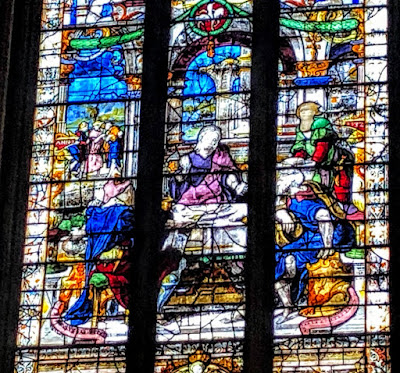
‘Christ raises the daughter of Jairus’ (left), in the Hardman window by JH Powell at the west end of the nave in Saint Nicholas Church, Adare, Co Limerick (Photograph: Patrick Comerford)
Scripture quotations are from the New Revised Standard Version, Anglicised Edition copyright © 2021, National Council of the Churches of Christ in the United States of America. Used by permission. All rights reserved worldwide.
Showing posts with label Adare. Show all posts
22 June 2026
Daily prayer in Ordinary Time 2026:
46, Monday 22 June 2026
‘First take the log out of your own eye’ (Matthew 7: 5) … the remains of a felled tree by Saint Anne's Boat Club and the River Isis in Oxford last week (Photograph: Patrick Comerford, 2026)
Patrick Comerford
We are in Ordinary Time in the Church Calendar, and the week began with the Third Sunday after Trinity (Trinity III, 21 June 2025), which was also Fathers’ Day and the Summer Solstice. The calendar of the Church of England in Common Worship today remembers Saint Alban (ca 250), first Martyr of Britain.
Before today begins, however, I am taking some quiet time this morning to give thanks, to reflect, to pray and to read in these ways:
1, reading today’s Gospel reading;
2, a short reflection;
3, a prayer from the USPG prayer diary;
4, the Collects and Post-Communion prayer of the day.
‘Why do you see the speck in your neighbour’s eye, but do not notice the log in your own eye?’ (Matthew 7: 3) (Photograph: Patrick Comerford)
Matthew 7: 1-5 (NRSVA):
[Jesus said to his disciples:] 1 ‘Do not judge, so that you may not be judged. 2 For with the judgement you make you will be judged, and the measure you give will be the measure you get. 3 Why do you see the speck in your neighbour’s eye, but do not notice the log in your own eye? 4 Or how can you say to your neighbour, “Let me take the speck out of your eye”, while the log is in your own eye? 5 You hypocrite, first take the log out of your own eye, and then you will see clearly to take the speck out of your neighbour’s eye.’
‘Why do you see the speck in your neighbour’s eye?’ (Mattew 7: 4) … street art in Plaza de Judería in Malaga (Photograph: Patrick Comerford)
Today’s Reflections:
Our Gospel story (Matthew 7: 1-5) returns to our readings from the Sermon on the Mount. Today’s reading prompts me once again to reflect on my own actions with the sort of introspection I find in the prayers of Saint John Chrysostom:
1. O Lord, deprive me not of your heavenly blessings.
2. O Lord, deliver me from eternal torment.
3. O Lord, if I have sinned in my mind or thought, in word or deed, forgive me.
4. O Lord, deliver me from every ignorance and heedlessness, from pettiness of the soul and stony hardness of heart.
5. O Lord, deliver me from every temptation.
6. O Lord, enlighten my heart darkened by evil desires.
7. O Lord, I, being a human being, have sinned; I ask you, being God, to forgive me in your loving kindness, for you know the weakness of my soul.
8. O Lord, send down your grace to help me, that I may glorify your holy Name.
9. O Lord Jesus Christ, inscribe me, your servant, in the Book of Life, and grant me a blessed end.
10. O Lord my God, even if I have done nothing good in your sight, yet grant me, according to your grace, that I may make a start in doing good.
11. O Lord, sprinkle on my heart the dew of your grace.
12. O Lord of heaven and earth, remember me, your sinful servant, cold of heart and impure, in your Kingdom.
13. O Lord, receive me in repentance.
14. O Lord, leave me not.
15. O Lord, save me from temptation.
16. O Lord, grant me pure thoughts.
17. O Lord, grant me tears of repentance, remembrance of death, and the sense of peace.
18. O Lord, grant me mindfulness to confess my sins.
19. O Lord, grant me humility, charity, and obedience.
20. O Lord, grant me tolerance, magnanimity, and gentleness.
21. O Lord, implant in me the root of all blessings: the fear of you in my heart.
22. O Lord, grant that I may love you with all my heart and soul, and that in all things I may obey your will.
23. O Lord, shield me from evil persons and devils and passions and all other lawless matters.
24. O Lord, who knows your creation and what you have willed for it; may your will also be fulfilled in me, a sinner, for you art blessed for evermore. Amen.
These are prayers that I handed out each year to students taking the elective on Patristics I offered on the MTh course in the Church of Ireland Theological Institute (CITI) and Trinity College Dublin (TCD).
The rediscovery of Patristic texts and writings in the 15th and 16th centuries, following the exodus of Greek scholars with the fall of Byzantium is a major factor in understanding the Reformations, in particular the Anglican Reformation. Thomas Cranmer introduced the ‘Prayer of Saint Chrysostom’ to Anglicanism:
‘Almighty God, you have given us grace at this time with one accord to make our common supplication to you; and you have promised through your well-beloved Son that when two or three are gathered together in his Name you will be in the midst of them: Fulfil now, O Lord, our desires and petitions as may be best for us; granting us in this world knowledge of your truth, and in the age to come life everlasting. Amen.’
‘Do not judge, so that you may not be judged’ (Matthew 7: 1) … the museum in the old courthouse in Adare, Co Limerick (Photograph: Patrick Comerford)
Today’s Prayers (Monday 22 June 2026):
In Pray with the World Church, the prayer diary of the Anglican mission agency USPG (United Society Partners in the Gospel), the theme this week, from 21 to 27 June 2026 (pp 12-13), is ‘Land Taken, Land Remembered’. This theme was introduced yesterday with a reflection by the Venerable Rosalyn Kantlaht’ant Elm, Director of Indigenous Ministries, Anglican Church of Canada.
The USPG prayer diary today (Monday 22 June 2026, Windrush Day) invites us to pray:
God of welcome, we thank you for the faith, courage, and contributions of the Windrush generation. Help us to honour their legacy by building a more just and hospitable society.
The Collect:
Eternal Father,
when the gospel of Christ first came to our land
you gloriously confirmed the faith of Alban
by making him the first to win a martyr’s crown:
grant that, following his example,
in the fellowship of the saints
we may worship you, the living God,
and give true witness to Jesus Christ your Son our Lord,
who is alive and reigns with you,
in the unity of the Holy Spirit,
one God, now and for ever.
The Post-Communion Prayer:
Eternal God,
who gave us this holy meal
in which we have celebrated the glory of the cross
and the victory of your martyr Alban:
by our communion with Christ
in his saving death and resurrection,
give us with all your saints the courage to conquer evil
and so to share the fruit of the tree of life;
through Jesus Christ our Lord.
Yesterday’s Reflections
Continued Tomorrow
The calendar of the Church of England in Common Worship today remembers Saint Alban … an icon in St Albans Cathedral (Photograph: Patrick Comerford)
Scripture quotations are from the New Revised Standard Version Bible: Anglicised Edition copyright © 1989, 1995, National Council of the Churches of Christ in the United States of America. Used by permission. All rights reserved worldwide. http://nrsvbibles.org
Patrick Comerford
We are in Ordinary Time in the Church Calendar, and the week began with the Third Sunday after Trinity (Trinity III, 21 June 2025), which was also Fathers’ Day and the Summer Solstice. The calendar of the Church of England in Common Worship today remembers Saint Alban (ca 250), first Martyr of Britain.
Before today begins, however, I am taking some quiet time this morning to give thanks, to reflect, to pray and to read in these ways:
1, reading today’s Gospel reading;
2, a short reflection;
3, a prayer from the USPG prayer diary;
4, the Collects and Post-Communion prayer of the day.
‘Why do you see the speck in your neighbour’s eye, but do not notice the log in your own eye?’ (Matthew 7: 3) (Photograph: Patrick Comerford)
Matthew 7: 1-5 (NRSVA):
[Jesus said to his disciples:] 1 ‘Do not judge, so that you may not be judged. 2 For with the judgement you make you will be judged, and the measure you give will be the measure you get. 3 Why do you see the speck in your neighbour’s eye, but do not notice the log in your own eye? 4 Or how can you say to your neighbour, “Let me take the speck out of your eye”, while the log is in your own eye? 5 You hypocrite, first take the log out of your own eye, and then you will see clearly to take the speck out of your neighbour’s eye.’
‘Why do you see the speck in your neighbour’s eye?’ (Mattew 7: 4) … street art in Plaza de Judería in Malaga (Photograph: Patrick Comerford)
Today’s Reflections:
Our Gospel story (Matthew 7: 1-5) returns to our readings from the Sermon on the Mount. Today’s reading prompts me once again to reflect on my own actions with the sort of introspection I find in the prayers of Saint John Chrysostom:
1. O Lord, deprive me not of your heavenly blessings.
2. O Lord, deliver me from eternal torment.
3. O Lord, if I have sinned in my mind or thought, in word or deed, forgive me.
4. O Lord, deliver me from every ignorance and heedlessness, from pettiness of the soul and stony hardness of heart.
5. O Lord, deliver me from every temptation.
6. O Lord, enlighten my heart darkened by evil desires.
7. O Lord, I, being a human being, have sinned; I ask you, being God, to forgive me in your loving kindness, for you know the weakness of my soul.
8. O Lord, send down your grace to help me, that I may glorify your holy Name.
9. O Lord Jesus Christ, inscribe me, your servant, in the Book of Life, and grant me a blessed end.
10. O Lord my God, even if I have done nothing good in your sight, yet grant me, according to your grace, that I may make a start in doing good.
11. O Lord, sprinkle on my heart the dew of your grace.
12. O Lord of heaven and earth, remember me, your sinful servant, cold of heart and impure, in your Kingdom.
13. O Lord, receive me in repentance.
14. O Lord, leave me not.
15. O Lord, save me from temptation.
16. O Lord, grant me pure thoughts.
17. O Lord, grant me tears of repentance, remembrance of death, and the sense of peace.
18. O Lord, grant me mindfulness to confess my sins.
19. O Lord, grant me humility, charity, and obedience.
20. O Lord, grant me tolerance, magnanimity, and gentleness.
21. O Lord, implant in me the root of all blessings: the fear of you in my heart.
22. O Lord, grant that I may love you with all my heart and soul, and that in all things I may obey your will.
23. O Lord, shield me from evil persons and devils and passions and all other lawless matters.
24. O Lord, who knows your creation and what you have willed for it; may your will also be fulfilled in me, a sinner, for you art blessed for evermore. Amen.
These are prayers that I handed out each year to students taking the elective on Patristics I offered on the MTh course in the Church of Ireland Theological Institute (CITI) and Trinity College Dublin (TCD).
The rediscovery of Patristic texts and writings in the 15th and 16th centuries, following the exodus of Greek scholars with the fall of Byzantium is a major factor in understanding the Reformations, in particular the Anglican Reformation. Thomas Cranmer introduced the ‘Prayer of Saint Chrysostom’ to Anglicanism:
‘Almighty God, you have given us grace at this time with one accord to make our common supplication to you; and you have promised through your well-beloved Son that when two or three are gathered together in his Name you will be in the midst of them: Fulfil now, O Lord, our desires and petitions as may be best for us; granting us in this world knowledge of your truth, and in the age to come life everlasting. Amen.’
‘Do not judge, so that you may not be judged’ (Matthew 7: 1) … the museum in the old courthouse in Adare, Co Limerick (Photograph: Patrick Comerford)
Today’s Prayers (Monday 22 June 2026):
In Pray with the World Church, the prayer diary of the Anglican mission agency USPG (United Society Partners in the Gospel), the theme this week, from 21 to 27 June 2026 (pp 12-13), is ‘Land Taken, Land Remembered’. This theme was introduced yesterday with a reflection by the Venerable Rosalyn Kantlaht’ant Elm, Director of Indigenous Ministries, Anglican Church of Canada.
The USPG prayer diary today (Monday 22 June 2026, Windrush Day) invites us to pray:
God of welcome, we thank you for the faith, courage, and contributions of the Windrush generation. Help us to honour their legacy by building a more just and hospitable society.
The Collect:
Eternal Father,
when the gospel of Christ first came to our land
you gloriously confirmed the faith of Alban
by making him the first to win a martyr’s crown:
grant that, following his example,
in the fellowship of the saints
we may worship you, the living God,
and give true witness to Jesus Christ your Son our Lord,
who is alive and reigns with you,
in the unity of the Holy Spirit,
one God, now and for ever.
The Post-Communion Prayer:
Eternal God,
who gave us this holy meal
in which we have celebrated the glory of the cross
and the victory of your martyr Alban:
by our communion with Christ
in his saving death and resurrection,
give us with all your saints the courage to conquer evil
and so to share the fruit of the tree of life;
through Jesus Christ our Lord.
Yesterday’s Reflections
Continued Tomorrow
The calendar of the Church of England in Common Worship today remembers Saint Alban … an icon in St Albans Cathedral (Photograph: Patrick Comerford)
Scripture quotations are from the New Revised Standard Version Bible: Anglicised Edition copyright © 1989, 1995, National Council of the Churches of Christ in the United States of America. Used by permission. All rights reserved worldwide. http://nrsvbibles.org
07 June 2026
Daily prayer in the Ordinary Time 2026:
31, Sunday 7 June 2026,
First Sunday after Trinity (Trinity I)
As Jesus was walking along, he saw a man called Matthew sitting at the tax booth; and he said to him, ‘Follow me’ (Matthew 9: 9) … the Triptych of Saint Matthew by Andrea di Cione (1343-1368), also known as Orcagna, in the Uffizi, Florence
Patrick Comerford
We are in Ordinary Time in the Church Calendar and today is the First Sunday after Trinity (7 June 2026). Stony Live 2026, Stony Stratford’s Festival of music, dance and arts, began yesterday (6 June 2026) and continues until next Friday (14 June 2026), and today’s events include Stony Classic, with the town filled with displays of classic and vintage cars. The afternoon events include the Big Lunch @The Riverside Fair from 12 noon to 4 pm on the Millfield, and is being opened by the Mayor of Milton Keynes Paul Trendall, and local author Sarah Pinborough.
Later this morning, I hope to take part in the Parish Eucharist in Saint Mary and Saint Giles Church, Stony Stratford. But, before today even begins, I am taking some quiet time this morning to give thanks, to reflect, to pray and to read in these ways:
1, reading today’s Gospel reading;
2, a short reflection;
3, a prayer from the USPG prayer diary;
4, the Collects and Post-Communion prayer of the day.
Saint Matthew represented in a group of the Four Evangelists on columns at the porch in University Church, Dublin (Photograph: Patrick Comerford)
Matthew 9: 9-13, 18-26 (NRSVA):
9 As Jesus was walking along, he saw a man called Matthew sitting at the tax booth; and he said to him, ‘Follow me.’ And he got up and followed him.
10 And as he sat at dinner in the house, many tax-collectors and sinners came and were sitting with him and his disciples. 11 When the Pharisees saw this, they said to his disciples, ‘Why does your teacher eat with tax-collectors and sinners?’ 12 But when he heard this, he said, ‘Those who are well have no need of a physician, but those who are sick. 13 Go and learn what this means, “I desire mercy, not sacrifice.” For I have come to call not the righteous but sinners.’
18 While he was saying these things to them, suddenly a leader of the synagogue came in and knelt before him, saying, ‘My daughter has just died; but come and lay your hand on her, and she will live.’ 19 And Jesus got up and followed him, with his disciples. 20 Then suddenly a woman who had been suffering from haemorrhages for twelve years came up behind him and touched the fringe of his cloak, 21 for she said to herself, ‘If I only touch his cloak, I will be made well.’ 22 Jesus turned, and seeing her he said, ‘Take heart, daughter; your faith has made you well.’ And instantly the woman was made well. 23 When Jesus came to the leader’s house and saw the flute-players and the crowd making a commotion, 24 he said, ‘Go away; for the girl is not dead but sleeping.’ And they laughed at him. 25 But when the crowd had been put outside, he went in and took her by the hand, and the girl got up. 26 And the report of this spread throughout that district.
Saint Matthew the Evangelist represented in a carving on the choir stalls in the Church of Saint Michael and All Angels, Penkridge (Photograph: Patrick Comerford)
Today’s reflections:
This morning’s Gospel reading (Matthew 9: 9-13, 18-26) in the Lectionary is divided into two parts: verses 9-13 tell of the call of Matthew the tax collector, and the questions that are raised by the dinner that follows in Matthew’s house; verses 18-26 tell of two healing miracles – the daughter of a leader of the synagogue (verses 18-19, 23-26), and a woman who is healed when she touches the fringe of Jesus’ cloak (verses 20-22).
The gravestone of a Levite family in the Jewish cemetery in the Lido, Venice … hand-washing and foot-washing for the priests are part of the ministry of Levites (Photograph: Patrick Comerford)
Part 1 (verses 9-13):
Saint Matthew the Evangelist (מתי/מתתיהו, Gift of Yahweh; Ματθαίος) is one of the Twelve and is identified with both the author of the first of the four gospels and with Levi the publican or tax collector in the Gospels according to Saint Mark and Saint Luke.
Tax collectors were considered unclean ritually, they worked for the occupying power and they were suspect financially. As with Peter and Andrew, Christ sees Matthew the tax collector beside the sea, and he responds immediately to Christ’s call to follow him.
Christ first called fishers as first four disciples: Andrew and Peter, then James and John. His next choice of a tax collector seems a bold move. Tax collectors were typically local Jews who were employed by the Romans to collect taxes from the people. They extracted money from their neighbours and local people to cover the expenses of the foreign rulers and occupiers.
Some translations use the word publican instead of tax-collector. The word publican is a translation of the Greek word for tax-farmer, and we come across it also in the Parable of the Pharisee and the Publican (Luke 18: 9-14).
The Romans paid tax collectors well, and seemingly did not care if the collectors took more than the tax required. They were free to take as much as they could for themselves – once the Romans had been paid.
Rome collected three principal kinds of taxes: a land tax, a head tax, and a customs tax of 2% to 5% of the value on goods being moved around. A tax office or booth stood near a city gate or port to collect the custom tax from people engaged in commercial trade, such as fishers exporting dried fish or farmers sending surplus crops to a larger city.
Tax collectors were seen as collaborators and as greedy, and they were despised. This attitude was reflected in the words of Jesus when he said: ‘If the member refuses to listen to them, tell it to the church; and if the offender refuses to listen even to the church, let such a one be to you as a Gentile and a tax-collector’ (Matthew 18: 17).
The Greek terminology indicates Matthew is a low-level tax collector. Unlike Zacchaeus, he is not a chief tax collector. The words tax booth, or tax office translate the Greek τὸ τελώνιον (to telōnion, ‘revenue or tax office’). Perhaps the booth indicates he collects tolls along the road along the west shore of the Sea of Galilee. He would have been seen as a state-sponsored thief who socialised on the fringes of respectable society.
But when Jesus calls Matthew to follow him, Matthew becomes the disciple of a rabbi who is well-respected, invited him into his home, and organises a welcoming banquet for Jesus, to which he invites other tax collectors.
Dining with Matthew damages Jesus’ reputation in the eyes of the religious leaders, local Pharisees and teachers of the law. To eat with a Gentile or tax collector was regarded by strict Pharisees as rendering one spiritually or ceremonially unclean, to the point that even a house entered by a tax collector could be considered unclean.
Matthew is a Greek form of a Hebrew name, מַתִּתְיָהוּ (Matityahu), meaning ‘Gift of God’ and transliterated into Greek as Ματταθίας (Mattathias). Many New Testament figures have two names: Simon becomes Cephas or Peter, Saul becomes Paul. Mark and Luke name the tax collector as Levi, indicating he may have been a descendent of the tribe of Levi, which included the priests and Levites. But instead of a holy service in the Temple, this Levi is an unholy civil servant in his tax booth.
The roles of the Levites include washing the hands, and sometimes the feet of the kohanim after they remove their shoes and before they ascend the bimah or platform to give the priestly blessing to the congregation. As this custom developed, the association of the Levites with this washing led to iconographic depictions of pitchers, ewers, and bowls on the tombstones of Levite families.
Mattew abandons his lucrative business as a tax collector, and is called too to be a new form of Levite, to minister hand and foot to Christ the great high priest. In accepting Jesus’ invitation, Matthew extends his own invitation: he invited Jesus to dinner in his house, and a large crowd of tax collectors and others eat with them in his large house, suited to a wealthy man. Yet those who are invited are seen as thieves, unbelievers, open sinners and social pariahs.
Did the guests also include Peter and Andrew, James and John, who once despised Matthew who extracted tolls on their fish exports? When they see Jesus warmly accepting Matthew, did they too accept him? Or did it take time? Were they hurt to hear their new fellow disciple put down with the question put not to Jesus but to them: ‘Why does your teacher eat with tax-collectors and sinners?’ (Matthew 9: 11).
Christ dines with people whose trades made them ritually unclean and social outcasts. When the religiously powerful question his actions, Christ replies: ‘Those who are well have no need of a physician, but those who are sick. 13 Go and learn what this means, “I desire mercy, not sacrifice.” For I have come to call not the righteous but sinners’ (verse 13). Christ calls and invite into his Kingdom those in need of repentance, not those who think they are righteous in God’s eyes.
Christ healing the woman in the crowd … a modern Orthodox icon
Part 2 (verses 18-26):
The second part of this Gospel reading (Matthew 9: 18-26) tells two stories about Christ’s response to the plight of two very different women: a 12-year-old girl who is on her deathbed, and a woman who has been suffering for the previous 12 years, as long as the young girl has lived.
Both of them remain unnamed, like so many women in the New Testament. One is the daughter of a leading male figure in the synagogue. But religious position and social status in the local community are of precious little value when a small girl is at the point of death.
In both cases hope has run out, for a little girl and for an old woman. In restoring their health, Christ teaches what faith means, Christ offers new hope, and Christ shows what love is.
In both cases, these women are ritually unclean … a bleeding older woman, and a dying young woman. Jesus should not touch them. Yet their plight touches his heart, and he reaches out to them with a healing touch.
This passage presents us with a large cast of dramatis personae, people who receive the gentle, caring, loving pastoral attention of Christ in equal measure, each within the list of people we are told should be our priority.
They include:
The crowd who gather around Jesus by the lake are going to learn what the Kingdom of God is like, not through another sermon or another lecture, but by seeing what Jesus does. After hearing this Gospel story, would each and every one of them be happy to wear one of those wristbands with the initials ‘WWJD’ – ‘What Would Jesus Do?’ If they looked at our actions for an example of Christian lifestyle, would they know what Jesus does?
Jairus, as he is named in the parallel passage in Saint Mark’s Gospel (Mark 5: 21-43), is a respected provincial leader. He shows what true worship truly is when he throws himself at the feet of Jesus. He prays, entreats, begs, not on behalf of himself, but on behalf of a sick and dying girl. If we were to look at ourselves today, would we see ourselves placing our lives at the feet of Christ, and making our first priorities the needs of others who cannot speak for themselves?
By now the large crowd is pressing in on Jesus. They really want to see what he is on about, what the Christian lifestyle is about. And who becomes the focus of attention within this crowd?
Too often in a crowd, it is those who get to the front first, who have the loudest voices, who are heard and whose demands are met.
In this case, though, it is not the loud and the proud, the rich or the famous, who grab the attention of Christ – it is a weak, timid, neglected impoverished, exploited and sick woman. All her money has gone on quacks, and she has no man to speak up for her.
But look at what Christ does for her. Without knowing it, he heals her. And when he realises what has happened, in very affectionate language, he calls her ‘Daughter’ (verse 22).
In a society where men had the only voices, where to have a full place in society was to be known as a Son of Israel, he takes hearts and calls her ‘Daughter.’ She too has a full and equal place in society, she is commended for her faith, she is restored personally and communally, she is offered healing, and she is also offered peace. From now on, she can be at one with herself, with her society, with the world and with God.
But perhaps there was a danger that all this could become a sideshow for the crowd. The young girl’s father appears to have been forgotten. His household – perhaps religious and community leaders too – tell him to give up on Christ.
Christ does not want to put on a sideshow, either to impress the pressing crowd or to prove wrong the inner circle around this man. In Saint Mark’s account, accompanied by just his three closest friends – Peter, James and John … the three disciples who would soon witness the Transfiguration – he goes directly to the house of the dying girl, where her family and neighbours are in great distress, where the funeral the funeral dirges can already be heard.
It is shocking that the first reactions of some of the key local figures seem to be to upbraid the father for seeking whatever help he can find for his daughter, and not to offer him comfort and sympathy. We can see that in his despair this man was finding no hope from his own community.
Their lack of compassion and sympathy contrasts sharply with the compassion Christ shows for the woman who has been suffering for 12 years. She has spent all her money with consultants and doctors and specialists. None of them has been able to offer her a cure, and now that all her money has run out, all her hope has run out too. All this is compounded by the fact that she is ritually unclean … no man should come near her.
Even as he is being told not to bother coming, even when he is being laughed at, Christ keeps focussed on who is important here – not those who shout the loudest and who press their demands.
Twelve-year-olds have no say, no voice, no power. But Jesus now offers this girl new life, new hope, a new future, a full place in society. When Jesus was her age, he was in the Temple, lost in discussion and debate with the doctors of the law. God becomes present in the presence of the young and vulnerable.
I missed the three-day annual conference of the Anglican mission agency USPG (the United Society Partners in the Gospel) in High Leigh, Hertfordshire last week (2 to 4 June). But I recall how many years ago at this conference (2015), I heard powerful and engaging stories of projects supported by USPG that are empowering women, from these islands to South Africa, from the West Indies and West Africa to India and Pakistan.
Canon Delene Mark from South Africa, gave harrowing accounts of gender-based violence, people trafficking, child murder and forced prostitution.
Sheba Sultan from the Church of Pakistan described the lives of women in Pakistan, from tribal people with few resources and many restrictions, to the elite women who have lives of luxury but find cultural values also stop them from living life to the full.
Anjun Anwar, a Muslim woman born in Pakistan, spoke of her experiences on the staff of Blackburn Cathedral. The Revd Dr Monodeep Daniel shared the work of the Delhi Brotherhood in challenging gender-based violence, including rape and murder. The Revd Dr Evie Vernon spoke of women challenging injustice and violence in Jamaica and in Liberia.
The Revd Dr Miranda Threlfall-Holmes, now the Archdeacon of Liverpool, talked about gender justice and shared a vision of equality for men and women who are created equally in the image and likeness of God, who are made one in Christ, who are called and equipped by the Holy Spirit, and who live with the promise of abundant life for all.
We were challenged that year to ask ourselves: how is the Gospel good news for women? Speaker after speaker insisted it is Good News – but only if we read it, accept its consequences for us, and then live it out.
The Gospel is Good News for the two women in oday’s Gospel reading: they are at opposite ends of the scale in terms of both social status and age. Yet one does not come before the other. The younger woman is restored to her place in her family and in her community. The older woman, who has lost everything, who is at risk of being marginalised even by the Disciples, is offered the hope of her proper place.
Christ has equal compassion for both, and restores them to full life, physically, spiritually and socially, despite objections from men on the scene – the privileged men who have access to the house of Jairus, or the men around Christ who find that a poor, old sick woman is embarrassing.
The Gospel is Good News for women like these two women in this morning's reading, for the women I have heard at USPG conferences year after year. But it is only good news if we hear it and then put it into practice.
‘The Daughter of Jairus’ by James Tissot (1836-1902)
Today’s Prayers (Sunday 7 June 2026, Trinity I):
In Pray with the World Church, the prayer diary of the Anglican mission agency USPG (United Society Partners in the Gospel), the theme this week, from 7 to 13 June 2026 (pp 8-9), is ‘Safe Churches in Zambia’. This theme is introduced today with a programme update from Fran Mate, Senior Regional Manager for Africa, USPG:
‘Across the Anglican Communion, churches are working to strengthen safeguarding and create safer environments for children, young people and vulnerable adults. In Zambia, church leaders gathered in Lusaka earlier this year to take this work forward within the Church in the Province of Central Africa.
‘At the meeting, Dr K Mwanza reminded participants that Safe Church work is not only about policies and procedures, but about everyday behaviour and how people are treated in church communities: “Safe Church work is broader than safeguarding. It involves treating everyone with dignity and respect.”
‘This was reinforced by the Most Revd Albert Chama, Archbishop of the Province of Central Africa and Bishop of Lusaka, who warned: “Documents alone will not keep people safe.” He emphasised that real protection requires committed leadership, practical action, and communities willing to speak up when harm occurs.
‘The gathering also looked to the future by strengthening learning and training. Evangelist Canon Janet Munde highlighted the importance of building “a foundation of knowledge that will be passed on to the next generation.” The Very Revd Canon Jacob Manda added: “Our mindsets and attitudes have been changed, and we have been empowered to go out and [create] safe spaces partners in global mission 8 for all.”
‘The meeting reflects a growing commitment across the Anglican Communion to ensure churches are places of trust and care. Safeguarding is not separate from mission, but part of faithful discipleship, where children, young people and vulnerable adults are protected and able to flourish.’
The USPG Prayer Diary today (Sunday 7 June 2026, Trinity I) invites us to pray by reading and meditating on Matthew 9: 9-13, 18-26.
The Collect:
O God,
the strength of all those who put their trust in you,
mercifully accept our prayers
and, because through the weakness of our mortal nature
we can do no good thing without you,
grant us the help of your grace,
that in the keeping of your commandments
we may please you both in will and deed;
through Jesus Christ your Son our Lord,
who is alive and reigns with you,
in the unity of the Holy Spirit,
one God, now and for ever.
The Post-Communion Prayer:
Eternal Father,
we thank you for nourishing us
with these heavenly gifts:
may our communion strengthen us in faith,
build us up in hope,
and make us grow in love;
for the sake of Jesus Christ our Lord.
Additional Collect:
God of truth,
help us to keep your law of love
and to walk in ways of wisdom,
that we may find true life
in Jesus Christ your Son.
Yesterday’s Reflections
Continued Tomorrow
‘Christ raises the daughter of Jairus’ (left), in the Hardman window by JH Powell at the west end of the nave in Saint Nicholas Church, Adare, Co Limerick (Photograph: Patrick Comerford)
Scripture quotations are from the New Revised Standard Version Bible: Anglicised Edition copyright © 1989, 1995 National Council of the Churches of Christ in the United States of America. Used by permission. All rights reserved worldwide. http://nrsvbibles.org
Patrick Comerford
We are in Ordinary Time in the Church Calendar and today is the First Sunday after Trinity (7 June 2026). Stony Live 2026, Stony Stratford’s Festival of music, dance and arts, began yesterday (6 June 2026) and continues until next Friday (14 June 2026), and today’s events include Stony Classic, with the town filled with displays of classic and vintage cars. The afternoon events include the Big Lunch @The Riverside Fair from 12 noon to 4 pm on the Millfield, and is being opened by the Mayor of Milton Keynes Paul Trendall, and local author Sarah Pinborough.
Later this morning, I hope to take part in the Parish Eucharist in Saint Mary and Saint Giles Church, Stony Stratford. But, before today even begins, I am taking some quiet time this morning to give thanks, to reflect, to pray and to read in these ways:
1, reading today’s Gospel reading;
2, a short reflection;
3, a prayer from the USPG prayer diary;
4, the Collects and Post-Communion prayer of the day.
Saint Matthew represented in a group of the Four Evangelists on columns at the porch in University Church, Dublin (Photograph: Patrick Comerford)
Matthew 9: 9-13, 18-26 (NRSVA):
9 As Jesus was walking along, he saw a man called Matthew sitting at the tax booth; and he said to him, ‘Follow me.’ And he got up and followed him.
10 And as he sat at dinner in the house, many tax-collectors and sinners came and were sitting with him and his disciples. 11 When the Pharisees saw this, they said to his disciples, ‘Why does your teacher eat with tax-collectors and sinners?’ 12 But when he heard this, he said, ‘Those who are well have no need of a physician, but those who are sick. 13 Go and learn what this means, “I desire mercy, not sacrifice.” For I have come to call not the righteous but sinners.’
18 While he was saying these things to them, suddenly a leader of the synagogue came in and knelt before him, saying, ‘My daughter has just died; but come and lay your hand on her, and she will live.’ 19 And Jesus got up and followed him, with his disciples. 20 Then suddenly a woman who had been suffering from haemorrhages for twelve years came up behind him and touched the fringe of his cloak, 21 for she said to herself, ‘If I only touch his cloak, I will be made well.’ 22 Jesus turned, and seeing her he said, ‘Take heart, daughter; your faith has made you well.’ And instantly the woman was made well. 23 When Jesus came to the leader’s house and saw the flute-players and the crowd making a commotion, 24 he said, ‘Go away; for the girl is not dead but sleeping.’ And they laughed at him. 25 But when the crowd had been put outside, he went in and took her by the hand, and the girl got up. 26 And the report of this spread throughout that district.
Saint Matthew the Evangelist represented in a carving on the choir stalls in the Church of Saint Michael and All Angels, Penkridge (Photograph: Patrick Comerford)
Today’s reflections:
This morning’s Gospel reading (Matthew 9: 9-13, 18-26) in the Lectionary is divided into two parts: verses 9-13 tell of the call of Matthew the tax collector, and the questions that are raised by the dinner that follows in Matthew’s house; verses 18-26 tell of two healing miracles – the daughter of a leader of the synagogue (verses 18-19, 23-26), and a woman who is healed when she touches the fringe of Jesus’ cloak (verses 20-22).
The gravestone of a Levite family in the Jewish cemetery in the Lido, Venice … hand-washing and foot-washing for the priests are part of the ministry of Levites (Photograph: Patrick Comerford)
Part 1 (verses 9-13):
Saint Matthew the Evangelist (מתי/מתתיהו, Gift of Yahweh; Ματθαίος) is one of the Twelve and is identified with both the author of the first of the four gospels and with Levi the publican or tax collector in the Gospels according to Saint Mark and Saint Luke.
Tax collectors were considered unclean ritually, they worked for the occupying power and they were suspect financially. As with Peter and Andrew, Christ sees Matthew the tax collector beside the sea, and he responds immediately to Christ’s call to follow him.
Christ first called fishers as first four disciples: Andrew and Peter, then James and John. His next choice of a tax collector seems a bold move. Tax collectors were typically local Jews who were employed by the Romans to collect taxes from the people. They extracted money from their neighbours and local people to cover the expenses of the foreign rulers and occupiers.
Some translations use the word publican instead of tax-collector. The word publican is a translation of the Greek word for tax-farmer, and we come across it also in the Parable of the Pharisee and the Publican (Luke 18: 9-14).
The Romans paid tax collectors well, and seemingly did not care if the collectors took more than the tax required. They were free to take as much as they could for themselves – once the Romans had been paid.
Rome collected three principal kinds of taxes: a land tax, a head tax, and a customs tax of 2% to 5% of the value on goods being moved around. A tax office or booth stood near a city gate or port to collect the custom tax from people engaged in commercial trade, such as fishers exporting dried fish or farmers sending surplus crops to a larger city.
Tax collectors were seen as collaborators and as greedy, and they were despised. This attitude was reflected in the words of Jesus when he said: ‘If the member refuses to listen to them, tell it to the church; and if the offender refuses to listen even to the church, let such a one be to you as a Gentile and a tax-collector’ (Matthew 18: 17).
The Greek terminology indicates Matthew is a low-level tax collector. Unlike Zacchaeus, he is not a chief tax collector. The words tax booth, or tax office translate the Greek τὸ τελώνιον (to telōnion, ‘revenue or tax office’). Perhaps the booth indicates he collects tolls along the road along the west shore of the Sea of Galilee. He would have been seen as a state-sponsored thief who socialised on the fringes of respectable society.
But when Jesus calls Matthew to follow him, Matthew becomes the disciple of a rabbi who is well-respected, invited him into his home, and organises a welcoming banquet for Jesus, to which he invites other tax collectors.
Dining with Matthew damages Jesus’ reputation in the eyes of the religious leaders, local Pharisees and teachers of the law. To eat with a Gentile or tax collector was regarded by strict Pharisees as rendering one spiritually or ceremonially unclean, to the point that even a house entered by a tax collector could be considered unclean.
Matthew is a Greek form of a Hebrew name, מַתִּתְיָהוּ (Matityahu), meaning ‘Gift of God’ and transliterated into Greek as Ματταθίας (Mattathias). Many New Testament figures have two names: Simon becomes Cephas or Peter, Saul becomes Paul. Mark and Luke name the tax collector as Levi, indicating he may have been a descendent of the tribe of Levi, which included the priests and Levites. But instead of a holy service in the Temple, this Levi is an unholy civil servant in his tax booth.
The roles of the Levites include washing the hands, and sometimes the feet of the kohanim after they remove their shoes and before they ascend the bimah or platform to give the priestly blessing to the congregation. As this custom developed, the association of the Levites with this washing led to iconographic depictions of pitchers, ewers, and bowls on the tombstones of Levite families.
Mattew abandons his lucrative business as a tax collector, and is called too to be a new form of Levite, to minister hand and foot to Christ the great high priest. In accepting Jesus’ invitation, Matthew extends his own invitation: he invited Jesus to dinner in his house, and a large crowd of tax collectors and others eat with them in his large house, suited to a wealthy man. Yet those who are invited are seen as thieves, unbelievers, open sinners and social pariahs.
Did the guests also include Peter and Andrew, James and John, who once despised Matthew who extracted tolls on their fish exports? When they see Jesus warmly accepting Matthew, did they too accept him? Or did it take time? Were they hurt to hear their new fellow disciple put down with the question put not to Jesus but to them: ‘Why does your teacher eat with tax-collectors and sinners?’ (Matthew 9: 11).
Christ dines with people whose trades made them ritually unclean and social outcasts. When the religiously powerful question his actions, Christ replies: ‘Those who are well have no need of a physician, but those who are sick. 13 Go and learn what this means, “I desire mercy, not sacrifice.” For I have come to call not the righteous but sinners’ (verse 13). Christ calls and invite into his Kingdom those in need of repentance, not those who think they are righteous in God’s eyes.
Christ healing the woman in the crowd … a modern Orthodox icon
Part 2 (verses 18-26):
The second part of this Gospel reading (Matthew 9: 18-26) tells two stories about Christ’s response to the plight of two very different women: a 12-year-old girl who is on her deathbed, and a woman who has been suffering for the previous 12 years, as long as the young girl has lived.
Both of them remain unnamed, like so many women in the New Testament. One is the daughter of a leading male figure in the synagogue. But religious position and social status in the local community are of precious little value when a small girl is at the point of death.
In both cases hope has run out, for a little girl and for an old woman. In restoring their health, Christ teaches what faith means, Christ offers new hope, and Christ shows what love is.
In both cases, these women are ritually unclean … a bleeding older woman, and a dying young woman. Jesus should not touch them. Yet their plight touches his heart, and he reaches out to them with a healing touch.
This passage presents us with a large cast of dramatis personae, people who receive the gentle, caring, loving pastoral attention of Christ in equal measure, each within the list of people we are told should be our priority.
They include:
The crowd who gather around Jesus by the lake are going to learn what the Kingdom of God is like, not through another sermon or another lecture, but by seeing what Jesus does. After hearing this Gospel story, would each and every one of them be happy to wear one of those wristbands with the initials ‘WWJD’ – ‘What Would Jesus Do?’ If they looked at our actions for an example of Christian lifestyle, would they know what Jesus does?
Jairus, as he is named in the parallel passage in Saint Mark’s Gospel (Mark 5: 21-43), is a respected provincial leader. He shows what true worship truly is when he throws himself at the feet of Jesus. He prays, entreats, begs, not on behalf of himself, but on behalf of a sick and dying girl. If we were to look at ourselves today, would we see ourselves placing our lives at the feet of Christ, and making our first priorities the needs of others who cannot speak for themselves?
By now the large crowd is pressing in on Jesus. They really want to see what he is on about, what the Christian lifestyle is about. And who becomes the focus of attention within this crowd?
Too often in a crowd, it is those who get to the front first, who have the loudest voices, who are heard and whose demands are met.
In this case, though, it is not the loud and the proud, the rich or the famous, who grab the attention of Christ – it is a weak, timid, neglected impoverished, exploited and sick woman. All her money has gone on quacks, and she has no man to speak up for her.
But look at what Christ does for her. Without knowing it, he heals her. And when he realises what has happened, in very affectionate language, he calls her ‘Daughter’ (verse 22).
In a society where men had the only voices, where to have a full place in society was to be known as a Son of Israel, he takes hearts and calls her ‘Daughter.’ She too has a full and equal place in society, she is commended for her faith, she is restored personally and communally, she is offered healing, and she is also offered peace. From now on, she can be at one with herself, with her society, with the world and with God.
But perhaps there was a danger that all this could become a sideshow for the crowd. The young girl’s father appears to have been forgotten. His household – perhaps religious and community leaders too – tell him to give up on Christ.
Christ does not want to put on a sideshow, either to impress the pressing crowd or to prove wrong the inner circle around this man. In Saint Mark’s account, accompanied by just his three closest friends – Peter, James and John … the three disciples who would soon witness the Transfiguration – he goes directly to the house of the dying girl, where her family and neighbours are in great distress, where the funeral the funeral dirges can already be heard.
It is shocking that the first reactions of some of the key local figures seem to be to upbraid the father for seeking whatever help he can find for his daughter, and not to offer him comfort and sympathy. We can see that in his despair this man was finding no hope from his own community.
Their lack of compassion and sympathy contrasts sharply with the compassion Christ shows for the woman who has been suffering for 12 years. She has spent all her money with consultants and doctors and specialists. None of them has been able to offer her a cure, and now that all her money has run out, all her hope has run out too. All this is compounded by the fact that she is ritually unclean … no man should come near her.
Even as he is being told not to bother coming, even when he is being laughed at, Christ keeps focussed on who is important here – not those who shout the loudest and who press their demands.
Twelve-year-olds have no say, no voice, no power. But Jesus now offers this girl new life, new hope, a new future, a full place in society. When Jesus was her age, he was in the Temple, lost in discussion and debate with the doctors of the law. God becomes present in the presence of the young and vulnerable.
I missed the three-day annual conference of the Anglican mission agency USPG (the United Society Partners in the Gospel) in High Leigh, Hertfordshire last week (2 to 4 June). But I recall how many years ago at this conference (2015), I heard powerful and engaging stories of projects supported by USPG that are empowering women, from these islands to South Africa, from the West Indies and West Africa to India and Pakistan.
Canon Delene Mark from South Africa, gave harrowing accounts of gender-based violence, people trafficking, child murder and forced prostitution.
Sheba Sultan from the Church of Pakistan described the lives of women in Pakistan, from tribal people with few resources and many restrictions, to the elite women who have lives of luxury but find cultural values also stop them from living life to the full.
Anjun Anwar, a Muslim woman born in Pakistan, spoke of her experiences on the staff of Blackburn Cathedral. The Revd Dr Monodeep Daniel shared the work of the Delhi Brotherhood in challenging gender-based violence, including rape and murder. The Revd Dr Evie Vernon spoke of women challenging injustice and violence in Jamaica and in Liberia.
The Revd Dr Miranda Threlfall-Holmes, now the Archdeacon of Liverpool, talked about gender justice and shared a vision of equality for men and women who are created equally in the image and likeness of God, who are made one in Christ, who are called and equipped by the Holy Spirit, and who live with the promise of abundant life for all.
We were challenged that year to ask ourselves: how is the Gospel good news for women? Speaker after speaker insisted it is Good News – but only if we read it, accept its consequences for us, and then live it out.
The Gospel is Good News for the two women in oday’s Gospel reading: they are at opposite ends of the scale in terms of both social status and age. Yet one does not come before the other. The younger woman is restored to her place in her family and in her community. The older woman, who has lost everything, who is at risk of being marginalised even by the Disciples, is offered the hope of her proper place.
Christ has equal compassion for both, and restores them to full life, physically, spiritually and socially, despite objections from men on the scene – the privileged men who have access to the house of Jairus, or the men around Christ who find that a poor, old sick woman is embarrassing.
The Gospel is Good News for women like these two women in this morning's reading, for the women I have heard at USPG conferences year after year. But it is only good news if we hear it and then put it into practice.
‘The Daughter of Jairus’ by James Tissot (1836-1902)
Today’s Prayers (Sunday 7 June 2026, Trinity I):
In Pray with the World Church, the prayer diary of the Anglican mission agency USPG (United Society Partners in the Gospel), the theme this week, from 7 to 13 June 2026 (pp 8-9), is ‘Safe Churches in Zambia’. This theme is introduced today with a programme update from Fran Mate, Senior Regional Manager for Africa, USPG:
‘Across the Anglican Communion, churches are working to strengthen safeguarding and create safer environments for children, young people and vulnerable adults. In Zambia, church leaders gathered in Lusaka earlier this year to take this work forward within the Church in the Province of Central Africa.
‘At the meeting, Dr K Mwanza reminded participants that Safe Church work is not only about policies and procedures, but about everyday behaviour and how people are treated in church communities: “Safe Church work is broader than safeguarding. It involves treating everyone with dignity and respect.”
‘This was reinforced by the Most Revd Albert Chama, Archbishop of the Province of Central Africa and Bishop of Lusaka, who warned: “Documents alone will not keep people safe.” He emphasised that real protection requires committed leadership, practical action, and communities willing to speak up when harm occurs.
‘The gathering also looked to the future by strengthening learning and training. Evangelist Canon Janet Munde highlighted the importance of building “a foundation of knowledge that will be passed on to the next generation.” The Very Revd Canon Jacob Manda added: “Our mindsets and attitudes have been changed, and we have been empowered to go out and [create] safe spaces partners in global mission 8 for all.”
‘The meeting reflects a growing commitment across the Anglican Communion to ensure churches are places of trust and care. Safeguarding is not separate from mission, but part of faithful discipleship, where children, young people and vulnerable adults are protected and able to flourish.’
The USPG Prayer Diary today (Sunday 7 June 2026, Trinity I) invites us to pray by reading and meditating on Matthew 9: 9-13, 18-26.
The Collect:
O God,
the strength of all those who put their trust in you,
mercifully accept our prayers
and, because through the weakness of our mortal nature
we can do no good thing without you,
grant us the help of your grace,
that in the keeping of your commandments
we may please you both in will and deed;
through Jesus Christ your Son our Lord,
who is alive and reigns with you,
in the unity of the Holy Spirit,
one God, now and for ever.
The Post-Communion Prayer:
Eternal Father,
we thank you for nourishing us
with these heavenly gifts:
may our communion strengthen us in faith,
build us up in hope,
and make us grow in love;
for the sake of Jesus Christ our Lord.
Additional Collect:
God of truth,
help us to keep your law of love
and to walk in ways of wisdom,
that we may find true life
in Jesus Christ your Son.
Yesterday’s Reflections
Continued Tomorrow
‘Christ raises the daughter of Jairus’ (left), in the Hardman window by JH Powell at the west end of the nave in Saint Nicholas Church, Adare, Co Limerick (Photograph: Patrick Comerford)
Scripture quotations are from the New Revised Standard Version Bible: Anglicised Edition copyright © 1989, 1995 National Council of the Churches of Christ in the United States of America. Used by permission. All rights reserved worldwide. http://nrsvbibles.org
03 February 2026
Daily prayer in Ordinary Time 2026:
1, Tuesday 3 February 2026
‘The Daughter of Jairus’ by James Tissot (1836-1902)
Patrick Comerford
The 40-day season of Christmas came to end on yesterday with the Feast of the Presentation of Christ in the Temple (2 February 2026) or Candlemas. We begin Ordinary Time in the Church Calendar today, the liturgical colour returns from white to green, and it is little more than two weeks to Ash Wednesday (18 February 2026) and the beginning of Lent.
Today, the calendar of the Church of England in Common Worship remembers Saint Anskar (865), Archbishop of Hamburg and Missionary in Denmark and Sweden. i have an appointment with the dentist in Stony Stratford, later this morning. But, before my begins, I am taking some quiet time this morning to give thanks, to reflect, to pray and to read in these ways:
1, today’s Gospel reading;
2, a short reflection;
3, a prayer from the USPG prayer diary;
4, the Collects and Post-Communion prayer of the day.
‘When Jesus had crossed again in the boat to the other side, a great crowd gathered round him’ (Mark 5: 21) … a crowded boat in the Mediterranean (Photograph: Patrick Comerford)
Mark 5: 21-43 (NRSVA):
21 When Jesus had crossed again in the boat to the other side, a great crowd gathered round him; and he was by the lake. 22 Then one of the leaders of the synagogue named Jairus came and, when he saw him, fell at his feet 23 and begged him repeatedly, ‘My little daughter is at the point of death. Come and lay your hands on her, so that she may be made well, and live.’ 24 So he went with him.
And a large crowd followed him and pressed in on him. 25 Now there was a woman who had been suffering from haemorrhages for twelve years. 26 She had endured much under many physicians, and had spent all that she had; and she was no better, but rather grew worse. 27 She had heard about Jesus, and came up behind him in the crowd and touched his cloak, 28 for she said, ‘If I but touch his clothes, I will be made well.’ 29 Immediately her haemorrhage stopped; and she felt in her body that she was healed of her disease. 30 Immediately aware that power had gone forth from him, Jesus turned about in the crowd and said, ‘Who touched my clothes?’ 31 And his disciples said to him, ‘You see the crowd pressing in on you; how can you say, “Who touched me?” ’ 32 He looked all round to see who had done it. 33 But the woman, knowing what had happened to her, came in fear and trembling, fell down before him, and told him the whole truth. 34 He said to her, ‘Daughter, your faith has made you well; go in peace, and be healed of your disease.’
35 While he was still speaking, some people came from the leader’s house to say, ‘Your daughter is dead. Why trouble the teacher any further?’ 36 But overhearing what they said, Jesus said to the leader of the synagogue, ‘Do not fear, only believe.’ 37 He allowed no one to follow him except Peter, James, and John, the brother of James. 38 When they came to the house of the leader of the synagogue, he saw a commotion, people weeping and wailing loudly. 39 When he had entered, he said to them, ‘Why do you make a commotion and weep? The child is not dead but sleeping.’ 40 And they laughed at him. Then he put them all outside, and took the child’s father and mother and those who were with him, and went in where the child was. 41 He took her by the hand and said to her, ‘Talitha cum’, which means, ‘Little girl, get up!’ 42 And immediately the girl got up and began to walk about (she was twelve years of age). At this they were overcome with amazement. 43 He strictly ordered them that no one should know this, and told them to give her something to eat.
‘Christ raises the daughter of Jairus’ (left), in the Hardman window by JH Powell at the west end of the nave in Saint Nicholas Church, Adare, Co Limerick (Photograph: Patrick Comerford)
Today’s Reflection:
The Gospel reading at the Eucharist today (Mark 5: 21-43) tells the stories of how Christ responds to the plight of two very different people: a young girl who is on her deathbed, and a woman who has been suffering for the previous 12 years, as long as the young girl has lived.
The women in this Gospel reading remain unnamed, like so many women in the New Testament: three women in all, the dying girl, the older woman, and the girl’s mother.
The young girl who is on her deathbed and her mother are from a religious family; the older woman who interrupts this story, and who disrupts Jesus and intrudes on the crowd, has endured a lifetime of suffering. The two principal women in this story both suffer and are marginalised, are seen as not worth bothering about, because of their gender and because of their age.
This reading reminds us that Christ calls the unnamed, the marginalised, and the long-suffering from the outside into the community. They call out, just as the psalmist cries out, ‘Out of the depths I cry to you, O Lord’ (Psalm 130: 1).
God is attentive to our pleas, despite everything that has gone wrong, God forgives, God is merciful, God offers unfailing love and freedom, God’s love for us surpasses the love of any father or mother for their children.
In this Gospel reading, one of the key people is the daughter of a leading member of the local synagogue. But religious position and social status are of little value when a small child is struck with a death-threatening illness or disease.
In both cases these women are ritually unclean … a bleeding woman, and a dying or dead woman. Jesus should not touch them. Yet their plight touches his heart, and he reaches out to them with a healing touch.
One young woman is restored to her place in her family and in her community. One older woman, who has lost everything, who is at risk of being marginalised, even by the Disciples, is offered the hope of her proper place in the community.
The crowd who gather around Jesus by the lake becomes a large crowd pressing in on him.
Too often in a crowd, it is those who get to the front first, who have the loudest voices, who are heard, whose demands are met.
But in this case, it is not the loud and the proud, the rich or the famous, who grab the attention of Christ – it is a weak, timid, neglected impoverished, exploited and sick woman. All her money has gone on quacks, and she has no man to speak up for her.
But look at what Christ does for her. Without knowing it, he heals her. And when he realises what has happened, he calls her ‘Daughter.’
In a society where men had the only voices, where to have a full place in society was to be known as a Son of Israel, she is called ‘Daughter.’ She too has a full and equal place in society, in the world, and before God.
It is shocking that when the unnamed girl dies the first reaction of some key local figures is to upbraid her father for seeking help, and not to offer him comfort and sympathy.
Their lack of compassion and sympathy contrasts sharply with the compassion Christ shows for both the older and the younger woman.
Some years ago at the annual conference of the Anglican mission agency USPG (the United Society Partners in the Gospel) in High Leigh, I heard powerful and engaging stories of how projects supported by USPG are empowering women around the world.
Canon Delene Mark from South Africa gave harrowing accounts of gender-based violence, people trafficking, child murder and forced prostitution.
Sheba Sultan from the Church of Pakistan reminded us that women in Pakistan cannot achieve anything without tackling bigotry and intolerance.
We heard from India where the Delhi Brotherhood is challenging gender-based violence, including rape and murder.
The Revd Dr Miranda Threlfall-Holmes, now the Archdeacon of Liverpool, talked about gender justice, which is much more than ending gender-based violence. She shared a vision of equality for men and women created equally in the image and likeness of God, made one in Christ, called and equipped by the Holy Spirit, and living with the promise of abundant life for all.
We were challenged each day to ask ourselves: how is the Gospel good news for women? Speaker after speaker insisted that the Gospel is Good News – but only if we read it, accept its consequences for us, and then live it out.
The Gospel is Good News for women like the two women in the Gospel story and for the women I heard about at that USPG conference. But … only if we read it and if we put it into practice.
Newspapers on sale at a kiosk in Rethymnon in Crete … when and how is the Gospel good news for people on the margins? (Photograph: Patrick Comerford)
Today’s Prayers (Tuesday 3 February 2026):
The theme this week in ‘Pray With the World Church,’ the Prayer Diary of the Anglican mission agency USPG (United Society Partners in the Gospel), is: ‘Serving the Lord with Dignity’ (pp 24-25). This theme was introduced on Sunday with a Programme Update by the Revd Mauricio Mugunhe, Executive Director of Acção Social Anglicana, Igreja Anglicana de Moçambique e Angola.
The USPG Prayer Diary today (Tuesday 3 February 2026) invites us to pray:
Lord, we pray for the spiritual growth and unity of IAMA. May Christ remain at the centre of the province’s life and mission.
The Collect:
God of grace and might,
who sent your servant Anskar
to spread the gospel to the Nordic peoples:
raise up, we pray, in our generation
messengers of your good news
and heralds of your kingdom
that the world may come to know
the immeasurable riches of our Saviour Jesus Christ,
who is alive and reigns with you,
in the unity of the Holy Spirit,
one God, now and for ever.
The Post-Communion Prayer:
Holy Father,
who gathered us here around the table of your Son
to share this meal with the whole household of God:
in that new world where you reveal
the fullness of your peace,
gather people of every race and language
to share with Anskar and all your saints
in the eternal banquet of Jesus Christ our Lord.
Yesterday’s Reflections
Continued Tomorrow
‘When Jesus had crossed again in the boat to the other side, a great crowd gathered round him’ (Mark 5: 21) … a few moments by the beach and the boats in Rethymnon (Patrick Comerford)
Scripture quotations are from the New Revised Standard Version Bible: Anglicised Edition copyright © 1989, 1995 National Council of the Churches of Christ in the United States of America. Used by permission. All rights reserved worldwide. http://nrsvbibles.org
Patrick Comerford
The 40-day season of Christmas came to end on yesterday with the Feast of the Presentation of Christ in the Temple (2 February 2026) or Candlemas. We begin Ordinary Time in the Church Calendar today, the liturgical colour returns from white to green, and it is little more than two weeks to Ash Wednesday (18 February 2026) and the beginning of Lent.
Today, the calendar of the Church of England in Common Worship remembers Saint Anskar (865), Archbishop of Hamburg and Missionary in Denmark and Sweden. i have an appointment with the dentist in Stony Stratford, later this morning. But, before my begins, I am taking some quiet time this morning to give thanks, to reflect, to pray and to read in these ways:
1, today’s Gospel reading;
2, a short reflection;
3, a prayer from the USPG prayer diary;
4, the Collects and Post-Communion prayer of the day.
‘When Jesus had crossed again in the boat to the other side, a great crowd gathered round him’ (Mark 5: 21) … a crowded boat in the Mediterranean (Photograph: Patrick Comerford)
Mark 5: 21-43 (NRSVA):
21 When Jesus had crossed again in the boat to the other side, a great crowd gathered round him; and he was by the lake. 22 Then one of the leaders of the synagogue named Jairus came and, when he saw him, fell at his feet 23 and begged him repeatedly, ‘My little daughter is at the point of death. Come and lay your hands on her, so that she may be made well, and live.’ 24 So he went with him.
And a large crowd followed him and pressed in on him. 25 Now there was a woman who had been suffering from haemorrhages for twelve years. 26 She had endured much under many physicians, and had spent all that she had; and she was no better, but rather grew worse. 27 She had heard about Jesus, and came up behind him in the crowd and touched his cloak, 28 for she said, ‘If I but touch his clothes, I will be made well.’ 29 Immediately her haemorrhage stopped; and she felt in her body that she was healed of her disease. 30 Immediately aware that power had gone forth from him, Jesus turned about in the crowd and said, ‘Who touched my clothes?’ 31 And his disciples said to him, ‘You see the crowd pressing in on you; how can you say, “Who touched me?” ’ 32 He looked all round to see who had done it. 33 But the woman, knowing what had happened to her, came in fear and trembling, fell down before him, and told him the whole truth. 34 He said to her, ‘Daughter, your faith has made you well; go in peace, and be healed of your disease.’
35 While he was still speaking, some people came from the leader’s house to say, ‘Your daughter is dead. Why trouble the teacher any further?’ 36 But overhearing what they said, Jesus said to the leader of the synagogue, ‘Do not fear, only believe.’ 37 He allowed no one to follow him except Peter, James, and John, the brother of James. 38 When they came to the house of the leader of the synagogue, he saw a commotion, people weeping and wailing loudly. 39 When he had entered, he said to them, ‘Why do you make a commotion and weep? The child is not dead but sleeping.’ 40 And they laughed at him. Then he put them all outside, and took the child’s father and mother and those who were with him, and went in where the child was. 41 He took her by the hand and said to her, ‘Talitha cum’, which means, ‘Little girl, get up!’ 42 And immediately the girl got up and began to walk about (she was twelve years of age). At this they were overcome with amazement. 43 He strictly ordered them that no one should know this, and told them to give her something to eat.
‘Christ raises the daughter of Jairus’ (left), in the Hardman window by JH Powell at the west end of the nave in Saint Nicholas Church, Adare, Co Limerick (Photograph: Patrick Comerford)
Today’s Reflection:
The Gospel reading at the Eucharist today (Mark 5: 21-43) tells the stories of how Christ responds to the plight of two very different people: a young girl who is on her deathbed, and a woman who has been suffering for the previous 12 years, as long as the young girl has lived.
The women in this Gospel reading remain unnamed, like so many women in the New Testament: three women in all, the dying girl, the older woman, and the girl’s mother.
The young girl who is on her deathbed and her mother are from a religious family; the older woman who interrupts this story, and who disrupts Jesus and intrudes on the crowd, has endured a lifetime of suffering. The two principal women in this story both suffer and are marginalised, are seen as not worth bothering about, because of their gender and because of their age.
This reading reminds us that Christ calls the unnamed, the marginalised, and the long-suffering from the outside into the community. They call out, just as the psalmist cries out, ‘Out of the depths I cry to you, O Lord’ (Psalm 130: 1).
God is attentive to our pleas, despite everything that has gone wrong, God forgives, God is merciful, God offers unfailing love and freedom, God’s love for us surpasses the love of any father or mother for their children.
In this Gospel reading, one of the key people is the daughter of a leading member of the local synagogue. But religious position and social status are of little value when a small child is struck with a death-threatening illness or disease.
In both cases these women are ritually unclean … a bleeding woman, and a dying or dead woman. Jesus should not touch them. Yet their plight touches his heart, and he reaches out to them with a healing touch.
One young woman is restored to her place in her family and in her community. One older woman, who has lost everything, who is at risk of being marginalised, even by the Disciples, is offered the hope of her proper place in the community.
The crowd who gather around Jesus by the lake becomes a large crowd pressing in on him.
Too often in a crowd, it is those who get to the front first, who have the loudest voices, who are heard, whose demands are met.
But in this case, it is not the loud and the proud, the rich or the famous, who grab the attention of Christ – it is a weak, timid, neglected impoverished, exploited and sick woman. All her money has gone on quacks, and she has no man to speak up for her.
But look at what Christ does for her. Without knowing it, he heals her. And when he realises what has happened, he calls her ‘Daughter.’
In a society where men had the only voices, where to have a full place in society was to be known as a Son of Israel, she is called ‘Daughter.’ She too has a full and equal place in society, in the world, and before God.
It is shocking that when the unnamed girl dies the first reaction of some key local figures is to upbraid her father for seeking help, and not to offer him comfort and sympathy.
Their lack of compassion and sympathy contrasts sharply with the compassion Christ shows for both the older and the younger woman.
Some years ago at the annual conference of the Anglican mission agency USPG (the United Society Partners in the Gospel) in High Leigh, I heard powerful and engaging stories of how projects supported by USPG are empowering women around the world.
Canon Delene Mark from South Africa gave harrowing accounts of gender-based violence, people trafficking, child murder and forced prostitution.
Sheba Sultan from the Church of Pakistan reminded us that women in Pakistan cannot achieve anything without tackling bigotry and intolerance.
We heard from India where the Delhi Brotherhood is challenging gender-based violence, including rape and murder.
The Revd Dr Miranda Threlfall-Holmes, now the Archdeacon of Liverpool, talked about gender justice, which is much more than ending gender-based violence. She shared a vision of equality for men and women created equally in the image and likeness of God, made one in Christ, called and equipped by the Holy Spirit, and living with the promise of abundant life for all.
We were challenged each day to ask ourselves: how is the Gospel good news for women? Speaker after speaker insisted that the Gospel is Good News – but only if we read it, accept its consequences for us, and then live it out.
The Gospel is Good News for women like the two women in the Gospel story and for the women I heard about at that USPG conference. But … only if we read it and if we put it into practice.
Newspapers on sale at a kiosk in Rethymnon in Crete … when and how is the Gospel good news for people on the margins? (Photograph: Patrick Comerford)
Today’s Prayers (Tuesday 3 February 2026):
The theme this week in ‘Pray With the World Church,’ the Prayer Diary of the Anglican mission agency USPG (United Society Partners in the Gospel), is: ‘Serving the Lord with Dignity’ (pp 24-25). This theme was introduced on Sunday with a Programme Update by the Revd Mauricio Mugunhe, Executive Director of Acção Social Anglicana, Igreja Anglicana de Moçambique e Angola.
The USPG Prayer Diary today (Tuesday 3 February 2026) invites us to pray:
Lord, we pray for the spiritual growth and unity of IAMA. May Christ remain at the centre of the province’s life and mission.
The Collect:
God of grace and might,
who sent your servant Anskar
to spread the gospel to the Nordic peoples:
raise up, we pray, in our generation
messengers of your good news
and heralds of your kingdom
that the world may come to know
the immeasurable riches of our Saviour Jesus Christ,
who is alive and reigns with you,
in the unity of the Holy Spirit,
one God, now and for ever.
The Post-Communion Prayer:
Holy Father,
who gathered us here around the table of your Son
to share this meal with the whole household of God:
in that new world where you reveal
the fullness of your peace,
gather people of every race and language
to share with Anskar and all your saints
in the eternal banquet of Jesus Christ our Lord.
Yesterday’s Reflections
Continued Tomorrow
‘When Jesus had crossed again in the boat to the other side, a great crowd gathered round him’ (Mark 5: 21) … a few moments by the beach and the boats in Rethymnon (Patrick Comerford)
Scripture quotations are from the New Revised Standard Version Bible: Anglicised Edition copyright © 1989, 1995 National Council of the Churches of Christ in the United States of America. Used by permission. All rights reserved worldwide. http://nrsvbibles.org
24 January 2026
A shop window on Elm Hill in
the Cathedral Quarter, Norwich:
a reminder of the furniture and
mice of ‘Mouseman’ Thompson
‘Antiques and Interiors’ or ‘Art and Craft Antiques’ … warm mid-winter evening lights on Elm Hill in Norwich (Photograph: Patrick Comerford, 2026)
Patrick Comerford
Elm Hill is a picturesque street in the Cathedral Quarter in Norwich, with its cobblestones, mediaeval jettied and timber-framed buildings and independent shops. It runs from the Church of Saint Peter Hungate, where the top of Elm Hill meets Princes Street, to the Church of Saint Simon and Saint Jude at the bottom of Elm Hill on the corner with Wensum Street. This was a thriving area at the height of the weaving trade. Since its renovation, Elm Hill has been a location for a number of films and has attracted many specialist independent businesses.
As we were walking back down the street towards the cathedral last week in the early darkness of a January afternoon, one of the inviting shops that caught attracted our gaze is ‘Antiques and Interiors’ or ‘Art and Craft Antiques’, a double shopfront with warm embracing mid-winter lighting and an interesting display of the work of Robert ‘Mouseman’ Thompson.
The shop is run by Patrick and Liz Russel-Davis, a husband and wife team who have been dealing in antiques for 30 or more years. Their shop at 31-35 Elm Hill is constantly changes stock and the window display last week included a Mouseman table and six chairs, including two carvers, each with the trademark ‘Mouseman mouse’. Together they have an asking price of £8,950.
A Mouseman table and six chairs, including two carvers in the shop window in Elm Hill, Norwich (Photograph: Patrick Comerford, 2026)
Robert ‘Mouseman’ Thompson (1876-1955), also known as ‘Mousey’ Thompson, was a furniture maker who lived and worked for most of his life in n Kilburn on the edge of the North Yorkshire Moors, where he was born on 7 May 1876.
Thompson featured a carved mouse on almost every piece of his work. It is said his mouse motif came about accidentally in 1919 following a conversation about ‘being as poor as a church mouse’. The conversation which took place between Thompson and one of his colleagues while they were carving a cornice for a screen. This chance remark led to him carving a mouse and it remained part of his work from then on.
Thompson was in his teens when he began visiting Ripon Cathedral and sketching its 15th century woodcarvings and interiors. He later spoke of this period as his inspiration to ‘bring back to life the spirit of medieval oak work, which had been dead for so many long years’.
During World War I, he was asked to remain in Yorkshire after his craftmanship was designated a ‘protected profession’ by the authorities. After the war, he was commissioned to create decorative oak war memorials and remembrance boards to honour the dead in towns and villages across Yorkshire.
Father Paul Nevill, who became Headmaster of Ampleforth College in 1924, met Thompson in 1919 and commissioned him to make furniture for Ampleforth Abbey. The school liked Thompsn’s work so much that Ampleforth kept asking him for more work, including the library and most of the main building. Most of Ampleforth College’s houses are now decorated with his furniture, and it is seen as the original home of his trademark mouse.
Word of his Arts and Crafts style oak furniture spread among parents at Ampleforth, who begin placing commissions for bespoke pieces. Thompson was part of the 1920s revival of craftsmanship, inspired by the Arts and Crafts movement led by William Morris, John Ruskin and Thomas Carlyle. Other furniture makers in this genre and era include Stanley Webb Davies of Windermere.
Mouseman’s mouse can be seen on one of the legs on a chair in the shop window on Elm Hill, Norwich (Photograph: Patrick Comerford, 2026)
The Thompson ‘mouse’ was officially registered as a trademark in 1931, and the carved mouse, still beloved by children and adults, became synonymous with his work and products. It inspired the ‘Mouseman’ name and remains one of the earliest British brand logos still in use, unchanged.
He received prestigious commissions from York Minster, Peterborough Cathedral and Westminster Abbey, as well as from Ripon Cathedral, the place of his early inspiration. I have also seen his work in Saint Nicholas Church, Adare, Co Limerick, Saint Peter’s Church, Harrogate, Yorkshire, and Bangor Cathedral.
Another collection of Thompson’s work is in the Church of Saint Michael and All Angels, Hubberholme, in North Yorkshire where, in the 1930s, he designed most of the interior furnishings, including pews, choir stalls and chairs. However, I have failed on a number of occasions to see his work see in Saint Clement’s Church, York.
Robert ‘Mouseman’ Thompson died on 8 December 1955, aged 79, and was buried in the churchyard in Kilburn.
One of Robert ‘Mousey’ Thompson’s mice in Saint Nicholas Church, Adare, Co Limerick (Photograph: Patrick Comerford)
Interest in Thompson’s work become more widespread new heights a quarter of a century after his death with an episode in the BBC’s Antiques Roadshow in 1979 when Arthur Negus picked out a large oak dining table and told viewers: ‘Items of furniture made by master craftsman Robert Thompson of Kilburn will become antiques of the future’.
The family of Cardinal Basil Hume bought a Mouseman prayer desk in 2017 to sit at the side of his tomb in Westminster Cathedral, London. Pre-owned furniture, from dining tables and chairs to cheese boards and coffee tables, are quickly being sold for similar sums as new pieces.
His workshop is now run by his descendants, and includes a showroom and the Mouseman Visitor Centre, beside Kilburn Parish Church, which has ‘Mouseman’ pews, fittings and other furniture. The company is now known as Robert Thompson’s Craftsmen Ltd. The Mouseman showroom displays examples of his handmade furniture signed with early examples of his carved mouse symbol. The viewing gallery is open Monday to Friday. However, the visitor centre and café are currently closed.
• Arts and Craft Antiques on Elm Hill, Norwich, is open Monday to Saturday from 10 am to 5 pm. Outside these hours, customers are welcome by appointment.
Elm Hill and its cobblestone have attracted many specialist independent businesses to the Cathedral Quarter in Norwich (Photograph: Patrick Comerford, 2026)
Patrick Comerford
Elm Hill is a picturesque street in the Cathedral Quarter in Norwich, with its cobblestones, mediaeval jettied and timber-framed buildings and independent shops. It runs from the Church of Saint Peter Hungate, where the top of Elm Hill meets Princes Street, to the Church of Saint Simon and Saint Jude at the bottom of Elm Hill on the corner with Wensum Street. This was a thriving area at the height of the weaving trade. Since its renovation, Elm Hill has been a location for a number of films and has attracted many specialist independent businesses.
As we were walking back down the street towards the cathedral last week in the early darkness of a January afternoon, one of the inviting shops that caught attracted our gaze is ‘Antiques and Interiors’ or ‘Art and Craft Antiques’, a double shopfront with warm embracing mid-winter lighting and an interesting display of the work of Robert ‘Mouseman’ Thompson.
The shop is run by Patrick and Liz Russel-Davis, a husband and wife team who have been dealing in antiques for 30 or more years. Their shop at 31-35 Elm Hill is constantly changes stock and the window display last week included a Mouseman table and six chairs, including two carvers, each with the trademark ‘Mouseman mouse’. Together they have an asking price of £8,950.
A Mouseman table and six chairs, including two carvers in the shop window in Elm Hill, Norwich (Photograph: Patrick Comerford, 2026)
Robert ‘Mouseman’ Thompson (1876-1955), also known as ‘Mousey’ Thompson, was a furniture maker who lived and worked for most of his life in n Kilburn on the edge of the North Yorkshire Moors, where he was born on 7 May 1876.
Thompson featured a carved mouse on almost every piece of his work. It is said his mouse motif came about accidentally in 1919 following a conversation about ‘being as poor as a church mouse’. The conversation which took place between Thompson and one of his colleagues while they were carving a cornice for a screen. This chance remark led to him carving a mouse and it remained part of his work from then on.
Thompson was in his teens when he began visiting Ripon Cathedral and sketching its 15th century woodcarvings and interiors. He later spoke of this period as his inspiration to ‘bring back to life the spirit of medieval oak work, which had been dead for so many long years’.
During World War I, he was asked to remain in Yorkshire after his craftmanship was designated a ‘protected profession’ by the authorities. After the war, he was commissioned to create decorative oak war memorials and remembrance boards to honour the dead in towns and villages across Yorkshire.
Father Paul Nevill, who became Headmaster of Ampleforth College in 1924, met Thompson in 1919 and commissioned him to make furniture for Ampleforth Abbey. The school liked Thompsn’s work so much that Ampleforth kept asking him for more work, including the library and most of the main building. Most of Ampleforth College’s houses are now decorated with his furniture, and it is seen as the original home of his trademark mouse.
Word of his Arts and Crafts style oak furniture spread among parents at Ampleforth, who begin placing commissions for bespoke pieces. Thompson was part of the 1920s revival of craftsmanship, inspired by the Arts and Crafts movement led by William Morris, John Ruskin and Thomas Carlyle. Other furniture makers in this genre and era include Stanley Webb Davies of Windermere.
Mouseman’s mouse can be seen on one of the legs on a chair in the shop window on Elm Hill, Norwich (Photograph: Patrick Comerford, 2026)
The Thompson ‘mouse’ was officially registered as a trademark in 1931, and the carved mouse, still beloved by children and adults, became synonymous with his work and products. It inspired the ‘Mouseman’ name and remains one of the earliest British brand logos still in use, unchanged.
He received prestigious commissions from York Minster, Peterborough Cathedral and Westminster Abbey, as well as from Ripon Cathedral, the place of his early inspiration. I have also seen his work in Saint Nicholas Church, Adare, Co Limerick, Saint Peter’s Church, Harrogate, Yorkshire, and Bangor Cathedral.
Another collection of Thompson’s work is in the Church of Saint Michael and All Angels, Hubberholme, in North Yorkshire where, in the 1930s, he designed most of the interior furnishings, including pews, choir stalls and chairs. However, I have failed on a number of occasions to see his work see in Saint Clement’s Church, York.
Robert ‘Mouseman’ Thompson died on 8 December 1955, aged 79, and was buried in the churchyard in Kilburn.
One of Robert ‘Mousey’ Thompson’s mice in Saint Nicholas Church, Adare, Co Limerick (Photograph: Patrick Comerford)
Interest in Thompson’s work become more widespread new heights a quarter of a century after his death with an episode in the BBC’s Antiques Roadshow in 1979 when Arthur Negus picked out a large oak dining table and told viewers: ‘Items of furniture made by master craftsman Robert Thompson of Kilburn will become antiques of the future’.
The family of Cardinal Basil Hume bought a Mouseman prayer desk in 2017 to sit at the side of his tomb in Westminster Cathedral, London. Pre-owned furniture, from dining tables and chairs to cheese boards and coffee tables, are quickly being sold for similar sums as new pieces.
His workshop is now run by his descendants, and includes a showroom and the Mouseman Visitor Centre, beside Kilburn Parish Church, which has ‘Mouseman’ pews, fittings and other furniture. The company is now known as Robert Thompson’s Craftsmen Ltd. The Mouseman showroom displays examples of his handmade furniture signed with early examples of his carved mouse symbol. The viewing gallery is open Monday to Friday. However, the visitor centre and café are currently closed.
• Arts and Craft Antiques on Elm Hill, Norwich, is open Monday to Saturday from 10 am to 5 pm. Outside these hours, customers are welcome by appointment.
Elm Hill and its cobblestone have attracted many specialist independent businesses to the Cathedral Quarter in Norwich (Photograph: Patrick Comerford, 2026)
Labels:
Adare,
Antiques,
Art,
Cathedrals,
Local History,
Norwich,
York
15 November 2025
Daily prayer in the Kingdom Season:
15, Saturday 15 November 2025
‘Grant me justice against my opponent’ (Luke 18: 3) … a painting by Una Heaton in a pub in Adare, Co Limerick (Photograph: Patrick Comerford)
Patrick Comerford
We are in the Kingdom Season, the time between All Saints and Advent, and tomorrow is the Second Sunday before Advent.
Before today begins, I am taking some quiet time early this morning to give thanks, and for reflection, prayer and reading in these ways:
1, today’s Gospel reading;
2, a short reflection;
3, a prayer from the USPG prayer diary;
4, the Collects and Post-Communion prayer of the day.
There is an emphasis on justice in today’s Gospel reading … the scales of justice depicted on the Precentor’s Stall in Lichfield Cathedral (Photograph: Patrick Comerford)
Luke 18: 1-8 (NRSVA):
1 Then Jesus told them a parable about their need to pray always and not to lose heart. 2 He said, ‘In a certain city there was a judge who neither feared God nor had respect for people. 3 In that city there was a widow who kept coming to him and saying, “Grant me justice against my opponent.” 4 For a while he refused; but later he said to himself, “Though I have no fear of God and no respect for anyone, 5 yet because this widow keeps bothering me, I will grant her justice, so that she may not wear me out by continually coming”.’ 6 And the Lord said, ‘Listen to what the unjust judge says. 7 And will not God grant justice to his chosen ones who cry to him day and night? Will he delay long in helping them? 8 I tell you, he will quickly grant justice to them. And yet, when the Son of Man comes, will he find faith on earth?’
‘Because this widow keeps bothering me, I will grant her justice’ (Luke 18: 5) … the sign at the Wig and Pen near the courthouse in Truro, Cornwall (Photograph: Patrick Comerford)
Today’s reflection:
The Gospel reading at the Eucharist this morning (Luke 18: 1-8) offers an opportunity to reflect on what we mean by law and justice. We read the well-known parable of the ‘Unjust Judge,’ a judge ‘who neither fears God nor has respect for people,’ and how he is forced to grant justice to a widow who keeps coming to him, saying, ‘Grant me justice against my opponent.’
Does the judge abandon his sense of impartiality when it comes to the administration of justice?
Or is he forced to realise the difference between what is legal and what is just, and the difference between justice and mercy?
We often know this parable as the ‘Parable of the Unjust Judge.’ But we might also call it the ‘Parable of the Persistent Widow,’ for we are told to take this woman and not the judge as our example: an example of how to pray to God, as opposed to an example of how to prey on people.
And yet, let us take some time first to look at the judge.
Are we asked to think that God behaves like an unjust or capricious judge?
Is this a judge who exercises his office without fear or favour?
Is justice about that?
Is justice about seeing that the law is enforced?
Or is it about seeing that justice is done, and is seen to be done?
How many judges implement the law without dispensing justice?
How many judges implement the law without dispensing mercy?
Is this not what happened in Nazi Germany, in apartheid South Africa, or in racist states in the American ‘Deep South’?
How many judges in Nazi Germany and apartheid South Africa merely applied the law?
Could a Jewish widow expect justice from a judge in Nazi Germany?
Could a black widow expect mercy from a judge in apartheid South Africa?
Could a woman whose family has been broken up by ICE and who is refused information about her husband’s whereabouts expect justice, mercy and the impartial application of the law in Trump’s America?
The woman in this parable is not asking for what is her legal right. She is not asking for her neighbour to be punished. But she may be asking for something she is not entitled to: justice.
When we find ourselves saying we cannot accept a judgmental God, is that because our image of a judge is of a distant figure who applies the full rigour of the law, rather than an accessible figure who dispenses justice and mercy?
Who are the chosen ones who cry to God day and night? (see verse 7)
Certainly, a widow would fall into that category at the time of Christ. She would have no man to argue her case for her, and so would go unheard. All other cases – commercial, civil and criminal – would take priority in the courts before her request to be heard.
Who is the widow in this story?
We might consider parallels between a people who have turned their back on God or whose covenantal relationship with God has died, and a woman whose covenantal relationship, her marriage, has come to an end with death.
Without love, there is no covenant. Without love there is no true religion, and without love there is no true marriage.
A true relationship with God is marked by love – God’s love for us, our love for God, and our love for others. If that love is the foundation of our Christianity, then justice becomes more important than law, and mercy more important than rules, and God the Judge becomes a loving rather than a tyrannical image.
The Royal Courts of Justice in London (Photograph: Patrick Comerford)
Today’s Prayers (Saturday 15 November 2025):
The theme this week (9 to 15 November) in Pray with the World Church, the prayer diary of the Anglican mission agency USPG (United Society Partners in the Gospel), has been ‘Hope for the Future’ (pp 54-55). This theme was introduced last Sunday with Reflections from Laura D’Henin-Ivers, Chief Executive Officer at Hope for the Future, to mark COP30 in Brazil this week.
The USPG Prayer Diary today (Saturday 15 November 2025) invites us to pray:
Gracious Lord, when we grow weary in this struggle, renew our hope. Remind us that every small act of care – every tree planted, every voice raised for justice, every effort to reduce waste – contributes to your redemptive work in the world. Strengthen our resolve to walk in faith and action.
The Collect:
Almighty Father,
whose will is to restore all things
in your beloved Son, the King of all:
govern the hearts and minds of those in authority,
and bring the families of the nations,
divided and torn apart by the ravages of sin,
to be subject to his just and gentle rule;
who is alive and reigns with you,
in the unity of the Holy Spirit,
one God, now and for ever.
Post Communion Prayer:
God of peace,
whose Son Jesus Christ proclaimed the kingdom
and restored the broken to wholeness of life:
look with compassion on the anguish of the world,
and by your healing power
make whole both people and nations;
through our Lord and Saviour Jesus Christ.
Additional Collect:
God, our refuge and strength,
bring near the day when wars shall cease
and poverty and pain shall end,
that earth may know the peace of heaven
through Jesus Christ our Lord.
Collect on the Eve of the Second Sunday before Advent:
Heavenly Father,
whose blessed Son was revealed
to destroy the works of the devil
and to make us the children of God and heirs of eternal life:
grant that we, having this hope,
may purify ourselves even as he is pure;
that when he shall appear in power and great glory
we may be made like him in his eternal and glorious kingdom;
where he is alive and reigns with you,
in the unity of the Holy Spirit,
one God, now and for ever.
Yesterday’s Reflections
Continued Tomorrow
The statue of Justice by John Van Nost (1721) in Dublin Castle (Photograph: Patrick Comerford)
Scripture quotations are from the New Revised Standard Version Bible: Anglicised Edition copyright © 1989, 1995 National Council of the Churches of Christ in the United States of America. Used by permission. All rights reserved worldwide. http://nrsvbibles.org
Patrick Comerford
We are in the Kingdom Season, the time between All Saints and Advent, and tomorrow is the Second Sunday before Advent.
Before today begins, I am taking some quiet time early this morning to give thanks, and for reflection, prayer and reading in these ways:
1, today’s Gospel reading;
2, a short reflection;
3, a prayer from the USPG prayer diary;
4, the Collects and Post-Communion prayer of the day.
There is an emphasis on justice in today’s Gospel reading … the scales of justice depicted on the Precentor’s Stall in Lichfield Cathedral (Photograph: Patrick Comerford)
Luke 18: 1-8 (NRSVA):
1 Then Jesus told them a parable about their need to pray always and not to lose heart. 2 He said, ‘In a certain city there was a judge who neither feared God nor had respect for people. 3 In that city there was a widow who kept coming to him and saying, “Grant me justice against my opponent.” 4 For a while he refused; but later he said to himself, “Though I have no fear of God and no respect for anyone, 5 yet because this widow keeps bothering me, I will grant her justice, so that she may not wear me out by continually coming”.’ 6 And the Lord said, ‘Listen to what the unjust judge says. 7 And will not God grant justice to his chosen ones who cry to him day and night? Will he delay long in helping them? 8 I tell you, he will quickly grant justice to them. And yet, when the Son of Man comes, will he find faith on earth?’
‘Because this widow keeps bothering me, I will grant her justice’ (Luke 18: 5) … the sign at the Wig and Pen near the courthouse in Truro, Cornwall (Photograph: Patrick Comerford)
Today’s reflection:
The Gospel reading at the Eucharist this morning (Luke 18: 1-8) offers an opportunity to reflect on what we mean by law and justice. We read the well-known parable of the ‘Unjust Judge,’ a judge ‘who neither fears God nor has respect for people,’ and how he is forced to grant justice to a widow who keeps coming to him, saying, ‘Grant me justice against my opponent.’
Does the judge abandon his sense of impartiality when it comes to the administration of justice?
Or is he forced to realise the difference between what is legal and what is just, and the difference between justice and mercy?
We often know this parable as the ‘Parable of the Unjust Judge.’ But we might also call it the ‘Parable of the Persistent Widow,’ for we are told to take this woman and not the judge as our example: an example of how to pray to God, as opposed to an example of how to prey on people.
And yet, let us take some time first to look at the judge.
Are we asked to think that God behaves like an unjust or capricious judge?
Is this a judge who exercises his office without fear or favour?
Is justice about that?
Is justice about seeing that the law is enforced?
Or is it about seeing that justice is done, and is seen to be done?
How many judges implement the law without dispensing justice?
How many judges implement the law without dispensing mercy?
Is this not what happened in Nazi Germany, in apartheid South Africa, or in racist states in the American ‘Deep South’?
How many judges in Nazi Germany and apartheid South Africa merely applied the law?
Could a Jewish widow expect justice from a judge in Nazi Germany?
Could a black widow expect mercy from a judge in apartheid South Africa?
Could a woman whose family has been broken up by ICE and who is refused information about her husband’s whereabouts expect justice, mercy and the impartial application of the law in Trump’s America?
The woman in this parable is not asking for what is her legal right. She is not asking for her neighbour to be punished. But she may be asking for something she is not entitled to: justice.
When we find ourselves saying we cannot accept a judgmental God, is that because our image of a judge is of a distant figure who applies the full rigour of the law, rather than an accessible figure who dispenses justice and mercy?
Who are the chosen ones who cry to God day and night? (see verse 7)
Certainly, a widow would fall into that category at the time of Christ. She would have no man to argue her case for her, and so would go unheard. All other cases – commercial, civil and criminal – would take priority in the courts before her request to be heard.
Who is the widow in this story?
We might consider parallels between a people who have turned their back on God or whose covenantal relationship with God has died, and a woman whose covenantal relationship, her marriage, has come to an end with death.
Without love, there is no covenant. Without love there is no true religion, and without love there is no true marriage.
A true relationship with God is marked by love – God’s love for us, our love for God, and our love for others. If that love is the foundation of our Christianity, then justice becomes more important than law, and mercy more important than rules, and God the Judge becomes a loving rather than a tyrannical image.
The Royal Courts of Justice in London (Photograph: Patrick Comerford)
Today’s Prayers (Saturday 15 November 2025):
The theme this week (9 to 15 November) in Pray with the World Church, the prayer diary of the Anglican mission agency USPG (United Society Partners in the Gospel), has been ‘Hope for the Future’ (pp 54-55). This theme was introduced last Sunday with Reflections from Laura D’Henin-Ivers, Chief Executive Officer at Hope for the Future, to mark COP30 in Brazil this week.
The USPG Prayer Diary today (Saturday 15 November 2025) invites us to pray:
Gracious Lord, when we grow weary in this struggle, renew our hope. Remind us that every small act of care – every tree planted, every voice raised for justice, every effort to reduce waste – contributes to your redemptive work in the world. Strengthen our resolve to walk in faith and action.
The Collect:
Almighty Father,
whose will is to restore all things
in your beloved Son, the King of all:
govern the hearts and minds of those in authority,
and bring the families of the nations,
divided and torn apart by the ravages of sin,
to be subject to his just and gentle rule;
who is alive and reigns with you,
in the unity of the Holy Spirit,
one God, now and for ever.
Post Communion Prayer:
God of peace,
whose Son Jesus Christ proclaimed the kingdom
and restored the broken to wholeness of life:
look with compassion on the anguish of the world,
and by your healing power
make whole both people and nations;
through our Lord and Saviour Jesus Christ.
Additional Collect:
God, our refuge and strength,
bring near the day when wars shall cease
and poverty and pain shall end,
that earth may know the peace of heaven
through Jesus Christ our Lord.
Collect on the Eve of the Second Sunday before Advent:
Heavenly Father,
whose blessed Son was revealed
to destroy the works of the devil
and to make us the children of God and heirs of eternal life:
grant that we, having this hope,
may purify ourselves even as he is pure;
that when he shall appear in power and great glory
we may be made like him in his eternal and glorious kingdom;
where he is alive and reigns with you,
in the unity of the Holy Spirit,
one God, now and for ever.
Yesterday’s Reflections
Continued Tomorrow
The statue of Justice by John Van Nost (1721) in Dublin Castle (Photograph: Patrick Comerford)
Scripture quotations are from the New Revised Standard Version Bible: Anglicised Edition copyright © 1989, 1995 National Council of the Churches of Christ in the United States of America. Used by permission. All rights reserved worldwide. http://nrsvbibles.org
07 October 2025
Daily prayer in Ordinary Time 2025:
148, Tuesday 7 October 2025
Christ in the home of Mary, Martha and Lazarus … a panel in the Herkenrode glass windows in the Lady Chapel in Lichfield Cathedral (Photograph: Patrick Comerford)
Patrick Comerford
We are continuing in Ordinary Time in the Church Calendar, and this week began with the Sixteenth Sunday after Trinity (Trinity XVI, 5 October).
Today is the second anniversary of the attack on Kibbutz Be’eri, Netiv haAsara, Kfar Aza, and the Nova music festival in Israel on 7 October 2024, with brutal murders and kidnappings and leading to the present conflagration in Gaza and that is still threatening to engulf the whole Middle East.
This situation, doubtless, is a priority for many of us in our prayers throughout this day, still hoping for the release of the remaining hostages or their bodies, praying for an immediate ceasefire and praying and hoping for peace and justice for people in Gaza, Israel, the West Bank, and in Lebanon, Syria, Iran and Yemen.
Before today begins, however, I am taking some quiet time this morning to give thanks, and for reflection, prayer and reading in these ways:
1, today’s Gospel reading;
2, a reflection on the Gospel reading;
3, a prayer from the USPG prayer diary;
4, the Collects and Post-Communion prayer of the day.
Christ in the home of Mary and Martha … the East Window in Saint Peter and Saint Paul Church, Watford, Northamptonshire (Photograph: Patrick Comerford)
Luke 10: 38-42 (NRSVA):
38 Now as they went on their way, he entered a certain village, where a woman named Martha welcomed him into her home. 39 She had a sister named Mary, who sat at the Lord’s feet and listened to what he was saying. 40 But Martha was distracted by her many tasks; so she came to him and asked, ‘Lord, do you not care that my sister has left me to do all the work by myself? Tell her then to help me.’ 41 But the Lord answered her, ‘Martha, Martha, you are worried and distracted by many things; 42 there is need of only one thing. Mary has chosen the better part, which will not be taken away from her.’
Christ in the House of Martha and Mary by Diego Velázquez (1630)
Today’s Reflection:
Saint Luke’s story of the meal that Jesus has with his friends Mary and Martha is not found in the other synoptic gospels, and the only other parallel is in the Fourth Gospel, where Jesus visits Mary and Martha after the death of Lazarus.
So the meals Jesus has with Mary and Martha must be understood in the light of the Resurrection, which is prefigured by the raising of Lazarus from the dead.
For many women, and for many men too, the story of the meal with Martha and Mary raises many problems, often created by insights that may not have been possible to have at the time when Saint Luke’s Gospel was written.
Our approach to understanding and explaining this meal very often depends on the way in which I understand Martha and the busy round of activities that have her distracted, and that cause her to complain to Jesus about her sister’s apparent lack of zeal and activity.
These activities in the Greek are described as Martha’s service – she is the deacon at the table: where the NRSV says ‘But Martha was distracted by her many tasks,’ the Greek says: ἡ δὲ Μάρθα περιεσπᾶτο περὶ πολλὴν διακονίαν (‘But Martha was being distracted by much diaconal work, service at the table’).
Quite often, when this story is told, over and over, again and again, it is told as if Martha is getting stroppy about having to empty the dishwasher while Mary is lazing, sitting around, making small talk with Jesus.
Does Martha see that Mary should only engage in kitchen work too?
Does she think, perhaps, that only Lazarus should be out at the front of the house, keeping Jesus engaged in lads’ banter about the latest league match between Bethany United and Jerusalem City?
Is Jesus being too dismissive of Martha’s complaints?
Or is he defending Mary’s right to engage in a full discussion of the Word, to engage in an alive ministry of the Word?
Martha is presented in this story as the dominant, leading figure. It is she who takes the initiative and who welcomes Jesus into her home (verse 38); it is she who offers the hospitality, who is the host at the meal, who is the head of the household – in fact, Lazarus isn’t even on the stage for this scene, and Mary is merely ‘her sister’ – very much the junior partner in the household.
Yet it is Mary, the figure on the margins, who offers the sort of hospitality that Jesus commends and praises.
Mary simply listens to Jesus, sitting at his feet, like a student would sit at the feet of a great rabbi or teacher, waiting and willing to learn what is being taught.
Martha is upset about this, and comes out from the back and asks Jesus to pack off Mary to the kitchen where she can help Martha.
But perhaps Martha was being too busy with her household tasks.
I was once invited to dinner by people I knew as good friends. And for a long time I was left on my own with the other guest as the couple busied themselves with things in the kitchen – they had decided to do the washing up before bringing out the coffee … the wife knew that if she left the washing up until later, the husband would shirk his share of the task.
But being left on our own was a little embarrassing. Part of the joy of being invited to someone’s home for dinner is the conversation around the table.
When I have been on retreats, at times, in Greek Orthodox and Benedictine monasteries, conversation at the table has been discouraged by a monk reading, usually from the writings of the Early Fathers, from the Patristic writings.
A good meal, good table fellowship, good hospitality, are not just about the food that is served, but about the ideas and words shared, heard and listened to around the table too.
One commentator suggests that Martha has gone overboard in her duties of hospitality. She has spent too much time preparing the food, and has failed to pay real attention to her guest.
On the other hand, Mary has chosen her activity (verse 42). It does not just happen by accident. Mary has chosen to offer Jesus the real hospitality that a guest should receive. She talks to Jesus, and real conversation is about both talking and listening.
If she is sent back into the kitchen, then – in the absence of Lazarus, indeed, in the notable absence of the disciples – Jesus would be left without hospitality, without words of welcome, without conversation.
Perhaps Martha might have been better off if she had a more simple lifestyle, if she prepared just one dish for her guest and for her family – might I be bold enough to suggest, if she had been content for them to sup on bread and wine alone.
She could have joined Mary in her hospitality, in welcoming Jesus to their home and to their table; they could have been in full communion with one another.
In this way, Martha will experience what her sister is experiencing, but which she is too busy to notice – their visitor’s invitation into the hospitality of God.
One commentator, Brendan Byrne, points out the subtle point being made in this story:
‘Frenetic service, even service of the Lord, can be a deceptive distraction from what the Lord really wants. Luke has already warned that the grasp of the word can be choked by the cares and worries of life … Here the cares and worries seem well justified – are they not in the service of the Lord? But precisely therein lies the power of the temptation, the great deceit. True hospitality – even that given directly to the Lord – attends to what the guest really wants.’
‘Christ at the home of Martha and Mary,’ Georg Friedrich Stettner (1639)
Today’s Prayers (Tuesday 7 October 2025):
The theme this week (5 to 11 October) in Pray with the World Church, the prayer diary of the Anglican mission agency USPG (United Society Partners in the Gospel), is ‘Disability inclusion in Zimbabwe’ (pp 44-45). This theme was introduced on Sunday with Reflections from Makomborero Bowa, Lecturer in the Department of Philosophy Religion and Ethics in the University of Zimbabwe.
The USPG Prayer Diary today (Tuesday 7 October 2025) invites us to pray:
Heavenly Father, inspire us to think of ways that truly transform our churches and communities into places that reflect your love and welcome all.
The Collect:
O Lord, we beseech you mercifully to hear the prayers
of your people who call upon you;
and grant that they may both perceive and know
what things they ought to do,
and also may have grace and power faithfully to fulfil them;
through Jesus Christ your Son our Lord,
who is alive and reigns with you,
in the unity of the Holy Spirit,
one God, now and for ever.
The Post Communion Prayer:
Almighty God,
you have taught us through your Son
that love is the fulfilling of the law:
grant that we may love you with our whole heart
and our neighbours as ourselves;
through Jesus Christ our Lord.
Additional Collect:
Lord of creation,
whose glory is around and within us:
open our eyes to your wonders,
that we may serve you with reverence
and know your peace at our lives’ end,
through Jesus Christ our Lord.
Yesterday’s Reflections
Continued Tomorrow
The Risen Christ with Mary of Bethany (left) and Mary Magdalene (right) … a stained glass window in Saint Nicholas’s Church, Adare, Co Limerick (Photograph: Patrick Comerford)
Scripture quotations are from the New Revised Standard Version Bible: Anglicised Edition copyright © 1989, 1995 National Council of the Churches of Christ in the United States of America. Used by permission. All rights reserved worldwide. http://nrsvbibles.org
Patrick Comerford
We are continuing in Ordinary Time in the Church Calendar, and this week began with the Sixteenth Sunday after Trinity (Trinity XVI, 5 October).
Today is the second anniversary of the attack on Kibbutz Be’eri, Netiv haAsara, Kfar Aza, and the Nova music festival in Israel on 7 October 2024, with brutal murders and kidnappings and leading to the present conflagration in Gaza and that is still threatening to engulf the whole Middle East.
This situation, doubtless, is a priority for many of us in our prayers throughout this day, still hoping for the release of the remaining hostages or their bodies, praying for an immediate ceasefire and praying and hoping for peace and justice for people in Gaza, Israel, the West Bank, and in Lebanon, Syria, Iran and Yemen.
Before today begins, however, I am taking some quiet time this morning to give thanks, and for reflection, prayer and reading in these ways:
1, today’s Gospel reading;
2, a reflection on the Gospel reading;
3, a prayer from the USPG prayer diary;
4, the Collects and Post-Communion prayer of the day.
Christ in the home of Mary and Martha … the East Window in Saint Peter and Saint Paul Church, Watford, Northamptonshire (Photograph: Patrick Comerford)
Luke 10: 38-42 (NRSVA):
38 Now as they went on their way, he entered a certain village, where a woman named Martha welcomed him into her home. 39 She had a sister named Mary, who sat at the Lord’s feet and listened to what he was saying. 40 But Martha was distracted by her many tasks; so she came to him and asked, ‘Lord, do you not care that my sister has left me to do all the work by myself? Tell her then to help me.’ 41 But the Lord answered her, ‘Martha, Martha, you are worried and distracted by many things; 42 there is need of only one thing. Mary has chosen the better part, which will not be taken away from her.’
Christ in the House of Martha and Mary by Diego Velázquez (1630)Today’s Reflection:
Saint Luke’s story of the meal that Jesus has with his friends Mary and Martha is not found in the other synoptic gospels, and the only other parallel is in the Fourth Gospel, where Jesus visits Mary and Martha after the death of Lazarus.
So the meals Jesus has with Mary and Martha must be understood in the light of the Resurrection, which is prefigured by the raising of Lazarus from the dead.
For many women, and for many men too, the story of the meal with Martha and Mary raises many problems, often created by insights that may not have been possible to have at the time when Saint Luke’s Gospel was written.
Our approach to understanding and explaining this meal very often depends on the way in which I understand Martha and the busy round of activities that have her distracted, and that cause her to complain to Jesus about her sister’s apparent lack of zeal and activity.
These activities in the Greek are described as Martha’s service – she is the deacon at the table: where the NRSV says ‘But Martha was distracted by her many tasks,’ the Greek says: ἡ δὲ Μάρθα περιεσπᾶτο περὶ πολλὴν διακονίαν (‘But Martha was being distracted by much diaconal work, service at the table’).
Quite often, when this story is told, over and over, again and again, it is told as if Martha is getting stroppy about having to empty the dishwasher while Mary is lazing, sitting around, making small talk with Jesus.
Does Martha see that Mary should only engage in kitchen work too?
Does she think, perhaps, that only Lazarus should be out at the front of the house, keeping Jesus engaged in lads’ banter about the latest league match between Bethany United and Jerusalem City?
Is Jesus being too dismissive of Martha’s complaints?
Or is he defending Mary’s right to engage in a full discussion of the Word, to engage in an alive ministry of the Word?
Martha is presented in this story as the dominant, leading figure. It is she who takes the initiative and who welcomes Jesus into her home (verse 38); it is she who offers the hospitality, who is the host at the meal, who is the head of the household – in fact, Lazarus isn’t even on the stage for this scene, and Mary is merely ‘her sister’ – very much the junior partner in the household.
Yet it is Mary, the figure on the margins, who offers the sort of hospitality that Jesus commends and praises.
Mary simply listens to Jesus, sitting at his feet, like a student would sit at the feet of a great rabbi or teacher, waiting and willing to learn what is being taught.
Martha is upset about this, and comes out from the back and asks Jesus to pack off Mary to the kitchen where she can help Martha.
But perhaps Martha was being too busy with her household tasks.
I was once invited to dinner by people I knew as good friends. And for a long time I was left on my own with the other guest as the couple busied themselves with things in the kitchen – they had decided to do the washing up before bringing out the coffee … the wife knew that if she left the washing up until later, the husband would shirk his share of the task.
But being left on our own was a little embarrassing. Part of the joy of being invited to someone’s home for dinner is the conversation around the table.
When I have been on retreats, at times, in Greek Orthodox and Benedictine monasteries, conversation at the table has been discouraged by a monk reading, usually from the writings of the Early Fathers, from the Patristic writings.
A good meal, good table fellowship, good hospitality, are not just about the food that is served, but about the ideas and words shared, heard and listened to around the table too.
One commentator suggests that Martha has gone overboard in her duties of hospitality. She has spent too much time preparing the food, and has failed to pay real attention to her guest.
On the other hand, Mary has chosen her activity (verse 42). It does not just happen by accident. Mary has chosen to offer Jesus the real hospitality that a guest should receive. She talks to Jesus, and real conversation is about both talking and listening.
If she is sent back into the kitchen, then – in the absence of Lazarus, indeed, in the notable absence of the disciples – Jesus would be left without hospitality, without words of welcome, without conversation.
Perhaps Martha might have been better off if she had a more simple lifestyle, if she prepared just one dish for her guest and for her family – might I be bold enough to suggest, if she had been content for them to sup on bread and wine alone.
She could have joined Mary in her hospitality, in welcoming Jesus to their home and to their table; they could have been in full communion with one another.
In this way, Martha will experience what her sister is experiencing, but which she is too busy to notice – their visitor’s invitation into the hospitality of God.
One commentator, Brendan Byrne, points out the subtle point being made in this story:
‘Frenetic service, even service of the Lord, can be a deceptive distraction from what the Lord really wants. Luke has already warned that the grasp of the word can be choked by the cares and worries of life … Here the cares and worries seem well justified – are they not in the service of the Lord? But precisely therein lies the power of the temptation, the great deceit. True hospitality – even that given directly to the Lord – attends to what the guest really wants.’
‘Christ at the home of Martha and Mary,’ Georg Friedrich Stettner (1639)
Today’s Prayers (Tuesday 7 October 2025):
The theme this week (5 to 11 October) in Pray with the World Church, the prayer diary of the Anglican mission agency USPG (United Society Partners in the Gospel), is ‘Disability inclusion in Zimbabwe’ (pp 44-45). This theme was introduced on Sunday with Reflections from Makomborero Bowa, Lecturer in the Department of Philosophy Religion and Ethics in the University of Zimbabwe.
The USPG Prayer Diary today (Tuesday 7 October 2025) invites us to pray:
Heavenly Father, inspire us to think of ways that truly transform our churches and communities into places that reflect your love and welcome all.
The Collect:
O Lord, we beseech you mercifully to hear the prayers
of your people who call upon you;
and grant that they may both perceive and know
what things they ought to do,
and also may have grace and power faithfully to fulfil them;
through Jesus Christ your Son our Lord,
who is alive and reigns with you,
in the unity of the Holy Spirit,
one God, now and for ever.
The Post Communion Prayer:
Almighty God,
you have taught us through your Son
that love is the fulfilling of the law:
grant that we may love you with our whole heart
and our neighbours as ourselves;
through Jesus Christ our Lord.
Additional Collect:
Lord of creation,
whose glory is around and within us:
open our eyes to your wonders,
that we may serve you with reverence
and know your peace at our lives’ end,
through Jesus Christ our Lord.
Yesterday’s Reflections
Continued Tomorrow
The Risen Christ with Mary of Bethany (left) and Mary Magdalene (right) … a stained glass window in Saint Nicholas’s Church, Adare, Co Limerick (Photograph: Patrick Comerford)
Scripture quotations are from the New Revised Standard Version Bible: Anglicised Edition copyright © 1989, 1995 National Council of the Churches of Christ in the United States of America. Used by permission. All rights reserved worldwide. http://nrsvbibles.org
Subscribe to:
Posts (Atom)