Showing posts with label Christmas 2022. Show all posts

02 February 2023

Praying through poetry and
with USPG: 2 February 2023

The Presentation depicted in a window in Saint Mary’s Church, Lichfield (Photograph: Patrick Comerford)

Patrick Comerford

Christmas is not a season of 12 days, despite the popular Christmas song. Christmas is a 40-day season that lasts from Christmas Day (25 December) to Candlemas or the Feast of the Presentation today (2 February).

Throughout the 40 days of this Christmas Season, I have been reflecting in these ways:

1, Reflecting on a seasonal or appropriate poem;

2, a prayer from the USPG prayer diary, ‘Pray with the World Church.’

‘The Presentation in the Temple’ … a window by James Watson in the Church of the Holy Rosary, Murroe, Co Limerick (Photograph: Patrick Comerford)

The feast we celebrate today has many names: the Feast of the Purification of the Virgin, the Meeting of the Lord, the Presentation of Christ in the Temple … Candlemas – based on the tradition of the priest blessing beeswax candles on 2 February for use throughout the year, some of which were distributed in the church for use in the home.

Candles light our processions and stand on our altars; candles are with us at the time of our departing, at our funerals as a symbol of hope and light; but, above all, candles are with us at our baptisms, all our baptisms.

Christ is the light of the world, and to the darkness in the world he brings hope and love and light. We too are meant to be a light to others – to carry the love and light of Christ to all we meet.

Some years ago, at the celebration of Candlemas in the Church of Ireland Theological Institute, instead of a sermon, I read TS Eliot’s poem, ‘A Song for Simeon’, based on the canticle Nunc Dimittis.

This is one of two poems written about the time of Eliot’s conversion in 1927. He titles his poem ‘A Song for Simeon’ rather than ‘A Song of Simeon’, the English sub-title of the canticle in The Book of Common Prayer, and it is one of four poems he published between 1927 and 1930 known as the Ariel Poems.

In ‘Journey of The Magi’ and ‘A Song for Simeon#, Eliot shows how he persisted on his spiritual pilgrimage. He was baptised and confirmed in the Church of England on 29 June 1927. ‘Journey of the Magi’ was published two months later, on 25 August 1927, and Faber published ‘A Song for Simeon’ the following year, on 24 September 1928.

Both ‘Journey of The Magi’ and ‘A Song for Simeon’ draw on the journeys of Biblical characters concerned with the arrival of the Christ-child. Both poems deal with the past, with a significant Epiphany event, with the future – as seen from the time of that event, and with a time beyond time – death.

The narrator in ‘Journey of the Magi’ is an old man, and in that poem, Eliot draws on a sermon from Christmas 1622 preached by the Caroline Divine, Bishop Lancelot Andrewes (1555-1626). ‘A Song for Simeon’ is also put in the mouth of an old man, the prophet Simeon in the Temple in Jerusalem. Here too, Eliot draws on a Christmas sermon by Andrewes.

In both poems, Eliot uses significant images to explore the Christian faith, images that are also prophetic, telling of things to happen to the Christ Child in the future. In both of these poems, he focuses on an event that brings about the end of an old order and the beginning of a new one.

A detail of Harry Clarke’s ‘Presentation Window’ in Saint Flannan’s Church, Killaloe, Co Clare (Photograph: Patrick Comerford)

A Song for Simeon, by TS Eliot:

Lord, the Roman hyacinths are blooming in bowls and
The winter sun creeps by the snow hills;
The stubborn season had made stand.
My life is light, waiting for the death wind,
Like a feather on the back of my hand.
Dust in sunlight and memory in corners
Wait for the wind that chills towards the dead land.

Grant us thy peace.
I have walked many years in this city,
Kept faith and fast, provided for the poor,
Have given and taken honour and ease.
There went never any rejected from my door.
Who shall remember my house, where shall live my children’s children
When the time of sorrow is come?
They will take to the goat’s path, and the fox’s home,
Fleeing from the foreign faces and the foreign swords.

Before the time of cords and scourges and lamentation
Grant us thy peace.
Before the stations of the mountain of desolation,
Before the certain hour of maternal sorrow,
Now at this birth season of decease,
Let the Infant, the still unspeaking and unspoken Word,
Grant Israel’s consolation
To one who has eighty years and no to-morrow.

According to thy word.
They shall praise Thee and suffer in every generation
With glory and derision,
Light upon light, mounting the saints’ stair.
Not for me the martyrdom, the ecstasy of thought and prayer,
Not for me the ultimate vision.
Grant me thy peace.
(And a sword shall pierce thy heart,
Thine also).
I am tired with my own life and the lives of those after me,
I am dying in my own death and the deaths of those after me.
Let thy servant depart,
Having seen thy salvation.

The Presentation in the Temple, carved on a panel on a triptych in the Lady Chapel, Lichfield Cathedral (Photograph: Patrick Comerford/Lichfield Gazette)

Luke 2: 22-40 (NRSVA):

22 When the time came for their purification according to the law of Moses, they brought him up to Jerusalem to present him to the Lord 23 (as it is written in the law of the Lord, ‘Every firstborn male shall be designated as holy to the Lord’), 24 and they offered a sacrifice according to what is stated in the law of the Lord, ‘a pair of turtle-doves or two young pigeons.’

25 Now there was a man in Jerusalem whose name was Simeon; this man was righteous and devout, looking forward to the consolation of Israel, and the Holy Spirit rested on him. 26 It had been revealed to him by the Holy Spirit that he would not see death before he had seen the Lord’s Messiah. 27 Guided by the Spirit, Simeon came into the temple; and when the parents brought in the child Jesus, to do for him what was customary under the law, 28 Simeon took him in his arms and praised God, saying,

29 ‘Master, now you are dismissing your servant in peace, according to your word;
30 for my eyes have seen your salvation,
31 which you have prepared in the presence of all peoples,
32 a light for revelation to the Gentiles
and for glory to your people Israel.’

33 And the child’s father and mother were amazed at what was being said about him. 34 Then Simeon blessed them and said to his mother Mary, ‘This child is destined for the falling and the rising of many in Israel, and to be a sign that will be opposed 35 so that the inner thoughts of many will be revealed – and a sword will pierce your own soul too.’

36 There was also a prophet, Anna the daughter of Phanuel, of the tribe of Asher. She was of a great age, having lived with her husband for seven years after her marriage, 37 then as a widow to the age of eighty-four. She never left the temple but worshipped there with fasting and prayer night and day. 38 At that moment she came, and began to praise God and to speak about the child to all who were looking for the redemption of Jerusalem.

39 When they had finished everything required by the law of the Lord, they returned to Galilee, to their own town of Nazareth. 40 The child grew and became strong, filled with wisdom; and the favour of God was upon him.

The Presentation depicted in a panel on the altar in Saint Mary’s Church, Lichfield (Photograph: Patrick Comerford)

USPG Prayer Diary:

The theme in the USPG Prayer Diary this week is the ‘Opening Our Hearts.’ This theme was introduced on Sunday by James Roberts, Christian Programme Manager at the Council of Christians and Jews, who reflected on Holocaust Memorial Day last Friday and World Interfaith Harmony Week, which began yesterday.

The USPG Prayer Diary today invites us to pray in these words:

Let us pray for a joyous recognition of the heritage Jews and Christians share. May we offer ourselves to God, as we remember the Christ child being brought to the Temple.

Yesterday’s Reflection

Continued Tomorrow

The Presentation in the Temple … a fresco in Analipsi Church in Georgioupoli in Crete (Photograph: Patrick Comerford)

Scripture quotations are from the New Revised Standard Version Bible: Anglicised Edition copyright © 1989, 1995, National Council of the Churches of Christ in the United States of America. Used by permission. All rights reserved worldwide. http://nrsvbibles.org

01 February 2023

Praying through poetry and
with USPG: 1 February 2023

Sir Brooke Boothby by Joseph Wright of Derby (1781)

Patrick Comerford

Christmas is not a season of 12 days, despite the popular Christmas song. Christmas is a 40-day season that lasts from Christmas Day (25 December) to Candlemas or the Feast of the Presentation tomorrow (2 February).

Throughout the 40 days of this Christmas Season, I have been reflecting in these ways:

1, Reflecting on a seasonal or appropriate poem;

2, a prayer from the USPG prayer diary, ‘Pray with the World Church.’

Over the past few days, I have been reflecting on poems written in Lichfield and Tamworth, which I returned to last week. These included two poems by Mal Dewhirst, ‘We are Tamworth’ and ‘Our Town’, and two poems by Anna Seward (1742-1809), the poet known as the ‘Swan of Lichfield’, ‘Sonnet 52’ and ‘Eyam’.

In my choice of poem this morning, ‘Sonnet XII’ by Brooke Boothby, the poet mourns the death of his young child, an appropriate reflection on the Eve of the Feast of the Presentation of the Christ Child in the Temple.

The Herkenrode windows in the Lady Chapel in Lichfield Cathedral … rescued by Sir Brooke Boothby (Photograph: Patrick Comerford)

Sir Brooke Boothby, 6th Baronet (1744-1824), was a linguist, translator, poet and landowner. He lived at Ashbourne Hall, Derbyshire, but was part of the intellectual and literary circle in Lichfield that included Anna Seward, Samuel Johnson and Erasmus Darwin.

Brooke Boothby was born in 1744. He inherited his unusual forename from Hill Brooke, second wife of Sir William Boothby of Broadlow Ash. He was educated at Saint John’s College, Cambridge, became active in cultural and intellectual life in Lichfield, and was also involved in the Lunar Society.

Boothby also had a family connection with the Moat House, the former Comberford family home on Lichfield Street in Tamworth.

The Moat House was ransacked after the sieges of Lichfield and Tamworth during the Cromwellian era. When the English Civil War was finally over, the Comberford family was forced to sell the house, and it was bought by Thomas Fox (1622-1666), a Roundhead captain, for £160. Over the centuries that followed, the Moat House was bought and sold several times.

Thomas Fox had married Judith Boothby in 1654 and they moved into the Moat House between 1656 and 1659. Fox was MP for Tamworth in 1659-1660, and was Town Clerk of Tamworth until 1663. In a list of Staffordshire gentry (1662-1663), he is described as a ‘violent Presbyterian, very able and dangerous, being bred to the law.’

After the Restoration, Fox was removed from office by the commissioners of corporations. In April 1663, sold his estate, including the Moat House, to his brother-in-law, Sir William Boothby (1638-1707), of Ashbourne Hall, Derbyshire, for £1,540. Fox then moved from Tamworth to London. He died in Dublin in 1666.

Unlike his brother-in-law, Sir William Boothby was a royalist. He was made a baronet at the restoration, and was High Sheriff of Derbyshire (1661-1662) immediately before he bought the Moat House. His second wife, Dame Hill Boothby, was a daughter of Sir William Brooke, hence the unusual first name of Brooke Boothby.

William Boothby (1664-1731), son of Sir William and Dame Hill Boothby, was born in the Moat House. Sir William Boothby, who later succeeded his nephew as the third baronet in 1710, sold the Moat House in 1671 to Sir Edward Littleton of Pillaton Hall.

He welcomed the philosopher Jean-Jacques Rousseau to Ashbourne in 1766, after Rousseau visited David Hume in London. Ten years later, Boothby visited Rousseau in Paris in 1776, and was given the manuscript of the first part of Rousseau’s three-part autobiographical Confessions. Boothby translated this and published it in Lichfield in 1780, and donated the document to the British Library in 1781.

A portrait of Boothby by Joseph Wright of Derby in 1781, shows him reclining in a wooded glade with a book carrying on its cover simply the name Rousseau. Two other paintings by Wright of Dovedale were sold to Brooke Boothby who had helped Wright to put on the first one-man exhibition in London. Boothby also bought two views of nearby Matlock, two paintings of bridges in Rome as well as the unusual portrait of himself.

Wright also painted ‘A grotto in the Gulf of Salerno, with the figure of Julia, banished from Rome’. The painting raised £665,000 at auction by Sotheby’s in 2015 to support the work of USPG and the Anglican chaplaincy in Athens with refugees in Greece.

Boothby married Susanna Bristoe in 1784 and moved into Ashbourne Hall, using his wife’s dowry to renovate the house, remodel the parkland, purchase rare plants and obtain works of art. He inherited the Boothby family title in 1789 as the sixth baronet.

Boothby’s daughter Penelope was painted by Joshua Reynolds and sculpted by Thomas Banks. But disaster Penelope died at the age of five on 19 March 1791. Her grieving father later published a book of poetry, Sorrows Sacred to the Memory of Penelope. Boothby’s life went into decline after her death and his wife Susanna returned to her parents’ home in Hampshire. He found consolation in travel, and spent much of the rest of his life wandering Europe.

He came across the Herkenrode windows in 1802, which he bought after the abbey had been dissolved during the Napoleonic wars, He wrote to the Dean of Lichfield, ‘I have contracted for the purchase of 17 windows of what appears to be the finest painted glass which I have almost ever seen.’

Boothby sold the glass to the cathedral on a not-for-profit basis. He sent the windows to Rotterdam and on to Hull, from where they were sent by river to the Midlands. Some of the glass ended up in Saint Mary’s Church, Shrewsbury, but the rest arrived in Lichfield.

The Herkenrode glass fills seven of the nine expansive windows at the east end. The other two windows are filled with restored glass from Antwerp. Next to the windows of King’s College Chapel, Cambridge, this is the finest Renaissance glass in an English church setting.

However, Boothby was ruined financially by his extravagance and his self-indulgence. Ashbourne Hall was leased in 1814 and he lived in exile in Boulogne where he died in 1824.

Penelope Boothby by Joshua Reynolds

Sonnet XII, by Sir Brooke Boothby:

Well has thy classick chisel, Banks, express’d
The graceful lineaments of that fine form,
Which late with conscious, living beauty warm,
Now here beneath does in dread silence rest.
And, oh, while life shall agitate my breast,
Recorded there exists her every charm,
In vivid colours, safe from change or harm,
Till my last sigh unalter’d love attest.

That form, as fair as ever fancy drew,
The marble cold, inanimate, retains;
But of the radiant smile that round her threw
Joys, that beguiled my soul of mortal pains,
And each divine expression’s varying hue,
A little senseless dust alone remains.

Sir Brooke Boothby’s memorial window in south quire aisle in Lichfield Cathedral (Photograph: Patrick Comerford)

USPG Prayer Diary:

The theme in the USPG Prayer Diary this week is the ‘Opening Our Hearts.’ This theme was introduced on Sunday by James Roberts, Christian Programme Manager at the Council of Christians and Jews, who reflected on Holocaust Memorial Day last Friday and World Interfaith Harmony Week, which begins today.

The USPG Prayer Diary today invites us to pray in these words:

Let us pray for people of other faiths. May we reach out to one another to discover what we hold in common and explore the riches of our differences.

Yesterday’s Reflection

Continued Tomorrow

The Moat House, the former Comberford family home on Lichfield Street, Tanworth, was owned by the Boothby family in the late 17th century (Photograph: Patrick Comerford, 2023)

31 January 2023

Praying through poetry and
with USPG: 31 January 2023

The Tapestry in Eyam Museum recalling the brave and sacrificial story of the plague in 1665/1666

Patrick Comerford

Christmas is not a season of 12 days, despite the popular Christmas song. Christmas is a 40-day season that lasts from Christmas Day (25 December) to Candlemas or the Feast of the Presentation on Thursday next (2 February).

Throughout the 40 days of this Christmas Season, I am reflecting in these ways:

1, Reflecting on a seasonal or appropriate poem;

2, a prayer from the USPG prayer diary, ‘Pray with the World Church.’

Over the past few days, I have been reflecting on poems written in Lichfield and Tamworth, which I returned to last week. My choice of poem this morning is ‘Eyam,’ written in Lichfield by Anna Seward (1742-1809), the poet known as the ‘Swan of Lichfield’.

Anna Seward (1742-1809) by Tilly Kettle … she was part of a literary and intellectual circle in Lichfield

The Coronavirus or Covid-19 –pandemic has been to the experiences in the past created by swine fever, SARS, fear of the HIV virus, ‘Mad Cow’ disease, Ebola, a fictitious virus like YK2 … or, further back in the past, ‘Spanish ’Flu’ or even the plague.

When the pandemic has run its course, even those who have not caught Covid-19 are going to continue how we were isolated and how major events were cancelled to stop it spreading.

Many years ago, decades before the Covid-19 pandemic, I visited Eyam, the ‘Plague Village’ in Derbyshire. Eyam still tells a memorable tale from the 17th century of self-sacrifice and bravery that remains an outstanding and unique story of redemptive self-sacrifice. It is a story that I am often reminded of in Lichfield when I hear the stories of Anna Seward and her poetry.

Eyam is a village in the Derbyshire Dales and in the Peak District. The village is noted for an outbreak of the plague in 1665, when the villagers chose to isolate themselves rather than let the infection spread.

Eyam was also badly affected by the Great Plague of 1665, although the plague is usually associated with London. The sacrifice made by the villagers of Eyam is said to have saved many places throughout the Midlands and northern England.

At the time of the plague, Eyam had a population of about 350. The most important person in the village was the Rector, the Revd William Mompesson (1639-1709), who moved to Eyam with his wife Catherine and their children in 1664.

In summer 1665, the village tailor received a flea-infested bundle of cloth from his supplier in London. This parcel contained the fleas that caused the plague. Within a week, the tailor’s assistant, George Vicars, had died from the plague. More began dying in the household soon after; by the end of September, five more villagers had died; 23 died in October.

As the plague spread, the villagers turned to their rector and his predecessor, the Revd Thomas Stanley. When some villagers wanted to flee to Sheffield, Mompesson feared they would bring the plague with them and persuaded them to cut themselves off from the outside would.

From May 1666, precautionary measures were introduced to slow the spread of the plague. Families buried their own dead and church services were moved to the natural amphitheatre at Cucklett Delph, allowing villagers to separate themselves and reduce the risk of infection.

The villagers voluntarily quarantined themselves although this would mean certain death for many of them. The village was supplied with food by people living outside who left supplies at the ‘plague stones’ marking the boundary that separated Eyam from the outside world.

The villagers left money in a water trough filled with vinegar to sterilise the coins. In this way, the people of Eyam were not left to starve to death, and the people who supplied the village with food did not come into contact with the plague.

Eyam continued to suffer from the plague throughout 1666. William Mompesson had to bury his own family in the churchyard. When his wife died in August 1666, he decided to hold services outdoors to reduce the chances of people catching the disease.

By November 1666, the plague had come to an end. In all, 260 out of 350 villagers had died in Eyam. But their selfless sacrifice saved many thousands of lives in the north of England.

Mompesson survived. He wrote at the end of the ordeal: ‘Now, blessed be God, all our fears are over for none have died of the plague since the eleventh of October and the pest-houses have long been empty.’

The plague ran its course over 14 months, but when it came to an end it had killed most of the villagers. The parish records provide the names of 273 people who were victims. Only 83 villagers survived out of a population of over 350.

Those who survived did so randomly and there is no explanation for their survival. Many of the survivors had close contact with those who died yet never caught the disease. Elizabeth Hancock buried six children and her husband within eight days, but was never infected herself. The village gravedigger Marshall Howe survived even though he handled many of the infected bodies.

Mompesson eventually remarried, moved parish, became a Prebendary of Southwell, and turned down the offer of becoming Dean of Lincoln before he died in 1709.

Every Plague Sunday, a wreath is laid on Catherine Mompesson’s grave in the churchyard. Plague Sunday has been marked in Eyam since the bicentenary of the plague in 1866. It now takes place in Cucklett Delph on the last Sunday in August, at the same time as Wakes Week and the Well Dressing ceremonies.

The Jacobean-style Eyam Hall was built by the Wright family in 1671, soon after the plague, and local mining helped Eyam to recover in population and to prosper economically. Today, many of the village houses and cottages are marked with plaques listing the names and ages of residents who died as victims of the plague, and the story of the plague village is told in Eyam Museum, and there is a plague window in the parish church.

Canon Thomas Seward (1708-1790) was Rector of Eyam for half a century from 1740 until his death in 1790, and his daughter, the poet Anna Seward, was born in Eyam in 1747. While he was still Rector of Eyam, he moved with his family 90 km south to the Bishop’s Palace in the Cathedral Close in Lichfield in 1754, and became Prebendary of Pipa Parva in Lichfield Cathedral.

Although she was born in Eyam, Anna Seward became known as the ‘Swan of Lichfield.’ In her Journal and in her correspondence, she recalled the stories of the plague in Eyam she had heard in her childhood. She returned from Lichfield to Eyam, in 1788 and her poem ‘Eyam’ is filled with nostalgia for her birthplace, tearfully recalling the story of the plague.
Eyam Hall, built shortly after the plague (Photograph: Dave Pape/Wikipedia)

Eyam, by Anna Seward:

For one short week I leave, with anxious heart,
Source of my filial cares, the Full of Days,
Lur’d by the promise of Harmonic Art
To breathe her Handel’s soul-exalting lays.
Pensive I trace the Derwent’s amber wave,
Foaming through umbrag’d banks, or view it lave
The soft, romantic vallies, high o’er-peer’d
By hills and rocks, in savage grandeur rear’d.
Not two short miles from thee, can I refrain
Thy haunts, my native Eyam, long unseen? –
Thou and thy lov’d inhabitants, again
Shall meet my transient gaze. – Thy rocky screen,
Thy airy cliffs I mount; and seek thy shade,
Thy roofs, that brow the steep, romantic glade;
But, while on me the eyes of Friendship glow,
Swell my pain’d sighs, my tears spontaneous flow.

In scenes paternal, not beheld through years,
Nor view’d, till now, but by a Father’s side,
Well might the tender, tributary tears,
From keen regrets of duteous fondness glide!
Its pastor, to this human-flock no more
Shall the long flight of future days restore!
Distant he droops, – and that once gladdening eye
Now languid gleams, ’en when his friends are nigh.

Through this known walk, where weedy gravel lies,
Rough, and unsightly; – by the long, coarse grass
Of the once smooth, and vivid green, with sighs
To the deserted Rectory I pass; –
Stray through the darken’d chambers’ naked bound,
Where childhood’s earliest, liveliest bliss I found;
How chang’d, since erst, the lightsome walls beneath,
The social joys did their warm comforts breathe!

Ere yet I go, who may return no more,
That sacred pile, ’mid yonder shadowy trees,
Let me revisit! – Ancient, massy door,
Thou gratest hoarse! – my vital spirits freeze,
Passing the vacant pulpit, to the space
Where humble rails the decent altar grace,
And where my infant sister’s ashes sleep,
Whose loss I left the childish sport to weep.
The gloves, suspended by the garland’s side,
White as its snowy flowers, with ribbons tied; –
Dear Village, long these wreaths funereal spread,
Simple memorials of thy early dead!

But O! thou bland, and silent pulpit! – thou,
That with a Father’s precepts, just, and bland,
Did’st win my ear, as reason’s strength’ning glow
Show’d their full value, now thou seem’st to stand
Before my sad, suffus’d, and trembling gaze,
The dreariest relic of departed days.
Of eloquence paternal, nervous, clear,
Dim Apparition thou – and bitter is my tear!

The Plague Cottage in Eyam (Photograph: Mickie Collins/Wikipedia)

USPG Prayer Diary:

The theme in the USPG Prayer Diary this week is the ‘Opening Our Hearts.’ This theme was introduced on Sunday by James Roberts, Christian Programme Manager at the Council of Christians and Jews, who reflected on Holocaust Memorial Day last Friday and World Interfaith Harmony Week.

The USPG Prayer Diary today invites us to pray in these words:

Let us pray for the healing of relationships between Christians and Jews. May the Christian Church acknowledge its history of Jewish persecution and repent.

Yesterday’s Reflection

Continued Tomorrow

Canon William Mompesson … the Vicar of Eyam, the ‘Plague Village’ in Derbyshire

30 January 2023

Praying through poetry and
with USPG: 30 January 2023

‘The radiant Orb unveils, / In all his pride of light’ (Anna Seward) … early morning on Stowe Pool to the east of Lichfield Cathedral (Photograph: Patrick Comerford)

Patrick Comerford

Christmas is not a season of 12 days, despite the popular Christmas song. Christmas is a 40-day season that lasts from Christmas Day (25 December) to Candlemas or the Feast of the Presentation on Thursday next (2 February).

Throughout the 40 days of this Christmas Season, I am reflecting in these ways:

1, Reflecting on a seasonal or appropriate poem;

2, a prayer from the USPG prayer diary, ‘Pray with the World Church.’

The calendar of the Church of England in Common Worship today commemorates Charles king and martyr (1649). As a young prince, Charles I was a guest of the Comberford family at the Moat House on Lichfield Street, Tamworth, in 1619, while his father stayed at Tamworth Castle.

Anna Seward (1742-1809) by Tilly Kettle … she was part of a literary and intellectual circle in Lichfield

I was back in Tamworth last week, visiting the Moat House and some places associated with the Comberford family, and in recent mornings my reflections have drawn on poems about Tamworth by Mal Dewhirst, ‘Our Town’ and ‘We are Tamworth.’

I thought it only fair, therefore, to reflect on a poem from Lichfield this morning, and my choice of poem is ‘Sonnet 52’, by Anna Seward (1742-1809), a Romantic poet, often called the ‘Swan of Lichfield’.

Anna Seward was the elder of two surviving daughters of Canon Thomas Seward (1708-1790), a prebendary of Lichfield Cathedral and Salisbury Cathedral, and his wife Elizabeth (Hunter). Elizabeth later had three further children, who all died in infancy, and two stillbirths. Anna Seward mourned their loss in her poem Eyam (1788).

Anna Seward was born on 12 December 1742 in Eyam in the Peak District of Derbyshire, where her father was Rector. Anna and her younger sister Sarah spent almost all their lives in the Peak District and in Lichfield.

When Thomas Seward was appointed a Canon Residentiary of Lichfield Cathedral in 1749, he moved to Lichfield with his family. They moved into the Bishop’s Palace in the Cathedral Close in 1754. Sarah (Sally) died suddenly of typhus at the age of 19 in 1764.

Anna Seward was part of a literary and cultural circle in Lichfield that included Samuel Johnson, James Boswell, Erasmus Darwin, Thomas Day, Maria Edgeworth, the poet Sir Brooke Boothby whose family once owned the Moat House, and the Levett family. She was also involved in the Lunar Society in Birmingham, which included Josiah Wedgwood and Richard Lovell Edgeworth.

Anna Seward cared for her father in the last 10 years of his life, after he suffered a stroke. When he died in 1790, he left her financially independent with an income of £400 per annum. She continued to live at the Bishop's Palace until she died on 25 March 1809.

My choice of poem this morning, ‘Sonnet 52’ by Anna Seward, is appropriate reading early on a Monday morning and at the beginning of the week.


The former Bishop’s Palace in Lichfield … home of the poet Anna Seward, the ‘Swan of Lichfield’ (Photograph: Patrick Comerford)

Sonnet 52, by Anna Seward:

Yes, thou shalt smile again! – Time always heals,
In Youth, the wounds of sorrow. – O! survey
Yon now subsided Deep, thro’ night a prey
To warring winds, and to their furious peals
Surging tumultuous. – Yet, as in dismay,
The settling billows tremble – Morning steals
Grey on the rocks; and soon, to pour the day
From the streak’d east, the radiant Orb unveils,
In all his pride of light. – Thus shall the glow
Of beauty, health, and hope, by soft degrees
Spread o’er thy breast; – disperse these storms of woe:
Wake with soft Pleasure’s sense, the wish to please,
Till from those eyes the wonted lustres flow,
Bright as the Sun, on calm, and crystal Seas.

‘Yes, thou shalt smile again! – Time always heals’ (Anna Seward) … the Friary Clock Tower in Lichfield (Photograph: Patrick Comerford)

USPG Prayer Diary:

The theme in the USPG Prayer Diary this week is the ‘Opening Our Hearts.’ This theme was introduced yesterday by James Roberts, Christian Programme Manager at the Council of Christians and Jews, who reflected on Holocaust Memorial Day last Friday and World Interfaith Harmony Week.

The USPG Prayer Diary today invites us to pray in these words:

Let us pray for our Jewish brothers and sisters at this time of remembrance. May their pain and loss never be forgotten, and the Holocaust be a perpetual reminder of where prejudice and discrimination ends.

Yesterday’s Reflection

Continued Tomorrow

The statue of King Charles I outside Lichfield Cathedral … he is commemorated with a Lesser Festival in the Church of England on 30 January (Photograph: Patrick Comerford)

29 January 2023

Praying through poetry and
with USPG: 29 January 2023

The Moat House, the former Comberford home on Lichfield Street, depicted on the welcome sign at Tamworth Railway Station (Photograph: Patrick Comerford, 2023)

Patrick Comerford

Today is the Fourth Sunday of Epiphany, although some parishes may decide to bring forward the celebration of the Feast of the Presentation from next Thursday to this morning.

Later this morning, I plan to be at the Parish Eucharist in the Church of Saint Mary and Saint Giles in Stony Stratford. But before the day begins I am taking some time in prayer and reflection at the beginning of the day.

Christmas is not a season of 12 days, despite the popular Christmas song. Christmas is a 40-day season that lasts from Christmas Day (25 December) to Candlemas or the Feast of the Presentation on Thursday next (2 February).

Throughout the 40 days of this Christmas Season, I am reflecting in these ways:

1, Reflecting on a seasonal or appropriate poem;

2, a prayer from the USPG prayer diary, ‘Pray with the World Church.’

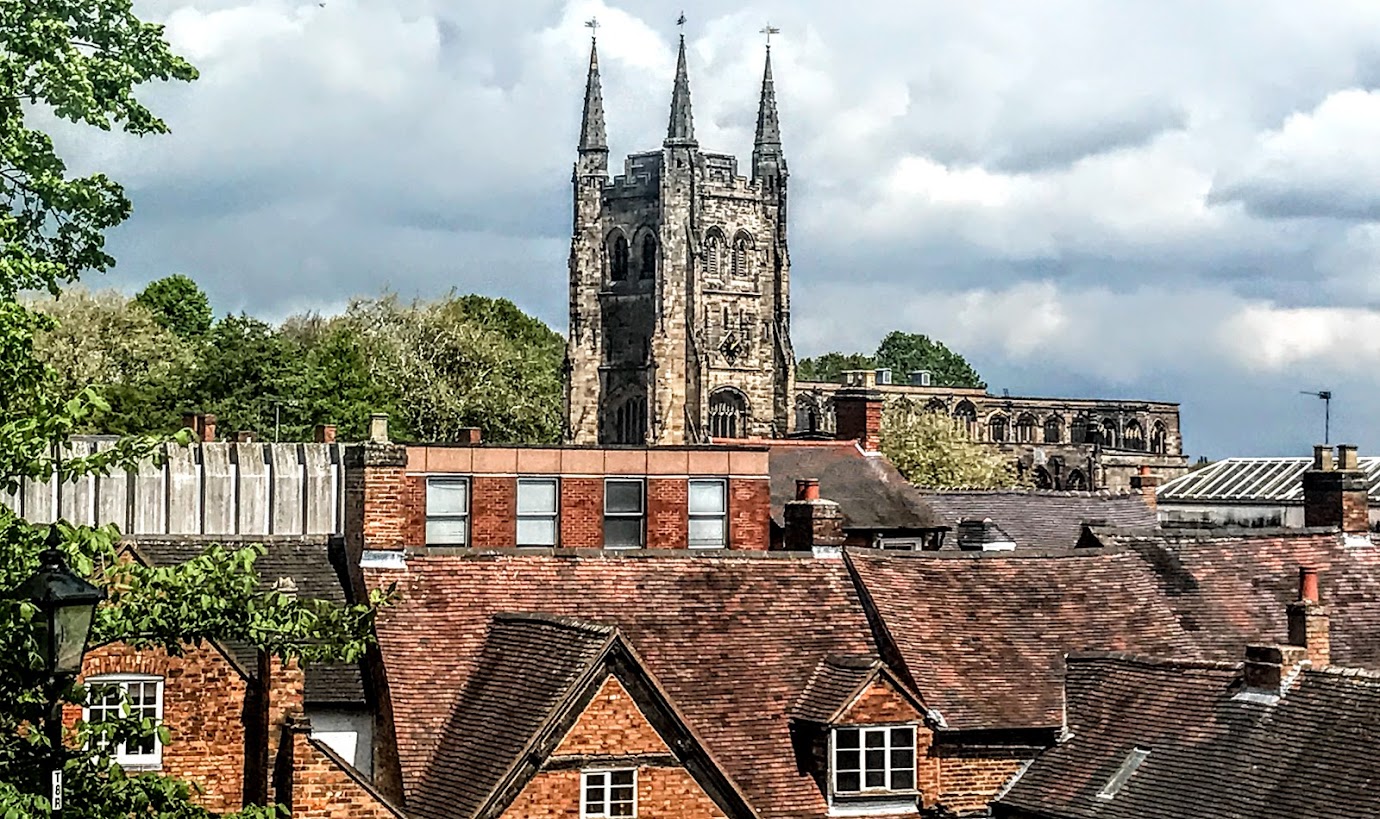
‘Our town has underused churches and underappreciated ancient monuments’ … Saint Editha’s Church and the town seen from Tamworth Castle (Photograph: Patrick Comerford)

I was back in Tamworth last week, visiting some places associated with the Comberford family. So, my choice of poem this morning is another poem about Tamworth by Mal Dewhirst, ‘Our Town.’

Mal Dewhirst, who died in 2021, became Staffordshire’s first poet laureate in 2012. He lived in Tamworth and Tamworth inspired a number of his poems.

He was a writer and film maker, and his plays have been performed across the Midlands, including ‘The Fell Walker’ in Tamworth and ‘At the Crossroads’ at the Garrick in Lichfield, which was commissioned by the Lichfield Mysteries.

Mal was a poet-in-residence in a town market and an archaeological dig, his work has been published in many magazines and journals, and he appeared on BBC Radio and Radio Wildfire. He was also responsible for the Polesworth Poets Trail.

Mal was a regular reader on the Midlands poetry scene and was part of the Coventry Cork Literature exchange in 2011, performing readings in Cork City and Limerick. As a film director, his film Double Booked was shown at the Corona Fastnet Short Film Festival in Ireland in 2014.

He hoped to bring ground-breaking writing to new audiences, always seeking to redefine boundaries, and wanted to develop and improvise new work as collaborations with other artists and performers in unexpected places as a melding of ideas, skills and talents.

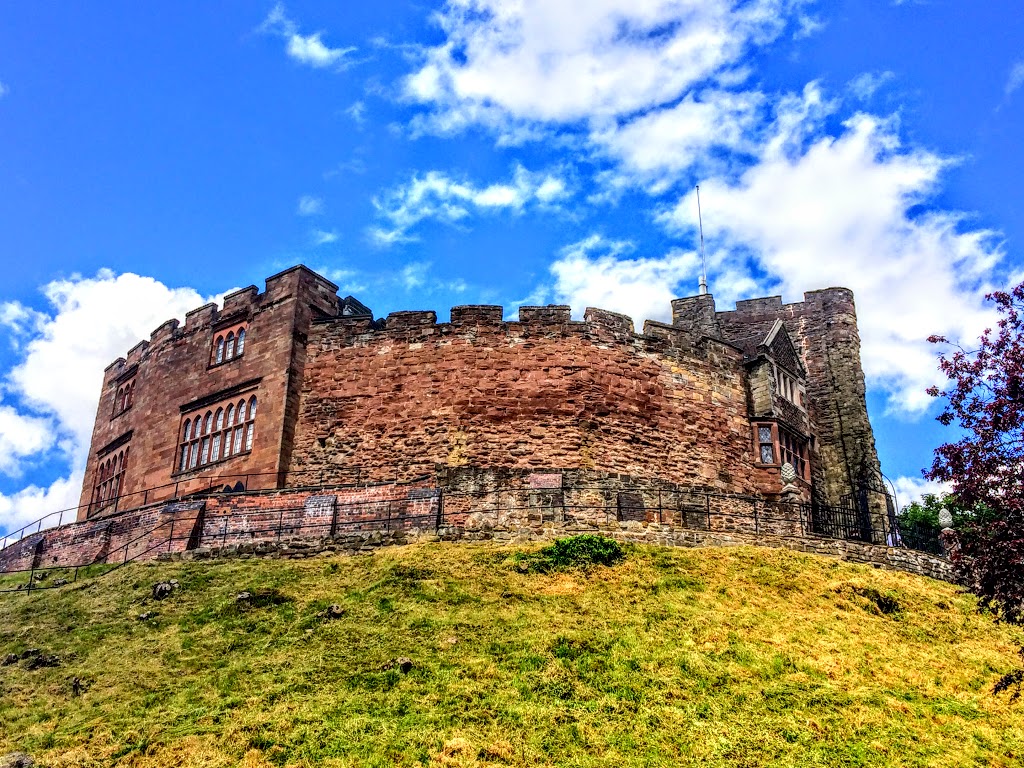
Tamworth Castle, on a mound above the town (Photograph: Patrick Comerford)

Our Town, by Mal Dewhirst:

Our town is being defined
by the corporate; coffee shop, pseudo design brand clothing stores, token music shop and two branches of a major pharmacy,
mixed in with charity shops for our hearts, the aged, the hospice and cancer.
It has an out of town retail park
with two supermarkets, a pet store, two electrical shops and a DIY store,
all mingled among a disruptive road network.

I know what you’re thinking,
Our town sounds just like your town.
It has several co-ops, a flower shop, a row of; banks and building societies,
travel agents and estate agents, solicitors and accountants,
they all group together, power in numbers,
creating quarters, where they know each others secrets.
Then there is the local council office, the tourist information centre,
pubs and restaurants, cafes and Kebab shops,
cheep booze emporiums,
where Chateauneuf-du-Pape is not even an aspiration.
Market stalls on xdays and ydays,
for the purveyors of:
fleeces and fruit, trainers and towels,
books and batteries, rugs and rollers,
cheese and chutney,
Our town sounds just like your town

Our town has a Non-league football team,
whose fans chant about coming from our town,
how nobody likes us but we don’t care,
just like they do in your town.
We have a leisure centre, with swimming pool and gym,
all franchised out to entrepreneurs from the Dragons den.
Our town has underused churches and underappreciated ancient monuments,
it has some green open spaces with swings and a slide
and some artworks, that just appeared as if dropped by aliens.
There is a carnival in the summer,
where lorries squeeze through open backed streets
and the sea cadets, girl guides and boy scouts
hold on for dear life, whilst the spectators thrown coins at them.
The carnival, when they crown a local girl as queen
who smiles for the camera and hopes that there is more to fame than this.

Our town has the battle of the bands in the autumn,
when young testosterone filled teenagers
thrash guitars and grunt about being misunderstood.

Our town has a bonfire and fireworks in the park,
except now it’s only fireworks
because the fire destroys the grass.
Our town sounds just like your town

Our town was badly re-planned in the sixties and has a local newspaper
that keeps reminding us, by printing pictures from the past.

Our town’s car parks are free after seven pm
but demands payment for a minimum of two hours at all other times.

Our town has its Assembly rooms where fading sixties bands strut their Zimmer tunes,
and the local dance groups hold their annual shows,
followed by the X factor rejects, grabbing their last gigs
before disappearing into Wikipedia.

Our town has its taxi ranks where A2B vie for business with Ourtown Taxi’s,
there is a bus garage that is in the narrowest most inappropriate part of town,
the multiplex Cinema surround sounds an American Diner.
Pedestrianised streets where
there are sometimes fights at weekends,
tears and bruises, over indulgent consequences.
Fading hotels, who have offers for weddings
where suits feel uncomfortable
upon their wearers
and women wear large bright hats.
Our town sounds just like your town.

Our town has bred several footballers, rock musicians and the odd writer,
all of whom no longer live here,
and never mention that they ever lived here,
We do have many other worthies, who were named after the roads,
where boy racers now avoid the awkward speed bumps
as they tear up the worthy tarmac.

Our town has its own crest,
is tripleted with several foreign towns,
one in Germany, as an act of reconciliation,
another in France, although I did not realise Agincourt still ran so deep,
and the obvious one, the one with same name, in a former British colony.
Our town used to produce things,
was known for producing certain things;
now either people don’t want our things,
or they can be made cheaper in Eastern Europe or China,
our town has lost its industry
has become overspill for the city
has more incomers who commute to work,
than those who are born and bred and speak with a local accent,
use local sayings; know everyone and who they are related too.

OK, In our town there is a familiar feeling
that our town is just like your town.

© Mal Dewhirst

‘Our town has its own crest’ … the Tamworth Arms on Lichfield Street (Photograph: Patrick Comerford)

USPG Prayer Diary:

The theme in the USPG Prayer Diary this week is the ‘Opening Our Hearts.’ This theme is introduced this morning by James Roberts, Christian Programme Manager at the Council of Christians and Jews, who reflects on Holocaust Memorial Day and World Interfaith Harmony Week.

Holocaust Memorial Day, which we commemorated on Friday, and World Interfaith Harmony Week, which begins on Wednesday, require us to open our hearts, both to the memory of the past and towards a more tolerant and loving future.

Holocaust Memorial Day is when we remember all the victims of Nazi persecution, including the six million Jews who were murdered in the Holocaust, and all subsequent genocides. In order to authentically witness to the memory of the Holocaust, we need to open our hearts to the pain of the past. We need to inform ourselves of this shameful history, and to hold the memory of the victims in our minds. We may even look inwards and ask ourselves how we might do more to stand up for those who are persecuted, abused, or rejected in our world today.

To look forward towards a better future, towards a world where genocide will be no more, we must also open our hearts to the other — to our neighbours, to people who are different from us. In interfaith harmony week, we think especially of people of other faiths.

To open our hearts to the memory of the past, and to our neighbours, is to actively and prayerfully strive towards harmony between all people, so that we may grow one step closer to a world united in love.

The USPG Prayer Diary today invites us to pray in these words:

Lightness our darkness, O Lord,
and reveal the unspeakable
lest we forget the victims of our inhumanity.
Turn our hearts to repentance and our actions to justice.

Yesterday’s reflection

Continued Tomorrow

‘Our town has … underappreciated ancient monuments’ … the Comberford monument in Saint Editha’s Church, Tamworth (Photograph: Patrick Comerford, 2023)

28 January 2023

Praying through poetry and
with USPG: 28 January 2023

Tamworth Castle and the Moat House, the former Comberford home on Lichfield Street, decorate the welcome sign at Tamworth Railway Station (Photograph: Patrick Comerford, 2023)

Patrick Comerford

Christmas is not a season of 12 days, despite the popular Christmas song. Christmas is a 40-day season that lasts from Christmas Day (25 December) to Candlemas or the Feast of the Presentation on Thursday next (2 February).

Throughout the 40 days of this Christmas Season, I am reflecting in these ways:

1, Reflecting on a seasonal or appropriate poem;

2, a prayer from the USPG prayer diary, ‘Pray with the World Church.’

I interrupted that pattern to mark the Week of Prayer for Christian Unity, which came to an end on Wednesday.

I have an appointment in Milton Keynes University Hospital later this morning. But, before the day gets busy, I am taking some time for prayer and reflection.

Inside Saint Editha’s Church, Tamworth (Photograph: Patrick Comerford, 2023)

I was back in Tamworth earlier this week, visiting some places associated with the Comberford family. So, my choice of poem this morning is Mal Dewhirst’s ‘We are Tamworth,’ a poem commissioned for ‘This is Tamworth’ at Birmingham Symphony Hall on 3 July 2014.

Mal Dewhirst, who died in 2021, became Staffordshire’s first poet laureate in 2012. He lived in Tamworth and Tamworth inspired a number of his poems.

He was a writer and film maker, and his plays have been performed across the Midlands, including ‘The Fell Walker’ in Tamworth and ‘At the Crossroads’ at the Garrick in Lichfield, which was commissioned by the Lichfield Mysteries.

Mal was a poet-in-residence in a town market and an archaeological dig, his work has been published in many magazines and journals, and he appeared on BBC Radio and Radio Wildfire. He was also responsible for the Polesworth Poets Trail.

Mal was a regular reader on the Midlands poetry scene and was part of the Coventry Cork Literature exchange in 2011, performing readings in Cork City and Limerick. As a film director, his film Double Booked was shown at the Corona Fastnet Short Film Festival in Ireland in 2014.

He hoped to bring ground-breaking writing to new audiences, always seeking to redefine boundaries, and wanted to develop and improvise new work as collaborations with other artists and performers in unexpected places as a melding of ideas, skills and talents.

Sir Robert Peel’s statue outside the Town Hall in Tamworth (Photograph: Patrick Comerford, 2023)

We are Tamworth, by Mal Dewhirst:

We are Tamworth
We are Tamworth
We are Tamworth
From the Lamb
from Stonydelph, Wincote, Belgrave, Amington, Two Gates, Lakeside, Riverside, Coton Green, Gillway, Perrycrofts. The Leys, Leyfields, Glascote and its Heath, Bolehall, Dosthill, Kettlebrook, Bitterscote, Castle and town and all our blessed lands.
We are Tamworth.

Where Tame meets Anker,
bringing Birmingham and Black Country tales
to mix with the Anker's Warwickshire words,
all the ripple and flow from here, to the Trent, to the Humber, to the Sea.

Rivers spilling full lap through meadowlands:
where Offa palaced in the castled grounds
of Sandybacks and Plastic Pigs,

Aetheflaeda proclaimed
build me a bridge, a Lady Bridge,
then guard it so that only I might cross.
Build me a mound, a castled mound,
where I might live and watch for dust.

This is Tamworth.
Where Saxon and Viking built their border,
we gave camp to the knights of Bosworth field,
where Roundhead met Cavalier on the Tame bridges
and we gave tea to soldiers as they passed on to the Somme,
always trying to bring some comfort to conflict.

This is Tamworth
where Enigma Heroes learned to swim,
ski’s ride summers of man-made frosts,
Rawlett, preached his legacy of learning,
where Guy built a town hall and gave Alms
then took them away when he didn’t get the vote
and Policeman Peel built his weaving mills,
warp and weft, webbing and tape,
building his new manifesto.

This is Tamworth where the Beatles and the Stones played,
in their constant touring, egg and chip days.
Tamworth, where the original Teardrop Exploded,
and Wolfsbane gave us a massive noise injection,
where every year we see the Assembly Rooms
host the next Battle of the Bands,
which is not when young testosterone filled teenagers
thrash guitars and grunt about being misunderstood.
It is when, just maybe, our Beatles and Rolling Stones might be heard.

Ventura Park and Ankerside, the retail lands
of designer brands and coffee shops,
supermarkets, house and homes,
enclosed by roads that circle and twist and never want to let you leave.

Market on Tuesdays and Saturdays,
for the purveyors of:
fleeces and fruit, cakes and clothes, trainers and towels,
books and batteries, rugs and rollers,
cheese and chutney, shoes and socks, games and gifts.

Town has several co-ops, flower shops, a row of: banks and building societies,
travel agents and estate agents, solicitors and accountants,
they all group together, power in numbers,
creating quarters, where they know each others secrets.
All watched over by the Philosophers of Upstairs, Downstairs, Sidewalk Cafe.

This is Tamworth
Our housing estates that are built on themes; of counties, of plants,
cars, poets, space travel and stately homes – and we don’t waste
people’s time in naming our roads, don’t see the point of adding road or
street or close – makes it so much easier to write an envelope.
And have you noticed that many of our famous people were named after the streets.

Famous people: Marmion, Ferrers, Robert Peel. Thomas Guy, John Rawlett, William McGregor, Colin Grazier, Tom Williams back to Ethelflaeda and Offa, and onward to Julian Cope, Blayze Bailey, Phil Bates, Mark Albrighton. Miss Pym and her suffragettes –
All worthies who have a staked a claim in Tamworth.

Along with the miners of Glascote and Amington, the car workers of Reliant, the spinners and weavers, the potters and warehouse crews. The choirs and bands all hammering the sound of Tamworth.

This is created in Tamworth, along with the crafts and cakes, the paintings and
sculpted forms that bring all the welcomes into the light of valued art.

This is Tamworth
Where the Herald reports our community woes and triumphs
then reminds of how the town used to look.
Tamworth, home where the Tamworth Two were trying to return,
and the Lambs raise goals to the songs of the shed choir.
Tamworth where the town hall is like an orange, it has Peel on the outside,
where the Olympic torch chose to catch its breath,
and jousters, fireworks, skateboarders,
families all strut their thought in the castle grounds.

Tamworth with our French and German twins
Sharing culture and song
Poetry and peace
Bringing markets to share cheese and meat and finest wine.

Tamworth where we race for life.
bring help to heroes
and support those in need.

This Tamworth where our dialect is spoken with a distinction, alright me duck.
These are our words that tell of a proud heritage built on toil
and a strength that sees one Tamworth, perfectly placed
to create our piece of theatre in the world
and remember who we are and where we are from
we can shed a tear and raise a smile
as we share our town with all those who choose to come.

Because we are Tamworth
Super Tamworth
We are Tamworth
from our land.

© Mal Dewhirst 2014

Aetheflaeda ‘enclosed by roads that circle and twist and never want to let you leave’ (Photograph: Patrick Comerford, 2023)

USPG Prayer Diary:

The theme in the USPG Prayer Diary this week is the ‘Myanmar Education Programme.’ This theme was introduced on Sunday with a reflection from a report from the Church of the Province of Myanmar.

The USPG Prayer Diary today invites us to pray in these words:

Let us give thanks for the Myanmar Education Programme. May its work amongst the rural communities of its dioceses resource and empower them.

Yesterday’s reflection

Continued Tomorrow

The former Peel School at 17 Lichfield Street, Tamworth (Photograph: Patrick Comerford, 2023)

27 January 2023

Praying through poetry and
with USPG: 27 January 2023

The train tracks in Auschwitz-Birkenau (Photograph: Patrick Comerford)

Patrick Comerford

Christmas is not a season of 12 days, despite the popular Christmas song. Christmas is a 40-day season that lasts from Christmas Day (25 December) to Candlemas or the Feast of the Presentation next Thursday (2 February).

Throughout the 40 days of this Christmas Season, I have been reflecting in these ways:

1, Reflecting on a seasonal or appropriate poem;

2, a prayer from the USPG prayer diary, ‘Pray with the World Church.’

I interrupted that pattern for the past week to mark the Week of Prayer for Christian Unity, which came to an end on Wednesday.

Today is Holocaust Memorial Day, and the theme for this year is ‘Ordinary People’. It focuses on the idea that it is ordinary people that facilitate genocide – and that those who are persecuted are ordinary people who belong to a particular group. My choice of a poem this morning is ‘Testimony’ by the Israeli poet Dan Pagis (1930-1986).

Dan Pagis was born in a German-speaking Jewish family in Bukovina, Romania (present-day Ukraine), and was interned in a concentration camp as teenager before escaping in 1944 and emigrating to Israel.

He wrote in Hebrew, a language he learned only as a teenager, and his first poems about the Holocaust appeared 25 years after the events. He also taught mediaeval Jewish literature at the Hebrew University.

His poem ‘Testimony’ draws attention to the experience of the victims of the Shoah, not the perpetrators. The perpetrators are just ‘uniforms and boots’; instead we are drawn the survivor’s voice.

Like so many survivors of the Holocaust and other traumas, the poet’s life is changed. He is more like smoke than a human being – a shade or shadow, in the central stanza, rather than an ‘image’.

In the Hebrew original, there is wordplay between these two words, as they differ only by one crucial letter (‘tzelem’ and ‘tzel’ are the words for ‘image’, and ‘shade’, respectively). Being a ‘shade’ or a shadow is a poignant and troubling description of life after trauma, and fits with this year’s theme for Holocaust Memorial Day.

Life does not simply return to ‘normal’ after events like those Pagis experienced. Moreover, the poet, who did nothing wrong, even feels the need to apologise to God in the last stanza – an example of the survivor’s guilt that has been well-documented amongst survivors of the Shoah and trauma in general.

The poet’s shadow-like existence is a challenge to the closure we seek in art and literature. Although the poet has lived to tell the tale, there is no happy ending here, no easy comfort. A simple contrast between light and dark is not appropriate here; the shadows persist even in the light of liberation.

The poem also voices anger at humanity: ‘No, no, they were definitely human beings’, reads the first line. The perpetrators were not monsters or animals. They were created in the image, they were humans like us.

The humanity of the perpetrators is a reminder of genocides in Cambodia, Bosnia, Rwanda, and Darfur. The only hope is that human beings ‘be the light in the darkness’, not the perpetrators of violence.

This poem directs our attention to the victims, in empathy, and to our shared human nature, in resolve. It is, perhaps, this journey as readers from smoky formlessness to anger and resolve that is this poem’s hope. Even so, the shadow-like existence of the survivor is a haunting and significant image.

A Holocaust memorial at the Jewish cemetery in Berlin (Photograph: Patrick Comerford)

Testimony, by Dan Pagis (1930-1986):

No, no: they definitely were
human beings: uniforms, boots.
How to explain? They were created
in the image.

I was a shade.
A different creator made me.

And he in his mercy left nothing of me that would die.
And I fled to him, rose weightless, blue,
forgiving – I would even say: apologizing –
smoke to omnipotent smoke
without image or likeness.

The gates of Auschwitz (Photograph: Patrick Comerford)

USPG Prayer Diary:

The theme in the USPG Prayer Diary last week was the Week of Prayer for Christian Unity. The theme this week is the ‘Myanmar Education Programme.’ This theme was introduced on Sunday with a reflection from a report from the Church of the Province of Myanmar.

The USPG Prayer Diary today (Holocaust Memorial Day) invites us to pray in these words:

Let us pray for the Rohingya people, denied citizenship in Myanmar and persecuted. May we never forget the Holocaust and work ceaselessly for justice for all ethnic minorities.

Yesterday’s reflection

Continued Tomorrow

The Holocaust Memorial at the Dohány Street Synagogue in Budapest (Photograph: Patrick Comerford, 2023)

17 January 2023

Praying through poems and
with USPG: 17 January 2023

‘Since Christmas they have lived with us, / Guileless and clear,/ Oval soul-animals …’ … balloons outside All Saints’ Church, Calverton (Photograph: Patrick Comerford, 2022)

Patrick Comerford

Christmas is not a season of 12 days, despite the popular Christmas song. Christmas is a 40-day season that lasts from Christmas Day (25 December) to Candlemas or the Feast of the Presentation (2 February).

Throughout the 40 days of this Christmas Season, I am reflecting in these ways:

1, Reflecting on a seasonal or appropriate poem;

2, a prayer from the USPG prayer diary, ‘Pray with the World Church.’

Sylvia Plath’s grave in the churchyard in Heptonstall, West Yorkshire

After reading ‘Sylvia’s Christmas Song’ by the Finnish poet Zachris Topelius, I decided in my choice of a seasonal poem this morning to return to ‘Balloons’ by the American-born poet Sylvia Plath (1932-1963).

This poem is an interesting commentary on the long, lingering days after Christmas, in January and into February. Sylvia Plath opens ‘Balloons’ with a description of how these days (for some) seem to drag on after Christmas, and how the Christmas decorations seem to linger a little longer than we expect, even in corners where we have forgotten them.

Sylvia Plath is buried in the new churchyard at Saint Thomas à Becket Church in Heptonstall, a small hilltop village above Hebden Bridge in West Yorkshire. She was married to the Poet Laureate Ted Hughes, who was from nearby Mytholmryd. Her headstone is regularly vandalised by visitors who remove his surname, because some of her fans – particularly women, and American women – believe he was responsible for her death.

The old church dedicated to Saint Thomas à Becket is now a ruin, but it is carefully maintained and is used occasionally for open-air services. There are three adjacent churchyards: the oldest, around the old church, is now closed; the second is around the new church; and the third and newer churchyard, across Back Lane, is where Sylvia Plath is buried.

Sylvia Plath died by suicide in London 60 years ago on 11 February 1963, following a long struggle with depression and a difficult and fraught marital separation. Six decades later, the story of her life and death, as well as her writing and legacy, are still marked by controversy.

She is credited with advancing the genre of confessional poetry and is best known for two collections, The Colossus and Other Poems and Ariel. In 1982, she was the first poet to receive a Pulitzer Prize posthumously, for The Collected Poems. She is also the author of The Bell Jar, a semi-autobiographical novel published under the pseudonym Victoria Lucas in 1963 shortly before her death.

Sylvia Plath was born in Boston in 1932 and published her first poem in the Boston Herald at the age of eight. Her German-born father Otto had been alienated from his family because of his decision not to be ordained a Lutheran minister. His death nine days after her eighth birthday had a deeply profound and lasting influence on her and shaped her personality and her writing. Raised as a Unitarian, she experienced a loss of faith after his death, and remained ambivalent about religion for the rest of her life.

While she was a student at Smith College in Massachusetts in the 1950s, she wrote over 400 poems. In 1955, she was awarded a Fulbright scholarship to study at Newnham College, Cambridge. She was enchanted with the groomed courts and crooked streets of Cambridge, and was often seen pedalling furiously around the town, her black gown billowing out behind.

In Cambridge, eventually, she met the English poet, Ted Hughes. Through his mother, Hughes claimed direct descent from Nicholas Ferrar, the founder of the Little Gidding community. When he met Sylvia Plath, Hughes had already graduated from Cambridge, where he had been an undergraduate at Pembroke College, and was living between London and Cambridge:

I am here;
I wait;
and he plays on the banks of the river Cam
like a casual faun.


The two were married by special licence from the Archbishop of Canterbury, Geoffrey Fisher, on 16 June 1956, in the Church of Saint George the Martyr, in Queen’s Square, Holborn, just a short stroll from the Bloomsbury offices of TS Eliot. They had chosen the day especially because it was Bloomsday.

Syvia Plath returned to Cambridge in October to begin her second year at Newnham. After some time in the US and Canada, they returned to England, and in 1960, at the age of 28, she published her first book, The Colossus in England.

For a while, Sylvia Plath and Ted Hughes lived in North Tawton, a country village in Devon, but their marriage began to break up less than two years after the birth of her first child.

In the cold winter of 1962-1963, she lived in poverty in a small flat in London, with her two small children – Frieda Rebecca, who is now a poet and children’s writer, and the late Nicholas Farrar Hughes, named after his ancestor, Nicholas Farrar of Little Gidding. Her flat in 23 Fitzroy Road was in a house where WB Yeats once lived. There that winter, the flat was cold, the pipes froze, there was no telephone, and the children were often ill with ’flu. But there she continued to write, often working between 4 and 8 a.m. before the children awoke, and at times finishing a poem a day. In those poems death is given a cruel, physical allure and psychic pain becomes almost tactile.

Early in the morning of 11 February 1963, Sylvia Plath succeeded in killing herself with cooking gas at the age of 30, while her children slept in the next room. She was buried in the churchyard in Heptonstall, beside Saint Thomas à Becket Church.

The Collected Poems of Sylvia Plath, published in 1981, was edited by Ted Hughes, who succeeded John Betjeman as Poet Laureate in 1984. In 1998, Hughes published Birthday Letters, a collection of 88 poems about their relationship. The book caused a sensation.

Ted Hughes died later that year, and his funeral took place in North Tawton, where he and Syliva Plath had lived for some time. Speaking at his funeral, Séamus Heaney said: ‘No death outside my immediate family has left me feeling more bereft. No death in my lifetime has hurt poets more. He was a tower of tenderness and strength, a great arch under which the least of poetry’s children could enter and feel secure. His creative powers were, as Shakespeare said, still crescent. By his death, the veil of poetry is rent and the walls of learning broken.’

Birthday Letters went on to win the Forward Poetry Prize, the TS Eliot Prize for Poetry and the Whitbread Poetry Prize.

Street art seen in Chatham Row, off Grafton Street, Dublin (Photograph: Patrick Comerford, 2022)

The poem ‘Balloons’ was written by Sylvia Plath in 1963, less that a fortnight before she died by suicide. Both ‘Edge’ and ‘Balloons’ are dated 5 February 1963, but she left no indication of which poem was written first. These are the last two poems she wrote, and the last poems she submitted for publication. There are many parallels between ‘Balloons’ and ‘Full Moon and Little Frieda’ by Ted Hughes.

The two last poems by Sylvia Plath, ‘Edge’ and ‘Balloons’, centre around images of a mother and her two children: ‘Balloons’ is the daylight poem, with its scene of realistic domesticity; ‘Edge’ is the night-time, moon poem, with its stark image of the dead mother and her two dead children.

As Sylvia Plath was bipolar, some see ‘Balloons’ as a poem about the highs and the lows in her life, her moods like balloons that might pop, making life bleak once again. Others say she is hinting once again at a common theme found in her poetry – the loss of innocence, marked by the popping of a red balloon.

In ‘Balloons,’ Sylvia Plath writes about the joy and innocent beauty we can find even in the smallest and simplest of things. She is talking to her daughter while her son is playing with one of the balloons left over from the Christmas decorations.

The balloons fill the small, lively room with a myriad of colours. But the room is small and the balloons appear to ‘take up half the space.’ She compares the balloons with oval-shaped soul-animals. ‘Invisible air drifts’ make the balloons drift and they become ‘globes of this air’ that are mobile and that take us to places that we cannot be.

The world of fantasy all children believe in during the first phase of their lives is symbolised by these balloons. This other world is childish and typically idealistic, alien yet desirable.

The child exclaims: ‘Such queer moons we live with’ – giving us the impression that the balloons, like imagination, are present but incomprehensible. The child is in awe at the balloon, for while he feels the rubber between his fingers, the air inside is inaccessible.

This inaccessibility fuels the child’s curiosity and he tries to fathom his imaginations. Despite his confusion, he finds the balloons and his imagination are ‘delighting.’

The single word at the end of the second stanza catches the reader’s attention. The child is intrigued and shows a kind of childish ignorance.

The small boy looks through a red balloon that makes everything look pink – an altered world.

In the last stanza, out of curiosity, the boy bites into the balloon and tries to eat it. But the balloon pops, and all that remains is the balloon’s shredded remains, ‘A red/Shred in his little fist.’ He is neither angry nor upset, but contemplates the consequences of his action. Now he sees the world not in a different light, but as it really is.

Like Saint Thomas the Apostle, when we see reality we can realise the full beauty of the world presented to us, and seeing truly is believing.

The poet’s focus is not so much on worlds destroyed but on the wonder and beauty of unexpected change. The small boy is surprised, and yet is calm and contemplative. Childhood allows us to see the world as a beautiful, exciting place.

But at some point that innocence is lost when eventually we see the reality of our lives, and we see the real world as it is. All we are left with is a small piece of what made us see the world differently in the first place. The world is no longer lively with colours but is ‘clear as water.’

Sylvia Plath with her son Nicholas shortly before she died in February 1963

Balloons, by Sylvia Plath

Since Christmas they have lived with us,
Guileless and clear,
Oval soul-animals,
Taking up half the space,
Moving and rubbing on the silk

Invisible air drifts,
Giving a shriek and pop
When attacked, then scooting to rest, barely trembling.
Yellow cathead, blue fish—
Such queer moons we live with

Instead of dead furniture!
Straw mats, white walls
And these traveling
Globes of thin air, red, green,
Delighting

The heart like wishes or free
Peacocks blessing
Old ground with a feather
Beaten in starry metals.
Your small

Brother is making
His balloon squeak like a cat.
Seeming to see
A funny pink world he might eat on the other side of it,
He bites,

Then sits
Back, fat jug
Contemplating a world clear as water.
A red
Shred in his little fist.

5 February 1963

Sylvia Plath was often seen pedalling furiously around the crooked streets of Cambridge … bicycles outside Sidney College, Cambridge (Photograph: Patrick Comerford)

USPG Prayer Diary:

The Week of Prayer for Christian Unity begins tomorrow (18 January), and the theme in the USPG Prayer Diary this week is the ‘Week of Prayer For Christian Unity.’ This theme was introduced on Sunday with a reflection from the Pontifical Council for Promoting Christian Unity and the Commission on Faith and Order of the World Council of Churches.

The USPG Prayer Diary invites us to pray today in these words:

Let us pray for honesty and integrity in our discussions around difference. May we search ourselves before judging others.

Yesterday’s reflection

Continued Tomorrow

Sylvia Plath and Ted Hughes were married on 16 June 1956, in the Church of Saint George the Martyr, in Queen’s Square, Holborn (Photograph: Patrick Comerford, 2022)