Showing posts with label Churchtown. Show all posts

09 September 2016

Summer turns to autumn as
the buddleia begins to fade

Fading buddleia in Churchtown this week … reminders of a priest who died over 300 years ago (Photograph: Patrick Comerford, 2016)

Patrick Comerford

There are two sayings in Ireland that mark the changes in the seasons. Some time around the end of March or the beginning of April, people begin to say, ‘Sure, there’s a grand stretch in the evenings.’ And then, around this time of the year, they begin to say, ‘You’d notice the evenings begin to close in, wouldn’t you?’

If you had any doubts that summer was trying to linger a little longer this week, then it came to an end today with the heavy rains and the high waves along the seafront in Bray, Co Wicklow, when I tried to go for a walk along the shore at the end of a long working week.

The rain and the Dublin bus strike colluded to make the end-of-week traffic between Dublin and Bray exceptionally heavy this afternoon, and it took a full hour and a half to travel at snail’s pace between Churchtown and Bray this afternoon. I took pity on those poor people who were trying to make it even further to Co Wexford for what they may have hoped was going to be the last weekend of the summer season by the sea.

I had hoped to use this week, before academic demands return with a demanding impact, to keep up my walking distances. The counter on my phone seems to act as some sort of incentive, but never quite produced the results I expected.

Why is it that I seem to manage to walk greater distances each day when I am in England than when I am in Ireland? Perhaps that is the secret cultural divide between the two countries.

My walking averages this week are low, at about 3.5 km a day, despite walking back to work after lunch each day, and having a long walk by the River Dodder on the way home on Monday, when my daily total came to almost 7.5 km.

On the other hand, when I was in Cambridge last week, I was managing to reach 13 and even 16 km a day as I went for lengthy walks by the river and the boathouses, and had brisk early morning walks each day, as well as some wandering walks in the Essex countryside during the day I spent visiting Saint John’s Monastery in Tolleshunt Knights.

Lingering images of summer on the lawns this week (Photograph: Patrick Comerford, 2016)

One of the signs of the passing of summer is the fading of the flowers, including the roses on the lawns at CITI and the buddleia or butterfly bushes that grow wildly by the roadside.

Only recently did I realise the buddleia takes its name from an Anglican priest. The Swedish botanist Carl Linnaeus named it in honour of the Revd Adam Buddle (1662-1715), an English botanist and priest, at the suggestion of Dr William Houstoun, who sent the first plants to England from the Caribbean about 15 years after Buddle’s death over 300 years ago.

Adam Buddle was born the son of a prosperous hemp-dresser in Deeping Saint James, a small village near Peterborough, and was educated at Saint Catharine’s College, Cambridge (BA, 1681, MA, 1685).

His life between graduation and ordination remains obscure. During that time, he lived near Hadleigh, Suffolk, where he became an authority on bryophytes. He was one of the first Englishmen to study mosses and liverworts as bryology began to be taken seriously in England during the late 17th century.

He was a Fellow of Saint Catharine’s College, Cambridge, until 1691, but like many others was then ejected after refusing to pledge his oath to the new king, William III.

He married Elizabeth Eveare in 1695, and they had two children.

By 1702, Buddle had sworn allegiance to King William, and he was in Ely Cathedral. In 1703 he became rector of North Fambridge, near Maldon in Essex, and 16 miles south of Tolleshunt Knights. He compiled a new English Flora in 1708, but this was never published.

He also accepted the post of Reader (or vicar) at the Chapel of Gray’s Inn, London. He died there and was buried at Saint Andrew’s Church Holborn, on 15 April 1715. His widow Elizabeth survived him until at least 1724.

Buddle’s memory has faded too, but I still thought of him this week as I looked at the buddleia in Churchtown this week. I knew summer was passing, and this afternoon’s rains and high waves in Bray late this afternoon seemed to confirm this.

The evenings begin to close in by the waves in Bray this evening (Photograph: Patrick Comerford, 2016)

11 August 2016

Camberley House, Churchtown: the home of
a revolutionary widow and a former school

Camberley House, 78 Upper Churchtown Road … the home of a revolutionary widow and later a preparatory school (Photograph: Patrick Comerford, 2016)

Patrick Comerford

In my walks around the Churchtown and Rathgar area in recent weeks, I was surprised to see for the first time Camberley House at 78 Upper Churchtown Road. This house, which was also known in the past as Inish More and as Inish Ealga, is an elegant Georgian house, with all the appearances of a country house, and the surprise on seeing it for the first time is added to by its setting in the midst of modern housing estates, behind SuperValu and other shops in this part of Churchtown.

Today, 200-year-old Camberley House is the home for a small project run by the housing agency Sophia operates through Dun Laoghaire Rathdown County Council.

A house on this site is recorded as early as 1768 when the house was sold by Francis Minchin to James Towers. At one time, the house may have been known as Barn Elms, a name that is now associated with house further west along Upper Churchtown Road.

The present house does not date back that far, but was probably built in the first decade of the 19th century, when it replaced an earlier house on the same site.

The Minchin family also had a house at Woodville, Co Wexford, and remained in the Churchtown and Dundrum area in the 19th century. The parish records of Taney Parish note the burials of Anne Minchin (1819), William Minchin (1825), and their father William Augustus Minchin (1841).

The name of Camberley House, which was on the old gate piers, seemingly does not appear in the official records. So where did the name come from?

Camberley is a town in Surrey, 50 km south-west of central London, close to Surrey’s borders with Hampshire and Berkshire, and the main town in the borough of Surrey Heath. However, Camberley did not exist before the 19th century, and the area for long was known either as Bagshot or Frimley Heath. A new town grew up around the Royal Military College, which was established there in 1812 and would later become the Royal Military Academy, Sandhurst. By 1831, the new town was known as York Town, but it later took a new name from the Cambridge Hotel, built in the mid-19th century.

The town was known unofficially as Cambridgetown, but had to be renamed renamed Camberley in 1877 at the request of the GPO to avoid confusion with Cambridge. It is a composite name: Cam- or Camb- is taken from the original name of Cambridgetown; -ber- means river, because there are many rivers in the area; and -ley, meaning a clearing in a woodland, is a common ending for placeames in the area.

So the name of Camberley House in Churchtown predates the name of Camberley in Surrey. It has been suggested by local historians that the name of Camberley House may be connected instead with Frederick Campbell of Blackrock, who bought Barn Elms from Alexander Orr on 31 January 1860 and then sold it to William O’Neill of Bellevue House, Dundrum, on the same day.

The Ceannt family seems to have acquired the property from the O’Neills around 1915. Eamon Ceannt was one of the signatories of the 1916 Proclamation and a rebel leader in the South Dublin Union on Easter Monday 1916. He was executed in Kilmainham Gaol on 8 May 1916.

When the Ceannt family moved into the house, they used both names of Inish More and Inish Ealga for the house. The name Inish Ealga was used in Irish literature as a type of poetic name for a Gaelic Ireland, “the Island of the Brave.”

For many years, the house was the home of his widow, Aine Ceannt. She was born Frances Mary O’Brennan and in 1905 she married Eamon Ceannt. Four years later, in 1909, she changed her name to Áine b. É. Ceannt. Áine was a sister of the prominent republican activist Elizabeth (‘Lily’) O’Brennan and the playwright Kathleen O’Brennan, and the three sisters were at the centre of the women’s republican movement in the 1910s and the 1930s.

She was vice-president of Cumann na mBan from 1917 to 1925, was a Sinn Fein magistrate during the War of Independence and was later jailed for a year during the Civil War as an anti-treaty activist. She went on to be a co-founder of the Irish Red Cross. From the 1930s, Aine Ceannt lived at Inis Mor, and in the 1940s, she commissioned the building of a substantial gate lodge for the property.

Shortly after the end of World War II, Churchtown started to become the bustling suburb we know today. It soon became obvious that needs in this developing area included schools. Archbishop John Charles McQuaid asked the Notre Dame Sisters to look after the needs of girls in the area and the De La Salle Brothers, who were already based in the area, to do the same for boys.

Both orders looked at various properties in the area. The nuns bought Fernbank, a large house on Upper Churchtown Road near the original turn-off for Dundrum, from a Quaker family. The De La Salle Brothers then started investigating the possibility of buying a neighbouring house, Woodstock, from the Switzer family, who owned Switzer’s shop in Grafton Street. However, Archbishop McQuaid thought that it would be unseemly for the two schools to be so close and that this would create a scandal. He suggested the De La Sale Brothers should look for another site for the boys’ school.

The brothers then began negotiating with Aine Ceannt, and eventually they bought Inish More House and most of the grounds. Aine Ceannt and her son Ronan moved to the extended Gate Lodge, retaining part of the grounds for her own use, and a new gateway was built to give access to the new school. The school was blessed and officially opened by Archbishop McQuaid in 1952.

Aine Ceannt, who left her home at Inis Ealga, Churchtown, in 1952, died in Dundrum on 2 February 1954.

In the years that followed, however, the house could not cope with the increasing numbers at the school, and the present college buildings were erected on the site of the former Landscape House. In 1957, the secondary school moved to its present location further west on Upper Churchtown Road and the preparatory school became a separate entity at Camberley House. Around the same time, the brothers opened a primary school nearby on Whitehall Road.

When the house was sold in the mid-1990s, the new owners renovated it from top to bottom, and it became a four-bedroom detached property with floor space totalling 2,422 sq ft. The accommodation included a reception hall with the original terrazzo floor, a kitchen with a range of maple units, and a dining room with a sandstone fireplace, oak floor and double doors leading out to the rear garden. The house also had a study/library, a large sitting room and lounge. Upstairs there were four bedrooms, including one with its own dressing room and study.

The house was sold once again in 2014, and today this three-storey, 19th century detached house has been split into six two-bedroom apartments, and offers temporary emergency accommodation for families. Referrals come to Sophia through the Homeless Executive. The team consists of a project manager, a support worker and three shift attendants. Staff are present throughout the week, and each tenant has a keyworker and there is a holistic care plan for all tenants. Practical support is also offered in a range of areas such as home management, budgeting, shopping and cooking.

It seems to be an ideal use for an elegant house like this and with this history.

For other postings on the architectural heritage of South Dublin see:

Berwick Hall.
The Bottle Tower, Churchtown.
Brookvale House, Rathfarnham.
Camberley House, Churchtown.
Dartry House, Orwell Park, Rathgar.
Ely Arch, Rathfarnham.
Ely House, Nutgrove Avenue, Rathfarnham.
Fernhurst, 14 Orwell Road, Rathgar.
Fortfield House, Hyde Park, Terenure.
No 201 Harold’s Cross Road, the birthplace of Richard Allen.
Homestead, Sandyford Road, Dundrum.
Kilvare House, also known as Cheeverstown House, Templeogue Road.
Knocklyon Castle.
Laurelmere Lodge, Marlay Park.
Marlay Park.
Mountain View House, Beaumont Avenue, Churchtown.
Newbrook House, Taylor’s Lane, Rathfarnham.
Old Bawn House, Tallaght.
Rathfarnham Castle.
Sally Park, Fihouse.
Scholarstown House, Knocklyon.
Silveracre House, off Sarah Curran Avenue, Rathfarnham.
Synge House, Newtwon Villas, Churchtown, and No 4 Orwell Park, Rathgar.
Templeogue House.
Washington House, Butterfield Avenue, Rathfarnham.
Westbourne House, off Rathfarnham Road.

29 July 2016

Two houses in Churchtown and Rathgar
with links to the playwright JM Synge

The birthplace of JM Synge (1871-1909) at Newtown Villas in Churchtown (Photograph: Patrick Comerford, 2016)

Patrick Comerford

My walks in search of mid-afternoon coffee or on the way home in the evening have led to two unexpected finds of houses in the Churchtown, Rathfarnham and Rathgar area that are associated with the great Irish playwright, John Millington Synge (1871-1909).

Synge was the author of plays, poems and essays, and played a pivotal role in the founding of the Abbey Theatre, alongside WB Yeats and Lady Gregory. His stylised realism set the tone for great writers who followed him, including Sean O’Casey, Brendan Behan and Samuel Beckett. Indeed, Beckett’s novels and plays are often indebted to Synge’s casts of tramps, beggars and peasants.

Around the corner from the Church of Ireland Theological Institute and Braemor Park, Synge House in Newtown Villas is now part of a discreetly-hidden gated community on the corner of Braemor Road.

Edmund John Millington Synge was born on 16 April 1871 in Newtown Little, then described as being in Rathfarnham and now Synge House, No 2 Newtown Villas, Churchtown, Dublin 14. Synge was the youngest son in a family of eight children and spent the first year of his life in this house.

The former country house has been converted into duplex accommodation, with one imposing two-storey-over-basement residence stuck back-to-back to an identical property. Both have steps leading up their main entrances on opposite sides, and have been divided into apartments.

Edmond John Millington Synge was born here in 1871, the youngest of five children. His father, John Hatch Synge, was from a landed gentry family that was seated at Glanmore Castle, Co Wicklow, and moved to Dublin to practice as a barrister.

The Synge family was descended from Edward Synge (1614-1678) from Shropshire, who became Bishop of Limerick and later Bishop of Cork. The family was closely identified with the Church of Ireland over several centuries, providing archbishops, bishops, deans, archdeacons, and clergy in abundance.

The playwright’s branch of the family derived its fortune from John Hatch, the son of Sir William Temple’s agent, who amassed estates in Co Wicklow, Co Meath and Dublin. In Dublin, John Hatch gave his name to Hatch Street, and he owned a townhouse on Harcourt Street that later became the High School.

Glanmore Castle, standing on a 4,000-acre estate in Co Wicklow that included Roundwood Park, was built by John Hatch’s son-in-law Francis Synge, who inherited Glanmore from his uncle, Sir Francis Hutchinson.

Francis Synge’s son, John Hatch Synge (died 1845), the playwright’s grandfather, was known as ‘Pestalozzi John’ after the Italian educationalist whose theories he applied in the estate school, incorporating its own printing-press for teaching materials.

The family estate in Co Wicklow was lost by his son, also John Hatch Synge, under the terms of the Encumbered Estates Act of 1848. The family bought back some of the estates at auction in 1850, and his brother Francis Synge re-established Glanmore Castle as the family seat. Both brothers were members of the Plymouth Brethren, which had a stronghold in Co Wicklow.

In 1856, John Hatch Synge married Kathleen Traill, daughter of the Revd Robert Traill, the Rector of Schull, Co Cork, who is described as having spent his life “waging war against popery.” He was the principal of the Schull Relief Committee during the Great Famine, and died of famine fever in 1847. His translation of Josephus’s The Jewish Wars was published posthumously.

Soon after John was born at Newtown Little, his father John Hatch Synge, a lawyer, contracted smallpox, and died in 1872. He was 49 and the child was just a year old.

No 4 Orwell Park, Rathgar (right) … the childhood of JM Synge; his grandmother lived in the neighbouring house (Photograph: Patrick Comerford, 2016)

The widowed Kathleen Synge was left with an income of £400 a year from a Galway property, bolstered by annuities for her children from an uncle. She moved to 4 Orwell Park, Rathgar, to be next door to her mother, Mrs Traill, whose house was afterwards occupied by his sister Annie and her family – maintaining the practice of living together as an extended family of evangelical religious temper under the tutelage of Kathleen.

John was always sickly and was kept at home by his domineering mother who tutored him there. Overshadowed by her through most of his early years, he would live with her for most of his life and even take his holidays with her. For her part, Kathleen Synge was her father’s daughter, a dour evangelical who mixed only in devout circles.

A neighbour wrote: “Mrs Synge conducted her household by a rule as strict as that of a religious order and supposed that her children would acquiesce without question.”

The banks of the River Dodder, behind Orwell Park, inspired Synge’s early interests in nature (Photograph: Patrick Comerford, 2016)

Nevertheless, Synge seems to have had a happy childhood. He developed an interest in nature and in bird-watching as he wandered behind Orwell Park along the banks of the River Dodder, with clusters of wild flowers and a variety of birds and wildlife, and in the grounds of nearby Rathfarnham Castle. Family holidays were spent at the seaside resort of Greystones, Co Wicklow, and at the family estate at Glanmore Castle, Co Wicklow.

The cruel irony for Kathleen Synge was that the long hours of reading she allowed her son to indulge in ultimately took him to Charles Darwin – as a 14 year old he kept The Origin Of The Species hidden under his pillow – and eventually he abandoned his religion completely.

Nos 1 and 2 Newtown Villas … John Millington Synge was born in No 2, the house to the right (Photograph: Patrick Comerford, 2016)

Robert Synge, a brother of the playwright, settled in Argentina as an engineer. Another brother, the Revd Dr Samuel Synge, was a CMS medical missionary in China (1896-1914) with the Church Mission Society (CMS) and the Dublin University Fukien Mission (now the Dublin University Far East Mission), before returning to Co Wicklow as Rector of Deralossary (1923-1951). In his letters to his daughter, he discussed JM Synge’s religious doubts and lack of paternal direction.

A third brother, Edward Synge, became land agent to the Synge estates and later to Lord Gormanston. He was involved in evictions in Galway and Wicklow, causing JM Synge to reproach his mother, to which she replied: “What would become of us if our tenants in Co Galway stopped paying their rents?”

His sister Annie also married a solicitor; an aunt Jane dandled Parnell on her knee and later lamented his politics.

The family later moved to two adjoining houses at Crosswaithe Terrace in Glasthule (Kingstown, Dun Laoghaire), where Mrs Synge continued to instruct her children and grandchildren. She wrote: “John – poor boy ... He had not found the Saviour yet.” He later wrote: “By the time I was 16 or 17, I had renounced Christianity after a good deal of wobbling.”

JM Synge was educated privately, at Mr Harick’s Classical and English School on Upper Leeson Street, and later briefly at Aravon School, Bray, Co Wicklow. The family spent summers in Delgany, Co Wicklow, and later in Duff House, a rented home at Lough Dan.

He studied the violin with Patrick Griffin for two years, and became a student at the Royal Irish Academy of Music, playing the piano, flute and violin and winning awards for counterpoint and harmony.

He entered TCD in 1889 and studied Irish with the Revd James Goodman (1828-1896), an “amiable old clergyman who made him read a crabbed version of the New Testament …” He studied Hebrew in his final year, read George Petrie on Irish antiquities and the Aran Islands, joined the academy orchestra in 1891, and graduated from TCD with a BA (Pass) in 1892.

In 1893, he campaigned against Home Rule in the belief that it would provoke sectarian conflict.

Later, he studied music in Koblenz, Wurzburg and Paris, and then studied literature and languages at the Sorbonne. In 1896, during a return visit to Dublin, he proposed to Cherrie Matheson, the daughter of a leading member of the Plymouth Brethren. Later that year in Paris, he met WB Yeats who encouraged him to visit the Aran Islands.

But in Paris, he also found Maud Gonne’s group – Irlande Libre, with a newspaper of the same name – to be mendacious and gave up attending their meetings. By then, however, he was suffering the first symptoms of Hodgkin’s Disease, and spent much time in hospital.

He travelled to Inishmore and the Aran Islands in 1898, and was invited to Coole Park, where he met Lady Gregory, Yeats, and Edward Martyn that summer 1898. He would spend the late summers of 1899-1902 on the Aran Islands. By coincidence, his uncle, the Revd Alexander Hamilton Synge, had been the Rector of the Aran Island, where he tried to ban Sunday games.

Synge stopped first at Aranmore but soon decided to “move on to Inishmaan, where Gaelic is more generally used and the life is perhaps the most primitive that is left in Europe.” He continued living mainly in Paris, but returned to the Aran Islands regularly.

This was followed in 1902 with two plays, Riders to the Sea and In the Shadow of the Glen, set in Glenmalure, Co Wicklow, near the Synge family home.

He left Paris in 1903 and moved to London. Later that year, In the Shadow of the Glen was staged for the first time by Irish National Theatre at the Molesworth Hall. It was criticised by Arthur Griffith in the United Irishman and other critics in the nationalist press as “a slur on Irish womanhood” and “a vile and inhuman story told in the foulest language we have ever listened to.”

When Riders to the Sea had its premiere in 1904, it was attacked by Patrick Pearse, who described it as “a sinister and unholy gospel.”

He was then living at 31 Crostwaithe Terrace, Glasthule, but he moved to 15 Maxwell Road, Rathmines, later that year.

He was appointed literary adviser to the Abbey Theatre at its foundation in December 1904. He became a director with Yeats and Lady Gregory when the limited liability company was formed in September 1905. His play The Well of the Saints also attacked by nationalists when it was stage at the Abbey in 1905.

Synge spent the summer of 1905 in Ballyferriter, Co Kerry, perfecting his Irish. He moved back to Croswaithe Terrace, in November 1906. At the time, he was writing The Playboy of the Western World, based on the story of a man who killed his father with a [turf-cutting implement.

The Playboy was first produced at the Abbey Theatre on 26 January 1907, with Riders to the Sea as a curtain-raiser, amid riots triggered by the phrase “chosen females in their shifts alone.” At the time, the word “shift” was also used in conversation as reference to Kitty O’Shea and her adultery with Charles Stewart Parnell. The rioters were egged on by a band of Trinity students who sang God Save the King. Theatre seats were torn up, Yeats turned up on the second night to appeal for calm, speaking as “The author of Cathleen Ni Houlihan,” and the Dublin Metropolitan Police were called into the theatre to keep the peace.

But Hodgkin’s Disease was taking its toll. He was working on his play Deirdre of the Sorrows, but spent much time in hospitals and nursing home. He was visited daily by Molly Allgood, aka Máire O’Neill, and they became engaged.

He read the Bible in a brown-paper wrapping during his last days, and he died on 24 March 1909, just short of his 38th birthday, in a private nursing home in Lower Mount Street, Dublin. He was buried in a Synge family grave in Mount Jerome. But the Synge family refused to permit Molly to attend his funeral. Deirdre, which was left uncompleted, was written for her and was performed at the Abbey in January 1910 in a version prepared by Yeats and Molly Allgood.

In his speech accepting the Nobel Award for Literature acceptance speech, Yeats said Synge was “incapable of a political thought or of a humanitarian purpose,” – meaning that he was pure imagination.

In 1927, Vaughan Williams wrote an operatic version of Riders to the Sea, which had its premiere in London in 1937 at the Royal College of Music.

The Abbey Theatre presented Pope John Paul II with a rare edition of The Playboy in 1979, during his visit to Ireland.

Today Newton Villas has been renamed Synge House. No 2 carries a plaque on the outside commemorating Synge’s birth, and Newtown Villas is surrounded by a gated residential scheme.

The plaque on Synge House, No 2 Newton Villas, commemorating JM Synge’s birth in the house (Photograph: Patrick Comerford, 2016)

For other postings on the architectural heritage of South Dublin see:

Berwick Hall.
The Bottle Tower, Churchtown.
Brookvale House, Rathfarnham.
Camberley House, Churchtown.
Dartry House, Orwell Park, Rathfarnham.
Ely Arch, Rathfarnham.
Ely House, Nutgrove Avenue, Rathfarnham.
Fernhurst, 14 Orwell Road, Rathgar.
Fortfield House, Hyde Park, Terenure.
No 201 Harold’s Cross Road, the birthplace of Richard Allen.
Homestead, Sandyford Road, Dundrum.
Kilvare House, also known as Cheeverstown House, Templeogue Road.
Knocklyon Castle.
Laurelmere Lodge, Marlay Park.
Marlay Park.
Mountain View House, Beaumont Avenue, Churchtown.
Newbrook House, Taylor’s Lane, Rathfarnham.
Old Bawn House, Tallaght.
Rathfarnham Castle.
Sally Park, Fihouse.
Scholarstown House, Knocklyon.
Silveracre House, off Sarah Curran Avenue, Rathfarnham.
Synge House, Newtwon Villas, Churchtown, and No 4 Orwell Park, Rathgar.
Templeogue House.
Washington House, Butterfield Avenue, Rathfarnham.
Westbourne House, off Rathfarnham Road.

24 April 2016

Remembering 1916: ‘nation shall
not lift up sword against nation’

Saint Nahi’s Church on Upper Churchtown Road, Dublin (Photograph: Patrick Comerford)

Patrick Comerford

Saint Nahi’s Church, Dundrum,

Sunday 24 April 2016.

11. 45 a.m.:
A Service of Commemoration of the Easter Rising 1916.

Readings: Isaiah 2: 1-6; Psalm 48, Matthew 5: 43-48.

In the name of + the Father, the Son and the Holy Spirit, Amen.

I imagine there is a mixture of feelings about the 1916 commemorations here this morning. Let me just identity four of those types of feelings that we might know are just below the surface:

1, Some of you may feel you are suffering from ‘1916 Fatigue.’ It’s been everywhere since the beginning of the year: on television, in newspapers, in the schools, on advertising hoardings … and may well wonder why you have to listen to more about it in this church this morning.

2, Some of you may feel a certain degree of national pride. Whether you agree or disagree with those we call ‘the men of 1916,’ you may feel thankful that we live in an open democracy and a free society, despite all its failures and weaknesses. Despite the many social, political and economic problems we have today, you may feel ‘we are where we are’ and want to be thankful about that.

3, Some of you, like me, may be very upset about the way the 1916 commemorations displaced our Easter celebrations last month, and wonder why the parades and marches and other events could not have been staged on the actual anniversary of the Rising, 24 April 2016, rather than Easter Day, which fell on 27 March 2016.

4, And some of you may feel alienated: that the whole thing has been staged and has been hijacked by a narrow, myopic vision of Irish identity that is Green, Gaelic and Catholic and that excludes members of the Church of Ireland.

None of these feelings are mutually exclusive. Over the last four weeks, or even over the last four months, you may have moved between these feelings, experiencing one and then another set of emotions at different times this year.

But there is real difficulty if we leave the narrative of 1916 to those who want to see the rebels as Green, Gaelic and Catholic working class heroes. We may both distort the truth and allow ourselves not to engage with the debate about the sort of Ireland we want for ourselves today and for our children and grandchildren in the future.

To distort the past does not allow us to own the present or to have vision for the future. I remember well the commemorations of 1966, and the horror it created within me. It is no coincidence that within three years Northern Ireland was being riven with violence and the Provisional IRA had emerged.

The truth, of course, is so often different from the pedalled myth. For example, despite what they would have us believe, neither Sinn Fein nor the IRA was involved in the events of Easter Week 1916. Sinn Fein was then a monarchist party, supporting Arthur Griffith’s concept of a dual monarchy shared by Britain and Ireland and modelled on the Austro-Hungarian empire. The party was also facing bankruptcy, unable to pay the rent on its premises in Harcourt Street.

Nor is the IRA one of the three armed groups named in the 1916 Proclamation, and it did not emerge until long after the Rising.

On the other hand, many members of the Church of Ireland were involved in the events that led up to the Rising and in 1916 itself.

Douglas Hyde, the son of a Cork-born rector, was a key figure in the revival of the Irish language. Lady Gregory, WB Yeats and ‘AE’ George Russell, all involved in the Abbey Theatre, were born in the Church of Ireland.

The Revd Professor Robert Malcolm Gwynn, who is buried in Whitechurch Churchyard, offered his rooms in Trinity College Dublin, for the meeting at which the Irish Citizen Army took its name in 1913. The Howth and Kilcoole gunrunnings in 1914 were organised mainly by members of the Church of Ireland.

Projecting images of the signatories of the 1916 proclamation as Green, Gaelic and Catholic working class heroes is false and manipulative. Pearse was the son a Birmingham Unitarian, two of the seven signatories were not born in Ireland, one was the son of an Englishman, one had served in the British army, one was the son of an RIC officer, one was born in a British army barracks, one was a titled aristocrat who went to an English public school, and at least three married women who were born into the Church of Ireland.

The key figures in the Rising also included Countess Markievicz, born Constance Gore-Booth, the trade unionist Harry Nicolls, and Dr Kathleen Lynn, a parishioner in Rathmines all her life. The historian Martin Maguire of Dundalk Institute of Technology has counted at least 45 Protestants – 21 women and 24 men – who were active in the Republican movement between 1916 and 1921, and the dramatist of that period, Sean O’Casey, was a member of the Church of Ireland too.

Of course they were not uncritical in their engagement with those events. Many were shocked and feared the worst, so that Yeats could write:

Things fall apart; the centre cannot hold;
Mere anarchy is loosed upon the world,
The blood-dimmed tide is loosed, and everywhere
The ceremony of innocence is drowned;
The best lack all conviction, while the worst
Are full of passionate intensity.


Among the 1,200 graves in Saint Nahi’s Graveyard in this parish are the graves of the artists Susan Mary (‘Lily’) and Elizabeth Corbett (‘Lolly’), sisters of the poet WB Yeats and the artist Jack B Yeats.

The Yeats family lived on Lower Churchtown Road, opposite the ‘Bottle Tower.’ Lily and Lolly were involved in the Dun Emer Industries in Dundrum, and Lolly was the first woman to run a private printing press in Ireland.

Also remembered in the churchyard is Patrick Doyle from Milltown, who was killed at Clanwilliam House during Easter Week 1916. He was killed on 26 April 1916 and his body was never recovered as Clanwilliam House was engulfed in flames, almost completely destroying the building. A font at Milltown marks his role in the Rising, and he also gave his name to Patrick Doyle Road in the Windy Arbour and Milltown area.

Patrick Doyle was a foreman at the laundry in Milltown. He was a Roman Catholic but his mother was a member of the Church of Ireland. It is likely he inherited his nationalist views from his mother as her brother was a Fenian who had been transported to Australia.

He was only 36 when he died and he left a widow and five children aged from 14 down to 1. Poignantly he died on his youngest child’s first birthday. Although there was no body to bury, he is named on his wife’s grave in Saint Nahi’s.

His eldest son, also Patrick Doyle, was only 22 when he was killed in the Civil War at Crooksling, Co Dublin, on 7 July 1922. He too is buried at Saint Nahi’s.

James Burke, who is also buried in the churchyard, was one of the spectators shot dead in Croke Park on ‘Bloody Sunday,’ 21 November 1920.

Another grave from those troubled times is that of Lawrence Sweeney or Lorcan Mac Suibhne from Goatstown, who was killed in Castledermot during the Civil War on 5 July 1922.

When a memorial to Lorcan Mac Suibhne was unveiled in the churchyard three years later in 1925, it attracted one of the biggest gatherings ever in the churchyard and brought to this parish some of the key figures involved in 1916, including Eamon de Valera, who was still debating taking his seat in Dail Eireann, Sean MacEntee, and Count Plunkett, father of the poet and proclamation signatory Joseph Mary Plunkett.

It was one of the first such gatherings of key figures from the events of 1916, and it took place in this parish.

Perhaps we ought to give thanks this morning that those people beat their swords into ploughshares and their spears into pruning hooks (Isaiah 2: 4), that they decided that in this nation that we should learn war no more, that they put aside the differences of the past, and allowed the future to be shaped not by the violence of the previous decade but by a new commitment to democracy.

The democratic handover in this society lacked the trauma of change seen on Continental Europe in the 1920s and the 1930s. They may not have loved their former enemies, but they certainly had put aside hatred (Matthew 5: 43-44).

Despite the presence of the Blueshirts, no credible fascist or racist party emerged in this society, unlike what happened in Italy, Germany, Spain, Hungary, Romania and many other European countries.

The 1937 Constitution made democracy the founding principle of Irish society. We can disagree with each other, but we do not need persecute each other any longer. They created a society in which the people have the final say in a referendum.

Whether you agree or disagree with recent referendum results, we can all agree that this is the best way to make decisions in our society.

And today, of course, I am so pleased that despite our nation being forged in the cauldron of violence, our armed forces are known internationally not for their engagements in wars and battles, but for their contributions to UN international peacekeeping missions around the world, that our naval service has engaged in so many humanitarian rescue missions in the Mediterranean while others have stood aside.

Of course, I have many worries for the future. I am worried, for example, that we have still not learned how to cherish all the children of the nation equally. I am worried that access to higher education, health care and the professions is baded on class and wealth rather than ability and need.

But what is your vision not for the next 10 or 20 years, but for the time when we are recalling the events of 1916 in 50 or 100 years from now, in 2066 or 2116?

Is it a society that reflects the values of the Kingdom of God, in which we love our enemies, pray for our persecutors, in which people have beaten their swords into ploughshares and their spears into pruning hooks?

Is it a vision for a future in which nation shall not lift up sword against nation, and they shall learn war no more?

And so, may all we think, say and do be to the praise, honour and glory of God, + Father, Son and Holy Spirit, Amen.

Saint Nahi’s Graveyard has over 1,200 graves, and the names of 800 of those buried here are known (Photograph: Patrick Comerford)

(Revd Canon Professor) Patrick Comerford is Lecturer in Anglicanism, Liturgy and Church History, the Church of Ireland Theological Institute. This sermon was preached in Saint Nahi’s Church, Dundrum, on 24 April 2016.

21 December 2015

Mountainview House … an old
Georgian house in Churchtown

Mountainview House … an imposing Georgian period residence on Beaumont Avenue, Churchtown (Photograph: Patrick Comerford, 2015)

Patrick Comerford

On my way home from work one evening last week, I stopped to admire and photograph another fine house that is part of the architectural heritage of the Dundrum and Churchtown area.

It is easy to pass by without noticing Mountainview House on Beaumont Avenue, and I can find no mention of the house in local histories or in architectural websites. But this a fine, imposing Georgian period residence on c.0.24 acre (0.097 ha) and the house has an interesting history.

In the early 19th century, the village of Dundrum and the surrounding area attracted the “fashionable unwell” from Dublin. Writing in The Beauties of Ireland in 1826, JN Brewer noted that Dundrum “is in a sheltered declivity, sheltered from the harshwinds. The village is the fashionable resort of invalids for the purpose of drinking goats’ whey.”

This probably explains the name of Goatstown to the east of Dundrum, now a residential area around the Goat Grill, at the junction of Goatstown Road and Taney Road. There has been a pub since the early 18th century, and in the 19th century it was popular to travel to Dundrum and Goatstown as goat’s milk was considered to be excellent for people suffering from tuberculosis.

In the early 19th century, Edward Weston Allen (1765-1848) and his wife Eleanor (Barrington) moved from their house at 22 Upper Bridge Street, in central Dublin, where he was a linen draper, to Mountainview House in Dundrum, which they had acquired as their country seat. They also had a large house at No 201 Harold’s Cross Road, where their son the abolitionist Richard Allen was born.

Edward Allen’s direct descendant, Clive Allen of Buinclody, Co Wexford, tells the story of Edward and his family in The Allens, Family and Friends, ten generations of Quaker ancestry (Dublin: Linden, 2007). Clive notes how Jane Tolerton, a granddaughter of Edward Weston Allen, later recalled the delightful setting of Mountainview House:

“Bridge St. was a pleasant enough place to go to, but it paled in the delights of Mountain View, the Allen’s country house near Dundrum. It had a large old garden bounded on side by a laurel hedge. Near the entrance there had been a pond, now filled up, but there were tales of Edward and Willie Allen having navigated a washtub round it.”

Eleanor (‘Ellen’) Barrington Allen (1772-1819) was descended from an old Co Wexford Quaker family and she and Edward Weston Allen were married in Dublin in 1798, at the height of the 1798 Rising. It is said that as they walked through the streets after their wedding “the soldiers stood aside to let the procession pass.”

Edward and Ellen first lived in Saint James’s Street Dublin, and later moved to Upper Bridge Street, where he ran a wholesale drapery and linen business. During the summer months they lived in their house in Harold’s Cross.

In 1811, Edward Allen was one of the founders of the Dublin Institution, based in Sackville Street (now O’Connell Street), Dublin. But, despite his involvement in many city charities, Edward Allen lost his membership in the Society of Friends in 1813 because of his persistent refusal over many years to attend Quaker meetings on Sunday mornings.

Ellen and Edward had a large family of 15 children, and she died in 1819, two years after her last child was born. Their children included Richard Allen (1803-1886) the abolitionist and anti-slavery campaigner, who founded the Hibernian Antislavery Association with James Haughton and Richard Davis Webb in 1837.

Edward Weston Allen lived a long life and died at Mountainview on 23 April 1848, in his 83rd year. Jane Toleron wrote:

“Mother and I hastened to the house of grief, and with hushed footsteps went up to the room where the aged patriarch was lying in his last sleep, his long silver hair combed down on each side of his face and resting on a pillow. All was peace, the sun of spring streaming in like a consolation.”

Although he had ceased attending Quaker meetings and had left the Society of Friends, Edward Weston Allen was buried in the Quaker Burial Ground in Cork Street, Dublin.

The Freeman’s Journal, in a news report on his death, noted his engagement with philanthropic causes in Dublin and his involvement with the Cork Street Fever Hospital.

Mountainview House … once the home of the Allen family (Photograph: Patrick Comerford, 2015)

When Mountainview House went on the market recently, the selling agents said it was “ideal for extension or redevelopment potential. Mountainview House is currently in use as a commercial building but could quite easily be returned to residential subject to planning permission.”

In addition to the main house, the sale included a collection of out-buildings, both single and two storey, built to the west of the main house. They range in age and building types and provide storage and workshop facilities. The rear of the property is south west facing benefiting from natural sunlight all day long.

The selling agents said the living accommodation was remodelled within the front half of the house, “which could possibly be extended again subject to planning.”

The present accommodation includes two reception rooms downstairs, a kitchen/sun room, guest WC, and two rooms upstairs. The agents said: “This property would be ideal for someone looking for a large unique family home with plenty of scope to extend in the heart of Churchtown.

There are two entrances to Mountainview House and the property from Beaumont Avenue. The house is close to many amenities, including Dundrum Town Centre, Churchtown village, Nutgrove Shopping Centre, a wide choice of schools, the Luas stations at Windy Arbour and Dundrum, and the M50.

Mountainview House … an imposing Georgian period residence on Beaumont Avenue, Churchtown (Photograph: Patrick Comerford, 2015)

For other postings on the architectural heritage of South Dublin see:

Berwick Hall.
The Bottle Tower, Churchtown.
Brookvale House, Rathfarnham.
Camberley House, Churchtown.
Dartry House, Orwell Park, Rathfarnham.
Ely Arch, Rathfarnham.
Ely House, Nutgrove Avenue, Rathfarnham.
Fernhurst, 14 Orwell Road, Rathgar.
Fortfield House, Hyde Park, Terenure.
No 201 Harold’s Cross Road, the birthplace of Richard Allen.
Homestead, Sandyford Road, Dundrum.
Kilvare House, also known as Cheeverstown House, Templeogue Road.
Knocklyon Castle.
Laurelmere Lodge, Marlay Park.
Marlay Park.
Mountain View House, Beaumont Avenue, Churchtown.
Newbrook House, Taylor’s Lane, Rathfarnham.
Old Bawn House, Tallaght.
Rathfarnham Castle.
Sally Park, Fihouse.
Scholarstown House, Knocklyon.
Silveracre House, off Sarah Curran Avenue, Rathfarnham.
Synge House, Newtwon Villas, Churchtown, and No 4 Orwell Park, Rathgar.
Templeogue House.
Washington House, Butterfield Avenue, Rathfarnham.
Westbourne House, off Rathfarnham Road.

20 August 2015

More about Edward Berwick, but
‘Lady Berwick’ remains a mystery

Berwick House on Whitehall Road, Churchtown … but the identity of ‘Lady Berwick’ remains a mystery (Photograph: Patrick Comerford, 2015)

Patrick Comerford

When I was writing last week about Berwick House in Churchtown, south Dublin, I suggested that the house took its name from the family of the Revd Edward Berwick (1754-1820), Vicar of Leixlip (1795-1820), Co Kildare.

Beriwck has been described mistakenly by some local historians as a son of the 2nd Duke of Berwick, whose mother was the widow of Patrick Sarsfield, Earl of Lucan, and whose father was an illegitimate son of King James II.

However, Edward Berwick was the son of a man named Duke Berwick from Co Down.

I have since had my attention drawn to David McFarland’s interesting work, Moira, fine perspective, in which he points out that Berwick Hall is one of the oldest surviving houses in Moira, Co Down, and that the Berwick family had lived in Moira for many generations.

The story leads to an interesting connection between the Revd Edward Berwick and Wolfe Tone and the events of the 1798 Rising. It all goes back to Francis Rawdon (1754-1826), who was born in Moira Castle. His mother was Lady Elizabeth Hastings and in later life Francis took on his mother's maiden name and became famous as Francis Rawdon-Hastings.

Once, as 10-year-old playing war games in the grounds of Moira Castle, a gun exploded accidentally and injured him in his leg.

Francis was educated at Lisburn, Harrow and later at University College, Oxford. At the age of 16 or 17 he first joined the army and spent most of his life as an army officer.

In 1774, he was posted to America and fought at the battle of Bunker Hill during the American War of Independence. He became Adjutant General of the British Army in America and commanded the armies, and is said to have been a courageous Generals. Some of his soldiers founded towns called Moira in memory of his exploits, one in New York State, and another in Canada where there is also a Moira River.

While he was in America, he was elected to the Irish House of Commons as MP for Randalstown, Co Antrim. He was known as Lord Rowden until 1793 when his father died and he succeeded as the 2nd Earl of Moira, with a seat in the Irish House of Lords. Later, he also inherited his mother's titles as Baron Hastings, and in 1816 he was given the title of Marquess of Hastings.

As the Earl of Moira, he was extremely critical of repression in Ireland and used his parliamentary office to expose the misgovernment of Ireland. In a debate in the House of Lords in 1797, he described the horrors he had witnessed in Ireland against the Catholic people. He declared that 91 householders had been banished from one of his own estates, and while asserting that he wished to uphold the Protestant ascendency in Ireland as much as his accusers, he asserted that he was asking only that the poor Catholics be allowed to live in peace.

A frequent visitor to Moira House was Theobald Wolfe Tone, who hoped to persuade Lord Moira “to lead the rebellion in Ireland and so become one of the greatest men in Europe.” Moira refused but did encourage the rebels without totally committing himself to their cause. His estate was found to be one of the principal arsenals.

Moira was the godfather to Tone’s son, Francis Rawdon Tone (1793-1806), and sent his chaplain to baptise the child in 1793. That chaplain was the Revd Edward Berwick.

Later, the Battle of Ballynahinch was fought on one of Lord Moira’s estates in 1798.

But who was Edward Berwick?

The Berwick family was living in the Moira area probably since the Battle of the Boyne or earlier. Berwick Hall is a 17th century listed thatched farmhouse on the Hillsborough Road, just 400 metres from the heart of the Georgian village of Moira. It dates from 1682 and is one of the earliest surviving buildings in Moira and one of the finest examples of a yeoman’s home.

The Revd Edward Berwick was born in Co Down, probably at Berwick Hall, in 1750 or 1754. It has been suggested that his grandfather was the Duke of Berwick, the illegitimate son of James II who had fought with King James at the Battle of the Boyne. However, a study of the genealogies of the Dukes of Berwick shows that is not only unlikely but is impossible. In fact, Edward Berwick’s father was named Duke Berwick, but was not related to the Dukes of Berwick, who had come Spanish grandees and aristocrats.

Edward Berwick was ordained deacon by the Bishop of Down in 1776, when he was only 22, and while he was still a deacon he was the Vicar of Tullylish in the Diocese of Dromore from 1776 to 1779.

Berwick then became private chaplain to Lord Moira, and while he was in this role he became a friend of the leading Irish politician of the 1780s and 1790s, Henry Grattan, and of the writer Sir Walter Scott.

He was eventually ordained deacon by the Bishop of Killaloe in 1784, eight years after being ordained deacon. In 1793, he was sent to baptise Wolfe Tone’s son. Two years later he was appointed both Vicar of Leixlip, Co Kildare, in the Diocese of Glendalough, and rector of Clongish, in the Diocese of Ardagh, holding both parishes at the same time.

He was married twice, published a Defence of Doctor Swift (1819), published scholarly translations from Greek and Latin, including The Lives of Marcus Valerius, Messala Corvinus, and Titus Pompinius Atticus (1812), and edited the letters of John Bramhall, the Caroline Divine who became Archbishop of Armagh. He also edited the Rawdon Papers (1819), containing much information about the 1641 Rebellion.

The Irish novelist George Moore believed that Berwick “wrote the best English prose that ever came out of Ireland” and modelled his own books in the Heinemann edition on the format of Berwick’s Apollonius of Tyana (1810), translated from the Greek.

The gallery in Saint John’s Church of Ireland Parish Church was added around 1871. It is said the gallery was needed because of the increase in the number of servants in the households of local landed gentry and aristocratic families like the Rawdons, Warings and Berwicks and other well-known local families. However, by then many of these gentry families had moved away from Moira.

Members of the Berwick family continued to live at Berwick Hall in Moira until the 1860s. It was bought in 1861 by George Wilson, whose descendants still live there.

Moira House on Usher’s Island, Dublin, was part of the Mendicity Institute until it was demolished in the 1950s

As for Francis Rawdon, Earl of Moira and Marquess of Hastings, he sold his estates in Ulster around 1800, and after his mother died in 1808 he sold Moira House in Dublin too, bringing to a close his associations with Ireland. The Moira and Hastings titles died out in 1868.

Moira House on Usher’s Island in Dublin became part of the Mendicity Institute but it was demolished in the early 1950s after its top floor had ben lopped off some years earlier.

But all of this is a digression, and none of it helps to answer my earlier question about the identity of “Lady Berwick” who is said to have founded a holiday house for working girls in Berwick House, which became the headquarters of her charity, known as Berwick Home, and whose name survives in Berwick House in Churchtown.

I still need to carry out more research.

18 August 2015

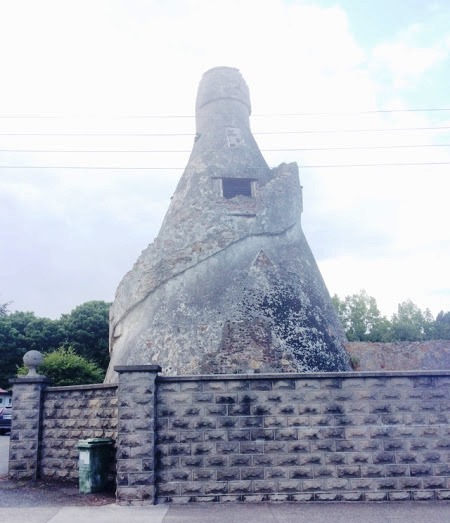
The Bottle Tower, a unique landmark
and unusual building in Churchtown

The Bottle Tower or Hall’s Barn on Whitehall Road … one of the most unusual buildings in the Rathfarnham/Churchtown area (Photograph: Patrick Comerford, 2015)

Patrick Comerford

I have written in recent days about Berwick House on Whitehall Road, which is near where I work, and Scholarstown House, which is near where I live.

On my way home yesterday [17 August 2015], I stopped on Whitehall Road again to look at the curious structure known as the Bottle Tower or Hall’s Barn.

This local landmark in the Rathfarnham/ Churchtown area was built by Major Hall in 1742 as a miniature replica or imitation of the better-built “Wonderful Barn” erected at the same time by Katherine Conolly near Castletown House, Co Kildare.

Why were these barns or bottle towers built?

And what inspired them?

Extremely cold and wet weather his Ireland in 1740-1741, and it persisted for almost two years. It led to the failure of corn and potato crops, a shortage of milk and a shortage of meat because livestock starved. This year was known as the ‘Year of the Slaughter’ and this famine resulted in widespread deaths from both hunger and disease. It is said about 28% of the population of Ireland died – a far higher death rate than in the ‘Great Famine’ a century later.

Katherine (Conyngham), the widow of William Connolly of Castletown House, was appalled by the suffering during those years. Her husband was Speaker of the Irish House of Commons, and she responded to the famine by commissioning the barn with two main purposes: to give employment to impoverished local people and to act as a store for grain that could be used should in the event of future famines.

There are suggestions that the design is based on the design of rice stores in India.

An external cantilevered stone stairs winding around the tapered external wall gives the barn its amazing corkscrew appearance, with 94 steps leading to the 70 ft high top.

Inside there are vaulted brick walls, covered with rubble stone, reaching up through seven floors, with a central hole running through each. Small triangular windows open at intervals on some levels, reflected by similar triangular motifs elsewhere.

Some historians, however, suggest that the barn was never intended for use as a barn. There are theories that it was either a dovecote or an elaborate hide for shooting parties could take aim at game or at least was used for one or other of these purposes.

The Bottle Tower … built in imitation of the ‘Wonderful Barn’ at Castletown House (Photograph: Patrick Comerford, 2015)

The Bottle Tower on Whitehall Road is only one other building in Ireland like the “Wonderful Barn.” They share the same corkscrew design and conical appearance, and they both have an adjoining conical dovecote.

The Bottle Tower on Whitehall Road was built in 1742 by Major Hall who was living in an old house known as Whitehall. The land that had once been part of the Rathfarnham Castle of ‘Speaker’ Conolly but had been sold in 1742 to John Hoadly (1678-1746), Archbishop of Dublin (1730-1742), Archbishop of Armagh (1742-1746) and Vice-Chancellor of Trinity College Dublin (1743-1746).

The floors and other timber work in the Bottle Tower have long disappeared and the winding stone steps are not safe to ascend. Whether it was originally intended as a barn or a residence when it was built in the 1740s is unclear. The ground floor may have been used as a barn, but the first and second floors appear to have been residential and they were both fitted with fireplaces. The stone spiral stairs may indicate that the tower was also used as a viewing tower.

A smaller structure behind the barn, built on somewhat similar lines, was a pigeon house.

The dovecote or pigeon house beside the Bottle Tower (Photograph: Patrick Comerford, 2015)

The old house named Whitehall was also built by Major Hall around the same time. By 1778, Hall’s house at Whitehall had become the home of the Revd Jeremiah Walsh (1702-ca 1789), who was the perpetual curate or Vicar of Taney Parish from 1758 to 1787. In 1778, Walsh also married his second wife, the widow of Thomas Eyre, MP for Fore, Co Westmeath.

In 1795, the Bottle Tower was converted into a boarding house by Michael Kelly. The painter Francis Jukes described it that year as “a very curious building, the singularity of which much attracted my notice. The stairs, by which you ascend it, are on the outside; and having a parapet wall, the ascent is rendered easy and safe. At the top the prospect is very beautiful, commanding a view of Lord Ely’s and Mr Palliser’s parks and of the country, as far as the mountains. It is two and a half miles from Dublin.”

A newspaper advertisement in 1816 invited inquiries from prospective visitors.

The barn appears on many early maps of Dublin. Samuel Lewis, in his Topographical Dictionary of Ireland (1837) names many of the old houses in the area, including Whitehall, of WP Matthews, Newtown, of Dr John Kirby, Barton Lodge, of W Conlan, Nutgrove, of P Jones, and Whitehall, of T Laffan. This last Whitehall is described as having an out-office “built in the shape of a pottery furnace, with a winding flight of steps on the outside to the top, whence there is a commanding prospect of the surrounding country.”

Hall’s former house stood immediately north of the barn until it was demolished some years ago. Hall’s Barn or the Bottle Tower has been unoccupied for over 150, it is unsafe to visit and it is in a state of advanced ruin. But it remains one of the most unusual looking buildings in the Rathfarnham and Churchtown area.

A name plate recalling Major Hall’s house, Whitehall, beside the Bottle Tower (Photograph: Patrick Comerford, 2015)

For other postings on the architectural heritage of South Dublin see:

Berwick Hall.
The Bottle Tower, Churchtown.
Brookvale House, Rathfarnham.
Camberley House, Churchtown.
Dartry House, Orwell Park, Rathfarnham.
Ely Arch, Rathfarnham.
Ely House, Nutgrove Avenue, Rathfarnham.
Fernhurst, 14 Orwell Road, Rathgar.
Fortfield House, Hyde Park, Terenure.
No 201 Harold’s Cross Road, the birthplace of Richard Allen.
Homestead, Sandyford Road, Dundrum.
Kilvare House, also known as Cheeverstown House, Templeogue Road.
Knocklyon Castle.
Laurelmere Lodge, Marlay Park.
Marlay Park.
Mountain View House, Beaumont Avenue, Churchtown.
Newbrook House, Taylor’s Lane, Rathfarnham.
Old Bawn House, Tallaght.
Rathfarnham Castle.
Sally Park, Fihouse.
Scholarstown House, Knocklyon.
Silveracre House, off Sarah Curran Avenue, Rathfarnham.
Synge House, Newtwon Villas, Churchtown, and No 4 Orwell Park, Rathgar.
Templeogue House.
Washington House, Butterfield Avenue, Rathfarnham.
Westbourne House, off Rathfarnham Road.

11 August 2015

Berwick House is impressive,
but who was ‘Lady Berwick’?

Berwick House on Whitehall Road, Churchtown … but who was Lady Berwick? (Photograph: Patrick Comerford, 2015)

Patrick Comerford

On my way home from work this evening, I went out of my way to take a look at Berwick House, a tall period house on the bend in Whitehall Road, Churchtown.

This imposing building, which has been converted into apartments in recent years, looks north, as if the first part of Whitehall Road was the drive up to a splendid country residence.

Until recently, this house was the residence of the De La Salle Brothers, who ran a number of schools in the locality. But it may date back to the 18th century or even late 17th century, when there was a house on this site. The present house is probably the house named as Waxfield where John Lamprey died in 1766.

By 1836, the house was known as Hazelbrook, and is referred to by Samuel Lewis in his Topographical Directory in 1837, when he mentions the celebrated guesthouse, patronised by people who came out from Dublin, to the nearby spa and health resort.

From 1844 to 1899, the house was known as Bachelor’s Hall. It was a travellers’ rest with bed, breakfast and stabling facilities. It was later bought by a “Lady Berwick,” who turned it into a holiday house for working girls. As the headquarters of this charity it was known as Berwick Home.

Meanwhile, the name Hazelbrook was transferred to the nearby, now defunct, HB milk bottling plant, ice cream factory and dairy run by the Hughes Brothers.

In 1944, the house again became a private residence and the name was changed to Berwick House. When the De La Salle Brothers first came to Churchtown they were a small group of only three. They eventually bought Berwick House and it became the base for their educational mission in the Churchtown, Rathfarnham and Dundrum area.

The house was recently converted into apartments. A small housing scheme beside Berwick House is known as Berwick Hall, named after the adjoining Berwick House.

The Hughes Brothers’ original house, built in 1898, and called Hazelbrook House, was rebuilt in Bunratty Folk Par, Co Clare, in 2001, and the old HB dairy site is being developed as Hazelbrook Square.

The Berwick Home Charity continues to give holiday grants to girls and women over the age of 14 who have recently been unwell or disabled.

An Edward post box beside Berwick House (Photograph: Patrick Comerford, 2015)

But who was Lady Berwick who gave her name to this charity and to Berwick House?

She certainly was not the wife of one of the Hill family who held the title of Baron Berwick and lived at Attingham Park, Atcham, Shropshire. William Noel-Hill, 6th Lord Berwick, died unmarried in 1882, and his nephew Richard Henry Noel-Hill, 7th Lord Berwick, died childless in 1897.

The Revd Edward Berwick (1754-1820), Vicar of Leixlip (1795-1820), Co Kildare, has been described mistakenly by some local historians as a son of the 2nd Duke of Berwick, whose mother was the widow of Patrick Sarsfield, Earl of Lucan, and whose father was an illegitimate son of King James II. However, Edward Berwick was the son of a man named Duke Berwick from Co Down.

Edward Berwick’s son, Walter Berwick (1800-1868), owned 653 acres in Co Cork, and was a well-known judge of the Quarter Sessions in Cork in the mid-19th century. He is remembered for presenting Cork city with an ornamental fountain on Grand Parade in 1859 when he moved to the bankruptcy court.

Walter Berwick was admitted to the Irish bar in 1826, served as assistant barrister for Waterford, and was well regarded by Daniel O’Connell while practising at the bar. His politics were liberal, and he was a founder member of the Saint Stephen’s Green Club in Dublin in 1840, and a founder of the Royal Irish Academy of Music in 1848.

He chaired the inquiry into the Dolly’s Brae riot in 1849, and his report led to the dismissal of Lord Roden and several other prominent Orangemen as magistrates.

In 1854, Judge Berwick bought St Edmundsbury in Lucan, where he did some farming. He was appointed a judge of the court of bankruptcy and insolvency in 1866. Judge Berwick and his wife, Mary Elizabeth, died on 20 August 1868 on the Irish Mail train in the Abergele railway disaster in north Wales. Among the many other victims was a nine-year-old girl, Louisa Symes, who was travelling in the care of the Berwicks.

Walter’s younger brother, Edward Berwick (1804-1877), was a lawyer and educationalist, who was President of Queen’s College Galway (now NUI Galway) from 1850 until 1877.

A nephew of Henry Grattan, he was given personal tuition by Dionysius Lardner (1793-1859), and studied law at Trinity College Dublin. He later lived with Lardner in Bray, Co Wicklow, and later in Gardiner Street, Dublin. He gave evidence in the celebrated Lardner divorce case. He was called to the Bar in 1832. On the foundation of Queen’s College Galway in 1845, Berwick was appointed Vice-President.

The college president, Joseph W. Kirwan, died in office in December 1849, and Berwick succeeded him in 1850. He died in office in 1877.

This family gave its name to another Berwick House in Dalkey, Co Dublin, but this house was later known as Scotch Rath. Was “Lady Beriwck” a member of this family?

I think I need to carry out a little more research.

Berwick House stands on the twist in the road on Whitehall Road (Photograph: Patrick Comerford, 2015)

For other postings on the architectural heritage of South Dublin see:

Berwick Hall.
The Bottle Tower, Churchtown.
Brookvale House, Rathfarnham.
Camberley House, Churchtown.
Dartry House, Orwell Park, Rathfarnham.
Ely Arch, Rathfarnham.
Ely House, Nutgrove Avenue, Rathfarnham.
Fernhurst, 14 Orwell Road, Rathgar.
Fortfield House, Hyde Park, Terenure.
No 201 Harold’s Cross Road, the birthplace of Richard Allen.
Homestead, Sandyford Road, Dundrum.
Kilvare House, also known as Cheeverstown House, Templeogue Road.
Knocklyon Castle.
Laurelmere Lodge, Marlay Park.
Marlay Park.
Mountain View House, Beaumont Avenue, Churchtown.
Newbrook House, Taylor’s Lane, Rathfarnham.
Old Bawn House, Tallaght.
Rathfarnham Castle.
Sally Park, Fihouse.
Scholarstown House, Knocklyon.
Silveracre House, off Sarah Curran Avenue, Rathfarnham.
Synge House, Newtwon Villas, Churchtown, and No 4 Orwell Park, Rathgar.
Templeogue House.
Washington House, Butterfield Avenue, Rathfarnham.
Westbourne House, off Rathfarnham Road.

28 March 2015

Stretching my legs and my imagination
with memories of old houses and names

Ely House, Rathfarnham … in the past it has been Ely Cottage and Ely Lodge, but was it the dower house of Rathfarnham Castle? (Photograph: Patrick Comerford, 2015)

Patrick Comerford

I had an interesting walk this morning [28 March 2015] from Churchtown along Nutgrove Avenue to Rathfarnham Village, and then along Butterfield Avenue, before continuing on home. Along the way, as I stretched my legs, I stopped to look at two interesting houses that have managed to survive the changes and developments of recent decades.

Ely House stands at the beginning of Nutgrove Avenue, close to the junction with Grange Road and Rathfarnham Wood. Ely House stands in no grounds of its own and is so close to the traffic on busy Nutgrove Avenue that it takes a leap in my architectural imagination to think of how it has managed to survive as all else around it changed so much.

In the past, this house was known as Ely Cottage, and then as Ely Lodge. It is likely that the historian Weston St John Joyce was mistaken when he was giving an account of nearby Nutgrove House, which is long-gone, and identified it as the dower house of Rathfarnham Castle.

Nutgrove House was also known as the White House, which may explain the name of Whitehall Road, but it was never part of the Ely estate at Rathfarnham Castle. Local historians now seem to agree instead that Ely Cottage or Ely Lodge was the dower house of Rathfarnham Castle.

The Loftus family of Rathfarnham Castle had given the name Ely Lodge to a new elegant house they built on Ely Island in Lough Erne, west of Enniskillen, Co Fermanagh, when they abandoned Rathfarnham Castle in the 1830s. Ely Lodge in Co Fermanagh later passed to the Grosvenor family, Dukes of Westminster.

The name of Ely Cottage may have been changed to Ely Lodge after the Loftus family moved out of Rathfarnham Castle in the 1830s. Certainly, Ely Cottage or Ely Lodge stood within the boundary of the Rathfarnham Castle estate, and by the 1880s a family named Dunne was living in Ely Lodge.

Nutgrove Avenue was widened and extended in the 1960s to link Rathfarnham and Churchtown, which explains the peculiar corner on Grange Road at this junction. The old, quiet, tree-shaded avenue was swept away, along with the narrow lanes on both sides. By then, Ely Lodge was in a bad state of repair, but it was restored in the late 1970s and is now known as Ely House.

After stopping to buy the Guardian in Rathfarnham Village, and having a double espresso in the Studio Café, I continued on along Butterfield Avenue, once known as Butterfield Lane.

Butterfield House … once the home of John Hely-Hutchinson, but did Robert Emmet live here? (Photograph: Patrick Comerford, 2015)

In the late 18th century, Butterfield House on Butterfield Lane was the home of the Right Hon John Hely-Hutchinson (1724-1794), MP for Taghmon, Co Wexford, Prime Sergeant of Ireland, and later Provost of Trinity College. Hely-Hutchinson donated the Fair Green to Rathfarnham Village in return for a high wall being built around his property. His eldest son Richard Hely-Hutchinson (1756–1825), was an ardent advocate of Catholic Emancipation became Earl of Donoughmore. In 1815, John’s fourth son, Augustus Abraham Hely-Hutchinson (1766-1834), married Catherine Maria Burke of Birr, a great-granddaughter of Elizabeth Comerford and Peter Burke.

Butterfield House has been identified by most historians as the house once rented by Robert Emmet, although there are two other contenders for this identity: Old Orchard House and Washington House.

In order to avoid being arrested before his rebellion, Emmet rented the house in Rathfarnham in April 1803 under the name of Robert Ellis and lived there with Dowdall, Hamilton and others. Their meetings here were attended by Michael Dwyer and his supporters from the Glen of Imaal.

Emmet’s housekeeper was Anne Devlin, whose father Brian Devlin ran a nearby dairy farm. On the night of 23 July 1803, after the rising had been abandoned, Emmet and his party returned to Butterfield Lane but later in the night moved into Brian Devlin’s house, where they remained a few days.

When a military party arrived at Butterfield House to search for Emmet, they found Anne Devlin alone in the house, they questioned her about Robert but got no satisfactory answers.

Forty years later, in 1843, when Anne Devlin was old and feeble, she identified the house and pointed out the bedrooms occupied by each person. The house appears on the Ordnance Survey that year, and in the 1850s is listed in both Thom’s Directory and Griffith’s Valuation as the home of Charles M. Dunn. In 1876, it was the home of Richard Marlowe.

Butterfield House was renovated and partly altered in 1900, and by 1911 it was the home of a Mr J M’Entagart, proprietor of the Empire Restaurant in Nassau Street, Dublin.

The lower portion of the house was extensively damaged by fire in 1952. But it has since been restored and is now the offices of the Irish Pharmacy Union as well as containing a number of apartments.


Oakdown Road … is it Br. Ócadún or Bóthar An Mhulláin Darach (Photographs: Patrick Comerford, 2015)

I ought to mention that at the beginning of my walk I came across yet another tortuous example of trying to render English-language street names into the Irish language.

Two weeks ago, I wrote how I was perplexed to notice that close to Christ Church Cathedral “Werburgh Street” (not Saint Werburgh Street, note), has been rendered in the Irish language as Sr[aid] Barbra [sic], and that neighbouring Upper Exchange Street, off Lord Edward Street, which apparently is in both Dublin 2 and Dublin 8, has been rendered in Irish on one sign as Sráid an Mhalartáin Uachtarach, or Street of the Upper Exchange, and on another as Sráid Iosóilde Uacht or Upper Isolde Street.

This morning in Churchtown I noticed that Oakdown Road is Br. Ócadún and just a few steps away, on the same street corner, by the same house, it is also Bóthar An Mhulláin Darach. Who decided to transliterate Oakdown as Ócadún? – it seems preposterous. As for Bóthar An Mhulláin Darach – could it really mean “the Road of the Notorious Oak”? Perhaps someone, somewhere, is working out how to turn Nutgrove Avenue into the Irish equivalent of “Bewildered Grove Avenue” and Butterfield Avenue into “the Avenue of the Field of Kerrygold.”

If you think I am stretching my imagination too far, then remember how, in JRR Tolkien’s The Fellowship of the Ring, Bilbo tells Gandalf: “I feel … thin. Sort of stretched … like butter scraped over too much bread.”

Some of our translators seem to have taken it on themselves to stretch and spread things too far when it comes to street names, both in the inner city and in the suburbs.