Professor Scott M Kenworthy’s new biography of Patriarch Tikhon … launched in Cambridge this evening
Patrick Comerford
I an sorry to miss this evening’s launch of a new book in Cambridge, The People’s Patriarch: Tikhon Bellavin and the Orthodox Church in North America and Revolutionary Russia by Scott M Kenworthy, and published by Oxford University Press.
The book launch in Wesley House, Cambridge, this evening has been organised by the Institute for Orthodox Christian Studies, where I have been a student on many courses over the years, mainly in Sidney Sussex College.
This is the first scholarly and comprehensive biography of Patriarch Tikhon, and draws on documents from the Soviet leadership and secret police file that were previously inaccessible to researchers. It provides an in-depth account of a crucial period of Orthodox Christianity in North America and of Patriarch Tikhon’s vital contributions to its development. But it is also an important book at this crucial time of dissonate relationship between the Russian Church and the rest of the Orthodox world.
Professor Scott M Kenworthy is Professor of History in the History Department at Miami University, Oxford, Ohio, where he also teaches for the Russian, East European and Eurasian Studies, and Religious Studies programs, and is also Associate Professor of Comparative Religion.
He is the author of the prize-winning book The Heart of Russia: Trinity-Sergius, Monasticism and Society After 1825 and, with Alexander Agadjanian, Understanding World Christianity: Russia. He is a past president of the Association for the Study of Eastern Christianity and has held research fellowships in the US, Germany, Hungary and Romania.
On 28 October 1917, just days after the Bolsheviks seized power, the great Council of the Russian Orthodox Church voted to restore the patriarchate, which had been abolished by Tsar Peter the Great almost two centuries earlier in 1721. The council chose as the new patriarch Patriarch Tikhon (1865-1925), born Vasily Ivanovich Bellavin, the son of a humble village parish priest.
As the Orthodox Bishop of North America (1898-1907), Patriarch Tikhon had already started putting into practice his vision of the Church as an organic body that welcomed the participation of all believers. The Bolsheviks, who had other ideas, aimed to create a revolution that would be carried out by the state on behalf of the people. They sought to eradicate religion as superstition, to disestablish the church and to destroy it altogether.
The alternate Russia that Patriarch Tikhon represented was crushed by the superior force of the Bolsheviks. But he helped to navigate the Church through immense challenges and, in the end, the Orthodox Church outlived the Soviet experiment.
In The People’s Patriarch, Scott Kenworthy tells the story of the clash of visions for the new Russia through the lens of the humble man chosen to lead the Church, whose life exemplifies the transformations within the Orthodox Church in late Imperial Russia and its fate during the Revolution. This the first critical biography of one of the most important Orthodox Christian leaders of the 20th century, based on an exhaustive use of previously untapped primary sources, including Patriarch Tikhon’s letters and encyclicals, previously classified documents from the Bolshevik leadership and Soviet secret police, and material from a dozen archives in five countries.
Patriarch Tikhon has been overlooked by most historians of Russia and the former Soviet Union, who have seen the Russian Orthodox Church as irrelevant within an anti-religious Communist polity. This book tells his story from his humble beginnings in the Pskov province in north-west Russia, to his ordination and consecration, and then his ministry as bishop of a diocese in Poland, where he was Bishop of Lublin.
For almost a decade (1898-1907), he was a bishop in the US, where he came to appreciate democracy, the separation of Church and State, and the vital part played by the laity and parish clergy within the Church. When he was appointed Bishop of the Aleutian Islands and Alaska in 1898, he went to the US where he eventually became a naturalized American citizen. There he visited emerging Orthodox emigrant communities in cities such as New York and Chicago and in coal-mining and steel-making areas in in Pennsylvania and Ohio.
He reorganised the diocese, changed its name to the Diocese of the Aleutian Islands and North America, and he blessed the cornerstone of Saint Nicholas Cathedral, New York, in 1901. He built churches across North America, opened dialogue with Greek Orthodox churches, and took part in the consecration of Reginald Heber Weller as an Anglican bishop in Saint Paul’s Cathedral in the Episcopal Diocese of Fond du Lac, Wisconsin. He returned to Russia in 1907 when he was appointed Bishop of Yaroslavl.
When he was chosen in 1917 as the eleventh Patriarch of Moscow and the first since Peter the Great abolished the patriarchate 200 years earlier, Patriarch Tikhon quoted Ezekiel prophetically: ‘How many tears and groans will I have to swallow.’
After the abdication of the tsar in March 1917, the Russian Church was freed from its subjugation to the State and became once again respected by a large section of the educated population. But the church also faced years of persecution, and lost its legal status and right to own property. Lenin launched a ferocious attack on the church in 1922, and Patriarch Tikhon was imprisoned from May 1922 until June 1923.
Patriarch Tikhon was effectively a prisoner in the Donskoi Monastery and was frequently interrogated in the Lubyanka. But on the occasions when he was allowed to take walks along the monastery walls, crowds would regularly gather below the walls to receive his blessing.
Thanks to changes in the regime and to support from abroad, particularly from Britain, Patriarch Tikhon was not put on trial or executed. On 13 April 1923, the Archbishop Randall Davidson of Canterbury and other British religious leaders, including the Chief Rabbi, issued a statement condemning religious persecution in the Soviet Union.
The British Foreign Secretary issued an ultimatum to the Soviet government on 8 May 1923, condemning ‘the definite object of destroying all religion in Russia’ and threatening to break off relations. The Soviet leadership was desperate to preserve the 1921 Anglo-Soviet Trade Treaty and to maintain good relations with Britain.
When Patriarch Tikhon died on 12 April 1925, between 30,000 and 40,000 attended his funeral in the Donskoi Monastery, many more than attended Lenin’s funeral the previous year.
Patriarch Tikhon defies definition, challengec the capitulation of many Christian leaders to the Trump regime in the US, and stands in sharp contrast to Patriarch Kirill of Moscow
Patriarch Tikhon defies definition as either a dissident or a collaborator. He endeavoured to preserve the Russian Orthodox Church while he tried to remain apolitical, and he criticised the Communist regime without opposing it.
He is a challenge to the capitulation of many Christian leaders to the Trump regime in the US. During his time as a bishop in the US, he came to appreciate democracy, plurality and diversity, and the separation of Church and State.
He also stands in sharp contrast to the present head of the Russian Orthodox Church, Patriarch Kirill of Moscow, with his intimate relationship with the Putin regime, his autocratic approach to church leadership, and his persistent attempts to sow divisions within the Orthodox churches.
The Orthodox Public Affairs Committee (OPAC) said earlier this week: ‘Rather than serving as a prophetic voice for peace, reconciliation, and the sanctity of every human life, Patriarch Kirill has repeatedly offered religious justification for Russia’s unprovoked war of aggression against Ukraine. He has portrayed the invasion as a sacred struggle, blessed those waging war, and increasingly intertwined the mission of the Russian Orthodox Church with the geopolitical ambitions of the Kremlin.’
Patriarch Kirill’s recent statements are disturbing and troubling. He has described Russia’s nuclear arsenal as a manifestation of God's ‘grace and mercy’ and he has claimed that the creation of the Soviet atomic bomb came about through divine providence and the prayers of Saint Seraphim of Sarov (1754-1833), a Russian saint known for his life of contemplation and kindness.
His invocation of one of Orthodoxy’s most beloved saints in defence of nuclear weapons that are capable of unimaginable destruction is a profound distortion of the Christian faith. The Gospel proclaims peace, reconciliation, and the sacred dignity of every human person and must never be used to sanctify war, imperial conquest, or nuclear intimidation.
For more than four years, the Ukrainian people have endured the horrors of an unprovoked war with extraordinary courage, resilience, and unwavering faith. Families have been torn apart, cities have been reduced to rubble, and countless innocent lives have been changed forever.
In response, the Saint Nicholas National Shrine recently presented its Beacon of Hope Award to President Volodymyr Zelenskyy and the people of Ukraine, recognising their courage, sacrifice, and resilience.
The National Shrine of Saint Nicholas was established to bear witness to the Light of Christ in the midst of darkness. It stands at the World Trade Centre as a place of prayer, remembrance and healing, and a reminder that evil and hatred will never have the final word. The US is about to mark the 25th anniversary of the ‘9/11’ attacks on 11 September 2001, the shrine is a ‘beacon of hope’ to all who suffer from violence, war, terrorism, and despair.
The shrine’s decision to honour President Zelenskyy and the people of Ukraine has been criticised by Patriarch Kirill’s apologists, who have claimed that Ukraine is persecuting Christianity and ‘shutting down churches’.
Saint Nicholas National Shrine was consecrated in memory of lives lost to terrorism 25 years ago, and remains a reminder to the world, like Patriarch Tikhon, that the Light of Christ continues to shine in the darkness, and the darkness shall never overcome it.
The Institute for Orthodox Christian Studies is on Jesus Lane, Cambridge, beside Jesus College and Wesley House and across the street from Westcott House and Sidney Sussex College (Photograph: Patrick Comerford)
Showing posts with label Theology and Culture. Show all posts
03 September 2026
14 August 2026
Martha Nussbaum: a philosopher’s odyssey from an Episcopalian childhood to Reform Judaism’s pursuit of political justice
Looking out from Preveli Monastery in Crete towards the island of Gavdos, said to be the Ogygia of Calypso where Odysseus stayed for seven years (Photograph: Patrick Comerford)
Patrick Comerford
While Christopher Nolan’s film The Odyssey was the topic of conversation, I was writing in recent weeks how the Revd Dr Giles Fraser, in ‘Thought for the Day’ on Radio 4 last month (24 July 2026), talked about an essay on why Odysseus is right to refuse the temptation to eternal life while he stranded with the nymph Calypso on the island of Ogygia.
He referred to the American philosopher Professor Martha Nussbaum of the University of Chicago, who he interviewed for The Guardian many years ago (29 June 2012). In his Thought for the Day’, he referred to how she argues that there are some things that the immortal gods are not able to do that mortal human beings are: not least amongst them is to show courage. If I cannot risk everything because I cannot die, he asked, then how could I possibly be courageous?
Martha Nussbaum, who is Jewish, suggests that there is something about this refusal of invulnerability that explains one of the key features of Christian theology: of God becoming human, of God who is prepared to suffer and die in the name of love. ‘What is attractive about both Odysseus and Jesus is that they are prepared to have skin in the game, which is pretty much the very definition of incarnation’, Giles Fraser says.
Since then, I have found myself reading some of the work of Martha Nussbaum, who is one of the world’s foremost public philosophers. She is Professor of Law and Ethics at the University of Chicago, where she is part of both the law school and the philosophy department and and an associate member of the Divinity School faculty. She has also taught at Harvard and Brown.
In her work, Martha Nussbaum has engaged with ancient Greek and Roman philosophy, political philosophy, existentialism, feminism, and ethics, such as animal rights. She has written more than two dozen books, including The Fragility of Goodness (1986), she has received a number of prestigious international prizes, and some years ago she was considered for the Nobel Prize in Literature.
Martha Nussbaum was born Martha Craven in New York on 6 May 1947, the daughter of George Craven, a Philadelphia lawyer, and Betty Warren, an interior designer, and grew up in an affluent Episcopalian home in Bryn Mawr, Pennsylvania. Her mother was an alcoholic whose forbears arrived on the Mayflower; her father was a successful southern-born lawyer from Georgia and she has described him as ‘bigoted against African Americans and Jews.’
She has spoken of her upbringing as ‘East Coast WASP elite … very sterile, very preoccupied with money and status’. She later explained her impatience with ‘mandarin philosophers’ and her dedication to public service as a repudiation of her own upbringing: ‘I don’t like anything that sets itself up as an in-group or an elite, whether it is the Bloomsbury group or Derrida’.
She studied theatre and classics at New York University (BA 1969) and philosophy at Harvard (MA 1972, PhD 1975), and went on to teach philosophy and classics at Harvard, Brown University, and the University of Chicago Law School.
Her book The Fragility of Goodness, Luck and Ethics in Greek Tragedy and Philosophy (1986) made her a well-known figure throughout the humanities. In that book, she confronts the ethical dilemma that individuals strongly committed to justice are nevertheless vulnerable to external factors that may deeply compromise or even negate their human flourishing, and she defends the practical ethics of Aristotle over the metaphysical supernaturalism of Plato.
She rejects the Platonic notion that human goodness can fully protect against peril, siding with the tragic playwrights and Aristotle in treating the acknowledgment of vulnerability as a key to realising the human good. Her interpretation of Plato’s Symposium in particular drew considerable attention.
Further books, including The Closing of the American Mind (1987) and Frontiers of Justice (2006), established her as a theorist of global justice. She has also written about the unequal freedoms and opportunities of women, and has developed a distinctive type of feminism, drawing inspiration from the liberal tradition but emphasising that liberalism, at its best, entails radical rethinking of gender relations and relations within the family.
In her philosophical work, she has also written widely about emotions and about grief, compassion, and love, and about disgust and shame. Following a court trial in Colorado in which she gave evidence, Nussbaum wrote a lengthy article on ‘Platonic Love and Colorado Law’, drawing on Plato’s Symposium and his interactions with Socrates as evidence for her argument.
In Cultivating Humanity: A Classical Defense of Reform in Liberal Education (1997), she appeals to classical Greek texts as a basis for the defence and reform of the liberal education. She notes how Greek cynic philosopher Diogenes aspired to transcend ‘local origins and group memberships’ in favour of becoming ‘a citizen of the world’.
In Sex and Social Justice (1999), she argues that sex and sexuality are morally irrelevant distinctions that have been artificially enforced as sources of social hierarchy, and that feminism and social justice have common concerns. She shows how sex is used to deny some people, including women and gay men, social justice.
In Hiding from Humanity (2004), Nussbaum examines the arguments for including two emotions – shame and disgust – as legitimate bases for legal judgments, and notes how projective disgust has wrongly justified group subordination, mainly of women, Jews, and homosexuals. She dismisses disgust as a reliable basis of judgment.
In From Disgust to Humanity: Sexual Orientation and Constitutional Law (2010), Nussbaum analyses the role that disgust plays in law and public debate in the US, including the constitutional legal issues facing gay and lesbian people. She argues that the fundamental motivation of those advocating legal restrictions against gay and lesbian people is a ‘politics of disgust’.
She explicitly opposes the concept of a disgust-based morality as an appropriate guide for legislating. Nussbaum notes that popular disgust has been used throughout history as a justification for persecution, and recalls how at various times, racism, antisemitism and sexism, have all been driven by popular revulsion.
In Creating Capabilities (2011), she outlines a unique theory on the Capability approach or the Human development approach. She criticises existing economic indicators, such as GDP, for failing to fully account for quality of life and assurance of basic needs, instead rewarding countries with large growth distributed highly unequally across the population, and she argues the Capability approach should be prioritised by development economics policymakers.
In The New Religious Intolerance, Overcoming the Politics of Fear in an Anxious Age (2012), she writes a vigorous defence of the religious freedom of minorities in the face of post-9/11 Islamophobia. And, as Giles Fraser said in The Guardian at the time, by minorities she mostly means Muslims.
Her book The Cosmopolitan Tradition: A Noble but Flawed Ideal (2019), engages critically with important examples of the cosmopolitan ideal from ancient Greece and Rome to the present. The cosmopolitan political tradition in Western thought begins with the Greek Cynic Diogenes, who, when asked where he came from, responded that he was a citizen of the world. Rather than declaring his lineage, city, social class, or gender, he defined himself as a human being, implicitly asserting the equal worth of all human beings. Nussbaum pursues this ‘noble but flawed‘ vision of world citizenship as it finds expression in figures of Greco-Roman antiquity, Hugo Grotius in the 17th century, Adam Smith during the 18th century, and various contemporary thinkers.
Earlier that year, the Republican Senator Josh Hawley of Missouri, speaking at the National Conservatism Conference in 2019, claimed the American middle class had been betrayed by an out-of-touch ‘cosmopolitan elite’ that catered to the needs of multinational companies while forgetting ‘the heartland’. Given Brexit, Donald Trump’s election, and a global turn to nationalism more generally, Hawley’s comments were anything but exceptional. What made them unique was that he directed his ire at particular academics for promulgating the beliefs of what he called the ‘cosmopolitan consensus’. Perhaps the best-known of these was Martha Nussbaum, wh o was accused by Hawley of teaching her students that ‘world citizenship’ trumps being the citizen of a nation-state.
Her latest book is The Republic of Love: Opera and Political Freedom, published earlier this year by Oxford University Press.
Nussbaum has criticised Noam Chomsky as one of the left-wing intellectuals who hold the belief that ‘one should not criticise one’s friends, that solidarity is more important than ethical correctness’.
She is known for her contributions in developing the capabilities approach to well-being, in which she asks, ‘What is each person able to do and to be?’ She asserts that all humans – and non-human animals – have a basic right to dignity. To provide human dignity, she insists governments must provide ‘at least a threshold level’ of a number of capabilities: life; bodily health; bodily integrity; senses, imagination, and thought, emotions; practical reason; affiliation; other species; play; and control over one's environment, including political and material environments.
‘Knowledge is no guarantee of good behaviour, but ignorance is a virtual guarantee of bad behaviour’ … Martha C Nussbaum (Photograph: University of Chicago Divinity School
From 1969 to 1987, Martha Nussbaum was married to Professor Alan Nussbaum of Yale and Cornell, a linguist and classical philologist known for his work on the language of the Homeric epics. During their marriage, she converted to Judaism and her commitment to Judaism has continued. She became a bat mitzvah at Temple KAM Isaiah Israel in Chicago in 2008, delivering a D’var Torah on the connection between genuine, non-narcissistic consolation and the pursuit of global justice.
For Nussbaum, coming to Judaism was both comfort and reprieve. She has described ‘the combination of joy and relief I found in entering a community in which outrage at injustice was normal.’
She soon came to appreciate the Jewish tradition of spirited debate. ‘In great contrast to my Christian education, focused on catechism and professions of faith,’ she wrote, ‘I discovered that in a Jewish conversion process it was possible to dispute about everything.’
Whether treating literary, legal, or political issues, she has consistently argued that any comprehensive ideology that claims to understand the good life fails unless it is accompanied by a love for that which is imperfect and vulnerable. ‘Philosophy does not compel, or threaten, or mock,’ she has said. ‘It doesn’t make bare assertions, but, instead, sets up a structure of thought in which a conclusion follows from premises the listener is free to dispute. In that way it invites dialogue and respects the listener.’
In her essay ‘Judaism and the Love of Reason,’ she describes her love for the ideas of the leaders of 19th century Reform Judaism, a movement she praises for its rationalism, its moral mission and commitment to justice, and for ‘returning the religion to its original Biblical core.’
In Women and Human Development (2000), she criticises secular feminists for ascribing patriarchy to religious traditions. In ‘Judaism and the Love of Reason’, she cites feminism and cosmopolitanism as ‘issues that have been at the heart of the Reform movement since its inception and to which Reform Judaism gives … more satisfactory answers than do other varieties of Judaism.’
In an interview with Benjamin Balint in Sources in Spring 2022, Martha Nussbaum said she does not ‘even really think that Biblical Judaism is inherently patriarchal. I once wrote a paper on the Creation stories in Genesis and learned a lot about how great interpreters have read Genesis 1 as holding that the first human was a hermaphrodite. And there are many other ways in which the apparently misogynistic aspects of the text have been differently interpreted by great textual scholars.’
Asked why religious ritual is important for people who seek to live a moral life, she cited Immanuel Kant, who ‘said that people have a duty to join a religious group of the right sort (the rational sort, and Reform Judaism is pretty much the rational religion he had in mind), because we are all weak and inclined to deviate from the moral law, but in a group with others our resolve is strengthened.’
In her speech when she received an honorary degree from Hebrew University in Jerusalem, she painted a portrait of the Judaism that inspires her, including the commitment to correct injustices in the community and to welcome all strangers.
The Israeli novelist David Grossman, who received an honorary degree the same day, said to her that that is the sort of Judaism Israel needs. In his speech, he talked about the capacity of the literary imagination to see the infinite in each person, and to cross the boundaries that divide us in life. He then asked whether that capacity is being lost in the Israel of today.
She told Benjamin Balint, ‘So that is what Reform strengthens, I believe: that imaginative capacity to see the infinite in each person and to welcome the stranger.’ And, she added, ‘the Judaism I belong to requires the pursuit of political justice.’
Patrick Comerford
While Christopher Nolan’s film The Odyssey was the topic of conversation, I was writing in recent weeks how the Revd Dr Giles Fraser, in ‘Thought for the Day’ on Radio 4 last month (24 July 2026), talked about an essay on why Odysseus is right to refuse the temptation to eternal life while he stranded with the nymph Calypso on the island of Ogygia.
He referred to the American philosopher Professor Martha Nussbaum of the University of Chicago, who he interviewed for The Guardian many years ago (29 June 2012). In his Thought for the Day’, he referred to how she argues that there are some things that the immortal gods are not able to do that mortal human beings are: not least amongst them is to show courage. If I cannot risk everything because I cannot die, he asked, then how could I possibly be courageous?
Martha Nussbaum, who is Jewish, suggests that there is something about this refusal of invulnerability that explains one of the key features of Christian theology: of God becoming human, of God who is prepared to suffer and die in the name of love. ‘What is attractive about both Odysseus and Jesus is that they are prepared to have skin in the game, which is pretty much the very definition of incarnation’, Giles Fraser says.
Since then, I have found myself reading some of the work of Martha Nussbaum, who is one of the world’s foremost public philosophers. She is Professor of Law and Ethics at the University of Chicago, where she is part of both the law school and the philosophy department and and an associate member of the Divinity School faculty. She has also taught at Harvard and Brown.
In her work, Martha Nussbaum has engaged with ancient Greek and Roman philosophy, political philosophy, existentialism, feminism, and ethics, such as animal rights. She has written more than two dozen books, including The Fragility of Goodness (1986), she has received a number of prestigious international prizes, and some years ago she was considered for the Nobel Prize in Literature.
Martha Nussbaum was born Martha Craven in New York on 6 May 1947, the daughter of George Craven, a Philadelphia lawyer, and Betty Warren, an interior designer, and grew up in an affluent Episcopalian home in Bryn Mawr, Pennsylvania. Her mother was an alcoholic whose forbears arrived on the Mayflower; her father was a successful southern-born lawyer from Georgia and she has described him as ‘bigoted against African Americans and Jews.’
She has spoken of her upbringing as ‘East Coast WASP elite … very sterile, very preoccupied with money and status’. She later explained her impatience with ‘mandarin philosophers’ and her dedication to public service as a repudiation of her own upbringing: ‘I don’t like anything that sets itself up as an in-group or an elite, whether it is the Bloomsbury group or Derrida’.
She studied theatre and classics at New York University (BA 1969) and philosophy at Harvard (MA 1972, PhD 1975), and went on to teach philosophy and classics at Harvard, Brown University, and the University of Chicago Law School.
Her book The Fragility of Goodness, Luck and Ethics in Greek Tragedy and Philosophy (1986) made her a well-known figure throughout the humanities. In that book, she confronts the ethical dilemma that individuals strongly committed to justice are nevertheless vulnerable to external factors that may deeply compromise or even negate their human flourishing, and she defends the practical ethics of Aristotle over the metaphysical supernaturalism of Plato.
She rejects the Platonic notion that human goodness can fully protect against peril, siding with the tragic playwrights and Aristotle in treating the acknowledgment of vulnerability as a key to realising the human good. Her interpretation of Plato’s Symposium in particular drew considerable attention.
Further books, including The Closing of the American Mind (1987) and Frontiers of Justice (2006), established her as a theorist of global justice. She has also written about the unequal freedoms and opportunities of women, and has developed a distinctive type of feminism, drawing inspiration from the liberal tradition but emphasising that liberalism, at its best, entails radical rethinking of gender relations and relations within the family.
In her philosophical work, she has also written widely about emotions and about grief, compassion, and love, and about disgust and shame. Following a court trial in Colorado in which she gave evidence, Nussbaum wrote a lengthy article on ‘Platonic Love and Colorado Law’, drawing on Plato’s Symposium and his interactions with Socrates as evidence for her argument.
In Cultivating Humanity: A Classical Defense of Reform in Liberal Education (1997), she appeals to classical Greek texts as a basis for the defence and reform of the liberal education. She notes how Greek cynic philosopher Diogenes aspired to transcend ‘local origins and group memberships’ in favour of becoming ‘a citizen of the world’.
In Sex and Social Justice (1999), she argues that sex and sexuality are morally irrelevant distinctions that have been artificially enforced as sources of social hierarchy, and that feminism and social justice have common concerns. She shows how sex is used to deny some people, including women and gay men, social justice.
In Hiding from Humanity (2004), Nussbaum examines the arguments for including two emotions – shame and disgust – as legitimate bases for legal judgments, and notes how projective disgust has wrongly justified group subordination, mainly of women, Jews, and homosexuals. She dismisses disgust as a reliable basis of judgment.
In From Disgust to Humanity: Sexual Orientation and Constitutional Law (2010), Nussbaum analyses the role that disgust plays in law and public debate in the US, including the constitutional legal issues facing gay and lesbian people. She argues that the fundamental motivation of those advocating legal restrictions against gay and lesbian people is a ‘politics of disgust’.
She explicitly opposes the concept of a disgust-based morality as an appropriate guide for legislating. Nussbaum notes that popular disgust has been used throughout history as a justification for persecution, and recalls how at various times, racism, antisemitism and sexism, have all been driven by popular revulsion.
In Creating Capabilities (2011), she outlines a unique theory on the Capability approach or the Human development approach. She criticises existing economic indicators, such as GDP, for failing to fully account for quality of life and assurance of basic needs, instead rewarding countries with large growth distributed highly unequally across the population, and she argues the Capability approach should be prioritised by development economics policymakers.
In The New Religious Intolerance, Overcoming the Politics of Fear in an Anxious Age (2012), she writes a vigorous defence of the religious freedom of minorities in the face of post-9/11 Islamophobia. And, as Giles Fraser said in The Guardian at the time, by minorities she mostly means Muslims.
Her book The Cosmopolitan Tradition: A Noble but Flawed Ideal (2019), engages critically with important examples of the cosmopolitan ideal from ancient Greece and Rome to the present. The cosmopolitan political tradition in Western thought begins with the Greek Cynic Diogenes, who, when asked where he came from, responded that he was a citizen of the world. Rather than declaring his lineage, city, social class, or gender, he defined himself as a human being, implicitly asserting the equal worth of all human beings. Nussbaum pursues this ‘noble but flawed‘ vision of world citizenship as it finds expression in figures of Greco-Roman antiquity, Hugo Grotius in the 17th century, Adam Smith during the 18th century, and various contemporary thinkers.
Earlier that year, the Republican Senator Josh Hawley of Missouri, speaking at the National Conservatism Conference in 2019, claimed the American middle class had been betrayed by an out-of-touch ‘cosmopolitan elite’ that catered to the needs of multinational companies while forgetting ‘the heartland’. Given Brexit, Donald Trump’s election, and a global turn to nationalism more generally, Hawley’s comments were anything but exceptional. What made them unique was that he directed his ire at particular academics for promulgating the beliefs of what he called the ‘cosmopolitan consensus’. Perhaps the best-known of these was Martha Nussbaum, wh o was accused by Hawley of teaching her students that ‘world citizenship’ trumps being the citizen of a nation-state.
Her latest book is The Republic of Love: Opera and Political Freedom, published earlier this year by Oxford University Press.
Nussbaum has criticised Noam Chomsky as one of the left-wing intellectuals who hold the belief that ‘one should not criticise one’s friends, that solidarity is more important than ethical correctness’.
She is known for her contributions in developing the capabilities approach to well-being, in which she asks, ‘What is each person able to do and to be?’ She asserts that all humans – and non-human animals – have a basic right to dignity. To provide human dignity, she insists governments must provide ‘at least a threshold level’ of a number of capabilities: life; bodily health; bodily integrity; senses, imagination, and thought, emotions; practical reason; affiliation; other species; play; and control over one's environment, including political and material environments.
‘Knowledge is no guarantee of good behaviour, but ignorance is a virtual guarantee of bad behaviour’ … Martha C Nussbaum (Photograph: University of Chicago Divinity School
From 1969 to 1987, Martha Nussbaum was married to Professor Alan Nussbaum of Yale and Cornell, a linguist and classical philologist known for his work on the language of the Homeric epics. During their marriage, she converted to Judaism and her commitment to Judaism has continued. She became a bat mitzvah at Temple KAM Isaiah Israel in Chicago in 2008, delivering a D’var Torah on the connection between genuine, non-narcissistic consolation and the pursuit of global justice.
For Nussbaum, coming to Judaism was both comfort and reprieve. She has described ‘the combination of joy and relief I found in entering a community in which outrage at injustice was normal.’
She soon came to appreciate the Jewish tradition of spirited debate. ‘In great contrast to my Christian education, focused on catechism and professions of faith,’ she wrote, ‘I discovered that in a Jewish conversion process it was possible to dispute about everything.’
Whether treating literary, legal, or political issues, she has consistently argued that any comprehensive ideology that claims to understand the good life fails unless it is accompanied by a love for that which is imperfect and vulnerable. ‘Philosophy does not compel, or threaten, or mock,’ she has said. ‘It doesn’t make bare assertions, but, instead, sets up a structure of thought in which a conclusion follows from premises the listener is free to dispute. In that way it invites dialogue and respects the listener.’
In her essay ‘Judaism and the Love of Reason,’ she describes her love for the ideas of the leaders of 19th century Reform Judaism, a movement she praises for its rationalism, its moral mission and commitment to justice, and for ‘returning the religion to its original Biblical core.’
In Women and Human Development (2000), she criticises secular feminists for ascribing patriarchy to religious traditions. In ‘Judaism and the Love of Reason’, she cites feminism and cosmopolitanism as ‘issues that have been at the heart of the Reform movement since its inception and to which Reform Judaism gives … more satisfactory answers than do other varieties of Judaism.’
In an interview with Benjamin Balint in Sources in Spring 2022, Martha Nussbaum said she does not ‘even really think that Biblical Judaism is inherently patriarchal. I once wrote a paper on the Creation stories in Genesis and learned a lot about how great interpreters have read Genesis 1 as holding that the first human was a hermaphrodite. And there are many other ways in which the apparently misogynistic aspects of the text have been differently interpreted by great textual scholars.’
Asked why religious ritual is important for people who seek to live a moral life, she cited Immanuel Kant, who ‘said that people have a duty to join a religious group of the right sort (the rational sort, and Reform Judaism is pretty much the rational religion he had in mind), because we are all weak and inclined to deviate from the moral law, but in a group with others our resolve is strengthened.’
In her speech when she received an honorary degree from Hebrew University in Jerusalem, she painted a portrait of the Judaism that inspires her, including the commitment to correct injustices in the community and to welcome all strangers.
The Israeli novelist David Grossman, who received an honorary degree the same day, said to her that that is the sort of Judaism Israel needs. In his speech, he talked about the capacity of the literary imagination to see the infinite in each person, and to cross the boundaries that divide us in life. He then asked whether that capacity is being lost in the Israel of today.
She told Benjamin Balint, ‘So that is what Reform strengthens, I believe: that imaginative capacity to see the infinite in each person and to welcome the stranger.’ And, she added, ‘the Judaism I belong to requires the pursuit of political justice.’
Labels:
antisemitism,
BBC,
Chicago,
Classics,
Crete 2026,
Gavdos,
Guardian,
Harvard,
Human Rights,
Inter-Faith Dialogue,
Judaism,
Justice,
Odyssey,
Philosophy,
Plato,
Preveli,
Theology and Culture
10 August 2026
Saint Saviour’s Church
in Pimlico – a Victorian
church one that once had
the tallest spire in London
Saint Saviour’s Church on Saint George’s Square, Pimlico, designed by Thomas Cundy, once had one of the tallest spires in London (Photograph: Patrick Comerford, 2026)
Patrick Comerford
During my afternoon in Pimlico and Belgravia last week, I visited a number of churches in the area, including Saint Peter’s Church on Eaton Square, Saint Gabriel’s Church on Warwick Square, and Saint Saviour’s Church on Saint George’s Square.
Saint Saviour’s Church at the north end of Saint George’s Square is a church in the Anglo-Catholic tradition. It was built in the 1860s as part of Thomas Cubitt’s development of Pimlico on behalf of the Grosvenor Estate. Cubitt’s executors donated the site and the Duke of Westminster funded much of the building work.
The Grade II listed church was designed by the architect Thomas Cundy, who had previously built Saint Gabriel’s Church on Warwick Square, a short walk away in Pimlico. Like Saint Gabriel’s, Cundy designed Saint Saviour’s in the Decorated Gothic style and built it in ragstone with Bath stone dressings to emphasise the contrast with the classical stucco of the houses in the surrounding streets and squares of Pimlico.
Inside Saint Saviour’s Church on Saint George’s Square, Pimlico, facing the east end (Photograph: Patrick Comerford, 2026)
The first Vicar of Saint Saviour’s was the Revd John Walker, from 1864 to 1887. The foundation stone was laid on 16 June 1863 and the church was consecrated on 16 July 1864. The spire at 51.8 metres (170 ft) was once one of the tallest in London and remains a landmark visible from much of Pimlico today.
The church has a nave of six bays and a tower at the north-west corner. At first, the church interior was rather bare. Two long galleries extended from the chancel to the west end, there was no screen or pulpit, and just a small brass lectern. The organ was built by William Hill in 1864 and enlarged in 1892.
The rood screen and east end of Saint Saviour’s Church, Pimlico (Photograph: Patrick Comerford, 2026)
The furnishings in Saint Saviour’s include the high altar, chancel screen, pulpit and font with its handsome oak cover are particularly good examples of their type. The choirstalls are of oak and pine and probably date from 1864.
A major restoration was carried out in 1882 and a former churchwarden described it as ‘the beautifying of the church’. The galleries were taken down, the chancel was embellished with new arcading, steps and a reredos, and the East Window was filled with stained glass.
The work was supervised by the architect and artist Romaine Walker (1854-1940), son of the first vicar, the Revd John Walker. Further stained glass windows were completed after 1882 and further decorative work was added.
The High Altar, reredos and East Window in Saint Saviour’s Church, Pimlico (Photograph: Patrick Comerford, 2026)
In the sanctuary, the reredos (1882) depicting the Last Supper was designed by Romaine Walker and carved by Thomas Earp.
The East Window (ca 1880) depicting Christ in Majesty and scenes from the Creation was also designed by Romaine Walker and made by Clayton and Bell, and is a dominant feature in the church. The oak rood screen was added in 1911.
The font was also designed by Romaine Walker, and the oak spire was added in 1885.
The side chapel was blessed in 1889, the sanctuary was decorated in 1891 and the clock was placed in the tower in 1895.
The reredos in Saint Saviour’s Church was designed by Romaine Walker (Photograph: Patrick Comerford, 2026)
A number of new additions were made to the church when the Revd Henry Washington was the second vicar of Saint Saviour’s, from 1887 to 1912.
The church was specially cleaned in 1911, the coronation year of George V, and the steeple repaired at a cost of £250. The Lady Chapel baldacchino was added in 1913, by the architectural practice of Hubert Christian Corlette (1869-1956) and Sir Charles Archibald Nicholson (1867-1949).
A north vestry was added ca 1910-1913.
The Revd Henry Washington, second vicar of Saint Saviour’s, is commemorated by a window depicting Christ appearing to his Disciples by the Sea of Galilee (Photograph: Patrick Comerford, 2026)
The Revd Henry Washington’s life and ministry are commemorated by the chancel screen, the oak pulpit and two stained glass windows, including one depicting Christ appearing to his Disciples by the Sea of Galilee.
The stained glass windows include one depicting the first vicar, the Revd John Walker, and a window composed of fragments of glass that were damaged during World War II.
Other windows include one depicting three scenes from the life of Saint Peter (ca 1880), by Clayton and Bell; a window depicting Christ the True Vine (ca 1890), by Clayton and Bell; a window near the Lady Chapel with two scenes from the life of Saint Martin; and the ‘children’s window’ dating from the 1920s with a series of 12 scenes of angels and lambs.
The Mission Altar (ca 1910) in the side chapel in the north aisle was originally in the old Mission Church of the Holy Name in Aylesford Street. Above the altar, the scenes are believed to have been painted one of the sisters in the former Mission House.
The statues of the Madonna and Child (after Michelangelo) and Saint Saviour (referred to as the Sacred Heart but without an open heart) and the Stations of the Cross were brought in from Oberammergau in the 1930s and installed in the church.
he Mission Altar in the side chapel in the north aisle was originally in the Mission Church of the Holy Name in Aylesford Street (Photograph: Patrick Comerford, 2026)
Saint Saviour’s sustained some war damage during World War II. A brick church hall was added to the south in the 1950s.
Extensive cleaning of the exterior was carried out in the 1990s and new bells were installed in the tower. The south wall was cleaned and repaired in 1999, extensive areas of damaged plaster-work were restored, and the church was redecorated. During this work, the full extent of the decorative panels of the chancel ceiling was uncovered, and the panels were cleaned and restored.
The Lady Chapel has been reinstated in the south chancel-transept and the nave transepts have been cleared to create a feeling of space throughout the church.
The north vestry was refurbished in 2007 as the Pimlico Room, the sacristy was remodelled and modern accessibility features and toilets were added, and a mezzanine was installed in the sacristy to provide more space for the office and sacristy.
A major restoration programme began in 2016, including a new nave roof and the restoration of the William Hill organ.
Inside the Lady Chapel at the east end of the south aisle (Photograph: Patrick Comerford, 2026)
Laurence Olivier’s father, Father Gerard Kerr Olivier, was a curate at Saint Saviour’s and Lord Olivier (1907-1989) was a choirboy and altar server. The founder of modern lawn tennis, Major Walter Clopton Wingfield (1833-1912), was a regular parishioner, and the writer Sir Compton Mackenzie (1883-1972) married Faith Stone in the church in 1905.
Saint Saviour’s church hall is in use almost every day of the week and is home to the Young England Kindergarten where Lady Diana Spencer worked before her marriage to the then Prince Charles. After her death in 1977, a tree was planted and a bench seat added in her memory.
Saint Saviour’s Church is open all day, five days a week, offering a welcoming and inspiring space for all.
The statue of the Virgin Mary at the entrance ti the Lady Chapel is after the Madonna of Bruges by Michelangelo (Photograph: Patrick Comerford, 2026)
• Father Matthew Catterick has been the Vicar of Saint Saviour’s since 2011. He was ordained in 1995 and previously worked in parishes in Colchester, Leicester and Wembley. Sunday services are at 8 am, Said Mass, and 10:30 am, Sung Mass, and there is a Said Mass at 12:30 on weekdays.
Laurence Olivier was a choirboy and server at Saint Saviour’s when his father, the Revd Gerard Kerr Olivier, was a curate (Photograph: Patrick Comerford, 2026)
Patrick Comerford
During my afternoon in Pimlico and Belgravia last week, I visited a number of churches in the area, including Saint Peter’s Church on Eaton Square, Saint Gabriel’s Church on Warwick Square, and Saint Saviour’s Church on Saint George’s Square.
Saint Saviour’s Church at the north end of Saint George’s Square is a church in the Anglo-Catholic tradition. It was built in the 1860s as part of Thomas Cubitt’s development of Pimlico on behalf of the Grosvenor Estate. Cubitt’s executors donated the site and the Duke of Westminster funded much of the building work.
The Grade II listed church was designed by the architect Thomas Cundy, who had previously built Saint Gabriel’s Church on Warwick Square, a short walk away in Pimlico. Like Saint Gabriel’s, Cundy designed Saint Saviour’s in the Decorated Gothic style and built it in ragstone with Bath stone dressings to emphasise the contrast with the classical stucco of the houses in the surrounding streets and squares of Pimlico.
Inside Saint Saviour’s Church on Saint George’s Square, Pimlico, facing the east end (Photograph: Patrick Comerford, 2026)
The first Vicar of Saint Saviour’s was the Revd John Walker, from 1864 to 1887. The foundation stone was laid on 16 June 1863 and the church was consecrated on 16 July 1864. The spire at 51.8 metres (170 ft) was once one of the tallest in London and remains a landmark visible from much of Pimlico today.
The church has a nave of six bays and a tower at the north-west corner. At first, the church interior was rather bare. Two long galleries extended from the chancel to the west end, there was no screen or pulpit, and just a small brass lectern. The organ was built by William Hill in 1864 and enlarged in 1892.
The rood screen and east end of Saint Saviour’s Church, Pimlico (Photograph: Patrick Comerford, 2026)
The furnishings in Saint Saviour’s include the high altar, chancel screen, pulpit and font with its handsome oak cover are particularly good examples of their type. The choirstalls are of oak and pine and probably date from 1864.
A major restoration was carried out in 1882 and a former churchwarden described it as ‘the beautifying of the church’. The galleries were taken down, the chancel was embellished with new arcading, steps and a reredos, and the East Window was filled with stained glass.
The work was supervised by the architect and artist Romaine Walker (1854-1940), son of the first vicar, the Revd John Walker. Further stained glass windows were completed after 1882 and further decorative work was added.
The High Altar, reredos and East Window in Saint Saviour’s Church, Pimlico (Photograph: Patrick Comerford, 2026)
In the sanctuary, the reredos (1882) depicting the Last Supper was designed by Romaine Walker and carved by Thomas Earp.
The East Window (ca 1880) depicting Christ in Majesty and scenes from the Creation was also designed by Romaine Walker and made by Clayton and Bell, and is a dominant feature in the church. The oak rood screen was added in 1911.
The font was also designed by Romaine Walker, and the oak spire was added in 1885.
The side chapel was blessed in 1889, the sanctuary was decorated in 1891 and the clock was placed in the tower in 1895.
The reredos in Saint Saviour’s Church was designed by Romaine Walker (Photograph: Patrick Comerford, 2026)
A number of new additions were made to the church when the Revd Henry Washington was the second vicar of Saint Saviour’s, from 1887 to 1912.
The church was specially cleaned in 1911, the coronation year of George V, and the steeple repaired at a cost of £250. The Lady Chapel baldacchino was added in 1913, by the architectural practice of Hubert Christian Corlette (1869-1956) and Sir Charles Archibald Nicholson (1867-1949).
A north vestry was added ca 1910-1913.
The Revd Henry Washington, second vicar of Saint Saviour’s, is commemorated by a window depicting Christ appearing to his Disciples by the Sea of Galilee (Photograph: Patrick Comerford, 2026)
The Revd Henry Washington’s life and ministry are commemorated by the chancel screen, the oak pulpit and two stained glass windows, including one depicting Christ appearing to his Disciples by the Sea of Galilee.
The stained glass windows include one depicting the first vicar, the Revd John Walker, and a window composed of fragments of glass that were damaged during World War II.
Other windows include one depicting three scenes from the life of Saint Peter (ca 1880), by Clayton and Bell; a window depicting Christ the True Vine (ca 1890), by Clayton and Bell; a window near the Lady Chapel with two scenes from the life of Saint Martin; and the ‘children’s window’ dating from the 1920s with a series of 12 scenes of angels and lambs.
The Mission Altar (ca 1910) in the side chapel in the north aisle was originally in the old Mission Church of the Holy Name in Aylesford Street. Above the altar, the scenes are believed to have been painted one of the sisters in the former Mission House.
The statues of the Madonna and Child (after Michelangelo) and Saint Saviour (referred to as the Sacred Heart but without an open heart) and the Stations of the Cross were brought in from Oberammergau in the 1930s and installed in the church.
he Mission Altar in the side chapel in the north aisle was originally in the Mission Church of the Holy Name in Aylesford Street (Photograph: Patrick Comerford, 2026)
Saint Saviour’s sustained some war damage during World War II. A brick church hall was added to the south in the 1950s.
Extensive cleaning of the exterior was carried out in the 1990s and new bells were installed in the tower. The south wall was cleaned and repaired in 1999, extensive areas of damaged plaster-work were restored, and the church was redecorated. During this work, the full extent of the decorative panels of the chancel ceiling was uncovered, and the panels were cleaned and restored.
The Lady Chapel has been reinstated in the south chancel-transept and the nave transepts have been cleared to create a feeling of space throughout the church.
The north vestry was refurbished in 2007 as the Pimlico Room, the sacristy was remodelled and modern accessibility features and toilets were added, and a mezzanine was installed in the sacristy to provide more space for the office and sacristy.
A major restoration programme began in 2016, including a new nave roof and the restoration of the William Hill organ.
Inside the Lady Chapel at the east end of the south aisle (Photograph: Patrick Comerford, 2026)
Laurence Olivier’s father, Father Gerard Kerr Olivier, was a curate at Saint Saviour’s and Lord Olivier (1907-1989) was a choirboy and altar server. The founder of modern lawn tennis, Major Walter Clopton Wingfield (1833-1912), was a regular parishioner, and the writer Sir Compton Mackenzie (1883-1972) married Faith Stone in the church in 1905.
Saint Saviour’s church hall is in use almost every day of the week and is home to the Young England Kindergarten where Lady Diana Spencer worked before her marriage to the then Prince Charles. After her death in 1977, a tree was planted and a bench seat added in her memory.
Saint Saviour’s Church is open all day, five days a week, offering a welcoming and inspiring space for all.
The statue of the Virgin Mary at the entrance ti the Lady Chapel is after the Madonna of Bruges by Michelangelo (Photograph: Patrick Comerford, 2026)
• Father Matthew Catterick has been the Vicar of Saint Saviour’s since 2011. He was ordained in 1995 and previously worked in parishes in Colchester, Leicester and Wembley. Sunday services are at 8 am, Said Mass, and 10:30 am, Sung Mass, and there is a Said Mass at 12:30 on weekdays.
Laurence Olivier was a choirboy and server at Saint Saviour’s when his father, the Revd Gerard Kerr Olivier, was a curate (Photograph: Patrick Comerford, 2026)
10 July 2026
Daily prayer in Ordinary Time 2026:
64, Friday 10 July 2026
‘See, I am sending you out like sheep into the midst of wolves’ (Matthew 10: 16)
Patrick Comerford
We are in Ordinary Time in the Church Calendar and this week began with the Fifth Sunday after Trinity (Trinity V, 5 July 2026). Later this evening, I hope to take part in the rehearsals in Saint Mary and Saint Giles for the service next Monday welcoming the new Rector of Stony Stratford, the Revd Dr David Jarratt.
But, before today begins, I am taking some quiet time this morning to give thanks, to reflect, to pray and to read in these ways:
1, reading today’s Gospel reading;
2, a short reflection;
3, a prayer from the USPG prayer diary;
4, the Collects and Post-Communion prayer of the day.
‘Be wise as serpents and innocent as doves’ (Matthew 10: 16)
Matthew 10: 16-23 (NRSVA):
[Jesus said:] 16 ‘See, I am sending you out like sheep into the midst of wolves; so be wise as serpents and innocent as doves. 17 Beware of them, for they will hand you over to councils and flog you in their synagogues; 18 and you will be dragged before governors and kings because of me, as a testimony to them and the Gentiles. 19 When they hand you over, do not worry about how you are to speak or what you are to say; for what you are to say will be given to you at that time; 20 for it is not you who speak, but the Spirit of your Father speaking through you. 21 Brother will betray brother to death, and a father his child, and children will rise against parents and have them put to death; 22 and you will be hated by all because of my name. But the one who endures to the end will be saved. 23 When they persecute you in one town, flee to the next; for truly I tell you, you will not have gone through all the towns of Israel before the Son of Man comes.’
‘Be wise as serpents and innocent as doves’ (Matthew 10: 16)
Today’s Reflections:
The Gospel reading at the Eucharist today (Matthew 10: 16-23) continues yesterday’s account of the commission and mission of the Twelve (Matthew 10: 7-15), as the Twelve continue to receive are given their instructions and commission for mission among the ‘lost sheep’: they are going out like sheep into the midst of wolves, so they need to be wise ‘as serpents and innocent as doves’ and to be aware of the threats and dangers they face.
The image of wolves in sheep’s clothing may lead us to ask how we recognise wolves in sheep clothing or false prophets who hijack abuse the name of Christ and Christianity today?
I hope I never get use to the blasphemous obscenities and images that come from Donald Trump. When he speaks he is often flanked by a Catholic Vice-President, JD Vance, a Catholic Secretary of State, Mario Rubio, who has also been a Baptist and a Mormon, and a Defence Secretary, Pete Hegseth, who is a member of the Pilgrim Hill Reformed Fellowship and who claims God blesses his war-mongering, his violence, his genocide, and invoking God to sanction his evil actions.
Let me offer four names to consider:
1, Allie Beth Stuckey seeks to legitimise the concept of ‘toxic empathy’ in her book Toxic Empathy: How Progressives Exploit Christian Compassion. She describes herself as a Reformed Baptist, is a regular guest on Fox News, and is heard on the podcast ‘Relatable with Allie Beth Stuckey’, distributed by Blaze Media, known for its recent film hijacking the story of Dietrich Bonhoeffer to promote ultra-right ‘Christian Nationalism’ in the US.
Stuckey studied communications at Furman University and has been a publicist and social media strategist on behalf of pro-Trump and MAGA causes. But she has no theological education or degrees that qualify her to make her judgmental theological pronouncements.
Stuckey once made a video that purported to be an interview with Alexandria Ocasio-Cortez in which the politician appeared to give bizarre answers to questions put to her by Stuckey. It emerged later that the video plagiarised footage from other interviews spliced to appear as answers to Stuckey’s questions. When the video was widely exposed as a hoax, Stuckey said it was ‘satirical’ and ‘a joke’, but she has not made similar videos or jokes about right-wing politicians.
In her book, Toxic Empathy: How Progressives Exploit Christian Compassion (2024), Stuckey claims that when politics are driven by empathy rather than truth, innocent people pay the price. She claims empathy has become the highest virtue but like so many other words, such as tolerance, justice and acceptance, the word has been hijacked by people who exploit compassion for their own political ends.
She claims ‘toxic empathy’ is the primary tool of persuasion used by progressives to manipulate well-meaning Christians. She says they use toxic empathy ‘by employing our language, our Bible verses, our concepts and then pervert them to morally extort us into adopting their position.’
Stuckey argues that empathy has become a tool of manipulation by left-wing activists, claiming they bully people into believing that they must adopt progressive positions to be loving. She associates toxic empathy with the issues she is obsessed with: abortion, gender, sexuality, immigration and social justice. She argues empathy should derive from God’s definitions of love, goodness, and justice, and argues there are logical pitfalls and moral consequences for toxic empathy.
‘Our language, our Bible verses, our concepts’? Stuckey seems to imply the Bible and the language of Christianity are the sole preserve of far-right fundamentalists. She complains someone of the same religion can read the shared religious text and come to a different conclusion about its meaning, such as coming to the conclusion that the Prophets of the Hebrew Scriptures and Jesus in the Gospels meant what they said about responding with human decency to the outcast, the stranger, the sick, the imprisoned, the widowed, and the orphan.
But her notion that there is one and only one correct understanding of Scripture, is a false notion … one might even say it is a toxic notion.
Q, Wolf or Sheep? True prophet or false?
2, Pastor Paula White-Cain, a televangelist and a prominent figure in the charismatic movement, has been a longtime spiritual adviser to Donald Trump and is a proponent of ‘prosperity theology’, which takes advantage of vulnerable believers, promising material blessings in return for donations.
In the past, she has been the pastor at churches that bought her a waterfront mansion for $900,000, paid over $1 million in salaries to her and her family members and paid for their private jet, yet failed to pay mortgages and electricity bills and filed for bankruptcy. One church alleged White had stolen $600,000 in audio-visual equipment.
She chaired the evangelical advisory board for Trump’s 2016 campaign, delivered the invocation at his inauguration in 2017, became his special adviser on the Faith and Opportunity Initiative at the Office of Public Liaison in 2019, and offered an opening prayer before Trump’s speech at the rally shortly before the US Capitol was stormed on 6 January 2021.
White has warned that ‘Christians that don’t support President Trump will have to answer to God.’ Last year (7 February 2025), he appointed White to lead the White House Faith Office.
She once criticised immigration advocates who cited the Gospel account of Jesus’ escape to Egypt as a child, saying: ‘Yes, he did live in Egypt for 3½ years. But it was not illegal. If he had broken the law, then he would have been sinful and he would not have been our Messiah.’
Q, Wolf or Sheep? True prophet or false?
3, Mike Huckabee – or, more formally, the Revd Dr Michael Dale Huckabee – is Trump’s ambassador to Israel. He is an ordained Baptist minister, but has also been the Governor of Arkansas (1996-2007), and has hosted a talk show on Fox News. He has claimed, wrongly, that Barack Obama was born in Kenya and alleged Obama supported the Mau-Mau rebels; he outlawed same-sex marriage in Arkansas; and he has repeated the unsubstantiated claims of election fraud in the 2020 presidential election.
He denies global warming, opposes anti-discrimination legislation, is vocal in opposing migration into the US, and opposes gun control measures. Within hours of the Sandy Hook Elementary School shooting, he told Fox News: ‘We ask why there is violence in our schools, but we have systematically removed God from our schools. Should we be so surprised that schools would become a place of carnage?’
Before his present appointment, he opposed Palestinian statehood and rejected Palestinian identity as ‘a political tool to try and force land away from Israel.’ At an event in the West Bank in 2017, he said: ‘There is no such thing as a West Bank – it’s Judea and Samaria. There’s no such thing as a settlement. They’re communities. They’re neighbourhoods. They’re cities. There’s no such thing as an occupation.’
When he presented his credentials to President Isaac Herzog, Huckabee claimed Iran wants to destroy Israel and the US. He hardly has the credibility or the credentials to be an impartial mediator or negotiator in any part of the Middle East, or in any conflict.
Q, Wolf or Sheep? True prophet or false?
4, Vance Boelter – or, more formally, the Revd Dr Vance Luther Boelter – was arrested in connection with the killing of a Minnesota state legislator and her husband and the shooting of a state senator and his wife last year (14 June 2025). It turns out he has been an evangelical missionary who has preached in the Democratic Republic of the Congo in recent years, and has long been a Trump supporter and a registered Republican voter.
Boelter has pleaded guilty to killing Melissa Hortman, a Democrat, and her husband Mark Hortman at their home in Champlin, a suburb of Minneapolis, and with shooting and wounding Democratic state Senator John Hoffman and his wife Yvette Hoffman at their home.
Videos show Boelter preaching from 2021 to 2023 at La Borne Matadi, a church in Matadi, on the western coast of the DRC. In one sermon he says ‘God is going to raise up apostles and prophets in America to correct his church.’ Boelter says he was ordained in 1993, claims a doctorate from Cardinal Stritch University, a private Catholic college in Wisconsin that was shut down in 2023, and says he studied at Christ for the Nations Institute in Dallas, a charismatic ‘Spirit-filled Bible School’. His other intended targets included Governor Tim Walz of Minnesota, the Democratic vice-presidential nominee last year, and Rashida Tlaib and Ilhan Omar, the first two Muslim women members of Congress.
He is due to be sentenced later this month (23 July 2026), when he faces two consecutive sentences of life imprisonment without the possibility of parole, plus 40 years.
To this day, Trump has had neither the courtesy nor the courage to pick up the phone and offer words of consolation and assurance to these three politicians or anyone else named on Boetler’s hit list. Then, on the other hand, perhaps it is no small mercy that he has not managed to shift the blame onto migrants or refugees, yet.
Q, Wolf or Sheep? True prophet or false?
We are sent out like sheep among wolves. We are, in a way, defenceless, because we renounce any use of violence. There are wolves out there eager to destroy us because, despite our message of love, justice and peace, we are seen as a threat to their activities and ambitions.
We are to be as wise as snakes and innocent as doves. We are to be as inventive and creative as we can be in dealing with the world. But we are to be innocent, not in the sense of being naive, but in the sense of being completely free of even any suspicion of wrongdoing. The ends do not justify the means.
At every Eucharist, we hear that Jesus in his Body is handed over to us: ‘This is my Body, which is given up for you.’
When we are handed over we are not to be anxious about what to say. The enemies of the Gospel do not have the final answer when it comes to truth, love and justice.
Of course, Jesus never calls on us to go out of our way to seek persecution or to be hated, and we are to make Christianity as attractive as possible. But Christianity and the values of the Kingdom are being traduced, supposedly in the name of Christ, by key people at the very heart of political life in the US today.
Has the time come when true Christians can run no further, or when it is clear we have to take a stand and cannot compromise? We need to know the sheep from the wolves, to be in some way as wise as serpents and innocent as doves, to be assured also of the promise that those who endure to the end will be saved.
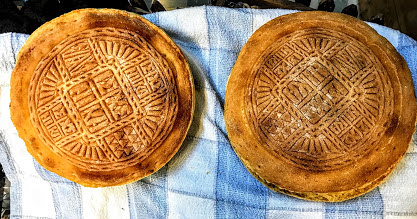
At every Eucharist, we hear that Jesus in his Body is handed over to us: ‘This is my Body, which is given up for you’ ... Communion bread being prepared at Mount Athos (Photograph: Patrick Comerford)
Today’s Prayers (Friday 10 July 2026):
In Pray with the World Church, the prayer diary of the Anglican mission agency USPG (United Society Partners in the Gospel), the theme this week, from 5 to 11 July 2026 (pp 16-17), is ‘Faith in the Midst of Fractures’. This theme was introduced on Sunday with a reflection by the Revd Godfrey Owino Adera, Anglican priest, theologian, and lecturer at Saint Paul’s University, Limuru, Kenya.
The USPG prayer diary today (Friday 10 July 2026) invites us to pray:
Faithful God, we give thanks for the FeAST network and the way it nurtures learning, friendship, and justice-oriented theology. Bless the network with deepened relationships, shared vision, and long-lasting fruit that glorifies your name.
The Collect of the Day:
Almighty and everlasting God,
by whose Spirit the whole body of the Church
is governed and sanctified:
hear our prayer which we offer for all your faithful people,
that in their vocation and ministry
they may serve you in holiness and truth
to the glory of your name;
through our Lord and Saviour Jesus Christ,
who is alive and reigns with you,
in the unity of the Holy Spirit,
one God, now and for ever.
The Post-Communion Prayer:
Grant, O Lord, we beseech you,
that the course of this world may be so peaceably ordered
by your governance,
that your Church may joyfully serve you in all godly quietness;
through Jesus Christ our Lord.
Additional Collect:
Almighty God,
send down upon your Church
the riches of your Spirit,
and kindle in all who minister the gospel
your countless gifts of grace;
through Jesus Christ our Lord.
Yesterday’s reflections
Continued tomorrow
‘See, I am sending you out like sheep …’ (Matthew 10: 16) … sheep on a farm in Comberford, between Lichfield and Tamworth in Staffordshire (Photograph: Patrick Comerford)
Scripture quotations are from the New Revised Standard Version Bible: Anglicised Edition copyright © 1989, 1995, National Council of the Churches of Christ in the United States of America. Used by permission. All rights reserved worldwide. http://nrsvbibles.org
Patrick Comerford
We are in Ordinary Time in the Church Calendar and this week began with the Fifth Sunday after Trinity (Trinity V, 5 July 2026). Later this evening, I hope to take part in the rehearsals in Saint Mary and Saint Giles for the service next Monday welcoming the new Rector of Stony Stratford, the Revd Dr David Jarratt.
But, before today begins, I am taking some quiet time this morning to give thanks, to reflect, to pray and to read in these ways:
1, reading today’s Gospel reading;
2, a short reflection;
3, a prayer from the USPG prayer diary;
4, the Collects and Post-Communion prayer of the day.
‘Be wise as serpents and innocent as doves’ (Matthew 10: 16)
Matthew 10: 16-23 (NRSVA):
[Jesus said:] 16 ‘See, I am sending you out like sheep into the midst of wolves; so be wise as serpents and innocent as doves. 17 Beware of them, for they will hand you over to councils and flog you in their synagogues; 18 and you will be dragged before governors and kings because of me, as a testimony to them and the Gentiles. 19 When they hand you over, do not worry about how you are to speak or what you are to say; for what you are to say will be given to you at that time; 20 for it is not you who speak, but the Spirit of your Father speaking through you. 21 Brother will betray brother to death, and a father his child, and children will rise against parents and have them put to death; 22 and you will be hated by all because of my name. But the one who endures to the end will be saved. 23 When they persecute you in one town, flee to the next; for truly I tell you, you will not have gone through all the towns of Israel before the Son of Man comes.’
‘Be wise as serpents and innocent as doves’ (Matthew 10: 16)
Today’s Reflections:
The Gospel reading at the Eucharist today (Matthew 10: 16-23) continues yesterday’s account of the commission and mission of the Twelve (Matthew 10: 7-15), as the Twelve continue to receive are given their instructions and commission for mission among the ‘lost sheep’: they are going out like sheep into the midst of wolves, so they need to be wise ‘as serpents and innocent as doves’ and to be aware of the threats and dangers they face.
The image of wolves in sheep’s clothing may lead us to ask how we recognise wolves in sheep clothing or false prophets who hijack abuse the name of Christ and Christianity today?
I hope I never get use to the blasphemous obscenities and images that come from Donald Trump. When he speaks he is often flanked by a Catholic Vice-President, JD Vance, a Catholic Secretary of State, Mario Rubio, who has also been a Baptist and a Mormon, and a Defence Secretary, Pete Hegseth, who is a member of the Pilgrim Hill Reformed Fellowship and who claims God blesses his war-mongering, his violence, his genocide, and invoking God to sanction his evil actions.
Let me offer four names to consider:
1, Allie Beth Stuckey seeks to legitimise the concept of ‘toxic empathy’ in her book Toxic Empathy: How Progressives Exploit Christian Compassion. She describes herself as a Reformed Baptist, is a regular guest on Fox News, and is heard on the podcast ‘Relatable with Allie Beth Stuckey’, distributed by Blaze Media, known for its recent film hijacking the story of Dietrich Bonhoeffer to promote ultra-right ‘Christian Nationalism’ in the US.
Stuckey studied communications at Furman University and has been a publicist and social media strategist on behalf of pro-Trump and MAGA causes. But she has no theological education or degrees that qualify her to make her judgmental theological pronouncements.
Stuckey once made a video that purported to be an interview with Alexandria Ocasio-Cortez in which the politician appeared to give bizarre answers to questions put to her by Stuckey. It emerged later that the video plagiarised footage from other interviews spliced to appear as answers to Stuckey’s questions. When the video was widely exposed as a hoax, Stuckey said it was ‘satirical’ and ‘a joke’, but she has not made similar videos or jokes about right-wing politicians.
In her book, Toxic Empathy: How Progressives Exploit Christian Compassion (2024), Stuckey claims that when politics are driven by empathy rather than truth, innocent people pay the price. She claims empathy has become the highest virtue but like so many other words, such as tolerance, justice and acceptance, the word has been hijacked by people who exploit compassion for their own political ends.
She claims ‘toxic empathy’ is the primary tool of persuasion used by progressives to manipulate well-meaning Christians. She says they use toxic empathy ‘by employing our language, our Bible verses, our concepts and then pervert them to morally extort us into adopting their position.’
Stuckey argues that empathy has become a tool of manipulation by left-wing activists, claiming they bully people into believing that they must adopt progressive positions to be loving. She associates toxic empathy with the issues she is obsessed with: abortion, gender, sexuality, immigration and social justice. She argues empathy should derive from God’s definitions of love, goodness, and justice, and argues there are logical pitfalls and moral consequences for toxic empathy.
‘Our language, our Bible verses, our concepts’? Stuckey seems to imply the Bible and the language of Christianity are the sole preserve of far-right fundamentalists. She complains someone of the same religion can read the shared religious text and come to a different conclusion about its meaning, such as coming to the conclusion that the Prophets of the Hebrew Scriptures and Jesus in the Gospels meant what they said about responding with human decency to the outcast, the stranger, the sick, the imprisoned, the widowed, and the orphan.
But her notion that there is one and only one correct understanding of Scripture, is a false notion … one might even say it is a toxic notion.
Q, Wolf or Sheep? True prophet or false?
2, Pastor Paula White-Cain, a televangelist and a prominent figure in the charismatic movement, has been a longtime spiritual adviser to Donald Trump and is a proponent of ‘prosperity theology’, which takes advantage of vulnerable believers, promising material blessings in return for donations.
In the past, she has been the pastor at churches that bought her a waterfront mansion for $900,000, paid over $1 million in salaries to her and her family members and paid for their private jet, yet failed to pay mortgages and electricity bills and filed for bankruptcy. One church alleged White had stolen $600,000 in audio-visual equipment.
She chaired the evangelical advisory board for Trump’s 2016 campaign, delivered the invocation at his inauguration in 2017, became his special adviser on the Faith and Opportunity Initiative at the Office of Public Liaison in 2019, and offered an opening prayer before Trump’s speech at the rally shortly before the US Capitol was stormed on 6 January 2021.
White has warned that ‘Christians that don’t support President Trump will have to answer to God.’ Last year (7 February 2025), he appointed White to lead the White House Faith Office.
She once criticised immigration advocates who cited the Gospel account of Jesus’ escape to Egypt as a child, saying: ‘Yes, he did live in Egypt for 3½ years. But it was not illegal. If he had broken the law, then he would have been sinful and he would not have been our Messiah.’
Q, Wolf or Sheep? True prophet or false?
3, Mike Huckabee – or, more formally, the Revd Dr Michael Dale Huckabee – is Trump’s ambassador to Israel. He is an ordained Baptist minister, but has also been the Governor of Arkansas (1996-2007), and has hosted a talk show on Fox News. He has claimed, wrongly, that Barack Obama was born in Kenya and alleged Obama supported the Mau-Mau rebels; he outlawed same-sex marriage in Arkansas; and he has repeated the unsubstantiated claims of election fraud in the 2020 presidential election.
He denies global warming, opposes anti-discrimination legislation, is vocal in opposing migration into the US, and opposes gun control measures. Within hours of the Sandy Hook Elementary School shooting, he told Fox News: ‘We ask why there is violence in our schools, but we have systematically removed God from our schools. Should we be so surprised that schools would become a place of carnage?’
Before his present appointment, he opposed Palestinian statehood and rejected Palestinian identity as ‘a political tool to try and force land away from Israel.’ At an event in the West Bank in 2017, he said: ‘There is no such thing as a West Bank – it’s Judea and Samaria. There’s no such thing as a settlement. They’re communities. They’re neighbourhoods. They’re cities. There’s no such thing as an occupation.’
When he presented his credentials to President Isaac Herzog, Huckabee claimed Iran wants to destroy Israel and the US. He hardly has the credibility or the credentials to be an impartial mediator or negotiator in any part of the Middle East, or in any conflict.
Q, Wolf or Sheep? True prophet or false?
4, Vance Boelter – or, more formally, the Revd Dr Vance Luther Boelter – was arrested in connection with the killing of a Minnesota state legislator and her husband and the shooting of a state senator and his wife last year (14 June 2025). It turns out he has been an evangelical missionary who has preached in the Democratic Republic of the Congo in recent years, and has long been a Trump supporter and a registered Republican voter.
Boelter has pleaded guilty to killing Melissa Hortman, a Democrat, and her husband Mark Hortman at their home in Champlin, a suburb of Minneapolis, and with shooting and wounding Democratic state Senator John Hoffman and his wife Yvette Hoffman at their home.
Videos show Boelter preaching from 2021 to 2023 at La Borne Matadi, a church in Matadi, on the western coast of the DRC. In one sermon he says ‘God is going to raise up apostles and prophets in America to correct his church.’ Boelter says he was ordained in 1993, claims a doctorate from Cardinal Stritch University, a private Catholic college in Wisconsin that was shut down in 2023, and says he studied at Christ for the Nations Institute in Dallas, a charismatic ‘Spirit-filled Bible School’. His other intended targets included Governor Tim Walz of Minnesota, the Democratic vice-presidential nominee last year, and Rashida Tlaib and Ilhan Omar, the first two Muslim women members of Congress.
He is due to be sentenced later this month (23 July 2026), when he faces two consecutive sentences of life imprisonment without the possibility of parole, plus 40 years.
To this day, Trump has had neither the courtesy nor the courage to pick up the phone and offer words of consolation and assurance to these three politicians or anyone else named on Boetler’s hit list. Then, on the other hand, perhaps it is no small mercy that he has not managed to shift the blame onto migrants or refugees, yet.
Q, Wolf or Sheep? True prophet or false?
We are sent out like sheep among wolves. We are, in a way, defenceless, because we renounce any use of violence. There are wolves out there eager to destroy us because, despite our message of love, justice and peace, we are seen as a threat to their activities and ambitions.
We are to be as wise as snakes and innocent as doves. We are to be as inventive and creative as we can be in dealing with the world. But we are to be innocent, not in the sense of being naive, but in the sense of being completely free of even any suspicion of wrongdoing. The ends do not justify the means.
At every Eucharist, we hear that Jesus in his Body is handed over to us: ‘This is my Body, which is given up for you.’
When we are handed over we are not to be anxious about what to say. The enemies of the Gospel do not have the final answer when it comes to truth, love and justice.
Of course, Jesus never calls on us to go out of our way to seek persecution or to be hated, and we are to make Christianity as attractive as possible. But Christianity and the values of the Kingdom are being traduced, supposedly in the name of Christ, by key people at the very heart of political life in the US today.
Has the time come when true Christians can run no further, or when it is clear we have to take a stand and cannot compromise? We need to know the sheep from the wolves, to be in some way as wise as serpents and innocent as doves, to be assured also of the promise that those who endure to the end will be saved.
At every Eucharist, we hear that Jesus in his Body is handed over to us: ‘This is my Body, which is given up for you’ ... Communion bread being prepared at Mount Athos (Photograph: Patrick Comerford)
Today’s Prayers (Friday 10 July 2026):
In Pray with the World Church, the prayer diary of the Anglican mission agency USPG (United Society Partners in the Gospel), the theme this week, from 5 to 11 July 2026 (pp 16-17), is ‘Faith in the Midst of Fractures’. This theme was introduced on Sunday with a reflection by the Revd Godfrey Owino Adera, Anglican priest, theologian, and lecturer at Saint Paul’s University, Limuru, Kenya.
The USPG prayer diary today (Friday 10 July 2026) invites us to pray:
Faithful God, we give thanks for the FeAST network and the way it nurtures learning, friendship, and justice-oriented theology. Bless the network with deepened relationships, shared vision, and long-lasting fruit that glorifies your name.
The Collect of the Day:
Almighty and everlasting God,
by whose Spirit the whole body of the Church
is governed and sanctified:
hear our prayer which we offer for all your faithful people,
that in their vocation and ministry
they may serve you in holiness and truth
to the glory of your name;
through our Lord and Saviour Jesus Christ,
who is alive and reigns with you,
in the unity of the Holy Spirit,
one God, now and for ever.
The Post-Communion Prayer:
Grant, O Lord, we beseech you,
that the course of this world may be so peaceably ordered
by your governance,
that your Church may joyfully serve you in all godly quietness;
through Jesus Christ our Lord.
Additional Collect:
Almighty God,
send down upon your Church
the riches of your Spirit,
and kindle in all who minister the gospel
your countless gifts of grace;
through Jesus Christ our Lord.
Yesterday’s reflections
Continued tomorrow
‘See, I am sending you out like sheep …’ (Matthew 10: 16) … sheep on a farm in Comberford, between Lichfield and Tamworth in Staffordshire (Photograph: Patrick Comerford)
Scripture quotations are from the New Revised Standard Version Bible: Anglicised Edition copyright © 1989, 1995, National Council of the Churches of Christ in the United States of America. Used by permission. All rights reserved worldwide. http://nrsvbibles.org
26 June 2026
Holy Rood Church, Oxford,
a pioneering building in
the Liturgical Movement
built before Vatican II
Holy Rood Church, near Folly Bridge, Oxford, was designed by Gilbert Flavel and has been described as ‘a landmark in English Catholic ecclesiology’ (Photograph: Patrick Comerford, 2026)
Patrick Comerford
We spent a day in Oxford earlier this week, and as temperatures rose during the day and the heatwave began to take a grip on the land, I went for a walk by the river and in search of some churches and ecclesiastical sites I had not visited before.
Holy Rood Church is near Folly Bridge on the Abingdon Road, and a short walk south from the centre of Oxford, between the late 18th century Grandpont House, now owned by Opus Dei, and the playing fields of Brasenose College.
The church has been described as ‘a landmark in English Catholic ecclesiology’ and is advanced in its liturgical planning. It was designed by the architect Gilbert Flavel, who was inspired by Saint Paul’s Church, Bow Common, designed by Robert Maguire and Michael Murray. It has a large number of works of high artistic merit, including works associated with Eric Gill.
Inside Holy Rood Church, Oxford, built in 1961, a year before Vatican II opened (Photograph: Patrick Comerford, 2026)
Holy Rood Church serves North Hinksey parish, the most northern parish in the Roman Catholic Diocese of Portsmouth, whose boundaries mainly follow the old county boundaries. The Hinksey areas were transferred from Berkshire to Oxfordshire in two phases: New Hinksey in 1889; and North Hinksey, South Hinksey and Hinksey Hill in 1974.
Building the church was made possible through an endowment in 1956 by a soldier, diplomat and explorer, Colonel Reginald Schomberg (1880-1958). Schomberg, who was ordained priest late in life, entrusted Father John Crozier (1917-1993), the priest in the North Hinksey parish from 1954 to 1968, with finding a site for a new church for Oxford Catholics living south of the river and in neighbouring villages.
The site was originally the orchard of Grandpont House, the former home of the Salter family, and Crozier bought it from Brasenose College in 1959.
The free-standing altar in Holy Rood Church, Oxford, and the giant circular corona by Michael Murray, symbolising the 12 gates of Jerusalem and the 12 apostles (Photograph: Patrick Comerford, 2026)
The Liturgical Movement radically reassessed how churches reflect celebrating the Word of God. It focussed on the Eucharist, and the relationship of the congregation to each other and to God. This movement was accepted by the Roman Catholic Church through the Second Vatican Council (1962-1965), although its importance was evident as early as 1947 with Pope Pius XII’s 1947 Mediator Dei et Hominum and the 1955 encyclical De musica sacra.
By the mid-1950s, many church architects were exploring e centralised and circular church plans, moving away from traditional longitudinal plans. The Catholic Herald in 1962 published a list of more than a dozen British churches along this plan form that were recently built or were being built.
In light of the liturgical movement and its architectural effects, the Oxford-based architect Gilbert Flavel was chosen in 1959. Flavel, an Anglican, was chosen because of his sympathetic attitude towards the new liturgical thinking, and Crozier had admired his restoration of Saint Michael at the North Gate, Oxford, and his work at the London College of Divinity in Norwood.
The corner stone by the entrance recalls the deidication of the church in 1961 by Bishop Thomas Holland (Photograph: Patrick Comerford, 2026)
In the years immediately before Vatican II, Crozier travelled widely throughout Europe, studying church design in relation to the liturgical revival. In 1958, he was impressed with James Gardner’s British Pavilion at the World’s Fair in Brussels, ‘which I thought would make an admirable church on a riverside site. Like Coventry Cathedral, however, it was oblong, whereas the new liturgy seemed to demand a building in the round or square. Each of the three towered segments of the pavilion was a square. An enlarged replica of a segment could form the basis of a church, in a style bringing out the symbolism of God’s tent among men.’
Flavel designed the church in an advanced liturgical style, before the reforms introduced at the time the Second Vatican Council. His design conceived of a church ‘in the round’ and tent-like. This enabled Mass to celebrated in the then traditional ad orientem, facing east, as well as versus populum, facing the people, as became normal.
The dedication is to the Holy Rood, (‘Holy Cross’), and the whole building is designed on a plan of a ‘Jerusalem Cross’ with equal arms, and a Jerusalem cross also surmounts the central lantern. The church is octagonal with a square lantern of four glazed gables cutting into the pyramid roof, and the walls are of yellow-brown brick. The tent shape reflects the tent of the Tabernacle in the Old Testament, the dwelling place of the presence of God.
The church was built for £35,000 by Bartlett Brothers of Witney. It was dedicated by Bishop Thomas Holland, coadjutor bishop of Portsmouth as titular Bishop of Etenna, on 16 December 1961, in the year before Vatican II opened. The church was consecrated by Bishop Derek Worlock on 5 February 1962.
To the left of the entrance, the corner stone has the inscription ‘19+61’ and ‘Huius Ecclesiae Lapidem Angularem Iecit + RR DD Thomas Holland Episcopus Etennae’. To the right of the entrance is a spiral staircase to a choir gallery fitted with more pews for the choir and an organ.
The baptismal font is incised with the lettering Fons Vitae Aeternae (Fount of Eternal Life) by Kevin Cribb (Photograph: Patrick Comerford, 2026)
The plan of the church consists of an octagon set within a Greek Cross for the main worship space, with ancillary spaces at the corners making up an overall rectangular plan. The Blessed Sacrament chapel is to one side, outside the rectangle. There is a glazed central entrance, its cruciform glazing subdivisions evoking the dedication. On either side are single-storey, flat-roofed spaces with ancillary functions.
The main double-height worship space rises up behind, with central raised top lighting with a pitched broach roof clad in copper sheeting. The walls are clad in pale brick, overlaying a steel frame construction.
The entrance doors lead into a narthex and baptistry, with ancillary rooms giving off to left and right. At the centre of this narthex and baptistry is a large granite font, the polished inside sufficiently large to allow for total immersion. It is incised with the lettering Fons Vitae Aeternae (Fount of Eternal Life), by Kevin Cribb (1928-2013), a son of Laurie Cribb, an assistant to Eric Gill.
The tent shape reflects the tent of the Tabernacle in the Old Testament, the dwelling place of the presence of God (Photograph: Patrick Comerford, 2026)
Crozier wrote that ‘the calm and simple dignity of Gill’s art harmonises with the new architecture, so the artists were as far as possible drawn from his school’. Cribb also carved the cornerstone on the left hand side of the entrance into the main body of the church.
The sanctuary is placed at the liturgical east end, and not – as at Saint Paul’s, Bow Common – at the centre of the building. However, the altar is and always was well forward of the east wall. The freestanding benches were originally raked at the sides to face towards the sanctuary.
The Blessed Sacrament Chapel to the right of the main seating area, is a low single-storey space and the only area in the church with stained glass windows. The floor of the narthex, nave and chapel is of black and white linoleum squares, producing a chequerboard effect. At the liturgical west end of the main worship space is a gallery with a large organ.
The abstract stained glass windows by Charles Ware are based on designs from Chartres Cathedral (Photograph: Patrick Comerford, 2026)
The church is also notable for the quality of its furnishings. The altar, like the font, is of granite and inscribed with lettering by Kevin Cribb: Dux Vitae Mortuus Regnat Vivus (‘Life’s champion slain, lives and reigns for ever’). Hanging over this is a giant circular corona by Michael Murray, symbolising the 12 gates of Jerusalem, with the lights symbolising the 12 apostles.
This and the other metalwork are all by Michael Murray (1923-2005). They include a bronze Pantocrator on east wall behind the altar, the bronze Theotokos, based on a Romanesque relief in York Minster, on the wall near the Blessed Sacrament chapel, the tabernacle in the Blessed Sacrament chapel, the ciborium, chalice, sanctuary lamps, altar cross and candlesticks.
The Blessed Sacrament chapel has two abstract stained glass windows by Charles Ware based on designs from Chartres Cathedral.
The small stone carving by Eric Gill of Christ on the Tree of Life, above the tabernacle in the Blessed Sacrament chapel (Photograph: Patrick Comerford, 2026)
The contents of Eric Gill’s chapel at Piggotts, near High Wycombe, Buckinghamshire, were given by Gill’s daughter to Crozier in 1963. A small stone carving by Gill of Christ on the Tree of Life was installed above the tabernacle in the Blessed Sacrament chapel, while other furnishings went to Saint Thomas More, Boar’s Hill, also part of the main parish of North Hinksey.
The chapel wall also has tablets by Cribb commemorating Schomberg and Crozier. The bronze Stations of the Cross on the walls of the nave are lit by conical lights. The plaque honouring Our Lady of Poland beside the gallery stairs is a reminder of the contribution of the Polish community to the church.
Tablets by Kevin Cribb commemorate Canon John Crozier and Father Reginald Schomberg (Photographs: Patrick Comerford, 2026)
The church was listed Grade II in 2020 for its architectural interest as a largely intact example of a 1960s church designed to meet the changing worship practices of the period; for its interior and it with high quality, designed fixtures and fittings; and because it is illustrative of post-war churches designed to the principles of the Liturgical Movement.
Inside Holy Rood Church, facing the west end and the organ gallery (Photograph: Patrick Comerford, 2026)
• The parish priest is Father Daniel Lloyd, a former Anglican. Saturday Vigil Masses are at 5 pm (Divine Worship of the Personal Ordinariate of Walsingham) and 7:30 pm (Portugese); Sunday Masses are at 11:15 am and 5 pm (Latin, 1962). Weekday Masses are at 9 am. The church is open on weekdays from 8:30 to 5:15.
The spiral staircase leading to the organ gallery (Photograph: Patrick Comerford, 2026)
Patrick Comerford
We spent a day in Oxford earlier this week, and as temperatures rose during the day and the heatwave began to take a grip on the land, I went for a walk by the river and in search of some churches and ecclesiastical sites I had not visited before.
Holy Rood Church is near Folly Bridge on the Abingdon Road, and a short walk south from the centre of Oxford, between the late 18th century Grandpont House, now owned by Opus Dei, and the playing fields of Brasenose College.
The church has been described as ‘a landmark in English Catholic ecclesiology’ and is advanced in its liturgical planning. It was designed by the architect Gilbert Flavel, who was inspired by Saint Paul’s Church, Bow Common, designed by Robert Maguire and Michael Murray. It has a large number of works of high artistic merit, including works associated with Eric Gill.
Inside Holy Rood Church, Oxford, built in 1961, a year before Vatican II opened (Photograph: Patrick Comerford, 2026)
Holy Rood Church serves North Hinksey parish, the most northern parish in the Roman Catholic Diocese of Portsmouth, whose boundaries mainly follow the old county boundaries. The Hinksey areas were transferred from Berkshire to Oxfordshire in two phases: New Hinksey in 1889; and North Hinksey, South Hinksey and Hinksey Hill in 1974.
Building the church was made possible through an endowment in 1956 by a soldier, diplomat and explorer, Colonel Reginald Schomberg (1880-1958). Schomberg, who was ordained priest late in life, entrusted Father John Crozier (1917-1993), the priest in the North Hinksey parish from 1954 to 1968, with finding a site for a new church for Oxford Catholics living south of the river and in neighbouring villages.
The site was originally the orchard of Grandpont House, the former home of the Salter family, and Crozier bought it from Brasenose College in 1959.
The free-standing altar in Holy Rood Church, Oxford, and the giant circular corona by Michael Murray, symbolising the 12 gates of Jerusalem and the 12 apostles (Photograph: Patrick Comerford, 2026)
The Liturgical Movement radically reassessed how churches reflect celebrating the Word of God. It focussed on the Eucharist, and the relationship of the congregation to each other and to God. This movement was accepted by the Roman Catholic Church through the Second Vatican Council (1962-1965), although its importance was evident as early as 1947 with Pope Pius XII’s 1947 Mediator Dei et Hominum and the 1955 encyclical De musica sacra.
By the mid-1950s, many church architects were exploring e centralised and circular church plans, moving away from traditional longitudinal plans. The Catholic Herald in 1962 published a list of more than a dozen British churches along this plan form that were recently built or were being built.
In light of the liturgical movement and its architectural effects, the Oxford-based architect Gilbert Flavel was chosen in 1959. Flavel, an Anglican, was chosen because of his sympathetic attitude towards the new liturgical thinking, and Crozier had admired his restoration of Saint Michael at the North Gate, Oxford, and his work at the London College of Divinity in Norwood.
The corner stone by the entrance recalls the deidication of the church in 1961 by Bishop Thomas Holland (Photograph: Patrick Comerford, 2026)
In the years immediately before Vatican II, Crozier travelled widely throughout Europe, studying church design in relation to the liturgical revival. In 1958, he was impressed with James Gardner’s British Pavilion at the World’s Fair in Brussels, ‘which I thought would make an admirable church on a riverside site. Like Coventry Cathedral, however, it was oblong, whereas the new liturgy seemed to demand a building in the round or square. Each of the three towered segments of the pavilion was a square. An enlarged replica of a segment could form the basis of a church, in a style bringing out the symbolism of God’s tent among men.’
Flavel designed the church in an advanced liturgical style, before the reforms introduced at the time the Second Vatican Council. His design conceived of a church ‘in the round’ and tent-like. This enabled Mass to celebrated in the then traditional ad orientem, facing east, as well as versus populum, facing the people, as became normal.
The dedication is to the Holy Rood, (‘Holy Cross’), and the whole building is designed on a plan of a ‘Jerusalem Cross’ with equal arms, and a Jerusalem cross also surmounts the central lantern. The church is octagonal with a square lantern of four glazed gables cutting into the pyramid roof, and the walls are of yellow-brown brick. The tent shape reflects the tent of the Tabernacle in the Old Testament, the dwelling place of the presence of God.
The church was built for £35,000 by Bartlett Brothers of Witney. It was dedicated by Bishop Thomas Holland, coadjutor bishop of Portsmouth as titular Bishop of Etenna, on 16 December 1961, in the year before Vatican II opened. The church was consecrated by Bishop Derek Worlock on 5 February 1962.
To the left of the entrance, the corner stone has the inscription ‘19+61’ and ‘Huius Ecclesiae Lapidem Angularem Iecit + RR DD Thomas Holland Episcopus Etennae’. To the right of the entrance is a spiral staircase to a choir gallery fitted with more pews for the choir and an organ.
The baptismal font is incised with the lettering Fons Vitae Aeternae (Fount of Eternal Life) by Kevin Cribb (Photograph: Patrick Comerford, 2026)
The plan of the church consists of an octagon set within a Greek Cross for the main worship space, with ancillary spaces at the corners making up an overall rectangular plan. The Blessed Sacrament chapel is to one side, outside the rectangle. There is a glazed central entrance, its cruciform glazing subdivisions evoking the dedication. On either side are single-storey, flat-roofed spaces with ancillary functions.
The main double-height worship space rises up behind, with central raised top lighting with a pitched broach roof clad in copper sheeting. The walls are clad in pale brick, overlaying a steel frame construction.
The entrance doors lead into a narthex and baptistry, with ancillary rooms giving off to left and right. At the centre of this narthex and baptistry is a large granite font, the polished inside sufficiently large to allow for total immersion. It is incised with the lettering Fons Vitae Aeternae (Fount of Eternal Life), by Kevin Cribb (1928-2013), a son of Laurie Cribb, an assistant to Eric Gill.
The tent shape reflects the tent of the Tabernacle in the Old Testament, the dwelling place of the presence of God (Photograph: Patrick Comerford, 2026)
Crozier wrote that ‘the calm and simple dignity of Gill’s art harmonises with the new architecture, so the artists were as far as possible drawn from his school’. Cribb also carved the cornerstone on the left hand side of the entrance into the main body of the church.
The sanctuary is placed at the liturgical east end, and not – as at Saint Paul’s, Bow Common – at the centre of the building. However, the altar is and always was well forward of the east wall. The freestanding benches were originally raked at the sides to face towards the sanctuary.
The Blessed Sacrament Chapel to the right of the main seating area, is a low single-storey space and the only area in the church with stained glass windows. The floor of the narthex, nave and chapel is of black and white linoleum squares, producing a chequerboard effect. At the liturgical west end of the main worship space is a gallery with a large organ.
The abstract stained glass windows by Charles Ware are based on designs from Chartres Cathedral (Photograph: Patrick Comerford, 2026)
The church is also notable for the quality of its furnishings. The altar, like the font, is of granite and inscribed with lettering by Kevin Cribb: Dux Vitae Mortuus Regnat Vivus (‘Life’s champion slain, lives and reigns for ever’). Hanging over this is a giant circular corona by Michael Murray, symbolising the 12 gates of Jerusalem, with the lights symbolising the 12 apostles.
This and the other metalwork are all by Michael Murray (1923-2005). They include a bronze Pantocrator on east wall behind the altar, the bronze Theotokos, based on a Romanesque relief in York Minster, on the wall near the Blessed Sacrament chapel, the tabernacle in the Blessed Sacrament chapel, the ciborium, chalice, sanctuary lamps, altar cross and candlesticks.
The Blessed Sacrament chapel has two abstract stained glass windows by Charles Ware based on designs from Chartres Cathedral.
The small stone carving by Eric Gill of Christ on the Tree of Life, above the tabernacle in the Blessed Sacrament chapel (Photograph: Patrick Comerford, 2026)
The contents of Eric Gill’s chapel at Piggotts, near High Wycombe, Buckinghamshire, were given by Gill’s daughter to Crozier in 1963. A small stone carving by Gill of Christ on the Tree of Life was installed above the tabernacle in the Blessed Sacrament chapel, while other furnishings went to Saint Thomas More, Boar’s Hill, also part of the main parish of North Hinksey.
The chapel wall also has tablets by Cribb commemorating Schomberg and Crozier. The bronze Stations of the Cross on the walls of the nave are lit by conical lights. The plaque honouring Our Lady of Poland beside the gallery stairs is a reminder of the contribution of the Polish community to the church.
Tablets by Kevin Cribb commemorate Canon John Crozier and Father Reginald Schomberg (Photographs: Patrick Comerford, 2026)
The church was listed Grade II in 2020 for its architectural interest as a largely intact example of a 1960s church designed to meet the changing worship practices of the period; for its interior and it with high quality, designed fixtures and fittings; and because it is illustrative of post-war churches designed to the principles of the Liturgical Movement.
Inside Holy Rood Church, facing the west end and the organ gallery (Photograph: Patrick Comerford, 2026)
• The parish priest is Father Daniel Lloyd, a former Anglican. Saturday Vigil Masses are at 5 pm (Divine Worship of the Personal Ordinariate of Walsingham) and 7:30 pm (Portugese); Sunday Masses are at 11:15 am and 5 pm (Latin, 1962). Weekday Masses are at 9 am. The church is open on weekdays from 8:30 to 5:15.
The spiral staircase leading to the organ gallery (Photograph: Patrick Comerford, 2026)
18 June 2026
Antigone: a classical reminder of
the higher natural laws that
demand resistance to injustice
‘Antigone 2084’, a new adaptation by the Carabosse Theatre Company, opens on Friday evening and continues until next Thursday (Photograph: Patrick Comerford, 2026)
Patrick Comerford
‘Antigone 2084’ is a new adaptation by the Carabosse Theatre Company, in the Swinfen Harris Church Hall, beside the Greek Orthodox Church on London Road in Stony Stratford. The production opens at 7 pm tomorrow evening (19 June 2026) and runs for six days until 25 June, with an additional matinee showing at 2 pm on Sunday (21 June 2026).
This adaptation is set in Thebes in 2084, during a civil war between two rival brothers and involves two sisters who just want to do the right thing. Are the fates in their favour? Or will the family curse prevail?
The play is set in the near future after a great catastrophe and where hybrid Mortal / Corvids – ‘The Guardians of the Cord’, a secret society – act as the chief advisers to the new commander Creon.
‘Antigone 2084’ is part of a trio of Greek theatre female protagonists, following a tour by Carabosse with ‘Electra Unbound’ (2025) and ‘Medea’ (2024), and they end with this tragic tale of Antigone, daughter of Oedipus.
Thebes in 2084 is a dystopian utopia where civil war has torn the city apart and left two brothers dead and their sisters, Antigone and Ismene, with the role of burying their dead. But there is a tyrant antagonist, their uncle, the commander Creon, who seeks to find order with a new and stricter regime in place.
This is a beautiful tragedy with funny bits, singing, choreography and a classic and modern narrative as its backbone. It explores themes that are rather poignant and more topical than perhaps many would like.
Antigone explores themes that are more poignant and topical than many may be comfortable with (Photograph: Patrick Comerford, 2026)
Antigone (Ἀντιγόνη) is a Theban princess In Greek mythology and she is a character in several Greek tragedies. She was the daughter of Oedipus, king of Thebes; her mother or grandmother was either Jocasta or, in another variation of the myth, Euryganeia. She was the sister of Polynices, Eteocles, and Ismene.
Antigone appears in three 5th century BCE tragic plays by Sophocles, known collectively as the three Theban plays, and she is the protagonist in ‘Antigone’, the tragedy that has her name. She makes a brief appearance at the end of Aeschylus’s ‘Seven against Thebes’, and her story is also the subject of Euripides’s now lost play of the same name. While Antigone has few appearances in Greek mythology, Sophocles’s play has ensured her a revered and lasting legacy.
The story of Antigone is told by Sophocles in the fifth century BCE in his Theban plays, ‘Oedipus Rex’, ‘Oedipus at Colonus’ and ‘Antigone’.
Antigone and her sister Ismene are seen at the end of ‘Oedipus Rex’ as Oedipus laments the shame and sorrow he is leaving his daughters to. He begs Creon to watch over them, but in his grief reaches to take them with him as he is led away. Creon prevents him from taking the girls city with him, and neither of them is named in the play.
Antigone serves as her father’s guide in ‘Oedipus at Colonus’, as she leads him into the city where the play takes place. Antigone resembles her father in her stubbornness and doomed existence. She stays with her father for most of the play, until she is taken away by Creon in an attempt to blackmail Oedipus into returning to Thebes. However, Theseus defends Oedipus and rescues both Antigone and her sister who was also taken prisoner.
At the end of the play, Antigone and her sister mourn the death of their father. Theseus offers them the comfort of knowing that Oedipus has received a proper burial, but by his wishes, they cannot go to the site. Antigone then decides to return to Thebes.
In ‘Antigone’, the play to which she gives her name, Antigone tries to secure a proper burial for her brother Polynices. Oedipus's sons, Eteocles and Polynices, had shared rule jointly until they quarrelled, and Eteocles expelled his brother. In Sophocles’s account, the two brothers agreed to alternate rule each year, but Eteocles decided not to share power after his term of office expired. Polynices left the kingdom, gathered an army and attacked Thebes in the war of the ‘Seven against Thebes’. Both brothers were killed in the battle.
Creon ascends to the throne of Thebes after the death of the brothers and decrees that Polynices is not to be buried or even mourned, on pain of death by stoning. When Antigone defies the king’s order, she is brought before Creon and confesses her crime. She knew about the king’s edict that Polynices should be neither buried nor mourned, but she claims divine law is morally superior to human law.
Antigone’s self-defence in defiance of Creon is passionate, courageous and determined. Creon orders her to be buried alive in a tomb. Although Creon has a reluctant change of heart and agrees to release Antigone, he finds she has hanged herself. Creon’s son Haemon, who was engaged to Antigone, make an unsuccessful attempt to kill Creon and then kills himself with a sword. His mother Queen Eurydice also kills herself in despair after the deaths of her sons, Haemon and Megareus, which she blames on Creon’s misrule and misjudgement. By her death, Antigone ends up destroying the household of her adversary, Creon.
Antigone also appears briefly in Aeschylus’s ‘Seven Against Thebes’, where Antigone and Ismene mourn the deaths of their siblings and Antigone defies an edict against the burial of Polynices.
The Swinfen Harris Hall in Stony Stratford … ‘Antigone 2084’ runs from Friday for six days (Photograph: Patrick Comerford)
Antigone is a stubborn and defiant heroine has become the embodiment of the ideal female character. As such, she contrasts with her beautiful but docile sister Ismene. In his play ‘Antigone’, Sophocles dramatises the dangers of allowing a ruler to attain absolute power, personified in Creon, the tyrant to whom few speak openly and who leaves few able to speak their true opinions. The people of Thebes know he is wrong, but they have no-one who risks telling him so or who is willing to engage in civil disobedience.
When Antigone is condemned to death, is it too late? Creon’s actions lead not just to the death of Antigone, but to the destruction of the city. Creon is unable to admit that he is mistaken. And so, Antigone hangs herself.
The play has influenced and been criticised by modern philosophers such as Martin Heidegger, in his essay The Ode on man in Sophocles’ Antigone.
Sophocles, in this play, is arguing that Athens needs to be saved from imminent destruction. He warns the people of Athens against arrogance which may lead to their destruction and downfall. Citizens cannot abdicate the responsibility of citizenship.
It is also a debate how to treat foreigners and citizens who are seen as identifying with the outsider and risk being outcasts themselves. Betraying the leader is now identified with betraying the state and betraying society. There are laws higher than those of the state, we cannot be expected to obey the law above all else, and tyrants do not have the last word. The law is not absolute; nor can we allow rulers to be absolute either.
There seem to be lessons there for many political societies and leaders too, and Antigone is seen today as influential figure in discussing higher moral principles that place a greater demand on us than the laws and decrees of temporal rulers – an important debate in resisting capricious and despotic rule in many places today, particularly the US under Donald Trump’s regime.
The German philosopher Georg Wilhelm Friedrich Hegel (1770-1831) presents Antigone as a figure who exposes a tragic rift between the so-called feminine ‘Divine Law’, which Antigone represents, and the ‘Human Law’, represented by Creon.
The French philosopher and theologian Jacques Maritain (1882-1973), who was influential in developing and drafting of the Universal Declaration of Human Rights, considers Antigone as the ‘heroine of the natural law.’ He writes, ‘she was aware of the fact that, in transgressing the human law and being crushed by it, she was obeying a higher commandment – that she was obeying laws that were unwritten, and that had their origin neither today nor yesterday, but which live always and forever, and no one knows where they have come from.’
Antigone … a small boat in the harbour at Aghios Gheorgios on the south-west coast of Corfu (Photograph: Patrick Comerford)
Patrick Comerford
‘Antigone 2084’ is a new adaptation by the Carabosse Theatre Company, in the Swinfen Harris Church Hall, beside the Greek Orthodox Church on London Road in Stony Stratford. The production opens at 7 pm tomorrow evening (19 June 2026) and runs for six days until 25 June, with an additional matinee showing at 2 pm on Sunday (21 June 2026).
This adaptation is set in Thebes in 2084, during a civil war between two rival brothers and involves two sisters who just want to do the right thing. Are the fates in their favour? Or will the family curse prevail?
The play is set in the near future after a great catastrophe and where hybrid Mortal / Corvids – ‘The Guardians of the Cord’, a secret society – act as the chief advisers to the new commander Creon.
‘Antigone 2084’ is part of a trio of Greek theatre female protagonists, following a tour by Carabosse with ‘Electra Unbound’ (2025) and ‘Medea’ (2024), and they end with this tragic tale of Antigone, daughter of Oedipus.
Thebes in 2084 is a dystopian utopia where civil war has torn the city apart and left two brothers dead and their sisters, Antigone and Ismene, with the role of burying their dead. But there is a tyrant antagonist, their uncle, the commander Creon, who seeks to find order with a new and stricter regime in place.
This is a beautiful tragedy with funny bits, singing, choreography and a classic and modern narrative as its backbone. It explores themes that are rather poignant and more topical than perhaps many would like.
Antigone explores themes that are more poignant and topical than many may be comfortable with (Photograph: Patrick Comerford, 2026)
Antigone (Ἀντιγόνη) is a Theban princess In Greek mythology and she is a character in several Greek tragedies. She was the daughter of Oedipus, king of Thebes; her mother or grandmother was either Jocasta or, in another variation of the myth, Euryganeia. She was the sister of Polynices, Eteocles, and Ismene.
Antigone appears in three 5th century BCE tragic plays by Sophocles, known collectively as the three Theban plays, and she is the protagonist in ‘Antigone’, the tragedy that has her name. She makes a brief appearance at the end of Aeschylus’s ‘Seven against Thebes’, and her story is also the subject of Euripides’s now lost play of the same name. While Antigone has few appearances in Greek mythology, Sophocles’s play has ensured her a revered and lasting legacy.
The story of Antigone is told by Sophocles in the fifth century BCE in his Theban plays, ‘Oedipus Rex’, ‘Oedipus at Colonus’ and ‘Antigone’.
Antigone and her sister Ismene are seen at the end of ‘Oedipus Rex’ as Oedipus laments the shame and sorrow he is leaving his daughters to. He begs Creon to watch over them, but in his grief reaches to take them with him as he is led away. Creon prevents him from taking the girls city with him, and neither of them is named in the play.
Antigone serves as her father’s guide in ‘Oedipus at Colonus’, as she leads him into the city where the play takes place. Antigone resembles her father in her stubbornness and doomed existence. She stays with her father for most of the play, until she is taken away by Creon in an attempt to blackmail Oedipus into returning to Thebes. However, Theseus defends Oedipus and rescues both Antigone and her sister who was also taken prisoner.
At the end of the play, Antigone and her sister mourn the death of their father. Theseus offers them the comfort of knowing that Oedipus has received a proper burial, but by his wishes, they cannot go to the site. Antigone then decides to return to Thebes.
In ‘Antigone’, the play to which she gives her name, Antigone tries to secure a proper burial for her brother Polynices. Oedipus's sons, Eteocles and Polynices, had shared rule jointly until they quarrelled, and Eteocles expelled his brother. In Sophocles’s account, the two brothers agreed to alternate rule each year, but Eteocles decided not to share power after his term of office expired. Polynices left the kingdom, gathered an army and attacked Thebes in the war of the ‘Seven against Thebes’. Both brothers were killed in the battle.
Creon ascends to the throne of Thebes after the death of the brothers and decrees that Polynices is not to be buried or even mourned, on pain of death by stoning. When Antigone defies the king’s order, she is brought before Creon and confesses her crime. She knew about the king’s edict that Polynices should be neither buried nor mourned, but she claims divine law is morally superior to human law.
Antigone’s self-defence in defiance of Creon is passionate, courageous and determined. Creon orders her to be buried alive in a tomb. Although Creon has a reluctant change of heart and agrees to release Antigone, he finds she has hanged herself. Creon’s son Haemon, who was engaged to Antigone, make an unsuccessful attempt to kill Creon and then kills himself with a sword. His mother Queen Eurydice also kills herself in despair after the deaths of her sons, Haemon and Megareus, which she blames on Creon’s misrule and misjudgement. By her death, Antigone ends up destroying the household of her adversary, Creon.
Antigone also appears briefly in Aeschylus’s ‘Seven Against Thebes’, where Antigone and Ismene mourn the deaths of their siblings and Antigone defies an edict against the burial of Polynices.
The Swinfen Harris Hall in Stony Stratford … ‘Antigone 2084’ runs from Friday for six days (Photograph: Patrick Comerford)
Antigone is a stubborn and defiant heroine has become the embodiment of the ideal female character. As such, she contrasts with her beautiful but docile sister Ismene. In his play ‘Antigone’, Sophocles dramatises the dangers of allowing a ruler to attain absolute power, personified in Creon, the tyrant to whom few speak openly and who leaves few able to speak their true opinions. The people of Thebes know he is wrong, but they have no-one who risks telling him so or who is willing to engage in civil disobedience.
When Antigone is condemned to death, is it too late? Creon’s actions lead not just to the death of Antigone, but to the destruction of the city. Creon is unable to admit that he is mistaken. And so, Antigone hangs herself.
The play has influenced and been criticised by modern philosophers such as Martin Heidegger, in his essay The Ode on man in Sophocles’ Antigone.
Sophocles, in this play, is arguing that Athens needs to be saved from imminent destruction. He warns the people of Athens against arrogance which may lead to their destruction and downfall. Citizens cannot abdicate the responsibility of citizenship.
It is also a debate how to treat foreigners and citizens who are seen as identifying with the outsider and risk being outcasts themselves. Betraying the leader is now identified with betraying the state and betraying society. There are laws higher than those of the state, we cannot be expected to obey the law above all else, and tyrants do not have the last word. The law is not absolute; nor can we allow rulers to be absolute either.
There seem to be lessons there for many political societies and leaders too, and Antigone is seen today as influential figure in discussing higher moral principles that place a greater demand on us than the laws and decrees of temporal rulers – an important debate in resisting capricious and despotic rule in many places today, particularly the US under Donald Trump’s regime.
The German philosopher Georg Wilhelm Friedrich Hegel (1770-1831) presents Antigone as a figure who exposes a tragic rift between the so-called feminine ‘Divine Law’, which Antigone represents, and the ‘Human Law’, represented by Creon.
The French philosopher and theologian Jacques Maritain (1882-1973), who was influential in developing and drafting of the Universal Declaration of Human Rights, considers Antigone as the ‘heroine of the natural law.’ He writes, ‘she was aware of the fact that, in transgressing the human law and being crushed by it, she was obeying a higher commandment – that she was obeying laws that were unwritten, and that had their origin neither today nor yesterday, but which live always and forever, and no one knows where they have come from.’
Antigone … a small boat in the harbour at Aghios Gheorgios on the south-west coast of Corfu (Photograph: Patrick Comerford)
Subscribe to:
Posts (Atom)