Showing posts with label Georgioupoli. Show all posts

29 August 2026

Daily prayer in Ordinary Time 2026:
113, Saturday 29 August 2026

The Execution of Saint John the Baptist … an early 18th century icon from the Monastery of Saint John the Theologian in Anopolis, in the Museum of Christian Art in the Church of Saint Catherine of Sinai in Iraklion in Crete (Photograph: Patrick Comerford)

Patrick Comerford

Today is the beginning of the August bank holiday weekend here. We are continuing in Ordinary Time in the Church Calendar and tomorrow is the Thirteenth Sunday after Trinity (Trinity XIII, 30 August 2026). The Church Calendar today remembers the Beheading of Saint John the Baptist (29 August 2026), a lesser festival in the calendar of the Church of England.

Before today begins, I am taking some quiet time this morning to give thanks, for reflection, prayer and reading in these ways:

1, today’s Gospel reading;

2, a reflection on the Gospel reading;

3, a prayer from the USPG prayer diary;

4, the Collects and Post-Communion prayer of the day.

The daughter of Herodias dances for the head of Saint John the Baptist … a fresco in the Church of Analipsi in Georgioupoli, Crete (Photograph: Patrick Comerford)

Matthew 14:1-12 (NRSVA):

1 At that time Herod the ruler heard reports about Jesus; 2 and he said to his servants, ‘This is John the Baptist; he has been raised from the dead, and for this reason these powers are at work in him.’ 3 For Herod had arrested John, bound him, and put him in prison on account of Herodias, his brother Philip’s wife, 4 because John had been telling him, ‘It is not lawful for you to have her.’ 5 Though Herod wanted to put him to death, he feared the crowd, because they regarded him as a prophet. 6 But when Herod’s birthday came, the daughter of Herodias danced before the company, and she pleased Herod 7 so much that he promised on oath to grant her whatever she might ask. 8 Prompted by her mother, she said, ‘Give me the head of John the Baptist here on a platter.’ 9 The king was grieved, yet out of regard for his oaths and for the guests, he commanded it to be given; 10 he sent and had John beheaded in the prison. 11 The head was brought on a platter and given to the girl, who brought it to her mother. 12 His disciples came and took the body and buried it; then they went and told Jesus.

The beheading of Saint John the Baptist … a fresco in the Church of Analipsi in Georgioupoli, Crete (Photograph: Patrick Comerford)

Today’s Reflections:

It is about six or seventh months since the Gospel reading told the story of the execution of Saint John the Baptist (Mark 6: 14-29, 6 February 2026) and little more than two months since we commemorated the Birth of Saint John the Baptist (24 June 2026). Now, the Church Calendar again marks his Beheading today with a lesser festival.

Today’s Gospel reading (Matthew 14:1-12) is full of stark, cruel, violent reality. To achieve this dramatic effect, it is told with recall, flashback or with the use of the devise modern movie-makers call ‘back story.’

Cruel Herod has already executed Saint John the Baptist – long ago. Now he hears about the miracles and signs being worked by Jesus and his disciples.

Some people think that Saint John the Baptist has returned, even though John has been executed by Herod. Others think Jesus is Elijah – and popular belief at the time expected Elijah to return at Judgment Day (Malachi 4: 5).

On the other hand, Herod, the deranged Herod who has already had John beheaded, wonders whether John is back again. And we are presented with a flashback to the story of Saint John the Baptist, how he was executed in a moment of passion, how Herod grieved, and how John was buried.

When I was reflecting on this story in Saint Mark’s Gospel earlier this year (6 February 2026) I asked: Did you ever get mistaken for someone else? Or, do you ever wonder whether the people you work with, or who are your neighbours, really know who you are?

I was thinking then of two examples. Anthony Hope Hawkins was the son of the Vicar of Saint Bride’s in Fleet Street, the Revd Edwards Comerford Hawkins. He was walking home to his father’s vicarage in London one dusky evening when he came face-to-face with a man who looked like his mirror image.

He wondered what would happen if they swapped places, if this double went back to Saint Bride’s vicarage, while he headed off instead to the suburbs. Would anyone notice? It inspired him, under the penname of Anthony Hope, to write his best-selling novel, The Prisoner of Zenda.

The other example I think of is the way I often hear people put themselves down with sayings such as: ‘If they only knew what I’m really like … if they only knew what I’m truly like …’

What are you truly like?

And would you honestly want to swap your life for someone else’s?

Would you take on all their woes, and angsts and burdens, along with their way of life?

It is a recurring theme for poets, writers and philosophers over the centuries. It was the theme in John Boorman’s movie The Tiger’s Tail (2006). Brendan Gleeson plays both the main character and his protagonist. Is he his doppelgänger, a forerunner warning of doom, destruction and death? Or is he the lost twin brother who envies his achievements and lifestyle?

The doppelgänger was regarded as a harbinger of doom and death. There is a way in which Saint John the Baptist is seen as the harbinger of the death of his own cousin, Christ.

The account of Saint John’s execution anticipates the future facing Christ and some of the disciples, and Christ’s own burial (see Mark 15: 45-47). The idea that John might be raised from the dead anticipates Christ’s resurrection.

As well as attracting similar followers and having similar messages, did these two cousins, in fact, look so like one another physically?

But Herod had known John the Baptist, he knew him as a righteous and a holy man, and he protected him. Why, he even liked to listen to John.

Do you think Herod was confused about the identities of Christ and of Saint John the Baptist?

Is Herod so truly deranged that he can believe someone he has executed, whose severed head he has seen, could come back to life in such a short period?

Or is Herod’s reaction merely one of exasperation and exhaustion: ‘Oh no! Not that John, back again!’

We too are forerunners, sent out to be signs of the Kingdom of God. To be a disciple is to follow a risky calling – or at least it ought to be so.

To be a disciple is to follow a risky calling – or at least it ought to be so.

I once had a poster with a grumpy looking judge and the words, ‘If you were accused of being a Christian, would there be enough evidence to convict you?’

Herod’s maniacal and capricious way of making decisions makes discipleship a risk-filled commitment.

But Herod’s horrid banquet runs right into the next story in Saint Mark’s Gospel where Christ feeds the 5,000, a sacramental sign of the invitation to all to the heavenly banquet – more than we can imagine can be fed in any human undertaking.

The invitation to Herod’s banquet, for the privileged and the prejudiced, is laden with the smell of death.

The invitation to Christ’s banquet, for the marginalised and the rejected, is laden with the promise of life.

Herod feeds the prejudices of his own family and a closed group of courtiers. Christ shows that, despite the initial prejudices of the disciples, all are welcome to his banquet.

Herod is in a lavish palace in his city, but is isolated and deserted. Christ withdraws to an open but deserted place to be alone, but a great crowd follows him.

Herod fears the crowd beyond his palace gates. Christ rebukes the disciples for wanting to keep the crowds away.

Herod offers his daughter half his kingdom. Christ offers us all, as God’s children, the fullness of the kingdom of God.

Herod’s daughter asks for John’s head on a platter. On the mountainside, Christ feeds all.

Our lives are filled with choices.

Herod chooses loyalty to his inner circle and their greed. Christ tells his disciples to make a choice in favour of those who need food and shelter.

Herod’s banquet leads to destruction and death. Christ’s banquet is an invitation to building the kingdom and to new life.

Would I rather be at Herod’s Banquet for the few in the palace or with Christ as he feeds the masses in the wilderness?

Who would you invite to the banquet?

And who do you think feels excluded from the banquet?

We may never get the chance to be like Herod when it comes to lavish banqueting and decadent partying. But we have an opportunity to be party to inviting the many to the banquet that really matters.

Who feels turned away from the banquet by the Church today, abandoned and left to fend for themselves?

And, in our response to their needs, when we become signs of the Kingdom of God, we provide evidence enough to convict us when we are accused of being Christians.

An icon of the Beheading of Saint John the Baptist in a church in Koutouloufári in Crete (Photograph: Patrick Comerford)

Today’s Prayers (Saturday 29 August 2026, the Beheading of Saint John the Baptist):


In Pray with the World Church, the prayer diary of the Anglican mission agency USPG (United Society Partners in the Gospel), the theme this week, from 23 to 29 August 2026 (pp 32-33), has been ‘Legacies of History’. This theme was introduced last Sunday with a reflection by the Revd Dr Rachele Evie Vernon O’Brien, a Jamaican-born theologian and advocate.

The USPG Prayer Diary today (Saturday 29 August 2026, the Beheading of Saint John the Baptist) invites us to pray:

God of truth, we pray for the Codrington project. Guide the research, the conversations, and the listening, so that this work may bring understanding, justice, and hope.

The Collect:

Almighty God,
who called your servant John the Baptist
to be the forerunner of your Son in birth and death:
strengthen us by your grace
that, as he suffered for the truth,
so we may boldly resist corruption and vice
and receive with him the unfading crown of glory;
through Jesus Christ your Son our Lord,
who is alive and reigns with you,
in the unity of the Holy Spirit,
one God, now and for ever.

The Post Communion Prayer:

Merciful Lord,
whose prophet John the Baptist
proclaimed your Son as the Lamb of God
who takes away the sin of the world:
grant that we who in this sacrament
have known your forgiveness and your life–giving love
may ever tell of your mercy and your peace;
through Jesus Christ our Lord.

Collect on the Eve of Trinity XIII:

Almighty God,
who called your Church to bear witness
that you were in Christ reconciling the world to yourself:
help us to proclaim the good news of your love,
that all who hear it may be drawn to you;
through him who was lifted up on the cross,
and reigns with you in the unity of the Holy Spirit,
one God, now and for ever.

Yesterday’s reflections

Continued tomorrow

Father Irenaeus, a monk in the Monastery of Saint Macarius in Wadi Natrun in Egypt, shows me the relics in the crypt of Saint John the Baptist below the northern wall of the church (Photograph: Patrick Comerford)

Scripture quotations are from the New Revised Standard Version Bible: Anglicised Edition copyright © 1989, 1995, National Council of the Churches of Christ in the United States of America. Used by permission. All rights reserved worldwide. http://nrsvbibles.org

10 August 2026

Daily prayer in Ordinary Time 2026:
95, Monday 10 August 2026

A traditional fishing boat by the old Venetian Harbour in Rethymnon … Izaak Walton points out that fishing can teach us patience and discipline (Photograph: Patrick Comerford)

Patrick Comerford

We are continuing in Ordinary Time in the Church Calendar and the week began with the Tenth Sunday after Trinity (Trinity X, 9 August 2026). The calendar of the Church of England in Common Worship today remembers Saint Laurence (258), Deacon at Rome, Martyr.

Later today, I have GP appointments for my regular injections needed because of my severe Vitamin B12 deficiency, for my sarcoidosis symtoms, and to follow up on my stroke four years ago. But, before the day begins, I am taking some quiet time this morning to give thanks, for reflection, prayer and reading in these ways:

1, today’s Gospel reading;

2, a reflection on the Gospel reading;

3, a prayer from the USPG prayer diary;

4, the Collects and Post-Communion prayer of the day.

‘Go to the lake and cast a hook; take the first fish that comes up’ (Matthew 17: 27) … a variety of fish on display in a seafood restaurant at the harbour in Rethymnon in Crete (Photograph: Patrick Comerford)

Matthew 17: 22-27 (NRSVA):

22 As they were gathering in Galilee, Jesus said to them, ‘The Son of Man is going to be betrayed into human hands, 23 and they will kill him, and on the third day he will be raised.’ And they were greatly distressed.

24 When they reached Capernaum, the collectors of the temple tax came to Peter and said, ‘Does your teacher not pay the temple tax?’ 25 He said, ‘Yes, he does.’ And when he came home, Jesus spoke of it first, asking, ‘What do you think, Simon? From whom do kings of the earth take toll or tribute? From their children or from others?’ 26 When Peter said, ‘From others’, Jesus said to him, ‘Then the children are free. 27 However, so that we do not give offence to them, go to the lake and cast a hook; take the first fish that comes up; and when you open its mouth, you will find a coin; take that and give it to them for you and me.’

‘Fishing Trips’ … fishing boats and tourist trips in Georgioupoli in Crete (Photograph: Patrick Comerford)

Today’s Reflections:

I have been a vegetarian most of my life, which has contributed to the health issues surrounding my severe B12 deficiency. But I still find the rewards of fishing at the Lake in Capernaum in this morning’s Gospel reading are worth working with. Ernest Hemingway, in The Old Man and The Sea, says ‘Il faut (d’abord) durer … It is necessary, above all else, to endure. It is necessary to endure.’

Over half a century ago, when I hitchhiking in the Peaks on the borders of Staffordshire and Derbyshire in my late teens, and staying in Ilam Hall, I came across the work of the great Anglican writer Izaak Walton (1593-1683), known for his biographies of John Donne, George Herbert and Richard Hooker, and also as the author of The Compleat Angler.

In The Compleat Angler, Izaak Walton points out that fishing can teach us patience and discipline. Fishing takes practice, preparation, discipline; like discipleship, it has to be learned, and learning requires practice before there are any results. And sometimes, whether it is fishing in a river, fishing in a lake or fishing in the sea, the best results can come from going against the current.

Walking along the piers in coastal fishing towns and villages or on holidays on Greek islands, I sometimes watch the careful early morning work of the crews in the trawlers and fishing boats, and I am reminded that good fishing does not come about by accident. It also requires paying attention to the nets, moving them carefully, mending them, cleaning them after each and every use, hanging them out to dry.

And fishing is also about noticing the weather, watching the wind and the clouds. Good fishing takes account of contexts … it is incarnational.

Time and again in the Gospels, the Kingdom of God is compared to a huge net cast over different numbers of people and species. We are the ones called to cast that net, and we cannot hang any sign outside on our office doors saying: ‘Gone Fishin’.

Nor can we stand by the bank or on the shore, content with two sizes of fish. We are called to go after the ones that others let get away, not just those who come to Church regularly, but also those people who sit in darkness and in the region of the shadow of death.

Peter is sent to go fishing in the lake. He is told to take the first fish that comes up and that he is going to find a treasure beyond his expectations. It is an image of what working for the kingdom of God can be like.

There are days when fishing seems pointless, and there will be days when we are happy with our work together. And as we work together, hopefully, there will be days when we are surprised with what we can achieve together, all in Christ’s name and all for the sake of the one that otherwise might get away.

A fishing boat and fishing nets on the Greek island of Samos (Photograph: Patrick Comerford)

Today’s Prayers (Monday 10 August 2026):

In Pray with the World Church, the prayer diary of the Anglican mission agency USPG (United Society Partners in the Gospel), the theme this week (9-15 August 2026, pp 28-29), is ‘Mission to the Mangyans’. This theme was introduced yesterday with a Programme Update by the Revd Jewel B Tumaliuan, Programme Director, Iglesia Filipina Independiente (IFI).

The USPG Prayer Diary today (Monday 10 August 2026) invites us to pray:

Lord, we pray for communities in remote areas where distance shapes daily life. May connection, support, and opportunity grow, and may your presence bring encouragement and hope.

The Collect of the Day:

Almighty God,
who made Laurence a loving servant of your people
and a wise steward of the treasures of your Church:
fire us with his example to love as he loved
and to walk in the way that leads to eternal life;
through Jesus Christ your Son our Lord,
who is alive and reigns with you,
in the unity of the Holy Spirit,
one God, now and for ever.

The Post-Communion Prayer:

Eternal God,
who gave us this holy meal
in which we have celebrated the glory of the cross
and the victory of your martyr Laurence:
by our communion with Christ
in his saving death and resurrection,
give us with all your saints the courage to conquer evil
and so to share the fruit of the tree of life;
through Jesus Christ our Lord.

Yesterday’s reflectionss

Continued tomorrow

‘Gone Fishin’ … fishing boats and nets by the harbour in Iraklion (Photograph: Patrick Comerford, 2025)

Scripture quotations are from the New Revised Standard Version Bible: Anglicised Edition copyright © 1989, 1995, National Council of the Churches of Christ in the United States of America. Used by permission. All rights reserved worldwide. http://nrsvbibles.org

02 August 2026

Daily prayer in Ordinary Time 2026:
87, Sunday 2 August 2026,
Ninth Sunday after Trinity (Trinity IX)

Five loaves and two fish in a motif on the railings at Saint Joseph’s Cathedral, Kuching (Photograph: Patrick Comerford)

Patrick Comerford

We are continuing in Ordinary Time in the Church Calendar and today is the Ninth Sunday after Trinity (Trinity IX, 2 August 2026). Later this morning, I hope to take part in the Parish Eucharist in Saint Mary and Saint Giles Church, Stony Stratford.

Meanwhile, before today begins, I am taking some quiet time this morning to give thanks, for reflection, prayer and reading in these ways:

1, today’s Gospel reading;

2, a reflection on the Gospel reading;

3, a prayer from the USPG prayer diary;

4, the Collects and Post-Communion prayer of the day.

Five loaves and two fish … ‘St Peter’s Harrogate Feeding Hungry People’ (Photograph: Patrick Comerford)

Matthew 14: 13-21 (NRSVA):

13 Now when Jesus heard this, he withdrew from there in a boat to a deserted place by himself. But when the crowds heard it, they followed him on foot from the towns. 14 When he went ashore, he saw a great crowd; and he had compassion for them and cured their sick. 15 When it was evening, the disciples came to him and said, ‘This is a deserted place, and the hour is now late; send the crowds away so that they may go into the villages and buy food for themselves.’ 16 Jesus said to them, ‘They need not go away; you give them something to eat.’ 17 They replied, ‘We have nothing here but five loaves and two fish.’ 18 And he said, ‘Bring them here to me.’ 19 Then he ordered the crowds to sit down on the grass. Taking the five loaves and the two fish, he looked up to heaven, and blessed and broke the loaves, and gave them to the disciples, and the disciples gave them to the crowds. 20 And all ate and were filled; and they took up what was left over of the broken pieces, twelve baskets full. 21 And those who ate were about five thousand men, besides women and children.

The miracle of the loaves and fishes in a fresco in Analipsi Church in Georgioupoli, Crete … there are only two fish, but the loaves of bread have already been multiplied (Photograph: Patrick Comerford)

Today’s Reflections:

The feeding of the multitude is the only miracle recorded in all four Gospels (see Mark 6: 30-44; Luke 9: 12-17; John 6: 1-15), with only minor variations on the location, the timing and the circumstances.

In the verses immediately before this morning’s reading, Saint Matthew tells of the beheading of Saint John the Baptist, who was executed after he denounced Herod Antipas for marrying his brother Philip’s wife, while Philip was still alive (see Matthew 14: 1-11).

The disciples of Saint John the Baptist took his body and buried it – a foreshadowing of how his disciples are going to desert Christ at his own death and burial – and they then go to Christ to tell him the news (verse 12).

When Jesus hears this, he takes a boat and withdraws to a deserted place. But the crowds follow him on foot around the shore and find him, and when he comes ashore there is a great crowd waiting for him. He has compassion for them, and he cures the sick among them (verses 13-14).

But a greater miracle is about to unfold – perhaps even two greater miracles.

This is a story of a miracle, but which miracle?

The multiplication of the five loaves and two fish is a miracle in itself, of course. But we might consider how there is another miracle here too.

Saint Matthew places this story in a section in his Gospel about training the disciples for their mission. So, perhaps, Christ is teaching them about how they can do this.

Christ tells the people to sit down – well, not so much to sit down as to recline (ἀνακλίνω, anaklíno, verse 19). They are asked to recline on the grass as they would at a banquet or at a feast – just as Christ reclines with the disciples at the Last Supper.

In verse 19, we have a reminder of the feeding of the people in the Wilderness (see Exodus 16), but also a foretaste or anticipation of the Last Supper (see Matthew 26: 20-29), the Eucharistic feast, and of the Messianic banquet at the end of time.

Christ takes bread, looks up to heaven, blesses it, breaks it, and gives it to them to distribute it among the people

The feeding with the fish also looks forward to the Resurrection. The fish is an early symbol of faith in the Risen Christ: Ichthus (ἰχθύς, ΙΧΘΥC) is the Greek word for fish, and can be read as an acrostic, a word formed from the first letters of words, spelling out ἰησοῦς Χριστός, Θεοῦ Υἱός, Σωτήρ (Iēsous Christos Theou Huios, Sōtēr), ‘Jesus Christ, Son of God, Saviour.’

In verse 20, we are told all ate and were filled (see Exodus 16: 15-18, Numbers 11: 31-32; Elisha’s food miracles, II Kings 4:42-44; cf John 6: 31-33, Revelation 2: 17). In Apocryphal writings, II Baruch 29: 8, a Jewish pseudepigraphical text thought to date from the late 1st century CE or early 2nd century CE, also connects the feeding in the wilderness in Exodus 16 with the Messianic age.

There is yet another level to the story in verse 20. The disciples get everyone to work together with a common purpose. All are filled, and yet much is left over: a basket for each disciple. Each of them has a mission, telling the good news of the infinite abundance of God's love and the kingdom in which all can eat.

Whether they are birthdays, baptisms, weddings, anniversaries, graduations, retirements, end-of-term or parish celebrations, we all enjoy a good party. Parties affirm who we are, where we fit in, and mark the rhythm of life and the continuity of families and communities.

It is not only the eating or the drinking. It is very difficult to sit beside someone at the same table after a funeral, or to stand beside someone at the bar at a wedding, and not to end up getting to know them and – as is said in Ireland – getting to know ‘their seed, breed and generation.’

Families share names, share stories, share memories, share identities, share anniversaries. And that is not all in the past. These celebrations allow us to express and share our hopes for the future too … is that not what baptisms and weddings are about in every family – hope for the future, hope for life itself?

In this story, the disciples have failed to buy or produce enough bread for a meal. Christ responds not by sympathising but by demanding greater generosity (see verse 18).

The disciples gather up what is left over. Gathering is an act of reverential economy towards the gifts of God; but gathering also anticipates Christ gathering all to himself. The amount that is left over is a sign of the outpouring of God’s generosity. There are 12 baskets – one for each tribe of Israel and one for each of the 12 disciples. God’s party, the Eucharist, looks forward to the new Israel, not the sort of earthly kingdom that the people now want but the Kingdom of God.

Christ puts no questions of belief to the disciples or to the crowd when he feeds them on the mountainside. They do not believe in the Resurrection – it has yet to happen. But he feeds them, and he feeds them indiscriminately. The disciples wanted to send them away (verse 15), but Christ wants to count them in. Christ invites more people to the banquet than we can fit into our churches.

The Revd Albert Ogle, who was once a priest in Dublin and, like me, was a student at the Irish School of Ecumenics, now lives in Philadelphia, Pennsylvania. He recalled this story on Facebook the year before last:

‘One of the bishops who participated in the irregular ordination of the first 11 women priests in the Episcopal Church was Bishop Daniel Corrigan. I met him in Santa Barbara many years ago and he told me this amazing story about connections and memory.

‘The Episcopal Church has a long history to Scotland and Corrigan found himself as a 15 year old serving with the US Naval submarine unit, off the coast of a remote Scottish island where the locals lived in cave houses. Corrigan and the crew had been submerged for days and without food, decided to knock on one of these creaky wooden doors in the dead of night.

‘He recalls how a very tall gaunt figure appeared at the door in lamplight to greet the strangers who were covered in oil and grime from the submarine. They wanted something to eat. She turned away from them and the next thing he remembered was seeing her return to the door with a large round loaf, like a priest at the Eucharist.

‘This impression of priestly generosity and open invitation remained with Corrigan all his life and it was this seminal experience for him to agree to ordain the Philadelphia 11 …

‘I am sure the enigmatic generous Scottish woman had no idea what her kindness would release into the world. Keep loving and being generous. You never know who or what you might be feeding.’

We often describe this morning’s Gospel story as the Feeding of the Multitude, or the Feeding of the Five Thousand. But how many people are there?

Verse 21 tells us that there were ‘about five thousand men,’ but adds also, ‘besides women and children.’

If there were 5,000 men there that day, and one woman and two children for each couple, we are then talking about the feeding of 20,000 people, or the population of a town like Wexford, Celbridge or Mullingar in Ireland, Berkhamsted, Brownhills, Truro or Newquay in England, or Ierapetra and Agios Nikolaos in Crete.

Sir Colin Humphreys of Selwyn College, Cambridge, former Professor of Materials Science, in his analysis of the number of people in the Exodus story suggests the number of Israelite men over the age of 20 in the census following the Exodus was 5,000, and not 603,550. He attributes the apparent error to an error in interpreting or translating the Hebrew word ’lp (אלף), and he goes on to suggest the number of men, women and children at the Exodus was about 20,000. Both of his figures correlate with the figures for the feeding of the multitude in this Gospel reading.

When we invite people into the Church, we have so much to share – much more that the meagre amount people may think we have in our bags.

As we enjoy the feast, enjoy the banquet, enjoy the party, share the Eucharist, are we prepared to be open to more being brought in to enjoy the banquet and the party than our imagination allows us to imagine.

A basket of bread in Barron’s Bakery in Cappoquin, Co Waterford (Photograph: Patrick Comerford)

Today’s Prayers (Sunday 2 August 2026, Trinity IX):

In Pray with the World Church, the prayer diary of the Anglican mission agency USPG (United Society Partners in the Gospel), the theme this week (2-8 August 2026, pp 24-25), is ‘Faith Under Pressure in Nicaragua’. This theme is introduced today with a Reflection by the Most Revd Juan David Alvarado, Bishop of El Salvador and Primate of the Province of the Anglican Church in Central America:

‘In Nicaragua, the Church is under intense pressure, a reality many outside the region may not be aware of. Since 2018, persecution has been relentless.

‘The government has violated human rights, restricting freedom of worship and expression. It is not only Catholic churches that suffer; clergy, schools, universities, and religious organisations have been targeted. Nuns have been expelled, and the Episcopal Church of Nicaragua faces constant pressure simply for speaking truth to power.

‘Some clergy have been prevented from returning after travelling abroad. One priest left for the United States and was barred from returning. Last December, a reverend visiting family abroad could not re-enter and remains in the United States. Bishop Harold Dixon lives in fear, unable to speak openly. The Church has lost legal recognition and risks losing its properties. Even sending financial support is fraught with difficulty.

‘In the face of fear, the Church must speak out. Silence is not an option. Statements have been issued, letters sent to the United Nations, and attempts made to accompany the diocese in every possible way. I have personally attempted three times to visit Nicaragua to offer pastoral support, yet entry has been denied.

‘It is painful to witness people stripped of homes, lands, and even their identities. As members of the Anglican Communion, we cannot look away. Even small gestures like a letter or a prayer can strengthen those who cannot freely practise their faith. It remains true that the love of Christ reaches even the most fearful corners of our world.’

The USPG prayer diary today (Sunday 2 August 2026) invites us to pray as we read and meditate on today’s Gospel reading (Matthew 14: 13-21).

The Collect of the Day:

Almighty God,
who sent your Holy Spirit
to be the life and light of your Church:
open our hearts to the riches of your grace,
that we may bring forth the fruit of the Spirit
in love and joy and peace;
through Jesus Christ your Son our Lord,
who is alive and reigns with you,
in the unity of the Holy Spirit,
one God, now and for ever.

The Post Communion Prayer:

Holy Father,
who gathered us here around the table of your Son
to share this meal with the whole household of God:
in that new world where you reveal the fullness of your peace,
gather people of every race and language
to share in the eternal banquet of Jesus Christ our Lord.

Additional Collect:

Gracious Father,
revive your Church in our day,
and make her holy, strong and faithful,
for your glory’s sake
in Jesus Christ our Lord.

Yesterday’s reflections

Continued tomorrow

Warm bread and a warm welcome in Pepi Studios on Tsouderon Street in Rethymnon in Crete

Scripture quotations are from the New Revised Standard Version Bible: Anglicised Edition copyright © 1989, 1995, National Council of the Churches of Christ in the United States of America. Used by permission. All rights reserved worldwide. http://nrsvbibles.org

01 August 2026

Daily prayer in Ordinary Time 2026:
86, Saturday 1 August 2026

An icon of the Beheading of Saint John the Baptist in a church in Koutouloufari in Crete (Photograph: Patrick Comerford)

Patrick Comerford

We are continuing in Ordinary Time in the Church, we have reached the beginning of a new month today, and tomorrow is the Ninth Sunday after Trinity (Trinity IX, 2 August 2026).

In many places, in the past, 1 August was known as Lammas, from an Old English word hlāfmæsse, meaning loaf-mass, or as Loaf Mass Day. The name originates from the word ‘loaf’ in reference to bread and ‘Mass’ in reference to the Eucharist. It is a festival to mark the blessing of the First Fruits of harvest, with a loaf of bread being brought to the church for this purpose. Lammastide falls at the halfway point between the summer solstice and the autumn equinox.

Later today, the Greek community in Stony Stratford is opening its pop-up café at Swinfen Harris Church Hall, London Road. Το Στεκι Μας, Our Place, takes place every first Saturday of the month from 10:30 to 5 pm.

But, before today begins, I am taking some quiet time this morning to give thanks, for reflection, prayer and reading in these ways:

1, today’s Gospel reading;

2, a reflection on the Gospel reading;

3, a prayer from the USPG prayer diary;

4, the Collects and Post-Communion prayer of the day.

‘The Beheading of Saint John the Baptist’ by Caravaggio in the Oratory of Saint John’s Co-Cathedral in Valletta, Malta (Photograph: Patrick Comerford)

Matthew 14: 1-12 (NRSVA):

14 At that time Herod the ruler heard reports about Jesus; 2 and he said to his servants, ‘This is John the Baptist; he has been raised from the dead, and for this reason these powers are at work in him.’ 3 For Herod had arrested John, bound him, and put him in prison on account of Herodias, his brother Philip’s wife, 4 because John had been telling him, ‘It is not lawful for you to have her.’ 5 Though Herod wanted to put him to death, he feared the crowd, because they regarded him as a prophet. 6 But when Herod’s birthday came, the daughter of Herodias danced before the company, and she pleased Herod 7 so much that he promised on oath to grant her whatever she might ask. 8 Prompted by her mother, she said, ‘Give me the head of John the Baptist here on a platter.’ 9 The king was grieved, yet out of regard for his oaths and for the guests, he commanded it to be given; 10 he sent and had John beheaded in the prison. 11 The head was brought on a platter and given to the girl, who brought it to her mother. 12 His disciples came and took the body and buried it; then they went and told Jesus.

Father Irenaeus, a monk in the Monastery of Saint Macarius in Wadi Natrun, shows me the relics in the crypt of Saint John the Baptist below the north wall of the church (Photograph: Patrick Comerford)

Today’s Reflections:

This morning’s Gospel reading (Matthew 14: 1-12) is in sequence with our Gospel readings throughout the past week. However, we are going to hear it once again near the end of the month, when 29 August is observed liturgically by most Christian traditions, including most Anglican, Roman Catholic, Orthodox and Lutheran churches, as a day commemorating the Beheading of Saint John the Baptist.

That liturgical commemoration is almost as old as the commemoration of the Birth of Saint John the Baptist on 24 June. In some Orthodox cultures, the day is one of strict fasting.

Saint John the Baptist was beheaded on the orders of Herod Antipas through the vengeful request of his daughter Salome. The story of his beheading is a story that places personal integrity, morality and honour in stark contrast to self-centred arrogance, vengeance, and the tyrannical abuse of power.

According to the Synoptic Gospels, Herod, who was Tetrarch of Judea, had imprisoned Saint John the Baptist after he reproved Herod for divorcing his wife and unlawfully marrying Herodias, the wife of his brother Herod Philip.

On Herod’s birthday, Salome, the daughter of Herodias, danced before him and his guests. The drunken Herod was so pleased that he promised her anything she desired, including half his kingdom. When her mother prompted Salome to ask for the head of Saint John the Baptist on a platter, he was executed in prison. The disciples took his body and buried it, but the Gospel accounts say nothing about what happened to his head (Matthew 14: 1-12; Mark 6: 14-29; see Luke 9: 7-9).

According to some Orthodox traditions, Saint John’s disciples buried his body at Sebaste, near present-day Nablus on the West Bank, but Herodias took his head and buried it in a dung heap. Later, Saint Joanna, the wife of one of Herod’s stewards, secretly recovered the head and buried it on the Mount of Olives, where it remained hidden for centuries. In the fourth century, a monk named Innocent is said to have found the buried head, but hid it again.

Over a century later, in the year 452 CE, when Constantine the Great was Emperor, two monks in Jerusalem on a pilgrimage claimed to have found the head once again, but it fell into the hands of an Arian monk, Eustathius. Eventually, Archimandrite Marcellus brought the head to Emesa in Phoenicia.

Yet other traditions say Herodias had the head buried in Herod’s fortress at Machaerus or in Herod’s palace in Jerusalem. It was found during the reign of Constantine and secretly taken to Emesa, where it was hidden until it was found once again in 453.

From Emesa, the head was brought to Constantinople. Although it was moved to Cappadocia in the early ninth century during the iconoclastic persecution, it was returned later to Constantinople.

According to another tradition, the body of Saint John the Baptist remained in Sebaste. However, his shrine was desecrated under Julian the Apostate ca 362. A portion of the rescued relics was brought first to Jerusalem and then to Alexandria in 395. Today, the former tomb in Nablus is at the Nabi Yahya Mosque or Saint John the Baptist Mosque.

Nowadays, several places claim to have the severed head of Saint John the Baptist, including the Church of San Silvestro in Capite in Rome, Amiens Cathedral in France, Antioch in Turkey, the Romanian skete of Saint John Prodromos (Saint John the Baptist) on Mount Athos in Greece, and the former Basilica of Saint John the Baptist in Damascus. Because of the traditions relating the head to the Syrian capital, many Muslims believe that Christ’s second coming will take place in Damascus.

In Egypt, when I visited the Coptic Orthodox Monastery of Saint Macarius the Great at Wadi el-Natrun, about 100 km north-west of Cairo, in the Desert of Sceits, Father Irenaeus, a monk in the monastery, showed me the relics of Saint John the Baptist in the crypt of the main church in the monastery.

The Church of Saint Macarius was restored in recent decades at the request of the late Pope Shenouda III. We were told that during the restoration of the church, the monks unearthed the crypt of Saint John the Baptist and the crypt of the Prophet Elisha below the northern wall . The relics were then gathered into a special reliquary and placed before the sanctuary of Saint John the Baptist in the Church of Saint Macarius.

The monastery has spiritual, academic and fraternal links with several monasteries outside Egypt, including Chevetogne in Belgium, Solesmes Abbey and the Monastery of the Transfiguration in France, Deir el-Harf in Lebanon and the Community of the Sisters of the Love of God at the Convent of the Incarnation at Fairacres in Oxford.

Each day, the monastery receives large numbers of Egyptian and foreign visitors, sometimes as many as 1,000 people a day. The monks give special priority to priests, full-time lay workers and Sunday school teachers as visitors, and during the summer holidays, the monastery offers many young people opportunities to spend a few days on retreat, with spiritual direction and guidance.

The monastery is playing a significant role in the spiritual awakening of the Coptic Church. ‘We receive all our visitors, no matter what their religious conviction, with joy, warmth and graciousness, not out of a mistaken optimism, but in genuine and sincere love for each person,’ says the monastery website.

In his book, Church and State, one of the monks, Father Matta el-Meskeen, declares that politics should be entirely separated from religion. ‘Give therefore to emperor the things that are the emperor’s, and to God the things that are God’s’ (Matthew 22: 21). In other writings, such as Sectarianism and Extremism, Father Matta warns against the common tendency of minorities to be wrapped up in themselves and to despise others.

The monks say they live out fully the unity of the Church in spirit and in truth, ‘in anticipation of its visible attainment ecclesiastically. Through our genuine openness of heart and spirit to all men, no matter what their confession, it has become possible for us to see ourselves, or rather Christ, in others. For us, Christian unity is to live together in Christ by love. Then divisions collapse and differences disappear, and there is only the One Christ who gathers us all into his holy person.’

And they add: ‘It is our hope that the desert of Scetis will become once more the birth place of good will, reconciliation and unity between all the peoples on earth in Christ Jesus.’

These monks are an example to us all. Meanwhile, in my prayers this morning I am thinking of those places associated with Saint John the Baptist in the Middle East, including Israel, the West Bank and Gaza, and Egypt, Syria and Turkey. The people there must be in our prayers this morning, including the victims of war and violence, the people starving in a famine that has created through political and military policies, the missing hostages, children and families being forced to move constantly and in terror, the maimed and the dying, whole communities that have been traumatised, the suffering minorities in the region.

I pray this morning that integrity, morality and honour may triumph over arrogance, vengeance and the tyrannical abuse of power, and pray too for an end to the killing of people at the behest of those with too much power and too many weapons.

The beheading of Saint John the Baptist … a fresco in Analipsi Church or the Church of the Ascension in Georgioupoli, Crete (Photograph: Patrick Comerford)

Today’s Prayers (Saturday 1 August 2026):

In Pray with the World Church, the prayer diary of the Anglican mission agency USPG (United Society Partners in the Gospel), the theme this week, from 26 July to 1 August 2026 (pp 22-23), is ‘Lives in Transit’. This theme was introduced last Sunday with a programme update by Rachel Weller, Communications Officer, USPG.

The USPG prayer diary today (Saturday 1 August 2026) invites us to pray:

Lord God, we pray for USPG and all church partners engaged in eradicating human trafficking and abolishing modern slavery. Guide their advocacy, deepen their compassion, and strengthen their efforts to bring justice, protection, and freedom.

The Collect of the Day:

Almighty Lord and everlasting God,
we beseech you to direct, sanctify and govern
both our hearts and bodies
in the ways of your laws
and the works of your commandments;
that through your most mighty protection, both here and ever,
we may be preserved in body and soul;
through our Lord and Saviour Jesus Christ,
who is alive and reigns with you,
in the unity of the Holy Spirit,
one God, now and for ever.

The Post Communion Prayer:

Strengthen for service, Lord,
the hands that have taken holy things;
may the ears which have heard your word
be deaf to clamour and dispute;
may the tongues which have sung your praise be free from deceit;
may the eyes which have seen the tokens of your love
shine with the light of hope;
and may the bodies which have been fed with your body
be refreshed with the fullness of your life;
glory to you for ever.

Additional Collect:

Lord God,
your Son left the riches of heaven
and became poor for our sake:
when we prosper save us from pride,
when we are needy save us from despair,
that we may trust in you alone;
through Jesus Christ our Lord.

Collect on the Eve of Trinity IX:

Almighty God,
who sent your Holy Spirit
to be the life and light of your Church:
open our hearts to the riches of your grace,
that we may bring forth the fruit of the Spirit
in love and joy and peace;
through Jesus Christ your Son our Lord,
who is alive and reigns with you,
in the unity of the Holy Spirit,
one God, now and for ever.

Yesterday’s reflections

Continued tomorrow

An icon of Saint John the Baptist in a small chapel in Georgioupoli in Crete (Photograph: Patrick Comerford)

Scripture quotations are from the New Revised Standard Version Bible: Anglicised Edition copyright © 1989, 1995, National Council of the Churches of Christ in the United States of America. Used by permission. All rights reserved worldwide. http://nrsvbibles.org

02 July 2026

Daily prayer in Ordinary Time 2026:
56, Thursday 2 July 2026

The healing of the paralytic man … a fresco in Analipsi Church in Georgioupoli in Crete (Photograph: Patrick Comerford)

Patrick Comerford

We are in Ordinary Time in the Church Calendar and the week began with the Fourth Sunday after Trinity (Trinity IV, 28 June 2026) and the Feast of Saint Peter and Saint Paul (29 June 2026). We are still in the time known as Peter-tide, a time when many ordinations to the diaconate and priesthood take place.

Later this evening, I hope to take part in the rehearsals with a playreading group in the Library in Stony Stratford. But, before this day begins, I am taking some quiet time this morning to give thanks, to reflect, to pray and to read in these ways:

1, reading today’s Gospel reading;

2, a short reflection;

3, a prayer from the USPG prayer diary;

4, the Collects and Post-Communion prayer of the day.

A blessing in the Chapel of the John Radcliffe Hospital, Oxford (Photograph: Patrick Comerford)

Matthew 9: 1-8 (NRSVA):

1 And after getting into a boat he crossed the water and came to his own town.

2 And just then some people were carrying a paralysed man lying on a bed. When Jesus saw their faith, he said to the paralytic, ‘Take heart, son; your sins are forgiven.’ 3 Then some of the scribes said to themselves, ‘This man is blaspheming.’ 4 But Jesus, perceiving their thoughts, said, ‘Why do you think evil in your hearts? 5 For which is easier, to say, “Your sins are forgiven”, or to say, “Stand up and walk”? 6 But so that you may know that the Son of Man has authority on earth to forgive sins’ – he then said to the paralytic – ‘Stand up, take your bed and go to your home.’ 7 And he stood up and went to his home. 8 When the crowds saw it, they were filled with awe, and they glorified God, who had given such authority to human beings.

Inside the Chapel in the John Radcliffe Hospital, Oxford (Photograph: Patrick Comerford)

Today’s Reflections:

This morning’s Gospel reading at the Eucharist (Matthew 9: 1-8) is a healing story that has its synoptic parallels in Mark 2: 1-12 and Luke 5: 18-26.

I have regular appointments with my local GP practice for injections for my B12 deficiency, and I continue to have regular hospital appointments monitoring my pulmonary sarcoidosis and as part of the care and attention I continue to receive as a follow-up to my stroke almost over four years ago in March 2022.

I remain truly grateful for the caring and attentive treatment I receive in hospitals in Milton Keynes, Oxford and Sheffield, and I am even more grateful for the way Charlotte Hunter recognised I was having a stroke, brought me to hospital, ensured I received the attention I needed, visited me every day, and brought me back to Stony Stratford.

Some years ago, at an event in Saint Martin-in-the-Fields Church, Trafalgar Square, when people were asked to bring along their favourite poems, Charlotte brought Seamus Heaney’s poem ‘Miracle’, from his collection Human Chain (2010).

In these poems, written after his stroke in 2005, Seamus Heaney speaks of suffering and mortality. This poem ‘Miracle’ retells the story of the miraculous healing of the man variously described as a paralytic man and a man with palsy. The story is told in all three synoptic Gospels, including this morning’s Gospel reading (Matthew 9: 1-8), and – like Seamus Heaney, I suppose – my situation makes me wonder whether this man was also suffering after a stroke.

It is interesting how Seamus Heaney tells the story of this man’s healing from the perspective of the man’s friends. In this way, his poem becomes an expression of gratitude by the poet to all who helped his recovery after his stroke.

When Jesus looks at the paralysed man brought to him by his friends, he sees not just the faith of the man, but the faith of his friends too. In other words, this is a story of the blessing of friendship and the miracle of community as much as it is a story of miraculous healing.

The poet’s focus is on neither Christ as the healer nor the invalid, but on the friends who in the other synoptic accounts helped this sick man to reach Jesus by lowering him through a skylight in the roof. The title of the poem refers to the miracle in the Gospel story, but for the poet the miracle is found in the opening lines:

Not the one who takes up his bed and walks
But the ones who have known him all along
And carry him in
.

The friends of this man love him and seek his healing, no matter what it takes for them to do, and so they become the true miracle in this moment. They are there when no one else is, they care for their friend, and they give him the priceless gift of friendship.

When they hear in Capernaum that Jesus is healing the sick, they give their friend one more gift. They carry him to Jesus. And when they cannot get him through the door, they then lower him through the roof.

What persistent love they show their friend, like the persistent love of one who calls a taxi, packs all my bags, brings me to the A&E unit, stays with me while I am admitted, as I am transferred to the emergency unit, and then, late at night, when I am moved to a ward.

This poem sees the Gospel story through the eyes of this man’s faithful friends. So often, I read this story through the eyes of the paralysed man, through the eyes of the crowd, or even through the eyes of the Pharisees and teachers. But Seamus Heaney invites me to join the man’s friends, who stand with

their shoulders numb, the ache and stoop deeplocked
In their backs, the stretcher handles
Slippery with sweat
.

We are invited to stand with those friends, with the hope and the faith and the love that brings them there, to stand with them on behalf of all who hurt, to feel the burns in their hands from the paid-out rope, the ache in their backs from the burden they have carried, to see the gift of this miracle, this grace, that was all gift, but that required something extra of them.

There are many miracles in this story and many lessons. This poem reminds us how sometimes we need to be carried by our friends, while at other times we are the ones who need to help ‘bear one another’s burdens’ (Galatians 6: 2).

Miracle, by Seamus Heaney (1939-2013)

Not the one who takes up his bed and walks
But the ones who have known him all along
And carry him in —

Their shoulders numb, the ache and stoop deeplocked
In their backs, the stretcher handles
Slippery with sweat. And no let up

Until he’s strapped on tight, made tiltable
and raised to the tiled roof, then lowered for healing.
Be mindful of them as they stand and wait

For the burn of the paid out ropes to cool,
Their slight lightheadedness and incredulity
To pass, those who had known him all along.

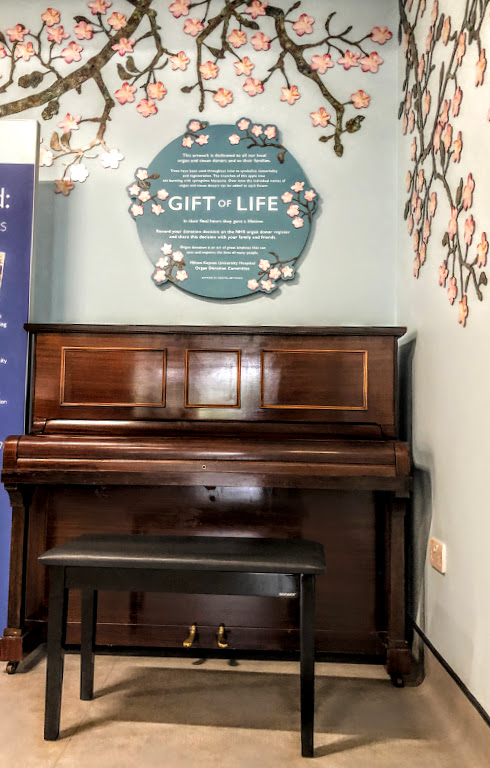
‘The Gift of Life’ … art and music in the outpatients reception area in Milton Keynes University Hospital (Photograph: Patrick Comerford)

Today’s Prayers (Thursday 2 July 2026):

In Pray with the World Church, the prayer diary of the Anglican mission agency USPG (United Society Partners in the Gospel), the theme this week, from 28 June to 4 July 2026 (pp 14-15), is ‘Living Stones’. This theme was introduced on Sunday with a reflection by the Very Revd Lydia Kelsey Bucklin, President and Dean of Episcopal Divinity School.

The USPG prayer diary today (Thursday 2 July 2026) invites us to pray:

Creator God, remind us of our deep interconnection. Strengthen us to seek the liberation of all people, knowing none of us are free while violence and injustice persist.

The Collect of the Day:

O God, the protector of all who trust in you,
without whom nothing is strong, nothing is holy:
increase and multiply upon us your mercy;
that with you as our ruler and guide
we may so pass through things temporal
that we lose not our hold on things eternal;
grant this, heavenly Father,
for our Lord Jesus Christ’s sake,
who is alive and reigns with you,
in the unity of the Holy Spirit,
one God, now and for ever.

The Post-Communion Prayer:

Eternal God,
comfort of the afflicted and healer of the broken,
you have fed us at the table of life and hope:
teach us the ways of gentleness and peace,
that all the world may acknowledge
the kingdom of your Son Jesus Christ our Lord.

Additional Collect:

Gracious Father,
by the obedience of Jesus
you brought salvation to our wayward world:
draw us into harmony with your will,
that we may find all things restored in him,
our Saviour Jesus Christ.

The Collect on the Eve of Saint Thomas:

Almighty and eternal God,
who, for the firmer foundation of our faith,
allowed your holy apostle Thomas
to doubt the resurrection of your Son
till word and sight convinced him:
grant to us, who have not seen, that we also may believe
and so confess Christ as our Lord and our God;
who is alive and reigns with you,
in the unity of the Holy Spirit,
one God, now and for ever.

Yesterday’s reflections

Continued tomorrow

The magnolia tree in a courtyard in the hospital in Milton Keynes (Photograph: Patrick Comerford)

Scripture quotations are from the New Revised Standard Version Bible: Anglicised Edition copyright © 1989, 1995 National Council of the Churches of Christ in the United States of America. Used by permission. All rights reserved worldwide. http://nrsvbibles.org

21 June 2026

Daily prayer in Ordinary Time 2026:
45, Sunday 21 June 2026,
Third Sunday after Trinity (Trinity III)

‘Whoever does not take the cross and follow me is not worthy of me’ (Matthew 10: 38) … the Byzantine-style crucifix by Laurence King (1907-1981) in the crypt of Saint Mary le Bow on Cheapside in London (Photograph: Patrick Comerford)

Patrick Comerford

We are in Ordinary Time in the Church Calendar, and this is the Third Sunday after Trinity (Trinity III, 21 June 2026). Tomorrow is also Father’s Day and the Summer Solstice, although next Wednesday (24 June) is officially Midsummer’s Day.

I hope to be involved in the Parish Eucharist in Saint Mary and Saint Giles Church later this morning. Meanwhile, before today begins, I am taking some quiet time this morning to give thanks, to reflect, to pray and to read in these ways:

1, reading today’s Gospel reading;

2, a short reflection;

3, a prayer from the USPG prayer diary;

4, the Collects and Post-Communion prayer of the day.

‘Whoever does not take up the cross and follow me is not worthy of me’ (Matthew 10: 37) … Station 5 in the Chapel at Saint John’s Hospital, Lichfield, Simon of Cyrene helps Jesus carry the Cross (Photograph: Patrick Comerford)

Matthew 10: 24-39 (NRSVA):

[Jesus said:] 24 ‘A disciple is not above the teacher, nor a slave above the master; 25 it is enough for the disciple to be like the teacher, and the slave like the master. If they have called the master of the house Beelzebul, how much more will they malign those of his household!

26 ‘So have no fear of them; for nothing is covered up that will not be uncovered, and nothing secret that will not become known. 27 What I say to you in the dark, tell in the light; and what you hear whispered, proclaim from the housetops. 28 Do not fear those who kill the body but cannot kill the soul; rather fear him who can destroy both soul and body in hell. 29 Are not two sparrows sold for a penny? Yet not one of them will fall to the ground unperceived by your Father. 30 And even the hairs of your head are all counted. 31 So do not be afraid; you are of more value than many sparrows.

32 ‘Everyone therefore who acknowledges me before others, I also will acknowledge before my Father in heaven; 33 but whoever denies me before others, I also will deny before my Father in heaven.

34 ‘Do not think that I have come to bring peace to the earth; I have not come to bring peace, but a sword.
35 For I have come to set a man against his father,
and a daughter against her mother,
and a daughter-in-law against her mother-in-law;
36 and one’s foes will be members of one’s own household.
37 Whoever loves father or mother more than me is not worthy of me; and whoever loves son or daughter more than me is not worthy of me; 38 and whoever does not take up the cross and follow me is not worthy of me. 39 Those who find their life will lose it, and those who lose their life for my sake will find it.’

‘What I say to you in the dark, tell in the light …’ (Matthew 10: 27) … a moment of prayer in Saint Titus Church, Iraklion (Photograph: Patrick Comerford, 2025)

Today’s Reflections:

In the Gospel reading last Sunday (Matthew 9: 35 to 10: 8 or 10: 23, Sunday 14 June 2026), Christ calls the Twelve together to prepare them for their ministry and mission. In today’s Gospel reading (Matthew 10: 24-39), Christ continues to prepare the Twelve for this mission, as both their teacher and their master. They are his students, and they are to be like him, they are told, and they receive their instructions and commission for mission, even in the most hostile of environments.

When the late Archbishop Desmond Tutu (1931-2021) received the Nobel Peace Prize in 1984, I profiled him for The Irish Times. We had met previously, at events co-hosted by AfrI and Christian CND and at dinner in Roebuck House, Seán MacBride’s house in Clonskeagh, Dublin.

I asked him about the death threats he faced in South Africa at the height of apartheid. He engaged me with that look that confirmed his deep hope, commitment and faith, and said: ‘But you know, death is not the worst thing that could happen to a Christian.’

He must have been tempted at times to give up being a thorn in the side of the regime, to stop being a ‘turbulent priest,’ and to live a comfortable life. But his conscience would never have been comfortable.

While apartheid was still in force, Desmond Tutu became Dean of Saint Mary’s Cathedral in Johannesburg, and when I first met him, he was the secretary general of the South African Council of Churches.

I was worried about the many death threats he was receiving, and I asked him how he lived with those threats. Was he worried about them? Did he ever consider modifying what he had to say because of them? His answer was similar to the one he gave when he was facing tough questioning before the regime’s Eloff Commission. He told that inquiry:

‘There is nothing the government can do to me that will stop me from being involved in what I believe God wants me to do. I do not do it because I like doing it. I do it because I am under what I believe to be the influence of God’s hand. I cannot help it. When I see injustice, I cannot keep quiet, for, as Jeremiah says, when I try to keep quiet, God’s Word burns like a fire in my breast. But what is it that they can ultimately do? The most awful thing that they can do is to kill me, and death is not the worst thing that could happen to a Christian.’

In 1987, Veritas invited me to write a short, 36-page biography of Archbishop Tutu, published as Desmond Tutu: Black Africa’s Man of Destiny. It was launched by the then Minister for Foreign Affairs, Brian Lenihan. It was a small book, hardly more than a pamphlet, but it came at an important time when both the Irish Government and the Irish Churches were becoming increasingly vocal about the evils of apartheid. It was republished in the US by Citadel (1988) and Hyperion Books (1989).

When I visited South Africa in 1990 with The Irish Times and Christian Aid, I met Archbishop Tutu in Cape Town, where once again he spoke powerfully about the changes that were beginning to take place.

Then, when my colleague Patsy McGarry was organising a monumental series of features in The Irish Times in 2000 to mark the millennium, Archbishop Tutu was one of the international contributors, along with Hans Küng, Andrew Greeley and Mary Robinson. The complete series was published by Veritas the following year as a book, Christianity, in which Part Two was my ‘Brief History of Christianity.’

I last met Archbishop Tutu when he visited Dublin in 2005, and he preached in Saint George’s and Saint Thomas’s Church in the inner city, where Canon Katharine Poulton was then the Rector, as part of the Discovery Gospel Choir services.

His unforgettable words to me echo Christ’s words to the disciples in today’s Gospel reading: ‘Do not fear those who kill the body but cannot kill the soul; rather fear him who can destroy both soul and body in hell’ (Matthew 10: 28).

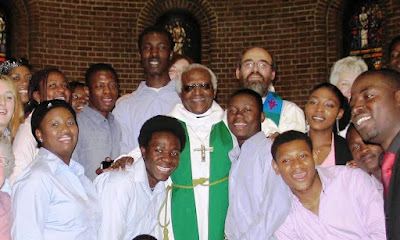
‘The most awful thing that they can do is to kill me, and death is not the worst thing that could happen to a Christian’ … Archbishop Desmond Tutu visiting Saint George’s and Saint Thomas’s Church, Dublin, and the Discovery Gospel Choir

Today’s Prayers (Sunday 21 June 2026, Trinity III, Fathers Day):

In Pray with the World Church, the prayer diary of the Anglican mission agency USPG (United Society Partners in the Gospel), the theme this week, from 21 to 27 June 2026 (pp 12-13), is ‘Land Taken, Land Remembered’. This theme is introduced today with a reflection by the Venerable Rosalyn Kantlaht’ant Elm, Director of Indigenous Ministries, Anglican Church of Canada:

When I think about how land was taken from Indigenous communities in Canada, I see that it was not the work of one person or a single event. It happened slowly, over more than four hundred years. In the early days of European settlement, Indigenous peoples and settlers often lived and worked alongside one another. Though imperfect, there was a time of coexistence.

As Canada developed, laws such as the Civilization Act and the Indian Act enabled the government to take Indigenous lands and move our people onto reserves – fenced-in areas often far from our traditional territories, languages, medicines, ceremonies, and rituals. This process unfolded over generations. Today, Indigenous peoples occupy only a small fraction of our original lands. Much of the rest remains under treaty dispute or is unceded territory, often threatened by mining, forestry, and oil and gas development.

Churches also played a significant role. In partnership with the government, they sought to ‘civilise’ Indigenous children, attempting to erase our cultures. In doing so, they became complicit in what can rightly be described as a legislative form of cultural genocide.

These truths are difficult to speak and to hear. But just as Christians cannot have Easter without Good Friday, we cannot skip the hard history and move straight to celebration. Facing these truths together allows us to lament, to pray, and to understand ourselves not by what we own, but as people created by God, called to care for one another and for the land.

The USPG prayer diary today (Sunday 21 June 2026, Trinity III, Fathers Day, National Indigenous Peoples Day, Canada) invites us to pray:

Creator God, from you every family in heaven and earth takes its name. Rooted and grounded in your covenant love, empowered by your Spirit, help us speak the truth in love and walk in your way towards justice and wholeness. (Anglican Church of Canada)

The Collect of the Day:

Almighty God,
you have broken the tyranny of sin
and have sent the Spirit of your Son into our hearts
whereby we call you Father:
give us grace to dedicate our freedom to your service,
that we and all creation may be brought
to the glorious liberty of the children of God;
through Jesus Christ your Son our Lord,
who is alive and reigns with you,
in the unity of the Holy Spirit,
one God, now and for ever.

The Post-Communion Prayer:

O God, whose beauty is beyond our imagining
and whose power we cannot comprehend:
show us your glory as far as we can grasp it,
and shield us from knowing more than we can bear
until we may look upon you without fear;
through Jesus Christ our Saviour.

Additional Collect:

God our saviour,
look on this wounded world
in pity and in power;
hold us fast to your promises of peace
won for us by your Son,
our Saviour Jesus Christ.

Yesterday’s Reflections

Continued Tomorrow

‘Whoever does not take up the cross and follow me is not worthy of me’ (Matthew 10: 37) … Christ is given his cross, a fresco in Analipsi Church in Georgioupoli, Crete (Photograph: Patrick Comerford)

Scripture quotations are from the New Revised Standard Version Bible: Anglicised Edition copyright © 1989, 1995, National Council of the Churches of Christ in the United States of America. Used by permission. All rights reserved worldwide. http://nrsvbibles.org


‘Are not two sparrows sold for a penny? … you are of more value than many sparrows’ (Matthew 10: 29-30) … a mother sparrow feds her chicks in a church in the ceiling of Aghias Anna Church, Maroulas, near Rethymnon in Crete (Patrick Comerford)

28 May 2026

Daily prayer in Ordinary Time 2026:
21, Thursday 28 May 2026

What can blind Bartimaeus see that the 12 have passed by? (Photograph: Patrick Comerford)

Patrick Comerford

The 50-day season of Easter, which began on Easter Day (5 April 2026), came to an end on Sunday with the Day of Pentecost or Whit Sunday (24 May 2026), and in the Church Calendar we have been back in Ordinary Time since Monday.

The Calendar of the Church of England in Common Worship today remembers Lanfranc (1089), Prior of Le Bec, Archbishop of Canterbury, and Scholar. But, before today begins, I am taking some quiet time this morning to give thanks, to reflect, to pray and to read in these ways:

1, reading today’s Gospel reading;

2, a short reflection;

3, a prayer from the USPG prayer diary;

4, the Collects and Post-Communion prayer of the day.

‘Christ Healing the Blind’ (ca 1570) by El Greco (Domenikos Theotokopoulos) … in the Met, New York

Mark 10: 46-52 (NRSVA):

46 They came to Jericho. As he and his disciples and a large crowd were leaving Jericho, Bartimaeus son of Timaeus, a blind beggar, was sitting by the roadside. 47 When he heard that it was Jesus of Nazareth, he began to shout out and say, ‘Jesus, Son of David, have mercy on me!’ 48 Many sternly ordered him to be quiet, but he cried out even more loudly, ‘Son of David, have mercy on me!’ 49 Jesus stood still and said, ‘Call him here.’ And they called the blind man, saying to him, ‘Take heart; get up, he is calling you.’ 50 So throwing off his cloak, he sprang up and came to Jesus. 51 Then Jesus said to him, ‘What do you want me to do for you?’ The blind man said to him, ‘My teacher, let me see again.’ 52 Jesus said to him, ‘Go; your faith has made you well.’ Immediately he regained his sight and followed him on the way.

The healing of the young blind man depicted in a Byzantine-style fresco in Analipsi Church or the Church of the Ascension in Georgioupoli, Crete … those looking on can hardly believe what they see (Photograph: Patrick Comerford)

Today’s Reflections:

When I started working as a journalist almost 55 years ago, it was instilled in me from the very beginning how important it is to ask the very basic questions: Who? What? When? Where? Why? …

In this morning’s Gospel reading (Mark 10: 46-52) these questions are very important.

Bartimaeus, the blind beggar outside the gates of Jericho, does not have to see to realise that he is in the presence of Christ.

Why do all the Gospel writers answer the ‘Where?’ question immediately and emphasise that this event takes place outside the walls of Jericho? And why do they tell us that when they heard the man’s loud cry that ‘many sternly ordered him to be quiet, but he cried out even more loudly’ (verse 48)?

At the time, the Hebrew name of Jesus, Yeshua (ישוע‎), was a common form of the name Joshua (ְהוֹשֻׁעַ‎).

In the story of Joshua (see Joshua 6), as the wandering, freed slaves are coming to the end of their journey, they arrive at Jericho to find the city is shut up to that no-one may go in or out.

Joshua tells the people not to shout or let their voices be heard until he tells them. And then, when he tells them to make a loud noise on the seventh day, the walls of Jericho fall.

Making a loud noise on the seventh day at Jericho breaks down all the barriers, and it is a sign of the fulfilment of the promises of the coming Kingdom of God.

By the time of Christ, Jericho is an important commercial city, a crossroads, the winter resort for Jerusalem’s aristocracy and the ruling priestly class. Which explains why, in the parable of the Good Samaritan, a priest and a Levite were regular passers-by on the road from Jericho to Jerusalem (Luke 10: 30-37).

Jericho was also the home of Zacchaeus, the repentant tax collector (Luke 19: 1-10).

Christ and his disciples are now near the end of their journey from Caesarea Philippi in the north to Jerusalem; Jericho is about 25 km from Jerusalem. On their journey, the disciples have misunderstood the message of Jesus and have been blind to who he truly is. But in this Gospel reading, it is a blind man who sees who Christ truly is.

Earlier in this Gospel, Saint Mark is alone in telling the story of an unnamed blind man who is healed gradually at Bethsaida (Mark 8: 22-26).

Have you ever noticed that when you are trying really hard to concentrate, you sometimes close your eyes to help you to focus?

Throughout the Talmud, the blind are called sagi nahor – ‘enough of light’ or ‘full of light.’ Jewish tradition says this is so because one’s physical sight, which gazes out at the mundane and materialistic world, often contradicts and weakens one’s inner or spiritual sight.

It is a universal Jewish custom to cover the eyes with the right hand when saying the first six words of the Shema, the fundamental Jewish declaration of faith. It is said that in doing this, the person who is praying is able to concentrate properly without visual distractions.

As the words are said, the focus is not just on their meaning, but also on accepting the yoke of heaven.

The person saying the Shema is expected to concentrate on the idea that God is the one and only true reality. This intention is so important that one who recites the words of this verse but does not think about its meaning is expected to recite it again.

In today’s Gospel reading, Saint Mark gives us – or seems to tell us – the name of this blind beggar, ‘Bartimaeus, son of Timaeus’ (verse 46).

But the name Bartimaeus literally means ‘Son of Timaeus,’ and so we are told only the name of this man’s father. Bartimaeus is an unusual Semitic-Greek hybrid, and Timaeus is an unusual Greek name for this place and at that time.

The cultural significance of this name is in Timaeus (Τίμαιος), one of Plato’s dialogues. This is mostly in the form of a long monologue by the title character, Timaeus of Locri. He delivers Plato’s most important cosmological and theological treatise, involving sight as the foundation of knowledge, and describing the nature of the physical world, the purpose of the universe, and the creation of the soul.

The blind son of Timaeus cries out to ‘Jesus, Son of David’ and asks for mercy. This cry is one of the Biblical foundations of the Jesus Prayer, ‘Lord Jesus Christ, Son of God, have mercy on me, the sinner.’

Until now, the disciples have been blind to who Jesus truly is. It takes a blind man to see the truth. When he does, Bartimaeus makes a politically charged statement. Jesus is the ‘Son of David,’ King of the Jews, and Messiah. In other places, Christ orders silence on the matter, but not here. His time is approaching. We shall soon understand the true nature of the physical world, the purpose of the universe, and the creation of the soul.

The cloak Bartimaeus throws off (verse 50) is probably the cloth he uses to receive the alms he is begging for. When he throws away his cloak, he gives up all he has to follow Christ. In Saint Mark’s Gospel, garments often indicate the old order, so Bartimaeus accepts the new order.

The question Christ now puts to Bartimaeus – ‘What do you want me to do for you?’ (verse 51) – is the same question he put in last Sunday’s reading to James and John when they sought status in the kingdom: ‘What is it you want me to do for you?’ (Mark 10: 36).

James and John asked in yesterday’s reading to be seated at his right hand and his left hand, symbolising power and prestige (see Mark 10: 37). But Bartimaeus, on the other hand, is humble in his reply: ‘My teacher, let me see again’ (verse 51).

Christ tells him simply that his faith ‘has made you well.’ Bartimaeus is not only cured immediately, but he follows Jesus on the way (verse 52).

The way is not going to be an easy one. As the parable of the Good Samaritan reminds us, in the time of Christ, the road from Jericho to Jerusalem was notorious for its danger and difficulty. It was known as the ‘Way of Blood’ because of the blood that was often shed there by robbers.

But Christ is also about to shed his blood. He is now on the road used by priests and by kings as they set out from Jericho to Jerusalem, and the next chapter of Saint Mark’s Gospel brings us to Christ’s triumphal entry into Jerusalem (Mark 11: 1-11).

What am I blind to that stops me from seeing and grasping the Kingdom of God?

Who am I blind to that stops me from seeing the needs of others?

How do I respond to the plight of others in ways that become promises, signs or sacraments of the Kingdom of God?

Plato is depicted in Raphael’s ‘The School of Athens’ carrying a bound copy of ‘The Timaeus’

Today’s Prayers (Thursday 28 May 2026):

This week in Pray with the World Church, the prayer diary of the Anglican mission agency USPG (United Society Partners in the Gospel), from 24 to 30 May 2026 (pp 58-59), the theme is ‘Carriers of the Flame’ and was introduced on Sunday with reflections by Carol Miller, Church Engagement Manager, USPG.

The USPG Prayer Diary today (Thursday 28 May 2026) invites us to pray:

Bless mothers, children and all who suffer from illness or lack of care and strengthen those who bring healing in places of need.

The Collect:

O Lord, from whom all good things come:
grant to us your humble servants,
that by your holy inspiration
we may think those things that are good,
and by your merciful guiding may perform the same;
through our Lord Jesus Christ,
who is alive and reigns with you,
in the unity of the Holy Spirit,
one God, now and for ever.

The Post-Communion Prayer:

Gracious God, lover of all,
in this sacrament
we are one family in Christ your Son,
one in the sharing of his body and blood
and one in the communion of his Spirit:
help us to grow in love for one another
and come to the full maturity of the Body of Christ.
We make our prayer through your Son our Saviour.

Yesterday’s Reflections

Continued Tomorrow

A bust of Plato in the Achilleion Palace in Corfu (Photograph: Patrick Comerford)

Scripture quotations are from the New Revised Standard Version Bible: Anglicised Edition copyright © 1989, 1995 National Council of the Churches of Christ in the United States of America. Used by permission. All rights reserved worldwide. http://nrsvbibles.org