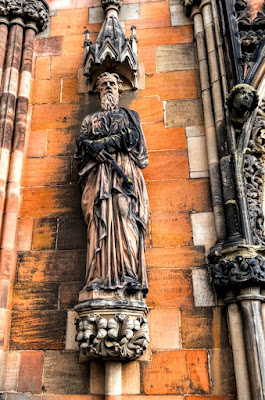
Showing posts with label Walsingham. Show all posts

22 October 2026

Daily prayer in Ordinary Time 2026:
167, Thursday 22 October 2026

The 15th-century font with images of the Seven Sacraments and the Crucifixion in Saint Mary and All Saints’ Church, Walsingham (Photograph: Patrick Comerford, 2026)

Patrick Comerford

We are continuing in Ordinary Time in the Church Calendar, and the week began with the Twentieth Sunday after Trinity (Trinity XX, 18 October 2026).

Before the day begins, I am taking some quiet time early this morning to give thanks, and for reflection, prayer and reading in these ways:

1, today’s Gospel reading;

2, a short reflection;

3, a prayer from the USPG prayer diary;

4, the Collects and Post-Communion prayer of the day.

‘Do you think that I have come to bring peace to the earth?’ (Luke 12: 51) … the Peace Globe in the nave in Norwich Cathedral (Photograph: Patrick Comerford, 2026)

Luke 12: 49-53 (NRSVA):

[Jesus said:] 49 ‘I came to bring fire to the earth, and how I wish it were already kindled! 50 I have a baptism with which to be baptized, and what stress I am under until it is completed! 51 Do you think that I have come to bring peace to the earth? No, I tell you, but rather division! 52 From now on, five in one household will be divided, three against two and two against three; 53 they will be divided:

father against son
and son against father,
mother against daughter
and daughter against mother,
mother-in-law against her daughter-in-law
and daughter-in-law against mother-in-law.’

‘And you yourself a sword shall pierce’ … Station IV of Ken Thompson’s Stations of the Cross in Saint Mel’s Cathedral, Longford (Photograph: Patrick Comerford)

Today’s Reflection:

Once again we are confronted with a Gospel reading this morning that is difficult, with its images of division and strife, shattering all our expectations of Gospel values that emphasise domestic bliss and harmony.

I cannot resist finding irony in the coincidence just two days before we mark United Nations Day and the beginning of UN Disarmament Week, while the US continues to wage an undeclared against war against Iran and is now openly facilitating Russia’s invasion of Ukraine, the Gospel reading is a passage in which Jesus says: ‘Do you think that I have come to bring peace to the earth? No, I tell you, but rather division!’ (verse 51).

In today’s Gospel reading (Luke 12: 49-53), we hear warnings of fire on earth (verse 49), and of families and households divided and fighting each other to the death (verses 52-53). The verses that follow include images of people being blown about by the storms and tempests of the day (verses 54-56).

They are images that might have inspired ‘hellfire and brimstone’ sermons. But they have inspired too great creative and literary minds in the English language, from William Shakespeare and William Blake to TS Eliot in the Four Quartets:

This is the death of earth.

Water and fire succeed
The town, the pasture and the weed.
Water and fire deride
The sacrifice that we denied.
Water and fire shall rot
The marred foundations we forgot,
Of sanctuary and choir.
This is the death of water and fire. ( – Little Gidding)

If we dismiss these apocalyptic images because they have been hijacked by fundamentalist extremists for their own religious and political ideals, then we miss an opportunity to allow our values to challenge those ways we may be allowing our lives to drift along without questioning or examination.

Fire and water were a challenge for me earlier this year when I visited Saint Mary and All Saints’ Church, the Church of England parish church in Walsingham. I was speaking at the Ecumenical Pilgrimage in March, and I had two separate opportunities to visit the Church of England parish church.

Saint Mary and All Saints’ Church dates from the 14th and 15th centuries, and is built from flint with stone dressings. In addition to nave and chancel, there are north and south aisles and north and south transepts. The west tower has a lead needle spire. The church was destroyed in a major fire in 1961; although the original tower and north porch survived. The rest of the church was rebuilt and it is a Grade I listed, building, while the churchyard walls and gates are separately listed Grade II. The original dedication of the church was to All Saints. When Father Alfred Hope Patten (1885-1958) was appointed the Vicar in 1921, he changed the dedication to the present double dedication of Saint Mary and All Saints.

The church has a 15th-century font that illustrate the Seven Sacraments and the Crucifixion. The font survived the fire in 1961, but the 17th-century font cover did not, and the 1964 font cover is a replica of the original. The beautiful baptismal font has now been placed at the west end of the church, close to entrance. The font is a challenge to all who enter the church and is placed exactly where it should be, for Baptism is entry to the Church.

Baptism is not a naming ceremony, it is not about my individual experience, it is never a private event. It is a public event, and it incorporates me into the unity, the community of the Body of Christ.

In the Gospel reading today (Luke 12: 49-53), Christ challenges us with three themes: Fire, Baptism and Division.

In the Bible, fire can represent the presence of God – think of the pillar of fire in the wilderness (Exodus 13: 17-22) or the tongues of flame at Pentecost (Acts 2: 1-4).

It can represent judgment (see Revelation 20: 7-10), and it can represent purification – the prophets Zachariah (13: 9) and Malachi (3: 2-3) speak of the refiner’s fire in which God purifies his people, as a refiner purifies silver by fire.

At the Presentation in the Temple (Luke 2: 22-38), old Simeon foresees how the Christ Child ‘is destined for the falling and the rising of many in Israel, and to be a sign that will be opposed so that the inward thoughts of many will be revealed – and a sword will pierce your own soul too’ (verses 34-35).

The sword that pierces the soul of the Virgin Mary, the sword that has killed the prophets, the sword the divides families, is a reminder that Christ, who embodies the presence of God, simultaneously judges and purifies.

In the New Testament, Baptism represents both judgment and purification and Saint John the Baptist connects it with fire (Luke 3: 16-17).

In this Gospel reading, however, Christ is referring not to the baptism he brings but to the baptism he receives. He not only brings the fire of judgment and purification, but he bears it himself also.

The Kingdom of God he proclaims is governed:

• not by might but by forgiveness (think of forgiveness in the Lord’s Prayer, Luke 11: 4);
• not by fear but by courage (‘be not afraid’ in Luke 1: 13, 30, 2: 10, 5: 11, 8: 50, 12: 4, 7, 32);
• not by power but by humility (see Magnificat, Luke 1: 46-55).

But it is easy to be lured by the temptations of wealth, status, power and political promises rather than the promises that come with our Baptism.

‘Do you think that I have come to bring peace to the earth? No, I tell you, but rather division!’ (Luke 12: 51) … Luke Perry’s sculpture of Æthelflæd in Tamworth points to Saint Editha’s Church and Tamworth Castle (Photograph: Patrick Comerford)

Today’s Prayers (Thursday 22 October 2026):

The theme this week (18 to 24 October) in Pray with the World Church, the prayer diary of the Anglican mission agency USPG (United Society Partners in the Gospel), is ‘Inclusive Education in Handeni’ (pp 48-49). This theme was introduced on Sunday with a programme update from Father John George Sembuyagi, Programme Lead, Diocese of Tanga, Anglican Church of Tanzania.

The USPG Prayer Diary today (Thursday 22 October 2026) invites us to pray:

God of unity, we pray for your church in Handeni that it may be known as a place of welcome, where hearts and minds are open to recognise and celebrate the gifts present in every person.

The Collect of the Day:

God, the giver of life,
whose Holy Spirit wells up within your Church:
by the Spirit’s gifts equip us to live the gospel of Christ
and make us eager to do your will,
that we may share with the whole creation
the joys of eternal life;
through Jesus Christ your Son our Lord,
who is alive and reigns with you,
in the unity of the Holy Spirit,
one God, now and for ever.

The Post-Communion Prayer:

God our Father,
whose Son, the light unfailing,
has come from heaven to deliver the world
from the darkness of ignorance:
let these holy mysteries open the eyes of our understanding
that we may know the way of life,
and walk in it without stumbling;
through Jesus Christ our Lord.

Additional Collect:

God, our light and our salvation:
illuminate our lives,
that we may see your goodness in the land of the living,
and looking on your beauty
may be changed into the likeness of Jesus Christ our Lord.

Yesterday’s Reflections

Continued Tomorrow

‘I have a baptism with which to be baptized’ (Luke 12: 50) … the baptismal font in Saint Mary and Saint Giles Church, Stony Stratford (Photograph: Patrick Comerford, 2026)

Scripture quotations are from the New Revised Standard Version Bible: Anglicised Edition copyright © 1989, 1995 National Council of the Churches of Christ in the United States of America. Used by permission. All rights reserved worldwide. http://nrsvbibles.org

18 October 2026

Holy Cross Church, King’s Cross:
a church in London with a mission
in an area of poverty and deprivation

Holy Cross Church, King’s Cross, designed by Joseph Peacock and built in 1887-1888 (Photograph: Patrick Comerford, 2026)

Patrick Comerford

During my most recent day out in London, I visited a number of places associated with the Comerford family in the past, sought out the sites of some of the earliest coffee shops in London, and visited a number of churches, including Saint Mary Woolnoth, Saint Michael’s, Cornhill, the sculptures in the grounds of Saint Pancras, Euston Road, Lumen Church on Tavistock Place, and Holy Cross Church, Cromer Street.

Holy Cross Church is in the St Pancras area of the London Borough of Camden and has served the people of King’s Cross since 1888. It is now in an area of regeneration, but its mission remains the same, both as a church designed for beautiful and formal worship and as a church that seeks to serve others, particularly people living with the ravages of life.

Holy Cross Church owes its name to the killing of a naval officer on the island of Santa Cruz in the Solomon Islands in 1875. Captain James Graham Goodenough (1830-1875), commander of HMS Pearl, was visiting the island but the islanders distrusted white visitors who trafficked young men to work on Australian plantations. The Pearl’s visit was friendly – the Royal Navy was trying to end the slave trade. But during a fracas with a landing party, the captain was hit by a poisoned arrow and was killed.

Algernon Stanley (1843-1928), the first vicar of the new parish of Holy Cross, Saint Pancras (1876-1879), became a Roman Catholic in 1879 and later became titular Bishop of Emmaus

The Revd the Hon Algernon Stanley (1843-1928) was the first vicar of the new parish of Holy Cross, Saint Pancras, 1876-1879. He was a close friend of Goodenough, and when he was appointed he decided to name the planned church Holy Cross (Santa Cruz) in memory of his friend. The bell from Goodenough’s ship still hangs in the church.

The King’s Cross area was poor and ‘slum priests’ like Stanley who had been influenced by the Catholic revival in the Church of England were keen to work in the new slum parishes. The new parish was needed because London was expanding. The church began as a district chapelry in 1876.

Before the church was ever built, Stanley became a Roman Catholic in 1879, and was the Vatican correspondent of The Times and the Daily Telegraph, an Auxiliary Bishop of Westminster and the titular Bishop of Emmaus. He was a nephew of Arthur Penrhyn Stanley (1815-1881), Dean of Westminster, and a brother of Henry Edward John Stanley (1827-1903), 3rd Baron Stanley of Alderley, who converted to Islam in 1862, adopted the name Abdul Rahman, and became the first Muslim member of the House of Lords when he inherited the family titles in 1869. The Stanley brothers were also uncles of the philosopher Bertrand Russell.

‘The outside is cheap and shrugged off, there are a hundred like it in London’s suburbs’ (Ian Nairn) … throughout its history, Holy Cross Church seen from the south-east (Photograph: Patrick Comerford, 2026)

Holy Cross Church was built after Stanley resigned. The church was designed by the architect Joseph Peacock (1821-1893), was built in 1887-1888, and was consecrated in 1888, when Holy Cross became a parish. Peacock was also the architect of Saint Stephen’s Church, Gloucester Road, Kensington, where TS Eliot was a churchwarden for 25 years.

The architectural writer Ian Nairn says: ‘The outside is cheap and shrugged off, there are a hundred like it in London’s suburbs. Inside it is as honest and selfless as King’s Cross Station … nothing unnecessary and nothing put on for form’s sake.’

The braced king post roof is one of the ‘great glories’ of the interior, according to Historic England’s listing.

The nave is exceptionally broad for its length and the aisles very wide. The elevated choir and sanctuary is enclosed by a wood screen that may be the work of Sir Charles Nicholson (1867-1949), who worked at Holy Cross around 1913. The moveable benches are late Victorian.

A small stained glass window on the south wall depicting Christ the Good Shepherd is by Martin Travers (1886-1948), a church artist in the Anglo-Catholic tradition. The lamp in the window copies the lamp in Holman Hunt’s ‘Light of the World’.

The Walsingham Chapel at the back of the church is a reminder of Father Alfred Hope Patten who was inspired to restore the Shrine of Our Lady of Walsingham while he was a curate at Holy Cross from 1913-1915.

The inlaid marble Stations of the Cross are identical to those in the Chapel of the Hospital of Saint John and Saint Elizabeth in Saint John’s Wood. The painting of Saint Mary Magdalene by Reginald Gray is in the small chapel dedicated to Saint Peter.

The war memorial cross on the west front of Holy Cross Church (Photograph: Patrick Comerford, 2026)

Holy Cross Church was built to serve a densely populated area and became a focal point for Anglo-Catholic liturgy and community outreach during the Victorian and Edwardian eras.

The Revd Albert Moore, who was appointed vicar in 1888, the year the church was consecrated, is recorded in Charles Booth’s famous poverty maps and notebooks. In an interview with Booth’s researchers in 1898, he provided detailed insights into the social conditions, missionary work, and religious life of his parish.

Moore was succeeded by the Revd John Roffey, who was appointed the priest-in-charge in 1907. The Revd Francis Edwin Baverstock, was the Vicar from 1909 to 1915, and his curates included Father Alfred Hope Patten who later founded the shrine at Walsingham. Later vicars included the Revd Leslie Douglas Rutherford, appointed in 1915, and the Revd Francis Robert Langford-James, who was appointed in 1922 and who was a son of Francis Lloyd Langford-James of Tullaha, Co Cork.

An early 20th century curate was Father Gerard Olivier, father of the actor Laurence Olivier, and the comedian and actor Kenneth Williams attended Sunday School there in the 1930s.

The Revd Ralph Huie Le Messurier (1898-1948), a decorated veteran of World War I, became the vicar of Holy Cross in 1933. Two years later, Holy Cross was merged in 1935 with the parish of Saint Jude, Gray’s Inn Road, which was demolished in 1936. He courageously remained in the parish to continue operating the church’s night shelter for people seeking safety from the Blitz. But he was forced to resign because of his pacifist views during World War II, and was even physically assaulted by members of his congregation. His unpublished autobiography was entitled By Grace A Pacifist.

Father Napier Pitfield Sturt, vicar from 1945 to 1970, had chosen Saint Francis of Assisi as his patron, and his ministry in poor parishes bears out his commitment to working with the poor and the marginalised. Saint Peter’s, Regent Square, was damaged in the Blitz, the church was demolished in 1954, and the parish was merged with Holy Cross that year.

Inside Holy Cross Church, facing the High Altar and the east end (Photograph: Holy Cross Church)

As a result of industrial decline in the second half of the 20th century, by the 1980s the area around King’s Cross Station, including Cromer Street, had become notorious for prostitution and drug abuse. The English Collective of Prostitutes staged a 12-day sit-in at Holy Cross in November 1982 as a protest against police harassment, attracting national media coverage. Father Trevor Richardson – ‘Trev the Rev’– said that the sit-in could continue so long as it did not interfere with services. He also commented that too much attention was being paid to the women occupying the church and not enough to the evils of society that had given rise to their sit-in.

The Crypt Centre was set up in 1988 to work for the homeless, and the development of the crypt in 2021 gives local groups a new place to meet.

Cromer Street is within the Bloomsbury Conservation Area. Since 2019, Holy Cross has been closely involved with the Bloomsbury Festival. The church is a performance venue in the festival each year, a rehearsal and performance space and a music venue, including dementia-friendly and family-friendly concerts on Saturday afternoons.

London’s South Sudanese community holds its Independence Day service and celebration in the church.

Holy Cross has close links with Goodenough College, a postgraduate residential college for overseas students found by Captain Goodenough’s family, and the parish priest has traditionally the chaplain. The church works closely with nearby Argyle Primary School, the King’s Cross Brunswick Neighbourhood Association and other community groups, and a local charity uses the crypt for English classes for asylum seekers.

The church was designated a Grade II listed building on 14 May 1974, but the church is on the English Heritage list of immediate risk of further rapid deterioration or loss of fabric. A settlement of the foundations at the north-east corner of the church has caused structural cracking to the vestry and parts of the walls of the church. The church is on Historic England’s register of buildings at risk and the congregation is working with other local churches to secure funding so that these heritage buildings can once again be a real community asset.

Holy Cross Church has a partnership with three neighbouring churches close to Euston Road – the ‘Camden 4’. All four have buildings that could be used much more by the local community but that need substantial support. The ‘Camden 4’ partners are the Churches of Saint Mary the Virgin, Eversholt Street, Saint Mary Magdalene, Munster Square, Saint George the Martyr, Queen Square, and Holy Cross Church.

Holy Cross Church is a place of prayer and stillness amid the surrounding rush of King’s Cross (Photograph: Patrick Comerford, 2026)

Holy Cross Church provides a sanctuary for countless visitors – a stopping-off place, a house of God and a place of prayer and stillness amid the surrounding rush of King’s Cross. It serves local residents but also travellers, commuters, students and wayfarers.

Holy Cross Church remains within the Anglo-Catholic tradition, a community bound by the Eucharist and the Sacraments of the Church. The Revd Christopher Cawrse celebrated his final mass in Holy Cross Church and retired as vicar or parish priest on 13 September 2026. The parish now has an open vacancy for a vicar or parish priest.

• The regular services in Holy Cross Church include the Parish Mass, Sunday, 11 am; Mass, Wednesday-Thursday, 6 pm, Friday 12:45 pm, Saturday 10:30 am, Feast Days 7 pm. During Advent and Lent the church also runs Bible Study courses after Sunday Mass. The church is open every Friday 10 am to 2 pm with a coffee morning.

Holy Cross Church remains within the Anglo-Catholic tradition, a community bound by the Eucharist and the Sacraments of the Church (Photograph: Patrick Comerford, 2026)

05 September 2026

The plaques that remember
a day when nothing happened
may also have the wrong date
for a day that never was

Did nothing of note happen on Dam Street in Lichfield on 5 September 1782? (Photograph: Patrick Comerford)

Patrick Comerford

Plaques have been popping up all over the country with the words: ‘On this site, Sept. 5, 1782, nothing happened.’ I have seen them in Lichfield, in Stony Stratford, in Walsingham, and in countless other places the length and breadth of England, and I believe they can be seen in many other countries too.

There used to be one on Dam Street in Lichfield and another on Market Square in Stony Stratford, and I spotted one on Church Street in Walsingham about six months ago.

So, did nothing really happen in any of these places 244 years ago – or, for that matter, anywhere else either?

Did nobody famous die?
Was no-one born that day who went on to become famous later in life?

Did no-one die in battle or in bed, fall off a horse, win a school prize, get married, do something tragic, disastrous, profane or of subsequent consequence – anything at all on 5 September 1782?

These plaques look a little like the ones so often seen commemorating famous births, battles or royal visits, record-breaking achievements discoveries or ventures, misadventures, mishaps, misfortunes or even first-time firsts.

Real commemorative plaques are usually blue with white lettering, with some variations in colours, generally circular in shape, and usually erected by English Heritage or Historic England, sometimes approved by a local council, or put in place by an enthusiastic local history society.

The original blue plaque scheme was the idea of politician William Ewart (1798-1869) in 1863 and the ball was set rolling by the Society of Arts in 1867, when the first plaque was unveiled in 1867 to commemorate Lord Byron at his birthplace, 24 Holles Street, Cavendish Square, London.

The scheme has been run since 1986 by English Heritage and is now the oldest of its kind in the world.

But the plaques celebrating 5 September 1782 seem have started as a humorous prank, a good-natured gag to place what have s become popular novelties on buildings and bridges, houses and hotels, streets and shops around the world, satirising an old and much-loved tradition by memorialising the mundane and the ordinary

Tourists spotting them and stopping awhile may well ask their origins. The answer is found online and in gift shops, and the price is anywhere from £20 to £30. If you buy one for more you probably deserve your own commemorative plaque.

Did nothing of note happen in Walsingham on 5 September 1782? (Photograph: Patrick Comerford, 2026)

The date 5 September 1782 seems to have been chosen arbitrarily as a tongue-in-cheek specific date for a completely unremarkable day.

One suggestion is that the year 1782 is a design error, and that it should read 1752. Britain and Ireland, and everywhere else in the British Empire at the time for that matter, changed from the Julian calendar to the Gregorian calendar in 1752. The Gregorian calendar calculated leap years differently, and by 1752 the Julian calendar was out of synch with the Gregorian calendar by 13 days. The only way to fix this anomaly was to just change the date.

When the change was introduced, the calendar simply changed in September 1752 and moved from 2 September to 14 September. The dates in between never happened, and 11 days were lost from the calendar and lost to history as a result. The date 5 September 1752 is one of those, lost, forgotten missing days that no-one ever woke up to and nothing happened, a day when nothing could have happened.

As for William Ewart, he died in 1869, two years after his ‘Blue Plaque’ scheme was first introduced. And he has earned his own blue plaque in Hampton: he successfully introduced legislation to abolish hanging in chains, an act to abolish capital punishment for cattle-stealing, a bill establishing free libraries supported out of public rates, and a law to legalise using the metric system in weights and measures, and he was a strong advocate of the abolition of capital punishment.

True blue plaques and similar memorials, seen throughout England, including Lichfield, London, Berkhamsted, Norwich, St Albans and York (Photographs: Patrick Comerford)

30 August 2026

Daily prayer in Ordinary Time 2026:
114, Sunday 30 August 2026,
Thirteenth Sunday after Trinity (Trinity XIII)

‘If any want to become my followers, let them deny themselves and take up their cross and follow me’ (Matthew 16: 25) … a Crucifixion icon by Hanna-Leena Ward in her recent exhibition in Lichfield Cathedral (Photograph: Patrick Comerford, 2026)

Patrick Comerford

This is the August bank holiday weekend here. We are continuing in Ordinary Time in the Church Calendar and today is the Thirteenth Sunday after Trinity (Trinity XIII, 30 August 2026). Later this morning, I hope to be at the Parish Eucharist in Saint Mary and Saint Giles Church, Stony Stratford. But, before today begins, I am taking some quiet time this morning to give thanks, for reflection, prayer and reading in these ways:

1, today’s Gospel reading;

2, a reflection on the Gospel reading;

3, a prayer from the USPG prayer diary;

4, the Collects and Post-Communion prayer of the day.

‘If any want to become my followers, let them deny themselves and take up their cross and follow me’ (Matthew 16: 25) … ‘The Passion’, a sculpture by Enzo Plazzotta in Saint Bene’t’s Church, Cambridge (Photograph: Patrick Comerford, 2026)

Matthew 16: 21-28 (NRSVA):

21 From that time on, Jesus began to show his disciples that he must go to Jerusalem and undergo great suffering at the hands of the elders and chief priests and scribes, and be killed, and on the third day be raised. 22 And Peter took him aside and began to rebuke him, saying, ‘God forbid it, Lord! This must never happen to you.’ 23 But he turned and said to Peter, ‘Get behind me, Satan! You are a stumbling-block to me; for you are setting your mind not on divine things but on human things.’

24 Then Jesus told his disciples, ‘If any want to become my followers, let them deny themselves and take up their cross and follow me. 25 For those who want to save their life will lose it, and those who lose their life for my sake will find it. 26 For what will it profit them if they gain the whole world but forfeit their life? Or what will they give in return for their life?

27 ‘For the Son of Man is to come with his angels in the glory of his Father, and then he will repay everyone for what has been done. 28 Truly I tell you, there are some standing here who will not taste death before they see the Son of Man coming in his kingdom.’

‘If any want to become my followers, let them deny themselves and take up their cross’ (Matthew 16: 25) … Simon of Cyrene helps Jesus carry the Cross, Station 5 in the Chapel, Saint John’s Hospital, Lichfield, (Photograph: Patrick Comerford)

Today’s Reflections:

There is a wonderful contrast today in the Gospel reading and the Epistle reading between the Apostle Peter, who gets it wrong, and the Apostle Paul, who gets it right.

On the previous Sunday [23 August 2026], in the Gospel reading, we saw how Saint Peter could get it right with his confession of faith, a rock-solid faith that had firm foundations. This week, Saint Peter becomes a stumbling block because he thinks Christ has come to defeat those he sees as the enemies of the people, and he wants to share in the victory he hopes Christ will win. From rock to stumbling block in the space of a week.

Saint Peter is going to share in Christ’s victory, but it is not that kind of victory. It is a victory won not by killing enemies, but by forgiving them. It is a victory won on the cross, and Saint Peter will share it when he is ready to take up his cross and follow Christ.

On the other hand, Saint Paul, who once used rocks and stones in a very different way – at the stoning of the first, early Christian martyrs – now provides us with his own concise summary of Christianity faith, life and love. It reads like his own retelling of the Sermon on the Mount, or Christ reading in the synagogue in Nazareth (see tomorrow’s Gospel reading, Luke 4: 16-30).

Saint Paul tells us: ‘Let love be genuine; hate what is evil, hold fast to what is good; love one another with mutual affection; outdo one another in showing honour’ (Romans 12: 9-10).

Christ has been teaching the disciples about their mission and how to proclaim the good news of the Kingdom of God. Now, as he prepares them to go up to Jerusalem, his emphasis shifts to teaching them that he must suffer, die and be raised from the dead on the third day.

The Apostle Peter has already grasped in last Sunday’s reading that Christ is ‘the Messiah, the Son of the living God’ (verse 16, see Matthew 16: 13-20, 23 August 2026). Now, however, he fails to grasp or refuses to accept the concept of the Messiah suffering and dying, rather than leading them to freedom glory.

There is a harsh, terse response from Christ: ‘Get behind me Satan! You are a stumbling-block to me; for you are setting your mind not on divine things but on human things.’

Peter who is a rock becomes a stumbling block, literally a scandal (σκᾰ́νδᾰλον, skandalon; see Leviticus 19: 14); Peter who has attempted to walk on water does not grasp what it means to walk with Christ on the road to Jerusalem; Peter who is to receive the keys of the kingdom fails to grasp the key to understanding Christ’s Messiahship; later, Peter who is present at the Transfiguration, is also going to deny Christ three times at his passion.

Christ then talks to the disciples about the cost of discipleship. To be his followers, we must be willing to take up the same cross, we must be willing to devote our whole lives to God, denying ourselves, giving up physical comforts and safety, accepting even death if necessary.

Jesus then asks a rhetorical question. Nothing that we can gain can add to the value of our future with God.

There will be a time of reckoning, when Christ comes in glory at the end of time, on the Day of Judgment, when Christ comes, ushering in his kingdom.

‘If any want to become my followers, let them deny themselves and take up their cross and follow me’ (Matthew 16: 25) … a crucifix in the North Transept in Jesus College Chapel, Cambridge (Photograph: Patrick Comerford, 2026)

Today’s Prayers (Sunday 30 August 2026, Trinity XIII):

In Pray with the World Church, the prayer diary of the Anglican mission agency USPG (United Society Partners in the Gospel), the theme this week, from 30 August to 5 September 2026 (pp 34-35), is ‘Anglican Youth Tackle Waste in Madagascar’. This theme is introduced today with a Programme Update by Ialy Tongasoa, Community Development Lead, Diocese of Toliara, Madagascar:

In Madagascar, huge amounts of waste are left untreated – clogging rivers, polluting land, and threatening both health and fragile ecosystems. Across Fort-Dauphin, and other parts of southern and northern Madagascar, Anglican dioceses have trained over 100 young advocates in practical ways to manage waste and tackle climate change. Workshops include hands-on sessions in composting organic waste, recycling plastics into useful products, and sensitising communities. The diocesan bishops also led Bible study sessions exploring the theological importance of caring for God’s creation, linking faith directly to environmental action.

Youth are central to this programme because they bring energy, creativity, and influence across their communities, and by learning sustainable practices early, they become lifelong stewards of God’s creation. With guidance from church leaders and local environmental specialists, the youth are taking these skills into their neighbourhoods – encouraging recycling, using smart bins, and even generating income from recycled materials.

When Kakafoharisoa Gabriel Fabriano from Mananjary joined the Smart Waste We Care programme, he never imagined how much he could learn. ‘Before the workshop, I knew waste could be recycled but didn’t know how. Now I can turn organic waste into compost and plastic waste into paving materials. I am ready to help my community and share what I have learned,’ he says.

To find out more about this year’s Harvest Appeal and climate action in Madagascar, visit harvest.uspg.org.uk

The USPG Prayer Diary today (Sunday 30 August 2026, Trinity XIII) invites us to pray as we read and meditate on today’s Gospel reading, Matthew 16: 21-28.

‘If any want to become my followers, let them deny themselves and take up their cross and follow me’ (Matthew 16: 25) … the Crucifixion scene on the rood screen in Saint Saviour’s Church, Pimlico (Photograph: Patrick Comerford, 2026)

The Collect:

Almighty God,
who called your Church to bear witness
that you were in Christ reconciling the world to yourself:
help us to proclaim the good news of your love,
that all who hear it may be drawn to you;
through him who was lifted up on the cross,
and reigns with you in the unity of the Holy Spirit,
one God, now and for ever.

The Post Communion Prayer:

God our creator,
you feed your children with the true manna,
the living bread from heaven:
let this holy food sustain us through our earthly pilgrimage
until we come to that place
where hunger and thirst are no more;
through Jesus Christ our Lord.

Additional Collect:

Almighty God,
you search us and know us:
may we rely on you in strength
and rest on you in weakness,
now and in all our days;
through Jesus Christ our Lord.

Yesterday’s reflections

Continued tomorrow

‘If any want to become my followers, let them deny themselves and take up their cross and follow me’ (Matthew 16: 25) … the steel sculpture Crucifix created by the sculptor David Begbie in the Barn Chapel, Walsingham (Photograph: Patrick Comerford, 2026)

Scripture quotations are from the New Revised Standard Version Bible: Anglicised Edition copyright © 1989, 1995, National Council of the Churches of Christ in the United States of America. Used by permission. All rights reserved worldwide. http://nrsvbibles.org

03 July 2026

Daily prayer in Ordinary Time 2026:
57, Friday 3 July 2026,
Saint Thomas the Apostle

Saint Thomas the Apostle … a sculpture on the west façade of Lichfield Cathedral (Photograph: Patrick Comerford)

Patrick Comerford

We are in Ordinary Time in the Church Calendar and the week began with the Fourth Sunday after Trinity (Trinity IV, 28 June 2025) and the Feast of Saint Peter and Saint Paul (29 June 2026). Today (3 July), the Calendar of the Church of England celebrates Saint Thomas the Apostle.

Before today begins, though, I am taking some quiet time this morning to give thanks, to reflect, to pray and to read in these ways:

1, reading today’s Gospel reading;

2, a short reflection;

3, a prayer from the USPG prayer diary;

4, the Collects and Post-Communion prayer of the day.

An icon of the Incredulity of Saint Thomas in the iconostasis in the Greek Orthodox Church in Stony Stratford (Photograph: Patrick Comerford, 2024)

John 20: 24-29 (NRSVA):

24 But Thomas (who was called the Twin), one of the twelve, was not with them when Jesus came. 25 So the other disciples told him, ‘We have seen the Lord.’ But he said to them, ‘Unless I see the mark of the nails in his hands, and put my finger in the mark of the nails and my hand in his side, I will not believe.’

26 A week later his disciples were again in the house, and Thomas was with them. Although the doors were shut, Jesus came and stood among them and said, ‘Peace be with you.’ 27 Then he said to Thomas, ‘Put your finger here and see my hands. Reach out your hand and put it in my side. Do not doubt but believe.’ 28 Thomas answered him, ‘My Lord and my God!’ 29 Jesus said to him, ‘Have you believed because you have seen me? Blessed are those who have not seen and yet have come to believe.’

Saint Thomas and the Risen Christ depicted in a fresco in a church in Athens (Photograph: Patrick Comerford)

Today’s Reflection:

The Calendar of the Church of England commemorates Saint Thomas today (3 July), while the Orthodox Church remembers the doubting of the Apostle Thomas on the first Sunday after Easter; this year Thomas Sunday was on Sunday 19 April 2026.

In the Gospels, Saint Thomas is named ‘Thomas, also called the Twin (Didymus).’ But the name ‘Thomas’ comes from the Aramaic word for twin, T'oma (תאומא), so there is a tautological wordplay going on here.

Syrian tradition says the apostle’s full name was Judas Thomas, or Jude Thomas. But, who was his twin brother – or sister?

I have often visited Didyma on the south coast of Anatolia. There, the Didymaion was one of the most important shrines and temples in the classical world to Apollo and his twin sister Artemis. Apollo was the sun-god, the son of Zeus; he was the patron of shepherds and the guardian of truth, and in Greek and Roman mythology he died and rose again.

Is the story of Saint Thomas’s doubts an invitation to the followers of the cult of Apollo to turn to Christ, the true Son of God the Father, who is the Good Shepherd, who is the way, the truth and the light, who has died and who is truly risen?

We can never be quite sure about Saint Thomas in Saint John’s Gospel. After the death of Lazarus, the disciples resist Christ’s decision to return to Judea, where there had been an attempt to stone Jesus. But Thomas shows he has no idea of the real meaning of death and resurrection when he suggests that the disciples should go to Bethany with Jesus: ‘Let us also go, that we may die with him’ (John 11: 16).

And, while Thomas saw the raising of Lazarus, what did he believe in?

Could seeing ever be enough for a doubting Thomas to believe?

The Apostle Thomas also speaks at the Last Supper (John 14: 5). When Christ assures the disciples that they know where he is going, Thomas protests that they do not know at all. He has been with Christ for three years, and still he does not believe or understand. Seeing and explanations are not enough for him. Christ replies to his remarks and to Philip’s requests with a detailed exposition of his relationship to God the Father.

In the Resurrection story in Saint John’s Gospel, Saint Mary Magdalene – who is commemorated later this month on 22 July – does not recognise the Risen Christ at first. For her, appearances could be deceptive, and she thinks he is the gardener. But when he speaks to her, she recognises his voice, and then wants to hold on to him. From that moment of seeing and believing, she rushes off to tell the Disciples: ‘I have seen the Lord.’

Two of the disciples, John the Beloved and Simon Peter, have already seen the empty tomb, but they fail to make the vital connection between seeing and believing. When they hear Mary’s testimony, they still fail to believe fully. They only believe when they see the Risen Lord standing among them, when he greets them, ‘Peace be with you,’ and when he shows them his pierced hands and side.

They had to see and to hear, they had to have the Master stand over them in their presence, before they could believe.

On the first Easter Day, the Disciples locked themselves away out of fear. But where is Thomas? Is he fearless? Or is he foolish?

For a full week, Thomas is absent and does not join in the Easter experience of the remaining disciples. He has not seen and so he refuses to believe. When they tell him what has happened, Thomas refuses to accept their stories of the Resurrection. For him hearing, even seeing, are not enough.

Thomas wants to see, hear and touch. He wants to use all his learning faculties before he can believe this story. He has heard, but he wants to see. When he sees, he wants to touch … he demands not only to touch the Risen Christ, but to touch his wounds too before being convinced.

And so, for a second time within eight days, Christ comes and stands among his disciples, and says: ‘Peace be with you.’

The traditional icon depicting the event recalled in John 20: 19-31 emphasises the closed door, a significant part of the narrative: ‘the doors were locked’ (verse 19). After Christ’s arrest, the disciples tried to hide from the authorities out of fear. They returned to the last place where they had seen him alive, the upper room, around the same table where they had shared that last meal.

The young Thomas was not present the first time round and had said to the others: ‘Unless I see the mark of the nails in his hands and put my finger in the mark of the nails and my hand in his side, I will not believe’ (John 20: 25).

Christ appears within the disciples’ hiding place, where the door is firmly shut. His presence is real, and he invites Thomas: ‘Put your finger here and see my hands. Reach out your hand and put it in my side. Do not doubt but believe’ (John 20: 27).

In this icon, Christ’s right arm is raised not so much in blessing but revealing his right side with its open wound. Saint Thomas is raising his right hand, about to touch the wounded side, but not actually placing his finger in the open wound.

The wounds from the nails on the Cross can also be seen in Christ’s hand and feet. The traditional icons following Byzantine iconography and style show Christ standing in front of the closed door of a large domed building, with his right arm raised; we can see the signs of the nails on his hands. In many icons, Christ holds a scroll in his left hand.

The Apostles, divided in two groups, watch Thomas touch Christ’s side.

The familiar term ‘doubting Thomas’, referring to the Apostle, is used to describe someone who unreasonably doubts someone’s word. Where Orthodox icons depicting this scene have inscriptions, they do not refer to the doubts of Saint Thomas. Instead, the usual Greek inscription reads Η ψηλάφηση του Θωμά (I Psilafisi tou Thoma), ‘the Assurance of Thomas.’ Often English icons are inscribed ‘The Belief of Thomas.’ The icons show not a ‘Doubting Thomas,’ but a reassured Thomas. This is the Thomas who bends before the Risen Christ to touch his wounds and exclaims: ‘My Lord and my God!’ (John 20: 28).

The Church Fathers recognised that although Saint Thomas doubted, his doubt was not unreasonable. Christ responded, spurring Saint Thomas to a confession of Christ’s Divinity that is more explicit than anywhere else in the Gospels.

Looking out from the scene, Christ’s response to Thomas is also for us: ‘Have you believed because you have seen me? Blessed are those who have not seen and yet have come to believe’ (John 20: 29).

Mary was asked in the garden on Easter morning not to cling on to Christ. But Thomas is invited to touch him in the most intimate way. He is told to place his finger in Christ’s wounded hands and his hand in Christ’s pierced side.

Yet we are never told whether Thomas actually touches those wounds with his fingers. All we are told is that once he has seen the Risen Christ, Thomas simply professes his faith in Christ: ‘My Lord and my God!’

In that moment, we hear the first expression of faith in the two natures of Christ, that he is both divine and human. For all his doubts, Saint Thomas provides us with an exquisite summary of the apostolic faith, contained within the Nicene Creed, whose 1,700th anniversary we are commemorating this year.

Too often, perhaps, we talk about ‘Doubting Thomas,’ when we might better call him ‘Believing Thomas.’ His doubting leads him to questions. But his questioning leads to listening. And when he hears, he sees, perhaps he even touches. Whatever he does, he learns in his own way, and he comes not only to faith but to faith that for this first time is expressed in that eloquent yet succinct acknowledgment of Christ as both ‘My Lord and My God.’

In our society today, are we easily deceived by appearances?

Do we confuse what pleases me with beauty and with truth?

Do we allow those who have power to define the boundaries of trust and integrity merely to serve their own interests?

Too often, in this world, we are deceived easily by the words of others and deceived by what they want us to see. Seeing is not always believing today. Hearing does not always mean we have heard the truth, as we know in politics today. It is easy to deceive and to be deceived by a good presentation and by clever words.

Too often, we accept or judge people by their appearances, and we are easily deceived by the words of others because of their office or their privilege. But there are times when our faith, however simple or sophisticated, must lead us to ask appropriate questions, not to take everything for granted, and not to confuse what looks like being in our own interests with real beauty and truth.

Although the doors were shut, Jesus came and stood among them and said, ‘Peace be with you’ (John 20: 26) … an icon in Saint Mary and All Saints Church, Walsingham (Photograph: Patrick Comerford, 2026)

Today’s Prayers (Friday 3 July 2026, Saint Thomas the Apostle):

In Pray with the World Church, the prayer diary of the Anglican mission agency USPG (United Society Partners in the Gospel), the theme this week, from 28 June to 4 July 2026 (pp 14-15), is ‘Living Stones’. This theme was introduced on Sunday with a reflection by the Very Revd Lydia Kelsey Bucklin, President and Dean of Episcopal Divinity School.

The USPG prayer diary today (Friday 3 July 2026, Saint Thomas the Apostle) invites us to pray:

Faithful God, as we remember Saint Thomas, we pray for those who doubt the myths of Christian nationalism. Give us courage to question and resist the use of faith to harm, and to see Christ more clearly.

The Collect:

Almighty and eternal God,
who, for the firmer foundation of our faith,
allowed your holy apostle Thomas
to doubt the resurrection of your Son
till word and sight convinced him:
grant to us, who have not seen, that we also may believe
and so confess Christ as our Lord and our God;
who is alive and reigns with you,
in the unity of the Holy Spirit,
one God, now and for ever.

The Post-Communion Prayer:

Almighty God,
who on the day of Pentecost
sent your Holy Spirit to the apostles
with the wind from heaven and in tongues of flame,
filling them with joy and boldness to preach the gospel:
by the power of the same Spirit
strengthen us to witness to your truth
and to draw everyone to the fire of your love;
through Jesus Christ our Lord.

Yesterday’s reflections

Continued tomorrow

The Temple of Apollo in Didyma … one of the most important shrines and temples in the classical world to Apollo and his twin sister Artemis (Photograph: Patrick Comerford)

Scripture quotations are from the New Revised Standard Version, Anglicised Edition copyright © 2021, National Council of the Churches of Christ in the United States of America. Used by permission. All rights reserved worldwide.

18 May 2026

Daily prayer in Easter 2026:
44, Monday 18 May 2026

‘But take courage; I have conquered the world!’ (John 16: 13) … Christ in Majesty depicted by Sir Ninian Comper in a window in the Shrine Chapel in Walsingham (Photograph: Patrick Comerford, 2026)

Patrick Comerford

Easter is a 50-day season, beginning on Easter Day (5 April 2026) and continuing through Ascension Day (14 May 2026) until the Day of Pentecost or Whit Sunday next Sunday (24 May 2026). Yesterday was the Seventh Sunday of Easter (Easter VII).

Before today begins, I am taking some quiet time this morning to give thanks, to reflect, to pray and to read in these ways:

1, reading today’s Gospel reading;

2, a short reflection;

3, a prayer from the USPG prayer diary;

4, the Collects and Post-Communion prayer of the day.

‘But take courage; I have conquered the world!’ (John 16: 33) … the Crucifixion and the Resurrection in a windows in Saint Editha’s Church, Tamworth (Photograph: Patrick Comerford, 2026)

John 16: 29-33 (NRSVA):

29 His disciples said, ‘Yes, now you are speaking plainly, not in any figure of speech! 30 Now we know that you know all things, and do not need to have anyone question you; by this we believe that you came from God.’ 31 Jesus answered them, ‘Do you now believe? 32 The hour is coming, indeed it has come, when you will be scattered, each one to his home, and you will leave me alone. Yet I am not alone because the Father is with me. 33 I have said this to you, so that in me you may have peace. In the world you face persecution. But take courage; I have conquered the world!’

‘But take courage; I have conquered the world!’ (John 16: 13) … the Risen Christ above Sir Ninian Comper’s baldacchino in the Chapel in Pusey House, Oxford (Photograph: Patrick Comerford)

Today’s Reflection:

As I was saying in my reflections yesterday, we are, in some ways, caught in the church calendar in an in-between time, between Ascension Day, last Thursday [14 May 2026], and the Day of Pentecost next Sunday [24 May 2026].

In the Gospel reading at the Eucharist today (John 16: 29-33), we continue reading from the ‘Farewell Discourse’ when Jesus talks with the Disciples at the Last Supper about their future and the future of the Church after he leaves them.

The disciples now claim to understand exactly what Jesus is talking about, although it seems they really do not. It is not until later that they grasp the meaning of his words fully.

In the coming days, they will be scattered in all directions and leave Jesus alone as he faces death. In the years ahead, they will be scattered abroad, and they too will face persecution and death. But they are to take courage, for Christ has conquered the world and overcome evil in the world. The disciples and we can share in his peace and in his victory: ‘I have said this to you, so that in me you may have peace. In the world you face persecution. But take courage; I have conquered the world!’ (verse 33).

The term ‘Christus Victor’ has become an influential phrase through Christus Victor by the Swedish bishop and theologian Gustaf Aulén (1879-1977), first published in Swedish as Den kristna försoningstanken (The Christian Idea of the Atonement) in 1930, and in English as Christus Victor in 1931.

Aulén reinterpreted the classic ransom theory of atonement, which says that Christ’s death is a ransom to the powers of evil that had held humankind in captivity. It is an understanding of the atonement until the time of Anselm of Canterbury. What became the satisfaction theory of atonement or penal substitutionary atonement sees Christ’s suffering as paying the penalty for human sin, and continues to dominate western theological thinking, particularly among ‘conservative’ evangelicals.

The concept of Christus Victor (‘Christ the Victor’) as a description of Christ’s triumph over evil and death through his death and resurrection, emphasises God’s victory over the forces of sin and darkness and highlights Christ’s role as the cosmic liberator, rescuing humanity from the bondage of evil and restoring a relationship with God.

The Christus Victor view has its roots in early Patristic teachings, and the Eastern Orthodox Church still holds to the view of the atonement put forward by Irenaeus and that is called ‘recapitulation’, in which Jesus became what we are so that we could become what he is.

For Irenaeus, the ultimate goal of Christ’s work of solidarity with humanity is to make humankind divine. Of Jesus he says, he ‘became what we are, that he might bring us to be even what he is himself.’ These ideas were shared by many other Church Fathers, including Sainr Athanasius, Saint Gregory of Nazianzus, Saint Augustine and Saint Maximus the Confessor. They have been most influential within the Eastern Orthodox Church, and this Eastern Orthodox theological development out of the recapitulation view of the atonement is called theosis (‘deification’).

Aulén argues that theologians have incorrectly concluded that the early Church Fathers held a ransom theory of atonement. Aulén argues that the Church Fathers’ theory was not that the crucifixion is the payment of a ransom to the devil, but rather that it represents the liberation of humanity from the bondage of sin, death and the devil. As the term Christus Victor (Christ the Victor) indicates, the idea of ‘ransom’ should not be seen as some sort of business transaction, but more in the terms of a rescue or liberation of humanity from the slavery of sin.

He sees the concept of Christus Victor as uniting Christ and his Father at the Crucifixion in a subversive condemnation of the unjust powers of darkness, a drama and a passion story in which God conquers the Powers and liberates humanity from the bondage of sin: ‘The work of Christ is first and foremost a victory over the powers which hold mankind in bondage: sin, death, and the devil.’

The Christus Victor theory is becoming increasingly popular with both paleo-orthodox evangelicals because of its connection to the early Church Fathers, and with liberal Christians and peace churches because of its subversive nature, seeing the death of Jesus as an exposure of the cruelty and evil present in the worldly powers, and the resurrection as a triumph over these powers.

The Christus Victor theory has also influenced liberation theology in Latin South America, as well as feminist and black theologies of liberation.

‘I have said this to you, so that in me you may have peace. In the world you face persecution. But take courage; I have conquered the world!’ (John 16: 33).

Christ is risen!
The Lord is risen indeed. Alleluia!

‘But take courage; I have conquered the world!’ (John 16: 33) … a window in the funeral chapel in Saint Joseph’s Church, Singapore (Photograph: Patrick Comerford)

Today’s Prayers (Monday 18 May 2026):

The theme this week (17-23 May 2026) in ‘Pray With the World Church’, the Prayer Diary of the Anglican mission agency USPG (United Society Partners in the Gospel) has been ‘Breaking Barriers: Gender Justice in Malawi’ (pp 56-57). This theme was introduced yesterday with Reflections from Tamara Khismisi, Projects Coordinator, Anglican Church in Malawi.

The USPG prayer diary invites us to pray today (Monday 18 May 2026):

Lord, we pray for girls in Malawi, that each one may take hold of courage, be granted protection and the support needed to stay in school. May education open doors for every girl’s future and dreams.

The Collect:

O God the King of glory,
you have exalted your only Son Jesus Christ
with great triumph to your kingdom in heaven:
we beseech you, leave us not comfortless,
but send your Holy Spirit to strengthen us
and exalt us to the place where our Saviour Christ is gone before,
who is alive and reigns with you,
in the unity of the Holy Spirit,
one God, now and for ever.

Post Communion Prayer:

Eternal God, giver of love and power,
your Son Jesus Christ has sent us into all the world
to preach the gospel of his kingdom:
confirm us in this mission,
and help us to live the good news we proclaim;
through Jesus Christ our Lord.

Additional Collect:

Risen, ascended Lord,
as we rejoice at your triumph,
fill your Church on earth with power and compassion,
that all who are estranged by sin
may find forgiveness and know your peace,
to the glory of God the Father.

Yesterday’s Reflections

Continued Tomorrow

‘But take courage; I have conquered the world!’ (John 16: 33) … a window in Saint Peter and Saint Church, Watford, Northamptonshire (Photograph: Patrick Comerford)

Scripture quotations are from the New Revised Standard Version Bible: Anglicised Edition copyright © 1989, 1995 National Council of the Churches of Christ in the United States of America. Used by permission. All rights reserved worldwide. http://nrsvbibles.org

12 May 2026

Daily prayer in Easter 2026:
38, Tuesday 12 May 2026

The Holy Spirit descending as a dove … the ceiling in the apse in the Slipper Chapel in Walsingham (Photograph: Patrick Comerford, 2026)

Patrick Comerford

Easter is a 50-day season, beginning on Easter Day (4 April 2026) and continuing until the Day of Pentecost (24 May 2026), or Whit Sunday. This week began with the Sixth Sunday of Easter (Easter VI, 10 May 2026), and this Thursday is Ascension Day (29 May 2025).

The calendar of the Church of England in Common Worship today celebrates the life and work of the liturgist Dom Gregory Dix (1901-1952), priest, monk and scholar. Before today begins, I am taking some quiet time this morning to give thanks, to reflect, to pray and to read in these ways:

1, reading today’s Gospel reading;

2, a short reflection;

3, a prayer from the USPG prayer diary;

4, the Collects and Post-Communion prayer of the day.

The Holy Spirit depicted in a window in Saint Editha’s Church, Tamworth (Photograph: Patrick Comerford)

John 16: 5-11 (NRSVA):

[Jesus said:] 5 ‘But now I am going to him who sent me; yet none of you asks me, “Where are you going?” 6 But because I have said these things to you, sorrow has filled your hearts. 7 Nevertheless, I tell you the truth: it is to your advantage that I go away, for if I do not go away, the Advocate will not come to you; but if I go, I will send him to you. 8 And when he comes, he will prove the world wrong about sin and righteousness and judgement: 9 about sin, because they do not believe in me; 10 about righteousness, because I am going to the Father and you will see me no longer; 11 about judgement, because the ruler of this world has been condemned.’

‘The Advocate will … prove the world wrong’ (John 16: ) … Les Colombes, the White Doves, in the art-for-peace installation by Michael Pendry in Milton Keynes last July (Photograph: Patrick Comerford)

Today’s Reflections:

The Gospel reading provided in the Lectionary today (John 16: 5-11) continues our readings from the ‘Farewell Discourse’ at the Last Supper in Saint John’s Gospel (John 14: 1 to 17: 26), where Christ continues to prepare his followers for his departure, and reminds them of his promise of the gift of the Holy Spirit at Pentecost: ‘And when he comes, he will prove the world wrong about sin and righteousness and judgement’ (verse 8).

Christ’s challenge, ‘yet none of you asks me, “Where are you going?” ’ (verse 5) seems strange because the disciples have asked this question earlier, not just once (see John 13: 36, 14: 5).

Perhaps Christ is saying: overwhelmed with ‘sorrow’ (verse 6), you are missing the main point: the coming of the Spirit. By leaving them, Christ is able to send the Spirit, the Comforter, ‘the Advocate’ (verse 7).

One thing the Spirit will do is show ‘the world’ (verse 8) that they are wrong on three counts:

• their idea of sin is incorrect (verse 9)
• the righteous were wrong about Christ Jesus: he is God’s agent (verse 10)
• he has defeated sin (verse 11)

This part of the ‘Farewell Discourse’ continues in our reading tomorrow morning. Meanwhile, this morning, considering today’s tense global political atmosphere, which has become so violent and filled with hatred, I wonder whether it is appropriate to take comfort in today’s reading, where Christ promises that the, Comforter, the Advocate, ‘will prove the world wrong … about judgement, because the ruler of this world has been condemned’ (verses 7-11). Is it appropriate to ask who thinks he is the ‘ruler of the world’?

Last year, at the beginning of Pope Leo XIV’s new papacy, Robert Mickens, an experienced Vatican commentator, wrote an interesting analysis of the new Pope and the Trump administration. Looking back on his commentary a year later, it is surprising how insightful and apposite his analysis provided to be.

At the time (23 May 2025), Robert Mickens said in his ‘Letter from Rome’ that it was ‘encouraging that at a time when Planet Earth is on the brink of destruction, our new pope has chosen peace and unity in the world and within the Church as one of the fundamental goals of his pontificate.’

He said then that Pope Leo ‘has positioned himself to be a force for unity at a critical moment. This starkly contrasts with the cynical and self-serving agenda of Donald Trump, the recently re-elected US president, who has emerged as a significant source of division and hatred on the world stage.’

Robert Mickens wrote, ‘As Trump continues to crassly revel in being a conduit for evil, Leo has expressed a desire to channel goodness, compassion, forgiveness, and love. These are all Christian virtues that Trump and his Catholic vice president, JD Vance, persist in mockingly dismiss as weakness, without any apparent sense of shame.’

That persistent mocking and misrepresentation has not only persistent in the past year, but has intensified since the war against Iran began in February. But we must live with Easter hope. The Collect today gives thanks that ‘God our redeemer’ has ‘delivered us from the power of darkness.’

Christ is risen!
The Lord is risen indeed. Alleluia!

‘When he comes, he will prove the world wrong … because the ruler of this world has been condemned’ (see John 16: 8-11) … folded doves made by the children in Saint Mary and Saint Giles Church, Stony Starford (Photograph: Patrick Comerford, 2026)

Today’s Prayers (Tuesday 12 May 2026):

The Feast of the Ascension is on Thursday (14 May 2026). The theme this week (10-16 May 2026) in ‘Pray With the World Church’, the Prayer Diary of the Anglican mission agency USPG (United Society Partners in the Gospel) is ‘Parenting with Purpose’ (pp 54-55). This theme was introduced on Sunday with a Programme Update from Ella Sibley, former Regional Manager for Europe and Oceania.

The USPG Prayer Diary today (Tuesday 12 May 2026) invites us to pray:

Gracious God, bless Sandra and Mothers’ Union leaders across Guadalcanal, Temotu, and the wider Solomon Islands. Grant perseverance to champion change in families and communities..

The Collect:

God our redeemer,
you have delivered us from the power of darkness
and brought us into the kingdom of your Son:
grant, that as by his death he has recalled us to life,
so by his continual presence in us he may raise us
to eternal joy;
through Jesus Christ your Son our Lord,
who is alive and reigns with you,
in the unity of the Holy Spirit,
one God, now and for ever.

The Post-Communion Prayer:

God our Father,
whose Son Jesus Christ gives the water of eternal life:
may we thirst for you,
the spring of life and source of goodness,
through him who is alive and reigns, now and for ever.

Additional Collect:

Risen Christ,
by the lakeside you renewed your call to your disciples:
help your Church to obey your command
and draw the nations to the fire of your love,
to the glory of God the Father.

Yesterday’s Reflections

Continued Tomorrow

Yet none of you asks me, “Where are you going?” (John 15: 5) … road signs at Calverton, near Stony Stratford (Photograph: Patrick Comerford)

Scripture quotations are from the New Revised Standard Version Bible: Anglicised Edition copyright © 1989, 1995 National Council of the Churches of Christ in the United States of America. Used by permission. All rights reserved worldwide. http://nrsvbibles.org