An icon depicting today’s Gospel reading … the Greek text reads ‘Take heart, it is I; do not be afraid’ (Matthew 14: 27)
Patrick Comerford
This is Ordinary Time in the Church Calendar and today is the Tenth Sunday after Trinity (Trinity X, 9 August 2026). Later this morning, I hope to take part in the Parish Eucharist in Saint Mary and Saint Giles Church, Stony Stratford, leading the intercessions. In these early hours, before today begins, I am taking some quiet time this morning to give thanks, for reflection, prayer and reading in these ways:
1, today’s Gospel reading;
2, a reflection on the Gospel reading;
3, a prayer from the USPG prayer diary;
4, the Collects and Post-Communion prayer of the day.
‘Peace. Be still’ … Christ calming the storm … the Cameron window in Saint Seiriol’s Priory Church, Penmon, Anglesey … see Matthew 14: 22-33 (Photograph: Patrick Comerford)
Matthew 14: 22-33 (NRSVA):
22 Immediately [after feeding the crowd with five loaves and two fish,] he [Jesus] made the disciples get into the boat and go on ahead to the other side, while he dismissed the crowds. 23 And after he had dismissed the crowds, he went up the mountain by himself to pray. When evening came, he was there alone, 24 but by this time the boat, battered by the waves, was far from the land, for the wind was against them. 25 And early in the morning he came walking towards them on the lake. 26 But when the disciples saw him walking on the lake, they were terrified, saying, ‘It is a ghost!’ And they cried out in fear. 27 But immediately Jesus spoke to them and said, ‘Take heart, it is I; do not be afraid.’
28 Peter answered him, ‘Lord, if it is you, command me to come to you on the water.’ 29 He said, ‘Come.’ So Peter got out of the boat, started walking on the water, and came towards Jesus. 30 But when he noticed the strong wind, he became frightened, and beginning to sink, he cried out, ‘Lord, save me!’ 31 Jesus immediately reached out his hand and caught him, saying to him, ‘You of little faith, why did you doubt?’ 32 When they got into the boat, the wind ceased. 33 And those in the boat worshipped him, saying, ‘Truly you are the Son of God.’
‘They got into the boat and went on ahead to the other side’ (Matthew 14: 22) … boats at Messonghi in Corfu (Photograph: Patrick Comerford)
Today’s Reflections:
The Gospel reading in the Lectionary today (Matthew 14: 22-33) is the same Gospel reading I reflected on last Monday (3 August 2026) and that was an optional reading on Tuesday (4 August 2026). So, I am reflecting on this reading this morning in the light of today marking the 81st anniversary of the atomic bombing of Nagasaki on 9 August 1945.
The bombing of Nagasaki came three days after the bombing of Hiroshima on 6 August, in the closing days of World War II. Within a week, the Japanese emperor had surrendered, and the war came to an end.
Perhaps there was added poignancy in Nagasaki as it was one of the oldest and one of the largest Christian communities in East Asia, and the cathedral was 500 metres from ground zero.
The first use of nuclear weapons was at the ‘Trinity’ test site in the New Mexico desert, at Hiroshima, and at Nagasaki. But this morning, I am asking yet again: what have we learned about war and peace, hatred and justice, since then?
The nuclear arms race continues apace, so that earlier this year [27 January 2026] the Bulletin of Atomic Scientists said the hands on the Doomsday Clock are now at 85 seconds to midnight, making it the closest it has ever been to global catastrophe in its history.
Their warning was issued just a month before the present conflict involving the US and Iran erupted in the Gulf on 28 February and quickly sucked in the rest of the world. When they reset the Doomsday Clock, the scientists said the nuclear threats have increased due to expiring strategic arms control agreements, the lack of replacement treaties, and an aggressive modernisation of arsenals by major nuclear powers.
Other factors include disruptive technologies, with the unmanaged proliferation of artificial intelligence (AI) in military simulations and disinformation risks. The climate and global crises, with ongoing extreme weather events, are accelerating ecological damage, and there is inadequate international co-operation.
These are our worst nightmares. As we fall further and further into the pit, into the abyss, we see too a rise in racism, antisemitism, Islamophobia and far-right populism that are fuelled by the Trump regime and funded and cheered on by people like Elon Musk and platforms such as X (formerly Twitter).
Too much money is being spent on the arms race and hatred, not enough on hospitals, health care and reaching out to one another.
Ever since the pandemic lockdown, many people have seen themselves descending to social, spiritual and psychological depths that in the past were known only at times of great and intimate crises, such as family tragedies.
Social and spiritual isolation seem to have brought many people deeper into the abyss, and since then many people have asked: ‘Where is God in all this?’
This is the context in which I find myself reading today’s lectionary readings. In the Epistle reading (Romans 10: 5-15), Saint Paul asks, ‘Who will descend into the abyss?’ (verse 7), a reference from the Septuagint (Deuteronomy 30) to crossing the seas. Saint Paul too knows that descending to the abyss is not the end: it leads to the end of oppression and to liberation and freedom.
Each and every one of us is overwhelmed by the pressures of life, by the demands of others, by the state of the world today. Yet we can believe, with the benefit of hindsight and through faith, that God is not neglecting his people.
In the Gospel reading (Matthew 14: 22-33), the disciples feel abandoned as they face their worst fears and face the abyss in the sea, the fear of drowning in the storms of life, of falling into the pit.
It is early in the morning, before dawn, and the boat is far from the shore when it is battered by waves and the wind. The disciples have lost control and are frightened. They see Jesus walking on the sea, and are terrified even more, thinking they are seeing a ghost. They cry out in their fears, but Jesus seeks to calm their fears: ‘Take heart, it is I; do not be afraid.’
In other Gospel accounts, Jesus says, ‘Peace! Be still!’ (see Mark 4: 39).
Both frightened humanity and disorderly nature listen to the word and obey. In their response, the disciples acknowledge Christ as ‘the Son of God’ (verse 33). He is in control of their fears and of the created order, offering to bring a new creation out of chaos and darkness.
Growing complacency and adversarial, nationalistic rhetoric among global leaders are undermining multilateral safety frameworks, the Bulletin of Atomic Scientists has warned.
But concern for the plight of the world in these dangerous times is not an add-on to mission – it is at the very heart of mission. Two of the five marks of mission – hallmarks of Anglican identity and mission – are ‘to challenge violence of every kind and pursue peace and reconciliation’ and ‘to strive to safeguard the integrity of creation, and sustain and renew the life of the earth.’
In words quoted some years ago by Helen Mirren and written inside Anne Frank’s Diary, we must ‘be kind and have courage.’
One of the collects in Common Worship today prays: ‘Lord of heaven and earth, as Jesus taught his disciples to be persistent in prayer, give us patience and courage never to lose hope, but always to bring our prayers before you; through Jesus Christ our Lord.’
There is no need to fear the abyss, the pit, the nightmares we face now, 81 years after the Holocaust and Nagasaki. We are in this boat together as disciples, and Christ offers the hope he brings with calming the storm, a way out of chaos and darkness into light and peace.
‘When they got into the boat, the wind ceased’ (Matthew 14: 32) … a gondolier on the Grand Canal in Venice (Photograph: Patrick Comerford)
Today’s Prayers (Sunday 9 August 2026, Trinity X):
In Pray with the World Church, the prayer diary of the Anglican mission agency USPG (United Society Partners in the Gospel), the theme this week (9-15 August 2026, pp 28-29), is ‘Mission to the Mangyans’. This theme is introduced today with a Programme Update by the Revd Jewel B Tumaliuan, Programme Director, Iglesia Filipina Independiente (IFI):
Nanay Norma Abnay is a lay leader in the IFI Church and a member of the Mangyan, an Indigenous people of Mindoro. She lives in Panhulugan, a remote mountain village on the island of Mindoro in the Philippines.
Access to healthcare is one of the greatest challenges for the community, with travel to medical treatment often long and difficult, and river crossings becoming impossible during the rainy season.
Bishop Ronelio, who began working with Mangyan communities in 1995, adds, ‘Sometimes we cannot reach certain communities due to security threats from armed conflict. If there is an encounter, we cannot be present at the chapels, which makes gathering very difficult.’ Despite these dangers, local leaders like Nanay Norma are given training to ensure that worship and care continue, helping the community remain resilient and looked after.
She explains, ‘When we first got to know IFI, we were given a church, and we already had a good feeling about it. As a lay leader, sometimes it is difficult, especially when there are many tasks to handle. But to the best of my ability, I do everything I can to serve our community.’
By God’s grace, a network of chapels has emerged, led by lay leaders like Nanay Norma from the Indigenous communities they serve. ‘The Church has helped us a lot,’ Norma concludes, ‘especially in fostering unity and teaching us how to work together. Although we experience poverty, they are always there to help without getting tired.’
The USPG Prayer Diary today (Sunday 9 August 2026, International Day of the World’s Indigenous Peoples) invites us to pray:
Creator God, we give thanks for the Mangyan and all Indigenous peoples, for their rich cultures, wisdom, and deep relationship with the land. Thank you that you love them and know them by name.
The Collect of the Day:
Let your merciful ears, O Lord,
be open to the prayers of your humble servants;
and that they may obtain their petitions
make them to ask such things as shall please you;
through Jesus Christ your Son our Lord,
who is alive and reigns with you,
in the unity of the Holy Spirit,
one God, now and for ever.
The Post-Communion Prayer:
God of our pilgrimage,
you have willed that the gate of mercy
should stand open for those who trust in you:
look upon us with your favour
that we who follow the path of your will
may never wander from the way of life;
through Jesus Christ our Lord.
Additional Collect:
Lord of heaven and earth,
as Jesus taught his disciples to be persistent in prayer,
give us patience and courage never to lose hope,
but always to bring our prayers before you;
through Jesus Christ our Lord.
Yesterday’s reflections
Continued tomorrow
Fishing boats tied up at the Quays in Wexford (Photograph: Patrick Comerford)
Scripture quotations are from the New Revised Standard Version Bible: Anglicised Edition copyright © 1989, 1995, National Council of the Churches of Christ in the United States of America. Used by permission. All rights reserved worldwide. http://nrsvbibles.org
Showing posts with label Nagasaki. Show all posts
09 August 2026
Daily prayer in Ordinary Time 2026:
94, Sunday 9 August 2026,
Tenth Sunday after Trinity (Trinity X)
Labels:
boats,
Corfu,
Greece 2026,
Hiroshima,
Holocaust,
Icons,
Mission,
Nagasaki,
Penmon,
Philippines,
Prayer,
Saint Matthew's Gospel,
Stony Stratford,
Street art,
USPG,
Venice,
War and peace,
Wexford
15 August 2025
Seven members of the extended
Comerford family remembered
on VJ Day, 80 years after war
Gerald Francis Commerford of the Australian Army Medical Corps was a Japanese prisoner of war and is named on Panel 26 on the Labuan Memorial in Borneo
Patrick Comerford
Commemorations are taking across the land marking VJ Day and the 80th anniversary of the defeat of Japan and the end of World War II in Asia and Pacific on 15 August 1945.
It is only a week or since I was involved in commemorations marking the atomic bombings of Hiroshima and Nagasaki on 6 and 9 August 1945.
Being a pacifist has not stopped me from wanting to remember both VE Day (7 May) and VJ Day and to honour the sacrifices so many people made so that we would have democracy, freedom and justice 80 years later.
The wars in Ukraine and Russia, in Gaza, Israel and Palestine, and the meeting at an air force base in Alaska later today of two bellicose presidents, Donald Trump and Vladimir Putin, should remind us all that there are no victors in war, that there is no glory in war, and when politicians get it wrong the principal victims of war are ordinary, every day civilians, men, women and children.
Ironically, today’s talks between Trump and Putin, which are unlikely to bring any hope of peace in the world, take in Pacific region as we remember the end of World War II in the Pacific.
This afternoon, to mark VJ Day, I am recalling members of the Comerford, Commerford and Cumberford families who died in the Pacific region during World War II and whose names are recorded on memorials and graves by the Commonwealth War Graves Commission.
The 19 members of this extended family I have found to date on Commonwealth War Graves include prisoners of war of the Japanese in Borneo, Burma (Myanmar), Hong Kong and Japan.
Seven Comerfords fought in the Asia and Pacific regions and five were Prisoners of War of the Japanese. They are remembered in the Sat Wan Memorial in Hong Kong, Thanbyuzayat War Cemetery and the Rangoon Memorial in Burma (Myanmar), Yokohama War Cemetery in Japan, and the Labuan Memorial on Labuan Island off the coast of Sabah in Borneo, Malaysia.
They were the members of the ‘Forgotten Army’, but they should not be forgotten, nor should the threat and dangers of war be forgotten. These seven people I am remembering today on VJ Day are:
Ernest Edward Comerford: Australian; Lieutenant, Australian Infantry, A.I.F. 3 Rec. Trg. Bn. Age: 28. Date of death: 18 July 1945. Service number: QX.35506. Family information: Son of John Edward and Rosina Comerford, of Townsville, Queensland. Grave/memorial reference: 2W. D. 8, Sydney War Cemetery.
Gerald Francis Commerford was born on 8 July 1919 in Maclean, Clarence Valley Council, New South Wales. He was a son of Denis and Margaret Sarah Commerford of Lower Lawrence, New South Wales. His family was originally from Ireland, and they were related to Denis Comerford, who gives his name to Comerford Way in Winslow, Buckinghamshire, near Milton Keynes.
Gerald was a private in a field ambulance unit in the Australian Army Medical Corps during World War II. He was one of over 2,000 Allied POWs held in the Sandakan camp in North Borneo. He was transferred there from Singapore as a part of B Force. The 1,494 POWs that made up B Force, were transported from Changi on 7 July 1942 on board the tramp ship Ubi Maru, arriving in Sandakan Harbour on 18 July 1942.
Gerald Commerford was 25 when he died of starvation while he was a prisoner of the Japanese in Borneo on 9 February 1945. He has no known grave, and is commemorated on Panel 26 on the Labuan Memorial on Labuan Island off the coast of Sabah in North Borneo, Malaysia.
James Matthew Comerford, Australian; Corporal, Australian Infantry, A.I.F. 2/26 Bn. Age: 26. Date of death: 25 May 1943. Service number: QX17117. Family information: son of Edward Tobias and Ellen Cecelia Comerford, of Paddington, Queensland, Australia. Grave/memorial reference: A1. B. 19, Thanbyuzayat War Cemetery, Burma (Myanmar).
John Commerford, United Kingdom; Lance Corporal, Middlesex Regiment, 1st Bn. Age: 27. Date of death: between 1 and 2 October 1942. Service number: 6010413. Family information: son of Serjeant TJ Commerford, The Royal Fusiliers, and of Mary Commerford, of Sunbury-on-Thames, Middlesex, England. Grave/memorial reference: Column 14, Sat Wan Memorial, Hong Kong.
Noel Patrick Commerford, South African; Able Seaman, South African Naval Forces, HMS Cornwall. Age: ?. Date of death: 5 April 1942 (off the coast of Ceylon/Sri Lanka). Service number: 66493. Family information: son of Mrs P Commerford, of Cape Town, Cape Province, South Africa; brother of Terence Commerford (see below), who died five months later. Grave/memorial reference: Panel 74, Column 1, Plymouth Naval Memorial.
Thomas Michael Comerford, Australian; Private, Australian Infantry, A.I.F. 2/20 Bn. Age: 39. Date of death: 26 October 1943. Service number: NX55519. Family information: son of John and Bridget Ann Comerford. Grave/memorial reference: Aust. Sec. A.B.1, Yokohama War Cemetery, Japan.
William Comerford, United Kingdom; Fusilier, Royal Inniskilling Fusiliers, 1st Bn. Age: 22. Date of death: 18 January 1943 (POW). Service number: 6981836. Family information: son of Edward William Comerford and Harriet Comerford, of Mansfield, Nottinghamshire. Grave/memorial reference: Face 11, Rangoon Memorial, Burma (Myanmar).
Behind each of these names and numbers are real-life stories … but more of these stories tomorrow evening.
Gerald Francis Commerford was a Japanese prisoner of war in Changi in Singapore and Sandakan camp in North Borneo
Patrick Comerford
Commemorations are taking across the land marking VJ Day and the 80th anniversary of the defeat of Japan and the end of World War II in Asia and Pacific on 15 August 1945.
It is only a week or since I was involved in commemorations marking the atomic bombings of Hiroshima and Nagasaki on 6 and 9 August 1945.
Being a pacifist has not stopped me from wanting to remember both VE Day (7 May) and VJ Day and to honour the sacrifices so many people made so that we would have democracy, freedom and justice 80 years later.
The wars in Ukraine and Russia, in Gaza, Israel and Palestine, and the meeting at an air force base in Alaska later today of two bellicose presidents, Donald Trump and Vladimir Putin, should remind us all that there are no victors in war, that there is no glory in war, and when politicians get it wrong the principal victims of war are ordinary, every day civilians, men, women and children.
Ironically, today’s talks between Trump and Putin, which are unlikely to bring any hope of peace in the world, take in Pacific region as we remember the end of World War II in the Pacific.
This afternoon, to mark VJ Day, I am recalling members of the Comerford, Commerford and Cumberford families who died in the Pacific region during World War II and whose names are recorded on memorials and graves by the Commonwealth War Graves Commission.
The 19 members of this extended family I have found to date on Commonwealth War Graves include prisoners of war of the Japanese in Borneo, Burma (Myanmar), Hong Kong and Japan.
Seven Comerfords fought in the Asia and Pacific regions and five were Prisoners of War of the Japanese. They are remembered in the Sat Wan Memorial in Hong Kong, Thanbyuzayat War Cemetery and the Rangoon Memorial in Burma (Myanmar), Yokohama War Cemetery in Japan, and the Labuan Memorial on Labuan Island off the coast of Sabah in Borneo, Malaysia.
They were the members of the ‘Forgotten Army’, but they should not be forgotten, nor should the threat and dangers of war be forgotten. These seven people I am remembering today on VJ Day are:
Ernest Edward Comerford: Australian; Lieutenant, Australian Infantry, A.I.F. 3 Rec. Trg. Bn. Age: 28. Date of death: 18 July 1945. Service number: QX.35506. Family information: Son of John Edward and Rosina Comerford, of Townsville, Queensland. Grave/memorial reference: 2W. D. 8, Sydney War Cemetery.
Gerald Francis Commerford was born on 8 July 1919 in Maclean, Clarence Valley Council, New South Wales. He was a son of Denis and Margaret Sarah Commerford of Lower Lawrence, New South Wales. His family was originally from Ireland, and they were related to Denis Comerford, who gives his name to Comerford Way in Winslow, Buckinghamshire, near Milton Keynes.
Gerald was a private in a field ambulance unit in the Australian Army Medical Corps during World War II. He was one of over 2,000 Allied POWs held in the Sandakan camp in North Borneo. He was transferred there from Singapore as a part of B Force. The 1,494 POWs that made up B Force, were transported from Changi on 7 July 1942 on board the tramp ship Ubi Maru, arriving in Sandakan Harbour on 18 July 1942.
Gerald Commerford was 25 when he died of starvation while he was a prisoner of the Japanese in Borneo on 9 February 1945. He has no known grave, and is commemorated on Panel 26 on the Labuan Memorial on Labuan Island off the coast of Sabah in North Borneo, Malaysia.
James Matthew Comerford, Australian; Corporal, Australian Infantry, A.I.F. 2/26 Bn. Age: 26. Date of death: 25 May 1943. Service number: QX17117. Family information: son of Edward Tobias and Ellen Cecelia Comerford, of Paddington, Queensland, Australia. Grave/memorial reference: A1. B. 19, Thanbyuzayat War Cemetery, Burma (Myanmar).
John Commerford, United Kingdom; Lance Corporal, Middlesex Regiment, 1st Bn. Age: 27. Date of death: between 1 and 2 October 1942. Service number: 6010413. Family information: son of Serjeant TJ Commerford, The Royal Fusiliers, and of Mary Commerford, of Sunbury-on-Thames, Middlesex, England. Grave/memorial reference: Column 14, Sat Wan Memorial, Hong Kong.
Noel Patrick Commerford, South African; Able Seaman, South African Naval Forces, HMS Cornwall. Age: ?. Date of death: 5 April 1942 (off the coast of Ceylon/Sri Lanka). Service number: 66493. Family information: son of Mrs P Commerford, of Cape Town, Cape Province, South Africa; brother of Terence Commerford (see below), who died five months later. Grave/memorial reference: Panel 74, Column 1, Plymouth Naval Memorial.
Thomas Michael Comerford, Australian; Private, Australian Infantry, A.I.F. 2/20 Bn. Age: 39. Date of death: 26 October 1943. Service number: NX55519. Family information: son of John and Bridget Ann Comerford. Grave/memorial reference: Aust. Sec. A.B.1, Yokohama War Cemetery, Japan.
William Comerford, United Kingdom; Fusilier, Royal Inniskilling Fusiliers, 1st Bn. Age: 22. Date of death: 18 January 1943 (POW). Service number: 6981836. Family information: son of Edward William Comerford and Harriet Comerford, of Mansfield, Nottinghamshire. Grave/memorial reference: Face 11, Rangoon Memorial, Burma (Myanmar).
Behind each of these names and numbers are real-life stories … but more of these stories tomorrow evening.
Gerald Francis Commerford was a Japanese prisoner of war in Changi in Singapore and Sandakan camp in North Borneo
09 August 2025
Nagasaki cathedral blesses
a new bell replacing the bell
destroyed 80 years ago by
the second atomic bomb
Urakami Cathedral, Nagasaki … the new bell was hung in the north bell tower (left) today, 80 years after the atomic bombing of Nagasaki (Photograph: Yomiuri Shimbun
Patrick Comerford
Eighty years ago this week, the world passed into a terrifying new age. The mushroom clouds that rose above Hiroshima and Nagasaki on 6 and 9 August 1945 announced not only that we have the capacity to slaughter each other in staggering numbers, but also that humanity now possesses the means to raze all civilisation as we know it. Yet, despite the defining nature of these bombings, these dreadful events at the end of World War II may feel distant for many eight decades later.
Today, every one of the crew members who carried out the bombings is dead. But many of the survivors, now in their 80s, still live with the physical, psychological and social scars of that dreadful week.
I was involved earlier this week in a number of events marking the 80th anniversary of the atomic bombing of Hiroshima on 6 August 1945. Two of us attended the annual Hiroshima Day commemorations at the Japanese Peace Pagoda by Willen Lake in Milton Keynes on Wednesday evening. I also recorded reflections and memories of my own activism for events organised by the Anglican Pacifist Fellowship and Christian CND and in Dublin by the Peace and Neutrality Alliance. But I am conscious too that today marks the 80th anniversary of the atomic bombing of Nagasaki three days later on 9 August 1945.
One of the bell towers at Urakami Cathedral in Nagasaki was left empty all those years until a replacement bell was finally installed earlier today. The replacement bell was installed after a successful international effort to fund it raised $125,000 in just over a year from more than 600 donors.
The atomic bomb at Nagasaki killed 70,000 people instantly, while many thousands more continued to die for months and years afterwards from the effects of burns, radiation sickness and other injuries compounded by illness and malnutrition. The bomb fell near the cathedral, where killed g two priests and 24 people inside among the more than 70,000 dead in the city. Nagasaki Peace Park, which marks the centre of the explosion, includes a section of wall from the destroyed cathedral.
Following the bombing of Nagasaki, the parishioners at Urakami Cathedral managed to dig up one of the original bells at the site of the destroyed cathedral, and that bell was installed in the right-hand bell tower of the new cathedral when it was rebuilt in 1959. The other bell was destroyed and the second bell tower of the rebuilt cathedral has remained empty for decades.
The funding initiative for the replacement bell was launched by James Nolan, a professor of sociology and anthropology at Williams College in Williamstown, Massachusetts. His recent books include Atomic Doctors: Conscience and Complicity at the Dawn of the Nuclear Age (Harvard University Press, 2020). The book examines the moral dilemma of medical doctors who took part in the Manhattan Project, is based on materials his grandfather left behind.
Dr Nolan’s involvement in the project has a personal aspect: his grandfather served as the chief medical officer at the Los Alamos facility in New Mexico, where the atomic bomb was developed, and he later visited Nagasaki and Hiroshima with a survey team following the atomic bombing of the two cities.
Professor Nolan visited Nagasaki frequently while he was researching and writing a book about the local Catholic population and their response to the bombing. He told the Catholic News Agency (CNA) how Kojiro Moriuchi, a parishioner at the cathedral, told him two years ago (2023) that it would be ‘wonderful if American Catholics gave us the bell for the left tower’. He responded by helping to spearhead the efforts to make it happen.
Archbishop Peter Michiaki Nakamura Nagasaki blessed the new bell last month (17 July 2025) and named it the ‘Saint Kateri Bell of Hope’.
Speaking at the blessing ceremony, Professor Nolan said that US Catholics ‘expressed sorrow, regret, sadness and a wish for forgiveness and reconciliation’ on learning about the destruction wrought at Nagasaki.
One person wrote to him: ‘May the ringing of these bells continue to remind the people of Nagasaki of our sorrow for what their people have endured and reassure them of ours and God’s love for them.’ Another told him that the gift of the new bell would help ‘heal the wounds’ of the war and bolster ‘progress to world peace’.
The bell was officially installed earlier today, 80 years to the day after the cathedral and the surrounding parish were levelled by the atomic bomb. The bell was rung at 11:02 am, the exact moment when the bomb detonated about 1,600 ft from the cathedral.
Dr Nolan says he hopes the new bell at the cathedral ‘will bear the fruit of fostering hope and peace and solidarity between American and Japanese Catholics’.
A prayer for Nagasaki today
All the crew members who flew on the missions to Hiroshima and to Nagasaki have died. Meanwhile, the numbers of hibakusha, the people who survived the attacks, are rapidly dwindling in numbers too. We are passing into a twilight of history, yet the world has become a more dangerous place. More nations are developing nuclear weapons with few, if any, effective international controls. Trump has redeployed nuclear missiles closer to Russian territory, Putin and Kim Jong-un have explicitly threatened tactical nuclear strikes, we have come close to war in the Middle East over responses to allegations that Iran is close to having a bomb, and India and Pakistan, two covert nuclear powers, have come close to war in recent months.
The bomb was tested in New Mexico on 16 July. Its blast was equivalent to the destructive payload of 2,000 B-29s. The New Mexico test explosion was described as the hottest and brightest thing since the creation. Little Boy, the bomb that destroyed Hiroshima used enriched uranium. But Fat Man, the Nagasaki bomb, was more sophisticated, using plutonium.
Nagasaki was never the first choice as a target. Three cities were selected, in a descending order: Hiroshima, Kokura (now called Kitakyushu) or Nagasaki; and the deciding factor would be the weather.
Originally the second bomb was intended to be dropped on 11 August – five days after Hiroshima. Kokura was 100 miles north of Nagasaki and home to one of Japan’s largest military arsenals. With Hiroshima devastated, this No 2 city had now moved up to the top of the list and Nagasaki was a backup in case bombing Kokura was ruled out.
The weather forecast predicted clear conditions over Kokura. But on the morning of 9 August the US plane ran headlong into the first of the thunderstorms. Kokura was saved by an accident of weather. When the crew diverted to Nagasaki, the city was covered in cloud.
In a bizarre coincidence, the Nagasaki bomb was detonated almost directly over the factory that once made the torpedoes used in the Japanese attack on Pearl Harbor. Six days later, on 15 August, battered by both nuclear attacks and suffering a crushing Soviet invasion of Japanese-occupied Manchuria, Japan finally surrendered.
The number of people who were killed in the bombings of Hiroshima and Nagasaki on those two fatal mornings will never be known, but they may number 200,000 to 300,000 people or more. They were men, women, and children. The overwhelming majority were in their own homes on those mornings. Few were in the military, the overwhelming majority were civilians. Nuclear weapons are indiscriminate: they do not distingush between cvilians and the miliary, between adults and children, betweem hospitals and factories. They are weapons of mass destruction, they are agents of genocide, they are crimes against humanity.
Patrick Comerford
Eighty years ago this week, the world passed into a terrifying new age. The mushroom clouds that rose above Hiroshima and Nagasaki on 6 and 9 August 1945 announced not only that we have the capacity to slaughter each other in staggering numbers, but also that humanity now possesses the means to raze all civilisation as we know it. Yet, despite the defining nature of these bombings, these dreadful events at the end of World War II may feel distant for many eight decades later.
Today, every one of the crew members who carried out the bombings is dead. But many of the survivors, now in their 80s, still live with the physical, psychological and social scars of that dreadful week.
I was involved earlier this week in a number of events marking the 80th anniversary of the atomic bombing of Hiroshima on 6 August 1945. Two of us attended the annual Hiroshima Day commemorations at the Japanese Peace Pagoda by Willen Lake in Milton Keynes on Wednesday evening. I also recorded reflections and memories of my own activism for events organised by the Anglican Pacifist Fellowship and Christian CND and in Dublin by the Peace and Neutrality Alliance. But I am conscious too that today marks the 80th anniversary of the atomic bombing of Nagasaki three days later on 9 August 1945.
One of the bell towers at Urakami Cathedral in Nagasaki was left empty all those years until a replacement bell was finally installed earlier today. The replacement bell was installed after a successful international effort to fund it raised $125,000 in just over a year from more than 600 donors.
The atomic bomb at Nagasaki killed 70,000 people instantly, while many thousands more continued to die for months and years afterwards from the effects of burns, radiation sickness and other injuries compounded by illness and malnutrition. The bomb fell near the cathedral, where killed g two priests and 24 people inside among the more than 70,000 dead in the city. Nagasaki Peace Park, which marks the centre of the explosion, includes a section of wall from the destroyed cathedral.
Following the bombing of Nagasaki, the parishioners at Urakami Cathedral managed to dig up one of the original bells at the site of the destroyed cathedral, and that bell was installed in the right-hand bell tower of the new cathedral when it was rebuilt in 1959. The other bell was destroyed and the second bell tower of the rebuilt cathedral has remained empty for decades.
The funding initiative for the replacement bell was launched by James Nolan, a professor of sociology and anthropology at Williams College in Williamstown, Massachusetts. His recent books include Atomic Doctors: Conscience and Complicity at the Dawn of the Nuclear Age (Harvard University Press, 2020). The book examines the moral dilemma of medical doctors who took part in the Manhattan Project, is based on materials his grandfather left behind.
Dr Nolan’s involvement in the project has a personal aspect: his grandfather served as the chief medical officer at the Los Alamos facility in New Mexico, where the atomic bomb was developed, and he later visited Nagasaki and Hiroshima with a survey team following the atomic bombing of the two cities.
Professor Nolan visited Nagasaki frequently while he was researching and writing a book about the local Catholic population and their response to the bombing. He told the Catholic News Agency (CNA) how Kojiro Moriuchi, a parishioner at the cathedral, told him two years ago (2023) that it would be ‘wonderful if American Catholics gave us the bell for the left tower’. He responded by helping to spearhead the efforts to make it happen.
Archbishop Peter Michiaki Nakamura Nagasaki blessed the new bell last month (17 July 2025) and named it the ‘Saint Kateri Bell of Hope’.
Speaking at the blessing ceremony, Professor Nolan said that US Catholics ‘expressed sorrow, regret, sadness and a wish for forgiveness and reconciliation’ on learning about the destruction wrought at Nagasaki.
One person wrote to him: ‘May the ringing of these bells continue to remind the people of Nagasaki of our sorrow for what their people have endured and reassure them of ours and God’s love for them.’ Another told him that the gift of the new bell would help ‘heal the wounds’ of the war and bolster ‘progress to world peace’.
The bell was officially installed earlier today, 80 years to the day after the cathedral and the surrounding parish were levelled by the atomic bomb. The bell was rung at 11:02 am, the exact moment when the bomb detonated about 1,600 ft from the cathedral.
Dr Nolan says he hopes the new bell at the cathedral ‘will bear the fruit of fostering hope and peace and solidarity between American and Japanese Catholics’.
A prayer for Nagasaki today
All the crew members who flew on the missions to Hiroshima and to Nagasaki have died. Meanwhile, the numbers of hibakusha, the people who survived the attacks, are rapidly dwindling in numbers too. We are passing into a twilight of history, yet the world has become a more dangerous place. More nations are developing nuclear weapons with few, if any, effective international controls. Trump has redeployed nuclear missiles closer to Russian territory, Putin and Kim Jong-un have explicitly threatened tactical nuclear strikes, we have come close to war in the Middle East over responses to allegations that Iran is close to having a bomb, and India and Pakistan, two covert nuclear powers, have come close to war in recent months.
The bomb was tested in New Mexico on 16 July. Its blast was equivalent to the destructive payload of 2,000 B-29s. The New Mexico test explosion was described as the hottest and brightest thing since the creation. Little Boy, the bomb that destroyed Hiroshima used enriched uranium. But Fat Man, the Nagasaki bomb, was more sophisticated, using plutonium.
Nagasaki was never the first choice as a target. Three cities were selected, in a descending order: Hiroshima, Kokura (now called Kitakyushu) or Nagasaki; and the deciding factor would be the weather.
Originally the second bomb was intended to be dropped on 11 August – five days after Hiroshima. Kokura was 100 miles north of Nagasaki and home to one of Japan’s largest military arsenals. With Hiroshima devastated, this No 2 city had now moved up to the top of the list and Nagasaki was a backup in case bombing Kokura was ruled out.
The weather forecast predicted clear conditions over Kokura. But on the morning of 9 August the US plane ran headlong into the first of the thunderstorms. Kokura was saved by an accident of weather. When the crew diverted to Nagasaki, the city was covered in cloud.
In a bizarre coincidence, the Nagasaki bomb was detonated almost directly over the factory that once made the torpedoes used in the Japanese attack on Pearl Harbor. Six days later, on 15 August, battered by both nuclear attacks and suffering a crushing Soviet invasion of Japanese-occupied Manchuria, Japan finally surrendered.
The number of people who were killed in the bombings of Hiroshima and Nagasaki on those two fatal mornings will never be known, but they may number 200,000 to 300,000 people or more. They were men, women, and children. The overwhelming majority were in their own homes on those mornings. Few were in the military, the overwhelming majority were civilians. Nuclear weapons are indiscriminate: they do not distingush between cvilians and the miliary, between adults and children, betweem hospitals and factories. They are weapons of mass destruction, they are agents of genocide, they are crimes against humanity.
Daily prayer in Ordinary Time 2025:
92, Saturday 9 August 2025
‘World’s Smallest Seed,’ 40”x30” oil/canvas, by James B Janknegt
Patrick Comerford
We are continuing in Ordinary Time in the Church Calendar and tomorrow is the Eighth Sunday after Trinity (Trinity VIII, 10 August 2025). Today, the calendar of the Church of England in Common Worship recalls Mary Sumner (1828-1921), founder of the Mothers’ Union. Today also marks the 80th anniversary of the atomic bombing of Nagasaki on 9 August 1945, three days after the atomic bombing of Hiroshima on 6 August 1945.
In the Jewish calendar, today is also Shabbbat Nachamu. It takes its name from the Haftarah from Isaiah 40: 1-26 that speaks of ‘comforting’ the Jewish people for their suffering. It is the first of seven Haftarot of consolation leading up to Rosh Hashanah and takes place on the Shabbat following Tisha B’Av.
Shabbat Nachamu is traditionally celebrated with singing, dancing, eating, and musical performances that extend into the early hours of the following morning. Many customs ordain that the celebration should last until the earliest time for Shacharit or morning prayers. It is also customary to lead into Shabbat Nachamu on Erev Shabbat with lively musical performance and dance, as well as to resume musical performances after Shacharit on Sunday until Mincha or evening prayer services.
Before today begins, I am taking some quiet time this morning to give thanks, for reflection, prayer and reading in these ways:
1, today’s Gospel reading;
2, a reflection on the Gospel reading;
3, a prayer from the USPG prayer diary;
4, the Collects and Post-Communion prayer of the day.
The sycamore fig, the mulberry and the fig are all related … a fig tree near Pavlos Beach in Platanias near Rethymnon (Photograph: Patrick Comerford, 2025)
Matthew 17: 14-20 (NRSVA):
14 When they came to the crowd, a man came to him, knelt before him, 15 and said, ‘Lord, have mercy on my son, for he is an epileptic and he suffers terribly; he often falls into the fire and often into the water. 16 And I brought him to your disciples, but they could not cure him.’ 17 Jesus answered, ‘You faithless and perverse generation, how much longer must I be with you? How much longer must I put up with you? Bring him here to me.’ 18 And Jesus rebuked the demon, and it came out of him, and the boy was cured instantly. 19 Then the disciples came to Jesus privately and said, ‘Why could we not cast it out?’ 20 He said to them, ‘Because of your little faith. For truly I tell you, if you have faith the size of a mustard seed, you will say to this mountain, “Move from here to there”, and it will move; and nothing will be impossible for you.’
‘If you have faith the size of a mustard seed’ (Matthew 17: 20) … Wisdom (Sophia) and her daughters Faith, Hope and Love depicted in a fresco in the Church of the Transfiguration in Piskopianó in Crete (Photograph: Patrick Comerford, 2024)
This morning’s reflection:
We have a patio area in Stony Stratford but no garden, and I have never had any real interest in gardening, nor could anyone ever say I had ‘green fingers’. But, when I lived in houses with gardens, I liked sitting in the garden, reading in the sunshine (when the sun shines), listening to the sound of a small fountain, enjoying the shade of the trees, and in summertime, eating out in the open.
So, it is not that I do not enjoy the garden. It is just that I have always felt I am no good at it.
It is an attitude that may have been nurtured and cultured by heavy hay-fever from early childhood, hay-fever that comes back to haunt me persistently at summer-time.
I remember once buying a willow tree in the early 1980s, and travelling back across Dublin with it in the back of a small car, a small Mini, me holding on to the tree as it stuck out the side window. By the time I got back to the house, I was covered in rashes, and my eyes, ears and nose were in a deep state of irritation. It must have been related to those willow trees in Psalm 137, because afterwards I sat down and wept.
For that reason alone, you could not call me a ‘tree hugger.’ But do not get me wrong … I really do like trees.
I relish spending time in the vast, expansive olive groves that stretch for miles and miles along the mountainsides in Crete, or in vineyards where the olive groves protect the vines.
But I cannot be trusted with trees. I was once given a present of a miniature orange tree … and it died within weeks. I have been given presents of not one, but two olive trees. One, sadly, died. The other is still growing at the house I once lived in, but it is a tiny little thing. Perhaps if I had just a little faith in my ability to help trees to grow, they would have survived and matured.
We may wonder why Christ decides to talk about a mustard seed and a mulberry tree, rather than, say, an olive tree. After all, as he was talking during the incident in today’s Gospel reading at the Eucharist (Matthew 17: 14-20), he must have been surrounded by grove upon grove of olive trees.
But, I can imagine, he is also watching to see if those who are listening have switched off their humour mode, if they have withdrawn their sense of humour. He is talking here with a great sense of humour, using hyperbole to underline his point.
We all know a tiny grain of mustard is incapable of growing to a big tree. So, what is Christ talking about here? Because, he not only caught the disciples off-guard with his hyperbole and sense of humour … he even wrong-footed some of the Reformers and many Bible translators who make mistakes about what sort of trees he is talking about this morning.
Why did Christ refer to a mustard seed and a mulberry or sycamine tree, and not, say, an olive tree, or an oak tree?
Christ first uses the example of a tiny, miniscule kernel or seed (κόκκος, kokkos), from which the small mustard plant (σίναπι, sinapi) grows. But mustard is an herb, not a tree. Not much of a miracle, you might say: tiny seed, tiny plant.
But he then mixes his metaphors and refers to another plant. Martin Luther, in his translation of the Bible, turned the tree (verse 6) into a mulberry tree. The mulberry tree – both the black mulberry and the white mulberry – is from the same family as the fig tree.
As children, some of us sang or played to the nursery rhyme or song, Here we go round the mulberry bush. Another version is Here we go gathering nuts in May. The same tune is used for the American rhyme Pop goes the weasel and for the Epiphany carol, I saw three ships.
Of course, mulberries do not grow on bushes, and they do not grow nuts that are gathered in May. Nor is the mulberry a very tall tree – it grows from tiny seeds but only reaches the height of an adult. It is not a very big tree at all. It is more like a bush than a tree – and it is easy to uproot too.
However, the tree Christ names (Greek συκάμινος, sikámeenos) is the sycamine tree, which has the shape and leaves of a mulberry tree but fruit that tastes like the fig, or the sycamore fig (συκόμορος, Ficus Sycomorus).
Others think the tree referred to here is the sycamore fig (συκόμορος, Ficus Sycomorus), a tree we know as the big tree that little Zacchaeus climbs in Jericho to see Jesus (see Luke 19: 1-10).
The sycamine tree is not naturally pollinated. The pollination process is initiated only when a wasp sticks its stinger right into the heart of the fruit. In other words, the tree and its fruit have to be stung in order to reproduce. There is a direct connection between suffering and growth, but also a lesson that everything in creation, including the wasp, has its place in the intricate balance of nature.
Whether it is a small seed like the mustard seed, a small, seemingly useless and annoying creature like the wasp, or a small and despised figure of fun like Zacchaeus, each has value in God’s eyes, and each has a role in the great harvest of gathering in for God’s Kingdom.
Put more simply, it is quality and not quantity that matters.
Here are six little vignettes about faith that I came across:
1, Once all the villagers decided to pray for rain. On the day of prayer, all the people gathered, but only one little boy came with an umbrella. That is faith.
2, When you throw babies in the air, they laugh because they know you will catch them. That is trust.
3, Every night we go to bed without any assurance of being alive the next morning, but still we set the alarm to wake us. That is hope.
4, We plan big things for tomorrow in spite of zero knowledge of the future. That is confidence.
5, We see the world suffering, but still people get married and have children. That is love.
6, There is a man who wears a T-shirt with the slogan: ‘I am not 80 years old; I am sweet 16 with 64 years of experience.’ That is attitude.
This morning’s Gospel reading challenges us to pay attention to our attitude to, to the quality of, our faith, trust, hope, confidence, love and positivity. And if we do so, we will be surprised by the results.
Perhaps I should have paid more attention to those small olive tree I received as gifts.
Faith is powerful enough to face all our fears and all impossibilities. Even if our germ of faith is tiny, if it is genuine there can be real growth beyond what we can see in ourselves, beyond what others can see in us.
A mulberry tree in Stoke Bruerne in Northamptonshire (Photograph: Patrick Comerford, 2024)
Today’s Prayers (Saturday 9 August 2025):
The theme this week (3 to 9 August) in Pray with the World Church, the prayer diary of the Anglican mission agency USPG (United Society Partners in the Gospel), has been ‘Indigenous Wisdom’ (pp 24-25). This theme was introduced last Sunday with reflections from Dr Paulo Ueti, Theological Advisor and Regional Manager for the Americas and the Caribbean, USPG.
The USPG Prayer Diary today (Saturday 9 August 2025, International Day of the World's Indigenous Peoples) invites us to pray:
We pray for Indigenous and marginalised communities fighting for land, identity, and dignity. Strengthen and guide us to stand in solidarity.
The Collect:
Faithful and loving God,
who called Mary Sumner to strive for the renewal of family life:
give us the gift of your Holy Spirit,
that through word, prayer and deed
your family may be strengthened and your people served;
through Jesus Christ your Son our Lord,
who is alive and reigns with you,
in the unity of the Holy Spirit,
one God, now and for ever.
The Post Communion Prayer:
Father,
from whom every family in heaven and on earth takes its name,
your servant Mary Sumner revealed your goodness
in a life of tranquillity and service:
grant that we who have gathered in faith around this table
may like her know the love of Christ that surpasses knowledge
and be filled with all your fullness;
through Jesus Christ our Lord.
Collect on the Eve of Trinity VIII:
Almighty Lord and everlasting God,
we beseech you to direct, sanctify and govern
both our hearts and bodies
in the ways of your laws
and the works of your commandments;
that through your most mighty protection, both here and ever,
we may be preserved in body and soul;
through our Lord and Saviour Jesus Christ,
who is alive and reigns with you,
in the unity of the Holy Spirit,
one God, now and for ever.
Figs ripening on the branches of a fig tree in Platanias, near Rethymnon (Photograph: Patrick Comerford, 2025)
Yesterday’s reflection
Continued tomorrow
Scripture quotations are from the New Revised Standard Version Bible: Anglicised Edition copyright © 1989, 1995, National Council of the Churches of Christ in the United States of America. Used by permission. All rights reserved worldwide. http://nrsvbibles.org
Patrick Comerford
We are continuing in Ordinary Time in the Church Calendar and tomorrow is the Eighth Sunday after Trinity (Trinity VIII, 10 August 2025). Today, the calendar of the Church of England in Common Worship recalls Mary Sumner (1828-1921), founder of the Mothers’ Union. Today also marks the 80th anniversary of the atomic bombing of Nagasaki on 9 August 1945, three days after the atomic bombing of Hiroshima on 6 August 1945.
In the Jewish calendar, today is also Shabbbat Nachamu. It takes its name from the Haftarah from Isaiah 40: 1-26 that speaks of ‘comforting’ the Jewish people for their suffering. It is the first of seven Haftarot of consolation leading up to Rosh Hashanah and takes place on the Shabbat following Tisha B’Av.
Shabbat Nachamu is traditionally celebrated with singing, dancing, eating, and musical performances that extend into the early hours of the following morning. Many customs ordain that the celebration should last until the earliest time for Shacharit or morning prayers. It is also customary to lead into Shabbat Nachamu on Erev Shabbat with lively musical performance and dance, as well as to resume musical performances after Shacharit on Sunday until Mincha or evening prayer services.
Before today begins, I am taking some quiet time this morning to give thanks, for reflection, prayer and reading in these ways:
1, today’s Gospel reading;
2, a reflection on the Gospel reading;
3, a prayer from the USPG prayer diary;
4, the Collects and Post-Communion prayer of the day.
The sycamore fig, the mulberry and the fig are all related … a fig tree near Pavlos Beach in Platanias near Rethymnon (Photograph: Patrick Comerford, 2025)
Matthew 17: 14-20 (NRSVA):
14 When they came to the crowd, a man came to him, knelt before him, 15 and said, ‘Lord, have mercy on my son, for he is an epileptic and he suffers terribly; he often falls into the fire and often into the water. 16 And I brought him to your disciples, but they could not cure him.’ 17 Jesus answered, ‘You faithless and perverse generation, how much longer must I be with you? How much longer must I put up with you? Bring him here to me.’ 18 And Jesus rebuked the demon, and it came out of him, and the boy was cured instantly. 19 Then the disciples came to Jesus privately and said, ‘Why could we not cast it out?’ 20 He said to them, ‘Because of your little faith. For truly I tell you, if you have faith the size of a mustard seed, you will say to this mountain, “Move from here to there”, and it will move; and nothing will be impossible for you.’
‘If you have faith the size of a mustard seed’ (Matthew 17: 20) … Wisdom (Sophia) and her daughters Faith, Hope and Love depicted in a fresco in the Church of the Transfiguration in Piskopianó in Crete (Photograph: Patrick Comerford, 2024)
This morning’s reflection:
We have a patio area in Stony Stratford but no garden, and I have never had any real interest in gardening, nor could anyone ever say I had ‘green fingers’. But, when I lived in houses with gardens, I liked sitting in the garden, reading in the sunshine (when the sun shines), listening to the sound of a small fountain, enjoying the shade of the trees, and in summertime, eating out in the open.
So, it is not that I do not enjoy the garden. It is just that I have always felt I am no good at it.
It is an attitude that may have been nurtured and cultured by heavy hay-fever from early childhood, hay-fever that comes back to haunt me persistently at summer-time.
I remember once buying a willow tree in the early 1980s, and travelling back across Dublin with it in the back of a small car, a small Mini, me holding on to the tree as it stuck out the side window. By the time I got back to the house, I was covered in rashes, and my eyes, ears and nose were in a deep state of irritation. It must have been related to those willow trees in Psalm 137, because afterwards I sat down and wept.
For that reason alone, you could not call me a ‘tree hugger.’ But do not get me wrong … I really do like trees.
I relish spending time in the vast, expansive olive groves that stretch for miles and miles along the mountainsides in Crete, or in vineyards where the olive groves protect the vines.
But I cannot be trusted with trees. I was once given a present of a miniature orange tree … and it died within weeks. I have been given presents of not one, but two olive trees. One, sadly, died. The other is still growing at the house I once lived in, but it is a tiny little thing. Perhaps if I had just a little faith in my ability to help trees to grow, they would have survived and matured.
We may wonder why Christ decides to talk about a mustard seed and a mulberry tree, rather than, say, an olive tree. After all, as he was talking during the incident in today’s Gospel reading at the Eucharist (Matthew 17: 14-20), he must have been surrounded by grove upon grove of olive trees.
But, I can imagine, he is also watching to see if those who are listening have switched off their humour mode, if they have withdrawn their sense of humour. He is talking here with a great sense of humour, using hyperbole to underline his point.
We all know a tiny grain of mustard is incapable of growing to a big tree. So, what is Christ talking about here? Because, he not only caught the disciples off-guard with his hyperbole and sense of humour … he even wrong-footed some of the Reformers and many Bible translators who make mistakes about what sort of trees he is talking about this morning.
Why did Christ refer to a mustard seed and a mulberry or sycamine tree, and not, say, an olive tree, or an oak tree?
Christ first uses the example of a tiny, miniscule kernel or seed (κόκκος, kokkos), from which the small mustard plant (σίναπι, sinapi) grows. But mustard is an herb, not a tree. Not much of a miracle, you might say: tiny seed, tiny plant.
But he then mixes his metaphors and refers to another plant. Martin Luther, in his translation of the Bible, turned the tree (verse 6) into a mulberry tree. The mulberry tree – both the black mulberry and the white mulberry – is from the same family as the fig tree.
As children, some of us sang or played to the nursery rhyme or song, Here we go round the mulberry bush. Another version is Here we go gathering nuts in May. The same tune is used for the American rhyme Pop goes the weasel and for the Epiphany carol, I saw three ships.
Of course, mulberries do not grow on bushes, and they do not grow nuts that are gathered in May. Nor is the mulberry a very tall tree – it grows from tiny seeds but only reaches the height of an adult. It is not a very big tree at all. It is more like a bush than a tree – and it is easy to uproot too.
However, the tree Christ names (Greek συκάμινος, sikámeenos) is the sycamine tree, which has the shape and leaves of a mulberry tree but fruit that tastes like the fig, or the sycamore fig (συκόμορος, Ficus Sycomorus).
Others think the tree referred to here is the sycamore fig (συκόμορος, Ficus Sycomorus), a tree we know as the big tree that little Zacchaeus climbs in Jericho to see Jesus (see Luke 19: 1-10).
The sycamine tree is not naturally pollinated. The pollination process is initiated only when a wasp sticks its stinger right into the heart of the fruit. In other words, the tree and its fruit have to be stung in order to reproduce. There is a direct connection between suffering and growth, but also a lesson that everything in creation, including the wasp, has its place in the intricate balance of nature.
Whether it is a small seed like the mustard seed, a small, seemingly useless and annoying creature like the wasp, or a small and despised figure of fun like Zacchaeus, each has value in God’s eyes, and each has a role in the great harvest of gathering in for God’s Kingdom.
Put more simply, it is quality and not quantity that matters.
Here are six little vignettes about faith that I came across:
1, Once all the villagers decided to pray for rain. On the day of prayer, all the people gathered, but only one little boy came with an umbrella. That is faith.
2, When you throw babies in the air, they laugh because they know you will catch them. That is trust.
3, Every night we go to bed without any assurance of being alive the next morning, but still we set the alarm to wake us. That is hope.
4, We plan big things for tomorrow in spite of zero knowledge of the future. That is confidence.
5, We see the world suffering, but still people get married and have children. That is love.
6, There is a man who wears a T-shirt with the slogan: ‘I am not 80 years old; I am sweet 16 with 64 years of experience.’ That is attitude.
This morning’s Gospel reading challenges us to pay attention to our attitude to, to the quality of, our faith, trust, hope, confidence, love and positivity. And if we do so, we will be surprised by the results.
Perhaps I should have paid more attention to those small olive tree I received as gifts.
Faith is powerful enough to face all our fears and all impossibilities. Even if our germ of faith is tiny, if it is genuine there can be real growth beyond what we can see in ourselves, beyond what others can see in us.
A mulberry tree in Stoke Bruerne in Northamptonshire (Photograph: Patrick Comerford, 2024)
Today’s Prayers (Saturday 9 August 2025):
The theme this week (3 to 9 August) in Pray with the World Church, the prayer diary of the Anglican mission agency USPG (United Society Partners in the Gospel), has been ‘Indigenous Wisdom’ (pp 24-25). This theme was introduced last Sunday with reflections from Dr Paulo Ueti, Theological Advisor and Regional Manager for the Americas and the Caribbean, USPG.
The USPG Prayer Diary today (Saturday 9 August 2025, International Day of the World's Indigenous Peoples) invites us to pray:
We pray for Indigenous and marginalised communities fighting for land, identity, and dignity. Strengthen and guide us to stand in solidarity.
The Collect:
Faithful and loving God,
who called Mary Sumner to strive for the renewal of family life:
give us the gift of your Holy Spirit,
that through word, prayer and deed
your family may be strengthened and your people served;
through Jesus Christ your Son our Lord,
who is alive and reigns with you,
in the unity of the Holy Spirit,
one God, now and for ever.
The Post Communion Prayer:
Father,
from whom every family in heaven and on earth takes its name,
your servant Mary Sumner revealed your goodness
in a life of tranquillity and service:
grant that we who have gathered in faith around this table
may like her know the love of Christ that surpasses knowledge
and be filled with all your fullness;
through Jesus Christ our Lord.
Collect on the Eve of Trinity VIII:
Almighty Lord and everlasting God,
we beseech you to direct, sanctify and govern
both our hearts and bodies
in the ways of your laws
and the works of your commandments;
that through your most mighty protection, both here and ever,
we may be preserved in body and soul;
through our Lord and Saviour Jesus Christ,
who is alive and reigns with you,
in the unity of the Holy Spirit,
one God, now and for ever.
Figs ripening on the branches of a fig tree in Platanias, near Rethymnon (Photograph: Patrick Comerford, 2025)
Yesterday’s reflection
Continued tomorrow
Scripture quotations are from the New Revised Standard Version Bible: Anglicised Edition copyright © 1989, 1995, National Council of the Churches of Christ in the United States of America. Used by permission. All rights reserved worldwide. http://nrsvbibles.org
07 July 2025
Twenty years after 7/7,
remembering calls for
peace and nonviolence
in Bloomsbury sculptures
The memorial honouring the 7/7 victims in Tavistock Square Gardens (Photograph: Patrick Comerford, 2025)
Patrick Comerford
Today has marked to the 20th anniversary of the 7/7 bombing attacks in London, four suicide bombings on 7 July 2005, including three at tube stations and a fourth on a bus at Tavistock Square.
I thought of those bombings and the victims as we travelled into London yesterday for Choral Evensong in Southwark Cathedral. Two trains, one after another, were delayed for the best part of an an hour, while trains on other routes were cancelled. The delays were due to a lighting strike on a train further south along the line, we were told. But I thought back to 7 July 2005 and how initial reports that morning suggested the unfolding rail chaos in London had been caused by a power outage.
As we continued our journey yesterday through Euston Station yesterday and on the Underground, I thought – as I think so often in that part of London – of both the bus bombing in Tavistock Square on 7/7 and the gardens in that Bloomsbury square which I always associate with peace and nonviolence campaigns.
The 7/7 London bombings on 7 July 2005 were four co-ordinated suicide attacks that targeted morning rush-hour commuters on public transport. Three suicide bombers, who had travelled together from Luton, separately detonated three home-made bombs in quick succession on underground trains in Inner London; a fourth bomber who travelled with them later detonated another bomb on a bus in Tavistock Square.
The underground bombings were on the Circle Line near Aldgate and at Edgware Road, and on the Piccadilly Line between the Liverpool Street and Russell Square stattions and exploded within 50 seconds of each other. The bomb at Tavistock Square was detonated by 18-year-old Hasib Hussain on a No 30 double-decker bus. The bus had been diverted from its normal route along Euston Road because of traffic disruption caused by the other three bombings at tube stations, and exploded outside the offices of the British Medical Association.
As well as the four bombers, 52 people of 18 different nationalities were killed that fatal day 20 years ago, and almost 800 people were injured in the attacks. Seven of the victims were killed at Aldgate, six at Edgware Road, 26 at King’s Cross and Russell Square, and 13 at Tavistock Square. It was planned and co-ordinated to the finest deatil and it was the deadliest terrorist attack in the UK since the bombing of Pan Am Flight 103 over Lockerbie in 1988.
By the end of the day on 7 July 2005, Britain had changed. As Tanjil Rashid says in his column in the current edition of the New Statesman (4-10 July 2025), ‘it was the 7 July bombings, not 9/11, that put Muslims at the centre of terror discourse’ in the UK. ‘London’s multicultural innocence’ was lost, and, he writes, in the feverish aftermath Islamophobia soared.
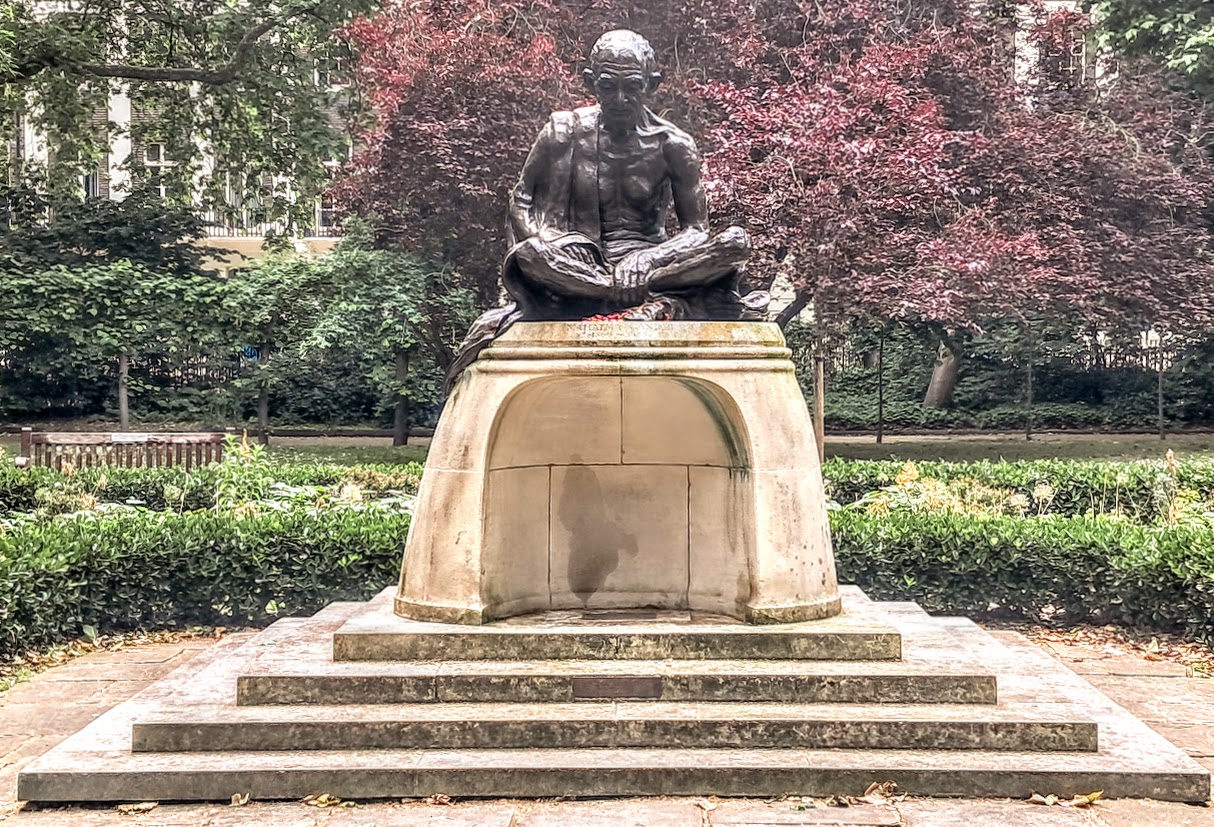
The centre-piece of the gardens in Tavistock Square is the sculpture of Mahatma Gandhi by Fredda Brilliant (Photograph: Patrick Comerford, 2025)
In contrast, three features have led to Tavistock Square being seen by many peace campaigners as a peace park or garden. These three memorials are the focus of annual ceremonies and I revisited all three twice within the past few weeks.
The centre-piece of the gardens in Tavistock Square is the sculpture of Mahatma Gandhi (1869-1948) by the Polish-born sculptor Fredda Brilliant (1903-1999). It was unveiled by the then Prime Minister Harold Wilson in May 1968. The hollow pedestal is used, as intended, by people leaving e floral tributes to the peace campaigner who led the nonviolent resistance to oppression in South Africa and colonial rule in India.
A cherry tree in memory of the victims of the atomic bombings of Hiroshima and Nagasaki in 1945 was planted in the gardens by the Mayor of Camden, Millie Miller, in 1967. That tree inspired my proposal for planting the Hiroshima Cherry Tree in Merrion Square, Dublin, by the Irish Campaign for Nuclear Disarmament (CND) 45 years ago, on 6 August 1980. The 80th anniversaries of those bombings are being commemorated next month on 6 and 9 August.
The cherry tree in Tavistock Square in memory of the victims of the Hiroshima and Nagasaki bombs in 1945 (Photograph: Patrick Comerford, 2025)
At the north gate of the square, the Conscientious Objectors’ Commemorative Stone by Hugh Court commemorates ‘all those who have established and are maintaining the right to refuse to kill’ and the ‘men and women conscientious objectors all over the world and in every age’.
The stone was first proposed in 1976 at the funeral of a conscientious objector, Joseph Brett, who had been imprisoned in 1916, and the erection of memorial was co-ordinated by the Peace Pledge Union (PPU). It is the work of Hugh Court of Architects for Peace and the sculptor Paul Wehrle and it was unveiled by the composer Sir Michael Tippett, President of the PPU and a former Conscientious Objector, on 15 May 1994, International Conscientious Objectors’ Day.
The focus of Tavistock Square on peace commemorations is enhanced by its proximity to Friends House on Euston Road, the main offices in London of Quakers who have facilitated and supported so many of peace and nonviolence campaigns.
Tavistock Square takes its name from the courtesy title Marquess of Tavistock, usually used by the eldest sons of the Dukes of Bedford. The square was laid out in 1806 by the property developer James Burton and the builder Thomas Cubitt for Francis Russell, 5th Duke of Bedford, and was part of the Bedford Estate. At the same time, Cubitt also developed Gordon Square nearby, so that the two squares form a pair among the many squares and gardens in Bloomsbury.
Tavistock House, once the home of James Burton and then of Charles Dickens, stood on the east side of the square. It was demolished in 1901, and BMA House, headquarters of the British Medical Association, was built originally for the Theosophical Society on the site and was designed by Sir Edwin Lutyens. The square gives its name to the Tavistock Clinic, founded in 1920 initially to treat shell-shock victims of World War I, although it has since moved to Swiss Cottage.
At the south-east corner of the square is a bust of the writer Virginia Woolf, cast from a sculpture by Stephen Tomlin and unveiled in 2004. She lived at 52 Tavistock Square in 1924-1939, when she and Leonard Woolf ran the Hogarth Press, publishing works by TS Eliot, EM Forster and Katherine Mansfield, as well as translations of Sigmund Freud.
Nearby, in Gordon Square, Shenda Armery’s bronze sculpture of the Indian poet Rabindranath Tagore was unveiled by Prince Charles (now King Charles) on 7 July 2011 to commemorate Tagore’s 150th birthday.
That date marked the anniversary of the 7/7 bombings, and in his speech Prince Charles referred to the 7/7 anniversary and hoped the sculpture would ‘shine out as a beacon of tolerance, understanding and of unity in diversity.’ He descried Tagore’s work as ‘very relevant for our time, particularly his understanding of a principle which is so dear to me, so much so that I have made it the title of a recently published book – Harmony.’
At that unveiling, Kalyan Kundu, founder and chair of the Tagore Centre UK, also referred to the 7/7 bombings and described ‘the unveiling of a statue of an apostle of peace’ as ‘a significant and timely reminder that a world of resentment and fear benefits no one and only brings with it pain.’
After the 7/7 bombings 20 years ago, 52 people who never came home; countless more are still living with the invisible echoes of that morning. May we hold their memory with care — and never take peace for granted.
At the end of the day, as we returned home from Southwark Cathedral last night, we were conscious that we were travelling on some of the lines and passing through some of the stations hit by the 7/7 bombers 20 years ago, and I remembered the words in the lesser litany and responses at Choral Evensong a few hours earlier:
Give peace in our time O Lord;
because there is none other that fighteth for us,
but only thou, O God.
And once again I prayed the second and third collects at Evensong, for Peace and for Aid against all Perils:
O God, from whom all holy desires, all good counsels, and all just works do proceed: Give unto thy servants that peace which the world cannot give; that both our hearts may be set to obey thy commandments, and also that by thee,, we being defended from the fear of our enemies may pass our time in rest and quietness; through the merits of Jesus Christ our Saviour. Amen.
Lighten our darkness, we beseech thee, O Lord; and by thy great mercy defend us from all perils and dangers of this night; for the love of thy only Son, our Saviour, Jesus Christ. Amen.
The Conscientious Objectors Commemorative Stone by Hugh Court and Paul Wehrle by the north gate in Tavistock Square (Photograph: Patrick Comerford, 2025)
Patrick Comerford
Today has marked to the 20th anniversary of the 7/7 bombing attacks in London, four suicide bombings on 7 July 2005, including three at tube stations and a fourth on a bus at Tavistock Square.
I thought of those bombings and the victims as we travelled into London yesterday for Choral Evensong in Southwark Cathedral. Two trains, one after another, were delayed for the best part of an an hour, while trains on other routes were cancelled. The delays were due to a lighting strike on a train further south along the line, we were told. But I thought back to 7 July 2005 and how initial reports that morning suggested the unfolding rail chaos in London had been caused by a power outage.
As we continued our journey yesterday through Euston Station yesterday and on the Underground, I thought – as I think so often in that part of London – of both the bus bombing in Tavistock Square on 7/7 and the gardens in that Bloomsbury square which I always associate with peace and nonviolence campaigns.
The 7/7 London bombings on 7 July 2005 were four co-ordinated suicide attacks that targeted morning rush-hour commuters on public transport. Three suicide bombers, who had travelled together from Luton, separately detonated three home-made bombs in quick succession on underground trains in Inner London; a fourth bomber who travelled with them later detonated another bomb on a bus in Tavistock Square.
The underground bombings were on the Circle Line near Aldgate and at Edgware Road, and on the Piccadilly Line between the Liverpool Street and Russell Square stattions and exploded within 50 seconds of each other. The bomb at Tavistock Square was detonated by 18-year-old Hasib Hussain on a No 30 double-decker bus. The bus had been diverted from its normal route along Euston Road because of traffic disruption caused by the other three bombings at tube stations, and exploded outside the offices of the British Medical Association.
As well as the four bombers, 52 people of 18 different nationalities were killed that fatal day 20 years ago, and almost 800 people were injured in the attacks. Seven of the victims were killed at Aldgate, six at Edgware Road, 26 at King’s Cross and Russell Square, and 13 at Tavistock Square. It was planned and co-ordinated to the finest deatil and it was the deadliest terrorist attack in the UK since the bombing of Pan Am Flight 103 over Lockerbie in 1988.
By the end of the day on 7 July 2005, Britain had changed. As Tanjil Rashid says in his column in the current edition of the New Statesman (4-10 July 2025), ‘it was the 7 July bombings, not 9/11, that put Muslims at the centre of terror discourse’ in the UK. ‘London’s multicultural innocence’ was lost, and, he writes, in the feverish aftermath Islamophobia soared.
The centre-piece of the gardens in Tavistock Square is the sculpture of Mahatma Gandhi by Fredda Brilliant (Photograph: Patrick Comerford, 2025)
In contrast, three features have led to Tavistock Square being seen by many peace campaigners as a peace park or garden. These three memorials are the focus of annual ceremonies and I revisited all three twice within the past few weeks.
The centre-piece of the gardens in Tavistock Square is the sculpture of Mahatma Gandhi (1869-1948) by the Polish-born sculptor Fredda Brilliant (1903-1999). It was unveiled by the then Prime Minister Harold Wilson in May 1968. The hollow pedestal is used, as intended, by people leaving e floral tributes to the peace campaigner who led the nonviolent resistance to oppression in South Africa and colonial rule in India.
A cherry tree in memory of the victims of the atomic bombings of Hiroshima and Nagasaki in 1945 was planted in the gardens by the Mayor of Camden, Millie Miller, in 1967. That tree inspired my proposal for planting the Hiroshima Cherry Tree in Merrion Square, Dublin, by the Irish Campaign for Nuclear Disarmament (CND) 45 years ago, on 6 August 1980. The 80th anniversaries of those bombings are being commemorated next month on 6 and 9 August.
The cherry tree in Tavistock Square in memory of the victims of the Hiroshima and Nagasaki bombs in 1945 (Photograph: Patrick Comerford, 2025)
At the north gate of the square, the Conscientious Objectors’ Commemorative Stone by Hugh Court commemorates ‘all those who have established and are maintaining the right to refuse to kill’ and the ‘men and women conscientious objectors all over the world and in every age’.
The stone was first proposed in 1976 at the funeral of a conscientious objector, Joseph Brett, who had been imprisoned in 1916, and the erection of memorial was co-ordinated by the Peace Pledge Union (PPU). It is the work of Hugh Court of Architects for Peace and the sculptor Paul Wehrle and it was unveiled by the composer Sir Michael Tippett, President of the PPU and a former Conscientious Objector, on 15 May 1994, International Conscientious Objectors’ Day.
The focus of Tavistock Square on peace commemorations is enhanced by its proximity to Friends House on Euston Road, the main offices in London of Quakers who have facilitated and supported so many of peace and nonviolence campaigns.
Tavistock Square takes its name from the courtesy title Marquess of Tavistock, usually used by the eldest sons of the Dukes of Bedford. The square was laid out in 1806 by the property developer James Burton and the builder Thomas Cubitt for Francis Russell, 5th Duke of Bedford, and was part of the Bedford Estate. At the same time, Cubitt also developed Gordon Square nearby, so that the two squares form a pair among the many squares and gardens in Bloomsbury.
Tavistock House, once the home of James Burton and then of Charles Dickens, stood on the east side of the square. It was demolished in 1901, and BMA House, headquarters of the British Medical Association, was built originally for the Theosophical Society on the site and was designed by Sir Edwin Lutyens. The square gives its name to the Tavistock Clinic, founded in 1920 initially to treat shell-shock victims of World War I, although it has since moved to Swiss Cottage.
At the south-east corner of the square is a bust of the writer Virginia Woolf, cast from a sculpture by Stephen Tomlin and unveiled in 2004. She lived at 52 Tavistock Square in 1924-1939, when she and Leonard Woolf ran the Hogarth Press, publishing works by TS Eliot, EM Forster and Katherine Mansfield, as well as translations of Sigmund Freud.
Nearby, in Gordon Square, Shenda Armery’s bronze sculpture of the Indian poet Rabindranath Tagore was unveiled by Prince Charles (now King Charles) on 7 July 2011 to commemorate Tagore’s 150th birthday.
That date marked the anniversary of the 7/7 bombings, and in his speech Prince Charles referred to the 7/7 anniversary and hoped the sculpture would ‘shine out as a beacon of tolerance, understanding and of unity in diversity.’ He descried Tagore’s work as ‘very relevant for our time, particularly his understanding of a principle which is so dear to me, so much so that I have made it the title of a recently published book – Harmony.’
At that unveiling, Kalyan Kundu, founder and chair of the Tagore Centre UK, also referred to the 7/7 bombings and described ‘the unveiling of a statue of an apostle of peace’ as ‘a significant and timely reminder that a world of resentment and fear benefits no one and only brings with it pain.’
After the 7/7 bombings 20 years ago, 52 people who never came home; countless more are still living with the invisible echoes of that morning. May we hold their memory with care — and never take peace for granted.
At the end of the day, as we returned home from Southwark Cathedral last night, we were conscious that we were travelling on some of the lines and passing through some of the stations hit by the 7/7 bombers 20 years ago, and I remembered the words in the lesser litany and responses at Choral Evensong a few hours earlier:
Give peace in our time O Lord;
because there is none other that fighteth for us,
but only thou, O God.
And once again I prayed the second and third collects at Evensong, for Peace and for Aid against all Perils:
O God, from whom all holy desires, all good counsels, and all just works do proceed: Give unto thy servants that peace which the world cannot give; that both our hearts may be set to obey thy commandments, and also that by thee,, we being defended from the fear of our enemies may pass our time in rest and quietness; through the merits of Jesus Christ our Saviour. Amen.
Lighten our darkness, we beseech thee, O Lord; and by thy great mercy defend us from all perils and dangers of this night; for the love of thy only Son, our Saviour, Jesus Christ. Amen.
The Conscientious Objectors Commemorative Stone by Hugh Court and Paul Wehrle by the north gate in Tavistock Square (Photograph: Patrick Comerford, 2025)
09 August 2024
Daily prayer in Ordinary Time 2024:
91, Friday 9 August 2024
‘Let them deny themselves and take up their cross and follow me’ (Matthew 16: 24) … the Byzantine-style crucifix by Laurence King (1907-1981) in the crypt of Saint Mary le Bow on Cheapside in London (Photograph: Patrick Comerford)
Patrick Comerford
We are continuing in Ordinary Time in the Church Calendar and the week began with the Tenth Sunday after Trinity (Trinity X). The Church Calendar today (9 August 2024) remembers the life and work of Mary Sumner (1921), founder of the Mothers’ Union. Today also marks the 79th anniversary of the atomic bombing of Nagasaki on 9 August 1945.
Before today begins, I am taking some quiet time this morning to give thanks, for reflection, prayer and reading in these ways:
1, today’s Gospel reading;
2, a reflection on the Gospel reading;
3, a prayer from the USPG prayer diary;
4, the Collects and Post-Communion prayer of the day.
‘Let them deny themselves and take up their cross and follow me’ (Matthew 16: 24) … Simon of Cyrene takes up the Cross, Station 5 in the Stations of the Cross in the chapel of Saint John’s Hospital, Lichfield (Photograph: Patrick Comerford)
Matthew 16: 24-28 (NRSVA):
24 Then Jesus told his disciples, ‘If any want to become my followers, let them deny themselves and take up their cross and follow me. 25 For those who want to save their life will lose it, and those who lose their life for my sake will find it. 26 For what will it profit them if they gain the whole world but forfeit their life? Or what will they give in return for their life?
27 ‘For the Son of Man is to come with his angels in the glory of his Father, and then he will repay everyone for what has been done. 28 Truly I tell you, there are some standing here who will not taste death before they see the Son of Man coming in his kingdom.’
‘For what will it profit them if they gain the whole world but forfeit their life?’ (Matthew 16: 26) … torn and ragged banknotes in a tin box outside an antiques shop in Rethymnon in Crete (Photograph: Patrick Comerford)
This morning’s reflection:
In this Gospel reading (Matthew 16: 24-28), Christ and the disciples are near the villages of Caesarea Philippi, in today’s Golan Heights. Christ has both commended Peter for his faith and warned him of the danger of being a stumbling block.
To their dismay, Christ now speaks openly about his imminent death and resurrection. He then describes true discipleship: first, a disciple must follow him and renounce self-centeredness (verse 23). Those who are prepared to give even their lives for his sake and for the sake of spreading the good news will find true life verse 24). But those who opt for material well-being deny their true selves and lose out (verse 26).
There is a cost to discipleship, but the challenge to take up the Cross and to follow Christ is open to all.
God in Christ has come to enfold humanity. The cross will not stop the proclamation of the Good News, nor will it keep salvation history from breaking into the cosmos.
So often, in the face of criticism, the Christian response is either to shut down or to retreat to a different understanding of God and Jesus. But Christ tells the people that if they want to follow him on the journey, there is a cost to discipleship.
We are challenged to take up our cross and follow Christ on that journey.
Christianity cannot be reduced to an individual mental or philosophical decision. It is a journey with Christ and with not only the disciples but with the crowd, the many, who are also invited to join that journey.
If Saint Peter knew what was ahead of him, perhaps he might have been even more vocal in rebuking Christ in yesterday’s Gospel reading. But the triumph comes not in getting what we want, not in engineering things so that God gives us what we desire and wish for, so that we get a Jesus who does the things we want him to do. The triumph comes in the Resurrection.
True discipleship and true prayer mean making God’s priorities my priorities: the poor, the sick, the imprisoned, the isolated, the marginalised, the victims, the unloved. If that is difficult, nobody said that being a Christian was going to be easy, that being a Christian would not cost anything.
As the German martyr and theologian Dietrich Bonhoeffer might have put it, being a disciple means having to pay the cost of discipleship. There is no cheap Christianity and there is no cheap grace.
Pope Francis puts it another way. Referring to discipleship and the traditional Lenten fast, he once asked, ‘Do you want to fast this Lent?’ And then, he answered:
Fast from hurting words and say kind words.
Fast from sadness and be filled with gratitude.
Fast from anger and be filled with patience.
Fast from pessimism and be filled with hope.
Fast from worries and have trust in God.
Fast from complaints; contemplate simplicity.
Fast from pressures and be prayerful.
Fast from bitterness; fill your hearts with joy.
Fast from selfishness and be compassionate.
Fast from grudges and be reconciled.
Fast from words; be silent and listen.
Dietrich Bonhoeffer distinguishes between cheap grace and costly grace, and reminds us of the ‘Cost of Discipleship’
Today’s Prayers (Friday 9 August 2024):
The theme this week in ‘Pray With the World Church,’ the Prayer Diary of the Anglican mission agency USPG (United Society Partners in the Gospel), is ‘Understanding each other by walking together’. This theme was introduced on Sunday with a programme update from the Right Revd Eduardo Coelho Grillo, Anglican Bishop of Rio de Janeiro.
The USPG Prayer Diary today (Friday 9 August 2024, International Day of the World’s Indigenous Peoples) invites us to pray:
Father God / Kthhe Mnedo (Great Spirit), we pray to you for freedom from unjust systems that exist and continue the oppression of Indigenous people around the world.
The Collect:
Faithful and loving God,
who called Mary Sumner to strive for the renewal of family life:
give us the gift of your Holy Spirit,
that through word, prayer and deed
your family may be strengthened and your people served;
through Jesus Christ your Son our Lord,
who is alive and reigns with you,
in the unity of the Holy Spirit,
one God, now and for ever.
The Post Communion Prayer:
Father,
from whom every family in heaven and on earth takes its name,
your servant Mary Sumner revealed your goodness
in a life of tranquillity and service:
grant that we who have gathered in faith around this table
may like her know the love of Christ that surpasses knowledge
and be filled with all your fullness;
through Jesus Christ our Lord.
Simon of Cyrene takes up the Cross and follows Christ … Station 5 in the Stations of the Cross in Saint Mel’s Cathedral, Longford (Photograph: Patrick Comerford)
Yesterday’s reflection
Continued tomorrow
Scripture quotations are from the New Revised Standard Version Bible: Anglicised Edition copyright © 1989, 1995, National Council of the Churches of Christ in the United States of America. Used by permission. All rights reserved worldwide. http://nrsvbibles.org
Patrick Comerford
We are continuing in Ordinary Time in the Church Calendar and the week began with the Tenth Sunday after Trinity (Trinity X). The Church Calendar today (9 August 2024) remembers the life and work of Mary Sumner (1921), founder of the Mothers’ Union. Today also marks the 79th anniversary of the atomic bombing of Nagasaki on 9 August 1945.
Before today begins, I am taking some quiet time this morning to give thanks, for reflection, prayer and reading in these ways:
1, today’s Gospel reading;
2, a reflection on the Gospel reading;
3, a prayer from the USPG prayer diary;
4, the Collects and Post-Communion prayer of the day.
‘Let them deny themselves and take up their cross and follow me’ (Matthew 16: 24) … Simon of Cyrene takes up the Cross, Station 5 in the Stations of the Cross in the chapel of Saint John’s Hospital, Lichfield (Photograph: Patrick Comerford)
Matthew 16: 24-28 (NRSVA):
24 Then Jesus told his disciples, ‘If any want to become my followers, let them deny themselves and take up their cross and follow me. 25 For those who want to save their life will lose it, and those who lose their life for my sake will find it. 26 For what will it profit them if they gain the whole world but forfeit their life? Or what will they give in return for their life?
27 ‘For the Son of Man is to come with his angels in the glory of his Father, and then he will repay everyone for what has been done. 28 Truly I tell you, there are some standing here who will not taste death before they see the Son of Man coming in his kingdom.’
‘For what will it profit them if they gain the whole world but forfeit their life?’ (Matthew 16: 26) … torn and ragged banknotes in a tin box outside an antiques shop in Rethymnon in Crete (Photograph: Patrick Comerford)
This morning’s reflection:
In this Gospel reading (Matthew 16: 24-28), Christ and the disciples are near the villages of Caesarea Philippi, in today’s Golan Heights. Christ has both commended Peter for his faith and warned him of the danger of being a stumbling block.
To their dismay, Christ now speaks openly about his imminent death and resurrection. He then describes true discipleship: first, a disciple must follow him and renounce self-centeredness (verse 23). Those who are prepared to give even their lives for his sake and for the sake of spreading the good news will find true life verse 24). But those who opt for material well-being deny their true selves and lose out (verse 26).
There is a cost to discipleship, but the challenge to take up the Cross and to follow Christ is open to all.
God in Christ has come to enfold humanity. The cross will not stop the proclamation of the Good News, nor will it keep salvation history from breaking into the cosmos.
So often, in the face of criticism, the Christian response is either to shut down or to retreat to a different understanding of God and Jesus. But Christ tells the people that if they want to follow him on the journey, there is a cost to discipleship.
We are challenged to take up our cross and follow Christ on that journey.
Christianity cannot be reduced to an individual mental or philosophical decision. It is a journey with Christ and with not only the disciples but with the crowd, the many, who are also invited to join that journey.
If Saint Peter knew what was ahead of him, perhaps he might have been even more vocal in rebuking Christ in yesterday’s Gospel reading. But the triumph comes not in getting what we want, not in engineering things so that God gives us what we desire and wish for, so that we get a Jesus who does the things we want him to do. The triumph comes in the Resurrection.
True discipleship and true prayer mean making God’s priorities my priorities: the poor, the sick, the imprisoned, the isolated, the marginalised, the victims, the unloved. If that is difficult, nobody said that being a Christian was going to be easy, that being a Christian would not cost anything.
As the German martyr and theologian Dietrich Bonhoeffer might have put it, being a disciple means having to pay the cost of discipleship. There is no cheap Christianity and there is no cheap grace.
Pope Francis puts it another way. Referring to discipleship and the traditional Lenten fast, he once asked, ‘Do you want to fast this Lent?’ And then, he answered:
Fast from hurting words and say kind words.
Fast from sadness and be filled with gratitude.
Fast from anger and be filled with patience.
Fast from pessimism and be filled with hope.
Fast from worries and have trust in God.
Fast from complaints; contemplate simplicity.
Fast from pressures and be prayerful.
Fast from bitterness; fill your hearts with joy.
Fast from selfishness and be compassionate.
Fast from grudges and be reconciled.
Fast from words; be silent and listen.
Dietrich Bonhoeffer distinguishes between cheap grace and costly grace, and reminds us of the ‘Cost of Discipleship’Today’s Prayers (Friday 9 August 2024):
The theme this week in ‘Pray With the World Church,’ the Prayer Diary of the Anglican mission agency USPG (United Society Partners in the Gospel), is ‘Understanding each other by walking together’. This theme was introduced on Sunday with a programme update from the Right Revd Eduardo Coelho Grillo, Anglican Bishop of Rio de Janeiro.
The USPG Prayer Diary today (Friday 9 August 2024, International Day of the World’s Indigenous Peoples) invites us to pray:
Father God / Kthhe Mnedo (Great Spirit), we pray to you for freedom from unjust systems that exist and continue the oppression of Indigenous people around the world.
The Collect:
Faithful and loving God,
who called Mary Sumner to strive for the renewal of family life:
give us the gift of your Holy Spirit,
that through word, prayer and deed
your family may be strengthened and your people served;
through Jesus Christ your Son our Lord,
who is alive and reigns with you,
in the unity of the Holy Spirit,
one God, now and for ever.
The Post Communion Prayer:
Father,
from whom every family in heaven and on earth takes its name,
your servant Mary Sumner revealed your goodness
in a life of tranquillity and service:
grant that we who have gathered in faith around this table
may like her know the love of Christ that surpasses knowledge
and be filled with all your fullness;
through Jesus Christ our Lord.
Simon of Cyrene takes up the Cross and follows Christ … Station 5 in the Stations of the Cross in Saint Mel’s Cathedral, Longford (Photograph: Patrick Comerford)
Yesterday’s reflection
Continued tomorrow
Scripture quotations are from the New Revised Standard Version Bible: Anglicised Edition copyright © 1989, 1995, National Council of the Churches of Christ in the United States of America. Used by permission. All rights reserved worldwide. http://nrsvbibles.org
09 August 2023
Daily prayers in Ordinary Time
with USPG: (73) 9 August 2023
The former Congregational Church on Aldergate, Tamworth … now Jalali Indian restaurant (Photograph: Patrick Comerford, 2023)
Patrick Comerford
We are in Ordinary Time in the Church Calendar, and this week began with the Ninth Sunday after Trinity (6 August 2023) and celebrations of the Feast of the Transfiguration. The calendar of the Church of England in Common Worship today recalls the life and work of Mary Sumner (1828-1921), founder of the Mothers’ Union (9 August). Today also marks the 78th anniversary of the atomic bombing of Nagasaki on 9 August 1945.
I am catching a flight from Birmingham to Dublin later this afternoon. But, before this day begins, I am taking some time this morning for prayer, reading and reflection.
As I recently spent a number of days looking at the windows in Saint Editha’s Church, Tamworth, I am reflecting in these ways for the rest of the week:
1, Looking at some other churches in Tamworth;
2, the Gospel reading of the day in the Church of England lectionary;
3, a prayer from the USPG prayer diary.
The former Congregational Church on the corner of Aldergate and Saint John Street, Tamworth, was built in 1827 (Photograph: Patrick Comerford, 2023)
It is said locally, with humour that Tamworth once had as many churches as it had pubs. The history of the Congregationalists, Unitarians and Baptists in Tamworth dates back to the presence of the Puritans in the early 17th century.
While the Revd Samuel Hodgkinson was the Vicar of Tamworth (1610-1629), the Revd Thomas Blake (ca 1597-1657) first arrived in Tamworth. Blake was a native of Staffordshire and graduated BA in Oxford in 1620. On Christmas Eve 1620, he was ordained priest by Thomas Morton, Bishop of Lichfield, at Eccleshall.
Bishop Morton was sympathetic to the Puritans in his diocese, and in 1627 he licensed Blake as preacher in Tamworth. In 1629, he succeeded Hodgkinson as the Vicar of Tamworth and master of the Grammar School.
As Vicar of Tamworth, Blake preached his brand of Presbyterian Puritanism with its dislike of bishops and catholic doctrines
However, William Comberford of Comberford Hall and the Moat House claimed the right of patronage in the parish, and between 1639 and 1642, he pursued legal actions to secure his claim to the patronage of Saint Editha’s and the college house. Comberford was unsuccessful in his action, and he and Blake then found themselves on opposite sides in the First English Civil War.
Blake was a strong supporter of Parliament and probably did not remain in Tamworth during the royalist occupation. His parish work was disrupted and it was in these years that he first earned a reputation for being controversial. His publications focussed on questions about infant baptism, and he debated publicly with other Puritans, including Presbyterians and Baptists, publishing pamphlets and sermons. One of the children he baptised was John Rawlett (1642-1686), later an Anglican cleric, preacher and writer with close sympathy with the Presbyterians.
Despite Comberford’s failure to eject him in 1642, Blake appears to have left the parish immediately after the case. There is a blank of two years in the Parish Registers during the Civil War from 1642 to 1644, for which Theophilus Lord wrote in 1644: ‘For some short time service there was not any.’
In 1643, Tamworth Castle was captured by a detachment of Parliamentarian forces under the regicide Colonel William Purefoy. William Comberford, who was High Sheriff of Staffordshire, escaped to Lichfield, and in his absence the Comberford home at the Moat House was ransacked by Cromwell’s forces, who mutilated the Comberford monument in Saint Editha’s Church, the Comberford Chapel was defaced, and sacked Comberford Hall.
However, Blake did not return to Tamworth, and in 1644 Cromwell’s Committee of Safety appointed Theophilus Lord as the Minister of Tamworth. Blake had moved from Tamworth to Shrewsbury, where he became a Puritan minister in 1645. A year later he was replaced as Vicar of Tamworth by Revd Ralph Hodges, who was appointed Vicar of Tamworth with Glascote and Hopwas in 1646. He was also appointed Rector of Birmingham, a position he held until the end of 1661.
Meanwhile, Blake was back in Tamworth by 1651, when he was writing and publishing Puritan tracts and pamphlets once again, and where he remained until his death. He was nominated by Cromwell to be an assistant to the commissioners of Staffordshire for ejecting ignorant and scandalous ministers and schoolmasters.
In later publications, Blake advocated a more open and inclusive approach to Baptism and the Lord’s Supper, This position brought him into conflict with one of the leading Puritans of the day, Richard Baxter, and the controversy continued until Blake’s death.
When Blake made his will in 1656, one of the witnesses was Thomas Fox, a Puritan and Parliamentarian officer who would soon move into the Moat House, the former Comberford family townhouse on Lichfield Street in Tamworth. When Blake died in 1657, he was buried in Saint Editha’s Church.
What happened to the Puritan circle around Blake and their successors in Tamworth after the civil war, the Restoration and the ejection of Puritan ministers?
Samuel Shaw, who gave the oration at Blake’s funeral, was ordained by the Wirksworth Classis or Presbyterian assembly in Derbyshire on 12 January 1658 and became the Schoolmaster or Puritan minister in Tamworth. He was one of the Puritan ministers who were ejected from their parishes at the Restoration and he later became master of the grammar school in Ashby-de-la-Zouch, Leicestershire.
Anthony Burgess, who preached at Blake’s funeral, had been the Vicar of Sutton Coldfield from 1635 until he was forced to take refuge in Coventry in 1642, and was replaced by the royalist Revd James Fleetwood. Burgess was a member of the Westminster Assembly in 1643, and returned to Sutton Coldfield. After the Great Ejection in 1662, he moved to Tamworth.
The parish of Tamworth remained vacant until 1662, when the Revd Samuel Langley was appointed Vicar of Tamworth.
The Puritans’ successors in Tamworth were the Presbyterians, who built their own meeting house. They had become Unitarians by 1690, and the former Presbyterian meeting house was replaced in 1724 by the Unitarian Chapel built on Colehill, now Victoria Road.
With its Georgian windows, the Unitarian Chapel is still a well-maintained building. But the Unitarians in Tamworth dwindled in numbers in the 20th century, and their chapel was later used by the Royal Naval Association.
A Congregational Church on the corner of Aldergate and Saint John Street was built in 1827. Some Congregationalists preferred to be called Independents.
A side extension was added to the church in 1925 to provide space for a Sunday school and for social activities. However, attendances had fallen to an all-time low by 1974. The church closed, the pulpit was moved to the neighbouring Methodist Church, and the former Congregational Church and the building was converted into the Victoria Shopping Arcade. Since 2002, it has been the Jalali Indian restaurant.
‘Congregational Chapel’ … the lettering remains above the entrance to Jalali Indian restaurant (Photograph: Patrick Comerford)
Matthew 15: 21-28 (NRSVA):
21 Jesus left that place and went away to the district of Tyre and Sidon. 22 Just then a Canaanite woman from that region came out and started shouting, ‘Have mercy on me, Lord, Son of David; my daughter is tormented by a demon.’ 23 But he did not answer her at all. And his disciples came and urged him, saying, ‘Send her away, for she keeps shouting after us.’ 24 He answered, ‘I was sent only to the lost sheep of the house of Israel.’ 25 But she came and knelt before him, saying, ‘Lord, help me.’ 26 He answered, ‘It is not fair to take the children’s food and throw it to the dogs.’ 27 She said, ‘Yes, Lord, yet even the dogs eat the crumbs that fall from their masters’ table.’ 28 Then Jesus answered her, ‘Woman, great is your faith! Let it be done for you as you wish.’ And her daughter was healed instantly.’
The Unitarian Chapel on Colehill, now Victoria Road, was built in 1724, but was rooted in the story of the 17th century Puritans (Photograph: Patrick Comerford)
Today’s Prayer:
The theme this week in ‘Pray With the World Church,’ the Prayer Diary of the Anglican mission agency USPG (United Society Partners in the Gospel), is ‘A reflection on the Exodus narrative (Exodus 1-13).’ This theme was introduced on Sunday by Archbishop Linda Nicholls, who has been the Primate of the Anglican Church of Canada since 2019.
The USPG Prayer Diary today (9 August 2023, International Day of the World’s Indigenous people) invites us to pray in these words:
Father, we come before You today to lift our indigenous brothers and sisters. Lord, they have faced many injustices throughout history, and we pray for Your healing power to touch their lives.
The Collect:
Faithful and loving God,
who called Mary Sumner to strive for the renewal of family life:
give us the gift of your Holy Spirit,
that through word, prayer and deed
your family may be strengthened and your people served;
through Jesus Christ your Son our Lord,
who is alive and reigns with you,
in the unity of the Holy Spirit,
one God, now and for ever.
The Post Communion Prayer:
Father,
from whom every family in heaven and on earth takes its name,
your servant Mary Sumner revealed your goodness
in a life of tranquillity and service:
grant that we who have gathered in faith around this table
may like her know the love of Christ that surpasses knowledge
and be filled with all your fullness;
through Jesus Christ our Lord.
The Moat House in Lichfield … at the centre of conflicts with the Puritans in 17th century Tamworth (Photograph: Patrick Comerford)
Yesterday’s reflection
Continued tomorrow
Scripture quotations are from the New Revised Standard Version Bible: Anglicised Edition copyright © 1989, 1995, National Council of the Churches of Christ in the United States of America. Used by permission. All rights reserved worldwide. http://nrsvbibles.org
Patrick Comerford
We are in Ordinary Time in the Church Calendar, and this week began with the Ninth Sunday after Trinity (6 August 2023) and celebrations of the Feast of the Transfiguration. The calendar of the Church of England in Common Worship today recalls the life and work of Mary Sumner (1828-1921), founder of the Mothers’ Union (9 August). Today also marks the 78th anniversary of the atomic bombing of Nagasaki on 9 August 1945.
I am catching a flight from Birmingham to Dublin later this afternoon. But, before this day begins, I am taking some time this morning for prayer, reading and reflection.
As I recently spent a number of days looking at the windows in Saint Editha’s Church, Tamworth, I am reflecting in these ways for the rest of the week:
1, Looking at some other churches in Tamworth;
2, the Gospel reading of the day in the Church of England lectionary;
3, a prayer from the USPG prayer diary.
The former Congregational Church on the corner of Aldergate and Saint John Street, Tamworth, was built in 1827 (Photograph: Patrick Comerford, 2023)
It is said locally, with humour that Tamworth once had as many churches as it had pubs. The history of the Congregationalists, Unitarians and Baptists in Tamworth dates back to the presence of the Puritans in the early 17th century.
While the Revd Samuel Hodgkinson was the Vicar of Tamworth (1610-1629), the Revd Thomas Blake (ca 1597-1657) first arrived in Tamworth. Blake was a native of Staffordshire and graduated BA in Oxford in 1620. On Christmas Eve 1620, he was ordained priest by Thomas Morton, Bishop of Lichfield, at Eccleshall.
Bishop Morton was sympathetic to the Puritans in his diocese, and in 1627 he licensed Blake as preacher in Tamworth. In 1629, he succeeded Hodgkinson as the Vicar of Tamworth and master of the Grammar School.
As Vicar of Tamworth, Blake preached his brand of Presbyterian Puritanism with its dislike of bishops and catholic doctrines
However, William Comberford of Comberford Hall and the Moat House claimed the right of patronage in the parish, and between 1639 and 1642, he pursued legal actions to secure his claim to the patronage of Saint Editha’s and the college house. Comberford was unsuccessful in his action, and he and Blake then found themselves on opposite sides in the First English Civil War.
Blake was a strong supporter of Parliament and probably did not remain in Tamworth during the royalist occupation. His parish work was disrupted and it was in these years that he first earned a reputation for being controversial. His publications focussed on questions about infant baptism, and he debated publicly with other Puritans, including Presbyterians and Baptists, publishing pamphlets and sermons. One of the children he baptised was John Rawlett (1642-1686), later an Anglican cleric, preacher and writer with close sympathy with the Presbyterians.
Despite Comberford’s failure to eject him in 1642, Blake appears to have left the parish immediately after the case. There is a blank of two years in the Parish Registers during the Civil War from 1642 to 1644, for which Theophilus Lord wrote in 1644: ‘For some short time service there was not any.’
In 1643, Tamworth Castle was captured by a detachment of Parliamentarian forces under the regicide Colonel William Purefoy. William Comberford, who was High Sheriff of Staffordshire, escaped to Lichfield, and in his absence the Comberford home at the Moat House was ransacked by Cromwell’s forces, who mutilated the Comberford monument in Saint Editha’s Church, the Comberford Chapel was defaced, and sacked Comberford Hall.
However, Blake did not return to Tamworth, and in 1644 Cromwell’s Committee of Safety appointed Theophilus Lord as the Minister of Tamworth. Blake had moved from Tamworth to Shrewsbury, where he became a Puritan minister in 1645. A year later he was replaced as Vicar of Tamworth by Revd Ralph Hodges, who was appointed Vicar of Tamworth with Glascote and Hopwas in 1646. He was also appointed Rector of Birmingham, a position he held until the end of 1661.
Meanwhile, Blake was back in Tamworth by 1651, when he was writing and publishing Puritan tracts and pamphlets once again, and where he remained until his death. He was nominated by Cromwell to be an assistant to the commissioners of Staffordshire for ejecting ignorant and scandalous ministers and schoolmasters.
In later publications, Blake advocated a more open and inclusive approach to Baptism and the Lord’s Supper, This position brought him into conflict with one of the leading Puritans of the day, Richard Baxter, and the controversy continued until Blake’s death.
When Blake made his will in 1656, one of the witnesses was Thomas Fox, a Puritan and Parliamentarian officer who would soon move into the Moat House, the former Comberford family townhouse on Lichfield Street in Tamworth. When Blake died in 1657, he was buried in Saint Editha’s Church.
What happened to the Puritan circle around Blake and their successors in Tamworth after the civil war, the Restoration and the ejection of Puritan ministers?
Samuel Shaw, who gave the oration at Blake’s funeral, was ordained by the Wirksworth Classis or Presbyterian assembly in Derbyshire on 12 January 1658 and became the Schoolmaster or Puritan minister in Tamworth. He was one of the Puritan ministers who were ejected from their parishes at the Restoration and he later became master of the grammar school in Ashby-de-la-Zouch, Leicestershire.
Anthony Burgess, who preached at Blake’s funeral, had been the Vicar of Sutton Coldfield from 1635 until he was forced to take refuge in Coventry in 1642, and was replaced by the royalist Revd James Fleetwood. Burgess was a member of the Westminster Assembly in 1643, and returned to Sutton Coldfield. After the Great Ejection in 1662, he moved to Tamworth.
The parish of Tamworth remained vacant until 1662, when the Revd Samuel Langley was appointed Vicar of Tamworth.
The Puritans’ successors in Tamworth were the Presbyterians, who built their own meeting house. They had become Unitarians by 1690, and the former Presbyterian meeting house was replaced in 1724 by the Unitarian Chapel built on Colehill, now Victoria Road.
With its Georgian windows, the Unitarian Chapel is still a well-maintained building. But the Unitarians in Tamworth dwindled in numbers in the 20th century, and their chapel was later used by the Royal Naval Association.
A Congregational Church on the corner of Aldergate and Saint John Street was built in 1827. Some Congregationalists preferred to be called Independents.
A side extension was added to the church in 1925 to provide space for a Sunday school and for social activities. However, attendances had fallen to an all-time low by 1974. The church closed, the pulpit was moved to the neighbouring Methodist Church, and the former Congregational Church and the building was converted into the Victoria Shopping Arcade. Since 2002, it has been the Jalali Indian restaurant.
‘Congregational Chapel’ … the lettering remains above the entrance to Jalali Indian restaurant (Photograph: Patrick Comerford)
Matthew 15: 21-28 (NRSVA):
21 Jesus left that place and went away to the district of Tyre and Sidon. 22 Just then a Canaanite woman from that region came out and started shouting, ‘Have mercy on me, Lord, Son of David; my daughter is tormented by a demon.’ 23 But he did not answer her at all. And his disciples came and urged him, saying, ‘Send her away, for she keeps shouting after us.’ 24 He answered, ‘I was sent only to the lost sheep of the house of Israel.’ 25 But she came and knelt before him, saying, ‘Lord, help me.’ 26 He answered, ‘It is not fair to take the children’s food and throw it to the dogs.’ 27 She said, ‘Yes, Lord, yet even the dogs eat the crumbs that fall from their masters’ table.’ 28 Then Jesus answered her, ‘Woman, great is your faith! Let it be done for you as you wish.’ And her daughter was healed instantly.’
The Unitarian Chapel on Colehill, now Victoria Road, was built in 1724, but was rooted in the story of the 17th century Puritans (Photograph: Patrick Comerford)
Today’s Prayer:
The theme this week in ‘Pray With the World Church,’ the Prayer Diary of the Anglican mission agency USPG (United Society Partners in the Gospel), is ‘A reflection on the Exodus narrative (Exodus 1-13).’ This theme was introduced on Sunday by Archbishop Linda Nicholls, who has been the Primate of the Anglican Church of Canada since 2019.
The USPG Prayer Diary today (9 August 2023, International Day of the World’s Indigenous people) invites us to pray in these words:
Father, we come before You today to lift our indigenous brothers and sisters. Lord, they have faced many injustices throughout history, and we pray for Your healing power to touch their lives.
The Collect:
Faithful and loving God,
who called Mary Sumner to strive for the renewal of family life:
give us the gift of your Holy Spirit,
that through word, prayer and deed
your family may be strengthened and your people served;
through Jesus Christ your Son our Lord,
who is alive and reigns with you,
in the unity of the Holy Spirit,
one God, now and for ever.
The Post Communion Prayer:
Father,
from whom every family in heaven and on earth takes its name,
your servant Mary Sumner revealed your goodness
in a life of tranquillity and service:
grant that we who have gathered in faith around this table
may like her know the love of Christ that surpasses knowledge
and be filled with all your fullness;
through Jesus Christ our Lord.
The Moat House in Lichfield … at the centre of conflicts with the Puritans in 17th century Tamworth (Photograph: Patrick Comerford)
Yesterday’s reflection
Continued tomorrow
Scripture quotations are from the New Revised Standard Version Bible: Anglicised Edition copyright © 1989, 1995, National Council of the Churches of Christ in the United States of America. Used by permission. All rights reserved worldwide. http://nrsvbibles.org
06 February 2023
Praying in Ordinary Time
with USPG: 6 February 2023
The cross from the rubble of Urakami Cathedral was returned to Nagasaki in 2019 (Photograph: Randy Sarvis / Wilmington College)
Patrick Comerford
Before today becomes a busy day I am taking some time for prayer and reflection early this morning.
These weeks, between the end of Epiphany and Ash Wednesday, are known as Ordinary Time. We are in a time of preparation for Lent, which in turn is a preparation for Holy Week and Easter.
In these days of Ordinary Time before Ash Wednesday later this month (22 February), I am reflecting in these ways each morning:
1, reflecting on a saint or interesting person in the life of the Church;
2, one of the lectionary readings of the day;
3, a prayer from the USPG prayer diary, ‘Pray with the World Church.’
Christ crucified on the Mushroom Cloud … an icon of Our Lady of Mount Carmel by Kristin McCarthy
The calendar of the Church of England in Common Worship today remembers the Martyrs of Japan (1597) with a commemoration.
Almost 50 years after Francis Xavier had arrived in Japan as its first Christian apostle, the presence of several thousand baptised Christians in Japan became a subject of suspicion to the ruler Hideyoshi. In a period of persecution, 26 men and women, religious and lay, were first mutilated then crucified near Nagasaki in 1597, the most famous of whom was Paul Miki.
After their martyrdom, their blooded clothes were kept and held in reverence by their fellow Christians. The period of persecution continued for another 35 years, many new witness-martyrs being added to their number.
The place of Nagasaki in the history of Christianity in Japan adds additional poignancy to the story of the atomic bombing of Nagasaki on 9 August 1945.
The Japanese city of Kokura was the initial target for the crew members of the B-29 bomber Bockscar. But low visibility that day forced them to abandon their mission. They were flying low, scanning for an opening in the clouds, when they found a clear patch of sky unexpectedly.
Below them lay the city of Nagasaki and the massive Mitsubishi arms factory. They decided they had found the target for the world’s most powerful weapon, a 4.5-ton plutonium bomb nick-named ‘Fat Man’ – the Hiroshima bomb was known as ‘Little Boy.’
The bomb that day killed tens of thousands of people and wiped out the city in an instant. Just 500 metres from ground zero was Urakami Cathedral, or the Cathedral of the Immaculate Conception.
This cathedral had been at the heart of a vibrant Catholic community that dates back to Nagasaki’s early days as a trading port and the arrival of Saint Francis Xavier and other Christian missionaries in the 16th century. For centuries, generations of Christians in Nagasaki had been tortured, banished, and executed and forced to practice their faith in secrecy until the ban on Christianity was lifted in 1873.
The Cathedral of the Immaculate Conception was built between 1895 and 1925. The bomb on 9 August 1945 fell on Nagasaki just 20 years after Urakami Cathedral had been completed. The priest and several parishioners who were inside at the time were destroyed along with much of the church’s memories and history.
The cathedral has since been rebuilt and in recent years a small piece of that history was returned to the cathedral: a cross, mostly forgotten, had been taken from the rubble and Walter Hooke, a former US Marine.
Hooke gave the cross to Wilmington College, a Quaker-run liberal arts college in rural south-west Ohio, where the Peace Resource Centre houses reference materials related to the atomic bombings of Hiroshima and Nagasaki. The centre was set up in 1975 by the late Barbara Reynolds, an American Quaker and anti-nuclear activist who died in 1990.
How did Hooke come across the cross? He had been stationed in Nagasaki after the bombing. Hooke was a devout Catholic and arrived in Nagasaki in October 1945. He developed a friendship with Aijiro Yamaguchi, then the Bishop of Nagasaki. Hooke’s son told the Asahi Shimbun, a leading Japanese newspaper, that the Bishop gave Hooke the cross, perhaps in the hope that it might change Americans’ perceptions of the bomb.
‘One of the things that always really bothered my father was that a Christian country bombed a cathedral that was a centre of Christianity in Asia,’ Christopher Hooke said at his home in Yonkers, New York. ‘There was absolutely no strategic value in the bombing of Nagasaki. I think that was the point.’
Hooke died in 2010 at the age of 97, and the cross remained in Wilmington for decades. But on 6 August 2019, on the 74th anniversary of the Hiroshima bombing, Tanya Maus, director of the Peace Resource Centre at Wilmington College, gave the cross to the Archbishop of Nagasaki.
Archbishop Mitsuaki Takami was exposed to radiation in the womb while his mother was pregnant in Nagasaki.
Dr Maus decided to return the cross after she read a report in the Asahi Shimbun that the Nagasaki Peace Association had been trying to locate the cross for 30 years.
Dr Maus contacted Church officials in Nagasaki in April. ‘I started to think about the idea of ‘should it really be here?’ Maybe it needs to be in Nagasaki, where people can sort of explore that history more and the meaning of the cross more.’
‘For me the cross represents human depravity. The utter stripping away of values, in this case Christian values, but it could be any values, that keep human beings from killing each other and destroying each other,’ she was quoted as saying in the Bulletin of the Atomic Scientists. ‘Part of giving it back was letting go of that and making it accessible to people who want to find their own meaning in it.’
‘Atomic bomb victims will die, but the cross will remain as a living witness to what happened in Nagasaki,’ Archbishop Mitsuaki Takami of Nagasaki said when he received from the cross from Dr Maus on Wednesday.
‘The cross is an embodiment of the brutality of war,’ Dr Maus said. ‘The cross is a cry to the US government and governments of other countries that possess nuclear weapons to stop the use of nuclear weapons,’ she said after handing over the cross to Archbishop Takami in Urakami Cathedral.
Dr Maus said the cross will be displayed alongside the head of a wooden sculpture of the Virgin Mary known as the ‘Bombed Mary,’ whose glass eyes were melted by the atomic bomb.
Archbishop Mitsuaki Takami of Nagasaki (centre) receives the cross that survived the atomic bombing of Nagasaki from Tanya Maus (right) of Wilmington College, Ohio, at Urakami Cathedral, with Chitose Fujita, a member of the cathedral congregation (Photograph: Masaru Komiyaji / Asahi Shimbun)
Mark 6: 53-56 (NRSVA):
53 When they had crossed over, they came to land at Gennesaret and moored the boat. 54 When they got out of the boat, people at once recognized him 55 and rushed about that whole region and began to bring the sick on mats to wherever they heard he was. 56 And wherever he went, into villages or cities or farms, they laid the sick in the marketplaces and begged him that they might touch even the fringe of his cloak, and all who touched it were healed.
Saint Francis Xavier among the Jesuit saints … a fresco in the former Jesuit church in the Crescent, Limerick (Photograph: Patrick Comerford)
USPG Prayer Diary:
The theme in the USPG Prayer Diary this week is ‘Christianity in Pakistan.’ This theme was introduced yesterday by Nathan Olsen.
The USPG Prayer Diary today invites us to pray in these words:
Let us pray for the bishops of Pakistan. May their faith sustain and encourage one another in difficult times and be an inspiration to their church communities.
Yesterday’s Reflection
Continued Tomorrow
A sermon for Nagasaki Day, 9 August 2020, shared by USPG
Scripture quotations are from the New Revised Standard Version Bible: Anglicised Edition copyright © 1989, 1995, National Council of the Churches of Christ in the United States of America. Used by permission. All rights reserved worldwide. http://nrsvbibles.org
Patrick Comerford
Before today becomes a busy day I am taking some time for prayer and reflection early this morning.
These weeks, between the end of Epiphany and Ash Wednesday, are known as Ordinary Time. We are in a time of preparation for Lent, which in turn is a preparation for Holy Week and Easter.
In these days of Ordinary Time before Ash Wednesday later this month (22 February), I am reflecting in these ways each morning:
1, reflecting on a saint or interesting person in the life of the Church;
2, one of the lectionary readings of the day;
3, a prayer from the USPG prayer diary, ‘Pray with the World Church.’
Christ crucified on the Mushroom Cloud … an icon of Our Lady of Mount Carmel by Kristin McCarthy
The calendar of the Church of England in Common Worship today remembers the Martyrs of Japan (1597) with a commemoration.
Almost 50 years after Francis Xavier had arrived in Japan as its first Christian apostle, the presence of several thousand baptised Christians in Japan became a subject of suspicion to the ruler Hideyoshi. In a period of persecution, 26 men and women, religious and lay, were first mutilated then crucified near Nagasaki in 1597, the most famous of whom was Paul Miki.
After their martyrdom, their blooded clothes were kept and held in reverence by their fellow Christians. The period of persecution continued for another 35 years, many new witness-martyrs being added to their number.
The place of Nagasaki in the history of Christianity in Japan adds additional poignancy to the story of the atomic bombing of Nagasaki on 9 August 1945.
The Japanese city of Kokura was the initial target for the crew members of the B-29 bomber Bockscar. But low visibility that day forced them to abandon their mission. They were flying low, scanning for an opening in the clouds, when they found a clear patch of sky unexpectedly.
Below them lay the city of Nagasaki and the massive Mitsubishi arms factory. They decided they had found the target for the world’s most powerful weapon, a 4.5-ton plutonium bomb nick-named ‘Fat Man’ – the Hiroshima bomb was known as ‘Little Boy.’
The bomb that day killed tens of thousands of people and wiped out the city in an instant. Just 500 metres from ground zero was Urakami Cathedral, or the Cathedral of the Immaculate Conception.
This cathedral had been at the heart of a vibrant Catholic community that dates back to Nagasaki’s early days as a trading port and the arrival of Saint Francis Xavier and other Christian missionaries in the 16th century. For centuries, generations of Christians in Nagasaki had been tortured, banished, and executed and forced to practice their faith in secrecy until the ban on Christianity was lifted in 1873.
The Cathedral of the Immaculate Conception was built between 1895 and 1925. The bomb on 9 August 1945 fell on Nagasaki just 20 years after Urakami Cathedral had been completed. The priest and several parishioners who were inside at the time were destroyed along with much of the church’s memories and history.
The cathedral has since been rebuilt and in recent years a small piece of that history was returned to the cathedral: a cross, mostly forgotten, had been taken from the rubble and Walter Hooke, a former US Marine.
Hooke gave the cross to Wilmington College, a Quaker-run liberal arts college in rural south-west Ohio, where the Peace Resource Centre houses reference materials related to the atomic bombings of Hiroshima and Nagasaki. The centre was set up in 1975 by the late Barbara Reynolds, an American Quaker and anti-nuclear activist who died in 1990.
How did Hooke come across the cross? He had been stationed in Nagasaki after the bombing. Hooke was a devout Catholic and arrived in Nagasaki in October 1945. He developed a friendship with Aijiro Yamaguchi, then the Bishop of Nagasaki. Hooke’s son told the Asahi Shimbun, a leading Japanese newspaper, that the Bishop gave Hooke the cross, perhaps in the hope that it might change Americans’ perceptions of the bomb.
‘One of the things that always really bothered my father was that a Christian country bombed a cathedral that was a centre of Christianity in Asia,’ Christopher Hooke said at his home in Yonkers, New York. ‘There was absolutely no strategic value in the bombing of Nagasaki. I think that was the point.’
Hooke died in 2010 at the age of 97, and the cross remained in Wilmington for decades. But on 6 August 2019, on the 74th anniversary of the Hiroshima bombing, Tanya Maus, director of the Peace Resource Centre at Wilmington College, gave the cross to the Archbishop of Nagasaki.
Archbishop Mitsuaki Takami was exposed to radiation in the womb while his mother was pregnant in Nagasaki.
Dr Maus decided to return the cross after she read a report in the Asahi Shimbun that the Nagasaki Peace Association had been trying to locate the cross for 30 years.
Dr Maus contacted Church officials in Nagasaki in April. ‘I started to think about the idea of ‘should it really be here?’ Maybe it needs to be in Nagasaki, where people can sort of explore that history more and the meaning of the cross more.’
‘For me the cross represents human depravity. The utter stripping away of values, in this case Christian values, but it could be any values, that keep human beings from killing each other and destroying each other,’ she was quoted as saying in the Bulletin of the Atomic Scientists. ‘Part of giving it back was letting go of that and making it accessible to people who want to find their own meaning in it.’
‘Atomic bomb victims will die, but the cross will remain as a living witness to what happened in Nagasaki,’ Archbishop Mitsuaki Takami of Nagasaki said when he received from the cross from Dr Maus on Wednesday.
‘The cross is an embodiment of the brutality of war,’ Dr Maus said. ‘The cross is a cry to the US government and governments of other countries that possess nuclear weapons to stop the use of nuclear weapons,’ she said after handing over the cross to Archbishop Takami in Urakami Cathedral.
Dr Maus said the cross will be displayed alongside the head of a wooden sculpture of the Virgin Mary known as the ‘Bombed Mary,’ whose glass eyes were melted by the atomic bomb.
Archbishop Mitsuaki Takami of Nagasaki (centre) receives the cross that survived the atomic bombing of Nagasaki from Tanya Maus (right) of Wilmington College, Ohio, at Urakami Cathedral, with Chitose Fujita, a member of the cathedral congregation (Photograph: Masaru Komiyaji / Asahi Shimbun)
Mark 6: 53-56 (NRSVA):
53 When they had crossed over, they came to land at Gennesaret and moored the boat. 54 When they got out of the boat, people at once recognized him 55 and rushed about that whole region and began to bring the sick on mats to wherever they heard he was. 56 And wherever he went, into villages or cities or farms, they laid the sick in the marketplaces and begged him that they might touch even the fringe of his cloak, and all who touched it were healed.
Saint Francis Xavier among the Jesuit saints … a fresco in the former Jesuit church in the Crescent, Limerick (Photograph: Patrick Comerford)
USPG Prayer Diary:
The theme in the USPG Prayer Diary this week is ‘Christianity in Pakistan.’ This theme was introduced yesterday by Nathan Olsen.
The USPG Prayer Diary today invites us to pray in these words:
Let us pray for the bishops of Pakistan. May their faith sustain and encourage one another in difficult times and be an inspiration to their church communities.
Yesterday’s Reflection
Continued Tomorrow
A sermon for Nagasaki Day, 9 August 2020, shared by USPG
Scripture quotations are from the New Revised Standard Version Bible: Anglicised Edition copyright © 1989, 1995, National Council of the Churches of Christ in the United States of America. Used by permission. All rights reserved worldwide. http://nrsvbibles.org
Subscribe to:
Posts (Atom)